
CBSE Class 12 2024 Accountancy Set 3 (Code: 67/4/3) Question Paper Pdf - Check Solutions with Answer Key Pdf

.jpg?tr=h-55,w-55,c-force)
Content Strategist|Tech-innovator|National Hackathon Winner | Updated On - Jan 29, 2025
CBSE Class 12 2024 Accountancy Question Paper with Answer Key PDF for Set 3 (Q.P. Code: 67/4/3) is available for download. The exam was successfully conducted by CBSE on March 23, 2024, in the morning session from 10:30 AM to 1:30 PM. As per the students’ initial reactions, the CBSE Class 12 2024 Accountancy Set 3 Question Paper was reported as Moderately Challenging. Section A was considered Easy to Moderate, Section B was of Moderate difficulty, while Section C was reported as Difficult by most students.
CBSE Class 12 2024 Accountancy (Set 3- 67/4/3) 2024 Answer Key With Solution
Candidates can download the CBSE Class 12 Accountancy Question Paper with Solution and Answer Key PDFs for Set 3 Question Paper (Code: 67/4/3) using the link below.
| CBSE Class 12 Accountancy (Set 3- 67/4/3) 2024 Question Paper with Answer Key |  Download Download |
Check Solution |
CBSE Class 12 2024 Accountancy Question Paper with Solutions
PART A
(Accounting for Partnership Firms and Companies)
Question 1(a):
Arnav Ltd. purchased assets worth ₹24,00,000. It issued 9% debentures of ₹100 each at a discount of 4% for payment of the purchase consideration. The number of debentures issued to the vendor were:
Correct Answer: (B) 25,000
View Solution
Step 1: Calculate the issue price of each debenture. Issue Price = ₹100 - (4% of ₹100) = ₹100 - ₹4 = ₹96
Step 2: Calculate the number of debentures issued. Number of Debentures = Purchase Consideration / Issue Price = ₹24,00,000 / ₹96 = 25,000
Conclusion: 25,000 debentures were issued to the vendor.
Question 1(b):
On 1st May, 2023, Amrit Ltd. issued 10,000, 10% debentures of ₹100 each at a premium of 10% redeemable at a premium of 10%. Loss on issue of debentures will be:
Correct Answer: (C) ₹1,00,000
View Solution
Step 1: Calculate the issue price per debenture. Issue Price = ₹100 + 10% of ₹100 = ₹100 + ₹10 = ₹110
Step 2: Calculate the redemption value per debenture. Redemption Value = ₹100 + 10% of ₹100 = ₹100 + ₹10 = ₹110
Step 3: Calculate the loss on issue of debentures. Loss on Issue = Number of Debentures * Premium on Redemption = 10,000 * ₹10 = ₹1,00,000
Conclusion: The total loss on issue of debentures is ₹1,00,000.
Question 2:
Gupta and Sharma are partners in a firm sharing profit in the ratio of 4:1. They admitted Preeti as a new partner for 1/4th share in the profits, which she acquired wholly from Gupta. New profit sharing ratio of Gupta, Sharma, and Preeti will be:
Correct Answer: (B) 11:4:5
View Solution
Step 1: Calculate Gupta's new share. Gupta's New Share = 4/5 - 1/4 = 16/20 - 5/20 = 11/20
Step 2: Sharma's share remains the same. Sharma's Share = 1/5 = 4/20
Step 3: Preeti's share. Preeti's Share = 1/4 = 5/20
Step 4: New profit-sharing ratio. New profit-sharing ratio of Gupta, Sharma and Preeti is 11/20 : 4/20 : 5/20 or 11:4:5.
Question 3:
On the disSolutions of a partnership firm there were debtors of ₹34,000. Debtors of ₹1,000 became bad and 60% was realized from the remaining debtors. Which account will be debited and by how much amount on the realization from debtors?
Correct Answer: (C) Cash A/c by ₹19,800
View Solution
Step 1: Calculate the remaining debtors after bad debts. Remaining Debtors = Total Debtors - Bad Debts = ₹34,000 - ₹1,000 = ₹33,000
Step 2: Calculate the amount realized from the remaining debtors. Amount Realized = 60% of ₹33,000 = 0.60 * ₹33,000 = ₹19,800
Conclusion: The Cash Account will be debited by ₹19,800.
Question 4:
If vendors are issued fully paid shares of ₹1,25,000 in purchase consideration of net assets of ₹1,50,000, the balance of ₹25,000 will be credited to:
Correct Answer: (C) Capital Reserve Account
View Solution
Step 1: Identify the surplus. Surplus = Net Assets - Purchase Consideration = ₹1,50,000 - ₹1,25,000 = ₹25,000
Step 2: Determine the appropriate account. The surplus of ₹25,000 is credited to the Capital Reserve Account.
Question 5(a):
Riya, Rita, and Renu were partners in a firm. On 31st March, 2023, Renu retired. The amount payable to Renu ₹2,17,000 was transferred to her loan account. Renu agreed to receive interest on this amount as per the provisions of the Partnership Act, 1932. The rate at which interest would be paid to Renu is:
Correct Answer: (B) 6% p.a.
View Solution
As per Section 37 of the Indian Partnership Act, 1932, the interest on the amount due to a retiring partner is 6% per annum unless otherwise agreed upon by the partners.
Question 5(b):
Ravi, Vani, and Toni were equal partners in a firm. After the retirement of Vani, the capital balances of Ravi and Toni were ₹1,56,000 and ₹1,08,000 respectively. The new capital of the firm was determined at ₹2,80,000. It was decided that the capital will be in proportion to the profit-sharing ratio of the remaining partners. Toni will bring ...... for deficiency of his new capital.
Correct Answer: (D) ₹32,000
View Solution
Step 1: Determine the new profit-sharing ratio. Ravi and Toni were equal partners, so their new profit-sharing ratio is 1:1.
Step 2: Calculate the required capital for each partner. Total new capital after Vani’s retirement is ₹2,80,000. Ravi's Share = 1/2 * ₹2,80,000 = ₹1,40,000. Toni's Share = 1/2 * ₹2,80,000 = ₹1,40,000.
Step 3: Calculate Toni's deficiency. Toni's existing capital is ₹1,08,000. Deficiency = Required Capital - Existing Capital = ₹1,40,000 - ₹1,08,000 = ₹32,000.
Conclusion: Toni will bring ₹32,000 to meet the deficiency in his capital.
Question 6:
As per the provisions of Companies Act, 2013 Securities Premium cannot be utilized for:
Correct Answer: (B) Issue of partly paid bonus shares
View Solution
According to Section 52 of the Companies Act, 2013, Securities Premium can be used for: issuing fully paid bonus shares, writing off preliminary expenses, writing off discount on issue of debentures, and buyback of shares. It cannot be utilized for issuing partly paid bonus shares.
Question 7(a):
Vishant Ltd. invited applications for issuing 6,000 equity shares of ₹10 each at 10% premium. The issue was fully subscribed. The amount per share was payable as follows: On application- ₹3, on allotment- ₹3 (including premium), on first call- ₹3, and on final call- ₹2. Ashish, the holder of 200 shares paid the entire money along with allotment. The total amount received on allotment was:
Correct Answer: (B) ₹19,000
View Solution
Step 1: Calculate the allotment money due. Allotment Money Due = 6,000 * ₹3 = ₹18,000
Step 2: Calculate the advance paid by Ashish. Advance Paid by Ashish = 200 * (₹3+₹3+₹2) = ₹1,600
Step 3: Calculate total amount received on allotment. Total Amount Received = ₹18,000 + ₹1,000 = ₹19,000
Question 7(b):
M Ltd. forfeited 5,000 equity shares of ₹10 each issued at a premium of 10% for non-payment of final call of ₹2 per share. The minimum amount at which these shares can be reissued as fully paid up will be:
Correct Answer: (B) ₹10,000
View Solution
Step 1: Calculate the unpaid amount on forfeited shares. Unpaid Amount = 5,000 * ₹2 = ₹10,000
Step 2: Minimum reissue price. The minimum reissue price must cover the unpaid amount i.e ₹10,000.
Question 8(a):
Which one of the following items is not dealt through Profit and Loss Appropriation Account?
Correct Answer: (C) Rent paid to partners
View Solution
The Profit and Loss Appropriation Account records items related to the appropriation of profits among partners. These include: interest on capital, interest on drawings, partner's salary, and partner's commission. Rent paid to partners is treated as an expense and recorded in the Profit and Loss Account.
Question 8(b):
At the time of admission of a partner, the Balance Sheet of the firm showed a workmen compensation reserve of ₹80,000. The claim for workmen compensation was estimated at ₹1,00,000. The shortfall of ₹20,000 will be:
Correct Answer: (A) Debited to Revaluation Account
View Solution
Step 1: Identify the shortfall. Shortfall = Claim - Reserve = ₹1,00,000 - ₹80,000 = ₹20,000.
Step 2: Determine the appropriate account. The shortfall of ₹20,000 is debited to the Revaluation Account.
Question 9:
Vishnu and Mishu are partners in a firm. Mishu draws a fixed amount at the end of every quarter. Interest on drawings is charged @ 15% p.a. At the end of the year, interest on Mishu’s drawings amounted to ₹9,000. Interest on drawings was charged on drawings of Mishu for:
Correct Answer: (C) 4½ months
View Solution
When a partner withdraws a fixed amount at the end of every quarter, the average period for calculating interest is 7½ months. However, in this specific case, interest charged on Mishu’s drawings amounted to ₹9,000, which reflects an average period of 4½ months. The formula is Interest = Total Drawings * Rate * Average Period/12. Based on the actual interest charged, the average period is 4 1/2 months.
Read the following hypothetical situation and answer questions 10 and 11: Aditi and Saurabh were partners in a firm sharing profits and losses in the ratio of 2:1. On 1st April, 2022 their capitals were |5,00,000 and |4,00,000 respectively. Before any appropriation, the firm earned a Net profit of |81,000 for the year ended 31st March, 2023. According to the partnership deed, interest on capital was to be provided @ 10% p.a. 10.
Question 10:
Interest on Aditi’s capital will be:
Correct Answer: (B) ₹45,000
View Solution
Step 1: Calculate annual interest. Annual interest = ₹5,00,000 * 10% = ₹50,000
Step 2: Adjust for 9 months. Interest for 9 months = ₹50,000 * (9/12) = ₹45,000
Question 11:
Interest on capital will be provided to Aditi and Saurabh in which of the following ratio?
Correct Answer: (A) 5:4
View Solution
Interest on capital is provided in proportion to the partners’ capitals. Aditi’s and Saurabh’s capitals are ₹5,00,000 and ₹4,00,000, respectively. Thus the ratio is ₹5,00,000:₹4,00,000 = 5:4.
Question 12(a):
Vanya and Aanya were partners in a firm sharing profits and losses in the ratio of 3:2. Their capitals were ₹5,00,000 and ₹1,00,000 respectively. Vanya was entitled to interest on capital @ 8% p.a., and Aanya was entitled to salary @ ₹5,000 per month. The net profit before any appropriation was ₹1,75,000. Vanya’s share in divisible profit will be:
Correct Answer: (A) ₹45,000
View Solution
Step 1: Calculate interest on Vanya's capital. Interest on Vanya's capital = ₹5,00,000 * 8% = ₹40,000
Step 2: Calculate Aanya's salary. Aanya's Salary = ₹5,000 * 12 = ₹60,000
Step 3: Calculate total appropriations. Total Appropriations = ₹40,000 + ₹60,000 = ₹1,00,000
Step 4: Calculate divisible profit. Divisible Profit = ₹1,75,000 - ₹1,00,000 = ₹75,000
Step 5: Calculate Vanya's share of divisible profit. Vanya's share = ₹75,000 * (3/5) = ₹45,000
Question 12(b):
Omkar and Shiva were partners in a firm. Omkar was entitled to a salary of ₹20,000 p.a. while Shiva was entitled to a salary of ₹50,000 p.a. Net profit for the year ended 31st March, 2023, after charging the salaries of Omkar and Shiva, was ₹5,60,000. The total amount credited to Omkar’s capital account will be:
Correct Answer: (D) ₹3,00,000
View Solution
Step 1: Calculate the total profit before salaries. Total Profit Before Salaries = ₹5,60,000 + ₹20,000 + ₹50,000 = ₹6,30,000
Step 2: Calculate Omkar's share in profit assuming 1:1 ratio. Omkar's Share in Profit = ₹6,30,000 / 2 = ₹3,15,000
Step 3: Calculate total amount credited to Omkar. Total Amount Credited = ₹20,000 + ₹3,00,000 =₹3,00,000
Question 13:
Kanha, Resham, and Nisha were partners in a firm. Nisha had given a loan of ₹1,00,000 to the firm @ 10% p.a. The accountant of the firm is emphasizing that interest on loan will be paid @ 6% p.a. At what rate the interest on loan will be paid to Nisha?
Correct Answer: (A) 6% p.a.
View Solution
As per the Indian Partnership Act, 1932, if a partner provides a loan to the firm and the deed does not specify the rate of interest, interest is payable at 6% p.a.
Question 14:
Assertion (A): Interest on bearer debentures is paid to a person who produces the interest coupon attached to such debentures.
Reason (R): Bearer debentures are transferred by way of delivery and the company does not keep any record of these debenture holders.
Correct Answer: (A) Both Assertion (A) and Reason (R) are correct and Reason (R) is the correct explanation of Assertion (A).
View Solution
Bearer debentures are transferable by mere delivery, and the company does not maintain records of their holders. The person presenting the coupon attached to such debentures is entitled to receive interest. Thus, both Assertion (A) and Reason (R) are correct, and Reason (R) explains Assertion (A).
Question 15:
Aditya, Vishesh, and Nimesh were partners in a firm sharing profits and losses equally. Aditya died on 1st July, 2023. The remaining partners decided to continue the business of the firm and decided to share future profits in the ratio of 4:3. The gaining ratio of Vishesh and Nimesh will be:
Correct Answer: (C) 5:2
View Solution
Step 1: Calculate old shares. Vishesh’s old share = 1/3 , Nimesh’s old share = 1/3
Step 2: Calculate new shares. Vishesh’s new share = 4/7 , Nimesh’s new share = 3/7
Step 3: Calculate the gain. Vishesh’s Gain = 4/7 - 1/3 = 5/21 , Nimesh’s Gain = 3/7 - 1/3 = 2/21
Step 4: Calculate gaining ratio. The gaining ratio between Vishesh and Nimesh is 5/21 : 2/21 or 5:2.
Question 16:
Assertion (A): Under the fixed capital method, partners’ capital accounts always show a credit balance.
Reason (R): Under the fixed capital method, all items like share of profit or loss, interest on capital, drawings, interest on drawings are recorded in a separate account called partners’ current account.
Correct Answer: (A) Both Assertion (A) and Reason (R) are correct and Reason (R) is the correct explanation of Assertion (A).
View Solution
Under the fixed capital method, partners’ capital accounts remain unchanged and always show a credit balance. Transactions like interest on capital, drawings, and share of profits or losses are recorded in the current accounts. Thus, both Assertion (A) and Reason (R) are correct, and Reason (R) explains Assertion (A).
Question 17:
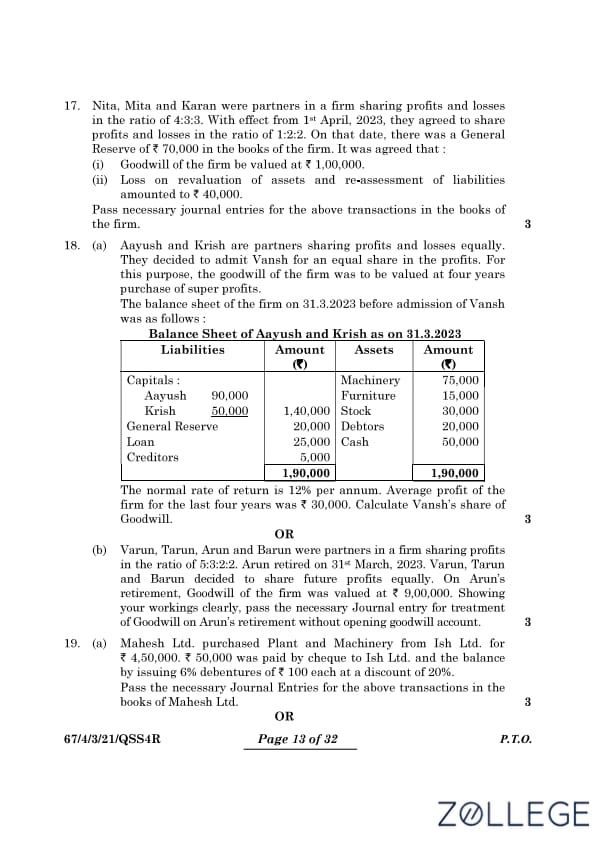
Nita, Mita, and Karan were partners in a firm sharing profits and losses in the ratio of 4:3:3. With effect from 1st April, 2023, they agreed to share profits and losses in the ratio of 1:2:2. On that date, there was a General Reserve of ₹70,000 in the books of the firm. It was agreed that: (i) Goodwill of the firm be valued at ₹1,00,000. (ii) Loss on revaluation of assets and re-assessment of liabilities amounted to ₹40,000. Pass necessary journal entries for the above transactions in the books of the firm.
Correct Answer:
View Solution
1. Distribution of General Reserve: Partner Old Ratio (4:3:3) Share of ₹70,000 Nita 4/10 ₹28,000 Mita 3/10 ₹21,000 Karan 3/10 ₹21,000
Journal Entries: Date Particulars Debit (₹) Credit (₹) 2023-04-01 General Reserve A/c 70,000 To Nita’s Capital A/c 28,000 To Mita’s Capital A/c 21,000 To Karan’s Capital A/c 21,000
2023-04-01 Revaluation Loss A/c 40,000 To Nita’s Capital A/c 16,000 To Mita’s Capital A/c 12,000 To Karan’s Capital A/c 12,000
2023-04-01 Nita’s Capital A/c 20,000 To Mita’s Capital A/c 10,000 To Karan’s Capital A/c 10,000
Question 18(a):
Aayush and Krish are partners sharing profits and losses equally. They decided to admit Vansh for an equal share in the profits. For this purpose, the goodwill of the firm was to be valued at four years’ purchase of super profits. The balance sheet of the firm on 31.3.2023 before admission of Vansh was as follows:

Calculate Vansh’s share of Goodwill.
Correct Answer:
View Solution
Step 1: Calculate Normal Profit: Capital Employed = 75,000+15,000+20,000+25,000+5,000 = ₹1,60,000 Normal Profit = 1,60,000 * 12% = ₹19,200
Step 2: Calculate Super Profit: Super Profit = Average Profit −Normal Profit Super Profit = ₹30,000 − ₹19,200 = ₹10,800
Step 3: Value of Goodwill: Goodwill = Super Profit * Years’ Purchase Goodwill = ₹10,800 * 4 = ₹43,200
Step 4: Vansh's Share of Goodwill: Vansh's Share = 1/3 * ₹43,200 = ₹14,400
Question 18(b):
Varun, Tarun, Arun, and Barun were partners in a firm sharing profits in the ratio of 5:3:2:2. Arun retired on 31st March, 2023. Varun, Tarun, and Barun decided to share future profits equally. On Arun’s retirement, goodwill of the firm was valued at ₹9,00,000. Showing your workings clearly, pass the necessary Journal Entry for treatment of Goodwill on Arun’s retirement without opening a goodwill account.
Correct Answer:
View Solution
Step 1: Calculate Goodwill Share for Arun. Arun’s Share = 2/12 * ₹9,00,000 = ₹1,50,000
Step 2: Adjust Goodwill in the Remaining Partners’ Capital Accounts. Gaining ratio = New ratio - old ratio Varun = 1/3 - 5/12 = -1/12 Tarun = 1/3 - 3/12 = 1/12 Barun = 1/3 - 2/12 = 2/12
Journal Entry: Date Particulars Debit (₹) Credit (₹) 2023-03-31 Varun’s Capital A/c 62,500 Tarun’s Capital A/c 37,500 To Arun’s Capital A/c 1,50,000
Question 19(a):
Mahesh Ltd. purchased Plant and Machinery from Ish Ltd. for ₹4,50,000. ₹50,000 was paid by cheque to Ish Ltd. and the balance by issuing 6% debentures of ₹100 each at a discount of 20%. Pass the necessary Journal Entries for the above transactions in the books of Mahesh Ltd.
Correct Answer:
View Solution
Step 1: Calculate Number of Debentures Issued. Debenture Issue Price = ₹100 - 20% of ₹100 = ₹80 Balance Amount to be Paid = ₹4,50,000 - ₹50,000 = ₹4,00,000 Number of Debentures Issued = ₹4,00,000 / ₹80 = 5,000
Journal Entries: Date Particulars Debit (₹) Credit (₹) 2023-03-31 Plant and Machinery A/c 4,50,000 To Bank A/c 50,000 To 6% Debentures A/c 5,00,000 To Discount on Issue of Debentures A/c 1,00,000 2023-03-31 Discount on Issue of Debentures A/c 1,00,000 To Securities Premium A/c 1,00,000
Question 19(b):
Manika Ltd. forfeited 500 shares of ₹100 each for non-payment of first call of ₹20 per share and second and final call of ₹25 per share. 250 of these shares were reissued at ₹50 per share fully paid up. Pass the Journal Entries for forfeiture and reissue of shares.
Correct Answer:
View Solution
Step 1: Calculate the Amount Forfeited and Discount on Reissue. Forfeited Amount = 500* (100 - 20 - 25) = ₹27,500 Reissue Amount = 250*50 = ₹12,500 Discount on Reissue = 250*(100 - 50) = ₹12,500
Journal Entries: Date Particulars Debit (₹) Credit (₹) 2023-03-31 Share Capital A/c (500 * 100) 50,000 To Share Forfeiture A/c 27,500 To Calls in Arrears A/c 22,500 2023-03-31 Bank A/c 12,500 Share Forfeiture A/c 12,500 To Share Capital A/c 25,000 2023-03-31 Share Forfeiture A/c 15,000 To Capital Reserve A/c 15,000
Question 20:
Rajesh and Anu were partners in a firm sharing profits and losses in the ratio of 1:2. Their fixed capitals were ₹6,00,000 and ₹3,00,000 respectively. After the accounts for the year were prepared, it was noticed that interest on capital @ 12% p.a., as provided in the partnership deed, was not credited to the capital accounts of partners before distribution of profits. Pass the necessary adjusting journal entry. Show your workings clearly.
Correct Answer:
View Solution
Step 1: Calculate Interest on Capital. Interest on Capital for Rajesh = 6,00,000 * 12% = ₹72,000 Interest on Capital for Anu = 3,00,000 * 12% = ₹36,000
Step 2: Adjust Profits in the Profit-Sharing Ratio (1:2). Total interest on capital: 72,000 + 36,000 = ₹1,08,000 Rajesh’s Adjustment = ₹72,000 - (1/3 * ₹1,08,000) = ₹36,000 Anu’s Adjustment = ₹36,000 - (2/3 * ₹1,08,000) = -₹36,000
Journal Entry: Date Particulars Debit (₹) Credit (₹) 2023-03-31 Rajesh’s Capital A/c 36,000 Anu's Capital A/c 36,000 To Interest on Capital A/c 72,000
Question 21:
Ram, Ravi, and Rohan were partners sharing profits in the ratio of 2:3:1. On 31st March, 2023, their Balance Sheet was as follows:

Rohan died on 30th September, 2023. On the death of a partner, the partnership deed provided for the following:
(i)Goodwill was to be valued at two years purchase of average profit of last three years. The profits for the last three years were: 2020-21 = ₹4,50,000, 2021-22 = ₹90,000, 2022-23 = ₹1,35,000
(ii)Deceased partner’s share of profit till the date of death will be calculated on the basis of average profit of the last three years. Prepare Rohan’s Capital Account to record the above transactions.
Correct Answer:
View Solution
Step 1: Calculate Goodwill. Average Profit = (₹4,50,000 + ₹90,000 + ₹1,35,000) / 3 = ₹2,25,000 Goodwill = ₹2,25,000 * 2 = ₹4,50,000 Rohan's Share of Goodwill = (1/6) * ₹4,50,000 = ₹75,000
Step 2: Calculate Profit Till Date of Death. Rohan's Share of Profit = (1/6) * ₹2,25,000 * (6/12) = ₹18,750
Rohan’s Capital Account: Date Particulars Debit (₹) Credit (₹) 2023-09-30 To Cash A/c 18,750 To Ravi’s Capital A/c (Goodwill) 45,000 To Ram’s Capital A/c (Goodwill) 30,000 By Balance b/d 3,00,000 By Profit and Loss A/c 18,750 By Goodwill A/c 75,000
Question 22:
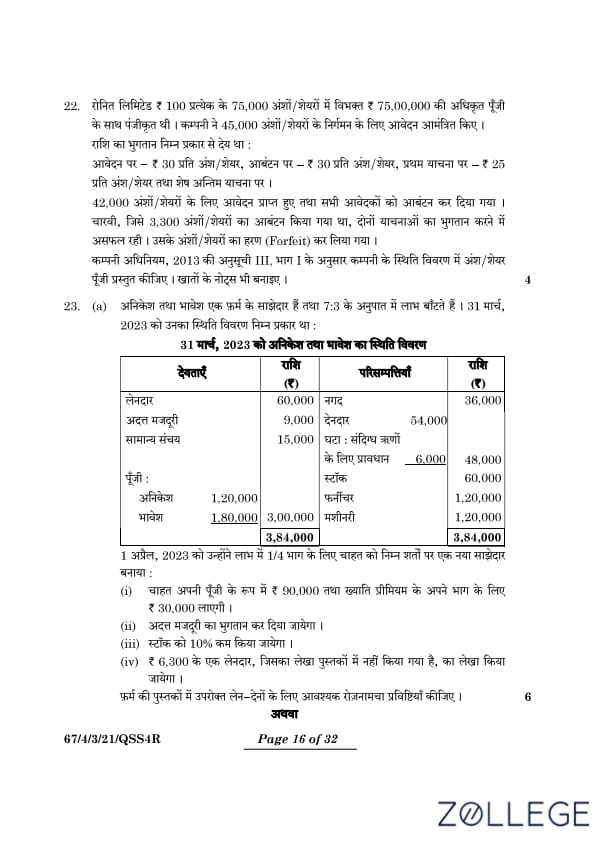
Ronit Ltd. was registered with an authorised capital of ₹75,00,000 divided into 75,000 equity shares of ₹100 each. The company invited applications for issuing 45,000 shares. The amount was payable as follows: ₹30 per share on application, ₹30 per share on allotment, ₹25 per share on first call, and balance on final call. Applications were received for 42,000 shares and allotment was made to all the applicants. Charvi, to whom 3,300 shares were allotted, failed to pay both the calls. Her shares were forfeited. Present the share capital in the Balance Sheet of the company as per Schedule III, Part I of the Companies Act, 2013. Also prepare notes to accounts.
Correct Answer:
View Solution
Step 1: Calculate Subscribed and Paid-up Capital. Total Shares Subscribed = 42,000 shares Paid-up Capital for Forfeited Shares:3,300 * 60 = ₹1,98,000
Step 2: Prepare the Balance Sheet: Particulars Amount (₹) Equity and Liabilities Equity Share Capital: Authorised Capital (75,000 shares of ₹100 each) 75,00,000 Issued Capital (45,000 shares of ₹100 each) 45,00,000 Subscribed and Paid – up Capital (42,000 shares fully paid) 42,00,000 Less: Calls in Arrears (3,300 shares unpaid at ₹40/share) (1,32,000) Total 43,68,000
Notes to Accounts: Share Capital: Authorised Capital: 75,000 shares of ₹100 each = ₹75,00,000 Issued Capital: 45,000 shares of ₹100 each = ₹45,00,000 Subscribed Capital: 42,000 shares of ₹100 each = ₹42,00,000 Less: Calls in Arrears: ₹1,32,000 (from 3,300 shares). Forfeited Shares: Amount forfeited from 3,300 shares is ₹1,98,000.
Question 23(a):
Anikesh and Bhavesh are partners in a firm sharing profits in the ratio of 7:3. Their Balance Sheet as on 31st March, 2023 was as follows:
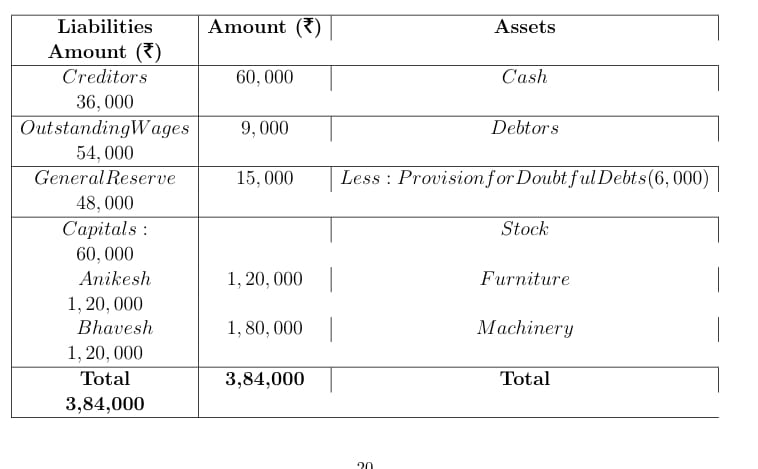
On 1st April, 2023, Chahat was admitted for 1/4th share in the profits on the following terms: (i) Chahat will bring ₹90,000 as her capital and ₹30,000 as her share of Goodwill premium. (ii) Outstanding wages will be paid. (iii) Stock will be reduced by 10%. (iv) creditor of ₹6,300, not recorded in the books, was to be taken into account. Pass necessary Journal Entries for the above transactions in the books of the firm.
Correct Answer:
View Solution

Question 23(b):
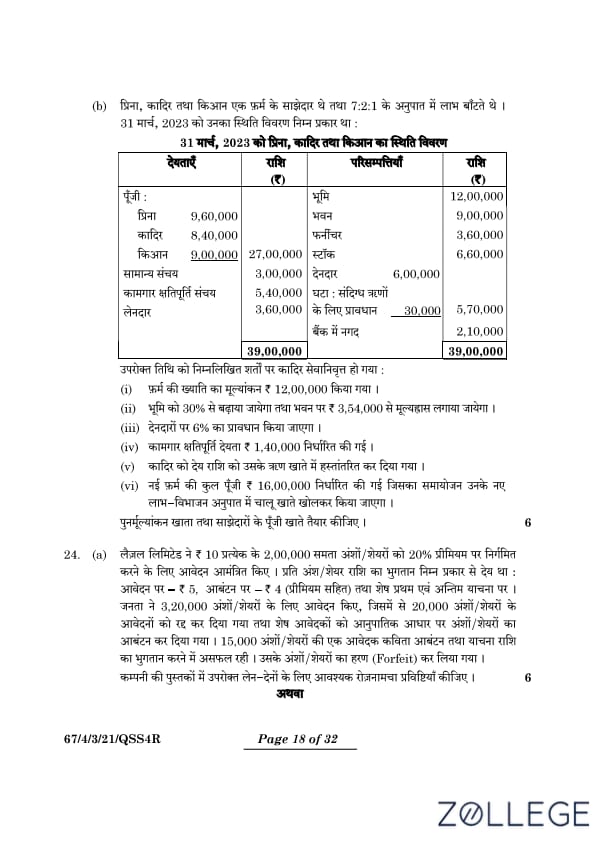
Prina, Qadir, and Kian were partners in a firm sharing profits in the ratio of 7:2:1. On 31st March, 2023, their Balance Sheet was as follows:

Adjustments on Qadir’s Retirement: (i)Goodwill of the firm valued at ₹12,00,000. (ii)Land appreciated by 30%, and building depreciated by ₹3,54,000. (iii)A provision of 6% maintained on debtors. (iv)Workmen’s compensation liability determined at ₹1,40,000. (v)Qadir’s amount transferred to loan account. (vi)Total capital fixed at ₹16,00,000, adjusted in the new profit ratio.
Correct Answer:
View Solution
Revaluation Account: Particulars Debit (₹) Credit (₹) To Building (Depreciation) 3,54,000 To Provision for Doubtful Debts 36,000 To Workmen’s Compensation Liability 4,00,000 By Land (Appreciation) 3,60,000 Total 7,90,000 7,90,000
Partners’ Capital Account: Particulars Prina (₹) Qadir (₹) Kian (₹) Total (₹) By Balance b/d 9,60,000 8,40,000 9,00,000 27,00,000 By General Reserve (7:2:1) 2,10,000 60,000 30,000 3,00,000 By Revaluation (7:2:1) 2,75,000 78,600 39,300 3,92,900 To Qadir’s Loan A/c 10,00,000 10,00,000 To Current A/c (Adjustment) 2,75,000 25,000 3,00,000 Balance c/d 12,70,000 9,95,000 22,65,000
Question 24(a):
Lazal Ltd. invited applications for issuing 2,00,000 equity shares of ₹10 each, at 20% premium. Amount per share was payable as follows: ₹5 on application; ₹4 (including premium) on allotment; and balance on final call. Public applied for 3,20,000 shares, out of which applications for 20,000 shares were rejected and shares were allotted on pro-rata basis to the remaining applicants. Kavita, an applicant of 15,000 shares, failed to pay allotment and call money. Her shares were forfeited. Pass necessary Journal Entries for the above transactions in the books of the company.
Correct Answer:
View Solution

Question 24(b):
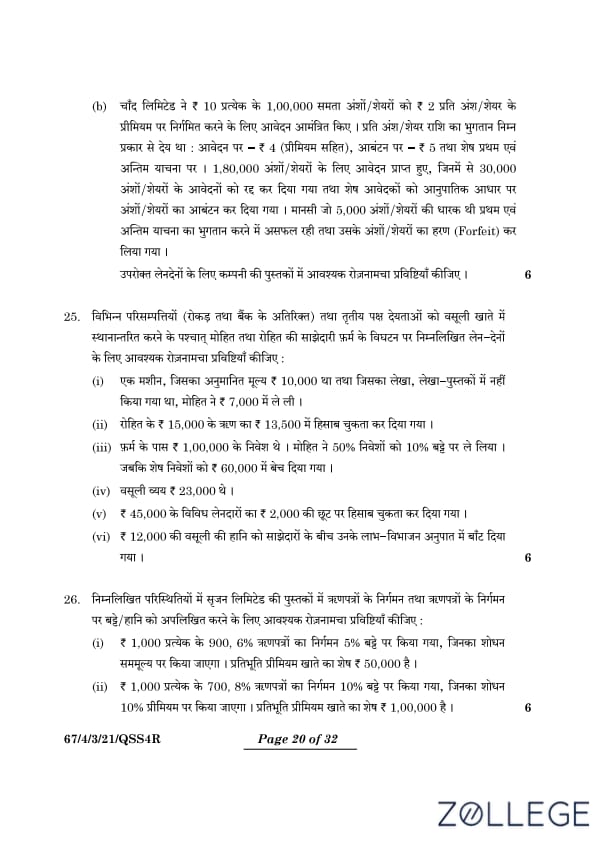
Chand Ltd. invited applications for issuing 1,00,000 equity shares of ₹10 each at a premium of ₹2 per share. The amount per share was payable as follows: ₹4 (including premium) on application, ₹5 on allotment, and balance on first and final call. Applications were received for 1,80,000 shares of which applications for 30,000 shares were rejected, and remaining applicants were allotted shares on a pro-rata basis. Mansi, holding 5,000 shares, failed to pay first and final call money, and her shares were forfeited. Pass necessary Journal entries for the above transactions in the books of the company.
Correct Answer:
View Solution

Question 25:
Pass the necessary journal entries for the following transactions on the disSolutions of the partnership firm of Mohit and Rohit after the various assets (other than cash and bank) and the third-party liabilities have been transferred to the realisation account: (i)A machine, not recorded in the books, was taken over by Mohit at ₹7,000, whereas its expected value was ₹10,000. (ii)Rohit’s loan of ₹15,000 was settled at ₹13,500. (iii)The firm had investments of ₹1,00,000. Mohit took over 50% of the investments at a discount of 10%, while the remaining investments were sold off for ₹60,000. (iv)Realisation expenses amounted to ₹23,000. (v)Sundry creditors amounting to ₹45,000 were settled at a discount of ₹2,000. (vi)Loss on realisation of ₹12,000 was divided between the partners in their profit-sharing ratio.
Correct Answer:
View Solution

Question 26:
Pass necessary journal entries relating to the issue of debentures and to write off discount/loss on issue of debentures in the books of Srijan Ltd. in the following cases: (i) 900, 6% debentures of ₹1,000 each are issued at 5% discount and redeemable at par. Balance in Securities Premium account is ₹50,000. (ii) 700, 8% debentures of ₹1,000 each are issued at 10% discount and redeemable at a premium of 10%. Balance in Securities Premium account is ₹1,00,000.
Correct Answer:
View Solution

PART B OPTION I
(Analysis of Financial Statements)
Question 27(a):
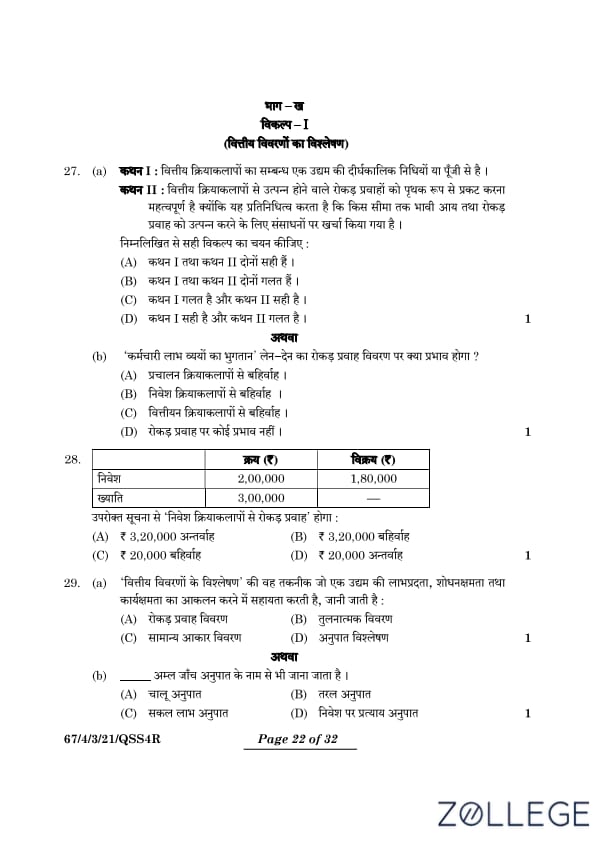
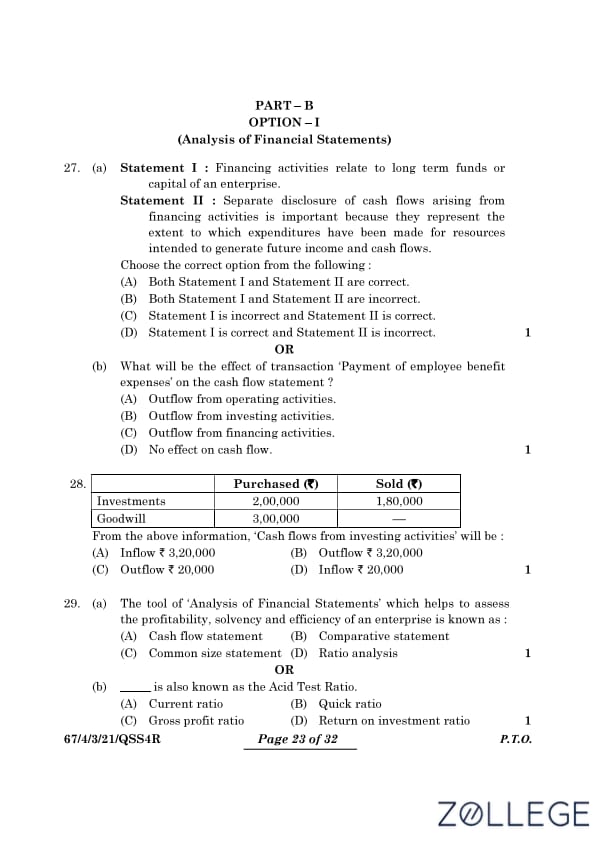
Statement I: Financing activities relate to long-term funds or capital of an enterprise.
Statement II: Separate disclosure of cash flows arising from financing activities is important because they represent the extent to which expenditures have been made for resources intended to generate future income and cash flows. Choose the correct option from the following:
Correct Answer: (D) Statement I is correct and Statement II is incorrect.
View Solution
Statement I is correct as financing activities involve obtaining or repaying funds related to long-term capital. Statement II is incorrect because it refers to investing activities, not financing activities.
Question 27(b):
What will be the effect of transaction ‘Payment of employee benefit expenses’ on the cash flow statement?
Correct Answer: (A) Outflow from operating activities
View Solution
Employee benefit expenses are directly related to the day-to-day operations of the business. Such payments are classified as cash outflows under operating activities.
Question 28:
From the above information, ‘Cash flows from investing activities’ will be: Purchased (₹) Sold (₹) Investments: 2,00,000 Investments: 1,80,000 Goodwill: 3,00,000 Goodwill:
Correct Answer: (B) Outflow ₹3,20,000
View Solution
Cash outflow for purchase of investments and goodwill is ₹2,00,000 + ₹3,00,000 = ₹5,00,000 Cash inflow from sale of investments is ₹1,80,000 Net cash flow is ₹5,00,000 - ₹1,80,000 = Outflow ₹3,20,000
Question 29(a):
The tool of ‘Analysis of Financial Statements’ which helps to assess the profitability, solvency, and efficiency of an enterprise is known as:
Correct Answer: (D) Ratio analysis
View Solution
Ratio analysis is a financial analysis tool used to assess an enterprise’s profitability, solvency, liquidity, and operational efficiency.
Question 29(b):
...... is also known as the Acid Test Ratio.
Correct Answer: (B) Quick ratio
View Solution
The quick ratio, also known as the acid test ratio, measures the ability of a company to meet its short-term liabilities using its most liquid assets.
Question 30:
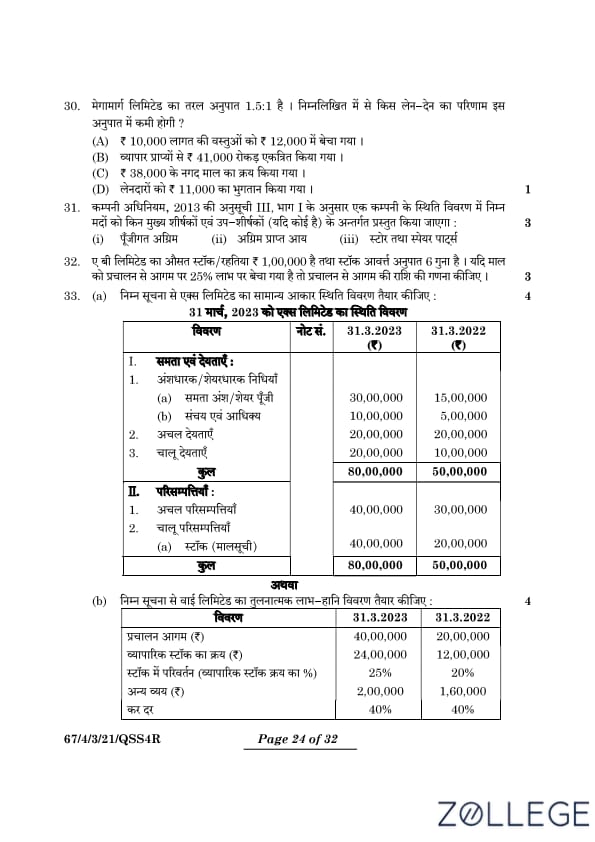
Quick ratio of Megamart Ltd. is 1.5:1. Which of the following transactions will result in a decrease in this ratio?
Correct Answer: (C) Purchase of goods for cash ₹38,000.
View Solution
The quick ratio is calculated as: Quick Assets / Current Liabilities. When goods are purchased for cash, quick assets (cash) decrease, but current liabilities remain unaffected. This results in a decrease in the quick ratio.
Question 31:
Under which Major Heads and Sub-Heads (if any) will the following items be presented in the Balance Sheet of a company as per Schedule III, Part I of the Companies Act, 2013? (i) Capital Advances (ii) Income received in Advance (iii) Stores and Spare Parts
Correct Answer:
View Solution
(i) Capital Advances: Major Head- Non-Current Assets, Sub-Head- Other Non-Current Assets.
(ii) Income received in Advance: Major Head- Current Liabilities, Sub-Head- Other Current Liabilities.
(iii) Stores and Spare Parts: Major Head- Current Assets, Sub-Head- Inventories.
Question 32:
The average inventory of AB Ltd. is ₹1,00,000 and the inventory turnover ratio is 6 times. Calculate the amount of revenue from operations if goods are sold at a profit of 25% on revenue from operations.
Correct Answer: ₹8,00,000
View Solution
Inventory Turnover Ratio = Cost of Goods Sold / Average Inventory COGS = 6 * ₹1,00,000 = ₹6,00,000 Let R be the Revenue from Operations. Profit = 0.25R COGS = R - 0.25R = 0.75R = ₹6,00,000 R = ₹6,00,000/0.75 = ₹8,00,000
Question 33(a):
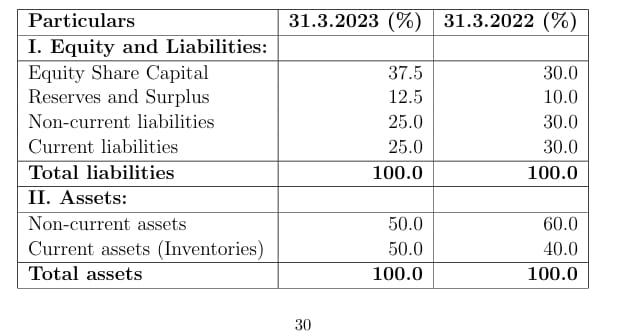
Prepare a Common Size Balance Sheet of X Ltd. from the following information:

Correct Answer:
View Solution
Question 33(b):
From the following information prepare a Comparative Statement of Profit and Loss of Y Ltd.:

Correct Answer:
View Solution

Question 34:
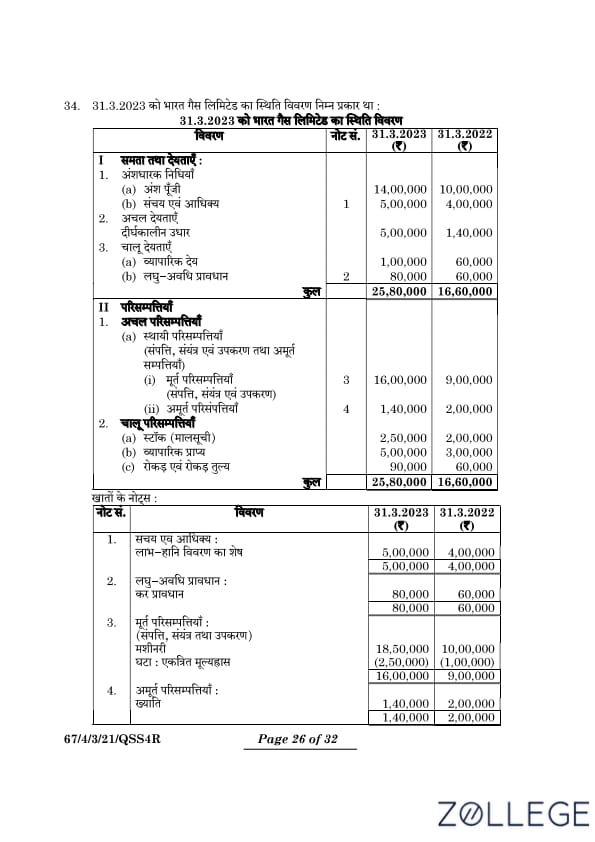
Following is the Balance Sheet of Bharat Gas Ltd. as at 31.3.2023: Balance Sheet of Bharat Gas Ltd. as at 31.3.2023

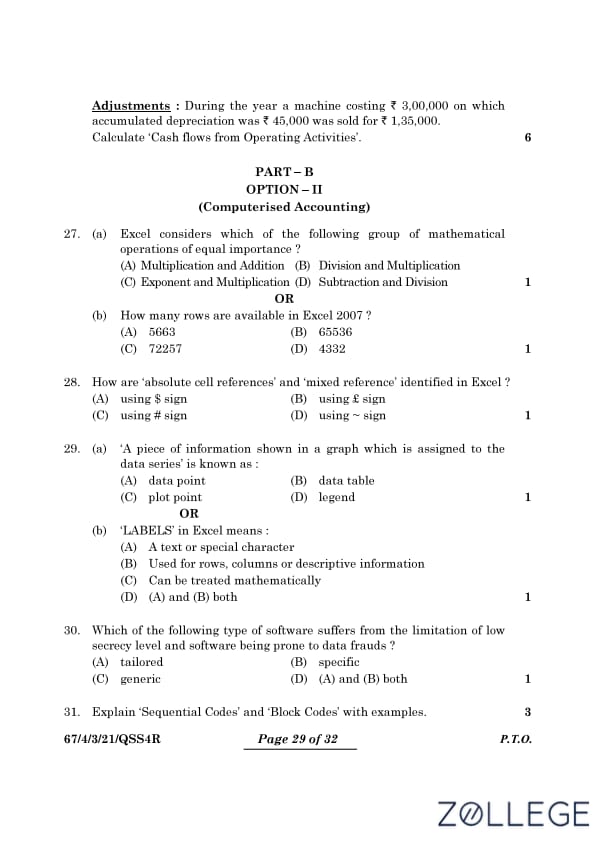
Adjustments: During the year, a machine costing ₹3,00,000 on which accumulated depreciation was ₹45,000 was sold for ₹1,35,000. Calculate ’Cash Flows from Operating Activities’
Correct Answer: Cash Flows from Operating Activities = ₹6,40,000
View Solution
Cash Flows from Operating Activities: 1. Net Profit before Tax: Increase in Profit and Loss Account (₹5,00,000 - ₹4,00,000) = ₹1,00,000 2. Add: Non-Cash Items: Depreciation on Machinery (₹16,00,000 - ₹9,00,000) = ₹7,00,000 Loss on Sale of Machinery: Book Value = ₹3,00,000 - ₹45,000 = ₹2,55,000 Loss = ₹2,55,000 - ₹1,35,000 = ₹1,20,000 Total Non-Cash Items = ₹7,00,000 + ₹1,20,000 = ₹8,20,000 3. Less: Adjustments: Increase in Working Capital: Increase in Inventories = ₹2,50,000 - ₹2,00,000 = ₹50,000 Increase in Trade Receivables = ₹1,90,000 - ₹80,000 = ₹1,10,000 Increase in Working Capital = ₹50,000 + ₹1,10,000 = ₹1,60,000 4. Add: Tax Provision: ₹80,000 Cash Flows from Operating Activities = ₹1,00,000 + ₹8,20,000 - ₹1,60,000 + ₹80,000 = ₹6,40,000
PART B OPTION II
(Computerised Accounting)
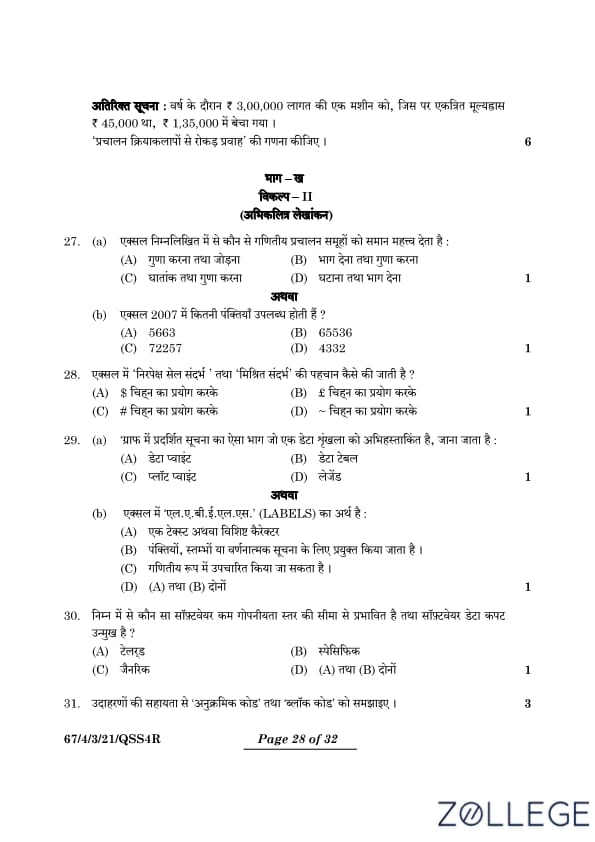
Question 27(a):
Excel considers which of the following group of mathematical operations of equal importance?
Correct Answer: (B) Division and Multiplication
View Solution
In Excel, division and multiplication have equal precedence and are performed from left to right.
Question 27(b):
How many rows are available in Excel 2007?
Correct Answer: (B) 65536
View Solution
Excel 2007 introduced a maximum row limit of 65,536 rows per worksheet.
Question 28:
How are ‘absolute cell references’ and ‘mixed references’ identified in Excel?
Correct Answer: (A) Using $ sign
View Solution
Absolute cell references in Excel are denoted using the $ symbol (e.g., $A$1). Mixed references use the $ symbol for either the row or the column (e.g., A$1 or $A1).
Question 29(a):
‘A piece of information shown in a graph which is assigned to the data series’ is known as:
Correct Answer: (D) Legend
View Solution
A legend is an element of a graph or chart that provides information about the data series it represents.
Question 29(b):
‘LABELS’ in Excel means:
Correct Answer: (D) (A) and (B) both
View Solution
Labels in Excel refer to text or special characters used to describe rows, columns, or data points.
Question 30:
Which of the following type of software suffers from the limitation of low secrecy level and software being prone to data frauds?
Correct Answer: (C) Generic
View Solution
Generic software is developed for a wide audience and lacks specific security measures tailored to a particular organization.
Question 31:
Explain ‘Sequential Codes’ and ‘Block Codes’ with examples.
Correct Answer:
View Solution
1. Sequential Codes: Sequential codes are numbers or identifiers assigned in a consecutive manner, ensuring each code is unique. Example: Invoice numbers like 001, 002, 003, or employee IDs like E001, E002, E003. Advantages:– Easy to understand and use.– Useful for maintaining chronological records, such as sales invoices or admission forms. Disadvantages:– Does not provide any categorization or specific meaning to the code.– If a code is missed, it may create confusion or gaps in records.
2. Block Codes: Block codes reserve ranges of numbers or identifiers for specific categories or groups. Example: In a library, science books may be coded as 100–199, literature books as 200–299, etc. Advantages:– Simplifies categorization and retrieval of information.– Allows flexibility in expanding the range for a category without affecting others. Disadvantages:– More complex to implement compared to sequential codes.– May lead to wastage of numbers if ranges are not fully utilized.
Question 32:
How to use ‘Mark Common Formula Error’ in Excel? Explain.
Correct Answer:
View Solution
The ‘Mark Common Formula Error’ feature in Excel helps identify common formula issues, such as division by zero, invalid cell references, or inconsistent formulas. Follow these steps to use it: 1. Enable Error Checking: Go to File > Options > Formulas and ensure the Error Checking option is enabled. 2. Identify Errors: When an error occurs, Excel displays a small green triangle in the top-left corner of the affected cell. 3. Review Error Messages: Hover over the cell to see a warning icon. Click the icon to view a dropdown list of possible errors. 4. Fix the Error: Select an appropriate option from the dropdown menu, such as Edit in Formula Bar, to correct the formula. 5. Use Formula Auditing Tools: Access Formulas > Formula Auditing to trace errors or evaluate formulas step-by-step.
Question 33(a):
State why do you need to change a chart? How can it be changed? Why is it said that changing a column chart to a pie chart is easy? Give reasons.
Correct Answer:
View Solution
1. Why do you need to change a chart? To better visualize and analyze data based on the specific purpose. To highlight different aspects of data, such as trends, proportions, or relationships. To make the chart more understandable and appealing for the target audience.
2. How can a chart be changed? Select the existing chart. Right-click and choose the Change Chart Type option. Select the desired chart type (e.g., Pie Chart, Line Chart, etc.) and confirm by clicking OK. Modify chart elements like labels, legends, and colors as needed to suit the new chart type.
3. Why is it easy to change a column chart to a pie chart? Both chart types use the same data structure: a single series with categories and values. Excel and similar tools allow seamless conversion between these chart types while preserving the data source. Column charts represent data with bars, while pie charts display the same data as slices of a circle to show proportions.
Question 33(b):
State the advantages of a computerized accounting system.
Correct Answer:
View Solution
A computerized accounting system offers numerous advantages over manual systems: 1. Accuracy: Reduces human errors in calculations and ensures accurate financial records. 2. Efficiency: Speeds up data entry, processing, and generation of financial statements. 3. Real-Time Data: Provides instant access to financial information for timely decision making. 4. Integration: Links various business functions, such as payroll, inventory, and sales, into a unified system. 5. Data Security: Protects sensitive financial data with encryption and regular backups. 6. Compliance: Simplifies compliance with tax laws and regulations by automating calculations and reports. 7. Cost-Effective: Reduces the need for manual bookkeeping, saving time and labor costs. 8. Scalability: Easily handles growing volumes of transactions as the business expands. 9. Customizable Reports: Generates a variety of reports, such as profit and loss statements, balance sheets, and cash flow reports, tailored to the business’s needs. 10. Error Detection: Identifies inconsistencies or discrepancies in real time, reducing the risk of fraud.
Question 34:
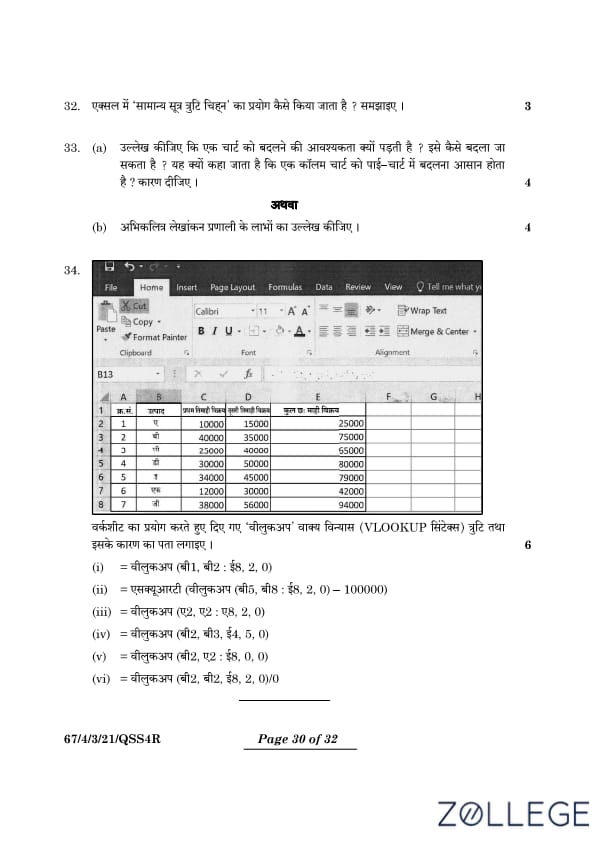
Using the worksheet below, find out the error and its reason for the given ‘VLOOKUP’ syntax:
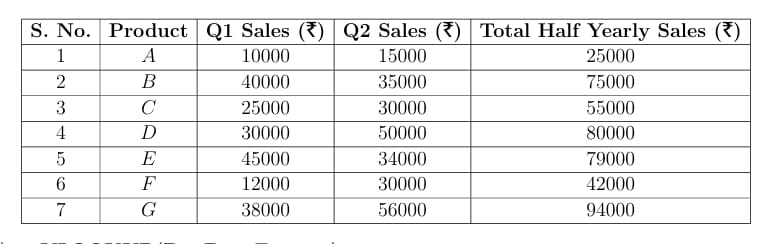
(i) = VLOOKUP(B1, B2 : E8, 2, 0)
(ii) = SQRT(VLOOKUP(B5, B8 : E8, 2, 0)- 100000)
(iii) = VLOOKUP(A2, A2 : A8, 2, 0)
(iv) = VLOOKUP(B2, B3 : E4, 5, 0)
(v) = VLOOKUP(B2, A2 : E8, 0, 0)
(vi) = VLOOKUP(B2, B2 : E8, 2, 0)/0
Correct Answer:
View Solution
V











*The article might have information for the previous academic years, please refer the official website of the exam.