
CBSE Class 12 2024 Economics Set 1 (Code: 58/2/1) Question Paper Pdf - Check Solutions with Answer Key Pdf

.jpg?tr=h-55,w-55,c-force)
Content Strategist|Tech-innovator|National Hackathon Winner | Updated On - Jan 29, 2025
CBSE Class 12 2024 Economics Question Paper with Answer Key PDF for Set 1 (Q.P. Code: 58/2/1) is available for download. The exam was successfully conducted by CBSE on March 18, 2024, in the morning session from 10:30 AM to 1:30 PM. As per the students’ initial reactions, the CBSE Class 12 2024 Economics Set 1 Question Paper was reported as Moderate. The Microeconomics section was considered Easy to Moderate, while the Macroeconomics section was reported as Moderate to Challenging.
CBSE Class 12 2024 Economics (Set 1- 58/2/1) 2024 Answer Key With Solution
Candidates can download the CBSE Class 12 Economics Question Paper with Solution and Answer Key PDFs for Set 1 Question Paper (Code: 58/2/1) using the link below.
| CBSE Class 12 Economics (Set 1- 58/2/1) 2024 Question Paper with Answer Key |  Download Download |
Check Solution |
CBSE Class 12 2024 Economics Question Paper with Solutions
Macro Economics
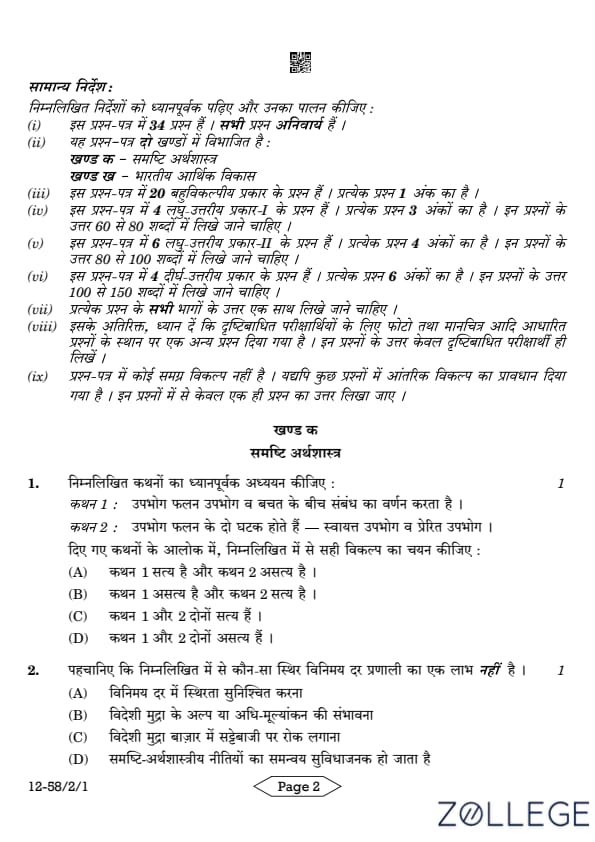
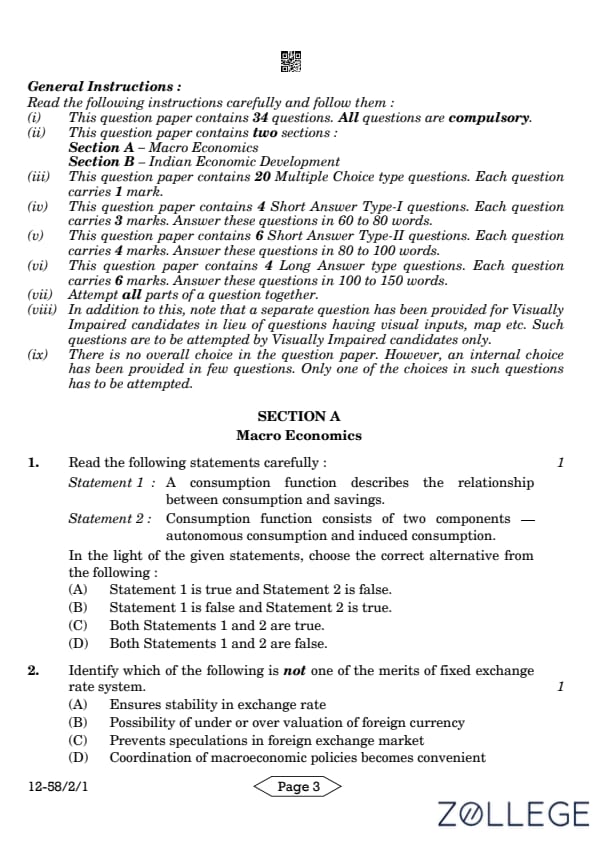
Question 1:
Read the following statements carefully:
Statement 1: A consumption function describes the relationship between consumption and savings.
Statement 2: Consumption function consists of two components—autonomous consumption and induced consumption.
In the light of the given statements, choose the correct alternative from the fol- lowing:
Correct Answer: (B) Statement 1 is false and Statement 2 is true.
View Solution
1. Statement 1: This is false because the consumption function describes the relationship between consumption and income, not savings.
2. Statement 2: This is true because the consumption function consists of two components: (a) Autonomous Consumption: The minimum level of consumption that occurs even when income is zero. (b) Induced Consumption: The component of consumption that varies with changes in income.
Question 2:
Identify which of the following is not one of the merits of a fixed exchange rate system:
Correct Answer: (B) Possibility of under or overvaluation of foreign currency.
View Solution
1. A fixed exchange rate system ensures stability in exchange rates (Option A) and prevents speculations in the foreign exchange market (Option C), making trade and investment more predictable.
2. It also makes coordination of macroeconomic policies easier (Option D).
3. However, possibility of under or overvaluation of foreign currency (Option B) is a disadvantage of the fixed exchange rate system, as the rate may not reflect the true value of the currency in the global market.
Question 3:
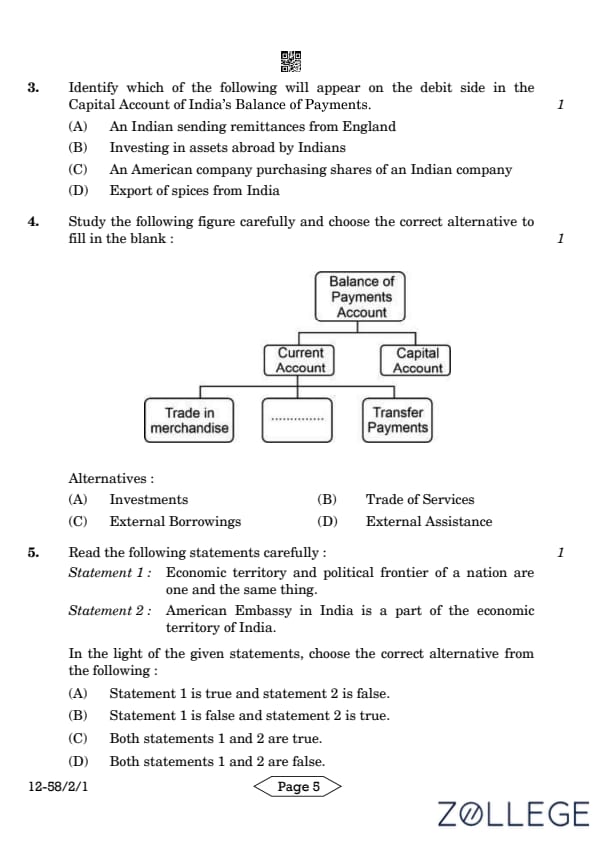
Identify which of the following will appear on the debit side in the Capital Account of India’s Balance of Payments:
Correct Answer: (B) Investing in assets abroad by Indians.
View Solution
1. A debit entry in the Capital Account of the Balance of Payments (BoP) represents an outflow of funds.
2. Option (B): When Indians invest in assets abroad, there is an outflow of capital from India, which is recorded as a debit entry.
3. Options (A), (C), and (D): These relate to current account transactions or represent capital inflows, which are credit entries.
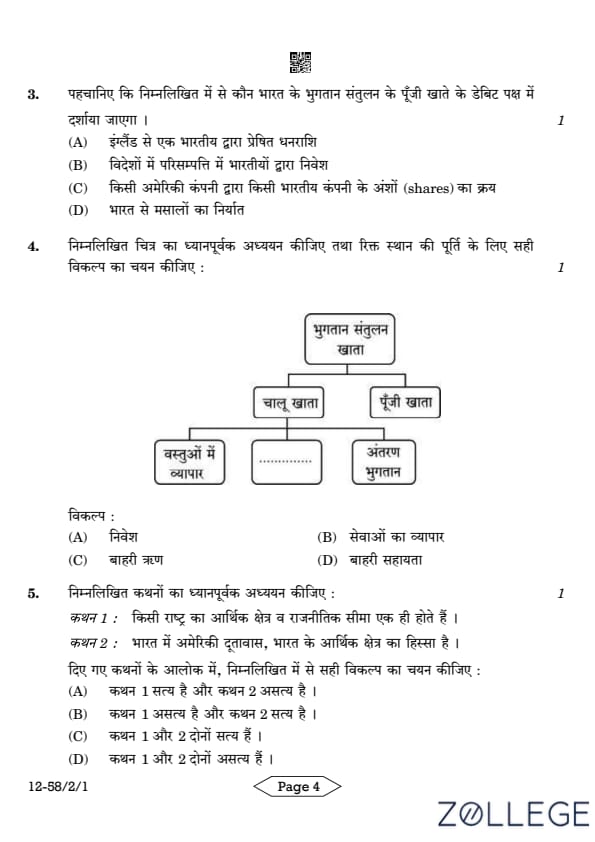
Question 4:
Study the following figure carefully and choose the correct alternative to fill in the blank:

Correct Answer: (B) Trade of Services.
View Solution
1. The Balance of Payments (BoP) Current Account records trade in goods (merchandise), trade in services, and transfer payments.
2. Option (B): Trade of services is the correct term to complete the given flowchart.
3. Options (A), (C), and (D): Investments, external borrowings, and external assistance belong to the Capital Account, not the Current Account.
Question 5:
Read the following statements carefully:
Statement 1: Economic territory and political frontier of a nation are one and the same thing.
Statement 2: American Embassy in India is a part of the economic territory of India.
In the light of the given statements, choose the correct alternative from the fol- lowing:
Correct Answer: (D) Both statements 1 and 2 are false.
View Solution
1. Statement 1: This is false because the economic territory of a country includes not only its political frontier but also excludes foreign diplomatic zones within its borders.
2. Statement 2: This is false because the American Embassy in India is considered part of the economic territory of the United States, not India.
Question 6:
Read the following statements carefully:
Statement 1: Money is a commodity which is generally accepted as a medium of exchange.
Statement 2: Money solved the problem of double coincidence of wants.
In the light of the given statements, choose the correct alternative from the fol- lowing:
Correct Answer: (C) Both statements 1 and 2 are true.
View Solution
1. Statement 1: Money is universally accepted as a medium of exchange, which makes it a key feature in economic transactions.
2. Statement 2: Money overcomes the limitation of barter systems, including the problem of double coincidence of wants, by allowing indirect exchanges.
Question 7:
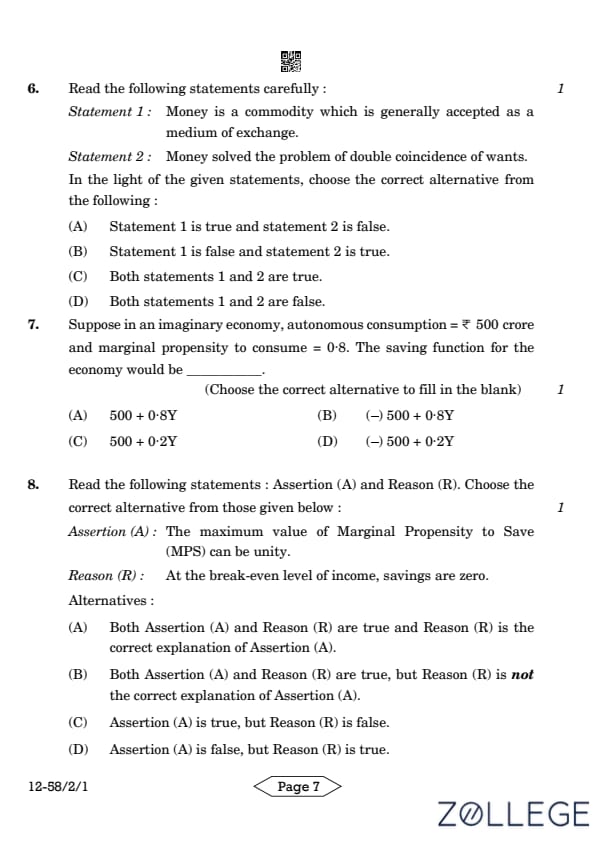
Suppose in an imaginary economy, autonomous consumption = 500 crore and marginal propensity to consume = 0.8. The saving function for the economy would be __________. (Choose the correct alternative to fill in the blank):
Correct Answer: (D) −500 + 0.2Y
View Solution
1. The consumption function is given as: C = 500 + 0.8Y
2. The saving function (S) is derived as: S = Y − C
Substituting C into the equation: S = Y − (500 + 0.8Y ) = −500 + 0.2Y
Question 8:
Read the following statements: Assertion (A) and Reason (R). Choose the correct alternative from those given below:
Assertion (A): The maximum value of Marginal Propensity to Save (MPS) can be unity.
Reason (R): At the break-even level of income, savings are zero.
Correct Answer: (B) Both Assertion (A) and Reason (R) are true, but Reason (R) is not the correct explanation of Assertion (A).
View Solution
1. Assertion (A): This is true because the maximum value of MPS can be unity when all additional income is saved and none is consumed.
2. Reason (R): This is true because, at the break-even level of income, all income is consumed, leaving savings at zero.
3. Conclusion: Although both statements are correct, the reason does not explain the assertion.
Question 9:
Identify the incorrect statement with reference to Cash Reserve Ratio (CRR):
Correct Answer: (C) It is not binding on the commercial banks.
View Solution
1. Cash Reserve Ratio (CRR) is the percentage of a commercial bank’s demand and time liabilities that must be kept as reserves with the Central Bank. This ensures liquidity and control over money supply.
2. Option (C): This is incorrect because CRR is mandatory and binding on all commercial banks as per the regulations of the Central Bank.
3. Options (A), (B), and (D): These are correct as they accurately describe CRR and its role in monetary policy and credit control.
Question 10:
Read the following statements: Assertion (A) and Reason (R). Choose the correct alternative from those given below:
Assertion (A): The equilibrium level of income is determined when ex-ante spending and ex-ante output are equal.
Reason (R): The equilibrium level of income may or may not be the same as the full employ- ment level of output.
Correct Answer: (B) Both Assertion (A) and Reason (R) are true, but Reason (R) is not the correct explanation of Assertion (A).
View Solution
1. Assertion (A): This is true because the equilibrium level of income is achieved when planned (ex-ante) spending equals planned (ex-ante) output, ensuring no unintended inventory changes.
2. Reason (R): This is also true because the equilibrium level of income is not necessarily the same as the full employment output. It can occur below or above the full employment level depending on the level of aggregate demand.
3. Conclusion: Although both statements are correct, the reason does not fully explain the assertion in terms of equilibrium determination.
Question 11(a):
“Accommodating transactions are undertaken to maintain stability in the Balance of Payments Account.” Justify the given statement with valid explanation.
View Solution
1. Accommodating transactions in the Balance of Payments (BoP) refer to the transactions that are carried out to bridge the gap between the deficit in the current account and the surplus in the capital account or vice versa.
2. These transactions are not market-driven but are undertaken by the government or central bank to ensure BoP stability.
3. Example: Borrowing from international institutions like the IMF to address a BoP deficit.
Question 11(b):
“Depreciation of currency may promote exports of a nation.” Defend or refute the given statement with valid arguments.
View Solution
1. Depreciation of a currency reduces the price of exports in foreign currency terms, making them more competitive in the global market.
2. This increases the demand for exports, boosting a nation’s trade balance.
3. However, it may also increase the cost of imports, leading to inflationary pressures within the domestic economy.
4. Example: If the Indian rupee depreciates against the US dollar, Indian goods become cheaper for US buyers, increasing export demand.
Question 12:
On the basis of the data given below, estimate the value of Gross National Product at Factor Cost (GNPFC):

View Solution
1. The formula for GNPFC is: GNPFC = Wages&Salaries+Rent&Interest+CorporateTax+UndistributedProfit+Dividend+NetFactorIncome from Abroad
2. Substituting the values: GNPFC = 2000 + 700 + 500 + 300 + 150 − 50 = 3800 crore.
Question 13:
For a hypothetical economy, assume the government increased an infrastruc- tural investment by 10,000 crore. 80% of additional income is consumed in the economy. Estimate the increase in income and the corresponding increase in con- sumption expenditure in the economy.
View Solution
1. The formula for the multiplier is: Multiplier = 1 / (1 - MPC)
Given MPC = 0.8: Multiplier = 1 / (1 - 0.8) = 5
2. Total increase in income: ΔY = Multiplier × Investment = 5 × 10,000 = 50,000 crore.
3. Increase in consumption expenditure: ΔC = MPC × ΔY = 0.8 × 50,000 = 40,000 crore.
Question 14(a):
“If actual demand for final goods falls short of the actual output of final goods corresponding to full employment level, it may lead to an unintended accu- mulation of inventories.”
Do you agree with the given statement? Give valid reasons in support of your answer.
View Solution
1. When actual demand is less than output at the full employment level, unsold goods accumulate as inventories for firms.
2. This unintended inventory accumulation signals to producers that supply exceeds demand, leading to reduced production in subsequent periods.
3. This reduction in production decreases income and employment, moving the economy below its full employment level.
Question 14(b):
Complete the following table. Construct the consumption function at 200 crore level of income.
| Income (Y) (in | crore) | Savings (S) (in | crore) | Average Propensity to Consume (APC) | Marginal Propensity to Save (MPS) |
|---|---|---|---|
| 0 | −50 | – | – |
| 100 | 0 | 1 | 0.5 |
| 200 | 50 | 3/4 | 0.5 |
| 300 | 100 | 2/3 | 0.5 |
View Solution
1. Consumption Function: C = Y − S • At Y = 0: C = -50 (Autonomous Consumption). • Marginal Propensity to Consume (MPC) = 1 − MPS = 1 − 0.5 = 0.5.
2. Values: • At Y = 100: S = 0, so C = 100 − 0 = 100. APC = C / Y = 1. • At Y = 200: S = 50, so C = 200 − 50 = 150. APC = C / Y = 150 / 200 = 0.75.
• At Y = 300: S = 100, so C = 300 − 100 = 200. APC = C / Y = 200 / 300 = 0.67.
Question 15:
Reserve Bank of India undertakes the important function of managing the government’s banking transactions. Discuss the above-stated function performed by the Reserve Bank of India.
View Solution
1. Government’s Banker:
• RBI manages accounts of the central and state governments.
• It facilitates the receipt and payment of government funds.
2. Public Debt Management:
• RBI manages the borrowing program of the government through the issuance of government bonds and treasury bills.
3. Monetary Policy Implementation:
• The RBI ensures liquidity and credit control to support government policies.
Question 16(a)(i):
Distinguish between direct tax and indirect tax with the help of suitable examples.
View Solution
| Direct Tax | Indirect Tax |
|---|---|
| Imposed directly on income or wealth of individuals and entities. | Imposed on goods and services; paid indirectly by consumers. |
| Example: Income Tax, Wealth Tax. | Example: GST, Excise Duty. |
| Collected directly by the government from taxpayers. | Collected by intermediaries (like sellers) and paid to the government. |
Question 16(a)(ii):
Explain the ‘redistribution of income’ objective of the Government Budget.
View Solution
1. The government budget aims to reduce income inequalities by redistributing wealth from the rich to the poor.
2. This is achieved through progressive taxation policies, where higher income groups are taxed more and lower-income groups receive subsidies and welfare programs.
3. Public expenditure on education, healthcare, and social welfare helps to provide equal opportunities and improve living standards for the underprivileged.
Question 16(b)(i):
Calculate Revenue Deficit and Fiscal Deficit based on the given data.
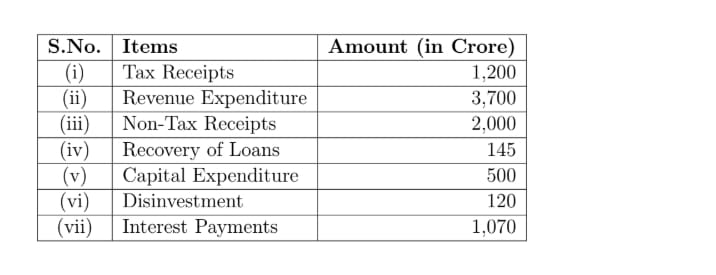
View Solution
1. Revenue Deficit: Revenue Expenditure − (Tax Receipts + Non-Tax Receipts) = 3,700 − (1,200 + 2,000) = 500 crore
2. Fiscal Deficit: (Revenue Expenditure + Capital Expenditure) − (Tax Receipts + Non-Tax Receipts + Recovery of Loans + Disinvestment) = (3,700 + 500) − (1,200 + 2,000 + 145 + 120) = 735 crore
Question 16(b)(ii):
Differentiate between public provision and public production.
View Solution
| Public Provision | Public Production |
|---|---|
| Government funds services, but production may be done by private entities. | Government directly produces goods and services. |
| Example: Subsidized education in private schools. | Example: Government hospitals providing healthcare. |
| Focuses on funding and ensuring availability. | Focuses on direct involvement in production activities. |
Question 17:
Read the following text carefully:
Decisions taken by factors of production in the production process often may affect the stake- holders indirectly. Such impacts at times are huge but are not accounted for, while estimating national income. Economists call them as externalities and they can be positive or negative.
In this regard, many economists suggest carbon pricing as an important tool to ensure ecological balance. Carbon pricing tries to control greenhouse gas emissions by either placing a fee on emitting or offering subsidies on lesser emission. Through instruments like carbon tax, green cess, eco tax, etc. economists suggest moving towards greener technology eliminating such negative external- ities.
(i) Define externalities.
(ii) Differentiate between positive and negative externalities.
(iii) Elaborate how and why carbon pricing should be promoted.
View Solution
(i)
1. Externalities refer to the unintended side effects of economic activities on third parties that are not directly involved in the production or consumption of goods or services.
2. These can be positive (benefits) or negative (costs) and are not accounted for in market transactions.
3. Example: • Positive: Planting trees improves air quality. • Negative: Factory pollution harms nearby residents.
(ii)
| Positive Externalities | Negative Externalities |
|---|---|
| Benefits third parties without direct involvement. | Imposes costs on third parties without compensation. |
| Leads to under-consumption in a free market. | Leads to over-production or over-consumption in a free market. |
| Example: Education, Vaccination. | Example: Pollution, Traffic Congestion. |
(iii)
1. Encouraging Emission Reduction: Carbon pricing discourages excessive emissions by making polluters pay for their carbon output.
2. Economic Efficiency: It provides economic incentives for firms to adopt cleaner technologies and energy-efficient processes.
3. Revenue Generation: Governments can use the revenue generated from carbon pricing to fund climate mitigation efforts and sustainable development.
4. Global Climate Goals: Carbon pricing aligns with international climate agreements and helps achieve emission reduction targets.
SECTION B
Indian Economic Development
Question 18:
During the British rule, India’s foreign trade had various features except __________. (Choose the correct alternative to fill in the blank):
Correct Answer: (C) Free trade from India to the rest of the world.
View Solution
1. During British rule, India’s foreign trade was characterized by restrictive policies, with the British monopolizing exports and imports.
2. There was no free trade as British policies aimed at serving their own industrial interests.
3. India’s export surplus was achieved at the cost of domestic welfare, as the proceeds were often used to meet British administrative and war expenses.
Question 19:
China was able to control its rapid population growth rate owing to __________. (Choose the correct alternative to fill in the blank):
Correct Answer: (B) One-Child Policy
View Solution
1. The One-Child Policy was introduced in China in 1979 to address its rapid population growth.
2. It restricted most families to having only one child, reducing population growth significantly over decades.
3. Though effective in controlling population, it resulted in challenges like an aging population and gender imbalance.
Question 20:
Modernization is an important economic planning objective that focuses on __________. (Choose the correct alternative to fill in the blank): (i) Adoption of innovative technology (ii) Equal distribution of income and wealth (iii) Bringing positive changes in the social outlook
Correct Answer: (C) (i) and (iii)
View Solution
1. Modernization involves:
• Adoption of innovative technology: Enhances productivity and global competitiveness.
• Positive social outlook: Encourages progressive attitudes and cultural development.
2. Modernization ensures economic and social progress by focusing on technological and social development.
Question 21:
The present-day rapid industrial growth in China can be traced back to the economic reforms introduced in 1978, where __________. (Choose the correct alternative to fill in the blank):
(i) Initially reforms were initiated in agriculture, foreign trade, and investment sectors (ii) The policy of dual pricing was adopted (iii) The Government revoked the policy of Special Economic Zones
Correct Answer: (C) (i) and (ii)
View Solution
1. In 1978, China introduced significant economic reforms:
• Reforms began in agriculture, foreign trade, and investment, paving the way for rapid industrialization.
• Dual pricing policy allowed state-set and market-driven prices to coexist, encouraging private sector participation.
2. The policy of Special Economic Zones (SEZs) was not revoked but introduced later to promote exports and attract foreign investments.
Question 22:
__________ farming is a system that is helpful in restoring, maintaining, and en- hancing the ecological balance. (Choose the correct alternative to fill in the blank):
Correct Answer: (B) Organic
View Solution
1. Organic farming is an agricultural practice that avoids the use of synthetic fertilizers and pesticides.
2. It focuses on using natural inputs, crop rotation, and biological pest control to restore soil fertility and maintain ecological balance.
3. It reduces pollution and promotes biodiversity, making it sustainable for the environment.
Question 23:
Read the following statements carefully:
Statement 1: India, Pakistan, and China have similar physical endowments, but totally dif- ferent political systems.
Statement 2: Both India and Pakistan laid great emphasis on creating a large private sector.
In the light of the given statements, choose the correct alternative from the fol- lowing:
Correct Answer: (A) Statement 1 is true and Statement 2 is false.
View Solution
1. Statement 1 is correct because India, Pakistan, and China share similar geographical features, such as river systems and fertile plains, but their political systems differ significantly.
2. Statement 2 is incorrect because India focused on creating a mixed economy with significant public sector involvement, while Pakistan also emphasized state-led initiatives initially, rather than focusing on a large private sector.
Question 24:
Identify the sources of Human Capital Formation and choose the correct al- ternative to fill in the blanks:

Alternatives:
Correct Answer: (D) Expenditure on Health and Expenditure on Migration
View Solution
1. Human Capital Formation refers to the development of skills, knowledge, and health in individuals to improve productivity.
2. Key sources include:
• Expenditure on Health: Ensures a healthy workforce capable of contributing effectively to the economy.
• Expenditure on Migration: Helps in reallocating skilled labor to areas with better opportunities, optimizing productivity.
Question 25:
From the type of workers given in Column I, identify the correct nature of work in Column II:

Correct Answer: (C) 1-(iii); 2-(ii); 3-(i)
View Solution
1. Cement shop owner: Falls under self-employed as the individual owns and manages the business independently.
2. Construction worker: Classified as a casual wage worker as they work temporarily for wages on various projects.
3. Civil engineer: Regular salaried professional employed in companies or institutions.
Question 26:
After the implementation of economic reforms, Pakistan experienced slowdown of growth due to various reasons including __________. (Choose the correct alternative to fill in the blank):
(i) Over-dependence on remittances from abroad (ii) Political instability (iii) Volatile performance of the agriculture sector
Correct Answer: (C) (i), (ii), and (iii)
View Solution
1. Volatile agriculture sector: Pakistan’s agriculture faced significant fluctuations, affecting economic growth.
2. Over-dependence on remittances: Heavy reliance on income from abroad limited domestic economic development.
3. Political instability: Created an uncertain business environment, discouraging investments and growth.
Question 27:
Read the following statements: Assertion (A) and Reason (R). Choose the correct alternative from those given below:
Assertion (A): In the recent past, Indian economy has been facing the problem of jobless growth.
Reason (R): Jobless growth refers to a situation where an economy is able to produce more goods and services without generating additional employment.
Correct Answer: (B) Both Assertion (A) and Reason (R) are true, but Reason (R) is not the correct explanation of Assertion (A).
View Solution
1. Assertion (A): Jobless growth has been a concern in India, where GDP grows without a corresponding increase in employment.
2. Reason (R): Jobless growth occurs when advancements in technology and productivity allow more output without employing additional labor.
3. Conclusion: Both Assertion (A) and Reason (R) are true, but the Reason does not directly explain the Assertion.
Question 28(a):
“Self-Help Groups provide stimulus to socio-economic development in rural areas.” Justify the given statement with a valid explanation.
View Solution
1. Empowerment: Self-Help Groups (SHGs) empower rural women and marginalized sections by providing access to credit and promoting entrepreneurial activities.
2. Employment Generation: SHGs enable small-scale businesses and agricultural activities, reducing unemployment in rural areas.
3. Social Development: They foster community development, skill-building, and financial literacy, improving overall socio-economic conditions.
Question 28(b):
“The Government of India has taken various measures to align the agricul- tural marketing system with the growing production activities in rural areas.”
Do you agree with the given statement? Give any two valid reasons in support of your answer.
View Solution
1. Improved Infrastructure: Establishment of warehouses, cold storage, and better transportation facilities reduces post-harvest losses and improves market access.
2. E-NAM Platform: Introduction of the National Agriculture Market (e-NAM) facilitates digital trading and competitive pricing, empowering farmers with better market linkage.
Question 29:
Interpret the given picture and explain any one strategy to control it from becoming an ecological disaster.

View Solution
1. The picture depicts industrial pollution, including air and water contamination, contributing to environmental degradation.
2. Strategy to Control:
• Implement strict pollution control regulations for industries.
• Promote the use of clean and renewable energy sources to reduce carbon emissions.
• Establish waste management systems for industrial discharge.
Question 29:
State any two strategies to achieve the objective of sustainable development.
View Solution
1. Promote Renewable Energy: Shift to solar, wind, and other renewable sources to reduce dependency on fossil fuels.
2. Conservation Practices: Adopt soil and water conservation methods to ensure the sustainable use of natural resources.
Question 30(a):
Discuss any two factors that lead to stagnating Indian agriculture sector during British rule.
View Solution
1. Land Revenue Systems: The introduction of exploitative land revenue systems such as the Zamindari system led to excessive taxation and neglect of agricultural development.
2. Commercialization of Agriculture: Focus on cash crops for British industries reduced food grain production, leading to frequent famines and stagnation in agricultural productivity.
Question 30(b):
Discuss any two liberalization measures pertaining to the tax reforms, introduced by the government, during the economic reform process of 1991.
View Solution
1. Reduction in Tax Rates: The government reduced corporate and personal income tax rates to encourage compliance and boost investment.
2. Simplification of Tax Procedures: Introduction of reforms like VAT and later GST streamlined indirect taxes, reducing cascading effects and promoting transparency.
Question 31:
“There exists a positive correlation between human capital formation and economic growth of a nation.” Justify the given statement with valid explanation.
View Solution
1. Higher Productivity: Investment in education, health, and skill development enhances the productivity of the workforce, contributing to economic growth.
2. Innovation and Technological Advancement: Human capital formation fosters innovation and efficient use of resources, leading to industrial and economic development.
3. Case Example: Countries like South Korea and Japan invested heavily in human capital post-World War II, achieving remarkable economic progress.
Question 32:
On the basis of the data given below, discuss the shift in output and employ- ment sector-wise, in India and China:

View Solution
1. India: Agriculture contributes 16% to GVA but employs 43% of the workforce, indicating disguised unemployment. The services sector dominates GVA (54%) with only 32% of the workforce.
2. China: A higher share of GVA comes from the industrial sector (41%), with a balanced workforce distribution in services and industry sectors.
3. Key Observation: India lags in industrialization compared to China, with a higher dependency on agriculture despite lower GVA contribution.
Question 33(a)(i):
“Amita is a regular worker in a private firm that employs twelve hired workers.” Is she working in the formal/informal sector? Give valid reasons in support of your answer.
View Solution
1. Amita is working in the formal sector because:
• The firm employs more than 10 workers, qualifying as a formal establishment.
• Formal sector workers receive social security benefits and work under legal provisions.
Question 33(a)(ii):
State any two sources of data on unemployment in India.
View Solution
1. Periodic Labour Force Survey (PLFS): Provides comprehensive data on employment and unemployment trends.
2. Census of India: Collects detailed demographic data, including economic activity and unemployment statistics.
Question 33(a)(iii):
Elaborate the need to promote women’s education in India.
View Solution
1. Economic Growth: Educating women enhances workforce participation and productivity.
2. Social Development: Women’s education improves healthcare, child welfare, and community progress.
Question 33(b)(i):
“The participation rate of people in economic activities in rural areas is more than that in urban areas.” Justify the given statement.
View Solution
1. Rural areas have higher participation in primary activities like agriculture due to lack of alternative employment opportunities.
2. Urban areas rely more on mechanization, requiring fewer workers for economic activities.
Question 33(b)(ii):
Define disguised unemployment. State its implications on output and employ- ment in a country.
View Solution
1. Definition: Disguised unemployment refers to a situation where more people are employed than necessary, resulting in zero marginal productivity.
2. Implications:
• Reduced efficiency in labor utilization.
• Lowers potential GDP by keeping excess workers in low-productive sectors like agriculture.
Question 34
India’s industrial policy since independence has been shaped broadly in terms of the Industrial Policy Resolution of 1948. It emphasized on the sole responsibility of the government in the matter of promoting, assisting, and regulating the development of industries in the national interest. It envisaged an active and dominant role of public sector.
Read More
The next Industrial Policy Resolution was placed before the Parliament by the Prime Minister on 30th April, 1956. It suggested that, “There is a need for adoption of the socialist pattern of economy as the national objective, along with the need for planned and rapid development. It required that all industries of basic and strategic importance, or in public utility services, should be in the public sector.
Other industries which are essential and require investment on a massive scale (which only the State could provide) have also to be in the public sector. Thus, the State has to assume direct responsibility for the future development of industries.”
This Resolution classifies industries into three categories:
• The first category given in Schedule A, consists of industries the future development of which will be the exclusive responsibility of the State.
• In the second category given in Schedule B, are industries which will be progressively State- owned. However, in them, private enterprise will also be expected to participate.
• The third category comprises all the remaining industries, the further development of which will be left to the initiative and enterprise of the private sector.
On the basis of the given text and common understanding, answer the following questions:
(i) The Government of India, in the initial years of economic development, empha- sized on a greater role of the public sector in the industrial development.” Justify the statement, giving reasons in support of your answer.
(ii) Outline and discuss the classification of industries into various categories as per Industrial Policy Resolution, 1956.
View Solution
(i)
1. In the initial years post-independence, India’s focus was on building a socialist pattern of economy to address socio-economic inequalities and achieve self-reliance.
2. The Industrial Policy Resolutions of 1948 and 1956 emphasized the role of the public sector in controlling basic and strategic industries, ensuring equitable distribution of resources and wealth.
3. This approach aimed at reducing the dominance of private monopolies and promoting rapid industrialization under state supervision.
(ii)
1. Schedule A:
• Includes industries of strategic and national importance, such as defense, atomic energy, and railways.
• These industries were to be exclusively owned and operated by the State.
2. Schedule B:
• Includes industries that were to be progressively state-owned, with private sector participation allowed under government regulations.
• Example: Chemical industries, machine tools.
3. Schedule C:
• Includes all other industries not covered under Schedules A and B.
• Their development was left to private enterprises, though the government provided guidance and support.




*The article might have information for the previous academic years, please refer the official website of the exam.