
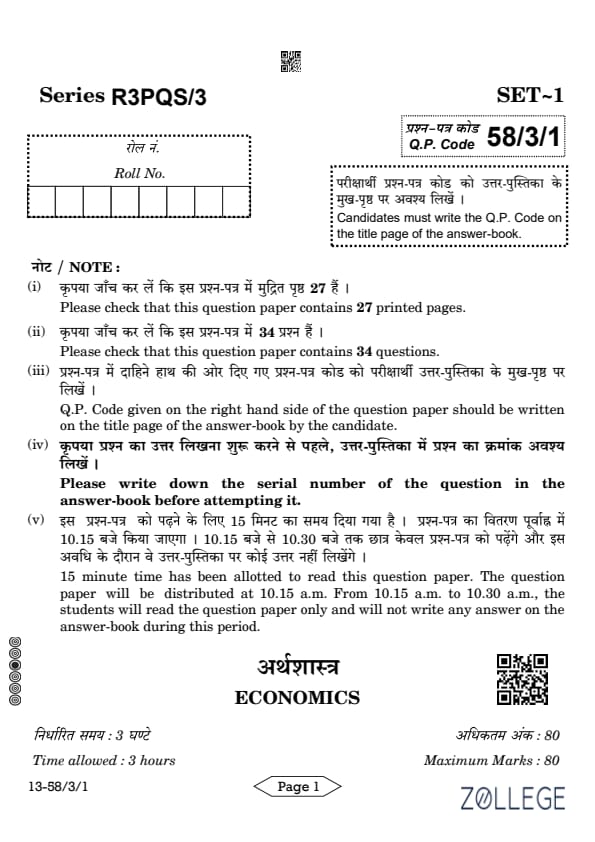
CBSE Class 12 2024 Economics Set 1 (Code: 58/3/1) Question Paper Pdf - Check Solutions with Answer Key Pdf

.jpg?tr=h-55,w-55,c-force)
Content Strategist|Tech-innovator|National Hackathon Winner | Updated On - Feb 21, 2025
CBSE Class 12 2024 Economics Question Paper with Answer Key PDF for Set 1 (Q.P. Code: 58/3/1) is available for download. The exam was successfully conducted by CBSE on March 18, 2024, in the morning session from 10:30 AM to 1:30 PM. As per the students’ initial reactions, the CBSE Class 12 2024 Economics Set 1 Question Paper was reported as Moderate. The Microeconomics section was considered Easy to Moderate, while the Macroeconomics section was reported as Moderate to Challenging.
CBSE Class 12 2024 Economics (Set 1- 58/3/1) 2024 Answer Key With Solution
Candidates can download the CBSE Class 12 Economics Question Paper with Solution and Answer Key PDFs for Set 1 Question Paper (Code: 58/3/1) using the link below.
| CBSE Class 12 Economics (Set 1- 58/3/1) 2024 Question Paper with Answer Key |  Download Download |
Check Solution |
CBSE Class 12 2024 Economics Question Paper with Solutions
Macro Economics
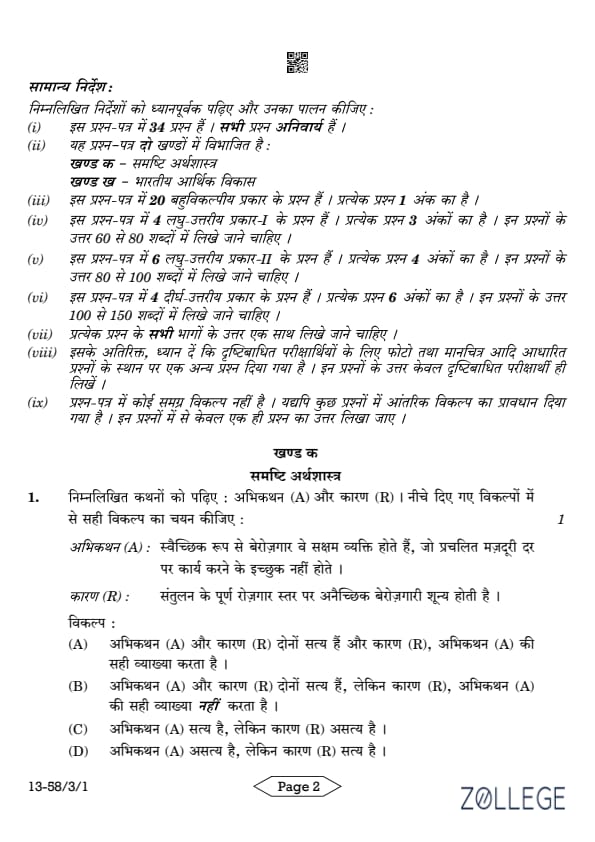
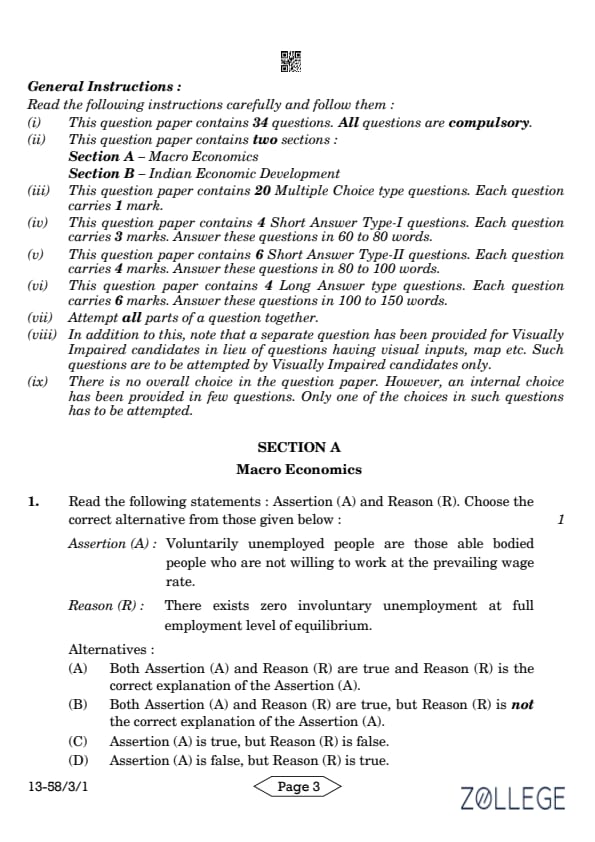
Question 1:
Read the following statements: Assertion (A) and Reason (R). Choose the correct alternative from those given below:
Assertion (A): Voluntarily unemployed people are those able-bodied people who are not willing to work at the prevailing wage rate.
Reason (R): There exists zero involuntary unemployment at full employment level of equilibrium.
Correct Answer: (B) Both Assertion (A) and Reason (R) are true, but Reason (R) is not the correct explanation of Assertion (A).
View Solution
Step 1: Understanding Voluntary Unemployment.
Assertion (A) correctly states that voluntarily unemployed individuals are those who choose not to work at the prevailing wage rate despite job availability. This can be due to personal choices such as waiting for better opportunities, higher wages, or other factors.
Step 2: Evaluating Full Employment and Involuntary Unemployment.
Reason (R) also holds true as full employment equilibrium implies that there is no involuntary unemployment. This means that all those who are willing to work at the given wage rate have jobs.
Step 3: Analyzing the Explanation.
While Reason (R) is true, it does not directly explain voluntary unemployment. Voluntary unemployment exists due to individual choices rather than market equilibrium conditions.
Conclusion: Hence, both Assertion (A) and Reason (R) are true, but Reason (R) does not sufficiently explain Assertion (A).
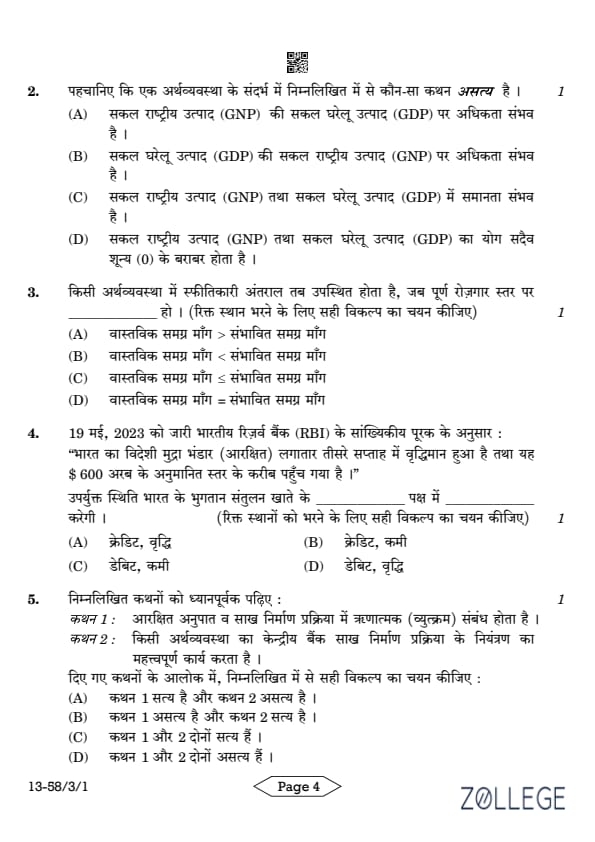
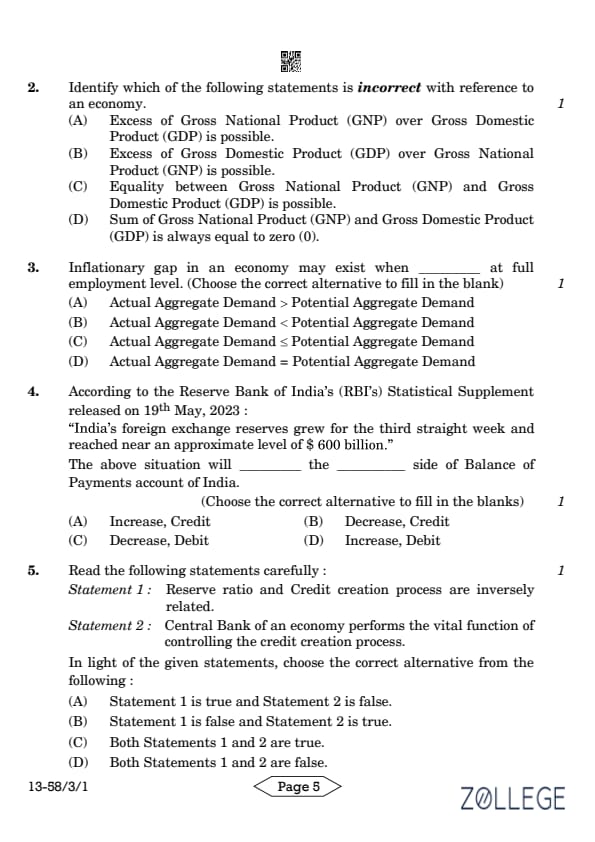
Question 2:
Identify which of the following statements is incorrect with reference to an economy.
Correct Answer: (D) Sum of Gross National Product (GNP) and Gross Domestic Product (GDP) is always equal to zero.
View Solution
Step 1: Understanding GNP and GDP.
GNP considers the total value of goods and services produced by nationals, including those produced abroad. GDP refers to the total value of goods and services produced within a country's borders.
Step 2: Evaluating the Options.
- Options (A), (B), and (C) are correct as GDP and GNP can be greater than or equal to each other under different circumstances.
- Option (D) is incorrect because the sum of GNP and GDP can never be zero.
Conclusion: The statement in (D) is mathematically and logically incorrect.
Question 3:
Inflationary gap in an economy may exist when at full employment level.
Correct Answer: (A) Actual Aggregate Demand > Potential Aggregate Demand
View Solution
Step 1: Understanding Inflationary Gap.
An inflationary gap occurs when actual aggregate demand exceeds the economy’s potential output at full employment level, causing upward pressure on prices.
Step 2: Evaluating the Options.
- Options (B) and (C) do not describe an inflationary gap as they do not indicate excess demand.
- Option (A) correctly states that inflation occurs when demand surpasses the economy’s full capacity.
Conclusion: The correct answer is (A).
Question 4:
According to the Reserve Bank of India’s (RBI’s) Statistical Supplement released on 19th May, 2023:
"India’s foreign exchange reserves grew for the third straight week and reached near an approximate level of 600 billion."
The above situation will affect the side of the Balance of Payments (BoP) account of India.
Correct Answer: (A) Increase, Credit
View Solution
Step 1: Understanding Foreign Exchange Reserves.
Foreign exchange reserves increase due to net inflows of foreign currency into the country, such as from exports, foreign investments, or remittances.
Step 2: Evaluating the Balance of Payments.
These inflows are recorded on the credit side of the BoP account, as they represent an increase in the country’s foreign assets.
Conclusion: The correct answer is (A).
Question 5:
Read the following statements carefully:
Statement 1: Reserve ratio and Credit creation process are inversely related.
Statement 2: The Central Bank of an economy performs the vital function of controlling the credit creation process.
Correct Answer: (C) Both Statements 1 and 2 are true.
View Solution
Step 1: Understanding Reserve Ratio and Credit Creation.
The reserve ratio and credit creation process are inversely related because a higher reserve ratio limits the funds available for lending, reducing credit creation.
Step 2: Role of the Central Bank.
The Central Bank controls credit creation through tools like the Cash Reserve Ratio (CRR), Statutory Liquidity Ratio (SLR), and repo rates.
Conclusion: Both statements are correct, making Option (C) the correct answer.
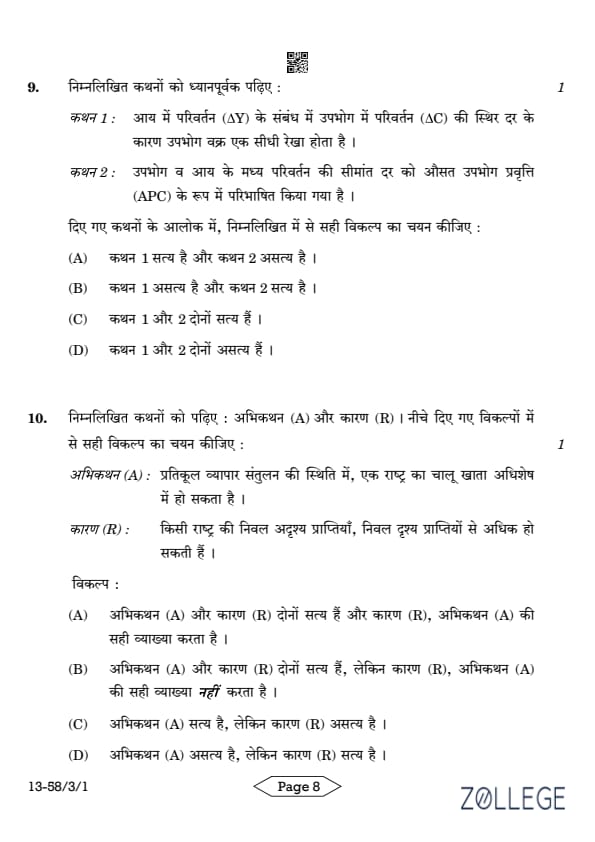
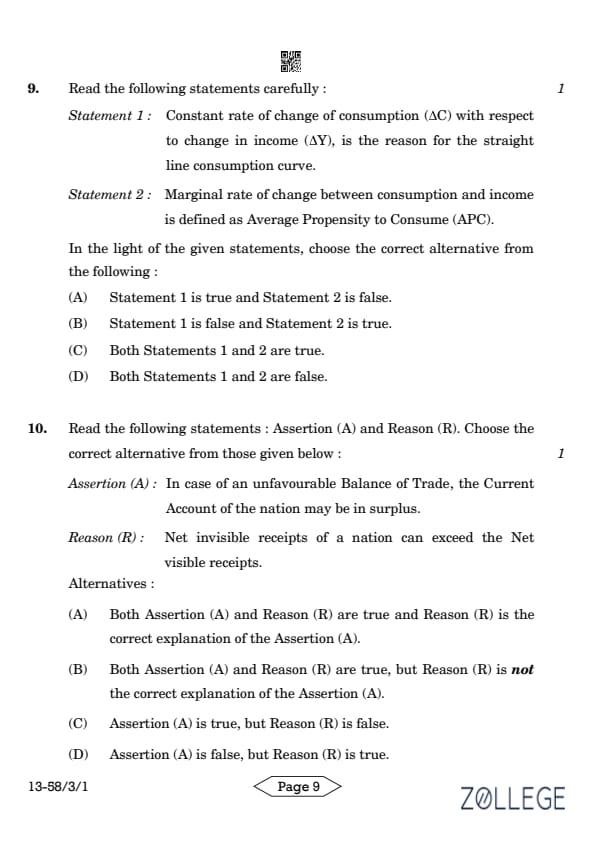
Question 9:
Read the following statements carefully:
Statement 1: Constant rate of change of consumption (∆C) with respect to change in income (∆Y ) is the reason for the straight-line consumption curve.
Statement 2: Marginal rate of change between consumption and income is defined as Average Propensity to Consume (APC).
In the light of the given statements, choose the correct alternative from the fol- lowing:
Correct Answer: (A) Statement 1 is true and Statement 2 is false.
View Solution
1. Statement 1: This is true because a constant rate of change of consumption with respect to income (∆C/∆Y ) represents the Marginal Propensity to Consume (MPC), which is why the consumption curve is straight.
2. Statement 2: This is false because the average rate of change between consumption and income is referred to as the Average Propensity to Consume (APC), not the marginal rate of change. APC is defined as C/Y , where C is consumption and Y is income.
3. Therefore, Option (A) is correct.
Question 10:
Read the following statements: Assertion (A) and Reason (R). Choose the correct alternative from those given below:
Assertion (A): In case of an unfavourable Balance of Trade, the Current Account of the nation may be in surplus.
Reason (R): Net invisible receipts of a nation can exceed the Net visible receipts.
Correct Answer: (A) Both Assertion (A) and Reason (R) are true and Reason (R) is the correct explanation of the Assertion (A).
View Solution
1. Assertion (A): This is true because even with an unfavourable Balance of Trade (i.e., imports exceed exports), the Current Account can be in surplus if the invisibles (services, remittances, etc.) are significant.
2. Reason (R): This is also true as net invisible receipts (like remittances, IT services, and other incomes) can exceed net visible receipts (goods trade).
3. Linking A and R: Reason (R) directly explains Assertion (A) since the high net invisibles can offset the trade deficit, leading to a Current Account surplus.
4. Thus, Option (A) is correct.
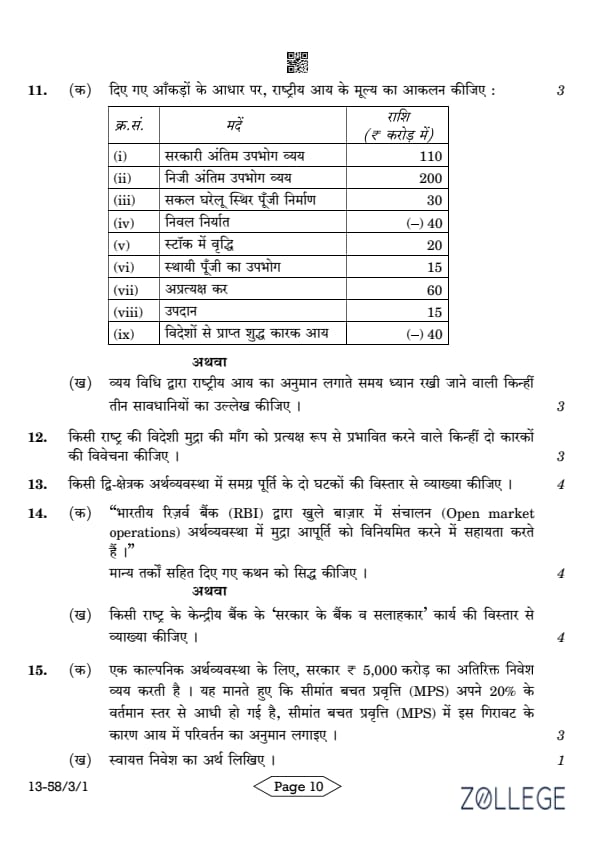
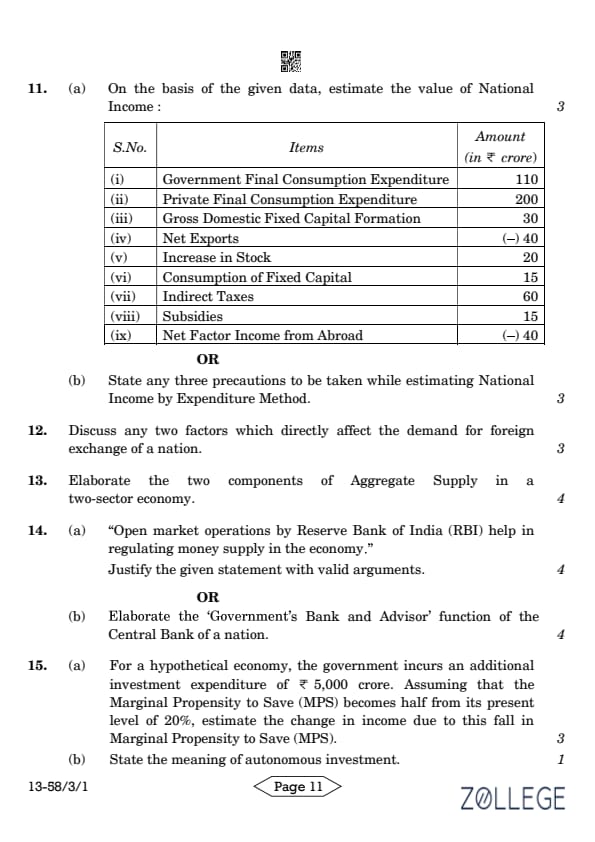
Question 11(a):
On the basis of the given data, estimate the value of National Income:
| S.No. | Items | Amount (in crore) |
|---|---|---|
| (i) | Government Final Consumption Expenditure | 110 |
| (ii) | Private Final Consumption Expenditure | 200 |
| (iii) | Gross Domestic Fixed Capital Formation | 30 |
| (iv) | Net Exports | (−40) |
| (v) | Increase in Stock | 20 |
| (vi) | Consumption of Fixed Capital | 15 |
| (vii) | Indirect Taxes | 60 |
| (viii) | Subsidies | 15 |
| (ix) | Net Factor Income from Abroad | (−40) |
View Solution
1. National Income (NNPFC) is calculated using the formula:
NNPFC = C + G + I + Net Exports + Net Factor Income from Abroad − Indirect Taxes + Subsidies.
2. Substituting the given values:
- C = 200 (Private Final Consumption Expenditure),
- G = 110 (Government Final Consumption Expenditure),
- I = Gross Domestic Fixed Capital Formation + Increase in Stock = 30 + 20 = 50,
- Net Exports = (-40),
- Net Factor Income from Abroad = (-40),
- Indirect Taxes = 60,
- Subsidies = 15.
3. Substituting into the formula: NNPFC = 200 + 110 + 50 − 40 − 40 − 60 + 15.
4. Simplifying the equation: NNPFC = 200 + 110 + 50 − 40 − 40 − 60 + 15 = 225 crore.
Question 11(b):
State any three precautions to be taken while estimating National Income by Expenditure Method.
View Solution
1. Avoid Double Counting: Ensure that intermediate goods or inputs are not counted multiple times to prevent overstating the national income.
2. Exclude Transfer Payments: Payments like pensions, scholarships, and unemployment benefits should not be included as they do not correspond to the production of goods and services.
3. Include Only Final Expenditures: Intermediate consumption, which is used in the production of other goods, should be excluded to avoid duplication.
4. Adjust for Indirect Taxes and Subsidies: Include indirect taxes and subsidies to convert GDP at market price to GDP at factor cost.
Question 12:
Discuss any two factors which directly affect the demand for foreign exchange of a nation.
View Solution
1. Imports: When a nation imports goods and services from other countries, it needs foreign exchange to make payments in the currency of the exporting country. An increase in imports, such as petroleum, machinery, or electronics, directly raises the demand for foreign exchange.
2. Foreign Travel and Education: Individuals traveling abroad for tourism, education, or business require foreign exchange to cover expenses like accommodation, tuition fees, or other services. The more citizens traveling abroad or studying overseas, the higher the demand for foreign currency.
Question 13:
Elaborate the two components of Aggregate Supply in a two-sector economy.
View Solution
1. Consumption (C):
- This represents the portion of income that households spend on goods and services to satisfy their immediate needs.
- Examples include spending on food, clothing, education, and healthcare.
- It plays a crucial role in determining the overall demand in the economy and directly influences production.
2. Savings (S):
- This is the portion of income not spent on consumption and is set aside for future use or investment.
- Savings contribute to the capital formation of an economy by providing funds for investment in productive activities.
- It ensures economic growth by enabling businesses to expand their capacity and improve efficiency.
In a two-sector economy, Aggregate Supply (AS) is represented as:
AS = C + S
where all income is either consumed or saved.
Question 14(a):
"Open market operations by Reserve Bank of India (RBI) help in regulating money supply in the economy." Justify the given statement with valid arguments.
View Solution
1. Regulating Liquidity:
- RBI uses open market operations (OMO) to regulate liquidity in the economy by buying or selling government securities.
- When the RBI sells securities, it absorbs excess liquidity from the economy, reducing the money supply.
- Conversely, when the RBI buys securities, it injects liquidity, increasing the money supply.
2. Controlling Inflation:
- During periods of high inflation, the RBI sells securities to reduce the availability of money in the market, helping to control price levels.
- During deflation or economic slowdowns, the RBI buys securities to increase liquidity and boost demand in the economy.
3. Stabilizing Interest Rates:
- Open market operations help stabilize interest rates by managing the supply of money in the banking system.
- Reduced liquidity through OMO can increase interest rates, discouraging borrowing, while increased liquidity reduces interest rates to encourage borrowing.
Question 15(a):
For a hypothetical economy, the government incurs an additional investment expenditure of ₹5,000 crore. Assuming that the Marginal Propensity to Save (MPS) becomes half from its present level of 20%, estimate the change in income due to this fall in MPS.
Correct Answer: ₹50,000 crore
View Solution
Step 1: Identify given values.
- Initial MPS = 20% = 0.2
- New MPS = 0.1 (half of the initial value)
Step 2: Calculate the multiplier.
Multiplier = 1 / MPS
For new MPS = 0.1:
Multiplier = 1 / 0.1 = 10
Step 3: Compute the change in income.
ΔY = Multiplier × ΔI
ΔY = 10 × 5,000
ΔY = ₹50,000 crore
Conclusion: Due to the fall in MPS, the change in income is ₹50,000 crore.
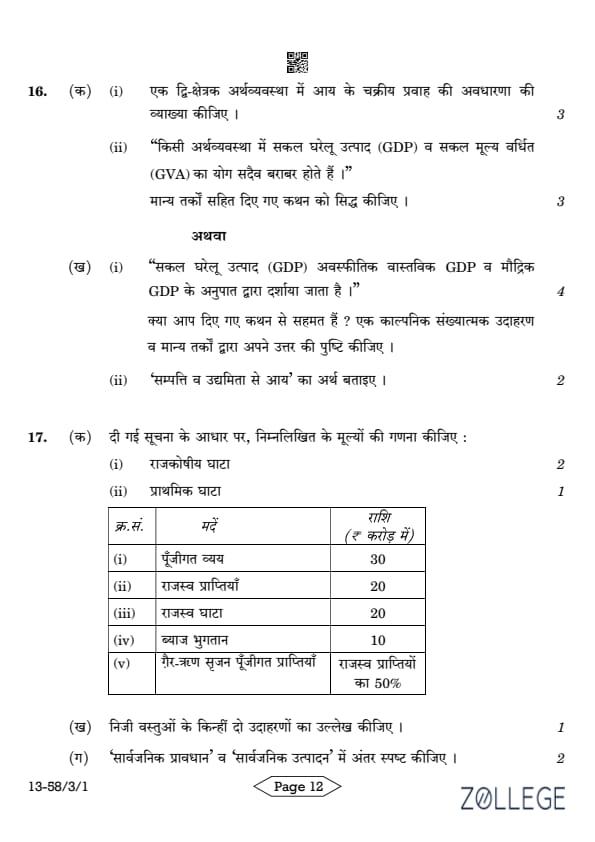
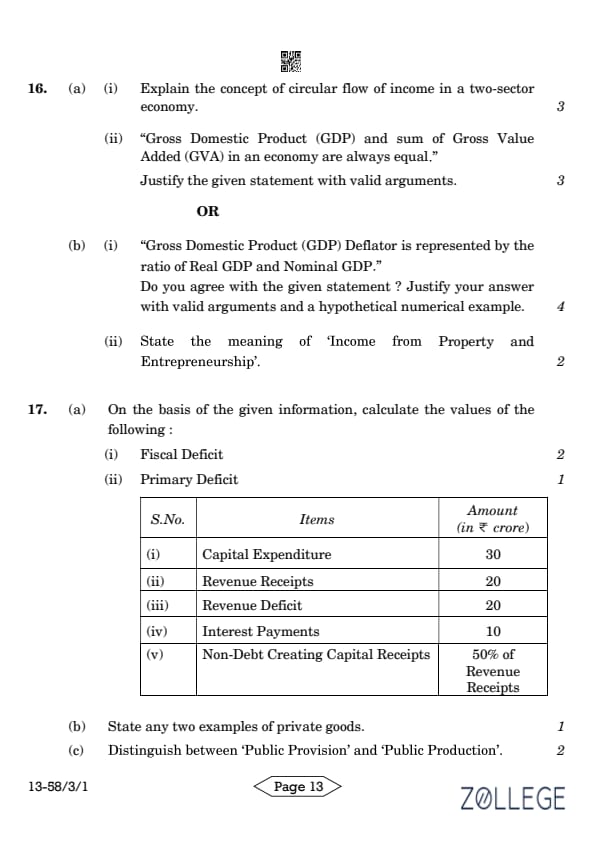
Question 16(a)(i):
Explain the concept of circular flow of income in a two-sector economy.
View Solution
1. Two-Sector Model:
- A two-sector economy comprises households and firms.
2. Factor Payments:
- Households provide factors of production (land, labor, capital) to firms, and in return, firms pay factor incomes (rent, wages, interest, profit).
3. Expenditure Flow:
- Households spend their income on goods and services produced by firms, creating a circular flow of income.
4. Continuous Exchange:
- This flow ensures continuous exchange of goods, services, and income between the two sectors.
Question 16(a)(ii):
"Gross Domestic Product (GDP) and sum of Gross Value Added (GVA) in an economy are always equal." Justify the given statement with valid arguments.
View Solution
1. Understanding GDP:
- GDP is the monetary value of all final goods and services produced within a country in a specific period.
2. Understanding GVA:
- GVA measures the value of goods and services produced after subtracting intermediate consumption from output.
3. Relationship Between GDP and GVA:
GDP = GVA + Taxes on Products − Subsidies on Products
- The sum of GVA across all sectors, adjusted for taxes and subsidies, equals GDP:
Conclusion: The two measures are equivalent when adjustments are appropriately made.
Question 16(b)(i):
“Gross Domestic Product (GDP) Deflator is represented by the ratio of Real GDP and Nominal GDP.”
Do you agree with the given statement? Justify your answer with valid arguments and a hypothetical numerical example.
View Solution
1. Definition: The GDP Deflator is a measure of the price level changes in an economy. It is calculated as:
GDP Deflator = (Nominal GDP / Real GDP) × 100
2. Explanation:
- Nominal GDP measures the value of goods and services at current prices.
- Real GDP measures the value of goods and services at base-year prices, removing the effect of inflation.
- The GDP Deflator shows how much of the nominal GDP is driven by price changes rather than output changes.
3. Numerical Example:
| Year | Price (in ) | Output (in units) | Real GDP | Nominal GDP | GDP Deflator |
|---|---|---|---|---|---|
| 2010 | 10 | 100 | 1,000 | 1,000 | (1000/1000) × 100 = 100 |
| 2015 | 15 | 100 | 1,000 | 1,500 | (1500/1000) × 100 = 150 |
4. From the above table:
- In 2010, the GDP Deflator is 100, indicating no inflation (base year).
- In 2015, the GDP Deflator is 150, indicating a 50% increase in price levels compared to the base year.
Question 16(b)(ii):
State the meaning of ‘Income from Property and Entrepreneurship’.
View Solution
1. Definition: Income from Property and Entrepreneurship refers to the factor income earned through ownership of assets (property) and entrepreneurial efforts in the production process.
2. Components:
- Rent: Earnings derived from leasing or renting out land, buildings, or other properties.
- Royalties: Income earned from granting permission to use intangible assets, such as patents, copyrights, or trademarks.
- Interest: Earnings received for lending capital or providing loans.
- Profits: The residual income that entrepreneurs earn after deducting all costs and expenses from total revenue.
3. These incomes are part of the factor incomes included in the calculation of National Income.
Question 17(a):
On the basis of the given information, calculate the values of the following:
(i) Fiscal Deficit
(ii) Primary Deficit
| S.No. | Items | Amount (in crore) |
|---|---|---|
| (i) | Capital Expenditure | 30 |
| (ii) | Revenue Receipts | 20 |
| (iii) | Revenue Deficit | 20 |
| (iv) | Interest Payments | 10 |
| (v) | Non-Debt Creating Capital Receipts | 50% of Revenue Receipts |
View Solution
1. Non-Debt Creating Capital Receipts:
Non-Debt Creating Capital Receipts = (50/100) × Revenue Receipts = (50/100) × 20 = 10 crore.
2. Fiscal Deficit:
Fiscal Deficit = Revenue Deficit + Capital Expenditure − Non-Debt Creating Capital Receipts.
Substituting the values: Fiscal Deficit = 20 + 30 − 10 = 40 crore.
3. Primary Deficit:
Primary Deficit = Fiscal Deficit − Interest Payments.
Substituting the values: Primary Deficit = 40 − 10 = 30 crore.
Question 17(b):
State any two examples of private goods.
View Solution
1. Mobile phones.
2. Personal vehicles.
Question 17(c):
Distinguish between ‘Public Provision’ and ‘Public Production’.
View Solution
| Public Provision | Public Production |
|---|---|
| Refers to the supply of goods and services by the government, funded through taxes or other sources. | Refers to the production of goods and services by government-owned entities. |
| Example: Free education in government schools. | Example: Electricity production by state-owned enterprises. |
| May involve private sector participation for delivery. | Entirely managed and controlled by the government. |
SECTION B
Indian Economic Development
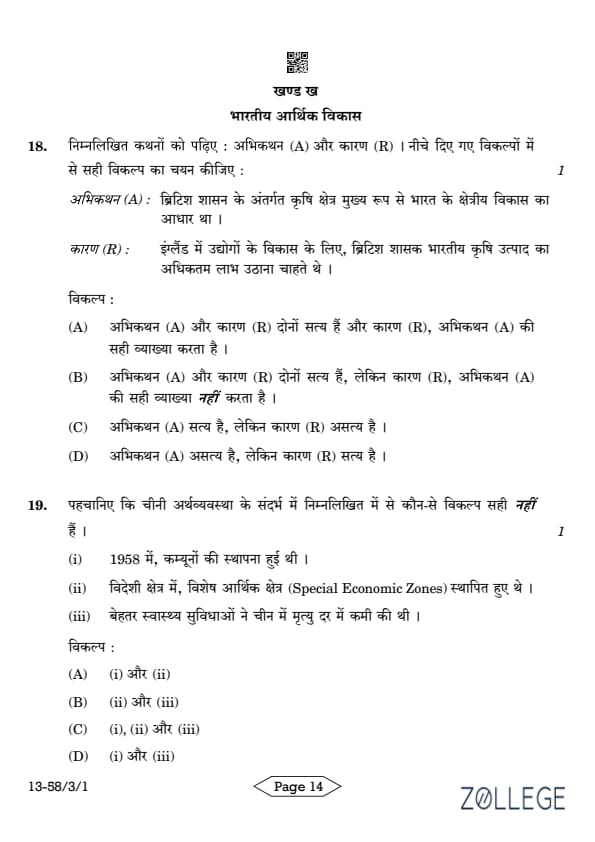
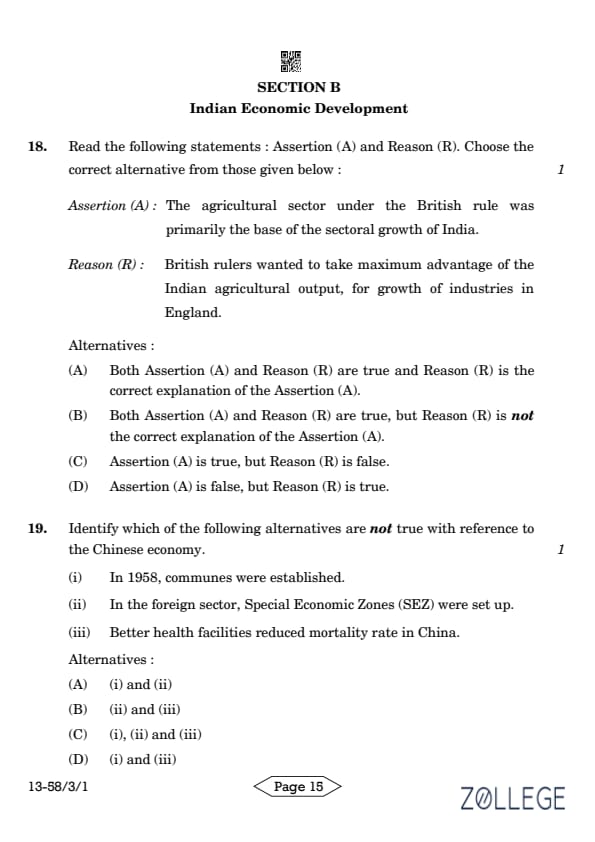
Question 18:
Read the following statements: Assertion (A) and Reason (R). Choose the correct alternative from those given below:
Assertion (A): The agricultural sector under the British rule was primarily the base of the sectoral growth of India.
Reason (R): British rulers wanted to take maximum advantage of the Indian agricultural output, for growth of industries in England.
Correct Answer: (B) Both Assertion (A) and Reason (R) are true, but Reason (R) is not the correct explanation of the Assertion (A).
View Solution
1. Assertion (A): This is true because the agricultural sector was the backbone of India’s economy under British rule, providing raw materials for industries.
2. Reason (R): This is also true as the British exploited Indian agriculture to fuel their industrial growth in England.
3. However, Reason (R) is not the correct explanation of Assertion (A) because the agricultural sector’s role was significant due to its structural composition in the Indian economy, not just because of British exploitation.
4. Therefore, Option (B) is correct.
Question 19:
Identify which of the following options are not true with reference to the Chinese economy:
(i) In 1958, communes were established. (ii) In the foreign sector, Special Economic Zones (SEZ) were set up. (iii) Better health facilities reduced mortality rate in China.
Correct Answer: (None of these/All are correct)
View Solution
1. Statement (i): This is true as communes, or collective farming units, were introduced in 1958 under the Great Leap Forward.
2. Statement (ii): This is *also true* as Special Economic Zones (SEZs) were set up to attract foreign investment and boost export-oriented industries.
3. Statement (iii): This is true since better health facilities significantly reduced mortality rates in China, contributing to improved life expectancy.
4. Therefore, *all* statements are individually true. The question asks which options are *not true*. Since all statements are true, none of the provided A, B, C, or D options are correct. A new option (None of these/All are correct) needs to be added and selected as the correct answer.
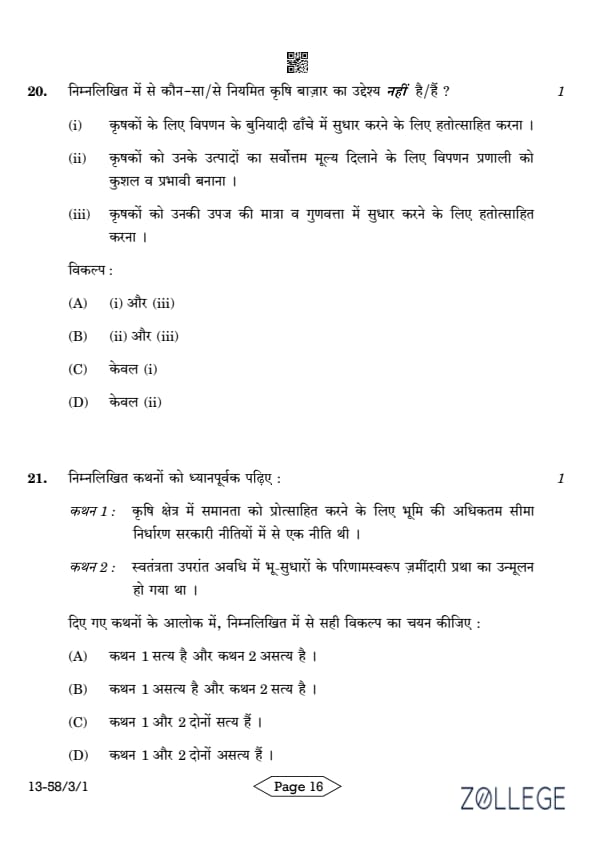
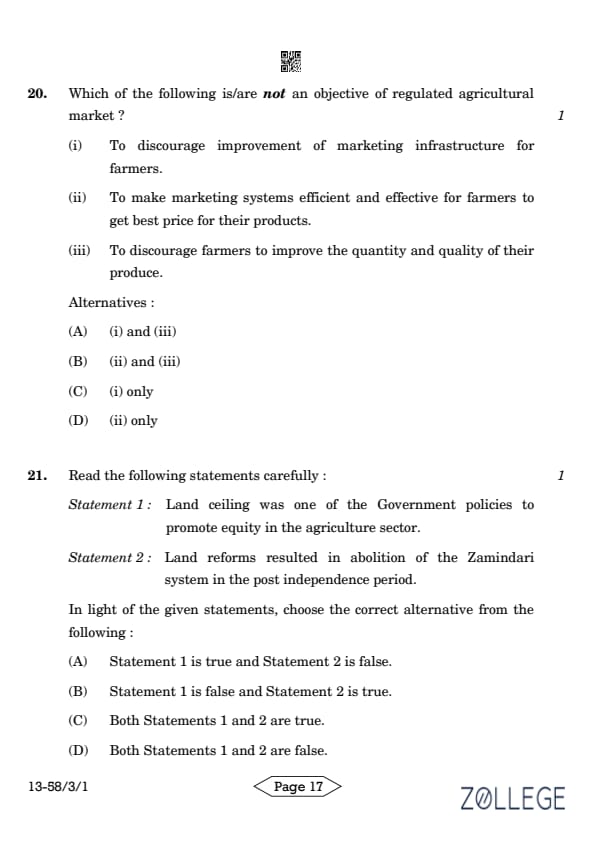
Question 20:
Which of the following is/are not an objective of regulated agricultural market?
(i) To discourage improvement of marketing infrastructure for farmers. (ii) To make marketing systems efficient and effective for farmers to get the best price for their products. (iii) To discourage farmers to improve the quantity and quality of their produce.
Correct Answer: (A) (i) and (iii)
View Solution
1. Statement (i): This is not an objective because improving marketing infrastructure is essential to support farmers and enhance their income.
2. Statement (ii): This is a valid objective, as efficient and effective marketing systems help farmers achieve better pricing.
3. Statement (iii): This is not an objective because encouraging farmers to improve the quantity and quality of their produce is crucial for overall agricultural growth.
4. Therefore, Statements (i) and (iii) are not objectives.
Question 21:
Read the following statements carefully:
Statement 1: Land ceiling was one of the Government policies to promote equity in the agriculture sector.
Statement 2: Land reforms resulted in the abolition of the Zamindari system in the post-independence period.
Correct Answer: (C) Both Statements 1 and 2 are true.
View Solution
Step 1: Land Ceiling as a Policy.
Land ceiling was implemented to limit land ownership and distribute surplus land to landless farmers, promoting equity in agriculture.
Step 2: Abolition of Zamindari System.
Post-independence land reforms abolished the exploitative Zamindari system, giving ownership rights to tenants and small farmers.
Conclusion: Both statements are correct as they describe key policies aimed at reducing inequality and promoting fairness in the agricultural sector.
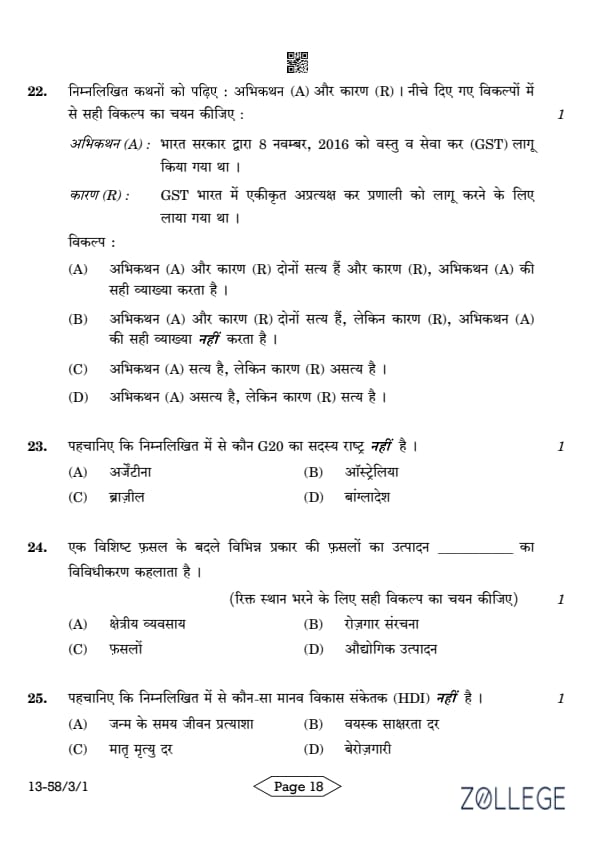
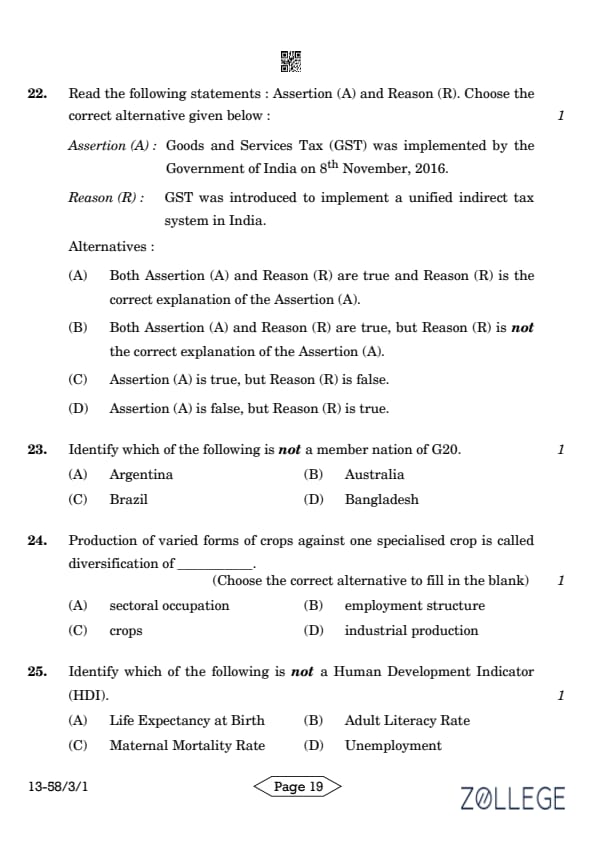
Question 22:
Read the following statements: Assertion (A) and Reason (R). Choose the correct alternative.
Assertion (A): Goods and Services Tax (GST) was implemented by the Government of India on 8th November, 2016.
Reason (R): GST was introduced to implement a unified indirect tax system in India.
Correct Answer: (D) Assertion (A) is false, but Reason (R) is true.
View Solution
Step 1: Verify the Implementation Date.
GST was implemented on 1st July, 2017, not on 8th November, 2016, making Assertion (A) false.
Step 2: Verify the Purpose of GST.
Reason (R) is true as GST aimed to unify the indirect tax system in India by replacing multiple indirect taxes with a single tax structure.
Conclusion: Since Assertion (A) is incorrect but Reason (R) is correct, the correct answer is (D).
Question 23:
Identify which of the following is not a member nation of G20.
Correct Answer: (D) Bangladesh
View Solution
Step 1: Understanding G20 Membership.
The G20 (Group of Twenty) is an international forum of 19 countries and the European Union, focusing on global economic issues.
Step 2: Identifying Members.
Argentina, Australia, and Brazil are members of the G20, while Bangladesh is not.
Conclusion: Bangladesh, despite being a growing economy, is not a G20 member but participates in discussions as an invited country.
Question 24:
Production of varied forms of crops against one specialized crop is called diversification of ______.
Correct Answer: (C) Crops
View Solution
Step 1: Understanding Crop Diversification.
Crop diversification refers to cultivating multiple crops in a given area instead of depending on a single crop.
Step 2: Benefits of Crop Diversification.
- Reduces risk from crop failure.
- Improves soil fertility by maintaining nutrient balance.
- Ensures food security and stabilizes farm income.
Conclusion: Crop diversification is the correct term, making option (C) the correct answer.
Question 25:
Identify which of the following is not a Human Development Indicator (HDI).
Correct Answer: (D) Unemployment
View Solution
Step 1: Understanding HDI Components.
- Life Expectancy at Birth - Measures health and longevity.
- Adult Literacy Rate - Part of the education index.
- Gross National Income (GNI) per capita - Reflects economic standard of living.
Step 2: Why Unemployment is Not Included?
Unemployment is an economic indicator but not directly used in HDI calculations.
Conclusion: Since HDI focuses on health, education, and income, unemployment is not an HDI measure.
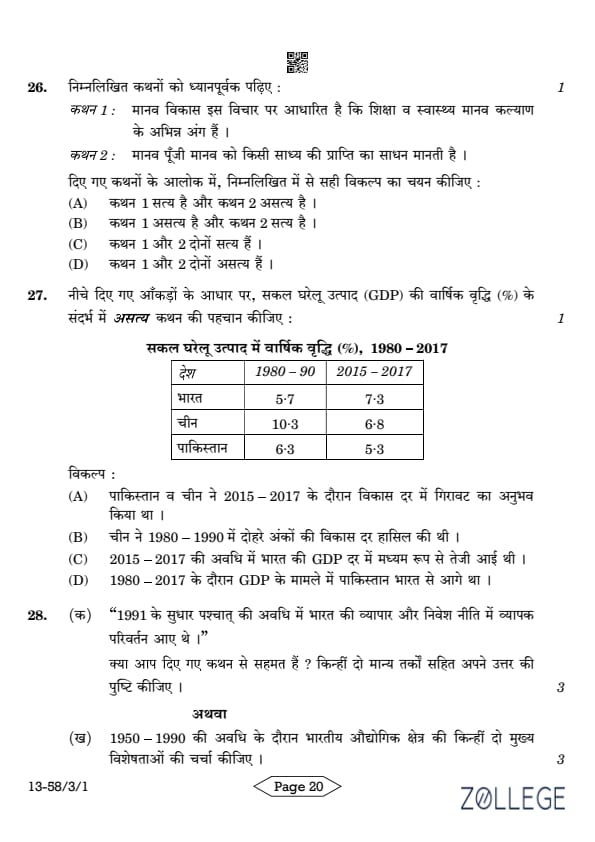
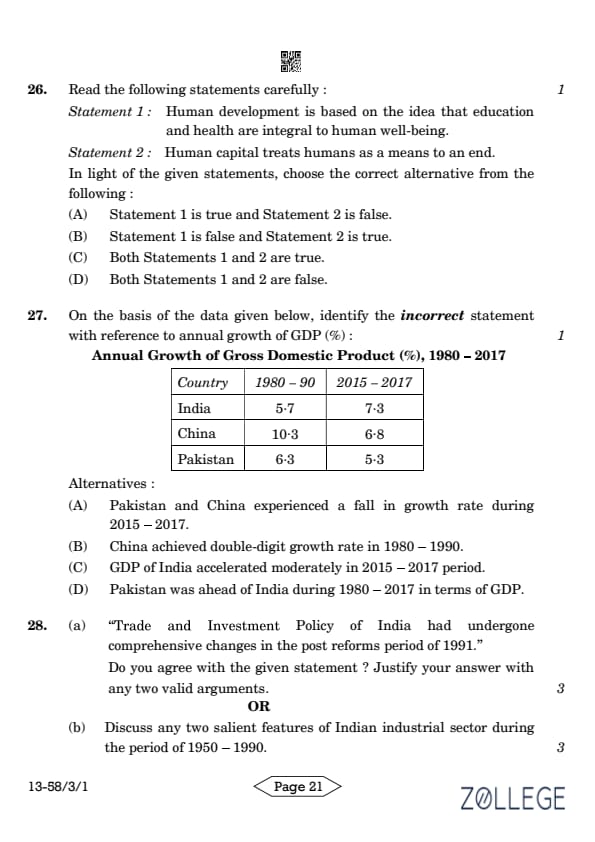
Question 26:
Read the following statements carefully:
Statement 1: Human development is based on the idea that education and health are integral to human well-being.
Statement 2: Human capital treats humans as a means to an end.
Correct Answer: (C) Both Statements 1 and 2 are true.
View Solution
Step 1: Understanding Human Development.
Human development focuses on well-being, with education and health as essential components.
Step 2: Understanding Human Capital.
Human capital treats education and health as investments to improve productivity and economic growth.
Conclusion: Both statements correctly describe different perspectives on human progress.
Question 28(a):
“Trade and Investment Policy of India had undergone comprehensive changes in the post-reform period of 1991.”
Do you agree with the given statement? Justify your answer with any two valid arguments.
View Solution
1. Liberalization of Trade Policies:
- Post-1991, India adopted liberalization by removing trade barriers, reducing import tariffs, and dismantling the license-permit regime.
- These changes promoted free trade, allowing Indian industries to compete in global markets and encouraging the import of advanced technologies and essential goods.
2. Promotion of Foreign Direct Investment (FDI):
- The government opened multiple sectors for FDI, including manufacturing, IT, telecommunications, and infrastructure.
- This led to significant technological advancements, improved productivity, and increased employment opportunities in the economy.
Question 28(b):
Discuss any two salient features of Indian industrial sector during the period of 1950 – 1990.
View Solution
1. Dominance of Public Sector:
- The Industrial Policy Resolution of 1956 laid the foundation for public sector dominance, categorizing industries into three groups: exclusively public, mixed, and private sectors.
- Key industries like steel, mining, heavy engineering, and defense production were reserved for the public sector to achieve socio-economic objectives such as reducing income inequalities and ensuring regional balance.
- The public sector was seen as an engine of growth, providing infrastructure and basic goods while addressing market failures.
2. License Raj:
- The industrial licensing system, introduced through the Industries (Development and Regulation) Act, 1951, required businesses to obtain licenses for starting, expanding, or diversifying their activities.
- This system aimed to prevent monopolies, control overproduction, and ensure equitable distribution of resources. However, it stifled competition and led to inefficiencies, bureaucratic delays, and corruption.
- Private sector participation was heavily regulated, limiting innovation and technological progress in industries.
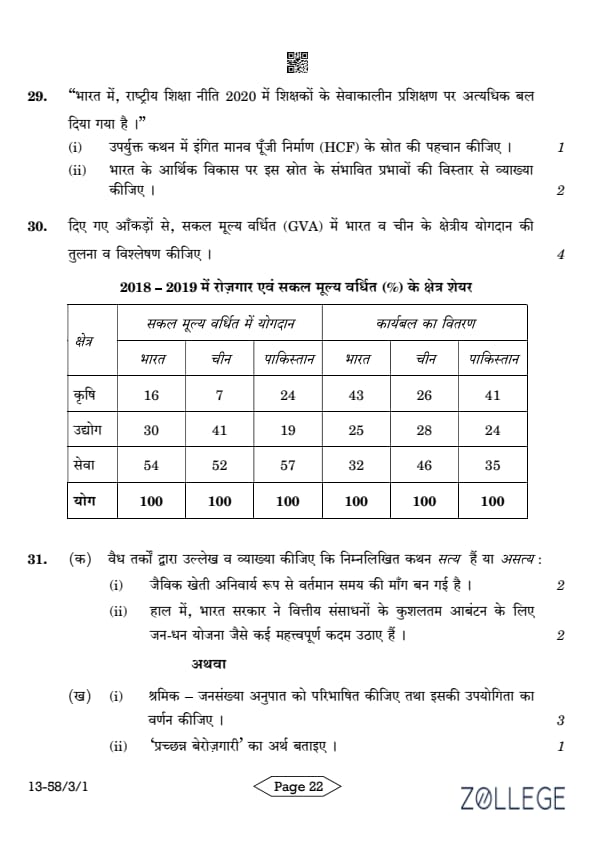
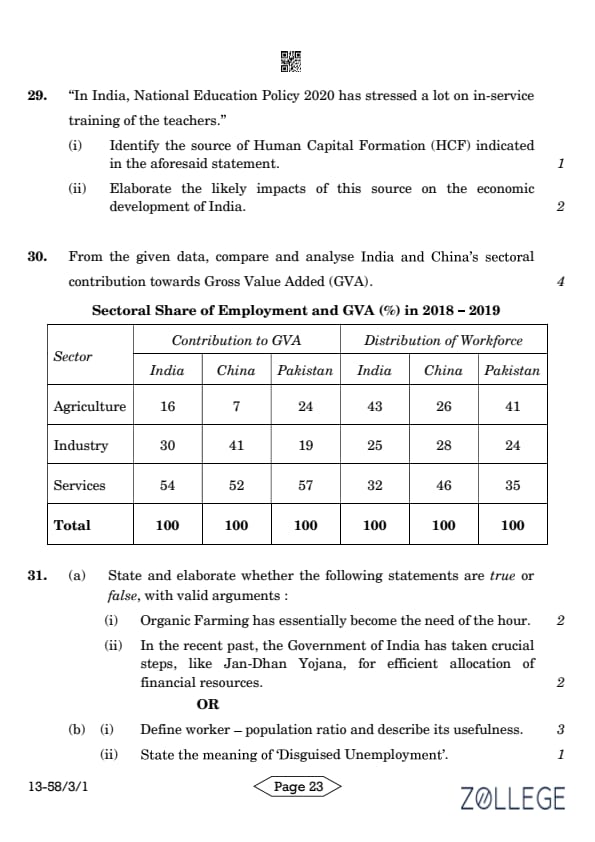
Question 29:
“In India, National Education Policy 2020 has stressed a lot on in-service training of the teachers.”
(i) Identify the source of Human Capital Formation (HCF) indicated in the afore- said statement.
(ii) Elaborate the likely impacts of this source on the economic development of India.
View Solution
(i)
- The source of Human Capital Formation (HCF) mentioned in the statement is Expenditure on Education.
- Expenditure on education includes teacher training programs, skill development initiatives, and capacity building to enhance the quality of human resources.
- Training for teachers improves their teaching methods, leading to better knowledge dissemination and higher student outcomes, which ultimately contributes to human capital formation.
(ii)
(a) Enhanced Workforce Productivity:
- Better-trained teachers impart high-quality education, resulting in a more skilled and knowledgeable workforce.
- A skilled workforce contributes to increased labor productivity and innovation in various sectors.
(b) Accelerated Economic Growth:
- A skilled workforce attracts investment, fosters entrepreneurship, and drives technological advancements.
- Higher productivity and efficiency contribute to increased GDP and per capita income, accelerating economic growth.
(c) Reduction in Social Inequalities:
- Improved education and skill development opportunities help bridge the gap between different socio-economic groups.
- A well-educated population leads to better employment prospects and poverty reduction.
(d) Improved Social Outcomes:
- Education enhances awareness about health, sanitation, and social values, leading to improved quality of life.
- Higher literacy rates and better education also foster democratic participation and social cohesion.
Question 30:
From the given data, compare and analyze India and China’s sectoral contri- bution towards Gross Value Added (GVA).
| Sector | Contribution to GVA (%) India | China | Pakistan |
Distribution of Workforce (%) India | China | Pakistan |
|---|---|---|
| Agriculture | 16 | 7 | 24 | 43 | 26 | 41 |
| Industry | 30 | 41 | 19 | 25 | 28 | 24 |
| Services | 54 | 52 | 57 | 32 | 46 | 35 |
| Total | 100 | 100 | 100 | 100 | 100 | 100 |
View Solution
1. Sectoral Contribution and Workforce Distribution in India:
- The agriculture sector employs 43% of the workforce but contributes only 16% to GVA. This indicates low productivity and disguised unemployment.
- The industry sector contributes 30% to GVA while employing 25% of the workforce, showing a growing but underdeveloped industrial base.
- The services sector dominates GVA, contributing 54%, yet it employs only 32% of the workforce, reflecting a structural shift towards services.
2. Sectoral Contribution and Workforce Distribution in China:
- Agriculture employs only 26% of the workforce, contributing a low 7% to GVA. This suggests a modern and efficient agricultural sector.
- Industry plays a major role, contributing 41% to GVA and employing 28% of the workforce, highlighting China’s strong manufacturing base.
- The services sector contributes 52% to GVA while employing 46% of the workforce, showing a balanced transition towards a service-driven economy.
3. Comparison Between India and China:
- India has a significantly higher percentage of its workforce engaged in agriculture (43%) than China (26%), but agriculture contributes much less to GVA in both countries.
- China has transitioned towards a strong industrial base, with industry contributing 41% to GVA, compared to 30% in India.
- China’s workforce is better distributed between sectors, whereas India still faces an overdependence on agriculture, requiring a structural shift towards industry and services.
Question 31(a):
State and elaborate whether the following statements are true or false, with valid arguments:
1. Organic Farming has essentially become the need of the hour.
View Solution
Organic farming has become an essential practice due to its numerous environmental, health, and economic benefits. It reduces dependence on chemical fertilizers and pesticides, ensuring long-term soil fertility and promoting biodiversity.
Reasons for Organic Farming as a Necessity:
- Environmental Sustainability: Maintains soil health and prevents water contamination by avoiding harmful pesticides and synthetic fertilizers.
- Health Benefits: Organic crops are free from harmful chemicals, making them safer for consumption.
- Market Demand: Increasing consumer preference for organic food allows farmers to earn higher profits and access international markets.
- Government Support: Policies like Paramparagat Krishi Vikas Yojana (PKVY) provide financial assistance and training for organic farming.
- Climate Change Mitigation: Organic practices improve soil carbon sequestration, reducing greenhouse gas emissions.
Conclusion: Given these benefits, organic farming is indeed the need of the hour.
2. In the recent past, the Government of India has taken crucial steps, like Jan-Dhan Yojana, for efficient allocation of financial resources.
View Solution
The Government of India introduced the Pradhan Mantri Jan-Dhan Yojana (PMJDY) to promote financial inclusion and ensure efficient allocation of financial resources.
Impact of PMJDY:
- Financial Inclusion: Provides banking access to the unbanked population.
- Direct Benefit Transfers (DBT): Ensures that subsidies and welfare payments reach beneficiaries without corruption.
- Encouraging Savings and Digital Transactions: Promotes secure savings and digital financial services.
- Access to Credit and Insurance: Offers overdraft facilities, accident insurance, and pension benefits.
- Economic Growth and Transparency: Reduces income disparities and improves the efficiency of financial resource allocation.
Conclusion: The statement is true, as Jan-Dhan Yojana has significantly improved financial accessibility and economic inclusivity.
Question 31(b)(i):
Define worker-population ratio and describe its usefulness.
View Solution
Definition:
The worker-population ratio represents the proportion of employed individuals to the total population of a country. It is expressed as:
Worker-Population Ratio = (Total Workers / Total Population) × 100
Usefulness:
- Measures Labor Force Utilization: Indicates how effectively a country is utilizing its human resources in productive activities.
- Highlights Employment Trends: Helps policymakers analyze employment trends across different sectors, age groups, and genders.
- Assesses Economic Development: A higher ratio suggests higher employment and income levels, while a low ratio indicates economic distress.
- Regional and Sectoral Analysis: Allows comparison of employment levels between urban and rural areas.
Conclusion: A higher worker-population ratio suggests better employment opportunities, while a lower ratio indicates underutilization of labor, requiring policy intervention.
Question 31(b)(ii):
State the meaning of ‘Disguised Unemployment’.
View Solution
Definition:
Disguised unemployment occurs when more workers are engaged in a task than necessary, leading to no additional contribution to productivity.
Example:
If a small farm requires only three laborers to produce a given output but five laborers are working, the extra two laborers do not contribute to productivity. This situation is termed disguised unemployment.
Implications:
- Economic Inefficiency: Leads to lower overall productivity.
- Prevalence in Rural Areas: Common in agriculture due to the absence of alternative employment opportunities.
- Need for Sectoral Shift: Requires shifting excess labor to industry or services through skill development.
Conclusion: Disguised unemployment is common in agriculture, where excess labor does not contribute to productivity.
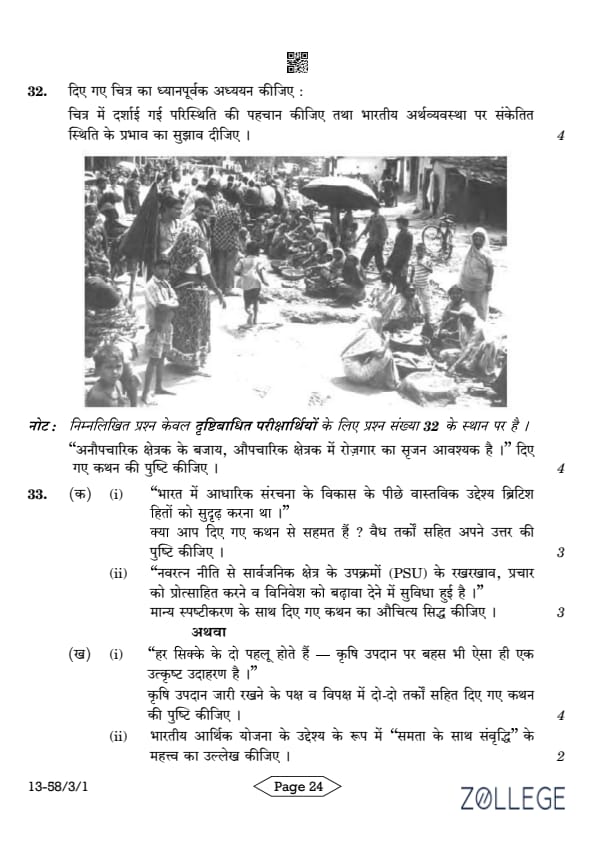
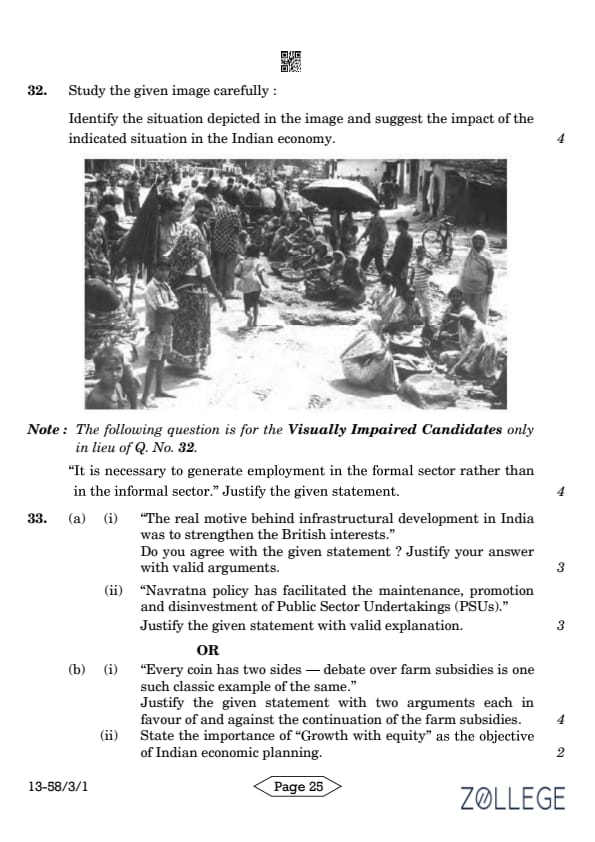
Question 32:
Study the given image carefully:

Identify the situation depicted in the image and suggest the impact of the indicated situation in the Indian economy.
View Solution
1. Situation Depicted:
The image highlights the prevalence of unemployment and underemployment in the informal sector of the Indian economy. A large segment of India’s workforce is engaged in low-paying, insecure jobs with minimal benefits.
2. Impact on the Indian Economy:
- Low Productivity: Informal sector workers often lack access to skill development, technology, and infrastructure, leading to low productivity.
- Absence of Social Security: Informal workers do not receive benefits like pensions, health insurance, or provident funds, increasing financial insecurity.
- Income Disparities and Poverty: The lack of fixed wages and unstable employment contributes to income inequality and prevents equitable wealth distribution.
- Tax Revenue Loss: The informal sector largely operates outside regulatory frameworks, leading to low tax compliance and reduced government revenue.
- Barrier to Economic Growth: Informal workers often remain trapped in low-income jobs, restricting human capital development, innovation, and investment.
Conclusion: Addressing informal sector unemployment requires labor market reforms, social security measures, and skill development programs.
Question 32:
It is necessary to generate employment in the formal sector rather than in the informal sector. Justify the given statement.
View Solution
1. Importance of Formal Sector Employment:
- Job Stability and Benefits: The formal sector ensures stable income, paid leave, and long-term employment security, improving workers’ financial conditions.
- Social Security and Welfare: Workers in the formal sector benefit from healthcare, provident funds, pension schemes, and insurance, ensuring economic stability.
- Higher Productivity and Innovation: Formal employment fosters skill development, training, and access to advanced technology, improving workforce efficiency.
- Contribution to Economic Growth: Formal sector workers contribute to national growth by increasing tax revenue, boosting consumption, and enhancing global competitiveness.
2. Challenges of the Informal Sector:
- Lack of Legal Protection: Informal sector workers face exploitation, job instability, and wage insecurity, leading to higher poverty levels.
- Limited Access to Credit and Resources: Informal businesses lack financial support, restricting expansion, investment, and overall economic contribution.
- Higher Economic Inequality: Since informal workers often earn low wages with no growth prospects, income disparity widens, affecting national economic balance.
Question 33(a)(i):
The real motive behind infrastructural development in India was to strengthen British interests.
Do you agree with the given statement? Justify your answer with valid argu- ments.
View Solution
Agree: The British introduced infrastructure developments primarily to serve their economic and administrative needs rather than benefiting India’s long-term economic progress.
Justification:
- Facilitated British Trade: Infrastructure, such as railways, roads, and ports, was developed mainly to facilitate raw material transportation from Indian villages to ports for export to Britain.
- Exploitive Economic Policies: The network of railways and roads allowed British industries to import finished goods into Indian markets, suppressing local handicrafts and industries.
- Administrative and Military Control: Infrastructure improved the mobility of British troops and enhanced administrative efficiency to control Indian territories.
- Lack of Development for Indian Interests: Investments in infrastructure were limited to regions strategically important to British trade, ignoring agricultural and industrial growth needed for India’s development.
Question 33(a)(ii):
Navratna policy has facilitated the maintenance, promotion, and disinvest- ment of Public Sector Undertakings (PSUs).
Justify the given statement with a valid explanation.
View Solution
Navratna Policy: Introduced to grant financial and operational autonomy to well-performing PSUs, enabling them to compete globally and improve efficiency.
Justification:
- Enhanced Operational Independence: Selected PSUs were allowed to make independent investment decisions, including global acquisitions and joint ventures.
- Improved Financial Performance: Autonomy helped these enterprises increase efficiency, productivity, and profitability, making them globally competitive.
- Selective Disinvestment Strategy: The policy enabled partial disinvestment, allowing private sector investment while maintaining government control.
- Promotion of Economic Development: By strengthening India’s industrial sector, Navratna PSUs contributed significantly to employment and national GDP growth.
Question 33(b)(i):
Every coin has two sides — debate over farm subsidies is one such classic example of the same.
Justify the given statement with two arguments each in favor and against the con- tinuation of farm subsidies.
View Solution
Arguments in Favor of Farm Subsidies:
- Support for Marginal Farmers: Subsidies help small and marginal farmers sustain their agricultural activities, ensuring food security.
- Price Stabilization and Risk Reduction: Government subsidies act as buffers against price volatility, protecting farmers from financial uncertainty.
Arguments Against Farm Subsidies:
- Financial Burden on Government: Excessive subsidies lead to fiscal deficits, reducing funds available for other developmental programs.
- Market Distortion and Inefficiency: Long-term dependency on subsidies discourages innovation and efficient resource allocation, making agriculture less competitive.
Question 33(b)(ii):
State the importance of “Growth with Equity” as an objective of Indian eco- nomic planning.
View Solution
- Inclusive Economic Growth: Ensures that economic benefits reach all sections of society, reducing wealth and income disparities.
- Poverty Alleviation: Provides opportunities for marginalized and underprivileged populations, contributing to overall poverty reduction.
- Balanced Regional Development: Prevents concentration of economic activities in a few states, ensuring equal distribution of resources.
- Social and Political Stability: Reduces economic inequalities, ensuring a more harmonious and stable socio-political environment.
- Sustainable Development: Encourages long-term, environmentally and economically sustainable growth.
Question 34(i):
State the meaning of green growth and net zero emissions.
View Solution
• Green Growth:
- Green growth refers to economic progress that occurs while ensuring minimal harm to the environment.
- It focuses on sustainable development, where industries and economies reduce their ecological footprint.
- This is achieved through energy efficiency, cleaner production methods, and the promotion of renewable energy sources.
- The aim is to decouple economic growth from environmental degradation while improving living standards.
• Net Zero Emissions:
- Net zero emissions refer to a state where the amount of greenhouse gases released into the atmosphere equals the amount removed.
- It does not mean eliminating all emissions but balancing them through carbon capture technologies, afforestation, and transitioning to low-carbon energy sources.
- Achieving net zero is crucial in combating climate change and meeting international climate commitments such as the Paris Agreement.
Question 34(ii):
Discuss briefly the interconnection between green growth and net zero emis- sions.
View Solution
- Green growth and net zero emissions are deeply interconnected as both aim to mitigate environmental impact while sustaining economic development.
• Reduction of Greenhouse Gas Emissions:
- Green growth strategies promote clean energy solutions like wind and solar, reducing carbon emissions.
- Lower emissions contribute directly to the goal of net zero emissions, as countries transition away from fossil fuels.
• Economic Growth and Sustainable Investment:
- Green growth stimulates new markets in renewable energy, electric mobility, and energy-efficient technologies.
- These industries create jobs and economic opportunities, allowing countries to finance technologies that remove carbon from the atmosphere.
• Long-term Environmental Benefits:
- Green policies encourage reforestation, conservation, and carbon sequestration techniques, further supporting net zero goals.
- Countries investing in sustainable agriculture, water conservation, and biodiversity protection achieve both economic and environmental stability.
Question 34(iii):
Illustrate any one factor to promote net zero emission.
View Solution
• Example: Investing in Renewable Energy Sources.
- Renewable energy sources such as solar, wind, hydro, and geothermal power do not emit greenhouse gases.
- By replacing fossil fuels, renewables play a crucial role in reducing overall emissions.
- Many countries have adopted solar and wind farms, leading to lower energy costs and decreasing reliance on coal and oil.
- Government policies such as subsidies for renewable energy projects, carbon pricing, and stricter emission regulations encourage investment in clean energy.
*The article might have information for the previous academic years, please refer the official website of the exam.