
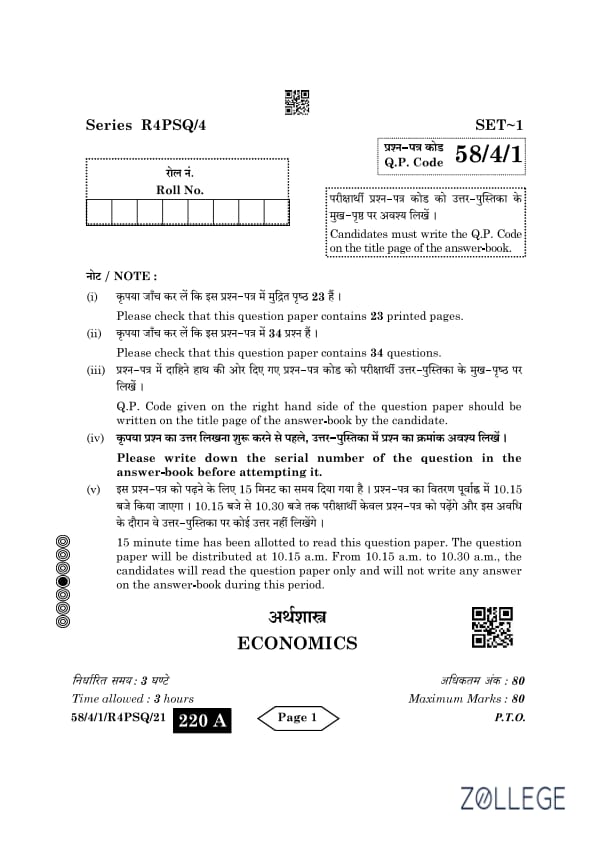
CBSE Class 12 2024 Economics Set 1 (Code: 58/4/1) Question Paper Pdf - Check Solutions with Answer Key Pdf

.jpg?tr=h-55,w-55,c-force)
Content Strategist|Tech-innovator|National Hackathon Winner | Updated On - Jan 31, 2025
CBSE Class 12 2024 Economics Question Paper with Answer Key PDF for Set 1 (Q.P. Code: 58/4/1) is available for download. The exam was successfully conducted by CBSE on March 18, 2024, in the morning session from 10:30 AM to 1:30 PM. As per the students’ initial reactions, the CBSE Class 12 2024 Economics Set 1 Question Paper was reported as Moderate. The Microeconomics section was considered Easy to Moderate, while the Macroeconomics section was reported as Moderate to Challenging.
CBSE Class 12 2024 Economics (Set 1- 58/4/1) 2024 Answer Key With Solution
Candidates can download the CBSE Class 12 Economics Question Paper with Solution and Answer Key PDFs for Set 1 Question Paper (Code: 58/4/1) using the link below.
| CBSE Class 12 Economics (Set 1- 58/4/1) 2024 Question Paper with Answer Key |  Download Download |
Check Solution |
CBSE Class 12 2024 Economics Question Paper with Solutions
Macro Economics
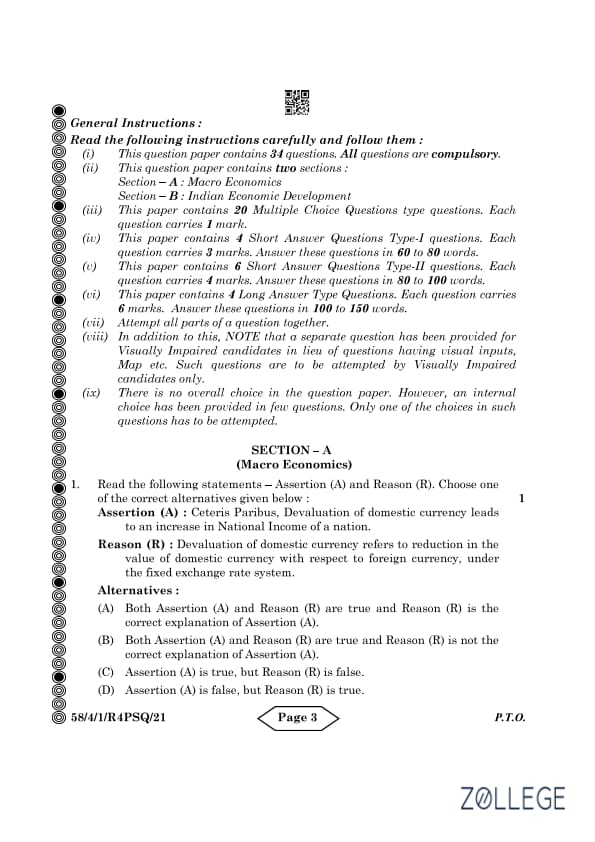
Question 1:
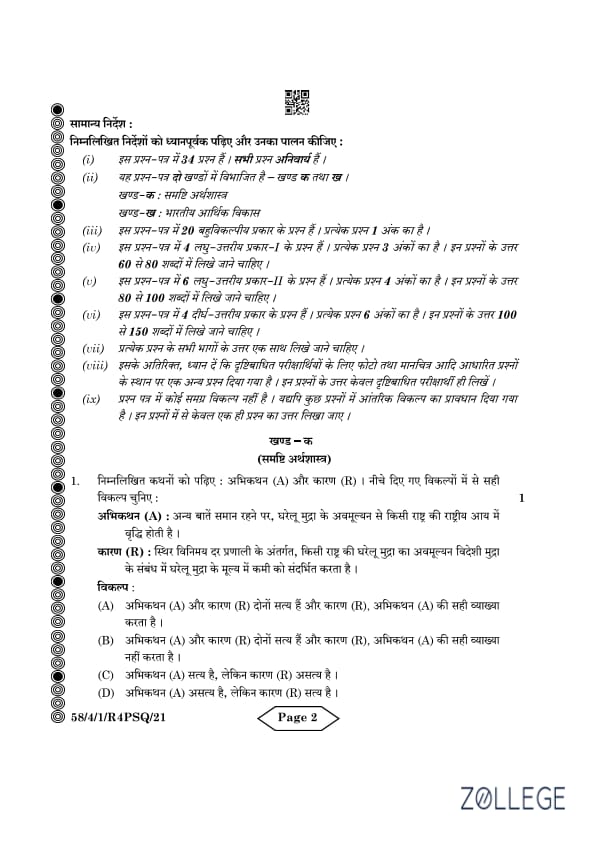
Read the following statements—Assertion (A) and Reason (R). Choose the correct alternative.
Assertion (A): Ceteris Paribus, Devaluation of domestic currency leads to an increase in National Income of a nation.
Reason (R): Devaluation of domestic currency refers to reduction in the value of domestic currency with respect to foreign currency, under the fixed exchange rate system.
Correct Answer: (B) Both Assertion (A) and Reason (R) are true and Reason (R) is not the correct explanation of Assertion (A).
View Solution
Devaluation of the domestic currency makes exports cheaper and imports more expensive, increasing demand for domestically produced goods. This leads to higher production, employment, and ultimately an increase in national income, making Assertion (A) true.
Reason (R) correctly defines devaluation under a fixed exchange rate system, making it true as well. However, Reason (R) does not explicitly explain its impact on national income.
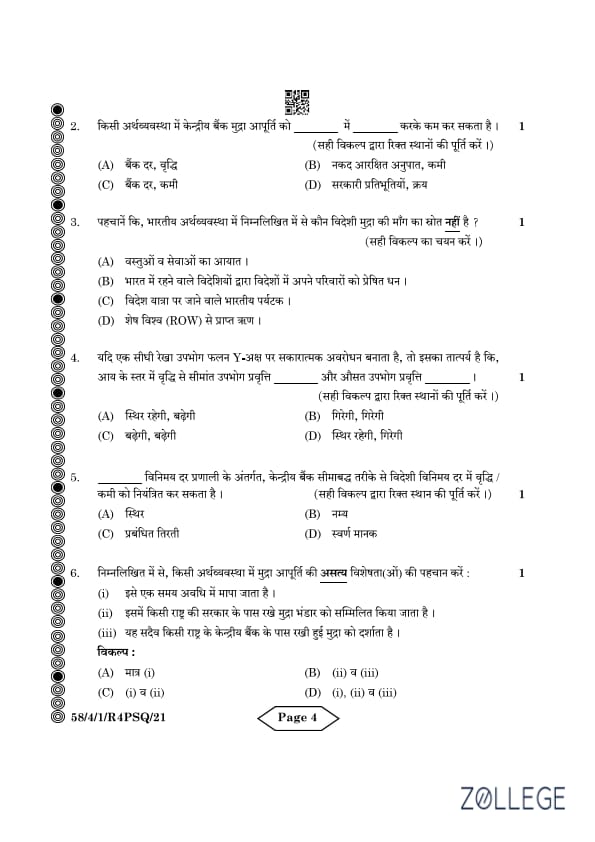
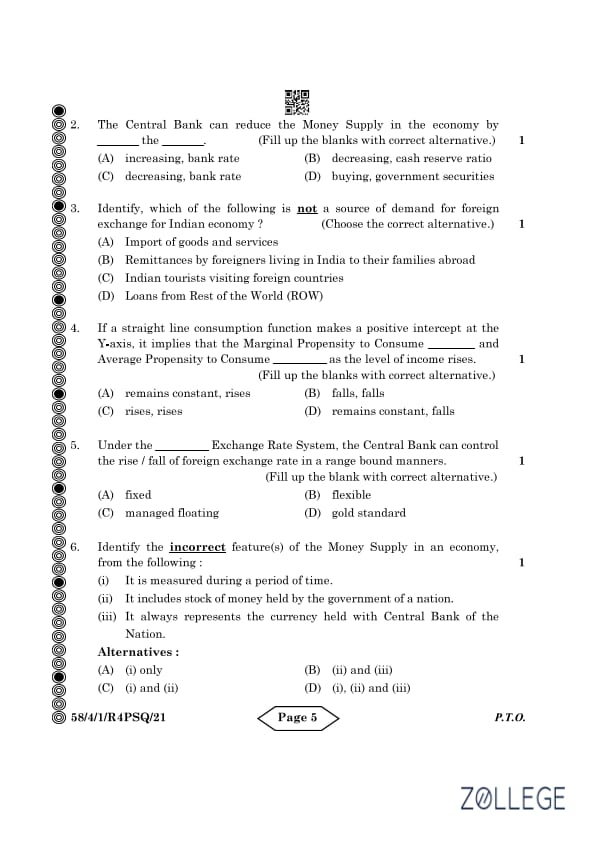
Question 2:
The Central Bank can reduce the Money Supply in the economy by:
Correct Answer: (A) increasing, bank rate
View Solution
The Central Bank reduces the money supply by increasing the bank rate. A higher bank rate makes borrowing more expensive for commercial banks, reducing credit availability and leading to contraction in the money supply.
Question 3:
Identify, which of the following is not a source of demand for foreign exchange for the Indian economy?
Correct Answer: (D) Loans from Rest of the World (ROW).
View Solution
Loans from ROW represent inflows of foreign exchange, not a source of demand. The other options involve outflows of foreign exchange, which constitute demand for it.
Question 4:
If a straight-line consumption function makes a positive intercept at the Y-axis, it implies that the Marginal Propensity to Consume and the Average Propensity to Consume ______ as the level of income rises.
Correct Answer: (D) remains constant, falls.
View Solution
For a straight-line consumption function, the Marginal Propensity to Consume (MPC) remains constant as it is the slope of the line. The Average Propensity to Consume (APC) falls as income increases because fixed consumption forms a smaller fraction of total income.
Question 5:
Under the ______ Exchange Rate System, the Central Bank can control the rise/fall of foreign exchange rate in a range-bound manner.
Correct Answer: (C) managed floating.
View Solution
Under the managed floating exchange rate system, the exchange rate is primarily market-driven, but the Central Bank intervenes to stabilize it within a specified range.
Question 6:
Identify the incorrect feature(s) of the Money Supply in an economy:
Correct Answer: (D) (i), (ii), and (iii).
View Solution
- Money supply is a stock concept measured at a specific point in time, not over a period of time, making statement (i) incorrect.
- Statement (ii) is incorrect because the government’s stock of money is not included in the money supply.
- Statement (iii) is also incorrect as money supply includes currency held by the public, not with the Central Bank.
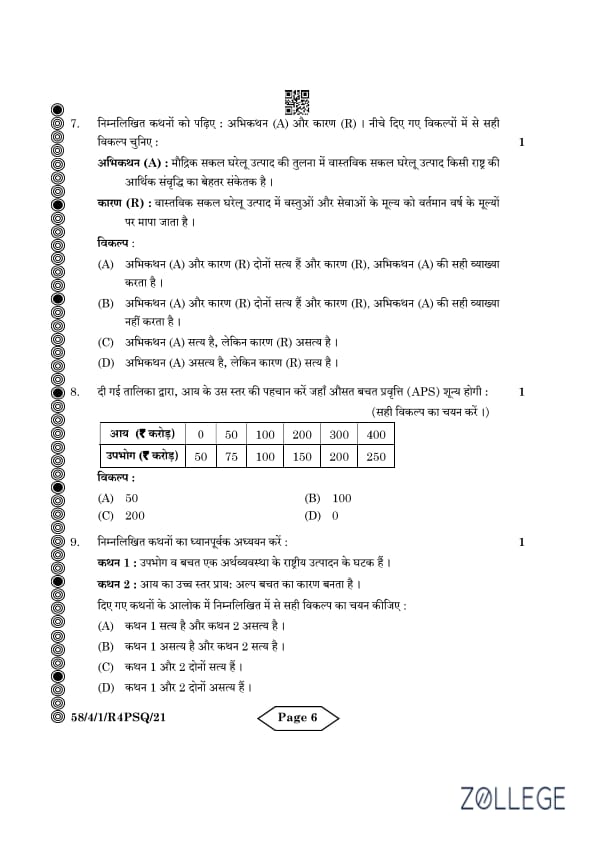
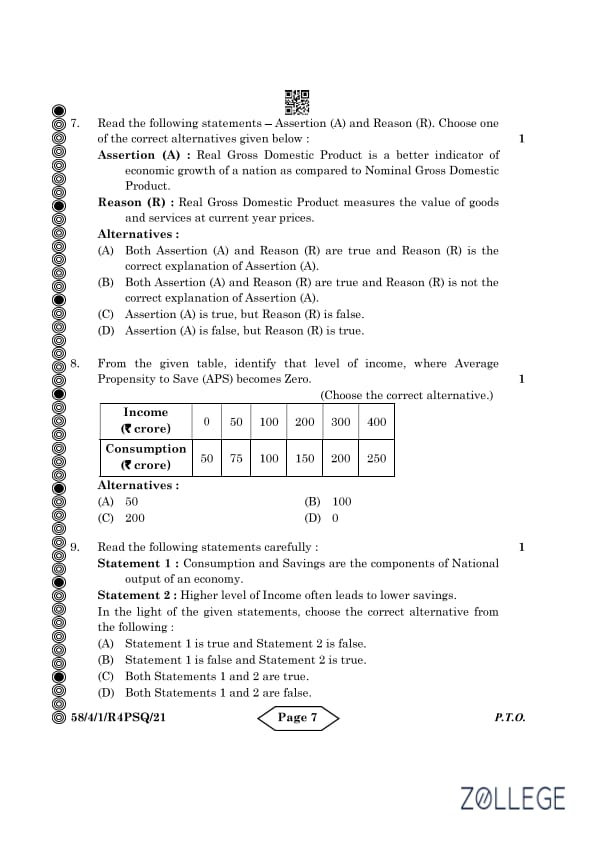
Question 7:
Read the following statements—Assertion (A) and Reason (R). Choose the correct alternative.
Assertion (A): Real Gross Domestic Product is a better indicator of economic growth of a nation as compared to Nominal Gross Domestic Product.
Reason (R): Real Gross Domestic Product measures the value of goods and services at current year prices.
Correct Answer: (C) Assertion (A) is true, but Reason (R) is false.
View Solution
Real GDP adjusts for inflation, making it a better measure of economic growth compared to Nominal GDP. However, Reason (R) is incorrect as Real GDP measures the value of goods and services at constant (base year) prices, not current year prices.
Question 8:
From the given table, identify that level of income, where Average Propensity to Save (APS) becomes Zero. (Choose the correct alternative.)
| Income (₹ crore) | Consumption (₹ crore) |
|---|---|
| 0 | 50 |
| 50 | 75 |
| 100 | 100 |
| 200 | 150 |
| 300 | 200 |
| 400 | 250 |
Correct Answer: (B) 100.
View Solution
APS becomes zero when savings are zero. Savings are calculated as:
Savings = Income − Consumption.
From the table:
- At an income of ₹100, consumption is also ₹100, resulting in zero savings.
- Therefore, APS becomes zero at ₹100.
Question 9:
Read the following statements carefully:
Statement 1: Consumption and Savings are the components of National output of an economy.
Statement 2: Higher level of Income often leads to lower savings.
In the light of the given statements, choose the correct alternative from the fol- lowing:
Correct Answer: (A) Statement 1 is true and Statement 2 is false.
View Solution
Statement 1 is correct as National output is derived from Consumption and Savings. However, Statement 2 is false because higher levels of income generally lead to higher savings due to increased disposable income.
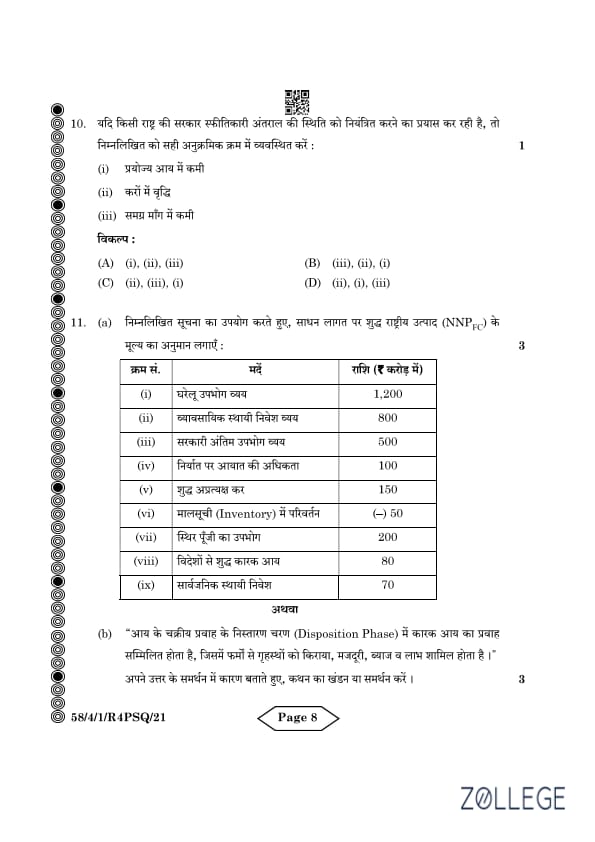
Question 10:
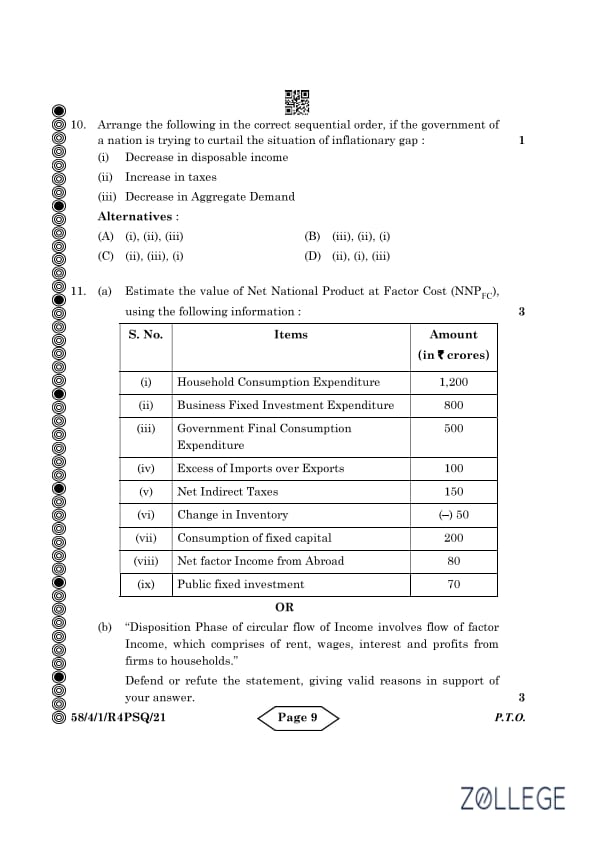
Arrange the following in the correct sequential order, if the government of a nation is trying to curtail the situation of inflationary gap:
(i) Decrease in disposable income (ii) Increase in taxes (iii) Decrease in Aggregate Demand
Correct Answer: (D) (ii), (i), (iii).
View Solution
To curtail the inflationary gap, the government follows these steps:
- Increase in taxes: Raising taxes reduces disposable income for consumers.
- Decrease in disposable income: As households have less money to spend, their consumption declines.
- Decrease in Aggregate Demand: Reduced spending leads to lower aggregate demand, helping to control inflation.
Thus, the correct sequence is (ii) Increase in taxes → (i) Decrease in disposable income → (iii) Decrease in Aggregate Demand.
Question 11(a):
Estimate the value of Net National Product at Factor Cost (NNPFC), using the following information:
| S. No. | Items | Amount (in crores) |
|---|---|---|
| (i) | Household Consumption Expenditure | 1,200 |
| (ii) | Business Fixed Investment Expenditure | 800 |
| (iii) | Government Final Consumption Expenditure | 500 |
| (iv) | Excess of Imports over Exports | 100 |
| (v) | Net Indirect Taxes | 150 |
| (vi) | Change in Inventory | (−) 50 |
| (vii) | Consumption of Fixed Capital | 200 |
| (viii) | Net Factor Income from Abroad | 80 |
| (ix) | Public Fixed Investment | 70 |
View Solution
The formula for Net National Product at Factor Cost (NNPFC) is:
NNPFC = (i) + (ii) + (iii) + (vi) + (ix) − (iv) − (v) + (viii) − (vii)
Substituting the given values:
NNPFC = 1,200 + 800 + 500 − 50 + 70 − 100 − 150 + 80 − 200
= 2,150 crores.
Thus, the estimated value of NNPFC is 2,150 crore.
Question 11(b):
“Disposition Phase of circular flow of Income involves flow of factor Income, which comprises of rent, wages, interest, and profits from firms to households.” Defend or refute the statement, giving valid reasons in support of your answer.
View Solution
This statement is correct. The disposition phase in the circular flow of income represents the distribution of factor incomes:
- Firms pay rent for land, wages for labor, interest for capital, and profits to entrepreneurs.
- Households receive these factor incomes and use them for consumption, savings, or paying taxes.
- This phase completes the cycle of income generation and expenditure, ensuring that income earned in production is re-circulated in the economy.
Hence, the statement accurately describes the flow of factor income in the economy.
Question 12:
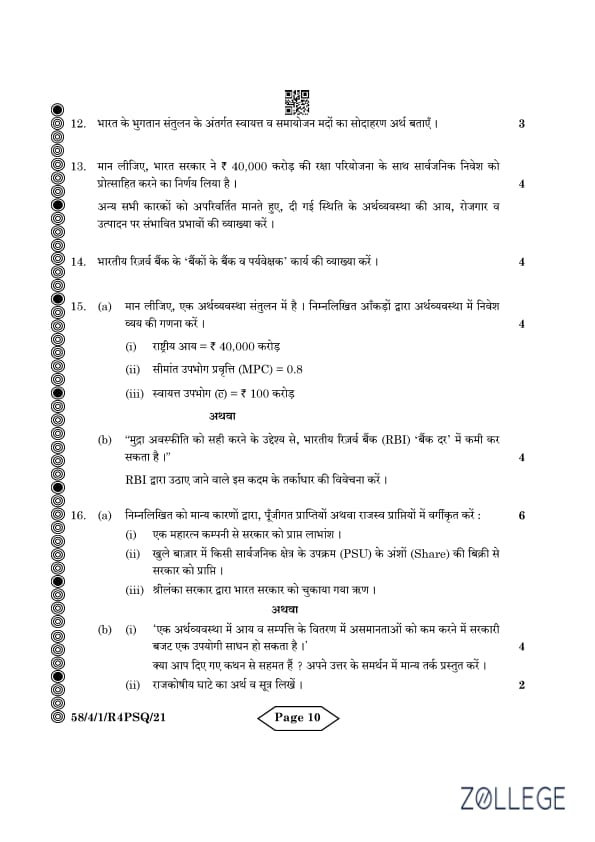
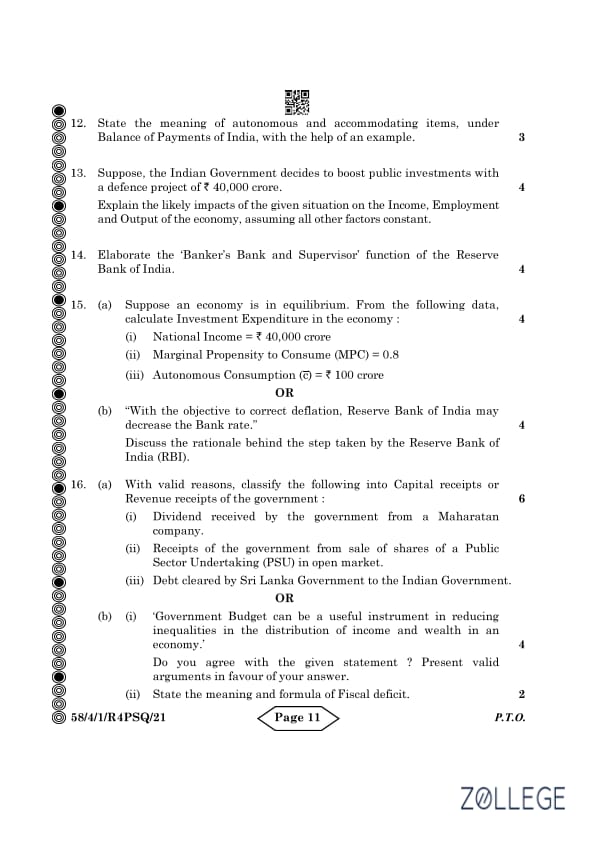
State the meaning of autonomous and accommodating items, under Balance of Payments of India, with the help of an example.
View Solution
Autonomous items in the Balance of Payments (BOP) refer to those transactions that are undertaken independently of the BOP position, such as exports, imports, and foreign investments. These are driven by profit motives or international obligations.
Accommodating items are those transactions that are undertaken to balance the BOP, such as borrowing from the IMF or drawing on foreign exchange reserves. These aim to offset deficits or surpluses in the autonomous account.
Example: Export of goods is an autonomous transaction, while using foreign exchange reserves to bridge a deficit is an accommodating transaction.
Question 13:
Suppose, the Indian Government decides to boost public investments with a de- fence project of ₹40,000 crore. Explain the likely impacts of the given situation on the Income, Employment, and Output of the economy, assuming all other factors constant.
View Solution
Boosting public investment will have the following impacts:
- Income: Increased investment leads to higher aggregate demand, generating income for contractors, suppliers, and workers involved in the project.
- Employment: Public investments create direct and indirect employment opportunities, reducing unemployment.
- Output: The multiplier effect ensures that the initial investment leads to multiple rounds of increased production and services in the economy.
Thus, public investments have a positive impact on income, employment, and output, promoting economic growth.
Question 14:
Elaborate the ‘Banker’s Bank and Supervisor’ function of the Reserve Bank of India.
View Solution
The Reserve Bank of India (RBI) performs the following functions as the ‘Banker’s Bank and Supervisor’:
- Banker’s Bank: The RBI acts as a banker to all scheduled commercial banks. It provides short-term funds, acts as a lender of last resort, and facilitates inter-bank clearing.
- Supervisor: The RBI supervises and regulates banks to ensure financial stability. It monitors compliance with banking regulations, manages non-performing assets (NPAs), and ensures that banks maintain required reserves.
These functions help in maintaining stability and liquidity in the financial system.
Question 15(a):
Suppose an economy is in equilibrium. From the following data, calculate Invest- ment Expenditure in the economy:
• National Income = ₹40,000 crore
• Marginal Propensity to Consume (MPC) = 0.8
• Autonomous Consumption (c) = ₹100 crore
View Solution
Equilibrium in the economy is achieved when:
Y = C + I
where C = c + MPC × Y . Substituting the given values:
C = 100 + 0.8 × 40,000 = 100 + 32,000 = 32,100 crore.
From the equilibrium condition:
I = Y − C = 40,000 − 32,100 = 7,900 crore.
Thus, Investment Expenditure is 7,900 crore.
Question 15(b):
“With the objective to correct deflation, the Reserve Bank of India may decrease the Bank Rate.” Discuss the rationale behind the step taken by the Reserve Bank of India (RBI).
View Solution
Decreasing the Bank Rate encourages commercial banks to borrow more from the RBI. This leads to:
- Increased liquidity in the banking system.
- Lower lending rates for consumers and businesses, boosting borrowing and spending.
- Higher aggregate demand, which helps in correcting deflationary pressures.
Thus, reducing the Bank Rate is an effective monetary policy tool to combat deflation.
Question 16(a):
With valid reasons, classify the following into Capital Receipts or Revenue Receipts of the government:
• Dividend received by the government from a Maharatna company.
• Receipts of the government from the sale of shares of a Public Sector Undertaking (PSU) in the open market.
• Debt cleared by the Sri Lanka Government to the Indian Government.
View Solution
- Dividend: This is a Revenue Receipt as it is a regular income for the government from its investments.
- Sale of Shares: This is a Capital Receipt as it involves the sale of government assets.
- Debt Repayment: This is a Capital Receipt as it reduces the liabilities of the government.
Question 16(b)(i):
“Government Budget can be a useful instrument in reducing inequalities in the distribution of income and wealth in an economy.”
Do you agree with the given statement? Present valid arguments in favour of your answer.
View Solution
Yes, the government budget can reduce income inequalities by:
- Progressive Taxation: Imposing higher taxes on the rich to reduce their disposable income.
- Welfare Expenditure: Allocating funds for subsidies, healthcare, education, and employment programs aimed at benefiting the economically weaker sections.
- Social Security: Providing direct financial support to low-income groups to ensure a more equitable distribution of wealth.
The government budget, through fiscal policies, can thus be an effective tool to minimize disparities in income and wealth.
Question 16(b)(ii):
State the meaning and formula of Fiscal Deficit.
View Solution
Meaning: Fiscal Deficit represents the total borrowing requirements of the government. It reflects the shortfall when the government’s total expenditure exceeds its total revenue (excluding borrowings).
Formula:
Fiscal Deficit = Total Expenditure − (Revenue Receipts + Capital Receipts Excluding Borrowings)
Fiscal deficit indicates the reliance of the government on borrowings to finance its expenditure.
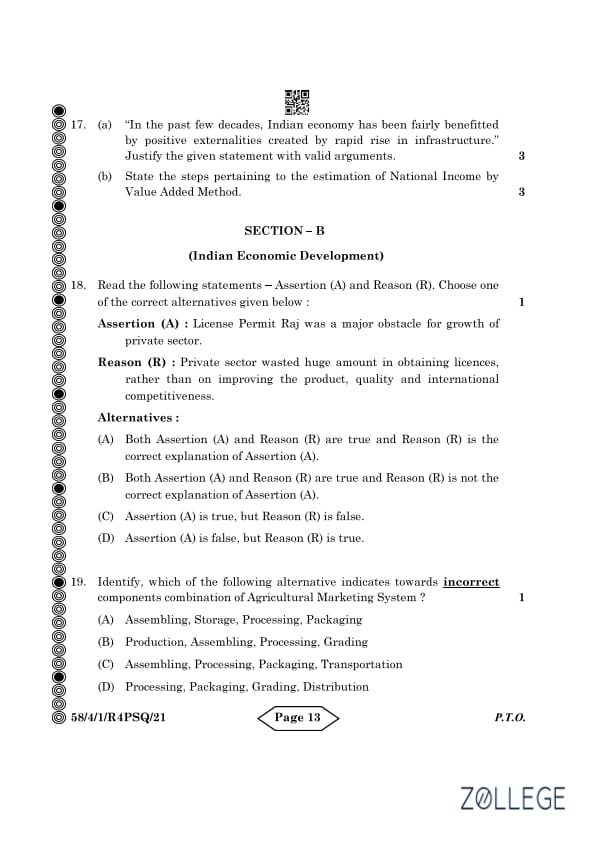
Question 17(a):
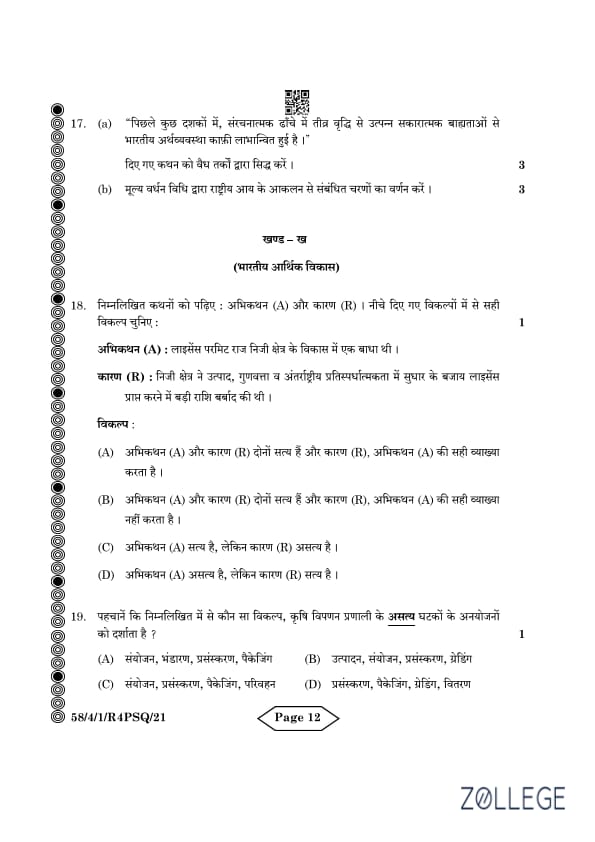
“In the past few decades, the Indian economy has been fairly benefitted by positive externalities created by the rapid rise in infrastructure.”
Justify the given statement with valid arguments.
View Solution
The rapid development of infrastructure in India has contributed significantly to economic growth by:
- Connectivity: Improved road, rail, and air connectivity has reduced transportation costs and increased accessibility for goods and services.
- Employment: Infrastructure projects create direct and indirect employment opportunities.
- Industrial Growth: Better infrastructure facilitates the setup of industries in remote areas, promoting balanced regional development.
- Foreign Investments: Modern infrastructure attracts foreign direct investments (FDI) by providing a conducive business environment.
These positive externalities have enhanced productivity, boosted trade, and improved the quality of life for citizens.
Question 17(b):
State the steps pertaining to the estimation of National Income by the Value Added Method.
View Solution
The steps involved in estimating National Income using the Value Added Method are:
- Identify Producing Units: Classify all producing units into primary, secondary, and tertiary sectors.
- Calculate Gross Value of Output: Add the value of all goods and services produced in each sector.
- Subtract Intermediate Consumption: Deduct the value of inputs used in production to get the gross value added.
- Adjust for Depreciation: Subtract depreciation from the gross value to get the net value added.
- Include Net Factor Income from Abroad (NFIA): Add NFIA to obtain the final National Income.
SECTION – B
(Indian Economic Development)
Question 18:
Read the following statements—Assertion (A) and Reason (R). Choose the correct alternative.
Assertion (A): License Permit Raj was a major obstacle for growth of the private sector.
Reason (R): Private sector wasted huge amounts in obtaining licenses, rather than on improving the product, quality, and international competitiveness.
Correct Answer: (A) Both Assertion (A) and Reason (R) are true and Reason (R) is the correct explanation of Assertion (A).
View Solution
The License Permit Raj created significant barriers for the private sector by:
- Increasing bureaucratic hurdles, leading to delays in project approvals.
- Diverting resources toward compliance and lobbying for licenses instead of investing in innovation and quality improvement.
- Limiting international competitiveness due to inefficiencies and lack of technological advancement.
Question 19:
Identify, which of the following alternative indicates an incorrect components combination of the Agricultural Marketing System?
Correct Answer: (B) Production, Assembling, Processing, Grading.
View Solution
Option (B) is incorrect because the agricultural marketing system primarily includes:
- Assembling: Collection of produce from farms.
- Storage and Transportation: Safeguarding and moving produce to markets.
- Processing: Converting raw produce into finished goods.
- Grading and Packaging: Preparing produce for sale.
- Distribution: Delivering goods to consumers or retailers.
Option (B) incorrectly includes "Production," which belongs to the agricultural sector but not the marketing system. Marketing begins only after production is completed.
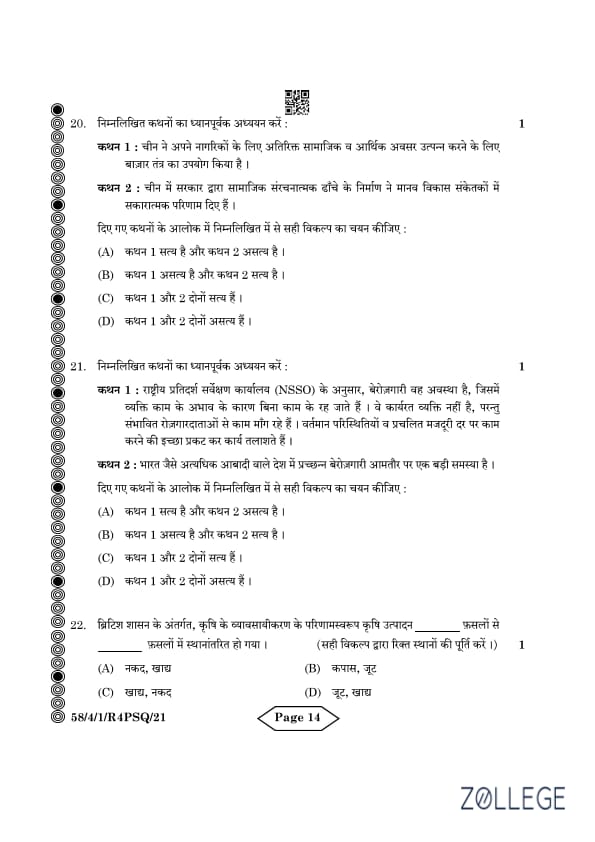
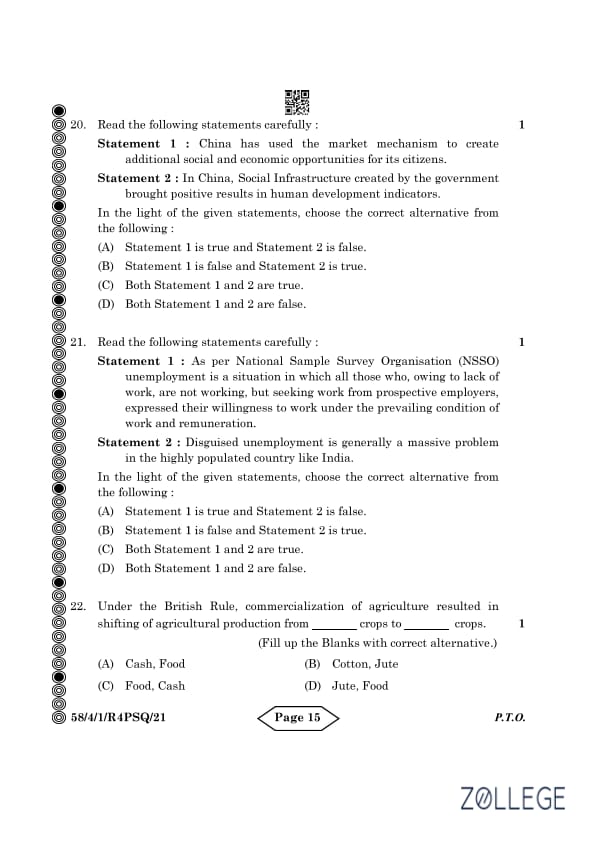
Question 20:
Read the following statements carefully:
Statement 1: China has used the market mechanism to create additional social and economic opportunities for its citizens.
Statement 2: In China, Social Infrastructure created by the government brought positive results in human development indicators.
Correct Answer: (C) Both Statement 1 and 2 are true.
View Solution
Both statements are true:
- Statement 1: China has effectively used market mechanisms alongside state policies to promote social and economic development.
- Statement 2: Government initiatives in building social infrastructure like health and education have positively impacted human development indicators such as life expectancy, literacy rates, and overall quality of life.
Question 21:
Read the following statements carefully:
Statement 1: As per National Sample Survey Organisation (NSSO), unemployment is a situation in which all those who, owing to lack of work, are not working but seeking work from prospective employers, express their willingness to work under the prevailing conditions of work and remuneration.
Statement 2: Disguised unemployment is generally a massive problem in a highly populated country like India.
Correct Answer: (C) Both Statement 1 and 2 are true.
View Solution
- Statement 1: NSSO defines unemployment as the condition of individuals actively seeking work but unable to find it under prevailing conditions.
- Statement 2: Disguised unemployment, where more people are employed than necessary, is a significant issue in India, especially in the agricultural sector.
Question 22:
Under the British Rule, commercialization of agriculture resulted in shifting agricultural production from ______ crops to ______ crops.
Correct Answer: (C) Food, Cash.
View Solution
During British Rule, agriculture shifted focus from food crops to cash crops like indigo, cotton, and jute. This shift was driven by the colonial demand for raw materials for British industries, leaving less emphasis on food production, which often led to famines.
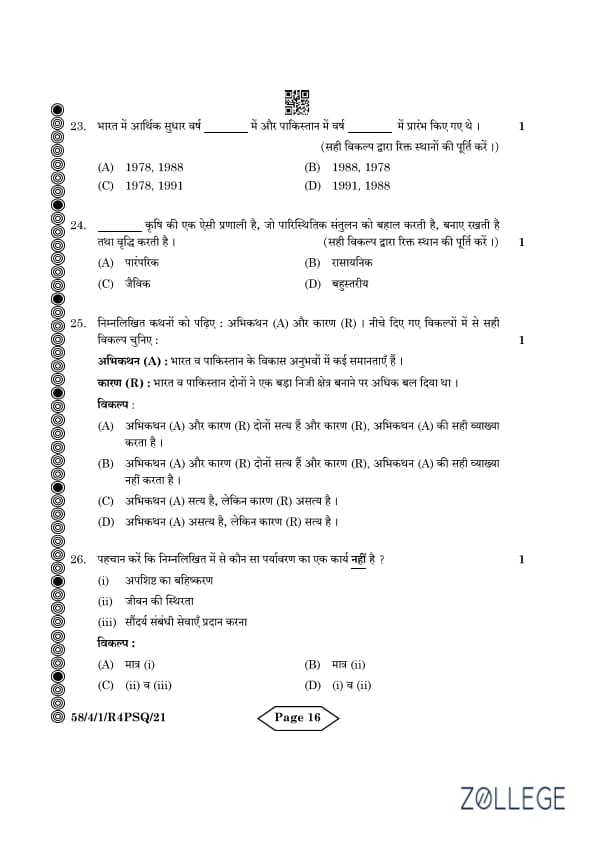
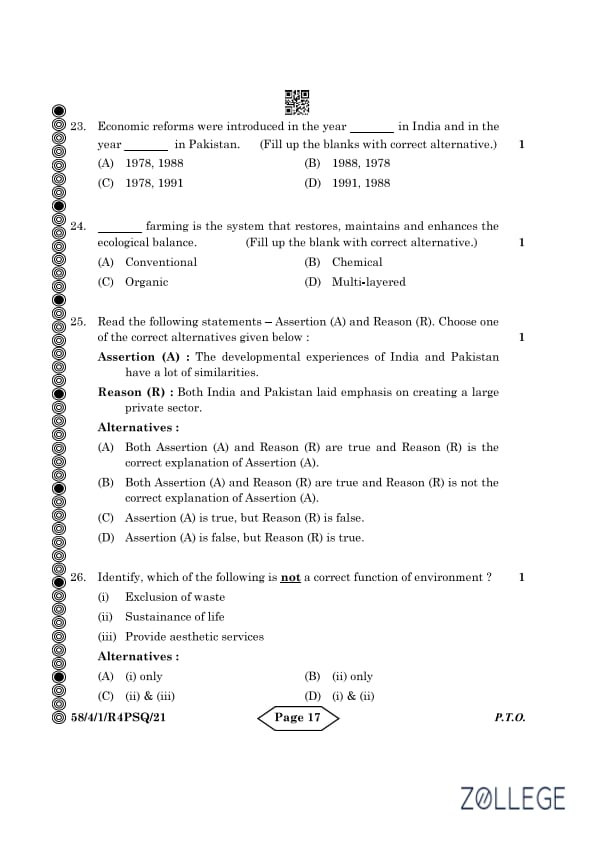
Question 23:
Economic reforms were introduced in the year ______ in India and in the year ______ in Pakistan. (Fill up the blanks with the correct alternative.)
Correct Answer: (D) 1991, 1988.
View Solution
Economic reforms in India were introduced in 1991 under the New Economic Policy, focusing on liberalization, privatization, and globalization. In Pakistan, similar reforms began in 1988 to address economic challenges and promote structural adjustments.
Question 24:
______ farming is the system that restores, maintains, and enhances the ecolog- ical balance. (Fill up the blank with the correct alternative.)
Correct Answer: (C) Organic.
View Solution
Organic farming emphasizes sustainable practices, avoiding synthetic chemicals, and using natural fertilizers like compost. It aims to enhance soil fertility and restore ecological balance.
Question 25:
Read the following statements—Assertion (A) and Reason (R). Choose one of the correct alternatives given below:
Assertion (A): The developmental experiences of India and Pakistan have a lot of similarities.
Reason (R): Both India and Pakistan laid emphasis on creating a large private sector.
Correct Answer: (C) Assertion (A) is true, but Reason (R) is false.
View Solution
The developmental experiences of India and Pakistan share similarities such as reliance on agriculture, focus on industrialization, and challenges in reducing poverty. However, the emphasis on creating a large private sector is not true for both countries, as Pakistan relied more on state-led development policies during the early years.
Question 26:
Identify, which of the following is not a correct function of environment?
(i) Exclusion of waste
(ii) Sustenance of life
(iii) Provide aesthetic services
Correct Answer: (A) (i) only.
View Solution
The environment sustains life, provides aesthetic services, and absorbs waste, but it does not exclude waste. Instead, it processes and assimilates waste to maintain ecological balance.
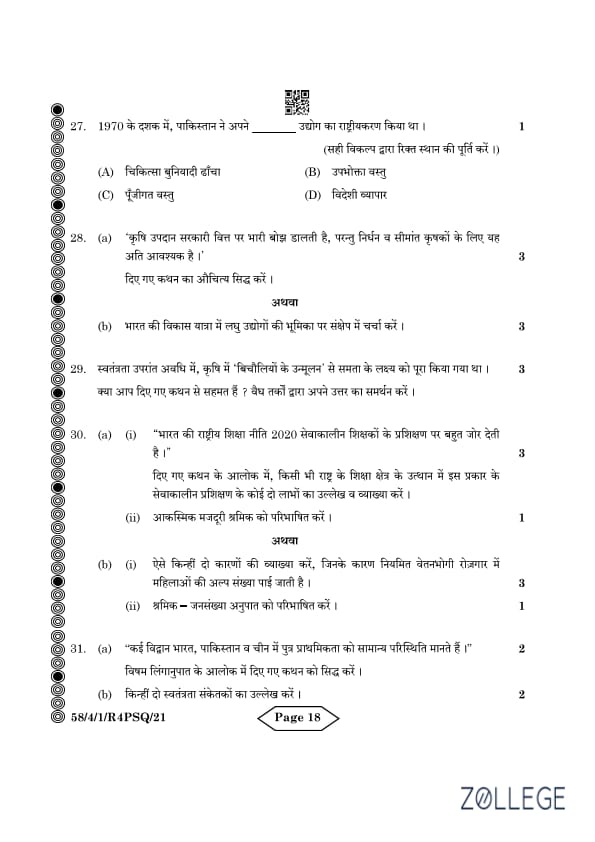
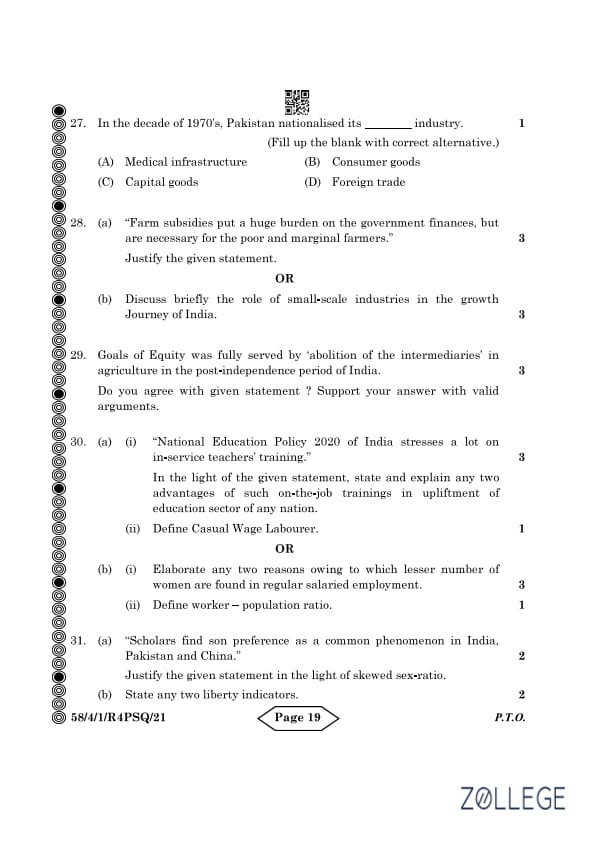
Question 27:
In the decade of 1970s, Pakistan nationalized its ______ industry. (Fill up the blank with the correct alternative.)
Correct Answer: (C) Capital goods.
View Solution
During the 1970s, Pakistan nationalized its capital goods industry to establish state control over major industrial sectors. This was aimed at reducing economic inequalities and enhancing government revenues, but it often resulted in inefficiencies and reduced private sector participation.
Question 28(a):
“Farm subsidies put a huge burden on the government finances, but are necessary for the poor and marginal farmers.”
Justify the given statement.
View Solution
Farm subsidies are essential despite their financial burden for the following reasons:
- Support for Marginal Farmers: Subsidies provide financial aid to small and marginal farmers, enabling them to access fertilizers, seeds, and irrigation facilities.
- Stabilizing Food Supply: They help ensure consistent agricultural production, leading to food security for the nation.
- Reducing Rural Inequalities: Subsidies mitigate income disparities in rural areas by supporting resource-poor farmers.
Question 28(b):
Discuss briefly the role of small-scale industries in the growth journey of India.
View Solution
Small-scale industries (SSIs) play a crucial role in India’s economic development by:
- Employment Generation: SSIs provide large-scale employment opportunities, particularly in rural and semi-urban areas.
- Regional Development: They promote balanced regional growth by encouraging industrialization in backward areas.
- Export Contribution: SSIs contribute significantly to exports, particularly in textiles, handicrafts, and engineering goods.
Question 29:
Goals of Equity were fully served by the ‘abolition of intermediaries’ in agriculture in the post-independence period of India.
Do you agree with the given statement? Support your answer with valid arguments.
View Solution
Yes, the abolition of intermediaries helped achieve equity goals in the following ways:
- Empowerment of Farmers: Land reforms eliminated middlemen, enabling farmers to gain direct ownership of land and retain a larger share of their produce.
- Reduction in Exploitation: It curtailed exploitation by landlords, improving socio-economic conditions for tenant farmers.
- Increased Agricultural Productivity: Direct ownership motivated farmers to invest more in land, enhancing agricultural output.
However, in some areas, poor implementation of reforms limited their effectiveness, leaving inequities unaddressed.
Question 30(a)(i):
“National Education Policy 2020 of India stresses a lot on in-service teachers’ training.”
In the light of the given statement, state and explain any two advantages of such on-the-job training in the upliftment of the education sector of any nation.
View Solution
Two advantages of in-service teachers’ training are:
- Skill Enhancement: Training equips teachers with modern pedagogical tools, improving teaching quality and student outcomes.
- Adaptation to New Trends: Teachers stay updated with the latest developments in education, ensuring relevance in the curriculum.
Question 30(a)(ii):
Define Casual Wage Labourer.
View Solution
Casual Wage Labourers are individuals who work on a daily basis, receiving wages for the number of days they work, without job security or benefits.
Question 30(b)(i):
Elaborate any two reasons owing to which a lesser number of women are found in regular salaried employment.
View Solution
Two reasons for fewer women in regular salaried employment:
- Societal Barriers: Traditional gender roles and lack of family support restrict women’s participation in formal jobs.
- Workplace Inequalities: Discrimination and wage gaps discourage women from seeking regular salaried employment.
Question 30(b)(ii):
Define Worker–Population Ratio.
View Solution
Worker–Population Ratio represents the proportion of the working population to the total population. It is calculated as:
Worker–Population Ratio = (Number of Workers / Total Population) × 100
Question 31(a):
“Scholars find son preference as a common phenomenon in India, Pakistan, and China.”
Justify the given statement in the light of the skewed sex ratio.
View Solution
Son preference in India, Pakistan, and China is evident due to their skewed sex ratios, driven by socio-cultural and economic factors:
- Economic Dependence: Sons are often seen as economic assets, expected to support parents in old age, unlike daughters who traditionally marry and move to another household.
- Cultural Beliefs: Sons are preferred for continuing the family name and performing last rites, which are considered important in many religions.
- Gender Bias: Discriminatory practices, such as dowry and limited opportunities for women, reinforce the preference for male children.
- Policy Impact: In China, the one-child policy amplified son preference, leading to selective births and gender imbalances.
Question 31(b):
State any two liberty indicators.
View Solution
Two liberty indicators are:
- Freedom of Expression: The ability of individuals to express their views freely without fear of censorship or persecution.
- Freedom of Movement: The right to travel and reside freely within and outside a country, without undue restrictions.
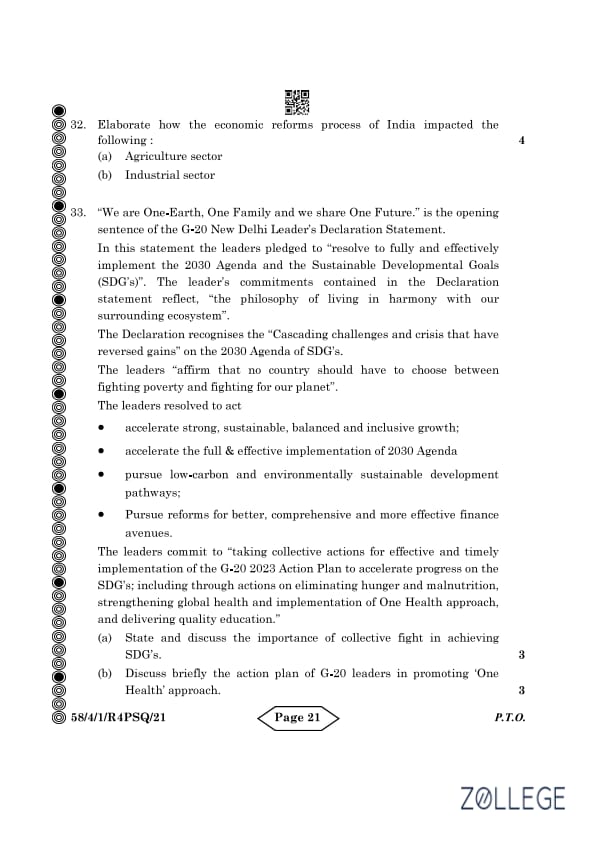
Question 32(a):
Elaborate how the economic reforms process of India impacted the agriculture sector.
View Solution
The economic reforms process impacted the agriculture sector in the following ways:
- Reduction in Subsidies: Post-reform policies reduced government subsidies on fertilizers and other inputs, increasing the cost of production for farmers.
- Market Deregulation: Reforms led to greater reliance on market forces for agricultural pricing, reducing state control.
- Focus on Exports: There was an increased emphasis on promoting agricultural exports, encouraging diversification into commercial crops.
- Private Sector Participation: Encouraged private sector investment in agricultural infrastructure, such as cold storage and food processing.
Question 32(b):
Elaborate how the economic reforms process of India impacted the industrial sec- tor.
View Solution
The economic reforms process transformed the industrial sector in the following ways:
- Liberalization: Removal of license requirements under the License Raj boosted industrial growth and competition.
- FDI Inflows: Reforms facilitated foreign direct investments in manufacturing, improving technology and productivity.
- Privatization: Shift towards privatization reduced state control over public enterprises, making industries more efficient.
- Export-Oriented Growth: Encouraged industries to focus on exports through special economic zones and trade liberalization.
Question 33(a):
State and discuss the importance of collective fight in achieving SDGs.
View Solution
The collective fight is crucial for achieving SDGs due to the following reasons:
- Shared Responsibility: Achieving SDGs requires global efforts as challenges like climate change, poverty, and health crises transcend borders.
- Pooling Resources: Collaborative actions enable sharing financial, technological, and human resources, ensuring effective implementation of goals.
- Addressing Inequities: Collective actions help address disparities in development, ensuring no country is left behind.
- Global Stability: Tackling hunger, education, and health collectively leads to stability and peace worldwide.
Question 33(b):
Discuss briefly the action plan of G-20 leaders in promoting the ‘One Health Ap- proach.’
View Solution
The G-20 leaders’ action plan to promote the ‘One Health Approach’ includes:
- Global Health Strengthening: Addressing pandemics, antimicrobial resistance, and zoonotic diseases through coordinated international strategies.
- Hunger and Malnutrition Elimination: Initiatives targeting food security and equitable access to nutrition.
- Environmental Conservation: Promoting sustainable agricultural practices and reducing environmental degradation to ensure better health.
- Quality Education: Investments in education to equip future generations with the knowledge and skills for health and sustainability.
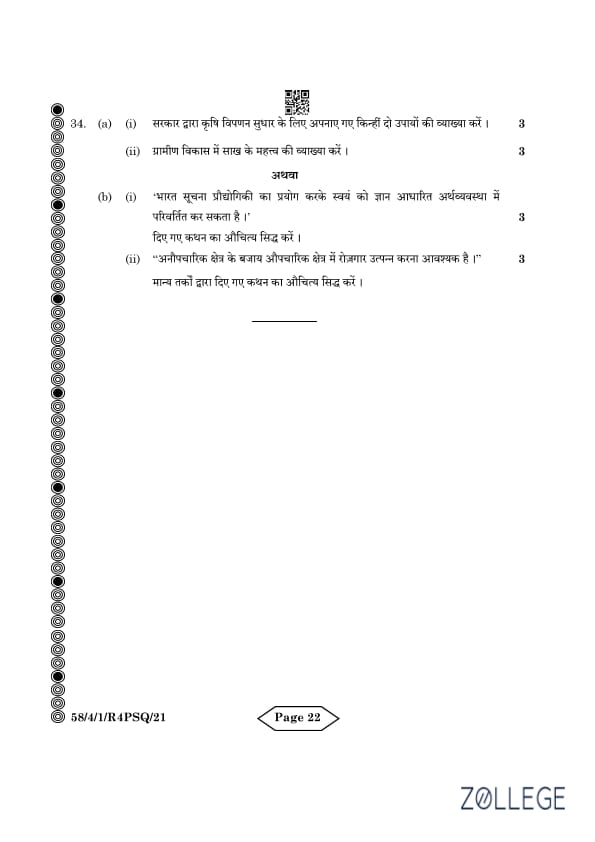
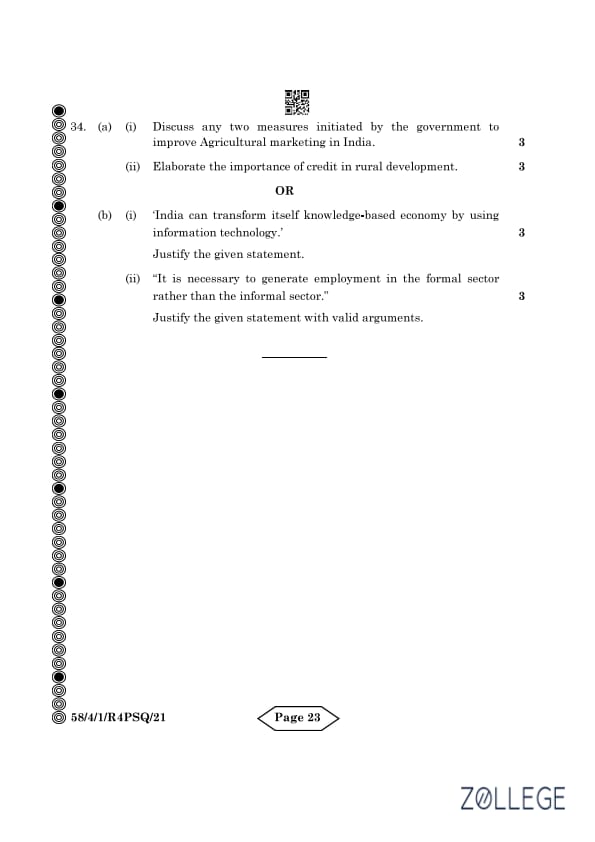
Question 34(a)(i):
Discuss any two measures initiated by the government to improve agricultural marketing in India.
View Solution
Two measures initiated by the government to improve agricultural marketing are:
- Establishment of Regulated Markets: Regulated markets were set up to eliminate middlemen and ensure farmers receive fair prices for their produce.
- E-NAM Platform: The government launched the National Agriculture Market (e-NAM), a digital platform to connect farmers with buyers, ensuring transparency and competitive pricing.
Question 34(a)(ii):
Elaborate the importance of credit in rural development.
View Solution
Credit plays a vital role in rural development in the following ways:
- Investment in Agriculture: Credit enables farmers to invest in seeds, fertilizers, irrigation, and technology, boosting agricultural productivity.
- Rural Infrastructure Development: Credit facilitates the construction of roads, warehouses, and rural markets, enhancing connectivity and storage facilities.
- Entrepreneurship Promotion: Access to credit supports small-scale industries and self-employment opportunities, fostering rural entrepreneurship.
Question 34(b)(i):
‘India can transform itself into a knowledge-based economy by using information technology.’
Justify the given statement.
View Solution
Information technology (IT) can transform India into a knowledge-based economy in the following ways:
- Enhanced Education Access: IT enables e-learning platforms, bridging the gap between rural and urban education systems.
- Boosting Research and Innovation: IT supports data analysis, artificial intelligence, and innovation, fostering advancements in various sectors.
- Efficient Governance: IT facilitates e-governance initiatives, improving transparency and citizen engagement.
- Global Competitiveness: IT creates opportunities in the global market by strengthening India’s service exports and tech industry.
Question 34(b)(ii):
“It is necessary to generate employment in the formal sector rather than the in- formal sector.”
Justify the given statement with valid arguments.
View Solution
Generating employment in the formal sector is essential for the following reasons:
- Job Security: Formal sector jobs provide job security, fixed wages, and social benefits like pensions and insurance.
- Tax Revenue: Formal employment increases the taxable base, contributing to government revenue for development projects.
- Skill Development: The formal sector focuses on training and skill enhancement, increasing workforce productivity.
- Economic Stability: Stable employment in the formal sector reduces income disparities and ensures steady economic growth.

*The article might have information for the previous academic years, please refer the official website of the exam.