
CBSE Class 12 2024 Economics Set 2 (Code: 58/1/2) Question Paper Pdf - Check Solutions with Answer Key Pdf

.jpg?tr=h-55,w-55,c-force)
Content Strategist|Tech-innovator|National Hackathon Winner | Updated On - Jan 29, 2025
CBSE Class 12 2024 Economics Question Paper with Answer Key PDF for Set 2 (Q.P. Code: 58/1/2) is available for download. The exam was successfully conducted by CBSE on March 18, 2024, in the morning session from 10:30 AM to 1:30 PM. As per the students’ initial reactions, the CBSE Class 12 2024 Economics Set 2 Question Paper was reported as Moderate. The Microeconomics section was considered Easy to Moderate, while the Macroeconomics section was reported as Moderate to Challenging.
CBSE Class 12 2024 Economics (Set 2- 58/1/2) 2024 Answer Key With Solution
Candidates can download the CBSE Class 12 Economics Question Paper with Solution and Answer Key PDFs for Set 2 Question Paper (Code: 58/1/2) using the link below.
| CBSE Class 12 Economics (Set 2- 58/1/2) 2024 Question Paper with Answer Key |  Download Download |
Check Solution |
CBSE Class 12 2024 Economics Question Paper with Solutions
Macro Economics
Question 1:
Read the following statements – Assertion (A) and Reason (R). Choose the correct option given below: Assertion (A): Full employment situation refers to the absence of involuntary unemployment. Reason (R): Under full employment situation, all the willing and able-bodied people get employment at the prevailing wage rate.
Correct Answer: (A) Both Assertion (A) and Reason (R) are true and Reason (R) is the correct explanation of Assertion (A).
View Solution
Full employment refers to a situation where there is no involuntary unemployment, meaning all individuals willing to work at prevailing wage rates are employed. The reason provided correctly explains the assertion as it aligns with the economic definition of full employment.
Question 2:
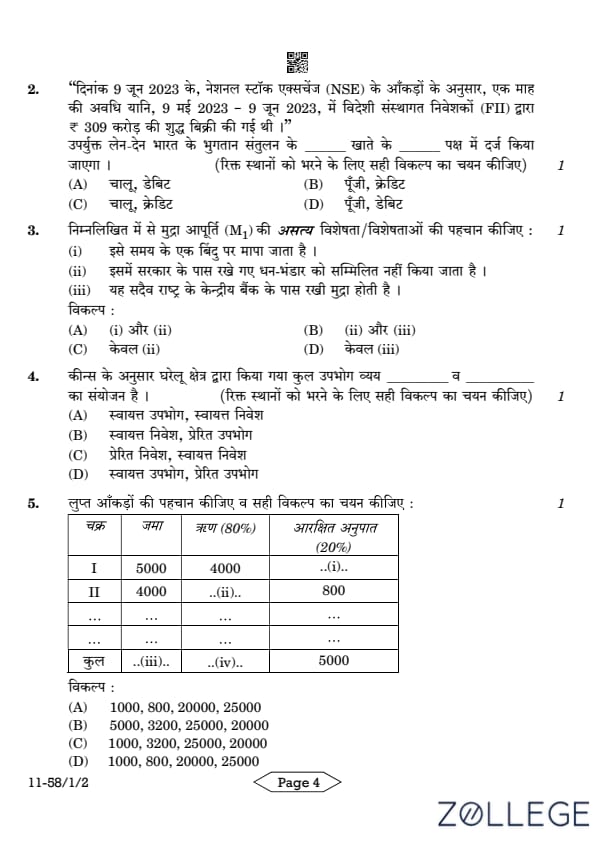
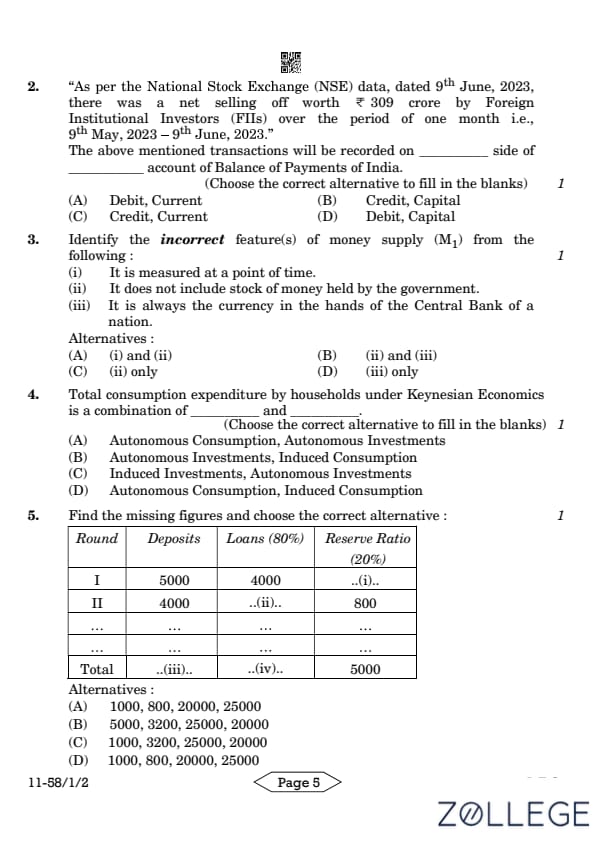
“As per the National Stock Exchange (NSE) data, dated 9th June, 2023, there was a net selling off worth 309 crore by Foreign Institutional Investors (FIIs) over the period of one month i.e., 9th May, 2023 – 9th June, 2023.” The above-mentioned transactions will be recorded on side of account of Balance of Payments of India.
Correct Answer: (D) Debit, Capital
View Solution
Net selling by FIIs reflects an outflow of foreign capital due to the sale of securities, and this is recorded as a debit entry in the capital account of the BoP.
Question 3:
Identify the incorrect feature(s) of money supply (M1) from the following:
(i) It is measured at a point of time.
(ii) It does not include stock of money held by the government.
(iii) It is always the currency in the hands of the Central Bank of a nation.
Correct Answer: (D) (iii) only
View Solution
Money supply (M1) includes currency in circulation and demand deposits with the public. It is measured at a point in time, and it excludes money held by the government. The statement that M1 is always the currency in the hands of the Central Bank is incorrect because M1 only accounts for money held by the public.
Question 4:
Total consumption expenditure by households under Keynesian Economics is a combination of _____ and_____ .
Correct Answer: (D) Autonomous Consumption, Induced Consumption
View Solution
Under Keynesian economics, total consumption expenditure is the sum of autonomous consumption (which does not depend on income) and induced consumption (which depends on income level).
Question 5:
Find the missing figures and choose the correct option:

Correct Answer: (C) 1000, 800, 25000, 20000
View Solution
In Round I, total deposits are 5000. Reserves = 5000 * 0.2 = 1000, Loans = 4000. In Round II, deposits from loans are 4000. Reserves = 4000 * 0.2 = 800, Loans = 4000 - 800 = 3200. The process continues similarly, leading to a total deposit of 25000, total loans of 20000, and total reserves of 5000.
Question 6:
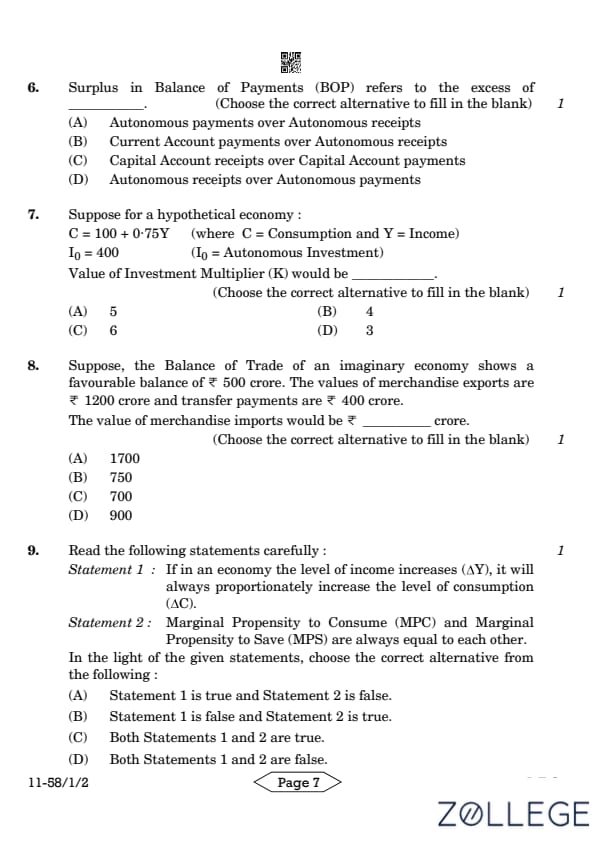
Surplus in Balance of Payments (BOP) refers to the excess of .
Correct Answer: (D) Autonomous receipts over Autonomous payments
View Solution
A surplus in the Balance of Payments occurs when autonomous receipts (inflows from exports, foreign investments, etc.) exceed autonomous payments (outflows for imports, investments abroad, etc.).
Question 7:
Suppose for a hypothetical economy: C = 100 + 0.75Y (where C = Consumption and Y = Income) I0 = 400 (I0 = Autonomous Investment) Value of Investment Multiplier (K) would be .
Correct Answer: (B) 4
View Solution
The investment multiplier (K) is calculated as: K = 1 / (1 - MPC) where MPC (Marginal Propensity to Consume) is 0.75. Substituting: K = 1 / (1 - 0.75) = 1 / 0.25 = 4
Question 8:
Suppose, the Balance of Trade of an imaginary economy shows a favorable balance of 500 crore. The values of merchandise exports are 1200 crore and transfer payments are 400 crore. The value of merchandise imports would be .
Correct Answer: (C) 700
View Solution
Balance of Trade (BOT) = Exports - Imports. 1200 - Imports = 500 Imports = 1200 - 500 = 700
Question 9:
Read the following statements carefully:
Statement 1: If in an economy the level of income increases (Y ), it will always proportionately increase the level of consumption (C).
Statement 2: Marginal Propensity to Consume (MPC) and Marginal Propensity to Save (MPS) are always equal to each other.
Correct Answer: (D) Both Statements 1 and 2 are false.
View Solution
Statement 1: False. While an increase in income (Y) leads to an increase in consumption (C), the increase is not necessarily proportionate, as it depends on the Marginal Propensity to Consume (MPC), which is always less than 1. Statement 2: False. MPC + MPS = 1, but MPC and MPS are not always equal. For example, if MPC = 0.7, then MPS = 0.3.
Question 10:
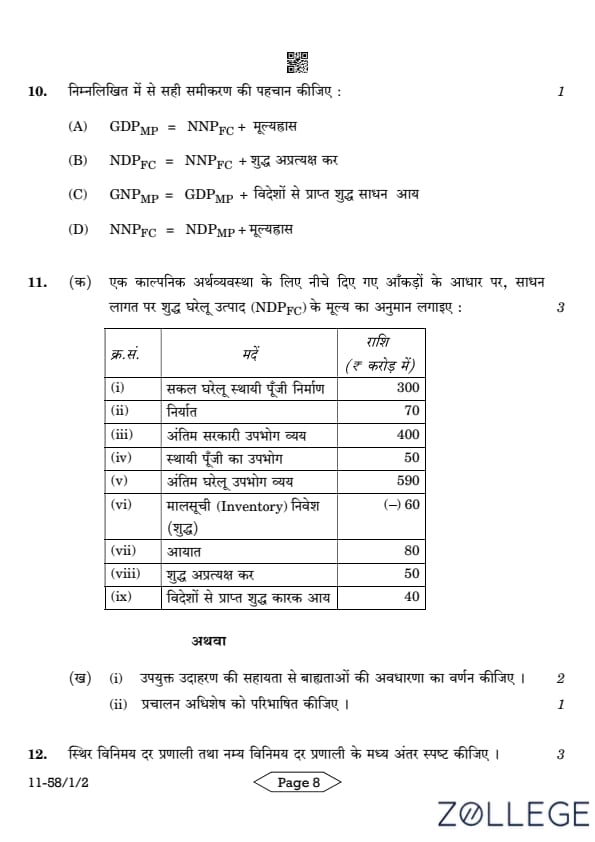
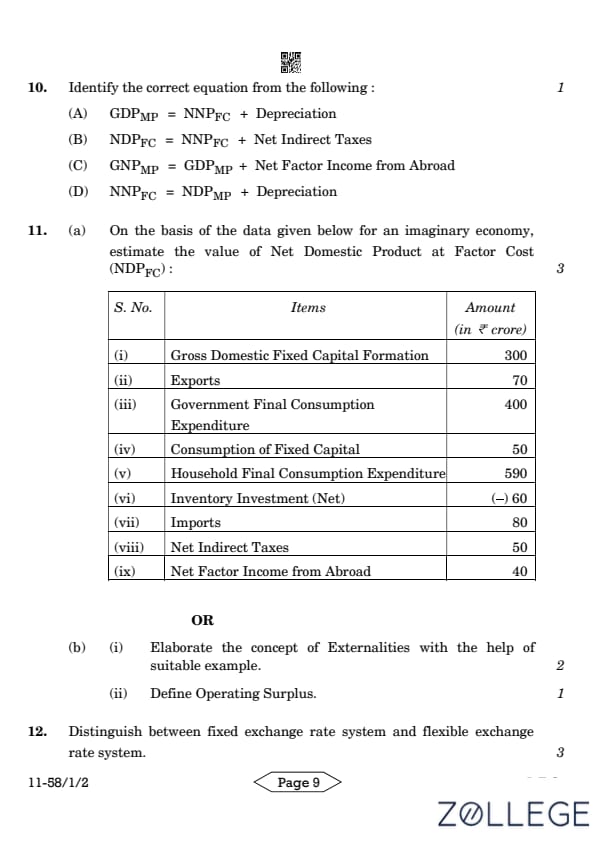
Identify the correct equation from the following:
Correct Answer: (C) GNPMP = GDPMP + Net Factor Income from Abroad
View Solution
Gross National Product at Market Price (GNPMP) is calculated by adding Net Factor Income from Abroad (NFIA) to Gross Domestic Product at Market Price (GDPMP). This equation represents the total income earned by nationals of a country, including income from abroad.
Question 11:
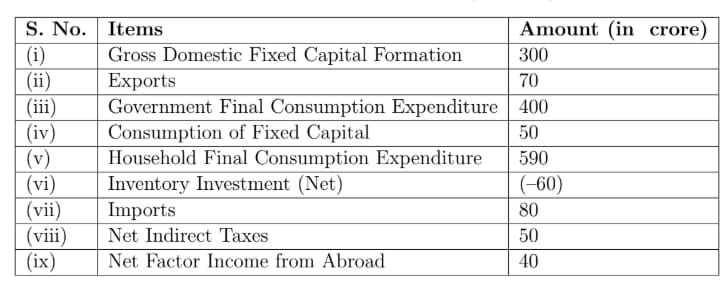
(a) On the basis of the data given below for an imaginary economy, estimate the value of Net Domestic Product at Factor Cost (NDPF C):
Correct Answer:
View Solution
NDPF C = GDPMP − Depreciation − Net Indirect Taxes GDPMP = Consumption Expenditure (Household + Government) + Gross Investment (Fixed + Inventory) + Net Exports (Exports - Imports) GDPMP = (590 + 400) + (300 - 60) + (70 - 80) = 1220 NDPF C = GDPMP - Depreciation - Net Indirect Taxes NDPF C = 1220 - 50 - 50 = 1130 crore
Question 11:
(i) Elaborate the concept of Externalities with the help of a suitable example.
Correct Answer:
View Solution
Externalities refer to the unintended side effects (positive or negative) of an economic activity on third parties who are not directly involved in the activity. Positive Externality: A company planting trees in the neighborhood improves air quality for residents. Negative Externality: A factory emitting pollutants harms the health of nearby residents.
Question 11:
(ii) Define Operating Surplus.
Correct Answer:
View Solution
Operating Surplus is the income generated by firms from the production process after paying wages and salaries to employees and meeting intermediate costs. It includes profits, rent, interest, and dividends. In National Income Accounting, it is a key component of Net Domestic Product at Factor Cost (NDPFC).
Question 12:
Distinguish between fixed exchange rate system and flexible exchange rate system.
Correct Answer:
View Solution
| Fixed Exchange Rate System | Flexible Exchange Rate System |
|---|---|
| The government fixes the currency value. | Market forces of demand and supply determine the currency value. |
| Ensures stability in international trade. | Allows currency to adjust automatically to economic changes. |
| Requires constant intervention by the central bank. | Minimal intervention by the central bank. |
Question 13:
Read the following text carefully from ‘The Economic Times’ dated 8th June, 2023: “The Reserve Bank of India’s (RBI’s) rate setting panel unanimously decided to keep the benchmark lending rate unchanged at 6.5%. The committee voted to remain focused on the withdrawal of accommodating monetary policy.” On the basis of the given text and common understanding, answer the following questions:
1. Identify and discuss the economic issue indicated in the above text.
Correct Answer:
View Solution
The economic issue highlighted in the text is the central bank’s monetary policy stance. The RBI’s decision to maintain the lending rate at 6.5% indicates a cautious approach to managing inflation. The focus on withdrawing an accommodative monetary policy shows an effort to balance economic growth and price stability.
Question 13:
2. Discuss the likely consequence on money supply if the rate-setting panel would have decreased the said rate.
Correct Answer:
View Solution
If the benchmark lending rate had been decreased: Borrowing costs would decrease, encouraging investment and consumption. This would lead to increased credit creation by banks, resulting in a higher money supply. While boosting economic activity, it may also create inflationary pressures in the economy.
Question 14:
(a) Complete the following table. Construct/Express the Consumption function at 200 crore level of income. Income (Y) Savings (S) Average Propensity to Consume (APC) Marginal Propensity to Save (MPS) 0 –30 1 0.2 100 20 0.85 0.2 200 70 0.85 0.2 300 120 0.8 0.2
Correct Answer:
View Solution
At Y = 200: C = 200 - 70 = 130 APC = C/Y = 130/200 = 0.85 MPS = 1 - MPC
Question 14:
“In an economy, ex-ante Aggregate Supply is less than ex-ante Aggregate Demand.” Explain its impact on the level of output, income, and employment.
Correct Answer:
View Solution
When ex-ante Aggregate Supply (AS) is less than ex-ante Aggregate Demand (AD), it creates an inflationary gap in the economy, resulting in: Increase in Output: Firms increase production to meet the higher demand for goods and services. Increase in Income: Higher production leads to increased payments to factors of production, resulting in higher income levels. Increase in Employment: Firms hire more workers to increase production, thereby creating additional employment opportunities.
Question 15:
Justify the following statements with valid arguments: 1. Money serves as the ‘medium of exchange’ for transactional purposes in an economy.
Correct Answer:
View Solution
Money acts as a universally accepted medium for exchanging goods and services. It eliminates the need for the double coincidence of wants, which is a major limitation of the barter system. This enhances trade efficiency and simplifies transactions.
Question 15:
2. The Central Bank acts as Banker’s Bank in an economy.
Correct Answer:
View Solution
The Central Bank provides banking services to commercial banks and regulates their operations. It holds reserves of commercial banks. It provides funds to banks during liquidity crises, ensuring financial stability. It supervises and regulates banking operations to maintain trust in the financial system.
Question 16:
(a)(i). Study the following chart carefully and analyse the changing trends in the government expenditure on: (I) Agriculture and Allied Activities (II) Transport Figure 1: Trend of Major Items of Expenditure ( lakh crore) 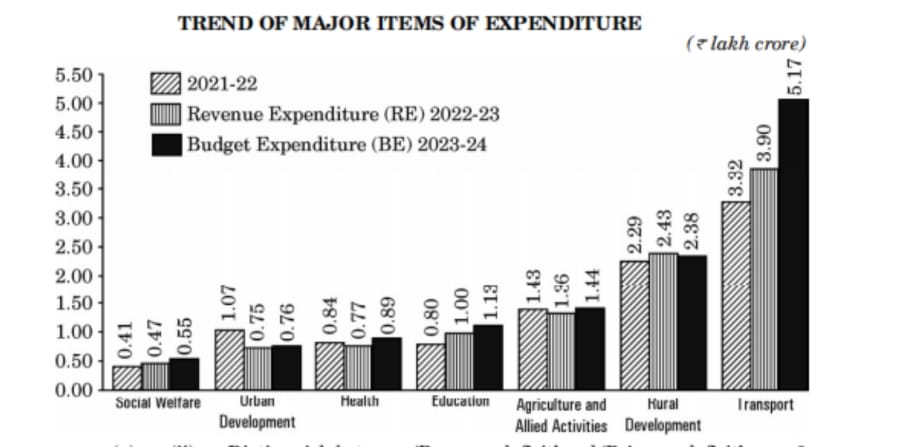
Correct Answer:
View Solution
Agriculture and Allied Activities: Government expenditure on agriculture and allied activities has shown a steady increase over the three years. It rose from 1.44 lakh crore in 2021-22 to 1.46 lakh crore in 2022-23. It further increased to 1.64 lakh crore in 2023-24. This indicates a focus on rural and agricultural development. Transport: Expenditure on transport has also seen a significant rise. It increased from 3.90 lakh crore in 2021-22 to 4.33 lakh crore in 2022-23. It further grew to 5.17 lakh crore in 2023-24. This highlights the government’s prioritization of infrastructure development.
Question 16:
(ii). Distinguish between ‘Revenue deficit’ and ‘Primary deficit’.
Correct Answer:
View Solution
| Revenue Deficit | Primary Deficit |
|---|---|
| Refers to the excess of revenue expenditure over revenue receipts. | Refers to the fiscal deficit excluding interest payments. |
| Indicates the inability of the government to meet its regular expenses from its regular income. | Indicates the borrowing requirement of the government to meet current expenses, excluding interest payments. |
Question 16:
Classify the following as Revenue receipts or Capital receipts. Give valid arguments in support of your answer: (i) Interest received on loan. (ii) Disinvestment receipts from the sale of a government company. (iii) Financial assistance by the Government of USA for promoting girl education in India.
Correct Answer:
View Solution
Interest received on loan: Revenue Receipt. Revenue receipts are non-redeemable and arise during the normal course of government operations. Interest earned on loans is a recurring income. Disinvestment receipts from the sale of a government company: Capital Receipt. Disinvestment proceeds are non-recurring and lead to a reduction in the government’s asset base. Financial assistance by the Government of USA: Revenue Receipt. Grants and aid are non-redeemable and classified as revenue receipts as they do not create liabilities or reduce assets.
Question 16.:
(a)(i). Explain the stabilisation function of the Government Budget. (Note: The following question is for the Visually Impaired Candidates only in lieu of Q. No. 16(a)(i).)
Correct Answer:
View Solution
The stabilisation function aims to maintain economic stability by managing fluctuations in the economy. During inflation: The government reduces spending or increases taxes to control demand. During recession: The government increases spending or reduces taxes to boost demand and output.
Question 17:
(a). Discuss briefly the concept of circular flow of income in a two-sector model.
Correct Answer:
View Solution
Households: Provide factors of production (land, labor, capital) to firms and receive factor payments (rent, wages, interest, profit). Firms: Produce goods and services and sell them to households in exchange for consumption expenditure. Circular Flow: The income and expenditure cycle continues, creating a closed economy.
Question 17:
“Real Gross Domestic Product (GDP) is a better indicator of economic growth of a nation as compared to the Nominal Gross Domestic Product (GDP).” Do you agree with the given statement? Justify your answer with a valid hypothetical numerical example.
Correct Answer:
View Solution
Yes, Real GDP is a better indicator as it accounts for inflation. Nominal GDP: Measures output at current prices. Real GDP: Adjusts for inflation, reflecting the true value of goods and services. Example: Year 1: Nominal GDP = 1000 crore, Price Index = 100. Year 2: Nominal GDP = 1200 crore, Price Index = 120. Real GDP (Year 2) = 1200 / 120 * 100 = 1000 crore. Despite an increase in nominal GDP, real GDP remains constant, indicating no actual growth in production.
SECTION B
Indian Economic Development
Question 18:
Read the following statements carefully:
Statement 1: Under the colonial rule, basic infrastructure (like railways, post and telegraph, etc.) was developed.
Statement 2: The real motive behind the infrastructural development in India was to strengthen the British interests. In the light of the given statements, choose the correct option from the following:
Correct Answer: (C) Both Statements 1 and 2 are true.
View Solution
The British colonial administration developed infrastructure like railways, ports, and communication systems primarily to serve their economic and administrative interests. While this infrastructure inadvertently benefited India in the long term, its original intent was to strengthen colonial control and facilitate resource exploitation.
Question 19:
Identify which of the following options indicate the incorrect components combination of Agriculture Marketing System:
Correct Answer: (B) Production, Assembling, Processing, Grading
View Solution
The Agricultural Marketing System includes components such as: Assembling, Grading, Processing, Packaging, Storage, Transportation. However, "Production" is not a part of the marketing process. It refers to the cultivation of crops, which is separate from marketing activities.
Question 20:
Read the following statements – Assertion (A) and Reason (R). Choose the correct option given below:
Assertion (A): World Trade Organization (WTO) is expected to establish the rule-based trading regime, to avoid unilaterally placed arbitrary restrictions by member nations.
Reason (R): It is imperative to enlarge world production and ensure optimum utilization of world resources along with environmental protection.
Correct Answer: (A) Both Assertion (A) and Reason (R) are true and Reason (R) is the correct explanation of Assertion (A).
View Solution
The primary goal of the WTO is to create a rule-based global trading system. This ensures that member nations do not impose arbitrary or unilateral trade restrictions. The provided reason aligns with the assertion because the WTO seeks to optimize global production, ensure efficient resource utilization, and integrate environmental protection within trade agreements.
Question 21:
Read the following statements – Assertion (A) and Reason (R). Choose the correct option given below:
Assertion (A): China has used the market mechanism to create additional social and economic opportunities for its citizens.
Reason (R): Social infrastructure creation by the government has brought positive results in human development indicators in China.
Correct Answer: (B) Both Assertion (A) and Reason (R) are true, but Reason (R) is not the correct explanation of Assertion (A).
View Solution
Both statements are correct: The market mechanism mentioned in Assertion (A) focuses on economic reforms and liberalization in China. Social infrastructure creation, mentioned in Reason (R), contributed to improvements in human development indicators. However, the reason does not directly explain the market mechanism in Assertion (A), as they refer to different strategies.
Question 22:
Identify from the following options the incorrect objectives of regulated agriculture market:
(i) To make the marketing system efficient and effective for farmers to get the best price for their products.
(ii) To discourage improvement of marketing infrastructure for farmers.
(iii) To prevent exploitation of farmers.
(iv) To discourage farmers from improving quality and quantity of their produce.
Correct Answer: (D) (ii) and (iv)
View Solution
The objectives of a regulated agriculture market include: Improving marketing infrastructure, Preventing the exploitation of farmers and Ensuring farmers get the best price for their produce. Statements (ii) and (iv) are incorrect because: Discouraging infrastructure improvement and quality enhancement contradicts the goals of regulated markets.
Question 23:
Economic reforms were introduced in India and Pakistan in the years___ and _____, respectively. (Choose the correct option to fill in the blanks)
Correct Answer: (C) 1991, 1988
View Solution
India introduced economic reforms in 1991 due to a balance of payments crisis, emphasizing liberalization, privatization, and globalization. Pakistan introduced economic reforms in 1988, focusing on structural adjustments and liberalization to boost its economy.
Question 24:
Read the following statements carefully:
Statement 1: As per the National Sample Survey Organization (NSSO), unemployment is a situation in which all those who, owing to lack of work, are not working, but are seeking work from prospective employers. They express their willingness/availability to work under the prevailing conditions of work and remuneration.
Statement 2: Disguised Unemployment is generally a massive problem in a highly populated country like India. In the light of the given statements, choose the correct option:
Correct Answer: (C) Both Statements 1 and 2 are true.
View Solution
Statement 1 is correct as it defines unemployment as per the NSSO, highlighting the lack of work despite willingness and availability to work. Statement 2 is also true because disguised unemployment is prevalent in India, especially in the agricultural and informal sectors, where more people are employed than required.
Question 25:
Identify which of the following is not a member nation of G20:
Correct Answer: (C) Bangladesh
View Solution
The G20 comprises 19 countries and the European Union, focusing on global economic issues. Bangladesh is not a member of the G20, whereas Brazil, Australia, and Argentina are members.
Question 26:
Read the following statements – Assertion (A) and Reason (R). Choose the correct option given below:
Assertion (A): The excessive regulation of permit license raj prevented certain private firms from becoming fairly competitive.
Reason (R): Private sector wasted huge amounts in obtaining licenses rather than on improving the product quality and international competitiveness.
Correct Answer: (A) Both Assertion (A) and Reason (R) are true and Reason (R) is the correct explanation of Assertion (A).
View Solution
The permit license raj hindered competition by making it difficult for private firms to operate efficiently. Firms focused more on obtaining licenses than improving their products, which negatively impacted competitiveness. Hence, both Assertion (A) and Reason (R) are correct, and the reason explains the assertion effectively.
Question 27:
In the decade of the 1970s, Pakistan nationalized its______ industries. (Choose the correct option to fill in the blank)
Correct Answer: (C) Capital goods
View Solution
During the 1970s, Pakistan adopted nationalization policies under the leadership of Zulfikar Ali Bhutto. The focus was on bringing key industries under state control, especially in the capital goods sector such as steel, energy, and heavy machinery. The purpose was to reduce economic inequality and foster industrial growth through state intervention.
Question 28:
“In India, National Education Policy 2020 has stressed a lot on in-service training of the teachers.” (a) Identify the source of Human Capital Formation (HCF) indicated in the aforesaid statement.
Correct Answer:
View Solution
The source of Human Capital Formation indicated in the statement is education and skill development. In-service teacher training focuses on improving the knowledge, skills, and competencies of educators, which are primary components of Human Capital Formation.
Question 28:
(b) Elaborate the likely impacts of this source on the economic development of India.
Correct Answer:
View Solution
The emphasis on teacher training under NEP 2020 can lead to the following impacts on India’s economic development: 1. Improved Quality of Education: Skilled and trained teachers contribute to better learning outcomes. This ensures a well-educated and employable workforce, improving human capital quality. 2. Higher Productivity: Enhanced skills result in increased efficiency and productivity across various sectors. This drives overall economic growth and competitiveness. 3. Innovation and Research: Skill development fosters creativity and innovation. This leads to advancements in technology and industry, contributing to long-term economic progress.
Question 29:
(a). Elaborate the reasons owing to which the private sector was regulated under the Industrial Policy Resolution, 1956.
Correct Answer:
View Solution
The private sector was regulated under the Industrial Policy Resolution, 1956, for the following reasons: 1. Socialistic Pattern of Society: The government aimed to establish a socialistic society by ensuring equitable distribution of resources through state control over industries. 2. Strategic Sectors: Key industries like defense, railways, and heavy machinery were reserved for the public sector to ensure national security and self-reliance. 3. Control of Monopolies: To prevent the concentration of wealth and power in a few hands, the government restricted private sector activities.
Question 29:
(b). “During the colonial period the agricultural sector showed massive stagnation.” Do you agree with the given statement? Justify your answer with valid arguments.
Correct Answer:
View Solution
Yes, the agricultural sector during the colonial period experienced massive stagnation due to: 1. Land Revenue Systems: Exploitative systems like Zamindari left farmers with little incentive to improve productivity. 2. Focus on Cash Crops: Farmers were forced to grow cash crops like indigo and cotton for export, neglecting food crops, leading to frequent famines. 3. Lack of Infrastructure: Minimal investment in irrigation, storage, and transportation facilities hindered agricultural growth. 4. Frequent Famines: Exploitative policies and neglect of food crop production caused widespread famines, further reflecting stagnation in agriculture.
Question 30:
(a)(i). “United Nations Department of Economic and Social Affairs indicated that India has overtaken China as the world’s most populous country in the month of April 2023.” Explain the consequences of the one-child policy adopted by China in the 1970s.
Correct Answer:
View Solution
The one-child policy adopted by China led to the following long-term consequences: 1. Aging Population: A sharp decline in birth rates caused an increase in the proportion of elderly people, leading to a shrinking workforce and higher dependency ratios. 2. Gender Imbalance: Cultural preferences for male children resulted in gender-selective abortions, creating a significant gender gap in the population. 3. Economic Implications: A declining workforce slowed economic growth, with fewer young workers available for industries and innovation. 4. Social Challenges: Increased pressure on the younger generation to support elderly family members.
Question 30:
(b). Discuss the impacts of Special Economic Zones (SEZs) on the economic growth of China.
Correct Answer:
View Solution
Special Economic Zones (SEZs) contributed significantly to China’s economic growth through: 1. Increased Foreign Direct Investment (FDI): SEZs attracted substantial FDI due to tax incentives and relaxed regulations, fostering industrial growth. 2. Export Growth: SEZs facilitated large-scale production and export, making China a global manufacturing hub. 3. Employment Opportunities: The establishment of SEZs created millions of jobs, reducing unemployment in urban and rural areas. 4. Technological Advancement: Access to global markets through SEZs encouraged technology transfers and innovation.
Question 31:
(a)(i). In the recent past, the Government of India has taken crucial steps, like Jan-Dhan Yojana, for efficient allocation of financial resources. State and elaborate whether the statement is true or false, with valid arguments.
Correct Answer:
View Solution
The statement is true as schemes like Pradhan Mantri Jan-Dhan Yojana (PMJDY) aim to provide universal access to banking services, ensuring efficient allocation of financial resources: 1. Financial Inclusion: PMJDY provides banking access to the unbanked population, enabling direct benefit transfers and reducing leakages. 2. Economic Efficiency: The efficient distribution of subsidies and welfare payments reduces dependency on intermediaries. 3. Empowerment of Poor: Access to credit and savings accounts enhances financial independence for marginalized communities.
Question 31:
(a)(ii). Worker–population ratio is an indicator, used for analyzing the employment situation in a nation. State and elaborate whether the statement is true or false, with valid arguments.
Correct Answer:
View Solution
The statement is true, as the worker-population ratio (WPR) measures the proportion of employed people in the total population: 1. Indicator of Employment Levels: A high WPR indicates a higher level of employment in the economy, while a low WPR points to underemployment or unemployment. 2. Policy Implications: WPR helps policymakers design targeted employment generation programs based on demographic and sectoral data. 3. Gender and Regional Analysis: It provides insights into disparities in employment across genders and regions.
Question 31:
(i). Elaborate the need to promote women’s education in India.
Correct Answer:
View Solution
The importance of women’s education includes: 1. Economic Empowerment: Educated women are more likely to participate in the workforce, contributing to economic growth and poverty reduction. 2. Improved Health Outcomes: Educated women are better informed about healthcare and hygiene, ensuring better health for their families. 3. Social Equality: Education empowers women to fight against social evils like gender discrimination, child marriage, and domestic violence. 4. Intergenerational Benefits: Educated mothers are more likely to ensure education for their children, breaking the cycle of illiteracy.
Question 31:
(ii). Mention any two examples of diversification activities in the non-agro processing industries.
Correct Answer:
View Solution
Examples of diversification activities in non-agro processing industries: 1. Textile Industry: Diversifying into technical textiles and sustainable fabrics. 2. Electronics Industry: Expansion into renewable energy products like solar panels and batteries.
Question 32:
(a). State any two advantages of the micro-credit system of financing in rural areas of India.
Correct Answer:
View Solution
1. Empowerment of Rural Poor: Micro-credit provides access to credit for rural households, enabling them to start small businesses and improve livelihoods. 2. Reduction in Dependency on Moneylenders: It reduces the dependency of rural households on informal and exploitative credit sources like moneylenders.
Question 32:
(b). “In the current situation, Information Technology plays a vital role in achieving food security in a nation like India.” Justify the given statement. (3 marks)
Correct Answer:
View Solution
1. Improved Agricultural Practices: IT enables precision farming through weather forecasting, crop monitoring, and soil analysis, leading to better yields. 2. Efficient Supply Chains: IT solutions optimize logistics and storage, reducing food wastage and ensuring timely delivery of food grains. 3. Access to Markets and Information: Farmers gain access to real-time market prices and agricultural advisories, helping them make informed decisions.
Question 33:
(a)(i). “Under the liberalisation measures taken by the Government of India, financial sector reforms were extremely crucial.” Reject or support the given statement with valid arguments.
Correct Answer:
View Solution
The statement is supported as financial sector reforms were pivotal for India’s economic growth: 1. Increased Efficiency: Reforms encouraged competition among banks and financial institutions, improving efficiency and customer services. 2. Attraction of FDI: Liberalization in financial services attracted foreign direct investment (FDI), boosting capital inflows. 3. Economic Stability: Strengthened regulatory mechanisms under the Reserve Bank of India ensured financial stability and prevented crises.
Question 33:
(a)(ii). Clarify how the Green Revolution enabled the government to procure sufficient food grains to build stocks to be used during the times of food shortages.
Correct Answer:
View Solution
The Green Revolution significantly enhanced agricultural productivity, enabling surplus food grain production: 1. Higher Yields: Introduction of high-yield variety (HYV) seeds and better irrigation practices significantly increased wheat and rice production. 2. Government Procurement: The surplus production allowed the government to procure food grains under the Minimum Support Price (MSP) policy, ensuring stockpiling. 3. Food Security Buffer: These stocks helped the government meet public distribution system requirements and manage food shortages during crises.
Question 33:
(b)(i). “Every coin has two sides — debate over farm subsidies is one such classic example of the same.” Justify the given statement with two arguments each in favour of and against the continuation of the farm subsidies.
Correct Answer:
View Solution
Arguments in favour: 1. Support to Farmers: Subsidies provide financial relief to farmers, especially small and marginal ones, ensuring their survival. 2. Food Security: By subsidizing inputs like fertilizers and seeds, the government ensures higher crop production, contributing to national food security. Arguments against: 1. Overuse of Resources: Excessive subsidies lead to overuse of water and fertilizers, degrading soil and depleting groundwater. 2. Inefficiency: Subsidies often benefit large farmers disproportionately, diverting funds from critical rural development needs.
Question 33:
(b)(ii). State the importance of “Growth with equity” as the objective of Indian economic planning.
Correct Answer:
View Solution
1. Inclusive Growth: It ensures that the benefits of economic growth reach marginalized and underprivileged sections of society. 2. Reduction in Income Inequality: Equitable distribution of resources and opportunities helps bridge the income gap between the rich and poor. 3. Social Justice: Growth with equity addresses regional imbalances and ensures sustainable development for all.
Question 34:
Read the following text carefully: In order to address two major environmental concerns in India, viz. water and air pollution, the government set up the Central Pollution Control Board (CPCB) in 1974. This was followed by states establishing their own state-level boards to address all the environmental concerns. They investigate, collect and disseminate information relating to water, air, and land pollution, lay down standards for sewage/trade effluent and emissions. These boards provide technical assistance to governments in promoting cleanliness of streams and wells by prevention, control, and abatement of water pollution, and improve the quality of air and to prevent, control, or abate air pollution in the country.
(a). State any two concerns owing to which the Central Pollution Control Board (CPCB) was established.
Correct Answer:
View Solution
The Central Pollution Control Board (CPCB) was established to address the following concerns: 1. Water Pollution: The increasing pollution in streams and wells required regulatory measures to maintain cleanliness and prevent contamination. 2. Air Pollution: Rising levels of air pollution necessitated the establishment of standards and actions to improve air quality.
Question 34:
(b). Explain any two functions performed by the Central Pollution Control Board (CPCB).
Correct Answer:
View Solution
The Central Pollution Control Board (CPCB) performs the following functions: 1. Monitoring Water Quality: CPCB monitors water quality in rivers, wells, lakes, and other water bodies to ensure pollution control. 2. Setting Standards: CPCB establishes standards for emissions and effluents to regulate industrial and urban pollution levels.
Question 34:
(c). Elaborate any two strategies to ensure sustainable development as adopted by India.
Correct Answer:
View Solution
India has adopted several strategies to promote sustainable development, including: 1. Promotion of Renewable Energy: Initiatives like the National Solar Mission focus on increasing the share of renewable energy in the power sector, reducing reliance on fossil fuels. 2. Afforestation and Biodiversity Conservation: Programs like the Green India Mission aim to increase forest cover, enhance carbon sinks, and conserve biodiversity for ecological balance.




*The article might have information for the previous academic years, please refer the official website of the exam.