
CBSE Class 12 2024 Economics Set 3 (Code: 58/2/3) Question Paper Pdf - Check Solutions with Answer Key Pdf

.jpg?tr=h-55,w-55,c-force)
Content Strategist|Tech-innovator|National Hackathon Winner | Updated On - Jan 30, 2025
CBSE Class 12 2024 Economics Question Paper with Answer Key PDF for Set 3 (Q.P. Code: 58/2/3) is available for download. The exam was successfully conducted by CBSE on March 18, 2024, in the morning session from 10:30 AM to 1:30 PM. As per the students’ initial reactions, the CBSE Class 12 2024 Economics Set 3 Question Paper was reported as Moderate. The Microeconomics section was considered Easy to Moderate, while the Macroeconomics section was reported as Moderate to Challenging.
CBSE Class 12 2024 Economics (Set 3- 58/2/3) 2024 Answer Key With Solution
Candidates can download the CBSE Class 12 Economics Question Paper with Solution and Answer Key PDFs for Set 3 Question Paper (Code: 58/2/3) using the link below.
| CBSE Class 12 Economics (Set 3- 58/2/3) 2024 Question Paper with Answer Key |  Download Download |
Check Solution |
CBSE Class 12 2024 Economics Question Paper with Solutions
Macro Economics
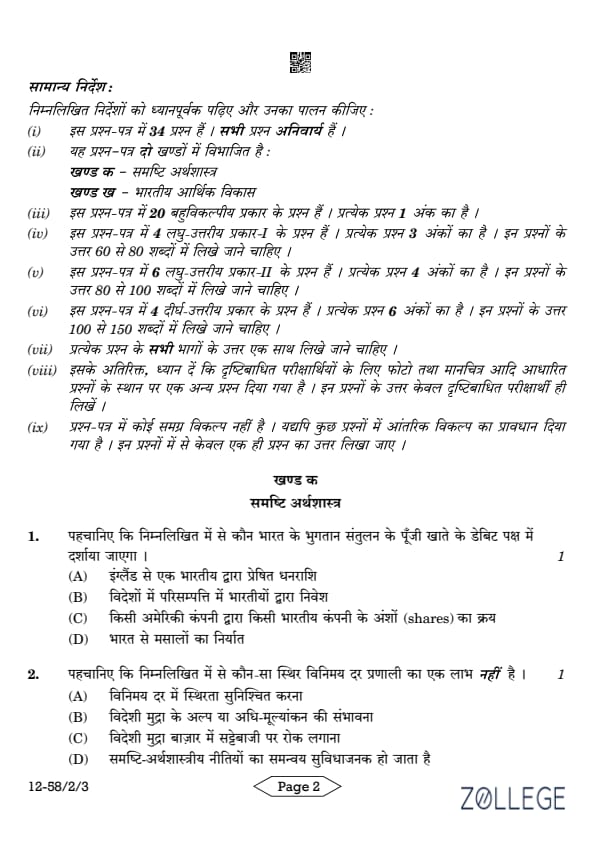
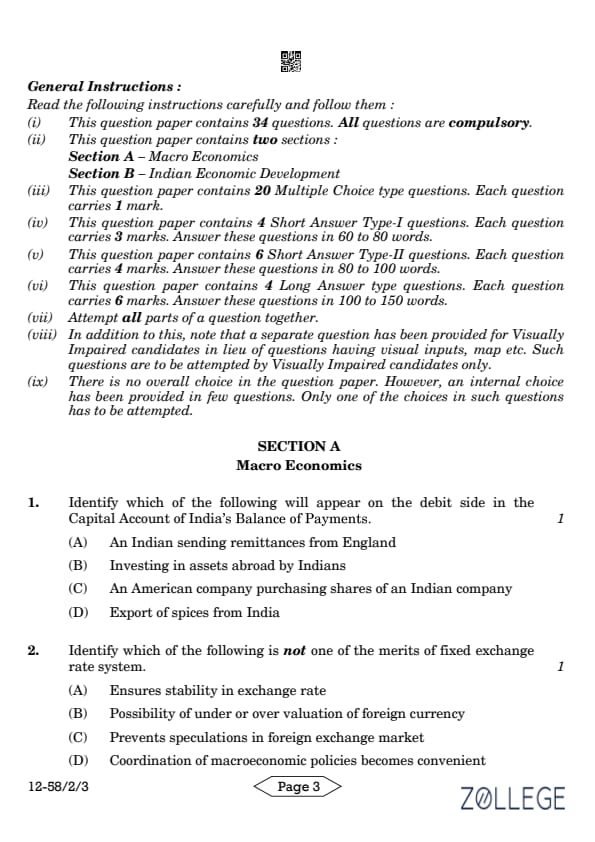
Question 1:
Identify which of the following will appear on the debit side in the Capital Account of India’s Balance of Payments:
Correct Answer: (B) Investing in assets abroad by Indians.
View Solution
Investing in assets abroad by Indians represents an outflow of funds from the economy, which is recorded as a debit entry in the Capital Account of the Balance of Payments.
Question 2:
Identify which of the following is not one of the merits of a fixed exchange rate system:
Correct Answer: (B) Possibility of under or overvaluation of foreign currency.
View Solution
The possibility of under or overvaluation of foreign currency is a limitation of the fixed exchange rate system, not a merit. Fixed exchange rates provide stability but can lead to currency misvaluation.
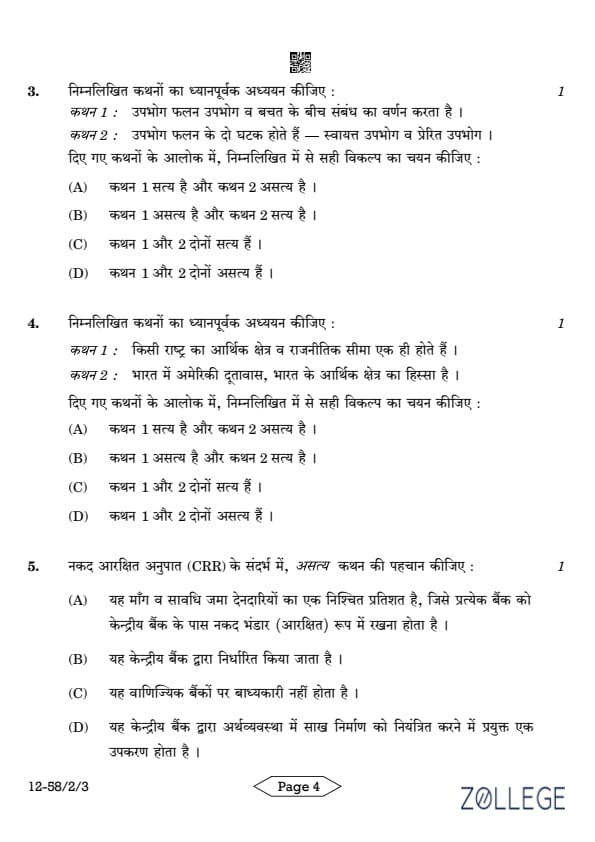
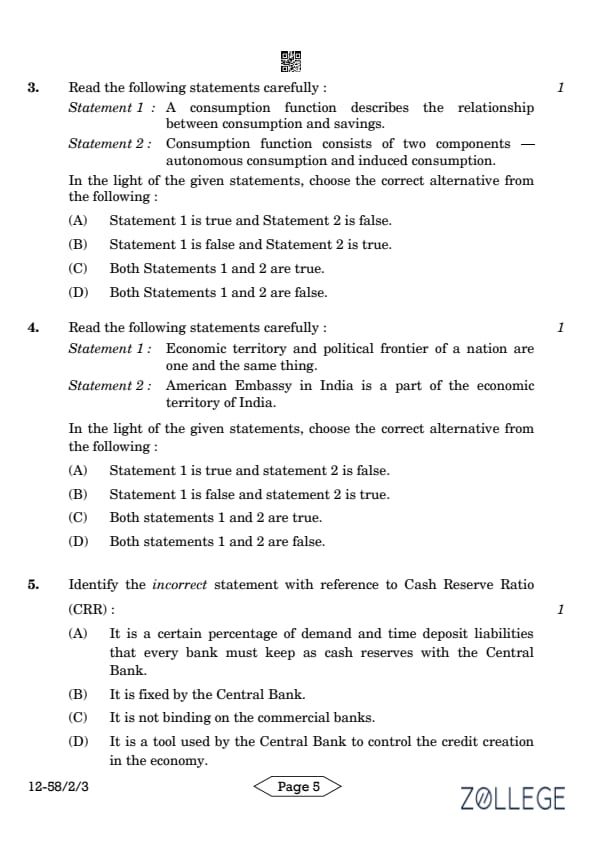
Question 3:
Read the following statements carefully:
Statement 1: A consumption function describes the relationship between consumption and savings.
Statement 2: Consumption function consists of two components—autonomous consumption and induced consumption.
Choose the correct alternative:
Correct Answer: (B) Statement 1 is false and Statement 2 is true.
View Solution
Statement 1 is false because the consumption function describes the relationship between consumption and income, not savings. Statement 2 is true because the consumption function consists of autonomous consumption (independent of income) and induced consumption (dependent on income).
Question 4:
Read the following statements carefully:
Statement 1: Economic territory and political frontier of a nation are one and the same thing.
Statement 2: American Embassy in India is a part of the economic territory of India.
Choose the correct alternative:
Correct Answer: (D) Both statements 1 and 2 are false.
View Solution
Statement 1 is false because a nation's economic territory extends beyond its political frontier, including embassies, consulates, and businesses abroad under its control. Statement 2 is also false because the American Embassy in India is part of the United States' economic territory, not India.
Question 5:
Identify the incorrect statement with reference to Cash Reserve Ratio (CRR):
Correct Answer: (C) It is not binding on the commercial banks.
View Solution
CRR is mandatory for all commercial banks as prescribed by the Central Bank. Option (C) is incorrect because it suggests that CRR is not binding, which is false.
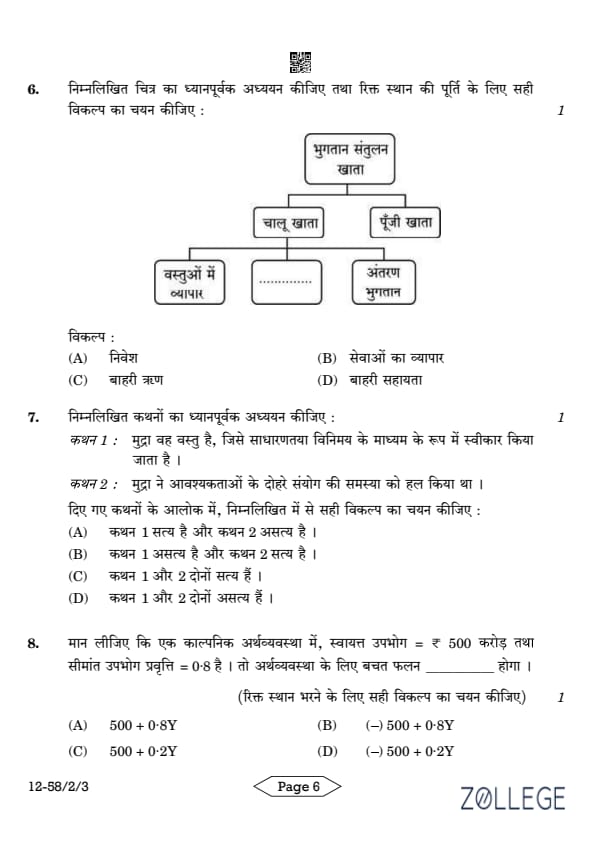
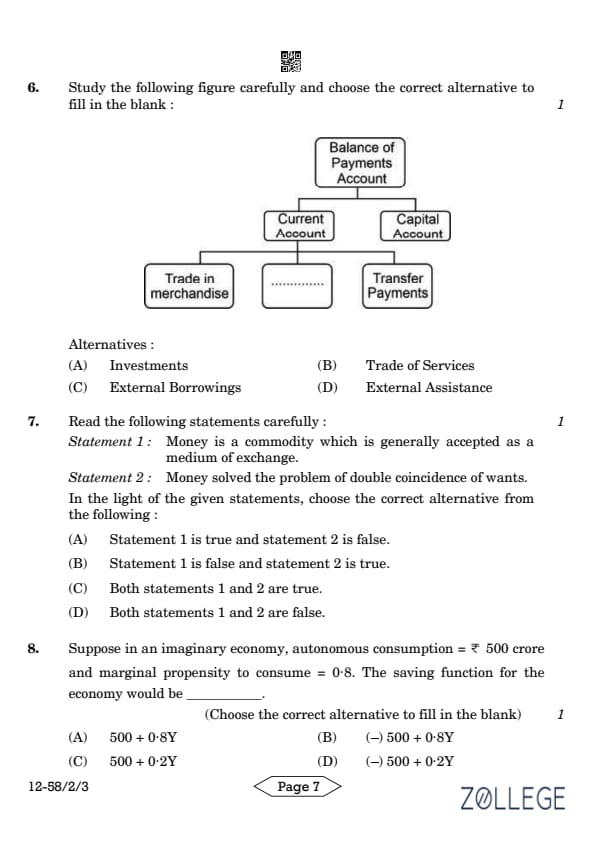
Question 6:
Study the following figure carefully and choose the correct alternative to fill in the blank:
Balance of Payments Account
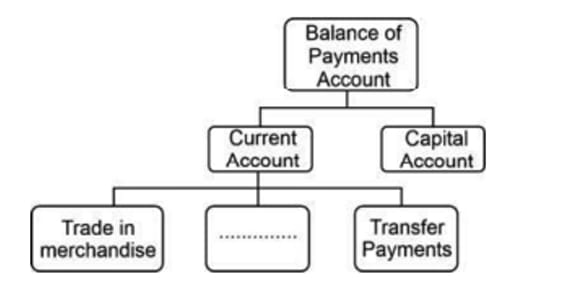
Correct Answer: (B) Trade of Services.
View Solution
The Current Account in the Balance of Payments includes trade in goods (merchandise), trade in services, and transfer payments. Therefore, the correct alternative to fill in the blank is Trade of Services.
Question 7:
Read the following statements:
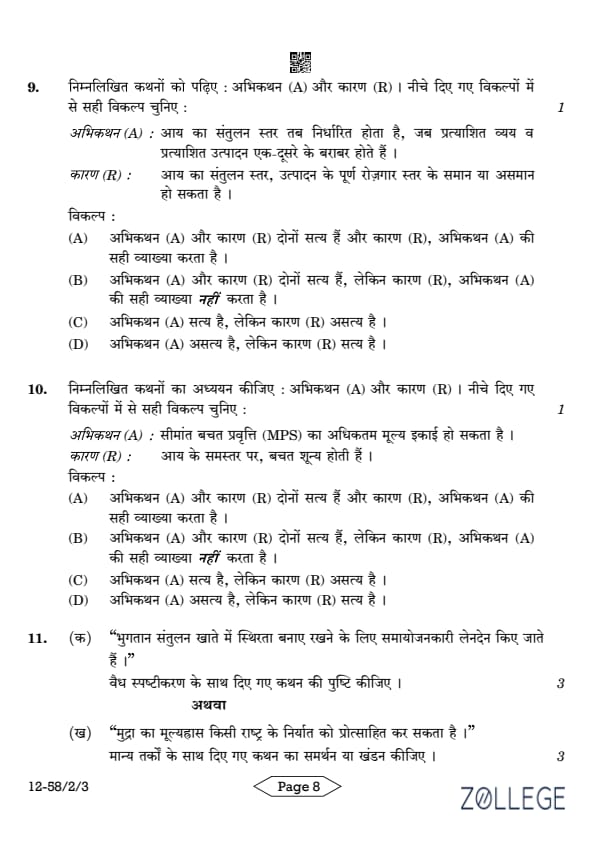
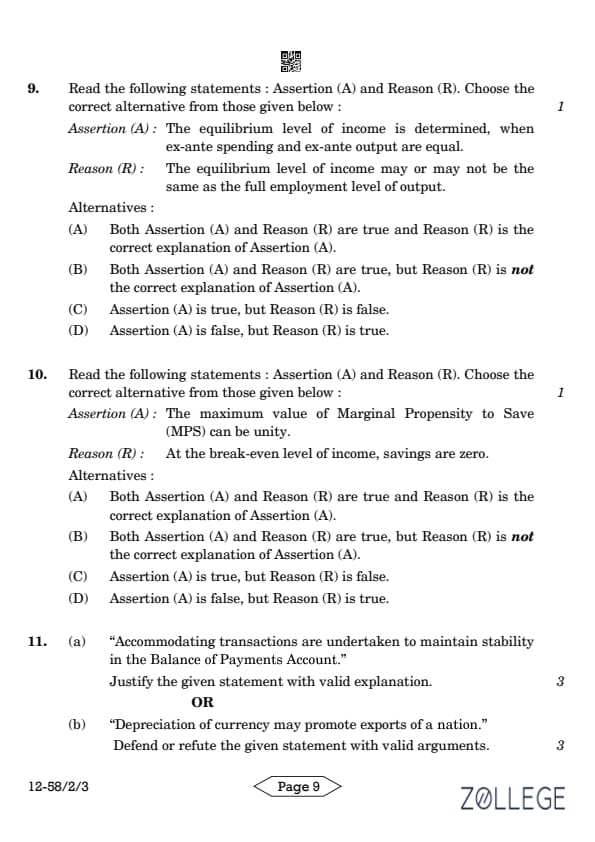
Assertion (A): The equilibrium level of income is determined when ex-ante spending and ex-ante output are equal.
Reason (R): The equilibrium level of income may or may not be the same as the full employment level of output.
Choose the correct alternative:
Correct Answer: (B) Both Assertion (A) and Reason (R) are true, but Reason (R) is not the correct explanation of Assertion (A).
View Solution
Assertion (A) is true because the equilibrium level of income is achieved when planned (ex-ante) spending equals planned (ex-ante) output, ensuring no unintended inventory changes. Reason (R) is also true because the equilibrium level of income may occur below or above the full employment level due to variations in aggregate demand. However, Reason (R) does not fully explain Assertion (A), as equilibrium income is based on aggregate demand, not necessarily full employment.
Question 8:
Read the following statements:
Assertion (A): The equilibrium level of income is determined when ex-ante spending and ex-ante output are equal.
Reason (R): The equilibrium level of income may or may not be the same as the full employment level of output.
Choose the correct alternative:
Correct Answer: (B) Both Assertion (A) and Reason (R) are true, but Reason (R) is not the correct explanation of Assertion (A).
View Solution
Step 1: Understanding the Equilibrium Level of Income
The equilibrium level of income is achieved when planned (ex-ante) spending equals planned (ex-ante) output, ensuring no unintended inventory changes.
Step 2: Understanding Full Employment Level
The equilibrium level of income may or may not be equal to the full employment output. It can be below full employment if there is insufficient aggregate demand or above full employment in cases of excess demand.
Conclusion: Both Assertion (A) and Reason (R) are true, but Reason (R) does not fully explain Assertion (A). The equilibrium level of income is based on aggregate demand, while full employment depends on labor market conditions.
Question 9:
Read the following statements:
Assertion (A): The maximum value of Marginal Propensity to Save (MPS) can be unity.
Reason (R): At the break-even level of income, savings are zero.
Choose the correct alternative:
Correct Answer: (B) Both Assertion (A) and Reason (R) are true, but Reason (R) is not the correct explanation of Assertion (A).
View Solution
Step 1: Understanding Marginal Propensity to Save (MPS)
MPS represents the proportion of additional income that is saved. Theoretically, its maximum value can be 1 (i.e., when the entire additional income is saved). However, in practical scenarios, this rarely happens.
Step 2: Understanding Break-even Income
At the break-even level of income, all earned income is used for consumption, leaving no savings. This explains why savings are zero at this point.
Conclusion: While both statements are true, Reason (R) does not fully explain Assertion (A). Break-even income refers to a specific income level where savings are zero, while MPS relates to the proportion of income saved.
Question 10:
"An increase in the credit creation capacity of commercial banks has a direct impact on the money supply in an economy."
Correct Answer: True
View Solution
Step 1: Understanding Credit Creation by Banks
Commercial banks play a vital role in the money supply by creating credit. The process of credit creation occurs when banks accept deposits and provide loans, thereby expanding the money supply.
Step 2: Role of the Reserve Ratio
The credit creation capacity of commercial banks depends on the reserve ratio (CRR and SLR) set by the Central Bank. A lower reserve ratio allows banks to lend more, increasing the money supply.
Step 3: Money Multiplier Effect
The credit creation process follows the money multiplier effect, where each deposit leads to multiple rounds of lending and deposit creation, significantly expanding the money supply.
Conclusion: Credit creation by commercial banks directly affects the money supply, making it a crucial factor in monetary policy.
Question 11:
“Accommodating transactions are undertaken to maintain stability in the Balance of Payments Account.”
Correct Answer: True
View Solution
Step 1: Understanding Accommodating Transactions
Accommodating transactions in the Balance of Payments (BoP) are non-market-driven transactions undertaken by the government or central bank to correct imbalances in the BoP.
Step 2: Purpose of Accommodating Transactions
These transactions bridge gaps in the BoP when there is a deficit in the current account or capital account. They help maintain stability in foreign exchange reserves and economic stability.
Step 3: Examples of Accommodating Transactions
- Borrowing from international financial institutions like the IMF.
- Using foreign exchange reserves to manage BoP deficits.
- Government interventions in foreign exchange markets.
Conclusion: Accommodating transactions ensure that BoP imbalances do not adversely affect economic stability, making them an essential tool for economic management.
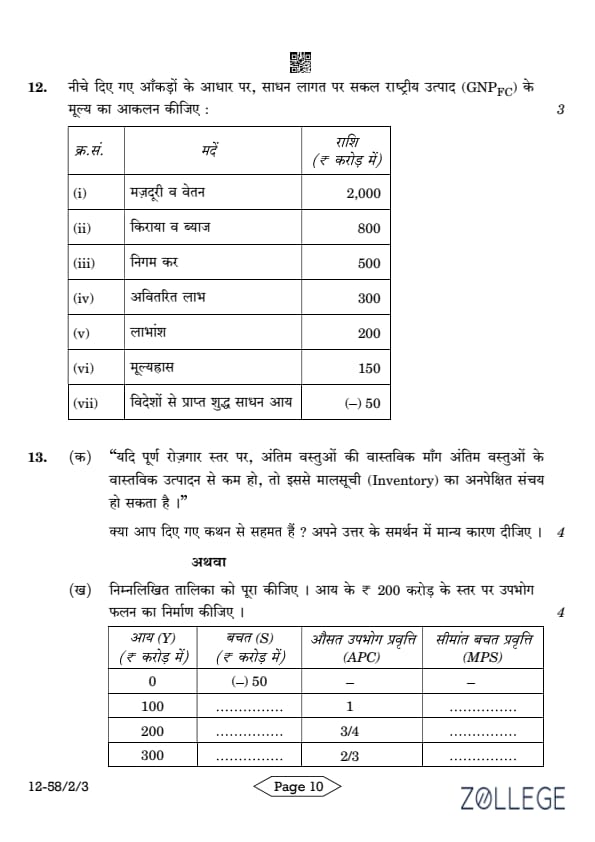
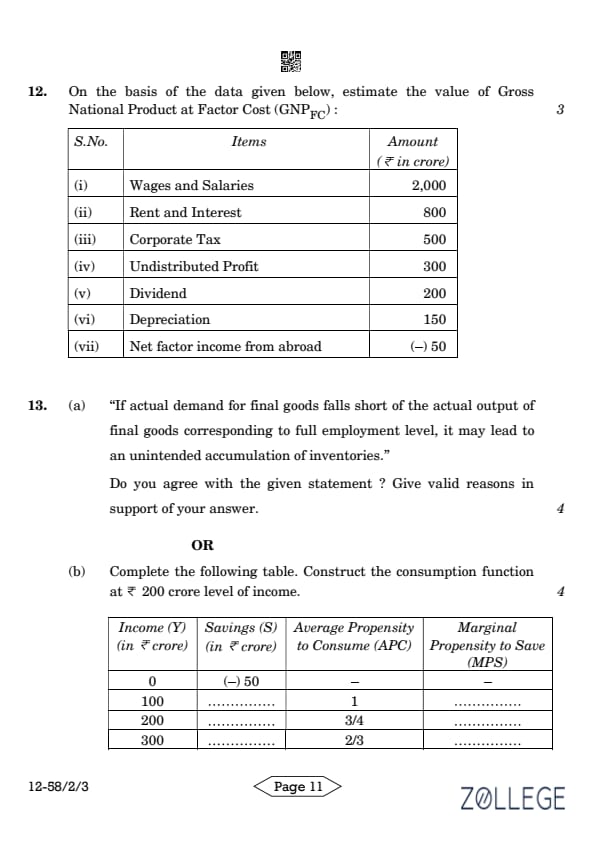
Question 12:
On the basis of the data given below, estimate the value of Gross National Product at Factor Cost (GNPFC):
| Items | Amount (in crore) |
|---|---|
| Wages and Salaries | 2,000 |
| Rent and Interest | 800 |
| Corporate Tax | 500 |
| Undistributed Profit | 300 |
| Dividend | 200 |
| Depreciation | 150 |
| Net Factor Income from Abroad | -50 |
Correct Answer: GNPFC = 3,900 crore
View Solution
Step 1: Formula for GNPFC
GNPFC = Wages & Salaries + Rent & Interest + Corporate Tax + Undistributed Profit + Dividend + Depreciation + Net Factor Income from Abroad
Step 2: Substituting the Values
GNPFC = 2000 + 800 + 500 + 300 + 200 + 150 + (-50)
Step 3: Calculation
GNPFC = 3,900 crore
Conclusion: The Gross National Product at Factor Cost (GNPFC) is 3,900 crore.
Question 13:
"If actual demand for final goods falls short of the actual output of final goods corresponding to full employment level, it may lead to an unintended accumulation of inventories." Do you agree? Justify.
Correct Answer: Yes
View Solution
Step 1: Understanding Demand and Output
If the actual demand for final goods is lower than the full employment output, firms are unable to sell all their produced goods.
Step 2: Impact on Inventory
Since unsold goods accumulate, this results in unintended inventory build-up, forcing firms to cut production in the future.
Step 3: Consequences
- Reduced production and economic slowdown.
- Decrease in employment levels.
- Possible deflationary pressures.
Conclusion: A demand shortfall leads to excess inventory accumulation, negatively impacting economic stability.
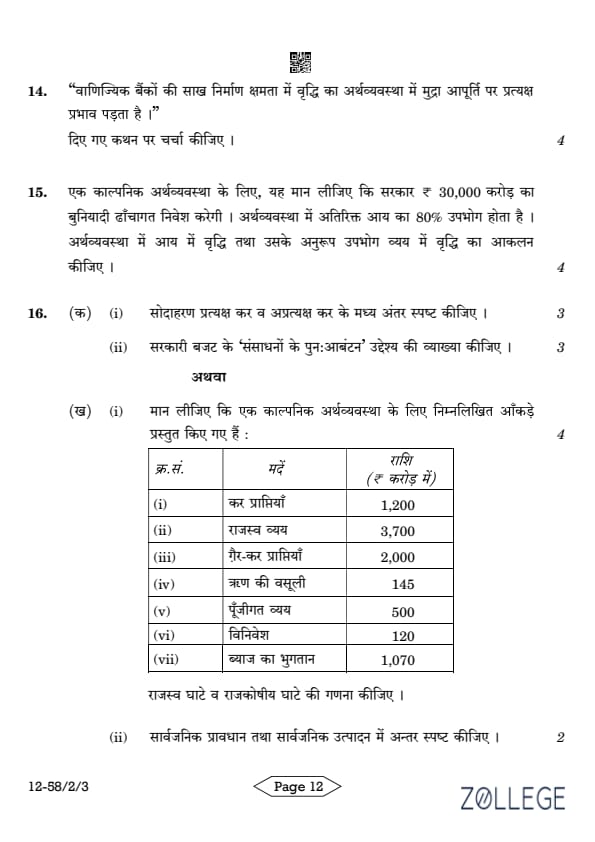
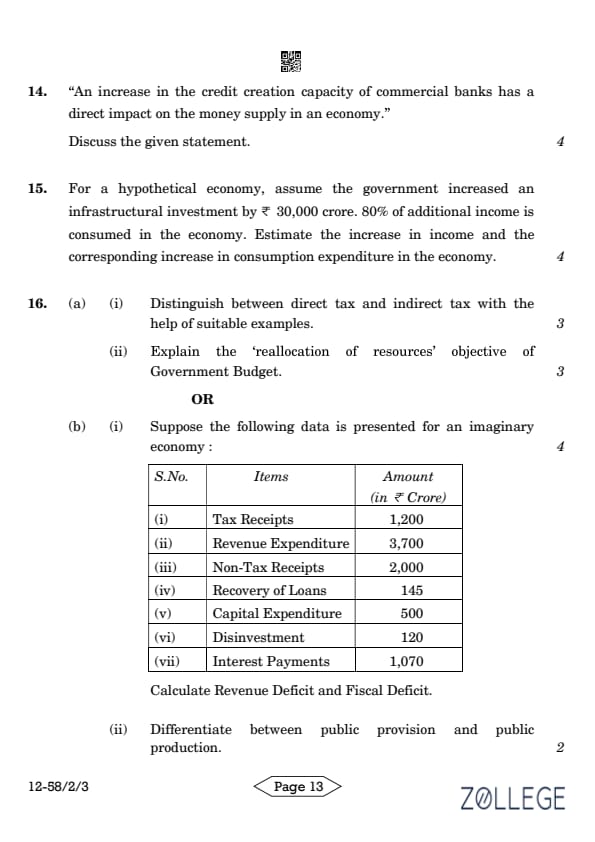
Question 14:
"An increase in the credit creation capacity of commercial banks has a direct impact on the money supply in an economy." Discuss.
Correct Answer: True
View Solution
Step 1: Role of Credit Creation
Commercial banks create money by issuing loans. When banks lend money, the funds are re-deposited into the banking system, leading to further lending.
Step 2: Money Multiplier Effect
Each loan creates new deposits, which further increase lending capacity, leading to an overall expansion of the money supply.
Step 3: Reserve Ratio Impact
A lower reserve ratio (CRR & SLR) allows banks to lend more, increasing money supply.
Conclusion: Credit creation plays a vital role in money supply expansion, directly influencing economic activity.
Question 15:
For a hypothetical economy, assume the government increased infrastructural investment by ₹30,000 crore. 80% of additional income is consumed in the economy. Estimate the increase in income and the corresponding increase in consumption expenditure.
Correct Answer: Increase in Income = ₹1,50,000 crore, Increase in Consumption Expenditure = ₹1,20,000 crore
View Solution
Step 1: Given Data
- Increase in Investment (ΔI) = ₹30,000 crore
- Marginal Propensity to Consume (MPC) = 0.8
Step 2: Calculate the Multiplier (K)
Formula: K = 1 / (1 - MPC)
K = 1 / (1 - 0.8) = 1 / 0.2 = 5
Step 3: Calculate Increase in Income (ΔY)
ΔY = K × ΔI
ΔY = 5 × 30,000 = ₹1,50,000 crore
Step 4: Calculate Increase in Consumption Expenditure (ΔC)
ΔC = MPC × ΔY
ΔC = 0.8 × 1,50,000 = ₹1,20,000 crore
Conclusion: An investment increase of ₹30,000 crore leads to an income rise of ₹1,50,000 crore and a consumption expenditure increase of ₹1,20,000 crore.
Question 16:
(a)(i) Distinguish between direct tax and indirect tax with the help of suitable examples.
| Direct Tax | Indirect Tax |
|---|---|
| Imposed directly on the income or wealth of individuals and entities. | Imposed on goods and services; paid indirectly by consumers. |
| Example: Income Tax, Corporate Tax. | Example: GST, Excise Duty. |
| Collected directly by the government from taxpayers. | Collected by intermediaries (like sellers) and paid to the government. |
View Solution
Conclusion: Direct taxes are income-based, while indirect taxes are consumption-based. Examples: Income Tax (direct) and GST (indirect).
(a)(ii) Explain the ‘reallocation of resources’ objective of Government Budget.
View Solution
Reallocation of Resources: The government, through its budgetary policies, reallocates resources to fulfill socio-economic objectives.
- Taxation Policy: Heavy taxes on harmful products discourage production, while subsidies promote essential goods.
- Direct Government Intervention: The government directly produces goods and services where private players hesitate.
Conclusion: Reallocation of resources ensures balanced economic development through taxation, subsidies, and direct public sector participation.
OR
(b)(i) Suppose the following data is presented for an imaginary economy:
| Items | Amount (in Crore) |
|---|---|
| Tax Receipts | 1,200 |
| Revenue Expenditure | 3,700 |
| Non-Tax Receipts | 2,000 |
| Recovery of Loans | 145 |
| Capital Expenditure | 500 |
| Disinvestment | 120 |
| Interest Payments | 1,070 |
View Solution
(a) Revenue Deficit:
Revenue Deficit = Revenue Expenditure − Revenue Receipts
Revenue Receipts = Tax Receipts + Non-Tax Receipts = 1,200 + 2,000 = 3,200
Revenue Deficit = 3,700 − 3,200 = 500 crore.
(b) Fiscal Deficit:
Fiscal Deficit = Total Expenditure − Total Receipts (excluding borrowings)
Total Expenditure = Revenue Expenditure + Capital Expenditure = 3,700 + 500 = 4,200
Total Receipts (excluding borrowings) = Revenue Receipts + Recovery of Loans + Disinvestment = 3,200 + 145 + 120 = 3,465
Fiscal Deficit = 4,200 − 3,465 = 735 crore.
(b)(ii) Differentiate between public provision and public production.
| Public Provision | Public Production |
|---|---|
| Supply of goods and services by the government, funded through taxes or other sources. | Production of goods and services by government-owned entities. |
| Example: Free education in government schools. | Example: Production of electricity by state-owned companies. |
| May involve private sector participation for delivery. | Entirely managed and controlled by the public sector. |
Question 17:
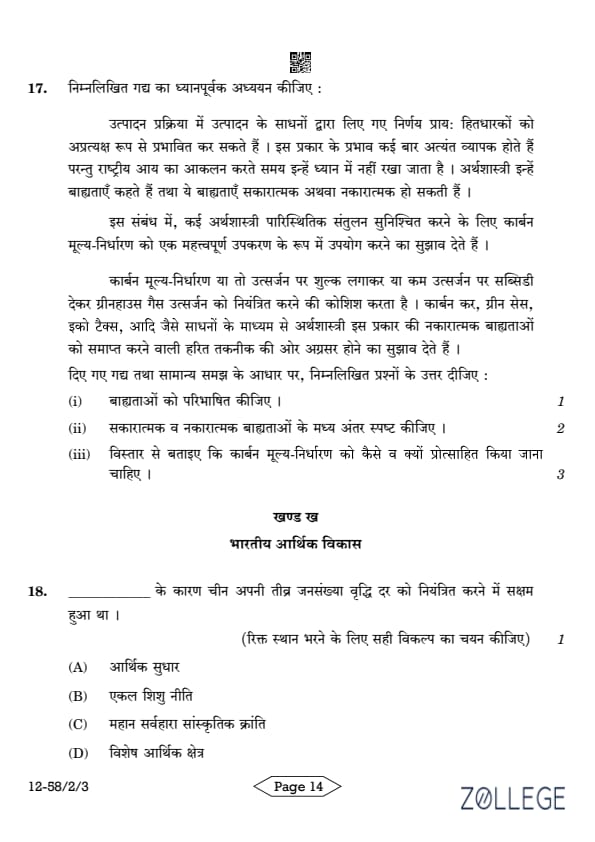
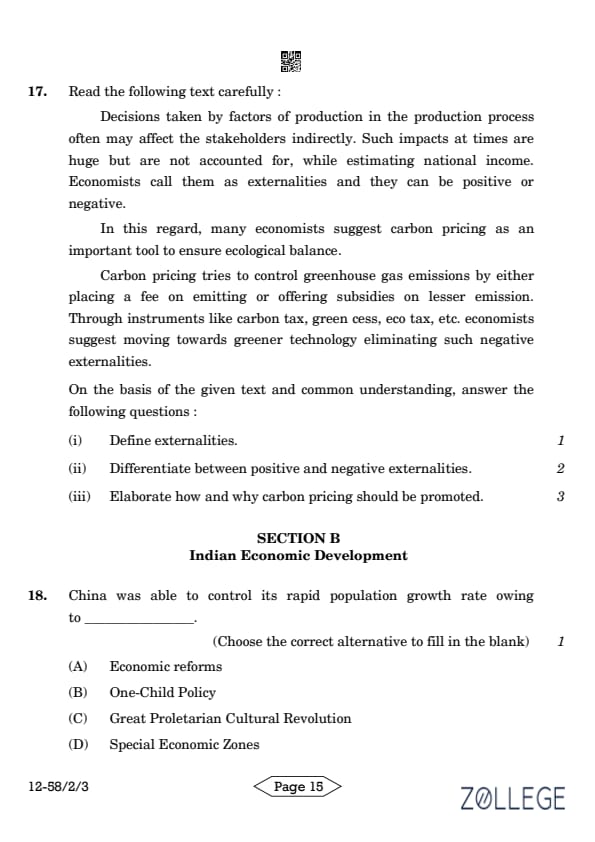
Read the following text carefully:
Decisions taken by factors of production in the production process often affect stakeholders indirectly. Such impacts at times are huge but are not accounted for in national income estimation. Economists call them externalities, which can be positive or negative.
In this regard, many economists suggest carbon pricing as an important tool to ensure ecological balance. Carbon pricing tries to control greenhouse gas emissions by either placing a fee on emissions or offering subsidies for lesser emissions. Through instruments like carbon tax, green cess, eco tax, etc., economists suggest moving towards greener technology, eliminating negative externalities.
(i) Define externalities.
View Solution
Definition: Externalities refer to the unintended side effects of economic activities on third parties that are not directly involved in the production or consumption of goods or services.
- Positive Externalities: Benefits to third parties (e.g., planting trees improves air quality).
- Negative Externalities: Costs to third parties (e.g., pollution affecting nearby residents).
(ii) Differentiate between positive and negative externalities.
| Positive Externalities | Negative Externalities |
|---|---|
| Occurs when an economic activity benefits third parties. | Occurs when an economic activity imposes costs on third parties. |
| Leads to under-consumption or under-production since benefits are not fully captured. | Leads to over-consumption or over-production since costs are not fully borne by producers. |
| Encouraged by subsidies, tax benefits, and public investment. | Controlled through regulations, pollution taxes, and penalties. |
| Example: Free vaccination programs reduce disease transmission. | Example: Industrial pollution harms nearby communities. |
(iii) Elaborate how and why carbon pricing should be promoted.
View Solution
Step 1: Role of Carbon Pricing
- Encourages reduction in greenhouse gas emissions.
- Charges polluters through carbon taxes or green cess.
- Offers subsidies for adopting cleaner technologies.
Step 2: Importance of Carbon Pricing
- Promotes the use of greener technology.
- Discourages environmentally harmful activities.
- Ensures sustainable development.
Conclusion: Carbon pricing is essential for reducing emissions, promoting clean energy, and achieving ecological balance.
SECTION B
Indian Economic Development
Question 18:
China was able to control its rapid population growth rate owing to:
Correct Answer: (B) One-Child Policy
View Solution
The One-Child Policy was introduced in China in 1979 to address its rapid population growth. It restricted most families to having only one child, significantly reducing the population growth rate over time. However, it also led to challenges such as an aging population and gender imbalance.
Question 19:
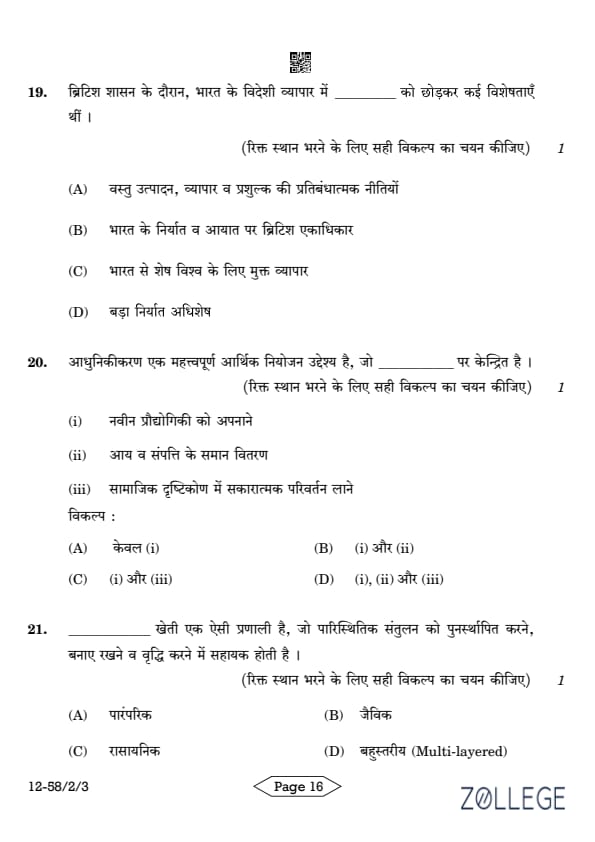
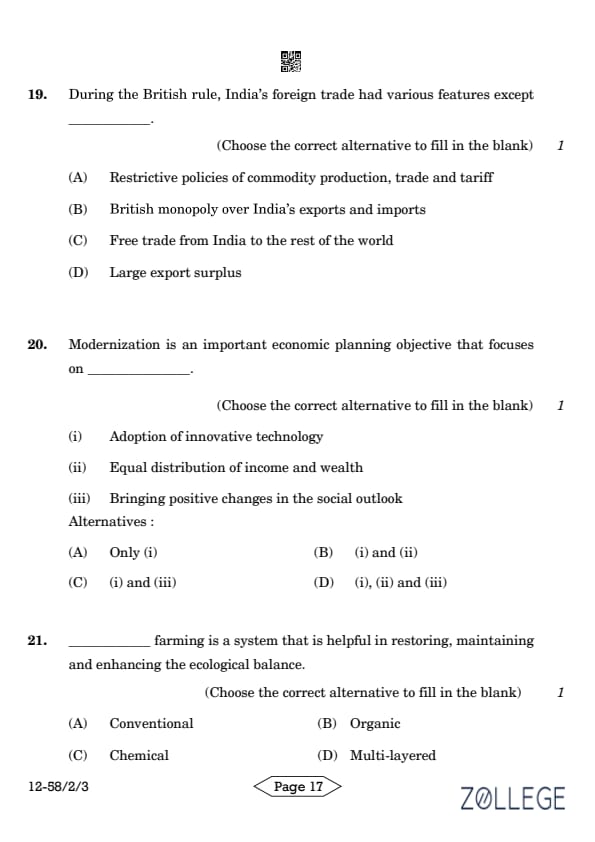
During the British rule, India’s foreign trade had various features except:
Correct Answer: (C) Free trade from India to the rest of the world
View Solution
During British rule, India’s foreign trade was controlled by restrictive policies aimed at serving British economic interests. There was no free trade from India to the rest of the world as trade policies were designed to maintain the British monopoly over exports and imports. Although India had a large export surplus, the proceeds were primarily used to meet the administrative and military expenses of the British.
Question 20:
Modernization is an important economic planning objective that focuses on:
- (i) Adoption of innovative technology
- (ii) Equal distribution of income and wealth
- (iii) Bringing positive changes in the social outlook
Correct Answer: (C) (i) and (iii)
View Solution
Modernization in economic planning focuses on:
- Adoption of innovative technology: Enhancing productivity and efficiency in industries.
- Bringing positive changes in the social outlook: Encouraging education, gender equality, and social progress.
Equal distribution of income falls under economic equity, not modernization.
Question 21:
_______ farming is a system that is helpful in restoring, maintaining, and enhancing the ecological balance.
Correct Answer: (B) Organic
View Solution
Organic farming promotes ecological balance by avoiding synthetic fertilizers and pesticides, using crop rotation, composting, and biological pest control. This method supports sustainable agriculture by conserving soil fertility and reducing pollution.
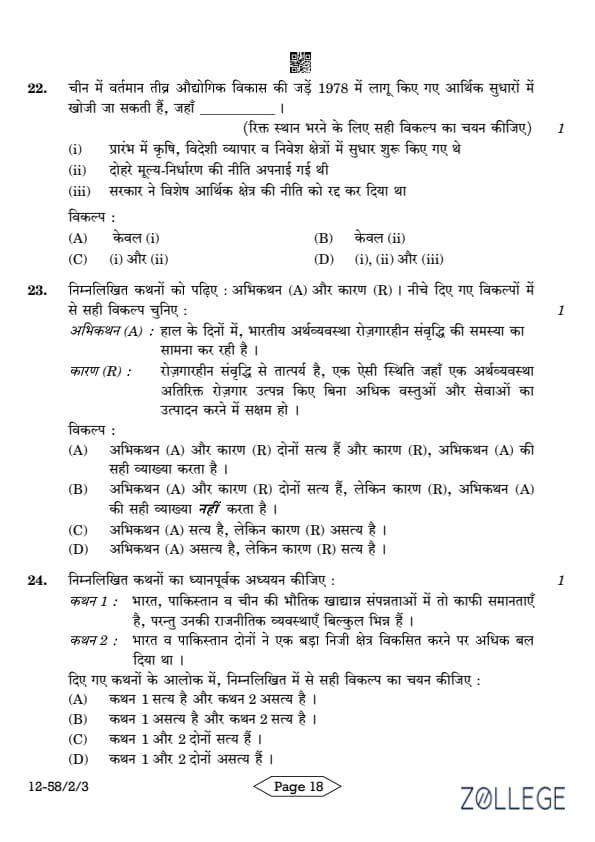
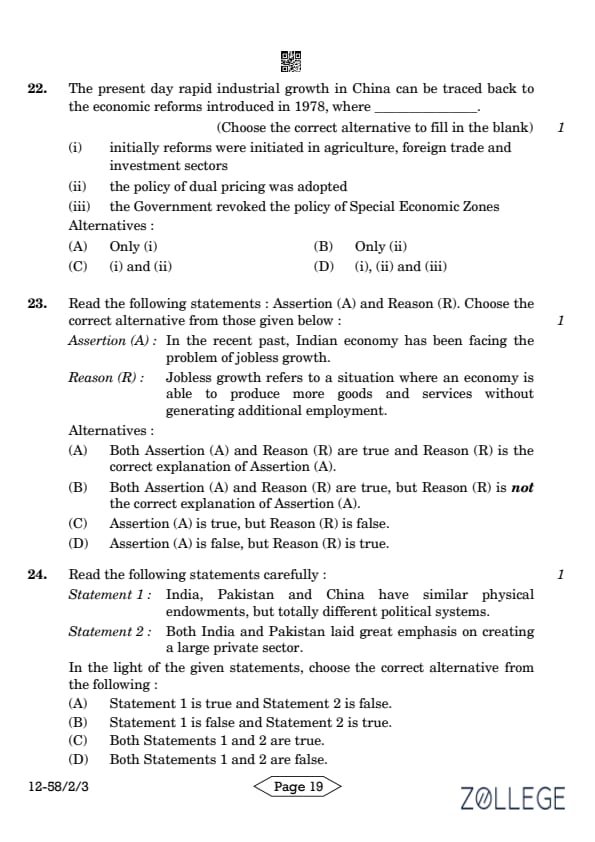
Question 22:
The present-day rapid industrial growth in China can be traced back to the economic reforms introduced in 1978, where:
- (i) Initially, reforms were initiated in agriculture, foreign trade, and investment sectors.
- (ii) The policy of dual pricing was adopted.
- (iii) The Government revoked the policy of Special Economic Zones.
Correct Answer: (C) (i) and (ii)
View Solution
China's 1978 reforms began in agriculture, foreign trade, and investment, setting the stage for rapid industrial growth. The policy of dual pricing allowed state-set prices to coexist with market-driven prices, encouraging private sector growth. Instead of revoking Special Economic Zones (SEZs), China introduced them to attract foreign investment.
Question 23:
Read the following statements: Assertion (A) and Reason (R). Choose the correct alternative:
Assertion (A): In the recent past, the Indian economy has been facing the problem of jobless growth.
Reason (R): Jobless growth refers to a situation where an economy is able to produce more goods and services without generating additional employment.
Correct Answer: (B) Both Assertion (A) and Reason (R) are true, but Reason (R) is not the correct explanation of Assertion (A).
View Solution
India has experienced jobless growth where GDP increases but employment does not expand at the same rate. While technological advancements contribute to jobless growth, other factors such as a shift towards capital-intensive industries, lack of skill development, and automation also play a role, making Reason (R) a partial explanation.
Question 24:
Read the following statements carefully:
Statement 1: India, Pakistan, and China have similar physical endowments but totally different political systems.
Statement 2: Both India and Pakistan laid great emphasis on creating a large private sector.
Correct Answer: (A) Statement 1 is true and Statement 2 is false.
View Solution
India, Pakistan, and China share similar geographical features but have different political systems. India initially emphasized a mixed economy with a strong public sector, and Pakistan also focused on state-led initiatives, rather than prioritizing a large private sector.
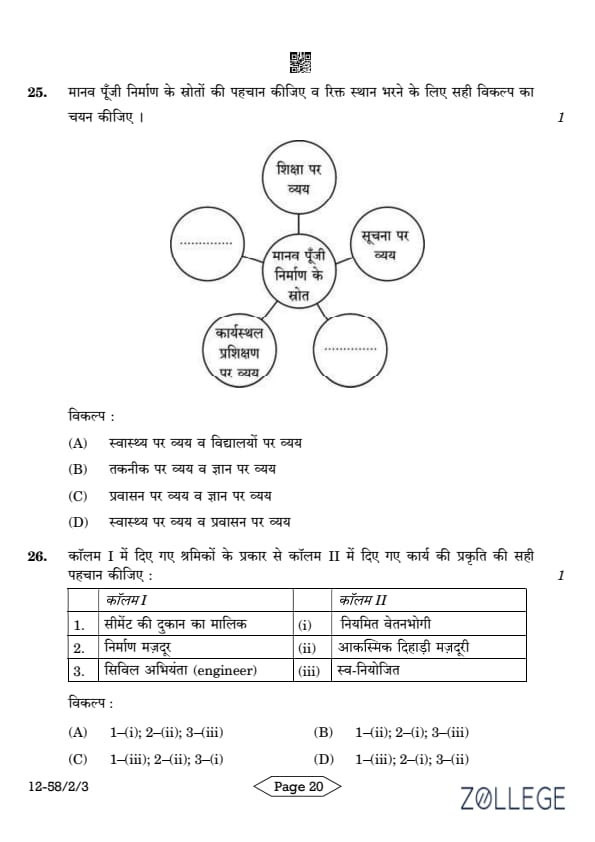
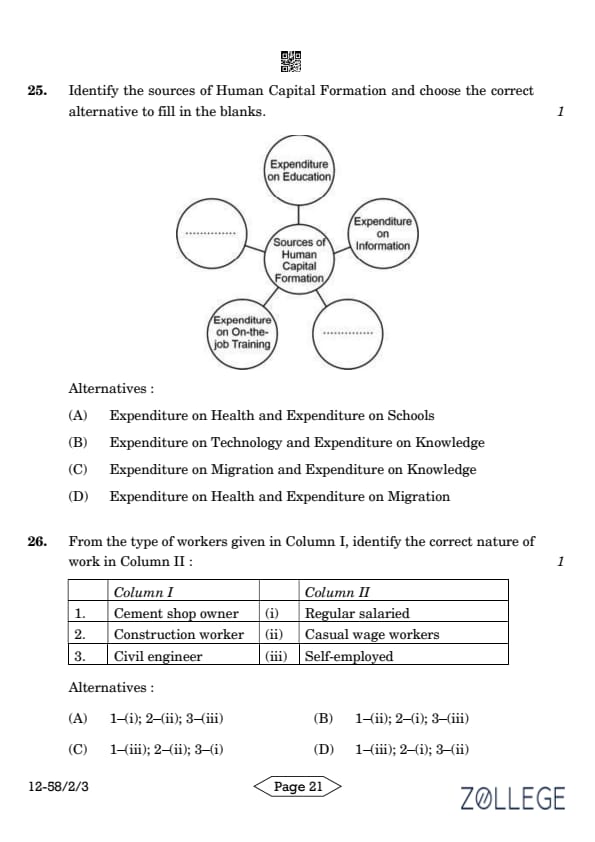
Question 25:
Identify the sources of Human Capital Formation:
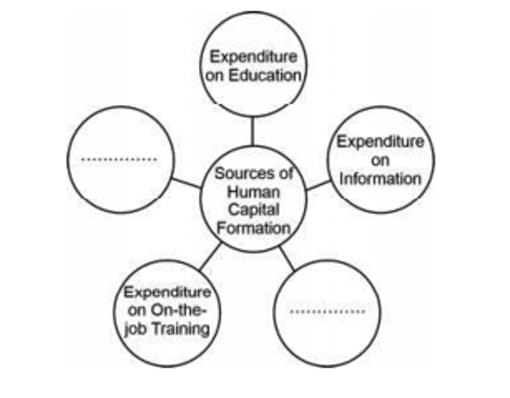
Correct Answer: (D) Expenditure on Health and Expenditure on Migration
View Solution
Human Capital Formation involves developing skills, knowledge, and health to increase productivity. Expenditure on health ensures a productive workforce, while migration allows skilled labor to move to better opportunities.
Question 26:
From the type of workers given in Column I, identify the correct nature of work in Column II:
| Column I | Column II |
|---|---|
| 1. Cement shop owner | (iii) Self-employed |
| 2. Construction worker | (ii) Casual wage worker |
| 3. Civil engineer | (i) Regular salaried |
Correct Answer: (C) 1-(iii); 2-(ii); 3-(i)
View Solution
Explanation:
- Cement shop owner: Self-employed, as they operate their own business.
- Construction worker: Casual wage worker due to temporary and project-based work.
- Civil engineer: Regular salaried employee working in an organization.
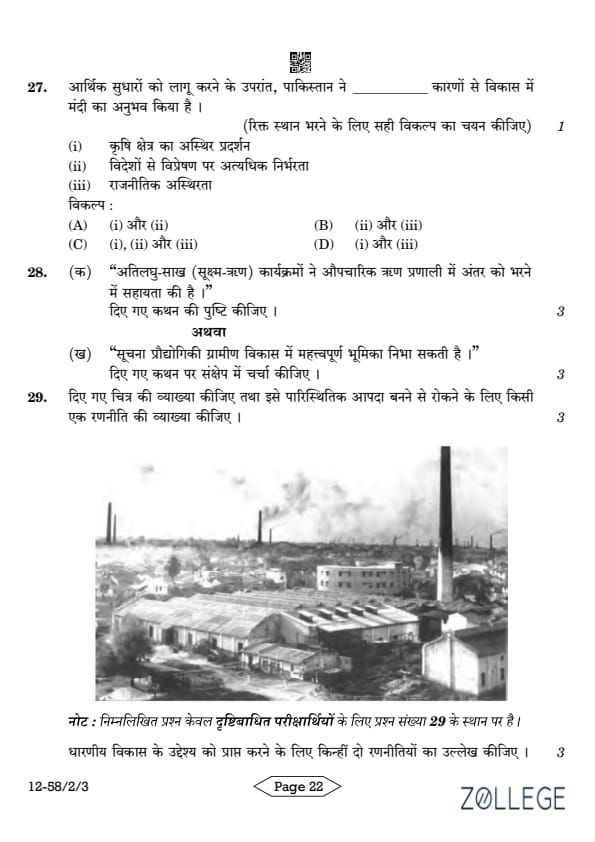
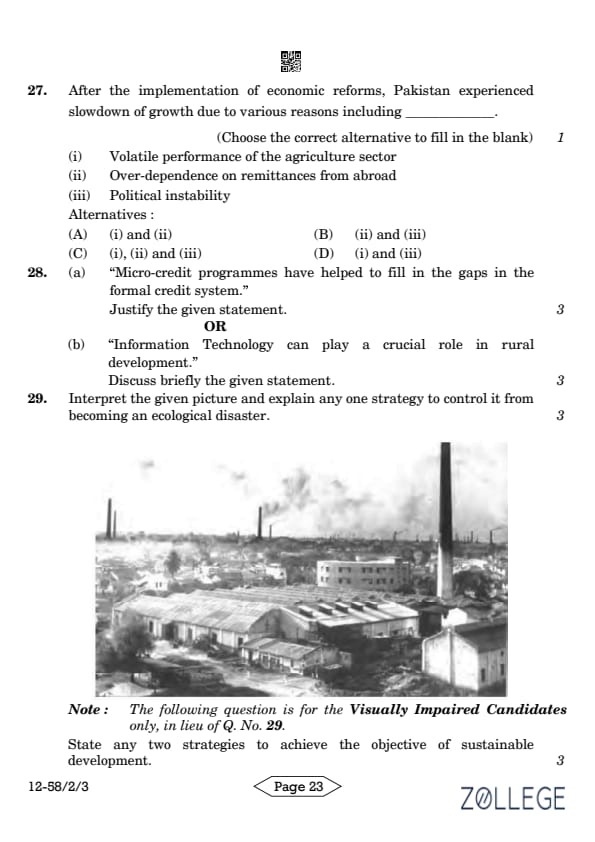
Question 27:
After the implementation of economic reforms, Pakistan experienced slowdown of growth due to various reasons including:
- (i) Volatile performance of the agriculture sector
- (ii) Over-dependence on remittances from abroad
- (iii) Political instability
Correct Answer: (C) (i), (ii) and (iii)
View Solution
Pakistan faced several challenges post-reforms:
- Volatile agriculture sector: Inconsistent performance led to economic instability.
- Over-dependence on remittances: Limited revenue diversification made the economy vulnerable.
- Political instability: Created uncertainty, deterring foreign investment and slowing economic growth.
Question 28(a):
"Micro-credit programmes have helped to fill in the gaps in the formal credit system." Justify the statement.
View Solution
Micro-credit programmes bridge the gap between formal credit systems and underserved populations by providing small, collateral-free loans.
Key Contributions of Micro-Credit Programmes:
- Access to Credit: Traditional banks exclude low-income groups; micro-credit fills this gap.
- Women Empowerment: Many programmes target women, fostering financial independence.
- Flexible Lending: No collateral requirement, easy repayment structure.
- Self-Employment: Encourages small businesses, boosting local economies.
- Poverty Alleviation: Supports income generation, improving living standards.
OR
Question 28(b):
"Information Technology can play a crucial role in rural development." Discuss.
View Solution
Ways IT Contributes to Rural Development:
- Bridges the information gap in market prices, farming techniques, and weather forecasts.
- Enables e-governance for better service delivery.
- Facilitates online education and skill development.
- Supports telemedicine services, improving healthcare access.
Question 29:
Interpret the given picture and explain any one strategy to prevent ecological disasters.
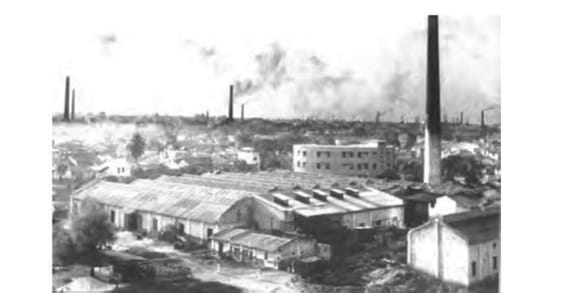
View Solution
The image depicts industrial pollution contributing to environmental degradation.
Possible Solutions:
- Adopting cleaner technology in industries.
- Implementing strict environmental regulations.
- Raising public awareness about conservation.
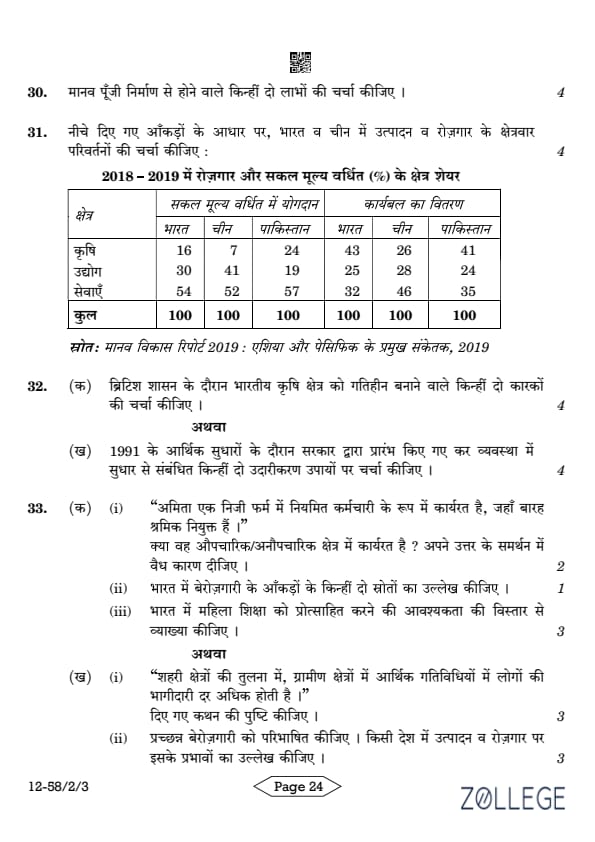
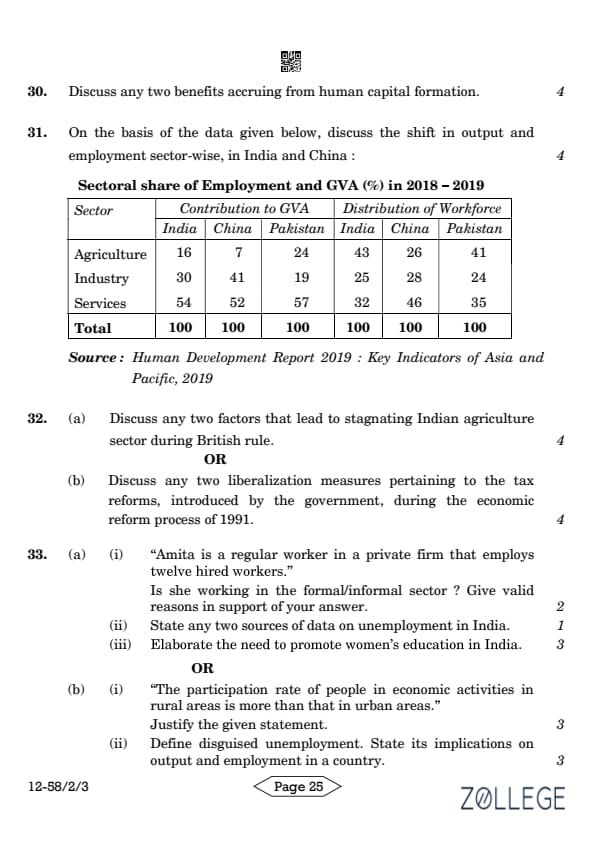
Question 30:
Discuss any two benefits accruing from human capital formation.
View Solution
- Enhanced Productivity: Educated and skilled workers contribute more to economic growth.
- Technological Advancement: A skilled workforce promotes innovation and industrial development.
Question 31:
On the basis of the data given below, discuss the shift in output and employment sector-wise, in India and China:
| Sector | Contribution to GVA (%) | Distribution of Workforce (%) |
|---|---|---|
| Agriculture | India: 16 | China: 7 | Pakistan: 24 | India: 43 | China: 26 | Pakistan: 41 |
| Industry | India: 30 | China: 41 | Pakistan: 19 | India: 25 | China: 28 | Pakistan: 24 |
| Services | India: 54 | China: 52 | Pakistan: 57 | India: 32 | China: 46 | Pakistan: 35 |
View Solution
- India’s agriculture employs 43% of workers but contributes only 16% to GVA, indicating disguised unemployment.
- China has efficiently reduced agriculture dependence while strengthening its industrial sector (41% of GVA).
- The service sector is the dominant contributor in all three countries.
Question 32:
(a) Discuss any two factors that led to stagnation in the Indian agriculture sector during British rule.
View Solution
- Exploitative Revenue Systems: High taxes under Zamindari left farmers with little resources for reinvestment.
- Commercialization of Agriculture: Shift to cash crops reduced food grain production, leading to famines.
Question 33:
(a)(i) “Amita is a regular worker in a private firm with 12 hired workers.” Is she working in the formal or informal sector? Justify.
View Solution
Amita works in the formal sector because:
- Her firm employs more than 10 workers, qualifying as a formal enterprise.
- She is entitled to labor law benefits and social security.
Question 33(a)(ii):
State any two sources of data on unemployment in India.
View Solution
1. Periodic Labour Force Survey (PLFS): Provides comprehensive data on employment and unemployment trends.
2. Census of India: Collects detailed demographic data, including economic activity and unemployment statistics.
Question 33(a)(iii):
Elaborate the need to promote women’s education in India.
View Solution
1. Economic Growth: Educating women enhances workforce participation and productivity.
2. Social Development: Women’s education improves healthcare, child welfare, and community progress.
Question 33(b)(i):
“The participation rate of people in economic activities in rural areas is more than that in urban areas.” Justify the given statement.
View Solution
1. Rural areas have higher participation in primary activities like agriculture due to lack of alternative employment opportunities.
2. Urban areas rely more on mechanization, requiring fewer workers for economic activities.
Question 33(b)(ii):
Define disguised unemployment. State its implications on output and employ- ment in a country.
View Solution
1. Definition: Disguised unemployment refers to a situation where more people are employed than necessary, resulting in zero marginal productivity.
2. Implications:
• Reduced efficiency in labor utilization.
• Lowers potential GDP by keeping excess workers in low-productive sectors like agriculture.
Question 34
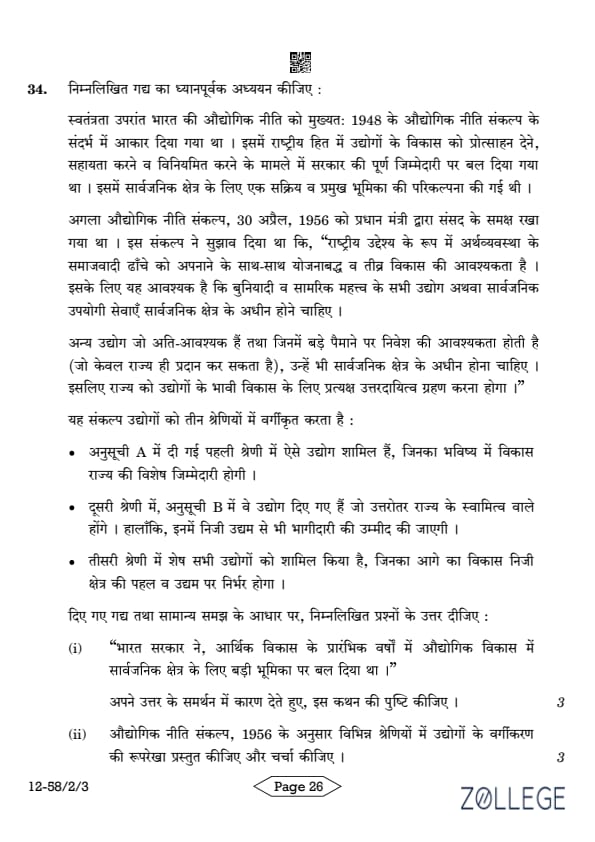
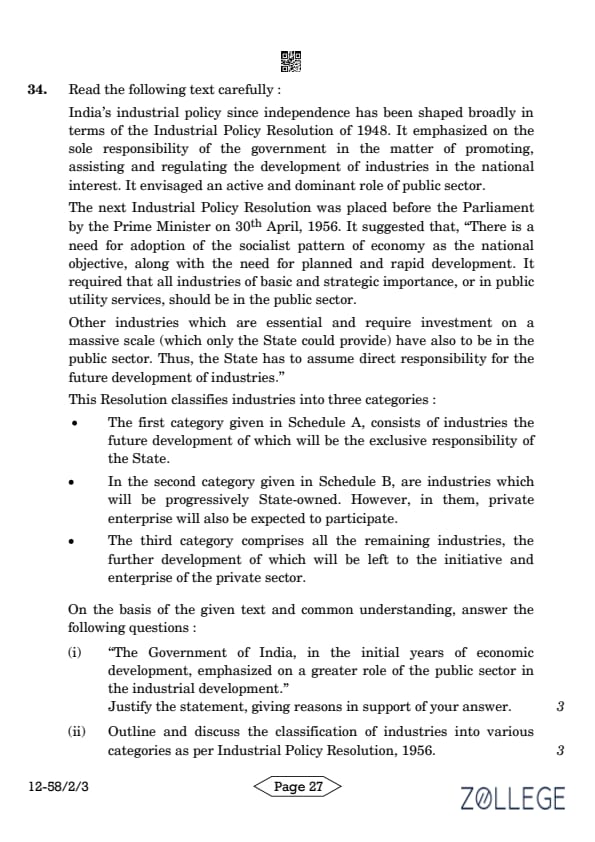
India’s industrial policy since independence has been shaped broadly in terms of the Industrial Policy Resolution of 1948. It emphasized on the sole responsibility of the government in the matter of promoting, assisting, and regulating the development of industries in the national interest. It envisaged an active and dominant role of public sector.
Read More
The next Industrial Policy Resolution was placed before the Parliament by the Prime Minister on 30th April, 1956. It suggested that, “There is a need for adoption of the socialist pattern of economy as the national objective, along with the need for planned and rapid development. It required that all industries of basic and strategic importance, or in public utility services, should be in the public sector.
Other industries which are essential and require investment on a massive scale (which only the State could provide) have also to be in the public sector. Thus, the State has to assume direct responsibility for the future development of industries.”
This Resolution classifies industries into three categories:
• The first category given in Schedule A, consists of industries the future development of which will be the exclusive responsibility of the State.
• In the second category given in Schedule B, are industries which will be progressively State- owned. However, in them, private enterprise will also be expected to participate.
• The third category comprises all the remaining industries, the further development of which will be left to the initiative and enterprise of the private sector.
On the basis of the given text and common understanding, answer the following questions:
(i) The Government of India, in the initial years of economic development, empha- sized on a greater role of the public sector in the industrial development.” Justify the statement, giving reasons in support of your answer.
(ii) Outline and discuss the classification of industries into various categories as per Industrial Policy Resolution, 1956.
View Solution
(i)
1. In the initial years post-independence, India’s focus was on building a socialist pattern of economy to address socio-economic inequalities and achieve self-reliance.
2. The Industrial Policy Resolutions of 1948 and 1956 emphasized the role of the public sector in controlling basic and strategic industries, ensuring equitable distribution of resources and wealth.
3. This approach aimed at reducing the dominance of private monopolies and promoting rapid industrialization under state supervision.
(ii)
1. Schedule A:
• Includes industries of strategic and national importance, such as defense, atomic energy, and railways.
• These industries were to be exclusively owned and operated by the State.
2. Schedule B:
• Includes industries that were to be progressively state-owned, with private sector participation allowed under government regulations.
• Example: Chemical industries, machine tools.
3. Schedule C:
• Includes all other industries not covered under Schedules A and B.
• Their development was left to private enterprises, though the government provided guidance and support.
*The article might have information for the previous academic years, please refer the official website of the exam.