
CBSE Class 12 History set 1 Question Paper Pdf - Check Solutions with Answer Key Pdf

.jpg?tr=h-55,w-55,c-force)
Content Strategist|Tech-innovator|National Hackathon Winner | Updated On - Jan 24, 2025
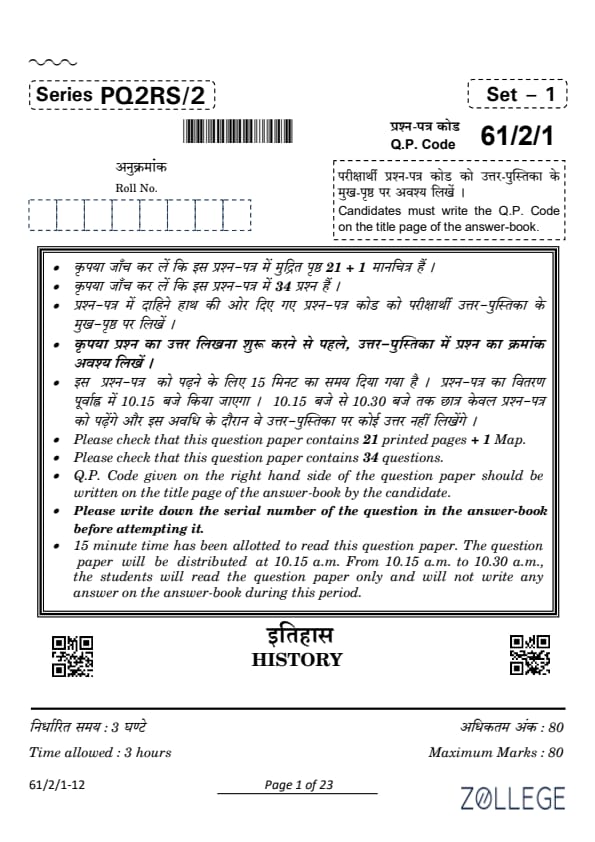
CBSE Class 12 2024 History Set 1 Question Paper (Q.P. Code: 61/2/1) is available for download. The exam was successfully conducted by CBSE on 28 March in the morning session from 10:30 AM to 1:30 PM. As per the student’s initial reactions, the CBSE Class 12 2024 History Set 1 Question Paper was reported as Moderate. The Ancient History section was reported as Easy to Moderate, the Medieval History section as Moderate, and the Modern History section as Moderate to Challenging.
CBSE Class 12 2024 History Set 1 61/2/1 Question Paper with Answer Key PDF
Candidates can download the CBSE Class 12 History Question Paper with Solution and Answer Key PDFs for Set 1 Question Paper (Code: 61/2/1) using the link below.
| CBSE Class 12 2024 History Question Paper with Answer Key |  Download Download |
Check Solution |
CBSE Class 12 2024 History Questions with Solutions
SECTION A
Question 1:
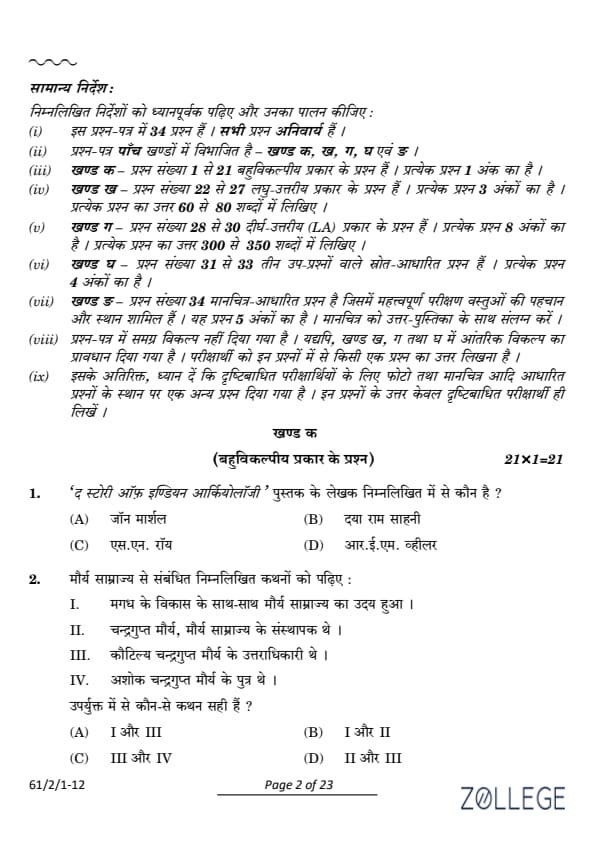
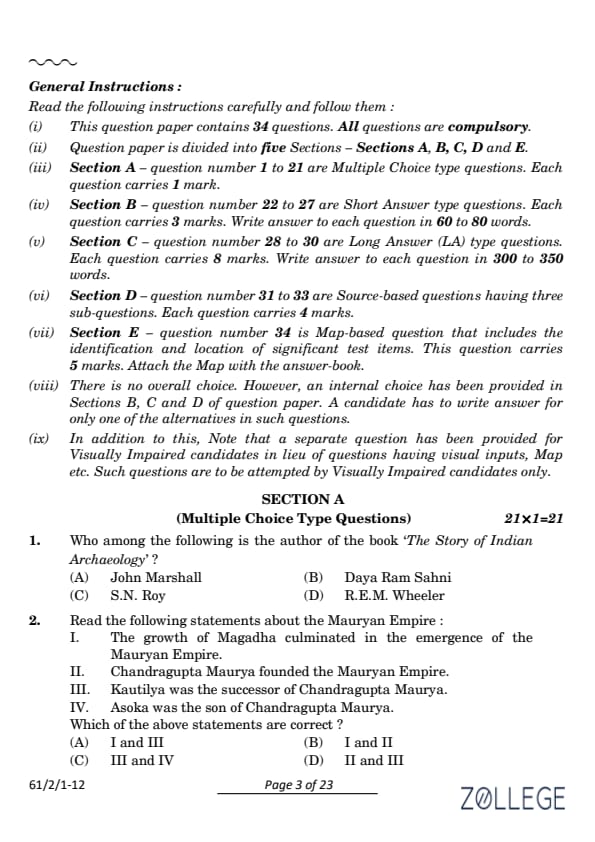
Who among the following is the author of the book "The Story of Indian Archaeology"?
View Solution
S.N. Roy is the author of the book "The Story of Indian Archaeology," which details the history and discoveries of Indian archaeology.
Question 2:
Read the following statements about the Mauryan Empire:
- The growth of Magadha culminated in the emergence of the Mauryan Empire.
- Chandragupta Maurya founded the Mauryan Empire.
- Kautilya was the successor of Chandragupta Maurya.
- Ashoka was the son of Chandragupta Maurya.
Select the correct pair:
View Solution
- Statement I: True. The growth of the Magadhan empire led to the establishment of the Mauryan Empire.
- Statement II: True. Chandragupta Maurya is credited with founding the Mauryan Empire.
- Statement III: False. Kautilya (Chanakya) was an advisor, not the successor, of Chandragupta Maurya.
- Statement IV: False. Ashoka was the grandson, not the son, of Chandragupta Maurya.
Question 3:
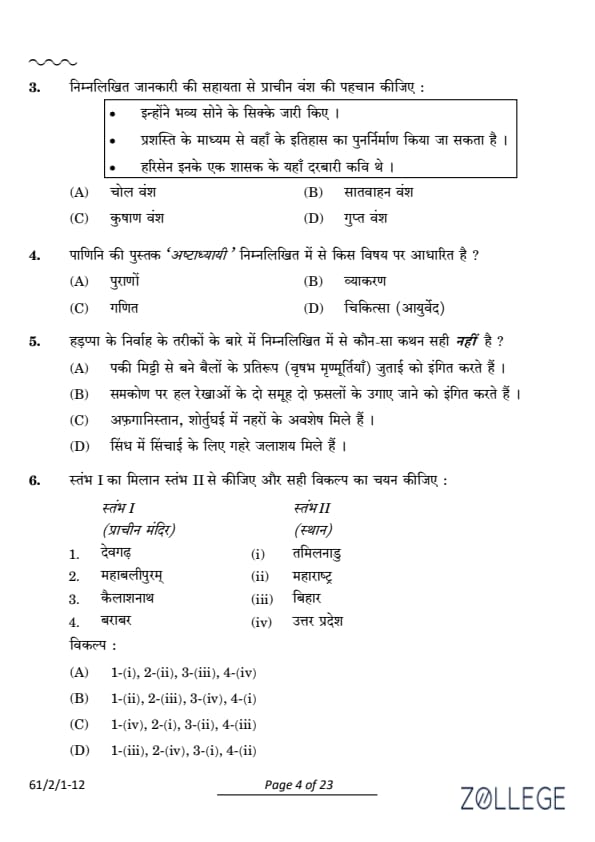
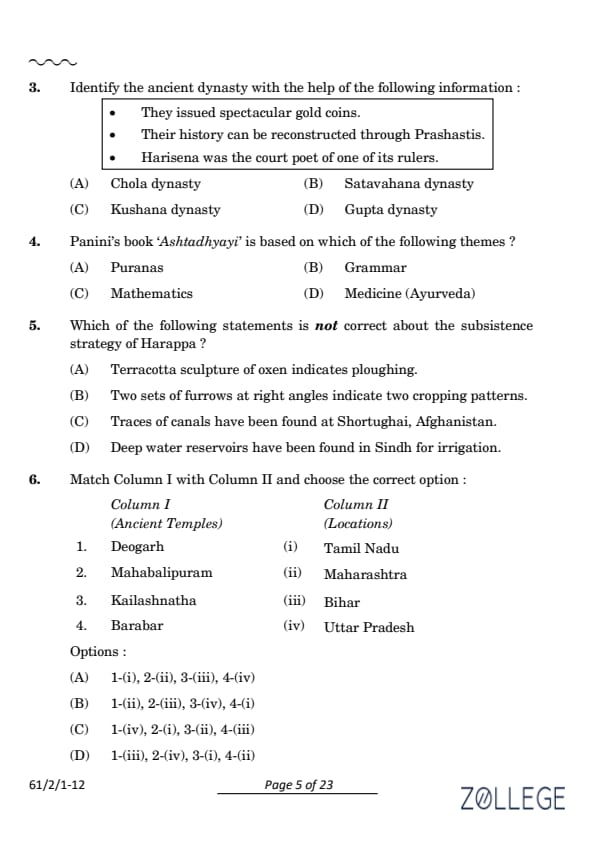
Identify the ancient dynasty with the help of the following information:

View Solution
The Satavahana dynasty is known for issuing spectacular gold coins and can be traced through their Prashastis. Harisena was the court poet of one of its rulers.
Question 4:
Panini’s book "Ashtadhyayi" is based on which of the following themes?
View Solution
Panini’s "Ashtadhyayi" is a treatise on Sanskrit grammar and is considered a foundational work in the field of linguistic studies.
Question 5:
Which of the following statements is not correct about the subsistence strategy of Harappa?
View Solution
Statement 4 is incorrect because while the Harappan civilization had sophisticated water management systems, deep water reservoirs have not been conclusively found in Sindh for irrigation purposes.
Question 6:
Match Column I with Column II and choose the correct option:

View Solution
The correct matching is:
- Deogarh: (i) Tamil Nadu
- Mahabalipuram: (ii) Maharashtra
- Kailashnatha: (iii) Bihar
- Barabar: (iv) Uttar Pradesh
Question 7:
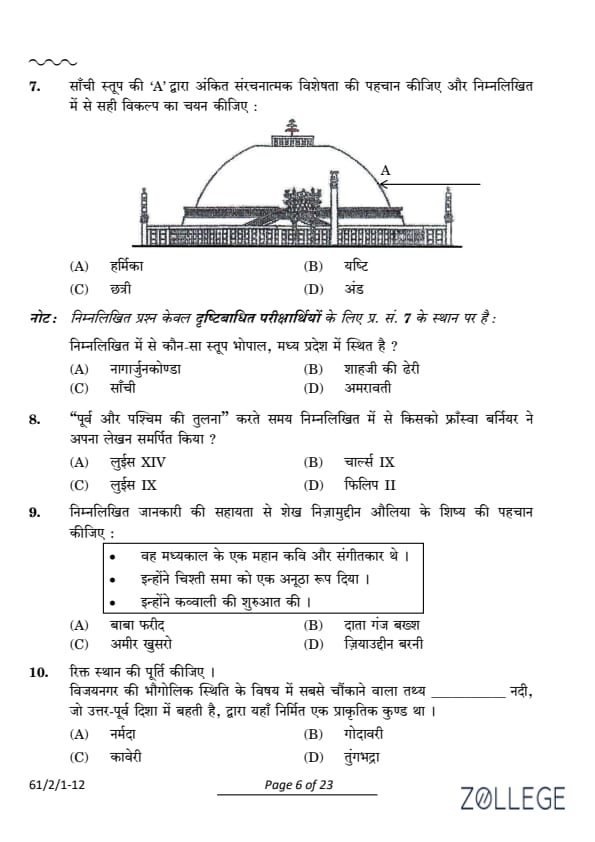
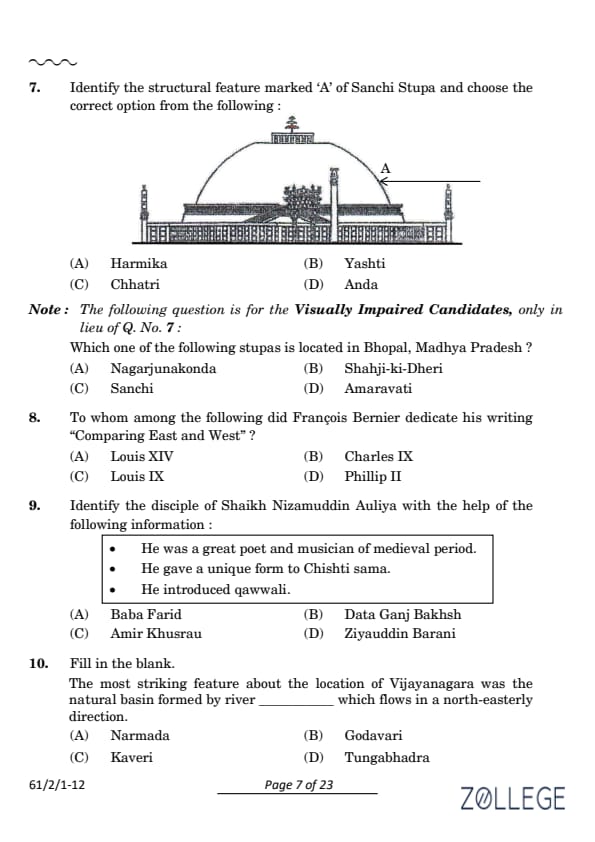
Identify the structural feature marked ‘A’ of Sanchi Stupa and choose the correct option:

View Solution
The feature marked ‘A’ in the image of Sanchi Stupa is the Anda, which is the dome-like structure that represents the cosmic mountain.
Question 7 (For Visually Impaired Candidates):
Which one of the following stupas is located in Bhopal, Madhya Pradesh?
View Solution
The Sanchi Stupa is one of the oldest stone structures in India, located in Sanchi, Madhya Pradesh, near Bhopal. Built by Emperor Ashoka, it is a significant Buddhist monument and a UNESCO World Heritage Site.
Question 8:
To whom among the following did François Bernier dedicate his writing “Comparing East and West”?
View Solution
François Bernier, a French philosopher and traveler, dedicated his writings "Comparing East and West" to King Louis XIV of France.
Question 9:
Identify the disciple of Shaikh Nizamuddin Auliya with the help of the following information:

View Solution
Amir Khusrau was the famous disciple of Shaikh Nizamuddin Auliya, known for his poetry and contribution to Sufi music.
Question 10:
The most striking feature about the location of Vijayanagara was the natural basin formed by river __________, which flows in a north-easterly direction:
View Solution
The Vijayanagara Empire was located near the river Tungabhadra, which provided the natural basin and strategic advantage for the city.
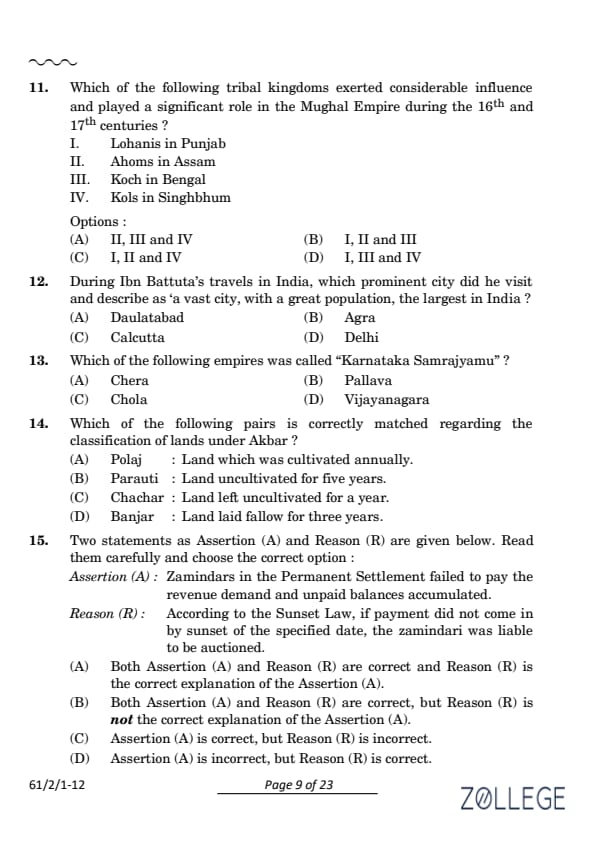
Question 11:
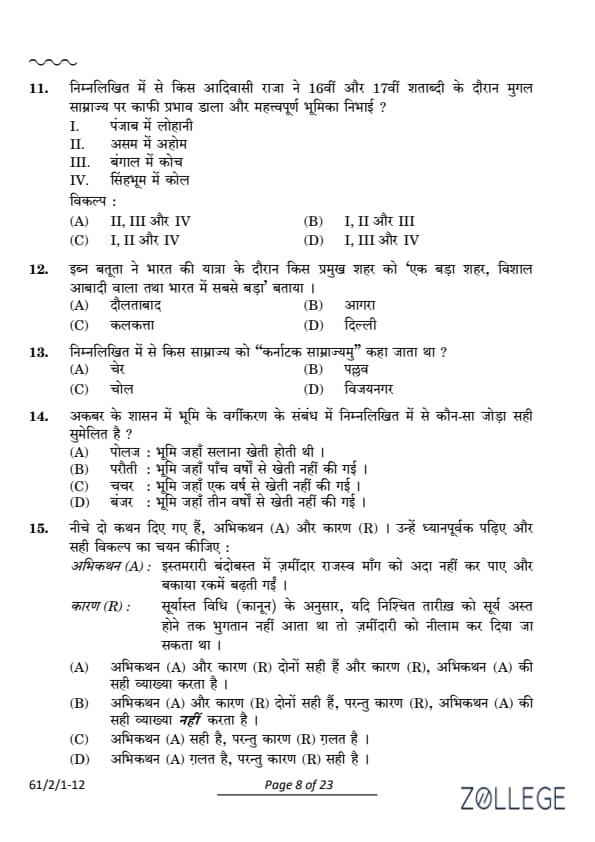
Which of the following tribal kingdoms exerted considerable influence and played a significant role in the Mughal Empire during the 16th and 17th centuries?
View Solution
The correct answer is II, III, and IV as the Ahoms in Assam, Kochi in Bengal, and Kols in Singhbhum exerted significant influence on the Mughal Empire.
Question 12:
During Ibn Battuta’s travels in India, which prominent city did he visit and describe as ‘a vast city, with a great population, the largest in India’?
View Solution
Ibn Battuta described Delhi as a vast city, the largest in India, reflecting its prominence during the Delhi Sultanate.
Question 13:
Which of the following empires was called “Karnataka Samrajyam”?
View Solution
The Vijayanagara Empire was known as “Karnataka Samrajyam” due to its dominance over the region now known as Karnataka.
Question 14:
Which of the following pairs is correctly matched regarding the classification of lands under Akbar?
View Solution
Under Akbar’s land classification system:
- Polaj: Cultivated annually.
- Parauti: Uncultivated for a few years.
- Chachar: Uncultivated for a year.
- Banjar: Fallow for three years.
Question 15:
Two statements as Assertion (A) and Reason (R) are given below. Read them carefully and choose the correct option:
View Solution
Assertion (A): Zamindars in the Permanent Settlement failed to pay their revenue, leading to accumulated unpaid balances.
Reason (R): According to the Sunset Law, any unpaid dues led to the auctioning of zamindari rights.
Both are correct, and the Reason explains the Assertion correctly.
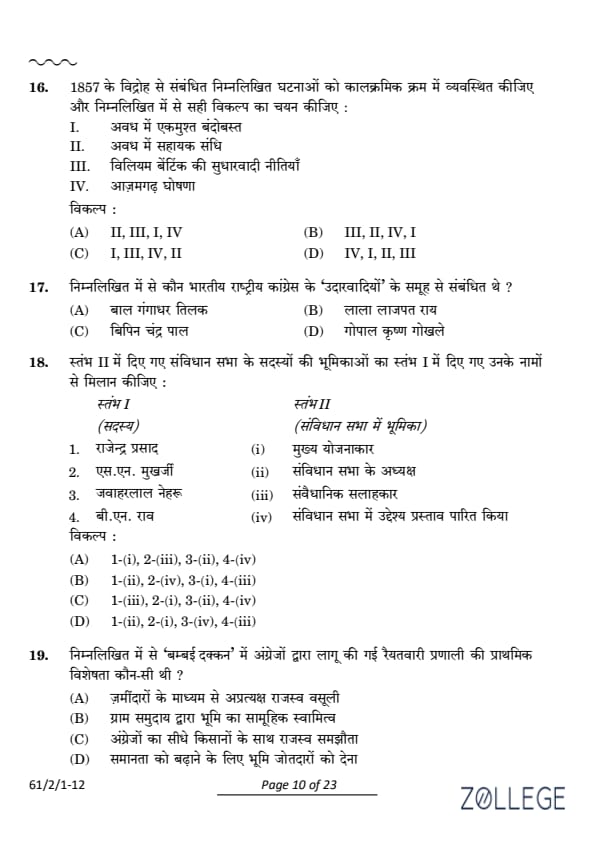
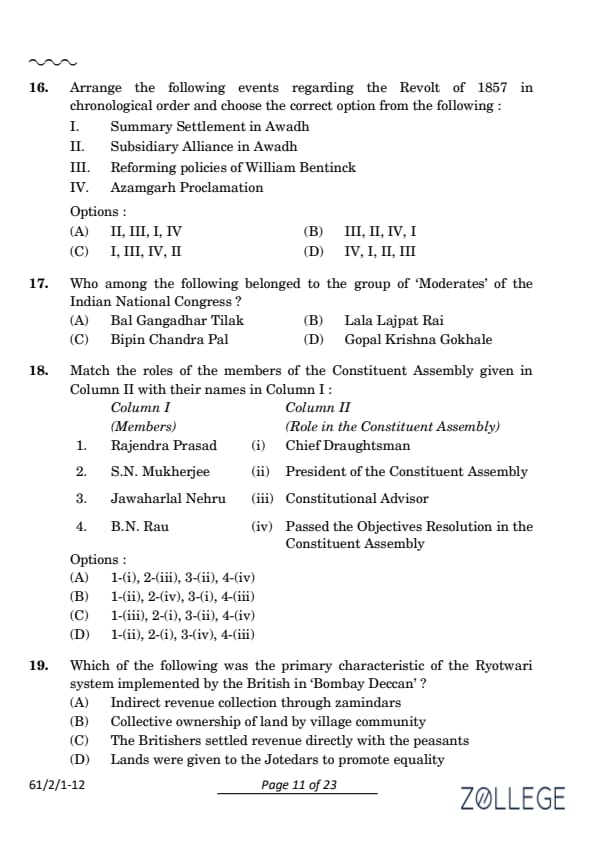
Question 16:
Arrange the following events regarding the Revolt of 1857 in chronological order and choose the correct option from the following:
View Solution
The correct chronological order of events in the Revolt of 1857 is:
- III: Reforming policies of William Bentinck.
- II: Subsidiary Alliance in Awadh.
- IV: Azamgarh Proclamation.
- I: Summary Settlement in Awadh.
Question 17:
Who among the following belonged to the group of ‘Moderates’ of the Indian National Congress?
View Solution
Gopal Krishna Gokhale was a key figure in the Moderate group of the Indian National Congress, advocating for reforms through constitutional methods.
Question 18:
Match the roles of the members of the Constituent Assembly given in Column II with their names in Column I:

View Solution
The correct matching is:
- Rajendra Prasad: (i) Chief Draughtsman.
- S.N. Mukherjee: (iii) Constitutional Advisor.
- Jawaharlal Nehru: (ii) President of the Constituent Assembly.
- B.N. Rau: (iv) Passed the Objectives Resolution in the Constituent Assembly.
Question 19:
Which of the following was the primary characteristic of the Ryotwari system implemented by the British in ‘Bombay Deccan’?
View Solution
The Ryotwari system was a land revenue system where the British government directly collected taxes from individual farmers (ryots), bypassing zamindars.
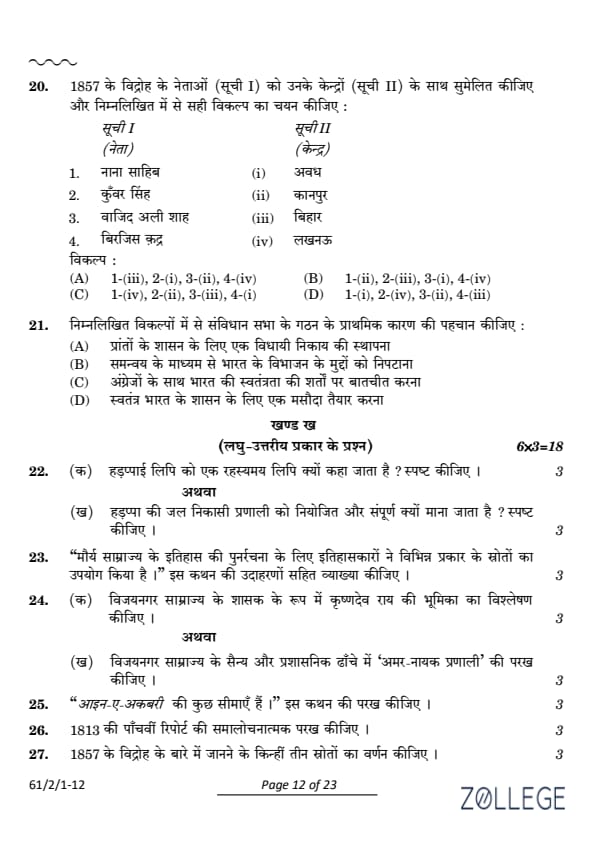
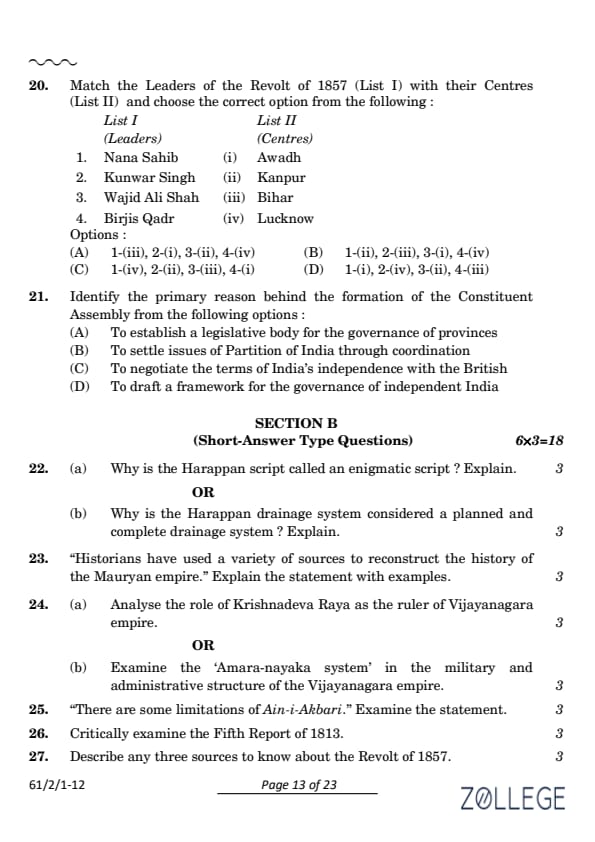
Question 20:
Match the Leaders of the Revolt of 1857 (List I) with their Centres (List II) and choose the correct option from the following:

View Solution
The correct matching is:
- Nana Sahib: (iii) Bihar.
- Kunwar Singh: (i) Awadh.
- Wajid Ali Shah: (ii) Kanpur.
- Birjis Qadr: (iv) Lucknow.
These leaders were central to the Revolt of 1857 and played significant roles in their respective regions.
Question 21:
Identify the primary reason behind the formation of the Constituent Assembly from the following options:
View Solution
The primary reason for the formation of the Constituent Assembly was to draft a framework for the governance of independent India. This body was responsible for drafting the Indian Constitution, setting up democratic governance in India post-independence.
SECTION B
Question 22(a):
Why is the Harappan script called an enigmatic script? Explain.
View Solution
The Harappan script is called enigmatic because it remains undeciphered. Despite numerous attempts, scholars have not been able to fully decode it, which makes it mysterious. The script consists of pictographs and symbols, but the lack of a bilingual inscription and the absence of direct knowledge about the language make it difficult to understand.
Question 22(b):
Why is the Harappan drainage system considered a planned and complete drainage system? Explain.
View Solution
The Harappan drainage system is considered a planned and complete system due to its systematic design. The cities had well-planned streets with covered drains made from brickwork, ensuring the smooth flow of water. This drainage system was efficient, preventing waterlogging and allowing the cities to remain clean. The uniformity and organization of this infrastructure suggest careful planning.
Question 23:
“Historians have used a variety of sources to reconstruct the history of the Mauryan Empire.” Explain the statement with examples.
View Solution
Historians have relied on various sources to reconstruct the Mauryan Empire’s history, such as:
- Edicts of Ashoka: Provide important information about Ashoka’s reign and policies.
- Accounts of foreign travelers: Megasthenes’ "Indica" offers insights into administration and society.
- Archaeological remains: Cities and artifacts like the Mauryan pillars support the historical narrative.
These sources collectively help historians understand the political, social, and cultural aspects of the Mauryan period.
Question 24(a):
Analyse the role of Krishnadeva Raya as the ruler of the Vijayanagara Empire.
View Solution
Krishnadeva Raya was one of the greatest rulers of the Vijayanagara Empire. His contributions include:
- Military Success: Expanded the empire’s boundaries through conquests.
- Promotion of Trade: Encouraged foreign trade and established economic prosperity.
- Cultural Patronage: Promoted literature in Kannada, Telugu, and Sanskrit.
- Administrative Efficiency: Focused on the welfare of his people and effective governance.
His reign marked a period of cultural and political flourishing in southern India.
Question 24(b):
Examine the ‘Amara-nayaka system’ in the military and administrative structure of the Vijayanagara Empire.
View Solution
The Amara-nayaka system was a crucial administrative and military system in the Vijayanagara Empire. Key features include:
- Decentralized Governance: Nayakas were assigned regions to manage and were responsible for collecting taxes.
- Military Responsibility: Nayakas maintained troops for the empire’s defense.
- Revenue Collection: Taxes collected by the Nayakas were partially forwarded to the central authority, ensuring stability and control.
This system ensured effective governance and military readiness across vast territories.
Question 25:
“There are some limitations of Ain-i-Akbari.” Examine the statement.
View Solution
The Ain-i-Akbari, written by Abul Fazl, is a valuable document of Akbar’s reign, but it has limitations:
- Bias: The text reflects the perspective of the imperial administration, portraying Akbar’s rule in an idealized manner.
- Incomplete Data: Some statistics and descriptions may not represent the diversity of the entire Mughal Empire accurately.
- Regional Variations: It does not adequately account for regional differences in practices, administration, and culture.
While it is a key source for Mughal history, it must be analyzed critically, considering its context and limitations.
Question 26:
Critically examine the Fifth Report of 1813.
View Solution
The Fifth Report of 1813 was an account prepared by the British East India Company regarding India’s political, social, and economic conditions. Key points include:
- Strengths: Provided detailed data on land revenue systems, administrative policies, and social conditions.
- Bias: Reflected British interests, emphasizing the inefficiencies of Indian systems to justify colonial control.
- Selective Portrayal: Overlooked indigenous governance and trade systems, focusing on the supposed "backwardness" of Indian society.
While informative, the report must be read critically, recognizing its colonial agenda.
Question 27:
Describe any three sources to know about the Revolt of 1857.
View Solution
Three key sources for studying the Revolt of 1857 include:
- British Accounts: Official reports and documents, such as those by British officers, provide detailed narratives of the events.
- Indian Perspectives: Writings and letters from Indian leaders, such as Bahadur Shah Zafar, give insights into the revolt from the Indian side.
- Archaeological Evidence: Remains of forts, weapons, and memorials associated with the revolt help reconstruct events.
These sources collectively offer a balanced understanding of the revolt’s causes and impact.
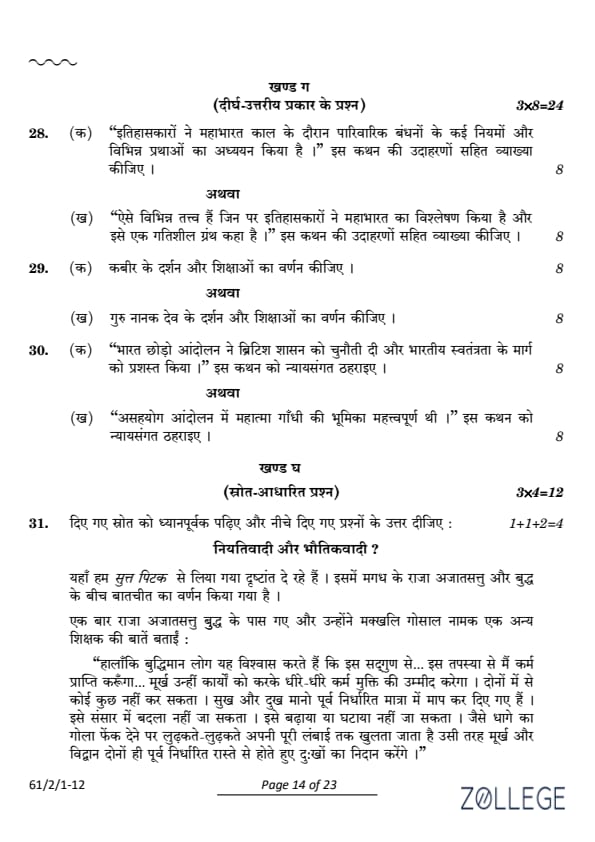
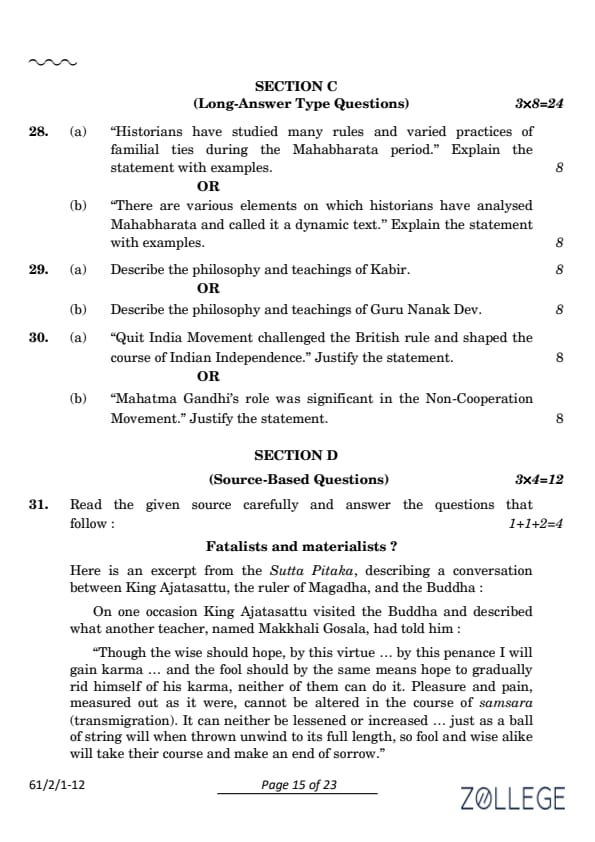
SECTION C
Question 28(a):
“Historians have studied many rules and varied practices of familial ties during the Mahabharata period.” Explain the statement with examples.
View Solution
The Mahabharata offers insights into familial structures and relationships in ancient Indian society:
- Duties (Dharma): Family roles and responsibilities were governed by Dharma, such as Yudhishthira’s loyalty to his father and brothers.
- Women’s Roles: Characters like Draupadi and Kunti challenged and shaped familial norms, reflecting evolving gender roles.
- Complex Relationships: The epic depicts both conflicts and cooperation within families, showcasing the dynamics of kinship.
The Mahabharata serves as both a historical and philosophical text, offering a window into the familial practices of its time.
Question 28(b):
“There are various elements on which historians have analysed the Mahabharata and called it a dynamic text.” Explain the statement with examples.
View Solution
The Mahabharata is considered a dynamic text due to its adaptability and richness in themes:
- Philosophy: The Bhagavad Gita addresses profound issues like duty, righteousness, and morality.
- Politics and Governance: The epic critiques kingship and explores moral dilemmas in statecraft.
- Social Issues: Gender roles and caste dynamics are analyzed through characters like Draupadi and Kunti.
- Reinterpretation: The Mahabharata has been adapted across cultures, showcasing its timeless relevance.
Historians view it as a living document that reflects changing societal values and priorities.
Question 29:
Describe the philosophy and teachings of Kabir.
View Solution
Kabir was a mystic poet whose teachings emphasized devotion to a formless God and rejected ritualistic practices:
- Universal God: Kabir believed in Nirakar (formless God) and opposed idol worship.
- Bhakti: Emphasized devotion and internal connection to God without rituals or ceremonies.
- Social Equality: Criticized the caste system and advocated for equality among all humans.
- Simple Living: Promoted living a life of simplicity, honesty, and devotion.
Kabir’s teachings influenced the Bhakti movement and continue to inspire ideals of spiritual unity and social justice.
Question 29(b):
Describe the philosophy and teachings of Guru Nanak Dev.
View Solution
Guru Nanak Dev, the founder of Sikhism, emphasized a philosophy of monotheism and devotion to one eternal, formless God. His key teachings include:
- Naam Simran: Meditation and repetition of God's name as the primary means to connect with the divine.
- Equality: Guru Nanak rejected the caste system and emphasized equality among all people, regardless of social status, gender, or religion.
- Seva (Selfless Service): Serving humanity was considered as important as devotion to God.
- Critique of Rituals: He rejected ritualistic practices and called for a direct and personal relationship with God.
Guru Nanak's teachings are encapsulated in the Three Pillars:
- Naam Japna – Remembering God’s name.
- Kirat Karni – Earning an honest living.
- Vand Chakna – Sharing with others.
These principles laid the foundation of Sikhism, promoting devotion, service, and equality.
Question 30(a):
“Quit India Movement challenged the British rule and shaped the course of Indian Independence.” Justify the statement.
View Solution
The Quit India Movement of 1942 was a turning point in India’s struggle for independence:
- Mass Mobilization: It united Indians across regions and social classes in a mass-based movement against British rule.
- Direct Action: Marked a shift from constitutional protests to a demand for complete independence with the slogan "Do or Die."
- British Vulnerability: The movement exposed the weakening control of the British during World War II.
- Impact on Independence: The unrest highlighted the urgency of Indian independence, paving the way for the eventual withdrawal of British rule in 1947.
Despite its suppression, the movement demonstrated the resolve of Indians and shaped the final phase of the freedom struggle.
Question 30(b):
“Mahatma Gandhi’s role was significant in the Non-Cooperation Movement.” Justify the statement.
View Solution
Mahatma Gandhi’s leadership was central to the Non-Cooperation Movement (1920-1922):
- Philosophy of Non-Violence: Gandhi inspired millions with his principle of non-violent resistance (Ahimsa).
- Mass Participation: The movement involved people from all walks of life, including students, farmers, and workers.
- Boycott of British Institutions: Gandhi urged Indians to boycott British goods, schools, and services, promoting self-reliance.
- Response to Jallianwala Bagh Massacre: The movement symbolized a mass protest against British repression.
Though suspended after the Chauri Chaura incident in 1922, the movement established Gandhi as a national leader and demonstrated the power of non-violent resistance.
SECTION D
Fatalists and Materialists?
Read More
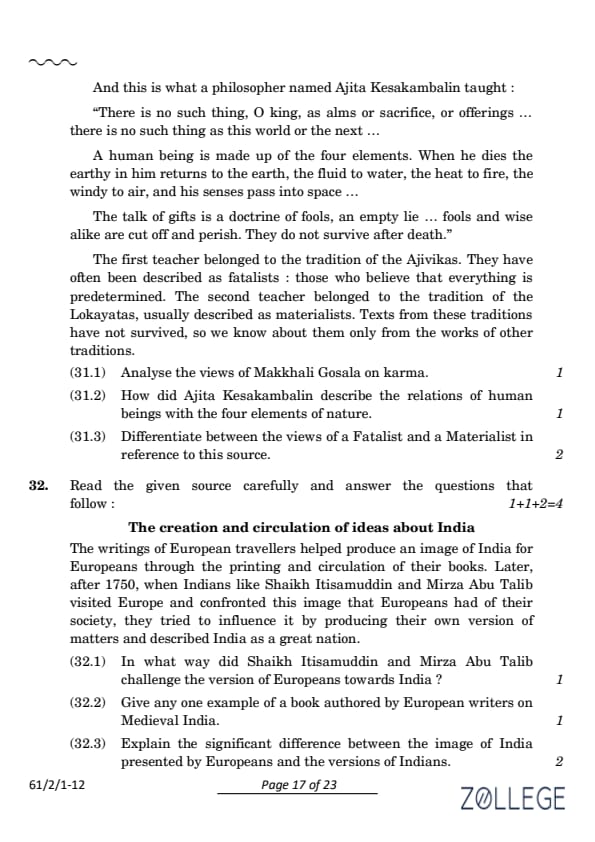
Here is an excerpt from the Sutta Pitaka, describing a conversation between King Ajatasattu, the ruler of Magadha, and the Buddha:
On one occasion King Ajatasattu visited the Buddha and described what another teacher, named Makkhali Gosala, had told him:
“Though the wise should hope, by this virtue ... by this penance I will gain karma ... and the fool should by the same means hope to gradually rid himself of his karma, neither of them can do it. Pleasure and pain, measured out as it were, cannot be altered in the course of samsara (transmigration). It can neither be lessened or increased ... just as a ball of string will when thrown unwind to its full length, so fool and wise alike will take their course and make an end of sorrow.”
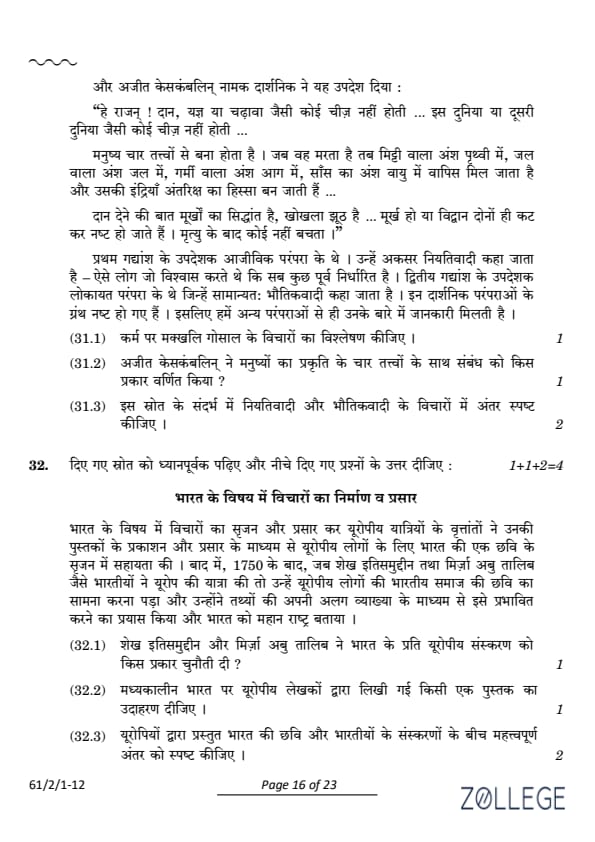
And this is what a philosopher named Ajita Kesakambalin taught:
“There is no such thing, O king, as alms or sacrifice, or offerings . . . there is no such thing as this world or the next . . . A human being is made up of the four elements. When he dies the earthy in him returns to the earth, the fluid to water, the heat to fire, the windy to air, and his senses pass into space . . . The talk of gifts is a doctrine of fools, an empty lie . . . fools and wise alike are cut off and perish. They do not survive after death.”
The first teacher belonged to the tradition of the Ajivikas. They have often been described as fatalists: those who believe that everything is predetermined. The second teacher belonged to the tradition of the Lokayatas, usually described as materialists. Texts from these traditions have not survived, so we know about them only from the works of other traditions.
Question 31.1:
Analyse the views of Makkhali Gosala on karma.
View Solution
Makkhali Gosala’s philosophy reflects a fatalistic view of karma:
- He believed that all events, including the consequences of karma, are predetermined and cannot be altered.
- Human efforts, penance, or virtue cannot change the cycle of samsara (rebirth).
- Life’s course is fixed, and pleasure or pain cannot be influenced by actions.
His views emphasize that life follows an unalterable cycle beyond human control.
Question 31.2:
How did Ajita Kesakambalin describe the relations of human beings with the universe?
View Solution
Ajita Kesakambalin, a materialist philosopher, described human beings and their relation to the universe as follows:
- Humans are composed of four elements—earth, water, fire, and air.
- Upon death, the body dissolves back into these elements, with no afterlife or soul.
- He rejected spiritual beliefs, focusing entirely on natural and physical processes.
His philosophy denies the existence of karma or any spiritual connections, emphasizing materialism.
Question 31.3:
Differentiate between the views of a Fatalist and a Materialist in reference to this source.
View Solution
The differences between a Fatalist and a Materialist are as follows:
- Fatalist: Believes in predetermined events governed by karma, as emphasized by Makkhali Gosala.
- Materialist: Denies spiritual elements, focusing on the physical nature of life, as described by Ajita Kesakambalin.
While Fatalists view life as fixed by cosmic law, Materialists attribute existence to natural processes without spiritual or karmic influences.
The creation and circulation of ideas about India
Read More
The writings of European travelers helped produce an image of India for Europeans through the printing and circulation of their books. Later, after 1750, when Indians like Shaikh Itsamuddin and Mirza Abu Talib visited Europe and confronted this image that Europeans had of their society, they tried to influence it by producing their own version of matters and described India as a great nation.
Question 32.1:
In what way did Shaikh Itsamuddin and Mirza Abu Talib challenge the version of Europeans towards India?
View Solution
Shaikh Itsamuddin and Mirza Abu Talib challenged the European portrayal of India by:
- Highlighting India’s rich culture, intellectual achievements, and spiritual traditions.
- Presenting India as a nation with a deep history of knowledge, art, and civilization.
- Countering stereotypes of India as a land of poverty and superstition.
Their works helped reclaim India’s dignity and showcased its contributions to global heritage.
Question 32.2:
Give any one example of a book authored by European writers on Medieval India.
View Solution
One example of a book authored by a European writer on Medieval India is The History of India by James Mill. This book, written during British rule, categorizes Indian history from a Eurocentric perspective, reflecting colonial attitudes.
Question 32.3:
Explain the significant difference between the image of India presented by Europeans and the versions of Indians.
View Solution
The significant difference lies in the portrayal of Indian society:
- European Perspective: European writers often depicted India as a land of stagnation, superstition, and moral decline. They focused on practices like the caste system and religious rituals to portray Indian society as backward and primitive.
- Indian Perspective: Indian writers, such as Shaikh Itsamuddin and Mirza Abu Talib, countered this narrative by presenting India as a land of rich culture, intellectual achievements, and spiritual wisdom. They emphasized India’s contributions in fields like philosophy, science, and arts.
Indian versions offered a balanced and positive portrayal of Indian society, challenging the biased colonial narratives.
The Firm Resolve for an Independent Republic
Read More
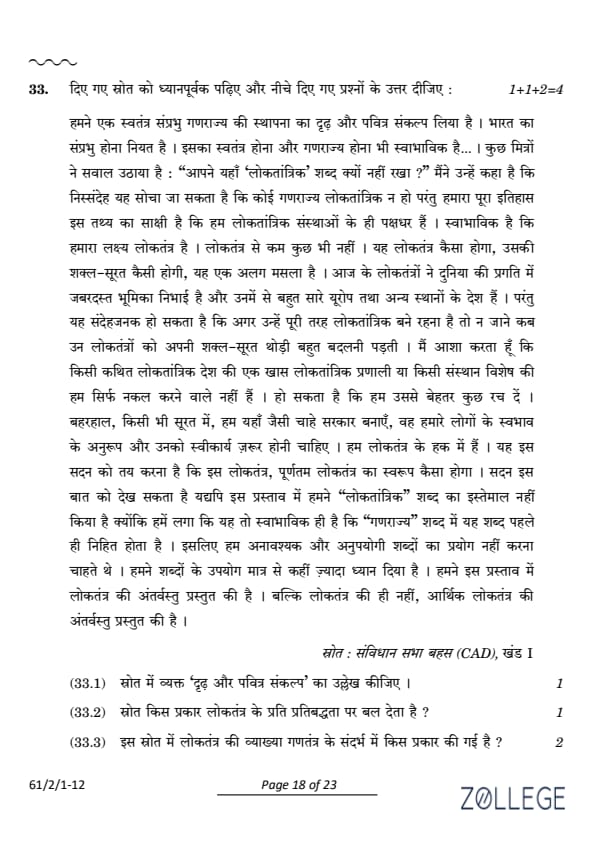
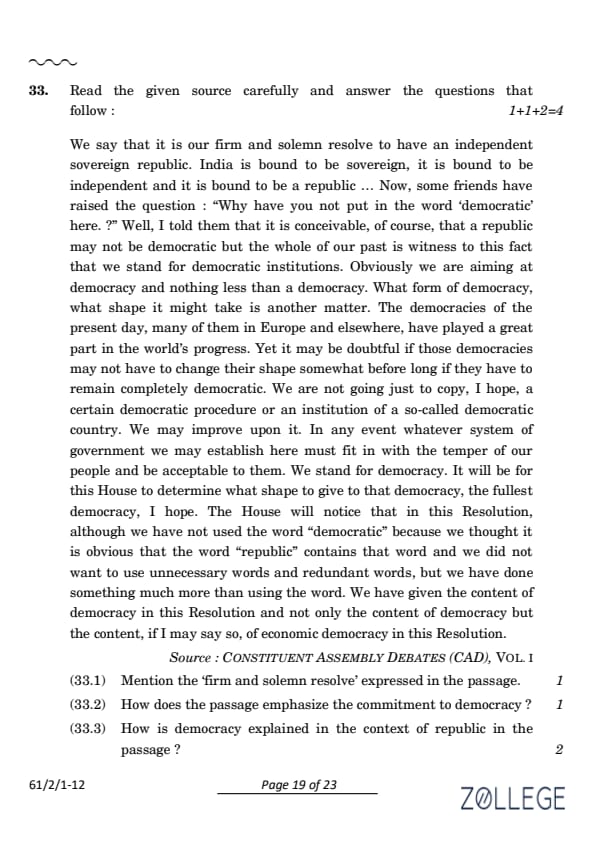
We say that it is our firm and solemn resolve to have an independent sovereign republic. India is bound to be sovereign, it is bound to be independent and it is bound to be a republic . . . Now, some friends have raised the question: “Why have you not put in the word ‘democratic’ here?” Well, I told them that it is conceivable, of course, that a republic may not be democratic but the whole of our past is witness to this fact that we stand for democratic institutions. Obviously we are aiming at democracy and nothing less than a democracy. What form of democracy, what shape it might take is another matter. The democracies of the present day, many of them in Europe and elsewhere, have played a great part in the world’s progress. Yet it may be doubtful if those democracies may not have to change their shape somewhat before long if they have to remain completely democratic. We are not going just to copy, I hope, a certain democratic procedure or an institution of a so-called democratic country. We may improve upon it. In any event whatever system of government we may establish here must fit in with the temper of our people and be acceptable to them. We stand for democracy. It will be for this House to determine what shape to give to that democracy, the fullest democracy, I hope. The House will notice that in this Resolution, although we have not used the word “democratic” because we thought it is obvious that the word “republic” contains that word and we did not want to use unnecessary words and redundant words, but we have done something much more than using the word. We have given the content of democracy in this Resolution and not only the content of democracy but the content, if I may say so, of economic democracy in this Resolution.
Source: CONSTITUENT ASSEMBLY DEBATES (CAD), VOL. I
Question 33.1:
Mention the ‘firm and solemn resolve’ expressed in the passage.
View Solution
The ‘firm and solemn resolve’ expressed in the passage refers to India’s commitment to becoming an independent, sovereign republic. The passage emphasizes India’s determination to establish a self-governing, sovereign state free from colonial rule.
Question 33.2:
How does the passage emphasize the commitment to democracy?
View Solution
The passage emphasizes democracy by stating that the principles of democracy are inherent in the concept of a republic. It highlights:
- India’s historical commitment to democratic institutions.
- The aim to establish a government that reflects the will and temper of the people.
- A focus on achieving a democracy that evolves to fit India’s unique needs rather than copying Western models.
This reinforces the idea that democracy will be integral to India’s governance framework.
Question 33.3:
How is democracy explained in the context of republic in the passage?
View Solution
In the context of the passage, democracy is explained as a core element of the republic, even if the word "democratic" is not explicitly used. Key points include:
- The republic inherently includes democratic principles, such as the participation of citizens in governance.
- India’s governance system will be shaped according to the unique needs and values of its people.
- The passage stresses both political democracy and economic democracy, ensuring equality and representation.
Thus, democracy is presented as an essential characteristic of the Indian republic.
SECTION E
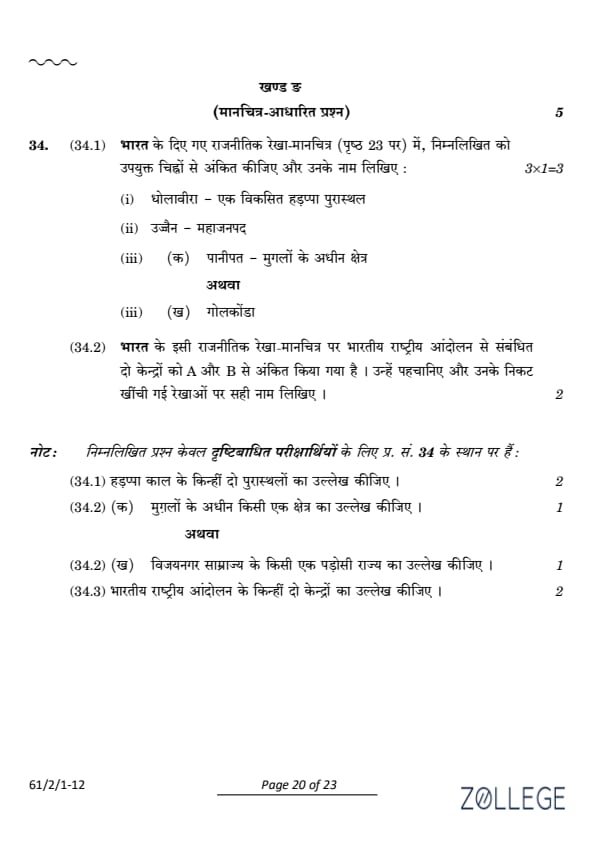
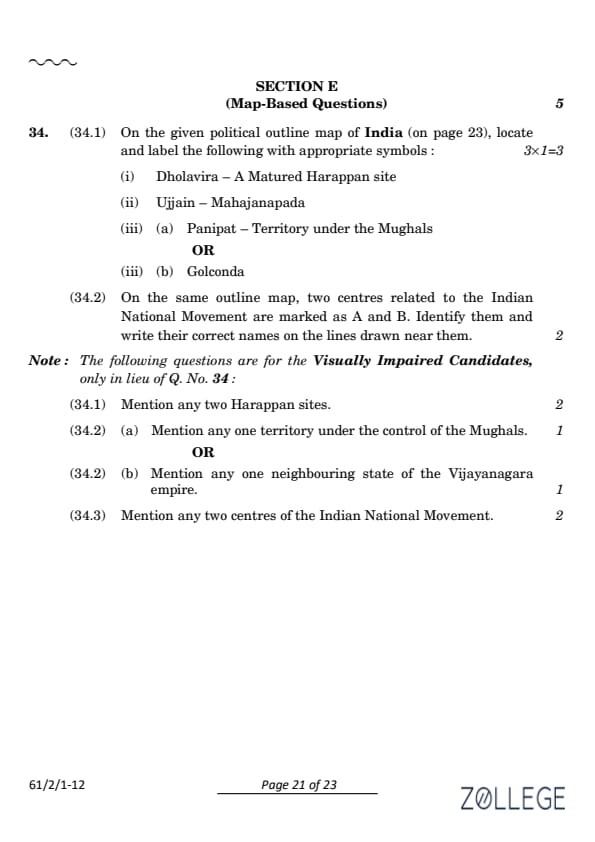
Question 34.1:
On the given political outline map of India, locate and label the following with appropriate symbols:
- (i) Dholavira – A Mature Harappan site
- (ii) Ujjain – Mahajanapada
- (iii)(a) Panipat – Territory under the Mughals
- OR
- (iii)(b) Golconda
View Solution
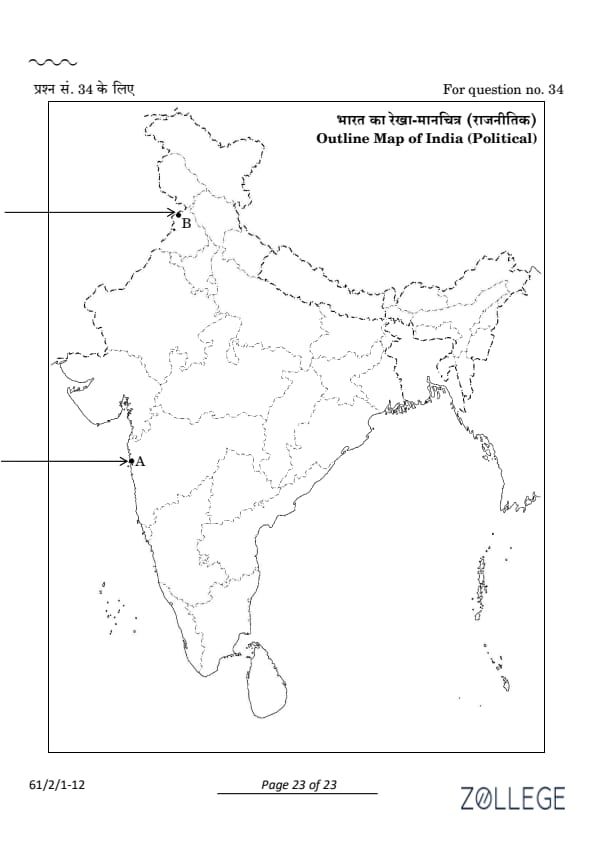
The locations are as follows:
- Dholavira: Located in Gujarat, on the island of Khadir in the Kutch district, showcasing advanced Harappan urban planning.
- Ujjain: Situated in Madhya Pradesh, it was an important Mahajanapada and a center of trade and culture during ancient India.
- Panipat: Located in Haryana, it was a key battlefield during the Mughal period.
- Golconda: Near Hyderabad, Telangana, known for its diamond trade and fortress.
The map should be labeled accordingly.
Question 34.2:
On the same outline map, two centers related to the Indian National Movement are marked as A and B. Identify them and write their correct names on the lines drawn near them.
View Solution
The two centers marked A and B could represent:
- A – Chandni Chowk (Delhi): A focal point of protests and political activity during the independence struggle.
- B – Nagpur: A major site for Congress sessions and nationalist activities, promoting the freedom movement in central India.
Question 34.2 (Alternative for Visually Impaired):
(a) Mention any two Harappan sites.
View Solution
Two significant Harappan sites are:
- Mohenjo-Daro: Located in Sindh, Pakistan, known for its urban planning and the Great Bath.
- Harappa: Located in Punjab, Pakistan, notable for its granaries and advanced agricultural practices.
Question 34.2 (b):
Mention any one territory under the control of the Mughals.
View Solution
One territory under Mughal control was Bengal. It was a prosperous region known for agriculture, trade, and strategic importance during Mughal rule.
Question 34.3:
Mention any two centers of the Indian National Movement.
View Solution
Two important centers of the Indian National Movement were:
- Calcutta (Kolkata): The birthplace of the Indian National Congress and a hub of revolutionary activities.
- Bombay (Mumbai): A major center for protests, strikes, and the Quit India Movement of 1942.

*The article might have information for the previous academic years, please refer the official website of the exam.