
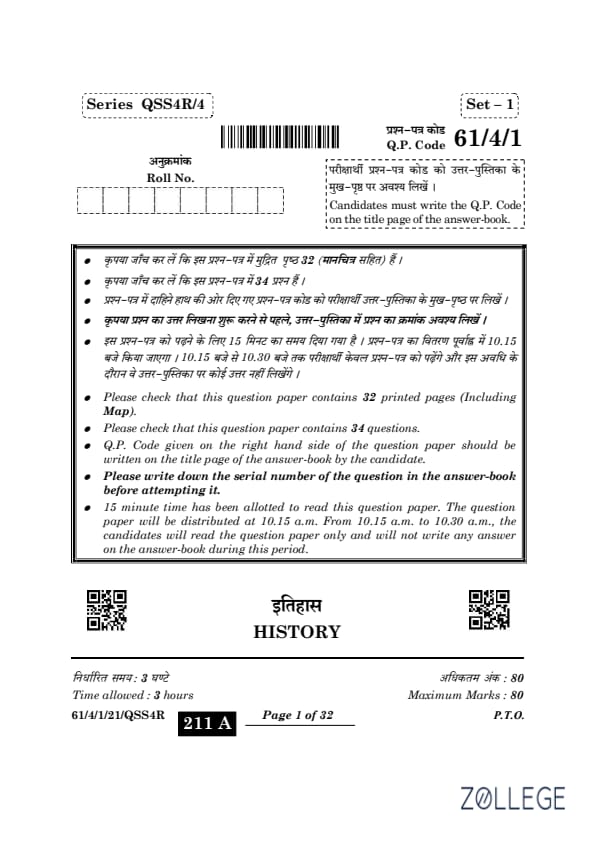
CBSE Class 12 2024 History Set 1 (Code: 61/4/1) Question Paper Pdf - Check Solutions with Answer Key Pdf

.jpg?tr=h-55,w-55,c-force)
Content Strategist|Tech-innovator|National Hackathon Winner | Updated On - Feb 1, 2025
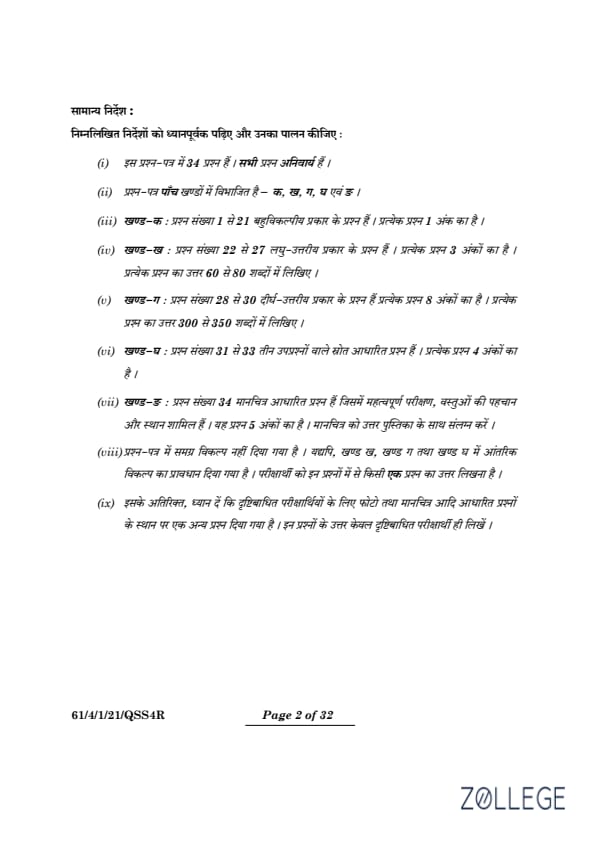
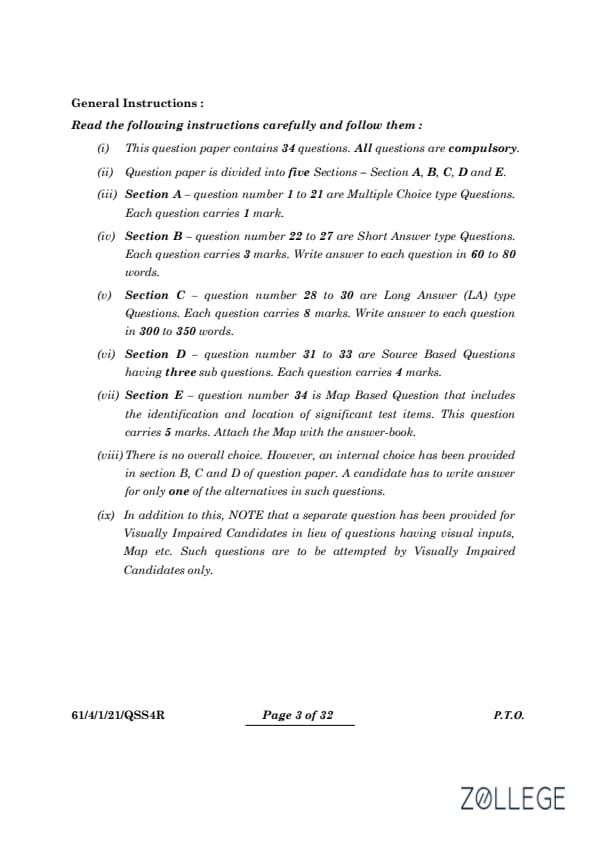
CBSE Class 12 2024 History Question Paper with Answer Key PDF for Set 1 (Q.P. Code: 61/4/1) is available for download. The exam was successfully conducted by CBSE on March 28, 2024, in the morning session from 10:30 AM to 1:30 PM. As per the students’ initial reactions, the CBSE Class 12 2024 History Set 1 Question Paper was reported as Moderate. The Ancient History section was considered Easy to Moderate, the Medieval History section as Moderate, and the Modern History section as Moderate to Challenging.
CBSE Class 12 2024 History (Set 1- 61/4/1) 2024 Answer Key With Solution
Candidates can download the CBSE Class 12 History Question Paper with Solution and Answer Key PDFs for Set 1 Question Paper (Code: 61/4/1) using the link below.
| CBSE Class 12 History (Set 1- 61/4/1) 2024 Question Paper with Answer Key |  Download Download |
Check Solution |
CBSE Class 12 2024 History Question Paper with Solutions
SECTION A
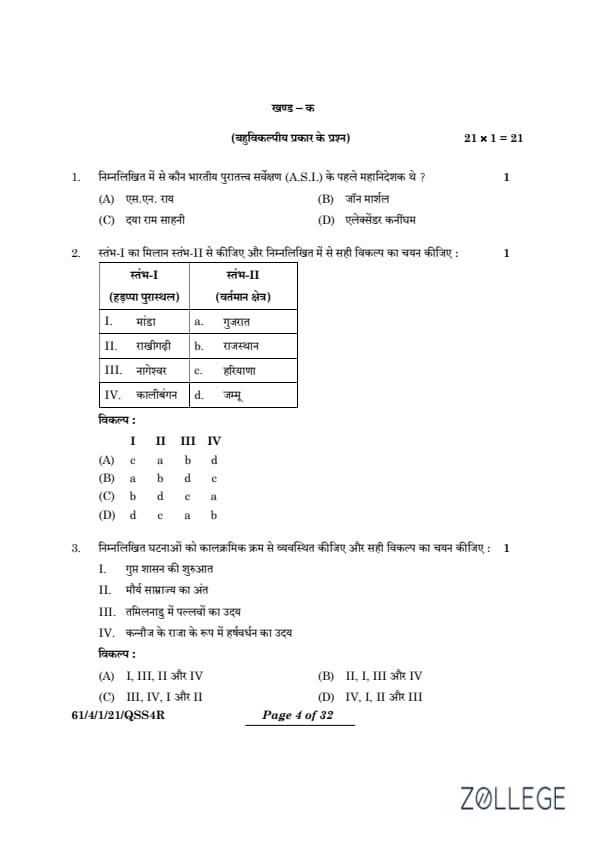
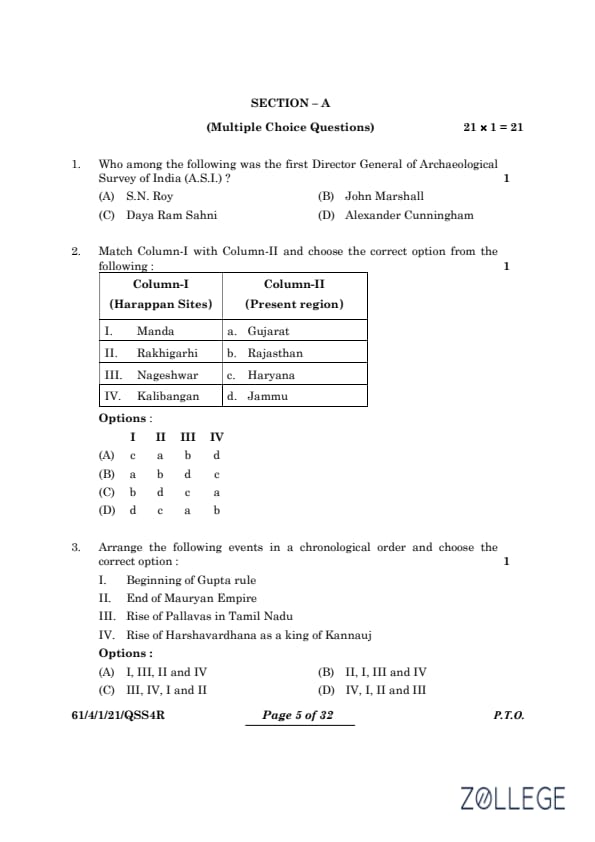
Question 1:
Who among the following was the first Director General of Archaeological Survey of India (A.S.I.)?
Correct Answer: (D) Alexander Cunningham
View Solution
Step 1: Alexander Cunningham was appointed as the first Director General of the Archaeological Survey of India (ASI) in 1861.
Conclusion: Alexander Cunningham is recognized as the first head of ASI and is often referred to as the "Father of Indian Archaeology."
Question 2:
Match Column-I with Column-II and choose the correct option from the following:
| Column-I (Harappan Sites) | Column-II (Present Region) |
|---|---|
| I. Manda | d. Jammu |
| II. Rakhigarhi | c. Haryana |
| III. Nageshwar | a. Gujarat |
| IV. Kalibangan | b. Rajasthan |
Correct Answer: (D) I - d, II - c, III - a, IV - b
View Solution
Step 1: The correct match is:
- Manda - Jammu
- Rakhigarhi - Haryana
- Nageshwar - Gujarat
- Kalibangan - Rajasthan
Conclusion: Harappan sites are spread across modern India and Pakistan, providing valuable insights into the Indus Valley Civilization.
Question 3:
Arrange the following events in chronological order and choose the correct option:
- Beginning of Gupta rule
- End of Mauryan Empire
- Rise of Pallavas in Tamil Nadu
- Rise of Harshavardhana as a king of Kannauj
Correct Answer: (B) II, I, III and IV
View Solution
Step 1: The correct chronological sequence is:
- End of Mauryan Empire (185 BCE)
- Beginning of Gupta Rule (319 CE)
- Rise of Pallavas (4th-6th Century CE)
- Rise of Harshavardhana (606 CE)
Conclusion: The sequence follows historical timelines of key dynasties and rulers in ancient India.
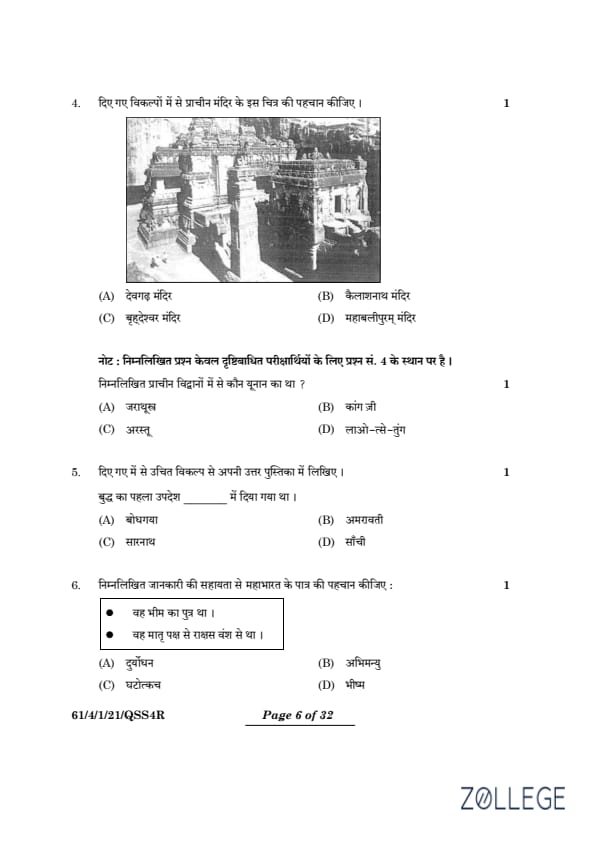
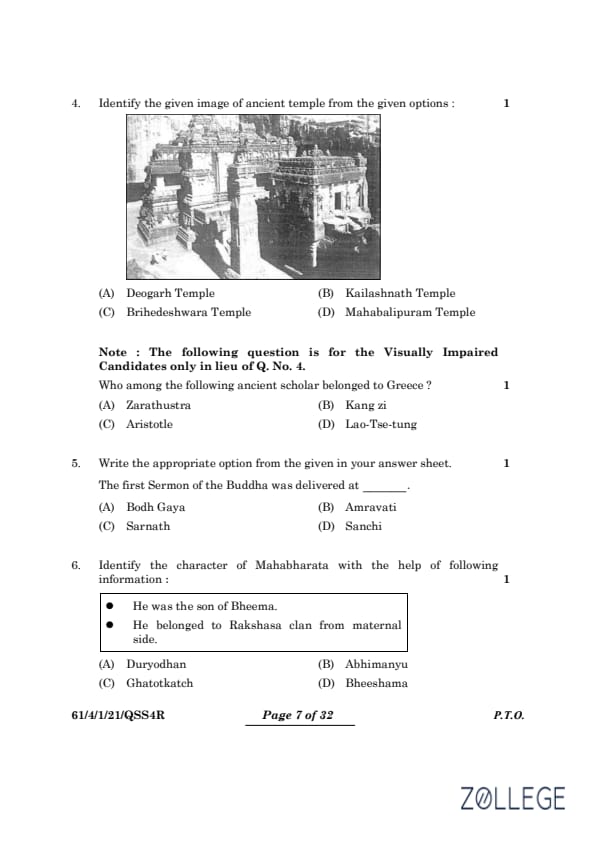
Question 4:
Identify the given image of the ancient temple from the given options:

Correct Answer: (B) Kailashnath Temple
View Solution
Step 1: The Kailashnath Temple at Ellora is a rock-cut Hindu temple known for its intricate carvings and monolithic structure.
Conclusion: The temple was built during the Rashtrakuta dynasty and is one of the largest monolithic rock-cut temples in the world.
Question 4 (For Visually Impaired Candidates):
Who among the following ancient scholars belonged to Greece?
Correct Answer: (C) Aristotle
View Solution
Step 1: Aristotle was a Greek philosopher and polymath, a student of Plato and teacher of Alexander the Great.
Step 2: His works covered various fields including logic, biology, ethics, and politics, significantly influencing Western thought.
Question 5:
The first sermon of the Buddha was delivered at:
Correct Answer: (C) Sarnath
View Solution
Step 1: Gautama Buddha delivered his first sermon at Sarnath, known as the Dharmachakra Pravartana (Turning of the Wheel of Dharma).
Question 6:
Identify the character of Mahabharata with the help of the following information:
- He was the son of Bheema.
- He belonged to the Rakshasa clan from the maternal side.
Correct Answer: (C) Ghatotkatch
View Solution
Step 1: Ghatotkatch was the son of Bheema and Hidimba. He belonged to the Rakshasa (demon) clan.
Conclusion: Ghatotkatch played a crucial role in the Mahabharata war and was known for his immense strength.
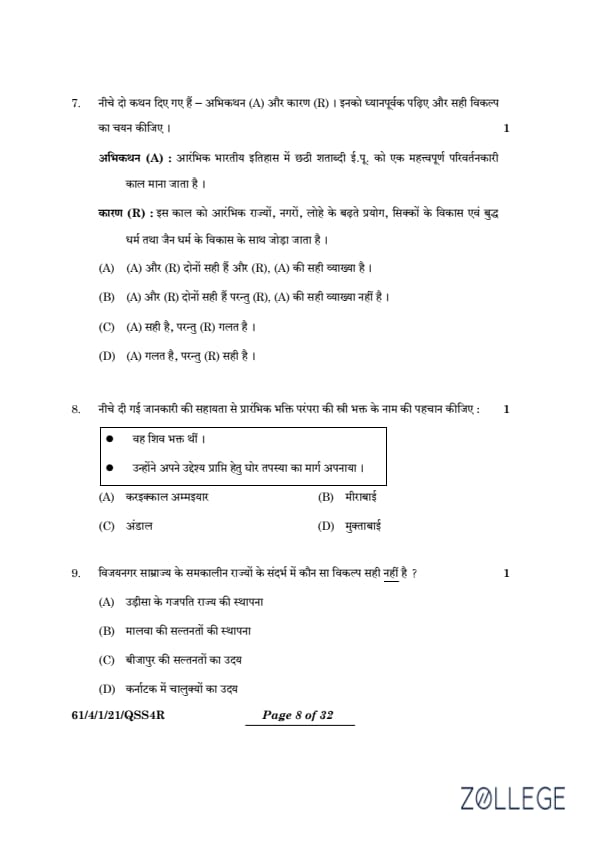
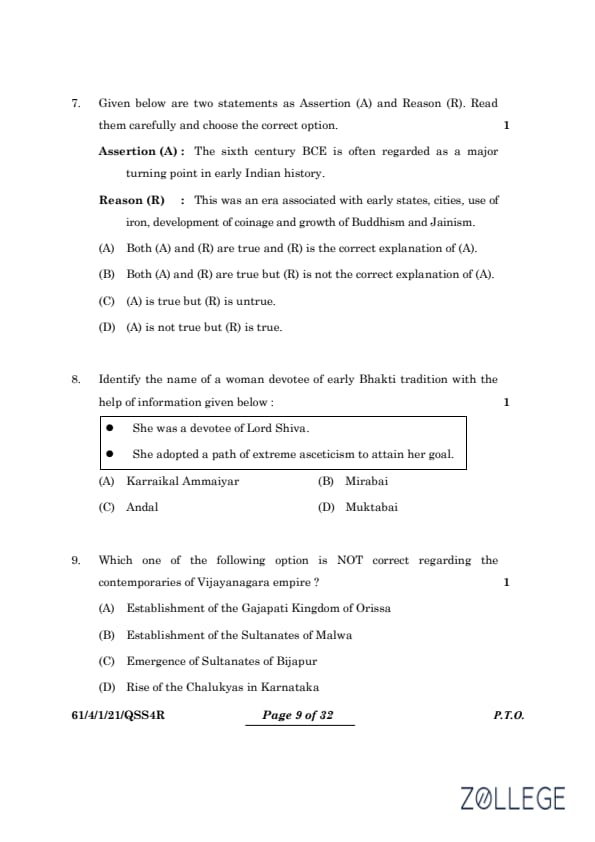
Question 7:
Given below are two statements as Assertion (A) and Reason (R). Read them carefully and choose the correct option.
Assertion (A): The sixth century BCE is often regarded as a major turning point in early Indian history.
Reason (R): This was an era associated with early states, cities, use of iron, development of coinage, and growth of Buddhism and Jainism.
Correct Answer: (A) Both (A) and (R) are true and (R) is the correct explanation of (A).
View Solution
Step 1: The sixth century BCE saw the rise of Mahajanapadas, urbanization, and religious reform movements such as Buddhism and Jainism.
Question 8:
Identify the name of a woman devotee of the early Bhakti tradition with the help of the information given below:
- She was a devotee of Lord Shiva.
- She adopted a path of extreme asceticism to attain her goal.
Correct Answer: (A) Karraikal Ammaiyar
View Solution
Step 1: Karraikal Ammaiyar was a renowned woman saint of the early Bhakti movement and a devoted follower of Lord Shiva.
Step 2: She embraced an ascetic lifestyle, emphasizing devotion and renunciation.
Question 9:
Which one of the following options is NOT correct regarding the contemporaries of the Vijayanagara empire?
Correct Answer: (D) Rise of the Chalukyas in Karnataka
View Solution
Step 1: The Vijayanagara Empire (1336-1646 CE) coexisted with the Gajapati Kingdom of Orissa, the Sultanates of Malwa, and the emergence of the Bijapur Sultanate.
Step 2: However, the Chalukyas ruled much earlier (6th-12th century CE) and were not contemporaries of the Vijayanagara Empire.
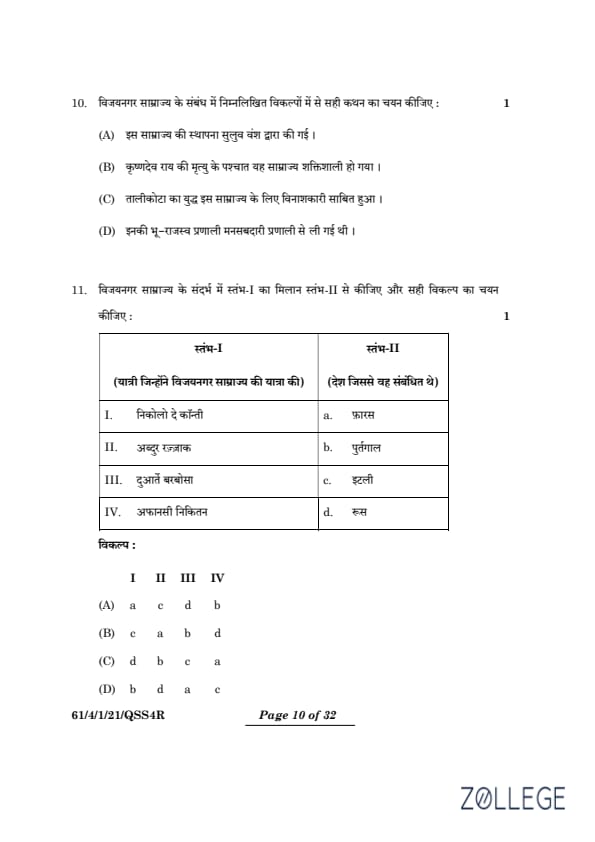
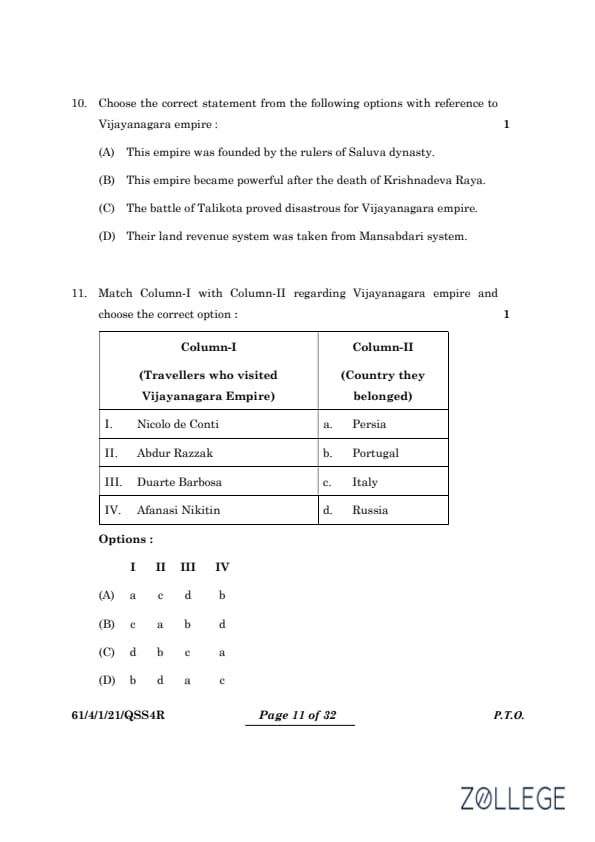
Question 10:
Choose the correct statement from the following options with reference to the Vijayanagara empire:
Correct Answer: (C) The battle of Talikota proved disastrous for Vijayanagara empire.
View Solution
Step 1: The Battle of Talikota (1565) was fought between the Vijayanagara Empire and the Deccan Sultanates. It led to the downfall of Vijayanagara.
Question 11:
Match Column-I with Column-II regarding Vijayanagara empire and choose the correct option:
| Column-I (Travellers who visited Vijayanagara Empire) | Column-II (Country they belonged) |
|---|---|
| I. Nicolo de Conti | c. Italy |
| II. Abdur Razzak | a. Persia |
| III. Duarte Barbosa | b. Portugal |
| IV. Afanasi Nikitin | d. Russia |
Options:
Correct Answer: (B) I-c, II-a, III-b, IV-d
View Solution
Step 1: The correct match is:
- Nicolo de Conti - Italy
- Abdur Razzak - Persia
- Duarte Barbosa - Portugal
- Afanasi Nikitin - Russia
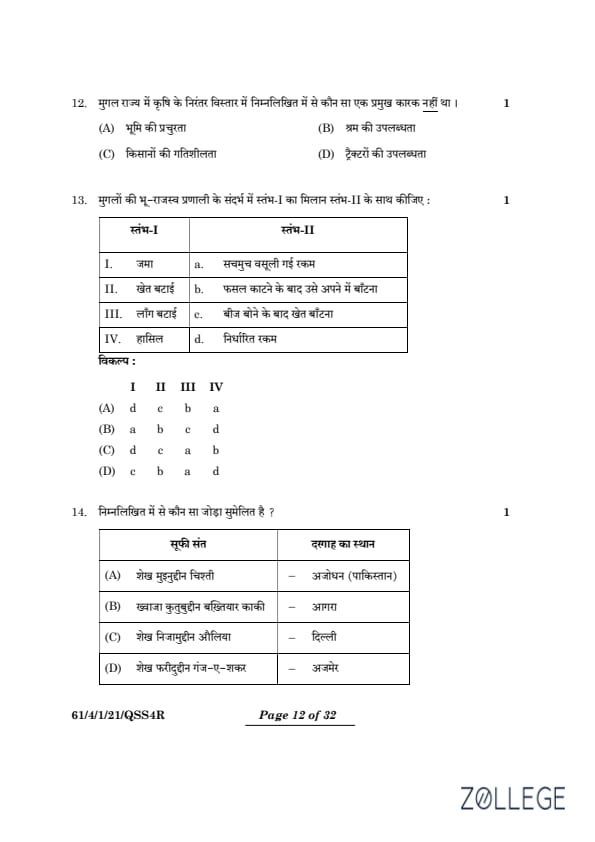
Question 12:
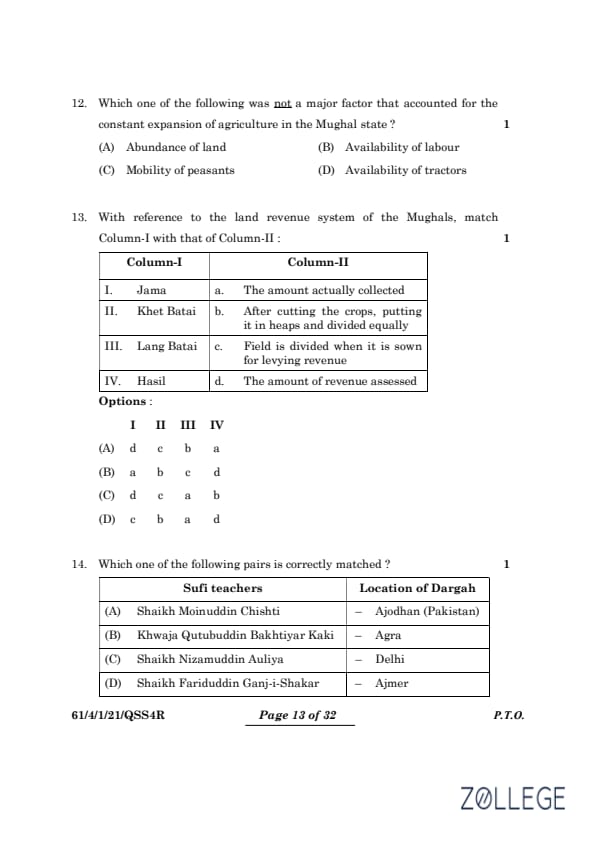
Which one of the following was not a major factor that accounted for the constant expansion of agriculture in the Mughal state?
Correct Answer: (D) Availability of tractors
View Solution
Step 1: Tractors were not available during the Mughal period, making this the incorrect factor for agricultural expansion.
Question 13:
With reference to the land revenue system of the Mughals, match Column-I with Column-II:
| Column-I | Column-II |
|---|---|
| I. Jama | d. The amount of revenue assessed |
| II. Khet Batai | c. After cutting the crops, putting it in heaps and divided equally |
| III. Lang Batai | b. Field is divided when it is sown for levying revenue |
| IV. Hasil | a. The amount actually collected |
Options:
Correct Answer: (A) I-d, II-c, III-b, IV-a
View Solution
Step 1: The correct match is:
- Jama - The amount of revenue assessed.
- Khet Batai - Crops are cut and divided equally.
- Lang Batai - Field is divided at sowing for tax.
- Hasil - The actual collected revenue.
Question 14:
Which one of the following pairs is correctly matched?
| Sufi teachers | Location of Dargah |
|---|---|
| Shaikh Moinuddin Chishti | Ajodhan (Pakistan) |
| Khwaja Qutubuddin Bakhtiyar Kaki | Agra |
| Shaikh Nizamuddin Auliya | Delhi |
| Shaikh Fariduddin Ganj-i-Shakar | Ajmer |
Options:
Correct Answer: (C) Shaikh Nizamuddin Auliya - Delhi
View Solution
Step 1: The correct match is Shaikh Nizamuddin Auliya, who is associated with Delhi.
Question 15:
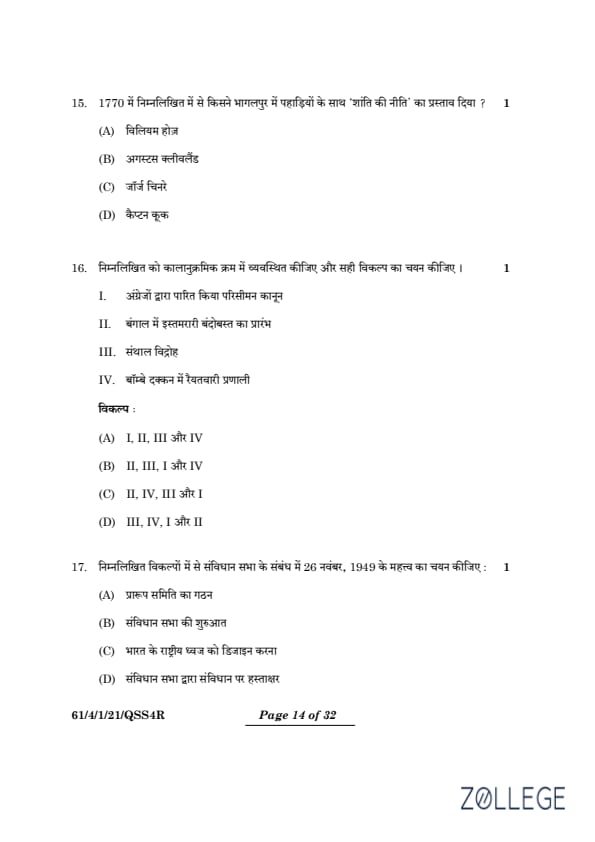
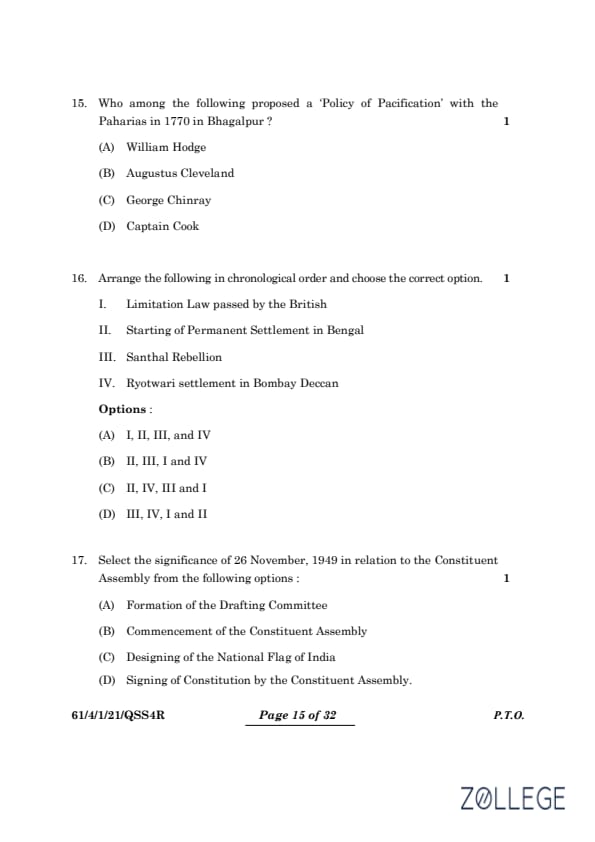
Who among the following proposed a ‘Policy of Pacification’ with the Paharias in 1770 in Bhagalpur?
Correct Answer: (B) Augustus Cleveland
View Solution
Step 1: Augustus Cleveland introduced the pacification policy to control the Paharias and integrate them into colonial rule.
Question 16:
Arrange the following in chronological order and choose the correct option:
Correct Answer: (C) II, IV, III and I
View Solution
Step 1: The correct sequence is:
- Permanent Settlement (1793)
- Ryotwari Settlement (Deccan) (1820s)
- Santhal Rebellion (1855)
- Limitation Law (1859)
Question 17:
Select the significance of 26 November, 1949 in relation to the Constituent Assembly from the following options:
Correct Answer: (D) Signing of Constitution by the Constituent Assembly
View Solution
Step 1: The Indian Constitution was adopted on 26th November 1949 by the Constituent Assembly. However, it came into effect on 26th January 1950.
Step 2: This day is now observed as Constitution Day in India to honor this milestone in the country’s history.
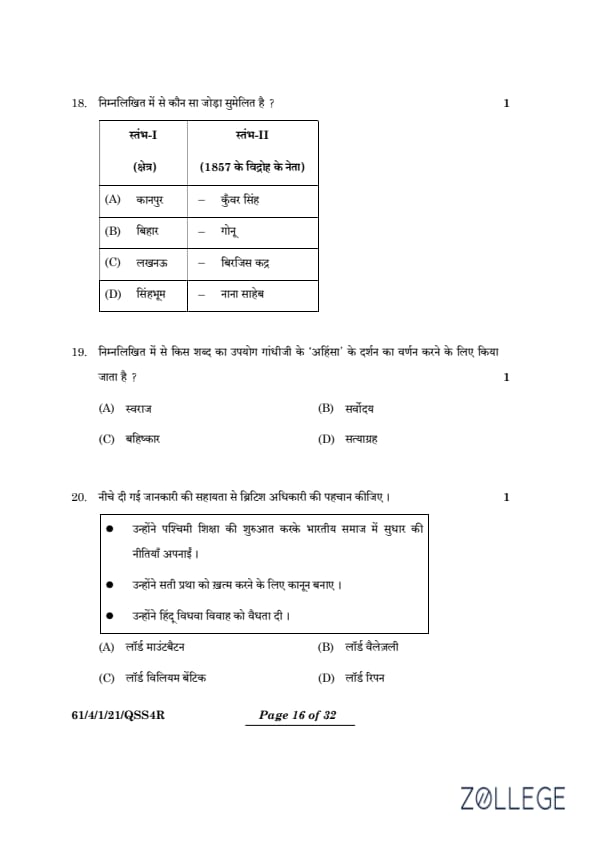
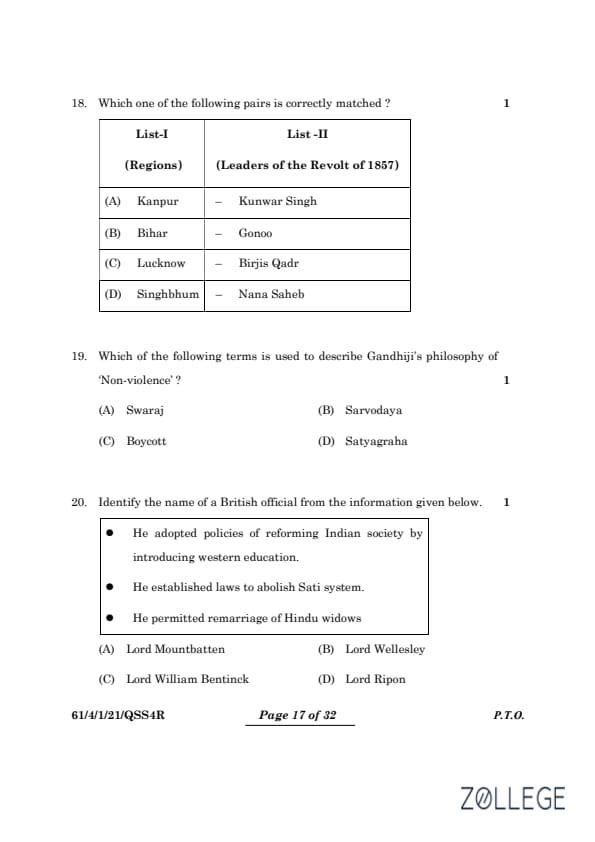
Question 18:
Which one of the following pairs is correctly matched?
| List-I (Regions) | List-II (Leaders of the Revolt of 1857) |
|---|---|
| Kanpur | Kunwar Singh |
| Bihar | Gono |
| Lucknow | Birjis Qadr |
| Singhbhum | Nana Saheb |
Options:
Correct Answer: (C) Lucknow - Birjis Qadr
View Solution
Step 1: The correct match is:
- Kanpur - Nana Saheb
- Bihar - Kunwar Singh
- Lucknow - Birjis Qadr (Correct)
- Singhbhum - Not a major center of revolt
Question 19:
Which of the following terms is used to describe Gandhiji’s philosophy of ‘Non-violence’?
Correct Answer: (D) Satyagraha
View Solution
Step 1: The term Satyagraha was coined by Mahatma Gandhi to describe the method of non-violent resistance.
Step 2: It emphasized truth, moral strength, and passive resistance against oppression.
Question 20:
Identify the name of a British official from the information given below:
- He adopted policies of reforming Indian society by introducing western education.
- He established laws to abolish the Sati system.
- He permitted remarriage of Hindu widows.
Correct Answer: (C) Lord William Bentinck
View Solution
Step 1: Lord William Bentinck was the Governor-General of India (1828-1835) and introduced major social reforms.
Step 2: He abolished the practice of Sati in 1829 and supported the Hindu Widows’ Remarriage Act.
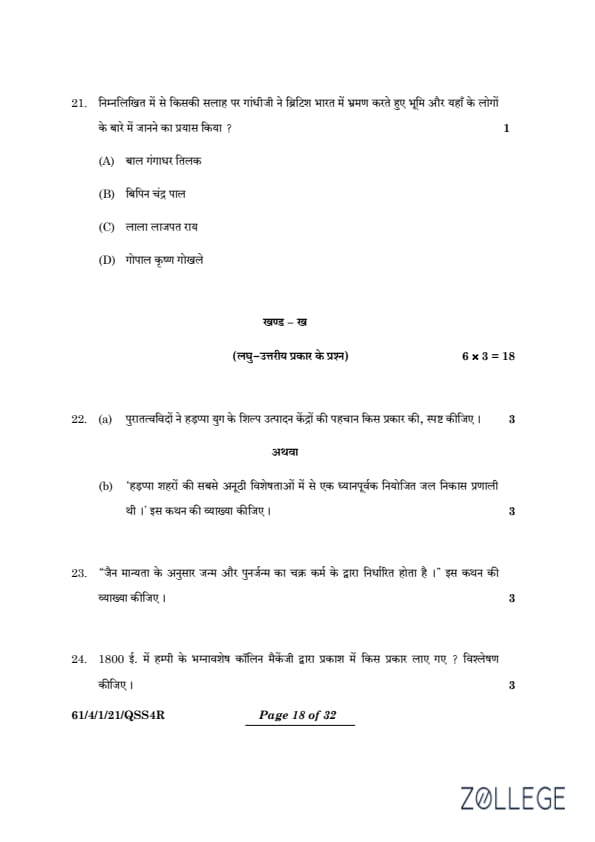
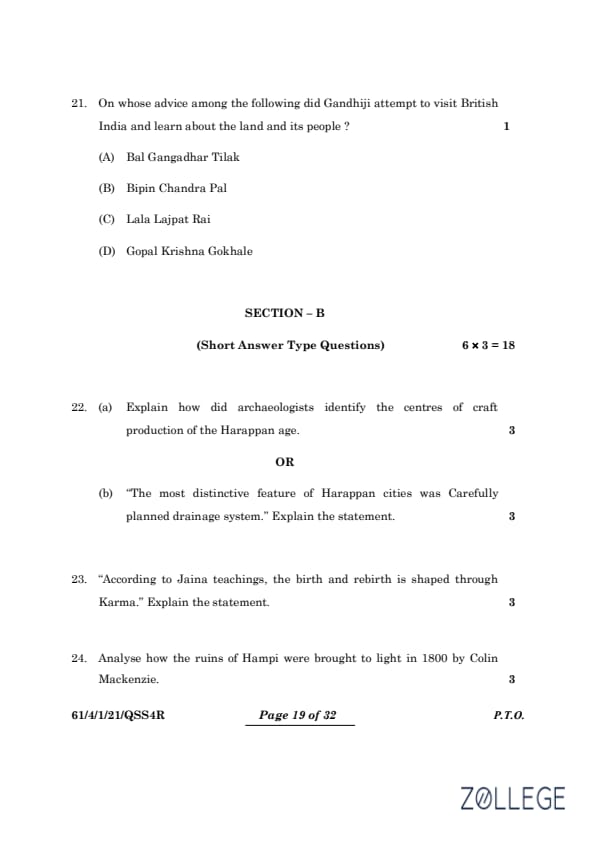
Question 21:
On whose advice among the following did Gandhiji attempt to visit British India and learn about the land and its people?
Correct Answer: (D) Gopal Krishna Gokhale
View Solution
Step 1: Gopal Krishna Gokhale, a senior leader of the Indian National Congress, advised Gandhi to travel across India to understand the country’s problems.
Step 2: Gandhi followed his advice and extensively toured India, which helped him develop his strategies for the independence movement.
SECTION – B
Question 22:
(a) Explain how did archaeologists identify the centres of craft production of the Harappan age.
View Solution
Solution:
Archaeologists identified craft production centers in the Harappan civilization by studying raw materials, unfinished objects, and waste materials found in excavation sites. Sites like Chanhudaro and Lothal contained evidence of bead-making, shell cutting, and metalworking. Specialized areas were marked for artisans, showing organized production and trade.
OR
(b) “The most distinctive feature of Harappan cities was carefully planned drainage system.” Explain the statement.
View Solution
Solution:
The Harappan civilization had an advanced drainage system, with covered drains made of bricks. Every house had a connection to the main drainage, which had inspection chambers for maintenance. This reflects the efficiency of their urban planning and sanitation.
Question 23:
“According to Jaina teachings, the birth and rebirth is shaped through Karma.” Explain the statement.
View Solution
Solution:
Jainism teaches that the cycle of birth and rebirth (samsara) is governed by karma. Good actions lead to a higher form of rebirth, while bad karma results in suffering. Liberation (moksha) is achieved by following strict ethical principles, including non-violence, truth, and asceticism. Jain monks practice severe austerity to free themselves from karma and attain enlightenment.
Question 24:
Analyse how the ruins of Hampi were brought to light in 1800 by Colin Mackenzie.
View Solution
Solution:
Colin Mackenzie, a British officer and surveyor, rediscovered the ruins of Hampi in 1800. As the first Surveyor General of India, he collected information from local sources and studied inscriptions, sculptures, and architecture. His documentation helped historians understand the history and significance of the Vijayanagara Empire.
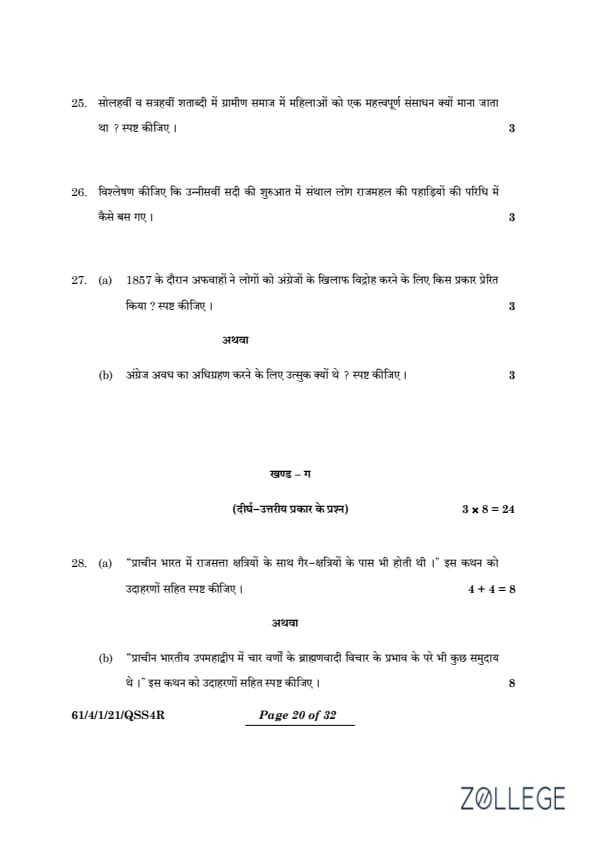
Question 25:
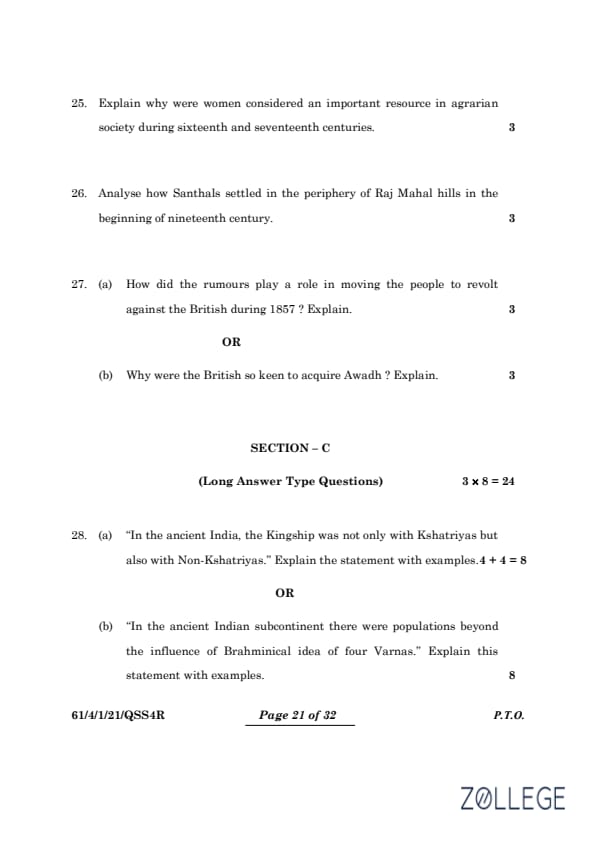
Explain why women were considered an important resource in agrarian society during the sixteenth and seventeenth centuries.
View Solution
Solution:
In agrarian societies, women played a vital role in farming activities such as sowing, harvesting, and threshing. They also managed household work, cattle rearing, and food storage. Women’s labor was essential for economic stability, and in some cases, they had land rights. However, they often faced social restrictions and patriarchal norms.
Question 26:
Analyse how Santhals settled in the periphery of Raj Mahal hills in the beginning of the nineteenth century.
View Solution
Solution:
The British encouraged Santhal tribes to settle in the Raj Mahal hills to clear forests and cultivate land. Given land grants, they expanded agriculture and built villages. However, exploitation by landlords and moneylenders led to the Santhal Rebellion (1855-56) against British rule.
Question 27:
(a) How did rumors play a role in moving the people to revolt against the British during 1857? Explain.
View Solution
Solution:
Rumors played a crucial role in the 1857 Revolt by spreading fear and resistance. The most famous rumor was that new rifle cartridges were greased with cow and pig fat, offending both Hindus and Muslims. The belief that the British aimed to destroy Indian traditions fueled mass uprisings.
OR
(b) Why were the British so keen to acquire Awadh? Explain.
View Solution
Solution:
The British annexed Awadh in 1856 under the pretext of misgovernance. Awadh was rich in agricultural production, had a large population, and was strategically located. The Nawab’s removal angered locals, contributing to the 1857 Revolt.
SECTION – C
Question 28:
(a) “In ancient India, the kingship was not only with Kshatriyas but also with Non-Kshatriyas.” Explain the statement with examples.
View Solution
In early Indian history, kingship was traditionally associated with the Kshatriya varna. However, several rulers who did not belong to the Kshatriya class also established powerful dynasties.
Examples:
- Mauryan Dynasty: Chandragupta Maurya, the founder of the Maurya Empire, was believed to be from a non-Kshatriya background.
- Shungas and Kanvas: These dynasties were Brahmins who ruled as kings.
- Satavahanas: This dynasty had rulers who identified as Kshatriyas but also followed non-Vedic traditions.
This demonstrates that political authority was not restricted to Kshatriyas, and merit played a crucial role in rulership.
OR
(b) “In the ancient Indian subcontinent there were populations beyond the influence of Brahminical idea of four Varnas.” Explain this statement with examples.
View Solution
The traditional Brahminical four-varna system did not encompass all communities in ancient India. Many tribes, pastoral groups, and merchant communities existed outside the rigid caste hierarchy.
Examples:
- Forest-dwelling Tribes: Many tribal communities lived autonomously, following their own customs.
- Craftsmen and Artisans: Groups like weavers, blacksmiths, and potters were essential to society but did not fit within the four-varna system.
- Buddhists and Jains: Many followers of Buddhism and Jainism rejected the caste system and formed their own communities.
This highlights the diversity of ancient Indian society beyond the Brahminical varna system.
Question 29:
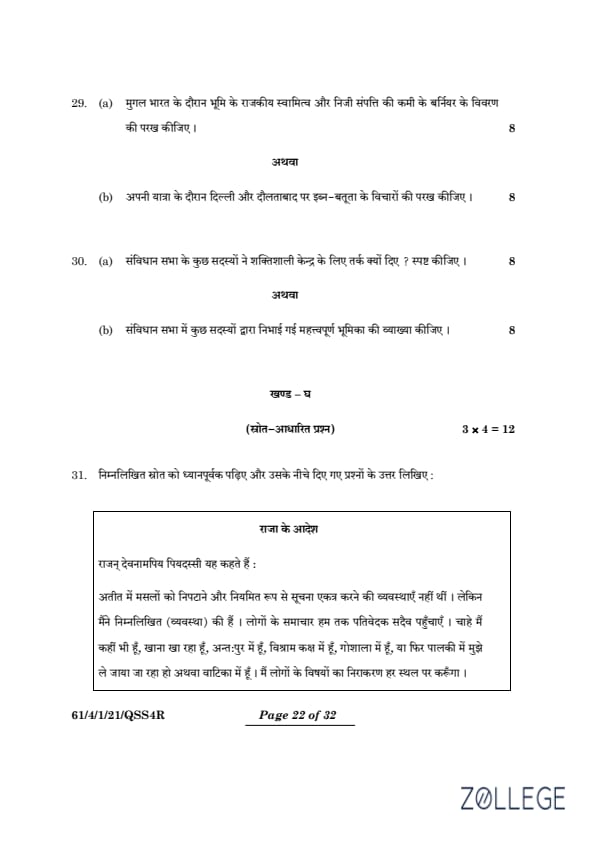
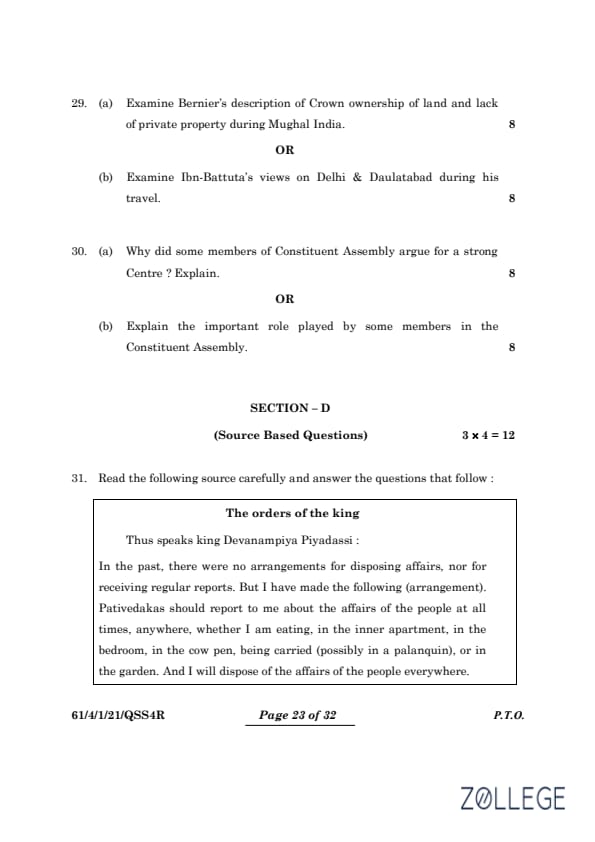
(a) Examine Bernier’s description of Crown ownership of land and lack of private property during Mughal India.
View Solution
François Bernier, a French traveler, visited India during the Mughal period and documented his observations on land ownership.
Key Points:
- Crown Ownership of Land: Bernier claimed that Mughal rulers had absolute control over land and did not allow private property rights.
- Impact on Agriculture: Since farmers did not own land, they lacked the motivation to invest in long-term agricultural development.
- Comparison with Europe: He contrasted this system with Europe, where private landownership encouraged economic prosperity.
- Criticism: Modern historians argue that Bernier’s view was biased, as Mughal India had a well-organized revenue system with hereditary land rights.
Thus, Bernier’s observations were influenced by his European perspective and do not fully capture the complexities of Mughal land administration.
OR
(b) Examine Ibn-Battuta’s views on Delhi & Daulatabad during his travel.
View Solution
Ibn Battuta, a Moroccan traveler, visited India during the reign of Muhammad bin Tughlaq and recorded his experiences of Delhi and Daulatabad.
Key Observations:
- Delhi: Ibn Battuta described Delhi as a grand and prosperous city with impressive architecture and a diverse population.
- Daulatabad: He witnessed the forced migration of Delhi’s population to Daulatabad under Tughlaq’s orders.
- Harsh Governance: Ibn Battuta noted the unpredictable and often cruel administration of Tughlaq, who frequently rewarded and punished people arbitrarily.
- Economic and Cultural Life: He admired the wealth, trade, and vibrant culture of Indian cities.
His accounts highlight both the grandeur and challenges of life under Tughlaq’s rule.
Question 30:
(a) Why did some members of the Constituent Assembly argue for a strong Centre? Explain.
View Solution
During the framing of the Indian Constitution, there was a debate on whether India should have a strong central government or a decentralized system.
Reasons for a Strong Centre:
- Unity and Integrity: Given the partition and communal violence, a strong Centre was needed to maintain national unity.
- Economic Development: Centralized policies could help in planned economic growth.
- Law and Order: A strong Centre was necessary to handle internal security challenges.
- Historical Experience: The disintegration of the Mughal and British Indian administration due to weak central authority influenced this decision.
As a result, the Constitution granted significant powers to the Centre while also maintaining federalism.
OR
(b) Explain the important role played by some members in the Constituent Assembly.
View Solution
The Constituent Assembly, formed in 1946, had prominent leaders who played a crucial role in drafting India’s Constitution.
Key Members and Their Contributions:
- Dr. B.R. Ambedkar: Chairman of the Drafting Committee, he played a pivotal role in shaping the Constitution, especially in ensuring social justice and equality.
- Jawaharlal Nehru: Advocated for a socialist and secular India.
- Sardar Vallabhbhai Patel: Worked towards the integration of princely states into India.
- Maulana Abul Kalam Azad: Focused on minority rights and educational policies.
- Rajendra Prasad: Provided leadership as the President of the Constituent Assembly.
These leaders played a crucial role in framing a Constitution that balanced democracy, fundamental rights, and national unity.
SECTION – D
Question 31:
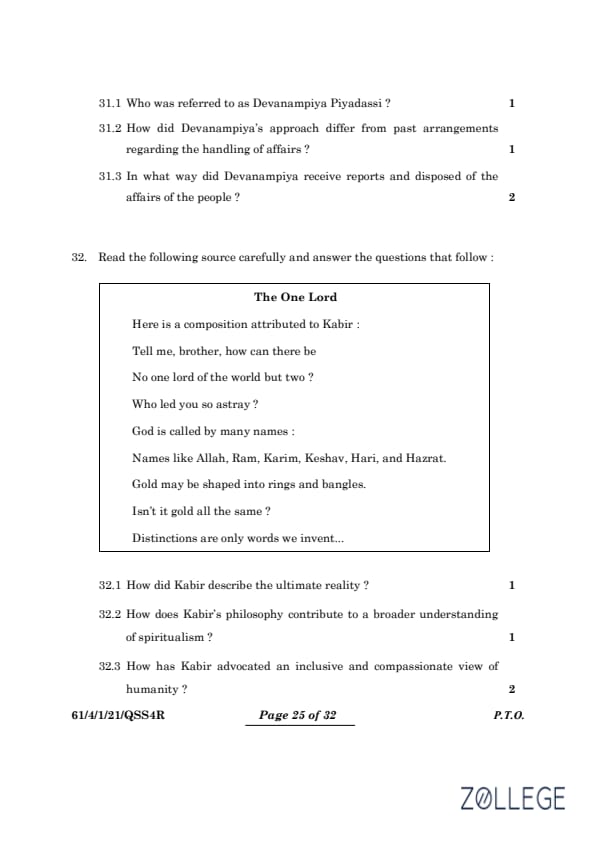
Read the following source carefully and answer the questions that follow:
The orders of the king
Thus speaks King Devanampiya Piyadassi:
In the past, there were no arrangements for disposing affairs, nor for receiving regular reports. But I have made the following (arrangement). Pativedakas should report to me about the affairs of the people at all times, anywhere, whether I am eating, in the inner apartment, in the bedroom, in the cow pen, being carried (possibly in a palanquin), or in the garden. And I will dispose of the affairs of the people everywhere.
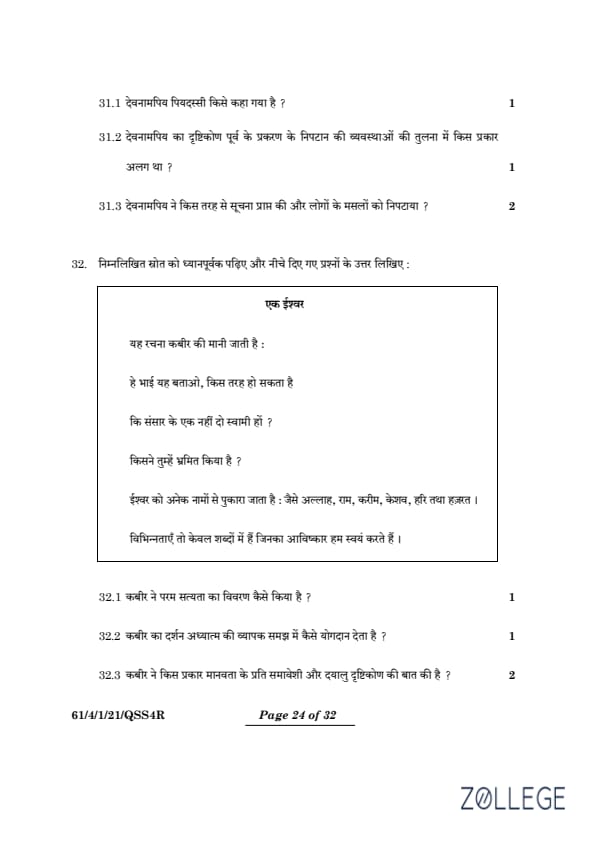
31.1 Who was referred to as Devanampiya Piyadassi?
Correct Answer: Emperor Ashoka
View Solution
Devanampiya Piyadassi refers to Emperor Ashoka, the Mauryan ruler, who promoted Dharma and welfare policies.
31.2 How did Devanampiya’s approach differ from past arrangements regarding the handling of affairs?
Correct Answer: Ashoka introduced a system of regular reporting.
View Solution
Unlike past rulers, Ashoka introduced a system of regular reporting where officials informed him about the people’s concerns at all times, ensuring direct governance.
31.3 In what way did Devanampiya receive reports and dispose of the affairs of the people?
Correct Answer: Pativedakas reported to Ashoka everywhere.
View Solution
Ashoka’s officials (Pativedakas) reported to him regardless of his location—whether he was eating, resting, or traveling. This ensured a continuous flow of communication, making governance more effective.
Question 32:
Read the following source carefully and answer the questions that follow:
The One Lord
Here is a composition attributed to Kabir:
Tell me, brother, how can there be
No one lord of the world but two?
Who led you so astray?
God is called by many names:
Names like Allah, Ram, Karim, Keshav, Hari, and Hazrat.
Gold may be shaped into rings and bangles.
Isn’t it gold all the same?
Distinctions are only words we invent...
32.1 How did Kabir describe the ultimate reality?
Correct Answer: Kabir emphasized the oneness of God.
View Solution
Kabir emphasized the oneness of God, rejecting religious divisions and advocating that all deities represent the same supreme reality.
32.2 How does Kabir’s philosophy contribute to a broader understanding of spiritualism?
Correct Answer: Kabir promoted universal devotion (Bhakti).
View Solution
Kabir promoted universal devotion (Bhakti) and rejected ritualistic practices, focusing on inner spirituality rather than religious formalities.
32.3 How has Kabir advocated an inclusive and compassionate view of humanity?
Correct Answer: Kabir rejected caste-based and religious discrimination.
View Solution
Kabir rejected caste-based and religious discrimination, emphasizing that all human beings are equal. He urged people to see beyond superficial differences and recognize the unity of mankind.
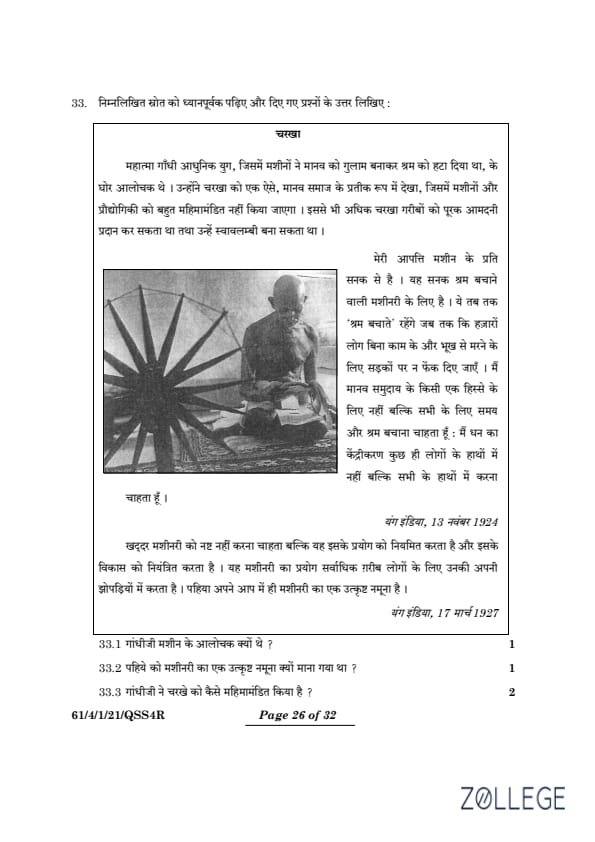
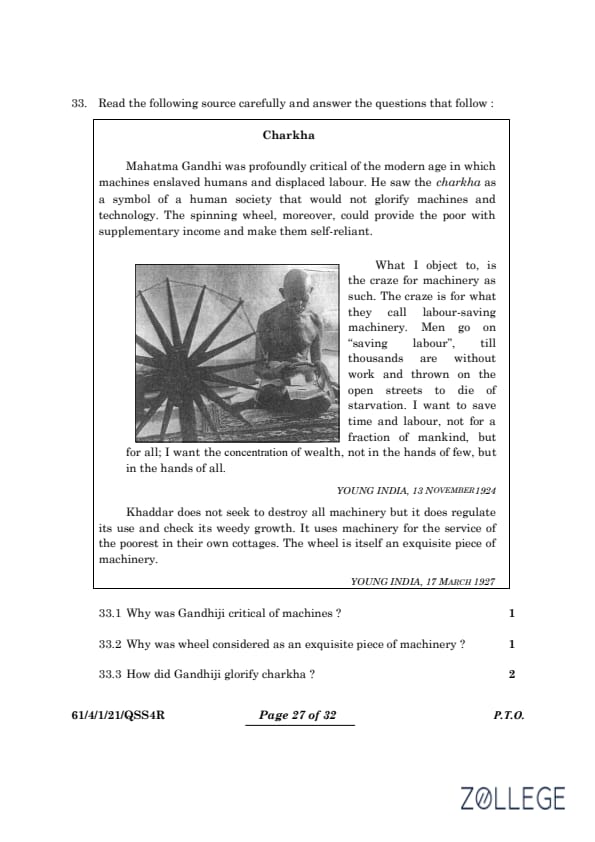
Question 33:
Read the following source carefully and answer the questions that follow:
Charkha
Mahatma Gandhi was profoundly critical of the modern age in which machines enslaved humans and displaced labour. He saw the charkha as a symbol of a human society that would not glorify machines and technology. The spinning wheel, moreover, could provide the poor with supplementary income and make them self-reliant.

What I object to, is the craze for machinery as such. The craze is for what they call labour-saving machinery. Men go on “saving labour”, till thousands are without work and thrown on the open streets to die of starvation. I want to save time and labour, not for a fraction of mankind, but for all; I want the concentration of wealth, not in the hands of few, but in the hands of all.
YOUNG INDIA, 13 NOVEMBER 1924
Khaddar does not seek to destroy all machinery but it does regulate its use and check its weedy growth. It uses machinery for the service of the poorest in their own cottages. The wheel is itself an exquisite piece of machinery.
YOUNG INDIA, 17 MARCH 1927
33.1 Why was Gandhiji critical of machines?
Correct Answer: Machines displaced workers and created economic disparity.
View Solution
Gandhi believed machines displaced workers, increased unemployment, and concentrated wealth in the hands of a few, leading to economic disparity.
33.2 Why was the wheel considered an exquisite piece of machinery?
Correct Answer: The spinning wheel symbolized self-reliance and empowerment.
View Solution
The spinning wheel (Charkha) symbolized self-reliance and empowerment for the poor, allowing them to earn a livelihood without industrial dependence.
33.3 How did Gandhiji glorify Charkha?
Correct Answer: Gandhi saw Charkha as a tool for economic independence.
View Solution
Gandhi saw the Charkha as a tool of economic independence and self-sufficiency. It was a key element of the Swadeshi movement, encouraging Indians to boycott British goods and produce their own cloth.
SECTION – E
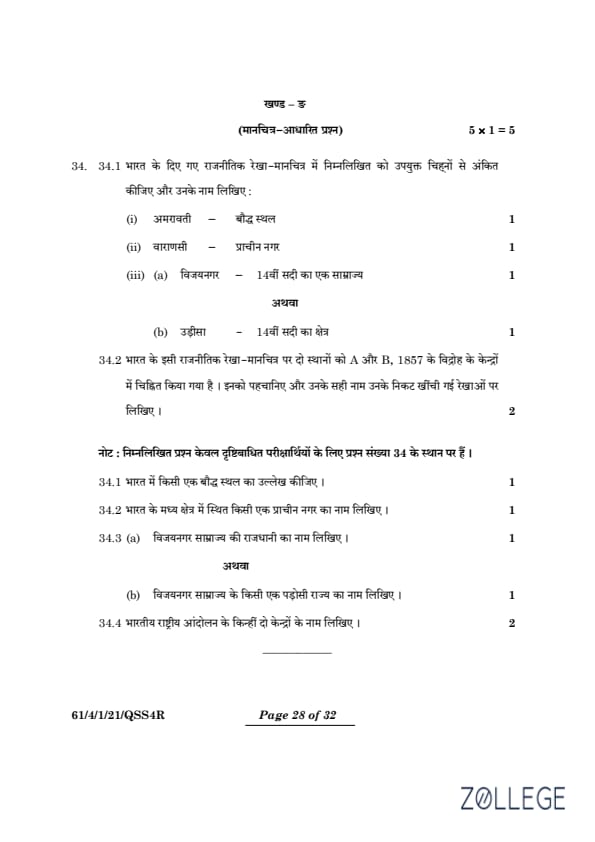
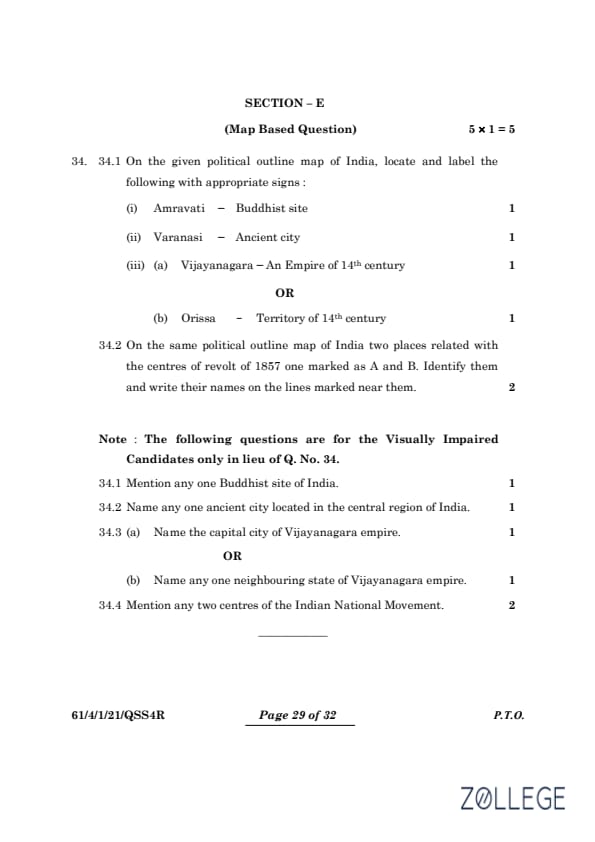
Question 34:
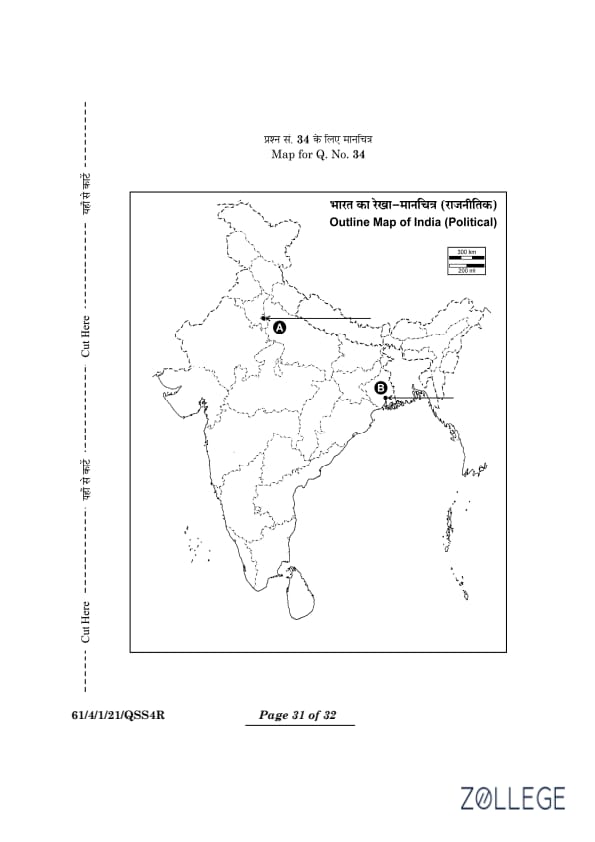
34.1 On the given political outline map of India, locate and label the following with appropriate signs:
- Amravati – Buddhist site
- Varanasi – Ancient city
- (a) Vijayanagara – An Empire of the 14th century
- OR
- (b) Orissa – Territory of the 14th century
Correct Answer:
View Solution
Marked Locations:
- Amravati: Located in present-day Andhra Pradesh, an important Buddhist center.
- Varanasi: One of the oldest cities in India, located in Uttar Pradesh.
- Vijayanagara: Located in present-day Karnataka, the capital of the Vijayanagara Empire.
- Orissa: Important territory during the 14th century, known for the Gajapati rulers.
34.2 On the same political outline map of India, two places related to the centres of the Revolt of 1857 are marked as A and B. Identify them and write their names on the lines marked near them.
Correct Answer:
View Solution
The two major centres of the Revolt of 1857:
- A – Kanpur: Led by Nana Saheb, a major centre of the uprising.
- B – Jhansi: Led by Rani Lakshmi Bai, known for her valiant resistance.
Note: The following questions are for the Visually Impaired Candidates only in lieu of Q. No. 34.
34.1 Mention any one Buddhist site of India.
Correct Answer: Sanchi
View Solution
Sanchi, located in Madhya Pradesh, is a famous Buddhist site known for its stupas and inscriptions.
34.2 Name any one ancient city located in the central region of India.
Correct Answer: Ujjain
View Solution
Ujjain, located in Madhya Pradesh, was an important trade and cultural centre in ancient India.
34.3 (a) Name the capital city of the Vijayanagara Empire.
Correct Answer: Hampi
View Solution
The capital of the Vijayanagara Empire was Hampi, located in present-day Karnataka.
OR
(b) Name any one neighbouring state of the Vijayanagara Empire.
Correct Answer: Bahmani Sultanate
View Solution
The Bahmani Sultanate was a neighbouring state of the Vijayanagara Empire, often in conflict with it.
34.4 Mention any two centres of the Indian National Movement.
Correct Answer:
View Solution
- Ahmedabad: Mahatma Gandhi led the famous textile mill workers’ strike and launched the Salt March from here.
- Amritsar: Site of the Jallianwala Bagh massacre in 1919, which fueled the independence movement.


*The article might have information for the previous academic years, please refer the official website of the exam.