
CBSE Class 12 History set 2 Question Paper Pdf - Check Solutions with Answer Key Pdf

.jpg?tr=h-55,w-55,c-force)
Content Strategist|Tech-innovator|National Hackathon Winner | Updated On - Jan 28, 2025
CBSE Class 12 2024 History Question Paper with Answer Key PDF for Set 2 (Q.P. Code: 61/1/2) is available for download. The exam was successfully conducted by CBSE on March 28, 2024, in the morning session from 10:30 AM to 1:30 PM. As per the students’ initial reactions, the CBSE Class 12 2024 History Set 2 Question Paper was reported as Moderate. The Ancient History section was considered Easy to Moderate, the Medieval History section as Moderate, and the Modern History section as Moderate to Challenging.
CBSE Class 12 2024 History Set 2 61/1/2 Question Paper with Answer Key PDF
Candidates can download the CBSE Class 12 History Question Paper with Solution and Answer Key PDFs for Set 2 Question Paper (Code: 61/1/2) using the link below.
| CBSE Class 12 2024 History Question Paper with Answer Key |  Download Download |
Check Solution |
CBSE Class 12 2024 History Questions with Solutions
SECTION - A
Question 1:
The legislature elected under the Government of India Act, 1935 operated within the framework of .
Correct Answer: (C) Colonial Rule
View Solution
The Government of India Act, 1935, established a legislature that operated within the framework of colonial rule, as the Act was implemented during the British administration in India.
Question 2:
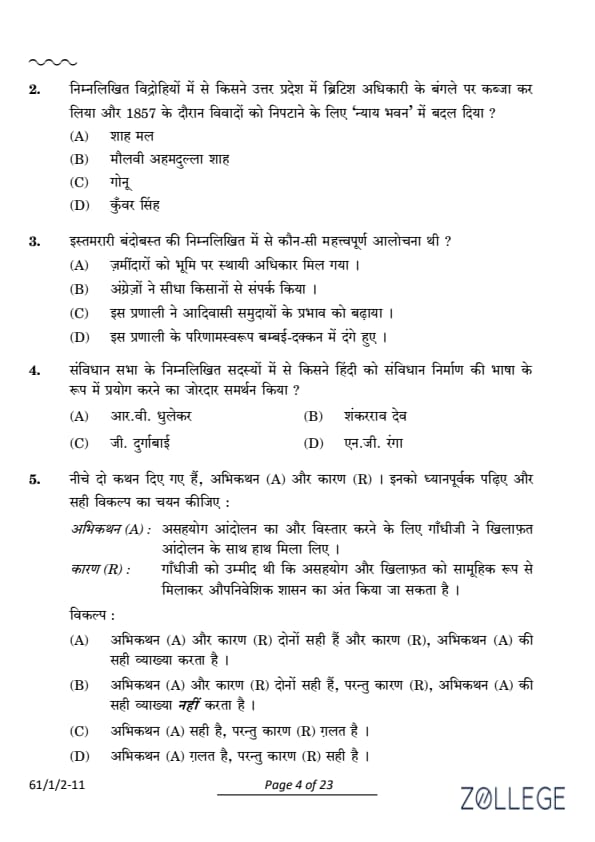
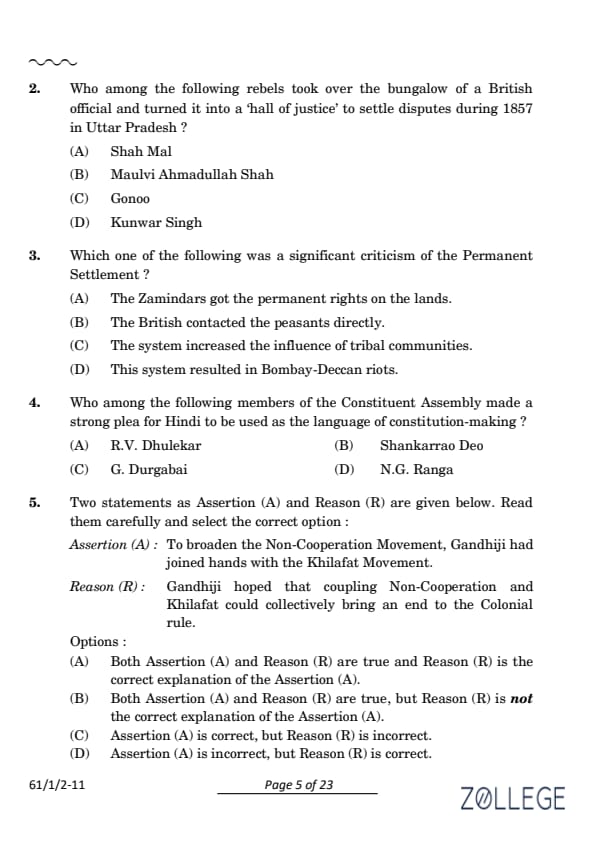
Who among the following rebels took over the bungalow of a British official and turned it into a ‘hall of justice’ to settle disputes during 1857 in Uttar Pradesh?
Correct Answer: (A) Shah Mal
View Solution
Shah Mal, a prominent leader during the Revolt of 1857, turned the bungalow of a British official into a ”hall of justice” to settle disputes, reflecting his leadership and efforts to establish self-rule in Uttar Pradesh.
Question 3:
Which one of the following was a significant criticism of the Permanent Settlement?
Correct Answer: (A) The Zamindars got the permanent rights on the lands.
View Solution
The Permanent Settlement gave permanent rights over land to the Zamindars, often at the expense of peasants, leading to exploitation and financial hardships for the cultivators.
Question 4:
Who among the following members of the Constituent Assembly made a strong plea for Hindi to be used as the language of constitution-making?
Correct Answer: (A) R.V. Dhulekar
View Solution
R.V. Dhulekar was a prominent advocate for using Hindi as the official language during the drafting of the Constitution. He strongly supported the idea of uniting the nation through a common language.
Question 5:
Two statements as Assertion (A) and Reason (R) are given below. Read them carefully and select the correct option:
Assertion (A): To broaden the Non-Cooperation Movement, Gandhiji had joined hands with the Khilafat Movement.
Reason (R): Gandhiji hoped that coupling Non-Cooperation and Khilafat could collectively bring an end to the Colonial rule.
Correct Answer: (A) Both Assertion (A) and Reason (R) are true and Reason (R) is the correct explanation of the Assertion (A).
View Solution
Assertion (A) and Reason (R) are both correct. Gandhiji’s collaboration with the Khilafat Movement was aimed at uniting Hindus and Muslims against British colonial rule, effectively broadening the scope of the Non-Cooperation Movement.
Question 6:
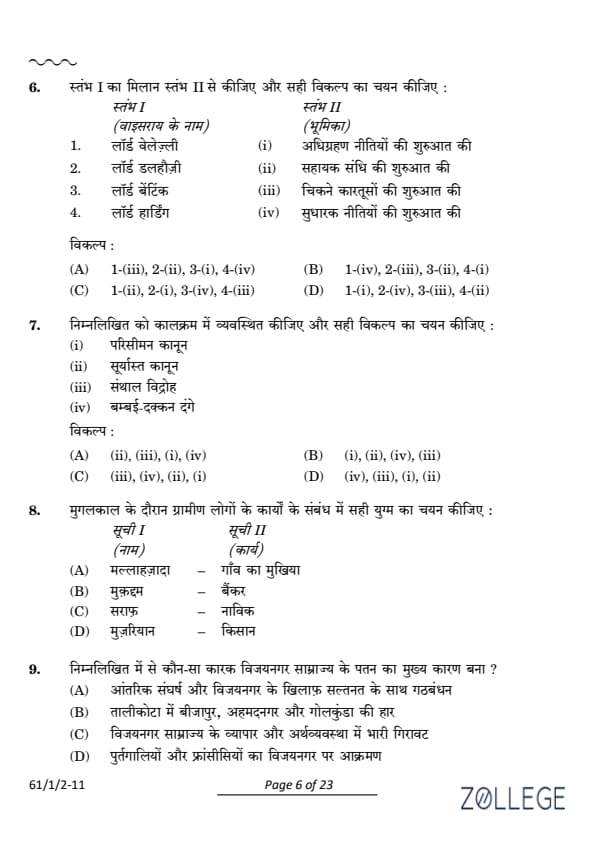
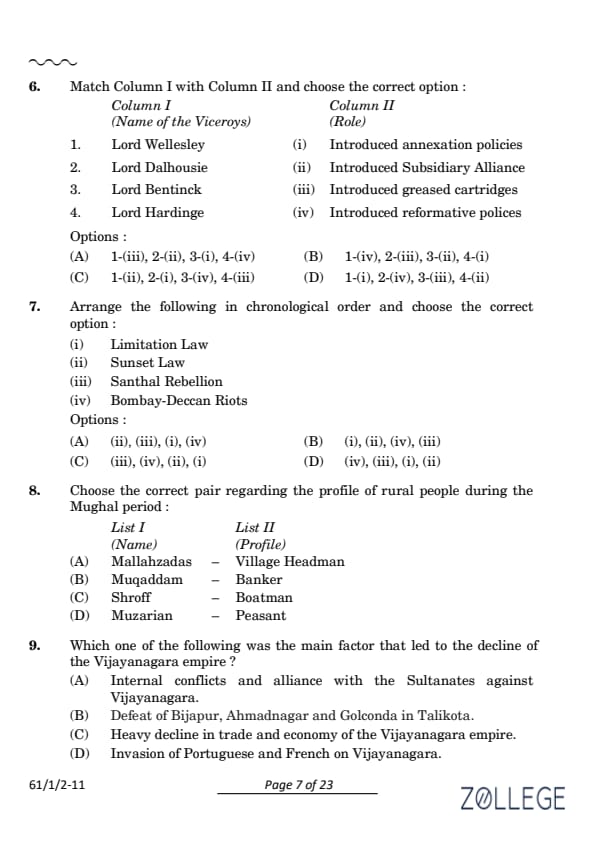
Match Column I with Column II and choose the correct option:
Column I (Name of the Viceroys) Column II (Role)
1. Lord Wellesley (i) Introduced annexation policies
2. Lord Dalhousie (ii) Introduced Subsidiary Alliance
3. Lord Bentinck (iii) Introduced greased cartridges
4. Lord Hardinge (iv) Introduced reformative policies
Correct Answer: (C) 1-(ii), 2-(i), 3-(iv), 4-(iii)
View Solution
- Lord Wellesley introduced the Subsidiary Alliance to expand British control.
- Lord Dalhousie implemented annexation policies like the Doctrine of Lapse.
- Lord Bentinck is known for reformative policies such as abolishing Sati.
- Lord Hardinge introduced greased cartridges, a trigger for the 1857 revolt.
Question 7:
Arrange the following in chronological order and choose the correct option:
(i) Limitation Law
(ii) Sunset Law
(iii) Santhal Rebellion
(iv) Bombay-Deccan Riots
Correct Answer: (A) (ii), (iii), (i), (iv)
View Solution
The correct chronological order is:
1. Sunset Law (introduced during Permanent Settlement)
2. Santhal Rebellion (1855–1856)
3. Limitation Law (1859)
4. Bombay-Deccan Riots (1875)
Question 8:
Choose the correct pair regarding the profile of rural people during the Mughal period:
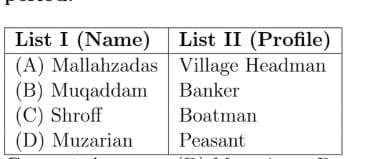
Correct Answer: (D) Muzarian – Peasant
View Solution
Muzarian refers to peasants or cultivators during the Mughal period. They were responsible for agricultural production and paid land revenue.
Question 9:
Which one of the following was the main factor that led to the decline of the Vijayanagara empire?
Correct Answer: (A) Internal conflicts and alliance with the Sultanates against Vijayanagara.
View Solution
The Battle of Talikota (1565) marked the decline of the Vijayanagara empire. The combined forces of Bijapur, Ahmadnagar, and Golconda defeated the Vijayanagara rulers. Internal strife and betrayal also weakened the empire.
Question 10:
Among the following, whose description of ‘degenerated East’ inspired Western theorists to develop the idea of ‘oriental despotism’ ?
Correct Answer: (B) François Bernier
View Solution
François Bernier, a French traveler, described the Mughal Empire as a ’degenerated East’ with a despotic system of governance. His writings heavily influenced the concept of ’oriental despotism,’ which Western theorists used to highlight supposed differences between Eastern and Western political systems.
Question 11:
Which of the following statements is correct regarding Ain-i-Akbari?
Correct Answer: (D) Mulk-abadi deals with the fiscal side of the Mughal empire.
View Solution
The Ain-i-Akbari, written by Abul Fazl, is a part of the Akbar Nama. It includes detailed descriptions of Akbar’s administration.
- Mulk-abadi focuses on the fiscal and land revenue system.
- Sipah-abadi relates to military administration.
- Manzil-abadi deals with the capital’s organization.
Question 12:
Match Column I with Column II and choose the correct option:
Column I (Temple) Column II (Location)
1. Hazara Rama Temple (i) Tamil Nadu
2. Chidambaram Temple (ii) Vijayanagara
3. Brihadishvara Temple (iii) Belur
4. Chennakeshava Temple (iv) Thanjavur
Correct Answer: (B) 1-(ii), 2-(i), 3-(iv), 4-(iii)
View Solution
1. Hazara Rama Temple – Vijayanagara (central to the empire).
2. Chidambaram Temple – Tamil Nadu (dedicated to Lord Shiva).
3. Brihadishvara Temple – Thanjavur (built by the Cholas).
4. Chennakeshava Temple – Belur (built by the Hoysalas).
Question 13:
Who among the following was the mentor of Amir Khusrau?
Correct Answer: (D) Shaikh Nizamuddin Auliya
View Solution
Shaikh Nizamuddin Auliya was a prominent Sufi saint of the Chishti order and served as a mentor to the renowned poet Amir Khusrau, who is also known as the ”Parrot of India.”
Question 14:
In which of the following languages has Al-Biruni translated Sanskrit, Pali, and Prakrit texts in India?
Correct Answer: (B) Arabic
View Solution
Al-Biruni, a Persian scholar, translated many Indian texts into Arabic, including Sanskrit works, during his travels in India. His translations introduced Indian knowledge to the Islamic world.
Question 15:
Which of the following pairs is correctly matched?
Correct Answer: (D) Polyandry – Woman having several husbands
View Solution
- Endogamy refers to marriage within a specific social group or caste.
- Exogamy refers to marriage outside the group.
- Polygyny refers to a man having multiple wives.
- Polyandry refers to a woman having multiple husbands.
Question 16:
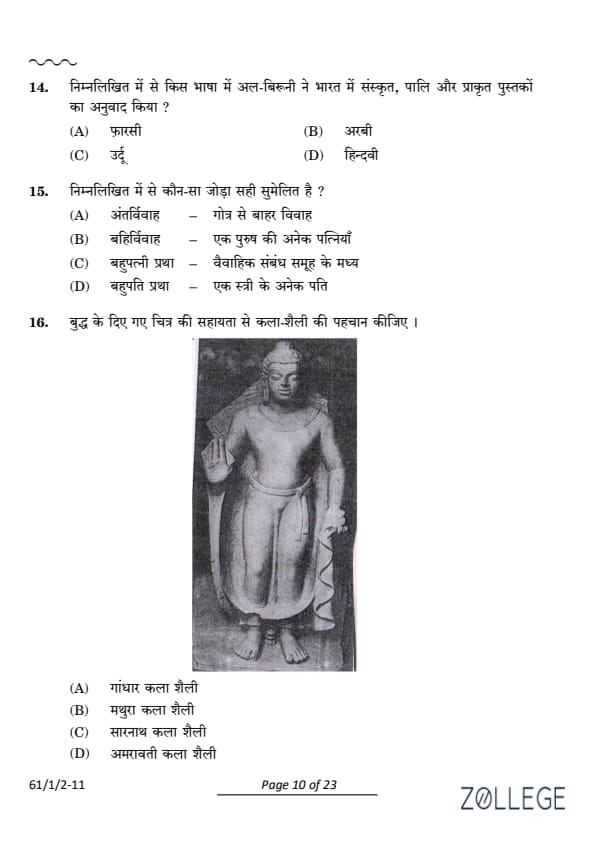
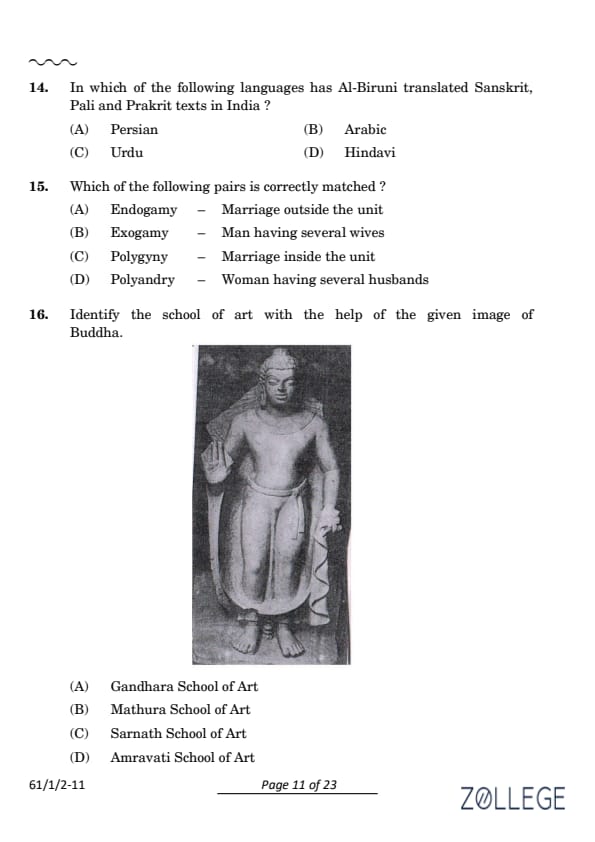
Identify the school of art with the help of the given image of Buddha.

Correct Answer: (A) Gandhara School of Art
View Solution
The Gandhara School of Art is characterized by Greco-Roman influence, evident in the realistic depiction of Buddha with wavy hair and drapery. This image matches the Gandhara style.
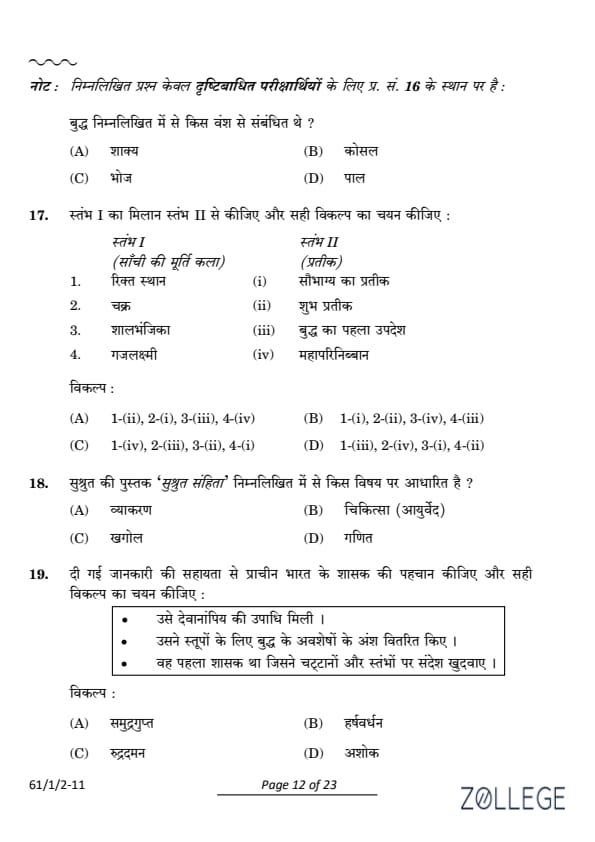
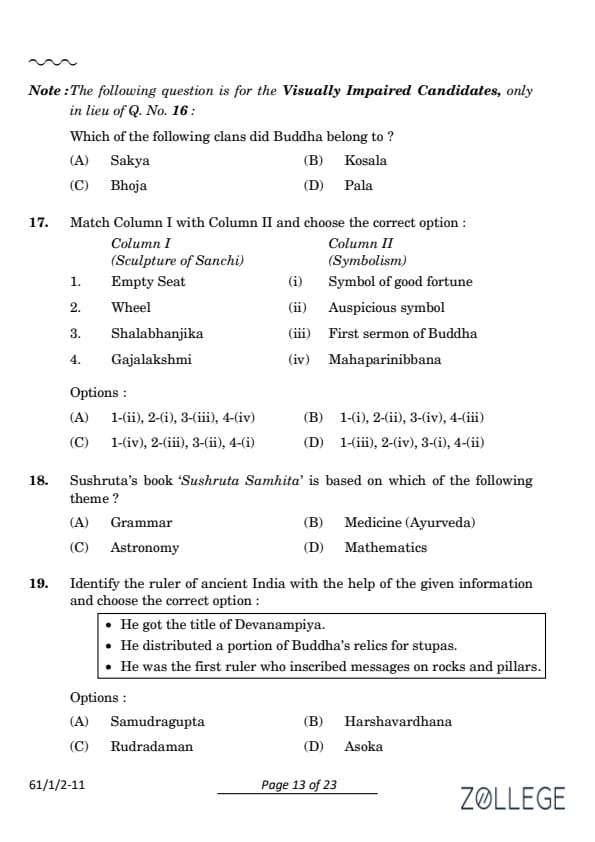
Question 16: (For Visually Impaired Candidates)
Which of the following clans did Buddha belong to?
Correct Answer: (A) Sakya
View Solution
Buddha belonged to the Sakya clan.
Question 17:
Match Column I with Column II and choose the correct option:

Correct Answer: (C) 1-(iv), 2-(iii), 3-(ii), 4-(i)
View Solution
- Empty Seat represents Mahaparinibbana (the death of Buddha).
- Wheel symbolizes the First Sermon of Buddha.
- Shalabhanjika represents an auspicious symbol.
- Gajalakshmi stands for good fortune.
Question 18:
Sushruta’s book ‘Sushruta Samhita’ is based on which of the following themes?
Correct Answer: (B) Medicine (Ayurveda)
View Solution
The ‘Sushruta Samhita’ is an ancient text on surgery and Ayurveda. It provides detailed descriptions of surgical techniques, diseases, and remedies, showcasing the advancements of Indian medicine during ancient times.
Question 19:
Identify the ruler of ancient India with the help of the given information and choose the correct option:
- He got the title of Devanampiya.
- He distributed a portion of Buddha’s relics for stupas.
- He was the first ruler who inscribed messages on rocks and pillars.
Correct Answer: (D) Asoka
View Solution
Emperor Ashoka, known as Devanampiya (Beloved of the Gods), was instrumental in spreading Buddhism. He built stupas to house Buddha’s relics and inscribed messages on rocks and pillars to propagate dharma (moral teachings).
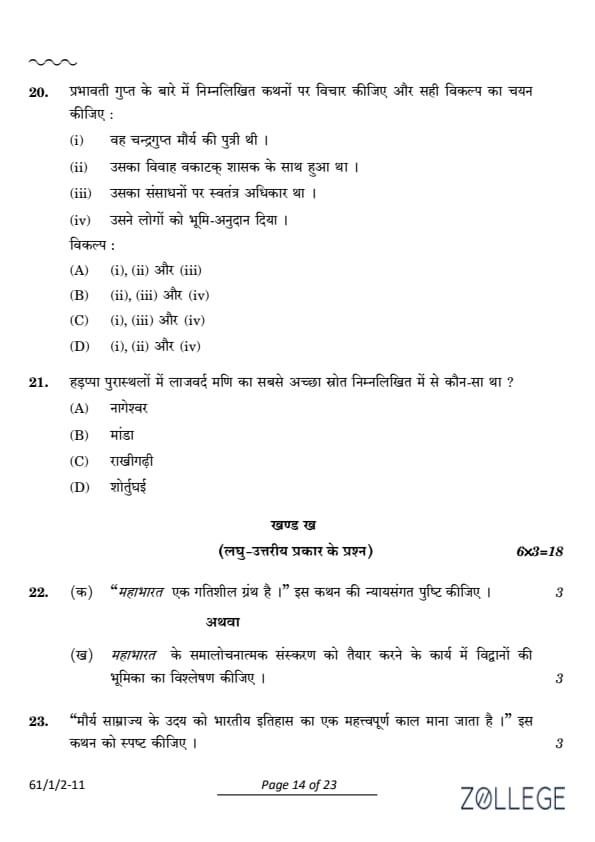
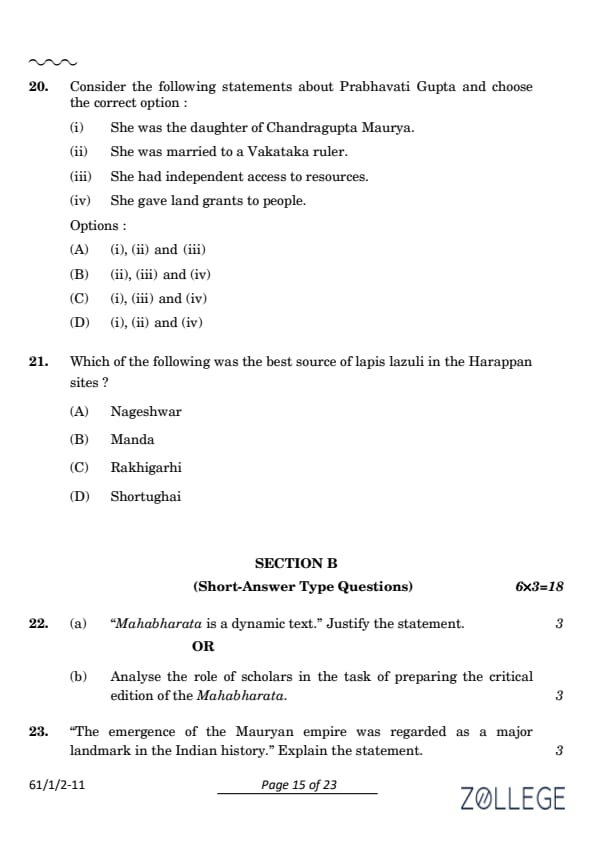
Question 20:
Consider the following statements about Prabhavati Gupta and choose the correct option:
(i) She was the daughter of Chandragupta Maurya.
(ii) She was married to a Vakataka ruler.
(iii) She had independent access to resources.
(iv) She gave land grants to people.
Correct Answer: (B) (ii), (iii) and (iv)
View Solution
Prabhavati Gupta, the daughter of Chandragupta II (not Chandragupta Maurya), was married to Rudrasena II, a Vakataka ruler. After his death, she assumed regency and issued land grants independently, showcasing her access to administrative resources and autonomy.
Question 21:
Which of the following was the best source of lapis lazuli in the Harappan sites?
Correct Answer: (D) Shortughai
View Solution
Shortughai, located in present-day Afghanistan, was the primary source of lapis lazuli for the Harappans. This semi-precious stone was highly valued for trade and used in ornaments, reflecting the extensive trade networks of the Harappan civilization.
SECTION B
Question 22: (a)
“Mahabharata is a dynamic text.” Justify the statement.
View Solution
The Mahabharata evolved over centuries, incorporating diverse stories, philosophies, and moral lessons. It reflects societal norms and values, with constant additions and adaptations. It includes both the main narrative of the Kuru dynasty and supplementary texts like the Bhagavad Gita, making it a living document for Indian culture.
Question 22: (b)
Analyse the role of scholars in preparing the critical edition of the Mahabharata.
View Solution
Scholars meticulously compared manuscripts from different regions to prepare the critical edition of the Mahabharata. This involved identifying interpolations, maintaining original narratives, and ensuring consistency. Their work highlights regional variations, enriching our understanding of the text’s evolution.
Question 23:
“The emergence of the Mauryan empire was regarded as a major landmark in Indian history.” Explain the statement.
View Solution
The Mauryan empire unified a vast territory, centralizing administration under Chandragupta Maurya. Ashoka’s Dhamma policies spread ethical governance and Buddhism. The empire’s trade, urban development, and military strategies shaped ancient Indian political and economic frameworks. It was the first large-scale empire in India.
Question 24:
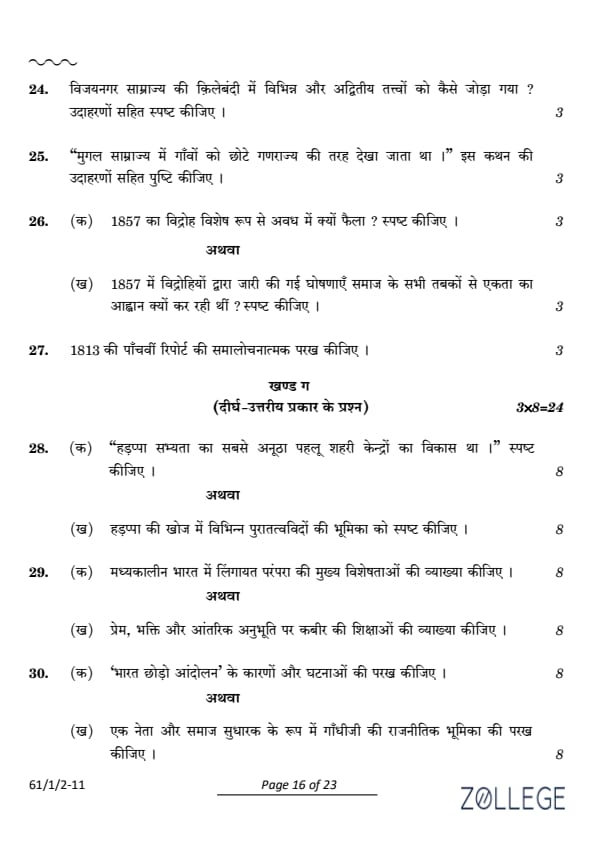
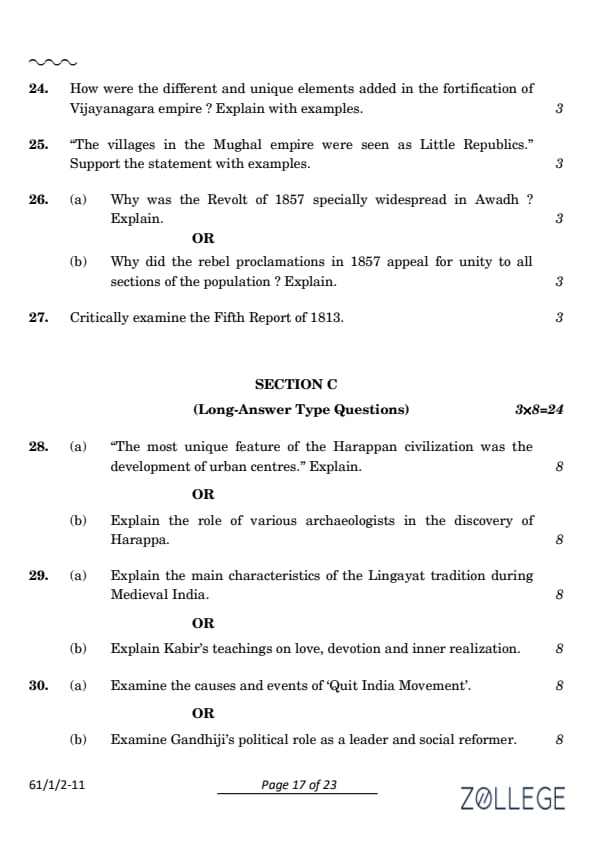
How were the different and unique elements added in the fortification of Vijayanagara empire? Explain with examples.
View Solution
The Vijayanagara empire’s fortifications included massive stone walls with bastions, moats, and gateways designed for defense. The unique feature was the integration of natural elements like hills and rivers into the fort’s structure. For example, the Tungabhadra River acted as a natural defense on one side of the empire. These features reflected advanced military architecture and strategic planning to protect the empire from invasions.
Question 25:
“The villages in the Mughal empire were seen as Little Republics.” Support the statement with examples.
View Solution
Villages in the Mughal empire were self-sufficient units with their own administrative setup. The Panchayat resolved disputes and managed local issues. Villages produced their own food, goods, and services, reducing reliance on external trade. Taxes were collected and submitted to the empire. This autonomous nature of administration and economy led them to be referred to as “Little Republics.”
Question 26: (a)
Why was the Revolt of 1857 specially widespread in Awadh? Explain.
View Solution
The Revolt of 1857 was widespread in Awadh due to the annexation of the region under the Doctrine of Lapse, which angered local rulers and nobles. Peasants, artisans, and soldiers resented high taxes, exploitation, and land confiscations. The sepoys from Awadh played a major role as they were directly affected by British policies, leading to widespread rebellion.
Question 26: (b)
Why did the rebel proclamations in 1857 appeal for unity to all sections of the population? Explain.
View Solution
The rebel proclamations of 1857 emphasized unity among Hindus and Muslims to counter British rule. They highlighted shared grievances like economic exploitation, loss of traditional privileges, and cultural impositions. By invoking religious and social harmony, leaders aimed to unite diverse sections of society under a common cause to strengthen the revolt.
Question 27:
Critically examine the Fifth Report of 1813.
View Solution
The Fifth Report of 1813 was a parliamentary document highlighting British mismanagement in India, especially by the East India Company. It exposed the exploitation of Indian resources and the adverse impact of revenue policies on peasants. Critics argue that it also justified increased British control over the company. While it provided valuable information, it was biased in promoting imperialist interests.
SECTION C
Question 28: (a)
“The most unique feature of the Harappan civilization was the development of urban centres.” Explain.
View Solution
The Harappan civilization, one of the earliest urban cultures, showcased advanced urban planning:
1. Grid Pattern Town Planning: Cities like Mohenjo-Daro and Harappa were built on a grid layout, with streets intersecting at right angles.
2. Drainage System: A sophisticated underground drainage system ensured sanitation and hygiene.
3. Public and Private Architecture: Cities had public structures like the Great Bath and granaries alongside private dwellings with standardized bricks.
4. Trade and Commerce: Harappan cities were centers of trade, with evidence of interactions with Mesopotamia and Central Asia.
5. Standardized Weights and Measures: Uniform systems of weights and measures indicate organized economic activities.
Question 28: (b)
Explain the role of various archaeologists in the discovery of Harappa.
View Solution
The discovery of Harappa and Mohenjo-Daro marked a breakthrough in understanding ancient Indian history:
1. Alexander Cunningham: In the 19th century, Cunningham discovered Harappan seals and connected them to an ancient culture.
2. Daya Ram Sahni: In 1921, he led excavations at Harappa, unveiling the urban culture.
3. R.D. Banerji: His excavations at Mohenjo-Daro in 1922 revealed its significance as a major Harappan city.
4. John Marshall: As Director-General of the Archaeological Survey of India, he ensured systematic excavations and documented findings.
5. Mortimer Wheeler: He emphasized stratigraphy and contributed to refining excavation techniques at Harappan sites.
Question 29: (a)
Explain the main characteristics of the Lingayat tradition during Medieval India.
View Solution
The Lingayat tradition, initiated by Basavanna in the 12th century, emerged as a significant socio-religious movement in Karnataka. It was based on devotion to Lord Shiva as the supreme deity, rejecting Brahminical dominance and rituals.
- Equality and Social Reform: The Lingayats rejected caste hierarchies, idol worship, and Vedic rituals. They promoted social equality, opposing practices like child marriage and the caste system.
- Philosophy: Their philosophy emphasized the concept of “Ishtalinga,” a personal symbol of Shiva worn by devotees, signifying direct communion with God without intermediaries.
- Religious Practices: Lingayats practiced simple worship, focusing on devotion (bhakti) and ethical living. They encouraged the upliftment of marginalized sections of society.
- Vachanas: The Lingayat saints composed vachanas, simple Kannada poems that spread their teachings and emphasized devotion, morality, and social reform.
- Rejection of Rituals: They rejected practices like idol worship, sacrificial offerings, and pilgrimages, emphasizing inner purity and spiritual connection.
- Role of Women: Women played an active role in the Lingayat tradition. Akkamahadevi, a prominent poet-saint, is celebrated for her vachanas and devotion to Shiva.
The Lingayat tradition challenged orthodox practices and brought social transformation in Medieval India, making it one of the most reformist movements of its time. Its teachings continue to influence society in Karnataka and other regions.
Question 29: (b)
Explain Kabir’s teachings on love, devotion, and inner realization.
View Solution
Kabir, a 15th-century Bhakti saint, spread his teachings through simple yet profound poetry, advocating love, devotion, and inner realization as paths to spiritual enlightenment.
Key Teachings:
1. Unity of God: Kabir emphasized monotheism, rejecting distinctions between Hindu and Muslim practices. He referred to God as Nirguna (formless), accessible to all through devotion and love.
2. Rejection of Rituals: Kabir criticized idolatry, pilgrimage, and caste-based rituals, focusing on inner spirituality rather than external practices.
3. Love and Devotion (Bhakti): He believed that unconditional love and devotion to God could transcend all social and religious barriers, fostering unity and harmony.
4. Inner Realization: Kabir stressed self-introspection and the realization of the divine within oneself. He used metaphors like the ”inner light” to convey his message.
5. Critique of Orthodoxy: Kabir questioned religious orthodoxy and hypocrisy, emphasizing that true spirituality lies in purity of heart and actions.
6. Universal Brotherhood: Kabir’s teachings promoted equality, condemning discrimination based on caste, religion, or social status.
Legacy:
Kabir’s teachings are preserved in the ”Bijak” and other collections of his verses. His ideology inspired both Hindu and Muslim communities, fostering the synthesis of Bhakti and Sufi traditions. His philosophy continues to influence Indian spiritual thought.
Question 30: (a)
Examine the causes and events of the ‘Quit India Movement’.
View Solution
The Quit India Movement, launched by Mahatma Gandhi on 8 August 1942, was a significant milestone in India’s freedom struggle. It aimed for complete independence from British rule.
Causes:
1. Failure of Cripps Mission (1942): The British proposal for Indian self-rule after World War II failed, angering Indian leaders.
2. Impact of World War II: Exploitation of Indian resources for the war effort and the subsequent economic crisis created widespread discontent.
3. Rising Nationalist Sentiment: The demand for complete independence grew stronger due to British repression and exploitation.
4. Global Anti-Colonial Wave: The decline of colonialism worldwide inspired Indians to intensify their struggle.
Events:
1. Launch of the Movement: On 8 August 1942, Gandhi called for the British to “Quit India” and gave the slogan “Do or Die.” The All India Congress Committee passed a resolution demanding immediate independence.
2. Mass Arrests: The British arrested prominent leaders, including Gandhi, Nehru, and Patel, to suppress the movement.
3. Violent and Nonviolent Protests: Despite Gandhi’s insistence on nonviolence, the movement witnessed strikes, demonstrations, and attacks on government buildings and communication networks.
4. Participation of the Masses: Students, peasants, workers, and women actively participated in the movement, reflecting widespread discontent.
5. Repression by the British: The British used brutal force, imprisoning thousands, killing protesters, and imposing censorship.
Outcome:
Although the movement was suppressed by 1944, it demonstrated the unity and determination of Indians against colonial rule. It convinced the British that their hold on India was untenable, paving the way for independence in 1947.
Question 30: (b)
Examine Gandhiji’s political role as a leader and social reformer.
View Solution
Mahatma Gandhi, known as the ”Father of the Nation,” played a pivotal role in India’s freedom struggle and social reform. His leadership combined political strategies with moral and ethical principles, transforming the Indian independence movement.
Political Role:
1. Satyagraha and Nonviolence: Gandhi advocated nonviolent resistance (Satyagraha) against British rule, launching movements like the Champaran Satyagraha (1917) and Kheda Satyagraha (1918).
2. Mass Movements: He led nationwide campaigns like the Non-Cooperation Movement (1920), Civil Disobedience Movement (1930), and Quit India Movement (1942), mobilizing millions.
3. Constructive Programs: Gandhi emphasized self-reliance through initiatives like khadi production, rural upliftment, and education reforms to strengthen India’s socio-economic fabric.
4. Leadership Style: Gandhi united people across caste, religion, and region, making the independence movement inclusive and mass-based.
Social Reforms:
1. Caste and Untouchability: Gandhi campaigned against untouchability, referring to Dalits as ”Harijans” (children of God). He worked to integrate marginalized communities into mainstream society.
2. Women’s Empowerment: Gandhi encouraged women’s participation in the freedom struggle, breaking traditional gender norms.
3. Communal Harmony: He promoted unity between Hindus and Muslims, emphasizing tolerance and understanding.
4. Simple Living: Gandhi’s philosophy of simplicity and self-discipline inspired people to adopt a lifestyle aligned with ethical and moral values.
Legacy:
Gandhi’s ideas of nonviolence, truth, and self-reliance left a lasting impact on global leaders and movements. His vision for a free and equitable India continues to inspire social and political reforms worldwide.
SECTION D
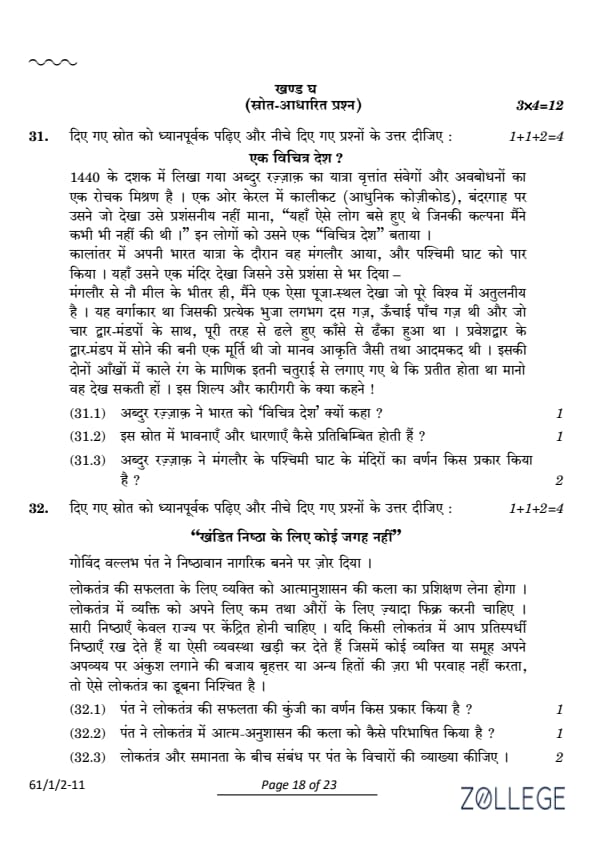
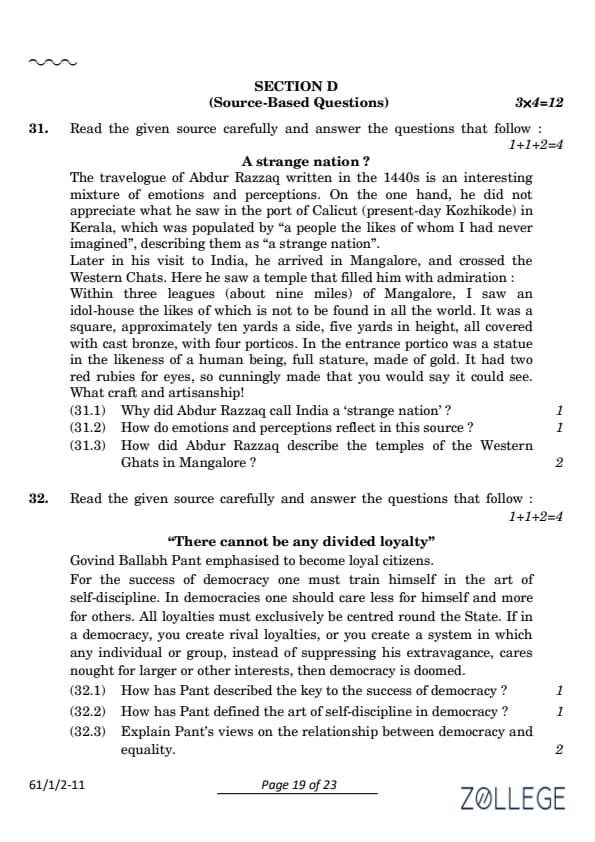
A strange nation?
The travelogue of Abdur Razzaq written in the 1440s is an interesting mixture of emotions and perceptions. On the one hand, he did not appreciate what he saw in the port of Calicut (present-day Kozhikode) in Kerala, which was populated by “a people the likes of whom I had never imagined”, describing them as “a strange nation”. Later in his visit to India, he arrived in Mangalore and crossed the Western Ghats. Here he saw a temple that filled him with admiration:
Read More
“Within three leagues (about nine miles) of Mangalore, I saw an idol-house the likes of which is not to be found in all the world. It was a square, approximately ten yards a side, five yards in height, all covered with cast bronze, with four porticos. In the entrance portico was a statue in the likeness of a human being, full stature, made of gold. It had two red rubies for eyes, so cunningly made that you would say it could see. What craft and artisanship!”
Question 31: (1)
Why did Abdur Razzaq call India a ‘strange nation’ ?
View Solution
Abdur Razzaq called India a ‘strange nation’ due to its unfamiliar customs, cultural practices, and diverse people, which were different from anything he had encountered. The bustling trade and social diversity of Calicut left him amazed and perplexed.
Question 31: (2)
How do emotions and perceptions reflect in this source?
View Solution
The source reflects a mix of amazement and admiration. While Abdur Razzaq was bewildered by the unfamiliar customs of Calicut, he admired the grandeur and artistry of Indian temples, showcasing his complex emotions.
Question 31: (3)
How did Abdur Razzaq describe the temples of the Western Ghats in Mangalore?
View Solution
Abdur Razzaq described the temples as magnificent, with bronze-covered structures and intricate sculptures. He was particularly impressed by the golden statue with ruby eyes in the entrance, which reflected extraordinary craftsmanship.
“There cannot be any divided loyalty”
Govind Ballabh Pant emphasized the need to become loyal citizens. For the success of democracy, one must train himself in the art of self-discipline. In democracies, one should care less for himself and more for others. All loyalties must exclusively be centred around the State. If in a democracy, you create rival loyalties, or you create a system in which any individual or group, instead of suppressing his extravagance, cares nought for larger or other interests, then democracy is doomed.
Question 32: (1)
“There cannot be any divided loyalty”
How has Pant described the key to the success of democracy?
View Solution
Pant described loyalty to the State as the key to democracy’s success. Citizens must prioritize the nation’s interests over personal or group interests to ensure democracy functions effectively.
Question 32: (2)
How has Pant defined the art of self-discipline in democracy?
View Solution
Pant defined self-discipline in democracy as the ability of citizens to control personal desires and extravagance, focusing on the welfare of others and the State to maintain democratic values.
Question 32: (3)
Explain Pant’s views on the relationship between democracy and equality.
View Solution
Pant emphasized that democracy is based on equality, where every individual enjoys equal rights and opportunities. Suppressing rivalries and uniting under a shared purpose strengthens democracy and ensures fairness.
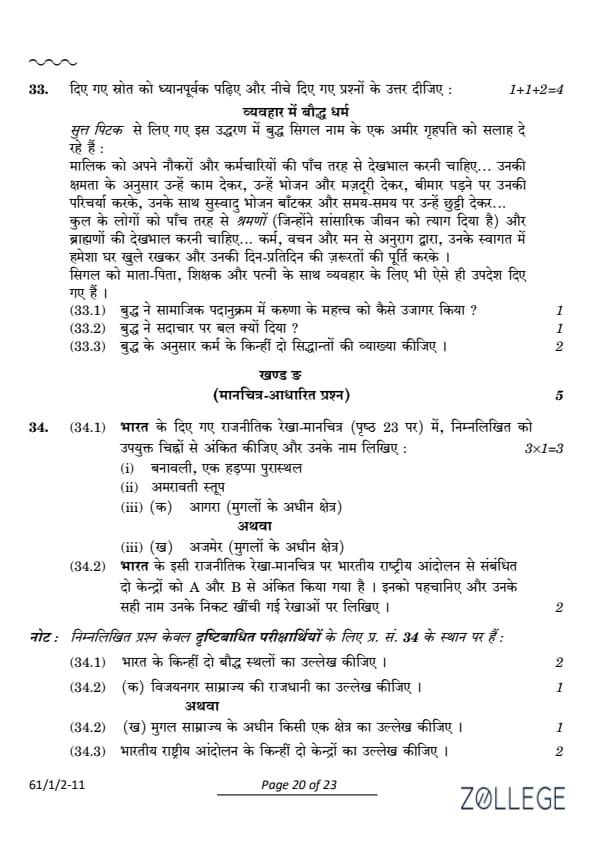
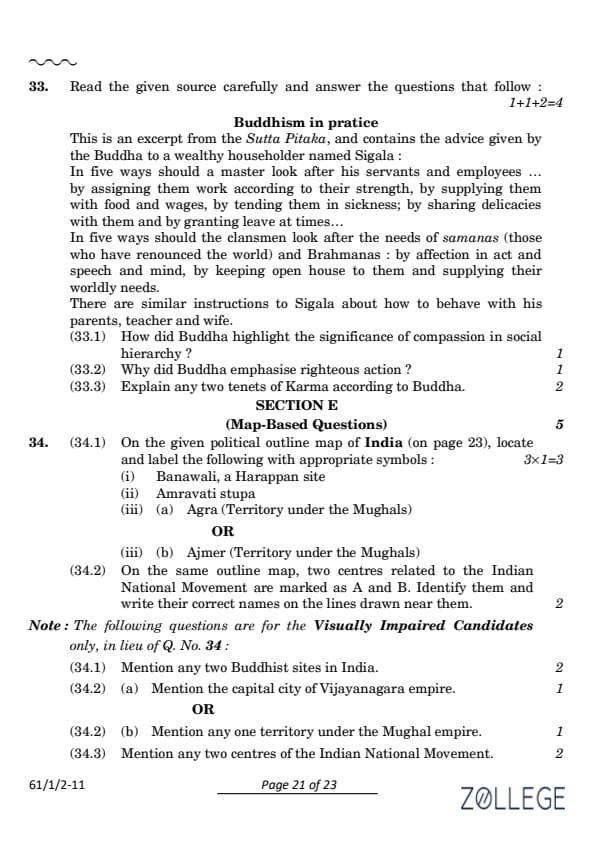
Buddhism in practice
This is an excerpt from the Sutta Pitaka, and contains the advice given by the Buddha to a wealthy householder named Sigala:
Read More
“In five ways should a master look after his servants and employees . . . by assigning them work according to their strength, by supplying them with food and wages, by tending them in sickness; by sharing delicacies with them and by granting leave at times. . .
In five ways should the clansmen look after the needs of samanas (those who have renounced the world) and Brahmanas: by affection in act and speech and mind, by keeping open house to them and supplying their worldly needs.
There are similar instructions to Sigala about how to behave with his parents, teacher and wife.”
Question 33: (1)
“Buddhism in practice”
How did Buddha highlight the significance of compassion in social hierarchy?
View Solution
Buddha emphasized compassion by advising masters to treat servants fairly, provide wages, care for them in sickness, and support their needs. This humane approach ensured dignity within social hierarchies.
Question 33: (2)
Why did Buddha emphasize righteous action?
View Solution
Buddha emphasized righteous action to promote ethical behavior and harmony. Actions guided by fairness, mindfulness, and kindness lead to personal and societal well-being, ensuring a balanced life.
Question 33: (3)
Explain any two tenets of Karma according to Buddha.
View Solution
1. Law of Cause and Effect: Every action has consequences that shape one’s present and future lives.
2. Moral Responsibility: Actions performed with good intent lead to positive outcomes, while harmful deeds result in suffering.
SECTION E
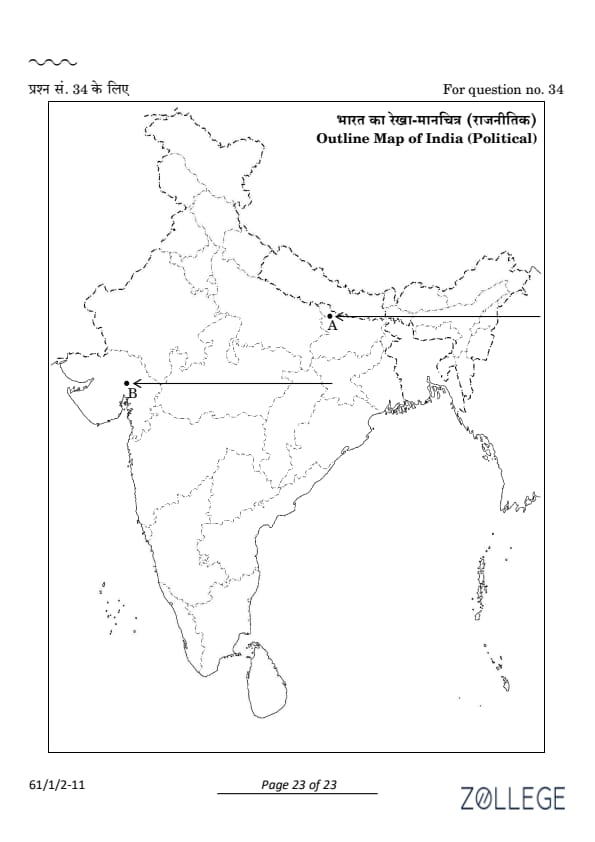
Question 34: Map Based Question
On the given political outline map of India, locate and label the following with appropriate symbols:
1. Banawali, a Harappan site
2. Amravati stupa
3. Agra (Territory under the Mughals)
OR
On the same outline map, two centres related to the Indian National Movement are marked as A and B. Identify them and write their correct names on the lines drawn near them.
View Solution
• A: Champaran (Bihar): Known for the Champaran Satyagraha of 1917, where Gandhi launched a movement against the exploitation of indigo farmers by British planters.
• B: Dandi (Gujarat): Famous for the Dandi March in 1930, where Gandhi led a non-violent protest against the salt tax imposed by the British.
Question 34: (For Visually Impaired Candidates) (1)
Mention any two Buddhist sites in India.
View Solution
• Sanchi (Madhya Pradesh)
• Bodh Gaya (Bihar)
Question 34: (For Visually Impaired Candidates) (2) (a)
Mention the capital city of Vijayanagara empire.
View Solution
Hampi (Karnataka)
Question 34: (For Visually Impaired Candidates) (2) (b)
Mention any one territory under the Mughal empire.
View Solution
Agra (Uttar Pradesh)
Question 34: (For Visually Impaired Candidates) (3)
Mention any two centres of the Indian National Movement.
View Solution
• Ahmedabad (Gujarat)
• Allahabad (Uttar Pradesh)

*The article might have information for the previous academic years, please refer the official website of the exam.