
CBSE Class 12 History set 2 Question Paper Pdf - Check Solutions with Answer Key Pdf

.jpg?tr=h-55,w-55,c-force)
Content Strategist|Tech-innovator|National Hackathon Winner | Updated On - Jan 24, 2025
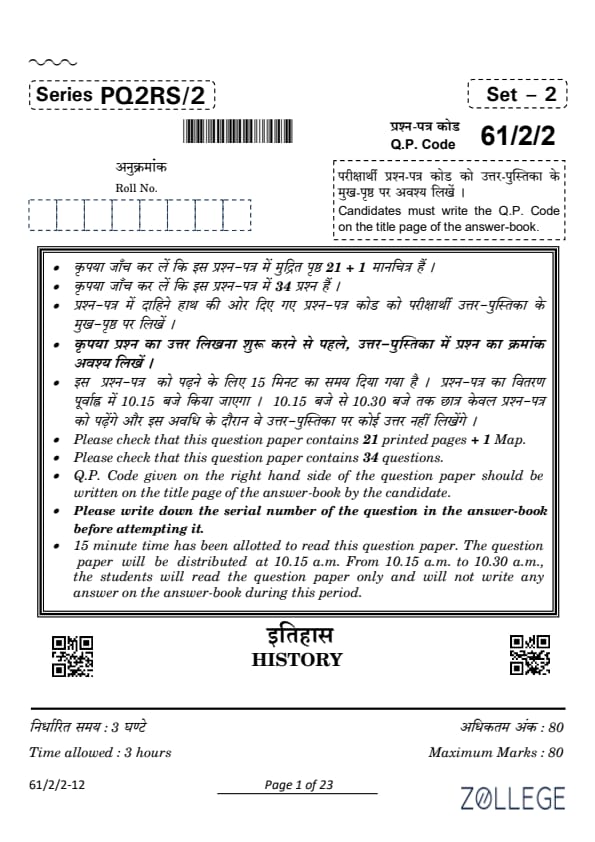
CBSE Class 12 2024 History Set 2 Question Paper (Q.P. Code: 61/2/2) is available for download. The exam was successfully conducted by CBSE on 28 March in the morning session from 10:30 AM to 1:30 PM. As per the student’s initial reactions, the CBSE Class 12 2024 History Set 2 Question Paper was reported as Moderate. The Ancient History section was reported as Easy to Moderate, the Medieval History section as Moderate, and the Modern History section as Moderate to Challenging.
CBSE Class 12 2024 History Set 2 61/2/2 Question Paper with Answer Key PDF
Candidates can download the CBSE Class 12 History Question Paper with Solution and Answer Key PDFs for Set 2 Question Paper (Code: 61/2/2) using the link below.
| CBSE Class 12 2024 History Question Paper with Answer Key |  Download Download |
Check Solution |
CBSE Class 12 2024 History Questions with Solutions
SECTION A
Question 1:
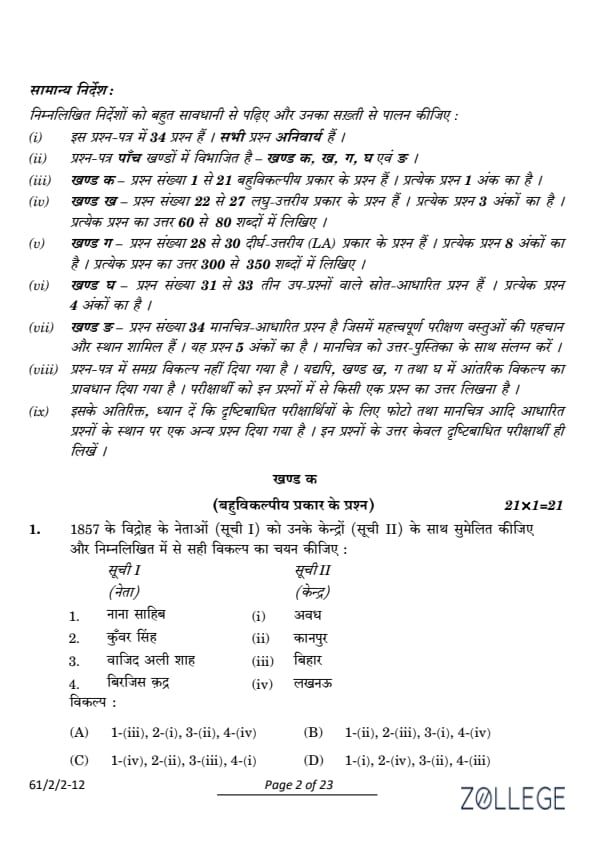
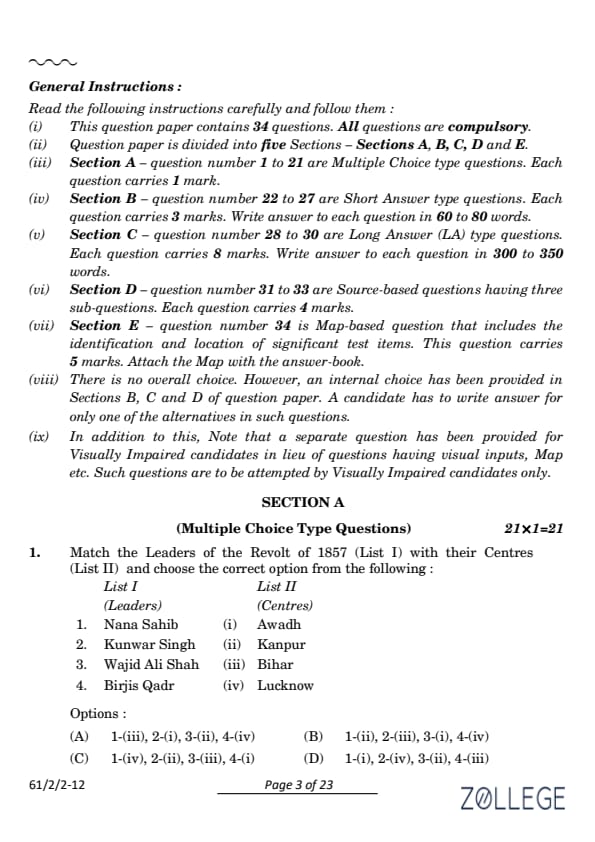
Match the Leaders of the Revolt of 1857 (List I) with their Centres (List II) and choose the correct option from the following:

View Solution
The correct matching is:
- Nana Sahib: (iii) Bihar.
- Kunwar Singh: (i) Awadh.
- Wajid Ali Shah: (ii) Kanpur.
- Birjis Qadr: (iv) Lucknow.
These leaders were central to the Revolt of 1857 and played significant roles in their respective regions.
Question 2:
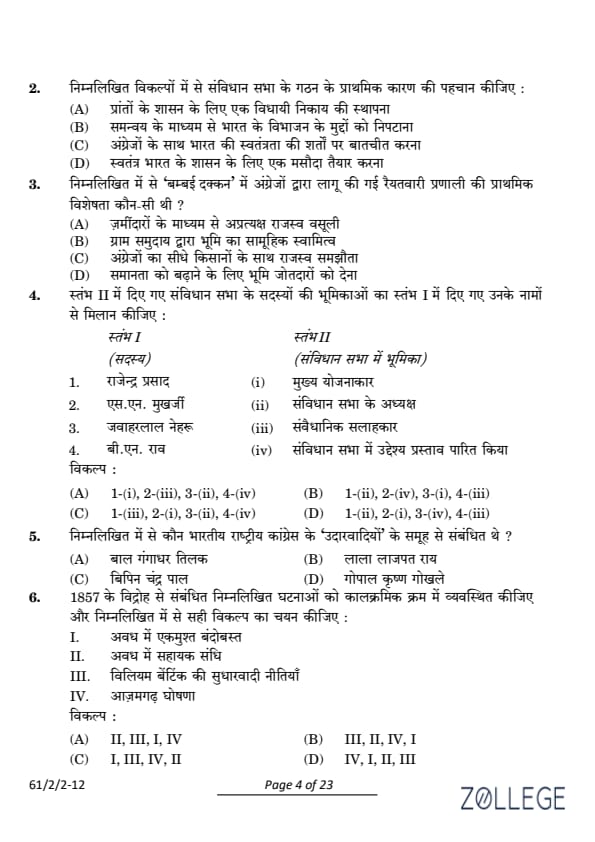
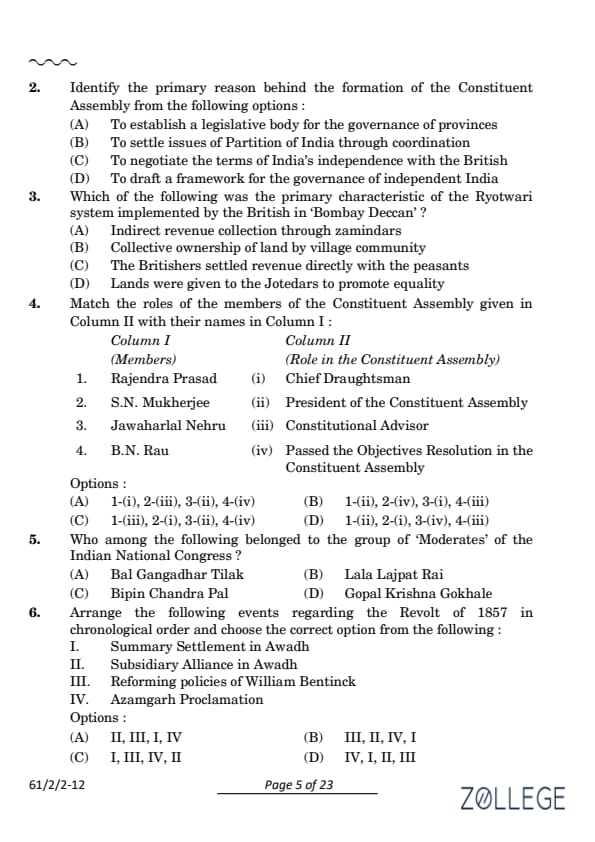
Identify the primary reason behind the formation of the Constituent Assembly from the following options:
View Solution
The primary reason for the formation of the Constituent Assembly was to draft a framework for the governance of independent India. This body was responsible for drafting the Indian Constitution, setting up democratic governance in India post-independence.
Question 3:
Which of the following was the primary characteristic of the Ryotwari system implemented by the British in ‘Bombay Deccan’?
View Solution
The Ryotwari system was a land revenue system where the British government directly collected taxes from individual farmers (ryots), bypassing zamindars.
Question 4:
Match the roles of the members of the Constituent Assembly given in Column II with their names in Column I:

View Solution
The correct matching is:
- Rajendra Prasad: (i) Chief Draughtsman.
- S.N. Mukherjee: (iii) Constitutional Advisor.
- Jawaharlal Nehru: (ii) President of the Constituent Assembly.
- B.N. Rau: (iv) Passed the Objectives Resolution in the Constituent Assembly.
Question 5:
Who among the following belonged to the group of ‘Moderates’ of the Indian National Congress?
View Solution
Gopal Krishna Gokhale was a key figure in the Moderate group of the Indian National Congress, advocating for reforms through constitutional methods.
Question 6:
Arrange the following events regarding the Revolt of 1857 in chronological order and choose the correct option from the following:
I. Summary Settlement in Awadh
II. Subsidiary Alliance in Awadh
III. Reforming policies of William Bentinck
IV. Azamgarh Proclamation
View Solution
The correct chronological order of events in the Revolt of 1857 is:
- III: Reforming policies of William Bentinck.
- II: Subsidiary Alliance in Awadh.
- IV: Azamgarh Proclamation.
- I: Summary Settlement in Awadh.
Question 7:
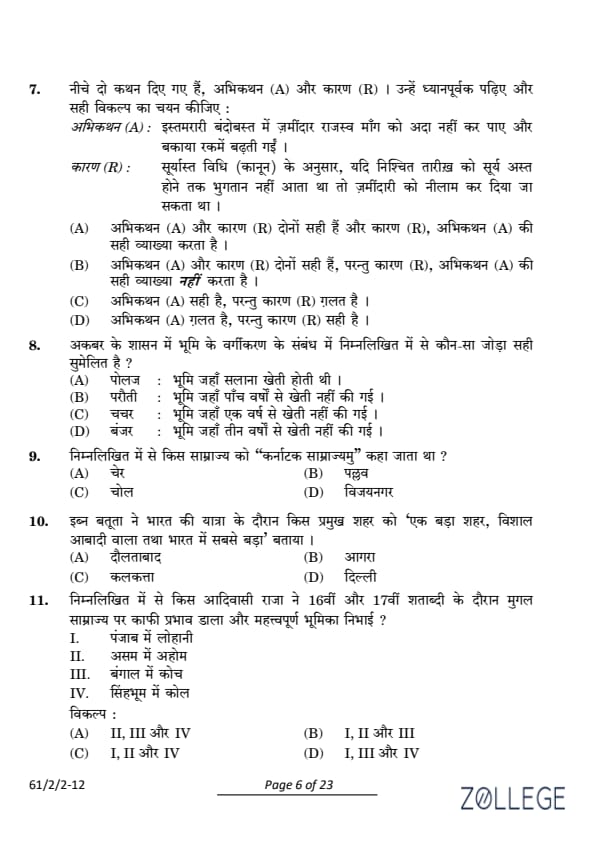
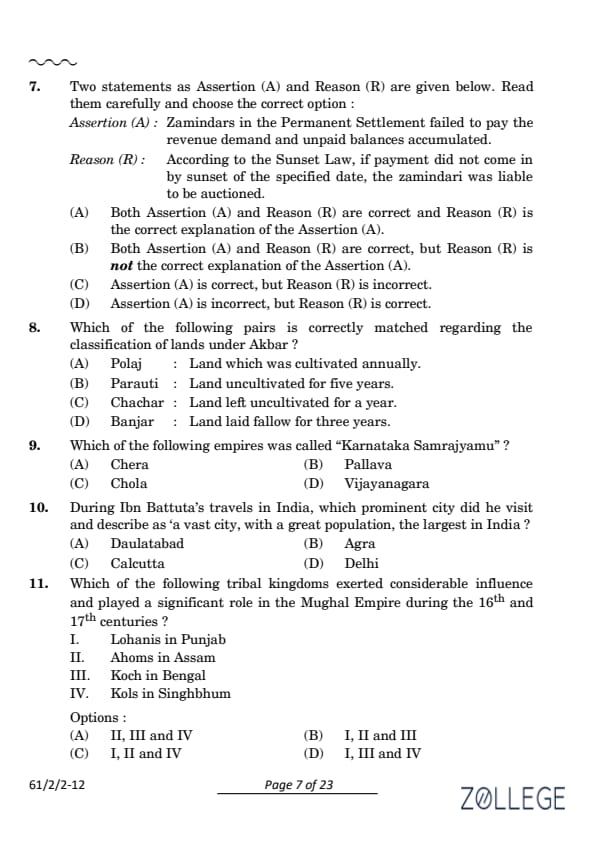
Which of the following was the primary characteristic of the Ryotwari system implemented by the British in ‘Bombay Deccan’?
View Solution
The Ryotwari system was a land revenue system where the British government directly collected taxes from individual farmers (ryots), bypassing zamindars.
Question 8:
Which of the following pairs is correctly matched regarding the classification of lands under Akbar?
View Solution
Under Akbar’s land classification system:
- Polaj: Cultivated annually.
- Parauti: Uncultivated for a few years.
- Chachar: Uncultivated for a year.
- Banjar: Fallow for three years.
Question 9:
Which of the following empires was called “Karnataka Samrajyam”?
View Solution
The Vijayanagara Empire was known as “Karnataka Samrajyam” due to its dominance over the region now known as Karnataka.
Question 10:
During Ibn Battuta’s travels in India, which prominent city did he visit and describe as ‘a vast city, with a great population, the largest in India’?
View Solution
Ibn Battuta described Delhi as a vast city, the largest in India, reflecting its prominence during the Delhi Sultanate.
Question 11:
Which of the following tribal kingdoms exerted considerable influence and played a significant role in the Mughal Empire during the 16th and 17th centuries?
I. Lohanis in Punjab
II. Ahoms in Assam
III. Koch in Bengal
IV. Kols in Singhbhum
View Solution
The correct answer is II, III, and IV as the Ahoms in Assam, Kochi in Bengal, and Kols in Singhbhum exerted significant influence on the Mughal Empire.
Question 12:
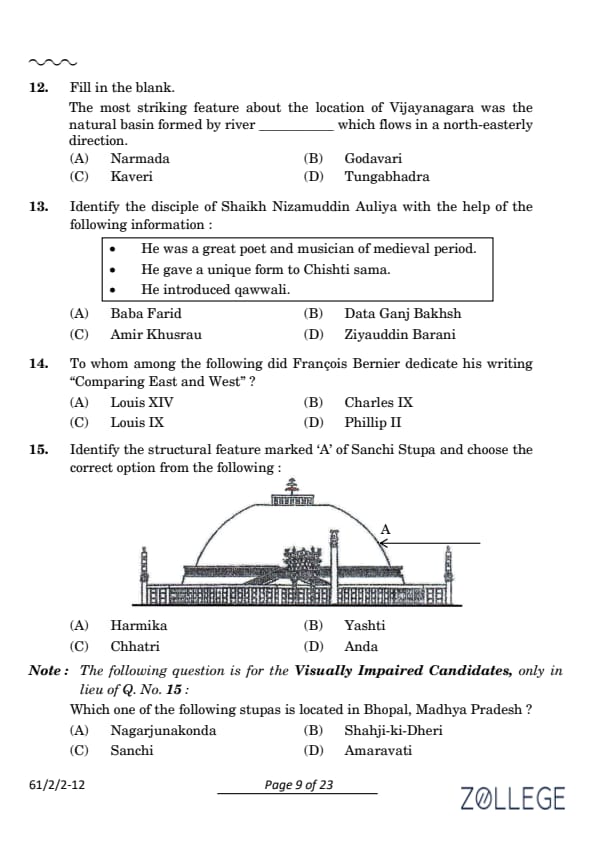
The most striking feature about the location of Vijayanagara was the natural basin formed by river __________, which flows in a north-easterly direction:
View Solution
The Vijayanagara Empire was located near the river Tungabhadra, which provided the natural basin and strategic advantage for the city.
Question 13:
Identify the disciple of Shaikh Nizamuddin Auliya with the help of the following information:

View Solution
Amir Khusrau was the famous disciple of Shaikh Nizamuddin Auliya, known for his poetry and contribution to Sufi music.
Question 14:
To whom among the following did François Bernier dedicate his writing “Comparing East and West”?
View Solution
François Bernier, a French philosopher and traveler, dedicated his writings "Comparing East and West" to King Louis XIV of France.
Question 15:
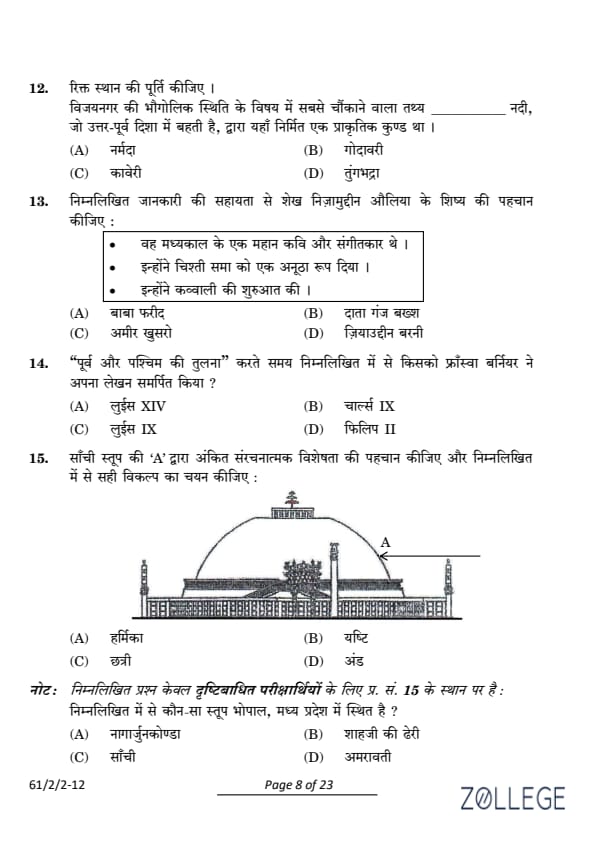
Identify the structural feature marked ‘A’ of Sanchi Stupa and choose the correct option:

View Solution
The feature marked ‘A’ in the image of Sanchi Stupa is the Anda, which is the dome-like structure that represents the cosmic mountain.
Question 15 (For Visually Impaired Candidates):
Which one of the following stupas is located in Bhopal, Madhya Pradesh?
View Solution
The Sanchi Stupa is one of the oldest stone structures in India, located in Sanchi, Madhya Pradesh, near Bhopal. Built by Emperor Ashoka, it is a significant Buddhist monument and a UNESCO World Heritage Site.
Question 16:
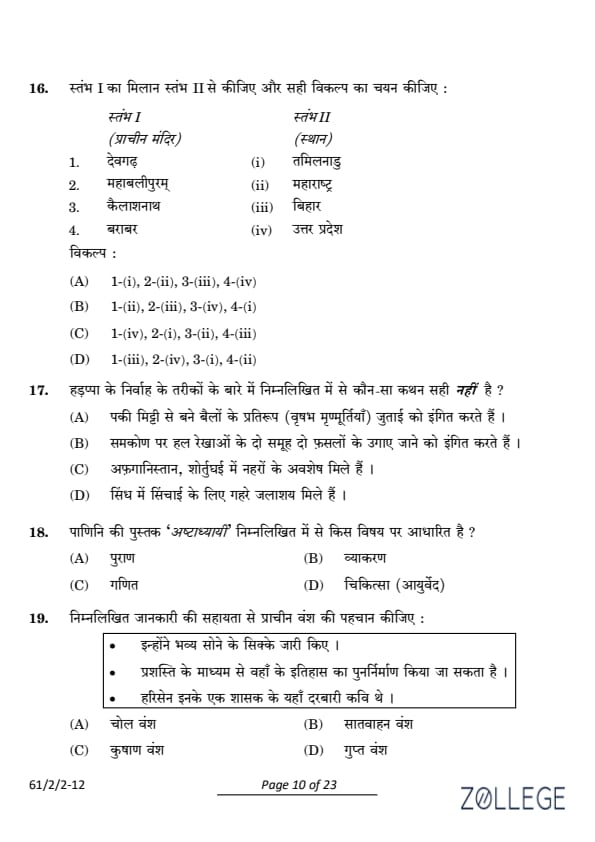
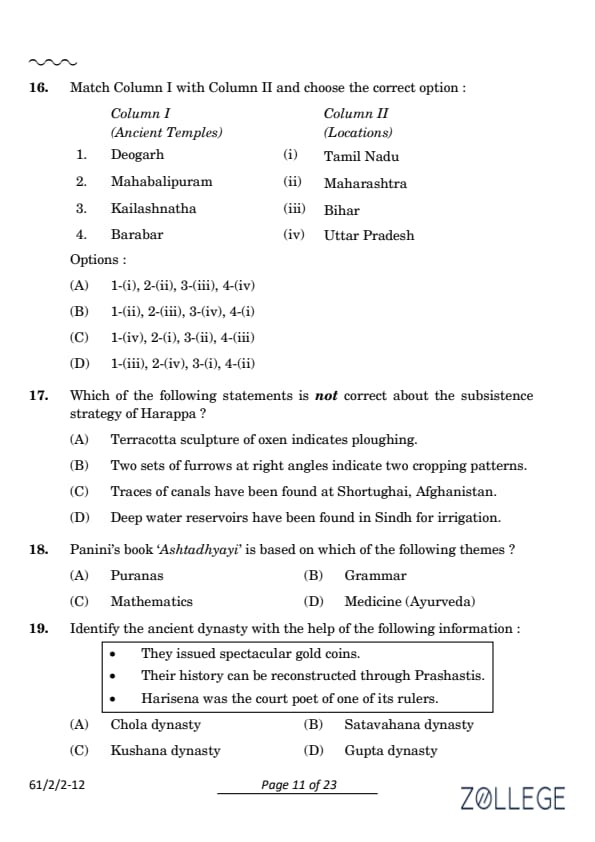
Match Column I with Column II and choose the correct option:

View Solution
The correct matching is:
- Deogarh: (i) Tamil Nadu
- Mahabalipuram: (ii) Maharashtra
- Kailashnatha: (iii) Bihar
- Barabar: (iv) Uttar Pradesh
Question 17:
Which of the following statements is not correct about the subsistence strategy of Harappa?
View Solution
Statement 4 is incorrect because while the Harappan civilization had sophisticated water management systems, deep water reservoirs have not been conclusively found in Sindh for irrigation purposes.
Question 18:
Panini’s book "Ashtadhyayi" is based on which of the following themes?
View Solution
Panini’s "Ashtadhyayi" is a treatise on Sanskrit grammar and is considered a foundational work in the field of linguistic studies.
Question 19:
Identify the ancient dynasty with the help of the following information:

View Solution
The Satavahana dynasty is known for issuing spectacular gold coins and can be traced through their Prashastis. Harisena was the court poet of one of its rulers.
Question 20:
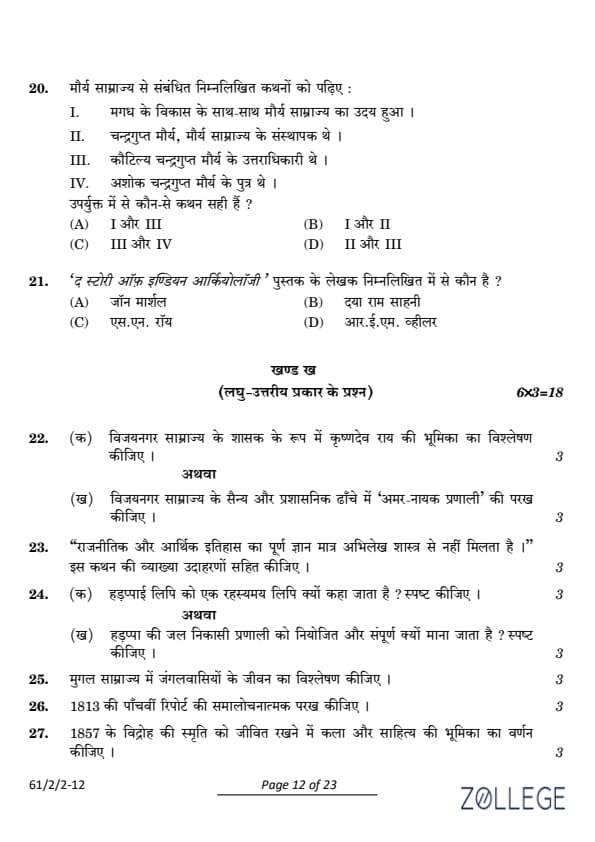
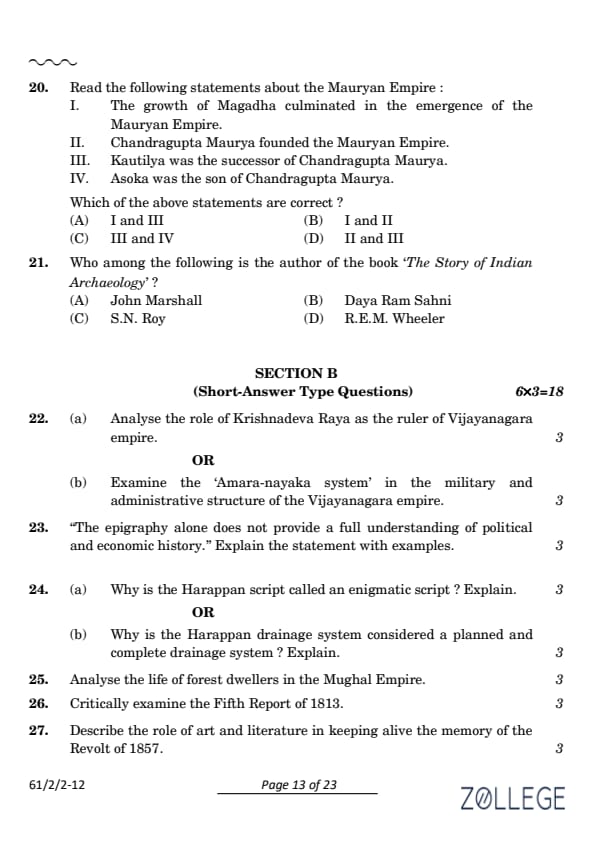
Read the following statements about the Mauryan Empire:
- The growth of Magadha culminated in the emergence of the Mauryan Empire.
- Chandragupta Maurya founded the Mauryan Empire.
- Kautilya was the successor of Chandragupta Maurya.
- Ashoka was the son of Chandragupta Maurya.
Select the correct pair:
View Solution
- Statement I: True. The growth of the Magadhan empire led to the establishment of the Mauryan Empire.
- Statement II: True. Chandragupta Maurya is credited with founding the Mauryan Empire.
- Statement III: False. Kautilya (Chanakya) was an advisor, not the successor, of Chandragupta Maurya.
- Statement IV: False. Ashoka was the grandson, not the son, of Chandragupta Maurya.
Question 21:
Who among the following is the author of the book "The Story of Indian Archaeology"?
View Solution
S.N. Roy is the author of the book "The Story of Indian Archaeology," which details the history and discoveries of Indian archaeology.
SECTION B
Question 22(a):
Analyse the role of Krishnadeva Raya as the ruler of the Vijayanagara Empire.
View Solution
Krishnadeva Raya was one of the greatest rulers of the Vijayanagara Empire. His contributions include:
- Military Success: Expanded the empire’s boundaries through conquests.
- Promotion of Trade: Encouraged foreign trade and established economic prosperity.
- Cultural Patronage: Promoted literature in Kannada, Telugu, and Sanskrit.
- Administrative Efficiency: Focused on the welfare of his people and effective governance.
His reign marked a period of cultural and political flourishing in southern India.
Question 22(b):
Examine the ‘Amara-nayaka system’ in the military and administrative structure of the Vijayanagara Empire.
View Solution
The Amara-nayaka system was a crucial administrative and military system in the Vijayanagara Empire. Key features include:
- Decentralized Governance: Nayakas were assigned regions to manage and were responsible for collecting taxes.
- Military Responsibility: Nayakas maintained troops for the empire’s defense.
- Revenue Collection: Taxes collected by the Nayakas were partially forwarded to the central authority, ensuring stability and control.
This system ensured effective governance and military readiness across vast territories.
Question 23:
“The epigraphy alone does not provide a full understanding of political and economic history.” Explain the statement with examples.
View Solution
Epigraphy, while valuable for understanding ancient inscriptions, does not provide a complete picture of political and economic history. For instance, inscriptions may highlight royal decrees or religious donations, but they often omit details about daily life, social structures, or economic conditions. Archaeological evidence and literary sources are necessary to fill in these gaps.
Question 24(a):
(a) Why is the Harappan script called an enigmatic script?
View Solution
The Harappan script is called enigmatic because it remains undeciphered despite extensive research. The script consists of symbols that appear on seals and pottery, but no clear connection has been made to any known language. This has made it difficult to fully understand the social, political, and economic structure of the Harappan Civilization.
Question 24(b):
(b) Why is the Harappan drainage system considered a planned and complete drainage system? Explain.
View Solution
The Harappan drainage system is considered planned and complete because of its well-organized layout. Cities like Mohenjo-Daro featured covered drains, wells, and a sophisticated sewage system, with drainage channels running along the streets, ensuring efficient water flow. This system reflects the advanced engineering and urban planning of the Harappan Civilization.
Question 25:
Analyse the life of forest dwellers in the Mughal Empire.
View Solution
Forest dwellers in the Mughal Empire, also known as ”van-giris,” played an essential role in providing resources like timber, honey, and medicinal plants. Their life was often marginalized, and they were regulated by the state for forest conservation and revenue collection. Despite their isolation, they contributed to the economy and were often engaged in trade with surrounding settlements.
Question 26:
Critically examine the Fifth Report of 1813.
View Solution
The Fifth Report of 1813, presented to the British Parliament, critically examined the British colonial administration in India. It acknowledged the failure to introduce reforms in the administration and highlighted the social and economic impacts of British policies. While the report provided useful data, it also served as a justification for continued British rule, promoting the idea of British superiority.
Question 27:
Describe the role of art and literature in keeping alive the memory of the Revolt of 1857.
View Solution
Art and literature played a crucial role in preserving the memory of the Revolt of 1857. Poets, writers, and artists captured the events of the uprising in their works, creating narratives of resistance and heroism. These creative expressions helped memorialize the sacrifices made during the revolt and inspired future generations to remember the struggle for independence.
SECTION C
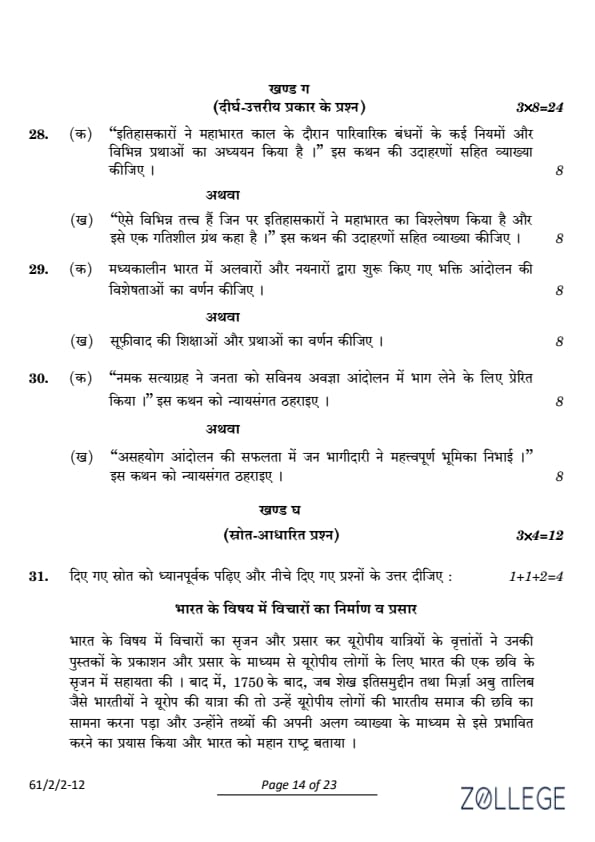
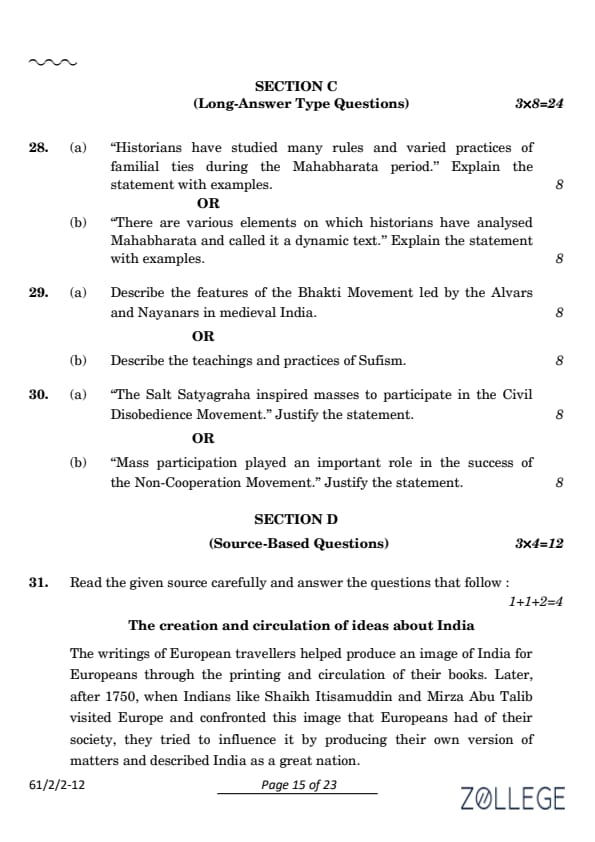
Question 28:
(a) “Historians have studied many rules and varied practices of familial ties during the Mahabharata period.” Explain the statement with examples.
View Solution
Historians have long studied the familial structures in the Mahabharata period to understand social, political, and cultural dynamics. The Mahabharata depicts various rules concerning marriage, inheritance, and kinship, such as the practice of ”Niyoga,” where a woman could bear children for her deceased husband’s brother. Examples include Draupadi’s polyandrous marriage to the Pandavas and the concept of dharma (duty) influencing family relationships. These practices are indicative of the social norms of the time.
(b) “There are various elements on which historians have analysed Mahabharata and called it a dynamic text.” Explain the statement with examples.
View Solution
Historians analyze the Mahabharata as a dynamic text due to its rich layers of storytelling, symbolism, and multiple interpretations. The text combines mythology, philosophy, politics, and ethics, reflecting changing social norms and ideologies over time. For instance, the Bhagavad Gita, a part of the Mahabharata, is analyzed as a philosophical dialogue on duty, righteousness, and the individual’s role in society. This adaptability to diverse interpretations makes the Mahabharata a dynamic text.
Question 29:
(a) Describe the features of the Bhakti Movement led by the Alvars and Nayanars in medieval India.
View Solution
The Bhakti Movement, which flourished in medieval India, emphasized personal devotion to God rather than rituals. The Alvars (devotees of Vishnu) and Nayanars (devotees of Shiva) were prominent figures in the early Bhakti Movement. They composed hymns that expressed love and devotion to their chosen deities, rejecting caste distinctions. The movement emphasized accessibility to the divine for all individuals, regardless of social status. It played a key role in shaping religious practices in South India.
(b) Describe the teachings and practices of Sufism.
View Solution
Sufism, the mystical dimension of Islam, emphasizes the inner, personal experience of God. Sufis believe in a direct connection with the divine through love, meditation, and devotion. The key practices include dhikr (remembrance of God), recitation of poetry, and spiritual music, such as qawwali. Sufism seeks to transcend the material world and unite the soul with God. Sufi saints like Khwaja Moinuddin Chishti played a key role in spreading these ideas across India.
Question 30:
(a) “The Salt Satyagraha inspired masses to participate in the Civil Disobedience Movement.” Justify the statement.
View Solution
The Salt Satyagraha, initiated by Mahatma Gandhi in 1930, became a pivotal event in the Civil Disobedience Movement. Gandhi’s defiance against the British monopoly on salt production mobilized millions, inspiring a wide section of Indian society to join the struggle for independence. The movement united people from various backgrounds, making the fight against colonial rule more inclusive and widespread. It marked a significant shift towards mass participation in India’s freedom struggle.
(b) “Mass participation played an important role in the success of the Non-Cooperation Movement.” Justify the statement.
View Solution
The Non-Cooperation Movement (1920-1922), led by Mahatma Gandhi, saw the active involvement of millions of Indians across the country. The movement aimed at nonviolent resistance to British rule by boycotting British goods, schools, and services. The mass participation of diverse social groups, including peasants, students, and workers, made the movement successful in weakening British authority. The widespread appeal and collective action brought India closer to independence.
SECTION D
Question 31:
Read the given source carefully and answer the questions that follow:
The writings of European travellers helped produce an image of India for Europeans through the printing and circulation of their books. Later, after 1750, when Indians like Shaikh Itisamuddin and Mirza Abu Talib visited Europe and confronted this image that Europeans had of their society, they tried to influence it by producing their own version of democracy and describing India as a great nation.
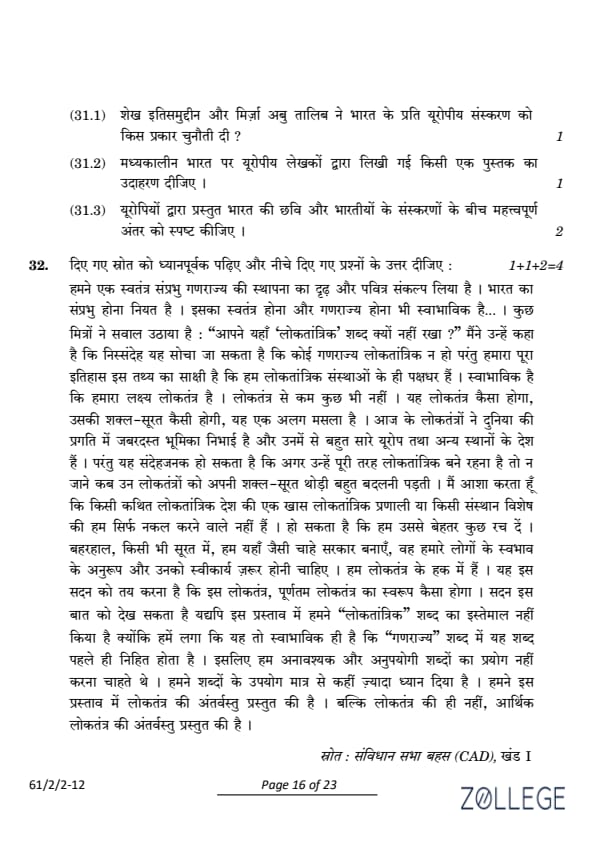
(31.1) In what way did Shaikh Itisamuddin and Mirza Abu Talib challenge the version of Europeans towards India?
View Solution
Shaikh Itisamuddin and Mirza Abu Talib challenged the European perception of India by presenting a more positive image of the country. They emphasized India’s rich culture, philosophy, and history, countering the colonial narrative that depicted India as a land of backwardness. Through their writings, they highlighted India’s intellectual traditions, governance systems, and contributions to civilization.
(31.2) Give any one example of a book authored by European writers on Medieval India.
View Solution
One example of a book written by a European author on Medieval India is ”The History of India” by James Mill. This book presents a colonial perspective on Indian history and played a significant role in shaping British views on India.
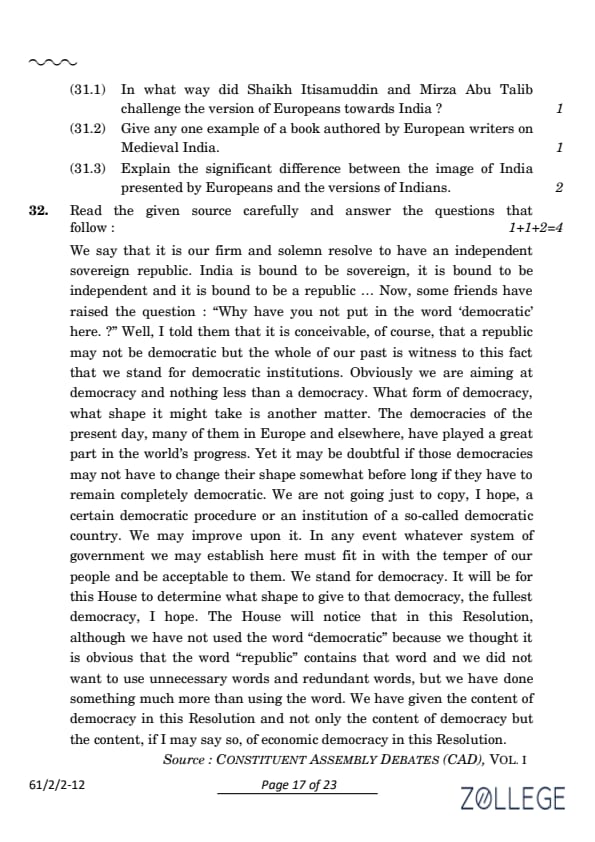
(31.3) Explain the significant difference between the image of India presented by Europeans and the versions of Indians.
View Solution
Europeans often portrayed India as a land of chaos, superstition, and stagnation. In contrast, Indian intellectuals like Shaikh Itisamuddin and Mirza Abu Talib highlighted India’s ancient wisdom, contributions to science and philosophy, and rich cultural heritage. Indians presented an image of their country as a flourishing civilization, counteracting the negative stereotypes propagated by Europeans.
Question 32:
Read the given source carefully and answer the questions that follow:
We say that it is our firm and solemn resolve to have an independent sovereign republic. India is bound to be sovereign, it is bound to be independent and it is bound to be a republic . . . Now, some friends have raised the question: “Why have you not put in the word ‘democratic’ here?” Well, I told them that it is conceivable, of course, that a republic may not be democratic but the whole of our past is witness to this fact that we stand for democratic institutions. Obviously we are aiming at democracy and nothing less than a democracy. What form of democracy, what shape it might take is another matter. The democracies of the present day, many of them in Europe and elsewhere, have played a great part in the world’s progress. Yet it may be doubtful if those democracies may not have to change their shape somewhat before long if they have to remain completely democratic. We are not going just to copy, I hope, a certain democratic procedure or an institution of a so-called democratic country. We may improve upon it. In any event whatever system of government we may establish here must fit in with the temper of our people and be acceptable to them. We stand for democracy. It will be for this House to determine what shape to give to that democracy, the fullest democracy, I hope. The House will notice that in this Resolution, although we have not used the word ”democratic” because we thought it is obvious that the word ”republic” contains that word and we did not want to use unnecessary words and redundant words, but we have done something much more than using the word. We have given the content of democracy in this Resolution and not only the content of democracy but the content, if I may say so, of economic democracy in this Resolution.
(32.1) Mention the ‘firm and solemn resolve’ expressed in the passage.
View Solution
The ‘firm and solemn resolve’ expressed in the passage is the commitment to establish an independent, sovereign, and republican India. The speaker emphasizes that India is destined to be a republic and is determined to achieve complete independence and sovereignty, while also aspiring to a democratic form of governance.
(32.2) How does the passage emphasize the commitment to democracy?
View Solution
The passage emphasizes the commitment to democracy by clarifying that India stands for democratic institutions and that the goal is to establish a democracy, although the form of that democracy may evolve. It stresses that India does not merely aim to replicate existing democratic systems but to create one that aligns with the country’s needs and the will of the people.
(32.3) How is democracy explained in the context of republic in the passage?
View Solution
In the passage, democracy is explained in the context of a republic by asserting that while the word ‘democratic’ is not explicitly used, the idea of democracy is inherently present in the notion of a republic. The speaker clarifies that India’s republic will not simply copy existing democratic models but will evolve its own form of democracy that suits its people and their aspirations.
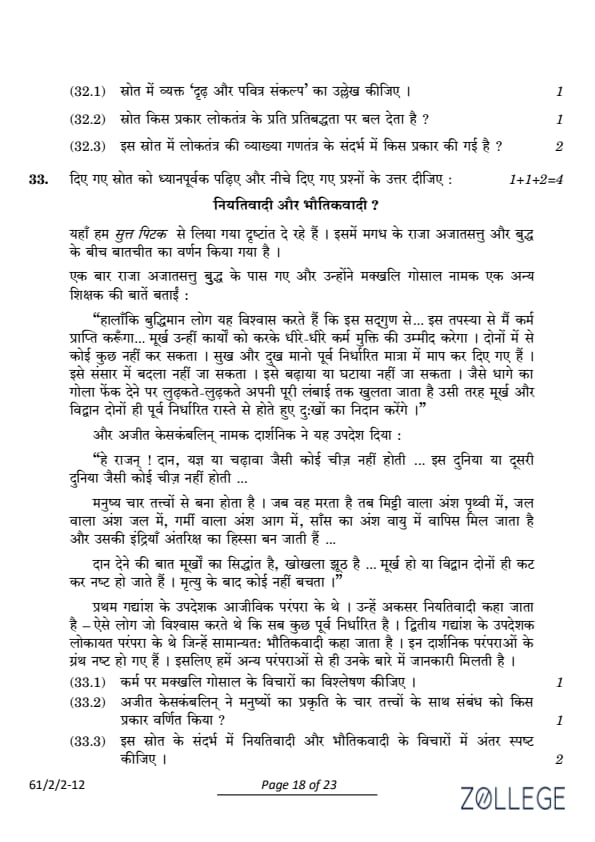
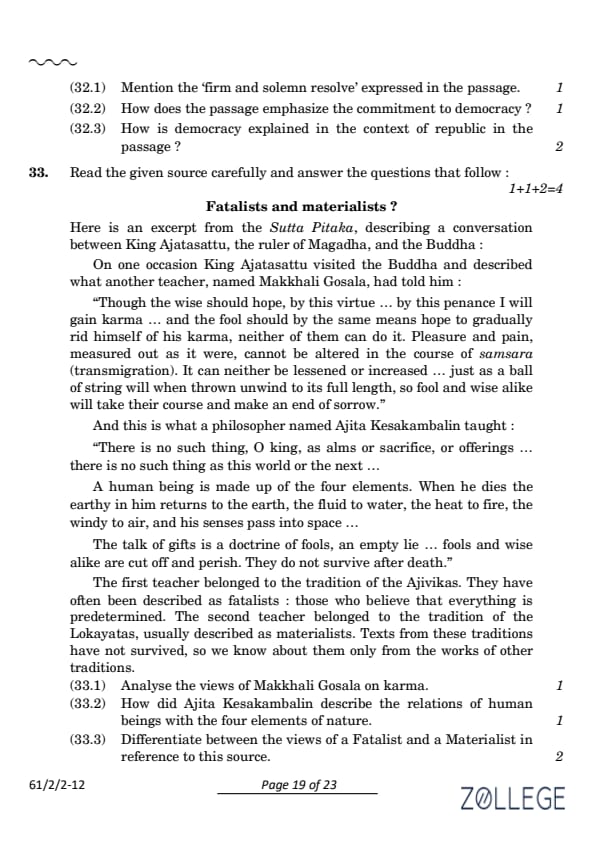
Question 33:
Read the given source carefully and answer the questions that follow:
Here is an excerpt from the Sutta Pitaka, describing a conversation between King Ajatasattu, the ruler of Magadha, and the Buddha:
“Though the wise should hope, by this virtue ... by this penance I will gain karma ... and the fool should by the same means hope to gradually rid himself of his karma, neither of them can do it. Pleasure and pain, measured out as it were, cannot be altered in the course of samsara (transmigration). It can neither be lessened or increased ... just as a ball of string will, when thrown unwound to its full length, so fool and wise alike will take their course and make an end of sorrow.”
And this is what a philosopher named Ajita Kesakambalin taught:
“There is no such thing, O king, as alms or sacrifice, or offerings ... there is no such thing as this world or the next ...”
A human being is made up of the four elements. When he dies, the earthy in him returns to the earth, the fluid to water, the heat to fire, the windy to air, and his senses pass into space ... The talk of gifts is a doctrine of fools, an empty lie ... fools and wise alike are cut off and perish. They do not survive after death.”
(33.1) Analyse the views of Makkhali Gosala on karma.
View Solution
Makkhali Gosala, a philosopher from the Ajivika tradition, believed that karma could not be changed or influenced. According to his views, both the wise and the fool alike would experience the consequences of their karma in a predestined manner. Karma, he argued, could neither be reduced nor increased, and the course of one’s life was governed by fixed natural laws.
Question 33:
(33.2) How did Ajita Kesakambalin describe the relations of human beings with the four elements of nature?
View Solution
Ajita Kesakambalin, another philosopher from the materialist school, described human beings as being composed of the four elements: earth, water, fire, and air. According to his philosophy, upon death, these elements would return to their respective natural states. He rejected the idea of an afterlife, claiming that death resulted in the dissolution of the human body into these elements.
Question 33:
(33.3) Differentiate between the views of a Fatalist and a Materialist in this source.
View Solution
The Fatalist, represented by Makkhali Gosala, believed that everything was predestined, and karma could not be altered. In contrast, the Materialist, represented by Ajita Kesakambalin, denied the existence of karma and afterlife, asserting that humans were merely composed of the four elements, and upon death, they dissolved back into these elements. Thus, the Fatalist sees life’s events as preordained, while the Materialist views life as a natural process with no spiritual dimensions.
SECTION E
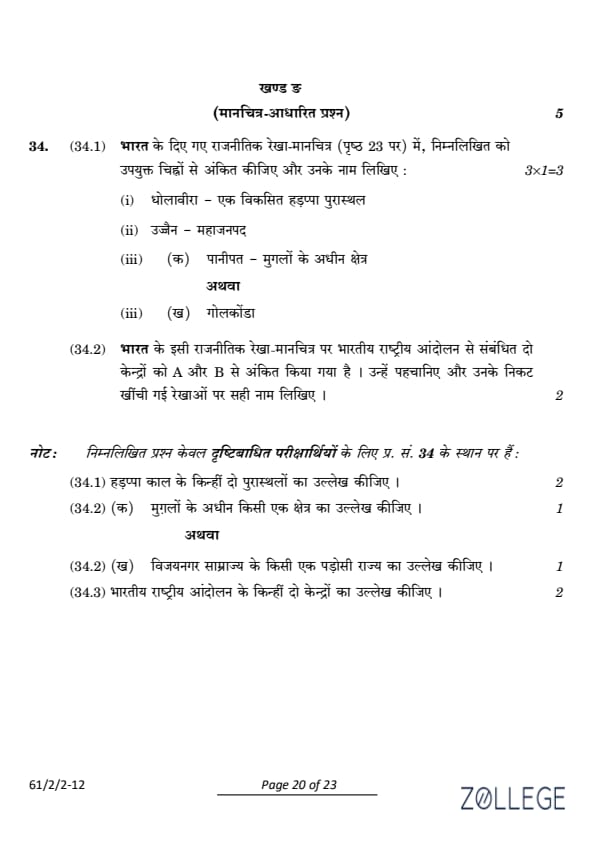
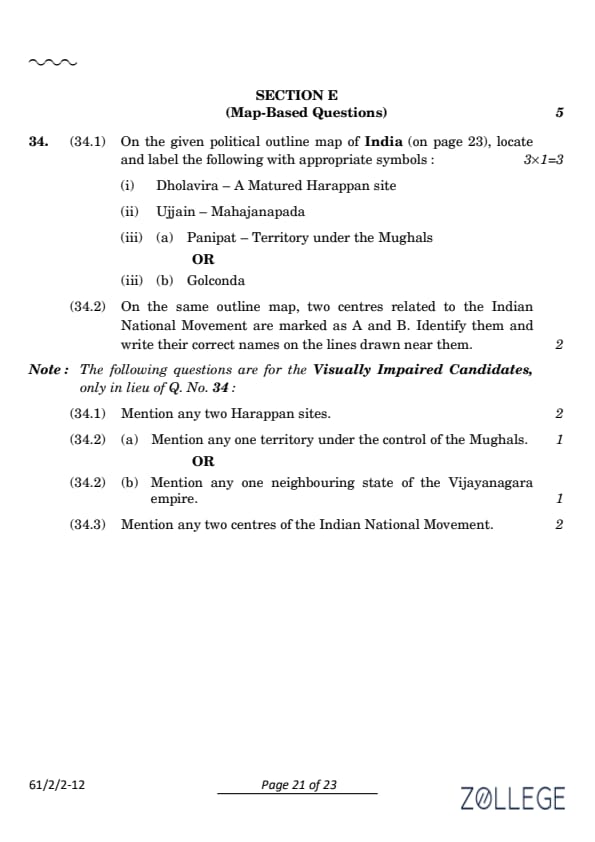
Question 34:
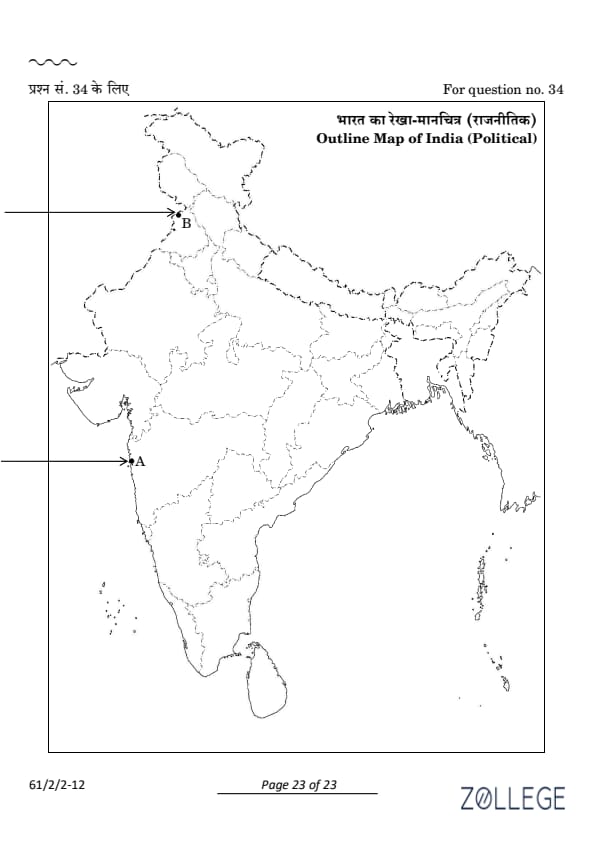
On the given political outline map of India (on page 24), locate and label the following with appropriate symbols:
- Dholavira – A Matured Harappan site
- Ujjain – Mahajanapada
- Panipat – Territory under the Mughals or Golconda
View Solution
On the map, locate and label the following: 1. Dholavira: A Matured Harappan site, located in Gujarat, is known for its well-planned city structures and advanced water management systems. 2. Ujjain: A prominent Mahajanapada in Madhya Pradesh, Ujjain was a major center for trade, culture, and religion during ancient times. 3. Panipat: Located in Haryana, Panipat was a significant location during the Mughal Empire, known for the battles fought there. 4. Golconda: Situated near Hyderabad in Telangana, Golconda was a thriving center for diamond trade and military fortifications.
Question 34:
Note : The following questions are for the Visually Impaired Candidates, only in lieu of Q. No. 34 :
(34.1) Mention any two Harappan sites.
View Solution
Two prominent Harappan sites are: 1. Mohenjo-Daro – Located in present-day Pakistan, it was one of the most advanced cities of the Indus Valley Civilization. 2. Harappa – Located in Pakistan, Harappa is another key site of the Indus Valley Civilization, known for its well-organized city planning and drainage systems.
(34.2) (a) Mention any one territory under the control of the Mughals.
View Solution
One territory under the control of the Mughals was Bengal. It was an important province in the Mughal Empire, known for its agricultural wealth and vibrant trade networks.
(34.2) (b) Mention any one neighboring state of the Vijayanagara empire.
View Solution
One neighboring state of the Vijayanagara Empire was the Bahmani Sultanate. It was located to the north of Vijayanagara and often engaged in military and diplomatic relations with the empire.
(34.3) Mention any two centres of the Indian National Movement.
View Solution
Two important centers of the Indian National Movement were: 1. Calcutta (Kolkata) – It played a central role in the freedom struggle, with major events such as the formation of the Indian National Congress. 2. Delhi – The city was significant during the Revolt of 1857 and later in the fight for independence, with the establishment of the Delhi Durbar and the final British transfer of power.

*The article might have information for the previous academic years, please refer the official website of the exam.