
CBSE Class 12 2024 History Set 3 (Code: 61/1/3) Question Paper Pdf - Check Solutions with Answer Key Pdf

.jpg?tr=h-55,w-55,c-force)
Content Strategist|Tech-innovator|National Hackathon Winner | Updated On - Feb 1, 2025
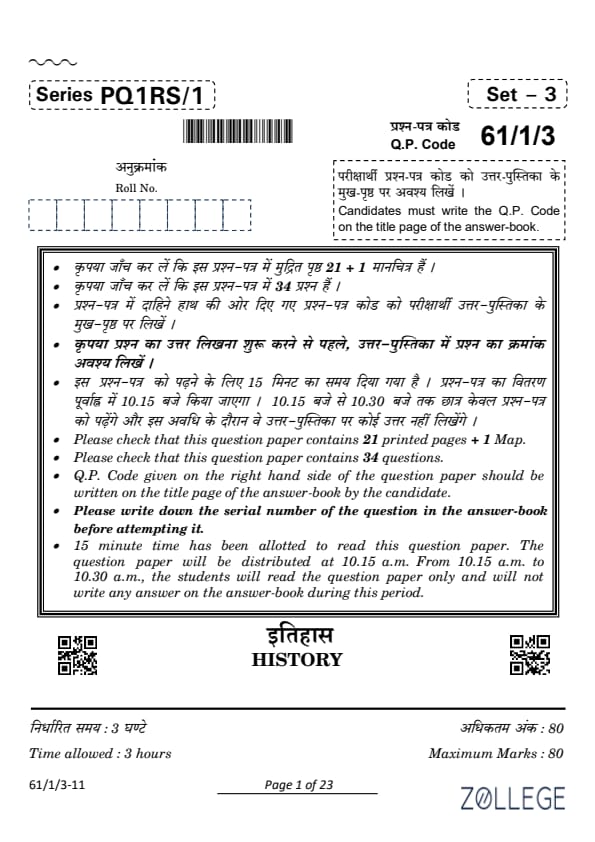
CBSE Class 12 2024 History Question Paper with Answer Key PDF for Set 3 (Q.P. Code: 61/1/3) is available for download. The exam was successfully conducted by CBSE on March 28, 2024, in the morning session from 10:30 AM to 1:30 PM. As per the students’ initial reactions, the CBSE Class 12 2024 History Set 3 Question Paper was reported as Moderate. The Ancient History section was considered Easy to Moderate, the Medieval History section as Moderate, and the Modern History section as Moderate to Challenging.
CBSE Class 12 2024 History (Set 3- 61/1/3) 2024 Answer Key With Solution
Candidates can download the CBSE Class 12 History Question Paper with Solution and Answer Key PDFs for Set 3 Question Paper (Code: 61/1/3) using the link below.
| CBSE Class 12 History (Set 3- 61/1/3) 2024 Question Paper with Answer Key |  Download Download |
Check Solution |
CBSE Class 12 2024 History Question Paper with Solutions
SECTION A
Question 1:
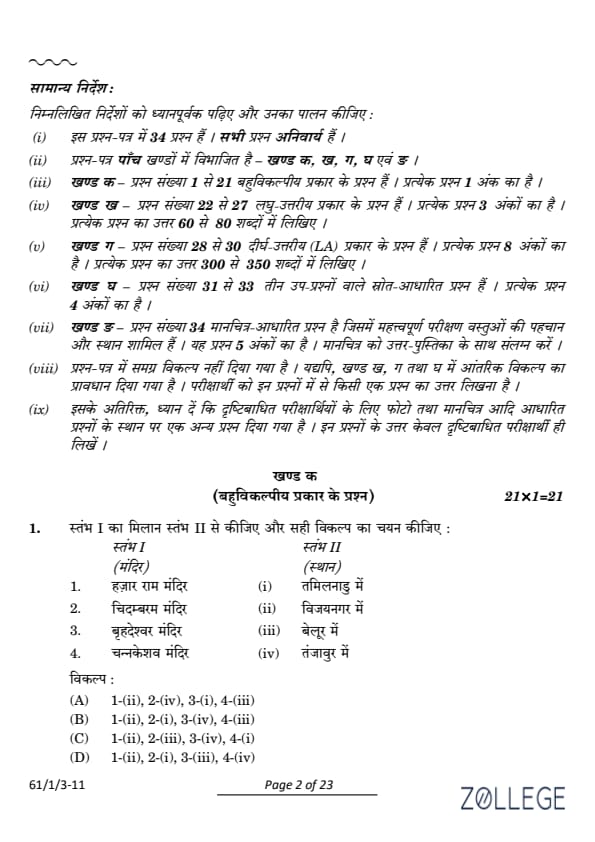
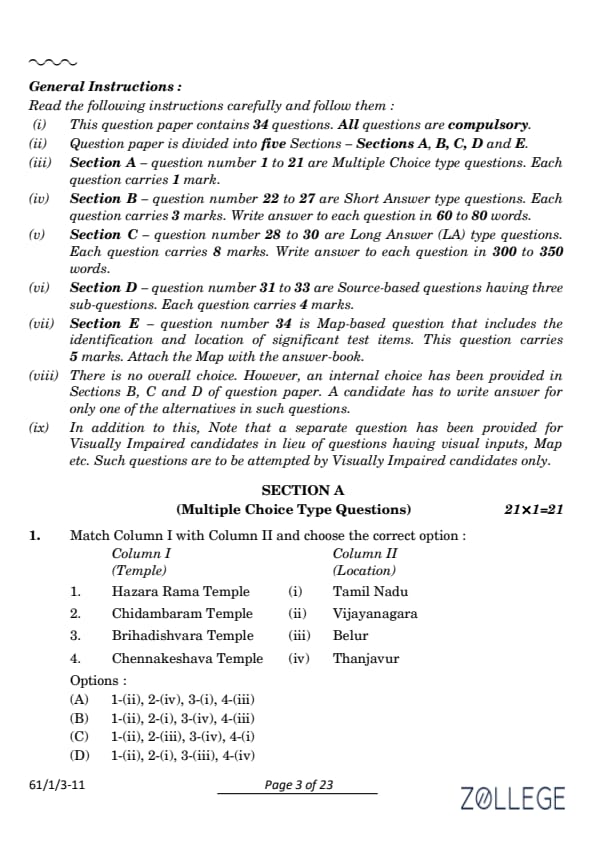
Match Column I with Column II and choose the correct option:

View Solution
Step 1: Analyze the locations of the given temples:
Hazara Rama Temple is located in Vijayanagara (Karnataka).
Chidambaram Temple is located in Tamil Nadu.
Brihadishvara Temple is located in Thanjavur (Tamil Nadu).
Chennakeshava Temple is located in Belur (Karnataka).
From this information, the correct matching is:\[\text{1-(ii), 2-(i), 3-(iv), 4-(iii).}\] Quick Tip: When solving matching questions, focus on known historical or geographical connections and eliminate options systematically.
Question 2:
Who among the following was the mentor of Amir Khusrau?
View Solution
Amir Khusrau was a famous Sufi poet, musician, and scholar of medieval India. He was closely associated with the Chishti order and was a disciple of Shaikh Nizamuddin Auliya, one of the prominent Sufi saints of Delhi.
Quick Tip: When identifying mentors or disciples in historical contexts, link their literary, cultural, or religious contributions to their associations.
Question 3:
In which of the following languages has Al-Biruni translated Sanskrit, Pali, and Prakrit texts in India?
View Solution
Al-Biruni, a Persian scholar and polymath, translated several Sanskrit texts into Persian during his stay in India. His works, such as "Kitab al-Hind," document the cultural and scientific practices of India.
Quick Tip: Link historical figures to their linguistic and scholarly contributions for better retention of facts.
Question 4:
Which of the following pairs is correctly matched?
View Solution
Step 1: Analyze the definitions of the terms: Endogamy: Marriage within a specific social group or caste. Exogamy: Marriage outside a specific social group or caste. Polygyny: A man having several wives. Polyandry: A woman having several husbands. The correct match is (D). Quick Tip: Understand sociological terms and their meanings for accurate identification in such questions.
Question 5:
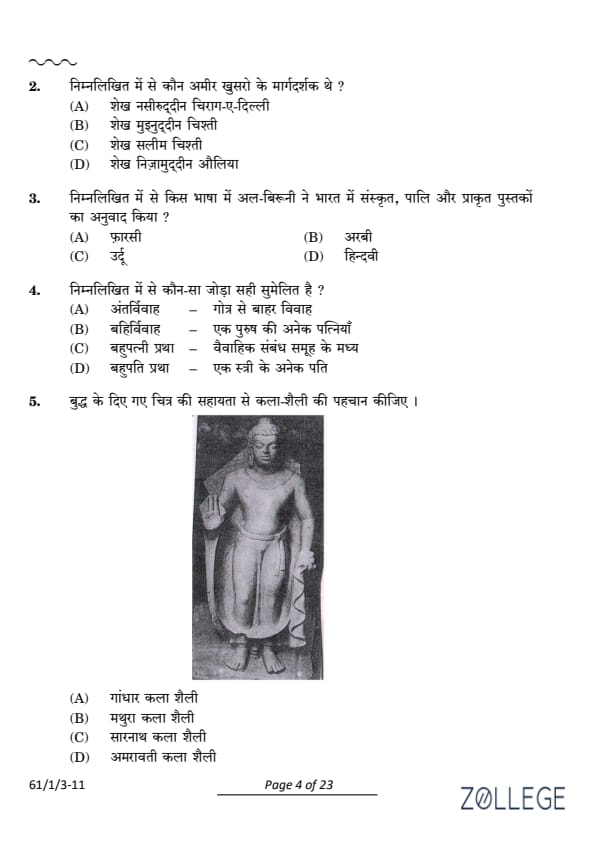
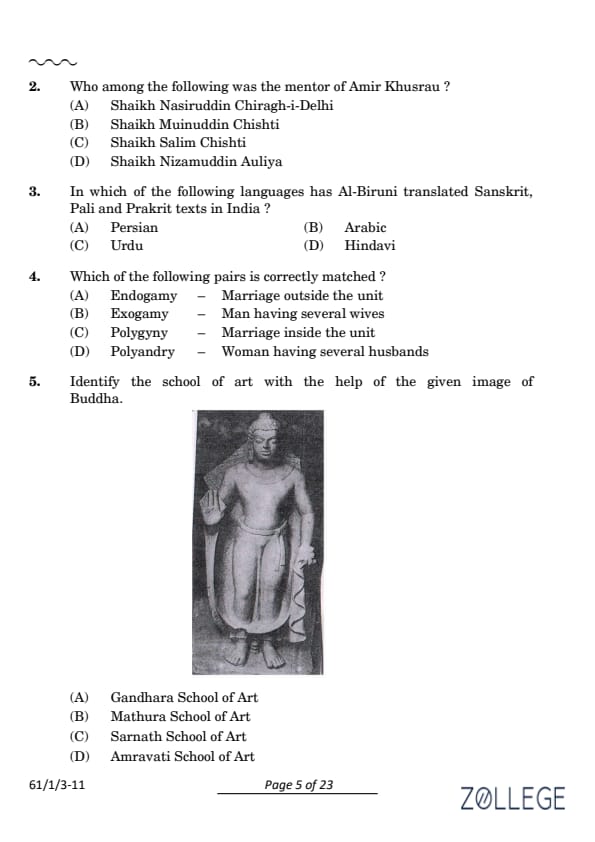
Identify the school of art with the help of the given image of Buddha.

View Solution
The image provided reflects the features of the Mathura School of Art, which is known for its indigenous Indian style, focusing on spiritual expressions and symbolic gestures.
Quick Tip: For art-related questions, focus on the distinguishing features and regional influences of each school.
Question 5:
5. (For Visually Impaired Candidates): Which of the following clans did Buddha belong to?
View Solution
Buddha, also known as Siddhartha Gautama, belonged to the Sakya clan, which was a part of the Kshatriya varna in ancient India. He was born in Lumbini, located in modern-day Nepal.
Quick Tip: Remember the clan and regional affiliations of historical figures for better recall in such questions.
Question 6:
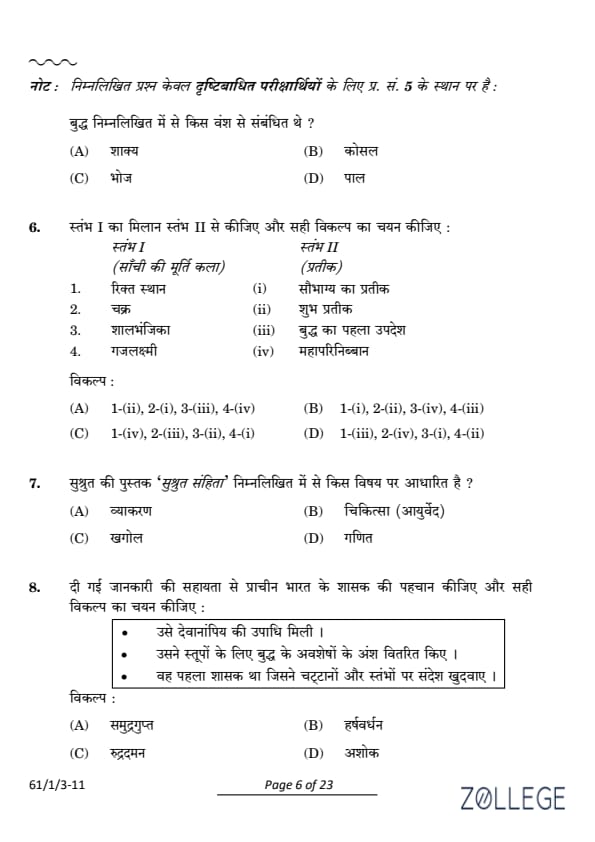
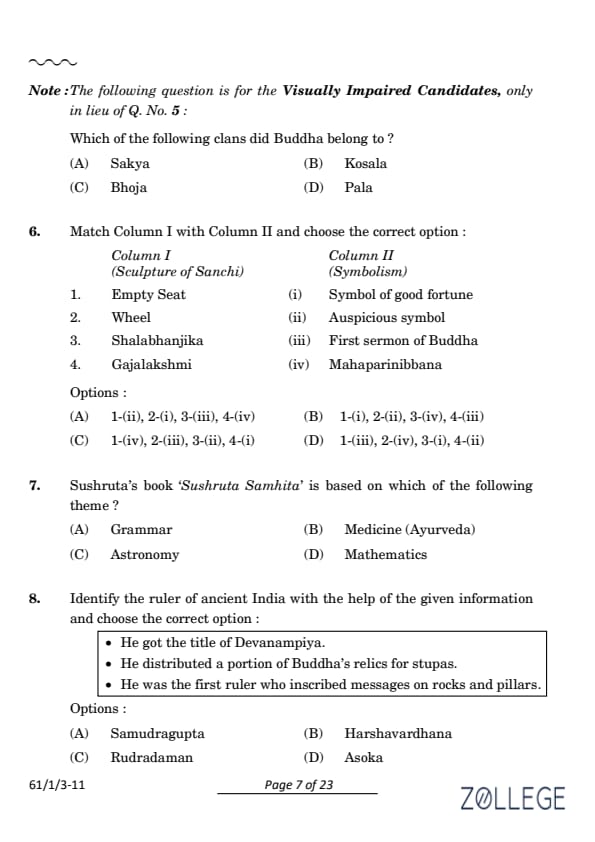
Match Column I with Column II and choose the correct option:

View Solution
Step 1: Match the symbols with their corresponding meanings:
Empty Seat: Represents Mahaparinibbana (final liberation).
Wheel: Represents the first sermon of Buddha (Dharmachakra Pravartan).
Shalabhanjika: An auspicious symbol, often depicted with trees.
Gajalakshmi: A symbol of good fortune and prosperity.
Quick Tip: Focus on iconography and its meanings in ancient Indian art for such questions.
Question 7:
Sushruta's book \textit{Sushruta Samhita} is based on which of the following themes?
View Solution
The \textit{Sushruta Samhita is a foundational text of Ayurveda, attributed to Sushruta, who is considered the "Father of Surgery." It contains detailed descriptions of surgical procedures, medicinal plants, and treatments.
Quick Tip: Link ancient texts with their contributions to fields like science, medicine, or philosophy for better retention.
Question 8:
Identify the ruler of ancient India with the help of the given information and choose the correct option:
He got the title of Devanampiya.
He distributed a portion of Buddha's relics for stupas.
He was the first ruler who inscribed messages on rocks and pillars.
View Solution
Asoka, a Mauryan emperor, is known for his propagation of Buddhism. He erected inscriptions and edicts on rocks and pillars throughout his empire to communicate his policies and promote Dharma.
Quick Tip: Focus on key titles and unique contributions of rulers to identify them easily in historical contexts.
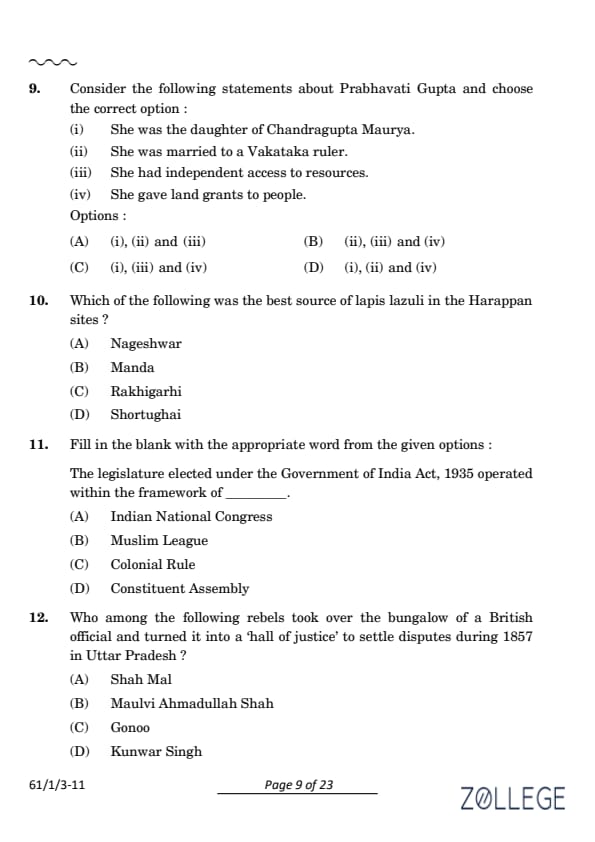
Question 9:
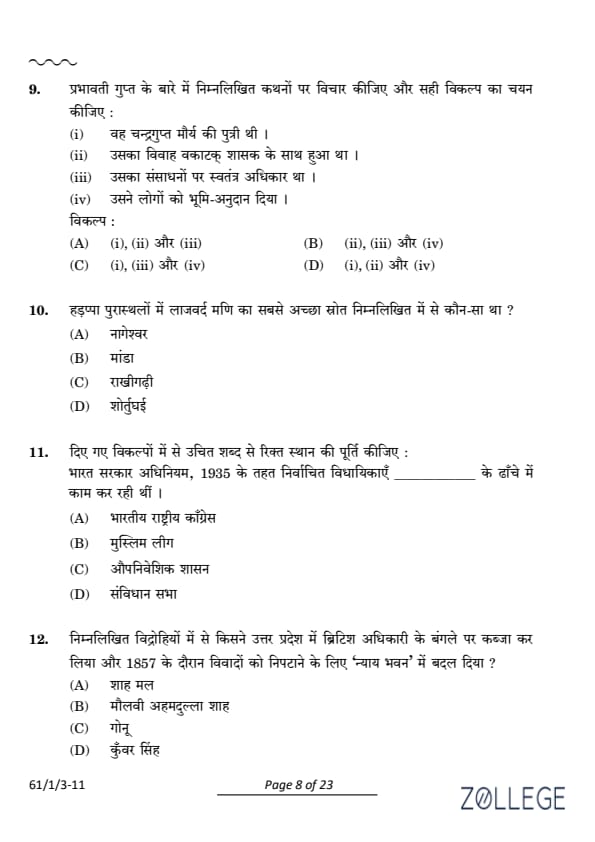
Consider the following statements about Prabhavati Gupta and choose the correct option:
She was the daughter of Chandragupta Maurya.
She was married to a Vakataka ruler.
She had independent access to resources.
She gave land grants to people.
View Solution
Step 1: Analyze the statements:
Prabhavati Gupta was the daughter of Chandragupta II, not Chandragupta Maurya, making statement (i) incorrect.
She was married to Rudrasena II, a Vakataka ruler, making statement (ii) correct.
As a widow, she issued royal land grants, indicating independent access to resources (statement (iii)) and granting land to people (statement (iv)).
Quick Tip: For historical figures, focus on familial, marital, and administrative contributions to eliminate incorrect options.
Question 10:
Which of the following was the best source of lapis lazuli in the Harappan sites?
View Solution
Shortughai, located in present-day Afghanistan, was an important Harappan site and a major source of lapis lazuli, a precious stone traded extensively during the Indus Valley Civilization.
Quick Tip: Associate resources like lapis lazuli with their geographical origins to answer such questions accurately.
Question 11:
The legislature elected under the Government of India Act, 1935, operated within the framework of :
View Solution
The Government of India Act, 1935, was enacted under British colonial rule. The legislatures formed under this act functioned within the framework of colonial governance, not independent governance.
Quick Tip: Relate legislative acts with their historical contexts to understand their implications better.
Question 12:
Who among the following rebels took over the bungalow of a British official and turned it into a 'hall of justice' to settle disputes during 1857 in Uttar Pradesh?
View Solution
Shah Mal, a prominent leader during the 1857 Revolt in Uttar Pradesh, converted a British officer's bungalow into a 'hall of justice' to resolve local disputes and provide governance during the rebellion.
Quick Tip: Link leaders of the 1857 Revolt to their regional activities for a better understanding of their roles.
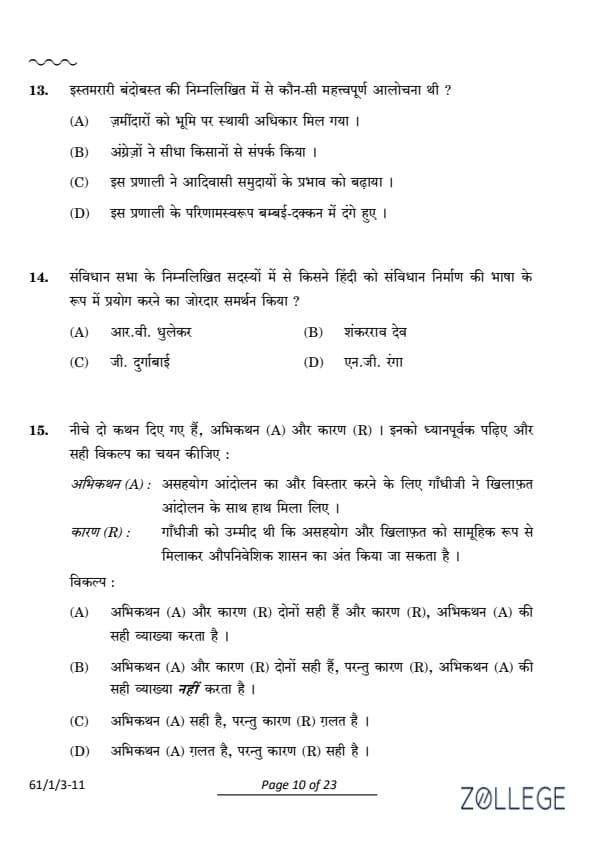
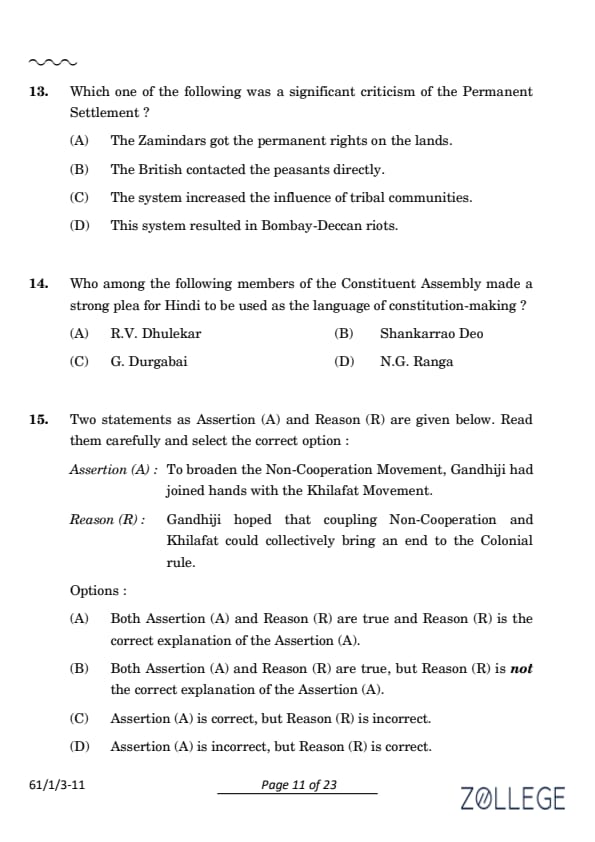
Question 13:
Which one of the following was a significant criticism of the Permanent Settlement?
View Solution
The Permanent Settlement introduced by Lord Cornwallis in 1793 was criticized for giving Zamindars permanent rights over land. This often led to exploitation of peasants as Zamindars extracted high rents and neglected agricultural development.
Quick Tip: Focus on the socio-economic impacts of colonial land revenue systems for understanding such questions.
Question 14:
Who among the following members of the Constituent Assembly made a strong plea for Hindi to be used as the language of constitution-making?
View Solution
R.V. Dhulekar, a prominent member of the Constituent Assembly, passionately advocated for Hindi to be the official language for constitution-making in India, arguing it represented the majority of the population.
Quick Tip: Understand the debates and key figures in the Constituent Assembly to answer such questions accurately.
Question 15:
Two statements as Assertion (A) and Reason (R) are given below. Read them carefully and select the correct option:
Assertion (A): To broaden the Non-Cooperation Movement, Gandhiji had joined hands with the Khilafat Movement.
Reason (R): Gandhiji hoped that coupling Non-Cooperation and Khilafat could collectively bring an end to the Colonial rule.
View Solution
Gandhiji strategically aligned the Non-Cooperation Movement with the Khilafat Movement to unify Hindu and Muslim communities against British rule, believing their combined efforts would strengthen the struggle for independence.
Quick Tip: Focus on the political strategies and alliances of leaders during India's freedom struggle for such questions.
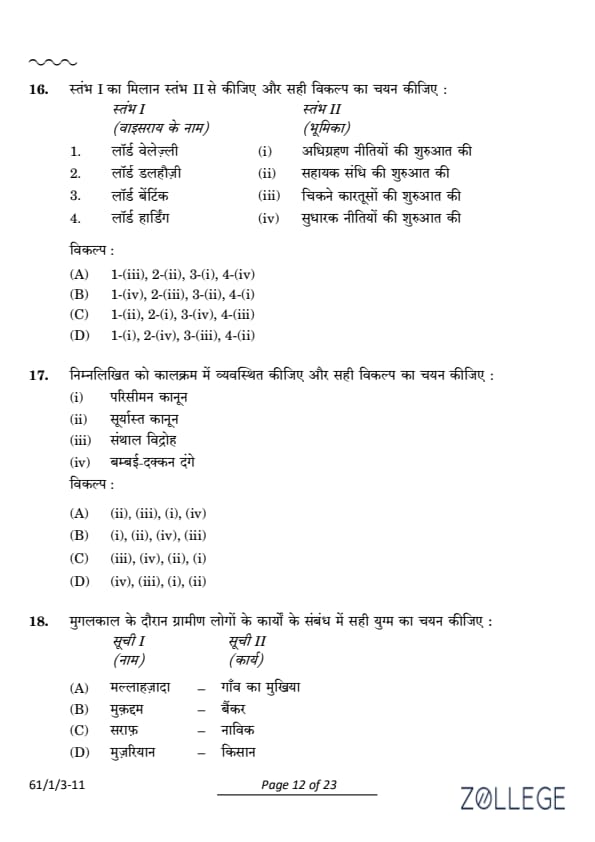
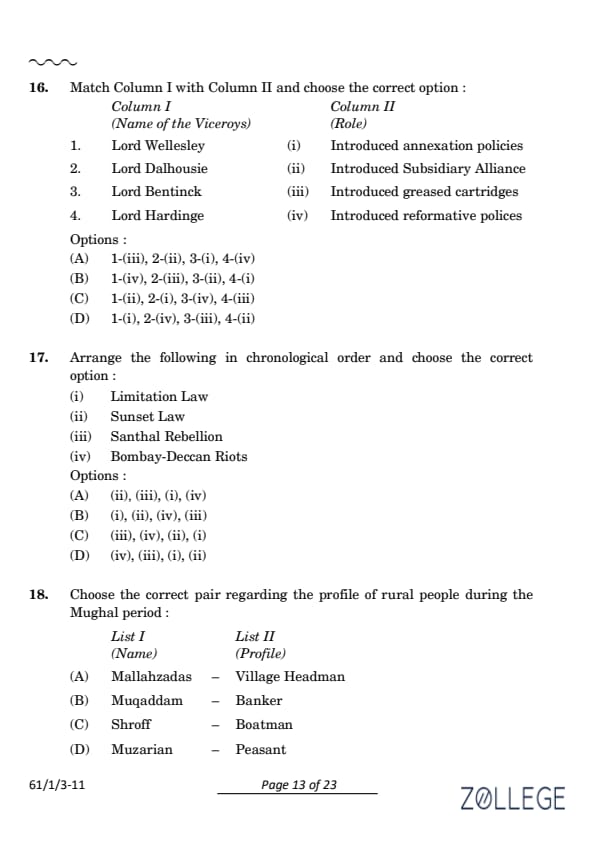
Question 16:
Match Column I with Column II and choose the correct option:

View Solution
Step 1: Match the viceroys with their roles:
Lord Wellesley: Introduced Subsidiary Alliance.
Lord Dalhousie: Introduced annexation policies.
Lord Bentinck: Introduced reformative policies.
Lord Hardinge: Introduced greased cartridges.
Quick Tip: For matching questions, associate the viceroys with significant policies or events during their tenure.
Question 17:
Arrange the following in chronological order and choose the correct option:
Limitation Law
Sunset Law
Santhal Rebellion
Bombay-Deccan Riots
View Solution
Step 1: Arrange the events:
Sunset Law (1793)
Santhal Rebellion (1855-1856)
Limitation Law (1859)
Bombay-Deccan Riots (1875)
Quick Tip: Use timeline-based memorization techniques for arranging historical events.
Question 18:
Choose the correct pair regarding the profile of rural people during the Mughal period:

View Solution
Muzarians were peasants in the rural areas during the Mughal period. They were primarily responsible for agricultural production and were the backbone of the agrarian economy.
Quick Tip: Focus on socio-economic roles during specific historical periods to match terms accurately.
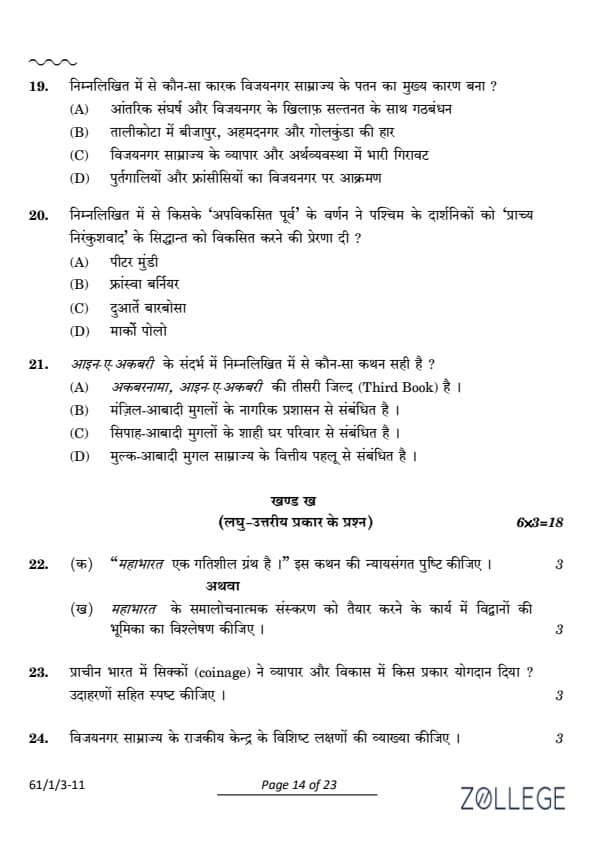
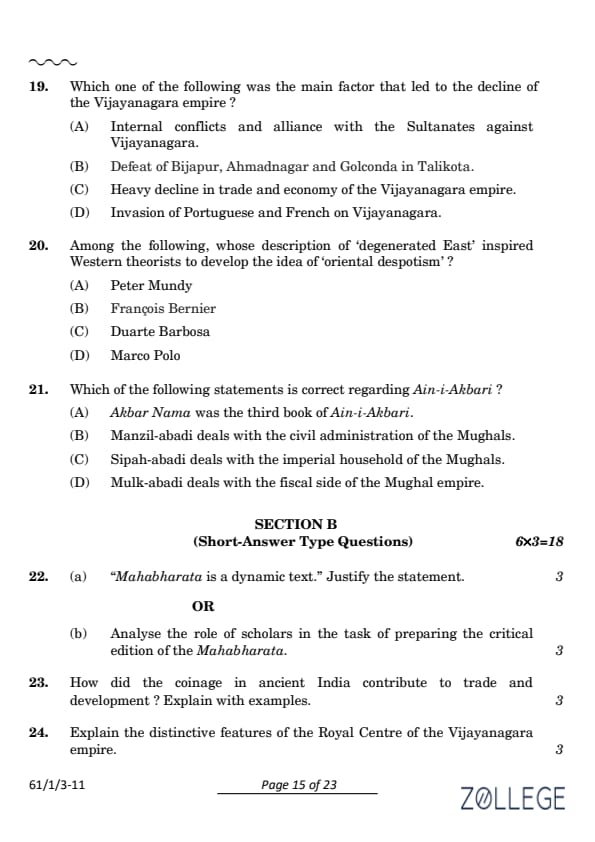
Question 19:
Which one of the following was the main factor that led to the decline of the Vijayanagara empire?
View Solution
The primary factor for the decline of the Vijayanagara empire was the Battle of Talikota in 1565, where an alliance of Deccan Sultanates, including Bijapur, Ahmadnagar, and Golconda, defeated the Vijayanagara forces. This alliance, coupled with internal conflicts within the empire, led to its downfall.
Quick Tip: Focus on military alliances and their consequences when studying empire declines.
Question 20:
Among the following, whose description of 'degenerated East' inspired Western theorists to develop the idea of 'oriental despotism'?
View Solution
François Bernier, a French traveler in 17th-century India, described the Mughal Empire as a "degenerated East" characterized by autocratic rule and economic stagnation. His accounts influenced Western theorists in framing the idea of "oriental despotism," portraying Eastern societies as inherently despotic and stagnant.
Quick Tip: Relate travelers' accounts to their influence on Western perceptions for contextual answers.
Question 21:
Which of the following statements is correct regarding Ain-i-Akbari?
View Solution
The \textit{Ain-i-Akbari, authored by Abul Fazl, is a part of the \textit{Akbar Nama and provides detailed administrative records of the Mughal Empire. \textit{Mulk-abadi specifically addresses the fiscal policies and revenue systems under Akbar's rule, making it an essential source for understanding Mughal administration.
Quick Tip: Link key sections of historical texts to their administrative or thematic relevance.
SECTION B
Question 22:
(a) "Mahabharata is a dynamic text." Justify the statement.
View Solution
The Mahabharata is called a dynamic text because it evolved over centuries through additions and interpolations. Initially composed as "Jaya" with 8,800 verses, it expanded into "Bharata" with 24,000 verses and finally into the Mahabharata with 100,000 verses. The text addresses diverse aspects of society, including dharma, politics, morality, and human relationships, making it relevant across time and cultures.
Quick Tip: Focus on the historical and social contexts when explaining the dynamism of ancient texts.
Question 22:
(b) Analyse the role of scholars in the task of preparing the critical edition of the Mahabharata.
View Solution
Scholars played a crucial role in preparing the critical edition of the Mahabharata, led by V.S. Sukthankar and the Bhandarkar Oriental Research Institute. They examined numerous manuscripts from across India, identifying interpolations and differences. The critical edition aimed to reconstruct the original text by compiling the most authentic verses, preserving the essence of this epic.
Quick Tip: Mention key contributions of institutions or individuals when discussing scholarly efforts.
Question 23:
How did the coinage in ancient India contribute to trade and development? Explain with examples.
View Solution
Ancient Indian coinage, such as punch-marked coins, facilitated trade by providing a standardized medium of exchange. Coins made of silver, gold, copper, and other metals were used in domestic and international trade. For instance, Roman gold coins found in South India highlight trade with the Roman Empire. The use of coins enhanced economic transactions and contributed to urban development.
Quick Tip: Highlight specific examples of coin types and trade relations to add depth to your answers.
Question 24:
Explain the distinctive features of the Royal Centre of the Vijayanagara empire.
View Solution
The Royal Centre of Vijayanagara had several distinctive features: It included grand palaces, such as the Lotus Mahal, reflecting Indo-Islamic architecture. The Mahanavami Dibba, a platform for royal ceremonies, showcased intricate carvings. Fortified enclosures protected the royal area, indicating advanced defense strategies. These features highlighted the empire's political and cultural significance. Quick Tip: Focus on architectural and functional aspects when discussing historical sites.
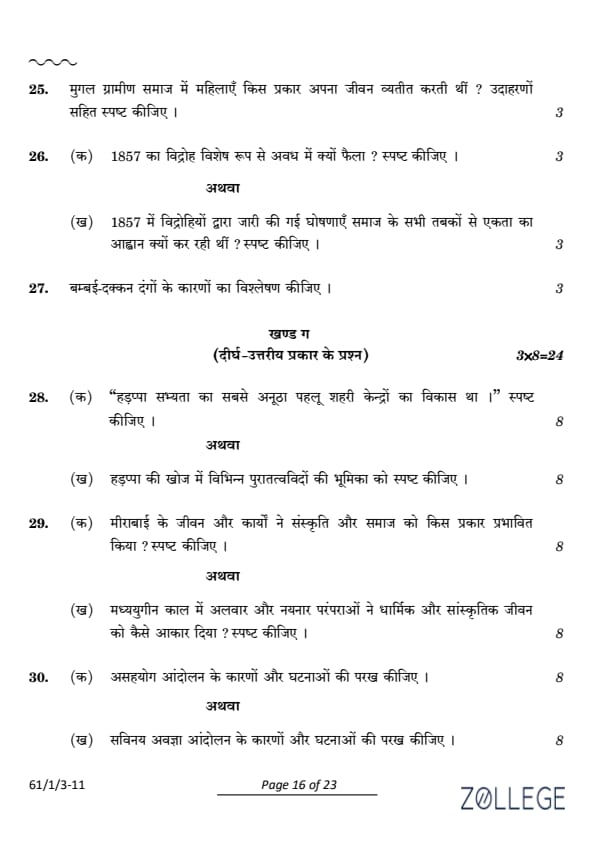
Question 25:
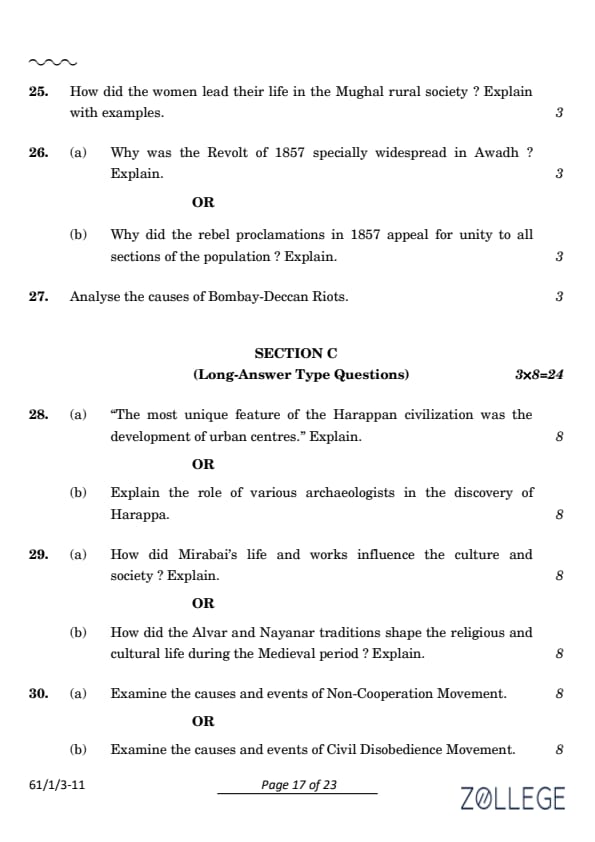
How did the women lead their life in the Mughal rural society? Explain with examples.
View Solution
Women in Mughal rural society often engaged in agricultural activities, household tasks, and artisan work. They contributed to weaving, pottery, and other crafts. While patriarchal norms restricted their rights, women from affluent families owned land and managed estates. For example, Nur Jahan, though a Mughal queen, influenced policies and trade.
Quick Tip: Incorporate societal roles and exceptions when discussing gender in history.
Question 26:
(a) Why was the Revolt of 1857 specially widespread in Awadh? Explain.
View Solution
The Revolt of 1857 was widespread in Awadh due to: Exploitation of peasants by taluqdars. Annexation of Awadh by the British under the Doctrine of Lapse. Resentment among soldiers recruited from Awadh. These factors created a strong base for rebellion in the region.
Quick Tip: Highlight regional factors when discussing the Revolt of 1857.
Question 26:
(b) Why did the rebel proclamations in 1857 appeal for unity to all sections of the population? Explain.
View Solution
Rebel proclamations during 1857 emphasized unity among Hindus and Muslims to counter British rule. They appealed to shared grievances like heavy taxation, loss of traditional livelihoods, and disrespect for religious practices. These proclamations aimed to consolidate support across caste, class, and religious lines.
Quick Tip: Mention socio-political motivations behind such proclamations for a comprehensive answer.
Question 27:
Analyse the causes of Bombay-Deccan Riots.
View Solution
The Bombay-Deccan Riots of 1875 were caused by High indebtedness among peasants due to exorbitant interest rates charged by moneylenders.Crop failures and famine conditions. Exploitative land revenue policies of the British. These riots reflected agrarian distress and resistance against oppressive systems.
Quick Tip: Link economic policies and social unrest for a nuanced explanation of historical events.
SECTION C
Question 28:
(a) "The most unique feature of the Harappan civilization was the development of urban centres." Explain.
View Solution
The Harappan civilization, one of the earliest urban civilizations, is renowned for its advanced urban planning and organization. Its urban centres showcased unique features that set them apart from other contemporary civilizations:
Grid System: Harappan cities like Mohenjo-Daro and Harappa were laid out in a grid pattern with streets running at right angles. This design facilitated smooth movement and division of residential, commercial, and administrative areas.
Drainage System: The civilization had an advanced drainage system with covered drains along the streets, allowing waste and rainwater to flow efficiently. Houses were connected to the main drains, indicating an emphasis on hygiene.
Granaries and Storage: Granaries in Harappa and Mohenjo-Daro highlight centralized food storage and distribution systems. These structures also point toward surplus production and a well-organized economy.
Public Buildings: Structures like the Great Bath in Mohenjo-Daro reveal the importance of public amenities for community activities. The meticulous construction and water-tight features reflect sophisticated engineering.
Standardization: Harappan cities had standardized bricks, weights, and measures, promoting uniformity in construction and trade. This points toward centralized authority and regulation. Water Management: Wells and reservoirs ensured a consistent water supply for domestic use and irrigation, even during dry periods.
The planning and construction of Harappan urban centres reflect their deep understanding of engineering, sanitation, and social organization. These features made the civilization remarkably advanced and left an indelible mark on history.
Quick Tip: Focus on urban elements like drainage, grid systems, and standardized measures for questions on Harappan civilization.
Question 28:
(b) Explain the role of various archaeologists in the discovery of Harappa.
View Solution
The discovery of the Harappan civilization was a result of significant efforts by several archaeologists:
Daya Ram Sahni (1921): Conducted the first excavations at Harappa, uncovering the remains of a highly developed urban culture. He unearthed seals, pottery, and structural remains.\ R.D. Banerji (1922): Discovered Mohenjo-Daro, another major Harappan site, and identified its advanced urban planning and drainage systems.
John Marshall: As the Director-General of the Archaeological Survey of India, Marshall recognized the significance of these findings and formally announced the discovery of the Indus Valley Civilization in 1924.
Mortimer Wheeler: Used the stratigraphy method to analyze Harappan layers, contributing to a better understanding of the civilization’s chronology and urban structures.
E.J.H. Mackay: Conducted detailed excavations at Harappa and Mohenjo-Daro, revealing insights into daily life, trade, and craftsmanship.
These archaeologists collectively shed light on one of the oldest civilizations, highlighting its urban sophistication and cultural significance.
Quick Tip: Mention specific archaeologists and their key contributions for archaeology-related questions.
Question 29:
(a) How did Mirabai's life and works influence the culture and society? Explain.
View Solution
Mirabai, a 16th-century Bhakti saint, profoundly influenced Indian culture and society through her life and devotional poetry. Her contributions can be summarized as follows:
Promotion of Bhakti: Mirabai's poems emphasized personal devotion (Bhakti) to Lord Krishna, advocating love and surrender over rituals and ceremonies.
Literary Contributions: Her compositions in Braj, Rajasthani, and Gujarati became an integral part of Indian devotional literature. Songs like “Payoji Maine Ram Ratan Dhan Payo” continue to inspire devotion.
Breaking Social Norms: Mirabai defied patriarchal norms by leaving her marital home to pursue spiritual freedom, challenging gender roles and societal expectations.
Inclusivity: Her works appealed to people across caste and class, promoting equality and spiritual liberation for all.
Cultural Impact: Mirabai’s life inspired art, music, and folk traditions, enriching India's cultural heritage.
Through her devotion and rebellion against orthodox norms, Mirabai shaped the Bhakti movement and left a lasting legacy in Indian culture. Quick Tip: Connect Bhakti saints’ works to their societal and cultural impact for comprehensive answers.
Question 29:
(b) How did the Alvar and Nayanar traditions shape the religious and cultural life during the Medieval period? Explain.
View Solution
The Alvar (Vaishnavite) and Nayanar (Shaivite) traditions played a pivotal role in shaping the religious and cultural life of Medieval South India: Promotion of Bhakti: Both traditions emphasized devotion to personal gods (Vishnu and Shiva) over ritualistic practices, spreading the Bhakti movement.
Sacred Hymns: The Alvars composed the \textit{Divya Prabandham, while the Nayanars contributed to the \textit{Tevaram, creating a rich corpus of devotional literature. Temple-Centric Worship: Their hymns popularized temple worship, leading to the construction of grand temples like Srirangam and Chidambaram.
Social Impact: The Alvar and Nayanar saints challenged caste barriers, promoting inclusivity and spiritual equality.
Cultural Legacy: Their hymns inspired classical music and dance traditions like Bharatanatyam. These movements reshaped religious practices and enriched South Indian cultural traditions.
Quick Tip: Focus on the literary, religious, and social impacts of Bhakti traditions in your answers.
Question 30:
(a) Examine the causes and events of the Non-Cooperation Movement.
View Solution
The Non-Cooperation Movement (1920–1922) was a significant milestone in India's freedom struggle: Causes: The Rowlatt Act and Jallianwala Bagh massacre created widespread resentment against British rule. The Khilafat Movement united Hindus and Muslims for a common cause. Exploitation of Indian resources for British benefits intensified demands for Swaraj. Events: Gandhi urged boycotts of British goods, schools, courts, and titles. The Chauri Chaura incident, where protestors clashed with police, led to the movement's suspension. The movement united Indians across caste and religion, laying the groundwork for future struggles. Quick Tip: Divide the answer into causes, events, and outcomes for a structured approach.
Question 30:
(b) Examine the causes and events of Civil Disobedience Movement.
View Solution
The Civil Disobedience Movement (1930–1934) was a crucial phase in India’s struggle for independence, marked by mass participation and significant events. Causes: Simon Commission (1927): The exclusion of Indians in the Simon Commission fueled resentment and protests. Demand for Purna Swaraj: The Lahore Congress of 1929 declared complete independence as its goal, intensifying nationalist sentiments. Salt Tax: The oppressive salt tax became a symbol of British exploitation, impacting every Indian. Key Events: Dandi March (1930): Mahatma Gandhi’s 240-mile march to Dandi to produce salt defied British laws and inspired similar protests nationwide. Boycotts and Non-Payment of Taxes: Indians boycotted British goods, schools, and legislatures, while refusing to pay taxes. Participation of Women: Women like Sarojini Naidu and Kamaladevi Chattopadhyay played active roles, increasing female participation in the freedom struggle. Gandhi-Irwin Pact (1931): This pact temporarily suspended the movement, with the British agreeing to release political prisoners and allow peaceful protests. Repression by the British: Despite peaceful protests, the British responded with arrests and violence, with leaders like Gandhi and Nehru imprisoned. Impact: Mass Mobilization: The movement united Indians across caste, religion, and gender, strengthening the nationalist movement. Global Attention: The Civil Disobedience Movement drew international attention to India’s struggle for independence. Foundation for Future Movements: It set the stage for subsequent campaigns like the Quit India Movement of 1942. The Civil Disobedience Movement demonstrated the power of non-violent resistance and became a significant milestone in India’s journey toward independence. Quick Tip: Highlight symbolic events like the Dandi March and their impact on mass mobilization and global attention.
Question 31:
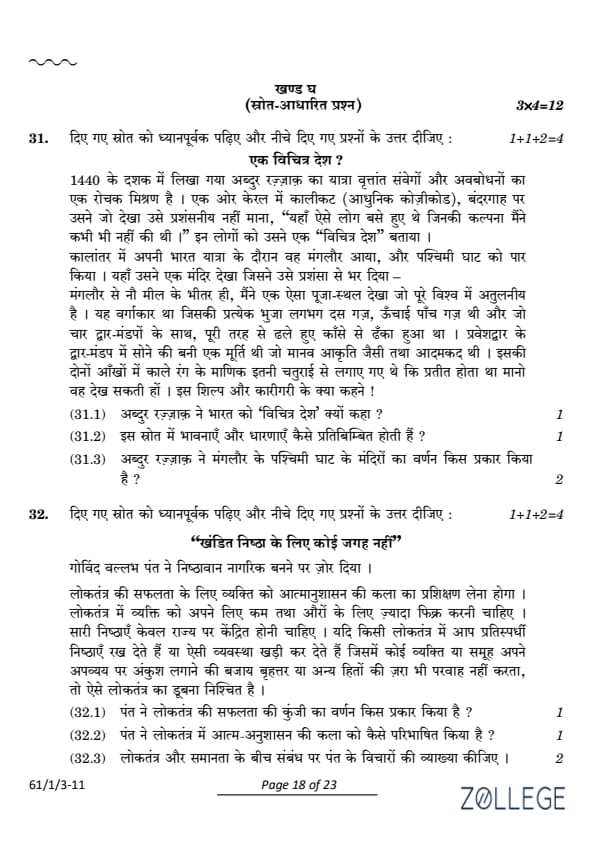
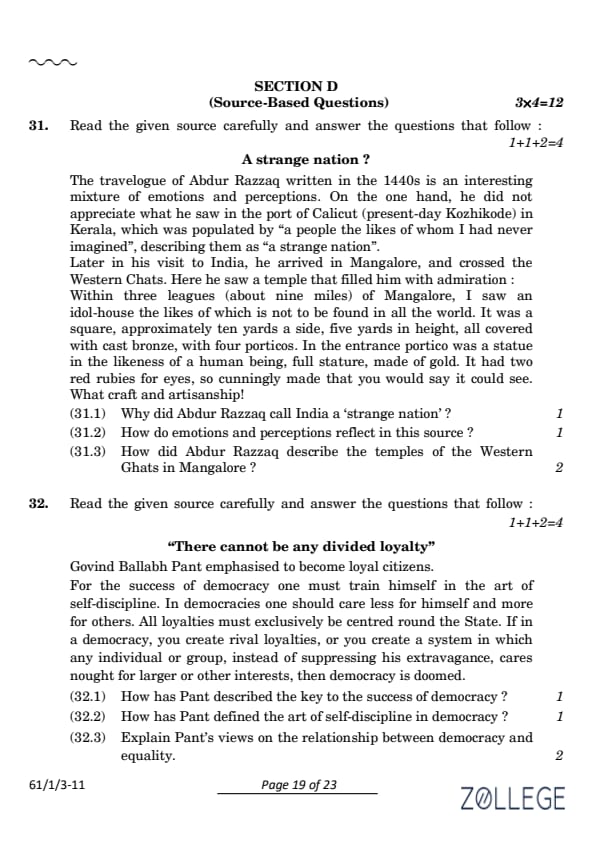
Read the given source carefully and answer the questions that follow:
A strange nation?
The travelogue of Abdur Razzaq written in the 1440s is an interesting mixture of emotions and perceptions. On the one hand, he did not appreciate what he saw in the port of Calicut (present-day Kozhikode) in Kerala, which was populated by “a people the likes of whom I had never imagined,” describing them as “a strange nation.” Later in his visit to India, he arrived in Mangalore and crossed the Western Ghats. Here he saw a temple that filled him with admiration: Within three leagues (about nine miles) of Mangalore, I saw an idol-house the likes of which is not to be found in all the world. It was a square, approximately ten yards a side, five yards in height, all covered with cast bronze, with four porticos. In the entrance portico was a statue in the likeness of a human being, full stature, made of gold. It had two red rubies for eyes, so cunningly made that you would say it could see. What craft and artisanship!
(31.1) Why did Abdur Razzaq call India a ‘strange nation’?
View Solution
Abdur Razzaq found the cultural practices, architecture, and people of India unfamiliar, which made him describe it as a "strange nation." The diversity in lifestyle and traditions were different from his native experiences.
Quick Tip: Consider how travelers interpret unfamiliar cultures to understand their descriptions.
(31.2) How do emotions and perceptions reflect in this source?
View Solution
The source reflects Abdur Razzaq’s mixed emotions. While he admired the craftsmanship and temples, he was perplexed and overwhelmed by the cultural diversity, showcasing his perception of India as both strange and extraordinary. Consider how travelers interpret unfamiliar cultures to understand their descriptions.
(31.3) How did Abdur Razzaq describe the temples of the Western Ghats in Mangalore?
View Solution
Abdur Razzaq described the temple as a unique architectural marvel. It was a square structure covered in cast bronze with intricate details. The temple’s entrance had a golden statue with ruby eyes, displaying exceptional craft and artisanship.
Question 32:
Read the given source carefully and answer the questions that follow:
“There cannot be any divided loyalty”
Govind Ballabh Pant emphasised to become loyal citizens. For the success of democracy one must train himself in the art of self-discipline. In democracies one should care less for himself and more for others. All loyalties must exclusively be centred round the State. If in a democracy, you create rival loyalties, or you create a system in which any individual or group, instead of suppressing his extravagance, cares nought for larger or other interests, then democracy is doomed.
(32.1) How has Pant described the key to the success of democracy?
View Solution
Pant described self-discipline and loyalty to the State as essential for democracy's success. Citizens should prioritize collective interests over individual or group loyalties.
Quick Tip: Understand the role of individual responsibility in strengthening democratic institutions.
(32.2) How has Pant defined the art of self-discipline in democracy?
View Solution
Pant defined self-discipline as the ability to suppress personal extravagance and focus on responsibilities toward the State and society to ensure democratic stability.
(32.3) Explain Pant’s views on the relationship between democracy and equality.
View Solution
Pant emphasized that democracy thrives on equality, where all citizens suppress individual interests to work toward collective welfare. This creates a sense of fairness and unity.
Question 33:
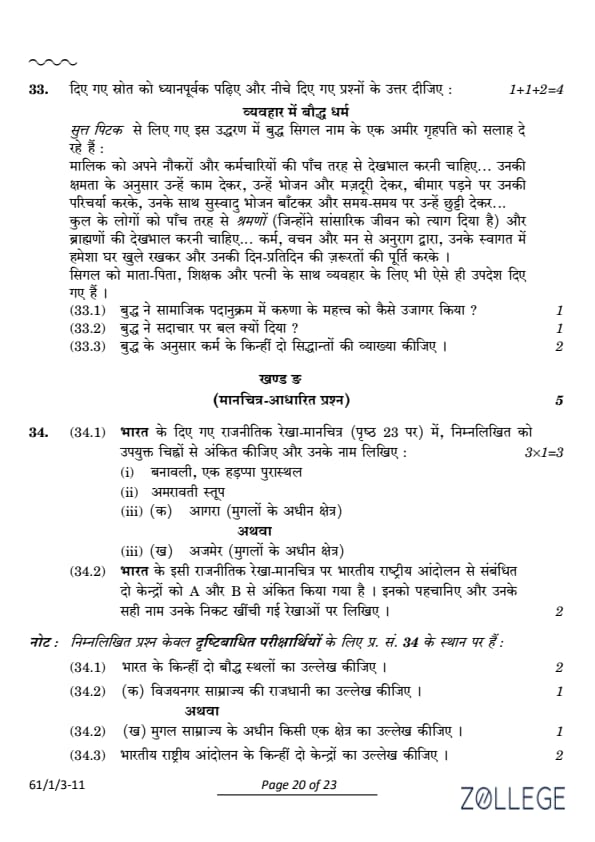
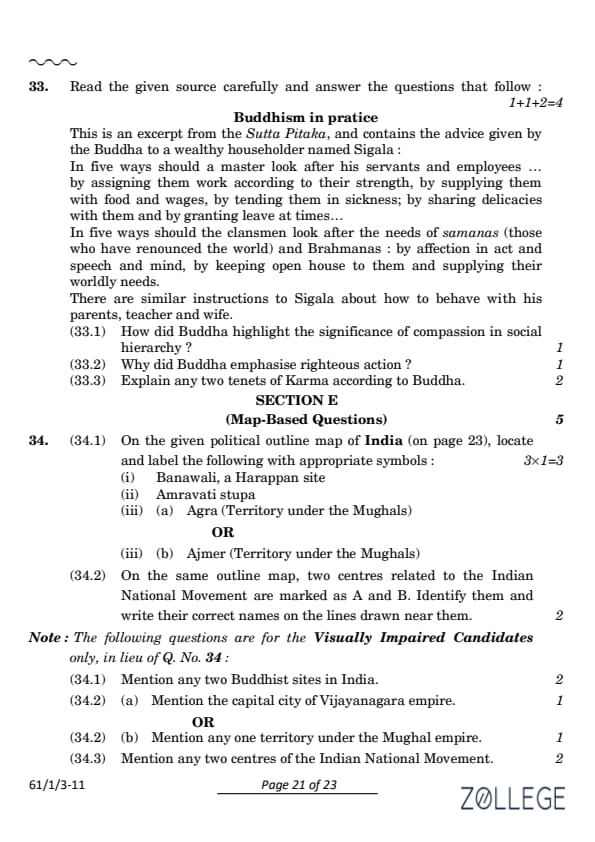
Read the given source carefully and answer the questions that follow:
Buddhism in practice
This is an excerpt from the \textit{Sutta Pitaka, and contains the advice given by the Buddha to a wealthy householder named Sigala:
In five ways should a master look after his servants and employees ... by assigning them work according to their strength, by supplying them with food and wages, by tending them in sickness; by sharing delicacies with them and by granting leave at times...
In five ways should the clansmen look after the needs of \textit{samanas (those who have renounced the world) and \textit{Brahmanas: by affection in act and speech and mind, by keeping open house to them and supplying their worldly needs.
There are similar instructions to Sigala about how to behave with his parents, teacher and wife.
(33.1) How did Buddha highlight the significance of compassion in social hierarchy?
View Solution
Buddha emphasized compassion in social hierarchy by advocating kindness toward servants and employees through fair treatment, proper wages, and care during sickness.
Quick Tip: Compassion ensures harmony in social structures; connect it to ethical governance.
(33.2) Why did Buddha emphasize righteous action?
View Solution
Buddha stressed righteous action as essential for maintaining harmony in society, urging individuals to act with kindness, fairness, and responsibility toward others.
(33.3) Explain any two tenets of Karma according to Buddha.
View Solution
Two tenets of Karma according to Buddha are:
• Actions have consequences, and good deeds lead to positive outcomes.
• One’s present circumstances are shaped by past actions, promoting accountability.
SECTION E
Question 34:
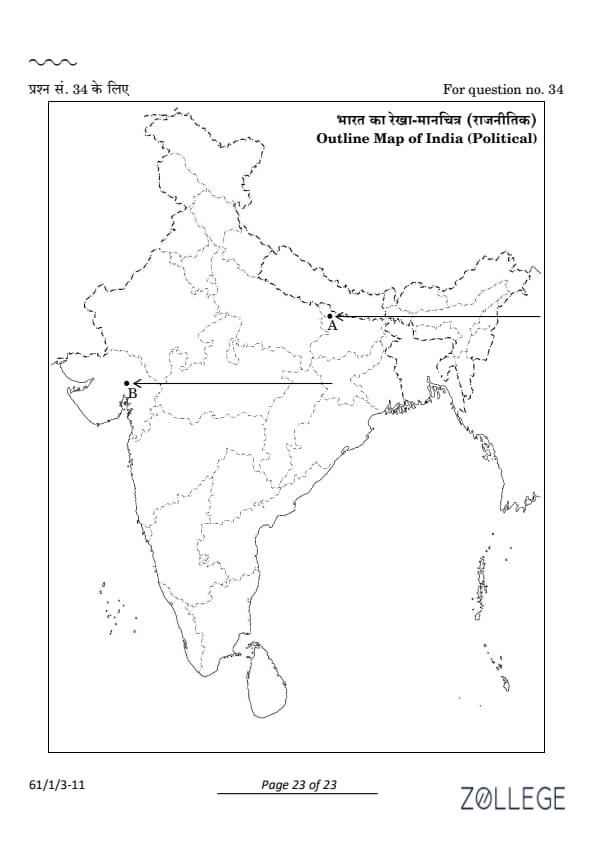
Map-Based Question: On the given political outline map of India (on page 25), locate and label the following with appropriate symbols: Banawali, a Harappan site
Amravati stupa
Agra (Territory under the Mughals)
OR 34.2 On the same outline map, two centres related to the Indian National Movement are marked as A and B. Identify them and write their correct names on the lines drawn near them.
View Solution
A: Champaran (Bihar): Known for the Champaran Satyagraha of 1917, where Gandhi launched a movement against the exploitation of indigo farmers by British planters.
B: Dandi (Gujarat): Famous for the Dandi March in 1930, where Gandhi led a non-violent protest against the salt tax imposed by the British.
Quick Tip: Focus on significant locations and their association with major events of the Indian freedom struggle for better identification.
Question 34:
(34.1) Mention any two Buddhist sites in India.
View Solution
Sanchi (Madhya Pradesh)
Bodh Gaya (Bihar)
Quick Tip: Focus on significant Buddhist sites that represent religious and architectural importance.
Question 34:
(34.2) (a) Mention the capital city of Vijayanagara empire.
View Solution
Hampi (Karnataka)
Quick Tip: Hampi, the capital of Vijayanagara, is renowned for its architectural and cultural significance.
Question 34:
OR (34.2) (b) Mention any one territory under the Mughal empire.
View Solution
Agra (Uttar Pradesh)
Quick Tip: Connect Mughal territories to their historical capitals for better recall.
Question 34:
(34.3) Mention any two centres of the Indian National Movement.
View Solution
Ahmedabad (Gujarat) Allahabad (Uttar Pradesh) Quick Tip: Highlight key centres like Ahmedabad (Salt Satyagraha) and Allahabad (Nehru’s resolutions) for contextual clarity.

*The article might have information for the previous academic years, please refer the official website of the exam.