
CBSE Class 12 History set 3 Question Paper Pdf - Check Solutions with Answer Key Pdf

.jpg?tr=h-55,w-55,c-force)
Content Strategist|Tech-innovator|National Hackathon Winner | Updated On - Jan 24, 2025
CBSE Class 12 2024 History Set 3 Question Paper (Q.P. Code: 61/2/3) is available for download. The exam was successfully conducted by CBSE on 28 March in the morning session from 10:30 AM to 1:30 PM. As per the student’s initial reactions, the CBSE Class 12 2024 History Set 3 Question Paper was reported as Moderate. The Ancient History section was reported as Easy to Moderate, the Medieval History section as Moderate, and the Modern History section as Moderate to Challenging.
CBSE Class 12 2024 History Set 3 61/2/3 Question Paper with Answer Key PDF
Candidates can download the CBSE Class 12 History Question Paper with Solution and Answer Key PDFs for Set 3 Question Paper (Code: 61/2/3) using the link below.
| CBSE Class 12 2024 History Question Paper with Answer Key |  Download Download |
Check Solution |
CBSE Class 12 2024 History Questions with Solutions
SECTION A
Question 1:
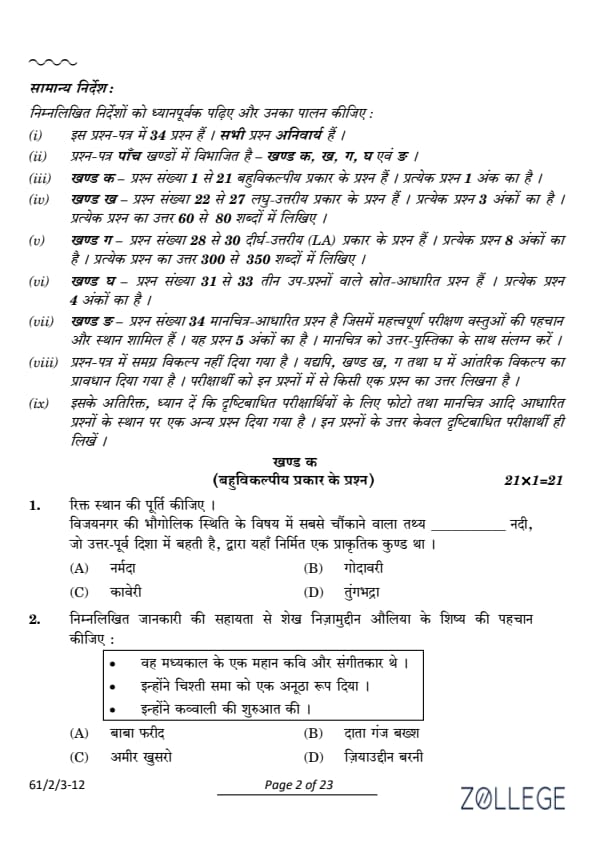
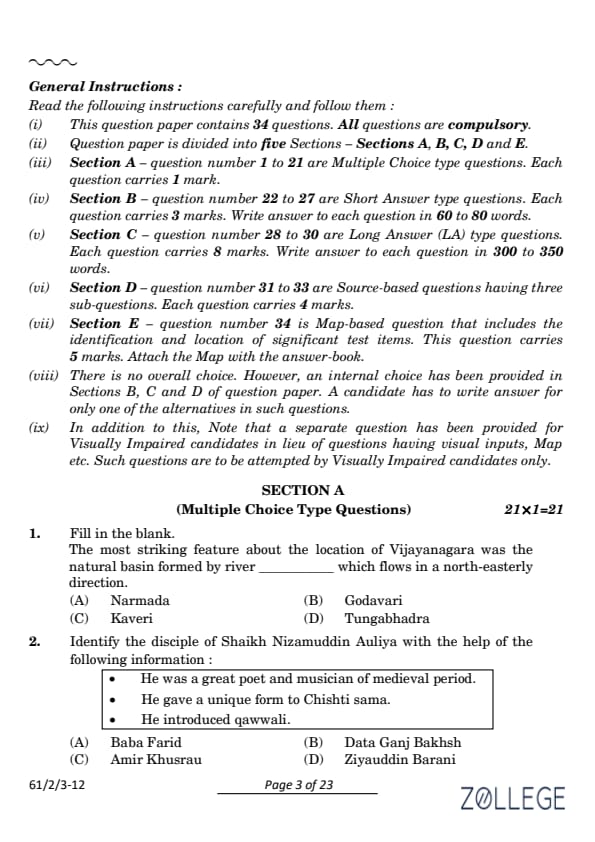
Fill in the blank.
The most striking feature about the location of Vijayanagara was the natural basin formed by river which flows in a north-easterly direction.
View Solution
The Vijayanagara Empire was located near the Tungabhadra River, which was central to its geography, providing water resources and natural defense.
Question 2:
Identify the disciple of Shaikh Nizamuddin Auliya with the help of the following information:
• He was a great poet and musician of the medieval period.
• He gave a unique form to Chishti sama.
• He introduced qawwali.
View Solution
Amir Khusrau, a disciple of Shaikh Nizamuddin Auliya, is renowned as a versatile genius of the medieval period. He is credited with introducing qawwali and enriching Indian music and poetry.
Question 3:
To whom among the following did François Bernier dedicate his writing "Comparing East and West"?
View Solution
François Bernier dedicated his book "Comparing East and West" to Louis XIV, the King of France. The work explored the differences between European and Asian societies.
Question 4:
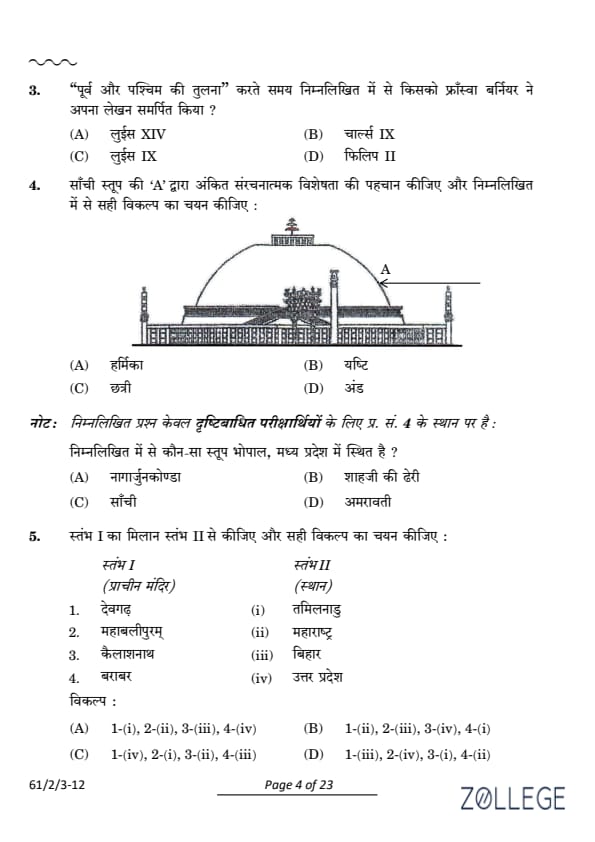
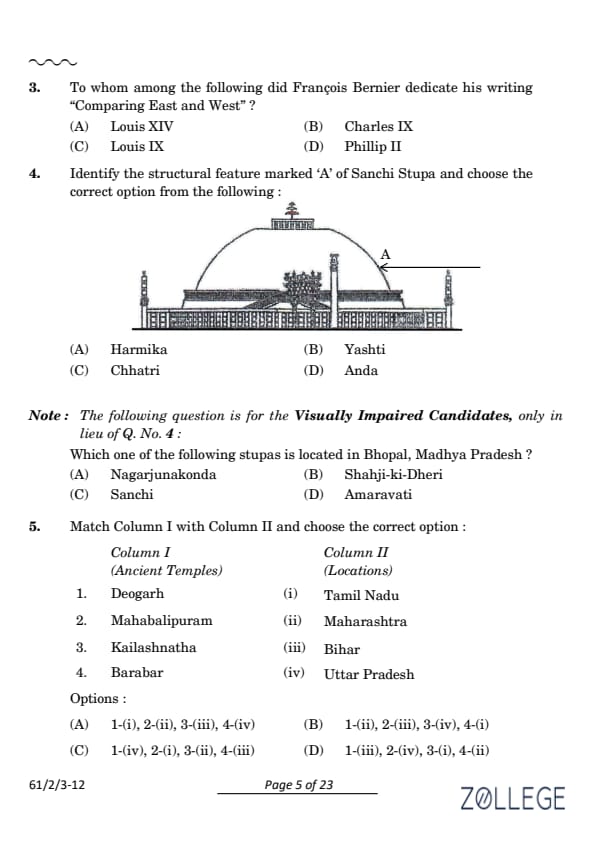
Identify the structural feature marked ‘A’ of Sanchi Stupa and choose the correct option from the following:
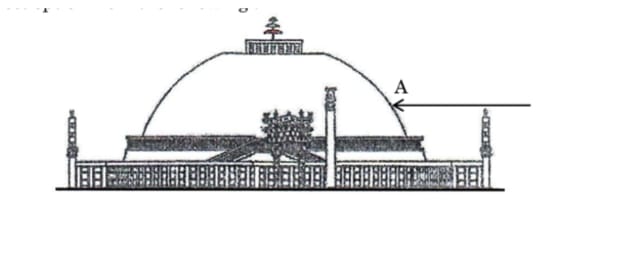
View Solution
The structure marked as ‘A’ in the image refers to the “Anda,” the dome-shaped part of the Sanchi Stupa. The Anda represents the cosmic egg and symbolizes the universe.
Question 5:
Match Column I with Column II and choose the correct option:
Column I Column II
1. Deogarh (i) Tamil Nadu
2. Mahabalipuram (ii) Maharashtra
3. Kailashnatha (iii) Bihar
4. Barabar (iv) Uttar Pradesh
View Solution
- Deogarh is located in Uttar Pradesh, associated with ancient temples (1).
- Mahabalipuram is found in Tamil Nadu (2).
- Kailashnatha is situated in Maharashtra (3).
- Barabar is found in Bihar (4).
Question 6:
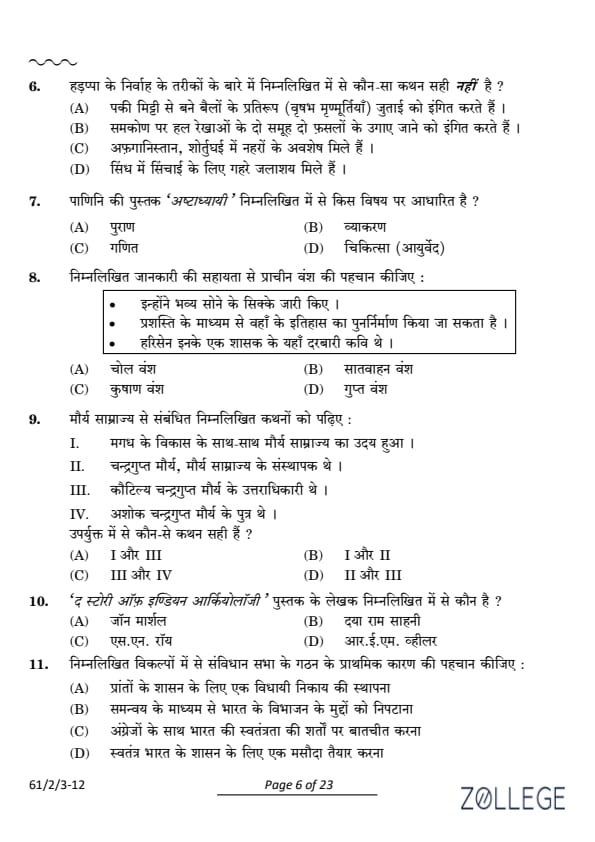
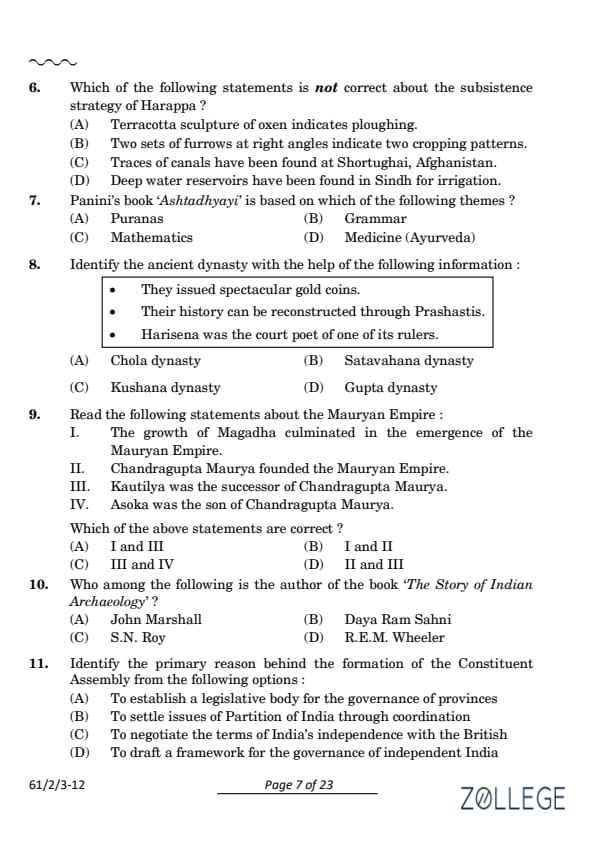
Which of the following statements is not correct about the subsistence strategy of Harappa?
View Solution
Harappa’s subsistence strategy relied heavily on agriculture. Terracotta sculptures indicate ploughing, and there are records of two cropping patterns from furrow evidence. However, there is no evidence of deep water reservoirs being found in Sindh for irrigation.
Question 7:
Panini’s book ‘Ashtadhyayi’ is based on which of the following themes?
View Solution
Panini’s ‘Ashtadhyayi’ is a treatise on Sanskrit grammar. It is considered one of the most important works in the study of the language.
Question 8:
Identify the ancient dynasty with the help of the following information:
• They issued spectacular gold coins.
• Their history can be reconstructed through Prashastis.
• Harisena was the court poet of one of its rulers.
View Solution
The Gupta dynasty is known for its spectacular gold coins and historical reconstructions through Prashastis. Harisena was a court poet in the Gupta court.
Question 9:
Read the following statements about the Mauryan Empire:
I. The growth of Magadha culminated in the emergence of the Mauryan Empire.
II. Chandragupta Maurya founded the Mauryan Empire.
III. Kautilya was the successor of Chandragupta Maurya.
IV. Asoka was the son of Chandragupta Maurya.
Which of the above statements are correct?
View Solution
The Mauryan Empire was founded by Chandragupta Maurya after the rise of Magadha. Kautilya was the teacher and advisor to Chandragupta, not his successor. Asoka was the grandson of Chandragupta, not his son.
Question 10:
Who among the following is the author of the book ’The Story of Indian Archaeology’?
View Solution
S.N. Roy, authored the book ”The Story of Indian Archaeology,” which chronicles the development of archaeology in India.
Question 11:
Identify the primary reason behind the formation of the Constituent Assembly from the following options:
View Solution
The Constituent Assembly was formed to draft the Constitution of India, which would govern independent India, including defining the rights of citizens and the structure of the government.
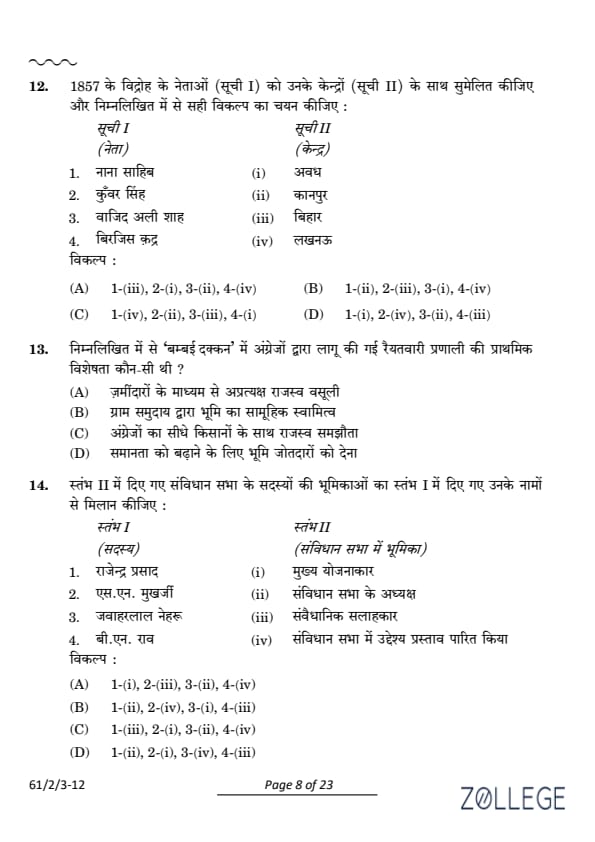
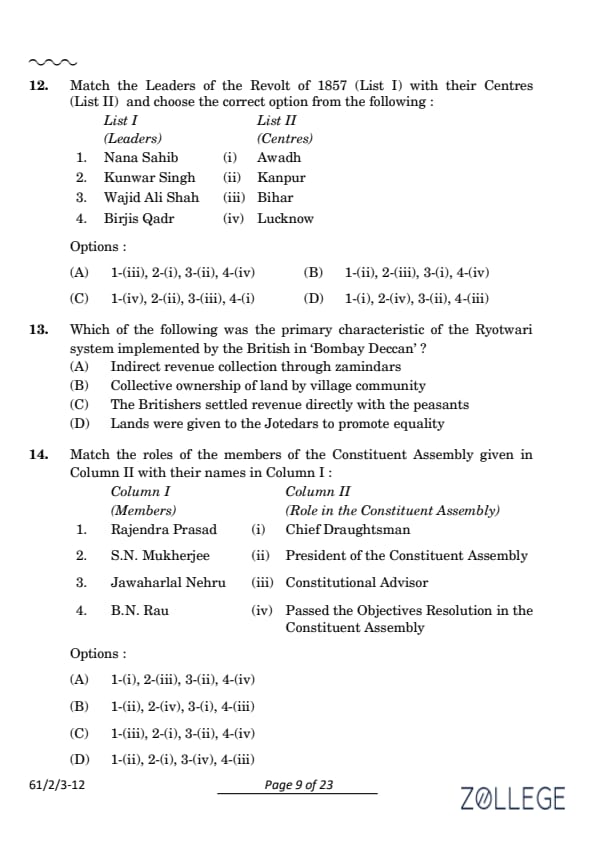
Question 12:
Match the Leaders of the Revolt of 1857 (List I) with their Centres (List II) and choose the correct option from the following:
List I List II
1. Nana Sahib (i) Awadh
2. Kunwar Singh (ii) Kanpur
3. Wajid Ali Shah (iii) Bihar
4. Birjis Qadr (iv) Lucknow
View Solution
- Nana Sahib was a leader in Kanpur (ii).
- Kunwar Singh led the revolt in Bihar (iii).
- Wajid Ali Shah was associated with Awadh (i).
- Birjis Qadr was involved in the revolt in Lucknow (iv).
Question 13:
Which of the following was the primary characteristic of the Ryotwari system implemented by the British in ’Bombay Deccan’?
View Solution
Under the Ryotwari system, the British directly collected land revenue from the individual peasants (ryots), bypassing intermediaries like zamindars.
Question 14:
Match the roles of the members of the Constituent Assembly given in Column II with their names in Column I:
Column I Column II
1. Rajendra Prasad (i) Chief Draughtsman
2. S.N. Mukherjee (ii) President of the Constituent Assembly
3. Jawaharlal Nehru (iii) Constitutional Advisor
4. B.N. Rau (iv) Passed the Objectives Resolution in the Constituent Assembly
View Solution
- Rajendra Prasad was the President of the Constituent Assembly (ii).
- S.N. Mukherjee served as the Constitutional Advisor (iii).
- Jawaharlal Nehru was responsible for passing the Objectives Resolution (iv).
- B.N. Rau was the Chief Draughtsman (i).
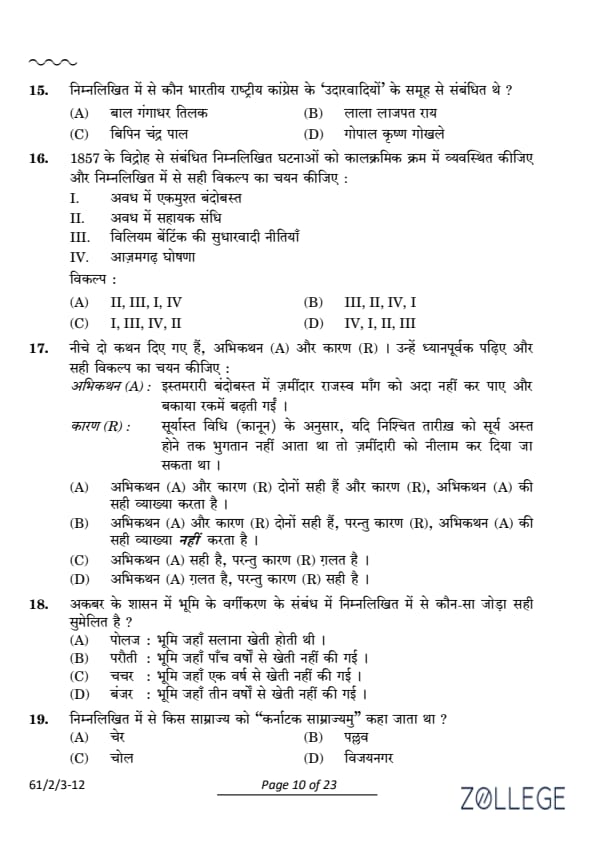
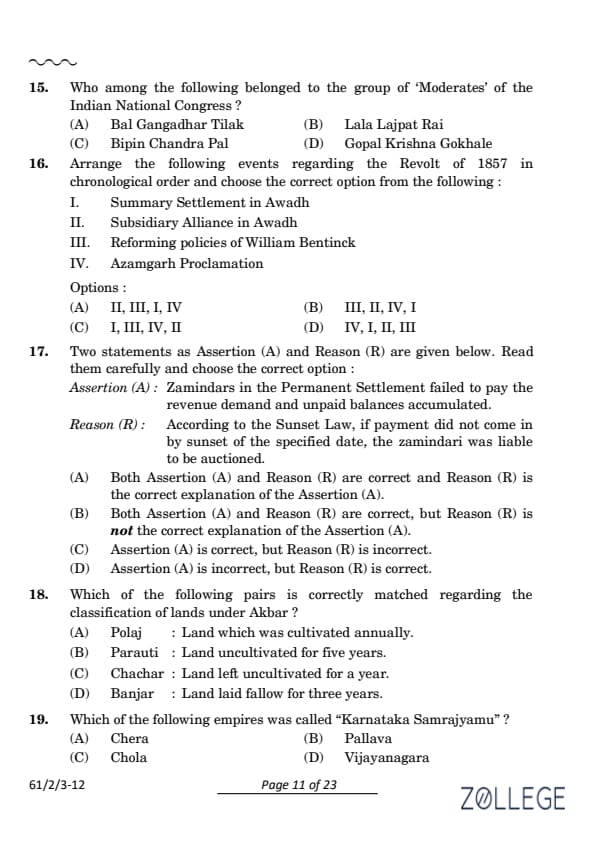
Question 15:
Who among the following belonged to the group of ’Moderates’ of the Indian National Congress?
View Solution
Gopal Krishna Gokhale was a prominent moderate leader in the Indian National Congress, advocating for gradual reforms. Bal Gangadhar Tilak and Bipin Chandra Pal were considered radicals.
Question 16:
Arrange the following events regarding the Revolt of 1857 in chronological order and choose the correct option from the following:
I. Summary Settlement in Awadh
II. Subsidiary Alliance in Awadh
III. Reforming policies of William Bentinck
IV. Azamgarh Proclamation
View Solution
The correct chronological order of events during the Revolt of 1857 is:
- II: Subsidiary Alliance in Awadh, which was introduced by Lord Wellesley in 1800 and had a significant impact on the region.
- III: Reforming policies of William Bentinck, who introduced several reforms in India during the early 19th century, including the abolition of Sati.
- I: Summary Settlement in Awadh, which was carried out in the 1850s by the British government to reorganize land revenue and other systems.
- IV: Azamgarh Proclamation, which was issued during the Revolt of 1857 by the rebels to rally support and mobilize resistance against the British.
Question 17:
Two statements as Assertion (A) and Reason (R) are given below. Read them carefully and choose the correct option:
Assertion (A): Zamindars in the Permanent Settlement failed to pay the revenue demand and unpaid balances accumulated.
Reason (R): According to the Sunset Law, if payment did not come in by sunset of the specified date, the zamindari was liable to be auctioned
View Solution
Assertion (A) is correct since Zamindars in the Permanent Settlement system were often unable to pay the revenue demands, which led to accumulated unpaid balances. However, Reason (R) describes the Sunset Law which applied to auctions, but it was not the direct cause of the failure to pay the revenue. Thus, Reason (R) is not the correct explanation for Assertion (A).
Question 18:
Which of the following pairs is correctly matched regarding the classification of lands under Akbar?
View Solution
Under Akbar’s land revenue system, the classification of lands was as follows:
- Polaj was land that was cultivated annually.
- Parauti was land that had been uncultivated for a number of years.
- Chachar was land left uncultivated for a year.
- Banjar was land that had been left fallow for several years.
Question 19:
Which of the following empires was called ”Karnataka Samrajyam”?
View Solution
The Vijayanagara Empire, located in the Deccan region, was often referred to as the ”Karnataka Samrajyam” due to its rule over the Karnataka region.
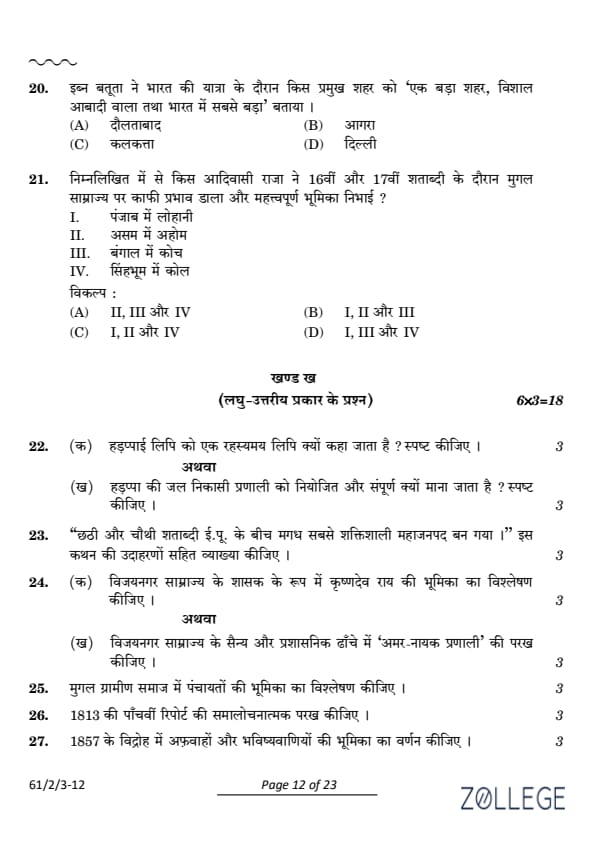
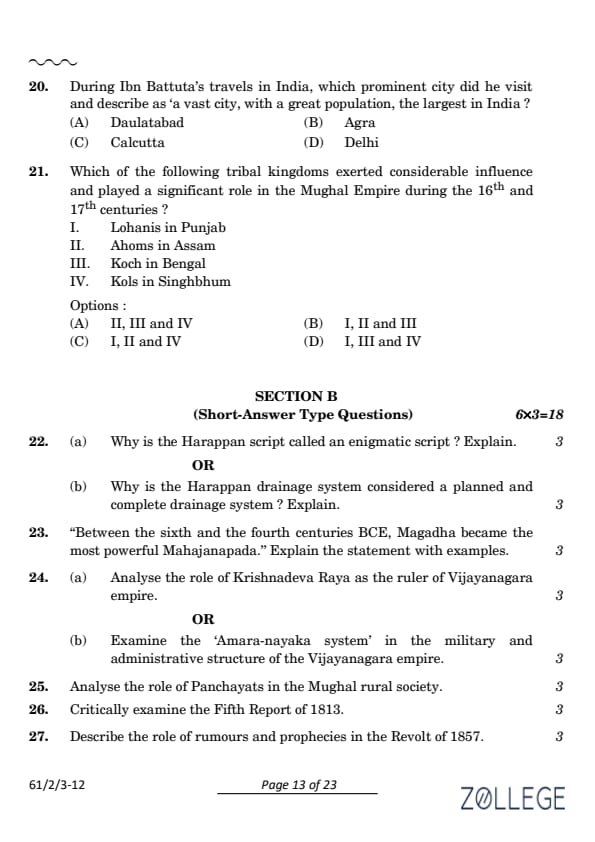
Question 20:
During Ibn Battuta’s travels in India, which prominent city did he visit and describe as ‘a vast city, with a great population, the largest in India?
View Solution
Ibn Battuta, the famous Moroccan traveler, visited Delhi during his travels in India and described it as a vast city with a great population, the largest in India. At the time, Delhi was the capital of the Delhi Sultanate under the rule of Muhammad bin Tughlaq. The city was known for its grand architecture, bustling markets, and significant cultural and political importance.
Question 21:
Which of the following tribal kingdoms exerted considerable influence and played a significant role in the Mughal Empire during the 16th and 17th centuries?
I. Lohanis in Punjab
II. Ahoms in Assam
III. Koch in Bengal
IV. Kols in Singhbhum
View Solution
The tribal kingdoms that played significant roles in the Mughal Empire during the 16th and 17th centuries include the Lohanis in Punjab, the Ahoms in Assam, and the Kols in Singhbhum. The Lohanis, though lesser-known, influenced the political landscape of Punjab. The Ahoms, on the other hand, were a major force in Assam and resisted Mughal expansion, while the Kols contributed to regional governance.
Question 22:
Why is the Harappan script called an enigmatic script? Explain.
View Solution
The Harappan script is considered enigmatic because it has not yet been deciphered, leaving its meaning unclear. Despite extensive studies by linguists and archaeologists, no concrete connection has been established between the script and any known language. This undeciphered state is what makes the Harappan script so mysterious and enigmatic.
Question 23:
Why is the Harappan drainage system considered a planned and complete drainage system? Explain.
View Solution
The Harappan drainage system is considered planned due to its systematic design. Cities like Mohenjo-Daro were built with streets lined by covered drains, and houses were connected to these drains. This advanced sanitation system effectively removed wastewater from the city, indicating meticulous urban planning and a well-developed engineering knowledge.
Question 24:
“Between the sixth and the fourth centuries BCE, Magadha became the most powerful Mahajanapada.” Explain the statement with examples.
View Solution
Magadha became the most powerful Mahajanapada between the sixth and fourth centuries BCE due to its fertile land, strategic location, and strong rulers. Kings like Bimbisara and Ajatashatru expanded Magadha through military campaigns, conquering neighboring regions. Its eventual rise as the center of the Maurya Empire further solidified its political and economic power.
Question 25:
Analyse the role of Krishnadeva Raya as the ruler of the Vijayanagara Empire.
View Solution
Krishnadeva Raya is known for his military successes and as a patron of literature and the arts. His reign saw significant territorial expansion of the Vijayanagara Empire. He promoted the Telugu language, supported the construction of temples, and encouraged artistic achievements, making his rule one of the most prosperous and culturally rich periods of the empire.
Question 26:
Examine the ‘Amara-nayaka system’ in the military and administrative structure of the Vijayanagara Empire.
View Solution
The ‘Amara-nayaka system’ was crucial in the Vijayanagara Empire’s administration. It divided the empire into smaller regions, each governed by an Amara-nayaka, a military officer responsible for both defense and local governance. This decentralized system allowed for effective military control and efficient management of resources across the empire.
Question 27:
Describe the role of rumours and prophecies in the Revolt of 1857.
View Solution
Rumours and prophecies played a major role in the Revolt of 1857 by fueling fear and anger. Rumours about the greased cartridges and the disrespect of religious customs led to widespread unrest. Prophecies about the downfall of British rule and the restoration of Indian sovereignty united soldiers, civilians, and rebels across different regions, turning local grievances into a national uprising.
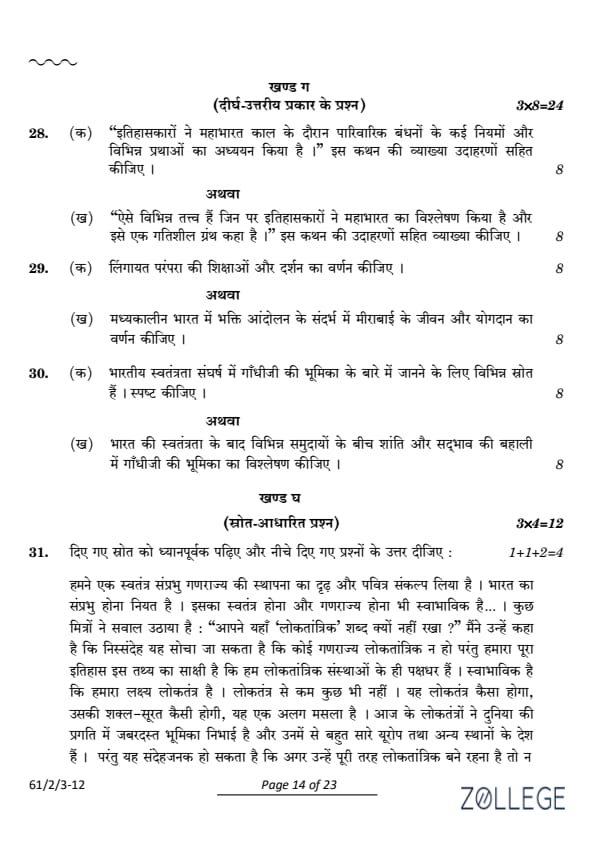
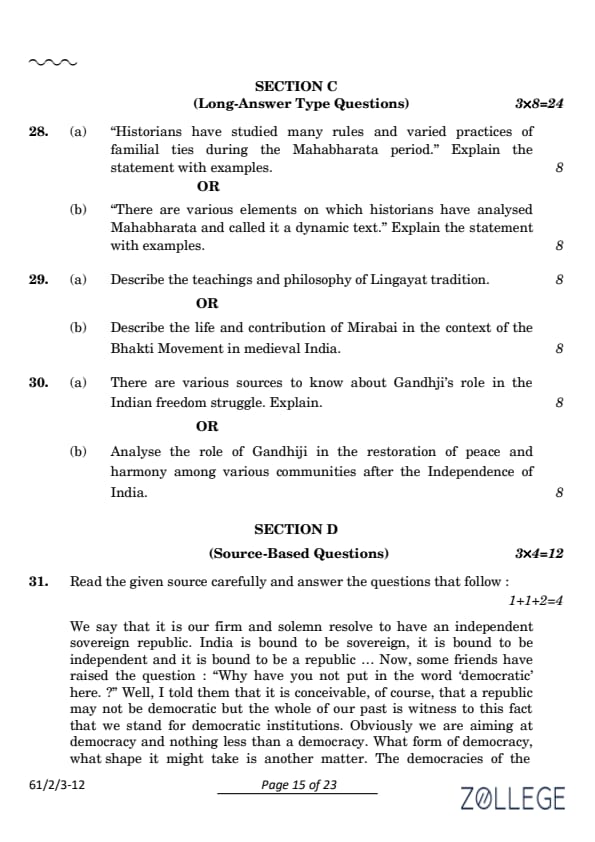
Question 28:
(a) “Historians have studied many rules and varied practices of familial ties during the Mahabharata period.” Explain the statement with examples.
View Solution
The Mahabharata, one of the most important epics of India, provides a rich source of information about familial ties and rules during the Vedic period. The relationships between family members are complex and serve as a lens to explore the social structure of the time. Key examples of familial practices can be found in the relationships between the Pandavas and Kauravas, where concepts like brotherhood, the role of a mother, and the impact of family traditions on political decisions are emphasized. The text also illustrates various social obligations and customs that governed family life, such as the importance of dharma (duty) and the duty to protect one’s family. In the Mahabharata, the duties of sons, daughters, and the relationships between parents and their children are depicted vividly. The code of conduct prescribed by the elders, as well as the tensions arising from disputes among family members, highlight the role of family in shaping moral and social obligations.
Question 28:
(b) “There are various elements on which historians have analysed the Mahabharata and called it a dynamic text.” Explain the statement with examples.
View Solution
The Mahabharata is considered a dynamic text by historians due to its adaptability over time and its reflection of evolving social norms. It incorporates various philosophical schools, such as Vedanta, and presents complex characters whose motivations and actions have multiple interpretations. Elements like the discourse of dharma (righteousness) and artha (material success) depict the changing ideas of governance, justice, and morality. For instance, the Bhagavad Gita, embedded within the Mahabharata, highlights philosophical dilemmas and ethical questions that transcend time. Additionally, the epic’s treatment of different social classes, its discussion of gender roles, and the depiction of war and peace make it a fluid and dynamic narrative that offers insights into changing social practices and political structures. The Mahabharata’s many layers of meaning and its continued relevance in modern times, even in popular culture, demonstrate its dynamic nature.
Question 29:
(a) Describe the teachings and philosophy of Lingayat tradition.
View Solution
The Lingayat tradition is a prominent religious movement within Hinduism that emerged in the 12th century in Karnataka. Founded by the saint Basava, it emphasizes devotion to Lord Shiva in the form of the Linga, symbolizing the formless divine. The central philosophy of Lingayatism is based on the concept of equality, rejecting the caste system and social hierarchies. Lingayats believe in the importance of individual devotion, and they emphasize the practice of personal prayer and meditation to achieve liberation. They focus on leading a righteous life, with a strong moral code that includes purity, honesty, and non-violence. The Lingayat tradition also stresses the importance of community service, advocating for the upliftment of women and marginalized groups in society. The tradition has a deep influence on the socio-political culture of South India and remains an active religious movement to this day.
Question 29:
(b) Describe the life and contribution of Mirabai in the context of the Bhakti Movement in medieval India.
View Solution
Mirabai was a 16th-century poet-saint and a prominent figure in the Bhakti movement. Born into a royal family in Rajasthan, she is best known for her devotion to Lord Krishna, which transcended social and familial boundaries. Mirabai’s unwavering love for Krishna defied the norms of her time, especially in a male-dominated society, where she faced opposition from her family and society. Her poetry, written in vernacular languages like Rajasthani, expressed her deep spiritual connection with Krishna and her rejection of traditional caste-based rituals and practices. Mirabai’s life and works became an inspiration for millions, especially women, and she became a symbol of devotion and religious tolerance. Her participation in the Bhakti movement helped spread the ideals of personal devotion, spiritual equality, and a rejection of idol worship.
Question 30:
(a) There are various sources to know about Gandhiji’s role in the Indian freedom struggle. Explain.
View Solution
Gandhiji’s role in the Indian freedom struggle can be understood through various primary and secondary sources. Primary sources include his own writings, such as his autobiography ”My Experiments with Truth,” which provides insights into his personal philosophy and political journey. His speeches, letters, and articles published in newspapers like ”Young India” and ”Harijan” are critical to understanding his thoughts on non-violence, satyagraha, and his vision for an independent India. Secondary sources include biographies and historical accounts written by scholars, which analyze his role in key events such as the Salt March, Quit India Movement, and his leadership in uniting various sections of Indian society against British colonial rule. Additionally, Gandhiji’s influence is seen in the oral histories of the people who participated in the struggle, many of whom continue to share their personal experiences of being led by him in their fight for independence.
Question 30:
(b) Analyse the role of Gandhiji in the restoration of peace and harmony among various communities after the Independence of India.
View Solution
After India gained independence in 1947, the country was grappling with communal violence, particularly between Hindus and Muslims, leading to the partition of India. Gandhiji played a crucial role in trying to restore peace and harmony in the aftermath of partition. He embarked on several peace missions, including fasts and public appeals, to stop the violence and promote religious tolerance. His efforts to promote Hindu-Muslim unity, his calls for non-violence, and his insistence on rebuilding communities torn by partition played a significant role in reducing tensions. Though Gandhiji’s life was tragically cut short by assassination in 1948, his vision of a secular, inclusive India continued to inspire efforts toward communal harmony in the years following independence.
Question 31:
Read the given source carefully and answer the questions that follow:
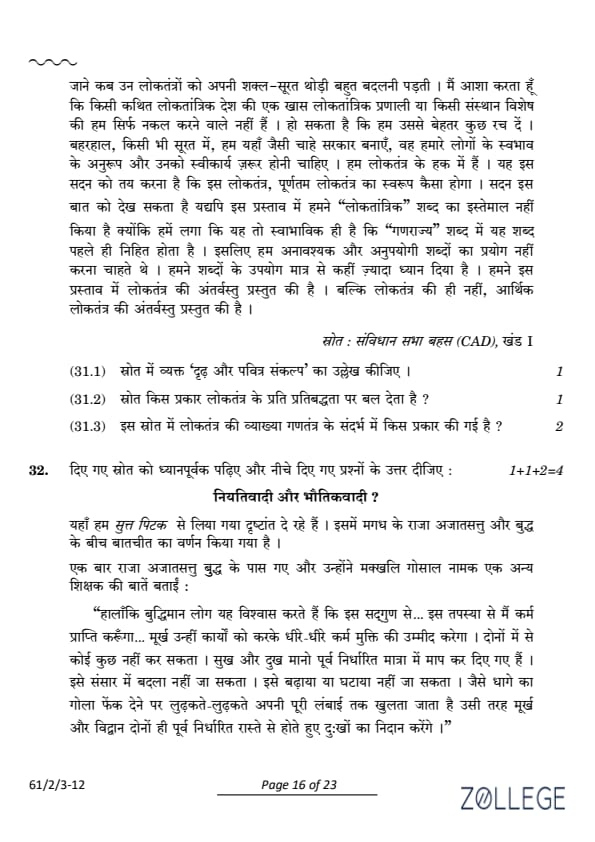
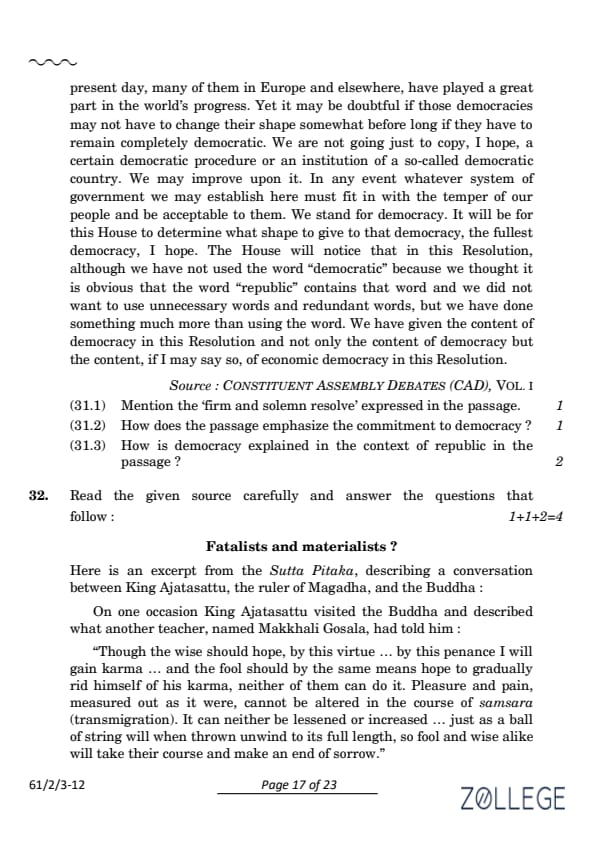
We say that it is our firm and solemn resolve to have an independent sovereign republic. India is bound to be sovereign, it is bound to be independent and it is bound to be a republic. . . Now, some friends have raised the question: ”Why have you not put in the word ‘democratic’ here?” Well, I told them that it is conceivable, of course, that a republic may not be democratic but the whole of our past is witness to this fact that we stand for democratic institutions. Obviously we are aiming at democracy and nothing less than a democracy. What form of democracy, we may improve upon it. In any event whatever system of government we may establish here must fit in with the temper of our people and be acceptable to them. We stand for democracy. It will be for this House to determine what shape to give to that democracy, the fullest democracy, I hope.
(31.1) Mention the ‘firm and solemn resolve’ expressed in the passage.
View Solution
The passage expresses India’s ”firm and solemn resolve” to become an independent, sovereign republic. This indicates the nation’s determination to gain independence and establish a republican form of government. The resolve emphasizes that India will not be a monarchy or a colony but will be a self-governing state. The passage further states that the specific form of democracy would be decided according to the needs and aspirations of the Indian people, but the commitment to a republic and democracy is unequivocal.
(31.2) How does the passage emphasize the commitment to democracy?
View Solution
The passage emphasizes the commitment to democracy by stating that while the word ‘democratic’ was not explicitly included, India has always been committed to democratic principles. The speaker asserts that India stands for democratic institutions and aims to build a democratic system that aligns with the values of the people. The statement that “we stand for democracy” and that the form of democracy will be shaped by the people’s needs shows a deep commitment to democratic governance that respects the diversity and aspirations of the nation.
(31.3) How is democracy explained in the context of republic in the passage?
View Solution
In the passage, democracy is explained as a crucial component of the republic that India is aiming to establish. The speaker clarifies that a republic can exist without being democratic, but India is committed to a democratic form of government. Democracy, in this context, is not just a system of government but a philosophy that aligns with India’s past, values, and future aspirations. It will be shaped by the people’s needs and accepted by them, and its specific form will be determined by the nation’s legislative body.
Question 32:
Read the given source carefully and answer the questions that follow:
Fatalists and materialists?
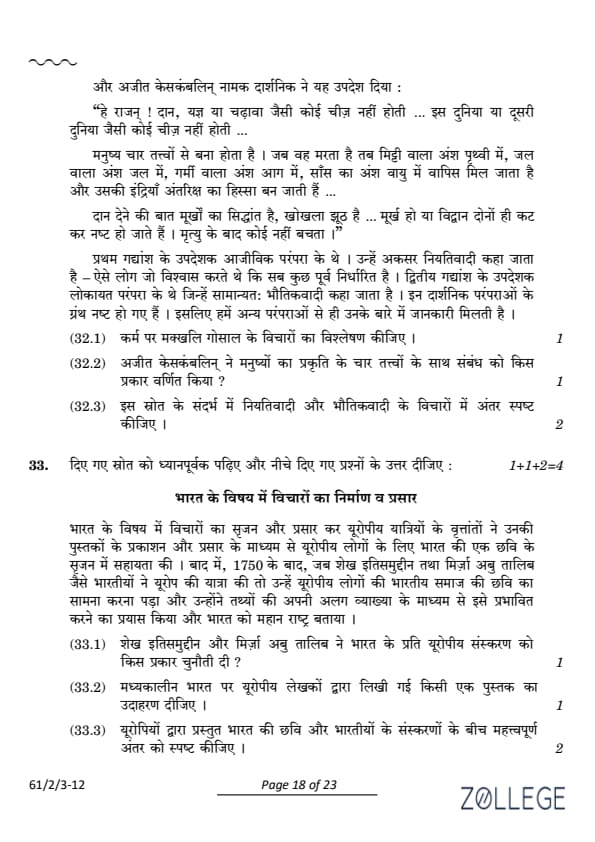
Here is an excerpt from the Sutta Pitaka, describing a conversation between King Ajatasattu, the ruler of Magadha, and the Buddha:
On one occasion King Ajatasattu visited the Buddha and described what another teacher, named Makkhali, had told him: ”Though the wise should hope, by this virtue ... by this penance I will gain karma ... and the fool should say the same means how to gradually rid himself of his karma, neither of them can do it. Pleasure and pain, measured out as it were, cannot be altered in the course of samsara (transmigration). It can neither be lessened or increased... just as a ball of string will throw unwound to its full length, so will all living beings take their course and make an end of sorrow.”
(32.1) Analyse the views of Makkhali Gosala on karma.
View Solution
Makkhali Gosala, a philosopher and teacher, holds a fatalistic view of karma, asserting that individuals have no control over their karma. According to him, neither virtuous actions nor penance can alter one’s karma, which is determined and unchangeable. He believes that pleasure and pain are set within the cycle of samsara (transmigration), and that human beings cannot influence their fates. His view suggests that everything is predestined and humans cannot affect the outcomes of their actions, indicating a belief in the inevitability of one’s karmic journey.
(32.2) How did Ajita Kesakambalin describe the relations of human beings with the four elements of nature?
View Solution
Ajita Kesakambalin, a materialist philosopher, proposed that human beings are made up of the four basic elements: earth, water, fire, and air. According to his philosophy, when a person dies, their body returns to these elements—earth to earth, water to water, fire to fire, and air to air. Kesakambalin rejects any notion of the soul or afterlife, arguing that death results in the dissolution of the human body into its natural components. His teachings emphasize the material nature of existence, denying any spiritual continuation after death.
(32.3) Differentiate between the views of a Fatalist and a Materialist in reference to this source.
View Solution
The key difference between a Fatalist, represented by Makkhali Gosala, and a Materialist, as exemplified by Ajita Kesakambalin, lies in their views on existence and the afterlife. Fatalism, as propounded by Gosala, asserts that everything is predestined, including karma, and that human actions have no power to alter one’s destiny. In contrast, Materialism, as articulated by Kesakambalin, rejects the idea of karma or any spiritual existence, focusing solely on the physical world. Materialists believe that life and death are governed by the physical elements, with no continuation beyond death, while Fatalists see life as determined by a higher, unchangeable force.
Question 33:
Read the given source carefully and answer the questions that follow:
The creation and circulation of ideas about India:
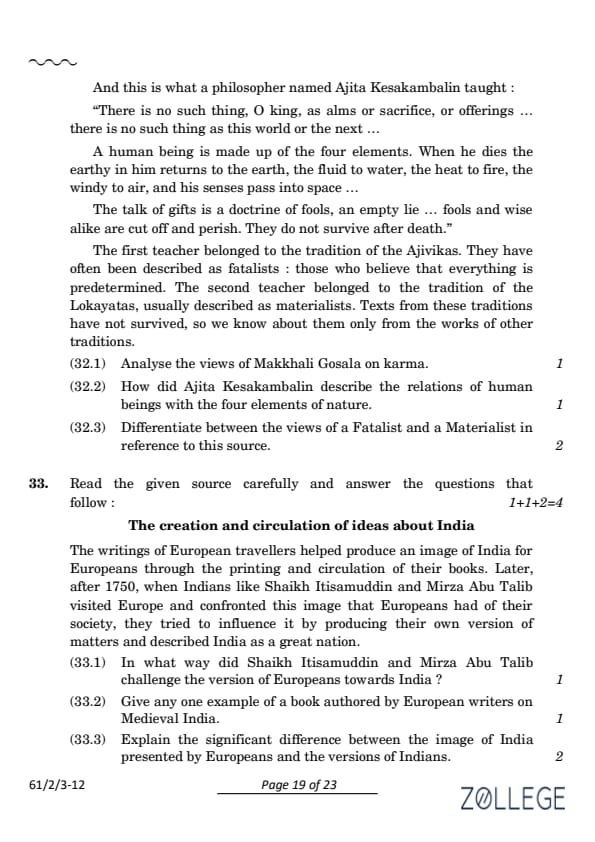
The writings of European travellers helped produce an image of India for Europeans through the printing and circulation of their books. Later, after 1750, when Indians like Shaikh Itsamuddin and Mirza Abu Talib visited Europe and confronted this image that Europeans had of their society, they tried to influence it by producing their own version of matters and described India as a great nation.
(33.1) In what way did Shaikh Itsamuddin and Mirza Abu Talib challenge the version of Europeans towards India?
View Solution
Shaikh Itsamuddin and Mirza Abu Talib challenged the negative portrayal of India by European travelers by presenting a more balanced and positive depiction of Indian society. These Indian scholars rejected the European image of India as a land of chaos and poverty. They sought to correct these misconceptions by highlighting the country’s rich cultural heritage, intellectual achievements, and diverse traditions. Their writings depicted India as a prosperous and ancient civilization, capable of contributing to global discourse, thus providing a counter-narrative to European colonial attitudes.
(33.2) Give any one example of a book authored by European writers on Medieval India.
View Solution
One example of a book authored by a European writer on Medieval India is ”The Travels of Ibn Battuta” by the famous Moroccan traveler Ibn Battuta. His accounts of his travels through India and other parts of the world were widely read in Europe and contributed to the understanding of India’s geography, culture, and society during the medieval period.
(33.3) How did Indians like Shaikh Itsamuddin and Mirza Abu Talib contribute to the creation of a positive image of India in Europe?
View Solution
Shaikh Itsamuddin and Mirza Abu Talib contributed to the positive image of India in Europe by directly engaging with European scholars and travelers and offering their own perspectives on India. They wrote books that described the grandeur of India’s history, its cultural achievements, and its rich traditions in art, science, and governance. Their works countered the European stereotypes of India as a backward society and presented India as a land of intellectual depth and historical significance. Their efforts were pivotal in shaping a more nuanced and respectful view of India in Europe.
Question 34:
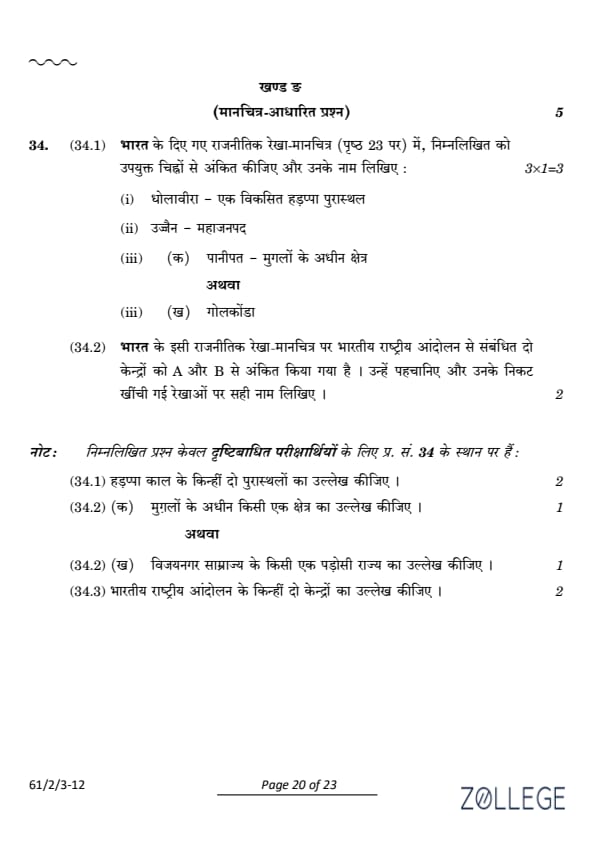
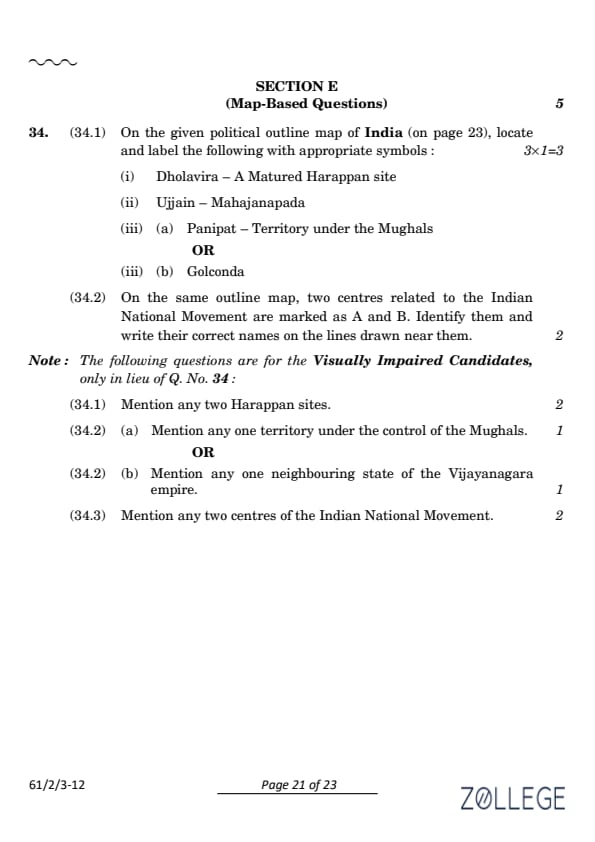
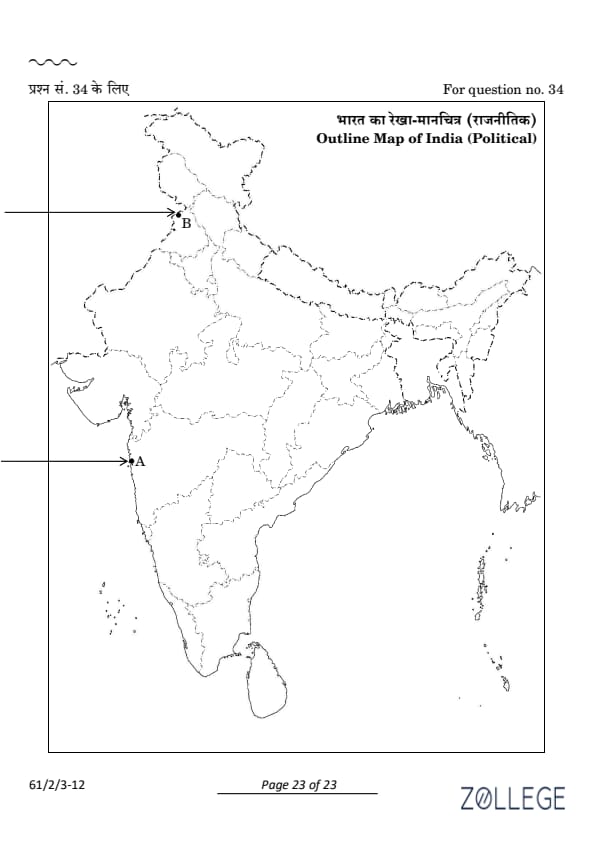
(34.1) On the given political outline map of India (on page 25), locate and label the following with appropriate symbols:
(i) Dholavira – A Matured Harappan site
(ii) Ujjain – Mahajanapada
(iii) (a) Panipat – Territory under the Mughals
OR
(iii) (b) Golconda
View Solution
In the map, the following significant sites are located:
1. Dholavira: Dholavira is located in the present-day state of Gujarat, on the arid island of Khadir in the Kutch district. It is one of the most significant Harappan sites and an example of advanced urban planning in the mature phase of the Harappan civilization. The city featured a sophisticated drainage system and impressive architecture, showcasing the advanced engineering skills of the Harappans.
2. Ujjain: Ujjain, located in Madhya Pradesh, was an important Mahajanapada during the 6th century BCE. It is also renowned for being a significant center of trade and culture during ancient and medieval times. Ujjain played a pivotal role in the political and religious history of India, particularly under the Mauryan Empire and later under the Gupta Empire. It was also known for its connection with Hindu astrology and its role as one of the four sites for the Kumbh Mela.
3. Panipat: Panipat, located in Haryana, was a key site during the Mughal era and is best known for the three major battles fought there: the First Battle of Panipat (1526) between Babur and the Delhi Sultanate, the Second Battle of Panipat (1556) between Akbar and Hemu, and the Third Battle of Panipat (1761) between the Marathas and the Durrani Empire. Panipat was significant as a battlefield that influenced the history of the Indian subcontinent.
4. Golconda: Golconda, located near Hyderabad in Telangana, was a fortified city and the capital of the medieval Golconda Sultanate. The city was known for its diamond trade and strategic importance in the Deccan. The fortress of Golconda was one of the most formidable fortresses in India, known for its acoustics and innovative water systems.
(34.2) On the same outline map, two centres related to the Indian National Movement are marked as A and B. Identify them and write their correct names on the lines drawn near them.
View Solution
In this case, the centers related to the Indian National Movement marked as A and B could be as follows:
- A: Chandni Chowk, Delhi – Chandni Chowk was a focal point of many political movements and protests during the Indian freedom struggle. It is located in the heart of Delhi and was closely associated with the Congress Party and other nationalist organizations during the early 20th century.
- B: Nagpur – Nagpur played a crucial role during the Indian National Movement as a prominent center for political activity. The city hosted several important sessions of the Indian National Congress and was instrumental in the spread of nationalist ideas across central India.
Question 34:
Note : The following questions are for the Visually Impaired Candidates, only in lieu of Q. No. 34
(34.1) Mention any two Harappan sites.
View Solution
Two significant Harappan sites are:
1. Mohenjo-Daro: Located in present-day Sindh, Pakistan, Mohenjo-Daro is one of the most well-preserved urban settlements of the Harappan Civilization. It features a grid-like street system, a sophisticated drainage system, and is known for its advanced urban planning. The site was excavated in the 1920s and continues to be a crucial site for understanding Harappan culture.
2. Harappa: Harappa, located in the Punjab region of Pakistan, is another major site of the Harappan Civilization. It is one of the earliest cities to be discovered and provides essential evidence of the development of the Harappan urban society. Harappa is particularly important for its well-planned streets, granaries, and advanced agricultural practices.
(34.2) (a) Mention any one territory under the control of the Mughals.
View Solution
One territory under the control of the Mughals was Bengal. Bengal was a prosperous region in Eastern India, known for its rich agriculture and trade. The Mughal Empire annexed Bengal in the early 16th century, and it became a crucial part of the empire’s economy due to its cotton, silk, and spice production, as well as its strategic location for trade with Southeast Asia and beyond.
OR
(34.2) (b) Mention any one neighbouring state of the Vijayanagara empire.
View Solution
One neighboring state of the Vijayanagara Empire was the Bahmani Sultanate. Located to the north of Vijayanagara in present-day Maharashtra and Karnataka, the Bahmani Sultanate was a significant political entity during the 14th and 15th centuries. While the two states were often in conflict, they also had cultural exchanges and diplomatic relations.
(34.3) Mention any two centres of the Indian National Movement.
View Solution
Two prominent centers of the Indian National Movement were:
1. Calcutta (Kolkata): Calcutta, the capital of British India for much of the colonial period, was one of the most important centers of political activity during the Indian National Movement. The city witnessed several crucial events, including the formation of the Indian National Congress in 1885, the Swadeshi Movement, and various protests against British colonial rule. Calcutta also hosted many significant sessions of the Indian National Congress and was the epicenter of revolutionary activities.
2. Bombay (Mumbai): Bombay, another key center, played a central role in the Indian independence struggle. The city was the site of numerous strikes, protests, and movements, including the Quit India Movement of 1942. It was also home to several prominent nationalists, leaders, and intellectuals, such as Bal Gangadhar Tilak and Dadabhai Naoroji, who significantly contributed to the national cause. The Bombay Presidency was also crucial in shaping the early political landscape of the country.

*The article might have information for the previous academic years, please refer the official website of the exam.