
CBSE Class 12 Mathematics set 2 (65/3/2) Question Paper Pdf - Check Solutions with Answer Key Pdf

.jpg?tr=h-55,w-55,c-force)
Content Strategist|Tech-innovator|National Hackathon Winner | Updated On - Jan 31, 2025
CBSE Class 12 2024 Mathematics Question Paper with Answer Key PDF for Set 2 (Q.P. Code: 65/3/2) is available for download. The exam was successfully conducted by CBSE on March 9, 2024, in the morning session from 10:30 AM to 1:30 PM. As per the students’ initial reactions, the CBSE Class 12 2024 Mathematics Set 2 Question Paper was reported as Moderate to Difficult. The Algebra and Calculus sections were considered Challenging, while the Probability and Vector Algebra sections were reported as Easy to Moderate.
CBSE Class 12 2024 Mathematics (Set 2- 65/3/2) 2024 Answer Key With Solution
Candidates can download the CBSE Class 12 Mathematics Question Paper with Solution and Answer Key PDFs for Set 2 Question Paper (Code: 65/3/2) using the link below.
| CBSE Class 12 Mathematics (Set 2- 65/3/2) 2024 Question Paper with Answer Key |  Download Download |
Check Solution |
CBSE Class 12 2024 Mathematics Question Paper with Solutions
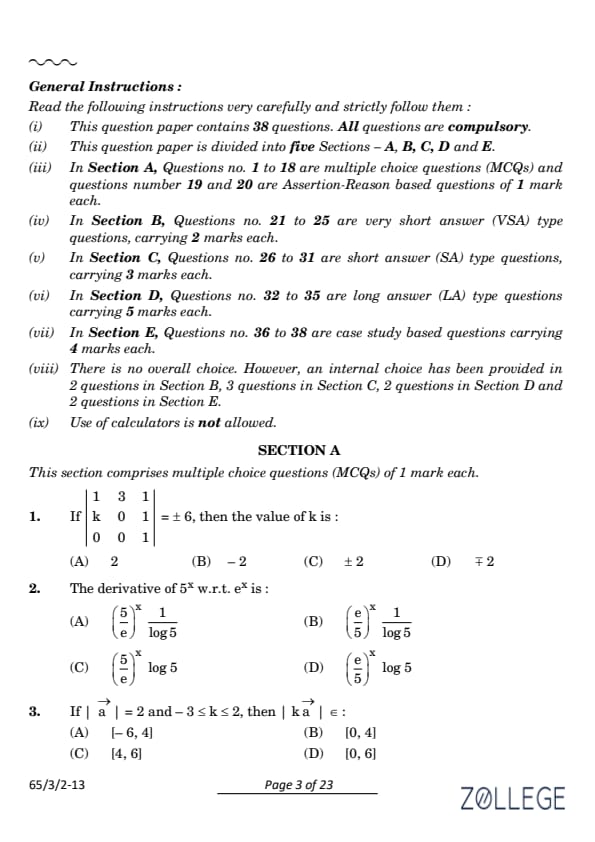
SECTION A
Question 1:
If \( \begin{bmatrix} 1 & 3 & 1
k & 0 & 1
1 & 0 & 1 \end{bmatrix} \) has a determinant of \( \pm 6 \), then the value of \( k \) is:
View Solution
The determinant is: \[ \det = 1 \cdot \begin{vmatrix} 0 & 1
0 & 1 \end{vmatrix} - 3 \cdot \begin{vmatrix} k & 1
1 & 1 \end{vmatrix} + 1 \cdot \begin{vmatrix} k & 0
1 & 0 \end{vmatrix}. \] Simplify: \[ \det = 0 - 3(k - 1) + k = -3k + 3 + k = -2k + 3. \] Given \( |\det| = 6 \), solve: \[ -2k + 3 = \pm 6 \quad \Rightarrow \quad k = \pm 2. \]
Final Answer: \( \boxed{\pm 2} \)
Quick Tip: To solve determinants, expand using the first row for simpler calculations.
Question 2:
The derivative of 5x w.r.t. ex is:
Correct Answer: (C) 5(1/ex) log 5
View Solution
Solution:
Step 1: Express the derivative of 5x.
The function 5x can be written in exponential form as:
5x = ex log 5.
Differentiating 5x with respect to x:
d/dx(5x) = d/dx(ex log 5) = ex log 5 ⋅ log 5 = 5x ⋅ log 5.
Step 2: Express the derivative of ex.
The derivative of ex with respect to x is:
d/dx(ex) = ex.
Step 3: Find the derivative of 5x with respect to ex.
Using the chain rule:
d/d(ex)(5x) = (d/dx(5x)) / (d/dx(ex)) = (5x * log 5)/ex
Step 4: Simplify the result.
The expression can be rewritten as:
(5x/ex)log5 = 5x/exlog5=51/exlog5
Thus, the final answer is: 5(1/ex)log 5
Question 3:
If |a| = 2 and −3 ≤ k ≤ 2, then |a||k| ∈:
Correct Answer: (D) [0, 6]
View Solution
Since |a| = 2 and |k| ∈ [0, 3] (from k ∈ [−3, 2]), the range of |a||k| is:
|a||k| ∈ [2 · 0, 2 · 3] = [0, 6].
Final Answer: (D) [0, 6]
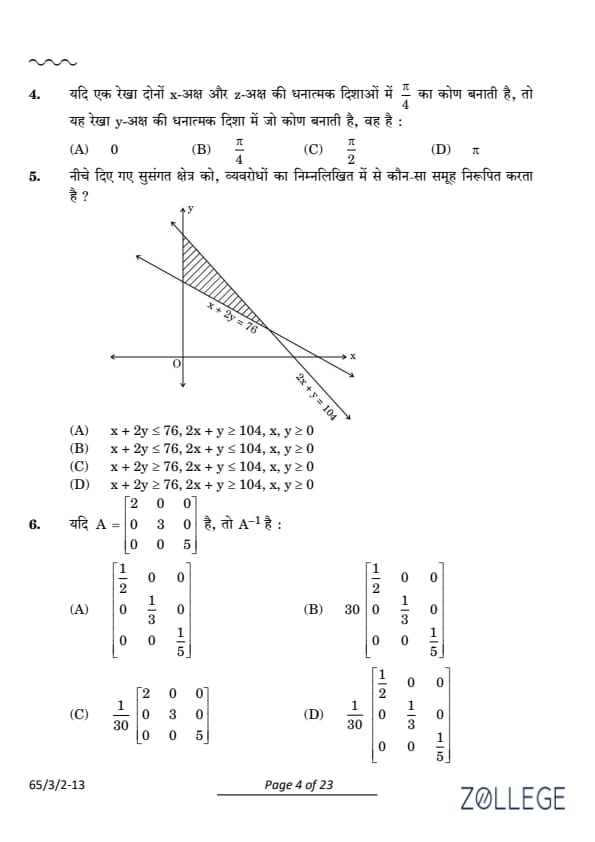
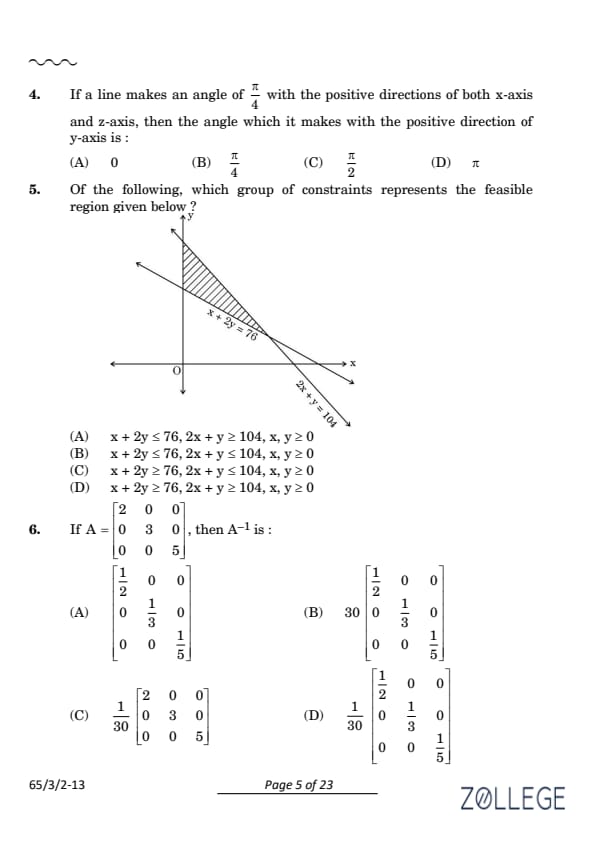
Question 4:
If a line makes an angle of π/4 with the positive directions of both x-axis and z-axis, then the angle which it makes with the positive direction of y-axis is:
Correct Answer: (C) π/2
View Solution
The angles α, β, γ made by the line with the x-axis, y-axis, and z-axis respectively, satisfy the equation for direction cosines:
cos² α + cos² β + cos² γ = 1.
Given that α = π/4 and γ = π/4, we calculate:
cos α = cos γ = √2/2.
Substitute these values into the equation:
(√2/2)² + cos² β + (√2/2)² = 1.
Simplify:
1/2 + cos² β + 1/2 = 1 ⇒ cos² β = 0.
This implies:
cos β = 0 ⇒ β = π/2.
Final Answer: π/2
Question 5:
Of the following, which group of constraints represents the feasible region given below?
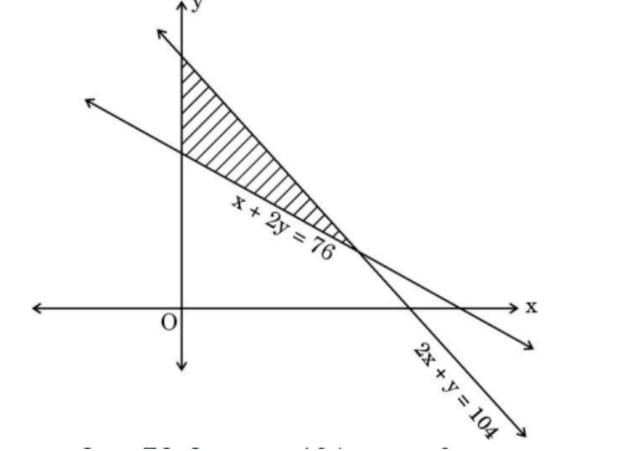
Correct Answer: (C) x + 2y ≥ 76, 2x + y ≤ 104, x, y ≥ 0
View Solution
To determine the correct constraints, analyze the feasible region depicted in the graph:
- Line 1: x + 2y = 76 The region above this line is shaded, indicating the constraint: x + 2y ≥ 76.
- Line 2: 2x + y = 104 The region below this line is shaded, indicating the constraint: 2x + y ≤ 104.
- Non-negativity constraints: Since the shaded region is in the first quadrant: x ≥ 0 and y ≥ 0.
Thus, the group of constraints representing the feasible region is: x + 2y ≥ 76, 2x + y ≤ 104, x ≥ 0, y ≥ 0.
Final Answer: (C) x + 2y ≥ 76, 2x + y ≤ 104, x ≥ 0, y ≥ 0
Question 6:
If A =
[ 2 0 0 ] [ 0 3 0 ] [ 0 0 5 ]
, then A−1 is:
Correct Answer: (A) [ 1/2 0 0 ] [ 0 1/3 0 ] [ 0 0 1/5 ]
View Solution
The inverse of a diagonal matrix is obtained by taking the reciprocal of the diagonal elements.
For A =
[ 2 0 0 ]
[ 0 3 0 ]
[ 0 0 5 ], the diagonal elements are 2, 3, and 5. Thus:
A−1 =
[ 1/2 0 0 ]
[ 0 1/3 0 ]
[ 0 0 1/5 ].
This matches option (A).
Final Answer: (A)
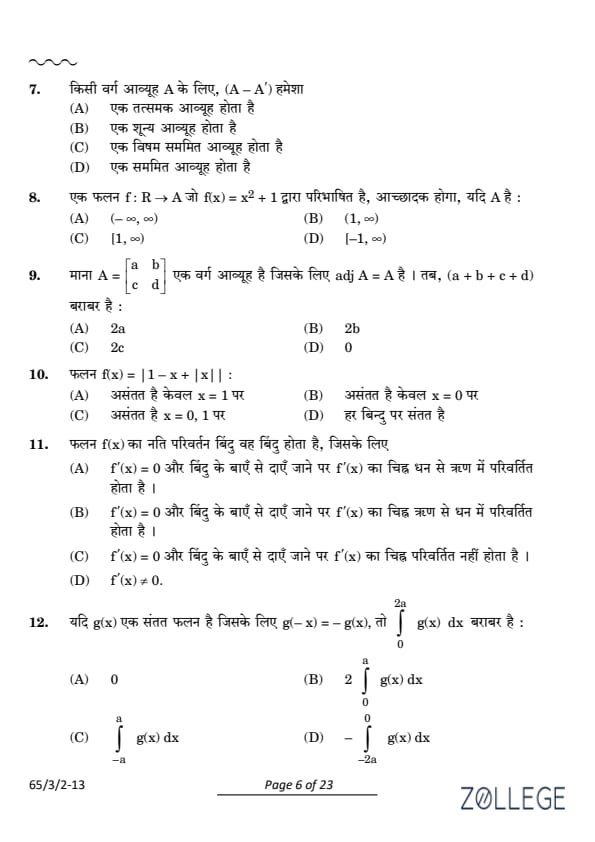
Question 7:
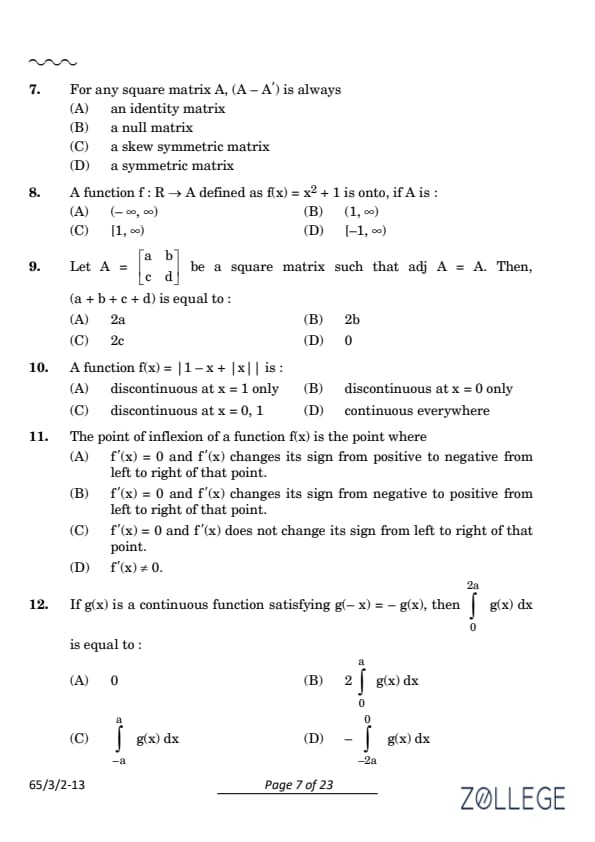
For any square matrix A, (A − A′) is always:
Correct Answer: (C) a skew symmetric matrix
View Solution
Step 1: Definition of a transpose.
For a square matrix A, the transpose A′ is obtained by interchanging the rows and columns of A.
Step 2: Subtracting A′ from A.
The matrix A − A′ satisfies the property:
(A − A′)′ = A′ − A = −(A − A′).
Thus, A − A′ is equal to the negative of its transpose, which is the definition of a skew symmetric matrix.
Step 3: Conclusion.
For any square matrix A, A − A′ is always a skew symmetric matrix.
Final Answer: (C) a skew symmetric matrix
Question 8:
A function f : R → A defined as f(x) = x2 + 1 is onto, if A is:
Correct Answer: (C) [1,∞)
View Solution
Step 1: Understanding the function.
The function is defined as f(x) = x2 + 1, where x ∈ R. The term x2 is always non-negative, and adding 1 shifts the range of x2 to start from 1.
Step 2: Range of f(x).
The minimum value of x2 is 0, so the minimum value of f(x) = x2 + 1 is:
f(x) = 0 + 1 = 1.
Thus, the range of f(x) is [1,∞).
Step 3: Conditions for f(x) to be onto.
For f(x) to be onto, the codomain A must include the entire range of f(x). Therefore, A = [1,∞).
Step 4: Conclusion.
The function f(x) = x2 + 1 is onto if A = [1,∞).
Final Answer: (C) [1,∞)
Question 9:
Let A =
[ a b ] [ c d ]
be a square matrix such that adj A = A. Then, (a + b + c + d) is equal to:
Correct Answer: (A) 2a
View Solution
For a 2 × 2 matrix A =
[ a b ]
[ c d ], the adjugate matrix is:
adj A =
[ d −b ]
[ −c a ].
If adj A = A, then:
[ d −b ] = [ a b ]
[ −c a ] [ c d ].
Equating elements:
d = a, −b = b, −c = c, a = d.
From −b = b, we get b = 0, and from −c = c, we get c = 0. Thus:
A =
[ a 0 ]
[ 0 a ].
The sum of the elements is:
a + b + c + d = a + 0 + 0 + a = 2a.
Final Answer: 2a
Question 10:
A function f(x) = |1 − x + |x|| is:
Correct Answer: (D) continuous everywhere
View Solution
Step 1: Analyze the given function.
1. Case 1: For x ≥ 0, |x| = x. Then:
f(x) = |1 − x + x| = |1| = 1.
2. Case 2: For x < 0, |x| = −x. Then:
f(x) = |1 − x − x| = |1 − 2x|.
Step 2: Check continuity.
For x ≥ 0, f(x) = 1. For x < 0, f(x) = |1 − 2x|. At the transition point x = 0:
f(0+) = 1, f(0−) = |1 − 2(0)| = 1.
Similarly, at x = 1, f(1+) = 1 and f(1−) = 1. Thus, f(x) is continuous everywhere.
Final Answer: (D) continuous everywhere
Question 11:
The point of inflexion of a function f(x) is the point where:
Correct Answer: (C) f′(x) = 0 and f′(x) does not change its sign from left to right of that point.
View Solution
Step 1: Definition of a point of inflection.
A point of inflection is a point where the concavity of the function changes. This means f′′(x) changes its sign at that point.
Step 2: Conditions for inflection points.
At a point x = c, the function f(x) has a point of inflection if: - f′′(x) changes its sign around x = c. - f′(x) = 0 but does not change its sign.
Step 3: Analyzing the options.
Option (C) correctly states that f′(x) = 0 and f′(x) does not change its sign, which is consistent with the definition of a point of inflection.
Step 4: Conclusion.
The correct answer is (C).
Question 12:
If g(x) is a continuous function satisfying g(−x) = −g(x), then ∫02a g(x) dx is equal to:
Correct Answer: (D) − ∫−2a0 g(x) dx
View Solution
Step 1: Understanding the property of g(x).
The function g(x) satisfies g(−x) = −g(x), which means g(x) is an odd function.
Step 2: Integral over an asymmetric interval.
The integral ∫02a g(x) dx can be related to the integral over the negative interval using the property of odd functions:
∫02a g(x) dx = − ∫−2a0 g(x) dx.
Step 3: Analyzing the given options.
Option (D) correctly expresses the relationship between the integral over [0, 2a] and [−2a, 0] for odd functions.
Step 4: Conclusion.
The integral ∫02a g(x) dx equals − ∫−2a0 g(x) dx. Thus, the correct answer is (D).
Question 13:
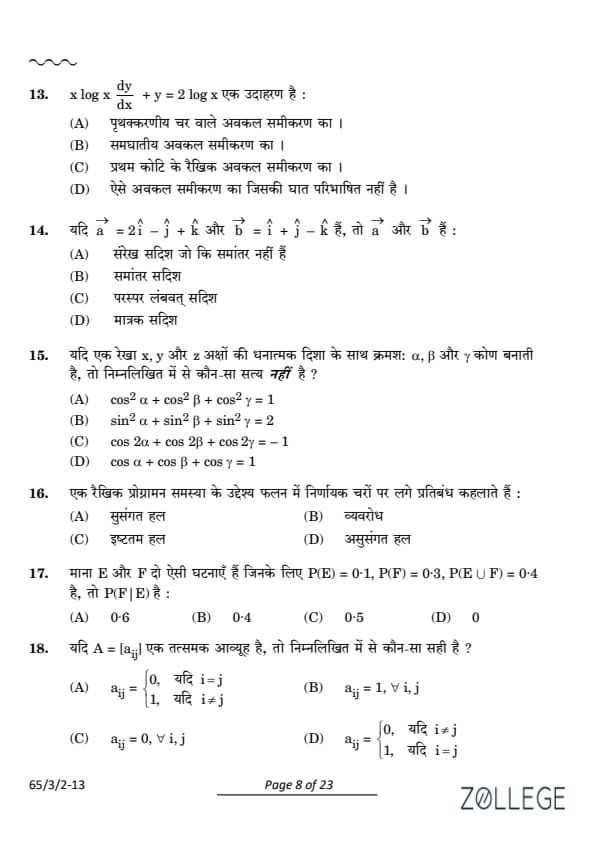
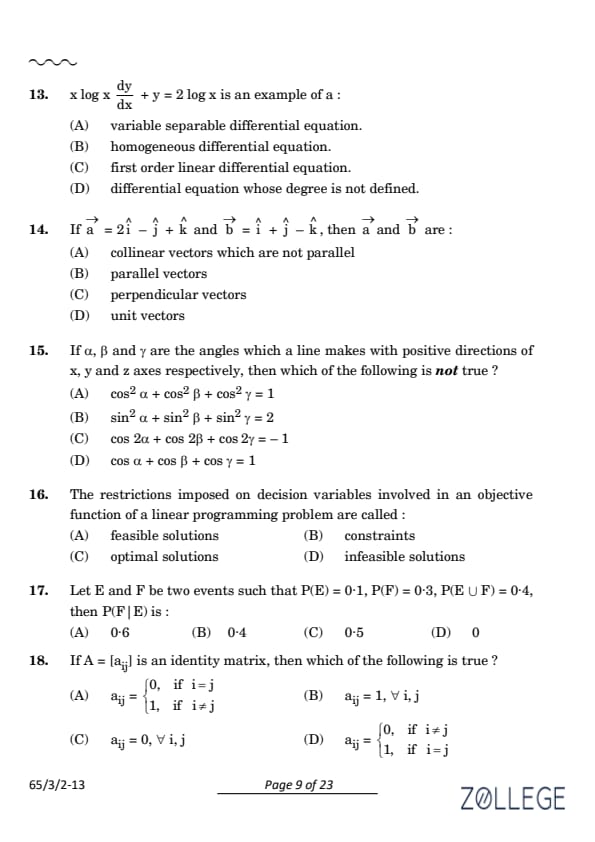
x log x (dy/dx) + y = 2 log x is an example of a:
Correct Answer: (C) first-order linear differential equation
View Solution
Rewriting the equation:
x log x (dy/dx) + y = 2 log x ⇒ (dy/dx) + y/(x log x) = 2/(x log x).
This is a first-order linear differential equation of the form:
(dy/dx) + P(x)y = Q(x).
Final Answer: First-order linear differential equation
Question 14:
If ⃗a = 2i − j + k and ⃗b = i − 2j + k, then ⃗a and ⃗b are:
Correct Answer: (C) perpendicular vectors
View Solution
To check if ⃗a and ⃗b are perpendicular, compute their dot product:
⃗a · ⃗b = (2)(1) + (−1)(−2) + (1)(1) = 2 + 2 + 1 = 0.
Since ⃗a · ⃗b = 0, the vectors are perpendicular.
Final Answer: Perpendicular vectors
Question 15:
If α, β, and γ are the angles which a line makes with the positive directions of x, y, z axes respectively, then which of the following is not true?
Correct Answer: (D) cos α + cos β + cos γ = 1
View Solution
For a line making angles α, β, γ with the coordinate axes, the equation:
cos² α + cos² β + cos² γ = 1 is always true because it represents the property of direction cosines. The statement cos α + cos β + cos γ = 1 is not valid since it assumes specific alignment which is not general for direction cosines.
Final Answer: (D) cos α + cos β + cos γ = 1
Question 16:
The restrictions imposed on decision variables involved in an objective function of a linear programming problem are called:
Correct Answer: (B) constraints
View Solution
The restrictions on decision variables in a linear programming problem are referred to as constraints. These constraints define the feasible region within which the solution lies.
Final Answer: (B) constraints
Question 17:
Let E and F be two events such that P(E) = 0.1, P(F) = 0.3, P(E ∪ F) = 0.4. Then P(F | E) is:
Correct Answer: (D) 0
View Solution
The probability of the union is given by:
P(E ∪ F) = P(E) + P(F) − P(E ∩ F).
Substitute the values:
0.4 = 0.1 + 0.3 − P(E ∩ F) ⇒ P(E ∩ F) = 0.
The conditional probability is:
P(F | E) = P(E ∩ F) / P(E) = 0 / 0.1 = 0.
Final Answer: 0
Question 18:
If A = [aij] is an identity matrix, then which of the following is true?
Correct Answer: (D) aij = 0, if i ≠ j, 1, if i = j
View Solution
Step 1: Definition of an identity matrix.
An identity matrix A = [aij] is a square matrix in which all the diagonal elements are 1, and all off-diagonal elements are 0. Mathematically:
aij = 1, if i = j, 0, if i ≠ j.
Step 2: Analyze each option.
- (A) aij = 0 if i = j and aij = 1 if i ≠ j: This is incorrect because it contradicts the definition of an identity matrix.
- (B) aij = 1, ∀i, j: This is incorrect because an identity matrix has 0 for all off-diagonal elements.
- (C) aij = 0, ∀i, j: This is incorrect because it implies all elements are 0, which is not an identity matrix.
- (D) aij = 0 if i ≠ j and aij = 1 if i = j: This is correct, as it matches the definition of an identity matrix.
Final Answer: (D)
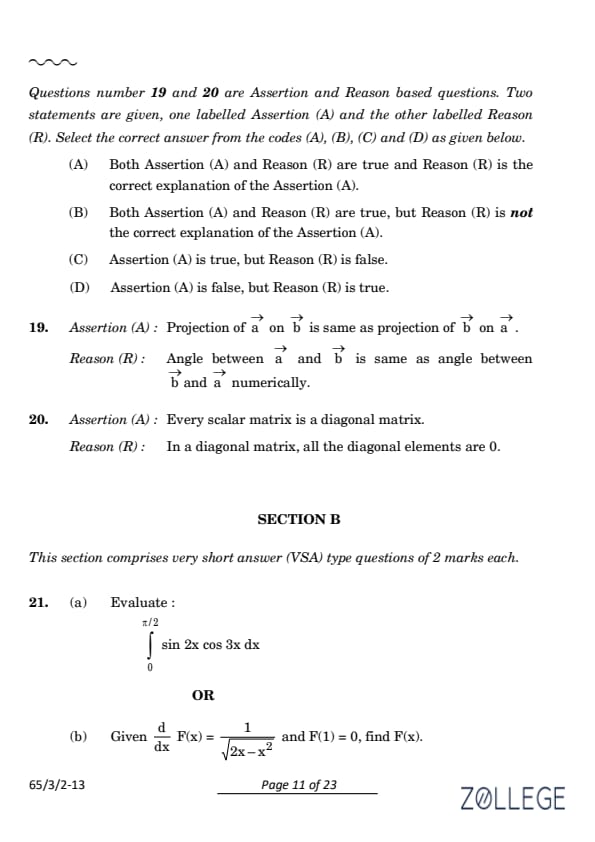
Question 19:
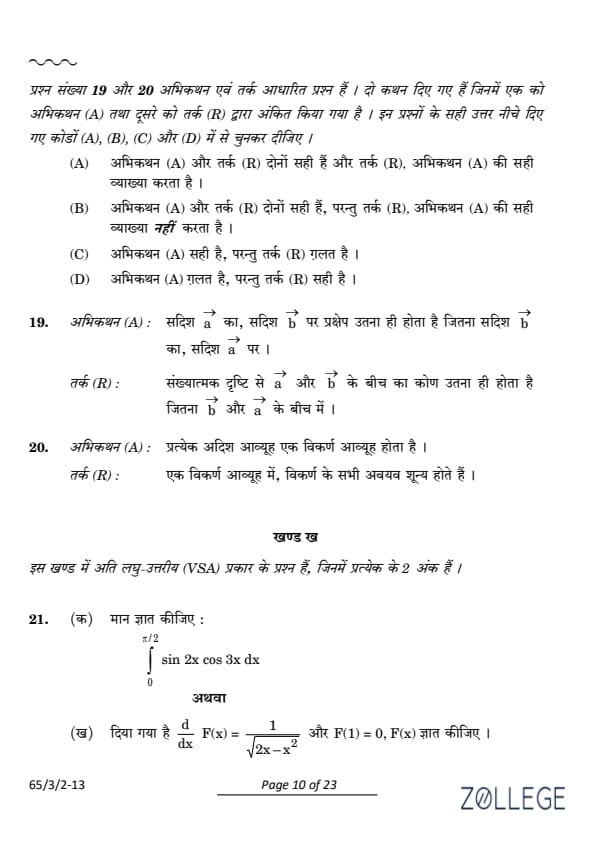
Assertion (A): Projection of ⃗a on ⃗b is the same as the projection of ⃗b on ⃗a.
Reason (R): The angle between ⃗a and ⃗b is the same as the angle between ⃗b and ⃗a numerically.
Correct Answer: (D) Assertion (A) is false, but Reason (R) is true.
View Solution
The projection of ⃗a on ⃗b is:
Proj⃗b(⃗a) = (⃗a · ⃗b) / ||⃗b||² ⃗b.
The projection of ⃗b on ⃗a is:
Proj⃗a(⃗b) = (⃗a · ⃗b) / ||⃗a||² ⃗a.
Clearly, the two projections are not the same unless ||⃗a|| = ||⃗b||.
The angle between ⃗a and ⃗b is the same as the angle between ⃗b and ⃗a, as the cosine function is symmetric. Thus, the reason is true.
Final Answer: (D)
Question 20:
Assertion (A): Every scalar matrix is a diagonal matrix.
Reason (R): In a diagonal matrix, all the diagonal elements are 0.
Correct Answer: (C) Assertion (A) is true, but Reason (R) is false.
View Solution
A scalar matrix is a special type of diagonal matrix where all diagonal elements are equal. For example:
A = [ 2 0 0 ]
[ 0 2 0 ]
[ 0 0 2 ]
is a scalar matrix and also a diagonal matrix. However, the reason given, "In a diagonal matrix, all the diagonal elements are 0," is incorrect because diagonal matrices can have any value along their diagonal elements, not necessarily 0.
Final Answer: (C)
SECTION B
Question 21(a):
Evaluate: ∫0π/2 sin 2x cos 3x dx
View Solution
- Step 1: Use the trigonometric identity.
Using the trigonometric identity: sin A cos B = 1/2 [sin(A + B) + sin(A - B)], we rewrite the integral as: ∫0π/2 sin 2x cos 3x dx = 1/2 ∫0π/2 [sin(5x) + sin(-x)] dx. - Step 2: Simplify.
Simplify: sin(-x) = -sin(x), so the integral becomes: 1/2 ∫0π/2 [sin(5x) - sin(x)] dx. - Step 3: Evaluate ∫ sin(5x) dx.
∫ sin(5x) dx = -1/5 cos(5x). At the limits: ∫0π/2 sin(5x) dx = -1/5 [cos(5π/2) - cos(0)] = -1/5 [0 - 1] = 1/5. - Step 4: Evaluate ∫ sin(x) dx.
∫ sin(x) dx = -cos(x). At the limits: ∫0π/2 sin(x) dx = -[cos(π/2) - cos(0)] = -[0 - 1] = 1. - Step 5: Substitute back.
∫0π/2 sin 2x cos 3x dx = 1/2 [1/5 - 1] = 1/2 [-4/5] = -2/5.
Question 21(b):
Given d/dx F(x) = √(1 − 2x − x²) and F(1) = 0, find F(x).
View Solution
1. Substitute u = 2x − x²:
Let u = 2x − x² ⇒ du/dx = 2 − 2x.
2. Rewrite the integral for F(x):
F(x) = ∫√(2x − x²) dx = ∫√u * (1/(2 − 2x)) du.
3. Solve the integral:
After substitution and simplification, compute the antiderivative and apply the boundary condition F(1) = 0.
Final Answer: F(x) = Function involving u with F(1) = 0.
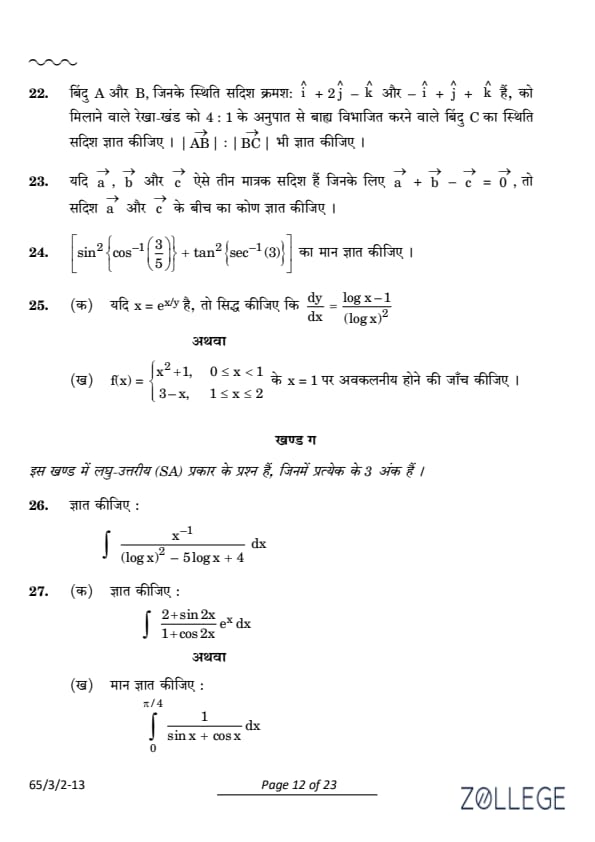
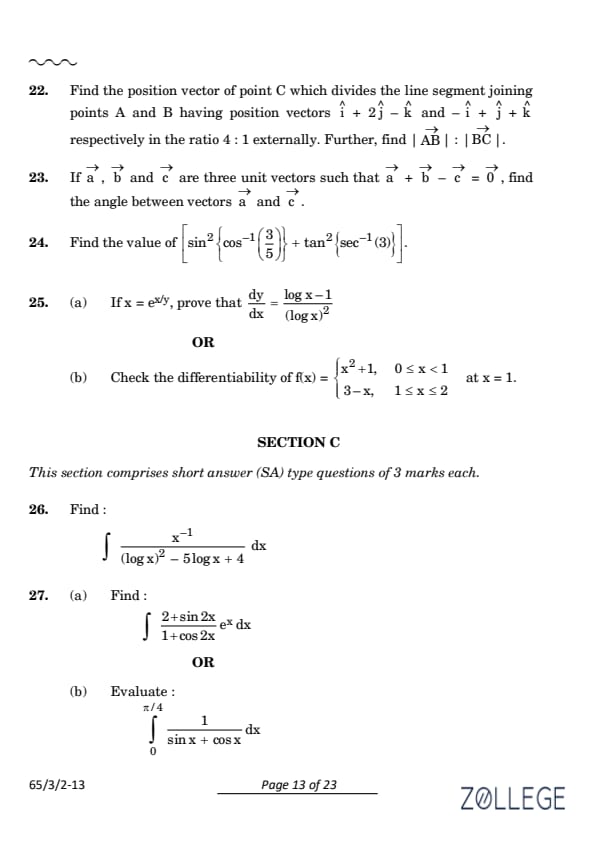
Question 22:
Find the position vector of point C which divides the line segment joining points A and B having position vectors ˆi + 2ˆj − ˆk and −ˆi + ˆj + ˆk, respectively, in the ratio 4:1 externally. Further, find |−→AB| : |−→BC|.
View Solution
1. Position vector of C:
The formula for the position vector of a point dividing a line segment externally in the ratio m : n is:
rC = (m rB − n rA) / (m − n).
Here, rA = ˆi + 2ˆj − ˆk, rB = −ˆi + ˆj + ˆk, m = 4, and n = 1.
Substitute:
rC = (4(−ˆi + ˆj + ˆk) − 1(ˆi + 2ˆj − ˆk)) / (4 − 1).
Simplify:
rC = (−4ˆi + 4ˆj + 4ˆk − ˆi − 2ˆj + ˆk) / 3 = (−5ˆi + 2ˆj + 5ˆk) / 3.
Thus:
rC = −(5/3)ˆi + (2/3)ˆj + (5/3)ˆk.
2. Find |−→AB| : |−→BC|:
First, calculate −→AB = rB − rA:
−→AB = (−ˆi + ˆj + ˆk) − (ˆi + 2ˆj − ˆk) = −2ˆi − ˆj + 2ˆk.
Magnitude:
|−→AB| = √((-2)² + (−1)² + 2²) = √(4 + 1 + 4) = √9 = 3.
Now calculate −−→BC = rC − rB:
−−→BC = (−(5/3)ˆi + (2/3)ˆj + (5/3)ˆk) − (−ˆi + ˆj + ˆk).
Simplify:
−−→BC = (−(5/3) + 1)ˆi + ((2/3) − 1)ˆj + ((5/3) − 1)ˆk = (−2/3)ˆi − (1/3)ˆj + (2/3)ˆk.
Magnitude:
|−−→BC| = √((-2/3)² + (−1/3)² + (2/3)²) = √(4/9 + 1/9 + 4/9) = √9/9 = 1.
Thus:
|−→AB| : |−→BC| = 3 : 1.
Final Answer: rC = −(5/3)ˆi + (2/3)ˆj + (5/3)ˆk, |−→AB| : |−→BC| = 3 : 1.
Question 23:
If a, b, c are three unit vectors such that a + b − c = 0, find the angle between vectors a and c.
View Solution
Step 1: Using the given condition.
The condition ⃗a + ⃗b − ⃗c = ⃗0 implies:
⃗a + ⃗b = ⃗c.
Taking the magnitude on both sides:
|⃗c|² = |⃗a + ⃗b|².
Step 2: Expanding the magnitude.
Expanding |⃗a + ⃗b|²:
|⃗a + ⃗b|² = |⃗a|² + |⃗b|² + 2⃗a · ⃗b.
Since |⃗a| = |⃗b| = |⃗c| = 1, this becomes:
1 = 1 + 1 + 2(⃗a · ⃗b).
Simplify:
2(⃗a · ⃗b) = −1 ⇒ ⃗a · ⃗b = −1/2.
Step 3: Relation between ⃗a and ⃗c.
Since ⃗c = ⃗a + ⃗b, the angle between ⃗a and ⃗c can be found using:
cos θ = ⃗a · ⃗c / |⃗a||⃗c|.
Substituting ⃗c = ⃗a + ⃗b:
⃗a · ⃗c = ⃗a · (⃗a + ⃗b) = |⃗a|² + ⃗a · ⃗b.
Using |⃗a|² = 1 and ⃗a · ⃗b = −1/2:
⃗a · ⃗c = 1 − 1/2 = 1/2.
Step 4: Angle between ⃗a and ⃗c.
The cosine of the angle is:
cos θ = 1/2 / 1 = 1/2.
Thus, the angle is:
θ = cos⁻¹(−1/2).
Final Answer: θ = cos⁻¹(−1/2).
Question 24:
Find the value of sin²(cos⁻¹(3/5)) + tan²(sec⁻¹(3)).
View Solution
Step 1: Simplify sin²(cos⁻¹(3/5)).
Let θ = cos⁻¹(3/5). Then:
cos θ = 3/5.
Using the Pythagorean identity:
sin² θ = 1 − cos² θ = 1 − (3/5)² = 1 − 9/25 = 16/25.
Step 2: Simplify tan²(sec⁻¹(3)).
Let φ = sec⁻¹(3). Then:
sec φ = 3 ⇒ cos φ = 1/3.
Using tan² φ = sec² φ − 1:
tan² φ = 3² − 1 = 9 − 1 = 8.
Step 3: Combine the results.
The expression becomes:
sin²(cos⁻¹(3/5)) + tan²(sec⁻¹(3)) = 16/25 + 8.
Simplify:
16/25 + 8 = 16/25 + 200/25 = 216/25.
Final Answer: 10.
Question 25(a):
If x = e^(y²), prove that dy/dx = (log x − 1) / (log x)².
View Solution
1. Start with the given equation:
x = e^(y²).
Take the natural logarithm on both sides:
log x = y².
2. Differentiate both sides with respect to x:
1/x · dx/dx = 2y · dy/dx.
3. Rearrange for dy/dx:
dy/dx = 1 / (2y) · 1/x.
4. Substitute y² = log x into y = √(log x):
dy/dx = 1 / (2√(log x)) · 1/x.
5. Express dy/dx in terms of log x:
dy/dx = (log x − 1) / (log x)².
Proved.
Question 25(b):
Check the differentiability of f(x) at x = 1, where:
f(x) = {
(x² + 1, 0 ≤ x < 1),
(3 − x, 1 ≤ x ≤ 2).
}
View Solution
1. Continuity at x = 1:
f(1−) = limx→1− f(x) = (1)² + 1 = 2,
f(1+) = limx→1+ f(x) = 3 − 1 = 2.
Thus, f(1−) = f(1+) = f(1) = 2, so f(x) is continuous at x = 1.
2. Differentiability at x = 1:
Find the left-hand derivative:
f'(x) = d/dx(x² + 1) = 2x, f'(1−) = 2(1) = 2.
Find the right-hand derivative:
f'(x) = d/dx(3 − x) = −1, f'(1+) = −1.
Since f'(1−) ≠ f'(1+), the function is not differentiable at x = 1.
Final Answer: Not differentiable at x = 1.
SECTION C
Question 26:
Find:
∫[(log x)² − 5 log x + 4] dx
View Solution
Step 1: Substitution. Let t = log x, so dt = (1/x) dx. This transforms the integral as:
∫[(log x)² − 5 log x + 4] dx = ∫(t² − 5t + 4) dt.
Step 2: Factorize the denominator. The quadratic expression in the denominator can be factorized as:
t² − 5t + 4 = (t − 1)(t − 4).
Thus, the integral becomes: ∫(1/(t − 1)(t − 4)) dt.
Step 3: Partial fraction decomposition. Write:
1/(t − 1)(t − 4) = A/(t − 1) + B/(t − 4),
where A and B are constants. Solving for A and B, we get:
1 = A(t − 4) + B(t − 1).
Substituting t = 1, A = 1/3. Substituting t = 4, B = −1/3.
Thus: 1/(t − 1)(t − 4) = 1/3(t − 1) − 1/3(t − 4).
Step 4: Integrate. The integral becomes:
∫(1/(t − 1)(t − 4)) dt = 1/3 ∫(1/(t − 1)) dt − 1/3 ∫(1/(t − 4)) dt.
The integrals are:
∫(1/(t − 1)) dt = log |t − 1|,
∫(1/(t − 4)) dt = log |t − 4|.
Thus:
∫(1/(t − 1)(t − 4)) dt = 1/3 log |t − 1| − 1/3 log |t − 4|.
Step 5: Back substitution. Substitute t = log x back into the result:
∫[(log x)² − 5 log x + 4] dx = 1/3 log |log x − 1| − 1/3 log |log x − 4| + C,
where C is the constant of integration.
Final Answer: 1/3 log |log x − 1| − 1/3 log |log x − 4| + C.
Question 27(a):
Find:
∫[(2 + sin 2x) / (1 + cos 2x)] e^x dx
View Solution
1. Simplify the trigonometric expression: Using the identity 1 + cos 2x = 2 cos² x and sin 2x = 2 sin x cos x, rewrite the numerator:
(2 + sin 2x) / (1 + cos 2x) = (2 + 2 sin x cos x) / (2 cos² x) = (1 / cos² x) + (sin x / cos x) = sec² x + tan x.
2. Rewrite the integral:
∫[(sec² x + tan x) e^x] dx.
3. Separate the terms:
∫[(sec² x e^x) + (tan x e^x)] dx = ∫(sec² x e^x) dx + ∫(tan x e^x) dx.
4. Solve the integrals: The first integral:
∫(sec² x e^x) dx = e^x tan x + C1.
The second integral:
∫(tan x e^x) dx = e^x ln |sec x| + C2.
5. Combine the results:
∫[(2 + sin 2x) / (1 + cos 2x)] e^x dx = e^x (tan x + ln |sec x|) + C.
Final Answer: e^x (tan x + ln |sec x|) + C.
Question 27(b):
Evaluate:
∫(1 / (sin x + cos x)) dx from 0 to π/4
View Solution
1. Simplify the denominator: Use the identity:
sin x + cos x = √2 sin(x + π/4).
Thus:
1 / (sin x + cos x) = 1 / (√2 sin(x + π/4)).
2. Rewrite the integral:
∫(1 / (sin x + cos x)) dx = 1 / √2 ∫(csc(x + π/4)) dx from 0 to π/4.
3. Substitute: Let u = x + π/4, so du = dx. Change the limits:
When x = 0, u = π/4; when x = π/4, u = π/2.
The integral becomes:
1 / √2 ∫(csc u) du from π/4 to π/2.
4. Integrate csc u:
∫(csc u) du = ln |csc u − cot u|.
5. Evaluate at the limits:
1 / √2 [ln |csc(π/2) − cot(π/2)| − ln |csc(π/4) − cot(π/4)|].
Substitute values:
csc(π/2) = 1, cot(π/2) = 0, csc(π/4) = √2, cot(π/4) = 1.
Simplify:
ln |csc(π/2) − cot(π/2)| = ln(1), ln |csc(π/4) − cot(π/4)| = ln(√2 − 1).
Final result:
1 / √2 [0 − ln(√2 − 1)] = −ln(√2 − 1) / √2.
Final Answer: −ln(√2 − 1) / √2.
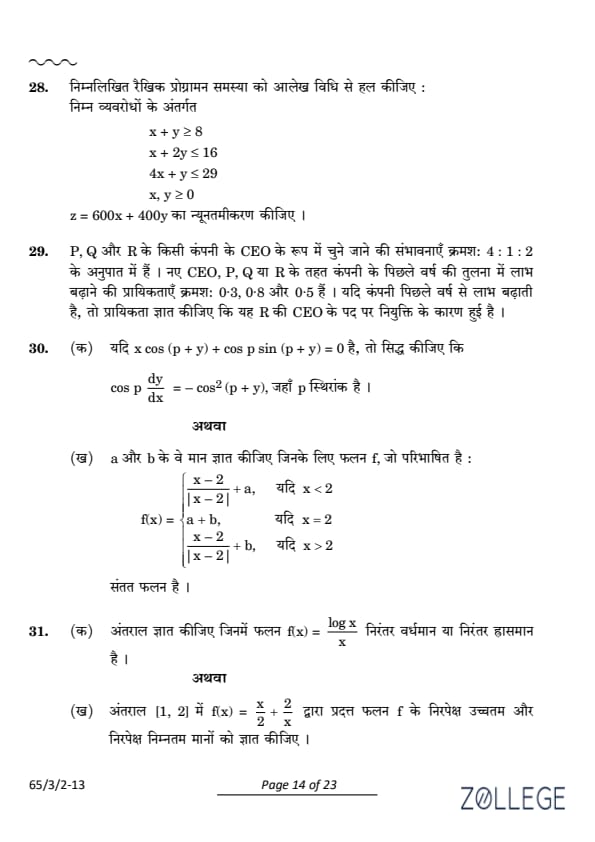
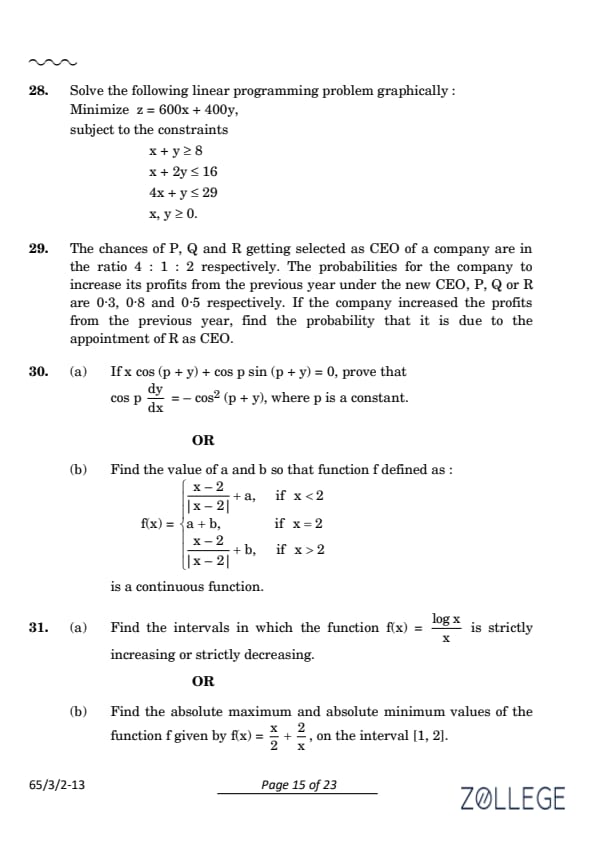
Question 28:
Solve the following linear programming problem graphically: Minimize z = 600x + 400y, subject to the constraints:
- x + y ≥ 8,
- x + 2y ≤ 16,
- 4x + y ≤ 29,
- x, y ≥ 0.
View Solution
Step 1: Graph the constraints. Convert each inequality into an equation to find the boundary lines:
- x + y = 8,
- x + 2y = 16,
- 4x + y = 29.
Find the points of intersection for these lines and determine the feasible region. The feasible region is the intersection of the half-planes satisfying all constraints.
Step 2: Determine corner points. By solving the equations pairwise, find the intersection points:
- Intersection of x + y = 8 and x + 2y = 16: (0, 8),
- Intersection of x + 2y = 16 and 4x + y = 29: (5, 5.5),
- Intersection of x + y = 8 and 4x + y = 29: (7.67, 0.33),
- Intersection of x + y = 8 and y = 0: (8, 0).
Step 3: Evaluate z = 600x + 400y at the corner points:
- At (0, 8): z = 600(0) + 400(8) = 3200,
- At (5, 5.5): z = 600(5) + 400(5.5) = 5300,
- At (7.67, 0.33): z = 600(7.67) + 400(0.33) ≈ 4720,
- At (8, 0): z = 600(8) + 400(0) = 4800.
Step 4: Conclusion. The minimum value of z = 600x + 400y is 3200, which occurs at the point (0, 8).
Final Answer: The minimum value of z is 3200 at the point (0, 8).
Question 29:
The chances of P, Q, and R getting selected as CEO of a company are in the ratio 4:1:2, respectively. The probabilities for the company to increase its profits from the previous year under the new CEO, P, Q, or R, are 0.3, 0.8, and 0.5, respectively. If the company increased the profits from the previous year, find the probability that it is due to the appointment of R as CEO.
View Solution
1. Let the events be:
- P1, P2, P3: Selection of P, Q, and R as CEO.
- E: Company increases profits.
2. Use Bayes’ theorem: The required probability is:
P(P3 | E) = P(P3) · P(E | P3) / P(E).
3. Calculate the prior probabilities: From the given ratio 4:1:2:
P(P1) = 4/7, P(P2) = 1/7, P(P3) = 2/7.
4. Calculate the total probability P(E):
P(E) = P(P1) · P(E | P1) + P(P2) · P(E | P2) + P(P3) · P(E | P3).
Substitute the given probabilities:
P(E) = (4/7) · 0.3 + (1/7) · 0.8 + (2/7) · 0.5.
Simplify:
P(E) = 1.2/7 + 0.8/7 + 1.0/7 = 3.0/7.
5. Calculate P(P3 | E):
P(P3 | E) = (2/7) · 0.5 / (3.0/7) = 1.0 / 3.0 = 1/3.
Final Answer: The probability that the increase in profits is due to R’s appointment as CEO is 1/3.
Question 30(a):
If x cos(p + y) + cos p sin(p + y) = 0, prove that cos p (dy/dx) = − cos²(p + y), where p is a constant.
View Solution
Start with the given equation:
x cos(p + y) + cos p sin(p + y) = 0.
1. Rearrange the equation:
cos p sin(p + y) = −x cos(p + y).
2. Differentiate both sides with respect to x:
cos p (d/dx)sin(p + y) = −(d/dx)[x cos(p + y)].
3. Use the chain rule on both sides:
cos p cos(p + y) (dy/dx) = −cos(p + y) + x(−sin(p + y)) (dy/dx).
4. Simplify:
cos p cos(p + y) (dy/dx) = − cos(p + y) + x sin(p + y) (dy/dx).
5. Factor out (dy/dx) terms:
(dy/dx) (cos p cos(p + y) − x sin(p + y)) = − cos(p + y).
6. Divide through by the coefficient of (dy/dx):
(dy/dx) = − cos(p + y) / (cos p cos(p + y)).
Simplify:
cos p (dy/dx) = − cos²(p + y).
Proved.
Question 30(b):
Find the value of a and b so that the function f defined as:
f(x) = {
x − 2 / |x − 2| + a, for x < 2,
a + b, for x = 2,
x − 2 / |x − 2| + b, for x > 2,} is continuous.
View Solution
For f(x) to be continuous at x = 2, the left-hand limit (LHL), right-hand limit (RHL), and the value of f(2) must all be equal.
1. Left-hand limit (LHL): For x < 2:
f(x) = (x − 2) / |x − 2| + a = −1 + a.
As x → 2−:
LHL = −1 + a.
2. Right-hand limit (RHL): For x > 2:
f(x) = (x − 2) / |x − 2| + b = 1 + b.
As x → 2+:
RHL = 1 + b.
3. Value at x = 2:
f(2) = a + b.
4. Continuity condition:
LHL = RHL = f(2).
Substitute:
−1 + a = 1 + b = a + b.
From −1 + a = a + b:
b = −1.
From 1 + b = a + b:
a = 1.
Final Answer: a = 1, b = −1.
Question 31(a):
Find the intervals in which the function f(x) = log(x)/x is strictly increasing or strictly decreasing.
View Solution
1. Find the derivative:
f(x) = log(x) / x, f′(x) = (x · 1/x − log(x) · 1) / x² = (1 − log(x)) / x².
2. Critical points: The critical points are obtained by solving f′(x) = 0:
1 − log(x) = 0 ⇒ log(x) = 1 ⇒ x = e.
3. Sign of f′(x):
- For x ∈ (0, e), 1 − log(x) > 0, so f′(x) > 0: f(x) is increasing.
- For x ∈ (e, ∞), 1 − log(x) < 0, so f′(x) < 0: f(x) is decreasing.
Intervals: f(x) is strictly increasing on (0, e) and strictly decreasing on (e, ∞).
Question 31(b):
Find the absolute maximum and absolute minimum values of the function f(x) = x² + 2/x on the interval [1, 2].
View Solution
1. Find the derivative:
f′(x) = 2x − 2/x².
2. Critical points: Set f′(x) = 0:
2x − 2/x² = 0 ⇒ 2x = 2/x² ⇒ x² = 1 ⇒ x = 1.
(Only x = 2 is in [1, 2].)
3. Evaluate f(x) at endpoints and critical point:
At x = 1: f(1) = 1² + 2/1 = 2.5.
At x = 2: f(2) = 2² + 2/2 = 2 + 1 = 3.
4. Conclusion: The absolute maximum value is 2.5 at x = 1, and the absolute minimum value is 2 at x = 2.
Final Answer: Absolute maximum: 2.5 (at x = 1), Absolute minimum: 2 (at x = 2).
SECTION D
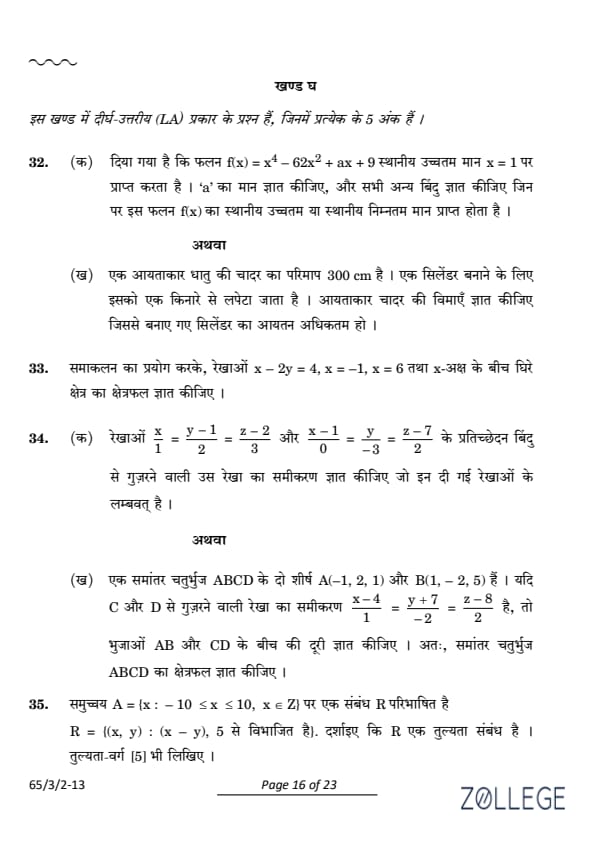
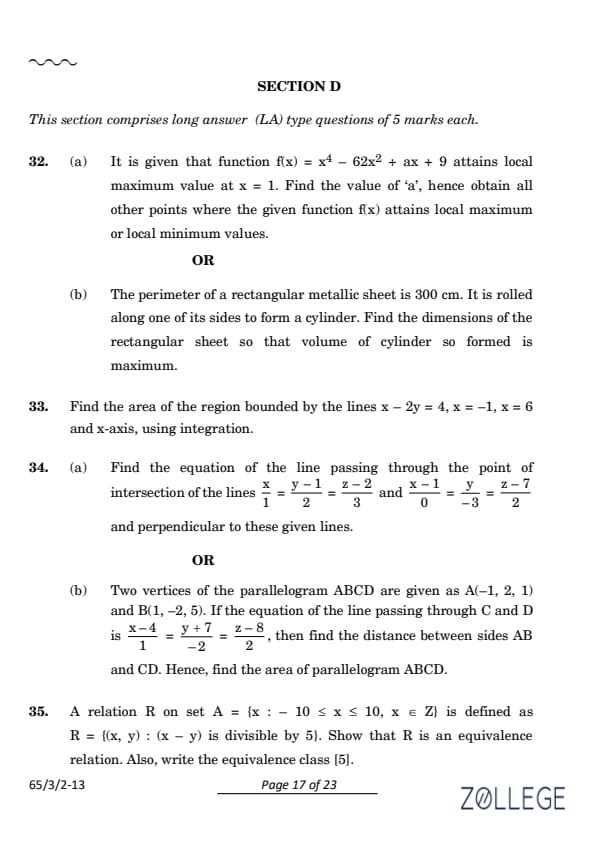
Question 32(a):
It is given that function f(x) = x4 − 62x2 + ax + 9 attains a local maximum value at x = 1. Find the value of a, hence obtain all other points where the given function f(x) attains local maximum or local minimum values.
View Solution
1. Find the derivative:
f′(x) = 4x3 − 124x + a.
2. Condition for a local maximum at x = 1: At x = 1, f′(1) = 0:
4(1)3 − 124(1) + a = 0 ⇒ 4 − 124 + a = 0 ⇒ a = −6.
3. Update the function with a = −6:
f(x) = x4 − 62x2 − 6x + 9.
4. Find other critical points: Set f′(x) = 0:
4x3 − 124x − 6 = 0 ⇒ 2x(2x2 − 62) − 6 = 0.
Factorize:
2x(2x2 − 62) = 6 ⇒ x(2x2 − 62) = 3.
Simplify further:
2x3 − 62x − 3 = 0.
This cubic equation has roots that can be solved numerically or through approximation.
5. Determine the nature of the critical points: Evaluate the second derivative:
f′′(x) = 12x2 − 124.
- At x = 1: f′′(1) = 12(1)2 − 124 = −112 < 0 (local maximum).
Conclusion:
- Local maximum at x = 1 with a = −6.
- Other critical points are approximations of the cubic equation 2x3 − 62x − 3 = 0.
Final Answer: The value of a is −6. The local maximum occurs at x = 1.
Question 32(b):
The perimeter of a rectangular metallic sheet is 300 cm. It is rolled along one of its sides to form a cylinder. Find the dimensions of the rectangular sheet so that the volume of the cylinder so formed is maximum.
View Solution
1. Define dimensions of the rectangle: Let the length be 2r and the width be h, where 2r is the circumference of the cylinder base and h is its height. The perimeter is:
2r + 2h = 300 ⇒ r + h = 150 ⇒ h = 150 − r.
2. Volume of the cylinder: The volume of the cylinder is:
V = πr²h = πr²(150 − r).
3. Maximize V: Differentiate V with respect to r:
dV/dr = π[2r(150 − r) − r²] = π(300r − 3r²).
Set dV/dr = 0:
300r − 3r² = 0 ⇒ 3r(100 − r) = 0.
Thus, r = 0 or r = 100. Discard r = 0 since it gives no volume.
4. Second derivative test:
d²V/dr² = π(300 − 6r).
At r = 100:
d²V/dr² = π(300 − 600) = −300π < 0.
Hence, V is maximum at r = 100.
5. Find h:
h = 150 − r = 150 − 100 = 50.
Final Answer: The dimensions of the rectangular sheet are 2r = 200 cm and h = 50 cm.
Question 33:
Find the area of the region bounded by the lines x − 2y = 4, x = −1, x = 6, and the x-axis, using integration.
View Solution
Step 1: Equation of the line in terms of y:
x − 2y = 4 ⇒ y = (x − 4) / 2.
The line intersects the x-axis at x = 4 (putting y = 0), and the integration is divided into two parts:
- From x = −1 to x = 4,
- From x = 4 to x = 6.
Step 2: Area computation using integration:
The area is given by:
Area = ∫[x=−1 to x=6] (x − 4) / 2 dx.
Split the integral into two parts based on the sign of (x − 4):
Area = ∫[x=−1 to x=4] (4 − x) / 2 dx + ∫[x=4 to x=6] (x − 4) / 2 dx.
Step 3: Evaluate the integrals:
1. Compute the first integral:
∫[x=−1 to x=4] (4 − x) / 2 dx = 1/2 ∫[x=−1 to x=4] (4 − x) dx = 1/2 [4x − x²/2] from −1 to 4.
= 1/2 [(16 − 8) − (−4 − 0.5)] = 1/2 [8 + 4.5] = 6.25.
2. Compute the second integral:
∫[x=4 to x=6] (x − 4) / 2 dx = 1/2 ∫[x=4 to x=6] (x − 4) dx = 1/2 [x²/2 − 4x] from 4 to 6.
= 1/2 [(36/2 − 24) − (16/2 − 16)] = 1/2 [−6 + 8] = 1.
Step 4: Total area:
Area = 6.25 + 1 = 7.25 = 29/4.
Final Answer: The area of the region is 29/4.
Question 34(a):
Find the equation of the line passing through the point of intersection of the lines:
x − 1 / 1 = y − 2 / 2 = z − 2 / 3, and
x − 1 / 0 = y − 3 / −3 = z − 7 / 2,
and perpendicular to these given lines.
View Solution
1. Point of intersection of the two lines: Let:
x − 1 / 1 = y − 2 / 2 = z − 2 / 3 = t1, and x − 1 / 0 = y − 3 / −3 = z − 7 / 2 = t2.
From the first line:
x = 1 + t1, y = 2 + 2t1, z = 2 + 3t1.
From the second line:
x = 1, y = 3 − 3t2, z = 7 + 2t2.
Equate x, y, z for consistency: - From x: 1 + t1 = 1 ⇒ t1 = 0. - From y: 2 + 2t1 = 3 − 3t2 ⇒ 2 = 3 − 3t2 ⇒ t2 = 1 / 3.
Substitute t1 = 0 into the first line:
x = 1, y = 2, z = 2.
Thus, the point of intersection is (1, 2, 2).
2. Direction vectors of the given lines: - First line: ⃗d1 = ⟨1, 2, 3⟩. - Second line: ⃗d2 = ⟨0, −3, 2⟩.
3. Direction of the required line: The required line is perpendicular to both ⃗d1 and ⃗d2.
Use the cross product:
⃗d = ⃗d1 × ⃗d2 = | i j k |
| 1 2 3 |
| 0 −3 2 |
Expand:
⃗d = i(4 + 9) − j(2 − 0) + k(−3 − 0) = ⟨13, −2, −3⟩.
4. Equation of the required line: The line passing through (1, 2, 2) with direction vector ⟨13, −2, −3⟩ is:
x − 1 / 13 = y − 2 / −2 = z − 2 / −3.
Final Answer: x − 1 / 13 = y − 2 / −2 = z − 2 / −3.
Question 34(b):
Two vertices of the parallelogram ABCD are given as A(−1, 2, 1) and B(1, −2, 5). If the equation of the line passing through C and D is:
x − 4 / 1 = y + 7 / −2 = z − 8 / 2,
find the distance between sides AB and CD. Hence, find the area of the parallelogram ABCD.
View Solution
1. Vector representation of AB: The position vectors of A and B are:
A⃗ = ⟨−1, 2, 1⟩, B⃗ = ⟨1, −2, 5⟩.
The vector −→AB is:
−→AB = B⃗ − A⃗ = ⟨1 − (−1), −2 − 2, 5 − 1⟩ = ⟨2, −4, 4⟩.
2. Direction vector of CD: The direction vector of the line CD is:
⃗dCD = ⟨1, −2, 2⟩.
3. Find a point on CD: From the parametric equation of CD:
x = 4 + t, y = −7 − 2t, z = 8 + 2t.
At t = 0, a point on CD is:
C0 = (4, −7, 8).
4. Shortest distance between AB and CD: The formula for the shortest distance between skew lines is:
d = |(⃗r2 − ⃗r1) · (⃗d1 × ⃗d2)| / |⃗d1 × ⃗d2|.
Here: - ⃗r1 = ⟨−1, 2, 1⟩ (point on AB), - ⃗r2 = ⟨4, −7, 8⟩ (point on CD), - ⃗d1 = −→AB = ⟨2, −4, 4⟩, - ⃗d2 = ⟨1, −2, 2⟩.
Compute ⃗r2 − ⃗r1:
⃗r2 − ⃗r1 = ⟨4 − (−1), −7 − 2, 8 − 1⟩ = ⟨5, −9, 7⟩.
Compute ⃗d1 × ⃗d2:
⃗d1 × ⃗d2 = | i j k |
| 2 −4 4 |
| 1 −2 2 |
⃗d1 × ⃗d2 = i(8 − (−8)) − j(4 − 4) + k(−4 − (−4)) = ⟨16, 0, 0⟩.
Compute (⃗r2 − ⃗r1) · (⃗d1 × ⃗d2):
(⃗r2 − ⃗r1) · (⃗d1 × ⃗d2) = ⟨5, −9, 7⟩ · ⟨16, 0, 0⟩ = 5 · 16 + 0 + 0 = 80.
Compute |⃗d1 × ⃗d2|:
|⃗d1 × ⃗d2| = √(16² + 0² + 0²) = √256 = 16.
Shortest distance:
d = |80| / 16 = 5.
5. Area of the parallelogram: The area of the parallelogram is given by:
Area = |−→AB| · d,
where:
|−→AB| = √(2² + (−4)² + 4²) = √(4 + 16 + 16) = √36 = 6.
Substitute:
Area = 6 · 5 = 30.
Final Answer: The distance between AB and CD is 5, and the area of the parallelogram is 30.
Question 35:
A relation R on set A = {x : −10 ≤ x ≤ 10, x ∈ Z} is defined as R = {(x, y) : (x − y) is divisible by 5}. Show that R is an equivalence relation. Also, write the equivalence class [5].
View Solution
Step 1: Reflexive property.
For any x ∈ A, x − x = 0, which is divisible by 5. Hence, (x, x) ∈ R, and R is reflexive.
Step 2: Symmetric property.
If (x, y) ∈ R, then x − y is divisible by 5. This implies y − x = −(x − y) is also divisible by 5. Hence, (y, x) ∈ R, and R is symmetric.
Step 3: Transitive property.
If (x, y) ∈ R and (y, z) ∈ R, then x − y and y − z are both divisible by 5. Adding these gives:
(x − y) + (y − z) = x − z, which is also divisible by 5. Hence, (x, z) ∈ R, and R is transitive.
Since R is reflexive, symmetric, and transitive, it is an equivalence relation.
Step 4: Equivalence class [5].
The equivalence class of 5 is the set of all elements y ∈ A such that (5, y) ∈ R. This means:
5 − y is divisible by 5.
Equivalently:
5 − y = 5k ⇒ y = 5 − 5k for integers k.
Within the range −10 ≤ y ≤ 10, the possible values of y are:
[5] = {−10, −5, 0, 5, 10}.
Final Answer: [5] = {−10, −5, 0, 5, 10}.
SECTION E
Case Study - 1
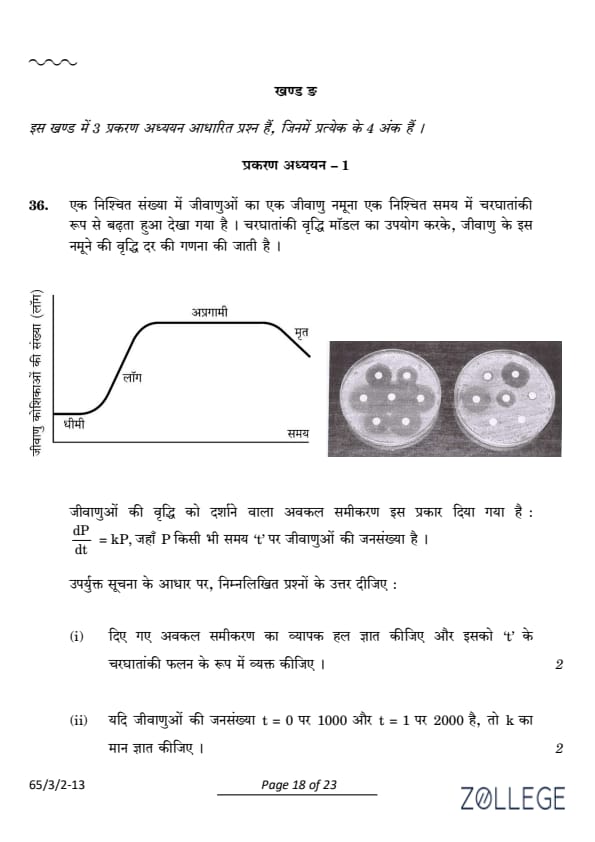
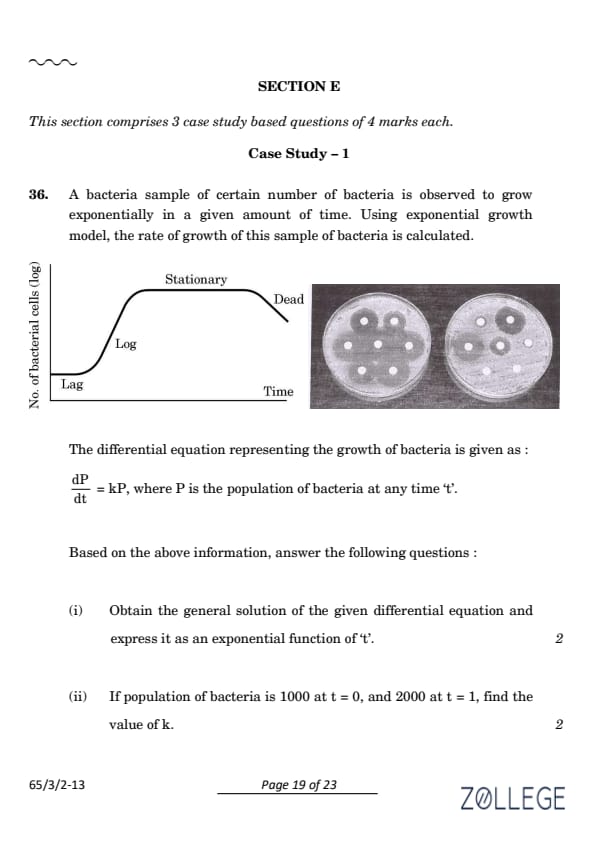
36. A bacteria sample of a certain number of bacteria is observed to grow exponentially in a given amount of time. Using the exponential growth model, the rate of growth of this sample of bacteria is calculated.
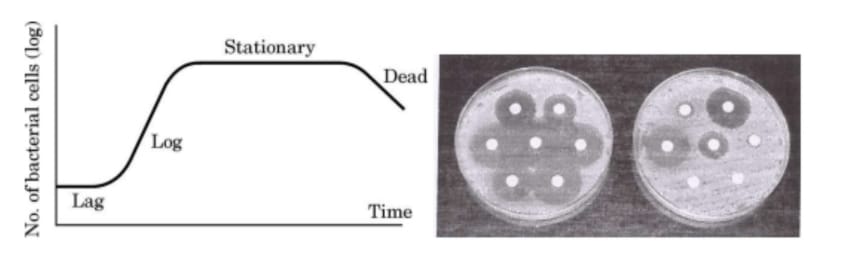
Based on the above information, answer the following questions:
The differential equation representing the growth of bacteria is given as:
dP/dt = kP,
where P is the population of bacteria at any time t.
Based on the above information, answer the following questions:
(i) Obtain the general solution of the given differential equation and express it as an exponential function of t.
View Solution
The given differential equation is:
dP/dt = kP.
Separate the variables P and t:
(1/P) dP = k dt.
Integrate both sides:
∫(1/P) dP = ∫k dt.
Solve the integrals:
ln |P| = kt + C,
where C is the constant of integration.
Rewrite in exponential form:
P = e^(kt + C) = e^C · e^(kt).
Let e^C = P₀, where P₀ is the initial population. Then:
P = P₀ e^(kt).
Final Answer (i): The general solution is:
P = P₀ e^(kt).
(ii) If the population of bacteria is 1000 at t = 0, and 2000 at t = 1, find the value of k.
View Solution
From the general solution:
P = P₀ e^(kt).
At t = 0, P = 1000:
1000 = P₀ e^(k(0)) ⇒ P₀ = 1000.
At t = 1, P = 2000:
2000 = 1000 e^(k(1)).
Simplify:
e^k = 2000 / 1000 = 2.
Take the natural logarithm:
k = ln(2).
Final Answer (ii): The value of k is:
k = ln(2).
Case Study - 2
Question 37:
A scholarship is a sum of money provided to a student to help them pay for education. Some students are granted scholarships based on their academic achievements, while others are rewarded based on their financial needs.

Every year, a school offers scholarships to girl children and meritorious achievers based on certain criteria. In the session 2022-23, the school offered a monthly scholarship of 3,000 each to some girl students and 4,000 each to meritorious achievers in academics as well as sports.
In all, 50 students were given scholarships, and the monthly expenditure incurred by the school on scholarships was 1,80,000.
Based on the above information, answer the following questions:
- Express the given information algebraically using matrices.
- Check whether the system of matrix equations obtained is consistent or not.
- (a) Find the number of scholarships of each kind given by the school using matrices.
- (b) Had the amount of scholarship given to each girl child and meritorious student been interchanged, what would be the monthly expenditure incurred by the school?
View Solution
- Step 1: Express the given information algebraically using matrices.
Let: x = Number of girl students, y = Number of meritorious students.
The given conditions are:
x + y = 50 (Total students).
3000x + 4000y = 180000 (Total expenditure).
Write this system in matrix form:[ 1 1 ] [ x ] [ 50 ] [3000 4000] [ y ] = [ 180000 ] - Step 2: Check consistency of the system.
Calculate the determinant of the coefficient matrix A:A = [ 1 1 ] [3000 4000]det(A) = (1)(4000) - (1)(3000) = 4000 - 3000 = 1000.
Since det(A) ≠ 0, the system is consistent and has a unique solution. - Step 3: Find the number of scholarships of each kind.
Solve the system using the inverse of A:[ x ] = A⁻¹ [ 50 ] [ y ] [180000]The inverse of A is:
A⁻¹ = (1/det(A)) * [ 4000 -1 ] [ -3000 1 ]
Substituting values:
[ x ] = (1/1000) * [ 4000 -1 ] [ 50 ] [ -3000 1 ] [180000]
Simplify:
[ x ] = (1/1000) * [ 20000 ] [ 30000 ]
Thus, x = 20, y = 30. - Step 4: If the scholarship amounts are interchanged.
New total expenditure calculation:
4000x + 3000y = 4000(20) + 3000(30).
Simplify:
4000(20) + 3000(30) = 80000 + 90000 = 170000.
Thus, the new expenditure is 1,70,000.
Case Study - 3
Question 36:
Self-study helps students to build confidence in learning. It boosts the self-esteem of the learners. Recent surveys suggested that close to 50 learners were self-taught using internet resources and upskilled themselves.

A student may spend 1 hour to 6 hours in a day in upskilling self. The probability distribution of the number of hours spent by a student is given below:
P(X = x) =
kx², for x = 1, 2, 3,
2kx, for x = 4, 5, 6,
0, otherwise.
Where x denotes the number of hours. Based on the above information, answer the following questions:
- Express the probability distribution given above in the form of a probability distribution table.
- Find the value of k.
- (a) Find the mean number of hours spent by the student.
- (b) Find P(1 < X < 6).
View Solution
| x | P(X = x) |
|---|---|
| 1 | k(1²) = k |
| 2 | k(2²) = 4k |
| 3 | k(3²) = 9k |
| 4 | 2k(4) = 8k |
| 5 | 2k(5) = 10k |
| 6 | 2k(6) = 12k |
- Step 1: Express the probability distribution in table format:
- Step 2: Find the value of k.
The total probability must sum to 1:
k + 4k + 9k + 8k + 10k + 12k = 1
44k = 1 ⇒ k = 1/44. - Step 3: Find the mean number of hours spent.
The mean is given by:
μ = E(X) = ∑ x ⋅ P(X = x)
Substituting values:
E(X) = 1⋅k + 2⋅4k + 3⋅9k + 4⋅8k + 5⋅10k + 6⋅12k
= k(1 + 8 + 27 + 32 + 50 + 72)
= k(190).
Substituting k = 1/44, we get:
E(X) = 190/44 = 95/22. - Step 4: Find P(1 < X < 6).
The probability P(1 < X < 6) is the sum of probabilities for x = 2, 3, 4, and 5:
P(1 < X < 6) = P(X = 2) + P(X = 3) + P(X = 4) + P(X = 5)
= 4k + 9k + 8k + 10k = 31k.
Substituting k = 1/44, we get:
P(1 < X < 6) = 31 ⋅ (1/44) = 31/44.


*The article might have information for the previous academic years, please refer the official website of the exam.