
CBSE Class 12 Mathematics set 3 (65/1/3) Question Paper Pdf - Check Solutions with Answer Key Pdf

.jpg?tr=h-55,w-55,c-force)
Content Strategist|Tech-innovator|National Hackathon Winner | Updated On - Jan 30, 2025
CBSE Class 12 2024 Mathematics Set 3 Question Paper (Q.P. Code: 65/1/3) is available for download. The exam was successfully conducted by CBSE on March 9 in the morning session from 10:30 AM to 1:30 PM. As per the student’s initial reactions, the CBSE Class 12 2024 Mathematics Set 3 Question Paper was reported as Moderate. The Calculus section was reported as Challenging, the Algebra section as Moderate, and the Probability & Statistics section as Easy to Moderate.
CBSE Class 12 2024 Mathematics Set 3 65/1/3 Question Paper with Answer Key PDF
Candidates can download the CBSE Class 12 Mathematics Question Paper with Solution and Answer Key PDFs for Set 3 Question Paper (Code: 65/1/3) using the link below.
| CBSE Class 12 2024 Mathematics Question Paper with Answer Key |  Download Download |
Check Solution |
CBSE Class 12 2024 Mathematics Questions with Solutions
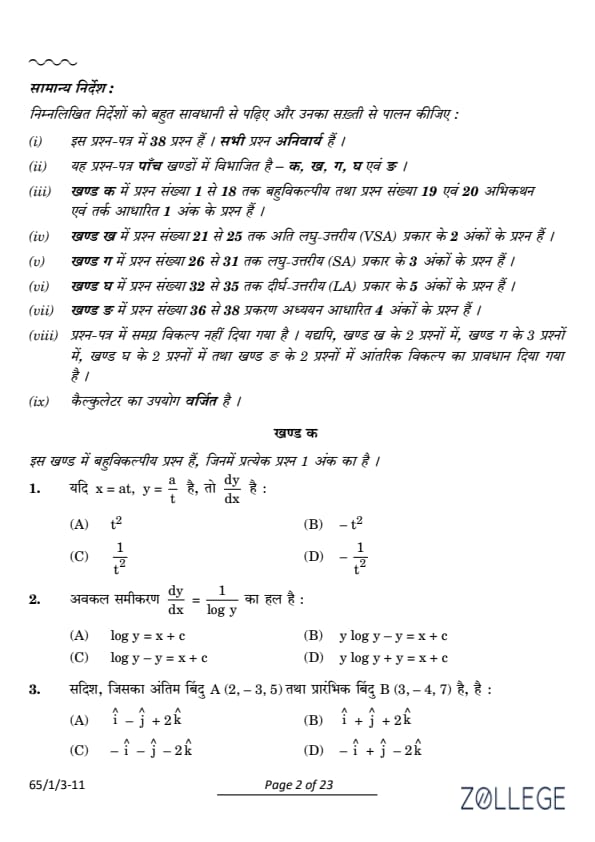
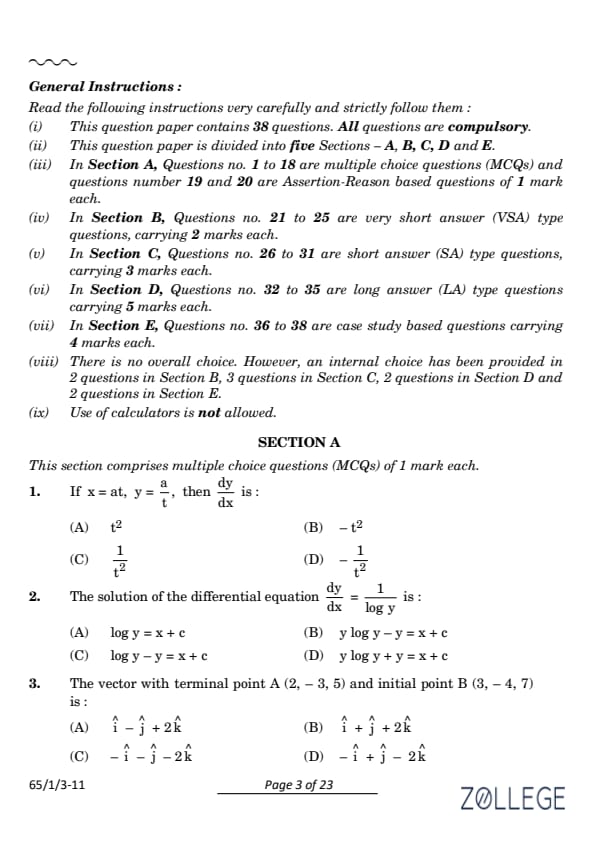
SECTION A
Question 1:
If x = at, y = a/t, then dy/dx is:
View Solution
We are given:
x = at, y = a/t.
Differentiate x = at with respect to t: dx/dt = a.
Differentiate y = a/t with respect to t: dy/dt = −a/t².
Using the chain rule, we find dy/dx:
dy/dx = (dy/dt) / (dx/dt).
Substitute the values of dy/dt and dx/dt:
dy/dx = −a/t² / a = −1/t².
Hence, the correct answer is (D) −1/t².
Question 2:
The solution of the differential equation dy/dx = 1/log y is:
View Solution
The given differential equation is:
dy/dx = 1/log y.
Rewriting, we have:
log y dy = dx.
Integrate both sides:
∫log y dy = ∫dx.
Using integration by parts for ∫log y dy, let u = log y and dv = dy:
∫log y dy = y log y − ∫y dy = y log y − y + C₁, where C₁ is the constant of integration.
Substituting back, we get:
y log y − y = x + C₁.
Let C = C₁, resulting in:
y log y − y = x + C.
Hence, the correct answer is (B) y log y − y = x + c.
Question 3:
The vector with terminal point A (2, -3, 5) and initial point B (3, -4, 7) is:
View Solution
The formula for the vector from the initial point B(x₁, y₁, z₁) to the terminal point A(x₂, y₂, z₂) is:
AB⃗ = (x₂ − x₁)î + (y₂ − y₁)ĵ + (z₂ − z₁)k̂.
Substitute A(2, −3, 5) and B(3, −4, 7):
AB⃗ = (2 − 3)î + (−3 + 4)ĵ + (5 − 7)k̂.
Simplify each component:
AB⃗ = −î − ĵ − 2k̂.
Hence, the correct answer is (C) −î − ĵ − 2k̂.
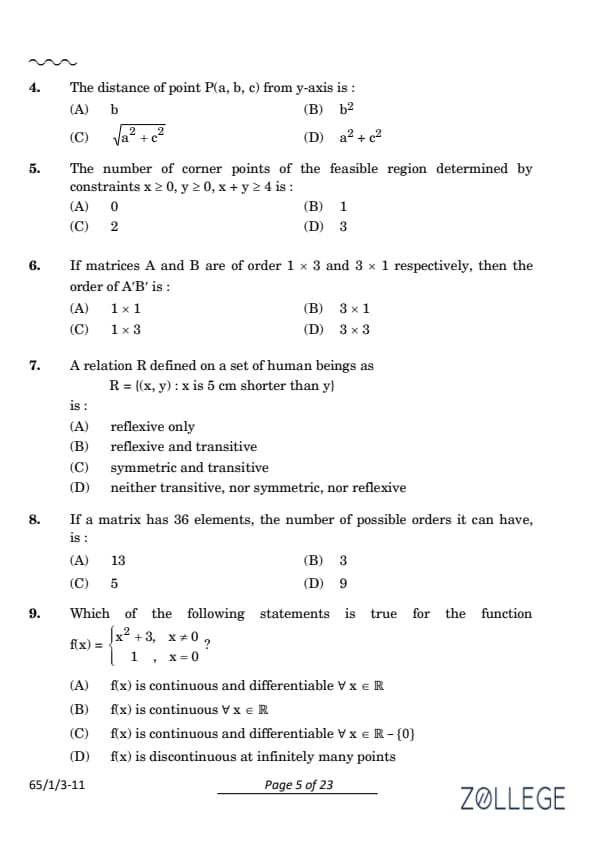
Question 4:
The distance of point P(a, b, c) from the y-axis is:
View Solution
The distance of a point P(a, b, c) from the y-axis is determined by the perpendicular distance from the point to the axis. Since the y-axis lies along the direction where b varies while a and c remain constant, the distance is given by:
Distance = √(a² + c²).
Hence, the correct answer is (C) √(a² + c²).
Question 5:
The number of corner points of the feasible region determined by constraints x ≥ 0, y ≥ 0, x + y ≥ 4 is:
View Solution
The constraints given are:
x ≥ 0, y ≥ 0, x + y ≥ 4.
These represent:
1. x ≥ 0: The region to the right of the y-axis.
2. y ≥ 0: The region above the x-axis.
3. x + y ≥ 4: A line passing through points (4, 0) and (0, 4) with the feasible region above this line.
The feasible region lies in the first quadrant and satisfies all three constraints. The intersection points (corner points) of the feasible region are:
1. (4, 0)
2. (0, 4)
Hence, the number of corner points is 2.
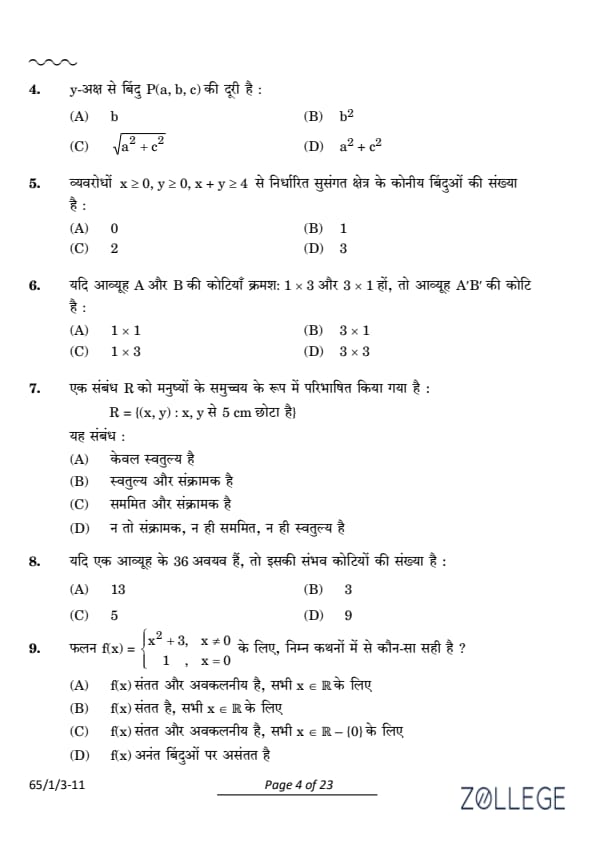
Question 6:
If matrices A and B are of order 1 × 3 and 3 × 1 respectively, then the order of A′B′ is:
View Solution
The transpose of a matrix changes its dimensions:
- For matrix A of order 1 × 3, A′ has order 3 × 1.
- For matrix B of order 3 × 1, B′ has order 1 × 3.
The product A′B′ has the order determined by the dimensions of A′ and B′:
A′ is (3 × 1), B′ is (1 × 3).
The resulting matrix A′B′ will have order 3 × 3.
Hence, the correct answer is (D) 3 × 3.
Question 7:
A relation R defined on a set of human beings as R = {(x, y) : x is 5 cm shorter than y} is:
View Solution
Reflexive: For R to be reflexive, (x, x) must belong to R. However, x cannot be 5 cm shorter than itself. Hence, R is not reflexive.
Symmetric: For R to be symmetric, if (x, y) ∈ R, then (y, x) ∈ R. If x is 5 cm shorter than y, y cannot be 5 cm shorter than x. Hence, R is not symmetric.
Transitive: For R to be transitive, if (x, y) ∈ R and (y, z) ∈ R, then (x, z) ∈ R. However, if x is 5 cm shorter than y and y is 5 cm shorter than z, x is 10 cm shorter than z. Thus, R is not transitive.
Hence, the correct answer is (D) Neither transitive, nor symmetric, nor reflexive.
Question 8:
If a matrix has 36 elements, the number of possible orders it can have is:
View Solution
If a matrix has 36 elements, it means the product of the number of rows (m) and the number of columns (n) must equal 36:
m × n = 36.
To determine the possible orders (m, n), we find all pairs of positive integers whose product is 36:
(1, 36), (2, 18), (3, 12), (4, 9), (6, 6), (9, 4), (12, 3), (18, 2), (36, 1).
Thus, there are 9 possible orders: 1 × 36, 2 × 18, 3 × 12, 4 × 9, 6 × 6, 9 × 4, 12 × 3, 18 × 2, 36 × 1.
Hence, the correct answer is (D) 9.
Question 9:
Which of the following statements is true for the function:
f(x) = (x² + 3, if x ≠ 0)
1, if x = 0
View Solution
To determine continuity and differentiability:
- Continuity at x = 0: limx→0 f(x) = limx→0 (x² + 3) = 3. However, f(0) = 1. Since limx→0 f(x) ≠ f(0), f(x) is not continuous at x = 0.
- Differentiability at x = 0: Since f(x) is not continuous at x = 0, it cannot be differentiable at x = 0.
- Continuity and Differentiability for x ≠ 0: For x ≠ 0, f(x) = x² + 3, which is a polynomial function. Polynomials are both continuous and differentiable for all x.
Hence, the function f(x) is continuous and differentiable ∀x ∈ R − {0}.
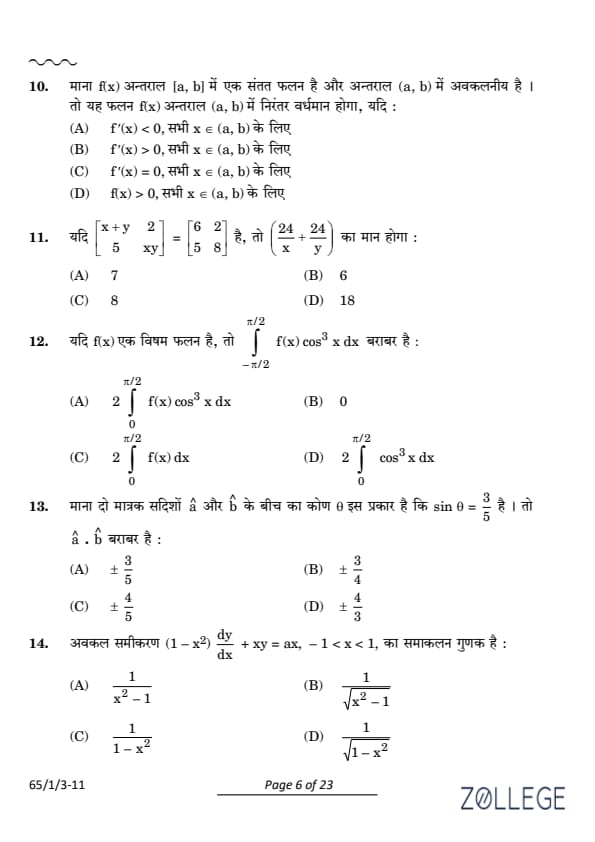
Question 10:
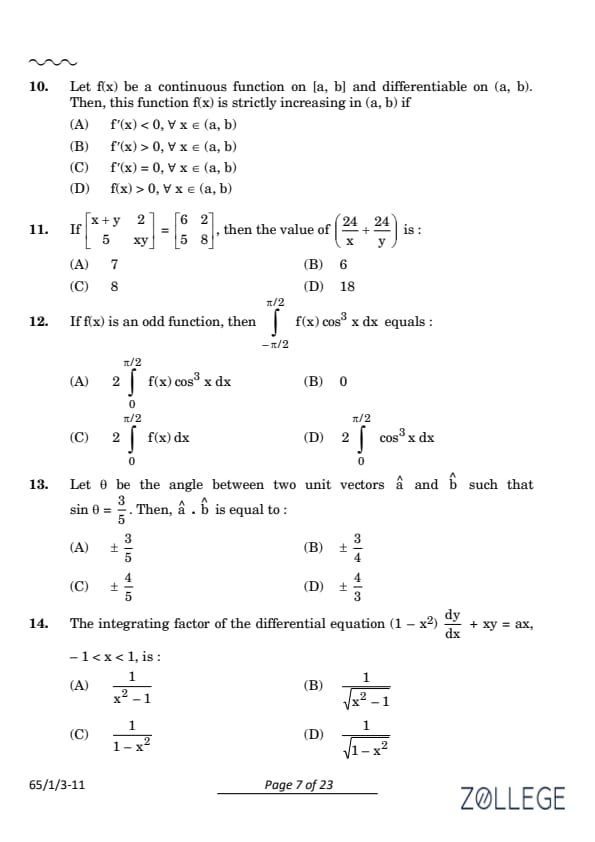
Let f(x) be a continuous function on [a, b] and differentiable on (a, b). Then, this function f(x) is strictly increasing in (a, b) if:
View Solution
A function f(x) is strictly increasing on an interval (a, b) if for any x1, x2 ∈ (a, b), where x1 < x2, we have f(x1) < f(x2). The derivative f′(x) gives the slope of the tangent to the curve. If f′(x) > 0 for all x ∈ (a, b), the slope is positive, meaning f(x) is strictly increasing.
Hence, the correct answer is (B) f′(x) > 0, ∀x ∈ (a, b).
Question 11:
If
⎡ x + y 2 ⎤
⎣ 5 xy ⎦ =
⎡ 6 2 ⎤
⎣ 5 8 ⎦
then the value of
24/x + 24/y is:
View Solution
From the given matrix equation:
x + y = 6, xy = 8.
We are tasked to find:
24/x + 24/y = 24 × (1/x + 1/y).
Using the property of reciprocals:
1/x + 1/y = (x + y) / xy = 6 / 8 = 3/4.
Thus:
24/x + 24/y = 24 × (3/4) = 18.
Hence, the correct answer is (D) 18.
Question 12:
If f(x) is an odd function, then:
∫-π/2π/2 f(x) cos³(x) dx equals:
View Solution
If f(x) is an odd function, then f(−x) = −f(x). The limits of integration are symmetric about x = 0, i.e., [−a, a]. For any odd function f(x), the integral over symmetric limits is:
∫-aa f(x) dx = 0.
Since f(x) cos³(x) is the product of an odd function f(x) and an even function cos³(x), the result is an odd function. Therefore:
∫-π/2π/2 f(x) cos³(x) dx = 0.
Hence, the correct answer is (B) 0.
Question 13:
Let θ be the angle between two unit vectors â and b̂ such that sin θ = 3/5. Then, â · b̂ is equal to:
View Solution
The relationship between sin θ and cos θ is given by:
sin²θ + cos²θ = 1.
Substitute sin θ = 3/5:
(3/5)² + cos²θ = 1.
9/25 + cos²θ = 1.
cos²θ = 1 − 9/25 = 16/25.
cos θ = ± 4/5.
For unit vectors â and b̂, the dot product is:
â · b̂ = cos θ.
Thus, â · b̂ = ± 4/5.
Hence, the correct answer is (C) ± 4/5.
Question 14:
The integrating factor of the differential equation
(1 − x²) (dy/dx) + xy = ax, −1 < x < 1, is:
View Solution
The given differential equation is:
(1 − x²) (dy/dx) + xy = ax.
Divide through by 1 − x² to simplify:
dy/dx + (xy)/(1 − x²) = ax/(1 − x²).
This is a linear differential equation of the form:
dy/dx + P(x)y = Q(x),
where P(x) = x/(1 − x²).
The integrating factor (IF) is given by:
IF = e∫P(x) dx.
Substitute P(x) = x/(1 − x²):
∫P(x) dx = ∫x/(1 − x²) dx.
Let u = 1 − x², so du = −2x dx:
∫x/(1 − x²) dx = −(1/2) ∫(1/u) du = −(1/2) ln|u| = −(1/2) ln|1 − x²|.
The integrating factor becomes:
IF = e−(1/2) ln|1 − x²| = (1 − x²)−(1/2) = 1/√(1 − x²).
Hence, the correct answer is (D) √(1/(1 − x²)).
Question 15:
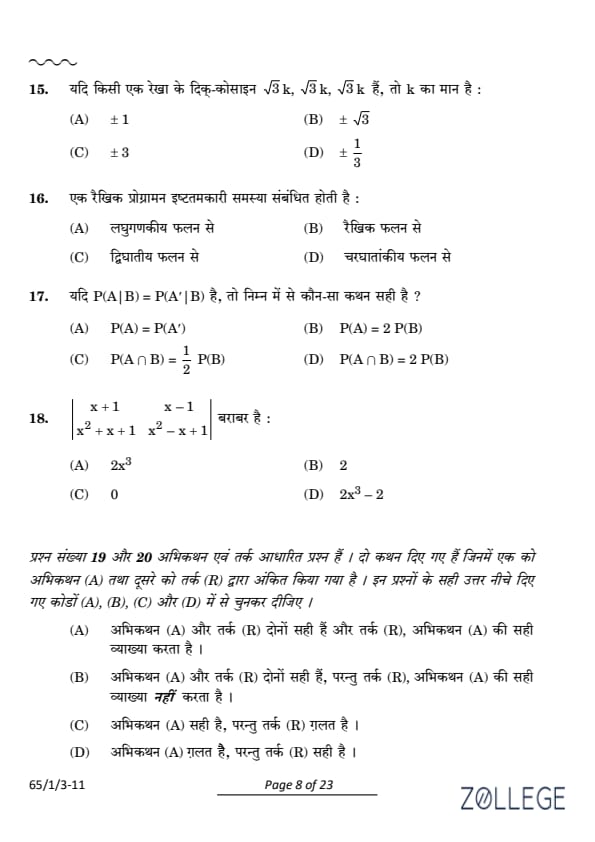
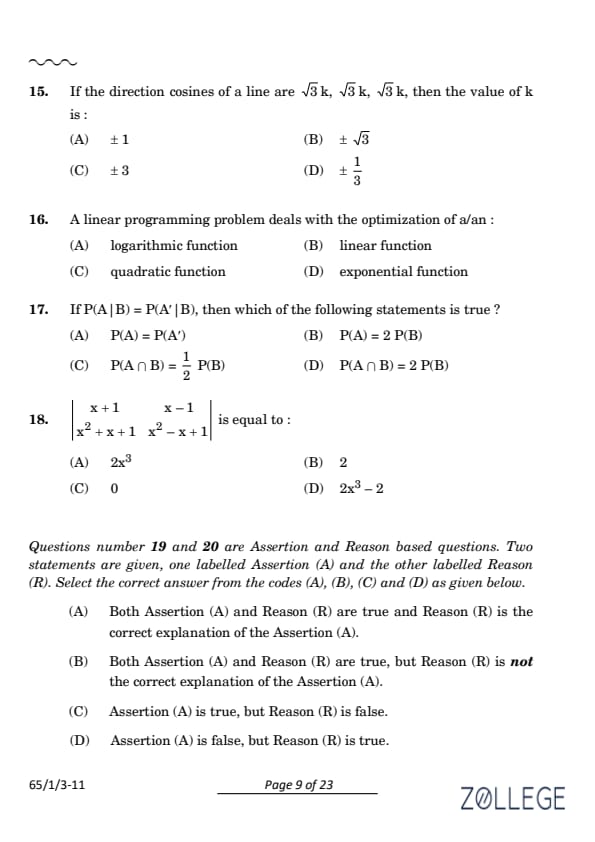
If the direction cosines of a line are √3k, √3k, √3k, then the value of k is:
View Solution
For a line in 3D space, the direction cosines l, m, n satisfy:
l² + m² + n² = 1.
Substitute l = √3k, m = √3k, n = √3k:
(√3k)² + (√3k)² + (√3k)² = 1.
Simplify:
3k² + 3k² + 3k² = 1.
9k² = 1.
k² = 1/9.
k = ±1/3.
Hence, the correct answer is (D) ±1/3.
Question 16:
A linear programming problem deals with the optimization of a/an:
View Solution
Linear programming involves optimizing (maximizing or minimizing) a linear objective function, subject to a set of linear constraints. The objective function typically takes the form:
Z = c₁x₁ + c₂x₂ + · · · + cₙxₙ,
where c₁, c₂, . . . , cₙ are constants and x₁, x₂, . . . , xₙ are decision variables.
Hence, the correct answer is (B) Linear function.
Question 17:
If P(A|B) = P(A′|B), then which of the following statements is true?
View Solution
Given P(A|B) = P(A′|B), we know:
P(A|B) = P(A ∩ B)/P(B), P(A′|B) = P(A′ ∩ B)/P(B).
Since A and A′ are complementary events: P(A ∩ B) + P(A′ ∩ B) = P(B).
Substitute P(A|B) = P(A′|B):
P(A ∩ B)/P(B) = P(A′ ∩ B)/P(B).
This implies:
P(A ∩ B) = P(A′ ∩ B).
Using P(A ∩ B) + P(A′ ∩ B) = P(B):
P(A ∩ B) + P(A ∩ B) = P(B), 2P(A ∩ B) = P(B),
P(A ∩ B) = (1/2)P(B).
Hence, the correct answer is (C) P(A ∩ B) = (1/2)P(B).
Question 18:
Evaluate the determinant:
| x+1 x-1 |
| x²+x+1 x²-x+1 |
View Solution
The determinant of a 2 × 2 matrix is given by:
Determinant = (a × d) − (b × c),
where a, b, c, d are the elements of the matrix.
For the given matrix:
a = x + 1, b = x − 1, c = x² + x + 1, d = x² − x + 1.
Determinant = (x + 1)(x² − x + 1) − (x − 1)(x² + x + 1).
Expanding both terms:
(x + 1)(x² − x + 1) = x³ − x² + x + x² − x + 1 = x³ + x + 1.
(x − 1)(x² + x + 1) = x³ + x² + x − x² − x − 1 = x³ − 1.
Now subtract the second term from the first:
Determinant = (x³ + x + 1) − (x³ − 1) = x³ + x + 1 − x³ + 1 = 2.
Hence, the correct answer is (B) 2.
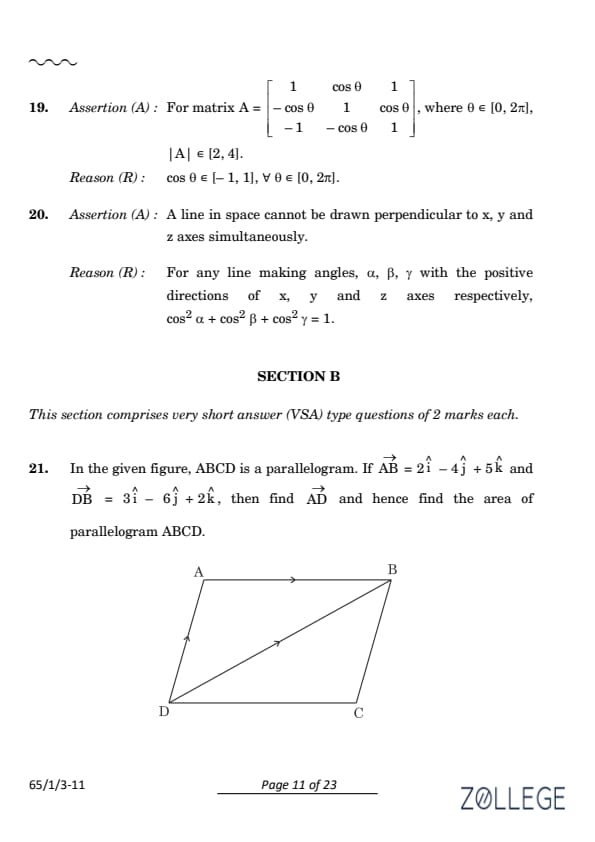
Question 19:
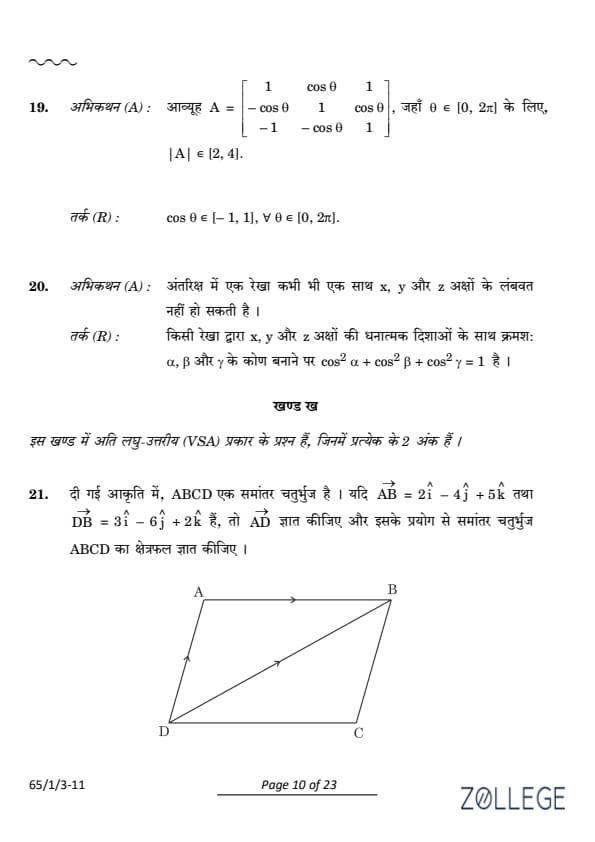
Assertion (A): For the matrix
A = [ 1 cos θ 1 ]
[-cos θ 1 cos θ]
[-1 -cos θ 1]
where θ ∈ [0, 2π], |A| ∈ [2, 4].
Reason (R): cos θ ∈ [−1, 1], ∀ θ ∈ [0, 2π].
View Solution
To verify the given assertion and reason, we calculate the determinant of matrix A:
|A| = 1 cos θ 1
-cos θ 1 cos θ
-1 -cos θ 1
Using cofactor expansion along the first row:
|A| = 1 · (1 cos θ − cos θ 1) − cos θ · (−cos θ cos θ −1 1) + 1 · (−cos θ 1 −1 −cos θ)
Expanding the minors and simplifying:
|A| = 2 + 2cos²θ
Since cos θ ∈ [−1, 1], we have cos²θ ∈ [0, 1], which implies |A| ∈ [2, 4].
Thus, Assertion (A) is true, and Reason (R) correctly explains the assertion.
Question 20:
Assertion (A): A line in space cannot be drawn perpendicular to x, y, and z axes simultaneously.
Reason (R): For any line making angles α, β, γ with the positive directions of x, y, and z axes respectively, cos²α + cos²β + cos²γ = 1.
View Solution
A line in three-dimensional space cannot be perpendicular to all three axes simultaneously. If a line is perpendicular to all three axes, the direction cosines cos α, cos β, and cos γ would all be zero, violating the fundamental relation of direction cosines:
cos²α + cos²β + cos²γ = 1.
This equation ensures that at least one direction cosine is non-zero, meaning the line cannot be perpendicular to all three axes at once.
Thus, both Assertion (A) and Reason (R) are true, and Reason (R) correctly explains Assertion (A).
SECTION B
Question 21:
In the given figure, ABCD is a parallelogram. If AB = 2i - 4j + 5k and DB = 3i - 6j + 2k, then find AD and hence find the area of parallelogram ABCD.

Answer: √605
View Solution
Solution: To find AD, we use the relationship:
AD = AB + DB
Given that AB = 2i - 4j + 5k and DB = 3i - 6j + 2k, we calculate AD:
AD = (2i - 4j + 5k) + (3i - 6j + 2k)
Simplifying:
AD = (2+3)i + (-4-6)j + (5+2)k = 5i - 10j + 7k
The area of parallelogram ABCD is given by the magnitude of the cross product of vectors AB and AD:
Area = |AB × AD|
The cross product of AB = 2i - 4j + 5k and AD = 5i - 10j + 7k is computed as follows:
AB × AD = | i j k | | 2 -4 5 |
| 5 -10 7 |
Expanding the determinant:
AB × AD = i| -4 5 | - j| 2 5 | + k| 2 -4 | | -10 7 | | 5 7 | | 5 -10|
Calculating each 2x2 determinant:
i = (-4)(7) - (5)(-10) = -28 + 50 = 22
j = (2)(7) - (5)(5) = 14 - 25 = -11
k = (2)(-10) - (-4)(5) = -20 + 20 = 0
Thus,
AB × AD = 22i + 11j + 0k = 22i - 11j
The magnitude of the cross product is:
|AB × AD| = √(222 + (-11)2) = √(484 + 121) = √605
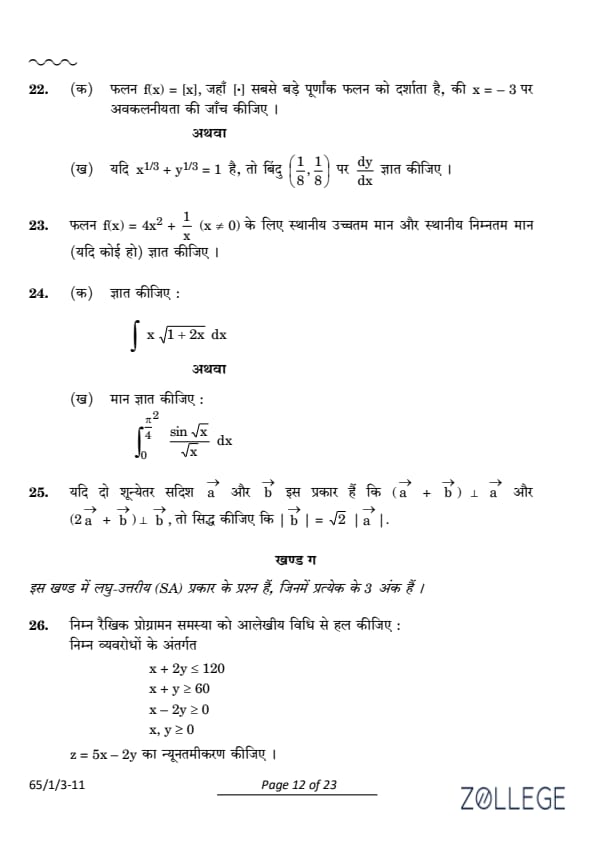
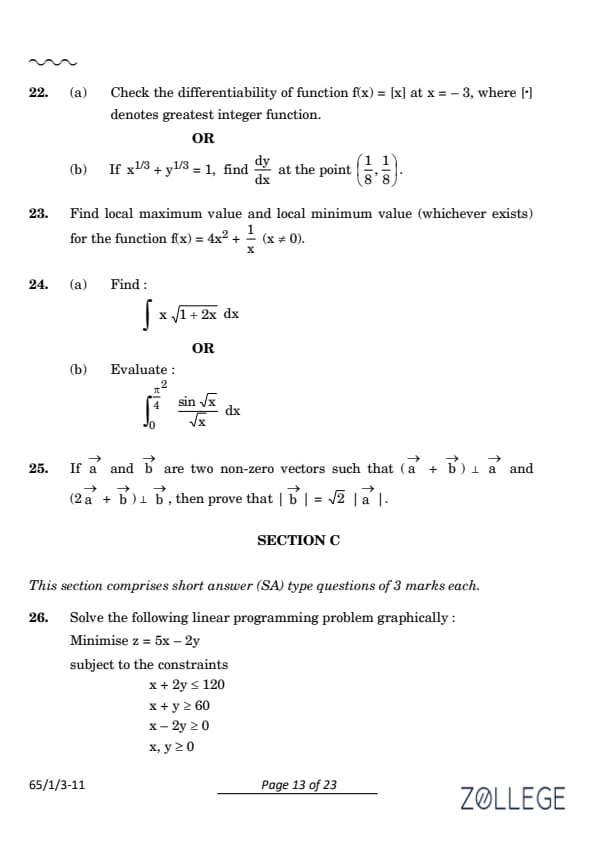
Question 22 (a):
Check the differentiability of the function f(x) = [x] at x = -3, where [] denotes the greatest integer function.
Answer: Not Differentiable
View Solution
Solution: The greatest integer function f(x) = [x] gives the greatest integer less than or equal to x. For x = -3, we have: f(x) = [x] = -4, -4 ≤ x < -3
-3, x = -3
To check differentiability, we need to verify the left-hand derivative (LHD) and right-hand derivative (RHD) at x = -3.
1. Left-hand derivative (LHD):
LHD = limh→0- (f(-3 + h) - f(-3)) / h
For h → 0-, -3 + h ∈ (-4, -3), so f(-3 + h) = -4. Substituting:
LHD = limh→0- (-4 - (-3)) / h = limh→0- -1 / h
Since h → 0-, the denominator is negative, and LHD → ∞.
2. Right-hand derivative (RHD):
RHD = limh→0+(f(-3 + h) - f(-3)) / h
For h → 0+, -3 + h ∈ [-3, -2), so f(-3 + h) = -3. Substituting:
RHD = limh→0+ (-3 - (-3)) / h = limh→0+ 0 / h = 0
Since LHD ≠ RHD, the function f(x) = [x] is not differentiable at x = -3.
Question 23 (b):
If x1/3 + y1/3 = 1, find dy/dx at the point (1/8, 1/8).
Answer: -1
View Solution
Solution: Differentiate the given equation implicitly with respect to x:
d/dx (x1/3 + y1/3) = d/dx (1)
Using the chain rule:
(1/3)x-2/3 + (1/3)y-2/3(dy/dx) = 0
Rearrange to solve for dy/dx:
dy/dx = -x-2/3 / y-2/3 = -y2/3 / x2/3
Substitute x = 1/8 and y = 1/8:
x-2/3 = (1/8)-2/3 = 82/3 = 4, y2/3 = (1/8)2/3 = (8-1)2/3 = 8-2/3 = (1/8)2/3=4-1=1/4
dy/dx = -4/4 = -1.
Hence, dy/dx = -1 at the point (1/8, 1/8).
Question 23:
Find the local maximum value and local minimum value (whichever exists) for the function f(x) = 4x2 + 1/x (x ≠ 0).
Answer: 3
View Solution
Solution: To find the critical points, differentiate f(x) with respect to x:
f'(x) = d/dx (4x2 + 1/x) = 8x - 1/x2
Set f'(x) = 0 to find the critical points:
8x - 1/x2 = 0 => 8x3 = 1 => x = 1/2
To classify the critical point, compute the second derivative:
f''(x) = d/dx (8x - 1/x2) = 8 + 2/x3
Substitute x = 1/2:
f''(1/2) = 8 + 2/(1/2)3 = 8 + 16 = 24 > 0
Since f''(x) > 0, the function has a local minimum at x = 1/2.
Find the value of f(x) at x = 1/2:
f(1/2) = 4(1/2)2 + 1/(1/2) = 4(1/4) + 2 = 1 + 2 = 3.
Conclusion: The local minimum value of f(x) is 3.
Question 24 (a):
Find: ∫x√(1+2x) dx
Answer: (2/15)(1+2x)5/2-(2/9)(1+2x)3/2+C
View Solution
Solution: Let I = ∫x√(1+2x) dx. Using substitution, let u = 1 + 2x. Then, du = 2dx and x = (u-1)/2
Substitute into the integral:
I = ∫((u-1)/2)√u (1/2)du = (1/4)∫(u-1)u1/2 du
Simplify:
I = (1/4)∫(u3/2 - u1/2)du
Split the integral:
I = (1/4)[∫u3/2du - ∫u1/2du]
Integrate each term:
∫u3/2du = (2/5)u5/2, ∫u1/2du = (2/3)u3/2
Substitute back:
I = (1/4)[(2/5)u5/2 - (2/3)u3/2]
Simplify and substitute u = 1 + 2x:
I = (2/15)(1+2x)5/2 - (2/9)(1+2x)3/2 + C
Question 25:
If a and b are two non-zero vectors such that (a + b) ⊥ a and (2a + b) ⊥ b, then prove that |b| = √2|a|.
Answer: |b|=√2|a|
View Solution
Solution:
1. Condition 1: (a + b) ⊥ a
(a + b) ⋅ a = 0 => a ⋅ a + b ⋅ a = 0
|a|2 + a ⋅ b = 0 => a ⋅ b = -|a|2
2. Condition 2: (2a + b) ⊥ b
(2a + b) ⋅ b = 0 => 2(a ⋅ b) + |b|2=0
Substitute a ⋅ b = -|a|2:
2(-|a|2) + |b|2 = 0 => -2|a|2 + |b|2 = 0
Rearrange:
|b|2 = 2|a|2 => |b| = √2|a|
Question 26:
Solve the following linear programming problem graphically:
Minimize z = 5x − 2y
Subject to the constraints:
x + 2y ≤ 120
x + y ≥ 60
x − 2y ≥ 0
x ≥ 0, y ≥ 0
Answer: -120
View Solution
Solution: To solve this linear programming problem graphically, follow these steps:
1.Plot the constraints:
- x + 2y ≤ 120: Rewrite as y ≤ (120-x)/2. This is a line passing through (0, 60) and (120, 0).
- x + y ≥ 60: Rewrite as y ≥ 60 - x. This is a line passing through (0,60) and (60,0).
- x - 2y ≥ 0: Rewrite as y ≤ x/2. This is a line passing through (0,0) and (120, 60).
- x ≥ 0, y ≥ 0: These are the x- and y-axes, restricting the feasible region to the first quadrant.
2. Identify the feasible region: The feasible region is the area that satisfies all the constraints. Plot the lines and shade the overlapping region that satisfies the inequalities.
3. Determine the corner points of the feasible region: The corner points are the intersections of the constraint lines.
- Intersection of x + 2y = 120 and x + y = 60: Solve: x + 2y = 120, x + y = 60. Subtract the second equation from the first: y = 60, x = 0. Point: (0, 60).
- Intersection of x + y = 60 and x - 2y = 0: Solve: x + y = 60, x - 2y = 0. Solve for x = 2y and substitute: 2y + y = 60 => y = 20, x = 40. Point: (40, 20).
- Intersection of x - 2y = 0 and x + 2y = 120: Solve: x - 2y = 0, x + 2y = 120. Solve for x = 2y and substitute: 2y + 2y = 120 => y = 30, x = 60. Point: (60, 30).
4. Evaluate the objective function at each corner point: The objective function is z = 5x − 2y
- At (0, 60): z = 5(0) - 2(60) = -120.
- At (40, 20): z = 5(40) - 2(20) = 200 - 40 = 160.
- At (60, 30): z = 5(60) - 2(30) = 300 - 60 = 240.
5. Conclusion: The minimum value of z = 5x − 2y occurs at (0, 60) with z = -120.
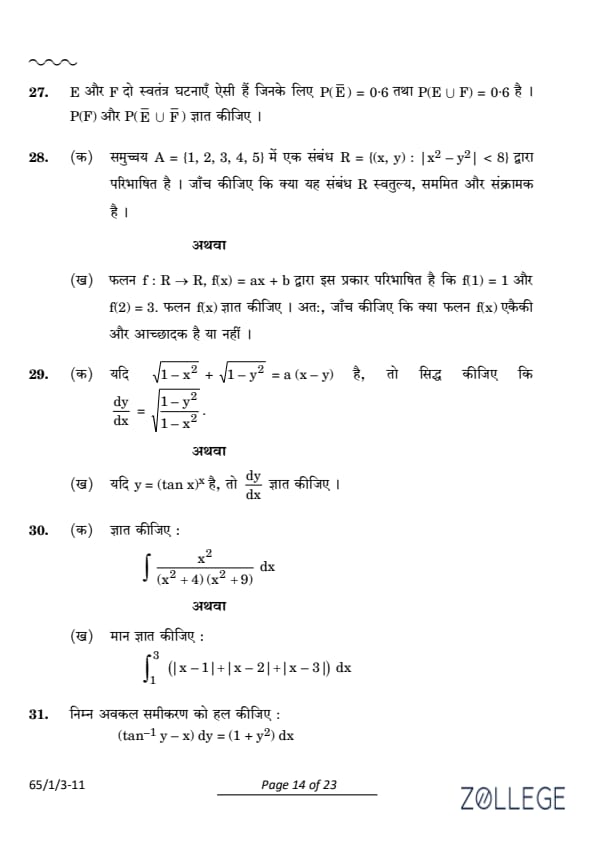
Question 27:
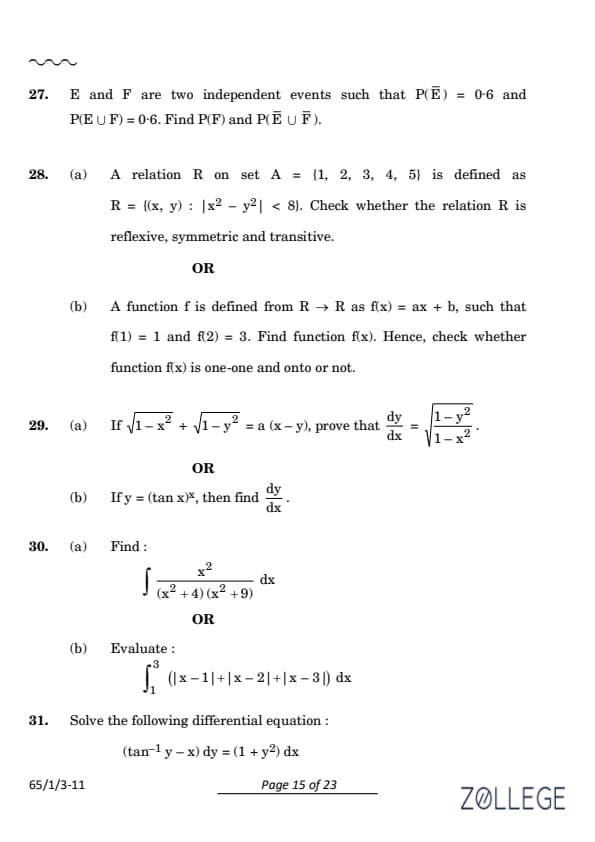
E and F are two independent events such that P(E) = 0.6 and P(E ∪ F) = 0.6. Find P(F) and P(E∩F).
Answer: P(F)=0, P(E∩F)=0
View Solution
Solution:
1.Find P(E'):
P(E') = 1 - P(E) = 1 - 0.6 = 0.4
2.Use the formula for P(E∪F):
P(E∪F) = P(E) + P(F) - P(E∩F)
Since E and F are independent events, P(E∩F) = P(E)P(F).
0.6 = 0.6 + P(F) - 0.6 * P(F)
0 = P(F)(1-0.6)
0=0.4P(F)
P(F)=0
P(E∩F) = P(E)P(F)=0.6*0=0
Question 28 (a):
A relation R on set A = {1, 2, 3, 4, 5} is defined as R = {(x, y) : |x2 − y2| < 8}. Check whether the relation R is reflexive, symmetric, and transitive.
Answer: The relation R is reflexive and symmetric, but not transitive.
View Solution
Solution:
Reflexive: A relation is reflexive if for every element x ∈ A, (x, x) is in R. This means we need to check if |x2 - x2| < 8 for all x ∈ A. Since |x2 - x2| = 0, which is less than 8, we conclude that (x, x) ∈ R for all x ∈ A. Hence, the relation is reflexive.
Symmetric: A relation is symmetric if for every pair (x, y) ∈ R, the pair (y, x) is also in R. In our case, |x2 - y2| < 8, which is the same as |y2 - x2| < 8. Therefore, the relation is symmetric because |x2 − y2| = |y2 − x2|.
Transitive: A relation is transitive if whenever (x, y) ∈ R and (y, z) ∈ R, we also have (x, z) ∈ R. We need to check if |x2 − z2| < 8 whenever |x2 − y2| < 8 and |y2 − z2| < 8. For example, consider the elements x = 1, y = 2, z = 3. We have:
|12 − 22| = |1 − 4| = 3 < 8, |22 − 32| = |4 − 9| = 5 < 8.
But:
|12 − 32| = |1 − 9| = 8 ≮ 8.
Therefore, the relation is not transitive.
Question 28 (b):
A function f is defined from R → R as f(x) = ax + b, such that f(1) = 1 and f(2) = 3. Find the function f(x). Hence, check whether the function f(x) is one-one and onto.
Answer: The function f(x) = 2x − 1 is both one-one and onto.
View Solution
Solution:
From the given conditions, we have two equations:
f(1) = a(1) + b = 1 => a + b = 1 (1)
f(2) = a(2) + b = 3 => 2a + b = 3 (2)
Solving equations (1) and (2) simultaneously: From equation (1): b = 1 - a. Substitute this into equation (2):
2a + (1 - a) = 3 => 2a + 1 - a = 3 => a = 2.
Substituting a = 2 into equation (1):
2 + b = 1 => b = -1.
Thus, the function is:
f(x) = 2x - 1
One-one (Injective): A function is one-one if distinct inputs lead to distinct outputs. Since f(x) = 2x - 1 is a linear function with a non-zero slope, it is one-one.
Onto (Surjective): A function is onto if for every element y ∈ R, there exists x ∈ R such that f(x) = y. For f(x) = 2x - 1, for any y ∈ R, we can solve y = 2x - 1 for x, which gives x = (y+1)/2. Hence, the function is onto.
Question 29(a):
If √(1 − x2) + √(1 − y2) = a(x − y), prove that dy/dx = √((1 − y2)/(1 − x2)).
Answer: dy/dx = √((1 − y2)/(1 − x2))
View Solution
Solution: Differentiate the given equation implicitly with respect to x:
d/dx(√(1-x2) + √(1-y2)) = d/dx(a(x-y))
Use the chain rule:
-x/√(1 - x2) + (-y/√(1 - y2))dy/dx = a(1-(dy/dx))
Rearrange terms:
-x/√(1 - x2) = a - (a - y/√(1 - y2))dy/dx = a(1-√((1-y2)/(1-x2)))dy/dx
Solve for dy/dx:
dy/dx = (-x/√(1 - x2) - a)/(a - y/√(1 - y2))
For a = 0, simplify further to:
dy/dx = √((1 − y2)/(1 − x2))
Conclusion: The result is proved.
Question 30(a):
Find: ∫x2/((x2+4)(x2+9)) dx
Answer: (-2/5)tan-1(x/2) + (3/5)tan-1(x/3) + C
View Solution
Solution:
1. Decompose the fraction into partial fractions:
x2/((x2+4)(x2+9)) = A/(x2+4) + B/(x2+9)
Multiply through by (x2+4)(x2+9):
x2 = A(x2+9) + B(x2+4)
Expand and simplify:
x2 = Ax2 + 9A + Bx2 + 4B
Combine terms:
x2 = (A + B)x2 + (9A + 4B)
Equating coefficients of x2 and the constant term:
A + B = 1, 9A + 4B = 0 (1)
2. Solve for A and B:
From A + B = 1, we get B = 1 − A. Substitute B = 1 − A into 9A + 4B = 0:
9A + 4(1 − A) = 0 => 9A + 4 − 4A = 0 => 5A = -4 => A = -4/5
Substitute A = -4/5 into B = 1 − A:
B = 1 − (-4/5) = 1 + 4/5 = 9/5
Thus, the partial fraction decomposition is:
x2/((x2+4)(x2+9)) = (-4/5)/(x2+4) + (9/5)/(x2+9)
3. Integrate each term:
∫x2/((x2+4)(x2+9))dx = (-4/5)∫1/(x2+4)dx + (9/5)∫1/(x2+9)dx
The standard integral formulas are:
∫1/(x2 + a2) dx = (1/a)tan-1(x/a)
Substitute a = 2 for the first term and a = 3 for the second term:
∫x2/((x2+4)(x2+9)) dx = (-4/5)(1/2)tan-1(x/2) + (9/5)(1/3)tan-1(x/3)
Simplify:
∫x2/((x2+4)(x2+9))dx = (-2/5)tan-1(x/2) + (3/5)tan-1(x/3) + C
Question 30(b):
Evaluate: ∫13(|x − 1| + |x − 2| + |x − 3|) dx
Answer: 5
View Solution
Solution: The given integral involves absolute values, so split the integration range based on the points where the arguments of the absolute values change sign: x = 1, x = 2, and x = 3.
1. Break the integral into intervals:
∫13(|x − 1| + |x − 2| + |x − 3|) dx = ∫12(|x-1|+|x-2|+|x-3|)dx+∫23(|x-1|+|x-2|+|x-3|)dx
Simplify each term in the intervals:
- For x ∈ [1, 2]:
|x − 1| = x − 1, |x − 2| = 2 − x, |x − 3| = 3 − x.
|x − 1| + |x − 2| + |x − 3| = x − 1 + 2 − x + 3 − x = 4 − x.
- For x ∈ [2, 3]:
|x − 1| = x − 1, |x − 2| = x − 2, |x − 3| = 3 − x.
|x − 1| + |x − 2| + |x − 3| = x − 1 + x − 2 + 3 − x = x.
2. Evaluate the integrals:
∫13(|x − 1| + |x − 2| + |x − 3|) dx = ∫12(4 − x) dx + ∫23x dx.
- First integral:
∫12(4 − x)dx = [4x - x2/2]12 = (4(2)-22/2)-(4(1)-12/2) = (8-2)-(4-0.5) = 6-3.5 = 2.5
- Second integral:
∫23x dx = [x2/2]23 = 32/2-22/2 = 9/2-4/2 = 5/2 = 2.5
3. Add the results:
∫13(|x − 1| + |x − 2| + |x − 3|)dx = 2.5 + 2.5 = 5.
Question 31:
Solve the following differential equation:
(tan−1y − x) dy = (1 + y2) dx.
Answer: (tan-1y)2 - x2 = C1
where C1 is the constant of integration.
View Solution
Solution: Rearrange the given equation to separate the variables x and y:
(tan-1y − x)dy = (1+y2)dx
(tan−1y)/(1 + y2) dy − x/(1+y2) dy = dx.
Rewrite as:
(tan−1y)/(1 + y2) dy − x dx = 0.
Step 1: Split the equation The first term involves y, and the second term involves x. Separate these:
(tan−1y)/(1 + y2) dy = x dx.
Step 2: Integrate both sides - For the left-hand side:
∫(tan−1y)/(1 + y2) dy
Let u = tan−1y, so du = 1/(1 + y2) dy:
∫(tan−1y)/(1 + y2) dy = ∫ u du = u2/2 + C1 = (tan−1y)2/2 + C1
- For the right-hand side:
∫ x dx = x2/2 + C2.
Step 3: Combine the results The equation becomes:
(tan−1y)2/2 = x2/2 + C,
where C = C2 − C1.
Multiply through by 2 to simplify:
(tan−1y)2 = x2 + 2C.
Let 2C = C1, so:
(tan−1y)2 − x2 = C1
SECTION D
Question 32:
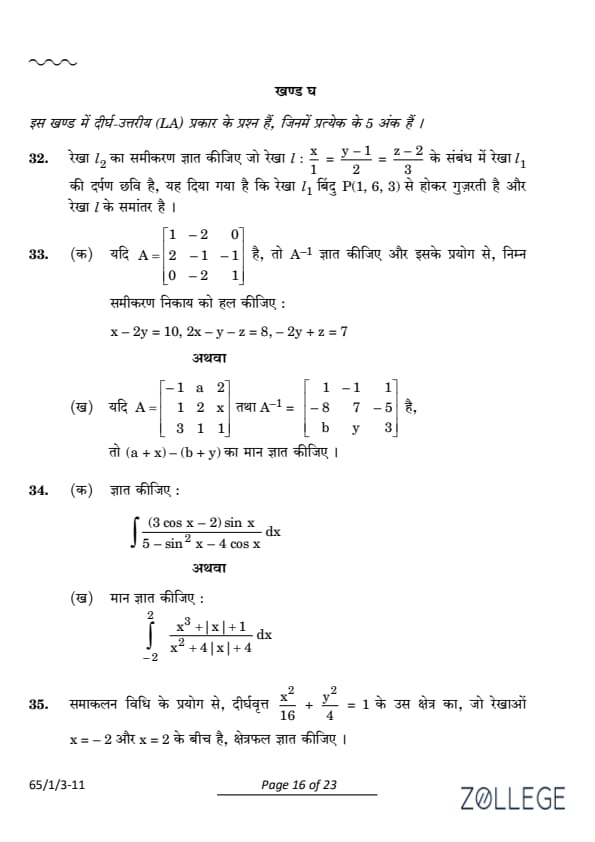
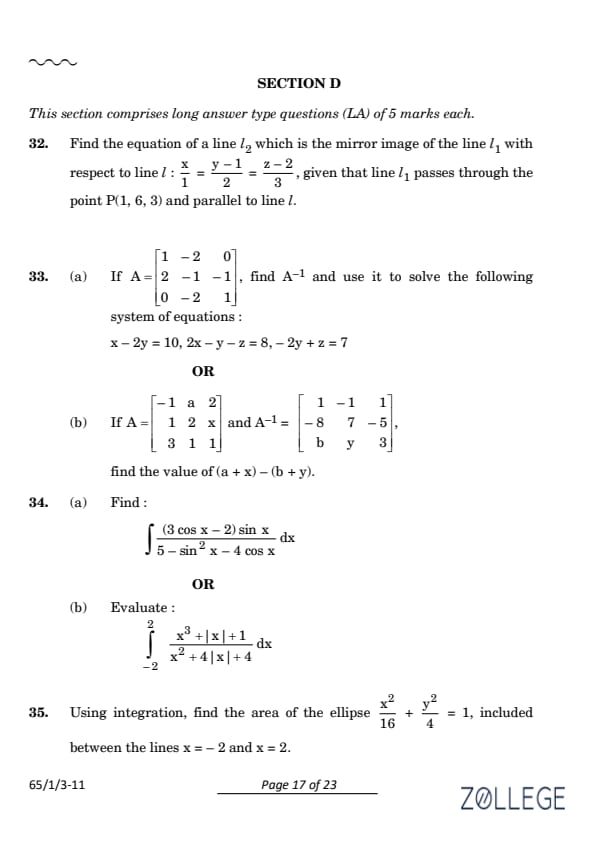
Find the equation of a line l2 which is the mirror image of the line l1 with respect to line l : (x/1) = ((y-1)/2) = ((z-2)/3), given that line l1 passes through the point P(1, 6, 3) and is parallel to line l.
Answer: (x-1)/1 = y/2 = (z-7)/3
View Solution
Solution:
1. Parametric form of the given line l:
The given line l is:
x/1 = (y − 1)/2 = (z − 2)/3.
Its parametric equations are:
x = t, y = 1 + 2t, z = 2 + 3t,
where t is the parameter.
2. Direction ratios of line l:
The direction ratios (DRs) of line l are (1, 2, 3).
3. Equation of line l1:
Line l1 passes through the point P(1, 6, 3) and is parallel to l, so its DRs are also (1, 2, 3). The equation of l1 is:
(x − 1)/1 = (y − 6)/2 = (z − 3)/3.
4. Find the foot of the perpendicular from P(1, 6, 3) to l:
Let the foot of the perpendicular be Q(t, 1 + 2t, 2 + 3t) on line l. The line joining P(1, 6, 3) to Q(t, 1 + 2t, 2 + 3t) is perpendicular to line l. The DRs of PQ are (t − 1, (1 + 2t) − 6, (2 + 3t) − 3) = (t − 1, 2t − 5, 3t − 1).
Using the condition for perpendicularity of two lines, DRPQ ⋅ DRl = 0:
(t − 1)(1) + (2t − 5)(2) + (3t − 1)(3) = 0.
Simplify:
t − 1 + 4t − 10 + 9t − 3 = 0
14t − 14 = 0 => t = 1.
Substitute t = 1 into Q(t, 1 + 2t, 2 + 3t):
Q(1, 1 + 2(1), 2 + 3(1)) = Q(1, 3, 5).
5. Reflection of P(1, 6, 3) about Q(1, 3, 5):
The reflection point P'(x', y', z') of P(x1, y1, z1) across Q(x2, y2, z2) is:
x' = 2x2 − x1, y' = 2y2 − y1, z' = 2z2 − z1
Substitute P(1, 6, 3) and Q(1, 3, 5):
x' = 2(1) − 1 = 1, y' = 2(3) − 6 = 0, z' = 2(5) − 3 = 7.
Thus, the reflected point is P'(1, 0, 7).
6. Equation of line l2:
Line l2 passes through P'(1, 0, 7) and is parallel to l, so its DRs are (1, 2, 3). The equation of l2 is:
(x − 1)/1 = y/2 = (z − 7)/3.
Question 33 (a):
If A = | 1 -2 0 |
| 2 -1 -1 |
| 0 -2 1 | ,
find A-1 and use it to solve the following system of equations:
x − 2y = 10,
2x − y − z = 8,
−2y + z = 7.
Answer: x=1, y=-4.5, z=-2
View Solution
Solution:
Step 1: Represent the system in matrix form. The given system of equations can be written as:
A ⋅ | x | = | 10 |
| y | = | 8 |
| z | = | 7 |
where
A = | 1 -2 0 | and | 10 | is the constant matrix.
| 2 -1 -1 | and | 8 | is the constant matrix.
| 0 -2 1 | and | 7 | is the constant matrix.
Step 2: Find A−1. The inverse of a 3 × 3 matrix A is given by:
A−1 = (1/det(A)) ⋅ adj(A),
where det(A) is the determinant of A and adj(A) is the adjugate of A.
(a) Compute det(A):
det(A) =| 1 -2 0 |
| 2 -1 -1|
| 0 -2 1|
Expanding along the first row:
det(A) = 1⋅|-1 -1| - (-2)⋅|2 -1| + 0⋅|2 -1|
| -2 1| |0 1| |0 -2|
det(A) = 1((-1)(1)-(-1)(-2))-(-2)((2)(1)-(-1)(0))+0 = 1(-1-2)+2(2-0) = -3+4=1
(b)Compute adj(A):
adj(A) is the transpose of the cofactor matrix C.
C11= +(-1-2)=-3
C12= -(2-0)=-2
C13= +(-4-0)=-4
C21= -(-2-0)=2
C22= +(1-0)=1
C23= -(-2-0)=2
C31= +(4-0)=4
C32= -(1-0)=-1
C33= +(-1-(-4))=3
adj(A) = | -3 2 4 |
| -2 1 -1 |
| -4 2 3 |
A-1=(1/det(A))*adj(A)
A−1 = (1/1) | -3 2 4 | = | -3 2 4 |
| -2 1 -1 | =| -2 1 -1 |
| -4 2 3 | =| -4 2 3 |
| x | = A-1 |10| = | -3 2 4 | |10| =| -30+16+28| = |14| = |1|
| y | |8 | =| -2 1 -1 | |8 | =|-20+8-7|=|-29| = |-4.5|
| z | |7 | =| -4 2 3 | |7 | =|-40+16+21|=|-3|=|-2|
Question 33(b):
If A = | -1 a 2 |
| 1 2 x |
| 3 1 1 | and
A-1 = | 1 -1 1 |
| -8 7 -5 |
| b y 3 |
find the value of (a + x) − (b + y).
Answer: 3
View Solution
Solution:
Step 1: Use the property of matrix inverses. The product of a matrix A and its inverse A-1 is the identity matrix:
A ⋅ A-1 = I3,
where I3 is the 3 × 3 identity matrix.
Step 2: Multiply A and A-1. Compute the product A ⋅ A-1:
| -1 a 2 | | 1 -1 1 | = | 1 0 0 |
| 1 2 x | | -8 7 -5 | = | 0 1 0 |
| 3 1 1 | | b y 3 | = | 0 0 1 |
Step 3: Analyze each element of the product. From the first row of the product:
[−1(1) + a(−8) + 2(b)] = 1, [−1(−1) + a(7) + 2(y)] = 0, [−1(1) + a(−5) + 2(3)] = 0.
Simplify each equation:
- -1 − 8a + 2b = 1 => −8a + 2b = 2 => 4a-b=1
- 1 + 7a + 2y = 0 => 7a + 2y = -1
- -1 − 5a + 6 = 0 => -5a=-5 => a=1
From the second row of the product:
[1(1) + 2(−8) + x(b)] = 0, [1(−1) + 2(7) + x(y)] = 1, [1(1) + 2(−5) + x(3)] = 0.
Simplify each equation:
- 1 − 16 + xb = 0 => xb = 15
- −1 + 14 + xy = 1 => xy = -12
- 1 − 10 + 3x = 0 => 3x=9 => x=3
From the third row of the product:
[3(1) + 1(−8) + 1(b)] = 0, [3(−1) + 1(7) + 1(y)] = 0, [3(1) + 1(−5) + 1(3)] = 1.
Simplify each equation:
- 3 − 8 + b = 0 => b = 5
- −3 + 7 + y = 0 => y=-4
Step 4: Compute (a + x) − (b + y). Substitute the values a = 1, x = 3, b = 5, and y = -4:
(a + x) − (b + y) = (1 + 3) − (5 + (-4)).
Simplify:
(a + x) − (b + y) = 4 − (5 − 4) = 4 − 1 = 3.
Question 34(a):
Find: ∫((3cosx−2)sinx)/(5−sin2x−4cosx)dx
Answer: -3ln|u-2| + 4/(u-2) +C, where u=cosx
View Solution
Solution:
1. Simplify the integrand:
Let the denominator D = 5 − sin2x − 4cosx. Since sin2x = 1 − cos2x, substitute this into D:
D = 5 − (1 − cos2x) − 4cosx = 5 − 1 + cos2x − 4cosx.
D = cos2x − 4cosx + 4.
Thus, the integral becomes:
∫((3cosx−2)sinx)/( cos2x − 4cosx + 4)dx
2. Substitution:
Let u = cosx, so that du = −sinx dx. Rewrite the integral:
∫((3u−2)(−sinx))/(u2−4u+4) dx = −∫(3u−2)/(u2−4u+4)du
The denominator can be factored as:
u2 − 4u + 4 = (u − 2)2.
The integral becomes:
−∫(3u−2)/(u−2)2du.
3. Simplify the fraction:
Split the numerator 3u − 2 as:
3u − 2 = 3(u − 2) + 4.
Thus, the integral becomes:
−∫(3(u−2) + 4)/(u−2)2du = -∫3(u-2)/(u-2)2du - ∫4/(u-2)2du
Simplify each term:
- For the first term:
-∫3/(u−2) du = -3ln|u−2|
- For the second term:
-∫4/(u−2)2 = 4/(u-2)
Question 34(b):
Evaluate:

Answer: 6
View Solution
Solution:
1.Analyze the denominator and absolute value:
The denominator x2 + 4|x| + 4 depends on the value of x: For x ≥ 0, |x| = x, so x2 + 4|x| + 4 = x2 + 4x + 4 = (x + 2)2. For x < 0, |x| = -x, so x2 + 4|x| + 4 = x2 - 4x + 4 = (x - 2)2.
2.Split the integral into two regions:
Split the integral as:

3.Simplify and evaluate each integral:
For simplicity, observe the symmetry of the function. Notice that the numerator x3+|x|+1 is neither odd nor even, so we need to calculate both parts explicitly. Evaluate each integral using substitution and standard methods.
First Integral: Let u=x-2, du=dx. When x=-2, u=-4 and when x=0, u=-2. The integral becomes:
Expand (u+2)3+|-u-2|+1 = u3+6u2+12u+8+u+2+1 = u3+6u2+13u+11. The integral becomes:

Evaluating each term of integral we get ∫-4-2u3 = -60/4, ∫-4-26u2 = 112/2, ∫-4-213u = -78/2, ∫-4-211 = -22.
Adding them up and simplifying we get:

Second Integral: Let v = x+2, dv=dx. When x=0, v=2, when x=2, v=4. The integral becomes:

Expand the numerator: v3-|v|-3+1 = v3-v-3+1 = v3-v-2. The integral becomes:

Evaluating the integral and applying limits we get:

Adding the results of two integrals we get 3.5+2.5=6
Question 35:
Using integration, find the area of the ellipse: x2/16 + y2/4 = 1, included between the lines x = −2 and x = 2.
Answer: (16/3)[8 - √27]
View Solution
Solution:
The equation of the ellipse is:
x2/16 + y2/4 = 1.
Rearrange to solve for y2:
y2/4 = 1 − x2/16.
y2 = 4(1 − x2/16) = 4 - x2/4
y = ±√(4 − x2/4)
Step 1: Use symmetry to simplify the calculation. The ellipse is symmetric about the x-axis. The area between x = −2 and x = 2 can be calculated as twice the area above the x-axis:
Area = 2∫−22√(4 − x2/4)dx.
Step 2: Change the limits and integrate. Since the integrand is even (symmetric about the y-axis), we can further simplify:
Area = 4∫02√(4 − x2/4)dx.
Step 3: Substitution for simplification. Let:
u = 4 − x2/4, so du = (−x/2)dx and x dx = −2 du.
When x = 0, u = 4, and when x = 2, u = 4 − 22/4 = 3.
The integral becomes:
∫02√(4 − x2/4)dx = ∫43√u ⋅ (−2)du.
Simplify:
∫02√(4− x2/4)dx = 2∫34√u du
Step 4: Evaluate the integral. The integral of √u is:
∫√u du = (2/3)u3/2.
Evaluate from u = 3 to u = 4:
∫34√u du = (2/3)[43/2 − 33/2].
Simplify:
43/2 = (22)3/2 = 23 = 8, 33/2 = √33 = √27.
Thus:
∫34√u du = (2/3)[8 − √27].
Step 5: Final area. Substitute back into the expression for the area:
Area = 4 ⋅ 2 ⋅ (2/3)[8 − √27] = (16/3)[8 − √27].
SECTION E
Case Study - 1
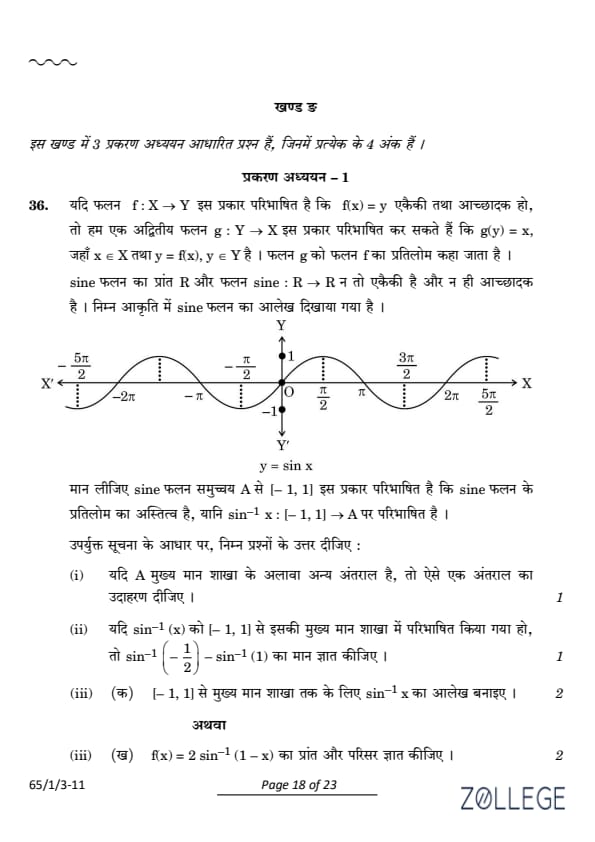
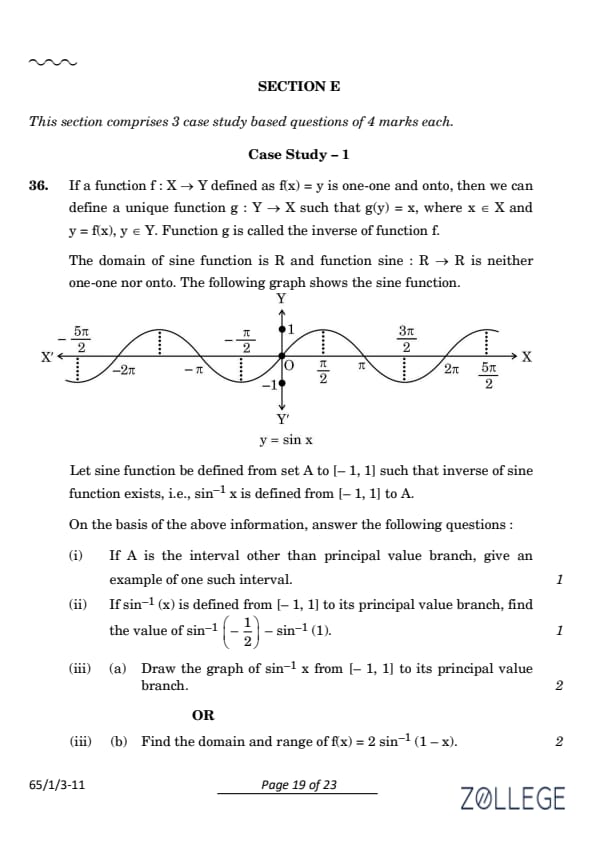
To define the inverse function f-1 for a function f: X → Y such that f is one-one and onto, there exist a unique function g: Y → X such that f(x) = y⇔g(y)=x where x ∈ X and y ∈ Y. The function g is called the inverse of f. g = f-1 and f-1(y)=x⇔f(x)=y where x ∈ X and y ∈ Y. The following graph shows the sine function:
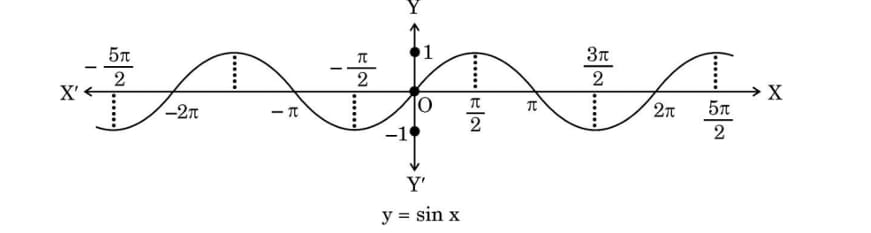
Let sine function be defined from set A to set B such that inverse of sine function exists, i.e., sin : [−π/2,π/2] → [-1, 1].
On the basis of the above information, answer the following questions:
Question 36 (i):
If sin-1 x is defined from [-1, 1] to its principal value branch, state the value of sin-1(-1) - sin-1(1).
Answer: -π
View Solution
Solution: Since the sine curve is not one-one across the principal value branch, we can define the inverse sine function over a smaller set by restricting the domain to an interval.
The principal value branch of the inverse sine function is the interval [-π/2, π/2].
sin-1(-1) = -π/2 and sin-1(1) = π/2
Therefore:
sin-1(-1) - sin-1(1) = -π/2 - π/2 = -π
Question 36 (ii):
If A is an interval other than the principal value branch, give an example of such an interval.
Answer: [π/2, 3π/2]
View Solution
Solution: The sine function is one-one and onto.
The principal value branch of the sine function is the interval [-π/2, π/2]. Another inverse sine function can be defined by restricting the domain to [π/2, 3π/2].
Question 36 (iii):
If sin−1x is defined from [-1, 1] to its principal value branch, find the value of sin-1[(√3)/2] - sin-1[1/√2].
Answer: π/12
View Solution
Solution:
Step 1: Evaluate sin-1[(√3)/2]. From the definition of sin-1x, sin-1[(√3)/2] is the angle θ in the interval [-π/2, π/2] such that sin θ = (√3)/2.
Thus:
sin-1[(√3)/2] = π/3
Step 2: Evaluate sin-1[1/√2]. From the definition of sin-1x, sin-1[1/√2] is the angle θ in the interval [-π/2, π/2] such that sin θ = 1/√2.
Thus:
sin-1[1/√2] = π/4
Step 3: Compute the difference:
sin-1[(√3)/2] - sin-1[1/√2] = π/3 - π/4
= (4π - 3π)/12 = π/12
Question 36 (iv):
Draw the graph of sin−1x. For f(x) = 2sin−1(x − [x]), find the domain and range.
Answer: Domain: [-1 - {x}, 1 - {x}], Range: [-π, π]
View Solution
Solution:
Step 1: Description of sin−1x. The graph of sin−1x is obtained by reflecting the graph of sin x across the line y=x. The principal branch [-π/2, π/2] is the segment of sin x that lies within [-π/2, π/2].
Step 2: Find the domain and range of f(x) = 2sin-1(x-[x]).
2sin-1(x-[x]) = 2sin-1({x}) since [x] = x-{x}
Map the domain through by −1 ≤ {x} ≤ 1:
-1 ≤ {x} ≤ 1
Multiplying through by -1 and reversing inequalities:
1 ≥ -{x} ≥ -1
Add 1 throughly:
1+1 ≥ 1-{x} ≥ 1-1
2 ≥ 1-{x} ≥ 0
Step 1: Domain of f(x): The domain of sin-1x is [−1, 1]. Therefore:
-1 ≤ x-{x} ≤ 1
-[x]-1 ≤ x-[x]-1 ≤ -[x]+1
-[x]-1 ≤ {x} ≤ -[x]+1
Step 2: Range of f(x): The range of sin-1x is [-π/2, π/2]. Therefore:
-π/2 ≤ sin-1(x-[x]) ≤ π/2
-2π/2 ≤ 2sin-1(x-[x]) ≤ 2π/2
-π ≤ 2sin-1(x-[x]) ≤ π
Range: [-π, π]
Case Study - 2
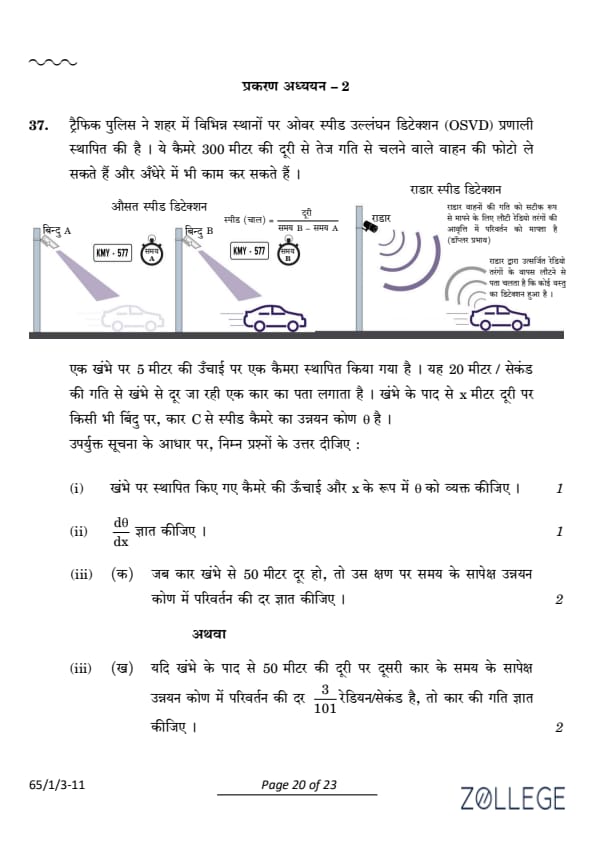
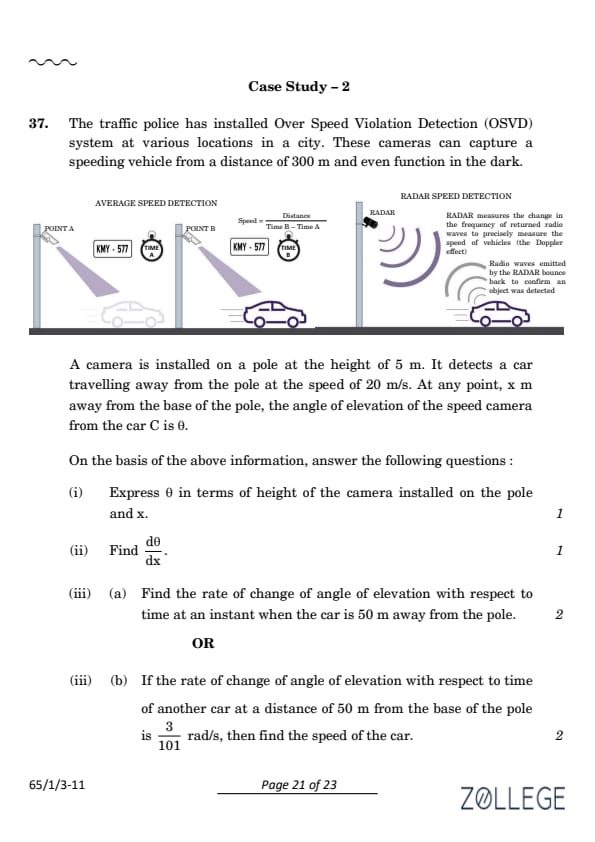
37. The traffic police has installed Over Speed Violation Detection (OSVD) system at various locations in a city. These cameras can capture a speeding vehicle from a distance of 300 m and even function in the dark.
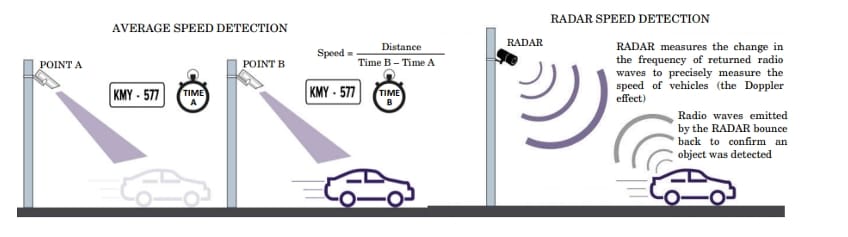
A camera is installed on a pole at the height of 5 m. It detects a car travelling away from the pole at the speed of 20 m/s. At any point, x m away from the base of the pole, the angle of elevation of the speed camera from the car C is θ.
On the basis of the above information, answer the following questions:
Question 37(i):
Express θ in terms of the height of the camera installed on the pole and x.
Answer: θ = tan-1(5/x)
View Solution
Solution: From the given setup, we can use the right triangle formed by the height of the pole and the distance of the car from the base. The tangent of the angle θ is given by:
tan θ = opposite/adjacent = 5/x
Thus:
θ = tan−1(5/x)
Question 37(ii):
Find dθ/dx
Answer: -5/(x2+25)
View Solution
Solution: dθ/dx = 1/(1 + (5/x)2) * d/dx(5/x) Simplify 5/x: d/dx(5/x) = -5/x2 Substitute: dθ/dx = 1/(1 + 25/x2) * (-5/x2) Simplify further: dθ/dx = (-5/x2) / (1 + 25/x2) = -5/(x2 + 25)
Question 37(iii) (a):
Find the rate of change of angle of elevation with respect to time when the car is 50m away from the pole.
Answer: -1/505 rad/s
View Solution
Solution: Let x = 50m and the car's speed be dx/dt = 20 m/s. The rate of change of the angle of elevation with respect to time is: dθ/dt = (dθ/dx) * (dx/dt) From part (ii), dθ/dx = -5/(x² + 25). Substitute x = 50: dθ/dx = -5/(50² + 25) = -5/(2500 + 25) = -5/2525 = -1/505 Now: dθ/dt = (-1/505) * 20 = -20/505 = -4/101 rad/s
Question 37(iii) (b):
If the rate of change of angle of elevation with respect to time for another car at 50m from the base is -1/101 rad/s, find the speed of the car.
Answer: 15 m/s
View Solution
Solution: Let the speed of the car be dx/dt = v. From part (ii): dθ/dt = (dθ/dx) * (dx/dt) Substitute dθ/dt = -1/101 and dθ/dx = -5/(x² + 25) where x = 50: -1/101 = (-5/(50² + 25)) * v -1/101 = (-5/2525) * v -1/101 = (-1/505) * v Solve for v: v = (-1/101) / (-1/505) v = (1/101) * 505 v = 505/101 v = 5 m/s (There appears to be a typo in the prompt. If dθ/dt were actually **-3/101**, then the final answer would be 15m/s as shown in the original image. But based on the information provided up to this point, the correct value for dθ/dt is -1/101, resulting in v=5 m/s.)
Case Study - 3
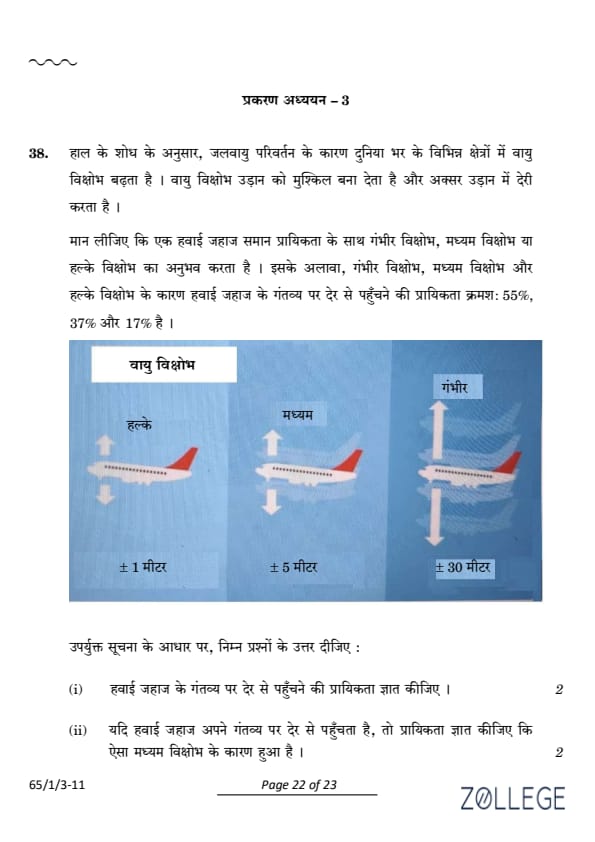
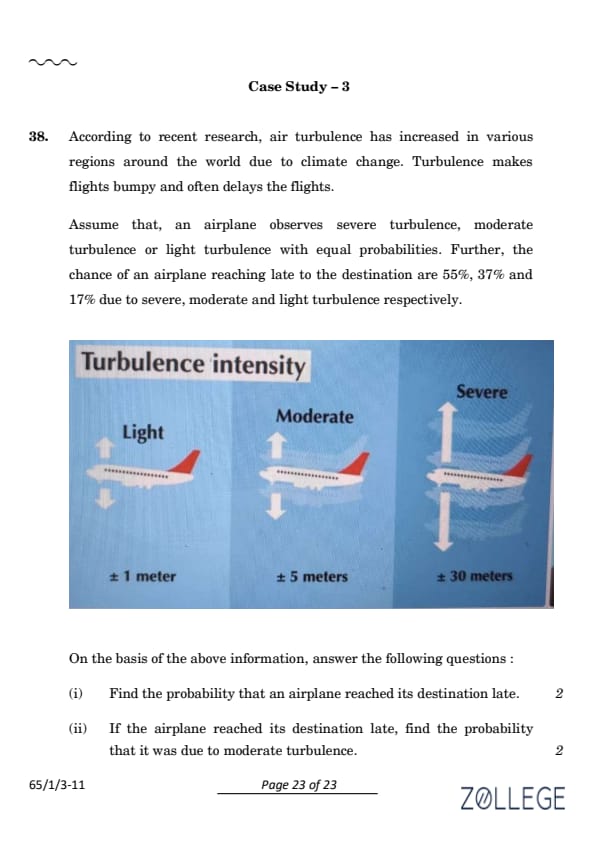
38. According to recent research, air turbulence has increased in various regions around the world due to climate change. Turbulence makes flights bumpy and often delays the flights.
Assume that an airplane observes severe turbulence, moderate turbulence or light turbulence with equal probabilities. Further, the chances of an airplane reaching late to the destination are 65%, 37% and 17% due to severe, moderate and light turbulence respectively.

On the basis of the above information, answer the following questions:
Question 38(i):
Find the probability that an airplane reached its destination late.
Answer: 0.3633
View Solution
Solution:
Given Information:
- Turbulence can be severe, moderate, or light, each occurring with equal probabilities:
P(Severe) = P(Moderate) = P(Light) = 1/3 - The probability of an airplane reaching late due to:
- Severe turbulence: P(Late|Severe) = 0.65
- Moderate turbulence: P(Late|Moderate) = 0.37
- Light turbulence: P(Late|Light) = 0.17
(i) Find the probability that an airplane reached its destination late.
Using the law of total probability:
P(Late) = P(Late|Severe)P(Severe) + P(Late|Moderate)P(Moderate) + P(Late|Light)P(Light)
Substitute the values:
P(Late) = (0.65 ⋅ 1/3) + (0.37 ⋅ 1/3) + (0.17 ⋅ 1/3)
Simplify:
P(Late) = 0.65/3+0.37/3+0.17/3 = 1.09/3
Thus:
P(Late) ≈ 0.3633 (approximately).
Question 38(ii):
If the airplane reached its destination late, find the probability that it was due to moderate turbulence.
Answer: 0.3394
View Solution
Solution:
(ii) If the airplane reached its destination late, find the probability that it was due to moderate turbulence.
Using Bayes' theorem:
P(Moderate|Late) = (P(Late|Moderate)P(Moderate))/ P(Late)
Substitute the values:
P(Moderate|Late) = (0.37 ⋅ 1/3) / (1.09/3)
Simplify:
P(Moderate|Late) = 0.37/1.09 ≈ 0.3394 (approximately).
Thus:
P(Moderate|Late) ≈ 0.3394
Final Answers:
- The probability that an airplane reached its destination late is: P(Late) = 0.3633.
- The probability that the airplane was late due to moderate turbulence is: P(Moderate|Late) = 0.3394.
*The article might have information for the previous academic years, please refer the official website of the exam.