
CBSE Class 12 2025 Business Studies 66-1-2 Question Paper Set-2: Download Solutions with Answer Key


| Updated On - Sep 16, 2025
The CBSE Class 12 Business Studies exam is scheduled on February 22, 2025. The total marks for the theory paper are 80. The question paper consists of 20% Multiple-Choice questions (MCQs), 40% competency-based questions, and 40% short and long-answer-type questions. The CBSE Class 12 Business Studies Question Paper 2025, along with Its Solutions, is available for download here.
CBSE Class 12 2025 Business Studies (Set 2- 66/1/2) 2025 With Solution PDF
| CBSE Class 12 Business Studies Question Paper with Answer Key | Download PDF | Check Solutions |

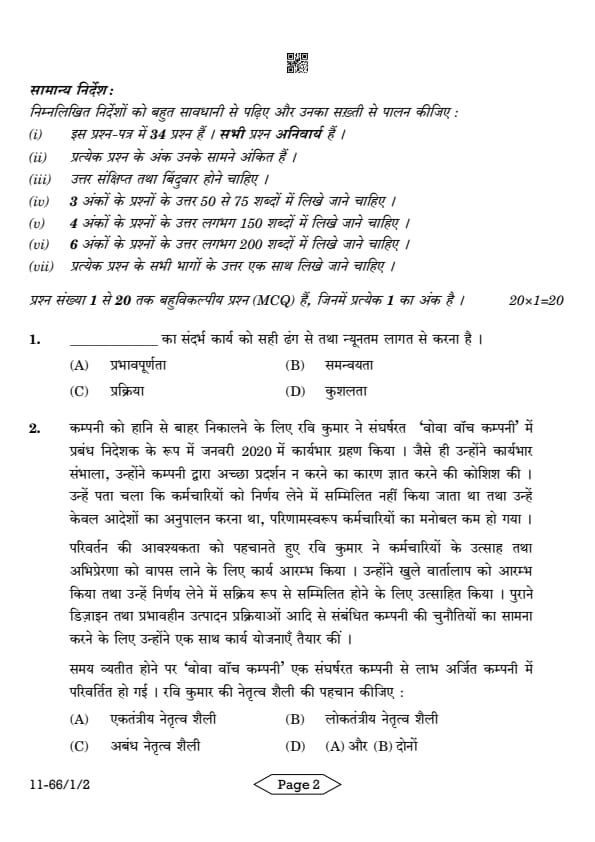
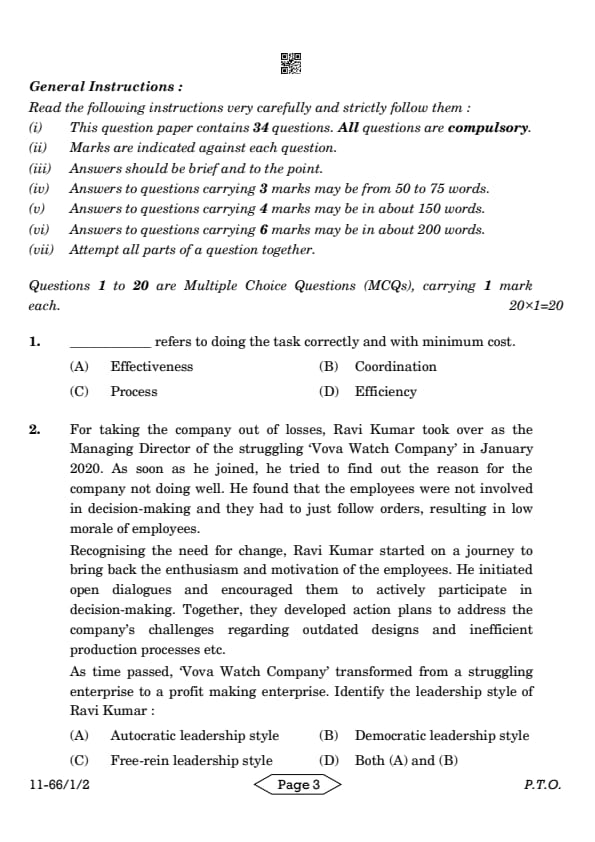
___________ refers to doing the task correctly and with minimum cost.
View Solution
Efficiency is the ability to perform tasks correctly while utilizing the least amount of resources, such as time, money, materials, and effort. In a management context, efficiency means achieving the desired output while minimizing input and reducing waste. It is essentially a measure of how effectively resources are transformed into results, be it goods or services.
For example, if one manager produces 100 units using 10 workers in one day, and another manager produces the same 100 units using only 8 workers in the same time, the second manager is considered more efficient.
However, it’s important to note that efficiency should not be the sole focus. It must be complemented by effectiveness, which refers to achieving the desired goals. A manager may be efficient but still fail to meet organizational objectives, which could undermine the value of their efficiency.
Final Answer: (D) Efficiency
Quick Tip: Efficiency is about "doing things right" — achieving the desired results with minimal use of resources, time, and effort. It’s crucial for cost control and resource optimization.
For taking the company out of losses, Ravi Kumar took over as the Managing Director of the struggling ‘Vova Watch Company’ in January 2020. As soon as he joined, he tried to find out the reason for the company not doing well. He found that the employees were not involved in decision-making and they had to just follow orders, resulting in low morale of employees.
Recognizing the need for change, Ravi Kumar started on a journey to bring back the enthusiasm and motivation of the employees. He initiated open dialogues and encouraged them to actively participate in decision-making. Together, they developed action plans to address the company’s challenges regarding outdated designs and inefficient production processes, etc.
As time passed, ‘Vova Watch Company’ transformed from a struggling enterprise to a profit-making enterprise. Identify the leadership style of Ravi Kumar:
View Solution
Ravi Kumar's approach exemplifies the **democratic leadership style**. In this style, the leader actively involves employees in the decision-making process, fosters open communication, and values the input of team members. This results in increased job satisfaction, better employee morale, and improved collaboration.
At the outset, the company was struggling due to low employee involvement and an autocratic management style where employees simply followed orders, leading to demotivation. Ravi Kumar recognized the importance of change and began fostering open communication channels, encouraging participation in decision-making, and building trust within the team. By involving employees in planning and addressing challenges collectively, he empowered them and made them feel valued. This led to increased commitment and higher productivity.
Ravi Kumar’s leadership style resulted in:
A boost in employee morale and motivation.
Better decision-making through diverse inputs.
Collaborative planning to address inefficiencies.
A complete turnaround of the company from loss-making to profit-making.
Hence, Ravi Kumar demonstrated the key traits of a **democratic leader** — one who values team participation, consults with subordinates, and creates an environment of trust and respect.
Final Answer: (B) Democratic leadership style
Quick Tip: A democratic leader fosters collaboration, involves the team in decision-making, and boosts morale—making it ideal for transitioning teams or revitalizing employee motivation.
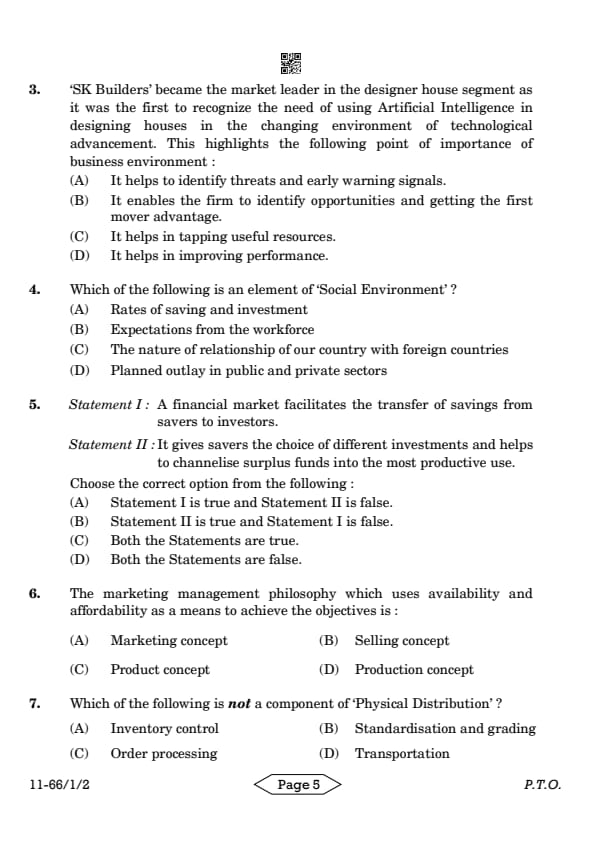
‘SK Builders’ became the market leader in the designer house segment as it was the first to recognize the need of using Artificial Intelligence in designing houses in the changing environment of technological advancement. This highlights the following point of importance of business environment:
View Solution
The scenario provided illustrates the importance of recognizing and adapting to changes in the business environment. 'SK Builders' identified the growing trend of Artificial Intelligence (AI) in the housing industry, which allowed them to capitalize on this technological innovation before their competitors. By integrating AI into their design processes, they became the first to leverage this technology in the market, thus gaining a competitive edge.
This is a clear example of the **first mover advantage**, which occurs when a firm is the first to introduce a new idea, process, or product. This position can lead to increased brand recognition, market share, and customer loyalty, as the company establishes itself as a leader and pioneer in the field.
The business environment plays a key role in helping firms identify emerging opportunities, whether through technological advancements, shifts in consumer preferences, or changes in competition. A company that is responsive to these external changes is better positioned to act quickly and secure a first mover advantage.
Therefore, the correct point of importance here is: “It enables the firm to identify opportunities and gain the first mover advantage.”
Final Answer: (B) It enables the firm to identify opportunities and getting the first mover advantage.
Quick Tip: Businesses that adapt early to trends, such as new technologies or shifting consumer demands, gain a strategic lead, known as "First Mover Advantage."
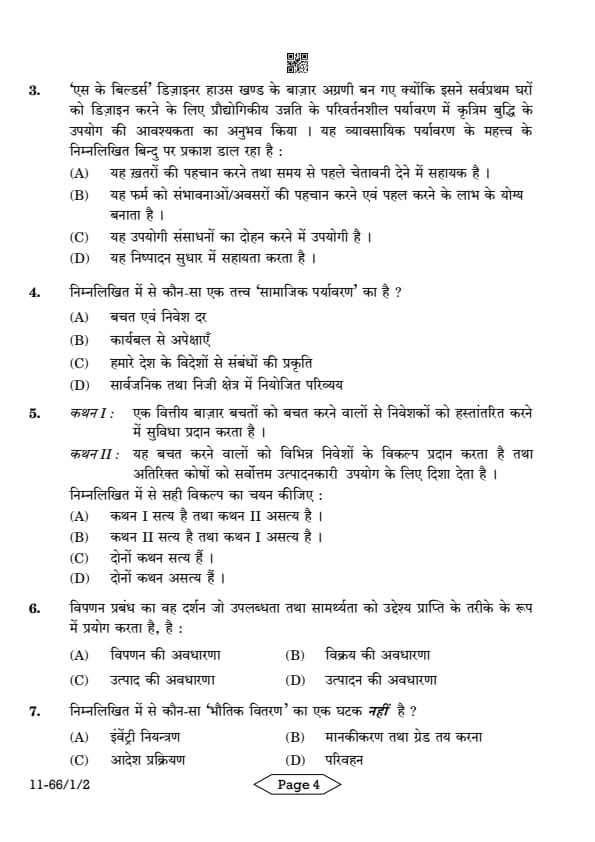
Which of the following is an element of ‘Social Environment’?
View Solution
The business environment is a broad concept that can be divided into several components, including the **social environment**. This part of the environment reflects societal trends, values, norms, and expectations that influence business decisions. It encompasses the way people live, work, and interact within their society.
Option (B), "Expectations from the workforce," is directly related to the social environment as it refers to societal changes in how employees view their work life. This includes factors like:
- The increasing demand for work-life balance,
- The desire for better working conditions and benefits,
- A shift toward more inclusive, ethical, and empathetic workplace cultures.
On the other hand:
- Option (A) pertains to the **economic environment**, which focuses on saving, investment, and financial factors.
- Option (C) relates to the **political/legal environment**, particularly international relations.
- Option (D) is part of **economic planning**, dealing with public and private sector policies.
Thus, only Option (B) pertains to the **social environment**, as it directly influences organizational culture and workforce policies.
Final Answer: (B) Expectations from the workforce
Quick Tip: The social environment includes trends and expectations within society, such as workforce demands for flexibility, inclusivity, and growth opportunities.
Statement I: A financial market facilitates the transfer of savings from savers to investors.
Statement II: It gives savers the choice of different investments and helps to channelise surplus funds into the most productive use.
Choose the correct option from the following:
View Solution
N/A Quick Tip: Financial markets not only connect savers and investors but also ensure funds flow into the most efficient sectors.
The marketing management philosophy which uses availability and affordability as a means to achieve the objectives is:
View Solution
N/A Quick Tip: The production concept emphasizes quantity and cost efficiency — best for economies of scale but not for personalized needs.
Which of the following is not a component of ‘Physical Distribution’?
View Solution
N/A Quick Tip: Physical distribution covers logistics like transport, inventory, and order handling — not quality categorization like standardisation.
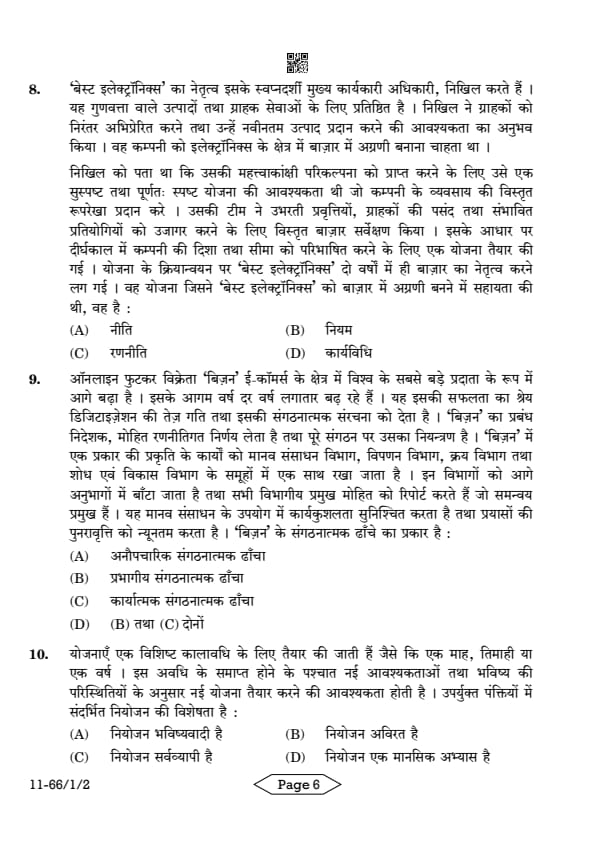
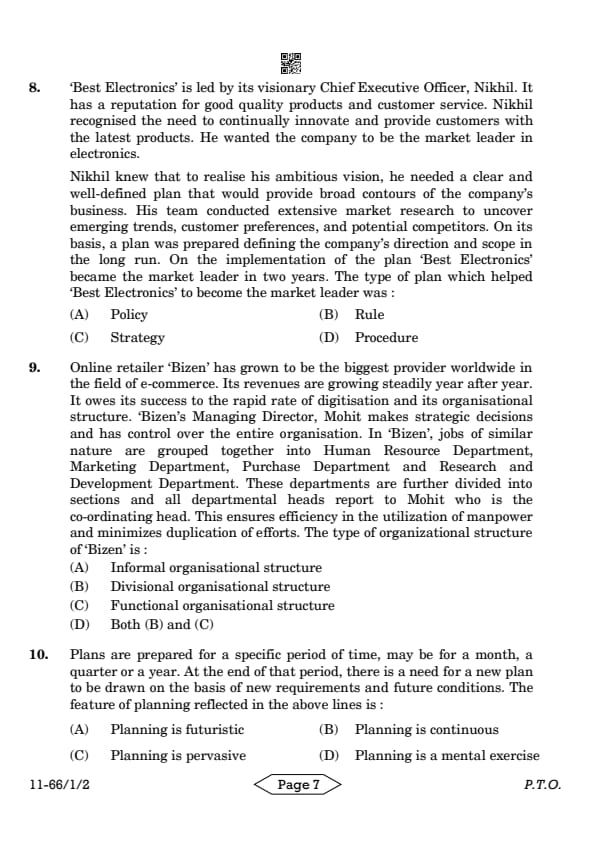
‘Best Electronics’ is led by its visionary Chief Executive Officer, Nikhil. It has a reputation for good quality products and customer service. Nikhil recognised the need to continually innovate and provide customers with the latest products. He wanted the company to be the market leader in electronics.
Nikhil knew that to realise his ambitious vision, he needed a clear and well-defined plan that would provide broad contours of the company’s business. His team conducted extensive market research to uncover emerging trends, customer preferences, and potential competitors. On its basis, a plan was prepared defining the company’s direction and scope in the long run. On the implementation of the plan ‘Best Electronics’ became the market leader in two years. The type of plan which helped ‘Best Electronics’ to become the market leader was :
View Solution
N/A Quick Tip: When a company prepares a comprehensive plan to achieve long-term objectives after analyzing external factors, it's called a strategy — not a policy, rule, or procedure.
Online retailer ‘Bizen’ has grown to be the biggest provider worldwide in the field of e-commerce. Its revenues are growing steadily year after year. It owes its success to the rapid rate of digitisation and its organisational structure. ‘Bizen’s Managing Director, Mohit makes strategic decisions and has control over the entire organisation. In ‘Bizen’, jobs of similar nature are grouped together into Human Resource Department, Marketing Department, Purchase Department and Research and Development Department. These departments are further divided into sections and all departmental heads report to Mohit who is the co-ordinating head. This ensures efficiency in the utilization of manpower and minimizes duplication of efforts. The type of organizational structure of ‘Bizen’ is :
View Solution
N/A Quick Tip: If a company groups jobs based on common functions (HR, Marketing, etc.) and centralizes authority, it's following a functional structure — not divisional.
Plans are prepared for a specific period of time, may be for a month, a quarter or a year. At the end of that period, there is a need for a new plan to be drawn on the basis of new requirements and future conditions. The feature of planning reflected in the above lines is :
View Solution
N/A Quick Tip: When plans are regularly made and remade due to new conditions, it shows that planning is continuous — a dynamic, never-ending managerial function.
Statement I : Delegation is the entrustment of responsibility and authority to another, and the creation of accountability for performance.
Statement II : Irrespective of the extent of delegated authority, the manager shall still be accountable to the same extent as before delegation.
Choose the correct option from the following :
View Solution
N/A Quick Tip: Even when tasks and authority are delegated, managers remain ultimately accountable — that’s a key principle in delegation.
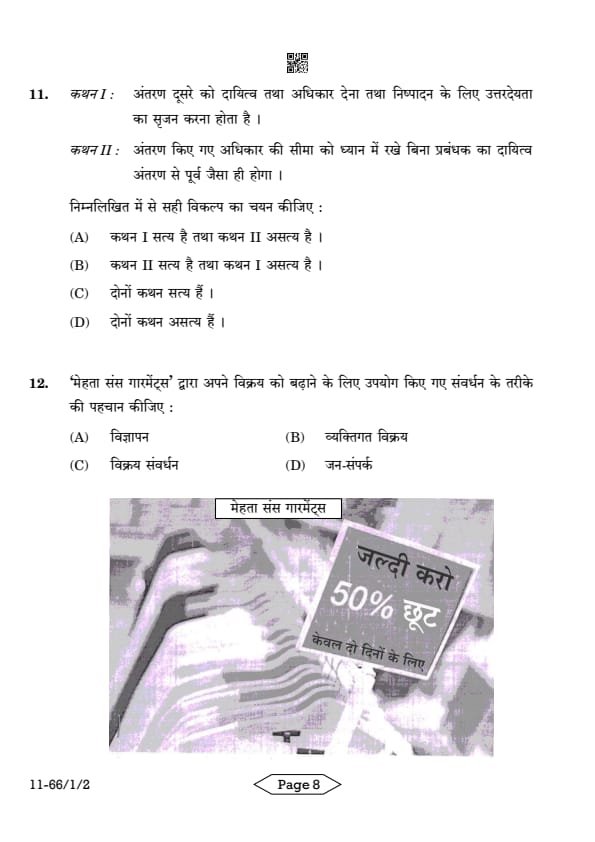
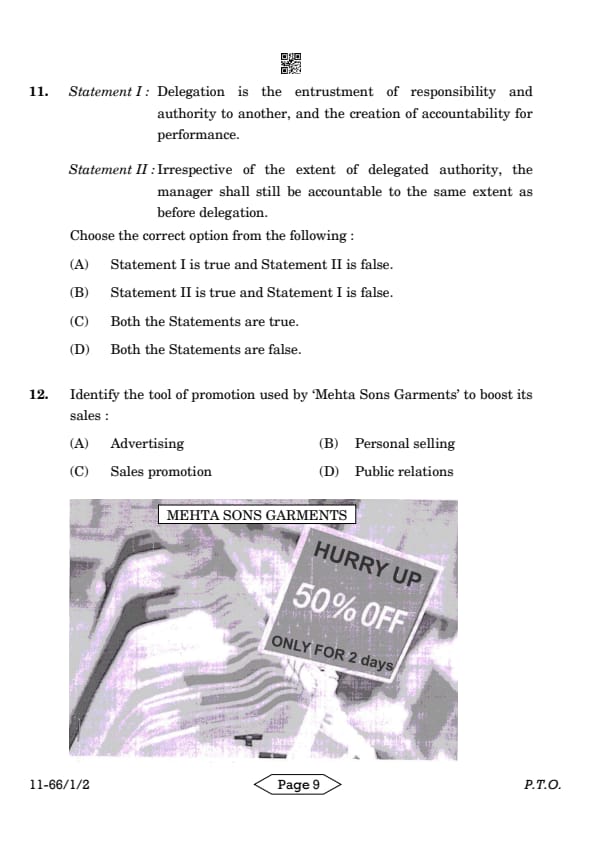
Identify the tool of promotion used by ‘Mehta Sons Garments’ to boost its sales :

View Solution
N/A Quick Tip: Sales promotion includes limited-time discounts and offers to boost short-term sales — like “50% off for 2 days.”
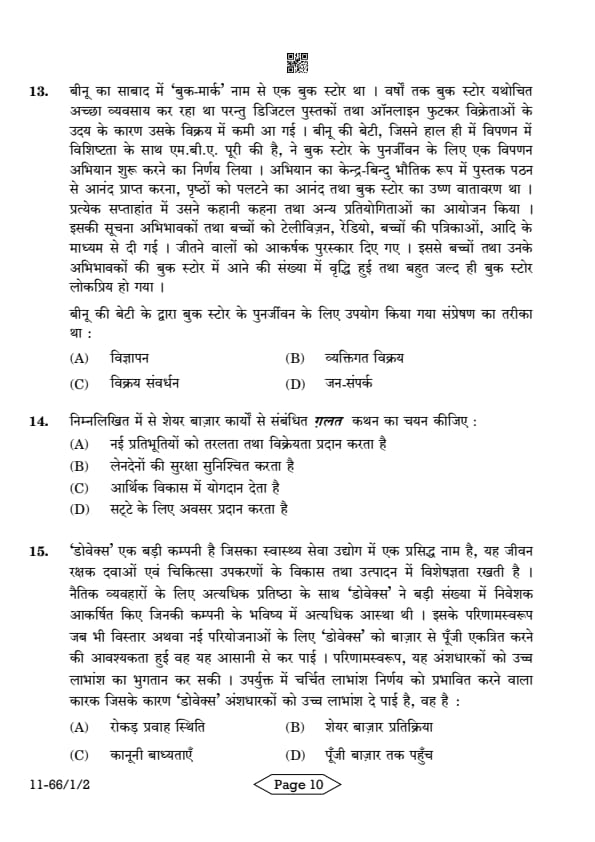
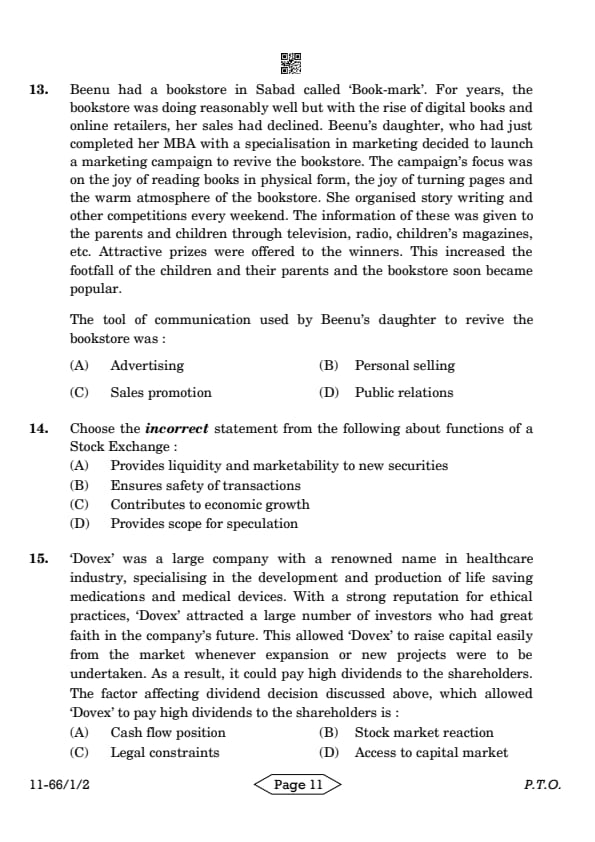
Beenu had a bookstore in Sabad called ‘Book-mark’. For years, the bookstore was doing reasonably well but with the rise of digital books and online retailers, her sales had declined. Beenu’s daughter, who had just completed her MBA with a specialisation in marketing decided to launch a marketing campaign to revive the bookstore. The campaign’s focus was on the joy of reading books in physical form, the joy of turning pages and the warm atmosphere of the bookstore. She organised story writing and other competitions every weekend. The information of these was given to the parents and children through television, radio, children’s magazines, etc. Attractive prizes were offered to the winners. This increased the footfall of the children and their parents and the bookstore soon became popular.
The tool of communication used by Beenu’s daughter to revive the bookstore was :
View Solution
N/A Quick Tip: Public Relations aims to create a favorable image in the public’s mind through non-paid, trust-building activities.
Choose the incorrect statement from the following about functions of a Stock Exchange :
View Solution
N/A Quick Tip: Primary markets deal with new securities; stock exchanges trade existing ones, providing liquidity and transparency.
‘Dovex’ was a large company with a renowned name in healthcare industry, specialising in the development and production of life saving medications and medical devices. With a strong reputation for ethical practices, ‘Dovex’ attracted a large number of investors who had great faith in the company’s future. This allowed ‘Dovex’ to raise capital easily from the market whenever expansion or new projects were to be undertaken. As a result, it could pay high dividends to the shareholders.
The factor affecting dividend decision discussed above, which allowed ‘Dovex’ to pay high dividends to the shareholders is :
View Solution
N/A Quick Tip: Easy access to capital markets reduces the need for internal financing, enabling companies to pay more dividends.
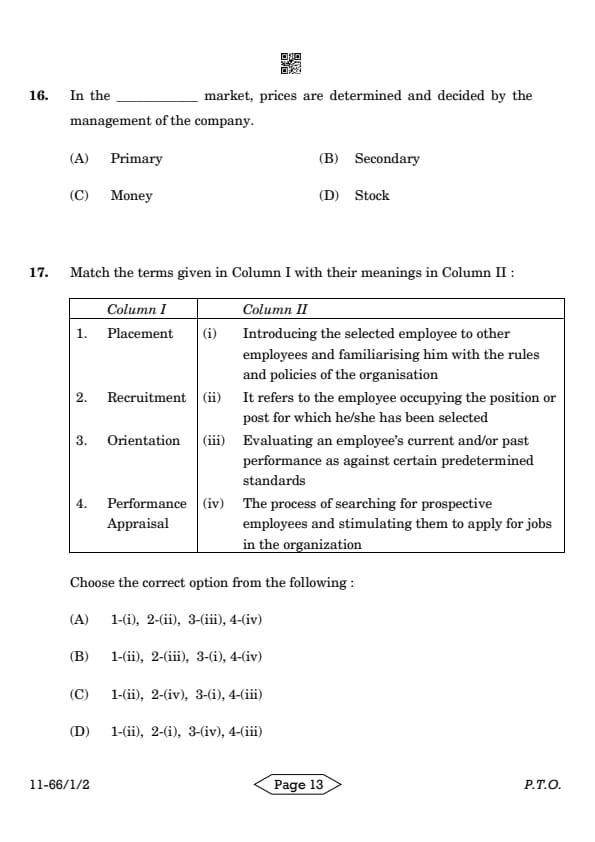
In the _________ market, prices are determined and decided by the management of the company.
View Solution
N/A Quick Tip: In the primary market, companies issue new securities and set prices; in the secondary market, prices fluctuate via investor trading.
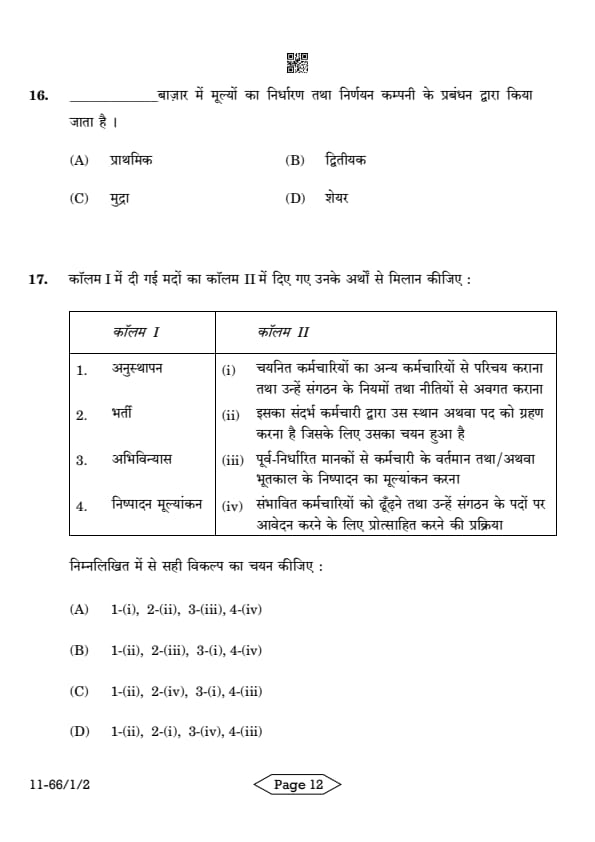
Match the terms given in Column I with their meanings in Column II:

View Solution
Step 1: Matching terms.
- Placement → employee occupying selected position (ii)
- Recruitment → process of searching for prospective employees (iv)
- Orientation → introducing employee to others and rules (i)
- Performance Appraisal → evaluating performance against standards (iii)
Step 2: Apply logically.
Each definition fits precisely with the correct HR term. Quick Tip: Placement = actual joining, Recruitment = sourcing, Orientation = introduction, Appraisal = evaluation.
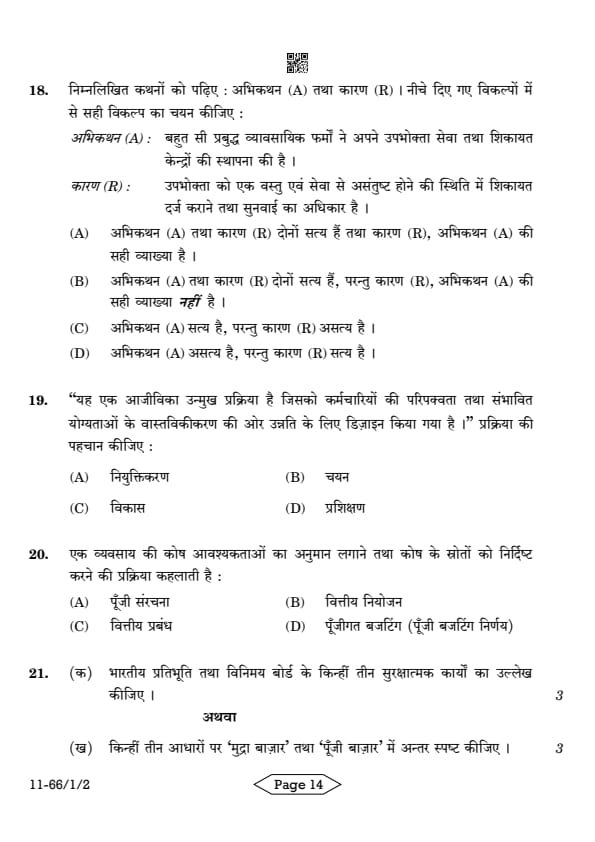
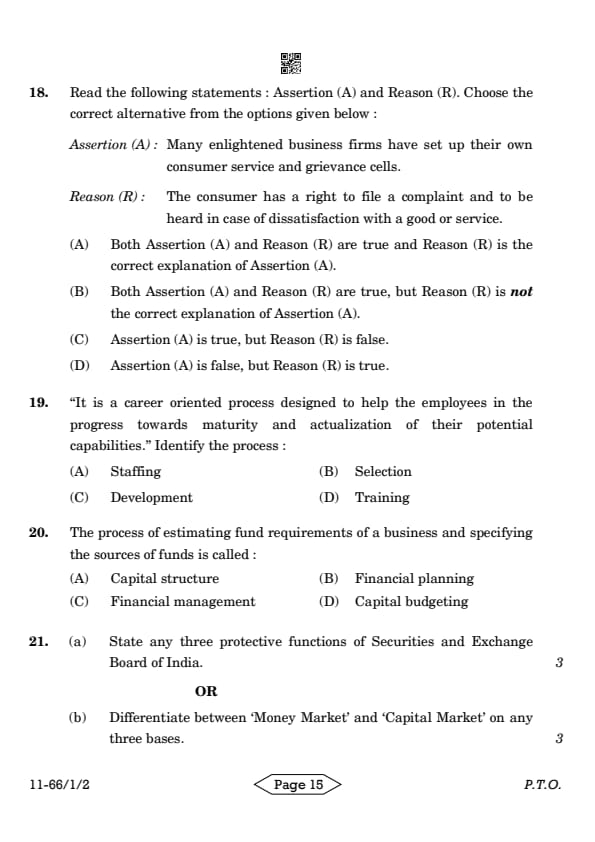
Read the following statements : Assertion (A) and Reason (R). Choose the correct alternative from the options given below :
Assertion (A) : Many enlightened business firms have set up their own consumer service and grievance cells.
Reason (R) : The consumer has a right to file a complaint and to be heard in case of dissatisfaction with a good or service.
View Solution
Assertion (A) is a **true statement**. Many enlightened firms have proactively set up consumer service and grievance cells to enhance customer satisfaction, handle complaints, and build trust with consumers. This is an ethical business practice that also aligns with corporate social responsibility.
Reason (R) is also **true**. One of the fundamental rights of a consumer under the Consumer Protection Act is the **Right to be Heard**, which includes the right to file complaints and have them addressed.
Now, the crucial part is whether Reason (R) **explains** Assertion (A). The reason explains **why** enlightened business firms set up grievance cells—because they recognize the consumer’s legal and ethical rights to complain and be heard. Hence, Reason (R) **logically explains** Assertion (A).
Final Answer: (A)
Quick Tip: Assertion-Reason questions test logical linkage; if both are true and R explains A, the correct answer is (A).
“It is a career-oriented process designed to help the employees in the progress towards maturity and actualization of their potential capabilities.” Identify the process:
View Solution
The process described in the question is one that focuses on the **long-term growth and maturity** of employees. The key phrases in the statement—*career-oriented*, *maturity*, and *actualization of potential*—point towards a process that goes beyond immediate skill training or recruitment.
Let’s break down the options:
- **Staffing** involves identifying and fulfilling the human resource needs of an organization. It includes recruitment, selection, and placement.
- **Selection** is a short-term decision-making process of choosing the most suitable candidate.
- **Training** is typically focused on short-term skill enhancement related to a specific job or role.
- **Development**, on the other hand, is a **long-term educational process** that focuses on the **overall growth** of employees and prepares them for **future roles** by enhancing capabilities and realizing their potential.
Thus, the correct answer is (C) Development.
Final Answer: (C) Development
Quick Tip: Development is a future-oriented process focused on career growth and capability enhancement of employees.
The process of estimating fund requirements of a business and specifying the sources of funds is called:
View Solution
**Financial planning** involves estimating the amount of funds required for the operation of a business and deciding the sources from which these funds can be raised.
Key objectives of financial planning include:
- Ensuring availability of funds at the right time.
- Avoiding unnecessary surplus or shortage of funds.
- Determining the best use of the funds.
It also includes planning for **investment** in assets, **working capital needs**, and long-term **financial goals**.
- **Capital structure** is the composition of debt and equity.
- **Financial management** is a broader term, covering planning, organizing, and controlling finances.
- **Capital budgeting** is related to evaluating investment options.
Final Answer: (B) Financial planning
Quick Tip: Financial planning = Forecasting fund needs and arranging sources in advance.
(a) State any three protective functions of Securities and Exchange Board of India.
OR
(b) Differentiate between ‘Money Market’ and ‘Capital Market’ on any three bases.
View Solution
N/A Quick Tip: SEBI protects investors; Money Market = short-term, Capital Market = long-term.
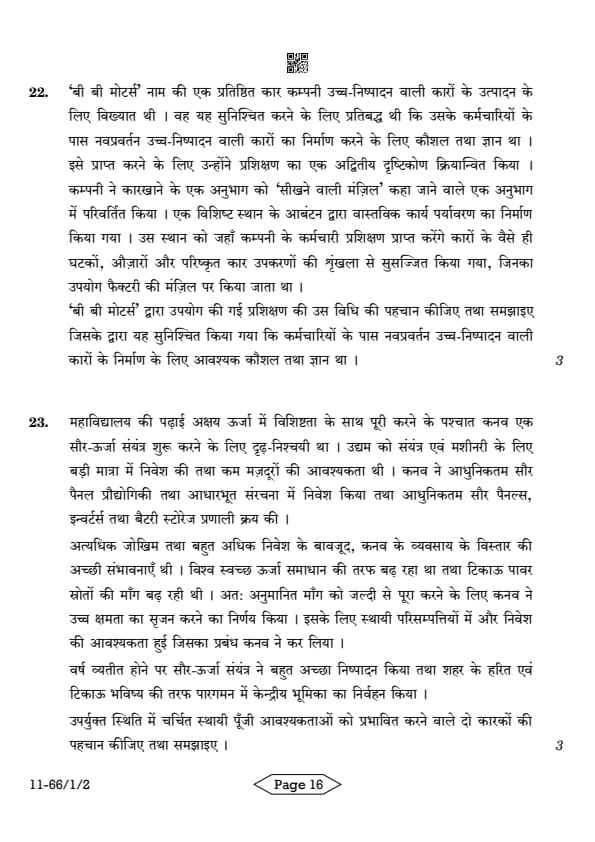
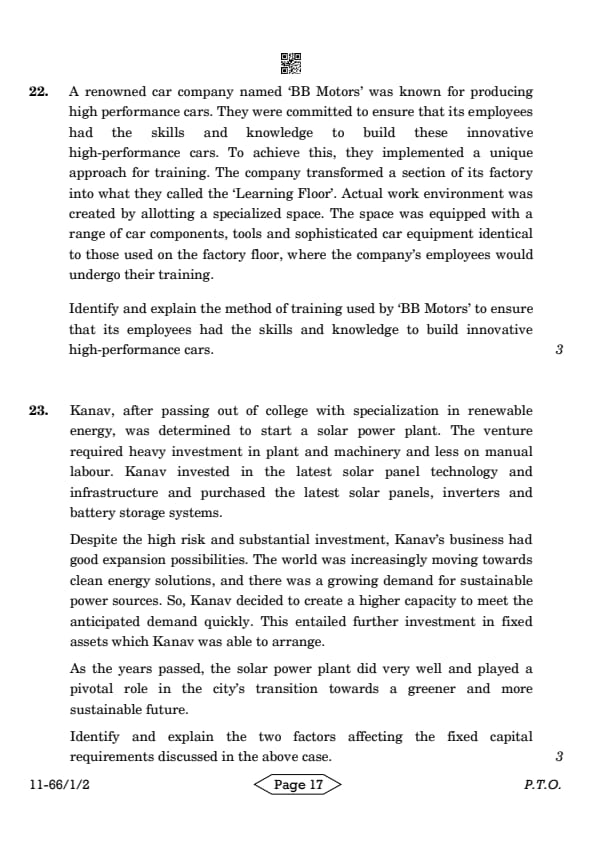
A renowned car company named ‘BB Motors’ was known for producing high-performance cars. They ensured their employees had the skills and knowledge to build innovative vehicles by transforming part of their factory into a 'Learning Floor'—an environment that replicated actual working conditions with real tools and equipment.
Identify and explain the method of training used by ‘BB Motors’ to ensure that its employees had the skills and knowledge to build innovative high-performance cars.
View Solution
The training method used by 'BB Motors' is called **Vestibule Training**.
- Vestibule training is conducted in a **simulated environment** that mirrors the actual workplace.
- It is generally conducted **outside the main production area** but with equipment, tools, and procedures that are **identical to the real working environment**.
- This allows employees to learn and practice in a safe, controlled space before they are assigned real job responsibilities.
In the case of BB Motors:
- The ‘Learning Floor’ was specially designed and equipped to mimic the company’s actual factory.
- Employees were trained on real car components and machines without affecting ongoing production.
- This method ensured that employees gained hands-on experience, reduced the risk of costly mistakes on the job, and improved both confidence and efficiency.
Vestibule training is especially useful in industries like manufacturing and engineering, where technical accuracy and familiarity with machines are essential.
Final Answer: Vestibule Training
Quick Tip: Vestibule Training = Simulated real-work setup → Safe hands-on learning before real job assignment.
Kanav, after passing out of college with specialization in renewable
energy, was determined to start a solar power plant. The venture required heavy investment in plant and machinery and less on manual labour. Kanav invested in the latest solar panel technology and infrastructure and purchased the latest solar panels, inverters and battery storage systems.
Despite the high risk and substantial investment, Kanav’s business had good expansion possibilities. The world was increasingly moving towards clean energy solutions, and there was a growing demand for sustainable power sources. So, Kanav decided to create a higher capacity to meet the anticipated demand quickly. This entailed further investment in fixed
assets which Kanav was able to arrange.
As the years passed, the solar power plant did very well and played a pivotal role in the city’s transition towards a greener and more sustainable future.
Identify and explain the two factors affecting the fixed capital requirements discussed in the above case.
View Solution
Two key factors affecting fixed capital requirements in this case are:
(i) Nature of Business:
- The type of business directly influences fixed capital needs.
- Businesses that are **manufacturing- or infrastructure-oriented**, like Kanav’s solar power plant, require heavy investment in **plant, equipment, and technology**.
- In contrast, trading or service businesses usually need lesser fixed capital.
In Kanav’s case: Being in the renewable energy sector, large fixed assets like **solar panels, battery storage, inverters, and machinery** were essential, hence high fixed capital was required.
(ii) Scale of Operations:
- The larger the size of operations, the greater the requirement for fixed capital.
- Bigger firms must invest more in equipment, land, buildings, and technology to meet higher production demands.
In the case: Due to increasing demand for clean energy and expansion goals, Kanav increased his plant capacity, leading to a **greater investment in fixed assets**.
Thus, the **nature** and **scale** of his business significantly influenced his fixed capital needs.
Final Answer: (i) Nature of Business and (ii) Scale of Operations
Quick Tip: Manufacturing firms with large-scale operations need more fixed capital due to high investment in assets.
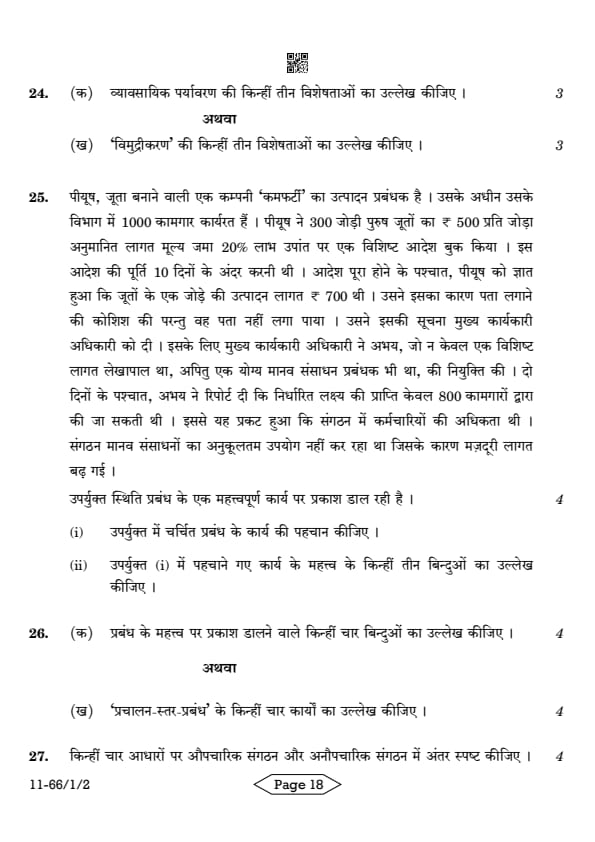
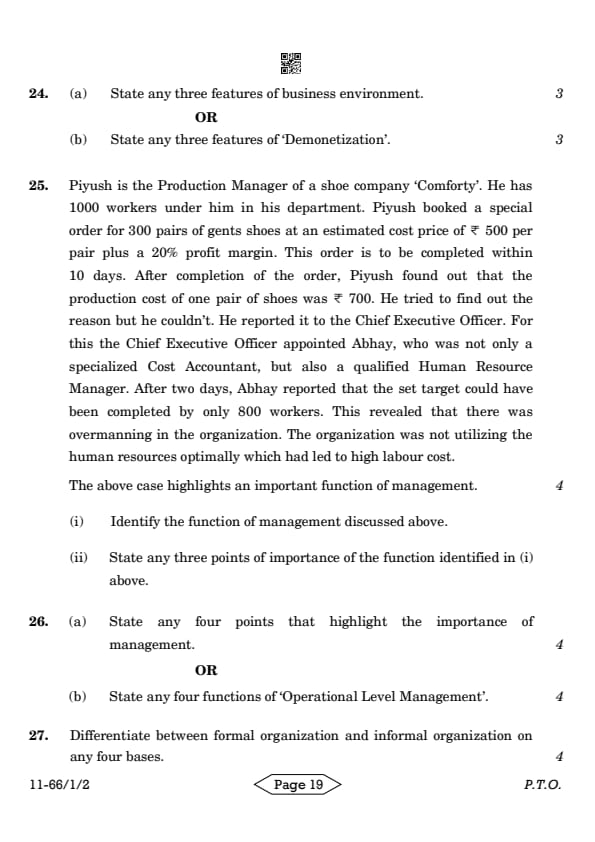
(a) State any three features of business environment.
OR
(b) State any three features of ‘Demonetization’.
View Solution
(a) Three Features of Business Environment:
1. Totality of External Forces:
Business environment includes all external forces such as economic, social, political, technological, and legal factors. These factors affect a business's performance but are outside its control. For instance, a change in government policy or a new technology can directly influence how a business operates.
2. Dynamic Nature:
The environment is constantly changing. What is relevant today may become irrelevant tomorrow. For example, consumer preferences, technology, and market competition keep evolving, requiring businesses to continuously adapt and innovate.
3. Inter-relatedness:
Different elements of the business environment are closely interlinked. For instance, a change in economic policy (economic environment) can affect the level of income (social environment), which in turn affects consumer buying behavior.
(b) Three Features of Demonetization:
1. Sudden and Immediate Implementation:
The government of India on 8th November 2016 announced demonetization of ₹500 and ₹1000 currency notes. The decision was implemented immediately, which created an abrupt need to exchange or deposit old notes, affecting all economic activities.
2. Aimed at Multiple Objectives:
Demonetization targeted the reduction of black money, control over counterfeit currency, and promotion of digital transactions. It was seen as a major financial reform step aimed at formalizing the economy and reducing corruption.
3. Wide Impact on the Economy:
The demonetization move affected various sectors such as retail, real estate, agriculture, and unorganized businesses. There was a temporary liquidity crunch that impacted daily wage earners and small vendors, though long-term benefits were anticipated in terms of higher tax compliance and digital transformation.
Final Answer:
Both parts have been attempted with detailed explanation. Quick Tip: Business environment is dynamic and includes all external forces affecting business decisions, while demonetization was a government policy step with immediate, wide-reaching economic impacts.
Piyush is the Production Manager of a shoe company ‘Comforty’. He has 1000 workers under him in his department. Piyush booked a special order for 300 pairs of gents shoes at an estimated cost price of ₹ 500 per pair plus a 20% profit margin. This order is to be completed within 10 days. After completion of the order, Piyush found out that the production cost of one pair of shoes was ₹ 700. He tried to find out the reason but he couldn’t. He reported it to the Chief Executive Officer. For this, the Chief Executive Officer appointed Abhay, who was not only a specialized Cost Accountant, but also a qualified Human Resource Manager. After two days, Abhay reported that the set target could have been completed by only 800 workers. This revealed that there was overmanning in the organization. The organization was not utilizing the human resources optimally which had led to high labour cost.
(i) Identify the function of management discussed above.
View Solution
The function of management highlighted in the case is **Staffing**. Staffing refers to the process of putting the right person in the right job. It includes workforce planning, recruitment, selection, placement, training, development, remuneration, and performance appraisal.
In the given case, Abhay identified overmanning, i.e., the presence of more employees than needed. This indicates that the organization had failed to properly evaluate how many workers were actually required, pointing towards inefficiency in staffing. Due to incorrect estimation of manpower requirement, labour costs increased unnecessarily, which impacted the overall profitability.
Hence, the correct function involved here is **Staffing**, which ensures optimal use of human resources in alignment with the organizational goals.
% Part (ii)
(ii) State any three points of importance of the function identified in (i) above.
Efficient Performance of Other Functions: Staffing helps in efficient performance of all other functions of management by ensuring that the right number and type of people are available at the right time.
Optimal Utilization of Human Resources: Through proper staffing, an organization avoids problems like overmanning or understaffing, thus utilizing the workforce efficiently and economically.
Improves Productivity and Profitability: The right staffing improves morale and motivation among employees, resulting in enhanced productivity and better quality of output, which leads to increased profitability.
Final Answer: (i) Staffing
\phantom{Final Answer: (ii) Efficient Performance of Other Functions, Optimal Utilization of Human Resources, Improves Productivity and Profitability Quick Tip: Staffing is not just about hiring people — it’s about forecasting manpower needs and aligning them with organizational goals to avoid wastage and inefficiency.
(a) State any four points that highlight the importance of management.
OR
(b) State any four functions of ‘Operational Level Management’.
View Solution
Four points that highlight the importance of management are:
Achievement of Group Goals: Management brings the human and material resources together and motivates the people for the achievement of the goals of the organization.
Increases Efficiency: Management increases efficiency through proper planning, organizing, staffing, directing, and controlling.
Creates Dynamic Organization: Management helps in adapting to the changing environment through innovation and flexibility.
Helps in Achieving Personal Objectives: Effective management helps individuals to achieve their personal goals while working towards organizational objectives.
Final Answer: (a) Achievement of Group Goals, Increases Efficiency, Creates Dynamic Organization, Helps in Achieving Personal Objectives Quick Tip: The role of management is essential in every organization as it bridges the gap between planning and execution by aligning resources effectively.
Differentiate between formal organization and informal organization on any four bases.
View Solution
\begin{tabular{|p{4cm|p{5.5cm|p{5.5cm|
\hline
Basis & Formal Organization & Informal Organization
\hline
Formation & Deliberately created by top management & Arises spontaneously due to social interaction
\hline
Purpose & To achieve organizational goals & To fulfill social and psychological needs
\hline
Structure & Well-defined and based on rules & Undefined and based on personal relationships
\hline
Authority & Flows according to official hierarchy & Arises out of mutual consent
\hline
\end{tabular
Final Answer: Formation, Purpose, Structure, Authority Quick Tip: A formal organization focuses on roles and responsibilities, while an informal organization emphasizes human relationships and communication.
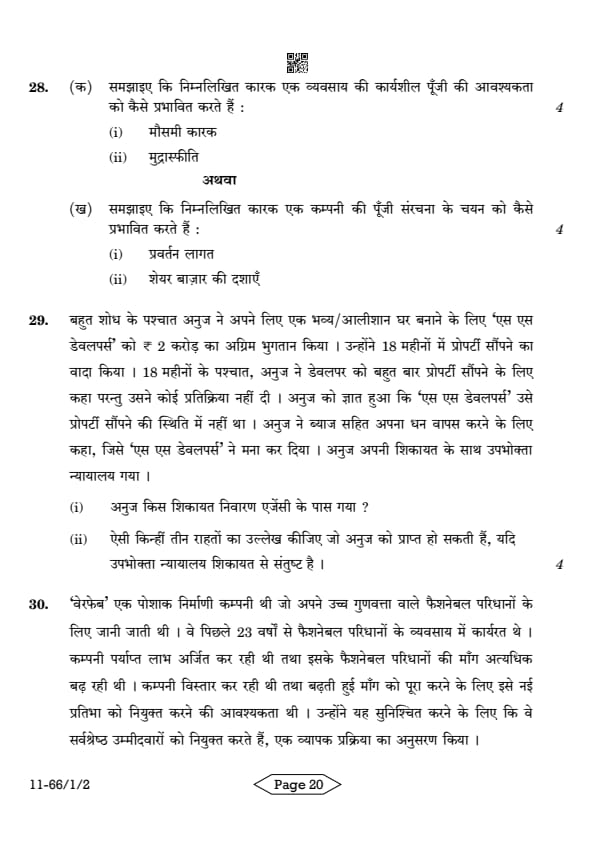
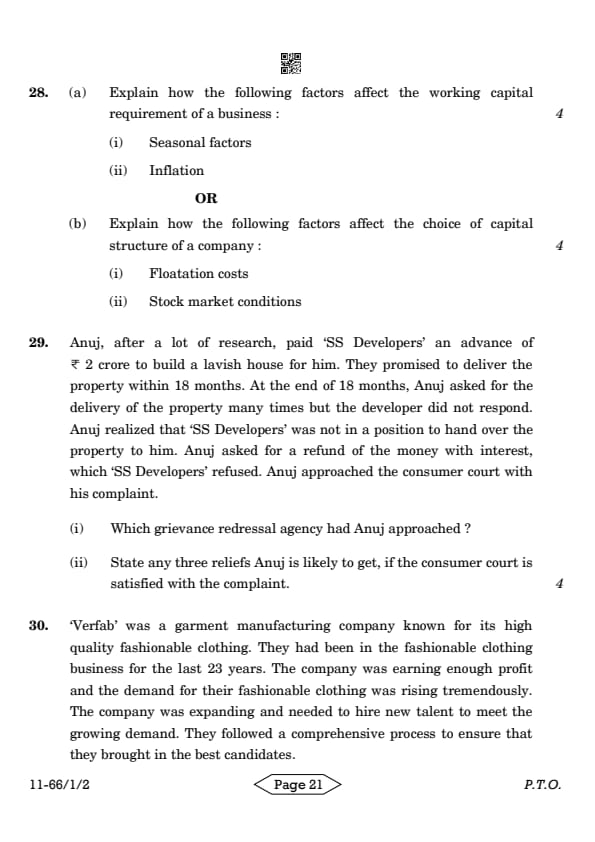
(a) Explain how the following factors affect the working capital requirement of a business:
(i) Seasonal factors
(ii) Inflation
OR
(b) Explain how the following factors affect the choice of capital structure of a company:
(i) Floatation costs
(ii) Stock market conditions
View Solution
(i) Seasonal Factors: Businesses that are seasonal in nature (e.g., ACs, woolen clothes) require higher working capital during peak seasons to maintain adequate stock and meet customer demands. During off-season, their working capital requirement reduces.
(ii) Inflation: Rising inflation increases the prices of raw materials, wages, and other expenses, leading to a higher working capital requirement to maintain the same level of operations.
Final Answer: (i) Seasonal factors – increase working capital in peak seasons
(ii) Inflation – increases overall working capital requirement Quick Tip: Always consider the nature of business and economic environment while estimating working capital to ensure smooth business operations.
Anuj, after a lot of research, paid ‘SS Developers’ an advance of ₹ 2 crore to build a lavish house for him. They promised to deliver the property within 18 months. At the end of 18 months, Anuj asked for the delivery of the property many times but the developer did not respond. Anuj realized that ‘SS Developers’ was not in a position to hand over the property to him. Anuj asked for a refund of the money with interest, which ‘SS Developers’ refused. Anuj approached the consumer court with his complaint.
% Part (i)
(i) Which grievance redressal agency had Anuj approached?
View Solution
Since the value of the claim is ₹2 crore, Anuj has approached the State Consumer Disputes Redressal Commission, which deals with complaints where the value is more than ₹50 lakh but less than ₹2 crore.
% Part (ii)
(ii) State any three reliefs Anuj is likely to get, if the consumer court is satisfied with the complaint.
Refund of the Amount Paid: The developer can be ordered to refund the ₹2 crore.
Interest on the Amount: Anuj can be granted interest on the amount paid due to delay.
Compensation for Mental Agony: The court may grant additional compensation for mental harassment and litigation cost.
Final Answer: (i) State Consumer Disputes Redressal Commission
\phantom{Final Answer: (ii) Refund, Interest, Compensation for Mental Agony Quick Tip: Consumers can seek justice through appropriate redressal forums depending on the value of goods or services involved in the dispute.
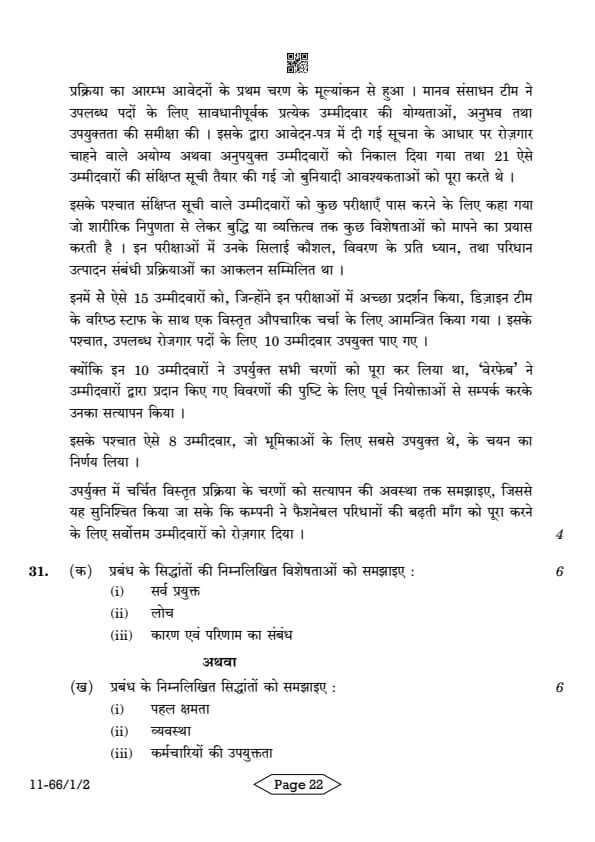
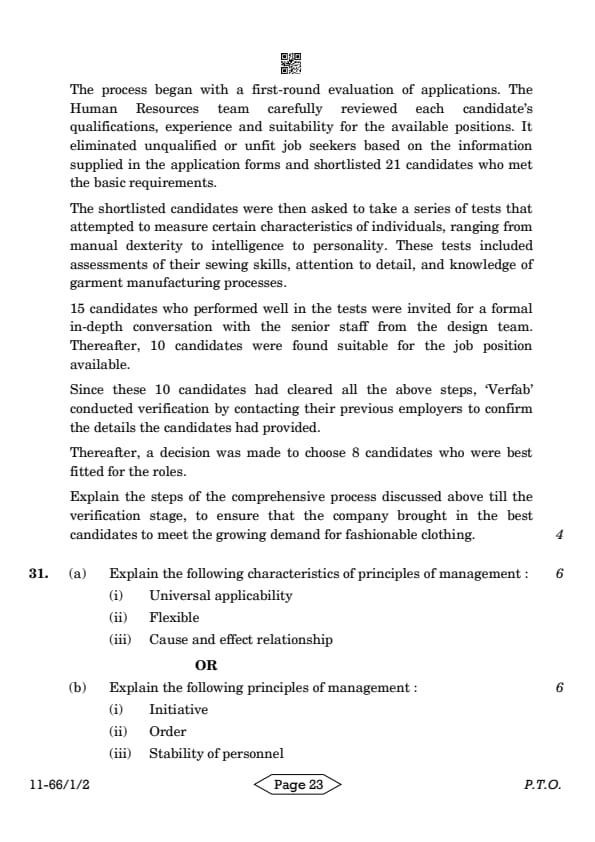
‘Verfab’ was a garment manufacturing company known for its high quality fashionable clothing. They had been in the fashionable clothing business for the last 23 years. The company was earning enough profit and the demand for their fashionable clothing was rising tremendously. The company was expanding and needed to hire new talent to meet the growing demand. They followed a comprehensive process to ensure that they brought in the best candidates.
Explain the steps of the comprehensive process discussed above till the verification stage, to ensure that the company brought in the best candidates to meet the growing demand for fashionable clothing.
View Solution
1. **Preliminary Screening** – Initial evaluation of applications was done to check qualifications, experience, and suitability. 21 candidates were shortlisted.
2. **Testing** – Shortlisted candidates took various tests to assess skills, intelligence, and personality.
3. **Interview** – 15 candidates were invited for formal interviews with senior staff.
4. **Selection** – Based on the tests and interviews, 10 candidates were found suitable.
5. **Verification** – Previous employment details of these 10 were verified by contacting past employers.
Final Answer: Steps till verification: Screening, Testing, Interview, Selection, Verification.
Quick Tip: Staffing ensures the right people are hired at the right time, enhancing organizational effectiveness.
(a) Explain the following characteristics of principles of management:
(i) Universal applicability
(ii) Flexible
(iii) Cause and effect relationship
(b) Explain the following principles of management:
(i) Initiative
(ii) Order
(iii) Stability of personnel
View Solution
\underline{(a) Characteristics of principles of management:
(i) Universal applicability – Principles of management are applicable to all types of organizations – business or non-business, small or large, and at all levels of management. They provide guidelines for managerial decision-making and actions.
(ii) Flexible – Management principles are not rigid; they can be modified by managers to suit the requirements of a particular situation.
(iii) Cause and effect relationship – Principles of management establish relationship between cause (input) and effect (output). For example, fair remuneration to employees (cause) leads to satisfied workforce (effect).
\underline{(b) Principles of management:
(i) Initiative – This principle encourages employees to take initiative within the prescribed limits of authority. It helps develop a sense of belongingness and increases employee motivation.
(ii) Order – This principle emphasizes that there should be a proper place for everything and everyone in the organization. Material and people should be at the right place at the right time.
(iii) Stability of personnel – High employee turnover is costly and disruptive. Stability of tenure builds loyalty, experience, and efficiency among workers, thus improving organizational performance.
Final Answer: Characteristics: Universal applicability, Flexibility, Cause-effect; Principles: Initiative, Order, Stability of personnel.
Quick Tip: Principles of management serve as guidelines and not strict rules; their flexible nature allows adaptation in dynamic scenarios.
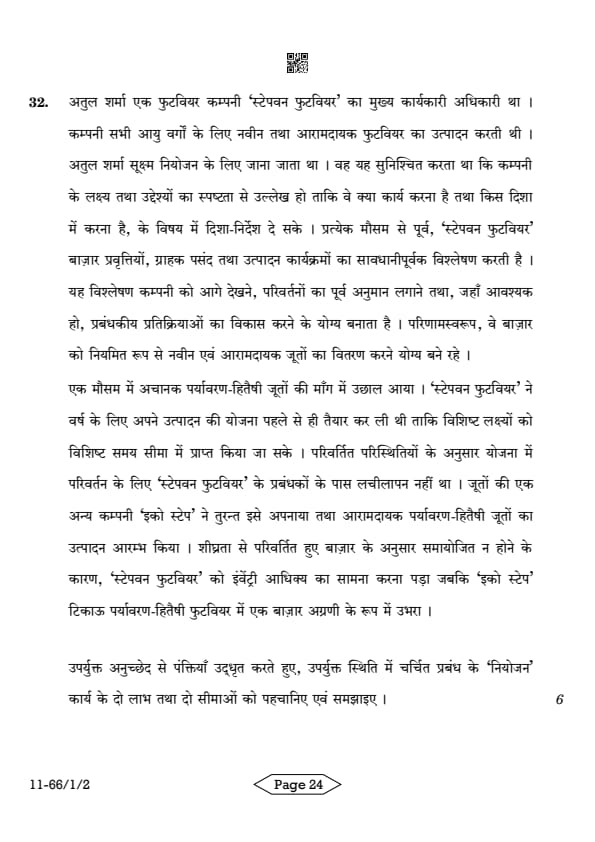
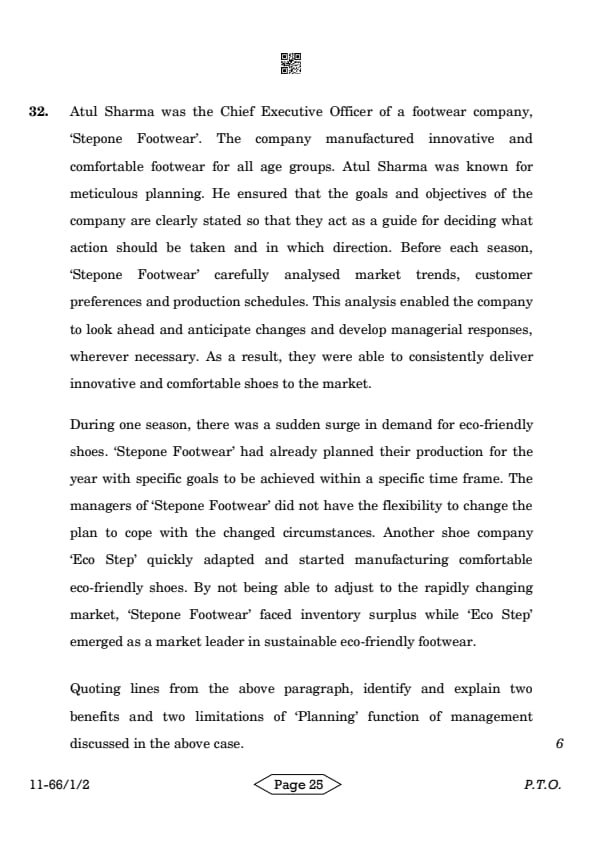
Atul Sharma was the Chief Executive Officer of a footwear company, ‘Stepone Footwear’. The company manufactured innovative and comfortable footwear for all age groups. Atul Sharma was known for meticulous planning. He ensured that the goals and objectives of the company are clearly stated so that they act as a guide for deciding what action should be taken and in which direction. Before each season, ‘Stepone Footwear’ carefully analysed market trends, customer preferences and production schedules. This analysis enabled the company to look ahead and anticipate changes and develop managerial responses,
wherever necessary. As a result, they were able to consistently deliver innovative and comfortable shoes to the market.
During one season, there was a sudden surge in demand for eco-friendly shoes. ‘Stepone Footwear’ had already planned their production for the year with specific goals to be achieved within a specific time frame. The managers of ‘Stepone Footwear’ did not have the flexibility to change the plan to cope with the changed circumstances. Another shoe company ‘Eco Step’ quickly adapted and started manufacturing comfortable eco-friendly shoes. By not being able to adjust to the rapidly changing market, ‘Stepone Footwear’ faced inventory surplus while ‘Eco Step’ emerged as a market leader in sustainable eco-friendly footwear.
Quoting lines from the given paragraph, identify and explain two benefits and two limitations of ‘Planning’ function of management discussed in the above case.\
View Solution
Benefits:\
Provides direction: "He ensured that the goals and objectives of the company are clearly stated so that they act as a guide for deciding what action should be taken and in which direction."\
Explanation: Clearly defined goals ensure that all departments work in the same direction.\
Reduces the risk of uncertainty: “This analysis enabled the company to look ahead and anticipate changes and develop managerial responses.”\
Explanation: Through planning, managers assess future uncertainties and devise ways to mitigate risks.\
Limitations:\
Reduces flexibility: “The managers of ‘Stepone Footwear’ did not have the flexibility to change the plan to cope with the changed circumstances.”\
Explanation: Once plans are set, it becomes difficult to change them, even if situations demand.\
May not work in dynamic environment: “By not being able to adjust to the rapidly changing market, ‘Stepone Footwear’ faced inventory surplus.”\
Explanation: In fast-changing market conditions, a rigid plan may become obsolete.\
Final Answer: Direction and risk reduction are benefits, while lack of flexibility and rigidity are limitations of planning.\ Quick Tip: Planning is a forward-looking function but must be complemented by adaptability in a changing environment.
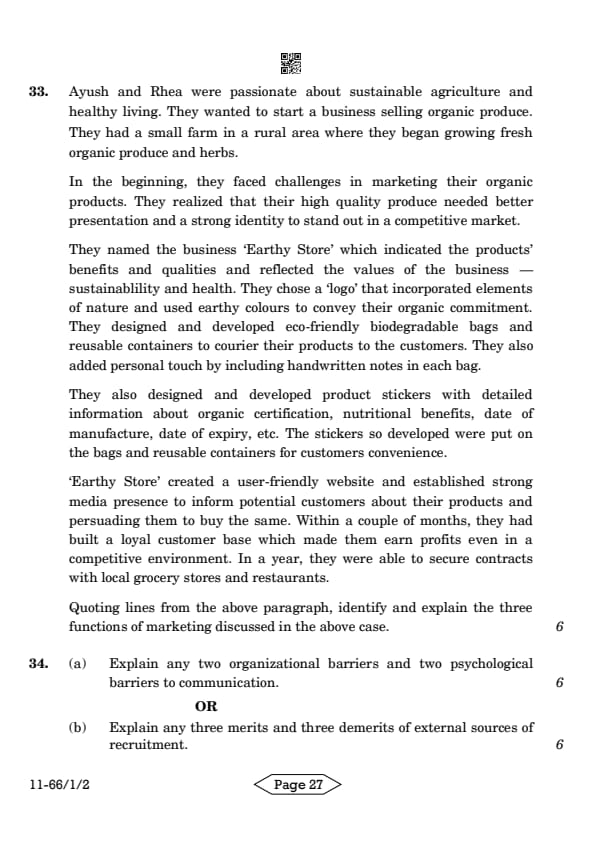
Ayush and Rhea were passionate about sustainable agriculture and
healthy living. They wanted to start a business selling organic produce.
They had a small farm in a rural area where they began growing fresh
organic produce and herbs.
In the beginning, they faced challenges in marketing their organic
products. They realized that their high quality produce needed better
presentation and a strong identity to stand out in a competitive market.
They named the business ‘Earthy Store’ which indicated the products’
benefits and qualities and reflected the values of the business —
sustainablility and health. They chose a ‘logo’ that incorporated elements
of nature and used earthy colours to convey their organic commitment.
They designed and developed eco-friendly biodegradable bags and
reusable containers to courier their products to the customers. They also
added personal touch by including handwritten notes in each bag.
They also designed and developed product stickers with detailed
information about organic certification, nutritional benefits, date of
manufacture, date of expiry, etc. The stickers so developed were put on
the bags and reusable containers for customers convenience.
‘Earthy Store’ created a user-friendly website and established strong
media presence to inform potential customers about their products and
persuading them to buy the same. Within a couple of months, they had
built a loyal customer base which made them earn profits even in a
competitive environment. In a year, they were able to secure contracts
with local grocery stores and restaurants.
Quoting lines from the above paragraph, identify and explain the three functions of marketing discussed in the above case.\
View Solution
Branding: “They named the business ‘Earthy Store’ which indicated the products’ benefits and qualities and reflected the values of the business.”\
Explanation: Branding involves giving a distinct name and identity to the product to create differentiation and recognition.\
Labelling: “They also designed and developed product stickers with detailed information about organic certification, nutritional benefits, date of manufacture, date of expiry, etc.”\
Explanation: Labelling provides vital information to consumers and helps them make informed choices.\
Promotion: “‘Earthy Store’ created a user-friendly website and established strong media presence to inform potential customers...”\
Explanation: Promotion involves creating awareness and persuading consumers to buy the product.\
Final Answer: Branding, labelling, and promotion are the key marketing functions highlighted in the case.\ Quick Tip: Effective marketing not only informs but also builds identity, trust, and consumer connection with the product.
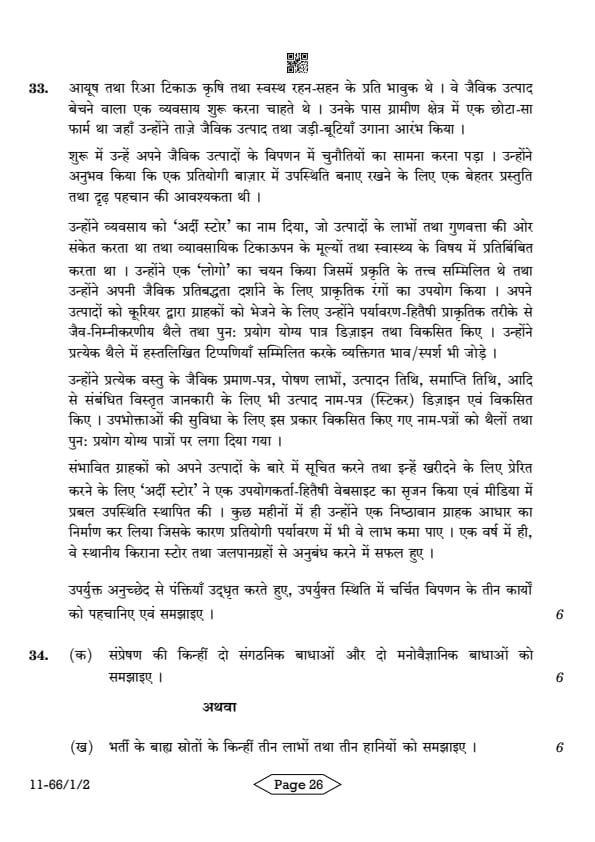
(a) Explain any two organizational barriers and two psychological barriers to communication.\
OR\
(b) Explain any three merits and three demerits of external sources of recruitment.\
View Solution
(a) Communication Barriers:\
Organizational Barriers:\
Organizational Policy: Restrictive communication policies can hinder free exchange of ideas.
Status: Subordinates may feel hesitant to communicate freely with superiors due to status differences.\
Psychological Barriers:\
Premature Evaluation: Listeners forming judgments before fully listening can distort communication.
Lack of Attention: Disinterest or distractions can prevent the message from being properly understood.\
(b) External Recruitment Merits and Demerits:\
Merits:\
Wider choice: A large pool of candidates increases the chances of finding the right talent.\
Fresh talent: New people bring new ideas and energy into the organization.\
Healthy competition: Existing employees are motivated to perform better.\
Demerits:\
Costly process: Advertising and selection procedures add to the expense.\
Time-consuming: Recruitment from outside takes more time.\
Adjustment issues: New recruits may take time to understand the organizational culture.\
Final Answer: Explained organizational and psychological barriers, and listed merits/demerits of external recruitment.\ Quick Tip: Communication and recruitment both play a vital role in enhancing organizational effectiveness and employee engagement.
*The article might have information for the previous academic years, please refer the official website of the exam.