
CBSE Class 12 Business Studies Set 1 Question Paper 2026 with Solution PDF


| Updated On - Mar 28, 2026
The CBSE Class 12 Business Studies exam 2026 was conducted on March 28, 2026, from 10:30 AM to 1:30 PM. The overall board exams run from February 17 to April 10, 2026. The paper consists of 80 marks for theory and 20 marks for internal assessment/project work.
The question paper contains 20% MCQ-based questions, 40% competency-based questions, and 40% short and long answer type questions.
CBSE Class 12 Business Studies Set-1 Question Paper and Detailed Solutions PDF is available for download here. Students can download the official paper in PDF format for reference.
CBSE Class 12 2026 Business Studies Question Paper Set 1- 66/5/1 with Solution PDF
| CBSE Class 12 Business Studies Set-1 Question Paper with Solution PDF 2026 | Download PDF | Check Solutions |
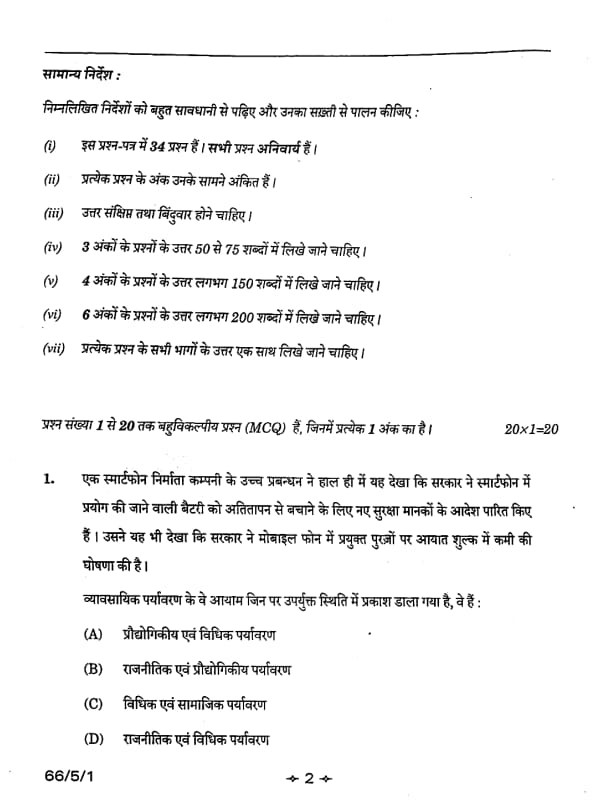
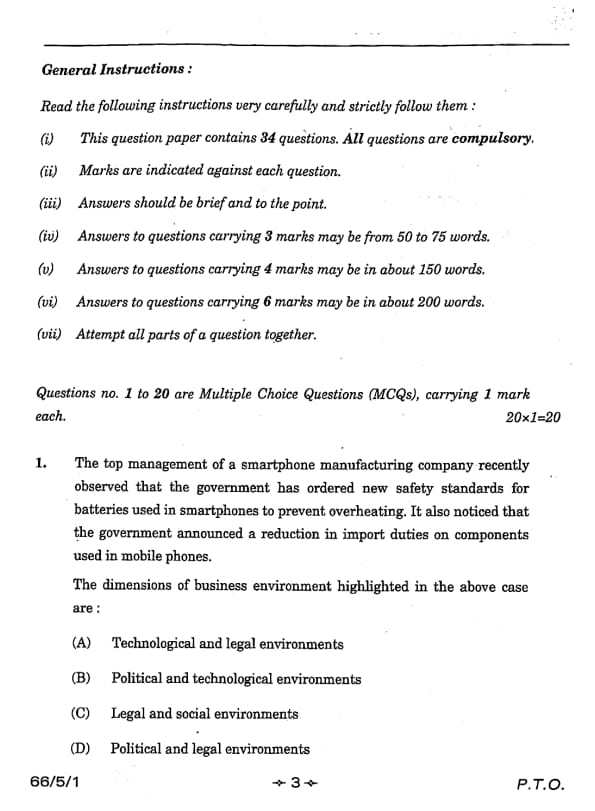
The top management of a smartphone manufacturing company recently observed that the government has ordered new safety standards for batteries used in smartphones to prevent overheating. It also noticed that the government announced a reduction in import duties on components used in mobile phones. The dimensions of business environment highlighted in the above case are :
View Solution
Step 1: Understanding the Concept:
The business environment consists of various dimensions: Economic, Social, Technological, Political, and Legal. Understanding which specific changes fall under which dimension is key to environmental scanning.
Step 2: Detailed Explanation:
1. The "new safety standards for batteries" refers to a shift in the Technological environment because it involves improvements and changes in the methods and techniques of production (specifically battery safety tech).
2. The "government ordered" standards and "announced a reduction in import duties" fall under the Legal environment (legislation/government orders) and the Political environment (government policy). However, since the prompt links safety standards directly to battery overheating (tech) and orders/duties (legal/policy), the most accurate pairing provided in the options is Technological and Legal.
Step 3: Final Answer:
The correct option is (A). Quick Tip: Government orders and legislation are "Legal," while changes in how a product is made or functions (like battery safety) are "Technological."
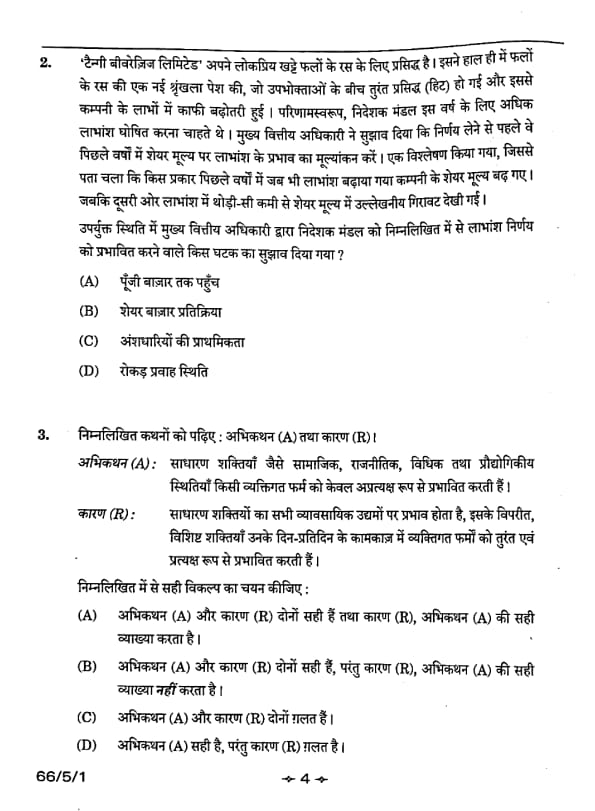
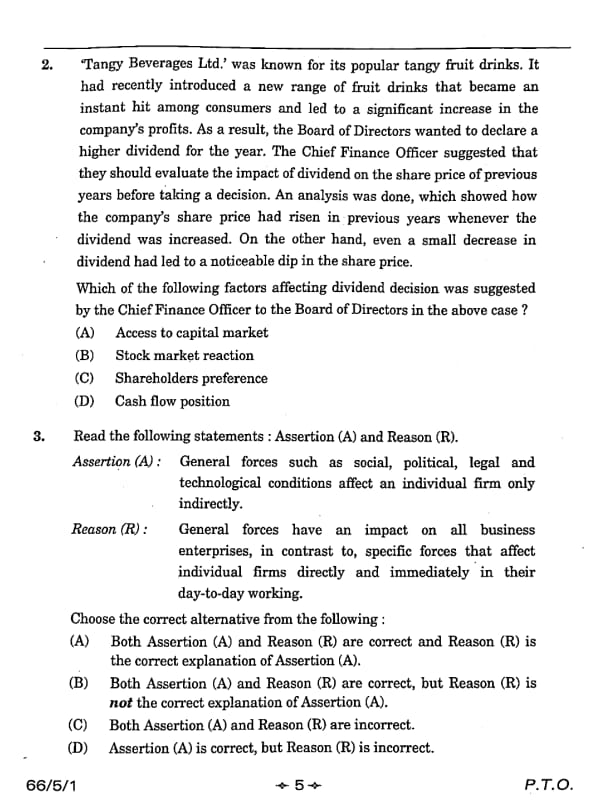
‘Tangy Beverages Ltd.’ was known for its popular tangy fruit drinks. It had recently introduced a new range of fruit drinks that became an instant hit among consumers and led to a significant increase in the company’s profits. As a result, the Board of Directors wanted to declare a higher dividend for the year. The Chief Finance Officer suggested that they should evaluate the impact of dividend on the share price of previous years before taking a decision. An analysis was done, which showed how the company’s share price had risen in previous years whenever the dividend was increased. On the other hand, even a small decrease in dividend had led to a noticeable dip in the share price. Which of the following factors affecting dividend decision was suggested by the Chief Finance Officer to the Board of Directors in the above case ?
View Solution
Step 1: Understanding the Concept:
Dividend decisions are influenced by several factors, including stability of earnings, cash flow, and how the external stock market perceives the change in dividend payouts.
Step 2: Detailed Explanation:
The Chief Finance Officer (CFO) explicitly pointed out the correlation between dividend changes and the "share price." Since investors view a change in dividend as "good news" or "bad news," the share price fluctuates accordingly. This specific impact on share prices is known as the "Stock Market Reaction."
Step 3: Final Answer:
The factor suggested is (B) Stock market reaction. Quick Tip: If the case study mentions "Share Prices," "BSE/NSE," or "Market Value of Shares," the factor being discussed is almost always Stock Market Reaction.
Read the following statements : Assertion (A) and Reason (R).
Assertion (A) : General forces such as social, political, legal and technological conditions affect an individual firm only indirectly.
Reason (R) : General forces have an impact on all business enterprises, in contrast to, specific forces that affect individual firms directly and immediately in their day-to-day working.
Choose the correct alternative from the following :
View Solution
Step 1: Understanding the Concept:
The business environment is composed of "Specific forces" (investors, customers, competitors) which affect a firm directly, and "General forces" (PESTEL) which affect the entire industry or all firms.
Step 2: Detailed Explanation:
Assertion (A) is correct because general forces set the overall climate but don't usually hit a single shop's daily operations without affecting others. Reason (R) provides the definition of why (A) is true: it contrasts general forces (impacting everyone) with specific forces (impacting one firm directly). Therefore, (R) explains (A).
Step 3: Final Answer:
The correct alternative is (A). Quick Tip: Use the word "because" between the Assertion and Reason. If the sentence makes logical sense as a whole, (A) is likely the correct choice.
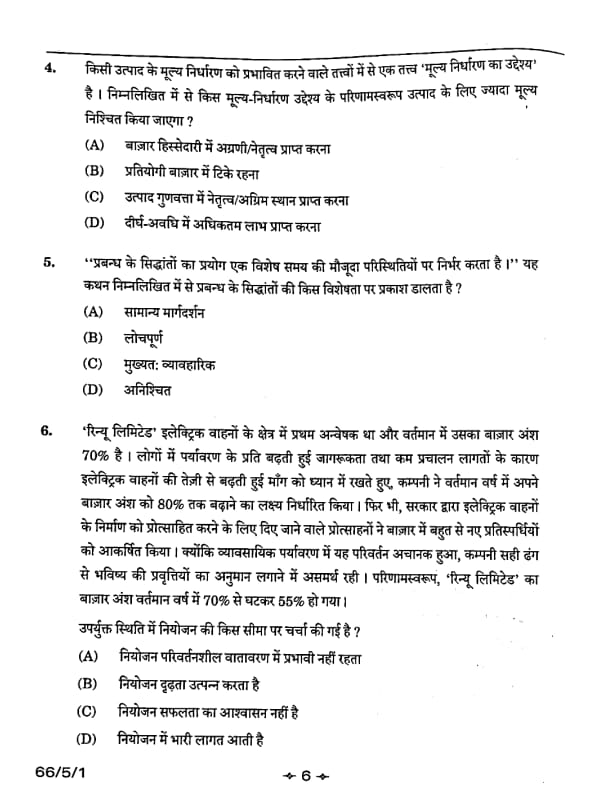
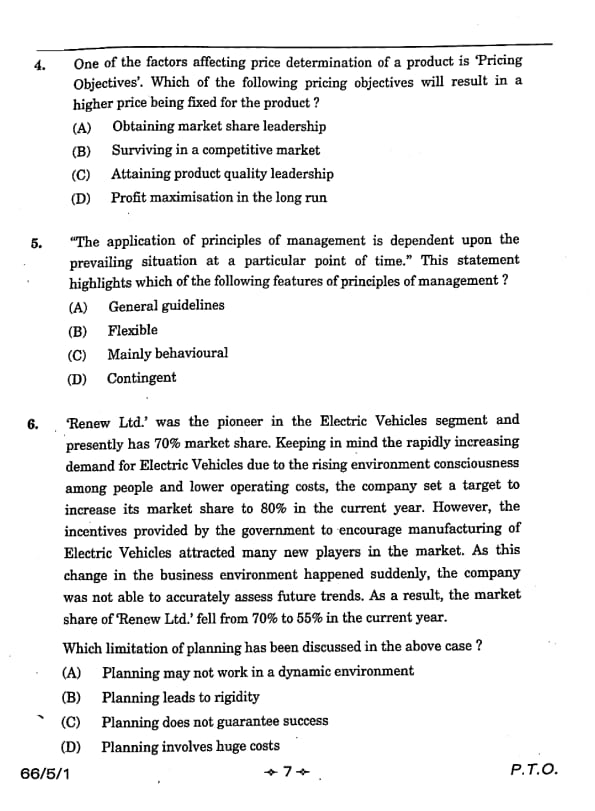
One of the factors affecting price determination of a product is ‘Pricing Objectives’. Which of the following pricing objectives will result in a higher price being fixed for the product ?
View Solution
Step 1: Understanding the Concept:
Pricing objectives dictate how a company sets its prices. Objectives like "survival" or "market share" usually require lower prices to attract volume, whereas "quality leadership" focuses on perceived value.
Step 2: Detailed Explanation:
To attain "Product Quality Leadership," a firm must invest heavily in R&D and high-quality materials. To cover these costs and signal to customers that the product is "premium" or the "best in class," the company must charge a higher price.
Step 3: Final Answer:
The objective resulting in higher prices is (C). Quick Tip: High Quality = High Cost = High Price. Think of brands like Apple or Rolex; their objective is quality leadership, which demands a premium price.
“The application of principles of management is dependent upon the prevailing situation at a particular point of time.” This statement highlights which of the following features of principles of management ?
View Solution
Step 1: Understanding the Concept:
Principles of management are not absolute like principles of pure science. Their application depends on the specific context or situation.
Step 2: Detailed Explanation:
The word "Contingent" means "depending on something else that might happen." Since the statement says application is "dependent upon the prevailing situation," it perfectly describes the contingent nature of management principles. It means they must be modified based on the situation at hand.
Step 3: Final Answer:
The feature highlighted is (D) Contingent. Quick Tip: Don't confuse "Flexible" with "Contingent." Flexible means they \textbf{can} be changed by the manager; Contingent means their use \textbf{depends} on the situation.
‘Renew Ltd.’ was the pioneer in the Electric Vehicles segment and presently has 70% market share. Keeping in mind the rapidly increasing demand for Electric Vehicles due to the rising environment consciousness among people and lower operating costs, the company set a target to increase its market share to 80% in the current year. However, the incentives provided by the government to encourage manufacturing of Electric Vehicles attracted many new players in the market. As this change in the business environment happened suddenly, the company was not able to accurately assess future trends. As a result, the market share of ‘Renew Ltd.’ fell from 70% to 55% in the current year. Which limitation of planning has been discussed in the above case ?
View Solution
Step 1: Understanding the Concept:
Business planning relies on forecasting future events. However, the external environment (economic, political, social) is "dynamic" and subject to rapid, unpredictable changes that can render existing plans obsolete.
Step 2: Detailed Explanation:
The case highlights that the business environment changed "suddenly" due to new competitors and government incentives. Because the company could not "accurately assess future trends" amidst this volatility, their plan to increase market share failed. This illustrates that planning has limitations when faced with a highly unstable or dynamic market.
Step 3: Final Answer:
The limitation discussed is (a) Planning may not work in a dynamic environment. Quick Tip: Planning is a "future-oriented" process. If the future becomes unpredictable due to external shifts, the plan loses its effectiveness.
Which of the following statements is incorrect with reference to Maslow’s Need Hierarchy Theory of motivation ?
View Solution
Step 1: Understanding the Concept:
Maslow's Theory is based on the premise that human motivation is driven by the desire to satisfy specific needs arranged in a pyramid of importance.
Step 2: Detailed Explanation:
A core assumption of Maslow’s theory is that a satisfied need no longer motivates a person. It is the unsatisfied or "felt" need that drives behavior. Therefore, statement (c) is factually incorrect within the context of the theory.
Step 3: Final Answer:
The incorrect statement is (c). Quick Tip: Once a need is met (like hunger), it stops being a motivator, and the individual moves their focus to the next level of needs (like safety).
Which of the following is not a factor affecting capital structure of a company ?
View Solution
Step 1: Understanding the Concept:
Capital structure refers to the specific mix of debt and equity used to finance a company's assets. Factors affecting this decision usually relate to cost, risk, and market flexibility.
Step 2: Detailed Explanation:
While a company considers different sources of finance, "Financing alternatives" is a broad term for the choices themselves rather than a specific factor or constraint that dictates the ratio of debt to equity. Factors like Cash Flow (ability to pay debt) and ROI (profitability relative to interest) are specific variables that force a decision one way or the other.
Step 3: Final Answer:
The correct option is (c). Quick Tip: Capital structure factors are usually "pressures" like tax rates, interest coverage, or control considerations.
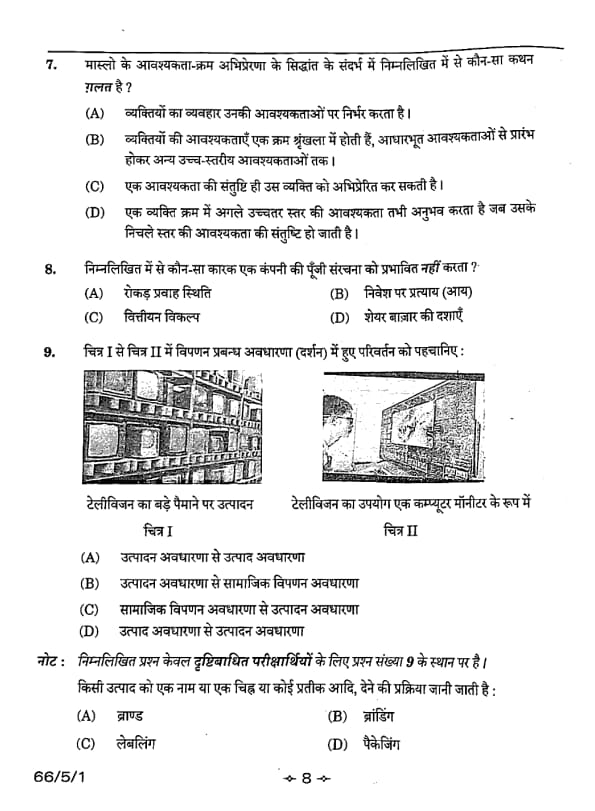
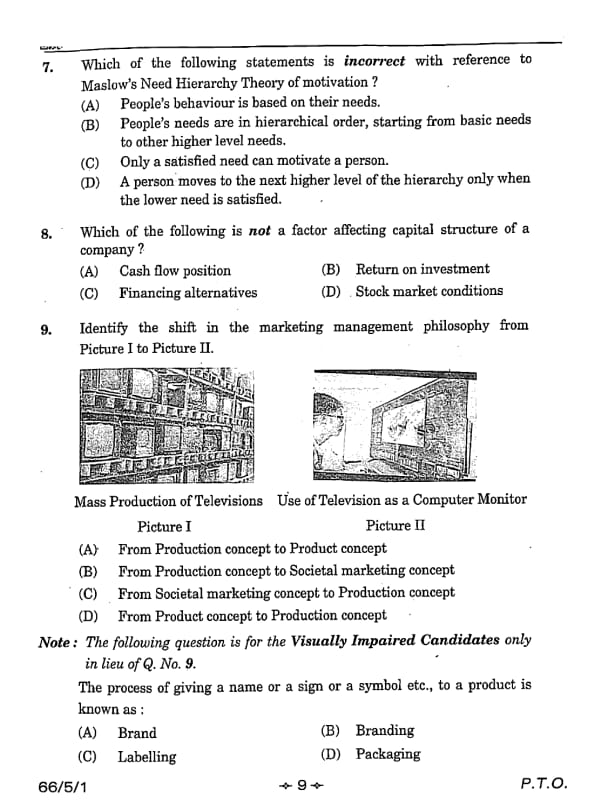
Identify the shift in the marketing management philosophy from Picture I to Picture II.

View Solution
Step 1: Understanding the Concept:
Marketing philosophies represent the focus of a business, ranging from internal efficiency (Production) to product quality (Product) to consumer satisfaction (Marketing).
Step 2: Detailed Explanation:
1. Mass production indicates the Production Concept, where the focus is on large-scale output to reduce costs and increase availability.
2. Adapting a television for a specific high-quality use (like a computer monitor) indicates the Product Concept, which emphasizes product excellence, features, and performance.
Step 3: Final Answer:
The shift is (a) From Production concept to Product concept. Quick Tip: Production = Quantity/Availability.
Product = Quality/Features.
The process of giving a name or a sign or a symbol etc., to a product is known as :
View Solution
Step 1: Understanding the Concept:
In marketing, a product needs a unique identity to distinguish it from competitors. This identity consists of names, terms, signs, symbols, or designs.
Step 2: Detailed Explanation:
The \textit{act or \textit{process of creating this identity is called Branding. While a "Brand" is the name or symbol itself, "Branding" refers to the management process of developing that name and symbol to ensure the product stands out in the market.
Step 3: Final Answer:
The correct option is (b) Branding. Quick Tip: Think of it this way: The "Brand" is the destination (the name), but "Branding" is the journey (the process of naming and designing).
‘Deccan Motors Ltd.’ is shifting from a functional organisational structure to a divisional structure. Identify the benefit the company will get as a result of shifting to divisional structure :
View Solution
Step 1: Understanding the Concept:
A divisional structure groups activities based on products. Each division is semi-autonomous and contains all the functions (production, sales, etc.) needed to manage that product line.
Step 2: Detailed Explanation:
In a divisional structure, division heads have the authority to make decisions independently for their specific product line (e.g., Commercial vs. Passenger vehicles). This autonomy fosters faster decision-making (flexibility) and encourages managers to take initiative to improve their specific division's performance. Options (b), (c), and (d) describe advantages of a \textit{functional structure.
Step 3: Final Answer:
The benefit is (a) promoting flexibility and initiative. Quick Tip: Divisional structures are best for multi-product companies where each product line requires specialized attention and independent management.
Obligation of a subordinate to properly perform the assigned duty is known as ________.
View Solution
Step 1: Understanding the Concept:
Delegation of authority involves three key elements: Authority (the right to command), Responsibility (the obligation to perform), and Accountability (the answerability for the final outcome).
Step 2: Detailed Explanation:
Responsibility is defined as the obligation of a subordinate to properly perform the assigned task. It arises from the superior-subordinate relationship because the subordinate is bound to perform the duty assigned to them by their senior. While authority is delegated, responsibility is assumed.
Step 3: Final Answer:
The correct term is (c) Responsibility. Quick Tip: Remember the flow: Authority flows downwards, while Responsibility and Accountability flow upwards.
A software company wants to expand its business. For this, it requires a large number of fresh graduates with innovative ideas in the field of Artificial Intelligence and Data Analytics. The existing staff members do not possess these specialized skills, so a notice was put up at the reception of the office asking the present employees to introduce any friend or relative who could possibly be possessing the required skills for the jobs. The source of recruitment that has been used by the software company is :
View Solution
Step 1: Understanding the Concept:
Recruitment can be internal or external. External sources involve looking outside the organization to fill vacancies, which brings in fresh talent and new ideas.
Step 2: Detailed Explanation:
The company asked existing employees to "introduce any friend or relative." This is a specific external source of recruitment known as "Recommendation of Employees." It is often reliable because the existing employees act as a preliminary screen for the candidates' suitability and character.
Step 3: Final Answer:
The source used is (b) Recommendation of employees. Quick Tip: "Direct Recruitment" involves a notice on the factory gate/office board for unskilled/semi-skilled labor, whereas "Recommendation" involves personal references from current staff.
Read the following statements carefully :
Statement I : The entry to a profession is not restricted either through an examination or through acquiring an educational degree.
Statement II : There is no restriction on anyone being designated or appointed as a manager in any business enterprise irrespective of the educational qualifications possessed.
In the light of the given statements, choose the correct alternative from the following :
View Solution
Step 1: Understanding the Concept:
This question tests whether management fulfills the criteria of a "Profession." One criteria of a profession is "Restricted Entry."
Step 2: Detailed Explanation:
1. Statement I is false. In true professions (like Law or Medicine), entry is restricted through examinations and degrees.
2. Statement II is true. Currently, in management, there is no legal restriction. Anyone can be called a manager regardless of their degree, although MBAs are preferred. This is why management is considered an "emerging profession" rather than a full-fledged one.
Step 3: Final Answer:
The correct alternative is (b). Quick Tip: To be a Doctor, you MUST have an MBBS (Restricted). To be a Manager, you DON'T legally need a specific degree (Unrestricted).
A leading newspaper company noticed that many of its talented editors were resigning despite being paid competitive salaries. On conducting an internal survey, it was revealed that employees were dissatisfied as they were not being offered benefits over and above the salary, like the employees of other competitive firms. Realising that such additional benefits play an important role in motivating employees, the management decided to provide car allowance, housing facilities, medical benefits, etc. to retain employees in the organisation and improve their satisfaction. Identify the incentive that the newspaper company decided to provide to their employees :
View Solution
Step 1: Understanding the Concept:
Financial incentives are rewards that can be measured in terms of money. These include salary, bonus, and various fringe benefits.
Step 2: Detailed Explanation:
The benefits mentioned—car allowance, housing facilities, and medical benefits—are offered over and above the basic salary. In management terminology, these non-cash (or cash-reimbursed) benefits provided to employees are called "Perquisites" (or Perks).
Step 3: Final Answer:
The specific incentive is (c) Perquisites. Quick Tip: "Bonus" is a one-time extra payment (like for festivals), whereas "Perquisites" are ongoing facilities like cars or houses.
Match the type of plan given in Column-I with its meaning in Column-II :
Column-I - Column-II
a. Policy - (iv) A general statement that guides thinking.
b. Programme - (ii) Detailed statement about a project.
c. Method - (i) Prescribed way in which a task is performed.
d. Strategy - (iii) Comprehensive plan taking environment into consideration.
Choose the correct alternative :
View Solution
Step 1: Understanding the Concept:
Plans are categorized into several types based on what they aim to achieve: Objectives, Strategies, Policies, Procedures, Methods, Rules, Programmes, and Budgets.
Step 2: Detailed Explanation:
1. Policy: A general guide to thinking (e.g., "We do not hire relatives").
2. Programme: A mix of goals, policies, and procedures for a specific project.
3. Method: The specific "how-to" for a single step of a task.
4. Strategy: A broad plan that accounts for what competitors are doing (business environment).
Step 3: Final Answer:
Matching these results in (b). Quick Tip: Key words: Policy = "Guide to thinking"; Method = "Way/Manner"; Strategy = "Business environment"; Programme = "Outline of project".
The purpose of opening a Demat Account with a Depository Participant (DP) is :
View Solution
Step 1: Understanding the Concept:
Dematerialization (Demat) is the process where physical share certificates are converted into electronic form. A Demat account is mandatory for trading in the Indian stock market.
Step 2: Detailed Explanation:
Just as a bank account holds cash in electronic form, a Demat account holds securities (shares, bonds, debentures) in electronic form. The primary purpose is to eliminate the risks of physical certificates (theft, forgery, or damage) and to facilitate the easy "holding and transferring" of these securities during trading.
Step 3: Final Answer:
The correct option is (a). Quick Tip: Remember: A "Demat" account is for shares, while a "Trading" account is used to actually place the buy/sell orders with the broker.
The step of the staffing process in which an employee’s current and/or past performance is evaluated against certain pre-determined standards is :
View Solution
Step 1: Understanding the Concept:
Staffing is a continuous process that includes estimating manpower requirements, recruitment, selection, placement, training, and evaluating performance.
Step 2: Detailed Explanation:
Evaluating an employee's performance against "pre-determined standards" is the definition of Performance Appraisal. It helps the management decide on salary increments, promotions, or the need for further training.
Step 3: Final Answer:
The correct step is (b) Performance appraisal. Quick Tip: "Placement" is about putting the right person on the right job, while "Appraisal" is checking how well they are doing that job.
Which of the following will require higher working capital ?
View Solution
Step 1: Understanding the Concept:
Working Capital is the funds required for day-to-day operations. Factors affecting it include the nature of business, scale of operations, and market conditions.
Step 2: Detailed Explanation:
1. Trading: Usually needs less working capital than manufacturing.
2. Short cycles: Needs less capital because stock is converted to cash quickly.
3. Strict credit: Needs less capital because cash is collected quickly.
4. High competition: Requires more working capital because the firm may need to maintain higher stock levels to meet immediate demand or offer liberal credit terms to attract customers.
Step 3: Final Answer:
The correct option is (c). Quick Tip: If competition is high, you need to "buffer" your business with more inventory and more credit to stay ahead, both of which use up more cash.
Read the following statements carefully :
Statement I : In democratic leadership style, the followers are given a high degree of independence to formulate their own objectives and ways to achieve them.
Statement II : In autocratic leadership style, communication is only one-way, with the subordinates only acting according to the command given by their managers.
In the light of the given statements, choose the correct alternative :
View Solution
Step 1: Understanding the Concept:
Leadership styles differ based on how power is shared: Autocratic (Dictatorial), Democratic (Participative), and Laissez-faire (Free-rein).
Step 2: Detailed Explanation:
1. Statement I describes the \textit{Laissez-faire (Free-rein) style, not Democratic. In a Democratic style, the leader consults followers, but they aren't totally independent.
2. Statement II is a perfect description of the \textit{Autocratic style, where the leader gives orders and expects strict obedience without consultation.
Step 3: Final Answer:
The correct alternative is (b). Quick Tip: Democratic = Consultation.
Laissez-faire = Complete Independence.
Autocratic = Commands.
Read the following statements : Assertion (A) and Reason (R).
Assertion (A) : The investing public gets a safe and fair deal on the stock market.
Reason (R) : The membership of stock exchange is well regulated and its dealings are well defined according to the existing legal framework.
Choose the correct alternative :
View Solution
Step 1: Understanding the Concept:
One of the primary functions of a Stock Exchange is "Safety of Transactions." This ensures that investors are not cheated.
Step 2: Detailed Explanation:
The Assertion (A) is true because stock exchanges provide a regulated platform for trading. The Reason (R) explains \textit{why it is safe: because the legal framework and exchange rules strictly regulate members and their dealings. Since (R) provides the underlying cause for (A), it is the correct explanation.
Step 3: Final Answer:
The correct alternative is (a). Quick Tip: The Stock Exchange operates under the watchful eye of SEBI, which ensures that the rules (Reason) lead to investor safety (Assertion).
‘Premier Ltd.’ is a clothing company known for its high quality apparel and strong commitment to environment sustainability. The company designs its clothing after carefully understanding the needs of its present and prospective buyers and satisfying them in an effective manner. It assumes that profit can be maximised only when all decisions are taken from the point of view of customer satisfaction. Along with meeting customer needs, ‘Premier Ltd.’ also shows a deep concern for the long-term well-being of the society. To reduce environmental pollution, the company is using organic cotton and recycled polyester. For reducing waste, they run a programme where customers can return old clothes for recycling and get a discount on new clothes. Not only this, they keep aside a portion of its profits for environmental education programmes in local schools. Identify and explain two marketing management philosophies followed by ‘Premier Ltd.’.
View Solution
Step 1: Understanding the Concept:
Marketing philosophies guide the strategy of a firm. The Marketing concept focuses on identifying and satisfying customer needs, while the Societal Marketing concept adds the dimension of ethical and social responsibility.
Step 2: Detailed Explanation:
1. Marketing Concept: This is highlighted by the line, "designs its clothing after carefully understanding the needs of its present and prospective buyers and satisfying them." The focus is on customer satisfaction as the path to profit.
2. Societal Marketing Concept: This is highlighted by the company's "deep concern for the long-term well-being of the society" and their use of organic cotton/recycled polyester. It balances company profits, consumer wants, and society's interests.
Step 3: Final Answer:
The two philosophies are the Marketing Concept and the Societal Marketing Concept. Quick Tip: If a company focuses only on the customer, it is the "Marketing Concept." If they also mention the environment, pollution, or social welfare, it becomes the "Societal Marketing Concept."
State any three points of importance of Financial Planning.
View Solution
Step 1: Understanding the Concept:
Financial planning is the process of estimating the fund requirements of a business and specifying the sources of funds to ensure that enough funds are available at the right time.
Step 2: Detailed Explanation:
1. Helps in facing the future: It helps in forecasting what may happen in the future under different business situations. By preparing a blueprint of the future, a company can prepare for various eventualities.
2. Avoids business shocks and surprises: By anticipating future requirements and shortages of funds, it helps the company to avoid sudden financial crises.
3. Coordination: It helps in coordinating various functions like sales, production, and purchase by providing a clear financial roadmap for each department.
Step 3: Final Answer:
The importance of financial planning lies in future preparation, risk mitigation, and functional coordination. Quick Tip: Financial planning is like a "Financial Blueprint" for the company. Without it, the firm might run out of cash during expansion even if it is profitable.
State any three factors that determine the requirement of fixed capital of a company.
View Solution
Step 1: Understanding the Concept:
Fixed capital refers to the investment in long-term assets or fixed assets. The requirement of fixed capital varies significantly from one business to another.
Step 2: Detailed Explanation:
1. Nature of Business: A manufacturing concern requires more fixed capital (for plant and machinery) compared to a trading concern which needs less investment in fixed assets.
2. Scale of Operations: A large-scale organization requires higher investment in fixed assets like land, building, and machinery as compared to a small-scale organization.
3. Technology Upgradation: Industries where technology becomes obsolete quickly (like computers or smartphones) require higher fixed capital to replace old machinery with new technology.
Step 3: Final Answer:
The fixed capital requirement is determined by the nature of the industry, the size of the company, and the pace of technological change. Quick Tip: Fixed Capital = "Long-term Assets." Think of things that stay in the business for more than one year, like buildings or heavy machinery.
‘DF Telecom Ltd.’, which produces a range of mobile phones for the Indian market, set a target to produce 30,000 units of mobile phones in the month of December 2025. This was the benchmark against which actual performance would be measured. At the end of the month, it was found that only 27,000 units were produced.
Concerned with the shortfall, the General Manager asked the Production Manager to find out and resolve the problem.
State the steps related to the process of one of the functions of management which the Production Manager has to take to find out and resolve the problem.
View Solution
Step 1: Understanding the Concept:
The situation describes a shortfall in production (30,000 vs 27,000), which falls under the Controlling function of management.
Step 2: Detailed Explanation:
The manager has already performed "Measuring actual performance" and "Comparing performance with standards." The next steps are:
1. Analyzing Deviations: Determining why the shortfall occurred. This involves identifying if the deviation is within acceptable limits (Critical Point Control/Management by Exception).
2. Taking Corrective Action: If the deviations are significant, the manager must fix the problem (e.g., repairing machinery, additional training) to ensure future targets are met.
Step 3: Final Answer:
The steps are Analyzing Deviations and Taking Corrective Action. Quick Tip: Controlling is the only function that looks back at past performance to correct future actions.
Differentiate between ‘Capital Market’ and ‘Money Market’ on the basis of the following:
(i) Investment outlay
(ii) Liquidity
(iii) Safety.
View Solution
Step 1: Understanding the Concept:
The financial market is categorized based on the tenure of the instruments traded. Money market deals in short-term funds, while Capital market deals in long-term funds.
Step 2: Detailed Explanation:
\begin{tabular{|l|p{5cm|p{5cm|
\hline
Basis & Money Market & Capital Market
\hline
Investment Outlay & Entails huge financial outlay as instruments are expensive (e.g., T-bills have a minimum of 25,000). & Investment is lower as the unit value of securities is small (e.g., shares of 10 or 100).
\hline
Liquidity & High degree of liquidity as there is a formal arrangement for discount/active secondary market. & Comparatively less liquid, though shares are traded, they may not always find a buyer immediately.
\hline
Safety & Generally much safer with minimum risk of default due to short duration and sound financial standing of issuers. & Riskier both with respect to returns and principal repayment due to market fluctuations.
\hline
\end{tabular
Step 3: Final Answer:
Money market is characterized by high outlay and high safety, while Capital market offers lower entry costs but higher risk and variable liquidity. Quick Tip: Think of the "Money Market" as a place for "Short-term Cash Management" and the "Capital Market" as a place for "Long-term Wealth Creation."
State any three development functions of Securities and Exchange Board of India (SEBI).
View Solution
Step 1: Understanding the Concept:
SEBI performs three types of functions: Protective, Regulatory, and Development. Development functions aim at increasing the efficiency and reach of the securities market.
Step 2: Detailed Explanation:
1. Training of Intermediaries: SEBI promotes the training of various intermediaries of the securities market (like brokers and sub-brokers) to ensure professional service.
2. Conducting Research: It conducts research and publishes information useful to all market participants to help them make informed decisions.
3. Promoting Fair Practices: SEBI takes measures to develop the capital market by adapting a flexible approach, such as permitting internet trading through registered stockbrokers.
Step 3: Final Answer:
The development functions focus on training, research, and modernizing the market infrastructure. Quick Tip: Development functions are about "Growth" and "Education." They help the market evolve and become more modern.
Explain the following points of importance of business environment:
(i) Helps in tapping useful resources
(ii) Helps in coping with rapid changes.
View Solution
Step 1: Understanding the Concept:
Business environment scanning is crucial for managers to align their organizational goals with the external world.
Step 2: Detailed Explanation:
1. Tapping Useful Resources: Business depends on the environment for inputs like finance, machines, raw materials, power, and water. A firm scans the environment to ensure it can convert these resources into outputs that the environment desires.
2. Coping with Rapid Changes: Today’s business environment is highly dynamic. Turbulent market conditions and rapid technological shifts require managers to scan the environment constantly to develop suitable courses of action to deal with these changes.
Step 3: Final Answer:
Scanning the environment ensures a steady supply of inputs and helps the firm adapt to volatile market conditions. Quick Tip: The environment is like a "Supply Store" (Resources) and a "Weather Report" (Changes) for a business.
Explain the following techniques of Scientific Management:
(i) Method study
(ii) Standardisation and simplification of work.
View Solution
Step 1: Understanding the Concept:
F.W. Taylor developed scientific management to improve industrial efficiency through standardized techniques and scientific observation.
Step 2: Detailed Explanation:
1. Method Study: The objective is to find the "One Best Way" of performing a job. This involves analyzing every step of the process—from the movement of raw materials to the final delivery—to minimize costs and maximize efficiency.
2. Standardisation and Simplification:
- Standardisation refers to the process of setting benchmarks for every phase of business operations (e.g., standardizing the quality of materials or time for a task).
- Simplification aims at eliminating unnecessary diversity, sizes, or varieties of products. This reduces costs of inventory, labor, and machinery.
Step 3: Final Answer:
Method study optimizes the process, while standardisation and simplification focus on uniformity and cost-effective variety reduction. Quick Tip: Method Study = Process Optimization.
Simplification = Eliminating excess variety to save costs.
State any four features of coordination.
View Solution
Step 1: Understanding the Concept:
Coordination is the process by which a manager synchronizes the activities of different departments to ensure that organizational goals are achieved efficiently. It is often called the "essence of management."
Step 2: Detailed Explanation:
1. Integrates Group Efforts: Coordination unifies unrelated or diverse interests into purposeful work activity, ensuring that the performance is according to plan.
2. Ensures Unity of Action: It acts as the binding force between departments and ensures that all efforts are focused on achieving organizational goals.
3. Continuous Process: Coordination is not a one-time function but a continuous process that begins at the planning stage and continues until controlling.
4. All-pervasive Function: It is required at all levels of management and in all departments due to the interdependence of activities.
Step 3: Final Answer:
The four features are integration of efforts, unity of action, continuity, and pervasiveness. Quick Tip: Coordination is not a separate "function" of management (like Planning or Staffing), but a thread that runs through all of them.
State any four points of importance of management.
View Solution
Step 1: Understanding the Concept:
Management is the process of getting things done with the aim of achieving goals effectively and efficiently. Its importance lies in how it transforms resources into results.
Step 2: Detailed Explanation:
1. Achieving Group Goals: Management gives a common direction to individual efforts to achieve the overall goals of the organization.
2. Increases Efficiency: By reducing costs and increasing productivity through better planning and organizing, management improves the efficiency of the firm.
3. Creates a Dynamic Organization: Management helps the organization adapt to changes in the external environment (like new technology or government policies).
4. Achieving Personal Objectives: A manager motivates and leads the team in such a manner that individual members are able to achieve personal goals while contributing to the organizational objective.
Step 3: Final Answer:
Management is vital for goal achievement, efficiency, adaptability, and personal growth. Quick Tip: Without management, resources remain resources and never become production.
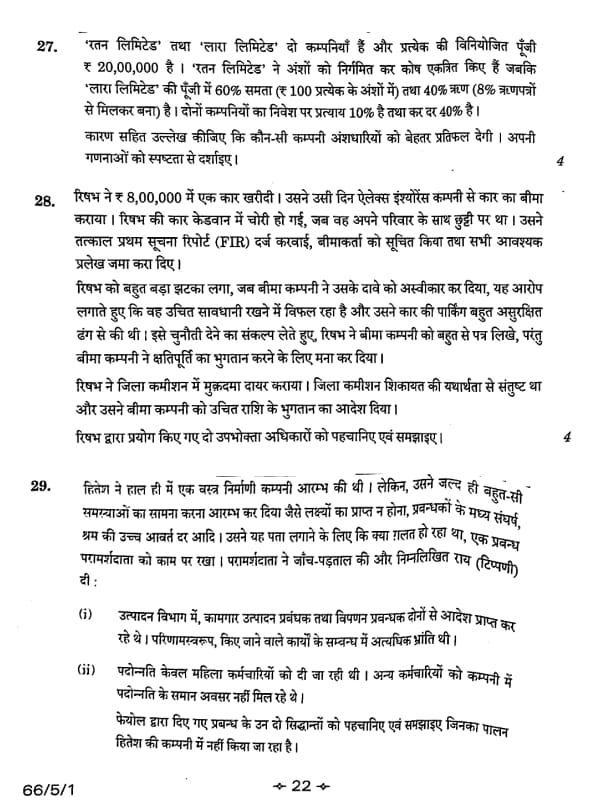
‘Ratan Ltd.’ and ‘Lara Ltd.’ are two companies with each having a capital employed of Rs. 20,00,000. ‘Ratan Ltd.’ had raised funds by issuing shares whereas ‘Lara Ltd.’s capital has 60% equity and 40% debt (8% debentures). Both have ROI of 10% and tax rate is 40%. State with reason which company will give a better return to shareholders.
View Solution
Step 1: Understanding the Concept:
We need to calculate the Earnings Per Share (EPS). If ROI > Interest Rate, the company benefits from "Trading on Equity" by using debt.
Step 2: Detailed Explanation:
Total Capital = Rs. 20,00,000. EBIT (10% of 20L) = Rs. 2,00,000 for both.
Calculations for Ratan Ltd. (100% Equity):
1. EBIT: Rs. 2,00,000
2. Interest: Rs. 0
3. EBT (1 - 2): Rs. 2,00,000
4. Tax (40%): Rs. 80,000
5. EAT (3 - 4): Rs. 1,20,000
6. No. of Shares (20L / 100): 20,000
7. EPS (5 / 6): Rs. 6.00
Calculations for Lara Ltd. (60% Equity, 40% Debt):
1. EBIT: Rs. 2,00,000
2. Interest (8% of Rs. 8,00,000 debt): Rs. 64,000
3. EBT (1 - 2): Rs. 1,36,000
4. Tax (40%): Rs. 54,400
5. EAT (3 - 4): Rs. 81,600
6. No. of Shares (12L equity / 100): 12,000
7. EPS (5 / 6): Rs. 6.80
Step 3: Final Answer:
Lara Ltd. will give a better return because its ROI (10%) is greater than the cost of debt (8%). This is called "Trading on Equity." Quick Tip: Debt is a "Double-Edged Sword." It increases returns when ROI is high but can lead to bankruptcy if ROI falls below the interest rate.
Rishabh purchased a car for ₹ 8,00,000. He insured the car on the same day from Alex Insurance Company. Rishabh’s car was stolen in Kedwan while he was on vacation with his family. He promptly filed a First Information Report (FIR), informed the insurer and submitted all the required documents.
To Rishabh’s shock, the insurance company rejected his claim, alleging he had failed to take due care and had parked the car in an unsafe manner. Determined to challenge this, Rishabh wrote multiple letters to the insurance company, but the insurance company refused to pay the compensation.
Rishabh filed a case with District Commission. The District Commission was satisfied with the genuineness of the complaint and ordered the insurance company to pay a reasonable amount.
Identify and explain two consumer rights which have been exercised by Rishabh.
View Solution
Step 1: Understanding the Concept:
The Consumer Protection Act provides rights to consumers to protect them against unfair trade practices and deficient services.
Step 2: Detailed Explanation:
1. Right to be Heard: This was exercised when Rishabh "wrote multiple letters to the insurance company" to express his grievance and later when he filed a case with the District Commission. It ensures the consumer's interest will receive due consideration at appropriate forums.
2. Right to Seek Redressal: This was exercised when the District Commission "ordered the insurance company to pay a reasonable amount." It gives the consumer the right to get compensation against unfair trade practices or exploitation.
Step 3: Final Answer:
The rights are the Right to be Heard and the Right to Seek Redressal. Quick Tip: "Right to be Heard" is about the \textbf{complaint} being received; "Right to Seek Redressal" is about getting the \textbf{compensation} or remedy.
Hitesh started a garment manufacturing company recently. However, he soon began facing several problems like targets not met, conflicts among managers, high labour turnover, etc. He hired a management consultant to find out what was going wrong. The consultant conducted investigations and gave the following observations :
(i) In Production Department, workers were receiving instructions from both, the Production Manager and the Marketing Manager. As a result, there was a lot of confusion regarding tasks to be done.
(ii) Promotions were given only to women employees. Other employees did not get equal opportunities in the company to rise.
Identify and explain the two principles of management given by Fayol which are not being followed in Hitesh’s company.
View Solution
Step 1: Understanding the Concept:
Henri Fayol gave 14 principles of management to ensure smooth functioning and justice within an organization.
Step 2: Detailed Explanation:
1. Unity of Command: Observation (i) shows workers received instructions from both the Production and Marketing Managers. This violates Unity of Command, which states an employee should receive orders from only one superior to avoid confusion.
2. Equity: Observation (ii) shows promotions were given only to women. This violates Equity, which states that there should be no discrimination on account of sex, religion, language, or caste, and all employees should be treated with kindness and justice.
Step 3: Final Answer:
The violated principles are Unity of Command and Equity. Quick Tip: If there are two bosses = Violation of \textbf{Unity of Command}. If there is discrimination = Violation of \textbf{Equity}.
The students of class 11 of ‘AL Public School’ decided to host a farewell party to students of class 12. A core team was formed that brainstormed and identified various activities that needed to be performed for the same. It was decided that the arrangements for refreshments, sound and music, tentage, gifts, invitations and cultural programme are required to be made. The students then divided the work into manageable activities so that duplication is avoided and burden of work is shared.
The students were excited that they were managing the whole event themselves.
(i) The students of class 11 have performed one of the steps in the process of organising. Identify the step.
(ii) State the next three steps that the students need to perform to complete the process of organising successfully.
View Solution
Step 1: Understanding the Concept:
Organizing is the process of defining and grouping the activities of the enterprise and establishing authority relationships among them.
Step 2: Detailed Explanation:
(i) Identified Step: "Identification and division of work." The students brainstormed activities and divided them into manageable tasks to avoid duplication.
(ii) Next Three Steps:
1. Departmentalisation: Grouping similar activities together (e.g., grouping sound and music under one "Entertainment" department).
2. Assignment of Duties: Allocating specific roles to individual members based on their skills and competencies.
3. Establishing Reporting Relationships: Defining who reports to whom, so every student knows where to take orders from and to whom they are accountable.
Step 3: Final Answer:
The current step is division of work; the following steps are departmentalisation, assignment of duties, and establishing hierarchy. Quick Tip: To remember the Organizing process, use the acronym \textbf{I-D-A-E}: \textbf{I}dentification, \textbf{D}epartmentalisation, \textbf{A}ssignment, \textbf{E}stablishing relationships.
‘Novel Stores’ is a chain of grocery stores that has built its reputation on customer satisfaction. It is known for its high-quality products, including a wide variety of bakery, dairy products and ready-to-cook meal kits, etc. catering to diverse customer needs. The store regularly takes feedback from the customers and stocks items accordingly.
The store is popular among the customers for its attractive schemes such as ‘buy one get one free’ offers and weekly discounts, etc. which are advertised on its website.
Once the goods are manufactured, packaged, branded and promoted, ‘Novel Stores’ ensures that they are made available to customers at the right place, in the right quantity and at the right time. Customers can place orders online and choose to get them delivered at their home or pick them up from the store at a selected time. As a result, the revenues of ‘Novel Stores’ are growing every year and profits are increasing.
Identify and explain the elements of marketing mix highlighted in the above case.
View Solution
Step 1: Understanding the Concept:
The Marketing Mix (4Ps) consists of Product, Price, Place, and Promotion. These are the tools a firm uses to achieve its marketing objectives in the target market.
Step 2: Detailed Explanation:
1. Product: Highlighted by "high-quality products, including a wide variety of bakery, dairy products... goods are manufactured, packaged, branded." It refers to the tangible or intangible offering that satisfies a consumer need.
2. Promotion: Highlighted by "attractive schemes such as ‘buy one get one free’ offers and weekly discounts... advertised on its website." These are activities used to communicate the product's availability and persuade customers to buy.
3. Place / Physical Distribution: Highlighted by ensuring goods are "made available to customers at the right place, in the right quantity and at the right time" and offering "online delivery or store pick-up." It involves the activities that make products available to target customers.
Step 3: Final Answer:
The elements are Product, Promotion, and Place. Quick Tip: "Price" is the only element not explicitly detailed here as a strategy, although discounts (Promotion) are mentioned. Always look for keywords like "Available/Delivery" for Place and "Variety/Quality/Brand" for Product.
Explain any four points of importance of directing function of management.
View Solution
Step 1: Understanding the Concept:
Directing is the "action" phase of management. It involves leading, influencing, and motivating employees to perform the tasks assigned to them.
Step 2: Detailed Explanation:
1. Initiates Action: While other functions prepare the setting for action, directing actually starts the work in the organization.
2. Integrates Employee Efforts: It ensures that every individual's effort contributes to the organizational goals, synchronizing various departments.
3. Means of Motivation: Directing helps in motivating employees to contribute their maximum efforts through proper leadership and incentives.
4. Facilitates Introduction of Changes: Through effective communication and leadership, managers can reduce employee resistance to changes in the environment or technology.
Step 3: Final Answer:
Directing is crucial because it turns plans into reality, unifies efforts, boosts morale, and helps the firm adapt to the market. Quick Tip: Directing is often called the "Life-spark" of an enterprise because it sets the whole organization in motion.
Explain any four psychological barriers of communication.
View Solution
Step 1: Understanding the Concept:
Psychological or emotional barriers refer to the state of mind of both the sender and the receiver which can hinder effective communication.
Step 2: Detailed Explanation:
1. Premature Evaluation: People sometimes evaluate the meaning of a message before the sender completes it, leading to misunderstandings.
2. Lack of Attention: If the receiver's mind is preoccupied, they may not listen effectively, making the communication fail (e.g., a distracted employee during a meeting).
3. Loss by Transmission and Poor Retention: When communication passes through various levels, it may lose its original meaning. Also, people often forget part of the information received.
4. Distrust: If the sender and receiver do not trust each other, they cannot understand each other's message in the original sense.
Step 3: Final Answer:
Emotional states, lack of focus, and bias are key psychological hurdles to clear communication. Quick Tip: "Semantic" barriers deal with words/language, while "Psychological" barriers deal with the mind and emotions.
‘Yummi Foods’, a fast-growing snacks chain has been in business for the last 13 years. Realising that there is a growing demand for nutritious food, the company planned to enter the healthy snacks segment. They decided to hire a Marketing Manager with an experience in this segment. For this, they gave an advertisement in a leading newspaper and received more than 200 applications.
The Human Resource Manager carefully went through all the application forms and removed the application forms of those applicants who did not meet the basic qualifications. Short introductory interactions were also held to filter out candidates who did not match the job requirements. The shortlisted candidates were then asked to take a test designed to measure their intelligence, personality traits, etc. Candidates who performed well in the test were invited for a formal in-depth conversation to be evaluated on their suitability for the job. A job offer was made to a candidate for the role of a Marketing Manager through an appointment letter mentioning the joining date.
But before the job offer was made, ‘Yummi Foods’ had performed three steps in the process of selection which are not mentioned above.
Identify and explain the steps.
View Solution
Step 1: Understanding the Concept:
The selection process is a series of hurdles that a candidate must clear to get the job. The case mentions Preliminary Screening, Selection Tests, Employment Interview, and Job Offer.
Step 2: Detailed Explanation:
1. Reference and Background Checks: Before a final offer, the employer usually contacts the references provided by the candidate to verify their character, previous conduct, and work experience.
2. Selection Decision: After the interview and checks, a final decision is made among the candidates who passed the tests and interviews. This is a critical point where the most suitable candidate is chosen.
3. Medical Examination: Before the job offer is finalized, the candidate is often asked to undergo a physical fitness test to ensure they are healthy enough to perform the required duties.
Step 3: Final Answer:
The missing steps are Reference/Background Checks, the final Selection Decision, and the Medical Examination. Quick Tip: The "Job Offer" (which is mentioned) comes \textbf{after} these three steps, while the "Contract of Employment" comes \textbf{after} the Job Offer.
Explain the following points of importance of delegation:
(i) Employee development
(ii) Motivation of employees
(iii) Effective management.
View Solution
Step 1: Understanding the Concept:
Delegation is the downward transfer of authority from a superior to a subordinate. It is essential for the efficient functioning of any organization.
Step 2: Detailed Explanation:
1. Employee Development: By delegating tasks, subordinates get the opportunity to handle challenges and utilize their talent. This prepares them for higher positions and develops their leadership skills.
2. Motivation of Employees: Delegation shows that the superior has trust in the subordinate's ability. This builds the employee's self-esteem and motivates them to perform better.
3. Effective Management: By delegating routine tasks, managers can focus on high-priority activities and strategic planning, thereby increasing the overall efficiency of the organization.
Step 3: Final Answer:
Delegation acts as a tool for growth, a morale booster, and a method for optimizing management's time. Quick Tip: Delegation does not mean "abdication." The manager remains accountable for the performance even after delegating the task.
Explain the following points of importance of planning:
(i) Planning provides directions
(ii) Planning reduces overlapping and wasteful activities
(iii) Planning establishes standards for controlling.
View Solution
Step 1: Understanding the Concept:
Planning is the primary function of management that involves deciding in advance what is to be done and how it is to be done.
Step 2: Detailed Explanation:
1. Planning Provides Directions: By stating in advance how work is to be done, planning provides direction for action. It ensures that everyone in the organization knows what they are working toward.
2. Reduces Overlapping and Wasteful Activities: Since planning coordinates the efforts of different divisions and individuals, it helps in avoiding confusion and duplication of work. Wasteful activities are minimized by clarity of action.
3. Establishes Standards for Controlling: Planning provides the goals or standards against which actual performance is measured. Without planning, there would be no benchmark to check if the work is on track.
Step 3: Final Answer:
Planning is vital for providing a roadmap, ensuring efficiency, and enabling the evaluation of performance. Quick Tip: Planning and Controlling are "Inseparable Twins." Planning sets the goal, and Controlling checks if the goal has been reached.





CBSE Class 12 Business Studies Revision 2026
*The article might have information for the previous academic years, please refer the official website of the exam.