
CBSE Class 12 Chemistry Question Paper 2025 Set 1 - (56/6/1) with Solution Pdf


| Updated On - Feb 6, 2026
CBSE Class 12 Chemistry exam was conducted on February 27, 2025, from 10:30 AM to 1:30 PM. 16.9 lakh students appeared for the exam across 7,330 centers in India and 26 other countries.
The Chemistry theory paper has 70 marks, while 30 marks are allocated for the practical assessment. The paper is divided into Physical, Organic, and Inorganic Chemistry, and it includes numerical, conceptual, and application-based problems. The question paper includes multiple-choice questions (1 mark each), short-answer questions (3 marks each), and long-answer questions (5 marks each).
CBSE Class 12 Chemistry Question Paper 2025 PDF (Set 1 - 56/6/1) is available for download here.
CBSE Class 12 Chemistry Question Paper 2025 (Set 1 – 56/6/1) with Solution Pdf
| CBSE Class 12 Chemistry Question Paper 2025 | Download PDF | Check Solution |

Williamson synthesis of preparing unsymmetrical ether is :
View Solution
Step 1: Understanding the Question:
The question asks to identify the type of reaction mechanism involved in the Williamson synthesis for preparing unsymmetrical ethers.
Step 2: Key Formula or Approach:
The Williamson synthesis involves the reaction of an alkyl halide with a sodium or potassium alkoxide.
The general reaction is:
\[ R-O^{-}Na^{+} + R'-X \rightarrow R-O-R' + NaX \]
where R and R' are alkyl groups. For preparing unsymmetrical ethers, R \(\neq\) R'.
Step 3: Detailed Explanation:
In this reaction, the alkoxide ion (\(R-O^{-}\)) acts as a nucleophile and attacks the alkyl halide (\(R'-X\)).
The attack occurs on the carbon atom bonded to the halogen, leading to the displacement of the halide ion (\(X^{-}\)).
This is a bimolecular nucleophilic substitution reaction, commonly known as an SN2 reaction.
The reaction proceeds in a single step where the bond formation between the oxygen of the alkoxide and the carbon of the alkyl halide occurs simultaneously with the breaking of the carbon-halogen bond.
For the reaction to be efficient, the alkyl halide (\(R'-X\)) should be primary to minimize steric hindrance and avoid elimination reactions. The alkoxide can be primary, secondary, or tertiary.
Step 4: Final Answer:
The mechanism involves a nucleophilic attack by the alkoxide on the alkyl halide, which is characteristic of an SN2 reaction. Therefore, option (B) is the correct answer.
Quick Tip: For Williamson synthesis, always remember the preferred pathway: a primary alkyl halide reacting with an alkoxide (which can be primary, secondary, or tertiary). Using a secondary or tertiary alkyl halide often leads to elimination as the major product. This is a classic example of an SN2 mechanism.
Which of the following compounds would be hydrolysed by aqueous KOH most easily ?
View Solution
Step 1: Understanding the Question:
The question asks which of the given bromo-compounds is most easily hydrolysed by aqueous KOH. Hydrolysis here is a nucleophilic substitution reaction where Br is replaced by OH. The ease of hydrolysis depends on the reactivity of the C-Br bond.
Step 2: Key Formula or Approach:
The reactivity of alkyl halides in nucleophilic substitution reactions depends on factors like the nature of the carbon atom to which the halogen is attached and the stability of the intermediate carbocation (for SN1) or the transition state.
- Vinylic halides (A) are very unreactive due to the partial double bond character of the C-Br bond.
- Primary (B) and secondary (C) alkyl halides undergo substitution.
- Allylic halides (D) are highly reactive.
Step 3: Detailed Explanation:
Let's analyze the reactivity of each compound:
(A) CH\(_{2}\) = CH – Br (Vinyl bromide): The bromine is attached to an sp\(^{2}\)-hybridized carbon. The C-Br bond has a partial double bond character due to resonance, making it strong and difficult to break. Thus, it is very unreactive towards nucleophilic substitution.
(B) CH\(_{3}\)–CH\(_{2}\) – Br (Ethyl bromide): This is a primary alkyl halide. It undergoes substitution, but its reactivity is standard.
(C) CH\(_{3}\)–CH(Br)–CH\(_{3}\) (Isopropyl bromide): This is a secondary alkyl halide. It is generally more reactive than primary halides in SN1 reactions due to greater carbocation stability, but can be less reactive in SN2 due to steric hindrance.
(D) CH\(_{2}\) = CH – CH\(_{2}\) – Br (Allyl bromide): This is an allylic halide. It is exceptionally reactive in both SN1 and SN2 reactions.
- In an SN1 mechanism: It forms a resonance-stabilized allylic carbocation (\(CH_{2}=CH-\stackrel{+}{C}H_{2} \leftrightarrow \stackrel{+}{C}H_{2}-CH=CH_{2}\)), which is very stable.
- In an SN2 mechanism: The transition state is also stabilized by the adjacent \(\pi\)-bond.
Due to the high stability of the intermediate carbocation, the C-Br bond in allyl bromide is easily broken, making it the most readily hydrolysed compound among the given options.
Step 4: Final Answer:
Allyl bromide is the most reactive compound due to the resonance stabilization of the resulting carbocation intermediate. Therefore, it is hydrolysed most easily. Option (D) is correct.
Quick Tip: Remember the reactivity order for nucleophilic substitution: Allylic/Benzylic \(>\) 3\(^{\circ}\) \(>\) 2\(^{\circ}\) \(>\) 1\(^{\circ}\) \(>\) Vinylic/Arylic halides. Allylic and benzylic halides are highly reactive because of the resonance stabilization of the carbocation intermediate.
According to Werner's theory of coordination compounds :
View Solution
Step 1: Understanding the Question:
The question asks about the nature of primary and secondary valences in coordination compounds according to Werner's theory.
Step 2: Key Formula or Approach:
Werner's theory postulates two types of valences for a central metal ion in a coordination compound:
1. Primary Valency: This corresponds to the oxidation state of the central metal ion. It is satisfied by negative ions.
2. Secondary Valency: This corresponds to the coordination number of the central metal ion. It is satisfied by ligands (neutral molecules or negative ions).
Step 3: Detailed Explanation:
- Primary Valences: These are satisfied by anions and represent the oxidation state of the metal. These valences are non-directional and are ionisable. For example, in the complex \([Co(NH_{3})_{6}]Cl_{3}\), the primary valency of Cobalt is +3, which is satisfied by three \(Cl^{-}\) ions. When dissolved in water, these chloride ions dissociate, making the primary valency ionisable.
\[ [Co(NH_{3})_{6}]Cl_{3} \rightarrow [Co(NH_{3})_{6}]^{3+} + 3Cl^{-} \]
- Secondary Valences: These are satisfied by ligands and determine the coordination number. These valences are directional and are responsible for the geometry of the complex. They are non-ionisable. In \([Co(NH_{3})_{6}]Cl_{3}\), the six ammonia molecules are attached to Cobalt by secondary valences. These do not dissociate in solution.
Step 4: Final Answer:
Based on Werner's theory, only the primary valences, which are satisfied by ions outside the coordination sphere, are ionisable. Therefore, option (A) is correct.
Quick Tip: A simple way to remember is: Primary Valency = Oxidation State = Outside the square bracket = Ionisable. Secondary Valency = Coordination Number = Inside the square bracket = Non-ionisable.
Which of the following complex ion is not optically active ?
View Solution
Step 1: Understanding the Question:
The question asks to identify which of the given complex ions is optically inactive. A molecule is optically inactive if it is superimposable on its mirror image. This is usually the case if the molecule possesses a plane of symmetry or a center of inversion.
Step 2: Key Formula or Approach:
We need to analyze the structure of each complex ion to check for elements of symmetry.
- (ox) is the bidentate oxalate ligand (\(C_{2}O_{4}^{2-}\)).
- (en) is the bidentate ethylenediamine ligand (\(NH_{2}CH_{2}CH_{2}NH_{2}\)).
Step 3: Detailed Explanation:
(A) [Co(ox)\(_{3}\)]\(^{3-}\): This is an octahedral complex of the type \([M(AA)_{3}]\). Complexes of this type are chiral (dissymmetric) and exist as a pair of enantiomers. They do not have a plane of symmetry. Thus, it is optically active.
(B) cis-[Co(en)\(_{2}\)Cl\(_{2}\)]\(^{+}\): This is an octahedral complex of the type cis-\([M(AA)_{2}X_{2}]\). The cis-isomer does not have a plane of symmetry and is chiral. Thus, it is optically active.
(C) trans-[Co(en)\(_{2}\)Cl\(_{2}\)]\(^{+}\): This is an octahedral complex of the type trans-\([M(AA)_{2}X_{2}]\). The trans-isomer has a plane of symmetry that passes through the Co atom, the two 'en' ligands and bisects the Cl-Co-Cl bond angle. Due to this plane of symmetry, the molecule is achiral and its mirror image is superimposable on it. Thus, it is optically inactive.
(D) [Co(en)\(_{3}\)]\(^{3+}\): This is an octahedral complex of the type \([M(AA)_{3}]\), similar to option (A). It lacks a plane of symmetry, is chiral, and therefore optically active. It has a propeller-like structure.
Step 4: Final Answer:
The trans-isomer of [Co(en)\(_{2}\)Cl\(_{2}\)]\(^{+}\) possesses a plane of symmetry, making it achiral and optically inactive. Therefore, option (C) is the correct answer.
Quick Tip: For octahedral complexes of the type \([M(AA)_{2}X_{2}]\), remember that the cis-isomer is always optically active (chiral), while the trans-isomer is always optically inactive (achiral) due to the presence of a plane of symmetry.
Which of the following is the softest metal ?
View Solution
Step 1: Understanding the Question:
The question asks to identify the softest metal among the given options: Zinc (Zn), Scandium (Sc), Copper (Cu), and Iron (Fe). Softness is the inverse of hardness.
Step 2: Key Formula or Approach:
The hardness of metals generally depends on the strength of the metallic bonding, which is influenced by factors like the number of valence electrons participating in bonding and the atomic size. Hardness is often measured on the Mohs scale. We can compare the known hardness values of these metals.
Step 3: Detailed Explanation:
Let's compare the hardness of the given transition metals on the Mohs scale (a higher number indicates greater hardness):
- Iron (Fe): Has a Mohs hardness of about 4.0. It is a relatively hard metal.
- Scandium (Sc): Has a Mohs hardness that is not commonly cited but is known to be a fairly hard metal, similar to other early transition metals. It is harder than aluminum but softer than beryllium. Its hardness is generally higher than Cu and Zn.
- Zinc (Zn): Has a Mohs hardness of 2.5. It is relatively soft but brittle.
- Copper (Cu): Has a Mohs hardness of 2.5 - 3.0. It is known for its malleability and ductility, which are properties associated with softer metals. Pure copper is softer than zinc.
Comparing the values, both Zn and Cu are soft with a Mohs hardness of around 2.5. However, copper is generally considered softer and more malleable than zinc. Iron and Scandium are significantly harder. Between Cu and Zn, Cu is softer.
Step 4: Final Answer:
Among the given options, Copper (Cu) is the softest metal. Therefore, option (C) is the correct answer.
Quick Tip: Hardness in transition metals generally increases across a period (due to increasing number of d-electrons for bonding) and then decreases towards the end. Fe is in the middle of the series and is quite hard. Cu and Zn are at the end of the first transition series and are softer. Copper is famously malleable and ductile, indicating its softness.
In the Hinsberg's method for separation of primary, secondary and tertiary amines, the reagent used is :
- (A) Nitrous acid
- (B) CHCl\(_{3}\) + aq. NaOH
- (C)
![]()
- (D) HCl / ZnCl\(_{2}\)

View Solution
Step 1: Understanding the Question:
The question asks to identify the reagent used in Hinsberg's test, which is a method to distinguish and separate primary, secondary, and tertiary amines.
Step 2: Key Formula or Approach:
Hinsberg's test utilizes the reaction of amines with a specific reagent to form products with different solubility properties in alkali.
Step 3: Detailed Explanation:
The reagent used in the Hinsberg test is benzenesulphonyl chloride (\(C_{6}H_{5}SO_{2}Cl\)). The reactions are as follows:
- Primary Amine (R-NH\(_{2}\)): Reacts with benzenesulphonyl chloride to form an
N-alkylbenzenesulphonamide. This sulphonamide has an acidic hydrogen atom on the nitrogen, so it is soluble in aqueous alkali (like NaOH or KOH).
\[ R-NH_{2} + C_{6}H_{5}SO_{2}Cl \rightarrow C_{6}H_{5}SO_{2}NHR \xrightarrow{KOH} [C_{6}H_{5}SO_{2}NR]^{-}K^{+} (Soluble) \]
- Secondary Amine (R\(_{2}\)NH): Reacts with benzenesulphonyl chloride to form an
N,N-dialkylbenzenesulphonamide. This product has no acidic hydrogen on the nitrogen, so it is insoluble in aqueous alkali.
\[ R_{2}NH + C_{6}H_{5}SO_{2}Cl \rightarrow C_{6}H_{5}SO_{2}NR_{2} (Insoluble \ in \ KOH) \]
- Tertiary Amine (R\(_{3}\)N): Does not have a hydrogen atom attached to the nitrogen, so it does not react with benzenesulphonyl chloride under these conditions.
Let's examine the other options:
(A) Nitrous acid (HNO\(_{2}\)): Used to distinguish primary, secondary, and tertiary amines, but it's not the Hinsberg reagent.
(B) CHCl\(_{3}\) + aq. NaOH: This is the reagent for the carbylamine test, which is specific for primary amines.
(D) HCl / ZnCl\(_{2}\): This is the Lucas reagent, used to distinguish primary, secondary, and tertiary alcohols.
Step 4: Final Answer:
The reagent for the Hinsberg method is benzenesulphonyl chloride. The structure provided in option (C) corresponds to this compound. Therefore, (C) is the correct answer.
Quick Tip: Remember the key chemical tests: Hinsberg's test (benzenesulphonyl chloride) for amines, Lucas test (anhyd. ZnCl\(_{2}\)/conc. HCl) for alcohols, and Carbylamine test (CHCl\(_{3}\)/KOH) for primary amines. Associating the reagent with the test name is crucial for exams.
Which one of the following amines gives an alcohol on reaction with HNO\(_{2}\) ?
- (A)
![]()
- (B) C\(_{2}\)H\(_{5}\)NH\(_{2}\)
- (C) (C\(_{2}\)H\(_{5}\))\(_{2}\)NH
- (D) (C\(_{2}\)H\(_{5}\))\(_{3}\)N

View Solution
Step 1: Understanding the Question:
The question asks which of the given amines will produce an alcohol upon reaction with nitrous acid (HNO\(_{2}\)).
Step 2: Key Formula or Approach:
The reaction of different classes of amines with nitrous acid gives different products.
- Primary aliphatic amines give alcohols.
- Primary aromatic amines give diazonium salts.
- Secondary amines (aliphatic or aromatic) give N-nitrosamines.
- Tertiary amines react to form different products depending on whether they are aliphatic or aromatic.
Step 3: Detailed Explanation:
Let's analyze the reaction of each amine with HNO\(_{2}\) (usually prepared in situ from NaNO\(_{2}\) + HCl):
(A) Aniline (\(C_{6}H_{5}NH_{2}\)): This is a primary aromatic amine. It reacts with HNO\(_{2}\) at low temperatures (0-5\(^{\circ}\)C) to form a stable benzenediazonium salt. It does not form an alcohol (phenol) directly under these conditions.
\[ C_{6}H_{5}NH_{2} + HNO_{2} + HCl \xrightarrow{273-278K} C_{6}H_{5}N_{2}^{+}Cl^{-} + 2H_{2}O \]
(B) C\(_{2}\)H\(_{5}\)NH\(_{2}\) (Ethylamine): This is a primary aliphatic amine. It reacts with HNO\(_{2}\) to form an unstable diazonium salt, which readily decomposes by reacting with water to form an alcohol and release nitrogen gas.
\[ C_{2}H_{5}NH_{2} + HNO_{2} \rightarrow [C_{2}H_{5}N_{2}^{+}] \xrightarrow{H_{2}O} C_{2}H_{5}OH + N_{2} + H^{+} \]
(C) (C\(_{2}\)H\(_{5}\))\(_{2}\)NH (Diethylamine): This is a secondary amine. It reacts with HNO\(_{2}\) to form N-nitrosodiethylamine, an oily yellow liquid.
\[ (C_{2}H_{5})_{2}NH + HNO_{2} \rightarrow (C_{2}H_{5})_{2}N-N=O + H_{2}O \]
(D) (C\(_{2}\)H\(_{5}\))\(_{3}\)N (Triethylamine): This is a tertiary aliphatic amine. It reacts with HNO\(_{2}\) to form a soluble triethylammonium nitrite salt.
\[ (C_{2}H_{5})_{3}N + HNO_{2} \rightarrow [(C_{2}H_{5})_{3}NH]^{+}NO_{2}^{-} \]
Step 4: Final Answer:
Only primary aliphatic amines yield alcohols upon reaction with nitrous acid. Ethylamine (C\(_{2}\)H\(_{5}\)NH\(_{2}\)) is a primary aliphatic amine. Therefore, option (B) is the correct answer.
Quick Tip: The reaction with nitrous acid is a fundamental test to distinguish between amine classes. Remember the key outcome: 1\(^{\circ}\) Aliphatic \(\rightarrow\) Alcohol + N\(_{2}\) gas; 1\(^{\circ}\) Aromatic \(\rightarrow\) Diazonium salt; 2\(^{\circ}\) \(\rightarrow\) Yellow oily N-nitrosamine.
The freezing point of one molal KCl solution, assuming KCl to be completely dissociated in water, is : (K\(_{f}\) for water = 1.86 K kg mol\(^{-1}\))
View Solution
Step 1: Understanding the Question:
The question asks for the freezing point of a 1 molal aqueous solution of KCl. We are given the molal freezing point depression constant (K\(_{f}\)) for water and told to assume complete dissociation of KCl. This is a problem based on the colligative property of depression in freezing point.
Step 2: Key Formula or Approach:
The formula for the depression in freezing point (\(\Delta\)T\(_{f}\)) is:
\[ \Delta T_{f} = i \cdot K_{f} \cdot m \]
where:
- \(\Delta T_{f}\) is the depression in freezing point.
- \(i\) is the van't Hoff factor.
- \(K_{f}\) is the molal freezing point depression constant.
- \(m\) is the molality of the solution.
The new freezing point (\(T_{f}\)) is calculated as \(T_{f} = T_{f}^{\circ} - \Delta T_{f}\), where \(T_{f}^{\circ}\) is the freezing point of the pure solvent (0\(^{\circ}\)C for water).
Step 3: Detailed Explanation:
Given values:
- Molality (m) = 1 molal
- K\(_{f}\) for water = 1.86 K kg mol\(^{-1}\) or 1.86 \(^{\circ}\)C kg mol\(^{-1}\)
- Solute is KCl.
Calculate the van't Hoff factor (i):
KCl is a strong electrolyte and is assumed to be completely dissociated in water.
\[ KCl (aq) \rightarrow K^{+} (aq) + Cl^{-} (aq) \]
One mole of KCl dissociates to produce one mole of K\(^{+}\) ions and one mole of Cl\(^{-}\) ions, for a total of 2 moles of ions.
Therefore, the van't Hoff factor, \(i = 2\).
Calculate the depression in freezing point (\(\Delta\)T\(_{f}\)):
Using the formula:
\[ \Delta T_{f} = i \cdot K_{f} \cdot m \]
\[ \Delta T_{f} = 2 \times 1.86 \ ^{\circ}C \ kg \ mol^{-1} \times 1 \ mol \ kg^{-1} \]
\[ \Delta T_{f} = 3.72 \ ^{\circ}C \]
Calculate the new freezing point:
The freezing point of pure water is 0\(^{\circ}\)C. The depression means the freezing point will be lower.
New freezing point = Freezing point of pure water - \(\Delta T_{f}\)
New freezing point = 0\(^{\circ}\)C - 3.72\(^{\circ}\)C = -3.72\(^{\circ}\)C.
Step 4: Final Answer:
The freezing point of the one molal KCl solution is -3.72\(^{\circ}\)C. Therefore, option (A) is the correct answer.
Quick Tip: For colligative property problems involving electrolytes, never forget to include the van't Hoff factor (\(i\)). For complete dissociation, \(i\) is equal to the number of ions produced per formula unit of the solute (e.g., \(i=2\) for NaCl/KCl, \(i=3\) for CaCl\(_{2}\), \(i=2\) for MgSO\(_{4}\)).
A solution of acetone in ethanol :
View Solution
Step 1: Understanding the Question:
The question asks about the behavior of a solution of acetone in ethanol with respect to Raoult's law. We need to determine if it's an ideal solution or shows positive or negative deviation.
Step 2: Key Formula or Approach:
The deviation from Raoult's law depends on the intermolecular forces of attraction between the solute and solvent molecules compared to the forces within the pure components.
- Ideal Solution (obeys Raoult's law): Solute-solvent interactions (A-B) are similar to solute-solute (A-A) and solvent-solvent (B-B) interactions. \(\Delta H_{mix} = 0\), \(\Delta V_{mix} = 0\).
- Positive Deviation: A-B interactions are weaker than A-A and B-B interactions. Molecules escape more easily, leading to a higher vapor pressure than predicted. \(\Delta H_{mix} > 0\), \(\Delta V_{mix} > 0\).
- Negative Deviation: A-B interactions are stronger than A-A and B-B interactions. Molecules escape less easily, leading to a lower vapor pressure than predicted. \(\Delta H_{mix} < 0\), \(\Delta V_{mix} < 0\).
Step 3: Detailed Explanation:
Let's analyze the intermolecular forces in the given solution:
- Pure Ethanol (Solvent): Ethanol molecules (\(C_{2}H_{5}OH\)) are strongly associated with each other through extensive intermolecular hydrogen bonding.
- Pure Acetone (Solute): Acetone molecules (\(CH_{3}COCH_{3}\)) are polar and have dipole-dipole interactions, but no hydrogen bonding among themselves.
- Solution of Acetone in Ethanol: When acetone is added to ethanol, the acetone molecules get in between the ethanol molecules. This disrupts the strong hydrogen bonding network of ethanol. The new interactions formed between acetone and ethanol molecules (dipole-dipole and some hydrogen bonding with acetone's oxygen) are weaker than the original hydrogen bonds between ethanol molecules.
Since the new solute-solvent interactions are weaker than the original solvent-solvent interactions, the molecules can escape into the vapor phase more easily. This results in a total vapor pressure of the solution that is higher than what would be predicted by Raoult's law for an ideal solution. This behavior is known as a positive deviation.
Step 4: Final Answer:
A solution of acetone in ethanol shows a positive deviation from Raoult's law because the intermolecular forces are weakened upon mixing. Therefore, option (C) is the correct answer.
Quick Tip: A key example of positive deviation is mixing a hydrogen-bonded liquid (like alcohol or water) with a non-hydrogen-bonded or less polar liquid. The disruption of H-bonds leads to weaker overall forces. A classic example of negative deviation is mixing an acid (like CHCl\(_{3}\)) with a base (like acetone), which forms new, stronger hydrogen bonds.
Which of the following cell converts the energy of combustion of fuel into electrical energy ?
View Solution
Step 1: Understanding the Question:
The question asks to identify the type of electrochemical cell that directly converts the chemical energy from the combustion of a fuel into electrical energy.
Step 2: Key Formula or Approach:
We need to understand the basic function of each type of cell listed in the options.
- Primary Cells: Chemical energy is converted to electrical energy, but the reaction is not reversible (e.g., Dry cell, Mercury cell).
- Secondary Cells: The cell reaction is reversible, so they can be recharged (e.g., Lead storage cell).
- Fuel Cells: Reactants (fuel) are continuously supplied from an external source to produce electrical energy.
Step 3: Detailed Explanation:
(A) Mercury cell: A primary cell often used in watches and hearing aids. It uses a redox reaction between zinc and mercury(II) oxide. It does not involve the combustion of a fuel.
(B) Fuel cell: This is a device that converts the chemical energy of a fuel (like hydrogen, methane, or methanol) and an oxidizing agent (like oxygen) directly into electricity through a pair of redox reactions. The combustion of the fuel is controlled to produce electricity instead of just heat. The most common example is the H\(_{2}\)-O\(_{2}\) fuel cell.
(C) Dry cell (Leclanché cell): A common primary battery. It uses a zinc anode and a carbon cathode in a paste of MnO\(_{2}\) and an electrolyte. It does not use external fuel.
(D) Lead storage cell: A secondary (rechargeable) battery, commonly used in automobiles. It involves redox reactions between lead, lead dioxide, and sulfuric acid. It stores energy and does not consume an external fuel.
Step 4: Final Answer:
By definition, a fuel cell is designed to convert the energy from the combustion of a fuel directly into electrical energy. Therefore, option (B) is the correct answer.
Quick Tip: Fuel cells are unique because they require a continuous external supply of fuel and oxidant to operate, unlike batteries that have a finite amount of reactants stored inside. They are highly efficient and produce low pollution (e.g., H\(_{2}\)-O\(_{2}\) fuel cell produces only water).
The unit of rate and rate constant are same for a :
View Solution
Step 1: Understanding the Question:
The question asks for which order of reaction the unit of the reaction rate is the same as the unit of the rate constant (k).
Step 2: Key Formula or Approach:
The general rate law for a reaction of order 'n' is given by:
Rate = k[Concentration]\(^{n}\)
The unit of rate is always mol L\(^{-1}\) s\(^{-1}\) (or concentration/time).
The unit of the rate constant (k) can be derived from the rate law:
Unit of k = (Unit of Rate) / (Unit of Concentration)\(^{n}\)
Unit of k = (mol L\(^{-1}\) s\(^{-1}\)) / (mol L\(^{-1}\))\(^{n}\) = (mol L\(^{-1}\))\(^{1-n}\) s\(^{-1}\).
Step 3: Detailed Explanation:
We need to find the value of 'n' (order of reaction) for which the unit of k is the same as the unit of rate (mol L\(^{-1}\) s\(^{-1}\)).
Let's check the units of k for different orders:
- For Zero order reaction (n=0):
Rate = k[Conc]\(^{0}\) = k
Therefore, the unit of k is the same as the unit of rate, which is mol L\(^{-1}\) s\(^{-1}\).
- For First order reaction (n=1):
Unit of k = (mol L\(^{-1}\))\(^{1-1}\) s\(^{-1}\) = s\(^{-1}\). This is not the same as the unit of rate.
- For Second order reaction (n=2):
Unit of k = (mol L\(^{-1}\))\(^{1-2}\) s\(^{-1}\) = mol\(^{-1}\) L s\(^{-1}\). This is not the same as the unit of rate.
- For Third order reaction (n=3):
Unit of k = (mol L\(^{-1}\))\(^{1-3}\) s\(^{-1}\) = mol\(^{-2}\) L\(^{2}\) s\(^{-1}\). This is not the same as the unit of rate.
Step 4: Final Answer:
The units of rate and rate constant are the same only for a zero-order reaction. Therefore, option (C) is the correct answer.
Quick Tip: A quick way to remember the units of the rate constant 'k' for an nth order reaction is using the formula: Unit of k = (Concentration)\(^{1-n}\) (Time)\(^{-1}\). For a zero-order reaction (n=0), the rate is independent of concentration, so Rate = k.
Pyranose ring of glucose is formed due to the reaction between :
View Solution
Step 1: Understanding the Question:
The question asks which carbon atoms in the open-chain structure of glucose react to form the pyranose ring.
Step 2: Key Formula or Approach:
The cyclic structures of monosaccharides are formed by an intramolecular reaction between the carbonyl group (aldehyde or ketone) and a hydroxyl group within the same molecule. This forms a cyclic hemiacetal or hemiketal.
- A six-membered ring is called a pyranose ring.
- A five-membered ring is called a furanose ring.
The stability of the ring determines which hydroxyl group will react. Six-membered rings are generally the most stable.
Step 3: Detailed Explanation:
Glucose is an aldohexose, meaning it has an aldehyde group at C\(_{1}\) and a total of six carbon atoms.
The open-chain structure of D-glucose is:

The pyranose ring is a six-membered ring. For this to form, the aldehyde group (-CHO) at the C\(_{1}\) position must react with a hydroxyl group (-OH) on another carbon.
- Reaction between C\(_{1}\) aldehyde and C\(_{5}\) hydroxyl group results in a six-membered ring (one oxygen atom and five carbon atoms). This is a thermodynamically stable structure and is called the pyranose form. The reaction is an intramolecular hemiacetal formation.
- Reaction between C\(_{1}\) aldehyde and C\(_{4}\) hydroxyl group would result in a five-membered ring, which is the furanose form. While this form exists, the pyranose form is more stable and predominant for glucose in solution.
- Reactions with -OH groups on C\(_{2}\) or C\(_{3}\) would form unstable three or four-membered rings.
Therefore, the stable pyranose ring of glucose is formed by the reaction between the C\(_{1}\) aldehyde group and the C\(_{5}\) hydroxyl group.
Step 4: Final Answer:
The pyranose ring of glucose is formed from the reaction between the C\(_{1}\) and C\(_{5}\) atoms. Therefore, option (B) is the correct answer.
Quick Tip: Remember: "Pyranose" has 6 letters, reminding you it's a 6-membered ring. For glucose (an aldohexose), the most stable ring is formed between C\(_{1}\) and C\(_{5}\). For fructose (a ketohexose), the pyranose ring is formed between C\(_{2}\) (ketone) and C\(_{6}\), and the more common furanose ring is between C\(_{2}\) and C\(_{5}\).
Assertion (A) : Actinoids show wide range of oxidation states.
Reason (R) : Actinoids are radioactive in nature.
View Solution
Step 1: Understanding the Question:
We need to evaluate the Assertion and Reason statements about actinoids and determine the relationship between them.
Step 2: Detailed Explanation:
Analysis of Assertion (A):
"Actinoids show wide range of oxidation states."
This statement is true. The actinoids exhibit a greater range of oxidation states than the lanthanoids. This is because the 5f, 6d, and 7s subshells are of comparable energies. Therefore, electrons from all these subshells can participate in bonding, leading to variable oxidation states. For example, Uranium (U) shows +3, +4, +5, +6, and Plutonium (Pu) shows +3, +4, +5, +6, +7.
Analysis of Reason (R):
"Actinoids are radioactive in nature."
This statement is also true. All isotopes of all actinoid elements are radioactive. Their nuclei are unstable and undergo radioactive decay.
Analysis of the Relationship:
Now, we must determine if the reason (radioactivity) explains the assertion (variable oxidation states).
The reason for the wide range of oxidation states is the small energy difference between the 5f, 6d, and 7s orbitals. The radioactivity of actinoids is a nuclear phenomenon, related to the instability of their large nuclei (high neutron-to-proton ratio). The electronic configuration, which determines chemical properties like oxidation states, is a separate phenomenon from nuclear stability.
Therefore, while both statements are true, the reason is not the correct explanation for the assertion.
Step 4: Final Answer:
Both Assertion (A) and Reason (R) are true, but Reason (R) does not explain Assertion (A). This corresponds to option (B).
Quick Tip: When tackling Assertion-Reason questions, follow a three-step process: 1. Check if Assertion is true. 2. Check if Reason is true. 3. If both are true, check if the Reason correctly explains the Assertion by asking "Why?" or "Because". Here, "Actinoids show a wide range of oxidation states *because* they are radioactive" does not make chemical sense.
Assertion (A) : Hydrolysis of an ester follows first order kinetics.
Reason (R) : The concentration of water does not get altered much during the reaction.
View Solution
Step 1: Understanding the Question:
We need to evaluate the Assertion and Reason regarding the kinetics of ester hydrolysis.
Step 2: Detailed Explanation:
Analysis of Assertion (A):
"Hydrolysis of an ester follows first order kinetics."
The hydrolysis of an ester, for example, ethyl acetate, is represented as:
\[ CH_{3}COOC_{2}H_{5} + H_{2}O \rightleftharpoons CH_{3}COOH + C_{2}H_{5}OH \]
The rate law for this reaction should theoretically be: Rate = k[Ester][Water]. This would make the reaction second order. However, the hydrolysis is typically carried out in an aqueous solution where water is the solvent and is present in a very large excess. Because its concentration remains virtually constant throughout the reaction, it is considered a constant and is absorbed into the rate constant.
So, the rate law becomes: Rate = k'[Ester], where k' = k[Water].
This type of reaction, which is bimolecular but behaves as first order, is called a pseudo-first-order reaction. Thus, the assertion that it follows first-order kinetics is true in practice.
Analysis of Reason (R):
"The concentration of water does not get altered much during the reaction."
This statement is true. As explained above, water is used as the solvent, so its concentration is very high compared to the concentration of the ester. For example, the molarity of pure water is about 55.5 M. If the ester concentration is 0.01 M, even after complete hydrolysis, the water concentration changes negligibly.
Analysis of the Relationship:
Is the reason the correct explanation for the assertion? Yes. The very reason why the reaction is treated as first order (pseudo-first-order) is that the concentration of one of the reactants (water) is so large that it remains effectively constant. This constancy allows it to be merged with the rate constant, simplifying the rate law to a first-order expression.
Step 4: Final Answer:
Both Assertion (A) and Reason (R) are true, and Reason (R) is the correct explanation for Assertion (A). This corresponds to option (A).
Quick Tip: Pseudo-first-order reactions are common in introductory kinetics. Look for bimolecular reactions where one reactant is a solvent or is present in a large excess. The hydrolysis of esters and the inversion of cane sugar are classic examples.
Assertion (A): Boiling point of (CH\(_{3}\))\(_{3}\)N is higher than that of CH\(_{3}\)CH\(_{2}\)CH\(_{2}\)NH\(_{2}\).
Reason (R) : Hydrogen bonding is more extensive in CH\(_{3}\)CH\(_{2}\)CH\(_{2}\)NH\(_{2}\).
View Solution
Step 1: Understanding the Question:
We need to evaluate the assertion and reason concerning the boiling points of two isomeric amines: trimethylamine ((CH\(_{3}\))\(_{3}\)N) and propan-1-amine (CH\(_{3}\)CH\(_{2}\)CH\(_{2}\)NH\(_{2}\)).
Step 2: Detailed Explanation:
Analysis of Assertion (A):
"Boiling point of (CH\(_{3}\))\(_{3}\)N is higher than that of CH\(_{3}\)CH\(_{2}\)CH\(_{2}\)NH\(_{2}\)."
Let's compare the intermolecular forces.
- Propan-1-amine (CH\(_{3}\)CH\(_{2}\)CH\(_{2}\)NH\(_{2}\)) is a primary amine. It has two hydrogen atoms directly attached to the nitrogen atom, allowing it to form strong intermolecular hydrogen bonds with other molecules.
- Trimethylamine ((CH\(_{3}\))\(_{3}\)N) is a tertiary amine. It has no hydrogen atoms directly attached to the nitrogen. Therefore, it cannot form hydrogen bonds with itself. The only intermolecular forces are weaker dipole-dipole interactions and van der Waals forces.
Since hydrogen bonds are much stronger than dipole-dipole forces, more energy is required to separate the molecules of propan-1-amine. Consequently, propan-1-amine has a significantly higher boiling point than trimethylamine.
Boiling point of propan-1-amine \(\approx\) 48\(^{\circ}\)C.
Boiling point of trimethylamine \(\approx\) 3\(^{\circ}\)C.
Therefore, the assertion is false.
Analysis of Reason (R):
"Hydrogen bonding is more extensive in CH\(_{3}\)CH\(_{2}\)CH\(_{2}\)NH\(_{2}\)."
This statement is true. As explained above, propan-1-amine (a primary amine) can form intermolecular hydrogen bonds because it has N-H bonds. Trimethylamine (a tertiary amine) cannot. Thus, hydrogen bonding is not just more extensive, it is present in propan-1-amine and absent in trimethylamine.
Step 4: Final Answer:
The Assertion (A) is false, and the Reason (R) is true. This corresponds to option (D).
Quick Tip: Remember the boiling point trend for isomeric amines: Primary (1\(^{\circ}\)) \(>\) Secondary (2\(^{\circ}\)) \(>\) Tertiary (3\(^{\circ}\)). This is due to the decreasing ability to form intermolecular hydrogen bonds as the number of N-H bonds decreases (2 in 1\(^{\circ}\), 1 in 2\(^{\circ}\), 0 in 3\(^{\circ}\)).
Assertion (A) : Phenol is strongly acidic as compared to ethanol.
Reason (R) : Phenoxide ion is more stable than ethoxide ion.
View Solution
Step 1: Understanding the Question:
We need to evaluate the assertion about the relative acidity of phenol and ethanol, and the reason provided, which relates to the stability of their conjugate bases.
Step 2: Detailed Explanation:
Analysis of Assertion (A):
"Phenol is strongly acidic as compared to ethanol."
The acidity of a compound is its ability to donate a proton (H\(^{+}\)). Phenols are significantly more acidic than alcohols. The pK\(_{a}\) of phenol is about 10, while the pK\(_{a}\) of ethanol is about 16. A lower pK\(_{a}\) value indicates a stronger acid. Therefore, phenol is a much stronger acid than ethanol. The assertion is true.
Analysis of Reason (R):
"Phenoxide ion is more stable than ethoxide ion."
The strength of an acid is determined by the stability of its conjugate base formed after donating a proton.
- When phenol loses a proton, it forms the phenoxide ion (\(C_{6}H_{5}O^{-}\)). The negative charge on the oxygen atom in the phenoxide ion is delocalized into the benzene ring through resonance. This delocalization spreads the negative charge over the entire molecule, making the ion very stable.
- When ethanol (\(CH_{3}CH_{2}OH\)) loses a proton, it forms the ethoxide ion (\(CH_{3}CH_{2}O^{-}\)). In the ethoxide ion, the negative charge is localized on the single oxygen atom. Furthermore, the ethyl group (-C\(_{2}\)H\(_{5}\)) is an electron-donating group (+I effect), which intensifies the negative charge on the oxygen, destabilizing the ion.
Because the phenoxide ion is stabilized by resonance while the ethoxide ion is destabilized by the inductive effect, the phenoxide ion is much more stable than the ethoxide ion. The reason is true.
Analysis of the Relationship:
The stability of the conjugate base is the fundamental reason for the acidity of the parent compound. Since the phenoxide ion is significantly more stable than the ethoxide ion, the equilibrium for the dissociation of phenol lies further to the right than that for ethanol, making phenol a stronger acid. Therefore, the reason is the correct explanation for the assertion.
Step 4: Final Answer:
Both Assertion (A) and Reason (R) are true, and Reason (R) is the correct explanation for Assertion (A). This corresponds to option (A).
Quick Tip: For acidity questions, always look at the stability of the conjugate base. Factors that stabilize the negative charge (like resonance, electron-withdrawing groups) increase acidity. Factors that destabilize the negative charge (like electron-donating groups) decrease acidity.
State Henry's law. Why are aquatic species more comfortable in cold water as compared to warm water?
View Solution
Step 1: State Henry's Law:
Henry's Law states that at a constant temperature, the solubility of a gas in a liquid is directly proportional to the partial pressure of the gas present above the surface of the liquid or solution.
Mathematically, it can be expressed as:
\[ p = K_{H} \cdot x \]
where:
- \(p\) is the partial pressure of the gas in the vapor phase.
- \(x\) is the mole fraction of the gas in the solution.
- \(K_{H}\) is Henry's law constant, which is specific to the gas and the solvent at a given temperature.
Step 2: Explain the comfort of aquatic species:
The comfort and survival of aquatic species like fish depend on the concentration of dissolved oxygen in the water for respiration.
The dissolution of a gas in a liquid is generally an exothermic process. According to Le Chatelier's principle, if a change of condition is applied to a system in equilibrium, the system will shift in a direction that counteracts the change.
\[ Gas + Liquid \rightleftharpoons Dissolved \ Gas + Heat \]
When the temperature of the water increases, the equilibrium shifts to the left (the endothermic direction) to absorb the added heat. This causes the dissolved gas (oxygen) to escape from the solution, decreasing its solubility.
Conversely, in cold water (lower temperature), the equilibrium shifts to the right, favoring the dissolution of the gas. Therefore, cold water can hold a higher concentration of dissolved oxygen than warm water.
Since aquatic species need a sufficient amount of dissolved oxygen to breathe, they are more comfortable and thrive better in cold water where oxygen is more abundant.
Quick Tip: Remember the relationship between Henry's constant (\(K_H\)) and solubility: Higher the value of \(K_H\), lower the solubility of the gas. Also, \(K_H\) increases with an increase in temperature, which means solubility decreases as temperature rises. This explains why soda goes flat faster when warm.
Predict the order of reaction.
View Solution
Step 1: Understanding the Question:
The question asks to predict the order of a reaction based on a given graph. The graph plots log([R]\(_{0}\)/[R]) on the y-axis against Time on the x-axis, and the result is a straight line passing through the origin.
Step 2: Key Formula or Approach:
We need to compare the given graphical representation with the integrated rate laws for different reaction orders.
- Zero Order: \([R] = -kt + [R]_{0}\). A plot of \([R]\) vs. time is a straight line.
- First Order: \(\ln[R] = -kt + \ln[R]_{0}\). This can be rearranged as \(\ln([R]_{0}/[R]) = kt\). Converting to base-10 logarithm: \(2.303 \log([R]_{0}/[R]) = kt\), which gives \(\log([R]_{0}/[R]) = (k/2.303)t\). A plot of \(\log([R]_{0}/[R])\) vs. time is a straight line.
- Second Order: \(1/[R] = kt + 1/[R]_{0}\). A plot of \(1/[R]\) vs. time is a straight line.
Step 3: Detailed Explanation:
The given graph plots \(\log([R]_{0}/[R])\) versus time (\(t\)).
The plot is a straight line that passes through the origin.
This matches the integrated rate law for a first-order reaction in the form:
\[ \log\left(\frac{[R]_{0}}{[R]}\right) = \left(\frac{k}{2.303}\right)t \]
This equation is in the form of a straight line, \(y = mx\), where:
- \(y = \log([R]_{0}/[R])\)
- \(x = t\) (time)
- \(m = k/2.303\) (the slope)
Since the graph of \(\log([R]_{0}/[R])\) vs. \(t\) is a straight line, the reaction must be of the first order.
Step 4: Final Answer:
The linear relationship shown in the graph is characteristic of a first-order reaction. Therefore, the order of the reaction is 1.
Quick Tip: Memorize the linear plots for different reaction orders:
- \textbf{Zero Order}: [A] vs. t (slope = -k)
- \textbf{First Order}: ln[A] vs. t (slope = -k) OR log([A]\(_{0}\)/[A]) vs. t (slope = k/2.303)
- \textbf{Second Order}: 1/[A] vs. t (slope = k)
What is the slope of the curve ?
View Solution
Step 1: Understanding the Question:
The question asks for the value of the slope of the given curve, which is a plot of log([R]\(_{0}\)/[R]) versus time for a chemical reaction.
Step 2: Key Formula or Approach:
From the previous part, we identified the reaction as first-order. The integrated rate law for a first-order reaction is:
\[ k = \frac{2.303}{t} \log\left(\frac{[R]_{0}}{[R]}\right) \]
We need to rearrange this equation into the form of a straight line, \(y = mx + c\), to identify the slope.
Step 3: Detailed Explanation:
Rearranging the first-order integrated rate law:
\[ \log\left(\frac{[R]_{0}}{[R]}\right) = \frac{k}{2.303} \times t \]
This equation relates the variables plotted on the graph:
- The y-axis variable is \(y = \log([R]_{0}/[R])\).
- The x-axis variable is \(x = t\).
Comparing this equation to the standard equation of a straight line passing through the origin, \(y = mx\):
\[ \underbrace{\log\left(\frac{[R]_{0}}{[R]}\right)}_{y} = \underbrace{\left(\frac{k}{2.303}\right)}_{m} \underbrace{t}_{x} \]
We can clearly see that the slope of the line, \(m\), is equal to \(k/2.303\).
Step 4: Final Answer:
The slope of the curve is equal to \(k/2.303\), where \(k\) is the rate constant of the first-order reaction.
Quick Tip: Be careful with the logarithm base. If the plot is \(\ln([R]_{0}/[R])\) vs. \(t\), the slope is simply \(k\). If the plot is \(\log([R]_{0}/[R])\) vs. \(t\) (using base-10 log), the slope is \(k/2.303\). Always check the y-axis label carefully in such graphical questions.
[CoCl\(_{2}\)(en)\(_{2}\)]SO\(_{4}\)
View Solution
Step 1: Determine the Charge of the Complex Ion and Oxidation State of Cobalt
First, we identify the cation and the anion. The complex ion [CoCl\(_{2}\)(en)\(_{2}\)] is the cation and the sulfate ion, SO\(_{4}\), is the anion.
The charge of the sulfate anion (SO\(_{4}\)) is 2-. To maintain overall electrical neutrality for the compound, the charge of the complex cation [CoCl\(_{2}\)(en)\(_{2}\)] must be 2+.
Now, let's calculate the oxidation state ('x') of the central metal, Cobalt (Co):
- The ligand 'en' (ethylenediamine) is a neutral molecule, so its charge is 0.
- The ligand 'Cl' (chloro) is an ion with a charge of -1.
The sum of the charges must equal the charge of the complex ion (+2):
\[ x + 2(charge of Cl) + 2(charge of en) = +2 \] \[ x + 2(-1) + 2(0) = +2 \] \[ x - 2 = +2 \] \[ x = +4 \]
This calculation, based strictly on the provided formula, gives an oxidation state of +4 for Cobalt.
Step 2: Analysis and Correction based on Chemical Principles
An oxidation state of +4 for cobalt is extremely rare and highly unstable, especially in complexes with ligands like ethylenediamine and chloride. The most common and stable oxidation state for cobalt in such coordination compounds is +3.
Therefore, it is almost certain that the formula given in the question, [CoCl\(_{2}\)(en)\(_{2}\)]SO\(_{4}\), contains a typographical error. The intended and chemically stable complex is [CoCl\(_{2}\)(en)\(_{2}\)]\(^{+}\), where cobalt has an oxidation state of +3. For exams, it is standard practice to name the chemically plausible compound. We will proceed with the assumption that the oxidation state of Cobalt is +3.
Step 3: IUPAC Naming (assuming Co is +3)
1. Name the Cation: [CoCl\(_{2}\)(en)\(_{2}\)]\(^{+}\)
- Ligands: We have two 'chloro' ligands and two 'ethylenediamine' ligands. They are named in alphabetical order (chloro before ethylenediamine).
- Prefixes: 'di' for chloro \(\rightarrow\) dichloro. Since ethylenediamine is a complex ligand (its name already contains a prefix 'di'), we use 'bis' for two \(\rightarrow\) bis(ethylenediamine).
- Metal Name: The complex is a cation, so the metal name is simply 'cobalt'.
- Oxidation State: We are using the stable state, (III).
- Cation Name: Dichlorobis(ethylenediamine)cobalt(III)
2. Name the Anion: SO\(_{4}\) is named 'sulfate'.
Step 4: Final Answer
Combining the cation and anion names, the correct IUPAC name for the intended compound is Dichlorobis(ethylenediamine)cobalt(III) sulfate. We acknowledge that this name is not stoichiometrically consistent with the 1:1 formula provided, but it correctly names the stable chemical species that the question likely intended to represent.
Quick Tip: In competitive exams, you may encounter questions with chemical formulas that appear incorrect or describe unstable species. In such cases, determine the most common and stable form of the species in question (e.g., the most common oxidation state of a transition metal) and provide the answer based on that. It's often helpful to mention the inconsistency and the assumption you made. Here, assuming Co(III) over the calculated but unstable Co(IV) is the correct approach.
K\(_{3}\)[Fe(C\(_{2}\)O\(_{4}\))\(_{3}\)]
View Solution
Step 1: Understanding the Question:
The task is to write the systematic IUPAC name for the coordination compound K\(_{3}\)[Fe(C\(_{2}\)O\(_{4}\))\(_{3}\)].
Step 2: Key Formula or Approach:
Follow the standard IUPAC nomenclature rules for coordination compounds.
Step 3: Detailed Explanation:
1. Identify the cation and anion:
The compound is K\(_{3}\)[Fe(C\(_{2}\)O\(_{4}\))\(_{3}\)]. The cation is K\(^{+}\) (Potassium) and the anion is the complex ion [Fe(C\(_{2}\)O\(_{4}\))\(_{3}\)]\(^{3-}\).
2. Name the cation:
The cation is K\(^{+}\), which is named simply as Potassium. The prefix 'tri' is not used for counter-ions.
3. Name the complex anion [Fe(C\(_{2}\)O\(_{4}\))\(_{3}\)]\(^{3-}\):
- Ligand: The ligand is C\(_{2}\)O\(_{4}^{2-}\), which is the oxalate ion. In IUPAC nomenclature, it is named oxalato.
- Prefix: There are three oxalato ligands, so the prefix is tri-. This gives trioxalato.
- Central Metal: The central metal is Iron (Fe). Since the complex is an anion, the name of the metal must end in '-ate'. So, Iron becomes ferrate.
- Oxidation State: Let the oxidation state of Fe be 'x'. The charge of the oxalato ligand is -2. The overall charge of the complex is -3.
x + 3(-2) = -3
x - 6 = -3
x = +3
The oxidation state is +3, which is written as (III).
4. Combine the parts for the anion: trioxalatoferrate(III).
5. Combine cation and anion names: The full name is Potassium trioxalatoferrate(III).
Step 4: Final Answer:
The correct IUPAC name for K\(_{3}\)[Fe(C\(_{2}\)O\(_{4}\))\(_{3}\)] is Potassium trioxalatoferrate(III).
Quick Tip: Remember that when the coordination sphere (the part in square brackets) is an anion, the metal's name must end in '-ate'.
Some common examples are Ferrate (for Iron), Cuprate (for Copper), Argentate (for Silver), Aurate (for Gold), and Plumbate (for Lead).
OR
Question 19 (b):
Differentiate between:
(i). Double salt and Complex compound
View Solution
Step 1: Understanding the Question:
The question asks for the key differences between a double salt and a complex compound.
Step 2: Detailed Explanation:
The main points of differentiation are as follows:
\begin{tabular{|p{3.5cm|p{6.5cm|p{6.5cm|
\hline
Property & Double Salt & Complex Compound
\hline
Definition & Formed by the combination of two or more stable salts in stoichiometric ratio. & Contains a central metal atom/ion bonded to a number of ions or neutral molecules (ligands).
\hline
Identity in Solution & Loses its identity when dissolved in water. It dissociates completely into its constituent ions. & Retains its identity in solution. The complex ion does not dissociate into its constituent parts.
\hline
Dissociation & Undergoes complete ionic dissociation. & Undergoes partial dissociation; the coordination sphere remains intact.
\hline
Test for Ions & Gives positive tests for all of its constituent ions. & Does not give tests for all constituent ions, specifically those inside the coordination sphere.
\hline
Example & Mohr's salt: FeSO\(_{4}\).(NH\(_{4}\))\(_{2}\)SO\(_{4}\).6H\(_{2}\)O. In water, it gives tests for Fe\(^{2+}\), NH\(_{4}^{+}\), and SO\(_{4}^{2-}\) ions. & Potassium ferrocyanide: K\(_{4}\)[Fe(CN)\(_{6}\)]. In water, it gives test for K\(^{+}\) but not for Fe\(^{2+}\) or CN\(^{-}\) ions, as [Fe(CN)\(_{6}\)]\(^{4-}\) remains as a single unit.
\hline
Bonding & The bonding is ionic between the constituent ions. & The bonding between the central metal and ligands is coordinate covalent.
\hline
\end{tabular
Quick Tip: The simplest way to distinguish them is the "water test":
If you dissolve the substance in water and can detect every single ion from the original salts, it's a double salt.
If some ions are "hidden" inside a complex and cannot be detected, it's a complex compound.
Didentate ligand and Ambidentate ligand
View Solution
Step 1: Understanding the Core Concepts
The question asks to distinguish between two types of ligands based on their binding behavior with a central metal ion. The key difference lies in how many donor atoms are used at once and the consequences of that binding mode.
Step 2: Detailed Differentiation
Here is a point-by-point comparison between didentate and ambidentate ligands:
\begin{tabular{|l|l|l|
\hline
Feature & Didentate Ligand & Ambidentate Ligand
\hline
Definition & A ligand that can bind to the central & A monodentate ligand that can bind to
& metal ion through two donor atoms & the central metal ion through two
& simultaneously, forming a chelate ring. & different donor atoms, but only one at a time.
\hline
Denticity & Denticity is 2. & Denticity is 1 (it is monodentate).
\hline
Bonding & Forms two coordinate bonds at the & Forms only one coordinate bond at a time,
& same time. & using either of its available donor sites.
\hline
Isomerism & Can be involved in optical isomerism. & Gives rise to linkage isomerism.
\hline
Example & Ethane-1,2-diamine (en): & Thiocyanate ion (SCN\(^-\)):
& H\(_2\)N-CH\(_2\)-CH\(_2\)-NH\(_2\). & Can bind through sulfur (thiocyanato) or
& Binds through both Nitrogen atoms. & nitrogen (isothiocyanato).
& Oxalate ion (C\(_2\)O\(_4^{2-}\)). & Nitrite ion (NO\(_2^-\)): Can bind through N or O.
\hline
\end{tabular
Quick Tip: To remember the difference, focus on the prefixes:
- \textbf{Di-} in "didentate" means two. It uses \textbf{two} binding sites at once.
- \textbf{Ambi-} in "ambidentate" relates to "ambiguous" or "ambidextrous". It has \textbf{two choices} but can only use \textbf{one} at a time, just like an ambidextrous person chooses to write with either their left or right hand.
Draw the structures of major monohalo products in each of the following reactions :
(a)


View Solution
Step 1: Understanding the Question:
The reaction is the addition of hydrogen iodide (HI) to 1-methylcyclohexene, which is an unsymmetrical alkene. We need to predict the major product. This is an electrophilic addition reaction.
Step 2: Key Formula or Approach:
The addition of HX to an unsymmetrical alkene follows Markovnikov's rule. The rule states that the negative part of the addendum (I\(^{-}\) in this case) gets attached to the carbon atom of the double bond which has fewer hydrogen atoms. The underlying principle is the formation of the more stable carbocation intermediate.
Step 3: Detailed Explanation:
The mechanism proceeds in two steps:
1. Protonation and Formation of Carbocation:
The \(\pi\) bond of the alkene attacks the proton (H\(^{+}\)) from HI. The proton can add to either C-1 or C-2 of the double bond.
- Path A: If H\(^{+}\) adds to C-2, the positive charge develops on C-1. This forms a tertiary carbocation, which is highly stable.
- Path B: If H\(^{+}\) adds to C-1, the positive charge develops on C-2. This forms a secondary carbocation, which is less stable than the tertiary carbocation.
Since the tertiary carbocation is more stable, Path A is the major pathway.
2. Attack of Nucleophile:
The iodide ion (I\(^{-}\)) acts as a nucleophile and attacks the more stable tertiary carbocation at C-1.
This results in the formation of the major product, 1-iodo-1-methylcyclohexane.
Step 4: Final Answer:
The major product formed according to Markovnikov's rule is 1-iodo-1-methylcyclohexane. The structure is:
Quick Tip: For electrophilic addition to alkenes, always remember "Markovnikov's rule" and its modern interpretation: "Form the most stable carbocation intermediate."
The stability order is Tertiary (3\(^{\circ}\)) \(>\) Secondary (2\(^{\circ}\)) \(>\) Primary (1\(^{\circ}\)).


View Solution
Step 1: Understanding the Question:
The reaction is the bromination of cyclohexane in the presence of heat or UV light. Cyclohexane is a saturated alkane. This reaction condition (heat/UV light) indicates a free-radical mechanism, not an electrophilic addition. The reaction is a free-radical substitution.
Step 2: Key Formula or Approach:
The halogenation of alkanes in the presence of UV light or high temperature proceeds via a free-radical chain mechanism involving three steps: initiation, propagation, and termination.
Step 3: Detailed Explanation:
The mechanism is as follows:
1. Initiation: The reaction is initiated by the homolytic cleavage of the Br-Br bond by UV light or heat, generating two bromine free radicals.
\[ Br-Br \xrightarrow{UV \ light} Br\cdot + Br\cdot \]
2. Propagation: A bromine radical abstracts a hydrogen atom from cyclohexane to form HBr and a cyclohexyl free radical. This cyclohexyl radical then reacts with a Br\(_{2}\) molecule to form the product, bromocyclohexane, and a new bromine radical, which continues the chain.
\[ C_{6}H_{12} + Br\cdot \rightarrow C_{6}H_{11}\cdot + HBr \] \[ C_{6}H_{11}\cdot + Br_{2} \rightarrow C_{6}H_{11}Br + Br\cdot \]
Since all 12 hydrogen atoms in cyclohexane are chemically equivalent, substitution can occur at any carbon atom, leading to the formation of a single monobrominated product.
3. Termination: The reaction terminates when free radicals combine with each other.
\[ Br\cdot + Br\cdot \rightarrow Br_{2} \] \[ C_{6}H_{11}\cdot + C_{6}H_{11}\cdot \rightarrow C_{12}H_{22} \] \[ C_{6}H_{11}\cdot + Br\cdot \rightarrow C_{6}H_{11}Br \]
Step 4: Final Answer:
The major monohalo product is bromocyclohexane. The structure is:
Quick Tip: Distinguish carefully between reaction conditions.
- Alkene + Br\(_{2}\) (in CCl\(_{4}\)) \(\rightarrow\) Electrophilic Addition (product is a dibromide).
- Alkane + Br\(_{2}\) (with UV light/heat) \(\rightarrow\) Free Radical Substitution (product is a bromoalkane).
The substrate and conditions determine the reaction type and product.
How do you explain the following ?
(a). Presence of an aldehydic group in glucose.
View Solution
Step 1: Understanding the Question:
The question asks for a chemical test or reaction that proves the presence of an aldehyde (-CHO) functional group in the structure of glucose.
Step 2: Key Formula or Approach:
Aldehydes are easily oxidized to carboxylic acids by mild oxidizing agents, whereas ketones are resistant to oxidation under mild conditions. We can use a reaction that is specific to aldehydes.
Step 3: Detailed Explanation:
The presence of an aldehydic group in glucose can be explained by the following chemical evidence:
Reaction with Bromine Water:
When glucose is treated with a mild oxidizing agent like bromine water (Br\(_{2}\) in H\(_{2}\)O), the aldehydic group (-CHO) is oxidized to a carboxylic acid group (-COOH), while the other hydroxyl groups remain unaffected. The product formed is gluconic acid, which is a six-carbon carboxylic acid.

This reaction is a characteristic test for aldehydes. Since glucose gives a positive result, it confirms the presence of an aldehydic functional group.
Other confirmatory tests include:
- Tollens' Test: Glucose reduces Tollens' reagent ([Ag(NH\(_{3}\))\(_{2}\)]\(^{+}\)) to metallic silver, forming a silver mirror.
- Fehling's Test: Glucose reduces Fehling's solution (Cu\(^{2+}\)) to give a red precipitate of copper(I) oxide (Cu\(_{2}\)O).
Step 4: Final Answer:
A key piece of evidence for the presence of an aldehydic group in glucose is its reaction with bromine water. Glucose gets oxidized to gluconic acid, confirming the presence of a -CHO group.
Quick Tip: For "presence of" questions in biomolecules, you need to recall specific chemical tests.
- Aldehyde in glucose \(\rightarrow\) Bromine water oxidation.
- Five -OH groups in glucose \(\rightarrow\) Acetylation with acetic anhydride.
- Carbonyl group (general) \(\rightarrow\) Reaction with HCN or NH\(_{2}\)OH.
(b) Presence of five – OH groups in glucose.
View Solution
Step 1: Understanding the Question:
The question asks for a chemical reaction that proves the presence of five hydroxyl (-OH) functional groups in the structure of glucose.
Step 2: Key Formula or Approach:
Alcohols (compounds with -OH groups) react with acetic anhydride in a process called acetylation to form esters. By quantifying the amount of acetic anhydride consumed or analyzing the product, we can determine the number of -OH groups present.
Step 3: Detailed Explanation:
The presence of five hydroxyl groups in glucose is confirmed by its acetylation reaction.
When glucose is treated with acetic anhydride ((CH\(_{3}\)CO)\(_{2}\)O) in the presence of a catalyst like pyridine or zinc chloride, it undergoes acylation. All five of the hydroxyl groups react to form a penta-ester derivative called glucose pentaacetate.

The molecular formula of the product is C\(_{6}\)H\(_{7}\)O(OCOCH\(_{3}\))\(_{5}\). The fact that a stable pentaacetate derivative is formed confirms two things:
1. There are exactly five hydroxyl groups in one molecule of glucose.
2. All five -OH groups are on different carbon atoms, because if two were on the same carbon (a gem-diol), the molecule would be unstable and readily lose a molecule of water.
Step 4: Final Answer:
The formation of glucose pentaacetate upon reaction with excess acetic anhydride provides conclusive evidence for the presence of five hydroxyl groups in the glucose molecule.
Quick Tip: Acetylation is the standard test for confirming the number of alcoholic hydroxyl groups in a molecule. The number of acetyl groups incorporated into the product directly corresponds to the number of -OH groups present in the starting material.
Vapour pressure of pure water at 298 K is 24.8 mm Hg. Calculate the lowering in vapour pressure of an aqueous solution which freezes at – 0.3°C. (K\(_{f}\) of water = 1.86 K kg mol\(^{-1}\))
View Solution
Step 1: Understanding the Question:
We are given the freezing point of an aqueous solution and the vapour pressure of pure water. We need to calculate the lowering in vapour pressure (\(\Delta P\)) for this solution. This requires connecting two different colligative properties: depression in freezing point and lowering of vapour pressure.
Step 2: Key Formula or Approach:
1. Use the depression in freezing point formula to find the effective molality of the solution.
\[ \Delta T_{f} = i \cdot K_{f} \cdot m \]
2. Use the molality to find the mole fraction of the solute (\(X_{solute}\)).
\[ X_{solute} = \frac{n_{solute}}{n_{solute} + n_{water}} = \frac{i \cdot m}{i \cdot m + \frac{1000}{M_{water}}} \]
where \(M_{water}\) is the molar mass of water (18.015 g/mol).
3. Use Raoult's law to calculate the lowering of vapour pressure.
\[ \Delta P = P^{o} \cdot X_{solute} \]
Here, 'i' is the van't Hoff factor and 'm' is the molality. We can calculate the product (\(i \cdot m\)) directly.
Step 3: Detailed Explanation:
Given data:
- Vapour pressure of pure water, \(P^{o}\) = 24.8 mm Hg
- Freezing point of solution, \(T_{f}\) = -0.3\(^{\circ}\)C
- Freezing point of pure water, \(T_{f}^{o}\) = 0\(^{\circ}\)C
- Molal freezing point depression constant for water, \(K_{f}\) = 1.86 K kg mol\(^{-1}\)
Calculation of effective molality (\(i \cdot m\)):
First, calculate the depression in freezing point, \(\Delta T_{f}\).
\[ \Delta T_{f} = T_{f}^{o} - T_{f} = 0^{\circ}C - (-0.3^{\circ}C) = 0.3^{\circ}C = 0.3 K \]
Now, use the formula \(\Delta T_{f} = i \cdot K_{f} \cdot m\).
\[ 0.3 = i \cdot m \cdot (1.86) \] \[ i \cdot m = \frac{0.3}{1.86} \approx 0.1613 \ mol \ kg^{-1} \]
This value represents the total molality of all solute particles in the solution.
Calculation of mole fraction of solute (\(X_{solute}\)):
A molality of 0.1613 mol kg\(^{-1}\) means there are 0.1613 moles of solute particles in 1 kg (1000 g) of water.
- Moles of solute particles, \(n_{solute, total} = i \cdot m = 0.1613\) mol
- Moles of water, \(n_{water} = \frac{Mass}{Molar \ Mass} = \frac{1000 \ g}{18.015 \ g/mol} \approx 55.51\) mol
Now, calculate the total mole fraction of solute particles.
\[ X_{solute} = \frac{n_{solute, total}}{n_{solute, total} + n_{water}} = \frac{0.1613}{0.1613 + 55.51} = \frac{0.1613}{55.6713} \approx 0.002897 \]
Calculation of lowering in vapour pressure (\(\Delta P\)):
Using Raoult's Law:
\[ \Delta P = P^{o} \cdot X_{solute} \] \[ \Delta P = 24.8 \ mm \ Hg \times 0.002897 \] \[ \Delta P \approx 0.07185 \ mm \ Hg \]
Step 4: Final Answer:
The lowering in vapour pressure of the aqueous solution is approximately 0.072 mm Hg.
Quick Tip: This problem links two colligative properties. The key is to realize that all colligative properties depend on the concentration of solute particles.
You can use one property (like freezing point depression) to find the effective concentration (like \(i \cdot m\)) and then use that concentration to calculate another property (like vapour pressure lowering).
The rate of a reaction :
A + B \(\rightarrow\) product
is given below as a function of different initial concentrations of A and B.
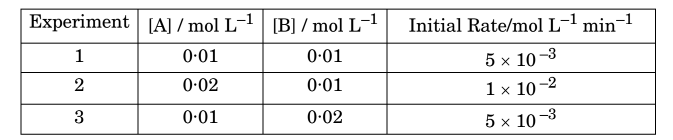
Calculate the order of the reaction with respect to A and B. Determine the rate constant of the reaction.
View Solution
Step 1: Understanding the Question:
We are given experimental data for the reaction A + B \(\rightarrow\) product.
We need to find the order of the reaction with respect to reactants A and B, and then calculate the rate constant (k).
Step 2: Key Formula or Approach:
The rate law for the reaction can be written as:
Rate = k[A]\(^x\)[B]\(^y\)
where x is the order of reaction with respect to A, and y is the order of reaction with respect to B.
We will use the given data to find the values of x and y by comparing the rates of different experiments.
Step 3: Detailed Explanation:
To find the order with respect to A (x):
Let's compare Experiment 1 and Experiment 2. In these experiments, the concentration of B is kept constant ([B] = 0.01 mol L\(^{-1}\)).
Rate\(_1\) = k(0.01)\(^x\)(0.01)\(^y\) = \(5 \times 10^{-3}\)
Rate\(_2\) = k(0.02)\(^x\)(0.01)\(^y\) = \(1 \times 10^{-2}\)
Divide Rate\(_2\) by Rate\(_1\):
\[ \frac{Rate_2}{Rate_1} = \frac{k(0.02)^x(0.01)^y}{k(0.01)^x(0.01)^y} = \frac{1 \times 10^{-2}}{5 \times 10^{-3}} \] \[ \left(\frac{0.02}{0.01}\right)^x = \frac{10 \times 10^{-3}}{5 \times 10^{-3}} \] \[ (2)^x = 2 \] \[ x = 1 \]
So, the order of the reaction with respect to A is 1.
To find the order with respect to B (y):
Let's compare Experiment 1 and Experiment 3. In these experiments, the concentration of A is kept constant ([A] = 0.01 mol L\(^{-1}\)).
Rate\(_1\) = k(0.01)\(^x\)(0.01)\(^y\) = \(5 \times 10^{-3}\)
Rate\(_3\) = k(0.01)\(^x\)(0.02)\(^y\) = \(5 \times 10^{-3}\)
Divide Rate\(_3\) by Rate\(_1\):
\[ \frac{Rate_3}{Rate_1} = \frac{k(0.01)^x(0.02)^y}{k(0.01)^x(0.01)^y} = \frac{5 \times 10^{-3}}{5 \times 10^{-3}} \] \[ \left(\frac{0.02}{0.01}\right)^y = 1 \] \[ (2)^y = 1 \]
Any number raised to the power of 0 is 1. Therefore, y = 0.
So, the order of the reaction with respect to B is 0.
To determine the rate constant (k):
The rate law is Rate = k[A]\(^1\)[B]\(^0\) = k[A].
We can use the data from any experiment to calculate k. Let's use Experiment 1.
Rate\(_1\) = k[A]\(_1\)
\(5 \times 10^{-3}\) mol L\(^{-1}\) min\(^{-1}\) = k (0.01 mol L\(^{-1}\))
\[ k = \frac{5 \times 10^{-3}}{0.01} = \frac{5 \times 10^{-3}}{1 \times 10^{-2}} = 0.5 min^{-1} \]
Step 4: Final Answer:
The order with respect to A is 1.
The order with respect to B is 0.
The rate constant (k) is 0.5 min\(^{-1}\).
Quick Tip: To find the order of a reaction with respect to a specific reactant, always compare two experiments where the concentration of only that reactant changes, while the concentrations of all other reactants are kept constant. This isolates the effect of that single reactant on the rate.
Give reasons for the following :
(a). The pH of aqueous NaCl increases when it is electrolysed.
View Solution
Step 1: Understanding the Question:
The question asks for the reason why the pH of an aqueous solution of sodium chloride (NaCl) increases during electrolysis. An increase in pH means the solution becomes more alkaline (basic).
Step 2: Detailed Explanation:
Aqueous NaCl solution contains Na\(^+\), Cl\(^{-}\) ions from NaCl and H\(^+\) and OH\(^{-}\) ions from the dissociation of water.
During electrolysis, reactions occur at two electrodes: the cathode (negative electrode) and the anode (positive electrode).
At the Cathode (Reduction):
There are two possible reduction reactions:
1. Na\(^+\)(aq) + e\(^{-}\) \(\rightarrow\) Na(s) \quad (\(E^\circ = -2.71\) V)
2. 2H\(_2\)O(l) + 2e\(^{-}\) \(\rightarrow\) H\(_2\)(g) + 2OH\(^{-}\)(aq) \quad (\(E^\circ = -0.83\) V at pH 7)
Since the reduction potential of water is higher (less negative) than that of Na\(^+\), water will be preferentially reduced at the cathode.
At the Anode (Oxidation):
There are two possible oxidation reactions:
1. 2Cl\(^{-}\)(aq) \(\rightarrow\) Cl\(_2\)(g) + 2e\(^{-}\) \quad (\(E^\circ = -1.36\) V)
2. 2H\(_2\)O(l) \(\rightarrow\) O\(_2\)(g) + 4H\(^+\)(aq) + 4e\(^{-}\) \quad (\(E^\circ = -1.23\) V)
Due to overpotential, the oxidation of Cl\(^{-}\) is preferred over the oxidation of water.
Overall Effect:
The key reaction causing the pH change is the one at the cathode:
2H\(_2\)O(l) + 2e\(^{-}\) \(\rightarrow\) H\(_2\)(g) + 2OH\(^{-}\)(aq)
This reaction produces hydroxide ions (OH\(^{-}\)) in the solution.
The accumulation of OH\(^{-}\) ions increases the basicity of the solution.
Step 3: Final Answer:
The increase in the concentration of hydroxide ions (OH\(^{-}\)) makes the solution alkaline. According to the definition of pH (pH = -log[H\(^+\)] or pOH = -log[OH\(^{-}\)], with pH + pOH = 14), an increase in [OH\(^{-}\)] leads to a decrease in pOH and consequently an increase in pH above 7.
Quick Tip: In the electrolysis of aqueous solutions of salts, always compare the standard electrode potentials of the cation/anion with that of water to determine what gets reduced at the cathode and oxidized at the anode. Remember that H\(_2\)O reduction produces OH\(^-\) (basic) and H\(_2\)O oxidation produces H\(^+\) (acidic).
Unlike dry cell, mercury cell has a constant cell potential through its lifetime.
View Solution
Step 1: Understanding the Question:
The question asks why a mercury cell maintains a constant voltage throughout its operational life, which is a characteristic that distinguishes it from a common dry cell (Leclanché cell).
Step 2: Detailed Explanation:
The reactions in a mercury cell are as follows:
Anode: Zinc amalgam (Zn(Hg)) is oxidized.
Zn(Hg) + 2OH\(^{-}\)(aq) \(\rightarrow\) ZnO(s) + H\(_2\)O(l) + 2e\(^{-}\)
Cathode: Mercuric oxide (HgO) is reduced.
HgO(s) + H\(_2\)O(l) + 2e\(^{-}\) \(\rightarrow\) Hg(l) + 2OH\(^{-}\)(aq)
Overall Reaction:
By adding the anode and cathode half-reactions, we get the net reaction:
Zn(Hg) + HgO(s) \(\rightarrow\) ZnO(s) + Hg(l)
Reason for Constant Potential:
1. No Change in Ion Concentration: Look at the overall cell reaction. The reactants (Zn, HgO) and products (ZnO, Hg) are all either solids or liquids. There are no ions from the electrolyte (like OH\(^{-}\)) present in the net equation.
2. Constant Activity: The concentrations (or more accurately, activities) of pure solids and liquids are considered to be constant (unity).
3. Nernst Equation: The cell potential is given by the Nernst equation: \(E_{cell} = E^\circ_{cell} - \frac{RT}{nF} \ln Q\). The reaction quotient, Q, for this reaction would be \(Q = \frac{[ZnO][Hg]}{[Zn][HgO]}\). Since all components are in their pure solid or liquid states, their activities are constant and equal to 1. Thus, Q=1.
4. Conclusion: Because the concentrations of the species involved in the overall reaction do not change as the cell discharges, the cell potential (\(E_{cell}\)) remains constant. In contrast, in a dry cell, the concentration of ions like Zn\(^{2+}\) and NH\(_4^+\) changes, causing the voltage to drop over time.
Step 3: Final Answer:
The mercury cell provides a constant cell potential because the overall cell reaction does not involve any ions in the solution whose concentrations change during the cell's lifetime. The reactants and products are all solids or liquids with constant activities.
Quick Tip: When asked about constant cell potential, check the overall reaction. If the reaction involves only pure solids and liquids, and no ions from the electrolyte, the potential will be constant. This is because the reaction quotient Q in the Nernst equation will be constant (usually 1).
Conductivity of solution decreases with dilution.
View Solution
Step 1: Understanding the Question:
The question asks to explain why the conductivity (\(\kappa\)) of an electrolyte solution decreases when it is diluted (i.e., when more solvent is added).
Step 2: Detailed Explanation:
1. Definition of Conductivity: Conductivity, also known as specific conductance, is a measure of a solution's ability to conduct electricity. It is specifically defined as the conductance of 1 cubic centimeter (or 1 cubic meter) of the solution. It essentially measures the concentration of effective charge carriers.
2. Effect of Dilution: When we dilute a solution by adding more solvent (e.g., water), two things happen:
a) The total number of ions in the solution may increase (in the case of a weak electrolyte due to increased dissociation) or remain the same (in the case of a strong electrolyte which is already fully dissociated).
b) The total volume of the solution increases significantly.
3. Ions per Unit Volume: The crucial factor for conductivity is the number of ions per unit volume. Although the total number of ions might increase or stay the same, the volume increases much more substantially. As a result, the number of ions present in any given unit volume (like 1 cm\(^3\)) of the solution decreases.
4. Conclusion: Since conductivity is directly proportional to the number of current-carrying ions per unit volume, a decrease in this number upon dilution leads to a decrease in the conductivity of the solution.
Distinction from Molar Conductivity: It is important not to confuse conductivity (\(\kappa\)) with molar conductivity (\(\Lambda_m\)). Molar conductivity is the conducting power of all the ions produced by dissolving one mole of an electrolyte. Molar conductivity increases with dilution because the increased volume allows ions to move more freely with less inter-ionic attraction, and for weak electrolytes, the degree of dissociation increases.
Step 3: Final Answer:
The conductivity of a solution decreases with dilution because the number of ions that carry the current per unit volume of the solution decreases.
Quick Tip: Remember the key difference:
- \textbf{Conductivity (\(\kappa\)): Depends on ions per \textbf{unit volume}. Decreases on dilution.
- \textbf{Molar Conductivity (\(\Lambda_m\)):} Depends on ions from \textbf{one mole}. Increases on dilution.
This is a very common point of confusion in exams.
Answer the following about the complexes
[FeF\(_6\)]\(^{3-}\) and [Fe(CN)\(_6\)]\(^{4-}\) :
(i) Write the hybridization involved in each case.
(ii) Which of them is the outer orbital complex and which one is the inner orbital complex ?
(iii) Compare their magnetic behaviour. [Atomic number : Fe = 26]
\textbf{(i) Hybridization:} [FeF\(_6\)]\(^{3-}\) is sp\(^3\)d\(^2\). [Fe(CN)\(_6\)]\(^{4-}\) is d\(^2\)sp\(^3\).
\textbf{(ii) Orbital Type:} [FeF\(_6\)]\(^{3-}\) is an outer orbital complex. [Fe(CN)\(_6\)]\(^{4-}\) is an inner orbital complex.
\textbf{(iii) Magnetic Behaviour:} [FeF\(_6\)]\(^{3-}\) is strongly paramagnetic. [Fe(CN)\(_6\)]\(^{4-}\) is diamagnetic.
View Solution
Step 1: Understanding the Question:
We need to analyze two coordination complexes of iron, [FeF\(_6\)]\(^{3-}\) and [Fe(CN)\(_6\)]\(^{4-}\), based on Valence Bond Theory (VBT) to determine their hybridization, orbital type (inner/outer), and magnetic properties.
Step 2: Detailed Explanation for [FeF\(_6\)]\(^{3-}\):
a. Oxidation State of Fe: Let the oxidation state of Fe be x.
x + 6(-1) = -3 \(\implies\) x = +3. So, we have Fe\(^{3+}\).
b. Electronic Configuration:
Fe (Z=26): [Ar] 3d\(^6\) 4s\(^2\).
Fe\(^{3+}\): [Ar] 3d\(^5\). The orbital diagram for Fe\(^{3+}\) is:
\begin{tabular{|c|c|c|c|c|
\hline \(\uparrow\) & \(\uparrow\) & \(\uparrow\) & \(\uparrow\) & \(\uparrow\)
\hline
\end{tabular (3d) \quad
\begin{tabular{|c|
\hline
\phantom{\(\uparrow\downarrow\)
\hline
\end{tabular (4s) \quad
\begin{tabular{|c|c|c|
\hline
\phantom{\(\uparrow\downarrow\) & \phantom{\(\uparrow\downarrow\) & \phantom{\(\uparrow\downarrow\)
\hline
\end{tabular (4p) \quad
\begin{tabular{|c|c|c|c|c|
\hline
\phantom{\(\uparrow\downarrow\) & \phantom{\(\uparrow\downarrow\) & \phantom{\(\uparrow\downarrow\) & \phantom{\(\uparrow\downarrow\) & \phantom{\(\uparrow\downarrow\)
\hline
\end{tabular (4d)
c. Ligand Type: F\(^{-}\) is a weak-field ligand. It does not cause the pairing of electrons in the 3d orbitals.
d. Hybridization: For the formation of six coordinate bonds with six F\(^{-}\) ligands, the Fe\(^{3+}\) ion needs six empty orbitals. Since the 3d orbitals are singly occupied and pairing does not occur, the vacant outer orbitals (one 4s, three 4p, and two 4d) are used for hybridization.
Hybridization is sp\(^3\)d\(^2\).
e. Orbital Type: Since the outer 4d orbitals are used, it is an outer orbital complex (or high-spin complex).
f. Magnetic Behaviour: It has five unpaired electrons in the 3d orbitals. Therefore, it is strongly paramagnetic.
Step 3: Detailed Explanation for [Fe(CN)\(_6\)]\(^{4-}\):
a. Oxidation State of Fe: Let the oxidation state of Fe be y.
y + 6(-1) = -4 \(\implies\) y = +2. So, we have Fe\(^{2+}\).
b. Electronic Configuration:
Fe (Z=26): [Ar] 3d\(^6\) 4s\(^2\).
Fe\(^{2+}\): [Ar] 3d\(^6\). The orbital diagram for Fe\(^{2+}\) is:
\begin{tabular{|c|c|c|c|c|
\hline \(\uparrow\downarrow\) & \(\uparrow\) & \(\uparrow\) & \(\uparrow\) & \(\uparrow\)
\hline
\end{tabular (3d) \quad
\begin{tabular{|c|
\hline
\phantom{\(\uparrow\downarrow\)
\hline
\end{tabular (4s) \quad
\begin{tabular{|c|c|c|
\hline
\phantom{\(\uparrow\downarrow\) & \phantom{\(\uparrow\downarrow\) & \phantom{\(\uparrow\downarrow\)
\hline
\end{tabular (4p)
c. Ligand Type: CN\(^{-}\) is a strong-field ligand. It forces the pairing of electrons in the 3d orbitals.
The 3d electrons rearrange as:
\begin{tabular{|c|c|c|c|c|
\hline \(\uparrow\downarrow\) & \(\uparrow\downarrow\) & \(\uparrow\downarrow\) & \phantom{\(\uparrow\downarrow\) & \phantom{\(\uparrow\downarrow\)
\hline
\end{tabular (3d)
d. Hybridization: After pairing, two inner 3d orbitals become vacant. These two 3d orbitals, along with one 4s and three 4p orbitals, hybridize to form six equivalent orbitals for bonding with six CN\(^{-}\) ligands.
Hybridization is d\(^2\)sp\(^3\).
e. Orbital Type: Since the inner 3d orbitals are used, it is an inner orbital complex (or low-spin complex).
f. Magnetic Behaviour: After pairing, there are no unpaired electrons. Therefore, the complex is diamagnetic.
Quick Tip: The key to solving such problems is to identify the ligand type. Spectrochemical series helps: strong-field ligands (like CN\(^{-}\), CO) cause pairing (low-spin, inner orbital), while weak-field ligands (like F\(^{-}\), Cl\(^{-}\), H\(_2\)O) do not (high-spin, outer orbital). The number of unpaired electrons determines the magnetic character (paramagnetic if unpaired e\(^{-}\) are present, diamagnetic if not).
OR
Question 25 (b):
(i) What happens to the colour of complex [Ti(H\(_2\)O)\(_6\)]\(^{3+}\) when heated gradually ?
(ii) Write the electronic configuration for d\(^5\) ion if \(\Delta_o < P\).
(iii) Write the hybridization and magnetic behaviour of the complex [Ni(CO)\(_4\)]. [Atomic number : Ni = 28]
\textbf{(i)} The violet colour of [Ti(H\(_2\)O)\(_6\)]\(^{3+}\) disappears, and it becomes colourless upon heating.
\textbf{(ii)} The electronic configuration is t\(_{2g}^3\) e\(_g^2\).
\textbf{(iii)} The hybridization of [Ni(CO)\(_4\)] is sp\(^3\) and it is diamagnetic.
View Solution
(i) What happens to the colour of complex [Ti(H\(_2\)O)\(_6\)]\(^{3+}\) when heated gradually ?
Step 1: Explanation of Colour:
In [Ti(H\(_2\)O)\(_6\)]\(^{3+}\), the oxidation state of Ti is +3. The electronic configuration of Ti\(^{3+}\) is [Ar] 3d\(^1\).
The complex is violet in colour. This colour is due to the d-d transition. The single d-electron in the lower energy t\(_{2g}\) orbital absorbs light from the visible region (yellow-green light) and gets promoted to the higher energy e\(_g\) orbital. The transmitted light appears complementary, which is violet.
Step 2: Effect of Heating:
When the complex is heated gradually, the water ligands (H\(_2\)O), which are coordinated to the central metal ion, are lost.
\[ [Ti(H_2O)_6]^{3+} \xrightarrow{Heat} Ti^{3+} + 6H_2O \]
The resulting anhydrous Ti\(^{3+}\) ion has no ligands surrounding it. Without ligands, there is no crystal field splitting of the d-orbitals.
Step 3: Final Answer:
Since there is no splitting, d-d transitions are not possible. Consequently, the substance does not absorb light from the visible region and becomes colourless.
(ii) Write the electronic configuration for d\(^5\) ion if \(\Delta_o < P\).
Step 1: Understanding the Condition:
The condition \(\Delta_o < P\) means that the crystal field splitting energy (\(\Delta_o\)) is less than the pairing energy (P). This situation occurs with weak-field ligands.
Step 2: Electron Filling:
When \(\Delta_o < P\), it is energetically more favourable for electrons to occupy the higher energy e\(_g\) orbitals than to pair up in the lower energy t\(_{2g}\) orbitals.
For a d\(^5\) configuration, the electrons will be filled according to Hund's rule of maximum multiplicity. The first three electrons will go into the t\(_{2g}\) orbitals singly. The next two electrons will go into the e\(_g\) orbitals singly, rather than pairing in t\(_{2g}\).
Step 3: Final Answer:
The electronic configuration will be t\(_{2g}^3\) e\(_g^2\). This corresponds to a high-spin complex.
(iii) Write the hybridization and magnetic behaviour of the complex [Ni(CO)\(_4\)].
Step 1: Oxidation State and Configuration:
The complex is [Ni(CO)\(_4\)], which is tetracarbonylnickel(0). CO is a neutral ligand, so the oxidation state of Nickel (Ni) is 0.
The atomic number of Ni is 28. Its ground state electronic configuration is [Ar] 3d\(^8\) 4s\(^2\).
Step 2: Effect of Ligand:
CO is a very strong-field ligand. In its presence, the electrons from the 4s orbital are pushed into the 3d orbitals to pair up with the existing d-electrons.
So, the configuration of Ni in the complex becomes [Ar] 3d\(^{10}\) 4s\(^0\).
The orbital diagram for Ni in the complex is:
\begin{tabular{|c|c|c|c|c|
\hline \(\uparrow\downarrow\) & \(\uparrow\downarrow\) & \(\uparrow\downarrow\) & \(\uparrow\downarrow\) & \(\uparrow\downarrow\)
\hline
\end{tabular (3d) \quad
\begin{tabular{|c|
\hline
\phantom{\(\uparrow\downarrow\)
\hline
\end{tabular (4s) \quad
\begin{tabular{|c|c|c|
\hline
\phantom{\(\uparrow\downarrow\) & \phantom{\(\uparrow\downarrow\) & \phantom{\(\uparrow\downarrow\)
\hline
\end{tabular (4p)
Step 3: Hybridization and Magnetic Behaviour:
For bonding with four CO ligands, Ni uses its empty valence orbitals. The empty 4s orbital and the three empty 4p orbitals hybridize to form four sp\(^3\) hybrid orbitals. These orbitals are then used to accept electron pairs from the four CO ligands.
The hybridization is sp\(^3\), which corresponds to a tetrahedral geometry.
Since the 3d orbitals are completely filled (3d\(^{10}\)), there are no unpaired electrons. Therefore, the complex is diamagnetic.
Quick Tip: For carbonyl complexes like [Ni(CO)\(_4\)] and [Fe(CO)\(_5\)], the metal is in a zero oxidation state. CO is a strong ligand that forces all valence electrons (from both s and d subshells) to pair up in the d-orbitals, leading to diamagnetic character. The hybridization then involves the empty s and p orbitals.
Write any two differences between S\(_N\)1 and S\(_N\)2 reactions. Which of the following compounds would undergo S\(_N\)1 reaction faster and why?

Benzyl chloride (
 ) would undergo S\(_N\)1 reaction faster because its intermediate, the benzyl carbocation, is highly stabilized by resonance.
View Solution
Part 1: Differences between S\(_N\)1 and S\(_N\)2 Reactions
\begin{tabular{|l|p{4.2cm|p{4.5cm|
\hline
Feature & S\(_N\)1 Reaction & S\(_N\)2 Reaction
\hline
1. Mechanism & Two-step mechanism. Involves a carbocation intermediate. & One-step (concerted) mechanism. Involves a pentavalent transition state.
\hline
2. Kinetics & Unimolecular, first-order kinetics. Rate = k[Substrate] & Bimolecular, second-order kinetics. Rate = k[Substrate][Nucleophile]
\hline
3. Reactivity & Reactivity order: 3\(^\circ\) \(>\) 2\(^\circ\) \(>\) 1\(^\circ\) \(>\) CH\(_3\)X. Favoured by stable carbocations. & Reactivity order: CH\(_3\)X \(>\) 1\(^\circ\) \(>\) 2\(^\circ\) \(>\) 3\(^\circ\). Favoured by less sterically hindered substrates.
\hline
4. Stereochemistry & Leads to racemization (formation of both enantiomers). & Leads to complete inversion of configuration (Walden Inversion).
\hline
\end{tabular
Part 2: Faster S\(_N\)1 Reaction
Step 1: Understanding the Requirement for S\(_N\)1 Reactions:
The rate-determining step of an S\(_N\)1 reaction is the formation of a carbocation intermediate. Therefore, the rate of an S\(_N\)1 reaction is directly proportional to the stability of the carbocation formed after the leaving group departs.
Step 2: Analyzing the Given Compounds:
The two compounds given are:
1. Cyclohexylchloromethane: 
2. Benzyl chloride:
Step 3: Comparing the Stability of Carbocation Intermediates:
- When Cyclohexylchloromethane loses Cl\(^{-}\), it forms the cyclohexylmethyl carbocation. This is a primary (1\(^\circ\)) carbocation. Primary carbocations are generally unstable.
- When Benzyl chloride loses Cl\(^{-}\), it forms the benzyl carbocation (). This carbocation is highly stable because the positive charge on the benzylic carbon can be delocalized over the entire benzene ring through resonance.
The resonance structures of the benzyl carbocation are:

Step 4: Conclusion:
Because the benzyl carbocation is significantly more stable than the primary cyclohexylmethyl carbocation due to resonance, Benzyl chloride will form its carbocation intermediate much more readily.
Step 5: Final Answer:
Benzyl chloride will undergo the S\(_N\)1 reaction faster. This is because the intermediate benzyl carbocation formed from it is highly stabilized by resonance, which lowers the activation energy of the rate-determining step.
Quick Tip: For S\(_N\)1 reactivity, always think "carbocation stability". Tertiary, allylic, and benzylic carbocations are the most stable due to hyperconjugation and/or resonance. For S\(_N\)2 reactivity, think "steric hindrance". Less crowded (primary) substrates react fastest.
A compound (A) with molecular formula C\(_4\)H\(_5\)N on reduction with DIBAL-H followed by hydrolysis, gives a compound (B). Compound (B) gives positive Tollens' test but does not give iodoform test. Compound (B) can also be obtained when ethanal is treated with dilute NaOH followed by heating. Identify (A) and (B). Write the reactions of (A) with DIBAL-H followed by hydrolysis.
\textbf{Compound (A):} But-2-enenitrile (CH\(_3\)-CH=CH-CN)
\textbf{Compound (B):} But-2-enal (Crotonaldehyde, CH\(_3\)-CH=CH-CHO)
\textbf{Reaction:} CH\(_3\)-CH=CH-CN \(\xrightarrow{\text{(i) DIBAL-H (ii) H\)_2\(O}}\) CH\(_3\)-CH=CH-CHO
View Solution
Step 1: Decoding the properties of Compound (B):
1. Positive Tollens' test: This indicates that compound (B) is an aldehyde.
2. Does not give iodoform test: This means compound (B) does not have a methyl ketone (CH\(_3\)-C=O) group or a CH\(_3\)-CH(OH)- group.
3. Formation from ethanal: (B) is formed when ethanal (CH\(_3\)CHO) is treated with dilute NaOH followed by heating. This is a classic Aldol Condensation reaction.
Step 2: Identifying Compound (B) from the Aldol Condensation:
The reaction of ethanal with dilute NaOH is an aldol addition, followed by dehydration upon heating.
- Aldol Addition:
\[ 2CH_3CHO \xrightarrow{dil. NaOH} CH_3-CH(OH)-CH_2-CHO \]
(3-Hydroxybutanal)
- Dehydration (Heating): The aldol product loses a molecule of water.
\[ CH_3-CH(OH)-CH_2-CHO \xrightarrow{\Delta} CH_3-CH=CH-CHO + H_2O \]
The product is But-2-enal, commonly known as Crotonaldehyde.
Let's verify this structure with the given tests:
- It is an aldehyde (has -CHO group), so it gives a positive Tollens' test. (Correct)
- It does not have a CH\(_3\)-C=O group. (Correct)
Therefore, Compound (B) is But-2-enal (CH\(_3\)-CH=CH-CHO).
Step 3: Identifying Compound (A):
We are told that compound (A) has the molecular formula C\(_4\)H\(_5\)N.
Compound (A) upon reduction with DIBAL-H (Diisobutylaluminium hydride) followed by hydrolysis gives compound (B), which is an aldehyde.
DIBAL-H is a reducing agent known for the partial reduction of nitriles (-CN) and esters to aldehydes.
Since (A) is C\(_4\)H\(_5\)N and reduces to the aldehyde (B) But-2-enal (C\(_4\)H\(_6\)O), it is highly likely that (A) is the corresponding nitrile.
The nitrile corresponding to But-2-enal (CH\(_3\)-CH=CH-CHO) is But-2-enenitrile (CH\(_3\)-CH=CH-CN).
Let's check the molecular formula for But-2-enenitrile: It has 4 carbons, (3+1+1) = 5 hydrogens, and 1 nitrogen. The formula is C\(_4\)H\(_5\)N. This matches the given formula for (A).
Therefore, Compound (A) is But-2-enenitrile.
Step 4: Writing the Reaction of (A) with DIBAL-H:
The reaction involves the reduction of the nitrile group to an imine intermediate by DIBAL-H, which is then hydrolyzed to form the aldehyde.
\[ \underset{(A) But-2-enenitrile}{CH_3-CH=CH-C \equiv N} \xrightarrow[(ii) H_2O / H^+]{(i) DIBAL-H} \underset{(B) But-2-enal}{CH_3-CH=CH-CHO} \]
Final Answer Summary:
- Compound (A): But-2-enenitrile
- Compound (B): But-2-enal
- Reaction: As shown in Step 4. Quick Tip: In organic synthesis problems, work backwards from the known product or the reaction that gives a clear identification. Here, the "ethanal + dil. NaOH" clue firmly identifies B as the product of an aldol condensation. Then, identifying the reagent (DIBAL-H) that converts A to B helps deduce the functional group and structure of A.
How will you obtain the following from aniline ? Give chemical equations only.
(a) Sulphanilic acid
(b) Phenylisocyanide
(c) Acetanilide
\textbf{(a)} Aniline is treated with concentrated H\(_2\)SO\(_4\) and heated to 180-200\(^\circ\)C.
\textbf{(b)} Aniline is warmed with chloroform (CHCl\(_3\)) and alcoholic KOH.
\textbf{(c)} Aniline is treated with acetic anhydride ((CH\(_3\)CO)\(_2\)O) or acetyl chloride (CH\(_3\)COCl).
View Solution
(a) Sulphanilic acid from aniline
Aniline reacts with concentrated sulfuric acid to form anilinium hydrogen sulphate, which upon heating undergoes rearrangement to form p-aminobenzenesulphonic acid (Sulphanilic acid).
Chemical Equation: \[ \underset{Aniline}{C_6H_5NH_2} + \underset{conc.}{H_2SO_4} \rightarrow \underset{Anilinium hydrogen sulphate}{[C_6H_5NH_3]^+HSO_4^-} \xrightarrow{180-200^\circ C} \underset{Sulphanilic acid}{p-H_2N-C_6H_4-SO_3H} + H_2O \]
Sulphanilic acid exists as a zwitterion.
(b) Phenylisocyanide from aniline
This is the Carbylamine reaction (or Isocyanide test), used as a test for primary amines. Aniline is heated with chloroform and an alcoholic solution of potassium hydroxide to form phenylisocyanide, which has a very unpleasant odour.
Chemical Equation: \[ \underset{Aniline}{C_6H_5NH_2} + \underset{Chloroform}{CHCl_3} + \underset{(alcoholic)}{3KOH} \xrightarrow{\Delta} \underset{Phenylisocyanide}{C_6H_5NC} + 3KCl + 3H_2O \]
(c) Acetanilide from aniline
This is the acetylation of aniline. Aniline is treated with an acetylating agent like acetic anhydride or acetyl chloride in the presence of a base (like pyridine, which neutralizes the HCl produced) or glacial acetic acid.
Chemical Equation (using acetic anhydride): \[ \underset{Aniline}{C_6H_5NH_2} + \underset{Acetic anhydride}{(CH_3CO)_2O} \xrightarrow{Pyridine} \underset{Acetanilide}{C_6H_5NHCOCH_3} + \underset{Acetic acid}{CH_3COOH} \] Quick Tip: These are three fundamental reactions of aniline. Memorize them by name:
- (a) Sulphonation
- (b) Carbylamine Reaction
- (c) Acetylation
Acetylation is often used as a method to protect the amino group in aniline before carrying out other reactions like nitration or halogenation to get mono-substituted products.
What happens when phenol is treated with the following?
(i) Br\(_2\) water \quad (ii) Conc. HNO\(_3\)
\textbf{(i)} When phenol is treated with Br\(_2\) water, a white precipitate of 2,4,6-tribromophenol is formed.
\textbf{(ii)} When phenol is treated with concentrated HNO\(_3\), it gives 2,4,6-trinitrophenol (Picric acid).
View Solution
(i) Reaction with Br\(_2\) water:
The -OH group in phenol is a strongly activating group. It activates the benzene ring for electrophilic substitution, particularly at the ortho and para positions. Bromine water is a polar medium which facilitates the ionization of Br\(_2\) to Br\(^+\).
Due to the high activation of the ring, the reaction is very fast and all three available ortho and para positions are substituted by bromine atoms.
Reaction: Phenol reacts with excess bromine water at room temperature to give a white precipitate of 2,4,6-tribromophenol.
Equation:

(ii) Reaction with Conc. HNO\(_3\):
Concentrated nitric acid, in the presence of concentrated sulfuric acid (which acts as a catalyst), is a strong nitrating agent.
Again, due to the highly activating nature of the -OH group, nitration occurs at all three ortho and para positions.
Reaction: Phenol reacts with concentrated nitric acid to yield 2,4,6-trinitrophenol, which is commonly known as Picric acid.
Equation:

Quick Tip: The -OH group in phenol is so strongly activating that controlling the substitution to get a mono-substituted product is difficult. To get mono-bromophenol, the reaction must be carried out in a non-polar solvent like CS\(_2\) or CCl\(_4\) at low temperatures. To get mono-nitrophenol, dilute HNO\(_3\) is used.
Write the mechanism of alcohol reacting as nucleophile in a reaction with CH\(_3^{\oplus}\).
View Solution
Step 1: Understanding the Question:
The question asks for the reaction mechanism when an alcohol (R-OH) acts as a nucleophile and attacks an electrophile, which is a methyl carbocation (CH\(_3^+\)). A nucleophile is an electron-rich species that donates an electron pair, and an electrophile is an electron-deficient species that accepts an electron pair. The lone pairs on the oxygen atom of the alcohol make it a good nucleophile.
Step 2: Detailed Mechanism:
The reaction proceeds in two steps:
Step 2a: Nucleophilic Attack of Alcohol on the Carbocation
The lone pair of electrons on the oxygen atom of the alcohol attacks the electron-deficient carbon of the methyl carbocation. This results in the formation of a new carbon-oxygen bond and an intermediate called a protonated ether or an oxonium ion.
\[ \underset{Alcohol (Nucleophile)}{R-\ddot{O}-H} + \underset{Carbocation (Electrophile)}{CH_3^{\oplus}} \longrightarrow \underset{Protonated Ether (Oxonium ion)}{R-\underset{\displaystyle\oplus}{\overset{\displaystyle H}{\ddot{O}}}-CH_3} \]
Step 2b: Deprotonation to form Ether
The oxonium ion formed in the first step is unstable because of the positive charge on the highly electronegative oxygen atom. It readily loses a proton to a weak base (B:), which could be another alcohol molecule or water, to form a stable ether.
\[ \underset{Protonated Ether}{R-\underset{\displaystyle\oplus}{\overset{\displaystyle H}{\ddot{O}}}-CH_3} + \underset{Base}{:B} \longrightarrow \underset{Ether}{R-\ddot{O}-CH_3} + \underset{Protonated Base}{H-B^{\oplus}} \]
Step 3: Final Answer:
The overall reaction is the formation of an ether from an alcohol and a carbocation. The mechanism involves a nucleophilic attack followed by a deprotonation step.
Quick Tip: This mechanism is fundamental to understanding reactions like the S\(_N\)1 reaction of alkyl halides with alcohol as the solvent/nucleophile, or the acid-catalyzed dehydration of alcohols to form ethers. The key is that the oxygen atom in alcohols and water can act as a nucleophile due to its lone pairs.
OR
Question 29 (b) (ii):
Why do phenols not undergo reactions involving cleavage of C - OH bond?
View Solution
Step 1: Understanding the Bond in Phenol:
The question asks why the bond between the benzene ring's carbon atom and the oxygen atom (C-OH) is difficult to break in phenols, unlike in alcohols.
Step 2: The Role of Resonance:
The key reason lies in the electronic structure of phenol. The oxygen atom of the -OH group has lone pairs of electrons. One of these lone pairs can participate in resonance with the \(\pi\)-electron system of the benzene ring.
The resonance structures of phenol are:

Step 3: Effect of Resonance on the C-O Bond:
As seen in the resonance structures II, III, and IV, there is a double bond between the carbon of the ring and the oxygen atom.
This means that the actual C-O bond in phenol is not a pure single bond but a resonance hybrid that has a significant partial double bond character.
A double bond is stronger and shorter than a single bond.
Step 4: Comparison with Alcohols:
In alcohols (R-OH), the C-O bond is a pure single bond. There is no resonance to strengthen it.
For example, the C-O bond length in methanol is 142 pm, whereas in phenol it is 136 pm. The shorter bond length in phenol indicates a stronger bond.
Step 5: Final Answer:
Due to the partial double bond character acquired through resonance, the C-O bond in phenols is much stronger than the C-O single bond in alcohols. Therefore, reactions that require the cleavage of this C-O bond do not occur easily in phenols.
Quick Tip: Whenever comparing the reactivity of functional groups attached to a benzene ring versus an alkyl chain (e.g., phenol vs alcohol, or chlorobenzene vs chloroalkane), always consider the effect of resonance. Resonance usually strengthens the bond between the ring and the atom of the functional group.
How can you distinguish between Butan-1-ol and 2-Methylpropan-2-ol by using HCl in the presence of anhydrous ZnCl\(_2\)?
View Solution
Step 1: Identifying the Reagent and Test:
The reagent described, a solution of concentrated HCl in the presence of anhydrous ZnCl\(_2\), is known as the Lucas reagent. The test performed using this reagent to distinguish between primary, secondary, and tertiary alcohols is called the Lucas test.
Step 2: Principle of the Lucas Test:
The Lucas test is based on the difference in the rate of reaction of primary, secondary, and tertiary alcohols with hydrogen halides. The reaction follows an S\(_N\)1 mechanism, where the rate-determining step is the formation of a carbocation. The reaction is:
\[ R-OH + HCl \xrightarrow{anhy. ZnCl_2} R-Cl + H_2O \]
The product, an alkyl chloride (R-Cl), is insoluble in the reagent and appears as a cloudy suspension or turbidity.
The reactivity order is: Tertiary > Secondary > Primary, because the stability of the corresponding carbocation follows the same order.
Step 3: Classifying the Given Alcohols:
1. Butan-1-ol: CH\(_3\)CH\(_2\)CH\(_2\)CH\(_2\)OH. The -OH group is attached to a primary carbon. This is a primary (1\(^\circ\)) alcohol.
2. 2-Methylpropan-2-ol: (CH\(_3\))\(_3\)COH. The -OH group is attached to a tertiary carbon. This is a tertiary (3\(^\circ\)) alcohol.
Step 4: Predicting the Observations:
- With 2-Methylpropan-2-ol (tertiary alcohol): It will react very rapidly with the Lucas reagent. A tertiary carbocation ((CH\(_3\))\(_3\)C\(^+\)) is formed, which is very stable. This leads to the immediate formation of 2-chloro-2-methylpropane, causing immediate turbidity to appear in the solution.
- With Butan-1-ol (primary alcohol): It will react very slowly. Primary carbocations are highly unstable. At room temperature, there will be no visible reaction or turbidity. Turbidity will only appear if the mixture is heated for a significant amount of time.
Step 5: Final Answer:
To distinguish between the two alcohols, add Lucas reagent to both test tubes at room temperature.
- The test tube containing 2-Methylpropan-2-ol will show immediate turbidity.
- The test tube containing Butan-1-ol will remain clear.
Quick Tip: Remember the Lucas test results by the speed of reaction:
- \textbf{Tertiary (3\(^\circ\)):} Turbidity is immediate (Fastest).
- \textbf{Secondary (2\(^\circ\)):} Turbidity appears in 5-10 minutes.
- \textbf{Primary (1\(^\circ\)):} No turbidity at room temperature; appears only on heating (Slowest).
Define the following :
(i) Peptide linkage \quad (ii) Denatured protein
\textbf{(i) Peptide linkage:} An amide bond (-CO-NH-) formed between the carboxyl group of one \(\alpha\)-amino acid and the amino group of another \(\alpha\)-amino acid, with the elimination of a water molecule.
\textbf{(ii) Denatured protein:} A protein that has lost its specific three-dimensional structure (secondary and tertiary structures) and hence its biological activity due to physical or chemical changes, while its primary structure remains intact.
View Solution
(i) Peptide linkage
A peptide linkage or peptide bond is a covalent chemical bond formed between two molecules when the carboxyl group of one molecule reacts with the amino group of the other molecule, releasing a molecule of water (H\(_2\)O). This is a dehydration synthesis reaction (also known as a condensation reaction) and usually occurs between amino acids. The resulting C(O)NH bond is called a peptide bond, and the resulting molecule is an amide.
The linkage -CO-NH- is the peptide linkage.
(ii) Denatured protein
Denaturation is a process in which a protein loses its native shape due to the disruption of weak chemical bonds and interactions, thereby becoming biologically inactive. The native conformation of a protein is its unique three-dimensional structure, including secondary, tertiary, and quaternary structures.
Denaturation can be caused by external stress such as:
- Heat: Breaks hydrogen bonds.
- Acids or Bases: Disrupt salt bridges by changing the state of protonation.
- Organic solvents, urea, or detergents.
During denaturation, the primary structure (the sequence of amino acids) remains the same. A common example is the coagulation of egg white (albumin) when it is cooked.
Quick Tip: Remember that denaturation is the loss of 2\(^\circ\), 3\(^\circ\), and 4\(^\circ\) structures, which causes the loss of biological function. The primary structure (amino acid sequence) is not affected by denaturation.
Why do amino acids show amphoteric behaviour ?
View Solution
Step 1: Understanding Amphoteric Behaviour:
A substance is called amphoteric if it can react as both an acid and a base.
Step 2: Structure of an Amino Acid:
An \(\alpha\)-amino acid has a central carbon atom (the \(\alpha\)-carbon) bonded to:
- An amino group (-NH\(_2\))
- A carboxyl group (-COOH)
- A hydrogen atom (-H)
- A variable side chain (-R group)
Step 3: Dual Functionality:
- The carboxyl group (-COOH) is acidic and can donate a proton (H\(^+\)).
- The amino group (-NH\(_2\)) is basic and can accept a proton (H\(^+\)).
Since a single amino acid molecule contains both an acidic and a basic functional group, it has the ability to act as either an acid or a base depending on the pH of the surrounding medium.
Step 4: Zwitterion Formation:
In neutral aqueous solution, the acidic carboxyl group donates its proton to the basic amino group within the same molecule. This forms a dipolar ion called a zwitterion, which has both a positive charge (-NH\(_3^+\)) and a negative charge (-COO\(^-\)).
This zwitterionic form can then:
- React with an acid (H\(^+\)): The -COO\(^-\) group accepts a proton, and the amino acid acts as a base.
- React with a base (OH\(^-\)): The -NH\(_3^+\) group donates a proton, and the amino acid acts as an acid.
Step 5: Final Answer:
Amino acids are amphoteric because their structure contains both an acidic carboxyl group (-COOH) and a basic amino group (-NH\(_2\)). This dual functionality allows them to react with both acids and bases.
Quick Tip: The concept of the zwitterion is key to understanding the properties of amino acids, including their high melting points, solubility in water, and amphoteric nature. Remember that at its isoelectric point (pI), an amino acid exists predominantly as a zwitterion.
How can you differentiate between Fibrous protein and Globular protein ?
View Solution
Fibrous and globular proteins can be differentiated based on their structure, solubility, and function.
\begin{tabular{|l|l|l|
\hline
Property & Fibrous Proteins & Globular Proteins
\hline
Shape & Long, narrow, thread-like or & Spherical, ovoid, or ellipsoidal in
& sheet-like structure. Polypeptide & shape. Polypeptide chains are
& chains are arranged in parallel. & tightly folded into a compact form.
\hline
Solubility & Generally insoluble in water and & Generally soluble in water and
& aqueous solutions of acids and bases. & aqueous solutions.
\hline
Function & Primarily have a structural or & Primarily involved in metabolic
& protective role in organisms. & and functional roles like catalysis
& Provide strength and elasticity. & (enzymes), transport, and regulation.
\hline
Stability & More stable to changes in & Less stable; sensitive to changes
& temperature and pH. & in temperature and pH (easily denatured).
\hline
Examples & Keratin (in hair, nails), Collagen & Insulin, Haemoglobin, Albumin,
& (in connective tissue), Myosin (in muscle). & and all enzymes.
\hline
\end{tabular
Quick Tip: A simple way to remember is: \textbf{Fibrous = Fiber = Structural} (like threads in a rope) and are insoluble. \textbf{Globular = Globe = Functional} (like compact balls that do jobs) and are soluble.
Write the names of two different secondary structures of proteins.
View Solution
The secondary structure of a protein refers to the local, regular, folded structures that form within a polypeptide chain due to hydrogen bonding between the atoms of the polypeptide backbone (not the side chains).
The two most common and stable types of secondary structures are:
1. \(\alpha\)-Helix:
- This structure resembles a coiled spring or a spiral staircase.
- The polypeptide chain is twisted into a right-handed helix.
- It is stabilized by intramolecular hydrogen bonds between the C=O group of one amino acid and the N-H group of the amino acid that is four residues ahead in the chain.
- An example of a protein rich in \(\alpha\)-helices is keratin, found in hair and nails.
2. \(\beta\)-Pleated Sheet:
- This structure consists of polypeptide chains (called \(\beta\)-strands) lying side-by-side.
- The structure is stabilized by intermolecular or intramolecular hydrogen bonds between the C=O groups of one strand and the N-H groups of an adjacent strand.
- The sheet has a pleated or folded appearance.
- The strands can run in the same direction (parallel \(\beta\)-sheet) or in opposite directions (antiparallel \(\beta\)-sheet).
- An example is fibroin, the protein in silk.
Quick Tip: Remember that secondary structures are all about hydrogen bonds in the \textbf{backbone} of the polypeptide chain. The \(\alpha\)-helix involves H-bonds within a single chain, while the \(\beta\)-sheet involves H-bonds between chains (or distant parts of the same chain).
Calculate E\(_{cell}\) of a galvanic cell in which the following reaction takes place at 25\(^\circ\)C :
Zn(s) + Pb\(^{2+}\)(0.02 M) \(\rightarrow\) Zn\(^{2+}\)(0.1 M) + Pb(s)
[Given: E\(^\circ_{Zn^{2+}/Zn}\) = -0.76 V, E\(^\circ_{Pb^{2+}/Pb}\) = -0.13 V;
log 2 = 0.3010, log 4 = 0.6021, log 5 = 0.6990].
View Solution
Step 1: Understanding the Question:
We need to calculate the cell potential (E\(_{cell}\)) for a non-standard galvanic cell using the Nernst equation. The temperature is 25\(^\circ\)C (298 K).
Step 2: Identify Anode and Cathode and Calculate E\(^\circ_{cell}\):
From the overall reaction: Zn(s) \(\rightarrow\) Zn\(^{2+}\)(aq) and Pb\(^{2+}\)(aq) \(\rightarrow\) Pb(s).
- Oxidation occurs for Zinc: Zn is the Anode.
- Reduction occurs for Lead: Pb is the Cathode.
The standard cell potential (E\(^\circ_{cell}\)) is calculated as:
\[ E^\circ_{cell} = E^\circ_{cathode} - E^\circ_{anode} \] \[ E^\circ_{cell} = E^\circ_{Pb^{2+}/Pb} - E^\circ_{Zn^{2+}/Zn} \] \[ E^\circ_{cell} = (-0.13 V) - (-0.76 V) \] \[ E^\circ_{cell} = -0.13 + 0.76 = 0.63 V \]
Step 3: Apply the Nernst Equation:
The Nernst equation at 25\(^\circ\)C (298 K) is:
\[ E_{cell} = E^\circ_{cell} - \frac{0.0591}{n} \log Q \]
Where:
- n is the number of moles of electrons transferred in the balanced equation.
Zn \(\rightarrow\) Zn\(^{2+}\) + 2e\(^{-}\)
Pb\(^{2+}\) + 2e\(^{-}\) \(\rightarrow\) Pb
So, n = 2.
- Q is the reaction quotient.
\[ Q = \frac{[Products]}{[Reactants]} = \frac{[Zn^{2+}]}{[Pb^{2+}]} \]
(Activities of pure solids Zn and Pb are taken as 1).
Step 4: Calculate Q and E\(_{cell}\):
Given concentrations are [Zn\(^{2+}\)] = 0.1 M and [Pb\(^{2+}\)] = 0.02 M.
\[ Q = \frac{0.1}{0.02} = 5 \]
Now, substitute all values into the Nernst equation:
\[ E_{cell} = 0.63 - \frac{0.0591}{2} \log(5) \]
Given log(5) = 0.6990.
\[ E_{cell} = 0.63 - (0.02955) \times (0.6990) \] \[ E_{cell} = 0.63 - 0.02065545 \] \[ E_{cell} \approx 0.6093 V \]
Step 5: Final Answer:
The calculated E\(_{cell}\) for the galvanic cell is 0.609 V.
Quick Tip: Always start by calculating the standard cell potential, \(E^\circ_{cell} = E^\circ_{cathode} - E^\circ_{anode}\). Remember that the cathode is where reduction happens (higher reduction potential) and the anode is where oxidation happens (lower reduction potential). Then, carefully set up the reaction quotient Q for the Nernst equation, making sure to exclude solids and liquids.
State Faraday's first law of electrolysis. How much electricity, in terms of Faraday, is required to reduce one mol of MnO\(_4^-\) to Mn\(^{2+}\) ion ?
\textbf{Faraday's First Law:} The mass of any substance deposited or liberated at any electrode is directly proportional to the quantity of electricity passed through the electrolyte.
\textbf{Electricity required:} 5 Faradays.
View Solution
Part 1: Faraday's First Law of Electrolysis
The law states that the amount of chemical reaction which occurs at any electrode during electrolysis by a current is proportional to the quantity of electricity passed through the electrolyte.
Mathematically, if 'm' is the mass of the substance deposited or liberated and 'Q' is the quantity of electricity passed, then:
\[ m \propto Q \]
Since Q = I \(\times\) t (where I is current in amperes and t is time in seconds),
\[ m \propto I \times t \] \[ m = Z \times I \times t \]
Where Z is a constant of proportionality known as the electrochemical equivalent of the substance.
Part 2: Electricity Required for Reduction of MnO\(_4^-\)
Step 1: Determine the half-reaction and change in oxidation state.
We need to find the electricity required to reduce one mole of MnO\(_4^-\) to Mn\(^{2+}\).
- First, find the oxidation state of Mn in MnO\(_4^-\). Let it be x.
x + 4(-2) = -1 \(\implies\) x = +7.
- The oxidation state of Mn in Mn\(^{2+}\) is +2.
- The change in oxidation state is from +7 to +2.
Change = 7 - 2 = 5.
Step 2: Relate the change in oxidation state to moles of electrons.
A change in oxidation state of 5 means that 5 moles of electrons are gained for every one mole of MnO\(_4^-\) that is reduced.
The balanced half-reaction in acidic medium is:
\[ MnO_4^-(aq) + 8H^+(aq) + 5e^- \rightarrow Mn^{2+}(aq) + 4H_2O(l) \]
This confirms that 5 moles of electrons are required to reduce 1 mole of MnO\(_4^-\).
Step 3: Convert moles of electrons to Faradays.
By definition, the charge carried by one mole of electrons is equal to one Faraday (1 F).
1 F \(\approx\) 96500 C/mol.
Since 5 moles of electrons are required, the total quantity of electricity needed is 5 Faradays.
Step 4: Final Answer:
The amount of electricity required to reduce one mole of MnO\(_4^-\) to Mn\(^{2+}\) is 5 Faradays.
Quick Tip: To quickly find the Faradays needed for a redox reaction, simply calculate the total change in oxidation number for one mole of the substance. This number is equal to the number of moles of electrons transferred, which is also the number of Faradays required.
OR
Question 31 (b) (i):
The resistance of a conductivity cell containing 0.001 M KCl solution at 298 K is 1000 ohm. What is the cell constant if conductivity of 0.001 M KCl solution at 298 K is 0.125 \(\times\) 10\(^{-3}\) S cm\(^{-1}\) ?
View Solution
Step 1: Understanding the Question:
We are given the resistance (R) of a KCl solution in a conductivity cell and the conductivity (\(\kappa\)) of that solution. We need to find the cell constant (G*).
Step 2: Key Formula or Approach:
The relationship between conductivity (\(\kappa\)), resistance (R), and the cell constant (G*) is given by the formula:
\[ \kappa = \frac{1}{R} \times G^* \]
Where:
- \(\kappa\) (kappa) is the conductivity in S cm\(^{-1}\).
- R is the resistance in ohms (\(\Omega\)).
- G* is the cell constant in cm\(^{-1}\). The cell constant is the ratio of the distance between the electrodes (l) to their area of cross-section (A), i.e., G* = l/A.
Step 3: Rearrange the Formula and Substitute the Values:
We can rearrange the formula to solve for the cell constant (G*):
\[ G^* = \kappa \times R \]
We are given:
- R = 1000 \(\Omega\)
- \(\kappa\) = 0.125 \(\times\) 10\(^{-3}\) S cm\(^{-1}\)
Now, substitute these values into the rearranged formula:
\[ G^* = (0.125 \times 10^{-3} S cm^{-1}) \times (1000 \Omega) \]
Since S (Siemens) is the reciprocal of ohm (\(\Omega^{-1}\)), the units S and \(\Omega\) will cancel out.
\[ G^* = 0.125 \times 10^{-3} \times 10^3 cm^{-1} \] \[ G^* = 0.125 cm^{-1} \]
Step 4: Final Answer:
The cell constant is 0.125 cm\(^{-1}\).
Quick Tip: Remember the fundamental formulas for conductance and conductivity.
- Conductance (G) = 1/Resistance (R)
- Conductivity (\(\kappa\)) = Conductance (G) \(\times\) Cell Constant (G*)
Combining these gives \(\kappa = (1/R) \times G^*\). The cell constant is a property of the cell itself and does not change with the solution used.
Calculate the E\(_{Mg^{2+}/Mg}\) potential for the following half cell at 25\(^\circ\)C:
Mg/Mg\(^{2+}\) (1 \(\times\) 10\(^{-4}\) M); E\(^\circ_{Mg^{2+}/Mg}\) = + 2.36 V
[Given: log 10 = 1]
View Solution
Note: The standard reduction potential for Mg\(^{2+}\)/Mg is -2.36 V. The value given in the question, E\(^\circ_{Mg^{2+}/Mg}\) = +2.36 V, is the standard oxidation potential (E\(^\circ_{Mg/Mg^{2+}}\)). We will solve the problem using the data as given in the question.
Step 1: Understanding the Question:
We need to calculate the non-standard reduction potential (E) for the Mg\(^{2+}\)/Mg half-cell using the Nernst equation.
Step 2: Write the Half-Reaction and Nernst Equation:
The reduction half-reaction is:
\[ Mg^{2+}(aq) + 2e^- \rightarrow Mg(s) \]
The Nernst equation for this half-reaction at 25\(^\circ\)C is:
\[ E_{Mg^{2+}/Mg} = E^\circ_{Mg^{2+}/Mg} - \frac{0.0591}{n} \log \frac{[Products]}{[Reactants]} \] \[ E_{Mg^{2+}/Mg} = E^\circ_{Mg^{2+}/Mg} - \frac{0.0591}{n} \log \frac{1}{[Mg^{2+}]} \]
Here, n = 2 (number of electrons transferred).
Step 3: Substitute the Given Values:
We are given:
- [Mg\(^{2+}\)] = 1 \(\times\) 10\(^{-4}\) M
- E\(^\circ_{Mg^{2+}/Mg}\) = +2.36 V (as per the question)
- n = 2
Substitute these values into the equation:
\[ E_{Mg^{2+}/Mg} = 2.36 - \frac{0.0591}{2} \log \frac{1}{1 \times 10^{-4}} \] \[ E_{Mg^{2+}/Mg} = 2.36 - 0.02955 \log(10^4) \]
Using the property log(a\(^b\)) = b log(a):
\[ E_{Mg^{2+}/Mg} = 2.36 - 0.02955 \times (4 \log 10) \]
Given log 10 = 1.
\[ E_{Mg^{2+}/Mg} = 2.36 - 0.02955 \times 4 \] \[ E_{Mg^{2+}/Mg} = 2.36 - 0.1182 \] \[ E_{Mg^{2+}/Mg} = +2.2418 V \]
Step 4: Final Answer:
Based on the data provided in the question, the potential for the half-cell is +2.2418 V.
Quick Tip: Be very careful with the signs of standard electrode potentials. The standard convention is to use reduction potentials. If an oxidation potential is given (like in this question, where \(E^\circ_{Mg^{2+}/Mg}\) is positive), you must still use it as provided in the problem statement, even if it contradicts the standard data book values. Always state any assumptions or note potential typos if you suspect them.
What is the effect of temperature on the electrical conductance of metallic conductor?
View Solution
Step 1: Understanding Metallic Conduction:
In metallic conductors, the flow of electricity is due to the movement of delocalized electrons through a fixed lattice of positive metal ions (kernels).
Step 2: Effect of Temperature:
When the temperature of a metal is increased, the metal ions in the lattice gain kinetic energy and begin to vibrate more vigorously about their mean positions.
Step 3: Resistance to Electron Flow:
These increased vibrations of the positive ions create a greater obstruction or hindrance to the flow of electrons. The electrons collide more frequently with the vibrating ions, which impedes their smooth passage through the conductor.
Step 4: Conclusion on Resistance and Conductance:
- This increased hindrance to electron flow means that the electrical resistance of the metal increases with an increase in temperature.
- Electrical conductance is the reciprocal of resistance (Conductance = 1/Resistance).
- Therefore, since resistance increases with temperature, the electrical conductance of a metallic conductor must decrease with an increase in temperature.
Step 5: Final Answer:
An increase in temperature causes the electrical conductance of a metallic conductor to decrease. This is because the increased thermal vibrations of the metal ions in the lattice obstruct the flow of electrons, increasing the resistance.
Quick Tip: Remember the opposite behavior for electrolytic conductors. For electrolytic solutions, conductance increases with temperature. This is because the increased temperature increases the kinetic energy of the ions, making them move faster, and also decreases the viscosity of the solvent, reducing the friction on the moving ions.
Account for the following :
I. Orange colour of Cr\(_2\)O\(_7^{2-}\) ion changes to yellow when treated with an alkali.
In alkaline medium, the orange dichromate ion (Cr\(_2\)O\(_7^{2-}\)) is converted into the yellow chromate ion (CrO\(_4^{2-}\)), as the equilibrium between them shifts to the right.
View Solution
In aqueous solution, the dichromate ion (Cr\(_2\)O\(_7^{2-}\)), which is orange, and the chromate ion (CrO\(_4^{2-}\)), which is yellow, exist in a pH-dependent equilibrium.
The equilibrium can be represented as:
\[ \underset{(Orange)}{Cr_2O_7^{2-}(aq)} + 2OH^-(aq) \rightleftharpoons \underset{(Yellow)}{2CrO_4^{2-}(aq)} + H_2O(l) \]
When an alkali (a source of OH\(^-\) ions) is added, according to Le Chatelier's principle, the equilibrium shifts to the right to consume the added OH\(^-\).
This results in the formation of the yellow chromate ion (CrO\(_4^{2-}\)). Therefore, the colour of the solution changes from orange to yellow.
Quick Tip: Remember this key equilibrium: Dichromate (Cr\(_2\)O\(_7^{2-}\)) is stable in acidic solution, while Chromate (CrO\(_4^{2-}\)) is stable in alkaline solution. Adding acid to yellow chromate turns it orange, and adding base to orange dichromate turns it yellow.
Zn, Cd and Hg are non-transition elements.
They have completely filled d-orbitals (d\(^{10}\)) in their ground state as well as in their common oxidation state (+2), so they do not meet the definition of transition elements.
View Solution
The definition of a transition element is an element that has an incompletely filled d-subshell in its ground state or in any of its common oxidation states.
Let's examine Zinc (Zn), Cadmium (Cd), and Mercury (Hg):
- Ground State Electronic Configuration:
Zn (Z=30): [Ar] 3d\(^{10}\) 4s\(^2\)
Cd (Z=48): [Kr] 4d\(^{10}\) 5s\(^2\)
Hg (Z=80): [Xe] 4f\(^{14}\) 5d\(^{10}\) 6s\(^2\)
In their ground state, all three have a completely filled d-subshell (d\(^{10}\)).
- Common Oxidation State: Their most common and stable oxidation state is +2.
Zn\(^{2+}\): [Ar] 3d\(^{10}\)
Cd\(^{2+}\): [Kr] 4d\(^{10}\)
Hg\(^{2+}\): [Xe] 4f\(^{14}\) 5d\(^{10}\)
In their +2 oxidation state, they still have a completely filled d-subshell.
Since they do not have a partially filled d-orbital in either their elemental form or their common ionic form, they are not considered typical transition elements and are often referred to as pseudo-transition elements or Group 12 elements.
Quick Tip: The key to identifying a transition element is to look for a partially filled d-orbital (d\(^1\) to d\(^9\)) in either the neutral atom or any of its common ions. If all possible states are d\(^0\) or d\(^{10}\), it is not a transition element.
E\(^\circ\) value for Mn\(^{3+}\)/Mn\(^{2+}\) couple is highly positive (+1.57 V) as compared to Cr\(^{3+}\)/Cr\(^{2+}\).
The high positive value is because the reduction of Mn\(^{3+}\) (d\(^4\)) to Mn\(^{2+}\) (d\(^5\)) results in a very stable, half-filled d-orbital configuration, making the reduction process highly favourable.
View Solution
The standard electrode potential (E\(^\circ\)) value indicates the tendency for a reduction to occur. A high positive value means the reduction is highly favourable.
- For Manganese (Mn): The reduction is Mn\(^{3+}\) + e\(^-\) \(\rightarrow\) Mn\(^{2+}\).
Electronic configuration of Mn\(^{3+}\) is [Ar] 3d\(^4\).
Electronic configuration of Mn\(^{2+}\) is [Ar] 3d\(^5\).
The 3d\(^5\) configuration is a half-filled d-subshell, which is an exceptionally stable electronic arrangement due to symmetry and high exchange energy. The strong tendency to achieve this stable configuration makes the reduction of Mn\(^{3+}\) to Mn\(^{2+}\) very favourable, resulting in a large positive E\(^\circ\) value.
- For Chromium (Cr): The reduction is Cr\(^{3+}\) + e\(^-\) \(\rightarrow\) Cr\(^{2+}\).
Electronic configuration of Cr\(^{3+}\) is [Ar] 3d\(^3\). This is also stable as it has a half-filled t\(_{2g}\) level in an octahedral field.
Electronic configuration of Cr\(^{2+}\) is [Ar] 3d\(^4\).
The reduction from the stable Cr\(^{3+}\) (d\(^3\)) to the less stable Cr\(^{2+}\) (d\(^4\)) is not as favourable. In fact, the reverse reaction (oxidation of Cr\(^{2+}\) to Cr\(^{3+}\)) is favoured. This is reflected in its negative E\(^\circ\) value (E\(^\circ_{Cr^{3+}/Cr^{2+}}\) = -0.41 V).
Thus, the E\(^\circ\) for Mn\(^{3+}\)/Mn\(^{2+}\) is highly positive due to the extra stability of the d\(^5\) configuration of Mn\(^{2+}\).
Quick Tip: When explaining trends in E\(^\circ\) values for transition metals, always look at the electronic configurations of the ions involved. The exceptional stability of half-filled (d\(^5\)) and fully-filled (d\(^{10}\)) configurations is a very common explanation for unusually high or low values.
What happens when :
I. Manganate ion undergoes disproportionation reaction in acidic medium ?
In acidic medium, the green manganate ion (MnO\(_4^{2-}\)) disproportionates to form the purple permanganate ion (MnO\(_4^-\)) and a brown precipitate of manganese dioxide (MnO\(_2\)).
View Solution
A disproportionation reaction is a redox reaction in which a species is simultaneously oxidized and reduced.
The manganate ion (MnO\(_4^{2-}\)), in which Mn is in the +6 oxidation state, is only stable in strongly alkaline solutions. In neutral or acidic medium, it is unstable and undergoes disproportionation.
- Oxidation: Mn\(^{6+}\) (in MnO\(_4^{2-}\)) is oxidized to Mn\(^{7+}\) (in MnO\(_4^-\)).
- Reduction: Mn\(^{6+}\) (in MnO\(_4^{2-}\)) is reduced to Mn\(^{4+}\) (in MnO\(_2\)).
Balanced Chemical Equation:
\[ \underset{(Manganate, green)}{3MnO_4^{2-}(aq)} + 4H^+(aq) \rightarrow \underset{(Permanganate, purple)}{2MnO_4^-(aq)} + \underset{(Manganese dioxide, brown ppt)}{MnO_2(s)} + 2H_2O(l) \]
So, when manganate ion is in an acidic medium, it disproportionates to form permanganate ion and manganese dioxide.
Quick Tip: A key feature of disproportionation reactions is that an element in an intermediate oxidation state converts to species with both higher and lower oxidation states. For manganese, the +6 state (manganate) is intermediate and unstable in acidic conditions.
(II) KMnO\(_4\) is heated?
When heated, potassium permanganate (KMnO\(_4\)) decomposes to give potassium manganate (K\(_2\)MnO\(_4\)), manganese dioxide (MnO\(_2\)), and oxygen gas (O\(_2\)).
View Solution
Potassium permanganate (KMnO\(_4\)) is thermally unstable. When it is heated strongly (to about 513 K or 240\(^\circ\)C), it undergoes decomposition.
In this reaction, the manganese in KMnO\(_4\) (oxidation state +7) is reduced to both +6 (in K\(_2\)MnO\(_4\)) and +4 (in MnO\(_2\)).
Balanced Chemical Equation:
\[ \underset{(Potassium permanganate, purple)}{2KMnO_4(s)} \xrightarrow{\Delta} \underset{(Potassium manganate, green)}{K_2MnO_4(s)} + \underset{(Manganese dioxide, black)}{MnO_2(s)} + \underset{(Oxygen gas)}{O_2(g)} \]
This reaction is a common laboratory method for the preparation of small amounts of pure oxygen gas.
Quick Tip: The chemistry of manganese is rich in different oxidation states, each with a characteristic colour. Memorizing these can be helpful:
- Mn\(^{2+}\): Pale pink
- MnO\(_2\) (Mn\(^{4+}\)): Black/Brown solid
- K\(_2\)MnO\(_4\) (Mn\(^{6+}\)): Green
- KMnO\(_4\) (Mn\(^{7+}\)): Dark purple
OR
Question 32 (b):
Answer the following questions :
(i). What is 'Misch metal'? Give its one use.
\textbf{Misch metal} is an alloy of lanthanoid metals (~95%) and iron (~5%). Use: in flints for lighters.
View Solution
- Definition: Misch metal is an alloy which consists predominantly of lanthanoid metals (about 95%) and iron (about 5%), with small traces of S, C, Ca, and Al. The typical composition of the lanthanoid part is ~50% Cerium, ~25% Lanthanum, and other rare-earth metals.
- Use: It is pyrophoric (sparks when struck). A major use is in the manufacture of flints for cigarette lighters and gas lighters. It is also used in magnesium-based alloys to produce bullets, shells and tracer bullets.
Quick Tip: The name 'Mischmetal' comes from the German word 'Mischmetall', which literally means "mixed metal". This is a good way to remember that it's an alloy made of a mixture of lanthanoid metals.
Write the formula of an oxoanion of chromium in which it shows the oxidation state equal to its group number.
Chromate ion (CrO\(_4^{2-}\)) or Dichromate ion (Cr\(_2\)O\(_7^{2-}\)).
View Solution
- Chromium (Cr) is in Group 6 of the periodic table.
- We need an oxoanion where Cr has an oxidation state of +6.
- Two common examples are:
1. Chromate ion (CrO\(_4^{2-}\)): Let oxidation state of Cr be x. x + 4(-2) = -2 \(\implies\) x = +6.
2. Dichromate ion (Cr\(_2\)O\(_7^{2-}\)): Let oxidation state of Cr be y. 2y + 7(-2) = -2 \(\implies\) 2y = 12 \(\implies\) y = +6.
Quick Tip: For many transition metals in Groups 4 through 8, the highest possible oxidation state is equal to their group number (e.g., Ti in Group 4 is +4, V in Group 5 is +5, Cr in Group 6 is +6, Mn in Group 7 is +7).
Why does Vanadium pentoxide (V\(_2\)O\(_5\)) act as a catalyst ?
It can exhibit variable oxidation states, allowing it to form unstable intermediates and provide an alternative reaction pathway with lower activation energy.
View Solution
Vanadium pentoxide acts as a catalyst primarily because of the ability of vanadium to exhibit variable oxidation states (from +2 to +5).
This allows it to participate in redox reactions by forming unstable intermediate compounds. It provides an alternative reaction pathway with a lower activation energy.
For example, in the Contact Process for manufacturing H\(_2\)SO\(_4\), V\(_2\)O\(_5\) oxidizes SO\(_2\) to SO\(_3\):
\[ 2SO_2 + V_2O_5 \rightarrow 2SO_3 + 2VO_2 \]
The catalyst is then regenerated by oxygen:
\[ 2VO_2 + \frac{1}{2}O_2 \rightarrow V_2O_5 \]
This cyclic change in oxidation state (V\(^{5+}\) \(\leftrightarrow\) V\(^{4+}\)) is key to its catalytic activity.
Quick Tip: The ability to show variable oxidation states is a hallmark of transition metals and is the primary reason why many of them and their compounds (like V\(_2\)O\(_5\), Ni, Pt) are excellent catalysts.
Why do transition elements have high enthalpies of atomisation ?
Due to strong metallic bonding arising from the participation of both (n-1)d and ns electrons.
View Solution
Enthalpy of atomisation is the energy required to convert one mole of a substance from its standard state into gaseous atoms. For metals, it is a measure of the strength of the metallic bond.
Transition elements have high enthalpies of atomisation because they have strong interatomic attractions. This is due to:
1. Large number of valence electrons: They have a large number of valence electrons in both ns and (n-1)d orbitals.
2. Participation of d-electrons: The (n-1)d electrons, in addition to the ns electrons, participate in forming strong metallic bonds. The more unpaired d-electrons, the stronger the bonding (generally).
The combination of these factors results in very strong metallic bonding, which requires a large amount of energy to break, leading to high enthalpies of atomisation.
Quick Tip: The strength of metallic bonding in d-block elements generally increases across the period up to the middle (due to increasing unpaired d-electrons) and then decreases. This trend is directly reflected in properties like melting point and enthalpy of atomisation.
How do you prepare Na\(_2\)Cr\(_2\)O\(_7\) from Na\(_2\)CrO\(_4\)?
By acidifying an aqueous solution of Na\(_2\)CrO\(_4\): 2Na\(_2\)CrO\(_4\) + 2H\(^+\) \(\rightarrow\) Na\(_2\)Cr\(_2\)O\(_7\) + 2Na\(^+\) + H\(_2\)O.
View Solution
Sodium dichromate (Na\(_2\)Cr\(_2\)O\(_7\)) is prepared from sodium chromate (Na\(_2\)CrO\(_4\)) by acidification of its aqueous solution.
The yellow solution of sodium chromate is treated with an acid, typically sulfuric acid (H\(_2\)SO\(_4\)). This shifts the chromate-dichromate equilibrium towards the dichromate side.
Equation:
\[ \underset{(Sodium Chromate, yellow solution)}{2Na_2CrO_4} + H_2SO_4 \rightarrow \underset{(Sodium Dichromate, orange solution)}{Na_2Cr_2O_7} + Na_2SO_4 + H_2O \]
The less soluble sodium sulfate can be crystallized out, leaving sodium dichromate in the solution.
Quick Tip: This is the reverse of the reaction in question 32(a)(i)(I). The chromate/dichromate system is a classic example of a pH-controlled equilibrium. Base favors chromate (yellow), while acid favors dichromate (orange).
Identify A, B and C in the following reactions :

\textbf{A:} Benzylidene diacetate [C\(_6\)H\(_5\)CH(OCOCH\(_3\))\(_2\)]
\textbf{B:} Benzaldehyde [C\(_6\)H\(_5\)CHO]
\textbf{C:} Benzyl alcohol [C\(_6\)H\(_5\)CH\(_2\)OH]
View Solution
Step 1: Identify the first reaction (Toluene to A and then B)
The starting material is Toluene (methylbenzene). It is treated with CrO\(_3\) in acetic anhydride ((CH\(_3\)CO)\(_2\)O). This is a method for the oxidation of the methyl group of toluene.
- The reagent combination CrO\(_3\) / (CH\(_3\)CO)\(_2\)O first oxidizes the methyl group to a gem-diacetate, which is stable and resists further oxidation to carboxylic acid. This intermediate is Benzylidene diacetate. So, A = C\(_6\)H\(_5\)CH(OCOCH\(_3\))\(_2\).
- This gem-diacetate (A) is then subjected to acidic hydrolysis (H\(_3\)O\(^+\)). Hydrolysis of the diacetate yields an aldehyde. So, B = Benzaldehyde (C\(_6\)H\(_5\)CHO).
This two-step conversion is an alternative to the Etard reaction for preparing benzaldehyde from toluene.
Step 2: Identify the second reaction (B to C and Sodium Benzoate)
Compound B (Benzaldehyde) is treated with concentrated NaOH.
- Identify the reaction type: Benzaldehyde (C\(_6\)H\(_5\)CHO) is an aldehyde with no \(\alpha\)-hydrogen atoms. When such aldehydes are treated with a strong base (like concentrated NaOH), they undergo a self-oxidation-reduction reaction known as the Cannizzaro reaction.
- Predict the products: In the Cannizzaro reaction, one molecule of the aldehyde is reduced to the corresponding primary alcohol, and another molecule is oxidized to the salt of the corresponding carboxylic acid.
- Reduction of Benzaldehyde gives Benzyl alcohol (C\(_6\)H\(_5\)CH\(_2\)OH). This is compound C.
- Oxidation of Benzaldehyde gives Benzoic acid, which in the basic medium forms the salt, Sodium Benzoate (C\(_6\)H\(_5\)COONa). This is the other product shown.
The reaction is:
\[ \underset{(B) Benzaldehyde}{2C_6H_5CHO} + conc. NaOH \rightarrow \underset{(C) Benzyl alcohol}{C_6H_5CH_2OH} + \underset{Sodium benzoate}{C_6H_5COONa} \]
Step 3: Final Answer Summary:
- A is Benzylidene diacetate, C\(_6\)H\(_5\)CH(OCOCH\(_3\))\(_2\).
- B is Benzaldehyde, C\(_6\)H\(_5\)CHO.
- C is Benzyl alcohol, C\(_6\)H\(_5\)CH\(_2\)OH.
Quick Tip: Recognizing named reactions is crucial. Here, the final step is a classic Cannizzaro reaction (aldehyde with no \(\alpha\)-H + conc. base). The first step is a variation of the Etard reaction. Knowing the reagents and products for these named reactions can solve multi-step synthesis problems quickly.
Give reasons for the following :
I. Carboxylic acids do not give the characteristic reactions of carbonyl group.
Due to resonance, the lone pair on the -OH group delocalizes over the C=O group, reducing the electrophilicity of the carbonyl carbon and making it less susceptible to nucleophilic attack.
View Solution
The characteristic reactions of the carbonyl group in aldehydes and ketones are nucleophilic addition reactions. In these compounds, the carbonyl carbon is highly electrophilic.
However, in carboxylic acids (-COOH), the carbonyl group is attached to a hydroxyl (-OH) group. The lone pair of electrons on the oxygen of the -OH group participates in resonance with the C=O double bond.
Resonance in Carboxylic Acid:

Due to this resonance:
1. The C=O bond acquires some single bond character.
2. The carbonyl carbon's positive charge (electrophilicity) is reduced because of the delocalization of the lone pair from the adjacent oxygen atom.
Since the carbonyl carbon is less electrophilic in carboxylic acids, it does not readily undergo nucleophilic addition reactions that are characteristic of aldehydes and ketones (e.g., reaction with HCN, NaHSO\(_3\)).
Quick Tip: The reactivity of a carbonyl group is significantly altered by the group attached to it. An adjacent atom with a lone pair (like in acids, esters, amides) will always reduce the electrophilicity of the carbonyl carbon via resonance, making it less reactive than aldehydes or ketones.
(II) Ethanoic acid is a stronger acid than ethanol.
The conjugate base of ethanoic acid (ethanoate ion) is stabilized by resonance, delocalizing the negative charge. The conjugate base of ethanol (ethoxide ion) has no such resonance stabilization, making it less stable and ethanol a weaker acid.
View Solution
The strength of an acid is determined by the stability of its conjugate base formed after donating a proton (H\(^+\)).
- Ethanoic Acid (CH\(_3\)COOH):
When it loses a proton, it forms the ethanoate (acetate) ion (CH\(_3\)COO\(^-\)).
\[ CH_3COOH \rightleftharpoons CH_3COO^- + H^+ \]
The ethanoate ion is highly stabilized by resonance. The negative charge is delocalized equally over both oxygen atoms.
\includegraphics[width=0.5\linewidth{image_acetate_resonance.png
This delocalization makes the ethanoate ion very stable.
- Ethanol (CH\(_3\)CH\(_2\)OH):
When it loses a proton, it forms the ethoxide ion (CH\(_3\)CH\(_2\)O\(^-\)).
\[ CH_3CH_2OH \rightleftharpoons CH_3CH_2O^- + H^+ \]
In the ethoxide ion, the negative charge is localized on the single oxygen atom. There is no resonance stabilization. In fact, the ethyl group (+I effect) slightly destabilizes the anion by increasing the electron density on the oxygen.
Conclusion:
Because the conjugate base of ethanoic acid is much more stable than the conjugate base of ethanol, the equilibrium for the dissociation of ethanoic acid lies further to the right. This means ethanoic acid donates its proton more readily and is therefore a much stronger acid than ethanol.
Quick Tip: When comparing acidity, always analyze the stability of the conjugate base. Factors that stabilize the conjugate base (like resonance, inductive effect of electron-withdrawing groups) will increase the acidity of the parent acid. Resonance is a very powerful stabilizing effect.
OR
Question 33 (b) (i):
Write the product(s) in the following reactions :
I. 2CH\(_3\)COOH \(\xrightarrow{P_4O_{10}, heat}\)
Acetic anhydride, (CH\(_3\)CO)\(_2\)O
View Solution
- Reagents: Acetic acid (CH\(_3\)COOH) is heated with phosphorus pentoxide (P\(_4\)O\(_{10}\)).
- Reaction Type: P\(_4\)O\(_{10}\) is a very powerful dehydrating agent. It removes one molecule of water from two molecules of carboxylic acid to form an acid anhydride.
- Reaction:
\[ 2CH_3COOH \xrightarrow{P_4O_{10}, \Delta} \underset{Acetic anhydride}{(CH_3CO)_2O} + H_2O \]
- Product: Acetic anhydride.
Quick Tip: Recognize the function of key reagents. P\(_4\)O\(_{10}\) is a classic dehydrating agent used to prepare acid anhydrides from carboxylic acids and nitriles from amides.

Acetophenone, C\(_6\)H\(_5\)COCH\(_3\)
View Solution
- Reagents: Benzoyl chloride (an acid chloride) reacts with dimethyl cadmium (an organocadmium reagent).
- Reaction Type: Organocadmium reagents are milder than Grignard reagents and are specifically used to synthesize ketones from acid chlorides. They react with acid chlorides but do not react further with the ketone product. The reaction proceeds via nucleophilic acyl substitution.
- Reaction: (The stoichiometry is usually 2 moles of acid chloride per mole of dialkylcadmium)
\[ 2\underset{Benzoyl chloride}{C_6H_5COCl} + \underset{Dimethylcadmium}{(CH_3)_2Cd} \rightarrow 2\underset{Acetophenone}{C_6H_5COCH_3} + CdCl_2 \]
- Product: Acetophenone.
Quick Tip: While Grignard reagents (R-MgX) react with acid chlorides to produce tertiary alcohols (after reacting twice), the less reactive organocadmium reagents (R\(_2\)Cd) are perfect for stopping the reaction at the ketone stage.

Phthalimide
View Solution
- Reagent: The starting material is phthalamide, which is benzene-1,2-dicarboxamide.
- Reaction Type: This is an intramolecular dehydration reaction (or more accurately, deammoniation). On strong heating, the two adjacent amide groups lose a molecule of ammonia (NH\(_3\)).
- Product: Phthalimide. This is a cyclic imide.
Quick Tip: Heating dicarboxylic acids or their derivatives (like diamides) that are positioned to form a 5- or 6-membered ring often leads to cyclization with the elimination of a small stable molecule like water or ammonia.
Write the reaction involved in the following reactions :
(I). Wolff-Kishner Reduction
It is the reduction of the carbonyl group of aldehydes and ketones to a methylene group (-CH\(_2\)-) using hydrazine (NH\(_2\)NH\(_2\)) and a strong base (like KOH) in a high-boiling solvent. General reaction: R-CO-R' \(\rightarrow\) R-CH\(_2\)-R'.
View Solution
- Purpose: This reaction is used for the complete reduction of the carbonyl group (C=O) of aldehydes and ketones to a methylene group (-CH\(_2\)-). It is particularly useful for compounds that are sensitive to acid (for which the Clemmensen reduction cannot be used).
- Reagents: Hydrazine (NH\(_2\)NH\(_2\)) followed by a strong base like potassium hydroxide (KOH) or potassium tert-butoxide, usually in a high-boiling polar solvent like ethylene glycol.
- General Reaction:
\[ \underset{Aldehyde or Ketone}{R-CO-R'} \xrightarrow{NH_2NH_2, KOH, ethylene glycol, \Delta} \underset{Alkane}{R-CH_2-R'} + N_2(g) \]
- Mechanism Outline: The carbonyl compound first reacts with hydrazine to form a hydrazone. Then, in the presence of a strong base, the hydrazone is deprotonated and rearranges to eliminate nitrogen gas, leaving behind the alkane.
Quick Tip: To choose between Wolff-Kishner and Clemmensen reduction (which both convert C=O to CH\(_2\)), check the stability of the rest of the molecule. Use Wolff-Kishner (basic conditions) if the molecule has acid-sensitive groups. Use Clemmensen (acidic conditions) for base-sensitive groups.
Decarboxylation Reaction
It is the removal of a carboxyl group (-COOH) from a molecule as carbon dioxide (CO\(_2\)). A common method is heating the sodium salt of a carboxylic acid with soda-lime (NaOH + CaO). General reaction: R-COONa + NaOH \(\xrightarrow{CaO, \Delta}\) R-H + Na\(_2\)CO\(_3\).
View Solution
- Purpose: This reaction involves the removal of a carboxyl group (-COOH) from a molecule, which is released as carbon dioxide (CO\(_2\)).
- Reagents and Method: There are several methods. A very common one is the Soda-Lime Decarboxylation. In this method, the sodium salt of a carboxylic acid is heated with soda-lime (a mixture of NaOH and CaO).
- General Reaction (Soda-Lime):
\[ \underset{Sodium carboxylate}{R-COONa} + \underset{from Soda-lime}{NaOH} \xrightarrow{CaO, \Delta} \underset{Alkane}{R-H} + Na_2CO_3 \]
- Note: Carboxylic acids having a keto group at the \(\beta\)-position ( \(\beta\)-keto acids) are particularly easy to decarboxylate and often do so just upon gentle heating, without the need for soda-lime.
\[ R-CO-CH_2-COOH \xrightarrow{\Delta} R-CO-CH_3 + CO_2 \] Quick Tip: The easiest decarboxylation occurs with \(\beta\)-keto acids because they can form a stable, cyclic, six-membered transition state that facilitates the loss of CO\(_2\). This is a very common reaction in biochemical pathways and organic synthesis.
*The article might have information for the previous academic years, please refer the official website of the exam.