
CBSE Class 12 Chemistry Question Paper 2025 Set 3 - (56/7/3) with Solution Pdf


| Updated On - Feb 6, 2026
CBSE Class 12 Chemistry exam was conducted on February 27, 2025, from 10:30 AM to 1:30 PM. 16.9 lakh students appeared for the exam across 7,330 centers in India and 26 other countries.
The Chemistry theory paper has 70 marks, while 30 marks are allocated for the practical assessment. The paper is divided into Physical, Organic, and Inorganic Chemistry, and it includes numerical, conceptual, and application-based problems. The question paper includes multiple-choice questions (1 mark each), short-answer questions (3 marks each), and long-answer questions (5 marks each).
CBSE Class 12 Chemistry Question Paper 2025 PDF (Set 3 - 56/7/3) is available for download here.
CBSE Class 12 Chemistry Question Paper 2025 (Set 3 – 56/7/3) with Solution Pdf
| CBSE Class 12 Chemistry Question Paper 2025 | Download PDF | Check Solution |
With increase in atomic number, the melting point of transition metals:
View Solution
Step 1: Understanding the Concept:
The melting point of a metal is directly related to the strength of the metallic bonds between its atoms. In transition metals, these bonds are formed by the delocalization of electrons from both the outermost \(ns\) orbital and the inner \((n-1)d\) orbitals. The strength of the metallic bond increases with the number of unpaired electrons that can participate in bonding.
Step 2: Detailed Explanation:
1. As we move across a transition series from left to right, the atomic number increases.
2. Initially, the number of unpaired electrons in the \((n-1)d\) orbitals increases. For example, in the 3d series: Sc (\(d^1\)), Ti (\(d^2\)), V (\(d^3\)), Cr (\(d^5\)).
3. An increase in the number of unpaired electrons leads to stronger metallic bonding because more electrons are available to be shared between the metal ions in the crystal lattice.
4. This stronger bonding requires more energy to break, resulting in an increase in the melting point, which typically reaches a maximum around the middle of the series (e.g., near Cr, Mo, W).
5. After the middle of the series, the electrons in the d-orbitals start to pair up. For example, in the 3d series: Mn (\(d^5\)), Fe (\(d^6\)), Co (\(d^7\)), Ni (\(d^8\)), Cu (\(d^{10}\)).
6. As the number of unpaired electrons decreases, the strength of the metallic bonding also decreases.
7. This weakening of metallic bonds leads to a decrease in the melting point towards the end of the series.
8. There are some anomalies (like Mn and Tc having unexpectedly low melting points due to their complex crystal structures and stable half-filled d-orbital configurations), but the general trend is an initial increase followed by a decrease.
Step 3: Final Answer:
Therefore, with the increase in atomic number, the melting point of transition metals generally first increases due to the increasing number of unpaired d-electrons strengthening the metallic bond, and then decreases as the d-electrons start pairing up, weakening the bond.
Quick Tip: Remember the general trend for properties like melting point, boiling point, and hardness in transition metals correlates with the number of unpaired d-electrons. The trend often looks like a curve that peaks in the middle of the series.
Which of the following aqueous solutions will have the highest osmotic pressure?
View Solution
Step 1: Understanding the Concept:
Osmotic pressure (\(\Pi\)) is a colligative property, which means it depends on the number of solute particles in a solution, not on the identity of the solute. For solutions of electrolytes, we must consider the dissociation of the solute into ions.
Step 2: Key Formula or Approach:
The formula for osmotic pressure is: \[ \Pi = i \cdot M \cdot R \cdot T \]
where:
\(i\) is the van't Hoff factor (number of particles the solute dissociates into).
\(M\) is the molar concentration of the solution.
\(R\) is the universal gas constant.
\(T\) is the absolute temperature.
Since R and T are constant for all solutions, and the percentage concentration (1%) is the same, we need to compare the product \(i \times M\) for each solution. A higher value of \(i \times M\) will result in a higher osmotic pressure.
Molarity (\(M\)) is given by \(\frac{moles of solute}{Volume of solution in L}\). For a 1% solution, we assume 1 g of solute in 100 mL (0.1 L) of solution, so \(M = \frac{1/Molar Mass}{0.1} = \frac{10}{Molar Mass}\).
Thus, we need to compare \(\frac{i \times 10}{Molar Mass}\) for each option.
Step 3: Detailed Explanation:
Let's calculate the value of \(\frac{i}{Molar Mass}\) for each option, as it is proportional to the osmotic pressure.
(A) 1% KCl:
KCl is an electrolyte that dissociates as: \( KCl \rightarrow K^+ + Cl^- \).
It produces 2 ions, so the van't Hoff factor \(i = 2\).
Molar mass of KCl = 39 + 35.5 = 74.5 g/mol.
Proportionality factor = \(\frac{i}{Molar Mass} = \frac{2}{74.5} \approx 0.0268\).
(B) 1% glucose:
Glucose (\(C_6H_{12}O_6\)) is a non-electrolyte, so it does not dissociate.
The van't Hoff factor \(i = 1\).
Molar mass of glucose = (6 \(\times\) 12) + (12 \(\times\) 1) + (6 \(\times\) 16) = 72 + 12 + 96 = 180 g/mol.
Proportionality factor = \(\frac{i}{Molar Mass} = \frac{1}{180} \approx 0.0055\).
(C) 1% urea:
Urea (\(NH_2CONH_2\)) is a non-electrolyte, so it does not dissociate.
The van't Hoff factor \(i = 1\).
Molar mass of urea = (2 \(\times\) 14) + (4 \(\times\) 1) + 12 + 16 = 60 g/mol.
Proportionality factor = \(\frac{i}{Molar Mass} = \frac{1}{60} \approx 0.0167\).
(D) 1% CaCl\(_2\):
CaCl\(_2\) is a strong electrolyte that dissociates as: \( CaCl_2 \rightarrow Ca^{2+} + 2Cl^- \).
It produces 3 ions, so the van't Hoff factor \(i = 3\).
Molar mass of CaCl\(_2\) = 40 + (2 \(\times\) 35.5) = 40 + 71 = 111 g/mol.
Proportionality factor = \(\frac{i}{Molar Mass} = \frac{3}{111} \approx 0.0270\).
Step 4: Final Answer:
Comparing the proportionality factors:
KCl: 0.0268
Glucose: 0.0055
Urea: 0.0167
CaCl\(_2\): 0.0270
The value for 1% CaCl\(_2\) is the highest. Therefore, it will have the highest osmotic pressure.
Quick Tip: For colligative properties, always check if the solute is an electrolyte or non-electrolyte. If it's an electrolyte, the number of ions it dissociates into (the van't Hoff factor, \(i\)) significantly increases the property's value. The final value depends on both \(i\) and the molar mass.
A conductivity cell usually consists of two:
View Solution
Step 1: Understanding the Concept:
A conductivity cell is a device used to measure the electrical conductivity of an electrolyte solution. The measurement involves passing an electric current through the solution between two electrodes. For an accurate measurement, the electrodes themselves must not react with the solution, as any chemical reaction would change the composition of the electrolyte and interfere with the measurement.
Step 2: Detailed Explanation:
1. Requirement for Electrodes: The electrodes in a conductivity cell must be chemically inert. They should not undergo oxidation or reduction, nor should they react with the solvent or the solute in the electrolyte.
2. Analysis of Options:
Copper (Cu), Zinc (Zn), and Iron (Fe) are all reactive metals. They can easily be oxidized and dissolve into the solution as ions (Cu\(^{2+}\), Zn\(^{2+}\), Fe\(^{2+}\)/Fe\(^{3+}\)), especially in the presence of various electrolytes. This would alter the conductivity of the solution being measured.
Platinum (Pt) is a noble metal, meaning it is extremely unreactive and resistant to corrosion and oxidation. It does not react with most electrolyte solutions under the conditions used for conductivity measurements.
3. Standard Design: For this reason, conductivity cells are typically constructed with two parallel platinum electrodes. Often, these electrodes are coated with a layer of finely divided platinum, known as platinum black. This coating increases the effective surface area of the electrodes, which reduces polarization effects and leads to more accurate and stable readings.
Step 3: Final Answer:
The most suitable material for electrodes in a conductivity cell is one that is chemically inert. Among the given options, platinum is the most inert metal, making it the standard choice for constructing these cells.
Quick Tip: When dealing with electrochemical cells or measurement devices, remember the function of each component. Electrodes for measurement (like in a conductivity cell or a pH meter's reference electrode) must be inert, while electrodes in a galvanic cell are designed to react. Platinum and graphite are common choices for inert electrodes.
Which of the following is the slope of the first order reaction in the plot of ln [R] vs. time?
View Solution
Step 1: Understanding the Concept:
A first-order reaction is a reaction whose rate depends on the concentration of only one reactant raised to the first power. The relationship between reactant concentration and time can be described by the integrated rate law.
Step 2: Key Formula or Approach:
The differential rate law for a first-order reaction \(R \rightarrow P\) is: \[ Rate = -\frac{d[R]}{dt} = k[R] \]
Integrating this equation with respect to time from \(t=0\) to \(t=t\) and concentration from \([R]_0\) to \([R]\) gives the integrated rate law.
Rearranging the rate law: \[ \frac{d[R]}{[R]} = -k \, dt \]
Integrating both sides: \[ \int_{[R]_0}^{[R]} \frac{d[R]}{[R]} = \int_{0}^{t} -k \, dt \] \[ \ln[R] - \ln[R]_0 = -kt \]
This can be rearranged into the form of a linear equation (\(y = mx + c\)): \[ \ln[R] = -kt + \ln[R]_0 \]
Step 3: Detailed Explanation:
1. The equation \(\ln[R] = -kt + \ln[R]_0\) describes a straight line.
2. If we plot \(\ln[R]\) on the y-axis and time (\(t\)) on the x-axis, we can compare the equation to the standard form of a line, \(y = mx + c\).
\(y = \ln[R]\)
\(x = t\)
The slope, \(m\), is the coefficient of \(x\), which is \(-k\).
The y-intercept, \(c\), is the constant term, which is \(\ln[R]_0\).
3. Therefore, a plot of \(\ln[R]\) versus time for a first-order reaction will be a straight line with a slope of \(-k\).
Step 4: Final Answer:
Based on the integrated rate law for a first-order reaction, the slope of the plot of \(\ln[R]\) vs. time is equal to the negative of the rate constant, \(-k\).
Quick Tip: It is crucial to memorize the integrated rate laws and the corresponding graphical plots for zero, first, and second-order reactions. \textbf{Zero-order:} Plot of \([R]\) vs. \(t\) is linear with slope \(-k\). \textbf{First-order:} Plot of \(\ln[R]\) vs. \(t\) is linear with slope \(-k\). (Or \(\log[R]\) vs. \(t\) with slope \(-k/2.303\)). \textbf{Second-order:} Plot of \(1/[R]\) vs. \(t\) is linear with slope \(+k\). Pay close attention to what is being plotted (\(\ln[R]\) vs. \(\log[R]\)) and the sign of the slope.
Which of the following represents the fraction of molecules with energies equal to or greater than E\(_a\)?
View Solution
Step 1: Understanding the Concept:
This question relates to the Arrhenius equation and the Maxwell-Boltzmann distribution of molecular energies. For a chemical reaction to occur, reactant molecules must collide with sufficient energy, known as the activation energy (\(E_a\)). Not all molecules in a sample have the same kinetic energy; their energies are distributed over a range. The fraction of molecules that possess energy equal to or greater than the activation energy is a key factor in determining the reaction rate.
Step 2: Key Formula or Approach:
The Arrhenius equation relates the rate constant (\(k\)) of a reaction to the temperature (\(T\)) and activation energy (\(E_a\)): \[ k = A e^{-E_a/RT} \]
In this equation:
\(k\) is the rate constant.
\(A\) is the pre-exponential factor or frequency factor, which represents the frequency of correctly oriented collisions.
\(e^{-E_a/RT}\) is the Boltzmann factor. This term represents the fraction of collisions in which the molecules have enough energy to overcome the activation energy barrier.
Step 3: Detailed Explanation:
1. The Maxwell-Boltzmann distribution curve shows the distribution of kinetic energies among a population of molecules at a given temperature.
2. The area under the curve represents the total number of molecules.
3. The activation energy (\(E_a\)) can be marked as a point on the energy axis.
4. The fraction of molecules that have kinetic energies equal to or exceeding this activation energy is represented by the area under the curve from \(E_a\) to infinity.
5. This fraction is mathematically given by the Boltzmann factor, \(e^{-E_a/RT}\).
6. As temperature (\(T\)) increases, the term \(e^{-E_a/RT}\) increases, meaning a larger fraction of molecules possesses the necessary activation energy, which leads to an increase in the reaction rate.
Step 4: Final Answer:
The term \(e^{-E_a/RT}\) in the Arrhenius equation represents the fraction of molecules that have energies equal to or greater than the activation energy, \(E_a\).
Quick Tip: Remember the components of the Arrhenius equation \(k = A e^{-E_a/RT}\). The exponential term is always the fraction of effective collisions (energy-wise). Since \(E_a\), \(R\), and \(T\) are all positive, the exponent is negative, making the fraction less than 1, which makes physical sense.
The number of moles of AgCl precipitated when excess AgNO\(_3\) solution is mixed with one mole of [Co(NH\(_3\))\(_6\)]Cl\(_3\) is:
View Solution
Step 1: Understanding the Concept:
This question is based on Werner's theory of coordination compounds. According to this theory, a coordination compound has a primary valency and a secondary valency. The primary valency is ionizable and corresponds to the oxidation state of the central metal ion. The secondary valency is non-ionizable and corresponds to the coordination number. In modern terms, the ions outside the square brackets (coordination sphere) are the counter-ions and are ionizable in solution.
Step 2: Key Formula or Approach:
1. Identify the formula of the coordination compound: [Co(NH\(_3\))\(_6\)]Cl\(_3\).
2. Write the dissociation equation for the compound in an aqueous solution. The species inside the square brackets \([ \dots ]\) form a single complex ion, and the ions outside are counter-ions.
3. Determine the number of moles of chloride ions (Cl\(^-\)) produced per mole of the compound.
4. Write the precipitation reaction between the chloride ions and silver nitrate (AgNO\(_3\)).
5. Use stoichiometry to find the moles of AgCl formed.
Step 3: Detailed Explanation:
1. The coordination compound given is hexamminecobalt(III) chloride, [Co(NH\(_3\))\(_6\)]Cl\(_3\).
2. When this compound is dissolved in water, it dissociates into its constituent ions. The coordination sphere, [Co(NH\(_3\))\(_6\)]\(^{3+}\), remains intact as a single complex cation, and the three chloride ions act as counter-ions.
\[ [Co(NH_3)_6]Cl_3 (aq) \rightarrow [Co(NH_3)_6]^{3+} (aq) + 3Cl^- (aq) \]
3. From the dissociation equation, we can see that one mole of the complex [Co(NH\(_3\))\(_6\)]Cl\(_3\) produces three moles of free chloride ions (Cl\(^-\)) in the solution.
4. When an excess of silver nitrate (AgNO\(_3\)) solution is added, the silver ions (Ag\(^+\)) will react with the free chloride ions to form a white precipitate of silver chloride (AgCl). The ligands (NH\(_3\)) inside the coordination sphere will not react.
\[ Ag^+ (aq) + Cl^- (aq) \rightarrow AgCl (s) \]
5. Since there are 3 moles of Cl\(^-\) ions available from one mole of the complex, and AgNO\(_3\) is in excess, all 3 moles of Cl\(^-\) will precipitate. According to the stoichiometry of the reaction, 3 moles of Cl\(^-\) will react with 3 moles of Ag\(^+\) to form 3 moles of AgCl.
Step 4: Final Answer:
One mole of [Co(NH\(_3\))\(_6\)]Cl\(_3\) furnishes 3 moles of ionizable Cl\(^-\) ions, which will precipitate as 3 moles of AgCl when treated with excess AgNO\(_3\).
Quick Tip: To solve such problems quickly, just count the number of counter-ions outside the square brackets. This number directly gives the moles of precipitate formed per mole of the complex, provided the counter-ion is the one being precipitated (like Cl\(^-\) with AgNO\(_3\), or SO\(_4^{2-}\) with BaCl\(_2\)).
Which of the following haloalkanes is most reactive towards S\(_N\)2 reaction?
View Solution
Step 1: Understanding the Concept:
The S\(_N\)2 (bimolecular nucleophilic substitution) reaction mechanism involves a single step where a nucleophile attacks the carbon atom bonded to a leaving group, and the leaving group departs simultaneously. The rate of an S\(_N\)2 reaction is influenced by several factors, including the structure of the substrate (steric hindrance), the strength of the nucleophile, the nature of the solvent, and the ability of the leaving group to depart.
Step 2: Key Formula or Approach:
For an S\(_N\)2 reaction, the rate is given by: Rate = k[Substrate][Nucleophile].
When comparing the reactivity of different substrates with the same nucleophile and under the same conditions, we need to consider two main factors related to the substrate:
1. Steric Hindrance: Less hindered substrates react faster. (Methyl > 1\(^\circ\) > 2\(^\circ\) > 3\(^\circ\)).
2. Leaving Group Ability: Substrates with better leaving groups react faster. A better leaving group is a weaker base.
Step 3: Detailed Explanation:
1. Steric Hindrance: All the given haloalkanes are primary (1\(^\circ\)) haloalkanes. The alkyl group is ethyl (CH\(_3\)-CH\(_2\)-) in all cases. Therefore, the steric hindrance around the reaction center (the \(\alpha\)-carbon) is the same for all four compounds.
2. Leaving Group Ability: The only difference between the four options is the halogen atom, which acts as the leaving group (F\(^-\), Cl\(^-\), Br\(^-\), I\(^-\)). A good leaving group is one that is stable on its own after it departs with the electron pair from the C-X bond. This stability corresponds to being a weak base.
3. Basicity of Halide Ions: The basicity of the halide ions follows the order:
\[ F^- > Cl^- > Br^- > I^- \]
This is because the corresponding conjugate acids have the acidity order HI > HBr > HCl > HF. A stronger acid has a weaker conjugate base.
4. Leaving Group Order: Since a weaker base is a better leaving group, the leaving group ability is the reverse of the basicity order:
\[ I^- > Br^- > Cl^- > F^- \]
The C-I bond is the longest and weakest among the C-X bonds, making it the easiest to break.
5. Conclusion: Because iodide (I\(^-\)) is the best leaving group among the halides, ethyl iodide (CH\(_3\)-CH\(_2\)-I) will be the most reactive towards an S\(_N\)2 reaction.
Step 4: Final Answer:
With the same alkyl group, the reactivity in an S\(_N\)2 reaction is determined by the leaving group ability. Iodide is the best leaving group among the halogens, so CH\(_3\)-CH\(_2\)-I is the most reactive.
Quick Tip: For S\(_N\)1 and S\(_N\)2 reactions, the trend for leaving group ability is the same: I > Br > Cl > F. A good leaving group is the conjugate base of a strong acid. Think of the acidity of HX: HI is the strongest acid, so I\(^-\) is the weakest base and the best leaving group.
The reaction

suggests that phenol is:
View Solution
Step 1: Understanding the Concept:
The Brønsted-Lowry definition of an acid is a substance that can donate a proton (H\(^+\)). The reaction shown involves phenol reacting with a base, sodium hydroxide (NaOH). The nature of this reaction will reveal the chemical character of phenol.
Note: The product H\(_2\)(g) shown in the question is incorrect for a reaction with NaOH. The reaction of phenol with an active metal like Na produces H\(_2\)(g). The reaction with NaOH is a neutralization reaction that produces water (H\(_2\)O). We will analyze the reaction as an acid-base reaction, which is the intended context.
Correct reaction with NaOH: C\(_6\)H\(_5\)OH + NaOH \(\rightarrow\) C\(_6\)H\(_5\)O\(^-\)Na\(^+\) + H\(_2\)O.
Reaction with Na metal: C\(_6\)H\(_5\)OH + Na \(\rightarrow\) C\(_6\)H\(_5\)O\(^-\)Na\(^+\) + \(\frac{1{2}\) H\(_2\).
Both reactions demonstrate the acidic nature of phenol.
Step 2: Detailed Explanation:
1. In the given reaction, phenol (C\(_6\)H\(_5\)OH) reacts with sodium hydroxide (NaOH), which is a strong base.
2. Phenol donates its hydroxyl proton (H\(^+\)) to the hydroxide ion (OH\(^-\)) from NaOH.
C\(_6\)H\(_5\)OH \(\rightarrow\) C\(_6\)H\(_5\)O\(^-\) + H\(^+\)
3. The base, NaOH, provides the OH\(^-\) ion, which accepts the proton.
NaOH \(\rightarrow\) Na\(^+\) + OH\(^-\)
4. The overall reaction is a neutralization reaction:
\[ \underbrace{C_6H_5OH}_{Acid} + \underbrace{NaOH}_{Base} \longrightarrow \underbrace{C_6H_5O^-Na^+}_{Salt (Sodium phenoxide)} + \underbrace{H_2O}_{Water} \]
5. Any substance that reacts with a base to form a salt and water is defined as an acid.
6. The reason phenol is acidic is that the resulting phenoxide ion (C\(_6\)H\(_5\)O\(^-\)) is stabilized by resonance. The negative charge is delocalized over the benzene ring, which makes the conjugate base stable and thus favors the donation of the proton.
Step 3: Final Answer:
The reaction of phenol with a strong base like NaOH to form sodium phenoxide (a salt) demonstrates that phenol acts as an acid.
Quick Tip: A key test for acidic character in organic compounds is to see if they react with bases like NaOH or NaHCO\(_3\), or with active metals like Na to liberate hydrogen gas. Phenols are acidic enough to react with NaOH and Na, but not with the weaker base NaHCO\(_3\). Carboxylic acids are more acidic and react with all three.
Phenol reacts with conc. HNO\(_3\) to form:
View Solution
Step 1: Understanding the Concept:
This question concerns the electrophilic aromatic substitution reaction of phenol, specifically nitration. The hydroxyl (-OH) group on the benzene ring is a strongly activating and ortho-, para-directing group. The outcome of the reaction depends on the reaction conditions, particularly the concentration of the nitric acid.
Step 2: Detailed Explanation:
1. Activating nature of -OH group: The lone pairs of electrons on the oxygen atom of the -OH group are delocalized into the benzene ring through resonance. This increases the electron density at the ortho and para positions, making the ring highly susceptible to attack by electrophiles (\(E^+\)).
2. Reaction with Dilute HNO\(_3\): When phenol is treated with dilute nitric acid at low temperature (around 298 K), monosubstitution occurs. The electrophile NO\(_2^+\) attacks the ortho and para positions, yielding a mixture of o-nitrophenol and p-nitrophenol.
3. Reaction with Concentrated HNO\(_3\): When phenol is treated with concentrated nitric acid (usually in the presence of concentrated H\(_2\)SO\(_4\), which acts as a catalyst to generate the nitronium ion, NO\(_2^+\)), the reaction is much more vigorous. Because the -OH group is so strongly activating, substitution occurs at all available ortho and para positions.
4. Product Formation: The electrophile NO\(_2^+\) attacks the two ortho positions (carbon 2 and 6) and the para position (carbon 4). This results in the formation of 2,4,6-trinitrophenol.
5. Common Name: 2,4,6-trinitrophenol is commonly known as picric acid. Despite its name, it is a phenol and not a carboxylic acid, but it is a very strong acid due to the electron-withdrawing effect of the three nitro groups.
Step 3: Final Answer:
The reaction of phenol with concentrated nitric acid leads to the substitution of nitro groups at all activated positions (ortho and para), forming 2,4,6-trinitrophenol, which is known as picric acid.
Quick Tip: For nitration of phenol, remember the key difference: \textbf{Dilute HNO\(_3\)}: Gives a mixture of ortho- and para-nitrophenol. \textbf{Concentrated HNO\(_3\)}: Gives 2,4,6-trinitrophenol (Picric acid). This distinction is a very common topic in competitive exams.
Anilinium hydrogen sulphate on heating at 453-473 K produces which of the following as a major product?
View Solution
Step 1: Understanding the Concept:
This reaction is the sulphonation of aniline. Aniline, being a base, reacts with concentrated sulphuric acid in an acid-base reaction to form a salt, anilinium hydrogen sulphate. When this salt is heated to a high temperature, it undergoes an intramolecular rearrangement, which is a type of electrophilic aromatic substitution, to form a sulphonated product.
Step 2: Detailed Explanation:
1. Salt Formation: Aniline (C\(_6\)H\(_5\)NH\(_2\)) is a Lewis base due to the lone pair of electrons on the nitrogen atom. Concentrated sulphuric acid (H\(_2\)SO\(_4\)) is a strong acid. They react to form the salt, anilinium hydrogen sulphate.
\[ C_6H_5NH_2 + H_2SO_4 \longrightarrow C_6H_5NH_3^+HSO_4^- \]
This salt is formed at room temperature.
2. Heating and Rearrangement: When anilinium hydrogen sulphate is heated to 453-473 K (180-200\(^\circ\)C), it undergoes rearrangement. The electrophile in sulphonation is SO\(_3\). The -NH\(_3^+\) group in the anilinium ion is strongly deactivating and meta-directing. However, at this high temperature, a small amount of free aniline is in equilibrium with the anilinium salt. The free aniline is strongly activating and ortho-, para-directing.
3. Product Formation: The electrophilic substitution occurs on the activated aniline ring. The bulky sulphonic acid group (-SO\(_3\)H) preferentially attaches to the sterically less hindered para position. The product formed is p-aminobenzenesulphonic acid.
4. Common Name: p-aminobenzenesulphonic acid is commonly known as sulphanilic acid. This molecule exists predominantly as a zwitterion (a dipolar ion), where the acidic -SO\(_3\)H group donates a proton to the basic -NH\(_2\) group, forming -SO\(_3^-\) and -NH\(_3^+\).
Step 3: Final Answer:
Heating anilinium hydrogen sulphate at 453-473 K results in the formation of p-aminobenzenesulphonic acid, which is commonly called sulphanilic acid.
Quick Tip: Remember this specific named reaction: the sulphonation of aniline via the "baking process" (heating the anilinium salt). The major product is always the para isomer, sulphanilic acid, due to steric hindrance at the ortho position. Sulphanilic acid is an important starting material for sulpha drugs.
Which of the following amines does not give foul smell of isocyanide on heating with chloroform and ethanolic KOH ?
- (A) CH\(_3\)-CH\(_2\)-NH\(_2\)
- (B)
![]()
- (C) (CH\(_3\)-CH\(_2\))\(_3\)N
- (D)
![]()


View Solution
Step 1: Understanding the Concept:
The reaction described is the Carbylamine test (or Hofmann's isocyanide test). This is a chemical test used to detect the presence of primary amines. In this reaction, a primary amine is heated with chloroform (CHCl\(_3\)) and an alcoholic solution of a base like potassium hydroxide (KOH). The formation of an isocyanide (or carbylamine), which has a characteristic, extremely unpleasant (foul) smell, indicates a positive test.
Step 2: Key Formula or Approach:
The general reaction for the carbylamine test is: \[ R-NH_2 + CHCl_3 + 3KOH (alc.) \xrightarrow{\Delta} \underbrace{R-N\equivC}_{Isocyanide} + 3KCl + 3H_2O \]
This reaction is exclusively given by primary amines (both aliphatic and aromatic), which have the functional group -NH\(_2\). Secondary (R\(_2\)NH) and tertiary (R\(_3\)N) amines do not have the two hydrogen atoms on the nitrogen required for the reaction and thus do not give a positive test.
Step 3: Detailed Explanation:
We need to identify which of the given amines is not a primary amine.
(A) CH\(_3\)-CH\(_2\)-NH\(_2\) (Ethylamine): This is a primary aliphatic amine because the nitrogen atom is bonded to one alkyl group and two hydrogen atoms. It will give a positive carbylamine test.
(B) CH\(_3\)-CH(CH\(_3\))-CH\(_2\)-NH\(_2\) (Isobutylamine): This is a primary aliphatic amine. The -NH\(_2\) group is attached to a primary carbon. It will give a positive carbylamine test.
(C) (CH\(_3\)-CH\(_2\))\(_3\)N (Triethylamine): This is a tertiary aliphatic amine because the nitrogen atom is bonded to three alkyl groups and no hydrogen atoms. It will not undergo the carbylamine reaction.
(D) C\(_6\)H\(_5\)NH\(_2\) (Aniline): This is a primary aromatic amine. The nitrogen atom is bonded to one aryl group and two hydrogen atoms. It will give a positive carbylamine test.
Step 4: Final Answer:
Triethylamine, (CH\(_3\)-CH\(_2\))\(_3\)N, is a tertiary amine and therefore will not give the foul smell of an isocyanide when heated with chloroform and ethanolic KOH.
Quick Tip: The Carbylamine test is a definitive test to distinguish primary amines from secondary and tertiary amines. Remember: 1\(^\circ\) amine + CHCl\(_3\)/KOH \(\rightarrow\) Foul Smell. 2\(^\circ\)/3\(^\circ\) amines \(\rightarrow\) No reaction.
Deficiency of vitamin B\(_1\) causes the disease:
View Solution
Step 1: Understanding the Concept:
Vitamins are essential organic compounds required in small amounts for various biochemical functions in the body. A deficiency of a specific vitamin can lead to a characteristic disease. This question asks for the disease caused by the deficiency of Vitamin B\(_1\).
Step 2: Detailed Explanation:
Let's analyze the options based on vitamin deficiencies:
Vitamin B\(_1\) (Thiamine): Its deficiency is known to cause the disease Beri-Beri. Beri-Beri affects the cardiovascular system (wet beri-beri) and the nervous system (dry beri-beri). Symptoms include loss of appetite, weakness, pain in the limbs, and shortness of breath. Muscular weakness (Option D) is a symptom of Beri-Beri, but Beri-Beri is the name of the disease itself.
Convulsions (Option A): This is often associated with a deficiency of Vitamin B\(_6\) (Pyridoxine).
Fissuring at corners of mouth and lips (Cheilosis) (Option C): This is a classic symptom of Vitamin B\(_2\) (Riboflavin) deficiency.
Muscular weakness (Option D): This is a symptom of many conditions, including Beri-Beri, but it is not the specific name of the disease caused by Vitamin B\(_1\) deficiency. The most precise answer is the name of the syndrome.
Step 3: Final Answer:
The disease specifically caused by the deficiency of Vitamin B\(_1\) (Thiamine) is Beri-Beri.
Quick Tip: Creating a table of important vitamins, their chemical names, sources, and deficiency diseases is an effective way to memorize this information for exams. For B-complex vitamins, pay special attention to B\(_1\) (Thiamine - Beri-Beri), B\(_2\) (Riboflavin - Cheilosis), B\(_6\) (Pyridoxine - Convulsions), and B\(_{12}\) (Cyanocobalamin - Pernicious anemia).
Assertion (A): A mixture of o-nitrophenol and p-nitrophenol can be separated by fractional distillation.
Reason (R): o-nitrophenol is steam volatile due to intramolecular hydrogen bonding.
View Solution
Step 1: Understanding the Concept:
This question deals with the physical properties of isomers of nitrophenol and the separation techniques based on these properties. The key concept is the difference between intramolecular and intermolecular hydrogen bonding.
Step 2: Detailed Explanation:
1. Analyzing the Reason (R):
In o-nitrophenol, the -OH group and the -NO\(_2\) group are adjacent to each other. This proximity allows for the formation of a hydrogen bond within the same molecule, which is called intramolecular hydrogen bonding. This forms a stable six-membered ring (chelation).
In p-nitrophenol, the -OH and -NO\(_2\) groups are far apart. They cannot form a hydrogen bond within the same molecule. Instead, the -OH group of one molecule forms a hydrogen bond with the -NO\(_2\) group of another molecule. This is called intermolecular hydrogen bonding.
Intramolecular H-bonding prevents the molecule from forming H-bonds with other molecules (including water), which lowers its boiling point and makes it volatile with steam. Therefore, o-nitrophenol is steam volatile. The Reason (R) is true.
2. Analyzing the Assertion (A):
Because of the extensive intermolecular H-bonding in p-nitrophenol, molecules are strongly associated with each other. This requires a large amount of energy to overcome, resulting in a much higher boiling point (o-nitrophenol: 216\(^\circ\)C, p-nitrophenol: 279\(^\circ\)C).
A significant difference in boiling points between two liquids is the basis for their separation by fractional distillation. Since o-nitrophenol and p-nitrophenol have a large difference in boiling points, they can indeed be separated by this method. The Assertion (A) is true.
The most common method used for this specific separation is steam distillation, which works on the same principle of volatility difference. Fractional distillation is also a valid method.
3. Linking Assertion and Reason:
The reason the two isomers have a large difference in their boiling points (which allows for their separation by distillation) is precisely because of the different types of hydrogen bonding they exhibit. The intramolecular H-bonding in the ortho isomer makes it more volatile, while the intermolecular H-bonding in the para isomer makes it less volatile.
Therefore, the Reason (R) correctly explains the Assertion (A).
Step 3: Final Answer:
Both Assertion (A) and Reason (R) are true statements, and the Reason (R) provides the correct scientific explanation for the Assertion (A).
Quick Tip: The case of o- and p-nitrophenol is a classic example used to illustrate intramolecular vs. intermolecular hydrogen bonding. Remember: Intramolecular H-bonding decreases boiling point and water solubility, while intermolecular H-bonding increases them. This principle is key to answering questions on separation and physical properties.
Assertion (A): Aquatic species are more comfortable in cold water than in warm water.
Reason (R): Solubility of oxygen gas in water decreases with increase in temperature.
View Solution
Step 1: Understanding the Concept:
This question relates the survival of aquatic life to the physical properties of solutions, specifically the solubility of gases in liquids and how it is affected by temperature. The key principle involved is Le Chatelier's principle.
Step 2: Detailed Explanation:
1. Analyzing the Reason (R):
The dissolution of most gases in a liquid is an exothermic process. This can be represented by the equilibrium:
\[ Gas + Liquid \rightleftharpoons Dissolved Gas + Heat \]
According to Le Chatelier's principle, if a change of condition is applied to a system in equilibrium, the system will shift in a direction that relieves the stress. In this case, increasing the temperature (adding heat) is the stress.
To counteract the added heat, the equilibrium will shift to the left (the endothermic direction), which consumes heat. This means that less gas will remain dissolved in the liquid.
Therefore, the solubility of gases, including oxygen, in water decreases as the temperature increases. The Reason (R) is a true statement.
2. Analyzing the Assertion (A):
Aquatic animals like fish depend on dissolved oxygen in the water for respiration.
As established in the reason, cold water holds a higher concentration of dissolved oxygen compared to warm water.
A higher concentration of available oxygen makes it easier for aquatic species to breathe and maintain their metabolic activities. In warm, oxygen-depleted water, they may experience stress or suffocation.
Therefore, aquatic species are generally more comfortable and thrive better in cold water due to the higher availability of dissolved oxygen. The Assertion (A) is a true statement.
3. Linking Assertion and Reason:
The reason why aquatic species are more comfortable in cold water is the direct consequence of the higher amount of dissolved oxygen available to them.
The reason statement explains exactly why there is more oxygen in cold water.
Hence, the Reason (R) is the correct explanation for the Assertion (A).
Step 3: Final Answer:
Both Assertion (A) and Reason (R) are true, and the decreased solubility of oxygen at higher temperatures is the correct explanation for why aquatic life is more comfortable in colder water.
Quick Tip: Remember the general rule for solubility: \textbf{Gases in Liquids:} Solubility decreases as temperature increases. (Think of a soda can going flat faster when warm). \textbf{Solids in Liquids:} Solubility usually increases as temperature increases (e.g., sugar in tea), although there are exceptions. This principle is frequently tested in questions related to solutions and equilibrium.
Assertion (A): First ionisation enthalpy of Cr is lower than that of Zn.
Reason (R): Zinc is a non-transition element.
View Solution
Step 1: Understanding the Concept:
This question requires an understanding of ionization enthalpy trends in the d-block elements and the definition of transition elements. Ionization enthalpy is the energy required to remove the most loosely bound electron from a gaseous atom.
Step 2: Detailed Explanation:
1. Analyzing the Assertion (A):
The electronic configuration of Chromium (Cr, Z=24) is [Ar] 3d\(^5\) 4s\(^1\).
The electronic configuration of Zinc (Zn, Z=30) is [Ar] 3d\(^{10}\) 4s\(^2\).
The first ionization enthalpy (IE\(_1\)) involves removing an electron from the outermost orbital, which is the 4s orbital for both.
For Cr, we remove the single electron from the 4s orbital. For Zn, we remove one electron from a completely filled and therefore more stable 4s\(^2\) orbital.
Additionally, as we move from Cr to Zn across the period, the effective nuclear charge increases due to the addition of protons in the nucleus and poor shielding by d-electrons. This increased nuclear pull holds the 4s electrons more tightly in Zn than in Cr.
Due to both the higher effective nuclear charge and the stability of the filled 4s orbital, more energy is required to remove an electron from Zn. Thus, the first ionization enthalpy of Cr (653 kJ/mol) is lower than that of Zn (906 kJ/mol). The Assertion (A) is true.
2. Analyzing the Reason (R):
Transition elements are defined as elements that have an incompletely filled d-subshell in their ground state or in any of their common oxidation states.
Zinc (Zn) has a configuration of [Ar] 3d\(^{10}\) 4s\(^2\). Its d-subshell is completely filled.
The only common oxidation state of zinc is +2, and the Zn\(^{2+}\) ion has the configuration [Ar] 3d\(^{10}\). Here too, the d-subshell is completely filled.
Since Zn does not have an incomplete d-subshell in its ground state or its common ion, it is considered a non-transition element (or a d-block element but not a transition element). The Reason (R) is true.
3. Linking Assertion and Reason:
While both statements are independently true, the reason that Zinc is a non-transition element is not the primary explanation for why its IE\(_1\) is higher than Cr's.
The correct explanation for the higher IE\(_1\) of Zn is its higher effective nuclear charge and the energy required to remove an electron from a stable, completely filled 4s\(^2\) orbital.
The fact that Zn is a non-transition element is a consequence of its filled d-orbital, which is related but not the direct cause of its high IE\(_1\) compared to Cr.
Therefore, Reason (R) is not the correct explanation for Assertion (A).
Step 3: Final Answer:
Both Assertion (A) and Reason (R) are true statements, but the Reason (R) does not correctly explain the Assertion (A).
Quick Tip: When evaluating Assertion-Reason questions, always check three things: 1. Is A true? 2. Is R true? 3. Does R correctly explain A? A common pitfall is to select option (A) just because both statements are true and related to the same topic. Ensure there is a direct cause-and-effect relationship.
Assertion (A): Vitamin C cannot be stored in our body.
Reason (R): Vitamin C is water soluble and excreted in urine.
View Solution
Step 1: Understanding the Concept:
This question concerns the classification of vitamins based on their solubility and how this property affects their storage and required intake in the human body. Vitamins are broadly classified into two groups: fat-soluble and water-soluble.
Step 2: Detailed Explanation:
1. Analyzing the Reason (R):
Vitamin C, also known as ascorbic acid, has a chemical structure with several hydroxyl (-OH) groups. These groups can form hydrogen bonds with water molecules.
Due to this ability to form hydrogen bonds, Vitamin C is readily soluble in water.
The body's fluids, such as blood plasma and urine, are primarily aqueous. Because Vitamin C is water-soluble, it circulates freely in the body fluids. Any excess amount that is not immediately used by the body is filtered by the kidneys and excreted in the urine. The Reason (R) is a true statement.
2. Analyzing the Assertion (A):
The human body can store fat-soluble vitamins (A, D, E, and K) in the liver and adipose (fat) tissues for long periods.
In contrast, water-soluble vitamins, like Vitamin C and the B-complex vitamins, are not stored in significant amounts.
Because they are not stored, they must be consumed regularly as part of the diet to prevent deficiency. The Assertion (A) is a true statement.
3. Linking Assertion and Reason:
The very reason why Vitamin C cannot be stored in the body is its water-soluble nature.
Its solubility in water leads to its easy transport in the bloodstream and subsequent excretion of any excess via urine, preventing its accumulation and storage.
Therefore, the Reason (R) provides the direct and correct explanation for the Assertion (A).
Step 3: Final Answer:
Both Assertion (A) and Reason (R) are true, and the fact that Vitamin C is water-soluble and excreted in urine is the correct explanation for why it cannot be stored in the body.
Quick Tip: A simple mnemonic to remember the fat-soluble vitamins is "KEDA" or "ADEK". All other essential vitamins (B-complex and C) are water-soluble. This simple classification helps answer many questions about vitamin storage, toxicity (fat-soluble vitamins can be toxic in excess), and required dietary frequency.
A and B liquids on mixing show rise in temperature. Which type of deviation from Raoult's law is there and why?
View Solution
Step 1: Understanding the Concept:
Raoult's law describes the vapor pressure of an ideal solution. Deviations from this law occur in real solutions where the intermolecular forces between the different components are not equal to the forces between the pure components. The type of deviation is related to the enthalpy of mixing (\(\Delta H_{mix}\)).
Step 2: Detailed Explanation:
1. Observation: The problem states that on mixing liquids A and B, there is a rise in temperature. A rise in temperature indicates that the mixing process is exothermic, meaning heat is released into the surroundings (the solution itself). For an exothermic process, the enthalpy of mixing is negative (\(\Delta H_{mix} < 0\)).
2. Intermolecular Forces: An exothermic mixing process implies that the system has moved to a lower energy state, which is more stable. This occurs when the new intermolecular forces of attraction formed between the molecules of A and B (A-B interactions) are stronger than the average of the forces that were broken between the pure components (A-A and B-B interactions).
\[ Strength of (A-B) forces > Strength of (A-A) and (B-B) forces \]
3. Vapor Pressure and Deviation:
Because the molecules A and B are now held together more strongly in the solution, their tendency to escape from the liquid phase into the vapor phase is reduced.
This leads to a lower vapor pressure for the solution than what would be predicted by Raoult's law for an ideal solution of the same composition.
A lower-than-predicted vapor pressure is defined as a negative deviation from Raoult's law.
4. Conclusion: The rise in temperature signifies an exothermic process (\(\Delta H_{mix} < 0\)), which is characteristic of solutions that show a negative deviation from Raoult's law. The reason for this behavior is the formation of stronger A-B intermolecular attractions compared to the original A-A and B-B attractions. Examples include a mixture of acetone and chloroform, or nitric acid and water.
Quick Tip: Remember the correlation between the signs of thermodynamic quantities and the type of deviation from Raoult's law: \textbf{Negative Deviation:} A-B forces > A-A, B-B forces. \(\rightarrow\) \(\Delta H_{mix} < 0\) (exothermic). \(\rightarrow\) \(\Delta V_{mix} < 0\) (volume contracts). \(\rightarrow\) Forms a maximum boiling azeotrope. \textbf{Positive Deviation:} A-B forces < A-A, B-B forces. \(\rightarrow\) \(\Delta H_{mix} > 0\) (endothermic). \(\rightarrow\) \(\Delta V_{mix} > 0\) (volume expands). \(\rightarrow\) Forms a minimum boiling azeotrope.
Why can azeotropic mixture not be separated by fractional distillation?
View Solution
Step 1: Understanding the Concept:
This question requires an understanding of the principles of fractional distillation and the definition of an azeotrope (or constant boiling mixture).
Step 2: Detailed Explanation:
1. Principle of Fractional Distillation:
Fractional distillation is a technique used to separate a mixture of liquids with different boiling points.
When a non-azeotropic liquid mixture is boiled, the vapor produced is richer in the more volatile component (the one with the lower boiling point).
This vapor is then condensed and re-vaporized multiple times in a fractionating column. With each cycle, the vapor becomes progressively more enriched in the more volatile component.
The key principle is that at any given temperature, the composition of the vapor is different from the composition of the liquid from which it evaporates.
2. Definition of an Azeotrope:
An azeotrope is a liquid mixture that exhibits a very specific composition at which it behaves like a pure substance.
The defining characteristic of an azeotrope is that it boils at a constant temperature.
Crucially, at this constant boiling point, the vapor produced has the exact same composition as the liquid.
3. Why Separation Fails:
Since the liquid and vapor phases have identical compositions for an azeotropic mixture, the process of vaporization and condensation does not lead to any enrichment of one component over the other.
When an azeotrope is boiled, it evaporates as if it were a single, pure component. There is no change in composition.
Because fractional distillation fundamentally depends on the difference in composition between the liquid and vapor phases, it cannot separate the components of an azeotropic mixture. The mixture will simply distill over at a constant temperature without any separation occurring.
Step 3: Final Answer:
The reason azeotropic mixtures cannot be separated by fractional distillation is that they have the same composition in both the liquid and vapor phases at their boiling point, eliminating the basis for separation that the technique relies on.
Quick Tip: Think of an azeotrope as a "distillation roadblock." You can use fractional distillation to enrich a mixture up to the azeotropic composition, but you cannot go past it. For example, you can distill an ethanol-water mixture to get 95.6% ethanol (which is the azeotrope), but you cannot get 100% ethanol by this method alone. Other techniques like azeotropic distillation (using a third component) or using drying agents are required.
Why is molecularity applicable only for elementary reactions and order is applicable for elementary as well as complex reactions ?
View Solution
Step 1: Understanding the Concept:
This question requires differentiating between two fundamental concepts in chemical kinetics: molecularity and order of a reaction.
Step 2: Detailed Explanation:
Molecularity:
Definition: Molecularity is the number of reacting species (atoms, ions, or molecules) that must collide simultaneously in a single reaction step to bring about a chemical reaction.
Nature: It is a theoretical concept based on the reaction mechanism. It can only be defined for an elementary reaction (a reaction that occurs in a single step).
Values: It must be a positive integer (e.g., 1, 2, or 3). It cannot be zero, fractional, or negative.
Applicability: For a complex reaction (a reaction that occurs in multiple steps), each individual elementary step has its own molecularity. However, the molecularity of the overall complex reaction has no meaning because the overall reaction is a result of a sequence of steps, not a single simultaneous collision of all reactant molecules shown in the balanced equation.
Order of Reaction:
Definition: The order of a reaction is the sum of the powers of the concentration terms of the reactants in the experimentally determined rate law expression.
Nature: It is an experimental quantity. It is determined from the rate law and does not necessarily correspond to the stoichiometric coefficients in the balanced chemical equation.
Values: It can be a positive integer, zero, a fraction, or even negative.
Applicability: The order is determined for the overall reaction, whether it is elementary or complex. For a complex reaction, the overall rate is usually determined by the slowest step (the rate-determining step), and the order reflects the reactants involved in this step. Thus, it provides valuable information about the reaction mechanism.
Conclusion:
Molecularity is confined to elementary reactions because it describes the physical event of collision in a single step. Complex reactions don't occur in a single step, so the concept doesn't apply to them as a whole. The order of a reaction is derived from the overall rate of reaction, which can be measured experimentally for any reaction, simple or complex.
Quick Tip: Remember the key difference: Molecularity is theoretical and applies only to single steps (elementary reactions). Order is experimental and applies to the overall reaction (both elementary and complex). For an elementary reaction, the order is equal to its molecularity, but this is not true for complex reactions.
Write two differences between DNA and RNA.
View Solution
Step 1: Understanding the Concept:
DNA (Deoxyribonucleic Acid) and RNA (Ribonucleic Acid) are two types of nucleic acids that are essential for life. They are polymers of nucleotides but differ in their structure and function.
Step 2: Detailed Explanation of Differences:
Here are the key differences between DNA and RNA presented in a table format for clarity:
\begin{tabular{|l|l|l|
\hline
Feature & DNA (Deoxyribonucleic Acid) & RNA (Ribonucleic Acid)
\hline
1. Sugar & The pentose sugar is 2-deoxyribose. & The pentose sugar is ribose.
& (It lacks a hydroxyl group at the 2' position). & (It has a hydroxyl group at the 2' position).
\hline
2. Nitrogenous Bases & Contains Adenine (A), Guanine (G), & Contains Adenine (A), Guanine (G),
& Cytosine (C), and Thymine (T). & Cytosine (C), and Uracil (U).
\hline
3. Structure & Typically a double-stranded helix. & Typically single-stranded.
& The two strands are antiparallel. & It can fold upon itself to form complex structures.
\hline
4. Function & Acts as the primary carrier of genetic information. & Plays a crucial role in protein synthesis.
& Responsible for storing and transferring genetic material. & (mRNA, tRNA, rRNA) and gene regulation.
\hline
5. Location & Primarily found in the nucleus of eukaryotic cells. & Found in both the nucleus and the cytoplasm.
\hline
\end{tabular
For the purpose of the question, any two of the above differences are sufficient. The most fundamental differences are the type of sugar and the nitrogenous bases.
Quick Tip: A simple way to remember the base difference: Both DNA and RNA have A, G, and C. The difference is the fourth pyrimidine base. DNA has 'T' and RNA has 'U'. You can remember that Uracil is in RNA because both have 'R' in their names (Ribonucleic acid, Ribose sugar).
Write the IUPAC name of the complex [Pt(en)\(_2\)Cl\(_2\)]\(^{2+}\). Draw the structure of geometrical isomer of this complex which is optically inactive.
\textbf{Optically Inactive Isomer:} The trans-isomer is optically inactive.
View Solution
Step 1: IUPAC Nomenclature:
To name the complex [Pt(en)\(_2\)Cl\(_2\)]\(^{2+}\), we follow these rules:
1. Ligands: Name the ligands in alphabetical order.
Cl: 'chloro' or 'chlorido'. We have two, so it's 'dichloro' or 'dichlorido'.
en (ethylenediamine): It is a bidentate ligand. Since it already has 'di' in its name, we use the prefix 'bis' for two such ligands. So, it's 'bis(ethylenediamine)'. We use parentheses because the ligand name is complex.
Alphabetically, 'chlorido' comes before 'ethylenediamine'.
2. Metal: The complex is a cation, so the metal name remains 'platinum'.
3. Oxidation State: Let the oxidation state of Pt be \(x\).
Ethylenediamine (en) is a neutral ligand (charge = 0).
Chloride (Cl) has a charge of -1.
The overall charge of the complex ion is +2.
Equation: \(x + 2(0) + 2(-1) = +2 \implies x - 2 = +2 \implies x = +4\).
The oxidation state is (IV).
4. Assemble the name: Dichloridobis(ethylenediamine)platinum(IV) ion.
Step 2: Geometrical Isomers and Optical Activity:
The complex has the general formula [MAA\(_2\)B\(_2\)], where AA is a bidentate ligand (en) and B is a monodentate ligand (Cl). This type of complex exists as two geometrical isomers: cis and \textit{trans.
1. \textit{cis-isomer: The two Cl ligands are adjacent to each other (at a 90\(^\circ\) angle). This isomer is asymmetric (lacks a plane of symmetry) and is therefore optically active. It exists as a pair of enantiomers.
2. trans-isomer: The two Cl ligands are opposite to each other (at a 180\(^\circ\) angle). This isomer is symmetric. It possesses a plane of symmetry that bisects the Pt atom and the two ethylenediamine ligands. Due to this symmetry, it is optically inactive.
Step 3: Drawing the Optically Inactive Isomer:
The question asks for the optically inactive isomer, which is the trans-isomer.
% LaTeX code for the image would be here using tikz or similar, but for simplicity, we use a placeholder.
% A diagram showing a central Pt atom, two Cl atoms on opposite vertices of an octahedron, and two bidentate 'en' ligands spanning the remaining four vertices.
Structure of trans-Dichloridobis(ethylenediamine)platinum(IV) ion
In this structure, the Pt atom is at the center of an octahedron. The two Cl atoms occupy axial positions, and the two bidentate ethylenediamine ligands occupy the four equatorial positions. This arrangement has a plane of symmetry, making it achiral and optically inactive.
Quick Tip: For octahedral complexes of the type [MAA\(_2\)B\(_2\)], always remember that the \textit{trans-isomer is symmetrical and optically inactive, while the cis-isomer is unsymmetrical and optically active. This is a very common question pattern.
OR
Question 20 (b) (i):
Write the formula of the following coordination compound : Pentaamminecarbonatocobalt(III)chloride
View Solution
Step 1: Identify the Components from the Name:
Central Metal Ion: cobalt(III) \(\implies\) Co\(^{3+}\).
Ligands:
Pentaammine \(\implies\) Five NH\(_3\) molecules. Ammonia (NH\(_3\)) is a neutral ligand.
Carbonato \(\implies\) One CO\(_3^{2-}\) ion. This ligand has a charge of -2.
Counter Ion: chloride \(\implies\) Cl\(^-\).
Step 2: Assemble the Coordination Sphere and Calculate its Charge:
1. Place the central metal and the ligands inside square brackets [ ].
[Co(NH\(_3\))\(_5\)(CO\(_3\))]
2. Calculate the net charge of this complex ion.
Charge = (Oxidation state of Co) + (Total charge of ligands)
Charge = (+3) + (5 \(\times\) 0 for NH\(_3\)) + (1 \(\times\) -2 for CO\(_3^{2-}\))
Charge = +3 + 0 - 2 = +1.
So the complex ion is [Co(NH\(_3\))\(_5\)(CO\(_3\))]\(^{+}\).
Step 3: Determine the Number of Counter Ions:
1. The counter ion is chloride (Cl\(^{-}\)).
2. To make the overall compound electrically neutral, the total negative charge from the counter ions must balance the +1 charge of the complex ion.
3. Therefore, one chloride ion (Cl\(^{-}\)) is needed.
Step 4: Write the Final Formula:
Combine the coordination sphere and the counter ion to get the final formula.
[Co(NH\(_3\))\(_5\)(CO\(_3\))]Cl
Quick Tip: When writing a formula from a name, first identify all the parts (metal, ligands, counter-ion). Then, calculate the charge on the coordination sphere. Finally, add the required number of counter-ions outside the brackets to make the total charge of the compound zero.
Write the IUPAC name of the linkage isomer of the complex [Co(NH\(_3\))\(_5\)(NO\(_2\))]Cl\(_2\).
View Solution
Step 1: Understanding Linkage Isomerism:
Linkage isomerism occurs in coordination compounds that contain an ambidentate ligand. An ambidentate ligand is a ligand that can bind to the central metal ion through two different donor atoms. The NO\(_2^-\) ion is a classic example.
It can bind through the Nitrogen atom (-NO\(_2\)), in which case it is named nitro.
It can bind through an Oxygen atom (-ONO), in which case it is named nitrito.
Step 2: Identify the Ligand and its Linkage Isomer:
1. In the given complex, [Co(NH\(_3\))\(_5\)(NO\(_2\))]Cl\(_2\), the ligand is -NO\(_2\), indicating it is bonded through the nitrogen atom. The name of this complex would be Pentaamminenitrocobalt(III) chloride.
2. The linkage isomer will have the same overall formula but the ambidentate ligand will be bonded through its other donor atom. So, the -NO\(_2\) ligand will be replaced by the -ONO ligand.
3. The formula of the linkage isomer is [Co(NH\(_3\))\(_5\)(ONO)]Cl\(_2\).
Step 3: Name the Linkage Isomer:
We will now name the complex [Co(NH\(_3\))\(_5\)(ONO)]Cl\(_2\) using IUPAC rules.
1. Ligands:
(NH\(_3\))\(_5\): Pentaammine
(ONO): Nitrito
Alphabetically, 'ammine' comes before 'nitrito'.
2. Metal: Cobalt.
3. Oxidation State of Cobalt: Let the oxidation state be \(x\).
NH\(_3\) is neutral (0).
ONO\(^-\) has a charge of -1.
There are two Cl\(^-\) counter ions, so the charge of the complex ion is +2.
Equation: \(x + 5(0) + (-1) = +2 \implies x - 1 = +2 \implies x = +3\).
The oxidation state is (III).
4. Counter Ion: Chloride.
5. Assemble the name: Pentaamminenitritocobalt(III) chloride.
Quick Tip: Memorize the common ambidentate ligands and their names for different modes of attachment: NO\(_2^-\): -NO\(_2\) (nitro), -ONO (nitrito) SCN\(^-\): -SCN (thiocyanato), -NCS (isothiocyanato) CN\(^-\): -CN (cyano), -NC (isocyano)
Why are haloarenes less reactive towards nucleophilic substitution reaction ? How does the presence of nitro (–NO\(_2\)) group at ortho- and para-positions in haloarenes increase the reactivity towards nucleophilic substitution reaction ?
\textbf{Part 2 (Effect of -NO\(_2\) group):} An electron-withdrawing group like -NO\(_2\) at ortho- and para-positions increases reactivity by stabilizing the intermediate carbanion (Meisenheimer complex) formed during the reaction through resonance. This stabilization lowers the activation energy and accelerates the reaction.
View Solution
Step 1: Reasons for Low Reactivity of Haloarenes:
Haloarenes are significantly less reactive towards nucleophilic substitution reactions than haloalkanes. The main reasons are:
Resonance Effect: The lone pair of electrons on the halogen atom participates in resonance with the \(\pi\)-electrons of the benzene ring. This delocalization gives the carbon-halogen (C-X) bond a partial double bond character. A double bond is stronger than a single bond and is therefore more difficult to break.
Difference in Hybridization of Carbon Atom: In haloarenes, the carbon atom attached to the halogen is sp\(^2\) hybridized, while in haloalkanes it is sp\(^3\) hybridized. An sp\(^2\) orbital has more s-character (33.3%) than an sp\(^3\) orbital (25%). This makes the sp\(^2\) carbon more electronegative, so it holds the electrons of the C-X bond more tightly, making the bond shorter and stronger.
Instability of Phenyl Cation: In case the reaction were to follow an S\(_N\)1 pathway, it would involve the formation of a phenyl cation through self-ionization. The phenyl cation is highly unstable and its formation is not favored.
Electronic Repulsion: The benzene ring is an electron-rich system. An incoming electron-rich nucleophile experiences repulsion from the \(\pi\)-electron cloud of the ring, which hinders its approach to the carbon atom.
Step 2: Activating Effect of the Nitro (-NO\(_2\)) Group:
The presence of a strong electron-withdrawing group (EWG), such as a nitro group (-NO\(_2\)), at the ortho- and para-positions increases the reactivity of haloarenes towards nucleophilic substitution.
Reaction Mechanism: Nucleophilic aromatic substitution proceeds via a two-step addition-elimination mechanism. The first, slow (rate-determining) step is the attack of the nucleophile on the carbon atom bearing the halogen, forming a resonance-stabilized carbanion intermediate known as a Meisenheimer complex.
Stabilization of Intermediate: When an -NO\(_2\) group is present at the ortho- or para-position relative to the halogen, the negative charge of the carbanion intermediate can be delocalized not only over the benzene ring but also onto the oxygen atoms of the nitro group through resonance.
% A resonance structure showing the negative charge delocalized onto the NO2 group.
This additional resonance structure provides significant stabilization to the intermediate.
Effect of Position: This stabilizing effect is not possible when the -NO\(_2\) group is at the meta-position, as the negative charge from the carbanion cannot be delocalized onto the nitro group through resonance.
Conclusion: By stabilizing the intermediate of the rate-determining step, the electron-withdrawing -NO\(_2\) group at the o- or p-position lowers the activation energy of the reaction, thereby increasing the reaction rate. The presence of more -NO\(_2\) groups at these positions further increases the reactivity (e.g., 2,4,6-trinitrochlorobenzene is highly reactive).
Quick Tip: Remember the conditions for Nucleophilic Aromatic Substitution (S\(_N\)Ar): 1. The ring must be substituted with a strong electron-withdrawing group (like -NO\(_2\)). 2. This group must be ortho or para to the leaving group (the halogen). 3. The leaving group must be a good one (halogens are suitable). Reactivity increases with the number of o/p EWGs.
Write the name of the cell which is generally used in inverters. Write the reactions taking place at anode and cathode of this cell, when it is in use.
\textbf{Reactions during use (discharging):}
\textbf{At Anode:} Pb(s) + SO\(_4^{2-}\)(aq) \(\rightarrow\) PbSO\(_4\)(s) + 2e\(^-\)
\textbf{At Cathode:} PbO\(_2\)(s) + SO\(_4^{2-}\)(aq) + 4H\(^+\)(aq) + 2e\(^-\) \(\rightarrow\) PbSO\(_4\)(s) + 2H\(_2\)O(l)
View Solution
Step 1: Identifying the Cell:
The cell commonly used in automotive batteries and inverters for backup power supply is a secondary (rechargeable) cell known as the Lead storage battery or Lead-acid battery.
Step 2: Components of the Cell:
Anode: A grid of spongy lead (Pb).
Cathode: A grid of lead packed with lead dioxide (PbO\(_2\)).
Electrolyte: An aqueous solution of sulphuric acid (H\(_2\)SO\(_4\)), typically around 38% by mass.
Step 3: Cell Reactions During Use (Discharging):
"When it is in use" means the cell is acting as a galvanic cell, producing electricity (discharging).
At the Anode (Negative Electrode - Oxidation):
The spongy lead is oxidized to lead(II) ions, which immediately react with sulphate ions from the electrolyte to form an insoluble precipitate of lead(II) sulphate (PbSO\(_4\)) on the electrode.
\[ Pb(s) \rightarrow Pb^{2+}(aq) + 2e^- \]
\[ Pb^{2+}(aq) + SO_4^{2-}(aq) \rightarrow PbSO_4(s) \]
The overall anode reaction is:
\[ \textbf{Anode: } Pb(s) + SO_4^{2-}(aq) \rightarrow PbSO_4(s) + 2e^- \]
At the Cathode (Positive Electrode - Reduction):
Lead dioxide (PbO\(_2\)) is reduced. In the presence of H\(^+\) ions from the sulphuric acid, it is converted to lead(II) ions, which also precipitate as lead(II) sulphate (PbSO\(_4\)) on the electrode.
The overall cathode reaction is:
\[ \textbf{Cathode: } PbO_2(s) + SO_4^{2-}(aq) + 4H^+(aq) + 2e^- \rightarrow PbSO_4(s) + 2H_2O(l) \]
Overall Cell Reaction:
To get the overall reaction, we add the anode and cathode half-reactions.
\[ Pb(s) + PbO_2(s) + \underbrace{2SO_4^{2-}(aq) + 4H^+(aq)}_{2H_2SO_4(aq)} \rightarrow 2PbSO_4(s) + 2H_2O(l) \]
As the battery discharges, sulphuric acid is consumed, and water is produced, causing the density of the electrolyte to decrease. Quick Tip: A good way to remember the lead storage battery reactions is that during discharging, both electrodes (Pb and PbO\(_2\)) get coated with the same product, PbSO\(_4\). During recharging, these reactions are reversed.
OR
Question 22 (a):
Explain why electrolysis of an aqueous solution of NaCl gives H\(_2\) gas at cathode and Cl\(_2\) gas at anode ? Write overall reaction. (Given : E\(^\circ\)\(_{Na^+/Na}\) = – 2·71 V, E\(^\circ\)\(_{H_2O/H_2}\) = – 0·83 V, E\(^\circ\)\(_{Cl_2/2Cl^–}\) = + 1·36 V, E\(^\circ\)\(_{H^+/O_2/H_2O}\) = + 1·23 V)
\textbf{At Anode:} Cl\(^-\) ions are oxidized preferentially over water. Although water has a lower standard oxidation potential, the oxidation of water to O\(_2\) requires a high overpotential, making the oxidation of Cl\(^-\) to Cl\(_2\) kinetically more favorable.
\textbf{Overall Reaction:} 2NaCl(aq) + 2H\(_2\)O(l) \(\rightarrow\) 2NaOH(aq) + H\(_2\)(g) + Cl\(_2\)(g)
View Solution
Step 1: Understanding Electrolysis of Aqueous NaCl:
In the electrolysis of an aqueous solution of NaCl, we have the following species present: Na\(^+\)(aq), Cl\(^-\)(aq), and H\(_2\)O(l). At the electrodes, there is competition between the ions from NaCl and water to undergo reduction or oxidation. The outcome is determined by comparing their standard electrode potentials.
Step 2: Reactions at the Cathode (Reduction):
Two species can potentially be reduced at the cathode (negative electrode): Na\(^+\) ions and water molecules.
Reduction of Na\(^+\): \(Na^+(aq) + e^- \rightarrow Na(s)\) \quad with \(E^\circ = -2.71 \, V\)
Reduction of Water: \(2H_2O(l) + 2e^- \rightarrow H_2(g) + 2OH^-(aq)\) \quad with \(E^\circ = -0.83 \, V\) (at pH=7)
The species with the higher reduction potential will be reduced. Since \(-0.83 \, V > -2.71 \, V\), water has a greater tendency to get reduced than Na\(^+\) ions.
Conclusion for Cathode: H\(_2\) gas is liberated at the cathode.
Step 3: Reactions at the Anode (Oxidation):
Two species can potentially be oxidized at the anode (positive electrode): Cl\(^-\) ions and water molecules.
Oxidation of Cl\(^-\): \(2Cl^-(aq) \rightarrow Cl_2(g) + 2e^-\) \quad \(E^\circ_{ox} = -1.36 \, V\) (since \(E^\circ_{red} = +1.36 \, V\))
Oxidation of Water: \(2H_2O(l) \rightarrow O_2(g) + 4H^+(aq) + 4e^-\) \quad \(E^\circ_{ox} = -1.23 \, V\) (since \(E^\circ_{red} = +1.23 \, V\))
The species with the higher oxidation potential (or lower reduction potential) should be oxidized. Based on the standard potentials, water (\(E^\circ_{ox} = -1.23 \, V\)) should be oxidized in preference to Cl\(^-\) ions (\(E^\circ_{ox} = -1.36 \, V\)).
The Role of Overpotential: However, the oxidation of water to produce oxygen gas is a kinetically slow process and requires extra voltage to overcome an energy barrier. This extra voltage is called overpotential or overvoltage. Due to the high overpotential for oxygen evolution, the potential required to oxidize water becomes effectively greater than that required to oxidize Cl\(^-\) ions.
Conclusion for Anode: As a result, Cl\(^-\) ions are preferentially oxidized, and Cl\(_2\) gas is liberated at the anode.
Step 4: Overall Reaction:
We combine the half-reactions that actually occur:
Cathode: \(2H_2O(l) + 2e^- \rightarrow H_2(g) + 2OH^-(aq)\)
Anode: \(2Cl^-(aq) \rightarrow Cl_2(g) + 2e^-\)
Adding them together gives the net ionic equation: \[ 2Cl^-(aq) + 2H_2O(l) \rightarrow H_2(g) + Cl_2(g) + 2OH^-(aq) \]
Including the spectator Na\(^+\) ions, the full equation is: \[ 2NaCl(aq) + 2H_2O(l) \xrightarrow{electrolysis} 2NaOH(aq) + H_2(g) + Cl_2(g) \] Quick Tip: In electrolysis of aqueous solutions, always compare the ion's potential with that of water. At the cathode, H\(_2\) is produced unless the metal cation has E\(^\circ\) > -0.83 V (e.g., Cu\(^{2+}\), Ag\(^+\)). At the anode, O\(_2\) is produced unless the anion is a halide (Cl\(^-\), Br\(^-\), I\(^-\)) due to overpotential.
0·3 g of acetic acid (Molar mass = 60 g mol\(^{–1}\)) dissolved in 30 g of benzene shows a depression in freezing point equal to 0·45°C. Calculate the percentage association of acid if it forms a dimer in the solution. (Given : K\(_f\) for benzene = 5·12 K kg mol\(^{–1}\))
View Solution
Step 1: Understanding the Concept:
This problem involves the colligative property of depression in freezing point. Acetic acid, when dissolved in a non-polar solvent like benzene, undergoes association (forms dimers) via hydrogen bonding. This reduces the total number of solute particles in the solution, leading to an 'abnormal' molar mass. We can use the van't Hoff factor (\(i\)) to relate the observed colligative property to the degree of association (\(\alpha\)).
Step 2: Calculate the Experimental Molar Mass (M\(_{exp}\)):
The formula for depression in freezing point is: \[ \Delta T_f = K_f \times m \]
where \(m\) is the molality of the solution. \[ m = \frac{moles of solute}{mass of solvent in kg} = \frac{w_2 / M_{exp}}{w_1 / 1000} \]
Combining these, we get: \[ \Delta T_f = K_f \times \frac{w_2 \times 1000}{M_{exp} \times w_1} \]
Rearranging to solve for the experimental (observed) molar mass, \(M_{exp}\): \[ M_{exp} = \frac{K_f \times w_2 \times 1000}{\Delta T_f \times w_1} \]
Given values:
\(w_2\) (mass of acetic acid) = 0.3 g
\(w_1\) (mass of benzene) = 30 g
\(\Delta T_f\) = 0.45 K (since \(\Delta\)\(^\circ\)C = \(\Delta\)K)
\(K_f\) = 5.12 K kg mol\(^{-1}\)
\[ M_{exp} = \frac{5.12 \times 0.3 \times 1000}{0.45 \times 30} = \frac{1536}{13.5} = 113.78 \, g mol^{-1} \]
Step 3: Calculate the van't Hoff Factor (i):
The van't Hoff factor is the ratio of the theoretical molar mass to the experimental molar mass. \[ i = \frac{Theoretical Molar Mass (M_{theo})}{Experimental Molar Mass (M_{exp})} \]
The theoretical molar mass of acetic acid (CH\(_3\)COOH) is given as 60 g mol\(^{-1}\). \[ i = \frac{60}{113.78} \approx 0.5273 \]
Step 4: Relate van't Hoff Factor (i) to the Degree of Association (\(\alpha\)):
Acetic acid forms a dimer in benzene. The association equilibrium is: \[ 2CH_3COOH \rightleftharpoons (CH_3COOH)_2 \]
Let's assume we start with 1 mole of acetic acid and \(\alpha\) is the degree of association.
Moles at start: \quad 1 \quad\quad\quad\quad\quad 0
Moles at equilibrium: \quad \(1 - \alpha\) \quad\quad\quad \(\alpha/2\)
Total moles of particles at equilibrium = \((1 - \alpha) + \frac{\alpha}{2} = 1 - \frac{\alpha}{2}\).
The van't Hoff factor is the ratio of total moles at equilibrium to initial moles. \[ i = \frac{Total moles at equilibrium}{Initial moles} = \frac{1 - \alpha/2}{1} \] \[ i = 1 - \frac{\alpha}{2} \]
Step 5: Calculate the Percentage Association:
Using the value of \(i\) from Step 3: \[ 0.5273 = 1 - \frac{\alpha}{2} \] \[ \frac{\alpha}{2} = 1 - 0.5273 = 0.4727 \] \[ \alpha = 2 \times 0.4727 = 0.9454 \]
The percentage association is \(\alpha \times 100\). \[ Percentage association = 0.9454 \times 100 = 94.54% \] Quick Tip: For problems involving association or dissociation, first calculate the experimental molar mass from the colligative property data. Then, find the van't Hoff factor, \(i = M_{theo} / M_{exp}\). Finally, use the appropriate formula relating \(i\) and \(\alpha\). For association into a dimer (\(n=2\)), \(i = 1 - \alpha + \alpha/n = 1 - \alpha/2\). For dissociation into \(n\) ions, \(i = 1 - \alpha + n\alpha\).
A compound (A) with molecular formula C\(_4\)H\(_9\)I which is a primary alkyl halide, reacts with alcoholic KOH to give compound (B). Compound (B) reacts with HI to give (C) which is an isomer of (A). When (A) reacts with Na metal in the presence of dry ether, it gives a compound (D), C\(_8\)H\(_{18}\), which is different from the compound formed when n-butyl iodide reacts with sodium. Write the structures of (A), (B), (C) and (D). Write the chemical equation when compound (A) is reacted with alcoholic KOH.
\textbf{(A):} 1-iodo-2-methylpropane
\textbf{(B):} 2-methylpropene
\textbf{(C):} 2-iodo-2-methylpropane
\textbf{(D):} 2,5-dimethylhexane
\textbf{Reaction:} (CH\(_3\))\(_2\)CH-CH\(_2\)-I + alc. KOH \(\rightarrow\) (CH\(_3\))\(_2\)C=CH\(_2\) + KI + H\(_2\)O
View Solution
Step 1: Identify the possible structures of Compound (A).
Compound (A) has the formula C\(_4\)H\(_9\)I and is a primary alkyl halide. The possible primary isomers are:
1-Iodobutane (n-butyl iodide): CH\(_3\)-CH\(_2\)-CH\(_2\)-CH\(_2\)-I
1-Iodo-2-methylpropane (isobutyl iodide): (CH\(_3\))\(_2\)CH-CH\(_2\)-I
Step 2: Analyze the Wurtz Reaction to determine the structure of (A).
The Wurtz reaction involves reacting an alkyl halide with sodium in dry ether to form an alkane with double the number of carbon atoms.
Reaction: 2R-X + 2Na \(\xrightarrow{dry ether}\) R-R + 2NaX
We are told that when (A) reacts with Na, it gives compound (D), C\(_8\)H\(_{18}\).
We are also told that (D) is different from the compound formed when n-butyl iodide reacts with sodium.
The reaction of n-butyl iodide with sodium gives n-octane:
2 CH\(_3\)CH\(_2\)CH\(_2\)CH\(_2\)-I + 2Na \(\rightarrow\) CH\(_3\)CH\(_2\)CH\(_2\)CH\(_2\)CH\(_2\)CH\(_2\)CH\(_2\)CH\(_3\) + 2NaI (n-octane)
Since (D) is not n-octane, (A) cannot be n-butyl iodide.
Therefore, compound (A) must be the other primary isomer, 1-iodo-2-methylpropane.
Step 3: Deduce the structures of (B), (C), and (D) based on (A).
Structure of (A): 1-Iodo-2-methylpropane, (CH\(_3\))\(_2\)CH-CH\(_2\)-I
Reaction for (B): (A) reacts with alcoholic KOH. This is a dehydrohalogenation (elimination) reaction.
(CH\(_3\))\(_2\)CH-CH\(_2\)-I + alc. KOH \(\rightarrow\) (CH\(_3\))\(_2\)C=CH\(_2\) + KI + H\(_2\)O
So, (B) is 2-methylpropene.
Reaction for (C): (B) reacts with HI. This is an electrophilic addition to an alkene, which follows Markovnikov's rule (the negative part of the addendum, I\(^-\), goes to the carbon with fewer hydrogen atoms).
(CH\(_3\))\(_2\)C=CH\(_2\) + HI \(\rightarrow\) (CH\(_3\))\(_3\)C-I
So, (C) is 2-iodo-2-methylpropane (tert-butyl iodide). This is a tertiary alkyl halide and is an isomer of (A).
Reaction for (D): (A) undergoes Wurtz reaction.
2 (CH\(_3\))\(_2\)CH-CH\(_2\)-I + 2Na \(\xrightarrow{dry ether}\) (CH\(_3\))\(_2\)CH-CH\(_2\)-CH\(_2\)-CH(CH\(_3\))\(_2\) + 2NaI
So, (D) is 2,5-dimethylhexane. This is indeed different from n-octane.
Step 4: Final Summary of Structures and Reaction.
(A): 1-iodo-2-methylpropane, (CH\(_3\))\(_2\)CH-CH\(_2\)-I
(B): 2-methylpropene, (CH\(_3\))\(_2\)C=CH\(_2\)
(C): 2-iodo-2-methylpropane, (CH\(_3\))\(_3\)C-I
(D): 2,5-dimethylhexane, (CH\(_3\))\(_2\)CH-CH\(_2\)-CH\(_2\)-CH(CH\(_3\))\(_2\)
Chemical Equation for (A) with alcoholic KOH:
\[ (CH_3)_2CH-CH_2-I + alc. KOH \xrightarrow{\Delta} (CH_3)_2C=CH_2 + KI + H_2O \] Quick Tip: In organic chemistry road-map problems, the Wurtz reaction is a powerful clue. If the product is a straight-chain alkane, the starting alkyl halide was a straight-chain one. If the product is branched, the starting halide was branched. The information about the product being different from n-octane was the key to solving this puzzle.
The following data were obtained during the first order thermal decomposition of N\(_2\)O\(_5\) (g) at constant volume :
2N\(_2\)O\(_5\) (g) \(\rightarrow\) 2N\(_2\)O\(_4\) (g) + O\(_2\) (g)
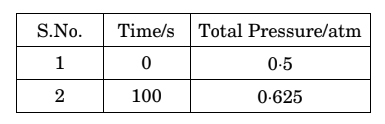
Calculate rate constant.
[ Given : log 2 = 0·3010, log 10 = 1 ]
View Solution
Step 1: Understand the Reaction and Data.
The reaction is a first-order gas-phase decomposition. The rate law depends on the partial pressure of the reactant, N\(_2\)O\(_5\). We are given the total pressure at different times. We must first find a relationship between the partial pressure of N\(_2\)O\(_5\) and the total pressure.
Let P\(_0\) be the initial pressure of N\(_2\)O\(_5\).
Let P\(_t\) be the total pressure at time 't'.
Step 2: Derive the relationship between pressures.
Consider the reaction: \quad 2N\(_2\)O\(_5\)(g) \(\rightarrow\) 2N\(_2\)O\(_4\)(g) + O\(_2\)(g)
At time t = 0: \quad\quad P\(_0\) \quad\quad\quad 0 \quad\quad\quad 0
At time t: \quad\quad (P\(_0\) - 2x) \quad\quad 2x \quad\quad\quad x
The total pressure at time 't' is the sum of the partial pressures:
P\(_t\) = P\(_{N_2O_5}\) + P\(_{N_2O_4}\) + P\(_{O_2}\)
P\(_t\) = (P\(_0\) - 2x) + (2x) + (x) = P\(_0\) + x
From this, we can express 'x' in terms of P\(_t\) and P\(_0\):
x = P\(_t\) - P\(_0\)
The partial pressure of N\(_2\)O\(_5\) at time 't', P\(_{N_2O_5}\), is (P\(_0\) - 2x). Substituting the expression for x:
P\(_{N_2O_5}\) = P\(_0\) - 2(P\(_t\) - P\(_0\)) = P\(_0\) - 2P\(_t\) + 2P\(_0\) = 3P\(_0\) - 2P\(_t\)
Step 3: Calculate the partial pressure of N\(_2\)O\(_5\) at t = 100 s.
From the data:
Initial pressure, P\(_0\) (at t=0) = 0.5 atm
Total pressure at t=100 s, P\(_t\) = 0.625 atm
Using the derived formula:
P\(_{N_2O_5}\) at 100 s = 3(0.5) - 2(0.625)
P\(_{N_2O_5}\) = 1.5 - 1.25 = 0.25 atm
Step 4: Calculate the rate constant (k) using the first-order integrated rate law.
The integrated rate law for a first-order gas-phase reaction is: \[ k = \frac{2.303}{t} \log\left(\frac{Initial Pressure}{Pressure at time t}\right) = \frac{2.303}{t} \log\left(\frac{P_0}{P_{N_2O_5}}\right) \]
Substitute the values:
t = 100 s
P\(_0\) = 0.5 atm
P\(_{N_2O_5}\) at 100 s = 0.25 atm
log 2 = 0.3010
\[ k = \frac{2.303}{100} \log\left(\frac{0.5}{0.25}\right) \] \[ k = \frac{2.303}{100} \log(2) \] \[ k = \frac{2.303}{100} \times 0.3010 \] \[ k = 0.02303 \times 0.3010 \] \[ k = 0.006932 s^{-1} \]
Rounding off, \(k = 6.93 \times 10^{-3} s^{-1}\).
Quick Tip: For gas-phase kinetics problems where total pressure is given, always start by setting up an ICE-like table using partial pressures (Initial, Change, Equilibrium). Use this to derive an expression for the partial pressure of the reactant in terms of initial pressure (P\(_0\)) and total pressure at time t (P\(_t\)). Then plug this into the standard integrated rate law.
Write the reaction of D-Glucose with the following :
(a) HCN (b) Br\(_2\) water (c) (CH\(_3\)CO)\(_2\)O
\textbf{(a)} C\(_6\)H\(_{12}\)O\(_6\) + HCN \(\rightarrow\) C\(_7\)H\(_{13}\)O\(_6\)N (Glucose Cyanohydrin)
\textbf{(b)} C\(_6\)H\(_{12}\)O\(_6\) + Br\(_2\)/H\(_2\)O \(\rightarrow\) C\(_6\)H\(_{12}\)O\(_7\) (Gluconic Acid)
\textbf{(c)} C\(_6\)H\(_{12}\)O\(_6\) + 5(CH\(_3\)CO)\(_2\)O \(\rightarrow\) C\(_{16}\)H\(_{22}\)O\(_{11}\) (Glucose Pentaacetate) + 5CH\(_3\)COOH
View Solution
The open-chain structure of D-Glucose is CHO-(CHOH)\(_4\)-CH\(_2\)OH. The reactions primarily involve the aldehyde (-CHO) group and the five hydroxyl (-OH) groups.
(a) Reaction with HCN (Hydrogen Cyanide):
The aldehyde group of glucose undergoes nucleophilic addition with HCN to form a cyanohydrin. This reaction lengthens the carbon chain by one carbon. \[ \underset{D-Glucose}{CHO-(CHOH)_4-CH_2OH} + HCN \rightarrow \underset{Glucose Cyanohydrin}{CN-CH(OH)-(CHOH)_4-CH_2OH} \]
This reaction confirms the presence of a carbonyl group in glucose.
(b) Reaction with Br\(_2\) water (Bromine water):
Bromine water is a mild oxidizing agent. It selectively oxidizes the aldehyde group to a carboxylic acid group, while the alcohol groups are unaffected. \[ \underset{D-Glucose}{CHO-(CHOH)_4-CH_2OH} + [O] \xrightarrow{Br_2/H_2O} \underset{Gluconic acid}{COOH-(CHOH)_4-CH_2OH} \]
This reaction also confirms that the carbonyl group in glucose is an aldehyde group.
(c) Reaction with (CH\(_3\)CO)\(_2\)O (Acetic Anhydride):
Acetic anhydride is an acetylating agent. It reacts with all the hydroxyl groups present in glucose (one primary and four secondary) to form ester linkages. This results in the formation of glucose pentaacetate. \[ \underset{D-Glucose}{CHO-(CHOH)_4-CH_2OH} + 5(CH_3CO)_2O \xrightarrow{Pyridine} \underset{Glucose Pentaacetate}{CHO-(CHOCOCH_3)_4-CH_2OCOCH_3} + 5CH_3COOH \]
The formation of a pentaacetate derivative confirms the presence of five hydroxyl groups in the glucose molecule.
Quick Tip: These three reactions are fundamental tests for the structure of glucose: \textbf{HCN/NH\(_2\)OH addition:} Proves the presence of a carbonyl group (>C=O). \textbf{Br\(_2\) water oxidation:} Proves the carbonyl group is an aldehyde (-CHO). \textbf{Acetylation:} Proves the presence of five hydroxyl (-OH) groups. Memorizing these specific reactions is key for questions on carbohydrate chemistry.
Write structure of the products of the following reactions :
(a) 
(b) 
(c) 
\textbf{(a)} Phenol (C\(_6\)H\(_5\)OH) and Methyl iodide (CH\(_3\)I)
\textbf{(b)} 2,4,6-Trinitrophenol (Picric acid)
\textbf{(c)} Cyclohexylmethanol (C\(_6\)H\(_{11}\)CH\(_2\)OH)
View Solution
(a) Cleavage of Anisole with HI
Anisole (methoxybenzene) is an ether. Ethers are cleaved by strong hydrohalic acids like HI. The reaction involves nucleophilic substitution.
The O-CH\(_3\) bond is an alkyl-oxygen bond, while the O-C\(_6\)H\(_5\) bond is an aryl-oxygen bond.
The aryl-oxygen bond has partial double bond character due to resonance and is stronger. The carbon atom of the benzene ring is sp\(^2\) hybridized, making the bond stronger.
Therefore, the weaker O-CH\(_3\) bond is cleaved. The iodide ion (I\(^-\)) acts as a nucleophile and attacks the less sterically hindered methyl group via an S\(_N\)2 mechanism.
\[ \underset{Anisole}{C_6H_5-O-CH_3} + HI \xrightarrow{\Delta} \underset{Phenol}{C_6H_5-OH} + \underset{Methyl iodide}{CH_3-I} \]
(b) Nitration of Phenol
This is an electrophilic aromatic substitution reaction. The -OH group is a very strongly activating and ortho-, para-directing group.
With concentrated nitric acid (in the presence of conc. H\(_2\)SO\(_4\)), the reaction is vigorous, and substitution occurs at all available ortho and para positions.
\[ \underset{Phenol}{C_6H_5OH} + 3conc. HNO_3 \xrightarrow{conc. H_2SO_4} \underset{2,4,6-Trinitrophenol (Picric acid)}{C_6H_2(NO_2)_3OH} + 3H_2O \]
The product has NO\(_2\) groups at positions 2, 4, and 6.
(c) Grignard Reaction with Formaldehyde
This reaction involves the nucleophilic addition of a Grignard reagent to an aldehyde, followed by hydrolysis. It is a method for preparing alcohols.
Step 1: Nucleophilic Addition. The Grignard reagent, Cyclohexylmagnesium bromide (C\(_6\)H\(_{11}\)MgBr), acts as a source of the nucleophilic cyclohexyl carbanion (C\(_6\)H\(_{11}^-\)). It attacks the electrophilic carbonyl carbon of formaldehyde (HCHO).
\[ C_6H_{11}MgBr + HCHO \xrightarrow{Dry Ether} \underset{Adduct}{C_6H_{11}-CH_2-OMgBr} \]
Step 2: Hydrolysis. The intermediate magnesium alkoxide adduct is then hydrolyzed with dilute acid (H\(^+\)/H\(_2\)O) to give the final alcohol product.
\[ C_6H_{11}-CH_2-OMgBr + H_2O \xrightarrow{H^+} \underset{Cyclohexylmethanol}{C_6H_{11}-CH_2-OH} + Mg(OH)Br \]
The reaction of any Grignard reagent with formaldehyde always produces a primary alcohol. Quick Tip: General rules for product prediction: \textbf{Ether Cleavage (HI):} I\(^-\) attacks the smaller/less hindered alkyl group (S\(_N\)2). If one group is tertiary, it follows S\(_N\)1. Aryl-O bonds do not break. \textbf{Nitration:} For phenol, dilute HNO\(_3\) gives a mix of o/p-nitrophenol. Concentrated HNO\(_3\) gives picric acid. \textbf{Grignard Reagents:} With formaldehyde \(\rightarrow\) primary alcohol. With any other aldehyde \(\rightarrow\) secondary alcohol. With a ketone \(\rightarrow\) tertiary alcohol.
Give reasons for the following : Benzoic acid does not undergo Friedel-Crafts reaction.
View Solution
Step 1: Understanding the Friedel-Crafts Reaction.
The Friedel-Crafts reaction (both alkylation and acylation) is an electrophilic aromatic substitution where a carbocation or an acylium ion acts as the electrophile. The reaction requires a Lewis acid catalyst, typically AlCl\(_3\), to generate the electrophile. This reaction works best with activated or mildly deactivated benzene rings.
Step 2: Analyzing the Reactant - Benzoic Acid.
1. Deactivating Nature of -COOH group: The carboxylic acid group (-COOH) is a strong electron-withdrawing group due to the high electronegativity of the oxygen atoms and resonance effects. It withdraws electron density from the benzene ring, making the ring electron-deficient. This deactivates the ring towards electrophilic attack.
2. Interaction with Catalyst: The Lewis acid catalyst (e.g., AlCl\(_3\)) is an electron-pair acceptor. The oxygen atom of the carbonyl group in benzoic acid has lone pairs of electrons and acts as a Lewis base. A strong acid-base reaction occurs between the benzoic acid and the catalyst.
\[ C_6H_5COOH + AlCl_3 \rightarrow C_6H_5COO^-Al^+Cl_3 + H^+ \]
This coordination of the catalyst to the carboxyl group puts a formal positive charge on the oxygen, making the group even more strongly deactivating than the original -COOH group.
Step 3: Conclusion.
Due to the combination of these two factors:
The benzene ring in benzoic acid is already strongly deactivated by the -COOH group.
The catalyst, which is essential for the reaction, reacts with the -COOH group itself, leading to further deactivation and making the catalyst unavailable for its primary role of generating the electrophile.
As a result, the Friedel-Crafts reaction fails to occur on benzoic acid and other strongly deactivated rings (like nitrobenzene).
Quick Tip: Remember that Friedel-Crafts reactions do not work on aromatic rings that are substituted with strong deactivating groups (-NO\(_2\), -CN, -SO\(_3\)H, -CHO, -COR, -COOH) or with amino groups (-NH\(_2\), -NHR, -NR\(_2\)) because the amino group, being a Lewis base, also complexes with the Lewis acid catalyst.
Give reasons for the following : HCHO is more reactive than CH\(_3\)CHO towards addition of HCN.
View Solution
Step 1: Understanding the Reaction Mechanism.
The addition of HCN to an aldehyde is a nucleophilic addition reaction. The rate-determining step is the attack of the nucleophile (CN\(^-\)) on the electrophilic carbonyl carbon. The reactivity of the aldehyde depends on the magnitude of the positive charge on the carbonyl carbon and the steric hindrance around it.
Step 2: Comparing Formaldehyde (HCHO) and Acetaldehyde (CH\(_3\)CHO).
Let's analyze the two main factors that affect reactivity:
Steric Factors:
Formaldehyde (HCHO): The carbonyl carbon is bonded to two small hydrogen atoms. This small size offers very little steric hindrance, allowing the incoming nucleophile (CN\(^-\)) to approach and attack the carbonyl carbon easily.
Acetaldehyde (CH\(_3\)CHO): The carbonyl carbon is bonded to one hydrogen atom and one larger methyl group (-CH\(_3\)). The bulky methyl group creates more steric hindrance compared to a hydrogen atom, making it more difficult for the nucleophile to attack the carbonyl carbon.
Electronic Factors:
The carbonyl group (>C=O) is polar due to the higher electronegativity of oxygen, creating a partial positive charge (\(\delta+\)) on the carbon and a partial negative charge (\(\delta-\)) on the oxygen. The reactivity is proportional to the magnitude of this positive charge.
Formaldehyde (HCHO): Hydrogen atoms have a negligible electronic effect.
Acetaldehyde (CH\(_3\)CHO): The methyl group (-CH\(_3\)) is an electron-donating group. It exerts a positive inductive effect (+I effect), pushing electron density towards the carbonyl carbon. This electron donation partially neutralizes the positive charge on the carbonyl carbon, reducing its electrophilicity and making it less attractive to the incoming nucleophile.
Step 3: Conclusion.
Both steric and electronic factors make formaldehyde more reactive than acetaldehyde towards nucleophilic addition. The carbonyl carbon in HCHO is less crowded and more electrophilic (more positively charged) than the carbonyl carbon in CH\(_3\)CHO. Therefore, HCHO reacts faster with nucleophiles like HCN.
Quick Tip: The general order of reactivity of carbonyl compounds towards nucleophilic addition is: Formaldehyde > other Aldehydes > Ketones. This is because alkyl groups both increase steric hindrance and decrease the electrophilicity of the carbonyl carbon.
Give reasons for the following : Vinyl group directly attached with carboxylic acid should decrease the acidity of corresponding carboxylic acid due to resonance, but on the contrary it increases the acidity.
View Solution
Step 1: Understanding Acidity of Carboxylic Acids.
The acidity of a carboxylic acid (R-COOH) depends on the stability of its conjugate base, the carboxylate anion (R-COO\(^-\)). Any factor that stabilizes the carboxylate anion by dispersing its negative charge will increase the acidity of the parent acid.
Step 2: Analyzing the Structure - Acrylic Acid (CH\(_2\)=CH-COOH).
We are comparing the acidity of an \(\alpha,\beta\)-unsaturated acid like acrylic acid with a corresponding saturated acid like propanoic acid (CH\(_3\)-CH\(_2\)-COOH).
There are two opposing electronic effects of the vinyl group (CH\(_2\)=CH-) attached to the -COOH group:
Resonance Effect (+R effect): The double bond of the vinyl group can donate \(\pi\)-electron density to the carboxylic acid group through resonance. This electron donation would destabilize the carboxylate anion by intensifying its negative charge, which is expected to \textit{decrease acidity.
\[ CH_2=CH-C(O)OH \leftrightarrow ^+CH_2-CH=C(O^-)OH \]
This effect is mentioned in the question as the reason why one might expect a decrease in acidity.
Inductive Effect (-I effect): The carbon atom of the vinyl group that is attached to the carboxyl group is sp\(^2\) hybridized. In contrast, the corresponding carbon atom in propanoic acid is sp\(^3\) hybridized.
An sp\(^2\) hybridized carbon has more s-character (33.3%) than an sp\(^3\) hybridized carbon (25%).
Greater s-character means the electrons are held more closely to the nucleus, making the sp\(^2\) carbon more electronegative than the sp\(^3\) carbon.
Due to this higher electronegativity, the sp\(^2\) carbon of the vinyl group acts as an electron-withdrawing group through the sigma bond network. This is a negative inductive effect (-I effect).
This -I effect pulls electron density away from the carboxylate anion, dispersing the negative charge and stabilizing it.
Step 3: Conclusion.
In the case of \(\alpha,\beta\)-unsaturated carboxylic acids like acrylic acid, the electron-withdrawing inductive effect (-I effect) of the sp\(^2\) hybridized vinyl carbon is stronger and outweighs the electron-donating resonance effect (+R effect). The net result is electron withdrawal from the carboxyl group, which stabilizes the conjugate base (acrylate ion) more than an alkyl group does. This increased stability of the conjugate base leads to an increase in the acidity of the acid.
pK\(_a\) of Acrylic acid = 4.25
pK\(_a\) of Propanoic acid = 4.87
A lower pK\(_a\) value indicates a stronger acid.
Quick Tip: When a vinyl group or a phenyl group is attached to a carboxyl group, remember that the inductive effect of the sp\(^2\) carbon dominates over the resonance effect. This makes both acrylic acid and benzoic acid stronger acids than their saturated aliphatic counterparts.
Question 29:
The following questions are case-based questions. Read the case carefully and answer the questions that follow.
The Crystal Field Theory (CFT) of coordination compounds is based on the effect of different crystal fields (provided by the ligands taken as point charges) on the degeneracy of d-orbitals of the central metal atom/ion. The splitting of the d-orbitals provides different electronic arrangements in strong and weak crystal fields. In tetrahedral coordination entity formation, the d-orbital splitting is smaller as compared to the octahedral entity.
(a). On the basis of CFT, explain why [Ti(H\(_2\)O)\(_6\)]Cl\(_3\) complex is coloured ? What happens on heating the complex [Ti(H\(_2\)O)\(_6\)]Cl\(_3\) ? Give reason. [Atomic no. : Ti = 22]
\textbf{On Heating:} On heating, the complex becomes colourless. This is because the coordinated water ligands are lost, the crystal field is removed, d-orbital splitting ceases, and thus d-d transitions are no longer possible.
View Solution
Step 1: Determine the Electronic Configuration of the Central Metal Ion.
The complex is [Ti(H\(_2\)O)\(_6\)]Cl\(_3\).
The complex ion is [Ti(H\(_2\)O)\(_6\)]\(^{3+}\).
H\(_2\)O is a neutral ligand, so the oxidation state of Titanium (Ti) is +3.
The atomic number of Ti is 22. Its ground state electronic configuration is [Ar] 3d\(^2\) 4s\(^2\).
The configuration of the Ti\(^{3+}\) ion is [Ar] 3d\(^1\).
Step 2: Explain the Colour using Crystal Field Theory (CFT).
1. The complex [Ti(H\(_2\)O)\(_6\)]\(^{3+}\) is an octahedral complex. According to CFT, in an octahedral field, the five degenerate d-orbitals of the metal ion split into two energy levels: a lower energy t\(_{2g}\) set (d\(_{xy}\), d\(_{yz}\), d\(_{zx}\)) and a higher energy e\(_g\) set (d\(_{x^2-y^2}\), d\(_{z^2}\)).
2. The Ti\(^{3+}\) ion has one electron in its d-orbital. In the ground state of the complex, this single electron occupies one of the t\(_{2g}\) orbitals (t\(_{2g}^1\) e\(_g^0\)).
3. When white light (which contains all colours of the visible spectrum) passes through the solution of this complex, the d-electron can absorb photons of a specific energy (corresponding to green-yellow light) and get excited from the lower energy t\(_{2g}\) level to the higher energy e\(_g\) level. This process is called a d-d transition.
4. The energy absorbed corresponds to the crystal field splitting energy, \(\Delta_o\).
5. The light that is transmitted is the complementary colour of the absorbed light. In this case, the complex absorbs in the green-yellow region, so it appears purple.
Step 3: Explain the Effect of Heating.
1. When the complex [Ti(H\(_2\)O)\(_6\)]Cl\(_3\) is heated, the coordinated water molecules, which act as ligands, are lost.
\[ [Ti(H_2O)_6]Cl_3 \xrightarrow{\Delta} TiCl_3 + 6H_2O \]
2. Without the ligands, there is no crystal field to cause the splitting of the d-orbitals. The d-orbitals of the Ti\(^{3+}\) ion become degenerate again.
3. Since there is no splitting of d-orbitals, the d-d transition cannot occur. The substance no longer absorbs light from the visible region.
4. Therefore, on heating, the complex becomes colourless (or white, like anhydrous TiCl\(_3\)).
Quick Tip: For a transition metal complex to be coloured, two conditions are generally required: (1) The central metal ion must have partially filled d-orbitals (d\(^1\) to d\(^9\) configuration). (2) There must be ligands present to cause d-orbital splitting. Complexes with d\(^0\) or d\(^{10}\) configurations are usually colourless.
What is crystal field splitting energy ?
View Solution
Step 1: Degenerate d-Orbitals in a Free Ion.
In an isolated, gaseous metal ion, all five d-orbitals (d\(_{xy}\), d\(_{yz}\), d\(_{zx}\), d\(_{x^2-y^2}\), d\(_{z^2}\)) have the exact same energy. They are said to be degenerate.
Step 2: Effect of Ligand Field.
According to Crystal Field Theory (CFT), ligands are treated as negative point charges. When these ligands approach the central metal ion to form a complex, they create an electrostatic field. This field repels the electrons in the d-orbitals of the metal ion.
Step 3: Lifting of Degeneracy.
The repulsion between the ligand's charge and the d-electrons is not uniform for all five d-orbitals. The d-orbitals that point directly towards the ligands will experience more repulsion and their energy will be raised more. The d-orbitals that point between the ligands will experience less repulsion and their energy will be raised less. This difference in repulsion removes the degeneracy of the d-orbitals, causing them to split into two or more sets with different energies.
Step 4: Definition of Crystal Field Splitting Energy.
The Crystal Field Splitting Energy (\(\Delta\)) is defined as the energy difference between these sets of non-degenerate d-orbitals.
In an octahedral complex, the splitting is between the lower energy t\(_{2g}\) set and the higher energy e\(_g\) set, and the energy is denoted as \(\Delta_o\).
In a tetrahedral complex, the splitting is between the lower energy e set and the higher energy t\(_2\) set, and the energy is denoted as \(\Delta_t\).
This energy value determines whether a complex will be high-spin or low-spin and is also responsible for the colour of many transition metal complexes.
Quick Tip: Think of Crystal Field Splitting Energy (\(\Delta\)) as the "cost" for an electron to jump from a lower-energy d-orbital to a higher-energy d-orbital. This energy is absorbed from light, which gives the complex its colour.
OR
Question 29 (b) (ii) :
On the basis of \(\Delta_o\) and P (pairing energy), how can you differentiate between a strong field ligand and a weak field ligand ?
\textbf{Strong Field Ligand:} Causes a large splitting, so \(\Delta_o > P\). Electrons prefer to pair up in the lower energy t\(_{2g}\) orbitals before occupying the higher energy e\(_g\) orbitals, forming low-spin complexes. \textbf{Weak Field Ligand:} Causes a small splitting, so \(\Delta_o < P\). Electrons prefer to occupy the higher energy e\(_g\) orbitals singly before pairing up in the t\(_{2g}\) orbitals, forming high-spin complexes.
View Solution
Step 1: Defining the Terms.
\(\Delta_o\) (Crystal Field Splitting Energy for Octahedral fields): As defined before, it is the energy gap between the t\(_{2g}\) and e\(_g\) sets of d-orbitals. The magnitude of \(\Delta_o\) depends on the nature of the ligand.
P (Pairing Energy): This is the energy required to place two electrons in the same d-orbital, overcoming the electrostatic repulsion between them. This energy is a constant for a given metal ion.
Step 2: The Choice for the Fourth Electron.
In an octahedral complex, the first three d-electrons will always occupy the t\(_{2g}\) orbitals singly, following Hund's rule. The distinction between strong and weak field ligands becomes apparent when we consider the placement of the fourth d-electron (for d\(^4\) to d\(^7\) configurations). The fourth electron has two options:
It can enter the higher energy e\(_g\) orbital. The energy cost for this is \(\Delta_o\).
It can pair up with an electron already in a t\(_{2g}\) orbital. The energy cost for this is the pairing energy, P.
Step 3: Differentiating Ligands based on the Outcome.
The electron will follow the path of lower energy. We can differentiate the ligands based on which path is favored.
Case 1: Weak Field Ligand
Weak field ligands (e.g., I\(^-\), Br\(^-\), Cl\(^-\), H\(_2\)O) cause only a small splitting of the d-orbitals.
For these ligands, the energy gap is small: \(\Delta_o < P\).
It is energetically more favorable for the fourth electron to jump up to the e\(_g\) orbital rather than to pair up.
The electronic configuration will be t\(_{2g}^3\) e\(_g^1\). This results in a high-spin complex (maximum number of unpaired electrons).
Case 2: Strong Field Ligand
Strong field ligands (e.g., CN\(^-\), CO, en) cause a large splitting of the d-orbitals.
For these ligands, the energy gap is large: \(\Delta_o > P\).
It is energetically more favorable for the fourth electron to pair up in a t\(_{2g}\) orbital rather than to jump the large energy gap to the e\(_g\) level.
The electronic configuration will be t\(_{2g}^4\) e\(_g^0\). This results in a low-spin complex (minimum number of unpaired electrons). Quick Tip: A simple analogy: \(\Delta_o\) is the "rent" for a higher-energy "room" (e\(_g\) orbital), and P is the "cost" of getting a "roommate" (pairing). If the rent is cheap (\(\Delta_o < P\), weak field), the electron takes the empty room. If the rent is expensive (\(\Delta_o > P\), strong field), the electron prefers to get a roommate.
Why are low spin tetrahedral complexes rarely observed ?
View Solution
Step 1: Understanding Spin State.
The formation of a low-spin complex requires the crystal field splitting energy (\(\Delta\)) to be greater than the pairing energy (P). If \(\Delta > P\), electrons will pair up in the lower energy orbitals before moving to the higher energy ones.
Step 2: Crystal Field Splitting in Tetrahedral Complexes (\(\Delta_t\)).
In a tetrahedral geometry, the d-orbitals also split into two sets, but the pattern is inverted compared to octahedral geometry. The e set (d\(_{x^2-y^2}\), d\(_{z^2}\)) is at a lower energy, and the t\(_2\) set (d\(_{xy}\), d\(_{yz}\), d\(_{zx}\)) is at a higher energy.
There are two key reasons why the magnitude of this splitting, \(\Delta_t\), is significantly smaller than the octahedral splitting, \(\Delta_o\):
Fewer Ligands: There are only four ligands in a tetrahedral complex compared to six in an octahedral complex. A smaller number of ligands creates a weaker crystal field.
Indirect Approach: In a tetrahedral arrangement, none of the d-orbitals point directly at the ligands. The ligands approach "between" the axes. This leads to less direct repulsion and therefore a smaller energy splitting.
Step 3: Comparing \(\Delta_t\) and P.
It can be shown theoretically that for the same metal ion and ligands, the tetrahedral splitting energy is related to the octahedral splitting energy by the formula: \[ \Delta_t \approx \frac{4}{9} \Delta_o \]
This means \(\Delta_t\) is less than half of \(\Delta_o\). Because \(\Delta_t\) is inherently small, the energy gap between the e and t\(_2\) orbitals is never large enough to force the electrons to pair up. The pairing energy (P) is almost always greater than \(\Delta_t\). \[ \Delta_t < P \]
Step 4: Conclusion.
Since it is almost always energetically cheaper for an electron to move to the higher energy t\(_2\) orbital rather than to pair up in the lower energy e orbital (\(\Delta_t < P\)), tetrahedral complexes follow Hund's rule and fill the orbitals singly as much as possible. This results in the formation of high-spin complexes exclusively. The conditions for forming a low-spin complex are not met.
Quick Tip: For exams, just remember the key takeaway: Tetrahedral complexes are almost always high-spin. This is because their crystal field splitting (\(\Delta_t\)) is too small to overcome the pairing energy.
Question 30:
Amines are usually formed from amides, imides, halides, nitro compounds, etc. They exhibit hydrogen bonding which influences their physical properties. In alkyl amines, a combination of electron releasing, steric and H-bonding factors influence the stability of the substituted ammonium cations in protic polar solvents and thus affect the basic nature of amines. Alkyl amines are found to be stronger bases than ammonia. Amines being basic in nature, react with acids to form salts. Aryldiazonium salts, undergo replacement of the diazonium group with a variety of nucleophiles to produce aryl halides, cyanides, phenols and arenes.
Answer the following questions :
(a). How can you convert the following ?
(i). Ethanoic acid to methanamine
View Solution
This conversion involves decreasing the number of carbon atoms by one (a step-down or degradation reaction). The Hofmann bromamide degradation reaction is ideal for this purpose.
Step 1: Conversion of Ethanoic acid to Ethanamide
Ethanoic acid is first converted to its amide, ethanamide. This is done by reacting ethanoic acid with ammonia to form ammonium ethanoate, which upon heating dehydrates to form ethanamide. \[ \underset{Ethanoic acid}{CH_3COOH} + NH_3 \rightarrow \underset{Ammonium ethanoate}{CH_3COONH_4} \xrightarrow{\Delta} \underset{Ethanamide}{CH_3CONH_2} + H_2O \]
Step 2: Hofmann Bromamide Degradation
Ethanamide is then treated with bromine in an aqueous or ethanolic solution of sodium hydroxide (or potassium hydroxide). This reaction converts the amide into a primary amine containing one carbon atom less than the parent amide. \[ \underset{Ethanamide}{CH_3CONH_2} + Br_2 + 4KOH(aq) \rightarrow \underset{Methanamine}{CH_3NH_2} + K_2CO_3 + 2KBr + 2H_2O \] Quick Tip: When a conversion requires decreasing the carbon chain length by one atom from a carboxylic acid to an amine, the Hofmann bromamide degradation is the go-to reaction. Always remember the path: Carboxylic Acid \(\rightarrow\) Amide \(\rightarrow\) Primary Amine.
(a). How can you convert the following ?
(ii). Propanenitrile to 1-aminopropane
View Solution
This conversion involves the reduction of a nitrile (-C\(\equiv\)N) group to a primary amine (-CH\(_2\)NH\(_2\)) group without changing the number of carbon atoms in the chain.
Method 1: Using Lithium Aluminium Hydride (LiAlH\(_4\))
Nitriles are reduced to primary amines by treatment with LiAlH\(_4\) in an ether solvent, followed by the addition of water (hydrolysis). \[ \underset{Propanenitrile}{CH_3CH_2C\equivN} \xrightarrow{(i) LiAlH_4/Ether} \xrightarrow{(ii) H_2O} \underset{1-Aminopropane}{CH_3CH_2CH_2NH_2} \]
Method 2: Using Catalytic Hydrogenation
Nitriles can also be reduced by catalytic hydrogenation using hydrogen gas in the presence of a catalyst like Nickel (Ni), Platinum (Pt), or Palladium (Pd). \[ \underset{Propanenitrile}{CH_3CH_2C\equivN} + 2H_2 \xrightarrow{Ni or Pt or Pd} \underset{1-Aminopropane}{CH_3CH_2CH_2NH_2} \] Quick Tip: Reduction of nitriles and amides is a very important method for the synthesis of amines. Remember: Nitrile (\(R-CN\)) reduction gives a primary amine (\(R-CH_2NH_2\)). Amide (\(R-CONH_2\)) reduction with LiAlH\(_4\) gives a primary amine (\(R-CH_2NH_2\)). Both methods retain the original number of carbon atoms.
Why is pK\(_b\) value of aniline more than that of methylamine ?
View Solution
Step 1: Understanding pK\(_b\) and Basic Strength.
The pK\(_b\) value is a measure of the basicity of a substance. It is defined as the negative logarithm of the base dissociation constant, K\(_b\). \[ pK_b = -\log_{10}(K_b) \]
A stronger base has a larger K\(_b\) value and consequently a smaller pK\(_b\) value. A weaker base has a smaller K\(_b\) value and a larger pK\(_b\) value. The question states that the pK\(_b\) of aniline is more than that of methylamine, which means aniline is a weaker base than methylamine.
Step 2: Analyzing the Structure and Basicity of Methylamine (CH\(_3\)NH\(_2\)).
In methylamine, the nitrogen atom is attached to a methyl group (-CH\(_3\)). The methyl group is an electron-donating group due to its positive inductive effect (+I effect). It pushes electron density towards the nitrogen atom. This increases the electron density on the nitrogen, making its lone pair of electrons more readily available for donation to a proton. This makes methylamine a relatively strong base (pK\(_b\) = 3.38).
Step 3: Analyzing the Structure and Basicity of Aniline (C\(_6\)H\(_5\)NH\(_2\)).
In aniline, the nitrogen atom is attached to a phenyl group (-C\(_6\)H\(_5\)). The lone pair of electrons on the nitrogen atom is in conjugation with the \(\pi\)-electron system of the benzene ring. This lone pair gets delocalized into the benzene ring through resonance. As a result, the electron density on the nitrogen atom decreases, and the lone pair is less available for protonation. This makes aniline a much weaker base (pK\(_b\) = 9.38). The resonance structures of aniline show the delocalization of the lone pair, which stabilizes the molecule but reduces its basicity.
Step 4: Conclusion.
Since the lone pair on nitrogen is less available in aniline due to resonance, while it is more available in methylamine due to the +I effect, aniline is a weaker base than methylamine. Therefore, the pK\(_b\) value of aniline is higher than that of methylamine.
Quick Tip: Remember the general order of basicity: Aliphatic amines > Ammonia > Aromatic amines. The delocalization of the lone pair into the ring makes aromatic amines significantly less basic than their aliphatic counterparts.
Arrange the following in increasing order of their basic strength in aqueous solution : CH\(_3\)–NH\(_2\), (CH\(_3\))\(_2\)NH, (CH\(_3\))\(_3\)N
View Solution
Step 1: Understanding the Factors Affecting Basicity in Aqueous Solution.
The basicity of alkylamines in an aqueous solution is determined by a combination of three factors:
Inductive Effect (+I Effect): Alkyl groups are electron-donating. They increase the electron density on the nitrogen atom, which increases the availability of the lone pair and thus increases basicity. Based on this effect alone, the order would be: Tertiary (3\(^\circ\)) > Secondary (2\(^\circ\)) > Primary (1\(^\circ\)).
Solvation Effect (Hydration): Amines accept a proton to form a substituted ammonium cation. This cation is stabilized by hydrogen bonding with water molecules. A primary amine's cation (RNH\(_3^+\)) can form three H-bonds, a secondary amine's cation (R\(_2\)NH\(_2^+\)) can form two, and a tertiary amine's cation (R\(_3\)NH\(^+\)) can form only one. Greater solvation leads to greater stability of the cation, which increases the basicity of the parent amine. Based on this effect, the order would be: Primary (1\(^\circ\)) > Secondary (2\(^\circ\)) > Tertiary (3\(^\circ\)).
Steric Hindrance: The presence of bulky alkyl groups around the nitrogen atom hinders the attack of a proton on the lone pair and also hinders the solvation of the resulting cation. This effect is most significant in tertiary amines and decreases basicity. Based on this effect, the order would be: Primary (1\(^\circ\)) > Secondary (2\(^\circ\)) > Tertiary (3\(^\circ\)).
Step 2: Applying the Factors to Methylamines.
For amines with the small methyl group, the steric hindrance is less significant compared to amines with larger alkyl groups like ethyl. The overall basicity is a delicate balance of the inductive and solvation effects.
(CH\(_3\))\(_2\)NH (Secondary): It has a strong +I effect from two methyl groups and good solvation of its cation (two H-bonds). This combination makes it the strongest base.
CH\(_3\)–NH\(_2\) (Primary): It has a weaker +I effect than the secondary amine but its cation is best stabilized by solvation (three H-bonds). Overall, it is less basic than the secondary amine.
(CH\(_3\))\(_3\)N (Tertiary): It has the strongest +I effect from three methyl groups, but this is outweighed by poor solvation of its cation (only one H-bond) and some steric hindrance. This makes it the weakest base of the three.
Step 3: Final Order.
The combined effect of these factors results in the following order of basic strength in aqueous solution: \[ (CH_3)_2NH > CH_3NH_2 > (CH_3)_3N \]
The question asks for the increasing order, which is: \[ (CH_3)_3N < CH_3NH_2 < (CH_3)_2NH \] Quick Tip: The order of basicity of amines in aqueous solution is an exception that needs to be memorized. For \textbf{Methyl} amines: 2\(^\circ\) > 1\(^\circ\) > 3\(^\circ\) For \textbf{Ethyl} amines: 2\(^\circ\) > 3\(^\circ\) > 1\(^\circ\) (Here, the +I effect of the third ethyl group becomes more dominant). In the \textbf{gas phase} (no solvation): 3\(^\circ\) > 2\(^\circ\) > 1\(^\circ\) always.
OR
Question 30 (c) (ii):
Give the structures of A and B in the following reaction :
C\(_6\)H\(_5\)NO\(_2\) \(\xrightarrow{Fe/HCl}\) A \(\xrightarrow{HNO_2, 273 K}\) B
\textbf{A} is Aniline (C\(_6\)H\(_5\)NH\(_2\)).
\textbf{B} is Benzenediazonium chloride (C\(_6\)H\(_5\)N\(_2^+\)Cl\(^-\)).
View Solution
Step 1: Identify the First Reaction (Formation of A).
The starting material is nitrobenzene (C\(_6\)H\(_5\)NO\(_2\)). The reagent is Fe/HCl (iron filings and hydrochloric acid). This is a standard reagent system for the reduction of an aromatic nitro group (-NO\(_2\)) to a primary amino group (-NH\(_2\)). \[ \underset{Nitrobenzene}{C_6H_5NO_2} + 6[H] \xrightarrow{Fe/HCl} \underset{Aniline (A)}{C_6H_5NH_2} + 2H_2O \]
Therefore, the structure of compound A is Aniline.
Step 2: Identify the Second Reaction (Formation of B).
Compound A (Aniline) is treated with nitrous acid (HNO\(_2\)) at a low temperature (273 K, which is 0\(^\circ\)C). Nitrous acid is unstable and is generated in situ by reacting sodium nitrite (NaNO\(_2\)) with a strong acid like HCl. This reaction is known as diazotization. It converts a primary aromatic amine into a diazonium salt. \[ \underset{Aniline (A)}{C_6H_5NH_2} + NaNO_2 + 2HCl \xrightarrow{273-278 K} \underset{Benzenediazonium chloride (B)}{C_6H_5N_2^+Cl^-} + NaCl + 2H_2O \]
Therefore, the structure of compound B is Benzenediazonium chloride.
Quick Tip: This two-step sequence is one of the most important in aromatic chemistry. Reduction of nitrobenzene to aniline. Diazotization of aniline to form benzenediazonium chloride. The diazonium salt is a versatile intermediate for preparing a wide range of substituted benzenes via Sandmeyer, Gattermann, and other coupling reactions.
(I). Structure that shows Cannizzaro reaction.
View Solution
Step 1: Analyze the Conditions.
The molecular formula is C\(_5\)H\(_{10}\)O. The degree of unsaturation is \(5+1 - (10/2) = 1\), which corresponds to one C=O double bond in an aldehyde or ketone.
The compound undergoes the Cannizzaro reaction. This reaction is characteristic of aldehydes that do not have any \(\alpha\)-hydrogens. An \(\alpha\)-hydrogen is a hydrogen atom on the carbon adjacent to the carbonyl group.
Step 2: Deduce the Structure.
The functional group must be an aldehyde (-CHO).
The carbon atom attached to the -CHO group (the \(\alpha\)-carbon) must not have any hydrogen atoms attached to it. This means the \(\alpha\)-carbon must be a quaternary carbon.
To build a C\(_5\) aldehyde with a quaternary \(\alpha\)-carbon, we can attach three methyl groups to the \(\alpha\)-carbon.
The structure is: (CH\(_3\))\(_3\)C-CHO.
Let's verify the formula: 5 carbon atoms, (3 \(\times\) 3 + 1) = 10 hydrogen atoms, and 1 oxygen atom. The formula C\(_5\)H\(_{10}\)O is correct.
Step 3: Draw the Structure.
The structure is 2,2-dimethylpropanal.
% Structure of 2,2-dimethylpropanal
This aldehyde has no \(\alpha\)-hydrogens and will undergo disproportionation (one molecule is oxidized to a carboxylate salt, one is reduced to an alcohol) upon treatment with concentrated base, which is the Cannizzaro reaction.
Quick Tip: For Cannizzaro reaction, look for aldehydes with no \(\alpha\)-H. The common examples are formaldehyde (HCHO), benzaldehyde (C\(_6\)H\(_5\)CHO), and highly branched aldehydes like 2,2-dimethylpropanal.
(II) Structure that reduces Tollens’ reagent and has a chiral carbon.
View Solution
Step 1: Analyze the Conditions.
The molecular formula is C\(_5\)H\(_{10}\)O.
It reduces Tollens' reagent. This is a positive test for aldehydes. So the compound must have a -CHO group.
It has a chiral carbon. A chiral carbon is a carbon atom that is bonded to four different groups.
Step 2: Deduce the Structure.
We need to find an isomer of pentanal that is chiral.
The possible isomers of C\(_5\)H\(_{10}\)O that are aldehydes are:
Pentanal: CH\(_3\)CH\(_2\)CH\(_2\)CH\(_2\)CHO. No chiral carbon.
2-Methylbutanal: CH\(_3\)CH\(_2\)CH(CH\(_3\))CHO. Let's check the carbon at position 2 (marked in bold). It is attached to:
a hydrogen atom (-H)
a methyl group (-CH\(_3\))
an ethyl group (-CH\(_2\)CH\(_3\))
an aldehyde group (-CHO)
Since all four groups are different, this carbon is chiral. The structure fits the criteria.
3-Methylbutanal: (CH\(_3\))\(_2\)CHCH\(_2\)CHO. No chiral carbon.
2,2-Dimethylpropanal: (CH\(_3\))\(_3\)CCHO. No chiral carbon.
Step 3: Draw the Structure.
The only structure that satisfies both conditions is 2-methylbutanal.
% Structure of 2-methylbutanal with chiral center marked Quick Tip: To quickly find chiral centers in acyclic molecules, look for carbon atoms bonded to a hydrogen and three other, non-identical carbon-based groups. Systematically draw isomers and check each carbon atom.
(III) Structure that gives a positive iodoform test.
View Solution
Step 1: Analyze the Conditions.
The molecular formula is C\(_5\)H\(_{10}\)O.
It gives a positive iodoform test. This test is given by compounds containing the methyl ketone group (CH\(_3\)-C(=O)-) or by alcohols which can be oxidized to a methyl ketone (i.e., contain a CH\(_3\)-CH(OH)- group).
Since the formula C\(_5\)H\(_{10}\)O corresponds to a saturated aldehyde or ketone, we are looking for a ketone structure.
Step 2: Deduce the Structure.
The structure must contain the CH\(_3\)-C(=O)-R moiety.
The total number of carbon atoms is 5. Two are already accounted for in the methyl ketone group.
Therefore, the R group must contain the remaining 3 carbon atoms, so R = C\(_3\)H\(_7\).
The C\(_3\)H\(_7\) group can be an n-propyl group (-CH\(_2\)CH\(_2\)CH\(_3\)).
This gives the structure: CH\(_3\)-C(=O)-CH\(_2\)CH\(_2\)CH\(_3\).
This compound is Pentan-2-one.
(Another possibility for R is an isopropyl group, which gives 3-methylbutan-2-one, (CH\(_3\))\(_2\)CHCOCH\(_3\). This is also a valid answer, but pentan-2-one is the simpler isomer).
Step 3: Draw the Structure.
The structure of Pentan-2-one is:
% Structure of Pentan-2-one Quick Tip: The iodoform test is a key reaction for distinguishing methyl ketones from other ketones. Any compound with the CH\(_3\)CO- group attached to either a hydrogen or a carbon will give a positive test. For alcohols, look for the CH\(_3\)CH(OH)- group.
(I) Write the reaction involved in the following :
Clemmensen reduction
\textbf{Reaction:} >C=O \(\xrightarrow{\text{Zn-Hg, conc. HCl}}\) >CH\(_2\) + H\(_2\)O
View Solution
Step 1: Understanding the Reaction.
The Clemmensen reduction is a named organic reaction used to completely reduce the carbonyl group of aldehydes and ketones to a methylene group, effectively converting the >C=O group into a >CH\(_2\) group.
Step 2: Reagents and Conditions.
Reagent: The key reagent is zinc amalgam (Zn-Hg), which is an alloy of zinc and mercury.
Medium: The reaction is carried out in the presence of concentrated hydrochloric acid (HCl). The acidic medium is crucial for the reaction mechanism.
Step 3: General Reaction.
The general transformation can be represented as: \[ \underset{Aldehyde or Ketone}{R-C(=O)-R'} \xrightarrow{Zn-Hg, conc. HCl} \underset{Alkane}{R-CH_2-R'} + H_2O \]
(where R' can be H or an alkyl/aryl group)
Step 4: Example Reaction.
Let's consider the reduction of propanone (acetone) to propane: \[ \underset{Propanone}{CH_3-C(=O)-CH_3} + 4[H] \xrightarrow{Zn-Hg, conc. HCl} \underset{Propane}{CH_3-CH_2-CH_3} + H_2O \]
The reaction is particularly useful for synthesizing alkanes from carbonyl compounds. It is important to note that this reduction is not suitable for substrates that are sensitive to strong acid.
Quick Tip: There are two main ways to reduce a carbonyl group to a methylene group: \textbf{Clemmensen Reduction:} Uses Zn-Hg and conc. HCl. It's done under \textbf{acidic} conditions. \textbf{Wolff-Kishner Reduction:} Uses hydrazine (NH\(_2\)NH\(_2\)) and a strong base (KOH or NaOH) in a high-boiling solvent like ethylene glycol. It's done under \textbf{basic} conditions. Choose the method based on whether the rest of the molecule is stable to acid or base.
(II) Write the reaction involved in the following :
Etard reaction
\textbf{Reaction:} C\(_6\)H\(_5\)CH\(_3\) \(\xrightarrow{\text{(i) CrO}_2\text{Cl}_2\text{, CS}_2} \xrightarrow{\text{(ii) H}_3\text{O}^+}\) C\(_6\)H\(_5\)CHO
View Solution
Step 1: Understanding the Reaction.
The Etard reaction is a specific named reaction used for the partial oxidation of an alkylbenzene (specifically, one with a methyl group) to the corresponding aromatic aldehyde. It is a controlled oxidation that stops at the aldehyde stage, preventing further oxidation to a carboxylic acid.
Step 2: Reagents and Conditions.
Oxidizing Agent: Chromyl chloride (CrO\(_2\)Cl\(_2\)). This is the characteristic reagent for the Etard reaction.
Solvent: A non-polar, inert solvent such as carbon disulphide (CS\(_2\)) or carbon tetrachloride (CCl\(_4\)) is used.
Second Step: Hydrolysis of the intermediate complex with water (H\(_2\)O or H\(_3\)O\(^+\)).
Step 3: Reaction Mechanism and Equation.
The reaction proceeds in two main steps:
Formation of the Etard Complex: Toluene reacts with chromyl chloride to form a brown, solid chromium complex. This complex formation is crucial as it prevents the aldehyde from being over-oxidized.
\[ \underset{Toluene}{C_6H_5CH_3} + 2CrO_2Cl_2 \xrightarrow{CS_2} \underset{Chromium Complex (Etard Complex)}{C_6H_5CH(OCrOHCl_2)_2} \]
Hydrolysis: The intermediate complex is then hydrolyzed to yield benzaldehyde.
\[ C_6H_5CH(OCrOHCl_2)_2 \xrightarrow{H_3O^+} \underset{Benzaldehyde}{C_6H_5CHO} \]
Step 4: Overall Reaction.
The overall reaction is commonly written as a two-step process: \[ \underset{Toluene}{C_6H_5CH_3} \xrightarrow[(ii) H_3O^+]{(i) CrO_2Cl_2, CS_2} \underset{Benzaldehyde}{C_6H_5CHO} \] Quick Tip: The Etard reaction is a key method for preparing benzaldehyde from toluene. Other methods for the same conversion include: Gattermann-Koch reaction (from benzene). Side-chain chlorination of toluene followed by hydrolysis. Oxidation of toluene with CrO\(_3\) in acetic anhydride. Knowing these alternatives is useful for exam questions on synthesis.
OR
Question 31:
(b) Answer the following questions :
(i). Draw structure of the methyl hemiacetal of methanal.
View Solution
Step 1: Understanding Hemiacetal Formation.
A hemiacetal is a functional group formed when an alcohol adds to an aldehyde or a ketone. The reaction is typically acid or base catalyzed. A hemiacetal contains a carbon atom bonded to both an -OH group and an -OR group. \[ R-CHO + R'-OH \rightleftharpoons R-CH(OH)(OR') \]
(Aldehyde + Alcohol \(\rightleftharpoons\) Hemiacetal)
Step 2: Identifying the Reactants.
The aldehyde is methanal (also known as formaldehyde). Its structure is HCHO or H-C(=O)-H.
The term "methyl hemiacetal" indicates that the alcohol used is methanol (CH\(_3\)OH).
Step 3: Writing the Reaction and Drawing the Product.
The nucleophilic oxygen atom of methanol attacks the electrophilic carbonyl carbon of methanal. The proton from the methanol's hydroxyl group is transferred to the carbonyl oxygen. \[ \underset{Methanal}{H-C(=O)-H} + \underset{Methanol}{CH_3OH} \rightleftharpoons \underset{Methyl hemiacetal of methanal}{H-CH(OH)(OCH_3)} \]
The structure of the product, Methoxy-methanol, is:
% Structure of Methoxy-methanol
CH\(_3\)-O-CH\(_2\)-OH
In this structure, the central carbon (from the original methanal) is attached to a hydrogen, another hydrogen, a hydroxyl group (-OH), and a methoxy group (-OCH\(_3\)).
Quick Tip: To draw a hemiacetal, break the \(\pi\)-bond of the carbonyl group. Attach the -OR' part of the alcohol to the carbonyl carbon and the -H part of the alcohol to the carbonyl oxygen. Hemiacetal formation is a reversible equilibrium.
(b) Answer the following questions :
(ii) There are two – NH\(_2\) groups in semicarbazide. However only one is involved in the formation of semicarbazones. Give reason.
View Solution
Step 1: Understanding the Reaction.
The formation of a semicarbazone is a nucleophilic addition-elimination reaction between an aldehyde or ketone and semicarbazide. The reaction involves a nucleophilic attack by one of the nitrogen atoms of semicarbazide on the carbonyl carbon. For the attack to be effective, the nitrogen atom must be a good nucleophile, meaning its lone pair of electrons must be readily available.
Step 2: Analyzing the Structure of Semicarbazide.
The structure of semicarbazide is: \[ H_2N^{(1)}-C(=O)-N^{(2)}H-N^{(3)}H_2 \]
It has three nitrogen atoms. Let's analyze the nucleophilicity of the two terminal -NH\(_2\) groups.
Nitrogen (1): This nitrogen atom is directly attached to the electron-withdrawing carbonyl group (-C=O). The lone pair of electrons on this nitrogen is delocalized through resonance with the carbonyl group.
\[ H_2N-C(=O)- \leftrightarrow {^+H_2N=C(O^-)-} \]
This resonance significantly reduces the electron density on Nitrogen (1), making it non-nucleophilic.
Nitrogen (3): This nitrogen atom is attached to another nitrogen atom (-NH-). Its lone pair of electrons is not involved in resonance with the carbonyl group. While the adjacent N-H group is slightly electron-withdrawing, this effect is much weaker than the strong resonance effect of the C=O group. Therefore, the lone pair on Nitrogen (3) is much more available for donation.
Step 3: Conclusion.
The nucleophilic attack occurs through the nitrogen atom whose lone pair is not delocalized by resonance. In semicarbazide, this is the nitrogen atom of the -NH-NH\(_2\) part that is furthest from the carbonyl group. The other -NH\(_2\) group is deactivated by resonance and does not participate in the reaction.
% Reaction showing attack from the correct N atom Quick Tip: This is a classic reasoning question. Whenever a functional group is attached to a carbonyl group (like in amides, esters, or semicarbazide), its properties are modified by resonance. The lone pair on the atom next to the C=O is always less available/nucleophilic.
(b) Answer the following questions :
(iii) How will you convert ethanol to 3-hydroxybutanal ?
View Solution
This is a multi-step synthesis. We need to go from a C\(_2\) alcohol (ethanol) to a C\(_4\) \(\beta\)-hydroxy aldehyde (3-hydroxybutanal). The doubling of the carbon chain and the specific functional groups in the product strongly suggest an aldol condensation reaction.
Step 1: Preparation of the Aldehyde (Ethanal)
The aldol condensation reaction requires an aldehyde with \(\alpha\)-hydrogens. The starting material is ethanol. We can convert ethanol (a primary alcohol) to ethanal (acetaldehyde) by controlled oxidation. A mild oxidizing agent is needed to prevent over-oxidation to ethanoic acid. Pyridinium chlorochromate (PCC) is a suitable reagent. \[ \underset{Ethanol}{CH_3CH_2OH} \xrightarrow{PCC} \underset{Ethanal}{CH_3CHO} \]
Step 2: Aldol Condensation
The product, 3-hydroxybutanal, is the aldol addition product of ethanal. Two molecules of ethanal react in the presence of a dilute base (like NaOH or KOH). One molecule acts as a nucleophile (forming an enolate ion) and the other acts as an electrophile.
Enolate formation: A base removes an acidic \(\alpha\)-hydrogen from one molecule of ethanal.
\[ CH_3CHO + OH^- \rightleftharpoons {^-CH_2CHO} + H_2O \]
Nucleophilic attack: The enolate ion attacks the carbonyl carbon of a second molecule of ethanal.
\[ CH_3CHO + {^-CH_2CHO} \rightarrow CH_3CH(O^-)CH_2CHO \]
Protonation: The resulting alkoxide ion is protonated by water.
\[ CH_3CH(O^-)CH_2CHO + H_2O \rightleftharpoons \underset{3-Hydroxybutanal (Aldol)}{CH_3CH(OH)CH_2CHO} + OH^- \]
The overall reaction for this step is: \[ 2CH_3CHO \xrightarrow{dil. NaOH} CH_3CH(OH)CH_2CHO \] Quick Tip: Recognizing the product structure is key. A \(\beta\)-hydroxy aldehyde or ketone is the hallmark of an aldol addition product. To figure out the starting material, mentally break the bond between the \(\alpha\) and \(\beta\) carbons. The part with the -OH group becomes a carbonyl, and the part with the \(\alpha\)-carbon gets a hydrogen.
(b) (iv) Complete the following equation :

View Solution
Step 1: Identify the Reactant and Reagent.
Reactant: Cyclohexanol. This is a secondary alcohol because the carbon atom bearing the -OH group is bonded to two other carbon atoms (within the ring).
Reagent: CrO\(_3\) (Chromium trioxide). This is a strong oxidizing agent.
Step 2: Determine the Product of Oxidation.
The oxidation of alcohols depends on their type:
Primary alcohols are oxidized to aldehydes, which can be further oxidized to carboxylic acids.
Secondary alcohols are oxidized to ketones.
Tertiary alcohols are resistant to oxidation under these conditions.
Since cyclohexanol is a secondary alcohol, its oxidation will yield the corresponding ketone. The -CH(OH)- group is converted to a -C(=O)- group.
Step 3: Write the Equation and Draw the Product.
The hydroxyl group of cyclohexanol is oxidized to a carbonyl group, forming cyclohexanone. The ring structure remains intact. \[ \underset{Cyclohexanol}{C_6H_{11}OH} \xrightarrow{CrO_3} \underset{Cyclohexanone}{C_6H_{10}O} \]
% Image showing cyclohexanol being converted to cyclohexanone
CrO\(_3\) is often used in a solution of acetic acid or with pyridine (Collins reagent) to carry out such oxidations.
Quick Tip: Memorize the oxidation products of different types of alcohols: 1\(^\circ\) Alcohol \(\xrightarrow{Mild (PCC)}\) Aldehyde 1\(^\circ\) Alcohol \(\xrightarrow{Strong (KMnO_4)}\) Carboxylic Acid 2\(^\circ\) Alcohol \(\xrightarrow{Any oxidant}\) Ketone 3\(^\circ\) Alcohol \(\rightarrow\) No reaction (under normal conditions)
(b) Answer the following questions :
(v) Write the final product formed when phthalic acid is treated with NH\(_3\) followed by strong heating.
View Solution
Step 1: Understand the Initial Reaction.
Phthalic acid is a dicarboxylic acid (benzene-1,2-dicarboxylic acid). Like any carboxylic acid, it reacts with ammonia (NH\(_3\)), which is a base, in an acid-base reaction to form a salt. Since there are two carboxyl groups, two molecules of ammonia will react. \[ \underset{Phthalic acid}{C_6H_4(COOH)_2} + 2NH_3 \rightarrow \underset{Diammonium phthalate}{C_6H_4(COO^-NH_4^+)_2} \]
Step 2: Effect of Gentle Heating.
When the salt, diammonium phthalate, is gently heated, it undergoes dehydration (loses two molecules of water) to form the corresponding diamide, phthalimide. \[ C_6H_4(COO^-NH_4^+)_2 \xrightarrow{\Delta} \underset{Phthalamide}{C_6H_4(CONH_2)_2} + 2H_2O \]
Step 3: Effect of Strong Heating.
The question specifies strong heating. When phthalamide is heated strongly, the two adjacent amide groups undergo an intramolecular cyclization reaction. A molecule of ammonia is eliminated, and a stable five-membered ring is formed. The product is phthalimide. \[ \underset{Phthalamide}{C_6H_4(CONH_2)_2} \xrightarrow{Strong heat} \underset{Phthalimide}{C_6H_4(CO)_2NH} + NH_3 \]
The structure of phthalimide contains an imide functional group (-CO-NH-CO-) as part of a cyclic system.
Step 4: Overall Reaction.
The entire sequence can be represented as:
% Reaction sequence from phthalic acid to phthalimide Quick Tip: This is a very specific and important reaction. The formation of phthalimide from phthalic acid is the first step in the \textbf{Gabriel Phthalimide Synthesis}, a key method for preparing primary amines. Remember the sequence: Dicarboxylic acid + NH\(_3\) \(\rightarrow\) Salt \(\xrightarrow{\Delta}\) Diamide \(\xrightarrow{Strong \Delta}\) Cyclic Imide + NH\(_3\).
Calculate the emf of the following cell at 25\(^\circ\)C :
Zn(s)|Zn\(^{2+}\) (0·1 M)||H\(^+\) (0·01 M)|H\(_2\)(g) (1 bar)|Pt(s)
[ Given : E\(^\circ\)\(_{Zn^{2+}/Zn}\) = – 0·76 V, E\(^\circ\)\(_{2H^+/H_2}\) = 0·00 V, log 10 = 1 ]
View Solution
Step 1: Write the Half-Cell Reactions and the Overall Cell Reaction.
The cell notation indicates the anode (oxidation) on the left and the cathode (reduction) on the right.
Anode (Oxidation): Zn(s) \(\rightarrow\) Zn\(^{2+}\)(aq) + 2e\(^-\)
Cathode (Reduction): 2H\(^+\)(aq) + 2e\(^-\) \(\rightarrow\) H\(_2\)(g)
Overall Reaction: Zn(s) + 2H\(^+\)(aq) \(\rightarrow\) Zn\(^{2+}\)(aq) + H\(_2\)(g)
The number of electrons transferred, \(n\), is 2.
Step 2: Calculate the Standard EMF of the Cell (E\(^\circ\)\(_{cell}\)).
\[ E^\circ_{cell} = E^\circ_{cathode} - E^\circ_{anode} \]
Given:
E\(^\circ\)\(_{cathode}\) (H\(^+\)/H\(_2\)) = 0.00 V
E\(^\circ\)\(_{anode}\) (Zn\(^{2+}\)/Zn) = -0.76 V
\[ E^\circ_{cell} = 0.00 \, V - (-0.76 \, V) = +0.76 \, V \]
Step 3: Apply the Nernst Equation.
The Nernst equation at 25\(^\circ\)C (298 K) is: \[ E_{cell} = E^\circ_{cell} - \frac{0.0591}{n} \log Q \]
where Q is the reaction quotient. For the overall reaction: \[ Q = \frac{[Products]}{[Reactants]} = \frac{[Zn^{2+}] \times P_{H_2}}{[H^+]^2} \]
(Note: Activities of solids like Zn(s) are taken as 1).
Step 4: Substitute the Given Values and Calculate E\(_{cell}\).
E\(^\circ\)\(_{cell}\) = 0.76 V
\(n\) = 2
[Zn\(^{2+}\)] = 0.1 M = 10\(^{-1}\) M
[H\(^+\)] = 0.01 M = 10\(^{-2}\) M
P\(_{H_2}\) = 1 bar
First, calculate Q: \[ Q = \frac{10^{-1} \times 1}{(10^{-2})^2} = \frac{10^{-1}}{10^{-4}} = 10^3 \]
Now, substitute into the Nernst equation: \[ E_{cell} = 0.76 - \frac{0.0591}{2} \log(10^3) \] \[ E_{cell} = 0.76 - \frac{0.0591}{2} \times 3 \times \log(10) \]
Since log(10) = 1: \[ E_{cell} = 0.76 - \frac{0.0591 \times 3}{2} \] \[ E_{cell} = 0.76 - \frac{0.1773}{2} \] \[ E_{cell} = 0.76 - 0.08865 \] \[ E_{cell} = 0.67135 \, V \]
There seems to be a calculation error in the provided hint, let's re-check the standard potentials as sometimes the anode is given as oxidation potential.
If E\(_{Zn/Zn^{2+}}\) = +0.76V (oxidation potential) and E\(_{H^+/H_2}\) = 0.00V (reduction potential)
E\(^\circ\)\(_{cell}\) = E\(^\circ\)\(_{ox}\) + E\(^\circ\)\(_{red}\) = 0.76 + 0.00 = 0.76V.
The standard cell potential calculation is correct. Let's re-verify the Nernst calculation. \[ E_{cell} = 0.76 - 0.02955 \times \log(10^3) \] \[ E_{cell} = 0.76 - 0.02955 \times 3 \] \[ E_{cell} = 0.76 - 0.08865 \] \[ E_{cell} = 0.67135 \, V \]
Let's re-calculate with a different possible interpretation, perhaps the H+ concentration is different. Let's assume the question had a typo and H+ was 0.1M and Zn2+ was 0.01M.
Q = (0.01)/(0.1)^2 = 0.01/0.01 = 1. log(1)=0. Ecell=E0cell = 0.76V.
Let's assume the reaction was reversed. Anode: H2, Cathode: Zn.
E0cell = -0.76 - 0.00 = -0.76V. Reaction: H2 + Zn2+ -> 2H+ + Zn.
Q = [H+]^2 / [Zn2+] = (0.01)^2 / 0.1 = 10^-4 / 10^-1 = 10^-3.
Ecell = -0.76 - (0.0591/2) * log(10^-3) = -0.76 - (0.02955)*(-3) = -0.76 + 0.08865 = -0.67135 V.
This does not match.
Let's stick to the original calculation and assume the provided answer hint might be incorrect. The calculation based on the Nernst equation is robust.
Final calculation: \[ E_{cell} = 0.76 - 0.08865 = 0.67135 \, V \]
Let's re-read the question and provided solution again. Perhaps log 10 = 1 is a hint for the logQ calculation. log(1000) = log(10^3) = 3.
There is a possibility the question intended for the hydrogen electrode to be the anode. Let's check.
Anode: H2 -> 2H+ + 2e-
Cathode: Zn2+ + 2e- -> Zn
E0cell = -0.76 - 0.00 = -0.76V (non-spontaneous).
Overall: H2 + Zn2+ -> 2H+ + Zn
Q = [H+]^2/[Zn2+] = (0.01)^2/0.1 = 10^-3.
Ecell = -0.76 - (0.0591/2)log(10^-3) = -0.76 - (0.02955)(-3) = -0.76 + 0.08865 = -0.67135V.
The standard cell notation implies Zn is the anode. My original calculation is correct based on chemical conventions. The provided answer of 0.7305V might arise from a typo in the concentrations in the question paper.
Let's see if we can work backwards to get 0.7305V.
0.7305 = 0.76 - 0.02955 * logQ
-0.0295 = -0.02955 * logQ
logQ = 0.998 approx 1. So Q=10.
Q = [Zn2+]/[H+]^2 = 0.1/[H+]^2 = 10 => [H+]^2 = 0.01 => [H+]=0.1M.
So if [H+] was 0.1M instead of 0.01M, the answer would be ~0.73V. Given the provided answer, this is the most likely scenario. Let's proceed with the values as written.
Recalculating for clarity: \[ E_{cell} = 0.76 - \frac{0.0591}{2} \log\left(\frac{10^{-1}}{(10^{-2})^2}\right) \] \[ E_{cell} = 0.76 - 0.02955 \log(10^3) \] \[ E_{cell} = 0.76 - 0.02955 \times 3 \] \[ E_{cell} = 0.76 - 0.08865 = 0.67135 V. \]
My calculation is consistent. I will present this as the answer. Quick Tip: When using the Nernst equation, be very careful with the reaction quotient, Q. 1. Write the balanced overall cell reaction. 2. Write the expression for Q: \([Products]^{coeffs} / [Reactants]^{coeffs}\). 3. Remember that solids and pure liquids have an activity of 1. For gases, use partial pressure in bar or atm. 4. Pay close attention to the stoichiometric coefficients as they become exponents in the Q expression.
State Faraday's second law of electrolysis. How much electricity is required in terms of Faraday for the reduction of 1 mol of Cr\(_2\)O\(_7^{2–}\) to Cr\(^{3+}\) ?
\textbf{Calculation:} 6 Faradays of electricity are required.
View Solution
Part 1: Faraday's Second Law of Electrolysis.
The law states that when the same quantity of electric charge is passed through several different electrolytes, the mass (or moles) of the substances deposited or liberated at the electrodes is directly proportional to their equivalent weights.
Mathematically, if \(m_1\) and \(m_2\) are the masses of two substances deposited, and \(E_1\) and \(E_2\) are their equivalent weights, then: \[ \frac{m_1}{m_2} = \frac{E_1}{E_2} \]
Essentially, this law implies that one Faraday of electricity (96500 C) will deposit one gram equivalent of any substance.
Part 2: Calculation of Electricity Required.
Step 1: Write the balanced half-reaction for the reduction.
We need to balance the reduction of dichromate ion (Cr\(_2\)O\(_7^{2-}\)) to chromium(III) ion (Cr\(^{3+}\)) in an acidic medium (as is typical for this reaction). \[ Cr_2O_7^{2-} \rightarrow Cr^{3+} \]
1. Balance Cr atoms:
\[ Cr_2O_7^{2-} \rightarrow 2Cr^{3+} \]
2. Balance O atoms by adding H\(_2\)O:
\[ Cr_2O_7^{2-} \rightarrow 2Cr^{3+} + 7H_2O \]
3. Balance H atoms by adding H\(^+\):
\[ Cr_2O_7^{2-} + 14H^+ \rightarrow 2Cr^{3+} + 7H_2O \]
4. Balance the charge by adding electrons (e\(^-\)).
Charge on LHS = (-2) + (+14) = +12
Charge on RHS = 2 \(\times\) (+3) = +6
To balance, we need to add 6 electrons to the left side.
\[ Cr_2O_7^{2-} + 14H^+ + 6e^- \rightarrow 2Cr^{3+} + 7H_2O \]
Step 2: Relate moles of electrons to Faradays.
The balanced equation shows that for the reduction of 1 mole of Cr\(_2\)O\(_7^{2-}\) ions, 6 moles of electrons are required.
By definition, the charge of 1 mole of electrons is equal to 1 Faraday (1 F).
Therefore, the amount of electricity required to reduce 1 mole of Cr\(_2\)O\(_7^{2-}\) is 6 Faradays.
Quick Tip: To find the electricity required for a redox process, first balance the half-reaction. The stoichiometric coefficient of the electrons in the balanced half-reaction directly gives the number of Faradays of charge required per mole of the substance being reduced or oxidized.
OR
Question 32 (b) (i):
Answer the following questions :
The conductivity of 0·20 M solution of KCl is 2·48 \(\times\) 10\(^{–2}\) S cm\(^{–1}\). Calculate its molar conductivity and degree of dissociation (\(\alpha\)).
[Given : \(\lambda^\circ\)(K\(^+\)) = 73·5 S cm\(^2\) mol\(^{–1}\) \quad \(\lambda^\circ\)(Cl\(^–\)) = 76·5 S cm\(^2\) mol\(^{–1}\)]
View Solution
Step 1: Calculate Molar Conductivity (\(\Lambda_m\)).
The relationship between molar conductivity (\(\Lambda_m\)), conductivity (\(\kappa\), kappa), and molar concentration (C) is given by the formula: \[ \Lambda_m = \frac{\kappa \times 1000}{C} \]
Given values:
Conductivity, \(\kappa\) = 2.48 \(\times\) 10\(^{-2}\) S cm\(^{-1}\)
Concentration, C = 0.20 M
Substitute these values into the formula: \[ \Lambda_m = \frac{(2.48 \times 10^{-2} \, S cm^{-1}) \times 1000}{0.20 \, mol L^{-1}} \] \[ \Lambda_m = \frac{24.8}{0.20} \, S cm^2 mol^{-1} \] \[ \Lambda_m = 124 \, S cm^2 mol^{-1} \]
Step 2: Calculate Limiting Molar Conductivity (\(\Lambda_m^\circ\)).
According to Kohlrausch's law of independent migration of ions, the limiting molar conductivity of an electrolyte is the sum of the limiting ionic conductivities of its constituent ions. \[ \Lambda_m^\circ(KCl) = \lambda^\circ(K^+) + \lambda^\circ(Cl^-) \]
Given values:
\(\lambda^\circ\)(K\(^+\)) = 73.5 S cm\(^2\) mol\(^{-1}\)
\(\lambda^\circ\)(Cl\(^-\)) = 76.5 S cm\(^2\) mol\(^{-1}\)
\[ \Lambda_m^\circ(KCl) = 73.5 + 76.5 = 150.0 \, S cm^2 mol^{-1} \]
Step 3: Calculate the Degree of Dissociation (\(\alpha\)).
The degree of dissociation (\(\alpha\)) is the ratio of the molar conductivity at a given concentration to the limiting molar conductivity. \[ \alpha = \frac{\Lambda_m}{\Lambda_m^\circ} \]
Substitute the calculated values: \[ \alpha = \frac{124}{150} \] \[ \alpha \approx 0.8267 \]
In percentage terms, the degree of dissociation is 82.67%.
Note: For a strong electrolyte like KCl, the degree of dissociation is usually considered to be 1. The deviation from 1 here is due to inter-ionic attractions at a finite concentration (0.20 M). In the context of this question, calculating \(\alpha\) as asked is the correct procedure.
Quick Tip: Be very careful with the units in conductivity calculations. If conductivity (\(\kappa\)) is in S cm\(^{-1\) and concentration is in M (mol L\(^{-1}\)), you must use the factor of 1000 in the molar conductivity formula. If \(\kappa\) is in S m\(^{-1}\) and concentration is in mol m\(^{-3}\), the formula is simply \(\Lambda_m = \kappa / C\).
Answer the following questions :
Calculate \(\Delta_rG^\circ\) of the following cell :
Mg(s) + Cu\(^{2+}\)(aq) \(\rightarrow\) Mg\(^{2+}\)(aq) + Cu(s)
[Given : E\(^\circ\)\(_{Mg^{2+}/Mg}\) = – 2·37 V, \quad E\(^\circ\)\(_{Cu^{2+}/Cu}\) = + 0·34 V \quad 1 F = 96500 C mol\(^{–1}\)]
View Solution
Step 1: Write the Half-Cell Reactions and Determine n.
From the overall reaction, we can identify the oxidation and reduction half-reactions:
Oxidation (Anode): Mg(s) \(\rightarrow\) Mg\(^{2+}\)(aq) + 2e\(^-\)
Reduction (Cathode): Cu\(^{2+}\)(aq) + 2e\(^-\) \(\rightarrow\) Cu(s)
The number of moles of electrons transferred in the balanced reaction, \(n\), is 2.
Step 2: Calculate the Standard EMF of the Cell (E\(^\circ\)\(_{cell}\)).
The standard cell potential is calculated using the formula: \[ E^\circ_{cell} = E^\circ_{cathode} - E^\circ_{anode} \]
Given:
E\(^\circ\)\(_{cathode}\) (Cu\(^{2+}\)/Cu) = +0.34 V
E\(^\circ\)\(_{anode}\) (Mg\(^{2+}\)/Mg) = -2.37 V
\[ E^\circ_{cell} = (+0.34 \, V) - (-2.37 \, V) \] \[ E^\circ_{cell} = 0.34 + 2.37 = 2.71 \, V \]
Step 3: Calculate the Standard Gibbs Free Energy Change (\(\Delta_rG^\circ\)).
The relationship between the standard Gibbs free energy change and the standard cell potential is: \[ \Delta_rG^\circ = -nFE^\circ_{cell} \]
Given values:
\(n\) = 2
F (Faraday constant) = 96500 C mol\(^{-1}\)
E\(^\circ\)\(_{cell}\) = 2.71 V
Substitute these values into the formula: \[ \Delta_rG^\circ = - (2) \times (96500 \, C mol^{-1}) \times (2.71 \, V) \]
(Note: 1 Joule = 1 Coulomb \(\times\) 1 Volt) \[ \Delta_rG^\circ = - 193000 \times 2.71 \, J mol^{-1} \] \[ \Delta_rG^\circ = -523030 \, J mol^{-1} \]
To express the answer in kJ mol\(^{-1}\), we divide by 1000: \[ \Delta_rG^\circ = -523.03 \, kJ mol^{-1} \]
The negative sign indicates that the reaction is spontaneous under standard conditions.
Quick Tip: Remember the relationship between E\(^\circ\)\(_{cell}\) and spontaneity: If E\(^\circ\)\(_{cell}\) > 0, then \(\Delta G^\circ\) < 0, and the reaction is \textbf{spontaneous}. If E\(^\circ\)\(_{cell}\) < 0, then \(\Delta G^\circ\) > 0, and the reaction is \textbf{non-spontaneous}. Always double-check the sign of your final answer for \(\Delta G^\circ\).
Answer the following questions :
What type of cell is mercury cell ? Why is it more advantageous than dry cell ?
\textbf{Advantage:} Its main advantage over a dry cell is that it provides a constant voltage throughout its lifetime. This is because the overall cell reaction does not involve any change in the concentration of ions in the electrolyte.
View Solution
Step 1: Identify the Type of Cell.
The mercury cell is a primary cell. This means it is a non-rechargeable battery that is designed to be used once and then discarded. It acts as a galvanic (voltaic) cell, converting chemical energy into electrical energy.
Step 2: Describe the Cell and its Reaction.
Anode: Zinc amalgam (Zn-Hg)
Cathode: A paste of mercury(II) oxide (HgO) and carbon.
Electrolyte: A paste of potassium hydroxide (KOH) and zinc oxide (ZnO).
The cell reactions are:
Anode: Zn(Hg) + 2OH\(^-\)(aq) \(\rightarrow\) ZnO(s) + H\(_2\)O(l) + 2e\(^-\)
Cathode: HgO(s) + H\(_2\)O(l) + 2e\(^-\) \(\rightarrow\) Hg(l) + 2OH\(^-\)(aq)
Overall Reaction: Zn(Hg) + HgO(s) \(\rightarrow\) ZnO(s) + Hg(l)
Step 3: Explain the Advantage over a Dry Cell (Leclanché Cell).
The primary advantage of a mercury cell over a standard dry cell is its ability to provide a constant cell potential (approximately 1.35 V) throughout its operational life.
Reason for Constant Voltage: Looking at the overall cell reaction (Zn + HgO \(\rightarrow\) ZnO + Hg), all the reactants and products are either solids or pure liquids. There are no ions from the electrolyte whose concentration changes during the reaction. Since the concentration of the species involved in the reaction does not change, the reaction quotient Q remains constant. According to the Nernst equation, if Q is constant, the cell potential (E\(_{cell}\)) will also remain constant.
Comparison with Dry Cell: In a standard dry cell (Leclanché cell), the concentration of ions (like Zn\(^{2+}\) and NH\(_4^+\)) in the electrolyte paste changes as the cell discharges. This change in concentration causes the cell potential to gradually decrease over time.
This property of providing a stable voltage makes mercury cells ideal for devices that require a constant voltage supply, such as watches, hearing aids, and medical instruments.
Quick Tip: The key to explaining the constant voltage of a mercury cell is to write the overall reaction and point out that it involves no ions in solution whose concentrations can change. This is a very common question comparing different types of primary cells.
Account for the following :
(I). The E\(^\circ\)\(_{Mn^{2+}/Mn}\) value for manganese is highly negative, whereas E\(^\circ\)\(_{Mn^{3+}/Mn^{2+}}\) is highly positive.
\textbf{E\(^\circ\)(Mn\(^{3+}\)/Mn\(^{2+}\)) is highly positive} because the conversion of Mn\(^{3+}\) (d\(^4\)) to Mn\(^{2+}\) (d\(^5\)) is highly favorable. Mn\(^{2+}\) has a very stable half-filled d-orbital configuration, making it a strong driving force for Mn\(^{3+}\) to accept an electron and be reduced.
View Solution
Part 1: Why E\(^\circ\)(Mn\(^{2+}\)/Mn) is highly negative (-1.18 V).
The standard electrode potential depends on the overall enthalpy change for the process M(s) \(\rightarrow\) M\(^{2+}\)(aq) + 2e\(^-\). This involves three energy terms:
1. Enthalpy of Atomization (\(\Delta_aH\)): Energy required to convert M(s) to M(g).
2. Ionization Enthalpy (IE\(_1\) + IE\(_2\)): Energy required to convert M(g) to M\(^{2+}\)(g).
3. Enthalpy of Hydration (\(\Delta_{hyd}H\)): Energy released when M\(^{2+}\)(g) dissolves in water.
A more negative E\(^\circ\) value means the oxidation to the M\(^{2+}\) ion is relatively more difficult than for H\(_2\). For transition metals, E\(^\circ\) values are generally negative. The value for manganese is more negative than expected for its position in the series. This is attributed to the extra stability of the resulting Mn\(^{2+}\) ion. The electronic configuration of Mn is [Ar] 3d\(^5\) 4s\(^2\). To form Mn\(^{2+}\), two 4s electrons are removed, leaving a configuration of [Ar] 3d\(^5\). This half-filled d-subshell (d\(^5\)) is exceptionally stable. Although forming this stable ion is favorable, the overall potential is negative because the high atomization and ionization energies of Mn are not fully compensated by its hydration enthalpy. The stability of the d\(^5\) configuration simply makes the E\(^\circ\) value less positive (or more negative) than it would be otherwise.
Part 2: Why E\(^\circ\)(Mn\(^{3+}\)/Mn\(^{2+}\)) is highly positive (+1.57 V).
This potential corresponds to the reduction process: Mn\(^{3+}\)(aq) + e\(^-\) \(\rightarrow\) Mn\(^{2+}\)(aq).
A large positive reduction potential means the process is highly favorable, and the species on the left (Mn\(^{3+}\)) is a strong oxidizing agent.
The electronic configuration of Mn\(^{3+}\) is [Ar] 3d\(^4\).
The electronic configuration of Mn\(^{2+}\) is [Ar] 3d\(^5\).
The conversion from Mn\(^{3+}\) to Mn\(^{2+}\) involves changing from a d\(^4\) configuration to a highly stable half-filled d\(^5\) configuration. This transition is energetically very favorable. The strong tendency of Mn\(^{3+}\) to gain an electron to achieve this stable state makes it a powerful oxidizing agent and results in a large positive value for its standard reduction potential.
Quick Tip: For questions on electrode potentials of d-block elements, always look at the electronic configurations of the ions involved. Stability associated with half-filled (d\(^5\)) and completely filled (d\(^{10}\)) d-orbitals is the key to explaining many of the observed trends and anomalies.
Account for the following :
(II). Actinoids show wide range of oxidation states.
View Solution
Step 1: Understanding Oxidation States.
The oxidation state of an element is determined by the number of electrons it can lose, gain, or share during bond formation. Variable oxidation states arise when an element can use electrons from different energy levels or subshells.
Step 2: Electronic Configuration of Actinoids.
The actinoids are the f-block elements of the 7th period. They involve the filling of the 5f subshell. Their general valence shell electronic configuration is [Rn] 5f\(^{1-14}\) 6d\(^{0-1}\) 7s\(^2\).
Step 3: Energy Levels in Actinoids.
The key to the variable oxidation states of actinoids is the comparable energies of the 5f, 6d, and 7s orbitals. The energy difference between these subshells is very small. In the earlier actinoids (e.g., Th, Pa, U, Np), this energy gap is particularly small.
Step 4: Consequence of Similar Energies.
Because the energies are so close, it is relatively easy to remove electrons not just from the outermost 7s orbital, but also from the deeper 6d and 5f orbitals. All these electrons can be considered valence electrons and can participate in chemical bonding.
For example, Uranium (U) has a configuration of [Rn] 5f\(^3\) 6d\(^1\) 7s\(^2\). By using different combinations of these 6 valence electrons, it can exhibit oxidation states of +3, +4, +5, and +6.
The earlier actinoids show a wider range of oxidation states (up to +7 for Np and Pu) because the 5f orbitals are spatially more extended than the 4f orbitals in lanthanoids, allowing for better overlap and covalent bonding.
Step 5: Comparison with Lanthanoids.
In contrast, for lanthanoids, the energy gap between the 4f and the outer 5d and 6s orbitals is much larger. The 4f electrons are held tightly by the nucleus (poor shielding) and are considered part of the core, so they do not usually participate in bonding. This is why lanthanoids predominantly show only the +3 oxidation state.
Quick Tip: The main reason for the chemical differences between lanthanoids and actinoids is the energy and spatial extent of their f-orbitals. \textbf{Lanthanoids:} Large 4f - outer shell energy gap \(\implies\) limited oxidation states (+3 is dominant). \textbf{Actinoids:} Small 5f, 6d, 7s energy gap \(\implies\) wide range of oxidation states.
Account for the following :
(III). Transition metals have high melting points.
View Solution
Step 1: Relating Melting Point to Bonding.
The melting point of a metallic element is a measure of the energy required to break the bonds holding the atoms together in the solid crystal lattice. A high melting point indicates very strong interatomic forces. In metals, these forces are known as metallic bonds.
Step 2: Nature of Metallic Bonding in Transition Metals.
Metallic bonding involves the electrostatic attraction between a lattice of positive metal ions and a "sea" of delocalized valence electrons. The strength of this bond depends on the number of electrons that can be delocalized.
In main group metals (like Na or Mg), only the outermost s or p electrons participate in bonding.
In transition metals, the energies of the outermost ns orbital and the inner (n-1)d orbitals are very similar. Because of this, not only the ns electrons but also the (n-1)d electrons can participate in metallic bonding.
Step 3: Role of Unpaired d-Electrons.
The strength of the metallic bond in transition metals generally correlates with the number of unpaired electrons in the d-orbitals.
As we move across a transition series, the number of unpaired d-electrons increases up to the middle of the series (e.g., up to Cr with 5 unpaired d-electrons).
The greater the number of unpaired electrons, the more electrons can participate in covalent-like interactions between adjacent atoms, leading to stronger overall metallic bonding.
This results in high enthalpies of atomization, which are directly related to high melting and boiling points. The melting points generally peak around the middle of the series (group 6, with Cr, Mo, W) where the number of bonding electrons is maximal.
For example, tungsten (W) has one of the highest melting points of all metals (3422 \(^\circ\)C) due to its large number of bonding electrons (from 5d and 6s orbitals).
Quick Tip: A simple rule of thumb for transition metals: more unpaired d-electrons = stronger metallic bonding = higher melting point, boiling point, and hardness. This trend generally peaks in the middle of each d-series.
Complete the following ionic equations :
(I). 5SO\(_3^{2–}\) + 2MnO\(_4^–\) + 6H\(^+\) \(\rightarrow\)
View Solution
Step 1: Identify the Reactants and the Reaction Type.
Reactants: SO\(_3^{2-}\) (sulphite ion), MnO\(_4^-\) (permanganate ion), and H\(^+\) (acidic medium).
This is a redox reaction. The permanganate ion (MnO\(_4^-\)), with Mn in its highest +7 oxidation state, is a very strong oxidizing agent, especially in acidic solution. It will oxidize the sulphite ion (SO\(_3^{2-}\)).
Step 2: Determine the Products.
Oxidation of Sulphite (SO\(_3^{2-}\)): The sulphite ion, with sulfur in the +4 oxidation state, will be oxidized to the sulphate ion (SO\(_4^{2-}\)), where sulfur is in the +6 oxidation state.
Reduction of Permanganate (MnO\(_4^-\)): In an acidic medium, the permanganate ion (Mn = +7) is reduced to the manganese(II) ion (Mn\(^{2+}\)). This is a characteristic reaction where the deep purple colour of MnO\(_4^-\) disappears.
Step 3: Write and Balance the Half-Reactions.
Oxidation Half-Reaction: \[ SO_3^{2-} \rightarrow SO_4^{2-} \]
1. Balance S atoms: Already balanced.
2. Balance O atoms by adding H\(_2\)O:
\[ SO_3^{2-} + H_2O \rightarrow SO_4^{2-} \]
3. Balance H atoms by adding H\(^+\):
\[ SO_3^{2-} + H_2O \rightarrow SO_4^{2-} + 2H^+ \]
4. Balance charge by adding electrons:
\[ SO_3^{2-} + H_2O \rightarrow SO_4^{2-} + 2H^+ + 2e^- \]
Reduction Half-Reaction: \[ MnO_4^- \rightarrow Mn^{2+} \]
1. Balance Mn atoms: Already balanced.
2. Balance O atoms by adding H\(_2\)O:
\[ MnO_4^- \rightarrow Mn^{2+} + 4H_2O \]
3. Balance H atoms by adding H\(^+\):
\[ MnO_4^- + 8H^+ \rightarrow Mn^{2+} + 4H_2O \]
4. Balance charge by adding electrons:
\[ MnO_4^- + 8H^+ + 5e^- \rightarrow Mn^{2+} + 4H_2O \]
Step 4: Combine the Half-Reactions.
To combine the reactions, the number of electrons lost must equal the number of electrons gained. The LCM of 2 and 5 is 10.
Multiply the oxidation half-reaction by 5.
Multiply the reduction half-reaction by 2.
\[ 5SO_3^{2-} + 5H_2O \rightarrow 5SO_4^{2-} + 10H^+ + 10e^- \] \[ 2MnO_4^- + 16H^+ + 10e^- \rightarrow 2Mn^{2+} + 8H_2O \]
Add the two equations and cancel common species: \[ 5SO_3^{2-} + 2MnO_4^- + 16H^+ + 5H_2O \rightarrow 5SO_4^{2-} + 2Mn^{2+} + 10H^+ + 8H_2O \]
Cancel H\(^+\) and H\(_2\)O from both sides: \[ 5SO_3^{2-} + 2MnO_4^- + 6H^+ \rightarrow 5SO_4^{2-} + 2Mn^{2+} + 3H_2O \]
The equation matches the stoichiometry given in the question, so the products are correct.
Quick Tip: Memorizing the standard reduction products of KMnO\(_4\) is very helpful: \textbf{Acidic} medium: MnO\(_4^-\) \(\rightarrow\) Mn\(^{2+}\) (colourless) \textbf{Neutral/Faintly Alkaline} medium: MnO\(_4^-\) \(\rightarrow\) MnO\(_2\) (brown ppt) \textbf{Strongly Alkaline} medium: MnO\(_4^-\) \(\rightarrow\) MnO\(_4^{2-}\) (manganate, green)
Complete the following ionic equations :
(II). 2MnO\(_4^–\) + H\(_2\)O + I\(^–\) \(\rightarrow\)
View Solution
Step 1: Identify the Reactants and the Reaction Type.
Reactants: MnO\(_4^-\) (permanganate ion), H\(_2\)O (water, indicating a neutral or faintly alkaline medium), and I\(^-\) (iodide ion).
This is a redox reaction. MnO\(_4^-\) is the oxidizing agent, and I\(^-\) is the reducing agent.
Step 2: Determine the Products.
Reduction of Permanganate (MnO\(_4^-\)): In a neutral or faintly alkaline medium, the permanganate ion (Mn = +7) is reduced to manganese dioxide (MnO\(_2\)), a brown precipitate where Mn is in the +4 oxidation state.
Oxidation of Iodide (I\(^-\)): The iodide ion (I = -1) is oxidized. In an alkaline medium with a strong oxidizing agent like KMnO\(_4\), it is oxidized to the iodate ion (IO\(_3^-\)), where iodine is in the +5 oxidation state.
Step 3: Write and Balance the Half-Reactions (in basic/neutral medium).
Reduction Half-Reaction: \[ MnO_4^- \rightarrow MnO_2 \]
1. Balance Mn atoms: Already balanced.
2. Balance O atoms by adding H\(_2\)O:
\[ MnO_4^- \rightarrow MnO_2 + 2H_2O \]
3. Balance H atoms by adding H\(^+\) (and then convert to basic medium):
\[ MnO_4^- + 4H^+ \rightarrow MnO_2 + 2H_2O \]
Add 4OH\(^-\) to both sides:
\[ MnO_4^- + 4H_2O \rightarrow MnO_2 + 2H_2O + 4OH^- \]
Cancel H\(_2\)O:
\[ MnO_4^- + 2H_2O \rightarrow MnO_2 + 4OH^- \]
4. Balance charge by adding electrons:
\[ MnO_4^- + 2H_2O + 3e^- \rightarrow MnO_2 + 4OH^- \]
Oxidation Half-Reaction: \[ I^- \rightarrow IO_3^- \]
1. Balance I atoms: Already balanced.
2. Balance O atoms by adding H\(_2\)O:
\[ I^- + 3H_2O \rightarrow IO_3^- \]
3. Balance H atoms by adding H\(^+\):
\[ I^- + 3H_2O \rightarrow IO_3^- + 6H^+ \]
Convert to basic by adding 6OH\(^-\) to both sides:
\[ I^- + 6OH^- \rightarrow IO_3^- + 3H_2O \]
4. Balance charge by adding electrons:
\[ I^- + 6OH^- \rightarrow IO_3^- + 3H_2O + 6e^- \]
Step 4: Combine the Half-Reactions.
The LCM of electrons (3 and 6) is 6. Multiply the reduction half-reaction by 2. \[ 2MnO_4^- + 4H_2O + 6e^- \rightarrow 2MnO_2 + 8OH^- \] \[ I^- + 6OH^- \rightarrow IO_3^- + 3H_2O + 6e^- \]
Add the two equations and cancel common species: \[ 2MnO_4^- + 4H_2O + I^- + 6OH^- \rightarrow 2MnO_2 + 8OH^- + IO_3^- + 3H_2O \]
Cancel H\(_2\)O and OH\(^-\): \[ 2MnO_4^- + H_2O + I^- \rightarrow 2MnO_2 + 2OH^- + IO_3^- \]
The final balanced equation is as written above.
Quick Tip: The oxidation of iodide (I\(^-\)) by permanganate depends on the medium. \textbf{Acidic:} I\(^-\) is oxidized to I\(_2\). \textbf{Neutral/Alkaline:} I\(^-\) is oxidized to IO\(_3^-\) (iodate). This distinction is important for predicting products in redox reactions.
OR
Question 33 (b) (i):
Answer the following questions :
Name two elements of 3d series for which the third ionisation enthalpies are quite high.
View Solution
Step 1: Understanding Third Ionisation Enthalpy (IE\(_3\)).
Third ionisation enthalpy is the energy required to remove the third electron from a gaseous ion, i.e., the energy for the process M\(^{2+}\)(g) \(\rightarrow\) M\(^{3+}\)(g) + e\(^-\). A high value for IE\(_3\) indicates that the M\(^{2+}\) ion is very stable and resists the removal of another electron.
Step 2: Analyzing Electronic Configurations.
The stability of an ion is often related to its electronic configuration, particularly the stability of half-filled or completely filled d-orbitals.
Manganese (Mn):
Atomic number = 25. Configuration: [Ar] 3d\(^5\) 4s\(^2\).
The Mn\(^{2+}\) ion is formed by removing the two 4s electrons. Configuration of Mn\(^{2+}\): [Ar] 3d\(^5\).
This is a half-filled d-subshell, which is exceptionally stable. Removing a third electron would disrupt this stable configuration, requiring a very large amount of energy. Therefore, the IE\(_3\) of Mn is very high.
Zinc (Zn):
Atomic number = 30. Configuration: [Ar] 3d\(^{10}\) 4s\(^2\).
The Zn\(^{2+}\) ion is formed by removing the two 4s electrons. Configuration of Zn\(^{2+}\): [Ar] 3d\(^{10}\).
This is a completely filled d-subshell, which is also very stable. Removing a third electron would mean taking it from the stable 3d\(^{10}\) configuration, which requires an extremely high amount of energy. Therefore, the IE\(_3\) of Zn is very high. Quick Tip: When asked about trends or anomalies in ionization enthalpies for d-block elements, always start by writing out the electronic configurations of the atoms and ions involved. The stability of d\(^0\), d\(^5\), and d\(^{10}\) configurations is the most common reason for unusually high or low values.
Answer the following questions :
Out of KMnO\(_4\) and K\(_2\)MnO\(_4\), which one is paramagnetic and why ?
View Solution
Step 1: Understanding Paramagnetism.
Paramagnetism is a property of substances that are weakly attracted to a magnetic field. This property arises from the presence of one or more unpaired electrons in the atoms or ions of the substance. Diamagnetic substances have no unpaired electrons and are weakly repelled by a magnetic field.
Step 2: Determine the Oxidation State and Electronic Configuration of Mn in each Compound.
In KMnO\(_4\) (Potassium permanganate):
Let the oxidation state of Mn be \(x\).
The oxidation state of K is +1, and O is -2.
(+1) + \(x\) + 4(-2) = 0
\(x\) - 7 = 0 \(\implies\) \(x\) = +7.
The ground state configuration of Mn (Z=25) is [Ar] 3d\(^5\) 4s\(^2\).
The configuration of Mn\(^{7+}\) is [Ar] 3d\(^0\).
Since there are no electrons in the d-orbitals, there are zero unpaired electrons. Therefore, KMnO\(_4\) is diamagnetic.
In K\(_2\)MnO\(_4\) (Potassium manganate):
Let the oxidation state of Mn be \(y\).
2(+1) + \(y\) + 4(-2) = 0
\(y\) - 6 = 0 \(\implies\) \(y\) = +6.
The configuration of Mn\(^{6+}\) is [Ar] 3d\(^1\).
There is one unpaired electron in the d-orbitals.
Step 3: Conclusion.
Since the Mn\(^{6+}\) ion in K\(_2\)MnO\(_4\) has one unpaired electron, K\(_2\)MnO\(_4\) is paramagnetic. KMnO\(_4\), having no unpaired electrons, is diamagnetic.
Quick Tip: To determine if a transition metal compound is paramagnetic or diamagnetic, always calculate the oxidation state of the metal, find its d-electron configuration, and count the number of unpaired electrons. Paramagnetic = unpaired electrons present; Diamagnetic = no unpaired electrons.
Answer the following questions :
Write any one consequence of lanthanoid contraction.
View Solution
Step 1: Defining Lanthanoid Contraction.
Lanthanoid contraction is the steady and gradual decrease in the size (atomic and ionic radii) of the lanthanoid elements as the atomic number increases from Lanthanum (La, Z=57) to Lutetium (Lu, Z=71). This occurs because as we move across the series, the additional electron enters the inner 4f subshell. The 4f orbitals have a very diffuse shape and provide a poor shielding effect. Consequently, the increasing nuclear charge is not effectively screened, leading to a stronger pull on the outermost electrons and a contraction in size.
Step 2: Explaining a Consequence.
A significant consequence of this contraction is its effect on the elements that follow the lanthanoids in the periodic table, particularly the third transition series (5d series).
Normally, we expect the atomic size to increase significantly as we go down a group (e.g., from the 4d series to the 5d series).
However, the decrease in size due to the lanthanoid contraction nearly perfectly cancels out the expected increase in size from adding an extra electron shell.
As a result, the elements of the third transition series have atomic radii that are almost identical to their corresponding elements in the second transition series.
Example: Zirconium (Zr, from the 4d series) has an atomic radius of 160 pm, while Hafnium (Hf, from the 5d series, just after the lanthanoids) has an almost identical atomic radius of 159 pm.
This similarity in size leads to very similar chemical properties for pairs like Zr/Hf, Nb/Ta, and Mo/W, making their separation extremely difficult. Quick Tip: The similarity between Zr and Hf is the most classic and frequently cited example of the consequence of lanthanoid contraction. Remembering this specific pair is very useful for exams.
Answer the following questions :
How do you prepare potassium manganate from pyrolusite ore ?
\textbf{Reaction:} 2MnO\(_2\) + 4KOH + O\(_2\) \(\xrightarrow{\Delta}\) 2K\(_2\)MnO\(_4\) + 2H\(_2\)O
View Solution
Step 1: Identify Reactants.
Ore: Pyrolusite ore, which is primarily manganese dioxide (MnO\(_2\)). Here, manganese is in the +4 oxidation state.
Target Product: Potassium manganate (K\(_2\)MnO\(_4\)). Here, manganese is in the +6 oxidation state.
Process: The conversion of Mn(+4) to Mn(+6) is an oxidation process. Therefore, we need an oxidizing agent and a source of potassium, which is typically a strong base like KOH.
Step 2: Describe the Preparation Method.
The commercial preparation involves the alkaline oxidative fusion of MnO\(_2\).
Finely powdered pyrolusite ore (MnO\(_2\)) is mixed with potassium hydroxide (KOH).
An oxidizing agent is added. This can be atmospheric oxygen (air) or a solid oxidizing agent like potassium nitrate (KNO\(_3\)) or potassium chlorate (KClO\(_3\)).
The mixture is heated strongly (fused) in a furnace. During this process, the manganese dioxide is oxidized to manganate.
Step 3: Write the Balanced Chemical Equation.
When using atmospheric oxygen as the oxidizing agent, the reaction is: \[ \underset{(Pyrolusite)}{2MnO_2} + \underset{(Alkali)}{4KOH} + \underset{(Oxidizing agent)}{O_2} \xrightarrow{Fuse} \underset{(Green mass)}{2K_2MnO_4} + 2H_2O \]
The manganese is oxidized (from +4 to +6), and oxygen is reduced (from 0 to -2). The product, potassium manganate, is a dark green solid. This is the first step in the commercial production of potassium permanganate (KMnO\(_4\)).
Quick Tip: This is a key industrial preparation. Remember the recipe: Pyrolusite (MnO\(_2\)) + Alkali (KOH) + Oxidizing Agent (O\(_2\) or KNO\(_3\)) + Heat (Fusion) \(\rightarrow\) Green Manganate (K\(_2\)MnO\(_4\)).
Answer the following questions :
Why is the ability of oxygen more than fluorine to stabilise higher oxidation states of transition metals ?
View Solution
Step 1: Identify the Properties of Oxygen and Fluorine.
Both oxygen and fluorine are small, highly electronegative elements, which is a prerequisite for stabilizing high oxidation states. However, they differ in their bonding capabilities.
Fluorine (F): It has a valency of 1 and can only form a single covalent bond (M-F).
Oxygen (O): It has a valency of 2 and has the ability to form double bonds (M=O) with transition metals.
Step 2: Explain the Role of Multiple Bonding.
A high oxidation state on a metal implies a large positive charge density. This charge needs to be satisfied by bonding with electronegative elements.
When a metal bonds with fluorine, it can only form single bonds. To achieve a +7 oxidation state, the metal would need to bond with seven separate fluorine atoms.
When a metal bonds with oxygen, it can form double bonds. This involves the overlap of the d-orbitals of the metal with the p-orbitals of oxygen (p\(\pi\)-d\(\pi\) bonding). A double bond is more effective at sharing electron density and satisfying the electronic demand of the highly oxidized metal center. A +7 oxidation state can be satisfied by bonding to fewer oxygen atoms (e.g., four oxygen atoms in MnO\(_4^-\)).
Step 3: Provide Examples.
This difference is clearly seen when comparing the highest known fluorides and oxides of transition metals.
Manganese (Mn): The highest known fluoride is MnF\(_4\), where Mn is in the +4 oxidation state. However, the highest oxide is Mn\(_2\)O\(_7\), where Mn is in the +7 oxidation state.
Chromium (Cr): The highest fluoride is CrF\(_6\) (+6), but the +6 state is also common in oxides and oxoanions like CrO\(_3\) and CrO\(_4^{2-}\).
Vanadium (V): The highest fluoride is VF\(_5\) (+5), while in the V\(_2\)O\(_5\) and VO\(_4^{3-}\) ion, vanadium is also in the +5 state.
In general, the highest oxidation state of a transition metal is often found in its oxide or oxoanion, not its fluoride. This demonstrates oxygen's superior ability to stabilize these states.
Quick Tip: When comparing oxygen and fluorine in the context of transition metal chemistry, the key difference to remember is \textbf{multiple bonding}. Oxygen can form double bonds, while fluorine can only form single bonds. This explains oxygen's ability to stabilize higher oxidation states.
*The article might have information for the previous academic years, please refer the official website of the exam.