
CBSE Class 12 2025 Economics 58-1-3 Question Paper Set-3: Download Solutions with Answer Key


Content Writer | Updated On - Sep 20, 2025
CBSE Class 12 2025 Economics Question Paper with Solution Pdf available for download here. CBSE conducted the Economics exam on March 19, 2025 from 10:30 AM to 1:30 PM. The total marks for the theory paper are 80. The question paper contains 20% MCQ-based questions, 40% competency-based questions, and 40% short and long answer-type questions. Candidates can use the link below to download the CBSE Class 12 Economics Question Paper with detailed solutions.
CBSE Class 12 Economics Question Paper 58-1-3 with Answer Key
| CBSE Class 12 2025 Economics Question Paper with Answer Key | Download PDF | Check Solutions |
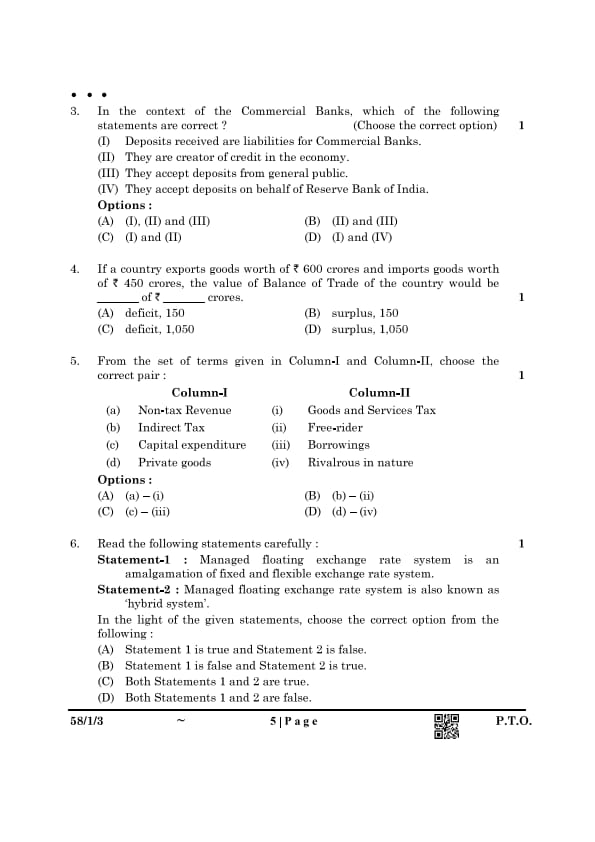
From the set of terms given in Column-I and Column-II, choose the correct pair:
Column-I & Column-II
(a) Non-tax Revenue & (i) Goods and Services Tax
(b) Indirect Tax & (ii) Free-rider
(c) Capital Expenditure & (iii) Borrowings
(d) Private goods & (iv) Rivalrous in nature
View Solution
Let us examine the correct matchings from Column-I and Column-II:
(a) Non-tax revenue does not correspond to Goods and Services Tax (GST), which is an indirect tax.
(b) Indirect Tax is not associated with the free-rider concept, which relates to public goods.
(c) Capital expenditure typically involves infrastructure investment, not borrowings.
(d) Private goods are defined by being rivalrous in nature, i.e., consumption by one person reduces availability for others.
Thus, the correct pair is (d) – (iv). Quick Tip: Private goods are \textbf{rivalrous and excludable}, unlike public goods which are non-rivalrous and non-excludable.
Read the following statements carefully:
Statement-1: Managed floating exchange rate system is an amalgamation of fixed and flexible exchange rate system.
Statement-2: Managed floating exchange rate system is also known as ‘hybrid system’.
In the light of the given statements, choose the correct option from the following:
View Solution
A managed floating exchange rate is indeed a combination of fixed and flexible exchange rates, and is also known as a hybrid system, where the central bank intervenes when necessary. Quick Tip: A \textbf{managed float} or \textbf{hybrid system} combines features of both fixed and flexible exchange rate systems.
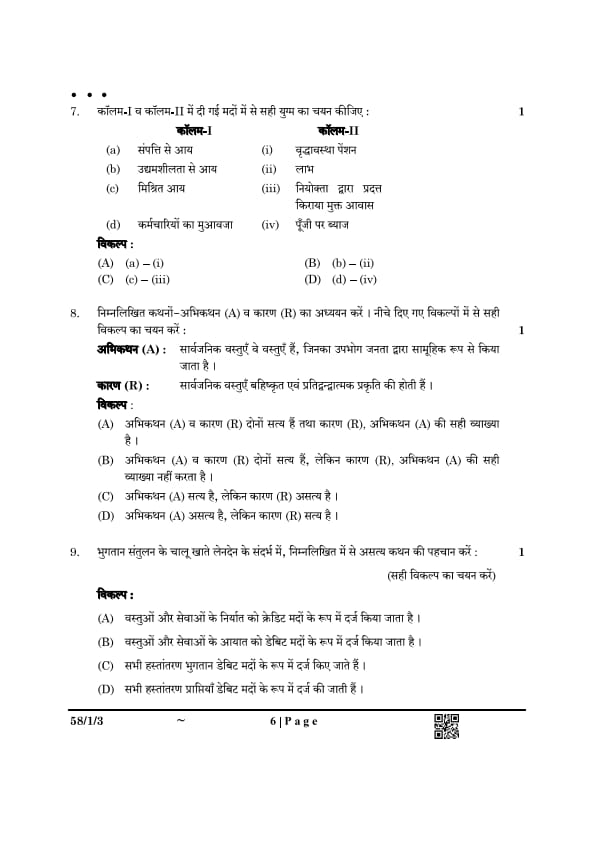
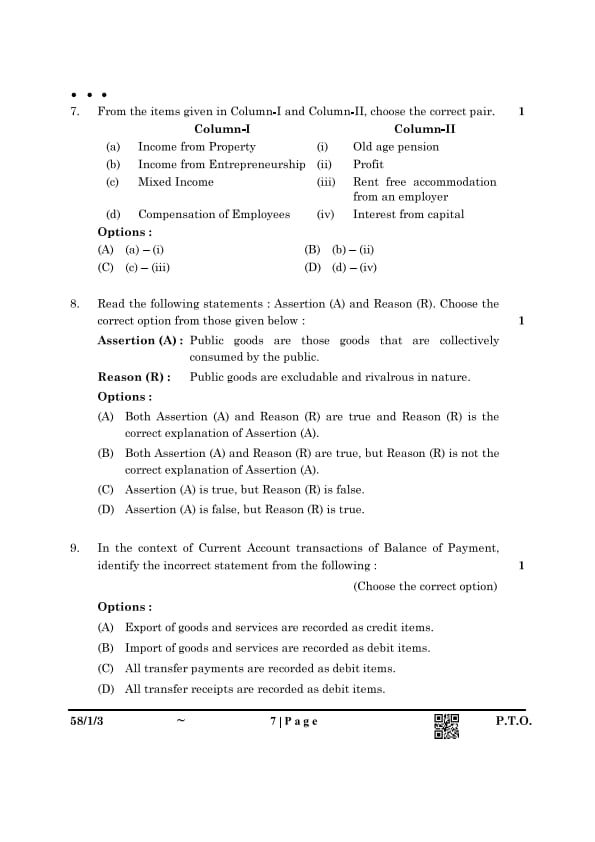
From the items given in Column-I and Column-II, choose the correct pair:
Column-I & Column-II
(a) Income from Property & (i) Old age pension
(b) Income from Entrepreneurship & (ii) Profit
(c) Mixed Income & (iii) Rent free accommodation from an employer
(d) Compensation of Employees & (iv) Interest from capital
View Solution
Mixed income includes elements like rent-free accommodation provided by an employer. It combines returns to labor, capital, and entrepreneurship typically in the case of self-employed individuals. Quick Tip: \textbf{Mixed Income} arises when all factors of production are used by self-employed individuals, and often includes items like rent-free benefits.
Read the following statements: Assertion (A) and Reason (R). Choose the correct option from those given below:
Assertion (A): Public goods are those goods that are collectively consumed by the public.
Reason (R): Public goods are excludable and rivalrous in nature.
View Solution
Assertion (A) is correct because public goods are non-excludable and non-rivalrous and are consumed collectively by the public.
Reason (R) is false because it incorrectly describes public goods as excludable and rivalrous, which are actually features of private goods. Quick Tip: Public goods are \textbf{non-excludable} and \textbf{non-rivalrous}, while private goods are the opposite.
In the context of Current Account transactions of Balance of Payment, identify the incorrect statement from the following: (Choose the correct option)
View Solution
In the Current Account of the Balance of Payment (BOP), exports are recorded as credit items because they bring foreign exchange into the country. Imports are recorded as debit items as they involve foreign exchange outflow. Transfer payments like remittances or donations sent abroad are also debit items. However, transfer receipts (such as remittances from abroad) bring in foreign exchange and are recorded as credit items. Therefore, option (D) is the incorrect statement. Quick Tip: \textbf{Receipts} (exports, inward remittances) are \textbf{credit} items, while \textbf{payments} (imports, outward transfers) are \textbf{debit} items in BOP accounting.
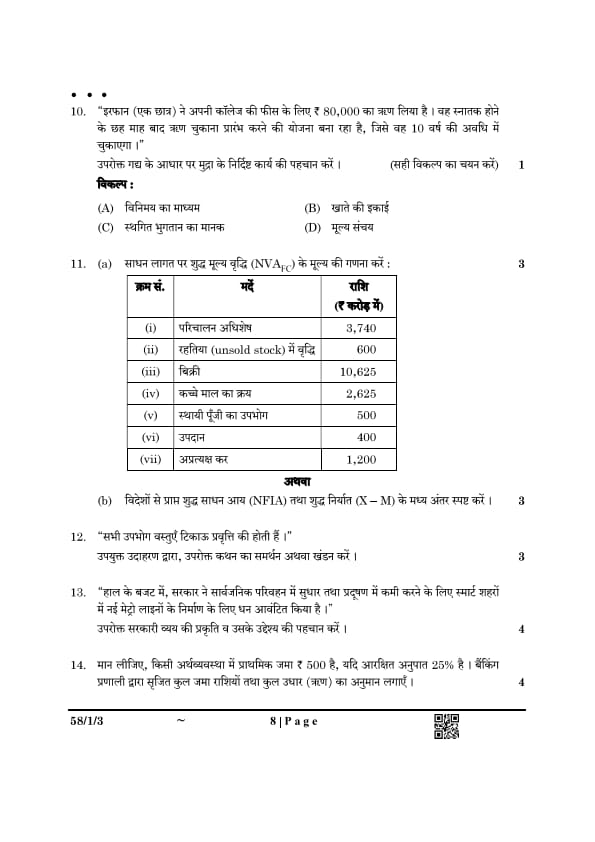
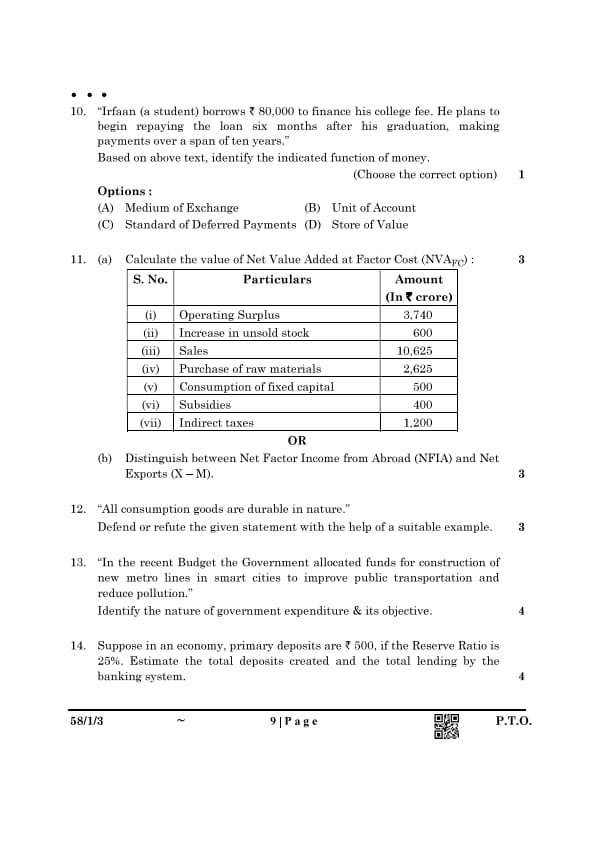
“Irfaan (a student) borrows Rs. 80,000 to finance his college fee. He plans to begin repaying the loan six months after his graduation, making payments over a span of ten years.”
Based on the above text, identify the indicated function of money. (Choose the correct option)
View Solution
Money acts as a standard of deferred payment when payments are scheduled to be made in the future. In this case, Irfaan’s loan repayment over ten years exemplifies this function of money. Quick Tip: When payments are scheduled in the future, money functions as a \textbf{standard of deferred payment}.
(a) Calculate the value of Net Value Added at Factor Cost (NVA{FC}):
S. No. & Particulars & Amount (In Rs. crore)
(i) & Operating Surplus & 3,740
(ii) & Increase in unsold stock & 600
(iii) & Sales & 10,625
(iv) & Purchase of raw materials & 2,625
(v) & Consumption of fixed capital & 500
(vi) & Subsidies & 400
(vii) & Indirect taxes & 1,200
View Solution
\begin{align*
GVA at MP &= \text{Sales + \text{Increase in stock - \text{Raw materials - \text{Depreciation
&= 10,625 + 600 - 2,625 - 500 = 8,100 \, \text{crore
\text{NVA at MP &= \text{GVA at MP - \text{Consumption of fixed capital = 8,100 - 500 = 7,600 \, \text{crore
\text{NVA at FC &= \text{NVA at MP - \text{Indirect Taxes + \text{Subsidies
&= 7,600 - 1,200 + 400 = \boxed{6,800 \, \text{crore
\end{align* Quick Tip: NVA{FC = Sales + Closing stock – Intermediate cost – Depreciation – Indirect taxes + Subsidies
Distinguish between Net Factor Income from Abroad (NFIA) and Net Exports (X – M).
View Solution
\begin{tabular{|p{7cm|p{7cm|
NFIA & Net Exports (X – M)
It is the difference between factor income earned from abroad and factor income paid to abroad. & It is the difference between the value of exports of goods and services and imports.
Includes wages, rent, interest, and profits. & Includes only trade in goods and services.
Part of National Income. & Part of Domestic Income.
Quick Tip: NFIA = Income flow from abroad – Income paid abroad;
Net Exports = Exports – Imports.
“All consumption goods are durable in nature.”
Defend or refute the given statement with the help of a suitable example.
View Solution
The statement is incorrect. All consumption goods are not durable in nature. Consumption goods are classified into two types:
Durable Consumption Goods: Last for a long time and used repeatedly, e.g., car, TV.
Non-Durable Consumption Goods: Consumed in a single use, e.g., milk, food, fuel.
Hence, consumption goods may or may not be durable. Quick Tip: All consumption goods are not durable; some are used immediately like milk or food.
“In the recent Budget the Government allocated funds for construction of new metro lines in smart cities to improve public transportation and reduce pollution.”
Identify the nature of government expenditure \& its objective.
View Solution
The nature of government expenditure is Capital Expenditure, as it leads to the creation of long-term assets like metro infrastructure.
The objective is to promote economic development by improving transport facilities and reducing pollution in urban areas. Quick Tip: Expenditure on asset creation = Capital Expenditure; purpose = development + welfare.
Suppose in an economy, primary deposits are ₹ 500, if the Reserve Ratio is 25%. Estimate the total deposits created and the total lending by the banking system.
View Solution
\begin{align*
Reserve Ratio &= 25% = \frac{1{4
\text{Money Multiplier &= \frac{1{\text{Reserve Ratio = \frac{1{0.25 = 4
\text{Total Deposits Created &= \text{Primary Deposits \times \text{Money Multiplier
&= 500 \times 4 = \boxed{₹ 2,000
\text{Total Lending &= \text{Total Deposits - \text{Reserves
&= 2,000 - (25% \text{ of 2,000) = 2,000 - 500 = \boxed{₹ 1,500
\end{align* Quick Tip: Total Deposits = Primary Deposit × \( \frac{1{Reserve Ratio} \); Lending = Deposits – Reserves.
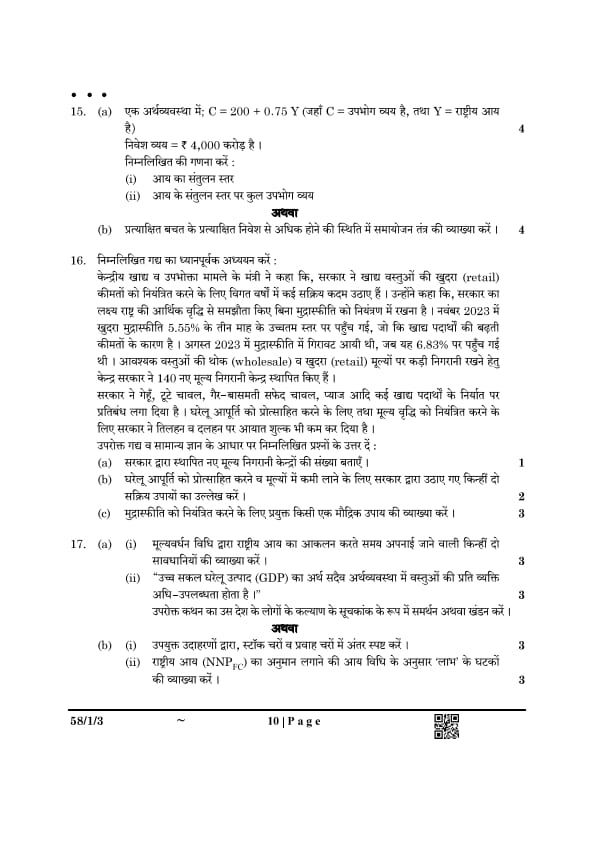
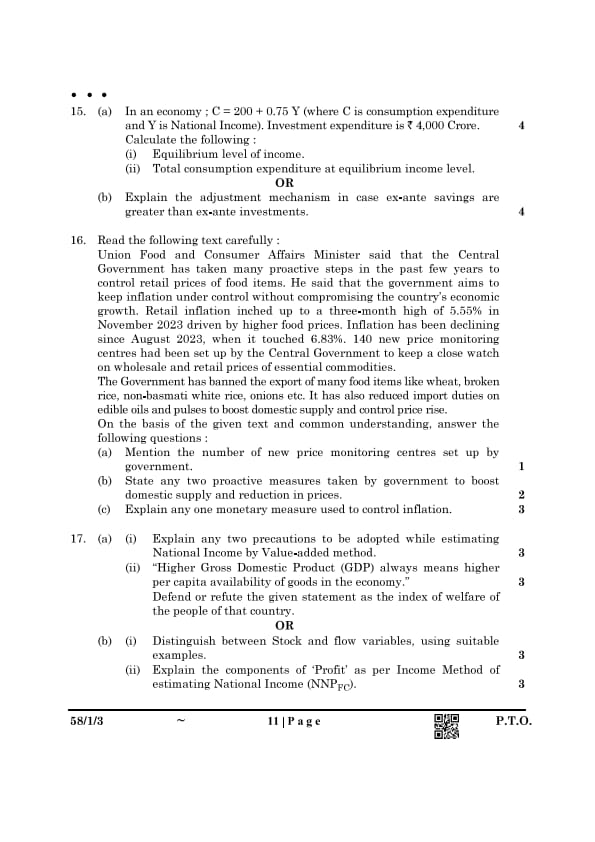
(a) In an economy; \( C = 200 + 0.75Y \) (where \( C \) is consumption expenditure and \( Y \) is National Income). Investment expenditure is Rs. 4,000 crore. Calculate the following:
(i) Equilibrium level of income.
(ii) Total consumption expenditure at equilibrium income level.
View Solution
Given:
Consumption function: \( C = 200 + 0.75Y \)
Investment (I) = Rs. 4,000 crore
Step 1: Find Equilibrium Income
At equilibrium, \[ Y = C + I = (200 + 0.75Y) + 4000 \] \[ Y = 200 + 0.75Y + 4000 = 4200 + 0.75Y \] \[ Y - 0.75Y = 4200 \Rightarrow 0.25Y = 4200 \] \[ \Rightarrow Y = \frac{4200}{0.25} = Rs. 16,800 \, crore \]
Step 2: Total Consumption at Equilibrium Income \[ C = 200 + 0.75 \times 16800 = 200 + 12600 = Rs. 12,800 \, crore \]
Therefore, equilibrium income = Rs. 16,800 crore and total consumption = Rs. 12,800 crore. Quick Tip: Use the condition \( Y = C + I \) to find equilibrium income in two-sector models. Plug the equilibrium income back into the consumption function to find total consumption.
Explain the adjustment mechanism in case ex-ante savings are greater than ex-ante investments.
View Solution
When ex-ante savings exceed ex-ante investments, there is an unintended accumulation of inventories in the economy. This indicates that aggregate demand is lower than aggregate supply.
Firms respond by reducing output and employment, leading to a fall in income. As income falls, both consumption and saving also fall. This process continues until savings equal investment again, and equilibrium is restored in the economy.
Thus, the economy automatically adjusts through changes in income until ex-ante savings equal ex-ante investments. Quick Tip: Remember, in Keynesian economics, income acts as the adjusting variable to bring savings and investment into equilibrium.
Mention the number of new price monitoring centres set up by government.
View Solution
The government has set up 140 new price monitoring centres to keep a close watch on wholesale and retail prices of essential commodities. Quick Tip: Key factual data such as figures or statistics mentioned in the passage should be used directly in the answer.
State any two proactive measures taken by government to boost domestic supply and reduction in prices.
View Solution
Two proactive measures taken by the government to boost domestic supply and reduce prices are:
1. Banning the export of food items like wheat, broken rice, non-basmati white rice, and onions.
2. Reducing import duties on edible oils and pulses to increase their availability in the domestic market. Quick Tip: Policy measures like export bans and duty reductions are supply-side interventions used to stabilize prices.
Explain any one monetary measure used to control inflation.
View Solution
One monetary measure used to control inflation is increasing the repo rate.
When the Reserve Bank of India (RBI) raises the repo rate, it becomes costlier for commercial banks to borrow money. This leads to reduced money supply in the economy, thereby decreasing demand and helping control inflation. Quick Tip: Monetary policy tools like repo rate and CRR are used by RBI to regulate inflation and liquidity.
Explain any two precautions to be adopted while estimating National Income by Expenditure method.
View Solution
Two precautions while using the expenditure method are:
1. Avoiding transfer payments: Expenditures like scholarships, pensions, or donations should not be included as they are not payments for goods and services.
2. Excluding expenditure on second-hand goods: These do not represent current production and hence must be excluded to avoid double counting. Quick Tip: Always include only final expenditures on currently produced goods and services in the expenditure method.
“Higher Gross Domestic Product (GDP) always means higher per capita availability of goods in the economy.”
Defend or refute the given statement as the index of welfare of the people of that country.
View Solution
The statement is only partially true. While higher GDP may indicate a higher availability of goods and services, it does not always reflect increased welfare due to the following reasons:
- Income inequality: GDP may rise, but the benefits might be concentrated in a few hands.
- Non-monetary aspects: Welfare also includes health, education, and environmental quality, which GDP does not account for.
- Population growth: If population increases faster than GDP, per capita availability may fall.
Therefore, GDP alone cannot be a complete indicator of welfare. Quick Tip: Welfare depends on both quantitative and qualitative aspects of economic growth.
Distinguish between Stock and Flow variables, using suitable examples.
View Solution
Stock Variable: It is measured at a particular point of time.
Example: Capital, wealth, and population.
Flow Variable: It is measured over a period of time.
Example: Income, savings, and investment.
Thus, stock is static and flow is dynamic in nature. Quick Tip: Stock is "as on" a date, while flow is "during" a time period.
Explain the components of ‘Profit’ as per Income Method of estimating National Income (NNP{FC}).
View Solution
The components of 'Profit' under the Income Method include:
1. Corporate Tax: Tax paid by companies on their profits.
2. Dividends: Part of profits distributed to shareholders.
3. Undistributed Profits: Retained earnings kept by firms for future use.
Together, these form the total profit component of factor income. Quick Tip: In the income method, only factor incomes like wages, rent, interest, and profit are included.
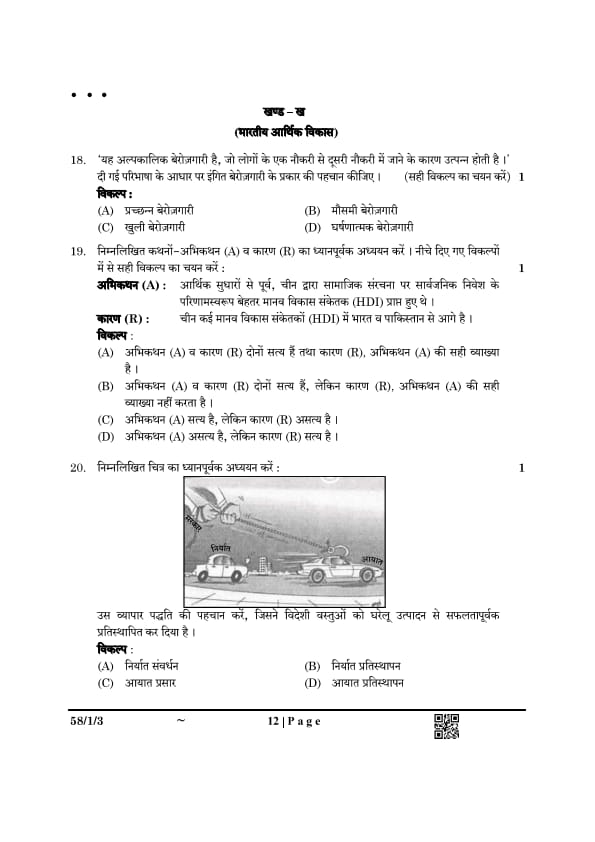
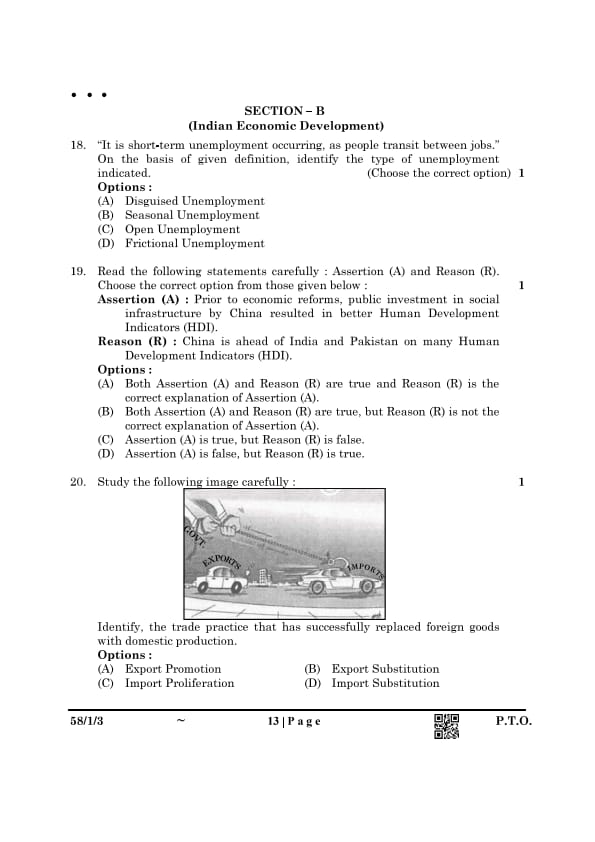
“It is short-term unemployment occurring, as people transit between jobs.”
On the basis of given definition, identify the type of unemployment indicated. (Choose the correct option)
View Solution
Frictional unemployment refers to short-term unemployment that arises when individuals are temporarily out of work while transitioning from one job to another or entering the workforce for the first time. It is a natural part of the labor market and does not indicate a lack of job opportunities but a process of adjustment. Quick Tip: \textbf{Frictional Unemployment} is temporary and occurs during job changes or new job searches.
Read the following statements carefully: Assertion (A) and Reason (R). Choose the correct option from those given below:
Assertion (A): Prior to economic reforms, public investment in social infrastructure by China resulted in better Human Development Indicators (HDI).
Reason (R): China is ahead of India and Pakistan on many Human Development Indicators (HDI).
View Solution
Before liberalization, China invested significantly in social sectors like education and health, which contributed to better HDI outcomes. The reason also holds true as China consistently outperforms India and Pakistan in HDI rankings. Moreover, the reason is a direct outcome of the public investments made, making it a valid explanation. Quick Tip: China's early public investment in health and education boosted its HDI rankings over time.
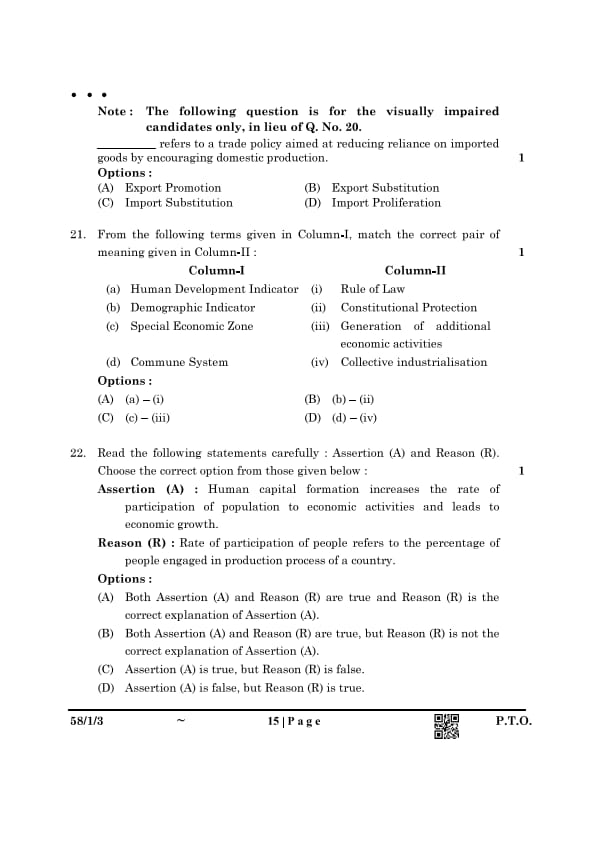
Study the following image carefully:
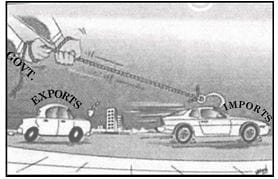
Identify the trade practice that has successfully replaced foreign goods with domestic production.
View Solution
Import substitution is a trade policy which encourages the replacement of foreign imports with domestic production. This was a key feature of India's earlier trade strategy post-independence, aiming to promote self-reliance by reducing dependency on imported goods. Quick Tip: \textbf{Import Substitution} helps a country become self-sufficient by producing domestically what was earlier imported.
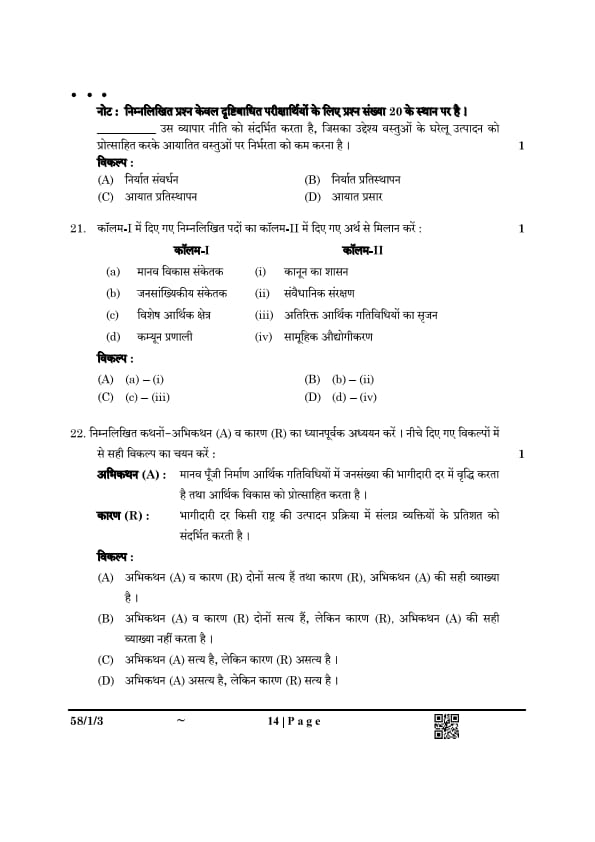
From the following terms given in Column-I, match the correct pair of meaning given in Column-II:
Column-I & Column-II
(a) Human Development Indicator & (i) Rule of Law
(b) Demographic Indicator & (ii) Constitutional Protection
(c) Special Economic Zone & (iii) Generation of additional economic activities
(d) Commune System & (iv) Collective industrialisation
View Solution
Special Economic Zones (SEZs) are designated areas that offer infrastructure, tax benefits, and relaxed regulations to promote economic activity. Their primary aim is to generate additional economic activities like exports, employment, and investment inflows. Hence, (c) – (iii) is the correct match. Quick Tip: SEZs aim to \textbf{generate additional economic activities} through incentives and infrastructure support.
Read the following statements carefully: Assertion (A) and Reason (R). Choose the correct option from those given below:
Assertion (A): Human capital formation increases the rate of participation of population to economic activities and leads to economic growth.
Reason (R): Rate of participation of people refers to the percentage of people engaged in production process of a country.
View Solution
Human capital formation equips individuals with education and skills that enhance their productivity and participation in economic activities. This leads to faster economic growth. The Reason correctly explains that the participation rate measures how much of the population is involved in productive work, making it a valid and correct explanation for the assertion. Quick Tip: Human capital boosts productivity and participation in the economy, which promotes economic growth.
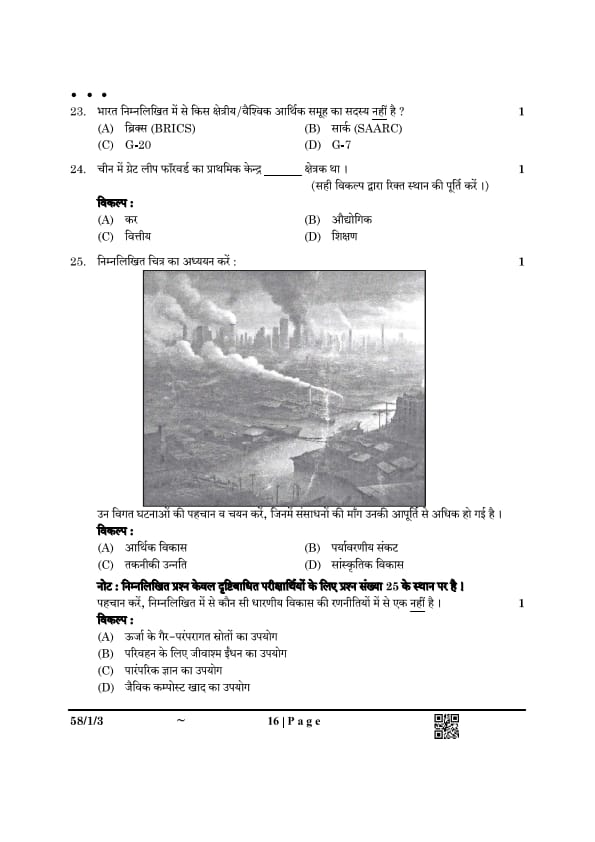
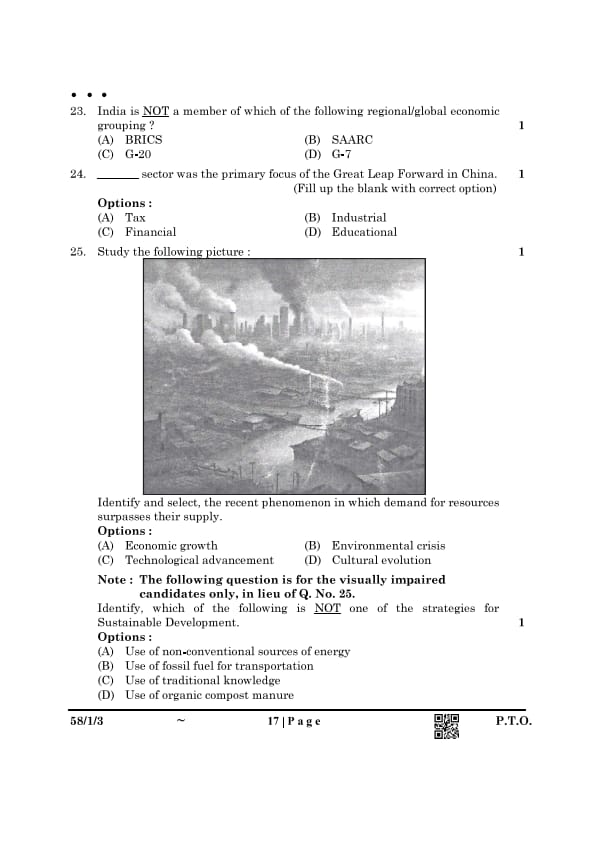
India is NOT a member of which of the following regional/global economic grouping? (Choose the correct option)
View Solution
India is a member of BRICS (Brazil, Russia, India, China, South Africa), SAARC (South Asian Association for Regional Cooperation), and G-20 (Group of 20 major economies). However, it is not a member of G-7, which comprises Canada, France, Germany, Italy, Japan, the United Kingdom, and the United States. Quick Tip: India is not part of G-7, a group of seven advanced economies.
sector was the primary focus of the Great Leap Forward in China. (Fill up the blank with correct option)
View Solution
The Great Leap Forward, launched in 1958, was a campaign initiated by the Chinese government to rapidly transform the country from an agrarian economy into a socialist society through rapid industrialization and collectivization. The primary focus was on boosting industrial production, particularly steel output, often through the establishment of backyard furnaces in rural areas. Quick Tip: The \textbf{Great Leap Forward} mainly targeted the \textbf{industrial sector}, especially steel production.
continued
Identify and select the recent phenomenon in which demand for resources surpasses their supply.
View Solution
The correct answer is: (B) Environmental crisis
The image shows heavy pollution and industrial waste, indicating an environmental crisis due to overuse and mismanagement of natural resources. Quick Tip: An environmental crisis occurs when the exploitation of natural resources exceeds their regenerative capacity.
Identify which of the following is NOT one of the strategies for Sustainable Development.
View Solution
The correct answer is: (B) Use of fossil fuel for transportation
Fossil fuels contribute to pollution and are not sustainable. The other options are environmentally friendly and promote sustainable development. Quick Tip: Strategies for sustainable development focus on renewable energy, eco-friendly practices, and resource conservation.
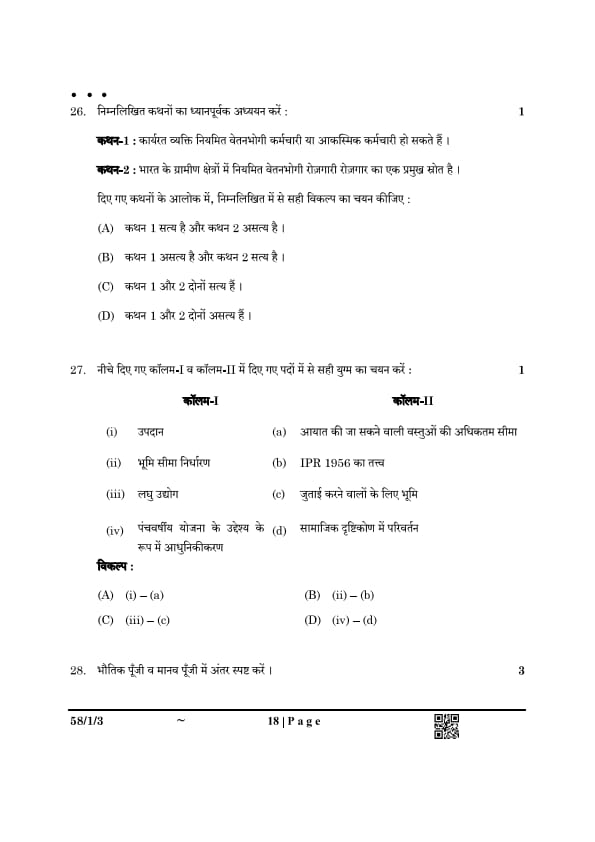
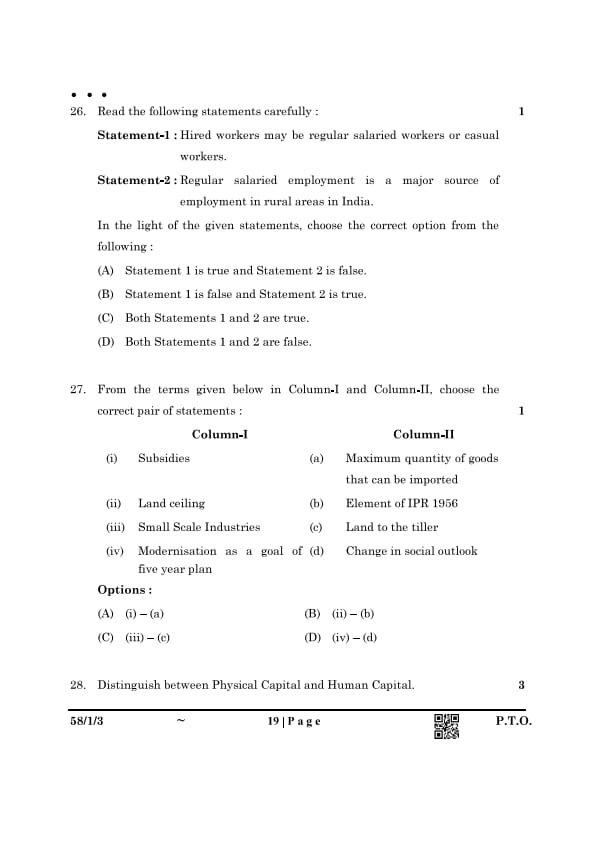
Read the following statements carefully:
Statement-1: Hired workers may be regular salaried workers or casual workers.
Statement-2: Regular salaried employment is a major source of employment in rural areas in India.
Choose the correct option from the following:
View Solution
Statement 1 is correct because hired workers can be classified into regular salaried (those with job security and fixed income) and casual workers (daily or temporary basis). However, Statement 2 is incorrect because in rural areas, the majority of employment is in the form of self-employment or casual work, not regular salaried jobs. Quick Tip: Rural employment is mostly \textbf{casual or self-employed}, not regular salaried.
From the terms given below in Column-I and Column-II, choose the correct pair of statements:
Column-I & Column-II
(i) Subsidies & (a) Maximum quantity of goods that can be imported
(ii) Land ceiling & (b) Element of IPR 1956
(iii) Small Scale Industries & (c) Land to the tiller
(iv) Modernisation as a goal of five year plan & (d) Change in social outlook
View Solution
Modernisation as a goal of five year plans aimed at changing the social outlook of people by encouraging rational thinking, scientific temper, and adoption of technology. Therefore, the correct match is (iv) – (d). The other pairs are mismatched. Quick Tip: Modernisation in planning refers to a shift in \textbf{social values and adoption of science-based thinking}.
Distinguish between Physical Capital and Human Capital.
View Solution
The distinction between Physical Capital and Human Capital is outlined below:
\begin{tabular{|p{6.5cm|p{6.5cm|
Physical Capital & Human Capital
Refers to the stock of produced means of production such as machines, tools, buildings, etc. & Refers to the stock of skills, knowledge, and experience possessed by an individual or population.
It is tangible and can be physically touched and seen. & It is intangible and embodied in human beings.
Physical capital is separable from its owner. & Human capital is inseparable from the individual who possesses it.
It depreciates over time due to wear and tear. & It may appreciate over time with experience and education.
Created by investing in physical assets. & Created through investment in education, training, and healthcare.
Quick Tip: \textbf{Physical Capital} includes tools and machines, while \textbf{Human Capital} includes skills and knowledge. One is tangible, the other is embodied in people.
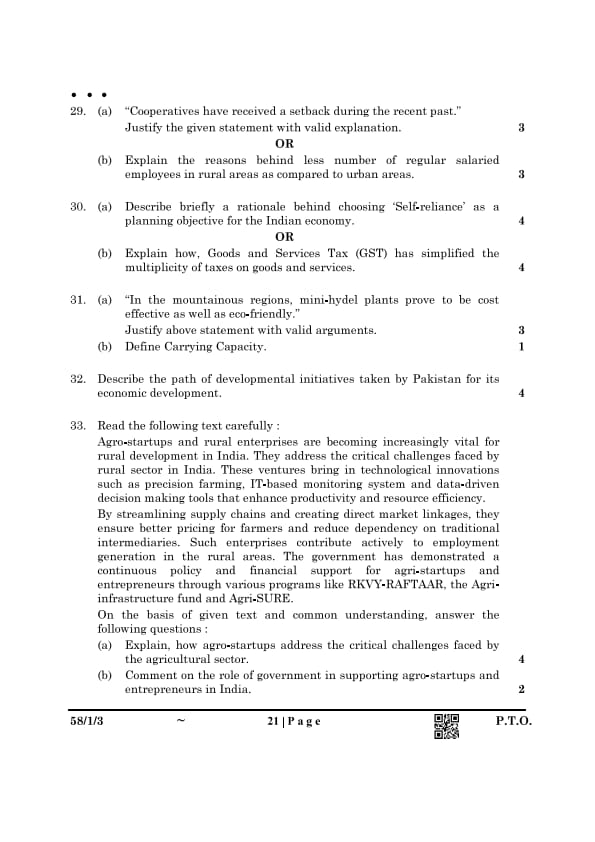
(a) "Cooperatives have received a setback during the recent past." Justify the given statement with valid explanation.
View Solution
Cooperatives in India, especially in the agricultural and credit sectors, have experienced setbacks in recent years due to multiple factors:
Lack of Professional Management: Most cooperatives are managed by individuals who may not possess adequate professional or technical knowledge, resulting in poor functioning and inefficiency.
Political Interference: Excessive political influence in cooperative operations has led to mismanagement and misuse of funds.
Inadequate Financial Support: With limited capital and insufficient government support, many cooperatives struggle to sustain operations or upgrade their infrastructure.
Poor Governance: Weak regulatory mechanisms and lack of transparency have reduced public trust in cooperatives.
Urban Preference and Privatization: The shift in focus towards privatization and urban-centric development has led to the neglect of rural cooperative structures.
These challenges have hindered their effectiveness, reducing their role in uplifting rural communities.
\begin{quicktipbox
Revival of cooperatives needs policy reform, financial aid, and strict governance to make them efficient contributors to rural development.
\end{quicktipbox Quick Tip: Revival of cooperatives needs policy reform, financial aid, and strict governance to make them efficient contributors to rural development.
(a) Describe briefly a rationale behind choosing 'Self-reliance' as a planning objective for the Indian economy.
OR
(b) Explain how, Goods and Services Tax (GST) has simplified the multiplicity of taxes on goods and services.
View Solution
(a) Rationale for Choosing ‘Self-Reliance’ as a Planning Objective:
Self-reliance was chosen as a key objective in India’s economic planning post-independence due to the following reasons:
Reduction of Dependence on Foreign Aid: India aimed to reduce its dependence on foreign countries, especially in the context of food grains, technology, and defence equipment, to preserve its economic and political sovereignty.
Promotion of Indigenous Industries: Encouraging domestic industries was essential to build internal production capacity, generate employment, and foster innovation.
Balance of Payments Stability: Excessive imports, particularly of capital goods and petroleum products, led to balance of payment crises. Self-reliance aimed to strengthen domestic capabilities to reduce import bills.
National Security and Strategic Autonomy: A self-reliant economy could withstand global shocks and maintain strategic autonomy without external pressures.
Long-Term Sustainable Development: Building self-sufficient systems ensured sustainable development without external economic vulnerabilities.
Thus, self-reliance became a foundation of India’s development strategy to ensure economic independence, security, and sustainable growth.
(b) GST and Simplification of Tax System:
Goods and Services Tax (GST), introduced in 2017, is a comprehensive indirect tax that replaced a host of central and state taxes, thereby simplifying the tax structure. The ways in which GST has addressed multiplicity of taxes include:
Unified Tax System: GST has replaced various indirect taxes like VAT, excise duty, service tax, CST, and octroi, creating a single tax system across the country.
One Nation, One Tax: GST created a common national market by eliminating the cascading effect of taxes and different tax rates across states.
Transparency and Simplicity: GST is administered through a transparent digital platform with clear compliance procedures, reducing ambiguity and corruption.
Input Tax Credit (ITC): Seamless flow of ITC across goods and services ensures tax is only paid on value addition, removing tax-on-tax.
Improved Ease of Doing Business: Simplified tax structure and online filing encourage entrepreneurship and foreign investment.
Overall, GST has led to simplification, standardization, and better compliance in the indirect taxation system of India. Quick Tip: \textbf{Self-reliance} aims at economic independence; \textbf{GST} unifies and simplifies India’s complex indirect tax system.
(a) "In the mountainous regions, mini-hydel plants prove to be cost effective as well as eco-friendly."
Justify above statement with valid arguments.
View Solution
Mini-hydel plants are especially suitable for mountainous regions because:
They utilize the natural flow and gradient of mountain rivers and streams, reducing the need for large dams or reservoirs.
These plants require comparatively lower investment, making them cost-effective for remote and hilly areas.
They generate clean and renewable energy, minimizing carbon emissions and pollution.
They help in decentralized power supply, enhancing electricity access in rural and remote regions.
Environmental degradation and displacement of people are minimal compared to large hydel projects. Quick Tip: \textbf{Mini-hydel plants} = ideal for hills: \textbf{low-cost}, \textbf{eco-friendly}, and use \textbf{natural gradients}.
Define Carrying Capacity.
View Solution
Carrying Capacity refers to the maximum population size of a species that an environment can sustain indefinitely, given the available resources such as food, habitat, water, and other necessities.
It determines:
The limit of population that can be supported without environmental degradation.
The threshold beyond which the quality of life and sustainability of resources may decline.
Thus, carrying capacity is a key ecological concept that links resource availability with population sustainability. Quick Tip: \textbf{Carrying Capacity} is the environment’s limit to support a population without depleting resources or harming future sustainability.
Describe the path of developmental initiatives taken by Pakistan for its economic development.
View Solution
Pakistan has followed various developmental strategies since its independence to promote economic growth and improve living standards. The path of development includes:
Mixed Economy Model: Pakistan adopted a mixed economy with both private and public sector participation.
Planning through Five-Year Plans: Like India, Pakistan implemented several Five-Year Plans to guide economic policies and priorities.
Green Revolution: It focused on agricultural development through high-yielding varieties of seeds, fertilizers, and irrigation.
Industrialization Drive: Pakistan promoted industries by offering subsidies, protecting domestic firms, and establishing industrial zones.
Structural Reforms: During the 1980s and 1990s, Pakistan introduced structural adjustment programmes under the IMF and World Bank to liberalize trade and privatize state-owned enterprises.
Social Sector Initiatives: Efforts were made to invest in health and education, although progress was relatively slower compared to economic reforms.
Vision 2025: A recent comprehensive plan aiming to transform Pakistan into an upper-middle-income country by focusing on infrastructure, energy, and human capital.
Despite these initiatives, Pakistan has faced challenges such as political instability, low human development indicators, and fiscal deficits.
\begin{quicktipbox
Pakistan’s development path combined planning, industrial growth, and liberalization, but progress was hindered by socio-political factors.
\end{quicktipbox Quick Tip: Pakistan’s development path combined planning, industrial growth, and liberalization, but progress was hindered by socio-political factors.
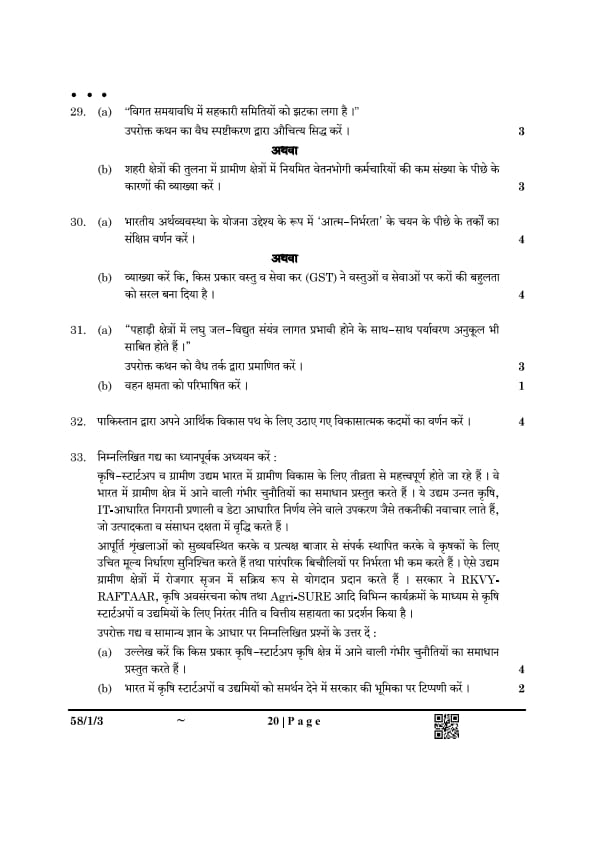
Explain, how agro-startups address the critical challenges faced by the agricultural sector.
View Solution
Agro-startups play a vital role in addressing the core issues of the agricultural sector by adopting modern, innovative strategies:
Technological Innovation: They introduce tools like precision farming, IT-based monitoring, and data-driven decision-making systems which improve crop yields and resource efficiency.
Supply Chain Efficiency: These startups streamline the agri-supply chain, enabling better access to markets and reducing post-harvest losses.
Market Linkages: By providing direct market access, agro-startups reduce the dependence on traditional intermediaries and ensure fair prices to farmers.
Rural Employment: They contribute to employment generation in rural areas, helping reduce migration to urban areas.
\begin{quicktipbox
Agro-startups combine technology and innovation to transform traditional farming into efficient and profitable ventures.
\end{quicktipbox Quick Tip: Agro-startups combine technology and innovation to transform traditional farming into efficient and profitable ventures.
Comment on the role of government in supporting agro-startups and entrepreneurs in India.
View Solution
The Indian government plays a key role in fostering agro-startups and rural entrepreneurship by providing targeted support through various schemes:
Policy Support: The government has consistently focused on promoting rural enterprises through favourable policy frameworks.
Financial Assistance: Programs like RKVY-RAFTAAR, Agri-Infrastructure Fund, and Agri-SURE provide crucial financial aid and startup incubation.
Capacity Building: These initiatives help build infrastructure, enable training, and improve access to credit and markets.
Encouraging Innovation: Through government support, agro-startups are encouraged to adopt sustainable practices and modern tools to enhance rural productivity.
\begin{quicktipbox
Supportive government schemes are critical in enabling agro-startups to scale and bring lasting change to rural India.
\end{quicktipbox Quick Tip: Supportive government schemes are critical in enabling agro-startups to scale and bring lasting change to rural India.
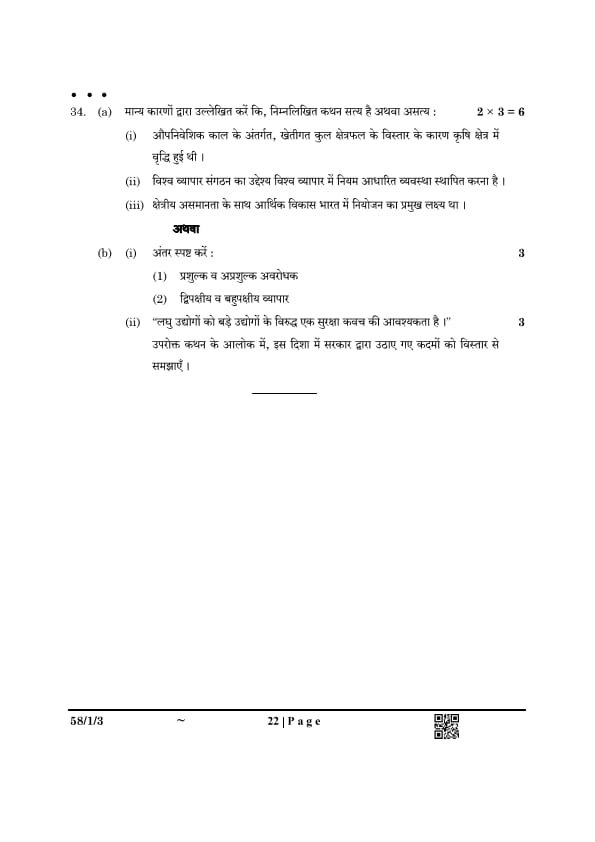
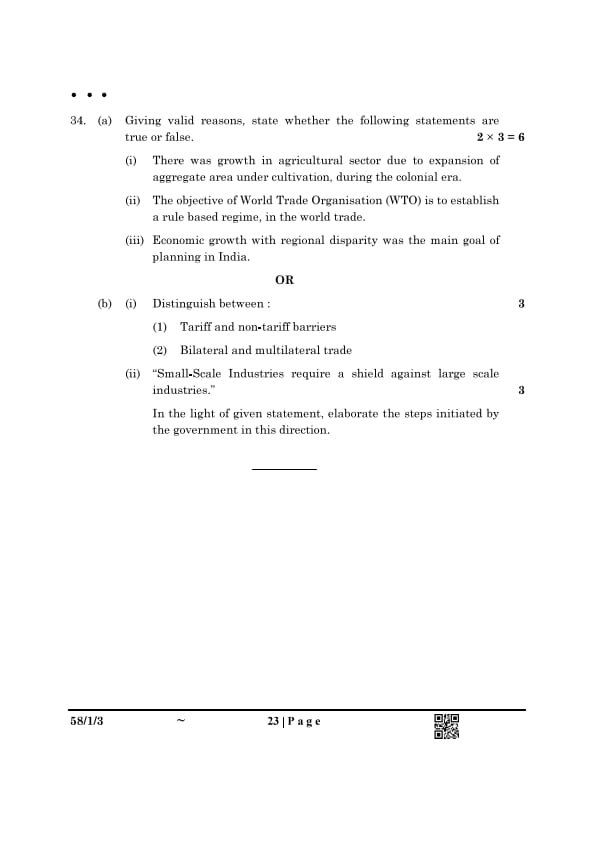
Giving valid reasons, state whether the following statements are true or false.
There was growth in agricultural sector due to expansion of aggregate area under cultivation, during the colonial era.
The objective of World Trade Organisation (WTO) is to establish a rule based regime, in the world trade.
Economic growth with regional disparity was the main goal of planning in India.
View Solution
False.
Reason: Although some expansion of area under cultivation occurred during the colonial period, there was no significant or systematic growth in the agricultural sector. The British policies were exploitative, focusing on cash crops for export rather than food security or productivity improvement.
True.
Reason: The World Trade Organisation (WTO) was established with the objective of promoting free and fair trade by setting up a rules-based multilateral trading system. It provides a common institutional framework for the conduct of international trade relations.
False.
Reason: The main goal of Indian planning was not economic growth with regional disparity but to promote inclusive and equitable development by reducing disparities across regions through balanced resource allocation and regional planning. Quick Tip: Support each True/False statement with historical context or institutional objectives for full clarity.
“Small-Scale Industries require a shield against large scale industries.”
In the light of given statement, elaborate the steps initiated by the government in this direction.
View Solution
The statement highlights the vulnerability of Small-Scale Industries (SSIs) in the face of competition from large industries. To protect and promote SSIs, the government of India has taken several initiatives:
Reservation of Products: Specific items were reserved for exclusive production by small-scale industries to safeguard them from large-scale industrial competition.
Financial Support: Provision of easy and low-interest loans through institutions like SIDBI and priority sector lending by banks.
Marketing Assistance: Establishment of agencies like NSIC (National Small Industries Corporation) to support marketing and procurement.
Infrastructure Support: Development of industrial estates and clusters with basic infrastructure to reduce operational costs.
Skill Development and Training: Programs under schemes like PMEGP and MSME Skill Development Programmes to enhance productivity and efficiency.
Technology Upgradation: Support through schemes such as Credit Linked Capital Subsidy Scheme (CLCSS) to modernize machinery and improve competitiveness.
These measures aim to create a level playing field, ensuring the sustainability and growth of SSIs in a competitive market environment. Quick Tip: To protect small-scale industries, the government has reserved products, offered financial and marketing aid, and promoted skill and tech development.

*The article might have information for the previous academic years, please refer the official website of the exam.