
CBSE Class 12 English Core Question Paper 2025 (Set 1 - 1/6/1) with Solution Pdf


| Updated On - Feb 10, 2026
CBSE conducted the Class 12 English Board Exam on March 11, 2025, from 10:30 AM to 1:30 PM. The English Core theory exam carries a total of 100 marks, divided into 80 marks for the written exam and 20 marks allocated for internal assessment. The question paper consists of different types of questions, including MCQ carrying 1 mark each,short-answer questions valued at 2 or 3 marks each and long-answer questions carrying 4 or 6 marks each.
CBSE Class 12 English (Set 1 - 1/6/1) Question Paper 2025 with Solution PDF
| CBSE Class 12 English Question Paper | Download PDF | Check Solutions |
Read the following passage carefully :
(1) In recent years, the rise of digital education has revolutionized the way
students in India learn. With the advent of high speed internet and
widespread smartphone use, online learning platforms have become
increasingly popular. These platforms offer a wide range of courses,
from academic subjects to vocational skills, enabling students to learn
at their own pace and convenience. The flexibility of digital education is
beneficial where traditional classroom learning cannot take place.
Many students and educators have now embraced this new mode of
learning, recognizing its potential.
(2) However, this shift to digital learning is not without its challenges. One
major issue is the digital divide, which refers to the gap between those
who have access to the internet and those who do not. In rural areas
and among economically disadvantaged communities, many students
lack the necessary devices or reliable internet connections to
participate in online classes. This has led to concerns about unequal
access to education and the potential for widening educational
disparities. For instance, a study by the National Sample Survey Office
revealed that only 24% of Indian households have internet access,
highlighting the extent of the digital divide.
(3) Another significant challenge is the effectiveness of digital learning.
While some students thrive in an online environment, others struggle
with the lack of face-to-face interaction and the self-discipline required
to stay on track. Teachers also face difficulties in both engaging
students as well as providing personalized feedback in a virtual setting.
The absence of a structured classroom environment can lead to
distractions and reduced motivation among students. Furthermore, the
lack of direct social interaction impacts social skills and emotional
development.
(4) To address these issues, various initiatives have been launched.
Government programmes aim to provide digital devices and improve
internet connectivity in far-off areas. Educational platforms are
developing more interactive and engaging content to enhance the
online learning experience. Blended learning models, which combine
online and offline methods, are being explored to offer a more balanced approach. The
government's Digital India campaign has also made strides in promoting digital literacy and bridging the technological gap.
(5) The potential of digital education extends beyond formal schooling.
Online platforms provide opportunities for lifelong learning, allowing
individuals to acquire new skills and knowledge throughout their lives.
This is particularly relevant in a rapidly changing job market, where
continuous upskilling and reskilling are essential. Digital education
empowers individuals to take control of this learning journey, breaking
down traditional barriers to education. Moreover, it offers flexibility for
working professionals and homemakers, who can access educational
resources without disrupting their daily schedules.
(6) As we navigate this digital revolution in education, it is crucial to
ensure that no one is left behind. Bridging the digital divide,
supporting teachers and students, and fostering an inclusive and
effective online learning environment are essential to realizing the full
potential of digital education in India. Policy-makers, educators, and
the private sector must collaborate to create sustainable solutions that
address the diverse needs of the population. Only then can we harness
the power of digital education.
Answer the following questions, based on the above passage :
(i). According to paragraph (1), what advantages do online learning platforms offer to students ?
View Solution
According to the first paragraph, online learning platforms provide several distinct advantages to students:
1. Variety of Courses: They offer a wide array of courses ranging from academic subjects to vocational skills, catering to diverse learning needs.
2. Pace and Convenience: They enable students to learn at their own pace and according to their own convenience, removing the pressure of keeping up with a class.
3. Flexibility: The inherent flexibility of digital education makes learning beneficial in situations or locations where traditional classroom learning is not feasible. Quick Tip: When a question asks for "advantages," scan the paragraph for positive adjectives or verbs like "offer," "enable," "beneficial," or "empower."
How does the author describe the ‘digital divide’ in the context of education ?
View Solution
The author describes the ‘digital divide’ primarily as the gap between individuals who have access to the internet and those who do not. In the specific context of education mentioned in paragraph 2, this divide manifests where students in rural areas and economically disadvantaged communities lack the necessary digital devices (like smartphones or laptops) or reliable internet connections required to participate effectively in online classes. Quick Tip: To define a specific term from the text, locate the phrase "which refers to" or "is defined as" immediately following the term in the passage.
Read the following sentence.
‘In rural areas and among economically disadvantaged communities, many students lack the necessary devices or reliable internet connections.’
The concern the above statement points towards is ________.
Choose the correct response from the two options to complete the sentence.
View Solution
The statement highlights the lack of resources (devices and internet) required for online learning. The passage directly connects this lack of access to "concerns about unequal access to education" and the "potential for widening educational disparities." Therefore, the primary concern is the growing divide in educational opportunities available to children based on their economic and geographical status. Quick Tip: Look for the consequence mentioned immediately after the problem in the text. The text links the lack of devices to "unequal access to education."
How does the lack of social interaction in digital learning affect students’ overall development ?
View Solution
According to paragraph 3, the lack of direct face-to-face social interaction in a digital learning environment negatively affects students' overall development by impacting their social skills and hindering their emotional development. The absence of a physical peer group limits the opportunities for students to learn social cues and develop emotional resilience through interaction. Quick Tip: Scan the final sentences of the relevant paragraph (Paragraph 3) to find the specific effects on "development."
Provide one textual evidence with reference to paragraph (3), to prove the following :
The absence of a structured classroom environment can lead to distractions among students.
View Solution
The specific sentence from paragraph 3 that serves as textual evidence is:
“The absence of a structured classroom environment can lead to distractions and reduced motivation among students.” Quick Tip: "Textual evidence" means quoting a line from the passage verbatim. Do not paraphrase; copy the exact sentence that supports the claim.
Complete the analogy with one word from paragraph (4) :
flexibility : adaptability : : integrated : _________.
View Solution
The analogy relies on synonyms or related concepts found in the text. 'Flexibility' leads to 'adaptability'. In paragraph 4, the concept of 'integrated' learning (combining online and offline methods) is explicitly referred to as "Blended" learning models. Therefore, 'blended' corresponds to 'integrated'. Quick Tip: Analogy questions often test vocabulary in context. Look for the term in the paragraph that describes the combination or integration of two things (online and offline).
Give one benefit of continuous upskilling and reskilling.
View Solution
Based on paragraph 5, one major benefit of continuous upskilling and reskilling is that it is essential for remaining relevant in a rapidly changing job market. It allows individuals to adapt to new professional demands and maintain their employability throughout their lives. Quick Tip: Locate the terms "upskilling and reskilling" in paragraph 5 and read the sentence immediately preceding or following it to find the benefit (context of the job market).
Assess the potential challenges or benefits of lifelong learning through digital platforms, as outlined in paragraph (5).
View Solution
Paragraph 5 outlines significant benefits of lifelong learning through digital platforms:
1. Empowerment: It empowers individuals to take control of their own learning journeys, allowing them to acquire new skills at any stage of life.
2. Breaking Barriers: It breaks down traditional barriers to education, such as age or location.
3. Flexibility: It offers immense flexibility, particularly for working professionals and homemakers, enabling them to access educational resources without disrupting their daily schedules. Quick Tip: Even though the question asks for "challenges OR benefits," if the paragraph only lists benefits, simply summarize those points clearly.
To realize the full potential of digital India, it is important to _________ an environment that provides education for all.
View Solution
In paragraph 6, the text mentions "fostering an inclusive and effective online learning environment." The word "fostering" means to encourage the development of something, which is synonymous with "nurture." The other options do not fit the context of creating a supportive environment. Quick Tip: Use context clues and synonym substitution. "Foster" in the passage matches "Nurture" in the options.
We can harness the power of digital education if
View Solution
The concluding lines of paragraph 6 state that "Policy-makers, educators, and the private sector must collaborate to create sustainable solutions that address the diverse needs of the population." It explicitly states that "Only then can we harness the power of digital education." Thus, option (A) is the correct condition. Quick Tip: Always verify the 'condition' (if...) by looking at the concluding sentence of the passage which often summarizes the path forward.
Read the following passage carefully :
(1) Introduction : In the face of rapid urbanization, effective waste
management has become a critical issue in Indian cities. This case
study aims to analyze the recycling practices among different
demographics in urban India and their implications for sustainable
urban development.
(2) Methodology : A survey was conducted among residents of various
urban areas, ranging from teenagers to elderly citizens, to determine
their waste management and recycling habits. Participants were asked
to indicate their preferred methods of waste disposal and recycling and
provide reasons for their choices. The data was then analyzed to
identify trends and patterns among different age groups.
(3) Survey Examination : The survey comprehensively examined waste
disposal habits. Participants were encouraged to share the reasons for
their selections, providing invaluable insight into waste management
behaviour.
(4) Results : The survey results revealed interesting insights into waste
management and recycling practices among different age groups.

5) Implications for Interventions : By discerning the diverse
preferences among different age groups, policy-makers and
environmental activists can not only make interventions to address
specific demographic needs, but also delve into the underlying
motivations and influences guiding these choices. For instance,
targeting educational campaigns towards teenagers and young adults
could empower them to adopt sustainable waste management practices.
Concurrently, efforts to enhance the infrastructure for segregation at
source and provide incentives for recycling could improve overall waste
management.
(6) Conclusion : The survey outcomes serve as a roadmap for designing
targeted interventions that not only cater to diverse demographic needs
but also foster a culture of sustainability. By harnessing the insights
gleaned from this study, stakeholders can collaboratively work towards
building cleaner and more sustainable urban environments for future
generations.
(i).Complete the following suitably :
In the introduction, the researcher links rapid urbanization with waste management by highlighting that _________.
View Solution
... effective waste management has become a critical issue in Indian cities.
The introduction states, "In the face of rapid urbanization, effective waste management has become a critical issue in Indian cities," thereby directly linking the growth of cities to the urgency of managing waste. Quick Tip: This is a sentence completion question. Locate the exact sentence in Paragraph 1 containing "rapid urbanization" and copy the remaining part of the clause.
What would the following be classified as ?
To examine waste management practices across various age groups in detail.
Select the appropriate response.
View Solution
The phrase "This case study aims to analyze..." in the Introduction indicates the main goal of the research. "To examine waste management practices" describes the core intent or the Primary purpose of the entire study, not just a secondary goal or the methodology itself. Quick Tip: Keywords like "aims to," "objective is," or "to examine" at the beginning of a study description usually signal the "Primary Purpose."
Give two points to support why it is likely that recycling was given as an option to the survey participants to choose from, in the study on waste management practices.
View Solution
It is highly likely that recycling was a specific option provided in the survey because:
1. Study Objective: The case study explicitly aimed to "analyze the recycling practices" (Paragraph 1), so the survey questions would naturally include recycling as a choice to gather relevant data.
2. Data Results: The 'Results' table (Paragraph 4) displays specific percentages of people who preferred "Recycling" or "Recycling & Reuse." This data could only be generated if participants were given these specific options to select. Quick Tip: Look at the column headers in the 'Results' table. If a category appears there (like 'Recycling'), it must have been an option in the survey.
Paragraph (5) includes words like ‘motivations’ and ‘interventions’. Classify the following sentences as motivation or intervention.
(A) Targeting educational campaigns towards teenagers and young adults could empower them to adopt sustainable waste management practices.
(B) Efforts to enhance the infrastructure for segregation at source.
View Solution
(A) Intervention: This is a strategic action (educational campaigns) proposed to solve a problem or influence behavior.
(B) Intervention: This is a physical or structural action (enhancing infrastructure) taken to improve the system.
\textit{(Note: Both sentences describe 'actions to be taken' by policymakers, which classifies them as interventions under the "Implications for Interventions" section of the text.) Quick Tip: Distinguish between the 'cause' (Motivation - why people do something) and the 'solution/action' (Intervention - what can be done to change/help). Both examples here are solutions.
Read the following text :
Radhika actively participates in school programmes that promote recycling. Her neighbour, Ragini, prefers recycling and reusing items for their environmental benefits. However, their neighbour Mrs. Gupta sticks to traditional disposal methods out of habit.
Select the option that identifies the correct demographic they belong to :
View Solution
We map the behaviors to the 'Results' table in Paragraph 4:
- Radhika participates in "school programmes": The table associates "school programme" with Teenagers (Row 1).
- Ragini prefers recycling for "environmental benefits/sustainability": The table associates "Sustainability" with Young Adults (Row 2).
- Mrs. Gupta uses traditional methods out of "habit": The table associates "Habit" with the Elderly (Row 4).
This matching leads to Option (B). Quick Tip: This is a data interpretation question. Match the keywords in the case (school, sustainability, habit) exactly with the 'Reasons for Preference' column in the table.
Why is the percentage to adopt recycling methods higher among young adults ?
View Solution
According to the 'Results' table in Paragraph 4, the percentage of adoption is higher among young adults (68%) because they are driven by specific motivating factors such as sustainability, convenience, and a sense of social responsibility. These drivers make them more inclined towards recycling and reuse compared to other groups. Quick Tip: Refer strictly to the data table. The answer lies in the "Reasons for Preference" column corresponding to the "Young adults" row.
Analyze how targeted interventions based on the diverse waste management preferences of different age groups can lead to improved environmental outcomes. (paragraph 5)
View Solution
Targeted interventions allow policy-makers to customize solutions for specific groups rather than using a 'one-size-fits-all' approach. For example, knowing that teenagers are influenced by school programs allows for focused educational campaigns, while knowing middle-aged people care about segregation allows for infrastructure improvements. By addressing the unique motivations of each demographic, participation rates increase, leading to more effective waste management and ultimately improved environmental outcomes. Quick Tip: Synthesize the logic in Paragraph 5: Understanding Needs \(\rightarrow\) Tailored Actions \(\rightarrow\) Higher Participation \(\rightarrow\) Better Environment.
What is the ultimate goal for stakeholders, based on the insights from the study ?
View Solution
The Conclusion (Paragraph 6) explicitly states the long-term vision: "stakeholders can collaboratively work towards building cleaner and more sustainable urban environments for future generations." While other options might be intermediate steps, this is the stated ultimate goal. Quick Tip: Look for the final "visionary" statement in the concluding paragraph to identify the ultimate goal.
Your school has recently set up a ‘Lost and Found Department’. As President of the department, write a notice informing students of the same. Include instructions on details to be submitted, such as description, time, location, etc. of the lost items. Include the necessary details. Put your notice in a box.
View Solution
 Quick Tip: Always enclose the notice in a box. Ensure the "5 Ws" (Who, What, Where, When, Whom to contact) are covered within the word limit.
OR
Question 3 (b):
As President of the Social Service Club of your school, write a notice mentioning a volunteer opportunity for students of Classes IX – XII during the forthcoming summer vacation. Include necessary details about timing, location and duration of the volunteer programme. Put your notice in a box.
View Solution

Quick Tip: Use bullet points or clear headings for details like Timing, Location, and Duration to make the notice readable and concise.
You are the Principal of Happy Montessori School, Kanpur. Your school has shown outstanding success in the board examination. Draft a formal invitation card inviting parents of Class XII and other PTA members to the prize-giving ceremony, celebrating the success of students for their academic and extracurricular achievements. Invent necessary details.
View Solution
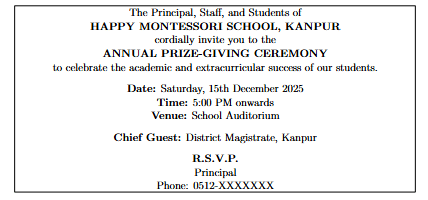
Quick Tip: Formal invitations are written in the third person. Center alignment is standard. Don't forget the RSVP details and the Chief Guest.
OR
Question 4 (b):
You are Shreya/Sanjay Rao. Your child is participating in a play to be enacted on the school annual day. You have received an invitation to attend the same. Draft a reply in not more than 50 words accepting the invitation.
View Solution
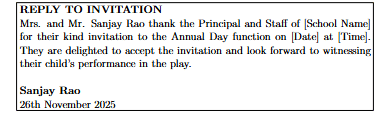
Quick Tip: A formal reply is also written in the third person. Be polite, acknowledge the invitation details (Event, Date), and clearly state acceptance.
You are Sonia/Shivam of 52, Main Street, Green City. Write a letter to the editor of a local daily expressing your views on the usage of increased screen time among children and its effects. You may use the following cues along with your own ideas to draft the letter.

View Solution
52, Main Street
Green City
26th November 2025
The Editor
The Daily Chronicle
Green City
Subject: Concerns Regarding Increased Screen Time Among Children
Sir,
Through the columns of your esteemed newspaper, I wish to draw the attention of parents and educators to the alarming rise in screen time among children and its detrimental effects.
"Increased screen time" refers to the excessive hours children spend on smartphones, tablets, and computers for non-educational purposes. This sedentary lifestyle is leading to severe physical health issues like obesity, eye strain, and poor posture. Mentally, it causes anxiety, reduced attention span, and disrupted sleep patterns.
Moreover, academic performance is suffering as students lose focus. Socially, children are becoming isolated, lacking the face-to-face interaction skills necessary for emotional development.
It is imperative that parents and educators intervene. Parents should set strict time limits and encourage outdoor activities. Schools can organize workshops on digital well-being. A collaborative effort is needed to ensure technology remains a tool for growth, not a hindrance.
Yours truly,
Sonia Quick Tip: Structure the letter formally: 1. Introduction (Purpose), 2. Body (Definition of problem), 3. Body (Effects - Physical/Mental/Social), 4. Conclusion (Solutions).
OR
Question 5 (b):
You are Sonali/Rahul from 46, G Street, Panipur. You read the given advertisement regarding the position of a graphic designer at Creative Studios. You decide to apply for the same. Write your application along with your biodata.

View Solution
46, G Street
Panipur
26th November 2025
The Director
Creative Studios
23/7 Roseview, Lake Point Street
Panipur
Subject: Application for the Post of Graphic Designer
Sir,
This is with reference to your advertisement in ‘The Times of India’ dated 24th November 2025 for the post of Graphic Designer. I wish to offer my candidature for the same.
I possess the requisite qualifications and over 5 years of experience in the field. I am proficient in Adobe Photoshop, CorelDRAW, and InDesign, and have a proven track record of designing logos and producing multimedia presentations. I am confident that my skills align well with your requirements.
I have enclosed my bio-data for your perusal. I am available for an interview at your convenience.
Yours faithfully,
Rahul
Encl: Bio-data
BIO-DATA
Name: Rahul
Father’s Name: Mr. A.K. Sharma
Date of Birth: 10th August 1995
Address: 46, G Street, Panipur
Educational Qualifications:
- MFA (Graphic Design), Delhi College of Art (2018)
- BFA, Delhi University (2016)
Experience:
- Senior Graphic Designer at XYZ Ad Agency (2020–Present)
- Junior Designer at ABC Corp (2018–2020)
Skills: Adobe Suite, CorelDRAW, UI/UX Design
References: Available on request. Quick Tip: Ensure the Covering Letter is concise. The Bio-data must explicitly include details asked in the cue: Experience (5+ years) and Skills (Adobe/Corel).
You are Anjali/Anjan, a Class XII student. Write an article exploring the role of youth in environmental conservation in India. Provide examples to illustrate your points. You may use the following cues along with your own ideas.

View Solution
Role of Youth in Environmental Conservation
By Anjali, Class XII
India, a land of diverse ecosystems, currently faces the dual brunt of modern technology and rapid urbanization. While development is essential, it often comes at the cost of our environment, leading to pollution, deforestation, and climate change. In this scenario, the youth of India hold the key to a sustainable future.
Young people today are more aware and technologically savvy. However, they face challenges such as lack of resources and resistance to change from older generations. Despite this, the benefits of their involvement are immense. Engaging in conservation fosters a sense of responsibility and ensures a healthier planet for their own future.
To bridge the gap, institutions and youth must collaborate. Schools and colleges can form ‘Green Clubs’ where students lead tree plantation drives and waste management projects. Youth can use social media to spread awareness. By harnessing their energy and innovation, we can transform environmental conservation from a mere concept into a nationwide movement. Quick Tip: Use a catchy title and byline. Follow a logical structure: Introduction (Context), Body (Challenges \& Benefits), Conclusion (Solutions).
OR
Question 6 (b):
Write a comprehensive report detailing the activities undertaken by students as part of the International Women’s Day celebrations. You are Aarushi/Aarav, a Class XII student and a member of the school magazine editorial board. Include descriptions of the events, participation details, and overall impact of these activities on the school community. You may organize your report by using the following cues.

View Solution
International Women’s Day Celebrations at ABC School
By Aarav, Member, Editorial Board
New Delhi, March 10: Our school celebrated International Women’s Day with great enthusiasm on March 8th in the school auditorium. The event aimed to honor the contributions of women and promote gender equality.
The programme began at 10:00 AM with a speech by the Principal highlighting women’s achievements. This was followed by a panel discussion involving female teachers and student leaders on ‘Women in Leadership’. Students of Class XII performed a thought-provoking skit depicting the journey of Indian women from the Vedic age to the modern era.
The highlight was a poster-making competition on the theme ‘Break the Bias’, which saw participation from over 200 students. The event concluded with a pledge to uphold the dignity of women. The celebration left a lasting impact, sensitizing the school community about gender issues and the importance of women’s empowerment. Quick Tip: A report must include a Headline, Byline, Place, and Date. Write in the past tense and cover the 5 Ws (Who, What, Where, When, How).
What I want should not be confused
with total inactivity.
Life is what it is about;
I want no truck with death.
If we were not so single-minded
about keeping our lives moving
(i). Explain with reference to the given extract, “What I want should not be confused with total inactivity.”
View Solution
The poet Pablo Neruda clarifies that his call for stillness and silence is for introspection and understanding oneself, not for “total inactivity.” Total inactivity implies idleness, passivity, or death, whereas the poet advocates for a conscious, productive pause to reflect on our actions and lives. Quick Tip: Focus on the distinction the poet makes between 'stillness' (active mental state) and 'inactivity' (passive physical state/death).
What does the term single-mindedness not imply in the given extract ?
View Solution
In the context of "keeping our lives moving," single-mindedness refers to a relentless focus or drive (synonymous with persistence, determination, and tenacity) to survive and progress. While this drive can make us tunnel-visioned, the term "narrow-mindedness" (intolerance/prejudice) is the outlier here as it carries a distinctly negative connotation regarding intellect/opinion, whereas the others describe the *effort*. Quick Tip: Identify synonyms. Persistence, determination, and tenacity are positive traits of effort. Narrow-mindedness is a negative trait of attitude.
In the line ‘Life is what it is about’, the phrase ‘it’ refers to _________.
View Solution
The phrase ‘it’ refers to life itself (or living/activity). The poet is emphasizing that his message of stillness is about celebrating life and living it more meaningfully, rather than ceasing to live. Quick Tip: The poet uses this line to distance his concept of silence from the concept of death.
The poet has used the phrase ‘total inactivity’ to illustrate _________ (irony/satire) in the perception that peace means doing nothing.
View Solution
The poet has used the phrase ‘total inactivity’ to illustrate the confusion (or misconception) in the perception that peace means doing nothing.
\textit{(Note: If the question demands choosing between irony or satire specifically, "irony" is more appropriate, highlighting the ironic misunderstanding that doing 'nothing' physically means being dead, whereas the poet means being mentally alive.) Quick Tip: The question asks what it "illustrates." It illustrates the misunderstanding/confusion people might have regarding the poet's message.
Read the assertion and the reason below, with reference to the given extract :
Assertion : The poet values an active and meaningful life.
Reason : Inactivity is equated with leisure, which the poet rejects.
Choose the correct option.
View Solution
The Assertion is true because the poet clearly states "Life is what it is about" and "I want no truck with death," indicating he values an active life. However, the Reason is false because the poet does *not* equate inactivity with leisure; he equates total inactivity with *death*. He actually advocates for a moment of quiet introspection (which could be seen as leisure/stillness), but he rejects the "total inactivity" of death. Quick Tip: Analyze the poet's definition of "total inactivity" - in the poem, it is linked to death ("no truck with death"), not leisure.
State in one sentence, what advice you would give to those engaged in ceaseless mechanized activity.
View Solution
I would advise them to pause for a moment, stop their rush, and engage in quiet introspection to understand the purpose of their actions and avoid the sadness of never understanding themselves. Quick Tip: The answer should reflect the central theme of the poem "Keeping Quiet": the need for introspection amidst the rush of modern life.
Read the following extract and answer the questions:
Therefore, on every morrow, are we wreathing
A flowery band to bind us to the earth,
Spite of despondence, of the inhuman dearth
Of noble natures, of the gloomy days,
Of all the unhealthy and o’er-darkened ways
Made for our searching: yes, in spite of all,
Some shape of beauty moves away the pall
From our dark spirits.
(A Thing of Beauty)
(i). Select the phrase that suggests the following :
In difficult times, beauty comes to our aid, in some form or the other, to make us overcome these difficulties.
View Solution
The phrase is: "Some shape of beauty moves away the pall / From our dark spirits." Quick Tip: Look for the part of the extract that describes the *effect* of beauty on our negative state ("dark spirits").
What does the imagery of ‘flowery band’ not represent in the given extract ?
View Solution
The "flowery band" represents our beautiful connection to nature and the earth ("bind us to the earth"). This binding is portrayed positively as something that keeps us attached to life despite suffering. "Imprisonment" carries a negative connotation of restriction which contradicts the comforting and life-affirming nature of the "flowery band" described by Keats. Quick Tip: Identify the option with a negative connotation that doesn't fit the context of "beauty" and "nature."
Complete the following suitably.
In the line, ‘moves away the pall from our dark spirits’, the phrase ‘the pall’ refers to _________.
View Solution
The phrase ‘the pall’ refers to a covering of sadness, gloom, or depression. (It metaphorically refers to the dark cloud of sorrow that covers the human spirit). Quick Tip: "Pall" literally means a cloth spread over a coffin. Metaphorically, it represents gloom or sadness covering the spirit.
The poet’s use of the phrase ‘inhuman dearth’ illustrates the ___________ (scarcity/plentitude) of noble human qualities.
View Solution
The poet’s use of the phrase ‘inhuman dearth’ illustrates the scarcity of noble human qualities. Quick Tip: "Dearth" means a scarcity or lack of something.
Read the assertion and the reason below, with reference to the given extract :
Assertion : The poet values beauty as it overcomes despondence and gloom.
Reason : Beauty, despite the world’s hardships, provides comfort and lifts our spirit.
Choose the correct option.
View Solution
The Assertion is true: the extract explicitly states that beauty moves away the pall of dark spirits ("spite of despondence"). The Reason is also true: it explains *why* the poet values beauty (because it provides comfort/lifts spirits despite hardships). The reason correctly explains the assertion. Quick Tip: Check if the Reason answers the "Why" for the Assertion. Why does the poet value beauty? Because it lifts our spirits.
State in one sentence, what advice would you give to those facing dark times.
View Solution
I would advise them to seek solace in the beautiful shapes of nature, like the sun, moon, or trees, as these things can lift the veil of sadness from their spirits and help them find hope. Quick Tip: Base the advice on the poem's message: Nature/Beauty is the cure for gloom.
Six hundred and fifty million years ago, a giant amalgamated southern supercontinent — Gondwana — did indeed exist, centred roughly around the present-day Antarctica. Things were quite different then: humans hadn’t arrived on the global scene, and the climate was much warmer, hosting a huge variety of flora and fauna. For 500 million years Gondwana thrived, but around the time when the dinosaurs were wiped out and the age of mammals got under way, the landmass was forced to separate into countries, shaping the globe much as we know it today.
(Journey to the end of the Earth)
(i). What was the climate like in Antarctica before the humans arrived on the global scene ?
View Solution
Before humans arrived, the climate in Antarctica (then part of Gondwana) was much warmer, and it hosted a huge variety of flora and fauna. Quick Tip: Scan the text for "climate was..." to find the direct answer.
Gondwana existed nearly ____________.
View Solution
Gondwana existed nearly six hundred and fifty million years ago. Quick Tip: The answer is in the very first phrase of the extract.
Select the suitable option to complete the following :
Gondwana, separating into countries, contributes to the reader’s understanding of the ___________.
View Solution
The separation of a supercontinent into countries and shaping the modern globe is a complex geological event (continental drift). It highlights the dynamic and complex nature of the earth's history, not its simplicity, speed (it took millions of years), or stability (since it broke apart). Quick Tip: Geological history involving the movement of landmasses indicates the complexity of how the earth was formed.
What difference does the author draw between then and now ?
View Solution
The author points out that "then" (650 million years ago), the climate was much warmer, there were no humans, and landmasses were fused (Gondwana); whereas "now," humans exist, the climate has changed, and the landmass has separated into distinct countries/continents. Quick Tip: Summarize the contrast mentioned in the text: "Things were quite different then..." vs. "shaping the globe much as we know it today."
Not that he faced no dangers. There were times when the bullet missed its mark, the tiger leapt upon him and he fought the beast with his bare hands. Each time it was the Maharaja who won.
At another time he was in danger of losing his throne. A high-ranking British officer visited Pratibandapuram. He was very fond of hunting tigers. And fonder of being photographed with the tigers he had shot.
(The Tiger King)
(i). Complete the following suitably :
The passage indicates that the British officer visited Pratibandapuram because __________.
View Solution
...he was very fond of hunting tigers and wanted to hunt a tiger in Pratibandapuram (and be photographed with it). Quick Tip: The text explicitly states his fondness for hunting tigers as the reason for his visit context.
What danger was faced by the Maharaja on the tiger hunt ?
View Solution
The danger faced was that sometimes the bullet missed its mark, and the tiger leapt upon him, forcing him to fight the beast with his bare hands. Quick Tip: Refer to the first two sentences of the extract for the details of the physical danger.
From the given extract, it is evident that the Maharaja was a _____________ man.
View Solution
From the given extract, it is evident that the Maharaja was a brave / courageous / fearless man. (He fought tigers with bare hands). Quick Tip: Infer the character trait from his action of fighting a tiger bare-handed.
Select the suitable option to complete the following :
The phrase ‘fonder of being photographed with the tigers’ contributes to the reader’s understanding of the officer’s __________.
View Solution
The officer cared more about the photograph (the proof/display of his act) than the act of hunting itself. This suggests a vanity or a desire to show off his achievements (recognition/fame) rather than a pure passion for the sport or photography as an art. Quick Tip: Focus on the motive behind the photograph – it's usually for showing off status or achievement.
The make-up department of the Gemini Studios was in the upstairs of a building that was believed to have been Robert Clive’s stables .... The make-up room had the look of a hair-cutting salon with lights at all angles around half a dozen large mirrors. They were all incandescent lights, so you can imagine the fiery misery of those subjected to make-up. The make-up department was first headed by a Bengali who became too big for the studio and left.
(Poets and Pancakes)
(i). The phrase ‘fiery misery’ in the given text refers to the ____________ of the actors.
View Solution
"Fiery misery" refers to the intense heat generated by the incandescent lights in the make-up room. This heat caused significant physical discomfort/suffering to the actors undergoing make-up. Quick Tip: "Misery" in this context implies suffering caused by the heat ("fiery"). "Discomfort" is the closest synonym in the options.
Select the correct option from those given in brackets to fill in the blank.
The description of the make-up room is a/an ___________ (criticism/admiration) of the make-up department in Gemini Studios.
View Solution
The description is a criticism of the make-up department. (The author highlights the intense heat, "fiery misery," and the "look of a hair-cutting salon," implying poor or uncomfortable working conditions). Quick Tip: Words like "misery" and the comparison to a "hair-cutting salon" (often chaotic/bright) suggest a critical or humorous tone, not admiration.
Complete the following suitably :
The historical significance of the make-up room was ___________.
View Solution
... that it was believed to have been Robert Clive’s stables. Quick Tip: Locate the historical reference in the first sentence of the extract.
With reference to the given extract, what does the reference to ‘half a dozen large mirrors’ suggest ?
View Solution
The reference to ‘half a dozen large mirrors’ suggests that the room was intensely bright and reflective, contributing to the "look of a hair-cutting salon." It emphasizes the visual setting where lights were reflected from all angles, increasing the heat and glare for the actors. Quick Tip: Connect the mirrors to the "lights at all angles" mentioned immediately before.
Select the textual option that is closest to indicating a sense of discomfort.
View Solution
Option (C) explicitly mentions "fiery misery," which directly describes the intense discomfort and heat experienced by the actors. Quick Tip: Look for words depicting pain or suffering. "Misery" is the keyword here.
What was the fate of the head of the make-up department ?
View Solution
The head of the make-up department (a Bengali) became too big for the studio and left. (He likely outgrew the role or sought better opportunities). Quick Tip: Refer to the last sentence of the extract for the answer.
Umberto Eco: Aah, now that is more difficult to explain. I have some philosophical interests and I pursue them through my academic work and my novels. Even my books for children are about non-violence and peace...you see, the same bunch of ethical, philosophical interests.
And then I have a secret. Did you know what will happen if you eliminate the empty spaces from the universe, eliminate the empty spaces in all the atoms ? The universe will become as big as my fist. Similarly, we have a lot of empty spaces in our lives. I call them interstices. Say you are coming over to my place. You are in an elevator and while you are coming up, I am waiting for you. This is an interstice, an empty space. I work in empty spaces.
(The Interview)
(i). What does Umberto’s statement on his philosophical interest reveal about him ?
View Solution
Umberto’s statement reveals that he is consistent and integrated in his work. Whether he is writing academic papers or novels, or even children's books, his core ethical and philosophical values (like non-violence and peace) remain the same and permeate all his writing. Quick Tip: Focus on the phrase "the same bunch of ethical, philosophical interests" - it shows consistency across genres.
Select the correct option from those given in brackets to fill in the blank.
His academic work and children’s books both reveal __________ (similar/experimental) interests.
View Solution
His academic work and children’s books both reveal similar interests. (He mentions "the same bunch of... interests"). Quick Tip: "Same bunch" clearly points to similarity, not experimentation.
What example of an interstice does Umberto Eco give ?
View Solution
Umberto Eco gives the example of waiting for someone while they are coming up in an elevator. The time spent waiting while the guest is in the elevator is the "empty space" or interstice. Quick Tip: Locate the sentence starting with "Say you are coming over..." to find the specific example.
The phrase ‘as big as my fist’ most nearly means _________ with reference to the given text.
View Solution
Eco uses the analogy to say that if all empty space were removed, the vast universe would shrink to the size of a fist. In this context, "as big as my fist" illustrates how compact or very small the solid matter actually is compared to the whole. Quick Tip: Imagine the universe shrinking to the size of a fist - it implies becoming very small.
What secret is Umberto referring to ?
View Solution
The secret Umberto refers to is his method of working in "interstices" or empty spaces. He utilizes the brief intervals of free time (like waiting for an elevator) to do his writing and work, which allows him to be prolific. Quick Tip: The "secret" is revealed in the paragraph starting with "And then I have a secret..." \(\rightarrow{}\) "I work in empty spaces."
Umberto Eco says, he works in interstices. By this, he means that he works ________.
View Solution
Eco explicitly defines interstices as "empty spaces" in our lives (intervals of time) and states "I work in empty spaces." Quick Tip: Direct textual match: "I work in empty spaces."
How does the poet highlight the mean and selfish nature of the city dwellers ? (A Roadside Stand)
View Solution
Robert Frost highlights the city dwellers' selfishness by depicting them as "polished traffic" that passes by the roadside stand without stopping. If they do stop, it is only to ask for directions, complain about the landscape being marred, or ask for gas, completely ignoring the plight and goods of the poor rural folk. Quick Tip: Focus on their actions: ignoring the stand, being self-absorbed ("polished traffic"), and lacking empathy.
How did Sophie’s family react when she announced that if she ever had money she would buy a boutique ? (Going Places)
View Solution
Sophie's family reacted with skepticism and dismissal. Her father looked at her with disdain/anger. Her brother Geoff remained silent or skeptical, and Jansie (her friend, though not family, represents her reality) knew it was impossible. They knew they were poor and destined for the biscuit factory, regarding her dreams as wild and impractical fantasies. Quick Tip: Recall the father's expression and the general atmosphere of poverty in their home.
What caused the lack of communication between the Englishman and the people at Gemini Studios ? (Poets and Pancakes)
View Solution
The lack of communication was caused by a language barrier and an accent gap. The Englishman (Stephen Spender) spoke with a distinct accent that the Tamil-speaking staff at Gemini Studios couldn't understand. Furthermore, his intellectual topic (communism/poetry) was alien to the simple studio crowd, making his speech a mystery to them. Quick Tip: Keywords: "Accent" and "Language barrier."
Give a brief account of the reception that Gandhi got in Motihari ? (Indigo)
View Solution
When Gandhi arrived in Motihari, he was greeted by a vast multitude of peasants. A huge crowd gathered at the station. Later, when he was summoned to court, thousands of peasants surrounded the courthouse, demonstrating their support. It was a spontaneous demonstration of their liberation from fear of the British, showing immense solidarity. Quick Tip: Mention the "multitude" and "thousands of peasants" demonstrating fearlessly.
Why was Douglas determined to get over his fear of water ? (Deep Water)
View Solution
Douglas was determined to conquer his fear because it ruined his fishing trips and deprived him of the joy of canoeing, boating, and swimming. The terror stayed with him for years, haunting him and limiting his enjoyment of life and outdoor activities, which compelled him to hire an instructor. Quick Tip: It restricted his life and joy - focus on the specific activities he missed out on (fishing, boating).
According to the poet, beauty is everlasting. Explain. (A Thing of Beauty)
View Solution
According to Keats, beauty is everlasting because "its loveliness increases" and it "will never pass into nothingness." Unlike mortal things that fade, a thing of beauty leaves a permanent impression on our minds, providing a quiet bower and eternal joy that sustains us through life's trials. Quick Tip: Quote key phrases like "loveliness increases" or "never pass into nothingness."
What makes Tishani Doshi write that she felt as if she was walking into a giant ping-pong ball ? (Journey to the end of the Earth)
View Solution
Tishani Doshi describes Antarctica as a giant ping-pong ball because of its vast, expansive whiteness. The landscape is devoid of any human markers like trees, billboards, or buildings. The uninterrupted white horizon and the blue sky create a surreal, enclosed feeling, making perspective and time feel suspended. Quick Tip: "Ping-pong ball" implies a smooth, white, featureless, and rounded expanse.
Why did the booking clerk refuse to accept the money ? (The Third Level)
View Solution
The booking clerk refused the money because Charley was trying to pay with modern currency notes, which looked different from the old-style currency used in 1894. The clerk thought Charley was trying to cheat him and warned him that he wouldn't get far, fearing it was counterfeit or fraud. Quick Tip: The difference in currency (Modern vs 1894 bills) is the key reason.
Why did Derry enter Mr Lamb’s garden ? (On The Face of It)
View Solution
Derry entered Mr. Lamb's garden not to steal apples, but because he thought it was empty. He wanted to find a secluded place to hide away from people, as he was self-conscious about his burnt face and wanted to avoid their staring eyes and cruel comments. Quick Tip: He sought "seclusion" or isolation, not the apples.
M. Hamel in ‘The Last Lesson’ and Edla in ‘The Rattrap’ are the guiding lights of self-realization to Franz and the peddler respectively. Comment.
View Solution
Both M. Hamel and Edla Willmansson serve as catalysts for transformation in their respective stories through their compassion and guidance.
In ‘The Last Lesson,’ M. Hamel acts as a guiding light for Franz. Until the last day, Franz neglected his studies and feared the teacher. However, Hamel’s dignity, patience, and patriotic appeal on the final day awakened Franz’s love for his language and country. Hamel taught him that holding onto one's language is the key to freedom, making Franz realize the value of education he had ignored.
In ‘The Rattrap,’ Edla’s unconditional kindness transforms the peddler. Despite knowing he was not the Captain, she treated him with respect and dignity, inviting him for Christmas. Her trust and compassion ("guiding light") melted his hardened heart, making him realize he could rise above his thief-like nature. He signed the letter as 'Captain von Stahle', proving he had reclaimed his dignity.
Thus, both characters illuminated the path to self-improvement for the protagonists. Quick Tip: Compare how both characters used their specific virtues (Hamel's patriotism/patience, Edla's kindness) to trigger a change in the protagonist.
OR
Question 12 (b):
The poems ‘My Mother at Sixty-six’ by Kamala Das and ‘Aunt Jennifer’s Tigers’ by Adrienne Rich explore the themes of pain and conflict. Explain.
View Solution
Both poems delve into the inner emotional struggles of women, dealing with different forms of pain and conflict.
In ‘My Mother at Sixty-six,’ Kamala Das deals with the pain of separation and the fear of loss. The conflict lies between her filial duty/affection and the reality of life (her mother's aging). Seeing her mother "ashen like a corpse" triggers the childhood fear of losing her. She hides this pain behind a smile ("I did was smile and smile..."), highlighting the conflict between her internal grief and external composure.
In ‘Aunt Jennifer’s Tigers,’ Adrienne Rich explores the pain of oppression within a patriarchal marriage. Aunt Jennifer’s conflict is between her desire for freedom (represented by the fearless tigers) and her reality of being crushed under the "massive weight of Uncle’s wedding band." Her art is her escape, but her life is one of terrified submission.
While Das's pain is personal and inevitable (aging), Rich's is societal and imposed (gender oppression). Both poets poignantly capture the silent suffering of women. Quick Tip: Structure the answer by discussing each poem separately first (identifying the specific pain/conflict) and then concluding with a comparative sentence.
Dr. Sadao emerges as both a true patriot and a compassionate human being. Elaborate. (The Enemy)
View Solution
Dr. Sadao Hoki represents the conflict between duty towards one's country and duty towards humanity, ultimately excelling in both.
As a compassionate human being and doctor, Sadao upholds his professional oath. When he finds the wounded American POW, his instinct to save a life overrides his prejudice against the enemy. He risks his own safety and reputation to operate on the man, nurse him back to health, and ensure his survival. This shows his supreme humanity.
As a true patriot, he does not harbor treasonous intent. Once the soldier is out of danger, Sadao loyally reports the matter to the General, ready to hand the prisoner over to the authorities. He waits for the General's assassins. However, when the General fails to act, Sadao helps the soldier escape to save him, but this is driven by the failure of the state machinery, not a lack of patriotism. He admits to the General later, proving he had no intention of hiding the truth.
Thus, he balances his ethical duty as a healer with his civic duty as a citizen. Quick Tip: Highlight the two roles: Doctor (saving the enemy) vs. Citizen (informing the General). Show how he didn't compromise on either.
OR
Question 13 (b):
‘Memories of Childhood’ deals with autobiographical episodes of Zitkala-Sa and Bama. They both come from marginalized communities, and look back on their childhood to reflect on their relationships with mainstream culture. Elaborate.
View Solution
Both Zitkala-Sa and Bama narrate childhood experiences that highlight the humiliation and discrimination faced by marginalized communities at the hands of mainstream culture.
Zitkala-Sa describes her experience in a Native American boarding school where her culture was systematically stripped away. The cutting of her long hair—a symbol of dignity in her culture—forced her into submission. She felt like a "wooden toy," her spirit crushed by the rigid, insensitive rules of the white mainstream culture that viewed her traditions as inferior.
Bama, a Tamil Dalit writer, recounts her awakening to the practice of untouchability. As a child, she was amused by an elder carrying a packet by its string, until her brother explained that the upper castes considered them "polluted." This realization of social segregation filled her with anger and rebellion.
Both narratives reflect a relationship of oppression and resistance. While the mainstream culture tried to subjugate them, both women used education and their voices to resist and reflect upon these injustices, turning their trauma into powerful literature. Quick Tip: Use keywords like "cultural suppression" (Zitkala-Sa) and "untouchability/caste discrimination" (Bama). Mention 'Education' as their tool for liberation.
*The article might have information for the previous academic years, please refer the official website of the exam.