
CBSE Class 12 English Core Question Paper 2025 (Set 2 - 1/5/2) with Solution Pdf


| Updated On - Feb 10, 2026
CBSE conducted the Class 12 English Board Exam on March 11, 2025, from 10:30 AM to 1:30 PM. The English Core theory exam carries a total of 100 marks, divided into 80 marks for the written exam and 20 marks allocated for internal assessment. The question paper consists of different types of questions, including MCQ carrying 1 mark each,short-answer questions valued at 2 or 3 marks each and long-answer questions carrying 4 or 6 marks each.
CBSE Class 12 English (Set 2 - 1/5/2) Question Paper 2025 with Solution PDF
| CBSE Class 12 English Question Paper | Download PDF | Check Solutions |
Read the following passage carefully:
(1) In recent years, air pollution has emerged as one of the most pressing environmental and public health issues in India. Cities like Delhi, Mumbai and Bengaluru often record Air Quality Indices (AQI) that fall into the 'hazardous' category, posing several health risks to their inhabitants. The thick blanket of smog that shrouds these urban areas is composed of harmful pollutants such as particulate material (PM 2.5 and PM 10), nitrogen dioxide (NO2) and sulphur dioxide (SO2). These pollutants originate from various sources including vehicular emissions, industrial activities and construction dust.
(2) The constant emission of pollutants from vehicles, industrial activities and construction works exacerbate the problem. Residents of these cities are often seen wearing masks and using air purifiers in a desperate attempt to mitigate the effects of polluted air. The 'urban haze' not only affects physical health but also impacts mental well-being. Studies indicate that prolonged exposure to high pollution levels can lead to respiratory issues, such as cardiovascular diseases and even cognitive decline.
(3) Furthermore, children and the elderly are the most vulnerable groups. Children, with their developing respiratory systems, and the elderly, often with pre-existing health conditions face the brunt of this environmental crisis. Schools frequently shut down during peak pollution periods, disrupting education and daily life. The economic cost of air pollution is staggering, with increased healthcare expenses and lost labour productivity. Businesses also suffer as employees' health issues lead to increased absenteeism and decreased efficiency.
(4) Government initiatives, such as the National Clean Air Programme (NCAP) aim at reducing air pollution levels across the country. However, these measures require robust implementation and public cooperation to be effective. Simple actions like reducing vehicle use, promoting public transportation and adopting cleaner technologies can significantly alleviate the situation. Additionally, the enforcement of stricter emission norms for industries and vehicles is crucial. Public awareness campaigns can play a pivotal role in encouraging others to adopt environmentally friendly practices.
(5) The role of technology in combating air pollution is also noteworthy. Innovative solutions such as air quality monitoring systems, green buildings and electric vehicles are gaining attraction. These technologies not only help in reducing pollution but also promote sustainable development. Urban planning that incorporates green spaces can also mitigate the effects of pollution by improving air quality and providing residents with a healthier living environment.
(6) As we navigate this challenge, it is imperative to remember that the solution lies not just in policy changes but also in the behavioural shifts of individuals. Embracing a lifestyle that prioritizes environmental health will pave the way for a cleaner, healthier India. Collective efforts and sustained commitments are crucial for ensuring breathable air for future generations. It is a shared responsibility that requires action from every segment of society from policy makers to ordinary citizens.
Answer the following questions, based on the above passage :
(i). According to paragraph (1), what components make up the ‘urban haze' that envelops Indian cities?
View Solution
Step 1: Understanding the Question:
The question asks to identify the components of the 'urban haze' as mentioned in the first paragraph of the passage.
Step 2: Locating the Information:
We need to carefully read paragraph (1) to find the sentence that describes the composition of the smog or 'urban haze'.
The paragraph states: "The thick blanket of smog that shrouds these urban areas is composed of harmful pollutants such as particulate material (PM 2.5 and PM 10), nitrogen dioxide (NO2) and sulphur dioxide (SO2)."
Step 3: Formulating the Answer:
Based on the text, the components are clearly listed. We can write them down as the answer.
Step 4: Final Answer:
The 'urban haze' is made up of particulate material (PM 2.5 and PM 10), nitrogen dioxide (NO2), and sulphur dioxide (SO2).
Quick Tip: For "find the information" type questions, scan the specified paragraph for keywords from the question (like 'urban haze' or 'components'). This helps locate the exact sentence with the answer quickly.
The writer refers to air pollution as a 'public health issue' in paragraph (1) because:
View Solution
Step 1: Understanding the Question:
The question asks for the reason why the author calls air pollution a 'public health issue' based on the information in paragraph (1).
Step 2: Analyzing the Passage:
Paragraph (1) states that cities record 'hazardous' Air Quality Indices (AQI), "posing several health risks to their inhabitants."
A 'public health issue' is a problem that affects the health of a large population.
The phrase "posing several health risks" directly links air pollution to the health and physical well-being of the public.
Step 3: Evaluating the Options:
(A) This aligns perfectly with the passage stating that pollution poses "several health risks."
(B), (C), and (D) are consequences of air pollution mentioned later in the passage (paragraph 3), but the primary reason it's a 'public health issue' is the direct threat to health, as stated in paragraph 1.
Step 4: Final Answer:
The correct option is (A) because the passage explicitly connects air pollution to "health risks," which is the definition of a public health issue.
Quick Tip: Focus on the specific paragraph mentioned in the question. While other options might be true according to the whole passage, the question asks for the reason based on paragraph (1) only.
Complete the analogy with one word from paragraph (2).
blanket: cover :: extended : _____________
View Solution
Step 1: Understanding the Question:
The question presents an analogy. We need to find the relationship between the first pair of words (blanket: cover) and apply it to the second pair (extended : ?). The answer must be a word from paragraph (2).
Step 2: Analyzing the Analogy:
A 'blanket' is used to 'cover' something. The words are synonyms or describe a similar action/state.
We need to find a word in paragraph (2) that is a synonym for 'extended'.
Step 3: Searching Paragraph (2):
Let's scan paragraph (2) for the options provided or words with similar meanings.
The paragraph contains the phrase: "prolonged exposure to high pollution levels".
The word 'prolonged' means lasting for a long time or extended.
Step 4: Final Answer:
'Prolonged' is a synonym for 'extended'. Therefore, the correct analogy is blanket: cover :: extended : prolonged.
Quick Tip: In analogy questions, first determine the relationship between the given pair of words (e.g., synonym, antonym, cause-effect, part-whole). Then, find a word that fits the same relationship with the third word.
Complete the following sentence suitably (Paragraph (2)):
'The prolonged exposure to high pollution levels leads to cognitive decline' indicates that it impacts _____________.
View Solution
Step 1: Understanding the Question:
The question asks what 'cognitive decline' impacts, based on the context of paragraph (2).
Step 2: Analyzing the Context:
Paragraph (2) states: "The 'urban haze' not only affects physical health but also impacts mental well-being."
It then gives examples: "prolonged exposure... can lead to respiratory issues, such as cardiovascular diseases and even cognitive decline."
'Cognitive decline' refers to the worsening of mental functions like memory, thinking, and reasoning. This is directly related to mental health and well-being.
Step 3: Evaluating the Options:
(A) mental health: Cognitive decline is a key aspect of deteriorating mental health. This fits perfectly.
(B) economic development: While pollution impacts the economy (mentioned in para 3), cognitive decline is a health issue, not an economic one directly.
(C) respiratory functions: This is a physical health issue, mentioned separately in the passage. Cognitive decline is distinct from respiratory problems.
(D) mobility: This refers to movement and is not related to cognitive function.
Step 4: Final Answer:
The term 'cognitive decline' points to an impact on mental health.
Quick Tip: Understand the meaning of key terms. 'Cognitive' relates to the mental processes of perception, memory, judgment, and reasoning. Knowing this makes it easy to link 'cognitive decline' to 'mental health'.
Provide one textual evidence with reference to paragraph (3), to prove the following:
"Children and the elderly are the most vulnerable groups affected by air pollution."
View Solution
Step 1: Understanding the Question:
The question asks for a direct quote or piece of evidence from paragraph (3) that supports the statement that children and the elderly are the most vulnerable.
Step 2: Locating the Evidence in Paragraph (3):
We need to scan paragraph (3) for sentences that talk about children and the elderly.
The paragraph starts with the sentence: "Furthermore, children and the elderly are the most vulnerable groups."
The sentence immediately following this provides the proof: "Children, with their developing respiratory systems, and the elderly, often with pre-existing health conditions face the brunt of this environmental crisis."
Step 3: Selecting the Evidence:
This sentence explicitly explains *why* they are vulnerable (developing respiratory systems, pre-existing conditions), thus proving the statement.
Step 4: Final Answer:
The required textual evidence is the sentence explaining the specific reasons for the vulnerability of children and the elderly.
Quick Tip: When asked for "textual evidence," it is best to quote the exact line or phrase from the passage that directly supports the given statement.
Complete the following suitably with one advantage with reference to paragraph (4):
Implementing stricter emission norms for vehicles can help to _____________.
View Solution
Step 1: Understanding the Question:
The question asks for an advantage of implementing stricter emission norms, based on information in paragraph (4).
Step 2: Analyzing Paragraph (4):
Paragraph (4) discusses measures to tackle air pollution. It says, "Simple actions like reducing vehicle use, promoting public transportation and adopting cleaner technologies can significantly alleviate the situation. Additionally, the enforcement of stricter emission norms for industries and vehicles is crucial."
The overall goal mentioned in the paragraph is "reducing air pollution levels across the country."
Step 3: Deducing the Advantage:
The paragraph frames stricter emission norms as a crucial action to solve the problem of air pollution. Therefore, its advantage is that it helps reduce pollution. The passage uses the phrase "alleviate the situation" to describe the effect of such actions.
Step 4: Final Answer:
Implementing stricter emission norms for vehicles can help to alleviate the situation of air pollution or help to reduce air pollution levels.
Quick Tip: Look for the overall purpose of the actions mentioned in the paragraph. The advantage of any specific action will be related to achieving that main purpose.
Assess the potential challenges and benefits of promoting public transportation as a solution to air pollution, as outlined in paragraph (4).
\textbf{Benefit:} Promoting public transportation can significantly alleviate the situation of air pollution by reducing the number of private vehicles on the road, thereby lowering vehicular emissions.
\textbf{Challenge:} The passage implies a challenge is that such measures require "robust implementation and public cooperation to be effective," suggesting that getting people to switch from private to public transport can be difficult and requires significant effort and cooperation.
View Solution
Step 1: Understanding the Question:
The question asks to identify both the benefits and challenges of promoting public transport, using information from paragraph (4).
Step 2: Identifying the Benefit:
Paragraph (4) explicitly lists "promoting public transportation" as one of the "simple actions" that can "significantly alleviate the situation." This is a clear benefit. It reduces air pollution.
Step 3: Identifying the Challenge:
The paragraph does not state a direct challenge to public transport, but it provides a general challenge for all government initiatives. It says, "However, these measures require robust implementation and public cooperation to be effective." This implies that a major challenge is ensuring the public actually uses public transport and that the system is implemented effectively. Lack of public cooperation is a significant hurdle.
Step 4: Final Answer:
The benefit is the alleviation of air pollution. The implied challenge is the need for effective implementation and gaining public cooperation for the measure to succeed.
Quick Tip: Sometimes, challenges are not stated directly but are implied. Look for words like 'however', 'require', or 'challenge' that signal a difficulty or condition that must be met for success.
What is the significance of urban planning in mitigating air pollution according to paragraph (5)?
View Solution
Step 1: Understanding the Question:
The question asks about the role or importance ('significance') of urban planning in reducing air pollution, based on paragraph (5).
Step 2: Locating the Information in Paragraph (5):
We need to scan paragraph (5) for the keywords 'urban planning'.
The paragraph states: "Urban planning that incorporates green spaces can also mitigate the effects of pollution by improving air quality and providing residents with a healthier living environment."
Step 3: Formulating the Answer:
The sentence directly explains the significance. Urban planning is significant because it allows for the inclusion of green spaces, which in turn improves air quality and creates a healthier environment.
Step 4: Final Answer:
The significance lies in its ability to integrate green spaces into cities, which helps to improve air quality and provide a healthier environment for residents.
Quick Tip: Pay attention to cause-and-effect language in the passage. Here, "Urban planning that incorporates green spaces can... mitigate the effects" shows a clear cause (urban planning with green spaces) and effect (mitigated pollution).
How does technology help in resolving the problem of air pollution?
View Solution
Step 1: Understanding the Question:
The question asks for the ways technology helps solve the air pollution problem, based on the passage (specifically paragraph 5).
Step 2: Locating the Information in Paragraph (5):
Paragraph (5) begins with "The role of technology in combating air pollution is also noteworthy."
It then lists examples: "Innovative solutions such as air quality monitoring systems, green buildings and electric vehicles are gaining attraction."
It further explains the benefit: "These technologies not only help in reducing pollution but also promote sustainable development."
Step 3: Synthesizing the Answer:
The answer should include the specific examples of technologies mentioned and their dual benefits of reducing pollution and promoting sustainability.
Step 4: Final Answer:
Technology helps by offering solutions like air quality monitoring systems, green buildings, and electric vehicles, which directly reduce pollution and also support sustainable development.
Quick Tip: When a question asks "How?", look for examples and explanations in the text. The passage provides specific examples of technologies to answer this question.
Why does the author say that just the policy change is not the solution?
View Solution
Step 1: Understanding the Question:
The question asks for the author's reasoning behind the statement that policy changes alone are insufficient to solve the air pollution problem. The answer is likely in the concluding paragraph (6).
Step 2: Analyzing Paragraph (6):
Paragraph (6) states: "...it is imperative to remember that the solution lies not just in policy changes but also in the behavioural shifts of individuals."
It further adds: "Embracing a lifestyle that prioritizes environmental health will pave the way for a cleaner, healthier India. Collective efforts and sustained commitments are crucial..."
The final sentence emphasizes it is a "shared responsibility".
Step 3: Formulating the Reason:
The author's point is that policies are ineffective without individual action and a change in public behaviour. The responsibility is shared among all members of society.
Step 4: Final Answer:
Policy change is not the sole solution because individual behavioural shifts, collective effort, and a shared sense of responsibility from all segments of society are equally essential to tackle air pollution effectively.
Quick Tip: Concluding paragraphs often summarize the author's main argument or call to action. For questions about the author's overall perspective or concluding thoughts, always refer to the final paragraph.
Read the following passage carefully:
(1) Introduction : In the digital age, social media has become an integral part of daily life, profoundly affecting how individuals interact and perceive the world. This case study aims to analyze the impact of social media on the mental health of different age groups in Indian society and explore the implications for overall well-being.
(2) Methodology: A survey was conducted among individuals across various age groups, ranging from teenagers to seniors, to determine their social media usage patterns. Participants were asked to indicate the amount of time they spend on social media platforms and describe their feelings and experiences related to its use. The data was then analyzed to identify trends and patterns among different age demographics.
(3) Survey Examination : The survey encompassed a comprehensive examination of social media habits, including not only the frequency and duration of usage but also the emotional and psychological effects of social media engagement. Participants were encouraged to articulate their experiences, providing invaluable insights into the multifaceted nature of social media's impact on mental health.
(4) Results: The survey results revealed interesting insights into social media usage and its effects on mental health among different age groups. Teenagers are deeply entrenched in exploring their self image and forming their identity. They are heavily reliant on their peer relationships and are vulnerable to the social aspects of online platforms to connect with friends and share experiences. As a result, their usage is higher that of other age groups.

(5) Implications for Interventions : By discerning the diverse effects of social media among different age groups, policy makers and mental health practitioners can tailor interventions to address specific demographic needs, e.g., educational campaigns aimed at teenagers could empower them to navigate social media more responsibly, while support groups for seniors can enhance their digital literacy and reduce feelings of loneliness.
(6) Conclusion : The survey outcomes serve as a roadmap for designing targeted interventions that not only cater to diverse demographic needs but also promote mental well-being. By harnessing the insights gleaned from this study, stakeholders can collaboratively work towards building healthier online communities and promoting sustainable digital practices for generations to come.
Answer the following questions, based on the above passage :
(i). Complete the following suitably:
In the introduction, the researchers link the digital age with the impact of social media on mental health to highlight _____________.
View Solution
Step 1: Understanding the Question:
The question asks to complete the sentence by identifying what the researchers wanted to highlight by linking the digital age, social media, and mental health in the introduction.
Step 2: Analyzing the Introduction (Paragraph 1):
The introduction (paragraph 1) states: "This case study aims to analyze the impact of social media on the mental health of different age groups in Indian society and explore the implications for overall well-being."
The sentence clearly states the two aims: analyzing the impact and exploring the implications for well-being.
Step 3: Completing the Sentence:
The link is established to highlight the broader consequences, which the passage refers to as "implications for overall well-being."
Step 4: Final Answer:
The researchers make this link to highlight the implications for overall well-being.
Quick Tip: The 'aim' or 'purpose' of a study is often explicitly stated in the introduction. Look for phrases like "This study aims to...", "The purpose is...", or "This paper explores...".
Choose the correct option:
To examine social media usage patterns across various age groups in detail and assess the mental health implications will be classified as:
View Solution
Step 1: Understanding the Question:
The question asks how to classify the act of examining usage patterns and assessing mental health implications within the context of the study described.
Step 2: Analyzing the Passage:
Paragraph (1) (Introduction) states the aim of the study: "to analyze the impact of social media on the mental health of different age groups... and explore the implications for overall well-being."
Paragraph (2) (Methodology) describes how this was done: "A survey was conducted... to determine their social media usage patterns."
The phrase in the question, "examine social media usage patterns... and assess the mental health implications," is a direct description of the main goal or objective of the research.
Step 3: Evaluating the Options:
(A) Primary purpose: This fits perfectly as it describes the main goal of the study.
(B) Method of analysis: The method was the survey and data analysis, not the goal itself.
(C) Secondary purpose: This was the main goal, not a secondary one.
(D) Research outcome: The outcome would be the findings (e.g., teenagers experience more anxiety), not the act of examining.
Step 4: Final Answer:
The statement describes the primary purpose of the case study.
Quick Tip: Distinguish between the 'purpose' (why the study is done), 'methodology' (how it is done), and 'outcome' (what was found). The question describes the 'why'.
Give two points to support why it is likely that social media usage was a key factor in the study on mental health.
Two points are:
1. The study's methodology specifically asked participants to indicate the amount of time they spend on social media platforms and describe their feelings and experiences related to its use.
2. The results are presented in a table that directly correlates the age group, average daily social media usage in hours, and the reported mental health effects (e.g., anxiety, stress, loneliness).
View Solution
Step 1: Understanding the Question:
The question asks for two reasons or pieces of evidence from the passage that show social media usage was the central element being studied for its impact on mental health.
Step 2: Finding Evidence in the Passage:
Point 1 (from Methodology): Paragraph (2) states, "Participants were asked to indicate the amount of time they spend on social media platforms and describe their feelings and experiences related to its use." This shows a direct focus on social media.
Point 2 (from Results): The table in paragraph (4) explicitly links "Average daily usage (hours)" of social media to "Reported effects" on mental health for each age group. This direct correlation demonstrates that social media usage was the key independent variable being investigated.
Step 3: Formulating the Points:
Combine the findings into two clear, distinct points that prove the focus was on social media.
Step 4: Final Answer:
The study's focus on collecting data about time spent on social media and its direct correlation of usage hours with mental health effects in the results table are two strong points supporting social media as the key factor.
Quick Tip: To support a claim, look for evidence in both the 'Methodology' (what was measured) and 'Results' (what was reported) sections of a study summary. These sections provide concrete proof of the study's focus.
Paragraph (3) includes the words - 'emotional and psychological'. Classify the following sentences as 'emotional' or ‘psychological'.
(A) Educational campaigns aimed at teenagers could empower them to navigate social media more responsibly.
(B) Support groups for seniors can enhance their digital literacy and reduce feelings of loneliness.
(A) Psychological
(B) Emotional
View Solution
Step 1: Understanding the Question:
We need to classify two statements as either relating to 'emotional' aspects or 'psychological' aspects. 'Psychological' generally refers to mental processes and behavior, while 'emotional' refers to feelings.
Step 2: Analyzing Sentence (A):
"Educational campaigns aimed at teenagers could empower them to navigate social media more responsibly."
This deals with changing behavior ("navigate... responsibly") through learning and empowerment. This is a cognitive and behavioral change, which falls under the broader category of 'psychological'.
Step 3: Analyzing Sentence (B):
"Support groups for seniors can enhance their digital literacy and reduce feelings of loneliness."
The key phrase here is "reduce feelings of loneliness." Loneliness is a feeling or an emotion. Therefore, this sentence directly addresses an 'emotional' state.
Step 4: Final Answer:
Sentence (A) is psychological as it relates to responsible behavior and cognitive empowerment. Sentence (B) is emotional as it directly targets the feeling of loneliness.
Quick Tip: Think of 'psychological' as relating to the mind and behavior (thinking, acting, learning). Think of 'emotional' as relating specifically to feelings (happiness, sadness, loneliness, anger).
Read the following text:
Rahul has a tendency to spend late night hours engaging in social media to avoid missing out on latest updates on different events. His friend, Rajneesh spends many hours on social media due to peer pressure whereas their close friend, Dr. Sharma uses social media to stay connected with his near and dear ones.
Select the option that identifies the correct demographic Rahul, Rajneesh and Dr. Sharma belong to:
View Solution
Step 1: Understanding the Question:
We need to match the behaviors of Rahul, Rajneesh, and Dr. Sharma with the reported effects for different age groups in the table provided in the passage.
Step 2: Analyzing the Characters and the Table:
Rahul: His behavior is driven by a need to not miss out on updates. This is a classic description of 'Fear of Missing Out (FOMO)', which the table lists as an effect for Young Adults.
Rajneesh: He uses social media due to 'peer pressure'. The table explicitly lists 'peer pressure' as an effect for Teenagers.
Dr. Sharma: He uses social media to 'stay connected with his near and dear ones'. The table for Seniors mentions 'sense of connection' as one of the effects.
Step 3: Matching and Selecting the Option:
- Rahul = Young Adult
- Rajneesh = Teenager
- Dr. Sharma = Senior
This combination matches option (D).
Step 4: Final Answer:
Based on the mapping of behaviors to the reported effects in the table, option (D) is the correct identification of the demographics.
Quick Tip: For application-based questions, break down the information given for each character and carefully match it with the specific data points or descriptions provided in the passage or table.
Why is the average daily usage of social media highest among teenagers?
View Solution
Step 1: Understanding the Question:
The question asks for the reason behind the high social media usage among teenagers, based on the passage.
Step 2: Locating the Information:
Paragraph (4) discusses the results for different age groups. After presenting the table, the text provides an explanation specifically for teenagers.
It states: "Teenagers are deeply entrenched in exploring their self image and forming their identity. They are heavily reliant on their peer relationships and are vulnerable to the social aspects of online platforms to connect with friends and share experiences. As a result, their usage is higher that of other age groups."
Step 3: Formulating the Answer:
The answer should summarize these key reasons: identity formation, reliance on peer relationships, and the use of platforms to connect and share.
Step 4: Final Answer:
The high usage is attributed to their developmental stage, where they focus on forming their identity and self-image, and their heavy reliance on peer connections, for which social media is a primary tool.
Quick Tip: Look for causal words like "As a result," "because," or "due to" in the text. They often signal an explanation for a previously stated fact, such as the high usage rates shown in the table.
According to paragraph (5), analyze how targeted interventions based on the diverse effects of social media on different age groups can lead to improved mental health outcomes.
View Solution
Step 1: Understanding the Question:
The question asks for an analysis of how 'targeted interventions' improve mental health, using information from paragraph (5). 'Analyze' means we need to explain the process or mechanism.
Step 2: Examining Paragraph (5):
The paragraph is titled "Implications for Interventions." It states that by understanding the "diverse effects," policymakers can "tailor interventions to address specific demographic needs."
It gives two specific examples:
1. For Teenagers: "educational campaigns... to navigate social media more responsibly." This targets their vulnerability and need for guidance.
2. For Seniors: "support groups... enhance their digital literacy and reduce feelings of loneliness." This targets their specific issues of loneliness and potential digital fatigue.
Step 3: Analyzing the Mechanism:
The core idea is that a one-size-fits-all approach is ineffective. Different age groups use social media for different reasons and experience different negative effects. Targeting the intervention means matching the solution to the specific problem (e.g., education for responsibility, support groups for loneliness). This customization makes the intervention more relevant and likely to succeed, leading to better mental health.
Step 4: Final Answer:
The analysis shows that targeted interventions are effective because they are not generic. They are designed based on the unique challenges (e.g., FOMO in young adults, loneliness in seniors) faced by each age group, thus providing a more precise and impactful solution for improving mental health.
Quick Tip: When a question asks you to "analyze how," break down the process. Explain the problem (diverse effects), the strategy (tailored interventions), and the outcome (improved mental health), using specific examples from the text to illustrate the connection.
Select the appropriate response:
What is the ultimate goal for stakeholders, based on the insight from the study?
View Solution
Step 1: Understanding the Question:
The question asks for the 'ultimate goal' for stakeholders (policymakers, health practitioners, etc.) based on the study's conclusion.
Step 2: Analyzing the Conclusion (Paragraph 6):
Paragraph (6) states that by using the insights from the study, "stakeholders can collaboratively work towards building healthier online communities and promoting sustainable digital practices for generations to come."
Step 3: Evaluating the Options:
(A) Profitability/marketing is not mentioned as a goal.
(B) "build healthier online communities" is a direct quote from the conclusion, making it the explicit ultimate goal.
(C) Reducing healthcare costs might be a secondary benefit, but it's not stated as the primary goal.
(D) Expanding platforms is contrary to the study's implications, which focus on managing the negative effects of existing platforms.
Step 4: Final Answer:
The concluding paragraph explicitly states the ultimate goal is to build healthier online communities, making option (B) the correct answer.
Quick Tip: The "ultimate goal" or main takeaway of a study is almost always found in the 'Conclusion' section. Look for forward-looking statements about what should be done with the research findings.
Attempt any one of the two, (a) or (b), in about 50 words.
(a). Your school is planning to open clubs for different extracurricular activities. As the Head of the organising committee, write a notice to inform the students about the clubs and invite registrations. Include all necessary details. Put your notice in a box.

View Solution
Step 1: Understanding the Question:
The task is to write a notice for a school noticeboard about the launch of new extracurricular clubs. The notice must be concise (around 50 words) and provide all necessary information for registration.
Step 2: Key Information to Include:
- Issuing Authority: School Name (e.g., SUN VALLEY PUBLIC SCHOOL, NOIDA)
- Title: NOTICE
- Date: Date of issue (24 November 2025)
- Heading: A clear title for the announcement (LAUNCH OF NEW EXTRACURRICULAR CLUBS)
- Body: What (new clubs), examples (Robotics, Debating, Art), Who (students VI-XII), Action required (register by submitting names), Where (staffroom), Deadline (30th November 2025).
- Closing: Name and designation of the issuer (Amit Singh, Head, Organising Committee).
Step 3: Drafting the Notice:
The draft concisely combines all key information. It clearly informs students about the new opportunity and provides a simple call to action with a specific deadline and contact person. The notice is then placed in a box as required by the format.
Quick Tip: For notice writing, always remember the 5 Ws: \textbf{W}hat (the event), \textbf{W}ho (is it for), \textbf{W}hen (deadline), \textbf{W}here (location for registration), and \textbf{W}hom (to contact). Keeping it brief and clear is essential. Always put the notice in a box.
OR
Question 3(b):
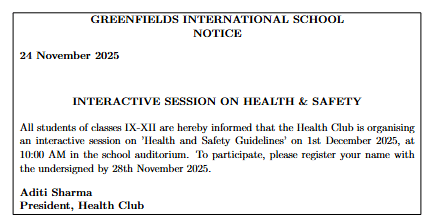
Your school is organising an interactive session on 'Health and Safety Guidelines'. As the President of the Health Club, write a notice informing members from classes IX - XII about the interactive session and invite registrations for participation. Include other necessary details. Put your notice in a box.
View Solution
Step 1: Understanding the Question:
The task is to write a notice about an interactive session on 'Health and Safety'. The notice needs to be for students of classes IX-XII and should ask for registrations.
Step 2: Key Information to Include:
- Issuing Authority: School Name (e.g., GREENFIELDS INTERNATIONAL SCHOOL)
- Title: NOTICE
- Date: Date of issue (24 November 2025)
- Heading: A clear title for the event (INTERACTIVE SESSION ON HEALTH \& SAFETY)
- Body: What (interactive session), Topic ('Health and Safety Guidelines'), Who (Classes IX-XII), When (1st December 2025, 10:00 AM), Where (school auditorium), Action required (register name), Deadline (28th November 2025).
- Closing: Name and designation of the issuer (Aditi Sharma, President, Health Club).
Step 3: Drafting the Notice:
The notice is drafted clearly and concisely, providing all essential details. It effectively communicates the event's purpose and gives a clear call to action for students who wish to participate, along with a deadline. The entire notice is enclosed in a box.
Quick Tip: When the target audience is specific (e.g., classes IX-XII), make sure to mention it clearly in the notice body. This ensures the right students receive the information.
Your school is organising a Career Mela. As President of Career Guidance and Counselling Club of your school, draft a formal invitation card in not more than 50 words, inviting parents and students for the Career Mela.

View Solution
Step 1: Understanding the Question:
The task is to draft a formal invitation card for a 'Career Mela', inviting both parents and students. The word count is limited to 50 words.
Step 2: Format and Tone of a Formal Invitation Card:
A formal invitation card is written in the third person. It should be polite, concise, and elegant. A centered layout is standard.
Step 3: Key Information to Include:
- Host: The President and Members of the Career Guidance and Counselling Club.
- Event: CAREER MELA 2025.
- Invitees: Parents and students (implied by "cordially invite you").
- Date and Time: Saturday, 6th December 2025, from 9:00 AM to 2:00 PM.
- Venue: School Premises.
- R.S.V.P.: A contact point for replies.
Step 4: Drafting the Invitation:
The invitation is drafted using standard formal phrasing like "cordially invite you". The essential details (event, date, time, venue) are presented clearly. The host is identified, and an R.S.V.P. is included. The layout is clean and follows the conventions of a formal card.
Quick Tip: For formal invitations, the key is to be brief and elegant. Avoid using full sentences for details like date and time; present them on separate lines for clarity and to fit the card format. Always write in the third person.
OR
Question 4 (b):
You have been invited to attend the Annual Day celebrations in your son's school. Draft a formal letter in not more than 50 words, expressing regret, for your inability to attend.
Ajay
C-17, MG Road,
Pune
24 November 2025
The Principal
Pune Public School
Gandhinagar
Subject: Inability to Attend Annual Day Celebrations
Dear Sir/Madam,
Thank you very much for your kind invitation to the Annual Day celebrations on [Date]. I sincerely regret my inability to attend the event due to a prior, unavoidable engagement.
I extend my best wishes for the success of the event.
Yours sincerely,
Ajay
(Father/Mother of Ajay, Class [X])
View Solution
Step 1: Understanding the Question:
The task is to write a formal letter of regret, declining an invitation to a school's Annual Day. The tone should be polite and formal, and the word limit is 50 words.
Step 2: Format of a Formal Reply (Letter):
The reply must follow the structure of a formal letter, including sender's address, date, receiver's address, subject, salutation, body, and closing.
Step 3: Content of the Letter:
- Acknowledge and Thank: Begin by thanking the sender for the invitation.
- Express Regret: Clearly and politely state your inability to attend. Use phrases like "I regret my inability..." or "Unfortunately, I will be unable to attend...".
- Give a Brief Reason (Optional but polite): Mention a "prior engagement" or "unavoidable commitment" without going into detail.
- Extend Good Wishes: Wish the event success.
Step 4: Drafting the Reply:
The letter is drafted following the formal structure. It is concise, polite, and directly addresses the purpose: declining the invitation. The reason provided is brief and socially acceptable.
Quick Tip: When declining a formal invitation, it is important to be gracious. Always thank the host for the invitation before you express your regrets. Providing a vague but polite reason like a "prior commitment" is standard practice.
Write a letter to the editor of a local daily about the "Importance of Mental Health Awareness among Teenagers". You are Ragini/Rajan a school counsellor, living at 17/235, Sector 5, Newpur. You may use the following cues along with your own ideas to draft the letter.

17/235, Sector 5
Newpur
24 November 2025
The Editor
The Newpur Chronicle
Newpur
Subject: Urgent Need for Mental Health Awareness Among Teenagers
Sir,
Through the columns of your esteemed newspaper, I wish to highlight the critical issue of mental health among teenagers. Today's youth grapple with immense academic pressure, social media anxiety, and peer competition, leading to rising cases of depression and stress. Often, these struggles are dismissed as mere teenage moodiness.
As a school counsellor, I witness students battling these issues in silence, fearing stigma. Early intervention is crucial, and this is where schools and parents play a vital role. We need to create an environment where discussing mental health is normal.
[1em] I suggest organising regular awareness programmes, workshops for parents, and establishing robust peer support systems in schools. By fostering open dialogue and providing accessible counselling, we can help our teenagers navigate their challenges effectively. Your newspaper can play a pivotal role in spreading this awareness.
Thank you,
Yours sincerely,
Ragini
(A School Counsellor)
View Solution
Step 1: Understanding the Question:
The task is to write a letter to the editor regarding mental health in teenagers, using the provided cues. The persona is a school counsellor.
Step 2: Structure of the Letter:
- Para 1: Introduction. State the problem (mental health issues among teenagers) and mention the causes (academic pressure, social media).
- Para 2: Highlighting the problem and need for intervention. Mention the stigma and the importance of early intervention, highlighting the role of schools and parents.
- Para 3: Suggestions and Conclusion. Provide concrete suggestions (awareness programs, workshops, support systems) and make a final appeal to the editor to raise public awareness.
Step 3: Drafting the Letter:
The letter is drafted following the formal letter format. It logically progresses from identifying the problem to suggesting solutions, incorporating all the given cues. The tone is concerned and professional, fitting the persona of a school counsellor. The word count is kept within the 120-150 range.
Quick Tip: In a Letter to the Editor, your credibility is enhanced by your role. As a 'school counsellor', your observations are more impactful. Always end your letter with a constructive suggestion and a call for public awareness through the newspaper.
OR
Question 5 (b):
You are Radha/Ram living at 18, Jan Vihar, Nayapur. You have read the given advertisement and wish to apply for the post of Marketing Executive. Write a job application along with your bio-data.

18, Jan Vihar
Nayapur
24 November 2025
The Director
ABC Corporation
Nayapur
Subject: Application for the Post of Marketing Executive
Dear Sir/Madam,
With reference to your advertisement in [Newspaper Name/Website] dated [Date], I wish to offer my candidature for the position of Marketing Executive in your esteemed organisation.
I hold a BBA degree in Marketing and possess five years of experience in the field, aligning perfectly with your requirements. I am proficient in digital marketing, market research, and strategic planning. My strong communication skills and analytical abilities have enabled me to successfully lead several marketing campaigns in my previous role.
I am enclosing my bio-data for your kind perusal. I am confident that my skills and experience will be an asset to your company. I am available for an interview at your earliest convenience.
Yours faithfully,
Ram
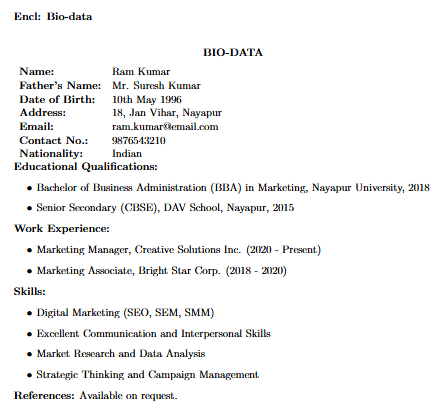
View Solution
Step 1: Understanding the Question:
The task is to write a complete job application for a Marketing Executive post, including a covering letter and a bio-data, based on the given advertisement.
Step 2: Drafting the Covering Letter:
- Format: Follow the standard format of a formal letter.
- Introduction: Refer to the source of the advertisement and state the position you are applying for.
- Body: Directly address the requirements mentioned in the ad. Mention your BBA in Marketing, 4-5 years of experience, and key skills like digital marketing, communication, and strategic thinking.
- Conclusion: Refer to the enclosed bio-data and express enthusiasm for an interview.
Step 3: Creating the Bio-data:
- Structure: Organize information under clear headings: Personal Details, Educational Qualifications, Work Experience, Skills.
- Content: Ensure the information is consistent with the advertisement's needs. The qualification must be a BBA in Marketing, the total work experience should be 4-5 years, and the skills listed should include those mentioned in the ad (digital marketing, etc.).
Quick Tip: When applying for a job, mirror the language of the advertisement. If the ad asks for a "Strategic thinker," use the phrase "Strategic thinking" in your skills list. This makes it easy for the recruiter to see that you are a perfect match.
You are Seema/Sarvesh Khanna of Class XII-A and a member of the school magazine editorial board. Write a comprehensive report on the Community Service Programme organised by the school. Include description of events and activities organised. You may organise your report by the following:

Community Service Programme: A Step Towards Social Responsibility
By Sarvesh Khanna, XII-A (Editorial Board)
New Delhi, 24 November 2025: Our school, DPS Mathura Road, organised a week-long Community Service Programme from 15th to 21st November 2025. The initiative, aimed at instilling a sense of social responsibility among students, saw enthusiastic participation from classes IX to XII.
The programme was inaugurated by the Principal, who emphasized the importance of giving back to society. Various activities were organised. Students of Class IX conducted a cleanliness drive in the neighbourhood, while Class X students visited a local orphanage to distribute storybooks and spend time with the children. A tree plantation drive was led by Class XI, and senior students of Class XII organised an awareness campaign on waste management in the local market.
The programme was a resounding success, sensitizing students to the needs of the community and empowering them to be agents of change. It was a fulfilling experience for everyone involved.
View Solution
Step 1: Understanding the Question:
The task is to write a report for a school magazine on a 'Community Service Programme'. The report must be comprehensive and can be structured using the 5Ws and H.
Step 2: Structure of a Report:
- Headline: An appropriate title (e.g., Community Service Programme: A Step Towards Social Responsibility).
- Byline: Writer's name, class, and designation (By Sarvesh Khanna, XII-A, Editorial Board).
- Dateline: Place and date of reporting (New Delhi, 24 November 2025).
- Para 1: Opening. Introduce the event answering the 5 Ws: Who (the school), What (Community Service Programme), When (15th-21st Nov), Where (school and neighbourhood), Why (to instill social responsibility).
- Para 2: Details. Describe How the programme was conducted, detailing the specific events (cleanliness drive, orphanage visit, etc.) and who participated.
- Para 3: Conclusion. Summarize the overall impact and success of the programme.
Step 3: Drafting the Report:
The report is drafted in a formal, objective tone and written in the past tense. It follows the standard journalistic format and logically incorporates the guiding cues to provide a clear and complete account of the event.
Quick Tip: When writing a report on a multi-day event, it's best to summarize the activities rather than describing each day in detail to stay within the word limit. Group similar activities or describe the contribution of different classes as shown in the solution.
OR
Question 6 (b):
Write an article exploring the importance of 'Road Safety Awareness' among Indian youth providing examples to illustrate your points from daily life. You may use the following cues along with your own ideas. You are Puja/Puneet Rao, a Class XII student.

Alert Today, Alive Tomorrow: The Need for Road Safety
By Puneet Rao, Class XII
In an era of rapid urbanization and fast-moving vehicles, the issue of road safety, especially among the youth, has become a matter of grave concern. We often witness teenagers on motorbikes performing reckless stunts or drivers distracted by their phones, stark examples of a dangerous disregard for traffic rules. This behaviour not only endangers their own lives but also the lives of others.
[1em] Advocating for road safety through school campaigns and stricter enforcement of traffic laws is essential. However, the youth face challenges like peer pressure to speed and a sense of youthful invincibility. Promoting road safety awareness instills a sense of responsibility and discipline. When young people follow traffic rules, they contribute to a safer community, demonstrating respect for shared public spaces.
Ultimately, change begins with us. We must pledge to wear helmets and seatbelts, avoid distractions while driving, and encourage our peers to do the same. Promoting initiatives like student traffic volunteer programmes can further empower the youth to become ambassadors of road safety.
View Solution
Step 1: Understanding the Question:
The task is to write an article on the importance of road safety for Indian youth, using the given cues to structure the content.
Step 2: Structuring the Article:
- Title and Byline: A catchy title ('Alert Today, Alive Tomorrow...') and the author's name (Puneet Rao, Class XII).
- Para 1: Introduction. Introduce the problem, linking modern transportation and urbanization to road safety risks. Use daily life examples (stunts, phone use) as requested.
- Para 2: Advocacy, Challenges, and Benefits. Discuss methods of advocating for safety (campaigns) and the challenges youth face (peer pressure). Explain the benefits of awareness, linking it to responsibility and community sense.
- Para 3: Suggestions and Conclusion. Conclude by suggesting concrete ways for youth to promote road safety (wearing helmets, avoiding distractions, volunteering) and a final call to action.
Step 3: Drafting the Article:
The article is drafted by logically weaving the given cues into a persuasive argument. It starts by identifying the problem, explores its complexities, and ends with practical solutions. The tone is engaging and aims to motivate the reader, particularly the youth.
Quick Tip: When writing an article, using rhetorical questions or relatable examples from daily life can make your writing more engaging and impactful for the reader. Start with a powerful observation to hook your audience.
Those who prepare green wars,
wars with gas, wars with fire,
victory with no survivors,
would put on clean clothes
and walk about with their brothers
in the shade, doing nothing.
(Keeping Quiet)
(i). Select the line/s that suggests the following:
The so-called victors of the wars are indifferent to the consequences of their actions.
View Solution
Step 1: Understanding the Question:
The question asks to identify the line from the poem that shows that the people who win wars do not care about the results of their actions.
Step 2: Analyzing the Extract:
The line 'victory with no survivors' points to a victory where everyone has been killed.
A victory is meaningless if there is no one left to celebrate it.
This highlights the absurdity and the warmongers' complete disregard for human life, which is the ultimate consequence of war. They focus only on winning, not on what that "win" actually costs.
Step 3: Final Answer:
The line 'victory with no survivors' perfectly illustrates this indifference by showing a hollow, pointless victory.
Quick Tip: Look for lines that present a paradox or a contradiction. A "victory" without "survivors" is a strong contradiction that highlights the futility and indifference the poet is criticizing.
What does the imagery of 'green wars' not represent in the given extract?
View Solution
Step 1: Understanding the Question:
The question asks what idea is NOT represented by the term 'green wars'.
Step 2: Analyzing the term 'green wars':
'Green wars' is a metaphor for humanity's destructive activities against nature.
This includes deforestation, pollution, and exploitation of natural resources, which are all forms of environmental conflict and harmful destruction.
Step 3: Evaluating the Options:
(A) environmental conflict: This is the direct meaning of 'green wars'.
(B) harmful destruction: This is the outcome of these wars.
(D) continuous deforestation: This is a specific example of a green war.
(C) sustainable peace: This concept is the complete opposite of war and conflict. It implies living in harmony with the environment, which is what 'green wars' destroys.
Step 4: Final Answer:
The imagery of 'green wars' does not represent 'sustainable peace'.
Quick Tip: In questions asking what a term does not represent, look for the option that is an antonym or the complete opposite of the term's meaning. Here, 'peace' is the opposite of 'war'.
Complete the following suitably.
"Would put on clean clothes ?"
'Clean clothes' here refers to ____________.
View Solution
Step 1: Understanding the Question:
The question asks for the symbolic meaning of 'clean clothes' in the context of the poem.
Step 2: Analyzing the Context:
The warmongers, after their destructive acts, are imagined to "put on clean clothes" and "walk about with their brothers." This action happens during the moment of introspection and silence that the poet calls for.
The 'clothes' they were wearing before would be stained with the blood and grime of war. 'Clean clothes' symbolize a purification, a move away from their violent past. It represents adopting a new, clean slate of thought and action, free from enmity.
Step 3: Final Answer:
'Clean clothes' symbolizes the act of shedding the guilt and animosity of war and embracing a pure, peaceful mindset, seeing former enemies as 'brothers'.
Quick Tip: In poetry, physical objects like 'clothes' often have a deeper, symbolic meaning. Think about what the object represents in the given context. 'Clean' often symbolizes purity, innocence, or a new beginning.
Choose a word from the brackets to complete the following suitably:
Phrases like 'victory with no survivors' illustrate the ________ (irony/satire) in the situation where those claiming victory actually achieve nothing of true value.
View Solution
Step 1: Understanding the Question:
The question asks to choose between 'irony' and 'satire' to describe the phrase 'victory with no survivors'.
Step 2: Defining Irony and Satire:
Irony is a figure of speech where the intended meaning is the opposite of the literal meaning. Situational irony occurs when the outcome of a situation is the opposite of what is expected.
Satire is the use of humor, irony, exaggeration, or ridicule to expose and criticize people's stupidity or vices. While the poem is critical, the specific phrase focuses on a contradictory outcome.
Step 3: Applying the Definition:
The expectation of a 'victory' is to have survivors who can celebrate and enjoy the fruits of winning. The outcome of "no survivors" is the direct opposite of this expectation. This is a classic example of situational irony, highlighting the absolute futility of such a war.
Step 4: Final Answer:
The phrase illustrates irony.
Quick Tip: Remember the difference: Irony is about contradiction (saying/doing the opposite of what is meant/expected). Satire is a broader tool used for social criticism, which often uses irony as one of its techniques. The phrase itself is a direct contradiction, making 'irony' the more precise term.
Read the Assertion and the Reason below with reference to the given context.
Assertion: The poet criticizes the superficial actions of those involved in conflicts.
Reason: The actions described are meant to highlight the futility and destructiveness of wars.
Choose the correct option:
View Solution
Step 1: Analyzing the Assertion:
The poet suggests warmongers would "put on clean clothes and walk about with their brothers." This is presented as an action taken during a moment of silence. The poet is indeed critical of their prior actions (preparing wars) and implies this change must be genuine, not superficial. So, the assertion is true.
Step 2: Analyzing the Reason:
The entire stanza, especially "victory with no survivors," is designed to show how pointless and destructive war is. So, the reason is true.
Step 3: Connecting Assertion and Reason:
The poet criticizes the actions of warmongers *because* he wants to highlight the futility of war. By showing the absurd endpoint ('victory with no survivors') and then suggesting a moment of cleansing ('put on clean clothes'), he uses this criticism to make a larger point about the meaninglessness of conflict. The reason directly explains the purpose behind the assertion.
Step 4: Final Answer:
Both are true, and the reason is the correct explanation for the assertion.
Quick Tip: For Assertion-Reason questions, first check if each statement is true independently. Then, ask "Why?" after reading the Assertion. If the Reason answers the "Why?", it is the correct explanation. Why does the poet criticize? To highlight futility. This works.
What is the message that you would give to the warmongers, based on the given extract?
View Solution
Step 1: Understanding the Question:
The question asks to formulate a message for warmongers based on the ideas presented in the given lines.
Step 2: Identifying Key Ideas in the Extract:
- Warmongers prepare destructive wars ('green wars', 'wars with gas, wars with fire').
- The outcome of their actions is futile ('victory with no survivors').
- The suggested alternative is peace, introspection, and brotherhood ('put on clean clothes', 'walk about with their brothers', 'doing nothing').
Step 3: Synthesizing the Message:
A powerful message should incorporate these key ideas. It should start with a call to stop the destructive actions, then explain why (the futility of it), and finally, offer the positive alternative suggested by the poet. The message should be direct and capture the essence of the poem's critique.
Step 4: Final Answer:
The formulated answer directly addresses the warmongers, contrasts their current actions with the poem's proposed alternative, and uses key phrases from the extract to deliver a concise and impactful message.
Quick Tip: When asked to formulate a message based on a text, try to use the language and imagery from the text itself. This shows that your message is directly derived from the source material. Phrases like "victory with no survivors" and "walk with your brothers" are powerful and should be used.
OR
Question 7 (b):
A thing of beauty is a joy forever
Its loveliness increases, it will never
Pass into nothingness; but will keep
A bower quiet for us, and a sleep
Full of sweet dreams, and health, and quiet breathing.
(i). Which of the above lines suggests that 'the enduring nature of beauty brings everlasting joy?'
View Solution
Step 1: Understanding the Question:
The question asks to find the line that explicitly connects the long-lasting (enduring) quality of beauty with unending (everlasting) happiness.
Step 2: Analyzing the Extract:
The very first line of the poem is "A thing of beauty is a joy forever."
The word "forever" directly means everlasting or for all time.
The line makes a direct statement that the joy ('joy') derived from beauty ('a thing of beauty') is permanent ('forever').
Step 3: Final Answer:
The first line, "A thing of beauty is a joy forever," is the most direct and clear answer to the question.
Quick Tip: Often, the answer to a question about the central theme of a poetic extract is found in its opening or closing lines. The first line here sets up the entire argument of the poem.
The phrase 'A bower quiet for us' does not imply:
View Solution
Step 1: Understanding the Question:
The question asks what idea is NOT suggested by the phrase 'A bower quiet for us'.
Step 2: Defining the Phrase:
A 'bower' is a shady, leafy shelter in a garden or wood. The word 'quiet' emphasizes tranquility and silence.
Therefore, the phrase 'a bower quiet' strongly suggests a place of peace, rest, and shelter.
Step 3: Evaluating the Options:
(A) A restful place: This is directly implied by the phrase.
(C) Peace and calm: 'Quiet' directly implies peace and calm.
(D) Shelter and protection: A 'bower' is a form of natural shelter.
(B) A noisy surrounding: This is the direct opposite of 'quiet' and is therefore not implied.
Step 4: Final Answer:
The phrase does not imply 'a noisy surrounding'.
Quick Tip: Break down the phrase into its components. 'Bower' = shelter. 'Quiet' = peaceful. Then, check which option contradicts these meanings. 'Noisy' is the clear antonym of 'quiet'.
In the line 'Its loveliness increases', the word 'its' refers to __________.
View Solution
Step 1: Understanding the Question:
The question asks to identify what the pronoun 'its' refers to in the second line.
Step 2: Analyzing the Context:
The first line introduces the subject: "A thing of beauty is a joy forever".
The second line, "Its loveliness increases," continues the description of this subject. The pronoun 'Its' is a possessive form used to refer back to the noun phrase 'A thing of beauty' from the preceding line.
Step 3: Final Answer:
The word 'its' refers to 'a thing of beauty'.
Quick Tip: Pronouns (like it, its, he, she, they) almost always refer to a noun that has been mentioned recently, usually in the same or the previous sentence. Look back to find the noun the pronoun is replacing.
Choose a word from the brackets to complete the following suitably:
The phrase 'joy forever' implies that the essence of beauty is a source of ________ (eternal/transient) peace and happiness.
View Solution
Step 1: Understanding the Question:
The question asks to choose the correct adjective to describe the peace and happiness that beauty provides, based on the phrase 'joy forever'.
Step 2: Analyzing the Phrase and Options:
The key word in the phrase is 'forever', which means for all time, without end.
The word 'eternal' means lasting or existing forever; without end or beginning.
The word 'transient' means lasting only for a short time; impermanent.
Step 3: Matching the Meaning:
'Eternal' is a direct synonym for 'forever'. 'Transient' is an antonym. Therefore, 'eternal' is the correct word to complete the sentence.
Step 4: Final Answer:
The correct word is 'eternal'.
Quick Tip: Pay close attention to vocabulary. Knowing the definitions of 'eternal' (everlasting) and 'transient' (temporary) makes this question straightforward. The word 'forever' is the biggest clue.
Read the following statements:
Assertion: The poet believes that beauty provides everlasting joy and comfort.
Reason: Beauty creates an environment conducive to health and well-being.
Choose the correct option from among the following:
View Solution
Step 1: Analyzing the Assertion:
The assertion states that beauty provides everlasting joy and comfort. The line "A thing of beauty is a joy forever" directly supports this. Thus, the assertion is true.
Step 2: Analyzing the Reason:
The reason states that beauty creates an environment conducive to health and well-being. The lines "will keep a bower quiet for us, and a sleep full of sweet dreams, and health, and quiet breathing" directly support this. Thus, the reason is true.
Step 3: Connecting Assertion and Reason:
Now, we must check if the reason explains the assertion. Why is beauty an everlasting joy and comfort? According to the poem, it is because it provides a peaceful sanctuary ("bower quiet") that leads to good sleep, health, and tranquility. The reason explains the mechanism through which beauty provides comfort.
Step 4: Final Answer:
Both are true, and the reason is the correct explanation for the assertion.
Quick Tip: In poetry, the "why" or "how" is often explained through metaphors and imagery. The assertion makes a claim, and the reason (based on the imagery of the 'bower' and 'sleep') provides the explanation for that claim.
State in one sentence, what you would include in your address to those who seek beauty.
View Solution
Step 1: Understanding the Question:
The question asks to formulate a one-sentence message for people who are looking for beauty, based on the ideas in the extract.
Step 2: Identifying Key Ideas in the Extract:
- Beauty provides everlasting joy.
- Its loveliness increases and it never becomes nothingness.
- It provides a quiet, peaceful place ('bower') and promotes health and good sleep.
Step 3: Synthesizing the Message:
A good sentence would combine these core benefits. It should advise the seeker on the value of what they are looking for, summarizing its key qualities: permanence, peace, and ever-increasing loveliness. The message should be encouraging and reflect the positive tone of the poem.
Step 4: Final Answer:
The formulated sentence captures the essence of the poem's message about beauty's enduring and life-affirming qualities, making it a suitable address to those who seek it.
Quick Tip: When asked to synthesize a message, focus on the benefits or the core argument of the text. What is the poet trying to convince the reader about? Frame your sentence around that central idea. Here, the idea is that beauty is a valuable and lasting source of comfort.
Question 8 (a):
My Antarctic experience was full of such epiphanies, but the best
occurred just short of the Antarctic Circle at 65.55 degrees south.
The Shokalskiy had managed to wedge herself into a thick white
stretch of ice between the peninsula and Tadpole Island which was
preventing us from going any further. The Captain decided we were
going to turn around and head back north, but before we did, we
were all instructed to climb down the gangplank and walk on the
ocean. So there we were, all 52 of us, kitted out in Gore-Tex and
glares, walking on a stark whiteness that seemed to spread out
forever. Underneath our feet was a metre-thick ice pack, .... In the
periphery Crabeater seals were stretching and sunning themselves
.... much like stray dogs .... It was nothing short of a revelation.
(i). Complete the following suitably.
The passage suggests that the author's Antarctic experience was ___________.
View Solution
Step 1: Understanding the Question:
The question asks to complete the sentence to describe the author's overall experience in Antarctica, based on the given passage.
Step 2: Analyzing the Passage:
The author uses very specific and powerful words to describe her experience.
The first sentence states the experience was "full of such epiphanies".
The last sentence concludes with "It was nothing short of a revelation."
Both 'epiphany' and 'revelation' suggest moments of sudden, profound insight and understanding.
Step 3: Final Answer:
The most suitable completion is to use the author's own words, showing that the experience was deeply insightful and transformative.
Quick Tip: For "complete the sentence" questions based on a passage, the answer is often found directly in the text. Look for keywords that summarize the main idea or feeling being described.
Choose the correct option:
The Shokalskiy was wedged in a thick stretch of ice. As a result the captain __________.
View Solution
Step 1: Understanding the Question:
The question asks what action the captain took after the ship, the Shokalskiy, got stuck in ice.
Step 2: Locating the Information in the Passage:
The passage clearly states: "...which was preventing us from going any further. The Captain decided we were going to turn around and head back north..."
Step 3: Evaluating the Options:
This textual evidence directly supports option (D). The other options are not mentioned in the passage. The captain made a decisive and practical choice.
Step 4: Final Answer:
The captain decided to turn around.
Quick Tip: For factual recall questions, scan the text for keywords from the question (e.g., "captain," "decided"). The sentence containing these words will almost always hold the answer.
What did the Captain instruct the team to do?
View Solution
Step 1: Understanding the Question:
The question asks for the specific instruction given by the captain.
Step 2: Locating the Information in the Passage:
The passage states: "...but before we did [turn around], we were all instructed to climb down the gangplank and walk on the ocean."
Step 3: Formulating the Answer:
The answer should be a clear and direct statement of this instruction, including the key details mentioned in the text (climb down the gangplank, walk on the ocean).
Step 4: Final Answer:
The answer accurately reflects the instructions as described in the passage.
Quick Tip: When a question asks "What did...", the answer should be a description of an action. Quote or paraphrase the part of the text that describes this action accurately.
Why does the writer describe what happens as an epiphany?
View Solution
Step 1: Understanding the Question:
The question asks for the reason behind the writer using the word 'epiphany' or 'revelation' to describe the event.
Step 2: Analyzing the Context:
An epiphany is a moment of sudden and great revelation or realization. The writer is standing on a metre of ice, with an ocean beneath her, on a continent-sized ice pack. This experience provided a direct, physical understanding of concepts she previously only knew intellectually.
This moment allowed her to grasp the vastness of geological time and the delicate balance of the planet's ecosystem, which was a profound insight.
Step 3: Formulating the Answer:
The answer should explain that the experience was not just a walk, but a moment of deep understanding about the planet, its history, and its future. It connected her intellectually and emotionally to the environment.
Step 4: Final Answer:
The answer correctly explains that the term 'epiphany' is used to signify a moment of sudden, profound insight into the nature of our planet.
Quick Tip: To understand why an author uses a specific powerful word like 'epiphany', think about the context. What was the experience? How did it change the author's perspective? An epiphany is a change in understanding, from knowing a fact to truly feeling and comprehending it.
OR
Question 8 (b):
It was celebration time for all the tigers inhabiting
Pratibandapuram.
The State banned tiger hunting by anyone except the Maharaja. A
proclamation was issued to the effect that if anyone dared to fling so
much as a stone at a tiger, all his wealth and property would be
confiscated.
The Maharaja vowed he would attend to all other matters only after
killing the hundred tigers. Initially the king seemed well set to
realise his ambition.
(i). Complete the following suitably:
It was celebration time for all the tigers because _____________.
View Solution
Step 1: Understanding the Question:
The question asks for the reason why the tigers were 'celebrating'. This is, of course, ironical.
Step 2: Analyzing the Passage:
The passage states, "The State banned tiger hunting by anyone except the Maharaja."
This means that while one person (the Maharaja) was still a threat, all other potential hunters in the kingdom were now legally forbidden from harming them. This greatly increased their overall safety. The "celebration" is a satirical way of highlighting this new protection.
Step 3: Final Answer:
The answer correctly identifies the state ban as the reason for the tigers' supposed celebration.
Quick Tip: Recognize the use of satire and irony. The author doesn't mean the tigers were literally having a party. It's a humorous way to point out the consequence of the king's selfish decree.
What strategy does the king use to ensure that he hunts all the tigers?
View Solution
Step 1: Understanding the Question:
The question asks about the method or plan the king implemented to achieve his goal.
Step 2: Identifying the Strategy in the Passage:
The passage describes two key actions taken by the king:
1. "The State banned tiger hunting by anyone except the Maharaja." (Creating a monopoly)
2. "if anyone dared to fling so much as a stone at a tiger, all his wealth and property would be confiscated." (Implementing a harsh deterrent)
Together, these actions ensure that he is the only person who can hunt tigers.
Step 3: Final Answer:
The answer combines these two points to describe his overall strategy effectively.
Quick Tip: A 'strategy' is a plan of action. Look for the specific actions or rules the character puts in place to achieve their objective. Here, the strategy involves both a ban and a threat.
The king's 'vow' indicates that he is a ______ man.
View Solution
Step 1: Understanding the Question:
The question asks what character trait is revealed by the king's vow.
Step 2: Analyzing the Vow:
The king's vow is: "he would attend to all other matters only after killing the hundred tigers."
This shows an obsessive, single-minded focus on his goal, to the point of neglecting all his royal duties. This level of commitment demonstrates immense determination.
Step 3: Evaluating the Options:
(A) Resilient: means to recover quickly from difficulties. Not the primary trait shown here.
(B) Determined: means having made a firm decision and being resolved not to change it. This fits perfectly.
(C) Generous: means showing a readiness to give more than is necessary or expected. He is the opposite of generous.
(D) Cautious: means being careful to avoid potential problems. He is reckless, not cautious.
Step 4: Final Answer:
The king's vow shows he is a determined man.
Quick Tip: Match the character's actions to the definition of the personality traits. Neglecting all other duties for a single goal is a powerful sign of determination.
What were the consequences of going against the king's proclamation?
View Solution
Step 1: Understanding the Question:
The question asks for the punishment for disobeying the king's new law.
Step 2: Locating the Information in the Passage:
The passage explicitly states the consequence: "if anyone dared to fling so much as a stone at a tiger, all his wealth and property would be confiscated."
Step 3: Formulating the Answer:
The answer should be a direct paraphrase or quote of this information from the text. It is a factual recall question.
Step 4: Final Answer:
The answer clearly and accurately states the severe penalty for violating the proclamation.
Quick Tip: For questions that ask about rules or consequences, the answer is usually stated very clearly and directly in the text. There is no need for deep interpretation; simply find the relevant sentence.
Question 9 (a):
At last, around four in the afternoon, the poet (or the editor) arrived. He was a tall man, very English, very serious and of course very unknown to all of us. Battling with half a dozen pedestal fans on the shooting stage, The Boss read out a long speech. It was obvious that he too knew precious little about the poet (or the editor). The speech was all in the most general terms but here and there it was peppered with words like ‘freedom' and 'democracy'. Then the poet spoke. He couldn't have addressed a more dazed and silent audience — no one knew what he was talking about and his accent defeated any attempt to understand what he was saying.
(i). Give a brief description of the editor.
View Solution
Step 1: Understanding the Question:
The question asks for a short description of the visiting poet/editor based on the text.
Step 2: Locating the Descriptive Phrases:
The passage describes him as:
- "a tall man"
- "very English"
- "very serious"
- "very unknown to all of us"
Step 3: Combining the Phrases:
A brief description should combine these key attributes into a concise sentence.
Step 4: Final Answer:
The answer provides a complete and accurate summary of the description given in the text.
Quick Tip: When asked for a description, pull out all the adjectives and descriptive phrases the author uses for the character and combine them into a coherent sentence.
The Boss's long speech and the visitor's serious demeanour indicates __________.
View Solution
Step 1: Understanding the Question:
The question asks what is implied by the combination of The Boss's vague speech and the visitor's serious attitude.
Step 2: Analyzing the Clues:
- The Boss's speech was in "general terms" because he "knew precious little about the poet." This shows a lack of knowledge and preparation.
- The visitor was "very serious." This, combined with the audience's confusion, suggests a formal but distant interaction.
- The overall situation points to a major disconnect. Neither party seems to understand the other's context or purpose.
Step 3: Final Answer:
The answer synthesizes these clues to conclude that the situation indicates a profound disconnect and awkwardness.
Quick Tip: Look at the interactions (or lack thereof) between characters. A vague speech paired with a serious expression often points to a communication breakdown or a mismatch in expectations.
The poet addressed ______ (a puzzled/an enthusiastic) audience.
View Solution
Step 1: Understanding the Question:
The question asks to choose the correct adjective to describe the audience.
Step 2: Analyzing the Description of the Audience:
The passage states the poet "couldn't have addressed a more dazed and silent audience."
It further explains "no one knew what he was talking about."
The words "dazed," "silent," and "no one knew" all point to a state of confusion and puzzlement, not enthusiasm.
Step 3: Final Answer:
The correct word is 'puzzled'.
Quick Tip: The author often provides synonyms or explanatory phrases that clarify the meaning. "Dazed" and "no one knew what he was talking about" are strong indicators that the audience was puzzled.
What, added as a last straw, made the poet's speech difficult to understand?
View Solution
Step 1: Understanding the Question:
The question asks for the final reason why the poet's speech was incomprehensible.
Step 2: Locating the Information in the Passage:
The passage lists two problems:
1. "no one knew what he was talking about" (the content was obscure).
2. "his accent defeated any attempt to understand what he was saying" (the delivery was unintelligible).
The accent is presented as the final barrier that made understanding completely impossible.
Step 3: Final Answer:
The answer correctly identifies the accent as the final and insurmountable problem.
Quick Tip: Look for phrases that indicate a finality or a culminating problem. The word "defeated any attempt" suggests that the accent was the final, decisive blow to the audience's understanding.
Select the textual option that is closest to indicating a sense of unfamiliarity about the poet (or the editor).
View Solution
Step 1: Understanding the Question:
The question asks for the line that most directly expresses the idea that the visitor was a stranger.
Step 2: Evaluating the Options:
(A) Describes his appearance and nationality, but not necessarily his unfamiliarity.
(B) Describes the setting, not the visitor's identity.
(C) Explicitly uses the word "unknown," making it the most direct statement of unfamiliarity.
(D) Describes an action by The Boss.
Step 3: Final Answer:
Option (C) is the most direct and explicit choice.
Quick Tip: For "select the closest option" questions, look for the most direct and explicit statement. While other options might hint at the idea, one option will usually state it outright. The word "unknown" is the key here.
Why was the speech by The Boss in 'most general terms'?
View Solution
Step 1: Understanding the Question:
The question asks for the reason behind the vague nature of The Boss's speech.
Step 2: Locating the Reason in the Passage:
The passage provides the reason immediately after mentioning the speech's nature: "It was obvious that he too knew precious little about the poet (or the editor)."
Step 3: Formulating the Answer:
The answer is a direct cause-and-effect relationship found in the text. He spoke in general terms because he lacked specific knowledge. He used generic words like 'freedom' and 'democracy' to fill the time without revealing his ignorance.
Step 4: Final Answer:
The answer correctly identifies the Boss's lack of knowledge as the reason for his general speech.
Quick Tip: Look for connecting words or phrases like "because," "as," or in this case, a sentence that directly explains the preceding one. The text often provides the reason for an action right after describing it.
OR
Question 9 (b):
Umberto Eco : Aah, now that is more difficult to explain. I have some philosophical interests and I pursue them through my academic work and my novels. Even my books for children are about non-violence and peace...you see, the same bunch of ethical, philosophical interests.
And then I have a secret. Did you know what will happen if you eliminate the empty spaces from the universe, eliminate the empty spaces in all the atoms ? The universe will become as big as my fist.
(i). Complete the following suitably:
Eco suggests that his books for children also share his ethical interest because they are about ______ (violence/peace).
View Solution
Step 1: Understanding the Question:
The question asks to identify the theme of Eco's children's books as mentioned in the text.
Step 2: Locating the Information in the Passage:
The passage quotes Umberto Eco directly: "Even my books for children are about non-violence and peace..."
Step 3: Final Answer:
Based on the direct quote, the correct word to complete the sentence is 'peace'.
Quick Tip: When options are provided in brackets, the text will almost always contain one of the words or a very close synonym. Here, the text explicitly uses the word "peace".
Complete the following suitably:
Umberto Eco's philosophical interests are ______ in his academic work and novels, making them interconnected.
View Solution
Step 1: Understanding the Question:
The question asks for a verb that describes the presence of Eco's philosophical interests in his varied works.
Step 2: Analyzing the Passage:
Eco says, "I pursue them through my academic work and my novels." The word "pursue" fits perfectly.
The phrase "the same bunch of ethical, philosophical interests" also implies that these interests are present or reflected across all his writings.
Step 3: Final Answer:
Any of the words 'pursued', 'present', or 'reflected' would accurately complete the sentence based on the meaning of the text.
Quick Tip: When completing a sentence, ensure the word you choose fits both grammatically and contextually. Using a word directly from the text, like "pursue," is often the safest and most accurate choice.
Select the textual option that is closest to indicating how his philosophical interests are represented.
View Solution
Step 1: Understanding the Question:
The question asks for the line that explains the method or way in which Eco's philosophical interests are expressed.
Step 2: Evaluating the Options:
(A) This line expresses difficulty in explanation, but not the method itself.
(B) This line introduces a new idea, it doesn't explain the previous one.
(C) This line directly states the channels ("through my academic work and my novels") he uses to explore his interests. This explains *how* they are represented.
(D) This is a philosophical riddle, an example of his interests, not an explanation of how he represents them in general.
Step 3: Final Answer:
Option (C) is the most direct answer to the question of *how* his interests are pursued or represented.
Quick Tip: Questions that ask "how" are looking for a process, method, or means. Look for phrases like "through," "by," or "using" that indicate a method. Here, "through my academic work..." is the key.
What does the following line from the extract showcase?
"The same bunch of ethical, philosophical interests”.
View Solution
Step 1: Understanding the Question:
The question asks what the phrase "The same bunch of..." reveals about his interests.
Step 2: Analyzing the Phrase:
The phrase "the same bunch" is used by Eco to refer to the interests that appear in his academic work, his novels, and even his children's books. Using "same" and "bunch" implies that these interests are not separate or isolated but are a unified group that connects all his different forms of writing.
Step 3: Evaluating the Options:
(A), (C), and (D) (separation, isolation, division) are all antonyms of this idea.
(B) interconnectedness accurately describes the concept of a single set of ideas weaving through multiple, diverse works.
Step 4: Final Answer:
The line showcases the interconnectedness of his work.
Quick Tip: Pay attention to words that indicate similarity or unity, like "same," "common," or "shared." These words often point to themes of connection and integration.
"I work in empty spaces." Choose the option that most accurately captures Eco's idea of empty spaces.
View Solution
Step 1: Understanding the Question:
The question asks for the meaning of "empty spaces" as used by Umberto Eco in the full interview. While the provided extract doesn't explain it, this is a key concept from the chapter.
Step 2: Recalling the Concept from the Chapter:
In the interview, Eco explains that "empty spaces" or "interstices" are the small gaps of time in a day, such as waiting for an elevator or while someone is coming to see him. He uses these small intervals to write, which is how he is so prolific.
This concept is fundamentally about using small, otherwise wasted, pockets of time.
Step 3: Evaluating the Options:
(A) management of time: This perfectly captures the idea of utilizing small time gaps effectively.
(B) integration of work: While his work is integrated, "empty spaces" refers to the *when*, not the *what*.
(C) management of space: This is a literal interpretation; Eco is speaking metaphorically about time.
(D) tasks of a writer: This is too general.
Step 4: Final Answer:
The idea of empty spaces is a strategy for the management of time.
Quick Tip: Some questions may refer to a concept from the chapter that is not fully explained in the short extract provided. It's important to have a good understanding of the entire chapter's key themes and ideas.
What according to Umberto Eco will happen if all the empty spaces are eliminated from the universe?
View Solution
Step 1: Understanding the Question:
The question asks for the outcome of eliminating empty spaces from the universe, according to Eco.
Step 2: Locating the Information in the Passage:
This is a factual recall question. The last sentence of the extract provides the answer directly.
Eco asks, "Did you know what will happen if you eliminate the empty spaces from the universe, eliminate the empty spaces in all the atoms?" and immediately provides the answer: "The universe will become as big as my fist."
Step 3: Final Answer:
The answer is a direct quote from the text.
Quick Tip: When a question asks "What according to [character]...", the answer is often a direct quote or a close paraphrase of something the character has said in the text.
Comment on the contrast brought out in the poem 'A Roadside Stand'.
View Solution
Step 1: Understanding the Question:
The question asks to identify and explain the main contrast in the poem.
Step 2: Identifying the Two Groups:
The poem clearly sets up two distinct groups: the "city folk" who drive by, and the "country folk" who run the stand.
Step 3: Describing the Contrast:
- City Folk: Described with symbols of wealth and speed ("polished cars," "whizzed by"). Their attitude is one of indifference and irritation.
- Country Folk: Described with symbols of poverty and desperation ("artless paint," "childish longing"). Their attitude is one of hopeful waiting.
The solution should articulate this gap between the two worlds.
Step 4: Final Answer:
The provided answer effectively summarizes this contrast by using key descriptive words from the poem and explaining the difference in their circumstances and attitudes.
Quick Tip: When asked to comment on a 'contrast', structure your answer by clearly identifying the two opposing elements and then use descriptive words to explain the differences between them.
How does Sophie plan to get the kind of money she wanted for her boutique? (Going Places)
View Solution
Step 1: Understanding the Question:
The question asks for Sophie's plan to finance her dream boutique.
Step 2: Analyzing Sophie's Character:
Sophie is a dreamer who escapes her working-class reality through fantasies. Her plans reflect this aspect of her personality.
Step 3: Recalling the Textual Details:
In her conversation with Jansie, Sophie suggests several options: becoming an actress ("there's real money in that"), a fashion designer, or simply manager of a boutique. She believes success and money will come easily. The key is that these are not concrete plans but rather fleeting fantasies.
Step 4: Final Answer:
The answer correctly points out the unrealistic and vague nature of her plans, using examples from the text to illustrate her tendency to daydream rather than plan practically.
Quick Tip: The key to answering questions about Sophie is to emphasize the contrast between her dreams and her reality. Always highlight that her 'plans' are more like fantasies.
Why was Kothamangalam Subbu considered No. 2 in Gemini Studios? (Poets and Pancakes)
View Solution
Step 1: Understanding the Question:
The question asks for the reasons behind Subbu's high position at the studio.
Step 2: Recalling Subbu's Qualities from the Text:
The text describes Subbu as:
- Loyal: Completely loyal to The Boss.
- Creative and Resourceful: "He had a solution for everything." He could suggest multiple ways to shoot a scene.
- Talented: He was a poet and an accomplished actor.
- Cheerful: He was always happy and good-natured, even with sycophants.
Step 3: Synthesizing the Reasons:
The answer should combine these key traits to explain why he was so valued by The Boss and held the No. 2 position. His usefulness and loyalty were the primary factors.
Step 4: Final Answer:
The answer effectively summarizes Subbu's key attributes that contributed to his status in the studio.
Quick Tip: For character-based questions, create a mental list of the key traits and contributions of the character as described in the text. Then, select the most important ones to form your answer. For Subbu, it's his loyalty and his problem-solving ability.
Why is Rajkumar Shukla described as being resolute? (Indigo)
View Solution
Step 1: Understanding the Question:
The question asks for evidence from the text that proves Rajkumar Shukla was 'resolute'.
Step 2: Defining 'Resolute':
'Resolute' means admirably purposeful, determined, and unwavering.
Step 3: Finding Evidence in the Text:
The text describes how Shukla first met Gandhiji in Lucknow and was told about Gandhiji's prior commitments. Shukla did not leave. He accompanied Gandhiji "everywhere." He followed him to Kanpur and then back to his ashram. He waited for weeks until Gandhiji was free. This persistent action is the evidence of his resolute nature.
Step 4: Final Answer:
The answer clearly explains the meaning of 'resolute' and supports it with the specific actions of Shukla from the story, demonstrating his persistence.
Quick Tip: To answer "Why is a character described as [adjective]?", you must provide specific actions or dialogues from the text as evidence to support that description. Don't just say he was determined; show *how* he was determined.
Bring out Umberto Eco's humility and modesty as evident in 'The Interview'.
View Solution
Step 1: Understanding the Question:
The question asks for examples of Umberto Eco's humility from the interview.
Step 2: Identifying Humble Statements:
Throughout the interview, Eco makes several modest statements:
- He identifies primarily as an academic, suggesting his fiction is a side activity ("writes novels on Sundays").
- He calls his non-fictional work his "first love."
- He resists grand explanations for the success of his novel, calling it a "mystery" and suggesting it was a matter of timing.
Step 3: Formulating the Answer:
The answer should select one or two of these key examples and explain how they demonstrate humility. The contrast between his immense success and his simple explanations is the key.
Step 4: Final Answer:
The provided answer effectively uses two strong examples—his self-description and his explanation for his novel's success—to showcase his modesty.
Quick Tip: Humility is often shown by what a person *doesn't* say. Eco doesn't boast or take full credit for his success. Focus on these instances of downplaying achievements to highlight a character's modesty.
How is beauty seen in the 'grandeur of the dooms'? (A Thing of Beauty)
View Solution
Step 1: Understanding the Question:
The question asks to explain the paradoxical phrase "grandeur of the dooms."
Step 2: Analyzing the Phrase:
- Grandeur: means magnificence, splendor.
- Dooms: refers to their final day, their death, or a terrible fate.
The phrase combines a positive and a negative idea. The question is how something terrible (doom) can be magnificent (grandeur).
Step 3: Understanding the Context:
The poem is talking about the "mighty dead" – heroes and martyrs. Their deaths were often tragic, but their lives and the cause they died for were grand. The beauty lies not in their death itself, but in the glorious stories and inspiration that their sacrifice provides.
Step 4: Final Answer:
The answer correctly explains this paradox by focusing on the legacy, stories, and inspiration left behind by the heroes, which is the source of the beauty.
Quick Tip: When faced with a paradox (a statement that seems to contradict itself), the key is to find the deeper meaning. The beauty isn't in the death itself, but in what the death represents: heroism, sacrifice, and lasting inspiration.
What was the most shocking discovery made by Charley when he was going through the first day covers of his grandfather's collection? (The Third Level)
View Solution
Step 1: Understanding the Question:
The question asks what shocking discovery Charley made while looking through his grandfather's stamp collection, specifically the first-day covers.
Step 2: Recalling the Plot Point:
Charley was sorting through his stamp collection when he found a first-day cover that was unusual. It had a postmark from Galesburg, dated July 18, 1894. The shocking part was the letter inside it.
Step 3: Identifying the Shocking Element:
The letter was from his friend Sam, the psychiatrist, who had been missing. The letter confirmed that Sam had successfully found the third level and was now living peacefully in 1894. This served as tangible proof that Charley's experience was real and not a hallucination.
Step 4: Final Answer:
The answer summarizes this discovery, emphasizing that the letter from Sam was the most shocking element as it validated Charley's belief in the third level.
Quick Tip: When answering questions about 'The Third Level', remember that the story blurs the line between reality and fantasy. The letter from Sam is the crucial piece of 'evidence' that confirms the fantasy might be real.
What did the hunters realise when they looked at the hundredth tiger? (The Tiger King)
View Solution
Step 1: Understanding the Question:
The question asks what the hunters discovered upon inspecting the tiger that the King believed he had killed.
Step 2: Recalling the Climax of the Hunt:
The Maharaja fired at the hundredth tiger, which then collapsed in a heap. The King, overjoyed at having fulfilled his vow, left the scene without confirming the kill.
Step 3: Identifying the Realization:
When the hunters approached the tiger to take it in procession, they found it looking back at them. They realised the animal was alive and had only fainted. The bullet had missed completely. This is the key realization.
Step 4: Final Answer:
The answer clearly states that the hunters realised the tiger was alive and that the king had actually missed his shot, a fact they decided to hide from him.
Quick Tip: This question revolves around a moment of great irony in the story. The King's triumphant moment was based on a mistake. Highlighting this irony—that the King failed his ultimate test—is key to a good answer.
What was the aim of the project 'Students on Ice'? (Journey to the end of the Earth)
View Solution
Step 1: Understanding the Question:
The question asks for the main purpose or goal of the 'Students on Ice' programme.
Step 2: Recalling the Programme's Mission:
The programme's founder, Geoff Green, believed that students are the future generation of policy-makers. He felt that by giving them a direct, life-changing experience in a critical ecosystem like Antarctica, they would be better equipped and more motivated to protect the planet.
Step 3: Identifying the Key Aims:
- Educational Opportunity: To teach students about the planet and climate change in a real-world setting.
- Create Awareness: To show them the stark reality of global warming.
- Foster Future Leaders: To inspire them to become environmentally conscious citizens and leaders who would take action.
Step 4: Final Answer:
The answer synthesizes these aims, focusing on the core idea of educating and inspiring the next generation through a direct, powerful experience.
Quick Tip: The central idea of 'Students on Ice' is experiential learning. The aim wasn't just to teach facts, but to create a lasting emotional and intellectual impact that would translate into future action. Emphasize this "learning by seeing" aspect in your answer.
Both the poems, 'My Mother at Sixty-six' and 'Aunt Jennifer's Tigers,' delve into experiences of life. How do these poems bring out the internal conflict in each of the women?
In 'My Mother at Sixty-six', the poet Kamala Das experiences an agonizing internal conflict between the painful realization of her mother's mortality and her inability to express her fear. The sight of her mother's frail, "ashen" face brings back the childhood fear of separation. However, she suppresses this deep-seated anxiety, masking her turmoil with a forced, repetitive smile and a hollow promise of meeting again. Her conflict is between her inner despair and the composed exterior she feels compelled to maintain.
In 'Aunt Jennifer's Tigers', the conflict is between Aunt Jennifer's oppressed reality and her suppressed desire for freedom. In life, she is trapped in a constricting marriage, symbolized by the "massive weight of Uncle's wedding band." Her terrified, "fluttering" hands struggle to create, revealing her subjugation. In stark contrast, her art—the proud, fearless tigers she creates—embodies the uninhibited strength and freedom she yearns for but cannot achieve. Her internal conflict is the vast chasm between her timid, controlled self and her liberated artistic soul.
View Solution
Step 1: Understanding the Question:
The question asks to compare the internal conflicts in two poems. The answer must discuss both poems and focus specifically on the 'internal conflict' within the women characters.
Step 2: Structuring the Answer:
- Introduction: Start with a sentence stating that both poems explore internal conflicts.
- Paragraph 1 (My Mother at Sixty-six): Describe the conflict for the poet. The key conflict is: Fear of mother's death vs. Inability to express that fear. Use evidence like "ashen face," "childhood's fear," and "smile, and smile, and smile."
- Paragraph 2 (Aunt Jennifer's Tigers): Describe the conflict for Aunt Jennifer. The key conflict is: Oppressed reality vs. Desire for freedom. Use evidence like "massive weight of Uncle's wedding band" contrasted with the "proud" and "unafraid" tigers.
- Conclusion (Optional but good): A brief concluding sentence can summarize the different nature of their struggles.
Step 3: Final Answer:
The provided answer follows this structure perfectly. It clearly defines the conflict for each woman and uses specific textual details as evidence, ensuring a comprehensive and well-supported analysis within the word limit.
Quick Tip: For comparative questions, use a clear structure. Dedicate a separate paragraph to each text to discuss the specific point (here, internal conflict). Use comparative words ('similarly', 'in contrast') if needed, but a clear separation can be just as effective. Always back up your points with evidence from the poems.
OR
Question 12 (b):
How do the stories 'The Last Lesson' by Alphonse Daudet and 'Lost Spring' by Anees Jung illustrate the impact of socio-political factors on education?
'The Last Lesson' shows the direct impact of political conflict and linguistic chauvinism. After Prussia's victory, a political order from Berlin abruptly bans the teaching of French in Alsace and Lorraine. This single act of political dominance robs an entire generation of their linguistic and cultural identity. The story captures the community's sudden, painful realization of what they have lost, highlighting how education can become an immediate casualty of war and nationalism.
'Lost Spring', on the other hand, illustrates the impact of entrenched socio-economic deprivation. The children, Saheb and Mukesh, are denied education not by a single decree but by a pervasive system of poverty and exploitation. Political apathy, corrupt officials, and societal prejudice create a vicious cycle that forces them into rag-picking and bangle-making. Their right to education is lost to the daily struggle for survival, a systemic failure rather than a single political event.
View Solution
Step 1: Understanding the Question:
The question asks how two different stories show the effect of 'socio-political factors' on education. The answer needs to analyze both stories.
Step 2: Structuring the Answer:
- Introduction: State that both stories show this impact, but through different mechanisms.
- Paragraph 1 (The Last Lesson): Focus on the political factor. The key event is the order from Berlin after the war. The impact is the loss of language and cultural identity. This is a direct, top-down political imposition.
- Paragraph 2 (Lost Spring): Focus on the socio-economic factors. The key issues are poverty, child labor, and systemic exploitation involving middlemen, politicians, and police. The impact is the complete denial of the opportunity for education. This is a systemic, societal failure.
- Conclusion: Briefly contrast the two: one is a sudden political act, the other a chronic societal condition.
Step 3: Final Answer:
The model answer effectively follows this structure. It clearly distinguishes between the nature of the socio-political factor in each story—one being an overt political order, the other being a pervasive societal system—and explains the consequence for the children in each case.
Quick Tip: When a question uses a broad term like "socio-political factors," break it down. For 'The Last Lesson', the key factor is political (war, nationalism). For 'Lost Spring', the key factor is social and economic (poverty, caste, exploitation). Differentiating between these makes your analysis more precise.
The author vividly describes the trauma of Zitkala-Sa and Bama in 'Memories of Childhood'. Support with examples from the texts, to illustrate the prejudices that were present in society.
Zitkala-Sa faces the trauma of cultural prejudice in an American boarding school. The forcible cutting of her long hair is a brutal assault on her identity, as her culture reserves such a fate for mourners or cowards. She describes the degrading experience of being "tied fast in a chair" and feeling the "cold blades of the scissors" as a profound violation. This act symbolizes the dominant white culture's prejudice and its systematic effort to erase her Native American heritage.
Bama confronts the trauma of caste prejudice in her village in India. Her innocent worldview is shattered when she learns about the practice of untouchability upon seeing an elder carry food with a string to avoid polluting it for the upper-caste landlord. The incident, which she first found funny, becomes a source of deep humiliation and anger. This reveals the dehumanizing prejudice of the caste system, which dictated and poisoned social interactions, branding her community as 'untouchable'.
View Solution
Step 1: Understanding the Question:
The question asks to explain the trauma of the two characters and link it to the specific prejudice present in their societies, using textual examples.
Step 2: Structuring the Answer:
- Introduction: Start by stating that both characters suffered trauma due to societal prejudice.
- Paragraph 1 (Zitkala-Sa):
- Prejudice: Cultural and racial prejudice against Native Americans.
- Traumatic Event: The cutting of her hair.
- Example/Evidence: Mention her struggle, being tied to a chair, and the significance of long hair in her culture.
- Paragraph 2 (Bama):
- Prejudice: Caste prejudice (untouchability).
- Traumatic Event: Witnessing the elder carrying the vadais by a string.
- Example/Evidence: Describe the incident and her subsequent feelings of anger and humiliation upon understanding the reason.
Step 3: Final Answer:
The model answer is structured perfectly, dedicating a paragraph to each character. It clearly identifies the specific prejudice, describes the traumatic incident that served as a catalyst, and explains why it was so traumatic, making it a complete and well-supported response.
Quick Tip: For questions on 'Memories of Childhood', always clearly distinguish between the two types of prejudice: racial/cultural prejudice for Zitkala-Sa and caste prejudice for Bama. Using the key incidents (hair-cutting and the food parcel) as your core evidence is essential.
OR
Question 13 (b):
How did Dr. Sadao plan the American prisoner's escape? (The Enemy)
View Solution
Step 1: Understanding the Question:
The question asks for a detailed description of the escape plan Dr. Sadao created for the American prisoner.
Step 2: Structuring the Answer:
The answer should be a step-by-step account of the plan. It should include:
- The Preparation: What did Dr. Sadao do beforehand? (Prepare the boat, gather supplies).
- The Supplies: What did he provide? (Food, water, clothing, flashlight).
- The Instructions: What did he tell the prisoner to do? (Row to the island, how to survive, how to signal, and the final escape plan via a Korean boat).
- The Purpose: Why was the plan designed this way? (To ensure the prisoner's survival and his own safety).
Step 3: Recalling the Details from the Text:
Gather all the specific details of the plan mentioned in the story to make the description comprehensive.
Step 4: Final Answer:
The model answer is well-structured and includes all the crucial elements of the plan in a logical sequence. It moves from preparation to execution and explains the signaling system, making it a complete description. It also touches upon Sadao's motivation.
Quick Tip: When asked to describe a plan or a process, write your answer chronologically. Start with the first step and follow through to the last. Using keywords like "First," "Then," "He instructed," can help structure your answer clearly.
*The article might have information for the previous academic years, please refer the official website of the exam.