
CBSE Class 12 2025 English 1-1-1 Question Paper Set-1 :Download solution with Answer Key


Content Writer | Updated On - Sep 16, 2025
CBSE conducted the Class 12 English Board Exam on March 11, 2025, from 10:30 AM to 1:30 PM. The English Core theory exam carries a total of 100 marks, divided into 80 marks for the written exam and 20 marks allocated for internal assessment. The question paper consists of different types of questions, including MCQ carrying 1 mark each,short-answer questions valued at 2 or 3 marks each and long-answer questions carrying 4 or 6 marks each.
CBSE Class 12 2025 English 1-1-1 Question Paper with Solution PDF
| CBSE Class 12 English Question Paper With Answer Key | Download | Check Solutions |

(1) Marketing is all about creativity and expression, so it must be an art, right? Not necessarily. While marketers once relied purely on instinct, they now rely on data-driven insights. On top of that, cutting-edge technologies and analytics have shifted the focus of marketing farther toward the science side of the spectrum. Armed with so much data, marketers can now track the impact of money spent on their bottom line.
(2) In today's world, the best approach to marketing combines both disciplines. And there's a distinct balance to the craft - a strategic mix of interpersonal empathy and tactical analysis. Neither side of the mix can be isolated or ignored, or the results will not be encouraging. Psychologists believe the brain is separated into two distinct functions: the left-brain and the right-brain. The right side of the brain is responsible for creative thinking and artistic intuition.
(3) As an art, marketing is all about understanding the nuances of human behaviour and determining how to make an emotional connection with the customer. More importantly, some level of art is needed to create brand standards for your company, including the logo, messaging, and overall visual identity for a brand.
(4) Right-brained marketers focus on the creative - the copy, graphics and emotions tied to the message. The science side of marketing tells us to let the data guide what strategies will be most effective. Marketers are now reporting the need for digital-first expertise including digital proficiency, data analysis, and data science. With science, marketers adopt an outcome-centric mindset that helps them curate smarter campaigns. Over the past few years, there has been an evolving prioritization on data-savvy talent. In 2020 and beyond, brands will need to focus on recruiting talent that can understand the complexities of AI and machine technologies.
(5) But when we reflect on earlier times, marketing was defined as the predominance of traditional advertising, like television, newspaper, and direct mail. Today, it ropes in digital channels, social media, mobile devices, and integrated, complex campaigns. And just as consumers today are more tech-savvy, employees should be able to match and exceed their expertise. It's important that brands continue to prioritize creative, engaging campaign messages while also focusing on key insights and performance metrics for optimal results.
Answer the following questions, based on the passage above:
Question 1:
_______ cutting-edge technologies and analytics have shifted the focus of marketing. (Para 1)
By ‘cutting-edge technologies’, the writer refers to _______.
View Solution
Advanced cutting-edge technologies and analytics have shifted the focus of marketing.
By ‘cutting-edge technologies’, the writer refers to modern data-driven tools and digital analytics that enable marketers to track the financial impact of their campaigns. Quick Tip: Cutting-edge technologies in marketing include AI tools, data analytics software, and digital platforms to measure campaign outcomes.
Complete the analogy with ONE word from paragraph 2:
included : incorporated : _______ : secluded
(A) approach
View Solution
(C) isolated Quick Tip: When solving analogies, look for synonyms or words with a similar relationship structure in the passage.
‘Marketing is all about understanding the nuances of human behaviour.’ (Para 3)
The writer uses the word ‘nuances’ to denote:
View Solution
(C) the complexities of human character. Quick Tip: The word 'nuances' often refers to subtle differences or complexities, especially in human behaviour or emotions.
Complete the following based on your understanding of the above passage:
According to the writer, modern marketing is built on both _______ and _______.
View Solution
According to the writer, modern marketing is built on both Art and Science. Quick Tip: Effective marketing requires a balance between creative thinking (Art) and data-driven analysis (Science).
‘_______ exceed their expertise’. (Para 5)
With reference to paragraph 5, what skills do you think the employees should possess to match the demand of the consumers?
View Solution
The line is: ‘match — and exceed — their expertise’.
To match the demand of consumers, employees should be tech-savvy, creative, capable of handling integrated digital campaigns, and focus on key insights and performance metrics. Quick Tip: Modern marketers must balance creativity with digital proficiency and data-driven decision making to meet evolving consumer expectations.
What fascinating fact about the human brain is revealed by the writer in the above passage?
View Solution
The writer reveals that the brain is divided into two parts — the left brain and the right brain. The right side of the brain is responsible for creative thinking and artistic intuition. Quick Tip: The left side of the brain handles logic and analysis, while the right side nurtures creativity and intuition — both vital in modern marketing.
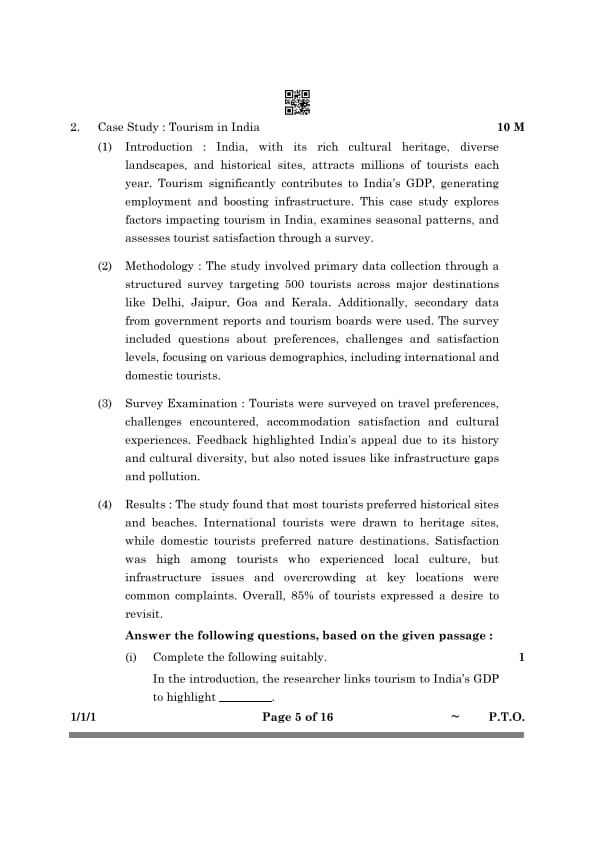
(1) Introduction India, with its rich cultural heritage, diverse landscapes, and historical sites, attracts millions of tourists each year. Tourism significantly contributes to India's GDP, generating employment and boosting infrastructure. This case study explores factors impacting tourism in India, examines seasonal patterns, and assesses tourist satisfaction through a survey.
(2) Methodology: The study involved primary data collection through a structured survey targeting 500 tourists across major destinations like Delhi, Jaipur, Goa and Kerala. Additionally, secondary data from government reports and tourism boards were used. The survey included questions about preferences, challenges and satisfaction levels, focusing on various demographics, including international and domestic tourists.
(3) Survey Examination : Tourists were surveyed on travel preferences, challenges encountered, accommodation satisfaction and cultural experiences. Feedback highlighted India's appeal due to its history and cultural diversity, but also noted issues like infrastructure gaps and pollution.
(4) Results: The study found that most tourists preferred historical sites and beaches. International tourists were drawn to heritage sites, while domestic tourists preferred nature destinations. Satisfaction was high among tourists who experienced local culture, but infrastructure issues and overcrowding at key locations were common complaints. Overall, 85% of tourists expressed a desire to revisit.
Answer the following questions, based on the given passage:
Question 7:
Complete the following suitably.
In the introduction, the researcher links tourism to India’s GDP to highlight _______.
View Solution
In the introduction, the researcher links tourism to India’s GDP to highlight its role in generating employment and boosting infrastructure. Quick Tip: Tourism doesn’t just attract visitors — it also fuels the economy by creating jobs and improving public infrastructure.
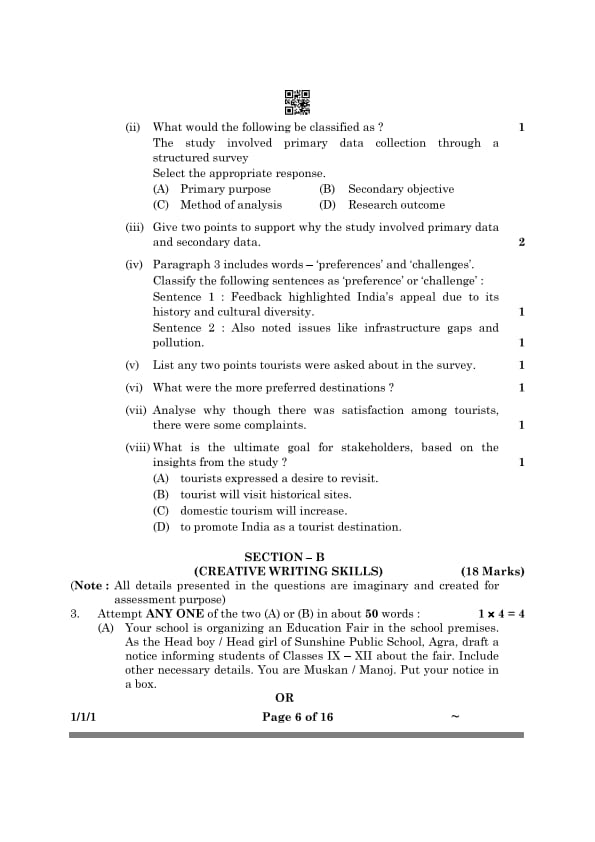
What would the following be classified as?
The study involved primary data collection through a structured survey.
Select the appropriate response:
View Solution
(C) Method of analysis Quick Tip: A structured survey used to collect data is a method of analysis — the tool through which information is gathered for a study.
Give two points to support why the study involved primary data and secondary data.
View Solution
1. Primary data was collected through a structured survey of 500 tourists to gain first-hand insights into tourist preferences and satisfaction.
2. Secondary data from government reports and tourism boards offered broader statistical and policy-based perspectives to complement the survey results. Quick Tip: Primary data helps in gathering direct insights from respondents, while secondary data adds credibility and broader context.
Classify the following sentences as ‘preference’ or ‘challenge’:
Sentence 1: Feedback highlighted India’s appeal due to its history and cultural diversity.
Sentence 2: Also noted issues like infrastructure gaps and pollution.
View Solution
Sentence 1: Preference
Sentence 2: Challenge Quick Tip: Preferences reflect what tourists liked, while challenges highlight the problems they faced.
List any two points tourists were asked about in the survey.
View Solution
1. Tourists were asked about their travel preferences.
2. They were also asked about satisfaction with accommodation and experiences. Quick Tip: Survey questions covered aspects of travel behavior, satisfaction, and encountered challenges.
What were the more preferred destinations?
View Solution
International tourists preferred heritage destinations like historical sites and beaches, while domestic tourists favored nature destinations. Quick Tip: Tourist preferences varied—international visitors favored heritage sites, locals preferred nature-based destinations.
Analyse why though there was satisfaction among tourists, there were some complaints.
View Solution
Although many tourists reported high satisfaction due to cultural experiences and heritage attractions, complaints arose due to infrastructure gaps and pollution in key tourist locations. Quick Tip: Satisfaction may coexist with complaints when positive experiences are offset by service or environmental issues.
What is the ultimate goal for stakeholders, based on the insights from the study?
\medskip
View Solution
The study aims to provide stakeholders insights into improving tourism experiences and addressing challenges, ultimately to promote India as a more attractive and competitive tourist destination. Quick Tip: The larger goal of such studies is to help stakeholders enhance tourism appeal and develop better infrastructure and policies.
(A) Your school is organizing an Education Fair in the school premises. As the Head boy / Head girl of Sunshine Public School, Agra, draft a notice informing students of Classes IX – XII about the fair. Include other necessary details. You are Muskan / Manoj. Put your notice in a box.
View Solution
\begin{tabular{|p{12cm|
\hline
\centering
SUNSHINE PUBLIC SCHOOL, AGRA
NOTICE
EDUCATION FAIR ON CAMPUS
This is to inform all students of Classes IX–XII that an Education Fair will be held in the school auditorium on 25th June 2025 from 10:00 a.m. to 3:00 p.m. Several universities and institutions will participate. Do not miss this informative opportunity.
Muskan / Manoj
(Head Girl / Head Boy)
\hline
\end{tabular Quick Tip: A good notice includes a heading, date, venue, purpose, and authority's signature — all inside a box.
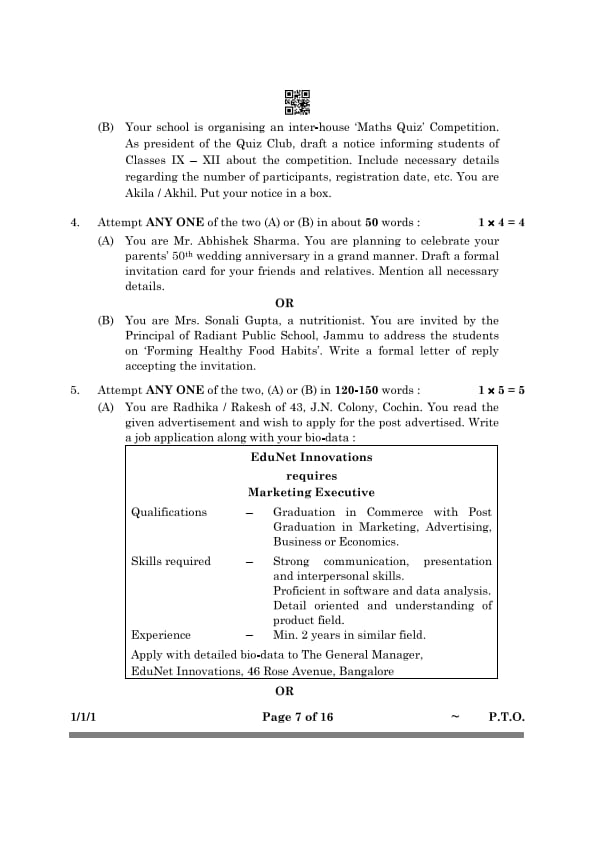
Your school is organising an inter-house ‘Maths Quiz’ Competition. As president of the Quiz Club, draft a notice informing students of Classes IX – XII about the competition. Include necessary details regarding the number of participants, registration date, etc. You are Akila / Akhil. Put your notice in a box.
View Solution
\begin{tabular{|p{12cm|
\hline
\centering
SUNSHINE PUBLIC SCHOOL, AGRA
NOTICE
INTER-HOUSE MATHS QUIZ COMPETITION
Students of Classes IX–XII are informed that an Inter-House Maths Quiz Competition will be held on 28th June 2025 in the AV Room from 9:00 a.m. onwards. Each house may nominate a team of 3 participants. Interested students must register with the undersigned by 24th June.
Akila / Akhil
(President, Quiz Club)
\hline
\end{tabular Quick Tip: Always mention the event title, date, venue, eligibility, registration deadline, and the signatory in notices.
(A) You are Mr. Abhishek Sharma. You are planning to celebrate your parents’ 50th wedding anniversary in a grand manner. Draft a formal invitation card for your friends and relatives. Mention all necessary details.
View Solution
\begin{tabular{|p{12cm|
\hline
\centering
INVITATION
50th Wedding Anniversary Celebration
You are cordially invited to celebrate the 50th Wedding Anniversary of my beloved parents on 1st July 2025 at Hotel Grand Palace, Agra, from 6:00 p.m. onwards. Kindly grace the occasion with your presence.
Mr. Abhishek Sharma
\hline
\end{tabular Quick Tip: An invitation must include what, when, where, and who is hosting. Keep it polite and formal.
You are Mrs. Sonali Gupta, a nutritionist. You are invited by the Principal of Radiant Public School, Jammu to address the students on ‘Forming Healthy Food Habits’. Write a formal letter of reply accepting the invitation.
View Solution
\begin{tabular{|p{12cm|
\hline
Mrs. Sonali Gupta
12 Green Valley, Jammu
20 June 2025
The Principal,
Radiant Public School,
Jammu
Subject: Acceptance of Invitation
Dear Sir/Madam,
I am pleased to accept your kind invitation to address the students on ‘Forming Healthy Food Habits’ on 26th June 2025. I look forward to the session.
Thank you.
Yours sincerely,
Sonali Gupta
\hline
\end{tabular Quick Tip: A formal reply should include the sender's address, date, salutation, purpose, confirmation, and closing.
(A) You are Radhika / Rakesh of 43, J.N. Colony, Cochin. You read the given advertisement and wish to apply for the post advertised. Write a job application along with your bio-data:
View Solution
43, J.N. Colony
Cochin – 682001
20 June 2025
To
The General Manager
EduNet Innovations
46 Rose Avenue
Bangalore
Subject: Application for the post of Marketing Executive
Sir/Madam,
In response to your advertisement, I would like to apply for the post of Marketing Executive. I have completed my Post Graduation in Marketing and have over two years of experience in the marketing industry. I possess strong communication and data analysis skills. I assure you of my sincerity and dedication to the role. Please find my bio-data below.
\begin{tabular{|p{12cm|
\hline
BIO-DATA
Name: Radhika / Rakesh
Address: 43, J.N. Colony, Cochin
Date of Birth: 15 April 1996
Qualifications: B.Com, MBA (Marketing)
Experience: 2+ years in marketing and advertising
Skills: Communication, Presentation, Software & Data Analysis
Languages Known: English, Hindi, Malayalam
Hobbies: Reading, Networking, Public Speaking
References: Available on request
\hline
\end{tabular Quick Tip: A job application should include sender's details, purpose, qualifications, and a clear bio-data table.
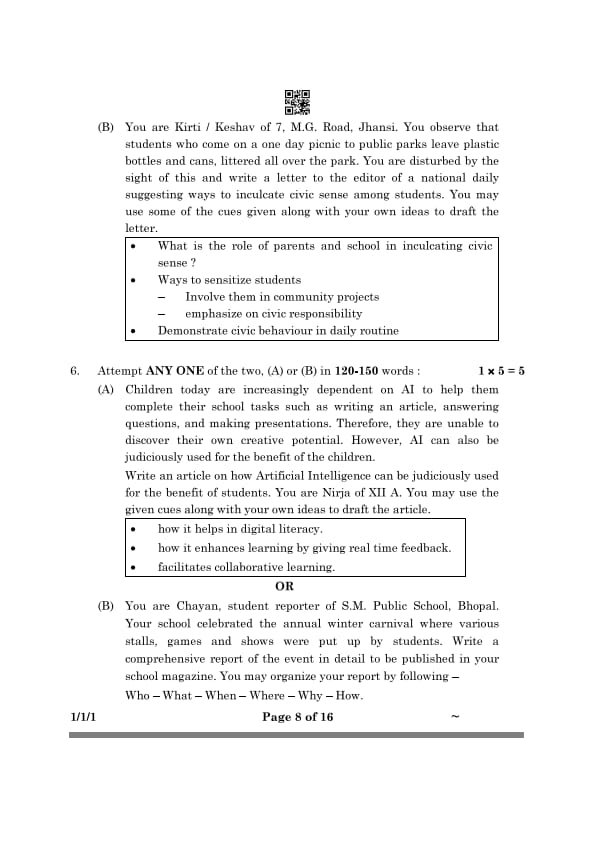
You are Kirti / Keshav of 7, M.G. Road, Jhansi. You are disturbed by students littering parks during one-day picnics. Write a letter to the editor of a national daily suggesting ways to inculcate civic sense among students. Use the given cues to draft the letter.
View Solution
7, M.G. Road
Jhansi – 284001
20 June 2025
The Editor
The National Herald
New Delhi
Subject: Need to Inculcate Civic Sense Among Students
Sir/Madam,
Through your esteemed newspaper, I would like to highlight the issue of students littering public places like parks. It is disturbing to see bottles and cans thrown around after school picnics. Schools and parents must work together to develop civic responsibility.
Students should be involved in community projects and taught civic behaviour through daily practice. Teachers must emphasize civic duty and set an example. Awareness drives and reward-based cleanliness campaigns may also help. Let's act now to raise responsible citizens.
Yours sincerely,
Kirti / Keshav Quick Tip: In formal letters, mention sender's details, date, recipient, subject, issue, suggestions, and polite closure.
(A) Children today are increasingly dependent on AI to help them complete school tasks. Write an article on how Artificial Intelligence can be judiciously used for the benefit of students. You are Nirja of XII A. Use the cues and your own ideas.
View Solution
Harnessing AI for Student Growth
{— by Nirja, XII A
Artificial Intelligence (AI) can be a valuable tool in enhancing the educational experience of students if used wisely. It helps build digital literacy by familiarizing students with technology from an early age.
Moreover, AI enhances learning through real-time feedback, enabling students to identify their mistakes and correct them instantly. Platforms powered by AI also support collaborative learning by connecting learners worldwide and offering shared problem-solving experiences.
However, over-reliance must be avoided to preserve creativity and independent thinking. Proper guidance from teachers and parents can help students use AI as a supportive tool rather than a substitute. Quick Tip: An article has a title, writer’s name, intro-body-conclusion structure, and clear ideas with examples or facts.
You are Chayan, student reporter of S.M. Public School, Bhopal. Write a comprehensive report of your school’s annual winter carnival. Organize your report by using: Who – What – When – Where – Why – How.
View Solution
Winter Carnival Brings Joy and Fun at S.M. Public School
{— Reported by Chayan, Student Reporter
S.M. Public School, Bhopal, organized its Annual Winter Carnival on 15th December 2024 in the school grounds. The event was inaugurated by the Principal, Mrs. Meera Sinha.
Students from all classes participated enthusiastically. There were food stalls, game counters, art exhibitions, and live performances, all set up by the students. The purpose of the carnival was to promote creativity, teamwork, and community involvement.
Parents and visitors enjoyed the vibrant atmosphere. The event concluded with a vote of thanks and a cultural program. It was a grand success and a memorable day for everyone involved. Quick Tip: A report includes factual narration in past tense using Who–What–When–Where–Why–How, and ends with a conclusion.
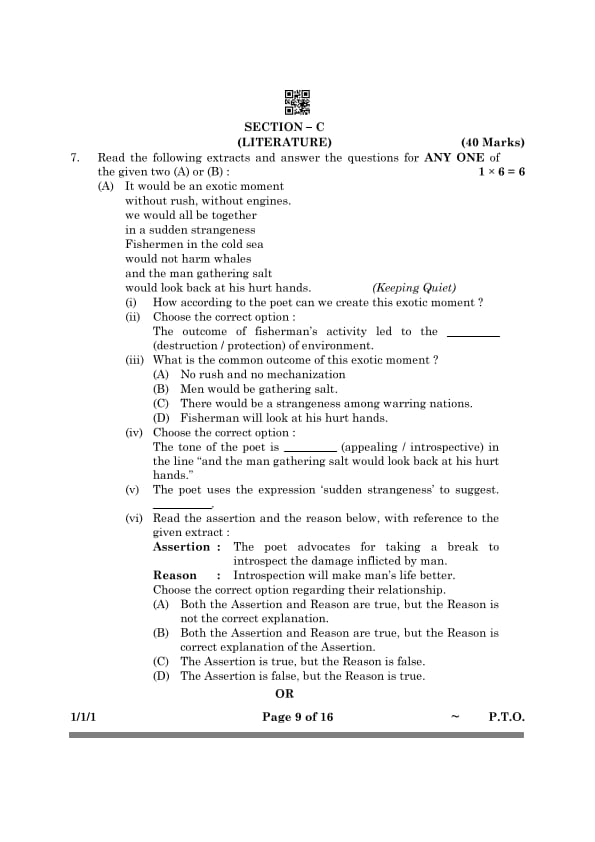
How according to the poet can we create this exotic moment?
View Solution
According to the poet, this exotic moment can be created by pausing all activity, maintaining silence, and taking a break from the mechanical rush of life. In that moment of stillness, people will come together in harmony and self-reflection. Quick Tip: The poet urges us to be still and quiet, suggesting that true unity and peace can emerge when we disconnect from constant activity.
Choose the correct option:
The outcome of fisherman's activity led to the (destruction / protection) of environment.
View Solution
The outcome of fisherman’s activity led to the destruction of the environment. Quick Tip: The poet highlights how harmful human actions, like fishing, disturb marine life — urging for mindful behavior and ecological awareness.
What is the common outcome of this exotic moment?
View Solution
The poet imagines a peaceful moment where humans pause all activity. In this quietness, there will be no rush, no use of engines or machines, and everyone will be united in a rare calmness. Quick Tip: ‘Exotic moment’ reflects the poet’s desire for global stillness, away from chaos and technology — allowing time for reflection and unity.
Choose the correct option:
The tone of the poet is (appealing / introspective) in the line "and the man gathering salt would look back at his hurt hands."
View Solution
The tone of the poet is introspective. The poet encourages a pause in routine tasks so individuals can reflect on their actions and the harm they may be causing to themselves or the environment. Quick Tip: The line invites readers to self-reflect — a key trait of an introspective tone, where attention turns inward to examine consequences.
The poet uses the expression 'sudden strangeness' to suggest ______.
View Solution
The poet uses the expression ‘sudden strangeness’ to suggest the unusual and unfamiliar experience of complete silence and stillness. It highlights the rare moment of unity, peace, and introspection which contrasts sharply with the usual chaos of life. Quick Tip: ‘Sudden strangeness’ symbolizes the unfamiliar peace and harmony that could arise if humanity paused its relentless activity.
Read the assertion and the reason below, with reference to the given extract:
Assertion: The poet advocates for taking a break to introspect the damage inflicted by man.
Reason: Introspection will make man's life better.
Choose the correct option regarding their relationship:
View Solution
The poet urges mankind to pause and reflect on its actions, particularly those harming the world and themselves. Through this introspection, a path to a more meaningful and peaceful life can be found — validating both the assertion and the reason. Quick Tip: In assertion-reason questions, confirm that both statements are factually correct and see if the reason directly explains the assertion.
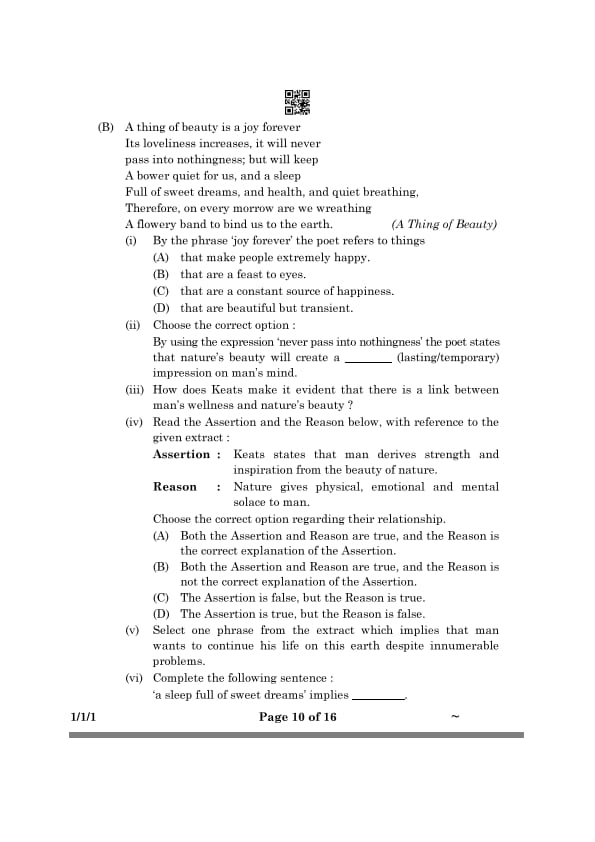
By the phrase 'joy forever' the poet refers to things:
View Solution
The poet describes beautiful things as eternal sources of joy. Their impact never fades, and they continue to uplift the human spirit, making them a lasting source of happiness. Quick Tip: Keats believes that true beauty is timeless and continues to bring comfort, joy, and peace throughout our lives.
Choose the correct option:
By using the expression 'never pass into nothingness' the poet states that nature's beauty will create a (lasting / temporary) impression on man's mind.
View Solution
The poet emphasizes that the impact of a beautiful thing never fades. It leaves a lasting impression on the human mind, offering eternal joy and comfort. Quick Tip: Poetic expressions like “never pass into nothingness” highlight the timeless and enduring effect of beauty in our lives.
How does Keats make it evident that there is a link between man's wellness and nature's beauty?
View Solution
Keats links man’s wellness to nature’s beauty by describing how beautiful things create a calming bower, induce sweet dreams, and bring health and peaceful breathing. These images show how beauty nurtures both the body and soul. Quick Tip: Keats connects natural beauty to human well-being through imagery of rest, peace, and health — emphasizing its healing power.
Read the Assertion and the Reason below, with reference to the given extract:
Assertion: Keats states that man derives strength and inspiration from the beauty of nature.
Reason: Nature gives physical, emotional and mental solace to man.
Choose the correct option regarding their relationship:
View Solution
Keats suggests that beauty in nature provides continuous support and motivation to mankind. Since it brings mental, emotional, and physical peace, the reason directly explains how nature inspires and strengthens man. Quick Tip: When both statements are true and logically connected, choose the option where the reason justifies the assertion.
Select one phrase from the extract which implies that man wants to continue his life on this earth despite innumerable problems.
View Solution
The phrase “a flowery band to bind us to the earth” implies that man finds enough beauty and hope in nature to stay connected to life, despite all hardships. Quick Tip: Look for metaphoric expressions in poetry — they often reveal deeper meanings about human emotions and desires.
Complete the following sentence:
‘a sleep full of sweet dreams’ implies ______
View Solution
‘A sleep full of sweet dreams’ implies the peace, comfort, and mental relaxation that beauty brings to human life, helping people to rest and rejuvenate. Quick Tip: In poetry, sleep often symbolizes calmness and relief — here it reflects the tranquil impact of nature’s beauty.
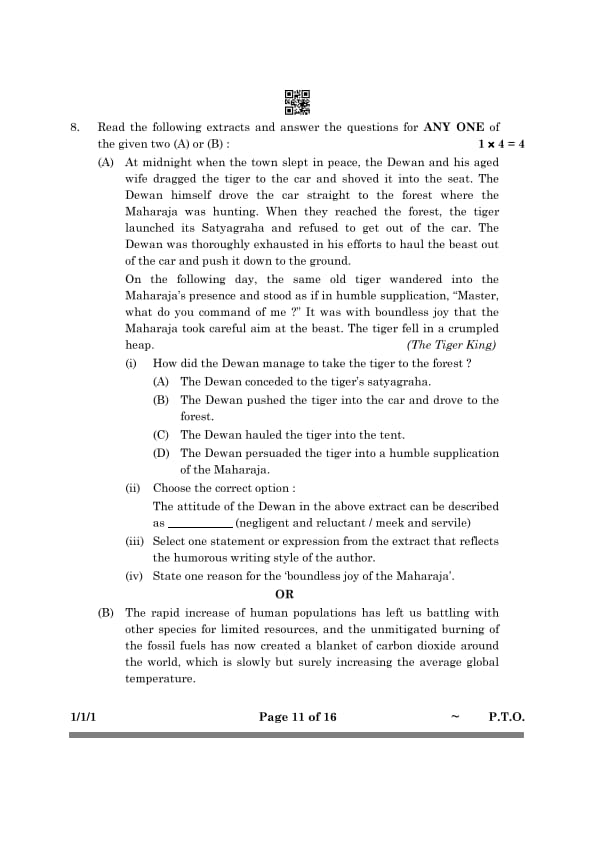
How did the Dewan manage to take the tiger to the forest?
View Solution
To help the Maharaja achieve his goal of killing the hundredth tiger, the Dewan and his wife secretly captured an old tiger from a circus. At midnight, they shoved the tiger into the car, and the Dewan personally drove it to the forest where the Maharaja was hunting. Quick Tip: Look closely at the character’s actions and motivations — the Dewan's actions show a mix of fear, loyalty, and desperation to please the king.
Choose the correct option:
The attitude of the Dewan in the above extract can be described as (negligent and reluctant / meek and servile)
View Solution
The Dewan’s actions — sneaking out at midnight, dragging an old tiger into a car, and exhausting himself to fulfill the Maharaja’s wish — clearly show his submissive and overly obedient nature. He acted out of fear and devotion rather than duty. Quick Tip: Words like “meek” and “servile” often describe characters who act with blind obedience or fear-driven loyalty.
Select one statement or expression from the extract that reflects the humorous writing style of the author.
View Solution
The line “the tiger launched its Satyagraha and refused to get out of the car” reflects the author's humorous writing style. The use of a serious political term like 'Satyagraha' for a tiger’s refusal adds a satirical and comic effect. Quick Tip: Humour in literature can come from exaggeration, irony, or unexpected word choices — like comparing an animal’s behavior to civil disobedience.
State one reason for the 'boundless joy of the Maharaja'.
View Solution
The Maharaja felt boundless joy because he believed he had successfully hunted the hundredth tiger, fulfilling the prophecy and proving his bravery, which was a matter of pride and ego for him. Quick Tip: The Maharaja’s exaggerated sense of pride and obsession with the prophecy is key to understanding his actions and emotional responses.
List one way in which the increasing human population is affecting other species.
View Solution
The increasing human population is leading to intense competition with other species for limited natural resources, which threatens the survival and habitats of many animal and plant species. Quick Tip: Look for cause-effect relationships — here, more people means more consumption and less space for wildlife.
Choose the correct option that best reflects the tone of the writer in the last line of the extract.
View Solution
The last line poses serious questions about environmental catastrophe in a dramatic tone, revealing the writer’s concern and anxiety about the uncertain future of the planet. Quick Tip: Tone is reflected in the writer’s choice of words — rhetorical questions and future concerns often show anxiety or urgency.
Choose the correct option:
'unmitigated burning of fossil fuels' reflects the (avaricious / furious) streak in man's nature.
View Solution
The phrase points to mankind’s greedy and unchecked exploitation of natural resources for economic growth and convenience, without regard for long-term consequences — a clear sign of avarice. Quick Tip: 'Avaricious' means greedy — fitting when human actions show uncontrolled consumption without concern for sustainability.
In the above extract, what message is the author giving to mankind?
View Solution
The author warns that human actions — especially overpopulation and fossil fuel burning — are leading to global climate instability. The message is a call for awareness, responsibility, and urgent action to protect the planet and ensure survival. Quick Tip: Identify the core idea — here it’s a caution against environmental negligence and a plea for sustainable living.
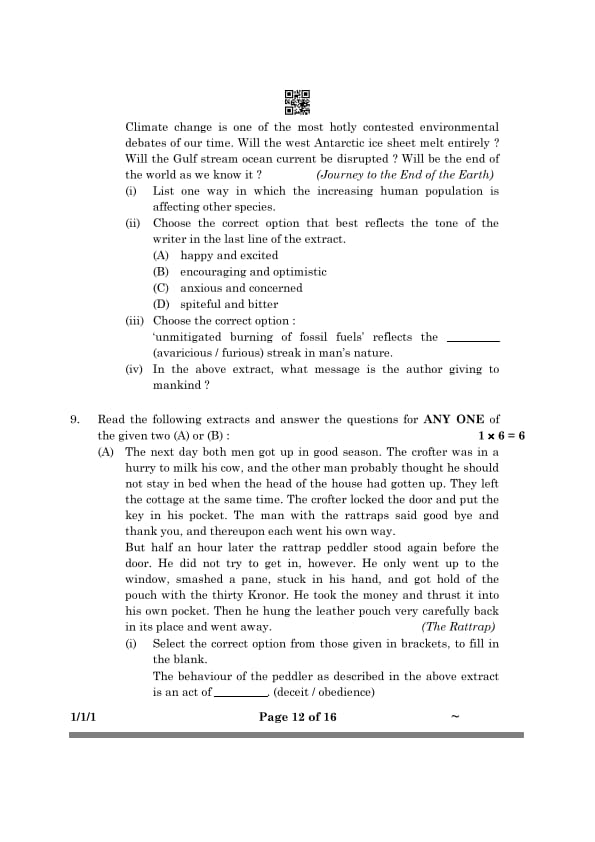
Select the correct option from those given in brackets, to fill in the blank.
The behaviour of the peddler as described in the above extract is an act of . (deceit / obedience)
View Solution
The peddler broke the crofter's trust by returning and stealing money from his house after being offered food and shelter. This clearly shows dishonesty and trickery, which is an act of deceit. Quick Tip: ‘Deceit’ refers to dishonest behaviour meant to mislead or betray someone — perfectly describing the peddler's actions in the passage.
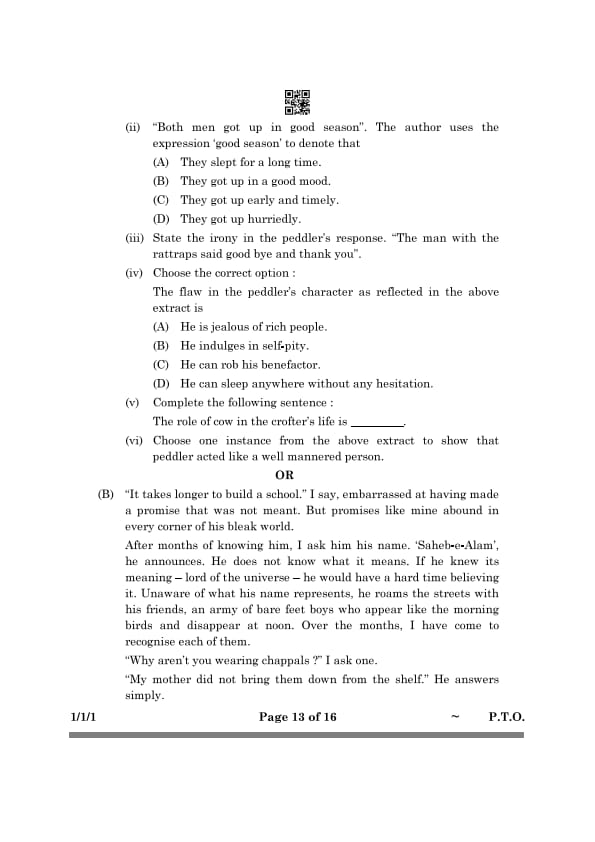
“Both men got up in good season”. The author uses the expression ‘good season’ to denote that
They slept for a long time.
They got up in a good mood.
They got up early and timely.
They got up hurriedly.
View Solution
The phrase "in good season" implies that both the crofter and the peddler woke up at an appropriate and early hour, ready to begin their daily routines — not hurriedly or mood-based. Quick Tip: The term "in good season" refers to being punctual and timely — not rushed or moody.
State the irony in the peddler’s response: “The man with the rattraps said good bye and thank you”.
View Solution
Although the peddler says “thank you” and appears polite, his actions contradict this civility. His words of gratitude are ironic because he ends up committing theft — an act of ingratitude and betrayal. Quick Tip: Irony is when words convey the opposite of actions — here, the peddler says “thank you” but soon robs the man.
Choose the correct option:
The flaw in the peddler’s character as reflected in the above extract is
He is jealous of rich people.
He indulges in self-pity.
He can rob his benefactor.
He can sleep anywhere without any hesitation.
View Solution
The peddler’s moral failing is shown when he chooses to rob the crofter — someone who treated him with kindness. This highlights a deep flaw in his values. Quick Tip: A benefactor is someone who helps — robbing such a person is a serious character flaw.
Complete the following sentence:
The role of cow in the crofter’s life is \hspace{5cm}.
View Solution
The cow is a source of income for the crofter. It allows him to earn money by selling milk, helping him live independently despite his old age. Quick Tip: In rural settings, livestock like cows are valuable income sources — a central part of livelihood.
Choose one instance from the above extract to show that peddler acted like a well-mannered person.
View Solution
Despite his later wrongdoing, the peddler displayed politeness and good manners in his words. This contrast enhances the irony of the situation. Quick Tip: Even people who commit wrong can show surface politeness — but actions speak louder than words.
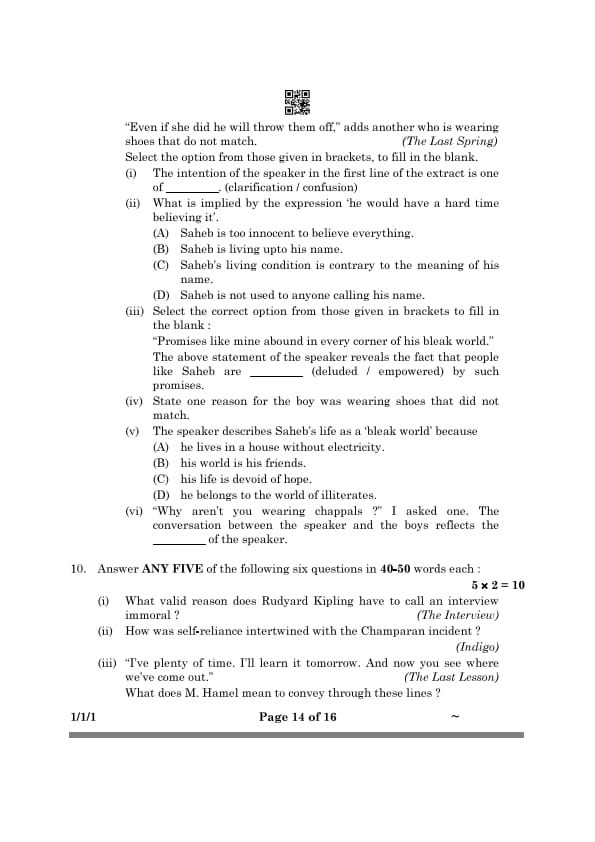
The intention of the speaker in the first line of the extract is one of . (clarification / confusion)
View Solution
The speaker feels awkward and guilty for making a promise that wasn’t genuine. The remark reflects uncertainty and embarrassment — showing confusion, not clarity. Quick Tip: Confusion occurs when someone speaks without clear intent or confidence — as seen in false or unkept promises.
What is implied by the expression ‘he would have a hard time believing it’?
Saheb is too innocent to believe everything.
Saheb is living up to his name.
Saheb’s living condition is contrary to the meaning of his name.
Saheb is not used to anyone calling his name.
View Solution
The name ‘Saheb-e-Alam’ means ‘lord of the universe’, but Saheb lives a life of poverty. The irony lies in the mismatch between name and reality, making it unbelievable for him. Quick Tip: When someone's name signifies grandeur but their life is full of struggle, irony and disbelief arise.
Select the correct option from those given in brackets to fill in the blank:
“Promises like mine abound in every corner of his bleak world.”
The above statement of the speaker reveals the fact that people like Saheb are (deluded / empowered) by such promises.
View Solution
The line reflects how false promises mislead poor children like Saheb. They place hope in things that are rarely fulfilled, hence they are deluded rather than empowered. Quick Tip: To be deluded is to be misled by false hopes — especially common in impoverished lives filled with empty promises.
State one reason for the boy was wearing shoes that did not match.
View Solution
The mismatched shoes show how the children are forced to use whatever they can find. Matching or proper footwear is a luxury for them. Quick Tip: Mismatched clothing or footwear in literature often symbolizes poverty and lack of access to basic needs.
The speaker describes Saheb’s life as a ‘bleak world’ because
he lives in a house without electricity.
his world is his friends.
his life is devoid of hope.
he belongs to the world of illiterates.
View Solution
‘Bleak world’ signifies a life lacking in joy, opportunity, and future prospects. Saheb’s reality is filled with poverty, broken promises, and emotional darkness. Quick Tip: A "bleak world" implies hopelessness and hardship, not merely material lack.
“Why aren’t you wearing chappals?” I asked one.
The conversation between the speaker and the boys reflects the of the speaker.
View Solution
The speaker is trying to understand the boys’ choices and lifestyle. The question comes from a place of genuine interest and a desire to know more about their world. Quick Tip: When characters ask sincere questions to understand others’ lives, it reflects curiosity and empathy.
What valid reason does Rudyard Kipling have to call an interview immoral? {(The Interview)
View Solution
Rudyard Kipling believed that interviews are immoral because they invade a person’s privacy and compel them to expose personal matters. He felt it was like an unwarranted intrusion that could misrepresent someone’s words or intentions. Kipling argued that the process is disrespectful and often misused to manipulate or sensationalize, thus degrading the dignity of the individual being interviewed. Quick Tip: When asked for an author’s opinion, clearly state their view and support it with logical reasoning or examples from the text.
How was self-reliance intertwined with the Champaran incident? {(Indigo)
View Solution
The Champaran incident was a turning point where Gandhi promoted self-reliance among poor farmers. He encouraged them to stand up to British indigo planters through nonviolent resistance. Gandhi’s leadership taught them to depend on their courage and collective unity rather than external help. It fostered a sense of empowerment and self-respect, showing that change could be achieved through moral strength and self-sufficiency. Quick Tip: When writing about a historical event or movement, connect it with the broader theme or value it promotes—like self-reliance or non-violence.
“I’ve plenty of time. I’ll learn it tomorrow. And now you see where we’ve come out.”
What does M. Hamel mean to convey through these lines? {(The Last Lesson)
View Solution
M. Hamel is criticizing the tendency to postpone learning, as people never realized the importance of their language until it was taken away. His statement conveys deep regret over the community’s neglect towards education and the French language. He wants to show that procrastination leads to irreversible loss, and people often value things only after losing them. His message is a warning about the cost of delay and carelessness in education. Quick Tip: Always connect a character’s words to the central theme of the story—like loss, regret, or patriotism.
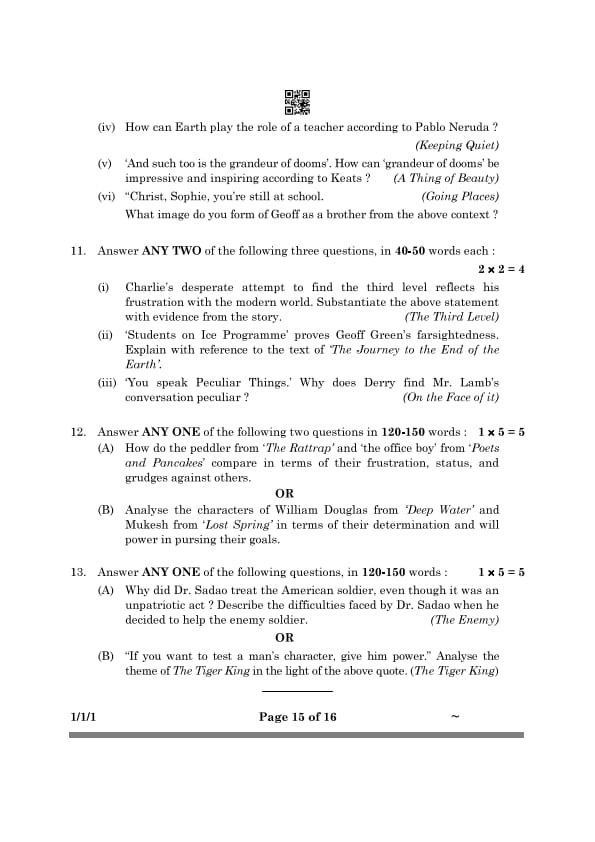
How can Earth play the role of a teacher according to Pablo Neruda? {(Keeping Quiet)
View Solution
According to Pablo Neruda, Earth teaches us the value of stillness, balance, and renewal. When everything appears silent and still during winter, life goes on beneath the surface, preparing for a new beginning. This natural rhythm teaches humanity that introspection and pause are necessary for peace and harmony. Earth becomes a teacher by showing how moments of quiet can lead to growth and transformation. Quick Tip: Use symbolic interpretations when dealing with poetry—explain what abstract elements like “Earth” or “silence” represent.
‘And such too is the grandeur of dooms’. How can ‘grandeur of dooms’ be impressive and inspiring according to Keats? {(A Thing of Beauty)
View Solution
Keats refers to the noble sacrifices and heroic deeds of people who faced tragic ends. The ‘grandeur of dooms’ represents the dignity and glory in such fates. These acts of courage and moral strength remain eternal sources of inspiration and beauty. Keats finds aesthetic and emotional power in such noble tragedies, which uplift the human spirit despite their sorrowful end. Quick Tip: Link poetic expressions to universal human values such as heroism, beauty, and inspiration when interpreting metaphors.
“Christ, Sophie, you’re still at school.”
What image do you form of Geoff as a brother from the above context? {(Going Places)
View Solution
From Geoff’s reaction, we see him as a mature and realistic brother. He knows the difference between dreams and reality and is concerned about Sophie’s fantasies. His statement reflects protectiveness and possibly frustration, as he feels she is being naive. Geoff appears as someone grounded and practical, aware of the harshness of the real world, unlike his younger sister’s dreamy nature. Quick Tip: When analyzing relationships, show contrast in personality and emotional tone to highlight character roles and conflicts.
Charlie’s desperate attempt to find the third level reflects his frustration with the modern world. Substantiate the above statement with evidence from the story. {(The Third Level)
View Solution
Charlie longs to escape the insecurity, stress, and complexity of modern life. The third level at Grand Central Station, a place that doesn’t actually exist, symbolizes his desire to return to a simpler, peaceful time. He imagines the year 1894 as an era free from war and anxiety. His obsession shows a deep yearning to run away from the harsh realities of the present, using the past as a mental refuge. Quick Tip: While writing theme-based answers, clearly link the symbolic elements of the story with the character’s emotions or mental state.
‘Students on Ice Programme’ proves Geoff Green’s farsightedness. Explain with reference to the text of ‘The Journey to the End of the Earth’. {(The Journey to the End of the Earth)
View Solution
Geoff Green believed that the future of the planet lies in the hands of today’s youth. By taking students to Antarctica, he gave them firsthand exposure to the effects of climate change, allowing them to connect emotionally with the environment. His goal was to create environmentally conscious leaders. His vision to involve students directly with nature’s extremes shows his foresight in educating the next generation about sustainability and ecological balance. Quick Tip: Focus on linking the initiative or action mentioned in the question with the values or vision of the character discussed.
“You speak peculiar things.” Why does Derry find Mr. Lamb’s conversation peculiar? {(On the Face of It)
View Solution
Derry finds Mr. Lamb’s conversation peculiar because it challenges his usual way of thinking. While Derry is used to people judging him for his scarred face, Mr. Lamb speaks with positivity and wisdom. He talks about seeing beauty in everything, ignoring disabilities, and living life without fear. Such optimistic, open-minded views are new and strange to Derry, who is filled with self-pity. Mr. Lamb’s attitude surprises and confuses him. Quick Tip: When explaining character dialogue, focus on the contrast in personalities or belief systems to show depth of reaction.
How do the peddler from ‘The Rattrap’ and ‘the office boy’ from ‘Poets and Pancakes’ compare in terms of their frustration, status, and grudges against others?
View Solution
Both the peddler in The Rattrap and the office boy in Poets and Pancakes represent individuals trapped in low status and unfulfilled aspirations. The peddler is a lonely vagabond who resents society for rejecting him and sees the world as a giant rattrap—full of bait and deception. His frustration manifests in stealing from the kind crofter who had offered him shelter. Similarly, the office boy nurtures dreams of stardom but finds himself stuck in the monotonous role of mixing paints in the make-up room. He vents his bitterness by mocking his co-workers and ridiculing their success, blaming everyone but himself for his failures.
Both characters bear grudges — the peddler against the social system that marginalizes him, and the office boy against authority and missed opportunities. However, their responses to their condition differ significantly. The peddler undergoes a transformation after encountering compassion and dignity at the ironmaster’s house. He acknowledges his wrongdoings and redeems himself by returning the stolen money. In contrast, the office boy remains cynical, arrogant, and deluded about his importance.
The key difference lies in the peddler’s capacity for introspection and change, while the office boy remains stagnant, consumed by his dissatisfaction and ego. Quick Tip: While comparing characters, discuss both similarities and differences, and connect them to the story’s message or outcome.
Analyse the characters of William Douglas from ‘Deep Water’ and Mukesh from ‘Lost Spring’ in terms of their determination and will power in pursuing their goals.
View Solution
William Douglas and Mukesh are both inspirational figures who overcome adversity through courage and determination. William Douglas, after a traumatic near-drowning experience, develops an intense fear of water. However, he refuses to let that fear dominate his life. Through relentless effort, guided training, and self-belief, he gradually conquers his phobia. His journey is a powerful testament to how inner resolve and discipline can help overcome psychological barriers.
Mukesh, a young boy from Firozabad, is born into the generational occupation of bangle-making. Despite being surrounded by poverty, exploitation, and social apathy, Mukesh dares to dream of a different life as a motor mechanic. He is determined not to follow the path of his ancestors and instead aspires to break free from the cycle of child labour. His courage lies not only in dreaming but also in taking steps to realize it, despite the odds.
While Douglas battles internal fear, Mukesh struggles against external societal constraints. Both emerge as symbols of hope, proving that success and dignity come not from privilege but from determination and resilience. Their stories underline a common truth: one’s circumstances may be limiting, but the human spirit, when determined, knows no bounds. Quick Tip: Focus on the characters’ challenges and efforts, then link them to broader values like courage, self-belief, or aspiration.
Why did Dr. Sadao treat the American soldier, even though it was an unpatriotic act? Describe the difficulties faced by Dr. Sadao when he decided to help the enemy soldier. {(The Enemy)
View Solution
Dr. Sadao, a renowned Japanese surgeon, chose to treat an American prisoner of war, even though such an act was considered unpatriotic during wartime. His decision was not driven by political allegiance but by his unwavering commitment to the Hippocratic Oath and humanitarian values. For Dr. Sadao, a patient in need transcended national identity; the enemy soldier was, first and foremost, a human being who needed help. As a doctor, he could not suppress his moral duty, despite the grave consequences it might entail.
This ethical stand placed him in a perilous position. He feared being accused of treason by the Japanese military and was constantly under psychological strain. His household was shaken—his domestic servants disapproved of his actions and abandoned their duties. His wife, Hana, although frightened and unsure, remained loyal and supportive, enduring the trauma of assisting in the soldier’s care while fearing for her family’s safety.
Dr. Sadao also faced an emotional dilemma. While his conscience urged him to save the man, his identity as a loyal Japanese citizen conflicted with that choice. He even informed the General, hoping for a resolution, but was left alone to carry the burden. Ultimately, he orchestrated the soldier’s escape—balancing his conscience and safety.
Dr. Sadao’s character demonstrates immense moral courage, empathy, and integrity. The story emphasizes that real patriotism does not lie in blind allegiance but in upholding human values even under duress. His struggle is a powerful statement on the primacy of ethics over prejudice. Quick Tip: In longer answers, begin with the character's action, explore their inner conflict, and conclude with the story’s broader moral message.
“If you want to test a man’s character, give him power.” Analyse the theme of The Tiger King in the light of the above quote. (The Tiger King)
View Solution
The quote aptly reflects the central theme of The Tiger King. The story is a sharp political and social satire on how power, when unchecked, corrupts absolutely and exposes a person’s true character. The Tiger King, having heard a prophecy at birth that he would die because of a tiger, becomes obsessed with defying his fate. Instead of embracing wisdom, he embarks on a ruthless campaign to kill a hundred tigers to escape death.
In his obsession, he misuses his royal authority. He imposes irrational bans, punishes villages that cannot offer him tigers, and manipulates his marriage solely to gain access to more hunting grounds. The irony lies in the fact that while he believes he is outwitting destiny, he is, in fact, sealing his own doom. His paranoia renders him blind to reason and compassion, and he becomes a symbol of absurd tyranny. Even the courtiers around him prefer flattery over honesty, highlighting the sycophancy that often surrounds those in power.
The climax, where the King is killed not by a real tiger but by a splinter from a wooden toy tiger, reinforces the futility of trying to control destiny. It also serves as a biting comment on the hollowness of authority when divorced from moral insight.
Through exaggerated storytelling, the author mocks the arrogance of power, stressing that true character is revealed not through words but through choices made under the influence of control. Real leadership, the story suggests, lies in wisdom, restraint, and self-awareness — qualities the Tiger King fatally lacks. Quick Tip: Use irony, symbolism, and satire as literary tools to explain the themes in fictional texts about power or leadership.

*The article might have information for the previous academic years, please refer the official website of the exam.