
CBSE Class 12 History Set 1 Question Paper 2026 with Solutions


| Updated On - Mar 30, 2026
CBSE Class 12 History Set-1 Question Paper 2026 with Solutions PDFs is available here for download.CBSE Board Class 12 History Paper 2026 was held on March 30, 2026. CBSE Board Class 12 question paper followed the latest syllabus and exam pattern prescribed by CBSE. CBSE Board Class 12 the examination was held in the first shift from 10:30 AM to 1:30 PM. Students can download the official paper in PDF format for reference.
CBSE Board Class 12 History Set 1 Paper 2026 with Solutions PDF
| CBSE Board Class 12 History Set 1 Question Paper 2026 | Download PDF | Check Solutions |

Who among the following rulers issued the first gold coins ?
View Solution
Step 1: Understanding the Concept:
The question requires identifying the specific ancient Indian dynasty that is historically credited with issuing the first widespread gold coinage in the subcontinent.
Step 2: Key Formula or Approach:
Use historical fact recall regarding ancient Indian numismatics and trade. Distinguish between the first to issue coins with portraits (Indo-Greeks) and the first to issue gold coins (Kushanas).
Step 3: Detailed Explanation:
While the Indo-Greeks were the first to issue coins bearing the names and images of rulers, the Kushana dynasty (around the 1st century CE), particularly under the ruler Vima Kadphises, issued the first widespread gold coins in India. These coins were virtually identical in weight to those issued by contemporary Roman emperors and Parthian rulers, which facilitated extensive international trade networks.
Step 4: Final Answer:
The Kushana rulers issued the first gold coins. Quick Tip: Do not confuse the Indo-Greeks (first inscribed/portrait coins) with the Kushanas (first gold coins) or the Guptas (most spectacular/highest number of gold coins).
Which one of the following statements is correct regarding Raja Gotmi Puta Siri Satkani ?
View Solution
Step 1: Understanding the Concept:
Evaluate the historical claims and achievements of the prominent Satavahana ruler, Gotamiputra Siri Satakarni, based on inscriptional evidence.
Step 2: Key Formula or Approach:
Analyze the historical claims found in the Nashik prashasti (inscription) commissioned by his mother, Gautami Balashri, to identify his correct social and political policies.
Step 3: Detailed Explanation:
- Option (A) is incorrect: He was a ruler of the Satavahana dynasty, not the Shaka dynasty. He actually fought against and defeated the Shakas.
- Option (C) is incorrect: The Satavahanas predate the Guptas. His successors had marriage alliances with the Shakas, not Guptas.
- Option (D) is incorrect: The Sudarshana lake was rebuilt by the Shaka ruler Rudradaman I, not Gotamiputra.
- Option (B) is correct: According to the Nashik inscription, Gotamiputra Satakarni claimed to be a unique Brahmana (eka bamhana) and boasted that he had stopped the contamination or intermarriage among the four varnas (vinivartita chaturvarna sankara), upholding the orthodox Brahmanical social order.
Step 4: Final Answer:
He ensured no intermarriage amongst members of the four varnas. Quick Tip: Satavahana rulers had a complex relationship with the varna system; they claimed to uphold strict varna rules while simultaneously entering into marriage alliances with people they considered 'outcastes' (like the Shakas).
Given below are two statements as Assertion (A) and Reason (R). Read them carefully and answer the question by choosing correct options :
Assertion (A) : Like Buddhism, Jainism also spread to many parts of India.
Reason (R) : Jaina scholars produced literature in various languages like Tamil, Prakrit and Sanskrit etc.
Options :
View Solution
Step 1: Understanding the Concept:
Assess the historical validity of both the assertion regarding the spread of Jainism and the reason regarding their literary contributions, and determine if they are causally linked.
Step 2: Key Formula or Approach:
Use the "because" test. Read the Assertion, add the word "because," and read the Reason to see if it makes logical historical sense.
Step 3: Detailed Explanation:
- Assertion (A) is historically correct. Jainism spread widely from its origins in eastern India to western India (Gujarat, Rajasthan) and southern India (Karnataka, Tamil Nadu).
- Reason (R) is also historically correct. Jaina monks and scholars were prolific writers. To reach a wider audience and local populations, they did not restrict themselves to one sacred language but produced extensive literature in Prakrit (the language of the masses), Sanskrit (for philosophical debates), and regional languages like Tamil (e.g., the Tamil epic Silappatikaram has strong Jaina influences).
- Connection: The ability to communicate and disseminate religious doctrines in local languages is a primary reason why a religion successfully spreads across diverse geographic and linguistic regions. Thus, (R) correctly explains (A).
Step 4: Final Answer:
Both statements are true, and the Reason correctly explains the Assertion. Quick Tip: In Assertion-Reason questions, always verify the factual correctness of each statement independently before evaluating the link between them.
Read the following statements regarding Buddhism teaching and choose the correct options :
I. The world is transient and constantly changing.
II. It is soulless and there is nothing eternal in it.
III. Sorrows and sufferings are intrinsic to human existence.
IV. Renouncing the world is essential for living.
Codes :
View Solution
Step 1: Understanding the Concept:
Identify the core philosophical tenets of Buddhism from the given list of statements.
Step 2: Key Formula or Approach:
Recall the "Three Marks of Existence" (Tilakkhana) and the "Four Noble Truths" in Buddhist philosophy to evaluate the statements.
Step 3: Detailed Explanation:
- Statement I is correct: It refers to Anicca (impermanence), the belief that the world is transient.
- Statement II is correct: It refers to Anatta (non-self), the belief that there is no eternal, unchanging soul.
- Statement III is correct: It refers to Dukkha (suffering), the First Noble Truth, which states that suffering is intrinsic to existence.
- Statement IV is incorrect: While Buddhism has a strong monastic tradition (renunciation for monks/nuns seeking nirvana), it does not teach that renouncing the world is "essential for living" for everyone. The Buddha taught the 'Middle Path' and gave extensive guidance for laypeople to live ethical lives without complete renunciation.
Step 4: Final Answer:
Statements I, II, and III are the correct teachings. Quick Tip: Extreme statements like "essential for living" are often incorrect in the context of the Middle Path, which emphasizes balance.
Match Column-I with Column-II and choose the correct option :
Column - I
(Scholars)
a. Kautilya
b. Harishena
c. Banabhatta
d. Bharat
Column - II
(Work)
i. Harshacharita
ii. Arthashastra
iii. Natyashastra
iv. Prayag Prashasti
Options :
View Solution
Step 1: Understanding the Concept:
Match prominent ancient Indian scholars, poets, and authors with their most famous literary or historical works.
Step 2: Key Formula or Approach:
Use elimination by matching the most certain pairs first (e.g., Kautilya with Arthashastra).
Step 3: Detailed Explanation:
- a. Kautilya (also known as Chanakya) is the legendary author of the ii. Arthashastra, the ancient Indian treatise on statecraft and political science.
- b. Harishena was the court poet of the Gupta emperor Samudragupta and composed the iv. Prayag Prashasti (Allahabad Pillar Inscription).
- c. Banabhatta was the court poet of King Harshavardhana and wrote his biography, the i. Harshacharita.
- d. Bharat (Bharata Muni) is traditionally credited with writing the iii. Natyashastra, the foundational text on classical Indian performing arts.
Therefore, the correct matching is a-ii, b-iv, c-i, d-iii.
Step 4: Final Answer:
Option (C) reflects the correct sequence. Quick Tip: In matching questions, identifying just one or two confident pairs (like Kautilya \(\rightarrow\) Arthashastra) is often enough to eliminate all incorrect options instantly.
Which of the following is a correct statement regarding Eklavya ?
View Solution
Step 1: Understanding the Concept:
Recall the narrative of Eklavya from the epic Mahabharata to verify the historical and literary facts of his story.
Step 2: Key Formula or Approach:
Analyze each statement against the established Mahabharata text regarding the relationship between Drona, Arjuna, and Eklavya.
Step 3: Detailed Explanation:
- Option (A) is incorrect: Arjuna was Drona's favorite student, not Eklavya. Drona had promised to make Arjuna the greatest archer in the world.
- Option (B) is incorrect: Eklavya did not belong to the royal Kuru lineage. He was a Nishada, a forest-dwelling hunting community often placed outside the strict varna hierarchy.
- Option (D) is incorrect: Because of his social background, Drona refused to accept Eklavya as a student. Therefore, he was never a co-student or friend of Arjuna; he learned by practicing in front of a clay statue of Drona.
- Option (C) is correct: When Drona realized Eklavya's skill surpassed Arjuna's, he demanded Eklavya's right thumb as Guru Dakshina (teacher's fee) to ensure Arjuna remained the supreme archer. Eklavya unhesitatingly cut it off and gave it to him.
Step 4: Final Answer:
The statement about offering his right thumb is the correct one. Quick Tip: The story of Eklavya highlights the rigid social hierarchies and the concept of 'Dharma' in ancient Indian epics, showing how access to martial education was restricted by lineage.
Look at the given image and identify the ancient sculptural panel from the options :

View Solution
Step 1: Understanding the Concept:
Identify the ancient Indian monument shown in the visual source based on its distinct architectural and sculptural features.
Step 2: Key Formula or Approach:
Analyze the visual cues: a massive open-air rock relief carved on two huge boulders with a cleft in between, featuring life-sized elephants and numerous divine and human figures.
Step 3: Detailed Explanation:
The image prominently displays the famous bas-relief located at Mahabalipuram (Mamallapuram) in Tamil Nadu, created during the Pallava dynasty. This massive open-air sculpture is carved onto two monolithic boulders. It is widely known by two interpretations: "The Descent of the Ganges" (representing the penance of Bhagiratha to bring the river Ganga to earth) or "Arjuna's Penance" (representing Arjuna obtaining the Pashupatastra from Shiva). The life-size elephants and the central cleft representing a river are its most distinguishing features.
Step 4: Final Answer:
The image is a sculpture from Mahabalipuram. Quick Tip: Visual questions often test familiarity with UNESCO World Heritage sites. Learn to recognize key motifs: Sanchi (Stupa/Toranas), Amravati (Limestone roundels), Brihadeshwara (Vimana/Nandi).
Note : The following question is for the Visually Impaired Candidates only in lieu of Question No. 7 :
In which of the following states Mahabalipuram temple is located ?
View Solution
Step 1: Understanding the Concept:
Identify the geographical location of the historical site of Mahabalipuram.
Step 2: Key Formula or Approach:
Recall the regional base of the Pallava dynasty, who built the monuments at Mahabalipuram.
Step 3: Detailed Explanation:
Mahabalipuram, also known as Mamallapuram, was a major seaport and center of art during the reign of the Pallava kings in the 7th and 8th centuries CE. It is situated on the Coromandel Coast along the Bay of Bengal. Geographically and administratively, this historic town is located in the Chengalpattu district of the present-day Indian state of Tamil Nadu.
Step 4: Final Answer:
Mahabalipuram is located in Tamil Nadu. Quick Tip: Map out major historical dynasties and their capitals: Pallavas/Cholas in Tamil Nadu, Chalukyas in Karnataka, Guptas/Mauryas in UP/Bihar.
Who among the following was appointed Qazi or Judge of Delhi by Sultan Mohd. Bin Tughlaq ?
View Solution
Step 1: Understanding the Concept:
Identify the famous foreign traveler who visited the Delhi Sultanate and was appointed to a high administrative position.
Step 2: Key Formula or Approach:
Link the names of famous travelers to the respective rulers they visited and the roles they played during their stay in India.
Step 3: Detailed Explanation:
- Al-Biruni visited India much earlier, accompanying Mahmud of Ghazni in the 11th century.
- Ibn Battuta was a Moroccan traveler and Islamic scholar who reached India in the 14th century during the reign of Sultan Muhammad bin Tughlaq. The Sultan was deeply impressed by Ibn Battuta's scholarship and knowledge of Islamic jurisprudence (Sharia). Consequently, he appointed him as the Qazi (chief judge) of Delhi, a prestigious post he held for several years before falling out of favor and later being reinstated as an ambassador to China.
Step 4: Final Answer:
Ibn Battuta was appointed as the Qazi of Delhi. Quick Tip: Remember the traveler-ruler pairs: Ibn Battuta \(\rightarrow\) Muhammad bin Tughlaq; Al-Biruni \(\rightarrow\) Mahmud of Ghazni; Francois Bernier \(\rightarrow\) Shah Jahan/Aurangzeb.
Identify the correct statements regarding the early Bhakti movement in South India :
I. Alvars and Nayanars travelled from place to place singing hymns in Tamil.
II. One of the major anthologies of compositions by the Alvars, 'Amuktamalyada', described as Tamil Vedas.
III. Karaikkal Ammaiyar and Andal were the women devotees of Nayanara and Alvar Tradition.
IV. Both Nayanars and Alvar saints were revered by the Vellala Peasants.
Options :
View Solution
Step 1: Understanding the Concept:
Evaluate statements characterizing the Alvar and Nayanar traditions of the early South Indian Bhakti movement.
Step 2: Key Formula or Approach:
Analyze each statement for historical accuracy regarding literature, gender participation, and social base.
Step 3: Detailed Explanation:
- Statement I is correct: The movement was characterized by wandering saints who used the local vernacular, Tamil, to compose and sing ecstatic hymns, making religion accessible to the masses.
- Statement II is incorrect: The major anthology of Alvar compositions revered as the "Tamil Veda" is the Nalayira Divyaprabandham. Amuktamalyada is a completely different text; it is a Telugu epic poem written centuries later by the Vijayanagara King Krishnadevaraya.
- Statement III is correct: Karaikkal Ammaiyar was a fierce devotee of Shiva (a Nayanar), and Andal was a famous devotee of Vishnu (an Alvar), highlighting the prominent role of women in these movements.
- Statement IV is correct: The movement challenged orthodox Brahmanical dominance and drew massive support from diverse social backgrounds, including strong reverence from the wealthy and influential Vellala peasant community.
Step 4: Final Answer:
Since statement II is false, the correct combination is I, III, and IV. Quick Tip: Always double-check the names of texts. Conflating the Nalayira Divyaprabandham with the Amuktamalyada is a classic trap in these exams.
Arrange the following dynasties in chronological order and choose the correct option :
I. Saluva dynasty
II. Sangama dynasty
III. Aravidu dynasty
IV. Tuluva dynasty
Options :
View Solution
Step 1: Understanding the Concept:
Recall the chronological succession of the four ruling dynasties of the Vijayanagara Empire.
Step 2: Key Formula or Approach:
Use a mnemonic or sequential timeline to order the dynasties from the founding of the empire to its decline.
Step 3: Detailed Explanation:
The Vijayanagara Empire was ruled by four consecutive dynasties:
1. Sangama Dynasty (II): The founding dynasty, established in 1336 CE by brothers Harihara I and Bukka Raya I.
2. Saluva Dynasty (I): A brief dynasty founded by Saluva Narasimha Deva Raya in 1485 CE after the decline of the Sangamas.
3. Tuluva Dynasty (IV): Founded by Tuluva Narasa Nayaka around 1491 CE. This dynasty produced the empire's greatest ruler, Krishnadevaraya.
4. Aravidu Dynasty (III): The final dynasty, which took over following the disastrous Battle of Talikota (1565) and ruled from Penukonda and Chandragiri until 1646 CE.
The correct chronological order is II \(\rightarrow\) I \(\rightarrow\) IV \(\rightarrow\) III.
Step 4: Final Answer:
Option (D) provides the correct chronological sequence. Quick Tip: Use the simple mnemonic S-S-T-A (Sangama, Saluva, Tuluva, Aravidu) to quickly recall the sequence of the Vijayanagara dynasties.
Identify the Sufi Saint with the help of following information and select the correct option :
• His Hospice was on the bank of river Yamuna in Delhi.
• His disciple was Amir Khusro.
• His disciples addressed him as Sultan-ul-Mashakh.
Options :
View Solution
Step 1: Understanding the Concept:
Identify the historical Sufi saint based on specific biographical clues regarding location, famous disciples, and titles.
Step 2: Key Formula or Approach:
Match the specific clues to the biographies of the major Chishti saints in India.
Step 3: Detailed Explanation:
- Shaikh Muinuddin Chishti had his hospice in Ajmer, not Delhi.
- Shaikh Qutbuddin Bakhtiyar Kaki was in Delhi, but the other clues do not define his primary legacy as strongly.
- The clues specifically point to Shaikh Nizamuddin Auliya. He established his khanqah (hospice) in Ghiyaspur, on the banks of the Yamuna in Delhi. His most famous and devoted disciple was the legendary poet and musician Amir Khusrau. Due to his immense spiritual authority and popularity, he was revered by his followers as Sultan-ul-Mashaikh (Sultan amongst the Sufi saints).
Step 4: Final Answer:
The given information correctly identifies Shaikh Nizamuddin Auliya. Quick Tip: The relationship between Nizamuddin Auliya and Amir Khusrau is central to medieval Indian culture; associating them instantly solves many Sufism-related questions.
Choose the correct option to fill the blank :

View Solution
Step 1: Understanding the Concept:
Map the prominent historical tribal/pastoral communities to their respective geographical regions during the Mughal era.
Step 2: Key Formula or Approach:
Recall the regional dominance of various indigenous groups in 16th/17th century India.
Step 3: Detailed Explanation:
- The diagram shows established pairings: Lohanis in Punjab and Bhils in Mewar (Rajasthan/Gujarat region).
- We must identify the dominant community in Assam during this period. The Ahoms migrated into the Brahmaputra valley (Assam) and established a powerful kingdom that successfully resisted Mughal expansion for a long time. They were the defining power in that region during the 16th and 17th centuries.
- By contrast, Gonds are associated with Central India (Gondwana), Meenas with Rajasthan, and Khasis with Meghalaya.
Step 4: Final Answer:
The Ahoms are correctly associated with the region of Assam. Quick Tip: The Ahom kingdom's resistance against the Mughals (especially the Battle of Saraighat) is a key feature of Northeast Indian history during the medieval period.
Which one of the following pairs is correctly matched ?
Travellers of Medieval period Native Region
View Solution
Step 1: Understanding the Concept:
Identify the correct country of origin for famous historical travelers who visited India or Asia.
Step 2: Key Formula or Approach:
Verify each traveler's nationality against historical records.
Step 3: Detailed Explanation:
- (A) Peter Mundy was a 17th-century traveler from England, not Spain.
- (B) Father Antonio Monserrate was a Spanish Jesuit priest (born in Catalonia), though he was part of a Portuguese mission to Akbar's court. Standard historical texts classify him as Spanish.
- (C) Abdur Razzaq was an Islamic scholar and ambassador from Herat (in present-day Afghanistan/Persia), not Morocco. (Ibn Battuta was the famous Moroccan traveler).
- (D) Marco Polo was a renowned merchant and explorer from the Republic of Venice, which is in modern-day Italy. This pair is correctly matched.
Step 4: Final Answer:
Marco Polo is correctly matched with Italy. Quick Tip: Create a quick reference table of foreign travelers containing their Name, Century, Origin Country, and the Indian Ruler they visited.
Which among the following was not the major factor for the development of agriculture during Mughal India ?
View Solution
Step 1: Understanding the Concept:
Identify the historical factors that contributed to agricultural expansion during the Mughal period and distinguish them from modern technologies.
Step 2: Key Formula or Approach:
Analyze the options for historical anachronisms (technologies or concepts that did not exist in the 16th-18th centuries).
Step 3: Detailed Explanation:
- Options (A), (B), and (C) were genuine factors. The Mughal empire had vast tracts of uncultivated, fertile land. Labor was relatively inexpensive. Additionally, peasant mobility was high; if oppressed by heavy taxes or famine, peasants would migrate to clear new forests and start fresh cultivation.
- Option (D) is incorrect. While the Mughals used irrigation techniques like state-built canals and the Persian wheel (rahat), tube-wells are a modern invention relying on motorized pumps and deep drilling technology that simply did not exist during the Mughal era.
Step 4: Final Answer:
Tube-wells were not a factor as they are a modern technology. Quick Tip: Always look out for anachronisms in history questions. Modern machinery, electricity, or synthetic materials in ancient/medieval contexts are immediate red flags.
How did the arrival of Santhals in the Raj Mahal hills affect the Paharias ? Choose the correct options :
View Solution
Step 1: Understanding the Concept:
Analyze the demographic and ecological impact of British colonial policies regarding the settlement of the Santhal community in the Rajmahal Hills.
Step 2: Key Formula or Approach:
Recall the conflict between shifting cultivators (Paharias) and settled agriculturists (Santhals) orchestrated by the British.
Step 3: Detailed Explanation:
The Paharias were the original inhabitants of the Rajmahal hills, practicing shifting cultivation and living off forest produce. To pacify the region and increase land revenue, the British administration actively encouraged the Santhals, who were settled agriculturists, to clear the forests and settle at the foothills in an area demarcated as the Damin-i-Koh.
As the Santhals rapidly expanded their agricultural lands, they encroached upon the traditional territories of the Paharias. Unable to compete and unwilling to give up their way of life, the Paharias were pushed deeper and higher into the barren, rocky upper reaches of the hills, severely restricting their livelihood.
Step 4: Final Answer:
The Paharias were displaced and forced to move to the upper hills. Quick Tip: Remember the dynamic: British used Santhals (plough agriculture) to displace Paharias (hoe agriculture) to maximize state revenue from land.
Arrange the following historical events in chronological order and choose the correct option :
I. Champaran Satyagraha
II. Kheda Satyagraha
III. Jallianwala Bagh Incident
IV. Rowlatt Act
Options :
View Solution
Step 1: Understanding the Concept:
Establish the correct historical timeline for key events during the early phase of the Indian National Movement under Mahatma Gandhi.
Step 2: Key Formula or Approach:
Assign specific years (and months if necessary) to each event to order them sequentially.
Step 3: Detailed Explanation:
1. Champaran Satyagraha (I): 1917. This was Gandhi's first major active involvement in Indian politics, fighting for indigo farmers.
2. Kheda Satyagraha (II): 1918. A peasant movement in Gujarat demanding revenue remission due to crop failure.
3. Rowlatt Act (IV): Passed in March 1919. It gave the colonial government sweeping powers to repress political activities without trial.
4. Jallianwala Bagh Incident (III): April 13, 1919. The massacre occurred when people gathered to protest the Rowlatt Act and the arrest of local leaders.
The correct chronological sequence is I \(\rightarrow\) II \(\rightarrow\) IV \(\rightarrow\) III.
Step 4: Final Answer:
Option (B) represents the correct chronological order. Quick Tip: The Rowlatt Act was the direct legislative cause that triggered the protests culminating in the Jallianwala Bagh tragedy. Therefore, the Act (IV) must immediately precede the massacre (III).
Find the odd one out from the following :
(British Officers) (Policy)
View Solution
Step 1: Understanding the Concept:
Identify which British official is incorrectly paired with the major policy or historical event they are famous for implementing in India.
Step 2: Key Formula or Approach:
Review each pair based on standard historical knowledge of British Governor-Generals and their signature policies.
Step 3: Detailed Explanation:
- (A) Lord Dalhousie is famously associated with the aggressive Doctrine of Lapse used to annex princely states. (Correct pair)
- (B) Lord Cornwallis introduced the Permanent Settlement of land revenue in Bengal in 1793. (Correct pair)
- (D) Lord Hardinge (specifically Hardinge as Master-General of Ordnance) was instrumental in adopting the new Enfield Pattern 1853 rifled musket, which eventually sparked the 1857 revolt in India. (Correct pair in broad historical context)
- (C) Lord Wellesley is renowned for introducing the Subsidiary Alliance system to bring Indian states under British control. The introduction of Western Education is primarily associated with Lord William Bentinck and Thomas Babington Macaulay (Macaulay's Minute of 1835). Therefore, Wellesley is incorrectly paired.
Step 4: Final Answer:
Option (C) is the odd one out. Quick Tip: Always associate Wellesley with the "Subsidiary Alliance" and Dalhousie with the "Doctrine of Lapse". These are the two most frequently tested annexation policies.
Who amongst the following leaders struggled to free Vietnam from the imperialist control ?
View Solution
Step 1: Understanding the Concept:
Identify the primary leader of the 20th-century Vietnamese nationalist and communist movement against colonial powers.
Step 2: Key Formula or Approach:
Differentiate between historical figures of Vietnam and China.
Step 3: Detailed Explanation:
- Qin Shi Huang (C) was the first Emperor of a unified China in ancient times.
- Mao-Ze-Dong (D) was the founding father of the People's Republic of China.
- Nguyen Hue (A) was an 18th-century emperor of the Tay Son dynasty in Vietnam, predating modern imperialism.
- Ho-Chi-Minh (B) was the paramount leader of the Vietnamese independence movement. He founded the Indochinese Communist Party and led the Viet Minh in their struggle against French colonial rule, and later against the United States during the Vietnam War.
Step 4: Final Answer:
Ho Chi Minh is the correct leader. Quick Tip: Questions on world history often focus on major anti-imperialist figures. Ho Chi Minh is the central figure for Vietnam's 20th-century freedom struggle.
Which of the following statements regarding Nana Saheb are correct ?
Choose the correct option :
I. Nana Saheb was the successor of Peshwa Baji Rao-II.
II. Nana Saheb joined the revolt of 1857 from Kanpur.
III. His rebellion collapsed in the beginning of 1857.
IV. Nana Saheb went to Nepal in 1857.
Options :
View Solution
Step 1: Understanding the Concept:
Evaluate historical facts surrounding Nana Saheb's identity and his role in the Revolt of 1857.
Step 2: Key Formula or Approach:
Analyze the timeline and geographical details of Nana Saheb's rebellion.
Step 3: Detailed Explanation:
- Statement I is correct: Nana Saheb was the adopted son of the exiled Maratha Peshwa, Baji Rao II, and he fought because the British refused to recognize him as the successor and denied him the Peshwa's pension.
- Statement II is correct: Upon the outbreak of the mutiny, Nana Saheb assumed leadership of the rebellious sepoys and local population in Kanpur (Cawnpore).
- Statement III is incorrect: The 1857 revolt itself only began in May 1857. Nana Saheb's rebellion in Kanpur saw initial success (capturing the British garrison) and did not collapse "in the beginning" of the year; fighting raged on for months before the British recaptured the city.
- Statement IV is incorrect: After a series of defeats, Nana Saheb ultimately escaped into the Terai region of Nepal. However, this escape occurred later, roughly in 1859, not in 1857, as guerrilla warfare continued for some time.
Therefore, only statements I and II are factually correct.
Step 4: Final Answer:
Option (D) correctly identifies the true statements. Quick Tip: Pay close attention to timelines in history statements. The revolt started mid-year (May 1857), so it could not have collapsed at the "beginning" of 1857.
Who amongst the following was the head of the 'Advisory Committee' of the Constituent Assembly ?
View Solution
Step 1: Understanding the Concept:
Recall the chairpersons of the major committees formed within the Constituent Assembly to draft the Constitution of India.
Step 2: Key Formula or Approach:
Match prominent founding fathers to their specific committee leadership roles.
Step 3: Detailed Explanation:
The Constituent Assembly delegated tasks to various committees:
- Dr. B.R. Ambedkar was the Chairman of the Drafting Committee.
- Jawaharlal Nehru headed the Union Powers Committee and the Union Constitution Committee.
- Dr. Rajendra Prasad headed the Steering Committee and the Rules of Procedure Committee.
- Sardar Vallabhbhai Patel was the Chairman of the crucial 'Advisory Committee on Fundamental Rights, Minorities and Tribal and Excluded Areas'.
Step 4: Final Answer:
Sardar Patel was the head of the Advisory Committee. Quick Tip: Memorize the heads of major committees. Patel's role in integrating princely states aligns well with his leadership of the committee dealing with minorities and fundamental rights.
Identify the British Officer with the help of following information :
• Was a Physician.
• Organised Zoo in Calcutta.
• Did survey of Bengal.
• He assumed family name as Hamilton.
View Solution
Step 1: Understanding the Concept:
Identify the historical colonial figure based on their diverse contributions to medicine, surveying, and naturalism in British India.
Step 2: Key Formula or Approach:
Match the specific biographical clues to the known profiles of British officials in India.
Step 3: Detailed Explanation:
The provided clues describe Francis Buchanan (later Francis Buchanan-Hamilton):
- He arrived in India as a surgeon/physician in the medical service of the East India Company.
- As a keen naturalist, he established the Alipore Zoological Gardens in Calcutta at the behest of Lord Wellesley.
- He is most famous for his exhaustive surveys of Mysore and his comprehensive, multi-year survey of Bengal, meticulously recording details of agriculture, society, and antiquities.
- Later in life, to inherit his mother's estate in Scotland, he assumed her family name, becoming Buchanan-Hamilton.
Step 4: Final Answer:
The information perfectly aligns with Francis Buchanan. Quick Tip: Francis Buchanan's detailed survey accounts are considered vital primary sources by modern historians studying the agrarian society of early 19th-century India.
How did Buddha attain enlightenment ? Explain.
View Solution
Step 1: Understanding the Concept:
The question requires a narrative explanation of the spiritual journey Siddhartha Gautama undertook to achieve Nirvana (enlightenment) and become the Buddha.
Step 2: Key Formula or Approach:
Structure the answer chronologically: The Great Departure \(\rightarrow\) Extreme Asceticism \(\rightarrow\) Discovery of the Middle Path \(\rightarrow\) Final Meditation under the Bodhi tree.
Step 3: Detailed Explanation:
Siddhartha Gautama attained enlightenment through a profound process marked by several key phases:
The Great Departure: Deeply troubled by the sight of old age, sickness, and death (the Four Sights), Siddhartha renounced his luxurious royal life, leaving his palace to seek the ultimate truth and an end to human suffering.
Experimentation with Asceticism: He initially sought guidance from various teachers and practiced severe bodily mortification and extreme fasting. These practices brought him near death but failed to provide the spiritual realization he sought.
Adopting the Middle Path: Realizing the futility of torturing the body, he abandoned extreme asceticism. He formulated the concept of the 'Middle Path' (Majjhima Patipada) — a balanced approach that avoids the extremes of sensory indulgence and severe self-mortification.
Meditation and Nirvana: Taking a firm resolve, he sat in deep meditation under a peepal tree (the Bodhi tree) in Bodh Gaya. After several days of intense focus, overcoming worldly temptations and distractions (often personified as the demon Mara), he attained supreme knowledge or Nirvana. He realized the true nature of existence and the cause of suffering, thereby becoming the "Buddha" or the Enlightened One.
Step 4: Final Answer:
He attained enlightenment by renouncing the world, rejecting extreme asceticism in favor of the Middle Path, and meditating deeply under the Bodhi tree at Bodh Gaya. Quick Tip: Always mention the "Middle Path" (Majjhima Patipada) as it is the defining characteristic of his journey that separates Buddhism from extreme ascetic traditions.
How has Buddhist literature helped in understanding the sculpture of Sanchi ? Explain.
View Solution
Step 1: Understanding the Concept:
Explain the critical relationship between textual sources (literature) and archaeological/visual sources (sculptures) in the study of history.
Step 2: Key Formula or Approach:
Provide specific examples of how texts decode narratives, symbols, and motifs found on the Sanchi stupa.
Step 3: Detailed Explanation:
Buddhist literature is indispensable for interpreting the complex visual language of the Sanchi stupa sculptures in the following ways:
Identifying Narrative Scenes: Many sculptures at Sanchi depict intricate stories. Art historians rely heavily on the Jatakas (a voluminous body of literature detailing the previous lives of the Buddha) to identify these scenes. For example, a complex relief showing a generous prince giving away his possessions can only be definitively identified as the Vessantara Jataka by correlating the visual details with the written text.
Decoding Aniconic Symbols: In early Buddhist art at Sanchi, the Buddha was rarely depicted in human form. Instead, abstract symbols were used. Buddhist texts explain the meaning behind these symbols: an empty seat and the Bodhi tree signify his meditation and enlightenment; the wheel (Dharmachakra) represents his first sermon; and the stupa itself represents his Mahaparinirvana (final blowing out/death).
Contextualizing Motifs: Literature provides the philosophical and cultural context for seemingly decorative motifs. For instance, the recurring motif of the lotus is understood through texts as a symbol of purity (growing in mud but remaining unsoiled), reflecting Buddhist spiritual ideals. Thus, texts transform mere decorations into profound theological statements.
Step 4: Final Answer:
Buddhist literature, particularly the Jatakas, acts as a key to decoding the aniconic symbols and narrative reliefs present on the Sanchi Stupa. Quick Tip: When answering questions about art and texts, use specific examples. Mentioning the 'Jatakas' and 'Aniconic symbols' (like the wheel or empty seat) will secure maximum marks.
Analyse the causes of conflict between Kauravas and Pandavas that resulted in the battle of Mahabharat.
View Solution
Step 1: Understanding the Concept:
Analyze the political, personal, and social disputes that culminated in the epic Kurukshetra War as described in the Mahabharata.
Step 2: Key Formula or Approach:
List the root causes chronologically: succession dispute, jealousy, the rigged game of dice, and the refusal to return land after exile.
Step 3: Detailed Explanation:
The catastrophic conflict between the cousin clans, the Kauravas and the Pandavas, stemmed from several interwoven causes:
Dispute over Succession: The primary underlying cause was the contested claim to the throne of Hastinapura. Dhritarashtra, being blind, was initially bypassed for his younger brother Pandu. After Pandu's premature death, Dhritarashtra assumed power. However, Pandu's eldest son, Yudhishthira, was widely considered the rightful heir, creating a fundamental tension with Dhritarashtra's eldest son, Duryodhana, who coveted the throne.
Jealousy and Insecurity: The five Pandavas grew up to be exceptionally skilled, virtuous, and popular among the subjects. Their superiority fueled intense jealousy and deep-seated insecurity in Duryodhana, who viewed them as a direct threat to his ambitions.
The Deceitful Game of Dice: The conflict escalated drastically due to a rigged game of dice orchestrated by Duryodhana and his uncle Shakuni. Yudhishthira was manipulated into gambling away his kingdom, his brothers, himself, and their common wife, Draupadi, leading to her public humiliation in the royal court—an act that sowed the seeds of irreconcilable vengeance.
Breach of Agreement: Following the game, the Pandavas underwent an agreed-upon 13-year exile. The immediate trigger for the war occurred when they returned from exile and Duryodhana adamantly refused to return their half of the kingdom, famously declaring he would not part with even a needle-point of land, making war inevitable despite Krishna's peace efforts.
Step 4: Final Answer:
The conflict was rooted in a succession dispute, exacerbated by Duryodhana's jealousy, the humiliation of Draupadi in the game of dice, and the final refusal to restore the Pandavas' kingdom. Quick Tip: Highlight that the conflict was fundamentally about 'patriliny' and the rules of succession within a royal lineage, which reflects the social structure of ancient India.
Why were regular hunting expeditions undertaken by the Mughal Emperors ? Explain.
View Solution
Step 1: Understanding the Concept:
Look beyond the surface of hunting as a sport and analyze its political, military, and administrative utility for the Mughal state.
Step 2: Key Formula or Approach:
Categorize the reasons into administrative supervision, public relations, and military readiness.
Step 3: Detailed Explanation:
For the Mughal Emperors, regular hunting expeditions (shikar) were much more than recreational pastimes; they were sophisticated tools of statecraft and administration:
Disguised Administrative Tours: A royal hunting expedition involved moving a massive camp. This allowed the Emperor to travel extensively across his vast empire without the overt appearance of a military march. It enabled him to personally inspect territories, assess local administration, and gather firsthand information about his domain.
Accessibility to Subjects: During these tours, the imperial camp would halt in various regions. This provided a crucial mechanism for common people to approach the Emperor directly. They could present petitions and air grievances against local officials (mansabdars or zamindars), reinforcing the image of the Emperor as the ultimate dispenser of justice.
Display of Imperial Power: The royal hunt was a spectacular event involving thousands of soldiers, attendants, and animals. Moving such a massive retinue served as a potent, visible display of the Mughal state's wealth, mobility, and military might, acting as a deterrent to potential rebels and cementing imperial authority in the provinces.
Military Coordination and Training: Organizing a large-scale hunt required complex logistics and coordination, closely mirroring the demands of moving an army. It provided excellent peacetime training for the cavalry and military commanders, keeping the army active and disciplined.
Step 4: Final Answer:
Hunting expeditions were utilized as disguised administrative tours, a means to hear public grievances, a display of imperial power, and large-scale military exercises. Quick Tip: Use terms like "administrative tool," "direct contact with subjects," and "display of power" to show a deeper understanding of Mughal statecraft beyond mere leisure.
Examine the role of Guru Gobind Singhji in the Sikhism.
View Solution
Step 1: Understanding the Concept:
Evaluate the transformative contributions of the tenth Sikh Guru in shaping the identity, martial spirit, and institutions of Sikhism.
Step 2: Key Formula or Approach:
Focus on his three major contributions: the creation of the Khalsa, the mandate of the Five Ks, and the establishment of the Guru Granth Sahib as the eternal Guru.
Step 3: Detailed Explanation:
Guru Gobind Singh, the tenth and final human Guru of the Sikhs, played a monumental role in formalizing and militarizing the Sikh community during a period of intense crisis:
Creation of the Khalsa: His most defining act was the foundation of the Khalsa Panth (the community of the pure) in 1699. This transformed the pacifist Sikh followers into a structured, martial brotherhood bound by strict discipline and a shared identity, ready to defend their faith against oppression.
Institution of the Five Ks: He mandated that initiated Sikhs (the Khalsa) wear five distinct articles of faith at all times: Kesh (uncut hair), Kangha (wooden comb), Kara (iron bracelet), Kachera (specific cotton undergarment), and Kirpan (sword). This provided Sikhs with a unique, highly visible identity.
Military Leadership against Oppression: Recognizing that peaceful means were insufficient against the severe persecution by the Mughal Empire (particularly under Aurangzeb) and hostile hill rajas, he infused a martial spirit into Sikhism. He led the Khalsa in numerous defensive battles, establishing the principle of fighting against tyranny (Dharam Yudh).
Establishing the Eternal Guru: Before his passing, Guru Gobind Singh made a visionary decision to end the line of living human Gurus. He formally invested spiritual authority into the sacred scripture, declaring the Guru Granth Sahib as the eternal, guiding Guru of the Sikhs thereafter.
Step 4: Final Answer:
He transformed Sikhism into a martial community by creating the Khalsa, mandated the Five Ks for distinct identity, and established the Guru Granth Sahib as the eternal Guru. Quick Tip: The key takeaway for this question is the transformation of Sikhs from a purely spiritual group to a "saint-soldier" (sant-sipahi) community under his leadership.
"Mahatma Gandhiji with the Charkha has become the most abiding image of Indian Nationalism." Substantiate this statement with examples.
View Solution
Step 1: Understanding the Concept:
Explain why the spinning wheel (charkha) became the central, enduring symbol of Gandhi's philosophy and the wider Indian independence movement.
Step 2: Key Formula or Approach:
Analyze the Charkha as a multi-dimensional symbol: economic independence (Swadeshi), social equality (breaking caste barriers), and mass mobilization.
Step 3: Detailed Explanation:
The image of Gandhi spinning the Charkha is synonymous with Indian nationalism because it brilliantly combined economic, social, and political ideals into a single, relatable practice:
Symbol of Swadeshi and Economic Independence: The Charkha was the ultimate tool for the boycott of foreign, machine-made British textiles. By encouraging Indians to spin their own yarn and wear Khadi, Gandhi aimed to cripple the economic basis of British imperialism in India and promote national self-reliance.
Dignity of Labour and Social Equality: In a society deeply divided by caste, where manual labor was often looked down upon, Gandhi made spinning mandatory for his followers regardless of their social standing. The Charkha became a great equalizer, emphasizing the dignity of manual work and bridging the gap between the elite leadership and the rural masses.
Tool for Mass Mobilization: The genius of the Charkha was its simplicity. It was an activity that everyone—men, women, rich, poor, urban, and rural—could participate in daily. It transformed the abstract concept of 'nationalism' into a tangible, everyday action, drawing millions, especially women who could participate from home, into the freedom struggle.
Economic Upliftment of Villages: Gandhi saw the Charkha as a means to alleviate the severe poverty of Indian villages. By providing a supplementary source of income during non-agricultural seasons, it linked the political goal of Swaraj directly with the economic survival of the poorest.
Step 4: Final Answer:
The Charkha is the most abiding image because it perfectly encapsulated the movement's goals of economic self-reliance, social equality, dignity of labor, and mass participation. Quick Tip: To substantiate, ensure you mention how the Charkha broke caste barriers (everyone spun) and gender barriers (brought women into the movement from within their homes).
Explain the events that took place on the very first day (10th May) of the rebellion of 1857 at Meerut.
View Solution
Step 1: Understanding the Concept:
Provide a chronological account of the specific events that sparked the widespread revolt on the afternoon of May 10, 1857, in the Meerut cantonment.
Step 2: Key Formula or Approach:
Trace the events sequentially: from the immediate catalyst (imprisonment over cartridges) to the mutiny, violence, and the decision to march to Delhi.
Step 3: Detailed Explanation:
The events of \(10^th\) May 1857 in Meerut marked the explosive beginning of the great revolt:
The Immediate Catalyst: Tension had been brewing over the introduction of the new Enfield rifle cartridges, widely believed to be greased with cow and pig fat. Just days prior, 85 sepoys of the 3rd Cavalry had been court-martialed and imprisoned for refusing to use these cartridges.
The Outbreak of Mutiny: On the late afternoon of Sunday, \(10^th\) May, while many British officers were at church or resting, the Indian sepoys in the cantonment spontaneously broke into open rebellion.
Releasing Prisoners and Violence: Their first major coordinated action was to storm the local jail and release their 85 imprisoned comrades. Following this, the mutiny escalated into violence; sepoys attacked and killed several British officers and European civilians they encountered.
Arson and March to Delhi: The rebellious sepoys then set fire to the bungalows, offices, and record rooms in the European quarter. As night fell, realizing they had crossed the point of no return, a large contingent of sepoys mounted their horses and began the crucial overnight march towards Delhi, seeking a focal point and leadership for their uprising.
Step 4: Final Answer:
The day saw sepoys mutiny, release their imprisoned comrades, attack British officers, burn properties, and commence their march to Delhi. Quick Tip: Focus on the sequence: Refusal of cartridges \(\rightarrow\) Imprisonment \(\rightarrow\) Mutiny/Jailbreak \(\rightarrow\) Violence/Arson \(\rightarrow\) March to Delhi.
Explain the events that took place on 11th May of the rebellion of 1857 at Red Fort of Delhi.
View Solution
Step 1: Understanding the Concept:
Detail the events that occurred when the mutinous sepoys from Meerut arrived in Delhi and sought the Mughal Emperor's leadership.
Step 2: Key Formula or Approach:
Describe the arrival of the sepoys, their interaction with Bahadur Shah Zafar, and the symbolic transformation of the mutiny.
Step 3: Detailed Explanation:
The events of \(11^th\) May 1857 in Delhi were pivotal in transforming a localized military mutiny into a broader political rebellion:
Arrival at Delhi: In the early hours of the morning, the band of mutinous sepoys who had marched overnight from Meerut arrived at the gates of Delhi. They crossed the tollhouse on the bridge of boats over the river Yamuna.
Entering the Red Fort: A group of sepoys managed to enter the Red Fort. They gathered under the window of the aging Mughal Emperor, Bahadur Shah Zafar.
Demanding Imperial Leadership: The sepoys informed the Emperor that they had mutinied in Meerut over the issue of greased cartridges that threatened their religion. They demanded that he give his blessing to their cause and assume the leadership of the rebellion.
Proclamation and Takeover: Despite his initial hesitation and lack of real power, the Emperor was compelled by the determined sepoys to agree. He was proclaimed the "Emperor of Hindustan." Concurrently, sepoys and local sympathizers attacked and killed many European officials and residents within the city walls, firmly establishing rebel control over the historic capital.
Step 4: Final Answer:
The sepoys arrived from Meerut, forced their way into the Red Fort, compelled Bahadur Shah Zafar to become the symbolic leader of the revolt, and took control of Delhi. Quick Tip: The key significance of May 11th is the rebels seeking legitimacy by turning a purely military mutiny into a war under the banner of the Mughal Emperor.
Examine the characteristic features of architecture of urban centres of Mohenjodaro.
View Solution
Step 1: Understanding the Concept:
Provide a comprehensive analysis detailing the advanced town planning, residential architecture, and public structures that characterize the Harappan city of Mohenjodaro.
Step 2: Key Formula or Approach:
Structure the answer systematically into key areas: Grid Layout, Citadel vs. Lower Town, Brick standardization, Drainage system, and Domestic architecture.
Step 3: Detailed Explanation:
Mohenjodaro stands as a testament to the exceptional urban planning and architectural sophistication of the Harappan civilization. Its characteristic features include:
Rigid Urban Layout: The city was remarkably planned on a grid system. Main streets and smaller lanes intersected at precise right angles, dividing the city into rectangular residential blocks.
Bipartite Division: The settlement was divided into two distinct sections. The Citadel was smaller but built on a raised artificial mud-brick platform, housing important public structures. The Lower Town was much larger and constituted the primary residential area for the common population.
Standardized Building Materials: Construction predominantly used sun-dried or baked bricks. Remarkably, these bricks were standardized across the entire civilization with a strict ratio of length to breadth to height (4:2:1), indicating a highly centralized authority regulating production.
Domestic Architecture and Privacy: Houses in the Lower Town were designed with a strong emphasis on privacy. They were typically centered around a courtyard with rooms on all sides. The main entrance was placed such that it did not give a direct view of the interior courtyard. Furthermore, there were no windows along the walls facing the main streets on the ground floor.
Advanced Drainage System: Perhaps the most striking feature was the meticulous drainage system. Every house was connected to street drains through its bathroom. The main street drains were covered with loose bricks or stone slabs (for easy cleaning) and had inspection sumps at regular intervals. It demonstrates an unprecedented focus on public health and sanitation.
Monumental Public Structures: The Citadel contained significant structures. The most famous is the Great Bath, a large, beautifully constructed rectangular tank surrounded by a corridor, made watertight with a layer of natural tar (bitumen), likely used for ritual bathing. Nearby was a massive structure identified as a Warehouse, suggesting centralized storage.
Step 4: Final Answer:
Mohenjodaro is characterized by grid planning, a Citadel/Lower Town divide, standardized bricks, exceptional drainage, privacy-focused housing, and monumental structures like the Great Bath. Quick Tip: For an 8-mark question, use clear headings for different aspects: Town Planning, Bricks, Drainage, Domestic Houses, and Citadel structures to ensure thorough coverage.
Examine the causes and the evidences of the collapse of the Harappan civilisation.
View Solution
Step 1: Understanding the Concept:
This two-part question requires an analysis of the various theories proposed for the decline of the Indus Valley Civilization and the archaeological evidence that supports the narrative of a collapse.
Step 2: Key Formula or Approach:
Explicitly divide the answer into two sections: "Causes of Collapse" (theories) and "Evidences of Collapse" (archaeological findings).
Step 3: Detailed Explanation:
Part 1: Causes of the Collapse
Historians agree that the Harappan civilization did not end suddenly due to a single cataclysmic event, but declined gradually due to a combination of factors:
Climatic Shifts: Significant environmental changes, specifically a shift towards a more arid climate with decreasing rainfall, likely reduced agricultural productivity over time.
Environmental Degradation: The intensive need for wood to fire millions of baked bricks and to clear land for agriculture may have led to severe deforestation, soil erosion, and ecological imbalance.
Hydrological Changes: Tectonic movements may have caused major river systems to shift course or dry up. The drying of the Hakra-Ghaggar (Saraswati) river system would have devastated the agricultural base of many settlements along its banks.
Natural Disasters: Repeated, devastating floods in rivers like the Indus, or severe earthquakes, could have repeatedly destroyed cities, exhausting the resources needed to rebuild them.
Part 2: Evidences of the Collapse
Archaeological excavations reveal clear signs of decline and de-urbanization in the later phases (Late Harappan period):
Abandonment of Urban Centers: Major mature Harappan sites like Mohenjodaro and Harappa show signs of gradual abandonment. Populations appear to have migrated eastwards and southwards towards newer, smaller, rural settlements in Gujarat, Haryana, and western UP.
Disappearance of Distinctive Artefacts: The unifying elements of the civilization vanished. There is a complete disappearance of the distinctive Harappan seals, the undeciphered script, standardized weights and measures, and specialized craft products like specific types of beads.
Decline in Civic Planning: The hallmark grid-pattern planning deteriorated significantly. In the later levels of Mohenjodaro, newly built houses encroached upon the once-straight streets.
Collapse of the Drainage System: The sophisticated drainage systems, a source of civic pride, were no longer maintained and eventually broke down, indicating a complete failure of the central civic authority. The architecture shifted from spacious courtyard houses to cramped, poorly constructed structures.
Step 4: Final Answer:
The collapse was caused by climatic shifts, environmental degradation, and hydrological changes, evidenced by abandoned cities, loss of script/weights, and deterioration of civic planning and drainage. Quick Tip: Clearly separate your answer into "Causes" (theories of why it happened) and "Evidences" (what archaeologists actually found in the ground) to address the specific breakdown of the question.
"Vijayanagara Kingdom flourished under conditions of unparalleled peace and prosperity during the rule of Krishandeva Raya but after his death Vijayanagara declined." Substantiate the statement with examples.
View Solution
Step 1: Understanding the Concept:
Write an analytical essay contrasting the zenith of the Vijayanagara Empire under its greatest ruler with its rapid disintegration following his demise.
Step 2: Key Formula or Approach:
Divide the essay into two distinct halves: The achievements of Krishnadevaraya's reign, followed by the political instability and military disasters after his death.
Step 3: Detailed Explanation:
Flourishing under Krishnadevaraya (1509–1529):
Krishnadevaraya's reign marked the golden age of the empire, characterized by expansion, wealth, and cultural brilliance:
Military Consolidation and Peace: He was an exceptional military strategist. He decisively defeated the Gajapatis of Orissa and the Sultan of Bijapur, securing the fertile Raichur Doab. Despite these external campaigns, his firm control ensured internal stability and "unparalleled peace" within the empire's borders.
Economic Prosperity: This peace fostered a booming economy. Vijayanagara became a bustling center of international trade. State revenues soared due to trade in spices, textiles, and precious stones, making the kingdom incredibly wealthy.
Architectural Splendor: He used the state's wealth for monumental architecture. He added massive gopurams to ancient temples (like in Hampi and Chidambaram) and constructed the exquisite Hazara Rama temple complex.
Cultural Patronage: His court was a vibrant center of learning. He patronized the Ashtadiggajas (eight great Telugu poets) and was himself an accomplished scholar, authoring the statecraft epic Amuktamalyada.
Decline After His Death:
The stability established by Krishnadevaraya was fragile and unraveled quickly after his death in 1529:
Succession Disputes and Rebellions: His death triggered immediate succession struggles among his relatives (Achyuta Deva Raya, Sadasiva Raya). This weakness at the center emboldened ambitious nayakas (military chiefs) to rebel and assert independence, fracturing the empire.
The Rise of Aliya Rama Raya: Power eventually concentrated in the hands of the ambitious minister Aliya Rama Raya. While capable, his aggressive diplomatic policy of playing the neighboring Deccan Sultanates against one another bred deep resentment.
The Catastrophe of Talikota (1565): Rama Raya's arrogant policies ultimately united his enemies. The Sultanates of Bijapur, Ahmadnagar, and Golconda formed an unprecedented alliance. They decisively crushed the Vijayanagara army at the Battle of Rakshasi-Tangadi (Talikota).
Destruction of the Capital: Following the battle, the victorious armies marched into the magnificent city of Vijayanagara. They sacked, looted, and destroyed it completely over several months. The capital was abandoned, and the empire, though surviving in a much-reduced state under the Aravidu dynasty, never recovered.
Step 4: Final Answer:
Krishnadevaraya brought peace, wealth, and architectural marvels, but his death led to succession wars, the rise of Rama Raya, and the ultimate destruction of the empire at the Battle of Talikota. Quick Tip: Contrast the elements to build a strong argument: Military success vs. Defeat at Talikota; Internal peace vs. Nayaka rebellions; Building temples vs. Sacking of the capital.
"The fortification of Vijaynagara was impressive in the medieval India." Substantiate the statement with examples.
View Solution
Step 1: Understanding the Concept:
Describe the unique features, scale, and strategic purpose of the defensive walls enclosing the Vijayanagara capital, drawing on historical accounts.
Step 2: Key Formula or Approach:
Use the accounts of foreign travelers (especially Abdur Razzaq) to detail the concentric walls, agricultural inclusion, and masonry techniques.
Step 3: Detailed Explanation:
The fortifications of Vijayanagara were indeed among the most impressive in medieval India, designed not just for defense but for long-term survival against siege warfare. Their impressiveness is substantiated by several key features:
Enclosure of Agricultural Hinterlands: The most distinctive and impressive feature, as marveled at by the Persian ambassador Abdur Razzaq, was that the outermost walls did not merely encircle the buildings of the city. They encompassed vast tracts of agricultural land, fields, and even forests.
Strategic Purpose of Enclosure: In an era where the standard military tactic was to lay siege to a city and starve its inhabitants into submission, Vijayanagara's design was brilliant. By securing their food-producing lands and complex irrigation systems (like canals from the Tungabhadra river) within the protective walls, the city could sustain itself independently and withstand sieges lasting several months or even years.
Multiple Lines of Defense: Abdur Razzaq observed seven concentric lines of forts. These lines segregated the city into distinct zones. The outermost defended the agricultural lands; inner lines protected the densely populated urban core; and the innermost, heavily fortified walls secured the royal center and state treasures.
Massive and Unique Masonry: The construction technique was highly advanced. The walls were built using massive, wedge-shaped stone blocks. Remarkably, these immense stones were fitted together without the use of mortar or any cementing agent. The walls relied entirely on gravity and the precise interlocking of the wedge shapes to hold them together securely.
Syncretic Architectural Gateways: The entry points to the city were heavily guarded and structurally impressive. Interestingly, the gateways often incorporated features of Indo-Islamic architecture, such as pointed arches over the gates and domes atop the guardhouses. This shows that despite being a Hindu kingdom frequently at war with Islamic Sultanates, Vijayanagara actively assimilated and utilized advanced architectural techniques from across the cultural divide.
Step 4: Final Answer:
The fortifications were impressive due to their massive scale involving seven concentric walls, the unique inclusion of agricultural lands to survive long sieges, and advanced mortar-less masonry. Quick Tip: Always mention the observation of Abdur Razzaq regarding the enclosure of agricultural land, as this was the most unique aspect of Vijayanagara's defense strategy compared to typical forts.
Describe the events that shaped the vision of the Constitution of India.
View Solution
Step 1: Understanding the Concept:
Analyze the historical events, political struggles, and foundational documents that contributed to the underlying philosophy and democratic ideals of the Indian Constitution.
Step 2: Key Formula or Approach:
Trace the ideological evolution through key historical milestones: the freedom struggle, Nehru Report, Karachi Resolution, 1935 Act, and Partition.
Step 3: Detailed Explanation:
The Constitution of India was not drafted in a vacuum; it was the culmination of decades of historical events and the collective vision forged during the freedom struggle:
The Ideals of the Freedom Movement: The long struggle against British imperialism deeply ingrained the values of democracy, liberty, equality, and secularism into the national consciousness. The Constitution sought to institutionalize these hard-won ideals.
The Motilal Nehru Report (1928): This early attempt at drafting a constitution by Indians laid down crucial foundational principles. It advocated for universal adult franchise, fundamental rights for citizens, and protection for minorities, which later became core tenets of the actual Constitution.
The Karachi Resolution (1931): The Indian National Congress passed a landmark resolution that went beyond political freedom. It stated that true independence must include economic and social freedom for the masses, directly influencing the inclusion of the Directive Principles of State Policy.
Experience with the Government of India Act 1935: While fiercely opposed for not granting full independence, this British-enacted law provided Indian leaders with vital experience in parliamentary democracy and administration. Many structural and administrative details of the Indian Constitution, including the federal scheme, were adopted from this Act.
The Objectives Resolution (1946): Introduced by Jawaharlal Nehru in the Constituent Assembly, this resolution formally articulated the philosophical framework. It declared the intent to make India an Independent Sovereign Republic, promising political, economic, and social justice, and explicit safeguards for minorities and depressed classes.
The Trauma of Partition (1947): The violent division of the country had a profound, immediate impact on the drafting process. It shifted the Assembly's focus towards ensuring national unity and stability. Consequently, the Constitution makers opted for a federal structure with a very strong central government to prevent further fragmentation.
Step 4: Final Answer:
The vision was shaped by the democratic ideals of the freedom movement, foundational documents like the Nehru Report and Karachi Resolution, the administrative framework of the 1935 Act, and the unifying necessity brought on by Partition. Quick Tip: Think of the Constitution as a river fed by multiple tributaries: The Nehru Report, Karachi Resolution, 1935 Act, Objectives Resolution, and the sobering reality of Partition.
Describe the arguments given in the Constituent Assembly against the creation of separate electorates.
View Solution
Step 1: Understanding the Concept:
Examine the intense debate within the Constituent Assembly regarding political representation for minorities, specifically why the system of separate electorates was strongly opposed and ultimately rejected.
Step 2: Key Formula or Approach:
Highlight the arguments made by key leaders (like Sardar Patel and G.B. Pant) regarding national unity, isolation of minorities, and the legacy of partition.
Step 3: Detailed Explanation:
The demand for continuing separate electorates (where a minority community votes only for candidates of their own community) was met with overwhelming opposition in the Assembly for several compelling reasons:
A Legacy of Division and Partition: The strongest argument, articulated passionately by leaders like Sardar Vallabhbhai Patel, was historical. Separate electorates were viewed as a "poison" introduced by the British 'divide and rule' policy. Members argued that this system had actively fostered communalism, divided the nation, and was the direct cause of the tragic Partition of the country. They refused to institutionalize a system that had caused such devastation.
Isolation of Minorities: Leaders like Govind Ballabh Pant argued that separate electorates were ultimately suicidal for the minorities themselves. By segregating them politically, the system would permanently isolate them from the national mainstream. It would reduce them to a perpetual minority incapable of influencing government policy or forming majorities, making them constantly vulnerable.
Hindrance to National Unity: The primary goal of the Constituent Assembly was to forge a united, singular nation out of highly diverse groups. Separate electorates encouraged individuals to think of themselves primarily as members of a religious community rather than as citizens of India. A true democracy, they argued, required citizens to vote based on political ideology, not religious identity.
Loyalty to the State: Pant also emphasized that in a secular republic, the citizen's primary loyalty must be to the State, not to a religious bloc. Separate electorates compromised this fundamental democratic principle.
The Compromise Solution: The Assembly acknowledged the need to protect historically disadvantaged groups but rejected the divisive mechanism of separate electorates. Instead, they adopted the system of joint electorates with reserved seats (specifically for Scheduled Castes and Tribes). This ensured representation without politically segregating communities, encouraging political integration.
Step 4: Final Answer:
Separate electorates were rejected because they were seen as a divisive colonial legacy that caused Partition, would permanently isolate minorities, and hindered the creation of a unified, secular national identity. Quick Tip: Quote key figures if possible: Mention Sardar Patel calling it a "poison" and G.B. Pant warning it would "isolate" minorities to show depth of understanding of the debates.
(Present-day Kerala)
Here is an excerpt from Periplua of the Erythraean Sea, composed by an anonymous Greek sailor (First century CE) : They (i.e. traders from abroad) send large ships to thene market-towns on account of the great quantity and bulk of pepper and malabathrum (possibly cinnamon, produced in these regions), There are imported here, in the first place, a great quantity of coin; topaz ... antimony (a mineral used as a colouring substance), coral, crude glass, copper, tin, lead ... There is exported pepper, which is produced in quantity in only one region near these markets .... Besides this there are exported great quantities of fine pearls, ivory, silk cloth, .... transparent stones of all kinds, diamonds and sapphires, and tortoise shell. Archaeological evidence of a bead-making industry, using precious and
semi-precious stones, has been found in Kodumanal (Tamil Nadu). It is likely that local traders brought the stones mentioned in the Periplus from sites such as these to the coastal porta.
Question 31.1:
Mention the role of rivers in the promotion of trade.
View Solution
Step 1: Understanding the Concept:
Deduce the logistical function of rivers based on the provided text and historical context of ancient trade.
Step 2: Key Formula or Approach:
Analyze the connection mentioned in the text between inland production sites (like Kodumanal) and coastal market-towns.
Step 3: Detailed Explanation:
The passage mentions that "local traders brought the stones... from sites such as these [inland sites like Kodumanal] to the coastal ports." In ancient times, transporting bulk goods or heavy materials like stones overland was difficult and expensive. Rivers served as crucial, natural transportation arteries. They allowed local traders to easily and safely move goods produced in inland centers down to the coastal market-towns, where they could be loaded onto "large ships" for maritime export.
Step 4: Final Answer:
Rivers acted as vital transport routes, facilitating the movement of goods from inland production centers to coastal ports for export. Quick Tip: Always base your answer strictly on the inferences drawn from the provided text in source-based questions.
Why were large number of goods traded between India and other countries ?
View Solution
Step 1: Understanding the Concept:
Identify the economic drivers of international trade mentioned in the passage.
Step 2: Key Formula or Approach:
Extract the list of exports (what India had) and imports (what foreigners brought) from the text to explain reciprocal demand.
Step 3: Detailed Explanation:
The trade was driven by reciprocal demand. India produced specific, highly valued commodities—such as large quantities of pepper, spices (malabathrum), fine pearls, silk cloth, and precious stones (diamonds, sapphires)—that were in great demand but scarce in foreign markets (like the Roman Empire). Conversely, foreign traders brought goods valuable to India, primarily "a great quantity of coin," along with metals and minerals (copper, tin, lead, coral) to exchange for these unique Indian products. This mutually beneficial exchange drove large-scale trade.
Step 4: Final Answer:
Large-scale trade occurred because India possessed unique, high-demand goods (like pepper and precious stones) that foreign traders sought, exchanging them for large amounts of coins and imported metals. Quick Tip: Highlight the economic concept of 'reciprocal demand'—India had spices/gems, foreigners had coins/metals.
Give reasons for the development of bead-making industry at Kodumanal.
View Solution
Step 1: Understanding the Concept:
Explain the factors that lead to the localization of a specific craft industry, combining the text and historical knowledge.
Step 2: Key Formula or Approach:
Identify the two necessary components for an industry mentioned in the text: raw materials and a market demand.
Step 3: Detailed Explanation:
The development of the bead-making industry at Kodumanal can be attributed to two main reasons derived from the text:
Availability of Raw Materials: As the text notes the use of "precious and semi-precious stones," it is highly likely that the Kodumanal region had natural geological deposits of these raw materials readily available for local artisans to exploit.
Strong Export Demand: The Periplus explicitly mentions the export of "transparent stones of all kinds, diamonds and sapphires." The existence of a lucrative international market, accessed via local traders transporting goods to coastal ports, provided a strong economic incentive to establish and grow a specialized manufacturing industry to process raw stones into finished beads.
Step 4: Final Answer:
The industry developed due to the local availability of raw precious and semi-precious stones and the high demand for finished stone products in international maritime trade. Quick Tip: Industrial development usually requires two things: raw materials and a market. Identify both from the context provided in the passage.
A warning for Europe Bernier warned that if Europenn kings followed the Mughal model:
Their kingdoms would be very far from being well sultivated andpeopled, so well built, so rich, so polite and flourishing as we see them.Our kings are otherwise rich and powerful; and we must avow that they are much better and more royally served. They would soon be kings of deserta and solitudes, of beggars and barbarians, such as thone are whom I have been ropresenting (the Mughals), We should find the grest Cities and the grent Burroughs (horougha) rendered uninhabitable becsuse of ill sir, and to fall to ruine (ruin) without any bodies (anybody) taking care of repairing them; the hillocks abandon'd, and the fielda oversprend with bushes, or fill'd with pestilential marishes (marshes), an hath been alrendy intimated.
Question 32.1:
Why did Bernier warn their European kings against following Mughal model of kingship ?
View Solution
Step 1: Understanding the Concept:
Francois Bernier, a French traveler, visited the Mughal Empire and compared its governance with that of European monarchies, specifically focusing on the concept of land ownership and agricultural productivity.
Step 2: Key Formula or Approach:
The approach involves identifying the causal link between state-owned land (Mughal model) and the perceived economic decline described by Bernier.
Step 3: Detailed Explanation:
Bernier argued that in the Mughal Empire, the king was the sole owner of all land, which discouraged peasants from investing in or maintaining their fields because they lacked long-term security.
He warned European kings that if they adopted this absolute control, their lands would cease to be "well cultivated" and "flourishing."
He predicted that their kingdoms would fall into ruin, effectively becoming "kings of deserts and solitudes" rather than wealthy, populated nations.
Step 4: Final Answer:
Bernier warned that adopting the Mughal model would destroy agricultural productivity and lead to the degradation of cities and villages, turning prosperous European realms into desolate, uninhabited landscapes.
Quick Tip: Always identify the core criticism: Bernier believed that private property was essential for the prosperity of a nation.
Mention any one difference between Mughal \& European land-ownership.
View Solution
Step 1: Understanding the Concept:
The central difference identified by travelers like Bernier was the nature of land tenure—state control versus individual/private ownership.
Step 2: Key Formula or Approach:
Contrast the Mughal system of "crown land" with the European system of "private property."
Step 3: Detailed Explanation:
Under the Mughal administration, the Emperor claimed ownership of all land, and land grants (Jagirs) were given to nobles, but these were revocable and not inherited as absolute private property.
Conversely, in many parts of Europe, landed aristocracy and commoners possessed recognized rights to land that were protected by law and custom, which incentivized long-term investment.
Step 4: Final Answer:
The major difference is that the Mughal model was based on the King's absolute ownership of all land, whereas the European model was characterized by well-defined private property rights.
Quick Tip: When discussing land ownership, use the term "private property rights" as the key differentiator between Eastern and Western socio-economic structures during this period.
How did Bernier's description influence the western theorists from 18th century onwards ? Explain.
View Solution
Step 1: Understanding the Concept:
Bernier’s travelogue served as a primary source of information for European thinkers, helping them define the differences between the "West" and the "East."
Step 2: Key Formula or Approach:
Analyze the transition from travel writing to theoretical framework (Oriental Despotism).
Step 3: Detailed Explanation:
From the 18th century, Western theorists (including Karl Marx) used Bernier's accounts to develop the idea of "Oriental Despotism."
They concluded that because the King owned all the land, there could be no independent middle class or landed gentry to check the King's power.
This lack of private property was theorized as the reason for the lack of progress and social change in Asian societies compared to the European experience.
Step 4: Final Answer:
Bernier’s descriptions fostered the theory of Oriental Despotism, leading Western thinkers to perceive Asian empires as static, non-progressive societies held back by the lack of private property and absolute state control.
Quick Tip: Remember: "Oriental Despotism" is the keyword. It describes the Western view that Eastern rulers were absolute, arbitrary, and responsible for the "stagnation" of their people.
On clearance and settled cultivation Passing through one village in the lower Rajmahal hills, Buchanan wrote :
The view of the country is exceedingly fine, the cultivation, especially the narrow valleys of rice winding in all directions, the cleared lands with scattered trees, and the rocky hills are in perfection; all that is wanted is some appearance of progress in the area and a vastly extended and improved cultivation, of which the country is highly susceptible. Plantations of Asan and Palas, for Tessar (Tassar silk worms) and Lac, should occupy the place of woods to as great an extent as the demand will admit; the remainder might be all cleared, and the greater part cultivated, while what is not fit for the purpose, might rear Plamira (palmyra) and Mowa (mahua).
Question 33.1:
How was the landscape described regarding cultivation ?
View Solution
Step 1: Understanding the Concept:
This relates to the surveys conducted by Francis Buchanan, who traveled through the Rajmahal hills to document the agricultural potential of the region for the British.
Step 2: Key Formula or Approach:
Extract descriptive observations of the geography and current agricultural state from the source.
Step 3: Detailed Explanation:
Buchanan notes the beauty of the region, observing "narrow valleys of rice" winding in various directions.
He sees the landscape as having high potential for further development, implying that while it was already cultivated, it was not yet being utilized to its "full potential" from a colonial revenue perspective.
Step 4: Final Answer:
The landscape was described as fertile and well-suited for cultivation, with thriving rice fields in valleys, which the observer felt were prime candidates for further expansion and systematic agricultural improvement.
Quick Tip: Look for the underlying "surveyor’s gaze" in such texts—the author is assessing the land not just as a traveler, but as an agent of potential economic exploitation.
Which crops were recommended for expanding agriculture ?
View Solution
Step 1: Understanding the Concept:
Buchanan suggested specific commercial crops to integrate the local ecology into the British colonial market.
Step 2: Key Formula or Approach:
Identify the specific list of commercial plants/trees mentioned in the text for expansion.
Step 3: Detailed Explanation:
The text lists Asan and Palas specifically for the production of Tassar silk, which was a commodity of high value.
It also mentions Lac and proposes using less fertile lands for trees like Palmyra and Mahua, ensuring that no land remained "unproductive" in the eyes of the British administration.
Step 4: Final Answer:
The crops recommended were Asan and Palas for sericulture, Lac, and in areas unsuitable for common crops, Palmyra and Mahua trees.
Quick Tip: Notice how colonial authorities preferred commercial, export-oriented crops over traditional subsistence crops to increase revenue.
Explain the proposal given by Buchanan for utilizing the land for economic development.
View Solution
Step 1: Understanding the Concept:
The proposal is based on the idea of replacing "wilderness" with orderly, taxable agricultural land.
Step 2: Key Formula or Approach:
Synthesize the strategy of "clearing" and "cultivating" as a tool for economic growth.
Step 3: Detailed Explanation:
Buchanan viewed the dense woods as a hindrance to agricultural development.
He proposed that large portions of the forest be cleared ("the remainder might be all cleared") and converted into farmland.
This would not only bring more land under the plow but also allow for the introduction of high-value cash crops, effectively turning the region into a productive economic zone for the Company.
Step 4: Final Answer:
Buchanan’s proposal for economic development involved clearing existing forests to expand settled agriculture and replacing diverse woodland with specialized plantations that produced high-value commodities, thereby maximizing the taxable potential of the region.
Quick Tip: The keyword here is "improvement." In British India, "improvement" almost always meant converting forests/grazing land into permanent, tax-paying agricultural fields.
On the given political outline map of India, locate and label the following places with appropriate signs or symbols : (i) Banawali - a mature Harappan site (ii) Kannauj - An important town from early states (iii) (a) Ajmer - A city under Mughals OR (b) Bidar - A medieval town
View Solution
Step 1: Understanding the Concept:
This question tests geographical and historical site identification on the Indian map.
Step 2: Key Formula or Approach:
Identify the state/region for each historical location:
(i) Banawali is situated in the Hisar/Fatehabad region of Haryana.
(ii) Kannauj is located in the Kannauj district of Uttar Pradesh.
(iii) Ajmer is centrally located in Rajasthan, while Bidar is in North Karnataka.
Step 3: Detailed Explanation:
Historical sites are landmarks that define the timeline of civilizations.
Banawali, a Harappan site, is distinct for its grid-based planning.
Kannauj served as the center of power during the reign of Harsha.
Ajmer was a key provincial headquarters during the Mughal period, and Bidar was the capital of the Bahmani Sultanate.
Step 4: Final Answer:
Students must mark these locations on an outline map using specific symbols as instructed in the exam guidelines.
Quick Tip: Always maintain a clean map. Use a dot for cities and a triangle for archaeological sites to keep the marking clear.
On the same political map of India, two places have been marked as A and B as the centres of Indian National Movement. Identify them and write their correct names on the lines drawn near them.
View Solution
Step 1: Understanding the Concept:
Identification of key centers where major national movements took place.
Step 2: Key Formula or Approach:
Observe the proximity to state capitals and coastlines.
Champaran is in North Bihar.
Dandi is on the coast of Southern Gujarat.
Step 3: Detailed Explanation:
The Indian National Movement was spread across the country.
Markers 'A' and 'B' denote specific locations where iconic events like the Salt Satyagraha or Indigo revolt occurred.
Step 4: Final Answer:
Identify the marked points based on historical context and label them clearly on the lines provided.
Quick Tip: Memorize the map of the Indian National Movement: Champaran (Bihar), Dandi (Gujarat), Amritsar (Punjab), and Lahore (Pakistan).
Visually Impaired Questions
Question 34.1:
Mention any one Harappan site from the present state of Haryana.
View Solution
Step 1: Understanding the Concept:
Identification of archaeological significance in specific states.
Step 2: Detailed Explanation:
Haryana is home to several significant Harappan-era sites.
Rakhigarhi is recognized as one of the largest Harappan sites.
Banawali is another well-excavated site located in the same state.
Step 3: Final Answer:
Rakhigarhi or Banawali are correct responses.
Quick Tip: Rakhigarhi is currently the largest site, making it a very important answer for examination purposes.
Name any one town which was under the rule of Babur.
View Solution
Step 1: Understanding the Concept:
Historical expansion of the Mughal empire under its founder, Babur.
Step 2: Detailed Explanation:
After the First Battle of Panipat (1526), Babur captured Delhi and Agra.
These cities became the administrative centers of the early Mughal Empire.
Step 3: Final Answer:
Delhi and Agra are both correct historical towns under Babur's control.
Quick Tip: Remember the year 1526; it marks the transition from the Delhi Sultanate to the Mughal rule.
Mention any one medieval town.
View Solution
Step 1: Understanding the Concept:
Identifying towns that flourished during the medieval period of Indian history.
Step 2: Detailed Explanation:
Medieval towns were centers of trade, architecture, and administration.
Hampi (the capital of Vijayanagara) is a prime example of a fortified medieval city.
Step 3: Final Answer:
Hampi is an excellent example of a prominent medieval town.
Quick Tip: When asked for a medieval town, think of the capitals of major empires like Vijayanagara, Bahmani, or Delhi.
Name any two centres of Indian National Movement.
View Solution
Step 1: Understanding the Concept:
Identifying significant locations of the freedom struggle.
Step 2: Detailed Explanation:
The Indian National Movement involved various locations.
Champaran (1917) was the site of the first Gandhian Satyagraha.
Dandi (1930) was the site of the historic Salt March.
Step 3: Final Answer:
Champaran and Dandi are two major centers of the movement.
Quick Tip: Always associate the place with the specific movement (e.g., Champaran-Indigo, Dandi-Salt).
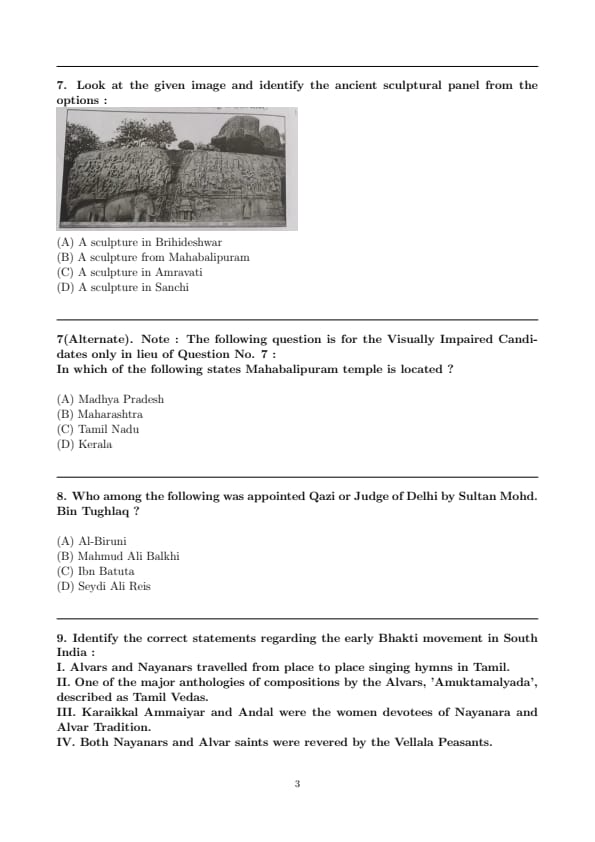
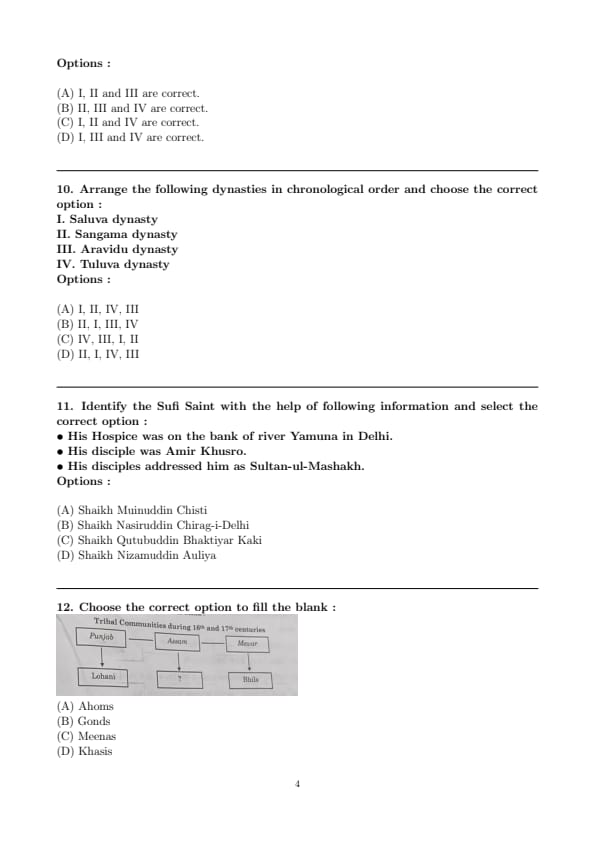
CBSE Class 12 2026 Preparation Tips
*The article might have information for the previous academic years, please refer the official website of the exam.