
CBSE Class 12 Mathematics Question Paper 2025 Set 1 - (65/6/1) with Solution Pdf


| Updated On - Feb 9, 2026
The CBSE Class 12th Board Mathematics exam was conducted on 8th March 2025 from 10:30 AM to 1:30 PM.
The Mathematics theory paper is worth 80 marks, and the internal assessment is worth 20 marks. The important topics include algebra, calculus, probability, linear programming, vectors, and Three-Dimensional Geometry. These topics require a solid conceptual understanding and problem-solving skills.
Mathematics question paper includes MCQs (1 mark each), short-answer type questions (2 & 3 marks each), and long-answer type questions (4 & 6 marks each) making up 80 marks.
The examination tests analytical skills, logical reasoning, and problem-solving ability based on application.
CBSE Class 12 Mathematics Question Paper 2025 with solution PDF is available for download here.
CBSE Class 12 Mathematics Question Paper (Set 1 - 65/6/1) 2025 with Solution Pdf
| CBSE Class 12 Mathematics Question Paper | Download PDF | Check Solutions |

Let both AB' and B'A be defined for matrices A and B. If order of A is n \(\times\) m, then the order of B is :
View Solution
Step 1: Understanding the Question:
We are given two matrices, A and B. The order of matrix A is n \(\times\) m.
We are also told that the matrix products AB' and B'A are both defined. We need to find the order of matrix B.
Step 2: Key Formula or Approach:
The rule for matrix multiplication states that for a product of two matrices, say XY, to be defined, the number of columns in the first matrix (X) must be equal to the number of rows in the second matrix (Y).
Also, if a matrix B has an order of p \(\times\) q, its transpose, B', will have an order of q \(\times\) p.
Step 3: Detailed Explanation:
Let the order of matrix B be p \(\times\) q.
Then, the order of its transpose, B', will be q \(\times\) p.
Condition 1: The product AB' is defined.
The order of A is n \(\times\) m.
The order of B' is q \(\times\) p.
For AB' to be defined, the number of columns of A must equal the number of rows of B'.
\[ Columns in A = Rows in B' \] \[ m = q \]
Condition 2: The product B'A is defined.
The order of B' is q \(\times\) p.
The order of A is n \(\times\) m.
For B'A to be defined, the number of columns of B' must equal the number of rows of A.
\[ Columns in B' = Rows in A \] \[ p = n \]
Step 4: Final Answer:
We found that q = m and p = n.
The order of matrix B was assumed to be p \(\times\) q.
Substituting the values we found, the order of B is n \(\times\) m.
Quick Tip: To quickly solve this, remember the "inner dimensions must match" rule for multiplication. For AB', we have (n \(\times\) \textbf{m}) and (\textbf{q} \(\times\) p), so \textbf{m=q}. For B'A, we have (q \(\times\) \textbf{p}) and (\textbf{n} \(\times\) m), so \textbf{p=n}. Thus, the order of B(p \(\times\) q) is n \(\times\) m.
If A = \(\begin{bmatrix} -1 & 0 & 0
0 & 3 & 0
0 & 0 & 5 \end{bmatrix}\), then A is a/an :
View Solution
Step 1: Understanding the Question:
We are given a 3x3 matrix A and asked to identify its type from the given options.
The matrix is A = \(\begin{bmatrix} -1 & 0 & 0
0 & 3 & 0
0 & 0 & 5 \end{bmatrix}\).
Step 2: Detailed Explanation:
Let's analyze the given options based on the properties of matrix A.
(A) Scalar Matrix: A scalar matrix is a diagonal matrix where all the diagonal elements are equal. In matrix A, the diagonal elements are -1, 3, and 5, which are not equal. Therefore, A is not a scalar matrix.
(B) Identity Matrix: An identity matrix is a diagonal matrix where all the diagonal elements are 1. The diagonal elements of A are not all 1. Therefore, A is not an identity matrix.
(D) Skew-Symmetric Matrix: A matrix is skew-symmetric if its transpose is equal to its negative, i.e., A' = -A. The diagonal elements of a skew-symmetric matrix must be zero, which is not the case for A. Also, A' = A, not -A. Therefore, A is not a skew-symmetric matrix.
(C) Symmetric Matrix: A matrix is symmetric if its transpose is equal to the matrix itself, i.e., A' = A.
Let's find the transpose of A:
\[ A' = \begin{bmatrix} -1 & 0 & 0
0 & 3 & 0
0 & 0 & 5 \end{bmatrix}' = \begin{bmatrix} -1 & 0 & 0
0 & 3 & 0
0 & 0 & 5 \end{bmatrix} \]
Since A' = A, the matrix is symmetric.
Step 3: Final Answer:
The given matrix A satisfies the condition for a symmetric matrix (A' = A). It is also a diagonal matrix, and every diagonal matrix is inherently symmetric.
Quick Tip: A diagonal matrix is a matrix where all off-diagonal elements are zero. All diagonal matrices are symmetric because transposing them does not change the matrix. Also, remember the specific definitions: a scalar matrix has equal diagonal elements (\(kI\)), and an identity matrix has diagonal elements equal to 1 (\(I\)).
The following graph is a combination of :

View Solution
Step 1: Understanding the Question:
The question displays a graph containing two S-shaped curves and asks to identify the functions that represent these curves.
Step 2: Detailed Explanation:
Let's analyze the key features of the two curves shown in the graph.
Curve 1:
This curve passes through the origin (0, 0).
It passes through the point (1, \(\pi\)/2).
It passes through the point (-1, -\(\pi\)/2).
The domain of this curve is [-1, 1] and its range (for the principal branch shown) is [-\(\pi\)/2, \(\pi\)/2].
These are the characteristic points and properties of the inverse sine function, y = sin\(^{-1}\) x.
Curve 2:
This curve passes through the point (0, \(\pi\)/2).
It passes through the point (1, 0).
It passes through the point (-1, \(\pi\)).
The domain of this curve is [-1, 1] and its range is [0, \(\pi\)].
These are the characteristic points and properties of the inverse cosine function, y = cos\(^{-1}\) x.
The graph also shows the line y = x, which is often plotted for reference when dealing with inverse functions.
Step 3: Final Answer:
The graph is a combination of the plots of y = sin\(^{-1}\) x and y = cos\(^{-1}\) x. Therefore, option (A) is the correct choice.
Quick Tip: Memorize the basic shapes and key points of the graphs of standard inverse trigonometric functions. For sin\(^{-1}\) x, remember it passes through (0,0) with a range of [-\(\pi\)/2, \(\pi\)/2]. For cos\(^{-1}\) x, remember it starts at (1,0) and ends at (-1, \(\pi\)) with a range of [0, \(\pi\)].
Sum of two skew-symmetric matrices of same order is always a/an :
View Solution
Step 1: Understanding the Question:
The question asks about the nature of the resultant matrix when two skew-symmetric matrices of the same order are added together.
Step 2: Key Formula or Approach:
A matrix M is called skew-symmetric if its transpose is equal to its negative, i.e., M' = -M.
The property of transpose of a sum of matrices is (A + B)' = A' + B'.
Step 3: Detailed Explanation:
Let A and B be two skew-symmetric matrices of the same order.
By the definition of a skew-symmetric matrix, we have:
\[ A' = -A \] \[ B' = -B \]
Let C be the sum of these two matrices:
\[ C = A + B \]
To determine if C is symmetric, skew-symmetric, or neither, we need to find its transpose, C'.
\[ C' = (A + B)' \]
Using the property of transposes, we get:
\[ C' = A' + B' \]
Now, substitute the skew-symmetric properties of A and B:
\[ C' = (-A) + (-B) \] \[ C' = -(A + B) \]
Since C = A + B, we can write:
\[ C' = -C \]
Step 4: Final Answer:
The condition C' = -C is the definition of a skew-symmetric matrix. Therefore, the sum of two skew-symmetric matrices of the same order is always a skew-symmetric matrix.
Quick Tip: This is a standard property of matrices. Remember these simple rules:
- Sum of symmetric matrices is symmetric.
- Sum of skew-symmetric matrices is skew-symmetric.
- Product of symmetric matrices is not always symmetric.
sec\(^{-1}\)(-\(\sqrt{2}\)) - tan\(^{-1}\)(\(\frac{1}{\sqrt{3}}\)) is equal to :
View Solution
Step 1: Understanding the Question:
We need to evaluate the given expression involving inverse trigonometric functions.
Step 2: Key Formula or Approach:
We will use the principal value ranges and properties of inverse trigonometric functions.
- The principal value range of sec\(^{-1}\)(x) is [0, \(\pi\)] - {\(\pi\)/2.
- The property for negative arguments in sec\(^{-1}\) is: sec\(^{-1}\)(-x) = \(\pi\) - sec\(^{-1}\)(x).
- The principal value range of tan\(^{-1}\)(x) is (-\(\pi\)/2, \(\pi\)/2).
Step 3: Detailed Explanation:
Let's evaluate each term separately.
Term 1: sec\(^{-1}\)(-\(\sqrt{2}\))
Using the property sec\(^{-1}\)(-x) = \(\pi\) - sec\(^{-1}\)(x):
\[ sec^{-1}(-\sqrt{2}) = \pi - sec^{-1}(\sqrt{2}) \]
We know that cos(\(\pi\)/4) = 1/\(\sqrt{2}\), which means sec(\(\pi\)/4) = \(\sqrt{2}\).
Therefore, sec\(^{-1}\)(\(\sqrt{2}\)) = \(\pi\)/4.
\[ sec^{-1}(-\sqrt{2}) = \pi - \frac{\pi}{4} = \frac{3\pi}{4} \]
Term 2: tan\(^{-1}\)(\(\frac{1}{\sqrt{3}}\))
We know that tan(\(\pi\)/6) = 1/\(\sqrt{3}\).
Therefore, tan\(^{-1}\)(\(1/\sqrt{3}\)) = \(\pi\)/6.
Combining the terms:
The expression is sec\(^{-1}\)(-\(\sqrt{2}\)) - tan\(^{-1}\)(\(1/\sqrt{3}\)).
\[ \frac{3\pi}{4} - \frac{\pi}{6} \]
To subtract, we find a common denominator, which is 12.
\[ \frac{3\pi \times 3}{4 \times 3} - \frac{\pi \times 2}{6 \times 2} = \frac{9\pi}{12} - \frac{2\pi}{12} = \frac{9\pi - 2\pi}{12} = \frac{7\pi}{12} \]
Step 4: Final Answer:
The value of the expression is \(\frac{7\pi}{12}\).
Quick Tip: Remember the rules for negative arguments in inverse trig functions, especially for cos\(^{-1}\), sec\(^{-1}\), and cot\(^{-1}\) where \(\pi\) is involved.
- sin\(^{-1}\)(-x) = -sin\(^{-1}\)(x)
- cos\(^{-1}\)(-x) = \(\pi\) - cos\(^{-1}\)(x)
- tan\(^{-1}\)(-x) = -tan\(^{-1}\)(x)
If f(x) = \(\begin{cases} \frac{\log(1+ax) + \log(1-bx)}{x} & , for x \neq 0
k & , for x=0 \end{cases}\) is continuous at x = 0, then the value of k is :
View Solution
Step 1: Understanding the Question:
The function f(x) is defined piecewise and is stated to be continuous at x = 0. We need to find the value of k that ensures this continuity.
Step 2: Key Formula or Approach:
For a function to be continuous at a point x = c, the limit of the function as x approaches c must be equal to the function's value at c.
\[ \lim_{x \to c} f(x) = f(c) \]
In this case, c = 0, so we need \(\lim_{x \to 0} f(x) = f(0)\).
We will use the standard limit: \(\lim_{u \to 0} \frac{\log(1+u)}{u} = 1\).
Step 3: Detailed Explanation:
From the definition of the function, we have f(0) = k.
For continuity at x = 0, we must have:
\[ k = \lim_{x \to 0} \frac{\log(1+ax) + \log(1-bx)}{x} \]
Using the property log(m) + log(n) = log(mn), the numerator is log((1+ax)(1-bx)). However, it's easier to split the limit.
\[ k = \lim_{x \to 0} \left( \frac{\log(1+ax)}{x} + \frac{\log(1-bx)}{x} \right) \] \[ k = \lim_{x \to 0} \frac{\log(1+ax)}{x} + \lim_{x \to 0} \frac{\log(1-bx)}{x} \]
Now, we adjust each term to match the standard limit form \(\lim_{u \to 0} \frac{\log(1+u)}{u} = 1\).
For the first term, let u = ax. As x \(\to\) 0, u \(\to\) 0.
\[ \lim_{x \to 0} \frac{\log(1+ax)}{x} = \lim_{x \to 0} a \cdot \frac{\log(1+ax)}{ax} = a \cdot \left( \lim_{ax \to 0} \frac{\log(1+ax)}{ax} \right) = a \cdot 1 = a \]
For the second term, let v = -bx. As x \(\to\) 0, v \(\to\) 0.
\[ \lim_{x \to 0} \frac{\log(1-bx)}{x} = \lim_{x \to 0} (-b) \cdot \frac{\log(1-bx)}{-bx} = -b \cdot \left( \lim_{-bx \to 0} \frac{\log(1-bx)}{-bx} \right) = -b \cdot 1 = -b \]
Combining the results:
\[ k = a + (-b) = a - b \]
Alternatively, using L'Hopital's Rule since the limit is in the 0/0 form:
\[ k = \lim_{x \to 0} \frac{\frac{d}{dx}(\log(1+ax) + \log(1-bx))}{\frac{d}{dx}(x)} = \lim_{x \to 0} \frac{\frac{a}{1+ax} + \frac{-b}{1-bx}}{1} \]
Substituting x = 0:
\[ k = \frac{a}{1+0} - \frac{b}{1-0} = a - b \]
Step 4: Final Answer:
The value of k for which the function is continuous at x = 0 is a - b.
Quick Tip: When dealing with limits for continuity involving logarithmic or exponential functions, always try to bring them into the standard forms like \(\lim_{x \to 0} \frac{\log(1+x)}{x} = 1\) or \(\lim_{x \to 0} \frac{e^x-1}{x} = 1\). L'Hopital's rule is also a powerful alternative for 0/0 or \(\infty/\infty\) forms.
If tan\(^{-1}\)(x\(^2\) – y\(^2\)) = a, where 'a' is a constant, then \(\frac{dy}{dx}\) is :
View Solution
Step 1: Understanding the Question:
We are given an implicit equation relating x and y, and we need to find the derivative \(\frac{dy}{dx}\).
Step 2: Key Formula or Approach:
We will use implicit differentiation. First, we'll simplify the equation to make differentiation easier. Then, we differentiate both sides of the equation with respect to x, treating y as a function of x. Finally, we solve for \(\frac{dy}{dx}\).
Step 3: Detailed Explanation:
The given equation is:
\[ \tan^{-1}(x^2 - y^2) = a \]
Apply the tangent function to both sides to eliminate the tan\(^{-1}\):
\[ \tan(\tan^{-1}(x^2 - y^2)) = \tan(a) \] \[ x^2 - y^2 = \tan(a) \]
Since 'a' is a constant, tan(a) is also a constant. Let's call it C.
\[ x^2 - y^2 = C \]
Now, differentiate both sides of this simplified equation with respect to x:
\[ \frac{d}{dx}(x^2 - y^2) = \frac{d}{dx}(C) \] \[ \frac{d}{dx}(x^2) - \frac{d}{dx}(y^2) = 0 \]
Using the power rule and the chain rule for the y\(^2\) term:
\[ 2x - 2y \cdot \frac{dy}{dx} = 0 \]
Now, we solve for \(\frac{dy}{dx}\):
\[ 2x = 2y \frac{dy}{dx} \] \[ \frac{dy}{dx} = \frac{2x}{2y} \] \[ \frac{dy}{dx} = \frac{x}{y} \]
Step 4: Final Answer:
The derivative \(\frac{dy}{dx}\) is \(\frac{x}{y}\).
Quick Tip: For implicit differentiation problems involving inverse trigonometric functions, it's often much easier to first eliminate the inverse function by applying its corresponding trigonometric function to both sides of the equation. This simplifies the expression before you differentiate.
If y = a cos(log x) + b sin(log x), then x\(^2\)y\(_2\) + xy\(_1\) is:
View Solution
Step 1: Understanding the Question:
We are given a function y in terms of x and asked to find the value of the expression x\(^2\)y\(_2\) + xy\(_1\), where y\(_1\) is the first derivative and y\(_2\) is the second derivative of y with respect to x.
Step 2: Key Formula or Approach:
We need to find the first and second derivatives of y and then substitute them into the given expression. This type of equation is related to the Cauchy-Euler differential equation.
Step 3: Detailed Explanation:
The given function is:
\[ y = a \cos(\log x) + b \sin(\log x) \]
First, find the first derivative, y\(_1\):
\[ y_1 = \frac{dy}{dx} = a(-\sin(\log x)) \cdot \frac{1}{x} + b(\cos(\log x)) \cdot \frac{1}{x} \] \[ y_1 = \frac{1}{x} [-a \sin(\log x) + b \cos(\log x)] \]
Multiply by x to simplify:
\[ xy_1 = -a \sin(\log x) + b \cos(\log x) \]
Now, differentiate this equation again with respect to x using the product rule on the left side:
\[ \frac{d}{dx}(xy_1) = \frac{d}{dx}[-a \sin(\log x) + b \cos(\log x)] \] \[ x \cdot \frac{dy_1}{dx} + y_1 \cdot 1 = -a (\cos(\log x)) \cdot \frac{1}{x} + b (-\sin(\log x)) \cdot \frac{1}{x} \] \[ xy_2 + y_1 = \frac{1}{x} [-a \cos(\log x) - b \sin(\log x)] \]
Multiply by x to clear the fraction:
\[ x(xy_2 + y_1) = -[a \cos(\log x) + b \sin(\log x)] \] \[ x^2y_2 + xy_1 = -[a \cos(\log x) + b \sin(\log x)] \]
Recognize that the term in the bracket is the original function y.
\[ x^2y_2 + xy_1 = -y \]
Step 4: Final Answer:
The value of the expression x\(^2\)y\(_2\) + xy\(_1\) is -y.
Quick Tip: This problem is a classic example of forming a differential equation from a given solution. When you see terms like cos(log x) and sin(log x), and the expression involves x\(^2\)y\(_2\) and xy\(_1\), it's a strong hint for a Cauchy-Euler equation. The trick is to differentiate once, multiply by x, and then differentiate again.
Let f(x) = |x|, x \(\in\) R. Then, which of the following statements is incorrect?
View Solution
Step 1: Understanding the Question:
We are given the absolute value function f(x) = |x| and asked to identify the incorrect statement about its properties among the given options.
Step 2: Detailed Explanation:
Let's analyze each statement for the function f(x) = |x|.
(A) f has a minimum value at x = 0.
The function f(x) = |x| is always non-negative. Its value is 0 at x=0 and positive for all other x. Thus, the global minimum value of f(x) is 0, which occurs at x = 0. This statement is correct.
(B) f has no maximum value in R.
As x approaches \(\infty\) or -\(\infty\), f(x) = |x| approaches \(\infty\). The function is unbounded above. Therefore, it has no maximum value in the set of real numbers (R). This statement is correct.
(C) f is continuous at x = 0.
For continuity at x = 0, we check if \(\lim_{x \to 0} f(x) = f(0)\).
- f(0) = |0| = 0.
- Left-hand limit: \(\lim_{x \to 0^-} |x| = \lim_{x \to 0^-} (-x) = 0\).
- Right-hand limit: \(\lim_{x \to 0^+} |x| = \lim_{x \to 0^+} (x) = 0\).
Since the left-hand limit, right-hand limit, and function value are all equal, the function is continuous at x = 0. This statement is correct.
(D) f is differentiable at x = 0.
For differentiability at x = 0, the left-hand derivative (LHD) and right-hand derivative (RHD) must exist and be equal.
- LHD at x=0: \( f'(0^-) = \lim_{h \to 0^-} \frac{f(0+h) - f(0)}{h} = \lim_{h \to 0^-} \frac{|h|}{h} = \lim_{h \to 0^-} \frac{-h}{h} = -1 \).
- RHD at x=0: \( f'(0^+) = \lim_{h \to 0^+} \frac{f(0+h) - f(0)}{h} = \lim_{h \to 0^+} \frac{|h|}{h} = \lim_{h \to 0^+} \frac{h}{h} = 1 \).
Since LHD (-1) \(\neq\) RHD (1), the function is not differentiable at x = 0. This statement is incorrect.
Step 3: Final Answer:
The question asks for the incorrect statement. The statement "f is differentiable at x = 0" is incorrect.
Quick Tip: The absolute value function f(x) = |x| is a classic example of a function that is continuous everywhere but not differentiable at a point (x=0). This non-differentiability occurs at the sharp corner or 'cusp' in its graph.
Let f'(x) = 3(x\(^2\) + 2x) – \(\frac{4}{x^3}\) + 5, f(1) = 0. Then, f(x) is :
View Solution
Step 1: Understanding the Question:
We are given the derivative of a function, f'(x), and a condition f(1) = 0. We need to find the original function f(x) by integrating f'(x) and using the given condition to find the constant of integration.
Step 2: Key Formula or Approach:
To find f(x) from f'(x), we integrate f'(x) with respect to x.
\[ f(x) = \int f'(x) dx \]
The key integration formula needed is \(\int x^n dx = \frac{x^{n+1}}{n+1} + C\).
Step 3: Detailed Explanation:
First, let's write out f'(x) in a form that is easy to integrate:
\[ f'(x) = 3(x^2 + 2x) - \frac{4}{x^3} + 5 = 3x^2 + 6x - 4x^{-3} + 5 \]
Now, integrate f'(x) to find f(x):
\[ f(x) = \int (3x^2 + 6x - 4x^{-3} + 5) dx \] \[ f(x) = \int 3x^2 dx + \int 6x dx - \int 4x^{-3} dx + \int 5 dx \]
Apply the power rule for integration:
\[ f(x) = 3 \left(\frac{x^3}{3}\right) + 6 \left(\frac{x^2}{2}\right) - 4 \left(\frac{x^{-3+1}}{-3+1}\right) + 5x + C \] \[ f(x) = x^3 + 3x^2 - 4 \left(\frac{x^{-2}}{-2}\right) + 5x + C \] \[ f(x) = x^3 + 3x^2 + 2x^{-2} + 5x + C \] \[ f(x) = x^3 + 3x^2 + \frac{2}{x^2} + 5x + C \]
Now, we use the given condition f(1) = 0 to find the constant C.
\[ f(1) = (1)^3 + 3(1)^2 + \frac{2}{(1)^2} + 5(1) + C = 0 \] \[ 1 + 3 + 2 + 5 + C = 0 \] \[ 11 + C = 0 \] \[ C = -11 \]
Substitute the value of C back into the expression for f(x):
\[ f(x) = x^3 + 3x^2 + \frac{2}{x^2} + 5x - 11 \]
Step 4: Final Answer:
The function f(x) is x\(^3\) + 3x\(^2\) + \(\frac{2}{x^2}\) + 5x - 11, which matches option (B).
Quick Tip: When integrating terms like \(\frac{1}{x^n}\), always rewrite them as \(x^{-n}\) first to easily apply the power rule of integration. Don't forget to solve for the constant of integration 'C' using the initial condition provided.
\(\int \frac{x+5}{(x+6)^2} e^x dx\) is equal to :
View Solution
Step 1: Understanding the Question:
We need to evaluate the given integral. The structure of the integrand, involving e\(^x\) multiplied by a rational function, suggests a specific integration formula.
Step 2: Key Formula or Approach:
The problem is in the form of a special integral:
\[ \int e^x [f(x) + f'(x)] dx = e^x f(x) + C \]
We need to manipulate the term \(\frac{x+5}{(x+6)^2}\) to see if it can be expressed as a function plus its derivative, f(x) + f'(x).
Step 3: Detailed Explanation:
Let's rewrite the rational function by adjusting the numerator to match the term in the denominator:
\[ \frac{x+5}{(x+6)^2} = \frac{(x+6) - 1}{(x+6)^2} \]
Now, split the fraction into two parts:
\[ \frac{x+6}{(x+6)^2} - \frac{1}{(x+6)^2} = \frac{1}{x+6} - \frac{1}{(x+6)^2} \]
The integral now becomes:
\[ \int e^x \left[ \frac{1}{x+6} - \frac{1}{(x+6)^2} \right] dx \]
Let's check if this fits the form \(\int e^x [f(x) + f'(x)] dx\).
Let \(f(x) = \frac{1}{x+6} = (x+6)^{-1}\).
Now, let's find the derivative of f(x):
\[ f'(x) = \frac{d}{dx} (x+6)^{-1} = -1 \cdot (x+6)^{-2} \cdot 1 = -\frac{1}{(x+6)^2} \]
The integrand is exactly \(e^x[f(x) + f'(x)]\).
\[ \int e^x \left[ \underbrace{\frac{1}{x+6}}_{f(x)} + \underbrace{\left(-\frac{1}{(x+6)^2}\right)}_{f'(x)} \right] dx \]
Using the special integration formula, the result is:
\[ e^x f(x) + C = e^x \cdot \frac{1}{x+6} + C = \frac{e^x}{x+6} + C \]
Step 4: Final Answer:
The value of the integral is \(\frac{e^x}{x+6} + C\).
Quick Tip: Whenever you see an integral with \(e^x\) multiplied by a function, immediately check if the function can be written in the form \(f(x) + f'(x)\). This is a very common pattern in competitive exams. The key is often to manipulate the algebraic part of the integrand.
The order and degree of the following differential equation are, respectively :
\(\frac{d^4y}{dx^4} + 2e^{dy/dx} + y^2 = 0\)
View Solution
Step 1: Understanding the Question:
We need to find the order and degree of the given differential equation.
Step 2: Key Formula or Approach:
Order: The order of a differential equation is the order of the highest derivative appearing in the equation.
Degree: The degree of a differential equation is the highest power (positive integer) of the highest order derivative, after the differential equation has been cleared of radicals and fractions in its derivatives. A key condition is that the equation must be a polynomial in its derivatives.
Step 3: Detailed Explanation:
The given differential equation is:
\[ \frac{d^4y}{dx^4} + 2e^{dy/dx} + y^2 = 0 \]
Finding the Order:
The derivatives present in the equation are \(\frac{d^4y}{dx^4}\) and \(\frac{dy}{dx}\).
The highest order derivative is \(\frac{d^4y}{dx^4}\), which is of order 4.
So, the order of the differential equation is 4.
Finding the Degree:
For the degree to be defined, the differential equation must be expressible as a polynomial in its derivatives (e.g., y', y'', y''', etc.).
The term \(e^{dy/dx}\) is a transcendental function of the derivative \(\frac{dy}{dx}\).
The Taylor series expansion of \(e^u\) is \(1 + u + \frac{u^2}{2!} + \frac{u^3}{3!} + \dots\).
So, \(e^{dy/dx} = 1 + \frac{dy}{dx} + \frac{(dy/dx)^2}{2!} + \frac{(dy/dx)^3}{3!} + \dots\), which is an infinite series.
Because of this term, the equation cannot be written as a polynomial in its derivatives.
Therefore, the degree of the differential equation is not defined.
Step 4: Final Answer:
The order is 4 and the degree is not defined.
Quick Tip: Be careful with the definition of degree. If derivatives appear inside transcendental functions like sin, cos, log, or exponential functions (e.g., sin(y'), e\(^{y'}\)), the degree is not defined. The equation must be a polynomial in y', y'', etc. for the degree to be defined.
The solution for the differential equation log\(\left(\frac{dy}{dx}\right)\) = 3x + 4y is :
View Solution
Step 1: Understanding the Question:
We need to solve the given first-order differential equation.
Step 2: Key Formula or Approach:
The equation can be solved using the method of separation of variables. We will rearrange the equation so that all terms involving y are on one side with dy, and all terms involving x are on the other side with dx. Then we integrate both sides.
Step 3: Detailed Explanation:
The given differential equation is:
\[ \log\left(\frac{dy}{dx}\right) = 3x + 4y \]
To isolate \(\frac{dy}{dx}\), we exponentiate both sides (with base e):
\[ \frac{dy}{dx} = e^{3x + 4y} \]
Using the property of exponents, \(e^{a+b} = e^a \cdot e^b\):
\[ \frac{dy}{dx} = e^{3x} \cdot e^{4y} \]
Now, we separate the variables. Move all y terms to the left side and all x terms to the right side.
\[ \frac{dy}{e^{4y}} = e^{3x} dx \] \[ e^{-4y} dy = e^{3x} dx \]
Integrate both sides of the equation:
\[ \int e^{-4y} dy = \int e^{3x} dx \]
Performing the integration:
\[ \frac{e^{-4y}}{-4} = \frac{e^{3x}}{3} + C_1 \]
Where C\(_1\) is the constant of integration. To make the equation look like the options, let's get rid of the denominators and rearrange the terms. Multiply the entire equation by 12:
\[ 12 \left( \frac{e^{-4y}}{-4} \right) = 12 \left( \frac{e^{3x}}{3} \right) + 12C_1 \] \[ -3e^{-4y} = 4e^{3x} + 12C_1 \]
Move all terms to one side:
\[ 4e^{3x} + 3e^{-4y} + 12C_1 = 0 \]
Let 12C\(_1\) be a new constant, which we can call C or 12C as used in the option. The equation becomes:
\[ 4e^{3x} + 3e^{-4y} + Constant = 0 \]
This matches the form of option (D).
Step 4: Final Answer:
The solution to the differential equation is 3e\(^{-4y}\) + 4e\(^{3x}\) + 12C = 0.
Quick Tip: When solving differential equations, first try to identify the type. If you can write it as \(f(y) dy = g(x) dx\), it's separable. This is often the easiest method. Don't worry about the form of the constant of integration (C, 12C, -C, etc.) as it can be represented in many ways. Match the variable terms first.
For a Linear Programming Problem (LPP), the given objective function is Z = x + 2y. The feasible region PQRS determined by the set of constraints is shown as a shaded region in the graph.

P = (\(\frac{3}{13}, \frac{24}{13}\)), Q = (\(\frac{3}{2}, \frac{15}{4}\)), R = (\(\frac{7}{2}, \frac{3}{4}\)), S = (\(\frac{18}{7}, \frac{2}{7}\))
Which of the following statements is correct?
View Solution
Step 1: Understanding the Question:
We are given an objective function Z = x + 2y and the corner points of its feasible region. We need to find the optimal (minimum or maximum) value of Z by evaluating it at these corner points and then determine which of the given statements is true.
Step 2: Key Formula or Approach:
According to the Fundamental Theorem of Linear Programming, the optimal value (maximum or minimum) of a linear objective function over a bounded feasible region will occur at one of the corner points (vertices) of the region. We must calculate Z at each given vertex.
Step 3: Detailed Explanation:
The objective function is Z = x + 2y. Let's evaluate Z at each corner point:
At point P (\(\frac{3}{13}, \frac{24}{13}\)):
\[ Z(P) = \frac{3}{13} + 2 \left( \frac{24}{13} \right) = \frac{3}{13} + \frac{48}{13} = \frac{51}{13} \approx 3.92 \]
At point Q (\(\frac{3}{2}, \frac{15}{4}\)):
\[ Z(Q) = \frac{3}{2} + 2 \left( \frac{15}{4} \right) = \frac{3}{2} + \frac{15}{2} = \frac{18}{2} = 9 \]
At point R (\(\frac{7}{2}, \frac{3}{4}\)):
\[ Z(R) = \frac{7}{2} + 2 \left( \frac{3}{4} \right) = \frac{7}{2} + \frac{3}{2} = \frac{10}{2} = 5 \]
At point S (\(\frac{18}{7}, \frac{2}{7}\)):
\[ Z(S) = \frac{18}{7} + 2 \left( \frac{2}{7} \right) = \frac{18}{7} + \frac{4}{7} = \frac{22}{7} \approx 3.14 \]
Summary of Z values:
- Z(P) \(\approx\) 3.92
- Z(Q) = 9 (Maximum)
- Z(R) = 5
- Z(S) \(\approx\) 3.14 (Minimum)
Now let's check the given statements:
(A) Z is minimum at S(\(\frac{18}{7}, \frac{2}{7}\)). Our calculation shows the minimum value is indeed at S. This statement is correct.
(B) Z is maximum at R(\(\frac{7}{2}, \frac{3}{4}\)). This is incorrect. The maximum is at Q.
(C) (Value of Z at P) > (Value of Z at Q) \(\implies\) 3.92 > 9. This is incorrect.
(D) (Value of Z at Q) < (Value of Z at R) \(\implies\) 9 < 5. This is incorrect.
Step 4: Final Answer:
The only correct statement is (A).
Quick Tip: In LPP, once you have the corner points of the feasible region, the process is straightforward: substitute the coordinates of each point into the objective function. Be careful with fraction arithmetic. The largest result is the maximum, and the smallest is the minimum.
For a Linear Programming Problem (LPP), the objective function Z = 2x + 5y is to be maximized subject to the following constraints:
x + y \(\leq\) 4, 3x + 3y \(\geq\) 18, x, y \(\geq\) 0
Study the graph and choose the correct option from the following.

(Note: The figure is not to scale)
The solution of the given linear programming problem:
View Solution
Step 1: Understanding the Question:
We need to determine the nature of the solution for the given LPP. This requires analyzing the constraints to determine if a feasible region exists.
Step 2: Key Formula or Approach:
A feasible region is the set of all points (x, y) that satisfy all the given constraints simultaneously. If there are no such points, the feasible region is empty, and the LPP has no solution.
Step 3: Detailed Explanation:
Let's analyze the constraints:
Constraint 1: x + y \(\leq\) 4. This represents all points on or below the line x + y = 4.
Constraint 2: 3x + 3y \(\geq\) 18. We can simplify this by dividing by 3: x + y \(\geq\) 6. This represents all points on or above the line x + y = 6.
Constraint 3: x \(\geq\) 0, y \(\geq\) 0. This restricts the solution to the first quadrant.
Now, let's consider Constraint 1 and Constraint 2 together. We are looking for points (x, y) that satisfy both:
x + y \(\leq\) 4
and
x + y \(\geq\) 6
It is impossible for the sum of two numbers (x+y) to be both less than or equal to 4 and greater than or equal to 6 at the same time. These two conditions are contradictory.
Because there is no pair of (x, y) values that can satisfy both inequalities, there is no overlapping region. The feasible region is an empty set.
The graph provided in the question is misleading as it shows a shaded region between the two lines, which does not correspond to the given inequalities. We must rely on the mathematical constraints.
Step 4: Final Answer:
Since the feasible region is empty, the linear programming problem has no solution. Therefore, the solution does not exist.
Quick Tip: Always analyze the constraints mathematically first. Sometimes, the provided graph in a question can be misleading or incorrect. If the constraints are contradictory, there is no feasible region, and thus no solution.
Let |\(\vec{a}\)| = 5 and \(-2 \leq \lambda \leq 1\). Then the range of |\( \lambda \vec{a} \)| is :
View Solution
Step 1: Understanding the Question:
We are given the magnitude of a vector \(\vec{a}\) and a range for a scalar \(\lambda\). We need to find the range of the magnitude of the vector \(\lambda \vec{a}\).
Step 2: Key Formula or Approach:
We will use the property of scalar multiplication with vector magnitudes:
\[ |\lambda \vec{a}| = |\lambda| |\vec{a}| \]
where \(|\lambda|\) is the absolute value of the scalar \(\lambda\).
Step 3: Detailed Explanation:
We are given:
- \(|\vec{a}| = 5\)
- \(-2 \leq \lambda \leq 1\)
First, we need to find the range of \(|\lambda|\) based on the given range of \(\lambda\).
The interval for \(\lambda\) is [-2, 1]. The absolute value \(|\lambda|\) represents the distance of \(\lambda\) from 0.
The minimum value of \(|\lambda|\) in this interval occurs at \(\lambda = 0\), so min(\(|\lambda|\)) = 0.
The maximum value of \(|\lambda|\) in this interval is the maximum of |1| and |-2|, which is max(1, 2) = 2.
So, the range for \(|\lambda|\) is [0, 2], or \(0 \leq |\lambda| \leq 2\).
Now, we can find the range of \(|\lambda \vec{a}|\) using the formula \(|\lambda \vec{a}| = |\lambda| |\vec{a}|\):
\[ |\lambda \vec{a}| = |\lambda| \times 5 \]
Since \(0 \leq |\lambda| \leq 2\), we multiply the inequality by 5:
\[ 5 \times 0 \leq 5|\lambda| \leq 5 \times 2 \] \[ 0 \leq 5|\lambda| \leq 10 \]
Therefore, the range of \(|\lambda \vec{a}|\) is [0, 10].
Step 4: Final Answer:
The correct range for \(|\lambda \vec{a}|\) is [0, 10]. Since this is not among the options, the question is likely flawed.
If we consider a common mistake or typo where the question might have intended to ask for the range of \(\lambda|\vec{a}|\) (without the absolute value on \(\lambda\)), the calculation would be:
Range of \(\lambda|\vec{a}|\) = Range of \(5\lambda\).
Since \(-2 \leq \lambda \leq 1\), then \(5 \times (-2) \leq 5\lambda \leq 5 \times 1\), which gives \(-10 \leq 5\lambda \leq 5\).
This results in the range [-10, 5], which matches option (D). This is the most probable intended question. However, based on the literal question, none of the options is correct.
Quick Tip: Pay close attention to absolute value signs. The magnitude of a vector, \(|\vec{v}|\), is always non-negative. The absolute value of a scalar, \(|\lambda|\), is also always non-negative. This is a crucial distinction from the scalar \(\lambda\) itself, which can be negative.
The area of the region bounded by the curve y\(^2\) = x, x = 0 and x = 1 is :
View Solution
Step 1: Understanding the Question:
We need to find the area of the region enclosed by the parabola y\(^2\) = x and the vertical lines x = 0 (the y-axis) and x = 1.
Step 2: Key Formula or Approach:
The area under a curve y = f(x) from x = a to x = b is given by the definite integral \(\int_{a}^{b} f(x) dx\).
The curve y\(^2\) = x is symmetric about the x-axis. It consists of two branches: y = \(\sqrt{x}\) (upper half) and y = -\(\sqrt{x}\) (lower half). We can find the area of the region in the first quadrant (bounded by y = \(\sqrt{x}\)) and multiply it by 2 to get the total area.
Step 3: Detailed Explanation:
The required area is the area bounded by y\(^2\) = x, from x = 0 to x = 1.
Due to symmetry, Total Area = 2 \(\times\) (Area in the first quadrant).
In the first quadrant, y = +\(\sqrt{x}\).
\[ Area = 2 \int_{0}^{1} y \, dx \] \[ Area = 2 \int_{0}^{1} \sqrt{x} \, dx = 2 \int_{0}^{1} x^{1/2} \, dx \]
Now, we evaluate the integral using the power rule \(\int x^n dx = \frac{x^{n+1}}{n+1}\):
\[ Area = 2 \left[ \frac{x^{1/2 + 1}}{1/2 + 1} \right]_{0}^{1} = 2 \left[ \frac{x^{3/2}}{3/2} \right]_{0}^{1} \] \[ Area = 2 \left[ \frac{2}{3} x^{3/2} \right]_{0}^{1} = \frac{4}{3} \left[ x^{3/2} \right]_{0}^{1} \]
Now, apply the limits of integration:
\[ Area = \frac{4}{3} (1^{3/2} - 0^{3/2}) \] \[ Area = \frac{4}{3} (1 - 0) = \frac{4}{3} \]
Step 4: Final Answer:
The area of the bounded region is \(\frac{4}{3}\) square units.
Quick Tip: When dealing with curves that are symmetric about an axis (like y\(^2\) = 4ax or x\(^2\) = 4ay), you can simplify the calculation by finding the area in one quadrant and then multiplying by the appropriate factor (2 or 4). This can help avoid issues with signs.
A box contains 4 green, 8 blue and 3 red pens. A student draws a pen at random from this box, and after finding out its colour, puts it back in the box. He repeats this process 3 times. The probability of getting at least one red pen is :
View Solution
Step 1: Understanding the Question:
This is a probability problem involving repeated independent trials with replacement, which is a scenario for Binomial Distribution. We need to find the probability of getting "at least one" red pen in 3 draws.
Step 2: Key Formula or Approach:
The probability of an event happening "at least once" is often easiest to calculate as 1 minus the probability of the event never happening.
P(at least one success) = 1 - P(no successes).
This is a binomial distribution problem with:
- Number of trials, n = 3.
- Let 'success' be drawing a red pen. We need to find the probability of success (p) and failure (q).
Step 3: Detailed Explanation:
First, calculate the total number of pens in the box:
Total pens = 4 (green) + 8 (blue) + 3 (red) = 15 pens.
Next, find the probability of drawing a red pen in a single trial (p):
\[ p = P(red pen) = \frac{Number of red pens}{Total pens} = \frac{3}{15} = \frac{1}{5} \]
Now, find the probability of not drawing a red pen in a single trial (q):
\[ q = P(not red pen) = 1 - p = 1 - \frac{1}{5} = \frac{4}{5} \]
The process is repeated 3 times (n=3). We want the probability of getting at least one red pen.
P(at least one red) = 1 - P(no red pens in 3 draws).
The probability of not getting a red pen on the first draw is q.
The probability of not getting a red pen on the second draw is q.
The probability of not getting a red pen on the third draw is q.
Since the trials are independent (due to replacement), the probability of all three events happening is:
\[ P(no red pens in 3 draws) = q \times q \times q = q^3 \] \[ P(no red pens) = \left(\frac{4}{5}\right)^3 = \frac{4^3}{5^3} = \frac{64}{125} \]
Finally, calculate the probability of getting at least one red pen:
\[ P(at least one red) = 1 - P(no red pens) = 1 - \frac{64}{125} = \frac{125 - 64}{125} = \frac{61}{125} \]
Step 4: Final Answer:
The probability of getting at least one red pen is \(\frac{61}{125}\).
Quick Tip: For probability questions involving phrases like "at least one," "at least two," etc., always consider using the complement rule (1 - P(event not happening)). It usually involves fewer calculations than adding up the probabilities of all the desired outcomes (e.g., P(1 red) + P(2 reds) + P(3 reds)).
Assertion (A): If \(|\vec{a} \times \vec{b}|^2 + |\vec{a} \cdot \vec{b}|^2 = 256\) and \(|\vec{b}| = 8\), then \(|\vec{a}| = 2\).
Reason (R): \(\sin^2\theta + \cos^2\theta = 1\) and \(|\vec{a} \times \vec{b}| = |\vec{a}||\vec{b}|\sin\theta\) and \(\vec{a} \cdot \vec{b} = |\vec{a}||\vec{b}|\cos\theta\).
View Solution
Step 1: Understanding the Question:
We are given an equation relating the cross product and dot product of two vectors, \(\vec{a}\) and \(\vec{b}\), along with the magnitude of \(\vec{b}\). We need to verify the Assertion which states the magnitude of \(\vec{a}\). The Reason provides the fundamental definitions and trigonometric identity that relate to these vector operations.
Step 2: Key Formula or Approach:
The relationship given in the Assertion is a form of Lagrange's identity: \(|\vec{a} \times \vec{b}|^2 + |\vec{a} \cdot \vec{b}|^2 = |\vec{a}|^2|\vec{b}|^2\). We will use this identity, which is derived from the definitions given in the Reason.
Step 3: Detailed Explanation:
First, let's verify the Reason (R). The definitions for the magnitude of the cross product and the dot product in terms of the angle \(\theta\) between the vectors are:
\[ |\vec{a} \times \vec{b}| = |\vec{a}||\vec{b}|\sin\theta \] \[ \vec{a} \cdot \vec{b} = |\vec{a}||\vec{b}|\cos\theta \]
The trigonometric identity \(\sin^2\theta + \cos^2\theta = 1\) is also correct. Thus, the Reason (R) is true.
Now, let's use the statements in the Reason to evaluate the expression in the Assertion (A).
\[ |\vec{a} \times \vec{b}|^2 + |\vec{a} \cdot \vec{b}|^2 = (|\vec{a}||\vec{b}|\sin\theta)^2 + (|\vec{a}||\vec{b}|\cos\theta)^2 \] \[ = |\vec{a}|^2|\vec{b}|^2\sin^2\theta + |\vec{a}|^2|\vec{b}|^2\cos^2\theta \] \[ = |\vec{a}|^2|\vec{b}|^2(\sin^2\theta + \cos^2\theta) \]
Using the identity from the Reason, \(\sin^2\theta + \cos^2\theta = 1\):
\[ = |\vec{a}|^2|\vec{b}|^2(1) = |\vec{a}|^2|\vec{b}|^2 \]
This confirms Lagrange's identity.
Now, we apply this to the data given in Assertion (A):
\[ |\vec{a}|^2|\vec{b}|^2 = 256 \]
We are given \(|\vec{b}| = 8\), so \(|\vec{b}|^2 = 64\).
\[ |\vec{a}|^2 \times 64 = 256 \] \[ |\vec{a}|^2 = \frac{256}{64} = 4 \]
Since magnitude must be non-negative:
\[ |\vec{a}| = \sqrt{4} = 2 \]
The Assertion (A) states that \(|\vec{a}| = 2\), which is true.
Step 4: Final Answer:
Both Assertion (A) and Reason (R) are true, and the Reason (R) provides the necessary formulas to derive the identity used to prove the Assertion. Therefore, Reason (R) is the correct explanation for Assertion (A).
Quick Tip: Lagrange's identity, \(|\vec{a} \times \vec{b}|^2 + (\vec{a} \cdot \vec{b})^2 = |\vec{a}|^2|\vec{b}|^2\), is a very useful formula that directly connects the magnitudes of the cross product, dot product, and the vectors themselves. Memorizing it can save time in solving such problems.
Assertion (A): Let f(x) = e\(^x\) and g(x) = log x. Then (f + g)x = e\(^x\) + log x where domain of (f + g) is R.
Reason (R): Dom(f + g) = Dom(f) \(\cap\) Dom(g).
View Solution
Step 1: Understanding the Question:
We are given two functions, f(x) and g(x), and an assertion about the domain of their sum, (f+g)(x). The reason provides the general rule for finding the domain of the sum of two functions. We need to check the validity of both statements.
Step 2: Detailed Explanation:
Let's first analyze the Reason (R).
The rule for finding the domain of a sum, difference, product, or quotient of two functions f and g states that the domain is the intersection of their individual domains.
Dom(f + g) = Dom(f) \(\cap\) Dom(g).
This is the correct definition. So, Reason (R) is true.
Now, let's analyze the Assertion (A) using the rule from Reason (R).
We have f(x) = e\(^x\) and g(x) = log x.
First, find the domain of f(x). The exponential function e\(^x\) is defined for all real numbers.
Dom(f) = R (the set of all real numbers).
Next, find the domain of g(x). The logarithmic function log x (with base e) is defined only for positive real numbers.
Dom(g) = \{x | x > 0\ = (0, \(\infty\)).
Now, find the domain of (f + g) using the intersection rule from Reason (R):
Dom(f + g) = Dom(f) \(\cap\) Dom(g) = R \(\cap\) (0, \(\infty\)) = (0, \(\infty\)).
The Assertion (A) states that the domain of (f + g) is R. This contradicts our finding that the domain is (0, \(\infty\)).
Therefore, Assertion (A) is false.
Step 3: Final Answer:
Assertion (A) is false and Reason (R) is true. This corresponds to option (D).
Quick Tip: When combining functions (adding, subtracting, multiplying, dividing), the new function can only be defined where *all* the original functions are defined. This is why we take the intersection of the domains. Pay special attention to functions with restricted domains like logarithms, square roots, and rational functions.
Find the domain of f(x) = sin\(^{-1}\)(– x\(^2\)).
View Solution
Step 1: Understanding the Question:
We need to find the set of all possible input values (x-values) for which the function f(x) = sin\(^{-1}\)(– x\(^2\)) is defined.
Step 2: Key Formula or Approach:
The domain of the inverse sine function, sin\(^{-1}\)(u), is the interval [-1, 1]. This means that the argument 'u' must satisfy the inequality:
\[ -1 \leq u \leq 1 \]
For the given function, the argument is \(u = -x^2\).
Step 3: Detailed Explanation:
We must apply the domain constraint to the argument of our function:
\[ -1 \leq -x^2 \leq 1 \]
This compound inequality can be split into two separate inequalities:
1) \(-1 \leq -x^2\)
2) \(-x^2 \leq 1\)
Let's solve the first inequality:
\[ -1 \leq -x^2 \]
Multiply by -1 and reverse the inequality sign:
\[ 1 \geq x^2 \quad or \quad x^2 \leq 1 \]
Taking the square root of both sides gives:
\[ |x| \leq 1 \]
This is equivalent to:
\[ -1 \leq x \leq 1 \]
Now, let's solve the second inequality:
\[ -x^2 \leq 1 \]
Multiply by -1 and reverse the inequality sign:
\[ x^2 \geq -1 \]
The square of any real number x is always non-negative (\(x^2 \geq 0\)). Therefore, \(x^2\) will always be greater than -1. This inequality is true for all real numbers, \(x \in R\).
The domain of the function is the intersection of the solutions to both inequalities.
Domain = (\(x \in [-1, 1]\)) \(\cap\) (\(x \in R\))
Domain = \([-1, 1]\)
Final Answer:
The domain of the function f(x) = sin\(^{-1}\)(– x\(^2\)) is \([-1, 1]\).
Quick Tip: To find the domain of a composite function like this, start from the "outside" function. Identify the domain requirement for the outer function (here, sin\(^{-1}\)) and apply it as an inequality to the "inside" function (here, -x\(^2\)). Then solve the resulting inequality for x.
Differentiate \(\sqrt{e^{\sqrt{2x}}}\) with respect to \(e^{\sqrt{2x}}\) for x \(>\) 0.
View Solution
Step 1: Understanding the Question:
We are asked to find the derivative of one function with respect to another function. This is a parametric differentiation problem where the independent variable is not explicitly given.
Step 2: Key Formula or Approach:
Let \(u = \sqrt{e^{\sqrt{2x}}}\) and \(v = e^{\sqrt{2x}}\). We need to find \(\frac{du}{dv}\).
We can use two methods:
Method 1: Substitution. Express u directly in terms of v.
Method 2: Chain Rule. Find \(\frac{du}{dx}\) and \(\frac{dv}{dx}\), then compute \(\frac{du}{dv} = \frac{du/dx}{dv/dx}\).
Step 3: Detailed Explanation:
Method 1: Substitution
Let \(u = \sqrt{e^{\sqrt{2x}}}\) and \(v = e^{\sqrt{2x}}\).
By observing the expressions, we can see a direct relationship between u and v:
\[ u = \sqrt{v} = v^{1/2} \]
Now, we can differentiate u directly with respect to v using the power rule:
\[ \frac{du}{dv} = \frac{d}{dv}(v^{1/2}) = \frac{1}{2}v^{1/2 - 1} = \frac{1}{2}v^{-1/2} = \frac{1}{2\sqrt{v}} \]
Substitute the original expression for v back into the result:
\[ \frac{du}{dv} = \frac{1}{2\sqrt{e^{\sqrt{2x}}}} \]
Method 2: Chain Rule
First, find \(\frac{du}{dx}\) where \(u = (e^{\sqrt{2x}})^{1/2} = e^{\frac{1}{2}\sqrt{2x}}\).
\[ \frac{du}{dx} = e^{\frac{1}{2}\sqrt{2x}} \cdot \frac{d}{dx}\left(\frac{1}{2}\sqrt{2x}\right) = e^{\frac{1}{2}\sqrt{2x}} \cdot \frac{1}{2} \cdot \frac{1}{2\sqrt{2x}} \cdot 2 = \frac{e^{\frac{1}{2}\sqrt{2x}}}{2\sqrt{2x}} \]
Next, find \(\frac{dv}{dx}\) where \(v = e^{\sqrt{2x}}\).
\[ \frac{dv}{dx} = e^{\sqrt{2x}} \cdot \frac{d}{dx}(\sqrt{2x}) = e^{\sqrt{2x}} \cdot \frac{1}{2\sqrt{2x}} \cdot 2 = \frac{e^{\sqrt{2x}}}{\sqrt{2x}} \]
Now, compute \(\frac{du}{dv}\):
\[ \frac{du}{dv} = \frac{du/dx}{dv/dx} = \frac{\frac{e^{\frac{1}{2}\sqrt{2x}}}{2\sqrt{2x}}}{\frac{e^{\sqrt{2x}}}{\sqrt{2x}}} = \frac{e^{\frac{1}{2}\sqrt{2x}}}{2e^{\sqrt{2x}}} = \frac{1}{2} e^{\frac{1}{2}\sqrt{2x} - \sqrt{2x}} = \frac{1}{2} e^{-\frac{1}{2}\sqrt{2x}} = \frac{1}{2e^{\frac{1}{2}\sqrt{2x}}} = \frac{1}{2\sqrt{e^{\sqrt{2x}}}} \]
Both methods yield the same result.
Final Answer:
The derivative of \(\sqrt{e^{\sqrt{2x}}}\) with respect to \(e^{\sqrt{2x}}\) is \(\frac{1}{2\sqrt{e^{\sqrt{2x}}}}\).
Quick Tip: When asked to differentiate f(x) with respect to g(x), always check if you can express f directly as a function of g. If so, as in this case where \(u = \sqrt{v}\), the differentiation becomes much simpler than using the full chain rule with respect to x.
If \(x^y = y^x\), then find \(\frac{dy}{dx}\).
View Solution
Step 1: Understanding the Question:
We are given an implicit equation involving variables in both the base and the exponent. We need to find the derivative \(\frac{dy}{dx}\) using implicit differentiation.
Step 2: Key Formula or Approach:
When variables appear in exponents, the standard technique is to use logarithmic differentiation. We will take the natural logarithm of both sides of the equation to bring the exponents down, and then differentiate implicitly with respect to x.
Step 3: Detailed Explanation:
The given equation is:
\[ x^y = y^x \]
Take the natural logarithm (ln) of both sides:
\[ \ln(x^y) = \ln(y^x) \]
Using the logarithm property \(\ln(a^b) = b\ln(a)\):
\[ y \ln x = x \ln y \]
Now, differentiate both sides of the equation with respect to x. We need to use the product rule on both sides.
\[ \frac{d}{dx}(y \ln x) = \frac{d}{dx}(x \ln y) \] \[ \left(\frac{dy}{dx} \cdot \ln x + y \cdot \frac{1}{x}\right) = \left(1 \cdot \ln y + x \cdot \frac{1}{y} \cdot \frac{dy}{dx}\right) \]
Now, we need to rearrange the equation to solve for \(\frac{dy}{dx}\). Group all terms containing \(\frac{dy}{dx}\) on one side and the other terms on the other side.
\[ \frac{dy}{dx} \ln x - \frac{x}{y} \frac{dy}{dx} = \ln y - \frac{y}{x} \]
Factor out \(\frac{dy}{dx}\) from the left side:
\[ \frac{dy}{dx} \left(\ln x - \frac{x}{y}\right) = \ln y - \frac{y}{x} \]
Simplify the expressions in the parentheses by finding common denominators:
\[ \frac{dy}{dx} \left(\frac{y \ln x - x}{y}\right) = \frac{x \ln y - y}{x} \]
Isolate \(\frac{dy}{dx}\):
\[ \frac{dy}{dx} = \frac{\frac{x \ln y - y}{x}}{\frac{y \ln x - x}{y}} \] \[ \frac{dy}{dx} = \frac{y(x \ln y - y)}{x(y \ln x - x)} \]
From the original equation, we can substitute \(x \ln y = y \ln x\). This can simplify the expression further, but the form above is generally accepted. For instance, substituting \(x \ln y = y \ln x\) in the numerator gives: \[ \frac{dy}{dx} = \frac{y(y \ln x - y)}{x(y \ln x - x)} = \frac{y^2(\ln x - 1)}{x(y \ln x - x)} \]
Final Answer:
The derivative is \(\frac{dy}{dx} = \frac{y(x \ln y - y)}{x(y \ln x - x)}\).
Quick Tip: Logarithmic differentiation is the go-to method for functions of the form \(f(x)^{g(x)}\) or implicit equations like \(f(x,y) = g(x,y)\) where variables are in the exponents. Always remember to use the product rule and chain rule carefully after taking the logarithm.
Determine the values of x for which f(x) = \(\frac{x-4}{x+1}\), x \(\neq\) -1 is an increasing or a decreasing function.
View Solution
Step 1: Understanding the Question:
To determine where the function is increasing or decreasing, we need to find its first derivative, f'(x), and then analyze its sign. The function is increasing where f'(x) > 0 and decreasing where f'(x) \(<\) 0.
Step 2: Key Formula or Approach:
We will use the quotient rule for differentiation:
If \(f(x) = \frac{u(x)}{v(x)}\), then \(f'(x) = \frac{u'(x)v(x) - u(x)v'(x)}{[v(x)]^2}\).
Here, u(x) = x - 4 and v(x) = x + 1.
Step 3: Detailed Explanation:
First, find the derivative f'(x).
u'(x) = 1
v'(x) = 1
\[ f'(x) = \frac{(1)(x+1) - (x-4)(1)}{(x+1)^2} \] \[ f'(x) = \frac{x+1 - x+4}{(x+1)^2} \] \[ f'(x) = \frac{5}{(x+1)^2} \]
Now, we analyze the sign of f'(x).
The numerator is 5, which is a positive constant.
The denominator is \((x+1)^2\). The square of any real number (except where the denominator is zero) is always positive.
So, \((x+1)^2 > 0\) for all x \(\neq\) -1.
Therefore, f'(x) = \(\frac{positive}{positive}\) which is always positive for all x in its domain.
Conclusion for Increasing/Decreasing:
Since f'(x) > 0 for all x \(\in\) R - \{-1\, the function f(x) is strictly increasing throughout its domain. It is never a decreasing function.
Final Answer:
The function f(x) is increasing for all x \(\in\) (-\(\infty\), -1) \(\cup\) (-1, \(\infty\)). The function is never decreasing.
Quick Tip: When analyzing the sign of a derivative that is a rational function, check the signs of the numerator and denominator separately. Pay special attention to terms that are squared, as they are always non-negative. This simplifies the analysis greatly.
If \(\vec{a}\) and \(\vec{b}\) are position vectors of point A and point B respectively, find the position vector of point C on BA produced such that BC = 3BA.
View Solution
Step 1: Understanding the Question:
We are given the position vectors for points A (\(\vec{a}\)) and B (\(\vec{b}\)). Point C lies on the line passing through B and A, but extended beyond A. The condition is given by the vector equation BC = 3BA. We need to find the position vector of C, let's call it \(\vec{c}\).
Step 2: Key Formula or Approach:
We can express the vectors \(\vec{BC}\) and \(\vec{BA}\) in terms of the position vectors of their endpoints:
\(\vec{BC} = \vec{c} - \vec{b}\)
\(\vec{BA} = \vec{a} - \vec{b}\)
We will substitute these into the given equation and solve for \(\vec{c}\).
Step 3: Detailed Explanation:
The given vector relation is:
\[ \vec{BC} = 3\vec{BA} \]
Substitute the expressions from Step 2:
\[ \vec{c} - \vec{b} = 3(\vec{a} - \vec{b}) \]
Now, distribute the scalar 3 on the right side:
\[ \vec{c} - \vec{b} = 3\vec{a} - 3\vec{b} \]
To solve for \(\vec{c}\), add \(\vec{b}\) to both sides of the equation:
\[ \vec{c} = 3\vec{a} - 3\vec{b} + \vec{b} \] \[ \vec{c} = 3\vec{a} - 2\vec{b} \]
Final Answer:
The position vector of point C is \(3\vec{a} - 2\vec{b}\).
Quick Tip: Remember the formula for a vector between two points: the vector from point P to point Q is given by (position vector of Q) - (position vector of P). Drawing a simple diagram can also help visualize the relative positions of A, B, and C to confirm your answer.
OR
Question 24 (b):
Vector \(\vec{r}\) is inclined at equal angles to the three axes x, y and z. If magnitude of \(\vec{r}\) is \(5\sqrt{3}\) units, then find \(\vec{r}\).
View Solution
Step 1: Understanding the Question:
A vector is inclined at equal angles to the coordinate axes. This gives us information about its direction cosines. We are also given its magnitude. We need to find the vector itself.
Step 2: Key Formula or Approach:
Let the angles the vector makes with the x, y, and z axes be \(\alpha, \beta, \gamma\) respectively. The direction cosines are l = cos(\(\alpha\)), m = cos(\(\beta\)), n = cos(\(\gamma\)).
The problem states \(\alpha = \beta = \gamma\), which implies l = m = n.
The fundamental identity for direction cosines is \(l^2 + m^2 + n^2 = 1\).
A vector \(\vec{r}\) can be expressed as \(\vec{r} = |\vec{r}| (unit vector in direction of r)\) or \(\vec{r} = |\vec{r}| (l\hat{i} + m\hat{j} + n\hat{k})\).
Step 3: Detailed Explanation:
Since the vector is inclined at equal angles to the axes, we have l = m = n.
Using the identity \(l^2 + m^2 + n^2 = 1\):
\[ l^2 + l^2 + l^2 = 1 \] \[ 3l^2 = 1 \] \[ l^2 = \frac{1}{3} \] \[ l = \pm \frac{1}{\sqrt{3}} \]
So, the direction cosines are \(l=m=n = \frac{1}{\sqrt{3}}\) or \(l=m=n = -\frac{1}{\sqrt{3}}\). This gives two possible directions.
We are given the magnitude \(|\vec{r}| = 5\sqrt{3}\).
Now we can write the vector \(\vec{r}\):
\[ \vec{r} = |\vec{r}| (l\hat{i} + m\hat{j} + n\hat{k}) \] \[ \vec{r} = 5\sqrt{3} \left( \pm \frac{1}{\sqrt{3}}\hat{i} \pm \frac{1}{\sqrt{3}}\hat{j} \pm \frac{1}{\sqrt{3}}\hat{k} \right) \]
The sign must be the same for all components.
\[ \vec{r} = \pm \frac{5\sqrt{3}}{\sqrt{3}} (\hat{i} + \hat{j} + \hat{k}) \] \[ \vec{r} = \pm 5 (\hat{i} + \hat{j} + \hat{k}) \]
Final Answer:
The vector \(\vec{r}\) is \(5\hat{i} + 5\hat{j} + 5\hat{k}\) or \(-5\hat{i} - 5\hat{j} - 5\hat{k}\).
Quick Tip: A vector equally inclined to the coordinate axes is always parallel to the vector \(\hat{i} + \hat{j} + \hat{k}\) or \(-\hat{i} - \hat{j} - \hat{k}\). Its unit vector is \(\pm \frac{1}{\sqrt{3}}(\hat{i} + \hat{j} + \hat{k})\). You can use this as a shortcut.
Determine if the lines \(\vec{r} = (\hat{i} + \hat{j} - \hat{k}) + \lambda(3\hat{i} - \hat{j})\) and \(\vec{r} = (4\hat{i} - \hat{k}) + \mu(2\hat{i} + 3\hat{k})\) intersect with each other.
View Solution
Step 1: Understanding the Question:
We are given the vector equations of two lines. We need to determine if they have a common point, i.e., if they intersect.
Step 2: Key Formula or Approach:
If the lines intersect, there must be values of the parameters \(\lambda\) and \(\mu\) for which the position vectors of the points on both lines are equal. We will equate the general position vectors of the two lines and try to solve for \(\lambda\) and \(\mu\).
Line 1: \(\vec{r_1} = \vec{a_1} + \lambda \vec{b_1}\)
Line 2: \(\vec{r_2} = \vec{a_2} + \mu \vec{b_2}\)
Set \(\vec{r_1} = \vec{r_2}\) and equate the corresponding components (\(\hat{i}, \hat{j}, \hat{k}\)). This gives a system of three linear equations in two variables. If a consistent solution exists, the lines intersect.
Step 3: Detailed Explanation:
Let's write the general point for each line.
For the first line:
\(\vec{r} = (\hat{i} + \hat{j} - \hat{k}) + \lambda(3\hat{i} - \hat{j}) = (1+3\lambda)\hat{i} + (1-\lambda)\hat{j} - 1\hat{k}\)
For the second line:
\(\vec{r} = (4\hat{i} - \hat{k}) + \mu(2\hat{i} + 3\hat{k}) = (4+2\mu)\hat{i} + 0\hat{j} + (-1+3\mu)\hat{k}\)
If they intersect, we can equate the components:
(i) \(1 + 3\lambda = 4 + 2\mu \implies 3\lambda - 2\mu = 3\)
(ii) \(1 - \lambda = 0 \implies \lambda = 1\)
(iii) \(-1 = -1 + 3\mu \implies 3\mu = 0 \implies \mu = 0\)
We have found values for \(\lambda\) and \(\mu\) from equations (ii) and (iii). Now we must check if these values satisfy the first equation (i).
Substitute \(\lambda = 1\) and \(\mu = 0\) into equation (i):
\[ 3(1) - 2(0) = 3 \] \[ 3 - 0 = 3 \] \[ 3 = 3 \]
The condition is satisfied. Since a consistent set of values for \(\lambda\) and \(\mu\) exists, the lines intersect.
Final Answer:
Yes, the lines intersect with each other.
Quick Tip: To check for intersection of two lines, you get a system of three equations with two unknowns (\(\lambda\) and \(\mu\)). Solve any two equations to find the values of the parameters. Then, substitute these values into the third equation. If it holds true, they intersect. If not, they are skew lines (assuming they are not parallel).
Let A = 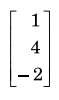 and C =
  be two matrices. Then, find the matrix B if AB = C.
View Solution
Step 1: Understanding the Question:
We are given matrices A and C and the matrix equation AB = C. We need to find the unknown matrix B.
Step 2: Key Formula or Approach:
First, determine the order (dimensions) of matrix B.
Order of A is 3 \(\times\) 1.
Order of C is 3 \(\times\) 3.
For the product AB to be defined and have the order of C, the order of B must be 1 \(\times\) 3.
Let B = \(\begin{bmatrix} x & y & z \end{bmatrix}\). We will then perform the matrix multiplication AB and equate the result to C to find the values of x, y, and z.
Step 3: Detailed Explanation:
Let the matrix B be \(B = \begin{bmatrix} x & y & z \end{bmatrix}\).
Now, compute the product AB:
\[ AB = \begin{bmatrix} 1
4
-2 \end{bmatrix} \begin{bmatrix} x & y & z \end{bmatrix} \] \[ AB = \begin{bmatrix} 1 \cdot x & 1 \cdot y & 1 \cdot z
4 \cdot x & 4 \cdot y & 4 \cdot z
-2 \cdot x & -2 \cdot y & -2 \cdot z \end{bmatrix} = \begin{bmatrix} x & y & z
4x & 4y & 4z
-2x & -2y & -2z \end{bmatrix} \]
We are given that AB = C. So, we can equate the two matrices:
\[ \begin{bmatrix} x & y & z
4x & 4y & 4z
-2x & -2y & -2z \end{bmatrix} = \begin{bmatrix} 3 & 4 & 2
12 & 16 & 8
-6 & -8 & -4 \end{bmatrix} \]
By comparing the corresponding elements, we get a system of equations. We only need to compare the first row to find x, y, and z.
From the first row:
\(x = 3\)
\(y = 4\)
\(z = 2\)
We can verify these values using the other rows. For example, in the second row, \(4x = 4(3) = 12\), which matches. In the third row, \(-2x = -2(3) = -6\), which also matches. The same applies to the other elements.
So, the matrix B is \(\begin{bmatrix} 3 & 4 & 2 \end{bmatrix}\).
Final Answer:
The matrix B is \(\begin{bmatrix} 3 & 4 & 2 \end{bmatrix}\).
Quick Tip: When solving matrix equations like AB=C, determining the order of the unknown matrix B is the crucial first step. The number of columns in A must equal the number of rows in B, and the resulting matrix AB will have the number of rows of A and the number of columns of B.
Differentiate y = sin\(^{-1}\)(3x - 4x\(^3\)) w.r.t. x, if x \(\in\) \((\)-\(\frac{1}{2}\), \(\frac{1}{2}\)\()\).
View Solution
Step 1: Understanding the Question:
We need to find the derivative of an inverse trigonometric function. The expression inside the sin\(^{-1}\) suggests using a trigonometric substitution to simplify the function before differentiating.
Step 2: Key Formula or Approach:
We use the trigonometric identity: \(\sin(3\theta) = 3\sin\theta - 4\sin^3\theta\).
This suggests the substitution \(x = \sin\theta\). Then \(\theta = \sin^{-1}x\).
We also need to check the given domain for x to determine the range for \(\theta\).
Step 3: Detailed Explanation:
Let \(x = \sin\theta\). The given domain for x is \(-\frac{1}{2} < x < \frac{1}{2}\).
So, \(-\frac{1}{2} < \sin\theta < \frac{1}{2}\).
This implies \(-\frac{\pi}{6} < \theta < \frac{\pi}{6}\).
Multiplying by 3 gives \(-\frac{3\pi}{6} < 3\theta < \frac{3\pi}{6}\), which means \(-\frac{\pi}{2} < 3\theta < \frac{\pi}{2}\).
This range for \(3\theta\) is within the principal value branch of \(\sin^{-1}\), which is crucial.
Now substitute \(x = \sin\theta\) into the function:
\[ y = \sin^{-1}(3\sin\theta - 4\sin^3\theta) \] \[ y = \sin^{-1}(\sin(3\theta)) \]
Since \(3\theta\) is in the range \((-\frac{\pi}{2}, \frac{\pi}{2})\), we can simplify \(\sin^{-1}(\sin(3\theta))\) to \(3\theta\).
\[ y = 3\theta \]
Now substitute back \(\theta = \sin^{-1}x\):
\[ y = 3\sin^{-1}x \]
This is a much simpler function to differentiate.
\[ \frac{dy}{dx} = \frac{d}{dx}(3\sin^{-1}x) \] \[ \frac{dy}{dx} = 3 \cdot \frac{1}{\sqrt{1-x^2}} = \frac{3}{\sqrt{1-x^2}} \]
Final Answer:
The derivative is \(\frac{dy}{dx} = \frac{3}{\sqrt{1-x^2}}\).
Quick Tip: When you see expressions like \(3x-4x^3\), \(2x/(1+x^2)\), or \((1-x^2)/(1+x^2)\) inside inverse trigonometric functions, always look for a trigonometric substitution (x=sin\(\theta\), x=tan\(\theta\), etc.) that matches a standard multiple-angle formula. Checking the domain is important to ensure the simplification is valid within the principal value branch.
OR
Question 27 (b):
Differentiate y = cos\(^{-1}\)\(\left(\frac{1-x^2}{1+x^2}\right)\) with respect to x, when x \(\in\) (0, 1).
View Solution
Step 1: Understanding the Question:
We need to find the derivative of an inverse trigonometric function. The expression inside the cos\(^{-1}\) suggests a trigonometric substitution.
Step 2: Key Formula or Approach:
We use the trigonometric identity for the double angle of cosine in terms of tangent: \(\cos(2\theta) = \frac{1-\tan^2\theta}{1+\tan^2\theta}\).
This suggests the substitution \(x = \tan\theta\). Then \(\theta = \tan^{-1}x\).
We check the given domain for x to find the range for \(\theta\).
Step 3: Detailed Explanation:
Let \(x = \tan\theta\). The given domain for x is \(0 < x < 1\).
So, \(0 < \tan\theta < 1\).
This implies \(0 < \theta < \frac{\pi}{4}\).
Multiplying by 2 gives \(0 < 2\theta < \frac{\pi}{2}\).
This range for \(2\theta\) is within the principal value branch of \(\cos^{-1}\), which is [0, \(\pi\)].
Now substitute \(x = \tan\theta\) into the function:
\[ y = \cos^{-1}\left(\frac{1-\tan^2\theta}{1+\tan^2\theta}\right) \] \[ y = \cos^{-1}(\cos(2\theta)) \]
Since \(2\theta\) is in the range \((0, \frac{\pi}{2})\), we can simplify \(\cos^{-1}(\cos(2\theta))\) to \(2\theta\).
\[ y = 2\theta \]
Substitute back \(\theta = \tan^{-1}x\):
\[ y = 2\tan^{-1}x \]
Now, differentiate this simplified function:
\[ \frac{dy}{dx} = \frac{d}{dx}(2\tan^{-1}x) \] \[ \frac{dy}{dx} = 2 \cdot \frac{1}{1+x^2} = \frac{2}{1+x^2} \]
Final Answer:
The derivative is \(\frac{dy}{dx} = \frac{2}{1+x^2}\).
Quick Tip: Recognizing trigonometric identities is key to simplifying differentiation of inverse trig functions. The form \(\frac{1-x^2}{1+x^2}\) is strongly associated with the substitution \(x = \tan\theta\). Remember the standard derivatives: \(\frac{d}{dx}\sin^{-1}x = \frac{1}{\sqrt{1-x^2}}\), \(\frac{d}{dx}\cos^{-1}x = \frac{-1}{\sqrt{1-x^2}}\), and \(\frac{d}{dx}\tan^{-1}x = \frac{1}{1+x^2}\).
A student wants to pair up natural numbers in such a way that they satisfy the equation 2x + y = 41, x, y \(\in\) N. Find the domain and range of the relation. Check if the relation thus formed is reflexive, symmetric and transitive. Hence, state whether it is an equivalence relation or not.
View Solution
Step 1: Understanding the Relation
The relation R consists of pairs of natural numbers (x, y) such that 2x + y = 41. We can write y = 41 - 2x. Since x and y must be natural numbers (N = \{1, 2, 3, ...\), we have the conditions x \(\geq\) 1 and y \(\geq\) 1.
Step 2: Domain and Range
From y = 41 - 2x, the condition y \(\geq\) 1 implies:
\[ 41 - 2x \geq 1 \] \[ 40 \geq 2x \] \[ 20 \geq x \]
Since x must also be a natural number (x \(\geq\) 1), the possible values for x are \{1, 2, 3, ..., 20\.
Domain = \{1, 2, 3, ..., 20\.
To find the range, we look at the values of y for x in the domain.
When x = 1, y = 41 - 2(1) = 39.
When x = 20, y = 41 - 2(20) = 1.
As x increases, y decreases. The values of y are 39, 37, 35, ..., 1. These are all odd natural numbers.
Range = \{1, 3, 5, ..., 39\.
Step 3: Checking Properties
Reflexive: For R to be reflexive, (a, a) \(\in\) R for all a in the set N. This would require 2a + a = 41, which means 3a = 41. This gives a = 41/3, which is not a natural number. So, no pair (a, a) exists in R. The relation is not reflexive.
Symmetric: For R to be symmetric, if (a, b) \(\in\) R, then (b, a) must also be in R.
Let (a, b) \(\in\) R. This means 2a + b = 41.
For (b, a) to be in R, it must satisfy 2b + a = 41.
Let's take an example. For x=1, y=39. So (1, 39) \(\in\) R. Let's check if (39, 1) \(\in\) R. We need to check if 2(39) + 1 = 41. But 78 + 1 = 79 \(\neq\) 41. So (39, 1) \(\notin\) R. The relation is not symmetric.
Transitive: For R to be transitive, if (a, b) \(\in\) R and (b, c) \(\in\) R, then (a, c) must also be in R.
Let (a, b) \(\in\) R \(\implies\) 2a + b = 41 \(\implies\) b = 41 - 2a.
Let (b, c) \(\in\) R \(\implies\) 2b + c = 41 \(\implies\) c = 41 - 2b.
Substitute the expression for b into the equation for c:
c = 41 - 2(41 - 2a) = 41 - 82 + 4a = 4a - 41.
For (a, c) to be in R, it must satisfy 2a + c = 41. Let's check:
2a + (4a - 41) = 6a - 41. This is not equal to 41 in general. (It's only true for 6a=82, a=41/3). The relation is not transitive.
Step 4: Equivalence Relation
An equivalence relation must be reflexive, symmetric, and transitive. Since this relation is none of these, it is not an equivalence relation.
Quick Tip: To check for symmetry and transitivity, it's often easiest to find a single counterexample. For reflexivity, check if the general condition (a,a) can ever be satisfied. Clearly stating the definition of each property and then testing it against the given relation is a solid method.
OR
Question 28 (b):
Show that the function f: N \(\rightarrow\) N, where N is a set of natural numbers, given by f(n) = \(\begin{cases} n-1, & if n is even
n+1, & if n is odd \end{cases}\) is a bijection.
View Solution
Step 1: Understanding the Question
To show that the function is a bijection, we need to prove that it is both one-one (injective) and onto (surjective).
One-one (Injective): A function is one-one if different inputs produce different outputs. That is, if f(n\(_1\)) = f(n\(_2\)), then n\(_1\) = n\(_2\).
Onto (Surjective): A function is onto if every element in the codomain (N) is the image of at least one element in the domain (N). That is, for every y \(\in\) N, there exists an n \(\in\) N such that f(n) = y.
Step 2: Proving One-one (Injective)
We consider three cases for n\(_1\) and n\(_2\).
Case 1: Both n\(_1\) and n\(_2\) are even.
f(n\(_1\)) = n\(_1\) - 1 and f(n\(_2\)) = n\(_2\) - 1.
If f(n\(_1\)) = f(n\(_2\)), then n\(_1\) - 1 = n\(_2\) - 1, which implies n\(_1\) = n\(_2\).
Case 2: Both n\(_1\) and n\(_2\) are odd.
f(n\(_1\)) = n\(_1\) + 1 and f(n\(_2\)) = n\(_2\) + 1.
If f(n\(_1\)) = f(n\(_2\)), then n\(_1\) + 1 = n\(_2\) + 1, which implies n\(_1\) = n\(_2\).
Case 3: One is even and one is odd. Let n\(_1\) be even and n\(_2\) be odd.
f(n\(_1\)) = n\(_1\) - 1 (which is odd).
f(n\(_2\)) = n\(_2\) + 1 (which is even).
An odd number can never be equal to an even number, so f(n\(_1\)) \(\neq\) f(n\(_2\)).
Since in all cases, f(n\(_1\)) = f(n\(_2\)) implies n\(_1\) = n\(_2\), the function is one-one.
Step 3: Proving Onto (Surjective)
Let y be an arbitrary element in the codomain N. We need to find a pre-image n \(\in\) N such that f(n) = y.
Case 1: y is odd.
We need to find an n such that f(n) = y. Since y is odd, the output must have come from an even input n (because f(even) = even-1 = odd).
Let f(n) = n - 1 = y. This gives n = y + 1.
If y is an odd natural number, then y+1 is an even natural number. So, for any odd y in the codomain, there exists an even pre-image n = y+1 in the domain.
(Example: If y=3, n=4. f(4)=4-1=3).
Case 2: y is even.
We need to find an n such that f(n) = y. Since y is even, the output must have come from an odd input n (because f(odd) = odd+1 = even).
Let f(n) = n + 1 = y. This gives n = y - 1.
If y is an even natural number (y\(\geq\)2), then y-1 is an odd natural number. So, for any even y in the codomain, there exists an odd pre-image n = y-1 in the domain.
(Example: If y=4, n=3. f(3)=3+1=4).
Since every element in the codomain N has a pre-image in the domain N, the function is onto.
Step 4: Conclusion
Since the function is both one-one and onto, it is a bijection.
Quick Tip: When dealing with piecewise functions based on properties like even/odd, always split your proofs for injectivity and surjectivity into cases. For surjectivity, work backwards: assume an arbitrary 'y' in the codomain and find what 'n' in the domain would produce it.
Consider the Linear Programming Problem, where the objective function Z = x + 4y needs to be minimized subject to constraints:
2x + y \(\geq\) 1000
x + 2y \(\geq\) 800
x, y \(\geq\) 0.
Draw a neat graph of the feasible region and find the minimum value of Z.
View Solution
Step 1: Identify the Problem and Boundary Lines
The problem is to minimize the objective function Z = x + 4y subject to the given constraints. The feasible region is in the first quadrant (\(x \geq 0, y \geq 0\)) and will be unbounded, as the inequalities are of the 'greater than or equal to' type.
First, we plot the boundary lines by converting the inequalities to equations:
Line 1 (L1): \(2x + y = 1000\). The intercepts are (500, 0) and (0, 1000).
Line 2 (L2): \(x + 2y = 800\). The intercepts are (800, 0) and (0, 400).
The feasible region is the area on or above both of these lines within the first quadrant.
Step 2: Find the Corner Points of the Feasible Region
The corner points (vertices) are the intersections of the boundary lines.
Point A (y-intercept): The boundary starts at the highest y-intercept, which is from L1. So, A = (0, 1000).
Point B (Intersection of L1 and L2): We solve the system of equations:
1) \(2x + y = 1000 \implies y = 1000 - 2x\)
2) \(x + 2y = 800\)
Substitute (1) into (2):
\(x + 2(1000 - 2x) = 800\)
\(x + 2000 - 4x = 800\)
\(-3x = -1200 \implies x = 400\)
Substitute x back into the expression for y:
\(y = 1000 - 2(400) = 1000 - 800 = 200\).
So, B = (400, 200).
Point C (x-intercept): The boundary meets the x-axis at the rightmost x-intercept, which is from L2. So, C = (800, 0).
The corner points of the feasible region are A(0, 1000), B(400, 200), and C(800, 0).
Step 3: Evaluate the Objective Function at Corner Points
We evaluate Z = x + 4y at each vertex:
At A(0, 1000): \(Z = 0 + 4(1000) = 4000\)
At B(400, 200): \(Z = 400 + 4(200) = 400 + 800 = 1200\)
At C(800, 0): \(Z = 800 + 4(0) = 800\)
The minimum value among these points is M = 800, occurring at C(800, 0).
Step 4: Check for Unbounded Region
Since the feasible region is unbounded, we must verify if a smaller value than 800 is possible. We test the open half-plane defined by \(Z < M\), which is \(x + 4y < 800\). If this region has any points in common with the feasible region, then no minimum exists.
Let's take any point (x, y) in the feasible region. By definition, it must satisfy all constraints, including \(x + 2y \geq 800\).
Consider the objective function \(Z = x + 4y\). We can rewrite it as:
\[ Z = (x + 2y) + 2y \]
Since any feasible point must satisfy \(x + 2y \geq 800\) and \(y \geq 0\), it follows that:
\[ Z \geq 800 + 2y \]
Because \(2y \geq 0\), every value of Z in the feasible region must be greater than or equal to 800. Therefore, no value of Z can be less than 800. The open half-plane \(x + 4y < 800\) has no points in common with the feasible region.
Final Answer:
The minimum value of Z exists and is 800.
\begin{figure[h!]
\centering
\begin{tikzpicture[
scale=0.9,
x=0.007cm, y=0.007cm, % Scale coordinates to fit page
every node/.style={font=\small
]
% Draw axes
\draw[->, thick] (0,0) -- (1150,0) node[right] {\(x\);
\draw[->, thick] (0,0) -- (0,1150) node[above] {\(y\);
% Draw ticks and labels for axes
\foreach \x in {200, 400, 600, 800, 1000 {
\draw (\x, 15) -- (\x, -15) node[below] {\x;
\foreach \y in {200, 400, 600, 800, 1000 {
\draw (15, \y) -- (-15, \y) node[left] {\y;
\node[below left] at (0,0) {0;
% Define coordinates for corner points
\coordinate (A) at (0, 1000);
\coordinate (B) at (400, 200);
\coordinate (C) at (800, 0);
% Shade the feasible region (unbounded)
\fill[cyan!20, opacity=0.6] (A) -- (B) -- (C) -- (1150,0) -- (1150,1150) -- (0,1150) -- cycle;
% Draw the boundary lines of the constraints
% Line 1: 2x + y = 1000 (intercepts at (500,0) and (0,1000))
\draw[blue, thick] (0, 1000) -- (500, 0)
node[pos=0.7, above, sloped, rotate=0, black, xshift=-10pt] {\(2x+y \geq 1000\);
% Line 2: x + 2y = 800 (intercepts at (800,0) and (0,400))
\draw[red, thick] (0, 400) -- (800, 0)
node[pos=0.3, below, sloped, rotate=0, black, xshift=10pt] {\(x+2y \geq 800\);
% Highlight the boundary of the feasible region
\draw[black, ultra thick] (A) -- (B) -- (C);
% Mark and label the corner points
\filldraw[black] (A) circle (3pt) node[above right=2pt] {A(0, 1000);
\filldraw[black] (B) circle (3pt) node[below right=5pt] {B(400, 200);
\filldraw[black] (C) circle (3pt) node[above right=2pt] {C(800, 0);
% Label the feasible region
\node[text=black, align=center] at (750, 600) {Feasible Region;
\end{tikzpicture
\end{figure Quick Tip: For minimization problems with an unbounded feasible region, always perform the final check. After finding the minimum value M at a vertex, graph the inequality Z < M. If this new region does not overlap with your feasible region, your minimum is valid. An algebraic check, as shown in Step 4, is also a robust way to confirm the result.
Find the distance of the point P(2, 4, -1) from the line \(\frac{x+5}{1} = \frac{y+3}{4} = \frac{z-6}{-9}\).
View Solution
Step 1: Understanding the Problem
We need to find the shortest distance from a given point to a given line in 3D space.
Step 2: Key Formula or Approach
The distance (d) of a point P with position vector \(\vec{p}\) from a line \(\vec{r} = \vec{a} + \lambda\vec{b}\) is given by the formula:
\[ d = \frac{|(\vec{p} - \vec{a}) \times \vec{b}|}{|\vec{b}|} \]
From the given line equation, we can identify a point A on the line (\(\vec{a}\)) and the direction vector of the line (\(\vec{b}\)).
Step 3: Detailed Explanation
The point is P(2, 4, -1), so its position vector is \(\vec{p} = 2\hat{i} + 4\hat{j} - \hat{k}\).
The line is \(\frac{x-(-5)}{1} = \frac{y-(-3)}{4} = \frac{z-6}{-9}\).
A point on the line is A(-5, -3, 6), so \(\vec{a} = -5\hat{i} - 3\hat{j} + 6\hat{k}\).
The direction vector of the line is \(\vec{b} = 1\hat{i} + 4\hat{j} - 9\hat{k}\).
First, calculate the vector \((\vec{p} - \vec{a})\):
\[ \vec{p} - \vec{a} = (2 - (-5))\hat{i} + (4 - (-3))\hat{j} + (-1 - 6)\hat{k} = 7\hat{i} + 7\hat{j} - 7\hat{k} \]
Next, calculate the cross product \((\vec{p} - \vec{a}) \times \vec{b}\):
\[ \begin{vmatrix} \hat{i} & \hat{j} & \hat{k}
7 & 7 & -7
1 & 4 & -9 \end{vmatrix} = \hat{i}(7(-9) - (-7)(4)) - \hat{j}(7(-9) - (-7)(1)) + \hat{k}(7(4) - 7(1)) \] \[ = \hat{i}(-63 + 28) - \hat{j}(-63 + 7) + \hat{k}(28 - 7) = -35\hat{i} + 56\hat{j} + 21\hat{k} \]
Now, find the magnitude of this cross product:
\[ |(\vec{p} - \vec{a}) \times \vec{b}| = \sqrt{(-35)^2 + 56^2 + 21^2} = \sqrt{1225 + 3136 + 441} = \sqrt{4802} \]
Next, find the magnitude of the direction vector \(\vec{b}\):
\[ |\vec{b}| = \sqrt{1^2 + 4^2 + (-9)^2} = \sqrt{1 + 16 + 81} = \sqrt{98} \]
Finally, calculate the distance:
\[ d = \frac{\sqrt{4802}}{\sqrt{98}} = \sqrt{\frac{4802}{98}} = \sqrt{49} = 7 \]
Final Answer:
The distance of the point P from the line is 7 units.
Quick Tip: The formula \(d = \frac{|\vec{AP} \times \vec{b}|}{|\vec{b}|}\) is standard for the distance from a point P to a line. Remember that the numerator represents the area of the parallelogram formed by vectors \(\vec{AP}\) and \(\vec{b}\), and dividing by the base \(|\vec{b}|\) gives the height, which is the perpendicular distance.
OR
Question 30 (b):
Let the position vectors of the points A, B and C be \(3\hat{i} - \hat{j} - 2\hat{k}\), \(\hat{i} + 2\hat{j} - \hat{k}\) and \(\hat{i} + 5\hat{j} + 3\hat{k}\) respectively. Find the vector and cartesian equations of the line passing through A and parallel to line BC.
View Solution
Step 1: Understanding the Problem
We need to find the equation of a line that passes through a given point A and is parallel to another line segment BC. A line parallel to BC will have the same direction vector as the vector \(\vec{BC}\).
Step 2: Key Formula or Approach
The vector equation of a line passing through a point with position vector \(\vec{a}\) and parallel to a direction vector \(\vec{d}\) is given by \(\vec{r} = \vec{a} + \lambda\vec{d}\).
The Cartesian equation is \(\frac{x-x_1}{d_1} = \frac{y-y_1}{d_2} = \frac{z-z_1}{d_3}\), where the point is (x\(_1\), y\(_1\), z\(_1\)) and the direction ratios are \(
Step 3: Detailed Explanation
The line passes through point A, so the position vector \(\vec{a}\) is given:
\[ \vec{a} = 3\hat{i} - \hat{j} - 2\hat{k} \]
The direction of the line is parallel to BC, so the direction vector \(\vec{d}\) is equal to \(\vec{BC}\).
\[ \vec{d} = \vec{BC} = (position vector of C) - (position vector of B) \] \[ \vec{d} = (\hat{i} + 5\hat{j} + 3\hat{k}) - (\hat{i} + 2\hat{j} - \hat{k}) \] \[ \vec{d} = (1-1)\hat{i} + (5-2)\hat{j} + (3-(-1))\hat{k} = 0\hat{i} + 3\hat{j} + 4\hat{k} \]
Vector Equation:
Using the formula \(\vec{r} = \vec{a} + \lambda\vec{d}\):
\[ \vec{r} = (3\hat{i} - \hat{j} - 2\hat{k}) + \lambda(3\hat{j} + 4\hat{k}) \]
Cartesian Equation:
The point A is (3, -1, -2) and the direction ratios are \(<0, 3, 4>\).
The Cartesian equation is \(\frac{x-3}{0} = \frac{y-(-1)}{3} = \frac{z-(-2)}{4}\).
Since a direction ratio is 0, we write the equation in two parts:
\[ \frac{y+1}{3} = \frac{z+2}{4} \quad and \quad x-3 = 0 \]
Or more commonly:
\[ x = 3, \quad \frac{y+1}{3} = \frac{z+2}{4} \]
Final Answer:
Vector Equation: \(\vec{r} = (3\hat{i} - \hat{j} - 2\hat{k}) + \lambda(3\hat{j} + 4\hat{k})\)
Cartesian Equations: \(x = 3, \frac{y+1}{3} = \frac{z+2}{4}\)
Quick Tip: When a direction ratio in a Cartesian equation is zero, say for the x-component, it means the line is parallel to the yz-plane and every point on the line has the same x-coordinate. The equation is then written as \(x = x_1\) and the remaining part relates y and z.
A person is Head of two independent selection committees I and II. If the probability of making a wrong selection in committee I is 0.03 and that in committee II is 0.01, then find the probability that the person makes the correct decision of selection :
(i) in both committees
(ii) in only one committee
View Solution
Step 1: Understanding the Problem and Probabilities
Let C1 be the event that a correct selection is made by committee I.
Let W1 be the event that a wrong selection is made by committee I.
Let C2 be the event that a correct selection is made by committee II.
Let W2 be the event that a wrong selection is made by committee II.
We are given:
P(W1) = 0.03 \(\implies\) P(C1) = 1 - P(W1) = 1 - 0.03 = 0.97
P(W2) = 0.01 \(\implies\) P(C2) = 1 - P(W2) = 1 - 0.01 = 0.99
The committees are independent, so the events are independent.
Step 2: Solving Part (i)
We need to find the probability of making a correct selection in both committees. This corresponds to the event C1 \(\cap\) C2.
Since the events are independent, P(C1 \(\cap\) C2) = P(C1) \(\times\) P(C2).
\[ P(correct in both) = 0.97 \times 0.99 \] \[ P(correct in both) = 0.9603 \]
Step 3: Solving Part (ii)
We need to find the probability of making a correct selection in \textit{only one committee. This can happen in two mutually exclusive ways:
1. Correct in committee I AND Wrong in committee II (C1 \(\cap\) W2)
2. Wrong in committee I AND Correct in committee II (W1 \(\cap\) C2)
The total probability is the sum of the probabilities of these two events.
P(only one correct) = P(C1 \(\cap\) W2) + P(W1 \(\cap\) C2)
Due to independence:
P(only one correct) = [P(C1) \(\times\) P(W2)] + [P(W1) \(\times\) P(C2)]
\[ = (0.97 \times 0.01) + (0.03 \times 0.99) \] \[ = 0.0097 + 0.0297 \] \[ = 0.0394 \]
Final Answer:
(i) The probability of making a correct selection in both committees is 0.9603.
(ii) The probability of making a correct selection in only one committee is 0.0394.
Quick Tip: For problems involving multiple independent events, clearly define the events and their probabilities first. Remember that P(A and B) = P(A)P(B) for independent events. For "only one" or "exactly one" type problems, remember to consider all mutually exclusive ways the outcome can occur and add their probabilities.
Find: \(\int \frac{x^2 + 1}{(x-1)^2(x+3)} dx\)
View Solution
Step 1: Understanding the Problem
This is an integral of a rational function. Since the degree of the numerator (2) is less than the degree of the denominator (3), we can use the method of partial fraction decomposition.
Step 2: Partial Fraction Decomposition
The denominator has a repeated linear factor \((x-1)^2\) and a distinct linear factor \((x+3)\). The decomposition will be of the form:
\[ \frac{x^2 + 1}{(x-1)^2(x+3)} = \frac{A}{x-1} + \frac{B}{(x-1)^2} + \frac{C}{x+3} \]
To find the constants A, B, and C, we multiply both sides by the denominator \((x-1)^2(x+3)\):
\[ x^2 + 1 = A(x-1)(x+3) + B(x+3) + C(x-1)^2 \]
Find B: Set x = 1.
\( (1)^2 + 1 = A(0) + B(1+3) + C(0) \implies 2 = 4B \implies B = \frac{1}{2} \)
Find C: Set x = -3.
\( (-3)^2 + 1 = A(0) + B(0) + C(-3-1)^2 \implies 10 = C(-4)^2 \implies 10 = 16C \implies C = \frac{10}{16} = \frac{5}{8} \)
Find A: Equate the coefficients of \(x^2\).
On the right side, the \(x^2\) terms are \(Ax^2\) and \(Cx^2\). On the left side, it's \(1x^2\).
\( 1 = A + C \implies A = 1 - C = 1 - \frac{5}{8} \implies A = \frac{3}{8} \)
Step 3: Integration
Now we substitute the constants back and integrate:
\[ \int \left( \frac{3/8}{x-1} + \frac{1/2}{(x-1)^2} + \frac{5/8}{x+3} \right) dx \] \[ = \frac{3}{8} \int \frac{1}{x-1} dx + \frac{1}{2} \int (x-1)^{-2} dx + \frac{5}{8} \int \frac{1}{x+3} dx \]
Using standard integration formulas:
\[ = \frac{3}{8} \ln|x-1| + \frac{1}{2} \frac{(x-1)^{-1}}{-1} + \frac{5}{8} \ln|x+3| + K \] \[ = \frac{3}{8} \ln|x-1| - \frac{1}{2(x-1)} + \frac{5}{8} \ln|x+3| + K \]
Final Answer:
The integral is \(\frac{3}{8} \ln|x-1| + \frac{5}{8} \ln|x+3| - \frac{1}{2(x-1)} + K\).
Quick Tip: When finding coefficients for partial fractions, use a combination of methods. The "cover-up" method (substituting roots of the denominator) is fastest for non-repeated linear factors and the highest power of repeated factors. Equating coefficients of like powers of x is reliable for finding the remaining constants.
OR
Question 32 (b):
Evaluate: \(\int_{0}^{\pi/2} \frac{x}{\sin x + \cos x} dx\)
View Solution
Step 1: Understanding the Problem
This is a definite integral that is difficult to solve directly. The presence of 'x' in the numerator suggests using the "King's property" of definite integrals.
Step 2: Applying Properties of Definite Integrals
Let the integral be I.
\[ I = \int_{0}^{\pi/2} \frac{x}{\sin x + \cos x} dx \quad (1) \]
Using the property \(\int_{0}^{a} f(x) dx = \int_{0}^{a} f(a-x) dx\):
\[ I = \int_{0}^{\pi/2} \frac{\frac{\pi}{2} - x}{\sin(\frac{\pi}{2}-x) + \cos(\frac{\pi}{2}-x)} dx \] \[ I = \int_{0}^{\pi/2} \frac{\frac{\pi}{2} - x}{\cos x + \sin x} dx \quad (2) \]
Adding equations (1) and (2):
\[ 2I = \int_{0}^{\pi/2} \frac{x + (\frac{\pi}{2} - x)}{\sin x + \cos x} dx \] \[ 2I = \int_{0}^{\pi/2} \frac{\frac{\pi}{2}}{\sin x + \cos x} dx = \frac{\pi}{2} \int_{0}^{\pi/2} \frac{1}{\sin x + \cos x} dx \]
Step 3: Evaluating the New Integral
To evaluate \(\int \frac{1}{\sin x + \cos x} dx\), we convert the denominator into the form \(R\cos(x-\alpha)\) or \(R\sin(x+\alpha)\).
Let \(\sin x + \cos x = R\sin(x+\alpha) = R(\sin x \cos\alpha + \cos x \sin\alpha)\).
Comparing coefficients, \(R\cos\alpha = 1\) and \(R\sin\alpha = 1\).
Squaring and adding: \(R^2(\cos^2\alpha + \sin^2\alpha) = 1^2+1^2 \implies R^2 = 2 \implies R=\sqrt{2}\).
Dividing: \(\tan\alpha = 1 \implies \alpha = \frac{\pi}{4}\).
So, \(\sin x + \cos x = \sqrt{2}\sin(x + \frac{\pi}{4})\).
The integral becomes:
\[ 2I = \frac{\pi}{2} \int_{0}^{\pi/2} \frac{1}{\sqrt{2}\sin(x + \frac{\pi}{4})} dx = \frac{\pi}{2\sqrt{2}} \int_{0}^{\pi/2} \csc(x + \frac{\pi}{4}) dx \]
The integral of \(\csc(u)\) is \(\ln|\csc(u) - \cot(u)|\) or \(-\ln|\csc(u) + \cot(u)|\).
\[ 2I = \frac{\pi}{2\sqrt{2}} [-\ln|\csc(x + \frac{\pi}{4}) + \cot(x + \frac{\pi}{4})|]_{0}^{\pi/2} \] \[ 2I = -\frac{\pi}{2\sqrt{2}} \left[ \ln|\csc(\frac{3\pi}{4}) + \cot(\frac{3\pi}{4})| - \ln|\csc(\frac{\pi}{4}) + \cot(\frac{\pi}{4})| \right] \] \[ 2I = -\frac{\pi}{2\sqrt{2}} \left[ \ln|\sqrt{2} - 1| - \ln|\sqrt{2} + 1| \right] = -\frac{\pi}{2\sqrt{2}} \ln\left|\frac{\sqrt{2}-1}{\sqrt{2}+1}\right| \] \[ 2I = -\frac{\pi}{2\sqrt{2}} \ln\left|(\sqrt{2}-1)^2\right| = -\frac{\pi}{\sqrt{2}} \ln(\sqrt{2}-1) \]
Or, \(2I = \frac{\pi}{2\sqrt{2}} \ln\left|\frac{\sqrt{2}+1}{\sqrt{2}-1}\right| = \frac{\pi}{2\sqrt{2}} \ln\left|(\sqrt{2}+1)^2\right| = \frac{\pi}{\sqrt{2}} \ln(\sqrt{2}+1) \)
\[ I = \frac{\pi}{2\sqrt{2}} \ln(\sqrt{2}+1) \]
Final Answer:
The value of the integral is \(\frac{\pi}{2\sqrt{2}} \ln(\sqrt{2}+1)\).
Quick Tip: The "King's property" \(\int_0^a f(x)dx = \int_0^a f(a-x)dx\) is extremely powerful for definite integrals where the integrand is of the form \(x \cdot g(x)\) or has symmetric properties. Adding the original integral (I) and the transformed integral (I) often simplifies the expression significantly.
Draw a rough sketch for the curve y = 2 + |x + 1|. Using integration, find the area of the region bounded by the curve y = 2 + |x + 1|, x = -4, x = 3 and y = 0.
View Solution
Step 1: Understanding the Curve
The function involves an absolute value. We need to define it piecewise.
The term \(|x+1|\) is equal to \((x+1)\) if \(x+1 \geq 0\) (i.e., \(x \geq -1\)) and is equal to \(-(x+1)\) if \(x+1 < 0\) (i.e., \(x < -1\)).
So, the function y is: \[ y = \begin{cases} 2 + (x+1) = x+3, & if x \geq -1
2 - (x+1) = -x+1, & if x < -1 \end{cases} \]
This is a V-shaped curve with its vertex at x = -1. At x = -1, y = 2 + |-1+1| = 2. So the vertex is at (-1, 2).
Step 2: Sketching the Graph
The region is bounded by the V-shaped curve, the vertical lines x=-4 and x=3, and the x-axis (y=0).
Key points:
- Vertex: (-1, 2)
- At x = -4, y = -(-4)+1 = 5. Point is (-4, 5).
- At x = 3, y = 3+3 = 6. Point is (3, 6).
The region is the area under the curve from x=-4 to x=3. It looks like two trapezoids.
\begin{figure[h!]
\centering
\begin{tikzpicture[
scale=0.9,
every node/.style={font=\small
]
% Draw axes
\draw[->, thick] (-5,0) -- (4,0) node[right] {\(x\);
\draw[->, thick] (0,-1) -- (0,7) node[above] {\(y\);
% Draw ticks and labels for axes
\foreach \x in {-4, -3, -2, -1, 1, 2, 3 {
\draw (\x, 2pt) -- (\x, -2pt) node[below] {\x;
\foreach \y in {1, 2, 3, 4, 5, 6 {
\draw (2pt, \y) -- (-2pt, \y) node[left] {\y;
\node[below left] at (0,0) {0;
% Define the key coordinates
\coordinate (LeftEnd) at (-4, 5);
\coordinate (Vertex) at (-1, 2);
\coordinate (RightEnd) at (3, 6);
\coordinate (LeftBase) at (-4, 0);
\coordinate (RightBase) at (3, 0);
% Shade the area under the curve
\fill[orange!20, opacity=0.7] (LeftBase) -- (LeftEnd) -- (Vertex) -- (RightEnd) -- (RightBase) -- cycle;
% Draw the vertical boundary lines
\draw[black, dashed] (LeftBase) -- (LeftEnd);
\draw[black, dashed] (RightBase) -- (RightEnd);
% Draw the V-shaped curve y = 2 + |x+1|
\draw[blue, ultra thick] (LeftEnd) -- (Vertex) -- (RightEnd);
% Label the function
\node[blue, above] at (0, 4) {\(y = 2 + |x + 1|\);
% Mark and label the key points
\filldraw[black] (LeftEnd) circle (2pt) node[above left] {(-4, 5);
\filldraw[black] (Vertex) circle (2pt) node[below] {Vertex (-1, 2);
\filldraw[black] (RightEnd) circle (2pt) node[above right] {(3, 6);
% Label the shaded region
\node at (0, 1) {Area to be Calculated;
\end{tikzpicture
\end{figure
Step 3: Setting up the Integral
Since the function definition changes at x=-1, we must split the integral for the area into two parts.
Area \(A = \int_{-4}^{3} y \, dx = \int_{-4}^{-1} (-x+1) \, dx + \int_{-1}^{3} (x+3) \, dx\)
Step 4: Evaluating the Integrals
First integral:
\[ \int_{-4}^{-1} (-x+1) \, dx = \left[ -\frac{x^2}{2} + x \right]_{-4}^{-1} \] \[ = \left( -\frac{(-1)^2}{2} + (-1) \right) - \left( -\frac{(-4)^2}{2} + (-4) \right) \] \[ = \left( -\frac{1}{2} - 1 \right) - \left( -\frac{16}{2} - 4 \right) = \left( -\frac{3}{2} \right) - (-8 - 4) = -\frac{3}{2} + 12 = \frac{21}{2} = 10.5 \]
Second integral:
\[ \int_{-1}^{3} (x+3) \, dx = \left[ \frac{x^2}{2} + 3x \right]_{-1}^{3} \] \[ = \left( \frac{(3)^2}{2} + 3(3) \right) - \left( \frac{(-1)^2}{2} + 3(-1) \right) \] \[ = \left( \frac{9}{2} + 9 \right) - \left( \frac{1}{2} - 3 \right) = \left( \frac{27}{2} \right) - \left( -\frac{5}{2} \right) = \frac{32}{2} = 16 \]
Total Area:
\[ A = 10.5 + 16 = 26.5 \]
Final Answer:
The area of the region is 26.5 square units.
Quick Tip: When integrating functions with absolute values, always split the integral at the points where the expression inside the absolute value becomes zero. For simple linear absolute value functions, the region under the curve is often a combination of triangles or trapezoids, so you can verify your integration result using geometric area formulas.
Solve the differential equation: \(x^2y \, dx - (x^3 + y^3) \, dy = 0\).
View Solution
Step 1: Identifying the Type of Equation
Rearrange the equation to find \(\frac{dy}{dx}\):
\[ \frac{dy}{dx} = \frac{x^2y}{x^3 + y^3} \]
This is a homogeneous differential equation because each term in the numerator and denominator has the same degree (degree 3).
Step 2: Substitution
To solve a homogeneous equation, we use the substitution \(y = vx\).
Differentiating with respect to x gives \(\frac{dy}{dx} = v + x\frac{dv}{dx}\).
Substitute \(y=vx\) and \(\frac{dy}{dx}\) into the equation:
\[ v + x\frac{dv}{dx} = \frac{x^2(vx)}{x^3 + (vx)^3} = \frac{vx^3}{x^3 + v^3x^3} = \frac{vx^3}{x^3(1+v^3)} = \frac{v}{1+v^3} \]
Now, isolate the variables v and x:
\[ x\frac{dv}{dx} = \frac{v}{1+v^3} - v = \frac{v - v(1+v^3)}{1+v^3} = \frac{v - v - v^4}{1+v^3} = \frac{-v^4}{1+v^3} \]
Step 3: Separation of Variables and Integration
Separate the variables v and x:
\[ \frac{1+v^3}{v^4} dv = -\frac{1}{x} dx \] \[ \left( \frac{1}{v^4} + \frac{v^3}{v^4} \right) dv = -\frac{1}{x} dx \] \[ \left( v^{-4} + \frac{1}{v} \right) dv = -\frac{1}{x} dx \]
Integrate both sides:
\[ \int (v^{-4} + \frac{1}{v}) dv = \int -\frac{1}{x} dx \] \[ \frac{v^{-3}}{-3} + \ln|v| = -\ln|x| + C \] \[ -\frac{1}{3v^3} + \ln|v| = -\ln|x| + C \]
Step 4: Back-Substitution
Substitute back \(v = \frac{y}{x}\):
\[ -\frac{1}{3(y/x)^3} + \ln\left|\frac{y}{x}\right| = -\ln|x| + C \] \[ -\frac{x^3}{3y^3} + \ln|y| - \ln|x| = -\ln|x| + C \] \[ -\frac{x^3}{3y^3} + \ln|y| = C \]
Multiplying by -3y\(^3\) and renaming the constant gives another form: \(x^3 - 3y^3\ln|y| = K y^3\). The simplest form is as derived.
Final Answer:
The general solution is \(-\frac{x^3}{3y^3} + \ln|y| = C\).
Quick Tip: To quickly check if a differential equation \(\frac{dy}{dx} = f(x,y)\) is homogeneous, replace x with \(\lambda x\) and y with \(\lambda y\). If the \(\lambda\)s cancel out completely, i.e., \(f(\lambda x, \lambda y) = f(x,y)\), the equation is homogeneous and the substitution \(y=vx\) will work.
OR
Question 34 (b):
Solve the differential equation \((1+x^2)\frac{dy}{dx} + 2xy - 4x^2 = 0\) subject to initial condition y(0) = 0.
View Solution
Step 1: Identifying the Type of Equation
First, rearrange the equation into the standard form of a linear differential equation, \(\frac{dy}{dx} + P(x)y = Q(x)\).
\[ (1+x^2)\frac{dy}{dx} + 2xy = 4x^2 \]
Divide by \((1+x^2)\):
\[ \frac{dy}{dx} + \frac{2x}{1+x^2}y = \frac{4x^2}{1+x^2} \]
This is a linear differential equation with \(P(x) = \frac{2x}{1+x^2}\) and \(Q(x) = \frac{4x^2}{1+x^2}\).
Step 2: Finding the Integrating Factor (I.F.)
The integrating factor is given by \(I.F. = e^{\int P(x) dx}\).
\[ \int P(x) dx = \int \frac{2x}{1+x^2} dx \]
Let \(u = 1+x^2\), then \(du = 2x dx\). The integral is \(\int \frac{1}{u} du = \ln|u| = \ln(1+x^2)\).
\[ I.F. = e^{\ln(1+x^2)} = 1+x^2 \]
Step 3: Finding the General Solution
The solution is given by \(y \cdot (I.F.) = \int Q(x) \cdot (I.F.) dx\).
\[ y(1+x^2) = \int \frac{4x^2}{1+x^2} \cdot (1+x^2) dx \] \[ y(1+x^2) = \int 4x^2 dx \] \[ y(1+x^2) = 4 \frac{x^3}{3} + C \]
Step 4: Applying the Initial Condition
We are given y(0) = 0. This means when x = 0, y = 0. Substitute these values to find C.
\[ 0(1+0^2) = \frac{4(0)^3}{3} + C \] \[ 0 = 0 + C \implies C = 0 \]
Substitute C=0 back into the general solution to get the particular solution.
\[ y(1+x^2) = \frac{4x^3}{3} \] \[ y = \frac{4x^3}{3(1+x^2)} \]
Final Answer:
The particular solution is \(y = \frac{4x^3}{3(1+x^2)}\).
Quick Tip: For linear differential equations of the form \(\frac{dy}{dx} + P(x)y = Q(x)\), the process is always the same: 1. Identify P(x) and Q(x). 2. Calculate the Integrating Factor, \(e^{\int P(x)dx}\). 3. The solution is \(y \cdot (I.F.) = \int Q(x) \cdot (I.F.) dx\). 4. Use the initial condition to find the constant of integration.
Let the polished side of the mirror be along the line \(\frac{x}{1} = \frac{1-y}{2} = \frac{2z-4}{6}\). A point P(1, 6, 3), some distance away from the mirror, has its image formed behind the mirror. Find the coordinates of the image point and the distance between the point P and its image.
View Solution
Step 1: Standardize the Line Equation
The given line equation needs to be in the standard form \(\frac{x-x_0}{a} = \frac{y-y_0}{b} = \frac{z-z_0}{c}\).
\[ \frac{x-0}{1} = \frac{-(y-1)}{2} = \frac{2(z-2)}{6} \] \[ \frac{x}{1} = \frac{y-1}{-2} = \frac{z-2}{3} \]
This line passes through the point A(0, 1, 2) and has a direction vector \(\vec{b} = \hat{i} - 2\hat{j} + 3\hat{k}\).
Step 2: Find the Foot of the Perpendicular
Let Q be the image of P(1, 6, 3). Let M be the foot of the perpendicular from P to the line. M is the midpoint of PQ.
Any point M on the line can be represented by the parameter \(\lambda\):
M = (\(\lambda\), 1 - 2\(\lambda\), 2 + 3\(\lambda\)).
The vector \(\vec{PM}\) is perpendicular to the line's direction vector \(\vec{b}\). Therefore, their dot product is zero.
\(\vec{PM} = (coords of M) - (coords of P)\)
\(\vec{PM} = (\lambda-1)\hat{i} + (1-2\lambda-6)\hat{j} + (2+3\lambda-3)\hat{k}\)
\(\vec{PM} = (\lambda-1)\hat{i} + (-5-2\lambda)\hat{j} + (3\lambda-1)\hat{k}\)
Now, \(\vec{PM} \cdot \vec{b} = 0\):
\[ 1(\lambda-1) - 2(-5-2\lambda) + 3(3\lambda-1) = 0 \] \[ \lambda - 1 + 10 + 4\lambda + 9\lambda - 3 = 0 \] \[ 14\lambda + 6 = 0 \implies \lambda = -\frac{6}{14} = -\frac{3}{7} \]
Now find the coordinates of M by substituting \(\lambda = -3/7\):
M = \( (-\frac{3}{7}, 1 - 2(-\frac{3}{7}), 2 + 3(-\frac{3}{7})) \)
M = \( (-\frac{3}{7}, 1 + \frac{6}{7}, 2 - \frac{9}{7}) \) = \( (-\frac{3}{7}, \frac{13}{7}, \frac{5}{7}) \)
Step 3: Find the Image Point Q
M is the midpoint of PQ. Let Q = (x, y, z).
\(M_x = \frac{P_x + Q_x}{2} \implies -\frac{3}{7} = \frac{1+x}{2} \implies -6 = 7+7x \implies 7x=-13 \implies x = -13/7\)
\(M_y = \frac{P_y + Q_y}{2} \implies \frac{13}{7} = \frac{6+y}{2} \implies 26 = 42+7y \implies 7y=-16 \implies y = -16/7\)
\(M_z = \frac{P_z + Q_z}{2} \implies \frac{5}{7} = \frac{3+z}{2} \implies 10 = 21+7z \implies 7z=-11 \implies z = -11/7\)
So, the image point is Q(-13/7, -16/7, -11/7).
Step 4: Find the Distance PQ
The distance PQ is twice the distance PM. First find the vector \(\vec{PM}\) with \(\lambda = -3/7\):
\(\vec{PM} = (-\frac{3}{7}-1)\hat{i} + (-5-2(-\frac{3}{7}))\hat{j} + (3(-\frac{3}{7})-1)\hat{k}\)
\(\vec{PM} = (-\frac{10}{7})\hat{i} + (-5+\frac{6}{7})\hat{j} + (-\frac{9}{7}-1)\hat{k} = -\frac{10}{7}\hat{i} - \frac{29}{7}\hat{j} - \frac{16}{7}\hat{k}\)
\(|\vec{PM}| = \sqrt{(-\frac{10}{7})^2 + (-\frac{29}{7})^2 + (-\frac{16}{7})^2} = \frac{1}{7}\sqrt{100 + 841 + 256} = \frac{\sqrt{1197}}{7}\)
Distance PQ = \(2 \times |\vec{PM}| = \frac{2\sqrt{1197}}{7}\) units.
Final Answer:
The coordinates of the image point are \(Q(-\frac{13}{7}, -\frac{16}{7}, -\frac{11}{7})\).
The distance between P and its image is \(\frac{2\sqrt{1197}}{7}\) units.
Quick Tip: Finding the image of a point in a line involves three main steps: 1. Parameterize a general point M on the line. 2. Use the fact that the vector PM is perpendicular to the line's direction vector (dot product is zero) to find the parameter. 3. Use the midpoint formula, as M is the midpoint of the point and its image, to find the image coordinates.
Question 36
Three students, Neha, Rani and Sam go to a market to purchase stationery items. Neha buys 4 pens, 3 notepads and 2 erasers and pays Rs 60. Rani buys 2 pens, 4 notepads and 6 erasers for Rs 90. Sam pays Rs 70 for 6 pens, 2 notepads and 3 erasers.
Based upon the above information, answer the following questions :
(i). Form the equations required to solve the problem of finding the price of each item, and express it in the matrix form AX = B.
View Solution
Step 1: Define the variables.
Let the price of one pen be Rs x.
Let the price of one notepad be Rs y.
Let the price of one eraser be Rs z.
Step 2: Form the linear equations based on the given information.
From Neha's purchase: \(4x + 3y + 2z = 60\)
From Rani's purchase: \(2x + 4y + 6z = 90\)
From Sam's purchase: \(6x + 2y + 3z = 70\)
Step 3: Express the system of equations in matrix form AX = B.
The system can be written as: \[ \begin{bmatrix} 4 & 3 & 2
2 & 4 & 6
6 & 2 & 3 \end{bmatrix} \begin{bmatrix} x
y
z \end{bmatrix} = \begin{bmatrix} 60
90
70 \end{bmatrix} \]
Where: \[ A = \begin{bmatrix} 4 & 3 & 2
2 & 4 & 6
6 & 2 & 3 \end{bmatrix}, \quad X = \begin{bmatrix} x
y
z \end{bmatrix}, \quad B = \begin{bmatrix} 60
90
70 \end{bmatrix} \] Quick Tip: When converting a word problem to a matrix equation, ensure the variables are consistent in each equation. The coefficients of these variables form the rows of matrix A, the variables form matrix X, and the constants on the right side form matrix B.
Find |A| and confirm if it is possible to find A\(^{-1}\).
View Solution
Step 1: Write the matrix A. \[ A = \begin{bmatrix} 4 & 3 & 2
2 & 4 & 6
6 & 2 & 3 \end{bmatrix} \]
Step 2: Calculate the determinant |A|.
We expand along the first row: \[ |A| = 4(4 \cdot 3 - 6 \cdot 2) - 3(2 \cdot 3 - 6 \cdot 6) + 2(2 \cdot 2 - 4 \cdot 6) \] \[ |A| = 4(12 - 12) - 3(6 - 36) + 2(4 - 24) \] \[ |A| = 4(0) - 3(-30) + 2(-20) \] \[ |A| = 0 + 90 - 40 = 50 \]
Step 3: Confirm if A\(^{-1}\) exists.
The inverse of a matrix A exists if and only if its determinant is non-zero (\(|A| \neq 0\)).
Since \(|A| = 50 \neq 0\), the matrix A is non-singular.
Therefore, it is possible to find A\(^{-1}\).
Quick Tip: A matrix is called "singular" if its determinant is zero, and "non-singular" otherwise. Only non-singular matrices are invertible. This is a fundamental concept in matrix algebra.
Find A\(^{-1}\), if possible, and write the formula to find X.
View Solution
Step 1: Find the cofactor matrix of A.
The cofactors are:
\( C_{11} = (12-12) = 0 \)
\( C_{12} = -(6-36) = 30 \)
\( C_{13} = (4-24) = -20 \)
\( C_{21} = -(9-4) = -5 \)
\( C_{22} = (12-12) = 0 \)
\( C_{23} = -(8-18) = 10 \)
\( C_{31} = (18-8) = 10 \)
\( C_{32} = -(24-4) = -20 \)
\( C_{33} = (16-6) = 10 \)
The cofactor matrix is \(\begin{bmatrix} 0 & 30 & -20
-5 & 0 & 10
10 & -20 & 10 \end{bmatrix}\).
Step 2: Find the adjugate (adjoint) of A.
The adjugate of A is the transpose of the cofactor matrix. \[ adj(A) = \begin{bmatrix} 0 & -5 & 10
30 & 0 & -20
-20 & 10 & 10 \end{bmatrix} \]
Step 3: Find the inverse of A.
The formula for the inverse is \(A^{-1} = \frac{1}{|A|} adj(A)\). We know \(|A| = 50\). \[ A^{-1} = \frac{1}{50} \begin{bmatrix} 0 & -5 & 10
30 & 0 & -20
-20 & 10 & 10 \end{bmatrix} \]
Step 4: Write the formula to find X.
The solution to the system of equations AX = B is given by: \[ X = A^{-1}B \] Quick Tip: The most common error in finding a matrix inverse is confusing the cofactor matrix with the adjugate matrix. Remember: adjugate is the \textbf{transpose} of the cofactors. The formula \(X = A^{-1}B\) is crucial for solving linear systems.
OR
Question (iii) (b):
Find A\(^2\) – 8I, where I is an identity matrix.
View Solution
Step 1: Calculate A\(^2\). \[ A^2 = A \cdot A = \begin{bmatrix} 4 & 3 & 2
2 & 4 & 6
6 & 2 & 3 \end{bmatrix} \begin{bmatrix} 4 & 3 & 2
2 & 4 & 6
6 & 2 & 3 \end{bmatrix} \] \[ A^2 = \begin{bmatrix} (16+6+12) & (12+12+4) & (8+18+6)
(8+8+36) & (6+16+12) & (4+24+18)
(24+4+18) & (18+8+6) & (12+12+9) \end{bmatrix} \] \[ A^2 = \begin{bmatrix} 34 & 28 & 32
52 & 34 & 46
46 & 32 & 33 \end{bmatrix} \]
Step 2: Calculate 8I.
I is the 3x3 identity matrix. \[ 8I = 8 \begin{bmatrix} 1 & 0 & 0
0 & 1 & 0
0 & 0 & 1 \end{bmatrix} = \begin{bmatrix} 8 & 0 & 0
0 & 8 & 0
0 & 0 & 8 \end{bmatrix} \]
Step 3: Calculate A\(^2\) - 8I. \[ A^2 - 8I = \begin{bmatrix} 34 & 28 & 32
52 & 34 & 46
46 & 32 & 33 \end{bmatrix} - \begin{bmatrix} 8 & 0 & 0
0 & 8 & 0
0 & 0 & 8 \end{bmatrix} \] \[ A^2 - 8I = \begin{bmatrix} (34-8) & (28-0) & (32-0)
(52-0) & (34-8) & (46-0)
(46-0) & (32-0) & (33-8) \end{bmatrix} \] \[ A^2 - 8I = \begin{bmatrix} 26 & 28 & 32
52 & 26 & 46
46 & 32 & 25 \end{bmatrix} \] Quick Tip: Matrix multiplication (\(A^2\)) is done row-by-column. Scalar multiplication (8I) multiplies every element by the scalar. Matrix subtraction is performed element-wise. Keep the operations distinct to avoid errors.
Question 37:
A ladder of fixed length 'h' is to be placed along the wall such that it is free to move along the height of the wall. Based upon the above information, answer the following questions :
(i). Express the distance (y) between the wall and foot of the ladder in terms of 'h' and height (x) on the wall at a certain instant. Also, write an expression in terms of h and x for the area (A) of the right triangle, as seen from the side by an observer.
View Solution
Step 1: Express y in terms of h and x.
The ladder, the wall, and the ground form a right-angled triangle.
- The length of the ladder is the hypotenuse, 'h'.
- The height on the wall is one leg, 'x'.
- The distance between the wall and the foot of the ladder is the other leg, 'y'.
By the Pythagorean theorem: \[ x^2 + y^2 = h^2 \]
Solving for y: \[ y^2 = h^2 - x^2 \] \[ y = \sqrt{h^2 - x^2} \quad (since distance y must be positive) \]
Step 2: Write an expression for the area (A).
The area of the right triangle is given by A = \(\frac{1}{2} \times base \times height\).
Here, the base is y and the height is x. \[ A = \frac{1}{2} yx \]
Substitute the expression for y from Step 1: \[ A = \frac{1}{2} x \sqrt{h^2 - x^2} \] Quick Tip: Drawing a simple diagram is the best way to start any geometry-based word problem. Clearly labeling the sides helps in correctly applying fundamental theorems like the Pythagorean theorem.
Find the derivative of the area (A) with respect to the height on the wall (x), and find its critical point.
View Solution
Step 1: Find the derivative of A with respect to x.
The area function is \(A(x) = \frac{1}{2} x \sqrt{h^2 - x^2}\). We use the product rule \((uv)' = u'v + uv'\) to differentiate.
Let \(u = x\) and \(v = \sqrt{h^2 - x^2}\). Then \(u' = 1\) and \(v' = \frac{1}{2\sqrt{h^2 - x^2}}(-2x) = \frac{-x}{\sqrt{h^2 - x^2}}\). \[ \frac{dA}{dx} = \frac{1}{2} \left[ (1) \sqrt{h^2 - x^2} + x \left( \frac{-x}{\sqrt{h^2 - x^2}} \right) \right] \] \[ \frac{dA}{dx} = \frac{1}{2} \left[ \sqrt{h^2 - x^2} - \frac{x^2}{\sqrt{h^2 - x^2}} \right] \]
Combine the terms by finding a common denominator: \[ \frac{dA}{dx} = \frac{1}{2} \left[ \frac{(h^2 - x^2) - x^2}{\sqrt{h^2 - x^2}} \right] = \frac{h^2 - 2x^2}{2\sqrt{h^2 - x^2}} \]
Step 2: Find the critical point.
Critical points occur where \(\frac{dA}{dx} = 0\) or is undefined. We set the numerator to zero: \[ h^2 - 2x^2 = 0 \] \[ 2x^2 = h^2 \] \[ x^2 = \frac{h^2}{2} \] \[ x = \frac{h}{\sqrt{2}} \quad (since height x must be positive) \]
This is the critical point.
Quick Tip: For optimization problems, critical points are the candidates for maxima or minima. They are found by setting the first derivative equal to zero. Remember to use the product and chain rules correctly.
Show that the area (A) of the right triangle is maximum at the critical point.
View Solution
Step 1: Use the Second Derivative Test.
We need to find the second derivative, \(\frac{d^2A}{dx^2}\), and evaluate its sign at the critical point \(x = \frac{h}{\sqrt{2}}\).
Our first derivative is \(\frac{dA}{dx} = \frac{h^2 - 2x^2}{2\sqrt{h^2 - x^2}}\).
Using the quotient rule \(\left(\frac{u}{v}\right)' = \frac{u'v - uv'}{v^2}\), where \(u = h^2 - 2x^2\) and \(v = 2\sqrt{h^2 - x^2}\).
\(u' = -4x\)
\(v' = 2 \cdot \frac{-x}{\sqrt{h^2 - x^2}} = \frac{-2x}{\sqrt{h^2 - x^2}}\)
\[ \frac{d^2A}{dx^2} = \frac{(-4x)(2\sqrt{h^2 - x^2}) - (h^2 - 2x^2)\left(\frac{-2x}{\sqrt{h^2 - x^2}}\right)}{(2\sqrt{h^2 - x^2})^2} \] \[ = \frac{-8x\sqrt{h^2 - x^2} + \frac{2x(h^2 - 2x^2)}{\sqrt{h^2 - x^2}}}{4(h^2 - x^2)} \]
Multiply numerator and denominator by \(\sqrt{h^2 - x^2}\): \[ = \frac{-8x(h^2 - x^2) + 2x(h^2 - 2x^2)}{4(h^2 - x^2)^{3/2}} = \frac{-8xh^2 + 8x^3 + 2xh^2 - 4x^3}{4(h^2 - x^2)^{3/2}} = \frac{4x^3 - 6xh^2}{4(h^2 - x^2)^{3/2}} = \frac{2x^3 - 3xh^2}{2(h^2 - x^2)^{3/2}} \]
Step 2: Evaluate the second derivative at the critical point.
At the critical point, \(x = \frac{h}{\sqrt{2}}\), we have \(x^2 = \frac{h^2}{2}\). The term \(h^2 - 2x^2\) in the numerator of \(\frac{d^2A}{dx^2}\) becomes \(h^2 - 2(\frac{h^2}{2}) = 0\).
Let's re-examine the expression for \(\frac{d^2A}{dx^2}\) before simplifying the numerator: \[ \frac{d^2A}{dx^2} = \frac{(-4x)(2\sqrt{h^2 - x^2}) - (h^2 - 2x^2)\left(\frac{-2x}{\sqrt{h^2 - x^2}}\right)}{4(h^2 - x^2)} \]
When \(x^2 = h^2/2\), the term \(h^2 - 2x^2 = 0\). So the second part of the numerator vanishes. \[ \frac{d^2A}{dx^2}\bigg|_{x=h/\sqrt{2}} = \frac{(-4(h/\sqrt{2}))(2\sqrt{h^2 - h^2/2}) - 0}{4(h^2 - h^2/2)} = \frac{(-4h/\sqrt{2})(2\sqrt{h^2/2})}{4(h^2/2)} = \frac{(-4h/\sqrt{2})(2h/\sqrt{2})}{2h^2}\]
\[= \frac{-8h^2/2}{2h^2} = \frac{-4h^2}{2h^2} = -2 \]
Since \(\frac{d^2A}{dx^2} = -2 < 0\) at the critical point, the area A is maximum at \(x = \frac{h}{\sqrt{2}}\).
Quick Tip: The First Derivative Test is often algebraically simpler than the Second Derivative Test. If the sign of the derivative changes from positive to negative at a critical point, it's a maximum. If it changes from negative to positive, it's a minimum.
OR
Question (iii) (b):
If the foot of the ladder whose length is 5 m, is being pulled towards the wall such that the rate of decrease of distance (y) is 2 m/s, then at what rate is the height on the wall (x) increasing, when the foot of the ladder is 3 m away from the wall?
View Solution
Step 1: Set up the related rates problem.
We are given:
- Length of ladder, h = 5 m.
- The distance y is decreasing at 2 m/s, so \(\frac{dy}{dt} = -2\) m/s.
- We need to find \(\frac{dx}{dt}\) when y = 3 m.
The relationship between x and y is given by the Pythagorean theorem: \[ x^2 + y^2 = h^2 \implies x^2 + y^2 = 5^2 = 25 \]
Step 2: Differentiate with respect to time (t).
Differentiate the equation \(x^2 + y^2 = 25\) implicitly with respect to time t: \[ \frac{d}{dt}(x^2) + \frac{d}{dt}(y^2) = \frac{d}{dt}(25) \] \[ 2x \frac{dx}{dt} + 2y \frac{dy}{dt} = 0 \]
Step 3: Find the value of x at the given instant.
We need to find x when y = 3 m. \[ x^2 + 3^2 = 25 \] \[ x^2 + 9 = 25 \] \[ x^2 = 16 \implies x = 4 m \quad (since height x must be positive) \]
Step 4: Solve for \(\frac{dx}{dt}\).
Substitute the known values (x=4, y=3, \(\frac{dy}{dt}=-2\)) into the differentiated equation: \[ 2(4) \frac{dx}{dt} + 2(3)(-2) = 0 \] \[ 8 \frac{dx}{dt} - 12 = 0 \] \[ 8 \frac{dx}{dt} = 12 \] \[ \frac{dx}{dt} = \frac{12}{8} = \frac{3}{2} = 1.5 m/s \]
Since the result is positive, the height x is increasing.
Final Answer:
The height on the wall (x) is increasing at a rate of 1.5 m/s.
Quick Tip: In related rates problems, the key is to find an equation connecting the variables and then differentiate it implicitly with respect to time, \(t\). Pay close attention to the signs of the rates (positive for increasing quantities, negative for decreasing).
Question 38:
A shop selling electronic items sells smartphones of only three reputed companies A, B and C because chances of their manufacturing a defective smartphone are only 5\%, 4\% and 2\% respectively. In his inventory he has 25\% smartphones from company A, 35\% smartphones from company B and 40\% smartphones from company C. A person buys a smartphone from this shop.
(i). Find the probability that it was defective.
View Solution
Step 1: Define events and list probabilities.
Let A, B, and C be the events that the chosen smartphone is from company A, B, and C, respectively.
Let D be the event that the chosen smartphone is defective.
We are given the following probabilities from the inventory:
- P(A) = 25% = 0.25
- P(B) = 35% = 0.35
- P(C) = 40% = 0.40
We are also given the conditional probabilities of a phone being defective, given the company:
- P(D|A) = 5% = 0.05
- P(D|B) = 4% = 0.04
- P(D|C) = 2% = 0.02
Step 2: Apply the Law of Total Probability.
The probability of the phone being defective, P(D), is the sum of the probabilities of it being a defective phone from each company. \[ P(D) = P(A)P(D|A) + P(B)P(D|B) + P(C)P(D|C) \] \[ P(D) = (0.25)(0.05) + (0.35)(0.04) + (0.40)(0.02) \] \[ P(D) = 0.0125 + 0.0140 + 0.0080 \] \[ P(D) = 0.0345 \]
Final Answer:
The probability that the smartphone was defective is 0.0345 or 3.45%.
Quick Tip: The Law of Total Probability is perfect for finding the overall probability of an event that can occur via several distinct paths. Structure the problem by listing the probability of each path and the conditional probability of the event along that path.
What is the probability that this defective smartphone was manufactured by company B?
View Solution
Step 1: Identify the required conditional probability.
We need to find the probability that the phone was made by company B, given that it is defective. This is the conditional probability P(B|D).
Step 2: Apply Bayes' Theorem.
Bayes' theorem states: \[ P(B|D) = \frac{P(B) P(D|B)}{P(D)} \]
We have all the necessary values from the problem statement and part (i).
- P(B) = 0.35
- P(D|B) = 0.04
- P(D) = 0.0345 (calculated in part i)
Step 3: Calculate the probability.
\[ P(B|D) = \frac{0.35 \times 0.04}{0.0345} \] \[ P(B|D) = \frac{0.0140}{0.0345} \]
To simplify the fraction, multiply the numerator and denominator by 10000: \[ P(B|D) = \frac{140}{345} \]
Divide both by 5: \[ P(B|D) = \frac{28}{69} \]
Final Answer:
The probability that the defective smartphone was manufactured by company B is \(\frac{28}{69}\).
Quick Tip: Bayes' Theorem helps "reverse" conditional probability. Use it when you know the outcome (the phone is defective) and want to find the probability of a specific cause (it came from company B). The denominator is almost always the total probability calculated in the first part of the question.
*The article might have information for the previous academic years, please refer the official website of the exam.