
CBSE Class 12 Mathematics Question Paper 2025 Set 2 - (65/7/2) with Solution Pdf


| Updated On - Feb 9, 2026
The CBSE Class 12th Board Mathematics exam was conducted on 8th March 2025 from 10:30 AM to 1:30 PM.
The Mathematics theory paper is worth 80 marks, and the internal assessment is worth 20 marks. The important topics include algebra, calculus, probability, linear programming, vectors, and Three-Dimensional Geometry. These topics require a solid conceptual understanding and problem-solving skills.
Mathematics question paper includes MCQs (1 mark each), short-answer type questions (2 & 3 marks each), and long-answer type questions (4 & 6 marks each) making up 80 marks.
The examination tests analytical skills, logical reasoning, and problem-solving ability based on application.
CBSE Class 12 Mathematics Question Paper 2025 with solution PDF is available for download here.
CBSE Class 12 Mathematics Question Paper (Set 2 - 65/7/2) 2025 with Solution Pdf
| CBSE Class 12 Mathematics Question Paper | Download PDF | Check Solutions |

Study the given graph. It illustrates :

View Solution
Step 1: Understanding the Question:
We need to identify the function that corresponds to the given graph by analyzing its key features.
Step 2: Detailed Explanation:
Let's analyze the properties of the graphed function:
- Domain: The graph exists for x-values between -1 and 1, inclusive. The domain is [-1, 1].
- Range: The function's y-values are between 0 and \(\pi\), inclusive. The range is [0, \(\pi\)]. However, the graph shown seems to have a range of [0, \(\pi\)]. Let's re-examine the image. It passes through (-1, \(\pi\)) and (1,0) and (0, \(\pi/2\)). The maximum y-value is \(\pi\). The points are (-1,pi), (0,pi/2), (1,0). The range appears to be [0, \(\pi\)]. My initial reading of the y-axis was wrong.
- Key Points: The graph passes through (1, 0), (0, \(\pi/2\)), and seems to approach (-1, \(\pi\)).
- Behavior: The function is strictly decreasing over its entire domain.
Now let's check these features against the given options:
- (A) y = tan\(^{-1}\) x: Has a domain of R and a range of (-\(\pi/2, \pi/2\)). This does not match.
- (B) y = cos\(^{-1}\) x: The domain is [-1, 1]. The principal value range is [0, \(\pi\)]. It is a decreasing function. Key points include cos\(^{-1}\)(1)=0, cos\(^{-1}\)(0)=\(\pi/2\), and cos\(^{-1}\)(-1)=\(\pi\). This perfectly matches all features of the graph.
- (C) y = sec\(^{-1}\) x: Has a domain of \(|x| \geq 1\). This does not match.
- (D) y = sin\(^{-1}\) x: Has a range of [-\(\pi/2, \pi/2\)]. This does not match.
Step 3: Final Answer:
The graph shown illustrates the function y = cos\(^{-1}\) x.
Quick Tip: Memorizing the graphs of the six inverse trigonometric functions is crucial.
The graph of cos\(^{-1}\)x is a decreasing function starting at (1, 0) and ending at (-1, \(\pi\)).
It is confined to a rectangle defined by x \(\in\) [-1, 1] and y \(\in\) [0, \(\pi\)].
If \(\begin{bmatrix} 2x-1 & 3x
0 & y^2-1 \end{bmatrix} = \begin{bmatrix} x+3 & 12
0 & 35 \end{bmatrix}\), then the value of (x - y) is :
View Solution
Step 1: Understanding Matrix Equality
If two matrices are equal, their corresponding elements must be equal. We can use this fact to create a system of equations to solve for x and y.
Step 2: Form and Solve Equations for x and y
By equating the corresponding elements of the given matrices:
- From the top-left element (position 1,1):
\( 2x - 1 = x + 3 \implies 2x - x = 3 + 1 \implies x = 4 \).
- We can verify this with the top-right element (position 1,2):
\( 3x = 12 \implies x = 4 \). This is consistent.
- From the bottom-right element (position 2,2):
\( y^2 - 1 = 35 \implies y^2 = 36 \implies y = \pm \sqrt{36} \).
So, the possible values for y are \( y = 6 \) or \( y = -6 \).
Step 3: Calculate the Value of (x - y) for All Cases
We have one value for x (\(x=4\)) and two possible values for y. We must calculate (x - y) for both cases.
- Case 1: When y = 6
\( x - y = 4 - 6 = -2 \).
- Case 2: When y = -6
\( x - y = 4 - (-6) = 4 + 6 = 10 \).
Step 4: Final Answer:
The possible values for the expression (x - y) are -2 and 10. This corresponds to option (B).
Quick Tip: When two matrices are set equal, it's a straightforward way of presenting a system of equations.
Equate each pair of corresponding elements to form the equations.
Be careful when solving equations that yield multiple solutions, such as quadratic equations (e.g., \(y^2=36\)), and make sure to test all possible combinations.
Let A be a square matrix of order 3. If |A| = 5, then |adj A| is:
View Solution
Step 1: Understanding the Question:
We need to find the determinant of the adjugate (or adjoint) of a 3x3 matrix, given the determinant of the matrix itself.
Step 2: Key Formula or Approach:
There is a standard property relating the determinant of a matrix and the determinant of its adjugate.
For any square matrix A of order n, the formula is:
\[ |adj(A)| = |A|^{n-1} \]
Step 3: Detailed Explanation:
We are given:
- The order of the matrix, n = 3.
- The determinant of the matrix, |A| = 5.
Substitute these values into the formula:
\[ |adj(A)| = (5)^{3-1} = 5^2 \]
\[ = 25 \]
Step 4: Final Answer:
The value of |adj A| is 25.
Quick Tip: This is a direct application of a very important determinant property. Memorize it to solve these questions in seconds.
Formula: \(|adj(A)| = |A|^{n-1}\).
This property is derived from the identity \(A \cdot adj(A) = |A| \cdot I\).
If A and B are two square matrices each of order 3 with \(|A|\) = 3 and \(|B|\) = 5, then \(|2AB|\) is:
View Solution
Step 1: Understanding the Question:
We need to find the determinant of the matrix product 2AB, using the properties of determinants.
Step 2: Key Formula or Approach:
We will use two main properties of determinants:
1. \(|kC| = k^n |C|\), where C is a square matrix of order n and k is a scalar.
2. \(|CD| = |C| |D|\), for square matrices C and D of the same order.
Step 3: Detailed Explanation:
We need to find \(|2AB|\). Let's apply the properties.
First, apply the scalar multiplication property. Here, the scalar is k=2 and the matrix is AB. The order of the matrices is n=3.
\[ |2(AB)| = 2^3 |AB| \]
Now, apply the product property to \(|AB|\):
\[ 2^3 |AB| = 8 \cdot (|A| |B|) \]
We are given \(|A|\) = 3 and \(|B|\) = 5. Substitute these values:
\[ = 8 \cdot (3 \times 5) = 8 \cdot 15 \]
\[ = 120 \]
Step 4: Final Answer:
The value of \(|2AB|\) is 120.
Quick Tip: The most common mistake in this type of problem is forgetting to raise the scalar to the power of the matrix order.
Remember, \(|kA| = k^n|A|\), not \(k|A|\).
This property arises because the scalar 'k' multiplies every row of the matrix, and each time a row is multiplied by k, the determinant is multiplied by k.
The matrix A = \(\begin{bmatrix} \sqrt{3} & 0 & 0
0 & \sqrt{2} & 0
0 & 0 & \sqrt{5} \end{bmatrix}\) is a/an :
View Solution
Step 1: Understanding the Question:
We need to classify the given matrix A by checking its properties against the definitions of the given options.
Step 2: Detailed Explanation:
Let's analyze the matrix A = \(\begin{bmatrix} \sqrt{3} & 0 & 0
0 & \sqrt{2} & 0
0 & 0 & \sqrt{5} \end{bmatrix}\).
This is a diagonal matrix because all of its off-diagonal elements are zero.
Now let's check the options:
- (A) Scalar matrix: This is a diagonal matrix where all diagonal elements are equal. Here, the diagonal elements are \(\sqrt{3}, \sqrt{2}, \sqrt{5}\), which are not equal. So, it is not a scalar matrix.
- (B) Identity matrix: This is a scalar matrix where all diagonal elements are 1. This is not the case here.
- (C) Null matrix: This is a matrix where all elements are zero. This is not the case here.
- (D) Symmetric matrix: A matrix is symmetric if its transpose is equal to itself (\(A' = A\)). Let's find the transpose of A:
\[ A' = \begin{bmatrix} \sqrt{3} & 0 & 0
0 & \sqrt{2} & 0
0 & 0 & \sqrt{5} \end{bmatrix}' = \begin{bmatrix} \sqrt{3} & 0 & 0
0 & \sqrt{2} & 0
0 & 0 & \sqrt{5} \end{bmatrix} = A \]
Since \(A' = A\), the matrix is symmetric.
Step 3: Final Answer:
The matrix A is a diagonal matrix, and every diagonal matrix is also a symmetric matrix. Therefore, from the given options, "symmetric matrix" is the correct classification.
Quick Tip: Remember the hierarchy of matrix types:
Identity Matrix \(\subset\) Scalar Matrix \(\subset\) Diagonal Matrix \(\subset\) Symmetric Matrix.
Any diagonal matrix is automatically symmetric because transposing it does not change any elements.
If "diagonal matrix" were an option, it would be a more specific and better description, but "symmetric matrix" is also correct.
What is the total number of possible matrices of order 3 \(\times\) 3 with each entry as \(\sqrt{2}\) or \(\sqrt{3}\) ?
View Solution
Step 1: Understanding the Question:
We need to find the total number of different 3 \(\times\) 3 matrices that can be created where every element must be either \(\sqrt{2}\) or \(\sqrt{3}\).
Step 2: Key Formula or Approach:
This is a counting problem based on the multiplication principle.
First, determine the total number of entries in the matrix.
Then, for each entry, determine the number of choices available.
The total number of possible matrices is the product of the number of choices for each entry.
Step 3: Detailed Explanation:
A 3 \(\times\) 3 matrix has \(3 \times 3 = 9\) entries (elements).
For each of these 9 entries, there are 2 possible choices: it can be either \(\sqrt{2}\) or \(\sqrt{3}\).
Using the multiplication principle, the total number of possible matrices is the number of choices for each entry multiplied together:
Total matrices = (Choices for entry 1) \(\times\) (Choices for entry 2) \(\times\) ... \(\times\) (Choices for entry 9)
\[ Total matrices = 2 \times 2 \times 2 \times 2 \times 2 \times 2 \times 2 \times 2 \times 2 \]
\[ = 2^9 \]
Now, calculate \(2^9\):
\[ 2^9 = 512 \]
Step 4: Final Answer:
There are 512 possible matrices of the specified order and entries.
Quick Tip: This is a classic combinatorial problem. The general formula is:
(Number of choices per entry)\(^{(Total number of entries)}\).
In this case, it's \(2^9\). If the entries could be 0, 1, or 2, the answer would be \(3^9\).
Domain of f(x) = cos\(^{-1}\) x + sin x is :
View Solution
Step 1: Understanding the Question:
We need to find the domain of a function that is the sum of two functions, \(g(x) = \cos^{-1}x\) and \(h(x) = \sin x\).
Step 2: Key Formula or Approach:
The domain of the sum of two functions, \(f(x) = g(x) + h(x)\), is the intersection of their individual domains.
Domain(f) = Domain(g) \(\cap\) Domain(h).
Step 3: Detailed Explanation:
First, find the domain of \(g(x) = \cos^{-1}x\).
The inverse cosine function is defined only for inputs between -1 and 1, inclusive.
So, Domain(g) = [-1, 1].
Next, find the domain of \(h(x) = \sin x\).
The sine function is defined for all real numbers.
So, Domain(h) = R (the set of all real numbers, or (\(-\infty, \infty\))).
Now, find the intersection of these two domains:
Domain(f) = [-1, 1] \(\cap\) R = [-1, 1].
Step 4: Final Answer:
The domain of f(x) = cos\(^{-1}\) x + sin x is [-1, 1].
Quick Tip: When combining functions (adding, subtracting, multiplying, etc.), the domain of the resulting function is always governed by the function with the \textbf{most restrictive} domain.
In this case, \(\cos^{-1}x\) restricts the domain, while \(\sin x\) does not add any further restrictions.
If f(x) = \(\begin{cases} \frac{\sin^2(ax)}{x^2}, & if x \neq 0
1, & if x=0 \end{cases}\) is continuous at x = 0, then the value of 'a' is :
View Solution
Step 1: Understanding the Question:
For the function f(x) to be continuous at x = 0, the limit of the function as x approaches 0 must be equal to the value of the function at x = 0.
We are given \(f(0) = 1\). So we must have \(\lim_{x \to 0} f(x) = 1\).
Step 2: Key Formula or Approach:
We will use the fundamental trigonometric limit:
\[ \lim_{\theta \to 0} \frac{\sin\theta}{\theta} = 1 \]
Step 3: Detailed Explanation:
We need to evaluate the limit:
\[ \lim_{x \to 0} \frac{\sin^2(ax)}{x^2} \]
We can rewrite the expression to match the standard limit form:
\[ \lim_{x \to 0} \left( \frac{\sin(ax)}{x} \right)^2 \]
To use the standard limit, the argument of the sine function and the denominator must be the same. We can achieve this by multiplying and dividing by 'a'.
\[ \lim_{x \to 0} \left( a \cdot \frac{\sin(ax)}{ax} \right)^2 \]
As x \(\rightarrow\) 0, ax also \(\rightarrow\) 0. We can now apply the limit:
\[ \left( a \cdot \lim_{ax \to 0} \frac{\sin(ax)}{ax} \right)^2 = (a \cdot 1)^2 = a^2 \]
For continuity, this limit must be equal to f(0).
\[ a^2 = 1 \]
Solving for a gives:
\[ a = \pm \sqrt{1} \implies a = 1 or a = -1 \]
Step 4: Final Answer:
The possible values for 'a' are \(\pm 1\).
Quick Tip: For limits involving trigonometric functions, the goal is often to manipulate the expression to use the standard limit \(\lim_{\theta \to 0} \frac{\sin\theta}{\theta} = 1\).
Remember that this also works for squared terms: \(\lim_{\theta \to 0} \frac{\sin^2\theta}{\theta^2} = \left(\lim_{\theta \to 0} \frac{\sin\theta}{\theta}\right)^2 = 1^2 = 1\).
Pay attention to constants inside the function, like 'a' in sin(ax).
If f: R \(\rightarrow\) R is defined as f(x) = 2x – sin x, then f is :
View Solution
Step 1: Understanding the Question:
To determine if the function is increasing or decreasing, we need to analyze the sign of its first derivative, f'(x).
If f'(x) > 0 for all x, the function is strictly increasing.
If f'(x) < 0 for all x, the function is strictly decreasing.
Step 2: Find the Derivative
The function is \(f(x) = 2x - \sin x\).
The derivative is:
\[ f'(x) = \frac{d}{dx}(2x - \sin x) = 2 - \cos x \]
Step 3: Analyze the Sign of the Derivative
We know that the range of the cosine function is [-1, 1]. That is:
\[ -1 \leq \cos x \leq 1 \]
Now, let's analyze the expression for f'(x) = 2 - cos x.
- The maximum value of cos x is 1. In this case, f'(x) = 2 - 1 = 1.
- The minimum value of cos x is -1. In this case, f'(x) = 2 - (-1) = 3.
So, for all real numbers x, the value of the derivative f'(x) is always in the interval [1, 3].
Since \(f'(x) \geq 1\) for all x, it means that f'(x) is always positive.
Step 4: Final Answer:
Because the first derivative f'(x) is always positive, the function f(x) is a strictly increasing function for all x \(\in\) R.
Quick Tip: To check if a function is always increasing or decreasing, find its derivative and analyze its range.
Using the known range of trigonometric functions (like \(-1 \leq \sin x \leq 1\) and \(-1 \leq \cos x \leq 1\)) is a powerful way to determine if the derivative is always positive or always negative.
If R be a relation defined as aRb iff |a - b| > 0 a, b \(\in\) R then R is :
View Solution
Step 1: Understanding the Relation
The relation R on the set of real numbers is defined as: a is related to b (aRb) if the absolute difference between them is greater than 0.
The condition \(|a-b| > 0\) is equivalent to saying \(a-b \neq 0\), which means \(a \neq b\).
So, the relation is simply "is not equal to". We need to check if this relation is reflexive, symmetric, and/or transitive.
Step 2: Check for Reflexivity
A relation is reflexive if aRa for all a \(\in\) R.
This would mean \(|a-a| > 0\).
But \(|a-a| = |0| = 0\). Since 0 is not greater than 0, the condition is not met.
The relation is not reflexive.
Step 3: Check for Symmetry
A relation is symmetric if aRb implies bRa.
Assume aRb holds. This means \(|a-b| > 0\), or \(a \neq b\).
We need to check if bRa holds, which means we need to check if \(|b-a| > 0\).
We know that \(|b-a| = |-(a-b)| = |a-b|\).
Since we assumed \(|a-b| > 0\), it follows that \(|b-a| > 0\).
So, if aRb, then bRa. The relation is symmetric.
Step 4: Check for Transitivity
A relation is transitive if aRb and bRc implies aRc.
This means if \(a \neq b\) and \(b \neq c\), does it imply \(a \neq c\)?
Let's test with a counterexample.
Let a = 1, b = 2, and c = 1.
- Is 1R2? Yes, because \(|1-2|=1 > 0\).
- Is 2R1? Yes, because \(|2-1|=1 > 0\).
- For transitivity, we need aRb and bRc. So let's use a=1, b=2, c=1.
- aRb: Is 1R2? Yes, since \(1 \neq 2\).
- bRc: Is 2R1? Yes, since \(2 \neq 1\).
- Does this imply aRc? We need to check if 1R1. No, because \(1=1\).
So, we have found a case where aRb and bRc but a is not related to c.
The relation is not transitive.
Step 5: Final Answer:
The relation is symmetric but not reflexive or transitive. From the given options, (B) is the correct choice.
Quick Tip: The relation "is not equal to" is a classic example used to test the properties of relations.
- It is never reflexive (an element is always equal to itself).
- It is always symmetric (\(a \neq b \implies b \neq a\)).
- It is never transitive (consider \(a \neq b\) and \(b \neq a\); this doesn't stop a from being equal to a). A better counterexample is \(a=1, b=2, c=1\).
If f(x) = -2x\(^8\), then the correct statement is :
View Solution
Step 1: Understanding the Question:
We need to find the first derivative of the function f(x) and then check the relationship between its values at x = 1/2 and x = -1/2. This question relates to the properties of even and odd functions.
Method 1: Using Properties of Even and Odd Functions
Step 2: Analyze the Parity of f(x) and f'(x)
- The function \(f(x) = -2x^8\) is an even function because the exponent of x is even. This means \(f(-x) = -2(-x)^8 = -2x^8 = f(x)\).
- A key property of differentiation is that the derivative of an even function is an odd function. Let's find the derivative:
\[ f'(x) = \frac{d}{dx}(-2x^8) = -2 \cdot (8x^7) = -16x^7 \]
The derivative \(f'(x) = -16x^7\) is an odd function because the exponent of x is odd.
- The definition of an odd function is \(g(-x) = -g(x)\). Applying this to our derivative, we have:
\[ f'(-x) = -f'(x) \]
If we let \(x = 1/2\), this general property becomes:
\[ f'(-1/2) = -f'(1/2) \]
- Now, let's check which option matches this property.
- Option (C) is \(-f'(1/2) = f'(-1/2)\). This is exactly our property. So, (C) is correct.
- Option (B) is \(f'(1/2) = -f'(-1/2)\). If we multiply our property by -1, we get \(-f'(-1/2) = f'(1/2)\), which is exactly the statement in option (B). So, (B) is also correct.
Method 2: Direct Calculation
Step 3: Calculate the Derivative at the Specific Points
We already found the derivative: \(f'(x) = -16x^7\).
- At x = 1/2:
\[ f'(1/2) = -16\left(\frac{1}{2}\right)^7 = -16 \cdot \frac{1}{128} = -\frac{1}{8} \]
- At x = -1/2:
\[ f'(-1/2) = -16\left(-\frac{1}{2}\right)^7 = -16 \cdot \left(-\frac{1}{128}\right) = \frac{1}{8} \]
Now we check the options:
- (B) \(f'(1/2) = -f'(-1/2)\) \(\implies -1/8 = -(1/8)\). This is True.
- (C) \(-f'(1/2) = f'(-1/2)\) \(\implies -(-1/8) = 1/8 \implies 1/8 = 1/8\). This is True.
Step 4: Final Answer and Conclusion
Both direct calculation and property analysis show that options (B) and (C) are correct statements. They are mathematically equivalent rearrangements of the same identity for an odd function.
Quick Tip: A key property of polynomials:
- The derivative of an even function (all powers of x are even) is an odd function (all powers of x are odd).
- The derivative of an odd function is an even function.
Recognizing this can allow you to answer the question without any calculation. Since f(x) is even, f'(x) must be odd, meaning \(f'(-x) = -f'(x)\).
For a function f(x), which of the following holds true ?
View Solution
Step 1: Understanding the Question:
We need to identify the correct property of definite integrals from the given list.
Step 2: Detailed Explanation:
Let's analyze each statement:
- (A) \(\int_a^b f(x)dx = \int_a^b f(a+b-x)dx\)
This is a standard and very useful property of definite integrals, often called the "King's property" in a more general form. It can be proven by substituting \(t = a+b-x\). This statement is true.
- (B) \(\int_{-a}^a f(x)dx = 0\), if f is an even function
This is incorrect. For an even function, \(f(-x) = f(x)\), the property is \(\int_{-a}^a f(x)dx = 2\int_0^a f(x)dx\). The integral is zero for an odd function. This statement is false.
- (C) \(\int_{-a^a f(x)dx = 2\int_0^a f(x)dx\), if f is an odd function
This is incorrect. For an odd function, \(f(-x) = -f(x)\), the property is \(\int_{-a}^a f(x)dx = 0\). The property stated here applies to an even function. This statement is false.
- (D) \(\int_0^{2a f(x)dx = \int_0^a f(x)dx - \int_0^a f(2a+x)dx\)
The correct property is \(\int_0^{2a} f(x)dx = \int_0^a f(x)dx + \int_0^a f(2a-x)dx\). The given statement has incorrect signs. This statement is false.
Step 3: Final Answer:
The only true statement is (A).
Quick Tip: Memorizing the standard properties of definite integrals is essential. The most important ones are:
1. \(\int_a^b f(x)dx = \int_a^b f(a+b-x)dx\)
2. \(\int_0^a f(x)dx = \int_0^a f(a-x)dx\) (A special case of the first)
3. \(\int_{-a}^a f(x)dx = 2\int_0^a f(x)dx\) if f is even.
4. \(\int_{-a}^a f(x)dx = 0\) if f is odd.
5. \(\int_0^{2a} f(x)dx = \int_0^a f(x)dx + \int_0^a f(2a-x)dx\)
\(\int \frac{e^{9\log x} - e^{8\log x}}{e^{6\log x} - e^{5\log x}} dx\) is equal to :
View Solution
Step 1: Understand the Question and Identify Key Properties
We need to evaluate the integral. The key is to first simplify the integrand using the properties of logarithms and exponents.
Step 2: Simplify the Integrand
We use the properties \(a \log b = \log b^a\) and \(e^{\log u} = u\).
- \(e^{9\log x} = e^{\log x^9} = x^9\)
- \(e^{8\log x} = e^{\log x^8} = x^8\)
- \(e^{6\log x} = e^{\log x^6} = x^6\)
- \(e^{5\log x} = e^{\log x^5} = x^5\)
Substitute these into the integral:
\[ \int \frac{x^9 - x^8}{x^6 - x^5} dx \]
Factor the numerator and the denominator:
\[ \int \frac{x^8(x - 1)}{x^5(x - 1)} dx \]
Cancel the \((x-1)\) term (for \(x \neq 1\)):
\[ \int \frac{x^8}{x^5} dx = \int x^3 dx \]
Step 3: Evaluate the Final Integral
Using the power rule for integration, \(\int x^n dx = \frac{x^{n+1}}{n+1} + C\):
\[ \int x^3 dx = \frac{x^{4}}{4} + C \]
Step 4: Final Answer:
The value of the integral is \(\frac{x^4}{4} + C\). This corresponds to option (C).
Quick Tip: The key to this problem is simplifying the integrand before attempting to integrate.
Always use the property \(e^{\ln u} = u\).
After simplification, the problem reduces to a basic power rule integration. Don't be intimidated by the initial appearance of the function.
\(\int \frac{a^x}{\sqrt{1 - a^{2x}}} dx\) is equal to :
View Solution
Step 1: Understanding the Question:
The structure of the integrand, \(\frac{du}{\sqrt{1-u^2}}\), strongly suggests an inverse sine function. We will use substitution to transform the integral into this standard form.
Step 2: Key Formula or Approach:
We will use the substitution method. The target standard integral form is:
\[ \int \frac{du}{\sqrt{1 - u^2}} = \sin^{-1}(u) + C \]
We also need the derivative of \(a^x\): \(\frac{d}{dx}(a^x) = a^x \log_e a\).
Step 3: Detailed Explanation:
Let the integral be I. We can rewrite the denominator as \(\sqrt{1 - (a^x)^2}\).
\[ I = \int \frac{a^x}{\sqrt{1 - (a^x)^2}} dx \]
Let's make the substitution \(u = a^x\).
Then, the derivative is \(\frac{du}{dx} = a^x \log_e a\), which means \(du = a^x \log_e a \, dx\).
From this, we can express \(a^x dx\) as \(\frac{du}{\log_e a}\).
Substitute u and dx into the integral:
\[ I = \int \frac{1}{\sqrt{1 - u^2}} \cdot \frac{du}{\log_e a} \]
Since \(\log_e a\) is a constant, we can take it out of the integral:
\[ I = \frac{1}{\log_e a} \int \frac{du}{\sqrt{1 - u^2}} \]
Now, apply the standard integral formula:
\[ I = \frac{1}{\log_e a} \sin^{-1}(u) + C \]
Finally, substitute back \(u = a^x\):
\[ I = \frac{\sin^{-1}(a^x)}{\log_e a} + C \]
Step 4: Final Answer:
The value of the integral is \(\frac{\sin^{-1}(a^x)}{\log_e a} + C\).
Quick Tip: When performing a u-substitution, the goal is to choose 'u' such that 'du' (or a constant multiple of it) also appears in the integrand.
Here, choosing \(u=a^x\) was perfect because its derivative, \(a^x \log_e a\), contains the \(a^x\) term from the numerator. The constant \(\log_e a\) can be easily handled.
A coin is tossed and a card is selected at random from a well shuffled pack of 52 playing cards. The probability of getting head on the coin and a face card from the pack is :
View Solution
Step 1: Understanding the Question:
We need to find the probability of two independent events both occurring: getting a head on a coin toss AND getting a face card from a deck.
Step 2: Key Formula or Approach:
For two independent events E1 and E2, the probability that both occur is the product of their individual probabilities:
P(E1 and E2) = P(E1) \(\times\) P(E2).
Step 3: Detailed Explanation:
Let E1 be the event of getting a head on a coin toss.
For a fair coin, P(E1) = P(Head) = \(\frac{1}{2}\).
Let E2 be the event of drawing a face card from a standard 52-card deck.
A standard deck has 12 face cards (Jack, Queen, King in each of the 4 suits).
The total number of cards is 52.
So, P(E2) = P(Face Card) = \(\frac{12}{52}\).
Simplify this fraction by dividing by 4: \(P(Face Card) = \frac{3}{13}\).
Since the events are independent, the probability of both happening is:
P(Head and Face Card) = P(Head) \(\times\) P(Face Card)
\[ = \frac{1}{2} \times \frac{3}{13} = \frac{3}{26} \]
Step 4: Final Answer:
The probability of getting a head and a face card is \(\frac{3}{26}\).
Quick Tip: Remember to identify if events are independent or dependent.
Tossing a coin and drawing a card from a separate deck are classic examples of independent events.
For independent events, the "and" rule means you multiply the probabilities.
A student tries to tie ropes, parallel to each other from one end of the wall to the other. If one rope is along the vector \(3\hat{i} + 15\hat{j} + 6\hat{k}\) and the other is along the vector \(2\hat{i} + 10\hat{j} + \lambda\hat{k}\), then the value of \(\lambda\) is :
View Solution
Step 1: Understanding the Question:
The ropes are parallel, which means their direction vectors must be parallel.
Two vectors are parallel if one is a scalar multiple of the other.
Step 2: Key Formula or Approach:
Let the two vectors be \(\vec{a} = a_1\hat{i} + a_2\hat{j} + a_3\hat{k}\) and \(\vec{b} = b_1\hat{i} + b_2\hat{j} + b_3\hat{k}\).
If \(\vec{a}\) and \(\vec{b}\) are parallel, then their corresponding components must be in proportion.
\[ \frac{a_1}{b_1} = \frac{a_2}{b_2} = \frac{a_3}{b_3} \]
Step 3: Detailed Explanation:
Let \(\vec{a} = 3\hat{i} + 15\hat{j} + 6\hat{k}\) and \(\vec{b} = 2\hat{i} + 10\hat{j} + \lambda\hat{k}\).
Since they are parallel, we set up the ratio of their components:
\[ \frac{3}{2} = \frac{15}{10} = \frac{6}{\lambda} \]
Let's check the first two parts of the ratio to find the constant of proportionality:
\[ \frac{3}{2} = 1.5 \]
\[ \frac{15}{10} = 1.5 \]
The ratios are equal, which confirms the vectors are parallel. Now we use this ratio to find \(\lambda\).
\[ \frac{3}{2} = \frac{6}{\lambda} \]
Cross-multiply to solve for \(\lambda\):
\[ 3\lambda = 2 \times 6 = 12 \]
\[ \lambda = \frac{12}{3} = 4 \]
Step 4: Final Answer:
The value of \(\lambda\) is 4.
Quick Tip: Two vectors are parallel if their components are proportional.
Two vectors are perpendicular if their dot product is zero.
These are the two most fundamental conditions for relating vectors in 3D space.
If P(A) = \(\frac{1}{5}\), P(B) = \(\frac{3}{5}\) and P(A | B) = \(\frac{2}{5}\), then P(A' \(\cap\) B') is :
View Solution
Step 1: Understand the Goal
We are asked to find the probability \(P(A' \cap B')\), which represents the probability that neither event A nor event B occurs.
Step 2: Identify Key Formulas
To solve this, we will need to combine several fundamental probability rules:
1. De Morgan's Law: \(A' \cap B' = (A \cup B)'\). This means the probability of "not A and not B" is the same as the probability of "not (A or B)".
2. Complement Rule: \(P(E') = 1 - P(E)\). So, \(P((A \cup B)') = 1 - P(A \cup B)\).
3. Addition Rule: \(P(A \cup B) = P(A) + P(B) - P(A \cap B)\).
4. Conditional Probability Formula: \(P(A|B) = \frac{P(A \cap B)}{P(B)}\), which can be rearranged to find the intersection: \(P(A \cap B) = P(A|B) \times P(B)\).
Step 3: Execute the Plan (Working Backwards)
Our goal is to find \(P(A' \cap B')\), which equals \(1 - P(A \cup B)\). To find \(P(A \cup B)\), we need \(P(A \cap B)\). We can find \(P(A \cap B)\) using the given conditional probability.
Part 1: Find P(A \(\cap\) B)
Using the conditional probability formula: \[ P(A \cap B) = P(A|B) \times P(B) \]
Substitute the given values: \[ P(A \cap B) = \frac{2}{5} \times \frac{3}{5} = \frac{6}{25} \]
Part 2: Find P(A \(\cup\) B)
Using the addition rule: \[ P(A \cup B) = P(A) + P(B) - P(A \cap B) \]
Substitute the known values: \[ P(A \cup B) = \frac{1}{5} + \frac{3}{5} - \frac{6}{25} \]
Combine the first two terms: \[ P(A \cup B) = \frac{4}{5} - \frac{6}{25} \]
Find a common denominator (25): \[ P(A \cup B) = \frac{20}{25} - \frac{6}{25} = \frac{14}{25} \]
Part 3: Find P(A' \(\cap\) B')
Using the complement rule and De Morgan's law: \[ P(A' \cap B') = 1 - P(A \cup B) \]
\[ P(A' \cap B') = 1 - \frac{14}{25} = \frac{25-14}{25} = \frac{11}{25} \]
Step 4: Final Answer:
The value of P(A' \(\cap\) B') is \(\frac{11}{25}\).
Quick Tip: This problem is a great example of how different probability rules connect.
The key insight is recognizing that \(P(A' \cap B')\) can be found via \(P(A \cup B)\) using De Morgan's Law.
Always start by identifying what you need to find, and then work backwards step-by-step to see what intermediate values (like \(P(A \cap B)\) here) you need to calculate first.
If \(|\vec{a} + \vec{b}| = |\vec{a} - \vec{b}|\) for any two vectors, then vectors \(\vec{a}\) and \(\vec{b}\) are :
View Solution
Step 1: Understanding the Question:
We are given an equality involving the magnitudes of the sum and difference of two vectors. We need to determine the geometric relationship between these vectors.
Step 2: Key Formula or Approach:
The magnitude squared of a vector \(\vec{v}\) is equal to the dot product of the vector with itself: \(|\vec{v}|^2 = \vec{v} \cdot \vec{v}\).
We will square both sides of the given equation and use this property to expand the terms.
Step 3: Detailed Explanation:
Given: \(|\vec{a} + \vec{b}| = |\vec{a} - \vec{b}|\).
Square both sides:
\[ |\vec{a} + \vec{b}|^2 = |\vec{a} - \vec{b}|^2 \]
Use the property \(|\vec{v}|^2 = \vec{v} \cdot \vec{v}\):
\[ (\vec{a} + \vec{b}) \cdot (\vec{a} + \vec{b}) = (\vec{a} - \vec{b}) \cdot (\vec{a} - \vec{b}) \]
Expand both sides using the distributive property of the dot product:
\[ \vec{a}\cdot\vec{a} + \vec{a}\cdot\vec{b} + \vec{b}\cdot\vec{a} + \vec{b}\cdot\vec{b} = \vec{a}\cdot\vec{a} - \vec{a}\cdot\vec{b} - \vec{b}\cdot\vec{a} + \vec{b}\cdot\vec{b} \]
Using \(|\vec{v}|^2 = \vec{v}\cdot\vec{v}\) and the commutative property \(\vec{a}\cdot\vec{b} = \vec{b}\cdot\vec{a}\):
\[ |\vec{a}|^2 + 2(\vec{a} \cdot \vec{b}) + |\vec{b}|^2 = |\vec{a}|^2 - 2(\vec{a} \cdot \vec{b}) + |\vec{b}|^2 \]
Cancel the \(|\vec{a}|^2\) and \(|\vec{b}|^2\) terms from both sides:
\[ 2(\vec{a} \cdot \vec{b}) = -2(\vec{a} \cdot \vec{b}) \implies 4(\vec{a} \cdot \vec{b}) = 0 \implies \vec{a} \cdot \vec{b} = 0 \]
Step 4: Final Answer:
The dot product of two non-zero vectors is zero if and only if they are orthogonal (perpendicular) to each other.
Therefore, \(\vec{a}\) and \(\vec{b}\) are orthogonal vectors.
Quick Tip: The condition \(|\vec{a} + \vec{b}| = |\vec{a} - \vec{b}|\) has a clear geometric interpretation.
The vectors \(\vec{a} + \vec{b}\) and \(\vec{a} - \vec{b}\) represent the diagonals of the parallelogram formed by vectors \(\vec{a}\) and \(\vec{b}\).
The diagonals of a parallelogram are equal in length if and only if the parallelogram is a rectangle. This means the adjacent sides, \(\vec{a}\) and \(\vec{b}\), must be orthogonal.
Assertion (A): f(x) = \(\begin{cases} x \sin(1/x), & x \neq 0
0, & x=0 \end{cases}\) is continuous at x = 0.
Reason (R): When x \(\rightarrow\) 0, sin(1/x) is a finite value between -1 and 1.
View Solution
Step 1: Understanding the Question:
We need to check the continuity of the function f(x) at x=0 using the concept of limits, and determine if the Reason correctly explains the Assertion.
Step 2: Analyze the Reason
The Reason (R) states that as x approaches 0, sin(1/x) is a finite value between -1 and 1.
The range of the sine function is always [-1, 1], regardless of its input. So, for any non-zero x, \(-1 \leq \sin(1/x) \leq 1\).
The statement is correct. Reason (R) is true.
Step 3: Verify the Assertion using the Squeeze Theorem
For f(x) to be continuous at x=0, we need \(\lim_{x \to 0} f(x) = f(0)\).
We are given f(0) = 0. We need to evaluate the limit:
\[ \lim_{x \to 0} x \sin(1/x) \]
We know from the Reason that \(-1 \leq \sin(1/x) \leq 1\).
By the Squeeze (or Sandwich) Theorem, since \(\sin(1/x)\) is a bounded function and it is being multiplied by a term (x) that approaches 0, the entire product must approach 0.
\[ \lim_{x \to 0} x \sin(1/x) = 0 \]
Since the limit (0) is equal to the function's value f(0) (which is 0), the function is continuous at x=0. Assertion (A) is true.
The Reason explains the key property of \(\sin(1/x)\) (that it is bounded) which allows the limit to be evaluated as 0, thus proving continuity. Therefore, the Reason is the correct explanation.
Step 4: Final Answer:
Both A and R are true, and R is the correct explanation of A.
Quick Tip: The Squeeze Theorem is the standard method for finding limits of functions like \(x^n \sin(1/x)\) or \(x^n \cos(1/x)\) as x approaches 0 (for n>0).
The key is that \(\sin(1/x)\) is bounded, while the \(x^n\) term goes to zero, "squeezing" the whole expression to zero.
Assertion (A): Set of values of sec\(^{-1}(\frac{\sqrt{3}}{2})\) is a null set.
Reason (R): sec\(^{-1}\) x is defined for x \(\in\) R – (–1, 1).
View Solution
Step 1: Analyze the Reason
The Reason (R) states the domain of the inverse secant function. The domain of sec\(^{-1}\)x is indeed the set of all real numbers x such that \(|x| \geq 1\).
This can be written as x \(\in\) (-\(\infty\), -1] \(\cup\) [1, \(\infty\)).
The set R - (-1, 1) is exactly this domain. Therefore, Reason (R) is true.
Step 2: Verify the Assertion using the Reason
The Assertion (A) is about the value of sec\(^{-1}(\frac{\sqrt{3}}{2})\).
Let's evaluate the input value: \( \frac{\sqrt{3}}{2} \approx \frac{1.732}{2} = 0.866 \).
This value, 0.866, lies within the interval (-1, 1).
According to the Reason, the function sec\(^{-1}\)x is NOT defined for values inside the interval (-1, 1).
Since \(\frac{\sqrt{3}}{2}\) is not in the domain of sec\(^{-1}\)x, there is no value for sec\(^{-1}(\frac{\sqrt{3}}{2})\).
This means the set of its possible values is the empty set (or null set). Therefore, Assertion (A) is true.
The Reason provides the domain rule that directly leads to the conclusion in the Assertion.
Step 3: Final Answer:
Both A and R are true, and R is the correct explanation of A.
Quick Tip: Domain and Range are fundamental to understanding inverse trigonometric functions.
- The domains of \(\sin^{-1}x\) and \(\cos^{-1}x\) are [-1, 1].
- The domains of \(\sec^{-1}x\) and \(\csc^{-1}x\) are the "outside" of that: \(|x| \geq 1\).
- The domains of \(\tan^{-1}x\) and \(\cot^{-1}x\) are all real numbers.
10 identical blocks are marked with ‘0' on two of them, '1' on three of them, '2' on four of them and '3' on one of them and put in a box. If X denotes the number written on the block, then write the probability distribution of X and calculate its mean.
View Solution
Step 1: Understand the Random Variable and Outcomes
The random variable X represents the number on a randomly drawn block.
There are 10 blocks in total.
The possible values (outcomes) for X are {0, 1, 2, 3.
Step 2: Find the Probability Distribution
The probability of each outcome is the count of that block divided by the total number of blocks (10).
- P(X=0): \(P(X=0) = \frac{2}{10}\).
- P(X=1): \(P(X=1) = \frac{3}{10}\).
- P(X=2): \(P(X=2) = \frac{4}{10}\).
- P(X=3): \(P(X=3) = \frac{1}{10}\).
The probability distribution table is:
\begin{tabular{|c|c|c|c|c|
\hline
X = x\(_i\) & 0 & 1 & 2 & 3
\hline
P(X = x\(_i\)) & 2/10 & 3/10 & 4/10 & 1/10
\hline
\end{tabular
Step 3: Calculate the Mean
The mean (\(\mu\) or E[X]) is \(\mu = \sum x_i P(x_i)\).
\[ \mu = (0)\left(\frac{2}{10}\right) + (1)\left(\frac{3}{10}\right) + (2)\left(\frac{4}{10}\right) + (3)\left(\frac{1}{10}\right) \]
\[ \mu = 0 + \frac{3}{10} + \frac{8}{10} + \frac{3}{10} = \frac{14}{10} = 1.4 \]
Step 4: Final Answer:
The probability distribution is as shown in the table. The mean of the distribution is 1.4.
Quick Tip: A probability distribution lists all possible outcomes of a random variable and their corresponding probabilities.
Always check that the sum of all probabilities in your distribution equals 1.
The mean or expected value is a weighted average of the outcomes, where each outcome is weighted by its probability.
OR
Question 21 (b):
In a village of 8000 people, 3000 go out of the village to work and 4000 are women. It is noted that 30% of women go out of the village to work. What is the probability that a randomly chosen individual is either a woman or a person working outside the village ?
View Solution
Step 1: Understand the Question and Define Events
We need to find the probability of the union of two events: P(Woman \(\cup\) Works Outside).
Let W be the event that the chosen person is a woman.
Let O be the event that the chosen person works outside the village.
Step 2: Key Formula or Approach
We will use the addition rule for probability:
\[ P(W \cup O) = P(W) + P(O) - P(W \cap O) \]
Step 3: Calculate the Probabilities of Individual and Intersection Events
Total number of people = 8000.
- P(W): \( P(W) = \frac{4000}{8000} = \frac{1}{2} \).
- P(O): \( P(O) = \frac{3000}{8000} = \frac{3}{8} \).
- P(W \(\cap\) O): Probability of being a woman AND working outside.
Number of women working outside = 30% of 4000 = 0.30 \(\times\) 4000 = 1200.
\( P(W \cap O) = \frac{1200}{8000} = \frac{12}{80} = \frac{3}{20} \).
Step 4: Apply the Addition Rule
\[ P(W \cup O) = \frac{1}{2} + \frac{3}{8} - \frac{3}{20} \]
Find a common denominator, which is 40.
\[ P(W \cup O) = \frac{20}{40} + \frac{15}{40} - \frac{6}{40} = \frac{20 + 15 - 6}{40} = \frac{29}{40} \]
Step 5: Final Answer:
The probability that the person is either a woman or works outside is \(\frac{29}{40}\).
Quick Tip: For "A or B" probability questions, the addition rule \(P(A \cup B) = P(A) + P(B) - P(A \cap B)\) is fundamental.
The most common mistake is forgetting to subtract the intersection, which accounts for the overlap (in this case, the women who work outside).
Using a Venn diagram or a contingency table can help organize the numbers.
If 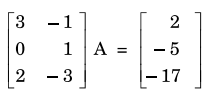 , then find matrix A.
-5 \end{bmatrix}\).
View Solution
Step 1: Understand the Question and Determine Matrix Dimensions
We are given a matrix equation of the form \(CA = B\), and we need to find the unknown matrix A. Since C is not a square matrix, we cannot use an inverse. We must solve a system of linear equations.
First, let's analyze the dimensions of the matrices:
- The first matrix, let's call it C, has order 3 \(\times\) 2.
- The resulting matrix, B, has order 3 \(\times\) 1.
- For the multiplication CA to be defined and result in a 3 \(\times\) 1 matrix, the dimensions of A must be 2 \(\times\) 1.
Step 2: Set up the System of Linear Equations
Let the unknown 2 \(\times\) 1 matrix A be represented by its elements:
\[ A = \begin{bmatrix} x
y \end{bmatrix} \]
Now, we write out the matrix multiplication from the problem:
\[ \begin{bmatrix} 3 & -1
0 & 1
2 & -3 \end{bmatrix} \begin{bmatrix} x
y \end{bmatrix} = \begin{bmatrix} 2
-5
-17 \end{bmatrix} \]
This matrix equation corresponds to a system of three linear equations with two variables:
(i) \(3x - y = 2\)
(ii) \(0x + 1y = -5\)
(iii) \(2x - 3y = -17\)
Step 3: Solve the System and Check for Consistency
From equation (ii), we can immediately find the value of y:
\[ y = -5 \]
Substitute this value, \(y = -5\), into equation (i) to find x:
\[ 3x - (-5) = 2 \]
\[ 3x + 5 = 2 \implies 3x = -3 \implies x = -1 \]
So, from the first two equations, we get a potential solution: x = -1 and y = -5.
Now, we must verify if this solution satisfies the third equation:
Substitute x = -1 and y = -5 into equation (iii):
\[ 2(-1) - 3(-5) = -2 + 15 = 13 \]
However, equation (iii) requires the result to be -17. Since \(13 \neq -17\), the system of equations is inconsistent. This means that, as written, there is no matrix A that satisfies the given equation, likely due to a typo in the question paper.
Step 4: Proposing and Solving the Likely Corrected Problem
A common type of error in such problems is a sign error. Let's assume the element \(c_{32}\) was intended to be +3 instead of -3. The third equation would then be \(2x + 3y = -17\).
Let's check our solution (x = -1, y = -5) with this corrected equation:
\[ 2(-1) + 3(-5) = -2 - 15 = -17 \]
This matches the right-hand side. With this correction, the system is consistent.
Step 5: Final Answer (Based on Correction)
Assuming the intended third equation was \(2x+3y=-17\), the solution is x = -1 and y = -5.
Therefore, the matrix A is:
\[ A = \begin{bmatrix} -1
-5 \end{bmatrix} \]
Quick Tip: When solving a matrix equation \(CA=B\) where C is not square, you cannot use inverses.
The only method is to define the unknown matrix A with variable elements, perform the multiplication, and solve the resulting system of linear equations.
If you get more equations than variables, you must check your solution against the "extra" equations. If it doesn't work, the system is inconsistent, which usually points to a typo in the question.
Let f: A \(\rightarrow\) B be defined by f(x) = \(\frac{x-2}{x-3}\), where A = R – \{3\ and B = R – \{1\. Discuss the bijectivity of the function.
View Solution
Step 1: Understanding Bijectivity
A function is a bijection if it is both one-one (injective) and onto (surjective).
- One-one (Injective): \(f(x_1) = f(x_2) \implies x_1 = x_2\).
- Onto (Surjective): For every y in the codomain B, there is an x in the domain A such that f(x) = y.
Step 2: Check for One-one (Injective)
Let \(f(x_1) = f(x_2)\) for \(x_1, x_2 \in A\).
\[ \frac{x_1 - 2}{x_1 - 3} = \frac{x_2 - 2}{x_2 - 3} \]
Cross-multiply:
\[ (x_1 - 2)(x_2 - 3) = (x_2 - 2)(x_1 - 3) \]
\[ x_1x_2 - 3x_1 - 2x_2 + 6 = x_1x_2 - 3x_2 - 2x_1 + 6 \]
Cancel common terms:
\[ -3x_1 - 2x_2 = -3x_2 - 2x_1 \implies x_2 = x_1 \]
Since \(f(x_1) = f(x_2)\) implies \(x_1 = x_2\), the function is one-one.
Step 3: Check for Onto (Surjective)
Let y be an arbitrary element in the codomain B (so \(y \in R - \{1\}\)). We solve for x in terms of y.
\[ y = \frac{x-2}{x-3} \implies y(x-3) = x-2 \implies yx - 3y = x - 2 \]
\[ yx - x = 3y - 2 \implies x(y - 1) = 3y - 2 \implies x = \frac{3y - 2}{y - 1} \]
For x to be defined, we need \(y \neq 1\), which is guaranteed by the definition of the codomain B.
We also must ensure that x is never 3 (the value excluded from the domain A). If \(x=3\), we get \(3 = \frac{3y-2}{y-1} \implies 3y-3 = 3y-2 \implies -3=-2\), a contradiction.
So for every y in B, we find a unique and valid x in A. The function is onto.
Step 4: Final Answer:
Since the function is both one-one and onto, it is a bijection.
Quick Tip: For rational functions \(f(x) = \frac{ax+b}{cx+d}\), they are typically one-one on their domain.
To check for surjectivity, solve for x in terms of y. The function is onto its range. The range of this function form is R - \{a/c\}, which is R - \{1/1\} = R - \{1\} here. Since the given codomain matches the calculated range, the function is surjective.
In a Linear Programming Program (LPP) for objective function Z = 14x – 10y subject to constraints
x + y \(\leq\) 8
3x - 2y \(\geq\) -6
x, y \(\geq\) 0
shade the feasible region and mark the corner points in a neatly drawn graph.
View Solution
Step 1: Understanding the Problem
We need to identify and graph the feasible region for a given LPP and find its corner points (vertices). The objective function itself is not needed for this part of the problem.
Step 2: Plot the Constraints and Find the Feasible Region
We will plot the boundary lines for each constraint in the first quadrant (\(x \geq 0, y \geq 0\)).
1. x + y = 8: This line passes through (8, 0) and (0, 8). The inequality is \(\leq\), so the region is on and below this line.
2. 3x - 2y = -6: To find intercepts:
- If x=0, -2y = -6 \(\implies\) y = 3. Point is (0, 3).
- If y=0, 3x = -6 \(\implies\) x = -2. Point is (-2, 0).
The inequality is \(\geq\). To check the region, let's test the origin (0,0): \(3(0) - 2(0) = 0\), and \(0 \geq -6\). This is true, so the region is on the side of the line that includes the origin.
The feasible region is the area in the first quadrant that is below \(x+y=8\) and above/on the side of \(3x-2y=-6\) that contains the origin.
Step 3: Identify the Corner Points
The corner points are the vertices of the shaded feasible region.
- O (Origin): The intersection of x=0 and y=0, which is (0, 0).
- A: The x-intercept of the feasible region, which is the intercept of \(x+y=8\), i.e., (8, 0).
- B: The intersection of the lines x+y = 8 and 3x - 2y = -6.
From the first equation, y = 8 - x. Substitute into the second:
\(3x - 2(8 - x) = -6\)
\(3x - 16 + 2x = -6\)
\(5x = 10 \implies x = 2\).
Find y: \(y = 8 - 2 = 6\). This gives the point (2, 6).
- C: The y-intercept of the feasible region, which is the intercept of \(3x-2y=-6\), i.e., (0, 3).
Step 4: Final Answer:
The feasible region is a polygon with four corner points: O(0, 0), A(8, 0), B(2, 6), and C(0, 3).
\begin{tikzpicture[scale=0.7]
\draw[->, thick] (-1,0) -- (9,0) node[right] {x;
\draw[->, thick] (0,-1) -- (0,9) node[above] {y;
\node[below left] at (0,0) {O;
\foreach \x in {1,...,8 \draw (\x,1pt) -- (\x,-1pt) node[below] {\tiny\x;
\foreach \y in {1,...,8 \draw (1pt,\y) -- (-1pt,\y) node[left] {\tiny\y;
% Define corner points
\coordinate (O) at (0,0);
\coordinate (A) at (8,0);
\coordinate (B) at (2,6);
\coordinate (C) at (0,3);
% Shade the feasible region
\fill[cyan!20, opacity=0.7] (O) -- (A) -- (B) -- (C) -- cycle;
% Draw boundary lines
\draw[red, thick] (-1,9) -- (9,-1) node[pos=0.2, above, sloped] {\(x+y=8\);
\draw[blue, thick] (-2,0) -- (4,9) node[pos=0.4, above, sloped] {\(3x-2y=-6\);
% Label corner points
\filldraw[black] (O) circle (2pt) node[below left] {O(0,0);
\filldraw[black] (A) circle (2pt) node[below right] {A(8,0);
\filldraw[black] (B) circle (2pt) node[above right] {B(2,6);
\filldraw[black] (C) circle (2pt) node[above left] {C(0,3);
\node[align=center, font=\bfseries] at (2, 2.5) {Feasible
Region;
\end{tikzpicture Quick Tip: Graphing an LPP is a systematic process:
1. Plot each constraint line using its intercepts.
2. Shade the correct side of each line based on the inequality sign. Testing the origin (0,0) is an easy way to determine which side to shade.
3. Identify the overlapping (feasible) region.
4. Find the coordinates of all vertices (corner points) of this region by solving systems of equations for the intersecting lines.
Differentiate \(\left(\frac{5^x}{x^5}\right)\) with respect to x.
View Solution
Step 1: Understanding the Question:
We need to find the derivative of a function that is a quotient of an exponential function and a power function.
Step 2: Key Formula or Approach:
We will use the quotient rule for differentiation:
\[ \left(\frac{u}{v}\right)' = \frac{u'v - uv'}{v^2} \]
Here, \(u = 5^x\) and \(v = x^5\).
We also need the derivative of an exponential function: \(\frac{d}{dx}(a^x) = a^x \ln(a)\).
Step 3: Detailed Explanation:
Let \(y = \frac{5^x}{x^5}\).
First, find the derivatives of u and v:
- \(u' = \frac{d}{dx}(5^x) = 5^x \ln(5)\).
- \(v' = \frac{d}{dx}(x^5) = 5x^4\).
Now, apply the quotient rule:
\[ \frac{dy}{dx} = \frac{(5^x \ln 5)(x^5) - (5^x)(5x^4)}{(x^5)^2} \]
Factor out the common terms \(5^x\) and \(x^4\) from the numerator:
\[ \frac{dy}{dx} = \frac{5^x x^4 (x \ln 5 - 5)}{x^{10}} \]
Cancel \(x^4\) from the numerator and denominator:
\[ \frac{dy}{dx} = \frac{5^x (x \ln 5 - 5)}{x^6} \]
Step 4: Final Answer:
The derivative is \(\frac{5^x (x \ln 5 - 5)}{x^6}\).
Quick Tip: When using the quotient rule, remember the order: "low d-high minus high d-low, over the square of what's below".
Don't forget the derivative of \(a^x\) is \(a^x \ln a\), which is different from the derivative of \(x^n\) (power rule) and \(e^x\).
OR
Question 25 (b):
If \(-2x^2 – 5xy + y^3 = 76\), then find \(\frac{dy}{dx}\).
View Solution
Step 1: Understanding the Question:
We need to find the derivative of y with respect to x for an implicitly defined function.
Step 2: Key Formula or Approach:
We will differentiate each term of the equation with respect to x, treating y as a function of x. This requires using the product rule for the `\(-5xy\)` term and the chain rule for the `y\(^\)3` term.
Step 3: Detailed Explanation:
The equation is \(-2x^2 – 5xy + y^3 = 76\).
Differentiate term by term with respect to x:
\[ \frac{d}{dx}(-2x^2) - \frac{d}{dx}(5xy) + \frac{d}{dx}(y^3) = \frac{d}{dx}(76) \]
- \(\frac{d}{dx}(-2x^2) = -4x\)
- For the middle term, use the product rule: \(\frac{d}{dx}(5xy) = 5\left( (1)y + x\frac{dy}{dx} \right) = 5y + 5x\frac{dy}{dx}\)
- For the y-term, use the chain rule: \(\frac{d}{dx}(y^3) = 3y^2 \frac{dy}{dx}\)
- The derivative of the constant 76 is 0.
Putting it all together:
\[ -4x - \left(5y + 5x\frac{dy}{dx}\right) + 3y^2\frac{dy}{dx} = 0 \]
\[ -4x - 5y - 5x\frac{dy}{dx} + 3y^2\frac{dy}{dx} = 0 \]
Step 4: Isolate \(\frac{dy}{dx}\)
Group the terms with \(\frac{dy}{dx}\) on one side and the other terms on the other side.
\[ 3y^2\frac{dy}{dx} - 5x\frac{dy}{dx} = 4x + 5y \]
Factor out \(\frac{dy}{dx}\):
\[ \frac{dy}{dx}(3y^2 - 5x) = 4x + 5y \]
Solve for \(\frac{dy}{dx}\):
\[ \frac{dy}{dx} = \frac{4x + 5y}{3y^2 - 5x} \]
Step 5: Final Answer:
The derivative is \(\frac{dy}{dx} = \frac{4x+5y}{3y^2-5x}\).
Quick Tip: For implicit differentiation, go term by term.
Remember that whenever you differentiate a term containing 'y', you must multiply by \(\frac{dy}{dx}\) because of the chain rule.
Be especially careful with the product rule for terms that mix x and y, like 'xy'.
Let 2x + 5y – 1 = 0 and 3x + 2y – 7 = 0 represent the equations of two lines on which the ants are moving on the ground. Using matrix method, find a point common to the paths of the ants.
View Solution
Step 1: Understanding the Question:
We need to find the point of intersection of two lines. The problem specifies that we must use the matrix method.
This involves setting up the system of linear equations in matrix form (AX = B) and solving for X using the inverse of matrix A (\(X = A^{-1}B\)).
Step 2: Set Up the Matrix Equation
First, rewrite the equations in standard form:
\(2x + 5y = 1\)
\(3x + 2y = 7\)
Now, express this system in the matrix form AX = B:
\[ \begin{bmatrix} 2 & 5
3 & 2 \end{bmatrix} \begin{bmatrix} x
y \end{bmatrix} = \begin{bmatrix} 1
7 \end{bmatrix} \]
Where \( A = \begin{bmatrix} 2 & 5
3 & 2 \end{bmatrix} \), \( X = \begin{bmatrix} x
y \end{bmatrix} \), and \( B = \begin{bmatrix} 1
7 \end{bmatrix} \).
Step 3: Find the Inverse of Matrix A
First, calculate the determinant of A:
\(|A| = (2)(2) - (5)(3) = 4 - 15 = -11\).
Since \(|A| \neq 0\), the inverse exists.
Next, find the adjugate of A. For a 2x2 matrix \(\begin{bmatrix} a & b
c & d \end{bmatrix}\), the adjugate is \(\begin{bmatrix} d & -b
-c & a \end{bmatrix}\).
\[ adj(A) = \begin{bmatrix} 2 & -5
-3 & 2 \end{bmatrix} \]
The inverse is \(A^{-1} = \frac{1}{|A|} adj(A)\):
\[ A^{-1} = \frac{1}{-11} \begin{bmatrix} 2 & -5
-3 & 2 \end{bmatrix} \]
Step 4: Solve for X
Now, use the formula \(X = A^{-1}B\):
\[ \begin{bmatrix} x
y \end{bmatrix} = \frac{1}{-11} \begin{bmatrix} 2 & -5
-3 & 2 \end{bmatrix} \begin{bmatrix} 1
7 \end{bmatrix} \]
\[ \begin{bmatrix} x
y \end{bmatrix} = \frac{1}{-11} \begin{bmatrix} (2)(1) + (-5)(7)
(-3)(1) + (2)(7) \end{bmatrix} \]
\[ \begin{bmatrix} x
y \end{bmatrix} = \frac{1}{-11} \begin{bmatrix} 2 - 35
-3 + 14 \end{bmatrix} = \frac{1}{-11} \begin{bmatrix} -33
11 \end{bmatrix} \]
\[ \begin{bmatrix} x
y \end{bmatrix} = \begin{bmatrix} -33 / -11
11 / -11 \end{bmatrix} = \begin{bmatrix} 3
-1 \end{bmatrix} \]
Step 5: Final Answer:
The common point to the paths is (x, y) = (3, -1).
Quick Tip: The matrix method is a systematic way to solve systems of linear equations.
For a 2x2 system, the key steps are:
1. Write the system as AX = B.
2. Find the determinant and inverse of A.
3. The solution is always given by \(X = A^{-1}B\).
This method is particularly powerful for larger systems.
OR
Question 26 (b):
A shopkeeper sells 50 Chemistry, 60 Physics and 35 Maths books on day I and sells 40 Chemistry, 45 Physics and 50 Maths books on day II. If the selling price for each such subject book is Rs 150 (Chemistry), Rs 175 (Physics) and Rs 180 (Maths), then find his total sale in two days, using matrix method. If cost price of all the books together is Rs 35,000, what profit did he earn after the sale of two days ?
View Solution
Step 1: Understanding the Question:
We are asked to perform two tasks:
1. Calculate the total sales revenue over two days using matrix multiplication.
2. Calculate the profit by subtracting the given total cost from the total sales revenue.
Step 2: Set Up the Matrices
We can represent the sales data in a 2 \(\times\) 3 matrix (let's call it S), where the rows represent Day I and Day II, and the columns represent the number of Chemistry, Physics, and Maths books sold.
\[ S = \begin{bmatrix} 50 & 60 & 35
40 & 45 & 50 \end{bmatrix} \]
We can represent the selling price of each book in a 3 \(\times\) 1 column matrix (let's call it P).
\[ P = \begin{bmatrix} 150
175
180 \end{bmatrix} \]
Step 3: Calculate Total Sales using Matrix Multiplication
To find the sales revenue for each day, we multiply the Sales matrix (S) by the Price matrix (P). The product SP will be a 2 \(\times\) 1 matrix, where the first row is the total sale for Day I and the second row is the total sale for Day II.
\[ Sales per day = SP = \begin{bmatrix} 50 & 60 & 35
40 & 45 & 50 \end{bmatrix} \begin{bmatrix} 150
175
180 \end{bmatrix} \]
\[ = \begin{bmatrix} (50)(150) + (60)(175) + (35)(180)
(40)(150) + (45)(175) + (50)(180) \end{bmatrix} \]
\[ = \begin{bmatrix} 7500 + 10500 + 6300
6000 + 7875 + 9000 \end{bmatrix} = \begin{bmatrix} 24300
22875 \end{bmatrix} \]
This matrix shows that the sale on Day I was Rs 24,300 and the sale on Day II was Rs 22,875.
The total sale over two days is the sum of these values:
Total Sale = 24,300 + 22,875 = Rs 47,175.
Step 4: Calculate the Profit
The profit is the difference between the total sales and the total cost.
Total Selling Price = Rs 47,175.
Total Cost Price = Rs 35,000 (given).
\[ Profit = Total Selling Price - Total Cost Price \]
\[ Profit = 47,175 - 35,000 = 12,175 \]
Step 5: Final Answer:
Using the matrix method, the total sale in two days is Rs 47,175.
The profit earned after the sale of two days is Rs 12,175.
Quick Tip: Matrix multiplication is a powerful tool for organizing and calculating data in business and economics problems.
When setting up the matrices, ensure the dimensions are compatible for multiplication. To get the total revenue per day, a (Days \(\times\) Items) matrix should be multiplied by an (Items \(\times\) Price) matrix.
The resulting (Days \(\times\) Price) matrix provides a clear breakdown of revenue for each day.
Show that the function f : R \(\rightarrow\) R defined by f(x) = 4x\(^3\) – 5, \(\forall\) x \(\in\) R is one-one and onto.
View Solution
Step 1: Understanding Bijectivity
To show the function is a bijection, we must prove it is both one-one (injective) and onto (surjective).
Step 2: Proving One-one (Injective)
Let \(f(x_1) = f(x_2)\) for any \(x_1, x_2 \in R\).
\[ 4x_1^3 - 5 = 4x_2^3 - 5 \]
Add 5 to both sides:
\[ 4x_1^3 = 4x_2^3 \]
Divide by 4:
\[ x_1^3 = x_2^3 \]
Take the cube root of both sides. Since the cube root function is a well-defined one-to-one function for all real numbers:
\[ x_1 = x_2 \]
Since \(f(x_1) = f(x_2)\) implies \(x_1 = x_2\), the function is one-one.
Step 3: Proving Onto (Surjective)
Let y be an arbitrary element in the codomain R. We need to show that there exists a pre-image x in the domain R such that f(x) = y.
Set \(y = f(x)\) and solve for x:
\[ y = 4x^3 - 5 \]
\[ y + 5 = 4x^3 \]
\[ x^3 = \frac{y+5}{4} \]
\[ x = \sqrt[3]{\frac{y+5}{4}} \]
For any real number y, the expression \(\frac{y+5}{4}\) is also a real number. The cube root of any real number is a well-defined real number.
Therefore, for every y in the codomain R, we can find a corresponding x in the domain R.
The function is onto.
Step 4: Final Answer:
Since the function f(x) is both one-one and onto, it is a bijection.
Quick Tip: An alternative method to prove injectivity for differentiable functions is to check the derivative.
Here, \(f'(x) = 12x^2\). Since \(f'(x) \geq 0\) for all x, the function is monotonically non-decreasing. It is strictly increasing for \(x \neq 0\). This implies it is one-one.
Odd-degree polynomial functions are often good candidates for being bijections from R to R.
OR
Question 27 (b):
Let R be a relation defined on a set N of natural numbers such that R = {(x, y) : xy is a square of a natural number, x, y \(\in\) N\. Determine if the relation R is an equivalence relation.
View Solution
Step 1: Understanding the Relation
The relation R on the set of natural numbers N is defined as (x, y) \(\in\) R if their product, xy, is a perfect square.
To be an equivalence relation, R must be reflexive, symmetric, and transitive.
Step 2: Checking for Reflexivity
A relation is reflexive if (x, x) \(\in\) R for all x \(\in\) N.
We need to check if \(x \cdot x\) is a perfect square.
\(x \cdot x = x^2\), which is by definition the square of a natural number x.
So, (x, x) \(\in\) R for all x \(\in\) N. The relation is reflexive.
Step 3: Checking for Symmetry
A relation is symmetric if (x, y) \(\in\) R implies (y, x) \(\in\) R.
Assume (x, y) \(\in\) R. This means \(xy = k^2\) for some natural number k.
We need to check if yx is a perfect square.
Since multiplication is commutative, \(yx = xy\).
Therefore, \(yx = k^2\), which is a perfect square.
So, (y, x) \(\in\) R. The relation is symmetric.
Step 4: Checking for Transitivity
A relation is transitive if (x, y) \(\in\) R and (y, z) \(\in\) R implies (x, z) \(\in\) R.
Assume (x, y) \(\in\) R, which means \(xy = k^2\) for some \(k \in N\).
Assume (y, z) \(\in\) R, which means \(yz = m^2\) for some \(m \in N\).
We need to check if xz is a perfect square.
Let's multiply the two equations:
\[ (xy)(yz) = k^2 m^2 \]
\[ xz \cdot y^2 = (km)^2 \]
\[ xz = \frac{(km)^2}{y^2} = \left(\frac{km}{y}\right)^2 \]
This shows that xz is the square of a rational number \(\frac{km}{y}\). For xz to be the square of a natural number, \(\frac{km}{y}\) must be a natural number.
Let's use a prime factorization approach for a more rigorous proof. A number is a perfect square if all the exponents in its prime factorization are even.
Let the prime factorization of x, y, z be \(x = p_1^{a_1} p_2^{a_2} \dots\), \(y = p_1^{b_1} p_2^{b_2} \dots\), \(z = p_1^{c_1} p_2^{c_2} \dots\).
- (x,y) \(\in\) R means \(a_i + b_i\) is even for all prime factors \(p_i\).
- (y,z) \(\in\) R means \(b_i + c_i\) is even for all i.
We need to check if \(a_i + c_i\) is even.
If \(b_i\) is even, then for \(a_i+b_i\) to be even, \(a_i\) must be even. For \(b_i+c_i\) to be even, \(c_i\) must be even. Then \(a_i+c_i\) (even+even) is even.
If \(b_i\) is odd, then for \(a_i+b_i\) to be even, \(a_i\) must be odd. For \(b_i+c_i\) to be even, \(c_i\) must be odd. Then \(a_i+c_i\) (odd+odd) is even.
In both possible cases, \(a_i + c_i\) is always even for all i. This means xz is a perfect square.
The relation is transitive.
Step 5: Final Answer:
Since the relation R is reflexive, symmetric, and transitive, it is an equivalence relation.
Quick Tip: For relations involving properties like "is a multiple of", "is a factor of", or "is a perfect square", thinking in terms of prime factorization can be a very powerful and rigorous way to prove or disprove transitivity.
A number 'n' is a perfect square if and only if every exponent in its prime factorization is an even number.
Show that the derivative of tan\(^{-1}\)(sec x + tan x), \(-\frac{\pi}{2} < x < \frac{\pi}{2}\), with respect to x is equal to \(\frac{1}{2}\).
View Solution
Step 1: Understanding the Question:
We need to find the derivative of the given function and show that it simplifies to a constant, 1/2. The best approach is to simplify the expression inside the tan\(^{-1}\) function first.
Step 2: Simplify the Inner Expression
Let's simplify \(sec x + \tan x\) by converting to sin and cos.
\[ \sec x + \tan x = \frac{1}{\cos x} + \frac{\sin x}{\cos x} = \frac{1 + \sin x}{\cos x} \]
Now, we use half-angle identities:
- \(1 = \sin^2(x/2) + \cos^2(x/2)\)
- \(\sin x = 2\sin(x/2)\cos(x/2)\)
- \(\cos x = \cos^2(x/2) - \sin^2(x/2)\)
Substitute these into the expression:
Numerator: \(1 + \sin x = \sin^2(x/2) + \cos^2(x/2) + 2\sin(x/2)\cos(x/2) = (\sin(x/2) + \cos(x/2))^2\).
Denominator: \(\cos x = \cos^2(x/2) - \sin^2(x/2) = (\cos(x/2) - \sin(x/2))(\cos(x/2) + \sin(x/2))\).
The expression becomes:
\[ \frac{(\sin(x/2) + \cos(x/2))^2}{(\cos(x/2) - \sin(x/2))(\cos(x/2) + \sin(x/2))} = \frac{\cos(x/2) + \sin(x/2)}{\cos(x/2) - \sin(x/2)} \]
Divide the numerator and denominator by \(\cos(x/2)\):
\[ \frac{1 + \tan(x/2)}{1 - \tan(x/2)} \]
This is in the form of the tangent addition formula, \(\tan(A+B)\). Since \(\tan(\pi/4)=1\):
\[ = \tan\left(\frac{\pi}{4} + \frac{x}{2}\right) \]
Step 3: Differentiate the Simplified Function
Let \(y = \tan^{-1}(\sec x + \tan x)\). After simplification, this is:
\[ y = \tan^{-1}\left(\tan\left(\frac{\pi}{4} + \frac{x}{2}\right)\right) \]
For the given domain \(-\frac{\pi}{2} < x < \frac{\pi}{2}\), we have \(-\frac{\pi}{4} < \frac{x}{2} < \frac{\pi}{4}\), which means \(0 < \frac{\pi}{4} + \frac{x}{2} < \frac{\pi}{2}\). This interval is within the principal value branch of \(\tan^{-1}\).
So, we can simplify:
\[ y = \frac{\pi}{4} + \frac{x}{2} \]
Now, differentiate with respect to x:
\[ \frac{dy}{dx} = \frac{d}{dx}\left(\frac{\pi}{4} + \frac{x}{2}\right) = 0 + \frac{1}{2} = \frac{1}{2} \]
Step 4: Final Answer:
The derivative of the function is shown to be equal to \(\frac{1}{2}\).
Quick Tip: When differentiating complex inverse trigonometric functions, always try to simplify the inner expression first.
Converting to sin and cos, followed by using half-angle or double-angle identities, is a very common and effective strategy.
Recognizing the form of tangent addition/subtraction formulas like \(\frac{1+\tan\theta}{1-\tan\theta} = \tan(\frac{\pi}{4}+\theta)\) is key.
Find dimensions of a rectangle of perimeter 12 cm which will generate maximum volume when swept along a circular rotation keeping the shorter side fixed as the axis.
View Solution
Step 1: Understanding the Problem and Setting up Variables
We have a rectangle with perimeter 12 cm. Let its sides be length 'l' and width 'w'.
Perimeter: \(2(l+w) = 12 \implies l+w = 6\).
The rectangle is rotated about its shorter side to form a cylinder. The volume of this cylinder needs to be maximized.
Let the shorter side be 'x' and the longer side be 'y'.
- The axis of rotation is the shorter side, x. So, the height of the cylinder is \(h_{cyl} = x\).
- The other side, y, becomes the radius of the cylinder. So, the radius is \(r_{cyl} = y\).
From the perimeter equation, we have \(x+y=6\), so \(y = 6-x\).
Since x is the shorter side, we must have \(x \leq y\), which means \(x \leq 6-x \implies 2x \leq 6 \implies x \leq 3\). The domain for x is (0, 3].
Step 2: Formulate the Volume Function
The volume of a cylinder is \(V = \pi r_{cyl}^2 h_{cyl}\).
Substitute our expressions for radius and height:
\[ V(x) = \pi (y^2)(x) = \pi (6-x)^2 x \]
This is the function we need to maximize for \(x \in (0, 3]\).
Step 3: Find the Maximum using Calculus
Expand the volume function:
\[ V(x) = \pi x (36 - 12x + x^2) = \pi(36x - 12x^2 + x^3) \]
Find the first derivative with respect to x:
\[ V'(x) = \pi (36 - 24x + 3x^2) \]
Set the derivative to zero to find critical points:
\[ \pi (3x^2 - 24x + 36) = 0 \implies 3x^2 - 24x + 36 = 0 \]
Divide by 3:
\[ x^2 - 8x + 12 = 0 \]
Factor the quadratic equation:
\[ (x-2)(x-6) = 0 \]
The critical points are x = 2 and x = 6.
Since our domain is (0, 3], the only valid critical point is x = 2.
To confirm it's a maximum, we use the second derivative test:
\[ V''(x) = \pi (6x - 24) \]
\[ V''(2) = \pi (12 - 24) = -12\pi < 0 \]. This confirms a maximum.
Step 4: Find the Dimensions
The shorter side is x = 2 cm.
The longer side is y = 6 - x = 6 - 2 = 4 cm.
The dimensions of the rectangle are 2 cm and 4 cm.
Step 5: Final Answer:
The dimensions of the rectangle are length = 4 cm and width = 2 cm.
Quick Tip: In optimization word problems, the process is always:
1. Identify the quantity to be optimized (e.g., Volume) and the constraint (e.g., Perimeter).
2. Use the constraint to express the quantity to be optimized as a function of a single variable.
3. Determine the valid domain for that variable based on the physical limitations of the problem.
4. Find the derivative, set it to zero to find critical points, and test them (and endpoints) to find the maximum/minimum.
The scalar product of the vector \(\vec{a} = \hat{i} - \hat{j} + 2\hat{k}\) with a unit vector along the sum of vectors \(\vec{b} = 2\hat{i} - 4\hat{j} + 5\hat{k}\) and \(\vec{c} = \lambda\hat{i} - 2\hat{j} - 3\hat{k}\) is equal to 1. Find the value of \(\lambda\).
View Solution
Step 1: Understanding the Question:
We are given three vectors \(\vec{a}\), \(\vec{b}\), and \(\vec{c}\). We need to find the value of \(\lambda\). The condition is that the dot product of vector \(\vec{a}\) with the unit vector along the sum of \(\vec{b}\) and \(\vec{c}\) is 1.
Step 2: Key Formula or Approach:
1. Find the sum vector, let's call it \(\vec{d} = \vec{b} + \vec{c}\).
2. Find the unit vector in the direction of \(\vec{d}\), which is \(\hat{d} = \frac{\vec{d}}{|\vec{d}|}\).
3. Use the given condition \(\vec{a} \cdot \hat{d} = 1\), which simplifies to \(\vec{a} \cdot \vec{d} = |\vec{d}|\).
4. Solve the resulting equation for \(\lambda\).
Step 3: Detailed Explanation:
First, let's find the sum of vectors \(\vec{b}\) and \(\vec{c}\):
\[ \vec{d} = \vec{b} + \vec{c} = (2\hat{i} - 4\hat{j} + 5\hat{k}) + (\lambda\hat{i} - 2\hat{j} - 3\hat{k}) \] \[ \vec{d} = (2 + \lambda)\hat{i} - 6\hat{j} + 2\hat{k} \]
Now, calculate the dot product \(\vec{a} \cdot \vec{d}\):
\[ \vec{a} \cdot \vec{d} = (\hat{i} - \hat{j} + 2\hat{k}) \cdot ((2 + \lambda)\hat{i} - 6\hat{j} + 2\hat{k}) \] \[ \vec{a} \cdot \vec{d} = (1)(2 + \lambda) + (-1)(-6) + (2)(2) = 2 + \lambda + 6 + 4 = \lambda + 12 \]
Next, find the magnitude of \(\vec{d}\):
\[ |\vec{d}| = \sqrt{(2 + \lambda)^2 + (-6)^2 + 2^2} = \sqrt{4 + 4\lambda + \lambda^2 + 36 + 4} = \sqrt{\lambda^2 + 4\lambda + 44} \]
The given condition is \(\vec{a} \cdot \frac{\vec{d}}{|\vec{d}|} = 1\), which means \(\vec{a} \cdot \vec{d} = |\vec{d}|\).
\[ \lambda + 12 = \sqrt{\lambda^2 + 4\lambda + 44} \]
For this equation to be valid, we must have \(\lambda + 12 \geq 0\), or \(\lambda \geq -12\).
Squaring both sides:
\[ (\lambda + 12)^2 = \lambda^2 + 4\lambda + 44 \] \[ \lambda^2 + 24\lambda + 144 = \lambda^2 + 4\lambda + 44 \] \[ 20\lambda = 44 - 144 \] \[ 20\lambda = -100 \] \[ \lambda = -5 \]
This value satisfies the condition \(\lambda \geq -12\). We can check the solution:
LHS: \(-5 + 12 = 7\).
RHS: \(\sqrt{(-5)^2 + 4(-5) + 44} = \sqrt{25 - 20 + 44} = \sqrt{49} = 7\).
Since LHS = RHS, the solution is correct.
Step 4: Final Answer:
The value of \(\lambda\) is -5.
Quick Tip: When an equation involves a square root, always check for extraneous solutions after squaring both sides. Substitute the final value back into the equation before you squared it to ensure validity.
OR
Question 30 (b):
Find the shortest distance between the lines :
\(\vec{r} = (2\hat{i} - \hat{j} + 3\hat{k}) + \lambda(\hat{i} - 2\hat{j} + 3\hat{k})\)
\(\vec{r} = (\hat{i} + 4\hat{k}) + \mu(3\hat{i} - 6\hat{j} + 9\hat{k})\)
View Solution
Step 1: Understanding the Question:
We are asked to find the shortest distance between two lines given in vector form. The first step is to check if the lines are parallel, intersecting, or skew.
Step 2: Key Formula or Approach:
The lines are of the form \(\vec{r} = \vec{a_1} + \lambda\vec{b_1}\) and \(\vec{r} = \vec{a_2} + \mu\vec{b_2}\).
1. Check for parallelism by comparing their direction vectors, \(\vec{b_1}\) and \(\vec{b_2}\). If \(\vec{b_2} = k\vec{b_1}\) for some scalar \(k\), the lines are parallel.
2. If the lines are parallel, the shortest distance \(d\) is given by: \(d = \frac{|(\vec{a_2} - \vec{a_1}) \times \vec{b_1}|}{|\vec{b_1}|}\).
Step 3: Detailed Explanation:
From the given equations, we identify the vectors:
\(\vec{a_1} = 2\hat{i} - \hat{j} + 3\hat{k}\), \(\vec{b_1} = \hat{i} - 2\hat{j} + 3\hat{k}\)
\(\vec{a_2} = \hat{i} + 4\hat{k}\), \(\vec{b_2} = 3\hat{i} - 6\hat{j} + 9\hat{k}\)
First, we compare the direction vectors \(\vec{b_1}\) and \(\vec{b_2}\):
\[ \vec{b_2} = 3\hat{i} - 6\hat{j} + 9\hat{k} = 3(\hat{i} - 2\hat{j} + 3\hat{k}) = 3\vec{b_1} \]
Since \(\vec{b_2}\) is a scalar multiple of \(\vec{b_1}\), the lines are parallel.
Now we use the formula for the distance between parallel lines. First, find \(\vec{a_2} - \vec{a_1}\):
\[ \vec{a_2} - \vec{a_1} = (\hat{i} + 4\hat{k}) - (2\hat{i} - \hat{j} + 3\hat{k}) = -\hat{i} + \hat{j} + \hat{k} \]
Next, calculate the cross product \((\vec{a_2} - \vec{a_1}) \times \vec{b_1}\):
\[ (\vec{a_2} - \vec{a_1}) \times \vec{b_1} = \begin{vmatrix} \hat{i} & \hat{j} & \hat{k}
-1 & 1 & 1
1 & -2 & 3 \end{vmatrix} = \hat{i}(3 - (-2)) - \hat{j}(-3 - 1) + \hat{k}(2 - 1) = 5\hat{i} + 4\hat{j} + \hat{k} \]
Find the magnitude of this cross product:
\[ |(\vec{a_2} - \vec{a_1}) \times \vec{b_1}| = \sqrt{5^2 + 4^2 + 1^2} = \sqrt{25 + 16 + 1} = \sqrt{42} \]
Find the magnitude of \(\vec{b_1}\):
\[ |\vec{b_1}| = \sqrt{1^2 + (-2)^2 + 3^2} = \sqrt{1 + 4 + 9} = \sqrt{14} \]
Finally, the shortest distance is:
\[ d = \frac{\sqrt{42}}{\sqrt{14}} = \sqrt{\frac{42}{14}} = \sqrt{3} \]
Step 4: Final Answer:
The shortest distance between the given lines is \(\sqrt{3}\) units.
Quick Tip: For shortest distance problems, always begin by comparing the direction vectors. If they are proportional, the lines are parallel, and you must use the specific formula for parallel lines. Using the skew lines formula will lead to an error (\(0/0\)) as the cross product of parallel vectors is the zero vector.
In the Linear Programming Problem for objective function Z = 18x + 10y subject to constraints
4x + y \(\geq\) 20
2x + 3y \(\geq\) 30
x, y \(\geq\) 0
find the minimum value of Z.
View Solution
Step 1: Understanding the Question:
We need to find the minimum value of the objective function \(Z = 18x + 10y\) subject to a set of linear constraints. This involves finding the feasible region and evaluating Z at its corner points.
Step 2: Key Formula or Approach:
1. Graph the boundary lines of the inequalities.
2. Identify the feasible region satisfying all constraints.
3. Determine the coordinates of the corner points (vertices) of the feasible region.
4. Evaluate the objective function Z at each corner point.
5. For an unbounded region, the smallest value M at a corner point is the minimum, provided the open half-plane defined by \(Z < M\) has no points in common with the feasible region.
Step 3: Detailed Explanation:
The constraints are:
1. \(4x + y \geq 20\) (Line \(L_1\): \(4x + y = 20\))
2. \(2x + 3y \geq 30\) (Line \(L_2\): \(2x + 3y = 30\))
3. \(x \geq 0, y \geq 0\) (First Quadrant)
First, find the intersection points of the lines with the axes:
For \(L_1\): Passes through (5, 0) and (0, 20).
For \(L_2\): Passes through (15, 0) and (0, 10).
Next, find the intersection of \(L_1\) and \(L_2\):
Multiply \(L_1\) by 3: \(12x + 3y = 60\).
Subtract \(L_2\): \((12x + 3y) - (2x + 3y) = 60 - 30 \implies 10x = 30 \implies x = 3\).
Substitute \(x=3\) into \(L_1\): \(4(3) + y = 20 \implies 12 + y = 20 \implies y = 8\).
The intersection point is (3, 8).
The feasible region is unbounded and its corner points are (15, 0), (3, 8), and (0, 20).
Evaluate Z at these corner points:
- At (15, 0): \(Z = 18(15) + 10(0) = 270\).
- At (3, 8): \(Z = 18(3) + 10(8) = 54 + 80 = 134\).
- At (0, 20): \(Z = 18(0) + 10(20) = 200\).
The smallest value is M = 134. Since the region is unbounded, we must check if Z can be smaller. We consider the inequality \(18x + 10y < 134\). The boundary line \(18x + 10y = 134\) passes through (3, 8). The open half-plane represented by the inequality lies "below" this line and has no points in common with the feasible region.
Therefore, the minimum value is indeed 134.
Step 4: Final Answer:
The minimum value of Z is 134, which occurs at the point (x, y) = (3, 8).
Quick Tip: For minimization problems with an unbounded feasible region, after finding the minimum value M at a corner point, always verify it by checking the inequality \(Z < M\). If the region for \(Z < M\) and the feasible region are disjoint, then M is the true minimum. Otherwise, no minimum value exists.
Find: \(\int \frac{x}{(x-1)(x^2+4)} dx\)
View Solution
Step 1: Understanding the Question:
We are asked to integrate a rational function. The denominator has a linear factor and an irreducible quadratic factor, which suggests using the method of partial fraction decomposition.
Step 2: Key Formula or Approach:
1. Decompose the integrand into the form: \(\frac{x}{(x-1)(x^2+4)} = \frac{A}{x-1} + \frac{Bx+C}{x^2+4}\).
2. Solve for the constants A, B, and C by creating an identity and substituting values of x or equating coefficients.
3. Integrate the resulting simpler fractions.
Step 3: Detailed Explanation:
Set up the partial fraction identity:
\[ x = A(x^2+4) + (Bx+C)(x-1) \]
To find A, set \(x=1\):
\[ 1 = A(1^2+4) + 0 \implies 1 = 5A \implies A = \frac{1}{5} \]
To find B and C, expand and equate coefficients:
\[ x = Ax^2 + 4A + Bx^2 - Bx + Cx - C \] \[ x = (A+B)x^2 + (C-B)x + (4A-C) \]
Comparing coefficients:
- \(x^2\): \(A+B = 0 \implies B = -A = -\frac{1}{5}\).
- \(x\): \(C-B = 1 \implies C = 1+B = 1 - \frac{1}{5} = \frac{4}{5}\).
So the decomposition is: \(\frac{1/5}{x-1} + \frac{-x/5 + 4/5}{x^2+4}\).
Now integrate:
\[ \int \frac{x}{(x-1)(x^2+4)} dx = \int \frac{1}{5(x-1)} dx + \int \frac{-x+4}{5(x^2+4)} dx \] \[ = \frac{1}{5}\int \frac{1}{x-1} dx - \frac{1}{5}\int \frac{x}{x^2+4} dx + \frac{4}{5}\int \frac{1}{x^2+4} dx \]
Evaluate each integral:
- \( \frac{1}{5}\int \frac{1}{x-1} dx = \frac{1}{5} \ln|x-1| \)
- \( -\frac{1}{5}\int \frac{x}{x^2+4} dx = -\frac{1}{10}\int \frac{2x}{x^2+4} dx = -\frac{1}{10} \ln(x^2+4) \)
- \( \frac{4}{5}\int \frac{1}{x^2+2^2} dx = \frac{4}{5} \cdot \frac{1}{2} \tan^{-1}\left(\frac{x}{2}\right) = \frac{2}{5} \tan^{-1}\left(\frac{x}{2}\right) \)
Combining the results and adding the constant of integration C:
\[ \frac{1}{5} \ln|x-1| - \frac{1}{10} \ln(x^2+4) + \frac{2}{5} \tan^{-1}\left(\frac{x}{2}\right) + C \]
Step 4: Final Answer:
The integral is \(\frac{1}{5} \ln|x-1| - \frac{1}{10} \ln(x^2+4) + \frac{2}{5} \tan^{-1}\left(\frac{x}{2}\right) + C\).
Quick Tip: For partial fractions, the "cover-up" method (substituting roots of linear factors) is fast for finding constants like A. For quadratic factors, equating coefficients is a reliable method to find the remaining constants.
OR
Question 32 (b):
Evaluate: \(\int_{0}^{\pi} \frac{x\sin x}{1+\cos^2 x} dx\)
View Solution
Step 1: Understanding the Question:
We need to evaluate a definite integral involving trigonometric functions and a linear term \(x\). This structure strongly suggests using the property of definite integrals: \(\int_{0}^{a} f(x) dx = \int_{0}^{a} f(a-x) dx\).
Step 2: Key Formula or Approach:
1. Let \(I = \int_{0}^{\pi} \frac{x\sin x}{1+\cos^2 x} dx\).
2. Apply the property \(f(a-x)\) with \(a=\pi\).
3. Add the two expressions for I to eliminate the \(x\) term in the numerator.
4. Solve the resulting simpler integral, likely using substitution.
Step 3: Detailed Explanation:
Let the given integral be \(I\).
\[ I = \int_{0}^{\pi} \frac{x\sin x}{1+\cos^2 x} dx \quad \cdots(1) \]
Using the property \(\int_{0}^{a} f(x) dx = \int_{0}^{a} f(a-x) dx\), we get:
\[ I = \int_{0}^{\pi} \frac{(\pi-x)\sin(\pi-x)}{1+\cos^2(\pi-x)} dx \]
Since \(\sin(\pi-x) = \sin x\) and \(\cos(\pi-x) = -\cos x\), \(\cos^2(\pi-x) = \cos^2 x\).
\[ I = \int_{0}^{\pi} \frac{(\pi-x)\sin x}{1+\cos^2 x} dx \quad \cdots(2) \]
Adding equations (1) and (2):
\[ 2I = \int_{0}^{\pi} \frac{x\sin x + (\pi-x)\sin x}{1+\cos^2 x} dx = \int_{0}^{\pi} \frac{\pi\sin x}{1+\cos^2 x} dx \] \[ 2I = \pi \int_{0}^{\pi} \frac{\sin x}{1+\cos^2 x} dx \]
Now, let's use substitution. Let \(u = \cos x\). Then \(du = -\sin x dx\).
We must also change the limits of integration:
- When \(x = 0\), \(u = \cos 0 = 1\).
- When \(x = \pi\), \(u = \cos \pi = -1\).
\[ 2I = \pi \int_{1}^{-1} \frac{-du}{1+u^2} = \pi \int_{-1}^{1} \frac{du}{1+u^2} \]
The integral of \(\frac{1}{1+u^2}\) is \(\tan^{-1}(u)\).
\[ 2I = \pi \left[ \tan^{-1}(u) \right]_{-1}^{1} = \pi (\tan^{-1}(1) - \tan^{-1}(-1)) \] \[ 2I = \pi \left( \frac{\pi}{4} - \left(-\frac{\pi}{4}\right) \right) = \pi \left( \frac{\pi}{2} \right) = \frac{\pi^2}{2} \] \[ I = \frac{\pi^2}{4} \]
Step 4: Final Answer:
The value of the definite integral is \(\frac{\pi^2}{4}\).
Quick Tip: Whenever you see an integral of the form \(\int_{0}^{a} x \cdot g(x) dx\), especially with trigonometric functions, always try applying the King's Rule: \(\int_{0}^{a} f(x) dx = \int_{0}^{a} f(a-x) dx\). It often simplifies the problem by eliminating the 'x' term.
Find the point Q on the line \(\frac{2x+4}{6} = \frac{y+1}{2} = \frac{-2z+6}{-4}\) at a distance of \(3\sqrt{2}\) from the point P(1, 2, 3).
View Solution
Step 1: Understanding the Question:
We need to find the coordinates of a point (or points) Q that lies on a given line and is at a specific distance from a given point P.
Step 2: Key Formula or Approach:
1. Convert the equation of the line into the standard symmetric form \(\frac{x-x_0}{a} = \frac{y-y_0}{b} = \frac{z-z_0}{c}\).
2. Write the coordinates of a general point Q on the line using a parameter, say \(\lambda\).
3. Find the distance PQ using the distance formula and set it equal to \(3\sqrt{2}\).
4. Solve the resulting equation for \(\lambda\). There may be two solutions.
5. Substitute the value(s) of \(\lambda\) back into the general coordinates of Q to get the required point(s).
Step 3: Detailed Explanation:
First, let's convert the line equation to standard form:
\(\frac{2(x+2)}{6} = \frac{x+2}{3}\)
\(\frac{y+1}{2}\)
\(\frac{-2(z-3)}{-4} = \frac{z-3}{2}\)
So, the line equation is \(\frac{x+2}{3} = \frac{y+1}{2} = \frac{z-3}{2}\).
Let this be equal to a parameter \(\lambda\). A general point Q on this line is:
\(Q = (3\lambda - 2, 2\lambda - 1, 2\lambda + 3)\).
The given point is P(1, 2, 3). The distance PQ is given as \(3\sqrt{2}\).
Using the distance formula, \(PQ^2 = (3\sqrt{2})^2 = 18\).
\[ ( (3\lambda-2) - 1 )^2 + ( (2\lambda-1) - 2 )^2 + ( (2\lambda+3) - 3 )^2 = 18 \] \[ (3\lambda-3)^2 + (2\lambda-3)^2 + (2\lambda)^2 = 18 \] \[ 9(\lambda-1)^2 + (4\lambda^2 - 12\lambda + 9) + 4\lambda^2 = 18 \] \[ 9(\lambda^2 - 2\lambda + 1) + 8\lambda^2 - 12\lambda + 9 = 18 \] \[ 9\lambda^2 - 18\lambda + 9 + 8\lambda^2 - 12\lambda + 9 - 18 = 0 \] \[ 17\lambda^2 - 30\lambda = 0 \] \[ \lambda(17\lambda - 30) = 0 \]
This gives two possible values for \(\lambda\): \(\lambda = 0\) or \(\lambda = \frac{30}{17}\).
Now find the coordinates of Q for each value of \(\lambda\):
- For \(\lambda = 0\): \(Q_1 = (3(0)-2, 2(0)-1, 2(0)+3) = (-2, -1, 3)\).
- For \(\lambda = \frac{30}{17}\):
\(x = 3(\frac{30}{17}) - 2 = \frac{90-34}{17} = \frac{56}{17}\)
\(y = 2(\frac{30}{17}) - 1 = \frac{60-17}{17} = \frac{43}{17}\)
\(z = 2(\frac{30}{17}) + 3 = \frac{60+51}{17} = \frac{111}{17}\)
So, \(Q_2 = (\frac{56}{17}, \frac{43}{17}, \frac{111}{17})\).
Step 4: Final Answer:
There are two such points on the line: \(Q_1 = (-2, -1, 3)\) and \(Q_2 = (\frac{56}{17}, \frac{43}{17}, \frac{111}{17})\).
Quick Tip: Always simplify the given equation of a line to its standard symmetric form before parameterizing it. This avoids errors in identifying the direction ratios and the point on the line. A quadratic equation for the parameter \(\lambda\) usually implies there are two points on the line at a given distance from an external point.
OR
Question 33 (b):
Find the image of the point (–1, 5, 2) in the line \(\frac{2x-4}{2} = \frac{y}{2} = \frac{2-z}{3}\). Find the length of the line segment joining the given point and the image point.
View Solution
Step 1: Understanding the Question:
We need to find the mirror image of a point P with respect to a given line L. This involves finding the foot of the perpendicular from P to L, and then using the midpoint formula. Finally, we calculate the distance between the point and its image.
Step 2: Key Formula or Approach:
1. Write the line L in standard form and find the coordinates of a general point F on it in terms of a parameter \(\lambda\). This point F will be the foot of the perpendicular from P.
2. Find the direction ratios of the vector \(\vec{PF}\).
3. The vector \(\vec{PF}\) is perpendicular to the line L. Therefore, the dot product of their direction ratios is zero. Use this to find \(\lambda\).
4. Substitute \(\lambda\) to find the coordinates of the foot F.
5. If Q is the image of P, then F is the midpoint of PQ. Use the midpoint formula to find the coordinates of Q.
6. Calculate the distance PQ.
Step 3: Detailed Explanation:
Let P = (–1, 5, 2). First, standardize the line equation:
\(\frac{2(x-2)}{2} = \frac{x-2}{1}\)
\(\frac{y-0}{2}\)
\(\frac{-(z-2)}{3} = \frac{z-2}{-3}\)
Line L: \(\frac{x-2}{1} = \frac{y}{2} = \frac{z-2}{-3} = \lambda\). The direction ratios of L are (1, 2, -3).
A general point F on L is \(F = (\lambda+2, 2\lambda, -3\lambda+2)\).
The direction ratios of the vector \(\vec{PF}\) are:
\( ( (\lambda+2) - (-1), 2\lambda - 5, (-3\lambda+2) - 2 ) = (\lambda+3, 2\lambda-5, -3\lambda) \).
Since \(\vec{PF}\) is perpendicular to L, their dot product is 0:
\( 1(\lambda+3) + 2(2\lambda-5) - 3(-3\lambda) = 0 \)
\( \lambda + 3 + 4\lambda - 10 + 9\lambda = 0 \)
\( 14\lambda - 7 = 0 \implies \lambda = \frac{1}{2} \).
The foot of the perpendicular is F:
\( F = (\frac{1}{2}+2, 2(\frac{1}{2}), -3(\frac{1}{2})+2) = (\frac{5}{2}, 1, \frac{1}{2}) \).
Let the image point be Q = (x, y, z). F is the midpoint of PQ.
\( \frac{x-1}{2} = \frac{5}{2} \implies x-1=5 \implies x=6 \)
\( \frac{y+5}{2} = 1 \implies y+5=2 \implies y=-3 \)
\( \frac{z+2}{2} = \frac{1}{2} \implies z+2=1 \implies z=-1 \)
The image is Q = (6, -3, -1).
The length of the segment PQ is:
\[ PQ = \sqrt{(6 - (-1))^2 + (-3 - 5)^2 + (-1 - 2)^2} \] \[ PQ = \sqrt{7^2 + (-8)^2 + (-3)^2} = \sqrt{49 + 64 + 9} = \sqrt{122} \]
Step 4: Final Answer:
The image of the point (–1, 5, 2) is (6, –3, –1). The length of the line segment PQ is \(\sqrt{122}\) units.
Quick Tip: The length from a point to its image is always twice the perpendicular distance from the point to the line (or plane). After finding the foot of the perpendicular F, you can calculate the distance PF and double it to get PQ.
Solve the differential equation \((x^2 + y^2)dx + xy dy = 0\), y(1) = 1.
View Solution
Step 1: Understanding the Question:
This is a first-order differential equation. We can check if it's homogeneous, as each term has a degree of 2. It is indeed a homogeneous differential equation.
Step 2: Key Formula or Approach:
1. Rearrange the equation into the form \(\frac{dy}{dx} = f(x, y)\).
2. Use the substitution \(y = vx\), which implies \(\frac{dy}{dx} = v + x\frac{dv}{dx}\).
3. The equation will transform into a separable variable form in terms of v and x.
4. Integrate both sides.
5. Substitute back \(v = \frac{y}{x}\).
6. Use the initial condition \(y(1)=1\) to find the particular solution.
Step 3: Detailed Explanation:
Rearrange the given equation:
\[ xy dy = -(x^2 + y^2)dx \] \[ \frac{dy}{dx} = -\frac{x^2+y^2}{xy} = -\frac{x}{y} - \frac{y}{x} \]
Substitute \(y=vx\) and \(\frac{dy}{dx} = v + x\frac{dv}{dx}\):
\[ v + x\frac{dv}{dx} = -\frac{x}{vx} - \frac{vx}{x} = -\frac{1}{v} - v \] \[ x\frac{dv}{dx} = -\frac{1}{v} - 2v = -\frac{1+2v^2}{v} \]
Separate the variables:
\[ \frac{v}{1+2v^2} dv = -\frac{1}{x} dx \]
Integrate both sides:
\[ \int \frac{v}{1+2v^2} dv = \int -\frac{1}{x} dx \]
For the left integral, use substitution \(u = 1+2v^2\), so \(du = 4v dv\). The integral becomes \(\frac{1}{4}\int \frac{du}{u}\).
\[ \frac{1}{4} \ln|1+2v^2| = -\ln|x| + C_1 \]
Multiply by 4:
\[ \ln|1+2v^2| = -4\ln|x| + 4C_1 = \ln|x^{-4}| + C \]
Substitute back \(v = \frac{y}{x}\):
\[ \ln\left|1+2\frac{y^2}{x^2}\right| = \ln\left|\frac{1}{x^4}\right| + C \] \[ \ln\left|\frac{x^2+2y^2}{x^2}\right| = \ln\left|\frac{1}{x^4}\right| + C \]
Exponentiate both sides:
\[ \frac{x^2+2y^2}{x^2} = e^C \cdot \frac{1}{x^4} = \frac{K}{x^4} \] \[ x^2(x^2+2y^2) = K \implies x^4 + 2x^2y^2 = K \]
Now apply the initial condition \(y(1)=1\):
\[ 1^4 + 2(1^2)(1^2) = K \implies 1 + 2 = K \implies K=3 \]
Step 4: Final Answer:
The particular solution to the differential equation is \(x^4 + 2x^2y^2 = 3\).
Quick Tip: To quickly check if a differential equation \(M(x,y)dx + N(x,y)dy = 0\) is homogeneous, verify that M and N are homogeneous functions of the same degree. A function \(f(x,y)\) is homogeneous of degree n if \(f(tx, ty) = t^n f(x,y)\).
A woman discovered a scratch along a straight line on a circular table top of radius 8 cm. She divided the table top into 4 equal quadrants and discovered the scratch passing through the origin inclined at an angle \(\frac{\pi}{4}\) anticlockwise along the positive direction of x-axis. Find the area of the region enclosed by the x-axis, the scratch and the circular table top in the first quadrant, using integration.
View Solution
Step 1: Understanding the Question:
We need to find the area of a sector of a circle. The circle is centered at the origin with a radius of 8 cm. The boundaries of the area are the x-axis (\(y=0\)), the line representing the scratch, and the circle itself, all within the first quadrant.
- Circle equation: \(x^2 + y^2 = 8^2 = 64\).
- Scratch line: Passes through the origin at an angle of \(\pi/4\). The equation is \(y = \tan(\pi/4)x\), which is \(y=x\).
- x-axis: \(y=0\).
Step 2: Key Formula or Approach:
The problem asks to use integration. The easiest method is to use integration in polar coordinates, where the area is given by \(A = \int_{\alpha}^{\beta} \frac{1}{2}r^2 d\theta\). We can also use Cartesian coordinates, which will require splitting the area into two parts.
Step 3: Detailed Explanation (Using Polar Coordinates):
This method is simpler. The region is a sector of a circle.
- The radius \(r\) is constant: \(r=8\).
- The angle \(\theta\) varies from the x-axis (\(\theta=0\)) to the scratch line (\(\theta=\pi/4\)).
The area A is given by the integral:
\[ A = \int_{0}^{\pi/4} \frac{1}{2}r^2 d\theta \] \[ A = \int_{0}^{\pi/4} \frac{1}{2}(8)^2 d\theta = \int_{0}^{\pi/4} 32 d\theta \] \[ A = 32[\theta]_{0}^{\pi/4} = 32\left(\frac{\pi}{4} - 0\right) = 8\pi \]
Step 3 (Alternative - Using Cartesian Coordinates):
We need to find the intersection of the line \(y=x\) and the circle \(x^2+y^2=64\).
\(x^2 + (x)^2 = 64 \implies 2x^2 = 64 \implies x^2 = 32 \implies x = \sqrt{32} = 4\sqrt{2}\). The intersection point is \((4\sqrt{2}, 4\sqrt{2})\).
The area must be split into two regions:
1. Area under the line \(y=x\) from \(x=0\) to \(x=4\sqrt{2}\).
2. Area under the circle \(y=\sqrt{64-x^2}\) from \(x=4\sqrt{2}\) to \(x=8\).
\[ A = \int_{0}^{4\sqrt{2}} x \,dx + \int_{4\sqrt{2}}^{8} \sqrt{64-x^2} \,dx \] \[ A_1 = \left[\frac{x^2}{2}\right]_{0}^{4\sqrt{2}} = \frac{(4\sqrt{2})^2}{2} = \frac{32}{2} = 16 \]
For the second integral, we use the formula \(\int \sqrt{a^2-x^2} dx = \frac{x}{2}\sqrt{a^2-x^2} + \frac{a^2}{2}\sin^{-1}\left(\frac{x}{a}\right)\) with \(a=8\).
\[ A_2 = \left[\frac{x}{2}\sqrt{64-x^2} + \frac{64}{2}\sin^{-1}\left(\frac{x}{8}\right)\right]_{4\sqrt{2}}^{8} \] \[ A_2 = \left(0 + 32\sin^{-1}(1)\right) - \left(\frac{4\sqrt{2}}{2}\sqrt{64-32} + 32\sin^{-1}\left(\frac{4\sqrt{2}}{8}\right)\right) \] \[ A_2 = \left(32 \cdot \frac{\pi}{2}\right) - \left(2\sqrt{2}\sqrt{32} + 32\sin^{-1}\left(\frac{1}{\sqrt{2}}\right)\right) \] \[ A_2 = 16\pi - \left(2\sqrt{64} + 32 \cdot \frac{\pi}{4}\right) = 16\pi - (16 + 8\pi) = 8\pi - 16 \]
Total Area \(A = A_1 + A_2 = 16 + (8\pi - 16) = 8\pi\).
Step 4: Final Answer:
The area of the region is \(8\pi\) cm\(^2\).
\begin{figure[h!]
\centering
\begin{tikzpicture[scale=0.6]
\draw[->, thick] (-1,0) -- (9,0) node[right] {x-axis;
\draw[->, thick] (0,-1) -- (0,9) node[above] {y-axis;
\node[below left] at (0,0) {O;
% Draw the circular arc
\draw[blue, ultra thick] (8,0) arc (0:90:8);
\node[blue] at (6,6) {\(x^2+y^2=64\);
% Draw the scratch line
\draw[red, thick] (0,0) -- (6,6) node[pos=0.8, above, sloped] {Scratch (\(y=x\));
% Shade the region
\fill[orange!30, opacity=0.8] (0,0) -- (8,0) arc (0:45:8) -- cycle;
% Mark radius and angle
\draw (1,0) arc (0:45:1);
\node at (1.3, 0.4) {\(\pi/4\);
\node at (4,1) {Area;
\node at (8.3, -0.3) {8;
\end{tikzpicture
\end{figure Quick Tip: For finding areas of sectors or regions bounded by circles and lines through the origin, using polar coordinates is often much faster and less error-prone than using Cartesian coordinates.
Based upon the results of regular medical check-ups in a hospital, it was found that out of 1000 people, 700 were very healthy, 200 maintained average health and 100 had a poor health record.
Let A1 : People with good health,
A2 : People with average health,
and A3 : People with poor health.
During a pandemic, the data expressed that the chances of people contracting the disease from category A1, A2 and A3 are 25%, 35% and 50%, respectively.
Based upon the above information, answer the following questions :
(i). A person was tested randomly. What is the probability that he/she has contracted the disease?
View Solution
Step 1: Define Events and List Probabilities
Let A\(_1\), A\(_2\), A\(_3\) be the events that a randomly chosen person is from the respective health categories.
- \(P(A_1) = \frac{700}{1000} = 0.7\)
- \(P(A_2) = \frac{200}{1000} = 0.2\)
- \(P(A_3) = \frac{100}{1000} = 0.1\)
Let D be the event that a person has contracted the disease. We are given the conditional probabilities:
- \(P(D|A_1) = 25% = 0.25\)
- \(P(D|A_2) = 35% = 0.35\)
- \(P(D|A_3) = 50% = 0.50\)
Step 2: Apply the Law of Total Probability
The overall probability of a person contracting the disease is the sum of the probabilities of contracting it from each health category.
\[ P(D) = P(A_1)P(D|A_1) + P(A_2)P(D|A_2) + P(A_3)P(D|A_3) \]
\[ P(D) = (0.7)(0.25) + (0.2)(0.35) + (0.1)(0.50) \]
\[ P(D) = 0.175 + 0.070 + 0.050 \]
\[ P(D) = 0.295 \]
Step 3: Final Answer:
The probability that a randomly tested person has contracted the disease is 0.295 or 29.5%.
Quick Tip: This is a standard application of the Law of Total Probability.
1. Identify the different "states" or "categories" the population is divided into (A1, A2, A3).
2. Find the probability of being in each category.
3. Find the conditional probability of the event in question (D) for each category.
4. The total probability is the sum of (Prob of Category \(\times\) Conditional Prob for that Category) over all categories.
Given that the person has not contracted the disease, what is the probability that the person is from category A\(_2\) ?
View Solution
Step 1: Understand the Question and Define Events
We need to find a conditional probability: P(A\(_2\) | D'), where D' is the event that a person has not contracted the disease.
We will use Bayes' Theorem: \( P(A_2|D') = \frac{P(A_2 \cap D'){P(D')} = \frac{P(A_2)P(D'|A_2)}{P(D')} \).
Step 2: Calculate Necessary Probabilities
First, we need the probability of not contracting the disease, P(D'). From part (i), we found P(D) = 0.295.
\[ P(D') = 1 - P(D) = 1 - 0.295 = 0.705 \]
Next, we need the conditional probabilities of NOT contracting the disease for each category.
- \(P(D'|A_1) = 1 - P(D|A_1) = 1 - 0.25 = 0.75\)
- \(P(D'|A_2) = 1 - P(D|A_2) = 1 - 0.35 = 0.65\)
- \(P(D'|A_3) = 1 - P(D|A_3) = 1 - 0.50 = 0.50\)
Step 3: Apply Bayes' Theorem
Now we can calculate P(A\(_2\) | D').
The numerator is \(P(A_2) \cdot P(D'|A_2)\):
\[ (0.2) \cdot (0.65) = 0.130 \]
The denominator is P(D'), which we calculated as 0.705.
(We can also verify the denominator using the law of total probability for D': \( (0.7)(0.75) + (0.2)(0.65) + (0.1)(0.50) = 0.525 + 0.130 + 0.050 = 0.705 \)).
Now, calculate the final probability:
\[ P(A_2|D') = \frac{0.130}{0.705} \]
To simplify the fraction, multiply the numerator and denominator by 1000:
\[ P(A_2|D') = \frac{130}{705} \]
Divide both by 5:
\[ P(A_2|D') = \frac{26}{141} \]
Step 4: Final Answer:
Given that the person has not contracted the disease, the probability that they are from category A\(_2\) is \(\frac{26}{141}\).
Quick Tip: This is a classic Bayes' Theorem problem involving a negative event ("not contracted").
The structure is the same as for a positive event, but you must remember to use the probabilities of the complement events.
\(P(D') = 1 - P(D)\) and \(P(D'|A_i) = 1 - P(D|A_i)\).
The denominator \(P(D')\) is the total probability of not getting the disease, summed over all categories.
Three friends A, B and C move out from the same location O at the same time in three different directions to reach their destinations. They move out on straight paths and decide that A and B after reaching their destinations will meet up with C at his predecided destination, following straight paths from A to C and B to C in such a way that \(\vec{OA} = \vec{a}\), \(\vec{OB} = \vec{b}\) and \(\vec{OC} = 5\vec{a} - 2\vec{b}\) respectively.

(i). Complete the given figure to explain their entire movement plan along the respective vectors.
View Solution
Step 1: Understanding the Movement Plan
The problem states that friends A and B travel from the origin O to their destinations, represented by points A and B.
Then, they both travel from their respective destinations to meet at a new point, C.
This means we need to draw vectors representing the paths from A to C and from B to C.
Step 2: Drawing the Vectors
We add two directed line segments (arrows) to the existing figure:
1. A vector starting at point A and ending at point C. This represents the vector \(\vec{AC}\).
2. A vector starting at point B and ending at point C. This represents the vector \(\vec{BC}\).
\begin{tikzpicture[>=stealth, scale=1.5]
% Define coordinates (arbitrary but illustrative)
\coordinate (O) at (0,0);
\coordinate (A) at (2,0.5);
\coordinate (B) at (2.5,1.5);
% Calculate C = 5A - 2B (using vector arithmetic on coordinates)
\coordinate (C) at (5*2 - 2*2.5, 5*0.5 - 2*1.5); % C = (5, -0.5)
% Draw initial paths from origin
\draw[->, thick] (O) -- (A) node[below] {A;
\draw[->, thick] (O) -- (B) node[above] {B;
\draw[->, thick] (O) -- (C) node[below] {C;
% Label initial vectors
\node at (1,0.4) {\(\vec{a}\);
\node at (1.2,1.1) {\(\vec{b}\);
\node at (2,-0.5) {\(5\vec{a}-2\vec{b}\);
\node at (-0.2,-0.2) {O;
% Draw the paths to the meeting point C (This completes the figure)
\draw[->, thick, red, dashed] (A) -- (C) node[midway, below] {\(\vec{AC}\);
\draw[->, thick, blue, dashed] (B) -- (C) node[midway, above right] {\(\vec{BC}\);
\end{tikzpicture Quick Tip: A vector \(\vec{PQ}\) always represents the path from the initial point P to the terminal point Q.
Completing a vector diagram involves drawing the arrows that correspond to the described movements.
Find vectors \(\vec{AC}\) and \(\vec{BC}\).
View Solution
Step 1: Key Formula
The vector from point P to point Q is given by the position vector of Q minus the position vector of P: \(\vec{PQ} = \vec{OQ} - \vec{OP}\).
Step 2: Calculate \(\vec{AC}\)
\[ \vec{AC} = \vec{OC} - \vec{OA} \]
Substitute the given vectors:
\[ \vec{AC} = (5\vec{a} - 2\vec{b}) - (\vec{a}) \]
\[ \vec{AC} = 4\vec{a} - 2\vec{b} \]
Step 3: Calculate \(\vec{BC}\)
\[ \vec{BC} = \vec{OC} - \vec{OB} \]
Substitute the given vectors:
\[ \vec{BC} = (5\vec{a} - 2\vec{b}) - (\vec{b}) \]
\[ \vec{BC} = 5\vec{a} - 3\vec{b} \]
Quick Tip: This is a direct application of the triangle law of vector addition.
For any three points O, P, Q, we have \(\vec{OP} + \vec{PQ} = \vec{OQ}\), which rearranges to \(\vec{PQ} = \vec{OQ} - \vec{OP}\).
Always remember: (Position vector of Terminal Point) - (Position vector of Initial Point).
If \(\vec{a} \cdot \vec{b} = 1\), distance of O to A is 1 km and that from O to B is 2 km, then find the angle between \(\vec{OA}\) and \(\vec{OB}\). Also, find \(|\vec{a} \times \vec{b}|\).
View Solution
Step 1: Find the Angle
We are given:
- \(\vec{a} \cdot \vec{b} = 1\)
- Distance O to A = \(|\vec{OA}| = |\vec{a}| = 1\) km.
- Distance O to B = \(|\vec{OB}| = |\vec{b}| = 2\) km.
The formula for the dot product is \(\vec{a} \cdot \vec{b} = |\vec{a}| |\vec{b}| \cos\theta\), where \(\theta\) is the angle between the vectors.
\[ 1 = (1)(2) \cos\theta \]
\[ \cos\theta = \frac{1}{2} \]
The angle is \(\theta = \cos^{-1}(1/2) = \frac{\pi}{3}\) radians or 60°.
Step 2: Find \(|\vec{a} \times \vec{b}|\)
The formula for the magnitude of the cross product is \(|\vec{a} \times \vec{b}| = |\vec{a}| |\vec{b}| \sin\theta\).
We found \(\theta = \pi/3\), so \(\sin\theta = \sin(\pi/3) = \frac{\sqrt{3}}{2}\).
\[ |\vec{a} \times \vec{b}| = (1)(2) \left(\frac{\sqrt{3}}{2}\right) = \sqrt{3} \]
Alternatively, using Lagrange's Identity: \(|\vec{a} \times \vec{b}|^2 + (\vec{a} \cdot \vec{b})^2 = |\vec{a}|^2 |\vec{b}|^2\).
\[ |\vec{a} \times \vec{b}|^2 + (1)^2 = (1)^2 (2)^2 \]
\[ |\vec{a} \times \vec{b}|^2 + 1 = 4 \implies |\vec{a} \times \vec{b}|^2 = 3 \implies |\vec{a} \times \vec{b}| = \sqrt{3} \]
Quick Tip: The dot product is used to find the angle between vectors, while the cross product is related to the area of the parallelogram they form.
The two are linked by Lagrange's identity, which is a great tool for finding the magnitude of one if you know the other, without needing to find the angle itself.
OR
Question (iii) (b):
If \(\vec{a} = 2\hat{i} - \hat{j} + 4\hat{k}\) and \(\vec{b} = \hat{j} - \hat{k}\), then find a unit vector perpendicular to \((\vec{a}+\vec{b})\) and \((\vec{a}-\vec{b})\).
View Solution
Step 1: Understand the Goal
We need to find a unit vector that is simultaneously perpendicular to two other vectors: the sum \((\vec{a}+\vec{b})\) and the difference \((\vec{a}-\vec{b})\).
The standard way to find a vector perpendicular to two given vectors is to calculate their cross product. The resulting vector will be orthogonal to both. After finding this vector, we will normalize it (divide by its magnitude) to get the required unit vector.
Step 2: Calculate the Sum and Difference Vectors
First, let's find the two vectors we'll be working with.
- Let \(\vec{p} = \vec{a} + \vec{b}\):
\[ \vec{p} = (2\hat{i} - \hat{j} + 4\hat{k}) + (0\hat{i} + \hat{j} - \hat{k}) = (2+0)\hat{i} + (-1+1)\hat{j} + (4-1)\hat{k} = 2\hat{i} + 0\hat{j} + 3\hat{k} \]
- Let \(\vec{q} = \vec{a} - \vec{b}\):
\[ \vec{q} = (2\hat{i} - \hat{j} + 4\hat{k}) - (0\hat{i} + \hat{j} - \hat{k}) = (2-0)\hat{i} + (-1-1)\hat{j} + (4-(-1))\hat{k} = 2\hat{i} - 2\hat{j} + 5\hat{k} \]
Step 3: Find a Vector Perpendicular to Both \(\vec{p}\) and \(\vec{q}\)
We calculate the cross product, \(\vec{v} = \vec{p} \times \vec{q}\).
\[ \vec{v} = \begin{vmatrix} \hat{i} & \hat{j} & \hat{k}
2 & 0 & 3
2 & -2 & 5 \end{vmatrix} \]
\[ = \hat{i}((0)(5) - (3)(-2)) - \hat{j}((2)(5) - (3)(2)) + \hat{k}((2)(-2) - (0)(2)) \]
\[ = \hat{i}(0 - (-6)) - \hat{j}(10 - 6) + \hat{k}(-4 - 0) \]
\[ = 6\hat{i} - 4\hat{j} - 4\hat{k} \]
This vector \(\vec{v}\) is perpendicular to both \(\vec{p}\) and \(\vec{q}\). We can use a simpler vector parallel to \(\vec{v}\) by dividing by 2:
Let's call it \(\vec{w} = 3\hat{i} - 2\hat{j} - 2\hat{k}\).
Step 4: Find the Unit Vector
To find the unit vector, we divide the vector \(\vec{w}\) by its magnitude, \(|\vec{w}|\).
\[ |\vec{w}| = \sqrt{3^2 + (-2)^2 + (-2)^2} = \sqrt{9 + 4 + 4} = \sqrt{17} \]
The unit vector, \(\hat{w}\), is given by \(\pm \frac{\vec{w}}{|\vec{w}|}\), as there are two opposite directions that are perpendicular.
\[ \hat{w} = \pm \frac{3\hat{i} - 2\hat{j} - 2\hat{k}}{\sqrt{17}} \]
Step 5: Final Answer:
The required unit vector is \(\pm \frac{1}{\sqrt{17}}(3\hat{i} - 2\hat{j} - 2\hat{k})\).
Quick Tip: The cross product \(\vec{a} \times \vec{b}\) gives a vector that is perpendicular to the plane containing \(\vec{a}\) and \(\vec{b}\).
To find a unit vector perpendicular to both, the process is always:
1. Find the cross product \(\vec{v} = \vec{a} \times \vec{b}\).
2. Find the magnitude of the resulting vector, \(|\vec{v}|\).
3. The unit vector is \(\hat{v} = \pm \frac{\vec{v}}{|\vec{v}|}\). Don't forget the \(\pm\) sign, as there are two possible directions.
Camphor is a waxy, colourless solid with strong aroma that evaporates through the process of sublimation, if left in the open at room temperature. A cylindrical camphor tablet whose height is equal to its radius (r)
evaporates when exposed to air such that the rate of reduction of its volume is proportional to its total surface area. Thus, \(\frac{dV}{dt} = kS\) is the differential equation where V is the volume, S is the surface area and
t is the time in hours.

Based upon the above information, answer the following questions :
(i). Write the order and degree of the given differential equation.
View Solution
Step 1: Analyze the Differential Equation
The given differential equation is \(\frac{dV}{dt} = kS\).
This relates the first derivative of the volume V with respect to time t.
Step 2: Determine the Order
The order of a differential equation is the order of the highest derivative present.
The only derivative is \(\frac{dV}{dt}\), which is a first-order derivative.
Therefore, the order is 1.
Step 3: Determine the Degree
The degree is the highest power of the highest-order derivative, provided the equation is a polynomial in its derivatives.
The term \(\frac{dV}{dt}\) is raised to the power of 1. The equation is a simple polynomial in terms of the derivative.
Therefore, the degree is 1.
Quick Tip: Order is simply the "highest number of primes" on the dependent variable (e.g., y'', y''', etc.).
Degree is the exponent on that highest derivative term, after the equation has been cleared of radicals or fractions in its derivative terms.
Substituting V = \(\pi r^3\) and S = 2\(\pi\)r\(^2\), we get the differential equation \(\frac{dr}{dt} = \frac{2}{3}k\). Solve it, given that r(0) = 5 mm.
View Solution
Step 1: Set up the Differential Equation for Separation
The given differential equation is \(\frac{dr}{dt} = \frac{2}{3}k\).
Here, k is a constant. This is a simple separable differential equation.
We can write it as \(dr = \frac{2}{3}k \, dt\).
Step 2: Integrate Both Sides
\[ \int dr = \int \frac{2}{3}k \, dt \]
\[ r = \frac{2}{3}kt + C \]
This is the general solution, where C is the constant of integration.
Step 3: Apply the Initial Condition
We are given the initial condition r(0) = 5 mm. This means when t = 0, r = 5.
Substitute these values into the general solution to find C:
\[ 5 = \frac{2}{3}k(0) + C \]
\[ 5 = 0 + C \implies C = 5 \]
Step 4: Write the Particular Solution
Substitute the value of C back into the general solution:
\[ r(t) = \frac{2}{3}kt + 5 \]
Quick Tip: This is the simplest form of a differential equation, \(\frac{dy}{dx} = C\), where C is a constant.
The solution is always a linear function, \(y = Cx + D\).
The initial condition is used to find the "y-intercept" D.
If it is given that r = 3 mm when t = 1 hour, find the value of k. Hence, find t for r = 0 mm.
View Solution
Step 1: Find the value of k
From the previous part, the particular solution is \(r(t) = \frac{2}{3}kt + 5\).
We are given a new condition: when t = 1, r = 3. We use this to find k.
\[ 3 = \frac{2}{3}k(1) + 5 \]
\[ 3 - 5 = \frac{2}{3}k \]
\[ -2 = \frac{2}{3}k \implies k = -3 \]
(The constant k is negative, which makes sense as the volume is reducing).
Step 2: Find the time t for r = 0
Now we have the complete equation for the radius at time t:
\[ r(t) = \frac{2}{3}(-3)t + 5 = -2t + 5 \]
We want to find the time t when the radius is 0 (the tablet has fully evaporated).
Set r(t) = 0:
\[ 0 = -2t + 5 \]
\[ 2t = 5 \implies t = \frac{5}{2} = 2.5 \]
Step 3: Final Answer:
The value of k is -3.
The time taken for the tablet to evaporate completely (r=0) is 2.5 hours.
Quick Tip: This is a follow-up to an initial value problem.
Once you have the particular solution from the first condition (\(r(0)=5\)), you use the second condition (\(r(1)=3\)) to solve for the remaining unknown parameter (k).
After finding all constants, you can use the final equation to answer any question about the system's state at a given time.
OR
Question (iii) (b):
If it is given that r = 1 mm when t = 1 hour, find the value of k. Hence, find t for r = 0 mm.
View Solution
Step 1: Find the value of k
We use the same particular solution from part (ii): \(r(t) = \frac{2}{3}kt + 5\).
We are given a different condition for this part: when t = 1, r = 1.
\[ 1 = \frac{2}{3}k(1) + 5 \]
\[ 1 - 5 = \frac{2}{3}k \]
\[ -4 = \frac{2}{3}k \implies k = -4 \cdot \frac{3}{2} = -6 \]
Step 2: Find the time t for r = 0
Now, the specific equation for the radius is:
\[ r(t) = \frac{2}{3}(-6)t + 5 = -4t + 5 \]
We set r(t) = 0 to find the time it takes to evaporate.
\[ 0 = -4t + 5 \]
\[ 4t = 5 \implies t = \frac{5}{4} = 1.25 \]
Step 3: Final Answer:
The value of k is -6.
The time taken for the tablet to evaporate completely (r=0) is 1.25 hours.
Quick Tip: The "OR" in case study questions often presents an alternative scenario with different numerical values.
The underlying model and equations are the same, but you must be careful to use the new set of conditions provided in that specific sub-part.
Do not carry over the value of 'k' from part (a) to part (b).
*The article might have information for the previous academic years, please refer the official website of the exam.