
CBSE Class 12 Mathematics Question Paper 2025 Set 3 - (65/2/3) with Solution Pdf


| Updated On - Feb 9, 2026
The CBSE Class 12th Board Mathematics exam was conducted on 8th March 2025 from 10:30 AM to 1:30 PM.
The Mathematics theory paper is worth 80 marks, and the internal assessment is worth 20 marks. The important topics include algebra, calculus, probability, linear programming, vectors, and Three-Dimensional Geometry. These topics require a solid conceptual understanding and problem-solving skills.
Mathematics question paper includes MCQs (1 mark each), short-answer type questions (2 & 3 marks each), and long-answer type questions (4 & 6 marks each) making up 80 marks.
The examination tests analytical skills, logical reasoning, and problem-solving ability based on application.
CBSE Class 12 Mathematics Question Paper 2025 with solution PDF is available for download here.
CBSE Class 12 Mathematics Question Paper (Set 3 - 65/2/3) 2025 with Solution Pdf
| CBSE Class 12 Mathematics Question Paper | Download PDF | Check Solutions |

If \(\vec{p}\) and \(\vec{q}\) are unit vectors, then which of the following values of \(\vec{p} \cdot \vec{q}\) is not possible ?
View Solution
Step 1: Understanding the Concept:
The dot product (or scalar product) of two vectors is related to the cosine of the angle between them. For unit vectors, this relationship is very direct. A unit vector is a vector with a magnitude (or length) of 1.
Step 2: Key Formula or Approach:
The dot product of two vectors \(\vec{p}\) and \(\vec{q}\) is defined as:
\[ \vec{p} \cdot \vec{q} = |\vec{p}| |\vec{q}| \cos\theta \]
where \(|\vec{p}|\) and \(|\vec{q}|\) are the magnitudes of the vectors and \(\theta\) is the angle between them.
Step 3: Detailed Explanation:
Given that \(\vec{p}\) and \(\vec{q}\) are unit vectors, their magnitudes are 1.
\[ |\vec{p}| = 1 \quad and \quad |\vec{q}| = 1 \]
Substituting these values into the dot product formula:
\[ \vec{p} \cdot \vec{q} = (1)(1) \cos\theta = \cos\theta \]
The range of the cosine function is \( [-1, 1] \). This means that for any angle \(\theta\), the value of \(\cos\theta\) must be between -1 and 1, inclusive.
\[ -1 \leq \cos\theta \leq 1 \]
Therefore, the value of \(\vec{p} \cdot \vec{q}\) must also lie within this range.
\[ -1 \leq \vec{p} \cdot \vec{q} \leq 1 \]
Now, we check the given options:
(A) \(-\frac{1}{2} = -0.5\), which is in the range \( [-1, 1] \).
(B) \(\frac{1}{\sqrt{2}} \approx 0.707\), which is in the range \( [-1, 1] \).
(C) \(\frac{\sqrt{3}}{2} \approx 0.866\), which is in the range \( [-1, 1] \).
(D) \(\sqrt{3} \approx 1.732\), which is outside the range \( [-1, 1] \).
Step 4: Final Answer:
Since \(\sqrt{3}\) is greater than 1, it cannot be the value of the dot product of two unit vectors.
Quick Tip: The dot product of two unit vectors is simply the cosine of the angle between them. Remember that the value of \(\cos\theta\) is always between -1 and 1. Any value outside this range is impossible.
Which of the following can be both a symmetric and skew-symmetric matrix?
View Solution
Step 1: Understanding the Concept:
This question requires understanding the definitions of symmetric and skew-symmetric matrices.
A matrix \(A\) is symmetric if its transpose is equal to itself (\(A^T = A\)).
A matrix \(A\) is skew-symmetric if its transpose is equal to its negative (\(A^T = -A\)).
Step 2: Detailed Explanation:
Let's assume a matrix \(A\) is both symmetric and skew-symmetric. This means it must satisfy both conditions simultaneously:
1. \(A^T = A\) (from the definition of a symmetric matrix)
2. \(A^T = -A\) (from the definition of a skew-symmetric matrix)
From these two equations, we can equate the expressions for \(A^T\):
\[ A = -A \]
Now, let's solve this equation for \(A\):
\[ A + A = O \]
where \(O\) is the null (zero) matrix of the same order as \(A\).
\[ 2A = O \] \[ A = \frac{1}{2}O \] \[ A = O \]
This shows that the only matrix that can be both symmetric and skew-symmetric is the null matrix (a matrix where all elements are zero).
Step 3: Analyzing the Options:
(A) Unit Matrix (I): \(I^T = I\), so it is symmetric. But \(I^T \neq -I\) (unless it's the 0x0 matrix), so it's not skew-symmetric.
(B) Diagonal Matrix (D): \(D^T = D\), so it is symmetric. But \(D^T \neq -D\) unless all diagonal elements are zero, which would make it a null matrix.
(C) Null Matrix (O): \(O^T = O\) and \(O^T = -O\). Both conditions are satisfied.
(D) Row Matrix: A row matrix is not generally symmetric or skew-symmetric.
Step 4: Final Answer:
The null matrix is the only matrix that satisfies the conditions for being both symmetric and skew-symmetric.
Quick Tip: A key property to remember is that any square matrix \(A\) can be expressed as the sum of a symmetric matrix \( \frac{1}{2}(A + A^T) \) and a skew-symmetric matrix \( \frac{1}{2}(A - A^T) \). If a matrix is both, then \(A = -A\), which implies \(A=O\).
If \( \int_{0}^{a} x \,dx \leq \frac{a}{2} + 6 \), then
View Solution
Step 1: Understanding the Concept:
This problem involves evaluating a simple definite integral and then solving the resulting quadratic inequality.
Step 2: Key Formula or Approach:
The formula for the integration of \(x^n\) is \( \int x^n \,dx = \frac{x^{n+1}}{n+1} \).
For a definite integral \( \int_{p}^{q} f(x) \,dx = [F(x)]_{p}^{q} = F(q) - F(p) \), where \(F(x)\) is the antiderivative of \(f(x)\).
Step 3: Detailed Explanation:
First, we evaluate the definite integral \( \int_{0}^{a} x \,dx \).
\[ \int_{0}^{a} x \,dx = \left[ \frac{x^2}{2} \right]_{0}^{a} \] \[ = \frac{a^2}{2} - \frac{0^2}{2} = \frac{a^2}{2} \]
Now, we substitute this result back into the given inequality:
\[ \frac{a^2}{2} \leq \frac{a}{2} + 6 \]
To solve this inequality, we first get rid of the denominators by multiplying the entire inequality by 2:
\[ a^2 \leq a + 12 \]
Rearrange the terms to form a standard quadratic inequality:
\[ a^2 - a - 12 \leq 0 \]
Factor the quadratic expression:
\[ (a - 4)(a + 3) \leq 0 \]
To find the range of \(a\) that satisfies this inequality, we find the roots of the equation \((a - 4)(a + 3) = 0\), which are \(a = 4\) and \(a = -3\).
The inequality \((a - 4)(a + 3) \leq 0\) holds true when the value of \(a\) is between the roots, inclusive. This is because the parabola \(y = a^2 - a - 12\) opens upwards, and its value is less than or equal to zero between its x-intercepts.
Therefore, the solution is:
\[ -3 \leq a \leq 4 \]
Step 4: Final Answer:
The value of \(a\) must lie in the interval \( [-3, 4] \).
Quick Tip: When solving a quadratic inequality of the form \((x-\alpha)(x-\beta) \leq 0\) with \(\alpha < \beta\), the solution is always the closed interval \([\alpha, \beta]\). If the inequality is \(\geq 0\), the solution is \(x \leq \alpha\) or \(x \geq \beta\).
If A and B are square matrices of same order, then \((AB^T - BA^T)\) is a
View Solution
Step 1: Understanding the Concept:
To determine if a matrix is symmetric or skew-symmetric, we need to find its transpose and compare it to the original matrix.
A matrix \(X\) is symmetric if \(X^T = X\).
A matrix \(X\) is skew-symmetric if \(X^T = -X\).
Step 2: Key Formula or Approach:
We will use the properties of transpose:
1. \((X - Y)^T = X^T - Y^T\)
2. \((XY)^T = Y^T X^T\) (Reversal law for transpose)
3. \((X^T)^T = X\)
Step 3: Detailed Explanation:
Let the given matrix be \(P = AB^T - BA^T\).
To check its nature, we find the transpose of \(P\), which is \(P^T\).
\[ P^T = (AB^T - BA^T)^T \]
Using the property \((X - Y)^T = X^T - Y^T\):
\[ P^T = (AB^T)^T - (BA^T)^T \]
Using the reversal law \((XY)^T = Y^T X^T\) on both terms:
\[ P^T = (B^T)^T A^T - (A^T)^T B^T \]
Using the property \((X^T)^T = X\):
\[ P^T = B A^T - A B^T \]
Now, we compare \(P^T\) with the original matrix \(P\).
We can factor out -1 from the expression for \(P^T\):
\[ P^T = - (A B^T - B A^T) \]
We can see that the expression in the parenthesis is the original matrix \(P\).
\[ P^T = -P \]
Step 4: Final Answer:
Since \(P^T = -P\), the matrix \((AB^T - BA^T)\) is a skew-symmetric matrix by definition.
Quick Tip: A useful general property to remember is that for any square matrix \(A\), the matrix \(A - A^T\) is always skew-symmetric. The given problem is a variation of this fundamental property.
The value of \( \cos\left(\frac{\pi}{6} + \cot^{-1}(-\sqrt{3})\right) \) is
View Solution
Step 1: Understanding the Concept:
This problem requires knowledge of the principal value branches of inverse trigonometric functions, specifically for \(\cot^{-1}(x)\), and basic trigonometric identities.
Step 2: Key Formula or Approach:
The principal value range for \(\cot^{-1}(x)\) is \( (0, \pi) \).
The identity for negative arguments in \(\cot^{-1}\) is:
\[ \cot^{-1}(-x) = \pi - \cot^{-1}(x), \quad for x > 0 \]
Step 3: Detailed Explanation:
First, we need to evaluate \(\cot^{-1}(-\sqrt{3})\).
We know that \(\cot\left(\frac{\pi}{6}\right) = \sqrt{3}\).
Therefore, \(\cot^{-1}(\sqrt{3}) = \frac{\pi}{6}\).
Now, we use the identity for the negative argument:
\[ \cot^{-1}(-\sqrt{3}) = \pi - \cot^{-1}(\sqrt{3}) \] \[ \cot^{-1}(-\sqrt{3}) = \pi - \frac{\pi}{6} = \frac{6\pi - \pi}{6} = \frac{5\pi}{6} \]
The value \(\frac{5\pi}{6}\) lies in the principal value range \( (0, \pi) \), so this is the correct value.
Next, substitute this value back into the original expression:
\[ \cos\left(\frac{\pi}{6} + \cot^{-1}(-\sqrt{3})\right) = \cos\left(\frac{\pi}{6} + \frac{5\pi}{6}\right) \] \[ = \cos\left(\frac{6\pi}{6}\right) = \cos(\pi) \]
The value of \(\cos(\pi)\) is -1.
Step 4: Final Answer:
The value of the given expression is -1.
Quick Tip: Be very careful with the principal value ranges of inverse trigonometric functions. A common mistake is to assume \(\cot^{-1}(-x) = -\cot^{-1}(x)\), which is incorrect. Remembering the correct identity \(\cot^{-1}(-x) = \pi - \cot^{-1}(x)\) is crucial.
If p and q are respectively the order and degree of the differential equation \( \frac{d}{dx}\left(\frac{dy}{dx}\right)^3 = 0 \), then \((p-q)\) is
View Solution
Step 1: Understanding the Concept:
Order of a differential equation is the order of the highest derivative appearing in the equation.
Degree of a differential equation is the highest power of the highest order derivative, provided the equation is a polynomial in its derivatives.
Step 2: Detailed Explanation:
First, we must simplify the given differential equation to identify the highest order derivative and its power.
The given equation is:
\[ \frac{d}{dx}\left(\frac{dy}{dx}\right)^3 = 0 \]
We need to perform the differentiation on the left side using the chain rule. Let \(u = \frac{dy}{dx}\). The equation becomes \(\frac{d}{dx}(u^3) = 0\).
\[ 3u^2 \cdot \frac{du}{dx} = 0 \]
Substitute back \(u = \frac{dy}{dx}\):
\[ 3\left(\frac{dy}{dx}\right)^2 \cdot \frac{d}{dx}\left(\frac{dy}{dx}\right) = 0 \] \[ 3\left(\frac{dy}{dx}\right)^2 \cdot \frac{d^2y}{dx^2} = 0 \]
Now, we can determine the order and degree from this simplified form.
Step 3: Determining Order and Degree:
Order (p): The highest order derivative in the equation is \(\frac{d^2y}{dx^2}\), which is a second-order derivative. Therefore, the order \(p = 2\).
Degree (q): The equation is a polynomial in its derivatives. The power of the highest order derivative (\(\frac{d^2y}{dx^2}\)) is 1. Therefore, the degree \(q = 1\).
Step 4: Final Calculation:
The question asks for the value of \((p - q)\).
\[ p - q = 2 - 1 = 1 \]
Step 5: Final Answer:
The value of \((p-q)\) is 1.
Quick Tip: Always simplify the differential equation before determining its order and degree. The degree can only be determined after the equation is expressed as a polynomial in the derivatives (i.e., free from radicals and fractions involving derivatives).
The function \(f(x) = x^2 - 4x + 6\) is increasing in the interval
View Solution
Step 1: Understanding the Concept:
A function \(f(x)\) is said to be increasing on an interval if its first derivative, \(f'(x)\), is non-negative (\(f'(x) \geq 0\)) for all \(x\) in that interval.
Step 2: Key Formula or Approach:
1. Find the first derivative of the function, \(f'(x)\).
2. Set up the inequality \(f'(x) \geq 0\) to find the interval(s) where the function is increasing.
3. Solve the inequality for \(x\).
Step 3: Detailed Explanation:
The given function is:
\[ f(x) = x^2 - 4x + 6 \]
First, we find the derivative of \(f(x)\) with respect to \(x\):
\[ f'(x) = \frac{d}{dx}(x^2 - 4x + 6) \] \[ f'(x) = 2x - 4 \]
For the function to be increasing, we must have \(f'(x) \geq 0\).
\[ 2x - 4 \geq 0 \]
Now, we solve this linear inequality for \(x\):
\[ 2x \geq 4 \] \[ x \geq \frac{4}{2} \] \[ x \geq 2 \]
This means the function is increasing for all values of \(x\) greater than or equal to 2. In interval notation, this is written as \([2, \infty)\).
Step 4: Final Answer:
The function \(f(x) = x^2 - 4x + 6\) is increasing in the interval \([2, \infty)\).
Quick Tip: For a quadratic function \(f(x) = ax^2 + bx + c\), the vertex (turning point) is at \(x = -b/(2a)\). If \(a > 0\), the parabola opens upwards, so the function is decreasing before the vertex and increasing after it. Here, \(x = -(-4)/(2*1) = 2\), so it increases for \(x \geq 2\).
The line \(x = 1 + 5\mu, y = -5 + \mu, z = -6 - 3\mu\) passes through which of the following point?
View Solution
Step 1: Understanding the Concept:
The given equations are the parametric equations of a line in 3D space. Any point lying on this line must satisfy all three equations for a single, consistent value of the parameter \(\mu\).
Step 2: Key Formula or Approach:
To check if a point \((x_0, y_0, z_0)\) lies on the line, we substitute its coordinates into the parametric equations and solve for \(\mu\). If we get the same value of \(\mu\) from all three equations, the point lies on the line.
Given equations:
\[ x = 1 + 5\mu \] \[ y = -5 + \mu \] \[ z = -6 - 3\mu \]
Step 3: Detailed Explanation:
Let's check each option:
(A) (1, -5, 6):
For x: \(1 = 1 + 5\mu \implies 5\mu = 0 \implies \mu = 0\).
For y: \(-5 = -5 + \mu \implies \mu = 0\).
For z: \(6 = -6 - 3\mu \implies 12 = -3\mu \implies \mu = -4\).
The values of \(\mu\) (0, 0, -4) are not consistent. So, this point is not on the line.
(B) (1, 5, 6):
For x: \(1 = 1 + 5\mu \implies 5\mu = 0 \implies \mu = 0\).
For y: \(5 = -5 + \mu \implies \mu = 10\).
The values of \(\mu\) (0, 10) are not consistent. So, this point is not on the line.
(C) (1, -5, -6):
For x: \(1 = 1 + 5\mu \implies 5\mu = 0 \implies \mu = 0\).
For y: \(-5 = -5 + \mu \implies \mu = 0\).
For z: \(-6 = -6 - 3\mu \implies 0 = -3\mu \implies \mu = 0\).
The value of \(\mu = 0\) is consistent for all three coordinates. So, this point lies on the line.
(D) (-1, -5, 6):
For x: \(-1 = 1 + 5\mu \implies -2 = 5\mu \implies \mu = -2/5\).
For y: \(-5 = -5 + \mu \implies \mu = 0\).
The values of \(\mu\) (-2/5, 0) are not consistent. So, this point is not on the line.
Step 4: Final Answer:
The point (1, -5, -6) satisfies the equations of the line for \(\mu = 0\).
Quick Tip: The parametric equation of a line \(x = x_0 + a\mu, y = y_0 + b\mu, z = z_0 + c\mu\) is designed to show that the line passes through the point \((x_0, y_0, z_0)\) when the parameter \(\mu = 0\). You can often find one point on the line instantly by setting the parameter to zero. In this case, setting \(\mu=0\) gives the point (1, -5, -6).
The area of the shaded region (figure) represented by the curves \(y=x^2, 0 \leq x \leq 2\) and y-axis is given by

View Solution
Step 1: Understanding the Concept:
The question asks for the area of a region bounded by a curve and the y-axis. This requires setting up a definite integral with respect to \(y\).
Step 2: Key Formula or Approach:
The area of a region bounded by the y-axis, a curve \(x = g(y)\), and the horizontal lines \(y=c\) and \(y=d\) is given by the integral:
\[ Area = \int_{c}^{d} x \,dy = \int_{c}^{d} g(y) \,dy \]
This corresponds to summing the areas of infinitesimally thin horizontal rectangles.
Step 3: Detailed Explanation:
1. Express x in terms of y:
The equation of the curve is \(y = x^2\). To integrate with respect to \(y\), we need to express \(x\) as a function of \(y\).
\[ x = \sqrt{y} \]
We take the positive square root because the region is in the first quadrant where \(x \geq 0\).
2. Determine the limits of integration for y:
The region is defined for \(0 \leq x \leq 2\). We need to find the corresponding range for \(y\).
When \(x=0\), \(y = 0^2 = 0\). So, the lower limit is \(c=0\).
When \(x=2\), \(y = 2^2 = 4\). So, the upper limit is \(d=4\).
3. Set up the integral:
Using the formula for the area with respect to the y-axis, with \(x = \sqrt{y}\) and limits from \(y=0\) to \(y=4\), we get:
\[ Area = \int_{0}^{4} \sqrt{y} \,dy \]
Step 4: Final Answer:
The integral representing the area of the shaded region is \( \int_{0}^{4} \sqrt{y} \,dy \), which corresponds to option (B). Option (A) \( \int_{0}^{2} x^2 \,dx \) would represent the area under the curve bounded by the x-axis.
Quick Tip: When calculating area, visualize the representative rectangle. If the rectangle is vertical (width \(dx\)), you integrate with respect to \(x\). If the rectangle is horizontal (width \(dy\)), you must express the curve as \(x = g(y)\) and integrate with respect to \(y\). The question's reference to the "y-axis" is a strong hint to integrate with respect to \(y\).
If E and F are two events such that P(E) \(>\) 0 and P(F) \(\neq\) 1, then P(\(\bar{E}\)/\(\bar{F}\)) is
View Solution
Step 1: Understanding the Concept:
This problem involves the formula for conditional probability and the application of set theory laws for probability, specifically De Morgan's Law.
Step 2: Key Formula or Approach:
The definition of conditional probability is:
\[ P(A/B) = \frac{P(A \cap B)}{P(B)} \]
De Morgan's Law for events states:
\[ \bar{E} \cap \bar{F} = \overline{E \cup F} \]
The probability of a complement event is:
\[ P(\bar{A}) = 1 - P(A) \]
Step 3: Detailed Explanation:
We want to find P(\(\bar{E}\)/\(\bar{F}\)). Using the formula for conditional probability with \(A = \bar{E}\) and \(B = \bar{F}\):
\[ P(\bar{E}/\bar{F}) = \frac{P(\bar{E} \cap \bar{F})}{P(\bar{F})} \]
Now, we simplify the numerator using De Morgan's Law:
\[ P(\bar{E} \cap \bar{F}) = P(\overline{E \cup F}) \]
Using the complement rule, we can write this as:
\[ P(\overline{E \cup F}) = 1 - P(E \cup F) \]
Substituting this back into the conditional probability formula:
\[ P(\bar{E}/\bar{F}) = \frac{1 - P(E \cup F)}{P(\bar{F})} \]
This expression matches option (D).
Step 4: Final Answer:
The correct expression for P(\(\bar{E}\)/\(\bar{F}\)) is \(\frac{1 - P(E \cup F)}{P(\bar{F})}\).
Quick Tip: Whenever you see conditional probabilities involving complements, always start with the basic definition \(P(A/B) = P(A \cap B)/P(B)\) and then use De Morgan's laws (\(\overline{A \cup B} = \bar{A} \cap \bar{B}\) and \(\overline{A \cap B} = \bar{A} \cup \bar{B}\)) to simplify the expression.
The probability distribution of a random variable X is given by:

Then E(X) of distribution is
View Solution
Step 1: Understanding the Concept:
E(X), the Expected Value (or mean) of a discrete random variable X, is the sum of the product of each possible value of X and its corresponding probability. It represents the long-run average value of the random variable.
Step 2: Key Formula or Approach:
The formula for the expected value E(X) of a discrete random variable is:
\[ E(X) = \sum_{i} x_i P(X=x_i) \]
where \(x_i\) are the possible values of X and \(P(X=x_i)\) are their respective probabilities.
Step 3: Detailed Explanation:
We apply the formula using the values from the given probability distribution table.
\[ E(X) = (-4 \times P(X=-4)) + (-3 \times P(X=-3)) + (-2 \times P(X=-2)) + (-1 \times P(X=-1)) + (0 \times P(X=0)) \]
Substitute the probabilities from the table:
\[ E(X) = (-4 \times 0.1) + (-3 \times 0.2) + (-2 \times 0.3) + (-1 \times 0.2) + (0 \times 0.2) \]
Calculate each term:
\[ E(X) = -0.4 - 0.6 - 0.6 - 0.2 + 0 \]
Sum the terms:
\[ E(X) = -1.8 \]
Step 4: Final Answer:
The expected value E(X) of the distribution is -1.8.
Quick Tip: Before calculating E(X), it's a good practice to quickly check if the sum of all probabilities is equal to 1. This confirms that the given distribution is valid. Here, \(0.1 + 0.2 + 0.3 + 0.2 + 0.2 = 1.0\).
If projection of \(\vec{a} = a\hat{i} + \hat{j} + 4\hat{k}\) on \(\vec{b} = 2\hat{i} + 6\hat{j} + 3\hat{k}\) is 4 units, then \(a\) is
View Solution
Step 1: Understanding the Concept:
The (scalar) projection of a vector \(\vec{a}\) onto another vector \(\vec{b}\) is the length of the shadow that \(\vec{a}\) casts on \(\vec{b}\). It is calculated using the dot product and the magnitude of the vector being projected onto.
Step 2: Key Formula or Approach:
The projection of vector \(\vec{a}\) on vector \(\vec{b}\) is given by the formula:
\[ Projection = \frac{\vec{a} \cdot \vec{b}}{|\vec{b}|} \]
Step 3: Detailed Explanation:
We are given:
\(\vec{a} = a\hat{i} + \hat{j} + 4\hat{k}\)
\(\vec{b} = 2\hat{i} + 6\hat{j} + 3\hat{k}\)
The projection is 4 units.
First, calculate the dot product \(\vec{a} \cdot \vec{b}\):
\[ \vec{a} \cdot \vec{b} = (a)(2) + (1)(6) + (4)(3) = 2a + 6 + 12 = 2a + 18 \]
Next, calculate the magnitude of \(\vec{b}\), \(|\vec{b}|\):
\[ |\vec{b}| = \sqrt{2^2 + 6^2 + 3^2} = \sqrt{4 + 36 + 9} = \sqrt{49} = 7 \]
Now, substitute these values into the projection formula:
\[ \frac{2a + 18}{7} = 4 \]
Solve for \(a\):
\[ 2a + 18 = 4 \times 7 \] \[ 2a + 18 = 28 \] \[ 2a = 28 - 18 \] \[ 2a = 10 \] \[ a = 5 \]
Step 4: Final Answer:
The value of \(a\) is 5.
Quick Tip: Remember the difference between scalar projection and vector projection. Scalar projection (as asked here) is a length, given by \( \frac{\vec{a} \cdot \vec{b}}{|\vec{b}|} \). Vector projection is a vector, given by \( \left(\frac{\vec{a} \cdot \vec{b}}{|\vec{b}|^2}\right)\vec{b} \).
The equation of a line parallel to the vector \(3\hat{i} + \hat{j} + 2\hat{k}\) and passing through the point (4, -3, 7) is:
View Solution
Step 1: Understanding the Concept:
The equation of a line in 3D space can be represented in vector or parametric form. It is defined by a point on the line and a direction vector that is parallel to the line.
Step 2: Key Formula or Approach:
The vector equation of a line passing through a point with position vector \(\vec{p}\) and parallel to a direction vector \(\vec{d}\) is given by:
\[ \vec{r} = \vec{p} + t\vec{d} \]
where \(t\) is a scalar parameter.
If \(\vec{r} = x\hat{i} + y\hat{j} + z\hat{k}\), \(\vec{p} = p_x\hat{i} + p_y\hat{j} + p_z\hat{k}\), and \(\vec{d} = d_x\hat{i} + d_y\hat{j} + d_z\hat{k}\), the parametric equations are:
\[ x = p_x + t d_x \] \[ y = p_y + t d_y \] \[ z = p_z + t d_z \]
Step 3: Detailed Explanation:
From the question, we have:
The point on the line is (4, -3, 7). So, the position vector is \(\vec{p} = 4\hat{i} - 3\hat{j} + 7\hat{k}\). This gives \((p_x, p_y, p_z) = (4, -3, 7)\).
The direction vector is \(3\hat{i} + \hat{j} + 2\hat{k}\). So, \(\vec{d} = 3\hat{i} + 1\hat{j} + 2\hat{k}\). This gives \((d_x, d_y, d_z) = (3, 1, 2)\).
Now, we write the parametric equations using the formula:
\[ x = 4 + t(3) \implies x = 3t + 4 \] \[ y = -3 + t(1) \implies y = t - 3 \] \[ z = 7 + t(2) \implies z = 2t + 7 \]
Comparing this set of equations with the given options, we find that it matches option (C).
Step 4: Final Answer:
The correct equation of the line is \(x = 3t + 4, y = t - 3, z = 2t + 7\).
Quick Tip: To quickly identify the correct parametric equation, look at two things: 1. The coefficients of the parameter \(t\) must match the components of the direction vector (3, 1, 2). 2. The constant terms must match the coordinates of the given point (4, -3, 7). Option (C) is the only one that satisfies both conditions.
If a line makes angles of \( \frac{\pi}{4} \), \( \frac{\pi}{3} \), and \(\theta\) with the positive directions of x, y and z-axis respectively, then \(\theta\) is
View Solution
Step 1: Understanding the Concept:
The angles \(\alpha, \beta, \gamma\) that a line makes with the positive x, y, and z axes respectively are called direction angles. The cosines of these angles (\(\cos\alpha, \cos\beta, \cos\gamma\)) are called direction cosines, denoted by \(l, m, n\). They are related by a fundamental identity.
Step 2: Key Formula or Approach:
The direction cosines of a line must satisfy the relation:
\[ l^2 + m^2 + n^2 = 1 \]
which is equivalent to: \[ \cos^2\alpha + \cos^2\beta + \cos^2\gamma = 1 \]
Step 3: Detailed Explanation:
We are given the direction angles:
\(\alpha = \frac{\pi}{4}\)
\(\beta = \frac{\pi}{3}\)
\(\gamma = \theta\)
First, we find the corresponding direction cosines:
\[ l = \cos\alpha = \cos\left(\frac{\pi}{4}\right) = \frac{1}{\sqrt{2}} \] \[ m = \cos\beta = \cos\left(\frac{\pi}{3}\right) = \frac{1}{2} \] \[ n = \cos\gamma = \cos\theta \]
Now, we substitute these into the identity \(l^2 + m^2 + n^2 = 1\):
\[ \left(\frac{1}{\sqrt{2}}\right)^2 + \left(\frac{1}{2}\right)^2 + (\cos\theta)^2 = 1 \] \[ \frac{1}{2} + \frac{1}{4} + \cos^2\theta = 1 \] \[ \frac{3}{4} + \cos^2\theta = 1 \]
Solve for \(\cos^2\theta\):
\[ \cos^2\theta = 1 - \frac{3}{4} = \frac{1}{4} \]
Take the square root of both sides:
\[ \cos\theta = \pm \sqrt{\frac{1}{4}} = \pm \frac{1}{2} \]
This gives two possible cases for \(\theta\):
Case 1: \(\cos\theta = \frac{1}{2}\). Since the angle \(\theta\) is typically in the range \([0, \pi]\), this gives \(\theta = \frac{\pi}{3}\).
Case 2: \(\cos\theta = -\frac{1}{2}\). In the range \([0, \pi]\), this gives \(\theta = \frac{2\pi}{3}\).
Step 4: Final Answer:
Both \(\frac{\pi}{3}\) and \(\frac{2\pi}{3}\) are mathematically correct possibilities for the angle \(\theta\). However, in a single-choice question format, there might be an implicit assumption (e.g., the angle is acute) or one of the options is intended as the answer. If both values were presented as a single option (e.g., "\(\frac{\pi}{3}\) or \(\frac{2\pi}{3}\)"), that would be the most complete answer. Given the options, and if forced to choose one, typically the acute angle is preferred unless specified otherwise. Assuming there is only one correct option among the choices, and without further context, we select \(\frac{\pi}{3}\). If option (D) were "\(\frac{\pi}{3}\) or \(\frac{2\pi}{3}\)", it would be the best choice.
Quick Tip: Always remember the fundamental identity for direction cosines: \(\cos^2\alpha + \cos^2\beta + \cos^2\gamma = 1\). When you solve for a direction cosine and get two possible values (positive and negative), it means there are two possible orientations for the line, resulting in two possible angles (one acute, one obtuse).
A factory produces two products X and Y. The profit earned by selling X and Y is represented by the objective function Z = 5x + 7y, where x and y are the number of units of X and Y respectively sold. Which of the following statement is correct?
View Solution
Step 1: Understanding the Concept:
In Linear Programming Problems (LPP), the objective function is a mathematical expression that represents the quantity to be optimized (either maximized or minimized). In business applications, this is typically profit (to be maximized) or cost (to be minimized).
Step 2: Detailed Explanation:
Let's analyze the given objective function: \(Z = 5x + 7y\).
- \(x\) is the number of units of product X sold.
- \(y\) is the number of units of product Y sold.
- The term \(5x\) represents the total profit from selling \(x\) units of product X (implying a profit of 5 per unit).
- The term \(7y\) represents the total profit from selling \(y\) units of product Y (implying a profit of 7 per unit).
- Therefore, \(Z = 5x + 7y\) represents the sum of the profits from both products, which is the combined profit.
The goal of an LPP in this context is to find the values of \(x\) and \(y\) (subject to certain constraints) that maximize this total profit \(Z\).
Now let's evaluate the given options:
(A) The function represents the sum of profits (\(5x + 7y\)), not the difference (\(|5x - 7y|\)). So, (A) is incorrect.
(B) The total production would be represented by \(x + y\), not \(5x + 7y\). So, (B) is incorrect.
(C) This statement correctly identifies that the function represents the combined profit and the goal is to maximize it. So, (C) is correct.
(D) The objective function itself does not impose any constraints on the production quantities. A constraint like \(x > y\) would be specified separately. So, (D) is incorrect.
Step 3: Final Answer:
The correct statement is that the objective function maximizes the combined profit earned from selling X and Y.
Quick Tip: In LPP word problems, identify what each variable represents and what the coefficients in the objective function signify. For profit maximization problems, the objective function will almost always be a sum of terms, where each term is (profit per unit) \(\times\) (number of units).
If A denotes the set of continuous functions and B denotes the set of differentiable functions, then which of the following depicts the correct relation between set A and B?
- (A)
![]()
- (B)
![]()
- (C)
![]()
- (D)
![]()


View Solution
Step 1: Understanding the Concept:
This question tests the fundamental relationship between continuity and differentiability of functions in calculus.
- Continuity: A function is continuous if its graph can be drawn without lifting the pen from the paper.
- Differentiability: A function is differentiable at a point if it has a well-defined, non-vertical tangent line at that point. This implies the graph is "smooth" and has no sharp corners, cusps, or vertical tangents.
Step 2: Detailed Explanation:
There is a key theorem in calculus that connects these two concepts:
Theorem: Differentiability implies Continuity.
If a function is differentiable at a point, then it must be continuous at that point. This means that every differentiable function is also a continuous function. In terms of sets, the set of differentiable functions (B) must be a subset of the set of continuous functions (A).
\[ B \subseteq A \]
However, the converse is not true. A function can be continuous but not differentiable. A classic example is the absolute value function, \(f(x) = |x|\), which is continuous everywhere but not differentiable at \(x=0\) because of the sharp corner. This means there are functions in set A that are not in set B.
Therefore, the set of differentiable functions (B) is a proper subset of the set of continuous functions (A).
Step 3: Analyzing the Venn Diagrams:
- Diagram (A) shows A as a subset of B. This is incorrect.
- Diagram (B) shows B as a subset of A. This correctly represents that all differentiable functions are continuous.
- Diagram (C) shows that some continuous functions are not differentiable and some differentiable functions are not continuous, which is incorrect.
- Diagram (D) shows that the two sets are disjoint, meaning no function is both, which is incorrect.
Step 4: Final Answer:
The correct Venn diagram is (B), which shows the set of differentiable functions B contained entirely within the set of continuous functions A.
Quick Tip: Remember the hierarchy: Differentiability is a stronger condition than continuity. All differentiable functions must be continuous, but not all continuous functions are differentiable. Think of it like squares and rectangles: all squares are rectangles, but not all rectangles are squares. Here, differentiable functions are the "squares" and continuous functions are the "rectangles".
Four friends Abhay, Bina, Chhaya and Devesh were asked to simplify \(4 AB + 3(AB + BA) - 4 BA\), where A and B are both matrices of order \(2 \times 2\). It is known that \(A \neq B \neq I\) and \(A^{-1} \neq B\).
Their answers are given as:
Abhay : 6 AB
Bina : 7 AB - BA
Chhaya : 8 AB
Devesh : 7 BA - AB
Who answered it correctly?
View Solution
Step 1: Understanding the Concept:
This problem involves the simplification of a matrix expression. The key properties of matrix algebra to be used are the distributive property and the combining of like terms. It is crucial to remember that matrix multiplication is not commutative in general, meaning \(AB \neq BA\).
Step 2: Detailed Explanation:
The expression to simplify is:
\[ 4 AB + 3(AB + BA) - 4 BA \]
First, apply the distributive property to the term \(3(AB + BA)\):
\[ 3(AB + BA) = 3AB + 3BA \]
Now, substitute this back into the original expression:
\[ 4 AB + (3AB + 3BA) - 4 BA \]
Remove the parentheses:
\[ 4 AB + 3AB + 3BA - 4 BA \]
Now, group the 'like' terms. We can combine the \(AB\) terms together and the \(BA\) terms together.
\[ (4 AB + 3AB) + (3BA - 4BA) \]
Perform the addition and subtraction:
\[ 7 AB - 1 BA \] \[ = 7 AB - BA \]
The simplified expression is \(7 AB - BA\).
The conditions \(A \neq B \neq I\) and \(A^{-1} \neq B\) are given to ensure we treat this as a general case where we cannot assume any special properties like \(AB = BA\) or \(AB = I\).
Step 3: Comparing with the Answers:
- Abhay's answer: 6 AB (Incorrect)
- Bina's answer: 7 AB - BA (Correct)
- Chhaya's answer: 8 AB (Incorrect)
- Devesh's answer: 7 BA - AB (Incorrect)
Step 4: Final Answer:
Bina answered the question correctly.
Quick Tip: When simplifying matrix expressions, treat \(AB\) and \(BA\) as completely different variables, like 'x' and 'y'. You can only combine terms that are identical in their matrix part. For example, you can add \(4AB\) and \(3AB\), but you cannot add \(4AB\) and \(3BA\).
If A and B are square matrices of order m such that \(A^2 - B^2 = (A - B)(A + B)\), then which of the following is always correct?
View Solution
Step 1: Understanding the Concept:
The familiar algebraic identity \(a^2 - b^2 = (a-b)(a+b)\) does not automatically hold for matrices because matrix multiplication is not, in general, commutative (\(AB \neq BA\)). This question asks for the specific condition under which this identity does hold for matrices.
Step 2: Detailed Explanation:
Let's start by expanding the right-hand side (RHS) of the equation using the rules of matrix multiplication (specifically, the distributive law).
\[ RHS = (A - B)(A + B) \]
Distribute \((A-B)\) across \((A+B)\):
\[ = A(A + B) - B(A + B) \]
Distribute A and B into the parentheses:
\[ = (A \cdot A + A \cdot B) - (B \cdot A + B \cdot B) \] \[ = A^2 + AB - BA - B^2 \]
Now, we are given that this expression is equal to the left-hand side (LHS), which is \(A^2 - B^2\).
So we set the expanded RHS equal to the LHS:
\[ A^2 - B^2 = A^2 + AB - BA - B^2 \]
To find the required condition, we simplify this equation.
Subtract \(A^2\) from both sides:
\[ -B^2 = AB - BA - B^2 \]
Add \(B^2\) to both sides:
\[ O = AB - BA \]
where O is the null matrix.
Rearranging this equation gives:
\[ AB = BA \]
Step 3: Final Answer:
The identity \(A^2 - B^2 = (A - B)(A + B)\) holds if and only if the matrices A and B commute, i.e., \(AB = BA\). Therefore, option (B) is always correct. The other options represent special cases but are not universally necessary. For instance, if A = B, then AB = BA, but AB can equal BA even if A is not equal to B.
Quick Tip: Whenever you encounter an algebraic identity from scalar algebra being applied to matrices, your first instinct should be to expand the expression using matrix laws. The non-commutative nature of matrix multiplication (\(AB \neq BA\)) is almost always the key to the problem.
Assertion (A): Every point of the feasible region of a Linear Programming Problem is an optimal solution.
Reason (R): The optimal solution for a Linear Programming Problem exists only at one or more corner point(s) of the feasible region.
View Solution
Step 1: Understanding the Concept:
This question relates to the fundamental principles of Linear Programming Problems (LPP).
- Feasible Region: The set of all points that satisfy all the given constraints of an LPP.
- Optimal Solution: A point within the feasible region that provides the maximum or minimum value for the objective function.
Step 2: Detailed Explanation:
Analyzing Assertion (A):
The statement "Every point of the feasible region... is an optimal solution" is incorrect. The feasible region contains infinitely many points (unless it's a single point). However, the optimal solution is a specific point or set of points that optimizes the objective function. For example, any point in the interior of the feasible region is a feasible solution, but it is generally not an optimal solution. Therefore, Assertion (A) is false.
Analyzing Reason (R):
The statement "The optimal solution for a Linear Programming Problem exists only at one or more corner point(s) of the feasible region" is the Corner Point Theorem, which is a fundamental theorem of linear programming. It states that if an optimal solution exists for a bounded feasible region, it must occur at one of the vertices (corner points). If the region is unbounded, an optimal solution may or may not exist, but if it does, it will be at a corner point. Therefore, Reason (R) is true.
Step 3: Final Answer:
Since Assertion (A) is false and Reason (R) is true, the correct option is (D).
Quick Tip: In a Linear Programming Problem, remember this key rule: check the value of the objective function ONLY at the corner points (vertices) of the feasible region. The maximum or minimum value will always be found at one of these corners. Any point inside the region is feasible, but not optimal.
Assertion (A): A = diag [3 5 2] is a scalar matrix of order 3 \(\times\) 3.
Reason (R): If a diagonal matrix has all non-zero elements equal, it is known as a scalar matrix.
View Solution
Step 1: Understanding the Concept:
This question tests the definitions of a diagonal matrix and a scalar matrix.
- Diagonal Matrix: A square matrix where all non-diagonal elements are zero. The diagonal elements can be any number, including zero.
- Scalar Matrix: A special type of diagonal matrix where all the principal diagonal elements are equal and non-zero.
Step 2: Detailed Explanation:
Analyzing Assertion (A):
The given matrix is A = diag [3 5 2]. This can be written as:
\[ A = \begin{pmatrix} 3 & 0 & 0
0 & 5 & 0
0 & 0 & 2 \end{pmatrix} \]
This is a diagonal matrix because all non-diagonal elements are zero. However, for it to be a scalar matrix, all the diagonal elements must be equal (e.g., [k k k]). Here, the diagonal elements are 3, 5, and 2, which are not equal. Therefore, A is not a scalar matrix. Assertion (A) is false.
Analyzing Reason (R):
The statement "If a diagonal matrix has all non-zero elements equal, it is known as a scalar matrix" is the correct definition of a scalar matrix. For example, diag [c c c] where \(c \neq 0\) is a scalar matrix. Therefore, Reason (R) is true.
Step 3: Final Answer:
Since Assertion (A) is false and Reason (R) is true, the correct option is (D).
Quick Tip: Remember the hierarchy of matrices: An Identity Matrix is a special case of a Scalar Matrix (where diagonal elements are 1), and a Scalar Matrix is a special case of a Diagonal Matrix. The matrix in the assertion is diagonal but fails the "equal elements" test to be scalar.
Find the values of 'a' for which f(x) = sin x - ax + b is increasing on \(\mathbb{R}\).
View Solution
Step 1: Understanding the Concept:
A function \(f(x)\) is said to be increasing on an interval if its first derivative, \(f'(x)\), is greater than or equal to zero (\(f'(x) \geq 0\)) for all \(x\) in that interval. Here, the interval is the set of all real numbers, \(\mathbb{R}\).
Step 2: Detailed Explanation:
The given function is:
\[ f(x) = \sin x - ax + b \]
First, we find the derivative of \(f(x)\) with respect to \(x\):
\[ f'(x) = \frac{d}{dx}(\sin x - ax + b) = \cos x - a \]
For the function to be increasing on \(\mathbb{R}\), we must have \(f'(x) \geq 0\) for all \(x \in \mathbb{R}\).
\[ \cos x - a \geq 0 \]
Rearranging the inequality, we get:
\[ \cos x \geq a \]
This inequality must hold true for all possible values of \(x\). We know that the range of the cosine function is \([-1, 1]\), meaning \(-1 \leq \cos x \leq 1\).
For the condition \(\cos x \geq a\) to be true for every value of \(\cos x\), the value of \(a\) must be less than or equal to the minimum possible value of \(\cos x\).
The minimum value of \(\cos x\) is -1.
Therefore, we must have:
\[ a \leq -1 \]
Step 3: Final Answer:
The values of 'a' for which the function is increasing on \(\mathbb{R}\) are given by the inequality \(a \leq -1\).
Quick Tip: When an inequality involves a trigonometric function that must hold for all real numbers, always compare the other term to the function's maximum or minimum value. For `f(x) >= k`, k must be less than or equal to the minimum of f(x). For `f(x) <= k`, k must be greater than or equal to the maximum of f(x).
Find: \( \int 2x^3 e^{x^2} dx \)
View Solution
Step 1: Understanding the Concept:
This integral cannot be solved directly. It requires a combination of methods: first, a substitution to simplify the expression, followed by integration by parts.
Step 2: Key Formula or Approach:
1. Substitution: Let \(t = x^2\).
2. Integration by Parts: \( \int u \, dv = uv - \int v \, du \).
Step 3: Detailed Explanation:
Let the integral be \(I\).
\[ I = \int 2x^3 e^{x^2} dx \]
First, we rewrite the integrand to make the substitution more apparent:
\[ I = \int x^2 \cdot e^{x^2} \cdot (2x \, dx) \]
Now, let's make the substitution:
Let \(t = x^2\). Then, differentiating with respect to \(x\), we get \(\frac{dt}{dx} = 2x\), which means \(dt = 2x \, dx\).
Substituting \(t\) and \(dt\) into the integral:
\[ I = \int t e^t \, dt \]
This is a standard form for integration by parts. Using the ILATE rule, we choose the algebraic function \(t\) as \(u\) and the exponential function \(e^t\) as \(dv\).
Let \(u = t\) and \(dv = e^t \, dt\).
Then \(du = dt\) and \(v = \int e^t \, dt = e^t\).
Applying the integration by parts formula:
\[ I = u v - \int v \, du \] \[ I = t e^t - \int e^t \, dt \] \[ I = t e^t - e^t + C \]
where C is the constant of integration.
Now, substitute back \(t = x^2\):
\[ I = x^2 e^{x^2} - e^{x^2} + C \]
Factoring out \(e^{x^2}\), we get the final answer.
\[ I = e^{x^2}(x^2 - 1) + C \]
Step 4: Final Answer:
The value of the integral is \( e^{x^2}(x^2 - 1) + C \).
Quick Tip: When the integrand contains a composite function like \(e^{x^2}\), try substituting for the inner function (\(t = x^2\)). If this simplifies the integral into a product of two simpler functions, integration by parts is the likely next step.
If \( x = e^{x/y} \), then prove that \( \frac{dy}{dx} = \frac{x-y}{x \log x} \).
View Solution
Step 1: Understanding the Concept:
The given equation defines \(y\) implicitly as a function of \(x\). To find \(\frac{dy}{dx}\), we will use implicit differentiation. To simplify the process, it's beneficial to take the natural logarithm of both sides first to eliminate the exponential function.
Step 2: Detailed Explanation:
We are given the equation:
\[ x = e^{x/y} \]
Taking the natural logarithm (log base e) on both sides:
\[ \log x = \log(e^{x/y}) \]
Using the property \(\log(e^a) = a\), we get:
\[ \log x = \frac{x}{y} \]
Now, rearrange the equation to make \(y\) the subject or to a form that is easier to differentiate. Multiplying both sides by \(y\):
\[ y \log x = x \]
Differentiate both sides with respect to \(x\). We must use the product rule on the left side (\((uv)' = u'v + uv'\)).
\[ \frac{d}{dx}(y \log x) = \frac{d}{dx}(x) \] \[ \left(\frac{dy}{dx}\right) \cdot (\log x) + y \cdot \left(\frac{d}{dx}(\log x)\right) = 1 \] \[ \frac{dy}{dx} \log x + y \cdot \frac{1}{x} = 1 \]
Now, we need to isolate \(\frac{dy}{dx}\).
\[ \frac{dy}{dx} \log x = 1 - \frac{y}{x} \] \[ \frac{dy}{dx} \log x = \frac{x-y}{x} \]
Finally, divide by \(\log x\) to solve for \(\frac{dy}{dx}\):
\[ \frac{dy}{dx} = \frac{x-y}{x \log x} \]
This is the required expression. Hence, proved.
Quick Tip: For equations involving variables in exponents, like \(a^{f(x,y)}\), taking logarithms is a powerful first step. It converts exponentiation into multiplication, which is much easier to handle with differentiation rules.
OR
Question 23 (b):
If \( f(x) = \begin{cases} 2x-3, & -3 \leq x \leq -2
x+1, & -2 < x \leq 0 \end{cases} \), check the differentiability of f(x) at x = -2.
View Solution
Step 1: Understanding the Concept:
For a function to be differentiable at a point \(x=c\), it must first be continuous at that point. If it is continuous, we must then check if the Left-Hand Derivative (LHD) is equal to the Right-Hand Derivative (RHD) at \(x=c\).
Step 2: Check for Continuity at x = -2
A function is continuous at \(x=c\) if \(\lim_{x \to c^-} f(x) = \lim_{x \to c^+} f(x) = f(c)\).
Left-Hand Limit (LHL):
For \(x \to -2^-\), we use the function \(f(x) = 2x-3\).
\[ LHL = \lim_{x \to -2^-} (2x-3) = 2(-2) - 3 = -4 - 3 = -7 \]
Right-Hand Limit (RHL):
For \(x \to -2^+\), we use the function \(f(x) = x+1\).
\[ RHL = \lim_{x \to -2^+} (x+1) = -2 + 1 = -1 \]
Value of the function at x = -2:
For \(x=-2\), we use \(f(x) = 2x-3\).
\[ f(-2) = 2(-2) - 3 = -7 \]
Since \(LHL (-7) \neq RHL (-1)\), the limit does not exist at \(x=-2\). Therefore, the function is not continuous at \(x=-2\).
Step 3: Conclusion on Differentiability
A fundamental theorem in calculus states that if a function is differentiable at a point, it must be continuous at that point. The contrapositive is also true: if a function is not continuous at a point, it cannot be differentiable at that point.
Since \(f(x)\) is not continuous at \(x=-2\), it is not differentiable at \(x=-2\).
Step 4: Final Answer:
The function \(f(x)\) is not differentiable at \(x = -2\) because it is not continuous at that point.
Quick Tip: Always check for continuity first when a differentiability question is asked for a piecewise function. If the function is discontinuous at the point, you can stop and conclude it's not differentiable. This saves you from having to calculate the derivatives.
If \( |\vec{a}| = 2, |\vec{b}| = 3 \) and \( \vec{a} \cdot \vec{b} = 4 \), then evaluate \( |\vec{a} + 2\vec{b}| \).
View Solution
Step 1: Understanding the Concept:
To find the magnitude of a sum or difference of vectors, we use the property that the square of the magnitude of a vector is equal to the dot product of the vector with itself: \( |\vec{v}|^2 = \vec{v} \cdot \vec{v} \).
Step 2: Key Formula or Approach:
We will calculate \( |\vec{a} + 2\vec{b}|^2 \) first.
\[ |\vec{a} + 2\vec{b}|^2 = (\vec{a} + 2\vec{b}) \cdot (\vec{a} + 2\vec{b}) \]
Step 3: Detailed Explanation:
Using the distributive property of the dot product:
\[ (\vec{a} + 2\vec{b}) \cdot (\vec{a} + 2\vec{b}) = \vec{a} \cdot (\vec{a} + 2\vec{b}) + 2\vec{b} \cdot (\vec{a} + 2\vec{b}) \] \[ = (\vec{a} \cdot \vec{a}) + (\vec{a} \cdot 2\vec{b}) + (2\vec{b} \cdot \vec{a}) + (2\vec{b} \cdot 2\vec{b}) \]
Using properties \( \vec{v} \cdot \vec{v} = |\vec{v}|^2 \) and the commutative property \( \vec{u} \cdot \vec{v} = \vec{v} \cdot \vec{u} \):
\[ = |\vec{a}|^2 + 2(\vec{a} \cdot \vec{b}) + 2(\vec{b} \cdot \vec{a}) + 4(\vec{b} \cdot \vec{b}) \] \[ = |\vec{a}|^2 + 4(\vec{a} \cdot \vec{b}) + 4|\vec{b}|^2 \]
Now, substitute the given values: \( |\vec{a}| = 2, |\vec{b}| = 3, \vec{a} \cdot \vec{b} = 4 \).
\[ |\vec{a} + 2\vec{b}|^2 = (2)^2 + 4(4) + 4(3)^2 \] \[ = 4 + 16 + 4(9) \] \[ = 20 + 36 \] \[ = 56 \]
To find \( |\vec{a} + 2\vec{b}| \), we take the square root of the result:
\[ |\vec{a} + 2\vec{b}| = \sqrt{56} \]
Simplifying the radical:
\[ \sqrt{56} = \sqrt{4 \times 14} = \sqrt{4} \cdot \sqrt{14} = 2\sqrt{14} \]
Step 4: Final Answer:
The value of \( |\vec{a} + 2\vec{b}| \) is \( 2\sqrt{14} \).
Quick Tip: This method of squaring the magnitude to evaluate it is very common and powerful. It transforms the problem from one of magnitudes into one of dot products, allowing you to use the given values directly. Remember the expansion: \(|\vec{x} + \vec{y}|^2 = |\vec{x}|^2 + 2(\vec{x} \cdot \vec{y}) + |\vec{y}|^2 \).
A vector \(\vec{a}\) makes equal angles with all the three axes. If the magnitude of the vector is \(5\sqrt{3}\) units, then find \(\vec{a}\).
View Solution
Step 1: Understanding the Concept:
If a vector makes angles \(\alpha, \beta, \gamma\) with the positive x, y, and z axes respectively, then its direction cosines are \(l = \cos\alpha\), \(m = \cos\beta\), and \(n = \cos\gamma\). These direction cosines are related by the identity \(l^2 + m^2 + n^2 = 1\). A vector can be expressed as its magnitude multiplied by its unit vector, which is composed of its direction cosines.
Step 2: Key Formula or Approach:
1. Use the condition of equal angles to relate the direction cosines.
2. Use the identity \(l^2 + m^2 + n^2 = 1\) to find the values of the direction cosines.
3. Construct the vector using the formula \(\vec{a} = |\vec{a}|(l\hat{i} + m\hat{j} + n\hat{k})\).
Step 3: Detailed Explanation:
Given that the vector \(\vec{a}\) makes equal angles with all three axes, let this angle be \(\theta\).
Then, \(\alpha = \beta = \gamma = \theta\).
The direction cosines are:
\[ l = \cos\theta, \quad m = \cos\theta, \quad n = \cos\theta \]
Using the identity for direction cosines:
\[ l^2 + m^2 + n^2 = 1 \] \[ \cos^2\theta + \cos^2\theta + \cos^2\theta = 1 \] \[ 3\cos^2\theta = 1 \] \[ \cos^2\theta = \frac{1}{3} \] \[ \cos\theta = \pm \frac{1}{\sqrt{3}} \]
So, the direction cosines are \(l=m=n = \pm \frac{1}{\sqrt{3}}\).
The magnitude of the vector is given as \(|\vec{a}| = 5\sqrt{3}\).
The vector \(\vec{a}\) is given by:
\[ \vec{a} = |\vec{a}|(unit vector in the direction of \vec{a}) = |\vec{a}|(l\hat{i} + m\hat{j} + n\hat{k}) \]
Substituting the values:
\[ \vec{a} = 5\sqrt{3} \left( \pm \frac{1}{\sqrt{3}}\hat{i} \pm \frac{1}{\sqrt{3}}\hat{j} \pm \frac{1}{\sqrt{3}}\hat{k} \right) \]
Since \(l,m,n\) must be equal, we take the same sign for all: \[ \vec{a} = 5\sqrt{3} \cdot \left( \pm \frac{1}{\sqrt{3}} \right) (\hat{i} + \hat{j} + \hat{k}) \] \[ \vec{a} = \pm 5(\hat{i} + \hat{j} + \hat{k}) \]
Step 4: Final Answer:
The required vector is \( \vec{a} = 5(\hat{i} + \hat{j} + \hat{k}) \) or \( \vec{a} = -5(\hat{i} + \hat{j} + \hat{k}) \).
Quick Tip: For any vector that is equally inclined to the coordinate axes, its direction cosines are always \( \pm \frac{1}{\sqrt{3}}, \pm \frac{1}{\sqrt{3}}, \pm \frac{1}{\sqrt{3}} \). This is a useful result to remember.
OR
Question 25 (b):
If \(\vec{\alpha}\) and \(\vec{\beta}\) are position vectors of two points P and Q respectively, then find the position vector of a point R in QP produced such that \(QR = \frac{3}{2}QP\).
View Solution
Step 1: Understanding the Concept:
The statement "R in QP produced" means that the point R lies on the line passing through Q and P, but outside the segment QP, on the side of P. The order of the points on the line is Q, P, R. This means P divides the line segment QR internally. We can use the section formula to find the position vector of R.
Step 2: Key Formula or Approach:
The position vector of a point that divides the line segment joining points with position vectors \(\vec{a}\) and \(\vec{b}\) internally in the ratio \(m:n\) is \( \frac{m\vec{b} + n\vec{a}}{m+n} \).
Step 3: Detailed Explanation:
Let the position vectors of P, Q, and R be \(\vec{p} = \vec{\alpha}\), \(\vec{q} = \vec{\beta}\), and \(\vec{r}\) respectively.
Since the points are collinear with the order Q, P, R, we have the vector relation:
\[ \vec{QR} = \vec{QP} + \vec{PR} \]
The given condition is based on magnitudes: \(QR = \frac{3}{2}QP\).
From this, we can find the relationship between the segments:
\[ PR = QR - QP = \frac{3}{2}QP - QP = \frac{1}{2}QP \]
This means that the point P divides the segment QR in the ratio of the lengths \(QP:PR\).
\[ \frac{QP}{PR} = \frac{QP}{\frac{1}{2}QP} = \frac{2}{1} \]
So, P divides QR internally in the ratio 2:1.
Using the section formula for the position vector of P (\(\vec{p}\)):
\[ \vec{p} = \frac{1 \cdot \vec{r} + 2 \cdot \vec{q}}{1+2} \]
Substitute the given position vectors:
\[ \vec{\alpha} = \frac{\vec{r} + 2\vec{\beta}}{3} \]
Now, we solve for \(\vec{r}\), the position vector of R.
\[ 3\vec{\alpha} = \vec{r} + 2\vec{\beta} \] \[ \vec{r} = 3\vec{\alpha} - 2\vec{\beta} \]
Step 4: Final Answer:
The position vector of the point R is \( 3\vec{\alpha} - 2\vec{\beta} \).
Quick Tip: When dealing with collinear points and ratios, drawing a simple line diagram can help visualize the relationship. The phrase "in QP produced" means extending the line from Q through P to R. This immediately tells you the order of the points is Q-P-R.
If \( y = \log \left( \sqrt{x} + \frac{1}{\sqrt{x}} \right)^2 \), then show that \( x(x+1)^2 y_2 + (x+1)^2 y_1 = 2 \).
View Solution
Step 1: Understanding the Concept:
This problem involves finding the first and second derivatives of a given function and then substituting them into a differential equation to prove its validity. Simplifying the original function before differentiation can make the process much easier.
Step 2: Detailed Explanation:
First, let's simplify the expression for \(y\).
\[ y = \log \left( \sqrt{x} + \frac{1}{\sqrt{x}} \right)^2 \]
Expand the term inside the logarithm:
\[ \left( \sqrt{x} + \frac{1}{\sqrt{x}} \right)^2 = (\sqrt{x})^2 + 2(\sqrt{x})\left(\frac{1}{\sqrt{x}}\right) + \left(\frac{1}{\sqrt{x}}\right)^2 = x + 2 + \frac{1}{x} \]
Combine the terms into a single fraction:
\[ x + 2 + \frac{1}{x} = \frac{x^2 + 2x + 1}{x} = \frac{(x+1)^2}{x} \]
So, the function becomes:
\[ y = \log\left(\frac{(x+1)^2}{x}\right) \]
Using properties of logarithms (\(\log(a/b) = \log a - \log b\) and \(\log a^n = n \log a\)):
\[ y = \log((x+1)^2) - \log(x) = 2\log(x+1) - \log(x) \]
Now, we differentiate this simplified form.
First Derivative (\(y_1\)):
\[ y_1 = \frac{dy}{dx} = \frac{d}{dx} (2\log(x+1) - \log(x)) = \frac{2}{x+1} - \frac{1}{x} \] \[ y_1 = \frac{2x - (x+1)}{x(x+1)} = \frac{x-1}{x(x+1)} \]
Second Derivative (\(y_2\)):
We differentiate \(y_1\) using the quotient rule, where \(u = x-1\) and \(v = x(x+1) = x^2+x\).
\[ y_2 = \frac{u'v - uv'}{v^2} = \frac{(1)(x^2+x) - (x-1)(2x+1)}{(x(x+1))^2} \] \[ y_2 = \frac{x^2+x - (2x^2 - 2x + x - 1)}{(x(x+1))^2} = \frac{x^2+x - (2x^2 - x - 1)}{(x(x+1))^2} \] \[ y_2 = \frac{x^2+x - 2x^2 + x + 1}{x^2(x+1)^2} = \frac{-x^2 + 2x + 1}{x^2(x+1)^2} \]
Verification:
Now substitute \(y_1\) and \(y_2\) into the left-hand side (LHS) of the given equation:
LHS = \( x(x+1)^2 y_2 + (x+1)^2 y_1 \)
\[ LHS = x(x+1)^2 \left( \frac{-x^2 + 2x + 1}{x^2(x+1)^2} \right) + (x+1)^2 \left( \frac{x-1}{x(x+1)} \right) \]
Simplify each term:
\[ LHS = \frac{-x^2 + 2x + 1}{x} + \frac{(x+1)(x-1)}{x} \] \[ LHS = \frac{-x^2 + 2x + 1}{x} + \frac{x^2-1}{x} \]
Combine the fractions:
\[ LHS = \frac{-x^2 + 2x + 1 + x^2 - 1}{x} = \frac{2x}{x} = 2 \]
LHS = RHS. Hence, the relation is proved.
Quick Tip: Always try to simplify a function as much as possible before differentiating, especially with logarithmic and trigonometric functions. Using properties of logarithms here turned a complex chain rule problem into a much simpler one.
OR
Question 26 (b):
If \( x\sqrt{1+y} + y\sqrt{1+x} = 0, -1 < x < 1, x \neq y \), then prove that \( \frac{dy}{dx} = -\frac{1}{(1+x)^2} \).
View Solution
Step 1: Understanding the Concept:
This problem involves implicit differentiation. However, differentiating the given expression directly would be very complicated. The key is to first algebraically manipulate the equation to express \(y\) explicitly as a function of \(x\), and then differentiate.
Step 2: Detailed Explanation:
Start with the given equation:
\[ x\sqrt{1+y} + y\sqrt{1+x} = 0 \]
Rearrange the terms:
\[ x\sqrt{1+y} = -y\sqrt{1+x} \]
Square both sides of the equation to eliminate the square roots:
\[ (x\sqrt{1+y})^2 = (-y\sqrt{1+x})^2 \] \[ x^2(1+y) = y^2(1+x) \]
Expand the terms:
\[ x^2 + x^2y = y^2 + y^2x \]
Rearrange the terms to group \(x^2 - y^2\) and terms with \(xy\):
\[ x^2 - y^2 = y^2x - x^2y \]
Factor both sides. The left is a difference of squares, and we can factor out \(-xy\) from the right:
\[ (x-y)(x+y) = -xy(x-y) \]
Since we are given that \(x \neq y\), we know that \(x-y \neq 0\). Therefore, we can safely divide both sides by \((x-y)\):
\[ x+y = -xy \]
Now, we can solve for \(y\) explicitly. Move all terms with \(y\) to one side:
\[ y + xy = -x \]
Factor out \(y\):
\[ y(1+x) = -x \] \[ y = -\frac{x}{1+x} \]
Now, differentiate this simplified explicit function for \(y\) with respect to \(x\) using the quotient rule:
\[ \frac{dy}{dx} = -\left[ \frac{(\frac{d}{dx}x)(1+x) - x(\frac{d}{dx}(1+x))}{(1+x)^2} \right] \] \[ \frac{dy}{dx} = -\left[ \frac{(1)(1+x) - x(1)}{(1+x)^2} \right] \] \[ \frac{dy}{dx} = -\left[ \frac{1+x-x}{(1+x)^2} \right] \] \[ \frac{dy}{dx} = -\frac{1}{(1+x)^2} \]
Hence, the relation is proved.
Quick Tip: When faced with an implicit equation involving square roots, try isolating one term and squaring both sides. This often leads to a polynomial equation that can be simplified and factored, potentially allowing you to find an explicit function.
Let R be a relation on set of real numbers \(\mathbb{R}\) defined as \(\{(x, y) : x - y + \sqrt{3}\) is an irrational number, \(x, y \in \mathbb{R}\}\). Verify R for reflexivity, symmetry and transitivity.
View Solution
Step 1: Understanding the Concept:
We need to test the given relation R for three properties:
- Reflexive: \((x, x) \in R\) for all \(x \in \mathbb{R}\).
- Symmetric: If \((x, y) \in R\), then \((y, x) \in R\).
- Transitive: If \((x, y) \in R\) and \((y, z) \in R\), then \((x, z) \in R\).
Step 2: Detailed Explanation:
Reflexivity:
For any \(x \in \mathbb{R}\), we check if \((x, x) \in R\).
Substitute \(y=x\) into the condition: \(x - x + \sqrt{3} = \sqrt{3}\).
Since \(\sqrt{3}\) is an irrational number, the condition is satisfied for all \(x \in \mathbb{R}\).
Therefore, R is reflexive.
Symmetry:
We need to check if \((y, x) \in R\) whenever \((x, y) \in R\).
Let's test with a counterexample. Let \(x = 2\sqrt{3}\) and \(y = \sqrt{3}\).
Check if \((x, y) \in R\):
\(x - y + \sqrt{3} = 2\sqrt{3} - \sqrt{3} + \sqrt{3} = 2\sqrt{3}\). This is irrational, so \((2\sqrt{3}, \sqrt{3}) \in R\).
Now check if \((y, x) \in R\):
\(y - x + \sqrt{3} = \sqrt{3} - 2\sqrt{3} + \sqrt{3} = 0\). This is a rational number.
So, \((y, x) \notin R\).
Since we found a case where \((x, y) \in R\) but \((y, x) \notin R\).
Therefore, R is not symmetric.
Transitivity:
We need to check if \((x, z) \in R\) whenever \((x, y) \in R\) and \((y, z) \in R\).
Let's test with a counterexample.
Let \(x = \sqrt{3}\), \(y = 1\), and \(z = 2\sqrt{3}\).
Check if \((x, y) \in R\):
\(x - y + \sqrt{3} = \sqrt{3} - 1 + \sqrt{3} = 2\sqrt{3} - 1\). This is irrational, so \((x, y) \in R\).
Check if \((y, z) \in R\):
\(y - z + \sqrt{3} = 1 - 2\sqrt{3} + \sqrt{3} = 1 - \sqrt{3}\). This is irrational, so \((y, z) \in R\).
Now check if \((x, z) \in R\):
\(x - z + \sqrt{3} = \sqrt{3} - 2\sqrt{3} + \sqrt{3} = 0\). This is a rational number.
So, \((x, z) \notin R\).
Since we found a case where \((x, y) \in R\) and \((y, z) \in R\) but \((x, z) \notin R\).
Therefore, R is not transitive.
Step 3: Final Answer:
The relation R is reflexive, but it is not symmetric and not transitive.
Quick Tip: To disprove symmetry or transitivity, you only need to find one counterexample. When working with irrational numbers, try to choose values for x, y, z that involve the specific irrational number in the definition (here \(\sqrt{3}\)) to see if you can make the expression rational.
Solve the following linear programming problem graphically:
Minimise Z = 2x + y
subject to the constraints:
\(3x + y \geq 9\)
\(x + y \geq 7\)
\(x + 2y \geq 8\)
\(x, y \geq 0\)
View Solution
Step 1: Graphing the Constraints
First, we convert the inequalities into equations to plot the boundary lines.
L1: \(3x + y = 9\) (Passes through (3, 0) and (0, 9))
L2: \(x + y = 7\) (Passes through (7, 0) and (0, 7))
L3: \(x + 2y = 8\) (Passes through (8, 0) and (0, 4))
Since all inequalities are of the form \(\geq\) and \(x,y \geq 0\), the feasible region will be the area in the first quadrant that is on or above all these three lines. This is an unbounded region.
Step 2: Finding the Corner Points
The corner points of the feasible region are the vertices formed by the intersection of the boundary lines.
Point A: Intersection of L1 and L2.
\(3x + y = 9\)
\(x + y = 7\)
Subtracting the second from the first gives \(2x = 2 \implies x = 1\). Substituting into the second equation gives \(1 + y = 7 \implies y = 6\). So, A = (1, 6).
Point B: Intersection of L2 and L3.
\(x + y = 7 \implies x = 7 - y\)
\(x + 2y = 8\)
Substituting for x: \((7 - y) + 2y = 8 \implies 7 + y = 8 \implies y = 1\). Then \(x = 7 - 1 = 6\). So, B = (6, 1).
Point C: x-intercept of the feasible region. This is the rightmost x-intercept of the lines, which is from L3. C = (8, 0).
Point D: y-intercept of the feasible region. This is the topmost y-intercept of the lines, which is from L1. D = (0, 9).
The corner points of the feasible region are A(1, 6), B(6, 1), C(8, 0), and D(0, 9).
Step 3: Evaluating the Objective Function
We evaluate Z = 2x + y at each corner point.
At A(1, 6): \(Z = 2(1) + 6 = 8\)
At B(6, 1): \(Z = 2(6) + 1 = 13\)
At C(8, 0): \(Z = 2(8) + 0 = 16\)
At D(0, 9): \(Z = 2(0) + 9 = 9\)
The minimum value from the corner points is 8, which occurs at (1, 6).
Step 4: Checking for Unbounded Region
Since the feasible region is unbounded, we must verify if a smaller value of Z is possible. We graph the inequality related to the minimum value found:
\(2x + y < 8\)
This is an open half-plane. If this region has any points in common with the feasible region, then there is no minimum solution. The line \(2x+y=8\) passes through (4,0) and (0,8). We observe that the feasible region lies entirely above and to the right of the line \(2x+y=8\). The point (1,6) is on this line, but no point from the feasible region is in the open half-plane \(2x+y<8\).
Therefore, the minimum value exists and is 8.
Step 5: Final Answer:
The minimum value of Z is 8, which occurs at the point (1, 6).
Quick Tip: For unbounded feasible regions, after finding the optimal value at a corner point, always perform the check. For minimization, graph `Z < Z_min` and for maximization, graph `Z > Z_max`. If this new region intersects the feasible region, no optimal solution exists.
A die with number 1 to 6 is biased such that \(P(2) = \frac{3}{10}\) and probability of other numbers is equal. Find the mean of the number of times number 2 appears on the dice, if the die is thrown twice.
View Solution
Step 1: Understanding the Concept:
This is a problem of a binomial experiment. A trial (throwing the die) is repeated a fixed number of times (\(n=2\)). Each trial has only two outcomes: success (getting a 2) or failure (not getting a 2). The probability of success (\(p\)) is constant for each trial. The mean of a binomial distribution is given by the formula \(E(X) = np\).
Step 2: Identifying the Parameters
Let X be the random variable for the number of times number 2 appears.
- Number of trials, \(n = 2\) (since the die is thrown twice).
- Let 'success' be the event of getting the number 2 on a single throw.
- The probability of success, \(p = P(2) = \frac{3}{10}\).
The variable X follows a binomial distribution, \(X \sim B(n, p)\), i.e., \(X \sim B(2, \frac{3}{10})\).
Step 3: Calculating the Mean
The formula for the mean (or expected value) of a binomial distribution is:
\[ E(X) = np \]
Substitute the values of \(n\) and \(p\):
\[ E(X) = 2 \times \frac{3}{10} \] \[ E(X) = \frac{6}{10} = \frac{3}{5} \]
Step 4: Final Answer:
The mean of the number of times number 2 appears is \(\frac{3}{5}\) or 0.6.
Quick Tip: Recognizing that a problem fits a standard distribution like the binomial distribution can save a lot of time. Instead of calculating the full probability distribution P(X=0), P(X=1), P(X=2) and then using the formula \(E(X) = \sum x_i P(x_i)\), you can directly use the simple formula \(E(X) = np\).
OR
Question 29 (b):
Two dice are thrown. Defined are the following two events A and B:
A = \(\{(x, y) : x + y = 9\}\), B = \(\{(x, y) : x \neq 3\}\), where (x, y) denote a point in the sample space.
Check if events A and B are independent or mutually exclusive.
View Solution
Step 1: Understanding the Concept:
- Independent Events: Two events A and B are independent if the occurrence of one does not affect the probability of the other. The condition is \(P(A \cap B) = P(A) \times P(B)\).
- Mutually Exclusive Events: Two events are mutually exclusive (or disjoint) if they cannot occur at the same time. The condition is \(A \cap B = \emptyset\), which means \(P(A \cap B) = 0\).
Step 2: Analyzing the Sample Space and Events
When two dice are thrown, the total number of outcomes in the sample space is \(n(S) = 6 \times 6 = 36\).
Event A: \(x+y=9\). The possible outcomes are:
A = \(\{(3, 6), (4, 5), (5, 4), (6, 3)\}\).
The number of outcomes is \(n(A) = 4\). So, \(P(A) = \frac{4}{36} = \frac{1}{9}\).
Event B: \(x \neq 3\). This means the first die can be 1, 2, 4, 5, or 6 (5 possibilities), and the second die can be any of the 6 numbers.
The number of outcomes is \(n(B) = 5 \times 6 = 30\). So, \(P(B) = \frac{30}{36} = \frac{5}{6}\).
Step 3: Finding the Intersection and Checking Conditions
Intersection \(A \cap B\): We need outcomes that are in both A and B. These are pairs from A where the first element \(x\) is not 3.
From the set A, the pair (3, 6) has \(x=3\). The others do not.
So, \(A \cap B = \{(4, 5), (5, 4), (6, 3)\}\).
The number of outcomes is \(n(A \cap B) = 3\). So, \(P(A \cap B) = \frac{3}{36} = \frac{1}{12}\).
Check for Mutual Exclusivity:
For events to be mutually exclusive, \(A \cap B\) must be the empty set. Here, \(A \cap B\) is not empty.
Therefore, A and B are not mutually exclusive.
Check for Independence:
We check if \(P(A \cap B) = P(A) \times P(B)\).
LHS = \(P(A \cap B) = \frac{1}{12}\).
RHS = \(P(A) \times P(B) = \frac{1}{9} \times \frac{5}{6} = \frac{5}{54}\).
Since \(\frac{1}{12} \neq \frac{5}{54}\), the condition for independence is not met.
Therefore, A and B are not independent.
Step 4: Final Answer:
The events A and B are neither independent nor mutually exclusive.
Quick Tip: For problems with dice rolls, it's often easiest to list the explicit outcomes for each event. This makes finding the intersection straightforward and reduces the chance of errors in counting.
Solve the differential equation \(2(y + 3) - xy \frac{dy}{dx} = 0\); given y(1) = -2.
View Solution
Step 1: Understanding the Concept:
The given differential equation can be solved using the method of separation of variables. After finding the general solution, we will use the initial condition y(1) = -2 to find the value of the integration constant and thus obtain the particular solution.
Step 2: Key Formula or Approach:
1. Rearrange the equation to the form \(f(y) \, dy = g(x) \, dx\).
2. Integrate both sides to find the general solution.
3. Substitute the initial values to find the constant of integration.
Step 3: Detailed Explanation:
The given differential equation is:
\[ 2(y + 3) - xy \frac{dy}{dx} = 0 \]
Rearrange to separate the variables:
\[ 2(y + 3) = xy \frac{dy}{dx} \] \[ \frac{2}{x} dx = \frac{y}{y+3} dy \]
Now, we integrate both sides. The right-hand side can be simplified for easier integration:
\[ \frac{y}{y+3} = \frac{(y+3) - 3}{y+3} = 1 - \frac{3}{y+3} \]
So, the equation becomes:
\[ \int \frac{2}{x} \, dx = \int \left(1 - \frac{3}{y+3}\right) \, dy \]
Performing the integration:
\[ 2 \ln|x| = y - 3 \ln|y+3| + C \]
This is the general solution. Now, we apply the initial condition y(1) = -2 (i.e., when x = 1, y = -2).
\[ 2 \ln|1| = -2 - 3 \ln|-2+3| + C \] \[ 2(0) = -2 - 3 \ln|1| + C \] \[ 0 = -2 - 3(0) + C \] \[ C = 2 \]
Substituting the value of C back into the general solution gives the particular solution.
Step 4: Final Answer:
The particular solution is \(2 \ln|x| = y - 3 \ln|y+3| + 2\).
Quick Tip: When the integrand is a rational function where the degree of the numerator is equal to or greater than the degree of the denominator, use polynomial long division or algebraic manipulation (as shown here) to simplify it before integrating.
OR
Question 30 (b):
Solve the following differential equation: \( (1 + x^2)\frac{dy}{dx} + 2xy = 4x^2 \).
View Solution
Step 1: Understanding the Concept:
The given equation is a linear differential equation of the first order. It can be written in the standard form \( \frac{dy}{dx} + P(x)y = Q(x) \) and solved by finding an integrating factor (I.F.).
Step 2: Key Formula or Approach:
1. Convert the equation to the standard form.
2. Find the Integrating Factor (I.F.) using the formula \( I.F. = e^{\int P(x) \, dx} \).
3. The solution is given by \( y \cdot (I.F.) = \int Q(x) \cdot (I.F.) \, dx + C \).
Step 3: Detailed Explanation:
The given equation is:
\[ (1 + x^2)\frac{dy}{dx} + 2xy = 4x^2 \]
Divide by \( (1 + x^2) \) to bring it to the standard form:
\[ \frac{dy}{dx} + \frac{2x}{1+x^2} y = \frac{4x^2}{1+x^2} \]
Comparing this with the standard form, we have:
\[ P(x) = \frac{2x}{1+x^2} \quad and \quad Q(x) = \frac{4x^2}{1+x^2} \]
Now, calculate the integrating factor:
\[ I.F. = e^{\int \frac{2x}{1+x^2} \, dx} \]
The integral in the exponent can be solved by substitution (let \(u = 1+x^2\), \(du = 2x \, dx\)):
\[ \int \frac{2x}{1+x^2} \, dx = \int \frac{1}{u} \, du = \ln|u| = \ln(1+x^2) \]
So, the integrating factor is:
\[ I.F. = e^{\ln(1+x^2)} = 1+x^2 \]
The solution is given by:
\[ y(1+x^2) = \int \frac{4x^2}{1+x^2} \cdot (1+x^2) \, dx + C \] \[ y(1+x^2) = \int 4x^2 \, dx + C \] \[ y(1+x^2) = 4 \frac{x^3}{3} + C \]
Step 4: Final Answer:
The general solution is \( y(1+x^2) = \frac{4}{3}x^3 + C \).
Quick Tip: Recognize the form \( \frac{dy}{dx} + P(x)y = Q(x) \) to identify a linear differential equation. The left side, after multiplying by the I.F., always becomes \( \frac{d}{dx}(y \cdot I.F.) \). This can be a useful check.
If \( \int_{a}^{b} x^3 \, dx = 0 \) and \( \int_{a}^{b} x^2 \, dx = \frac{2}{3} \), then find the values of a and b.
View Solution
Step 1: Understanding the Concept:
We need to evaluate the two given definite integrals. This will result in a system of two algebraic equations in terms of \(a\) and \(b\), which we can then solve.
Step 2: Key Formula or Approach:
The fundamental theorem of calculus states \( \int_{a}^{b} f(x) \, dx = F(b) - F(a) \), where \(F(x)\) is the antiderivative of \(f(x)\). The power rule for integration is \( \int x^n \, dx = \frac{x^{n+1}}{n+1} \).
Step 3: Detailed Explanation:
From the first equation:
\[ \int_{a}^{b} x^3 \, dx = \left[ \frac{x^4}{4} \right]_{a}^{b} = \frac{b^4 - a^4}{4} \]
We are given that this integral is 0.
\[ \frac{b^4 - a^4}{4} = 0 \implies b^4 - a^4 = 0 \] \[ (b^2 - a^2)(b^2 + a^2) = 0 \implies (b-a)(b+a)(b^2+a^2) = 0 \]
Since \(a\) and \(b\) are limits of integration, we assume \(a \neq b\), so \(b-a \neq 0\). Also, \(b^2+a^2 > 0\) unless \(a=b=0\), which would not satisfy the second condition. This leaves us with:
\[ b+a = 0 \implies b = -a \]
From the second equation:
\[ \int_{a}^{b} x^2 \, dx = \left[ \frac{x^3}{3} \right]_{a}^{b} = \frac{b^3 - a^3}{3} \]
We are given that this integral is \(\frac{2}{3}\).
\[ \frac{b^3 - a^3}{3} = \frac{2}{3} \implies b^3 - a^3 = 2 \]
Now, substitute \(b = -a\) into this second result:
\[ (-a)^3 - a^3 = 2 \] \[ -a^3 - a^3 = 2 \] \[ -2a^3 = 2 \] \[ a^3 = -1 \implies a = -1 \]
Now find \(b\) using the relation \(b = -a\):
\[ b = -(-1) = 1 \]
Step 4: Final Answer:
The values are \(a = -1\) and \(b = 1\).
Quick Tip: The condition \( \int_{-c}^{c} f(x) \, dx = 0 \) holds for any odd function \(f(x)\). Here, \(f(x)=x^3\) is an odd function, which directly gives the hint that the limits of integration are likely symmetric around the origin (i.e., \(b = -a\)).
Find the shortest distance between the lines:
\( \frac{x+1}{2} = \frac{y-1}{1} = \frac{z-9}{-3} \) and \( \frac{x-3}{2} = \frac{y+15}{-7} = \frac{z-9}{5} \).
View Solution
Step 1: Understanding the Concept:
The shortest distance between two skew lines \(\vec{r} = \vec{a}_1 + \lambda \vec{b}_1\) and \(\vec{r} = \vec{a}_2 + \mu \vec{b}_2\) is the length of the perpendicular line segment between them. It is calculated using a standard vector formula.
Step 2: Key Formula or Approach:
\[ Shortest Distance (SD) = \left| \frac{(\vec{a}_2 - \vec{a}_1) \cdot (\vec{b}_1 \times \vec{b}_2)}{|\vec{b}_1 \times \vec{b}_2|} \right| \]
Step 3: Detailed Explanation:
From the equations of the lines, we extract the position vectors of points on the lines (\(\vec{a}_1, \vec{a}_2\)) and the direction vectors of the lines (\(\vec{b}_1, \vec{b}_2\)).
Line 1:
\(\vec{a}_1 = -\hat{i} + \hat{j} + 9\hat{k}\)
\(\vec{b}_1 = 2\hat{i} + \hat{j} - 3\hat{k}\)
Line 2:
\(\vec{a}_2 = 3\hat{i} - 15\hat{j} + 9\hat{k}\)
\(\vec{b}_2 = 2\hat{i} - 7\hat{j} + 5\hat{k}\)
First, calculate \( \vec{a}_2 - \vec{a}_1 \):
\[ \vec{a}_2 - \vec{a}_1 = (3 - (-1))\hat{i} + (-15 - 1)\hat{j} + (9 - 9)\hat{k} = 4\hat{i} - 16\hat{j} + 0\hat{k} \]
Next, calculate the cross product \( \vec{b}_1 \times \vec{b}_2 \):
\[ \vec{b}_1 \times \vec{b}_2 = \begin{vmatrix} \hat{i} & \hat{j} & \hat{k}
2 & 1 & -3
2 & -7 & 5 \end{vmatrix} = \hat{i}(5 - 21) - \hat{j}(10 - (-6)) + \hat{k}(-14 - 2) \] \[ = -16\hat{i} - 16\hat{j} - 16\hat{k} \]
Now, calculate the magnitude \( |\vec{b}_1 \times \vec{b}_2| \):
\[ |\vec{b}_1 \times \vec{b}_2| = \sqrt{(-16)^2 + (-16)^2 + (-16)^2} = \sqrt{3 \cdot 16^2} = 16\sqrt{3} \]
Next, calculate the dot product \( (\vec{a}_2 - \vec{a}_1) \cdot (\vec{b}_1 \times \vec{b}_2) \):
\[ (4\hat{i} - 16\hat{j}) \cdot (-16\hat{i} - 16\hat{j} - 16\hat{k}) = (4)(-16) + (-16)(-16) + (0)(-16) = -64 + 256 = 192 \]
Finally, substitute these values into the shortest distance formula:
\[ SD = \left| \frac{192}{16\sqrt{3}} \right| = \frac{12}{\sqrt{3}} = \frac{12\sqrt{3}}{3} = 4\sqrt{3} \]
Step 4: Final Answer:
The shortest distance between the lines is \( 4\sqrt{3} \) units.
Quick Tip: Before applying the skew lines formula, quickly check if the lines are parallel by comparing their direction vectors. Here, \(\vec{b}_1\) is not a scalar multiple of \(\vec{b}_2\), so they are not parallel and the skew lines formula is appropriate.
OR
Question 32 (b):
Find the image A' of the point A(2, 1, 2) in the line \( l : \vec{r} = 4\hat{i} + 2\hat{j} + 2\hat{k} + \lambda (\hat{i} - \hat{j} - \hat{k}) \). Also, find the equation of line joining AA'. Find the foot of perpendicular from point A on the line l.
View Solution
Step 1: Understanding the Concept:
The foot of the perpendicular (let's call it M) is a point on the line \(l\) such that the vector AM is perpendicular to the direction vector of the line. The image A' is a point such that M is the midpoint of the line segment AA'.
Step 2: Finding the Foot of the Perpendicular (M)
Let the coordinates of point A be (2, 1, 2). The equation of the line \(l\) is \(\vec{r} = (4, 2, 2) + \lambda(1, -1, -1)\).
Any general point M on the line \(l\) has coordinates \(M(4+\lambda, 2-\lambda, 2-\lambda)\).
The direction vector of the line is \(\vec{b} = \hat{i} - \hat{j} - \hat{k}\).
The vector \(\vec{AM}\) is:
\[ \vec{AM} = (4+\lambda - 2)\hat{i} + (2-\lambda - 1)\hat{j} + (2-\lambda - 2)\hat{k} = (2+\lambda)\hat{i} + (1-\lambda)\hat{j} - \lambda\hat{k} \]
Since AM is perpendicular to the line \(l\), their dot product is zero: \(\vec{AM} \cdot \vec{b} = 0\).
\[ ((2+\lambda)\hat{i} + (1-\lambda)\hat{j} - \lambda\hat{k}) \cdot (\hat{i} - \hat{j} - \hat{k}) = 0 \] \[ (2+\lambda)(1) + (1-\lambda)(-1) + (-\lambda)(-1) = 0 \] \[ 2 + \lambda - 1 + \lambda + \lambda = 0 \] \[ 3\lambda + 1 = 0 \implies \lambda = -\frac{1}{3} \]
Substitute this value of \(\lambda\) back into the coordinates of M:
\[ M = \left(4-\frac{1}{3}, 2-(-\frac{1}{3}), 2-(-\frac{1}{3})\right) = \left(\frac{11}{3}, \frac{7}{3}, \frac{7}{3}\right) \]
The foot of the perpendicular is M\((\frac{11}{3}, \frac{7}{3}, \frac{7}{3})\).
Step 3: Finding the Image (A')
Let the image point be A'(x', y', z'). Since M is the midpoint of AA':
\[ M = \left(\frac{x'+2}{2}, \frac{y'+1}{2}, \frac{z'+2}{2}\right) \]
Equating the coordinates:
\[ \frac{x'+2}{2} = \frac{11}{3} \implies 3x' + 6 = 22 \implies 3x' = 16 \implies x' = \frac{16}{3} \] \[ \frac{y'+1}{2} = \frac{7}{3} \implies 3y' + 3 = 14 \implies 3y' = 11 \implies y' = \frac{11}{3} \] \[ \frac{z'+2}{2} = \frac{7}{3} \implies 3z' + 6 = 14 \implies 3z' = 8 \implies z' = \frac{8}{3} \]
The image is A'\((\frac{16}{3}, \frac{11}{3}, \frac{8}{3})\).
Step 4: Finding the Equation of Line AA'
The line passes through point A(2, 1, 2) and is parallel to the vector \(\vec{AM}\).
At \(\lambda = -1/3\), \(\vec{AM} = (2-\frac{1}{3})\hat{i} + (1-(-\frac{1}{3}))\hat{j} - (-\frac{1}{3})\hat{k} = \frac{5}{3}\hat{i} + \frac{4}{3}\hat{j} + \frac{1}{3}\hat{k}\).
The direction ratios can be taken as (5, 4, 1).
The equation of the line AA' is:
\[ \frac{x-2}{5} = \frac{y-1}{4} = \frac{z-2}{1} \] Quick Tip: The process is always the same: 1. Write a general point M on the line in terms of a parameter \(\lambda\). 2. Find vector \(\vec{AM}\). 3. Use the perpendicularity condition \(\vec{AM} \cdot \vec{b} = 0\) to solve for \(\lambda\). 4. Find M (the foot). 5. Use the midpoint formula to find the image A'.
Find: \( \int (\sqrt{\tan x} + \sqrt{\cot x}) \, dx \)
View Solution
Step 1: Understanding the Concept:
This integral requires significant algebraic and trigonometric manipulation before a suitable substitution can be made. The goal is to transform the integrand into a form where the numerator is the derivative of a part of the denominator.
Step 2: Key Formula or Approach:
1. Convert to sine and cosine.
2. Use the identity \(2\sin x \cos x = \sin(2x)\).
3. Use the substitution \(t = \sin x - \cos x\), which implies \(t^2 = 1 - \sin(2x)\).
Step 3: Detailed Explanation:
Let \(I = \int (\sqrt{\tan x} + \sqrt{\cot x}) \, dx\).
First, express in terms of \(\sin x\) and \(\cos x\):
\[ I = \int \left( \sqrt{\frac{\sin x}{\cos x}} + \sqrt{\frac{\cos x}{\sin x}} \right) \, dx \]
Combine the terms under a common denominator:
\[ I = \int \frac{\sin x + \cos x}{\sqrt{\sin x \cos x}} \, dx \]
Multiply the numerator and denominator by \(\sqrt{2}\) to create the \(\sin(2x)\) identity in the denominator:
\[ I = \int \frac{\sqrt{2}(\sin x + \cos x)}{\sqrt{2\sin x \cos x}} \, dx = \sqrt{2} \int \frac{\sin x + \cos x}{\sqrt{\sin(2x)}} \, dx \]
Now, we look for a substitution. Let's try \(t = \sin x - \cos x\).
Differentiating with respect to \(x\), we get:
\[ \frac{dt}{dx} = \cos x - (-\sin x) = \cos x + \sin x \implies dt = (\cos x + \sin x) \, dx \]
This matches the numerator of our integral. Now we need to express the denominator, \(\sqrt{\sin(2x)}\), in terms of \(t\).
\[ t^2 = (\sin x - \cos x)^2 = \sin^2 x + \cos^2 x - 2\sin x \cos x = 1 - \sin(2x) \]
From this, we get \(\sin(2x) = 1 - t^2\).
Now, substitute \(t\) and \(dt\) into the integral:
\[ I = \sqrt{2} \int \frac{dt}{\sqrt{1 - t^2}} \]
This is a standard integral form.
\[ \int \frac{dt}{\sqrt{1 - t^2}} = \arcsin(t) + C \]
So, the integral becomes:
\[ I = \sqrt{2} \arcsin(t) + C \]
Finally, substitute back \(t = \sin x - \cos x\).
Step 4: Final Answer:
The result of the integration is \( \sqrt{2} \arcsin(\sin x - \cos x) + C \).
Quick Tip: For integrals involving \(\sin x \pm \cos x\) in the numerator, always try the substitution where \(t\) is the other pair, i.e., if the numerator is \(\sin x + \cos x\), try \(t = \sin x - \cos x\), and vice versa. Squaring \(t\) will almost always relate to \(\sin(2x)\).
Using integration, find the area of the region bounded by the line y = 5x + 2, the x-axis and the ordinates x = -2 and x = 2.
View Solution
Step 1: Understanding the Concept:
The area bounded by a curve \(y=f(x)\), the x-axis, and the vertical lines \(x=a\) and \(x=b\) is given by the definite integral \( \int_{a}^{b} f(x) \, dx \). However, since area must be non-negative, if the function is below the x-axis (\(f(x) < 0\)) in some interval, we must take the absolute value of the integral over that interval. The first step is to find where the function crosses the x-axis.
Step 2: Key Formula or Approach:
1. Find the x-intercept of the line \(y = 5x + 2\).
2. Check if the intercept lies within the interval [-2, 2].
3. Split the integral at the intercept. The total area will be \( A = \int_{-2}^{-2/5} |5x+2| \, dx + \int_{-2/5}^{2} |5x+2| \, dx \).
Step 3: Detailed Explanation:
The given line is \(y = 5x + 2\).
To find the x-intercept, set \(y=0\):
\[ 5x + 2 = 0 \implies x = -\frac{2}{5} \]
The x-intercept \(x = -2/5\) lies within the interval [-2, 2].
For the interval \([-2, -2/5]\), the function \(y = 5x+2\) is negative.
For the interval \([-2/5, 2]\), the function \(y = 5x+2\) is positive.
So, the required area is:
\[ A = \int_{-2}^{-2/5} -(5x+2) \, dx + \int_{-2/5}^{2} (5x+2) \, dx \]
Calculate the first integral:
\[ \int_{-2}^{-2/5} (-5x-2) \, dx = \left[ -\frac{5x^2}{2} - 2x \right]_{-2}^{-2/5} \] \[ = \left(-\frac{5}{2}\left(\frac{4}{25}\right) - 2\left(-\frac{2}{5}\right)\right) - \left(-\frac{5}{2}(4) - 2(-2)\right) \] \[ = \left(-\frac{2}{5} + \frac{4}{5}\right) - (-10 + 4) = \frac{2}{5} - (-6) = \frac{2}{5} + 6 = \frac{32}{5} \]
Calculate the second integral:
\[ \int_{-2/5}^{2} (5x+2) \, dx = \left[ \frac{5x^2}{2} + 2x \right]_{-2/5}^{2} \] \[ = \left(\frac{5}{2}(4) + 2(2)\right) - \left(\frac{5}{2}\left(\frac{4}{25}\right) + 2\left(-\frac{2}{5}\right)\right) \] \[ = (10 + 4) - \left(\frac{2}{5} - \frac{4}{5}\right) = 14 - \left(-\frac{2}{5}\right) = 14 + \frac{2}{5} = \frac{72}{5} \]
Total Area \(A\):
\[ A = \frac{32}{5} + \frac{72}{5} = \frac{104}{5} \]
Step 4: Final Answer:
The area of the region is \( \frac{104}{5} \) or 20.8 square units.
Quick Tip: Whenever finding the area under a curve, always start by sketching the graph or finding the x-intercepts within the given bounds. Forgetting to split the integral where the function crosses the x-axis is a common mistake that leads to an incorrect (and smaller) result.
Given 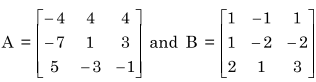 , find AB. Hence, solve the system of linear equations:
\(x - y + z = 4\)
\(x - 2y - 2z = 9\)
\(2x + y + 3z = 1\)
View Solution
Step 1: Find the product AB
\[ AB = \begin{pmatrix} -4 & 4 & 4
-7 & 1 & 3
5 & -3 & -1 \end{pmatrix} \begin{pmatrix} 1 & -1 & 1
1 & -2 & -2
2 & 1 & 3 \end{pmatrix} \] \[ AB = \begin{pmatrix} (-4)(1)+(4)(1)+(4)(2) & (-4)(-1)+(4)(-2)+(4)(1) & (-4)(1)+(4)(-2)+(4)(3)
(-7)(1)+(1)(1)+(3)(2) & (-7)(-1)+(1)(-2)+(3)(1) & (-7)(1)+(1)(-2)+(3)(3)
(5)(1)+(-3)(1)+(-1)(2) & (5)(-1)+(-3)(-2)+(-1)(1) & (5)(1)+(-3)(-2)+(-1)(3) \end{pmatrix} \] \[ AB = \begin{pmatrix} -4+4+8 & 4-8+4 & -4-8+12
-7+1+6 & 7-2+3 & -7-2+9
5-3-2 & -5+6-1 & 5+6-3 \end{pmatrix} = \begin{pmatrix} 8 & 0 & 0
0 & 8 & 0
0 & 0 & 8 \end{pmatrix} = 8I \]
Step 2: Solve the system of linear equations
The system of equations can be written in matrix form as \(CX = D\), where:
\[ C = \begin{pmatrix} 1 & -1 & 1
1 & -2 & -2
2 & 1 & 3 \end{pmatrix}, \quad X = \begin{pmatrix} x
y
z \end{pmatrix}, \quad D = \begin{pmatrix} 4
9
1 \end{pmatrix} \]
We observe that the coefficient matrix \(C\) is the same as the matrix \(B\). So, the system is \(BX = D\).
The solution to this system is \(X = B^{-1}D\).
Step 3: Use the result from AB
From Step 1, we found that \(AB = 8I\).
Pre-multiplying by \(A^{-1}\) is not useful, but we can post-multiply by \(B^{-1}\):
\[ (AB)B^{-1} = (8I)B^{-1} \] \[ A(BB^{-1}) = 8B^{-1} \] \[ AI = 8B^{-1} \implies A = 8B^{-1} \]
Therefore, the inverse of B is:
\[ B^{-1} = \frac{1}{8}A \]
Step 4: Calculate the solution
Now substitute this into the solution equation:
\[ X = B^{-1}D = \left(\frac{1}{8}A\right)D = \frac{1}{8}(AD) \] \[ \begin{pmatrix} x
y
z \end{pmatrix} = \frac{1}{8} \begin{pmatrix} -4 & 4 & 4
-7 & 1 & 3
5 & -3 & -1 \end{pmatrix} \begin{pmatrix} 4
9
1 \end{pmatrix} \] \[ \begin{pmatrix} x
y
z \end{pmatrix} = \frac{1}{8} \begin{pmatrix} -16 + 36 + 4
-28 + 9 + 3
20 - 27 - 1 \end{pmatrix} = \frac{1}{8} \begin{pmatrix} 24
-16
-8 \end{pmatrix} = \begin{pmatrix} 3
-2
-1 \end{pmatrix} \]
Step 5: Final Answer
The solution is \(x = 3, y = -2, z = -1\).
Quick Tip: When a question asks you to "find AB" and "hence solve" a system of equations, the coefficient matrix of the system will almost always be related to A or B. Look for this connection. If \(AB=kI\), then \(A^{-1} = \frac{1}{k}B\) and \(B^{-1} = \frac{1}{k}A\), which provides a shortcut to finding the inverse.
OR
Question 35 (b):
If 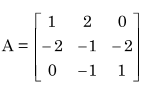 , then find \(A^{-1}\).
Hence, solve the system of linear equations:
\(x - 2y = 10\)
\(2x - y - z = 8\)
\(-2y + z = 7\)
2 & 1 & 2
2 & 1 & 3 \end{pmatrix} \), Solution: x = 0, y = -5, z = -3
View Solution
Step 1: Find the inverse of A
First, calculate the determinant of A:
\[ |A| = 1((-1)(1) - (-2)(-1)) - 2((-2)(1) - (-2)(0)) + 0 = 1(-1-2) - 2(-2) = -3 + 4 = 1 \]
Since \(|A| \neq 0\), the inverse exists.
Next, find the adjugate of A (transpose of the cofactor matrix).
Cofactors are:
\( C_{11} = -3, C_{12} = 2, C_{13} = 2 \)
\( C_{21} = -2, C_{22} = 1, C_{23} = 1 \)
\( C_{31} = -4, C_{32} = 2, C_{33} = 3 \)
The cofactor matrix is \( C = \begin{pmatrix} -3 & 2 & 2
-2 & 1 & 1
-4 & 2 & 3 \end{pmatrix} \).
The adjugate of A is \( adj(A) = C^T = \begin{pmatrix} -3 & -2 & -4
2 & 1 & 2
2 & 1 & 3 \end{pmatrix} \).
The inverse is \( A^{-1} = \frac{1}{|A|}adj(A) = \frac{1}{1}adj(A) = \begin{pmatrix} -3 & -2 & -4
2 & 1 & 2
2 & 1 & 3 \end{pmatrix} \).
Step 2: Solve the system of linear equations
The system can be written in matrix form \(CX = D\). (Using C to avoid confusion with matrix A)
\[ C = \begin{pmatrix} 1 & -2 & 0
2 & -1 & -1
0 & -2 & 1 \end{pmatrix}, \quad X = \begin{pmatrix} x
y
z \end{pmatrix}, \quad D = \begin{pmatrix} 10
8
7 \end{pmatrix} \]
The solution is \(X = C^{-1}D\).
We need to find the relationship between matrix C and matrix A. Let's find the transpose of A:
\[ A^T = \begin{pmatrix} 1 & -2 & 0
2 & -1 & -1
0 & -2 & 1 \end{pmatrix} \]
We see that \(C = A^T\).
Therefore, we need to find \(C^{-1} = (A^T)^{-1}\). Using the property \((A^T)^{-1} = (A^{-1})^T\), we have:
\[ C^{-1} = (A^{-1})^T = \begin{pmatrix} -3 & -2 & -4
2 & 1 & 2
2 & 1 & 3 \end{pmatrix}^T = \begin{pmatrix} -3 & 2 & 2
-2 & 1 & 1
-4 & 2 & 3 \end{pmatrix} \]
Now we can find the solution:
\[ X = C^{-1}D = \begin{pmatrix} -3 & 2 & 2
-2 & 1 & 1
-4 & 2 & 3 \end{pmatrix} \begin{pmatrix} 10
8
7 \end{pmatrix} \] \[ \begin{pmatrix} x
y
z \end{pmatrix} = \begin{pmatrix} (-3)(10)+(2)(8)+(2)(7)
(-2)(10)+(1)(8)+(1)(7)
(-4)(10)+(2)(8)+(3)(7) \end{pmatrix} = \begin{pmatrix} -30+16+14
-20+8+7
-40+16+21 \end{pmatrix} = \begin{pmatrix} 0
-5
-3 \end{pmatrix} \]
Step 3: Final Answer
The solution is \(x = 0, y = -5, z = -3\).
Quick Tip: In "Hence, solve..." type problems, the coefficient matrix of the system is always related to the matrix given earlier. It could be the matrix itself, its transpose, or a scalar multiple. Always check for the transpose relationship, as \( (A^T)^{-1} = (A^{-1})^T \).
Case Study Setup
A school is organizing a debate competition with participants as speakers S = \(\{S_1, S_2, S_3, S_4\}\) and these are judged by judges J = \(\{J_1, J_2, J_3\}\). Each speaker can be assigned one judge. Let R be a relation from set S to J defined as R = \(\{(x, y) : speaker x is judged by judge y, x \in S, y \in J\}\).

36 (i). How many relations can be there from S to J?
View Solution
Step 1: Understanding the Concept:
A relation from a set A to a set B is any subset of the Cartesian product \(A \times B\). The total number of possible relations is the total number of subsets of \(A \times B\), which is \(2^{n(A \times B)}\).
Step 2: Key Formula or Approach:
1. Find the number of elements in the domain (S) and co-domain (J).
2. Calculate the number of elements in the Cartesian product \(S \times J\), which is \(n(S) \times n(J)\).
3. The total number of relations is \(2^{n(S) \times n(J)}\).
Step 3: Detailed Explanation:
We have the set of speakers \(S = \{S_1, S_2, S_3, S_4\}\), so \(n(S) = 4\).
We have the set of judges \(J = \{J_1, J_2, J_3\}\), so \(n(J) = 3\).
The Cartesian product \(S \times J\) consists of all possible ordered pairs \((s, j)\) where \(s \in S\) and \(j \in J\). The total number of such pairs is:
\[ n(S \times J) = n(S) \times n(J) = 4 \times 3 = 12 \]
A relation is any subset of these 12 pairs. The number of subsets of a set with 12 elements is \(2^{12}\).
\[ 2^{12} = 2^{10} \times 2^2 = 1024 \times 4 = 4096 \]
Step 4: Final Answer:
There can be 4096 possible relations from set S to set J.
Quick Tip: Do not confuse the number of relations with the number of functions. The number of functions is \(n(J)^{n(S)}\), but the number of relations is \(2^{n(S) \times n(J)}\). A relation is a much more general concept.
A student identifies a function from S to J as \(f = \{(S_1, J_1), (S_2, J_2), (S_3, J_2), (S_4, J_3)\}\). Check if it is bijective.
View Solution
Step 1: Understanding the Concept:
A function is bijective if it is both one-to-one (injective) and onto (surjective).
- One-to-one (injective): Different elements in the domain map to different elements in the co-domain. No two speakers are judged by the same judge.
- Onto (surjective): Every element in the co-domain is an image of at least one element from the domain. Every judge is assigned at least one speaker.
Step 2: Detailed Explanation:
The given function is \(f = \{(S_1, J_1), (S_2, J_2), (S_3, J_2), (S_4, J_3)\}\).
Check for one-to-one (injective):
We can see that both speaker \(S_2\) and speaker \(S_3\) are mapped to the same judge, \(J_2\). That is, \(f(S_2) = J_2\) and \(f(S_3) = J_2\). Since two different inputs have the same output, the function is not one-to-one.
Check for onto (surjective):
The co-domain is \(J = \{J_1, J_2, J_3\}\). The set of images (the range) is \(\{f(S_1), f(S_2), f(S_3), f(S_4)\} = \{J_1, J_2, J_3\}\). Since the range is equal to the co-domain, the function is onto.
Step 3: Final Answer:
For a function to be bijective, it must be both one-to-one and onto. Since this function is not one-to-one, it is not bijective.
Quick Tip: A function from a set A to a set B cannot be one-to-one if \(n(A) > n(B)\). Here, \(n(S) = 4\) and \(n(J) = 3\), so no function from S to J can ever be one-to-one, and therefore, no function can be bijective.
How many one-one functions can be there from set S to set J?
View Solution
Step 1: Understanding the Concept:
A function is one-to-one (injective) if every element in the domain maps to a unique element in the co-domain. This means that if \(f(x_1) = f(x_2)\), then \(x_1 = x_2\).
Step 2: Key Formula or Approach:
For a one-to-one function to exist from a set A to a set B, the number of elements in the domain must be less than or equal to the number of elements in the co-domain, i.e., \(n(A) \leq n(B)\).
Step 3: Detailed Explanation:
The domain is the set of speakers S, with \(n(S) = 4\).
The co-domain is the set of judges J, with \(n(J) = 3\).
Here, we have \(n(S) > n(J)\).
By the Pigeonhole Principle, if you try to map 4 speakers to 3 judges, at least one judge must be assigned to more than one speaker. This violates the condition for a function to be one-to-one.
Step 4: Final Answer:
Since the number of elements in the domain is greater than the number of elements in the co-domain, it is impossible to create a one-to-one function. Therefore, the number of one-one functions is 0.
Quick Tip: The number of one-to-one functions from A to B is given by \(^{n(B)}P_{n(A)}\) if \(n(A) \leq n(B)\), and 0 if \(n(A) > n(B)\). This provides a quick check for such questions.
OR
Question (iii) (b):
Another student considers a relation \(R_1 = \{(S_1, S_2), (S_2, S_4)\}\) in set S. Write minimum ordered pairs to be included in \(R_1\) so that \(R_1\) is reflexive but not symmetric.
View Solution
Step 1: Understanding the Concept:
The question asks us to augment the given relation \(R_1\) to satisfy two conditions: it must be reflexive, and it must not be symmetric.
- Reflexive: A relation R on a set A is reflexive if \((x, x) \in R\) for every element \(x \in A\).
- Not Symmetric: A relation is not symmetric if there exists at least one pair \((x, y) \in R\) such that its reverse, \((y, x)\), is not in R.
Step 2: Detailed Explanation:
The base set is \(S = \{S_1, S_2, S_3, S_4\}\). The given relation is \(R_1 = \{(S_1, S_2), (S_2, S_4)\}\).
Making it Reflexive:
For \(R_1\) to be reflexive, it must contain the pair \((x, x)\) for all \(x \in S\). The minimum pairs we must add to achieve this are:
\((S_1, S_1), (S_2, S_2), (S_3, S_3), (S_4, S_4)\).
After adding these, the new relation becomes:
\(R' = \{(S_1, S_2), (S_2, S_4), (S_1, S_1), (S_2, S_2), (S_3, S_3), (S_4, S_4)\}\).
Checking for Non-Symmetry:
Now we must check if this new relation \(R'\) is not symmetric.
The relation contains the pair \((S_1, S_2)\). For the relation to be symmetric, it would also need to contain the pair \((S_2, S_1)\). Since \((S_2, S_1)\) is not in \(R'\), the relation is not symmetric.
Similarly, it contains \((S_2, S_4)\) but not \((S_4, S_2)\), which also confirms it is not symmetric.
Since the added pairs already ensure the non-symmetric property is maintained, we do not need to add or remove any other pairs.
Step 3: Final Answer:
The minimum ordered pairs to be included are those required for reflexivity: \(\{(S_1, S_1), (S_2, S_2), (S_3, S_3), (S_4, S_4)\}\).
Quick Tip: When asked to add the "minimum" number of pairs to satisfy a property like reflexivity, only add the pairs that are strictly required by the definition. Then, check if the other conditions (like non-symmetry) are already met.
Case Study Setup
Three persons viz. Amber, Bonzi and Comet are manufacturing cars which run on petrol and on battery as well. Their production share in the market is 60%, 30% and 10% respectively. Of their respective production capacities, 20%, 10% and 5% cars respectively are electric (or battery operated).

37 (i) (a). What is the probability that a randomly selected car is an electric car?
View Solution
Step 1: Understanding the Concept:
We need to find the overall probability of a car being electric, P(E). Since a car can be electric and made by Amber, or electric and made by Bonzi, or electric and made by Comet, we use the Law of Total Probability.
Step 2: Key Formula or Approach:
The Law of Total Probability states:
\[ P(E) = P(A)P(E|A) + P(B)P(E|B) + P(C)P(E|C) \]
Step 3: Detailed Explanation:
Using the probabilities identified in the case study setup:
- \(P(A) = 0.60, P(E|A) = 0.20\)
- \(P(B) = 0.30, P(E|B) = 0.10\)
- \(P(C) = 0.10, P(E|C) = 0.05\)
Substitute these values into the formula:
\[ P(E) = (0.60 \times 0.20) + (0.30 \times 0.10) + (0.10 \times 0.05) \] \[ P(E) = 0.120 + 0.030 + 0.005 \] \[ P(E) = 0.155 \]
Step 4: Final Answer:
The probability that a randomly selected car is an electric car is 0.155 or 15.5%.
Quick Tip: The Law of Total Probability is used to find the probability of an event (like 'electric car') by summing the probabilities of its occurrences under all possible mutually exclusive conditions (the manufacturers).
OR
Question (i) (b):
What is the probability that a randomly selected car is a petrol car?
View Solution
Step 1: Understanding the Concept:
Since the cars are either petrol or electric (battery operated), the event 'petrol car' (P) is the complement of the event 'electric car' (E). We can find the probability of a car being petrol by subtracting the probability of it being electric from 1.
Step 2: Key Formula or Approach:
Using the complement rule:
\[ P(P) = 1 - P(E) \]
Alternatively, we can use the Law of Total Probability for petrol cars:
\[ P(P) = P(A)P(P|A) + P(B)P(P|B) + P(C)P(P|C) \]
Step 3: Detailed Explanation:
Method 1: Using the Complement Rule
From the previous question (i)(a), we calculated that the probability of a car being electric is \(P(E) = 0.155\).
\[ P(P) = 1 - P(E) = 1 - 0.155 = 0.845 \]
Method 2: Using the Law of Total Probability
Using the probabilities derived in the case study setup:
- \(P(A) = 0.60, P(P|A) = 0.80\)
- \(P(B) = 0.30, P(P|B) = 0.90\)
- \(P(C) = 0.10, P(P|C) = 0.95\)
\[ P(P) = (0.60 \times 0.80) + (0.30 \times 0.90) + (0.10 \times 0.95) \] \[ P(P) = 0.480 + 0.270 + 0.095 \] \[ P(P) = 0.845 \]
Both methods give the same result.
Step 4: Final Answer:
The probability that a randomly selected car is a petrol car is 0.845 or 84.5%.
Quick Tip: If you have already calculated the probability of an event, always check if the next question asks for the probability of its complement. Using the rule \(P(not A) = 1 - P(A)\) is often much faster than recalculating from scratch.
A car is selected at random and is found to be electric. What is the probability that it was manufactured by Comet?
View Solution
Step 1: Understanding the Concept:
This question asks for a conditional probability, specifically \(P(C|E)\) - the probability that the car was made by Comet, given that it is electric. This is a classic application of Bayes' Theorem.
Step 2: Key Formula or Approach:
Bayes' Theorem states:
\[ P(C|E) = \frac{P(C)P(E|C)}{P(E)} \]
Step 3: Detailed Explanation:
We need the following values, most of which were calculated previously:
- \(P(C)P(E|C)\) is the probability that a car is made by Comet AND is electric.
\(P(C \cap E) = P(C)P(E|C) = 0.10 \times 0.05 = 0.005\).
- \(P(E)\) is the total probability of a car being electric, which we found in part (i)(a) to be 0.155.
Now, apply Bayes' Theorem:
\[ P(C|E) = \frac{0.005}{0.155} \]
To simplify the fraction, multiply the numerator and denominator by 1000:
\[ P(C|E) = \frac{5}{155} \]
Divide both by 5:
\[ P(C|E) = \frac{1}{31} \]
Step 4: Final Answer:
The probability that the electric car was manufactured by Comet is \(\frac{1}{31}\).
Quick Tip: Bayes' Theorem problems often follow questions about total probability. The answer to the total probability question (\(P(E)\) in this case) becomes the denominator in the Bayes' Theorem calculation.
A car is selected at random and is found to be electric. What is the probability that it was manufactured by Amber or Bonzi?
View Solution
Step 1: Understanding the Concept:
We are asked to find the probability that a car was made by Amber or Bonzi, given that it is electric. This can be written as \(P(A \cup B | E)\). Since A and B are mutually exclusive events (a car cannot be made by both), this is equal to \(P(A|E) + P(B|E)\). Alternatively, we can use the complement rule.
Step 2: Key Formula or Approach:
Method 1: Sum of Probabilities
Calculate \(P(A|E)\) and \(P(B|E)\) using Bayes' theorem and add them.
Method 2: Complement Rule
The event "manufactured by Amber or Bonzi" is the complement of the event "manufactured by Comet". Therefore, \(P(A \cup B | E) = 1 - P(C | E)\).
Step 3: Detailed Explanation:
Method 2: Complement Rule (Easiest)
From the previous question (ii), we found the probability that the electric car was made by Comet:
\[ P(C|E) = \frac{1}{31} \]
The only other manufacturers are Amber and Bonzi. Therefore, the probability that the electric car was made by either Amber or Bonzi is the complement of it being made by Comet.
\[ P(A \cup B | E) = 1 - P(C|E) = 1 - \frac{1}{31} = \frac{30}{31} \]
Method 1: Sum of Probabilities (for verification)
First, find \(P(A|E)\):
\[ P(A|E) = \frac{P(A)P(E|A)}{P(E)} = \frac{0.60 \times 0.20}{0.155} = \frac{0.120}{0.155} = \frac{120}{155} = \frac{24}{31} \]
Next, find \(P(B|E)\):
\[ P(B|E) = \frac{P(B)P(E|B)}{P(E)} = \frac{0.30 \times 0.10}{0.155} = \frac{0.030}{0.155} = \frac{30}{155} = \frac{6}{31} \]
Now, add them:
\[ P(A|E) + P(B|E) = \frac{24}{31} + \frac{6}{31} = \frac{30}{31} \]
Both methods yield the same result.
Step 4: Final Answer:
The probability that the electric car was manufactured by Amber or Bonzi is \(\frac{30}{31}\).
Quick Tip: When a probability question involves "or" and the events cover all but one possibility, using the complement rule is almost always the fastest method.
Case Study Setup
A small town is analyzing the pattern of a new street light installation. The lights are set up in such a way that the intensity of light at any point x metres from the start of the street can be modelled by \( f(x) = e^x \sin x \), where x is in metres.

Based on the above, answer the following:
38 (i). Find the intervals on which the f(x) is increasing or decreasing, \(x \in [0, \pi]\).
View Solution
Step 1: Understanding the Concept:
A function is increasing where its first derivative is non-negative (\(f'(x) \geq 0\)) and decreasing where its first derivative is non-positive (\(f'(x) \leq 0\)). We need to find the critical points by setting \(f'(x) = 0\) and then test the sign of \(f'(x)\) in the intervals created by these points.
Step 2: Finding Critical Points
From the setup, we have \(f'(x) = e^x(\sin x + \cos x)\).
Set \(f'(x) = 0\):
\[ e^x(\sin x + \cos x) = 0 \]
Since \(e^x\) is always positive (\(e^x > 0\)), we only need to solve:
\[ \sin x + \cos x = 0 \] \[ \sin x = -\cos x \] \[ \tan x = -1 \]
In the given interval \(x \in [0, \pi]\), the only value of x for which \(\tan x = -1\) is \(x = \frac{3\pi}{4}\).
This critical point divides the interval \([0, \pi]\) into two sub-intervals: \( [0, \frac{3\pi}{4}) \) and \( (\frac{3\pi}{4}, \pi] \).
Step 3: Determining Intervals of Increase and Decrease
We test the sign of \(f'(x)\) in each sub-interval.
Interval 1: \( [0, \frac{3\pi}{4}) \)
Let's choose a test point, for example, \(x = \frac{\pi}{2}\).
\[ f'\left(\frac{\pi}{2}\right) = e^{\pi/2}\left(\sin\frac{\pi}{2} + \cos\frac{\pi}{2}\right) = e^{\pi/2}(1 + 0) = e^{\pi/2} > 0 \]
Since \(f'(x) > 0\), the function is increasing on \( [0, \frac{3\pi}{4}] \).
Interval 2: \( (\frac{3\pi}{4}, \pi] \)
Let's choose a test point, for example, \(x = \pi\).
\[ f'(\pi) = e^{\pi}(\sin\pi + \cos\pi) = e^{\pi}(0 - 1) = -e^{\pi} < 0 \]
Since \(f'(x) < 0\), the function is decreasing on \( [\frac{3\pi}{4}, \pi] \).
Step 4: Final Answer:
The function \(f(x)\) is increasing on the interval \( [0, \frac{3\pi}{4}] \) and decreasing on the interval \( [\frac{3\pi}{4}, \pi] \).
Quick Tip: To solve \(\sin x + \cos x = 0\), an alternative method is to multiply by \(\frac{1}{\sqrt{2}}\), which gives \(\frac{1}{\sqrt{2}}\sin x + \frac{1}{\sqrt{2}}\cos x = \sin(x + \frac{\pi}{4}) = 0\). This can be easier to solve than using the tangent function.
Verify, whether each critical point when \(x \in [0, \pi]\) is a point of local maximum or local minimum or a point of inflexion.
View Solution
Step 1: Understanding the Concept:
We use the Second Derivative Test to classify the critical point found in part (i).
- If \(f''(c) < 0\) at a critical point \(c\), it is a local maximum.
- If \(f''(c) > 0\), it is a local minimum.
- If \(f''(c) = 0\), the test is inconclusive, and the point might be a point of inflection. A point of inflection is where the concavity of the function changes, which happens when \(f''(x)\) changes sign.
Step 2: Applying the Second Derivative Test
The only critical point within the open interval \((0, \pi)\) is \(x = \frac{3\pi}{4}\).
From the case study setup, the second derivative is \(f''(x) = 2e^x \cos x\).
Now, we evaluate the second derivative at the critical point \(x = \frac{3\pi}{4}\):
\[ f''\left(\frac{3\pi}{4}\right) = 2e^{3\pi/4} \cos\left(\frac{3\pi}{4}\right) \]
We know that \(\cos\left(\frac{3\pi}{4}\right)\) is in the second quadrant, where cosine is negative. Specifically, \(\cos\left(\frac{3\pi}{4}\right) = -\frac{1}{\sqrt{2}}\).
The term \(2e^{3\pi/4}\) is positive.
Therefore,
\[ f''\left(\frac{3\pi}{4}\right) = 2e^{3\pi/4} \left(-\frac{1}{\sqrt{2}}\right) = -\sqrt{2} e^{3\pi/4} \]
Since \(f''\left(\frac{3\pi}{4}\right) < 0\), the function has a local maximum at \(x = \frac{3\pi}{4}\).
Step 3: Checking for Points of Inflection
A point of inflection occurs where \(f''(x) = 0\) and changes sign. Let's find where this happens.
\[ f''(x) = 2e^x \cos x = 0 \]
Since \(2e^x \neq 0\), we must have \(\cos x = 0\).
In the interval \([0, \pi]\), the solution is \(x = \frac{\pi}{2}\).
At \(x = \frac{\pi}{2}\), the concavity changes, making it a point of inflection. However, the question asks to classify the critical point from \(f'(x)=0\), which is \(x = \frac{3\pi{4}\). Since \(f''(\frac{3\pi}{4}) \neq 0\), the critical point is not a point of inflection.
Step 4: Final Answer:
The critical point at \(x = \frac{3\pi}{4}\) is a point of local maximum.
Quick Tip: Be careful with the terminology. A critical point is where \(f'(x)=0\) or is undefined. A point of inflection is where \(f''(x)=0\) and changes sign. These are generally different points, as shown in this problem.
*The article might have information for the previous academic years, please refer the official website of the exam.