
CBSE Class 12 Mathematics (Set 2 - 65/2/2) Question Paper 2026 with Solutions


| Updated On - Mar 9, 2026
CBSE Class 12 Mathematics (Set 2 - 65/2/2) Question Paper 2026 with Solutions PDFs is available here for download. CBSE Board is conducting the Class 12 Mathematics Exam 2026 on March 09, 2026. CBSE Board Class 12 the examination was held in the first half from 10:30 AM to 1:30 PM. The official question paper of CBSE Board Class 12 Mathematics Exam 2026 is provided below. Students can download the official paper in PDF format for reference.
CBSE Class 12 Mathematics (Set 2 - 65/2/2) Question Paper 2026 with Solutions PDFs
| CBSE Class 12 Mathematics (Set 2 - 65/2/2) Question Paper 2026 | Download PDF | Check Solutions |
\(\int \frac{dx}{1 + \cos x}\) is equal to
View Solution
Step 1: Understanding the Concept:
The given problem is an indefinite integral involving a trigonometric expression in the denominator.
The objective is to simplify the expression using trigonometric identities to convert it into a standard integrable form.
Step 2: Key Formula or Approach:
We use the half-angle identity for cosine:
\[ 1 + \cos x = 2 \cos^2 \left(\frac{x}{2}\right) \]
The integral of the squared secant function is:
\[ \int \sec^2 u \, du = \tan u + C \]
Step 3: Detailed Explanation:
Substitute the identity \(1 + \cos x = 2 \cos^2 \left(\frac{x}{2}\right)\) into the integral:
\[ I = \int \frac{dx}{2 \cos^2 \left(\frac{x}{2}\right)} \]
Take the constant factor \(\frac{1}{2}\) outside the integral:
\[ I = \frac{1}{2} \int \frac{1}{\cos^2 \left(\frac{x}{2}\right)} \, dx \]
Using the reciprocal identity \(\frac{1}{\cos^2 \theta} = \sec^2 \theta\), we get:
\[ I = \frac{1}{2} \int \sec^2 \left(\frac{x}{2}\right) \, dx \]
Integrating with respect to \(x\):
\[ I = \frac{1}{2} \left[ \frac{\tan\left(\frac{x}{2}\right)}{1/2} \right] + C \]
The \(\frac{1}{2}\) in the numerator and denominator cancel each other out:
\[ I = \tan \left(\frac{x}{2}\right) + C \]
Step 4: Final Answer:
The value of the integral is \(\tan \frac{x}{2} + C\).
Quick Tip: To simplify denominators with \(1 \pm \cos x\), always apply the half-angle formulas to transform them into a single term.
This usually leads to standard integrals like \(\sec^2 u\) or \(cosec^2 u\).
For \(f(x) = x + \frac{1}{x} \ (x \neq 0)\)
View Solution
Step 1: Understanding the Concept:
To find local extrema, we identify critical points where the derivative is zero and use the second derivative test to determine their nature.
Step 2: Key Formula or Approach:
1. Find \(f'(x)\) and solve \(f'(x) = 0\) for critical points.
2. Use the second derivative \(f''(x)\):
- If \(f''(x) > 0\), the point is a local minimum.
- If \(f''(x) < 0\), the point is a local maximum.
Step 3: Detailed Explanation:
Given \(f(x) = x + \frac{1}{x}\).
First derivative:
\[ f'(x) = 1 - \frac{1}{x^2} \]
For critical points, set \(f'(x) = 0\):
\[ 1 - \frac{1}{x^2} = 0 \Rightarrow x^2 = 1 \Rightarrow x = 1, -1 \]
Second derivative:
\[ f''(x) = \frac{2}{x^3} \]
At \(x = 1\):
\[ f''(1) = \frac{2}{1^3} = 2 > 0 \]
So, \(x = 1\) is a local minimum. Value: \(f(1) = 1 + \frac{1}{1} = 2\).
At \(x = -1\):
\[ f''(-1) = \frac{2}{(-1)^3} = -2 < 0 \]
So, \(x = -1\) is a local maximum. Value: \(f(-1) = -1 + \frac{1}{-1} = -2\).
Checking the options:
Option (C) states local maximum value is \(-2\), which matches our result.
Step 4: Final Answer:
The function has a local maximum value of \(-2\) at \(x = -1\).
Quick Tip: For the function \(x + \frac{1}{x}\), remember that the local minimum value (2) is actually greater than the local maximum value (\(-2\)) because of the discontinuity at \(x = 0\).
Which of the following expressions will give the area of region bounded by the curve \(y = x^2\) and line \(y = 16\) ?
View Solution
Step 1: Understanding the Concept:
The area bounded by a curve \(x = f(y)\) and the \(y\)-axis from \(y = a\) to \(y = b\) is given by \(\int_{a}^{b} f(y) \, dy\).
If the region is symmetric, we can integrate half the region and double the result.
Step 2: Key Formula or Approach:
The curve \(y = x^2\) can be written as \(x = \sqrt{y}\) for the right side (\(x > 0\)).
The total area is bounded by \(y=16\) and is symmetric about the \(y\)-axis.
Step 3: Detailed Explanation:
The curve \(y = x^2\) is a parabola symmetric about the \(y\)-axis.
The region is bounded by the line \(y = 16\) and the curve.
Integrating along the \(y\)-axis from \(y = 0\) to \(y = 16\):
The area in the first quadrant is \(\int_{0}^{16} \sqrt{y} \, dy\).
Due to symmetry, the area in the second quadrant is identical.
Thus, the total area \(= 2 \times \int_{0}^{16} \sqrt{y} \, dy\).
Step 4: Final Answer:
The expression for the area is \(2 \int_{0}^{16} \sqrt{y} \, dy\).
Quick Tip: Integrating along the \(y\)-axis is often easier when the upper boundary is a horizontal line like \(y = k\).
Always check for symmetry to avoid missing parts of the region.
The general solution of the differential equation \(x \, dy - y \, dx = 0\) is
View Solution
Step 1: Understanding the Concept:
This is a first-order ordinary differential equation which can be solved using the variable separation method.
Step 2: Key Formula or Approach:
Separate variables so that \(y\)-terms are with \(dy\) and \(x\)-terms are with \(dx\):
\[ \frac{dy}{y} = \frac{dx}{x} \]
Step 3: Detailed Explanation:
Given: \(x \, dy - y \, dx = 0\).
Rearranging terms:
\[ x \, dy = y \, dx \]
Dividing both sides by \(xy\):
\[ \frac{dy}{y} = \frac{dx}{x} \]
Integrating both sides:
\[ \int \frac{dy}{y} = \int \frac{dx}{x} \]
\[ \log |y| = \log |x| + \log |C| \]
Using properties of logarithms:
\[ \log |y| = \log |Cx| \]
Removing logs:
\[ y = Cx \Rightarrow x = \frac{1}{C} y \]
Let \(k = \frac{1}{C}\) be the arbitrary constant.
\[ x = ky \]
Step 4: Final Answer:
The general solution is \(x = ky\).
Quick Tip: Differential equations representing lines through the origin always take the simplified form \(y = mx\) or \(x = ky\).
The integrating factor of the differential equation \(2x \frac{dy}{dx} - y = 3\) is
View Solution
Step 1: Understanding the Concept:
A linear differential equation in standard form \(\frac{dy}{dx} + P(x)y = Q(x)\) has an integrating factor given by \(e^{\int P(x) dx}\).
Step 2: Key Formula or Approach:
Convert the equation to standard form:
\[ \frac{dy}{dx} - \frac{1}{2x} y = \frac{3}{2x} \]
Here, \(P(x) = -\frac{1}{2x}\).
Step 3: Detailed Explanation:
Calculating the integrating factor (I.F.):
\[ I.F. = e^{\int P(x) \, dx} = e^{\int -\frac{1}{2x} \, dx} \]
\[ I.F. = e^{-\frac{1}{2} \log x} \]
Using logarithmic properties:
\[ I.F. = e^{\log(x^{-1/2})} \]
Since \(e^{\log f(x)} = f(x)\):
\[ I.F. = x^{-1/2} = \frac{1}{\sqrt{x}} \]
Step 4: Final Answer:
The integrating factor is \(\frac{1}{\sqrt{x}}\).
Quick Tip: Always ensure the coefficient of \(\frac{dy}{dx}\) is 1 before identifying \(P(x)\). Failing to do so is a common error.
If \(|\vec{a}| = 5\) and \(-2 \le \lambda \le 1\), then the sum of greatest and the smallest value of \(|\lambda \vec{a}|\) is
View Solution
Step 1: Understanding the Concept:
The magnitude of a scalar multiple of a vector is given by \(|\lambda \vec{a}| = |\lambda| \cdot |\vec{a}|\).
Step 2: Key Formula or Approach:
Identify the maximum and minimum values of the absolute value \(|\lambda|\) in the given interval \([-2, 1]\).
Step 3: Detailed Explanation:
Given \(|\vec{a}| = 5\).
The expression is \(|\lambda \vec{a}| = 5|\lambda|\).
Interval for \(\lambda\) is \([-2, 1]\).
- The smallest value of \(|\lambda|\) in this range is \(0\) (at \(\lambda = 0\)).
- The greatest value of \(|\lambda|\) in this range is \(|-2| = 2\).
Smallest value of \(|\lambda \vec{a}| = 5 \times 0 = 0\).
Greatest value of \(|\lambda \vec{a}| = 5 \times 2 = 10\).
Sum \(= 10 + 0 = 10\).
Step 4: Final Answer:
The sum is 10.
Quick Tip: Magnitude is always non-negative. Even if \(\lambda\) ranges into negative numbers, \(|\lambda|\) will start from \(0\) if the interval includes zero.
Vector of magnitude 3 making equal angles with \(x\) and \(y\) axes and perpendicular to \(z\) axis is
View Solution
Step 1: Understanding the Concept:
A vector is defined by its magnitude and its direction cosines \((l, m, n)\), where \(l^2 + m^2 + n^2 = 1\).
Step 2: Key Formula or Approach:
1. Perpendicular to \(z\)-axis means \(\gamma = 90^\circ \Rightarrow n = \cos 90^\circ = 0\).
2. Equal angles with \(x\) and \(y\) axes means \(\alpha = \beta \Rightarrow l = m\).
Step 3: Detailed Explanation:
From \(l^2 + m^2 + n^2 = 1\):
\[ l^2 + l^2 + 0^2 = 1 \Rightarrow 2l^2 = 1 \Rightarrow l = \frac{1}{\sqrt{2}} \]
So, \(l = \frac{1}{\sqrt{2}}, m = \frac{1}{\sqrt{2}}, n = 0\).
Vector \(= magnitude \times (l\hat{i} + m\hat{j} + n\hat{k})\)
Vector \(= 3 \left( \frac{1}{\sqrt{2}}\hat{i} + \frac{1}{\sqrt{2}}\hat{j} \right) = \frac{3}{\sqrt{2}}\hat{i} + \frac{3}{\sqrt{2}}\hat{j}\)
Multiply numerator and denominator by \(\sqrt{2}\):
Vector \(= \frac{3\sqrt{2}}{2}\hat{i} + \frac{3\sqrt{2}}{2}\hat{j}\).
Step 4: Final Answer:
The vector is \(\frac{3\sqrt{2}}{2} \hat{i} + \frac{3\sqrt{2}}{2} \hat{j}\).
Quick Tip: "Perpendicular to \(z\)-axis" means the \(\hat{k}\) component is zero. This immediately rules out options (B) and (D).
Direction cosines of line \(x = y = 1 - z\) are
View Solution
Step 1: Understanding the Concept:
To find direction cosines, first write the line in standard Cartesian form \(\frac{x-x_1}{a} = \frac{y-y_1}{b} = \frac{z-z_1}{c}\).
Step 2: Key Formula or Approach:
The direction ratios are \((a, b, c)\). The direction cosines are obtained by normalizing:
\[ l = \frac{a}{\sqrt{a^2+b^2+c^2}}, \ m = \frac{b}{\sqrt{a^2+b^2+c^2}}, \ n = \frac{c}{\sqrt{a^2+b^2+c^2}} \]
Step 3: Detailed Explanation:
The given equation is \(x = y = 1 - z\).
Rewrite in standard form:
\[ \frac{x}{1} = \frac{y}{1} = \frac{z - 1}{-1} \]
Direction ratios are \((1, 1, -1)\).
Calculate magnitude: \(\sqrt{1^2 + 1^2 + (-1)^2} = \sqrt{3}\).
Direction cosines are: \(\frac{1}{\sqrt{3}}, \frac{1}{\sqrt{3}}, \frac{-1}{\sqrt{3}}\).
Step 4: Final Answer:
The direction cosines are \(\frac{1}{\sqrt{3}}, \frac{1}{\sqrt{3}}, \frac{-1}{\sqrt{3}}\).
Quick Tip: Always ensure the coefficient of the variables (\(x, y, z\)) is \(+1\) in the numerator before identifying direction ratios.
In a linear programming problem, the linear function which has to be maximized or minimized is called
View Solution
Step 1: Understanding the Concept:
Linear programming involves optimizing a specific mathematical function within a set of constraints.
Step 2: Key Formula or Approach:
Define the standard components of an LPP: objective function and constraints.
Step 3: Detailed Explanation:
- Objective Function: This is the linear function (e.g., \(Z = ax + by\)) representing profit or cost that needs to be maximized or minimized.
- Constraint: These are the linear inequalities that define the limitations or boundaries of the variables.
- Feasible region: The common region determined by all constraints.
Step 4: Final Answer:
The function to be optimized is the objective function.
Quick Tip: In any LPP, the "objective" is the "goal", which is why the function to be optimized is named the objective function.
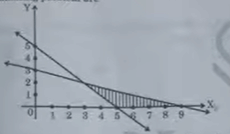
For the feasible region shown below, the non-trivial constraints of the linear programming problem are
View Solution
Step 1: Understanding the Concept:
Identify equations of boundary lines using intercepts and then determine the inequality direction based on the shaded region.
Step 2: Key Formula or Approach:
Use the intercept form: \(\frac{x}{a} + \frac{y}{b} = 1\).
Step 3: Detailed Explanation:
1. Line 1: Intercepts are \((5,0)\) and \((0,5)\).
Equation: \(\frac{x}{5} + \frac{y}{5} = 1 \Rightarrow x + y = 5\).
The shaded region is on the side away from the origin \((0,0)\). Testing \((0,0)\) gives \(0 < 5\). Since it's on the other side, the inequality is \(x + y \ge 5\).
2. Line 2: Intercepts are \((9,0)\) and \((0,3)\).
Equation: \(\frac{x}{9} + \frac{y}{3} = 1 \Rightarrow x + 3y = 9\).
The shaded region is on the same side as the origin. Testing \((0,0)\) gives \(0 < 9\). So the inequality is \(x + 3y \le 9\).
Step 4: Final Answer:
The constraints are \(x + y \ge 5\) and \(x + 3y \le 9\).
Quick Tip: Quickly find the equations using \(\frac{x}{x-intercept} + \frac{y}{y-intercept} = 1\). This saves time during exams.
For two events A and B such that \(P(A) \neq 0\) and \(P(B) \neq 1\), \(P(A'|B') = \)
View Solution
Step 1: Understanding the Concept:
Use the definition of conditional probability and De Morgan's laws for sets.
Step 2: Key Formula or Approach:
1. \(P(X|Y) = \frac{P(X \cap Y)}{P(Y)}\)
2. \(A' \cap B' = (A \cup B)'\)
Step 3: Detailed Explanation:
From the definition:
\[ P(A'|B') = \frac{P(A' \cap B')}{P(B')} \]
Applying De Morgan's Law:
\[ P(A' \cap B') = P((A \cup B)') \]
Since \(P(E') = 1 - P(E)\):
\[ P((A \cup B)') = 1 - P(A \cup B) \]
Substituting this back:
\[ P(A'|B') = \frac{1 - P(A \cup B)}{P(B')} \]
Step 4: Final Answer:
The correct expression is \(\frac{1 - P(A \cup B)}{P(B')}\).
Quick Tip: Intersection of complements equals the complement of the union. This is a very frequent substitution in probability questions.
A relation R on set \(A = \{1, 2, 3\}\) defined as \(R = \{(1, 2), (2, 1), (2, 2)\}\) is
View Solution
Step 1: Understanding the Concept:
A relation is:
- Reflexive if \((a, a) \in R\) for all \(a \in A\).
- Symmetric if \((a, b) \in R \Rightarrow (b, a) \in R\).
- Transitive if \((a, b) \in R\) and \((b, c) \in R \Rightarrow (a, c) \in R\).
Step 2: Key Formula or Approach:
Systematically check each property using elements from the given set \(A\) and relation \(R\).
Step 3: Detailed Explanation:
1. Reflexive: \(A = \{1, 2, 3\}\). For \(R\) to be reflexive, it must contain \((1,1), (2,2), (3,3)\). It is missing \((1,1)\) and \((3,3)\). So, not reflexive.
2. Symmetric: \((1,2) \in R\) and \((2,1) \in R\). \((2,2)\) is symmetric to itself. All pairs satisfy the property. So, it is symmetric.
3. Transitive: \((1,2) \in R\) and \((2,1) \in R\). For it to be transitive, \((1,1)\) must be in \(R\). Since \((1,1) \notin R\), it is not transitive.
Step 4: Final Answer:
The relation is symmetric only.
Quick Tip: For transitivity, always check the "bridge" elements. Here, \(1 \to 2 \to 1\) failed because \(1 \to 1\) was missing.
If A and B are square matrices of same order, then which of the following statements is/are always true ?
(i) \((A + B)(A - B) = A^2 - B^2\)
(ii) \(AB = BA\)
(iii) \((A + B)^2 = A^2 + AB + BA + B^2\)
(iv) \(AB = 0 \Rightarrow A = 0\) or \(B = 0\)
View Solution
Step 1: Understanding the Concept:
Matrix multiplication is generally non-commutative (\(AB \neq BA\)), and zero-divisors exist (product can be zero without factors being zero).
Step 2: Key Formula or Approach:
Expand the algebraic expressions using the distributive property of matrix multiplication.
Step 3: Detailed Explanation:
(i) \((A+B)(A-B) = A(A-B) + B(A-B) = A^2 - AB + BA - B^2\). This equals \(A^2 - B^2\) only if \(AB = BA\). Not always true.
(ii) \(AB = BA\) is not a general property. Not always true.
(iii) \((A+B)^2 = (A+B)(A+B) = A^2 + AB + BA + B^2\). This is based strictly on the distributive property. Always true.
(iv) In matrices, \(AB=0\) can happen for non-zero matrices. For example, \(\begin{bmatrix} 0 & 1
0 & 0 \end{bmatrix} \begin{bmatrix} 1 & 0
0 & 0 \end{bmatrix} = \begin{bmatrix} 0 & 0
0 & 0 \end{bmatrix}\). Not always true.
Step 4: Final Answer:
Only statement (iii) is always true.
Quick Tip: Algebraic identities for matrices are different from real numbers because order of multiplication matters. Never assume \(AB = BA\) in a general question.
If \(A = \begin{bmatrix} 1 & a & b
-1 & 2 & c
0 & 5 & 3 \end{bmatrix}\) is a symmetric matrix, then the value of \(3a + b + c\) is
View Solution
Step 1: Understanding the Concept:
A matrix \(A\) is symmetric if \(A = A^T\), which means \(a_{ij} = a_{ji}\) for all \(i, j\).
Step 2: Key Formula or Approach:
Equate the elements across the main diagonal to find the variables \(a, b,\) and \(c\).
Step 3: Detailed Explanation:
From symmetry:
\(a_{12} = a_{21} \Rightarrow a = -1\).
\(a_{13} = a_{31} \Rightarrow b = 0\).
\(a_{23} = a_{32} \Rightarrow c = 5\).
Substitute into the expression \(3a + b + c\):
\[ 3(-1) + 0 + 5 = -3 + 5 = 2 \]
Step 4: Final Answer:
The value is 2.
Quick Tip: In a symmetric matrix, the elements are reflected across the main diagonal. Visualize it like a mirror.
If \(A = \begin{bmatrix} \frac{1}{2} \cos x & -\sin x
\sin x & \frac{1}{2} \cos x \end{bmatrix}\) and \(A + A^T = I\), then value of \(x \in \left[\frac{-\pi}{2}, \frac{\pi}{2}\right]\) is
View Solution
Step 1: Understanding the Concept:
Add a matrix to its transpose and equate it to the identity matrix.
Step 2: Key Formula or Approach:
Equate corresponding elements of the resulting matrix sum to the elements of \(I = \begin{bmatrix} 1 & 0
0 & 1 \end{bmatrix}\).
Step 3: Detailed Explanation:
\(A = \begin{bmatrix} \frac{1}{2} \cos x & -\sin x
\sin x & \frac{1}{2} \cos x \end{bmatrix}, A^T = \begin{bmatrix} \frac{1}{2} \cos x & \sin x
-\sin x & \frac{1}{2} \cos x \end{bmatrix}\)
\(A + A^T = \begin{bmatrix} \cos x & 0
0 & \cos x \end{bmatrix}\)
Since \(A + A^T = I\):
\(\cos x = 1 \Rightarrow x = 0\) for the given interval.
Step 4: Final Answer:
The value of \(x\) is 0.
Quick Tip: The off-diagonal elements \((-\sin x + \sin x)\) always cancel out when adding a matrix like this to its transpose. Only focus on the diagonal.
For a square matrix A, \((3A)^{-1} = \)
View Solution
Step 1: Understanding the Concept:
The inverse of a scalar product of a matrix follows a specific scaling property.
Step 2: Key Formula or Approach:
For any non-zero scalar \(k\) and non-singular matrix \(A\):
\[ (kA)^{-1} = \frac{1}{k} A^{-1} \]
Step 3: Detailed Explanation:
Let \(B = 3A\). We need \(B^{-1}\).
\(B \cdot B^{-1} = I \Rightarrow (3A) \cdot B^{-1} = I\).
Multiply by \(A^{-1}\) on the left:
\(3(A^{-1}A)B^{-1} = A^{-1}I \Rightarrow 3IB^{-1} = A^{-1}\).
\(3B^{-1} = A^{-1} \Rightarrow B^{-1} = \frac{1}{3}A^{-1}\).
Step 4: Final Answer:
The answer is \(\frac{1}{3} A^{-1}\).
Quick Tip: The inverse of a multiple is the multiple of the inverse using the reciprocal of the scalar.
If \(\begin{vmatrix} -1 & -2 & 5
-2 & a & -1
0 & 4 & 2a \end{vmatrix} = -86\), then the sum of all possible values of a is
View Solution
Step 1: Understanding the Concept:
Evaluate a \(3 \times 3\) determinant and solve the resulting quadratic equation for the unknown \(a\).
Step 2: Key Formula or Approach:
1. Expand along Row 1 or Column 1.
2. Use the relation: Sum of roots of \(px^2 + qx + r = 0\) is \(-q/p\).
Step 3: Detailed Explanation:
Expand along Row 1:
\(-1(2a^2 - (-4)) - (-2)(-4a - 0) + 5(-8 - 0) = -86\)
\(-1(2a^2 + 4) + 2(-4a) - 40 = -86\)
\(-2a^2 - 4 - 8a - 40 = -86\)
\(-2a^2 - 8a + 42 = 0\)
Divide by \(-2\): \(a^2 + 4a - 21 = 0\).
Sum of roots \(= \frac{-4}{1} = -4\).
Step 4: Final Answer:
The sum of all possible values of \(a\) is -4.
Quick Tip: You don't need to solve the quadratic equation to find the sum of values. Using the sum of roots property saves valuable exam time.
If \(e^{x+y} = 3x\), then \(\frac{dy}{dx}\) is
View Solution
Step 1: Understanding the Concept:
Differentiate an implicit function where \(y\) is a function of \(x\).
Step 2: Key Formula or Approach:
Use the chain rule for the exponential term: \(\frac{d}{dx} e^{f(x)} = e^{f(x)} \cdot f'(x)\).
Step 3: Detailed Explanation:
Differentiating wrt \(x\):
\(e^{x+y} \cdot (1 + \frac{dy}{dx}) = 3\)
\(1 + \frac{dy}{dx} = \frac{3}{e^{x+y}}\)
\(\frac{dy}{dx} = \frac{3}{e^{x+y}} - 1\)
\(\frac{dy}{dx} = \frac{3 - e^{x+y}}{e^{x+y}}\)
Step 4: Final Answer:
The derivative is \(\frac{3 - e^{x+y}}{e^{x+y}}\).
Quick Tip: Alternatively, take natural logs: \(x+y = \ln(3x)\). Then \(1 + \frac{dy}{dx} = \frac{1}{3x} \cdot 3 = \frac{1}{x}\). Substitute \(x = \frac{e^{x+y}}{3}\) back to match the options.
Assertion (A) : A line can have direction cosines \(<1, 1, 1>\)
Reason (R) : \(\cos \theta = 1\) is possible for \(\theta = 0\)
View Solution
Step 1: Understanding the Concept:
Direction cosines \((l, m, n)\) must satisfy the property that the sum of their squares is 1.
Step 2: Key Formula or Approach:
Check if \(l^2 + m^2 + n^2 = 1\).
Step 3: Detailed Explanation:
Assertion: \(l=1, m=1, n=1\). \(1^2 + 1^2 + 1^2 = 3 \neq 1\). So, Assertion is false.
Reason: \(\cos 0 = 1\) is a standard trigonometric fact. So, Reason is true.
Step 4: Final Answer:
Since (A) is false and (R) is true, option (D) is correct.
Quick Tip: Direction cosines are coordinates of a point on a unit sphere. The distance from the origin must be exactly 1.
For two vectors \(\vec{a}\) and \(\vec{b}\)
Assertion (A) : \(|\vec{a} \times \vec{b}|^2 + (\vec{a} \cdot \vec{b})^2 = |\vec{a}|^2 |\vec{b}|^2\)
Reason (R) : \(|\vec{a} \times \vec{b}| = (\vec{a} \cdot \vec{b}) \tan \theta, (\theta \neq \frac{\pi}{2})\)
View Solution
Step 1: Understanding the Concept:
Evaluate Lagrange's Identity and the trigonometric relationship between vector cross and dot products.
Step 2: Key Formula or Approach:
1. \(|\vec{a} \times \vec{b}| = ab \sin \theta\)
2. \(\vec{a} \cdot \vec{b} = ab \cos \theta\)
Step 3: Detailed Explanation:
Assertion: \((ab \sin \theta)^2 + (ab \cos \theta)^2 = a^2 b^2 (\sin^2 \theta + \cos^2 \theta) = a^2 b^2\). True.
Reason: \(\frac{|\vec{a} \times \vec{b}|}{\vec{a} \cdot \vec{b}} = \frac{ab \sin \theta}{ab \cos \theta} = \tan \theta\). So \(|\vec{a} \times \vec{b}| = (\vec{a} \cdot \vec{b}) \tan \theta\). True.
The reason provides the functional link used in proving the identity.
Step 4: Final Answer:
Both are true and R is the explanation. Option (A) is correct.
Quick Tip: This identity is useful to calculate the magnitude of cross product when only the dot product and individual magnitudes are given.
Find the absolute maximum value of \(f(x) = \cos x + \sin^2 x, x \in [0, \pi]\)
View Solution
Step 1: Understanding the Concept:
To find the absolute maximum value of a continuous function on a closed interval, we must evaluate the function at its critical points within the interval and at the endpoints of the interval. The largest of these values is the absolute maximum.
Step 2: Key Formula or Approach:
1. Rewrite the function using the identity \(\sin^2 x = 1 - \cos^2 x\) to simplify differentiation.
2. Find \(f'(x)\) and solve \(f'(x) = 0\) for critical points.
3. Compare \(f(x)\) at endpoints \(x=0, x=\pi\) and critical points.
Step 3: Detailed Explanation:
Let \(f(x) = \cos x + \sin^2 x = \cos x + 1 - \cos^2 x\).
Let \(u = \cos x\). Since \(x \in [0, \pi]\), \(u\) ranges from \(1\) to \(-1\).
\(g(u) = 1 + u - u^2\).
Differentiate with respect to \(u\):
\[ g'(u) = 1 - 2u \]
Set \(g'(u) = 0 \Rightarrow u = \frac{1}{2}\).
Since \(u = \cos x = \frac{1}{2}\) corresponds to \(x = \frac{\pi}{3}\), which is in \([0, \pi]\), this is a valid critical point.
Now evaluate \(f(x)\) at \(x=0, \frac{\pi}{3}, \pi\):
- At \(x = 0\): \(f(0) = \cos(0) + \sin^2(0) = 1 + 0 = 1\).
- At \(x = \frac{\pi}{3}\): \(f(\frac{\pi}{3}) = \cos(\frac{\pi}{3}) + \sin^2(\frac{\pi}{3}) = \frac{1}{2} + (\frac{\sqrt{3}}{2})^2 = \frac{1}{2} + \frac{3}{4} = \frac{5}{4} = 1.25\).
- At \(x = \pi\): \(f(\pi) = \cos(\pi) + \sin^2(\pi) = -1 + 0 = -1\).
Comparing the values \(\{1, 1.25, -1\}\), the largest is \(1.25\).
Step 4: Final Answer:
The absolute maximum value of the function on \([0, \pi]\) is \(\frac{5}{4}\).
Quick Tip: Converting trigonometric functions into a single variable using identities (like \(\sin^2 x = 1 - \cos^2 x\)) often turns a complex calculus problem into a simpler quadratic optimization problem.
If the volume of a solid hemisphere increases at a uniform rate, prove that its surface area varies inversely as its radius.
View Solution
Step 1: Understanding the Concept:
This is a related rates problem. We are given that the rate of change of volume \(\frac{dV}{dt}\) is constant. We need to find the relationship between the rate of change of surface area \(\frac{dS}{dt}\) and the radius \(r\).
Step 2: Key Formula or Approach:
- Volume of hemisphere: \(V = \frac{2}{3}\pi r^3\).
- Total surface area of solid hemisphere: \(S = 2\pi r^2 (curved) + \pi r^2 (base) = 3\pi r^2\).
- Differentiate both with respect to time \(t\).
Step 3: Detailed Explanation:
Let the uniform rate of volume increase be \(k\) (a constant).
\[ V = \frac{2}{3}\pi r^3 \Rightarrow \frac{dV}{dt} = \frac{2}{3}\pi(3r^2) \frac{dr}{dt} = 2\pi r^2 \frac{dr}{dt} = k \]
From this, we find \(\frac{dr}{dt} = \frac{k}{2\pi r^2}\).
The total surface area is \(S = 3\pi r^2\).
Differentiate \(S\) with respect to \(t\):
\[ \frac{dS}{dt} = 3\pi(2r) \frac{dr}{dt} = 6\pi r \frac{dr}{dt} \]
Substitute the value of \(\frac{dr}{dt}\):
\[ \frac{dS}{dt} = 6\pi r \left( \frac{k}{2\pi r^2} \right) = \frac{3k}{r} \]
Since \(3k\) is a constant, we have \(\frac{dS}{dt} \propto \frac{1}{r}\).
Step 4: Final Answer:
The rate of change of surface area varies inversely as the radius.
Quick Tip: In problems involving "solid" hemispheres, remember to include the area of the flat circular base (\(\pi r^2\)) in the total surface area formula.
If \(\vec{AB} = \hat{j} + \hat{k}\) and \(\vec{AC} = 3\hat{i} - \hat{j} + 4\hat{k}\) represent the two vectors along the sides AB and AC of \(\triangle ABC\), prove that the median \(\vec{AD} = \frac{\vec{AB} + \vec{AC}}{2}\), where D is midpoint of BC. Hence, find the length of median AD.
View Solution
Step 1: Understanding the Concept:
The median of a triangle connects a vertex to the midpoint of the opposite side. Using vector addition, we can express the position vector of the midpoint in terms of the side vectors.
Step 2: Key Formula or Approach:
1. Use the triangle law of vector addition.
2. \(\vec{AD} = \vec{AB} + \vec{BD}\) and \(\vec{BD} = \frac{1}{2}\vec{BC}\).
3. \(\vec{BC} = \vec{AC} - \vec{AB}\).
Step 3: Detailed Explanation:
In \(\triangle ABC\), \(D\) is the midpoint of \(BC\).
Therefore, \(\vec{BD} = \vec{DC} = \frac{1}{2}\vec{BC}\).
From \(\triangle ABC\), \(\vec{AB} + \vec{BC} = \vec{AC} \implies \vec{BC} = \vec{AC} - \vec{AB}\).
Now, \(\vec{AD} = \vec{AB} + \vec{BD} = \vec{AB} + \frac{1}{2}\vec{BC}\).
Substitute \(\vec{BC}\):
\(\vec{AD} = \vec{AB} + \frac{1}{2}(\vec{AC} - \vec{AB}) = \vec{AB} + \frac{1}{2}\vec{AC} - \frac{1}{2}\vec{AB} = \frac{1}{2}\vec{AB} + \frac{1}{2}\vec{AC} = \frac{\vec{AB} + \vec{AC}}{2}\). (Proved)
Given \(\vec{AB} = 0\hat{i} + \hat{j} + \hat{k}\) and \(\vec{AC} = 3\hat{i} - \hat{j} + 4\hat{k}\).
\(\vec{AD} = \frac{(0+3)\hat{i} + (1-1)\hat{j} + (1+4)\hat{k}}{2} = \frac{3\hat{i} + 5\hat{k}}{2} = 1.5\hat{i} + 2.5\hat{k}\).
Length of \(AD = |\vec{AD}| = \sqrt{(1.5)^2 + (2.5)^2} = \sqrt{2.25 + 6.25} = \sqrt{8.5}\) units.
Wait, let me re-calculate with fractions: \(|\vec{AD}| = \sqrt{(\frac{3}{2})^2 + (\frac{5}{2})^2} = \sqrt{\frac{9+25}{4}} = \sqrt{\frac{34}{4}} = \frac{\sqrt{34}}{2}\) units.
Step 4: Final Answer:
The vector median is proved to be the average of the side vectors. Its length is \(\frac{\sqrt{34}}{2}\) units.
Quick Tip: For any triangle \(ABC\) with origin at \(A\), the median vector \(\vec{AD}\) is simply half the sum of the adjacent side vectors. This is a very useful shortcut in geometry problems.
Find the co-ordinates of foot of perpendicular drawn from \((0, 0, 0)\) to line \(\frac{x}{1} = \frac{y+1}{-1} = \frac{z-3}{-2}\).
View Solution
Step 1: Understanding the Concept:
The foot of the perpendicular from a point \(O\) to a line \(L\) is a point \(P\) on the line such that the vector \(\vec{OP}\) is perpendicular to the direction vector of the line.
Step 2: Key Formula or Approach:
1. Write a general point \(P\) on the line in terms of a parameter \(\lambda\).
2. Form the vector \(\vec{OP}\).
3. Use the dot product property \(\vec{OP} \cdot \vec{d} = 0\), where \(\vec{d}\) is the direction vector of the line.
Step 3: Detailed Explanation:
The line is \(L: \frac{x}{1} = \frac{y+1}{-1} = \frac{z-3}{-2} = \lambda\).
General point \(P(\lambda, -\lambda - 1, -2\lambda + 3)\).
Vector \(\vec{OP} = \lambda\hat{i} + (-\lambda - 1)\hat{j} + (-2\lambda + 3)\hat{k}\) (since \(O\) is \((0,0,0)\)).
The direction vector of the line is \(\vec{d} = \hat{i} - \hat{j} - 2\hat{k}\).
Since \(OP \perp L\):
\[ (\lambda)(1) + (-\lambda - 1)(-1) + (-2\lambda + 3)(-2) = 0 \]
\[ \lambda + \lambda + 1 + 4\lambda - 6 = 0 \]
\[ 6\lambda - 5 = 0 \Rightarrow \lambda = \frac{5}{6} \]
Substituting \(\lambda = 5/6\) back into point \(P\):
\(x = 5/6\)
\(y = -5/6 - 1 = -11/6\)
\(z = -2(5/6) + 3 = -10/6 + 18/6 = 8/6 = 4/3\).
Wait, let me re-check the dot product:
\(1(\lambda) - 1(-\lambda-1) - 2(-2\lambda+3) = \lambda + \lambda + 1 + 4\lambda - 6 = 6\lambda - 5\). Yes, correct.
Coordinates: \((\frac{5}{6}, -\frac{11}{6}, \frac{4}{3})\).
Step 4: Final Answer:
The foot of the perpendicular is \((\frac{5}{6}, -\frac{11}{6}, \frac{4}{3})\).
Quick Tip: Always double-check the signs of direction ratios when forming the dot product. A single sign error will lead to completely incorrect coordinates.
Check whether \(f: R - \{3\} \rightarrow R\) defined as \(f(x) = \frac{x-2}{x-3}\) is onto or not.
View Solution
Step 1: Understanding the Concept:
A function is onto (surjective) if every element in the codomain has at least one corresponding pre-image in the domain. For \(f(x) = y\), we solve for \(x\) in terms of \(y\) and check if \(x\) always exists in the domain.
Step 2: Key Formula or Approach:
Set \(y = f(x)\), solve for \(x\), and identify values of \(y\) for which no real \(x\) exists.
Step 3: Detailed Explanation:
Let \(y = \frac{x-2}{x-3}\).
\(y(x-3) = x - 2\)
\(xy - 3y = x - 2\)
\(xy - x = 3y - 2\)
\(x(y-1) = 3y - 2 \implies x = \frac{3y - 2}{y - 1}\).
For \(x\) to be a real number, the denominator \(y-1\) must not be zero, so \(y \neq 1\).
The codomain of the function is \(R\) (all real numbers).
However, the value \(y = 1\) in the codomain has no pre-image in the domain because \(x = \frac{3(1)-2}{1-1}\) is undefined.
Since there exists an element in the codomain (\(y=1\)) which is not an image of any element in the domain, the function is not onto.
Step 4: Final Answer:
The function \(f\) is not onto.
Quick Tip: For rational functions like \(\frac{ax+b}{cx+d}\), the horizontal asymptote \(y = a/c\) is usually the value missing from the range. Here, \(a=1, c=1\), so \(y=1\) is missing.
Check whether \(f: Z \times Z \rightarrow Z \times Z\) (where Z is the set of integers) defined as \(f(x, y) = (2y, 3x)\) is injective or not.
View Solution
Step 1: Understanding the Concept:
A function is injective (one-to-one) if \(f(x_1, y_1) = f(x_2, y_2)\) implies \((x_1, y_1) = (x_2, y_2)\).
Step 2: Key Formula or Approach:
Equate the components of the outputs and solve for the inputs.
Step 3: Detailed Explanation:
Suppose \(f(x_1, y_1) = f(x_2, y_2)\) for some \((x_1, y_1), (x_2, y_2) \in Z \times Z\).
According to the definition of the function:
\((2y_1, 3x_1) = (2y_2, 3x_2)\)
Comparing corresponding components:
1. \(2y_1 = 2y_2 \implies y_1 = y_2\)
2. \(3x_1 = 3x_2 \implies x_1 = x_2\)
Since \(x_1 = x_2\) and \(y_1 = y_2\), we have \((x_1, y_1) = (x_2, y_2)\).
This proves that distinct inputs lead to distinct outputs.
Step 4: Final Answer:
The function \(f(x, y) = (2y, 3x)\) is injective.
Quick Tip: Linear transformations where each input component maps linearly to an output component are almost always injective unless a coefficient is zero.
If \(x = \sin t - \cos t, y = \sin t \cos t\), find \(\frac{dy}{dx}\) at \(t = \frac{\pi}{4}\).
View Solution
Step 1: Understanding the Concept:
To find the derivative of parametric equations, we use the formula \(\frac{dy}{dx} = \frac{dy/dt}{dx/dt}\).
Step 2: Key Formula or Approach:
1. Calculate \(\frac{dx}{dt}\) and \(\frac{dy}{dt}\).
2. Use \(y = \frac{1}{2}\sin 2t\) to simplify differentiation.
Step 3: Detailed Explanation:
Given:
\(x = \sin t - \cos t \implies \frac{dx}{dt} = \cos t - (-\sin t) = \cos t + \sin t\).
\(y = \sin t \cos t = \frac{1}{2}\sin 2t\).
\(\frac{dy}{dt} = \frac{1}{2}(\cos 2t \cdot 2) = \cos 2t\).
Now, \(\frac{dy}{dx} = \frac{\cos 2t}{\cos t + \sin t}\).
Evaluate at \(t = \frac{\pi}{4}\):
\(\frac{dx}{dt}\big|_{t=\pi/4} = \cos(\frac{\pi}{4}) + \sin(\frac{\pi}{4}) = \frac{1}{\sqrt{2}} + \frac{1}{\sqrt{2}} = \sqrt{2} \neq 0\).
\(\frac{dy}{dt}\big|_{t=\pi/4} = \cos(2 \cdot \frac{\pi}{4}) = \cos(\frac{\pi}{2}) = 0\).
Thus, \(\frac{dy}{dx} = \frac{0}{\sqrt{2}} = 0\).
Step 4: Final Answer:
The value of \(\frac{dy}{dx}\) at \(t = \frac{\pi}{4}\) is 0.
Quick Tip: Before dividing, always check that \(\frac{dx}{dt} \neq 0\) at the given point to ensure the derivative exists.
If \(\frac{d}{dx}(F(x)) = \frac{1}{e^x + 1}\), then find \(F(x)\) given that \(F(0) = \log \frac{1}{2}\).
View Solution
Step 1: Understanding the Concept:
Finding \(F(x)\) given its derivative involves integration. The given condition \(F(0)\) allows us to find the specific constant of integration.
Step 2: Key Formula or Approach:
Use the substitution method or algebraic manipulation to integrate \(\frac{1}{e^x + 1}\).
Step 3: Detailed Explanation:
\(F(x) = \int \frac{1}{e^x + 1} \, dx\).
Multiply numerator and denominator by \(e^{-x}\):
\(F(x) = \int \frac{e^{-x}}{1 + e^{-x}} \, dx\).
Let \(u = 1 + e^{-x} \implies du = -e^{-x} \, dx \implies e^{-x} \, dx = -du\).
\(F(x) = \int \frac{-du}{u} = -\log|u| + C = -\log(1 + e^{-x}) + C\).
We can rewrite this: \(F(x) = -\log(\frac{e^x + 1}{e^x}) + C = -[\log(e^x + 1) - \log e^x] + C = x - \log(e^x + 1) + C\).
Use condition \(F(0) = \log(1/2) = -\log 2\):
\(0 - \log(e^0 + 1) + C = -\log 2\)
\(-\log 2 + C = -\log 2 \implies C = 0\).
Therefore, \(F(x) = x - \log(e^x + 1)\).
Step 4: Final Answer:
The function is \(F(x) = x - \log(e^x + 1)\).
Quick Tip: Integrals of the form \(\int \frac{1}{e^x + k} dx\) are best solved by multiplying top and bottom by \(e^{-x}\) or writing the numerator as \((e^x + k) - e^x\).
Solve the following differential equation : \(x \frac{dy}{dx} = y - x \sin^2\left(\frac{y}{x}\right)\), given that \(y(1) = \frac{\pi}{6}\).
View Solution
Step 1: Understanding the Concept:
This is a homogeneous differential equation because it can be written in the form \(\frac{dy}{dx} = f(y/x)\). We solve such equations using the substitution \(y = vx\).
Step 2: Key Formula or Approach:
1. Let \(y = vx \implies \frac{dy}{dx} = v + x\frac{dv}{dx}\).
2. Separate variables and integrate.
Step 3: Detailed Explanation:
Rewrite the equation: \(\frac{dy}{dx} = \frac{y}{x} - \sin^2\left(\frac{y}{x}\right)\).
Substitute \(y = vx\) and \(\frac{dy}{dx} = v + x\frac{dv}{dx}\):
\(v + x\frac{dv}{dx} = v - \sin^2 v\)
\(x\frac{dv}{dx} = -\sin^2 v\)
Separate variables:
\(\frac{dv}{\sin^2 v} = -\frac{dx}{x}\)
\(\int cosec^2 v \, dv = -\int \frac{1}{x} \, dx\)
\(-\cot v = -\log|x| + C \implies \cot(y/x) = \log|x| + C'\).
Use initial condition \(y(1) = \pi/6\):
\(\cot(\frac{\pi/6}{1}) = \log|1| + C'\)
\(\cot(\pi/6) = 0 + C' \implies C' = \sqrt{3}\).
The solution is \(\cot(y/x) = \log|x| + \sqrt{3}\).
Step 4: Final Answer:
The particular solution is \(\cot(y/x) = \log|x| + \sqrt{3}\).
Quick Tip: Whenever the terms \(\sin(y/x)\), \(\cos(y/x)\), or \(e^{y/x}\) appear, it's a clear signal that the differential equation is homogeneous and \(y=vx\) is the intended substitution.
Find the general solution of the differential equation : \(y \log y \frac{dx}{dy} + x = \frac{2}{y}\).
View Solution
Step 1: Understanding the Concept:
This is a linear differential equation in \(x\) of the form \(\frac{dx}{dy} + P(y)x = Q(y)\).
Step 2: Key Formula or Approach:
1. Identify \(P(y)\) and \(Q(y)\).
2. Find Integrating Factor \(I.F. = e^{\int P(y) \, dy}\).
3. Solution is \(x \cdot I.F. = \int Q(y) \cdot I.F. \, dy + C\).
Step 3: Detailed Explanation:
Divide the equation by \(y \log y\):
\(\frac{dx}{dy} + \frac{1}{y \log y} x = \frac{2}{y^2 \log y}\).
Here \(P(y) = \frac{1}{y \log y}\).
\(I.F. = e^{\int \frac{1}{y \log y} \, dy}\). Let \(u = \log y \implies du = \frac{1}{y} dy\).
\(I.F. = e^{\int \frac{1}{u} \, du} = e^{\ln u} = u = \log y\).
The solution is:
\(x \cdot \log y = \int \left(\frac{2}{y^2 \log y}\right) \cdot \log y \, dy + C\)
\(x \log y = \int \frac{2}{y^2} \, dy + C\)
\(x \log y = 2 \int y^{-2} \, dy + C = 2 (\frac{y^{-1}}{-1}) + C = -\frac{2}{y} + C\).
Step 4: Final Answer:
The general solution is \(x \log y = C - \frac{2}{y}\).
Quick Tip: Always simplify the Integrating Factor using properties like \(e^{\ln f(x)} = f(x)\). This significantly simplifies the final integration step.
Solve the following linear programming problem graphically :
Maximize \(Z = 8000x + 12000y\)
Subject to constraints
\(3x + 4y \le 60\)
\(x + 3y \le 30\)
\(x \ge 0, y \ge 0\)
View Solution
Step 1: Understanding the Concept:
To maximize an objective function graphically, we plot the linear inequalities to find the feasible region (common shaded area) and evaluate the function at its corner points.
Step 2: Key Formula or Approach:
1. Plot lines \(3x+4y=60\) and \(x+3y=30\).
2. Identify the feasible region in the first quadrant.
3. Test corner points in \(Z\).
Step 3: Detailed Explanation:
- Line \(3x + 4y = 60\): Intercepts are \((20, 0)\) and \((0, 15)\).
- Line \(x + 3y = 30\): Intercepts are \((30, 0)\) and \((0, 10)\).
- Intersection point:
Multiply 2nd eq by 3: \(3x + 9y = 90\).
Subtract 1st eq: \((3x+9y) - (3x+4y) = 90 - 60 \implies 5y = 30 \implies y = 6\).
Then \(x + 3(6) = 30 \implies x = 12\). Point is \((12, 6)\).
The feasible region is the quadrilateral with vertices: \(O(0,0), A(20,0), B(12,6), C(0,10)\).
Evaluate \(Z = 8000x + 12000y\) at these points:
- At \(O(0,0)\): \(Z = 0\).
- At \(A(20,0)\): \(Z = 8000(20) = 160,000\).
- At \(B(12,6)\): \(Z = 8000(12) + 12000(6) = 96,000 + 72,000 = 168,000\).
- At \(C(0,10)\): \(Z = 12000(10) = 120,000\).
The maximum value is 168,000 at point \((12, 6)\).
Step 4: Final Answer:
The maximum value of \(Z\) is 168,000 at \(x=12, y=6\).
Quick Tip: The "corner point theorem" ensures that the optimal value of a linear objective function will always occur at one of the vertices of the feasible region.
The probability of hitting the target by a trained sniper is three times the probability of not hitting the target on a stormy day due to high wind speed. The sniper fired two shots on the target on a stormy day when wind speed was very high. Find the probability that (i) target is hit (ii) atleast one shot misses the target.

View Solution
Step 1: Understanding the Concept:
This problem involves calculating probabilities for independent Bernoulli trials. "Target is hit" means at least one shot hits. "At least one shot misses" is the complement of "both shots hit".
Step 2: Key Formula or Approach:
Let \(p\) be probability of hit, \(q\) be probability of miss. \(p + q = 1\).
Given \(p = 3q\).
Step 3: Detailed Explanation:
\(p = 3q\) and \(p + q = 1 \implies 3q + q = 1 \implies 4q = 1 \implies q = 1/4, p = 3/4\).
Total shots \(n = 2\). Let \(X\) be the number of hits.
(i) Target is hit means \(P(X \ge 1) = 1 - P(X = 0)\).
\(P(X = 0) = q^2 = (1/4)^2 = 1/16\).
\(P(Target is hit) = 1 - 1/16 = 15/16\).
(ii) At least one shot misses means \(P(misses \ge 1) = 1 - P(no misses)\).
No misses means both hit: \(P(X = 2) = p^2 = (3/4)^2 = 9/16\).
\(P(At least one miss) = 1 - 9/16 = 7/16\).
Step 4: Final Answer:
The probabilities are (i) \(15/16\) and (ii) \(7/16\).
Quick Tip: Using the complement rule \(P(A) = 1 - P(A')\) is usually much faster than calculating each sub-case (like exactly 1 hit + exactly 2 hits).
Mother, Father and Son line up at random for a family picture. Let events E : Son on one end and F : Father in the middle. Find P(E/F).
View Solution
Step 1: Understanding the Concept:
We are dealing with conditional probability \(P(E|F) = \frac{P(E \cap F)}{P(F)}\). We first identify the sample space and the sets corresponding to events E and F.
Step 2: Key Formula or Approach:
List all permutations of Mother (M), Father (F), and Son (S).
Step 3: Detailed Explanation:
Sample space \(S = \{MFS, MSF, FMS, FSM, SMF, SFM\}\). Total \(n(S) = 6\).
Event E (Son on one end): \(E = \{SMF, SFM, MFS, FMS\}\). \(n(E) = 4\).
Event F (Father in the middle): \(F = \{MFS, SFM\}\). \(n(F) = 2\).
Intersection \(E \cap F\): Elements in both are \(\{MFS, SFM\}\). \(n(E \cap F) = 2\).
Conditional Probability \(P(E|F) = \frac{n(E \cap F)}{n(F)} = \frac{2}{2} = 1\).
Step 4: Final Answer:
The probability \(P(E/F)\) is 1. This means if the Father is in the middle, the Son is guaranteed to be on one end.
Quick Tip: Always visualize the physical situation. If the Father is in the middle of 3 people, only the Mother and Son are left for the two ends. Thus, the Son MUST be at one of the ends.
Find : \(\int \frac{2x+1}{\sqrt{6x+x^2}} dx\)
View Solution
Step 1: Understanding the Concept:
This integral is of the form \(\int \frac{px+q}{\sqrt{ax^2+bx+c}} dx\). We write the numerator as \(A(derivative of quadratic) + B\).
Step 2: Key Formula or Approach:
1. Let \(2x+1 = A(2x+6) + B\).
2. Integrate the two resulting parts separately.
Step 3: Detailed Explanation:
\(2x+1 = 2Ax + 6A + B \implies 2A = 2 \implies A = 1\).
\(6A + B = 1 \implies 6(1) + B = 1 \implies B = -5\).
The integral becomes:
\(I = \int \frac{2x+6}{\sqrt{6x+x^2}} dx - 5 \int \frac{1}{\sqrt{x^2+6x}} dx\).
For the first part, let \(u = x^2+6x \implies du = (2x+6)dx\).
\(I_1 = \int u^{-1/2} du = 2\sqrt{u} = 2\sqrt{6x+x^2}\).
For the second part, complete the square: \(x^2+6x = (x+3)^2 - 9\).
\(I_2 = \int \frac{dx}{\sqrt{(x+3)^2 - 3^2}} = \log|x+3 + \sqrt{(x+3)^2-9}| = \log|x+3+\sqrt{x^2+6x}|\).
Combining parts: \(I = 2\sqrt{x^2+6x} - 5\log|x+3+\sqrt{x^2+6x}| + C\).
Step 4: Final Answer:
The integral is \(2\sqrt{x^2+6x} - 5\log|x+3+\sqrt{x^2+6x}| + C\).
Quick Tip: Integrals with a radical quadratic in the denominator often involve \(\log\) or \(\sin^{-1}\) functions. Completing the square is the standard technique here.
Evaluate: \(\int_{\pi/12}^{5\pi/12} \frac{dx}{1 + \sqrt{\cot x}}\)
View Solution
Step 1: Understanding the Concept:
This problem uses the definite integral property \(\int_a^b f(x) \, dx = \int_a^b f(a+b-x) \, dx\).
Step 2: Key Formula or Approach:
1. Convert \(\cot x\) to \(\cos x / \sin x\).
2. Apply the \((a+b-x)\) property.
Step 3: Detailed Explanation:
Let \(I = \int_{\pi/12}^{5\pi/12} \frac{\sqrt{\sin x}}{\sqrt{\sin x} + \sqrt{\cos x}} \, dx\).
Here \(a+b = \frac{\pi}{12} + \frac{5\pi}{12} = \frac{6\pi}{12} = \frac{\pi}{2}\).
Using \(x \rightarrow \frac{\pi}{2} - x\):
\(I = \int_{\pi/12}^{5\pi/12} \frac{\sqrt{\sin(\pi/2-x)}}{\sqrt{\sin(\pi/2-x)} + \sqrt{\cos(\pi/2-x)}} \, dx = \int_{\pi/12}^{5\pi/12} \frac{\sqrt{\cos x}}{\sqrt{\cos x} + \sqrt{\sin x}} \, dx\).
Adding the two expressions for \(I\):
\(2I = \int_{\pi/12}^{5\pi/12} \frac{\sqrt{\sin x} + \sqrt{\cos x}}{\sqrt{\sin x} + \sqrt{\cos x}} \, dx = \int_{\pi/12}^{5\pi/12} 1 \, dx = [x]_{\pi/12}^{5\pi/12} = \frac{5\pi}{12} - \frac{\pi}{12} = \frac{4\pi}{12} = \frac{\pi}{3}\).
\(2I = \frac{\pi}{3} \implies I = \frac{\pi}{6}\).
Step 4: Final Answer:
The value of the integral is \(\frac{\pi}{6}\).
Quick Tip: For integrals of the type \(\int_a^b \frac{dx}{1 + f(\tan x)}\) or similar where \(a+b = \pi/2\), the answer is almost always \(\frac{1}{2}(b-a)\).
Evaluate: \(\int_{-\pi/6}^{\pi/2} (\sin|x| + \cos|x|) dx\)
View Solution
Step 1: Understanding the Concept:
To integrate functions with absolute values, we split the interval where the expression inside the absolute value changes sign. Here, we split at \(x=0\).
Step 2: Key Formula or Approach:
1. For \(x < 0\), \(|x| = -x\). For \(x \ge 0\), \(|x| = x\).
2. \(\cos(-x) = \cos x\) and \(\sin(-x) = -\sin x\).
Step 3: Detailed Explanation:
\(I = \int_{-\pi/6}^{0} (\sin(-x) + \cos(-x)) dx + \int_{0}^{\pi/2} (\sin x + \cos x) dx\).
\(I = \int_{-\pi/6}^{0} (-\sin x + \cos x) dx + \int_{0}^{\pi/2} (\sin x + \cos x) dx\).
\(I = [\cos x + \sin x]_{-\pi/6}^{0} + [-\cos x + \sin x]_{0}^{\pi/2}\).
Part 1: \((\cos 0 + \sin 0) - (\cos(-\pi/6) + \sin(-\pi/6)) = (1+0) - (\frac{\sqrt{3}}{2} - \frac{1}{2}) = 1.5 - \frac{\sqrt{3}}{2}\).
Part 2: \((-\cos \pi/2 + \sin \pi/2) - (-\cos 0 + \sin 0) = (0+1) - (-1+0) = 2\).
Total \(I = 1.5 - \frac{\sqrt{3}}{2} + 2 = 3.5 - \frac{\sqrt{3}}{2} = \frac{7 - \sqrt{3}}{2}\).
Step 4: Final Answer:
The integral evaluates to \(\frac{7 - \sqrt{3}}{2}\).
Quick Tip: The cosine function is even, so \(\cos|x| = \cos x\) for all \(x\). You only need to worry about the sign change for \(\sin|x|\).
Find the domain of \(p(x) = \sin^{-1}(1 - 2x^2)\). Hence, find the value of \(x\) for which \(p(x) = \frac{\pi}{6}\). Also, write the range of \(2p(x) + \frac{\pi}{2}\).
View Solution
Step 1: Understanding the Concept:
The domain of \(\sin^{-1}(u)\) is \(-1 \le u \le 1\). The range of \(\sin^{-1}(u)\) is \([-\pi/2, \pi/2]\). We use these constraints to solve for \(x\) and determine the overall range.
Step 2: Key Formula or Approach:
1. Solve \(-1 \le 1 - 2x^2 \le 1\).
2. Solve \(1 - 2x^2 = \sin(\pi/6)\).
3. Use the known range of \(p(x)\) to find range of \(2p(x) + \pi/2\).
Step 3: Detailed Explanation:
Domain: \(-1 \le 1 - 2x^2 \le 1\).
Subtract 1: \(-2 \le -2x^2 \le 0\).
Divide by \(-2\) (flip inequality): \(0 \le x^2 \le 1 \implies x \in [-1, 1]\).
Value for \(p(x) = \pi/6\):
\(1 - 2x^2 = \sin(\pi/6) = 1/2\).
\(1/2 = 2x^2 \implies x^2 = 1/4 \implies x = \pm 1/2\).
Range: Range of \(p(x)\) is \([-\pi/2, \pi/2]\).
Multiply by 2: \([-\pi, \pi]\).
Add \(\pi/2\): \([-\pi + \pi/2, \pi + \pi/2] = [-\pi/2, 3\pi/2]\).
Step 4: Final Answer:
Domain is \([-1, 1]\). For \(p(x)=\pi/6\), \(x = \pm 1/2\). Range is \([-\pi/2, 3\pi/2]\).
Quick Tip: When solving inequalities with \(x^2\), remember that \(x^2 \le a^2 \implies -a \le x \le a\). Don't forget the negative part of the interval!
A line passing through the points A(1, 2, 3) and B(5, 8, 11) intersects the line \(\vec{r} = 4\hat{i} + \hat{j} + \lambda(5\hat{i} + 2\hat{j} + \hat{k})\). Find the co-ordinates of the point of intersection. Hence, write the equation of a line passing through the point of intersection and perpendicular to both the lines.
View Solution
Step 1: Understanding the Concept:
Lines intersect if their general points match for some parameters. The direction of a line perpendicular to two others is found using the cross product of their direction vectors.
Step 2: Key Formula or Approach:
1. Equation of AB: \(\frac{x-1}{4} = \frac{y-2}{6} = \frac{z-3}{8} = \mu\).
2. Direction vector \(\vec{d_1} = (4,6,8) \sim (2,3,4)\).
3. Line 2 direction \(\vec{d_2} = (5,2,1)\).
4. Solve for intersection and find \(\vec{d_1} \times \vec{d_2}\).
Step 3: Detailed Explanation:
Line AB: \(P(4\mu+1, 6\mu+2, 8\mu+3)\).
Line 2: \(Q(5\lambda+4, 2\lambda+1, \lambda)\).
Set \(z\): \(8\mu+3 = \lambda\).
Set \(y\): \(6\mu+2 = 2\lambda+1 \implies 6\mu+2 = 2(8\mu+3)+1 = 16\mu+7 \implies 10\mu = -5 \implies \mu = -1/2\).
Then \(\lambda = 8(-1/2)+3 = -1\).
Check \(x\): \(4(-1/2)+1 = -1\) and \(5(-1)+4 = -1\). Match!
Intersection \(P = (-1, -1, -1)\).
Direction of perp line \(\vec{n} = \vec{d_1} \times \vec{d_2}\):
\(\vec{n} = \begin{vmatrix} \hat{i} & \hat{j} & \hat{k}
2 & 3 & 4
5 & 2 & 1 \end{vmatrix} = \hat{i}(3-8) - \hat{j}(2-20) + \hat{k}(4-15) = -5\hat{i} + 18\hat{j} - 11\hat{k}\).
Line eq: \(\frac{x+1}{-5} = \frac{y+1}{18} = \frac{z+1}{-11}\).
Step 4: Final Answer:
Intersection point is \((-1, -1, -1)\). The perpendicular line is \(\frac{x+1}{-5} = \frac{y+1}{18} = \frac{z+1}{-11}\).
Quick Tip: Always use the third coordinate to check the intersection point. If the values of parameters don't satisfy all three coordinates, the lines are skew and do not intersect.
If P = 
and
Q = 
find (QP) and hence solve the following system of equations using matrices :
\(x - y = 3, 2x + 3y + 4z = 17, y + 2z = 7\)
View Solution
Step 1: Understanding the Concept:
If \(QP = kI\), then \(P^{-1} = \frac{1}{k}Q\). We can use this result to solve the matrix equation \(PX = B\).
Step 2: Key Formula or Approach:
1. Multiply matrices \(Q\) and \(P\).
2. Rewrite system as \(PX = B\). Solution is \(X = P^{-1}B = \frac{1}{k}QB\).
Step 3: Detailed Explanation:
\(QP = \begin{bmatrix} 2 & 2 & -4
-4 & 2 & -4
2 & -1 & 5 \end{bmatrix} \begin{bmatrix} 1 & -1 & 0
2 & 3 & 4
0 & 1 & 2 \end{bmatrix} = \begin{bmatrix} 6 & 0 & 0
0 & 6 & 0
0 & 0 & 6 \end{bmatrix} = 6I\).
The given system is:
\(\begin{bmatrix} 1 & -1 & 0
2 & 3 & 4
0 & 1 & 2 \end{bmatrix} \begin{bmatrix} x
y
z \end{bmatrix} = \begin{bmatrix} 3
17
7 \end{bmatrix} \implies PX = B\).
Since \(QP = 6I\), \(P^{-1} = \frac{1}{6}Q\).
\(X = \frac{1}{6}QB = \frac{1}{6} \begin{bmatrix} 2 & 2 & -4
-4 & 2 & -4
2 & -1 & 5 \end{bmatrix} \begin{bmatrix} 3
17
7 \end{bmatrix} = \frac{1}{6} \begin{bmatrix} 6+34-28
-12+34-28
6-17+35 \end{bmatrix} = \frac{1}{6} \begin{bmatrix} 12
-6
24 \end{bmatrix} = \begin{bmatrix} 2
-1
4 \end{bmatrix}\).
\(x=2, y=-1, z=4\).
Step 4: Final Answer:
The product \(QP = 6I\). The solution is \(x=2, y=-1, z=4\).
Quick Tip: When a question says "hence solve", it's usually testing your ability to relate the matrix product to the inverse of the coefficient matrix. Don't solve using traditional row reduction!
Obtain the value of \(\Delta = 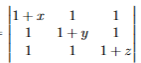 ) in terms of x, y and z. Further, if \(\Delta = 0\) and x, y, z are non-zero real numbers, prove that \(x^{-1} + y^{-1} + z^{-1} = -1\).
View Solution
Step 1: Understanding the Concept:
We use row and column operations to simplify the determinant before expansion. Factoring out terms often leads to the desired algebraic form.
Step 2: Key Formula or Approach:
Factor out \(x\) from \(R_1\), \(y\) from \(R_2\), and \(z\) from \(R_3\).
Step 3: Detailed Explanation:
\(\Delta = xyz \begin{vmatrix} 1/x + 1 & 1/x & 1/x
1/y & 1/y + 1 & 1/y
1/z & 1/z & 1/z + 1 \end{vmatrix}\).
Apply \(R_1 \rightarrow R_1 + R_2 + R_3\):
\(\Delta = xyz(1 + 1/x + 1/y + 1/z) \begin{vmatrix} 1 & 1 & 1
1/y & 1/y + 1 & 1/y
1/z & 1/z & 1/z + 1 \end{vmatrix}\).
Use \(C_2 \rightarrow C_2 - C_1\) and \(C_3 \rightarrow C_3 - C_1\):
\(\Delta = xyz(1 + 1/x + 1/y + 1/z) \begin{vmatrix} 1 & 0 & 0
1/y & 1 & 0
1/z & 0 & 1 \end{vmatrix} = xyz(1 + 1/x + 1/y + 1/z)\).
If \(\Delta = 0\): \(xyz(1 + 1/x + 1/y + 1/z) = 0\).
Since \(x, y, z \neq 0\), we must have \(1 + 1/x + 1/y + 1/z = 0\).
\(x^{-1} + y^{-1} + z^{-1} = -1\). (Proved)
Step 4: Final Answer:
The determinant is \(xyz + xy + yz + zx\). If zero, the sum of reciprocals is -1.
Quick Tip: For determinants with cyclic or systematic patterns, try to produce a row or column of all 1s by adding all rows or all columns together.
Find the sub-interval of \((0, \pi)\) in which \(f(x) = \tan^{-1}(\sin x - \cos x)\) is increasing and decreasing.
View Solution
Step 1: Understanding the Concept:
A function is increasing if \(f'(x) > 0\) and decreasing if \(f'(x) < 0\). We must find the derivative and check its sign on the given interval.
Step 2: Key Formula or Approach:
1. \(f'(x) = \frac{1}{1 + (\sin x - \cos x)^2} \cdot \frac{d}{dx}(\sin x - \cos x)\).
2. Solve \(\cos x + \sin x = 0\) for critical points.
Step 3: Detailed Explanation:
\(f'(x) = \frac{\cos x + \sin x}{1 + (\sin x - \cos x)^2}\).
The denominator is always positive (\(\ge 1\)). The sign of \(f'(x)\) depends only on \(\cos x + \sin x\).
Set \(f'(x) = 0 \implies \sin x = -\cos x \implies \tan x = -1 \implies x = 3\pi/4\) in \((0, \pi)\).
- For \(x \in (0, 3\pi/4)\): Both \(\sin x\) and \(\cos x\) behavior... at \(x=\pi/2\), \(\cos(\pi/2)+\sin(\pi/2) = 1 > 0\). So \(f'(x) > 0\). Function is increasing.
- For \(x \in (3\pi/4, \pi)\): at \(x=5\pi/6\), \(\cos(5\pi/6)+\sin(5\pi/6) = -\sqrt{3}/2 + 1/2 < 0\). Function is decreasing.
Step 4: Final Answer:
\(f(x)\) is increasing on \((0, 3\pi/4)\) and decreasing on \((3\pi/4, \pi)\).
Quick Tip: When checking the sign of a sum like \(\sin x + \cos x\), it's helpful to rewrite it as \(\sqrt{2}\sin(x + \pi/4)\). Then you can easily see it is positive where \(0 < x + \pi/4 < \pi\).
A rectangle of perimeter 24 cm is revolved along one of its sides to sweep out a cylinder of maximum volume. Find the dimensions of the rectangle.

View Solution
Step 1: Understanding the Concept:
Revolving a rectangle of sides \(x\) and \(y\) about side \(y\) creates a cylinder of radius \(x\) and height \(y\). We maximize the volume \(V = \pi x^2 y\) subject to the constraint \(2(x+y) = 24\).
Step 2: Key Formula or Approach:
1. \(x + y = 12 \implies y = 12 - x\).
2. \(V(x) = \pi x^2(12 - x)\).
3. Find \(V'(x)=0\) and confirm max with \(V''(x)\).
Step 3: Detailed Explanation:
\(V(x) = 12\pi x^2 - \pi x^3\).
\(V'(x) = 24\pi x - 3\pi x^2 = 3\pi x(8 - x)\).
\(V'(x) = 0 \implies x = 8\) (as \(x=0\) is not possible).
\(V''(x) = 24\pi - 6\pi x\).
At \(x=8\), \(V''(8) = 24\pi - 48\pi = -24\pi < 0\). (Maxima)
If \(x = 8\), then \(y = 12 - 8 = 4\).
The dimensions are \(8 cm\) and \(4 cm\).
Step 4: Final Answer:
The dimensions of the rectangle are \(8 cm\) and \(4 cm\).
Quick Tip: In optimization problems involving rotation, always identify which side is the radius and which is the height. Squaring the side that acts as the radius gives it "more weight" in the volume formula.
A racing track is build around an elliptical ground whose equation is given by \(9x^2 + 16y^2 = 144\). The width of the track is 3 m as shown below :

Question 36(i):
Express y as a function of x from the given equation of ellipse.
View Solution
Step 1: Understanding the Concept:
To express one variable as a function of another, we isolate that variable on one side of the equation.
In this case, we need to manipulate the elliptical equation to solve for \(y\) in terms of \(x\).
Step 2: Key Formula or Approach:
1. Subtract the \(x\)-term from both sides.
2. Divide by the coefficient of \(y^2\).
3. Take the square root of both sides.
Step 3: Detailed Explanation:
The given equation of the ellipse is:
\[ 9x^2 + 16y^2 = 144 \]
Isolating the \(y\)-term:
\[ 16y^2 = 144 - 9x^2 \]
Dividing both sides by 16:
\[ y^2 = \frac{144 - 9x^2}{16} \]
Taking 9 common in the numerator:
\[ y^2 = \frac{9(16 - x^2)}{16} \]
Taking the square root of both sides:
\[ y = \pm \sqrt{\frac{9(16 - x^2)}{16}} \]
Considering the positive half for the function representation:
\[ y = \frac{3}{4}\sqrt{16 - x^2} \]
Step 4: Final Answer:
The function is \(y = \frac{3}{4}\sqrt{16 - x^2}\).
Quick Tip: Always represent the semi-major and semi-minor axes in the form \(\frac{x^2}{a^2} + \frac{y^2}{b^2} = 1\) to quickly identify the intercepts as \(a=4\) and \(b=3\).
Integrate the function obtained in (i) with respect to x.
View Solution
Step 1: Understanding the Concept:
Integration of a square root of a quadratic expression requires the use of standard trigonometric substitution formulas.
Step 2: Key Formula or Approach:
Standard Integral Formula:
\[ \int \sqrt{a^2 - x^2} \, dx = \frac{x}{2}\sqrt{a^2 - x^2} + \frac{a^2}{2}\sin^{-1}\left(\frac{x}{a}\right) + C \]
Step 3: Detailed Explanation:
We integrate the function \(y = \frac{3}{4}\sqrt{16 - x^2}\):
\[ \int \frac{3}{4}\sqrt{16 - x^2} \, dx = \frac{3}{4} \int \sqrt{4^2 - x^2} \, dx \]
Applying the formula with \(a = 4\):
\[ = \frac{3}{4} \left[ \frac{x}{2}\sqrt{4^2 - x^2} + \frac{4^2}{2}\sin^{-1}\left(\frac{x}{4}\right) \right] + C \]
\[ = \frac{3}{4} \left[ \frac{x}{2}\sqrt{16 - x^2} + 8\sin^{-1}\left(\frac{x}{4}\right) \right] + C \]
Multiplying by \(\frac{3}{4}\):
\[ = \frac{3}{8}x\sqrt{16 - x^2} + 6\sin^{-1}\left(\frac{x}{4}\right) + C \]
Step 4: Final Answer:
The integral is \(\frac{3}{8}x\sqrt{16 - x^2} + 6\sin^{-1}\left(\frac{x}{4}\right) + C\).
Quick Tip: The integral \(\int \sqrt{a^2-x^2} dx\) is the backbone of area calculation for circles and ellipses. Memorizing this formula is vital for Section E.
Find the area of the region enclosed within the elliptical ground excluding the track using integration.
View Solution
Step 1: Understanding the Concept:
The area of the region enclosed within the inner elliptical ground is 4 times the area of the ellipse in the first quadrant.
Step 2: Key Formula or Approach:
Area \(= 4 \times \int_{0}^{4} y \, dx\).
Step 3: Detailed Explanation:
Using the integral result from Part (ii):
\[ Area = 4 \left[ \frac{3}{8}x\sqrt{16 - x^2} + 6\sin^{-1}\left(\frac{x}{4}\right) \right]_{0}^{4} \]
Evaluating at Upper Limit (\(x = 4\)):
\[ \frac{3}{8}(4)\sqrt{0} + 6\sin^{-1}(1) = 6 \cdot \frac{\pi}{2} = 3\pi \]
Evaluating at Lower Limit (\(x = 0\)):
\[ \frac{3}{8}(0)\sqrt{16} + 6\sin^{-1}(0) = 0 \]
One quadrant area \(= 3\pi\).
Total Area \(= 4 \times 3\pi = 12\pi \, m^2\).
Step 4: Final Answer:
The area within the elliptical ground is \(12\pi \, m^2\).
Quick Tip: Use the shortcut Area \(= \pi ab\) to verify your answer. For \(a=4\) and \(b=3\), Area \(= \pi(4)(3) = 12\pi\).
Write the co-ordinates of the points P and Q where the outer edge of the track cuts x axis and y axis in first quadrant and find the area of the triangle formed by points P, O, Q using integration.
View Solution
Step 1: Understanding the Concept:
The outer edge semi-axes are obtained by adding the track width to the inner semi-axes.
The triangle POQ area is found by integrating the equation of the line passing through P and Q.
Step 2: Key Formula or Approach:
Outer \(a' = 4 + 3 = 7\), Outer \(b' = 3 + 3 = 6\).
Equation of line: \(\frac{x}{7} + \frac{y}{6} = 1 \implies y = 6 - \frac{6x}{7}\).
Step 3: Detailed Explanation:
Points are \(P(7, 0)\) and \(Q(0, 6)\).
Line equation \(y = 6 - \frac{6x}{7}\).
Area of \(\triangle POQ = \int_{0}^{7} \left(6 - \frac{6x}{7}\right) \, dx\)
\[ = \left[ 6x - \frac{6x^2}{14} \right]_{0}^{7} = \left[ 6x - \frac{3x^2}{7} \right]_{0}^{7} \]
Substituting \(x = 7\):
\[ = 6(7) - \frac{3(49)}{7} = 42 - 21 = 21 \, m^2 \]
Step 4: Final Answer:
The coordinates are \(P(7, 0)\) and \(Q(0, 6)\), and the area of the triangle is \(21 \, m^2\).
Quick Tip: Area of a right-angled triangle is \(\frac{1}{2} \times base \times height = \frac{1}{2} \times 7 \times 6 = 21\). This quickly validates your integration.
The equation of one such track is given as follows :
\[ f(x) = \begin{cases} x^4 - 4x^2 + 4, & 0 \le x < 3
x^2 + 40, & x \ge 3 \end{cases} \]

Question 37(i):
Find f'(x) for \(0 < x < 3\).
View Solution
Step 1: Understanding the Concept:
The derivative of a piecewise function on an open interval is simply the derivative of the sub-function defined for that specific interval.
Step 2: Key Formula or Approach:
Use the power rule of differentiation: \(\frac{d}{dx}(x^n) = nx^{n-1}\).
Step 3: Detailed Explanation:
For \(0 < x < 3\):
\(f(x) = x^4 - 4x^2 + 4\)
Differentiating term by term:
\(f'(x) = \frac{d}{dx}(x^4) - 4\frac{d}{dx}(x^2) + \frac{d}{dx}(4)\)
\(f'(x) = 4x^3 - 8x + 0\)
\(f'(x) = 4x^3 - 8x\)
Step 4: Final Answer:
The derivative is \(f'(x) = 4x^3 - 8x\).
Quick Tip: Always ensure you are using the correct sub-function for the specified interval when dealing with piecewise functions.
Find f'(4)
View Solution
Step 1: Understanding the Concept:
To find the derivative at a point, identify the interval containing that point and evaluate the derivative of the corresponding sub-function at that point.
Step 2: Key Formula or Approach:
For \(x \ge 3\), \(f(x) = x^2 + 40\). Find \(f'(x)\) and substitute \(x = 4\).
Step 3: Detailed Explanation:
Since \(4 \ge 3\), we use \(f(x) = x^2 + 40\).
Differentiating with respect to \(x\):
\(f'(x) = 2x\)
Substitute \(x = 4\):
\(f'(4) = 2(4) = 8\)
Step 4: Final Answer:
The value of \(f'(4)\) is 8.
Quick Tip: For points where the function is a simple polynomial, the derivative is straightforward power rule application.
Test for continuity of f(x) at x = 3.
View Solution
Step 1: Understanding the Concept:
A function is continuous at \(x = a\) if \(\lim_{x \to a^-} f(x) = \lim_{x \to a^+} f(x) = f(a)\).
Step 2: Key Formula or Approach:
Calculate Left Hand Limit (LHL) using \(x < 3\) part and Right Hand Limit (RHL) using \(x \ge 3\) part.
Step 3: Detailed Explanation:
LHL at \(x = 3\):
\(\lim_{x \to 3^-} (x^4 - 4x^2 + 4) = 3^4 - 4(3^2) + 4 = 81 - 36 + 4 = 49\)
RHL at \(x = 3\):
\(\lim_{x \to 3^+} (x^2 + 40) = 3^2 + 40 = 9 + 40 = 49\)
Value of the function \(f(3) = 3^2 + 40 = 49\).
Since \(LHL = RHL = f(3) = 49\), the function is continuous.
Step 4: Final Answer:
The function \(f(x)\) is continuous at \(x = 3\).
Quick Tip: For continuity, the graph must connect smoothly at the boundary without any jumps or holes.
Test for differentiability of f(x) at x = 3.
View Solution
Step 1: Understanding the Concept:
A function is differentiable at \(x = a\) if the Left Hand Derivative (LHD) equals the Right Hand Derivative (RHD).
Step 2: Key Formula or Approach:
Find limits of derivatives from both sides at \(x = 3\).
Step 3: Detailed Explanation:
LHD at \(x = 3\):
\(\lim_{x \to 3^-} f'(x) = \lim_{x \to 3^-} (4x^3 - 8x) = 4(27) - 8(3) = 108 - 24 = 84\)
RHD at \(x = 3\):
\(\lim_{x \to 3^+} f'(x) = \lim_{x \to 3^+} (2x) = 2(3) = 6\)
Since \(LHD \neq RHD\), the slopes do not match at \(x = 3\).
Step 4: Final Answer:
The function is not differentiable at \(x = 3\).
Quick Tip: Continuity is a necessary condition for differentiability, but it does not guarantee it. A function can be continuous but have a "corner" where it is not differentiable.
A study revealed that 170 in 1000 males who smoke develop lung complications, while 120 out of 1000 females who smoke develop lung related problems. In a colony, 50 people were found to be smokers of which 30 are males. A person is selected at random from these 50 people and tested for lung related problems.

Question 38(i):
What is the probability that selected person is a female ?
View Solution
Step 1: Understanding the Concept:
Basic probability is calculated by dividing the number of favorable outcomes by the total number of possible outcomes.
Step 2: Key Formula or Approach:
\(P(F) = \frac{No. of Female Smokers}{Total Smokers}\).
Step 3: Detailed Explanation:
Total number of smokers \(= 50\).
Number of male smokers \(= 30\).
Number of female smokers \(= 50 - 30 = 20\).
Probability of selecting a female \(= \frac{20}{50} = \frac{2}{5} = 0.4\).
Step 4: Final Answer:
The probability is \(0.4\).
Quick Tip: Always identify the sample space clearly before calculating probabilities.
If a male person is selected, what is the probability that he will not be suffering from lung problems ?
View Solution
Step 1: Understanding the Concept:
This is a conditional probability where we find the probability of the complement of an event.
Step 2: Key Formula or Approach:
\(P(No Lung Problem | Male) = 1 - P(Lung Problem | Male)\).
Step 3: Detailed Explanation:
Given \(P(Lung Problem | Male) = \frac{170}{1000} = 0.17\).
Probability of not having lung problems \(= 1 - 0.17 = 0.83\).
Step 4: Final Answer:
The probability is \(0.83\).
Quick Tip: The sum of the probability of an event and its complement is always 1.
A person selected at random is detected with lung complications. Find the probability that selected person is a female.
View Solution
Step 1: Understanding the Concept:
This problem requires Bayes' Theorem to find a conditional probability given the outcome of a related event.
Step 2: Key Formula or Approach:
Bayes' Theorem: \(P(F|L) = \frac{P(F)P(L|F)}{P(F)P(L|F) + P(M)P(L|M)}\).
Step 3: Detailed Explanation:
Let \(L\) be the event of having lung complications.
\(P(F) = 0.4, \ P(M) = 0.6\).
\(P(L|F) = 0.12, \ P(L|M) = 0.17\).
Numerator \(= P(F)P(L|F) = 0.4 \times 0.12 = 0.048\).
Denominator \(= 0.048 + (0.6 \times 0.17) = 0.048 + 0.102 = 0.150\).
\(P(F|L) = \frac{0.048}{0.150} = \frac{48}{150} = \frac{8}{25} = 0.32\).
Step 4: Final Answer:
The probability is \(0.32\).
Quick Tip: Bayes' Theorem is the standard tool for "backwards" probability where you know the result and want to find the cause.
A person selected at random is not having lung problems, find the probability that the person is a male.
View Solution
Step 1: Understanding the Concept:
We use Bayes' Theorem for the complement event (no lung complications).
Step 2: Key Formula or Approach:
\(P(M|L') = \frac{P(M)P(L'|M)}{P(M)P(L'|M) + P(F)P(L'|F)}\).
Step 3: Detailed Explanation:
\(P(L'|M) = 0.83, \ P(L'|F) = 0.88\).
Numerator \(= 0.6 \times 0.83 = 0.498\).
Denominator \(= 0.498 + (0.4 \times 0.88) = 0.498 + 0.352 = 0.850\).
\(P(M|L') = \frac{0.498}{0.850} = \frac{498}{850} = \frac{249}{425} \approx 0.586\).
Step 4: Final Answer:
The probability is approximately \(0.586\).
Quick Tip: Ensure that conditional probabilities sum to 1 over the total probability space of outcomes.
*The article might have information for the previous academic years, please refer the official website of the exam.