
CBSE Class 12 Political Science (Set - 1 59/2/1) Question Paper with Solutions Pdfs


| Updated On - Mar 24, 2026
CBSE Class 12 Political Science (Set – 1 59/2/1) Question Paper with Solutions PDFs is available here for download.CBSE Board Class 12 Political Science (Set – 1 59/2/1) Paper 2026 was held on March 23, 2026. CBSE Board Class 12 question paper followed the latest syllabus and exam pattern prescribed by CBSE. CBSE Board Class 12 the examination was held in the first half from 10:30 AM to 1:30 PM. Students can download the official paper in PDF format for reference.
CBSE Board Class 12 Political Science (Set – 1 59/2/1) Paper 2026 with Solutions PDFs
| CBSE Board Class 12 Political Science (Set – 1 59/2/1) Question Paper 2026 | Download PDF | Check Solutions |
Given below are two statements marked as Assertion (A) and Reason (R). Read these statements and choose the correct answer from the given options :
Assertion (A) : The idea of Five Year Plans (FYP) in India was inspired by the USSR.
Reason (R) : Due to acute economic crisis, the Indian Government started 'Plan Holiday' in 1966.
View Solution
Step 1: Understanding the Concept:
India adopted the model of planned economic development shortly after independence, influenced heavily by socialist models.
The term 'Plan Holiday' refers to a specific period where five-year plans were paused due to economic hardships.
Step 2: Key Formula or Approach:
Analyze the historical accuracy of both the Assertion and the Reason independently.
Then, evaluate if the Reason provides the logical cause for the Assertion.
Step 3: Detailed Explanation:
Assertion (A) is factually true.
The Planning Commission of India was indeed inspired by the centralized planning model of the Soviet Union (USSR).
Reason (R) is also factually true.
After the Third Five Year Plan, India faced severe economic crises due to the Indo-Pak war of 1965, droughts, and inflation, leading to three annual plans (1966-1969) known as the 'Plan Holiday'.
However, the economic crisis in 1966 is not the reason why India initially adopted the USSR's planning model in 1951.
Therefore, both statements are true, but they are historically independent facts.
Step 4: Final Answer:
Both Assertion (A) and Reason (R) are true, but Reason (R) is not the correct explanation of Assertion (A).
Quick Tip: When answering Assertion-Reason questions, always read the two statements joined by the word "because" to test their relationship.
Which one of the following is related to the traditional notion of security ?
View Solution
Step 1: Understanding the Concept:
Security concepts are broadly divided into traditional and non-traditional categories.
Traditional security focuses primarily on the state and military threats from other countries.
Step 2: Key Formula or Approach:
Identify which option represents a direct military conflict between sovereign states, which is the core of traditional security.
Step 3: Detailed Explanation:
Option (A), the Russia - Ukraine War, is a direct military confrontation between two nations involving armies and territorial disputes.
This perfectly fits the traditional notion of security.
Option (B), global temperature rise, is an environmental issue falling under non-traditional security.
Option (C), the 9/11 attack, involves terrorism by non-state actors, often classified as a non-traditional threat.
Option (D), the COVID-19 epidemic, is a global health crisis, which is a key component of human/non-traditional security.
Step 4: Final Answer:
The Russia-Ukraine war is a classic example of a traditional security threat.
Quick Tip: Traditional Security = State-centric, military threats, border defense.
Non-Traditional Security = Human-centric, global issues like health, environment, and poverty.
Which one of the following statements is NOT correct about the first two Five Year Plan ?
View Solution
Step 1: Understanding the Concept:
The First and Second Five Year Plans had distinctly different priorities for the newly independent Indian economy.
The First Plan aimed at agrarian recovery, while the Second Plan aimed at rapid industrialization.
Step 2: Key Formula or Approach:
Evaluate each statement against the historical objectives and architects of the first two plans to find the incorrect one.
Step 3: Detailed Explanation:
Statement (A) is correct; K.N. Raj was a key architect of the First Plan, and P.C. Mahalanobis led the Second Plan.
Statement (B) is correct; the First Plan prioritized agriculture, and the Second Plan prioritized heavy industries.
Statement (C) is correct; both plans relied heavily on state intervention and public sector growth.
Statement (D) is incorrect.
The First Five Year Plan did not aim to raise industrial production; its primary focus was on agriculture, including dams and irrigation.
Raising industrial production was the core objective of the Second Five Year Plan.
Step 4: Final Answer:
Statement (D) is the incorrect statement regarding the first two Five Year Plans.
Quick Tip: Remember the shift: 1st Plan = Agriculture (survival). 2nd Plan = Heavy Industry (modernization via the Mahalanobis model).
Identify the correct trio of Baltic Republics :
View Solution
Step 1: Understanding the Concept:
The Baltic Republics refer to three specific countries located on the eastern shore of the Baltic Sea in Northern Europe.
They were historically annexed by the Soviet Union and were the first to declare independence during its collapse.
Step 2: Key Formula or Approach:
Recall the geographical and historical grouping of the former Soviet republics to identify the correct trio.
Step 3: Detailed Explanation:
Estonia, Latvia, and Lithuania are universally recognized as the Baltic states.
They share a similar geographical location and recent political history regarding their separation from the USSR.
Slovenia was a part of Yugoslavia, not the USSR, and is located in Central/Southern Europe.
Romania was an independent communist state in the Eastern Bloc, not a Soviet Republic, and borders the Black Sea.
Step 4: Final Answer:
The correct trio is Estonia, Latvia, and Lithuania.
Quick Tip: Use the acronym "ELL" to easily remember the Baltic Republics: Estonia, Latvia, Lithuania.
Given below are two statements :
Statement I : The International Monetary Fund (IMF) is an international organization that oversees those financial institutions and regulations that act at the international level.
Statement II : All the 189 members of IMF organization have equal say.
In the light of above statements, choose the correct answer from the options given below :
View Solution
Step 1: Understanding the Concept:
The IMF is a major global financial institution responsible for global economic stability.
Its governance structure differs from organizations like the UN General Assembly.
Step 2: Key Formula or Approach:
Analyze the defined role of the IMF for Statement I and its voting mechanism for Statement II.
Step 3: Detailed Explanation:
Statement I is true.
The IMF acts as the central institution of the international monetary system, overseeing exchange rates and international payments.
Statement II is false.
Unlike the principle of "one country, one vote", the IMF uses a quota system based on a country's financial contribution to the fund.
Therefore, members do not have an equal say; wealthier nations (like the US, Japan, and European nations) hold significantly higher voting power.
Step 4: Final Answer:
Statement I is correct, but Statement II incorrectly describes the IMF's voting structure.
Quick Tip: In global financial bodies (IMF, World Bank), voting power is proportional to the financial contribution (quota), unlike the UN General Assembly.
Which one of the following statements is True about the concept of 'Co-operative Security' ?
View Solution
Step 1: Understanding the Concept:
Co-operative security acknowledges that contemporary threats often transcend national borders and cannot be solved by military force or a single nation.
Step 2: Key Formula or Approach:
Distinguish between traditional military alliances (collective security) and collaborative approaches to global issues (co-operative security).
Step 3: Detailed Explanation:
Option (A) is too narrow, as it limits action to only developed countries.
Option (B) describes "Collective Security", which is a military alliance concept where an attack on one is an attack on all (e.g., NATO).
Option (C) refers merely to domestic law enforcement and internal stability.
Option (D) accurately describes "Co-operative Security".
It involves international cooperation (multilateralism) to address non-traditional threats like climate change, poverty, and pandemics, requiring a collective global response.
Step 4: Final Answer:
Co-operative security relies on international collaboration against shared, non-military threats.
Quick Tip: Keywords for Co-operative Security: Cooperation, Multilateralism, Non-traditional threats, Global issues.
Which statement is the best description of 'Veto Power' ?
View Solution
Step 1: Understanding the Concept:
Veto power is a special constitutional right granted to specific members within the United Nations Security Council (UNSC).
Step 2: Key Formula or Approach:
Identify who holds the veto power and its fundamental nature within the UN structure.
Step 3: Detailed Explanation:
Option (A) is incorrect because a veto is inherently a negative power—it is the power to stop or block a decision, not a positive vote.
Option (C) is incorrect because temporary (non-permanent) members of the UNSC do not hold veto power at any time.
Option (D) is incorrect because not all 15 members possess this power.
Option (B) is the correct description.
It was established post-WWII to ensure that the major victorious powers (USA, USSR, UK, France, China) would remain engaged in the UN by giving them the power to block resolutions that threatened their vital interests.
Step 4: Final Answer:
Veto power is exclusively held by the five permanent members of the UNSC.
Quick Tip: "Veto" is a Latin word meaning "I forbid". Only the P-5 nations have this absolute blocking power in the UNSC.
Which was the last state toured by Rajiv Gandhi for his election campaign in May 1991 ?
View Solution
Step 1: Understanding the Concept:
This question pertains to a significant historical and tragic event in modern Indian political history during the 1991 general elections.
Step 2: Key Formula or Approach:
Recall the location where former Prime Minister Rajiv Gandhi was assassinated.
Step 3: Detailed Explanation:
In May 1991, Rajiv Gandhi was actively campaigning for the Congress party.
On the night of May 21, 1991, he attended an election rally in Sriperumbudur.
Sriperumbudur is a town located in the southern state of Tamil Nadu.
It was here that he was assassinated by an LTTE suicide bomber.
Step 4: Final Answer:
The last state he toured before his tragic death was Tamil Nadu.
Quick Tip: Associating major political figures with the specific historical events and locations of their passing can help memorize such facts.
Match List-I with List-II correctly and choose the correct answer from the codes given below :

View Solution
Step 1: Understanding the Concept:
This question tests knowledge of key political slogans, movements, and figures in India during the tumultuous 1970s.
Step 2: Key Formula or Approach:
Identify the most obvious matches first to eliminate incorrect options, then deduce the remaining pairs.
Step 3: Detailed Explanation:
- (b) Garibi Hatao: This is one of the most famous slogans in Indian political history, coined by Indira Gandhi during the 1971 elections. So, (b) pairs with (iv).
Looking at the options, only option (C) has (b)-(iv). We can verify the rest to be sure.
- (a) Congress for Democracy: This political party was founded by Jagjeevan Ram in 1977 after he resigned from Indira Gandhi's government. So, (a) pairs with (iii).
- (c) Student movement led by Morarji Desai: The Navnirman Andolan, a socio-political movement by students, took place in Gujarat. Morarji Desai went on an indefinite fast to support it. So, (c) pairs with (i).
- (d) Total Revolution: The call for 'Sampoorna Kranti' (Total Revolution) against corruption and authoritarianism was given by Jay Prakash Narayan (JP) in Bihar. So, (d) pairs with (ii).
Step 4: Final Answer:
The correct matching sequence is (a)-(iii), (b)-(iv), (c)-(i), (d)-(ii).
Quick Tip: In match-the-following questions, find the one pair you are 100% sure about (like Garibi Hatao = Indira Gandhi). Often, this alone leads to the correct code.
Which one of the following is NOT a consequence of 'Shock Therapy' ?
View Solution
Step 1: Understanding the Concept:
'Shock Therapy' refers to the sudden and painful transition of post-Soviet states from state-controlled socialist economies to free-market capitalist economies in the 1990s.
Step 2: Key Formula or Approach:
Analyze the historical outcomes of Shock Therapy to identify which statement contradicts the actual events.
Step 3: Detailed Explanation:
Option (A) is a true consequence. The sudden transition caused hyperinflation, and the Russian Rouble lost its value dramatically.
Option (B) is a true consequence. The rapid privatization led to the collapse of state industries, often termed "the largest garage sale in history", devastating the regional economy.
Option (D) is a true consequence. State-owned collective farms were disbanded, leading to severe food security issues.
Option (C) is the false statement.
Under the Soviet system, citizens enjoyed extensive state-sponsored social welfare. Shock Therapy dismantled these subsidies and welfare programs, pushing millions into poverty. The system was systematically weakened, not strengthened.
Step 4: Final Answer:
The strengthening of social welfare did not happen; it was destroyed. Therefore, (C) is the correct choice.
Quick Tip: Shock Therapy was essentially an economic disaster for the common citizens of the former USSR. Any option suggesting a positive socioeconomic outcome during that specific period is highly likely to be the "NOT" consequence.
Arrange the following events in chronological order :
(i) Declaration of National Emergency on the basis of internal disturbances.
(ii) Railway strike by government employees under the leadership of George Fernandes.
(iii) Sixth General Election held in India.
(iv) Declaration of the doctrine of 'basic structure' of the Constitution in the 'Keshavananda Bharti' case by the Supreme Court.
Choose the correct option :
View Solution
Step 1: Understanding the Concept:
This requires chronological sequencing of major political and constitutional events in India during the turbulent decade of the 1970s.
Step 2: Key Formula or Approach:
Assign the correct historical year (and month, if necessary) to each event and then order them from earliest to latest.
Step 3: Detailed Explanation:
Let's date each event:
(iv) The Keshavananda Bharti judgement, which established the 'basic structure' doctrine, was delivered on April 24, 1973.
(ii) The massive All-India Railway strike led by George Fernandes took place in May 1974.
(i) The National Emergency, citing 'internal disturbance', was declared by PM Indira Gandhi on June 25, 1975.
(iii) The Sixth General Election, which saw the defeat of the Congress party and the end of the Emergency, was held in March 1977.
Sorting these chronologically gives us: 1973 \(\rightarrow\) 1974 \(\rightarrow\) 1975 \(\rightarrow\) 1977.
This corresponds to the sequence: (iv), (ii), (i), (iii).
Step 4: Final Answer:
The correct chronological order is given by option (A).
Quick Tip: Create a mental timeline of the 1970s: Supreme Court ruling (1973) \(\rightarrow\) Public unrest/Strikes (1974) \(\rightarrow\) Emergency declared to suppress unrest (1975) \(\rightarrow\) Elections held after Emergency is lifted (1977).
The alliance that has formed the government at the centre the maximum number of times :
View Solution
Step 1: Understanding the Concept:
Indian politics entered a long phase of coalition governments at the national level starting from 1989.
Step 2: Key Formula or Approach:
Count the number of separate terms each political alliance has successfully formed the government at the Centre.
Step 3: Detailed Explanation:
- United Progressive Alliance (UPA): Led by the Congress party, formed the government two times (2004-2009 under Manmohan Singh, and 2009-2014).
- National Front: Led by V.P. Singh and later Chandra Shekhar, formed the government once (1989-1990/91).
- United Front: Formed the government once, though with two Prime Ministers, H.D. Deve Gowda and I.K. Gujral (1996-1998).
- National Democratic Alliance (NDA): Led by the BJP, formed the government multiple times:
1. 1998 (Vajpayee, lasted 13 months)
2. 1999-2004 (Vajpayee, full term)
3. 2014-2019 (Modi)
4. 2019-2024 (Modi)
Therefore, the NDA has formed the government the most number of times.
Step 4: Final Answer:
The NDA is the alliance that has held power at the Centre the maximum number of times.
Quick Tip: Distinguish between "years in power" and "number of times formed government". A government is formed after every general election or successful vote of confidence.
Highlight any four threats to non-traditional security.
View Solution
Step 1: Understanding the Concept:
Non-traditional security moves beyond the military focus of state defense to encompass a broader range of threats that affect human survival, societies, and the global environment.
Step 2: Key Formula or Approach:
Identify and clearly state four distinct categories of modern global threats that do not involve conventional warfare between states.
Step 3: Detailed Explanation:
Four major threats to non-traditional security include:
1. Global Terrorism: The use of violence and intimidation by non-state actors targeting civilians to achieve political or ideological goals, which creates widespread fear globally.
2. Global Poverty and Inequality: Extreme poverty and the massive wealth gap between the Global North and South lead to systemic insecurity, massive migrations, and human rights violations.
3. Environmental Degradation: Threats like climate change, global warming, ozone depletion, and deforestation pose existential risks to human habitats and global food security.
4. Health Epidemics and Pandemics: The rapid international spread of infectious diseases such as HIV/AIDS, Ebola, Bird Flu, and COVID-19, which can severely disrupt global health and economies.
Step 4: Final Answer:
Terrorism, poverty, environmental collapse, and global health crises are prime examples of non-traditional security threats.
Quick Tip: When asked about non-traditional security, think of "Human Security" (protecting individuals) and "Global Security" (protecting the planet).
Assess the impact of outside powers on the South Asian Countries.
View Solution
Step 1: Understanding the Concept:
South Asia is a geopolitically strategic region. The presence of nuclear-armed states and historical conflicts makes it a focal point for intervention and influence by global superpowers.
Step 2: Key Formula or Approach:
Analyze the roles played by major external players, particularly the USA and China, in shaping the political and economic landscape of South Asia.
Step 3: Detailed Explanation:
The impact of outside powers is profound and multifaceted:
1. Role of the United States: During the Cold War, the US actively supported Pakistan, heavily militarizing the region. Post-Cold War, the US has deepened strategic and economic ties with India. However, it continues to engage with Pakistan, especially concerning counter-terrorism in Afghanistan. The US often acts as an external moderator to prevent escalations between India and Pakistan.
2. Role of China: China's growing economic and military clout has significantly altered South Asian dynamics. Through its Belt and Road Initiative (BRI), China has heavily invested in infrastructure in Pakistan (CPEC), Sri Lanka, and Nepal. This deepening "all-weather" alliance with Pakistan and growing footprint in India's neighborhood creates strategic anxiety and power balancing challenges for India.
Step 4: Final Answer:
Outside powers deeply impact South Asia by supplying arms, funding massive economic projects, and acting as balancers in regional disputes, thereby intertwining global geopolitics with regional stability.
Quick Tip: Always highlight the China-Pakistan axis and the evolving US-India partnership when discussing external influences in South Asia.
How does the geographical location of the North-East region has affected the expression of its regional demands ? Explain.
View Solution
Step 1: Understanding the Concept:
The North-East of India is geographically unique, connected to the rest of the country by a very narrow land corridor, while sharing extensive boundaries with foreign nations.
Step 2: Key Formula or Approach:
Connect the physical geography (isolation and international borders) to the psychological and political expressions of the people in the region.
Step 3: Detailed Explanation:
1. Geographical Isolation leading to Alienation: The region is connected to mainland India only by the narrow "Siliguri Corridor" (Chicken's Neck). This physical separation resulted in decades of poor infrastructure and economic neglect. Consequently, regional demands often express a deep sense of alienation, economic grievance, and demands for greater autonomy or even secession.
2. Porous International Borders: The North-East shares borders with China, Myanmar, Bangladesh, and Bhutan. This geography has facilitated massive cross-border migration (e.g., from Bangladesh). As a result, demographic changes have occurred, triggering intense "anti-outsider" movements (like the Assam movement) to protect local ethnic identities. Furthermore, these borders have historically provided safe havens for insurgent groups.
Step 4: Final Answer:
The North-East's physical isolation breeds feelings of neglect, while its porous international borders fuel anxieties over identity and illegal immigration, shaping its intense regional demands.
Quick Tip: Use the term "Siliguri Corridor" or "Chicken's Neck" to demonstrate specific geographic knowledge of the region's isolation.
Explain any two differences between the refugees and the migrants.
View Solution
Step 1: Understanding the Concept:
While both groups involve people moving from one country to another, their motivations for moving and their standing under international law are fundamentally different.
Step 2: Key Formula or Approach:
Contrast the two groups based on the voluntary nature of their movement and the legal protections afforded to them.
Step 3: Detailed Explanation:
1. Reason and Nature of Movement:
Refugees are forced to flee their home country due to an immediate threat to their lives, such as armed conflict, severe human rights violations, natural disasters, or persecution based on race, religion, or politics. Their movement is involuntary.
Migrants, on the other hand, make a conscious, voluntary choice to leave their country, primarily to seek better economic opportunities, higher education, or family reunification.
2. Legal Status and Protection:
Refugees are protected under international law (like the 1951 Refugee Convention), which dictates that they cannot be forced to return to a country where their life is in danger (principle of non-refoulement).
Migrants do not possess this specific international protection and are strictly subject to the national immigration laws and deportation policies of their host country.
Step 4: Final Answer:
The main differences lie in the forced vs. voluntary nature of their departure and their respective protections under international refugee law.
Quick Tip: Refugees move out of necessity (survival), whereas Migrants move out of choice (opportunity).
Name any four political parties that had merged to form Janata Party in 1977.
View Solution
Step 1: Understanding the Concept:
Following the end of the National Emergency in 1977, various disparate opposition parties united under the guidance of Jayaprakash Narayan to ensure the defeat of the Congress party.
Step 2: Key Formula or Approach:
Recall the major constituent political factions that dissolved their independent identities to create the unified Janata Party.
Step 3: Detailed Explanation:
The Janata Party was essentially an umbrella organization. The four prominent political parties that merged to form it were:
1. Bharatiya Jana Sangh (BJS)
2. Congress (O) (The 'Old' or 'Syndicate' faction of Congress led by Morarji Desai)
3. Bharatiya Lok Dal (BLD) (Led by Charan Singh)
4. Socialist Party
Step 4: Final Answer:
The amalgamation of the Jana Sangh, Congress (O), Lok Dal, and Socialist Party formed the core of the Janata Party in 1977.
Quick Tip: These parties had vastly different ideologies (from right-wing nationalist to socialist) but merged purely on the common agenda of opposing the Emergency and Indira Gandhi.
Analyse the main reason responsible for the formation of Coalition Governments after 1989.
View Solution
Step 1: Understanding the Concept:
1989 marks a watershed moment in Indian electoral history, transitioning the system from single-party dominance to a multi-party coalition era.
Step 2: Key Formula or Approach:
Identify the political shifts occurring in the late 1980s that prevented any single party from achieving a majority in the Lok Sabha.
Step 3: Detailed Explanation:
The primary reason for the formation of coalition governments after 1989 was the decline of the Congress System.
For decades, the Congress party consistently secured absolute majorities. However, following the 1989 elections, Congress failed to win a clear majority.
Simultaneously, there was a dramatic rise in the influence of regional parties (like TDP, DMK, SP, BSP), which captured large vote shares in their respective states by mobilizing voters on lines of caste, language, and regional identity.
Because the national vote was fragmented among these numerous regional players, no single national party (neither Congress nor the emerging BJP) could cross the halfway mark (272 seats) independently. Therefore, national parties were forced to form alliances with regional parties to stitch together a governing majority.
Step 4: Final Answer:
The decline of Congress dominance coupled with the fragmented mandate driven by the rise of powerful regional parties necessitated the formation of coalition governments.
Quick Tip: 1989 is synonymous with the "End of the Congress System" and the "Rise of Regionalism" in Indian politics.
Explain any four differences between the governments formed in the first three General Elections held in India after independence and the coalition governments formed after the year 1989.
View Solution
Step 1: Understanding the Concept:
This requires contrasting the "Congress System" era (1952, 1957, 1962) with the "Coalition Era" (1989 onwards).
Step 2: Key Formula or Approach:
Compare the two eras on parameters like party dominance, government stability, role of regional leaders, and ideological coherence.
Step 3: Detailed Explanation:
1. Party System and Dominance: In the first three elections, the governments were characterized by absolute single-party dominance (the Indian National Congress), which won massive majorities alone. Post-1989 governments were multi-party coalitions where no single party held an absolute majority.
2. Stability and Tenure: The early Congress governments were highly stable, easily completing their full five-year terms without internal threats of collapse. Conversely, early post-1989 coalition governments were often highly unstable, with frequent collapses and mid-term elections (e.g., between 1989 and 1999, India saw several Prime Ministers).
3. Influence of Regional Parties: Regional parties had negligible influence on the central government during the first three elections. In the post-1989 era, regional parties became the "kingmakers", holding crucial cabinet portfolios and significantly influencing national policy.
4. Ideological Coherence vs. Pragmatism: The early governments operated with a relatively cohesive party ideology and centralized high-command decision-making. Coalition governments operate on pragmatism and Common Minimum Programmes (CMP), requiring constant consensus-building among partners with vastly different ideologies.
Step 4: Final Answer:
The transition represents a shift from a centralized, stable, single-party regime to a decentralized, consensus-driven, and regionally influenced multi-party system.
Quick Tip: Use the contrasting pairs: Single vs. Multi-party, Stable vs. Unstable, National focus vs. Regional influence, Ideology vs. Pragmatism.
Explain any four advantages of coalition governments with reference to Indian politics.
View Solution
Step 1: Understanding the Concept:
Despite criticisms regarding instability, the coalition model has profoundly deepened the democratic and federal structure of India.
Step 2: Key Formula or Approach:
Identify how power-sharing among multiple parties benefits diverse representation and prevents authoritarianism.
Step 3: Detailed Explanation:
Four key advantages of coalition governments in India are:
1. Wider Representation: India is vastly diverse. Coalitions ensure that the varied interests of different regions, languages, castes, and communities are directly represented at the national level through their regional parties.
2. Strengthening Federalism: By bringing regional parties into the central government, the friction between the Centre and the States is reduced. States feel they have a direct voice in national policy-making, thus strengthening the federal fabric.
3. Prevention of Authoritarianism: A single party with a massive majority might act autocratically. In a coalition, the leading party must constantly consult its partners. This acts as a system of internal checks and balances, preventing dictatorial decision-making.
4. Consensus-Based Policies: Because coalitions are formed by parties with differing viewpoints, they govern based on a 'Common Minimum Programme'. This ensures that extreme policies are filtered out, and the resulting governance reflects a broader national consensus.
Step 4: Final Answer:
Coalitions make Indian democracy more inclusive, federal, and resistant to authoritarian overreach by enforcing power-sharing.
Quick Tip: Focus on the positives: Coalitions = Teamwork, Inclusivity, and Balance of Power.
Why could the reforms initiated by Mikhail Gorbachev not save the disintegration of Soviet Union ? Explain any two reasons.
View Solution
Step 1: Understanding the Concept:
Mikhail Gorbachev introduced rapid economic and political reforms ('Perestroika' and 'Glasnost') in the 1980s to modernize and save the struggling USSR. However, these reforms inadvertently triggered its total collapse.
Step 2: Key Formula or Approach:
Analyze the unintended consequences of granting freedom of speech and attempting to reform a rigid authoritarian system.
Step 3: Detailed Explanation:
1. The Explosion of Nationalism: Gorbachev's policy of 'Glasnost' (openness) removed the strict censorship and state terror that had kept the diverse Soviet republics united. Given the freedom to speak and protest, long-suppressed nationalist sentiments erupted. Republics like the Baltic States (Estonia, Latvia, Lithuania), Ukraine, and Georgia used this new freedom not to reform the USSR, but to demand complete independence from it.
2. Alienation of Both Ends of the Political Spectrum: Gorbachev lost control over the pace of his reforms. On one side, the ordinary citizens felt the reforms were moving too slowly and did not improve their economic hardships fast enough. On the other side, the conservative Communist Party elites (the hardliners) felt the reforms were moving too fast and destroying the traditional system that gave them power. This resulted in a lack of widespread support and culminated in the 1991 coup attempt by the hardliners, which fatally weakened central authority.
Step 4: Final Answer:
Gorbachev's reforms failed to save the USSR because they unbottled uncontrollable nationalist forces and alienated both the impatient public and the entrenched political elites.
Quick Tip: Gorbachev's dilemma: To fix the system, he had to give people freedom. But once people had freedom, they chose to dismantle the system entirely.
Describe any two areas of co-operation and any two reasons for conflicts between India and Pakistan.
View Solution
Step 1: Understanding the Concept:
The bilateral relationship between India and Pakistan is highly volatile, characterized by a history of wars but also necessity-driven diplomatic and resource cooperation.
Step 2: Key Formula or Approach:
Identify two specific successful treaties or mechanisms of cooperation, followed by the two primary historical and ongoing sources of tension.
Step 3: Detailed Explanation:
Areas of Co-operation:
1. The Indus Waters Treaty (1960): Mediated by the World Bank, this treaty manages the sharing of the Indus river system. Remarkably, it has survived multiple wars and crises, serving as a robust model for resource cooperation.
2. Nuclear Confidence Building Measures (CBMs): Both nations have signed agreements to reduce the risk of accidental nuclear war. This includes the regular exchange of lists of their nuclear installations and facilities on January 1st every year to prevent attacks on these specific sites.
Reasons for Conflict:
1. The Kashmir Dispute: The most deeply entrenched conflict is the territorial dispute over the former princely state of Jammu and Kashmir. Both nations claim the region in full but rule it in parts, leading to multiple wars (1947, 1965, 1999).
2. Cross-Border Terrorism: India strongly accuses Pakistan of funding, training, and providing safe havens to militant groups (like LeT and JeM) that carry out terrorist attacks on Indian soil as a state policy of "bleeding India with a thousand cuts".
Step 4: Final Answer:
Despite enduring conflicts over Kashmir and terrorism, both nations successfully cooperate on river water sharing and nuclear safety protocols.
Quick Tip: The Indus Waters Treaty is the strongest evidence that India and Pakistan can cooperate even in hostile environments.
Describe any two areas of co-operation and any two reasons for conflicts between India and Nepal.
View Solution
Step 1: Understanding the Concept:
India and Nepal share an open border and deep cultural ties, yet their relationship faces geopolitical friction due to differing strategic interests.
Step 2: Key Formula or Approach:
Detail the unique elements of their friendly relations and then explain the recent geopolitical and territorial issues causing strain.
Step 3: Detailed Explanation:
Areas of Co-operation:
1. Open Border and Free Movement: Under the 1950 Treaty of Peace and Friendship, citizens of both nations can travel, work, and reside across the border without visas or passports, reflecting a unique level of mutual trust.
2. Economic and Developmental Assistance: India is Nepal's largest trade partner and provides extensive assistance in developing Nepal's infrastructure, particularly in utilizing its vast hydro-electric power potential and providing transit routes for the landlocked nation.
Reasons for Conflict:
1. The China Factor: India views the growing economic and strategic footprint of China in Nepal with deep suspicion. Nepal's attempts to balance its relations by playing the "China card" against India frequently causes diplomatic friction.
2. Border Disputes: Recent tensions have flared over specific border demarcations, most notably the Kalapani, Lipulekh, and Limpiyadhura regions, which both countries claim as their own territory and include in their official political maps.
Step 4: Final Answer:
While the open border and economic reliance foster deep cooperation, territorial disputes and Nepal's warming ties with China remain consistent sources of conflict.
Quick Tip: Remember that Nepal is landlocked. It relies heavily on India for access to the sea, which defines much of their economic cooperation.
The ideology of 'Bharatiya Jana Sangh' party was to make India a progressive and strong nation. Do you agree with the statement ? Support your answer with any four suitable arguments.
View Solution
Step 1: Understanding the Concept:
The Bharatiya Jana Sangh (BJS), founded by Syama Prasad Mookerjee in 1951, had a distinct right-wing nationalist ideology that contrasted sharply with the secular-socialist approach of the Congress party.
Step 2: Key Formula or Approach:
Agree with the premise and outline the specific policy pillars of the BJS that they believed were essential for building a robust and unified India.
Step 3: Detailed Explanation:
Yes, I agree that the Bharatiya Jana Sangh aimed to build a strong and progressive nation, though their definition of progress was rooted in cultural nationalism. This is supported by the following arguments:
1. Cultural Unification (One Country, One Culture, One Nation): The BJS believed that India's strength lay in its ancient heritage. They argued that modern India should be built on the foundation of Bharatiya culture and traditions, promoting national unity through cultural homogeneity.
2. Akhand Bharat (Undivided India): To undo what they saw as the tragedy of partition, the party advocated for the eventual reunification of India and Pakistan, believing an undivided subcontinent was essential for regional strength.
3. Linguistic Unity (Promotion of Hindi): They strongly advocated for replacing English with Hindi as the sole official language of India as quickly as possible, viewing a single national language as crucial for national integration and progress.
4. Strong National Defense (Nuclear Weapons): The BJS was a very early and consistent advocate for India developing its own nuclear weapons capability (especially after China's nuclear test in 1964) to ensure absolute self-reliance in national security and to project strength globally.
Step 4: Final Answer:
Through policies of cultural nationalism, linguistic unity, and military self-reliance, the BJS envisioned a unified, strong, and assertive Indian nation.
Quick Tip: The BJS ideology can be summarized as emphasizing indigenous culture, Hindi language promotion, and aggressive national defense.
During the decade of 1960, how did the Congress Party resolve the challenge of political succession ? Explain.
View Solution
Step 1: Understanding the Concept:
The 1960s posed severe existential threats to India's democracy with the deaths of two serving Prime Ministers. Global observers doubted if the Congress party could manage peaceful successions without splintering.
Step 2: Key Formula or Approach:
Explain the two major succession crises (after Nehru's death and after Shastri's death) and detail the democratic mechanisms the party used to resolve them.
Step 3: Detailed Explanation:
The Congress resolved these challenges through established party mechanisms and internal democracy, disproving the skeptics.
1. First Succession (After Jawaharlal Nehru, 1964): When Nehru died, there was anxiety about "After Nehru, who?". The Congress President at the time, K. Kamaraj, played a crucial role. He consulted party leaders and Members of Parliament extensively. He found a broad consensus in favor of Lal Bahadur Shastri. Due to this consensus-building, Shastri was unanimously elected as the leader of the Congress Parliamentary Party without any bitter contest.
2. Second Succession (After Lal Bahadur Shastri, 1966): Shastri's sudden death in Tashkent triggered a more intense succession battle. This time, there was no unanimous choice. A fierce contest arose between the experienced leader Morarji Desai and Nehru's daughter, Indira Gandhi. To resolve this, the Congress party leadership (the "Syndicate") decided to hold a secret ballot among Congress MPs. Indira Gandhi comfortably defeated Morarji Desai, winning the backing of more than two-thirds of the party's MPs.
Step 4: Final Answer:
The peaceful resolution of these two successions—first by consensus and then by a secret democratic ballot—demonstrated the maturity and institutional strength of the Congress party in the 1960s.
Quick Tip: Highlight the contrast in methods: 1964 was resolved by \textbf{Consensus}, while 1966 was resolved by \textbf{Voting (Secret Ballot)}.
Question 24:
On the reform of structures and processes, the biggest discussion has been on the functioning of the Security Council. Related to this has been the demand for an increase in the UN Security Council's permanent and non-permanent membership so that the realities of contemporary world politics are better reflected in the structure of the organisation. In particular, there are proposals to increase membership from Asia, Africa and South America. Beyond this, the US and other Western countries want improvements in the UN's budgetary procedures and its administration
Question 24(i):
Which organ of the United Nations has five permanent members ?
View Solution
Step 1: Understanding the Concept:
Identify the structural composition of the main organs of the UN.
Step 2: Key Formula or Approach:
Recall which body holds the P5 nations.
Step 3: Detailed Explanation:
The United Nations Security Council (UNSC) is the only organ that consists of 15 members, out of which five (USA, Russia, China, UK, France) are permanent members holding veto power.
Step 4: Final Answer:
The Security Council is the correct answer.
Quick Tip: The passage itself mentions the "UN Security Council's permanent and non-permanent membership", giving a strong hint.
Which country contributes the most in the budget of United Nations Organisation ?
View Solution
Step 1: Understanding the Concept:
UN funding is assessed based on the economic capacity of member states.
Step 2: Key Formula or Approach:
Identify the largest economy in the world, which corresponds to the largest financial contributor to the UN.
Step 3: Detailed Explanation:
The United States of America (America) is historically and currently the single largest financial contributor to both the regular UN budget and its peacekeeping operations.
Step 4: Final Answer:
America contributes the most to the UN budget.
Quick Tip: Because the US pays the most, it often leads the demands for "improvements in the UN's budgetary procedures" as mentioned in the passage.
In which year was the strength of non-permanent members of Security Council increased ?
View Solution
Step 1: Understanding the Concept:
The composition of the UNSC has only been expanded once in its history.
Step 2: Key Formula or Approach:
Recall the historical year when the UN Charter was amended to increase representation.
Step 3: Detailed Explanation:
Originally, the UNSC had 11 members (5 permanent + 6 non-permanent). In 1965, the UN Charter was amended to increase the number of non-permanent members from 6 to 10, bringing the total membership to 15. The number of permanent members remained unchanged at 5.
Step 4: Final Answer:
The expansion occurred in the year 1965.
Quick Tip: 1965 is a critical date in UN history as the first and only time the Security Council was structurally reformed.
Which of the following statements is NOT correct about the reforms in Security Council ?
View Solution
Step 1: Understanding the Concept:
This requires distinguishing between the common arguments for UN reform and factual misconceptions about the UN's military capabilities.
Step 2: Key Formula or Approach:
Evaluate each statement. A, B, and C are common grievances voiced by developing nations demanding reform.
Step 3: Detailed Explanation:
Statement (A), (B), and (C) are all standard criticisms of the current UNSC structure. Countries argue it reflects the 1945 world order, is Western-dominated, and under-represents Asia, Africa, and Latin America.
Statement (D) is factually incorrect. The United Nations does not possess a standing army of its own. When a peacekeeping mission is authorized, the UN relies entirely on member states to voluntarily contribute their national military troops (the "Blue Helmets") for that specific operation.
Step 4: Final Answer:
The claim that the UN has its own large army is false.
Quick Tip: The UN is an intergovernmental organization, not a global government; therefore, it has no sovereign military.
Question 25:
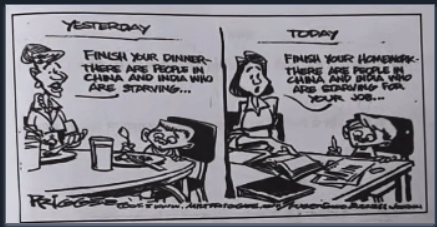
Study the given cartoon carefully and answer the questions that follow :
Question 25(i):
Which change does the cartoon reflect ?
View Solution
Step 1: Understanding the Concept:
The cartoon illustrates the socio-economic transformation brought about by globalization over a few decades.
Step 2: Key Formula or Approach:
Analyze the contrast between the 'Yesterday' panel (focus on poverty) and the 'Today' panel (focus on employment competition).
Step 3: Detailed Explanation:
The cartoon reflects the massive economic shift where developing nations like India and China have transitioned from being poverty-stricken, starving countries to becoming global economic powerhouses. Because of globalization and their highly educated, competitive workforces, they are now securing jobs that previously belonged to the developed world.
Step 4: Final Answer:
It reflects the shift in the global economy due to globalization, where India and China have emerged as major competitors for global jobs.
Quick Tip: Identify the core theme: The evolution of the Global South from "charity cases" to "economic competitors".
What kind of shift is shown in America's attitude towards developing countries ?
View Solution
Step 1: Understanding the Concept:
Observe the psychological change in the western (American) perspective portrayed by the mother's dialogue.
Step 2: Key Formula or Approach:
Compare the tone of pity in the first panel to the tone of anxiety in the second panel.
Step 3: Detailed Explanation:
The shift shown is from an attitude of sympathy and superiority to one of fear and insecurity. Previously, Americans viewed developing countries with pity due to famine and poverty. Today, that attitude has shifted to anxiety over job security, viewing the skilled workforce of developing countries as a direct economic threat.
Step 4: Final Answer:
The attitude has shifted from pity/sympathy for starving nations to fear/anxiety over economic competition and job losses.
Quick Tip: Focus on the emotion behind the mother's warning: First it was a moral guilt trip; now it is a genuine economic warning.
Mention any one positive and any one negative impact of globalization in reference to the cartoon.
View Solution
Step 1: Understanding the Concept:
Extract the dual impacts of global economic integration specifically hinted at by the cartoon's text.
Step 2: Key Formula or Approach:
Identify who benefits and who suffers in the 'Today' scenario of the cartoon.
Step 3: Detailed Explanation:
- Positive Impact (for developing nations): Globalization has led to immense job creation and economic growth in developing countries like India and China. "Outsourcing" has provided employment to millions, lifting them out of the starvation shown in the 'Yesterday' panel.
- Negative Impact (for developed nations): It has created severe job insecurity and potential unemployment for workers in developed nations (like the USA), as corporations move jobs to countries where labor is cheaper but equally skilled.
Step 4: Final Answer:
Positive: Job creation and economic rise of developing nations (India/China). Negative: Job insecurity and loss of employment in developed nations.
Quick Tip: Use the term "Outsourcing" or "BPO (Business Process Outsourcing)" to give a concrete example of this phenomenon.
Note : The following questions are for Visually Impaired Candidates only in lieu of Q. No. 25 :
Question 25(i):
In which year did India embark on reforms for economic growth ?
View Solution
Step 1: Understanding the Concept:
This refers to the landmark shift in India's economic policy.
Step 2: Key Formula or Approach:
Recall the year of the New Economic Policy.
Step 3: Detailed Explanation:
Facing a severe Balance of Payments crisis, the Indian government, under PM P.V. Narasimha Rao and Finance Minister Dr. Manmohan Singh, introduced structural economic reforms in 1991, widely known as Liberalization, Privatization, and Globalization (LPG).
Step 4: Final Answer:
India embarked on these comprehensive economic reforms in the year 1991.
Quick Tip: 1991 is arguably the most important year in modern Indian economic history.
In which year and at what place was the first meeting of World Social Forum (WSF) organized ?
View Solution
Step 1: Understanding the Concept:
The WSF is a major global platform for civil society organizations that oppose neo-liberal globalization.
Step 2: Key Formula or Approach:
Recall the founding details of the WSF movement.
Step 3: Detailed Explanation:
The World Social Forum was created as an alternative and counter-movement to the World Economic Forum (WEF). Its first meeting was held to gather activists, NGOs, and social movements under the slogan "Another World is Possible". This took place in Porto Alegre, Brazil, in the year 2001.
Step 4: Final Answer:
The first meeting of the WSF was organized in 2001 at Porto Alegre, Brazil.
Quick Tip: The WSF is the core of "Anti-Globalization" or "Alter-Globalization" movements globally.
State any two cultural consequences of globalization.
View Solution
Step 1: Understanding the Concept:
Globalization affects not just economies, but what people eat, wear, and how they think.
Step 2: Key Formula or Approach:
Identify the two main contrasting cultural effects taught in the curriculum: homogenization and heterogenization.
Step 3: Detailed Explanation:
1. Cultural Homogenization: The rise of a uniform global culture, predominantly influenced by Western (especially American) lifestyles. For example, wearing blue jeans, eating at McDonald's, and the global spread of Hollywood movies. It leads to the fear that rich local cultures are being destroyed.
2. Cultural Heterogenization (or Glocalization): The blending of global culture with local culture to produce something entirely new and unique. For example, McDonald's selling the McAloo Tikki burger in India, or the fusion of western pop music with traditional Indian beats.
Step 4: Final Answer:
Two major consequences are Cultural Homogenization (the world becoming culturally similar) and Cultural Heterogenization (the mixing of local and global cultures).
Quick Tip: Always use both Homogenization and Heterogenization to provide a balanced answer showing both the negative and positive cultural aspects of globalization.
In the given political outline map of India, four states have been marked as A, B, C and D. Identify these on the basis of the information given below and write their correct names in your answer-book along with their respective serial number of the information used and the concerned alphabet as per the format that follows :
(i) The state related to the leader of Dravidian Movement E.V. Ramasami Naicker.
(ii) The state whose formation was supported by Master Tara Singh.
(iii) The state where the 'movement against outsiders' was started by students.
(iv) The state for which Rajiv Gandhi and Laldenga signed an agreement for peace.
View Solution
Step 1: Understanding the Concept:
This requires identifying Indian states based on specific historical movements and leaders related to regional aspirations.
Step 2: Key Formula or Approach:
Correlate the historical clue with the correct state, and then match it to the typical A, B, C, D placements on a standard political map of India corresponding to these regions.
Step 3: Detailed Explanation:
(i) E.V. Ramasami Naicker, affectionately known as 'Periyar', was the central figure of the Dravidian movement, which was rooted in the southern state of Tamil Nadu (Alphabet D on the map).
(ii) Master Tara Singh was a prominent political and religious leader who spearheaded the Punjabi Suba movement, demanding a separate Punjabi-speaking state, leading to the creation of modern Punjab (Alphabet B on the map).
(iii) The massive, six-year-long anti-foreigner movement (targeting illegal immigrants from Bangladesh) was spearheaded by the All Assam Students’ Union (AASU) in the state of Assam (Alphabet C on the map).
(iv) Laldenga was the leader of the Mizo National Front (MNF), which fought an armed insurgency before signing a historic peace accord with PM Rajiv Gandhi in 1986, establishing the state of Mizoram (Alphabet A on the map).
Step 4: Final Answer:

Quick Tip: Map-based questions usually test "Regional Aspirations". Memorizing the key leaders (Phizo \(\rightarrow\) Nagaland, Laldenga \(\rightarrow\) Mizoram, Tara Singh \(\rightarrow\) Punjab, Periyar \(\rightarrow\) Tamil Nadu) guarantees full marks here.
Note : The following questions are for Visually Impaired Candidates only in lieu of Q. No. 26 :
Question 26(i):
State the article related to Jammu and Kashmir which was abolished in 2019.
View Solution
Step 1: Understanding the Concept:
Jammu & Kashmir held a special constitutional status within the Indian Union.
Step 2: Key Formula or Approach:
Identify the specific article of the Indian Constitution that provided this autonomy.
Step 3: Detailed Explanation:
Article 370 of the Indian Constitution gave special status to the region of Jammu and Kashmir, allowing it to have a separate constitution, a state flag, and autonomy over the internal administration. This was abrogated by the Government of India in August 2019.
Step 4: Final Answer:
Article 370 is the correct answer.
Quick Tip: Article 35A was also scrapped alongside 370; it defined 'permanent residents' of the state.
Name any one regional political party of the Jammu \& Kashmir.
View Solution
Step 1: Understanding the Concept:
Identify dominant state-level political organizations in J\&K.
Step 2: Key Formula or Approach:
Recall the parties that have historically formed the state government in J\&K.
Step 3: Detailed Explanation:
The National Conference (JKNC), historically led by Sheikh Abdullah and later Farooq and Omar Abdullah, is the oldest and most prominent regional party.
Another major regional party is the People's Democratic Party (PDP), founded by Mufti Mohammad Sayeed.
Step 4: Final Answer:
National Conference (NC) or People's Democratic Party (PDP) are correct answers.
Quick Tip: Sheikh Abdullah's party was originally called the 'All Jammu and Kashmir Muslim Conference' before being secularized to 'National Conference'.
In which year did Arunachal Pradesh become a separate state ?
View Solution
Step 1: Understanding the Concept:
The reorganization of the North-East into separate states happened in phases.
Step 2: Key Formula or Approach:
Recall the specific timeline of statehood for Arunachal Pradesh.
Step 3: Detailed Explanation:
Arunachal Pradesh was originally known as the North-East Frontier Agency (NEFA). It became a Union Territory in 1972 and was finally granted full statehood by the Indian Government in the year 1987 (alongside Mizoram).
Step 4: Final Answer:
The year is 1987.
Quick Tip: Remember the trio of 1987: Goa, Mizoram, and Arunachal Pradesh all became full states in this year.
Name the popular leader of Mizo National Front (MNF).
View Solution
Step 1: Understanding the Concept:
The MNF was a key insurgent group turned political party in the Mizo hills.
Step 2: Key Formula or Approach:
Identify the founder and chief negotiator of the MNF.
Step 3: Detailed Explanation:
The movement for a sovereign Mizoram was led by Laldenga. After two decades of armed struggle, he signed the Mizo Peace Accord in 1986 and subsequently became the Chief Minister of the newly formed state of Mizoram.
Step 4: Final Answer:
Laldenga is the popular leader.
Quick Tip: Laldenga's transition from an insurgent leader to a democratically elected Chief Minister is a classic success story of Indian democratic accommodation.
Explain any four factors that led Japan to emerge as a new centre of power even after the destruction caused by Atom Bombs.
View Solution
Step 1: Understanding the Concept:
Despite total devastation in WWII and lacking natural resources, Japan engineered an "economic miracle" to become a dominant global economic power.
Step 2: Key Formula or Approach:
Identify the strategic, economic, and socio-cultural decisions made by post-war Japan that facilitated its rapid recovery.
Step 3: Detailed Explanation:
1. The US Security Umbrella: Under the post-war constitution (imposed by the US), Japan was restricted from maintaining an offensive military. Furthermore, a security alliance with the USA meant America provided defense for Japan. This allowed Japan to divert almost all its national wealth and resources away from military spending and strictly into economic development and industrialization.
2. Focus on High-Tech and Export-Oriented Manufacturing: Having few natural resources, Japan imported raw materials, processed them, and focused heavily on exporting high-value manufactured goods. They aggressively invested in Research \& Development (R\&D), becoming global leaders in electronics, automobiles, and robotics (e.g., Sony, Toyota, Honda).
3. Strong Work Ethic and Labor Relations: Japanese society rebuilt itself on a culture of intense discipline, loyalty to the company (lifetime employment systems), and harmony. Labor disputes were minimized, and workers were highly educated and skilled, leading to unparalleled productivity.
4. Strict Quality Control Models: Japan adopted revolutionary manufacturing techniques, such as 'Kaizen' (continuous improvement) and 'Just-in-Time' production. This made Japanese products globally renowned for their unmatched reliability and quality, easily outcompeting western goods.
Step 4: Final Answer:
Through reliance on US security, high-tech exports, a disciplined workforce, and superior manufacturing quality, Japan successfully rebuilt itself into a global economic powerhouse.
Quick Tip: Japan is the classic example of an "Alternative Centre of Power" that relies entirely on Economic and Technological dominance (Soft/Economic Power) rather than Military strength.
Explain any four policies adopted by China to accelerate its economic growth.
View Solution
Step 1: Understanding the Concept:
In 1978, China shifted from a rigid, isolated communist economy to a pragmatic, market-oriented system without relinquishing political control of the Communist Party.
Step 2: Key Formula or Approach:
Detail the specific step-by-step reforms introduced by Deng Xiaoping and his successors.
Step 3: Detailed Explanation:
1. The 'Open Door' Policy (1978): Introduced by Deng Xiaoping, this marked the end of China's economic isolation. The policy invited foreign capital and technology into China to significantly boost productivity by integrating China into the global market.
2. Gradual Privatization (No Shock Therapy): Unlike the USSR, China reformed step-by-step. They began by dismantling collective farms and privatizing agriculture in 1982, which led to a massive increase in agricultural production and rural incomes. They later privatized industry in 1998.
3. Creation of Special Economic Zones (SEZs): To attract multinational corporations (MNCs) without disrupting the entire domestic economy, China created SEZs along its coast. These zones offered tax incentives, cheap labor, and relaxed labor laws, transforming China into the "manufacturing hub of the world".
4. Accession to the World Trade Organization (WTO in 2001): By joining the WTO, China committed to further opening its economy to foreign competition. This strategic move fully integrated China into the global capitalist trade architecture, allowing its exports to reach every corner of the globe without heavy tariffs.
Step 4: Final Answer:
China's economic miracle was driven by the Open Door policy, phased privatization, the establishment of SEZs, and global integration via the WTO.
Quick Tip: Contrast China's success with the USSR's failure: China used "Gradualism" (step-by-step reform) while the USSR used "Shock Therapy" (sudden, disastrous reform).
Highlight any four steps taken by the Government of India to minimize the greenhouse gas emissions.
View Solution
Step 1: Understanding the Concept:
India is highly vulnerable to climate change but also needs energy for development. It has initiated several domestic policies to reduce its carbon footprint.
Step 2: Key Formula or Approach:
List specific national missions, renewable energy targets, and efficiency schemes implemented by the Indian government.
Step 3: Detailed Explanation:
1. Massive Push for Renewable Energy: India launched the National Solar Mission to establish itself as a global leader in solar energy. It has aggressively increased its targets for installed renewable energy capacity (solar, wind) to reduce reliance on coal-fired power plants.
2. Promoting Energy Efficiency: The government introduced the UJALA scheme, which distributed millions of subsidized LED bulbs across the country. Additionally, the mandatory 'star-rating' system for electrical appliances ensures that newly manufactured goods consume significantly less electricity.
3. Transition to Clean Mobility: Through initiatives like the FAME (Faster Adoption and Manufacturing of (Hybrid \&) Electric Vehicles) scheme, the government provides subsidies to buyers and manufacturers to accelerate the transition from petrol/diesel vehicles to Electric Vehicles (EVs), thereby reducing vehicular emissions.
4. Afforestation and The Green India Mission: Under the National Action Plan on Climate Change (NAPCC), India actively promotes planting trees and recovering forest areas. Forests act as crucial "carbon sinks", naturally absorbing CO2 from the atmosphere.
Step 4: Final Answer:
India's strategy revolves around scaling up solar energy, mandating energy efficiency, promoting electric vehicles, and expanding forest cover.
Quick Tip: Mentioning the "National Action Plan on Climate Change (NAPCC)" or the "Panchamrit" goals announced at the COP summits adds immense value to environmental answers.
How does geo-politics of natural resources determine the balance of power in the contemporary world ? Examine.
View Solution
Step 1: Understanding the Concept:
Natural resources (like oil, gas, water, and minerals) are the lifelines of modern economies and militaries. Therefore, controlling them is a primary source of global political power.
Step 2: Key Formula or Approach:
Examine how dependency on, and control over, key resources lead to international diplomacy, strategic alliances, and conflicts.
Step 3: Detailed Explanation:
1. The Oil Geopolitics of West Asia (Middle East): The global economy runs on petroleum. The massive concentration of oil reserves in the Gulf region gives these countries disproportionate political power. Global superpowers continually intervene in this region (e.g., the Gulf Wars) to ensure uninterrupted access to oil, making it the most heavily militarized region globally.
2. Energy as a Diplomatic Weapon: Countries with vast resources often use them to dictate terms to dependent nations. For example, Russia's massive reserves of natural gas have historically been used as leverage over European countries, influencing their foreign policy out of fear of having their winter heating supplies cut off.
3. Conflict over Strategic Minerals: The modern tech and defense industries require rare earth minerals, uranium, cobalt, etc. The scramble to secure these resources often leads to neo-colonial exploitation and proxy wars, particularly in resource-rich but unstable regions like Sub-Saharan Africa.
4. Water Geopolitics (Hydro-politics): As freshwater becomes scarce, rivers shared by multiple countries (like the Nile, Mekong, or Brahmaputra) become flashpoints. An upper-riparian state (e.g., China building dams on the Brahmaputra) holds significant strategic power over lower-riparian states (like India and Bangladesh), threatening their food and water security.
Step 4: Final Answer:
In conclusion, the geopolitical struggle to secure, transport, and control natural resources dictates international alliances, triggers conflicts, and fundamentally shapes the global balance of power.
Quick Tip: Use the phrase "Resource Curse" to describe how having abundant natural resources often brings foreign interference and conflict rather than wealth to a nation.
Analyse any three principles of India's foreign policy which you would like to alter in the present international scenario.
View Solution
Step 1: Understanding the Concept:
India's foreign policy was heavily shaped by Cold War dynamics (Non-Alignment) and post-colonial idealism. The contemporary multipolar world requires a more pragmatic approach.
Step 2: Key Formula or Approach:
Identify three traditional pillars of Indian foreign policy and propose necessary practical alterations suited for modern geopolitical realities like a rising China and a multipolar world.
Step 3: Detailed Explanation:
1. From 'Non-Alignment' to 'Multi-Alignment': Traditionally, India avoided joining power blocs. However, in the current scenario, strict non-alignment is obsolete. I would alter this to a policy of proactive "Multi-alignment" or "Issue-based alignment". India must aggressively build strategic partnerships with all major poles (USA, Russia, EU, Japan) simultaneously to maximize its national interest, as seen in its participation in the QUAD without abandoning ties with Russia.
2. A More Assertive 'Neighborhood First' Policy: Historically, India has often taken a "big brother" or overly accommodating approach, which sometimes bred resentment or allowed external powers space. I would alter this to be more transactional and assertive. Given China's "String of Pearls" strategy encroaching on South Asia, India must aggressively deliver on infrastructure projects in neighboring countries (Nepal, Maldives, Sri Lanka) and set clear "red lines" regarding security threats.
3. Shifting from Moral Idealism to Hard Pragmatism (Realpolitik): Early Indian foreign policy was heavily driven by moral stands on global issues, often sacrificing immediate material gains. I would alter this to prioritize economic diplomacy and hard security. Decisions should be driven strictly by what secures resources, technology, and border security for India, rather than seeking to be the moral voice of the Global South at the cost of national interest.
Step 4: Final Answer:
To thrive today, India's foreign policy must shift from idealistic non-alignment to pragmatic multi-alignment, assertiveness in its neighborhood, and economic realpolitik.
Quick Tip: This is an analytical and opinion-based question. You must logically justify *why* the old principle doesn't work today (e.g., "Because the Cold War is over" or "Because of China's rise").
"India's nuclear policy is a blend of strategic autonomy and a commitment to global disarmament." Justify the statement with any three suitable arguments.
View Solution
Step 1: Understanding the Concept:
India possesses nuclear weapons but insists it only has them because the world is unfair, not because it wants to use them. It balances its own defense needs with a desire for global peace.
Step 2: Key Formula or Approach:
Provide evidence of India's independent nuclear decision-making (autonomy) alongside its responsible behavior and diplomatic calls for a nuclear-free world (disarmament).
Step 3: Detailed Explanation:
1. Refusal to Sign Discriminatory Treaties (Strategic Autonomy): India steadfastly refused to sign the Nuclear Non-Proliferation Treaty (NPT) and the Comprehensive Test Ban Treaty (CTBT). India argued these treaties were inherently discriminatory, creating a "nuclear apartheid" where five nations could keep their weapons while the rest of the world could not. By conducting tests in 1998, India demonstrated absolute strategic autonomy, prioritizing its national security over international pressure.
2. The 'No First Use' (NFU) Doctrine (Blend of Both): India's official nuclear doctrine explicitly states it will never use nuclear weapons first against any nation. It maintains a "credible minimum deterrent" meant strictly for retaliation. This proves that India’s weapons are purely defensive, reflecting its commitment to minimizing nuclear threats while retaining autonomous deterrence.
3. Consistent Advocacy for Universal Disarmament: Despite being a nuclear-armed state, India continues to be a leading voice at the United Nations demanding complete, universal, and non-discriminatory nuclear disarmament. India's stance is that it is ready to give up its nuclear arsenal provided all other nuclear weapon states agree to do the same in a time-bound manner, proving its genuine commitment to a peaceful, weapon-free world.
Step 4: Final Answer:
India's refusal of the NPT secures its autonomy, while its 'No First Use' policy and advocacy for universal destruction of all nuclear weapons prove its commitment to global disarmament.
Quick Tip: Always use the phrase "Credible Minimum Deterrence" and "No First Use" when writing about India's nuclear policy.
How did Princely states posed a threat to the National Security of India ? Explain.
View Solution
Step 1: Understanding the Concept:
At the time of independence in 1947, India contained 565 princely states whose rulers were given the legal right by the British to join India, join Pakistan, or declare themselves independent sovereign nations.
Step 2: Key Formula or Approach:
Analyze the geographical, political, and strategic dangers of having independent kingdoms embedded within the new Indian republic.
Step 3: Detailed Explanation:
The prospect of Princely states remaining independent posed severe multi-dimensional threats to India:
1. Geographical Fragmentation (Balkanization): If large states like Hyderabad, Junagadh, or Travancore had remained independent, India would have been divided into dozens of pieces. The map of India would look like Swiss cheese, making internal movement, trade, and unified administration virtually impossible.
2. Vulnerability to Foreign Interference: Independent, weak princely states would have been highly susceptible to interference or alliances with hostile foreign powers. For instance, an independent Hyderabad in the heart of the Deccan, or an independent Kashmir on the northern frontier, could be used as launchpads by adversaries (like Pakistan) to destabilize India from within.
3. Threat to Democracy and Internal Security: The Indian national movement was based on democracy and fundamental rights. In contrast, most princely states were autocracies where subjects had no democratic rights. Having undemocratic pockets spread throughout the country would have inevitably led to internal rebellions, civil unrest, and a constant threat to the democratic stability of the Indian Union.
Step 4: Final Answer:
The princely states threatened to fracture the geographic unity, compromise the border security, and undermine the democratic foundation of the newly independent India.
Quick Tip: Mention Sardar Vallabhbhai Patel. As the Home Minister, his diplomatic skill and use of force (e.g., Police Action in Hyderabad) eliminated this massive security threat.
Explain any four problems faced during the process of partition of India.
View Solution
Step 1: Understanding the Concept:
The partition of British India into India and Pakistan based on the "Two-Nation Theory" was not a neat geographical division but a chaotic, bloody, and administratively nightmarish process.
Step 2: Key Formula or Approach:
Identify and detail four distinct hurdles: geographical non-contiguity, boundary confusion, violence/refugees, and administrative division.
Step 3: Detailed Explanation:
1. No Single Continuous Muslim-Majority Area: There was no single geographical region in British India with a continuous Muslim majority. The two main concentrations were in the extreme West and the extreme East. Therefore, Pakistan had to be created in two non-contiguous parts (West Pakistan and East Pakistan) separated by thousands of kilometers of Indian territory, creating massive logistical nightmares.
2. Ambiguity of the Border (The Radcliffe Line): The exact boundaries were drawn in extreme haste by a British lawyer (Cyril Radcliffe) who had no prior knowledge of India. The border award was announced on August 17th, two days \textit{after independence. Consequently, millions of people were entirely unaware on Independence Day whether they belonged to India or Pakistan.
3. Unprecedented Communal Violence and the Refugee Crisis: As people realized they were on the "wrong" side of the border, massive, spontaneous riots erupted, particularly in Punjab and Bengal. Minorities on both sides were slaughtered. This triggered the largest abrupt human migration in history (approx. 80 lakh people), leading to a monumental refugee crisis as people arrived with nothing, requiring massive relief camps.
4. Division of State Assets and Administration: The partition was not just of land, but of the entire state apparatus. Everything from financial assets, railway networks, and the military/police force to mundane items like typewriters, paperclips, and library books had to be divided between the two nations amidst extreme hostility.
Step 4: Final Answer:
The partition process was marred by geographic impossibility, delayed and confused borders, catastrophic communal violence, and complex administrative division.
Quick Tip: Remember that partition was not just a political event; it was a profound human tragedy. Highlighting the plight of the refugees and minorities adds depth to the answer.
*The article might have information for the previous academic years, please refer the official website of the exam.