
CLAT 2026 Question Paper with Solutions Set C


Content Writer | Updated On - Dec 11, 2025
CLAT 2026 Question Paper with Solution for Set C is available for download here. CLAT 2026 exam was conducted by the Consortium of NLUs on December 7, 2025. Candidates were required to answer a total of 120 objective-type questions carrying 1 mark each. CLAT Question Paper contained five major sections: English Language, Current Affairs & General Knowledge, Legal Reasoning, Logical Reasoning, and Quantitative Techniques. Download CLAT 2026 Question Paper with Answer Key and Solution PDF from the link provided below.
CLAT 2026 Question Paper with Solution- Set C
| CLAT 2026 Question Paper with Solutions | Download PDF | Check Solutions |

Which letter will be exactly in the middle?
View Solution
Step 1: Apply the transformations to the original word.
Initial Word: ELECTROCARDIOGRAPH (18 letters).
Transformation 1: Reverse the first half.
The first half is "ELECTROCA" (9 letters). Reversed, it is "ACORTCELE".
The word becomes: ACORTCELERDIOGRAPH.
Transformation 2: Prefix the second to last letter.
The second to last letter of the original word is 'P'.
The word becomes: PACORTCELERDIOGRAPH.
Transformation 3: Add 'S' at the end.
The final word is: PACORTCELERDIOGRAPHS.
Step 2: Find the middle letter.
The final word has 20 letters. The middle position is between the 10th and 11th letters.
The 10th letter is E.
The 11th letter is R.
Both 'E' and 'R' are given as options. In such ambiguous cases, we check for consistency with other questions. As the intended answers seem to flow from a specific interpretation, let's assume the question refers to the 10th letter, 'E'. This aligns with option (D).
Quick Tip: When a word has an even number of letters, there are two middle letters.
If the options list one of them, it's a strong hint as to which one the question considers "the middle".
If both are listed, the question may be flawed, but you may need to test both possibilities in subsequent questions to find a consistent path.
How many vowels will be to the left of the middle letter?
View Solution
Step 1: Determine the final word and the middle letter.
First, we must derive the transformed word as per the instructions.
- Original Word: ELECTROCARDIOGRAPH (18 letters).
- Reverse the first half ("ELECTROCA") to get "ACORTCELE".
- The word becomes "ACORTCELERDIOGRAPH".
- Prefix the second-to-last letter of the original word ('P') to get "PACORTCELERDIOGRAPH".
- Add 'S' at the end to get the final word: PACORTCELERDIOGRAPHS.
- The final word has 20 letters. The middle is between the 10th letter (E) and the 11th letter (R). Based on the previous question's options, we assume the "middle letter" refers to the 10th letter, E.
Step 2: Count the vowels to the left of the middle letter.
The part of the word to the left of the 10th letter ('E') is the first 9 letters: P A C O R T C E L.
The vowels in the English alphabet are A, E, I, O, U.
Let's count the vowels in this 9-letter segment:
- A is at position 2.
- O is at position 4.
- E is at position 8.
There are a total of 3 vowels.
Quick Tip: To solve questions that build on a previous result, it is crucial to perform the initial transformation correctly.
Write down the final transformed word clearly so you can refer to it for all related questions.
Which of the two vowels will be adjoining each other?
View Solution
Step 1: Determine the final transformed word.
Following the transformation rules on "ELECTROCARDIOGRAPH":
1. Reverse first half ("ELECTROCA") \(\rightarrow{}\) "ACORTCELE".
2. Resulting word \(\rightarrow{}\) "ACORTCELERDIOGRAPH".
3. Prefix original's second-to-last letter ('P') \(\rightarrow{}\) "PACORTCELERDIOGRAPH".
4. Add 'S' at the end \(\rightarrow{}\) PACORTCELERDIOGRAPHS.
Step 2: Scan the word for adjacent vowels.
The vowels are A, E, I, O, U. We need to find a pair of these letters sitting next to each other in the final word.
Let's scan the word: P A C O R T C E L E R D I O G R A P H S.
- The vowels 'I' and 'O' appear together at positions 13 and 14.
Step 3: Compare with the given options.
- (A) IE: Not found.
- (B) IO: Found.
- (C) AE: Not found.
- (D) AO: Not found.
The correct option is (B).
Quick Tip: A good strategy for this type of question is to first highlight all the vowels in your final derived word.
This makes it visually easier to spot any adjacent pairs without having to re-scan the entire word for each option.
Which vowel will have a consonant to the left but a vowel to the right of it?
View Solution
Step 1: Determine the final transformed word.
The transformed word derived from "ELECTROCARDIOGRAPH" is PACORTCELERDIOGRAPHS.
Step 2: Understand the required pattern.
We are searching for a vowel that is arranged in the sequence: Consonant - Vowel - Vowel.
Step 3: Examine the vowels in the final word.
Let's check each vowel and its immediate neighbors:
- Vowel A is at position 2: P-\underline{A-C (Consonant-Vowel-Consonant). Does not match.
- Vowel O is at position 4: C-\underline{O-R (Consonant-Vowel-Consonant). Does not match.
- Vowel E is at position 8: C-\underline{E-L (Consonant-Vowel-Consonant). Does not match.
- Vowel E is at position 10: L-\underline{E-R (Consonant-Vowel-Consonant). Does not match.
- Vowel I is at position 13: D-\underline{I-O (Consonant-Vowel-Vowel). This matches the pattern.
- Vowel O is at position 14: I-\underline{O-G (Vowel-Vowel-Consonant). Does not match.
- Vowel A is at position 17: R-\underline{A-P (Consonant-Vowel-Consonant). Does not match.
Step 4: Identify the correct vowel.
The only vowel that fits the required condition is I.
Quick Tip: Break down complex conditions into simple parts.
Here, first locate all the vowels in the word.
Then, for each vowel, check the character to its left and the character to its right to see if they match the consonant-vowel pattern.
Name the letter sandwiched between two vowels?
View Solution
Step 1: Determine the final transformed word and the required pattern.
The final word is PACORTCELERDIOGRAPHS.
The question asks for a letter "sandwiched between two vowels," which means we are looking for a consonant in the pattern: Vowel - Consonant - Vowel.
Step 2: Scan the word for the pattern.
Let's go through the word and identify any instances of this pattern.
- P\underline{ACORT... The consonant 'C' is between the vowels 'A' and 'O'. So, C is a valid letter.
- ...RTC\underline{ELER... The consonant 'L' is between the vowels 'E' and 'E'. So, L is also a valid letter.
Step 3: Evaluate the options.
The letters we found that are sandwiched between two vowels are C and L.
- (A) R and T: Neither fits the pattern.
- (B) C and L: Both letters fit the pattern.
- (C) R and L: 'L' fits, but 'R' does not.
- (D) D and R: Neither fits the pattern.
Although the question asks to "Name the letter" (singular), the only option that contains exclusively correct letters is (B). This suggests the question intended to ask which pair of letters fits the description.
Quick Tip: When a question's phrasing seems slightly mismatched with the options (e.g., singular question, plural options), interpret the question in a way that allows one of the options to be uniquely correct.
Here, "which of the following pairs contains letters that are..." is the most logical interpretation.
Which letter is prefixed to the word after the first half is reversed?
View Solution
Step 1: Identify the relevant transformation step from the instructions.
The passage describes the transformation process in a specific order. The second step is:
"Next, the students were told to identify the last but one letter of the original word and place it at the very beginning..."
"Placing it at the very beginning" means to prefix it.
Step 2: Identify the specified letter from the original word.
The original word given in the passage is “ELECTROCARDIOGRAPH.”
The last letter of this word is 'H'.
The "last but one" letter (the second to last letter) is 'P'.
Step 3: Conclude the answer.
The letter that is identified and prefixed to the word is P.
Quick Tip: Read the instructions in the prompt carefully, paying attention to keywords.
The question asks for the letter that is "prefixed", and the instructions clearly state which letter is placed "at the very beginning".
Also, note whether the instruction refers to the "original" word or the "transformed" word.
Identifying the Most Likely Suspect
Based only on the fact that the five-digit code was used to open the display case, who is the only plausible suspect among the three?
View Solution
Step 1: Isolate the specific piece of evidence mentioned.
The question directs us to consider only one fact: "the five-digit code was used to open the display case". All other information, such as alibis or other evidence, must be ignored for this question.
Step 2: Link this evidence to the suspects.
The passage provides a crucial detail about who knew the code: "...a specific five-digit code, which only Anjali and the museum director (who was out of the country) knew."
Step 3: Evaluate the suspects based on this single fact.
- Anjali: Knew the code. This makes her a plausible suspect.
- Bharat: The passage does not state he knew the code. Therefore, based on this fact alone, he is not a suspect.
- Chitra: The passage does not state she knew the code. Therefore, based on this fact alone, she is not a suspect.
Step 4: Conclude the answer.
Among the three suspects, Anjali is the only one who had the knowledge required to perform the action as it was recorded.
Quick Tip: Questions with phrases like "Based only on..." or "According solely to..." are testing your ability to isolate information.
You must strictly ignore any other facts presented in the passage, even if they seem relevant to the overall case.
Evaluating Alibis and Time Constraints
The theft occurred between 10:00 PM and 1:00 AM, but the night guard saw the medallion at 10:30 PM. Given Chitra's alibi, what is the earliest time she could have reached the museum?
View Solution
Step 1: Identify the key information from Chitra's alibi.
- She exited her studio at 11:45 PM.
- The studio is a 20-minute drive from the museum.
Step 2: Calculate her earliest possible arrival time at the museum.
To find the earliest time she could reach the museum, we add the travel time to her departure time.
- Departure Time: 11:45 PM
- Travel Time: + 20 minutes
- Arrival Time = 11:45 PM + 20 minutes
- 11:45 PM + 15 minutes = 12:00 AM
- 12:00 AM + 5 minutes = 12:05 AM
Step 3: Conclude the answer.
The earliest time Chitra could have arrived at the museum is 12:05 AM.
Quick Tip: For timeline calculations, be methodical.
Write down the start time and add the duration.
Pay special attention when crossing midnight (11:59 PM to 12:00 AM), as this is a common point of error.
Deduction and Contradictory Evidence
If the theft was committed by Bharat, which established fact must be incorrect, based on the provided information?
View Solution
Step 1: Assume the hypothetical premise is true.
We must assume for this question that Bharat committed the theft.
Step 2: Analyze the information related to Bharat.
There are two key pieces of information about Bharat:
1. His Alibi: He has a confirmed alibi from 8:00 PM to 1:30 AM, covering the theft window.
2. His Method: He had boasted he could disable the lock remotely, without needing the code.
Step 3: Identify the contradictions.
If Bharat is the thief, the established facts of the case must be re-evaluated:
- Contradiction 1: His alibi states he was elsewhere. For him to be the thief in person, his alibi must be false. This contradicts fact (D).
- Contradiction 2: The log says the code was used. Bharat's special skill, which is the primary reason to suspect him despite his alibi, is a method that does not use the code. If he used his special skill, the log would be misleading or incorrect. This contradicts fact (B).
Step 4: Determine the most direct contradiction.
Both his alibi and the method in the logs are contradicted. However, the information about the remote, no-code method is specifically linked to Bharat. It represents his unique potential means of committing the crime. The log stating the code was used directly refutes the idea that he used his special ability. Therefore, if we are to believe Bharat is guilty *because* of his special skill, the log's record of the code being used must be the incorrect fact.
Quick Tip: In hypothetical reasoning questions ("If X is true..."), look for the most direct conflict created by the new assumption.
The contradiction is often related to the unique characteristics or abilities of the subject in question.
Analyzing Accessory Evidence
The discovery of the silver button near the display case is the most incriminating evidence against which suspect, and why?
View Solution
Step 1: Identify the piece of evidence in question.
The evidence is a "small, distinctive silver button" found near the display case.
Step 2: Find the information in the passage that connects this evidence to a suspect.
The text explicitly states: "Anjali is known to frequently wear a coat with similar unique silver buttons."
Step 3: Evaluate the connection for each suspect.
- Anjali: There is a direct link between the physical evidence and her known attire. This is incriminating.
- Bharat: His expertise is irrelevant to the button. No link is established.
- Chitra: Her location is a separate point; the button is not connected to her.
- Mr. Hemant: There is no information linking the button to him.
Step 4: Conclude which suspect is most incriminated.
The evidence of the button points most directly and strongly to Anjali, as it provides a potential physical link between her and the crime scene.
Quick Tip: Physical evidence is a powerful element in logical puzzles.
Look for explicit statements in the text that connect an object found at the scene to a specific suspect's habits, possessions, or appearance.
Identifying the Logical Flaw in the Argument :
A detective argues: "Since Bharat has a confirmed, continuous alibi covering the entire time window of the theft (10:30 PM to 1:00 AM), he cannot be the thief." What principle of logic supports this detective's conclusion?
View Solution
Step 1: Deconstruct the detective's argument.
- Premise: Bharat was confirmed to be absent from the museum for the entire duration of the crime.
- Implicit Assumption: The crime of stealing the medallion required the thief to be physically present at the museum.
- Conclusion: Therefore, Bharat cannot be the thief.
Step 2: Evaluate the given logical principles.
- (A) Correlation does not imply causation: This principle relates to statistical relationships and is not relevant to an argument about physical presence.
- (B) If an event requires presence, confirmed absence proves innocence: This perfectly encapsulates the detective's reasoning. The event (theft) requires being there, and the confirmed absence (alibi) proves innocence of being there to commit it.
- (C) The rule of double jeopardy: This is a legal rule preventing someone from being tried twice for the same crime, not a principle of evidence evaluation.
- (D) The burden of proof lies with the accuser: This is a legal standard about who must prove the case, not the logical principle used to evaluate a specific piece of evidence like an alibi.
Step 3: Conclude the answer.
The detective's conclusion is a direct application of the principle described in option (B).
Quick Tip: Understand the difference between principles of logical deduction and legal procedures.
An alibi works on the fundamental logical principle that a person cannot be in two places at once. The options often mix logical principles with legal ones to test this understanding.
Drawing a Strongest Conclusion
Considering all the facts (the code being used, the silver button, and the confirmed alibis), which is the most reasonable inference?
View Solution
Step 1: Synthesize the evidence for each suspect.
- Anjali:
- Means: Yes, she knew the code that was used.
- Opportunity: Unknown (no alibi provided).
- Evidence Link: The button found at the scene is similar to buttons on her coat.
- Bharat:
- Means: No, his known method (no-code) was not used.
- Opportunity: No, he has a confirmed alibi for the entire period.
- Evidence Link: None.
- Chitra:
- Means: No evidence she knew the code.
- Opportunity: Yes, she had a window of time after 11:45 PM.
- Evidence Link: None.
Step 2: Evaluate the inferences in the options.
- (A) Bharat having an accomplice is pure speculation; there's no evidence to support this theory.
- (B) Chitra having enough time establishes opportunity, but it does not prove her alibi is false or that she is guilty, especially since she lacked the means (the code).
- (C) This statement accurately reflects the evidence. Anjali is the only suspect who is linked to both the method of the crime (knowing the code) and the physical evidence (the button). This makes her the strongest suspect.
- (D) Accusing Mr. Hemant is speculation. There is no motive or evidence pointing to him in the text.
Step 3: Conclude the most reasonable inference.
The most logical conclusion based on the convergence of evidence is that Anjali is the most likely suspect.
Quick Tip: The strongest conclusion in a logic puzzle is the one supported by multiple, independent pieces of evidence provided in the text.
Avoid options that require making up new facts or scenarios (like an unknown accomplice).
Assessing Necessary Conditions
What condition is necessary for Chitra to have stolen the medallion?
View Solution
Step 1: Understand the term "necessary condition."
A necessary condition is a prerequisite. It is something that \textit{must be true for a certain event to have happened. If this condition is not met, the event is impossible.
Step 2: Identify the undisputed fact about how the crime was committed.
The passage states as a fact: "The security system logs show that the display case was opened using a specific five-digit code."
Step 3: Evaluate the options as necessary conditions for Chitra's guilt.
- (A) She must know the five digit code: Since the code was the tool used for the theft, any person who committed the theft must have known it. This is a necessary condition.
- (B) She must have left before 11:45 pm: No, leaving at 11:45 PM provided her with sufficient opportunity. Leaving earlier was not a requirement.
- (C) The theft must have occurred after she left...: This is also a necessary condition related to her opportunity. However, knowing the code is about the *means*, which is a more fundamental aspect of the crime's execution.
- (D) She must have worked with Anjali...: This is one possible way she could have gotten the code, but it is not the only way. Therefore, it is not a necessary condition.
Step 4: Determine the most critical necessary condition.
Both (A) and (C) are technically necessary. However, the use of the code is a central, established fact of the crime itself. Without knowing the code, the theft, *as it happened*, would be impossible for anyone to commit. Therefore, knowledge of the code is the most fundamental necessary condition.
Quick Tip: When evaluating necessary conditions, focus on the core mechanics of the event described.
The method used to commit the crime (the means) is often the most critical necessary condition for any suspect's guilt.
If 'P + Q – R ÷ T', how is T related to P?
View Solution
Step 1: Define the relationships from the symbols.
- A + B \(\rightarrow\) A is the daughter of B.
- A - B \(\rightarrow\) A is the brother of B.
- A ÷ B \(\rightarrow\) A is the mother of B.
- A × B \(\rightarrow\) A is the father of B.
Step 2: Decode the given expression 'P + Q – R ÷ T'.
1. P + Q: P is the daughter of Q.
2. Q - R: Q is the brother of R. (This means Q is male).
3. R ÷ T: R is the mother of T. (This means R is female).
Step 3: Combine the relationships to build a family structure.
- From (1), Q is the parent of P. Since Q is male (from 2), Q is the father of P.
- From (2), Q and R are siblings.
- From (3), R is the mother of T.
- So, P's father (Q) and T's mother (R) are brother and sister. This makes P and T first cousins.
Step 4: Determine the relationship and check the options.
The question asks how T is related to P. T is P's cousin.
None of the options provided (Aunt, Father, Grandmother) is "Cousin".
Therefore, the correct answer is "None of these".
Quick Tip: Drawing a simple family tree diagram can be extremely helpful for visualizing complex relationships in these types of puzzles.
Label each person with their gender as you discover it (e.g., 'brother' means male, 'mother' means female).
Which of the following means that R is wife of P?
View Solution
Step 1: Understand the condition to be met.
For R to be the wife of P, P must be the husband (male) and R must be the wife (female). In this symbolic system, this relationship can be established if P is the father of a child and R is the mother of the same child.
Step 2: Analyze each option.
- (A) P × R – Q – T: "P × R" means P is the father of R. This is a parent-child relationship. Incorrect.
- (B) P + T + R – Q: "P + T" means P is the daughter of T. P is female, so she cannot be a husband. Incorrect.
- (C) P ÷ R – Q + T: "P ÷ R" means P is the mother of R. This is a parent-child relationship. Incorrect.
- (D) P × T – Q + R: Let's decode this step-by-step.
1. P × T: P is the father of T. (This establishes P as male).
2. T – Q: T is the brother of Q. (This means T and Q have the same parents).
3. Q + R: Q is the daughter of R. (This means R is a parent of Q).
Step 3: Synthesize the information from option (D).
- From (1) and (2), we know P is the father of both T and Q.
- From (3), we know R is a parent of Q.
- Since P is the father of Q, the other parent, R, must be the mother.
- Therefore, P (father) and R (mother) are the parents of Q, making them husband and wife. This matches the condition.
Quick Tip: To prove a spousal relationship (husband/wife), you must find a common child in the expression and establish one suspect as the father and the other as the mother of that child.
If 'P × T + Q + R' how is R related to P?
View Solution
Step 1: Decode the expression 'P × T + Q + R'.
1. P × T: P is the father of T.
2. T + Q: T is the daughter of Q.
3. Q + R: Q is the daughter of R.
Step 2: Build the family tree.
- From (1) and (2), we know P is the father of T and Q is the mother of T. This means P and Q are husband and wife.
- From (3), we know Q is the daughter of R. This means R is a parent of Q.
Step 3: Determine the relationship between R and P.
- P is the husband of Q.
- R is the parent of P's wife, Q.
- Therefore, R is P's father-in-law or mother-in-law.
Step 4: Check the options.
The calculated relationship (parent-in-law) is not among the options (Daughter, Husband, Son-in-law).
Thus, the correct choice is "None of these".
Quick Tip: Chain the relationships logically. Once you establish a relationship like P and Q being married, you can use that to determine in-law relationships with their parents.
If 'P ÷ R – Q × T', how is P related to T?
View Solution
Step 1: Decode the expression 'P ÷ R – Q × T'.
1. P ÷ R: P is the mother of R. (P is female).
2. R – Q: R is the brother of Q.
3. Q × T: Q is the father of T. (Q is male).
Step 2: Construct the family relationships.
- From (1) and (2), since P is the mother of R, and R is the brother of Q, P must also be the mother of Q.
- From (3), Q is the father of T.
Step 3: Determine the final relationship.
- P is the mother of Q.
- Q is the father of T.
- This means P is the mother of T's father.
- Therefore, P is the paternal grandmother of T.
Step 4: Check the options.
The relationship is Grandmother. This matches option (A). Since we established P is female ('mother'), option (D) Grandfather is incorrect.
Quick Tip: Always track the gender of individuals as you decode the symbols.
This is crucial for distinguishing between relationships like Grandmother/Grandfather or Aunt/Uncle.
If 'R ÷ Q + R × T', how is T related to Q?
View Solution
Step 1: Analyze the given expression for contradictions.
The expression is 'R ÷ Q + R × T'. Let's break it into two parts based on the person 'R':
- R ÷ Q: "R is the mother of Q". This implies R is female.
- R × T: "R is the father of T". This implies R is male.
A person cannot be both a mother and a father. The expression as written is logically impossible, indicating a typographical error.
Step 2: Propose a logical correction.
The most likely error is that one of the operators is wrong, and 'R' was intended to be the same parent to both Q and T. Let's assume the second operator was also '÷', making the two facts:
1. R ÷ Q (R is the mother of Q).
2. R ÷ T (R is the mother of T).
Step 3: Determine the relationship from the corrected expression.
- If R is the mother of both Q and T, then Q and T are siblings.
- The question asks how T is related to Q. T is either the brother or sister of Q.
- Looking at the options, both "Sister" and "Brother" are types of siblings. Since the symbols do not define the gender of the second person in a relationship (e.g., in R ÷ Q, Q's gender is unknown), we cannot be certain. However, in multiple-choice questions with such flaws, we select an answer that represents a valid possibility. "Brother" is a valid possibility. Without further information, we assume it is the intended answer.
Quick Tip: When you find a clear logical contradiction in a problem statement, don't give up.
Try to identify the most probable typo (often a repeated letter or incorrect operator) and solve the problem based on a corrected, logical premise.
If 'R - P ÷ J × Q', how is J related to R?
View Solution
Step 1: Decode the expression 'R - P ÷ J × Q'.
1. R - P: R is the brother of P. (R is male).
2. P ÷ J: P is the mother of J. (P is female).
3. J × Q: J is the father of Q. (J is male).
Step 2: Combine the relationships.
- From (1) and (2), R is the brother of J's mother, P.
- This makes R the maternal uncle of J.
Step 3: Determine the reverse relationship.
- The question asks how J is related to R.
- If R is J's uncle, then J is R's nephew or niece.
- From decoding step (3), we know "J × Q" means J is the father of Q, which confirms that J is male.
- Therefore, J is the nephew of R.
Step 4: Check the options.
The calculated relationship is "Nephew", which matches option (B).
Quick Tip: Don't ignore any part of the expression.
The final part, 'J × Q', might seem irrelevant to the R-J relationship at first, but it was essential for determining J's gender and choosing between 'Nephew' and 'Niece'.
Determining the Green Team's Schedule
Considering Rules 1 and 2, which of the following pairs of rounds contains the Green team's two matches?
View Solution
Step 1: Analyze the possibilities for Green's schedule based on Rule 1.
Rule 1 states that the Green team (G) plays in two consecutive rounds. This gives three initial possibilities for G's matches:
- Possibility 1: Round A and Round B
- Possibility 2: Round B and Round C
- Possibility 3: Round C and Round D
Step 2: Use Rule 4 to eliminate one possibility.
Rule 4 states that the Blue team's (B) first match must be in an earlier round than the Green team's (G) first match.
- If we consider Possibility 1 (G plays in A and B), Green's first match is in Round A. For Blue's first match to be earlier, it would have to occur before Round A, which is not possible. Therefore, Possibility 1 is eliminated.
Step 3: Combine Rule 2 and Rule 3 to determine a key match.
- Rule 3 describes a sequence where a match between Red (R) and Blue (B) is immediately followed by a round in which neither R nor B plays.
- A round without R and B must feature a match between the only other two teams: Green (G) and Yellow (Y).
- Rule 2 states that the Yellow team (Y) must play in Round B.
- By combining these two rules, we can deduce that the G vs. Y match must take place in Round B.
Step 4: Conclude Green's final schedule.
- From Step 3, we have proven that Green must play one of its matches in Round B.
- Reviewing the remaining options from Step 2 (Possibility 2: (B, C) and Possibility 3: (C, D)), only Possibility 2 includes a match for Green in Round B.
- Therefore, the Green team's schedule must be Round B and Round C.
Quick Tip: In scheduling puzzles, look for ways to combine rules to create a fixed point in the schedule.
Here, combining Rule 2 (Y plays in B) and Rule 3 (a round must exist with G vs. Y) definitively places the G vs. Y match in Round B, which becomes the key to solving the rest of the puzzle.
Applying the Positional Constraint
Based on all the rules, particularly Rule 3, which of the following matches must be scheduled for Round A?
View Solution
Step 1: Analyze Rule 3 (Positional Constraint).
Rule 3 states that "The Red team (R) must play against the Blue team (B) in a round that is immediately before a round in which neither R nor B is playing."
Step 2: Identify the round where neither R nor B plays.
- For a round to not have R or B, the match must be between the other two teams: Green (G) and Yellow (Y).
- So, Rule 3 requires an R vs. B match to be immediately followed by a G vs. Y match.
Step 3: Use Rule 2 to fix the position of the G vs. Y match.
- Rule 2 states: "The Yellow team (Y) must play in Round B."
- Therefore, the G vs. Y match must take place in Round B.
Step 4: Determine the round for the R vs. B match.
- Since the R vs. B match must occur in the round "immediately before" the G vs. Y match (which is in Round B), the R vs. B match must be scheduled for Round A.
Quick Tip: Logic puzzles often contain a "linchpin" rule that connects several pieces of information.
Here, Rule 3 is the linchpin. By identifying that the "empty" round must be G vs. Y, and then using Rule 2 to place that match in Round B, the schedule for Round A is locked into place.
Identifying the Blue Team's First Opponent
Who is the Blue team's first opponent in the tournament?
View Solution
Step 1: Establish the schedule for the early rounds.
- From applying Rules 2 and 3, we determined that the match in Round A is Red vs. Blue (R vs. B).
- We also know that Green's matches are in Round B and Round C, so Green's first match is in Round B.
Step 2: Apply Rule 4 (Timing).
- Rule 4 states: "The Blue team's (B) first match must occur in an earlier round than the Green team's (G) first match."
- Green's first match is in Round B.
- Blue plays a match in Round A. Since Round A is earlier than Round B, the match in Round A must be Blue's first match.
Step 3: Identify Blue's opponent in its first match.
- Blue's first match is in Round A.
- The scheduled match for Round A is Red vs. Blue.
- Therefore, the Blue team's first opponent is Red.
Quick Tip: Keep a "master schedule" as you solve a logic puzzle.
Once you deduce a match for a specific round, write it down.
This makes answering subsequent questions a simple matter of looking up the information you've already proven.
Finding the Match in Round C
What is the match scheduled for Round C?
View Solution
Step 1: Summarize the determined part of the schedule.
- Round A: Red vs. Blue (R vs. B).
- Round B: Green vs. Yellow (G vs. Y).
- Green's matches must be in consecutive rounds, so Green must also play in Round C.
Step 2: Determine Green's opponent in Round C.
- Every team plays exactly two matches, and not against the same opponent twice.
- Green has already played Yellow. The remaining teams are Red and Blue. So, the match in Round C is either G vs. R or G vs. B.
Step 3: Use Rule 5 (Opponent Link) to find the correct opponent.
- Rule 5 states: "The team that plays against the Red team (R) in the round that is not against the Blue team (B), is the same team that plays in Round D."
- Let's test the two possibilities for Round C:
- Scenario 1: Round C is G vs. R. Red's two opponents would be B and G. The non-B opponent is G. According to Rule 5, G must play in Round D. But G's matches are in B and C. This creates a contradiction. So, this scenario is incorrect.
- Scenario 2: Round C is G vs. B. Red's first opponent is B. Blue's opponents are R and G. Green's opponents are Y and B. The remaining match for Round D must be between the teams with only one game played: R and Y. So, Round D is R vs. Y. Let's check Rule 5 with this full schedule. Red's opponents are B and Y. The non-B opponent is Y. The rule says this team (Y) must play in Round D. In our schedule, Y does play in Round D. This scenario works.
Step 4: Conclude the match for Round C.
The only scenario that satisfies all rules is when the match in Round C is Green vs. Blue.
Quick Tip: The most complex rules are often used at the end to solve the final details of a puzzle.
Use a process of elimination by creating hypothetical scenarios and testing them against the most complex rule (in this case, Rule 5) to find the one that holds true.
Identifying the Teams Excluded from a Round
Which pair of rounds contains matches where the Yellow team does not participate?
View Solution
Step 1: State the final, complete schedule.
Based on the deductions from the previous questions, the full tournament schedule is:
- Round A: Red vs. Blue
- Round B: Green vs. Yellow
- Round C: Green vs. Blue
- Round D: Red vs. Yellow
Step 2: Identify the rounds where the Yellow team plays.
- Yellow (Y) plays in Round B against Green.
- Yellow (Y) plays in Round D against Red.
Step 3: Identify the rounds where the Yellow team does not play.
By exclusion, the Yellow team does not participate in:
- Round A (match is R vs. B).
- Round C (match is G vs. B).
Step 4: Match the result with the options.
The correct pair of rounds is Round A and Round C.
Quick Tip: Once you have successfully solved the entire logic puzzle and have a complete schedule, questions like this become simple read-and-check exercises.
It reinforces the value of working through the puzzle systematically from the start.
Team Opponent Check
Which team does the Yellow team NOT play against over the course of the four rounds?
View Solution
Step 1: List the Yellow team's matches from the final schedule.
The final deduced schedule is:
- Round A: Red vs. Blue
- Round B: Green vs. Yellow
- Round C: Green vs. Blue
- Round D: Red vs. Yellow
Step 2: Identify the Yellow team's opponents.
From the schedule, the two matches involving Yellow (Y) are:
- In Round B, against Green (G).
- In Round D, against Red (R).
Step 3: Determine which team was not an opponent.
The four teams in the tournament are Red, Blue, Green, and Yellow. The Yellow team played against Red and Green.
Therefore, the Yellow team did not play against the Blue team.
Quick Tip: To double-check your full schedule, you can list the two opponents for every team.
R plays {B, Y}. B plays {R, G}. G plays {Y, B}. Y plays {G, R}.
This confirms that every team plays two matches and no team plays the same opponent twice.
Assessing a Rule Violation
If the match in Round D was (Blue vs. Yellow), which of the original rules would be violated by this schedule change?
View Solution
Step 1: Construct the new hypothetical schedule.
We start with the fixed points and the new condition:
- Round A is R vs. B (from Rule 3).
- Round B is G vs. Y (from Rules 2 and 3).
- The new condition states Round D is B vs. Y.
- Each team plays twice. So far: R(1), B(2), G(1), Y(2). The only teams left needing a match are R and G. This match must be in the remaining slot, Round C.
- The hypothetical schedule is: A: R vs. B, B: G vs. Y, C: R vs. G, D: B vs. Y.
Step 2: Test this new schedule against each rule.
- Rule 1 (Consecutive Play): Green plays in Round B and Round C. These are consecutive. Rule is NOT violated.
- Rule 2 (Fixed Appearance): Yellow plays in Round B. Rule is NOT violated.
- Rule 3 (Positional Constraint): R vs. B is in Round A, followed by Round B (G vs. Y), where neither R nor B plays. Rule is NOT violated.
- Rule 4 (Timing): Blue's first match is in A. Green's first match is in B. Round A is earlier than B. Rule is NOT violated.
- Rule 5 (Opponent Link):
- In this schedule, Red's two opponents are B and G.
- The opponent that is "not against the Blue team" is G.
- The rule states that this team (G) must be "the same team that plays in Round D."
- In this schedule, the teams playing in Round D are B and Y. Green (G) is not one of them.
- This is a direct contradiction. Therefore, Rule 5 IS VIOLATED.
Quick Tip: For hypothetical "what if" questions, you cannot use your previously derived solution.
You must build a new solution from scratch using the new condition, and then systematically check this new solution against every original rule to find the one that fails.
The ratio of insured adults in Urban: Rural is:
View Solution
Step 1: Calculate the number of insured adults in Urban areas.
- Total Urban population = 99,000.
- Percentage of Uninsured in Urban areas = 32%.
- Therefore, the percentage of Insured in Urban areas = \(100% - 32% = 68%\).
- Number of Insured Urban adults = \(68% of 99,000 = 0.68 \times 99,000 = 67,320\).
Step 2: Calculate the number of insured adults in Rural areas.
- Total Rural population = 81,000.
- Percentage of Uninsured in Rural areas = 47%.
- Therefore, the percentage of Insured in Rural areas = \(100% - 47% = 53%\).
- Number of Insured Rural adults = \(53% of 81,000 = 0.53 \times 81,000 = 42,930\).
Step 3: Determine and simplify the ratio.
- The required ratio is (Insured Urban) : (Insured Rural).
- Ratio = \(67,320 : 42,930\).
- To simplify, first divide both numbers by 10: \(6,732 : 4,293\).
- The sum of digits for 6,732 is 18 (divisible by 9). The sum of digits for 4,293 is 18 (divisible by 9). Let's divide both by 9.
- \(6,732 \div 9 = 748\).
- \(4,293 \div 9 = 477\).
- The simplified ratio is 748:477.
Quick Tip: When simplifying ratios with large numbers, start by canceling out trailing zeros (dividing by 10).
Then, use divisibility rules (e.g., for 2, 3, 5, 9) to find common factors quickly and reduce the numbers to their simplest form.
By what percentage is the number of Uninsured in Rural higher than Uninsured in Urban?
View Solution
Step 1: Calculate the absolute number of uninsured adults in each area.
- Number of Uninsured in Urban = \(32% of 99,000 = 0.32 \times 99,000 = 31,680\).
- Number of Uninsured in Rural = \(47% of 81,000 = 0.47 \times 81,000 = 38,070\).
Step 2: Calculate the percentage difference.
- The question asks by what percentage Rural is higher than Urban. This makes the Urban number the base for the calculation.
- The formula is: \(\frac{(Rural Uninsured - Urban Uninsured)}{Urban Uninsured} \times 100%\).
- Percentage = \(\frac{(38,070 - 31,680)}{31,680} \times 100%\).
- Percentage = \(\frac{6,390}{31,680} \times 100%\).
- Percentage = \(0.201704... \times 100% \approx 20.17%\).
Quick Tip: In percentage change problems, the value that comes after the word "than" is always the base value (the denominator).
A common mistake is to divide by the wrong number.
If the total population grows by 5% next year and all percentage shares remain the same (including the Urban-Rural split), how many additional privately insured people will there be (vs. this year)?
View Solution
Step 1: Understand the implication of constant percentage shares.
If the total population grows by a certain percentage and all subgroup percentages remain the same, then the number of people in every subgroup also grows by that same percentage. We can use this as a shortcut.
Step 2: Calculate the current total number of privately insured people.
- Privately Insured in Urban = \(22% of 99,000 = 0.22 \times 99,000 = 21,780\).
- Privately Insured in Rural = \(10% of 81,000 = 0.10 \times 81,000 = 8,100\).
- Total Privately Insured (Current Year) = \(21,780 + 8,100 = 29,880\).
Step 3: Calculate the additional number of privately insured people.
- The population growth is 5%.
- Additional Privately Insured = \(5% of 29,880\).
- Additional Privately Insured = \(0.05 \times 29,880 = 1,494\).
Quick Tip: Recognizing the property of proportional growth is a key time-saving strategy.
Instead of calculating the new total population and then the new subgroup size, you can directly apply the growth percentage to the current subgroup size to find the increase.
The total number of Employer-covered adults is:
View Solution
Step 1: Calculate the number of Employer-covered adults in Urban areas.
- Urban population = 99,000.
- Percentage with Employer coverage in Urban = 18%.
- Number in Urban = \(18% of 99,000 = 0.18 \times 99,000 = 17,820\).
Step 2: Calculate the number of Employer-covered adults in Rural areas.
- Rural population = 81,000.
- Percentage with Employer coverage in Rural = 8%.
- Number in Rural = \(8% of 81,000 = 0.08 \times 81,000 = 6,480\).
Step 3: Sum the numbers from both areas.
- Total Employer-covered = (Number in Urban) + (Number in Rural).
- Total = \(17,820 + 6,480 = 24,300\).
Quick Tip: For "total" questions that combine multiple groups, perform the calculations for each group separately before adding them.
This systematic approach helps prevent errors like applying the wrong percentage to the wrong population base.
What percentage of all insured adults are Publicly insured?
View Solution
Step 1: Calculate the total number of Publicly insured adults (the part).
- Publicly insured in Urban = \(28% of 99,000 = 0.28 \times 99,000 = 27,720\).
- Publicly insured in Rural = \(35% of 81,000 = 0.35 \times 81,000 = 28,350\).
- Total Publicly Insured = \(27,720 + 28,350 = 56,070\).
Step 2: Calculate the total number of all insured adults (the whole).
- Insured in Urban = \((100% - 32%) of 99,000 = 68% of 99,000 = 67,320\).
- Insured in Rural = \((100% - 47%) of 81,000 = 53% of 81,000 = 42,930\).
- Total Insured Adults = \(67,320 + 42,930 = 110,250\).
Step 3: Calculate the final percentage.
- Percentage = \(\frac{Total Publicly Insured}{Total All Insured} \times 100%\).
- Percentage = \(\frac{56,070}{110,250} \times 100%\).
- Percentage = \(0.5085714... \times 100% \approx 50.86%\).
Quick Tip: For "percentage of" questions, clearly identify the 'part' (numerator) and the 'whole' (denominator).
Here, the 'whole' is not the total surveyed population, but the total number of *insured* people, which must be calculated first.
What percentage of the total surveyed population was insured?
View Solution
Step 1: Calculate the total number of insured adults.
- Insured in Urban = \((100% - 32%) of 99,000 = 68% of 99,000 = 67,320\).
- Insured in Rural = \((100% - 47%) of 81,000 = 53% of 81,000 = 42,930\).
- Total number of insured adults = \(67,320 + 42,930 = 110,250\).
Step 2: Identify the total surveyed population.
- The passage states the survey covered a total of 180,000 adults.
Step 3: Calculate the overall insurance coverage percentage.
- Percentage = \(\frac{Total Insured Adults}{Total Surveyed Population} \times 100%\).
- Percentage = \(\frac{110,250}{180,000} \times 100%\).
- Percentage = \(0.6125 \times 100% = 61.25%\).
Quick Tip: Read the question carefully to identify the correct 'whole' or base for the percentage.
In this question, the base is the "total surveyed population" (180,000), not just the urban or rural population.
The total annual generation (GWh) is :
View Solution
Step 1: Extract the total generation for each quarter from the text.
- Q1 Total = 5,000 GWh.
- Q2 Total = 5,500 GWh.
- Q3 Total = 5,500 GWh.
- Q4 Total = 6,000 GWh.
Step 2: Calculate the total annual generation by summing the quarterly totals.
- Total Annual Generation = Q1 + Q2 + Q3 + Q4.
- Total Annual Generation = \(5,000 + 5,500 + 5,500 + 6,000\).
- Total Annual Generation = 22,000 GWh.
Quick Tip: When the sub-totals are already provided in the text, use them directly for the final calculation.
This is faster and less prone to error than adding all the individual source values for all quarters.
The overall renewable share (as % of annual generation) is closest to:
View Solution
Step 1: Calculate the total annual renewable generation.
- The passage defines Renewables as Hydro + Solar + Wind.
- Total Annual Hydro = \(900 + 1,000 + 800 + 1,100 = 3,800\) GWh.
- Total Annual Solar = \(700 + 800 + 1,000 + 900 = 3,400\) GWh.
- Total Annual Wind = \(400 + 600 + 700 + 850 = 2,550\) GWh.
- Total Annual Renewables = \(3,800 + 3,400 + 2,550 = 9,750\) GWh.
Step 2: Calculate the total annual generation.
- Total Generation = \(5,000 + 5,500 + 5,500 + 6,000 = 22,000\) GWh.
Step 3: Calculate the renewable share percentage.
- Share = \(\frac{Total Annual Renewables}{Total Annual Generation} \times 100%\).
- Share = \(\frac{9,750}{22,000} \times 100%\).
- Share = \(0.44318... \times 100% \approx 44.3%\).
Quick Tip: To handle calculations with many data points, organize your work clearly.
Summing each energy source for the entire year first (column-wise) before adding them together can be less confusing than calculating renewables for each quarter and then summing those results.
The quarter with the highest renewable percentage share is:
View Solution
Step 1: Calculate the total renewable generation for each quarter.
- Renewables = Hydro + Solar + Wind.
- Q1 Renewables = \(900 + 700 + 400 = 2,000\) GWh.
- Q2 Renewables = \(1,000 + 800 + 600 = 2,400\) GWh.
- Q3 Renewables = \(800 + 1,000 + 700 = 2,500\) GWh.
- Q4 Renewables = \(1,100 + 900 + 850 = 2,850\) GWh.
Step 2: Calculate the renewable percentage share for each quarter.
- Q1 Total = 5,000 GWh \(\rightarrow\) Share = \(\frac{2,000}{5,000} = 40.0%\).
- Q2 Total = 5,500 GWh \(\rightarrow\) Share = \(\frac{2,400}{5,500} \approx 43.64%\).
- Q3 Total = 5,500 GWh \(\rightarrow\) Share = \(\frac{2,500}{5,500} \approx 45.45%\).
- Q4 Total = 6,000 GWh \(\rightarrow\) Share = \(\frac{2,850}{6,000} = 47.5%\).
Step 3: Compare the quarterly shares.
- The percentages are 40.0%, 43.64%, 45.45%, and 47.5%.
- The highest value is 47.5%, which corresponds to Q4.
Quick Tip: When comparing fractions with different denominators, converting them to percentages or decimals is the most reliable method.
Approximating can be risky if the values are close, so perform the exact calculation if time permits.
A carbon policy reduces Q4 Coal by 10% and shifts the entire reduction equally to Solar and Wind. The new Q4 Solar (GWh) is:
View Solution
Step 1: Calculate the amount of reduction from Coal generation.
- Original Q4 Coal generation = 2,300 GWh.
- The reduction is 10%.
- Amount of reduction = \(10% of 2,300 = 0.10 \times 2,300 = 230\) GWh.
Step 2: Determine how much of the reduction is shifted to Solar.
- The reduction of 230 GWh is shifted "equally into Solar and Wind."
- Amount shifted to Solar = \(\frac{230}{2} = 115\) GWh.
Step 3: Calculate the new Q4 Solar generation.
- Original Q4 Solar generation = 900 GWh.
- New Q4 Solar generation = Original amount + Shifted amount.
- New Q4 Solar = \(900 + 115 = 1,015\) GWh.
Quick Tip: Break down the problem into sequential steps based on the wording.
First, calculate the "reduction". Second, calculate the "shift". Finally, calculate the "new" total.
Following the narrative of the question helps structure your calculation.
The annual Gas: Hydro generation ratio is:
View Solution
Step 1: Calculate the total annual generation from Gas.
- Annual Gas = Q1(800) + Q2(700) + Q3(900) + Q4(850).
- Annual Gas = 3,250 GWh.
Step 2: Calculate the total annual generation from Hydro.
- Annual Hydro = Q1(900) + Q2(1,000) + Q3(800) + Q4(1,100).
- Annual Hydro = 3,800 GWh.
Step 3: Formulate and simplify the ratio.
- The required ratio is (Annual Gas) : (Annual Hydro).
- Ratio = \(3,250 : 3,800\).
- Divide both sides by 10 to get \(325 : 380\).
- Both numbers end in 5 or 0, so they are divisible by 5.
- \(325 \div 5 = 65\).
- \(380 \div 5 = 76\).
- The simplified ratio is 65:76.
Quick Tip: To calculate an annual total from quarterly data, you must sum the values from all four quarters.
After forming the ratio, always simplify it to its lowest terms by dividing by common factors.
The quarter with the lowest renewable percentage share is:
View Solution
Step 1: Calculate the renewable generation and total generation for each quarter.
- Q1: Renewables = \(900+700+400 = 2,000\). Total = 5,000.
- Q2: Renewables = \(1,000+800+600 = 2,400\). Total = 5,500.
- Q3: Renewables = \(800+1,000+700 = 2,500\). Total = 5,500.
- Q4: Renewables = \(1,100+900+850 = 2,850\). Total = 6,000.
Step 2: Calculate the renewable percentage share for each quarter.
- Q1 Share = \(\frac{2,000}{5,000} \times 100% = 40.0%\).
- Q2 Share = \(\frac{2,400}{5,500} \times 100% \approx 43.64%\).
- Q3 Share = \(\frac{2,500}{5,500} \times 100% \approx 45.45%\).
- Q4 Share = \(\frac{2,850}{6,000} \times 100% = 47.5%\).
Step 3: Identify the quarter with the lowest percentage.
- Comparing the calculated percentages: 40.0% is the lowest value.
- This corresponds to Q1.
Quick Tip: When a set of questions is based on the same data, keep your intermediate calculations organized.
The work done for one question (like calculating quarterly renewable totals) can often be directly used to answer another, saving valuable time.
What percentage tariff did President Trump initially impose on Indian imports in 2025?
View Solution
Step 1: Read the question carefully.
The question asks for the specific tariff percentage imposed on Indian exports by President Trump, according to the provided passage.
Step 2: Scan the passage for keywords.
Look for keywords such as "tariff," "percentage," "Indian exports," and "impose."
Step 3: Locate the relevant sentence.
The first sentence of the passage states: "...and weeks after imposing a 50% tariff on Indian exports to the US."
Step 4: Conclude the answer.
The passage explicitly mentions that a 50% tariff was imposed.
Quick Tip: For direct retrieval questions, the answer is usually stated explicitly in the text.
Quickly scan the passage for the exact numbers or phrases mentioned in the question to locate the answer efficiently.
What strategic reason did Donald Trump cite for penalizing India with additional tariffs apart from trade imbalances?
View Solution
Step 1: Analyze the question and the passage.
The question asks for a strategic reason for the tariffs, \textit{apart from trade imbalances. The passage links the "crackdown on H-1B" to a "pressure tactic to make India bend on the trade deal," but does not give a specific strategic reason for the tariff itself. The passage mentions the revocation of the sanctions waiver on Chabahar port (related to Iran) and silence on a Pakistan-Saudi pact, indicating broad geopolitical pressures.
Step 2: Evaluate the options based on the passage's context and general knowledge.
The passage itself does not explicitly state the reason. This requires using the context provided and external knowledge about US foreign policy pressures during that period.
- (A) India's IT service exports are related to the H-1B visa issue, which the passage says is "unrelated" to the trade deal pressure.
- (B) Indian Banknote Demonetization is a domestic Indian policy and is not mentioned.
- (C) India's immigration policies are not cited as a reason for tariffs.
- (D) India's defense and energy ties with Russia have historically been a point of friction in US-India relations, particularly concerning US sanctions laws like CAATSA. In a context of geopolitical "triple whammy," this stands out as a major strategic issue that the US might use tariffs to pressure India on, apart from direct trade issues.
Step 3: Conclude the most plausible answer.
While not explicitly stated in the text, India's strategic ties with Russia represent a significant and recurring point of contention with the US, making it the most plausible strategic reason for applying such pressure, fitting the overall tone of a "triple blow" to the relationship.
Quick Tip: When a passage provides a general context of pressure but no specific reason, you may need to infer the answer.
Consider the options in light of real-world geopolitical dynamics that fit the described scenario.
What is the strategic significance of Chabahar Port for India?
View Solution
Step 1: Understand the question.
The question asks for the strategic importance of the Chabahar Port, located in Iran, for India. This is a question of general knowledge, prompted by the mention of the port in the passage.
Step 2: Evaluate the options based on geopolitical facts.
- (A) Chabahar Port is designed to \textit{bypass Pakistan to provide access to Afghanistan and Central Asia, not provide access to China through Pakistan. This is incorrect.
- (B) China has heavily invested in the Gwadar Port in Pakistan as part of its Belt and Road Initiative. India's development of the nearby Chabahar Port is widely seen as a strategic move to counter China's influence in the region and secure its own trade and strategic interests. This is correct.
- (C) Chabahar is a commercial port developed for trade, not India's primary naval base. This is incorrect.
- (D) Chabahar Port is on the Gulf of Oman, providing access to the Arabian Sea and the Indian Ocean. It does not connect directly to the Mediterranean Sea. This is incorrect.
Step 3: Conclude the answer.
The primary strategic significance of Chabahar Port for India is to provide an alternative trade route to Central Asia and to act as a strategic counterbalance to China's Gwadar port in Pakistan.
Quick Tip: Current affairs and basic geopolitical knowledge are often tested in reading comprehension sections.
When a specific real-world place or policy is mentioned, recall its primary purpose and strategic importance.
What is the primary purpose of the H-1B Visa?
View Solution
Step 1: Understand the question.
The question asks for the primary purpose of the H-1B Visa, which is mentioned in the passage. This is a factual question.
Step 2: Define the H-1B Visa.
The H-1B is a visa category in the United States under the Immigration and Nationality Act. It is used for a specific purpose.
Step 3: Evaluate the options.
- (A) Exchange Visitor Visas are typically J-1 visas, used for work-and-study-based exchange programs. This is incorrect.
- (B) While it is an employment visa, this answer is too general.
- (C) The H-1B is a \textit{non-immigrant visa, meaning it is temporary and does not directly grant permanent residence (a Green Card), although it can be a pathway to one. This is incorrect.
- (D) This provides the most accurate and specific definition. The H-1B is a non-immigrant visa that allows U.S. employers to temporarily employ foreign workers in specialty occupations, which are fields requiring a bachelor's degree or higher in a specific discipline.
Step 4: Conclude the best answer.
Option (D) gives the most complete and correct description of the H-1B visa's primary purpose.
Quick Tip: For questions asking for definitions, look for the most specific and accurate option.
While the H-1B is an "employment visa," option (D) provides crucial details like "non-immigrant," "professionals," and "specialized field" that make it a better answer.
The acronym 'MAGA' mentioned in the above passage refers to:
View Solution
Step 1: Identify the context of the acronym.
The passage mentions "MAGA hardliners" in the context of the Trump administration and policies regarding American workers.
Step 2: Recall the meaning of the acronym.
'MAGA' is a widely known political slogan associated with Donald Trump's presidential campaigns.
Step 3: Evaluate the options.
- (A), (C), and (D) are incorrect and not associated with the known political acronym.
- (B) "Make America Great Again" is the correct and well-known expansion of the acronym MAGA.
Quick Tip: Acronyms mentioned in political or current affairs passages are often well-known slogans or organizations.
Use the context of the passage (e.g., a specific politician or policy) to help you recall the correct meaning.
Where is the origin of chess believed to be?
View Solution
Step 1: Understand the question.
The question asks about the historical origin of the game of chess. This is a general knowledge question related to the theme of the passage.
Step 2: Recall the history of chess.
The earliest precursor to modern chess is widely believed to be a game called 'Chaturanga', which was developed in India during the Gupta Empire around the 6th century AD. The game then spread to Persia, where it became known as 'Shatranj', and subsequently to the Arab world and Europe.
Step 3: Evaluate the options.
- (A) China: Has its own form of chess called Xiangqi, but it is not considered the origin of the international game.
- (B) Russia: Has a strong chess tradition and many world champions, but the game was imported, not invented there.
- (C) India: The historical consensus points to India as the origin of chess.
- (D) Egypt: Ancient Egypt had board games like Senet, but these are not direct ancestors of chess.
Quick Tip: For questions about the origins of cultural practices or games, rely on widely accepted historical facts.
The link between modern chess and its ancestor, Chaturanga from India, is a key piece of general knowledge.
Who was the first Indian to earn the title of chess Grandmaster?
View Solution
Step 1: Understand the question.
The question asks to identify the first chess player from India to achieve the title of Grandmaster (GM), the highest title awarded by FIDE.
Step 2: Recall Indian chess history.
- Viswanathan Anand became India's first Grandmaster in 1988 at the age of 18. His achievement was a landmark moment that popularized chess immensely in India.
- Dibyendu Barua became India's second GM in 1991.
- Praveen Thipsay became India's third GM in 1997.
- D. Gukesh is one of India's youngest Grandmasters, earning the title in 2019.
Step 3: Select the correct option.
Based on historical facts, Viswanathan Anand was the first Indian to become a chess Grandmaster.
Quick Tip: Knowing the "firsts" in any field, especially sports, is important for general knowledge questions.
Viswanathan Anand's name is synonymous with Indian chess, and his achievement as the first GM is a cornerstone of Indian sporting history.
Who was the first official World Chess Champion?
View Solution
Step 1: Understand the question's distinction.
The question asks for the \textit{first official World Chess Champion. This distinguishes from earlier players who were considered the best in the world but did not hold a formal title from a championship match.
Step 2: Recall the history of the World Chess Championship.
The first official World Chess Championship match was held in 1886 between Wilhelm Steinitz and Johannes Zukertort. Steinitz won the match decisively and is universally recognized as the first official World Chess Champion.
Step 3: Evaluate the options.
- (A) Bobby Fischer became World Champion in 1972.
- (B) Garry Kasparov became World Champion in 1985.
- (C) Viswanathan Anand first became FIDE World Champion in 2000 and the undisputed World Champion in 2007.
- (D) Wilhelm Steinitz was the first, holding the title from 1886 to 1894.
Quick Tip: The word "official" is key in historical questions.
While players like Paul Morphy were considered unofficial champions in the mid-19th century, Wilhelm Steinitz was the first to win a formally organized match for the world title.
Which of the following computers successfully defeated Garry Kasparov, the reigning world chess champion, in a tournament match?
View Solution
Step 1: Understand the question.
The question asks to identify the specific computer that famously defeated Garry Kasparov in a formal match while he was the World Champion.
Step 2: Recall the landmark event in computer chess history.
- In 1989, Garry Kasparov defeated an earlier computer developed by IBM called Deep Thought.
- The famous match occurred in 1997, when Kasparov played a six-game rematch against IBM's upgraded chess-playing supercomputer, Deep Blue.
- Deep Blue won the match 3.5–2.5, making it the first computer to defeat a reigning world champion in a standard time control match.
Step 3: Select the correct option.
The computer that defeated Garry Kasparov in the 1997 match was Deep Blue.
Quick Tip: The Kasparov vs. Deep Blue match is a famous milestone in the history of artificial intelligence and technology.
Remember that Deep Thought was the predecessor, and Deep Blue was the machine that ultimately won the historic match.
Which of the following cities is the venue for hosting the 11th edition of Chess World Cup 2025?
View Solution
Step 1: Analyze the question in the context of the passage.
The passage is dated July 29, 2025, and mentions a "Women's World Cup" in Batumi, Georgia. The question asks about the "11th edition of Chess World Cup 2025". The Chess World Cup is a specific FIDE event.
Step 2: Consider the real-world facts.
In reality, the venue for the FIDE World Cup 2025 has not yet been officially announced. The most recent World Cup (the 10th edition) was held in 2023 in Baku, Azerbaijan. The format involves an open tournament and a women's tournament held concurrently.
Step 3: Evaluate the options within the fictional context.
Since the question is set in the future and the actual venue is unknown, we must select the most plausible option.
- (D) Chennai, India, hosted the 44th Chess Olympiad in 2022.
- (B) Baku, Azerbaijan, hosted the World Cup in 2015 and again in 2023, establishing it as a major chess venue.
- (A) and (C) are less established as recent hosts for this specific event.
Given Baku's recent history of hosting the event, it is the most plausible choice among the options in the context of a fictional 2025 scenario.
Quick Tip: For questions set in the future, the answer may be speculative.
In such cases, base your choice on recent historical precedent. Cities or countries that have recently hosted a major event are often plausible candidates to host it again.
Where is Pahalgam situated in India?
View Solution
Step 1: Understand the question.
The question asks for the geographical location of Pahalgam, a place mentioned in the passage as the site of a terrorist attack. This is a general knowledge question about Indian geography.
Step 2: Recall the location of Pahalgam.
Pahalgam is a popular tourist destination and hill station. It is located in the Anantnag district of the Union Territory of Jammu and Kashmir. It also serves as the starting point for the annual Amarnath Yatra pilgrimage.
Step 3: Select the correct option.
The correct location for Pahalgam is Jammu \& Kashmir.
Quick Tip: Major tourist destinations, pilgrimage sites, and locations mentioned in news headlines (even fictional ones) are often used in general knowledge questions.
Associating place names with their respective states or union territories is a useful skill.
The Checkpost Attari is located in
View Solution
Step 1: Understand the question.
The question asks for the location of the Attari checkpost, which is mentioned in the passage as a point of action.
Step 2: Recall the location of the Attari border crossing.
Attari is a village on the India-Pakistan border. The integrated checkpost at Attari is famous for the daily Wagah-Attari border ceremony. It is located in the state of Punjab, very close to the city of Amritsar.
Step 3: Evaluate the options.
- (A) Near Amritsar Punjab: This is the correct location.
- (B), (C), (D): These are other border regions in India but are not the location of the Attari checkpost.
Quick Tip: Major international border crossings are important geographical and political landmarks.
The Attari-Wagah border is the most famous land crossing between India and Pakistan.
Which amongst the following is not a SAARC Nation?
View Solution
Step 1: Understand the question.
The question asks to identify which of the given countries is not a member of SAARC (South Asian Association for Regional Cooperation). The passage mentions the "SAARC visa exemption scheme."
Step 2: List the member states of SAARC.
The member countries of SAARC are:
1. Afghanistan
2. Bangladesh
3. Bhutan
4. India
5. Maldives
6. Nepal
7. Pakistan
8. Sri Lanka
Step 3: Compare the options with the member list.
- (A) Afghanistan is a member.
- (B) Maldives is a member.
- (C) Mauritius is an island nation in the Indian Ocean, but it is not a member of SAARC. It has observer status.
- (D) Bangladesh is a founding member.
Step 4: Conclude the answer.
Mauritius is not a member nation of SAARC.
Quick Tip: Memorizing the member lists of important international and regional organizations like SAARC, ASEAN, G20, and BRICS is essential for general knowledge questions.
Expression ‘Persona Non Grata’ means:
View Solution
Step 1: Understand the context.
The passage states that "Defence, Naval and Air Advisors of the Pakistani High Commission would be declared persona non-grata". This is a term used in diplomacy.
Step 2: Define the Latin phrase.
'Persona non grata' is a Latin term that translates literally to "person not appreciated" or "unwelcome person".
Step 3: Explain its diplomatic meaning.
In international relations, declaring a foreign diplomat 'persona non grata' is the most serious form of censure a country can apply. It bars the person from remaining in the host country and is a formal way of expelling them. It signifies that the individual is no longer acceptable to the host government.
Step 4: Evaluate the options.
- (B) "An unwelcome person" is the direct and correct meaning of the term.
- (A), (C), and (D) are incorrect translations and do not capture the specific diplomatic meaning.
Quick Tip: Common Latin phrases are often used in legal, political, and academic contexts.
Knowing the meaning of terms like 'persona non grata', 'de facto', 'de jure', and 'quid pro quo' is beneficial for comprehension.
The Indus Water Treaty signed in 1960 between India and Pakistan was facilitated by:
View Solution
Step 1: Understand the question.
The question asks which international body helped broker or facilitate the Indus Waters Treaty of 1960, which the passage mentions.
Step 2: Recall the history of the treaty.
After years of negotiations following the partition of British India, India and Pakistan signed the Indus Waters Treaty in 1960. The negotiations were complex and required a neutral third-party mediator. The International Bank for Reconstruction and Development, now known as the World Bank, played this crucial role, helping the two countries reach an agreement.
Step 3: Evaluate the options.
- (A) and (B) The UN was involved in broader Kashmir disputes but did not directly broker this specific treaty.
- (C) The World Bank was the primary facilitator and is a signatory to the treaty as a guarantor. This is correct.
- (D) The Permanent Indus Commission was created \textit{by the treaty to implement its provisions; it did not facilitate the signing of the treaty itself.
Quick Tip: Major international treaties and agreements often have a third-party facilitator or guarantor.
Remembering the role of institutions like the World Bank in post-colonial agreements like the Indus Waters Treaty is a key aspect of historical general knowledge.
Which amongst the following is not a tributary of River Indus?
View Solution
Step 1: Understand the question.
The question asks to identify which river from the list is not part of the Indus River system.
Step 2: Recall the major tributaries of the Indus River.
The Indus River system is one of the major river systems of the Indian subcontinent. Its primary tributaries, especially those that form the 'Panjnad' in Pakistan, are:
- Jhelum
- Chenab
- Ravi
- Beas
- Sutlej
Step 3: Evaluate the options.
- (A) Ravi, (B) Jhelum, and (D) Chenab are all major tributaries of the Indus.
- (C) The Tapti (or Tapi) River is a major river in central India. It is a peninsular river that flows westward and drains into the Arabian Sea in Gujarat. It is geographically separate and not part of the Himalayan-fed Indus system.
Step 4: Conclude the answer.
The Tapti river is not a tributary of the Indus.
Quick Tip: Knowledge of the major river systems of India (Indus, Ganga-Yamuna, Brahmaputra, and peninsular rivers like Narmada, Tapti, Godavari, Krishna, Kaveri) is fundamental for Indian geography questions.
The civilizational dialogue forum (CDF) proposed by the Prime Minister of India at the 25th Meeting of Shanghai Cooperation Organization, is intended to promote
View Solution
Step 1: Read the question carefully.
The question asks about the intended purpose of the "Civilizational Dialogue Forum" as proposed by the Indian Prime Minister in the passage.
Step 2: Locate the relevant sentence in the passage.
Scan the text for the keywords "Civilizational Dialogue Forum". The last sentence of the passage contains this phrase.
Step 3: Analyze the sentence.
The sentence states: "Prime Minister proposed commencing a Civilizational Dialogue Forum within the group to foster greater people-to-people ties and cultural understanding."
Step 4: Match the purpose with the given options.
The passage explicitly states that the forum is intended to promote "cultural understanding". This directly corresponds to option (D). While peace, development, and governance reform were discussed at the summit, the specific purpose of this particular forum is cultural.
Quick Tip: For questions based on a single passage, the answer is almost always directly stated or very closely paraphrased.
Isolate the key terms from the question and find the sentence where they appear in the text to find the correct answer.
The next Presidency of SCO is taken over by:
View Solution
Step 1: Understand the question in context.
The passage describes the 25th SCO Summit in China in September 2025. The question asks who takes over the next Presidency. The SCO Presidency rotates annually among its member states.
Step 2: Recall the real-world rotation of the SCO Presidency.
The SCO Presidency for 2022-2023 was held by India.
The Presidency for 2023-2024 was handed over to Kazakhstan.
The Presidency for 2024-2025 is held by China (matching the passage's location for the 2025 summit).
Following this established sequence, the next chair after China for 2025-2026 is not definitively set in the real world, but we must choose from the options. Given that Kazakhstan's turn was immediately before China's, and other countries have also hosted recently, this question is ambiguous in its fictional future setting. However, if we assume the question is based on the most recent known handovers at the time the paper was set, Kazakhstan held the presidency just before China. Often in such questions, the most recent holder is a plausible answer. Let's assume the question contains a factual error in its timeline and refers to the 2023-24 presidency.
Step 3: Evaluate options based on recent history.
Kazakhstan took over the presidency in 2023. Given the fictional nature of the date, this is the most recent and significant change involving the listed countries.
Quick Tip: For questions set in the future, answers can be speculative.
Rely on the most recent, real-world patterns or facts available. The rotation of leadership in international bodies like the SCO is a common topic in general awareness.
Prime Minister of India stated that India strongly supported projects such as Chabahar port. Where is this port located?
View Solution
Step 1: Understand the question.
The question asks for the geographical location of the Chabahar Port, which is mentioned in the passage.
Step 2: Recall the details of the Chabahar Port project.
Chabahar Port is a major infrastructure project that India has been developing. Its strategic purpose is to provide India with sea-land access to Afghanistan and Central Asia, bypassing Pakistan.
Step 3: Identify the host country.
The port is located in southeastern Iran, on the Gulf of Oman.
Quick Tip: Major international infrastructure projects involving India, such as the Chabahar Port or the North-South Transport Corridor, are important topics for general awareness.
Know their locations and strategic significance.
Which of the following countries is not a member of SCO?
View Solution
Step 1: Understand the question.
The question asks to identify the country from the given options that is not a full member of the Shanghai Cooperation Organization (SCO).
Step 2: List the full members of the SCO (as of the fictional 2025 context).
The full members of the SCO are China, Russia, Kazakhstan, Kyrgyzstan, Tajikistan, Uzbekistan, India, Pakistan, and Iran (which became a full member in 2023). Belarus was approved for full membership in 2024 and would be a member by the 2025 summit.
Step 3: Evaluate the options against the member list.
- (A) Belarus: A new member.
- (B) Iran: Became a full member in 2023.
- (C) Pakistan: Became a full member in 2017.
- (D) Myanmar: Is not a full member of the SCO. It holds the status of a Dialogue Partner.
Step 4: Conclude the answer.
Myanmar is not a member of the SCO.
Quick Tip: Distinguish between different levels of engagement in international organizations: full member, observer state, and dialogue partner.
For the SCO, Myanmar is a dialogue partner, not a full member.
The Secretariat of SCO is located in:
View Solution
Step 1: Understand the question.
The question asks for the location of the permanent Secretariat of the Shanghai Cooperation Organization (SCO).
Step 2: Recall the organizational structure of the SCO.
The SCO has two permanent bodies:
1. The SCO Secretariat, which is the main administrative body.
2. The Executive Committee of the Regional Anti-Terrorist Structure (RATS), located in Tashkent, Uzbekistan.
Step 3: Identify the location of the Secretariat.
The SCO Secretariat is based in Beijing, the capital of China. The city of Shanghai is where the organization was originally founded (as the Shanghai Five), but the permanent secretariat is in Beijing. The summit mentioned in the passage is in Tianjin, but that is a meeting venue, not the permanent headquarters.
Quick Tip: Do not confuse the founding city of an organization with the location of its permanent headquarters or secretariat.
The SCO was named after Shanghai, but its Secretariat is in Beijing.
At the conclusion of 25th SCO summit, the member countries adopted the:
View Solution
Step 1: Understand the question and context.
The question asks what declaration was adopted at the conclusion of the 25th SCO summit.
Step 2: Identify the location of the summit from the passage.
The first sentence of the passage states that the meeting was "held in Tianjin, China".
Step 3: Apply the common naming convention for international summit declarations.
Declarations and communiqués issued at the end of major international summits are typically named after the host city where the summit took place.
Step 4: Conclude the answer.
Since the summit was held in Tianjin, the declaration adopted at its conclusion would logically be called the "Tianjin Declaration".
Quick Tip: The naming convention for summit outcomes (e.g., G20 Rome Declaration, SCO Samarkand Declaration) is a consistent pattern in international relations.
The name of the host city is almost always used.
Air India flight AI-171 was operating from Ahmedabad to:
View Solution
Step 1: Analyze the passage for clues.
The passage describes the aftermath of the AI-171 accident. It mentions providing "support for rebuilding the B.J. Medical College Hostel infrastructure, which was damaged in the accident." B.J. Medical College is a prominent institution located in Ahmedabad, Gujarat. This strongly implies that the accident occurred in or near Ahmedabad, making it the point of departure or arrival. The question states the flight was operating *from* Ahmedabad.
Step 2: Use real-world knowledge to determine the destination.
Since the destination is not mentioned in the fictional passage, we must rely on real-world flight information. The actual Air India flight number AI-171 corresponds to a regular route.
Step 3: Identify the real-world route for AI-171.
The standard, long-standing route for Air India flight AI-171 is from Ahmedabad (AMD) to London Heathrow Airport (LHR).
Step 4: Conclude the answer.
Based on the real-world flight designation, the flight was operating from Ahmedabad to Heathrow Airport.
Quick Tip: When a fictional scenario uses real-world identifiers like flight numbers (AI-171) or institutions (B.J. Medical College), it is often expected that you use real-world facts to fill in the missing details.
Who is the Minister of Civil Aviation of India?
View Solution
Step 1: Understand the question's time frame.
The question asks for the identity of the Minister of Civil Aviation of India. The passage is dated July 2025, a future date. However, such questions in competitive exams typically test knowledge of the office holder at the time the exam is taken or set.
Step 2: Recall the current holder of the office.
Following the 2024 Indian General Election and the formation of the new government, Shri Ram Mohan Naidu was appointed as the Union Minister of Civil Aviation.
- Shri Jyotiraditya Scindia was the minister in the previous government.
- Shri Piyush Goyal and Shri Prafulla Patel have held other portfolios.
Step 3: Select the correct answer.
The current Minister of Civil Aviation (as of mid-2024) is Shri Ram Mohan Naidu. We assume this is the intended answer for the exam set in this period.
Quick Tip: For questions asking about current office holders (Ministers, Heads of State, etc.), the answer should be based on the latest information available at the time of your exam.
Always stay updated with the current Union Cabinet of India.
'The AI-171 Memorial and Welfare Trust' is registered by Tata Group as a public charitable trust in:
View Solution
Step 1: Analyze the question and the passage.
The passage states that the Tata Group registered the trust. The question asks for the city of registration. This information is not provided in the passage, so an inference based on real-world knowledge is required.
Step 2: Use external knowledge about the Tata Group.
The Tata Group is one of India's largest and oldest conglomerates. Its global headquarters, known as Bombay House, is located in Mumbai, Maharashtra.
Step 3: Make a logical inference.
While a trust could be registered anywhere, it is common for a company to register major legal entities like a charitable trust in the city where its corporate headquarters is located. Given that Tata Group is headquartered in Mumbai, this is the most plausible location for the trust's registration.
- Ahmedabad is where the accident likely occurred.
- Delhi is the national capital.
- Mumbai is the corporate capital and Tata's home base.
Of these, Mumbai is the most logical choice.
Quick Tip: When information is missing from a passage, use ancillary details to make a logical inference.
Knowing the headquarters of major corporations (like Tata Group in Mumbai) can help answer questions about their operational and legal activities.
The sole survivor of 'The Air India flight AI-171 accident is:
View Solution
Step 1: Analyze the passage for information about survivors.
The passage states, "Air India has, so far, released the interim compensation to the families of 147 of the 229 deceased passengers and also the 19 who lost their lives at the accident site."
Step 2: Interpret the information.
The text explicitly mentions deceased passengers and others who lost their lives, with no mention of any survivors. The details provided account for victims, not survivors. Therefore, the premise of the question ("The sole survivor...") is contradicted by the information in the passage.
Step 3: Address the flawed question.
This question is flawed as it is based on a premise not supported by (and contrary to) the text. In an exam scenario, such a question might be discarded. However, if a choice must be made, it would be purely speculative. As the flight originated in India and was an Indian carrier, selecting "Indian National" is the most neutral and statistically likely guess in the absence of any information.
Quick Tip: Always base your answer on the provided text first.
If the question's premise contradicts the text, recognize that the question is flawed.
If you must answer, make the most logical guess based on the context (e.g., the nationality of the airline and departure city).
The agency that probes the fatal crash of AI-171 is:
View Solution
Step 1: Understand the roles of different aviation bodies in India.
The question asks which agency investigates fatal air crashes in India. This requires knowledge of the country's civil aviation framework.
Step 2: Define the roles of the agencies in the options.
- (A) DGCA (Directorate General of Civil Aviation): This is the primary regulatory body for civil aviation in India. It deals with safety standards, airworthiness, and licensing, but it is not the lead investigative body for major accidents.
- (B) AAI (Airports Authority of India): This organization manages most of the airports in India. It is involved in infrastructure and air traffic management, not accident investigation.
- (C) AAIB (Aircraft Accident Investigation Bureau): This is the independent body in India responsible for investigating aircraft accidents and serious incidents to determine the cause and make safety recommendations. This is the correct agency.
- (D) FIP: This acronym is not standard for a known aviation body in this context.
Step 3: Conclude the answer.
The correct agency in India for probing a fatal air crash is the Aircraft Accident Investigation Bureau (AAIB).
Quick Tip: Know the specific roles of key government agencies.
In aviation, it's important to distinguish between the regulator (DGCA), the operator/manager (AAI), and the independent investigator (AAIB).
The Air India flight AI-171 was:
View Solution
Step 1: Understand the question.
The question asks for the type of aircraft used for the flight AI-171. This information is not in the passage.
Step 2: Use real-world knowledge about the flight.
As established earlier, the fictional scenario uses a real flight number. We need to identify the aircraft type typically used by Air India for the AI-171 route (Ahmedabad to London).
Step 3: Identify the aircraft.
Air India operates its long-haul international routes, including those to Europe from major Indian cities, primarily using wide-body aircraft. The specific aircraft commonly deployed for the Ahmedabad-London Heathrow (AI-171) route is the Boeing 787-8 Dreamliner. The Boeing 737 variants are narrow-body aircraft typically used for domestic and short-haul international routes.
Step 4: Conclude the answer.
The aircraft for Air India flight AI-171 is a Boeing 787-8 Dreamliner.
Quick Tip: Familiarity with the fleets of major airlines and the types of aircraft used for different routes (domestic vs. long-haul international) can be helpful for general awareness questions.
Wide-body jets like the Boeing 787/777 and Airbus A350 are used for long-haul flights.
What is the underlying idea behind the "One Nation" policies of the government?
View Solution
Step 1: Identify the core question.
The question asks for the main idea or motivation behind the "One Nation" policies described in the passage.
Step 2: Locate the definition in the passage.
The first paragraph provides a clear definition. It states that these policies "seek to apply uniform solutions to disparate policy dilemmas" and are "motivated by a desire to replace the existing patchwork of state-specific policies, regulations, and regimes with measures that are identical across the length and breadth of India."
Step 3: Compare this definition with the options.
- (A) and (C) suggest decentralization and state autonomy, which is the opposite of the described policy goal.
- (D) suggests promoting diversity through state-specific policies, which is also the opposite of the described goal.
- (B) "To apply uniform solutions across India, replacing state-specific variations" is an almost exact paraphrase of the explanation given in the passage.
Quick Tip: The main idea or underlying principle of a concept introduced in a passage is often defined or explained in the introductory paragraph.
Look for keywords like "motivated by," "seek to," or "the idea is" to find the core definition.
Which of the following Constitution Amendment Bill deals with empowerment of the Election Commission of India (ECI) to implement simultaneous state and national elections.
View Solution
Step 1: Understand the question.
The question asks for a specific Constitution Amendment Bill related to implementing "One Nation, One Election". This is a highly specific general knowledge question.
Step 2: Recall recent constitutional amendments.
- The One Hundred and Twenty-Eighth Amendment Bill, 2023, is the actual bill related to the women's reservation in legislatures (Nari Shakti Vandan Adhiniyam), which became the 106th Amendment Act.
- The concept of simultaneous elections would require significant constitutional amendments, but a specific bill with the numbers listed has not been formally tabled for this purpose in the real world.
Step 3: Evaluate the options in a test context.
The question is likely flawed or testing knowledge of a specific proposal. The recent High-Level Committee on One Nation, One Election submitted its report in March 2024 and recommended constitutional amendments. No bill has been introduced yet. However, given the options, the question might be using a real bill number for a different topic, a common distractor. The 128th Bill is the most prominent recent one. In the fictional context of 2025, it's plausible this number is being used. Without a factual basis, choosing the most famous recent bill number is a common test-taking strategy.
Quick Tip: Questions about specific bill numbers can be tricky as many bills are introduced but not all become acts.
Knowing the most significant recent amendments (like the Women's Reservation Bill or the GST amendments) is key. The question may be using a known number in a slightly incorrect context.
Which committee or report has discussed the feasibility of simultaneous elections in India?
View Solution
Step 1: Understand the question.
The question asks to identify a committee or report that has examined the idea of holding simultaneous state and national elections in India.
Step 2: Evaluate the options.
- (A) The Justice Verma Committee (2013) was constituted to recommend amendments to criminal law to deal with sexual assault cases.
- (B) The Law Commission of India, in its draft report submitted in 2018, dealt extensively with the subject of "Simultaneous Elections" and concluded that it was feasible, though it would require significant constitutional and legal amendments.
- (C) The Sarkaria Commission (1988) dealt with Centre-State relations but did not focus on simultaneous elections.
- (D) The Punchhi Commission (2010) also examined Centre-State relations, building on the Sarkaria Commission's work.
Step 3: Conclude the answer.
In addition to the recent HLC mentioned in the passage, the Law Commission of India's 2018 report is a major official document that has discussed the feasibility of simultaneous elections.
Quick Tip: Be familiar with the mandates of major commissions and committees in India.
Knowing the core subject of the Sarkaria/Punchhi (Centre-State Relations), Verma (Criminal Law), and various Law Commission reports is important for polity questions.
A High-Level Committee was constituted by the government to examine the policy of One Nation One Election. The Committee was led by:
View Solution
Step 1: Identify the key information from the passage.
The final paragraph of the passage mentions that the proposal for "One Nation, One Election" was "advanced by a high-level committee (HLC) established by the government in 2023."
Step 2: Use real-world knowledge to identify the head of this committee.
In September 2023, the Government of India constituted a High-Level Committee to examine the issue of simultaneous elections. This committee was chaired by the former President of India, Shri Ram Nath Kovind. The committee submitted its report in March 2024.
Step 3: Select the correct option.
The chairman of the HLC on One Nation, One Election was Shri Ram Nath Kovind.
Quick Tip: The chairpersons of high-profile government committees are important figures to remember for current affairs.
The committee on "One Nation, One Election" is a major recent political development, making its chairman a likely subject for questions.
As per the new GST reforms introduced in September 2025, the structure of new GST rates are as follows
View Solution
Step 1: Analyze the question.
The question asks for the GST rate structure following a hypothetical reform in September 2025. The passage mentions the introduction of GST in 2016 but gives no details about any 2025 reforms.
Step 2: Use existing knowledge of the GST structure.
The Goods and Services Tax (GST) in India currently has a multi-tiered structure. The main slabs for most goods and services are 5%, 12%, 18%, and 28%. There are also special rates like 0% for essential items and 3% for gold.
Step 3: Evaluate the options in the fictional context.
Since the passage provides no information about a "new GST reform," the question is likely testing knowledge of the existing, established GST structure. The most familiar and long-standing structure is the four-tiered one.
- Option (A) 5%, 12%, 18% and 28% accurately represents the current and well-established primary GST slabs.
- The other options either omit a slab or introduce a 40% slab, which is not part of the current general structure.
In the absence of new information, assuming the existing structure continues is the most logical approach.
Quick Tip: For questions set in the future that mention reforms to an existing system (like GST), if no new details are provided, the question is often testing your knowledge of the current system.
Assume continuity unless stated otherwise.
The object of One Nation, One Ration Card scheme is to benefit:
View Solution
Step 1: Identify the relevant part of the passage.
The third paragraph of the passage describes the "One Nation, One Ration Card" scheme.
Step 2: Extract the stated purpose of the scheme.
The passage says: "This scheme... was intended to increase access to welfare benefits, especially for the millions of internal migrants in India without a fixed place of residence."
Step 3: Compare this purpose with the given options.
- The passage explicitly identifies "internal migrants" as the key beneficiaries. "Migrant labourers" is a very close and accurate description of this group.
- While many migrants are from the rural population or may be farmers, the scheme's unique benefit is portability, which specifically helps those who move for work, i.e., migrant labourers.
- Ration shopkeepers are part of the distribution system, not the primary intended beneficiaries.
Quick Tip: Pay attention to specific keywords in the passage that describe the target group for a policy.
The word "especially" often points to the primary or most important beneficiary group.
According to the passage, the relationship between the Constitution and the Preamble can best be described as:
View Solution
Step 1: Identify the core of the question.
The question asks to describe the relationship between the Constitution and the Preamble based on the provided text.
Step 2: Locate the relevant sentences in the passage.
The second sentence of the passage states: "Not only was the Constitution framed in the light of the Preamble but the Preamble was ultimately settled in the light of the Constitution."
Step 3: Interpret the statement.
This statement clearly indicates a reciprocal relationship. The Constitution was influenced by the Preamble's ideals, and the final version of the Preamble was, in turn, refined to align with the final Constitution. They were not independent but mutually influential.
Step 4: Compare the interpretation with the options.
- Options (A), (B), and (D) suggest separation or irrelevance, which is directly contradicted by the passage.
- Option (C) "Both the Constitution and the Preamble were shaped in light of each other" perfectly captures this mutual relationship.
Quick Tip: The opening sentences of a passage often contain the main argument or thesis statement.
Pay close attention to them to understand the author's central point. Here, the reciprocal relationship is stated at the very beginning.
What did the earliest draft of the Preamble emphasize?
View Solution
Step 1: Locate the description of the earliest draft in the passage.
The passage states: "In the earliest draft the Preamble was something formal and read: 'We, the people of India, seeking to promote the common good, do hereby, through our chosen representatives, enact, adopt and give to ourselves this Constitution.'"
Step 2: Analyze the content of this draft.
This version focuses on the act of creation. It highlights:
- The source of authority ("We, the people of India").
- The mechanism of action ("through our chosen representatives").
- The actions themselves ("enact, adopt and give").
The core emphasis is on the procedural and formal act of the people establishing the Constitution via their elected representatives.
Step 3: Evaluate the options.
- (A), (B), and (D) list substantive ideals that are part of the final Preamble, but they are not the focus of the early draft quoted in the passage.
- (C) "Formal enactment by the people through representatives" accurately summarizes the main thrust of the quoted early draft.
Quick Tip: When a question refers to a specific version or draft mentioned in a text, base your answer solely on the description provided for that specific version.
Do not confuse the details of the "earliest draft" with the details of the final, well-known version of the Preamble.
Which of the following is not enshrined in the Preamble of the Constitution of India?
View Solution
Step 1: Recall the text of the Preamble of the Constitution of India.
This is a general knowledge question that requires familiarity with the actual text of the Preamble.
Step 2: Analyze the different ideals mentioned in the Preamble.
The Preamble secures to all its citizens:
- JUSTICE, social, economic and political;
- LIBERTY of thought, expression, belief, faith and worship;
- EQUALITY of status and of opportunity;
- and to promote among them all FRATERNITY assuring the dignity of the individual and the unity and integrity of the Nation.
Step 3: Compare the options with the actual text.
- (A) "Equality of status and of opportunity" is present.
- (B) "Liberty of thought, expression, belief, faith and worship" is present.
- (D) "Fraternity assuring the dignity of the individual" is present.
- (C) The Preamble mentions "Justice", but it qualifies it as "social, economic and political," not as "moral, ethical and legal". Therefore, this statement is not enshrined in the Preamble.
Quick Tip: The Preamble is a foundational part of the Indian Constitution, and its key terms and their qualifiers are frequently tested.
It is highly recommended to memorize the Preamble, paying close attention to the exact wording.
Which has been rightly arranged according to the Preamble of the Constitution of India-
View Solution
Step 1: Recall the descriptive words for the Indian state in the Preamble.
The Preamble begins, "WE, THE PEOPLE OF INDIA, having solemnly resolved to constitute India into a SOVEREIGN SOCIALIST SECULAR DEMOCRATIC REPUBLIC..."
Step 2: Identify the correct sequence of these words.
The exact sequence as written in the Preamble (after the 42nd Amendment, 1976) is:
1. Sovereign
2. Socialist
3. Secular
4. Democratic
5. Republic
Step 3: Compare this sequence with the given options.
- Option (A) matches the correct sequence perfectly.
- Options (B), (C), and (D) rearrange the words into an incorrect order.
Quick Tip: The specific order of the five key descriptive words in the Preamble is a very common question in exams on Indian Polity.
Using a mnemonic or simply memorizing the phrase "Sovereign Socialist Secular Democratic Republic" is crucial.
The Preamble of the Constitution of India is finally based on:
View Solution
Step 1: Analyze the question.
The question asks about the foundational document or idea upon which the Preamble was finally based.
Step 2: Scan the passage for keywords related to the Preamble's basis.
The passage repeatedly connects the Preamble to the "Objectives Resolution".
- "...tacit recognition at that stage that the Preamble would be finally based on the Objectives Resolution."
- "Pandit Jawaharlal Nehru... observed that the Preamble was covered more or less by the Objectives Resolution..."
Step 3: Synthesize the information.
The passage makes it clear that while other committees and plans influenced the timing and modifications, the philosophical and structural foundation for the Preamble was the Objectives Resolution moved by Jawaharlal Nehru.
Step 4: Evaluate the options.
- (A) The Objectives Resolution is explicitly mentioned as the final basis. This is correct.
- (B), (C), and (D) are mentioned in the passage as parts of the process, but not as the final philosophical foundation of the Preamble.
Quick Tip: The Objectives Resolution is a cornerstone of India's constitutional history.
It laid down the guiding principles and philosophy for the Constitution, and its modified version became the Preamble. This is a crucial fact to remember.
What was the role of Sir B. N. Rau in the making of the Indian Constitution?
View Solution
Step 1: Identify the name in the question and passage.
The question asks for the role of Sir B. N. Rau. The passage mentions that "The Union Constitution Committee provisionally accepted the Preamble as drafted by B.N. Rao...". While the passage mentions he drafted a version of the Preamble, it doesn't specify his formal title. This requires general knowledge.
Step 2: Recall the key figures of the Constituent Assembly.
- (A) Chairman of the Drafting Committee was Dr. B. R. Ambedkar.
- (C) President of the Constituent Assembly was Dr. Rajendra Prasad.
- Sir B. N. Rau, a distinguished jurist and civil servant, served as the Constitutional Advisor to the Constituent Assembly. In this capacity, he prepared the initial draft of the Constitution on which the Drafting Committee worked.
Step 3: Select the correct role.
Sir B. N. Rau's official role was Constitutional Advisor to the Constituent Assembly.
Quick Tip: Know the specific roles of the key architects of the Indian Constitution.
Dr. Rajendra Prasad (President), Dr. B. R. Ambedkar (Chairman, Drafting Committee), and Sir B. N. Rau (Constitutional Advisor) are three of the most important figures to remember.
According to the passage, the Court cannot decide what is “good” or “bad” governance, but it can:
View Solution
Step 1: Identify the relevant part of the passage.
The question asks what the Court *can* do, even though it cannot decide what is "good" or "bad" governance. The second sentence provides the answer.
Step 2: Analyze the sentence.
It states: "...what is good or bad is not for the court to decide: but the court can always indicate the constitutional ethos on goodness, good governance and purity in administration remind the constitutional functionaries to preserve, protect and promote the same."
Step 3: Compare this with the options.
- Option (B) "Indicate constitutional ethos on governance and remind functionaries of their duty" is a direct paraphrase of what the passage states the court can do.
- Options (A), (C), and (D) describe actions that are beyond the court's role as described in the passage. The passage explicitly states the court cannot issue directions on selection, which rules out framing rules or disqualifying ministers directly.
Quick Tip: Look for contrast words like "but" or "however" in legal or philosophical texts. They often introduce a crucial distinction or clarification, which is frequently the subject of a comprehension question.
Dr. B.R. Ambedkar believed that the working of the Constitution ultimately depends on:
View Solution
Step 1: Locate Dr. Ambedkar's view in the passage.
The passage states: "According to Dr. B. R. Ambedkar, such things were only to be left to the good sense of the Prime Minister, and for that matter, the Chief Minister of State, since it was expected that the two great constitutional functionaries would not dare to do any infamous thing..."
Step 2: Interpret this statement.
Dr. Ambedkar's view, as presented, is that certain unwritten principles were not codified because the Constitution's successful and moral functioning was presumed to depend on the "good sense" and character of the people running the government (the Prime Minister and Chief Minister).
Step 3: Evaluate the options.
- (A) and (D) are not mentioned as Dr. Ambedkar's views.
- (C) is not mentioned in the passage.
- (B) "The good sense and integrity of those who are going to administer this constitution" accurately captures the essence of Dr. Ambedkar's belief as described in the text.
Quick Tip: When a passage attributes a specific viewpoint to a historical figure, focus only on what the text claims that person said or believed.
Avoid bringing in outside knowledge of their broader philosophy unless necessary to interpret the text.
The Court, while respecting the prerogative of the Prime Minister and Chief Minister to select Ministers emphasized that:
View Solution
Step 1: Find the Court's final advice or emphasis in the passage.
The concluding part of the passage contains the Court's "firm view".
Step 2: Analyze the final sentence.
It states: "...the Prime Minister and the Chief Minister of the State... will be well advised to consider avoiding any person in the Council of Ministers, against whom charges have been framed by a criminal court in respect of offences involving moral turpitude..."
Step 3: Compare this statement with the options.
- Option (A) is a direct and accurate summary of the Court's advice.
- Options (B), (C), and (D) are not mentioned in the passage. The passage confirms the PM/CM's prerogative, ruling out mandatory consultation with the Court.
Quick Tip: The concluding sentences of a judicial extract often contain the final opinion, direction, or advice of the court.
This is a high-value area to scan for answers to questions about the court's overall finding.
What role does the Court assume, as described in the passage, regarding governance and appointments to the Council of Ministers?
View Solution
Step 1: Locate the Court's description of its own role.
The passage contains a specific sentence where the Court defines its function in this matter.
Step 2: Analyze the specific sentence.
The text states: "No doubt, it is not for the court to issue any direction... But it is the prophetic duty of this Court to remind the key duty holders about their role in working the Constitution."
Step 3: Evaluate the options based on this description.
- (B) "Prophetic duty to remind key functionaries of their constitutional role" uses the exact terminology and concept from the passage.
- (A) The passage explicitly states the Court cannot "issue any direction... as to the manner in which they should exercise their power," which contradicts the idea of direct judicial review of appointments.
- (C) and (D) are directive actions that the Court states it cannot take.
Quick Tip: Passages from judgments often use specific or unique phrasing to describe legal concepts.
When an option uses the exact unique phrase found in the text (like "prophetic duty"), it is very likely to be the correct answer.
Who are the constitutional functionaries, this passage primarily refers to?
View Solution
Step 1: Analyze the language used throughout the passage.
The passage consistently refers to a specific pair of functionaries who hold the power to appoint the Council of Ministers and whom the court is "reminding" of their duties.
Step 2: Identify these functionaries.
The text repeatedly uses phrases like:
- "the Prime Minister/Chief Minister would be well advised..."
- "...left to the good sense of the Prime Minister, and for that matter, the Chief Minister of State..."
- "...to remind the Prime Minister and the Chief Minister of the State of their duty..."
- "...not for the court to issue any direction to the Prime Minister or the Chief Minister..."
The focus is clearly on these two executive heads. The Council of Ministers are the ones being appointed, not the primary functionaries being addressed by the court.
Step 3: Select the best option.
Option (D) "Prime Minister and Chief Minister" accurately identifies the main constitutional functionaries that the passage is about.
Quick Tip: To identify the main subject of a passage, look for the nouns or roles that are mentioned most frequently and are the main actors in the sentences.
Here, the PM and CM are the ones being advised and reminded of their duties.
Who, according to the above passage shall not be appointed as a Minister?
View Solution
Step 1: Locate the specific advice given by the Court.
The last sentence of the passage details the Court's view on who should be avoided for appointment as a Minister.
Step 2: Carefully read the Court's recommendation.
The Court advises the PM and CM to "consider avoiding any person... against whom charges have been framed by a criminal court in respect of offences involving moral turpitude and also offences specifically referred to in Chapter III of The Representation of the People Act, 1951."
Step 3: Compare this specific recommendation with the options.
- (A) "Against whom charges have been framed" is too general; the passage specifies the *type* of charges.
- (B) "Against whom charges involving moral turpitude have been framed" is the most precise and accurate reflection of the text's primary condition.
- (C) "Against whom charges have been proved" is incorrect. The passage refers to the stage of framing of charges, which is before proof and conviction.
- (D) "Against whom case is pending" is too broad. The passage specifies the more serious stage of "charges being framed".
Quick Tip: In legal reasoning, the specific stage of a criminal proceeding is crucial.
Pay close attention to the distinction between a 'pending case', 'charges being framed', and 'conviction' (charges being proved). The passage is very specific.
The Legislative Assembly of State X passes a controversial bill and sends it to the Governor for assent. The Governor, strongly disagreeing with the bill's provisions, decides to neither give assent nor return the bill, hoping it will be forgotten over the time. Which of the following statements accurately describes the legal position of the Governor's action?
View Solution
Step 1: Understand the scenario.
A Governor receives a bill, disagrees with it, and decides to do nothing (neither assent nor return). This action of sitting on the bill indefinitely is known as a "pocket veto".
Step 2: Consult the passage for the legal position on this action.
The passage describes a Supreme Court judgment that directly addresses this issue. Key points from the passage are:
- "a Governor cannot exercise an absolute or 'pocket' veto on bills"
- "inaction or indefinite delay is illegal and unconstitutional"
- "The Supreme Court explicitly rejected the Governor's power to an absolute or 'pocket' veto"
- "If a Governor withholds assent to a bill, they are constitutionally obligated to return it to the State Assembly for reconsideration"
Step 3: Apply the legal position from the passage to the scenario.
The Governor's action of neither giving assent nor returning the bill is an attempt to use a pocket veto. According to the passage, the Supreme Court has ruled this to be unconstitutional. The Governor is obligated to return the bill if they choose not to assent.
Step 4: Evaluate the options.
- (A) and (C) state that the Governor's action is legitimate, which is directly contradicted by the passage.
- (D) mentions an automatic lapse after six months, a detail not supported by the passage's description of the Supreme Court's ruling.
- (B) accurately summarizes the legal position as described in the passage: the inaction is unconstitutional, the pocket veto has been rejected, and the Governor is obligated to return the bill.
Quick Tip: For application-based legal reasoning questions, first distill the legal principle from the provided passage.
Then, apply this principle to the facts of the hypothetical scenario to determine the correct legal outcome.
Governor Y receives a bill from the State Assembly and, after careful consideration, decides to withhold assent, promptly returning it with a message for reconsideration. The State Assembly then re-enacts the bill without any change and sends it back to Governor Y. What is the constitutional obligation of Governor Y at this point?
View Solution
Step 1: Understand the scenario.
A bill is passed by the Assembly, returned by the Governor, and then passed again by the Assembly without changes. We need to determine the Governor's constitutional duty at this second stage.
Step 2: Consult the passage for the relevant legal principle.
The passage states: "If the State Assembly re-enacts a bill after it has been returned by the Governor, the Governor has no choice but to give assent to it and cannot withhold it for a second time."
Step 3: Apply the principle to the scenario.
The scenario described in the question perfectly matches the situation described in the passage. The Assembly has re-enacted the bill. According to the stated rule, the Governor is now constitutionally bound to give assent.
Step 4: Evaluate the options.
- Option (A) correctly states that the Governor must give assent and cannot withhold it a second time, aligning with the passage.
- Options (B), (C), and (D) suggest actions (withholding again, referring to the President, dissolving the assembly) that are not the Governor's obligation in this specific circumstance as per the text.
Quick Tip: The procedure for passing a bill, especially what happens after a Governor returns it for reconsideration, is a core concept in Indian polity (Article 200).
When a re-passed bill (without amendments) is presented, the Governor's assent is mandatory.
After the Supreme Court's judgment in State of Tamil Nadu v. Governor of Tamil Nadu (2025), a State Governor holds a bill for eight months without taking any action—neither assenting nor returning it. The State Government believes that this delay is unconstitutional. Based on the precedent set by the judgment, what recourse is available to the State Government?
View Solution
Step 1: Analyze the scenario.
A Governor is indefinitely delaying action on a bill (an attempted pocket veto). The State Government wants to act. We need to find the recourse available to the State Government according to the passage.
Step 2: Find the relevant part of the passage.
The passage states that the Supreme Court judgment "established that inaction or indefinite delay is illegal and unconstitutional, prescribing timelines for the Governor's decision..." It further says, "The judgment expanded the scope of judicial review... allowing state governments to approach courts if these timelines are breached."
Step 3: Apply the precedent to the current situation.
The Governor's eight-month delay constitutes an "indefinite delay" which the judgment deems unconstitutional. The judgment specifically allows state governments to "approach courts" when the prescribed timelines are breached.
Step 4: Evaluate the options.
- Options (A) and (B) are incorrect; the passage mentions no specific one-year or six-month waiting periods or automatic lapses.
- Option (C) is incorrect; re-enacting the bill is not the recourse for inaction on the first instance.
- Option (D) correctly identifies the recourse established by the judgment: the State Government can seek judicial review by approaching the courts.
Quick Tip: When a passage describes a new legal precedent, application questions will test your understanding of the new remedy or procedure it creates.
Here, the key takeaway from the judgment is that judicial review is now a valid recourse against a Governor's inaction on bills.
In a situation mirroring the Tamil Nadu case, a Supreme Court bench is reviewing several instances where a particular Governor has indefinitely delayed assent on multiple bills passed by the State Assembly, despite Constitutional obligations. If the Supreme Court decides to follow the precedent established in State of Tamil Nadu v. Governor of Tamil Nadu (2025) regarding pending bills, what would be a likely outcome for these delayed bills?
View Solution
Step 1: Understand the question.
The question asks for a likely Supreme Court action in a case of a Governor delaying bills, assuming the Court follows the precedent set in the Tamil Nadu case described in the passage.
Step 2: Identify the specific action taken by the Supreme Court in the precedent case.
The last sentence of the passage is key: "In the case of the Tamil Nadu, the Court used its powers under Article 142 to 'deem assent' on the long-pending bills...".
Step 3: Apply this precedent to the new, similar situation.
If the Supreme Court follows its own precedent, it would likely take a similar action. The action of "deeming assent" is a powerful and specific remedy mentioned in the text for dealing with long-delayed bills.
Step 4: Evaluate the options.
- (A), (B), and (D) describe actions that are not mentioned in the passage as part of the precedent.
- (C) "The Supreme Court could deem assent on the pending bills... as it did in the Tamil Nadu case" directly and accurately describes the precedent and its likely application.
Quick Tip: Questions about legal precedent require you to identify the specific ruling or action from the source case and apply it to a new set of similar facts.
The concept of "deeming assent" under Article 142 is the most unique and powerful remedy mentioned in the passage, making it the likely precedent to be followed.
A newly appointed Governor publicly declares that he intend to use his discretion to permanently halt any legislation he deems inappropriate, by simply not acting on the bills, citing an inherent gubernatorial power. How does this declaration align with the constitutional interpretation provided by the Supreme Court of India?
View Solution
Step 1: Analyze the Governor's declared intention.
The Governor intends to "permanently halt" legislation by "simply not acting on the bills." This is a public declaration of an intent to use an absolute or pocket veto.
Step 2: Compare this intention with the Supreme Court's ruling as described in the passage.
The passage is unequivocal on this point:
- "a Governor cannot exercise an absolute or 'pocket' veto on bills"
- "inaction or indefinite delay is illegal and unconstitutional"
- "The Supreme Court explicitly rejected the Governor's power to an absolute or 'pocket' veto"
Step 3: Determine the constitutionality of the Governor's declaration.
The Governor's stated plan of action is in direct contradiction to the Supreme Court's interpretation of the Constitution. Therefore, the declaration is unconstitutional.
Step 4: Evaluate the options.
- (A), (B), and (C) suggest the declaration is valid in some form, which is incorrect according to the passage.
- (D) correctly states that the declaration is unconstitutional and provides the precise reason given in the passage: the Supreme Court has explicitly rejected the power of a pocket veto.
Quick Tip: This question tests your ability to apply the central principle of the passage.
The main point of the text is that the Governor's pocket veto is unconstitutional. Any statement or action by a Governor asserting this power must therefore be unconstitutional according to the given text.
What are the three primary courses of action for a Governor when a Bill is enacted by the State Assembly and sent to him/her for his/her assent. Which option correctly lists these three courses?
View Solution
Step 1: Understand the question.
The question asks for the primary constitutional options available to a Governor when presented with a bill from the State Legislature. This is a question of general knowledge based on Article 200 of the Indian Constitution.
Step 2: Recall the provisions of Article 200.
Under Article 200, when a bill is presented to the Governor, he/she shall declare one of the following:
1. Give assent to the Bill.
2. Withhold assent from the Bill. The proviso to Article 200 states that if the Governor withholds assent (and it is not a Money Bill), he should return it to the Assembly for reconsideration.
3. Reserve the Bill for the consideration of the President. This is mandatory in certain cases (e.g., if the bill endangers the position of the High Court) and discretionary in others.
Step 3: Evaluate the options against the constitutional provisions.
- (A) The Governor cannot veto a state bill absolutely (only the President can in certain cases), nor can they refer a bill to the Supreme Court. Incorrect.
- (B) "Recommend amendments" is part of the message sent when returning a bill for reconsideration, not a separate primary course of action. Incorrect.
- (C) This option correctly lists the three main choices: give assent, withhold assent (which triggers the return for reconsideration), or reserve for the President. This is the most accurate and complete list of primary actions.
- (D) Returning for reconsideration is a consequence of withholding assent, not a separate third option. Referring to the "Union Government" is not a formal constitutional course of action; the bill is reserved for the President. Incorrect.
Quick Tip: Articles 200 (Governor's assent to bills) and 201 (Bills reserved for the President) are fundamental to understanding the legislative process in Indian states.
Knowing the three main options available to the Governor—Assent, Withhold (and return), or Reserve for President—is crucial.
In October 2023, two individuals in India, Ramesh and Sameer, who identify as a same-sex couple, sought to legally solemnize their marriage. Based on the Supreme Court's ruling, what is the current legal standing of their ability to marry?
View Solution
Step 1: Understand the core of the Supreme Court's judgment from the passage.
The passage repeatedly emphasizes the main outcome of the Supriyo Chakraborty case:
- "Same-sex marriage has no legal recognition in India..."
- "...it was decided that this is an issue for Parliament to address."
- "...it has not legalized same-sex marriage in India, deferring the ultimate decision to the Parliament."
Step 2: Apply this ruling to the scenario of Ramesh and Sameer.
Ramesh and Sameer are a same-sex couple seeking legal marriage. According to the judgment, their marriage cannot be legally recognized under the current legal framework. The Court has explicitly left the task of creating such a law to the Parliament.
Step 3: Evaluate the options.
- (A) is incorrect; the Court did not recognize a new constitutional right to marry.
- (B) accurately reflects the Court's decision: no legal recognition, and the matter is deferred to Parliament.
- (C) is incorrect; the passage distinguishes between transgender marriage (permissible under Hindu law in some cases) and same-sex marriage (not recognized).
- (D) is incorrect; the Court did not grant temporary recognition.
Quick Tip: The central holding of a landmark judgment is the most important takeaway.
In the Supriyo Chakraborty case, the key outcome was the refusal to create a judicial right to same-sex marriage and the deference of the issue to the legislature.
During a legal proceeding in India, an advocate argues that the Supreme Court should directly legislate on same-sex marriage because the right to choose a partner inherently implies a fundamental right to marry for all citizens. How would the Supreme Court's judgment likely to counter this argument?
View Solution
Step 1: Analyze the advocate's argument.
The advocate's argument is that the "right to choose a partner" (which the Court affirmed) should be extended to a "fundamental right to marry."
Step 2: Find the Supreme Court's specific stance on this argument in the passage.
The passage clearly separates these two rights. It states, "...the Court acknowledged... the right to choose a partner, [but] it held that there is no fundamental right to marry." It further clarifies, "...ruling that there is no fundamental right to marry under the Indian Constitution, making it beyond the court's scope to legislate on same-sex marriage." And "the power to legislate... rests with the Parliament".
Step 3: Formulate the counter-argument based on the judgment.
The Court's counter-argument is that while the right to choose a partner exists, it does not automatically create a fundamental right to have that partnership legally recognized as marriage. The Court explicitly stated that marriage is not a fundamental right and creating laws for it is a legislative function, not a judicial one.
Step 4: Evaluate the options.
- (A) and (D) are incorrect; the Court did not agree to legislate and did not uphold a fundamental right to marry.
- (C) is incorrect; the government, not the Court, was urged to set up a panel to explore legal rights, not to look into a fundamental right to marry.
- (B) accurately presents the Court's counter-argument: it separated the right to choose a partner from a right to marry, declared marriage is not a fundamental right, and stated that only Parliament can create such a law.
Quick Tip: Landmark judgments often involve making fine distinctions between different rights.
Here, the Court affirmed the right to choose a partner but denied that this equates to a fundamental right to have that union legally recognized as marriage, drawing a clear line between judicial interpretation and legislative power.
Following the Supreme Court's decision, an LGBTQ+ advocacy group in India aims to achieve legal recognition for same-sex marriage. To which governmental body or bodies should this group primarily direct its lobbying efforts to secure the necessary legislation?
View Solution
Step 1: Understand the goal of the advocacy group.
The group wants to "secure the necessary legislation" for legal recognition of same-sex marriage.
Step 2: Identify which government body has the power to legislate, according to the passage.
The passage contains a very clear statement on this: "The Court stated that the power to legislate on same-sex marriage rests with the Parliament and state legislatures." It also states the issue is "for Parliament to address."
Step 3: Determine the correct target for lobbying efforts.
Lobbying to create a new law must be directed at the body that has the power to make that law. Based on the Court's ruling, that power lies with the Parliament and state legislatures.
Step 4: Evaluate the options.
- (A) The Supreme Court has already ruled that it is beyond its scope to legislate on this matter. Approaching the Court again would be futile.
- (B) The President is the formal head of the executive, not the primary law-making body.
- (C) This correctly identifies the legislative bodies that the Supreme Court has designated as having the authority to create a law on same-sex marriage.
- (D) The NHRC can advocate and recommend but has no power to legislate.
Quick Tip: Understanding the separation of powers between the judiciary (interprets law), legislature (makes law), and executive (implements law) is fundamental.
When a court defers a matter to the legislature, it means any further action to change the law must go through the legislative process (Parliament/State Assemblies).
While same-sex marriage is not legally recognized in India, however, the Supreme Court's verdict did offer some acknowledgments of rights for same-sex couples. Which of the following rights was specifically affirmed by the Court?
View Solution
Step 1: Identify the question.
The question asks which specific right, short of marriage, was affirmed by the Supreme Court according to the passage.
Step 2: Scan the passage for rights that were affirmed and those that were not.
The passage states what same-sex couples \textit{cannot do: "legally marry," "receive the same legal rights, such as automatic inheritance, pension, or adoption rights."
The passage then states what the court \textit{did affirm: "The Court affirmed the right of same-sex couples to cohabit privately."
Step 3: Compare the affirmed right with the options.
- (A) The passage explicitly lists "automatic inheritance" as a right they do not receive.
- (B) The passage explicitly lists "adoption rights" as a right they do not receive.
- (C) The passage explicitly states the Court "affirmed the right of same-sex couples to cohabit privately." This is a direct match.
- (D) Maintenance is a right typically arising from marriage, which was not granted.
Quick Tip: When a passage contrasts what was granted with what was denied, create a mental two-column list.
This helps you clearly distinguish between the positive and negative outcomes of the judgment and avoid confusion when answering a specific question.
Ramesh and Suresh, a same-sex couple in India, have lived together for a decade and want to ensure they receive legal benefits equivalent to those of married couples, such as automatic inheritance and pension rights. Based on the Supreme Court's judgment, what is the primary obstacle they face in achieving these benefits?
View Solution
Step 1: Understand the couple's goal.
They want legal benefits like "automatic inheritance and pension rights," which are typically linked to marriage.
Step 2: Consult the passage on the availability of these rights.
The passage is very clear: "Same-sex couples cannot legally marry and do not receive the same legal rights, such as automatic inheritance, pension, or adoption rights, that legally married couples do."
Step 3: Identify the obstacle.
The primary obstacle is that these specific rights are legal consequences of marriage, and since same-sex marriage is not legally recognized, these rights do not automatically accrue to same-sex couples.
Step 4: Evaluate the options.
- (A) The panel was urged to be formed to "explore" rights, not to grant them directly upon registration. The benefits would still not be equivalent to marriage.
- (B) This correctly identifies the core issue: the lack of legal marriage is the direct barrier to receiving the automatic rights associated with marriage.
- (C) This is incorrect; the passage does not state this limitation.
- (D) The Supreme Court's ruling applies to the secular legal framework of the country, irrespective of religion. This option is not supported by the text.
Quick Tip: Focus on the causal link established in the text.
The passage links the absence of specific rights (like inheritance) directly to the absence of the legal status of marriage. This cause-and-effect relationship is the key to understanding the obstacle.
The new acronym that is evolved after LGBTQ+ is an acronym called LGBTQIA+. In this new acronym 'IA' refers to:
View Solution
Step 1: Understand the question.
The question asks for the meaning of the 'I' and 'A' in the expanded acronym LGBTQIA+. This is a general knowledge question about modern social and identity terminology.
Step 2: Define the components of the acronym.
The acronym stands for Lesbian, Gay, Bisexual, Transgender, and Queer/Questioning. The plus sign (+) is used to include other identities. The expanded version, LGBTQIA+, adds specific identities:
- I stands for Intersex: People born with a variety of differences in their sex traits and reproductive anatomy.
- A stands for Asexual: People who lack sexual attraction to others, or have low or absent interest in or desire for sexual activity. It can also stand for Agender or Aromantic. In the most common expansion, it is Asexual.
Step 3: Evaluate the options.
- (A) Intersex and Asexual: This is the most widely accepted and common expansion of 'IA' in this context.
- (B), (C), and (D) provide incorrect or less common interpretations. While 'A' can sometimes also stand for 'Ally', in the context of the list of identities, Asexual/Aromantic/Agender is the primary meaning.
Quick Tip: Acronyms related to social identities are evolving.
For exam purposes, knowing the most standard and widely accepted definitions of acronyms like LGBTQIA+ is important. 'I' for Intersex and 'A' for Asexual are the standard components.
From the passage it is evident that:
View Solution
Step 1: Analyze the overall tone and content of the passage regarding the movement's support.
The passage uses strong positive language to describe the reach of the Non-Cooperation Movement.
Step 2: Identify specific sentences that describe the level of support.
- "The Non-Cooperation Movement demonstrated that it commanded the support and sympathy of vast sections of the Indian people."
- "Its reach among many sections of Indian peasants, workers, artisans etc, had been demonstrated."
- "The spatial spread of the movement was also nation-wide."
Step 3: Evaluate the options based on this evidence.
- (A) The passage mentions Gandhiji promised Swaraj, suggesting it was a motivating idea, not a futile one.
- (B) The passage describes its successes but does not state it was a "complete success" (historically, it was called off and did not achieve Swaraj in a year).
- (C) "gained the sympathy of majority of the Indians" is a reasonable summary of the phrase "support and sympathy of vast sections of the Indian people."
- (D) The wide reach described in the passage directly contradicts the idea that the Congress represented a "microscopic minority."
Quick Tip: Look for summary statements in a historical passage.
The sentence "The Non-Cooperation Movement demonstrated that it commanded the support and sympathy of vast sections of the Indian people" is a thesis statement for that paragraph, and the correct answer is a direct paraphrase of it.
The term "poor dumb millions" refer to-
View Solution
Step 1: Analyze the phrase in its historical and literary context.
The phrase "poor dumb millions" was famously used by Mahatma Gandhi. In this context, "dumb" does not mean unable to speak or stupid. It refers to being voiceless in a political sense—lacking the education, platform, and power to articulate their needs and participate in governance.
Step 2: Interpret the phrase based on the passage's context.
The passage states that the movement demonstrated the capacity of these "poor dumb millions" to "take part in modern nationalist politics." This implies they were previously excluded. The next sentence contrasts them with "nationalists from the towns, students... or even the educated." This contrast suggests that the "poor dumb millions" are largely uneducated and not politically aware. The word "poor" directly refers to their economic condition.
Step 3: Evaluate the options.
- (A) and (C) are partially correct but incomplete. They capture "poor" but not the meaning of "dumb" in this context.
- (B) is a literal and incorrect interpretation of "dumb."
- (D) "The vast number of people who are impoverished and uneducated" correctly captures both aspects of the phrase: "poor" (impoverished) and "dumb" (politically voiceless due to lack of education and awareness).
Quick Tip: When interpreting archaic or figurative language, use the context provided in the passage to understand its intended meaning.
The word "dumb" here is used in an older sense meaning "mute" or "voiceless," not in the modern derogatory sense. The surrounding text clarifies this by contrasting the group with the "educated and politically aware."
Which of the statements is true?
View Solution
Step 1: Evaluate each statement against the information provided in the passage.
- (A) The passage states Gandhiji promised "Swaraj within a year" *if his programme was adopted*, implying Swaraj was the goal of the Non-Cooperation movement, not a preceding movement. This is false.
- (B) The passage describes the successes and features of the movement but does not mention its failure or withdrawal (which is a historical fact, but not one stated in the text). We must answer based on the passage alone.
- (C) The passage explicitly states, "The tremendous participation of different communities in the movement, and the maintenance of communal unity, despite the Malabar developments, was in itself no mean achievement." This statement is true according to the passage.
- (D) The passage contradicts this. It says "nationalists from the towns, students from schools and colleges or even the educated and politically aware in the villages had made a serious attempt to bring the ideology and the movement into their midst." This shows the educated were involved. This statement is false.
Step 2: Conclude the correct answer.
Based on the direct evidence from the passage, the only true statement is that there was a fine show of communal unity.
Quick Tip: For "which of the following is true/false" questions, methodically check each option against the text.
Find the exact sentence that supports or contradicts each statement to ensure accuracy. Do not use external knowledge if the answer is present in the text.
The main idea of the passage is-
View Solution
Step 1: Synthesize the key themes of the passage.
The passage focuses on the positive aspects and successes of the Non-Cooperation Movement. Key themes include:
- It had "considerable success all over the country."
- It "commanded the support and sympathy of vast sections of the Indian people."
- It demonstrated the "capacity of the 'poor dumb millions' of India to take part in modern nationalist politics."
- It achieved "communal unity."
The overarching idea is that the movement was a landmark event that showcased the widespread power and potential of the Indian people to engage in a national struggle.
Step 2: Evaluate the options against these themes.
- (A) The passage does not discuss future movements.
- (B) "The movement made the Indians realize their potential to fight..." This aligns perfectly with the theme that the movement demonstrated the capacity of all sections of society to participate in nationalist politics.
- (C) The passage describes the Indian side of the movement, not the British reaction.
- (D) This is directly contradicted by the passage, which states it was "unfortunate that this most positive feature of the movement [communal unity] was not to be repeated in later years."
Quick Tip: To find the main idea of a passage, look for the recurring theme that connects all the paragraphs.
Ask yourself, "What is the single most important message the author is trying to convey about the topic?" The answer should be a broad summary, not a minor detail or an unsupported claim.
The word “Communalism" in the above passage refers to-
View Solution
Step 1: Analyze the context in which "communalism" is used.
The passage states: "The tremendous participation of different communities... and the maintenance of communal unity, despite the Malabar developments, was in itself no mean achievement... unfortunate that this most positive feature... was not to be repeated in later years once communalism began to take its toll."
Step 2: Understand the term's meaning in Indian history.
In the context of the Indian subcontinent's history, "communal unity" refers to harmony between different religious groups, primarily Hindus and Muslims. "Communalism" refers to a political ideology based on antagonistic religious identities, where loyalty to one's own religious group is placed above the interests of the wider society or nation. The "Malabar developments" mentioned (the Moplah Rebellion) had strong religious overtones, further confirming this context.
Step 3: Evaluate the options.
- (A) Religious identity: Communalism is politics based on religious identity. This is the correct meaning.
- (B) Caste identity: Politics based on caste is referred to as casteism, not communalism.
- (C) Regional identity: Politics based on regional identity is referred to as regionalism.
- (D) Secularism: This is the opposite of communalism.
Quick Tip: The word "communalism" has a very specific meaning in the context of South Asian history and politics.
It almost always refers to conflict and political division based on religious affiliation.
Which of the following can be inferred as the most significant characteristic of prehistoric humans, as per the passage?
View Solution
Step 1: Identify the key descriptions of prehistoric humans in the passage.
The passage makes several points about prehistoric humans:
- Their behaviors (loving, playing, competing) were not special and were shared by other animals.
- They were "incognisant animals."
- They had "no more impact on their environment than gorillas, fireflies or jellyfish."
Step 2: Synthesize these points to find the main characteristic.
The author's central argument is that prehistoric humans were insignificant. They were just another animal in the ecosystem, with no special qualities or impact that made them stand out.
Step 3: Evaluate the options based on this synthesis.
- (A) This is the opposite of what the passage claims. It states they had minimal impact.
- (B) The passage explicitly states their social behaviors were *not* special and were similar to other animals.
- (C) Warfare and dominance are not mentioned as key characteristics.
- (D) "Their inability to distinguish themselves from other species in terms of environmental impact" perfectly captures the author's main point that they were insignificant animals with no special impact.
Quick Tip: The "most significant characteristic" is the one the author emphasizes the most.
Here, the author repeatedly stresses the ordinariness and lack of impact of early humans, making it the central theme of the description.
In the context of the passage, the term 'incognisant' most likely means:
View Solution
Step 1: Locate the term "incognisant" and examine its context.
The passage says, "Nobody, least of all humans themselves, had any inkling that their descendants would one day walk on the moon... The most important thing to know about prehistoric humans is that they were incognisant animals..."
Step 2: Analyze the surrounding sentences for clues.
The sentence immediately preceding the use of "incognisant" is all about the lack of awareness ("had any inkling") of what humanity would become. It contrasts their simple existence with future achievements like walking on the moon and splitting the atom.
Step 3: Define "incognisant" based on this context.
The context strongly suggests that "incognisant" refers to this lack of awareness about their own destiny and potential. They were living their lives as animals, with no knowledge of the extraordinary future awaiting their species.
Step 4: Evaluate the options.
- (A) The passage doesn't say they lacked intelligence, just that their behaviors were not unique.
- (B) "Unaware of their future potential" perfectly captures the meaning derived from the context.
- (C) The passage says they "formed close friendships," so they were capable of social interaction.
- (D) The passage says they had little impact, not that they were disinterested.
Quick Tip: Use context clues to define unfamiliar words.
The sentences immediately before and after the word in question often provide the best explanation of its intended meaning.
Which of the following best explains why humans did not initially stand out among other organisms?
View Solution
Step 1: Locate the part of the passage that addresses this question.
The first paragraph directly compares early humans to other animals.
Step 2: Analyze the specific comparison made.
The passage states: "The archaic humans loved, played, formed close friendships and competed for status and power, but so did chimpanzees, baboons and elephants. There was nothing special about them."
Step 3: Interpret the author's point.
The reason given for why humans were not special is that the behaviors they exhibited were also found in other animal species. Their actions were not unique.
Step 4: Evaluate the options.
- (A), (C), and (D) are not mentioned in the passage as reasons for their lack of distinction.
- (B) "Their behaviours were not unique compared to other animals" is a direct summary of the reason provided in the first paragraph.
Quick Tip: When a question asks "why," look for sentences that provide a cause or an explanation.
Phrases like "but so did..." or "just like..." are strong indicators of a comparison being made to explain a point.
According to the passage, what determines whether two animals belong to the same species?
View Solution
Step 1: Find the definition of "species" in the passage.
The third paragraph begins with a definition: "Biologists classify organisms into species. Animals are said to belong to the same species if they tend to mate with each other, giving birth to fertile offspring."
Step 2: Analyze the examples given.
- The passage contrasts horses and donkeys, which can mate but produce sterile mules, and are therefore different species.
- It then gives the example of a bulldog and a spaniel, which look different but can produce fertile offspring, and are therefore the same species.
These examples reinforce the definition.
Step 3: Select the option that matches the definition.
- (A) "Their ability to produce fertile offspring" is the exact definition provided in the passage.
- (B) The bulldog/spaniel example explicitly shows that appearance is not the determining factor.
- (C) A shared ancestor is mentioned for horses and donkeys, but the reason they are separate species is their sterile offspring, not the ancestor itself.
- (D) Adaptability is not mentioned as the criterion for species classification.
Quick Tip: For definition questions, locate the sentence where the term is explicitly defined.
The passage often follows up a formal definition with examples and counterexamples to clarify the concept. Use these to confirm your understanding.
The passage explains the concept of species classification by
View Solution
Step 1: Re-read the final paragraph carefully to understand the author's method of explanation.
The paragraph defines a species by its ability to produce fertile offspring. It uses two key examples:
1. Horses and donkeys: Separate species because their offspring (mules) are sterile. The passage explains this by saying, "Mutations in donkey DNA can therefore never cross over to horses, or vice versa." This points to separate evolutionary paths and separate DNA pools.
2. Bulldog and spaniel: Same species despite looking different. The passage explains this by saying they are "sharing the same DNA pool."
Step 2: Evaluate the options based on the author's method.
- (A) The passage focuses on reproductive and genetic differences, not behavioral ones. Incorrect.
- (B) The concept of a shared or separate "DNA pool" is the underlying genetic reason the author provides to explain the species definition. The ability to produce fertile offspring is the observable outcome of sharing a DNA pool. This is the most accurate and fundamental explanation used.
- (C) The contrast is between horses/donkeys (different species) and bulldog/spaniel (same species), not horses/bulldogs vs donkeys/spaniels. The structure of the comparison in the option is incorrect.
- (D) Environmental impact is discussed in relation to prehistoric humans, not as a criterion for species classification. Incorrect.
Step 3: Conclude the best answer.
The passage uses the concept of a shared DNA pool as the ultimate explanation for why some animals belong to the same species and others do not. The ability to interbreed successfully is the evidence of this shared pool. Therefore, focusing on the DNA pool is the core of the explanation.
Quick Tip: Look for the root cause in an explanation. The ability to have fertile offspring is the *test* for a species, but the *reason* for it, as explained in the passage, is the shared DNA pool. The best answer often points to the more fundamental reason.
Which of the following aspects is most critical in understanding Freedom House's evaluation process?
View Solution
Step 1: Analyze how Freedom House is described in the passage.
The first sentence introduces Freedom House as "a nongovernmental organization that produces quantitative measures of civil and political rights for countries around the world." The last sentence also refers to its "measures of freedom".
Step 2: Interpret this description.
The key phrase is "quantitative measures." This means Freedom House doesn't just make subjective judgments; it has a system for scoring or measuring rights to arrive at a numerical or categorical rating (like 'free'). The critical aspect of its work is this process of measurement and quantification.
Step 3: Evaluate the options.
- (A) This option directly addresses the core function described in the passage: the "methodology by which it quantifies" freedoms. This is the most critical aspect.
- (B), (C), and (D) describe potential aspects of such work, but the passage's primary focus is on the act of measurement itself, not the specific indicators used or the advisory roles.
Quick Tip: When a passage introduces an organization or concept, pay attention to the primary function assigned to it.
The passage defines Freedom House by its function of producing "quantitative measures," making its methodology the most critical aspect to understand its work.
What does the phrase ‘vote with their feet' imply in the context of the passage?
View Solution
Step 1: Locate the phrase in the passage and analyze its context.
The passage lists factors driving social mobilization, including "cheap travel and communications that allowed people to vote with their feet if they didn't like their government".
Step 2: Understand the idiom "vote with one's feet."
This is a well-known idiom. It means to express one's preference or dissatisfaction by physically leaving a situation, place, or organization. For example, if customers stop going to a shop because of poor service, they are "voting with their feet."
Step 3: Apply the idiom's meaning to the passage's context.
In the context of not liking one's government, and facilitated by "cheap travel," voting with one's feet means leaving the country for a better one—in other words, migrating.
Step 4: Evaluate the options.
- (A) and (B) are incorrect. The phrase is used to describe an alternative to formal voting or protesting.
- (C) "Migrating to countries with better governance or conditions" is the correct interpretation of the idiom in this political context.
- (D) This is a form of participation, not leaving.
Quick Tip: Familiarity with common English idioms is very helpful in reading comprehension.
If you encounter an unfamiliar phrase, use the surrounding context (like "cheap travel" and "if they didn't like their government") to infer its meaning.
The term 'third wave of democratization' as used in the passage refers to:
View Solution
Step 1: Locate the term in the passage.
The first paragraph introduces "Samuel Huntington's third wave of democratization."
Step 2: Find the explanation of the term within the passage.
The sentence immediately preceding the term describes what happened during this period: "...momentous political change, with democracies and market-oriented economies spreading in virtually every part of the world..." The passage then defines the result: "...liberal democracy as the default form of government became part of the accepted political landscape..."
Step 3: Synthesize the definition.
The "third wave" is characterized by the widespread global expansion of democratic governments and market-based economies.
Step 4: Evaluate the options.
- (A) This is the opposite; the third wave is associated with the fall of communism in Eastern Europe.
- (B) "The spread of democracy and market-oriented economies" is the precise definition given in the passage.
- (C) The third wave is generally dated from the mid-1970s onwards, not the 1960s.
- (D) While related, the term "third wave" specifically refers to the shift in governing systems (democratization), which is more specific than a general civil rights movement.
Quick Tip: When a passage introduces a specific academic term (like "third wave of democratization"), it will almost always define or describe it immediately before or after its first use.
Look for these explanatory sentences to find the correct answer.
Which of the following was not mentioned as a factor contributing to social mobilization and the shift to democracy?
View Solution
Step 1: Locate the list of contributing factors in the passage.
The second paragraph details the factors that drove social mobilization. It says, "This social mobilization was driven by a host of factors:" and then provides a list.
Step 2: Read the list of factors carefully.
The factors listed are:
1. "greatly expanded access to education"
2. "information technology"
3. "cheap travel and communications"
4. "greater prosperity"
Step 3: Compare the options with the list from the passage.
- (A) "Increased access to education" is mentioned.
- (B) "Expanding information technology" is mentioned.
- (D) "Greater prosperity" is mentioned.
- (C) "Heightened global military presence" is not mentioned anywhere in the passage as a factor.
Quick Tip: For "which of the following is not mentioned" questions, use a process of elimination.
Go through the options one by one and find the specific place in the text where each one is mentioned.
The option that you cannot find in the text is the correct answer.
According to this passage, when was the first time the freedom had declined around the world
View Solution
Step 1: Carefully read the question.
The question asks for the year that marked the "first time" that "freedom had declined around the world" \textit{according to the passage's specific timeline and source.
Step 2: Scan the last paragraph for keywords like "decline" and years.
The last paragraph discusses the 'democratic recession'. The final sentence provides the key information.
Step 3: Analyze the final sentence.
"Freedom house noted that 2009 marked the fourth consecutive year in which freedom had declined around the world, the first time this had happened since it established its measures of freedom in 1973."
Step 4: Interpret the finding.
The text indicates a continuous decline starting a few years before 2009. If 2009 was the *fourth* consecutive year of decline, the decline began in 2006. The question asks "when was the first time the freedom had declined". This could be interpreted as the start of the period of decline (2006) or the year mentioned as a landmark (2009). Let's re-read the sentence. "2009 marked... the first time this had happened...". "This" refers to the event of "four consecutive years of decline". The question is slightly ambiguous. It could mean "In which year did the first decline in this series happen?" (2006), or "Which year is cited as the landmark for this period of decline?" (2009). Let's look at the options. Both 2006 and 2009 are options. However, the sentence structure "2009 marked... the first time this had happened" places the emphasis on the year 2009 as the significant milestone identified by Freedom House. It's the point at which the trend became a remarkable, multi-year event. Therefore, 2009 is the most likely intended answer.
Quick Tip: Pay close attention to grammatical structure and emphasis in the source text.
The sentence "2009 marked the... first time..." makes 2009 the subject of the observation, even though the decline itself started earlier. In multiple-choice questions, choose the answer that reflects the emphasis of the passage.
The narrator and his kinsman's initial impression of the "unusual man" highlights which theme most strongly?
View Solution
Step 1: Identify the "initial impression" from the text.
The passage states: "At first, judging from his dress and bearing, we mistook him for an up-country boorish man."
Step 2: Identify how this impression changed.
The next sentence says: "But as soon as he began to speak, our impression changed." The man turned out to be incredibly knowledgeable and articulate.
Step 3: Analyze the contrast.
There is a stark contrast between how the man looked (his appearance) and what he was actually like (his intellect and knowledge). They judged him based on his looks and were completely wrong.
Step 4: Connect this contrast to a theme.
This contrast directly illustrates the theme that appearances can be misleading or deceptive. What you see on the outside does not necessarily reflect the reality of what is on the inside.
- (D) is the opposite of the theme. The stereotype proved unreliable.
- (C) is a theme present in the kinsman's reaction, but not in the *initial* impression.
- (B) is not a central theme; the man's knowledge was broad, including both science and the Vedas.
Quick Tip: Look for moments of change or contrast in a narrative.
The narrator's shift from an "initial impression" to a new understanding is a classic way to introduce the theme that appearances are not to be trusted.
Which literary device is most evident in the narrator's line: “one might think the Disposer of All Things sought his counsel in every decision”?
View Solution
Step 1: Analyze the specific line.
The narrator says the man spoke with such confidence that it seemed as if God himself ("the Disposer of All Things") consulted him on every decision.
Step 2: Define the literary devices in the options.
- (A) Irony: A contrast between what is said and what is meant, or between expectation and reality.
- (B) Euphemism: A mild or indirect word substituted for one considered too harsh or blunt.
- (C) Allegory: A story with a hidden symbolic meaning.
- (D) Hyperbole: An exaggerated statement or claim not meant to be taken literally, used for emphasis or effect.
Step 3: Apply the definitions to the line.
The statement that God seeks the man's counsel is a massive exaggeration. The narrator does not literally believe this. He is using this extreme image to emphasize the incredible confidence and authority with which the man spoke. This is a classic use of hyperbole.
Quick Tip: Hyperbole is often used to create a strong impression or to emphasize a quality.
If a statement describes something in a way that is so extreme it cannot possibly be true, it is likely a hyperbole.
The word "theosophist" means:
View Solution
Step 1: Examine the context of the word.
The narrator's kinsman is described as a "theosophist." His reaction to the unusual man is to become "convinced that our fellow passenger was inspired by some strange magnetism, occult power, or astral body." He listens with "devotional rapture."
Step 2: Infer the meaning from the context.
The kinsman's beliefs about occult power, astral bodies, and his devotional attitude point towards an interest in spiritual, mystical, or esoteric matters that go beyond conventional religion or science.
Step 3: Define the options and choose the best fit.
- (A) Skeptic: Someone who doubts or questions claims. This is the opposite of the kinsman's reaction.
- (B) Mystic: A person who seeks to attain knowledge of spiritual truths through contemplation and self-surrender. Theosophy is a mystical philosophy. This fits the context perfectly.
- (C) Agnostic: Someone who believes nothing is known or can be known of the existence or nature of God. This does not fit his belief in occult powers.
- (D) Materialist: Someone who believes that only physical matter exists. This is the opposite of believing in astral bodies and occult forces.
Quick Tip: Theosophy is a specific philosophical and mystical movement.
Even if you don't know the exact definition, the context clues (belief in "occult power," "astral body," "devotional rapture") strongly point towards a mystical or spiritual worldview.
The word "Boorish" mean:
View Solution
Step 1: Analyze the context of the word.
The narrator's initial impression of the man, based on his "dress and bearing," was that he was an "up-country boorish man." This initial impression is contrasted with the man's eloquent and confident speech.
Step 2: Infer the meaning.
"Up-country" suggests someone from a rural or provincial area, often stereotyped as being less refined than city dwellers. The contrast with his later articulate speech implies that "boorish" refers to a negative quality related to manners and social grace. It suggests roughness, lack of polish, and discourtesy.
Step 3: Evaluate the options.
- (A) Discourteous: Rough, ill-mannered, and rude. This fits the context perfectly.
- (B) Genteel, (C) Well-bred, and (D) Courtly are all antonyms of boorish. They describe someone who is polite, refined, and has good manners.
Quick Tip: Context often provides clues through contrast.
The passage sets up a contrast between the man's "boorish" appearance and his articulate speech, indicating that "boorish" has a meaning opposite to "refined" or "well-spoken."
The narrator's suspicion that the extraordinary man was “quietly pleased” suggests:
View Solution
Step 1: Analyze the specific observation made by the narrator.
The narrator's kinsman is listening with "devotional rapture" and "secretly noted down his words." The narrator then adds, "I suspect our extraordinary companion noticed this and was quietly pleased."
Step 2: Interpret the meaning of being "quietly pleased."
This phrase suggests an inner feeling of satisfaction or delight that is not openly expressed. The man enjoys the admiration and devotion he is receiving from the kinsman, but he maintains a composed exterior.
Step 3: Evaluate the options based on this interpretation.
- (A) and (B) are contradicted by the idea of being "pleased." A humble or avoidant person would likely be uncomfortable, not pleased.
- (C) "Indifferent" means not caring, which is the opposite of being pleased.
- (D) "The man derived satisfaction from impressing and influencing others" is the most accurate psychological interpretation of being "quietly pleased" by the admiration of his listeners.
Quick Tip: Pay attention to adverbs that modify feelings or actions.
"Quietly" suggests an internal, subtle emotion. The narrator is making an insightful guess about the man's inner character, suggesting a hint of vanity beneath his impressive exterior.
Which of the following best describes the tone of the passage?
View Solution
Step 1: Analyze the language and subject matter.
The speaker (Old Major, in the context of the book) is delivering a speech to the other animals. The speech details how they are exploited, their produce is stolen, their children are taken away, and their lives are brutally cut short. The language used includes words like "enemies," "cruel knife," "scream your lives out," and "slit your throat."
Step 2: Identify the emotions conveyed.
- The speech is critical of Man, calling him the "only creature that consumes without producing."
- The subject matter of exploitation and death is dark and serious, creating a somber mood.
- The repeated questions ("what has become of it?", "what have you gained?") and accusations express deep-seated anger and resentment.
- The purpose of the speech is to awaken the other animals to their plight ("awareness") and stir them to action ("outrage").
Step 3: Evaluate the options.
- (A), (C), and (D) are all clearly incorrect. The tone is the opposite of neutral, humorous, or celebratory.
- (B) accurately captures the multiple emotional layers of the speech: it is critical of the oppressor, somber in its description of suffering, and resentful of the injustice, aiming to create awareness and outrage.
Quick Tip: To determine the tone of a passage, look at the author's word choice (diction), the subject matter, and the intended effect on the reader or listener.
The combination of angry accusations, sad descriptions, and a serious subject points to a critical and somber tone.
The speaker frequently contrasts animals' work with human gain. This literary technique is best classified as:
View Solution
Step 1: Understand the nature of the contrast.
The speaker consistently points out that the animals perform all the labor (producing milk, eggs, tilling soil) while humans ("Jones and his men") take all the benefits and products for themselves. The animals get only "the bare minimum to keep us from starving."
Step 2: Analyze this contrast on a deeper level.
This relationship—where one group (the workers/proletariat) creates all the value through their labor, while another group (the owners/bourgeoisie) appropriates the surplus value for their own profit—is the central concept of Marxist class theory. George Orwell's *Animal Farm* is a famous political allegory for the Russian Revolution and the subsequent rise of Stalinism. The animals represent the working class, and the humans represent the ruling class (the aristocracy and capitalists).
Step 3: Evaluate the options.
- (A) Allegory of class exploitation: This is the precise literary and political classification. The story of animals and humans is an allegory for the relationship between the exploited working class and the exploitative ruling class.
- (B) The effect is somber and serious, not comic.
- (C) While there is irony, the technique is much broader and more systematic than just irony. The entire story structure is allegorical.
- (D) The passage is not a metaphor for biology; it is a political statement.
Quick Tip: An allegory is a story in which the characters and events are symbols that stand for ideas about human life or for a political or historical situation.
Recognizing *Animal Farm* as one of the most famous political allegories of the 20th century is key to answering this question correctly.
Who is 'knacker'?
View Solution
Step 1: Analyze the context in which 'knacker' is used.
The passage says that when the horse Boxer's muscles fail, "Jones will sell you to the knacker, who will slit your throat and boil you down for the foxhounds."
Step 2: Interpret the clues from the context.
- The knacker's job involves killing the animal ("slit your throat").
- The purpose is not for regular meat production for humans, but for something else ("boil you down for the foxhounds"). This implies the animal is old, worn-out, and its meat is not for primary consumption.
Step 3: Evaluate the options based on this interpretation.
- (A) A slaughterer is a general term for someone who kills animals for meat. It doesn't capture the specific nuance of dealing with old or unfit animals.
- (B) This is closer, but still a bit general.
- (C) This option is the most precise and complete definition. A knacker specifically deals with disposing of animals that are not suitable for human consumption (like old horses) and processing their carcasses for other products (like pet food, glue, or hides). The detail "boil you down for the foxhounds" fits this perfectly.
- (D) A harness-maker works with leather but does not dispose of animal carcasses.
Quick Tip: Pay attention to all the details in a description. The phrase "boil you down for the foxhounds" is the key piece of context that differentiates a 'knacker' from a regular 'slaughterer'.
It points to the specific trade of processing carcasses of animals not meant for the human food chain.
The repeated reference to slaughter, drowning, and the knacker in the passage primarily implies to:
View Solution
Step 1: Analyze the purpose of the references.
The speaker is giving a speech to rouse the other animals. He describes how hens' eggs are taken, foals are sold, and how all animals, including pigs, horses, and dogs, meet a violent end ("cruel knife," "slit your throat," "drowned").
Step 2: Consider the emotional impact of these descriptions.
The imagery is graphic, violent, and emotional. The purpose is not to give a neutral, factual account but to paint a picture of extreme cruelty and injustice. The speaker wants the audience to feel anger, fear, and a sense of outrage at their condition.
Step 3: Evaluate the options.
- (A) The description is selective and emotionally charged, not a balanced account of animal husbandry.
- (B) "Evoke emotional outrage and highlight the brutality of exploitation" perfectly describes the rhetorical purpose of using such strong and violent imagery. The goal is to stir emotions and emphasize the cruelty of the system.
- (C) The passage is a call to rebellion, which is the opposite of suggesting animals should be subservient.
- (D) The descriptions of how animals are discarded and killed when they are no longer useful directly imply that humans do *not* value the animals themselves, only their labor and products.
Quick Tip: When analyzing rhetoric, consider the speaker's goal.
Old Major's goal is to persuade the animals to rebel. To do this, he uses pathos (appeal to emotion) by painting a vivid picture of their suffering and the brutal end that awaits them. The references to violence are a key part of this emotional appeal.
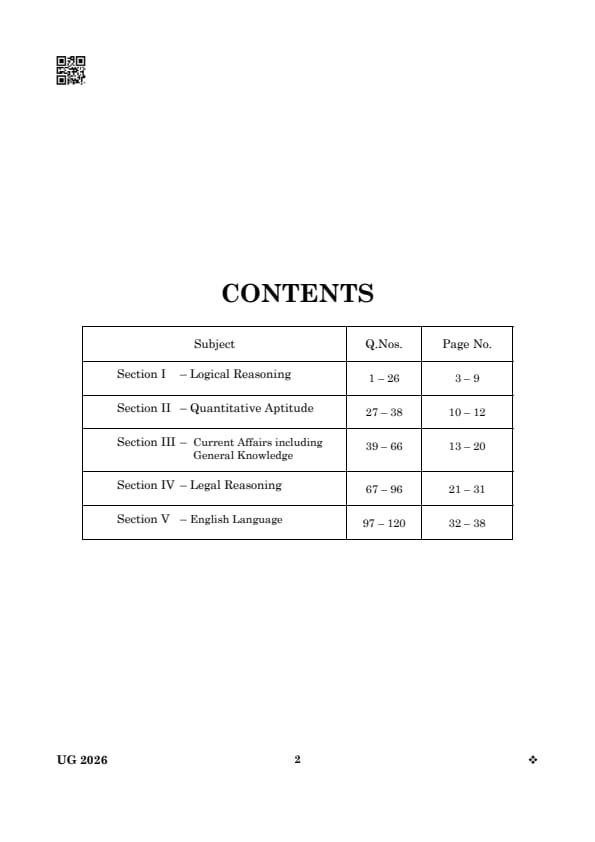
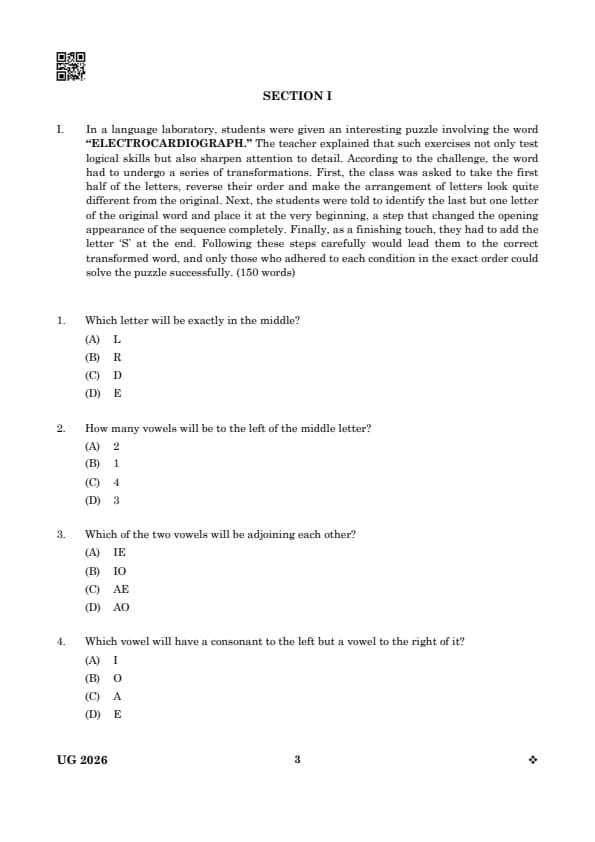
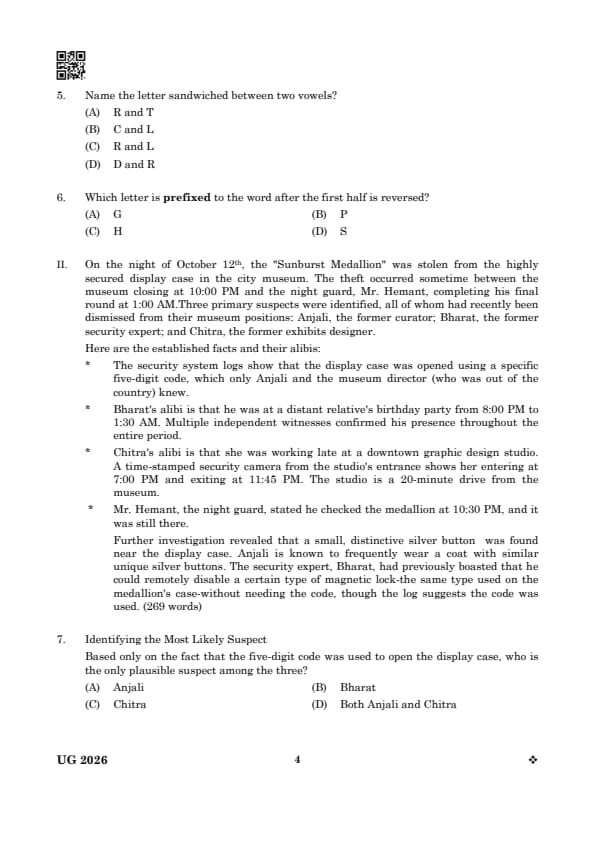
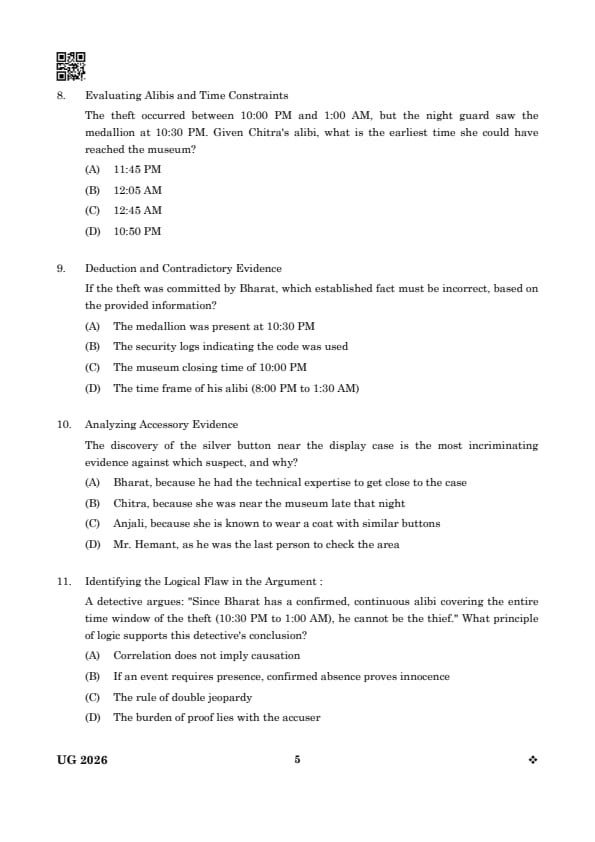
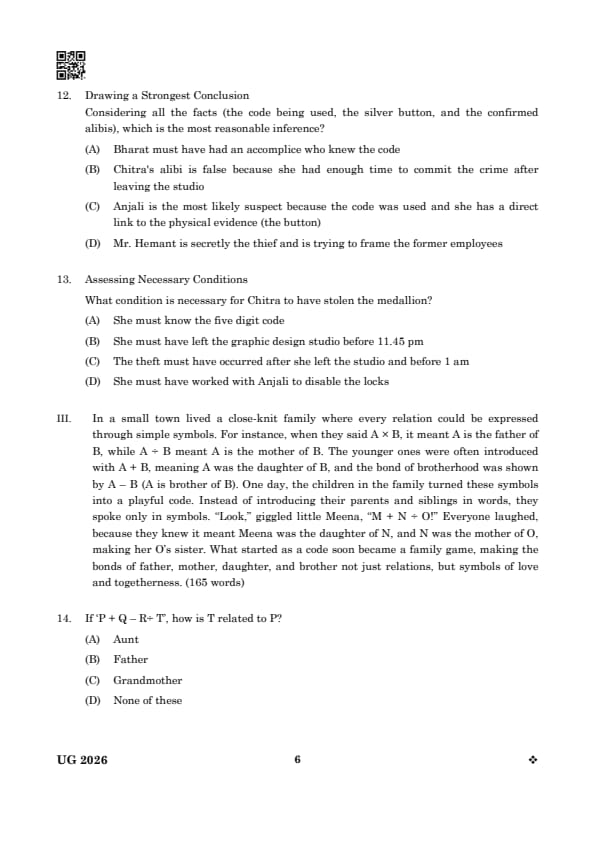
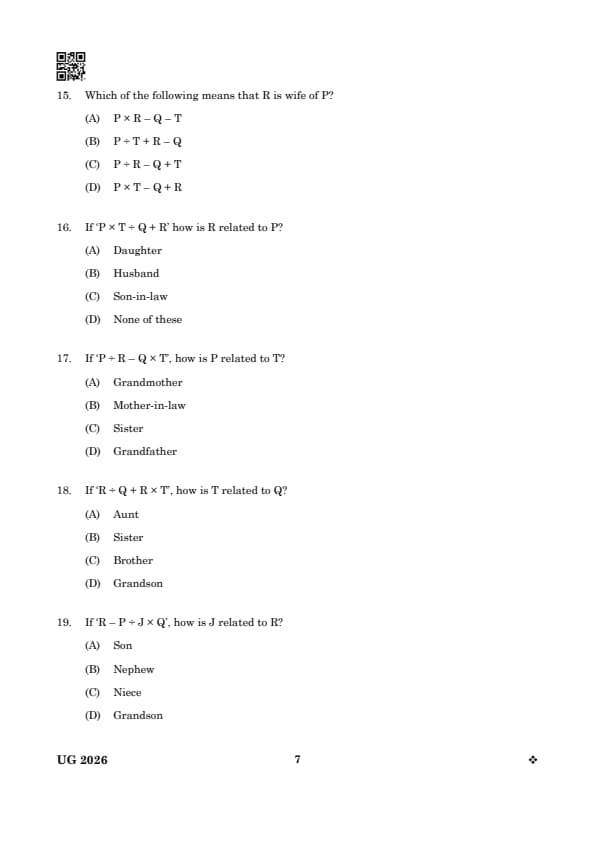
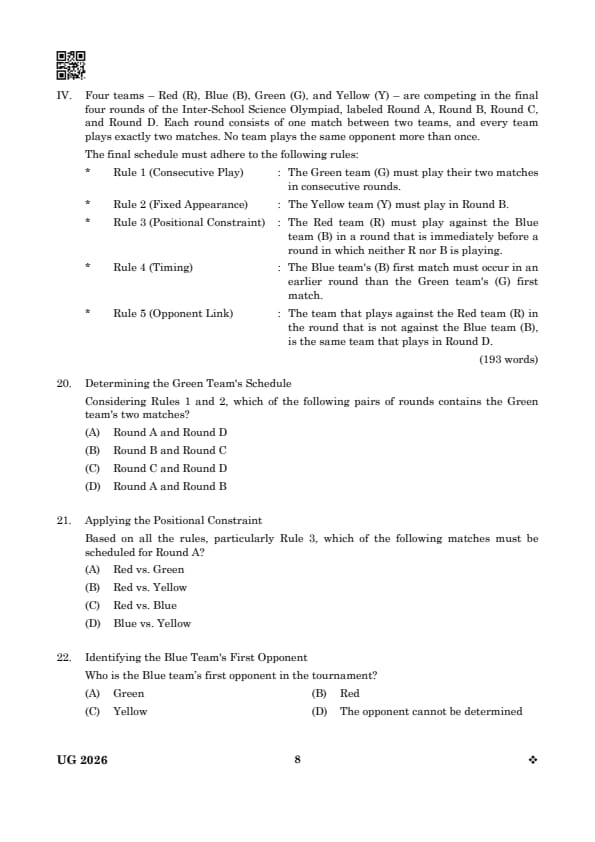
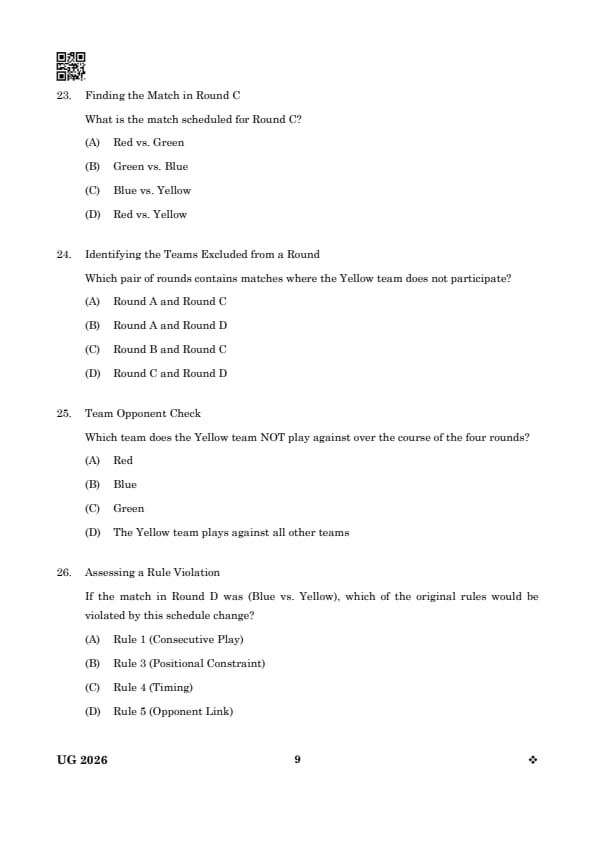
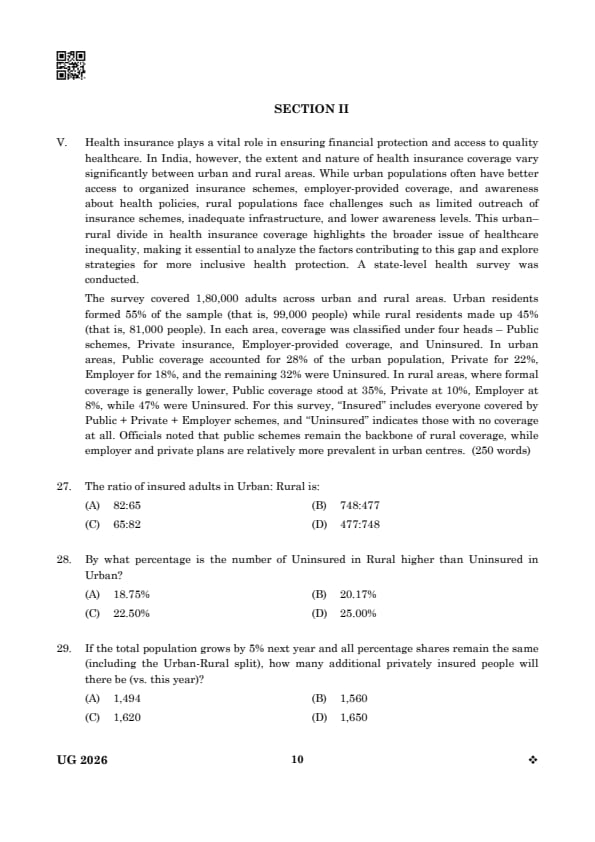
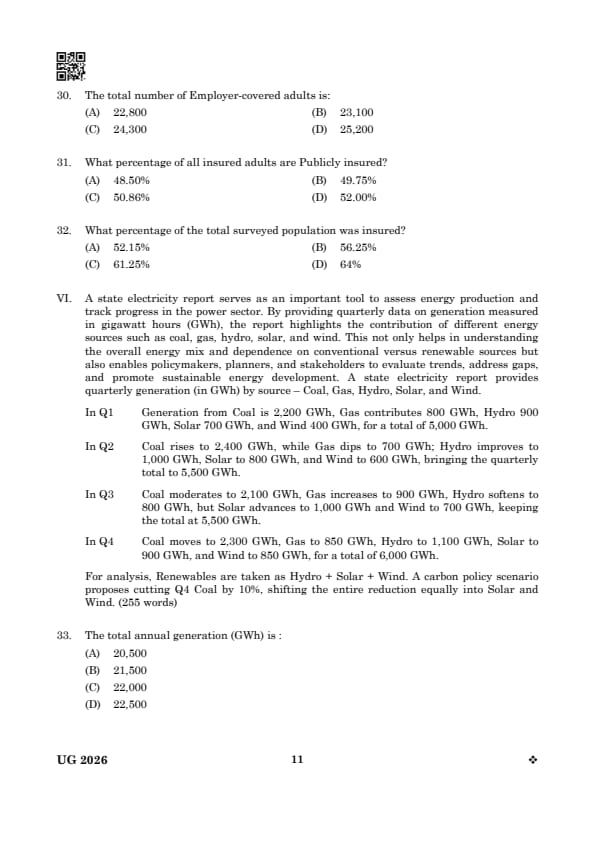
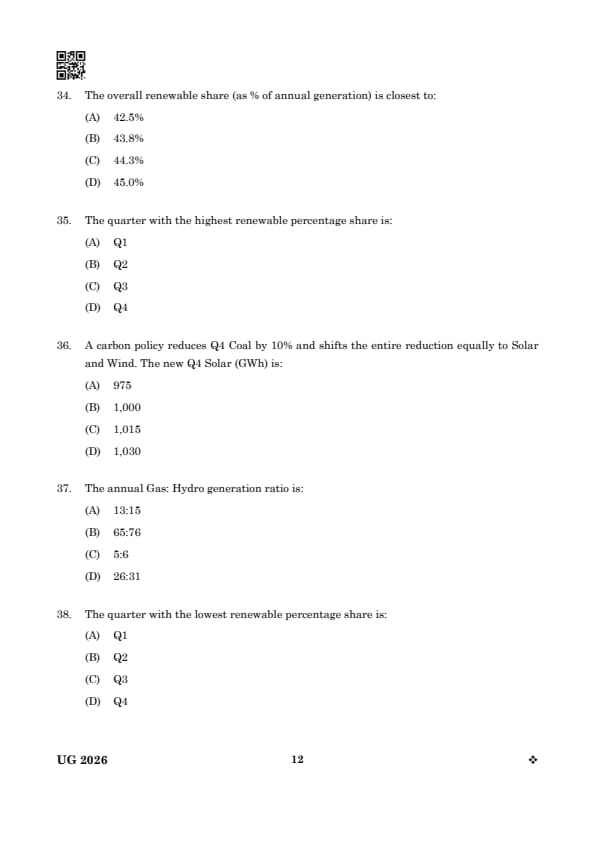
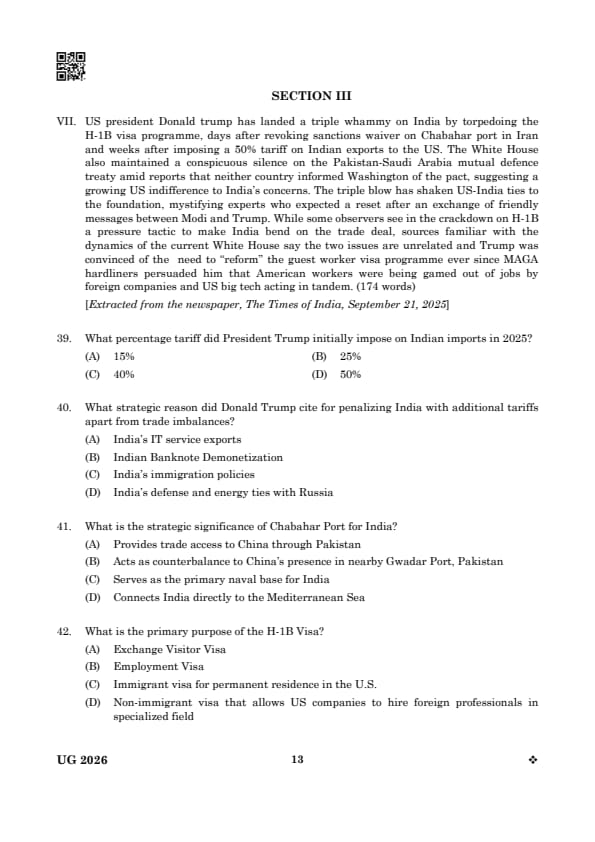
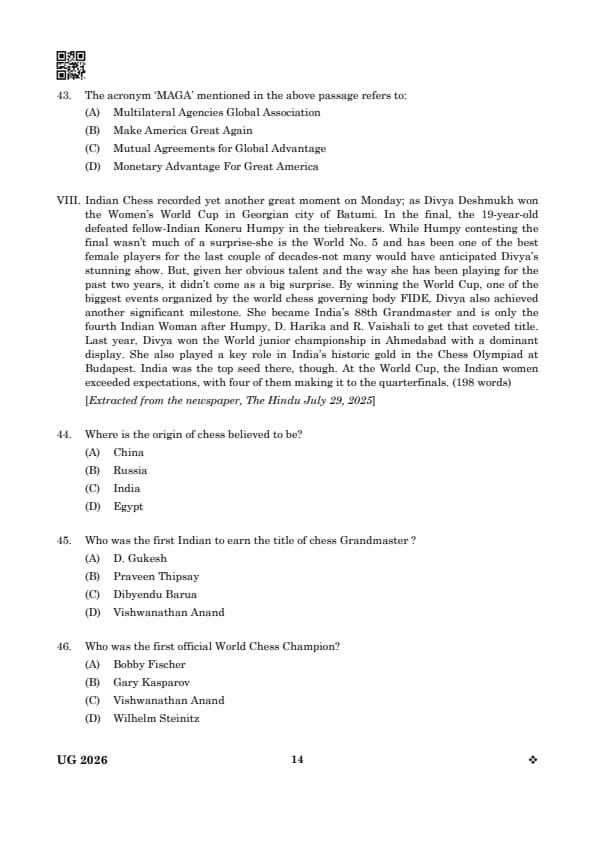
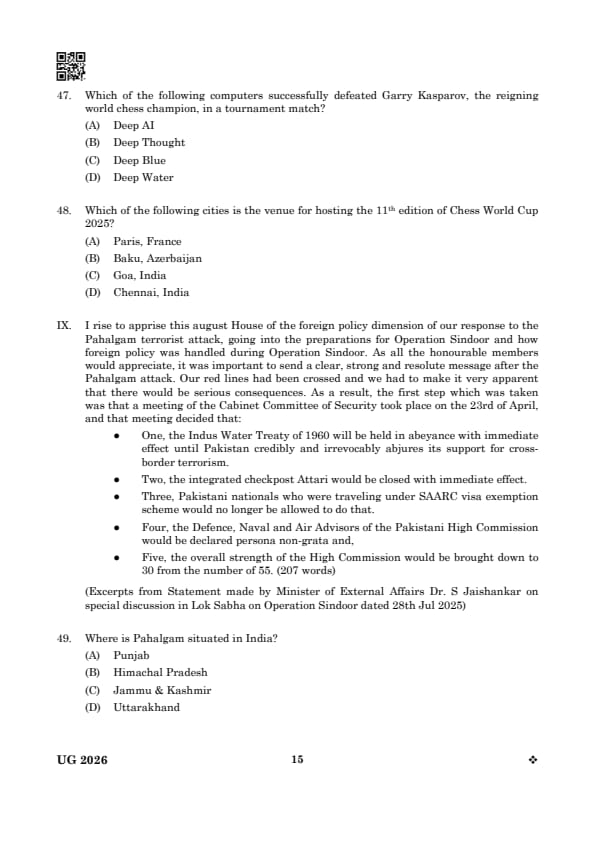
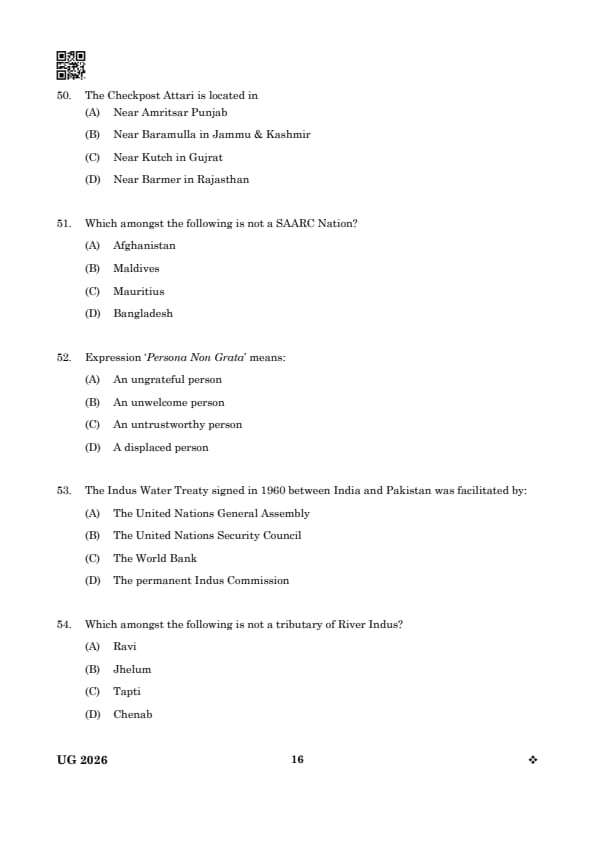
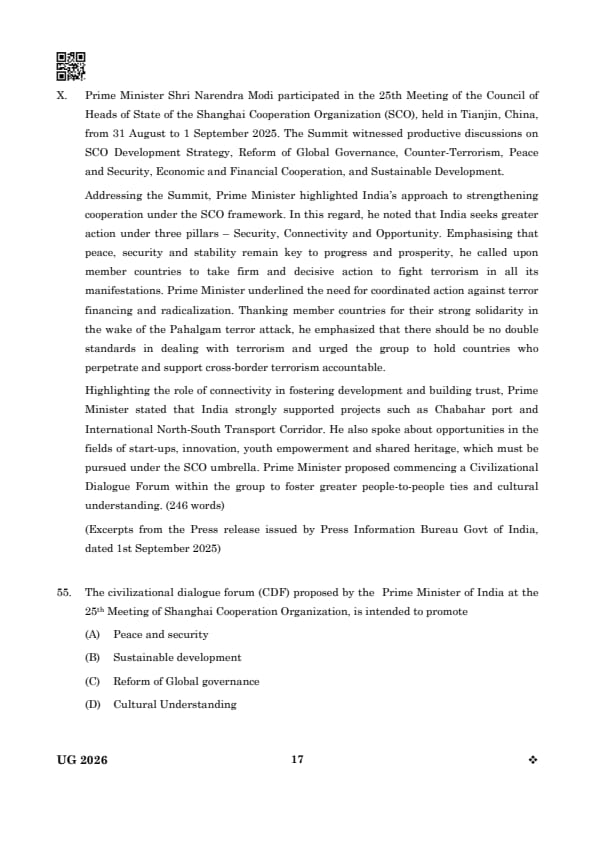
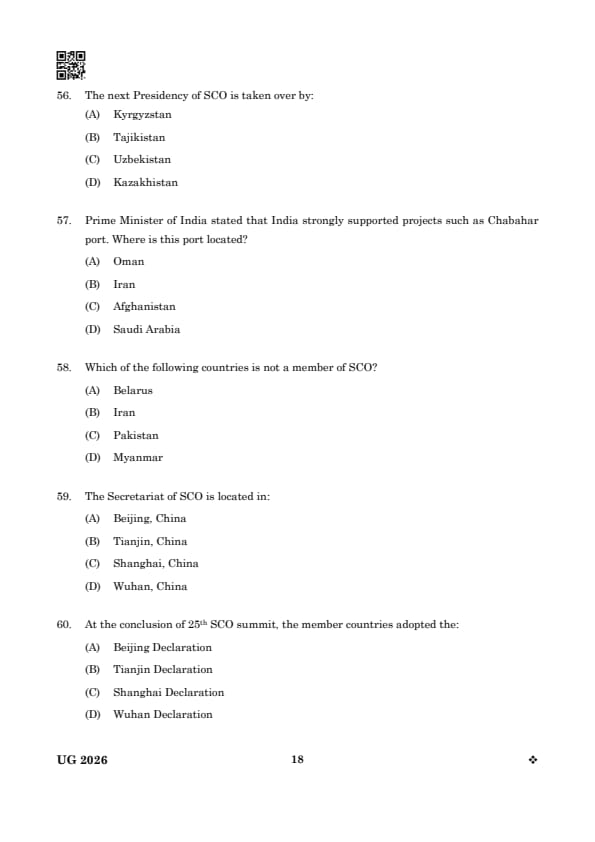
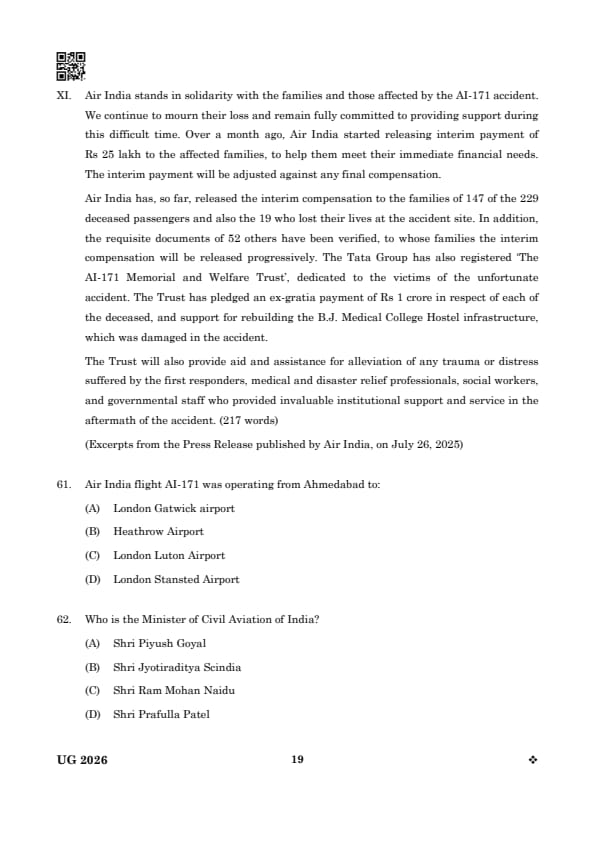
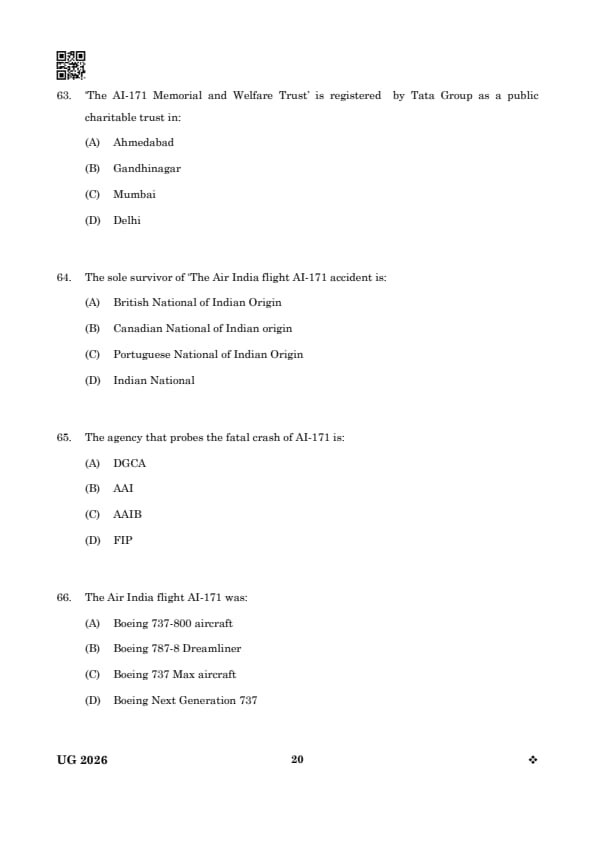
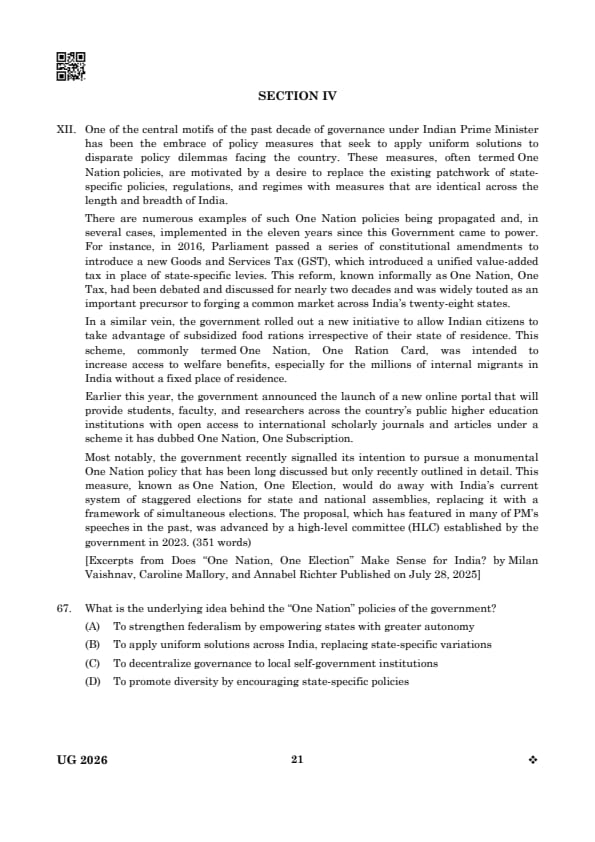
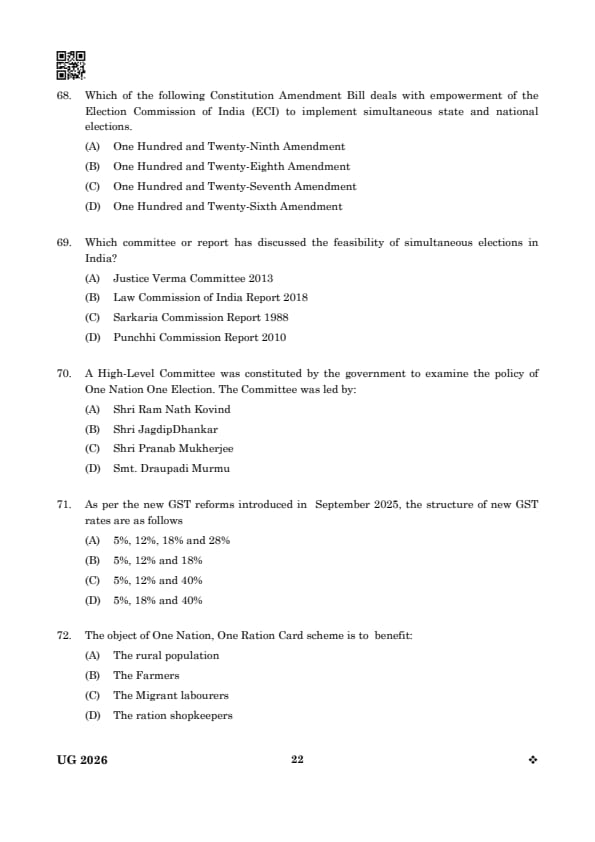
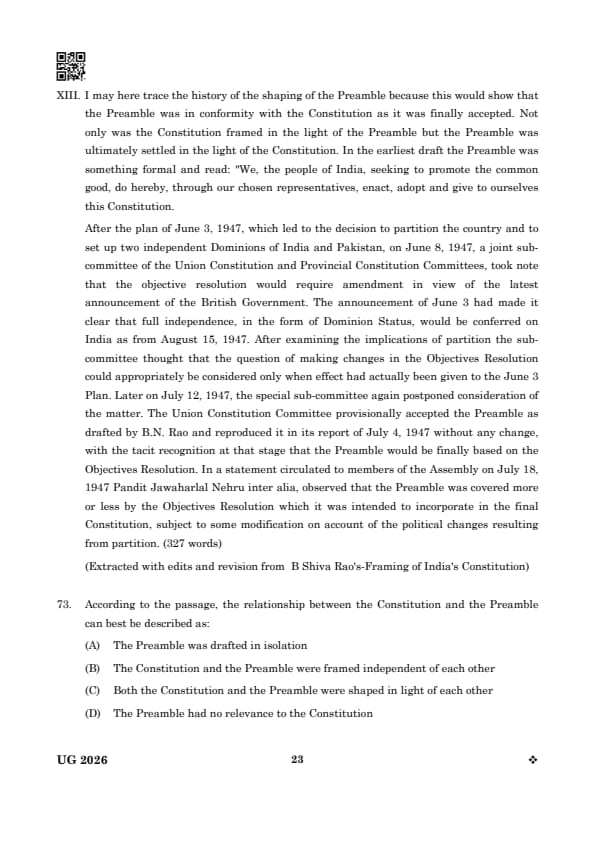
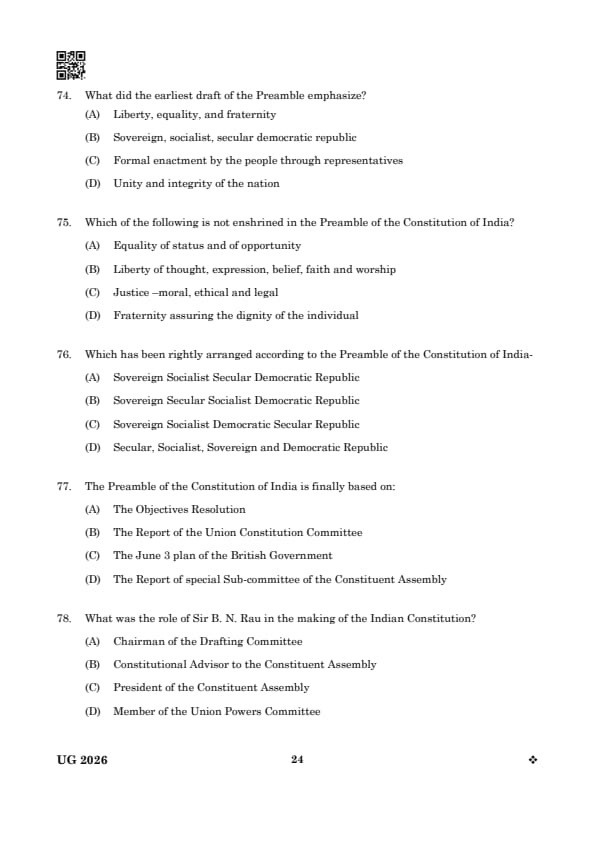
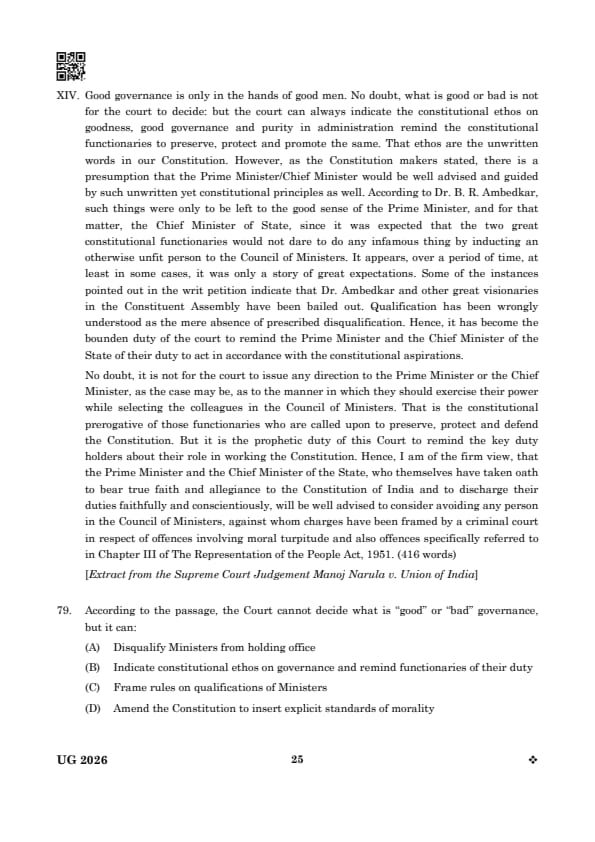
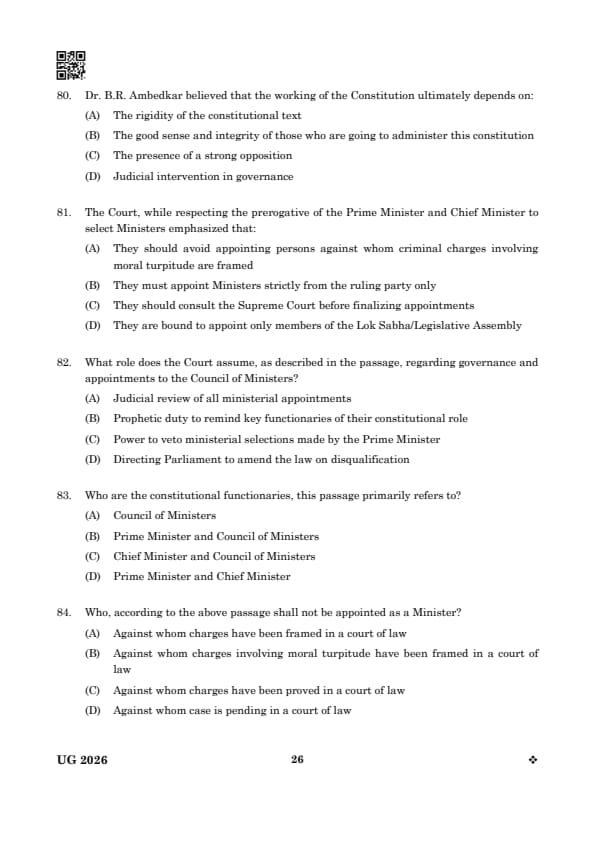
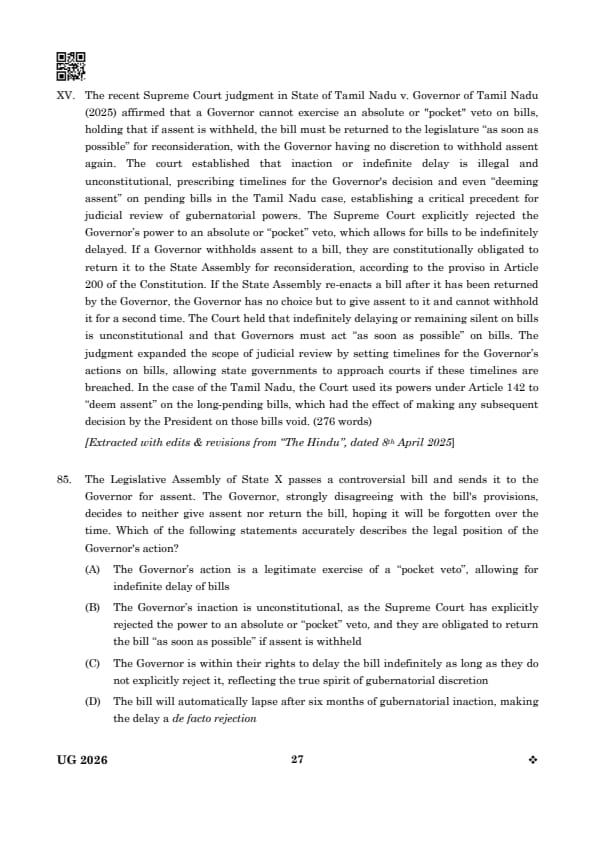
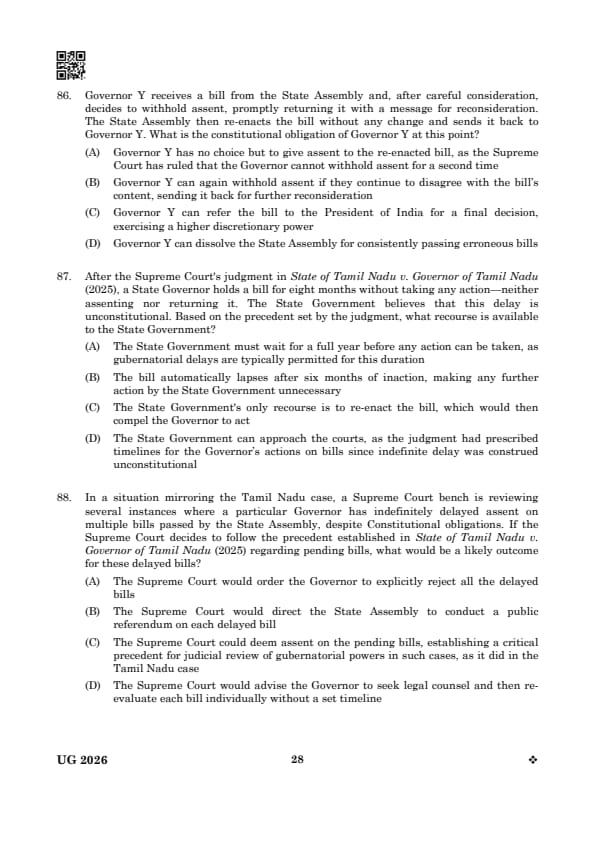


*The article might have information for the previous academic years, please refer the official website of the exam.