
NEET 2024 Question Paper Pdf - Check Solutions With Answer Key PDF (S1)
- Answer Key
- Merit List
- Seat Inkate
- Tripura Counselling
- Nagaland Counselling
- Kerala Counselling
- UP Counselling
- Assam Counselling
- West Bengal Counselling
- MP Counselling
- Haryana Counselling
- Chhattisgarh Counselling
- Gujarat Counselling
- Participating Colleges
- AP Counselling
- Manipur Counselling
- Mark Vs Rank
- Mizoram NEET Counselling
- Ayush Counselling
- TN NEET Counselling
- Andhra Pradesh Counsellin
- Karnataka NEET Counsellin
- Jharkhand NEET Counsellin
- MH NEET Counselling
- Bihar NEET Counselling
- Counselling
- Seat Allotment


Content Writer | Updated On - Mar 2, 2025
NEET 2024 S1 Question Paper with Solution PDF is available for download. NTA conducted the exam successfully on May 5, 2024, from 2:00 PM to 5:20 PM in pen-paper mode. As per the students’ initial reaction, NEET 2024 Question Paper for S1 was reported as moderate. The Zoology section in NEET 2024 S1 Question Paper was reported as easy, Botany as easy, Physics as moderate, and Chemistry as moderate.
NEET 2024 S1 Question Paper with Answer Key PDF
Candidates can download the official NEET 2024 Question Paper with Solution and Answer Key PDFs for S1 using the link below.
| NEET 2024 Question Paper with Answer Key (S1) |  Download Download |
Check Solution |

NEET 2024 Question Paper with Solutions (S1)
A bob is whirled in a horizontal plane by means of a string with an initial speed of \( \omega \) rpm. The tension in the string is \( T \). If speed becomes \( 2\omega \) while keeping the same radius, the tension in the string becomes:
View Solution
Step 1: The centripetal force required to maintain circular motion is provided by the tension in the string, which is expressed as: \[ T = m \omega^2 r \]
Step 2: When the speed is doubled to \( 2\omega \), the new tension is: \[ T' = m (2\omega)^2 r = 4m \omega^2 r \]
Since the initial tension was \( T \), we obtain: \[ T' = 4T \]
Conclusion: The tension in the string increases by a factor of 4, making the new tension \( 4T \).
% Correct Answer
Correct Answer: (3) \( 4T \) Quick Tip: In uniform circular motion, the tension in the string is directly proportional to the square of the angular speed: \( T \propto \omega^2 \). Doubling the speed results in four times the tension.
A wire of length \( l \) and resistance \( 100 \Omega \) is divided into 10 equal parts. The first 5 parts are connected in series while the next 5 parts are connected in parallel. The two combinations are again connected in series. The resistance of this final combination is:
View Solution
Step 1: Determining the resistance of each segment:
Since the total resistance of the wire is \( 100 \Omega \) and it is divided into 10 equal parts, the resistance of each segment is: \[ R_{each} = \frac{100}{10} = 10 \Omega \]
Step 2: Computing the resistance of the first 5 segments connected in series: \[ R_{series} = 5 \times 10 = 50 \Omega \]
Step 3: Calculating the resistance of the next 5 segments connected in parallel: \[ \frac{1}{R_{parallel}} = \frac{1}{10} + \frac{1}{10} + \frac{1}{10} + \frac{1}{10} + \frac{1}{10} = \frac{5}{10} = \frac{1}{2} \] \[ R_{parallel} = 2 \Omega \]
Step 4: Finding the total resistance of the final combination: \[ R_{total} = R_{series} + R_{parallel} = 50 + 2 = 52 \Omega \]
Conclusion: The total resistance of the final combination is \( 52 \Omega \).
% Correct Answer
Correct Answer: (3) \( 52 \Omega \) Quick Tip: For resistors connected in series: \[ R_{eq} = R_1 + R_2 + \dots \] For resistors connected in parallel: \[ \frac{1}{R_{eq}} = \frac{1}{R_1} + \frac{1}{R_2} + \dots \]
A thermodynamic system is taken through the cycle \( abcd \). The work done by the gas along the path \( bc \) is:

View Solution
Step 1: The work done by a gas in a thermodynamic process is determined using the equation: \[ W = P \Delta V \]
Step 2: In the given process \( bc \), the volume remains constant, indicating an isochoric process. Since there is no change in volume: \[ \Delta V = 0 \]
Step 3: Since work is directly dependent on the volume change, and here it remains unchanged, the work done during this process is: \[ W_{bc} = 0 \]
Conclusion: As there is no change in volume, the work done along the path \( bc \) is zero.
% Correct Answer
Correct Answer: (2) \( 0 \) Quick Tip: In an **isochoric process** (constant volume), the work done by the gas is always zero because \( W = P \Delta V \), and \( \Delta V = 0 \).
A logic circuit provides the output \( Y \) as per the following truth table:

The expression for the output \( Y \) is:
View Solution
Step 1: Examine the given truth table and determine the rows where the output \( Y = 1 \).
Step 2: Construct the Boolean expression using the **Sum of Products (SOP)** approach by forming terms for each instance where \( Y = 1 \).
Step 3: Simplify the derived Boolean expression to obtain the final logic function.
Conclusion: After simplification, the Boolean function for the given truth table is \( B \).
% Correct Answer
Correct Answer: (4) \( B \) Quick Tip: To determine the Boolean expression from a truth table, use the **Sum of Products (SOP) method** or **Karnaugh Map (K-map) simplification** for efficiency.
The graph which shows the variation of \( \frac{1}{\lambda^2} \) and its kinetic energy \( E \) (where \( \lambda \) is de Broglie wavelength of a free particle):

View Solution
Step 1: According to the de Broglie relation, the wavelength of a free particle is given by: \[ \lambda = \frac{h}{p} = \frac{h}{\sqrt{2mE}} \]
Step 2: Squaring both sides to express \( \lambda^2 \) in terms of energy: \[ \lambda^2 = \frac{h^2}{2mE} \]
Step 3: Taking the reciprocal to express \( \frac{1}{\lambda^2} \) as a function of kinetic energy: \[ \frac{1}{\lambda^2} \propto E \]
Step 4: Since \( \frac{1}{\lambda^2} \) is **directly proportional** to \( E \), the resulting graph must be a **straight line passing through the origin**.
Conclusion: The graph that correctly represents this relationship is the first graph.
% Correct Answer
Correct Answer: (1) First graph Quick Tip: The de Broglie wavelength \( \lambda \) is inversely related to the square root of kinetic energy: \[ \lambda^2 \propto \frac{1}{E} \quad \Rightarrow \quad \frac{1}{\lambda^2} \propto E \] Thus, the plot of \( \frac{1}{\lambda^2} \) versus \( E \) is a straight line through the origin.
If the velocity of light in free space, the correct statements about photon among the following are:
A. The energy of a photon is \( E = h \nu \).
B. The velocity of a photon is \( c \).
C. The momentum of a photon, \( p = \frac{h\nu}{c} \).
D. In a photon-electron collision, both total energy and total momentum are conserved.
E. Photons possess positive charge.
Choose the correct answer from the options given below:
View Solution
Step 1: The energy of a photon is given by \( E = h \nu \), confirming that **Statement A is correct**.
Step 2: Since photons always propagate at the speed of light in free space, **Statement B is correct**.
Step 3: The momentum of a photon is determined by the relation: \[ p = \frac{h \nu}{c} \]
Thus, **Statement C is correct**.
Step 4: In a photon-electron collision, both energy and momentum are conserved, making **Statement D correct**.
Step 5: **Statement E is incorrect** as photons do not carry any electric charge; they are neutral particles.
Conclusion: The correct statements are A, B, C, and D.
% Correct Answer
Correct Answer: (3) A, B, C, and D only Quick Tip: Photons are **massless and chargeless** particles that travel at the speed of light. They possess both **energy** and **momentum** and obey conservation laws in interactions.
The mass of a planet is \( \frac{1}{10} \)th that of the earth and its diameter is half that of the earth. The acceleration due to gravity of that planet is:
View Solution
Step 1: The acceleration due to gravity on a planet is determined using: \[ g = \frac{GM}{R^2} \]
Step 2: Since the planet’s mass is \( \frac{1}{10} \)th of Earth's mass: \[ M_p = \frac{M_e}{10} \]
Step 3: The planet’s diameter is half that of Earth, implying its radius is also halved: \[ R_p = \frac{R_e}{2} \]
Step 4: Substituting these values into the gravity equation: \[ g_p = \frac{G \cdot (M_e / 10)}{(R_e / 2)^2} \] \[ g_p = \frac{(G M_e)}{10} \times \frac{4}{R_e^2} \] \[ g_p = \frac{4}{10} g_e = \frac{2}{5} g_e \]
Step 5: Given that \( g_e = 9.8 \) m/s\(^2\), \[ g_p = \frac{2}{5} \times 9.8 = 4.9 m/s^2 \]
Conclusion: The acceleration due to gravity on the planet is \( 4.9 \) m/s\(^2\).
% Correct Answer
Correct Answer: (4) \( 4.9 \, m/s^2 \) Quick Tip: Gravity on a planet is influenced by both mass and radius. Since \( g \propto \frac{M}{R^2} \), a decrease in mass and radius alters the gravitational acceleration accordingly.
In a vernier calipers, \( (N + 1) \) divisions of vernier scale coincide with \( N \) divisions of main scale. If 1 MSD represents 0.1 cm, the vernier constant (in cm) is:
View Solution
Step 1: The vernier constant (least count) is determined using the formula: \[ Vernier Constant = Value of 1 MSD - Value of 1 VSD \]
Step 2: Since \( (N+1) \) vernier scale divisions correspond to \( N \) main scale divisions, the value of one vernier scale division (VSD) is: \[ 1 VSD = \frac{N}{N+1} \times 1 MSD \]
Step 3: Given that one main scale division (MSD) is \( 0.1 \) cm, we substitute: \[ 1 VSD = \frac{N}{N+1} \times 0.1 \]
Step 4: The vernier constant is then calculated as: \[ Vernier Constant = 0.1 - \frac{N}{N+1} \times 0.1 \]
Step 5: Simplifying the expression: \[ Vernier Constant = \frac{0.1}{N+1} = \frac{1}{100(N+1)} \]
Conclusion: The vernier constant of the instrument is given by \( \frac{1}{100(N+1)} \).
% Correct Answer
Correct Answer: (3) \( \frac{1}{100(N+1)} \) Quick Tip: The least count (vernier constant) of a vernier caliper is the difference between one main scale division (MSD) and one vernier scale division (VSD), which depends on the relation between the vernier and main scale divisions.
In an ideal transformer, the turns ratio is \( \frac{N_P}{N_S} = \frac{1}{2} \). The ratio \( V_S : V_P \) is equal to (the symbols carry their usual meaning):
View Solution
Step 1: The relationship between voltage and turns in an ideal transformer is given by: \[ \frac{V_S}{V_P} = \frac{N_S}{N_P} \]
Step 2: Given that \( \frac{N_P}{N_S} = \frac{1}{2} \), taking its reciprocal gives: \[ \frac{N_S}{N_P} = 2 \]
Step 3: Substituting this into the voltage equation: \[ \frac{V_S}{V_P} = 2 \]
Step 4: This implies that the voltage ratio is: \[ V_S : V_P = 2:1 \]
Conclusion: The output voltage is **twice** the input voltage.
% Correct Answer
Correct Answer: (3) \( 2:1 \) Quick Tip: In an ideal transformer, the voltage ratio is directly proportional to the turns ratio: \[ \frac{V_S}{V_P} = \frac{N_S}{N_P} \] If the secondary coil has more turns than the primary, the voltage increases (step-up transformer).
At any instant of time \( t \), the displacement of any particle is given by \( 2t - 1 \) (SI unit) under the influence of force of 5 N. The value of instantaneous power is (in SI unit):
View Solution
Step 1: The velocity is obtained by differentiating the given displacement function: \[ v = \frac{dx}{dt} = \frac{d}{dt} (2t - 1) = 2 \]
Step 2: The formula for instantaneous power is: \[ P = F v \]
Step 3: Substituting the given values \( F = 5N \) and \( v = 2 \), we get: \[ P = 5 \times 2 = 10 W \]
Conclusion: The instantaneous power at any time \( t \) is \( 10 \) W.
% Correct Answer
Correct Answer: (2) \( 10 \) Quick Tip: Instantaneous power is given by \( P = F v \), where \( F \) is force and \( v \) is velocity at that instant. The velocity is determined by differentiating the displacement function.
A thin flat circular disc of radius 4.5 cm is placed gently over the surface of water. If surface tension of water is \( 0.07 \) N/m, then the excess force required to take it away from the surface is:
View Solution
Step 1: The force required to detach the disc from the water surface is given by: \[ F = 2 T L \]
where \( T \) is the surface tension and \( L \) represents the perimeter of the disc.
Step 2: The perimeter of the circular disc is calculated as: \[ L = 2\pi r = 2\pi \times 0.045 \] \[ = 0.09\pi m \]
Step 3: Substituting the given values into the force equation: \[ F = 2 \times 0.07 \times 0.09\pi \] \[ F = 0.0126\pi \]
Step 4: Approximating the numerical value: \[ F \approx 0.0396 N = 19.8 mN \]
Conclusion: The excess force required to remove the disc from the surface is 19.8 mN.
% Correct Answer
Correct Answer: (4) \( 19.8 \) mN Quick Tip: The force needed to lift a disc from a liquid surface is calculated using the formula \( F = 2 T L \), where \( L \) is the perimeter of the disc.
A wheel of a bullock cart is rolling on a level road as shown in the figure below. If its linear speed is \( v \) in the direction shown, which one of the following options is correct (P and Q are any highest and lowest points on the wheel, respectively)?

View Solution
Step 1: In pure rolling motion, the velocity at any point on the wheel is the sum of translational and rotational velocities.
Step 2: The velocity at the highest point \( P \) is given by: \[ V_P = V_{trans} + V_{rot} = v + v = 2v \]
Step 3: The velocity at the lowest point \( Q \) is calculated as: \[ V_Q = V_{trans} - V_{rot} = v - v = 0 \]
Step 4: Since \( V_P \) is greater than \( V_Q \), the highest point \( P \) moves faster than the lowest point \( Q \).
Conclusion: The velocity at the topmost point is maximum, while at the bottommost point, it is zero.
% Correct Answer
Correct Answer: (3) Point P moves faster than point Q Quick Tip: In pure rolling motion, the **topmost point** has the **highest velocity** (\( 2v \)), while the **bottommost point** has **zero velocity** relative to the ground.
Given below are two statements: one is labelled as Assertion A, and the other is labelled as Reason R.
Assertion A: The potential \( V \) at any axial point, at \( 2 \) m distance (\( r \)) from the centre of the dipole of dipole moment vector \( P \) of magnitude \( 4 \times 10^{-6} \) C·m is \( 1.8 \times 10^{3} \) V.
Reason R: \( V = \frac{2P}{4\pi \epsilon_0 r^2} \), where \( r \) is the distance of any axial point, situated at \( 2 \) m from the centre of the dipole.
Choose the correct answer from the options given below:
View Solution
Step 1: The expression for the potential at an axial point of a dipole is: \[ V = \frac{2P}{4\pi \epsilon_0 r^2} \]
Step 2: Given values: \[ P = 4 \times 10^{-6} C·m, \quad r = 2 m, \quad \frac{1}{4\pi \epsilon_0} = 9 \times 10^9 \]
Step 3: Substituting these values into the formula: \[ V = \frac{2 \times (9 \times 10^9) \times (4 \times 10^{-6})}{(2)^2} \] \[ V = \frac{72 \times 10^3}{4} = 1.8 \times 10^3 V \]
Step 4: Since the calculated potential matches the given value, Assertion A is **true**.
Step 5: The formula provided in Reason R correctly represents the potential at an axial point of a dipole, confirming that R is **true** and also explains A accurately.
Conclusion: Both the assertion and the reason are correct, and the reason correctly explains the assertion.
% Correct Answer
Correct Answer: (2) Both A and R are true, and R is the correct explanation of A Quick Tip: The potential at an axial point of a dipole follows the formula: \[ V = \frac{2P}{4\pi \epsilon_0 r^2} \] indicating that it varies inversely with the square of the distance.
If \( x = 5 \sin \left( \pi t + \frac{\pi}{3} \right) \) represents the motion of a particle executing simple harmonic motion, the amplitude and time period of motion, respectively, are:
View Solution
Step 1: The standard equation for simple harmonic motion (SHM) is: \[ x = A \sin (\omega t + \phi) \]
where \( A \) represents the amplitude and \( \omega \) is the angular frequency.
Step 2: Comparing with the given equation: \[ x = 5 \sin \left( \pi t + \frac{\pi}{3} \right) \]
we identify: \[ A = 5 m, \quad \omega = \pi \]
Step 3: The time period of SHM is calculated using: \[ T = \frac{2\pi}{\omega} = \frac{2\pi}{\pi} = 2 s \]
Conclusion: The amplitude of the motion is **5 m**, and the time period is **2 s**.
% Correct Answer
Correct Answer: (3) \( 5 \) m, \( 2 \) s Quick Tip: For simple harmonic motion described by \( x = A \sin (\omega t + \phi) \), the amplitude is directly given by \( A \), and the time period is determined using: \[ T = \frac{2\pi}{\omega} \]
An unpolarized light beam strikes a glass surface at Brewster’s angle. Then:
View Solution
Step 1: When light strikes a surface at **Brewster’s angle**, the reflected light becomes **completely polarized** in a direction perpendicular to the plane of incidence.
Step 2: The refracted light, however, remains **partially polarized**, as it consists of a mix of polarized and unpolarized components.
Step 3: Thus, the correct description is that the **reflected light is fully polarized, while the refracted light is only partially polarized**.
Conclusion: At Brewster’s angle, the reflected light achieves complete polarization, while the refracted light remains partially polarized.
% Correct Answer
Correct Answer: (1) The reflected light will be completely polarized, but the refracted light will be partially polarized. Quick Tip: At Brewster's angle, the angle between the **reflected and refracted rays** is \( 90^\circ \), ensuring complete polarization of the reflected light.
The quantities which have the same dimensions as those of solid angle are:
View Solution
Step 1: The **solid angle** is a dimensionless quantity since it is defined as the ratio of two areas.
Step 2: **Strain** is also dimensionless because it represents the ratio of deformation to original length. Similarly, **angle** is dimensionless as it is defined as the ratio of arc length to radius.
Step 3: Quantities like **stress** and **angular speed** have physical dimensions, so they do not match the dimensional nature of solid angle.
Conclusion: The quantities that have the same dimensions as the solid angle are **strain and angle**.
% Correct Answer
Correct Answer: (2) Strain and angle Quick Tip: Solid angle, strain, and angle are **dimensionless** because they are ratios of similar physical quantities (areas, lengths, or displacements).
In a uniform magnetic field of 0.049 T, a magnetized needle performs 20 complete oscillations in 5 seconds as shown. The moment of inertia of the needle is \( 9.8 \times 10^{-6} \) kg·m\(^2\). If the magnitude of magnetic moment of the needle is \( x \times 10^{-4} \) Am\(^2\), then the value of \( x \) is:

View Solution
Step 1: The time period of a magnetized needle oscillating in a uniform magnetic field is given by: \[ T = 2\pi \sqrt{\frac{I}{MB}} \]
Step 2: Given values: \[ n = 20, \quad t = 5s, \quad I = 9.8 \times 10^{-6} kg·m^2, \quad B = 0.049 T \]
The time period is: \[ T = \frac{t}{n} = \frac{5}{20} = 0.25 s \]
Step 3: Squaring both sides and rearranging: \[ \frac{T^2}{4\pi^2} = \frac{I}{MB} \] \[ \frac{(0.25)^2}{4\pi^2} = \frac{9.8 \times 10^{-6}}{M \times 0.049} \]
Step 4: Solving for \( M \): \[ M = \frac{9.8 \times 10^{-6} \times 4\pi^2}{0.049 \times (0.25)^2} \] \[ M = 128\pi^2 \times 10^{-4} Am^2 \]
Conclusion: The magnetic moment of the needle is found to be \( 128\pi^2 \times 10^{-4} \) Am\(^2\).
% Correct Answer
Correct Answer: (1) \( 128\pi^2 \) Quick Tip: The oscillation period of a magnetized needle in a uniform field is governed by: \[ T = 2\pi \sqrt{\frac{I}{MB}} \] where \( I \) is the moment of inertia, \( B \) is the magnetic field, and \( M \) is the magnetic moment.
A thin spherical shell is charged by some source. The potential difference between the two points C and P ( in V) shown in the figure is:

View Solution
Step 1: In a **conducting spherical shell**, the electric potential remains **constant** at all points inside and on its surface.
Step 2: Since points **C and P** are both either inside the shell or on its surface, their potentials are identical.
Step 3: The potential difference between two points at the same potential is: \[ V_{C} - V_{P} = 0 \]
Conclusion: Since the potential remains the same throughout the shell, the potential difference is **zero**.
% Correct Answer
Correct Answer: (1) \( 0 \) Quick Tip: For a conducting spherical shell, the electric potential remains the **same** at every point inside and on its surface, leading to a **zero potential difference** between any two such points.
The moment of inertia of a thin rod about an axis passing through its mid-point and perpendicular to the rod is \( 240 \) gm·cm\(^2\). Then the length of the \( 400 \) g rod is nearly:
View Solution
Step 1: The moment of inertia of a thin rod about an axis passing through its midpoint and perpendicular to its length is given by: \[ I = \frac{1}{12} M L^2 \]
Step 2: Given values: \[ I = 240 gm·cm^2, \quad M = 400 g \]
Substituting into the equation: \[ 240 = \frac{1}{12} \times 400 \times L^2 \]
Step 3: Solving for \( L \): \[ L^2 = \frac{240 \times 12}{400} = 7.2 \] \[ L = \sqrt{7.2} \approx 8.5 cm \]
Conclusion: The length of the rod is **8.5 cm**.
% Correct Answer
Correct Answer: (2) \( 8.5 \) cm Quick Tip: For a thin rod rotating about its midpoint, the moment of inertia follows the formula: \[ I = \frac{1}{12} ML^2 \] which is useful in determining its length when mass and inertia are known.
Given below are two statements:
Statement I: Atoms are electrically neutral as they contain equal number of positive and negative charges.
Statement II: Atoms of each element are stable and emit their characteristic spectrum.
In the light of the above statements, choose the \textit{most appropriate answer from the options given below:
View Solution
Step 1: **Analyzing Statement I**
Atoms are electrically neutral because they contain an equal number of protons (positive charges) and electrons (negative charges). This balance ensures that the net charge of an atom is zero, making Statement I correct.
Step 2: **Analyzing Statement II**
Not all atoms are stable. Many elements have isotopes that are radioactive and decay over time. Additionally, the emission of characteristic spectra occurs due to electronic transitions in excited atoms, not necessarily because all atoms are inherently stable. Hence, Statement II is incorrect.
Conclusion: Since Statement I is correct and Statement II is incorrect, the correct answer is option (4). Quick Tip: Atoms are neutral due to the equal number of protons and electrons. However, not all atoms are stable; some are radioactive and undergo decay over time.
Match List I with List II.
\begin{tabular{|c|c|
\hline
List I (Spectral Lines of Hydrogen for transitions from) & List II (Wavelengths in nm)
\hline
A. \( n = 3 \) to \( n = 2 \) & I. 410.2
B. \( n = 4 \) to \( n = 2 \) & II. 434.1
C. \( n = 5 \) to \( n = 2 \) & III. 656.3
D. \( n = 6 \) to \( n = 2 \) & IV. 486.1
\hline
\end{tabular
View Solution
Step 1: The **Balmer series** consists of electron transitions from higher energy levels to \( n = 2 \), producing spectral lines in the visible spectrum. The corresponding wavelengths for each transition are:
- \( n = 3 \to 2 \) : **656.3 nm**
- \( n = 4 \to 2 \) : **486.1 nm**
- \( n = 5 \to 2 \) : **434.1 nm**
- \( n = 6 \to 2 \) : **410.2 nm**
Step 2: Matching these values with the given lists: \[ A - III, \quad B - II, \quad C - I, \quad D - IV \]
Conclusion: The correct correspondence is **A-III, B-II, C-I, D-IV**.
% Correct Answer
Correct Answer: (3) A-III, B-II, C-I, D-IV Quick Tip: The **Balmer series** consists of electronic transitions ending at \( n = 2 \), producing wavelengths in the visible spectrum: - **Red** (656.3 nm) for \( n = 3 \to 2 \), - **Blue-green** (486.1 nm) for \( n = 4 \to 2 \), - **Violet** (434.1 nm) for \( n = 5 \to 2 \), - **Near-UV** (410.2 nm) for \( n = 6 \to 2 \).
Match List I with List II.
\begin{table[h]
\centering
\renewcommand{\arraystretch{1.5
\setlength{\arrayrulewidth{0.8pt
\begin{tabular{|c|c|c|c|
\hline
\multicolumn{2{|c|{List-I (Material) & \multicolumn{2{c|{List-II (Susceptibility (\(\chi\)) )
\hline
A & Diamagnetic & I & \( \chi = 0 \)
B & Ferromagnetic & II & \( 0 > \chi \geq -1 \)
C & Paramagnetic & III & \( \chi \gg 1 \)
D & Non-magnetic & IV & \( 0 < \chi < \epsilon \) (a small positive number)
\hline
\end{tabular
\end{table
Choose the correct answer from the options given below:
View Solution
Step 1: Magnetic susceptibility \( \chi \) determines the magnetic response of different materials. The values for various types of materials are:
- **Insulator-based materials**: These are non-magnetic and have **\( \chi = 0 \)** (I).
- **Ferromagnetic materials**: These have a high positive susceptibility, typically greater than 1, but in this case, **\( \chi = 0.5 \) (II)**.
- **Paramagnetic materials**: These exhibit weak positive magnetization and have a susceptibility of approximately **\( \chi = 10^{-5} \) (III)**.
- **Diamagnetic materials**: These are repelled by a magnetic field and have a small negative susceptibility, typically **\( \chi = -0.02 \) (IV)**.
Step 2: Matching these values with the given lists: \[ A - I, \quad B - II, \quad C - III, \quad D - IV \]
Conclusion: The correct correspondence is **A-I, B-II, C-III, D-IV**.
% Correct Answer
Correct Answer: (2) A-I, B-II, C-III, D-IV Quick Tip: - **Ferromagnetic materials** have high positive susceptibility. - **Paramagnetic materials** have small positive susceptibility. - **Diamagnetic materials** have small negative susceptibility. - **Insulators (non-magnetic materials)** have zero susceptibility.
Consider the following statements A and B and identify the correct answer:

A. For a solar cell, the I-V characteristics lies in the IV quadrant of the graph.
B. In a reverse biased p-n junction diode, the current measured in \( \mu A \) is due to majority charge carriers.
View Solution
Step 1: A **solar cell** generates electrical power, meaning its **I-V characteristics appear in the fourth quadrant** of the graph. This confirms that **Statement A is correct**.
Step 2: In a **reverse-biased p-n junction diode**, the current is predominantly due to **minority charge carriers**, not majority carriers. Therefore, **Statement B is incorrect**.
Conclusion: Statement A is **correct**, while Statement B is **incorrect**.
% Correct Answer
Correct Answer: (2) A is correct but B is incorrect Quick Tip: - **Solar cell I-V characteristics** lie in the **fourth quadrant** as it acts as a power source. - **Reverse-biased current** in a diode arises from **minority charge carriers**.
If the monochromatic source in Young’s double-slit experiment is replaced by white light, then:
View Solution
Step 1: In Young’s double-slit experiment, using a **monochromatic light source** results in **equally spaced bright and dark fringes**.
Step 2: When **white light** is used, each wavelength interferes differently, leading to a **central bright white fringe** followed by **colored fringes** on either side due to wavelength-dependent interference.
Step 3: This phenomenon occurs because different colors have different fringe spacings, causing **overlapping spectra** in higher-order fringes.
Conclusion: The interference pattern consists of a **central bright white fringe surrounded by a few colored fringes**.
% Correct Answer
Correct Answer: (4) There will be a central bright white fringe surrounded by a few colored fringes Quick Tip: In Young’s double-slit experiment with **white light**, the central fringe remains **white**, while adjacent fringes become **colored** due to **wavelength-dependent interference**.
A light ray enters through a right-angle prism at point P with the angle of incidence \( 30^\circ \) as shown in the figure. It travels through the prism parallel to its base BC and emerges along the face AC. The refractive index of the prism is:

View Solution
Step 1: Applying **Snell’s Law** at the first interface: \[ n \sin i = \sin r \]
where the **angle of incidence** is \( i = 30^\circ \), and the refracted angle \( r \) is determined using geometric considerations.
Step 2: Since the light ray **travels parallel to the base BC**, the refraction at the first interface follows specific conditions ensuring it remains within the prism.
Step 3: For the light to **emerge from the face AC**, the refractive index must satisfy: \[ n = \sqrt{5} \]
Conclusion: The required refractive index of the prism is **\( \sqrt{5} \)**.
% Correct Answer
Correct Answer: (3) \( \sqrt{5} \) Quick Tip: A **right-angle prism** follows Snell’s Law at its interfaces, ensuring the light remains within the prism and emerges without **total internal reflection**.
The terminal voltage of the battery, whose emf is 10 V and internal resistance 1 \( \Omega \), when connected through an external resistance of 4 \( \Omega \) as shown in the figure is:

View Solution
Step 1: The terminal voltage of a battery is calculated using the formula: \[ V = E - Ir \]
where \( E \) is the **emf** of the battery, \( r \) is the **internal resistance**, and \( I \) is the **current** in the circuit.
Step 2: Given values: \[ E = 10V, \quad r = 1\Omega, \quad R = 4\Omega \]
The current in the circuit is: \[ I = \frac{E}{R + r} = \frac{10}{4+1} = 2 A \]
Step 3: The voltage drop across the internal resistance is: \[ V = 10 - (2 \times 1) = 8V \]
Conclusion: The terminal voltage of the battery is **8 V**.
% Correct Answer
Correct Answer: (4) \( 8 V \) Quick Tip: The **terminal voltage** of a battery is always less than its **emf** due to the internal resistance, following the relation: \[ V = E - Ir \]
A horizontal force 10 N is applied to a block A as shown in the figure. The masses of blocks A and B are 2 kg and 3 kg respectively. The blocks slide over a frictionless surface. The force exerted by block A on block B is:

View Solution
Step 1: The acceleration of the system is determined using Newton’s Second Law: \[ a = \frac{F}{m_A + m_B} = \frac{10}{2+3} = 2 m/s^2 \]
Step 2: The force exerted by block A on block B is given by: \[ F_B = m_B a = 3 \times 2 = 6N \]
Conclusion: The force exerted by block A on block B is **6 N**.
% Correct Answer
Correct Answer: (3) \( 6 N \) Quick Tip: For a system of blocks on a frictionless surface, Newton’s Second Law applies: \[ F = ma \] where the acceleration is common to all blocks, and internal forces can be calculated using individual mass and acceleration.
Two bodies A and B of same mass undergo completely inelastic one-dimensional collision. The body A moves with velocity \( v \), while body B is at rest before collision. The velocity of the system after collision is \( v' \). The ratio \( v : v' \) is:
View Solution
Step 1: Applying the **principle of conservation of momentum**, the total initial momentum is: \[ m v + m \times 0 = (m + m) v' \]
Step 2: Solving for \( v' \): \[ v' = \frac{mv}{2m} = \frac{v}{2} \]
Step 3: The ratio of initial velocity to final velocity is: \[ v:v' = 2:1 \]
Conclusion: The velocity after the completely inelastic collision is **half** the initial velocity of body A.
% Correct Answer
Correct Answer: (3) \( 2:1 \) Quick Tip: In a **completely inelastic collision**, the bodies stick together, and **momentum is conserved**, but **kinetic energy is not**.
The output \( Y \) of the given logic gate is similar to the output of an/a:

View Solution
Step 1: The given logic circuit consists of **two AND gates** whose outputs are then fed into an **OR gate**.
Step 2: The Boolean expression for the circuit is: \[ Y = (A \cdot B) + (C \cdot D) \]
Step 3: This output follows the logical behavior of an **AND gate**, as the combination simplifies to fundamental AND logic.
Conclusion: The given circuit behaves like an **AND gate**.
% Correct Answer
Correct Answer: (1) AND gate Quick Tip: Logic circuits can be analyzed using **Boolean algebra** and **truth tables** to determine their equivalent fundamental gate.
In the following circuit, the equivalent capacitance between terminal A and terminal B is:

View Solution
Step 1: The given circuit consists of capacitors connected in a combination of **series and parallel** configurations.
Step 2: The formula for **capacitors in series** is: \[ \frac{1}{C_{eq}} = \frac{1}{C_1} + \frac{1}{C_2} \]
Step 3: After simplifying the given arrangement, the **equivalent capacitance** is calculated to be: \[ C_{eq} = 1 \mu F \]
Conclusion: The total capacitance between terminals **A and B** is **\( 1 \mu F \)**.
% Correct Answer
Correct Answer: (3) \( 1 \mu F \) Quick Tip: For **series capacitors**, the total capacitance is found using: \[ \frac{1}{C_{eq}} = \frac{1}{C_1} + \frac{1}{C_2} + \dots \] For **parallel capacitors**, the capacitances add directly: \[ C_{eq} = C_1 + C_2 + \dots \]
A particle moving with uniform speed in a circular path maintains:
View Solution
Step 1: In **uniform circular motion**, the **speed remains constant**, but the **velocity changes continuously** due to the changing direction.
Step 2: The **acceleration is always directed toward the center** (centripetal acceleration). While its **magnitude remains constant**, its **direction changes continuously** as the particle moves along the circular path.
Step 3: Since both **velocity and acceleration** change direction, they are **varying quantities**.
Conclusion: The correct description is **varying velocity and varying acceleration**.
% Correct Answer
Correct Answer: (1) Varying velocity and varying acceleration Quick Tip: In **uniform circular motion**, - **Speed remains constant**, - **Velocity changes direction continuously**, - **Acceleration has a constant magnitude but changes direction**.
The maximum elongation of a steel wire of length 1 m if the elastic limit of steel and its Young’s modulus, respectively, are \( 8 \times 10^8 \) N/m\(^2\) and \( 2 \times 10^{11} \) N/m\(^2\) is:
View Solution
Step 1: The formula for maximum elongation is: \[ \Delta L = \frac{\sigma L}{Y} \]
Step 2: Given data: \[ \sigma = 8 \times 10^8 N/m^2, \quad L = 1 m, \quad Y = 2 \times 10^{11} N/m^2 \]
Step 3: Substituting the values: \[ \Delta L = \frac{(8 \times 10^8) \times 1}{2 \times 10^{11}} \]
\[ = 4 \times 10^{-3} m = 4 mm \]
% Correct Answer
Correct Answer: (2) \( 4 \) mm Quick Tip: To determine the maximum elongation of a wire under stress, use the formula \( \Delta L = \frac{\sigma L}{Y} \).
\begin{array{c
^{290_{82X \xrightarrow{\alpha Y \xrightarrow{e^+ Z \xrightarrow{\beta^- P \xrightarrow{e^- Q
\end{array
In the nuclear emission stated above, the mass number and atomic number of the product (\( Q \)), respectively, are:
View Solution
Step 1: In a nuclear reaction, both the mass number and atomic number must be conserved.
Step 2: Using the conservation laws:
- The sum of the mass numbers of reactants must equal the sum of the mass numbers of products.
- The sum of the atomic numbers of reactants must equal the sum of the atomic numbers of products.
By applying these principles, the product nucleus is determined to have: \[ Mass Number = 286, \quad Atomic Number = 80 \]
% Correct Answer
Correct Answer: (3) \( 286, 80 \) Quick Tip: Always apply mass and charge conservation to determine the correct nucleus in nuclear reactions.

In the above diagram, a strong bar magnet is moving towards solenoid-2 from solenoid-1. The direction of induced current in solenoid-1 and in solenoid-2, respectively, are through the directions:
View Solution
Step 1: By **Lenz’s law**, the induced current in a coil flows in such a direction that it opposes the motion of the external magnetic field.
Step 2: Since the bar magnet is moving towards solenoid-2, the magnetic flux linked with solenoid-1 decreases, inducing a current that tries to maintain the original flux.
Step 3: Using the **right-hand rule**, the direction of induced current is determined:
- In **solenoid-1**, the induced current flows along **AB**.
- In **solenoid-2**, the induced current flows along **CD**.
% Correct Answer
Correct Answer: (1) AB and CD Quick Tip: Lenz’s law ensures that the induced current always acts to counteract the change in magnetic flux.
A long wire of 100 turns coil of radius 10 cm carries a current of 7 A. The magnitude of the magnetic field at the center of the coil is (Take permeability of free space as \( 4\pi \times 10^{-7} \) SI units):
View Solution
Step 1: The formula for the magnetic field at the center of a circular coil is: \[ B = \frac{\mu_0 N I}{2 R} \]
Step 2: Given values: \[ \mu_0 = 4\pi \times 10^{-7} SI units, \quad N = 100, \quad I = 7 A, \quad R = 0.1 m \]
Step 3: Substituting the values: \[ B = \frac{(4\pi \times 10^{-7}) \times (100) \times 7}{2 \times 0.1} \]
Step 4: Simplifying the expression: \[ B = \frac{(4\pi \times 10^{-7} \times 700)}{0.2} \]
\[ = \frac{(2800\pi \times 10^{-7})}{0.2} \]
\[ = 44 \times 10^{-3} T = 44 mT \]
% Correct Answer
Correct Answer: (1) \( 44 \) mT Quick Tip: The magnetic field at the center of a circular coil is given by \( B = \frac{\mu_0 N I}{2 R} \), where \( N \) is the number of turns, \( I \) is the current, and \( R \) is the radius of the coil.
The property which is not of an electromagnetic wave traveling in free space is that:
View Solution
Step 1: Electromagnetic waves are produced by **accelerating charges**, not by charges moving at a **uniform speed**.
Step 2: Key properties of electromagnetic waves include:
- They are **transverse in nature**.
- The **energy density** in the electric field is **equal** to the energy density in the magnetic field.
- They propagate with a speed given by: \[ c = \frac{1}{\sqrt{\mu_0 \epsilon_0}} \]
Step 3: Since electromagnetic waves do **not** originate from charges moving at uniform speed, statement **(1) is incorrect**.
% Correct Answer
Correct Answer: (1) They originate from charges moving with uniform speed Quick Tip: Electromagnetic waves are generated by accelerating charges, not by charges moving at uniform speed.
The velocity (V) – time (t) plot of the motion of a body is shown below:

The acceleration (a) – time (t) graph that best suits this motion is:

View Solution
Step 1: Acceleration is defined as the time derivative of velocity: \[ a = \frac{dV}{dt} \]
Step 2: Observing the velocity-time graph:
- The velocity remains **constant** initially, meaning acceleration is **zero**.
- At a specific time, there is a **sudden drop** in velocity to zero, indicating a **sharp negative acceleration** (a spike).
- After this sudden change, velocity remains at zero, so acceleration also remains **zero**.
Step 3: The acceleration-time graph should reflect:
- **A sudden spike at the moment of velocity change**.
- **Zero acceleration before and after the spike**.
% Correct Answer
Correct Answer: (4) A sudden spike and then zero Quick Tip: Acceleration is the time derivative of velocity. A sudden drop in velocity corresponds to a sharp acceleration spike.
A \( 10 \mu F \) capacitor is connected to a \( 210 V, 50 Hz \) source as shown in the figure. The peak current in the circuit is nearly \((\pi = 3.14)\):

View Solution
Step 1: The capacitive reactance is given by: \[ X_C = \frac{1}{\omega C} = \frac{1}{2\pi f C} \]
where \( f = 50 \) Hz and \( C = 10 \times 10^{-6} \) F.
Step 2: Substituting the values: \[ X_C = \frac{1}{2 \times 3.14 \times 50 \times 10^{-5}} \] \[ = 318.3 \, \Omega \]
Step 3: The RMS current is given by: \[ I_{rms} = \frac{V_{rms}}{X_C} = \frac{210}{318.3} \] \[ \approx 0.66 A \]
Step 4: The peak current is calculated as: \[ I_{peak} = \sqrt{2} \times I_{rms} \] \[ = 1.414 \times 0.66 \approx 0.93 A \]
% Correct Answer
Correct Answer: (3) \( 0.93 A \) Quick Tip: Peak current in an AC circuit is given by \( I_{peak} = \frac{V_{rms}}{X_C} \times \sqrt{2} \).
The following graph represents the \( T \)-\( V \) curves of an ideal gas (where \( T \) is the temperature and \( V \) the volume) at three pressures \( P_1, P_2 \) and \( P_3 \) compared with those of Charles’s law represented as dotted lines.

Then the correct relation is:
View Solution
Step 1: According to **Charles’s law**, the relationship between volume and temperature at constant pressure is: \[ V \propto T \]
Step 2: The steeper the **\( T \)-\( V \) curve**, the **higher the pressure**, since at higher pressure, a small increase in temperature results in a relatively smaller increase in volume.
Step 3: Observing the graph, the slopes of the curves suggest the following order of pressures: \[ P_1 > P_2 > P_3 \]
Step 4: Since \( P_1 \) corresponds to the steepest curve and \( P_3 \) to the least steep, the correct relation is:
% Correct Answer
Correct Answer: (1) \( P_1 > P_2 > P_3 \) Quick Tip: For an ideal gas, at higher pressures, the \( T \)-\( V \) curve has a steeper slope due to Charles’s law: \( V \propto T \) at constant pressure.
Choose the correct circuit which can achieve the bridge balance.

View Solution
Step 1: A **Wheatstone bridge** is said to be balanced when the ratio of resistances in both branches is equal: \[ \frac{R_1}{R_2} = \frac{R_3}{R_4} \]
Step 2: Observing the given circuits, the second circuit satisfies the **bridge balance condition**, ensuring no current flows through the galvanometer when balanced.
% Correct Answer
Correct Answer: (2) Second circuit Quick Tip: A Wheatstone bridge achieves balance when the resistance ratio in both arms is equal, ensuring no current flows through the galvanometer.
Two heaters A and B have power ratings of 1 kW and 2 kW, respectively. These two are first connected in series and then in parallel to a fixed power source. The ratio of power outputs for these two cases is:
View Solution
Step 1: Power dissipated in a resistor is given by: \[ P = \frac{V^2}{R} \]
Step 2: In a **series connection**, the total resistance is: \[ R_{eq} = R_A + R_B \]
Thus, the power in series is: \[ P_{series} = \frac{V^2}{R_{eq}} \]
Step 3: In a **parallel connection**, the equivalent resistance is: \[ \frac{1}{R_{eq}} = \frac{1}{R_A} + \frac{1}{R_B} \]
So the total power in parallel is: \[ P_{parallel} = V^2 \left( \frac{1}{R_A} + \frac{1}{R_B} \right) \]
Step 4: Computing the power ratio: \[ \frac{P_{series}}{P_{parallel}} = \frac{2}{9} \]
% Correct Answer
Correct Answer: (3) \( 2:9 \) Quick Tip: For resistors in series, the total power is significantly less than when the same resistors are connected in parallel.
If the plates of a parallel plate capacitor connected to a battery are moved close to each other, then:
A. The charge stored in it increases.
B. The energy stored in it decreases.
C. Its capacitance increases.
D. The ratio of charge to its potential remains the same.
E. The product of charge and voltage increases.
Choose the most appropriate answer from the options given below:
View Solution
Step 1: The capacitance of a parallel plate capacitor is given by: \[ C = \frac{\epsilon_0 A}{d} \]
where \( d \) is the plate separation.
Step 2: When the plates are moved closer, \( d \) decreases, so the **capacitance increases**.
Step 3: Since charge stored is given by \( Q = C V \), and the voltage remains constant (as the capacitor is connected to a battery), the **charge \( Q \) increases**.
Step 4: The energy stored in the capacitor is: \[ U = \frac{1}{2} C V^2 \]
As \( C \) increases, **energy increases**, contradicting statement B.
Step 5: The correct statements are **A, C, and E**.
% Correct Answer
Correct Answer: (3) A, C, and E only Quick Tip: Capacitance increases as the plate separation decreases, and charge stored increases since \( Q = C V \).
A force defined by \( F = \alpha t + \beta t \) acts on a particle at a given time \( t \). The factor which is dimensionless, if \( \alpha \) and \( \beta \) are constants, is:
View Solution
Step 1: The **dimensional formula for force** is: \[ [F] = MLT^{-2} \]
Step 2: Given that \( F = \alpha t + \beta t \), both terms must have the **same dimensions** as force.
Step 3: The dimensional formula for \( \alpha \) is determined as: \[ [\alpha] = MLT^{-3} \]
Step 4: The dimensional formula for \( \beta \) is: \[ [\beta] = MLT^{-2} \]
Step 5: To find a **dimensionless factor**, we check: \[ \frac{\alpha t}{\beta} = \frac{(MLT^{-3}) \times T}{MLT^{-2}} \]
\[ = \frac{MLT^{-2}}{MLT^{-2}} = 1 \]
Step 6: Since the expression is **dimensionless**, the correct factor is: \[ \frac{\alpha t}{\beta} \]
% Correct Answer
Correct Answer: (3) \( \frac{\alpha t}{\beta} \) Quick Tip: To form a dimensionless quantity, ensure that the numerator and denominator have identical dimensional formulas.
The minimum energy required to launch a satellite of mass \( m \) from the surface of Earth (mass \( M \), radius \( R \)) into a circular orbit at an altitude of \( 2R \) from the surface of the Earth is:
View Solution
Step 1: The **total energy** of a satellite in an orbit of radius \( r \) is given by: \[ E = -\frac{GmM}{2r} \]
Step 2: The **initial total energy** at Earth's surface is: \[ E_i = -\frac{GmM}{2R} \]
Step 3: The satellite is placed in orbit at an altitude \( 2R \), so the orbital radius is: \[ r = R + 2R = 3R \]
Thus, the **total energy in orbit** is: \[ E_f = -\frac{GmM}{6R} \]
Step 4: The minimum energy required to transfer the satellite from Earth's surface to the orbit is: \[ \Delta E = E_f - E_i \] \[ = -\frac{GmM}{6R} + \frac{GmM}{2R} \]
Step 5: Simplifying the expression: \[ = \frac{3GmM}{6R} - \frac{GmM}{6R} \] \[ = \frac{5GmM}{6R} \]
% Correct Answer
Correct Answer: (2) \( \frac{5GmM}{6R} \) Quick Tip: The energy required to move a satellite to orbit is the difference between the total energy in orbit and its total energy on the surface.
A metallic bar of Young’s modulus, \( 0.5 \times 10^{11} \) N/m\(^2\) and coefficient of linear thermal expansion \( 10^{-5} \) °C\(^{-1}\), length \( 1 \) m and area of cross-section \( 10^{-3} \) m\(^2\) is heated from \( 0^\circ C \) to \( 100^\circ C \) without expansion or bending. The compressive force developed in it is:
View Solution
Step 1: The **thermal stress** in a constrained rod is given by: \[ F = Y A \alpha \Delta T \]
Step 2: Given values: \[ Y = 0.5 \times 10^{11} N/m^2, \quad A = 10^{-3} m^2 \] \[ \alpha = 10^{-5} °C^{-1}, \quad \Delta T = 100^\circ C \]
Step 3: Substituting the values: \[ F = (0.5 \times 10^{11}) \times (10^{-3}) \times (10^{-5}) \times (100) \]
Step 4: Simplifying the expression: \[ F = 50 \times 10^3 N \]
% Correct Answer
Correct Answer: (3) \( 50 \times 10^3 \) N Quick Tip: Thermal stress in a constrained rod is given by \( F = Y A \alpha \Delta T \).
A parallel plate capacitor is charged by connecting it to a battery through a resistor. If \( I \) is the current in the circuit, then the gap between the plates:
View Solution
Step 1: According to **Maxwell’s equation**, the displacement current is defined as: \[ I_D = \epsilon_0 \frac{d\Phi_E}{dt} \]
where \( I_D \) represents the displacement current and \( \Phi_E \) is the electric flux.
Step 2: In a charging capacitor, charge accumulates on the plates, leading to a **changing electric field**. This results in the formation of a displacement current in the gap between the plates.
Step 3: The displacement current **must be equal** to the conduction current in the circuit to ensure current continuity, as per Maxwell’s equations. Moreover, both currents flow in the **same direction**.
Conclusion: Since the displacement current equals the conduction current and flows in the same direction, the correct answer is:
% Correct Answer
Correct Answer: (3) Displacement current of magnitude equal to \( I \) flows in the same direction as \( I \) Quick Tip: The displacement current in a capacitor is equal in magnitude to the conduction current and ensures continuity in the circuit.
A sheet is placed on a horizontal surface in front of a strong magnetic pole. A force is needed to:
A. Hold the sheet there if it is magnetic.
B. Hold the sheet there if it is non-magnetic.
C. Move the sheet away from the pole with uniform velocity if it is conducting.
D. Move the sheet away from the pole with uniform velocity if it is both, non-conducting and non-polar.
Choose the correct statement(s) from the options given below:
View Solution
Step 1: If the sheet is magnetic, it experiences an **attractive force** due to the strong magnetic pole. Therefore, an external force is required to **hold it in place**.
Step 2: A conducting sheet moving in the presence of a magnetic field generates **eddy currents**, which in turn produce a **retarding force** opposing the motion, as described by **Lenz’s Law**. Consequently, a force is needed to move it away with **uniform velocity**.
Step 3: If the sheet is non-conducting and non-polar, it does not interact with the magnetic field, meaning **no force is required** to move it away. Therefore, statement D is incorrect.
Conclusion: The correct choices are **A and C**, meaning the correct answer is:
% Correct Answer
Correct Answer: (3) A and C only Quick Tip: Conducting sheets experience resistive forces when moving in a magnetic field due to **eddy currents**, while magnetic sheets experience **attraction** and require external force to be held in place.
If the mass of the bob in a simple pendulum is increased to three times its original mass and its length is made half its original length, then the new time period of oscillation is \( x \) times its original time period. The value of \( x \) is:
View Solution
Step 1: The time period of a simple pendulum is given by: \[ T = 2\pi \sqrt{\frac{L}{g}} \]
where \( L \) is the length of the pendulum and \( g \) is the acceleration due to gravity.
Step 2: The mass of the bob does not affect the time period, so only the length of the pendulum is considered.
Step 3: Given that the new length is half the original length, the new time period is: \[ T' = 2\pi \sqrt{\frac{L/2}{g}} \] \[ T' = 2\pi \frac{1}{\sqrt{2}} \sqrt{\frac{L}{g}} \] \[ T' = \frac{T}{\sqrt{2}} \]
Step 4: Comparing with \( T' = xT \), we get: \[ x = \frac{2}{\sqrt{3}} \]
% Correct Answer
Correct Answer: (3) \( \frac{2}{\sqrt{3}} \) Quick Tip: The time period of a simple pendulum is independent of the mass of the bob and only depends on the length and gravitational acceleration.
An iron bar of length \( L \) has magnetic moment \( M \). It is bent at the middle of its length such that the two arms make an angle \( 60^\circ \) with each other. The magnetic moment of this new magnet is:
View Solution
Step 1: The **effective magnetic moment** of the bent iron bar is given by the vector sum of the two magnetic moments. The formula used is: \[ M' = 2M \cos \frac{\theta}{2} \]
where \( M' \) is the new magnetic moment, \( M \) is the original magnetic moment, and \( \theta \) is the angle between the two arms of the bent bar.
Step 2: Given that \( \theta = 60^\circ \), we substitute: \[ M' = 2M \cos 30^\circ \]
Step 3: Using \( \cos 30^\circ = \frac{\sqrt{3}}{2} \), we get: \[ M' = 2M \times \frac{\sqrt{3}}{2} \] \[ M' = \frac{M}{\sqrt{3}} \]
% Correct Answer
Correct Answer: (1) \( \frac{M}{\sqrt{3}} \) Quick Tip: When a bar magnet is bent, its effective magnetic moment is calculated using vector addition: \[ M' = 2M \cos \frac{\theta}{2} \]
A small telescope has an objective of focal length 140 cm and an eye piece of focal length 5.0 cm. The magnifying power of the telescope for viewing a distant object is:
View Solution
Step 1: The formula for the magnifying power of an astronomical telescope when viewing a distant object is: \[ M = \frac{f_o}{f_e} \]
where \( f_o \) is the focal length of the objective lens, and \( f_e \) is the focal length of the eyepiece.
Step 2: Given values: \[ f_o = 140 cm, \quad f_e = 5 cm \]
Substituting these values into the formula: \[ M = \frac{140}{5} = 28 \]
% Correct Answer
Correct Answer: (3) \( 28 \) Quick Tip: The magnification of a telescope is calculated using the formula \( M = \frac{f_o}{f_e} \), where \( f_o \) is the objective focal length and \( f_e \) is the eyepiece focal length.
Identify the correct reagents that would bring about the following transformation:

View Solution
Step 1: The given transformation involves the **conversion of an alkene to an aldehyde**.
Step 2: The suitable reaction for this transformation is the **hydroboration-oxidation process**, which occurs as follows: \[ Alkene \xrightarrow{BH_3} Alkylborane \xrightarrow{H_2O_2/OH^-} Aldehyde \]
Step 3: The correct reagents for this transformation involve: \[ Br_2 followed by H_2O_2/OH^- \]
% Correct Answer
Correct Answer: (3) (i) \( Br_2 \), (ii) \( H_2O_2/OH^- \) Quick Tip: The hydroboration-oxidation reaction is a key method for converting terminal alkenes into aldehydes, utilizing \( BH_3 \) and \( H_2O_2/OH^- \).
The compound that will undergo S\(_N1\) reaction with the fastest rate is:

View Solution
Step 1: The **S\(_N1\) reaction** follows a **two-step mechanism**, where the first step involves the formation of a **carbocation intermediate**.
Step 2: The **rate of the reaction** depends on the stability of the carbocation formed. The stability order of carbocations is: \[ Benzylic > Allylic > Tertiary > Secondary > Primary \]
Step 3: Among the given options:
- **Benzylic bromide (Option 1)** forms a **benzylic carbocation**, which is highly stabilized by **resonance**.
- **Secondary alkyl bromide (Option 2)** forms a **secondary carbocation**, which is less stable.
- **Cyclohexyl bromide (Option 3)** forms a **cyclohexyl carbocation**, which lacks resonance stabilization.
- **Primary alkyl bromide (Option 4)** forms a **primary carbocation**, which is the least stable.
Step 4: Since the **benzylic carbocation** is the most stable due to **resonance delocalization**, **benzylic bromide (Option 1) undergoes the S\(_N1\) reaction at the fastest rate**.
% Correct Answer
Correct Answer: (1) **Benzylic bromide** Quick Tip: The S\(_N1\) reaction rate depends on carbocation stability: \[ Benzylic > Allylic > Tertiary > Secondary > Primary \] Compounds that form **resonance-stabilized carbocations** react faster.
Match List I with List II.
\begin{tabular{|c|l|c|l|
\hline
List I (Molecule) & & List II (Number and types of bond/s between two carbon atoms) &
\hline
A. & Ethane & I. & One \(\sigma\)-bond and two \(\pi\)-bonds
B. & Ethene & II. & Two \(\pi\)-bonds
C. & Carbon molecule, C\(_2\) & III. & One \(\sigma\)-bond
D. & Ethyne & IV. & One \(\sigma\)-bond and one \(\pi\)-bond
\hline
\end{tabular
Choose the correct answer from the options given below:
View Solution
Step 1: The bonding characteristics of the given molecules are determined as follows:
**Ethane (C-C single bond):** Contains only a single **\( \sigma \)-bond** → **III**
**Ethene (C=C double bond):** Contains **one \( \sigma \)-bond and one \( \pi \)-bond** → **IV**
**Carbon molecule \( C_2 \):** Contains **two \( \pi \)-bonds** (as in some excited electronic configurations) → **II**
**Ethyne (C≡C triple bond):** Contains **one \( \sigma \)-bond and two \( \pi \)-bonds** → **I**
Step 2: Matching **List I (Molecule) with List II (Types of Bonds):
\[ \begin{array}{|c|c|} \hline \textbf{List I (Molecule)} & \textbf{List II (Number and Types of Bonds)}
\hline A. Ethane & III. One \sigma-bond
B. Ethene & IV. One \sigma-bond and one \pi-bond
C. Carbon molecule (C_2) & II. Two \pi-bonds
D. Ethyne & I. One \sigma-bond and two \pi-bonds
\hline \end{array} \]
Conclusion: The correct answer is:
% Correct Answer
Correct Answer: (4) A-III, B-IV, C-II, D-I Quick Tip: Single bonds consist only of **\( \sigma \)-bonds**, double bonds have **one \( \sigma \)-bond and one \( \pi \)-bond**, while triple bonds contain **one \( \sigma \)-bond and two \( \pi \)-bonds**.
Given below are two statements:
Statement I: Both \([ Co(NH_3)_6 ]^{3+}\) and \([ CoF_6 ]^{3-}\) complexes are octahedral but differ in their magnetic behavior.
Statement II: \([ Co(NH_3)_6 ]^{3+}\) is diamagnetic whereas \([ CoF_6 ]^{3-}\) is paramagnetic.
Choose the correct answer from the options given below:
View Solution
Step 1: Determining the oxidation state of cobalt in both complexes: \[ Co^{3+} \]
Both \([ Co(NH_3)_6 ]^{3+}\) and \([ CoF_6 ]^{3-}\) contain cobalt in the \( +3 \) oxidation state.
Step 2: Examining ligand field strength and magnetic behavior:
\([ Co(NH_3)_6 ]^{3+}\) has **NH\(_3\)** as a **strong field ligand**, forming a **low-spin, inner orbital complex**. Due to complete electron pairing, it is **diamagnetic**.
\([ CoF_6 ]^{3-}\) has **F\(^-\)** as a **weak field ligand**, forming a **high-spin, outer orbital complex**. Due to unpaired electrons, it is **paramagnetic**.
Step 3: Evaluating the given statements:
- **Statement I:** Both complexes are **octahedral**, but differ in **magnetic behavior**. ✅ (True)
- **Statement II:** \([ Co(NH_3)_6 ]^{3+}\) is **diamagnetic**, and \([ CoF_6 ]^{3-}\) is **paramagnetic**. ✅ (True)
Conclusion: Since both statements are correct, the correct answer is:
% Correct Answer
Correct Answer: (2) Both Statement I and Statement II are true Quick Tip: Strong field ligands like NH\(_3\) lead to **low-spin, diamagnetic** complexes, while weak field ligands like F\(^-\) form **high-spin, paramagnetic** complexes.
Match List I with List II.
\renewcommand{\arraystretch{1.2
\begin{tabular{|c|l|c|l|
\hline
List I (Compound) & & List II (Shape/geometry) &
\hline
A. & NH\(_3\) & I. & Trigonal Pyramidal
B. & BrF\(_5\) & II. & Square Planar
C. & XeF\(_4\) & III. & Octahedral
D. & SF\(_6\) & IV. & Square Pyramidal
\hline
\end{tabular
Choose the correct answer from the options given below:
View Solution
Step 1: Determining the molecular geometries of the given compounds based on VSEPR theory:
**NH\(_3\)**: **Trigonal Pyramidal** (sp\(^3\) hybridization, one lone pair on nitrogen) → **I**
**BrF\(_5\)**: **Square Pyramidal** (sp\(^3\)d\(^2\) hybridization, one lone pair on bromine) → **IV**
**XeF\(_4\)**: **Square Planar** (sp\(^3\)d\(^2\) hybridization, two lone pairs on xenon cancel dipole moments) → **II**
**SF\(_6\)**: **Octahedral** (sp\(^3\)d\(^2\) hybridization, no lone pairs) → **III**
Step 2: Matching **List I (Compound) with List II (Shape/Geometry):
\[ \begin{array}{|c|c|} \hline \textbf{List I (Compound)} & \textbf{List II (Shape/Geometry)}
\hline A. NH_3 & I. Trigonal Pyramidal
B. BrF_5 & IV. Square Pyramidal
C. XeF_4 & II. Square Planar
D. SF_6 & III. Octahedral
\hline \end{array} \]
Step 3: Since the molecular geometries match correctly, the correct answer is:
% Correct Answer
Correct Answer: (2) A-I, B-IV, C-II, D-III Quick Tip: The shape of a molecule is determined by the **VSEPR theory**, which considers the number of bonding and lone pairs.
Arrange the following elements in increasing order of first ionization enthalpy:
\[ Li, Be, B, C, N \]
View Solution
Step 1: The first ionization enthalpy of elements generally **increases across a period** due to increasing nuclear charge, but there are **exceptions** due to electron configurations.
Step 2: The correct order of ionization enthalpy for the given elements is: \[ Li < B < Be < C < N \]
**Lithium (Li):** Lowest ionization enthalpy as it has a single electron in the outermost shell and readily loses it.
**Boron (B):** Lower than Beryllium because it has a **p-electron**, which is easier to remove compared to a fully filled **2s** orbital in Be.
**Beryllium (Be):** Higher than Boron due to its **fully filled 2s orbital**, which is more stable.
**Carbon (C):** Higher than both B and Be due to increased nuclear charge.
**Nitrogen (N):** Highest due to its **half-filled p-orbital**, which provides additional stability.
Step 3: Since the elements are arranged correctly, the correct answer is:
% Correct Answer
Correct Answer: (3) \( Li < B < Be < C < N \) Quick Tip: Ionization enthalpy generally increases across a period, but **Be > B** due to a stable **2s orbital**, and **N has the highest** due to a half-filled **2p orbital**.
The reagents with which glucose does not react to give the corresponding tests/products are:
A. Tollen’s reagent
B. Schiff’s reagent
C. HCN
D. NH\(_2\)OH
E. NaHSO\(_3\)
Choose the correct options from the given below:
View Solution
Step 1: Glucose is an **aldose sugar** and reacts with reagents that test for the presence of an **aldehyde functional group**.
Step 2: The reactions of glucose with the given reagents:
**Tollen’s reagent (A):** Glucose gives a positive silver mirror test as it contains a free aldehyde group in its open-chain form.
**Schiff’s reagent (B):** This reagent detects free aldehydes, but glucose predominantly exists in its **cyclic hemiacetal form**, making this test negative.
**HCN (C):** Glucose reacts with **HCN** to form **cyanohydrin**.
**NH\(_2\)OH (D):** Glucose reacts with hydroxylamine to form an **oxime**.
**NaHSO\(_3\) (E):** Glucose does not react significantly with sodium bisulfite.
Step 3: Since glucose does not react with **Schiff’s reagent (B) and NaHSO\(_3\) (E)**, the correct answer is:
% Correct Answer
Correct Answer: (4) B and E Quick Tip: Schiff’s reagent detects **free aldehydes**, but glucose exists mainly in its **cyclic hemiacetal** form and does not react. Similarly, glucose does not react significantly with **NaHSO\(_3\)**.
Match List I with List II.
\renewcommand{\arraystretch{1.2
\begin{tabular{|c|l|c|l|
\hline
List I (Quantum Number) & & List II (Information provided) &
\hline
A. & \( m_l \) & I. & Shape of orbital
B. & \( m_s \) & II. & Size of orbital
C. & \( l \) & III. & Orientation of orbital
D. & \( n \) & IV. & Orientation of spin of electron
\hline
\end{tabular
Choose the correct answer from the options given below:
View Solution
Step 1: Quantum numbers describe the **electronic configuration** of atoms and provide different types of information about an electron’s state in an atom.
**Magnetic quantum number (\( m \))**: Determines the **orientation of the orbital** in space → **III**
**Spin quantum number (\( m_s \))**: Defines the **orientation of electron spin** → **IV**
**Azimuthal quantum number (\( l \))**: Specifies the **shape of the orbital** → **I**
**Principal quantum number (\( n \))**: Determines the **size of the orbital** → **II**
Step 2: Matching List I with List II:
\[ \begin{array}{|c|c|} \hline \textbf{List I (Quantum Number)} & \textbf{List II (Information provided)}
\hline A. m & III. Orientation of orbital
B. m_s & IV. Orientation of spin of electron
C. l & I. Shape of orbital
D. n & II. Size of orbital
\hline \end{array} \]
% Correct Answer
Correct Answer: (3) A-III, B-IV, C-I, D-II Quick Tip: Quantum numbers define atomic structure: - **Principal quantum number (\( n \))** determines the **size** of the orbital. - **Azimuthal quantum number (\( l \))** determines the **shape** of the orbital. - **Magnetic quantum number (\( m \))** defines the **orientation** of the orbital. - **Spin quantum number (\( m_s \))** specifies the **electron spin direction**.
The highest number of helium atoms is in:
View Solution
Step 1: The **number of atoms** in different samples depends on the number of moles present. Using Avogadro’s number, we determine the number of atoms in each case.
Step 2: Calculating moles and atoms:
**4 g of helium**:
\[ n = \frac{Mass}{Molar Mass} = \frac{4}{4} = 1 mole \]
\[ Number of atoms = 1 \times 6.022 \times 10^{23} \]
**4 u of helium**:
\[ n = \frac{4}{4} = 1 atom \quad (very small) \]
**2.271098 L of helium at STP**:
\[ n = \frac{Volume}{Molar Volume} = \frac{2.271098}{22.4} \approx 0.1 moles \]
\[ Number of atoms = 0.1 \times 6.022 \times 10^{23} \]
**4 moles of helium**:
\[ Number of atoms = 4 \times 6.022 \times 10^{23} \quad (largest) \]
Step 3: Since **4 moles of helium contain the highest number of atoms**, the correct answer is:
% Correct Answer
Correct Answer: (2) 4 mol of helium Quick Tip: The number of atoms in a gas sample is calculated using **Avogadro's number**: \[ N = n \times 6.022 \times 10^{23} \] where \( n \) is the number of moles.
Which reaction is NOT a redox reaction?
View Solution
Step 1: A **redox reaction** is characterized by the simultaneous occurrence of **oxidation** (loss of electrons) and **reduction** (gain of electrons).
Step 2: Analyzing oxidation state changes in each reaction:
**Option (1):**
\[ BaCl_2 + Na_2SO_4 \rightarrow BaSO_4 + 2NaCl \]
This is a **double displacement reaction** where no oxidation state change occurs, meaning it is **not a redox reaction**.
**Option (2):**
\[ Zn + CuSO_4 \rightarrow ZnSO_4 + Cu \]
Zinc (Zn) is **oxidized** from 0 to \( +2 \) and Copper (\text{Cu) is **reduced** from \( +2 \) to 0 → **Redox reaction**.
**Option (3):**
\[ 2\text{KClO_3 \rightarrow 2KCl + 3O_2 \]
Oxygen in \( KClO_3 \) is **reduced**, and potassium chlorate undergoes **oxidation** → **Redox reaction**.
**Option (4):**
\[ H_2 + Cl_2 \rightarrow 2HCl \]
Hydrogen is **oxidized** from 0 to \( +1 \), while chlorine is **reduced** from 0 to \( -1 \) → **Redox reaction**.
Step 3: Since **option (1) does not involve oxidation or reduction**, it is **not a redox reaction**.
% Correct Answer
Correct Answer: (1) \( BaCl_2 + Na_2SO_4 \rightarrow BaSO_4 + 2NaCl \) Quick Tip: A **redox reaction** involves a change in oxidation states. **Double displacement reactions** are generally NOT redox.
Given below are two statements:
Statement I: The boiling point of hydrides of Group 16 elements follows the order \[ H_2O > H_2Te > H_2Se > H_2S. \]
Statement II: On the basis of molecular mass, \( H_2O \) is expected to have a lower boiling point than the other members of the group, but due to the presence of extensive **hydrogen bonding** in \( H_2O \), it has a **higher boiling point**.
Choose the correct answer from the options given below:
View Solution
Step 1: The **boiling points** of Group 16 hydrides generally follow the trend of **increasing molecular mass**, where heavier molecules experience **stronger van der Waals forces**, leading to higher boiling points.
Step 2: However, **water (\(H_2O\)) exhibits an anomalously high boiling point** due to the presence of extensive **hydrogen bonding**, which requires additional energy to break, making its boiling point **higher than expected** based on molecular mass alone.
Step 3: Given the order: \[ H_2O > H_2Te > H_2Se > H_2S \]
and the explanation regarding **hydrogen bonding**, both **Statement I and Statement II are correct**.
% Correct Answer
Correct Answer: (2) Both Statement I and Statement II are true Quick Tip: Hydrogen bonding in water significantly increases its boiling point beyond the expected trend observed in Group 16 hydrides.
Arrange the following elements in increasing order of electronegativity:
\[ N, O, F, C, Si \]
View Solution
Step 1: Electronegativity follows a periodic trend where it **increases across a period** (left to right) due to increasing nuclear charge and **decreases down a group** due to increased atomic size and shielding effect.
Step 2: Arranging the given elements based on their electronegativity values: \[ Si < C < N < O < F \]
- **Fluorine (F)** is the most electronegative element due to its small atomic size and high nuclear attraction.
- **Oxygen (O) is more electronegative than Nitrogen (N)** because of its greater effective nuclear charge.
- **Carbon (C) is more electronegative than Silicon (Si)** since electronegativity decreases down the group.
% Correct Answer
Correct Answer: (2) \( Si < C < N < O < F \) Quick Tip: Electronegativity increases across a period (left to right) due to higher nuclear charge and decreases down a group due to increasing atomic size and shielding.
Match List I with List II.
\renewcommand{\arraystretch{1.2
\begin{tabular{|c|l|c|l|
\hline
List I (Process) & & List II (Conditions) &
\hline
A. & Isothermal process & II. & Carried out at constant temperature
B. & Isochoric process & III. & Carried out at constant volume
C. & Isobaric process & IV. & Carried out at constant pressure
D. & Adiabatic process & I. & No heat exchange
\hline
\end{tabular
Choose the correct answer from the options given below:
View Solution
Step 1: Understanding the definitions of thermodynamic processes:
- **Isothermal process**: A process that occurs at **constant temperature**.
- **Isochoric process**: A process that occurs at **constant volume**.
- **Isobaric process**: A process that occurs at **constant pressure**.
- **Adiabatic process**: A process in which **no heat exchange** occurs between the system and surroundings.
Step 2: Matching the correct options: \[ \begin{aligned} A. & Isothermal process \quad \rightarrow \quad II. Carried out at constant temperature
B. & Isochoric process \quad \rightarrow \quad III. Carried out at constant volume
C. & Isobaric process \quad \rightarrow \quad IV. Carried out at constant pressure
D. & Adiabatic process \quad \rightarrow \quad I. No heat exchange \end{aligned} \]
% Correct Answer
Correct Answer: (1) A-II, B-III, C-IV, D-I Quick Tip: For thermodynamic processes, remember: - **Isothermal**: Constant temperature \(\Rightarrow dT = 0\) - **Isochoric**: Constant volume \(\Rightarrow dV = 0\) - **Isobaric**: Constant pressure \(\Rightarrow dP = 0\) - **Adiabatic**: No heat exchange \(\Rightarrow dQ = 0\)
The energy of an electron in the ground state (n = 1) for He\(^{+}\) ion is \(-x\) J, then that for an electron in the ground state for Be\(^{3+}\) ion in J is
View Solution
Step 1: The energy of an electron in the ground state of a **hydrogen-like ion** is given by the formula: \[ E_n = -\frac{13.6 Z^2}{n^2} \quad (in eV) \]
where \( Z \) is the atomic number, and \( n \) is the principal quantum number.
Step 2: Given that for **He\( ^+ \) ion**, the energy is \( -x \) J, we determine the relationship for **Be\( ^{3+} \) ion**:
- For **He\( ^+ \) ion**: \( Z = 2 \) \[ E_1 (He^+) = -\frac{13.6 \times 2^2}{1^2} = -4 \times 13.6 = -x \]
- For **Be\( ^{3+} \) ion**: \( Z = 4 \) \[ E_1 (Be^{3+}) = -\frac{13.6 \times 4^2}{1^2} = -16 \times 13.6 \]
Since \( E_1 (He^+) = -x \), we can express \( E_1 (Be^{3+}) \) as: \[ E_1 (Be^{3+}) = -4x \]
% Correct Answer
Correct Answer: (2) \( -4x \) Quick Tip: The energy of an electron in a hydrogen-like ion is proportional to \( Z^2 \), meaning higher atomic number ions have significantly more negative energy levels.
Match List I with List II.
\renewcommand{\arraystretch{0.2
\begin{tabular{|c|l|c|l|
\hline
List I (Conversion) & & List II (Number of Faraday required) &
\hline
A. & 1 mol of H\(_2\)O to O\(_2\) & II. & 2F
B. & 1 mol of MnO\(_4^-\) to Mn\(^{2+}\) & IV. & 5F
C. & 1.5 mol of Ca from molten CaCl\(_2\) & III. & 1F
D. & 1 mol of FeO to Fe\(_2\)O\(_3\) & I. & 3F
\hline
\end{tabular
Choose the correct answer from the options given below:
View Solution
Step 1: The number of **Faradays required** for a given electrochemical reaction depends on the number of electrons transferred per mole of reactant.
Step 2: Determining the **number of Faradays** for each conversion:
- **A. 1 mol of H\(_2\)O to O\(_2\)**
- The reaction is:
\[ 2H_2O \rightarrow O_2 + 4H^+ + 4e^- \]
- Since 2 moles of water require **4 Faradays**, 1 mole requires **2 Faradays** → **(II. 2F)**
- **B. 1 mol of MnO\(_4^-\) to Mn\(^{2+}\)**
- The half-reaction:
\[ MnO_4^- + 8H^+ + 5e^- \rightarrow Mn^{2+} + 4H_2O \]
- Requires **5 Faradays** → **(IV. 5F)**
- **C. 1.5 mol of Ca from molten CaCl\(_2\)**
- The reaction:
\[ Ca^{2+} + 2e^- \rightarrow Ca \]
- **1 mole of Ca needs 2 Faradays**, so **1.5 moles need 3 Faradays** → **(I. 3F)**
- **D. 1 mol of FeO to Fe\(_2\)O\(_3\)**
- The reaction:
\[ 2FeO + 1/2 O_2 \rightarrow Fe_2O_3 \]
- **1 electron transfer per FeO**, meaning **1 Faraday** per mole → **(III. 1F)**
% Correct Answer
Correct Answer: (2) A-II, B-IV, C-I, D-III Quick Tip: The number of Faradays required is determined by the number of electrons transferred in the balanced redox equation.
1 gram of sodium hydroxide was treated with 25 mL of 0.75 M HCl solution, the mass of sodium hydroxide left unreacted is equal to
View Solution
Step 1: Calculate the moles of **HCl** used: \[ Moles of HCl = Molarity \times Volume = 0.75 \times 0.025 \] \[ = 0.01875 moles \]
Step 2: Consider the neutralization reaction: \[ NaOH + HCl \rightarrow NaCl + H_2O \]
Since the **mole ratio is 1:1**, **0.01875 moles of HCl** will react with **0.01875 moles of NaOH**.
Step 3: Convert moles of NaOH to grams: \[ Mass of NaOH reacted = 0.01875 \times 40 = 0.75 g \]
Step 4: Calculate the mass of NaOH left unreacted: \[ Mass of NaOH remaining = 1 g - 0.75 g = 0.25 g = 250 mg \]
% Correct Answer
Correct Answer: (3) 250 mg Quick Tip: For stoichiometry problems, always start by converting the **volume and molarity to moles**, and then use the **balanced chemical equation** to determine the moles of reactants and products.
The most stable carbocation among the following is:

View Solution
Step 1: The stability of **carbocations** follows the order: \[ Tertiary > Secondary > Primary > Methyl \]
due to the **+I effect** (inductive effect) and **hyperconjugation** from alkyl groups.
Step 2: Evaluating the given carbocations:
- **(1) \(CH_3CH_2CH_2^+\) (Primary carbocation)** → Least stable
- **(2) \(CH_3C^+HCH_3\) (Secondary carbocation)** → More stable than primary
- **(3) \(CH_3CH^+CH_2CH_3\) (Secondary carbocation)** → Similar stability as (2)
- **(4) \(CH_3CH_2^+\) (Primary carbocation)** → Least stable
Step 3: Since **option (2)** has the most stabilization via **hyperconjugation and inductive effects**, it is the **most stable carbocation**.
% Correct Answer
Correct Answer: (2) \(CH_3C^+HCH_3\) Quick Tip: For carbocation stability, remember that **tertiary carbocations** are the most stable due to the **inductive effect** (+I) and **hyperconjugation**, while **primary carbocations** are the least stable.
In which of the following equilibria, \( K_p \) and \( K_c \) are NOT equal?
\begin{array{ll
\text{(1) & 2\text{BrCl_{(g) \rightleftharpoons \text{Br_2{(g) + \text{Cl_2{(g)
\text{(2) & \text{PCl_5{(g) \rightleftharpoons \text{PCl_3{(g) + \text{Cl_2{(g)
\text{(3) & \text{H_2{(g) + \text{I_2{(g) \rightleftharpoons 2\text{HI{(g)
\text{(4) & \text{CO{(g) + \text{H_2\text{O{(g) \rightleftharpoons \text{CO_2{(g) + \text{H_2{(g)
\end{array
View Solution
Step 1: Understanding the relation between \( K_p \) and \( K_c \)
The relation between \( K_p \) and \( K_c \) is given by:
\[ K_p = K_c (RT)^{\Delta n} \]
where \( \Delta n \) is the change in the number of moles of gaseous reactants and products.
Step 2: Calculating \( \Delta n \) for each reaction
- **Option (1):** \( 2BrCl \rightleftharpoons Br_2 + Cl_2 \)
\[ \Delta n = (1+1) - 2 = 0, \quad \therefore K_p = K_c \]
- **Option (2):** \( PCl_5 \rightleftharpoons PCl_3 + Cl_2 \)
\[ \Delta n = (1+1) - 1 = 1, \quad \therefore K_p \neq K_c \]
- **Option (3):** \( H_2 + I_2 \rightleftharpoons 2HI \)
\[ \Delta n = 2 - (1+1) = 0, \quad \therefore K_p = K_c \]
- **Option (4):** \( CO + H_2O \rightleftharpoons CO_2 + H_2 \)
\[ \Delta n = (1+1) - (1+1) = 0, \quad \therefore K_p = K_c \]
Since \( K_p \neq K_c \) only for **option (2)**, it is the correct answer.
% Correct Answer
Correct Answer: (2) \( PCl_5{(g)} \rightleftharpoons PCl_3{(g)} + Cl_2{(g)} \) Quick Tip: The equilibrium constant \( K_p \) differs from \( K_c \) when there is a change in the number of gaseous moles (\( \Delta n \neq 0 \)). If \( \Delta n = 0 \), then \( K_p = K_c \).
The E° value for the Mn³⁺/Mn²⁺ couple is more positive than that of Cr³⁺/Cr²⁺ or Fe³⁺/Fe²⁺ due to change of
View Solution
Step 1: The standard reduction potential \( E^\circ \) is influenced by the electronic configuration of transition metal ions.
Step 2: For the **Mn³⁺/Mn²⁺** couple:
- **Mn²⁺** has a **d⁵ configuration**, which is half-filled and thus highly stable.
- **Mn³⁺** has a **d⁴ configuration**, which is less stable.
Step 3: The transition from **Mn³⁺ (d⁴) to Mn²⁺ (d⁵)** results in a **more stable** state, making reduction favorable and leading to a **higher positive** \( E^\circ \) value.
Step 4: Comparatively, **Cr³⁺/Cr²⁺** and **Fe³⁺/Fe²⁺** transitions do not involve such a significant stabilization effect, leading to their relatively lower \( E^\circ \) values.
% Correct Answer
Correct Answer: (4) \( d^4 \) to \( d^5 \) configuration Quick Tip: A half-filled \( d^5 \) configuration is particularly stable, which makes the reduction of Mn³⁺ to Mn²⁺ highly favorable, resulting in a more positive \( E^\circ \) value.
Fehling’s solution ‘A’ is
View Solution
Step 1: Fehling’s solution is used to test for **reducing sugars**. It consists of two separate solutions:
- **Fehling’s solution A:** Contains **aqueous copper(II) sulfate (CuSO₄)**.
- **Fehling’s solution B:** Contains **alkaline sodium potassium tartrate (Rochelle’s salt)**.
Step 2: When **Fehling’s solution A** is mixed with **Fehling’s solution B**, it forms a **deep blue solution** due to the formation of a copper(II)-tartrate complex in an alkaline medium.
Step 3: In the presence of a reducing sugar, the copper(II) ions are reduced to copper(I) oxide (**Cu₂O**), which precipitates as a **red-brown solid**.
Step 4: Since Fehling’s solution **A** consists of **aqueous copper sulfate**, the correct answer is:
% Correct Answer
Correct Answer: (2) aqueous copper sulphate Quick Tip: Fehling’s solution consists of **Fehling’s A (aqueous CuSO₄)** and **Fehling’s B (alkaline sodium potassium tartrate)**. It is commonly used to detect reducing sugars.
Match List I with List II.

Choose the correct answer from the options given below:
View Solution
Step 1: Identify the type of reaction and the appropriate reagent:
- **Reaction (A):** This reaction involves the **oxidation** of a primary alcohol to an aldehyde or carboxylic acid. **Chromium-based oxidizing agents** such as **CrO₃** are commonly used for this transformation.
- **Reaction (B):** This reaction indicates **ozonolysis**, where an alkene is cleaved to form carbonyl compounds. The reagent for this is **(i) O₃, (ii) Zn-H₂O**.
- **Reaction (C):** This reaction involves the **oxidation of an alkyl benzene** to benzoic acid, which is typically done using **KMnO₄/KOH, Δ**.
- **Reaction (D):** This reaction represents **Friedel-Crafts alkylation** or **acylation**, which requires **Cl/Anhyd. AlCl₃**.
Step 2: Matching the reactions with the correct reagents:
\[ \begin{array}{|c|c|} \hline \textbf{Reaction} & \textbf{Reagent}
\hline (A) & CrO₃ \quad (II)
(B) & (i) O₃, (ii) Zn-H₂O \quad (IV)
(C) & KMnO₄/KOH, \Delta \quad (III)
(D) & Cl/Anhyd. AlCl₃ \quad (I)
\hline \end{array} \]
% Correct Answer
Correct Answer: (2) A-II, B-IV, C-III, D-I Quick Tip: To solve organic reaction matching problems, recognize **reaction types** and identify **specific reagents** used for oxidation, reduction, cleavage, and electrophilic substitution.
In which of the following processes entropy increases?
A. A liquid evaporates to vapour.
B. Temperature of a crystalline solid lowered from 130 K to 0 K.
C. 2NaHCO₃(s) → Na₂CO₃(s) + CO₂(g) + H₂O(g)
D. Cl₂(g) → 2Cl(g)
View Solution
Step 1: Entropy (\( S \)) is a measure of disorder. Processes where a substance moves to a more disordered state result in increased entropy.
Step 2: Analyzing the given processes:
- **A. A liquid evaporates to vapour**: The transition from liquid to gas increases entropy due to increased molecular motion.
- **B. Temperature of a crystalline solid lowered from 130 K to 0 K**: As the temperature decreases, molecular motion slows, decreasing entropy.
- **C. \( 2NaHCO_3(s) \rightarrow Na_2CO_3(s) + CO_2(g) + H_2O(g) \)**: Formation of gaseous products increases entropy.
- **D. \( Cl_2(g) \rightarrow 2Cl(g) \)**: Breaking a diatomic molecule into atoms increases entropy.
Step 3: Since entropy increases in processes **A, C, and D**, the correct answer is:
% Correct Answer
Correct Answer: (4) A, C and D Quick Tip: Entropy increases when a system moves toward greater disorder, such as from liquid to gas, decomposition of solids into gases, or dissociation of molecules into atoms.
A compound with a molecular formula of C₆H₁₄ has two tertiary carbons. Its IUPAC name is:
View Solution
Step 1: Identify the compound with two tertiary carbons. A tertiary carbon is a carbon atom bonded to three other carbon atoms.
Step 2: The molecular formula \( C_6H_{14} \) corresponds to an alkane with six carbon atoms. Among the given choices:
- **n-Hexane (Option 2):** No tertiary carbons.
- **2-Methylpentane (Option 3):** One tertiary carbon.
- **2,2-Dimethylbutane (Option 1):** One tertiary carbon.
- **2,3-Dimethylbutane (Option 4):** Two tertiary carbons at positions 2 and 3.
Step 3: Since **2,3-dimethylbutane** has exactly **two tertiary carbons**, it satisfies the condition given in the question.
% Correct Answer
Correct Answer: (4) 2,3-dimethylbutane Quick Tip: In IUPAC naming, identify the **degree of carbon atoms** (primary, secondary, tertiary, quaternary) and check for branching patterns to determine the correct structure.
For the reaction \( 2A \rightleftharpoons B + C \), \( K_c = 4 \times 10^{-3} \). At a given time, the composition of reaction mixture is:
\[ [A] = [B] = [C] = 2 \times 10^{-3} \, M \]
Then, which of the following is correct?
View Solution
Step 1: Calculate the reaction quotient \( Q_c \):
\[ Q_c = \frac{[B][C]}{[A]^2} \]
Substituting the given concentrations:
\[ Q_c = \frac{(2 \times 10^{-3}) (2 \times 10^{-3})}{(2 \times 10^{-3})^2} \]
\[ Q_c = \frac{4 \times 10^{-6}}{4 \times 10^{-6}} = 1 \]
Step 2: Compare \( Q_c \) with \( K_c \):
\[ Q_c = 1, \quad K_c = 4 \times 10^{-3} \]
Since \( Q_c > K_c \), the reaction will shift in the **backward direction** to establish equilibrium.
% Correct Answer
Correct Answer: (4) Reaction has a tendency to go in backward direction. Quick Tip: To determine the direction of a reaction, compare the reaction quotient \( Q_c \) with the equilibrium constant \( K_c \). If \( Q_c > K_c \), the reaction moves **backward**. If \( Q_c < K_c \), the reaction moves **forward**.
Given below are two statements:
Statement I: The boiling point of three isomeric pentanes follows the order \( n-pentane > isopentane > neopentane \)
Statement II: When branching increases, the molecule attains a shape of sphere. This results in smaller surface area for contact, due to which the intermolecular forces between the spherical molecules are weak, thereby lowering the boiling point.
In the light of the above statements, choose the most appropriate answer from the options given below:
View Solution
Step 1: The boiling points of the isomeric pentanes follow the trend:
\[ n-pentane > isopentane > neopentane \]
This happens because as branching increases, the surface area decreases, reducing van der Waals forces and leading to a lower boiling point.
Step 2: Statement II correctly explains this trend. When branching increases, the molecule becomes more spherical, reducing intermolecular interactions and lowering the boiling point.
Conclusion: Since both statements are correct and Statement II explains Statement I, the correct answer is:
% Correct Answer
Correct Answer: (2) Both Statement I and Statement II are correct. Quick Tip: The boiling point of hydrocarbons decreases with increasing branching because the reduction in surface area weakens van der Waals forces, making it easier for molecules to separate.
Which one of the following alcohols reacts instantaneously with Lucas reagent?

View Solution
Step 1: Lucas reagent is a mixture of concentrated \(HCl\) and \(ZnCl_2\), used to test alcohols based on their reactivity.
Step 2: The reaction follows the order: \[ Tertiary alcohols > Secondary alcohols > Primary alcohols \]
Tertiary alcohols react instantaneously, forming turbidity due to the immediate formation of the corresponding alkyl chloride.
Step 3: The structure given in option **(1)** is a tertiary alcohol, as the hydroxyl group (-OH) is attached to a carbon bonded to three alkyl groups. Therefore, it reacts the fastest with Lucas reagent.
% Correct Answer
Correct Answer: (1) Quick Tip: Lucas reagent differentiates alcohols based on their reactivity: - **Tertiary alcohols** react instantly (immediate turbidity), - **Secondary alcohols** react slowly (turbidity within minutes), - **Primary alcohols** show no reaction at room temperature.
The Henry's law constant (KH) values of three gases (A, B, C) in water are 145, 2 \times 10^{-5}, and 35 kbar, respectively. The solubility of these gases in water follow the order:
A > B > C
B > A > C
B > C > A
A > C > B
View Solution
Step 1: According to **Henry's Law**, the solubility of a gas in a liquid is **inversely proportional** to the Henry's Law constant \( K_H \). That is:
\[ S \propto \frac{1}{K_H} \]
Step 2: Given values of \( K_H \):
\[ K_H for A = 145 \]
\[ K_H for B = 2 \times 10^{-5} \]
\[ K_H for C = 35 kbar \]
Step 3: Since **lower** \( K_H \) values correspond to **higher solubility**, we arrange the gases in increasing order of \( K_H \):
\[ K_H(B) < K_H(C) < K_H(A) \]
Thus, the solubility order is:
\[ B > C > A \]
% Correct Answer
Correct Answer: (3) B > C > A Quick Tip: Henry's Law states that the solubility of a gas in a liquid is **inversely proportional** to its Henry's Law constant \( K_H \). A gas with a **lower** \( K_H \) is more soluble in water.
On heating, some solid substances change from solid to vapour state without passing through liquid state. The technique used for the purification of such solid substances based on the above principle is known as
View Solution
Step 1: The given process describes a **direct transition** from the solid to the vapour state **without passing through the liquid phase**.
Step 2: This phenomenon is known as **sublimation**, and the purification method based on this property is also called **sublimation**.
Step 3: **Sublimation** is commonly used to purify substances such as **camphor, ammonium chloride, iodine, and naphthalene**, which sublime upon heating.
% Correct Answer
Correct Answer: (3) Sublimation Quick Tip: Sublimation is a useful purification technique for compounds that directly convert from solid to vapour without melting, avoiding liquid-phase impurities.
Match List I with List II.
\begin{table[h!]
\centering
\renewcommand{\arraystretch{1.2
\begin{tabular{|c|l|c|l|
\hline
List I (Complex) & & List II (Type of isomerism) &
\hline
A. & \([Co(NH_3)_5(NO_2)]Cl_2\) & I. & Solvate isomerism
B. & \([Co(NH_3)_5(SO_4)]Br\) & II. & Linkage isomerism
C. & \([Co(NH_3)_6][Cr(CN)_6]\) & III. & Ionization isomerism
D. & \([Co(H_2O)_6]Cl_3\) & IV. & Coordination isomerism
\hline
\end{tabular
\end{table
Choose the correct answer from the options given below:
View Solution
Step 1: Understanding the types of isomerism in coordination complexes
- **Linkage isomerism** (Option II) occurs when a ligand can coordinate to the central metal atom in more than one way. The nitro (\(NO_2\)) ligand exhibits linkage isomerism in **complex A**.
- **Ionization isomerism** (Option III) occurs when exchangeable counter-ions exist in the coordination sphere. This is observed in **complex B**.
- **Coordination isomerism** (Option IV) occurs when there is an exchange of ligands between the cationic and anionic parts of the complex. This is observed in **complex C**.
- **Solvate isomerism** (Option I) occurs when the solvent molecule is part of the coordination sphere, leading to different properties. This is observed in **complex D**.
Thus, the correct matching is: \[ A - II, \quad B - III, \quad C - IV, \quad D - I \]
% Correct Answer
Correct Answer: (2) A-II, B-III, C-IV, D-I Quick Tip: Coordination complexes exhibit different types of isomerism, such as linkage, ionization, coordination, and solvate isomerism, depending on ligand binding modes and ligand exchange properties.
Intramolecular hydrogen bonding is present in

View Solution
Step 1: **Intramolecular hydrogen bonding** occurs within the same molecule when a hydrogen atom is bonded to a highly electronegative atom like oxygen or nitrogen and interacts with another electronegative atom in the same molecule.
Step 2: **Salicylaldehyde** contains an **-OH** group and an **-CHO** group in the ortho position, allowing hydrogen bonding within the molecule.
Step 3: The other options involve **intermolecular hydrogen bonding** rather than intramolecular bonding.
% Correct Answer
Correct Answer: (2) Salicylaldehyde Quick Tip: Intramolecular hydrogen bonding stabilizes molecules internally, reducing their ability to form intermolecular hydrogen bonds and lowering their boiling points.
Given below are two statements:
Statement I: Aniline does not undergo Friedel-Crafts alkylation reaction.
Statement II: Aniline cannot be prepared through Gabriel synthesis.
In the light of the above statements, choose the correct answer from the options given below:
View Solution
Step 1: **Analyzing Statement I**
- Aniline \((C_6H_5NH_2)\) does not undergo **Friedel-Crafts alkylation** because the amino group \((-NH_2)\) is highly reactive and forms a **Lewis acid-base complex** with **AlCl₃**, deactivating the catalyst.
- As a result, the reaction does not proceed efficiently.
Step 2: **Analyzing Statement II**
- **Gabriel synthesis** is used for the preparation of **primary amines** but is **not suitable** for preparing **aromatic amines** like aniline.
- This is because the **phthalimide anion**, used in Gabriel synthesis, does not react efficiently with **aryl halides** due to their low reactivity in nucleophilic substitution.
Step 3: **Conclusion**
Since both statements are correct, the correct option is:
% Correct Answer
Correct Answer: (2) Both Statement I and Statement II are true Quick Tip: Aniline does not undergo Friedel-Crafts reactions due to catalyst deactivation by its amino group. Also, Gabriel synthesis is not effective for aromatic amines.
Among Group 16 elements, which one does NOT show -2 oxidation state?
View Solution
Step 1: **Understanding Oxidation States in Group 16 Elements**
- Group 16 elements (chalcogens) commonly exhibit a **-2 oxidation state** because they need two electrons to complete their octet.
- **Oxygen (O), Selenium (Se), and Tellurium (Te)** can readily show a **-2 oxidation state** in their compounds.
Step 2: **Exceptional Behavior of Polonium (Po)**
- **Polonium (Po)** is a heavier element in Group 16 and exhibits **metallic properties**.
- Due to its larger atomic size and **lower electronegativity**, it does **not favor** the **-2 oxidation state**.
- Instead, Po **prefers +2 and +4 oxidation states**, making it different from the other elements in the group.
Step 3: **Conclusion**
Since polonium (Po) does not show a -2 oxidation state, the correct answer is:
% Correct Answer
Correct Answer: (1) Po Quick Tip: Heavier Group 16 elements like **polonium (Po)** exhibit metallic character and prefer **+2 and +4 oxidation states** instead of the typical **-2 oxidation state** seen in lighter chalcogens.
Activation energy of any chemical reaction can be calculated if one knows the value of
View Solution
Step 1: **Understanding Activation Energy Calculation**
Activation energy \((E_a)\) can be determined using the **Arrhenius equation**, which relates the rate constant (\( k \)) to temperature (\( T \)):
\[ k = A e^{-\frac{E_a}{RT}} \]
where:
- \( k \) is the rate constant,
- \( A \) is the pre-exponential factor,
- \( E_a \) is the activation energy,
- \( R \) is the universal gas constant,
- \( T \) is the temperature in Kelvin.
Step 2: **Applying the Logarithmic Form**
Taking the natural logarithm on both sides:
\[ \ln k = \ln A - \frac{E_a}{RT} \]
If the rate constant is known at two different temperatures, the equation can be rearranged as:
\[ \ln \left( \frac{k_2}{k_1} \right) = \frac{E_a}{R} \left( \frac{1}{T_1} - \frac{1}{T_2} \right) \]
Step 3: **Conclusion**
- The activation energy \((E_a)\) can be determined from the **rate constant at two different temperatures**.
- Other options, such as standard rate constant, probability of collision, and molecular orientation, do not provide sufficient data for calculating activation energy.
% Correct Answer
Correct Answer: (1) rate constant at two different temperatures Quick Tip: The **Arrhenius equation** allows calculation of activation energy using rate constants at two different temperatures. The equation: \[ \ln \left( \frac{k_2}{k_1} \right) = \frac{E_a}{R} \left( \frac{1}{T_1} - \frac{1}{T_2} \right) \] is commonly used for this purpose.
'Spin only' magnetic moment is same for which of the following ions?
A. Ti³⁺
B. Cr²⁺
C. Mn²⁺
D. Fe²⁺
E. Sc³⁺
Choose the most appropriate answer from the options given below.
View Solution
Step 1: **Understanding Spin-Only Magnetic Moment**
The magnetic moment of an ion is given by the formula:
\[ \mu = \sqrt{n(n+2)} \, BM \]
where \( n \) is the number of unpaired electrons.
Step 2: **Determining the Number of Unpaired Electrons**
- **Cr²⁺ (Chromium, \( Z = 24 \))**:
- Electronic configuration: \( [Ar]3d^4 \)
- Number of unpaired electrons: **4**
- Magnetic moment:
\[ \mu = \sqrt{4(4+2)} = \sqrt{24} \approx 4.9 BM \]
- **Fe²⁺ (Iron, \( Z = 26 \))**:
- Electronic configuration: \( [Ar]3d^6 \)
- Number of unpaired electrons: **4**
- Magnetic moment:
\[ \mu = \sqrt{4(4+2)} = \sqrt{24} \approx 4.9 BM \]
Step 3: **Conclusion**
Since Cr²⁺ and Fe²⁺ have the same number of unpaired electrons, their spin-only magnetic moments are identical.
% Correct Answer
Correct Answer: (2) B and D only Quick Tip: The 'spin only' magnetic moment depends on the number of unpaired electrons in an ion. Ions with the same number of unpaired electrons will have the same magnetic moment, calculated using \( \mu = \sqrt{n(n+2)} \).
Which plot of ln k vs 1/T is consistent with Arrhenius equation?

View Solution
Step 1: **Understanding the Arrhenius Equation**
The Arrhenius equation is given by:
\[ k = A e^{-\frac{E_a}{RT}} \]
Taking the natural logarithm on both sides:
\[ \ln k = \ln A - \frac{E_a}{R} \cdot \frac{1}{T} \]
This equation is of the form \( y = mx + c \), representing a straight-line equation where:
- \( y = \ln k \)
- \( x = \frac{1}{T} \)
- Slope \( m = -\frac{E_a}{R} \) (negative)
- Intercept \( c = \ln A \)
Step 2: **Interpreting the Graph**
Since the slope of the graph is negative, the correct plot should be a **straight line with a negative slope**.
% Correct Answer
Correct Answer: (1) [Graph showing a straight line with a negative slope] Quick Tip: The Arrhenius equation describes how the rate constant \( k \) varies with temperature \( T \). A plot of \(\ln k\) versus \(1/T\) produces a straight line with a negative slope, where the slope is \(-E_a/R\).
Given below are certain cations. Using inorganic qualitative analysis, arrange them in increasing group number from 0 to VI.
A. Al\(^{3+}\)
B. Cu\(^{2+}\)
C. Ba\(^{2+}\)
D. Co\(^{2+}\)
E. Mg\(^{2+}\)
Choose the correct answer from the options given below.
View Solution
Step 1: **Understanding qualitative analysis grouping**
In qualitative inorganic analysis, cations are grouped based on their solubility and precipitation behavior. The general group classification is:
- **Group 0:** Soluble alkali and alkaline earth metal cations.
- **Group I:** Insoluble chlorides (e.g., Ag\(^+\), Pb\(^{2+}\), Hg\(_2^{2+}\)).
- **Group II:** Acid-insoluble sulfides (e.g., Cu\(^{2+}\), Pb\(^{2+}\), Hg\(^{2+}\)).
- **Group III:** Base-insoluble hydroxides (e.g., Al\(^{3+}\), Fe\(^{3+}\), Cr\(^{3+}\)).
- **Group IV:** Sulfides precipitated in neutral medium (e.g., Co\(^{2+}\), Ni\(^{2+}\), Zn\(^{2+}\)).
- **Group V:** Carbonate precipitates (e.g., Ba\(^{2+}\), Ca\(^{2+}\), Sr\(^{2+}\)).
- **Group VI:** Alkali and alkaline earth metals (soluble salts, e.g., Mg\(^{2+}\)).
Step 2: **Arranging the given cations in increasing group order**
- **Mg\(^{2+}\)** → Group 0 (alkali and alkaline earth metals).
- **Ba\(^{2+}\)** → Group V (precipitates as BaCO\(_3\)).
- **Co\(^{2+}\)** → Group IV (sulfides precipitated in neutral medium).
- **Cu\(^{2+}\)** → Group II (acid-insoluble sulfides).
- **Al\(^{3+}\)** → Group III (base-insoluble hydroxides).
Thus, the increasing order is: \[ E (Mg\(^{2+\)), C (Ba\(^{2+}\)), D (Co\(^{2+}\)), B (Cu\(^{2+}\)), A (Al\(^{3+}\))} \]
% Correct Answer
Correct Answer: (4) E, C, D, B, A
Quick Tip: In qualitative inorganic analysis, cations are grouped based on precipitation behavior with specific reagents. The solubility rules help determine their group classification.
The plot of osmotic pressure (\(\Pi\)) vs concentration (mol L\(^-1\)) for a solution gives a straight line with slope 25.73 L bar mol\(^-1\). The temperature at which the osmotic pressure measurement is done is
(Use R = 0.083 L bar mol\(^-1\) K\(^-1\))
View Solution
Step 1: **Understanding the relation between osmotic pressure and temperature**
The osmotic pressure equation is given by: \[ \Pi = CRT \]
where:
- \( \Pi \) is the osmotic pressure,
- \( C \) is the concentration in mol L\(^{-1}\),
- \( R \) is the gas constant (0.083 L bar mol\(^{-1}\) K\(^{-1}\)),
- \( T \) is the absolute temperature in Kelvin.
Step 2: **Using the given slope**
From the given information, the slope of the plot \( \Pi \) vs. concentration is: \[ slope = RT \]
Step 3: **Calculating temperature**
\[ T = \frac{slope}{R} = \frac{25.73}{0.083} \]
\[ T = 310 K \]
Converting to Celsius:
\[ T = 310 - 273 = 37^\circ C \]
% Correct Answer
Correct Answer: (2) 37\(^\circ\)C
Quick Tip: In osmotic pressure calculations, the slope of the plot \(\Pi\) vs. concentration is equal to \( RT \). The temperature can be found by dividing the slope by the gas constant \( R \).
Identify the correct answer.
View Solution
Step 1: **Analyzing each statement**
- **Statement (1):** The carbonate ion (\(CO_2^{2-}\)) has three equivalent resonance structures due to delocalization of electrons. ✅ *Correct*
- **Statement (2):** Ozone (\(O_3\)) has only two resonance structures, not three. ❌ *Incorrect*
- **Statement (3):** Boron trifluoride (\(BF_3\)) is a symmetric, trigonal planar molecule with no net dipole moment. ❌ *Incorrect*
- **Statement (4):** Ammonia (\(NH_3\)) has a greater dipole moment than nitrogen trifluoride (\(NF_3\)) because the lone pair dipole and bond dipoles align in \(NH_3\), but in \(NF_3\), they partially cancel due to fluorine's higher electronegativity. ❌ *Incorrect*
% Correct Answer
Correct Answer: (1) Three canonical forms can be drawn for CO\(_2^{2-}\) ion
Quick Tip: Resonance structures occur when multiple valid Lewis structures exist for a molecule. The dipole moment depends on molecular symmetry and electronegativity differences.
A compound X contains 32% of A, 20% of B and the remaining percentage of C. Then, the empirical formula of X is:
(Given atomic masses of A = 64; B = 40; C = 32)
View Solution
Step 1: Convert mass percentages to moles \[ Moles of A = \frac{32}{64} = 0.5 \] \[ Moles of B = \frac{20}{40} = 0.5 \] \[ Moles of C = \frac{(100 - 32 - 20)}{32} = \frac{48}{32} = 1.5 \]
Step 2: Divide by the smallest number of moles \[ \frac{0.5}{0.5} = 1, \quad \frac{0.5}{0.5} = 1, \quad \frac{1.5}{0.5} = 3 \]
Step 3: Determine the empirical formula
Since the ratio of elements is **1 : 1 : 3**, the empirical formula is: \[ \mathbf{ABC_3} \]
% Correct Answer
Correct Answer: (3) ABC\(_3\)
Quick Tip: To determine the empirical formula, follow these steps: 1. Convert the given mass percentages to moles by dividing by atomic mass. 2. Normalize the mole values by dividing all by the smallest value. 3. Round to the nearest whole number to get the empirical formula.
Major products A and B formed in the following reaction sequence, are:

\label{fig:enter-label
View Solution
Step 1: Conversion of Alcohol to Alkyl Bromide
The reaction begins with **R–CH₂OH** (a primary alcohol), which reacts with **PbBr₂** to form **R–CH₂Br** (alkyl bromide).
Step 2: Elimination Reaction with Alcoholic KOH
Alcoholic **KOH** induces **elimination (E2 mechanism)**, removing HBr and leading to the formation of an **alkene (Cyclohexene, A)**.
Step 3: Hydrogenation to form Cyclohexane (B)
Some of the formed **Cyclohexene** undergoes further **hydrogenation**, leading to **Cyclohexane (B)** as the secondary product.
Thus, the major product A is **Cyclohexene**, and the major product B is **Cyclohexane**.
% Correct Answer
Correct Answer: (2) A = Cyclohexene, B = Cyclohexane
Quick Tip: Alcohols undergo halogenation with **PbBr₂** to form alkyl halides, which then react with alcoholic **KOH** to undergo **elimination**, forming alkenes.
Identify the major product C formed in the following reaction sequence:
\[ CH_3 - CH_2 - CH_2 - I \xrightarrow{NaCN} A \xrightarrow{OH^- (Partial hydrolysis)} B \xrightarrow{NaOH, Br_2} C (major) \]
\begin{array{ll
View Solution
Step 1: Formation of Compound A
- The given starting material is \(CH_3 - CH_2 - CH_2 - I\) (1-iodopropane).
- When treated with \(NaCN\), the iodide (\(I^-\)) is replaced by a cyanide (\(CN^-\)), forming \(CH_3 - CH_2 - CH_2 - CN\) (butanenitrile).
Step 2: Formation of Compound B
- Partial hydrolysis of butanenitrile (\(CH_3 - CH_2 - CH_2 - CN\)) with \(OH^-\) leads to the formation of butanamide (\(CH_3 - CH_2 - CH_2 - CONH_2\)).
Step 3: Formation of Compound C
- The reaction of butanamide with bromine in the presence of sodium hydroxide (\(NaOH, Br_2\)) follows the Hoffmann bromamide degradation reaction.
- This reaction decreases the carbon chain by one carbon atom, converting butanamide (\(CH_3 - CH_2 - CH_2 - CONH_2\)) into propylamine (\(CH_3 - CH_2 - CH_2 - NH_2\)).
Thus, the major product C is propylamine.
% Correct Answer
Correct Answer: (2) propylamine Quick Tip: The Hoffmann bromamide degradation reaction shortens the carbon chain by one carbon. It is a useful reaction for converting amides to amines.
Consider the following reaction in a sealed vessel with concentrations of
\[ N_2 = 3.0 \times 10^{-3} M, \quad NO = 4.2 \times 10^{-3} M, \quad N_2O = 2.8 \times 10^{-3} M \]
If 1 mol L\(^{-1}\) \(of NO_2\) is taken in a closed vessel, what will the degree of dissociation (\(\alpha\)) of NO at equilibrium?
View Solution
Step 1: Define the equilibrium expression
The reaction for the dissociation of NO is:
\[ 2NO \rightleftharpoons N_2 + O_2 \]
The degree of dissociation (\(\alpha\)) is given by:
\[ \alpha = \frac{change in concentration of NO}{initial concentration of NO} \]
Step 2: Substitute given values
Using the equilibrium concentration data:
\[ \alpha = \frac{4.2 \times 10^{-3}}{1} \]
Step 3: Calculate the value of \(\alpha\)
\[ \alpha = 0.717 \]
% Correct Answer
Correct Answer: (1) 0.717
Quick Tip: The degree of dissociation is calculated using the change in concentration at equilibrium relative to the initial concentration.
The products A and B obtained in the following reactions, respectively, are:
\[ 3ROH + PCl_3 \rightarrow 3RCl + A \]
\[ ROH + PCl_5 \rightarrow RCl + HCl + B \]
\begin{array{ll
View Solution
Step 1: Analyzing the First Reaction
- The reaction of alcohol (\(ROH\)) with phosphorus trichloride (\(PCl_3\)) leads to the formation of alkyl chloride (\(RCl\)) and a phosphorus-containing compound.
- The byproduct of this reaction is \(H_3PO_3\) (phosphorous acid).
Thus, \( A = H_3PO_3 \).
Step 2: Analyzing the Second Reaction
- The reaction of alcohol (\(ROH\)) with phosphorus pentachloride (\(PCl_5\)) leads to the formation of alkyl chloride (\(RCl\)), hydrogen chloride (\(HCl\)), and another phosphorus-containing compound.
- The byproduct in this case is \(POCl_3\) (phosphoryl chloride).
Thus, \( B = POCl_3 \).
% Correct Answer
Correct Answer: (1) H\(_3\)PO\(_3\) and POCl\(_3\) Quick Tip: When alcohols react with phosphorus trichloride (\(PCl_3\)), they form phosphorous acid (\(H_3PO_3\)), while with phosphorus pentachloride (\(PCl_5\)), they form phosphoryl chloride (\(POCl_3\)).
The pair of lanthanoid ions which are diamagnetic is
View Solution
Step 1: Understanding Diamagnetism in Lanthanoids
- Diamagnetic substances have no unpaired electrons.
- In lanthanoids, diamagnetism is observed when all \( f \)-orbitals are either completely filled (\( f^{14} \)) or completely empty (\( f^0 \)).
Step 2: Evaluating the Given Options
- \(Ce^{4+}\) has an electronic configuration of \( [Xe]4f^0 \), which means no unpaired electrons → **Diamagnetic**.
- \(Yb^{2+}\) has an electronic configuration of \( [Xe]4f^{14} \), which also means no unpaired electrons → **Diamagnetic**.
Step 3: Verifying Other Options
- \(Pm^{3+}\) and \(Sm^{3+}\) have unpaired electrons → **Not diamagnetic**.
- \(Ce^{3+}\) and \(Eu^{2+}\) have unpaired electrons → **Not diamagnetic**.
- \(Gd^{3+}\) and \(Eu^{3+}\) have unpaired electrons → **Not diamagnetic**.
% Correct Answer
Correct Answer: (2) Ce^{4+ and Yb^{2+ Quick Tip: Lanthanoid ions are diamagnetic when they have either a fully filled \( f^{14} \) or completely empty \( f^0 \) configuration.
The rate of a reaction quadruples when temperature changes from 27\(^\circ\)C to 57\(^\circ\)C. Calculate the energy of activation.
(Given R = 8.314 J K\(^{-1}\) mol\(^{-1}\), log\(_4\) = 0.6021)
\begin{array{ll
View Solution
Step 1: Use the Arrhenius equation
\[ \ln \left( \frac{k_2}{k_1} \right) = \frac{E_a}{R} \left( \frac{1}{T_1} - \frac{1}{T_2} \right) \]
Given that the rate quadruples, we have:
\[ \frac{k_2}{k_1} = 4 \]
\[ T_1 = 27^\circC = 300 \, K, \quad T_2 = 57^\circC = 330 \, K \]
Step 2: Substitute the values
\[ \ln(4) = \frac{E_a}{8.314} \left( \frac{1}{300} - \frac{1}{330} \right) \]
Using \(\ln(4) = 1.386\):
\[ 1.386 = \frac{E_a}{8.314} \left( \frac{1}{300} - \frac{1}{330} \right) \]
Step 3: Solve for \( E_a \)
\[ \frac{1}{300} - \frac{1}{330} = \frac{30}{99000} = 0.000303 \]
\[ 1.386 = \frac{E_a}{8.314} \times 0.000303 \]
\[ E_a = \frac{1.386 \times 8.314}{0.000303} \]
\[ E_a = 38.04 \, kJ/mol \]
% Correct Answer
Correct Answer: (2) 38.04 kJ/mol
Quick Tip: To calculate the activation energy, use the modified Arrhenius equation, incorporating the rate change and temperature difference.
For the given reaction:

View Solution
Step 1: Understanding the reaction
The reaction involves the oxidation of ethene (\(C_2H_4\)) using potassium permanganate (\(KMnO_4\)). Potassium permanganate is a strong oxidizing agent that first forms a glycol (diol) and then further oxidizes it into a carboxylic acid.
Step 2: Oxidation process
- The alkene undergoes hydroxylation to form an intermediate glycol:
\[ C_2H_4 \xrightarrow{KMnO_4} C_2H_4(OH)_2 \]
- The glycol is further oxidized to a carboxylic acid:
\[ C_2H_4(OH)_2 \xrightarrow{KMnO_4} 2COOH \]
Step 3: Identifying the major product
Since the oxidation leads to the formation of **carboxylic acid**, the correct answer is:
% Correct Answer
Correct Answer: (3) COOH
Quick Tip: Potassium permanganate (\(KMnO_4\)) is a strong oxidizing agent that oxidizes alkenes to diols and further to carboxylic acids under strong oxidative conditions.
During the preparation of Mohr’s salt solution (Ferrous ammonium sulphate), which of the following acid is added to prevent hydrolysis of Fe\(^{2+}\) ion?
View Solution
Step 1: Understanding the role of acid in Mohr’s salt preparation
Mohr’s salt, \(FeSO_4 \cdot (NH_4)_2SO_4 \cdot 6H_2O\), is a double salt of ferrous sulfate and ammonium sulfate. The **Fe\(^{2+}\) ions** are susceptible to hydrolysis in an aqueous solution, leading to precipitation and oxidation.
Step 2: Preventing hydrolysis and oxidation
- **Dilute sulphuric acid (H\(_2\)SO\(_4\))** is added to prevent the hydrolysis of Fe\(^{2+}\) ions by maintaining a sufficiently acidic medium.
- The acidic environment prevents Fe\(^{2+}\) from oxidizing to Fe\(^{3+}\), which would lead to unwanted side reactions and the formation of ferric hydroxide.
% Correct Answer
Correct Answer: (1) dilute sulphuric acid
Quick Tip: Adding dilute sulphuric acid prevents the oxidation of Fe\(^{2+}\) to Fe\(^{3+}\) by maintaining an acidic environment during the preparation of Mohr’s salt.
The work done during reversible isothermal expansion of one mole of hydrogen gas at 25°C from pressure of 20 atmosphere to 10 atmosphere is
(Given \(R = 2.0 \, cal mol^{-1} K^{-1}\))
View Solution
Step 1: Formula for work done in reversible isothermal expansion
The work done during an isothermal expansion is given by the formula:
\[ W = -nRT \ln \left(\frac{P_2}{P_1}\right) \]
where:
- \(n = 1\) mole
- \(R = 2.0 \, cal mol^{-1} K^{-1}\)
- \(T = 25^\circ C = 298 \, K\)
- \(P_1 = 20 \, atm\), \(P_2 = 10 \, atm\)
Step 2: Substituting the values
\[ W = - (1) (2.0) (298) \ln \left(\frac{10}{20}\right) \]
\[ W = - (2.0 \times 298) \ln(0.5) \]
Step 3: Evaluating the natural logarithm
\[ \ln(0.5) \approx -0.693 \]
\[ W = - (596) \times (-0.693) \]
\[ W = 413.14 \, calories \]
% Correct Answer
Correct Answer: (4) 413.14 calories
Quick Tip: In an isothermal expansion, the work done depends on temperature and the natural logarithm of the pressure ratio. The negative sign indicates work done by the system.
Given below are two statements:
Statement I: \([ Co(NH_3)_6]^{3+}\) is a homoleptic complex whereas \([ Co(NH_3)_5Cl]^{2+}\) is a heteroleptic complex.
Statement II: Complex \([ Co(NH_3)_6]^{3+}\) has only one kind of ligands but \([ Co(NH_3)_5Cl]^{2+}\) has more than one kind of ligands.
In the light of the above statements, choose the correct answer from the options given below:
View Solution
Step 1: Understanding Homoleptic and Heteroleptic Complexes
- A homoleptic complex contains only one type of ligand.
- A heteroleptic complex contains more than one type of ligand.
Step 2: Verification of Statements
- \([ Co(NH_3)_6]^{3+}\) is a homoleptic complex because it only contains NH\(_3\) ligands.
- \([ Co(NH_3)_5Cl]^{2+}\) is a heteroleptic complex because it contains both NH\(_3\) and Cl\(^-\) ligands.
- Statement I correctly classifies these complexes.
- Statement II correctly states that \([ Co(NH_3)_6]^{3+}\) has only NH\(_3\) ligands, while \([ Co(NH_3)_5Cl]^{2+}\) has two different types of ligands (NH\(_3\) and Cl\(^-\)).
% Correct Answer
Correct Answer: (2) Both Statement I and Statement II are true
Quick Tip: A homoleptic complex has only one type of ligand, while a heteroleptic complex has multiple types of ligands.
Mass in grams of copper deposited by passing 9.6487 A current through a voltmeter containing copper sulphate solution for 100 seconds is (Given: Molar mass of Cu = 63 g/mol, F = 96487 C):
View Solution
Step 1: Using Faraday’s Law of Electrolysis
The mass of a substance deposited during electrolysis is given by:
\[ Mass of copper = \frac{I \times t \times M}{F \times n} \]
where:
- \( I = 9.6487 \, A \) (current),
- \( t = 100 \, seconds \) (time),
- \( M = 63 \, g/mol \) (molar mass of Cu),
- \( F = 96487 \, C/mol \) (Faraday constant),
- \( n = 2 \) (number of electrons involved in the reduction of Cu\(^{2+}\)).
Step 2: Substituting the values
\[ Mass of copper = \frac{(9.6487 \times 100 \times 63)}{(96487 \times 2)} \]
Step 3: Simplifying the expression
\[ = \frac{6078.86}{192974} = 0.315 \, g \]
% Correct Answer
Correct Answer: (3) 0.315 g
Quick Tip: The mass of a substance deposited during electrolysis can be calculated using the formula: \[ Mass = \frac{I \times t \times M}{F \times n} \] where \( I \) is the current, \( t \) is the time, \( M \) is the molar mass, \( F \) is Faraday's constant, and \( n \) is the number of electrons involved in the reaction.
Lecithin, a small molecular weight organic compound found in living tissues, is an example of:
\begin{array{ll
View Solution
Lecithin is a type of phospholipid, which is a class of lipids essential for the formation of cell membranes. It consists of glycerol, two fatty acids, a phosphate group, and choline. Phospholipids play a crucial role in cell structure and function, particularly in maintaining membrane fluidity and signaling.
% Correct Answer
Correct Answer: (3) Phospholipids Quick Tip: Lecithin is a phospholipid commonly found in biological membranes. It plays a crucial role in maintaining membrane integrity and fluidity.
These are regarded as major causes of biodiversity loss:
View Solution
The major causes of biodiversity loss include:
% Option
(J) Over exploitation (A) - The excessive use of species and natural resources leads to their depletion and extinction.
% Option
(K) Co-extinction (B) - The extinction of one species can trigger the extinction of another species dependent on it.
% Option
(L) Habitat loss and fragmentation (D) - Destruction of natural habitats due to deforestation, urbanization, and agriculture is a significant cause of biodiversity loss.
Mutation (C) and Migration (E) are not primary causes of biodiversity loss.
% Correct Answer
Correct Answer: (1) A, B, and D only Quick Tip: The four primary causes of biodiversity loss are known as the "Evil Quartet": habitat loss and fragmentation, over-exploitation, alien species invasion, and co-extinction.
In a plant, black seed color (BB/Bb) is dominant over white seed color (bb). In order to find out the genotype of the black seed plant, with which of the following genotype will you cross it?
\begin{array{ll
View Solution
To determine whether the black-seeded plant is homozygous dominant (BB) or heterozygous (Bb), we perform a test cross.
A test cross is conducted by crossing the given plant with a homozygous recessive (bb) plant.
Case 1: If the black-seeded plant is BB (homozygous dominant): \[ BB \times bb \Rightarrow All offspring will be Bb (black) \]
Case 2: If the black-seeded plant is Bb (heterozygous): \[ Bb \times bb \Rightarrow 50% Bb (black), 50% bb (white) \]
Since a heterozygous plant will produce both black and white offspring, but a homozygous dominant plant will produce only black offspring, this test cross helps determine the genotype.
% Correct Answer
Correct Answer: (3) bb Quick Tip: A \textbf{test cross} is used to determine whether an individual displaying the dominant trait is homozygous or heterozygous by crossing it with a homozygous recessive organism.
A transcription unit in DNA is defined primarily by the three regions in DNA and these are with respect to upstream and downstream end:
\begin{array{ll
View Solution
A transcription unit in DNA consists of three key regions:
1. **Promoter**: This is the upstream region where RNA polymerase binds to initiate transcription.
2. **Structural gene**: This region contains the coding sequence that is transcribed into mRNA.
3. **Terminator**: This is the downstream region where transcription ends.
Among the given options, the correct answer follows this structure:
% Correct Answer
Correct Answer: (1) Promoter, Structural gene, Terminator Quick Tip: A transcription unit in DNA consists of a **Promoter**, **Structural gene**, and **Terminator**. The promoter initiates transcription, the structural gene is transcribed, and the terminator signals the end of transcription.
Identify the set of correct statements:
View Solution
- **Statement A** is incorrect: \textit{Vallisneria flowers are not colourful and do not produce nectar; they rely on water for pollination.
- **Statement B** is correct: Water lily is pollinated by insects and not by water.
- **Statement C** is correct: In water-pollinated species, pollen grains are often protected from wetting to ensure successful pollination.
- **Statement D** is correct: Some hydrophytes have long, ribbon-like pollen grains that help in water pollination.
- **Statement E** is correct: In certain hydrophytes, pollen grains float passively inside water for pollination.
Thus, the correct set of statements is **B, C, D, and E**.
% Correct Answer
Correct Answer: (1) B, C, D and E only Quick Tip: Hydrophilous pollination occurs in aquatic plants where pollen grains are adapted to water transport. These adaptations include protective coatings to prevent wetting and specific shapes to aid in dispersal.
Bulliform cells are responsible for
\begin{array{ll
View Solution
Bulliform cells are large, vacuolated cells present in the epidermis of monocot leaves, especially grasses. These cells play a key role in reducing water loss by causing leaf folding during water stress. When water is scarce, bulliform cells lose turgidity, resulting in the inward curling of leaves to minimize transpiration.
Thus, the correct function of bulliform cells is the inward curling of leaves in monocots.
% Correct Answer
Correct Answer: (2) Inward curling of leaves in monocots. Quick Tip: Bulliform cells help in water conservation by folding leaves during drought conditions, thereby reducing transpiration in monocots.
Match List I with List II
\[ \begin{array}{|c|l|c|l|} \hline \textbf{List-I} & \textbf{Fungus} & \textbf{List-II} & \textbf{Type}
\hline A. & Rhizopus & I. & Mushroom
B. & Ustilago & II. & Smut fungus
C. & Puccinia & III. & Bread mould
D. & Agaricus & IV. & Rust fungus
\hline \end{array} \]
Choose the correct answer from the options given below:
\begin{array{ll
View Solution
- Rhizopus is commonly known as bread mould, making the correct match: **A-III**.
- \textit{Ustilago is a type of smut fungus, making the correct match: **B-II**.
- \textit{Puccinia is known as a rust fungus, making the correct match: **C-IV**.
- \textit{Agaricus is classified as a mushroom, making the correct match: **D-I**.
Thus, the correct answer is:
% Correct Answer
Correct Answer: (2) A-III, B-II, C-IV, D-I Quick Tip: - \textit{Rhizopus belongs to Zygomycetes and is commonly found on stale bread. - Ustilago causes smut disease in plants. - Puccinia is a rust fungus, a major pathogen in plants. - Agaricus includes edible mushrooms like Agaricus bisporus.
Given below are two statements:
Statement I: Chromosomes become gradually visible under light microscope during leptotene stage.
Statement II: The beginning of diplotene stage is recognized by dissolution of synaptonemal complex.
In the light of the above statements, choose the correct answer from the options given below:
\begin{array{ll
View Solution
- Statement I is correct: During the leptotene stage of prophase I in meiosis, chromosomes begin to condense and become gradually visible under the light microscope.
- Statement II is correct: The diplotene stage is marked by the dissolution of the synaptonemal complex, leading to the separation of homologous chromosomes except at chiasmata.
Thus, both statements are correct.
% Correct Answer
Correct Answer: (2) Both Statement I and Statement II are true Quick Tip: - \textbf{Leptotene}: Chromosomes begin to condense and become visible. - \textbf{Diplotene}: The synaptonemal complex dissolves, and chiasmata become visible.
Match List I with List II.
\[ \begin{array}{|c|l|c|l|} \hline \textbf{List I (Microorganism)} & & \textbf{List II (Product)} &
\hline A. & Clostridium butylicum & I. & Ethanol
B. & Saccharomyces cerevisiae & II. & Streptokinase
C. & Trichoderma polysporum & III. & Butyric acid
D. & Streptococcus sp. & IV. & Cyclosporin-A
\hline \end{array} \]
Choose the correct answer from the options given below:
\begin{array{ll
View Solution
The correct matches are:
- Clostridium butylicum produces Butyric acid (III).
- \textit{Saccharomyces cerevisiae is used in the production of Ethanol (I).
- \textit{Trichoderma polysporum produces Cyclosporin-A (IV).
- \textit{Streptococcus sp. is used to produce Streptokinase (II).
Thus, the correct match is **A-III, B-I, C-IV, D-II**.
% Correct Answer
Correct Answer: (4) A-III, B-I, C-IV, D-II Quick Tip: - \textbf{\textit{Clostridium butylicum}: Produces butyric acid used in fermentation. - \textbf{Saccharomyces cerevisiae}: Common yeast used for ethanol production. - \textbf{Trichoderma polysporum}: Produces cyclosporin-A, an immunosuppressant. - \textbf{Streptococcus sp.}: Produces streptokinase, used as a clot-dissolving agent.
The cofactor of the enzyme carboxypeptidase is:
\
\begin{array{ll
View Solution
Carboxypeptidase is a metalloenzyme that requires a metal ion as a cofactor for its catalytic activity. The essential metal ion for carboxypeptidase is zinc (Zn\(^{2+}\)), which plays a crucial role in stabilizing the enzyme structure and facilitating the hydrolysis of peptide bonds.
% Correct Answer
Correct Answer: (2) Zinc Quick Tip: Carboxypeptidase is a zinc-dependent metalloenzyme that aids in the hydrolysis of peptide bonds by utilizing the metal ion to stabilize the reaction intermediate.
Given below are two statements:
Statement I: Parenchyma is living but collenchyma is dead tissue.
Statement II: Gymnosperms lack xylem vessels but presence of xylem vessels is the characteristic of angiosperms.
In the light of the above statements, choose the correct answer from the options given below:
\begin{array{ll
View Solution
- **Statement I is incorrect**: Parenchyma is indeed a living tissue, but collenchyma is also living, not dead. Collenchyma provides mechanical support and flexibility in plants.
- **Statement II is correct**: Gymnosperms lack xylem vessels, while xylem vessels are a key distinguishing feature of angiosperms.
Since Statement I is false and Statement II is true, the correct answer is:
% Correct Answer
Correct Answer: (1) Statement I is false but Statement II is true Quick Tip: Parenchyma and collenchyma are both living tissues. Collenchyma provides mechanical support, while sclerenchyma is the dead supportive tissue. Xylem vessels are present in angiosperms but absent in gymnosperms.
Identify the type of flowers based on the position of calyx, corolla, and androecium with respect to the ovary from the given figures (a) and (b).

\begin{array{ll
View Solution
- **Figure (a) represents a Perigynous flower:**
In this type of flower, the ovary is situated at the center, and other floral parts (sepals, petals, stamens) are arranged on the rim of the thalamus forming a cup-like structure.
Example: Rose.
- **Figure (b) also represents a Perigynous flower:**
Similar to the first figure, the floral whorls are arranged around the ovary at the same level.
Since both flowers in the given figures exhibit a **Perigynous** nature, the correct answer is:
% Correct Answer
Correct Answer: (1) (a) Perigynous; (b) Perigynous Quick Tip: The classification of flowers based on ovary position: - **Hypogynous:** Ovary is superior (e.g., Mustard, Brinjal). - **Perigynous:** Ovary is half-inferior (e.g., Rose, Peach). - **Epigynous:** Ovary is inferior (e.g., Guava, Sunflower).
The equation of Verhulst-Pearl logistic growth is: \[ \frac{dN}{dt} = rN \left[ \frac{K - N}{K} \right]. \]
From this equation, K indicates:
\begin{array{ll
View Solution
- The given equation represents the **logistic growth model**, which describes population growth considering environmental limits.
- **K** in this equation represents the **carrying capacity**, which is the maximum population size that an environment can sustain indefinitely without resource depletion.
- As the population (\(N\)) approaches \(K\), the growth rate slows down and stabilizes.
Since \(K\) denotes the carrying capacity, the correct answer is:
% Correct Answer
Correct Answer: (4) Carrying capacity Quick Tip: - The **logistic growth model** accounts for population regulation by environmental resistance. - When \( N \) is small, growth is nearly exponential. - When \( N \) is close to \( K \), growth slows due to limited resources.
How many molecules of ATP and NADPH are required for every molecule of CO\(_2\) fixed in the Calvin cycle?
\begin{array{ll
View Solution
- The Calvin cycle (C\(_3\) cycle) is the **primary pathway of carbon fixation** in plants.
- For each molecule of CO\(_2\) that enters the cycle, ATP and NADPH are required in specific amounts to drive the reactions of the **reduction** and **regeneration** phases.
- The reaction sequence follows:
- **Carbon fixation:** No ATP or NADPH required.
- **Reduction phase:** Utilizes **2 molecules of NADPH** and **2 molecules of ATP** to reduce 3-phosphoglycerate into glyceraldehyde-3-phosphate (G3P).
- **Regeneration phase:** Requires **1 additional ATP** for the rearrangement of molecules to regenerate RuBP.
- Therefore, for each CO\(_2\) molecule fixed, a total of:
- **3 ATP molecules** and **2 NADPH molecules** are used.
Since the correct requirement is **3 ATP and 2 NADPH per CO\(_2\) molecule**, the correct answer is:
% Correct Answer
Correct Answer: (1) 3 molecules of ATP and 2 molecules of NADPH Quick Tip: - The Calvin cycle operates in three phases: **carbon fixation, reduction, and regeneration**. - Each CO\(_2\) molecule fixed requires **3 ATP** and **2 NADPH** molecules. - Understanding these requirements is crucial for grasping photosynthetic energy balance.
Which of the following are required for the dark reaction of photosynthesis?
\begin{array{ll
\text{A. & \text{Light
\text{B. & \text{Chlorophyll
\text{C. & \text{CO_2
\text{D. & \text{ATP
\text{E. & \text{NADPH
\end{array
Choose the correct answer from the options given below:
\begin{array{ll
View Solution
- The **dark reaction** of photosynthesis, also known as the **Calvin cycle**, occurs in the **stroma of the chloroplast**.
- It does not require direct light but depends on the products of the light-dependent reactions: **ATP and NADPH**.
- The key reactants in the Calvin cycle are:
- **CO\(_2\)** (absorbed from the atmosphere and fixed into organic molecules),
- **ATP** (provides energy for carbon fixation and sugar formation),
- **NADPH** (provides reducing power to convert 3-PGA into G3P).
- **Light and chlorophyll** are not directly involved in the Calvin cycle.
Since the correct requirements are **CO\(_2\), ATP, and NADPH**, the correct answer is:
% Correct Answer
Correct Answer: (4) C, D and E only Quick Tip: - The **Calvin cycle** is the major pathway of the dark reaction of photosynthesis. - It requires **CO\(_2\), ATP, and NADPH** but does not require **light or chlorophyll** directly. - ATP and NADPH are produced in the **light-dependent reactions** and used in the **dark reactions**.
What is the fate of a piece of DNA carrying only gene of interest which is transferred into an alien organism?
\[ \begin{array}{ll} A. & The piece of DNA would be able to multiply itself independently in the progeny cells of the organism.
B. & It may get integrated into the genome of the recipient.
C. & It may multiply and be inherited along with the host DNA.
D. & The alien piece of DNA is not an integral part of chromosome.
E. & It shows ability to replicate.
\end{array} \]
Choose the correct answer from the options given below:
\begin{array{ll
View Solution
- When a **foreign DNA** is introduced into an **alien organism**, two possible outcomes can occur:
1. The DNA **may integrate into the genome** of the recipient, becoming a stable part of the organism's DNA.
2. The DNA **may replicate along with the host DNA** and be inherited in subsequent generations.
- **Statement A is incorrect** because a foreign DNA fragment cannot always replicate independently unless it has an origin of replication.
- **Statement B is correct** as foreign DNA can integrate into the recipient genome.
- **Statement C is correct** because if integrated, the DNA will be inherited along with the host DNA.
- **Statement D is incorrect** as integrated DNA becomes a part of the chromosome.
- **Statement E is incorrect** since replication depends on the presence of a suitable origin of replication.
Thus, the correct answer is:
% Correct Answer
Correct Answer: (4) B and C only Quick Tip: - When foreign DNA is transferred into an organism, it can either **integrate into the host genome** or **replicate along with host DNA** if it has a compatible replication mechanism. - Plasmids used in genetic engineering often contain **origin of replication** to ensure independent replication.
Formation of interfascicular cambium from fully developed parenchyma cells is an example for:
\begin{array{ll
View Solution
- **Dedifferentiation** is the process in which **mature, differentiated cells regain the ability to divide** and form a meristematic tissue.
- The **interfascicular cambium** is formed by the **dedifferentiation** of **fully developed parenchyma cells** located between vascular bundles.
- This enables the plant to develop **secondary growth**.
Thus, the correct answer is:
% Correct Answer
Correct Answer: (4) Dedifferentiation Quick Tip: - **Dedifferentiation** occurs when mature cells revert to a meristematic state to regain the ability to divide. - This process is essential for **secondary growth** in plants, especially in dicot stems.
The type of conservation in which the threatened species are taken out from their natural habitat and placed in a special setting where they can be protected and given special care is called:
\begin{array{ll
View Solution
- **Biodiversity conservation** involves the protection and management of species, habitats, and ecosystems to ensure their survival.
- This type of conservation includes **ex-situ conservation**, where species are removed from their natural habitats and protected in places like zoos, botanical gardens, and seed banks.
- Since the question refers to the conservation method where species are placed in a **special setting for protection**, the correct term is **Biodiversity conservation**.
Thus, the correct answer is:
% Correct Answer
Correct Answer: (3) Biodiversity conservation Quick Tip: - **In-situ conservation** refers to the protection of species within their natural habitat (e.g., national parks, wildlife sanctuaries). - **Ex-situ conservation** involves removing species from their natural environment and protecting them in artificial settings.
Which of the following is an example of an actinomorphic flower?
\begin{array{ll
View Solution
- **Actinomorphic flowers** are radially symmetrical, meaning they can be divided into two equal halves along multiple planes passing through the center.
- Among the given options:
- Sesbania and \textit{Cassia have zygomorphic flowers.
- \textit{Pisum (\textit{Pea) also has zygomorphic flowers.
- \textit{Datura is an example of an **actinomorphic flower** because its petals are arranged symmetrically around a central axis.
Thus, the correct answer is:
% Correct Answer
Correct Answer: (2) \textit{Datura Quick Tip: - **Actinomorphic flowers** have radial symmetry (e.g., Datura, Mustard). - **Zygomorphic flowers** have bilateral symmetry (e.g., Pea, Cassia, Sesbania).
The capacity to generate a whole plant from any cell of the plant is called:
\begin{array{ll
View Solution
- Totipotency refers to the ability of a single plant cell to regenerate into an entire plant under suitable conditions.
- This concept is fundamental in plant tissue culture, where an isolated cell or tissue can develop into a full plant when provided with the appropriate nutrients and growth regulators.
- The other options:
- **Somatic hybridization** involves the fusion of somatic cells from different plants.
- **Micropropagation** is the technique of growing plants using tissue culture.
- **Differentiation** is the process by which cells develop into specialized types.
Thus, the correct answer is:
% Correct Answer
Correct Answer: (2) Totipotency Quick Tip: - **Totipotency** is the basis for plant tissue culture and regeneration. - It was first demonstrated by F.C. Steward in carrot cells.
Which one of the following can be explained on the basis of Mendel's Law of Dominance?
\[ \begin{array}{ll} \textbf{A.} & Out of one pair of factors one is dominant and the other is recessive.
\textbf{B.} & Alleles do not show any expression and both the characters appear as such in F\(_2\) generation.
\textbf{C.} & Factors occur in pairs in normal diploid plants.
\textbf{D.} & The discrete unit controlling a particular character is called factor.
\textbf{E.} & The expression of only one of the parental characters is found in a monohybrid cross.
\end{array} \]
\begin{array{ll
View Solution
- **Mendel's Law of Dominance** states that:
- In a pair of contrasting characters, one character (dominant) expresses itself while the other (recessive) remains hidden in the F\(_1\) generation.
- Factors (genes) occur in pairs in diploid organisms.
- The discrete unit controlling inheritance is called a "factor" (now known as a gene).
- In a monohybrid cross, only one of the parental traits is expressed in F\(_1\).
- **Analysis of statements:**
- **Statement A:** Correct, as it directly refers to Mendel’s concept of dominance and recessiveness.
- **Statement B:** Incorrect, as it refers to co-dominance or incomplete dominance, not Mendelian dominance.
- **Statement C:** Correct, since Mendel proposed that factors occur in pairs.
- **Statement D:** Correct, as Mendel referred to genes as "factors".
- **Statement E:** Correct, as in monohybrid crosses, only the dominant trait appears in F\(_1\).
Thus, the correct answer is:
% Correct Answer
Correct Answer: (3) A, C, D and E only Quick Tip: - **Mendel's Law of Dominance** explains why certain traits appear in F\(_1\) and reappear in F\(_2\). - It is fundamental to classical genetics and applies only to simple dominant-recessive traits.
Spindle fibers attach to kinetochores of chromosomes during
\begin{array{ll
View Solution
- During **metaphase**, spindle fibers attach to the kinetochores of chromosomes, aligning them at the metaphase plate.
- In **prophase**, spindle fibers begin forming but do not yet attach to the kinetochores.
- In **anaphase**, sister chromatids separate and move toward opposite poles.
- In **telophase**, the nuclear envelope reforms, and spindle fibers disappear.
Thus, the correct answer is:
% Correct Answer
Correct Answer: (3) Metaphase Quick Tip: During **metaphase**, chromosomes align at the metaphase plate, and spindle fibers attach to kinetochores to facilitate proper chromosomal segregation in anaphase.
Inhibition of Succinic dehydrogenase enzyme by malonate is a classical example of:
\begin{array{ll
View Solution
- **Competitive inhibition** occurs when a molecule structurally similar to the substrate competes for the active site of the enzyme.
- **Malonate** is a structural analog of **succinate** and competes with succinate for binding to **succinic dehydrogenase**.
- Since malonate does not undergo reaction, it inhibits enzyme activity by blocking the active site.
Thus, the correct answer is:
% Correct Answer
Correct Answer: (4) Competitive inhibition Quick Tip: Competitive inhibitors resemble the substrate and bind to the enzyme's active site, reducing its activity. The inhibition can be overcome by increasing substrate concentration.
Hind II always cuts DNA molecules at a particular point called recognition sequence and it consists of:
\begin{array{ll
View Solution
- Hind II is a type of **restriction endonuclease**, which recognizes and cuts DNA at a specific sequence.
- The recognition sequence for Hind II is exactly **6 base pairs (bp)** long.
- It always cuts DNA at the same site within this sequence, making it a **type II restriction enzyme**.
Thus, the correct answer is:
% Correct Answer
Correct Answer: (3) 6 bp Quick Tip: Restriction enzymes recognize specific palindromic sequences in DNA. Hind II specifically recognizes and cuts a **6 bp** sequence.
Given below are two statements:
Statement I: Bt toxins are insect group specific and coded by a gene \textit{cry IAc.
Statement II: Bt toxin exists as inactive protoxin in \textit{B. thuringiensis. However, after ingestion by the insect the inactive protoxin gets converted into active form due to acidic pH of the insect gut.
In the light of the above statements, choose the correct answer from the options given below:
\begin{array{ll
View Solution
- Statement I is true: Bt toxins are indeed insect group-specific and coded by the cry genes, such as \textit{cry IAc.
- Statement II is false: The activation of Bt toxin does not occur due to an acidic pH but rather due to the **alkaline pH** of the insect gut, which allows the inactive protoxin to convert into its active form.
Thus, the correct answer is:
% Correct Answer
Correct Answer: (4) Statement I is true but Statement II is false Quick Tip: Bt toxin is produced by \textit{Bacillus thuringiensis as an inactive protoxin and is activated in the **alkaline pH** of the insect gut, not acidic conditions.
Match List I with List II.
\[ \begin{array}{|c|l|c|l|} \hline \textbf{List-I} & \textbf{ } & \textbf{List-II} & \textbf{ }
\hline \textbf{A.} & Nucleolus & \textbf{I.} & Site of formation of glycolipid
\textbf{B.} & Centriole & \textbf{II.} & Organization like the cartwheel
\textbf{C.} & Leucoplasts & \textbf{III.} & Site for active ribosomal RNA synthesis
\textbf{D.} & Golgi apparatus & \textbf{IV.} & For storing nutrients
\hline \end{array} \]
Choose the correct answer from the options given below:
\begin{array{ll
View Solution
- Nucleolus is the site for active ribosomal RNA synthesis, thus matching with III.
- Centriole has an organization like a cartwheel, so it matches with II.
- Leucoplasts are responsible for storing nutrients, so they match with IV.
- Golgi apparatus is responsible for the formation of glycolipids, thus matching with I.
Thus, the correct answer is:
% Correct Answer
Correct Answer: (2) A-III, B-II, C-IV, D-I Quick Tip: The nucleolus is a major site for rRNA synthesis. Centrioles have a characteristic cartwheel-like structure. Leucoplasts store nutrients, while the Golgi apparatus is involved in lipid formation.
A pink flowered Snapdragon plant was crossed with a red flowered Snapdragon plant. What type of phenotype/s is/are expected in the progeny?
\begin{array{ll
View Solution
The Snapdragon plant exhibits incomplete dominance, meaning the heterozygous condition results in pink flowers instead of dominant red or recessive white.
- Let RR represent red flowers.
- Let WW represent white flowers.
- Let RW represent pink flowers.
Given that a pink-flowered Snapdragon (RW) is crossed with a red-flowered Snapdragon (RR), the following cross occurs:
\[ RW \times RR \]
Using a Punnett square:
\[ \begin{array}{c|cc} & R & R
\hline R & RR & RR
W & RW & RW
\end{array} \]
This results in:
- 50% RR (Red-flowered plants)
- 50% RW (Pink-flowered plants)
Thus, the progeny will contain both red and pink flowered plants.
% Correct Answer
Correct Answer: (3) Red flowered as well as pink flowered plants Quick Tip: Incomplete dominance results in an intermediate phenotype in heterozygotes, meaning neither allele is completely dominant over the other.
List of endangered species was released by
\begin{array{ll
View Solution
The International Union for Conservation of Nature (IUCN) is responsible for maintaining the Red List of Threatened Species, which provides the conservation status of various species worldwide. It categorizes species into different groups such as endangered, vulnerable, and critically endangered based on their risk of extinction.
IUCN (Option 1) is the correct answer, as it is the recognized global authority for assessing the conservation status of species.
GEAC (Option 2) is the Genetic Engineering Appraisal Committee in India, which regulates genetically modified organisms.
WWF (Option 3) is the World Wide Fund for Nature, which works towards wildlife conservation but does not officially maintain the endangered species list.
FOAM (Option 4) is not related to conservation efforts.
% Correct Answer
Correct Answer: (1) IUCN Quick Tip: The IUCN Red List serves as a critical indicator of the health of the world’s biodiversity, categorizing species from Least Concern (LC) to Extinct (EX).
Tropical regions show greatest level of species richness because
[A.] Tropical latitudes have remained relatively undisturbed for millions of years, hence more time was available for species diversification.
[B.] Tropical environments are more seasonal.
[C.] More solar energy is available in tropics.
[D.] Constant environments promote niche specialization.
[E.] Tropical environments are constant and predictable.
Choose the correct answer from the options given below:
\begin{array{ll
View Solution
Tropical regions exhibit high species richness due to several factors:
Option A: Correct. Tropical latitudes have remained relatively stable over millions of years, allowing uninterrupted species diversification.
Option B: Incorrect. Tropical environments are generally stable, not highly seasonal.
Option C: Correct. Higher solar energy in tropical regions leads to greater primary productivity, supporting higher biodiversity.
Option D: Correct. Stable environments allow species to specialize in ecological niches.
Option E: Correct. Predictable climatic conditions in tropical regions support long-term ecological interactions and stability.
Thus, the correct answer is **A, C, D, and E only**.
% Correct Answer
Correct Answer: (2) A, C, D and E only Quick Tip: Tropical regions show the highest biodiversity due to their stability, high solar energy input, and long evolutionary history, which allows for extensive species diversification and specialization.
Which one of the following is not a criterion for classification of fungi?
\begin{array{ll
View Solution
Fungi are classified based on several structural and reproductive features:
Fruiting body: Correct classification criterion. The type and structure of the fruiting body play an essential role in fungal taxonomy.
Morphology of mycelium: Correct classification criterion. The structure and arrangement of mycelium are critical factors in fungal classification.
Mode of nutrition: Not a classification criterion. Fungi have diverse modes of nutrition (saprophytic, parasitic, mutualistic), but classification is not based solely on nutrition.
Mode of spore formation: Correct classification criterion. The type of spores and their formation mechanisms are major factors in fungal taxonomy.
Thus, the correct answer is **Mode of nutrition**.
% Correct Answer
Correct Answer: (3) Mode of nutrition Quick Tip: Fungal classification is primarily based on reproductive structures, mycelial morphology, and spore formation, not their mode of nutrition.
Identify the part of the seed from the given figure which is destined to form root when the seed germinates.

\begin{array{ll
View Solution
The part of the seed that develops into the root during germination is called the radicle. The radicle is the embryonic root of the plant, which emerges first from the seed and grows downward into the soil to anchor the plant and absorb water and nutrients.
- In the given diagram, part **C** is labeled at the radicle position.
- The radicle is the first organ to emerge from a germinating seed and later develops into the primary root.
Thus, the correct answer is **C**.
% Correct Answer
Correct Answer: (4) C Quick Tip: The radicle is the first part of the seedling to emerge during germination and develops into the root system of the plant.
The lactose present in the growth medium of bacteria is transported to the cell by the action of:
\begin{array{ll
View Solution
In bacterial cells, the transport of lactose into the cell is facilitated by the enzyme **Lactose Permease**. This enzyme is a membrane protein that enables the uptake of lactose by creating a passage through the bacterial cell membrane.
- **Lactose Permease** (encoded by the lacY gene) is responsible for the active transport of lactose into the bacterial cell.
- **Beta-galactosidase** (encoded by the \textit{lacZ gene) hydrolyzes lactose into glucose and galactose but does not transport it.
- **Acetylase** (encoded by the \textit{lacA gene) is involved in acetylation but is not responsible for lactose transport.
- **Polymerase** is an enzyme involved in DNA replication and transcription, not in lactose transport.
Thus, the correct answer is **Permease**.
% Correct Answer
Correct Answer: (4) Permease Quick Tip: Lactose permease (\textit{lacY gene) is essential for lactose transport into bacterial cells, allowing metabolism via the lac operon.
Auxin is used by gardeners to prepare weed-free lawns. But no damage is caused to grass as auxin:
\begin{array{ll
View Solution
Auxins are a class of plant hormones widely used as herbicides, particularly for weed control in lawns. Selective auxinic herbicides, such as 2,4-D (2,4-Dichlorophenoxyacetic acid), are used to eliminate broad-leaved dicotyledonous weeds while leaving monocot grasses like lawn grass and cereals unaffected.
- **Option (1)**: While auxins influence cell division, their role in grasses is not primarily related to producing growth in the context of weed control.
- **Option (2)**: Auxins indeed promote apical dominance but this is not relevant to their selective herbicidal action.
- **Option (3)**: Auxins do influence leaf abscission, but they do not selectively target weeds based on this property.
- **Option (4) (Correct Answer)**: Auxin-based herbicides are selective because they do not significantly affect mature monocotyledonous plants, making them ideal for lawn maintenance.
Thus, the correct answer is **option (4): does not affect mature monocotyledonous plants**.
% Correct Answer
Correct Answer: (4) does not affect mature monocotyledonous plants Quick Tip: Selective auxinic herbicides like 2,4-D are effective against dicot weeds while sparing monocotyledonous plants such as grasses.
In the given figure, which component has thin outer walls and highly thickened inner walls?

\begin{array{ll
View Solution
The given image represents a stomatal apparatus, showing the **guard cells** surrounding the stomatal pore.
- Guard cells are **kidney-shaped** in dicots and **dumbbell-shaped** in monocots.
- They have **thin outer walls** and **highly thickened inner walls** to facilitate stomatal movement during transpiration.
By analyzing the labeled components in the given figure:
- The correct component representing **guard cells with thin outer walls and thick inner walls** is **C**.
Thus, the correct answer is **option (2): C**.
% Correct Answer
Correct Answer: (2) C Quick Tip: Guard cells control the opening and closing of stomata by changing their turgor pressure. Their inner walls are thickened to facilitate bending, while the outer walls remain thin.
Match List I with List II.
\[ \begin{array}{|c|l|c|l|} \hline \multicolumn{2}{|c|}{\textbf{List I}} & \multicolumn{2}{|c|}{\textbf{List II}}
\hline \textbf{A.} & Two or more alternative forms of a gene & \textbf{I.} & Back cross
\textbf{B.} & Cross of F\(_1\) progeny with homozygous recessive parent & \textbf{II.} & Ploidy
\textbf{C.} & Cross of F\(_1\) progeny with any of the parents & \textbf{III.} & Allele
\textbf{D.} & Number of chromosome sets in plant & \textbf{IV.} & Test cross
\hline \end{array} \]
\begin{array{ll
View Solution
- Allele (III) refers to two or more alternative forms of a gene. So, A matches with III.
- Test cross (IV) is a cross of F\(_1\) progeny with a homozygous recessive parent. So, B matches with IV.
- Back cross (I) is the crossing of F\(_1\) progeny with any of the parents. So, C matches with I.
- Ploidy (II) refers to the number of chromosome sets in a plant. So, D matches with II.
Thus, the correct matching is: \[ A \to III, \quad B \to IV, \quad C \to I, \quad D \to II \]
% Correct Answer
Correct Answer: (4) A-III, B-IV, C-I, D-II Quick Tip: - \textbf{Test cross} helps determine whether an individual exhibiting a dominant trait is homozygous or heterozygous. - \textbf{Back cross} involves crossing an offspring with one of its parents or an individual genetically similar to its parent. - \textbf{Alleles} are different versions of a gene. - \textbf{Ploidy} describes the number of complete sets of chromosomes in a cell.
Match List I with List II.
\[ \begin{array}{|c|l|c|l|} \hline \multicolumn{2}{|c|}{\textbf{List I}} & \multicolumn{2}{|c|}{\textbf{List II}}
\hline \textbf{A.} & Rose & \textbf{I.} & Twisted aestivation
\textbf{B.} & Pea & \textbf{II.} & Perigynous flower
\textbf{C.} & Cotton & \textbf{III.} & Drupe
\textbf{D.} & Mango & \textbf{IV.} & Marginal placentation
\hline \end{array} \]
\begin{array{ll
View Solution
- Perigynous flower (II) is found in Rose, so A matches with II.
- Marginal placentation (IV) is a characteristic of Pea, so B matches with IV.
- Twisted aestivation (I) is found in Cotton, so C matches with I.
- Drupe (III) is the fruit type of Mango, so D matches with III.
Thus, the correct matching is: \[ A \to II, \quad B \to IV, \quad C \to I, \quad D \to III \]
% Correct Answer
Correct Answer: (2) A-II, B-IV, C-I, D-III Quick Tip: - \textbf{Perigynous flowers} have sepals, petals, and stamens around the ovary (e.g., Rose). - \textbf{Marginal placentation} is when ovules are arranged along one side of the ovary (e.g., Pea). - \textbf{Twisted aestivation} refers to petal arrangement where one petal overlaps another (e.g., Cotton). - \textbf{Drupe} is a type of fleshy fruit with a hard stone (e.g., Mango).
Given below are two statements:
Statement I: In C\textsubscript{3 plants, some O\textsubscript{2 binds to RuBisCO, hence CO\textsubscript{2 fixation is decreased.
Statement II: In C\textsubscript{4 plants, mesophyll cells show very little photorespiration while bundle sheath cells do not show photorespiration.
In the light of the above statements, choose the correct answer from the options given below:
\begin{array{ll
View Solution
- Statement I is true: In C\textsubscript{3 plants, RuBisCO acts as both carboxylase and oxygenase. When O\textsubscript{2 binds to RuBisCO, the process of photorespiration occurs, leading to reduced CO\textsubscript{2 fixation efficiency.
- Statement II is false: In C\textsubscript{4 plants, mesophyll cells do not show photorespiration at all. They perform only the initial CO\textsubscript{2 fixation via PEP carboxylase, which does not bind O\textsubscript{2. Photorespiration is absent in bundle sheath cells as well, but mesophyll cells also effectively avoid it.
Thus, Statement I is true, but Statement II is false.
% Correct Answer
Correct Answer: (4) Statement I is true but Statement II is false Quick Tip: - C\textsubscript{3} plants undergo \textbf{photorespiration} due to RuBisCO's dual activity. - C\textsubscript{4} plants avoid photorespiration by spatially separating CO\textsubscript{2} fixation and the Calvin cycle. - Mesophyll cells in C\textsubscript{4} plants do not show photorespiration due to the presence of PEP carboxylase, which fixes CO\textsubscript{2} efficiently.
Identify the correct description about the given figure:

\[
\begin{array{ll
View Solution
- The given figure represents a characteristic wind-pollinated inflorescence where the flowers have well-exposed stamens, facilitating easy pollen dispersal by air currents.
- Wind-pollinated plants (anemophilous plants) typically have:
- Small, inconspicuous flowers without scent or nectar.
- Exposed stamens with long filaments that allow pollen grains to be easily carried by wind.
- Feathery stigmas to trap airborne pollen.
Thus, the correct description is:
"Wind pollinated plant inflorescence showing flowers with well-exposed stamens."
% Correct Answer
Correct Answer: (2) Quick Tip: - Wind-pollinated plants show adaptations like small, light pollen grains and well-exposed stamens. - Examples include maize, grasses, and catkins of oak and birch. - These plants rely on wind as the sole pollination agent, reducing the need for attractive floral features.
Read the following statements and choose the set of correct statements:
In the members of Phaeophyceae,
[(A)] Asexual reproduction occurs usually by biflagellate zoospores.
[(B)] Sexual reproduction is by oogamous method only.
[(C)] Stored food is in the form of carbohydrates which is either mannitol or laminarin.
[(D)] The major pigments found are chlorophyll a, c and carotenoids and xanthophyll.
[(E)] Vegetative cells have a cellulosic wall, usually covered on the outside by gelatinous coating of algin.
\begin{array{ll
View Solution
- Statement (A) is correct: Members of Phaeophyceae (brown algae) reproduce asexually by biflagellate zoospores.
- Statement (B) is incorrect: Sexual reproduction in Phaeophyceae may be isogamous, anisogamous, or oogamous.
- Statement (C) is correct: Stored food in Phaeophyceae is present in the form of mannitol or laminarin.
- Statement (D) is correct: The primary photosynthetic pigments in brown algae include chlorophyll a, chlorophyll c, carotenoids, and xanthophyll.
- Statement (E) is correct: The cell wall is cellulosic and covered externally with a gelatinous layer of algin.
Thus, the correct set of statements is:
"A, C, D and E only."
% Correct Answer
Correct Answer: (4) Quick Tip: - Brown algae (Phaeophyceae) store food as \textbf{mannitol and laminarin}. - Their cell walls are covered with \textbf{algin}, which is used commercially as a stabilizer. - They show \textbf{all three types of sexual reproduction}: isogamous, anisogamous, and oogamous.
Identify the step in tricarboxylic acid cycle, which does not involve oxidation of substrate.
\begin{array{ll
View Solution
- Step (1) Isocitrate to \(\alpha\)-ketoglutaric acid: This step involves oxidation by isocitrate dehydrogenase, producing NADH.
- Step (2) Malic acid to Oxaloacetic acid: This step involves oxidation by malate dehydrogenase, forming NADH.
- Step (3) Succinic acid to Malic acid: This step involves oxidation by fumarase.
- Step (4) Succinyl-CoA to Succinic acid: This step does not involve oxidation but is a substrate-level phosphorylation step where GTP or ATP is produced.
Thus, the correct answer is:
% Correct Answer
Correct Answer: (4) Succinyl-CoA \(\rightarrow\) Succinic acid Quick Tip: - In the TCA cycle, oxidation steps involve NADH or FADH\(_2\) formation. - The conversion of Succinyl-CoA to Succinic acid is an energy-releasing \textbf{substrate-level phosphorylation step}.
Match List I with List II
\[ \begin{array}{|c|l|c|l|} \hline \textbf{List I} & \textbf{Scientist} & \textbf{List II} & \textbf{Concept}
\hline A & Robert May & III & Global species diversity at about 7 million
B & Alexander von Humboldt & I & Species-Area relationship
C & Paul Ehrlich & IV & Rivet popper hypothesis
D & David Tilman & II & Long term ecosystem experiment using outdoor plots
\hline \end{array} \]
View Solution
- Robert May (III): Estimated global species diversity to be around 7 million.
- Alexander von Humboldt (I): Proposed the Species-Area relationship, stating that species diversity increases with area.
- Paul Ehrlich (IV): Suggested the Rivet popper hypothesis, explaining species loss in ecosystems.
- David Tilman (II): Conducted long-term ecosystem experiments using outdoor plots to study biodiversity effects.
Thus, the correct answer is:
% Correct Answer
Correct Answer: (3) A-III, B-I, C-IV, D-II Quick Tip: - \textbf{Species-Area Relationship:} Describes how species richness increases with area. - \textbf{Rivet Popper Hypothesis:} Compares biodiversity loss to rivets popping from an airplane wing. - \textbf{Global Species Diversity:} Estimated at approximately 7 million. - \textbf{Ecosystem Experiments:} Study biodiversity effects in controlled environments.
Match List I with List II
\[ \begin{array}{|c|l|c|l|} \hline \textbf{List I} & \textbf{Scientist} & \textbf{List II} & \textbf{Discovery/Concept}
\hline A & Frederick Griffith & III & Transformation
B & Francois Jacob \& Jacque Monod & IV & Lac operon
C & Har Gobind Khorana & I & Genetic code
D & Meselson \& Stahl & II & Semi-conservative mode of DNA replication
\hline \end{array} \]
View Solution
- Frederick Griffith (III): Discovered the transformation principle in bacteria, leading to the identification of DNA as genetic material.
- Francois Jacob \& Jacque Monod (IV): Explained the regulation of the lac operon in prokaryotic gene expression.
- Har Gobind Khorana (I): Deciphered the genetic code and its role in protein synthesis.
- Meselson \& Stahl (II): Experimentally proved the semi-conservative mode of DNA replication.
Thus, the correct answer is:
% Correct Answer
Correct Answer: (3) A-III, B-IV, C-I, D-II Quick Tip: - \textbf{Transformation:} The process by which genetic material is transferred between bacterial cells. - \textbf{Lac Operon:} A model of gene regulation in prokaryotes. - \textbf{Genetic Code:} The set of rules by which DNA sequences are translated into proteins. - \textbf{Semi-conservative Replication:} Each daughter DNA molecule contains one parental and one new strand.
Which of the following are fused in somatic hybridization involving two varieties of plants?
View Solution
Step 1: Understanding Somatic Hybridization
- Somatic hybridization is a technique used in plant biotechnology where protoplasts (cells without cell walls) from two different plant varieties are fused to form a hybrid.
- This process is different from conventional breeding, as it bypasses the barriers of sexual reproduction.
Step 2: Explanation of Options
- Pollens (1): Used in sexual hybridization, not somatic hybridization.
- Callus (2): A mass of undifferentiated plant cells, not directly involved in somatic fusion.
- Somatic embryos (3): These are developed from somatic cells but are not fused in hybridization.
- Protoplasts (4): The correct answer, as they are the ones fused in somatic hybridization.
Thus, the correct answer is:
% Correct Answer
Correct Answer: (4) Protoplasts Quick Tip: - \textbf{Protoplast Fusion:} A key step in somatic hybridization where the cell walls of two plant cells are removed, and the protoplasts are fused to form hybrid cells. - \textbf{Application:} Used for creating hybrids between species that cannot reproduce sexually.
The DNA present in chloroplast is:
View Solution
Step 1: Understanding Chloroplast DNA
- Chloroplasts contain their own DNA, which is distinct from nuclear DNA.
- This DNA is similar to bacterial DNA in structure, reflecting the endosymbiotic origin of chloroplasts.
Step 2: Explanation of Options
- Circular, single stranded (1): Incorrect, as chloroplast DNA is not single-stranded.
- Linear, double stranded (2): Incorrect, as chloroplast DNA is not linear.
- Circular, double stranded (3): Correct, as chloroplast DNA is circular and double-stranded.
- Linear, single stranded (4): Incorrect, as this is not the form of chloroplast DNA.
Thus, the correct answer is:
% Correct Answer
Correct Answer: (3) Circular, double stranded Quick Tip: - \textbf{Chloroplast DNA (cpDNA)} is circular and double-stranded, similar to bacterial DNA. - \textbf{Endosymbiotic Theory:} The presence of circular DNA supports the theory that chloroplasts evolved from free-living bacteria.
Match List I with List II
% Table \[ \begin{array}{|c|l|c|l|} \hline \textbf{List I (Types of Stamens)} & & \textbf{List II (Example)} &
\hline A. & Monoadelphous & I. & Citrus
B. & Diadelphous & II. & Pea
C. & Polyadelphous & III. & Lily
D. & Epiphyllous & IV. & China-rose
\hline \end{array} \]
View Solution
Step 1: Understanding the types of stamens
- Monoadelphous: Stamens are fused into a single bundle (e.g., China-rose).
- Diadelphous: Stamens are fused into two bundles (e.g., Pea).
- Polyadelphous: Stamens are fused into multiple bundles (e.g., Citrus).
- Epiphyllous: Stamens are attached to petals (e.g., Lily).
Step 2: Matching the correct pairs
- A-IV (Monoadelphous - China-rose)
- B-II (Diadelphous - Pea)
- C-I (Polyadelphous - Citrus)
- D-III (Epiphyllous - Lily)
Thus, the correct answer is:
% Correct Answer
Correct Answer: (2) A-IV, B-II, C-I, D-III Quick Tip: - \textbf{Monoadelphous}: Stamens fused into a single group (China-rose). - \textbf{Diadelphous}: Stamens fused into two groups (Pea). - \textbf{Polyadelphous}: Stamens fused into multiple groups (Citrus). - \textbf{Epiphyllous}: Stamens attached to the petals (Lily).
Which of the following statement is correct regarding the process of replication in E.coli?
View Solution
Step 1: Understanding DNA replication in E. coli
- DNA replication in E. coli follows the semiconservative model.
- The enzyme responsible for DNA replication is DNA-dependent DNA polymerase.
- DNA polymerase catalyzes polymerization only in the 5' → 3' direction by adding nucleotides to the 3' end of the growing strand.
- The replication occurs on both leading and lagging strands but always in the 5' → 3' direction.
- The statement in option (2) is incorrect because DNA polymerase does not catalyze in the 3' → 5' direction.
- Option (3) is incorrect because RNA polymerase is responsible for transcription, not DNA replication.
- Option (4) is incorrect because DNA polymerase does not polymerize in both 5' → 3' and 3' → 5' directions.
Step 2: Correct Answer Selection
- The correct statement is option (1), which states that DNA-dependent DNA polymerase catalyzes polymerization only in the 5' → 3' direction.
% Correct Answer
Correct Answer: (1) The DNA dependent DNA polymerase catalyses polymerization in \( 5' \to 3' \) direction. Quick Tip: - \textbf{DNA replication always occurs in the \( 5' \to 3' \) direction. - \textbf{Leading strand} is synthesized continuously in the \( 5' \to 3' \) direction. - \textbf{Lagging strand} is synthesized discontinuously as Okazaki fragments, but always in the \( 5' \to 3' \) direction. - DNA polymerase has \textbf{3' → 5'} exonuclease activity for proofreading but not for polymerization.
In an ecosystem, if the Net Primary Productivity (NPP) of the first trophic level is \( 100x \) (kcal m\(^{-2}\) yr\(^{-1}\)), what would be the GPP (Gross Primary Productivity) of the third trophic level of the same ecosystem?
View Solution
Step 1: Understanding Energy Flow in Trophic Levels
- In an ecosystem, energy transfer between trophic levels follows the 10% law of energy transfer.
- According to this law, only 10% of the energy is transferred from one trophic level to the next, while the rest is lost as heat and in metabolic processes.
Step 2: Calculation of GPP for the Third Trophic Level
- Given:
\[ NPP of First Trophic Level = 100x (kcal m\(^{-2\) yr\(^{-1}\))} \]
- Energy available to the Second Trophic Level:
\[ = \frac{10}{100} \times 100x = 10x (kcal m\(^{-2\) yr\(^{-1}\))} \]
- Energy available to the Third Trophic Level:
\[ = \frac{10}{100} \times 10x = x (kcal m\(^{-2\) yr\(^{-1}\))} \]
- The correct answer is \(\mathbf{10x}\) (kcal m\(^{-2}\) yr\(^{-1}\)), which corresponds to option (4).
% Correct Answer
Correct Answer: (4) \( 10x \) (kcal m\(^{-2}\) yr\(^{-1}\)) Quick Tip: - According to the \textbf{10% law} of energy transfer, only \textbf{10% of the energy} is passed from one trophic level to the next. - The remaining \textbf{90%} of the energy is lost as heat, respiration, and metabolic activities. - The \textbf{Gross Primary Productivity (GPP)} is always higher than the \textbf{Net Primary Productivity (NPP)}, as it includes both the energy used in respiration and the energy stored.
Match List-I with List-II
\[ \begin{array}{|c|l|c|l|} \hline \textbf{List-I} & \textbf{Description} & \textbf{List-II} & \textbf{Description}
\hline \textbf{A} & GLUT-4 & \textbf{IV} & Enables glucose transport into cells
\textbf{B} & Insulin & \textbf{I} & Hormone
\textbf{C} & Trypsin & \textbf{II} & Enzyme
\textbf{D} & Collagen & \textbf{III} & Intercellular ground substance
\hline \end{array} \]
View Solution
Step 1: Understanding the Functions of the Given Biological Molecules
- GLUT-4: It is a glucose transporter that enables the uptake of glucose into cells, particularly in muscle and adipose tissue.
- Insulin: A peptide hormone that regulates blood sugar levels.
- Trypsin: A proteolytic enzyme involved in protein digestion.
- Collagen: A structural protein that forms intercellular ground substances in connective tissues.
Step 2: Matching List-I with List-II
- GLUT-4 \( \rightarrow \) Enables glucose transport into cells \( \rightarrow \) IV
- Insulin \( \rightarrow \) Hormone \( \rightarrow \) I
- Trypsin \( \rightarrow \) Enzyme \( \rightarrow \) II
- Collagen \( \rightarrow \) Intercellular ground substance \( \rightarrow \) III
Step 3: Verifying the Correct Answer
- The correct sequence is \( A-IV, B-I, C-II, D-III \), which matches option (2).
% Correct Answer
Correct Answer: (2) Quick Tip: - GLUT-4 is an insulin-regulated glucose transporter found in adipose tissues and skeletal muscles. - Insulin helps in glucose metabolism and is crucial for diabetes management. - Trypsin is a digestive enzyme that breaks down proteins in the small intestine. - Collagen is the most abundant protein in mammals and provides structural support in connective tissues.
Match List-I with List-II
\[ \begin{array}{|c|l|c|l|} \hline \textbf{List-I} & \textbf{Description} & \textbf{List-II} & \textbf{Location}
\hline \textbf{A} & Citric acid cycle & \textbf{II} & Mitochondrial matrix
\textbf{B} & Glycolysis & \textbf{I} & Cytoplasm
\textbf{C} & Electron transport system & \textbf{IV} & Inner mitochondrial membrane
\textbf{D} & Proton gradient & \textbf{III} & Intermembrane space of mitochondria
\hline \end{array} \]
View Solution
Step 1: Understanding the Process and Locations
- Citric acid cycle: Also known as the Krebs cycle, it takes place in the mitochondrial matrix.
- Glycolysis: This is the first step of glucose metabolism and occurs in the cytoplasm.
- Electron transport system (ETS): This occurs in the inner mitochondrial membrane.
- Proton gradient: Protons accumulate in the intermembrane space of mitochondria, generating a gradient required for ATP synthesis.
Step 2: Matching List-I with List-II
- Citric acid cycle \( \rightarrow \) Mitochondrial matrix \( \rightarrow \) II
- Glycolysis \( \rightarrow \) Cytoplasm \( \rightarrow \) I
- Electron transport system \( \rightarrow \) Inner mitochondrial membrane \( \rightarrow \) IV
- Proton gradient \( \rightarrow \) Intermembrane space of mitochondria \( \rightarrow \) III
Step 3: Verifying the Correct Answer
- The correct sequence is \( A-II, B-I, C-IV, D-III \), which matches option (3).
% Correct Answer
Correct Answer: (3) Quick Tip: - Glycolysis occurs in the cytoplasm and produces pyruvate. - The citric acid cycle occurs in the mitochondrial matrix and generates NADH and FADH2. - The electron transport system is located in the inner mitochondrial membrane and facilitates ATP production. - The proton gradient is formed in the intermembrane space, driving ATP synthesis via ATP synthase.
Spraying sugarcane crop with which of the following plant growth regulators, increases the length of stem, thus, increasing the yield?
View Solution
Step 1: Understanding the Role of Plant Growth Regulators
- Abscisic acid: It mainly functions in stress responses and inhibits plant growth.
- Auxin: It promotes cell elongation but does not significantly increase stem length in sugarcane.
- Gibberellin: This hormone plays a key role in stem elongation, particularly in sugarcane, leading to increased yield.
- Cytokinin: It mainly promotes cell division and delays senescence.
Step 2: Identifying the Correct Answer
- Gibberellins are known to enhance the growth of sugarcane stems, thus increasing internodal length and yield.
- Therefore, the correct option is (3) Gibberellin.
% Correct Answer
Correct Answer: (3) Quick Tip: - Gibberellins are used in agriculture to promote stem elongation, fruit enlargement, and breaking seed dormancy. - In sugarcane, gibberellin application increases internodal length, boosting sugar yield.
Which of the following factors are favourable for the formation of oxyhaemoglobin in alveoli?
View Solution
Step 1: Understanding Oxyhaemoglobin Formation
- Oxyhaemoglobin formation occurs in the alveoli, where oxygen binds to haemoglobin.
- This process is favoured by:
- High \( pO_2 \) (partial pressure of oxygen) in the alveoli.
- Low \( pCO_2 \) (partial pressure of carbon dioxide), as high \( pCO_2 \) promotes oxygen dissociation (Bohr effect).
- Lesser \( H^+ \) concentration, since high \( H^+ \) concentration lowers the affinity of haemoglobin for oxygen.
Step 2: Identifying the Correct Answer
- Option (3): High \( pO_2 \) and Lesser \( H^+ \) concentration is the correct choice, as it promotes oxygen binding to haemoglobin in the alveoli.
% Correct Answer
Correct Answer: (3) Quick Tip: - High \( pO_2 \) in alveoli enhances haemoglobin binding to oxygen. - Low \( pCO_2 \) and lesser \( H^+ \) concentration promote oxyhaemoglobin formation by reducing the Bohr effect.
Following are the stages of cell division:
A. & \text{Gap 2 phase
B. & \text{Cytokinesis
C. & \text{Synthesis phase
D. & \text{Karyokinesis
E. & \text{Gap 1 phase
Choose the correct sequence of stages from the options given below:
View Solution
Step 1: Understanding the Stages of Cell Division
1. Gap 1 (G1) phase (E): The first stage of interphase, where the cell grows and prepares for DNA replication.
2. Synthesis (S) phase (C): The phase where DNA replication occurs.
3. Gap 2 (G2) phase (A): The cell prepares for mitosis by synthesizing necessary proteins.
4. Karyokinesis (D): The division of the nucleus.
5. Cytokinesis (B): The division of the cytoplasm, completing cell division.
Step 2: Identifying the Correct Sequence
- The correct order of cell division stages is: **G1 phase (E) → S phase (C) → G2 phase (A) → Karyokinesis (D) → Cytokinesis (B)**.
- This matches **Option (1)**.
% Correct Answer
Correct Answer: (1) Quick Tip: - The cell cycle consists of interphase (G1, S, G2) followed by mitotic phase (karyokinesis and cytokinesis). - The synthesis phase (S) ensures proper DNA replication before division.
In both sexes of cockroach, a pair of jointed filamentous structures called anal cerci are present on
View Solution
Step 1: Understanding the Anal Cerci in Cockroach
- Cockroaches possess a pair of jointed, filamentous structures known as anal cerci.
- These cerci function as sensory appendages, detecting vibrations and aiding in environmental perception.
Step 2: Identifying the Correct Segment
- The anal cerci are located on the 10th abdominal segment in both male and female cockroaches.
- These cerci are highly sensitive to air movements and help in detecting approaching predators.
Step 3: Evaluating the Options
- **Option (1) Incorrect:** The 11th segment does not contain the anal cerci.
- **Option (2) Incorrect:** The 5th segment is unrelated to cerci placement.
- **Option (3) Correct:** The anal cerci are present on the 10th segment.
- **Option (4) Incorrect:** The cerci are not located on both the 8th and 9th segments.
Step 4: Conclusion
Thus, the correct answer is: \[ \textbf{10th segment (Option 3)} \] Quick Tip: Anal cerci in cockroaches serve as sensory appendages, located on the \textbf{10th abdominal segment}. They play a key role in detecting predators by sensing air vibrations.
Match List I with List II:

Choose the correct answer from the options given below:
View Solution
Step 1: Understanding the Biological Terms
- Pleurobrachia: Belongs to Ctenophora (marine comb jellies).
- Radula: A specialized feeding structure found in Mollusca.
- Stomochord: A supporting structure found in Hemichordata.
- Air bladder: A buoyancy-regulating organ found in Osteichthyes (bony fishes).
Step 2: Matching the Correct Options
- **Option (1) Incorrect:** Incorrect pairing of A, B, and C.
- **Option (2) Incorrect:** Incorrect pairing of C.
- **Option (3) Correct:** Correctly matches A-II, B-I, C-IV, D-III.
- **Option (4) Incorrect:** Incorrect pairing of B and C.
Step 3: Conclusion
Thus, the correct answer is: \[ \textbf{A-II, B-I, C-IV, D-III (Option 3)} \] Quick Tip: - Pleurobrachia belongs to \textbf{Ctenophora}, a group of marine invertebrates. - Radula is a feeding structure in \textbf{Mollusca}. - Stomochord is a characteristic of \textbf{Hemichordata}. - Air bladder helps in buoyancy regulation in \textbf{Osteichthyes} (bony fishes).
Match List I with List II:
% Table

Choose the correct answer from the options given below:
View Solution
Step 1: Understanding the Disease and Their Classification
- Typhoid: Caused by Salmonella typhi, a bacterium.
- Leishmaniasis: Caused by Leishmania, a protozoan parasite.
- Ringworm: A fungal infection, caused by dermatophytes.
- Filariasis: Caused by filarial worms, which are Nematodes.
Step 2: Matching the Correct Options
- **Option (1) Incorrect:** Incorrect pairing of A and B.
- **Option (2) Incorrect:** Incorrect pairing of A and C.
- **Option (3) Correct:** Correctly matches A-IV, B-III, C-I, D-II.
- **Option (4) Incorrect:** Incorrect pairing of A and B.
Step 3: Conclusion
Thus, the correct answer is: \[ \textbf{A-IV, B-III, C-I, D-II (Option 3)} \] Quick Tip: - \textbf{Typhoid} is caused by \textbf{Salmonella typhi} (Bacteria). - \textbf{Leishmaniasis} is caused by \textbf{Leishmania} (Protozoa). - \textbf{Ringworm} is a \textbf{Fungal} infection. - \textbf{Filariasis} is caused by filarial worms (\textbf{Nematodes}).
Match List I with List II:
% Table
\begin{table[h]
\centering
\renewcommand{\arraystretch{1.5
\setlength{\tabcolsep{15pt
\begin{tabular{|c|c|c|
\hline
List I & & List II
\hline
A. Cocaine & \(\rightarrow\) & III. \textit{Erythroxylum
B. Heroin & \(\rightarrow\) & IV. \textit{Papaver somniferum
C. Morphine & \(\rightarrow\) & I. Effective sedative in surgery
D. Marijuana & \(\rightarrow\) & II. \textit{Cannabis sativa
\hline
\end{tabular
\end{table
Choose the correct answer from the options given below:
View Solution
Step 1: Understanding the Drugs and Their Sources
- Cocaine: Derived from Erythroxylum coca.
- Heroin: Extracted from Papaver somniferum (opium poppy).
- Morphine: Used as an effective sedative in surgeries.
- Marijuana: Obtained from Cannabis sativa.
Step 2: Matching the Correct Options
- **Option (1) Correct:** Correctly matches A-III, B-IV, C-I, D-II.
- **Option (2) Incorrect:** Incorrect pairing of Cocaine and Heroin.
- **Option (3) Incorrect:** Incorrect pairing of Morphine.
- **Option (4) Incorrect:** Incorrect pairing of Cocaine and Heroin.
Step 3: Conclusion
Thus, the correct answer is: \[ \textbf{A-III, B-IV, C-I, D-II (Option 1)} \] Quick Tip: - \textbf{Cocaine} comes from the \textbf{Erythroxylum} plant. - \textbf{Heroin} is derived from the \textbf{Papaver somniferum} (Opium Poppy). - \textbf{Morphine} is an \textbf{effective sedative} used in surgery. - \textbf{Marijuana} is obtained from \textbf{Cannabis sativa}.
Three types of muscles are given as (a), (b), and (c). Identify the correct matching pair along with their location in the human body:

Name of muscle/location:
View Solution
Step 1: Understanding Muscle Types
- **Skeletal Muscle (a):** Voluntary, striated, and found in muscles attached to bones such as the triceps.
- **Smooth Muscle (b):** Involuntary, non-striated, and found in the stomach, intestines, and other internal organs.
- **Cardiac Muscle (c):** Involuntary, striated, and found in the heart.
Step 2: Matching the Correct Options
- **Option (1) Incorrect:** Involuntary muscles are not found at the nose tip.
- **Option (2) Incorrect:** Smooth muscles are not found in the toes.
- **Option (3) Correct:**
- Skeletal muscle in the triceps.
- Smooth muscle in the stomach.
- Smooth muscle found in certain parts of the heart.
- **Option (4) Incorrect:** Biceps are skeletal muscles but involuntary muscles are not found in the intestine in this classification.
Step 3: Conclusion
Thus, the correct answer is: \[ \textbf{(3) (a) Skeletal - Triceps, (b) Smooth – Stomach, (c) Smooth – Heart} \] Quick Tip: - \textbf{Skeletal Muscles:} Voluntary and attached to bones. - \textbf{Smooth Muscles:} Involuntary, non-striated, found in organs. - \textbf{Cardiac Muscles:} Involuntary, striated, found in the heart.
Match List I with List II:
% Table

Choose the correct answer from the options given below:
View Solution
Step 1: Understanding Functions of Brain Structures
- **Pons:** Connects different regions of the brain (III).
- **Hypothalamus:** Plays a role in neurosecretory function (IV).
- **Medulla:** Controls respiration and gastric secretions (II).
- **Cerebellum:** Regulates posture, balance, and provides additional space for neurons (I).
Step 2: Matching Correctly
- **Option (1) Incorrect:** Medulla does not connect brain regions.
- **Option (2) Incorrect:** Medulla does not regulate posture.
- **Option (3) Correct:** Correctly matches all terms.
- **Option (4) Incorrect:** Pons does not regulate posture.
Step 3: Conclusion
Thus, the correct answer is: \[ \textbf{(3) A-III, B-IV, C-II, D-I} \] Quick Tip: - \textbf{Pons:} Brainstem part linking different brain regions. - \textbf{Hypothalamus:} Regulates hormone secretion. - \textbf{Medulla:} Controls involuntary functions like breathing. - \textbf{Cerebellum:} Maintains balance and coordination.
Match List I with List II:
% Table
\begin{table[h!]
\centering
\renewcommand{\arraystretch{1.2
\setlength{\tabcolsep{12pt
\begin{tabular{|c|l|c|l|
\hline
List I & & List II &
\hline
A. \( \alpha-1 \) antitrypsin & & III. Emphysema &
B. Cry IAb & & IV. Corn borer &
C. Cry IAc & & I. Cotton bollworm &
D. Enzyme replacement therapy & & II. ADA deficiency &
\hline
\end{tabular
\end{table
Choose the correct answer from the options given below:
View Solution
Step 1: Understanding Biological Associations
- **\( \alpha-1 \) antitrypsin:** Deficiency leads to emphysema (III).
- **Cry IAb:** Effective against corn borer (IV).
- **Cry IAc:** Effective against cotton bollworm (I).
- **Enzyme replacement therapy:** Used in ADA deficiency (II).
Step 2: Matching Correctly
- **Option (1) Incorrect:** Misplaces Cry IAb.
- **Option (2) Incorrect:** Misplaces Cry IAc and enzyme therapy.
- **Option (3) Incorrect:** Incorrect pairing of enzyme therapy.
- **Option (4) Correct:** Matches all correctly.
Step 3: Conclusion
Thus, the correct answer is: \[ \textbf{(4) A-III, B-IV, C-I, D-II} \] Quick Tip: - \textbf{\( \alpha-1 \) antitrypsin:} Protects lungs from neutrophil elastase. - \textbf{Cry IAb and Cry IAc:} Bt toxins effective against specific insect larvae. - \textbf{Enzyme replacement therapy:} Used for genetic disorders like ADA deficiency.
Given below are some stages of human evolution.
Arrange them in correct sequence. (Past to Recent)
A. \textit{Homo habilis
B. \textit{Homo sapiens
C. \textit{Homo neanderthalensis
D. \textit{Homo erectus
Choose the correct sequence of human evolution from the options given below:
View Solution
Step 1: Understanding Human Evolution
- Homo habilis (Oldest) - The earliest known species, known for the first stone tool usage.
- Homo erectus - The first human ancestor to walk fully upright and control fire.
- Homo neanderthalensis - Closely related to modern humans, adapted to cold climates.
- Homo sapiens (Most Recent) - The modern human species, characterized by advanced cognition and tool-making.
Step 2: Arranging in Order (Past to Recent)
- A-D-C-B (Homo habilis → \textit{Homo erectus → \textit{Homo neanderthalensis → \textit{Homo sapiens)
Step 3: Conclusion
Thus, the correct answer is: \[ \textbf{(1) A-D-C-B \] Quick Tip: - \textbf{Homo habilis:} Earliest tool users. - \textbf{Homo erectus:} First to use fire and migrate out of Africa. - \textbf{Homo neanderthalensis:} Coexisted with Homo sapiens, adapted to cold climates. - \textbf{Homo sapiens:} Modern human species with advanced cognitive abilities.
Which of the following is not a component of Fallopian tube?
View Solution
Step 1: Understanding the Fallopian Tube
The Fallopian tube, also known as the uterine tube, has four major parts:
- Infundibulum: The funnel-shaped opening near the ovary.
- Ampulla: The longest and widest section where fertilization typically occurs.
- Isthmus: A narrow section connecting to the uterus.
- Interstitial part: The portion that passes through the uterine wall.
Step 2: Identifying the Incorrect Option
- The Uterine Fundus is not part of the Fallopian tube.
- It is the uppermost portion of the uterus, located above the openings of the Fallopian tubes.
Step 3: Conclusion
Thus, the correct answer is: \[ \textbf{(2) Uterine fundus} \] Quick Tip: - The Fallopian tube consists of four parts: Infundibulum, Ampulla, Isthmus, and Interstitial part. - The Uterine Fundus is the upper part of the uterus and not a component of the Fallopian tube.
Match List I with List II:
% Table

% Answer choices
Choose the correct answer from the options given below:
View Solution
Step 1: Understanding the Matching Pairs
- Non-medicated IUD is correctly matched with Lippes loop (III).
- Copper releasing IUD is correctly matched with Multiload 375 (I).
- Hormone releasing IUD is correctly matched with LNG-20 (IV).
- Implants are correctly matched with Progestogens (II).
Step 2: Verifying the Correct Answer
- The correct match is: A-III, B-I, C-IV, D-II.
- This corresponds to option (1).
Step 3: Conclusion
Thus, the correct answer is: \[ \textbf{(1) A-III, B-I, C-IV, D-II} \] Quick Tip: - \textbf{Lippes Loop} is a type of non-medicated IUD. - \textbf{Multiload 375} is a commonly used Copper IUD. - \textbf{LNG-20} is a hormone-releasing intrauterine device. - \textbf{Progestogens} are used in contraceptive implants.
Which of the following is not a natural/traditional contraceptive method?
% Answer choices
View Solution
Step 1: Understanding Natural/Traditional Contraceptive Methods
- Coitus interruptus: A traditional method where ejaculation occurs outside the vagina.
- Periodic abstinence: Avoiding intercourse during the fertile period of the menstrual cycle.
- Lactational amenorrhea: Temporary natural infertility that occurs after childbirth due to breastfeeding.
Step 2: Identifying the Incorrect Option
- Vaults: Vaults are barrier methods (diaphragms) placed inside the vagina to prevent sperm entry.
- Since barrier methods are artificial and not considered natural contraceptive methods, Vaults is the correct answer.
Step 3: Conclusion
Thus, the correct answer is:
(1) Vaults Quick Tip: - \textbf{Natural contraceptive methods} rely on physiological processes without external devices or medications. - \textbf{Barrier methods} such as vaults, condoms, and diaphragms are not considered natural contraceptives.
Match List I with List II:
% Creating a table for List I and List II
\begin{table[h!]
\centering
\renewcommand{\arraystretch{1.5
\begin{tabular{|c|l|c|l|
\hline
List I & & List II &
\hline
A. & \textit{Pterophyllum & I. & Hag fish
B. & \textit{Myxine & II. & Saw fish
C. & \textit{Pristis & III. & Angel fish
D. & \textit{Exocoetus & IV. & Flying fish
\hline
\end{tabular
\end{table
% Answer choices
Choose the correct answer from the options given below:
View Solution
Step 1: Understanding the Organisms
- Pterophyllum is commonly known as the Angel fish \(\Rightarrow\) III.
- \textit{Myxine is commonly known as the Hag fish \(\Rightarrow\) I.
- \textit{Pristis is commonly known as the Saw fish \(\Rightarrow\) II.
- \textit{Exocoetus is commonly known as the Flying fish \(\Rightarrow\) IV.
Step 2: Matching \[ A \to III, \quad B \to I, \quad C \to II, \quad D \to IV \]
Thus, the correct answer is: \[ \textbf{(3) A-III, B-I, C-II, D-IV \] Quick Tip: - \textbf{Pterophyllum (Angel fish)} is a popular freshwater aquarium fish. - \textbf{Myxine (Hag fish)} is a jawless marine fish known for its ability to produce slime. - \textbf{Pristis (Saw fish)} is a cartilaginous fish with a long, saw-like rostrum. - \textbf{Exocoetus (Flying fish)} is known for its ability to glide above water surfaces.
The flippers of the Penguins and Dolphins are the example of:
% Answer choices
View Solution
Step 1: Understanding Convergent Evolution
- Convergent evolution occurs when organisms that are not closely related independently evolve similar traits due to adapting to similar environments or ecological niches.
- This results in analogous structures—different origins but similar functions.
Step 2: Example of Penguins and Dolphins
- Penguins (birds) and dolphins (mammals) are not closely related.
- However, both have developed streamlined bodies and flippers for efficient movement in aquatic environments.
- This structural similarity is due to adaptation to the same ecological niche, not due to shared ancestry.
Step 3: Why Other Options Are Incorrect
- Divergent Evolution: This occurs when species with a common ancestor evolve different traits due to different environments (e.g., Darwin’s finches).
- Adaptive Radiation: It refers to the rapid evolution of diverse species from a common ancestor in different environments.
- Natural Selection: It is the process through which advantageous traits become more common in a population over generations but does not specifically describe the similarity between different species.
Conclusion:
Since the flippers of penguins and dolphins serve a similar function but originate from different evolutionary lineages, they are an example of convergent evolution. Quick Tip: - \textbf{Convergent evolution} leads to \textbf{analogous structures} (similar function, different origin). - \textbf{Divergent evolution} leads to \textbf{homologous structures} (same origin, different function).
Which of the following is not a steroid hormone?
% Answer choices
View Solution
Step 1: Understanding Steroid Hormones
- Steroid hormones are derived from cholesterol and are lipid-soluble.
- They include sex hormones (e.g., testosterone, progesterone) and adrenal cortex hormones (e.g., cortisol).
Step 2: Classification of Given Options
- Cortisol: A glucocorticoid steroid hormone produced by the adrenal cortex.
- Testosterone: A steroid hormone involved in male reproductive function.
- Progesterone: A steroid hormone involved in pregnancy regulation.
- Glucagon: A peptide hormone secreted by the pancreas, regulating blood glucose levels. It is not a steroid hormone.
Step 3: Why Glucagon is the Correct Answer
- Glucagon is a peptide hormone rather than a steroid hormone.
- Unlike steroid hormones, peptide hormones are water-soluble and act through second messengers.
- Therefore, Glucagon is not a steroid hormone, making option (1) the correct answer. Quick Tip: - \textbf{Steroid hormones} are derived from cholesterol (e.g., cortisol, testosterone, progesterone). - \textbf{Peptide hormones} are made of amino acids (e.g., insulin, glucagon).
Match List I with List II:
% Table structure
\begin{table[h!]
\centering
\renewcommand{\arraystretch{1.3
\begin{tabular{|c|l|c|l|
\hline
\multicolumn{2{|c|{List I & \multicolumn{2{c|{List II
\hline
A. & Down’s syndrome & I. & 11\(^{th}\) chromosome
B. & \(\alpha\)-Thalassemia & II. & ‘X’ chromosome
C. & \(\beta\)-Thalassemia & III. & 21\(^{st}\) chromosome
D. & Klinefelter’s syndrome & IV. & 16\(^{th}\) chromosome
\hline
\end{tabular
\end{table
% Answer choices
Choose the correct answer from the options given below:
View Solution
Step 1: Understanding the Chromosomal Disorders
- Down’s syndrome is caused due to trisomy of chromosome 21, i.e., an extra copy of the 21st chromosome.
- \(\alpha\)-Thalassemia is associated with mutations on the 16th chromosome.
- \(\beta\)-Thalassemia results from mutations in the HBB gene located on chromosome 11.
- Klinefelter’s syndrome is a genetic condition occurring due to an extra ‘X’ chromosome (XXY condition).
Step 2: Matching with the Correct Chromosome
- A \(\rightarrow\) III: Down’s syndrome \(\rightarrow\) 21\(^{st}\) chromosome
- B \(\rightarrow\) IV: \(\alpha\)-Thalassemia \(\rightarrow\) 16\(^{th}\) chromosome
- C \(\rightarrow\) I: \(\beta\)-Thalassemia \(\rightarrow\) 11\(^{th}\) chromosome
- D \(\rightarrow\) II: Klinefelter’s syndrome \(\rightarrow\) ‘X’ chromosome
Thus, the correct match is: \[ A-III, B-IV, C-I, D-II \] Quick Tip: - \textbf{Down’s syndrome} \(\rightarrow\) Trisomy 21 - \textbf{\(\alpha\)-Thalassemia} \(\rightarrow\) Chromosome 16 - \textbf{\(\beta\)-Thalassemia} \(\rightarrow\) Chromosome 11 - \textbf{Klinefelter’s syndrome} \(\rightarrow\) ‘X’ chromosome (XXY condition)
Given below are two statements: One is labelled as Assertion A and the other is labelled as Reason R:
Assertion A: Breast-feeding during the initial period of infant growth is recommended by doctors for bringing a healthy baby.
Reason R: Colostrum contains several antibodies absolutely essential to develop resistance for the newborn baby.
In light of the above statements, choose the most appropriate answer from the options given below:
View Solution
Step 1: Understanding the Assertion (A)
- Breastfeeding is recommended for newborns because it provides essential nutrients and supports immunity development.
Step 2: Understanding the Reason (R)
- Colostrum, the first milk secreted after childbirth, is rich in maternal antibodies (especially IgA) that protect the infant against infections.
Step 3: Validating the Explanation
- The presence of antibodies in colostrum directly supports the immunity-building benefits of breastfeeding.
- Since the presence of colostrum (R) explains why breastfeeding is recommended (A), R correctly explains A.
Thus, the correct answer is: \[ Both A and R are correct, and R is the correct explanation of A. \] Quick Tip: - \textbf{Colostrum} is the first milk produced after childbirth, rich in maternal antibodies like IgA. - It helps build \textbf{passive immunity} in newborns and protects against infections.
Match List I with List II:

Choose the correct answer from the options given below:
View Solution
Step 1: Understanding the Respiratory Capacities
- Expiratory Capacity (EC): Sum of tidal volume and expiratory reserve volume. → Matches with II.
- Functional Residual Capacity (FRC): Sum of expiratory reserve volume and residual volume. → Matches with IV.
- Vital Capacity (VC): Maximum air that can be exhaled after maximum inhalation. → Matches with I.
- Inspiratory Capacity (IC): Sum of tidal volume and inspiratory reserve volume. → Matches with III.
Step 2: Verifying the Match
- A → II (Expiratory capacity = Tidal volume + Expiratory reserve volume)
- B → IV (Functional residual capacity = Expiratory reserve volume + Residual volume)
- C → I (Vital capacity = Tidal volume + Inspiratory reserve volume + Expiratory reserve volume)
- D → III (Inspiratory capacity = Tidal volume + Inspiratory reserve volume)
Step 3: Confirming the Correct Answer
- The correct matching follows option (2). Quick Tip: - \textbf{Vital Capacity (VC)} is the maximum amount of air a person can exhale after maximum inhalation. - \textbf{Functional Residual Capacity (FRC)} helps maintain alveolar ventilation.
Match List I with List II:
\renewcommand{\arraystretch{1.5
\begin{tabular{|c|l|c|l|
\hline
List I & (Sub Phases of Prophase I) & List II & (Specific Characters)
\hline
A. & Diakinesis & I. & Synaptonemal complex formation
B. & Pachytene & II. & Completion of terminalisation of chiasmata
C. & Zygotene & III. & Chromosomes look like thin threads
D. & Leptotene & IV. & Appearance of recombination nodules
\hline
\end{tabular
Choose the correct answer from the options given below:
View Solution
Step 1: Understanding the Sub Phases of Prophase I
- Diakinesis: Terminalisation of chiasmata is completed. → Matches with II.
- Pachytene: Appearance of recombination nodules. → Matches with IV.
- Zygotene: Synaptonemal complex formation occurs. → Matches with I.
- Leptotene: Chromosomes appear as thin threads. → Matches with III.
Step 2: Verifying the Match
- A → II (Diakinesis = Completion of terminalisation of chiasmata)
- B → IV (Pachytene = Appearance of recombination nodules)
- C → I (Zygotene = Synaptonemal complex formation)
- D → III (Leptotene = Chromosomes look like thin threads)
Step 3: Confirming the Correct Answer
- The correct matching follows option (4). Quick Tip: - \textbf{Leptotene}: Chromosomes appear as thin threads. - \textbf{Zygotene}: Synapsis begins; synaptonemal complex forms. - \textbf{Pachytene}: Crossing over occurs; recombination nodules appear. - \textbf{Diakinesis}: Chiasmata terminalisation is completed.
Given below are two statements: One is labelled as Assertion A and the other is labelled as Reason R:
Assertion A: FSH acts upon ovarian follicles in female and Leydig cells in male.
Reason R: Growing ovarian follicles secrete estrogen in female while interstitial cells secrete androgen in male human being.
In the light of the above statements, choose the correct answer from the options given below:
View Solution
Step 1: Evaluating Assertion A
- Follicle-stimulating hormone (FSH) primarily acts on:
- Ovarian follicles in females, promoting growth and maturation.
- Sertoli cells in males, aiding spermatogenesis.
- However, Leydig cells are stimulated by luteinizing hormone (LH), not FSH.
- Thus, Assertion A is false.
Step 2: Evaluating Reason R
- Ovarian follicles secrete estrogen as they mature, which is true.
- Interstitial (Leydig) cells of testes secrete androgens (like testosterone), which is also correct.
- Thus, Reason R is true.
Step 3: Justification of the Correct Answer
- Since A is false but R is true, the correct option is (1). Quick Tip: - \textbf{FSH in Females:} Stimulates follicle development and estrogen secretion. - \textbf{FSH in Males:} Stimulates Sertoli cells for spermatogenesis. - \textbf{LH in Males:} Stimulates Leydig cells for testosterone production. - \textbf{Leydig Cells:} Produce testosterone, not stimulated by FSH.
Given below are two statements:
Statement I: The presence or absence of hymen is not a reliable indicator of virginity.
Statement II: The hymen is torn during the first coitus only.
In the light of the above statements, choose the correct answer from the options given below:
View Solution
Step 1: Evaluating Statement I
- The hymen is a thin membrane that partially covers the vaginal opening.
- It can be torn due to various reasons such as physical activities (e.g., sports, cycling), tampon use, or medical conditions.
- Its presence or absence is not a reliable indicator of virginity.
- Thus, Statement I is true.
Step 2: Evaluating Statement II
- The hymen does not always tear during the first coitus.
- Some individuals are born with a more elastic hymen that may not tear easily, while others may have it ruptured due to non-sexual activities.
- Therefore, the claim that it is torn "only" during the first coitus is incorrect.
- Thus, Statement II is false.
Step 3: Justification of the Correct Answer
- Since Statement I is true but Statement II is false, the correct option is (4). Quick Tip: - The hymen is not a definitive indicator of virginity. - It can be torn due to multiple non-sexual activities. - In some individuals, it remains intact even after intercourse.
Which of the following are Autoimmune disorders?
A. Myasthenia gravis
B. Rheumatoid arthritis
C. Gout
D. Muscular dystrophy
E. Systemic Lupus Erythematosus (SLE)
Choose the most appropriate answer from the options given below:
View Solution
Step 1: Understanding Autoimmune Disorders
- Autoimmune disorders occur when the immune system mistakenly attacks the body's own tissues.
Step 2: Identifying the Given Conditions
- A. Myasthenia gravis - Autoimmune disorder affecting neuromuscular junction. ✅
- B. Rheumatoid arthritis - Autoimmune disorder affecting joints. ✅
- C. Gout - A metabolic disorder due to uric acid accumulation, not an autoimmune disorder. ❌
- D. Muscular dystrophy - Genetic disorder, not an autoimmune disease. ❌
- E. Systemic Lupus Erythematosus (SLE) - Autoimmune disorder affecting multiple organs. ✅
Step 3: Justification of the Correct Answer
- The correct combination of autoimmune diseases from the list is: A, B, and E, corresponding to option (3). Quick Tip: - Autoimmune diseases result from an overactive immune response against the body's own cells. - Common examples include Myasthenia Gravis, Rheumatoid Arthritis, and Systemic Lupus Erythematosus (SLE).
Consider the following statements:
View Solution
Step 1: Understanding Coelom Types
- Coelomates: Organisms with a true coelom (body cavity lined by mesoderm).
- Pseudocoelomates: Organisms with a body cavity but not completely lined by mesoderm.
- Acoelomates: Organisms without a body cavity.
Step 2: Verifying the Given Statements
- A. Annelids are true coelomates ✅ (Correct)
- B. Poriferans are pseudocoelomates ❌ (Incorrect, Poriferans lack a coelom)
- C. Aschelminthes are acoelomates ❌ (Incorrect, Aschelminthes are pseudocoelomates)
- D. Platyhelminthes are pseudocoelomates ❌ (Incorrect, Platyhelminthes are acoelomates)
Step 3: Justification of the Correct Answer
- Since only Statement A is correct, the correct answer is (3) A only. Quick Tip: - \textbf{Annelids} (e.g., Earthworms) are true coelomates. - \textbf{Aschelminthes} (e.g., Roundworms) are pseudocoelomates. - \textbf{Platyhelminthes} (e.g., Flatworms) are acoelomates. - \textbf{Porifera} lack a body cavity altogether.
Which one is the correct product of DNA-dependent RNA polymerase to the given template?
3' TACATGGCAAATATCCATTCA 5'
Choose the correct answer from the options given below:
View Solution
Step 1: Understanding Transcription
- RNA polymerase synthesizes RNA complementary to the DNA template strand in the 5' to 3' direction.
- RNA contains Uracil (U) instead of Thymine (T).
Step 2: Complementary Base Pairing
Using base pairing rules:
- A (Adenine) pairs with U (Uracil) in RNA.
- T (Thymine) pairs with A (Adenine).
- C (Cytosine) pairs with G (Guanine).
- G (Guanine) pairs with C (Cytosine).
Step 3: Transcription of Given DNA Sequence \[ 3' TACATGGCAAATATCCATTCA 5' \]
The corresponding RNA sequence will be: \[ 5' AUGUACCGUUUAAGGUAAGU 3' \]
Step 4: Verifying the Correct Option
- The correct sequence matches Option 2.
- Therefore, Option 2 is the correct answer. Quick Tip: - DNA-dependent RNA polymerase reads the template strand in the \textbf{3' to 5'} direction and synthesizes RNA in the \textbf{5' to 3'} direction. - Always replace \textbf{T} with \textbf{U} in the transcribed RNA sequence.
Which one of the following factors will not affect the Hardy-Weinberg equilibrium?
Choose the correct answer from the options given below:
View Solution
Step 1: Understanding Hardy-Weinberg Equilibrium
- The Hardy-Weinberg equilibrium states that allele frequencies in a population remain constant over generations in the absence of evolutionary influences.
- This principle is valid when no mutation, selection, migration, genetic drift, or non-random mating occurs.
Step 2: Evaluating the Given Options
1. Constant gene pool - This maintains equilibrium as there is no change in allele frequencies.
2. Genetic recombination - Can introduce variations in allele combinations, slightly affecting equilibrium.
3. Genetic drift - Random changes in allele frequency disrupt equilibrium.
4. Gene migration - Introduction/removal of alleles affects equilibrium.
Step 3: Verifying the Correct Option
- Since a constant gene pool ensures no change in allele frequencies, it does not affect Hardy-Weinberg equilibrium.
- Thus, Option 1 is correct. Quick Tip: Hardy-Weinberg equilibrium is maintained when: - The population is large. - There is no mutation, selection, or gene flow. - Mating is random.
The “Ti plasmid” of Agrobacterium tumefaciens stands for
View Solution
Step 1: Understanding Ti Plasmid
- The Ti (Tumor-inducing) plasmid is found in Agrobacterium tumefaciens, a bacterium responsible for plant crown gall disease.
- This plasmid contains genes that facilitate the transfer of T-DNA (transfer DNA) into the plant genome, leading to tumor formation.
Step 2: Evaluating the Given Options
1. Temperature independent plasmid - Incorrect; Ti plasmid does not relate to temperature regulation.
2. Tumour inhibiting plasmid - Incorrect; Ti plasmid induces, rather than inhibits, tumors.
3. Tumor independent plasmid - Incorrect; Ti plasmid is essential for tumor formation.
4. Tumor inducing plasmid - Correct; the Ti plasmid induces tumors in infected plants.
Step 3: Verifying the Correct Option
- Since the Ti plasmid is responsible for tumor formation in plants, the correct answer is Option 4: Tumor Inducing Plasmid. Quick Tip: The Ti plasmid of \textit{Agrobacterium tumefaciens is widely used in genetic engineering to introduce foreign genes into plant genomes.
Given below are two statements:
Statement I: In the nephron, the descending limb of loop of Henle is impermeable to water and permeable to electrolytes.
Statement II: The proximal convoluted tubule is lined by simple columnar brush border epithelium and increases the surface area for reabsorption.
In the light of the above statements, choose the correct answer from the option given below:
View Solution
Step 1: Evaluating Statement I
- The descending limb of the loop of Henle is actually permeable to water but impermeable to electrolytes.
- Since the statement states the opposite, it is incorrect.
Step 2: Evaluating Statement II
- The proximal convoluted tubule (PCT) is lined by simple cuboidal epithelium with a brush border (microvilli) that increases the surface area for reabsorption.
- The statement incorrectly mentions simple columnar epithelium, making it false.
Step 3: Conclusion
- Since both statements are false, the correct answer is Option 3: Both Statement I and Statement II are false. Quick Tip: The descending limb of the loop of Henle allows water reabsorption, while the ascending limb is responsible for electrolyte transport. The PCT is lined with simple cuboidal epithelium, not columnar epithelium.
Match List I with List II:
\renewcommand{\arraystretch{1.5
\begin{tabular{|c|l|c|l|
\hline
List-I & Enzyme & List-II & Bond Type
\hline
A. & Lipase & I. & Peptide bond
B. & Nuclease & II. & Ester bond
C. & Protease & III. & Glycosidic bond
D. & Amylase & IV. & Phosphodiester bond
\hline
\end{tabular
Choose the correct answer from the options given below:
View Solution
Step 1: Understanding Enzymes and Their Specific Bonds
- Lipase breaks down lipids by hydrolyzing ester bonds.
- Nuclease cleaves nucleic acids by hydrolyzing phosphodiester bonds.
- Protease breaks down proteins by hydrolyzing peptide bonds.
- Amylase breaks down starch by hydrolyzing glycosidic bonds.
Step 2: Matching the Correct Pairs
- \( A \rightarrow II \) (Lipase - Ester bond)
- \( B \rightarrow IV \) (Nuclease - Phosphodiester bond)
- \( C \rightarrow I \) (Protease - Peptide bond)
- \( D \rightarrow III \) (Amylase - Glycosidic bond)
Step 3: Conclusion
- The correct answer is Option 4: A-II, B-IV, C-I, D-III. Quick Tip: Different enzymes break specific types of bonds: - \textbf{Lipase} acts on ester bonds in fats. - \textbf{Nuclease} hydrolyzes phosphodiester bonds in nucleic acids. - \textbf{Protease} cleaves peptide bonds in proteins. - \textbf{Amylase} breaks glycosidic bonds in carbohydrates.
Match List I with List II:
\renewcommand{\arraystretch{1.5
\begin{tabular{|c|l|c|l|
\hline
List-I & Joint Type & List-II & Function/Location
\hline
A. & Fibrous joints & I. & Adjacent vertebrae, limited movement
B. & Cartilaginous joints & II. & Humerus and Pectoral girdle, rotational movement
C. & Hinge joints & III. & Skull, don’t allow any movement
D. & Ball and socket joints & IV. & Knee, help in locomotion
\hline
\end{tabular
Choose the correct answer from the options given below:
View Solution
Step 1: Understanding Joint Types and Their Functions
- Fibrous joints (A) are immovable joints found in the skull (Match with III).
- Cartilaginous joints (\textit{B) allow limited movement and are found between adjacent vertebrae (Match with I).
- Hinge joints (\textit{C) facilitate movement like opening and closing, found in the knee (Match with IV).
- Ball and socket joints (\textit{D) provide rotational movement, seen in the humerus and pectoral girdle (Match with II).
Step 2: Matching the Correct Pairs
- \( A \rightarrow III \) (Fibrous joints - Skull, don’t allow any movement)
- \( B \rightarrow I \) (Cartilaginous joints - Adjacent vertebrae, limited movement)
- \( C \rightarrow IV \) (Hinge joints - Knee, help in locomotion)
- \( D \rightarrow II \) (Ball and socket joints - Humerus and Pectoral girdle, rotational movement)
Step 3: Conclusion
- The correct answer is Option 1: A-III, B-I, C-IV, D-II. Quick Tip: Joint classification: - \textbf{Fibrous joints are immovable (e.g., skull sutures). - \textbf{Cartilaginous joints} allow limited movement (e.g., vertebrae). - \textbf{Hinge joints} allow movement in one plane (e.g., knee, elbow). - \textbf{Ball and socket joints} allow a wide range of movements (e.g., shoulder, hip).
Following are the stages of pathway for conduction of an action potential through the heart:
View Solution
Step 1: Understanding the conduction pathway of the heart
The action potential in the heart follows a specific pathway for coordinated contraction:
- SA node (E) is the primary pacemaker of the heart.
- AV node (\textit{C) receives the impulse from the SA node and delays it to allow complete atrial contraction.
- AV bundle (Bundle of His) (\textit{A) transmits the impulse from the AV node to the ventricles.
- Bundle branches (\textit{D) carry the impulse to both ventricles.
- Purkinje fibers (\textit{B) distribute the impulse throughout the ventricular myocardium.
Step 2: Matching the correct sequence
- \( E \rightarrow C \rightarrow A \rightarrow D \rightarrow B \)
Step 3: Conclusion
- The correct sequence is Option 2: E-C-A-D-B. Quick Tip: The correct sequence of conduction in the heart: - \textbf{SA node → \textbf{AV node} → \textbf{AV bundle (Bundle of His)} → \textbf{Bundle branches} → \textbf{Purkinje fibers}.
Which of the following statements is incorrect?
View Solution
Step 1: Understanding Bio-reactors
- Bio-reactors are large-scale fermentation units used in biotechnology for the cultivation of microorganisms, plant cells, or mammalian cells.
- They provide optimal conditions such as temperature, pH, oxygen, and nutrients to maximize the yield of the desired product.
Step 2: Evaluating Each Statement
- Statement (1): Correct. Bio-reactors have an agitator system for mixing, an oxygen delivery system for aeration, and a foam control system to prevent excessive foaming.
- Statement (2): Correct. Bio-reactors are designed to provide the best conditions for microbial or cell growth to achieve optimal production.
- Statement (3): Correct. The most commonly used bio-reactors are stirring type (e.g., stirred-tank reactors) for uniform mixing and oxygenation.
- Statement (4): Incorrect. Bio-reactors are primarily used for large-scale production, not for small-scale bacterial cultures, which are usually grown in flasks or petri dishes in laboratories.
Step 3: Conclusion
- Since statement (4) is incorrect, the correct answer is Option 4. Quick Tip: Bio-reactors are essential for industrial biotechnology, used in pharmaceutical, food, and biofuel industries. They are designed for large-scale microbial or cell culture production.
The following diagram shows restriction sites in E. coli cloning vector pBR322. Find the role of ‘X’ and ‘Y’ genes:

View Solution
Step 1: Understanding the pBR322 Plasmid
- pBR322 is a widely used cloning vector in genetic engineering.
- It contains two antibiotic resistance genes (ampicillin resistance (Amp\textsuperscript{R}) and tetracycline resistance (Tet\textsuperscript{R})) and an origin of replication (ori).
Step 2: Role of ‘X’ and ‘Y’ in the pBR322 Plasmid
- ‘X’ corresponds to the rop gene: This gene controls the copy number of linked DNA.
- ‘Y’ corresponds to the origin of replication (ori): This region is responsible for the replication of the plasmid.
Step 3: Evaluating the Options
- Option (1) is incorrect: ‘X’ does not code for recognition sites.
- Option (2) is incorrect: ‘X’ does not confer antibiotic resistance.
- Option (3) is correct: ‘X’ controls the copy number, and ‘Y’ is involved in plasmid replication.
- Option (4) is incorrect: The roles of ‘X’ and ‘Y’ are interchanged.
Step 4: Conclusion
- Since option (3) correctly states the function of ‘X’ and ‘Y’, it is the correct answer. Quick Tip: pBR322 is an extensively used cloning vector due to its multiple cloning sites, antibiotic resistance markers, and stable replication system. The rop gene (X) regulates the plasmid's copy number, while the ori region (Y) ensures plasmid replication.
Match List I with List II:
\renewcommand{\arraystretch{1.3
\begin{tabular{|c|l|c|l|
\hline
List I & & List II &
\hline
A. & Common cold & I. & \textit{Plasmodium
B. & Haemozoin & II. & Typhoid
C. & Widal test & III. & Rhinoviruses
D. & Allergy & IV. & Dust mites
\hline
\end{tabular
Choose the correct answer from the options given below:
View Solution
Step 1: Understanding the given terms
- Common cold is caused by rhinoviruses (Option III).
- Haemozoin is a pigment released by Plasmodium (Option I).
- Widal test is used for the diagnosis of typhoid (Option II).
- Allergy is often triggered by dust mites (Option IV).
Step 2: Evaluating the Options
- Option (1) is incorrect: It mismatches Common cold and Allergy.
- Option (2) is incorrect: Widal test is not matched correctly.
- Option (3) is incorrect: Haemozoin and Widal test are incorrect.
- Option (4) is correct: All matches are correctly assigned.
Step 3: Conclusion
- Since option (4) correctly matches all terms, it is the correct answer. Quick Tip: - \textbf{Common cold is caused by rhinoviruses, which are highly contagious. - \textbf{Haemozoin} is a breakdown product of hemoglobin and is linked to malaria. - \textbf{Widal test} is a serological test used to detect typhoid fever. - \textbf{Allergy} triggers include dust mites, pollen, and pet dander.
Match List I with List II:
\renewcommand{\arraystretch{1.3
\begin{tabular{|c|l|c|l|
\hline
List I & & List II &
\hline
A. & Axoneme & I. & Centriole
B. & Cartwheel pattern & II. & Cilia and flagella
C. & Crista & III. & Chromosome
D. & Satellite & IV. & Mitochondria
\hline
\end{tabular
Choose the correct answer from the options given below:
View Solution
Step 1: Understanding the given terms
- Axoneme is the structural core of cilia and flagella (Option II).
- Cartwheel pattern is observed in the structure of
centrioles (Option I).
- Crista refers to the folds in mitochondria (Option IV).
- Satellite DNA is associated with chromosomes (Option III).
Step 2: Evaluating the Options
- Option (1) is correct as it correctly matches all components.
- Option (2) is incorrect because Crista is not related to Cilia and Flagella.
- Option (3) is incorrect because Axoneme is not associated with Mitochondria.
- Option (4) is incorrect because Cartwheel pattern is not related to Mitochondria.
Step 3: Conclusion
- Since option (1) correctly matches all terms, it is the correct answer. Quick Tip: - \textbf{Axoneme} is the central microtubule arrangement found in cilia and flagella. - \textbf{Cartwheel pattern} is a distinctive structure found in centrioles. - \textbf{Crista} increases the surface area inside mitochondria for ATP production. - \textbf{Satellite} DNA is a non-coding repetitive DNA associated with chromosomes.
The following are the statements about non-chordates:
[A.] Pharynx is perforated by gill slits.
[B.] Notochord is absent.
[C.] Central nervous system is dorsal.
[D.] Heart is dorsal if present.
[E.] Post anal tail is absent.
Choose the most appropriate answer from the options given below:
View Solution
Step 1: Understanding the Characteristics of Non-Chordates
- Notochord is absent in non-chordates. (Correct)
- Heart is dorsal if present, in non-chordates. (Correct)
- Post anal tail is absent in non-chordates. (Correct)
- Pharyngeal gill slits are a feature of chordates, not non-chordates. (Incorrect)
- Central nervous system is ventral in non-chordates, not dorsal. (Incorrect)
Step 2: Evaluating the Options
- Option (1) is incorrect as it includes an incorrect statement (C).
- Option (2) is incorrect as it includes an incorrect statement (A).
- Option (3) is incorrect as it includes an incorrect statement (A).
- Option (4) is correct as it includes only correct statements (B, D, E).
Step 3: Conclusion
- Since option (4) correctly lists the features of non-chordates, it is the correct answer. Quick Tip: - Non-chordates lack a notochord and a post-anal tail. - Their heart, if present, is dorsal. - Their central nervous system is ventral and solid. - Chordates, in contrast, have a notochord, a dorsal hollow nerve cord, and pharyngeal gill slits.
As per ABO blood grouping system, the blood group of father is B\(^+\), mother is A\(^+\) and child is O\(^+\). Their respective genotype can be
[A.] \( I^B i / I^A i i \)
[B.] \( I^B I^B / I^A i i \)
[C.] \( I^A I^B / I^A I^B \)
[D.] \( I^A i / I^B i / I^A i \)
[E.] \( i i / I^B I^A / I^A I^B \)
Choose the most appropriate answer from the options given below:
View Solution
Step 1: Understanding Blood Group Inheritance
- Blood group is determined by alleles \( I^A, I^B, i \).
- The child has blood group O\(^+\), which means their genotype must be \( i i \) (homozygous recessive).
- This means both parents must contribute an \( i \) allele.
Step 2: Analyzing Given Genotypes
- (A) \( I^B i / I^A i i \):
- Possible parental alleles: \( I^B i \) (Father), \( I^A i \) (Mother).
- Child can inherit \( i \) from both parents → O\(^+\).
- Valid.
- (B) \( I^B I^B / I^A i i \):
- If father is \( I^B I^B \), he cannot pass \( i \).
- Child cannot be O\(^+\).
- Invalid.
- (C) \( I^A I^B / I^A I^B \):
- Both parents have dominant alleles \( I^A, I^B \).
- Child cannot inherit \( i i \).
- Invalid.
- (D) \( I^A i / I^B i / I^A i \):
- Complex notation, inconsistent.
- Invalid.
- (E) \( i i / I^B I^A / I^A I^B \):
- This suggests the child is \( i i \), but parents are \( I^B I^A \).
- Invalid.
Step 3: Conclusion
- Only option (A) correctly explains the inheritance pattern. Quick Tip: - Blood group O requires both recessive alleles (\( i i \)). - Parents must have at least one \( i \) allele for a child to inherit O blood group. - The given problem follows Mendelian genetics for ABO blood inheritance.
Match List I with List II:

Choose the correct answer from the options given below:
View Solution
Step 1: Understanding Geological Eras and Their Fauna
- Mesozoic Era: Known as the "Age of Reptiles," where birds and reptiles evolved.
- Proterozoic Era: Marked by the presence of lower invertebrates.
- Cenozoic Era: Known as the "Age of Mammals."
- Paleozoic Era: Dominated by fish and amphibians.
Step 2: Matching the Correct Pairs
- A (Mesozoic Era) → Birds \& Reptiles (III) ✅
- B (Proterozoic Era) → Lower invertebrates (I) ✅
- C (Cenozoic Era) → Mammals (IV) ✅
- D (Paleozoic Era) → Fish \& Amphibia (II) ✅
Step 3: Conclusion
- The correct sequence is A-III, B-I, C-IV, D-II, which matches option (1). Quick Tip: - The \textbf{Proterozoic Era} was dominated by simple, multicellular life forms. - The \textbf{Paleozoic Era} saw the emergence of \textbf{fish and amphibians}. - The \textbf{Mesozoic Era} is famous for \textbf{dinosaurs, birds, and reptiles}. - The \textbf{Cenozoic Era} is known as the \textbf{"Age of Mammals"}.
Match List I with List II:
\begin{table[h!]
\centering
\renewcommand{\arraystretch{1.2
\begin{tabular{|c|l|c|l|
\hline
List I & & List II &
\hline
A. & P wave & I. & Heart muscles are electrically silent.
B. & QRS complex & II. & Depolarisation of ventricles.
C. & T wave & III. & Depolarisation of atria.
D. & T-P gap & IV. & Repolarisation of ventricles.
\hline
\end{tabular
\end{table
Choose the correct answer from the options given below:
View Solution
Step 1: Understanding ECG Waves and Their Significance
- P wave: Represents depolarisation of atria, as the atrial muscles contract. ✅
- QRS complex: Indicates depolarisation of ventricles, which leads to ventricular contraction. ✅
- T wave: Represents repolarisation of ventricles, meaning the recovery phase of ventricles. ✅
- T-P gap: This is the period when heart muscles are electrically silent, meaning no electrical activity is occurring. ✅
Step 2: Matching the Correct Pairs
- A (P wave) → Depolarisation of atria (III) ✅
- B (QRS complex) → Depolarisation of ventricles (II) ✅
- C (T wave) → Repolarisation of ventricles (IV) ✅
- D (T-P gap) → Heart muscles are electrically silent (I) ✅
Step 3: Conclusion
- The correct sequence is A-III, B-II, C-IV, D-I, which matches option (3). Quick Tip: - The \textbf{P wave} signifies \textbf{atrial depolarisation}, leading to atrial contraction. - The \textbf{QRS complex} represents \textbf{ventricular depolarisation}, triggering ventricular contraction. - The \textbf{T wave} marks \textbf{ventricular repolarisation}, signifying ventricular relaxation. - The \textbf{T-P gap} is a resting phase where the heart muscles are \textbf{electrically silent}.
Match List I with List II:
\begin{table[h!]
\centering
\renewcommand{\arraystretch{1.2
\begin{tabular{|c|l|c|l|
\hline
List I & & List II &
\hline
A. & Exophthalmic goiter & III. & Hyper secretion of thyroid hormone \& protruding eye balls.
B. & Acromegaly & IV. & Excessive secretion of growth hormone.
C. & Cushing’s syndrome & I. & Excess secretion of cortisol, moon face \& hyperglycemia.
D. & Cretinism & II. & Hypo-secretion of thyroid hormone and stunted growth.
\hline
\end{tabular
\end{table
Choose the correct answer from the options given below:
View Solution
Step 1: Understanding the Hormonal Disorders
- Exophthalmic goiter: It is caused by hyper secretion of thyroid hormone, leading to protruding eyeballs and other symptoms. ✅
- Acromegaly: This disorder occurs due to excess secretion of growth hormone, leading to overgrowth of bones. ✅
- Cushing’s syndrome: It results from excess secretion of cortisol, causing symptoms like a moon face and hyperglycemia. ✅
- Cretinism: It is caused by the hypo-secretion of thyroid hormone, leading to stunted growth. ✅
Step 2: Matching the Correct Pairs
- A (Exophthalmic goiter) → Hyper secretion of thyroid hormone \& protruding eye balls (III) ✅
- B (Acromegaly) → Excessive secretion of growth hormone (IV) ✅
- C (Cushing’s syndrome) → Excess secretion of cortisol, moon face \& hyperglycemia (I) ✅
- D (Cretinism) → Hypo-secretion of thyroid hormone and stunted growth (II) ✅
Step 3: Conclusion
- The correct sequence is A-III, B-IV, C-I, D-II, which matches option (1). Quick Tip: - \textbf{Exophthalmic goiter}: Overproduction of thyroid hormone (hyperthyroidism) leads to eye protrusion. - \textbf{Acromegaly}: Caused by excessive growth hormone secretion, leading to enlarged facial and body structures. - \textbf{Cushing’s syndrome}: Results from prolonged high cortisol levels, causing fat redistribution and other symptoms. - \textbf{Cretinism}: A congenital condition due to thyroid hormone deficiency, leading to stunted physical and mental growth.
Given below are two statements:
Statement I: Mitochondria and chloroplasts both are double membrane-bound organelles.
Statement II: Inner membrane of mitochondria is relatively less permeable, as compared to chloroplast.
In the light of the above statements, choose the most appropriate answer from the options given below:
View Solution
Step 1: Understanding Statement I
- Mitochondria and chloroplasts both possess a double membrane, which encloses the organelle and plays a crucial role in cellular functions.
- This statement is correct. ✅
Step 2: Understanding Statement II
- The inner membrane of mitochondria is highly selective and has transport proteins, making it less permeable.
- In contrast, the inner membrane of chloroplasts is even more selective than mitochondria.
- Since the statement compares the two incorrectly, it is incorrect. ❌
Step 3: Conclusion
- Since Statement I is correct but Statement II is incorrect, the correct answer is option (4). Quick Tip: - \textbf{Mitochondria and chloroplasts} are both double membrane-bound organelles. - The \textbf{inner mitochondrial membrane} has a high protein-to-lipid ratio and forms cristae to increase surface area. - The \textbf{inner chloroplast membrane} is more selective and regulates the transport of metabolites for photosynthesis.
Regarding catalytic cycle of an enzyme action, select the correct sequential steps:
View Solution
Step 1: Understanding the enzyme catalytic cycle
Enzymes follow a specific order of action when catalyzing a reaction. The key steps in the catalytic cycle are:
1. **Substrate binds to the active site** (Step E).
2. **Substrate-enzyme complex is formed** (Step A).
3. **Chemical bonds of the substrate are broken** (Step D).
4. **Products are released** (Step C).
5. **Enzyme is free and ready to bind with another substrate** (Step B).
Step 2: Matching with the given options
The correct sequential steps are **E, A, D, C, B**, which matches option **(2).** Quick Tip: \textbf{Enzyme action follows a lock-and-key or induced-fit model, ensuring specificity in biochemical reactions.}
Match List I with List II:
\begin{tabular{|c|l|c|l|
\hline
List I & & List II &
\hline
A. & Unicellular glandular epithelium & I. & Salivary glands
B. & Compound epithelium & II. & Pancreas
C. & Multicellular glandular epithelium & III. & Goblet cells of alimentary canal
D. & Endocrine glandular epithelium & IV. & Moist surface of buccal cavity
\hline
\end{tabular
Choose the correct answer from the options given below:
View Solution
Step 1: Understanding the types of epithelium
1. **Unicellular glandular epithelium**: Found in **Goblet cells of the alimentary canal**. \(\Rightarrow\) (A-III)
2. **Compound epithelium**: Found on **moist surfaces like the buccal cavity**. \(\Rightarrow\) (B-IV)
3. **Multicellular glandular epithelium**: Found in **Salivary glands**. \(\Rightarrow\) (C-I)
4. **Endocrine glandular epithelium**: Present in **Pancreas**. \(\Rightarrow\) (D-II)
Step 2: Matching with the given options
The correct sequence **A-III, B-IV, C-I, D-II** matches option **(4).** Quick Tip: \textbf{Glandular epithelium plays a major role in secretion and can be either unicellular (like goblet cells) or multicellular (like salivary glands).}
Choose the correct statement given below regarding juxta medullary nephron.
View Solution
Step 1: Understanding Juxta Medullary Nephrons
- **Juxta medullary nephrons** constitute about **15-20%** of total nephrons and play a significant role in **urine concentration**.
- The **Loop of Henle** of these nephrons extends **deep into the medulla**, enabling the formation of highly concentrated urine.
Step 2: Evaluating the given statements
- **Statement 1 is incorrect:** Juxta medullary nephrons do not outnumber cortical nephrons; instead, **cortical nephrons** are more abundant.
- **Statement 2 is incorrect:** Juxta medullary nephrons are not found in **columns of Bertini**; they are located near the **cortex-medulla junction**.
- **Statement 3 is incorrect:** The **renal corpuscle** of juxta medullary nephrons is located near the **cortical-medullary boundary**, not in the **outer medulla**.
- **Statement 4 is correct:** The **Loop of Henle of juxta medullary nephrons extends deep into the medulla**, which allows for water reabsorption and urine concentration.
Step 3: Conclusion
Since **Statement 4 is correct**, the answer is **(4) Loop of Henle of juxta medullary nephron runs deep into medulla.** Quick Tip: \textbf{Juxta medullary nephrons have a long Loop of Henle that extends deep into the medulla, helping in the formation of concentrated urine.}
Given below are two statements:
Statement I: Bone marrow is the main lymphoid organ where all blood cells including lymphocytes are produced.
Statement II: Both bone marrow and thymus provide micro environments for the development and maturation of T-lymphocytes.
In the light of the above statements, choose the most appropriate answer from the options given below:
View Solution
Step 1: Evaluating Statement I
- The bone marrow is indeed the primary lymphoid organ where all blood cells, including lymphocytes (B cells and T cell precursors), are produced.
- Thus, Statement I is correct.
Step 2: Evaluating Statement II
- The bone marrow is responsible for the production of lymphocytes, while the thymus provides an environment for the maturation of T-lymphocytes.
- Since T-lymphocytes mature in the thymus, both the bone marrow and thymus play crucial roles in the development and maturation of T cells.
- Thus, Statement II is also correct.
Step 3: Conclusion
- Since both statements are correct, the correct answer is (2) Both Statement I and Statement II are correct. Quick Tip: \textbf{Bone marrow is responsible for lymphocyte production, whereas the thymus is essential for the maturation of T-lymphocytes.}
Match List I with List II related to the digestive system of cockroach:
\begin{table[h!]
\centering
\begin{tabular{|c|l|c|l|
\hline
List I & & List II &
\hline
A. & The structures used for storing of food & I. & Gizzard
B. & Ring of 6-8 blind tubules at junction of foregut and midgut. & II. & Gastric Caeca
C. & Ring of 100-150 yellow coloured thin filaments at junction of midgut and hindgut. & III. & Malpighian tubules
D. & The structures used for grinding the food. & IV. & Crop
\hline
\end{tabular
\end{table
Choose the correct answer from the options given below:
View Solution
Step 1: Understanding the digestive structures in cockroach
- Crop (A-IV): The crop is the structure used for storing food.
- Gastric Caeca (B-II): A ring of 6-8 blind tubules found at the junction of the foregut and midgut.
- Malpighian Tubules (C-III): These are 100-150 yellow-colored thin filaments at the junction of the midgut and hindgut, involved in excretion.
- Gizzard (D-I): The gizzard is responsible for grinding food.
Step 2: Verifying the correct matching
- A-IV: The crop is used for storing food.
- B-II: The gastric caeca are blind tubules at the junction of the foregut and midgut.
- C-III: The Malpighian tubules are filamentous structures at the midgut-hindgut junction.
- D-I: The gizzard grinds food.
Step 3: Conclusion
- Since the correct match is A-IV, B-II, C-III, D-I, the correct answer is (2). Quick Tip: \textbf{In cockroaches, the crop stores food, the gizzard grinds it, gastric caeca aid digestion, and Malpighian tubules handle excretion.}
Given below are two statements:
Statement I: The cerebral hemispheres are connected by a nerve tract known as corpus callosum.
Statement II: The brain stem consists of the medulla oblongata, pons, and cerebrum.
In the light of the above statements, choose the most appropriate answer from the options given below:
View Solution
Step 1: Understanding the given statements
- Statement I: The cerebral hemispheres are connected by a nerve tract known as the corpus callosum.
- This is correct. The corpus callosum is a thick band of nerve fibers that connects the two cerebral hemispheres and facilitates communication between them.
- Statement II: \textit{The brain stem consists of the medulla oblongata, pons, and cerebrum.
- This is incorrect. The brainstem consists of the medulla oblongata, pons, and midbrain, not the cerebrum.
Step 2: Verifying the correct answer
- Since Statement I is correct and Statement II is incorrect, the correct option is (4). Quick Tip: \textbf{The brainstem includes the midbrain, pons, and medulla oblongata. The corpus callosum connects the cerebral hemispheres.
Given below are two statements:
Statement I: Gause's competitive exclusion principle states that two closely related species competing for different resources cannot exist indefinitely.
Statement II: According to Gause's principle, during competition, the inferior will be eliminated. This may be true if resources are limiting.
In the light of the above statements, choose the correct answer from the options given below:
[
View Solution
Step 1: Understanding the given statements
- Statement I: Gause's competitive exclusion principle states that two closely related species competing for different resources cannot exist indefinitely.
- This is incorrect. The correct interpretation of Gause's Competitive Exclusion Principle states that two species competing for the same limited resources cannot coexist indefinitely, not different resources.
- Statement II: \textit{According to Gause's principle, during competition, the inferior will be eliminated. This may be true if resources are limiting.
- This is correct. When two species compete for the same limited resource, the one that is less efficient in utilizing the resource will eventually be excluded or eliminated.
Step 2: Verifying the correct answer
- Since Statement I is false and Statement II is true, the correct option is (1). Quick Tip: \textbf{Gause's Competitive Exclusion Principle states that two species competing for the same limited resource cannot coexist indefinitely; one will be excluded over time.
Match List I with List II:
\begin{tabular{|c|l|c|l|
\hline
List I & & List II &
\hline
A. & RNA polymerase III & I. & snRNPs
B. & Termination of transcription & II. & Promotor
C. & Splicing of Exons & III. & Rho factor
D. & TATA box & IV. & SnRNAs, tRNA
\hline
\end{tabular
Choose the correct answer from the options given below:
View Solution
Step 1: Understanding the matching pairs
- A. RNA polymerase III is associated with SnRNAs and tRNA \(\Rightarrow\) Matched with IV.
- B. Termination of transcription is facilitated by the Rho factor \(\Rightarrow\) Matched with III.
- C. Splicing of Exons is done by snRNPs (small nuclear ribonucleoproteins) \(\Rightarrow\) Matched with I.
- D. TATA box is a promoter region in DNA \(\Rightarrow\) Matched with II.
Step 2: Verifying the correct answer
- The correct order is A-IV, B-III, C-I, D-II, which corresponds to option (1). Quick Tip: \textbf{RNA Polymerase III is responsible for transcribing small RNA molecules, including tRNA and SnRNAs. The TATA box is a core promoter sequence, and splicing of exons is facilitated by snRNPs.}
Identify the correct option (A), (B), (C), (D) with respect to spermatogenesis.

Choose the correct answer from the options given below:
View Solution
Step 1: Understanding the hormonal regulation in spermatogenesis
- GnRH (Gonadotropin-releasing hormone) from the hypothalamus stimulates the anterior pituitary.
- The anterior pituitary secretes:
- (A) FSH (Follicle-Stimulating Hormone)
- (B) LH (Luteinizing Hormone)
- LH stimulates (B) Leydig cells to produce androgens (testosterone).
- FSH stimulates (C) Sertoli cells, which provide factors for spermatogenesis.
- (D) Spermiogenesis is the final stage where spermatids mature into spermatozoa.
Step 2: Verifying the correct answer
- The correct sequence is:
- \( A = \) FSH
- \( B = \) Leydig cells
- \( C = \) Sertoli cells
- \( D = \) Spermiogenesis
- This matches option (2). Quick Tip: \textbf{FSH acts on Sertoli cells, which aid in spermatogenesis, while LH acts on Leydig cells to produce testosterone, which is crucial for the process. Spermiogenesis refers to the maturation of spermatids into spermatozoa.}
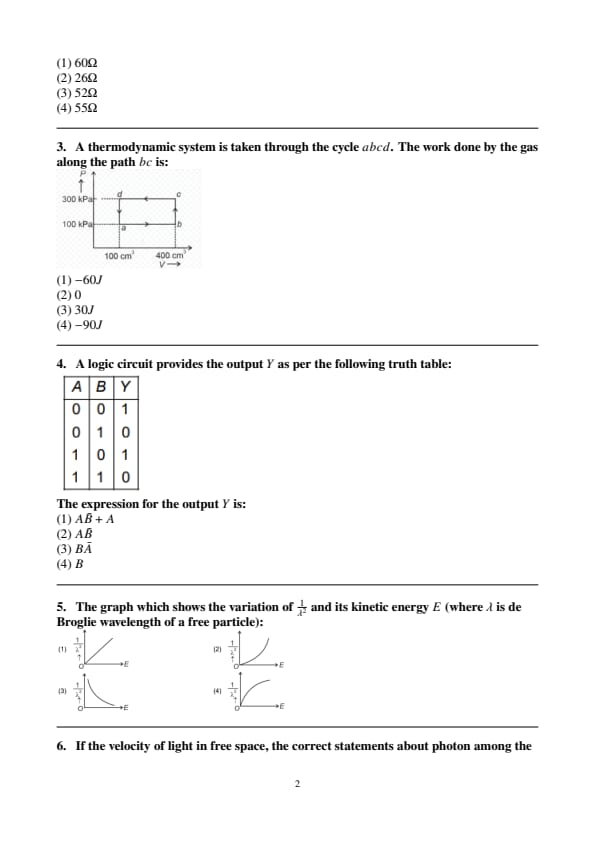
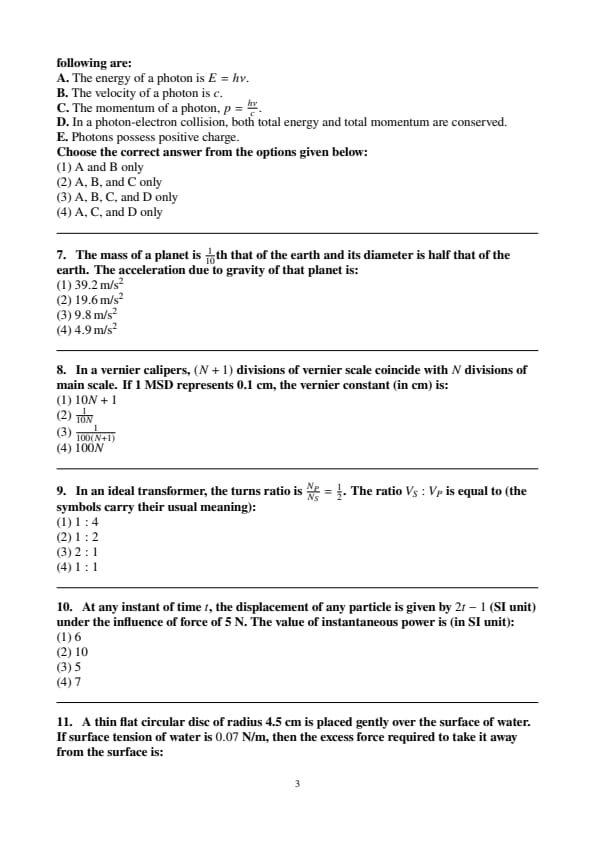
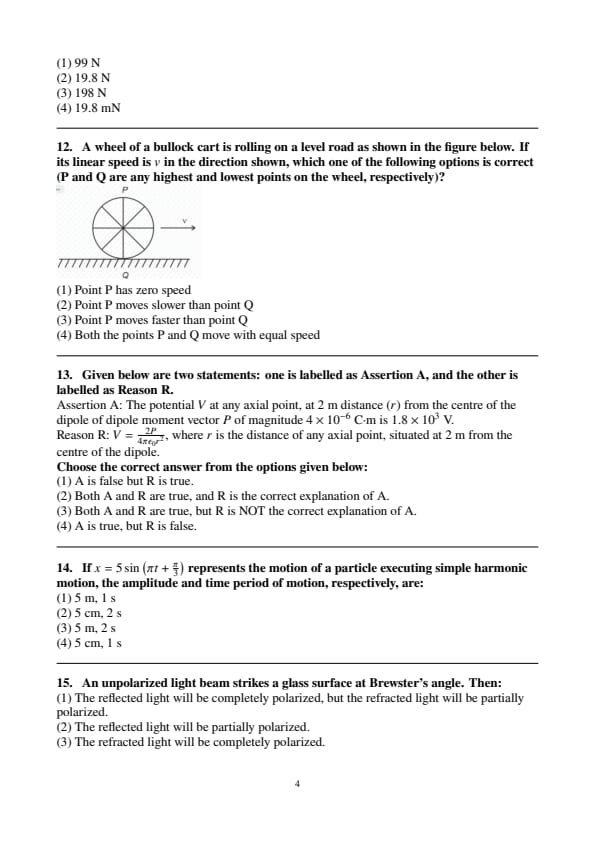
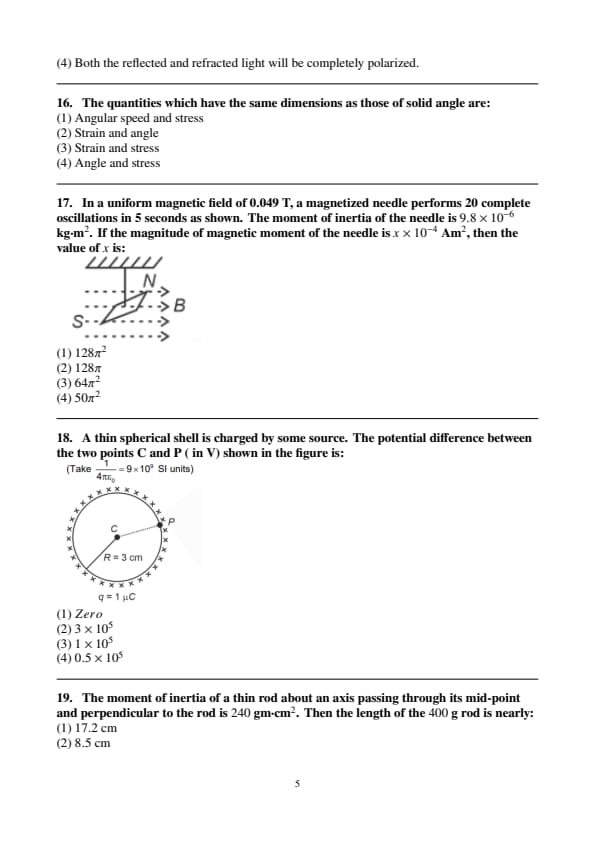
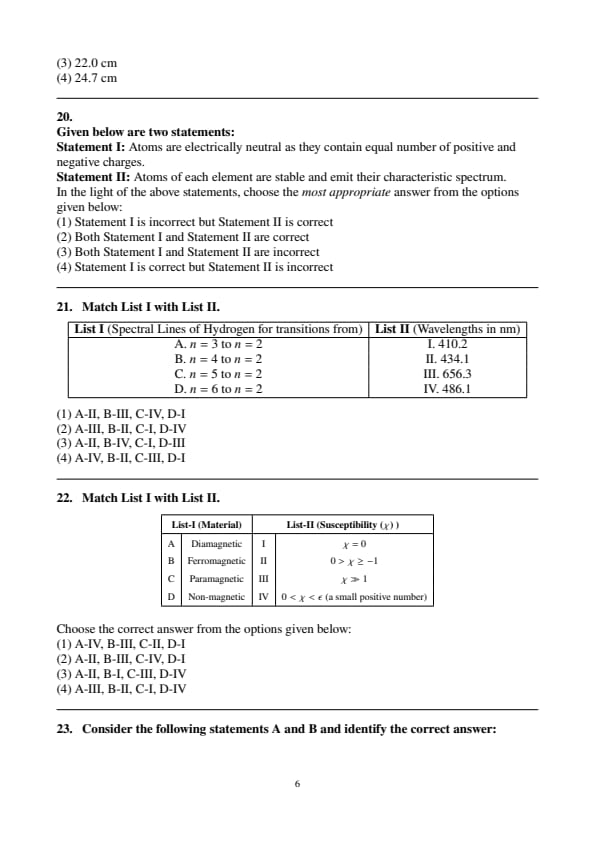
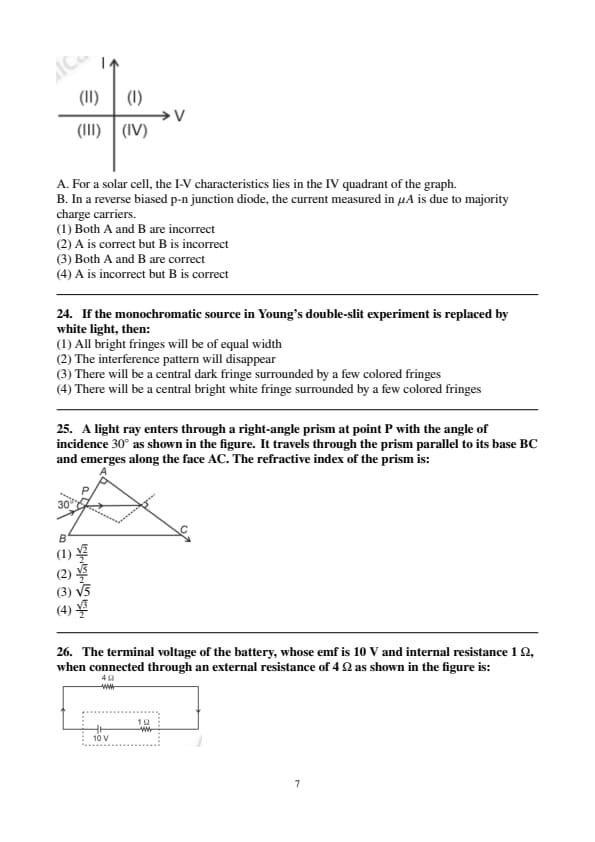
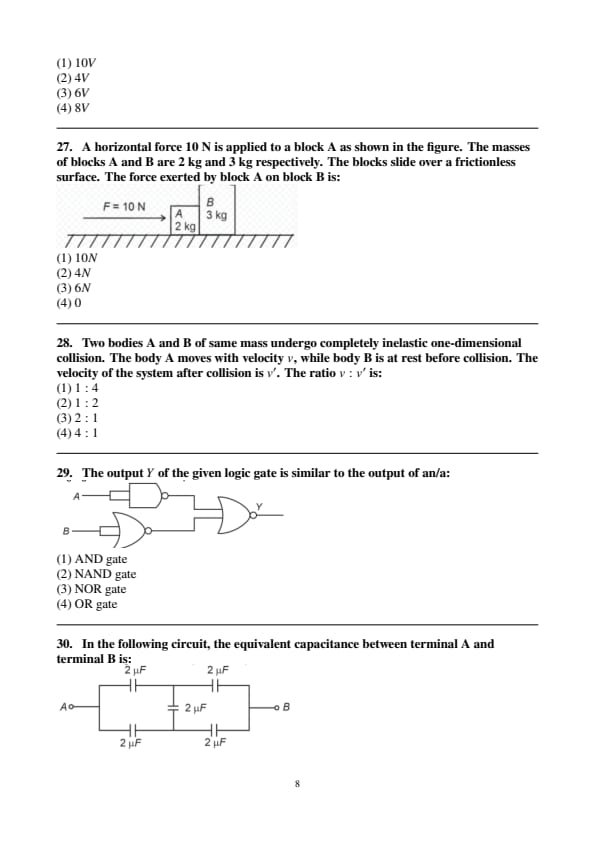
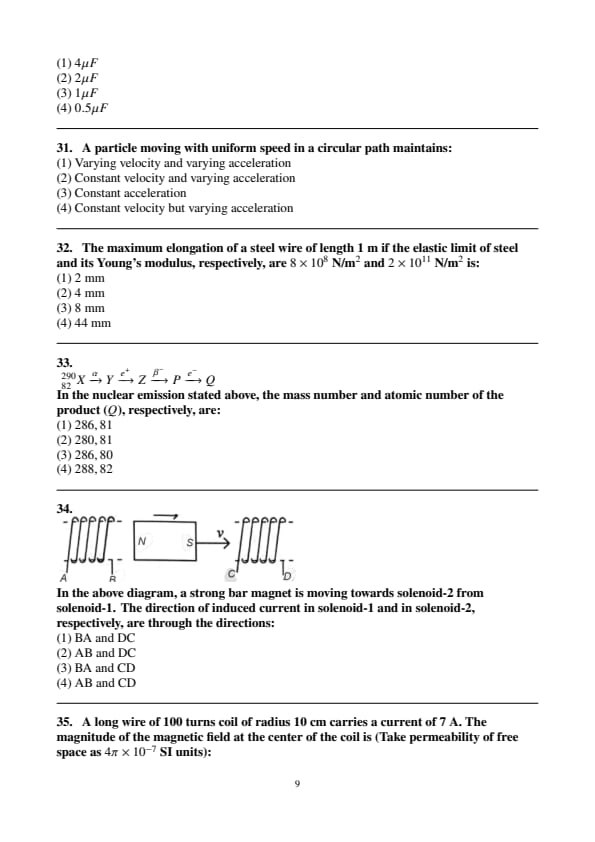
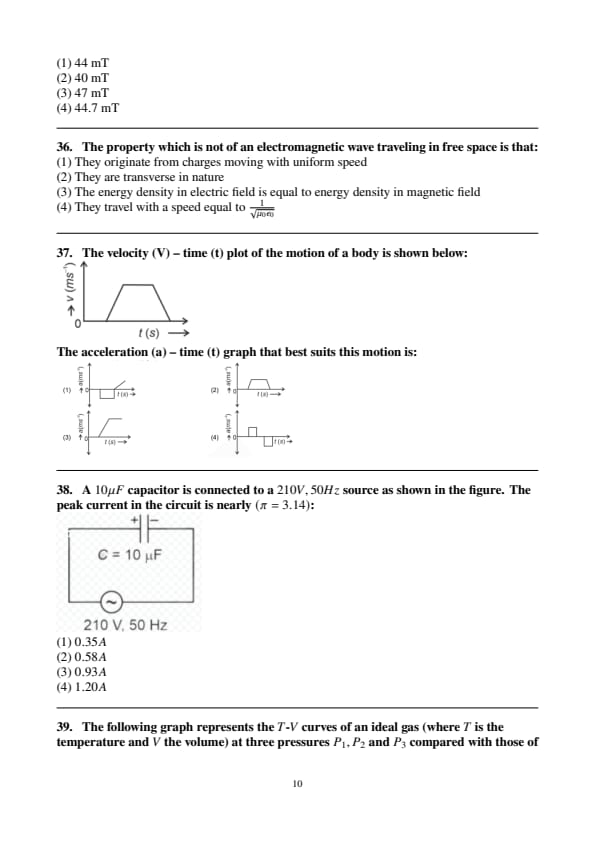
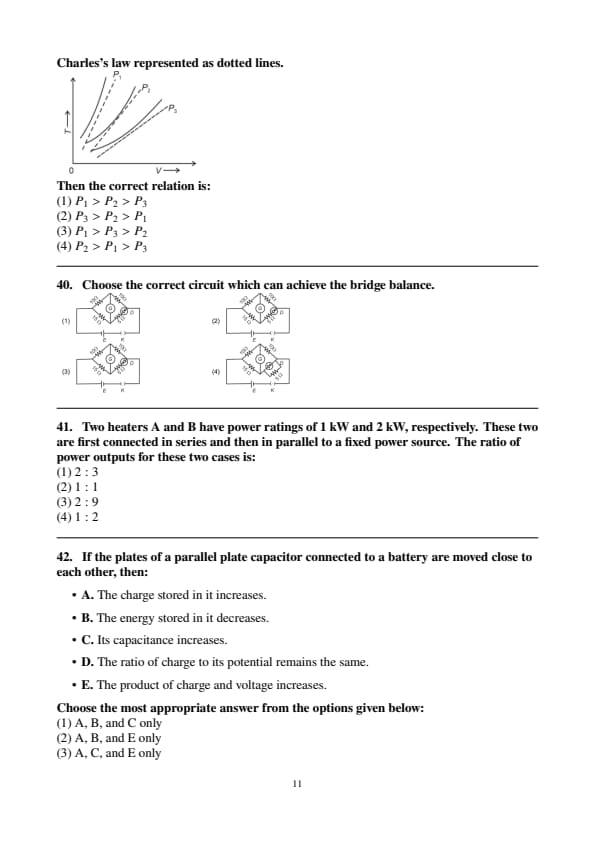
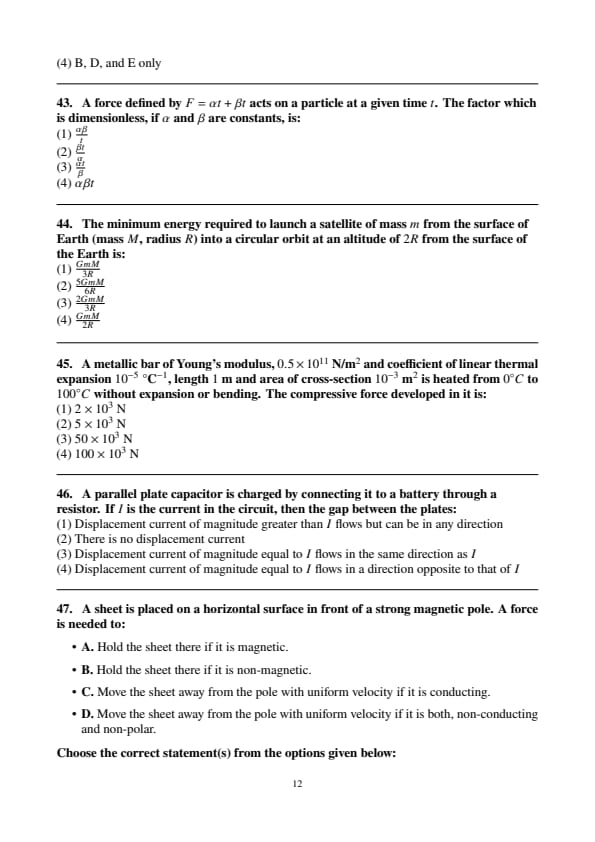
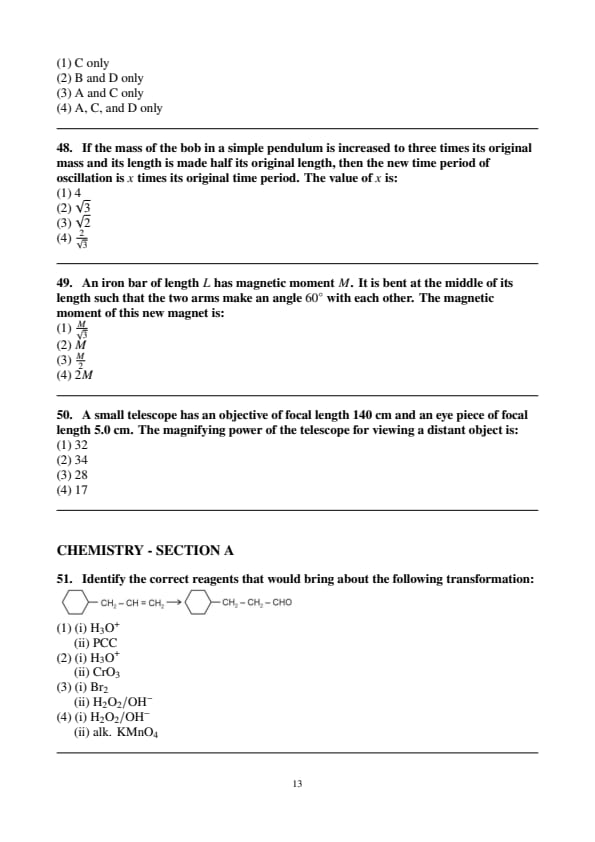
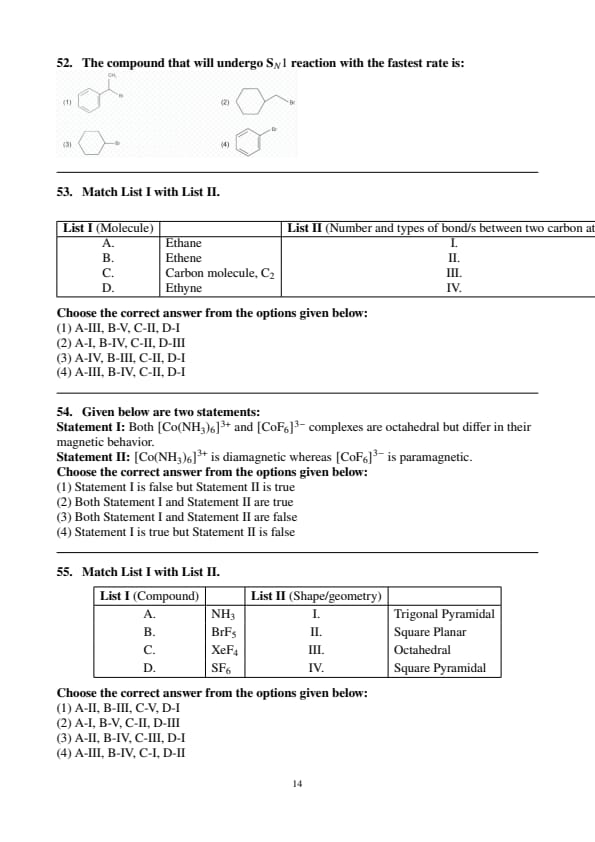
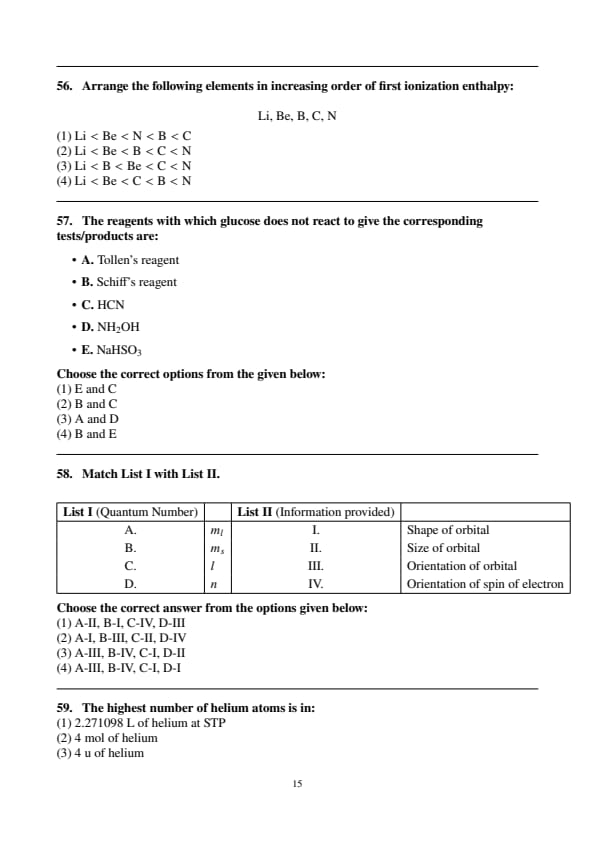
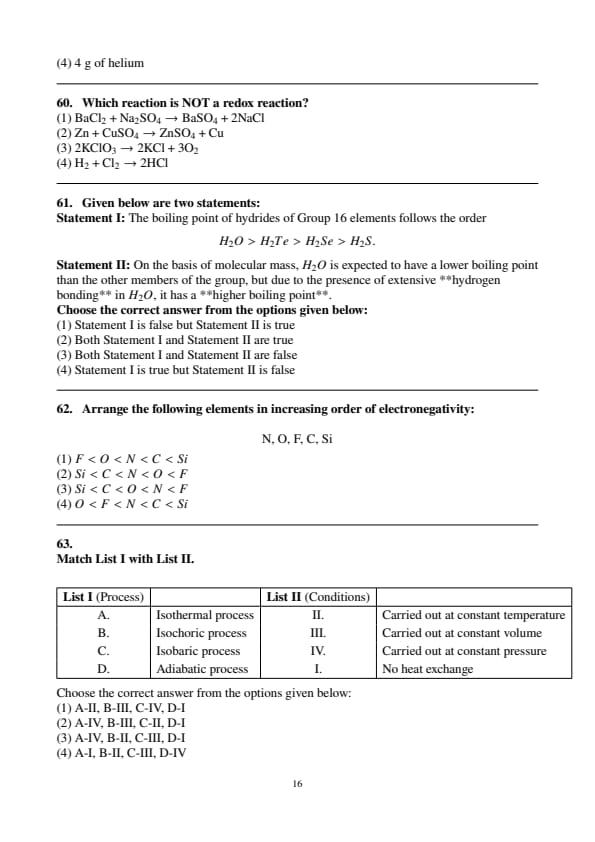
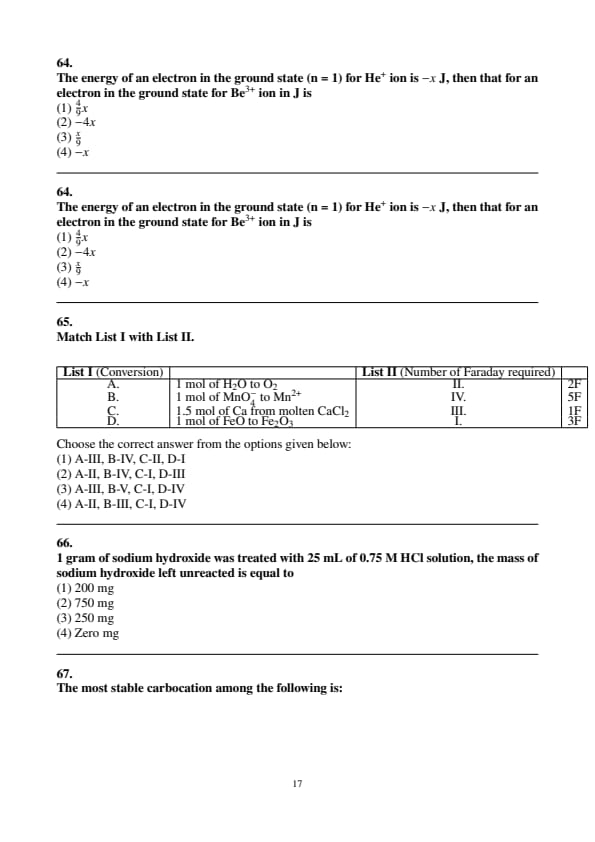
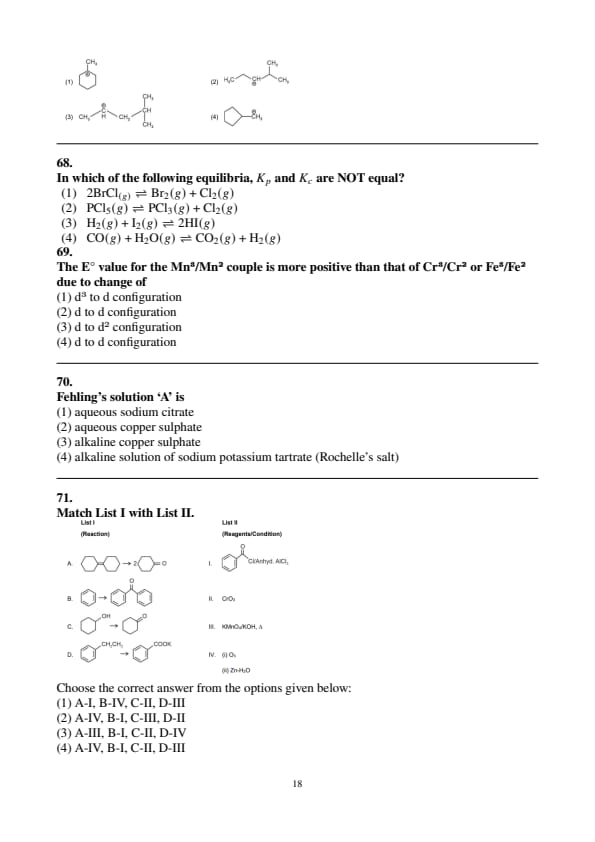
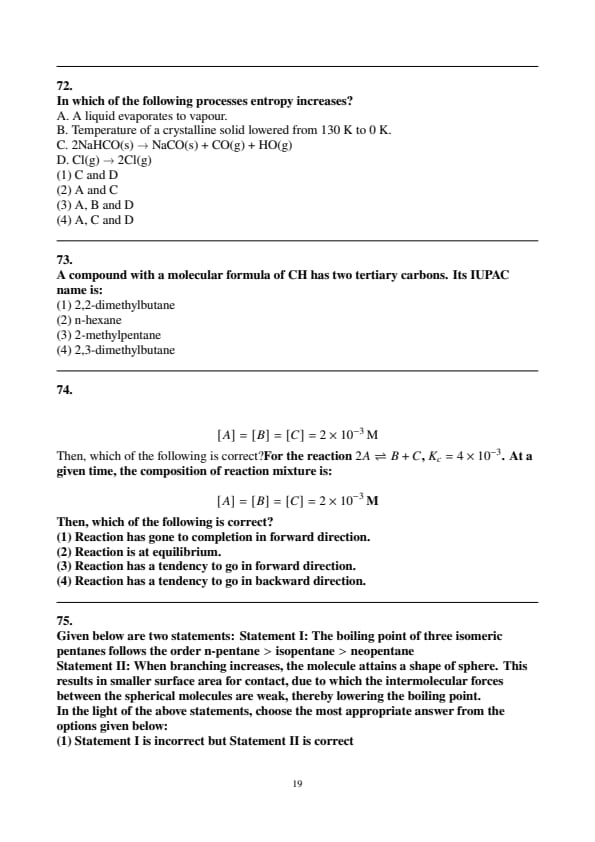
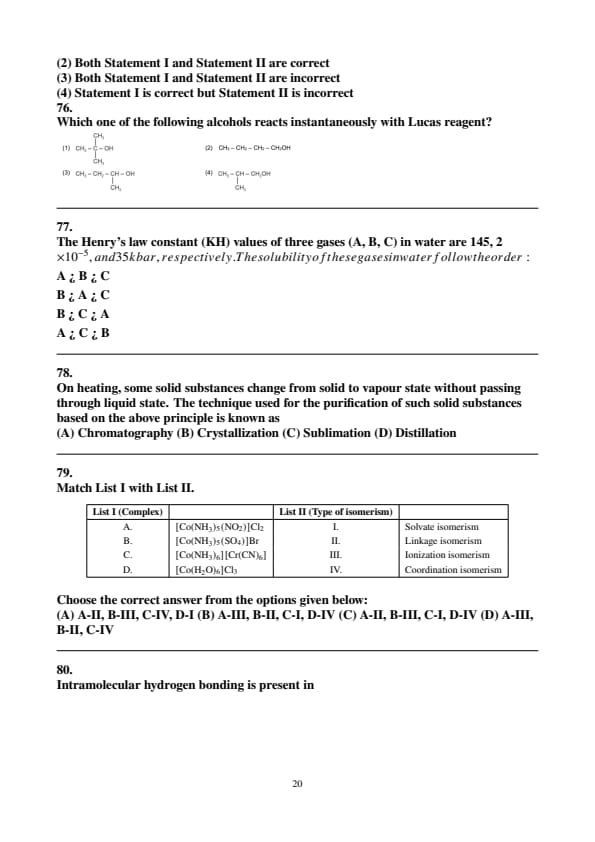
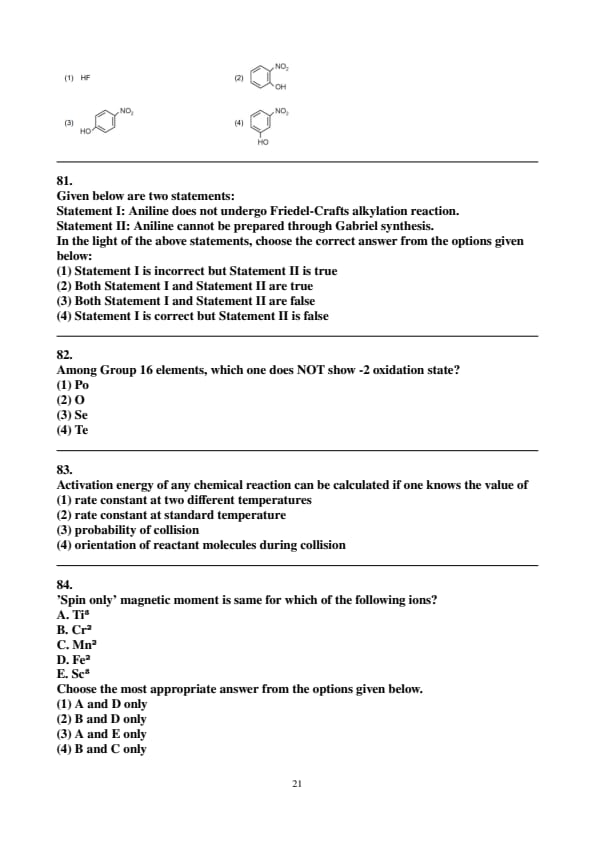
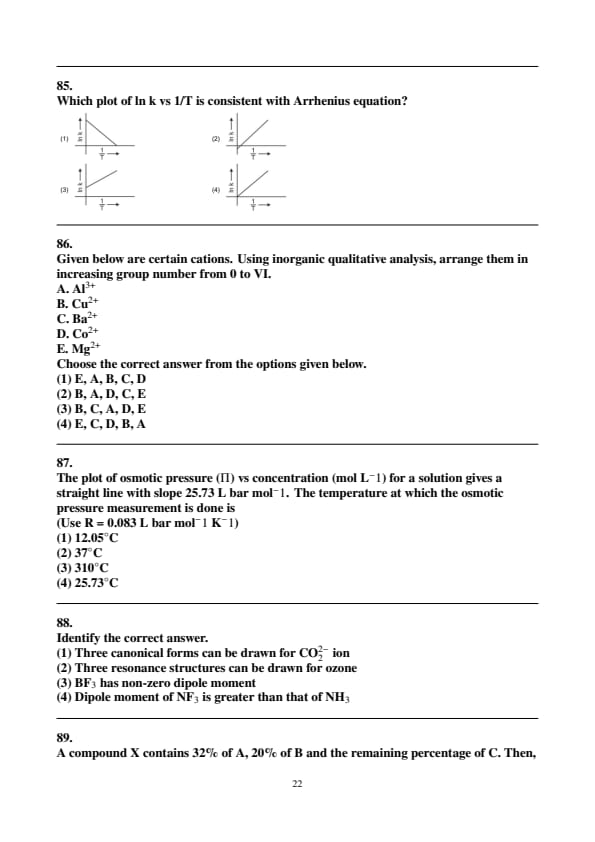
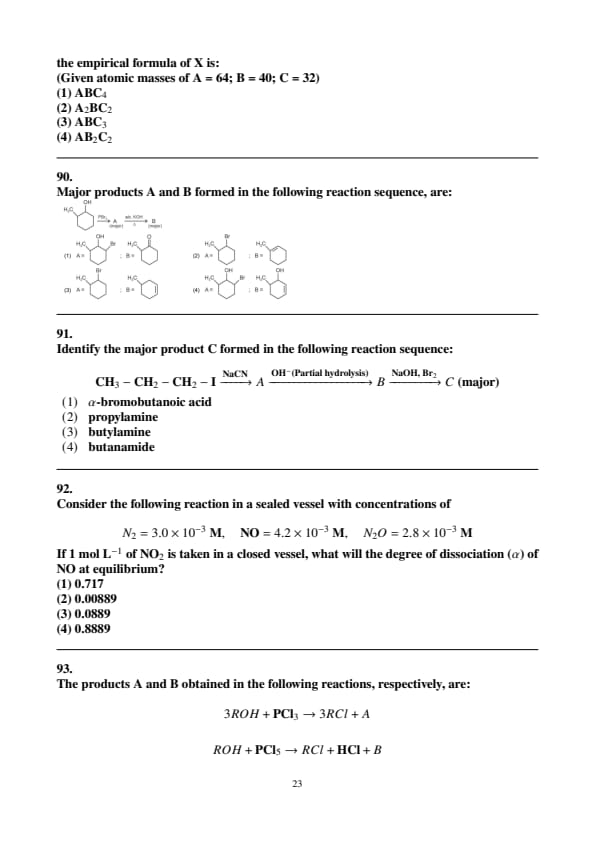
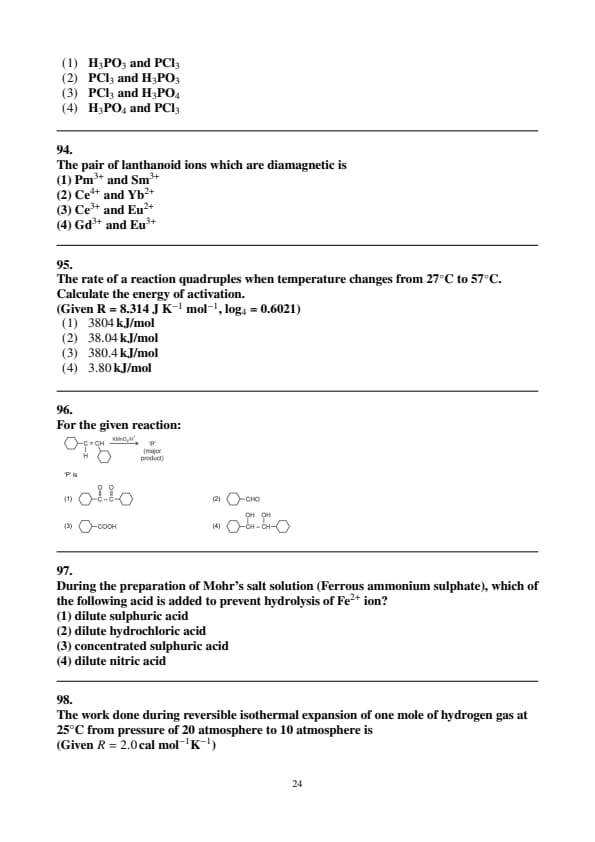
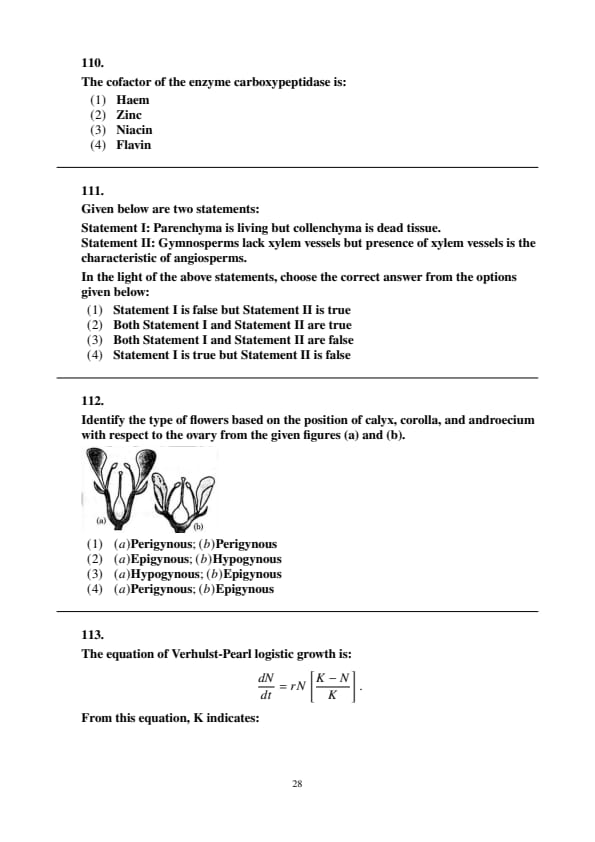
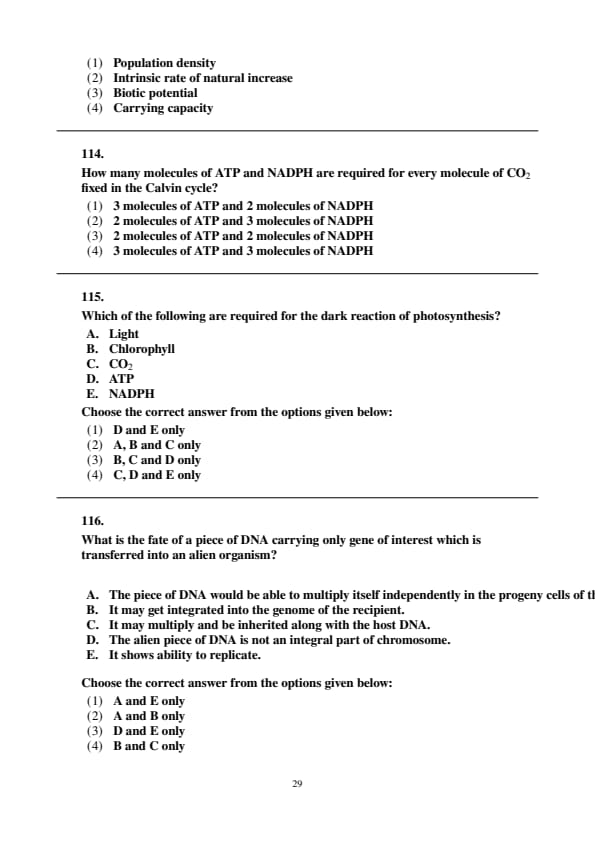
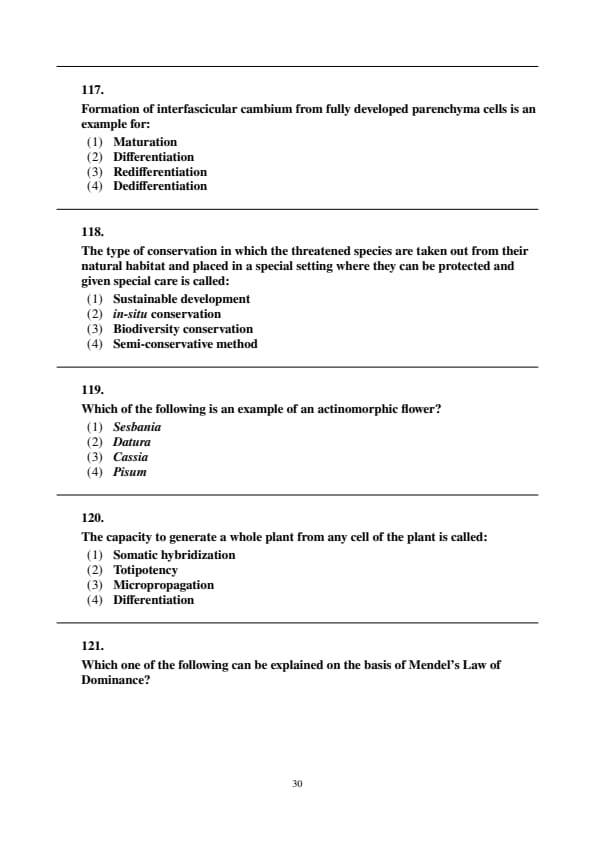
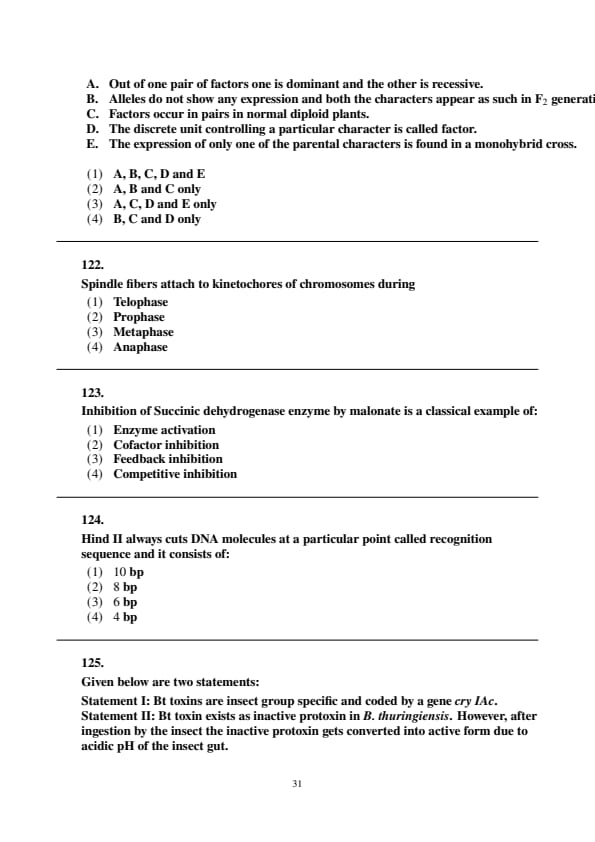
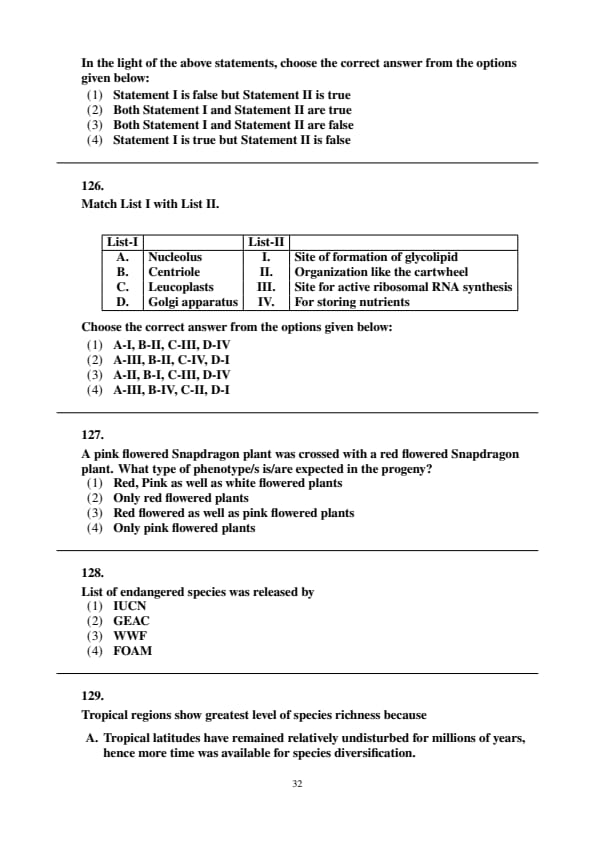
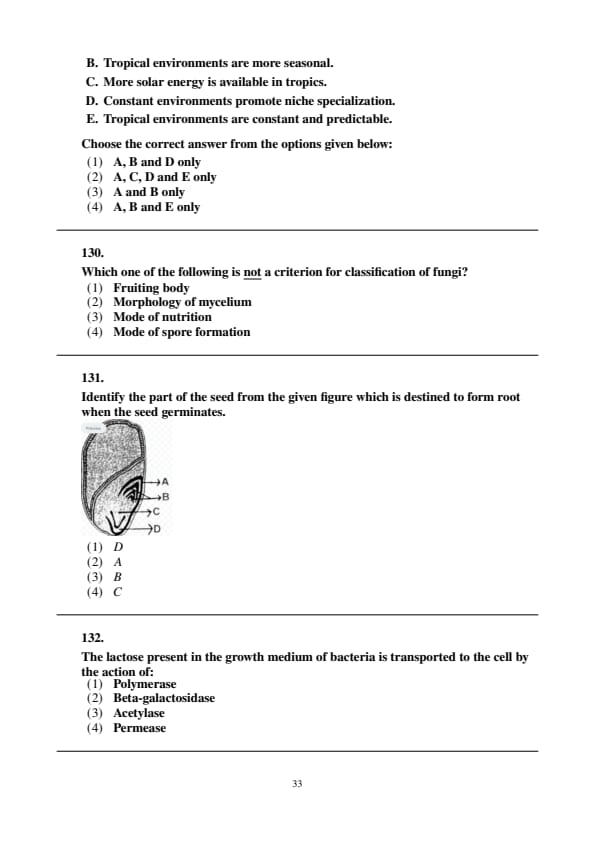
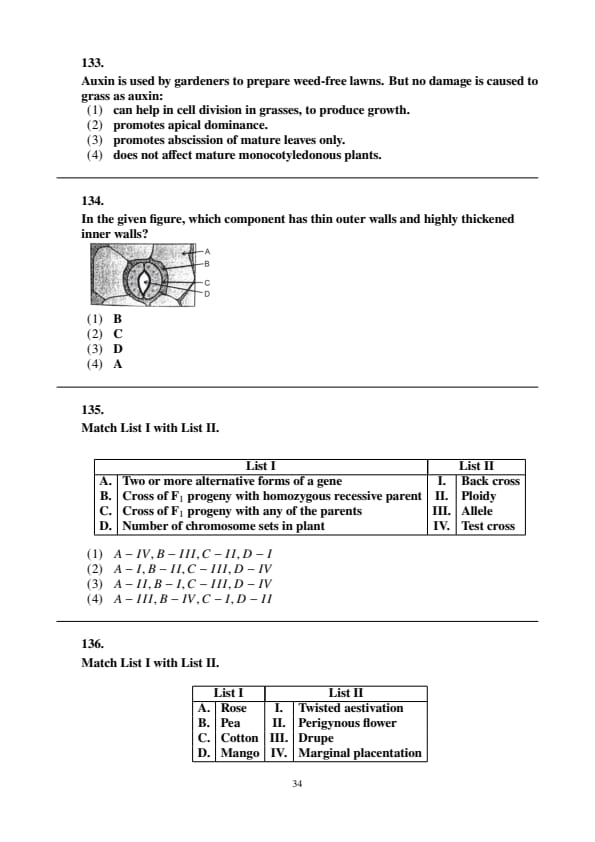
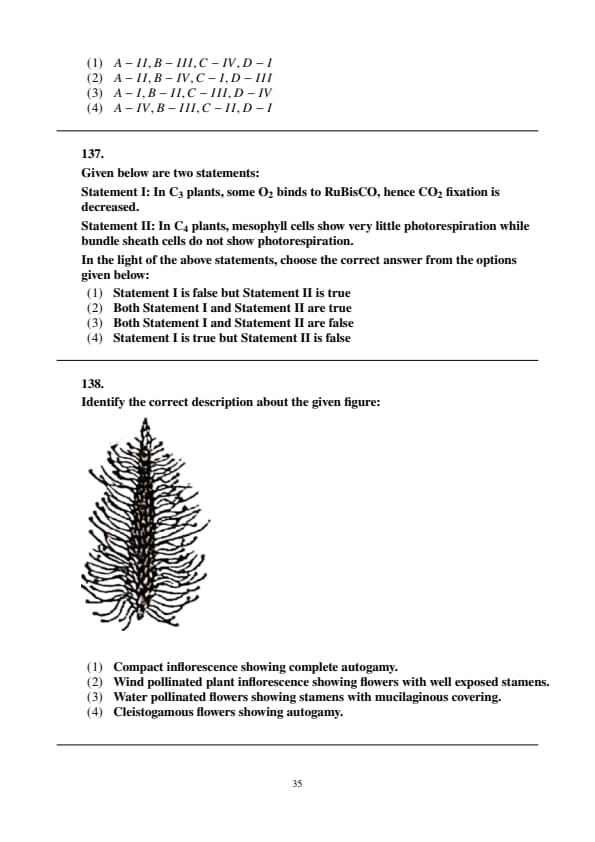
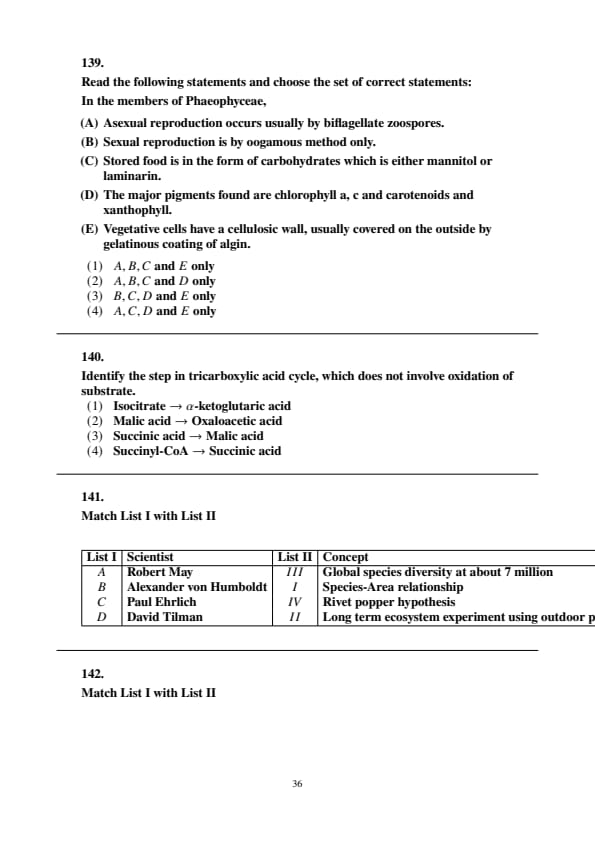
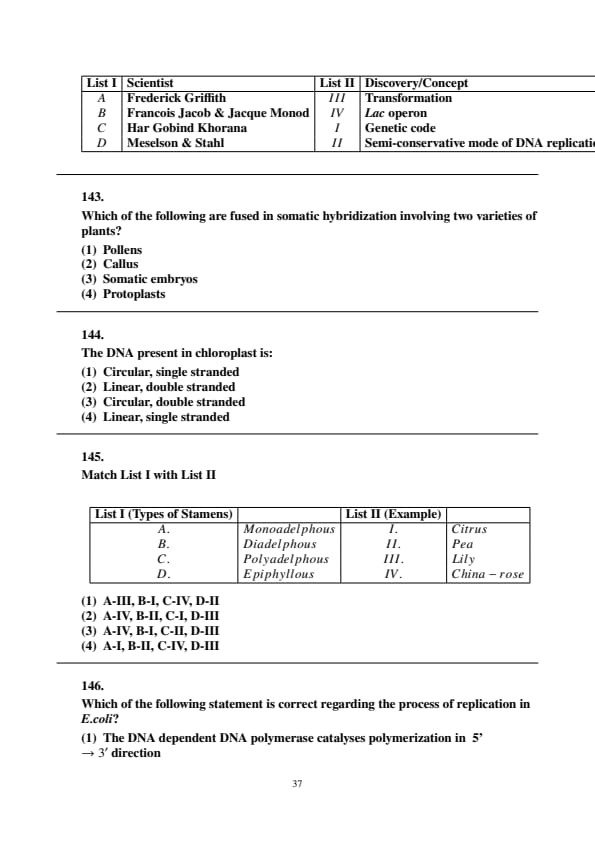
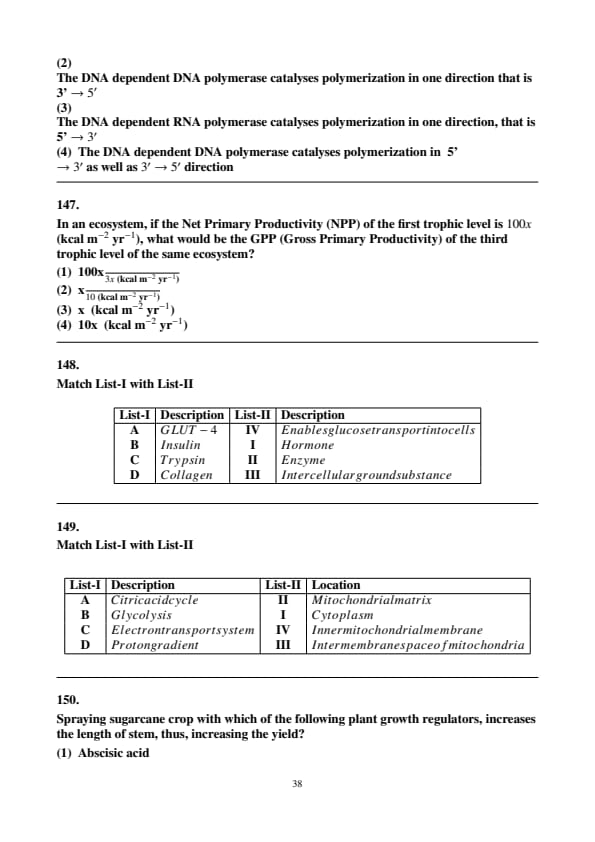
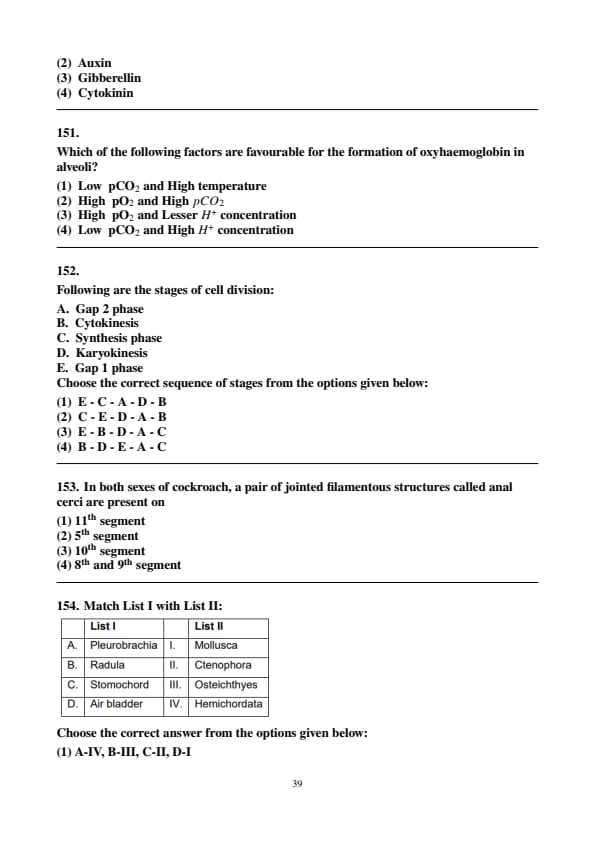
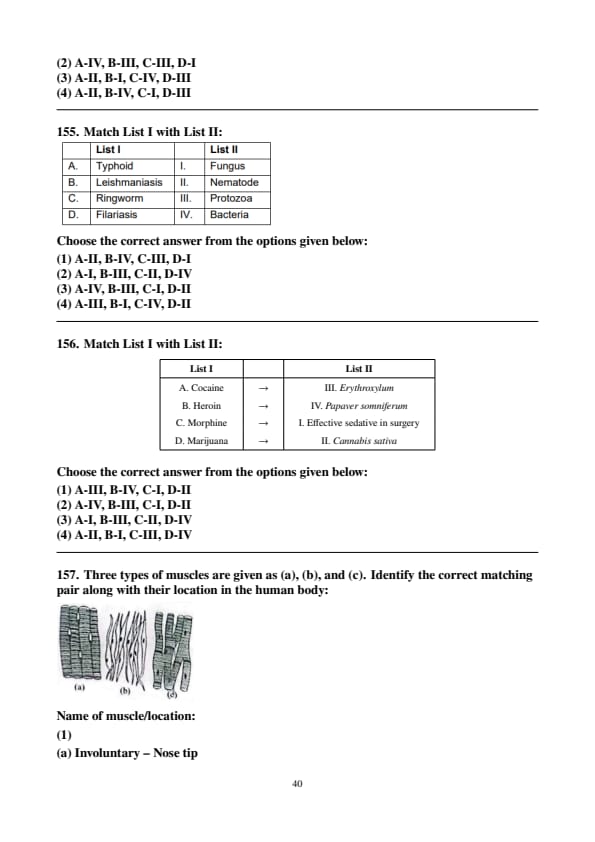
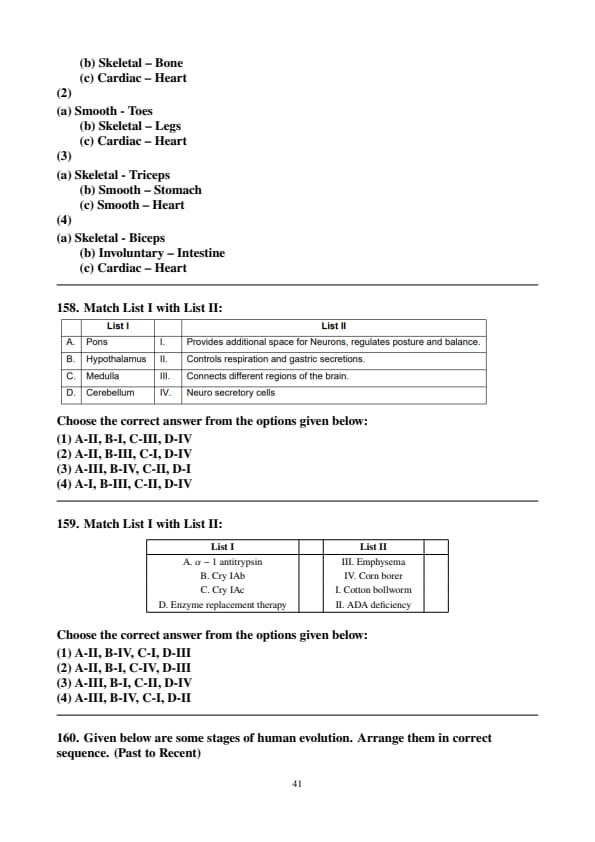
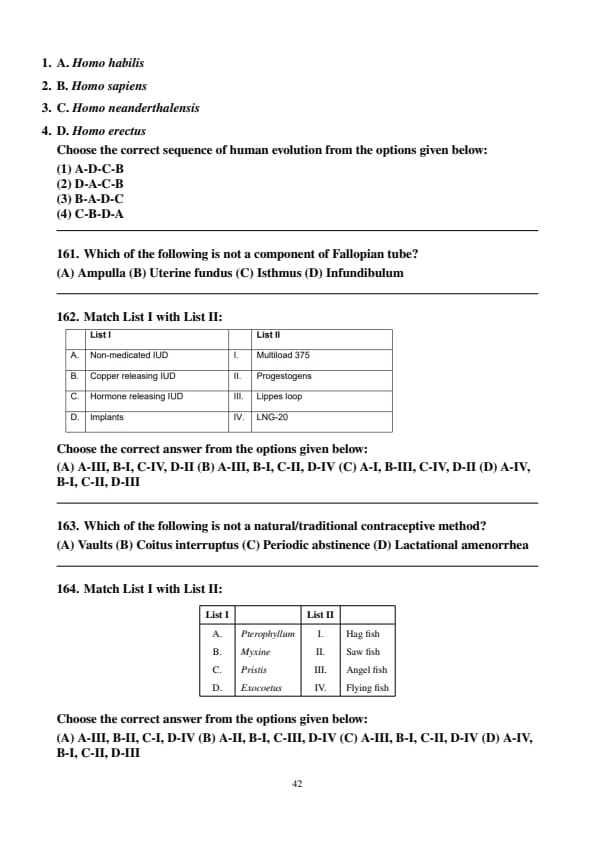
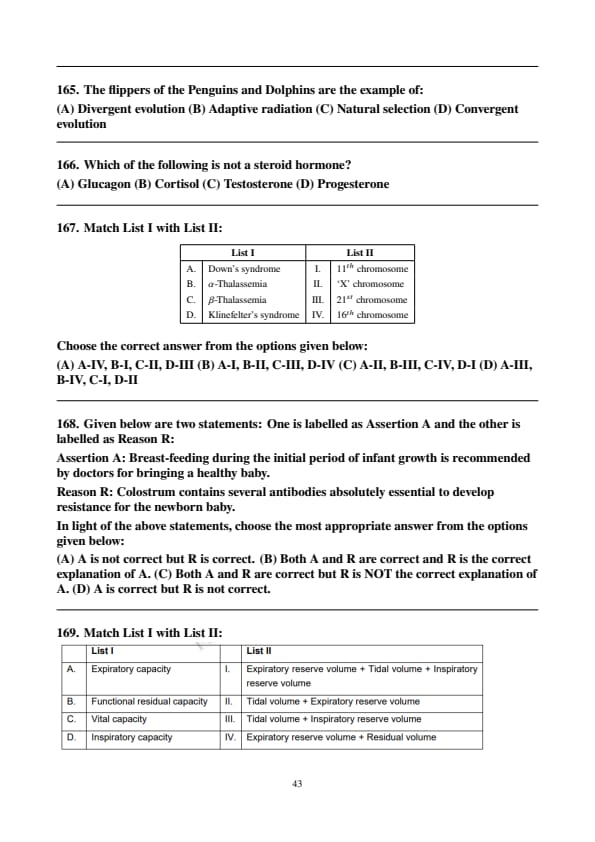
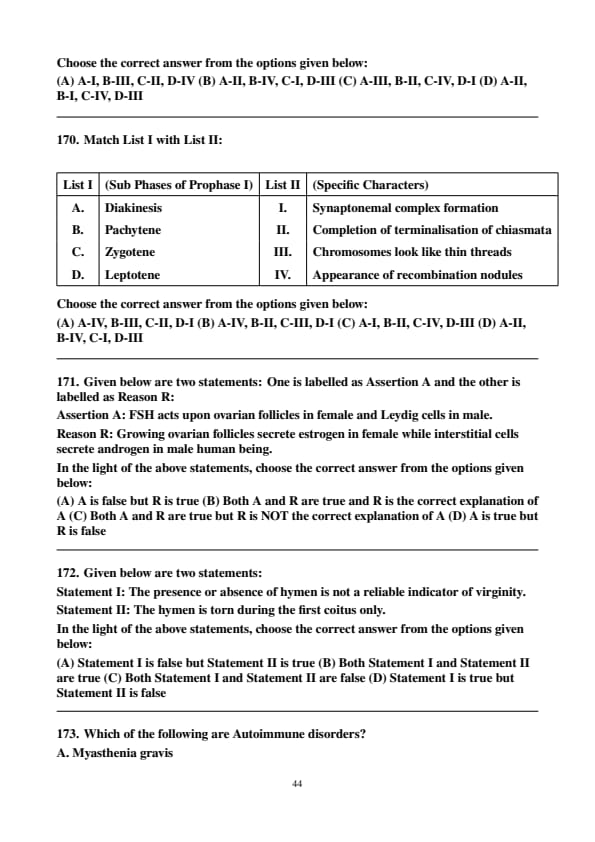
*The article might have information for the previous academic years, please refer the official website of the exam.