
NEET 2025 Revision Plan, Check High Weightage Chapters, Effective Strategy To Keep In Mind While Preparing
- Answer Key
- Merit List
- Seat Inkate
- Tripura Counselling
- Nagaland Counselling
- Kerala Counselling
- UP Counselling
- Assam Counselling
- West Bengal Counselling
- MP Counselling
- Haryana Counselling
- Chhattisgarh Counselling
- Gujarat Counselling
- Participating Colleges
- AP Counselling
- Manipur Counselling
- Mark Vs Rank
- Mizoram NEET Counselling
- Ayush Counselling
- TN NEET Counselling
- Andhra Pradesh Counsellin
- Karnataka NEET Counsellin
- Jharkhand NEET Counsellin
- MH NEET Counselling
- Bihar NEET Counselling
- Counselling
- Seat Allotment

.jpg?tr=h-55,w-55,c-force)
Content Strategist|Tech-innovator|National Hackathon Winner | Updated On - Jan 29, 2025
NEET Exam 2025 is likely to take place on May 4, 2025, depending on the trends set by earlier examinations-usually the first Sunday of May.
Official notification about the examination is expected to come out in early February 2025.
Students preparing for NEET 2025 should start their revision. These many months are enough for preparation if you have got the right approach and dedication for cracking the exam with an effective strategy. During this period, you need to make a NEET 2025 Revision Plan to revise thoroughly each concept and brush up your basics.
The online NEET 2025 Application form is Expected to be released in March 2025. Here we have designed an effective NEET 2025 revision plan which will definitely help you in fulfilling your dream to pursue MBBS or BDS from the top medical college of the country.
The three major essential factors to remember for the NEET 2025 preparation are:
- The NEET aspirants should be calm and focused on the exam.
- Do not doubt yourself or do not try to compare with the other candidate.
- The candidates should put their best efforts. Hard work and disciplined study is the only way to prepare yourself.
- Do not panic, it, in turn, increases your stress. So, it will tend to lose time for the NEET revision purposes.
Latest News
The official notice reads, ‘In continuation to the Public Notice dated 16 January 2025 on the mode of conduct of NEET (UG)-2025, it is clarified that in addition to the courses mentioned in the Public Notice dated 16 January 2025, NEET (UG)-2025 scores and merit list will also apply for admissions to BDS and BVSc & AH courses as followed in the past in accordance with the rules governed by respective regulatory bodies.
Check
You Can Also Check
NEET Study Plan 2025
In order to excel NEET 2025, it is necessary to have an organized study strategy combining concept learning, regular practices, and timely revisions. Divided into different phases, this plan will guide you to study systematically, thus sharpening your skills over a certain period. With this schedule, you can increase your chances of scoring well. The effective study plan is given below:
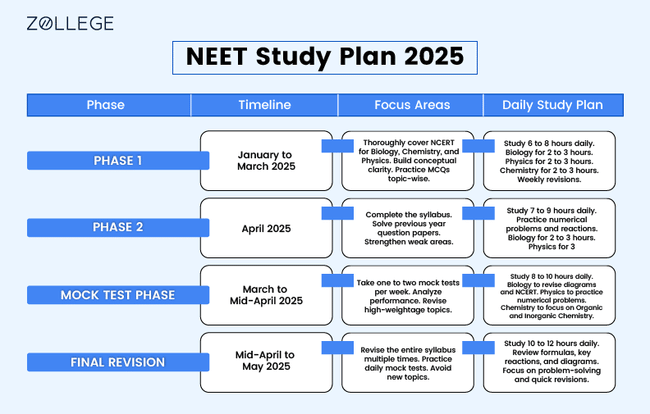
- NEET Study Plan 2025
- High Weightage Topics For NEET 2025
- NEET 2025 Revision Time Table for Last 30 Days
- NEET 2025 Subject Wise Preparation Tips
- NEET Biology Important Topics
- NEET Chemistry Important Topics
- NEET Physics Important Topics
- Best Books For NEET 2025
- NEET Topper Tips 2025
- NEET Exam Day Tips 2025
NEET 2025: Hourly Study Plan
| Time Slot | Subject | Topics to Focus On |
|---|---|---|
| 6:00 AM – 7:00 AM | Physics | Mechanics: Laws of Motion, Work, Energy, Power, Rotational Motion |
| 7:00 AM – 8:00 AM | Physics | Electrostatics: Coulomb’s Law, Electric Field, Electric Potential |
| 8:00 AM – 9:00 AM | Chemistry | Physical Chemistry: Thermodynamics, Chemical Equilibrium |
| 9:00 AM – 10:00 AM | Break/Refresh | Relax, take a light walk, or meditate |
| 10:00 AM – 11:00 AM | Physics | Thermodynamics: Heat Transfer, Laws of Thermodynamics |
| 11:00 AM – 12:00 PM | Biology | Human Physiology: Circulation, Respiration, Excretion |
| 12:00 PM – 1:00 PM | Physics | Oscillations and Waves: SHM, Wave Motion, Sound Waves |
| 1:00 PM – 2:00 PM | Lunch/Break | Eat, take rest, relax |
| 2:00 PM – 3:00 PM | Physics | Optics: Ray Optics, Wave Optics |
| 3:00 PM – 4:00 PM | Physics | Modern Physics: Photoelectric Effect, Atomic Structure |
| 4:00 PM – 5:00 PM | Chemistry | Organic Chemistry: General Organic Chemistry (GOC), Hydrocarbons |
| 5:00 PM – 6:00 PM | Break/Refresh | Take a break, relax or do light exercise |
| 6:00 PM – 7:00 PM | Physics | Magnetism: Biot-Savart Law, Ampere’s Law, Magnetic Field |
| 7:00 PM – 8:00 PM | Physics | Current Electricity: Ohm’s Law, Kirchhoff’s Laws |
| 8:00 PM – 9:00 PM | Dinner/Rest | Have dinner and relax |
| 9:00 PM – 10:00 PM | Revision | Quick revision of the day’s work (Focus on weak areas) |
High Weightage Topics For NEET 2025
In order to do well in NEET 2025, one must focus on high-weight topics covered in the examination. These topics would not only allow the best time management but also would allow one to score the maximum with minimum effort. An analysis of previous year's papers revealed that some chapters and concepts have always contributed significantly to the question pool in Biology, Chemistry, and Physics. Here is a list of high-weight topics for NEET 2025 for your preparation boost.
NEET Biology High Weightage Topics 2025
| Unit | High-Weightage Topics | Key Focus Areas | Approximate Weightage (%) |
|---|---|---|---|
| Human Physiology | Digestion, Respiration, Circulation, Excretion, Neural Control, and Coordination | Focus on processes, structures, and disorders. | 20–22 |
| Genetics and Evolution | Mendelian Genetics, Molecular Basis of Inheritance, Hardy-Weinberg Principle | Practice numerical problems and inheritance patterns. | 18–20 |
| Cell Structure and Function | Cell Cycle, Biomolecules, Structure of Prokaryotic and Eukaryotic Cells | Pay special attention to diagrams and NCERT terminology. | 8–10 |
| Ecology and Environment | Ecosystem, Biodiversity and Conservation, Population Ecology | Study case studies and environmental issues in detail. | 12–15 |
| Reproduction | Reproduction in Organisms, Sexual Reproduction in Flowering Plants, Human Reproduction | Understand diagrams and mechanisms of reproduction in plants and humans. | 14–16 |
| Plant Physiology | Photosynthesis, Respiration, Transport in Plants | Emphasize pathways like C3, C4, and CAM, and transport processes. | 10–12 |
NEET Physics High Weightage Topics 2025
| Unit | High-Weightage Topics | Key Focus Areas | Approximate Weightage (%) |
|---|---|---|---|
| Mechanics | Laws of Motion, Work, Energy, Power, Rotational Motion | Focus on problem-solving, concepts of torque, and moment of inertia. | 20–22 |
| Gravitation | Universal Law of Gravitation, Orbital Motion | Practice numericals on satellite motion and escape velocity. | 6–8 |
| Thermodynamics | Laws of Thermodynamics, Heat Engines | Emphasize the first and second laws of thermodynamics. | 8–10 |
| Oscillations and Waves | SHM, Wave Motion, Sound Waves | Focus on equations of motion and resonance. | 8–10 |
| Electrostatics and Current Electricity | Coulomb’s Law, Electric Field, Potential, Ohm’s Law, Kirchhoff's Laws | Practice capacitor problems and circuit analysis. | 15–17 |
| Magnetism and Electromagnetic Induction | Biot-Savart Law, Faraday's Law, Lenz's Law | Focus on applications of magnetic effects and induction. | 10–12 |
| Optics | Ray Optics, Wave Optics | Emphasize lenses, mirrors, interference, and diffraction. | 10–12 |
| Modern Physics | Photoelectric Effect, Bohr’s Model, Atomic Structure | Focus on nuclear reactions and energy levels. | 10–12 |
| Semiconductors | Logic Gates, p-n Junction Diodes | Practice circuit applications and logic gate questions. | 5–6 |
NEET Chemistry High Weightage Topics 2025
| Unit | High-Weightage Topics | Key Focus Areas | Approximate Weightage (%) |
|---|---|---|---|
| Mechanics | Laws of Motion, Work, Energy, Power, Rotational Motion | Focus on problem-solving, concepts of torque, and moment of inertia. | 20–22 |
| Gravitation | Universal Law of Gravitation, Orbital Motion | Practice numericals on satellite motion and escape velocity. | 6–8 |
| Thermodynamics | Laws of Thermodynamics, Heat Engines | Emphasize the first and second laws of thermodynamics. | 8–10 |
| Oscillations and Waves | SHM, Wave Motion, Sound Waves | Focus on equations of motion and resonance. | 8–10 |
| Electrostatics and Current Electricity | Coulomb’s Law, Electric Field, Potential, Ohm’s Law, Kirchhoff's Laws | Practice capacitor problems and circuit analysis. | 15–17 |
| Magnetism and Electromagnetic Induction | Biot-Savart Law, Faraday's Law, Lenz's Law | Focus on applications of magnetic effects and induction. | 10–12 |
| Optics | Ray Optics, Wave Optics | Emphasize lenses, mirrors, interference, and diffraction. | 10–12 |
| Modern Physics | Photoelectric Effect, Bohr’s Model, Atomic Structure | Focus on nuclear reactions and energy levels. | 10–12 |
| Semiconductors | Logic Gates, p-n Junction Diodes | Practice circuit applications and logic gate questions. | 5–6 |
NEET 2025 Revision Time Table for Last 30 Days
| Day | Biology | Physics | Chemistry |
|---|---|---|---|
| 1 | Diversity in Living World Biological, Classification The Living World Plant Kingdom | Physical World and Measurements, Physical World Measurements and Errors, Units and Dimensions | Some Basic Concepts of Chemistry, Atomic and Molecular weights |
| 2 | Structural Organisation in Plants, Morphology of Angiosperms | Kinematics, Product of Vector,s Vector Addition, Relative Velocity, Oblique Projection, Horizontal Projection Horizontal, Motion, Motion Under Gravity Graphs | Atomic Structure Introduction, Fundamental Particles, De-Broglie Wave Theory, Quantum Mechanical Model of Atom Spectra, Hydrogen Spectrum, Bohr’s Model |
| 3 | Cell Structure and Function Cell Biology | Laws of Motion, Connected Bodies, Horizontal Plane, Inclined Plane Laws of Motion, Block on Block, Horizontal Circular Motion | Periodic Classification, Periodic Classification of Elements, Electron Affinity, Valency Oxidation Sationship, Periodicitytate and Diagonal Rel |
| 4 | Plant Physiology, Water Relations, Photosynthesis | Work, Power and Energy, Vertical Circular Motion, Work, Power and Energy Collisions | Chemical Bonding, Chemical Bonding, Bond Characteristics, Vsepr Theory, Coordinate Covalent Bond, Hydrogen Bond |
| 5 | Plant Physiology, Respiration, Plant Growth and Development | Motion of System of Particles and Rigid Body, Moment of Inertia, Centre of Mass | States of Matter, Inter Molecular Interactions, Properties Of Gases, Gas Laws, Ideal Gas Equation, Kinetic Molecular Model of Gas, Real Gases, The Liquid State Graham’s Law of Diffusion |
| 6 | Plant Physiology, Mineral Nutrition & Nitrogen Metabolism | Gravitation Basic Forces and Kepler's Laws Orbital & Escape Velocities Variation of "g" | Thermo Dynamics, Thermodynamics Hess’s Law |
NOTE:- At the end of each week you can just solve sample question papers and mock tests. It is better to sit and give the exam exactly at the time you will do on the final day. It is also important to keep in mind the time limit and attempt these papers in the same manner. This will help you with better time management and will also enhance your writing skills. After you complete the exam, sit down an analyze your weaknesses and revise the topics where you have performed poorly.
NEET 2025 Subject Wise Preparation Tips
NEET Biology Important Topics
The best way of solving the NEET Biology section is dependent upon the syllabus, important topics and on their respective weightage. Thus, the weightage fo all topics is given below.
| Topic name | Number of Questions | Weightage (In percentage) |
|---|---|---|
| Botany | ||
| Plant Diversity | 7 | 12% |
| Plant Anatomy | 2 | 4% |
| Plant Morphology | 4 | 7% |
| Cell Biology & Cell Division | 6 | 10% |
| Bio-molecule | 2 | 3% |
| Plant Physiology | 8 | 13% |
| Plant Reproduction | 5 | 9% |
| Genetics and Biotechnology | 15 | 24% |
| Biology in Human Welfare | 1 | 2% |
| Ecology | 10 | 16% |
| Zoology | ||
| Animal Diversity | 3 | 10% |
| Animal Tissue | 1 | 3% |
| Structural Organisation in animals | 1 | 2% |
| Human Physiology | 13 | 45% |
| Human Reproduction and Reproductive Health | 5 | 18% |
| Origin & Evolution | 3 | 10% |
| Animal husbandry | 1 | 3% |
| Human Health & Diseases | 3 | 9% |
NEET Chemistry Important Topics
| Most Important Topics | Moderately Important Topics | Less Important Topics |
|---|---|---|
| Aldehydes, Ketones And Carboxylic Acids | Alcohols, Phenols and Ethers | Chemistry In Everyday Life |
| Biomolecules | Classification Of Elements And Periodicity In Properties | Electrochemistry |
| Chemical Bonding And Molecular Structure | d And f Block Elements | Environmental Chemistry |
| Chemical Kinetics | Hydrocarbons | General Principles And Processes Of Isolation Of Elements |
| Coordination Compounds | Polymers | Haloalkanes And Haloarenes |
| Equilibrium | s-Block Elements (Alkali And Alkaline Earth Metals) | Hydrogen |
| Organic Chemistry – Some Basic Principles And Techniques | Solid State | Organic Compounds Containing Nitrogen |
| p-block Elements | Solutions | States Of Matter: Gases And Liquids |
| Redox Reactions | Some Basic Concepts Of Chemistry | Surface Chemistry |
| Thermodynamics | Structure Of Atom | – |
NEET Physics Important Topics
| Unit | Important Topics | Key Concepts |
|---|---|---|
| Mechanics | Laws of Motion, Work, Energy, Power, Rotational Motion | Newton’s Laws, Inertia, Impulse, Work-Energy Theorem, Moment of Inertia, Torque |
| Gravitation | Universal Law of Gravitation, Orbital Motion, Escape Velocity | Gravitational Force, Satellites, Orbital Motion |
| Thermodynamics | Laws of Thermodynamics, Heat Transfer, Thermal Properties of Matter | First and Second Law, Heat Engines, Conduction, Convection, Radiation |
| Oscillations and Waves | Simple Harmonic Motion (SHM), Wave Motion, Sound Waves, Fluid Mechanics | SHM, Wave Equation, Doppler Effect, Bernoulli’s Theorem, Viscosity |
| Electrostatics and Current Electricity | Coulomb’s Law, Electric Field, Electric Potential, Capacitors, Ohm’s Law, Kirchhoff’s Laws | Electric Force, Electric Field, Capacitors in Series and Parallel, Current Flow |
| Magnetic Effects of Current | Biot-Savart Law, Ampere’s Law, Magnetic Field due to Current, Electromagnetic Induction | Magnetic Field, Lorentz Force, Electromagnetic Induction |
| Optics | Ray Optics, Wave Optics | Reflection, Refraction, Lenses, Mirrors, Diffraction, Interference, Polarization |
| Modern Physics | Photoelectric Effect, Atomic Structure, Nuclear Physics | Einstein’s Equation, Bohr’s Model, Radioactivity, Nuclear Reactions |
| Semiconductors | p-n Junction, Logic Gates, Diodes, Transistors | Semiconductor Theory, Diode Applications, Digital Circuits |
Best Books For NEET 2025
This is a common thing that comes into every student's or aspirant’s mind. It doesn’t matter they are preparing for NEET or UPSC or JEE or any other competitive/entrance exams. Choosing the right book is very much essential in order to get the exams cleared. While choosing the books, the applicants must consult with their teachers, seniors who have given the exams, mentors or experienced persons of the field. We know that content is the key. Opting for books with clear and concise language for ease of learning. Also, opt for books with comprehensive coverage of the syllabus. Here are the list of some important books that will help students throughout their preparation-
Physics
| Book Title | Author/Publisher | Key Features |
|---|---|---|
| NCERT Physics for Class 11 and 12 | NCERT | Fundamental concepts, NEET-oriented |
| Concepts of Physics (Vol 1 & 2) | H.C. Verma | Strong theoretical explanations and practice questions |
| Understanding Physics for NEET (Series) | D.C. Pandey | Topic-wise explanations and NEET-specific questions |
| Problems in General Physics | I.E. Irodov | Advanced problem-solving for high-level preparation |
Chemistry
| Book Title | Author/Publisher | Key Features |
|---|---|---|
| NCERT Chemistry for Class 11 and 12 | NCERT | Essential for theory and direct NEET questions |
| Physical Chemistry | O.P. Tandon | Detailed explanations of numerical concepts |
| Organic Chemistry | Morrison and Boyd | Comprehensive for reaction mechanisms |
| Inorganic Chemistry | J.D. Lee | Focus on periodic properties and coordination chemistry |
Biology
| Book Title | Author/Publisher | Key Features |
|---|---|---|
| NCERT Biology for Class 11 and 12 | NCERT | Core content for NEET questions |
| Objective Biology | Dinesh Publication | Chapter-wise MCQs for practice |
| Biology Volumes 1 and 2 | Trueman’s | In-depth coverage of NEET topics |
| Objective Biology | MTG Editorial Board | Previous year questions and topic tests |
NEET Topper Tips 2025
| Topper Name | State | Category | Percentile | NEET Rank | Statement |
|---|---|---|---|---|---|
| Ayush Naugraiya | Uttar Pradesh | Gen-EWS | 99.9992714 | 1 | "Consistent hard work and a well-structured study plan were key to my success." |
| Prachita | Rajasthan | General | 99.9992714 | 1 | "Staying focused and maintaining a positive mindset helped me achieve my goal." |
| Divyansh | Delhi | General | 99.9992714 | 1 | "Regular practice and understanding concepts deeply were crucial for my preparation." |
| Gunmay Garg | Punjab | General | 99.9992714 | 1 | "Time management and consistent revision played a significant role in my success." |
| Arghyadeep Dutta | West Bengal | OBC-NCL | 99.9992714 | 1 | "Staying calm under pressure and running regular mock tests helped me work towards my preparation." |
NEET Exam Day Tips 2025
- One should revise the technique for filling the OMR Sheet that is effective and speedy. This is due to the fact that any mistake in the OMR sheet would directly reflect in your marks.
- Many of the details presented in the question are irrelevant to the solution. In cases like this, candidates should circle and underline all of the parts of the question that are relevant to problem-solving in order to avoid silly mistakes. Aspirants should pay extra attention to qualifiers such as all, some, etc.
- Prefixes such as uni, bi, mono, and duo are good indicators of quantitative and qualitative characteristics of a question.
- While solving the questions, it is imperative that you create diagrams such as charts, tables, or maps to understand and inculcate data conceptually.
- Candidates must have a clear idea of what questions they can or can not attempt. Aiming to solve the entire paper will only lead to disruption of clarity. The sequence of attempting the question paper must be chosen as per one’s own convenience.
*The article might have information for the previous academic years, please refer the official website of the exam.
Ask your question
Answered Questions
Best way to prepare for NEET is by starting early and being dedicated. Join a coaching class or take one online.
For the UG Engineering courses, candidates need to have 10+2 with 45% for the general category. However, the aggregate percentage will be 40% for SC/ST/OBC. For the PG Engineering courses, candidates need to have graduation with 50% and 45% for the SC/ST/OBC.
PDUSU eligibility criteria for the M.Ed program is merit scored in the B.Ed program from a recognized University or Board.
Eligibility requirements for Rajiv Gandhi Proudyogiki Vishwavidyalaya (RGPV) programs as follows:
- B.Tech - Pass 10 +2 with 45% aggregate marks (40% for reserved category)
- MBA - graduate degree with minimum 50% aggregate marks(45% aggregate for reserved category)
- B.Pharma - Pass 10 +2 with PCM with 50% aggregate marks
- B.Arch - Pass 10 +2 with Mathematics with 50%aggregate marks
- M.Tech - BE/ BTech in the relevant stream with 50% aggregate marks
- M.Pharma - BPharm with 55% aggregate marks
- Diploma - Bachelor’s degree in the relevant stream from a recognised university
There are different scholarships provided for VIT students and each has different Criteria. Some of them are mentioned below.
- VITEEE Scholarship under GV School Development Programme (GVSDP): Scholarships are given to the rank scored in VITEEE in the first year of the program and are continued on the basis of the criteria mentioned in the award letter issued during admission.
- Smt. Rajeswari Viswanathan Memorial Scholarship: Scholarships given to meritorious candidates from an economically weak background who satisfy the criteria specified in the application.
- Merit Awards for NRI and Foreign students: For the top 10 students of each branch of a program from 1st to final year with a record of 75% above attendance and no history of arrears, also do not violate the university's code of conduct.
- Cent percent Attendance Awards: Students who maintain a record of 100% attendance
- Sports Scholarship: For the students with great records and performance in various sports.


