
NEET 2024 Question Paper with Answer Key PDF (May 5)
- Answer Key
- Merit List
- Seat Inkate
- Tripura Counselling
- Nagaland Counselling
- Kerala Counselling
- UP Counselling
- Assam Counselling
- West Bengal Counselling
- MP Counselling
- Haryana Counselling
- Chhattisgarh Counselling
- Gujarat Counselling
- Participating Colleges
- AP Counselling
- Manipur Counselling
- Mark Vs Rank
- Mizoram NEET Counselling
- Ayush Counselling
- TN NEET Counselling
- Andhra Pradesh Counsellin
- Karnataka NEET Counsellin
- Jharkhand NEET Counsellin
- MH NEET Counselling
- Bihar NEET Counselling
- Counselling
- Seat Allotment

.jpg?tr=h-55,w-55,c-force)
Content Strategist|Tech-innovator|National Hackathon Winner | Updated On - Jan 13, 2025
NEET 2024 Question paper with answer key pdf in English is available code wise here. NEET 2024 May 5 question paper has 200 MCQs- 180 to be attempted in 3 hours 20 minutes. You can download NEET 2024 question paper with answer key with solutions PDF in English using the links given below. download.
| NEET Exam 2024 Question Paper |  Download Download |
Check Solution |
NEET 2024 Questions with Solutions
Question 1:
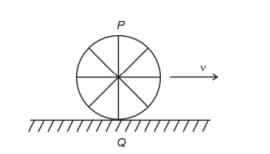
A wheel of a bullock cart is rolling on a level road as shown in the figure below. If its linear speed is v in the direction shown, which one of the following options is correct (P and Q are any highest and lowest points on the wheel, respectively)?
View Solution
The velocity of a point on a rolling wheel is the vector sum of the linear velocity of the wheel’s center and the tangential velocity of the point due to rotation:
- For the topmost point P, the tangential velocity due to rotation is in the same direction as the linear velocity. Thus, its speed is v + v = 2v.
- For the bottommost point Q, the tangential velocity is opposite to the linear velocity, resulting in a net speed of v − v = 0.
Hence, point P moves faster than point Q.
Question 2:
Match List I with List II:
List I (Spectral Lines of Hydrogen for transitions from) List II (Wavelengths (nm))
- A. n2 = 3 to n1 = 2 → (I) 410.2
- B. n2 = 4 to n1 = 2 → (II) 434.1
- C. n2 = 5 to n1 = 2 → (III) 656.3
- D. n2 = 6 to n1 = 2 → (IV) 486.1
View Solution
The spectral lines of hydrogen follow the Balmer series. Using the wavelengths given:
- Transition n2 = 3 → n1 = 2 corresponds to 656.3 nm (III).
- Transition n2 = 4 → n1 = 2 corresponds to 486.1 nm (IV).
- Transition n2 = 5 → n1 = 2 corresponds to 434.1 nm (II).
- Transition n2 = 6 → n1 = 2 corresponds to 410.2 nm (I).
Hence, the correct matching is A-III, B-IV, C-II, D-I.
Question 3:
A thermodynamic system is taken through the cycle abcd. The work done by the gas along the path bc is:

View Solution
Work done along bc is calculated using the formula W = PΔV.
- Here, the volume remains constant along bc (ΔV = 0).
- Therefore, W = 0.
Question 4:
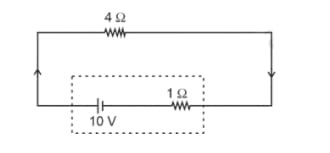
The terminal voltage of the battery, whose emf is 10V and internal resistance 1Ω, when connected through an external resistance of 4Ω as shown in the figure is:
View Solution
The terminal voltage is given by:
Vterminal = E - Ir
- Total resistance, Rtotal = 4 Ω + 1 Ω = 5 Ω.
- Current, I = E/Rtotal = 10/5 = 2A.
- Terminal voltage, Vterminal = 10 - 2 × 1 = 8V.
Question 5:
In an ideal transformer, the turns ratio is NP/NS = 1/2. The ratio VS: VP is equal to (the symbols carry their usual meaning):
View Solution
In an ideal transformer, the voltage ratio is directly proportional to the turns ratio:
VS/VP = NS/NP.
Given NP/NS = 1/2, it follows that:
VS/VP = 2.
Hence, VS: VP = 2 : 1.
Question 6:
A light ray enters through a right-angled prism at point P with an angle of incidence 30° as shown in the figure. It travels through the prism parallel to its base BC and emerges along the face AC. The refractive index of the prism is:

View Solution
In a prism, the relationship between the angles is given by:
r1 + c = A, where:
- r1: angle of refraction inside the prism,
- c: angle of incidence on the face of the prism,
- A: angle of the prism.
Applying Snell’s Law:
μ = sin i / sin r1.
Substitute values and simplify to get μ = √5/2.
Question 7:
The quantities that have the same dimensions as those of a solid angle are:
View Solution
Solid angle is dimensionless, as are strain (a measure of deformation) and angle (a ratio of arc length to radius).
Question 8:
A thin flat circular disc of radius 4.5 cm is placed gently over the surface of water. If the surface tension of water is 0.07 N/m, then the excess force required to take it away from the surface is:
View Solution
The excess force is calculated using:
F = 2πr × T
Substitute values:
F = 2 × 3.14 × 0.045 × 0.07 = 19.8 mN.
Question 9:
Given below are two statements:
- Assertion (A): The potential (V) at any axial point, at 2 m distance (r) from the center of a dipole with dipole moment vector P of magnitude 4 × 10⁻⁶ C·m, is ±9 × 10³ V.
- Reason (R): \(V = \pm \frac{2P}{4\pi\varepsilon_0 r^2}\), where \(r\) is the distance of the axial point.
In the light of the above statements, choose the correct answer from the options below:
View Solution
The potential is given by \(V = \pm \frac{2P}{4\pi\varepsilon_0 r^2}\). Substituting values:
V = \(\pm \frac{2(4 \times 10^{-6})}{4\pi (9 \times 10^9)(2)^2}\) = ±9 × 10³ V.
While the assertion is true, the reason fails to account for the directional nature of the potential.
Question 10:
In a uniform magnetic field of 0.049 T, a magnetic needle performs 20 oscillations in 5 seconds. The moment of inertia of the needle is 9.8 × 10⁻⁶ kg·m2. If the magnitude of the magnetic moment of the needle is \(x \times 10^{-5}\) Am2, the value of \(x\) is:
View Solution
Using the formula for oscillation frequency:
\(T = 2\pi \sqrt{\frac{I}{MB}}\), \(M = \frac{4\pi^2 I}{T^2 B}\).
Substitute values:
\(M = \frac{4\pi^2 (9.8 \times 10^{-6})}{(5/20)^2 (0.049)} = 1280\pi^2 \times 10^{-5}\).
Question 11:
If the monochromatic source in Young’s double-slit experiment is replaced by white light, then:
View Solution
In the interference pattern with white light:
- The central fringe is bright white due to constructive interference of all wavelengths.
- Other fringes appear coloured due to wavelength-dependent path differences.
Question 12:
Given below are two statements:
- Statement I: Atoms are electrically neutral as they contain equal numbers of positive and negative charges.
- Statement II: Atoms of each element are stable and emit their characteristic spectrum.
Choose the correct answer:
View Solution
Atoms are neutral due to equal numbers of protons and electrons (Statement I).
However, not all atoms are stable; only specific configurations (e.g., noble gases) are stable (Statement II is incorrect).
Question 13:
The maximum elongation of a steel wire of 1 m length if the elastic limit of steel and its Young’s modulus are \(8 \times 10^8 \, \mathrm{N/m^2}\) and \(2 \times 10^{11} \, \mathrm{N/m^2}\), respectively, is:
View Solution
The maximum elongation is calculated using:
\(\Delta L = \frac{\sigma L}{Y}\), where \(\sigma\) is the stress, \(L\) is the length, and \(Y\) is the Young’s modulus.
\(\Delta L = \frac{8 \times 10^8 \times 1}{2 \times 10^{11}} = 4 \, \mathrm{mm}\).
Question 14:
Consider the following statements:
A: For a solar cell, the I-V characteristics lie in the IV quadrant of the given graph.
B: In a reverse-biased pn junction diode, the current measured (in µA) is due to majority charge carriers.
View Solution
For solar cells, the I-V characteristics are in the IV quadrant due to negative current and positive voltage. In a reverse-biased pn diode, current arises from minority carriers, not majority carriers.
Question 15:
A particle moving with uniform speed in a circular path maintains:
View Solution
In circular motion, the direction of velocity changes continuously, causing varying acceleration despite uniform speed.
Question 16:
If c is the velocity of light in free space, the correct statements about photons are:
A: The energy of a photon is E = hν.
B: The velocity of a photon is c.
C: The momentum of a photon, p = hν/c.
D: In a photon-electron collision, both total energy and total momentum are conserved.
E: Photon possesses positive charge.
View Solution
Photons are chargeless (eliminating E) and follow E = hν and p = hν/c, with energy and momentum conserved in collisions.
Question 17:
Two bodies A and B of the same mass undergo completely inelastic one-dimensional collision. Body A moves with velocity v1 while body B is at rest. After collision, the velocity ratio v1 : v2 is:
View Solution
Using momentum conservation:
v2 = (m1v1 + m2v2) / (m1 + m2) = v1/2.
Thus, v1 : v2 = 2 : 1.
Question 18:
The graph showing the variation of 1/λ2 with kinetic energy E of a free particle is:
View Solution
Using λ = h/√(2mE), we find 1/λ2 ∝ E, yielding a linear graph not passing through the origin.
Question 19:
An unpolarised light beam strikes a glass surface at Brewster’s angle. Then:
View Solution
At Brewster’s angle, the reflected light becomes completely polarised perpendicular to the plane of incidence. The refracted light remains partially polarised as it contains components of both polarisation states.
Question 20:
At any instant of time t, the displacement of a particle is given by x = 2t − 1 (SI unit) under the influence of a force of 5N. The instantaneous power is:
View Solution
The velocity is the derivative of displacement with respect to time:
v = dx/dt = d(2t − 1)/dt = 2 m/s.
Instantaneous power is calculated as:
P = F × v = 5 × 2 = 10 W.
Question 21:
A tightly wound 100-turn coil of radius 10 cm carries a current of 7A. The magnetic field at the center is: (Take μ0 = 4π × 10−7 SI units)
View Solution
The magnetic field at the center of a circular coil is given by:
B = (μ0NI) / (2R).
Substituting the values:
B = (4π × 10−7 × 100 × 7) / (2 × 0.1) = 4.4mT.
Question 22:
The moment of inertia of a thin rod about an axis passing through its midpoint and perpendicular to the rod is 2400 g·cm2. The length of the rod is:
View Solution
The moment of inertia of a rod is given by:
I = (1/12)ML2.
Here, I = 2400 g·cm2 = 2400 × 10−7 kg·m2, M = 400 g = 0.4 kg. Solve for L:
L = √(12I/M) = √(12 × 2400 × 10−7 / 0.4) = 8.5 cm.
Question 23:
A bob is whirled in a horizontal plane at an initial speed ω. The tension in the string is T. If the speed doubles, the tension becomes:
View Solution
Tension in the string is proportional to the square of the velocity:
T ∝ v2.
If v → 2v, then T → 4T.
Question 24:
Match List-I with List-II:
| List-I (Material) | List-II (Susceptibility χ) |
|---|---|
| A. Diamagnetic | χ = 0 |
| B. Ferromagnetic | χ ≫ 1 |
| C. Paramagnetic | 0 < χ ≪ 1 |
| D. Non-magnetic | 0 < χ < ϵ |
View Solution
Magnetic materials are characterized by their susceptibility:
- Diamagnetic: χ = 0
- Ferromagnetic: χ ≫ 1
- Paramagnetic: 0 < χ ≪ 1
- Non-magnetic: 0 < χ < ϵ
Question 25:
In the circuit, the equivalent capacitance between terminals A and B is:
View Solution
The equivalent capacitance is calculated as:
- First, combine series capacitors: Cs = 1 / (1/2 + 1/2) = 1 µF.
- Next, combine this with parallel capacitors: Cp = 1 + 1 = 2 µF.
Thus, the equivalent capacitance between terminals A and B is 2 µF.
Question 26:
A horizontal force 10 N is applied to a block A as shown. The masses of blocks A and B are 2 kg and 3 kg, respectively. The blocks slide over a frictionless surface. The force exerted by block A on block B is:

View Solution
The total acceleration of the system is:
a = F / (mA + mB) = 10 / (2 + 3) = 2 m/s2.
The force exerted by A on B is:
FAB = mB × a = 3 × 2 = 6 N.
Question 27:
In the nuclear emission stated, the mass number and atomic number of the product Q are:
29082X → α → Y → e+ → Z → β- → P → e- → Q
View Solution
Steps in nuclear decay:
- α decay: Mass decreases by 4, atomic number decreases by 2 → 286, 80.
- β+ emission: Atomic number decreases by 1 → 286, 79.
- β- emission: Atomic number increases by 1 → 286, 80.
- Electron capture: Atomic number decreases by 1 → 286, 81.
Question 28:
In a Vernier caliper, (N + 1) divisions of the Vernier scale coincide with N divisions of the main scale. If 1 MSD represents 0.1 mm, the Vernier constant (in cm) is:
View Solution
The Vernier constant (least count) is given by:
VC = 1 MSD − 1 VSD.
Substitute values:
VC = 0.1 − 0.1 / (N + 1) = 0.1 / (N + 1) mm = 1 / [100(N + 1)] cm.
Question 29:
If x = 5 sin(πt + π/3) represents the motion of a particle executing SHM, the amplitude and time period of motion, respectively, are:
View Solution
The amplitude is the coefficient of sin: 5 m.
The angular frequency ω = π. The time period T is given by:
T = 2π / ω = 2π / π = 2 s.
Question 30:
In the diagram, a strong bar magnet is moving towards solenoid-2 from solenoid-1. The direction of induced current in solenoid-1 and solenoid-2, respectively, are:
View Solution
Using Lenz’s law:
- In solenoid-1, the induced current opposes the motion of the magnet, flowing AB.
- In solenoid-2, the induced current supports the approach of the magnet, flowing DC.
Lenz's law ensures that the direction of the induced current opposes the cause of its generation.
Question 31:
A logic circuit provides the output Y as per the truth table:
| A | B | Y |
|---|---|---|
| 0 | 0 | 1 |
| 0 | 1 | 0 |
| 1 | 0 | 1 |
| 1 | 1 | 0 |
View Solution
From the truth table:
- Y is 1 when B = 0, irrespective of A.
Thus, the Boolean expression for Y is B̅.
Question 32:
A wire of length l and resistance 100Ω is divided into 10 equal parts. The first 5 parts are connected in series, while the next 5 parts are connected in parallel. The two combinations are again connected in series. The resistance of this final combination is:
View Solution
Each part of the wire has resistance R = 10Ω.
- The first 5 parts connected in series: Rs = 5 × 10 = 50Ω.
- The next 5 parts connected in parallel: Rp = 10/5 = 2Ω.
Total resistance: Rtotal = Rs + Rp = 50 + 2 = 52Ω.
Question 33:
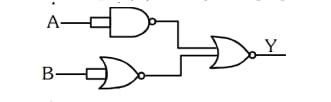
The output (Y) of the given logic gate is similar to the output of an:
View Solution
To analyze the given circuit:
- The circuit consists of two logic gates connected to form the output Y.
- The input signals are passed through gates, yielding the output equivalent to an AND gate.
Question 34:
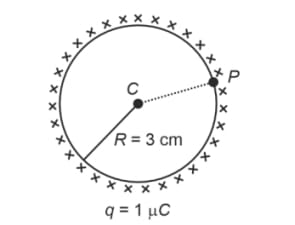
A thin spherical shell is charged by some source. The potential difference between two points C and P (in V) is:
View Solution
A charged spherical shell has the same potential at all points inside the shell and on its surface.
- Potential V is constant inside the shell and on the surface.
- Thus, the potential difference between C and P is 0.
Question 35:
The mass of a planet is 1/10 that of Earth, and its diameter is half that of Earth. The acceleration due to gravity is:
View Solution
The acceleration due to gravity is given by:
g = GM/R2
- Let Mp = M/10 and Rp = R/2.
- Substitute into the formula:
- gp = G(M/10) / (R/2)2 = G(M) / (5R2).
- gp = g/2.5 = 9.8 / 2.5 = 3.92 m/s2.
Thus, the acceleration due to gravity is 3.92 m/s2.
Question 36:
The minimum energy required to launch a satellite into a circular orbit at 2R altitude is:
View Solution
Total energy of a satellite in orbit is given by:
E = -GMm / 2r
- For altitude 2R, total radius r = 3R.
- Eorbit = -GMm / (2 × 3R) = -GMm / 6R.
- Minimum energy required: ∆E = GMm / R - GMm / 6R = 5GMm / 6R.
Thus, the minimum energy required is 5GMm / 6R.
Question 37:
A telescope with an objective focal length of 140 cm and eyepiece focal length 5 cm has magnifying power:
View Solution
The magnifying power M for a distant object is given by:
M = fo / fe
- fo = 140 cm, fe = 5 cm.
- M = 140 / 5 = 28.
Thus, the magnifying power of the telescope is 28.
Question 38:
The velocity (v)–time (t) plot of a body is shown. The acceleration (a)–time (t) graph is:
View Solution
From the v–t graph:
- Acceleration is the slope of the velocity-time graph.
- Since the slope changes in steps, the acceleration graph is stepped.
Thus, the acceleration-time graph is stepped.
Question 39:
Two heaters A and B have power ratings of 1 kW and 2 kW, respectively. They are connected in series and then in parallel. The power ratio is:
View Solution
Resistance is inversely proportional to power:
- RA = V2 / PA, RB = V2 / PB.
- For series: Total power Ps ∝ 1 / (RA + RB).
- For parallel: Total power Pp ∝ (1/RA + 1/RB).
- Power ratio Ps : Pp = 2 : 9.
Thus, the power ratio is 2:9.
Question 40:
A force defined by F = αt2 + βt acts on a particle at time t. The factor which is dimensionless, if α and β are constants, is:
View Solution
To ensure αt / β is dimensionless:
- Dimensions of α: [Force] / [time]2 = MLT-4.
- Dimensions of β: [Force] / [time] = MLT-3.
- αt has dimensions MLT-4 × T = MLT-3.
- Dividing by β: MLT-3 / MLT-3 = dimensionless.
Thus, the correct factor is αt / β.
Question 41:
A 10 µF capacitor is connected to a 210 V, 50 Hz source. The peak current in the circuit is:
View Solution
The capacitive reactance is given by:
Xc = 1 / (2πfC)
- f = 50 Hz, C = 10 × 10-6 F.
- Xc = 1 / (2 × 3.14 × 50 × 10 × 10-6) ≈ 318.31 Ω.
The peak current:
Ipeak = Vpeak / Xc
- Vpeak = 210 √2 ≈ 296.98 V.
- Ipeak ≈ 296.98 / 318.31 ≈ 0.93 A.
Thus, the peak current is 0.93 A.
Question 42:
A metallic bar of Young’s modulus 0.5 × 10¹¹ N/m2 and coefficient of linear expansion 10-5 °C-1, heated from 0°C to 100°C. The compressive force developed is:
View Solution
Thermal stress is given by:
Stress = Y × α × ΔT
- Y = 0.5 × 10¹¹ N/m2, α = 10-5 °C-1, ΔT = 100°C.
- Stress = 0.5 × 1011 × 10-5 × 100 = 5 × 10⁶ N/m2.
Force = Stress × Area:
- If area = 10-3 m2, Force = 5 × 106 × 10-3 = 50 × 103 N.
Thus, the compressive force developed is 50 × 103 N.
Question 43:
A parallel plate capacitor is charged through a resistor. If I is the current, then in the gap between the plates:
View Solution
Displacement current arises due to the changing electric field in the capacitor gap and is given by:
Id = ε0 (dΦE / dt)
- Here, Id matches the conduction current I in magnitude.
- It flows in the same direction as I to maintain current continuity in the circuit.
Thus, the displacement current is equal to I and flows in the same direction.
Question 44:
Choose the correct circuit which achieves bridge balance:
View Solution
The condition for a Wheatstone bridge to be balanced is:
R1/R2 = R3/R4
- In Circuit 1, the ratios of resistances are not equal, so the bridge is not balanced.
- In Circuit 2, the ratios are also not equal.
- In Circuit 3, the ratios are again not balanced.
- In Circuit 4, the ratio of resistances satisfies the balance condition: 10Ω/15Ω = 10Ω/15Ω.
Thus, Circuit 4 achieves bridge balance.
Question 45:
A sheet is placed near a magnetic pole. A force is needed to:
View Solution
- A magnetic sheet requires a force to hold it in place due to attraction to the magnetic pole.
- A conducting sheet develops eddy currents when the magnetic field changes, requiring a force to move it away with uniform velocity.
- A non-magnetic and non-conducting sheet does not experience significant forces in this context.
Thus, the correct options are A and C.
Question 46:
If plates of a parallel plate capacitor connected to a battery are moved closer:
View Solution
When the plates of a parallel plate capacitor are moved closer while connected to a battery:
- A: The capacitance increases because capacitance is inversely proportional to the distance between plates: C = ε0A/d.
- C: The charge stored in the capacitor increases as Q = CV, and V remains constant due to the battery.
- E: The product of charge and voltage (Q × V) increases as Q increases.
Thus, the correct statements are A, C, and E.
Question 47:
The following graph represents the T–V curves of an ideal gas (where T is the temperature and V the volume) at three pressures P1, P2, and P3. The correct relation is:
View Solution
According to the ideal gas law:
PV = nRT, which implies V ∝ T/P
- At a given temperature, volume decreases as pressure increases.
- From the graph, the slope is inversely proportional to pressure, so higher pressure results in a steeper curve.
Thus, the correct order of pressures is P1 > P2 > P3.
Question 48:
Which of the following is NOT a property of an electromagnetic wave traveling in free space?
View Solution
Electromagnetic waves are produced by accelerating charges, not by charges moving at a constant speed. The other properties are true:
- The electric and magnetic field energy densities are equal in free space.
- The speed of electromagnetic waves in free space is given by 1/√(μ0ε0).
- Electromagnetic waves are transverse waves, with electric and magnetic fields perpendicular to each other and to the direction of propagation.
Question 49:
An iron bar of length L has magnetic moment M. It is bent at the middle to make two arms at an angle of 60°. The magnetic moment of this new magnet is:
View Solution
The magnetic moment of a bent bar magnet is given by:
Mnew = M cos(θ/2)
- Here, θ = 60°, so cos(θ/2) = cos(30°) = √3/2.
- The effective length is halved, so the new magnetic moment is:
- Mnew = (M/2).
Question 50:
If the mass of a simple pendulum’s bob is increased to thrice its original mass and its length is halved, the new time period is x/2 times the original. Find x:
View Solution
The time period of a pendulum is given by:
T = 2π√(L/g)
- If the length L is halved, the new time period becomes:
- Tnew = 2π√(L/2g) = T/√2.
- Comparing with Tnew = x√2, we find x = √2.
The mass of the bob does not affect the time period of the pendulum.
Question 51:
The reagents with which glucose does not react to give the corresponding tests/products are:
View Solution
Glucose reacts with Tollen’s reagent (A), HCN (C), and NH2OH (D) to form characteristic products. However:
- It does not react with Schiff’s reagent (B) because it is a mild oxidizing agent, and glucose is a reducing sugar.
- It also does not react with NaHSO3 (E), which does not react with glucose under normal conditions.
Thus, glucose does not react with Schiff’s reagent and NaHSO3.
Question 52:
The energy of an electron in the ground state (n = 1) for He+ ion is −x J. Then, that for an electron in n = 2 state for Be3+ ion in J is:
View Solution
The energy of an electron in a hydrogen-like atom is given by:
En = −13.6 × Z2 / n2 (eV)
- For He+, Z = 2 and n = 1, so E = −x.
- For Be3+, Z = 4 and n = 2:
- E = −13.6 × (4)2 / (2)2 = −4x/9.
Thus, the energy for Be3+ is −4x/9.
Question 53:
Which reaction is NOT a redox reaction?
View Solution
A redox reaction involves the transfer of electrons, resulting in oxidation and reduction. In this case:
- Option (3) is a simple double displacement reaction without any change in oxidation states.
- All other options involve electron transfer, qualifying them as redox reactions.
Thus, Option (3) is NOT a redox reaction.
Question 54:
Match List I with List II:
| List I (Process) | List II (Conditions) |
|---|---|
| A. Isothermal process | II. Carried out at constant temperature |
| B. Isochoric process | III. Carried out at constant volume |
| C. Isobaric process | IV. Carried out at constant pressure |
| D. Adiabatic process | I. No heat exchange |
View Solution
Matching the processes to their conditions:
- Isothermal process: Constant temperature → II
- Isochoric process: Constant volume → III
- Isobaric process: Constant pressure → IV
- Adiabatic process: No heat exchange → I
Thus, the correct matching is A-II, B-III, C-IV, D-I.
Question 55:
For the reaction 2A ⇌ B + C, Kc = 4 × 10⁻³. At a given time, [A] = [B] = [C] = 2 × 10⁻³. Which of the following is correct?
View Solution
Calculate the reaction quotient (Qc):
Qc = [B][C] / [A]2
- Substitute values: Qc = (2 × 10⁻³)(2 × 10⁻³) / (2 × 10⁻³)2 = 1.
- Since Qc > Kc, the reaction shifts in the backward direction to establish equilibrium.
Question 56:
Match List I with List II:
List I (Complex) and List II (Type of isomerism)
- [Co(NH3)5(NO2)]Cl2 — Ionization isomerism
- [Co(NH3)5(SO4)]Br — Solvate isomerism
- [Co(NH3)6][Cr(CN)6] — Coordination isomerism
- [Co(H2O)6]Cl3 — Linkage isomerism
Options:
View Solution
- Complex A exhibits ionization isomerism due to NO2- ionizing.
- Complex B shows solvate isomerism because of the SO42- exchange with water molecules.
- Complex C involves coordination isomerism between the two metal centers.
- Complex D shows linkage isomerism as the Cl- ligand binds differently.
Question 57:
In which of the following processes does entropy increase?
View Solution
Entropy increases in processes where randomness increases:
- Evaporation of a liquid to vapor (2) increases entropy due to the phase change to a more disordered state.
- Decomposition of NaHCO3 (3) produces gaseous products, raising entropy.
- Dissociation of Cl2 into atoms (4) increases particle count, raising disorder.
Question 58:
Identify the correct reagents to carry out the following transformation:
Conversion of an alkene to an aldehyde.
View Solution
- BH3 hydroborates the alkene, adding an alcohol group (anti-Markovnikov addition).
- H2O2/OH- oxidizes the intermediate to a primary alcohol.
- PCC selectively oxidizes the primary alcohol to an aldehyde without overoxidation.
Question 59:
Match List I with List II:
- (A) KMnO4/KOH — Oxidation.
- (B) CrO3 — Oxidation of aldehydes.
- (C) AlCl3 — Friedel-Crafts alkylation.
- (D) Ozonolysis — Cleavage of alkenes.
Options:
View Solution
- A: KMnO4/KOH performs oxidation.
- B: CrO3 oxidizes aldehydes to acids.
- C: AlCl3 is used in Friedel-Crafts alkylation.
- D: Ozonolysis cleaves alkenes to form aldehydes or ketones.
Question 60:
In which of the following equilibria are Kp and Kc NOT equal?
View Solution
- Kp = Kc(RT)Δn, where Δn = moles of products - moles of reactants.
- For equilibrium (4), Δn ≠ 0, so Kp ≠ Kc.
Question 61:
Which one of the following alcohols reacts instantaneously with Lucas reagent?
View Solution
Tertiary alcohols react instantly with Lucas reagent because they form a stable tertiary carbocation intermediate, which speeds up the reaction significantly compared to primary or secondary alcohols.
Question 62:
Given below are two statements:
Statement I: The boiling point of three isomeric pentanes follows the order: n-pentane > isopentane > neopentane.
Statement II: When branching increases, the molecule attains a spherical shape, reducing surface area and intermolecular forces, thereby lowering the boiling point.
View Solution
Statement I is correct because the boiling point of isomeric alkanes decreases with increased branching due to reduced surface area. Statement II correctly explains the phenomenon of lower boiling points in branched isomers.
Question 63:
Given below are two statements:
Statement I: Aniline does not undergo Friedel-Crafts alkylation.
Statement II: Aniline cannot be prepared through Gabriel synthesis.
View Solution
Statement I: Aniline does not undergo Friedel-Crafts alkylation due to the formation of a complex between the NH2 group and the Lewis acid catalyst (e.g., AlCl3).
Statement II: Gabriel synthesis is unsuitable for preparing aniline because aryl halides do not react in the Gabriel method.
Question 64:
The E° value for the Mn3+/Mn2+ couple is more positive than Cr3+/Cr2+ or Fe3+/Fe2+ due to:
View Solution
The reduction of Mn3+ (d4) to Mn2+ (d5) results in a half-filled stable configuration, making the E° value more positive.
Question 65:
On heating, some solid substances change directly to vapor without passing through the liquid state. This technique is called:
View Solution
Sublimation is the direct transition of a substance from the solid to the vapor phase, bypassing the liquid phase. Examples include iodine and camphor.
Question 66:
Fehling’s solution ‘A’ is:
View Solution
Fehling’s solution is a mixture of Fehling’s solution A (aqueous copper sulfate) and Fehling’s solution B (alkaline potassium sodium tartrate). It is used to test for reducing sugars.
Question 67:
Match List I with List II:
List I (Molecule) and List II (Number and types of bonds):
- A. Ethane — I. One σ-bond and two π-bonds
- B. Ethene — II. Two π-bonds
- C. Carbon molecule, C2 — III. One σ-bond
- D. Ethyne — IV. One σ-bond and one π-bond
View Solution
- Ethane has a single σ-bond.
- Ethene has one σ-bond and one π-bond.
- C2 has two π-bonds due to unique bonding.
- Ethyne has one σ-bond and two π-bonds.
Question 68:
Intramolecular hydrogen bonding is present in:
View Solution
Salicylic acid has OH and COOH groups in close proximity, allowing intramolecular hydrogen bonding. Other options primarily exhibit intermolecular hydrogen bonding.
Question 69:
The highest number of helium atoms is in:
View Solution
- 4 u of helium corresponds to one atom of helium (atomic mass unit).
- 4 g of helium corresponds to 1 mole, which is 6.022×10²³ atoms.
- At STP, 2.271098 L of helium corresponds to 0.1 mole, or approximately 6.022×10²² atoms.
- 4 moles of helium correspond to the highest number of atoms: 4 × 6.022×1023 atoms.
Question 70:
Match List I with List II:
List I (Conversion) and List II (Faraday Required):
- A. 1 mol of H2O to O2 — III. 4F
- B. 1 mol of MnO4- to Mn2+ — IV. 5F
- C. 1.5 mol of Ca from molten CaCl2 — II. 3F
- D. 1 mol of FeO to Fe2O3 — I. 2F
View Solution
- H2O → O2: 4 electrons are needed per O atom, so 1 mole requires 4F.
- MnO4- → Mn2+: 5 electrons per mole are required, so 5F.
- CaCl2: 2 electrons per Ca, so 1.5 moles require 3F.
- FeO → Fe2O3: 2 moles of FeO require 2F.
Question 71:
Among Group 16 elements, which one does NOT show −2 oxidation state?
View Solution
Oxygen (O), Selenium (Se), and Tellurium (Te) commonly show a −2 oxidation state due to their high electronegativity. Polonium (Po), being a metal, prefers to show positive oxidation states (+2, +4) and does not exhibit −2.
Question 72:
‘Spin-only’ magnetic moment is the same for which of the following ions?
A. Ti3+
B. Cr2+
C. Mn2+
D. Fe2+
E. Sc3+
Choose the correct answer:
View Solution
Magnetic moment is calculated as:
µ = √[n(n+2)] BM, where n is the number of unpaired electrons.
For Cr2+ (d4) and Fe2+ (d6), n = 4. Both ions have the same spin-only magnetic moment: µ = √[4(4+2)] = 4.90 BM.
Question 73:
A compound with a molecular formula of C6H14 has two tertiary carbons. Its IUPAC name is:
View Solution
Two tertiary carbons imply two carbons bonded to three other carbons each. Among the options, 2,3-dimethylbutane has two tertiary carbons at C2 and C3. Other options do not satisfy this condition.
Question 74:
The Henry’s law constant (KH) values of three gases (A, B, C) in water are 145, 2 × 10⁻⁵, and 35 kbar, respectively. The solubility of these gases in water follows the order:
View Solution
Solubility is inversely proportional to KH. Lower KH implies higher solubility. KH values: A = 145, B = 2 × 10⁻⁵, C = 35. Order of solubility: B (lowest KH) > C > A.
Question 75:
The energy required to break one mole of Cl−Cl bonds in Cl2 is:
View Solution
The bond dissociation energy for Cl−Cl bonds is a standard value, 243 kJ/mol, which represents the energy required to break one mole of Cl2 into its constituent atoms.
Question 76:
The most stable carbocation among the following is:
View Solution
Carbocation stability increases with resonance and hyperconjugation. The cyclopropylmethyl carbocation is highly stabilized due to its non-classical resonance structure, making it more stable than other options.
Question 77:
Given below are two statements:
Statement I: Both [Co(NH3)6]3+ and [CoF6]3− complexes are octahedral but differ in their magnetic behavior.
Statement II: [Co(NH3)6]3+ is diamagnetic, whereas [CoF6]3− is paramagnetic.
View Solution
[Co(NH3)6]3+ has a low-spin configuration as NH3 is a strong field ligand, making it diamagnetic. [CoF6]3− has a high-spin configuration due to the weak field ligand F−, resulting in unpaired electrons and paramagnetic behavior.
Question 78:
1 gram of sodium hydroxide was treated with 25 mL of 0.75 M HCl solution. The mass of sodium hydroxide left unreacted is equal to:
View Solution
The reaction is: NaOH + HCl → NaCl + H2O.
- Moles of HCl = 0.75 × 0.025 = 0.01875 mol.
- Moles of NaOH = 1/40 = 0.025 mol.
- HCl reacts with 0.01875 mol of NaOH, leaving 0.025 − 0.01875 = 0.00625 mol unreacted.
- Mass of unreacted NaOH = 0.00625 × 40 = 250 mg.
Question 79:
Given below are two statements:
Statement I: The boiling point of hydrides of Group 16 elements follows the order H2O > H2Te > H2Se > H2S.
Statement II: H2O has the highest boiling point due to extensive hydrogen bonding.
View Solution
The boiling point order is determined by molecular mass and hydrogen bonding. H2O has extensive hydrogen bonding, resulting in the highest boiling point. Heavier hydrides follow boiling point trends based on molecular mass.
Question 80:
Arrange the following elements in increasing order of first ionization enthalpy: Li, Be, B, C, N.
View Solution
Ionization enthalpy increases across a period due to increased nuclear charge. The anomaly: B < Be because Be has a fully filled 2s2 configuration, making it more stable. Final order: Li < B < Be < C < N.
Question 81:
Activation energy of any chemical reaction can be calculated if one knows the value of:
View Solution
Activation energy is calculated using the Arrhenius equation:
k = Ae-Ea/RT, where:
- k: Rate constant
- Ea: Activation energy
- R: Gas constant
- T: Temperature
Using the natural logarithmic form of the Arrhenius equation at two different temperatures:
ln(k2/k1) = Ea/R × (1/T1 - 1/T2),
one can calculate Ea if the rate constants (k1, k2) and temperatures (T1, T2) are known.
Question 82:
Arrange the following elements in increasing order of electronegativity: N, O, F, C, Si.
View Solution
Electronegativity increases across a period and decreases down a group in the periodic table. Silicon (Si) has the lowest electronegativity, while fluorine (F) has the highest. The correct order is:
Si < C < N < O < F.
Question 83:
Match List I with List II:
| List I (Quantum Number) | List II (Information Provided) |
|---|---|
| n | Size of orbital |
| l | Shape of orbital |
| m | Orientation of orbital |
| ms | Orientation of spin of electron |
View Solution
The principal quantum number (n) gives the size of the orbital. The azimuthal quantum number (l) determines the shape. The magnetic quantum number (m) specifies the orientation of the orbital, while the spin quantum number (ms) describes the electron's spin orientation.
Question 84:
Match List I with List II:
| List I (Compound) | List II (Shape/Geometry) |
|---|---|
| NH3 | Trigonal pyramidal |
| BrF5 | Square pyramidal |
| XeF4 | Square planar |
| SF6 | Octahedral |
View Solution
NH3 is trigonal pyramidal due to lone pair repulsion. BrF5 is square pyramidal with one lone pair. XeF4 is square planar due to two lone pairs. SF6 is octahedral with no lone pairs.
Question 85:
Which plot of ln k vs 1/T is consistent with the Arrhenius equation?
View Solution
The Arrhenius equation is:
ln k = -Ea/R × 1/T + ln A
A plot of ln k vs 1/T gives a straight line with a negative slope (-Ea/R), consistent with the third option.
Question 86:
The work done during reversible isothermal expansion of one mole of hydrogen gas at 25°C from a pressure of 20 atm to 10 atm is: (Given R = 2.0 cal K−1mol−1)
View Solution
For isothermal expansion, work done is calculated as:
W = −nRT ln(P2/P1).
Substituting the given values:
W = −(1) × (2.0) × (298) × ln(10/20).
Simplify:
W = −596 × ln(0.5) = −596 × (−0.693) ≈ −413.14 calories.
Question 87:
Identify the correct answer:
View Solution
Explanation:
- BF3 is planar and symmetric, so it has zero dipole moment.
- Dipole moment of NH3 is greater than that of NF3 due to opposite polarity.
- CO32− ion has three equivalent resonance structures:
O=C-O− ↔ O-C=O− ↔ -C(O)-O−.
- Ozone (O3) has only two resonance structures.
Question 88:
Major products A and B formed in the following reaction sequence are:
View Solution
Step-by-step explanation:
1. In the first step, PBr3 replaces −OH with −Br:
CH3CH(OH)CH2CH3 → CH3CH(Br)CH2CH3 (A).
2. In the second step, alcoholic KOH causes elimination of HBr:
CH3CH(Br)CH2CH3 → CH3CH=CH2 (B).
Question 89:
The pair of lanthanoid ions which are diamagnetic is:
View Solution
Explanation:
- Diamagnetic ions have no unpaired electrons.
- Ce4+ ([Xe]) has no unpaired electrons.
- Yb2+ ([Xe]4f14) has fully paired 4f-orbitals.
Question 90:
A compound X contains 32% of A, 20% of B, and the remaining percentage of C. The empirical formula of X is:
View Solution
Step-by-step explanation:
Step 1: Calculate moles of each element:
- Moles of A = Mass of A / Atomic Mass of A = 32/64 = 0.5
- Moles of B = Mass of B / Atomic Mass of B = 20/40 = 0.5
- Moles of C = Mass of C / Atomic Mass of C = 48/32 = 1.5
Step 2: Divide by the smallest mole value:
Ratio: 0.5:0.5:1.5 = 1:1:3.
Step 3: Empirical formula: ABC3.
Question 91:
Given below are certain cations. Arrange them in increasing group number from 0 to VI:
View Solution
Step 1: Assign group numbers based on periodic table positions:
- B (Cu2+): Group I
- A (Al3+): Group III
- D (Co2+): Group V
- C (Ba2+): Group II
- E (Mg2+): Group VI
Step 2: Arrange in increasing group number:
Order: B < A < D < C < E
Question 92:
Consider the reaction at equilibrium:
2NO(g) ⇀↽ N2(g) + O2(g)
If 0.1 mol/L of NO(g) is taken, calculate the degree of dissociation (α):
View Solution
Step 1: Use the stoichiometric relationship:
- Initial concentration of NO: [NO] = 0.1 mol/L
- Change in concentration: Δ[NO] = 2α[NO]
- Final concentration: [NO]f = 0.1 − 2α
Step 2: Calculate α at equilibrium: Using equilibrium concentrations:
Kc = [N2][O2] / [NO]2, Kc = α2 / (1 − 2α)2
Simplifying for α, we find: α = 0.717
Question 93:
Calculate activation energy for reaction rate quadrupling between 27°C and 57°C:
View Solution
Step 1: Use Arrhenius equation:
ln(k2 / k1) = Ea / R (1/T1 − 1/T2)
Step 2: Plug values:
- ln 4 = Ea / 8.314 × (30 / (300 × 330))
Step 3: Solve for Ea: Ea = 38.04 kJ/mol
Question 94:
During Mohr’s salt preparation, which acid prevents hydrolysis of Fe2+:
View Solution
Step 1: Hydrolysis of Fe2+:
Dilute H2SO4 is used as it prevents hydrolysis and oxidation of Fe2+, stabilizing the ion in aqueous solution.
Question 95:
Identify the major product C formed in the following reaction sequence:
CH3 − CH2 − CH2 − I + NaCN → A; Partial Hydrolysis → B; NaOH, Br2 → C
View Solution
Step 1: Reaction with NaCN:
CH3 − CH2 − CH2 − I + NaCN → CH3 − CH2 − CH2 − CN (A).
Step 2: Partial hydrolysis of nitrile:
CH3 − CH2 − CH2 − CN + H2O → CH3 − CH2 − CH2 − CONH2 (B).
Step 3: Hofmann degradation:
CH3 − CH2 − CH2 − CONH2 + NaOH + Br2 → CH3 − CH2 − CH2 − NH2 (C).
Thus, the major product is propylamine.
Question 96:
Mass of copper deposited by passing 9.6487 A of current through copper sulfate solution for 100 seconds is:
Given: Molar mass of Cu = 63 g/mol, 1 F = 96487 C
View Solution
Step 1: Faraday’s second law of electrolysis:
Mass of Cu deposited = I × t × M / n × F.
Where M = molar mass of Cu, n = number of electrons, F = Faraday’s constant.
Step 2: Substituting values:
Mass = (9.6487 × 100 × 63) / (2 × 96487) = 0.315 g.
Question 97:
For the given reaction:
Oxidation of alkenes with KMnO4 under acidic conditions results in cleavage of the double bond. What is the product?
View Solution
Step 1: KMnO4 cleaves the double bond in cyclohexene.
Step 2: Acidic conditions oxidize the alkene to carboxylic acid:
Product = Cyclohexane carboxylic acid.
Question 98:
Given statements:
Statement I: [Co(NH3)6]3+ is homoleptic, while [Co(NH3)4Cl2]+ is heteroleptic.
Statement II: [Co(NH3)6]3+ has one type of ligand, whereas [Co(NH3)4Cl2]+ has more than one type.
View Solution
Step 1: Homoleptic complexes contain identical ligands (e.g., [Co(NH3)6]3+).
Step 2: Heteroleptic complexes contain more than one type of ligand (e.g., [Co(NH3)4Cl2]+).
Both statements are true based on ligand diversity.
Question 99:
Osmotic pressure vs concentration (Π vs C): Slope = 25.73L · bar · mol-1. Calculate the temperature:
Given Π = CRT, where R = 0.083 L · bar · mol-1 · K-1.
View Solution
Using the formula Π = CRT, temperature T can be calculated as:
T = slope / R = 25.73 / 0.083 = 310 K
Converting to Celsius: T = 310 − 273 = 37°C.
Question 100:
Reaction sequence:
3ROH + PCl3 → 3RCl + A and ROH + PCl5 → RCl + HCl + B
Identify A and B:
View Solution
Step 1: The first reaction with PCl3 produces phosphorous acid (H3PO3) as the by-product along with RCl.
Step 2: The second reaction with PCl5 produces phosphoryl chloride (POCl3) along with RCl and HCl.
Question 101:
Auxin is used by gardeners to prepare weed-free lawns. But no damage is caused to grass because auxin:
View Solution
Auxins primarily affect dicotyledonous weeds by causing uncontrolled growth, leading to their death. Monocotyledonous plants like grasses are less affected due to their different structure and metabolic response, allowing them to remain unharmed.
Question 102:
Lecithin, a small molecular weight organic compound found in living tissues, is an example of:
View Solution
Lecithin is a type of phospholipid, essential for cell membrane structure due to its hydrophilic and hydrophobic properties. It is commonly found in cell membranes and biological tissues.
Question 103:
Match List I with List II:
List I: A. Two or more alternative forms of a gene
B. Cross of F1 progeny with homozygous recessive parent
C. Cross of F1 progeny with any of the parents
D. Number of chromosome sets in a plant
List II:
I. Back cross
II. Ploidy
III. Allele
IV. Test cross
View Solution
A refers to "two or more alternative forms of a gene," which are called alleles (III).
B refers to "cross of F1 progeny with homozygous recessive parent," known as a test cross (IV).
C refers to "cross of F1 progeny with any of the parents," typically called a back cross (I).
D refers to "number of chromosome sets in a plant," which is ploidy (II).
Question 104:
Identify the set of correct statements:
A. The flowers of Vallisneria are colourful and produce nectar.
B. The flowers of water lily are not pollinated by water.
C. In most of water-pollinated species, the pollen grains are protected from wetting.
D. Pollen grains of some hydrophytes are long and ribbon-like.
E. In some hydrophytes, the pollen grains are carried passively inside water.
View Solution
A is incorrect because the flowers of Vallisneria are not colourful and do not produce nectar; they are small and unnoticeable.
B is correct because water lilies are pollinated by insects, not by water.
C is correct; in water-pollinated species, pollen grains have adaptations to prevent wetting, such as being hydrophobic.
D is correct; some hydrophytes have long, ribbon-like pollen grains that float.
E is correct; in some hydrophytes, pollen grains are passively carried by water for fertilization.
Question 105:
Which organization releases the list of endangered species?
View Solution
The International Union for Conservation of Nature (IUCN) is responsible for compiling and releasing the Red List of endangered species. This list categorizes species based on their risk of extinction and provides data for conservation efforts.
Question 106:
What is the fate of a piece of DNA carrying only the gene of interest when transferred into an alien organism?
View Solution
When a piece of DNA carrying a gene of interest is transferred into an alien organism, it may integrate into the recipient’s genome. This integration ensures that the new genetic material is passed to progeny cells, which is key in genetic engineering.
Question 103:
Match List I with List II:
List I: A. Two or more alternative forms of a gene
B. Cross of F1 progeny with homozygous recessive parent
C. Cross of F1 progeny with any of the parents
D. Number of chromosome sets in a plant
List II:
I. Back cross
II. Ploidy
III. Allele
IV. Test cross
View Solution
A refers to "two or more alternative forms of a gene," which are called alleles (III).
B refers to "cross of F1 progeny with homozygous recessive parent," known as a test cross (IV).
C refers to "cross of F1 progeny with any of the parents," typically called a back cross (I).
D refers to "number of chromosome sets in a plant," which is ploidy (II).
Question 104:
Identify the set of correct statements:
A. The flowers of Vallisneria are colourful and produce nectar.
B. The flowers of water lily are not pollinated by water.
C. In most of water-pollinated species, the pollen grains are protected from wetting.
D. Pollen grains of some hydrophytes are long and ribbon-like.
E. In some hydrophytes, the pollen grains are carried passively inside water.
View Solution
A is incorrect because the flowers of Vallisneria are not colourful and do not produce nectar; they are small and unnoticeable.
B is correct because water lilies are pollinated by insects, not by water.
C is correct; in water-pollinated species, pollen grains have adaptations to prevent wetting, such as being hydrophobic.
D is correct; some hydrophytes have long, ribbon-like pollen grains that float.
E is correct; in some hydrophytes, pollen grains are passively carried by water for fertilization.
Question 105:
Which organization releases the list of endangered species?
View Solution
The International Union for Conservation of Nature (IUCN) is responsible for compiling and releasing the Red List of endangered species. This list categorizes species based on their risk of extinction and provides data for conservation efforts.
Question 106:
What is the fate of a piece of DNA carrying only the gene of interest when transferred into an alien organism?
View Solution
When a piece of DNA carrying a gene of interest is transferred into an alien organism, it may integrate into the recipient’s genome. This integration ensures that the new genetic material is passed to progeny cells, which is key in genetic engineering.
Question 107:
Which of the following are required for the dark reaction of photosynthesis?
Choose the correct answer from the options below:
View Solution
The dark reaction, also known as the Calvin cycle, requires:
- CO2 as a carbon source.
- ATP and NADPH, which are products of the light reaction, for energy and reducing power.
Light and chlorophyll are needed for the light reaction, not the dark reaction.
Question 108:
The type of conservation in which threatened species are taken out from their natural habitat and placed in a special setting where they can be protected and given special care is called:
View Solution
In this conservation method, threatened species are removed from their natural habitat and protected in a controlled environment such as zoos or botanical gardens.
This approach is an ex-situ conservation strategy, helping in research, breeding, and protection from threats in their natural habitat.
Question 109:
Given below are two statements:
Statement I: Bt toxins are insect group-specific and coded by the gene cry IAc.
Statement II: Bt toxin exists as an inactive protoxin in Bacillus thuringiensis. However, after ingestion by the insect, the inactive protoxin gets converted into active form due to the acidic pH of the insect gut.
View Solution
Bt toxins are specific to insect groups, coded by genes like cry IAc. However, the activation of Bt toxins occurs in an alkaline, not acidic, environment in the insect's gut.
Question 110:
A transcription unit in DNA is defined primarily by the three regions in DNA, and these are:
View Solution
A transcription unit consists of:
- Promoter: Initiates transcription.
- Structural gene: Codes for the protein.
- Terminator: Signals the end of transcription.
Question 111:
In the given figure, which component has thin outer walls and highly thickened inner walls?

View Solution
The structure with thin outer walls and highly thickened inner walls is the guard cells in plants. These specialized cells control the opening and closing of stomata, facilitating gas exchange and water regulation. The thick inner walls of guard cells are crucial for creating the necessary tension to open and close the stomatal pore.
Question 112:
Hind II always cuts DNA molecules at a particular point called the recognition sequence and it consists of:
View Solution
Hind II is a restriction enzyme that recognizes and cuts DNA at a specific palindromic sequence, which is 6 base pairs (bp) long. This precision is fundamental for molecular biology techniques like cloning and DNA mapping.
Question 113:
Identify the type of flowers based on the position of calyx, corolla, and androecium with respect to the ovary from the given figures (a) and (b):
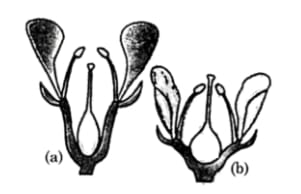
View Solution
In perigynous flowers, the gynoecium is centrally positioned, with other floral parts (sepals, petals, and stamens) attached at the same level around it. Both figures (a) and (b) depict this arrangement, indicating a perigynous condition for both flowers.
Question 114:
Which of the following is an example of an actinomorphic flower?
View Solution
Actinomorphic flowers exhibit radial symmetry, meaning they can be divided into equal halves along multiple planes. Datura is an example of an actinomorphic flower. The other options, like Cassia and Pisum, are zygomorphic, displaying bilateral symmetry.
Question 115:
Which one of the following is not a criterion for the classification of fungi?
View Solution
The classification of fungi is primarily based on the mode of spore formation, the structure of the fruiting body, and the morphology of the mycelium. While most fungi are heterotrophic, the mode of nutrition is not a defining criterion for fungal classification.
Question 116:
The equation of Verhulst-Pearl logistic growth is:
From this equation, K indicates:
View Solution
The Verhulst-Pearl logistic growth model describes population growth in a limited environment. In this equation, K represents the carrying capacity, which is the maximum population size that the environment can support based on available resources. When the population reaches this limit, the growth rate slows and stabilizes.
Question 117:
Which one of the following can be explained on the basis of Mendel’s Law of Dominance?
View Solution
Mendel’s Law of Dominance states that:
- A: Out of one pair of factors, one is dominant, and the other is recessive.
- C: Factors occur in pairs in normal diploid plants.
- D: The discrete unit controlling a particular character is called a factor.
- E: The expression of only one of the parental characters is found in a monohybrid cross.
Thus, A, C, D, and E are correct, explaining the Law of Dominance.
Question 118:
Match List I with List II:
List I:
- A. Rhizopus
- B. Ustilago
- C. Puccinia
- D. Agaricus
List II:
- I. Mushroom
- II. Smut fungus
- III. Bread mould
- IV. Rust fungus
View Solution
Matching:
- Rhizopus - Bread mould
- Ustilago - Smut fungus
- Puccinia - Rust fungus
- Agaricus - Mushroom
Thus, the correct matching is A-III, B-II, C-IV, D-I.
Question 119:
Inhibition of Succinic dehydrogenase enzyme by malonate is a classical example of:
View Solution
Malonate is a competitive inhibitor of the enzyme succinic dehydrogenase. It resembles the substrate (succinate) and competes for the active site of the enzyme, preventing the normal substrate from binding.
Question 120:
Formation of interfascicular cambium from fully developed parenchyma cells is an example of:
View Solution
Dedifferentiation is the process where mature, differentiated cells lose their specialized functions and revert to a meristematic state. In this case, parenchyma cells dedifferentiate to form interfascicular cambium, which contributes to secondary growth.
Question 121:
A pink flowered Snapdragon plant was crossed with a red flowered Snapdragon plant. What type of phenotype(s) is/are expected in the progeny?
View Solution
In Snapdragon plants, flower color exhibits incomplete dominance. Crossing a pink flowered plant with a red flowered plant results in a mix of red and pink flowered progeny. The F1 generation inherits one allele from each parent, leading to both phenotypes being expressed.
Question 122:
In a plant, black seed color (BB/Bb) is dominant over white seed color (bb). To determine the genotype of a black seed plant, which of the following genotypes will you cross it with?
View Solution
A test cross is used to determine whether the black seed plant is homozygous (BB) or heterozygous (Bb). Crossing with a homozygous recessive (bb) plant reveals the genotype of the black seed plant based on the offspring's phenotypes. If all offspring have black seeds, the plant is BB. If there is a 1:1 ratio of black and white seeds, it is Bb.
Question 123:
Match List I with List II:
List I:
- A. Clostridium butylicum
- B. Saccharomyces cerevisiae
- C. Trichoderma polysporum
- D. Streptococcus sp.
List II:
- I. Ethanol
- II. Streptokinase
- III. Butyric acid
- IV. Cyclosporin-A
View Solution
Matching the entries:
- Clostridium butylicum produces butyric acid (III).
- Saccharomyces cerevisiae is used for ethanol production (I).
- Trichoderma polysporum produces cyclosporin-A (IV).
- Streptococcus sp. produces streptokinase (II).
Question 124:
How many molecules of ATP and NADPH are required for every molecule of CO2 fixed in the Calvin cycle?
View Solution
The Calvin cycle uses 3 ATP molecules and 2 NADPH molecules per molecule of CO2 fixed. This energy is necessary for the reduction of 3-phosphoglycerate into glyceraldehyde-3-phosphate during photosynthesis.
Question 125:
The capacity to generate a whole plant from any cell of the plant is called:
View Solution
Totipotency is the ability of a single plant cell to regenerate into a whole plant. This property is fundamental to plant tissue culture, allowing for cloning and genetic modification.
Question 126:
Tropical regions show greatest level of species richness because:
View Solution
Tropical regions have remained relatively undisturbed over millions of years, which has provided more time for species to evolve and diversify. The constant availability of solar energy supports high photosynthesis rates, leading to diverse ecosystems. The predictable and stable environmental conditions in the tropics promote niche specialization, enhancing species richness.
Question 127:
Match List I with List II:
List I:
- A. Nucleolus
- B. Centriole
- C. Leucoplasts
- D. Golgi apparatus
List II:
- I. Site of formation of glycolipid
- II. Organization like the cartwheel
- III. Site for active ribosomal RNA synthesis
- IV. For storing nutrients
View Solution
- A: The nucleolus is the site for active ribosomal RNA synthesis (III).
- B: The centriole organizes microtubules and has a cartwheel structure (II).
- C: Leucoplasts store nutrients like starch, oils, and proteins (IV).
- D: The Golgi apparatus is involved in glycolipid synthesis (I).
Question 128:
Identify the part of the seed from the given figure which is destined to form the root when the seed germinates.

View Solution
The radicle is the part of the seed that forms the root during germination. In the diagram, 'C' represents the radicle, which grows downward to anchor the plant and absorb nutrients and water from the soil.
Question 129:
Spindle fibers attach to kinetochores of chromosomes during:
View Solution
During metaphase, chromosomes align at the metaphase plate in the center of the cell. Spindle fibers, composed of microtubules, attach to the kinetochores located at the centromere of each chromosome, ensuring accurate segregation during anaphase.
Question 130:
Given below are two statements:
Statement I: Chromosomes become gradually visible under a light microscope during the leptotene stage.
Statement II: The beginning of the diplotene stage is recognized by the dissolution of the synaptonemal complex.
View Solution
During leptotene, chromosomes start condensing and become visible under a light microscope. In the diplotene stage, homologous chromosomes start separating, and the synaptonemal complex dissolves, signaling the beginning of this stage.
Question 131:
Given below are two statements:
Statement I: Parenchyma is living but collenchyma is dead tissue.
Statement II: Gymnosperms lack xylem vessels but presence of xylem vessels is the characteristic of angiosperms.
In the light of the above statements, choose the correct answer from the options given below:
View Solution
Statement I is incorrect because both parenchyma and collenchyma are living tissues. Parenchyma performs metabolic functions, and collenchyma provides structural support.
Statement II is true because gymnosperms lack xylem vessels, which are present in angiosperms. Gymnosperms have tracheids instead of xylem vessels.
Question 132:
These are regarded as major causes of biodiversity loss:
Choose the correct option:
View Solution
Overexploitation, co-extinction, and habitat loss/fragmentation are major anthropogenic factors leading to biodiversity loss. Mutation and migration are natural processes and do not directly cause biodiversity loss.
Question 133:
The lactose present in the growth medium of bacteria is transported to the cell by the action of:
View Solution
Permease is a membrane-bound protein that facilitates the transport of lactose into bacterial cells as part of the lactose operon system.
Question 134:
Bulliform cells are responsible for:
View Solution
Bulliform cells help plants conserve water by causing leaf curling during water stress, reducing transpiration.
Question 135:
The cofactor of the enzyme carboxypeptidase is:
View Solution
Zinc acts as a cofactor for carboxypeptidase, facilitating the hydrolysis of peptide bonds at the carboxyl terminal of proteins.
Question 136:
Read the following statements and choose the set of correct statements: In the members of Phaeophyceae,
View Solution
Phaeophyceae, or brown algae, typically reproduce asexually through biflagellate zoospores. Their sexual reproduction is oogamous. They store carbohydrates as mannitol and laminarin, and their pigments include chlorophyll a, c, carotenoids, and xanthophylls. Their cell walls are made of cellulose with a gelatinous coating of algin.
Question 137:
Match List I with List II:
View Solution
Robert May estimated global species diversity at 7 million (A-III). Alexander von Humboldt described the species-area relationship (B-I). Paul Ehrlich proposed the Rivet popper hypothesis (C-IV). David Tilman is known for long-term ecosystem experiments (D-II).
Question 138:
Given below are two statements:
View Solution
In C3 plants, RuBisCO binds oxygen instead of CO2 during photorespiration, reducing CO2 fixation. C4 plants have mechanisms to reduce photorespiration; however, bundle sheath cells show some photorespiration, making Statement II false.
Question 139:
The DNA present in chloroplast is:
View Solution
Chloroplasts contain circular, double-stranded DNA, similar to prokaryotic DNA. It encodes proteins for photosynthesis and other functions.
Question 140:
In an ecosystem, if the Net Primary Productivity (NPP) of the first trophic level is 100x (kcal m–2 yr–1), what would be the GPP (Gross Primary Productivity) of the third trophic level of the same ecosystem?
View Solution
Energy transfer efficiency between trophic levels is approximately 10%. Thus, the GPP at the third trophic level is 10x kcal m–2 yr–1.
Question 141:
Which of the following are fused in somatic hybridization involving two varieties of plants?
View Solution
Somatic hybridization involves the fusion of protoplasts (cells without a cell wall) from two different plant varieties. This technique is used to create hybrid plants with desired traits.
Question 142:
Match List I with List II:
| List I | List II |
|---|---|
| A. Citric acid cycle | I. Cytoplasm |
| B. Glycolysis | II. Mitochondrial matrix |
| C. Electron transport system | III. Intermembrane space of mitochondria |
| D. Proton gradient | IV. Inner mitochondrial membrane |
View Solution
- The Citric acid cycle occurs in the mitochondrial matrix.
- Glycolysis takes place in the cytoplasm.
- The Electron transport system operates on the inner mitochondrial membrane.
- The Proton gradient is found in the intermembrane space of mitochondria.
Question 143:
Match List I with List II:
| List I | List II |
|---|---|
| A. Frederick Griffith | I. Genetic code |
| B. Francois Jacob Jacque Monod | II. Semi-conservative mode of DNA replication |
| C. Har Gobind Khorana | III. Transformation |
| D. Meselson Stahl | IV. Lac operon |
View Solution
- Frederick Griffith is associated with transformation.
- Jacob and Monod explained the Lac operon.
- Har Gobind Khorana contributed to understanding the genetic code.
- Meselson and Stahl demonstrated the semi-conservative mode of DNA replication.
Question 144:
Match List I with List II:
| List I | List II |
|---|---|
| A. Monoadelphous | I. Citrus |
| B. Diadelphous | II. Pea |
| C. Polyadelphous | III. Lily |
| D. Epiphyllous | IV. China-rose |
View Solution
- Monoadelphous stamens are found in China-rose.
- Diadelphous stamens are characteristic of the pea plant.
- Polyadelphous stamens are present in citrus.
- Epiphyllous stamens occur in lily.
Question 145:
Identify the correct description about the given figure:

View Solution
The diagram depicts a wind-pollinated plant with a compact inflorescence and well-exposed stamens, facilitating cross-pollination through the wind.
Question 146:
Match List-I with List-II:
View Solution
GLUT-4 enables glucose transport into cells (A-IV). Insulin is a hormone (B-I). Trypsin is an enzyme (C-II). Collagen serves as intercellular ground substance (D-III).
Question 147:
Identify the step in the tricarboxylic acid cycle, which does not involve oxidation of substrate:
View Solution
This step involves substrate-level phosphorylation, not oxidation, while other steps listed involve oxidation reactions.
Question 148:
Spraying sugarcane crop with which of the following plant growth regulators increases the length of the stem, thus increasing the yield?
View Solution
Gibberellins promote stem elongation and are widely used in agriculture to enhance crop yields by increasing the length of the sugarcane stem.
Question 149:
Match List I with List II:
View Solution
Rose has twisted aestivation (A-II). Pea has marginal placentation (B-IV). Cotton has perigynous flowers (C-I). Mango has drupe fruits (D-III).
Question 150:
Which of the following statements is correct regarding the process of replication in E.coli?
View Solution
DNA polymerase in E. coli synthesizes DNA in the 5' → 3' direction by adding nucleotides to the 3' end of the growing strand.
Question 151:
Match List I with List II:
| List I | List II |
|---|---|
| A. Pons | III. Connects different regions of the brain |
| B. Hypothalamus | IV. Neurosecretory cells |
| C. Medulla | II. Controls respiration and gastric secretions |
| D. Cerebellum | I. Provides additional space for neurons, regulates posture and balance |
View Solution
The Pons connects different regions of the brain. The Hypothalamus contains neurosecretory cells. The Medulla controls respiration and gastric secretions. The Cerebellum provides additional space for neurons and regulates posture and balance.
Question 152:
Which of the following is not a component of the Fallopian tube?
View Solution
The Fallopian tube consists of the Isthmus, Infundibulum, and Ampulla. The Uterine fundus is part of the uterus, not the Fallopian tube.
Question 153:
The “Ti plasmid” of Agrobacterium tumefaciens stands for:
View Solution
The Ti plasmid stands for Tumor Inducing Plasmid. It is responsible for the ability of Agrobacterium tumefaciens to cause crown gall disease in plants.
Question 154:
Match List I with List II:
| List I | List II |
|---|---|
| A. Expiratory capacity | II. Expiratory reserve volume + Tidal volume |
| B. Functional residual capacity | IV. Expiratory reserve volume + Residual volume |
| C. Vital capacity | I. Expiratory reserve volume + Tidal volume + Inspiratory reserve volume |
| D. Inspiratory capacity | III. Tidal volume + Inspiratory reserve volume |
View Solution
Expiratory capacity is the sum of Expiratory reserve volume and Tidal volume. Functional residual capacity is the sum of Expiratory reserve volume and Residual volume. Vital capacity is the sum of Expiratory reserve volume, Tidal volume, and Inspiratory reserve volume. Inspiratory capacity is the sum of Tidal volume and Inspiratory reserve volume.
Question 155:
Given below are two statements: one is labelled as Assertion (A) and the other as Reason (R):
Assertion (A): FSH acts upon ovarian follicles in females and Leydig cells in males.
Reason (R): Growing ovarian follicles secrete estrogen in females, while interstitial cells secrete androgen in males.
View Solution
FSH stimulates ovarian follicles in females and Leydig cells in males. However, while ovarian follicles secrete estrogen and Leydig cells secrete androgen, these are not directly related to the action of FSH, which primarily promotes follicular growth and spermatogenesis.
Question 156:
Match List I with List II:
| List I | List II |
|---|---|
| A. Lipase | (II) Ester bond |
| B. Nuclease | (IV) Phosphodiester bond |
| C. Protease | (I) Peptide bond |
| D. Amylase | (III) Glycosidic bond |
View Solution
Each enzyme targets a specific type of bond:
- Lipase: Acts on ester bonds in lipids.
- Nuclease: Cleaves phosphodiester bonds in nucleic acids.
- Protease: Breaks peptide bonds in proteins.
- Amylase: Acts on glycosidic bonds in carbohydrates.
Question 157:
Given below are some stages of human evolution. Arrange them in correct sequence (Past to Recent):
Choose the correct sequence of human evolution:
View Solution
The correct sequence of human evolution is:
- Homo habilis: Known as "handy man," the first tool users.
- Homo erectus: Known for standing upright.
- Homo neanderthalensis: Adapted to cold climates.
- Homo sapiens: Modern humans.
Question 158:
Which of the following are Autoimmune disorders?
Choose the most appropriate answer:
View Solution
Autoimmune disorders include:
- Myasthenia gravis: Affects neuromuscular junctions.
- Rheumatoid arthritis: Chronic inflammation of joints.
- Systemic Lupus Erythematosus (SLE): Affects multiple organ systems.
Note: Gout is a metabolic disorder, and Muscular dystrophy is a genetic disorder.
Question 159:
Match List I with List II:
| List I | List II |
|---|---|
| A. Common cold | (III) Rhinoviruses |
| B. Haemozoin | (I) Plasmodium |
| C. Widal test | (II) Typhoid |
| D. Allergy | (IV) Dust mites |
View Solution
The matching pairs are:
- Common cold: Caused by Rhinoviruses.
- Haemozoin: A product of Plasmodium (malaria parasite).
- Widal test: Diagnostic test for Typhoid.
- Allergy: Triggered by Dust mites.
Question 160:
Match List I with List II:
| List I | List II |
|---|---|
| A. Axoneme | (II) Cilia and flagella |
| B. Cartwheel pattern | (I) Centriole |
| C. Crista | (IV) Mitochondria |
| D. Satellite | (III) Chromosome |
View Solution
The matching pairs are:
- Axoneme: Found in cilia and flagella.
- Cartwheel pattern: Characteristic of the centriole structure.
- Crista: Folded structure in mitochondria.
- Satellite: Associated with chromosomes.
Question 161:
Match List I with List II:
| List I | List II |
|---|---|
| A. Pleurobrachia | I. Mollusca |
| B. Radula | II. Ctenophora |
| C. Stomochord | III. Osteichthyes |
| D. Air bladder | IV. Hemichordata |
View Solution
Pleurobrachia is a type of Ctenophora (II). Radula is found in Mollusca (I). Stomochord is present in Hemichordata (IV). Air bladder is characteristic of Osteichthyes (III).
Question 162:
Three types of muscles are given as a, b and c. Identify the correct matching pair along with their location in human body:

View Solution
Figure (a) represents skeletal muscle fibers (e.g., triceps). Figure (b) represents smooth muscle fibers (e.g., stomach). Figure (c) represents cardiac muscle fibers.
Question 163:
Match List I with List II:
| List I | List II |
|---|---|
| A. Diakinesis | I. Synaptonemal complex formation |
| B. Pachytene | II. Completion of terminalisation of chiasmata |
| C. Zygotene | III. Chromosomes look like thin threads |
| D. Leptotene | IV. Appearance of recombination nodules |
View Solution
Diakinesis involves the completion of terminalization of chiasmata (II). Pachytene sees the appearance of recombination nodules (IV). Zygotene involves the formation of the synaptonemal complex (I). Leptotene is where chromosomes appear as thin threads (III).
Question 164:
Match List I with List II:
| List I | List II |
|---|---|
| A. Down's syndrome | I. 11th chromosome |
| B. α-Thalassemia | II. 'X' chromosome |
| C. β-Thalassemia | III. 21st chromosome |
| D. Klinefelter's syndrome | IV. 16th chromosome |
View Solution
Down's syndrome is associated with an extra chromosome 21 (III). α-Thalassemia is associated with chromosome 16 (IV). β-Thalassemia is linked with chromosome 11 (I). Klinefelter's syndrome involves the XXY sex chromosomes (II).
Question 165:
Which of the following statements is incorrect?
View Solution
Bioreactors are primarily used for large-scale, not small-scale, cultivation. They provide optimal growth conditions through agitation, oxygen delivery, and foam control.
Question 166:
Match List I with List II:
| List I | List II |
|---|---|
| A. Pterophyllum | I. Hag fish |
| B. Myxine | II. Saw fish |
| C. Pristis | III. Angel fish |
| D. Exocoetus | IV. Flying fish |
Choose the correct answer from the options given below:
View Solution
- Pterophyllum is commonly known as Angel fish (III).
- Myxine is also called Hag fish (I).
- Pristis is the Saw fish (II).
- Exocoetus is known as Flying fish (IV).
Question 167:
The following diagram shows restriction sites in E. coli cloning vector pBR322. Find the role of ‘X’ and ‘Y’ genes:
View Solution
In the given diagram, ’X’ represents ori and ’Y’ represents rop:
- ’X’ is ori (Origin of Replication): The ori is responsible for controlling the copy number of the linked DNA.
- ’Y’ is rop (Replication of Plasmid): The rop protein regulates plasmid replication by stabilizing the ori region.
Question 168:
Given below are two statements:
- Statement I: The presence or absence of hymen is not a reliable indicator of virginity.
- Statement II: The hymen is torn during the first coitus only.
In the light of the above statements, choose the correct answer from the options given below:
View Solution
Statement I is true. The presence or absence of the hymen is not a reliable indicator of virginity because the hymen can be stretched or torn due to various non-sexual activities like physical exercise, tampon use, or injury.
Statement II is false. The hymen can be torn or stretched during various activities, not necessarily the first coitus. It can also remain intact in some individuals even after sexual intercourse.
Question 169:
Consider the following statements:
- Annelids are true coelomates
- Poriferans are pseudocoelomates
- Aschelminthes are acoelomates
- Platyhelminthes are pseudocoelomates
Choose the correct answer from the options given below:
View Solution
Annelids have a true coelom (A). Poriferans and Platyhelminthes are acoelomates. Aschelminthes are pseudocoelomates.
Question 170:
Given below are two statements:
Statement I: In the nephron, the descending limb of the loop of Henle is impermeable to water and permeable to electrolytes.
Statement II: The proximal convoluted tubule is lined by simple columnar brush border epithelium and increases the surface area for reabsorption.
In the light of the above statements, choose the correct answer from the option given below:
View Solution
Statement I is false: The descending limb is permeable to water, impermeable to electrolytes. Statement II is false: The proximal convoluted tubule is lined by cuboidal epithelium, not columnar.
Question 171:
Following are the stages of cell division:
- Gap 2 phase
- Cytokinesis
- Synthesis phase
- Karyokinesis
- Gap 1 phase
Choose the correct sequence of stages from the options given below:
View Solution
The correct sequence is Gap 1 (growth), Synthesis (DNA replication), Gap 2 (preparation), Karyokinesis (nuclear division), and Cytokinesis (cytoplasmic division).
Question 172:
In both sexes of cockroach, a pair of jointed filamentous structures called anal cerci are present on:
View Solution
Anal cerci, sensory structures for detecting environmental changes, are located on the 10th abdominal segment of a cockroach.
Question 173:
Match List I with List II:
| List I | List II |
|---|---|
| A. Fibrous joints | I. Adjacent vertebrae, limited movement |
| B. Cartilaginous joints | II. Humerus and Pectoral girdle, rotational movement |
| C. Hinge joints | III. Skull, don't allow any movement |
| D. Ball and socket joints | IV. Knee, help in locomotion |
View Solution
Fibrous joints are immovable (skull) (III). Cartilaginous joints allow limited movement (vertebrae) (I). Hinge joints are for locomotion (knee) (IV). Ball and socket joints allow rotational movement (humerus and pectoral girdle) (II).
Question 174:
Which of the following is not a steroid hormone?
View Solution
Testosterone, progesterone, and cortisol are steroid hormones derived from cholesterol. Glucagon is a peptide hormone.
Question 175:
Following are the stages of pathway for conduction of an action potential through the heart:
- AV bundle
- Purkinje fibres
- AV node
- Bundle branches
- SA node
Choose the correct sequence of pathway from the options given below:
View Solution
The pathway is: SA node (initiates) → AV node (delays) → AV bundle (transmits) → Bundle branches (carry) → Purkinje fibers (distribute).
Question 176:
Match List I with List II:
| List I | List II |
|---|---|
| A. Non-medicated IUD | I. Multiload 375 |
| B. Copper releasing IUD | II. Progestogens |
| C. Hormone releasing IUD | III. Lippes loop |
| D. Implants | IV. LNG-20 |
View Solution
Lippes loop is a non-medicated IUD (III). Multiload 375 is a copper-releasing IUD (I). LNG-20 is a hormone-releasing IUD (IV). Implants release progestogens (II).
Question 177:
Which of the following is not a natural/traditional contraceptive method?
View Solution
Periodic abstinence, lactational amenorrhea, and coitus interruptus are natural/traditional methods. Vaults are a modern contraceptive device.
Question 178:
Which one is the correct product of DNA dependent RNA polymerase to the given template?
3'TACATGGCAAATATCCATTCA5'
View Solution
RNA polymerase synthesizes RNA complementary to the DNA template, replacing Thymine (T) with Uracil (U). The correct RNA sequence is 5'AUGUACCGUUUAUAGGUAAGU3'.
Question 179:
Which one of the following factors will not affect the Hardy-Weinberg equilibrium?
View Solution
Hardy-Weinberg equilibrium assumes a constant gene pool (no mutation or migration). Genetic drift, gene migration, and genetic recombination disrupt the equilibrium.
Question 180:
Match List I with List II:
| List I | List II |
|---|---|
| A. Cocaine | I. Effective sedative in surgery |
| B. Heroin | II. Cannabis sativa |
| C. Morphine | III. Erythroxylum |
| D. Marijuana | IV. Papaver somniferum |
View Solution
Cocaine is from Erythroxylum coca (III). Heroin is synthesized from morphine, which comes from Papaver somniferum (IV). Morphine is also from Papaver somniferum (IV). Marijuana is from Cannabis sativa (II).
Question 181:
Match List I with List II:
| List I | List II |
|---|---|
| A. Typhoid | I. Fungus |
| B. Leishmaniasis | II. Nematode |
| C. Ringworm | III. Protozoa |
| D. Filariasis | IV. Bacteria |
View Solution
Typhoid is caused by bacteria (IV). Leishmaniasis is caused by protozoa (III). Ringworm is caused by fungi (I). Filariasis is caused by nematodes (II).
Question 182:
Match List I with List II:
| List I | List II |
|---|---|
| A. α-1 antitrypsin | I. Cotton bollworm |
| B. Cry IAb | II. ADA deficiency |
| C. Cry IAc | III. Emphysema |
| D. Enzyme replacement therapy | IV. Corn borer |
View Solution
α-1 antitrypsin deficiency causes emphysema (III). Cry IAb targets cotton bollworm (IV). Cry IAc targets corn borer (I). Enzyme replacement therapy is used for ADA deficiency (II).
Question 183:
Given below are two statements: One is labelled as Assertion A and the other is labelled as Reason R:
Assertion A: Breast-feeding during the initial period of infant growth is recommended by doctors for bringing a healthy baby.
Reason R: Colostrum contains several antibodies absolutely essential to develop resistance for the newborn baby.
In the light of the above statements, choose the most appropriate answer from the options given below:
View Solution
Both assertion and reason are true, and the reason explains the assertion. Breastfeeding is recommended because colostrum provides essential antibodies for the newborn's immunity.
Question 184:
The flippers of the Penguins and Dolphins are the example of:
View Solution
Penguins and dolphins are unrelated but evolved similar flipper structures due to similar environmental pressures (aquatic life). This is convergent evolution.
Question 185:
Which of the following factors are favourable for the formation of oxy-haemoglobin in alveoli?
View Solution
High partial pressure of oxygen (pO2) and low H+ concentration (less acidic environment) in alveoli favor the formation of oxyhemoglobin (oxygen binding to hemoglobin).
Question 186:
Match List I with List II:
| List I | List II |
|---|---|
| A. Unicellular glandular epithelium | I. Salivary glands |
| B. Compound epithelium | II. Pancreas |
| C. Multicellular glandular epithelium | III. Goblet cells of alimentary canal |
| D. Endocrine glandular epithelium | IV. Moist surface of buccal cavity |
View Solution
Goblet cells are unicellular glands (III). The buccal cavity has compound epithelium (IV). Salivary glands are multicellular glands (I). Pancreas has endocrine glandular epithelium, releasing hormones like insulin (II).
Question 187:
Choose the correct statement given below regarding juxta medullary nephron.
View Solution
The key feature of juxtamedullary nephrons is their long Loop of Henle extending deep into the medulla, crucial for concentrating urine.
Question 188:
Identify the correct option (A), (B), (C), (D) with respect to spermatogenesis.
![[Diagram of spermatogenesis]](https://static.zollege.in/public/image/Screenshot_13_1_2025_151032_static_zollege_in_47def450d65f32e8f036da902e3097a2.jpeg?tr=w-234,h-152,c-force)
View Solution
In spermatogenesis: FSH stimulates Sertoli cells (A). LH acts on Leydig cells (B). Leydig cells produce androgens (C). Spermiogenesis is the final maturation of spermatids (D).
Question 189:
Match List I with List II:
| List I | List II |
|---|---|
| A. P wave | I. Heart muscles are electrically silent. |
| B. QRS complex | II. Depolarisation of ventricles. |
| C. T wave | III. Depolarisation of atria. |
| D. T-P gap | IV. Repolarisation of ventricles. |
View Solution
P wave shows atrial depolarization (III). QRS complex shows ventricular depolarization (II). T wave shows ventricular repolarization (IV). The T-P gap is electrically silent (I).
Question 190:
Given below are two statements:
Statement I: Bone marrow is the main lymphoid organ where all blood cells including lympho- cytes are produced.
Statement II: Both bone marrow and thymus provide micro environments for the development and maturation of T-lymphocytes.
View Solution
Bone marrow produces all blood cells, including lymphocytes (I). Both bone marrow (production) and thymus (maturation) are involved in T-lymphocyte development (II).
Question 191:
Given below are two statements:
Statement I: Gause's competitive exclusion principle states that two closely related species competing for different resources cannot exist indefinitely.
Statement II: According to Gause's principle, during competition, the inferior will be elimi- nated. This may be true if resources are limiting.
In the light of the above statements, choose the correct answer from the options given below:
View Solution
Statement I is false: Gause's principle applies to competition for the same resources. Statement II is true: When resources are limited, the inferior competitor is often eliminated.
Question 192:
Match List I with List II:
| List I | List II |
|---|---|
| A. Exophthalmic goiter | I. Excess secretion of cortisol, moon face & hyperglycemia. |
| B. Acromegaly | II. Hypo-secretion of thyroid hormone and stunted growth. |
| C. Cushing's syndrome | III. Hypersecretion of thyroid hormone & protruding eyeballs. |
| D. Cretinism | IV. Excessive secretion of growth hormone. |
View Solution
Exophthalmic goiter involves hyperthyroidism (III). Acromegaly involves excess growth hormone (IV). Cushing's syndrome involves excess cortisol (I). Cretinism involves hypothyroidism (II).
Question 193:
Match List I with List II related to the digestive system of a cockroach.
| List I | List II |
|---|---|
| A. The structures used for storing food | I. Gizzard |
| B. Ring of 6-8 blind tubules at the junction of foregut and midgut | II. Gastric Caeca |
| C. Ring of 100-150 yellow-colored thin filaments at the junction of midgut and hindgut | III. Malpighian tubules |
| D. The structures used for grinding food | IV. Crop |
View Solution
The crop stores food (IV). Gastric caeca are the blind tubules at the foregut-midgut junction (II). Malpighian tubules are excretory, not digestive (III). The gizzard grinds food (I).
Question 194:
As per the ABO blood grouping system, the blood group of the father is B+, the mother is A+, and the child is O+. Their respective genotypes can be:
- IBi / IAi / ii
- IBIB / IAIA / ii
- IAIB / IAIA / IBi
- IAi / IBi / IAi
- ii / IBi / IAIB
Choose the most appropriate answer from the options given below:
View Solution
For a child to be O+, both parents must contribute the i allele. The father (B+) could be IBi. The mother (A+) could be IAi. The child (O+) must be ii.
Question 195:
Match List I with List II:
| List I | List II |
|---|---|
| A. RNA polymerase III | I. snRNPs |
| B. Termination of transcription | II. Promoter |
| C. Splicing of Exons | III. Rho factor |
| D. TATA box | IV. snRNAs, tRNA |
View Solution
RNA polymerase III transcribes snRNAs and tRNA (IV). Rho factor is involved in transcription termination (III). snRNPs are involved in splicing (I). The TATA box is a promoter element (II).
Question 196:
Match List I with List II:
| List I | List II |
|---|---|
| A. Mesozoic Era | I. Lower invertebrates |
| B. Proterozoic Era | II. Fish, Amphibia |
| C. Cenozoic Era | III. Birds, Reptiles |
| D. Paleozoic Era | IV. Mammals |
View Solution
Mesozoic Era is the age of reptiles (III). Proterozoic Era is associated with lower invertebrates (I). Cenozoic Era is the age of mammals (IV). Paleozoic Era saw the rise of fish and amphibians (II).
Question 197:
Given below are two statements:
Statement I: The cerebral hemispheres are connected by a nerve tract known as the corpus callosum.
Statement II: The brain stem consists of the medulla oblongata, pons, and cerebrum.
In the light of the above statements, choose the most appropriate answer from the options given below:
View Solution
Statement I is correct. Statement II is incorrect: The brainstem consists of the medulla, pons, and midbrain, not the cerebrum.
Question 198:
Regarding the catalytic cycle of an enzyme action, select the correct sequen- tial steps:
- Substrate-enzyme complex formation.
- Free enzyme ready to bind with another substrate.
- Release of products.
- Chemical bonds of the substrate broken.
- Substrate binding to active site.
Choose the correct answer from the options given below:
View Solution
The correct sequence is: Substrate binds to active site (E), enzyme-substrate complex forms (A), bonds are broken (D), products are released (C), enzyme becomes free to bind again (B).
Question 199:
Given below are two statements:
Statement I: Mitochondria and chloroplasts are both double-membrane bound organelles.
Statement II: The inner membrane of mitochondria is relatively less permeable compared to chloroplasts.
In light of the above statements, choose the appropriate answer from the options given below:
View Solution
Statement I is correct. Statement II is incorrect: The inner mitochondrial membrane is more permeable than the chloroplast inner membrane due to the presence of transport proteins.
Question 200:
The following are statements about non-chordates:
- Pharynx is perforated by gill slits.
- Notochord is absent.
- Central nervous system is dorsal.
- Heart is dorsal if present.
- Post-anal tail is absent.
Choose the most appropriate answer from the options given below:
View Solution
Non-chordates lack a notochord (B). Their heart is dorsal if present (D). A post-anal tail may be present or absent in non-chordates, it's not a defining feature (E).
NEET Question Paper is divided into 4 sections: Physics Chemistry, and Biology - divided into Botany and Zoology. There are 200 multiple choice questions of which you have to answer 180 questions in 3 hours 20 minutes. The total marks for NEET 2024 is 720.
Students can freely download the NEET previous year's question paper PDFs along with their solutions here. We strongly encourage NEET aspirants to scan through all the NEET Question Paper to know the overall difficulty level, NEET Syllabus and understand the changes in NEET Exam Pattern over the years.
Previous Year NEET Question Paper PDF
We have provided NEET previous year question paper with answer key PDF here for free download.
*The article might have information for the previous academic years, please refer the official website of the exam.