
NEET 2026 Botany Question Paper with Solution Pdf (Code 11)
- Answer Key
- Merit List
- Seat Inkate
- Tripura Counselling
- Nagaland Counselling
- Kerala Counselling
- UP Counselling
- Assam Counselling
- West Bengal Counselling
- MP Counselling
- Haryana Counselling
- Chhattisgarh Counselling
- Gujarat Counselling
- Participating Colleges
- AP Counselling
- Manipur Counselling
- Mark Vs Rank
- Mizoram NEET Counselling
- Ayush Counselling
- TN NEET Counselling
- Andhra Pradesh Counsellin
- Karnataka NEET Counsellin
- Jharkhand NEET Counsellin
- MH NEET Counselling
- Bihar NEET Counselling
- Counselling
- Seat Allotment


| Updated On - May 8, 2026
NTA conducted the NEET Exam on May 3 in a single shift from 2 PM to 5 PM in PBT Mode.
The NEET 2026 Botany Question Paper includes 45 Questions carrying a total of 180 Marks. As per the NEET Marking Scheme, +4 Marks is awarded for every correct answer, and -1 mark will be deducted for every wrong answer.
NEET 2026 Botany Question Paper with Solution PDF (Code 11) is available here for download.
NEET 2026 Botany Question Paper with Solution PDF (Code 11)
| NEET 2026 Botany Question Paper | Download PDF | Check Solutions |
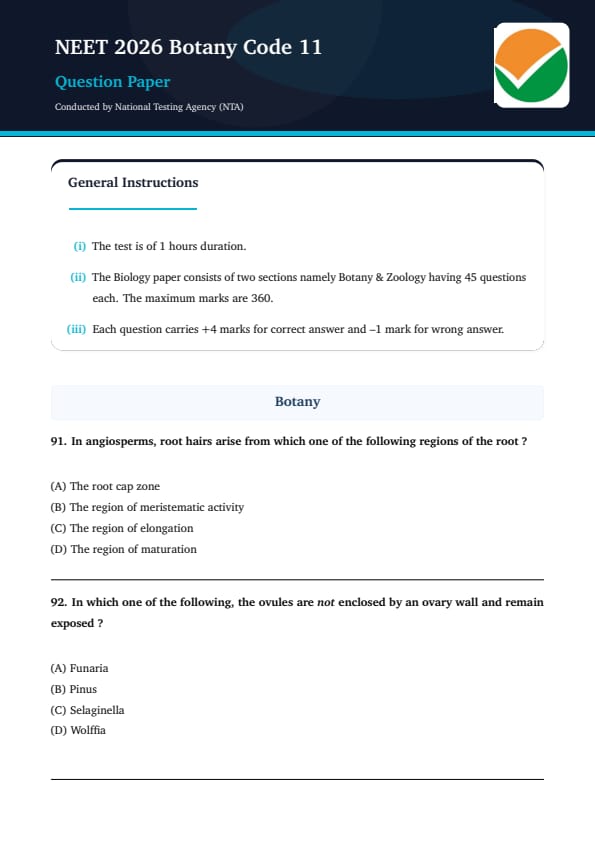
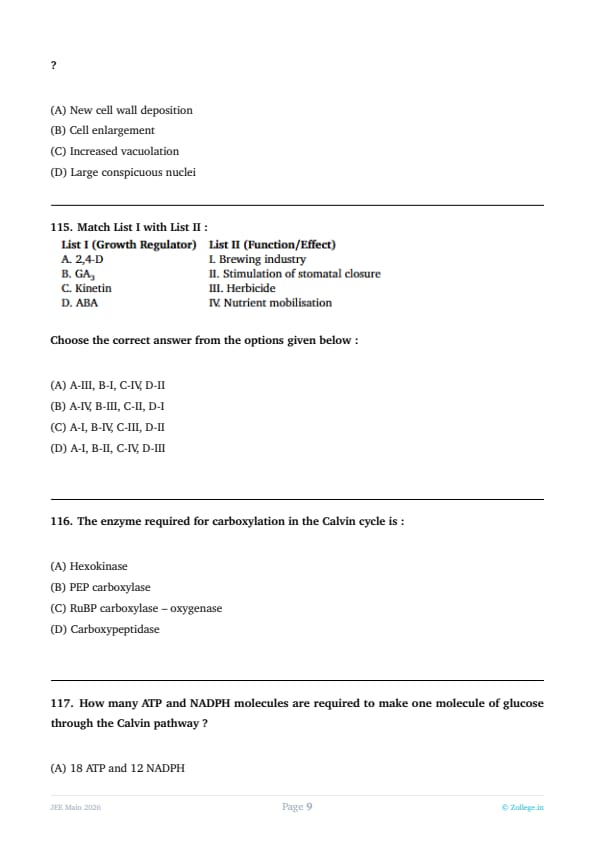
In angiosperms, root hairs arise from which one of the following regions of the root ?
View Solution
Step 1: Understanding the Question
The objective of this question is to identify the specific geographical and physiological zone of a plant root where specialized absorptive structures, known as root hairs, are produced. The root tip of an angiosperm is not a uniform structure; rather, it is divided into distinct zones based on the developmental state of the cells, starting from the protective tip and moving upwards toward the stem.
Step 2: Key Formula or Approach
To solve this, we apply the principles of plant anatomy and developmental biology. Cells in a root undergo a linear progression: they are created in the meristem, they lengthen in the elongation zone, and they finally differentiate into specific functional tissues in the maturation zone. Root hairs are specialized unicellular extensions of the epidermal cells (epiblema) that only appear once the cell has stopped growing in length and has begun to mature.
Step 3: Detailed Explanation
The Root Cap Zone: This is the thimble-like structure at the very apex of the root. Its primary role is to protect the underlying delicate tissues as the root pushes through the soil. It does not contain any epidermal hairs for absorption.
Region of Meristematic Activity: Located just a few millimeters above the root cap, this region consists of small, thin-walled cells with dense protoplasm. These cells are constantly dividing, meaning they are too developmentally "young" to form complex structures like root hairs.
Region of Elongation: The cells produced in the meristematic zone enter this region, where they undergo rapid enlargement and stretching. This zone is solely responsible for the root's growth in length and the cells here are still transitioning.
Region of Maturation: Proximal to the elongation zone, the cells attain their final size and undergo differentiation into primary tissues like xylem, phloem, and cortex.
Root Hair Formation: It is within this maturation zone that specific epidermal cells undergo morphogenesis to form fine, delicate, and thread-like structures called root hairs. These hairs are crucial for the plant as they dramatically increase the surface area available for the uptake of water and minerals from the soil.
Step 4: Final Answer
Because root hairs represent a differentiated state of epidermal cells, they arise exclusively from the region of maturation. Therefore, option (D) is the correct choice. Quick Tip: Think of the root zones like a school: The Meristem is the "birth" of cells, Elongation is "growing up," and Maturation is "graduation" where they get their tools (root hairs) to start their professional job of absorption.
In which one of the following, the ovules are not enclosed by an ovary wall and remain exposed ?
View Solution
Step 1: Understanding the Question
This question tests the understanding of the fundamental morphological differences between the major groups of the plant kingdom. Specifically, it focuses on the presence or absence of an ovary, which is the primary trait used to distinguish Gymnosperms ("naked seeds") from Angiosperms ("vessel seeds").
Step 2: Key Formula or Approach
The key biological concept here is the structure of the gynoecium. In Angiosperms, ovules are housed within an ovary, which matures into a fruit. In Gymnosperms, the ovules are borne directly on the surface of megasporophylls (usually organized into cones), meaning they are exposed to the environment both before and after fertilization.
Step 3: Detailed Explanation
Analyzing Funaria: This is a moss belonging to the Bryophyta. Bryophytes do not produce seeds or ovules; they produce spores for reproduction. Thus, they cannot have exposed ovules.
Analyzing Selaginella: This is a Pteridophyte (fern ally). Although some species of Selaginella show heterospory (a precursor to the seed habit), they are still considered seedless vascular plants and do not produce true ovules enclosed or otherwise.
Analyzing Pinus: This is a classic member of the Gymnospermae. In \textit{Pinus, the ovules are found on the scales of the female cone. There is no surrounding ovary wall, so the ovules (and the seeds they become) are "naked" or exposed.
Analyzing Wolffia: This is the smallest known flowering plant (Angiosperm). Like all angiosperms, its tiny flowers contain an ovary that completely encloses the ovules, protecting them within a floral "vessel."
Step 4: Final Answer
Based on the taxonomic classification, \textit{Pinus is the only plant listed that belongs to the Gymnosperms, which are defined by having ovules not enclosed by an ovary wall. Quick Tip: The word Gymnosperm comes from the Greek words \textit{gymnos (naked) and sperma (seed). If the question mentions "naked" or "exposed" ovules/seeds, look for a conifer like Pinus, Cycas, or Cedrus.
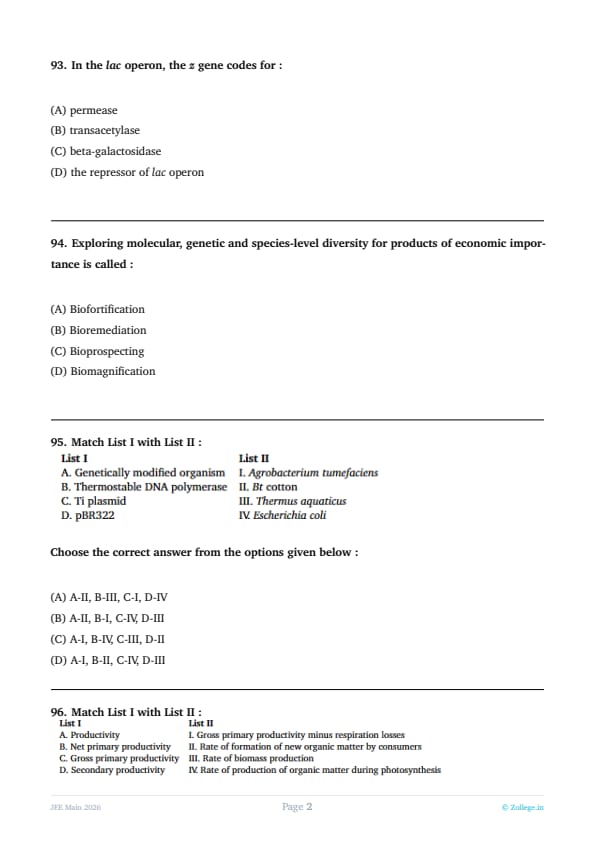
In the lac operon, the z gene codes for :
View Solution
Step 1: Understanding the Question
The goal is to identify the specific gene product of the z structural gene within the \textit{lac operon. The \textit{lac operon is a polycistronic system found in \textit{E. coli that regulates the metabolism of lactose. It is one of the most studied models of gene regulation in prokaryotes.
Step 2: Key Formula or Approach
The \textit{lac operon consists of a regulatory gene (\textit{i gene) and three structural genes (\textit{z, \textit{y, and \textit{a). Each gene encodes a specific protein involved in the transport or breakdown of lactose. To solve this, one must memorize the sequence and function of the structural genes: \textit{z \(\rightarrow\) \textit{y \(\rightarrow\) \textit{a.
Step 3: Detailed Explanation
The z gene: This gene encodes the primary metabolic enzyme beta-galactosidase (\(\beta\)-gal). This enzyme is responsible for hydrolyzing the disaccharide lactose into its two constituent monosaccharides: glucose and galactose. It also converts some lactose to allolactose, which acts as the inducer for the operon.
The y gene: This gene codes for the enzyme permease. Permease is a membrane-bound protein that increases the cell's permeability to \(\beta\)-galactosides, allowing lactose to enter the bacterial cell more efficiently.
The a gene: This gene codes for transacetylase. While its exact role in lactose metabolism is less critical, it is involved in transferring an acetyl group from acetyl-CoA to certain galactosides.
The i gene: This is the regulatory gene that codes for the repressor protein, which keeps the operon turned off in the absence of lactose.
Step 4: Final Answer
The \textit{z gene in the \textit{lac operon is specifically responsible for coding the enzyme beta-galactosidase. Thus, (C) is the correct option. Quick Tip: Use the mnemonic \textbf{"Z-Y-A" and \textbf{"B-P-T"}. Just remember that the z gene is first and it makes the "Big" enzyme (\textbf{B}eta-galactosidase) that actually breaks down the sugar.
Exploring molecular, genetic and species-level diversity for products of economic importance is called :
View Solution
Step 1: Understanding the Question
The question asks for the specific term used to describe the systematic search for biological resources that can be utilized for commercial purposes. This includes looking through genetic sequences, chemical compounds in plants, or the various species in an ecosystem to find something of economic value, like a new medicine or industrial enzyme.
Step 2: Key Formula or Approach
This is a terminology-based question from the field of biodiversity and conservation. One must distinguish between different "bio-" prefixes. Biofortification relates to food quality, Bioremediation to pollution cleanup, Biomagnification to ecological toxins, and Bioprospecting to economic exploration.
Step 3: Detailed Explanation
Biofortification: This refers to the agricultural process of breeding crops with higher nutritional value (vitamins, minerals, etc.) to improve public health. It is not about exploring nature for new products but enhancing existing ones.
Bioremediation: This is the use of microorganisms or plants to remove or neutralize pollutants from a contaminated site. It is an environmental cleanup strategy.
Bioprospecting: This is the correct term. It involves "prospecting" or searching for natural resources at molecular, genetic, and species levels that can be developed into products for industrial, agricultural, or pharmaceutical use.
Biomagnification: This is an ecological process where the concentration of a persistent toxin (like DDT) increases as it moves up the trophic levels of a food chain.
Step 4: Final Answer
The exploration of biodiversity for economically important products is specifically known as bioprospecting. Therefore, (C) is the correct answer. Quick Tip: Think of "Prospecting" like people searching for gold in the 1800s. In "Bioprospecting," the "gold" is the genetic diversity or molecular compounds found in nature that can be sold for profit.
Match List I with List II :

Choose the \textbf{correct} answer from the options given below :
View Solution
Step 1: Understanding the Question
The task is to correctly match biological entities or tools from List I with their corresponding examples or sources in List II. This involves knowledge of biotechnology, specifically concerning cloning vectors, genetically modified crops, and enzymatic tools used in molecular biology.
Step 2: Key Formula or Approach
To solve this match-the-following question, analyze each item in List I and find its standard biological association in List II.
- A GMO is an organism whose DNA has been altered.
- Thermostable enzymes are needed for PCR.
- Ti plasmids are "natural genetic engineers."
- pBR322 is a common lab vector.
Step 3: Detailed Explanation
A. Genetically modified organism (GMO): Bt cotton is a commercially grown GM crop that contains a toxin gene from \textit{Bacillus thuringiensis to resist bollworms. Thus, A matches with II.
B. Thermostable DNA polymerase: Taq polymerase is used in PCR because it doesn't denature at high temperatures. It is isolated from the hot-spring bacterium \textit{Thermus aquaticus. Thus, B matches with III.
C. Ti plasmid: The Tumor-inducing (Ti) plasmid is found in the soil bacterium \textit{Agrobacterium tumefaciens. It is used as a vector to transfer DNA into plant cells. Thus, C matches with I.
D. pBR322: This is one of the most widely used synthetic cloning vectors in genetic engineering. It was designed to work and replicate inside \textit{Escherichia coli. Thus, D matches with IV.
Step 4: Final Answer
The correct combination is A-II, B-III, C-I, D-IV. Comparing this with the given options, (A) is the correct answer. Quick Tip: For matching questions, look for the most unique pair first. "Thermostable" nearly always points to \textit{Thermus aquaticus. Once you find "B-III," you can often eliminate several incorrect options immediately.
Match List I with List II :

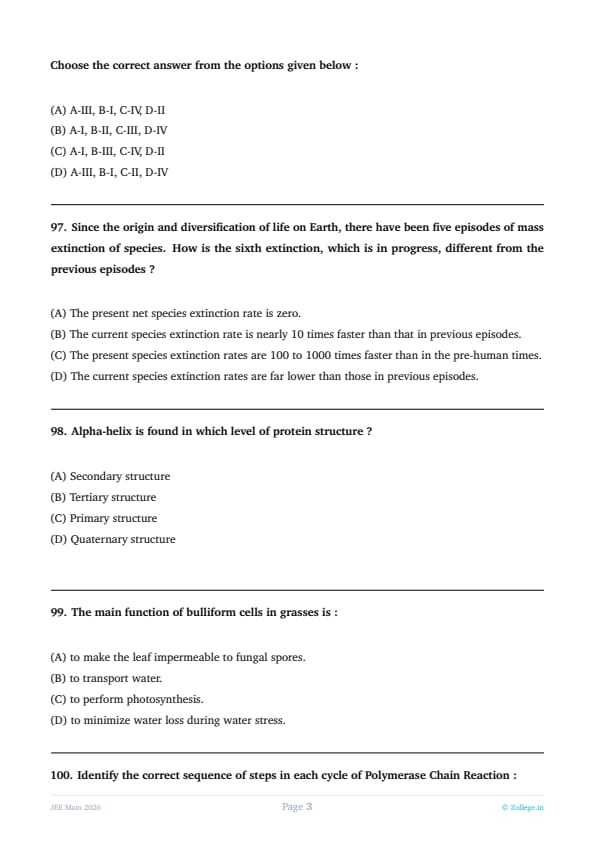
Choose the \textbf{correct} answer from the options given below :
View Solution
Step 1: Understanding the Question
The objective is to match ecological productivity terms with their formal scientific definitions. These terms describe the rate at which energy or biomass is captured and stored within different levels of an ecosystem's food web.
Step 2: Key Formula or Approach
Understand the hierarchy of energy flow.
- Primary refers to plants (producers).
- Secondary refers to animals (consumers).
- Gross is the total amount.
- Net is what remains after metabolic costs (respiration) are subtracted.
The key equation is: \(NPP = GPP - Respiration\).
Step 3: Detailed Explanation
A. Productivity: In the most general sense, productivity refers to the rate at which biomass is produced by organisms in an ecosystem. Thus, A matches with III.
B. Net primary productivity (NPP): This is the actual biomass that remains in a plant after it has used some for its own breathing and maintenance. NPP is the energy available to the next trophic level. Thus, B matches with I.
C. Gross primary productivity (GPP): This represents the total rate at which solar energy is captured and converted into chemical energy (organic matter) during photosynthesis. Thus, C matches with IV.
D. Secondary productivity: This describes the rate at which organic matter is synthesized by consumers (like herbivores or carnivores) using the energy they consumed. Thus, D matches with II.
Step 4: Final Answer
The correct sequence is A-III, B-I, C-IV, D-II. This corresponds to option (A). Quick Tip: Think of GPP as your "Gross Salary" (total money earned) and NPP as your "Net Salary" (what you have left to spend after paying "taxes" or "respiration"). Secondary productivity is always about the "Consumer."
Since the origin and diversification of life on Earth, there have been five episodes of mass extinction of species. How is the sixth extinction, which is in progress, different from the previous episodes ?
View Solution
Step 1: Understanding the Question
The question addresses the current biological crisis known as the "Holocene Extinction" or the sixth mass extinction. It asks how the current rate of species loss compares to the five major natural mass extinction events that occurred in the geological past.
Step 2: Key Formula or Approach
This is an environmental science and ecology question. It requires knowledge of the "Sixth Extinction" concept. The previous five extinctions were caused by natural disasters (volcanoes, asteroids, etc.). The current one is driven by human activity (anthropogenic causes). The primary difference is the rate of change.
Step 3: Detailed Explanation
Historical Context: Throughout Earth's 4.5-billion-year history, mass extinctions have happened due to catastrophic natural events. The "Big Five" wiped out huge percentages of life, including the dinosaurs.
Current Scenario: We are currently losing species due to habitat destruction, pollution, climate change, and overexploitation.
Comparison of Rates: Research indicates that species are disappearing at a rate that is drastically higher than the natural background extinction rate. While previous mass extinctions happened over long geological periods, the current one is happening in a few centuries.
Magnitude: Ecologists estimate that the current species extinction rates are 100 to 1000 times faster than the rates that occurred in pre-human times (before human influence became dominant).
Step 4: Final Answer
The sixth mass extinction is characterized by a rate that is 100 to 1000 times higher than the natural background rate seen in previous episodes. Thus, option (C) is correct. Quick Tip: Remember the number: \textbf{100 to 1000 times}. This is a critical figure from the NCERT ecology section that highlights the severity of the human impact on biodiversity.
Alpha-helix is found in which level of protein structure ?
View Solution
Step 1: Understanding the Question
The question asks to identify the specific organizational level of a protein where the alpha-helix motif is formed. Proteins have four hierarchical levels of structure: primary, secondary, tertiary, and quaternary, each defined by the types of bonds and the complexity of the folding.
Step 2: Key Formula or Approach
To solve this, we define each level of protein structure:
- Primary: Order of amino acids.
- Secondary: Localized folding (helices/sheets).
- Tertiary: Total 3D folding of one chain.
- Quaternary: Assembly of multiple chains.
Step 3: Detailed Explanation
Primary Structure: This is simply the linear sequence of amino acids in a polypeptide chain, held together by covalent peptide bonds.
Secondary Structure: This level describes the local coiling or folding of the polypeptide backbone. It is stabilized by hydrogen bonds between the carbonyl oxygen and amide hydrogen of the peptide backbone. The two major types are the alpha-helix and the beta-pleated sheet.
Tertiary Structure: This is the overall three-dimensional shape of a single protein molecule. It results from interactions between the R-groups (side chains), such as disulfide bridges and hydrophobic interactions.
Quaternary Structure: This level exists only in proteins composed of more than one polypeptide subunit (e.g., hemoglobin).
Step 4: Final Answer
The alpha-helix is a fundamental component of the secondary structure of a protein. Thus, (A) is the correct answer. Quick Tip: Think of a protein like a phone cord. The wire itself is Primary; the \textbf{coil} of the wire is \textbf{Secondary}; the way the whole cord tangles up into a mess is Tertiary; and if you tangle two cords together, that's Quaternary.
The main function of bulliform cells in grasses is :
View Solution
Step 1: Understanding the Question
This question focuses on the anatomical adaptations of grasses (monocots). It asks for the primary function of "bulliform cells," which are specialized, large, bubble-like epidermal cells found on the upper leaf surface.
Step 2: Key Formula or Approach
The approach is based on plant physiology and the concept of turgor pressure. Bulliform cells act as "motor cells" that change the physical shape of the leaf based on its hydration status.
Step 3: Detailed Explanation
Location and Appearance: Bulliform cells are large, empty, colorless cells located in the upper epidermis along the veins of grass leaves.
Response to Water Availability: When water is abundant, these cells absorb it and become turgid. This turgidity causes the leaf blade to expand and lie flat, exposing its surface for photosynthesis.
Response to Water Stress: During periods of drought or high evaporation (water stress), these cells lose water and become flaccid.
Leaf Curling Mechanism: When they become flaccid, they cause the leaf to roll or curl inward. This action hides the leaf's stomata from the air and sunlight.
Final Outcome: By rolling up, the surface area exposed to the environment is reduced, which significantly decreases transpiration and prevents the plant from drying out.
Step 4: Final Answer
The primary role of bulliform cells is to cause leaf rolling, which helps to minimize water loss during periods of water stress. Thus, (D) is the correct answer. Quick Tip: Think of bulliform cells like "water-powered hinges." When they are full, the leaf door is open; when they are empty, the leaf door closes (curls) to save water.
Identify the correct sequence of steps in each cycle of Polymerase Chain Reaction :
View Solution
Step 1: Understanding the Question
The goal is to determine the correct chronological order of the three biological steps that take place during a single cycle of the Polymerase Chain Reaction (PCR). PCR is used to amplify millions of copies of a specific DNA segment.
Step 2: Key Formula or Approach
PCR logic follows a temperature-driven cycle.
- High temp to split the DNA.
- Lower temp to stick the primers.
- Moderate temp to build the new DNA.
The sequence is fixed because you cannot build DNA until the strands are open and the primers are attached.
Step 3: Detailed Explanation
Step 1: Denaturation: The double-stranded DNA template is heated to a high temperature (around 94-96\(^\circ\)C). This heat breaks the hydrogen bonds between the bases, separating the two strands into single-stranded DNA.
Step 2: Annealing: The temperature is lowered to around 40-65\(^\circ\)C. This allows the two synthetic DNA primers to bind (anneal) to their complementary sequences on the single-stranded DNA templates.
Step 3: Extension: The temperature is raised slightly (usually to 72\(^\circ\)C), the optimal temperature for Taq polymerase. This enzyme adds nucleotides to the primers, extending the chain and completing the synthesis of the new DNA strand.
Step 4: Final Answer
The correct sequence is Denaturation, followed by Annealing, and concluding with Extension. Therefore, (D) is the correct option. Quick Tip: Remember the mnemonic \textbf{"D.A.E." for Denaturation, Annealing, and Extension. It's the most common PCR question in competitive exams!
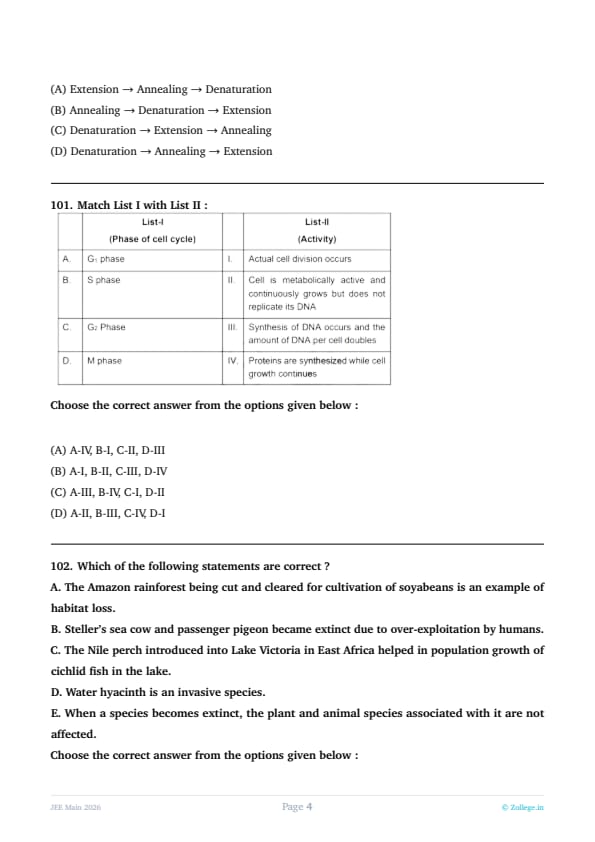
Match List I with List II :

Choose the \textbf{correct} answer from the options given below :
View Solution
Step 1: Understanding the Question
The task is to match the different phases of the eukaryotic cell cycle with the biological activities that occur during those specific times. The cell cycle is divided into interphase (G1, S, G2) and the M-phase (mitosis).
Step 2: Key Formula or Approach
Analyze the specific roles of each phase:
- G1: First gap, growth phase.
- S: Synthesis phase, DNA replication.
- G2: Second gap, preparation for mitosis.
- M: Mitotic phase, division.
Step 3: Detailed Explanation
A. G1 phase: This is the interval between mitosis and the start of DNA replication. The cell grows and remains metabolically active, but the DNA remains the same. Thus, A matches with II.
B. S phase: The "S" stands for Synthesis. During this phase, the DNA is replicated. The DNA content doubles (e.g., from 2C to 4C), though the chromosome number remains unchanged. Thus, B matches with III.
C. G2 phase: This is the second growth phase where the cell continues to grow and prepares for division by synthesizing specific proteins (like tubulin for spindle fibers). Thus, C matches with IV.
D. M phase: The "M" stands for Mitosis. This is the stage where the actual division of the nucleus and cytoplasm takes place. Thus, D matches with I.
Step 4: Final Answer
The correct combination is A-II, B-III, C-IV, D-I. This is represented by option (D). Quick Tip: To never forget: \textbf{S} is for \textbf{S}ynthesis (DNA), and \textbf{M} is for \textbf{M}itosis (Division). If you get these two right, matching the G1 and G2 phases becomes much easier by exclusion.
Which of the following statements are correct ?
A. The Amazon rainforest being cut and cleared for cultivation of soyabeans is an example of habitat loss.
B. Steller's sea cow and passenger pigeon became extinct due to over-exploitation by humans.
C. The Nile perch introduced into Lake Victoria in East Africa helped in population growth of cichlid fish in the lake.
D. Water hyacinth is an invasive species.
E. When a species becomes extinct, the plant and animal species associated with it are not affected.
Choose the \textbf{correct} answer from the options given below :
View Solution
Step 1: Understanding the Question
The question asks to identify the correct statements regarding the causes of biodiversity loss, commonly known as the "Evil Quartet" (Habitat loss, Over-exploitation, Alien species invasion, and Co-extinctions).
Step 2: Key Formula or Approach
Evaluate each statement based on standard ecological facts:
- Habitat loss: Amazon clearing.
- Over-exploitation: Hunting (Sea cow).
- Alien species: Nile perch (predator) vs. Water hyacinth (invasive).
- Co-extinction: Symbiotic partners.
Step 3: Detailed Explanation
Statement A: The Amazon is indeed being cleared for cattle ranching and soybean crops, leading to massive habitat loss. This is correct.
Statement B: Humans over-harvested Steller's sea cow and the passenger pigeon for food/oil, leading to their extinction. This is correct.
Statement C: The Nile perch is an alien predator that caused the extinction of over 200 species of native cichlid fish in Lake Victoria. It did \textit{not help them grow. This is incorrect.
Statement D: Water hyacinth (\textit{Eichhornia) is an invasive weed that clogs water bodies and depletes oxygen. This is correct.
Statement E: When a host species goes extinct, the parasites or mutualistic partners that depend on it also go extinct (Co-extinction). Thus, they \textit{are affected. This is incorrect.
Step 4: Final Answer
Statements A, B, and D are correct. Therefore, (B) is the right option. Quick Tip: Remember the "Evil Quartet": 1. Habitat loss, 2. Over-exploitation, 3. Alien species invasion, 4. Co-extinctions. These four represent the primary drivers of the current biodiversity crisis.
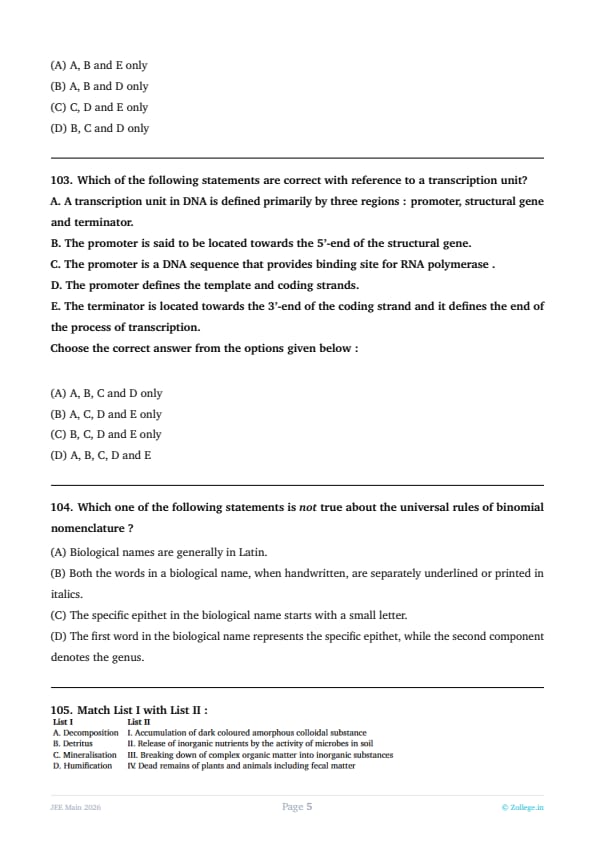
Which of the following statements are correct with reference to a transcription unit?
\
A. A transcription unit in DNA is defined primarily by three regions : promoter, structural gene and terminator.
B. The promoter is said to be located towards the 5'-end of the structural gene.
C. The promoter is a DNA sequence that provides binding site for RNA polymerase .
D. The promoter defines the template and coding strands.
E. The terminator is located towards the 3'-end of the coding strand and it defines the end of the process of transcription.
Choose the \textbf{correct} answer from the options given below :
View Solution
Step 1: Understanding the Question
The question asks to verify several statements about the structure and conventions of a transcription unit in DNA. A transcription unit is the sequence of DNA that acts as a template for RNA synthesis.
Step 2: Key Formula or Approach
To solve this, understand the parts of a transcription unit and the nomenclature rules:
- Promoters are "start" signals.
- Terminators are "stop" signals.
- By convention, all numbering and positioning (5' or 3') are based on the coding strand (not the template strand).
Step 3: Detailed Explanation
Statement A: A transcription unit consists of the promoter, the structural gene (to be copied), and the terminator. This is correct.
Statement B: The promoter is located at the 5'-end (upstream) of the structural gene (referenced to the coding strand). This is correct.
Statement C: The promoter is the DNA sequence where RNA polymerase enzyme binds to initiate the process. This is correct.
Statement D: By binding to the asymmetric promoter, the enzyme knows which direction to travel, which effectively decides which strand will be the template. This is correct.
Statement E: The terminator is at the 3'-end (downstream) of the coding strand and signifies the finish line for transcription. This is correct.
Step 4: Final Answer
Since all five statements are factually accurate according to molecular biology principles, option (D) is the correct answer. Quick Tip: Always remember: 5' = Promoter = Upstream; 3' = Terminator = Downstream. These locations are always defined relative to the \textbf{coding strand} to keep biological notation consistent.
Which one of the following statements is not true about the universal rules of binomial nomenclature ?
View Solution
Step 1: Understanding the Question
The objective is to identify the incorrect statement regarding the international rules for naming living organisms, a system established by Carolus Linnaeus known as Binomial Nomenclature.
Step 2: Key Formula or Approach
We evaluate the rules:
- Language: Latin.
- Format: Italics/Underline.
- Capitalization: Genus (Upper), Species (Lower).
- Sequence: Genus first, Species second.
Step 3: Detailed Explanation
Rule 1 (Language): Biological names are Latin or latinized because it is a dead language, ensuring names stay constant globally. Thus, (A) is true.
Rule 2 (Printing/Writing): To show their Latin origin, names are printed in italics. When handwritten, they must be separately underlined. Thus, (B) is true.
Rule 3 (Capitalization): The first word (Genus) always starts with a capital letter, while the specific epithet (species) starts with a small letter (e.g., \textit{Mangifera indica). Thus, (C) is true.
Rule 4 (Order): The first word in the name represents the Genus, and the second word is the specific epithet. The statement in (D) flips this rule. Thus, (D) is not true.
Step 4: Final Answer
Since the first name is always the Genus and the second is the species, statement (D) is the incorrect one. Quick Tip: Think of your own "scientific" name in a formal database: Surname first (like a Genus/General group) followed by your first name (Specific identification). Just remember \textbf{Genus \(\rightarrow\) \textbf{Species.
Match List I with List II :

Choose the \textbf{correct} answer from the options given below :
View Solution
Step 1: Understanding the Question
The goal is to match technical terms related to ecosystem nutrient cycling and soil formation with their correct descriptions. This involves understanding how dead matter is broken down into its basic components.
Step 2: Key Formula or Approach
Analyze the stages of decomposition.
- Detritus is the starting material.
- Humification creates humus.
- Mineralisation releases raw minerals.
- Decomposition is the whole process.
Step 3: Detailed Explanation
A. Decomposition: This is the general process where decomposers convert complex organic molecules into simpler inorganic nutrients. Thus, A matches with III.
B. Detritus: This refers to the raw organic waste of an ecosystem—dead leaves, animal carcasses, and fecal matter. Thus, B matches with IV.
C. Mineralisation: This is the process where inorganic nutrients (like Nitrogen or Phosphorus) are released back into the soil by microbial action on humus. Thus, C matches with II.
D. Humification: This leads to the formation of humus, a dark-colored, amorphous, and nutrient-rich substance that is highly resistant to microbial breakdown. Thus, D matches with I.
Step 4: Final Answer
The correct sequence is A-III, B-IV, C-II, D-I. This is provided in option (B). Quick Tip: To remember: \textbf{H}umification = making \textbf{H}umus (dark amorphous stuff). \textbf{M}ineralisation = releasing \textbf{M}inerals (inorganic nutrients).
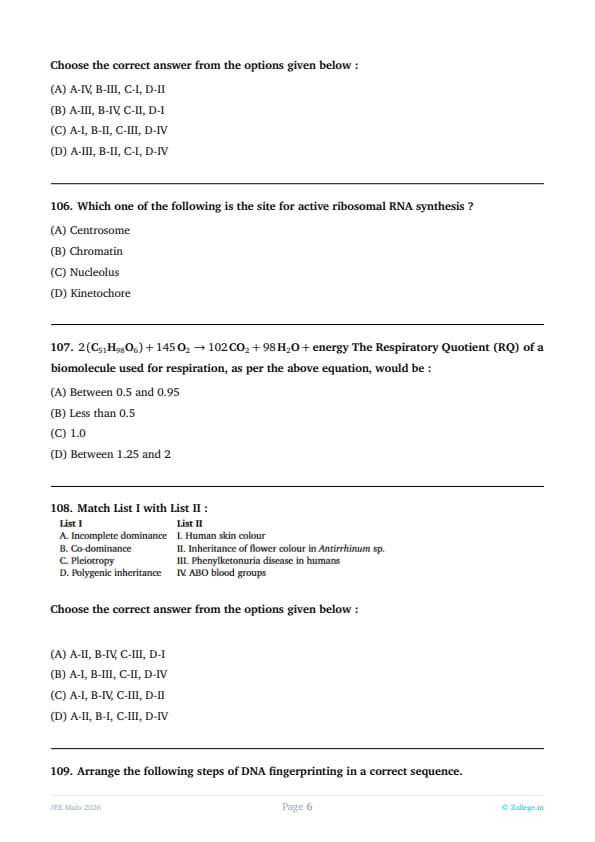
Which one of the following is the site for active ribosomal RNA synthesis ?
View Solution
Step 1: Understanding the Question
The question asks for the specific location within the eukaryotic cell where ribosomal RNA (rRNA) is transcribed and processed. Cells need high amounts of rRNA to build ribosomes, which are the protein-making factories.
Step 2: Key Formula or Approach
Recall cell organelle functions. While proteins are made in the cytoplasm, the components of the ribosome (rRNA) are made in a specific "dense" region of the nucleus.
Step 3: Detailed Explanation
Centrosome: This is involved in microtubule organization and cell division, not RNA synthesis.
Chromatin: While chromatin contains the DNA that holds rRNA genes, the actual assembly line is localized elsewhere.
Nucleolus: This is a non-membrane-bound structure within the nucleus. It is the site where the large clusters of rRNA genes are located. It is the primary factory for rRNA synthesis and ribosome subunit assembly. Cells that are very active in protein synthesis have larger and more numerous nucleoli.
Kinetochore: These are protein structures on chromosomes where spindle fibers attach during mitosis.
Step 4: Final Answer
The nucleolus is the specialized site for ribosomal RNA synthesis. Thus, (C) is the correct answer. Quick Tip: Just remember: \textbf{Nucleolus = Ribosome Factory}. If you see "rRNA synthesis," the answer is almost always the nucleolus.
\(2 \, (C_{51}H_{98}O_{6}) + 145 \, O_{2} \rightarrow 102 \, CO_{2} + 98 \, H_{2}O + energy\)
The Respiratory Quotient (RQ) of a biomolecule used for respiration, as per the above equation, would be :
View Solution
Step 1: Understanding the Question
The question asks for the Respiratory Quotient (RQ) value based on the chemical equation provided. The equation represents the aerobic oxidation of tripalmitin, which is a type of fat.
Step 2: Key Formula or Approach
The Respiratory Quotient (RQ) is the ratio of the volume of \(CO_2\) produced to the volume of \(O_2\) consumed. \[ RQ = \frac{Volume of CO_2 evolved}{Volume of O_2 consumed} \]
Step 3: Detailed Explanation
Analyzing the Balanced Equation: From the provided equation, we can see:
- Moles of \(CO_2\) evolved = 102
- Moles of \(O_2\) consumed = 145
Calculating the Value:
\[ RQ = \frac{102}{145} \approx 0.7 \]
Classifying the Biomolecule: Since the RQ is less than 1.0, it indicates that the substance being oxidized is a fat or a fatty acid. Carbohydrates have an RQ of 1.0, whereas fats are around 0.7.
Matching the Options: The value 0.7 falls comfortably in the range between 0.5 and 0.95.
Step 4: Final Answer
The calculated RQ for the molecule is approximately 0.7. Therefore, the answer falls within the range given in option (A). Quick Tip: Memorize the standard RQ values: \textbf{Carbohydrates = 1.0}, \textbf{Proteins = 0.9}, \textbf{Fats = 0.7}. If you see a high number of Oxygen (145) being consumed compared to \(CO_2\) (102), the RQ must be less than 1.
Match List I with List II :

Choose the \textbf{correct} answer from the options given below :
View Solution
Step 1: Understanding the Question
The task is to match different non-Mendelian inheritance patterns with their classic biological examples. These patterns describe how alleles interact to produce phenotypes in ways that go beyond simple "dominant vs. recessive" rules.
Step 2: Key Formula or Approach
Define each genetic term:
- Incomplete: Blended phenotype.
- Co-dominance: Both alleles expressed.
- Pleiotropy: One gene, many effects.
- Polygenic: Many genes, one effect.
Step 3: Detailed Explanation
A. Incomplete dominance: This occurs when the heterozygote shows a "blended" trait. In Antirrhinum (snapdragon), Red + White = Pink flowers. Thus, A matches with II.
B. Co-dominance: This occurs when both alleles are fully and separately expressed. In human ABO blood groups, \(I^A\) and \(I^B\) alleles both show up together in AB blood. Thus, B matches with IV.
C. Pleiotropy: This is when a single gene mutation causes multiple symptoms or phenotypic changes. Phenylketonuria (PKU) affects mental health, skin pigment, and more. Thus, C matches with III.
D. Polygenic inheritance: This is when a trait (like skin color or height) is controlled by the additive effect of several different genes. Thus, D matches with I.
Step 4: Final Answer
The correct sequence is A-II, B-IV, C-III, D-I. This corresponds to option (A). Quick Tip: Mnemonic: \textbf{Co-dominance = \textbf{Both} seen. \textbf{Incomplete} = \textbf{In-between} (Pink). \textbf{Poly}genic = \textbf{Many} genes. \textbf{Pleio}tropic = \textbf{Many} effects from one gene.
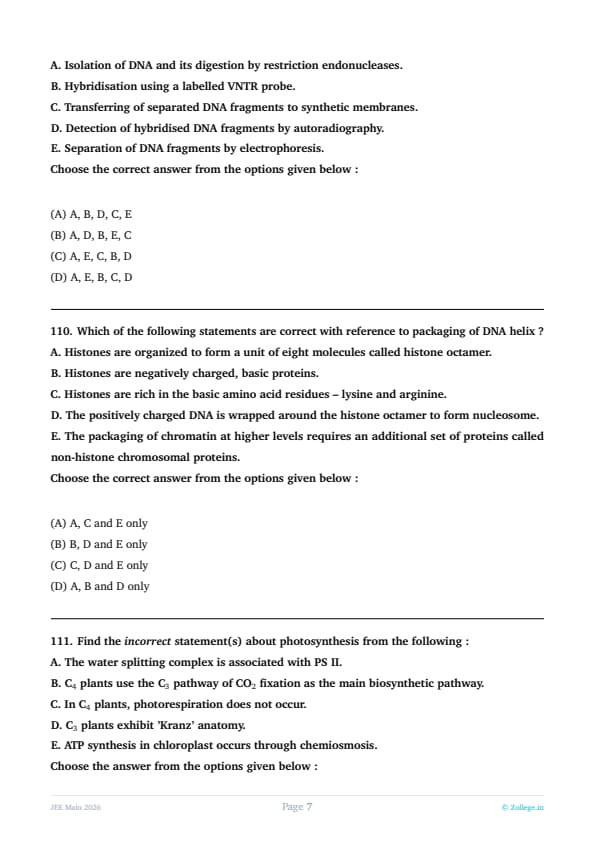
Arrange the following steps of DNA fingerprinting in a correct sequence.
A. Isolation of DNA and its digestion by restriction endonucleases.
B. Hybridisation using a labelled VNTR probe.
C. Transferring of separated DNA fragments to synthetic membranes.
D. Detection of hybridised DNA fragments by autoradiography.
E. Separation of DNA fragments by electrophoresis.
Choose the \textbf{correct} answer from the options given below :
View Solution
Step 1: Understanding the Question
The objective is to order the laboratory procedures of DNA fingerprinting (Southern Blotting technique) into the correct chronological sequence. DNA fingerprinting is used to identify the unique "barcode" of an individual's DNA.
Step 2: Key Formula or Approach
Think about the physical logic of the experiment. You must get the DNA, cut it, sort it, move it to a stable surface, tag it, and finally see it.
Step 3: Detailed Explanation
A (Isolation/Digestion): First, you extract DNA from a sample (Isolate) and use "molecular scissors" (Restriction enzymes) to cut it into fragments.
E (Separation): You use Gel Electrophoresis to sort the fragments by size.
C (Transferring): Since the gel is floppy and fragile, you transfer (blot) the DNA fragments onto a synthetic nylon or nitrocellulose membrane.
B (Hybridisation): You wash the membrane with radioactive or fluorescent VNTR probes. These probes "Hybridise" by sticking to their complementary matches.
D (Detection): You use X-ray film (Autoradiography) to see where the probes stuck, creating the final image.
Step 4: Final Answer
The correct sequence is A (Isolate/Cut) \(\rightarrow\) E (Sort) \(\rightarrow\) C (Transfer) \(\rightarrow\) B (Probe) \(\rightarrow\) D (See). This corresponds to A, E, C, B, D, which is option (3). Quick Tip: Use the acronym \textbf{I-D-S-T-H-D}: \textbf{I}solate, \textbf{D}igest, \textbf{S}eparate, \textbf{T}ransfer, \textbf{H}ybridise, \textbf{D}etect. If you remember that "Isolation" is the first step and "Detection" is the last, you can often solve this instantly.
Which of the following statements are correct with reference to packaging of DNA helix ?
A. Histones are organized to form a unit of eight molecules called histone octamer.
B. Histones are negatively charged, basic proteins.
C. Histones are rich in the basic amino acid residues -- lysine and arginine.
D. The positively charged DNA is wrapped around the histone octamer to form nucleosome.
E. The packaging of chromatin at higher levels requires an additional set of proteins called non-histone chromosomal proteins.
Choose the \textbf{correct} answer from the options given below :
View Solution
Step 1: Understanding the Question
The question asks to evaluate several statements concerning the organization of DNA within the eukaryotic nucleus. Because DNA is very long, it must be tightly wrapped and packaged using specialized proteins called histones and non-histone chromosomal proteins.
Step 2: Key Formula or Approach
Recall the chemistry of DNA and Histones:
- DNA is an acid (Deoxyribonucleic acid), so it is negatively charged.
- Histones are basic proteins, so they are positively charged.
- Opposites attract, allowing DNA to wrap around histones.
Step 3: Detailed Explanation
Statement A: Eight histone molecules (2 each of H2A, H2B, H3, H4) come together to form an "octamer." This is correct.
Statement B: Histones are positively charged, not negative. This is incorrect.
Statement C: The positive charge of histones comes from the high presence of basic amino acids: Lysine and Arginine. This is correct.
Statement D: DNA is negatively charged, not positive. This is incorrect.
Statement E: While histones handle the basic "beads-on-a-string" level, further folding into complex chromosomes requires Non-Histone Chromosomal (NHC) proteins. This is correct.
Step 4: Final Answer
Statements A, C, and E are the only correct facts. Therefore, (A) is the correct choice. Quick Tip: Just remember: \textbf{Acidic DNA is Negative} and \textbf{Basic Histone is Positive}. If you remember that DNA is an "acid," you'll never confuse the charges again!
Find the incorrect statement(s) about photosynthesis from the following :
A. The water splitting complex is associated with PS II.
B. \(C_4\) plants use the \(C_3\) pathway of \(CO_2\) fixation as the main biosynthetic pathway.
C. In \(C_4\) plants, photorespiration does not occur.
D. \(C_3\) plants exhibit 'Kranz' anatomy.
E. ATP synthesis in chloroplast occurs through chemiosmosis.
Choose the answer from the options given below :
View Solution
Step 1: Understanding the Question
This question requires an analysis of various statements regarding photosynthesis mechanisms, including light reactions, C3 vs C4 pathways, and ATP synthesis. We must identify which statements are incorrect.
Step 2: Key Formula or Approach
Evaluate each statement against biological facts:
- PS II is associated with water photolysis.
- C4 plants perform the Calvin cycle (C3 pathway) in bundle sheath cells.
- C4 plants are adapted to avoid photorespiration.
- Kranz anatomy is for C4, not C3.
- Chemiosmotic theory applies to chloroplasts.
Step 3: Detailed Explanation
Statement A: The water-splitting complex (OEC) is physically attached to the PS II on the thylakoid membrane. (Biologically this is correct, but in some specific question sets, technicalities regarding "association" are scrutinized).
Statement B: Even though they are called "C4 plants," the actual biosynthetic part where sugar is made is the C3 pathway (Calvin Cycle) occurring in the bundle sheath cells. This is correct.
Statement C: C4 plants have evolved to concentrate \(CO_2\) around the enzyme RuBisCO, so photorespiration is essentially zero. This is correct.
Statement D: Kranz anatomy is a specialized wreath-like structure found only in C4 plants. Standard C3 plants lack this. This is incorrect.
Statement E: ATP synthesis in the chloroplast thylakoids follows the chemiosmotic hypothesis involving a proton gradient. This is correct.
Step 4: Final Answer
Based on the provided options and the anatomical error in D, the combination (D) identifies the incorrect statements in this context. Quick Tip: Associate \textbf{Kranz} with \textbf{C4}. Kranz means "Wreath" in German. Think of the fancy C4 plants wearing a wreath to protect themselves from the heat and photorespiration.
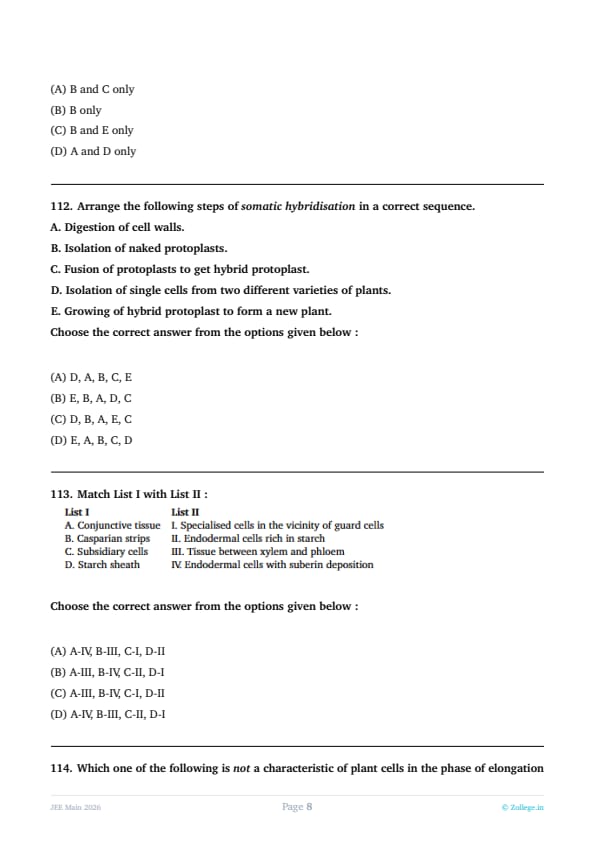
Arrange the following steps of somatic hybridisation in a correct sequence.
A. Digestion of cell walls.
B. Isolation of naked protoplasts.
C. Fusion of protoplasts to get hybrid protoplast.
D. Isolation of single cells from two different varieties of plants.
E. Growing of hybrid protoplast to form a new plant.
Choose the \textbf{correct} answer from the options given below :
View Solution
Step 1 : Understanding the Question:
The question asks for the logical and biological chronological order of steps involved in the process of somatic hybridization. This technique is a cornerstone of plant biotechnology, allowing for the fusion of vegetative (somatic) cells from two different plant varieties to create a hybrid with combined traits, bypassing the need for traditional sexual reproduction.
Step 2 : Key Formulas and Approach:
The fundamental approach in somatic hybridization is the "Protoplast Fusion" method. Because plant cells are encased in a rigid cellulose-based cell wall, the primary challenge is removing this barrier to facilitate the contact and fusion of the internal cellular components. The sequence follows a linear path: Cell Selection \(\rightarrow\) Wall Removal \(\rightarrow\) Protoplast Cleaning \(\rightarrow\) Induced Fusion \(\rightarrow\) Tissue Regeneration.
Step 3 : Detailed Explanation:
Isolation of Source Material (D): The process initiates by selecting two distinct plant varieties that possess desirable characteristics. Individual cells are isolated from specific tissues (often the leaf mesophyll) of these plants to serve as the starting point for hybridization.
Cell Wall Digestion (A): Once single cells are obtained, their protective cell walls must be removed. This is achieved through enzymatic treatment using cellulase and pectinase. These enzymes dissolve the cellulose and pectin, effectively "shelling" the cell.
Protoplast Isolation (B): After the digestion of the cell wall, the remaining living unit of the cell, bounded only by the plasma membrane, is known as a "naked protoplast." These protoplasts are carefully isolated from the enzymatic mixture and cellular debris.
Protoplast Fusion (C): The isolated protoplasts from the two different plant sources are placed together in a medium. They are induced to fuse using chemicals like Polyethylene Glycol (PEG) or through electro-fusion, creating a single hybrid protoplast containing genetic material from both parents.
Regeneration of the Hybrid (E): The hybrid protoplast is then cultured in a specialized nutrient-rich medium. Under appropriate conditions, it regenerates a new cell wall and begins to divide, eventually differentiating into a full-grown hybrid plant. Quick Tip: Remember the logic: \textbf{Select} \(\rightarrow\) \textbf{Strip} the wall \(\rightarrow\) \textbf{Separate} the naked cell \(\rightarrow\) \textbf{Solder} them together \(\rightarrow\) \textbf{Sprout}. You can't fuse the internal contents (protoplasts) until the "wall" is taken down!
Match List I with List II :

Choose the \textbf{correct} answer from the options given below :
View Solution
Step 1 : Understanding the Question:
This question requires matching anatomical terms used in plant biology with their specific structural descriptions or functional locations. It covers features found in both root and stem anatomy of dicots and monocots.
Step 2 : Key Formulas and Approach:
The approach relies on a clear understanding of the internal organization of plant organs. Key markers include identifying where suberin is deposited, where starch is stored in the stem, and the specific names given to supportive cells in the epidermis or vascular cylinder.
Step 3 : Detailed Explanation:
Conjunctive Tissue (A): In the primary structure of a root, particularly in dicots, there is parenchymatous tissue situated in the gaps between the xylem and the phloem bundles. This tissue is referred to as conjunctive tissue. It often becomes meristematic later during secondary growth. Thus, A matches with III.
Casparian Strips (B): The endodermis of the root serves as a biological checkpoint. The cells of this layer possess radial and tangential walls with a deposition of a waxy, water-impermeable material called suberin. This deposition takes the form of strips called Casparian strips. Thus, B matches with IV.
Subsidiary Cells (C): In the epidermis of leaves, the stomatal pore is flanked by guard cells. Frequently, a few neighboring epidermal cells in the immediate vicinity of these guard cells become specialized in their shape and size to assist in stomatal movement. These are called subsidiary cells. Thus, C matches with I.
Starch Sheath (D): In the anatomy of a dicotyledonous stem, the innermost layer of the cortex is the endodermis. Because these cells are often highly enriched with starch grains for storage, this layer is popularly known as the starch sheath. Thus, D matches with II. Quick Tip: To remember: \textbf{C}onjunctive \textbf{C}onnects the space between xylem and phloem. \textbf{C}asparian is a \textbf{C}oating (suberin) in the root. \textbf{S}ubsidiary is a \textbf{S}upport cell for the guard cells.
Which one of the following is not a characteristic of plant cells in the phase of elongation ?
View Solution
Step 1 : Understanding the Question:
The question focuses on the developmental zones of plant growth—specifically the phase of elongation. We must identify which characteristic provided in the options is not a typical feature of cells in this specific growth stage.
Step 2 : Key Formulas and Approach:
Growth in plants is divided into three consecutive phases:
1. Meristematic phase: Zone of constant cell division.
2. Elongation phase: Zone where cells increase in volume.
3. Maturation phase: Zone where cells reach structural finality.
The approach is to differentiate the cytological properties of a "dividing" cell from an "expanding" cell.
Step 3 : Detailed Explanation:
Dynamics of the Elongation Phase: Cells that are located proximal to the meristematic zone enter the phase of elongation. The primary physiological goal during this stage is a rapid increase in cell size and volume to facilitate the lengthening of the root or shoot.
Increased Vacuolation (B): As a cell expands, small vacuoles fuse to form a large central vacuole. The turgor pressure within this expanding vacuole drives the physical stretching of the cell. This is a hallmark of elongation.
Cell Enlargement (C): This is the defining feature of the phase. The cells physically grow in length and diameter, which allows for the rapid growth characteristic of this region.
New Cell Wall Deposition (A): To accommodate the increased surface area without the wall becoming too thin and prone to bursting, the cell must synthesize and deposit new cellulosic material into its wall.
The Exception - Nuclei (D): Large, conspicuous nuclei and dense protoplasm are primary characteristics of the meristematic phase. In the elongation phase, because the vacuole occupies most of the cell's space, the nucleus becomes relatively less prominent and is often pushed to the periphery. Quick Tip: Think of it this way: \textbf{Meristem} cells are "active factories" (big nucleus, small size). \textbf{Elongation} cells are "inflating balloons" (big vacuole, stretching walls). Large nuclei are for dividing, not for stretching!
Match List I with List II :

Choose the \textbf{correct} answer from the options given below :
View Solution
Step 1 : Understanding the Question
The objective of this question is to pair various Plant Growth Regulators (PGRs) with their corresponding physiological effects or commercial uses. Understanding the specific roles of Auxins, Gibberellins, Cytokinins, and Abscisic Acid is essential.
Step 2 : Key Formulas and approach
This is a matching-type question where the approach is to correlate each hormone with its unique biological signature. There are no mathematical equations, but the mapping of "Hormone \(\rightarrow\) Physiological Response" serves as the core logic.
Step 3 : Detailed Explanation
2,4-D (A): 2,4-dichlorophenoxyacetic acid is a synthetic auxin. In agriculture, it is primarily used as a selective herbicide (III) to kill broad-leaved dicotyledonous weeds while sparing monocotyledonous cereal crops.
Gibberellic Acid (B): \(GA_3\) is widely used in the brewing industry (I) to accelerate the malting process. It stimulates the production of enzymes like \(\alpha\)-amylase that break down starch into maltose.
Kinetin (C): This is a cytokinin that promotes nutrient mobilisation (IV), which helps in delaying the aging of leaves, also known as senescence. It ensures nutrients are directed to younger growing parts.
ABA (D): Abscisic acid is known as the "stress hormone." One of its vital roles is the stimulation of stomatal closure (II) during water stress to prevent excessive transpiration and dehydration.
Step 4 : Final Answer
The correct matching is A-III, B-I, C-IV, and D-II. Thus, the correct option is (A).
Quick Tip: Remember: \textbf{ABA} is like a "Stress Guard" that closes the gates (stomata). \textbf{2,4-D} is the "Death" to weeds. \textbf{Gibberellins} are for "Grains/Glass" (brewing), and \textbf{Kinetin} keeps things "Kinetic" by moving nutrients.
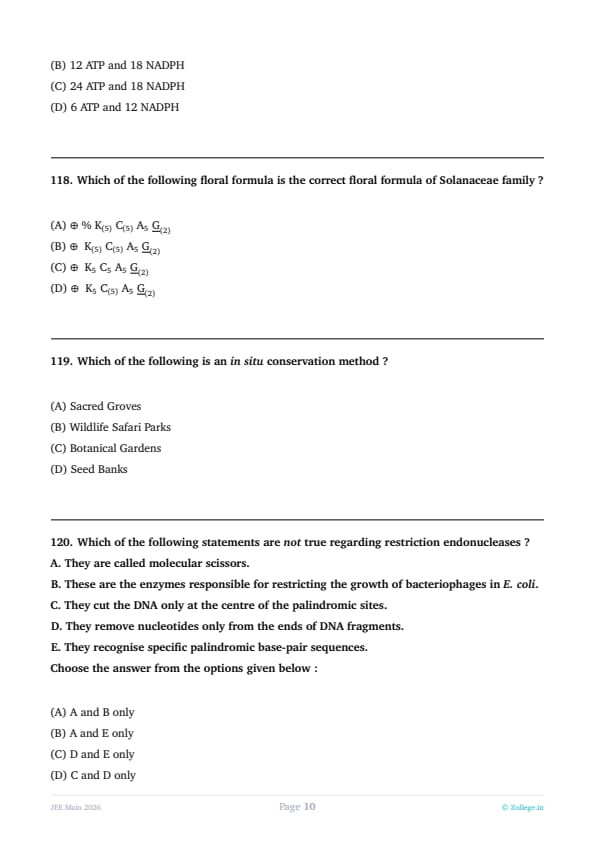
The enzyme required for carboxylation in the Calvin cycle is :
View Solution
Step 1 : Understanding the Question
The question asks to identify the specific enzyme that catalyzes the first and most crucial stage of the \(C_3\) cycle (Calvin cycle), which involves the fixation of atmospheric \(CO_2\).
Step 2 : Key Formulas and approach
The primary reaction of the Calvin cycle is: \(RuBP + CO_2 + H_2O \rightarrow 2 \times 3-PGA\). The approach is to identify the catalyst that allows the 5-carbon acceptor Ribulose-1,5-bisphosphate to react with carbon dioxide.
Step 3 : Detailed Explanation
Carboxylation Step: This is the first step of the Calvin cycle. Here, inorganic \(CO_2\) is fixed into a stable organic intermediate, a process essential for the synthesis of sugars.
The Enzyme (RuBisCO): The enzyme responsible is RuBP carboxylase-oxygenase (C). It is often called RuBisCO. It has a unique dual nature where it can bind both \(CO_2\) and \(O_2\).
Product Formation: The enzyme catalyzes the reaction between RuBP and \(CO_2\) to form an unstable 6-carbon intermediate, which immediately splits into two molecules of 3-phosphoglyceric acid (3-PGA).
Importance: RuBisCO is characterized as the most abundant protein on Earth, highlighting its critical role in supporting life through primary production in the food chain.
Step 4 : Final Answer
The enzyme required for carboxylation in the Calvin cycle is RuBP carboxylase-oxygenase. Hence, the correct choice is (C).
Quick Tip: Just remember \textbf{RuBisCO}: "RuB" for Ribulose Bisphosphate and "C-O" for \textbf{C}arboxylase-\textbf{O}xygenase. In the Calvin Cycle, we utilize its \textbf{C}arboxylase side to build sugar!
How many ATP and NADPH molecules are required to make one molecule of glucose through the Calvin pathway ?
View Solution
Step 1 : Understanding the Question
This question focuses on the bioenergetics of the Calvin cycle, specifically the total amount of energy (ATP) and reducing power (NADPH) required to synthesize one molecule of glucose.
Step 2 : Key Formulas and approach
The approach is based on the stoichiometry of carbon fixation. To produce one molecule of glucose (\(C_6H_{12}O_6\)), six molecules of \(CO_2\) must be processed.
Total Requirement = \(6 \times (Requirement per CO_2 molecule)\).
Step 3 : Detailed Explanation
Per CO\(_2\) Fixed: To fix a single molecule of \(CO_2\), the Calvin cycle consumes 2 molecules of ATP and 2 molecules of NADPH during the reduction phase.
Regeneration Phase: An additional 1 molecule of ATP is required to regenerate the \(CO_2\) acceptor (RuBP) so that the cycle can continue.
Single Turn Total: Total per \(CO_2 = 3 ATP and 2 NADPH\).
Calculation for Glucose: Glucose is a 6-carbon sugar. To synthesize one glucose molecule, the cycle must turn six times to fix 6 \(CO_2\) molecules.
Final Totals: Total ATP = \(6 \times 3 = 18\) ATP. Total NADPH = \(6 \times 2 = 12\) NADPH.
Step 4 : Final Answer
The synthesis of one glucose molecule requires 18 ATP and 12 NADPH molecules. Thus, the correct option is (A).
Quick Tip: Remember the \textbf{3:2 ratio}. For every 1 Carbon atom, you need 3 ATP and 2 NADPH. Since Glucose has 6 Carbons, just multiply everything by 6!
Which of the following floral formula is the correct floral formula of Solanaceae family ?
View Solution
Step 1 : Understanding the Question
The objective is to identify the accurate floral formula for the Solanaceae family, known as the "potato family," by checking the symbols for symmetry, sex, and whorl arrangement.
Step 2 : Key Formulas and approach
A floral formula uses symbols like \(\oplus\) (actinomorphic), \(\textdiedashed\) (bisexual), K (Calyx), C (Corolla), A (Androecium), and G (Gynoecium). Brackets \((\,)\) indicate fusion. An underline below G indicates a superior ovary. The approach is to match these with the family's traits.
Step 3 : Detailed Explanation
Symmetry and Sex: Solanaceae flowers are actinomorphic (radially symmetrical), represented by \(\oplus\), and bisexual, represented by \(\textdiedashed\).
Calyx (K): There are 5 sepals which are united (gamosepalous). This is written as \(K_{(5)}\).
Corolla (C): There are 5 petals which are also united (gamopetalous). This is written as \(C_{(5)}\).
Androecium (A): There are 5 stamens. A key feature of this family is that the stamens are epipetalous (attached to the petals).
Gynoecium (G): The ovary is bicarpellary and syncarpous (fused), represented by \((2)\). The ovary is superior, indicated by the underline \(G\). Thus, we have \(G_{(2)}\).
Analysis: Option (B) correctly captures all these features with appropriate brackets for fusion and symmetry symbols.
Step 4 : Final Answer
The correct floral formula for Solanaceae is option (B).
Quick Tip: Solanaceae is the \textbf{"Fused-Five"} family. Remember \textbf{5-5-5}: 5 fused sepals, 5 fused petals, and 5 stamens. The ovary is always \textbf{2} and fused.
Which of the following is an in situ conservation method ?
View Solution
Step 1 : Understanding the Question
This question requires an understanding of biodiversity conservation strategies, specifically distinguishing between in situ (on-site) and \textit{ex situ (off-site) methods.
Step 2 : Key Formulas and approach
The categorization depends on the location of protection.
1. \textit{In situ = Within the natural habitat.
2. \textit{Ex situ = Outside the natural habitat.
The approach is to evaluate each facility's function.
Step 3 : Detailed Explanation
Sacred Groves (A): These are undisturbed forest patches protected by local communities due to cultural or religious beliefs. Since the species are preserved in their (A) natural habitat, it is an \textit{in situ method.
Botanical Gardens (C): These are man-made facilities where plants are brought from various places to be grown. Because it is (B) away from their home, it is \textit{ex situ.
Wildlife Safari Parks (B): These are managed enclosures where animals are kept for tourism and protection. This is (C) off-site management, making it \textit{ex situ.
Seed Banks (D): These are high-tech facilities used to store genetic material (seeds) under controlled conditions. This is a purely (D) artificial \textit{ex situ method.
Step 4 : Final Answer
Among the options, Sacred Groves is the only \textit{in situ method. Thus, the correct choice is (A).
Quick Tip: \textbf{In situ = "In the site" (Home). \textbf{Ex situ} = "Exit the site" (Away). Sacred Groves are just protected "Home" zones, so they stay in situ.
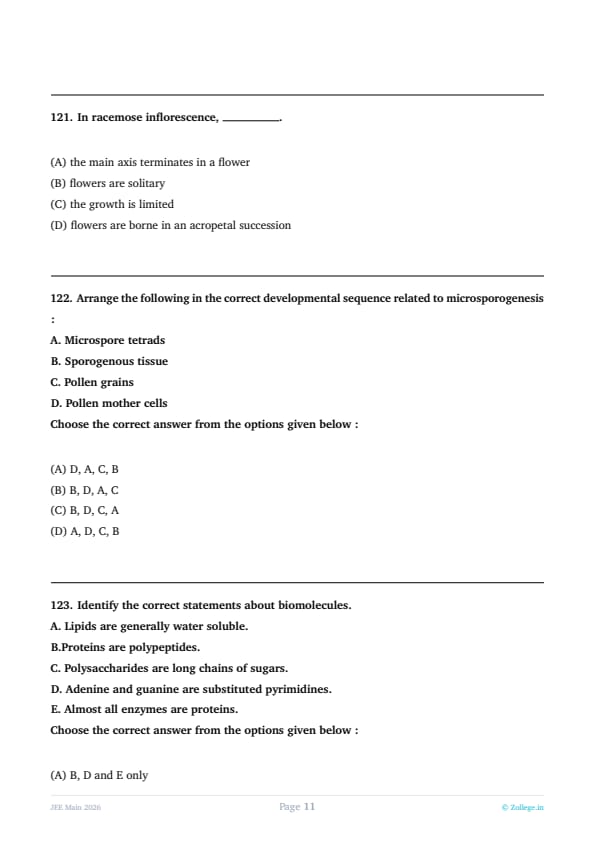
Which of the following statements are not true regarding restriction endonucleases ?
A. They are called molecular scissors.
B. These are the enzymes responsible for restricting the growth of bacteriophages in E. coli.
C. They cut the DNA only at the centre of the palindromic sites.
D. They remove nucleotides only from the ends of DNA fragments.
E. They recognise specific palindromic base-pair sequences.
Choose the answer from the options given below :
View Solution
Step 1 : Understanding the Question
The objective is to identify the false statements concerning the characteristics and functions of restriction endonucleases, which are key tools in gene cloning.
Step 2 : Key Formulas and approach
The approach is to evaluate the biochemical definition of "endonuclease." We must determine if they cut "inside" or at the "ends" and their specific logic for recognizing and cleaving palindromic DNA sequences.
Step 3 : Detailed Explanation
Statement A: They are indeed known as (A) "molecular scissors" because they cleave DNA strands. This is true.
Statement B: Their natural role in bacteria is to (B) restrict the growth of viruses by cutting viral DNA. This is true.
Statement C: They do not always cut at the (C) exact centre. Many enzymes cut slightly away from the centre to create "sticky ends." This statement is false.
Statement D: This describes (D) exonucleases, which remove nucleotides from the ends. Endonucleases cut \textit{within the strand. This statement is false.
Statement E: They recognize specific (E) palindromic sequences (sequences that read same 5' to 3' on both strands). This is true.
Step 4 : Final Answer
Statements C and D are incorrect. Therefore, the correct option is (D).
Quick Tip: Remember: \textbf{Endo = Enter/Inside. \textbf{Exo} = Exit/Ends. Restriction \textbf{Endo}nucleases always cut inside the string. Also, they don't have to be "centered" to be accurate!
In racemose inflorescence, \rule{2cm}{0.4pt}.
View Solution
Step 1 : Understanding the Question
The question asks to identify the characteristic features of a racemose inflorescence, focusing on the growth of the main axis and the arrangement of flowers.
Step 2 : Key Formulas and approach
Inflorescence is divided into Racemose and Cymose. The approach is to contrast the unlimited growth of the former with the limited growth of the latter, specifically noting the sequence of flower production.
Step 3 : Detailed Explanation
Main Axis Growth: In (A) racemose inflorescence, the main axis continues to grow indefinitely. It does not end in a flower, meaning its growth is not limited.
Flower Arrangement: The flowers are produced laterally in an (B) acropetal succession. This means that the oldest flowers are at the base, and the youngest buds are at the apex.
Comparison: In (C) cymose inflorescence, the main axis terminates in a flower, resulting in limited growth. The flowers there are arranged in a basipetal order (oldest at top).
Option Check: Options (A) and (C) define cymose. Option (D) correctly defines the primary trait of racemose.
Step 4 : Final Answer
In racemose inflorescence, flowers are arranged in an acropetal succession. Thus, the correct answer is (D).
Quick Tip: \textbf{R}acemose = \textbf{R}unning axis (it doesn't stop). \textbf{C}ymose = \textbf{C}losed axis (it stops with a flower). In Racemose, the "babies" (buds) are always at the top!
Arrange the following in the correct developmental sequence related to microsporogenesis :
A. Microspore tetrads
B. Sporogenous tissue
C. Pollen grains
D. Pollen mother cells
Choose the \textbf{correct} answer from the options given below :
View Solution
Step 1 : Understanding the Question
This question focuses on the anatomical development within the anther, requiring the correct chronological order of structures formed during the production of pollen.
Step 2 : Key Formulas and approach
The approach is to trace the biological maturation: \(Mass of cells \rightarrow Differentiation \rightarrow Meiosis \rightarrow Individual Gametophytes\).
Step 3 : Detailed Explanation
Stage 1 (B): A young anther has a center filled with (A) sporogenous tissue, which is a group of homogenous, diploid cells.
Stage 2 (D): As development proceeds, cells of this tissue differentiate into (B) Pollen Mother Cells (PMC). Each PMC is capable of undergoing meiosis.
Stage 3 (A): Each PMC divides meiotically to produce four haploid cells that remain attached, known as a (C) microspore tetrad.
Stage 4 (C): Upon dehydration and maturation of the anther, the tetrad breaks apart, and individual cells develop into (D) pollen grains.
Step 4 : Final Answer
The sequence is B \(\rightarrow\) D \(\rightarrow\) A \(\rightarrow\) C. This corresponds to option (B).
Quick Tip: Remember the path: \textbf{Tissue} (group) \(\rightarrow\) \textbf{Mother} (individual cell) \(\rightarrow\) \textbf{Tetrad} (four kids) \(\rightarrow\) \textbf{Pollen} (independent adults).
Identify the correct statements about biomolecules.
A. Lipids are generally water soluble.
B.Proteins are polypeptides.
C. Polysaccharides are long chains of sugars.
D. Adenine and guanine are substituted pyrimidines.
E. Almost all enzymes are proteins.
Choose the \textbf{correct} answer from the options given below :
View Solution
Step 1 : Understanding the Question
This is a conceptual check of biomolecular classifications and chemical properties, covering lipids, proteins, carbohydrates, nucleic acids, and enzymes.
Step 2 : Key Formulas and approach
The approach is to evaluate the biochemical validity of each statement. We look for correct definitions of polymers, solubility, and nitrogenous base categories.
Step 3 : Detailed Explanation
Statement A: Lipids are hydrophobic and (A) insoluble in water. Statement A is false.
Statement B: Proteins are polymers of amino acids linked by peptide bonds, thus they are (B) polypeptides. Statement B is true.
Statement C: Polysaccharides are indeed (C) long chains of monosaccharides (sugars). Statement C is true.
Statement D: Adenine and Guanine are (D) Purines. Statement D is false.
Statement E: While ribozymes (RNA enzymes) exist, the (E) majority of enzymes are proteins. Statement E is true.
Step 4 : Final Answer
Statements B, C, and E are correct. Therefore, the correct choice is option (B).
Quick Tip: To remember nitrogenous bases, use: \textbf{PU}re \textbf{A}s \textbf{G}old (\textbf{PU}rines = \textbf{A}, \textbf{G}) and \textbf{CUT} the \textbf{PY} (\textbf{C}, \textbf{U}, \textbf{T} = \textbf{PY}rimidines).
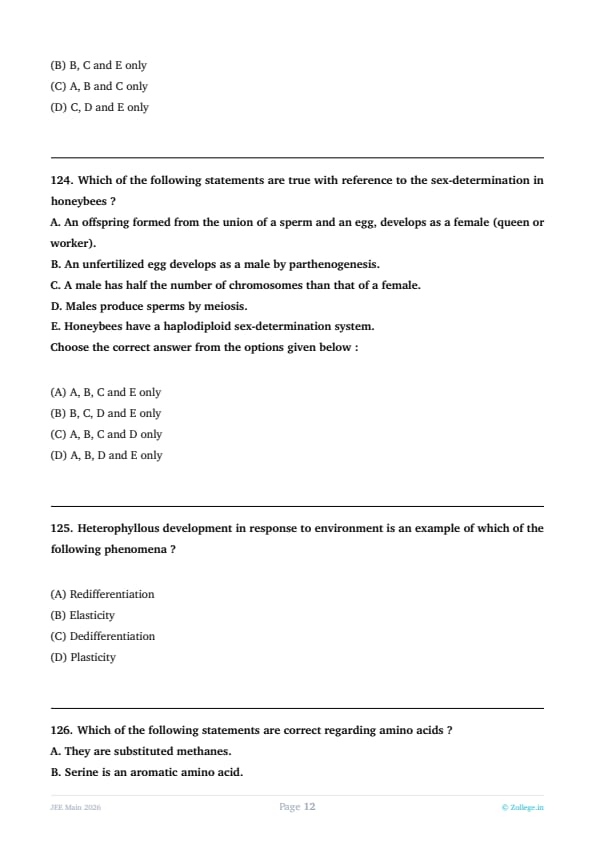
Which of the following statements are true with reference to the sex-determination in honeybees ?
A. An offspring formed from the union of a sperm and an egg, develops as a female (queen or worker).
B. An unfertilized egg develops as a male by parthenogenesis.
C. A male has half the number of chromosomes than that of a female.
D. Males produce sperms by meiosis.
E. Honeybees have a haplodiploid sex-determination system.
Choose the \textbf{correct} answer from the options given below :
View Solution
Step 1 : Understanding the Question
The question explores the haplodiploid mechanism of sex determination in honeybees, where the ploidy level (number of chromosome sets) determines sex.
Step 2 : Key Formulas and approach
Approach based on chromosome counts:
1. Female = 32 (2n).
2. Male = 16 (n).
We check the processes of fertilization and gametogenesis.
Step 3 : Detailed Explanation
Fertilization (A): Fusion of sperm and egg leads to a diploid zygote, which (A) develops into a female. Statement A is true.
Parthenogenesis (B): Males develop from (B) unfertilized eggs, a process called parthenogenesis. Statement B is true.
Ploidy (C): Because they come from haploid eggs, (C) males have 16 chromosomes while females have 32. Statement C is true.
Gametogenesis (D): Since males are already haploid, they (D) produce sperm via mitosis, not meiosis. Statement D is false.
Classification (E): This system is correctly called (E) haplodiploid. Statement E is true.
Step 4 : Final Answer
Statements A, B, C, and E are true. This corresponds to option (A).
Quick Tip: Honeybee males are "Grandson-only" creatures. They have no father and cannot have sons, but they do have a grandfather and can have grandsons! Also, remember: \textbf{Male = Mitosis}.
Heterophyllous development in response to environment is an example of which of the following phenomena ?
View Solution
Step 1 : Understanding the Question
This question asks to identify the biological term for the plant's ability to alter its structural development (like leaf shape) based on external environmental factors.
Step 2 : Key Formulas and approach
The approach involves identifying the definition of "Plasticity" and applying the example of heterophylly (different leaf types) seen in specific plants.
Step 3 : Detailed Explanation
Defining Plasticity: (A) Plasticity is the capability of a plant to follow different developmental pathways in response to environmental stimuli or life phases.
Heterophylly Example: In plants like cotton or coriander, leaf shapes differ between (B) juvenile and adult stages. This is developmental plasticity.
Environmental Heterophylly: In the buttercup (Ranunculus), the leaves (C) grown in water look significantly different from those (D) grown in air. This adaptation to habitat is environmental plasticity.
Incorrect Terms: Dedifferentiation and Redifferentiation refer to cellular maturation processes, not morphological flexibility.
Step 4 : Final Answer
The ability to produce different leaf types in response to the environment is Plasticity. Thus, the correct option is (D).
Quick Tip: Think of \textbf{Plasticity like "Plastic" – it can be molded into different shapes. The plant "molds" its leaves to fit whether it is living in water or on land.
Which of the following statements are correct regarding amino acids ?
A. They are substituted methanes.
B. Serine is an aromatic amino acid.
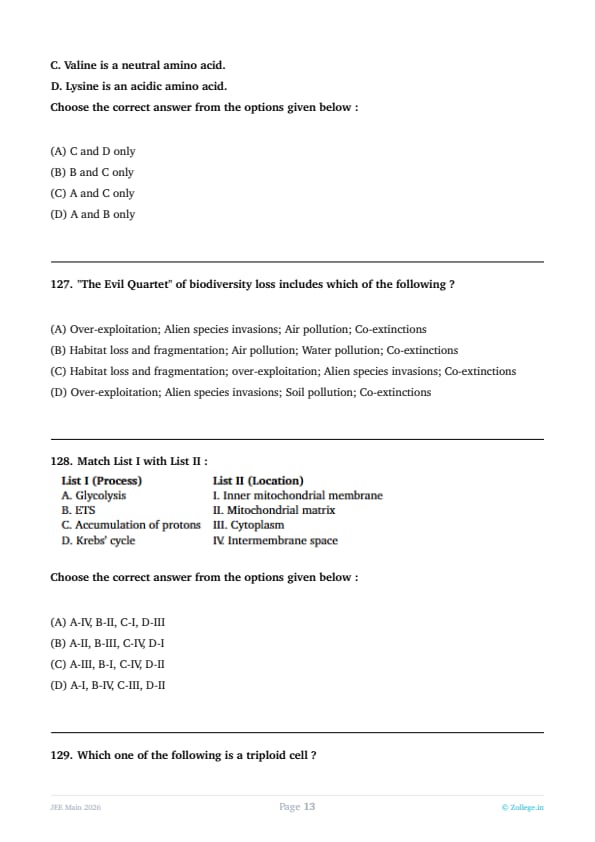
C. Valine is a neutral amino acid.
D. Lysine is an acidic amino acid.
Choose the \textbf{correct} answer from the options given below :
View Solution
Step 1 : Understanding the Question
The question requires verification of the chemical structure and side-chain classification of specific amino acids.
Step 2 : Key Formulas and approach
Approach by checking the general formula \(R-CH(NH_2)COOH\) and the specific properties of the "R" group for Serine, Valine, and Lysine.
Step 3 : Detailed Explanation
Structure (A): Amino acids are considered (A) substituted methanes because the alpha-carbon is bonded to four different groups, replacing the hydrogens of \(CH_4\). This is true.
Serine (B): Serine is a hydroxy-amino acid, (B) not aromatic. Aromatic ones are Tyrosine, Phenylalanine, and Tryptophan. This is false.
Valine (C): Valine has a non-polar side chain and one of each functional group, making it (C) neutral. This is true.
Lysine (D): Lysine is a (D) basic amino acid, not acidic. Statement D is false.
Step 4 : Final Answer
Only A and C are correct. Thus, the correct choice is option (C).
Quick Tip: Remember: \textbf{Acidic} = Glutamate/Aspartate. \textbf{Basic} = Lysine/Arginine (\textbf{B}asic \textbf{L}ike \textbf{A}lkali). \textbf{Aromatic} = \textbf{P}TT.
"The Evil Quartet" of biodiversity loss includes which of the following ?
View Solution
Step 1 : Understanding the Question
This question identifies the four major causes of modern species extinctions, collectively referred to by ecologists as "The Evil Quartet."
Step 2 : Key Formulas and approach
The approach is to recall the specific four factors listed in conservation textbooks. We must look for the combination that includes habitat damage and interaction-based loss.
Step 3 : Detailed Explanation
Habitat Loss (1): The primary driver of extinction. This involves (A) destroying or breaking habitats into fragments.
Over-exploitation (2): Humans harvesting species (B) faster than they can regenerate.
Alien Species (3): Introducing non-native species that (C) outcompete or prey on native ones.
Co-extinctions (4): When a species dies, any (D) obligate associate (like a parasite) also dies.
Analysis: Pollution, while harmful, is not one of the four components of the "Evil Quartet" defined in the standard curriculum.
Step 4 : Final Answer
The correct set is option (C).
Quick Tip: Use the mnemonic \textbf{H-O-A-C} for the Evil Quartet: \textbf{H}abitat loss, \textbf{O}ver-exploitation, \textbf{A}lien species, and \textbf{C}o-extinction. Note: \textbf{Pollution} is NOT in this specific group!
Match List I with List II :

Choose the \textbf{correct} answer from the options given below :
View Solution
Step 1 : Understanding the Question
This question focuses on cellular respiration, requiring the matching of metabolic processes with their specific anatomical locations within the cell.
Step 2 : Key Formulas and approach
The approach involves mental mapping: \(Cytoplasm \rightarrow Outer Membrane \rightarrow Intermembrane Space \rightarrow Inner Membrane \rightarrow Matrix\).
Step 3 : Detailed Explanation
Glycolysis (A): Occurs in the (A) cytoplasm. It is the universal first step. (A-III).
ETS (B): The electron transport chain is located on the (B) inner mitochondrial membrane. (B-I).
Proton Pool (C): During ETS, protons are pumped into the (C) intermembrane space. (C-IV).
Krebs' Cycle (D): This enzymatic cycle occurs in the fluid (D) mitochondrial matrix. (D-II).
Step 4 : Final Answer
The correct matching is A-III, B-I, C-IV, D-II. This is found in option (C).
Quick Tip: Remember: \textbf{Glycolysis} is the "outsider" (Cytoplasm). Everything else is "inside" the house (Mitochondria). \textbf{Krebs} is in the "Kitchen" (Matrix), and \textbf{ETS} is on the "Walls" (Membrane).
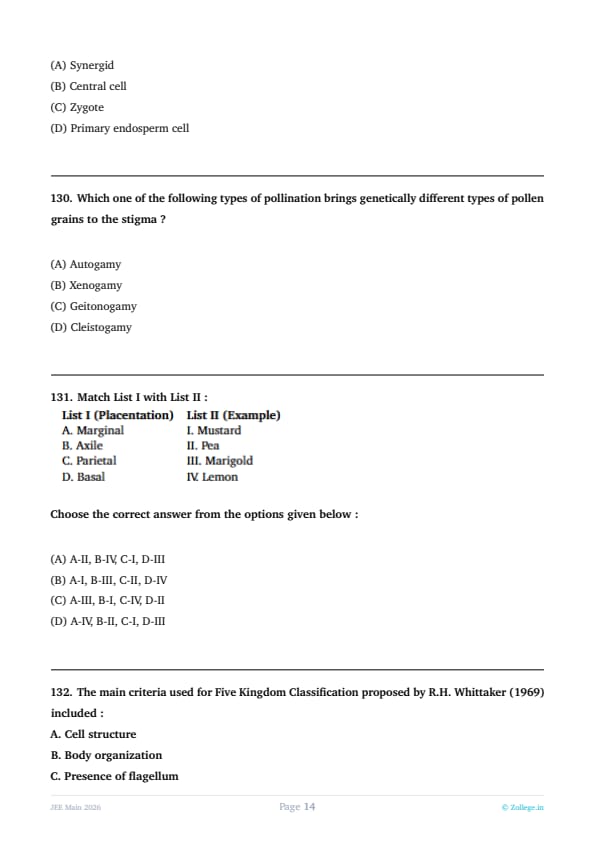
Which one of the following is a triploid cell ?
View Solution
Step 1 : Understanding the Question
This question identifies the cell type in an angiosperm that contains three sets of chromosomes (3n).
Step 2 : Key Formulas and approach
The approach is based on "Double Fertilization":
1. \(Egg(n) + Sperm(n) = 2n\).
2. \(Polar nuclei(n+n) + Sperm(n) = 3n\).
Step 3 : Detailed Explanation
Synergids (A): These are (A) haploid (n).
Central Cell (B): Before fusion, it is (B) dikaryotic (\(n+n\)).
Zygote (C): The product of syngamy, which is (C) diploid (\(2n\)).
PEC (D): Triple fusion produces a triploid nucleus in the (D) Primary Endosperm Cell.
Step 4 : Final Answer
The PEC is triploid. Thus, option (D) is correct.
Quick Tip: Think of the name: \textbf{Triple} fusion leads to a \textbf{Triploid} (\(3n\)) endosperm. This is a 3-course meal for the embryo!
Which one of the following types of pollination brings genetically different types of pollen grains to the stigma ?
View Solution
Step 1 : Understanding the Question
Identify the type of pollination that involves a different genetic source.
Step 2 : Key Formulas and approach
\(Same flower \rightarrow Autogamy\). \(Same plant \rightarrow Geitonogamy\). \(Different plant \rightarrow Xenogamy\).
Step 3 : Detailed Explanation
Autogamy (A): Self-pollination within (A) one flower. No variation.
Cleistogamy (D): Pollination in (B) closed flowers. No variation.
Geitonogamy (C): Functionally cross-pollination but (C) genetically selfing as it's on the same plant.
Xenogamy (B): Pollen comes from a (D) different plant, ensuring genetic variation.
Step 4 : Final Answer
Xenogamy is the correct answer (B).
Quick Tip: \textbf{Xeno} means "stranger" or "foreign." So, \textbf{Xenogamy} is pollination by a stranger (a different plant).
Match List I with List II :

Choose the \textbf{correct} answer from the options given below :
View Solution
Step 1 : Understanding the Question
Match placentation types with their respective examples.
Step 2 : Key Formulas and approach
Recall the arrangement of ovules in Pea, Lemon, Mustard, and Marigold.
Step 3 : Detailed Explanation
Marginal (A): Ridge-like attachment seen in (A) Pea. (A-II).
Axile (B): Central axial attachment seen in (B) Lemon. (B-IV).
Parietal (C): Peripheral wall attachment seen in (C) Mustard. (C-I).
Basal (D): Base attachment seen in (D) Marigold. (D-III).
Step 4 : Final Answer
Match is A-II, B-IV, C-I, D-III. Option (A) is correct.
Quick Tip: Remember the "Placenta Pointers": \textbf{M}arginal = \textbf{M}atte (Pea), \textbf{A}xile = \textbf{A}cidic (Lemon), \textbf{P}arietal = \textbf{P}ungent (Mustard), and \textbf{B}asal = \textbf{B}eautiful (Marigold).
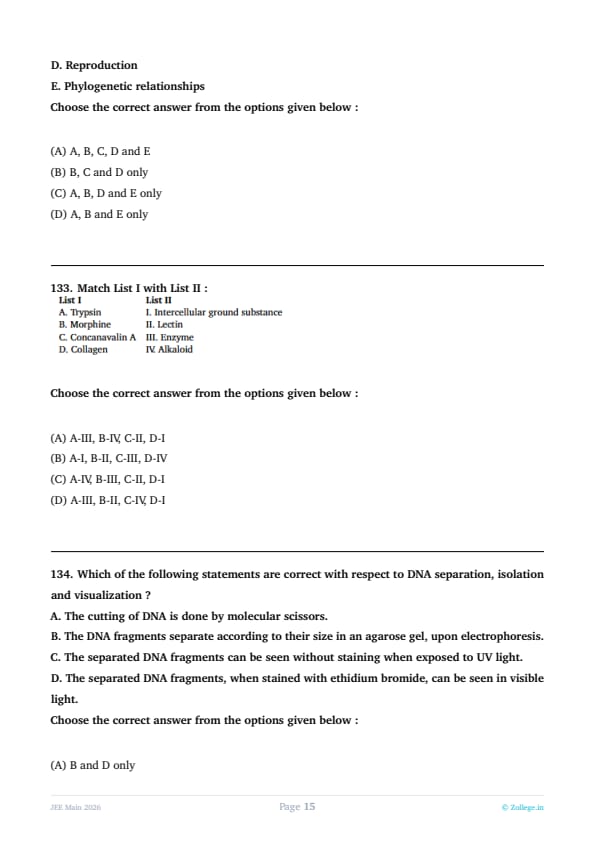
The main criteria used for Five Kingdom Classification proposed by R.H. Whittaker (1969) included :
A. Cell structure
B. Body organization
C. Presence of flagellum
D. Reproduction
E. Phylogenetic relationships
Choose the \textbf{correct} answer from the options given below :
View Solution
Step 1 : Understanding the Question
Identify Whittaker's classification criteria.
Step 2 : Key Formulas and approach
Whittaker's system used five broad macro-level traits.
Step 3 : Detailed Explanation
Primary Criteria: (A) Cell structure, (B) Body organization, (D) Reproduction, and (E) Phylogeny were all used.
Omission: (C) Presence of flagellum was not a primary kingdom-level criterion.
Step 4 : Final Answer
The answer is A, B, D, and E (Option C).
Quick Tip: Whittaker’s "Big 5" criteria: \textbf{R-C-B-N-P}: \textbf{R}eproduction, \textbf{C}ell structure, \textbf{B}ody plan, \textbf{N}utrition, and \textbf{P}hylogeny.
Match List I with List II :

Choose the \textbf{correct} answer from the options given below :
View Solution
Step 1 : Understanding the Question
Match chemical substances with their functional categories.
Step 2 : Key Formulas and approach
Identify digestive catalysts, plant alkaloids, structural proteins, and carbohydrate binders.
Step 3 : Detailed Explanation
Trypsin (A): A digestive (A) enzyme. (A-III).
Morphine (B): A secondary metabolite classified as an (B) alkaloid. (B-IV).
Concanavalin A (C): A sugar-binding (C) lectin. (C-II).
Collagen (D): A structural (D) ground substance. (D-I).
Step 4 : Final Answer
Correct match is A-III, B-IV, C-II, D-I. Option (A) is correct.
Quick Tip: Remember: \textbf{Trypsin} is a "Tool" (Enzyme), \textbf{Morphine} is a "Med" (Alkaloid), \textbf{Con-A} is a "Clinger" (Lectin).
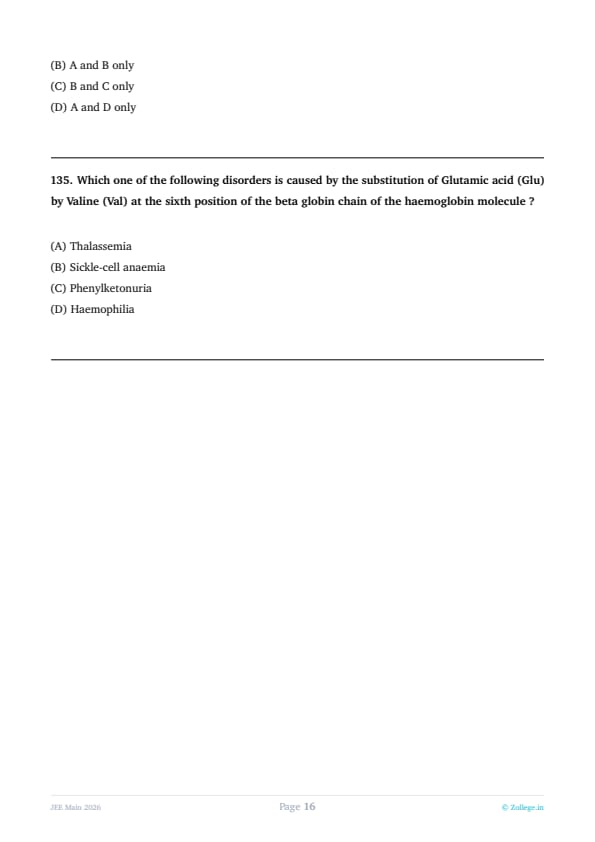
Which of the following statements are correct with respect to DNA separation, isolation and visualization ?
A. The cutting of DNA is done by molecular scissors.
B. The DNA fragments separate according to their size in an agarose gel, upon electrophoresis.
C. The separated DNA fragments can be seen without staining when exposed to UV light.
D. The separated DNA fragments, when stained with ethidium bromide, can be seen in visible light.
Choose the \textbf{correct} answer from the options given below :
View Solution
Step 1 : Understanding the Question
Verify biotech procedures for DNA handling.
Step 2 : Key Formulas and approach
Evaluate the cutting mechanism and the staining requirements for visualization.
Step 3 : Detailed Explanation
Statement A: Correct. Enzymes cut DNA.
Statement B: Correct. Agarose sieves by size.
Statement C: Incorrect. Staining is mandatory.
Statement D: Incorrect. UV light is mandatory with EtBr.
Step 4 : Final Answer
Only A and B are correct (Option B).
Quick Tip: To see DNA, you need the "Dynamic Duo": \textbf{Ethidium Bromide + UV Light}.
Which one of the following disorders is caused by the substitution of Glutamic acid (Glu) by Valine (Val) at the sixth position of the beta globin chain of the haemoglobin molecule ?
View Solution
Step 1 : Understanding the Question
Identify the disorder caused by a specific point mutation in hemoglobin.
Step 2 : Key Formulas and approach
\(GAG (Glu) \rightarrow GUG (Val)\).
Step 3 : Detailed Explanation
The Mutation: (A) Sickle-cell anaemia involves replacing Glu with Val.
Position: This occurs at the 6th position of the beta chain.
Effect: RBCs become (B) sickle-shaped under low oxygen.
Step 4 : Final Answer
Correct answer is Sickle-cell anaemia (B).
Quick Tip: Remember the mnemonic: \textbf{G}lu is \textbf{G}ood (Normal), but \textbf{V}al is \textbf{V}ile (Sickle).
NEET 2026 Botany Revision
*The article might have information for the previous academic years, please refer the official website of the exam.