
NEET 2026 Botany Question Paper with Solutions PDF(Code 12)
- Answer Key
- Merit List
- Seat Inkate
- Tripura Counselling
- Nagaland Counselling
- Kerala Counselling
- UP Counselling
- Assam Counselling
- West Bengal Counselling
- MP Counselling
- Haryana Counselling
- Chhattisgarh Counselling
- Gujarat Counselling
- Participating Colleges
- AP Counselling
- Manipur Counselling
- Mark Vs Rank
- Mizoram NEET Counselling
- Ayush Counselling
- TN NEET Counselling
- Andhra Pradesh Counsellin
- Karnataka NEET Counsellin
- Jharkhand NEET Counsellin
- MH NEET Counselling
- Bihar NEET Counselling
- Counselling
- Seat Allotment


Content Curator | Updated On - Jun 17, 2026
NTA conducted the NEET Exam on May 3 in a single shift from 2 PM to 5 PM in PBT Mode.
The NEET 2026 Botany Question Paper includes 45 Questions carrying a total of 180 Marks. As per the NEET Marking Scheme, +4 marks are awarded for every correct answer, and -1 mark will be deducted for every wrong answer.
NEET 2026 Botany Question Paper with Solution PDF (Code 12) is available here for download.
NEET 2026 Botany Question Paper with Solution PDF(Code 12)
| NEET 2026 Botany Question Paper (Code 12) | Download PDF | Check Solution |
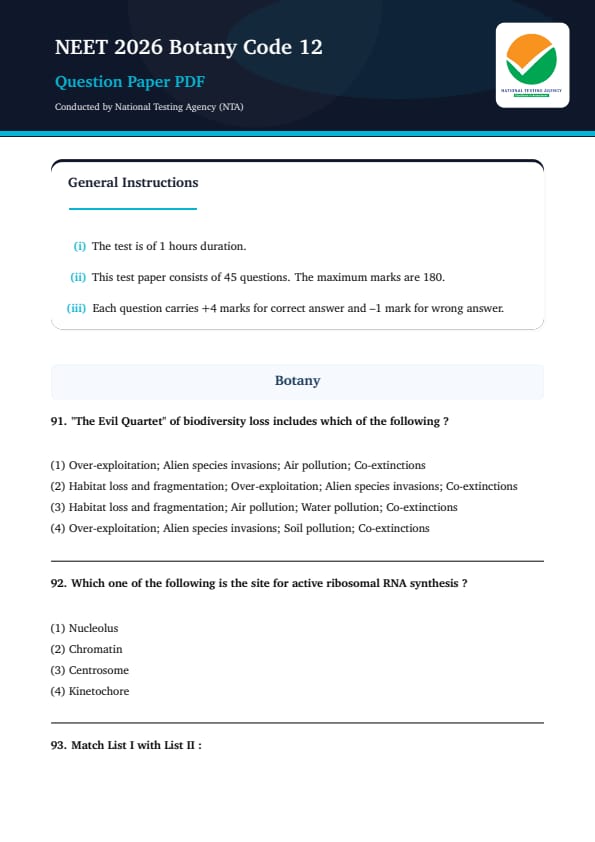
"The Evil Quartet" of biodiversity loss includes which of the following ?
View Solution
Step 1: Understanding the Concept:
"The Evil Quartet" is a term used to describe the four major causes of accelerated rates of species extinction in the world today.
Step 2: Detailed Explanation:
The four components are:
1. Habitat loss and fragmentation: This is the most important cause driving animals and plants to extinction (e.g., tropical rainforests).
2. Over-exploitation: When 'need' turns to 'greed', it leads to over-exploitation of natural resources (e.g., Steller's sea cow, passenger pigeon).
3. Alien species invasions: When alien species are introduced into a new habitat, some of them turn invasive and cause decline or extinction of indigenous species (e.g., Nile perch in Lake Victoria).
4. Co-extinctions: When a species becomes extinct, the plant and animal species associated with it in an obligatory way also become extinct (e.g., co-evolved plant-pollinator mutualism).
Pollution (Air, Water, or Soil) is a threat to biodiversity but is not considered one of the primary "Evil Quartet" factors.
Step 3: Final Answer:
The correct set is provided in option (2).
Quick Tip: To remember the Quartet, use the mnemonic: {H.O.A.C.} (Habitat loss, Over-exploitation, Alien species, Co-extinctions). Habitat loss is always considered the number one threat.
Which one of the following is the site for active ribosomal RNA synthesis ?
View Solution
Step 1: Understanding the Concept:
The nucleolus is a non-membrane bound, dense structure found within the nucleus of eukaryotic cells.
Step 2: Detailed Explanation:
1. Nucleolus: It is the site for active ribosomal RNA (rRNA) synthesis. Larger and more numerous nucleoli are present in cells actively carrying out protein synthesis.
2. Chromatin: It is a complex of DNA and proteins that forms chromosomes.
3. Centrosome: An organelle that serves as the main microtubule organizing center (MTOC) of the animal cell.
4. Kinetochore: A disc-shaped protein structure on the centromere to which spindle fibers attach during cell division.
Step 3: Final Answer:
The nucleolus is the site for rRNA synthesis.
Quick Tip: Think of the nucleolus as the "Ribosome Factory." It assembles the subunits that later migrate to the cytoplasm to build proteins.
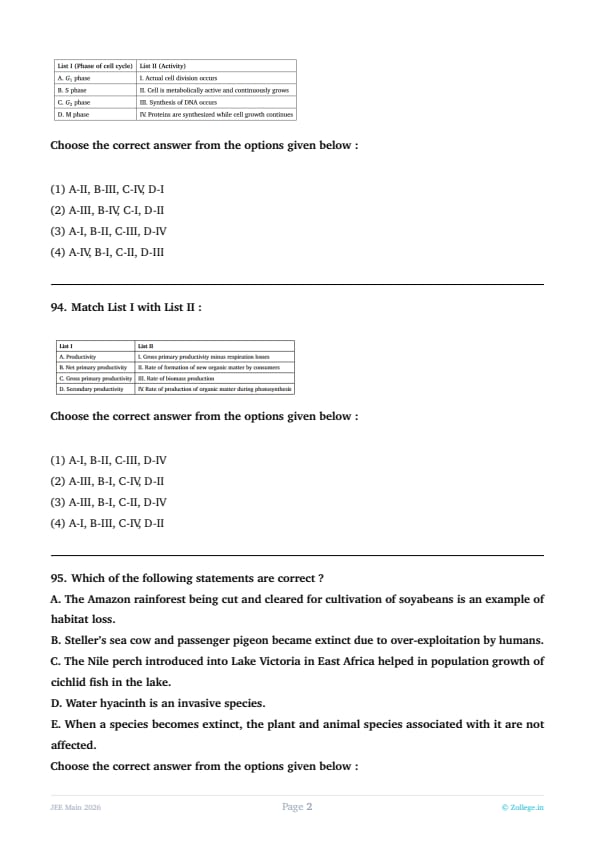
Match List I with List II :

Choose the correct answer from the options given below :
View Solution
Step 1: Understanding the Concept:
The cell cycle consists of Interphase (\( G_1, S, G_2 \)) and the M-phase (Mitosis). Each stage has specific molecular and cellular activities.
Step 2: Detailed Explanation:
A. \( G_1 \) phase: This is the interval between mitosis and initiation of DNA replication. The cell is metabolically active and grows but does not replicate DNA. (A \(\rightarrow\) II).
B. S phase: DNA synthesis or replication takes place. The amount of DNA per cell doubles. (B \(\rightarrow\) III).
C. \( G_2 \) phase: Proteins (like tubulin) are synthesized in preparation for mitosis while cell growth continues. (C \(\rightarrow\) IV).
D. M phase: This is the most dramatic period of the cell cycle, where the actual cell division occurs. (D \(\rightarrow\) I).
Step 3: Final Answer:
The correct matching is A-II, B-III, C-IV, D-I.
Quick Tip: Remember: S = Synthesis (DNA), M = Mitosis (Division). The \( G_1 \) and \( G_2 \) are "Gap" phases where the cell prepares by growing and making proteins.
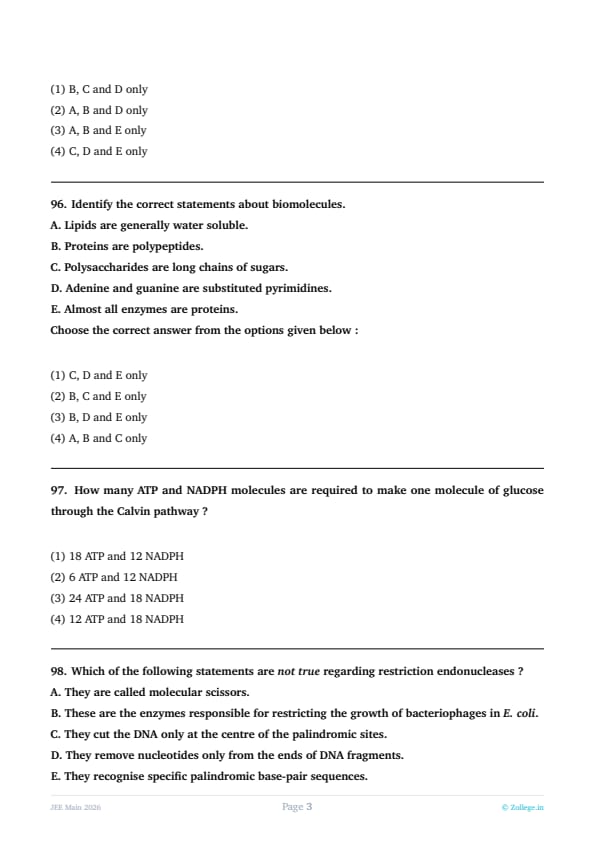
Match List I with List II :

Choose the correct answer from the options given below :
View Solution
Step 1: Understanding the Concept:
Productivity in an ecosystem refers to the rate of biomass production. It is divided into primary (plants) and secondary (consumers) productivity.
Step 2: Detailed Explanation:
A. Productivity: The general rate of biomass production. (A \(\rightarrow\) III).
B. Net Primary Productivity (NPP): The available biomass for the consumption of heterotrophs, calculated as \( GPP - R = NPP \). (B \(\rightarrow\) I).
C. Gross Primary Productivity (GPP): The total rate of production of organic matter during photosynthesis. (C \(\rightarrow\) IV).
D. Secondary Productivity: The rate of formation of new organic matter by consumers (heterotrophs). (D \(\rightarrow\) II).
Step 3: Final Answer:
The correct matching is A-III, B-I, C-IV, D-II.
Quick Tip: GPP is the "Total Salary" of the ecosystem, Respiration is the "Taxes", and NPP is the "Take-home pay" available for consumers.
Which of the following statements are correct ?
A. The Amazon rainforest being cut and cleared for cultivation of soyabeans is an example of habitat loss.
B. Steller's sea cow and passenger pigeon became extinct due to over-exploitation by humans.
C. The Nile perch introduced into Lake Victoria in East Africa helped in population growth of cichlid fish in the lake.
D. Water hyacinth is an invasive species.
E. When a species becomes extinct, the plant and animal species associated with it are not affected.
Choose the correct answer from the options given below :
View Solution
Step 1: Understanding the Concept:
This question covers ecological issues and biodiversity loss factors.
Step 2: Detailed Explanation:
A. Correct: Clearing the Amazon rainforest for soyabean cultivation or grasslands for beef cattle is a classic example of habitat loss.
B. Correct: Over-exploitation by humans led to the extinction of Steller's sea cow and the passenger pigeon.
C. Incorrect: The Nile perch was an invasive alien species that led to the extinction of an ecologically unique assemblage of more than 200 species of cichlid fish in the lake.
D. Correct: Water hyacinth ({Eichhornia crassipes) is the world's most problematic aquatic weed and an invasive species in India.
E. Incorrect: Co-extinction occurs when the extinction of one species leads to the extinction of another that is obligatorily associated with it.
Step 3: Final Answer:
Statements A, B, and D are correct.
Quick Tip: Nile perch is the "villain" of Lake Victoria. Whenever you see it "helping" other fish in a statement, that statement is almost certainly false.
Identify the correct statements about biomolecules.
A. Lipids are generally water soluble.
B. Proteins are polypeptides.
C. Polysaccharides are long chains of sugars.
D. Adenine and guanine are substituted pyrimidines.
E. Almost all enzymes are proteins.
Choose the correct answer from the options given below :
View Solution
Step 1: Understanding the Concept:
Biomolecules like proteins, lipids, carbohydrates, and nucleic acids have specific chemical properties and structures.
Step 2: Detailed Explanation:
A. Incorrect: Lipids are generally water insoluble (hydrophobic).
B. Correct: Proteins are linear chains of amino acids linked by peptide bonds, hence they are polypeptides.
C. Correct: Polysaccharides are polymers of monosaccharides (sugars) linked by glycosidic bonds.
D. Incorrect: Adenine and Guanine are purines (double-ring structures), whereas Cytosine, Thymine, and Uracil are pyrimidines.
E. Correct: Most enzymes are proteins, though some RNA molecules (ribozymes) also act as enzymes.
Step 3: Final Answer:
Statements B, C, and E are correct.
Quick Tip: Purines are "Pure As Gold" (Adenine, Guanine). Pyrimidines are "Cut The Pie" (Cytosine, Uracil, Thymine). This helps distinguish nitrogenous bases easily.
How many ATP and NADPH molecules are required to make one molecule of glucose through the Calvin pathway ?
View Solution
Step 1: Understanding the Concept:
The Calvin cycle (C3 pathway) is the light-independent phase of photosynthesis where \( CO_2 \) is fixed into glucose.
Step 2: Detailed Explanation:
For every \( CO_2 \) molecule entering the Calvin cycle, 3 molecules of ATP and 2 molecules of NADPH are required.
To produce one molecule of glucose (\( C_6H_{12}O_6 \)), 6 turns of the Calvin cycle are needed.
Total ATP = \( 6 \times 3 = 18 ATP \)
Total NADPH = \( 6 \times 2 = 12 NADPH \)
Step 3: Final Answer:
The requirement is 18 ATP and 12 NADPH.
Quick Tip: Remember the ratio 3:2 (ATP:NADPH) per \( CO_2 \). For glucose, multiply the ratio by 6. In \( C_4 \) plants, the requirement is higher (30 ATP and 12 NADPH).
Which of the following statements are not true regarding restriction endonucleases ?
A. They are called molecular scissors.
B. These are the enzymes responsible for restricting the growth of bacteriophages in E. coli.
C. They cut the DNA only at the centre of the palindromic sites.
D. They remove nucleotides only from the ends of DNA fragments.
E. They recognise specific palindromic base-pair sequences.
Choose the answer from the options given below :
View Solution
Step 1: Understanding the Concept:
Restriction enzymes are endonucleases that cut DNA at specific recognition sequences.
Step 2: Detailed Explanation:
A. True: They are famously known as molecular scissors.
B. True: They naturally occur in bacteria as a defense mechanism to "restrict" viral (bacteriophage) DNA.
C. Not True: Most restriction enzymes cut the two strands of DNA at a point a little away from the center of the palindromic sites, but between the same two bases on the opposite strands, creating "sticky ends". Some (like SmaI) cut at the center to create "blunt ends".
D. Not True: This is the definition of exonucleases. Endonucleases cut {within the DNA at specific sites.
E. True: Each restriction endonuclease recognizes a specific palindromic sequence (e.g., GAATTC for EcoRI).
Step 3: Final Answer:
Statements C and D are not true.
Quick Tip: "Endo" means inside, "Exo" means outside. Endonucleases cut the interior of the DNA molecule, while exonucleases chew away at the ends.
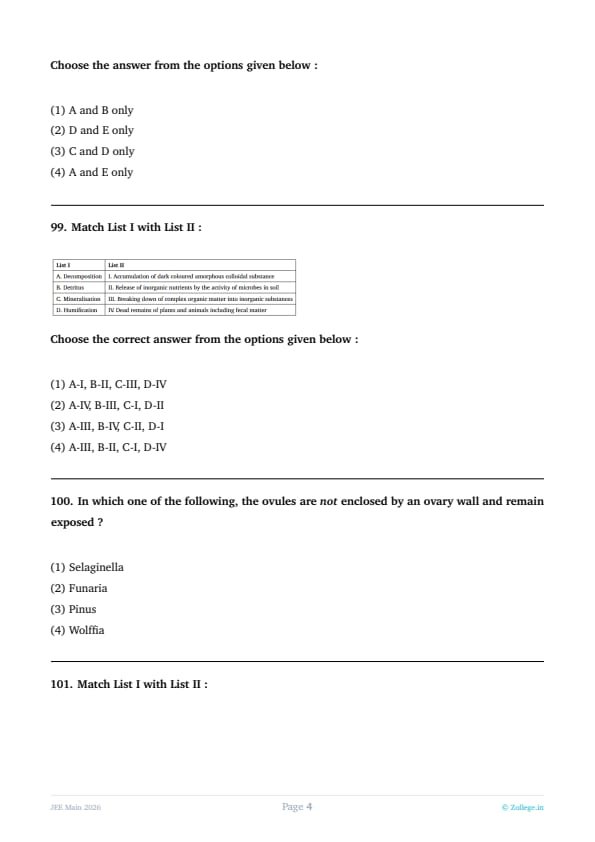
Match List I with List II :

Choose the correct answer from the options given below :
View Solution
Step 1: Understanding the Concept:
Decomposition is the process where decomposers break down complex organic matter into inorganic substances like \( CO_2 \), water, and nutrients.
Step 2: Detailed Explanation:
A. Decomposition: The overall process of breaking down complex organic matter. (A \(\rightarrow\) III).
B. Detritus: The raw material for decomposition, consisting of dead remains and fecal matter. (B \(\rightarrow\) IV).
C. Mineralisation: The final step where some microbes further degrade humus and release inorganic nutrients into the soil. (C \(\rightarrow\) II).
D. Humification: The process leading to the accumulation of a dark coloured amorphous substance called humus. (D \(\rightarrow\) I).
Step 3: Final Answer:
The correct matching is A-III, B-IV, C-II, D-I.
Quick Tip: Remember the order: Fragmentation \(\rightarrow\) Leaching \(\rightarrow\) Catabolism \(\rightarrow\) Humification \(\rightarrow\) Mineralisation. Humification creates "dark humus", Mineralisation releases "inorganic minerals".
In which one of the following, the ovules are not enclosed by an ovary wall and remain exposed ?
View Solution
Step 1: Understanding the Concept:
Naked seeds (ovules not enclosed by an ovary) are a characteristic feature of the plant group Gymnosperms.
Step 2: Detailed Explanation:
1. Pinus: It is a Gymnosperm. Gymnosperms are plants in which the ovules are not enclosed by any ovary wall and remain exposed, both before and after fertilization.
2. Wolffia: It is an Angiosperm (the smallest flowering plant), where ovules are enclosed in an ovary.
3. Selaginella: It is a Pteridophyte (vascular cryptogam). They produce spores, not seeds.
4. Funaria: It is a Bryophyte (moss). They produce spores and do not have seeds or ovules.
Step 3: Final Answer:
Pinus has exposed ovules.
Quick Tip: The word "Gymnosperm" literally means "naked seed" ({gymnos = naked, sperma = seed). If a question mentions exposed ovules or naked seeds, look for a gymnosperm like Pinus or Cycas.
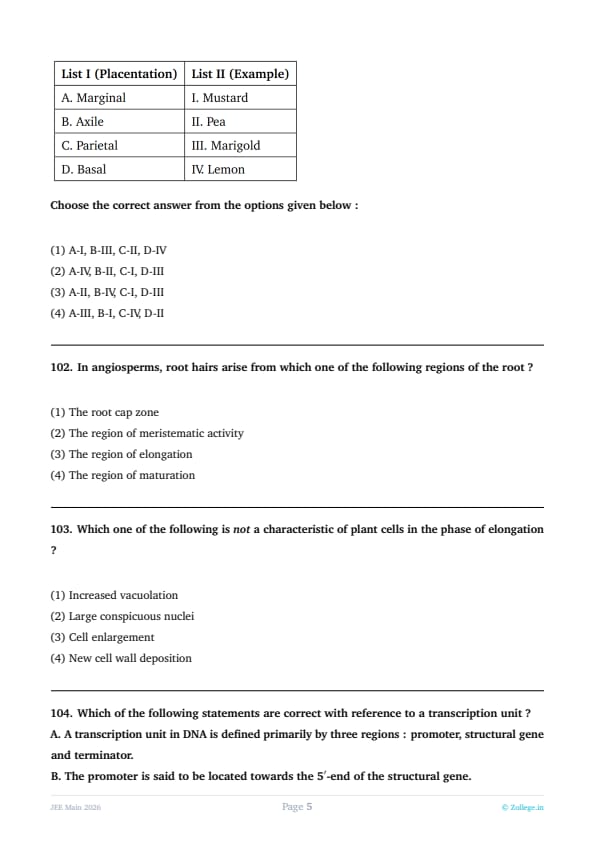
Match List I with List II :

Choose the correct answer from the options given below :
View Solution
Step 1: Understanding the Concept:
Placentation refers to the arrangement of ovules within the ovary. Different plant families exhibit distinct types of placentation.
Step 2: Detailed Explanation:
A. Marginal Placentation: The placenta forms a ridge along the ventral suture of the ovary and the ovules are borne on this ridge forming two rows. Example: Pea. (A \(\rightarrow\) II).
B. Axile Placentation: The placenta is axial and the ovules are attached to it in a multilocular ovary. Examples: Lemon, Tomato, China rose. (B \(\rightarrow\) IV).
C. Parietal Placentation: The ovules develop on the inner wall of the ovary or on peripheral part. Example: Mustard, Argemone. (C \(\rightarrow\) I).
D. Basal Placentation: The placenta develops at the base of the ovary and a single ovule is attached to it. Examples: Marigold, Sunflower. (D \(\rightarrow\) III).
The correct sequence is A-II, B-IV, C-I, D-III.
Step 4: Final Answer:
Matching the pairs correctly results in option (3).
Quick Tip: Remember: {M}arginal = {M}any peas in a pod. {B}asal = {B}eautiful Sunflower/Marigold. This helps distinguish the most common examples.
In angiosperms, root hairs arise from which one of the following regions of the root ?
View Solution
Step 1: Understanding the Concept:
The root is divided into different zones, each having a specific function and cellular characteristics.
Step 2: Detailed Explanation:
1. Root Cap: Protects the tender apex of the root.
2. Region of Meristematic Activity: Cells are small, thin-walled with dense protoplasm; they divide repeatedly.
3. Region of Elongation: Cells undergo rapid elongation and enlargement and are responsible for the growth of the root in length.
4. Region of Maturation: Proximal to the region of elongation, cells gradually differentiate and mature. Some of the epidermal cells in this region form very fine and delicate, thread-like structures called root hairs. These hairs absorb water and minerals from the soil.
Step 4: Final Answer:
Root hairs arise from the region of maturation.
Quick Tip: The region of maturation is also known as the zone of differentiation. Only mature epidermal cells can produce specialized structures like root hairs.
Which one of the following is not a characteristic of plant cells in the phase of elongation ?
View Solution
Step 1: Understanding the Concept:
Growth in plants is divided into three phases: meristematic, elongation, and maturation. Each phase has unique cellular features.
Step 2: Detailed Explanation:
1. Meristematic Phase: Cells have dense protoplasm and large conspicuous nuclei. They lack large vacuoles.
2. Elongation Phase: This phase is characterized by increased vacuolation, cell enlargement, and new cell wall deposition. The cells grow significantly in size during this period.
3. Because "large conspicuous nuclei" is a hallmark of the meristematic (dividing) phase, it is not a characteristic of the elongation phase.
Step 4: Final Answer:
The presence of large conspicuous nuclei is not a characteristic of the elongation phase.
Quick Tip: Meristematic cells are like "babies"—they have a big head (nucleus) and are busy dividing. Elongation cells are like "teenagers"—they are busy growing tall and making space (vacuoles).
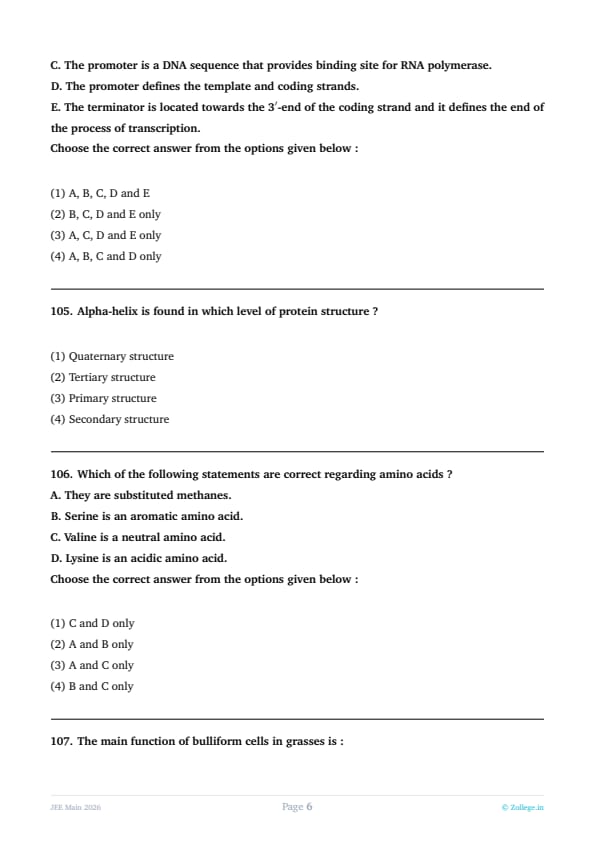
Which of the following statements are correct with reference to a transcription unit ?
A. A transcription unit in DNA is defined primarily by three regions : promoter, structural gene and terminator.
B. The promoter is said to be located towards the 5\('\)-end of the structural gene.
C. The promoter is a DNA sequence that provides binding site for RNA polymerase.
D. The promoter defines the template and coding strands.
E. The terminator is located towards the 3\('\)-end of the coding strand and it defines the end of the process of transcription.
Choose the correct answer from the options given below :
View Solution
Step 1: Understanding the Concept:
Transcription is the process of copying genetic information from one strand of the DNA into RNA. A transcription unit is the specific segment of DNA involved in this process.
Step 2: Detailed Explanation:
A. Correct: A transcription unit consists of a promoter, a structural gene, and a terminator.
B. Correct: By convention, the promoter is located at the 5\('\)-end (upstream) of the structural gene (with respect to the coding strand).
C. Correct: It is the DNA sequence where RNA polymerase binds to initiate transcription.
D. Correct: The presence of a promoter in a transcription unit defines which strand will be the template strand and which will be the coding strand.
E. Correct: The terminator is located at the 3\('\)-end (downstream) of the coding strand and signals the end of the transcription process.
Step 4: Final Answer:
All the statements A, B, C, D, and E are correct.
Quick Tip: All reference points in transcription (upstream, downstream, 5\('\), 3\('\)) are defined with respect to the {coding strand}, even though it doesn't actually code for the RNA.
Alpha-helix is found in which level of protein structure ?
View Solution
Step 1: Understanding the Concept:
Proteins are organized into four levels of structural hierarchy: primary, secondary, tertiary, and quaternary.
Step 2: Detailed Explanation:
1. Primary Structure: The linear sequence of amino acids in a polypeptide chain.
2. Secondary Structure: Localized folding or coiling of the polypeptide chain held by hydrogen bonds. Common types are the alpha-helix and the beta-pleated sheet.
3. Tertiary Structure: The overall three-dimensional folding of a single polypeptide chain.
4. Quaternary Structure: The spatial arrangement of multiple polypeptide subunits.
Step 4: Final Answer:
The alpha-helix is a characteristic of the secondary structure of proteins.
Quick Tip: Secondary structure is all about hydrogen bonding between the backbone atoms of the amino acids. Think of it as a "spring" (alpha-helix) or a "folded paper" (beta-sheet).
Which of the following statements are correct regarding amino acids ?
A. They are substituted methanes.
B. Serine is an aromatic amino acid.
C. Valine is a neutral amino acid.
D. Lysine is an acidic amino acid.
Choose the correct answer from the options given below :
View Solution
Step 1: Understanding the Concept:
Amino acids are organic compounds containing an amino group, a carboxyl group, a hydrogen, and a variable R-group attached to a central carbon.
Step 2: Detailed Explanation:
A. Correct: Chemically, amino acids can be viewed as substituted methanes where the four substituents (\( H \), \( NH_2 \), \( COOH \), and \( R \)) are attached to the alpha-carbon.
B. Incorrect: Serine is a polar, non-aromatic amino acid with a hydroxyl group in its R-chain. Aromatic amino acids include Phenylalanine, Tyrosine, and Tryptophan.
C. Correct: Valine has a non-polar hydrocarbon R-group and is classified as a neutral amino acid.
D. Incorrect: Lysine has an additional amino group in its side chain, making it a basic amino acid. Glutamic acid and Aspartic acid are acidic amino acids.
Step 4: Final Answer:
Statements A and C are correct.
Quick Tip: Acronym for basic amino acids: {HAL} (Histidine, Arginine, Lysine). Acronym for aromatic ones: {TTP} (Tyrosine, Tryptophan, Phenylalanine).
The main function of bulliform cells in grasses is :
View Solution
Step 1: Understanding the Concept:
Bulliform cells are large, empty, colorless epidermal cells present along the veins of many monocot (grass) leaves.
Step 2: Detailed Explanation:
In grasses, certain adaxial epidermal cells are modified into bulliform cells.
1. When these cells are turgid (full of water), they cause the leaf surface to be exposed.
2. When they become flaccid due to water stress (transpiration exceeds absorption), they cause the leaves to curl inwards to minimize water loss by reducing the exposed surface area.
Step 4: Final Answer:
The main function is to minimize water loss during water stress.
Quick Tip: Bulliform cells act like "hinges" or "water-sensors" for the leaf. Flaccid = Curl = Save water. Turgid = Uncurl = Photosynthesize.
Find the incorrect statement(s) about photosynthesis from the following :
A. The water splitting complex is associated with PS I.
B. C\(_4\) plants use the C\(_3\) pathway of CO\(_2\) fixation as the main biosynthetic pathway.
C. In C\(_4\) plants, photorespiration does not occur.
D. C\(_3\) plants exhibit 'Kranz' anatomy.
E. ATP synthesis in chloroplast occurs through chemiosmosis.
Choose the answer from the options given below :
View Solution
Step 1: Understanding the Concept:
Photosynthesis involves light-dependent and light-independent reactions with significant differences between C\(_3\) and C\(_4\) plants.
Step 2: Detailed Explanation:
A. Incorrect: The water splitting complex (Oxygen Evolving Complex) is associated with PS II, which is physically located on the inner side of the thylakoid membrane.
B. Correct: C\(_4\) plants have a CO\(_2\) concentration mechanism, but the actual fixation of CO\(_2\) into glucose still occurs via the C\(_3\) (Calvin) cycle in the bundle sheath cells.
C. Correct: C\(_4\) plants avoid photorespiration by increasing the CO\(_2\) concentration around the RuBisCO enzyme.
D. Incorrect: C\(_4\) plants exhibit Kranz anatomy, not C\(_3\) plants.
E. Correct: Both in mitochondria and chloroplasts, ATP synthesis is driven by a proton gradient according to the chemiosmotic hypothesis.
Step 4: Final Answer:
Statements A and D are incorrect.
Quick Tip: Remember: {PS II} does the hard work of breaking water (\( H_2O \)). {Kranz} is for {C\(_4\)} (both have 4 letters in a way—K, R, A, N, Z vs C, 4).
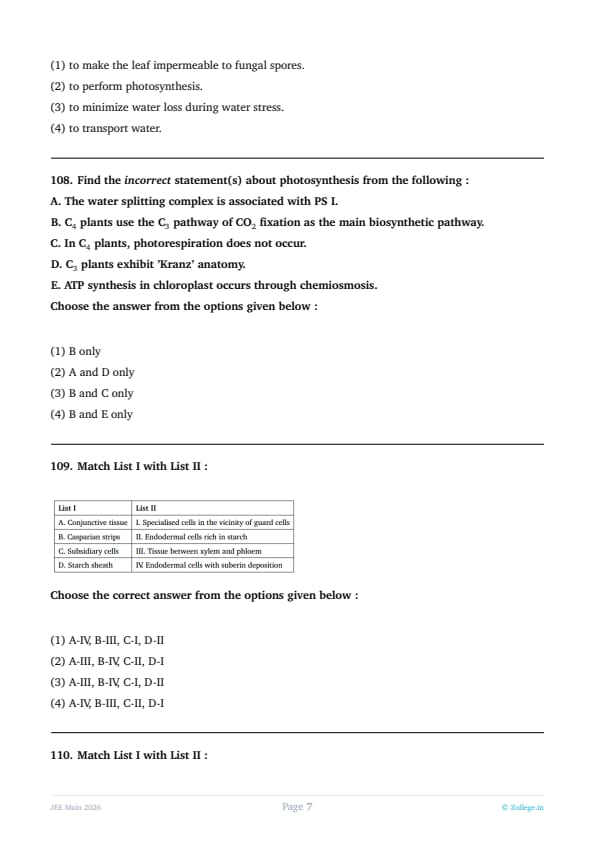
Match List I with List II :

Choose the correct answer from the options given below :
View Solution
Step 1: Understanding the Concept:
This question covers specialized anatomical structures in plant tissues.
Step 2: Detailed Explanation:
A. Conjunctive tissue: This is the parenchymatous tissue that lies between the xylem and the phloem strands in a root. (A \(\rightarrow\) III).
B. Casparian strips: These are water-impermeable suberized strips found on the tangential and radial walls of the endodermal cells in roots. (B \(\rightarrow\) IV).
C. Subsidiary cells: These are specialized epidermal cells found near the guard cells that help in stomatal opening and closing. (C \(\rightarrow\) I).
D. Starch sheath: In dicot stems, the endodermis is often called the starch sheath because its cells are rich in starch grains. (D \(\rightarrow\) II).
The correct sequence is A-III, B-IV, C-I, D-II.
Step 4: Final Answer:
Matching results in option (3).
Quick Tip: Casparian strips = Suberin = Waterproofing. Starch sheath = Endodermis of stem. Conjunctive tissue = Root filling between vessels.
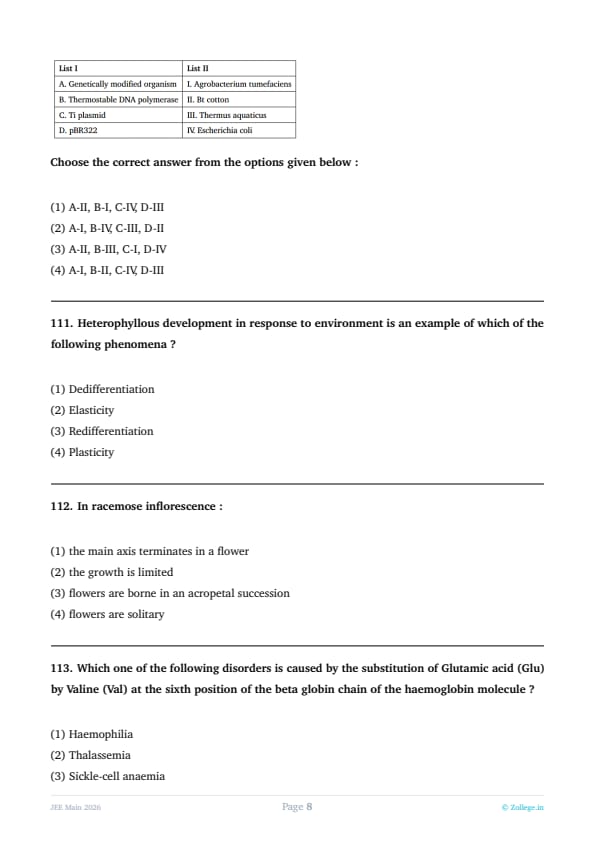
Match List I with List II :

Choose the correct answer from the options given below :
View Solution
Step 1: Understanding the Concept:
Biotechnology utilizes various organisms and genetic tools like plasmids and specialized enzymes for genetic engineering.
Step 2: Detailed Explanation:
A. Genetically Modified Organism (GMO): Bt cotton is a prime example of a crop modified to express a bacterial toxin gene. (A \(\rightarrow\) II).
B. Thermostable DNA polymerase: Taq polymerase is isolated from the bacterium Thermus aquaticus; it is used in PCR because it doesn't denature at high temperatures. (B \(\rightarrow\) III).
C. Ti plasmid: The Tumor-inducing plasmid is obtained from Agrobacterium tumefaciens and is used as a cloning vector for plants. (C \(\rightarrow\) I).
D. pBR322: This is a widely used artificial cloning vector initially developed using parts of Escherichia coli's naturally occurring plasmids. (D \(\rightarrow\) IV).
The correct sequence is A-II, B-III, C-I, D-IV.
Step 4: Final Answer:
Matching leads to option (3).
Quick Tip: Taq = {T}hermus {aq}uaticus. Ti = {T}umor {i}nducing (Agrobacterium). pBR322 = p (plasmid), B (Bolivar), R (Rodriguez).
Heterophyllous development in response to environment is an example of which of the following phenomena ?
View Solution
Step 1: Understanding the Concept:
Plants follow different pathways in response to environment or phases of life to form different kinds of structures. This ability is called plasticity.
Step 2: Detailed Explanation:
Heterophylly is a classic example of plasticity where the same plant produces different types of leaves.
In plants like cotton, coriander, and larkspur, the leaves of the juvenile plant are different in shape from those in mature plants (developmental heterophylly).
In plants like buttercup ({Ranunculus), the leaves formed in air are different from those formed in water (environmental heterophylly).
Therefore, the development of different leaf forms in response to the environment is called plasticity.
Step 4: Final Answer:
The phenomenon is known as plasticity.
Quick Tip: Remember: "Plasticity" refers to the "malleability" of a plant's growth pattern. Heterophylly in Buttercup is the most common NCERT example for environmental plasticity.
In racemose inflorescence :
View Solution
Step 1: Understanding the Concept:
Inflorescence is the arrangement of flowers on the floral axis. It is mainly categorized into racemose and cymose based on whether the apex gets converted into a flower.
Step 2: Detailed Explanation:
In racemose type of inflorescences, the main axis continues to grow indefinitely and does not terminate in a flower.
Because the axis keeps growing, the older flowers are found at the base and the younger flowers are found towards the tip.
This arrangement where flowers are borne laterally in a sequence from bottom to top is called acropetal succession.
In contrast, in cymose inflorescence, the main axis terminates in a flower and the arrangement is basipetal.
Step 4: Final Answer:
In racemose inflorescence, flowers are borne in an acropetal succession.
Quick Tip: Racemose = Unlimited growth = Acropetal (Youngest at top).
Cymose = Limited growth = Basipetal (Oldest at top).
Which one of the following disorders is caused by the substitution of Glutamic acid (Glu) by Valine (Val) at the sixth position of the beta globin chain of the haemoglobin molecule ?
View Solution
Step 1: Understanding the Concept:
Genetic disorders can be caused by point mutations where a single base pair change leads to the substitution of one amino acid for another in a protein chain.
Step 2: Detailed Explanation:
Sickle-cell anaemia is an autosome-linked recessive trait.
It is caused by the substitution of Glutamic acid (Glu) by Valine (Val) at the sixth position of the beta globin chain of the haemoglobin molecule.
This substitution results from a single base substitution at the sixth codon of the beta globin gene from GAG to GUG.
The mutant haemoglobin molecule undergoes polymerisation under low oxygen tension causing the change in the shape of the RBC from biconcave disc to elongated sickle-like structure.
Step 4: Final Answer:
The disorder is Sickle-cell anaemia.
Quick Tip: Mnemonic: "G-G-V" \(\rightarrow\) {G}lutamic acid at {6}th position is replaced by {V}aline. This is the classic example of a "Point Mutation".
Match List I with List II :

Choose the correct answer from the options given below :
View Solution
Step 1: Understanding the Concept:
This question matches specific inheritance patterns with their standard biological examples.
Step 2: Detailed Explanation:
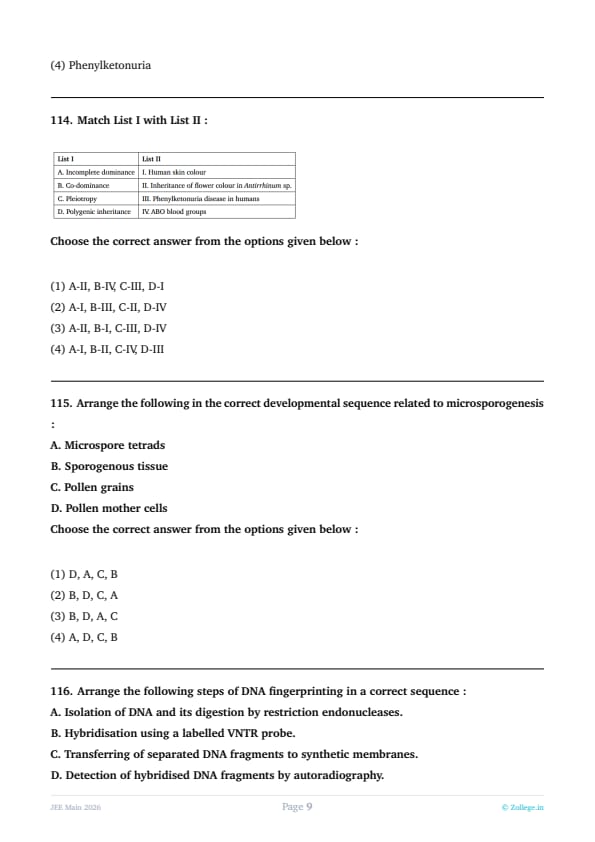
A. Incomplete dominance: This is seen in the Snap dragon ({Antirrhinum majus) where a cross between red and white flowers produces pink flowers. (A \(\rightarrow\) II).
B. Co-dominance: ABO blood groups show co-dominance because both \( I^A \) and \( I^B \) alleles express themselves fully when present together. (B \(\rightarrow\) IV).
C. Pleiotropy: Phenylketonuria (PKU) is an example where a single gene mutation affects multiple phenotypic traits like mental retardation and skin pigmentation. (C \(\rightarrow\) III).
D. Polygenic inheritance: Human skin colour is controlled by multiple genes (typically three), leading to a wide range of continuous variation. (D \(\rightarrow\) I).
Step 4: Final Answer:
The matching sequence is A-II, B-IV, C-III, D-I.
Quick Tip: Pleiotropy = 1 Gene \(\rightarrow\) Many Traits.
Polygenic = Many Genes \(\rightarrow\) 1 Trait.
Don't confuse these two!
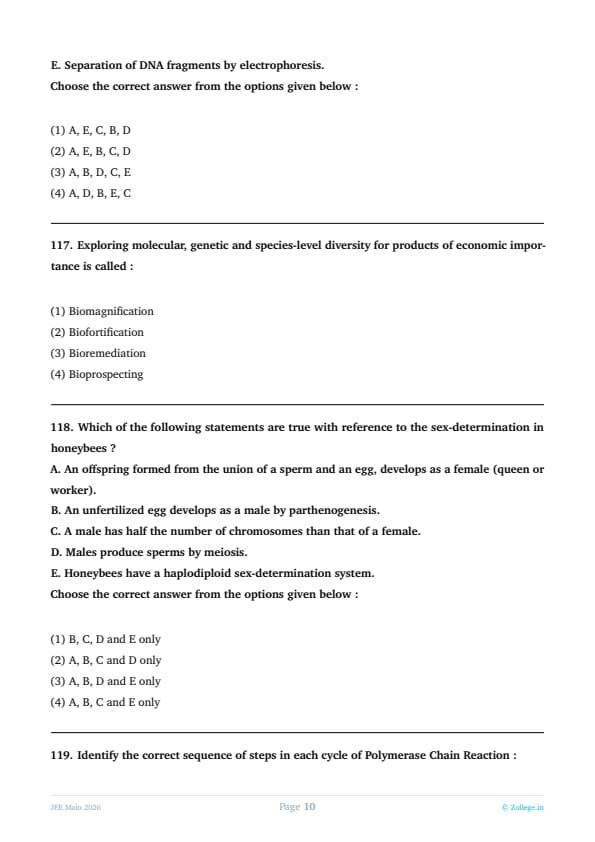
Arrange the following in the correct developmental sequence related to microsporogenesis :
A. Microspore tetrads
B. Sporogenous tissue
C. Pollen grains
D. Pollen mother cells
Choose the correct answer from the options given below :
View Solution
Step 1: Understanding the Concept:
Microsporogenesis is the process of formation of microspores from a pollen mother cell (PMC) through meiosis.
Step 2: Detailed Explanation:
1. The process begins with Sporogenous tissue (B) occupying the centre of each microsporangium.
2. As the anther develops, cells of the sporogenous tissue differentiate into Pollen mother cells (D).
3. Each PMC undergoes meiosis to form Microspore tetrads (A), which are clusters of four cells.
4. As the anthers mature and dehydrate, the microspores dissociate from each other and develop into Pollen grains (C).
The correct sequence is B \(\rightarrow\) D \(\rightarrow\) A \(\rightarrow\) C.
Step 4: Final Answer:
The developmental sequence is B, D, A, C.
Quick Tip: Just remember the progression: Tissue \(\rightarrow\) Mother Cell \(\rightarrow\) Tetrad (Meiosis product) \(\rightarrow\) Final Pollen.
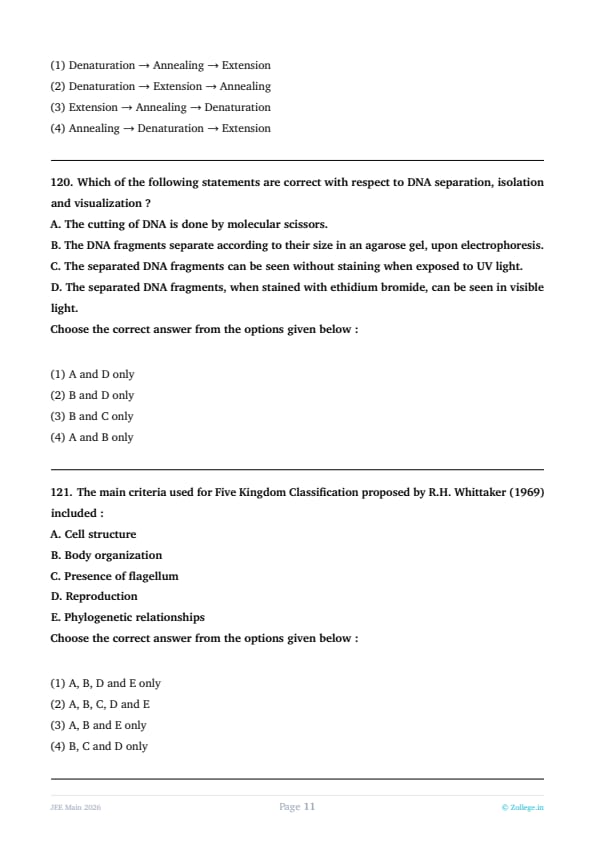
Arrange the following steps of DNA fingerprinting in a correct sequence :
A. Isolation of DNA and its digestion by restriction endonucleases.
B. Hybridisation using a labelled VNTR probe.
C. Transferring of separated DNA fragments to synthetic membranes.
D. Detection of hybridised DNA fragments by autoradiography.
E. Separation of DNA fragments by electrophoresis.
Choose the correct answer from the options given below :
View Solution
Step 1: Understanding the Concept:
DNA fingerprinting (Southern Blotting technique) involves identifying unique patterns in the DNA sequences (VNTRs) of an individual.
Step 2: Detailed Explanation:
The protocol follows these steps:
1. A: Isolation of DNA and its digestion by restriction endonucleases.
2. E: Separation of DNA fragments by electrophoresis.
3. C: Transferring (blotting) of separated DNA fragments to synthetic membranes, such as nitrocellulose or nylon.
4. B: Hybridisation using a labelled VNTR probe.
5. D: Detection of hybridised DNA fragments by autoradiography.
The sequence is A-E-C-B-D.
Step 4: Final Answer:
The correct sequence is A, E, C, B, D.
Quick Tip: Mnemonic: {I.D.E.B.H.A.} \(\rightarrow\) {I}solation, {D}igestion, {E}lectrophoresis, {B}lotting, {H}ybridisation, {A}utoradiography.
Exploring molecular, genetic and species-level diversity for products of economic importance is called :
View Solution
Step 1: Understanding the Concept:
Conservation and utilization of biodiversity involves several strategies and terms related to environmental and economic benefits.
Step 2: Detailed Explanation:
1. Biomagnification: Increase in concentration of a toxicant at successive trophic levels.
2. Biofortification: Breeding crops with higher levels of vitamins, minerals, or proteins.
3. Bioremediation: Use of microorganisms to clean up contaminated soil or groundwater.
4. Bioprospecting: It refers to the systematic search for and exploitation of new sources of chemical compounds, genes, proteins, and other products that have economic value from biological sources.
Step 4: Final Answer:
The correct term is bioprospecting.
Quick Tip: Bioprospecting = "Prospective" economic "Bio" search. It's how industries look for the next "miracle drug" or "enzyme" in nature.
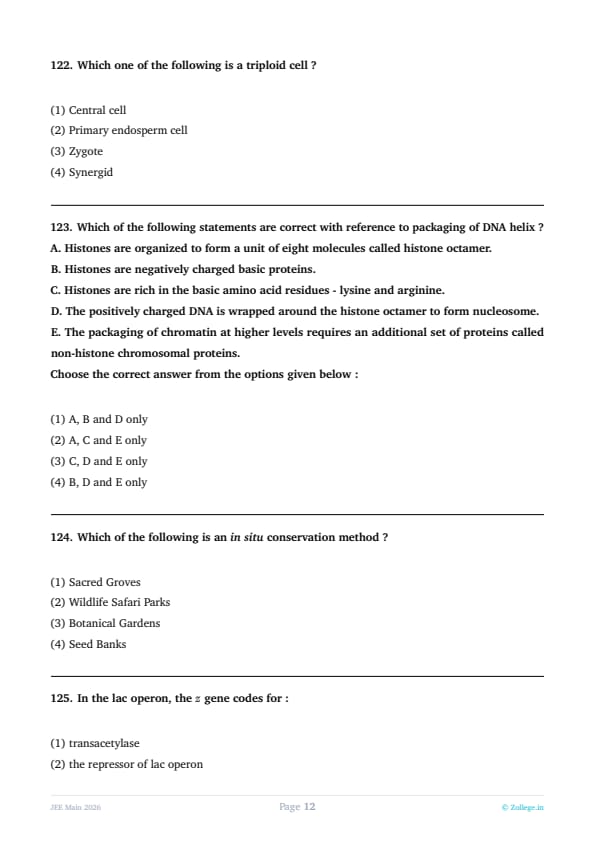
Which of the following statements are true with reference to the sex-determination in honeybees ?
A. An offspring formed from the union of a sperm and an egg, develops as a female (queen or worker).
B. An unfertilized egg develops as a male by parthenogenesis.
C. A male has half the number of chromosomes than that of a female.
D. Males produce sperms by meiosis.
E. Honeybees have a haplodiploid sex-determination system.
Choose the correct answer from the options given below :
View Solution
Step 1: Understanding the Concept:
Honeybees exhibit a unique sex-determination system where the sex is determined by the number of sets of chromosomes an individual receives.
Step 2: Detailed Explanation:
A. True: Fertilized eggs (union of sperm and egg) develop into diploid females (\( 2n = 32 \)).
B. True: Unfertilized eggs develop into haploid males (\( n = 16 \)) via arrhenotoky (a type of parthenogenesis).
C. True: Since females are diploid and males are haploid, a male has half the number of chromosomes.
D. False: Since males are already haploid (\( n \)), they cannot undergo meiosis to produce gametes. Instead, they produce sperms by mitosis.
E. True: This whole system is called the haplodiploid sex-determination system.
Step 4: Final Answer:
Statements A, B, C, and E are correct.
Quick Tip: Drones (males) have no fathers and cannot have sons, but they do have grandfathers and can have grandsons.
Identify the correct sequence of steps in each cycle of Polymerase Chain Reaction :
View Solution
Step 1: Understanding the Concept:
PCR (Polymerase Chain Reaction) is used to amplify specific DNA sequences in vitro. Each cycle involves three main temperature-dependent steps.
Step 2: Detailed Explanation:
1. Denaturation: The double-stranded DNA is heated to high temperatures (approx. 94\(^{\circ\)C) to separate it into two single strands.
2. Annealing: Two sets of oligonucleotide primers are attached to the single-stranded DNA templates at a lower temperature (approx. 50-65\(^{\circ}\)C).
3. Extension: The thermostable Taq DNA polymerase adds nucleotides to the primers using the template strands at an intermediate temperature (approx. 72\(^{\circ}\)C).
The correct order is Denaturation \(\rightarrow\) Annealing \(\rightarrow\) Extension.
Step 4: Final Answer:
The correct sequence is Denaturation, Annealing, Extension.
Quick Tip: Mnemonic: {D.A.E.} ({D}enaturation, {A}nnealing, {E}xtension). Think of it as: Separate (D), Attach (A), Build (E).
Which of the following statements are correct with respect to DNA separation, isolation and visualization ?
A. The cutting of DNA is done by molecular scissors.
B. The DNA fragments separate according to their size in an agarose gel, upon electrophoresis.
C. The separated DNA fragments can be seen without staining when exposed to UV light.
D. The separated DNA fragments, when stained with ethidium bromide, can be seen in visible light.
Choose the correct answer from the options given below :
View Solution
Step 1: Understanding the Concept:
Visualizing and manipulating DNA involves specific tools and biochemical techniques.
Step 2: Detailed Explanation:
A. Correct: Restriction endonucleases are known as molecular scissors as they cut DNA at specific sites.
B. Correct: In gel electrophoresis, DNA (negatively charged) moves towards the anode. The agarose gel acts as a sieve, so smaller fragments move faster and further than larger ones.
C. Incorrect: Pure DNA fragments cannot be seen in normal or UV light. They must be stained.
D. Incorrect: Even after staining with ethidium bromide, DNA cannot be seen in visible light. It can only be seen as bright orange bands when exposed to UV light.
Step 4: Final Answer:
Statements A and B are correct.
Quick Tip: DNA + Ethidium Bromide + UV Light = Bright Orange Bands. Visible light is useless for seeing DNA bands in a gel!
The main criteria used for Five Kingdom Classification proposed by R.H. Whittaker (1969) included :
A. Cell structure
B. Body organization
C. Presence of flagellum
D. Reproduction
E. Phylogenetic relationships
Choose the correct answer from the options given below :
View Solution
Step 1: Understanding the Concept:
The Five Kingdom classification is a phylogenetic system developed by Robert Whittaker. It categorizes all living organisms based on complex biological characteristics.
Step 2: Detailed Explanation:
The five kingdoms proposed were Monera, Protista, Fungi, Plantae, and Animalia.
The main criteria for classification used by him include:
1. Cell structure: Complexity of cell (Prokaryotic vs. Eukaryotic).
2. Body organization: Complexity of organisms (Unicellular vs. Multicellular/Tissue/Organ).
3. Mode of nutrition: Autotrophic vs. Heterotrophic (absorptive or holozoic).
4. Reproduction: Methods of multiplying.
5. Phylogenetic relationships: Evolutionary history and ancestry.
Presence or absence of flagellum was not a primary criterion for this broad classification level.
Step 4: Final Answer:
The correct criteria are A, B, D, and E.
Quick Tip: To remember Whittaker's criteria, use the mnemonic: {M.P.R.C.B.} ({M}ode of nutrition, {P}hylogeny, {R}eproduction, {C}ell structure, {B}ody organization).
Which one of the following is a triploid cell ?
View Solution
Step 1: Understanding the Concept:
Ploidy refers to the number of sets of chromosomes in a cell. Triploid cells (\( 3n \)) have three sets of chromosomes.
Step 2: Detailed Explanation:
In Angiosperms, double fertilization occurs.
1. One male gamete (\( n \)) fuses with the egg (\( n \)) to form a Zygote (\( 2n \)).
2. The second male gamete (\( n \)) fuses with the two polar nuclei (\( n+n \)) in the Central cell.
3. This process is called triple fusion, and it results in the formation of the Primary Endosperm Nucleus (PEN) and subsequently the Primary Endosperm Cell (PEC), which are triploid (\( 3n \)).
4. Synergids are part of the egg apparatus and are haploid (\( n \)).
Step 4: Final Answer:
The Primary endosperm cell is the triploid cell.
Quick Tip: Remember: In angiosperms, Endosperm = \( 3n \), Zygote = \( 2n \), and all cells of the gametophyte (pollen, egg, synergids, antipodals) = \( n \).
Which of the following statements are correct with reference to packaging of DNA helix ?
A. Histones are organized to form a unit of eight molecules called histone octamer.
B. Histones are negatively charged basic proteins.
C. Histones are rich in the basic amino acid residues - lysine and arginine.
D. The positively charged DNA is wrapped around the histone octamer to form nucleosome.
E. The packaging of chromatin at higher levels requires an additional set of proteins called non-histone chromosomal proteins.
Choose the correct answer from the options given below :
View Solution
Step 1: Understanding the Concept:
DNA packaging in eukaryotes involves winding the DNA strand around specialized protein complexes to fit it into the nucleus.
Step 2: Detailed Explanation:
A. Correct: Histones form an octamer (containing two copies each of H2A, H2B, H3, and H4).
B. Incorrect: Histones are positively charged basic proteins.
C. Correct: The positive charge comes from a high concentration of basic amino acids like lysine and arginine.
D. Incorrect: DNA is negatively charged (due to phosphate groups) and is wrapped around the positively charged histone octamer.
E. Correct: Non-histone chromosomal (NHC) proteins are required for higher-order chromatin folding (scaffolding).
Step 4: Final Answer:
Statements A, C, and E are correct.
Quick Tip: Opposites attract! Negatively charged DNA sticks to Positively charged Histones. If you remember DNA is an {acid} (Deoxyribonucleic Acid), you'll remember it's negative.
Which of the following is an in situ conservation method ?
View Solution
Step 1: Understanding the Concept:
In situ conservation means "on-site" conservation—protecting species within their natural habitats. {Ex situ means "off-site"—removing them to a controlled environment.
Step 2: Detailed Explanation:
1. Sacred Groves: These are undisturbed forest patches protected by local communities due to religious beliefs. This is {in situ because the species are protected where they naturally live.
2. Wildlife Safari Parks: Animals are kept in enclosed areas, though larger than typical zoos; it's considered ex situ or a transition, but strictly categorized as ex situ in NCERT.
3. Botanical Gardens: Plants are grown in artificial settings for study and display. {Ex situ.
4. Seed Banks: Seeds are stored in cryopreservation or cold storage. Ex situ.
Step 4: Final Answer:
Sacred Groves is an in situ conservation method.
Quick Tip: {In situ = National Parks, Sanctuaries, Biosphere Reserves, Sacred Groves.
Ex situ = Zoos, Botanical Gardens, Seed/Pollen Banks, Tissue Culture.
In the lac operon, the \( z \) gene codes for :
View Solution
Step 1: Understanding the Concept:
The lac operon is a functional unit of genomic DNA in bacteria that allows for the coordinated regulation of gene expression for lactose metabolism.
Step 2: Detailed Explanation:
The structural genes in the lac operon are \( z, y, \) and \( a \):
1. \( z \) gene: Codes for beta-galactosidase (\( \beta \)-gal), which hydrolyzes lactose into galactose and glucose.
2. \( y \) gene: Codes for permease, which increases cell permeability to \( \beta \)-galactosides.
3. \( a \) gene: Codes for transacetylase.
4. The \( i \) gene (inhibitor) codes for the repressor protein.
Step 4: Final Answer:
The \( z \) gene codes for beta-galactosidase.
Quick Tip: Mnemonic: {Z.P.T.} (the products of \( z, y, a \)) \(\rightarrow\) {Z}-Galactosidase, {P}ermease, {T}ransacetylase.
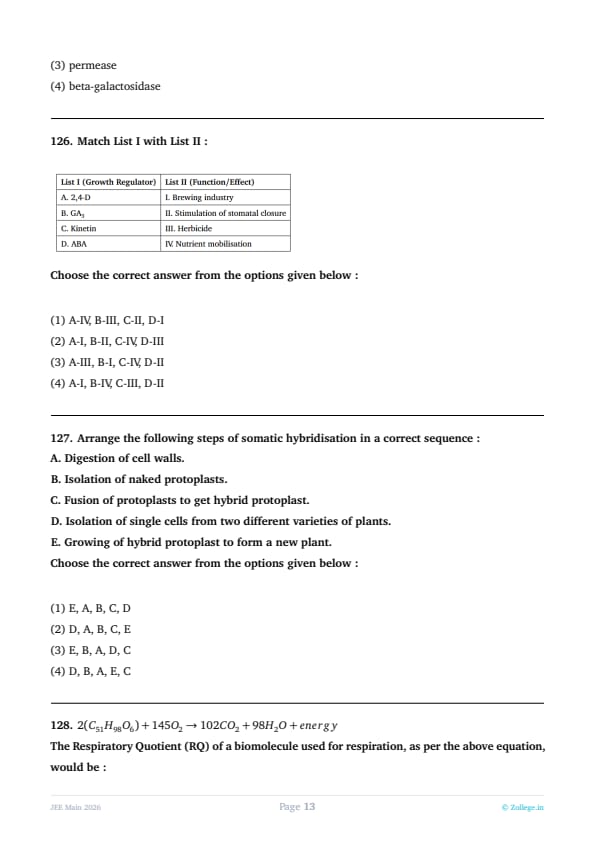
Match List I with List II :

Choose the correct answer from the options given below :
View Solution
Step 1: Understanding the Concept:
Plant Growth Regulators (PGRs) are chemical signals that control various physiological processes in plants.
Step 2: Detailed Explanation:
A. 2,4-D (2,4-dichlorophenoxyacetic acid): It is a synthetic auxin widely used as a herbicide to kill broad-leaved dicot weeds. (A \(\rightarrow\) III).
B. \( GA_3 \) (Gibberellic acid): Used in the brewing industry to speed up the malting process. (B \(\rightarrow\) I).
C. Kinetin: A cytokinin that helps in delaying leaf senescence by promoting nutrient mobilisation. (C \(\rightarrow\) IV).
D. ABA (Abscisic acid): Known as the "stress hormone," it triggers the closure of stomata to prevent water loss. (D \(\rightarrow\) II).
Step 4: Final Answer:
The matching sequence is A-III, B-I, C-IV, D-II.
Quick Tip: Remember: ABA = Stomata "A"bove and Closed. 2,4-D = "D"eath to weeds.
Arrange the following steps of somatic hybridisation in a correct sequence :
A. Digestion of cell walls.
B. Isolation of naked protoplasts.
C. Fusion of protoplasts to get hybrid protoplast.
D. Isolation of single cells from two different varieties of plants.
E. Growing of hybrid protoplast to form a new plant.
Choose the correct answer from the options given below :
View Solution
Step 1: Understanding the Concept:
Somatic hybridisation is the process of fusing protoplasts (cells without walls) from two different plants to create a hybrid with desired traits.
Step 2: Detailed Explanation:
The logical sequence of events is:
1. D: Isolation of single cells from the target plant varieties.
2. A: Digestion of the cellulose/pectin cell walls using enzymes.
3. B: Obtaining the "naked" protoplasts after wall removal.
4. C: Fusing the protoplasts (often using PEG) to form a hybrid.
5. E: Culturing and growing the hybrid cell into a full plant.
Step 4: Final Answer:
The correct sequence is D, A, B, C, E.
Quick Tip: You must take the cell (D) before you can remove its wall (A). Once the wall is gone, you have a protoplast (B). Then you fuse them (C) and grow the result (E).
\( 2(C_{51}H_{98}O_{6}) + 145 O_2 \rightarrow 102 CO_2 + 98 H_2O + energy \)
The Respiratory Quotient (RQ) of a biomolecule used for respiration, as per the above equation, would be :
View Solution
Step 1: Understanding the Concept:
Respiratory Quotient (RQ) is the ratio of the volume of \( CO_2 \) evolved to the volume of \( O_2 \) consumed during respiration.
Step 2: Key Formula or Approach:
\[ RQ = \frac{Volume of CO_2 evolved}{Volume of O_2 consumed} \]
Step 3: Detailed Explanation:
From the given balanced chemical equation (for tripalmitin, a fat):
\[ Volume of CO_2 = 102 units \] \[ Volume of O_2 = 145 units \] \[ RQ = \frac{102}{145} \approx 0.703 \]
Numerical value \( 0.7 \) falls within the range of \( 0.5 \) to \( 0.95 \).
Step 4: Final Answer:
The RQ value is between 0.5 and 0.95.
Quick Tip: Standard RQ values:
Carbohydrates = 1.0
Fats \(\approx\) 0.7
Proteins \(\approx\) 0.9
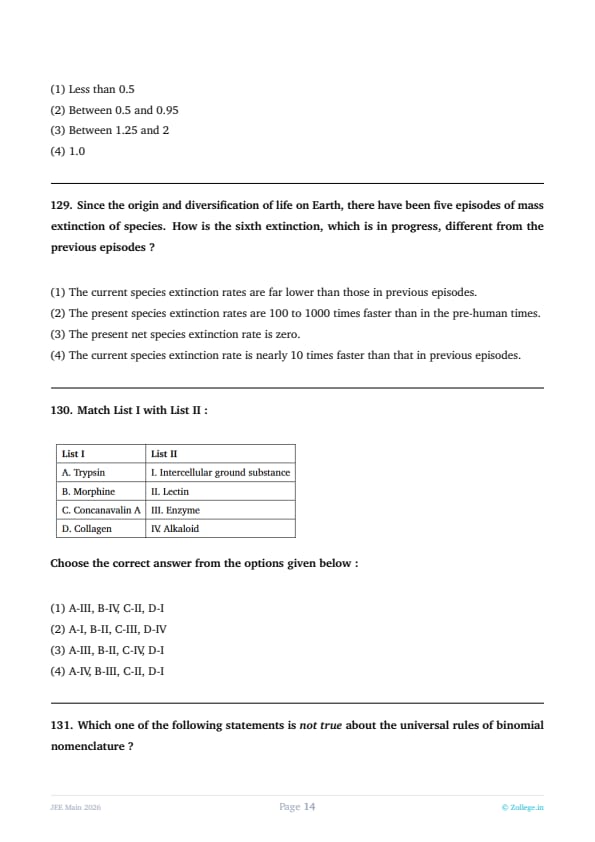
Since the origin and diversification of life on Earth, there have been five episodes of mass extinction of species. How is the sixth extinction, which is in progress, different from the previous episodes ?
View Solution
Step 1: Understanding the Concept:
Earth is currently experiencing a "biodiversity crisis" driven by human activities, marking the sixth major mass extinction in history.
Step 2: Detailed Explanation:
While extinctions have happened naturally in the past (the "big five" events), the current (sixth) mass extinction is uniquely different because:
1. It is caused primarily by human interference (habitat loss, pollution, etc.).
2. The rate of extinction is estimated to be 100 to 1000 times faster than the background or natural rate observed before human dominance.
Step 4: Final Answer:
The correct distinction is that the rates are 100 to 1000 times faster.
Quick Tip: The "Evil Quartet" are the main human activities driving this accelerated sixth extinction.
Match List I with List II :

Choose the correct answer from the options given below :
View Solution
Step 1: Understanding the Concept:
Organisms produce various primary and secondary metabolites that serve different biological and structural functions.
Step 2: Detailed Explanation:
A. Trypsin: A proteolytic enzyme involved in the digestion of proteins. (A \(\rightarrow\) III).
B. Morphine: A secondary metabolite classified as an alkaloid, used as a potent painkiller. (B \(\rightarrow\) IV).
C. Concanavalin A: A secondary metabolite from plants that acts as a lectin (carbohydrate-binding protein). (C \(\rightarrow\) II).
D. Collagen: The most abundant protein in animals, serving as the main intercellular ground substance in connective tissues. (D \(\rightarrow\) I).
Step 4: Final Answer:
The matching sequence is A-III, B-IV, C-II, D-I.
Quick Tip: Match the easy ones first: Trypsin is an enzyme and Collagen is a protein/tissue component. That's usually enough to find the right option.
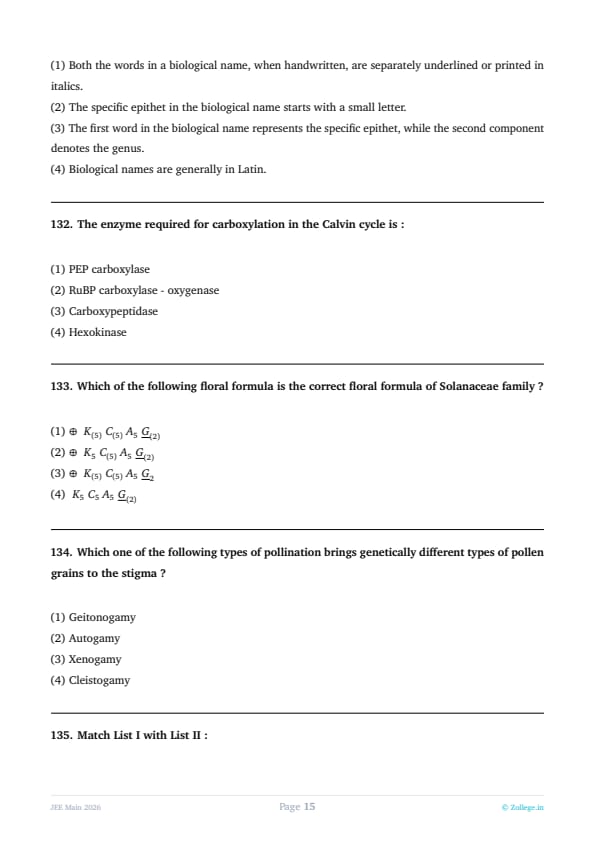
Which one of the following statements is not true about the universal rules of binomial nomenclature ?
View Solution
Step 1: Understanding the Concept:
Binomial nomenclature is a formal system of naming species of living things by giving each a name composed of two parts.
Step 2: Detailed Explanation:
The universal rules of binomial nomenclature are:
1. Biological names are generally in Latin and written in italics.
2. The first word in a biological name represents the Genus (generic name) while the second component denotes the specific epithet.
3. Both the words in a biological name, when handwritten, are separately underlined, or printed in italics to indicate their Latin origin.
4. The first word (Genus) starts with a capital letter while the specific epithet starts with a small letter.
Looking at statement (3), it incorrectly identifies the first word as the specific epithet and the second as the genus.
Step 4: Final Answer:
Statement (3) is not true because the first word represents the Genus.
Quick Tip: Remember the order: {G.S.} (Genus then Species). Think of it like your Surname and then your Given Name.
The enzyme required for carboxylation in the Calvin cycle is :
View Solution
Step 1: Understanding the Concept:
The Calvin cycle is the biosynthetic phase of photosynthesis where \( CO_2 \) is fixed into sugars. The first step is carboxylation.
Step 2: Detailed Explanation:
1. Carboxylation is the fixation of \( CO_2 \) into a stable organic intermediate.
2. In the Calvin cycle, \( CO_2 \) is utilized for the carboxylation of RuBP (Ribulose-1,5-bisphosphate).
3. This reaction is catalyzed by the enzyme RuBP carboxylase-oxygenase, commonly known as RuBisCO.
4. RuBisCO is the most abundant enzyme on Earth and has the unique ability to bind both \( CO_2 \) and \( O_2 \).
Step 4: Final Answer:
The enzyme is RuBP carboxylase - oxygenase (RuBisCO).
Quick Tip: RuBisCO stands for {Ru}b{i}lose {s}ugar {C}arboxylase {O}xygenase. PEP carboxylase is used in \( C_4 \) plants for the initial fixation of \( CO_2 \).
Which of the following floral formula is the correct floral formula of Solanaceae family ?
View Solution
Step 1: Understanding the Concept:
Floral formulas are symbolic representations of the various parts of a flower, their numbers, arrangement, and relationships.
Step 2: Detailed Explanation:
The Solanaceae (Potato family) characters are:
- Symmetry: Actinomorphic (\( \oplus \)).
- Sexuality: Bisexual (\( \textphi \)).
- Calyx: 5 sepals, gamosepalous (united, \( K_{(5)} \)), persistent.
- Corolla: 5 petals, gamopetalous (united, \( C_{(5)} \)).
- Androecium: 5 stamens, epipetalous (attached to petals, \( \overset{\Large \frown}{C \quad A} \)).
- Gynoecium: Bicarpellary, syncarpous (united, \( G_{(2)} \)), ovary superior.
The formula in option (1) correctly represents these traits including the epipetalous condition (often indicated by a line connecting C and A).
Step 4: Final Answer:
The correct floral formula is \( \oplus \textphi K_{(5)} C_{(5)} A_{5} G_{(2)} \).
Quick Tip: Remember the "Five-Group" Rule for Solanaceae: almost everything (K, C, A) comes in fives and is usually united (brackets), except the stamens which are free from each other but stuck to the petals.
Which one of the following types of pollination brings genetically different types of pollen grains to the stigma ?
View Solution
Step 1: Understanding the Concept:
Pollination is the transfer of pollen grains from the anther to the stigma. Depending on the source of pollen, it can be autogamy, geitonogamy, or xenogamy.
Step 2: Detailed Explanation:
1. Autogamy: Pollination within the same flower. The pollen is genetically identical to the stigma's plant.
2. Cleistogamy: A type of autogamy in flowers that never open. No genetic variation.
3. Geitonogamy: Transfer of pollen from the anther of one flower to the stigma of another flower on the same plant. Though it involves a pollinator, it is genetically similar to autogamy.
4. Xenogamy: Transfer of pollen from anther to the stigma of a different plant. This is the only type of pollination that brings genetically different types of pollen grains to the stigma.
Step 4: Final Answer:
Xenogamy is the type of pollination that ensures genetic diversity.
Quick Tip: Xeno means foreign. So, Xenogamy is "foreign marriage"—pollen from a completely different individual.
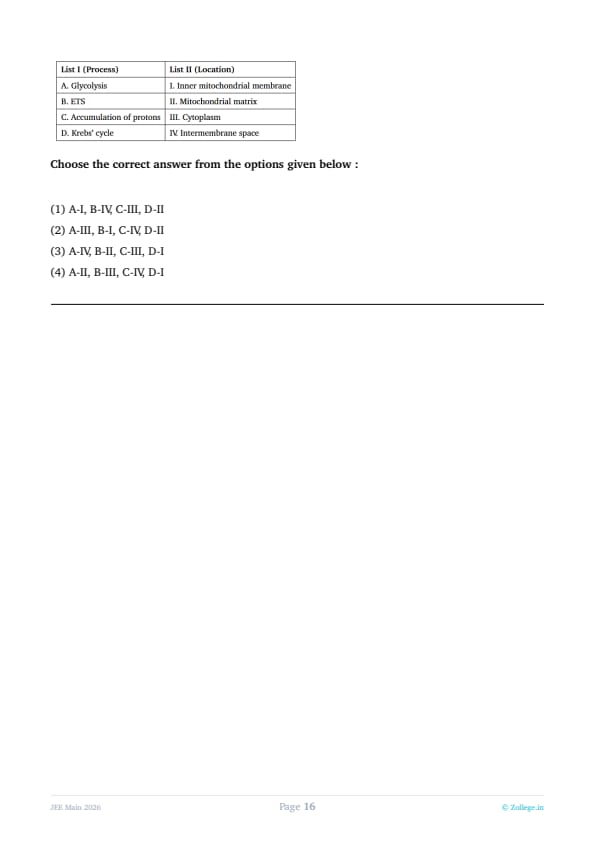
Match List I with List II :

Choose the correct answer from the options given below :
View Solution
Step 1: Understanding the Concept:
Cellular respiration occurs in specific compartments of the cell. Efficient energy production depends on the spatial organization of enzymes and membranes.
Step 2: Detailed Explanation:
A. Glycolysis: Occurs in the cytoplasm of the cell. It is the common pathway for both aerobic and anaerobic respiration. (A \(\rightarrow\) III).
B. ETS (Electron Transport System): Located on the inner mitochondrial membrane. This is where oxidative phosphorylation takes place. (B \(\rightarrow\) I).
C. Accumulation of protons: During electron transport, protons are pumped from the matrix into the intermembrane space of the mitochondria, creating a gradient. (C \(\rightarrow\) IV).
D. Krebs' cycle (TCA cycle): Takes place in the mitochondrial matrix. (D \(\rightarrow\) II).
The correct sequence is A-III, B-I, C-IV, D-II.
Step 4: Final Answer:
Matching the pairs correctly gives option (2).
Quick Tip: Glycolysis is the only major respiration step that happens "outside" the mitochondria (in the cytoplasm). All other aerobic steps happen "inside".
NEET 2026 Botany Revision
*The article might have information for the previous academic years, please refer the official website of the exam.