
NEET 2026 Chemistry Question Paper with Solution Pdf (Code 11)
- Answer Key
- Merit List
- Seat Inkate
- Tripura Counselling
- Nagaland Counselling
- Kerala Counselling
- UP Counselling
- Assam Counselling
- West Bengal Counselling
- MP Counselling
- Haryana Counselling
- Chhattisgarh Counselling
- Gujarat Counselling
- Participating Colleges
- AP Counselling
- Manipur Counselling
- Mark Vs Rank
- Mizoram NEET Counselling
- Ayush Counselling
- TN NEET Counselling
- Andhra Pradesh Counsellin
- Karnataka NEET Counsellin
- Jharkhand NEET Counsellin
- MH NEET Counselling
- Bihar NEET Counselling
- Counselling
- Seat Allotment


| Updated On - May 8, 2026
NTA conducted the NEET Exam on May 3 in a single shift from 2 PM to 5 PM in PBT Mode.
The NEET 2026 Chemistry Question Paper includes 45 Questions carrying a total of 180 Marks. As per the NEET Marking Scheme, +4 Marks is awarded for every correct answer, and -1 mark will be deducted for every wrong answer.
NEET 2026 Chemistry Question Paper with Solution PDF (Code 11) is available here for download.
NEET 2026 Chemistry Question Paper with Solution PDF(Code 11)
| NEET 2026 Question Paper Code 11 | Download PDF | Check Solutions |
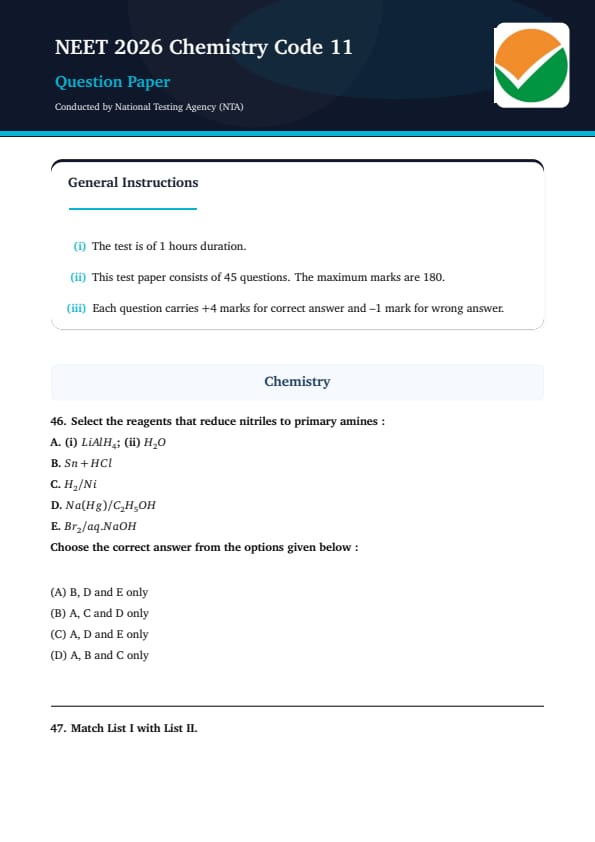
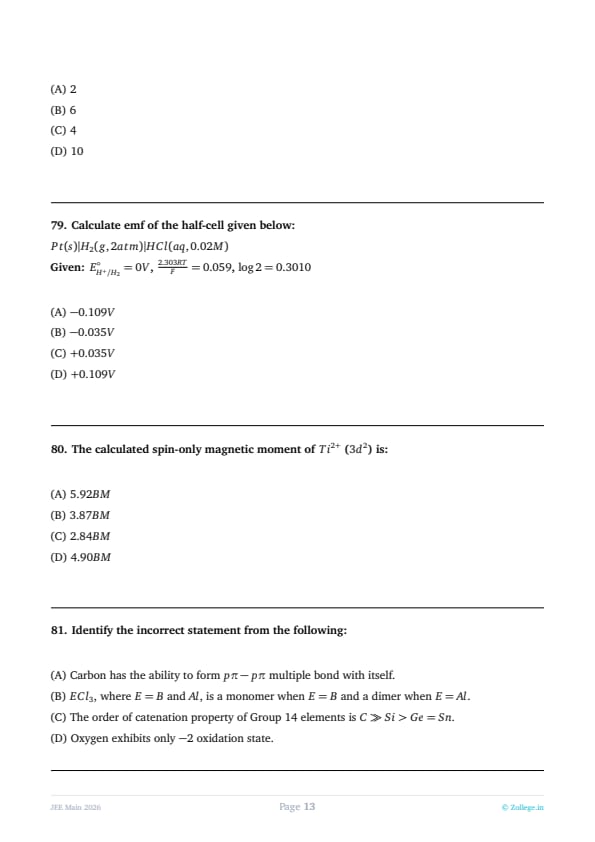
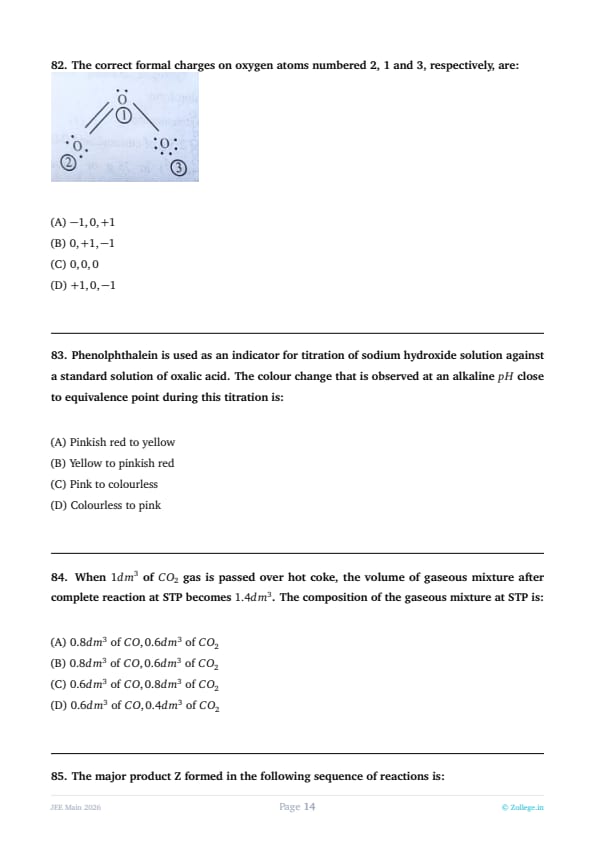
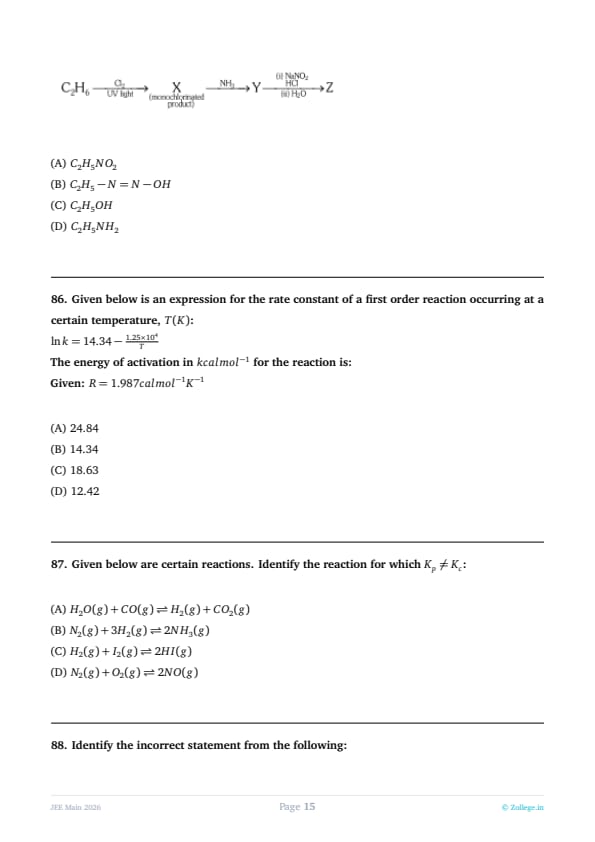
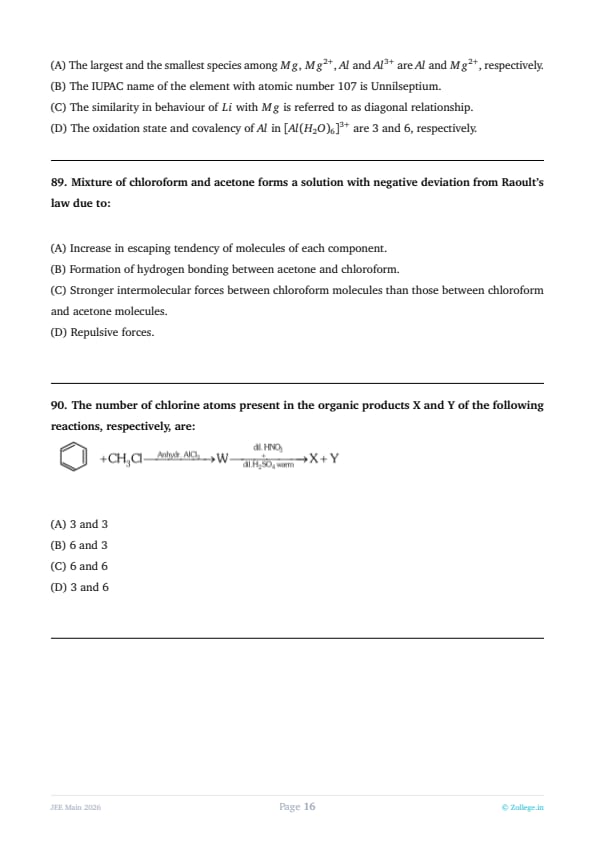
Select the reagents that reduce nitriles to primary amines :
A. (i) \(LiAlH_4\); (ii) \(H_2O\)
B. \(Sn + HCl\)
C. \(H_2/Ni\)
D. \(Na(Hg)/C_2H_5OH\)
E. \(Br_2/aq. NaOH\)
Choose the correct answer from the options given below :
View Solution
Step 1: Understanding the Topic:
The central theme of this question is the functional group transformation involving the reduction of nitriles (also known as organic cyanides) into primary amines. In organic synthesis, nitriles contain a carbon-nitrogen triple bond (\(C \equiv N\)). Reduction is the process of adding hydrogen across this multiple bond to reach a saturated state where the carbon and nitrogen are both \(sp^3\) hybridized, resulting in the \(-CH_2-NH_2\) group. This reaction is highly valued in laboratories because it allows for the extension of a carbon chain by one unit (if starting from an alkyl halide) while simultaneously introducing a primary amino group.
Step 2: Key Formulas and Approach:
The overall chemical transformation can be summarized as: \(R-C \equiv N \xrightarrow{Reduction} R-CH_2-NH_2\). To identify suitable reagents, we must look for chemicals that provide hydride ions or facilitate catalytic hydrogenation. We evaluate each option based on its known reactivity:
Hydride-based reduction (using \(LiAlH_4\)).
Catalytic hydrogenation (using \(H_2\) gas with metal catalysts).
Dissolving metal reduction (nascent hydrogen from \(Na/EtOH\)).
Step 3: Detailed Explanation:
Reagent A (\(LiAlH_4\)/\(H_2O\)): Lithium aluminium hydride is an exceptionally strong reducing agent. The \(Al-H\) bonds act as a source of nucleophilic hydride ions (\(H^-\)) which attack the electrophilic carbon of the nitrile. Two equivalents of hydride are added to the carbon, and the nitrogen eventually becomes protonated during the aqueous workup (\(H_2O\)). This is a standard and very effective laboratory method for producing primary amines from nitriles.
Reagent B (\(Sn + HCl\)): This combination generates nascent hydrogen and is primarily used for the reduction of the nitro group (\(-NO_2\)) to the amino group (\(-NH_2\)) in aromatic systems (forming aniline). It is generally not considered a standard or efficient reagent for the reduction of nitriles to primary amines.
Reagent C (\(H_2/Ni\)): This is a catalytic hydrogenation process. In the presence of a catalyst like Raney Nickel, hydrogen gas adds across the \(C \equiv N\) triple bond. This method is industrially preferred because it is clean and can be performed on a large scale to yield primary amines without the generation of bulky metal-salt byproducts.
Reagent D (\(Na(Hg)/C_2H_5OH\)): Known as the Mendius reduction, this method utilizes the reaction between sodium amalgam and ethanol to produce nascent hydrogen. This system is historically significant for specifically reducing nitriles to primary amines.
Reagent E (\(Br_2/aq. NaOH\)): This is the reagent set for the Hofmann Bromamide Degradation. It is used to convert an amide (\(R-CONH_2\)) to an amine (\(R-NH_2\)) with one fewer carbon atom. It does not reduce nitriles.
Step 4: Final Answer:
Reagents A, C, and D are valid for this specific reduction. Thus, the correct option is (B).
Quick Tip: Nitrile reduction "stretches" the triple bond into single bonds by adding two H atoms to C and two to N. Remember "M" for Mendius reduction (\(Na/EtOH\)) to link it to Nitrile reduction. Also, always steer clear of \(Br_2/NaOH\) for nitriles; that reagent is strictly for "cutting" a carbon off an amide!
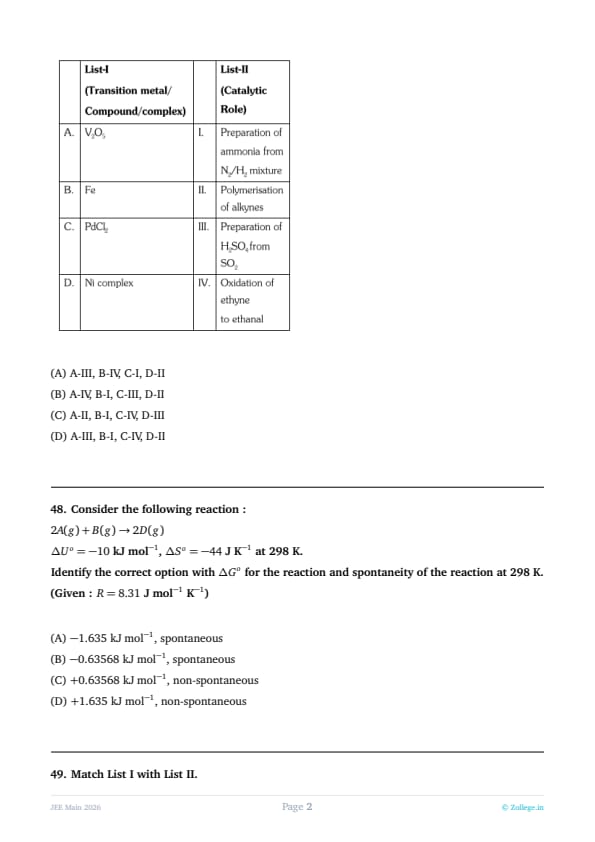
Match List I with List II.

View Solution
Step 1: Understanding the Topic:
The topic of this question is the industrial application of d-block elements and their compounds as catalysts. Transition metals are highly effective as catalysts due to their ability to adopt multiple oxidation states and their ability to form unstable complexes with reactant molecules. By providing a surface for reactants to adsorb or by forming intermediate species, they lower the activation energy of important industrial reactions. This makes the production of fundamental chemicals like ammonia and sulfuric acid economically viable.
Step 2: Key Formulas and Approach:
The approach involves identifying the specific catalyst used in well-known "named" industrial processes. We categorize each catalyst based on its physical form and the specific chemical reaction it facilitates:
Contact Process: Oxidation of \(SO_2\) to \(SO_3\).
Haber Process: Synthesis of \(NH_3\) from \(N_2\) and \(H_2\).
Wacker Process: Oxidation of alkenes to aldehydes.
Polymerization: Joining of small molecules into long chains.
Step 3: Detailed Explanation:
A. V\(_2\)O\(_5\) (Vanadium Pentoxide): This is the key catalyst in the Contact Process. In this process, sulfur dioxide is converted to sulfur trioxide, which is then used to make sulfuric acid. The oxide provides an oxygen-transfer mechanism through the switching of Vanadium's oxidation states. Thus, A matches with III.
B. Fe (Iron): Finely divided iron, along with promoters like \(Al_2O_3\) and \(K_2O\), is used in the Haber Process. This process is the foundation of the fertilizer industry as it converts atmospheric nitrogen into ammonia. Iron helps in weakening the extremely strong \(N \equiv N\) triple bond. Thus, B matches with I.
C. PdCl\(_2\) (Palladium Chloride): This metal salt is used in the Wacker Process. This industrial method allows for the direct oxidation of ethene to ethanal (acetaldehyde) in the presence of air and a \(PdCl_2/CuCl_2\) catalytic system. Thus, C matches with IV.
D. Ni complex: Certain organometallic complexes of Nickel are used to catalyze the cyclic polymerization of alkynes. For example, they can facilitate the conversion of ethyne (acetylene) into benzene or other cyclic oligomers. Thus, D matches with II.
Step 4: Final Answer:
The correct matching sequence is A-III, B-I, C-IV, D-II, which corresponds to option (D).
Quick Tip: Industrial catalysts are usually transition metals because they have "incomplete d-shells." Think of these d-shells as empty parking spots where reactant molecules can temporarily park, react, and then leave. Match Vanadium to Acid, Iron to Ammonia, and Palladium to Aldehydes.
Consider the following reaction :
\(2A(g) + B(g) \rightarrow 2D(g)\)
\(\Delta U^o = -10 kJ mol^{-1}\), \(\Delta S^o = -44 J K^{-1}\) at 298 K.
Identify the correct option with \(\Delta G^o\) for the reaction and spontaneity of the reaction at 298 K.
(Given : \(R = 8.31 J mol^{-1} K^{-1}\))
View Solution
Step 1: Understanding the Topic:
The question is based on Chemical Thermodynamics and the criteria for the spontaneity of a chemical reaction. The standard Gibbs free energy change (\(\Delta G^o\)) is the ultimate predictor of whether a reaction will proceed forward under standard conditions at a specific temperature. To calculate \(\Delta G^o\), we need to relate the internal energy change (\(\Delta U^o\)) to the enthalpy change (\(\Delta H^o\)), and then use the Gibbs-Helmholtz equation involving entropy.
Step 2: Key Formulas and Approach:
The following fundamental thermodynamic relations are used:
\(\Delta n_g = (moles of gaseous products) - (moles of gaseous reactants)\)
\(\Delta H^o = \Delta U^o + \Delta n_g RT\)
\(\Delta G^o = \Delta H^o - T \Delta S^o\)
Calculations must be done carefully regarding units, converting everything to Joules before the final step.
Step 3: Detailed Explanation:
Find \(\Delta n_g\): For the reaction \(2A(g) + B(g) \rightarrow 2D(g)\), the gaseous product moles = 2 and gaseous reactant moles = \(2+1 = 3\). Thus, \(\Delta n_g = 2 - 3 = -1\).
Calculate \(\Delta H^o\): We are given \(\Delta U^o = -10 kJ = -10000 J\).
\[ \Delta H^o = -10000 + (-1 \times 8.31 \times 298) \]
\[ \Delta H^o = -10000 - 2476.38 = -12476.38 J \]
Calculate \(\Delta G^o\): Now substitute \(\Delta H^o\), \(T=298 K\), and \(\Delta S^o = -44 J/K\).
\[ \Delta G^o = -12476.38 - (298 \times -44) \]
\[ \Delta G^o = -12476.38 + 13112 = +635.62 J \]
Spontaneity Check: Converting to kJ, \(\Delta G^o \approx +0.63568 kJ/mol\). Since the value is positive (\(>0\)), the reaction is non-spontaneous at 298 K under standard conditions.
Step 4: Final Answer:
The calculated value is approximately \(+0.63568 kJ mol^{-1}\) and the reaction is non-spontaneous. This matches option (C).
Quick Tip: Thermodynamics is all about units! \(\Delta U\) and \(\Delta G\) are usually in kJ, but \(R\) and \(\Delta S\) are in J. Always multiply your kJ values by 1000 before adding them to \(RT\) or \(T\Delta S\). Remember: \(\Delta G\) Negative means "Go" (Spontaneous), and \(\Delta G\) Positive means "No" (Non-spontaneous).
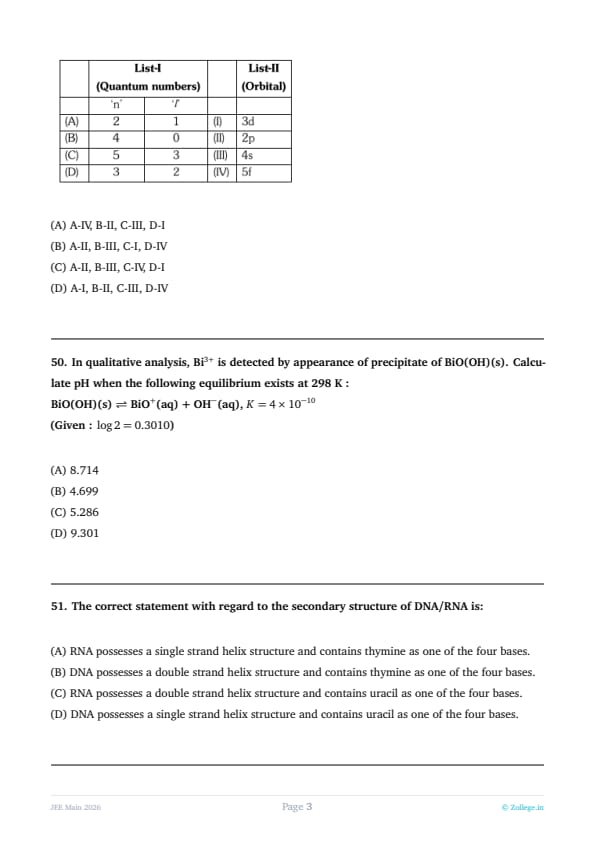
Match List I with List II.

View Solution
Step 1: Understanding the Topic:
This question deals with the structure of the atom and the quantum mechanical model. Specifically, it tests the identification of atomic orbitals using principal quantum numbers (\(n\)) and azimuthal quantum numbers (\(l\)). Every electron in an atom is described by a set of quantum numbers that define its energy, shell, and the shape of the orbital it occupies. Understanding this notation is essential for writing electronic configurations and predicting the chemical properties of elements.
Step 2: Key Formulas and Approach:
The orbital name is a combination of the principal quantum number \(n\) and a letter corresponding to the \(l\) value. The standard subshell mapping is:
\(l = 0 \rightarrow s\) subshell
\(l = 1 \rightarrow p\) subshell
\(l = 2 \rightarrow d\) subshell
\(l = 3 \rightarrow f\) subshell
We simply combine the value of \(n\) with the appropriate letter.
Step 3: Detailed Explanation:
A. n=2, l=1: The shell is 2 and the \(l=1\) indicates a 'p' subshell. Therefore, this is the 2p orbital. A matches with II.
B. n=4, l=0: The shell is 4 and the \(l=0\) indicates an 's' subshell. Therefore, this is the 4s orbital. B matches with III.
C. n=5, l=3: The shell is 5 and the \(l=3\) indicates an 'f' subshell. Therefore, this is the 5f orbital. C matches with IV.
D. n=3, l=2: The shell is 3 and the \(l=2\) indicates a 'd' subshell. Therefore, this is the 3d orbital. D matches with I.
Step 4: Final Answer:
The matching sequence is A-II, B-III, C-IV, D-I, which is provided in option (C).
Quick Tip: To remember the subshell letters, use the mnemonic: "\textbf{S}mart \textbf{P}eople \textbf{D}o \textbf{F}ine" representing \(l = 0, 1, 2, 3\). The \(n\) value is just the number in front. Remember that the maximum value of \(l\) is always \(n-1\).
In qualitative analysis, Bi\(^{3+}\) is detected by appearance of precipitate of BiO(OH)(s). Calculate pH when the following equilibrium exists at 298 K :
BiO(OH)(s) \(\rightleftharpoons\) BiO\(^+\)(aq) + OH\(^-\)(aq), \(K = 4 \times 10^{-10}\)
(Given : \(\log 2 = 0.3010\))
View Solution
Step 1: Understanding the Topic:
This problem focuses on "Ionic Equilibrium," specifically the solubility of sparingly soluble bases and the resulting pH of their saturated solutions. The equilibrium constant \(K\) provided is equivalent to the solubility product constant (\(K_{sp}\)) for Bismuth oxyhydroxide. When this solid dissolves, it produces hydroxide ions, making the solution basic. Our goal is to determine the concentration of these hydroxide ions to find the alkalinity of the system.
Step 2: Key Formulas and Approach:
For a dissolution equilibrium of the type \(AB(s) \rightleftharpoons A^+(aq) + B^-(aq)\):
\(K = [A^+][B^-]\)
If \(s\) is the molar solubility, then \([A^+] = s\) and \([B^-] = s\).
\(pOH = -\log[OH^-]\)
\(pH = 14 - pOH\) (at 298 K)
Step 3: Detailed Explanation:
Setup Concentrations: From the stoichiometry of the reaction \(BiO(OH) \rightleftharpoons BiO^+ + OH^-\), one mole of solid produces one mole of \(BiO^+\) and one mole of \(OH^-\). If the solubility is \(s\), then \([BiO^+] = s\) and \([OH^-] = s\).
Calculate Solubility:
\[ K = s \times s = s^2 = 4 \times 10^{-10} \]
\[ s = \sqrt{4 \times 10^{-10}} = 2 \times 10^{-5} mol/L \]
Calculate pOH: Since \([OH^-] = 2 \times 10^{-5} M\):
\[ pOH = -\log(2 \times 10^{-5}) = -(\log 2 + \log 10^{-5}) \]
\[ pOH = -(0.3010 - 5) = 4.699 \]
Calculate pH: At standard temperature (298 K), the sum of pH and pOH is 14.
\[ pH = 14 - 4.699 = 9.301 \]
Step 4: Final Answer:
The pH of the solution is 9.301, which corresponds to option (D).
Quick Tip: Check your answer against common sense: the reaction produces \(OH^-\) ions, so the solution \textbf{must} be basic (\(pH > 7\)). You can immediately cross out options (B) and (C) without even picking up a pencil. This leaves only (A) and (D) as possible candidates.
The correct statement with regard to the secondary structure of DNA/RNA is:
View Solution
Step 1: Understanding the Topic:
This question deals with "Biomolecules," particularly the structural features of nucleic acids: DNA (Deoxyribonucleic Acid) and RNA (Ribonucleic Acid). Nucleic acids are the information-carrying molecules of the cell. Their secondary structure describes the spatial arrangement of the nucleotide strands and the specific hydrogen-bonding patterns between nitrogenous bases. Differentiating between DNA and RNA structural characteristics is a fundamental concept in molecular biology and biochemistry.
Step 2: Key Formulas and Approach:
The approach involves identifying the specific differences between DNA and RNA in terms of:
The number of strands in the helix.
The specific nitrogenous bases present (specifically the difference between Thymine and Uracil).
Step 3: Detailed Explanation:
DNA Characteristics: DNA is composed of two polynucleotide chains that wrap around each other to form a double-strand helix. The four nitrogenous bases in DNA are Adenine (A), Guanine (G), Cytosine (C), and Thymine (T). The two strands are held together by complementary base pairing (A with T, G with C).
RNA Characteristics: RNA is generally a single-strand molecule. While it can fold back on itself to form complex 3D shapes, its standard secondary structure is a single polynucleotide chain. The nitrogenous bases in RNA are Adenine (A), Guanine (G), Cytosine (C), and Uracil (U). Note that Uracil replaces Thymine in RNA.
Evaluating Statements:
(A) Incorrect because RNA contains Uracil, not Thymine.
(B) Correct because DNA is double-stranded and uses Thymine.
(C) Incorrect because RNA is usually single-stranded.
(D) Incorrect because DNA is double-stranded and uses Thymine.
Step 4: Final Answer:
The correct description is provided in option (B).
Quick Tip: To keep them straight, remember: \textbf{DNA} has a \textbf{D}ouble strand and \textbf{T}hymine. \textbf{RNA} is a \textbf{R}ather single strand and has \textbf{U}racil. Adenine, Guanine, and Cytosine are the "common" bases found in both.
The pair of molecules that are metamers among the following is:
View Solution
Step 1: Understanding the Topic:
This problem pertains to structural isomerism in organic chemistry. Isomers are compounds with the same molecular formula but different arrangements of atoms. Metamerism is a specific type of isomerism that occurs when different alkyl groups are attached to the same polyvalent functional group (such as \(-O-\), \(-S-\), \(-NH-\), or \(-CO-\)). Essentially, the "distribution" of carbon atoms on either side of the functional group is shifted.
Step 2: Key Formulas and Approach:
To identify metamers:
Ensure the molecular formula is identical.
Identify a polyvalent functional group present in both.
Check if the nature of the alkyl groups on either side of the functional group has changed.
Step 3: Detailed Explanation:
Option (A): Propan-1-ol and Propan-2-ol. These are both alcohols (\(C_3H_8O\)) but differ in the position of the \(-OH\) group on the chain. These are position isomers.
Option (B): \(n\)-butane and Isobutane. These are alkanes (\(C_4H_{10}\)) with different carbon skeletons. These are chain isomers.
Option (C): Propanone (ketone) and Propanal (aldehyde). They have the same formula (\(C_3H_6O\)) but different functional groups. These are functional isomers.
Option (D): Methyl propyl ether (\(CH_3-O-C_3H_7\)) and Diethyl ether (\(C_2H_5-O-C_2H_5\)). Both have the formula \(C_4H_{10}O\).
In the first, the oxygen has a methyl (\(C_1\)) and a propyl (\(C_3\)) group.
In the second, the oxygen has two ethyl (\(C_2\)) groups.
Because the alkyl groups around the polyvalent oxygen are distributed differently, they are metamers.
Step 4: Final Answer:
The metamers are the ethers in option (D).
Quick Tip: Metamerism is common in ethers, ketones, and secondary amines. Imagine the functional group as a pivot; if you move a carbon atom from the left side of the pivot to the right side, you've created a metamer!
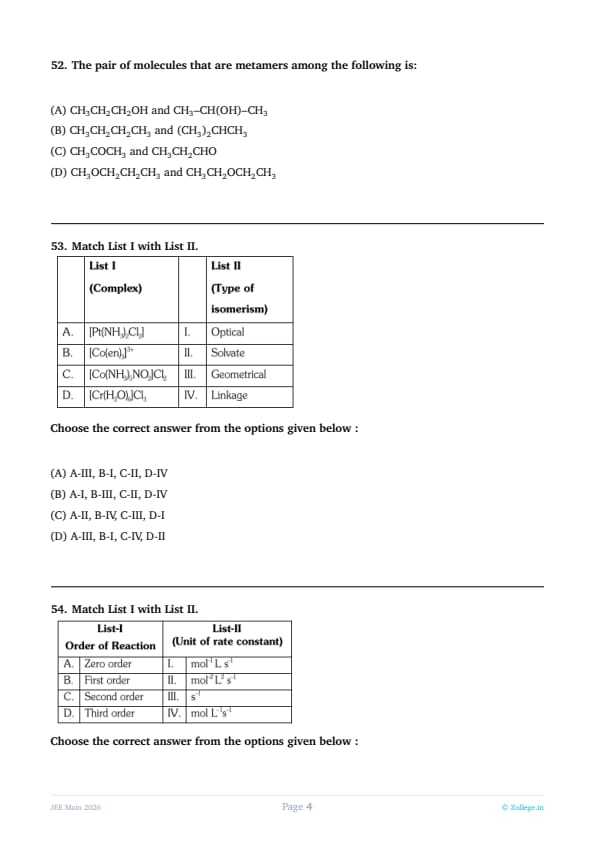
Match List I with List II.

Choose the correct answer from the options given below :
View Solution
Step 1: Understanding the Topic:
This question focuses on "Coordination Compounds" and the various types of isomerism that exist within these complexes. Coordination isomers have the same chemical formula but different spatial or structural arrangements. These differences can arise from the way ligands are attached (linkage), the arrangement of ligands in space (geometrical/optical), or the distribution of solvent molecules (solvate). Understanding these is key to identifying different versions of the same chemical complex.
Step 2: Key Formulas and Approach:
We identify the specific type of isomerism by looking for structural markers:
Geometrical: Cis/Trans arrangements in \(MA_2B_2\) or \(MA_4B_2\).
Optical: Chiral complexes (often with bidentate ligands) that have mirror images.
Linkage: Presence of ambidentate ligands (like \(NO_2^-\) or \(SCN^-\)).
Solvate: Water molecules moving between the coordination sphere and the crystal lattice.
Step 3: Detailed Explanation:
A. \([Pt(NH_3)_2Cl_2]\): This square planar complex exists in two forms: cis (ligands on the same side) and trans (ligands on opposite sides). This is the hallmark of geometrical isomerism. A matches with III.
B. \([Co(en)_3]^{3+}\): This octahedral complex contains three bidentate ethylenediamine ligands. Because it is chiral and possesses no plane of symmetry, it exists as a pair of non-superimposable mirror images. This is optical isomerism. B matches with I.
C. \([Co(NH_3)_5NO_2]Cl_2\): The \(NO_2^-\) ligand is ambidentate, meaning it can link to the metal via Nitrogen (nitro) or Oxygen (nitrito). This is linkage isomerism. C matches with IV.
D. \([Cr(H_2O)_6]Cl_3\): In this series, water molecules can swap positions with chloride ions inside or outside the bracket (e.g., \([Cr(H_2O)_5Cl]Cl_2 \cdot H_2O\)). This is solvate isomerism. D matches with II.
Step 4: Final Answer:
The correct matching sequence is A-III, B-I, C-IV, D-II, corresponding to option (D).
Quick Tip: Look for the "tell-tale" ligands! If you see \(NO_2\), think \textbf{Linkage}. If you see \(H_2O\) inside and outside the brackets, think \textbf{Solvate}. If the molecule looks symmetric but can have a "cis/trans" version, it is \textbf{Geometrical}.
Match List I with List II.

Choose the correct answer from the options given below :
View Solution
Step 1: Understanding the Topic:
This question belongs to "Chemical Kinetics." It explores the units of the rate constant (\(k\)), which is a fundamental part of the rate law for a chemical reaction. The units of \(k\) are not fixed; they change depending on the overall order of the reaction. This ensures that the overall "Rate" of the reaction always maintains consistent units of concentration divided by time (\(mol \cdot L^{-1} \cdot s^{-1}\)).
Step 2: Key Formulas and Approach:
The general formula for determining the units of the rate constant for a reaction of order \(n\) is: \[ Units of k = (mol \cdot L^{-1})^{1-n} \cdot s^{-1} \]
We can also write this as \(M^{1-n} \cdot s^{-1}\) where \(M\) is molarity. By substituting the values \(n = 0, 1, 2, 3\), we find the corresponding units.
Step 3: Detailed Explanation:
A. Zero order (n=0): Substituting \(n=0\): \((mol \cdot L^{-1})^{1-0} \cdot s^{-1} = mol \cdot L^{-1} \cdot s^{-1}\). Matches with IV.
B. First order (n=1): Substituting \(n=1\): \((mol \cdot L^{-1})^{1-1} \cdot s^{-1} = (mol \cdot L^{-1})^0 \cdot s^{-1} = s^{-1}\). Matches with III.
C. Second order (n=2): Substituting \(n=2\): \((mol \cdot L^{-1})^{1-2} \cdot s^{-1} = (mol \cdot L^{-1})^{-1} \cdot s^{-1} = L \cdot mol^{-1} \cdot s^{-1}\). Matches with I.
D. Third order (n=3): Substituting \(n=3\): \((mol \cdot L^{-1})^{1-3} \cdot s^{-1} = (mol \cdot L^{-1})^{-2} \cdot s^{-1} = L^2 \cdot mol^{-2} \cdot s^{-1}\). Matches with II.
Step 4: Final Answer:
The correct matching sequence is A-IV, B-III, C-I, D-II, which is option (B).
Quick Tip: If you forget the formula, just remember that for \textbf{First Order}, \(k\) has only "time" units (\(s^{-1}\)). For any other order, you can derive it from the rate law: \(Rate = k[Conc]^n\). Rearrange to \(k = Rate / [Conc]^n\) and plug in the units of Rate and Concentration!
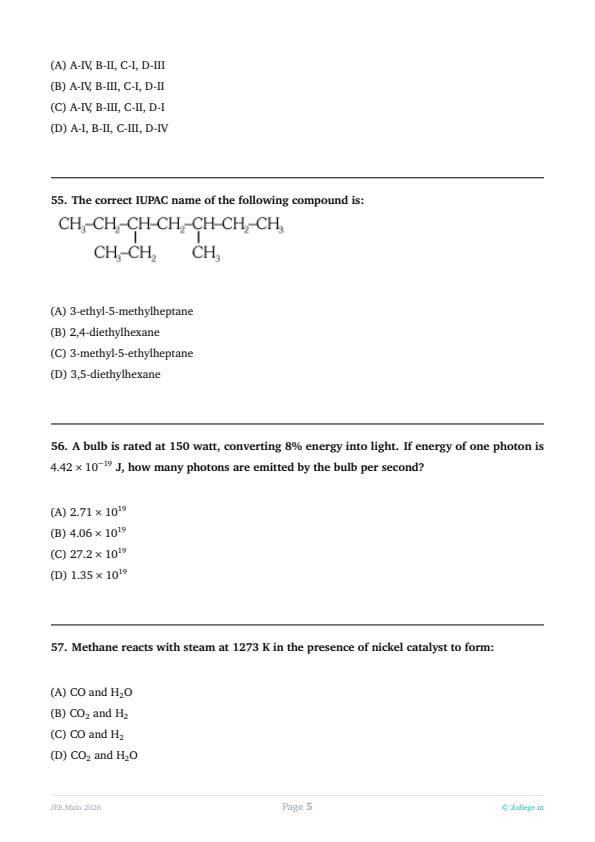
The correct IUPAC name of the following compound is:

View Solution
Step 1: Understanding the Topic:
The problem requires applying the IUPAC (International Union of Pure and Applied Chemistry) rules for naming branched-chain alkanes. Systematic nomenclature ensures that every organic molecule has a unique and descriptive name. The process involves identifying the longest continuous carbon chain, numbering it to give substituents the lowest possible positions, and arranging substituents in alphabetical order.
Step 2: Key Formulas and Approach:
The approach follows these rules:
Identify the longest carbon chain (parent chain).
Number the chain to give the substituents the lowest possible locants.
If two different substituents are at equivalent positions from either end, the one that comes first alphabetically gets the lower number.
Write the final name with substituents in alphabetical order.
Step 3: Detailed Explanation:
Longest Chain: By tracing the structure, we find a 7-carbon continuous chain. A 6-carbon "hexane" path exists, but it is not the longest. The parent name is thus heptane.
Substituents: There is a 1-carbon branch (methyl) and a 2-carbon branch (ethyl).
Numbering:
If we number from left-to-right: Ethyl is at position 3, Methyl is at position 5. (Locants: 3, 5).
If we number from right-to-left: Methyl is at position 3, Ethyl is at position 5. (Locants: 3, 5).
Tie-Breaker: Since both directions give the same locant set (3, 5), we apply alphabetical priority. "Ethyl" (E) comes before "Methyl" (M). Therefore, the ethyl group is prioritized with the lower number (3).
Assembly: The name is 3-ethyl-5-methylheptane.
Step 4: Final Answer:
The correct IUPAC name is 3-ethyl-5-methylheptane, matching option (A).
Quick Tip: Never assume the horizontal line is the parent chain. Always count every possible zigzag! Also, remember that "ethyl" beats "methyl" in a numbering tie-break because "E" comes before "M" in the alphabet.
A bulb is rated at 150 watt, converting 8% energy into light. If energy of one photon is \(4.42 \times 10^{-19}\) J, how many photons are emitted by the bulb per second?
View Solution
Step 1: Understanding the Topic:
This question combines concepts from "Structure of Atom" and basic physics (Power and Energy). It deals with the quantization of energy, where light is viewed as a stream of individual particles called photons. We must calculate the total energy converted into light every second and then determine how many individual photons make up that total energy value.
Step 2: Key Formulas and Approach:
Power (Watts) = Energy per unit time (Joules per second).
Energy converted to light = \(Total Power \times Efficiency\).
Total light energy per second (\(E_{total}\)) = \(n \times E_{photon}\) (where \(n\) is the number of photons).
Step 3: Detailed Explanation:
Total Energy Output: A 150 W bulb outputs 150 Joules of energy every second.
Efficiency Calculation: Only 8% of this energy is actually light.
\[ Light energy per second = 150 \times 0.08 = 12 J/s \]
Determine Photon Count (n): The energy of a single photon is given as \(4.42 \times 10^{-19}\) Joules.
\[ 12 = n \times (4.42 \times 10^{-19}) \]
\[ n = \frac{12}{4.42 \times 10^{-19}} \]
Final Calculation:
\[ n = 2.7149 \times 10^{19} \approx 2.71 \times 10^{19} \]
This huge number indicates the staggering amount of photons emitted by even a modest light source.
Step 4: Final Answer:
The number of photons emitted per second is \(2.71 \times 10^{19}\), matching option (A).
Quick Tip: A Watt is simply a "Joule per second." When you see Power, treat it as the total "energy budget" for one second. After that, it's just a simple division problem: \(Total Budget / Cost of one photon\).
Methane reacts with steam at 1273 K in the presence of nickel catalyst to form:
View Solution
Step 1: Understanding the Topic:
The reaction described is known as "Steam Reforming of Methane." It is a vital industrial process covered in the chapters on "Hydrogen" and "Hydrocarbons." This method is the primary way hydrogen gas is produced globally. It involves the high-temperature catalytic reaction between a hydrocarbon and water vapor to produce a mixture of gases that serve as feedstock for further chemical synthesis.
Step 2: Key Formulas and Approach:
The approach involves identifying the specific chemical equation for the interaction between methane and water in the presence of a metal catalyst at high temperature. We analyze the oxidation state changes of carbon.
Step 3: Detailed Explanation:
Reaction Conditions: When methane (\(CH_4\)) and steam (\(H_2O\)) are passed over a Nickel (\(Ni\)) catalyst at approximately \(1273 K\), a redox reaction takes place.
Chemical Equation:
\[ CH_4(g) + H_2O(g) \xrightarrow[1273 K]{Ni} CO(g) + 3H_2(g) \]
Products: The reaction produces Carbon Monoxide (\(CO\)) and Hydrogen gas (\(H_2\)).
Terminology: The resulting mixture of \(CO\) and \(H_2\) is commercially referred to as Synthesis Gas or Syngas. It is a starting point for producing methanol and other synthetic hydrocarbons. If further hydrogen is needed, the \(CO\) can be reacted with more steam at a lower temperature (Water-Gas Shift reaction).
Step 4: Final Answer:
The reaction forms CO and H\(_2\), corresponding to option (C).
Quick Tip: Think of "reforming" as reforming the simple methane molecule into something more useful. At very high temperatures (\(>1200 K\)), \(CO\) is the dominant carbon product. If you ever see "Steam + Methane + Nickel," the answer is almost always Syngas (\(CO + H_2\)).
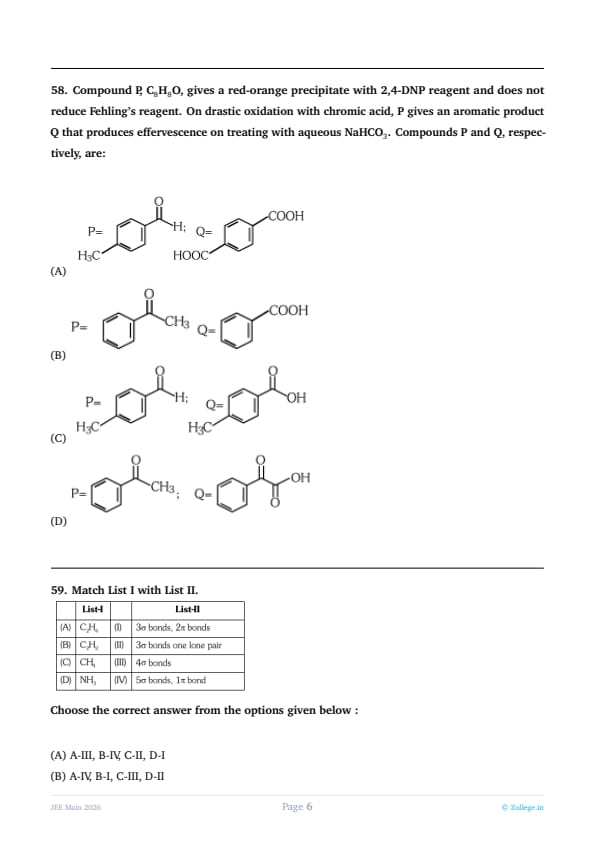
Compound P, C\(_8\)H\(_8\)O, gives a red-orange precipitate with 2,4-DNP reagent and does not reduce Fehling's reagent. On drastic oxidation with chromic acid, P gives an aromatic product Q that produces effervescence on treating with aqueous NaHCO\(_3\). Compounds P and Q, respectively, are:
- (A)
![]()
- (B)
![]()
- (C)
![]()
- (D)
![]()


View Solution
Step 1: Understanding the Topic:
This problem focuses on the qualitative analysis of organic compounds. It uses specific chemical tests (2,4-DNP, Fehling's, and Sodium Bicarbonate) to determine the functional groups of unknown molecules. It also requires understanding the oxidation of alkyl/acyl side chains in aromatic compounds. Deciphering these tests is essential for identifying substances in organic chemistry labs.
Step 2: Key Formulas and Approach:
The approach involves translating each chemical test into a functional group:
2,4-DNP Positive \(\rightarrow\) Carbonyl group present (Aldehyde or Ketone).
Fehling's Negative \(\rightarrow\) Not an aliphatic aldehyde (likely a Ketone).
NaHCO\(_3\) Positive \(\rightarrow\) Carboxylic acid group present.
Oxidation of \(Ar-R\) or \(Ar-CO-R\) \(\rightarrow\) \(Ar-COOH\).
Step 3: Detailed Explanation:
Identify P: The molecular formula \(C_8H_8O\) indicates a high degree of unsaturation (likely a benzene ring). A positive 2,4-DNP test confirms a carbonyl. A negative Fehling's test indicates a ketone rather than an aldehyde. Acetophenone (\(C_6H_5COCH_3\)) perfectly fits these observations and the formula \(C_8H_8O\).
Identify Q: Strong oxidation of acetophenone with chromic acid (\(H_2CrO_4\)) cleaves the side chain and oxidizes the carbon attached to the ring to its highest state.
\[ C_6H_5COCH_3 \xrightarrow{[O]} C_6H_5COOH \]
The product \(Q\) is thus Benzoic Acid.
Verification: Benzoic acid is a carboxylic acid, so it will react with sodium bicarbonate to release carbon dioxide gas, causing the observed effervescence.
Step 4: Final Answer:
P is acetophenone and Q is benzoic acid, matching option (A).
Quick Tip: If you see \(C_8H_8O\) in a question about aromatic ketones, \textbf{Acetophenone} should be your first thought. Also, remember that any side chain on a benzene ring—whether it is an ethyl group, a propyl group, or an acetyl group—will be "shaved down" to a single \(-COOH\) group under drastic oxidation!
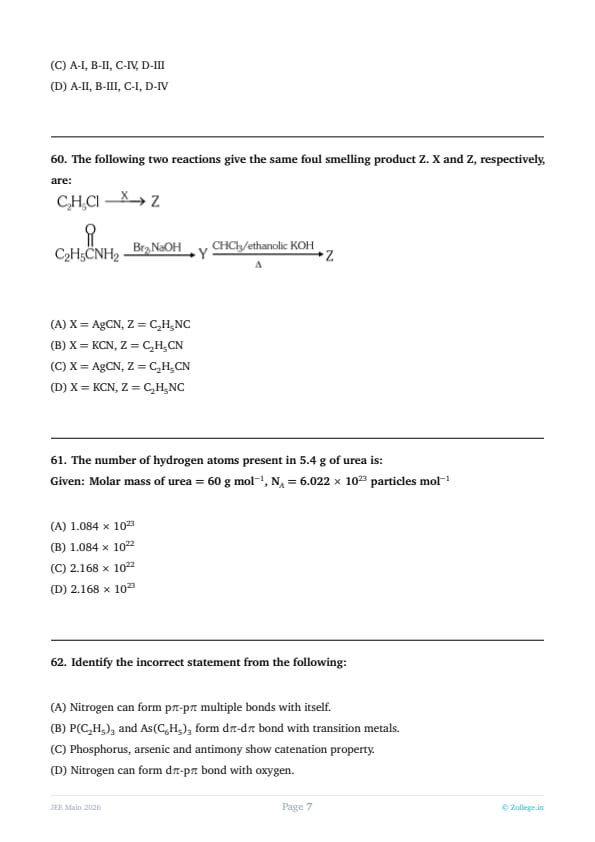
Match List I with List II.

Choose the correct answer from the options given below :
View Solution
Step 1: Understanding the Topic:
The topic of this question is "Chemical Bonding and Molecular Structure." It specifically focuses on the types of covalent bonds (\(\sigma\) and \(\pi\)) and the presence of lone pairs in various simple molecules. Sigma bonds result from the head-on overlap of orbitals and are found in all single bonds, while pi bonds result from sideways overlap and are found in double and triple bonds. Lone pairs are non-bonding valence electrons that influence molecular geometry.
Step 2: Key Formulas and Approach:
We evaluate the Lewis structure of each molecule:
A single bond is 1 \(\sigma\) bond.
A double bond is 1 \(\sigma\) + 1 \(\pi\) bond.
A triple bond is 1 \(\sigma\) + 2 \(\pi\) bonds.
Lone pairs = (Valence electrons of central atom - used electrons) / 2.
Step 3: Detailed Explanation:
A. C\(_2\)H\(_4\) (Ethene): Structure: \(H_2C=CH_2\). There is one \(C=C\) double bond and four \(C-H\) single bonds. Total: \((1+4) = \textbf{5}\) \(\sigma\) bonds and \(\textbf{1}\) \(\pi\) bond. A matches with IV.
B. C\(_2\)H\(_2\) (Ethyne): Structure: \(HC \equiv CH\). There is one \(C \equiv C\) triple bond and two \(C-H\) single bonds. Total: \((1+2) = \textbf{3}\) \(\sigma\) bonds and \(\textbf{2}\) \(\pi\) bonds. B matches with I.
C. CH\(_4\) (Methane): Structure: A central carbon bonded to four hydrogen atoms by single bonds. Total: 4 \(\sigma\) bonds. C matches with III.
D. NH\(_3\) (Ammonia): Structure: Nitrogen has 5 valence electrons. 3 are used for single bonds with Hydrogen, leaving 2 electrons as a lone pair. Total: 3 \(\sigma\) bonds and 1 lone pair. D matches with II.
Step 4: Final Answer:
The matching sequence is A-IV, B-I, C-III, D-II, which is option (B).
Quick Tip: To count \(\sigma\) bonds in an acyclic molecule quickly, use the formula: \(Atoms - 1\). For ethene (\(C_2H_4\)): 6 atoms \(- 1 = 5 \sigma\) bonds. For ethyne (\(C_2H_2\)): 4 atoms \(- 1 = 3 \sigma\) bonds. It’s a great way to verify your counts!
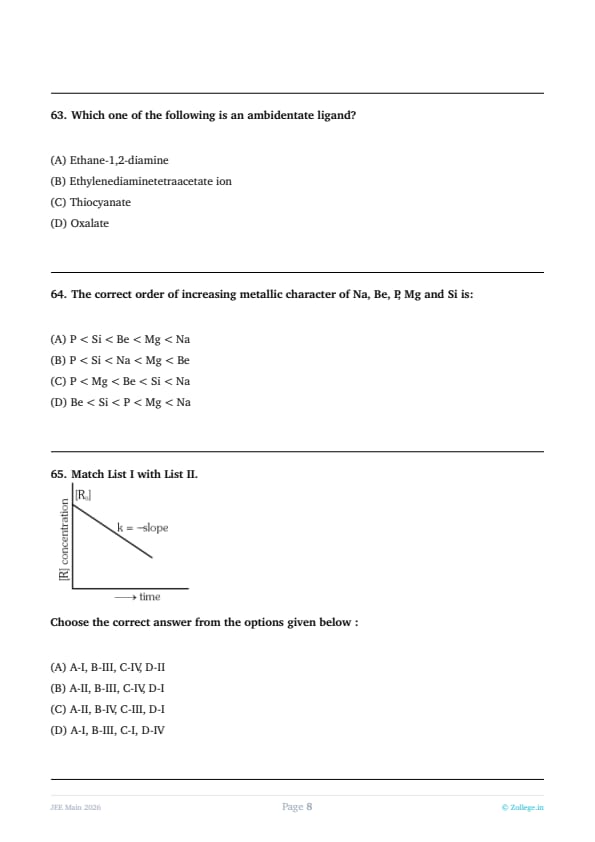
The following two reactions give the same foul smelling product Z. X and Z, respectively, are:

View Solution
Step 1: Understanding the Topic:
This problem deals with "Amines" and the "Haloalkanes and Haloarenes" chapters. It specifically targets the ambidentate nature of the cyanide ion (\(CN^-\)) and the "Carbylamine test." An ambidentate nucleophile can attack through two different atoms. The "foul smell" mentioned is a classic indicator used in chemistry laboratories to identify the formation of an isocyanide (also called carbylamine).
Step 2: Key Formulas and Approach:
The approach involves identifying the specific conditions that favor Nitrogen-attack over Carbon-attack:
\(R-Cl + KCN \rightarrow R-CN\) (Nitrile).
\(R-Cl + AgCN \rightarrow R-NC\) (Isocyanide).
\(R-NH_2 + CHCl_3 + KOH \rightarrow R-NC\) (Isocyanide/Carbylamine).
Step 3: Detailed Explanation:
Analyze the second reaction: A primary amine (formed from the Hofmann degradation of propanamide) reacts with chloroform and alcoholic KOH. This is the Carbylamine reaction, which always produces a foul-smelling isocyanide. For an ethyl chain, the product \(Z\) is Ethyl Isocyanide (\(C_2H_5NC\)).
Analyze the first reaction: The reaction is \(C_2H_5Cl + X \rightarrow Z\). We already found that \(Z\) is \(C_2H_5NC\).
To obtain an isocyanide from an alkyl chloride, we must use a covalent cyanide like Silver Cyanide (AgCN).
While \(KCN\) provides free cyanide ions that favor the stronger \(C-C\) bond formation, the covalent \(Ag-C\) bond in \(AgCN\) forces the lone pair on Nitrogen to act as the nucleophile, leading to the isocyanide.
Step 4: Final Answer:
X is AgCN and Z is \(C_2H_5NC\). This corresponds to option (A).
Quick Tip: Remember: \textbf{K}otassium is ionic and gives \textbf{K}yanides (Cyanides/Nitriles). \textbf{S}ilver is covalent and gives i\textbf{S}ocyanides. If you ever see "foul smell" in an organic question, \(99%\) of the time it is talking about an isocyanide!
The number of hydrogen atoms present in 5.4 g of urea is:
Given: Molar mass of urea = 60 g mol\(^{-1}\), N\(_A\) = 6.022 \(\times\) 10\(^{23}\) particles mol\(^{-1}\)
View Solution
Step 1: Understanding the Topic:
The question belongs to "Some Basic Concepts of Chemistry," specifically the "Mole Concept." Calculating the number of atoms in a given mass of a substance requires several steps: converting mass to moles using molar mass, converting moles to molecules using Avogadro’s number, and finally multiplying by the "atomicity" (number of specific atoms in one molecule). This is a fundamental skill in stoichiometry.
Step 2: Key Formulas and Approach:
The formulas required are:
\(n = Mass / Molar Mass\)
\(Number of Molecules = n \times N_A\)
\(Number of Atoms = Molecules \times Subscript of that atom in the formula\)
Urea formula: \(NH_2CONH_2\).
Step 3: Detailed Explanation:
Analyze Urea: The formula for urea is \((NH_2)_2CO\). Counting the atoms, each molecule contains 1 Carbon, 1 Oxygen, 2 Nitrogens, and 4 Hydrogens (\(2 \times 2 = 4\)).
Calculate Moles of Urea:
\[ n = 5.4 g / 60 g/mol = 0.09 mol \]
Calculate Number of Molecules:
\[ Molecules = 0.09 \times 6.022 \times 10^{23} = 0.54198 \times 10^{23} \]
Calculate Hydrogen Atoms: Since each molecule has 4 Hydrogen atoms:
\[ H-atoms = 4 \times 0.54198 \times 10^{23} = 2.16792 \times 10^{23} \]
Rounding to four significant figures gives \(2.168 \times 10^{23}\).
Step 4: Final Answer:
The total number of hydrogen atoms is \(2.168 \times 10^{23}\), which is option (D).
Quick Tip: A common mistake is to forget to multiply by the number of atoms in a single molecule. A mole of "people" is \(N_A\) people, but a mole of "people" has \(2 \times N_A\) "hands." Similarly, a mole of urea has \(4 \times N_A\) hydrogen atoms. Always check the formula!
Identify the incorrect statement from the following:
View Solution
Step 1: Understanding the Topic:
The question covers the properties of "p-Block Elements," specifically Group 15 (The Pnictogens). A key concept here is the "anomalous behavior of Nitrogen," which arises because it belongs to the second period of the periodic table. Elements in the second period differ from their heavier congeners because of their exceptionally small size, high electronegativity, and, most importantly, the lack of vacant d-orbitals in their valence shell.
Step 2: Key Formulas and Approach:
The approach involves evaluating each statement based on the orbital availability of Nitrogen versus Phosphorus/Arsenic:
Nitrogen: Shell \(n=2\), orbitals available: \(2s, 2p\) (No d-orbitals).
Phosphorus/Arsenic: Shell \(n=3\) or \(n=4\), vacant d-orbitals available for bonding.
Step 3: Detailed Explanation:
Statement (A): Correct. Nitrogen is small and can achieve sideways overlap of p-orbitals to form the \(N \equiv N\) triple bond.
Statement (B): Correct. Phosphines and Arsines use their vacant d-orbitals to accept electron density back from transition metals in a process known as "back-bonding" (forming \(d\pi-d\pi\) bonds).
Statement (C): Correct. While Nitrogen shows limited catenation (\(N_2, N_3^-\)), Phosphorus and Arsenic show extensive catenation (chains and rings), as seen in \(P_4\).
Statement (D): Incorrect. Nitrogen does not have any d-orbitals in its valence shell (\(n=2\) can only have \(l=0,1\)). Therefore, it cannot participate in \(d\pi-p\pi\) bonding. Heavy elements like Phosphorus can form such bonds with oxygen (as in \(P_4O_{10}\)).
Step 4: Final Answer:
The incorrect statement is (D).
Quick Tip: Always remember: Second-period elements (B, C, N, O, F) \textbf{never} use d-orbitals because they don't have them! If a statement suggests Nitrogen or Oxygen is using a d-orbital, you have found your incorrect answer.
Which one of the following is an ambidentate ligand?
View Solution
Step 1: Understanding the Topic:
This problem belongs to the chapter "Coordination Compounds." Ligands are molecules or ions that donate electron pairs to a central metal atom. An ambidentate ligand is a unique type of ligand that possesses two different atoms through which it can coordinate, but it only uses one of these atoms at a time to bond with the metal. This capability leads to the formation of linkage isomers.
Step 2: Key Formulas and Approach:
We evaluate the denticity and donor atoms of each option:
Bidentate: Uses two donor sites simultaneously.
Hexadentate: Uses six donor sites simultaneously.
Ambidentate: Has two choices of donor atoms but uses only one at a time.
Step 3: Detailed Explanation:
A. Ethane-1,2-diamine (en): This is a bidentate ligand. It uses two Nitrogen donor atoms simultaneously to form a five-membered chelate ring with the metal.
B. EDTA: This is a hexadentate ligand. It uses two Nitrogen and four Oxygen donor sites to wrap around the metal ion.
C. Thiocyanate (\(SCN^-\)): This is an ambidentate ligand. It can coordinate via the Sulfur atom (\(M-SCN\), thiocyanato) or via the Nitrogen atom (\(M-NCS\), isothiocyanato). It is monodentate but has two different ways to "plug in" to the metal.
D. Oxalate (\(ox\)): This is a bidentate ligand using two Oxygen donor atoms simultaneously.
Step 4: Final Answer:
The only ambidentate ligand listed is Thiocyanate, which corresponds to option (C).
Quick Tip: There are only a few common ambidentate ligands you need to memorize: \(NO_2^-\) (Nitro/Nitrito), \(CN^-\) (Cyano/Isocyano), and \(SCN^-\) (Thiocyanato/Isothiocyanato). If you see these, you know they can "flip" their donor atom!
The correct order of increasing metallic character of Na, Be, P, Mg and Si is:
View Solution
Step 1: Understanding the Topic:
The question relates to "Classification of Elements and Periodicity in Properties." Metallic character (or electropositivity) is the tendency of an element to lose electrons and form cations. This property follows regular trends in the periodic table. Understanding these trends allows us to rank elements based on their reactivity and physical properties like electrical conductivity.
Step 2: Key Formulas and Approach:
The trends are:
Across a Period (left to right): Metallic character decreases due to an increase in effective nuclear charge, which makes it harder to remove valence electrons.
Down a Group: Metallic character increases as atomic size increases and shielding effect increases, making valence electrons easier to remove.
Step 3: Detailed Explanation:
Positions: Na, Mg, Si, P are all in Period 3. Be is in Period 2 (directly above Mg).
Period 3 Ranking: Na (Group 1) is most metallic, followed by Mg (Group 2), then the metalloid Si, and finally the non-metal P. (Order: \(P < Si < Mg < Na\)).
Group 2 Ranking: Since metallic character increases down a group, Mg (Period 3) is more metallic than Be (Period 2).
Refining the order: Phosphorus is a non-metal (lowest). Silicon is a metalloid. Between the metals Be, Mg, and Na:
Na is more metallic than Mg (Period trend).
Mg is more metallic than Be (Group trend).
Be is further to the right and higher up than Na/Mg, making it less metallic than them but more so than Si.
Final Order: \(P < Si < Be < Mg < Na\).
Step 4: Final Answer:
The correct increasing order is option (A).
Quick Tip: Remember: The "king" of metals is at the bottom-left corner of the periodic table (Francium), and the "king" of non-metals is at the top-right (Fluorine). The closer an element is to the bottom-left, the more metallic it is! Since Na is the furthest left and P is furthest right, Na must be the biggest and P the smallest in this list.
Match List I with List II.

Choose the correct answer from the options given below :
View Solution
Step 1: Understanding the Topic:
This matching question involves multiple functional group transformations across organic chemistry. It requires knowledge of industrial synthesis methods (like the Cumene process for phenol), reducing agents for carboxylic acids, and standard dehydration reactions of alcohols. Mastery of reagents and their specific roles is fundamental to organic synthesis.
Step 2: Key Formulas and Approach:
We evaluate the reagent requirements for each specific chemical conversion:
\(Acid \rightarrow Alcohol\): Requires a strong hydride donor (\(LiAlH_4\)).
\(Alcohol \rightarrow Alkene\): Requires a strong dehydrating acid (\(H_2SO_4\)).
\(Cumene \rightarrow Phenol\): Requires oxidation with \(O_2\) followed by acid.
\(Benzene \rightarrow Phenol\): Requires sulfonation and alkali fusion.
Step 3: Detailed Explanation:
A. Cumene to Phenol: This is the industrial "Cumene Process." Cumene is oxidized by air to cumene hydroperoxide, which is then decomposed by aqueous acid into Phenol and Acetone. A matches with II.
B. \(CH_3COOH \rightarrow CH_3CH_2OH\): Reducing a carboxylic acid to a primary alcohol is difficult and requires a very strong reducing agent like Lithium Aluminium Hydride (\(LiAlH_4\)). B matches with III.
C. \(Propanol \rightarrow Propene\): This is the acid-catalyzed dehydration of a primary alcohol. Heating with concentrated sulfuric acid removes water to form an alkene. C matches with IV.
D. Benzene to Phenol: This is achieved by first sulfonating benzene with Oleum (\(H_2S_2O_7\)) to make benzenesulfonic acid, then fusing it with molten \(NaOH\) and acidifying. D matches with I.
Step 4: Final Answer:
The matching sequence is A-II, B-III, C-IV, D-I, which corresponds to option (B).
Quick Tip: Whenever you see "Cumene" and "Phenol," immediately look for \(O_2\) and \(H^+\). It’s the world’s most important way to make phenol. Also, \(LiAlH_4\) is the "brute force" reducing agent—if you have a "stubborn" group like a carboxylic acid, it's usually the only reagent that will get the job done.
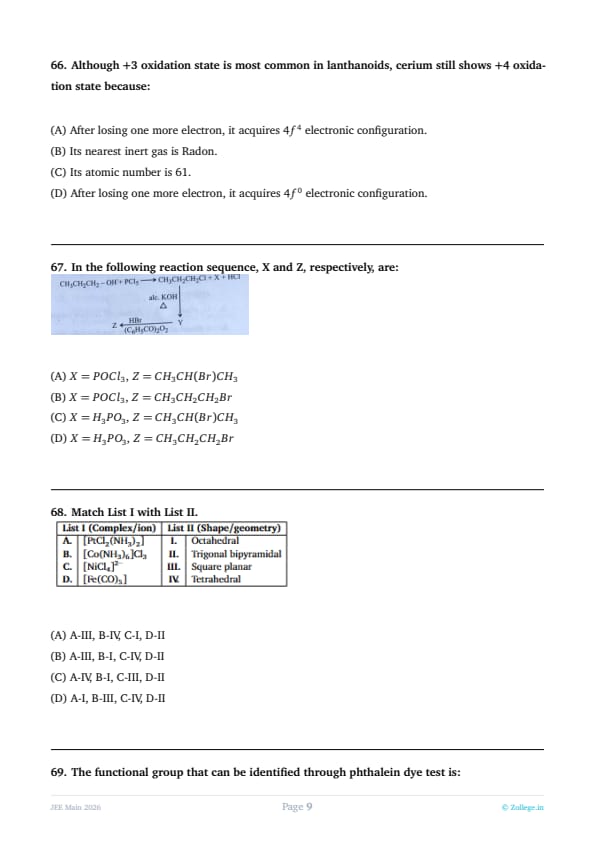
Although +3 oxidation state is most common in lanthanoids, cerium still shows +4 oxidation state because:
View Solution
Step 1: Understanding the Topic:
This problem belongs to the "f-Block Elements," specifically the Lanthanoid series. While the \(+3\) oxidation state is the most common and stable for all lanthanoids, some elements exhibit \(+2\) or \(+4\) states. These anomalous oxidation states are almost always driven by the extra stability that comes from achieving an empty (\(f^0\)), half-filled (\(f^7\)), or completely filled (\(f^{14}\)) \(4f\) subshell. Achieving these specific configurations mimics the stability found in noble gases.
Step 2: Key Formulas and Approach:
The approach involves checking the electronic configuration of Cerium in its neutral state and its various ionic states to see which one provides maximum stability.
Step 3: Detailed Explanation:
Ground State: Cerium (Atomic Number 58) has the ground-state configuration: \([Xe] 4f^1 5d^1 6s^2\).
\(+3\) State: Removing three electrons (from \(6s\) and \(5d\)) gives \(Ce^{3+}\) with the configuration \([Xe] 4f^1\).
\(+4\) State: Removing one more electron (the \(4f\) electron) results in \(Ce^{4+}\).
The Result: The electronic configuration of \(Ce^{4+}\) is simply \([Xe]\), or \(4f^0\).
An empty \(4f\) subshell is highly stable. In the case of Cerium, the \(+4\) state is favored because it leaves the atom with the stable electronic core of the noble gas Xenon. Although \(Ce^{4+}\) is a strong oxidizing agent (it wants to get back to the more common \(+3\) state), it is stable enough to exist in many solid compounds and solutions.
Step 4: Final Answer:
Cerium shows the \(+4\) state due to the attainment of the stable \(4f^0\) configuration, which is option (D).
Quick Tip: Lanthanides are "f-shell perfectionists." They will go out of their way (\(+2\) or \(+4\) states) just to reach \(f^0\) (empty), \(f^7\) (half-full), or \(f^{14}\) (full). Cerium is the first element after Xenon that can reach \(f^0\) by losing 4 electrons, so it "grabs" that opportunity!
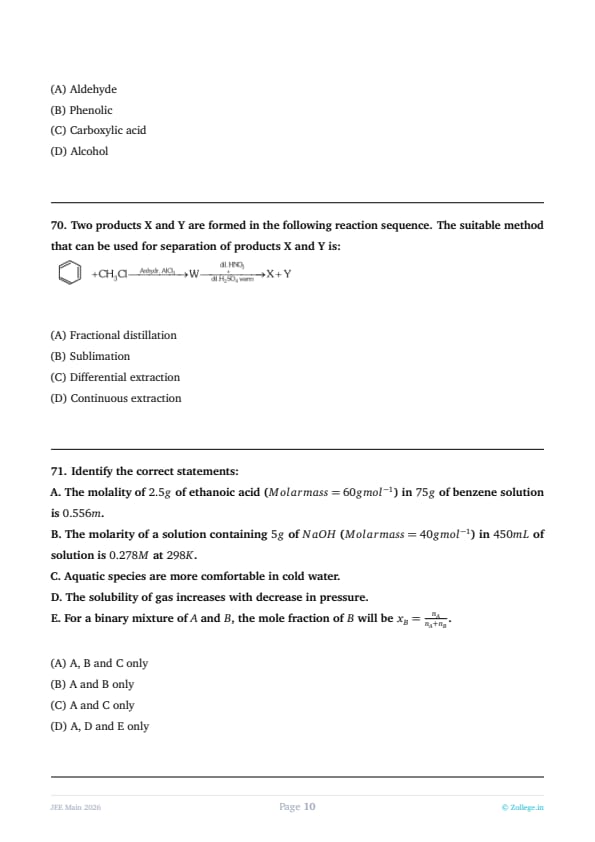
In the following reaction sequence, X and Z, respectively, are:

View Solution
Step 1: Understanding the Topic:
This problem covers a sequence of reactions involving "Alcohols," "Haloalkanes," and "Hydrocarbons." It requires knowledge of nucleophilic substitution side-products, dehydrohalogenation (elimination), and regioselective addition to alkenes. Crucially, it tests the understanding of how "Peroxide" changes the outcome of \(HBr\) addition to an asymmetrical alkene (the Kharasch effect).
Step 2: Key Formulas and Approach:
The approach involves breaking down the sequence step-by-step:
Step 1: Alcohol + \(PCl_5 \rightarrow\) Alkyl Halide + inorganic side products.
Step 2: Alkyl Halide + Alcoholic \(KOH\) \(\rightarrow\) Alkene.
Step 3: Alkene + \(HBr\)/Peroxide \(\rightarrow\) Anti-Markovnikov Halide.
Step 3: Detailed Explanation:
Reaction 1 (Find X): Propan-1-ol reacts with \(PCl_5\). The organic product is 1-chloropropane. The inorganic side products are \(HCl\) and \(POCl_3\). Thus, \(X = POCl_3\). (Note: \(PCl_3\) would give \(H_3PO_3\)).
Reaction 2 (Find Y): 1-chloropropane treated with alcoholic \(KOH\) undergoes dehydrohalogenation to form an alkene. \(CH_3CH_2CH_2Cl \rightarrow CH_3CH=CH_2\) (Propene, \(Y\)).
Reaction 3 (Find Z): Propene reacts with \(HBr\) in the presence of peroxide. Ordinarily, \(HBr\) follows Markovnikov's rule (Br goes to the middle carbon). However, peroxide causes anti-Markovnikov addition.
Result: The Bromine adds to the terminal (primary) carbon. \(Z = CH_3CH_2CH_2Br\).
Step 4: Final Answer:
X is \(POCl_3\) and Z is 1-bromopropane, matching option (B).
Quick Tip: Remember the "Five-bond Phosphorus" rule: \(PCl_{\textbf{5}}\) gives \(POCl_{\textbf{3}}\) (where P still has 5 bonds). Also, Peroxide is the "regiochemistry flipper," but only for \(HBr\). It doesn't affect \(HCl\) or \(HI\). If you see Peroxide, look for the terminal (outside) carbon for your halogen!
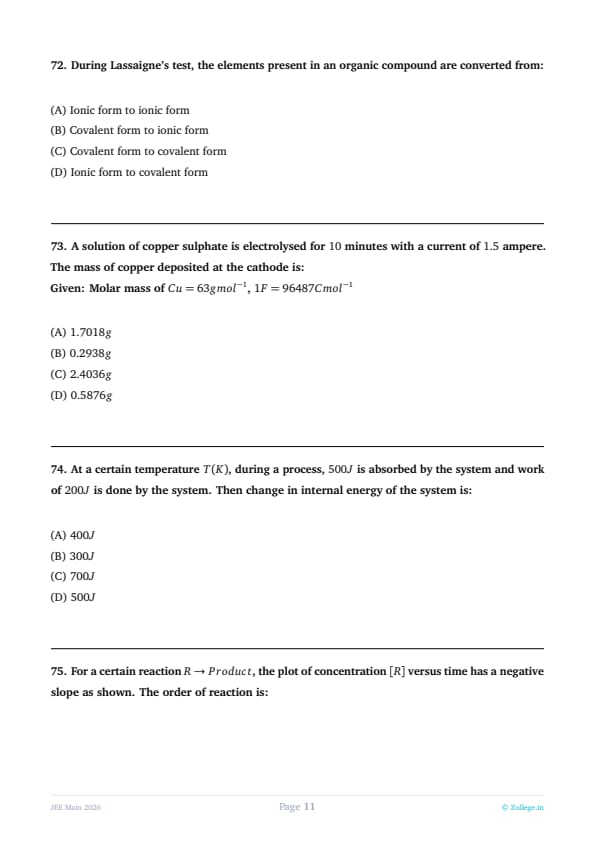
Match List I with List II.

View Solution
Step 1: Understanding the Topic:
This problem deals with the geometry and hybridization of "Coordination Compounds." According to Valence Bond Theory (VBT), the spatial arrangement of ligands around a central metal ion depends on the metal's coordination number and its hybridization state. The hybridization, in turn, is influenced by whether the ligands are "strong field" (causing electron pairing) or "weak field" (leaving electrons unpaired). Mastering these shapes is fundamental to inorganic chemistry.
Step 2: Key Formulas and Approach:
The approach involves identifying the coordination number (CN) and the metal's electronic state:
CN 4: Tetrahedral (\(sp^3\)) or Square Planar (\(dsp^2\)).
CN 5: Trigonal Bipyramidal (\(dsp^3\)).
CN 6: Octahedral (\(d^2sp^3\) or \(sp^3d^2\)).
Step 3: Detailed Explanation:
A. \([PtCl_2(NH_3)_2]\): Platinum is a heavy 5d metal in the \(+2\) state. Coordination number is 4. For heavy metals like Pt and Pd, \(CN=4\) almost always results in a Square Planar geometry regardless of ligand strength. A matches with III.
B. \([Co(NH_3)_6]Cl_3\): Cobalt is in the \(+3\) state (\(d^6\)). With 6 ammonia ligands, it is an octahedral complex. \(NH_3\) is a strong field ligand for \(Co^{3+}\), forcing electron pairing and \(d^2sp^3\) hybridization. B matches with I.
C. \([NiCl_4]^{2-}\): Nickel is in the \(+2\) state (\(d^8\)). Chloride is a weak field ligand and cannot pair the electrons. Thus, it uses \(sp^3\) hybridization, resulting in a Tetrahedral geometry. C matches with IV.
D. \([Fe(CO)_5]\): Iron is in the zero oxidation state. Coordination number is 5. Using \(dsp^3\) hybridization, the shape is Trigonal bipyramidal. D matches with II.
Step 4: Final Answer:
The matching sequence is A-III, B-I, C-IV, D-II, which is option (B).
Quick Tip: For Platinum and Palladium with coordination number 4, you can skip the complex rules and always bet on \textbf{Square Planar}. Also, Carbonyls (\(CO\)) are the strongest of all ligands—they always force pairing and result in very symmetric shapes like the Trigonal Bipyramidal for \(Fe(CO)_5\).
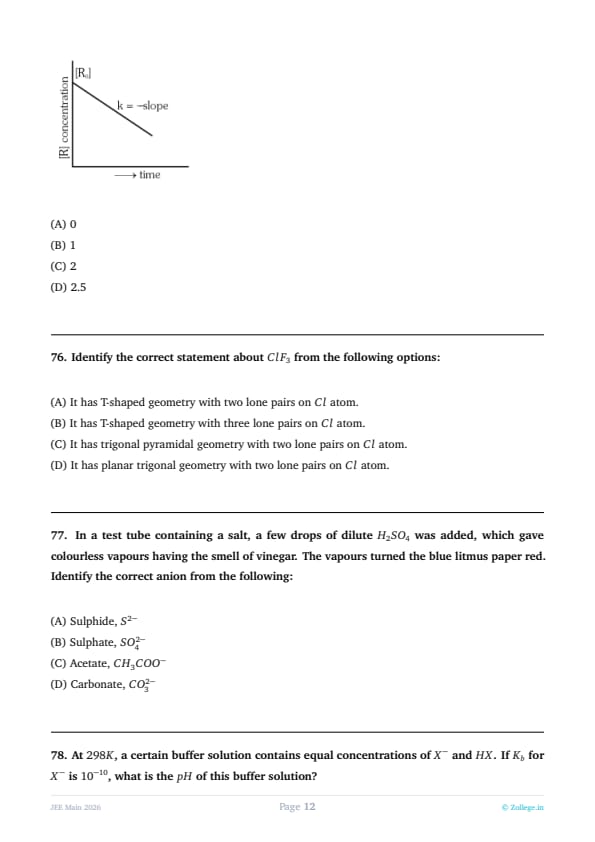
The functional group that can be identified through phthalein dye test is:
View Solution
Step 1: Understanding the Topic:
This question concerns "Qualitative Analysis" in organic chemistry. Functional groups are detected in the laboratory through specific "named" color tests. The Phthalein dye test is a sensitive method used to distinguish phenols from other oxygen-containing organic compounds like aliphatic alcohols or aldehydes. It results in the synthesis of a pH-sensitive dye that changes color in alkaline solutions.
Step 2: Key Formulas and Approach:
The approach involves understanding the condensation reaction between phenols and phthalic anhydride:
\(2 Phenol + Phthalic Anhydride \xrightarrow{H_2SO_4, \Delta} Phthalein Dye + H_2O\).
Step 3: Detailed Explanation:
Reaction Mechanism: When a compound containing a phenolic hydroxyl group (\(-OH\) attached to an aromatic ring) is heated with phthalic anhydride and concentrated sulfuric acid, a condensation reaction occurs.
Dye Formation: This reaction produces a phthalein derivative. For instance, ordinary phenol produces phenolphthalein.
Identification: The reaction mixture is then treated with a dilute alkali like \(NaOH\). If a phenol was present, the solution will develop a characteristic color (pink/red for phenol, green fluorescence for resorcinol).
Selectivity: Alcohols and aldehydes do not possess the correctly activated aromatic ring to undergo this specific condensation to form colored phthalein dyes. Thus, it is a specific test for the phenolic group.
Step 4: Final Answer:
The phthalein dye test is used to identify the phenolic functional group, matching option (B).
Quick Tip: Think of "Phenol" + "Phthalic" = "Phenolphthalein." The name of the test itself tells you that you are making a dye from a Phenol! It is the same process used to make the pink indicator you use in acid-base titrations.
Two products X and Y are formed in the following reaction sequence. The suitable method that can be used for separation of products X and Y is:

View Solution
Step 1: Understanding the Topic:
This problem integrates organic synthesis (Friedel-Crafts alkylation and Nitration) with laboratory "Purification Techniques." In organic chemistry, reactions often produce mixtures of isomers (ortho, meta, para). Because these isomers have identical molecular weights, they must be separated based on differences in their physical properties like boiling points, melting points, or steam volatility.
Step 2: Key Formulas and Approach:
The approach involves identifying the products and their physical states:
Benzene + \(CH_3Cl \xrightarrow{AlCl_3}\) Toluene.
Toluene + Nitrating mixture \(\rightarrow\) Ortho-nitrotoluene + Para-nitrotoluene.
Choose separation method based on boiling point difference.
Step 3: Detailed Explanation:
Reaction Steps: Benzene undergoes Friedel-Crafts alkylation to form Toluene (\(W\)). Toluene is then nitrated. Since the methyl group is an \(o/p\)-directing group, the reaction produces two major isomers: ortho-nitrotoluene (\(X\)) and para-nitrotoluene (\(Y\)).
Physical Constants: These two compounds are structural isomers. Ortho-nitrotoluene has a boiling point of about \(222^\circ C\), whereas para-nitrotoluene has a boiling point of about \(238^\circ C\).
Method Selection: When the components of a liquid mixture have a significant difference in their boiling points (generally \(>10-15^\circ C\)), Fractional distillation is the most effective way to separate them. The fractionating column allows for multiple vaporization-condensation cycles, ensuring that the more volatile ortho isomer is collected first.
Step 4: Final Answer:
The suitable method is fractional distillation, matching option (A).
Quick Tip: If the mixture consists of \textbf{liquids}, your first thought for separation should be distillation. If it's a mix of \textbf{solids}, think recrystallization or sublimation. Since nitrotoluenes are handled as liquids with a decent boiling point gap, fractional distillation is the key.
Identify the correct statements:
A. The molality of \(2.5 g\) of ethanoic acid (\(Molar mass = 60 g mol^{-1}\)) in \(75 g\) of benzene solution is \(0.556 m\).
B. The molarity of a solution containing \(5 g\) of \(NaOH\) (\(Molar mass = 40 g mol^{-1}\)) in \(450 mL\) of solution is \(0.278 M\) at \(298 K\).
C. Aquatic species are more comfortable in cold water.
D. The solubility of gas increases with decrease in pressure.
E. For a binary mixture of \(A\) and \(B\), the mole fraction of \(B\) will be \(x_B = \frac{n_A}{n_A + n_B}\).
View Solution
Step 1: Understanding the Question:
The objective of this question is to analyze various fundamental concepts in solution chemistry. This includes the mathematical verification of concentration units like molality and molarity, understanding the physical behavior of dissolved gases in liquids as described by Henry's Law, and identifying the correct mathematical expression for mole fractions in a binary mixture. We must evaluate each statement (A through E) for scientific and mathematical accuracy to determine which set of options is correct.
Step 2: Key Formula or Approach:
The following formulas and concepts are essential for solving this problem:
Molality (m): defined as the number of moles of solute per kilogram of solvent (\(m = \frac{n_{solute}}{m_{solvent} in kg}\)).
Molarity (M): defined as the number of moles of solute per liter of total solution (\(M = \frac{n_{solute}}{V_{solution} in L}\)).
Henry's Law and Temperature: The solubility of gases generally decreases with an increase in temperature (exothermic dissolution) and increases with an increase in partial pressure.
Mole Fraction (\(x_i\)): The ratio of moles of a specific component to the total moles in the mixture (\(x_B = \frac{n_B}{n_A + n_B}\)).
Step 3: Detailed Explanation:
Statement A Verification: We first find the moles of ethanoic acid (\(CH_3COOH\)): \(n = \frac{2.5 g}{60 g/mol} = 0.04167\) mol. The mass of the solvent (benzene) is \(75\) g, which is \(0.075\) kg. Calculating molality: \(m = \frac{0.04167}{0.075} = 0.5555...\) m. Rounding to three decimal places gives \(0.556\) m. Thus, Statement A is correct.
Statement B Verification: First, calculate the moles of \(NaOH\): \(n = \frac{5 g}{40 g/mol} = 0.125\) mol. The volume of the solution is \(450\) mL, which equals \(0.450\) L. Calculating molarity: \(M = \frac{0.125}{0.450} = 0.2777...\) M. Rounding to three decimal places gives \(0.278\) M. Thus, Statement B is correct.
Statement C Analysis: According to Henry's Law, the solubility of a gas is inversely related to temperature because the dissolution of gases is typically an exothermic process. Cold water can hold a higher concentration of dissolved oxygen compared to warm water. This higher oxygen content makes aquatic organisms more "comfortable" or biologically viable in colder environments. Thus, Statement C is correct.
Statement D Analysis: Henry's Law states that gas solubility (\(S\)) is directly proportional to the partial pressure (\(P\)) of the gas (\(S \propto P\)). Therefore, if pressure decreases, the solubility should also decrease. This makes Statement D incorrect.
Statement E Analysis: The mole fraction of a component B is the number of moles of B divided by the total moles. The provided formula \(x_B = \frac{n_A}{n_A + n_B}\) is the formula for the mole fraction of component A, not B. Thus, Statement E is incorrect.
Step 4: Final Answer:
By evaluating all claims, we find that only statements A, B, and C are logically and mathematically sound. Therefore, the correct option is (A).
Quick Tip: To remember the difference between Molarity and Molality, focus on the "l" in mola\textbf{l}ity. Think of it as mola\textbf{l}ity for "solvent mass (kg)" and mo\textbf{l}arity for "volume (L)". Also, note that while molarity changes with temperature due to volume expansion, molality remains constant because mass is temperature-independent.
During Lassaigne’s test, the elements present in an organic compound are converted from:
View Solution
Step 1: Understanding the Question:
This question focuses on the underlying chemical principle of Lassaigne's test, which is a qualitative analysis method used to detect the presence of Nitrogen, Sulfur, and Halogens in organic compounds. Because these elements are bonded within a covalent framework in organic molecules, they do not exist as free ions and cannot be detected by standard inorganic reagents. The test is designed to convert these non-ionizable elements into a form that can be tested in an aqueous solution.
Step 2: Key Formula or Approach:
The "Sodium Fusion" method is the core approach here. By heating the organic compound with highly reactive sodium metal, the covalent bonds are broken, and the atoms are forced to react with sodium to form stable, water-soluble ionic salts. The general reactions are:
For Nitrogen: \(Na + C + N \rightarrow NaCN\) (Sodium Cyanide)
For Sulfur: \(2Na + S \rightarrow Na_2S\) (Sodium Sulfide)
For Halogens: \(Na + X \rightarrow NaX\) (Sodium Halide)
Step 3: Detailed Explanation:
Initial State: In organic molecules (like urea, thiourea, or chlorobenzene), the Nitrogen, Sulfur, and Halogens are part of the carbon chain or rings. They are held together by covalent bonds, where electrons are shared. These molecules do not dissociate into ions when dissolved in water, meaning we cannot use simple tests like adding silver nitrate to detect a halogen.
Transformation Process: During the fusion process, the organic compound is heated with a pellet of sodium metal until the tube becomes red hot. The intense heat and the strong reducing nature of sodium cause the covalent bonds to rupture.
Ionic Product Formation: The free atoms then bond with sodium. Carbon and Nitrogen from the organic matter combine with sodium to form the cyanide ion (\(CN^-\)) in the salt \(NaCN\). Sulfur forms the sulfide ion (\(S^{2-}\)) in \(Na_2S\), and Halogens (Cl, Br, I) form halide ions (\(X^-\)) in \(NaX\).
Detection: These resulting salts are ionic. When the red-hot tube is plunged into distilled water, these ionic salts dissolve completely. This "sodium fusion extract" can then be tested using standard inorganic qualitative procedures (like the Prussian blue test for Nitrogen or the Lead Acetate test for Sulfur).
Step 4: Final Answer:
The fundamental shift in the Lassaigne's test is the conversion of elements from their original covalent form into a detectable ionic form. Thus, option (B) is the correct answer.
Quick Tip: To ensure the success of Lassaigne's test, always use a fresh, shiny piece of sodium. If the sodium is oxidized, the fusion may be incomplete. Also, remember that the formation of \(NaCN\) requires \textbf{both} carbon and nitrogen from the organic compound; if you are testing a compound that lacks carbon but has nitrogen, you won't get a positive cyanide test.
A solution of copper sulphate is electrolysed for \(10\) minutes with a current of \(1.5\) ampere. The mass of copper deposited at the cathode is:
Given: Molar mass of \(Cu = 63 g mol^{-1}\), \(1F = 96487 C mol^{-1}\)
View Solution
Step 1: Understanding the Question:
The problem asks for the quantitative mass of copper metal that will be plated out of a copper sulfate (\(CuSO_4\)) solution onto a cathode during an electrolytic process. We are provided with the duration of the electrolysis, the amount of current passed, the molar mass of copper, and Faraday's constant. This is a direct application of the stoichiometry of electrolysis.
Step 2: Key Formula or Approach:
We utilize Faraday’s First Law of Electrolysis, which states that the mass (\(w\)) of a substance deposited is proportional to the quantity of electricity (\(Q\)) passed through the electrolyte.
\(Q = I \times t\) (where \(I\) is current in Amperes and \(t\) is time in seconds).
\(w = \frac{E \cdot I \cdot t}{F}\)
Equivalent Weight (E): \(E = \frac{Molar Mass}{Valency factor (n)}\).
For \(CuSO_4\), copper is in the \(+2\) oxidation state. The reduction half-reaction is \(Cu^{2+} + 2e^- \rightarrow Cu(s)\), so \(n = 2\).
Step 3: Detailed Explanation:
Time conversion: The current is applied for \(10\) minutes. To use standard units, we convert this to seconds: \(t = 10 \times 60 = 600\) seconds.
Calculating Total Charge: The total charge passed is \(Q = 1.5 A \times 600 s = 900 Coulombs\).
Determining Equivalent Weight: Using the molar mass (\(63\) g/mol) and the valency (\(2\)), we get \(E = \frac{63}{2} = 31.5\) g/eq.
Applying the mass formula:
\[ w = \frac{31.5 \times 900}{96487} \]
Final calculation: Multiply \(31.5\) by \(900\) to get \(28350\). Dividing \(28350\) by \(96487\) results in approximately \(0.293823\) g.
Rounding the result to four decimal places gives us \(0.2938\) g, which matches option (B).
Step 4: Final Answer:
The calculated mass of copper deposited at the cathode is \(0.2938\) g.
Quick Tip: Always double-check the "n-factor" (valency). For metals like Copper, it can be \(1\) (in \(CuCl\)) or \(2\) (in \(CuSO_4\)). Using the wrong n-factor will lead to a 100% error in your final mass calculation. Also, ensure time is always converted to seconds!
At a certain temperature \(T(K)\), during a process, \(500 J\) is absorbed by the system and work of \(200 J\) is done by the system. Then change in internal energy of the system is:
View Solution
Step 1: Understanding the Question:
The question asks for the change in internal energy (\(\Delta U\)) of a thermodynamic system. It provides two specific energy exchanges: heat (\(q\)) absorbed and work (\(w\)) performed. This requires an understanding of the First Law of Thermodynamics, which is essentially the law of conservation of energy applied to thermodynamic systems. We must be particularly careful with the sign conventions used in chemistry.
Step 2: Key Formula or Approach:
The First Law of Thermodynamics is expressed as: \(\Delta U = q + w\).
According to the IUPAC convention (standard for Chemistry):
Heat (q): If heat is absorbed/gained by the system, \(q\) is positive (\(+\)). If heat is released, \(q\) is negative (\(-\)).
Work (w): If work is done on the system (compression), \(w\) is positive (\(+\)). If work is done \textit{by the system (expansion), \(w\) is negative (\(-\)).
Step 3: Detailed Explanation:
Analyze Heat (q): The problem states \(500 J\) is "absorbed by the system." This represents an influx of energy, so \(q = +500 J\).
Analyze Work (w): The problem states \(200 J\) of work is "done by the system." Since the system is spending energy to do work on its surroundings, the internal energy should decrease by this amount. Thus, \(w = -200 J\).
Calculating \(\Delta U\): Plug the values into the formula:
\[ \Delta U = q + w \]
\[ \Delta U = (+500 J) + (-200 J) \]
\[ \Delta U = 500 - 200 = 300 J \]
The final result of \(300 J\) means that although the system did some work, it gained more heat than it spent, resulting in a net increase of \(300 J\) in its total internal energy.
Step 4: Final Answer:
The change in internal energy of the system is \(300 J\).
Quick Tip: To remember the signs, think of the system like a bank account. Heat \textbf{absorbed is like a \textbf{deposit} (\(+\)), and work \textbf{done by} the system is like a \textbf{withdrawal} (\(-\)). The final balance in the account is your \(\Delta U\).
For a certain reaction \(R \rightarrow Product\), the plot of concentration \([R]\) versus time has a negative slope as shown. The order of reaction is:
View Solution
Step 1: Understanding the Question:
In chemical kinetics, the relationship between concentration and time is unique for every reaction order. By observing the graphical representation of how the reactant concentration \([R]\) changes as time progresses, we can deduce the order of the reaction. The question provides a plot where \([R]\) is on the y-axis and time \(t\) is on the x-axis, showing a straight line with a negative slope.
Step 2: Key Formula or Approach:
We evaluate the integrated rate laws for various orders:
Zero Order: \([R]_t = -kt + [R]_0\) (This is a linear equation of the form \(y = mx + c\)).
First Order: \(\ln[R]_t = -kt + \ln[R]_0\) (Linear only if \(\ln[R]\) is on the y-axis).
Second Order: \(\frac{1}{[R]_t} = kt + \frac{1}{[R]_0}\) (Linear only if \(1/[R]\) is on the y-axis).
Step 3: Detailed Explanation:
Analysis of the Graph: The provided image shows a plot of \([R]\) vs \(t\). It is a perfectly straight line. This implies that the concentration decreases at a constant rate, regardless of how much reactant is present.
Mathematical Correlation: The equation for a straight line is \(y = mx + c\). In the zero-order rate law (\([R] = -kt + [R]_0\)), \([R]\) acts as \(y\), \(t\) acts as \(x\), \(-k\) acts as the slope \(m\), and \([R]_0\) is the y-intercept.
Conclusion for Zero Order: Since the graph of concentration versus time is linear, the reaction rate (\(Rate = -d[R]/dt = k\)) is independent of the reactant concentration. This is the definition of a zero-order reaction.
Comparison with First Order: If the reaction were first order, the \([R]\) vs \(t\) plot would be an exponential decay curve. Only a plot of \(\ln[R]\) vs \(t\) would yield a straight line for first order.
Step 4: Final Answer:
Because the plot of \([R]\) versus time is a straight line, the order of the reaction is \(0\).
Quick Tip: Always check the labels on the axes!
1. \textbf{Direct} concentration \([R]\) vs \(t \rightarrow\) \textbf{Zero} order.
2. \textbf{Natural Log} \(\ln[R]\) vs \(t \rightarrow\) \textbf{First} order.
3. \textbf{Reciprocal} \(1/[R]\) vs \(t \rightarrow\) \textbf{Second} order.
One quick glance at the y-axis can solve the problem in seconds!
Identify the correct statement about \(ClF_3\) from the following options:
View Solution
Step 1: Understanding the Question:
The objective is to determine the structural characteristics of chlorine trifluoride (\(ClF_3\)), an interhalogen compound. We need to identify its molecular geometry and the number of lone pairs residing on the central chlorine atom using the VSEPR (Valence Shell Electron Pair Repulsion) theory. VSEPR theory states that electron pairs around a central atom arrange themselves to minimize repulsion, which dictates the shape of the molecule.
Step 2: Key Formula or Approach:
Calculate the Steric Number (SN):
\(SN = \frac{1}{2} [V + M - C + A]\)
\(V = Valence electrons of central atom\)
\(M = Number of monovalent surrounding atoms\)
\(C, A = Charge (if any)\)
Lone Pairs (LP) = SN - Bond Pairs (BP)
Step 3: Detailed Explanation:
Central Atom: Chlorine (\(Cl\)) is in group 17, so it has \(7\) valence electrons (\(V=7\)).
Surrounding Atoms: There are \(3\) monovalent Fluorine (\(F\)) atoms (\(M=3\)).
Calculation: \(SN = \frac{1}{2}(7 + 3) = 5\).
Hybridization: \(SN = 5\) corresponds to \(sp^3d\) hybridization and a Trigonal Bipyramidal (TBP) electronic geometry.
Identifying Pairs: The number of bond pairs (\(BP\)) is \(3\) (one for each \(F\) atom). The number of lone pairs is \(LP = SN - BP = 5 - 3 = 2\).
Molecular Geometry: In a TBP arrangement, lone pairs occupy equatorial positions to minimize repulsions with bond pairs. With two lone pairs in equatorial spots and three bond pairs (two axial, one equatorial), the atoms form a "T" shape.
Therefore, \(ClF_3\) is T-shaped with two lone pairs on the \(Cl\) atom.
Step 4: Final Answer:
The correct description of \(ClF_3\) is T-shaped geometry with two lone pairs on the central \(Cl\) atom.
Quick Tip: To remember where lone pairs go in \(sp^3d\) (SN=5) systems: they \textbf{always} prefer the equatorial positions because they have more "breathing room" (120-degree angles) compared to the axial positions (90-degree angles). This is why \(ClF_3\) is T-shaped and \(XeF_2\) is linear!
In a test tube containing a salt, a few drops of dilute \(H_2SO_4\) was added, which gave colourless vapours having the smell of vinegar. The vapours turned the blue litmus paper red. Identify the correct anion from the following:
View Solution
Step 1: Understanding the Question:
This is a question regarding qualitative inorganic analysis. We are observing the reaction between an unknown salt and dilute sulfuric acid. The identifying characteristics provided are the color of the evolved vapors (colorless), their distinct smell (vinegar), and their effect on litmus paper (acidic). We need to correlate these observations with the standard reactions of specific anions.
Step 2: Key Formula or Approach:
The approach involves knowing the gases produced when dilute acids react with specific anionic radicals:
Carbonate (\(CO_3^{2-}\)): Produces \(CO_2\) (colorless, odorless, turns lime water milky).
Sulphide (\(S^{2-}\)): Produces \(H_2S\) (colorless, smell of rotten eggs).
Acetate (\(CH_3COO^-\)): Produces Acetic acid vapors (colorless, smell of vinegar).
Sulphite (\(SO_3^{2-}\)): Produces \(SO_2\) (colorless, smell of burning sulfur).
Step 3: Detailed Explanation:
The Smell of Vinegar: The most defining characteristic in this problem is the "smell of vinegar." In chemistry, this odor is exclusively associated with acetic acid (\(CH_3COOH\)).
Reaction with Acid: When dilute \(H_2SO_4\) is added to an acetate salt (like sodium acetate), the acetate ion is protonated to form acetic acid.
\[ 2CH_3COONa + H_2SO_4 \rightarrow Na_2SO_4 + 2CH_3COOH \]
Acidic Nature: Acetic acid is a volatile weak acid. When it escapes as vapor, it remains acidic. Therefore, when these vapors come into contact with moist blue litmus paper, they turn it red, which is a standard test for acids.
Excluding Other Options: Sulphide gives a rotten egg smell (\(H_2S\)). Carbonate gives odorless \(CO_2\). Sulphate (\(SO_4^{2-}\)) does not react with dilute \(H_2SO_4\) to give any gas, as it is the ion from the acid itself.
Step 4: Final Answer:
Based on the specific vinegary odor and the acidic nature of the vapors, the anion is Acetate (\(CH_3COO^-\)).
Quick Tip: In the lab, if you suspect an acetate ion, you can perform the "Esterification Test" to be sure. Mix the salt with ethanol and a few drops of conc. \(H_2SO_4\) and heat. If you get a "fruity" smell, it confirms the presence of an acetate (forming ethyl acetate ester).
At \(298 K\), a certain buffer solution contains equal concentrations of \(X^-\) and \(HX\). If \(K_b\) for \(X^-\) is \(10^{-10}\), what is the \(pH\) of this buffer solution?
View Solution
Step 1: Understanding the Question:
The question asks for the \(pH\) of a buffer solution composed of a weak acid (\(HX\)) and its conjugate base (\(X^-\)). We are provided with the base dissociation constant (\(K_b\)) of the conjugate base and told that the concentrations of the acid and base are equal. To find the \(pH\), we first need to find the acid dissociation constant (\(K_a\)) and then use the Henderson-Hasselbalch equation.
Step 2: Key Formula or Approach:
Conjugate Pair Relation: At \(298 K\), \(K_a \times K_b = K_w = 10^{-14}\).
Henderson-Hasselbalch Equation: \(pH = pK_a + \log \frac{[Salt]}{[Acid]}\) (for acidic buffers).
p-notation: \(pK = -\log(K)\).
Step 3: Detailed Explanation:
Calculate \(K_a\): Given \(K_b = 10^{-10}\). Using the relation \(K_a = \frac{K_w}{K_b}\), we get:
\[ K_a = \frac{10^{-14}}{10^{-10}} = 10^{-4} \]
Calculate \(pK_a\): \(pK_a = -\log(K_a) = -\log(10^{-4}) = 4\).
Analyze Concentration Ratio: The problem states that the concentrations of \(X^-\) (salt/base) and \(HX\) (acid) are equal. Therefore, \(\frac{[X^-]}{[HX]} = 1\).
Apply Henderson-Hasselbalch:
\[ pH = 4 + \log(1) \]
Since \(\log(1) = 0\), we find that:
\[ pH = 4 + 0 = 4 \]
In such scenarios where the concentration of the acid and its conjugate base are identical, the \(pH\) simply equals the \(pK_a\) of the acid.
Step 4: Final Answer:
The \(pH\) of the buffer solution is \(4\).
Quick Tip: Remember the \(pH = pK_a\) rule! Whenever you see "equal concentrations" in a buffer problem, you don't even need to use the full HH equation. Just find the \(pK_a\) and you have your answer. It saves valuable time during exams!
Calculate emf of the half-cell given below:
\(Pt(s) | H_2(g, 2 atm) | HCl(aq, 0.02 M)\)
Given: \(E^\circ_{H^+/H_2} = 0 V\), \(\frac{2.303RT}{F} = 0.059\), \(\log 2 = 0.3010\)
View Solution
Step 1: Understanding the Question:
The goal is to find the electrode potential (\(E\)) of a hydrogen half-cell that is not at standard conditions. In a standard hydrogen electrode (SHE), the pressure is \(1\) atm and the concentration of \(H^+\) is \(1 M\). However, here the pressure is \(2\) atm and the \(HCl\) concentration is \(0.02 M\). We must apply the Nernst equation to find how these non-standard parameters affect the half-cell potential.
Step 2: Key Formula or Approach:
The reduction reaction for the hydrogen electrode is: \(2H^+ (aq) + 2e^- \rightarrow H_2 (g)\).
The Nernst Equation for a half-cell is: \[ E = E^\circ - \frac{2.303RT}{nF} \log \frac{P_{H_2}}{[H^+]^2} \]
\(E^\circ = 0 V\) (by convention for SHE).
\(n = 2\) (number of electrons transferred).
\(0.059\) is given as the value for \(\frac{2.303RT}{F}\).
Step 3: Detailed Explanation:
Parameters: \(P_{H_2} = 2 atm\) and \([H^+] = 0.02 M\) (as \(HCl\) is a strong monoprotic acid).
Substitute into Formula:
\[ E = 0 - \frac{0.059}{2} \log \frac{2}{(0.02)^2} \]
Simplify the Logarithmic Term:
\((0.02)^2 = 0.0004 = 4 \times 10^{-4}\).
So, \(\frac{2}{4 \times 10^{-4}} = 0.5 \times 10^4 = 5000\).
Calculate Log Value:
\(\log(5000) = \log(5 \times 10^3) = \log 5 + 3\).
Given \(\log 2 = 0.3010\), we can find \(\log 5\) because \(\log 5 = \log(10/2) = \log 10 - \log 2 = 1 - 0.3010 = 0.6990\).
Therefore, \(\log(5000) = 0.6990 + 3 = 3.6990\).
Final Potential:
\[ E = -0.0295 \times 3.6990 \approx -0.10912 V \]
Rounding gives \(-0.109 V\).
Step 4: Final Answer:
The emf of the half-cell is \(-0.109 V\).
Quick Tip: Always remember that for a hydrogen electrode, increasing the pressure of \(H_2\) (product) will decrease the potential (more negative), while increasing the concentration of \(H^+\) (reactant) will increase the potential (more positive) according to Le Chatelier's principle applied to the reduction half-reaction.
The calculated spin-only magnetic moment of \(Ti^{2+}\) (\(3d^2\)) is:
View Solution
Step 1: Understanding the Question:
The question asks for the spin-only magnetic moment of the titanium ion in its \(+2\) oxidation state. Magnetic moments are a result of the orbital and spin motions of electrons. In transition metals, the "spin-only" formula is widely used because the orbital contribution is often "quenched" by the surrounding ligands or crystal field. This calculation relies entirely on the number of unpaired electrons in the \(d\)-subshell of the ion.
Step 2: Key Formula or Approach:
The Spin-only magnetic moment (\(\mu\)) formula is: \[ \mu = \sqrt{n(n+2)} Bohr Magnetons (BM) \]
where \(n\) is the number of unpaired electrons.
To find \(n\), we must write the electronic configuration of the ion.
Step 3: Detailed Explanation:
Neutral Atom Configuration: Titanium (\(Ti\), Atomic Number \(Z = 22\)) has the configuration \([Ar] 3d^2 4s^2\).
Ion Configuration: For \(Ti^{2+}\), two electrons are removed. Electrons are always removed from the outermost shell (\(4s\)) first. Thus, \(Ti^{2+}\) has the configuration \([Ar] 3d^2\).
Unpaired Electrons (n): In the \(3d\) subshell, there are five orbitals. Following Hund's Rule, the two electrons will occupy separate orbitals with parallel spins. Thus, there are \(n = 2\) unpaired electrons.
Calculating Magnetic Moment:
\[ \mu = \sqrt{2(2+2)} \]
\[ \mu = \sqrt{2 \times 4} = \sqrt{8} \]
Final Value: \(\sqrt{8}\) is approximately \(2.8284\). Looking at the provided options, \(2.84\) BM is the closest and correct value.
Step 4: Final Answer:
The calculated spin-only magnetic moment for \(Ti^{2+}\) is \(2.84 BM\).
Quick Tip: There is a handy trick: the magnetic moment value always starts with the same digit as the number of unpaired electrons.
\(n=1 \rightarrow \mu \approx 1.73\)
\(n=2 \rightarrow \mu \approx 2.83\)
\(n=3 \rightarrow \mu \approx 3.87\)
\(n=4 \rightarrow \mu \approx 4.90\)
\(n=5 \rightarrow \mu \approx 5.92\)
If you know \(n=2\), you can immediately pick the option starting with \(2\).
Identify the incorrect statement from the following:
View Solution
Step 1: Understanding the Question:
This question requires an evaluation of various descriptive chemistry facts concerning Group 13, 14, and 16 elements. We must identify which statement is scientifically false by examining bonding behaviors (\(p\pi-p\pi\)), structural tendencies (monomer vs dimer), periodic trends (catenation), and oxidation states.
Step 2: Key Formula or Approach:
The approach is to use the first-principles knowledge of inorganic chemistry:
Second-period elements (\(C, N, O\)) can form multiple bonds via \(p\pi-p\pi\) overlap.
Lewis acidity in Group 13 determines whether compounds exist as monomers or dimers.
Catenation is the ability of an element to form long chains and depends on bond dissociation energy.
Oxidation states of highly electronegative elements like Oxygen depend on the partner atom's electronegativity.
Step 3: Detailed Explanation:
Statement A: Carbon is small and has the correct orbital size to form effective lateral overlaps. Thus, it forms stable double and triple bonds (\(C=C, C \equiv C\)). This is correct.
Statement B: \(BCl_3\) is a monomer because boron is small and can satisfy its octet partially via back-bonding from chlorine. \(AlCl_3\) is larger and forms a stable dimer \(Al_2Cl_6\) through chlorine bridge bonding to complete the aluminum octets. This is correct.
Statement C: Catenation depends on the \(M-M\) bond strength. \(C-C\) is the strongest (\(348 kJ/mol\)), while \(Si-Si\), \(Ge-Ge\), and \(Sn-Sn\) are significantly weaker. The order \(C \gg Si > Ge \approx Sn\) is the standard trend. This is correct.
Statement D: While \(-2\) is common, Oxygen shows \(-1\) in peroxides (\(H_2O_2\)), \(-1/2\) in superoxides (\(KO_2\)), and even positive oxidation states (\(+1, +2\)) when bonded to Fluorine (e.g., \(O_2F_2\) and \(OF_2\)). Therefore, saying it shows "only" \(-2\) is incorrect.
Step 4: Final Answer:
Statement (D) is the incorrect one.
Quick Tip: Oxygen is the second most electronegative element. It will only show a positive oxidation state when paired with the \textbf{most} electronegative element: Fluorine. In all other scenarios, it will be negative.
The correct formal charges on oxygen atoms numbered 2, 1 and 3, respectively, are:

View Solution
Step 1: Understanding the Question:
The question asks for the formal charges on three different oxygen atoms within an ozone (\(O_3\)) molecule, based on its standard Lewis resonance structure. Formal charge is a concept used in Lewis structures to help determine the distribution of electrons among atoms, assuming that electrons in a bond are shared equally between the atoms.
Step 2: Key Formula or Approach:
The Formal Charge (FC) of an atom is calculated using the formula: \[ FC = V - L - \frac{1}{2}B \]
Where:
\(V\) = valence electrons in the free atom (for Oxygen, \(V=6\)).
\(L\) = number of lone pair (non-bonding) electrons.
\(B\) = number of bonding electrons (2 electrons per bond).
Step 3: Detailed Explanation:
Oxygen 1 (Central): It is attached to one double bond and one single bond. This equals 3 bonds (6 bonding electrons) and has 1 lone pair (2 electrons).
\(FC = 6 - 2 - \frac{1}{2}(6) = 6 - 2 - 3 = +1\).
Oxygen 2 (Double-bonded): It is attached to one double bond (4 bonding electrons) and has 2 lone pairs (4 electrons).
\(FC = 6 - 4 - \frac{1}{2}(4) = 6 - 4 - 2 = 0\).
Oxygen 3 (Single-bonded): It is attached to one single bond (2 bonding electrons) and has 3 lone pairs (6 electrons).
\(FC = 6 - 6 - \frac{1}{2}(2) = 6 - 6 - 1 = -1\).
The question asks for the charges in the order 2, 1, 3. So the sequence is \(0, +1, -1\).
Step 4: Final Answer:
The formal charges on oxygen atoms 2, 1, and 3 are \(0, +1, and -1\), respectively. This matches option (B).
Quick Tip: To verify your work, the sum of all formal charges must equal the total charge of the molecule. For a neutral molecule like ozone (\(O_3\)), \(0 + (+1) + (-1) = 0\). If your sum isn't zero, you made a calculation error!
Phenolphthalein is used as an indicator for titration of sodium hydroxide solution against a standard solution of oxalic acid. The colour change that is observed at an alkaline \(pH\) close to equivalence point during this titration is:
View Solution
Step 1: Understanding the Question:
This problem focuses on an acid-base titration between Sodium Hydroxide (\(NaOH\)), a strong base, and Oxalic Acid (\(H_2C_2O_4\)), a weak acid. Specifically, we need to identify the visual signal (color change) provided by the indicator phenolphthalein at the endpoint of the titration. It is important to know the starting medium and the final medium to determine the direction of the color change.
Step 2: Key Formula or Approach:
Phenolphthalein range: It is colorless in acidic and neutral solutions (\(pH < 8.3\)) and turns bright pink in basic solutions (\(pH > 10\)).
Titration Setup: Usually, the acid (analyte) is in the conical flask, and the base (titrant) is added from the burette.
Step 3: Detailed Explanation:
Initial Conditions: The conical flask contains Oxalic acid and a few drops of phenolphthalein. Because the solution is acidic, the phenolphthalein is colorless.
During Titration: As \(NaOH\) is added dropwise, it neutralizes the oxalic acid. The \(pH\) slowly rises.
Equivalence Point: At the equivalence point for a weak acid vs. strong base titration, the resulting salt (sodium oxalate) undergoes hydrolysis, creating a slightly basic environment (\(pH > 7\)).
End Point: The very first excess drop of \(NaOH\) pushes the \(pH\) into the range where phenolphthalein becomes active. The indicator then undergoes a structural change that results in a pink color.
Thus, the visible change is from a colorless solution to one that is permanently light pink.
Step 4: Final Answer:
The color change observed is from colourless to pink.
Quick Tip: Phenolphthalein is the "standard" choice for strong base vs. weak acid titrations because its working \(pH\) range matches the basic \(pH\) of the equivalence point of such reactions. Avoid using methyl orange here, as its range is too acidic!
When \(1 dm^3\) of \(CO_2\) gas is passed over hot coke, the volume of gaseous mixture after complete reaction at STP becomes \(1.4 dm^3\). The composition of the gaseous mixture at STP is:
View Solution
Step 1: Understanding the Question:
This is a stoichiometry problem involving gaseous reactants and products. \(CO_2\) gas reacts with solid carbon (coke) to form Carbon Monoxide (\(CO\)). We are given the initial volume of \(CO_2\) and the total volume of the gas mixture after the reaction. We must find the individual volumes of \(CO_2\) and \(CO\) in that final mixture.
Step 2: Key Formula or Approach:
The chemical equation is: \(CO_2(g) + C(s) \rightarrow 2CO(g)\).
According to Avogadro's Law, at constant temperature and pressure, the volume of a gas is proportional to its moles. Therefore, we can treat volumes as stoichiometric ratios. Crucially, the solid Carbon (\(C(s)\)) has negligible volume and is not part of the gas mixture calculation.
Step 3: Detailed Explanation:
Initial Volume: \(V_{CO_2} = 1 dm^3\).
Let \(x\) be the volume of \(CO_2\) that reacts.
Volumes remaining/formed:
- Volume of \(CO_2\) left \(= (1 - x) dm^3\).
- Volume of \(CO\) produced \(= 2x dm^3\) (Stoichiometry is \(1:2\)).
Total volume of mixture:
\[ V_{total} = (1 - x) + 2x = 1.4 \]
\[ 1 + x = 1.4 \]
\[ x = 0.4 dm^3 \]
Final Composition:
- Volume of \(CO_2\) remaining \(= 1 - 0.4 = 0.6 dm^3\).
- Volume of \(CO\) formed \(= 2(0.4) = 0.8 dm^3\).
This matches option (A).
Step 4: Final Answer:
The composition of the mixture is \(0.8 dm^3\) of \(CO\) and \(0.6 dm^3\) of \(CO_2\).
Quick Tip: Always notice the physical state in chemical equations! In this problem, \(C(s)\) is a solid. Students often mistakenly try to assign a volume to it or assume it disappears. Only gaseous components (\(CO_2\) and \(CO\)) contribute to the total gas volume of \(1.4 dm^3\).
The major product Z formed in the following sequence of reactions is:

View Solution
Step 1: Understanding the Question:
We are given a three-step organic synthesis starting from Ethane (\(C_2H_6\)). We must identify the intermediate products X and Y to determine the final product Z. The sequence involves a free-radical substitution, a nucleophilic substitution, and a diazotization reaction.
Step 2: Key Formula or Approach:
The approach involves identifying each reaction type:
Step 1: Halogenation of alkanes (\(Cl_2 / h\nu\)).
Step 2: Reaction of alkyl halides with ammonia (Ammonolysis).
Step 3: Reaction of primary aliphatic amines with nitrous acid (\(NaNO_2/HCl\)).
Step 3: Detailed Explanation:
Step 1 (\(X\)): Ethane reacts with \(Cl_2\) in the presence of UV light. This is a free radical substitution where one hydrogen is replaced by chlorine.
\(C_2H_6 + Cl_2 \rightarrow C_2H_5Cl (X) + HCl\). \(X\) is Ethyl chloride.
Step 2 (\(Y\)): Ethyl chloride reacts with ammonia. The \(NH_3\) acts as a nucleophile and displaces the \(Cl\) atom.
\(C_2H_5Cl + NH_3 \rightarrow C_2H_5NH_2 (Y) + HCl\). \(Y\) is Ethylamine.
Step 3 (\(Z\)): Ethylamine (a primary aliphatic amine) reacts with nitrous acid (\(HNO_2\) generated in situ).
Primary aliphatic amines react with \(HNO_2\) to form highly unstable aliphatic diazonium salts (\([C_2H_5N_2^+]Cl^-\)).
Unlike aromatic diazonium salts, these decompose immediately in water (aqueous medium) to produce nitrogen gas and the corresponding alcohol.
\(C_2H_5NH_2 \xrightarrow{HNO_2} [C_2H_5N_2^+] \xrightarrow{H_2O} C_2H_5OH (Z) + N_2 \uparrow\).
Step 4: Final Answer:
The final major product \(Z\) is Ethanol (\(C_2H_5OH\)).
Quick Tip: Remember: Aliphatic amines \(+ HNO_2 \rightarrow\) Alcohols. Aromatic amines \(+ HNO_2 \rightarrow\) Stable Diazonium salts. This is a very common distinction tested in organic chemistry exams!
Given below is an expression for the rate constant of a first order reaction occurring at a certain temperature, \(T(K)\):
\(\ln k = 14.34 - \frac{1.25 \times 10^4}{T}\)
The energy of activation in \(kcal mol^{-1}\) for the reaction is:
Given: \(R = 1.987 cal mol^{-1} K^{-1}\)
View Solution
Step 1: Understanding the Question:
The problem asks for the activation energy (\(E_a\)) of a chemical reaction. We are given an empirical logarithmic expression for the rate constant \(k\) as a function of temperature \(T\). We need to compare this expression with the theoretical Arrhenius equation to extract the value of \(E_a\). Note that the final answer is required in \(kcal/mol\), but the gas constant \(R\) is given in \(cal/mol \cdot K\).
Step 2: Key Formula or Approach:
The Arrhenius Equation in its logarithmic form is: \[ \ln k = \ln A - \frac{E_a}{RT} \]
By comparing this with the provided equation: \[ \ln k = 14.34 - \frac{1.25 \times 10^4}{T} \]
We can see that the term subtracted from \(14.34\) must correspond to \(E_a/RT\).
Step 3: Detailed Explanation:
Equating terms: \(\frac{E_a}{RT} = \frac{1.25 \times 10^4}{T}\).
The temperature \(T\) cancels out from both sides, leaving:
\(\frac{E_a}{R} = 1.25 \times 10^4\).
Calculating \(E_a\) in calories:
\(E_a = 1.25 \times 10^4 \times R\)
\(E_a = 12500 \times 1.987 = 24837.5 cal/mol\).
Converting to kcal/mol:
Since \(1 kcal = 1000 cal\), we divide the result by \(1000\).
\(E_a = \frac{24837.5}{1000} = 24.8375 kcal/mol\).
This rounds perfectly to \(24.84 kcal/mol\), which is option (A).
Step 4: Final Answer:
The energy of activation is \(24.84 kcal mol^{-1}\).
Quick Tip: Always pay attention to units in kinetics! The gas constant \(R\) can be \(8.314 J\) or \(1.987 cal\). If the options were in \(kJ/mol\), you would have needed to use \(8.314\). Since the units are \(kcal\), \(1.987\) is the correct choice to minimize unit conversion steps.
Given below are certain reactions. Identify the reaction for which \(K_p \neq K_c\):
View Solution
Step 1: Understanding the Question:
In chemical equilibrium, \(K_p\) is the equilibrium constant defined by partial pressures, and \(K_c\) is defined by molar concentrations. Depending on the stoichiometry of the gaseous components, these two constants may or may not be numerically equal. The question asks to identify the reaction where they are different.
Step 2: Key Formula or Approach:
The relationship between the two constants is: \(K_p = K_c(RT)^{\Delta n_g}\).
\(\Delta n_g\) = (Total moles of gaseous products) - (Total moles of gaseous reactants).
If \(\Delta n_g = 0\), then \((RT)^0 = 1\), so \(K_p = K_c\).
If \(\Delta n_g \neq 0\), then \(K_p \neq K_c\).
Step 3: Detailed Explanation:
Reaction A: \(H_2O(g) + CO(g) \rightleftharpoons H_2(g) + CO_2(g)\).
\(\Delta n_g = (1 + 1) - (1 + 1) = 0\). So \(K_p = K_c\).
Reaction B: \(N_2(g) + 3H_2(g) \rightleftharpoons 2NH_3(g)\).
\(\Delta n_g = (2) - (1 + 3) = 2 - 4 = -2\).
Since \(\Delta n_g \neq 0\), \(K_p = K_c(RT)^{-2}\). Thus, \(K_p \neq K_c\).
Reaction C: \(H_2(g) + I_2(g) \rightleftharpoons 2HI(g)\).
\(\Delta n_g = 2 - (1 + 1) = 0\). So \(K_p = K_c\).
Reaction D: \(N_2(g) + O_2(g) \rightleftharpoons 2NO(g)\).
\(\Delta n_g = 2 - (1 + 1) = 0\). So \(K_p = K_c\).
Reaction B is the only case where the number of gaseous molecules changes during the reaction, leading to the inequality.
Step 4: Final Answer:
The reaction where \(K_p \neq K_c\) is \(N_2(g) + 3H_2(g) \rightleftharpoons 2NH_3(g)\).
Quick Tip: To solve this in 5 seconds: just count the sum of coefficients on both sides. If they are equal (like \(1+1=2\)), then \(K_p = K_c\). If they are unequal (like \(1+3 \neq 2\)), then \(K_p \neq K_c\).
Identify the incorrect statement from the following:
View Solution
Step 1: Understanding the Question:
This question covers multiple topics in periodicity, IUPAC nomenclature, and coordination chemistry. We need to evaluate four disparate statements to find the one that is factually incorrect. This requires applying knowledge of atomic/ionic radii trends, naming rules for elements over 100, diagonal relationship concepts, and coordination number/oxidation state rules.
Step 2: Key Formula or Approach:
Radii Trend: Atomic radius decreases across a period. Cations are smaller than neutral atoms. For isoelectronic species, radius decreases with increasing atomic number.
IUPAC nomenclature: 1 = un, 0 = nil, 7 = sept.
Coordination: Coordination number is the number of ligands attached to the central metal.
Step 3: Detailed Explanation:
Analysis of (A): \(Mg (Z=12)\) and \(Al (Z=13)\) are in the same period. Atomic size decreases from left to right, so \(Mg > Al\). Thus, \(Mg\) is larger than \(Al\). For ions, \(Mg^{2+}\) and \(Al^{3+}\) are isoelectronic (both have 10 electrons). In isoelectronic species, the one with the higher atomic number has a stronger nuclear pull and is smaller. Thus, \(Mg^{2+} > Al^{3+}\). So, \(Mg\) is the largest and \(Al^{3+}\) is the smallest. Statement A is incorrect.
Analysis of (B): Atomic number 107: 1 (un), 0 (nil), 7 (sept). Name = Unnilseptium. This is correct.
Analysis of (C): \(Li\) (Group 1) and \(Mg\) (Group 2) show similar properties (like nitride formation and carbonate decomposition) due to their similar size and charge density. This is indeed called a diagonal relationship. This is correct.
Analysis of (D): In \([Al(H_2O)_6]^{3+}\), \(H_2O\) is neutral, so the charge of \(+3\) on the complex is the oxidation state of \(Al\). Since \(6\) water molecules are coordinated to it, the coordination number (covalency) is \(6\). This is correct.
Step 4: Final Answer:
Statement (A) is the incorrect statement.
Quick Tip: For isoelectronic ions, just remember: "More protons, more pull, smaller size." \(Al^{3+}\) has 13 protons pulling 10 electrons, while \(Mg^{2+}\) has only 12 protons pulling 10 electrons. Naturally, \(Al^{3+}\) will be smaller.
Mixture of chloroform and acetone forms a solution with negative deviation from Raoult’s law due to:
View Solution
Step 1: Understanding the Question:
The question asks about the molecular reason behind the non-ideal behavior of a chloroform-acetone mixture. Specifically, why does it show a "negative deviation"? Negative deviation means the total vapor pressure of the solution is lower than what Raoult's Law predicts. This usually happens when the attraction between the two different components is stronger than the attractions within the pure components themselves.
Step 2: Key Formula or Approach:
According to Raoult's Law, for an ideal solution, \(A-A\) and \(B-B\) interactions are equivalent to \(A-B\) interactions.
Negative Deviation: Interaction \((A-B) >\) Interaction \((A-A)\) or \((B-B)\).
This leads to a lower escaping tendency of the molecules into the vapor phase, reducing vapor pressure.
Step 3: Detailed Explanation:
Intermolecular Forces: In pure acetone (\(CH_3COCH_3\)), there are dipole-dipole interactions. In pure chloroform (\(CHCl_3\)), there are also dipole-dipole interactions.
Synergy on Mixing: When chloroform is mixed with acetone, the hydrogen atom of the chloroform molecule is attracted to the oxygen atom of the carbonyl group in the acetone molecule.
Hydrogen Bonding: This interaction is a specific type of intermolecular hydrogen bond (\(C-H \cdots O\)). Even though \(C-H\) bonds don't usually form hydrogen bonds, the three chlorine atoms on the carbon withdraw electrons, making that \(H\) atom significantly positive and capable of H-bonding.
Result: These new \(A-B\) bonds are stronger than the original dipole-dipole interactions in the pure liquids. Consequently, the molecules "hold onto" each other more tightly, making them less likely to evaporate. This results in a negative deviation from Raoult's Law.
Step 4: Final Answer:
The negative deviation is due to the formation of hydrogen bonding between acetone and chloroform.
Quick Tip: A simple trick: If mixing two things makes the container \textbf{warm} (\(\Delta H < 0\)), it's usually a \textbf{negative} deviation (stronger bonds formed). If it gets \textbf{cold} (\(\Delta H > 0\)), it's a \textbf{positive} deviation (bonds were broken). Chloroform + Acetone is an exothermic process!
The number of chlorine atoms present in the organic products X and Y of the following reactions, respectively, are:
View Solution
Step 1: Understanding the Question:
The question asks for the number of chlorine atoms in the final products of two different reactions of benzene. Both reactions involve chlorine, but the conditions are different: one involves a Lewis acid catalyst in the dark, and the other involves UV light. These different conditions trigger two entirely different mechanisms: electrophilic substitution and free-radical addition.
Step 2: Key Formula or Approach:
Reaction 1: Benzene \(+ Cl_2\) (excess) \(+ AlCl_3\) (Lewis acid) \(\rightarrow\) Electrophilic substitution.
Reaction 2: Benzene \(+ Cl_2 + UV\) light (\(h\nu\)) \(\rightarrow\) Radical addition reaction.
Step 3: Detailed Explanation:
Product X (Substitution): When benzene is treated with excess chlorine in the presence of \(AlCl_3\) (anhydrous) in the dark, it undergoes electrophilic aromatic substitution. The \(AlCl_3\) helps generate \(Cl^+\) electrophiles. Since chlorine is in excess, all six hydrogen atoms on the benzene ring are substituted by chlorine atoms.
\(C_6H_6 + 6Cl_2 \rightarrow C_6Cl_6 + 6HCl\). Product \(X\) is Hexachlorobenzene. It has 6 chlorine atoms.
Product Y (Addition): When benzene reacts with chlorine in the presence of sunlight (\(h\nu\)), the mechanism changes to addition. The aromaticity is lost as chlorine atoms add across each of the three double bonds.
\(C_6H_6 + 3Cl_2 \xrightarrow{h\nu} C_6H_6Cl_6\). Product \(Y\) is Benzene Hexachloride (BHC), also known as Gammexane or Lindane. It also has 6 chlorine atoms.
Note the difference in the formula: \(X\) is \(C_6Cl_6\) and \(Y\) is \(C_6H_6Cl_6\). However, both molecules contain exactly six chlorine atoms.
Step 4: Final Answer:
Both \(X\) and \(Y\) contain \(6\) chlorine atoms each. So the correct option is (C).
Quick Tip: The names can be tricky! \textbf{Hexachlorobenzene} (\(C_6Cl_6\)) is aromatic, whereas \textbf{Benzene Hexachloride} (\(C_6H_6Cl_6\)) is actually a cyclohexane derivative and is \textbf{not} aromatic. Don't let the "Benzene" in BHC fool you into thinking it has a benzene ring!
NEET 2026 Marking Scheme
| Category | Detail |
| Marking Scheme | |
| Correct answer | +4 marks |
| Incorrect answer | −1 mark |
| Unattempted question | 0 marks |
| Subject-wise distribution | |
| Physics | 45 questions · 180 marks |
| Chemistry | 45 questions · 180 marks |
| Biology — Botany | 45 questions · 180 marks |
| Biology — Zoology | 45 questions · 180 marks |
| Total | 180 questions · 720 marks |
NEET 2026 Chemistry Revision
*The article might have information for the previous academic years, please refer the official website of the exam.