
NEET 2026 Chemistry Question Paper with Solutions PDF (Code 12)
- Answer Key
- Merit List
- Seat Inkate
- Tripura Counselling
- Nagaland Counselling
- Kerala Counselling
- UP Counselling
- Assam Counselling
- West Bengal Counselling
- MP Counselling
- Haryana Counselling
- Chhattisgarh Counselling
- Gujarat Counselling
- Participating Colleges
- AP Counselling
- Manipur Counselling
- Mark Vs Rank
- Mizoram NEET Counselling
- Ayush Counselling
- TN NEET Counselling
- Andhra Pradesh Counsellin
- Karnataka NEET Counsellin
- Jharkhand NEET Counsellin
- MH NEET Counselling
- Bihar NEET Counselling
- Counselling
- Seat Allotment


Content Curator | Updated On - Jun 17, 2026
NTA conducted the NEET Exam on May 3 in a single shift from 2 PM to 5 PM in PBT Mode.
The NEET 2026 Chemistry Question Paper includes 45 Questions carrying a total of 180 Marks. As per the NEET Marking Scheme, +4 Marks is awarded for every correct answer, and -1 mark will be deducted for every wrong answer.
NEET 2026 Chemistry Question Paper with Solution PDF (Code 12) is available for download here.
NEET 2026 Chemistry Question Paper with Solution PDF (Code 12)
| NEET 2026 Chemistry Question Paper (Code 12) | Download PDF | Check Solution |
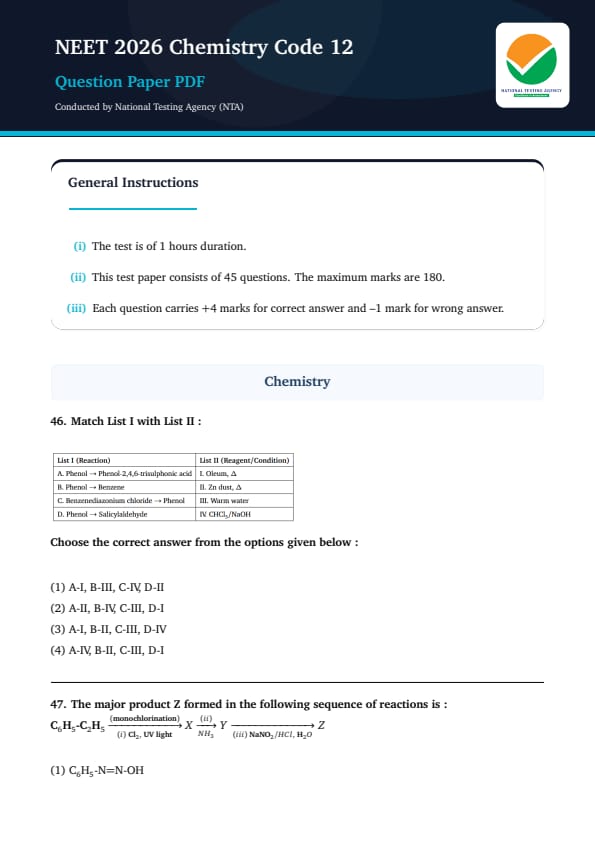
Match List I with List II :

Choose the correct answer from the options given below :
View Solution
Step 1: Understanding the Concept:
This matches standard organic transformations of aromatic compounds with their necessary chemical reagents.
Step 2: Detailed Explanation:
A. Sulphonation: Phenol reacts with concentrated sulfuric acid or oleum to undergo electrophilic substitution. High temperature and Oleum lead to multiple substitutions. (A \(\rightarrow\) I)
B. Reduction: Distilling phenol with Zinc dust removes the hydroxyl group, reducing it to benzene. (B \(\rightarrow\) II)
C. Diazonium Hydrolysis: Benzenediazonium chloride reacts with warm water to produce phenol and nitrogen gas. (C \(\rightarrow\) III)
D. Reimer-Tiemann Reaction: Phenol reacts with chloroform (\( CHCl_3 \)) and aqueous sodium hydroxide (\( NaOH \)) to form salicylaldehyde. (D \(\rightarrow\) IV)
Sequence: A-I, B-II, C-III, D-IV.
Step 3: Final Answer:
Matching gives option (3).
Quick Tip: "Zinc dust" is a classic reagent for removing \( -OH \) from an aromatic ring. Reimer-Tiemann (\( CHCl_3 + NaOH \)) is one of the most frequently tested name reactions.
The major product Z formed in the following sequence of reactions is :
\( C_6H_5-C_2H_5 \xrightarrow[(i) Cl_2, UV light]{(monochlorination)} X \xrightarrow[NH_3]{(ii)} Y \xrightarrow[(iii) NaNO_2/HCl, H_2O]{} Z \)
View Solution
Step 1: Understanding the Concept:
The reaction involves side-chain chlorination of an alkylbenzene, followed by nucleophilic substitution and then diazotization/hydrolysis.
Step 2: Detailed Explanation:
1. Chlorination: Ethylbenzene reacts with chlorine in UV light. Substitution occurs at the benzylic position because the benzylic radical is more stable. \( X = C_6H_5-CHCl-CH_3 \).
2. Amination: Reaction with \( NH_3 \) involves substitution of the halogen. \( Y = C_6H_5-CH(NH_2)-CH_3 \).
3. Diazotization and Hydrolysis: Since \( Y \) is an aliphatic amine (the \( -NH_2 \) is not directly on the ring), reaction with \( NaNO_2/HCl \) forms a highly unstable diazonium salt that decomposes immediately in the presence of water to form an alcohol. \( Z = C_6H_5-CH(OH)-CH_3 \).
Step 3: Final Answer:
The product is 1-phenylethanol, represented as \( C_6H_5CH(OH)CH_3 \).
Quick Tip: Remember that primary aliphatic amines (\( R-NH_2 \)) always give alcohols when treated with \( NaNO_2/HCl \), unlike aromatic amines which can form stable salts at low temperatures.
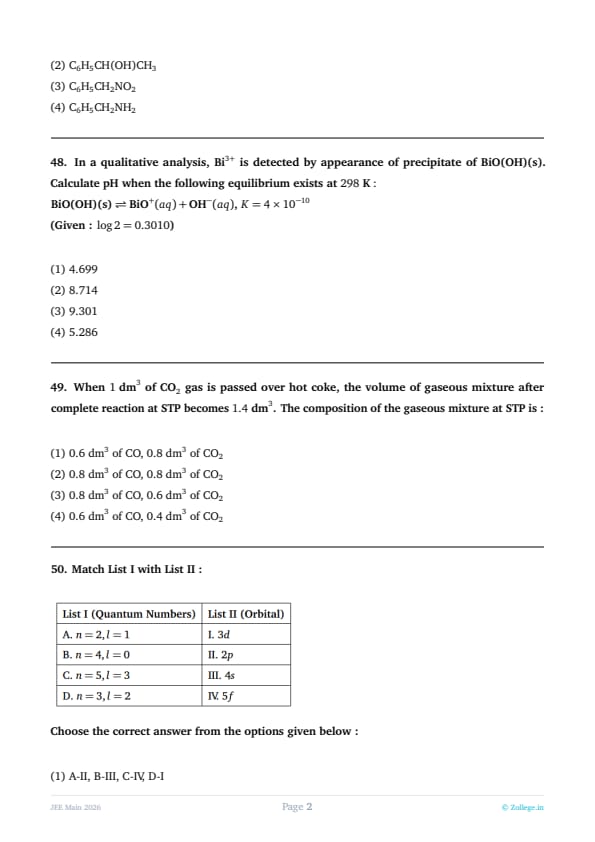
In a qualitative analysis, \( Bi^{3+} \) is detected by appearance of precipitate of \( BiO(OH)(s) \). Calculate pH when the following equilibrium exists at \( 298 K : \)
\( BiO(OH)(s) \rightleftharpoons BiO^{+}(aq) + OH^{-}(aq) \), \( K = 4 \times 10^{-10} \)
(Given : \( \log 2 = 0.3010 \))
View Solution
Step 1: Understanding the Concept:
The equilibrium constant \( K \) for this solubility process allows us to determine the concentration of hydroxide ions in a saturated solution.
Step 2: Key Formula or Approach:
1. \( K = [BiO^{+}][OH^{-}] \)
2. Let solubility be \( s \). Then \( K = s^2 \implies [OH^{-}] = \sqrt{K} \).
3. \( pOH = -\log[OH^{-}] \); \( pH = 14 - pOH \).
Step 3: Detailed Explanation:
Given \( K = 4 \times 10^{-10} \).
\[ [OH^{-}] = \sqrt{4 \times 10^{-10}} = 2 \times 10^{-5} M \]
Calculation of \( pOH \):
\[ pOH = -\log(2 \times 10^{-5}) \] \[ pOH = 5 - \log 2 = 5 - 0.3010 = 4.699 \]
Calculation of \( pH \):
\[ pH = 14 - 4.699 = 9.301 \]
Step 4: Final Answer:
The pH is \( 9.301 \).
Quick Tip: Always remember to subtract \( pOH \) from \( 14 \). Many students mistakenly choose the \( pOH \) value (\( 4.7 \)) as the answer. Since the substance produces \( OH^- \), the pH must be basic (\( > 7 \)).
When \( 1 dm^3 \) of \( CO_2 \) gas is passed over hot coke, the volume of gaseous mixture after complete reaction at STP becomes \( 1.4 dm^3 \). The composition of the gaseous mixture at STP is :
View Solution
Step 1: Understanding the Concept:
Carbon dioxide reacts with solid carbon (coke) to form carbon monoxide. Since we are dealing with gases at STP, volume ratios follow stoichiometric coefficients.
Step 2: Key Formula or Approach:
Reaction: \( CO_2(g) + C(s) \rightarrow 2CO(g) \)
Step 3: Detailed Explanation:
Let \( x dm^3 \) be the volume of \( CO_2 \) that reacts.
Initial volume of \( CO_2 = 1 dm^3 \).
Remaining volume of \( CO_2 = (1 - x) dm^3 \).
Volume of \( CO \) produced = \( 2x dm^3 \).
Total final volume:
\[ (1 - x) + 2x = 1.4 \] \[ 1 + x = 1.4 \implies x = 0.4 dm^3 \]
Composition of the mixture:
- Volume of \( CO = 2x = 2(0.4) = 0.8 dm^3 \).
- Volume of \( CO_2 = 1 - x = 1 - 0.4 = 0.6 dm^3 \).
Step 4: Final Answer:
The mixture consists of \( 0.8 dm^3 \) of \( CO \) and \( 0.6 dm^3 \) of \( CO_2 \).
Quick Tip: For every liter of \( CO_2 \) that reacts, the total volume increases by one liter. If volume increased by \( 0.4 L \), it means \( 0.4 L \) of \( CO_2 \) reacted.
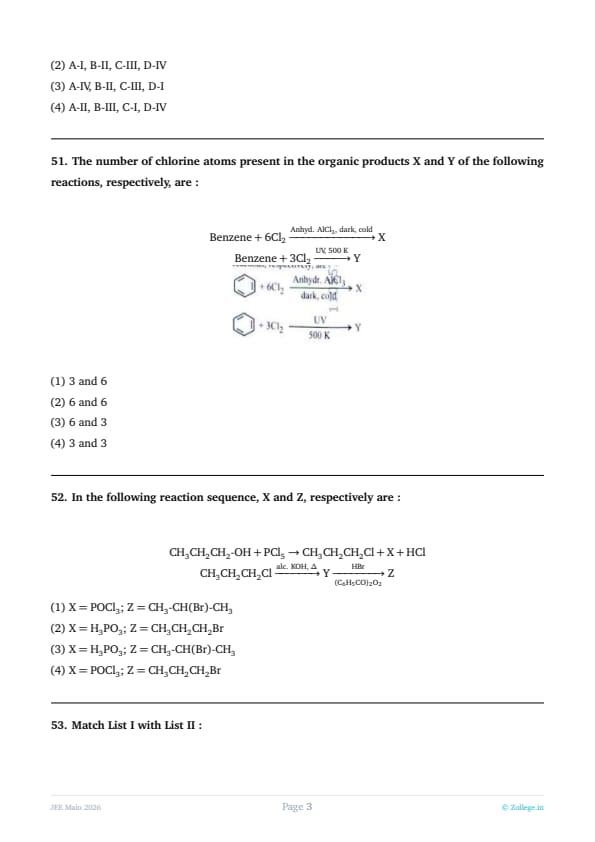
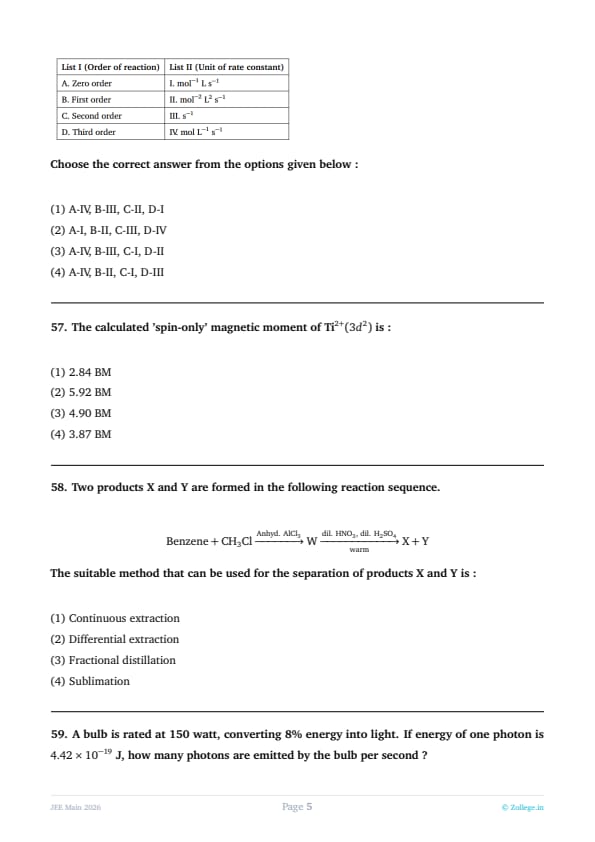
Match List I with List II :

Choose the correct answer from the options given below :
View Solution
Step 1: Understanding the Concept:
Orbitals are designated by the principal quantum number \( n \) (the coefficient) and the azimuthal quantum number \( l \) (represented by a letter).
Step 2: Detailed Explanation:
The letters for \( l \) values are: \( 0 \rightarrow s \), \( 1 \rightarrow p \), \( 2 \rightarrow d \), \( 3 \rightarrow f \).
A. \( n=2, l=1 \rightarrow 2p \). Matches with II.
B. \( n=4, l=0 \rightarrow 4s \). Matches with III.
C. \( n=5, l=3 \rightarrow 5f \). Matches with IV.
D. \( n=3, l=2 \rightarrow 3d \). Matches with I.
The correct sequence is A-II, B-III, C-IV, D-I.
Step 3: Final Answer:
The matching results in option (1).
Quick Tip: Remember the order of letters: s, p, d, f corresponds to 0, 1, 2, 3. You can quickly verify the matches by identifying just one pair (e.g., \( 2p \)) to narrow down the choices.
The number of chlorine atoms present in the organic products X and Y of the following reactions, respectively, are :
\( Benzene + 6Cl_2 \xrightarrow{Anhyd. AlCl_3, dark, cold} X \)
\( Benzene + 3Cl_2 \xrightarrow{UV, 500 K} Y \)

View Solution
Step 1: Understanding the Concept:
Benzene reacts with chlorine in two distinct ways depending on the conditions. The presence of a Lewis acid catalyst leads to electrophilic substitution, while UV light and high temperature promote free radical addition.
Step 2: Detailed Explanation:
1. Reaction for X: When benzene is treated with excess chlorine (\(6Cl_2\)) in the presence of anhydrous \( AlCl_3 \) in the dark and cold, all six hydrogen atoms of benzene are replaced by chlorine atoms. This is an electrophilic substitution reaction.
\[ C_6H_6 + 6Cl_2 \xrightarrow{Anhyd. AlCl_3} C_6Cl_6 + 6HCl \]
Product X is hexachlorobenzene (\(C_6Cl_6\)), which contains 6 chlorine atoms.
2. Reaction for Y: When benzene reacts with chlorine (\(3Cl_2\)) in the presence of ultraviolet light at \(500 K\), the chlorine atoms add across the double bonds of the aromatic ring. This is an addition reaction.
\[ C_6H_6 + 3Cl_2 \xrightarrow{UV, 500 K} C_6H_6Cl_6 \]
Product Y is benzene hexachloride (\(BHC\)), also known as Gammexane or Lindane. It contains 6 chlorine atoms.
Step 3: Final Answer:
Both products X and Y contain 6 chlorine atoms.
Quick Tip: Do not confuse "hexachlorobenzene" (substitution product) with "benzene hexachloride" (addition product). Although they sound similar, their structures are completely different, but both happen to have 6 chlorine atoms in these specific excess conditions.
In the following reaction sequence, X and Z, respectively are :
\( CH_3CH_2CH_2-OH + PCl_5 \rightarrow CH_3CH_2CH_2Cl + X + HCl \)
\( CH_3CH_2CH_2Cl \xrightarrow{alc. KOH, \Delta} Y \xrightarrow[(C_6H_5CO)_2O_2]{HBr} Z \)
View Solution
Step 1: Understanding the Concept:
This sequence involves the halogenation of an alcohol, dehydrohalogenation of an alkyl halide to form an alkene, and subsequent addition to the alkene.
Step 2: Detailed Explanation:
1. Reaction 1: Propan-1-ol reacts with \( PCl_5 \) to form 1-chloropropane. The byproducts of this specific reaction are phosphorus oxychloride (\( POCl_3 \)) and hydrogen chloride.
\[ CH_3CH_2CH_2OH + PCl_5 \rightarrow CH_3CH_2CH_2Cl + POCl_3 (X) + HCl \]
Thus, \( X = POCl_3 \).
2. Reaction 2: 1-chloropropane undergoes elimination (dehydrohalogenation) when heated with alcoholic \( KOH \).
\[ CH_3CH_2CH_2Cl \xrightarrow{alc. KOH, \Delta} CH_3CH=CH_2 (Y) \]
Product Y is propene.
3. Reaction 3: Propene reacts with \( HBr \) in the presence of benzoyl peroxide (\( peroxide \)). This triggers the Anti-Markovnikov addition (Kharasch effect).
\[ CH_3CH=CH_2 + HBr \xrightarrow{Peroxide} CH_3CH_2CH_2Br (Z) \]
Product Z is 1-bromopropane.
Step 3: Final Answer:
\( X \) is \( POCl_3 \) and \( Z \) is \( CH_3CH_2CH_2Br \).
Quick Tip: Remember: \( PCl_5 \) gives \( POCl_3 \), while \( PCl_3 \) gives \( H_3PO_3 \). Also, peroxides only affect the addition of \( HBr \); they have no effect on \( HCl \) or \( HI \) additions.
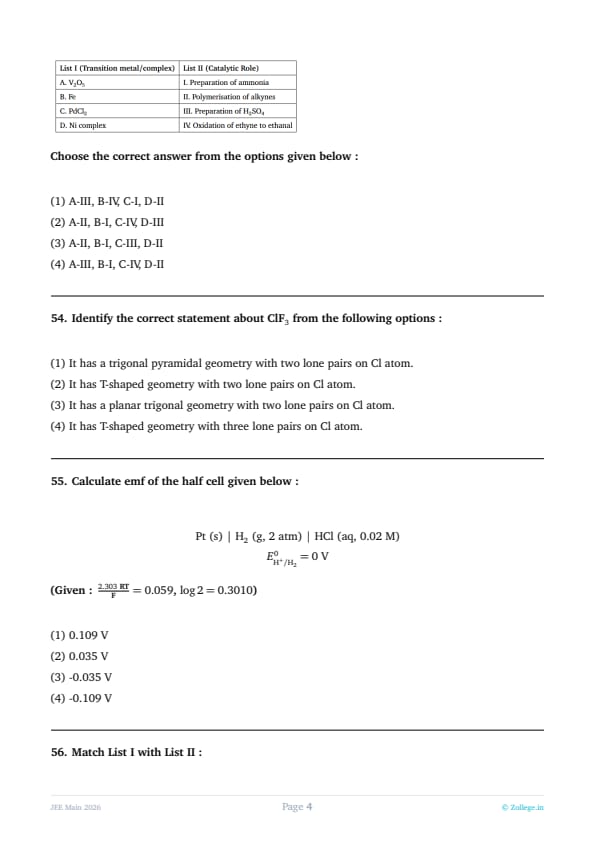
Match List I with List II :

Choose the correct answer from the options given below :
View Solution
Step 1: Understanding the Concept:
Transition metals and their compounds are used as catalysts in many industrial chemical processes due to their ability to adopt multiple oxidation states and provide a surface for reactions.
Step 2: Detailed Explanation:
A. \( V_2O_5 \): This is the catalyst used in the Contact Process for the oxidation of \( SO_2 \) to \( SO_3 \), which is a key step in the preparation of sulfuric acid (\( H_2SO_4 \)). (A \(\rightarrow\) III).
B. \( Fe \): Finely divided iron is used as the catalyst in the Haber Process for the synthesis of ammonia from nitrogen and hydrogen. (B \(\rightarrow\) I).
C. \( PdCl_2 \): This is used as a catalyst in the Wacker Process for the oxidation of ethyne (or ethene) to ethanal (acetaldehyde). (C \(\rightarrow\) IV).
D. \( Ni complex \): Various nickel complexes are used for the polymerisation of alkynes (e.g., ethyne to cyclooctatetraene or benzene). (D \(\rightarrow\) II).
Step 3: Final Answer:
The matching results in sequence A-III, B-I, C-IV, D-II.
Quick Tip: In matching questions, identify the most familiar pair first (e.g., Fe for ammonia) to quickly eliminate incorrect options. Usually, knowing two pairs is sufficient.
Identify the correct statement about \( ClF_3 \) from the following options :
View Solution
Step 1: Understanding the Concept:
The structure and geometry of a molecule can be determined using VSEPR (Valence Shell Electron Pair Repulsion) theory, based on the number of bonding pairs and lone pairs around the central atom.
Step 2: Detailed Explanation:
1. The central atom is Chlorine (Cl), which has 7 valence electrons.
2. There are 3 Fluorine (F) atoms bonded to Cl, contributing 3 electrons for bonding.
3. Total electron pairs = (Valence electrons on central atom + number of monovalent atoms) / 2 = (7 + 3) / 2 = 5.
4. With 5 electron pairs, the hybridization is \( sp^3d \). The electron geometry is trigonal bipyramidal.
5. Out of 5 pairs, 3 are bond pairs (Cl-F) and \( 5 - 3 = 2 \) are lone pairs.
6. To minimize repulsion, the 2 lone pairs occupy the equatorial positions of the trigonal bipyramid. The resulting molecular shape (ignoring lone pairs) is T-shaped.
Step 3: Final Answer:
The molecule has a T-shaped geometry and 2 lone pairs on the Cl atom.
Quick Tip: For molecules with \( sp^3d \) hybridization:
3 BP + 2 LP \(\rightarrow\) T-shape (e.g., \( ClF_3 \)).
2 BP + 3 LP \(\rightarrow\) Linear (e.g., \( XeF_2 \)).
Calculate emf of the half cell given below :
\( Pt (s) | H_2 (g, 2 atm) | HCl (aq, 0.02 M) \)
\( E^0_{H^+/H_2} = 0 V \)
(Given : \( \frac{2.303 RT}{F} = 0.059 \), \( \log 2 = 0.3010 \))
View Solution
Step 1: Understanding the Concept:
The electrode potential of a hydrogen half-cell under non-standard conditions is calculated using the Nernst Equation for the reduction reaction: \( 2H^+(aq) + 2e^- \rightarrow H_2(g) \).
Step 2: Key Formula or Approach:
Nernst Equation for this half-cell:
\[ E = E^0 - \frac{0.059}{n} \log \frac{P_{H_2}}{[H^+]^2} \]
Step 3: Detailed Explanation:
Given:
\( E^0 = 0 V \)
\( n = 2 \) (electrons involved)
\( P_{H_2} = 2 atm \)
\( [H^+] = 0.02 M = 2 \times 10^{-2} M \)
Calculation:
\[ E = 0 - \frac{0.059}{2} \log \frac{2}{(2 \times 10^{-2})^2} \] \[ E = -0.0295 \log \frac{2}{4 \times 10^{-4}} \] \[ E = -0.0295 \log (0.5 \times 10^4) = -0.0295 \log(5000) \] \[ E = -0.0295 \times (\log 5 + 3) \] \[ E = -0.0295 \times (0.699 + 3) = -0.0295 \times 3.699 \] \[ E \approx -0.109 V \]
Step 4: Final Answer:
The emf of the half cell is \( -0.109 V \).
Quick Tip: Remember that for a gas electrode, the partial pressure of the gas appears in the numerator of the reaction quotient \( Q \) for a reduction half-reaction. Always check if \( n \) is 1 or 2 based on your balanced half-reaction.
Match List I with List II :

Choose the correct answer from the options given below :
View Solution
Step 1: Understanding the Concept:
The unit of the rate constant (\( k \)) depends on the order of the reaction (\( n \)). The general formula is derived from the rate law: \( Rate = k[A]^n \).
Step 2: Key Formula or Approach:
General unit of \( k = (mol L^{-1})^{1-n} \cdot s^{-1} = mol^{1-n} \cdot L^{n-1} \cdot s^{-1} \).
Step 3: Detailed Explanation:
1. Zero Order (\( n=0 \)): Unit = \( mol^{1} L^{-1} s^{-1} = mol L^{-1} s^{-1} \). (A \(\rightarrow\) IV).
2. First Order (\( n=1 \)): Unit = \( mol^{0} L^{0} s^{-1} = s^{-1} \). (B \(\rightarrow\) III).
3. Second Order (\( n=2 \)): Unit = \( mol^{-1} L^{1} s^{-1} = mol^{-1} L s^{-1} \). (C \(\rightarrow\) I).
4. Third Order (\( n=3 \)): Unit = \( mol^{-2} L^{2} s^{-1} = mol^{-2} L^2 s^{-1} \). (D \(\rightarrow\) II).
The matching sequence is A-IV, B-III, C-I, D-II.
Step 4: Final Answer:
Matching the lists results in option (3).
Quick Tip: For any order \( n \), the sum of the powers of 'mol' and 'L' in the unit of \( k \) is always zero. For example, in second order: \( -1 + 1 = 0 \). This is a quick way to check if a unit is possible.
The calculated 'spin-only' magnetic moment of \( Ti^{2+}(3d^2) \) is :
View Solution
Step 1: Understanding the Concept:
The magnetic properties of transition metal ions are primarily determined by the number of unpaired electrons. The "spin-only" formula calculates the magnetic moment based solely on these electrons.
Step 2: Key Formula or Approach:
Spin-only magnetic moment \( \mu = \sqrt{n(n+2)} \) BM, where \( n \) is the number of unpaired electrons.
Step 3: Detailed Explanation:
1. The given ion is \( Ti^{2+} \) with a configuration of \( 3d^2 \).
2. According to Hund's Rule, the two electrons will occupy two different d-orbitals with parallel spins.
3. Therefore, the number of unpaired electrons \( n = 2 \).
4. Calculation:
\[ \mu = \sqrt{2(2+2)} = \sqrt{2 \times 4} = \sqrt{8} BM \] \[ \mu \approx 2.828 BM \]
The closest value in the options is \( 2.84 BM \).
Step 4: Final Answer:
The calculated spin-only magnetic moment is \( 2.84 BM \).
Quick Tip: A useful shortcut: if there are \( n \) unpaired electrons, the magnetic moment will be "\( n \).something" BM. For \( n=2 \), it must be \( 2.xx \). For \( n=3 \), it's \( 3.xx \). This allows for immediate elimination of options.
Two products X and Y are formed in the following reaction sequence.
\( Benzene + CH_3Cl \xrightarrow{Anhyd. AlCl_3} W \xrightarrow[warm]{dil. HNO_3, dil. H_2SO_4} X + Y \)
The suitable method that can be used for the separation of products X and Y is :
View Solution
Step 1: Understanding the Concept:
The sequence involves Friedel-Crafts alkylation of benzene to form toluene, followed by nitration of toluene. Separation of the resulting isomers depends on their physical properties.
Step 2: Detailed Explanation:
1. Reaction 1: Benzene reacts with methyl chloride in the presence of \( AlCl_3 \) to give toluene (\( W \)).
2. Reaction 2: Nitration of toluene (\( dil. HNO_3 / dil. H_2SO_4 \)) yields a mixture of ortho-nitrotoluene and para-nitrotoluene (X and Y).
3. Ortho and para isomers are positional isomers. They generally have significant differences in boiling points. While steam distillation is often used for nitrophenols, for these nitrotoluene isomers, fractional distillation is the most appropriate technique as they are liquids with distinct boiling points.
Step 3: Final Answer:
The mixture can be separated by fractional distillation.
Quick Tip: Fractional distillation is used for liquid-liquid mixtures with boiling point differences. For solids like naphthalene and benzoic acid, sublimation is used. For ortho and para nitrophenol, steam distillation is the classic choice due to H-bonding.
A bulb is rated at 150 watt, converting 8% energy into light. If energy of one photon is \( 4.42 \times 10^{-19} J \), how many photons are emitted by the bulb per second ?
View Solution
Step 1: Understanding the Concept:
Power is the rate of energy emission. To find the number of photons per second, calculate the actual light power and divide it by the energy of a single photon.
Step 2: Key Formula or Approach:
1. Light Power (\( P_L \)) = Rated Power \(\times\) Efficiency
2. Number of photons (\( N \)) = \( P_L / E_{photon} \)
Step 3: Detailed Explanation:
Given:
Rated Power = 150 W
Efficiency = 8% = 0.08
Energy per photon (\( E \)) = \( 4.42 \times 10^{-19} J \)
Calculation of Light Power:
\[ P_L = 150 \times 0.08 = 12 Watts (J/s) \]
Calculation of photon count per second:
\[ N = \frac{12 J/s}{4.42 \times 10^{-19} J/photon} \] \[ N = \frac{12}{4.42} \times 10^{19} \] \[ N \approx 2.7149 \times 10^{19} photons/s \]
Step 4: Final Answer:
The bulb emits approximately \( 2.71 \times 10^{19} \) photons per second.
Quick Tip: Always convert percentage efficiency to decimal immediately. 1 Watt = 1 Joule per second. The final answer will just be a division problem of power by energy.
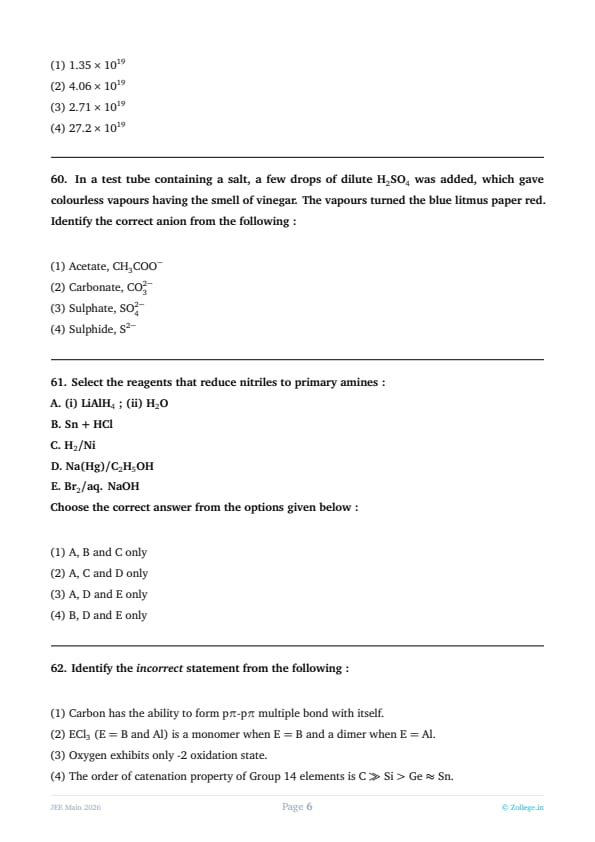
In a test tube containing a salt, a few drops of dilute \( H_2SO_4 \) was added, which gave colourless vapours having the smell of vinegar. The vapours turned the blue litmus paper red. Identify the correct anion from the following :
View Solution
Step 1: Understanding the Concept:
In salt analysis, dilute acids react with specific anions to release gases with unique characteristics.
Step 2: Detailed Explanation:
1. Observation: Addition of dilute acid produces "colourless vapours with a smell of vinegar".
2. Analysis: The smell of vinegar is characteristic of acetic acid (\( CH_3COOH \)).
3. Reaction: Acetate salts react with acids like \( H_2SO_4 \) to liberate acetic acid.
\[ 2CH_3COONa + H_2SO_4 \rightarrow Na_2SO_4 + 2CH_3COOH \uparrow \]
4. Since acetic acid is an acid, its vapours will turn moist blue litmus paper red.
- Carbonate gives \( CO_2 \) (odourless).
- Sulphide gives \( H_2S \) (rotten egg smell).
- Sulphate does not react with dilute \( H_2SO_4 \).
Step 3: Final Answer:
The anion is Acetate (\( CH_3COO^- \)).
Quick Tip: In qualitative analysis, smell is a vital clue:
Vinegar smell \(\rightarrow\) Acetate
Rotten egg smell \(\rightarrow\) Sulphide
Suffocating smell of burning sulphur \(\rightarrow\) Sulphite
Select the reagents that reduce nitriles to primary amines :
A. (i) LiAlH\(_4\) ; (ii) H\(_2\)O
B. Sn + HCl
C. H\(_2\)/Ni
D. Na(Hg)/C\(_2\)H\(_5\)OH
E. Br\(_2\)/aq. NaOH
Choose the correct answer from the options given below :
View Solution
Step 1: Understanding the Concept:
Reduction of nitriles (\(R-C\equiv N\)) involves the addition of four hydrogen atoms to the triple bond, converting it into a primary amine (\(R-CH_2-NH_2\)).
Step 2: Detailed Explanation:
A. LiAlH\(_4\) followed by water: This is a strong reducing agent that effectively reduces nitriles to primary amines.
B. Sn + HCl: This reagent is typically used for the reduction of nitro compounds (like nitrobenzene to aniline) and is not a standard reagent for nitrile reduction to primary amines.
C. H\(_2\)/Ni: Catalytic hydrogenation using hydrogen gas in the presence of a metal catalyst like Nickel, Platinum, or Palladium reduces nitriles to primary amines.
D. Na(Hg)/C\(_2\)H\(_5\)OH: Sodium amalgam in ethanol is the reagent for the Mendius reaction, which specifically reduces nitriles to primary amines.
E. Br\(_2\)/aq. NaOH: This is the reagent for Hoffmann Bromamide Degradation, which converts an amide to an amine with one less carbon atom, not nitriles.
Combining the correct reagents, we get A, C, and D.
Step 3: Final Answer:
The reagents that reduce nitriles to primary amines are A, C, and D.
Quick Tip: Remember the Mendius reaction: Na(Hg) + Ethanol is a classic nitrile-to-amine converter. Hoffmann Bromamide (Br\(_2\)/NaOH) is only for amides!
Identify the incorrect statement from the following :
View Solution
Step 1: Understanding the Concept:
This question tests general periodic properties and chemical characteristics of p-block elements.
Step 2: Detailed Explanation:
1. Statement 1: Carbon, due to its small size and high electronegativity, can form \(p\pi-p\pi\) multiple bonds (\(C=C, C\equiv C\)). This is correct.
2. Statement 2: Boron trichloride (\(BCl_3\)) is a monomer because the small size of Boron prevents dimer formation, whereas \(AlCl_3\) exists as a dimer (\(Al_2Cl_6\)) in the vapor phase to achieve an octet. This is correct.
3. Statement 3: Oxygen commonly shows a -2 oxidation state, but it also shows -1 in peroxides (\(H_2O_2\)), -1/2 in superoxides (\(KO_2\)), and even positive states like +2 in \(OF_2\). Therefore, saying it exhibits only -2 is incorrect.
4. Statement 4: Catenation depends on bond enthalpy. Carbon has the strongest \(M-M\) bond, so the order \(C \gg Si > Ge \approx Sn\) is correct.
Step 3: Final Answer:
Statement (3) is incorrect.
Quick Tip: The word "only" is usually a red flag in inorganic chemistry statements. Oxygen and Fluorine are the only elements that can force oxygen into a positive oxidation state in \(OF_2\).
Although +3 oxidation state is most common in lanthanoids, cerium still shows +4 oxidation state because :
View Solution
Step 1: Understanding the Concept:
The stability of oxidation states in lanthanoids is often related to the attainment of empty (\(f^0\)), half-filled (\(f^7\)), or fully-filled (\(f^{14}\)) f-subshells.
Step 2: Detailed Explanation:
Cerium (Ce) has the atomic number 58.
Its ground state electronic configuration is \([Xe] 4f^1 5d^1 6s^2\).
In the +3 oxidation state (\(Ce^{3+}\)), the configuration is \([Xe] 4f^1\).
If it loses one more electron to reach the +4 state (\(Ce^{4+}\)), its configuration becomes \([Xe] 4f^0\).
The \(4f^0\) state is exceptionally stable because it corresponds to the noble gas configuration of Xenon.
Step 3: Final Answer:
Cerium shows +4 oxidation state because it attains the stable \(4f^0\) configuration.
Quick Tip: Remember the stability milestones: \(Ce^{4+}\) (\(f^0\)), \(Gd^{3+}\) (\(f^7\)), and \(Lu^{3+}\) (\(f^{14}\)). They drive many "anomalous" oxidation state questions in f-block chemistry.
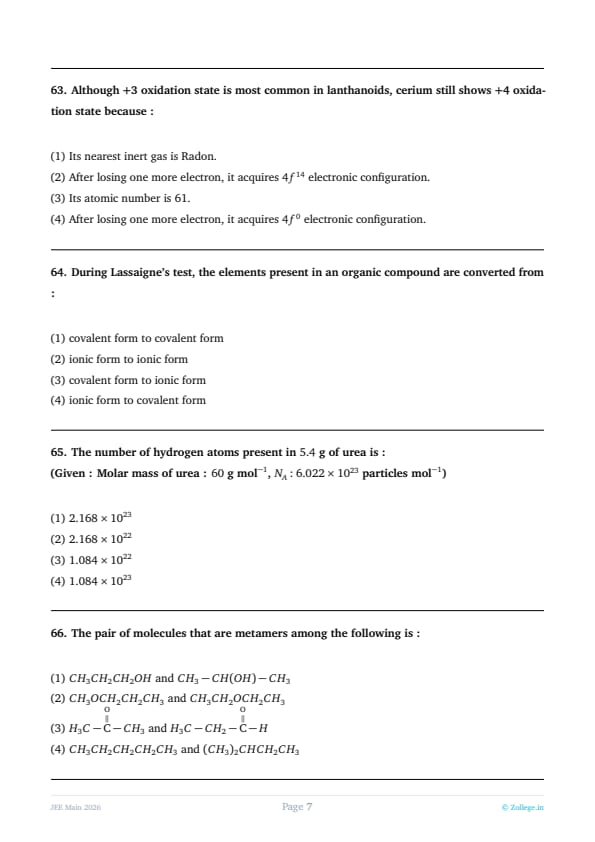
During Lassaigne's test, the elements present in an organic compound are converted from :
View Solution
Step 1: Understanding the Concept:
Lassaigne's test is used to detect nitrogen, sulfur, and halogens in organic compounds. Organic compounds are primarily covalent, making these elements difficult to detect directly.
Step 2: Detailed Explanation:
In Lassaigne's test, the organic compound is fused with metallic sodium. This process converts elements from their covalent bonding in the organic molecule into water-soluble ionic salts:
1. Carbon and Nitrogen are converted to Sodium Cyanide (\(NaCN\)).
2. Sulfur is converted to Sodium Sulfide (\(Na_2S\)).
3. Halogens (X) are converted to Sodium Halides (\(NaX\)).
These ionic salts can then be easily tested using standard qualitative reagents in the aqueous extract (sodium extract).
Step 3: Final Answer:
Elements are converted from covalent form to ionic form.
Quick Tip: Sodium fusion (Lassaigne's) is essentially "breaking down" covalent organic molecules into simple inorganic ions so we can perform standard lab tests on them.
The number of hydrogen atoms present in \(5.4 g\) of urea is :
(Given : Molar mass of urea : \(60 g mol^{-1}\), \(N_A : 6.022 \times 10^{23} particles mol^{-1}\))
View Solution
Step 1: Understanding the Concept:
To find the number of atoms, we first calculate the number of moles of the substance, then the number of molecules, and finally multiply by the number of atoms of that element per molecule.
Step 2: Key Formula or Approach:
1. Moles (\(n\)) = \(\frac{Given Mass}{Molar Mass}\)
2. Number of molecules = \(n \times N_A\)
3. Total atoms = (Molecules) \(\times\) (Number of atoms in one molecule)
Step 3: Detailed Explanation:
The formula for urea is \(NH_2CONH_2\).
One molecule of urea contains 4 hydrogen atoms.
Calculation:
1. Moles of urea = \(\frac{5.4}{60} = 0.09 mol\).
2. Number of urea molecules = \(0.09 \times 6.022 \times 10^{23} = 0.54198 \times 10^{23}\).
3. Number of Hydrogen atoms = \(4 \times (0.54198 \times 10^{23})\).
\[ Total H atoms = 2.16792 \times 10^{23} \approx 2.168 \times 10^{23} \]
Step 4: Final Answer:
The number of hydrogen atoms is \(2.168 \times 10^{23}\).
Quick Tip: Always write the chemical formula first (\(NH_2CONH_2\)). A common mistake is counting only 2 hydrogens if you just remember the "amino" part. Total H = 4.
The pair of molecules that are metamers among the following is :
View Solution
Step 1: Understanding the Concept:
Metamers are isomers that have the same molecular formula but differ in the distribution of alkyl groups on either side of the functional group (like ether, ketone, ester).
Step 2: Detailed Explanation:
1. Option 1: Propan-1-ol and Propan-2-ol. These are positional isomers (position of -OH group changes).
2. Option 2: Methyl propyl ether (\(CH_3-O-C_3H_7\)) and Diethyl ether (\(C_2H_5-O-C_2H_5\)). Both have formula \(C_4H_{10}O\) but different alkyl chains around the oxygen atom. These are metamers.
3. Option 3: Propanone and Propanal. These are functional isomers (ketone vs aldehyde).
4. Option 4: Pentane and 2-methylbutane. These are chain isomers.
Step 3: Final Answer:
The pair in option (2) represents metamers.
Quick Tip: Metamerism is common in ethers, ketones, and esters. Look for a "bridge" atom or group and check if the carbon chains on the left and right are swapped or changed in length.
Identify the incorrect statement from the following :
View Solution
Step 1: Understanding the Concept:
Electronic configuration and the availability of d-orbitals determine the types of bonding an element can participate in.
Step 2: Detailed Explanation:
1. Statement 1: Phosphorus and Arsenic have empty d-orbitals. They can accept electron density from filled d-orbitals of transition metals to form \(d\pi-d\pi\) back bonds. This is correct.
2. Statement 2: Nitrogen (\(N\)) has the valence shell \(n=2\). The second shell does not have d-orbitals. Therefore, it is physically impossible for Nitrogen to form any \(d\pi\)-related bonds. This statement is incorrect.
3. Statement 3: Nitrogen's small size allows effective sideways overlap of p-orbitals to form \(p\pi-p\pi\) triple bonds (\(N\equiv N\)). This is correct.
4. Statement 4: Elements of Group 15 show catenation, though much weaker than Group 14. Phosphorus forms \(P_4\), \(P_n\) chains, etc. This is correct.
Step 3: Final Answer:
Statement (2) is incorrect because Nitrogen lacks d-orbitals.
Quick Tip: Second-period elements (Li, Be, B, C, N, O, F, Ne) never use d-orbitals for bonding. Any statement claiming they use "d-orbitals" is automatically false.
Phenolphthalein is used as an indicator for the titration of sodium hydroxide solution against standard solution of oxalic acid. The colour change that is observed at an alkaline pH close to the equivalence point during this titration is :
View Solution
Step 1: Understanding the Concept:
Titration of Sodium Hydroxide (Strong Base) against Oxalic Acid (Weak Acid) results in a basic salt at the equivalence point. An indicator changes color based on the pH range of the solution.
Step 2: Detailed Explanation:
In this titration, the acid is typically in the flask and the base (NaOH) is added from the burette.
1. Initially, the solution in the flask is acidic (Oxalic acid).
2. Phenolphthalein is colourless in acidic and neutral solutions (\(pH < 8.3\)).
3. As the equivalence point is approached and the first excess drop of NaOH is added, the solution becomes slightly alkaline.
4. Phenolphthalein turns pink in alkaline conditions (\(pH > 10\)).
The transition observed is from colourless to pink.
Step 3: Final Answer:
The colour change is from colourless to pink.
Quick Tip: Remember the simple rule for Phenolphthalein: "Acid = clear, Base = pink". In a standard acid-base titration where base is added to acid, the change is always colourless to pink.
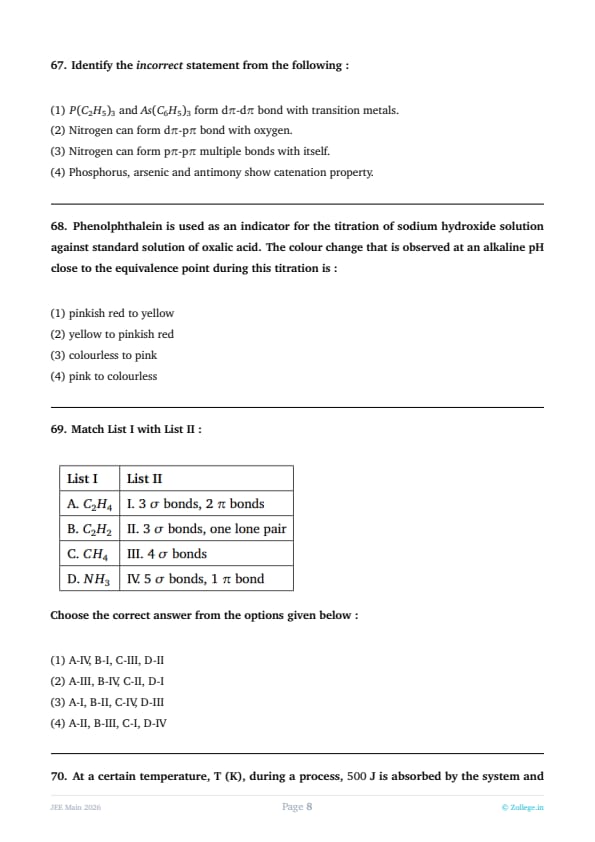
Match List I with List II :

Choose the correct answer from the options given below :
View Solution
Step 1: Understanding the Concept:
Bond counting (sigma and pi bonds) and identifying lone pairs are fundamental to understanding molecular structures and hybridization.
Step 2: Detailed Explanation:
A. Ethene (\(C_2H_4\)): Structure is \(H_2C = CH_2\). It has 4 C-H \(\sigma\) bonds, 1 C-C \(\sigma\) bond, and 1 C-C \(\pi\) bond. Total: 5 \(\sigma\), 1 \(\pi\). (A \(\rightarrow\) IV).
B. Ethyne (\(C_2H_2\)): Structure is \(HC \equiv CH\). It has 2 C-H \(\sigma\) bonds, 1 C-C \(\sigma\) bond, and 2 C-C \(\pi\) bonds. Total: 3 \(\sigma\), 2 \(\pi\). (B \(\rightarrow\) I).
C. Methane (\(CH_4\)): Structure is tetrahedral. It has 4 C-H \(\sigma\) bonds. Total: 4 \(\sigma\). (C \(\rightarrow\) III).
D. Ammonia (\(NH_3\)): Structure has 3 N-H \(\sigma\) bonds and one lone pair on the Nitrogen atom. (D \(\rightarrow\) II).
Step 3: Final Answer:
Matching gives: A-IV, B-I, C-III, D-II.
Quick Tip: In a multiple bond, the first bond is always a \(\sigma\) bond, and all subsequent bonds are \(\pi\) bonds. (Single = 1\(\sigma\); Double = 1\(\sigma\), 1\(\pi\); Triple = 1\(\sigma\), 2\(\pi\)).
At a certain temperature, T (K), during a process, \(500 J\) is absorbed by the system and work of \(200 J\) is done by the system. Then change in internal energy of the system is :
View Solution
Step 1: Understanding the Concept:
The First Law of Thermodynamics states that the energy of an isolated system is constant. Change in internal energy (\(\Delta U\)) is equal to heat absorbed (\(Q\)) minus work done (\(W\)) by the system.
Step 2: Key Formula or Approach:
\[ \Delta U = Q - W \]
Sign conventions:
\(Q > 0\) if heat is absorbed by the system.
\(W > 0\) if work is done by the system.
Step 3: Detailed Explanation:
Given:
1. Heat absorbed by the system, \(Q = +500 J\).
2. Work done by the system, \(W = +200 J\).
Calculation:
\[ \Delta U = 500 - 200 \] \[ \Delta U = 300 J \]
Step 4: Final Answer:
The change in internal energy is \(300 J\).
Quick Tip: Think of it as a bank account: "Heat absorbed" is a deposit (+), and "Work done by system" is a withdrawal (-). The balance is your change in internal energy.
Methane reacts with steam at \(1273 K\) in the presence of nickel catalyst to form :
View Solution
Step 1: Understanding the Concept:
Hydrocarbons react with steam at high temperatures in the presence of catalysts to produce a mixture of carbon monoxide and hydrogen, commonly known as water gas or synthesis gas (syngas).
Step 2: Key Formula or Approach:
The general reaction for steam reforming of methane is:
\[ CH_4(g) + H_2O(g) \xrightarrow[1273 K]{Ni} CO(g) + 3H_2(g) \]
Step 3: Detailed Explanation:
When methane (\(CH_4\)) is heated with steam (\(H_2O\)) at \(1273 K\) in the presence of a nickel catalyst, it undergoes a process called steam reforming. This reaction produces one molecule of carbon monoxide (\(CO\)) and three molecules of hydrogen gas (\(H_2\)). This industrial process is one of the primary methods for large-scale hydrogen production.
Step 4: Final Answer:
The products formed are \( CO \) and \( H_2 \).
Quick Tip: The mixture of \( CO \) and \( H_2 \) produced in this reaction is called "syngas" because it is used for the synthesis of methanol and many hydrocarbons.
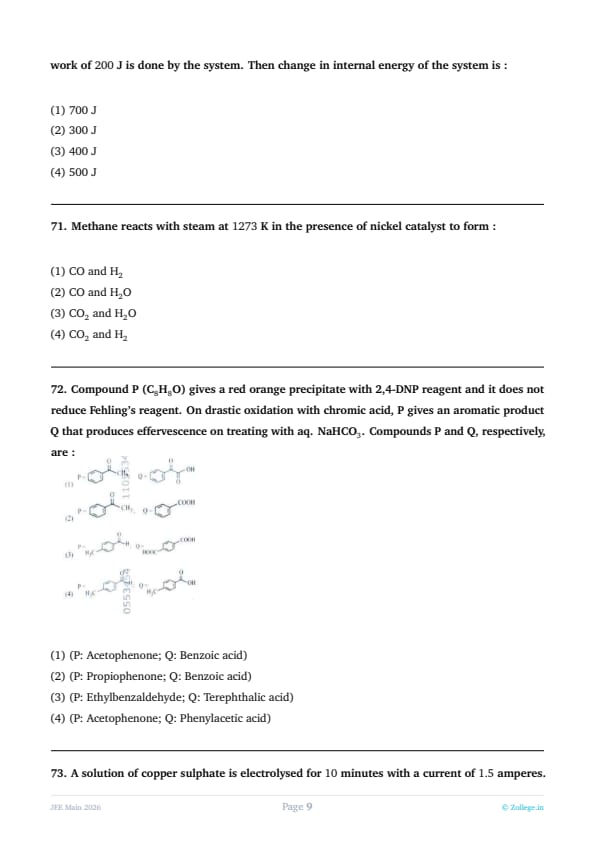
Compound P (\( C_8H_8O \)) gives a red orange precipitate with 2,4-DNP reagent and it does not reduce Fehling's reagent. On drastic oxidation with chromic acid, P gives an aromatic product Q that produces effervescence on treating with aq. \( NaHCO_3 \). Compounds P and Q, respectively, are :

View Solution
Step 1: Understanding the Concept:
1. Reaction with 2,4-DNP indicates the presence of a carbonyl group (aldehyde or ketone).
2. No reaction with Fehling's reagent confirms that it is a ketone (or an aromatic aldehyde, but aromatic ketones like acetophenone are common test cases).
3. Effervescence with \( NaHCO_3 \) indicates that the oxidation product Q is a carboxylic acid.
Step 2: Detailed Explanation:
1. Compound P has the formula \( C_8H_8O \). The degree of unsaturation is 5 (benzene ring + C=O).
2. P gives a 2,4-DNP test \(\rightarrow\) Carbonyl group.
3. P does not reduce Fehling's \(\rightarrow\) P is a ketone. In this molecular formula range, acetophenone (\( C_6H_5COCH_3 \)) is the prime candidate.
4. Drastic oxidation of acetophenone with chromic acid (\( H_2CrO_4 \)) cleaves the alkyl side chain to form benzoic acid (\( C_6H_5COOH \)).
5. Benzoic acid (Q) reacts with sodium bicarbonate to release \( CO_2 \) gas (effervescence).
Step 3: Final Answer:
P is Acetophenone and Q is Benzoic acid.
Quick Tip: Fehling's reagent only oxidizes aliphatic aldehydes. Aromatic aldehydes and all ketones (aliphatic or aromatic) do not react with Fehling's reagent.
A solution of copper sulphate is electrolysed for \(10 minutes\) with a current of \(1.5 amperes\). The mass of copper deposited at cathode is :
(Given : Molar mass of \( Cu = 63 g mol^{-1} \); \( 1 F = 96487 C mol^{-1} \))
View Solution
Step 1: Understanding the Concept:
According to Faraday's first law of electrolysis, the mass of a substance deposited at an electrode is proportional to the quantity of electricity passed through the electrolyte.
Step 2: Key Formula or Approach:
\[ w = ZIt = \frac{M}{n \cdot F} \cdot I \cdot t \]
Where \( w \) is mass, \( M \) is molar mass, \( n \) is number of electrons, \( F \) is Faraday's constant, \( I \) is current, and \( t \) is time in seconds.
Step 3: Detailed Explanation:
Given:
\( I = 1.5 A \)
\( t = 10 min = 600 s \)
\( M = 63 g/mol \)
For \( Cu^{2+} + 2e^- \rightarrow Cu \), \( n = 2 \).
Calculation:
\[ Q = I \times t = 1.5 \times 600 = 900 C \] \[ w = \frac{63}{2 \times 96487} \times 900 \] \[ w = \frac{31.5 \times 900}{96487} = \frac{28350}{96487} \approx 0.2938 g \]
Step 4: Final Answer:
The mass of copper deposited is \(0.2938 g\).
Quick Tip: Always convert time to seconds. In competitive exams, you can approximate \( F \approx 96500 \) for faster calculation if the options are not extremely close.
The functional group that can be identified through phthalein dye test is :
View Solution
Step 1: Understanding the Concept:
The phthalein dye test is a characteristic laboratory test used to identify phenols. It involves the condensation of phenol with phthalic anhydride.
Step 2: Detailed Explanation:
When a phenol is heated with phthalic anhydride in the presence of concentrated sulfuric acid, a condensation reaction occurs to form a phthalein dye. For example, phenol reacting with phthalic anhydride forms phenolphthalein.
The resulting mixture is then treated with dilute sodium hydroxide (\( NaOH \)). If a phthalein dye is formed, the solution turns a characteristic color (e.g., intense pink for phenolphthalein). This test is specific to the phenolic (\( -OH \) group on an aromatic ring) functional group.
Step 3: Final Answer:
The phthalein dye test identifies the phenolic functional group.
Quick Tip: Phenolphthalein is not just an acid-base indicator; its synthesis is the actual "phthalein dye test" for phenols. Different phenols produce different colored dyes (e.g., resorcinol produces fluorescein, which is yellow-green).
The correct statement with regard to the secondary structure of DNA/RNA is :
View Solution
Step 1: Understanding the Concept:
DNA (Deoxyribonucleic acid) and RNA (Ribonucleic acid) have distinct secondary structures and nucleotide base compositions.
Step 2: Detailed Explanation:
1. DNA: The secondary structure is a double-stranded right-handed helix (proposed by Watson and Crick). It contains four bases: Adenine (A), Guanine (G), Cytosine (C), and Thymine (T).
2. RNA: Usually exists as a single-stranded helical structure. It contains four bases: Adenine (A), Guanine (G), Cytosine (C), and Uracil (U) instead of thymine.
Step 3: Final Answer:
Statement (3) correctly describes DNA's double strand helix and its use of thymine.
Quick Tip: Mnemonics for bases:
DNA: ATGC (At The Gold Coast)
RNA: AUGC (All Universities Go Crazy)
Identify the correct statements :
A. The molality of \(2.5 g\) of ethanoic acid (Molar mass : \(60 g mol^{-1}\)) in \(75 g\) of benzene solution is \(0.556 m\).
B. The molarity of a solution containing \(5 g\) of NaOH (molar mass : \(40 g mol^{-1}\)) in \(450 mL\) of solution is \(0.278 M\) at \(298 K\).
C. Aquatic species are more comfortable in cold water.
D. The solubility of gas increases with decrease in pressure.
E. For a binary mixture of A and B, the mole fraction of B will be \( \chi_B = \frac{n_A}{n_A + n_B} \).
Choose the correct answer from the options given below :
View Solution
Step 1: Understanding the Concept:
This question evaluates basic concentration definitions (molality, molarity, mole fraction) and the properties of solubility of gases in liquids.
Step 2: Detailed Explanation:
Statement A: Molality \( m = \frac{w_B \times 1000}{M_B \times w_A} = \frac{2.5 \times 1000}{60 \times 75} = \frac{2500}{4500} \approx 0.556 m \). Correct.
Statement B: Molarity \( M = \frac{w_B \times 1000}{M_B \times V(mL)} = \frac{5 \times 1000}{40 \times 450} = \frac{5000}{18000} \approx 0.278 M \). Correct.
Statement C: Solubility of gases (like oxygen) increases with a decrease in temperature. Therefore, there is more dissolved oxygen in cold water, making aquatic species more comfortable. Correct.
Statement D: According to Henry's Law, the solubility of a gas is directly proportional to the partial pressure of the gas above the liquid. Solubility decreases with a decrease in pressure. Incorrect.
Statement E: The mole fraction of B is \( \chi_B = \frac{n_B{n_A + n_B} \). The given formula describes \( \chi_A \). Incorrect.
Step 3: Final Answer:
Statements A, B, and C are correct.
Quick Tip: Always double-check the numerator for mole fraction. It must match the component being measured. For solubility of gases, remember: "Soda stays fizzy longer in the fridge (cold) and under high pressure."
Mixture of chloroform and acetone forms a solution with negative deviation from Raoult's law due to :
View Solution
Step 1: Understanding the Concept:
Negative deviation from Raoult's law occurs when the total vapor pressure of the solution is lower than expected. This happens when the attractive forces between the different components (A-B) are stronger than the forces within the pure components (A-A and B-B).
Step 2: Detailed Explanation:
When chloroform (\( CHCl_3 \)) and acetone (\( CH_3COCH_3 \)) are mixed, a new intermolecular hydrogen bond is formed between the slightly acidic hydrogen of chloroform and the lone pair on the oxygen of acetone.
\[ Cl_3C-H\cdotsO=C(CH_3)_2 \]
These A-B interactions are much stronger than the dipole-dipole interactions present in pure chloroform or pure acetone. Because the molecules are held together more tightly, their escaping tendency into the vapor phase decreases, leading to a negative deviation from Raoult's law.
Step 3: Final Answer:
The negative deviation is due to the formation of hydrogen bonding between the two components.
Quick Tip: Negative deviation \(\rightarrow\) Interaction increases, Volume decreases (\( \Delta V_{mix} < 0 \)), Heat is released (\( \Delta H_{mix} < 0 \)).
At \(298 K\), a certain buffer solution contains equal concentrations of \( X^- \) and \( HX \). \( K_b \) for \( X^- \) is \( 10^{-10} \). What is the pH of this buffer solution ?
View Solution
Step 1: Understanding the Concept:
A buffer solution consisting of a weak acid (\( HX \)) and its conjugate base (\( X^- \)) follows the Henderson-Hasselbalch equation.
Step 2: Key Formula or Approach:
1. \( pH = pK_a + \log\left(\frac{[Salt]}{[Acid]}\right) \)
2. \( pK_a + pK_b = 14 \) (at \( 298 K \))
Step 3: Detailed Explanation:
Given:
\( [ X^- ] = [ HX ] \implies \log\left(\frac{[X^-]}{[HX]}\right) = \log(1) = 0 \).
Thus, \( pH = pK_a \).
Find \( pK_a \):
\( K_b = 10^{-10} \implies pK_b = -\log(10^{-10}) = 10 \).
Using \( pK_a + pK_b = 14 \):
\( pK_a = 14 - 10 = 4 \).
Therefore, \( pH = 4 \).
Step 4: Final Answer:
The pH of the buffer solution is \( 4 \).
Quick Tip: When concentrations of conjugate acid and base are equal, the pH equals the \( pK_a \). Always check if you are given \( K_a \) or \( K_b \) and for which species!
Identify the incorrect statement from the following :
View Solution
Step 1: Understanding the Concept:
Periodic properties like ionic radii, nomenclature of heavy elements, and coordination chemistry properties follow specific trends and rules.
Step 2: Detailed Explanation:
Statement 1: For atomic number 107: 1 (un) + 0 (nil) + 7 (sept) + ium = Unnilseptium. Correct.
Statement 2: Let's analyze the sizes:
- Atoms: \( Mg \) (period 3, group 2) and \( Al \) (period 3, group 13). Moving left to right, radius decreases. So \( Mg > Al \).
- Ions: \( Mg^{2+} \) and \( Al^{3+} \) are isoelectronic (10 electrons). For isoelectronic species, the higher the nuclear charge, the smaller the radius. Nuclear charge: \( Al (13) > Mg (12) \). So \( Mg^{2+} > Al^{3+} \).
Therefore, the largest species is Mg and the smallest is Al\(^{3+}\). Statement 2 is Incorrect.
Statement 3: \( Li \) and \( Mg \) show similar chemical properties due to similar charge/radius ratios. Correct.
Statement 4: In \( [AlCl(H_2O)_5]^{2+} \):
- Oxidation state: \( x + (-1) + 5(0) = +2 \implies x = +3 \).
- Covalency (Coordination number): 1 Cl + 5 \( H_2O \) = 6. Correct.
Step 3: Final Answer:
Statement (2) is incorrect.
Quick Tip: For isoelectronic ions, radius \( \propto 1/Z \). More protons pull the same number of electrons closer.
The correct order of increasing metallic character of \( Na, Be, P, Mg \) and \( Si \) is :
View Solution
Step 1: Understanding the Concept:
Metallic character is the tendency of an atom to lose electrons. It increases down a group (due to increasing size/effective shielding) and decreases across a period (due to increasing nuclear charge/decreasing size).
Step 2: Detailed Explanation:
Let's group the elements by their position in the periodic table:
Period 2: \( Be \) (Group 2)
Period 3: \( Na \) (Group 1), \( Mg \) (Group 2), \( Si \) (Group 14), \( P \) (Group 15)
1. In Period 3: Metallic character decreases across the period.
Order: \( Na (most) > Mg > Si > P (least) \).
2. Comparing \( Be \) (Period 2) and \( Mg \) (Period 3) in Group 2: Metallic character increases down the group.
Order: \( Mg > Be \).
3. Now, compare \( Be \) and \( Si \): Although \( Be \) is higher up, it is in Group 2 (metal), whereas \( Si \) is in Group 14 (metalloid). \( Be \) is more metallic than \( Si \).
Combining these observations: \( P < Si < Be < Mg < Na \).
Step 3: Final Answer:
The correct increasing order is \( P < Si < Be < Mg < Na \).
Quick Tip: Metallic character trend is the {inverse} of electronegativity. Non-metals (P, Si) will always be at the lower end, while alkali metals (Na) will be at the top.
The correct IUPAC name of the following compound is :
\( CH_3-CH_2-CH(C_2H_5)-CH_2-CH(CH_3)-CH_2-CH_3 \)
View Solution
Step 1: Understanding the Concept:
Naming an organic compound involves identifying the longest continuous carbon chain and numbering it to give the lowest possible locants to the substituents, following alphabetical priority.
Step 2: Detailed Explanation:
1. Identify the Parent Chain: The longest chain contains 7 carbon atoms, so the parent name is heptane.
2. Identify Substituents: There is an ethyl group (\( -C_2H_5 \)) and a methyl group (\( -CH_3 \)).
3. Numbering:
- Numbering from left to right: Ethyl at C3, Methyl at C5. Set: (3, 5).
- Numbering from right to left: Methyl at C3, Ethyl at C5. Set: (3, 5).
4. Alphabetical Rule: Since both directions give the same locant set (3, 5), the substituent that comes first alphabetically (ethyl) gets the lower number.
- Thus, the correct name is 3-ethyl-5-methylheptane.
Step 3: Final Answer:
The IUPAC name is 3-ethyl-5-methylheptane.
Quick Tip: When locant sets are identical from both ends, always give priority to the substituent that appears first in the alphabet. Ethyl (e) beats Methyl (m).
Match List I with List II :

Choose the correct answer from the options given below :
View Solution
Step 1: Understanding the Concept:
The geometry of coordination complexes is determined by the hybridization of the central metal atom, which depends on its coordination number and electronic configuration.
Step 2: Detailed Explanation:
A. \( [Pt(Cl_2)(NH_3)_2] \): Platinum(II) complexes with coordination number 4 are typically \( dsp^2 \) hybridized and have a square planar geometry. (A \(\rightarrow\) III).
B. \( [Co(NH_3)_6]^{3+} \): Cobalt(III) with 6 ligands involves \( d^2sp^3 \) or \( sp^3d^2 \) hybridization, resulting in an octahedral geometry. (B \(\rightarrow\) I).
C. \( [NiCl_4]^{2-} \): Nickel(II) with weak field ligands (Cl) and coordination number 4 is \( sp^3 \) hybridized, leading to a tetrahedral geometry. (C \(\rightarrow\) IV).
D. \( [Fe(CO)_5] \): Iron(0) with 5 CO ligands is \( dsp^3 \) hybridized, resulting in a trigonal bipyramidal geometry. (D \(\rightarrow\) II).
Step 3: Final Answer:
The matching sequence is A-III, B-I, C-IV, D-II.
Quick Tip: Remember that \( Pt^{2+} \) and \( Pd^{2+} \) almost always form square planar complexes regardless of the ligand strength due to high crystal field splitting.
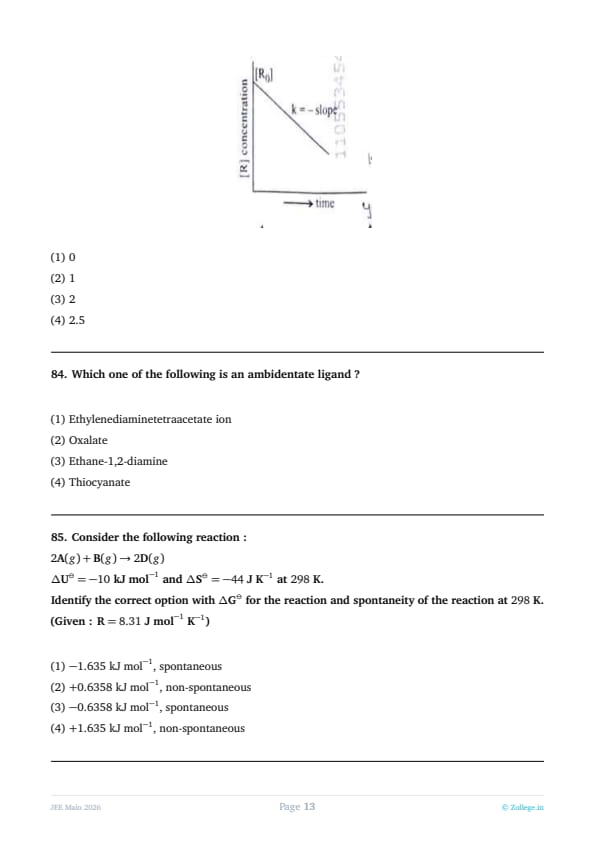
For a certain reaction \( R \rightarrow Product \), the plot of concentration [R] vs time has a negative slope as shown. The order of reaction is :

View Solution
Step 1: Understanding the Concept:
The integrated rate laws for different orders of reactions produce different linear plots.
Step 2: Key Formula or Approach:
For a zero-order reaction: \( [R] = [R]_0 - kt \).
This matches the equation of a straight line \( y = mx + c \) where the slope \( m = -k \).
Step 3: Detailed Explanation:
1. If the plot of \( [R] \) vs \( t \) is a straight line, it indicates that the rate of change of concentration is independent of the concentration itself.
2. This is the definition of a zero-order reaction.
3. For a first-order reaction, a plot of \( \ln[R] \) vs \( t \) would be linear.
4. For a second-order reaction, a plot of \( 1/[R] \) vs \( t \) would be linear.
Step 4: Final Answer:
The order of the reaction is 0.
Quick Tip: Visualize the axes:
Conc vs Time = Linear \(\rightarrow\) 0 order
log(Conc) vs Time = Linear \(\rightarrow\) 1st order
1/Conc vs Time = Linear \(\rightarrow\) 2nd order
Which one of the following is an ambidentate ligand ?
View Solution
Step 1: Understanding the Concept:
An ambidentate ligand is a unidentate ligand that has two or more different donor atoms and can coordinate to a central metal atom through either of these atoms.
Step 2: Detailed Explanation:
1. EDTA: A hexadentate ligand. (Not ambidentate).
2. Oxalate: A bidentate ligand. (Not ambidentate).
3. Ethane-1,2-diamine: A bidentate ligand. (Not ambidentate).
4. Thiocyanate (\( SCN^- \)): This ligand can coordinate through the Nitrogen atom (\( M-NCS \), isothiocyanato) or the Sulfur atom (\( M-SCN \), thiocyanato). Because it has two different potential donor atoms, it is an ambidentate ligand.
Step 3: Final Answer:
Thiocyanate is the ambidentate ligand.
Quick Tip: Common ambidentate ligands to memorize: \( NO_2^- \) (N or O), \( CN^- \) (C or N), and \( SCN^- \) (S or N).
Consider the following reaction :
\( 2A(g) + B(g) \rightarrow 2D(g) \)
\( \Delta U^{\ominus} = -10 kJ mol^{-1} \) and \( \Delta S^{\ominus} = -44 J K^{-1} \) at \( 298 K \).
Identify the correct option with \( \Delta G^{\ominus} \) for the reaction and spontaneity of the reaction at \( 298 K \).
(Given : \( R = 8.31 J mol^{-1} K^{-1} \))
View Solution
Step 1: Understanding the Concept:
To determine spontaneity, we calculate the Gibbs free energy change (\( \Delta G \)). If \( \Delta G < 0 \), the reaction is spontaneous; if \( \Delta G > 0 \), it is non-spontaneous.
Step 2: Key Formula or Approach:
1. \( \Delta H = \Delta U + \Delta n_g RT \)
2. \( \Delta G = \Delta H - T\Delta S \)
Step 3: Detailed Explanation:
Given:
\( \Delta U^{\ominus} = -10 kJ = -10,000 J \)
\( \Delta S^{\ominus} = -44 J/K \); \( T = 298 K \); \( R = 8.314 \)
\( \Delta n_g = 2 - (2 + 1) = -1 \).
Calculation of \( \Delta H^{\ominus} \):
\[ \Delta H^{\ominus} = -10,000 + (-1 \times 8.314 \times 298) \] \[ \Delta H^{\ominus} = -10,000 - 2477.5 \approx -12477.5 J \]
Calculation of \( \Delta G^{\ominus} \):
\[ \Delta G^{\ominus} = -12477.5 - (298 \times -44) \] \[ \Delta G^{\ominus} = -12477.5 + 13112 = +634.5 J mol^{-1} \] \[ \Delta G^{\ominus} \approx +0.635 kJ mol^{-1} \]
Step 4: Final Answer:
Since \( \Delta G \) is positive (\( +0.635 kJ/mol \)), the reaction is non-spontaneous.
Quick Tip: Always convert kJ to J or vice-versa to ensure all terms in the equation have consistent units. Note that \( \Delta G = +0.635 kJ \) is very close to zero, suggesting the reaction is nearly at equilibrium.
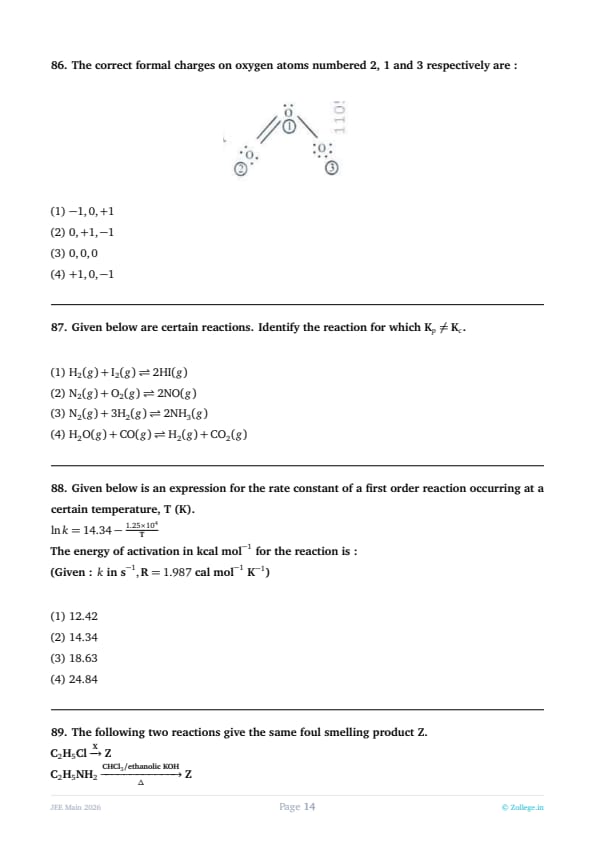
The correct formal charges on oxygen atoms numbered 2, 1 and 3 respectively are :

View Solution
Step 1: Understanding the Concept:
Formal charge is calculated based on the valence electrons, lone pair electrons, and shared bonding electrons.
Step 2: Key Formula or Approach:
\[ FC = V - L - \frac{1}{2} S \]
Where \( V \) = Valence electrons, \( L \) = Lone pair electrons, \( S \) = Shared bonding electrons.
Step 3: Detailed Explanation:
Structure of Ozone (\( O_3 \)):
Central atom (O-1) forms one double bond and one single bond. It has 1 lone pair.
\[ FC_1 = 6 - 2 - (6/2) = +1 \]
Oxygen (O-2) forms a double bond. It has 2 lone pairs.
\[ FC_2 = 6 - 4 - (4/2) = 0 \]
Oxygen (O-3) forms a single bond. It has 3 lone pairs.
\[ FC_3 = 6 - 6 - (2/2) = -1 \]
Requested order (2, 1, 3): 0, +1, -1.
Step 4: Final Answer:
The formal charges are \( 0, +1, -1 \).
Quick Tip: The sum of formal charges must equal the total charge on the molecule. For neutral \( O_3 \): \( 0 + (+1) + (-1) = 0 \).
Given below are certain reactions. Identify the reaction for which \( K_p \neq K_c \).
View Solution
Step 1: Understanding the Concept:
The relationship between the equilibrium constants \( K_p \) and \( K_c \) is determined by the change in the number of moles of gaseous products and reactants.
Step 2: Key Formula or Approach:
\[ K_p = K_c(RT)^{\Delta n_g} \]
If \( \Delta n_g = 0 \), then \( K_p = K_c \). If \( \Delta n_g \neq 0 \), then \( K_p \neq K_c \).
Step 3: Detailed Explanation:
1. \( \Delta n_g = 2 - (1+1) = 0 \implies K_p = K_c \).
2. \( \Delta n_g = 2 - (1+1) = 0 \implies K_p = K_c \).
3. \( \Delta n_g = 2 - (1+3) = -2 \). Since \( \Delta n_g \neq 0 \), \( K_p \neq K_c \).
4. \( \Delta n_g = (1+1) - (1+1) = 0 \implies K_p = K_c \).
Step 4: Final Answer:
Reaction (3) has \( K_p \neq K_c \).
Quick Tip: Always check the physical states. Only include gaseous moles in the calculation of \( \Delta n_g \).
Given below is an expression for the rate constant of a first order reaction occurring at a certain temperature, T (K).
\( \ln k = 14.34 - \frac{1.25 \times 10^4}{T} \)
The energy of activation in \( kcal mol^{-1} \) for the reaction is :
(Given : \( k in s^{-1}, R = 1.987 cal mol^{-1} K^{-1} \))
View Solution
Step 1: Understanding the Concept:
The temperature dependence of the rate constant is given by the Arrhenius equation.
Step 2: Key Formula or Approach:
1. \( k = A e^{-E_a/RT} \implies \ln k = \ln A - \frac{E_a}{RT} \)
2. Compare given equation with \( \ln k = \ln A - \frac{E_a}{R} \cdot \frac{1}{T} \).
Step 3: Detailed Explanation:
From comparison:
\[ \frac{E_a}{R} = 1.25 \times 10^4 \] \[ E_a = 1.25 \times 10^4 \times R \] \[ E_a = 1.25 \times 10^4 \times 1.987 cal/mol \] \[ E_a = 24837.5 cal/mol \]
To convert to kcal/mol:
\[ E_a = \frac{24837.5}{1000} kcal/mol \approx 24.84 kcal/mol \]
Step 4: Final Answer:
The activation energy is \( 24.84 kcal mol^{-1} \).
Quick Tip: Always match the coefficients of \( 1/T \) in both equations. Be careful with units like calories vs kilocalories.
The following two reactions give the same foul smelling product Z.
\( C_2H_5Cl \xrightarrow{X} Z \)
\( C_2H_5NH_2 \xrightarrow[\Delta]{CHCl_3/ethanolic KOH} Z \)
X and Z, respectively, are :
View Solution
Step 1: Understanding the Concept:
The second reaction is the Carbylamine reaction, a characteristic test for primary amines that produces foul-smelling isocyanides.
Step 2: Detailed Explanation:
1. Reaction 2: \( C_2H_5NH_2 + CHCl_3 + 3KOH \rightarrow C_2H_5NC (Z) + 3KCl + 3H_2O \).
The foul-smelling product \( Z \) is ethyl isocyanide (\( C_2H_5NC \)).
2. Reaction 1: Alkyl halides react with \( AgCN \) to primarily form isocyanides because Ag-C bond is covalent, making the Nitrogen atom the nucleophilic center. Reaction with \( KCN \) would produce cyanides (\( RCN \)).
\[ C_2H_5Cl + AgCN \rightarrow C_2H_5NC (Z) + AgCl \]
Thus, \( X = AgCN \) and \( Z = C_2H_5NC \).
Step 3: Final Answer:
\( X \) is \( AgCN \) and \( Z \) is \( C_2H_5NC \).
Quick Tip: Remember: \( KCN \rightarrow \) Cyanide (\( -CN \)); \( AgCN \rightarrow \) Isocyanide (\( -NC \)). The foul smell is the signature of an isocyanide.
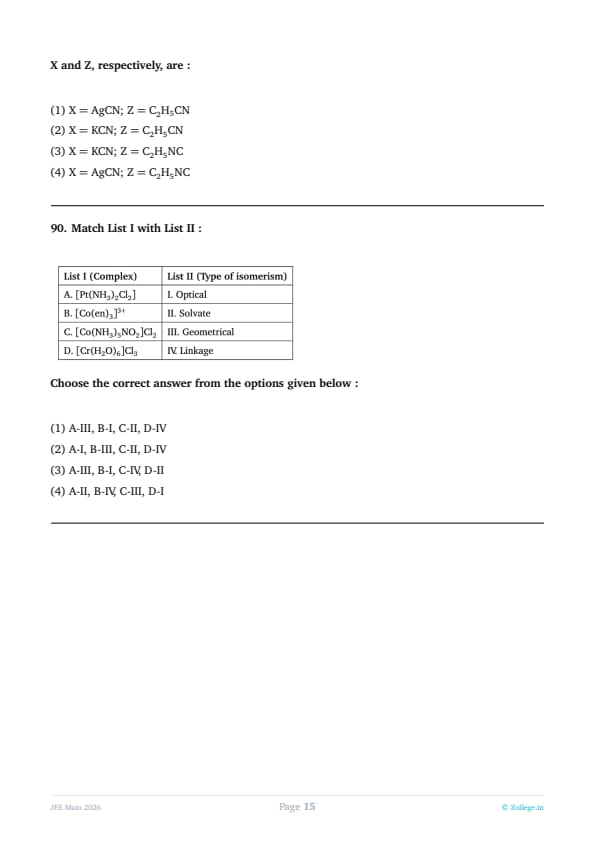
Match List I with List II :

Choose the correct answer from the options given below :
View Solution
Step 1: Understanding the Concept:
Isomerism in coordination compounds can be structural (linkage, solvate, etc.) or stereoisomerism (geometrical, optical).
Step 2: Detailed Explanation:
A. \( [Pt(NH_3)_2Cl_2] \): This square planar complex exhibits geometrical isomerism (cis and trans). (A \(\rightarrow\) III).
B. \( [Co(en)_3]^{3+} \): This octahedral complex with three bidentate ligands is chiral and exhibits optical isomerism. (B \(\rightarrow\) I).
C. \( [Co(NH_3)_5NO_2]Cl_2 \): The nitro ligand is ambidentate (can bond through N or O), exhibiting linkage isomerism. (C \(\rightarrow\) IV).
D. \( [Cr(H_2O)_6]Cl_3 \): This complex can exchange water molecules in the coordination sphere with counter ions (like Cl), exhibiting solvate (hydrate) isomerism. (D \(\rightarrow\) II).
Step 3: Final Answer:
The matching sequence is A-III, B-I, C-IV, D-II.
Quick Tip: Ambidentate ligands (\( NO_2, SCN \)) are the hallmark of linkage isomerism. \( [M(en)_3] \) type complexes are the most classic examples of purely optical isomerism in inorganic chemistry.
NEET 2026 Chemistry Revision
*The article might have information for the previous academic years, please refer the official website of the exam.