
NEET 2026 Question Paper with Solution PDF Code 11
- Answer Key
- Merit List
- Seat Inkate
- Tripura Counselling
- Nagaland Counselling
- Kerala Counselling
- UP Counselling
- Assam Counselling
- West Bengal Counselling
- MP Counselling
- Haryana Counselling
- Chhattisgarh Counselling
- Gujarat Counselling
- Participating Colleges
- AP Counselling
- Manipur Counselling
- Mark Vs Rank
- Mizoram NEET Counselling
- Ayush Counselling
- TN NEET Counselling
- Andhra Pradesh Counsellin
- Karnataka NEET Counsellin
- Jharkhand NEET Counsellin
- MH NEET Counselling
- Bihar NEET Counselling
- Counselling
- Seat Allotment


Content Curator | Updated On - May 28, 2026
NTA conducted the NEET Exam on May 3 in a single shift from 2 PM to 5 PM in PBT Mode.
The NEET 2026 Question Paper will include 3 sections: Physics, Chemistry, and Biology (Botany & Zoology) with 180 Questions carrying a total of 720 Marks, as per the NEET Marking Scheme, +4 Marks for every correct answer, and -1 mark will be deducted for every wrong answer.
NEET 2026 Question Paper with Solution PDF(Code 11) is available here for download
NEET 2026 Question Paper with Solution PDF(Code 11)
| NEET 2026 Question Paper Code 11 | Download PDF | Check Solutions |
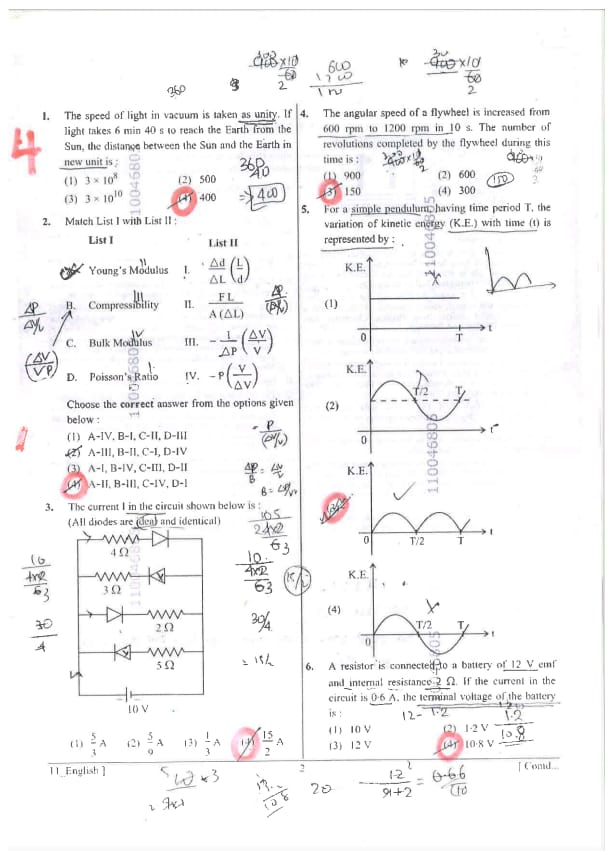
The speed of light in vacuum is taken as unity. If light takes 6 min 40 s to reach the Earth from the Sun, the distance between the Sun and the Earth in new unit is: ____.
Match List I with List II:

The current I in the circuit shown below is: (All diodes are ideal and identical)

The angular speed of a flywheel is increased from 600 rpm to 1200 rpm in 10 s. The number of revolutions completed by the flywheel during this time is: ____.
For a simple pendulum, having time period T, the variation of kinetic energy (K.E.) with time (t) is represented by: ____.
- (A)
![]()
- (B)
![]()
- (C)
![]()
- (D)
![]()


A resistor is connected to a battery of 12 V emf and internal resistance 2 \(\Omega\). If the current in the circuit is 0.6 A, the terminal voltage of the battery is: ____.
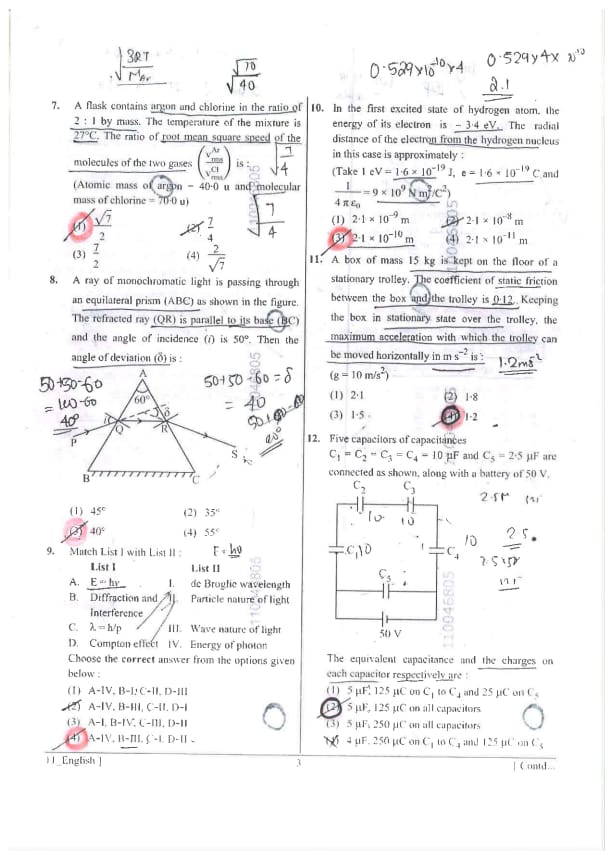
A flask contains argon and chlorine in the ratio of 2 : 1 by mass. The temperature of the mixture is 27°C. The ratio of root mean square speed of the molecules of the two gases (\(v_{rms}(Ar) / v_{rms}(Cl_2)\)) is: (Atomic mass of argon = 40.0 u and molecular mass of chlorine = 70.0 u) ____.
A ray of monochromatic light is passing through an equilateral prism (ABC) as shown in the figure. The refracted ray (QR) is parallel to its base (BC) and the angle of incidence (i) is 50°. Then the angle of deviation (\(\delta\)) is: ____.

Match List I with List II:

In the first excited state of hydrogen atom, the energy of its electron is 10.2 eV. The radial distance of the electron from the hydrogen nucleus in this case is approximately: ____.
A box of mass 15 kg is kept on the floor of a stationary trolley. The coefficient of static friction between the box and the trolley is 0.12. Keeping the box in stationary state over the trolley, the maximum acceleration with which the trolley can be moved horizontally in m s⁻² is: ____.
Five capacitors of capacitances C₁ = C₂ = C₃ = C₄ = 10 \(\mu\)F and C₅ = 2.5 \(\mu\)F are connected as shown, along with a battery of 50 V. The equivalent capacitance and the charges on each capacitor respectively are: ____.

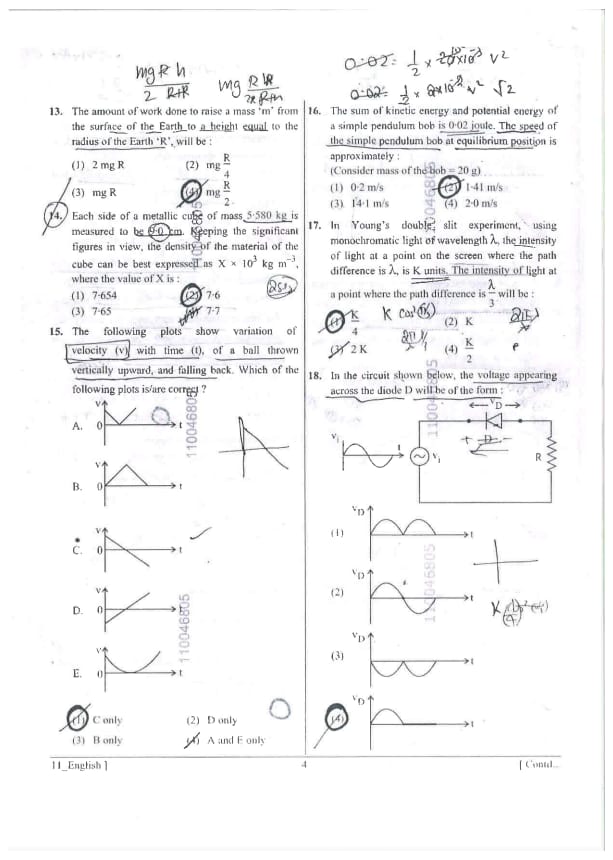
The amount of work done to raise a mass ‘m’ from the surface of the Earth to a height equal to the radius of the Earth ‘R’, will be: ____.
Each side of a metallic cube of mass 5.580 kg is measured to be 9.0 cm. Keeping the significant figures in view, the density of the material of the cube can be best expressed as X \(\times\) 10³ kg m⁻³, where the value of X is: ____.
The following plots show variation of velocity (v), with time (t), of a ball thrown vertically upward, and falling back. Which of the following plots is/are correct?

The sum of kinetic energy and potential energy of a simple pendulum bob is 0.02 J. The speed of the simple pendulum bob at equilibrium position is approximately: (Consider mass of the bob = 20 g)
In Young’s double slit experiment, using monochromatic light of wavelength \(\lambda\), the intensity of light at a point on the screen where the path difference is \(\lambda/3\) is K units. The intensity of light at a point where the path difference is \(\lambda/2\) will be: ____.
In the circuit shown below, the voltage appearing across the diode D will be of the form: ____.

- (A)
![]()
- (B)
![]()
- (C)
![]()
- (D)
![]()


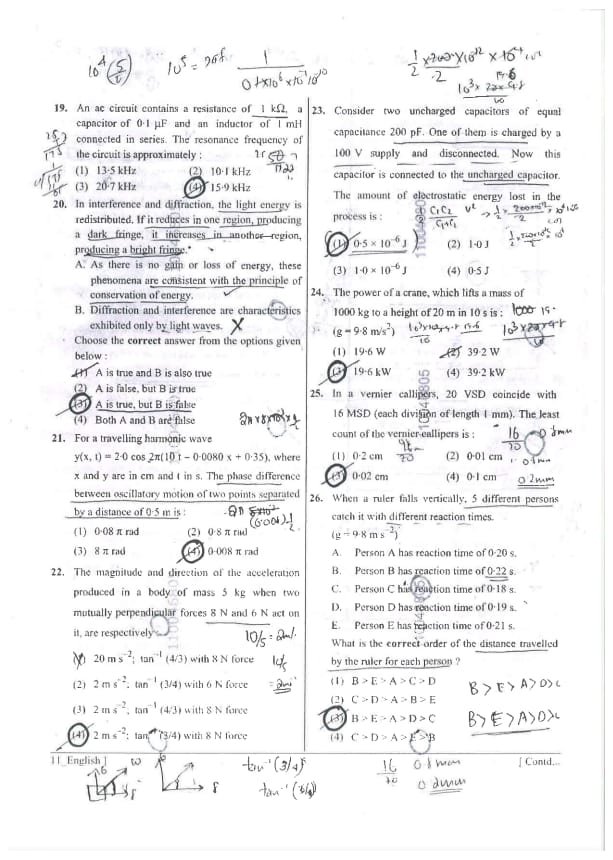
An ac circuit contains a resistance of 1 k\(\Omega\), a capacitor of 0.1 \(\mu\)F and an inductor of 1 mH connected in series. The resonance frequency of the circuit is approximately: ____.
In interference and diffraction, the light energy is redistributed. If it reduces in one region, producing a dark fringe, it increases in another region, producing a bright fringe.
A. As there is no gain or loss of energy, these phenomena are consistent with the principle of conservation of energy.
B. Diffraction and interference are characteristics exhibited only by light waves.
Choose the correct answer from the options given below:
For a travelling harmonic wave \(y(x, t) = 2.0 \cos 2\pi(10t – 0.0080 x + 0.35)\), where \(x\) and \(y\) are in cm and \(t\) in s. The phase difference between oscillatory motion of two points separated by a distance of 0.5 m is: ____.
The magnitude and direction of the acceleration produced in a body of mass 5 kg when two mutually perpendicular forces 8 N and 6 N act on it, are respectively:
Consider two uncharged capacitors of equal capacitance 200 pF. One of them is charged by a 100 V supply and disconnected. Now this capacitor is connected to the uncharged capacitor. The amount of electrostatic energy lost in the process is: ____.
The power of a crane, which lifts a mass of 1000 kg to a height of 20 m in 10 s is: (g = 9.8 m/s²)
In a vernier callipers, 20 VSD coincide with 16 MSD (each division of length 1 mm). The least count of the vernier callipers is: ____.
When a ruler falls vertically, 5 different persons catch it with different reaction times. What is the correct order of the distance travelled by the ruler for each person?
A. Person A: 0.20 s, B. Person B: 0.22 s, C. Person C: 0.18 s, D. Person D: 0.19 s, E. Person E: 0.21 s.
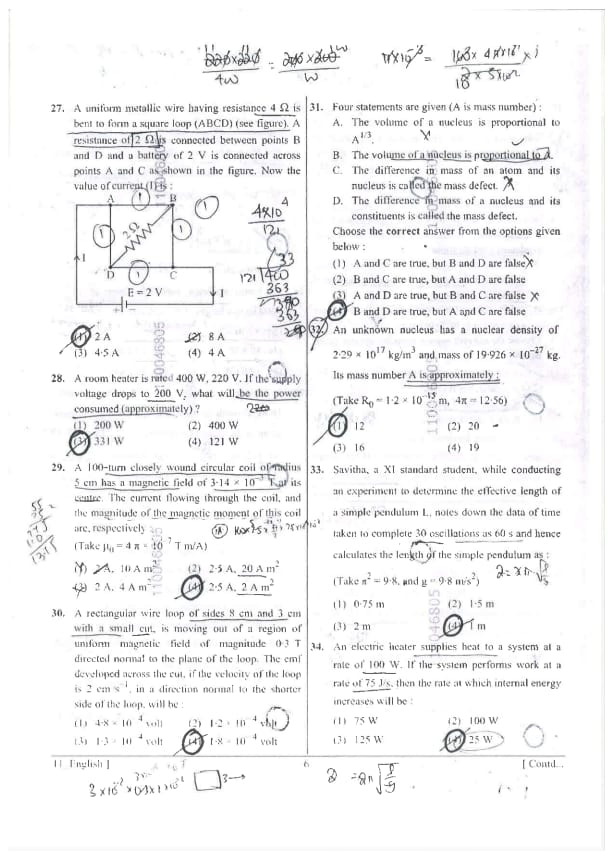
A uniform metallic wire having resistance 4 \(\Omega\) is bent to form a square loop (ABCD). A resistance of 2 \(\Omega\) is connected between points B and D and a battery of 2 V is connected across points A and C as shown in the figure. Now the amount of current (I) is: ____.

A room heater is rated 400 W, 220 V. If the supply voltage drops to 200 V, what will be the power consumed (approximately)? ____.
A 100-turn closely wound circular coil of radius 5 cm has a magnetic field of 3.14 \(\times\) 10⁻³ T at its centre. The current flowing through the coil, and the magnitude of the magnetic moment of this coil are, respectively: (Take \(\mu_0 = 4\pi \times 10^{-7}\) T m/A)
A rectangular wire loop of sides 8 cm and 3 cm with a small cut, is moving out of a region of uniform magnetic field of magnitude 0.3 T directed normal to the plane of the loop. The emf developed across the cut, if the velocity of the loop is 2 cm s⁻¹, in a direction normal to the shorter side of the loop, will be: ____.
Four statements are given (A is mass number):
A. The volume of a nucleus is proportional to A.
B. The volume of a nucleus is proportional to A\(^{1/3}\).
C. The difference in mass of an atom and its nucleus is called the mass defect.
D. The difference in mass of a nucleus and its constituents is called the mass defect.
Choose the correct answer from the options given below:
An unknown nucleus has a nuclear density of 2.29 \(\times\) 10¹⁷ kg/m³ and mass of 19.926 \(\times\) 10⁻²⁷ kg. Its mass number A is approximately: (Take \(R_0 = 1.2 \times 10^{-15}\) m, \(4\pi = 12.56\))
Savitha notes down the data of time taken to complete 30 oscillations as 60 s and hence calculates the length of the simple pendulum as: (Take \(\pi^2 = 9.8\), and \(g = 9.8\) m/s\(^2\))
An electric heater supplies heat to a system at a rate of 100 W. If the system performs work at a rate of 75 W, then the rate at which internal energy increases will be: ____.
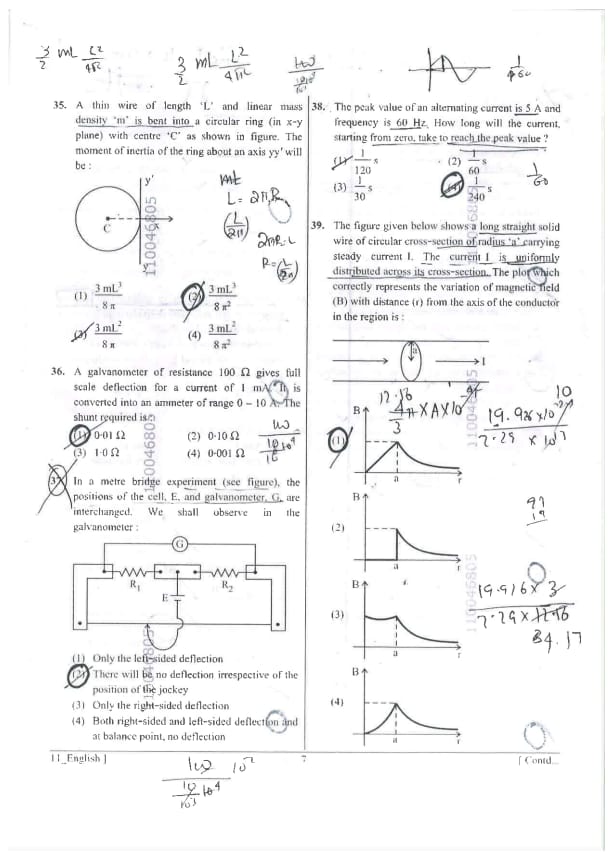
A thin wire of length ‘L’ and linear mass density ‘m’ is bent into a circular ring (in x-y plane) with centre ‘C’ as shown in figure. The moment of inertia of the ring about an axis yy′ will be: ____.

A galvanometer of resistance 100 \(\Omega\) gives full scale deflection for a current of 1 mA. It is converted into an ammeter of range 0 – 10 A. The shunt required is: ____.
In a metre bridge experiment (as shown in figure), the positions of the cell E, and galvanometer G, are interchanged. We shall observe in the galvanometer: ____.

The peak value of an alternating current is 5 A and frequency is 60 Hz. How long will the current, starting from zero, take to reach the peak value? ____.
The figure given below shows a long straight solid wire of circular cross-section of radius ‘a’ carrying steady current I. The current I is uniformly distributed across its cross-section. The plot which correctly represents the variation of magnetic field (B) with distance (r) from the axis of the conductor in the region is: ____.

- (A)
![]()
- (B)
![]()
- (C)
![]()
- (D)
![]()


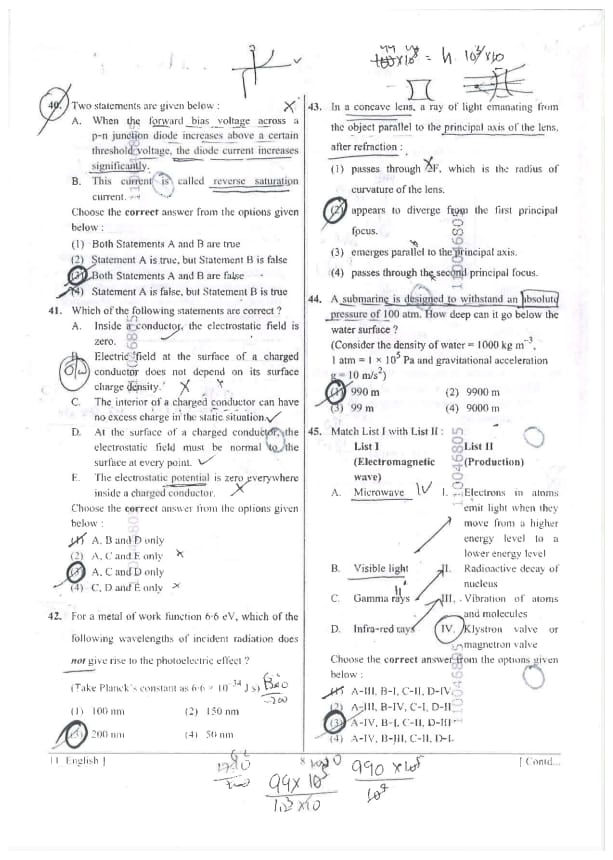
Two statements are given below:
A. When the forward bias voltage across a p-n junction diode increases above a certain threshold voltage, the diode current increases significantly.
B. This current is called reverse saturation current.
Choose the correct answer from the options given below:
Which of the following statements are correct?
A. Inside a conductor, the electrostatic field is zero.
B. Electric field at the surface of a charged conductor does not depend on its surface charge density.
C. The interior of a charged conductor can have no excess charge in the static situation.
D. At the surface of a charged conductor, the electrostatic field must be normal to the surface at every point.
E. The electrostatic potential is zero everywhere inside a charged conductor.
Choose the correct answer from the options given below:
For a metal of work function 6.6 eV, which of the following wavelengths of incident radiation does not give rise to the photoelectric effect? (Take Planck’s constant as 6.6 \(\times\) 10⁻³⁴ Js)
In a concave lens, a ray of light emanating from the object parallel to the principal axis of the lens, after refraction: ____.
A submarine is designed to withstand an absolute pressure of 100 atm. How deep can it go below the water surface? (Consider the density of water = 1000 kg m⁻³, 1 atm = 1 \(\times\) 10⁵ Pa and g = 10 m/s²)
Match List I with List II:

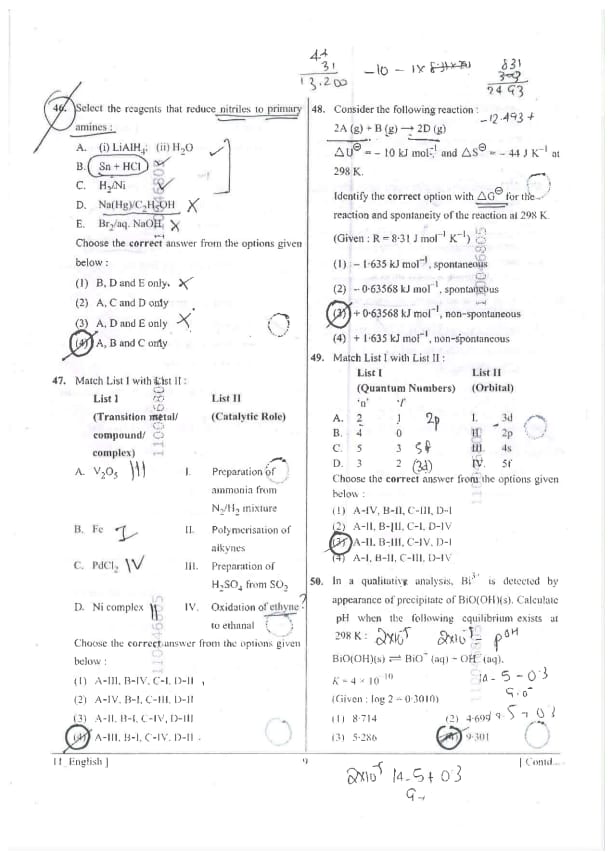
Select the reagents that reduce nitriles to primary amines :
A. (i) \(LiAlH_4\); (ii) \(H_2O\)
B. \(Sn + HCl\)
C. \(H_2/Ni\)
D. \(Na(Hg)/C_2H_5OH\)
E. \(Br_2/aq. NaOH\)
Choose the correct answer from the options given below :
Match List I with List II.

Consider the following reaction :
\(2A(g) + B(g) \rightarrow 2D(g)\)
\(\Delta U^o = -10 kJ mol^{-1}\), \(\Delta S^o = -44 J K^{-1}\) at 298 K.
Identify the correct option with \(\Delta G^o\) for the reaction and spontaneity of the reaction at 298 K.
(Given : \(R = 8.31 J mol^{-1} K^{-1}\))
Match List I with List II.

In qualitative analysis, Bi\(^{3+}\) is detected by appearance of precipitate of BiO(OH)(s). Calculate pH when the following equilibrium exists at 298 K :
BiO(OH)(s) \(\rightleftharpoons\) BiO\(^+\)(aq) + OH\(^-\)(aq), \(K = 4 \times 10^{-10}\)
(Given : \(\log 2 = 0.3010\))
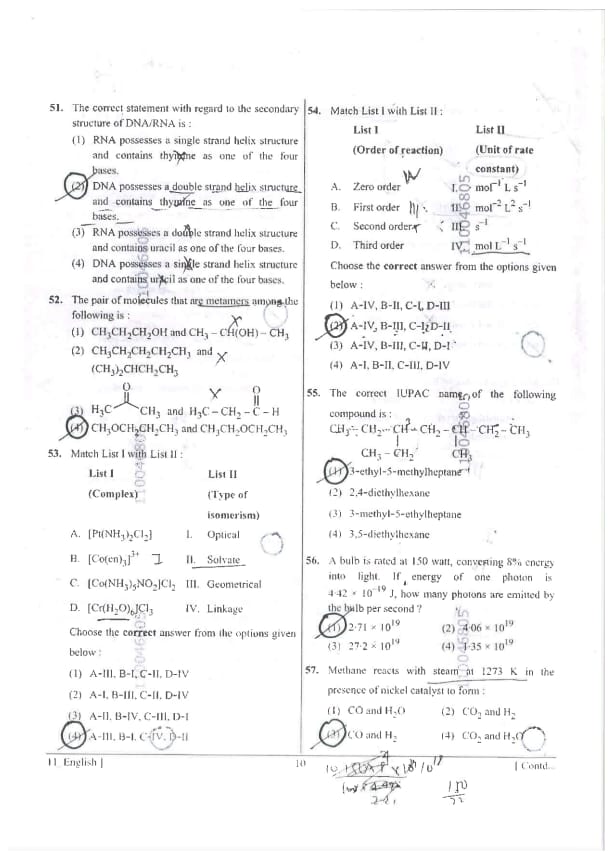
The correct statement with regard to the secondary structure of DNA/RNA is:
The pair of molecules that are metamers among the following is:
Match List I with List II.

Choose the correct answer from the options given below :
Match List I with List II.

Choose the correct answer from the options given below :
The correct IUPAC name of the following compound is:

A bulb is rated at 150 watt, converting 8% energy into light. If energy of one photon is \(4.42 \times 10^{-19}\) J, how many photons are emitted by the bulb per second?
Methane reacts with steam at 1273 K in the presence of nickel catalyst to form:
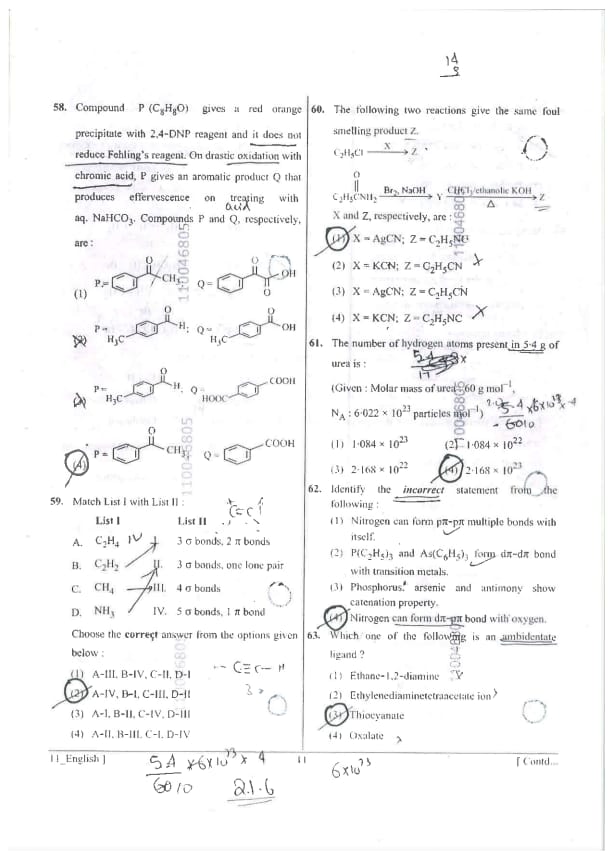
Compound P, C\(_8\)H\(_8\)O, gives a red-orange precipitate with 2,4-DNP reagent and does not reduce Fehling's reagent. On drastic oxidation with chromic acid, P gives an aromatic product Q that produces effervescence on treating with aqueous NaHCO\(_3\). Compounds P and Q, respectively, are:
- (A)
![]()
- (B)
![]()
- (C)
![]()
- (D)
![]()


Match List I with List II.

Choose the correct answer from the options given below :
The following two reactions give the same foul smelling product Z. X and Z, respectively, are:

The number of hydrogen atoms present in 5.4 g of urea is:
Given: Molar mass of urea = 60 g mol\(^{-1}\), N\(_A\) = 6.022 \(\times\) 10\(^{23}\) particles mol\(^{-1}\)
Identify the incorrect statement from the following:
Which one of the following is an ambidentate ligand?
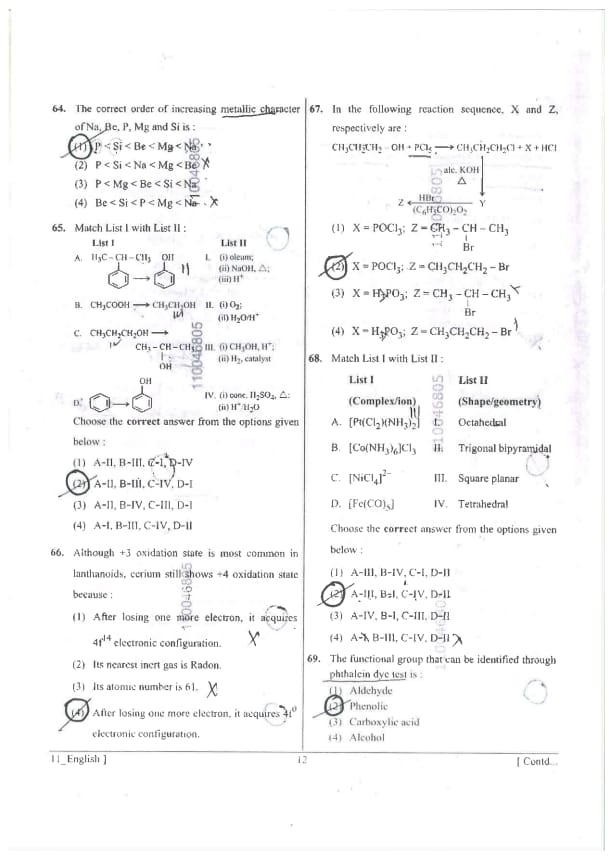
The correct order of increasing metallic character of Na, Be, P, Mg and Si is:
Match List I with List II.

Choose the correct answer from the options given below :
Although +3 oxidation state is most common in lanthanoids, cerium still shows +4 oxidation state because:
In the following reaction sequence, X and Z, respectively, are:

Match List I with List II.

The functional group that can be identified through phthalein dye test is:
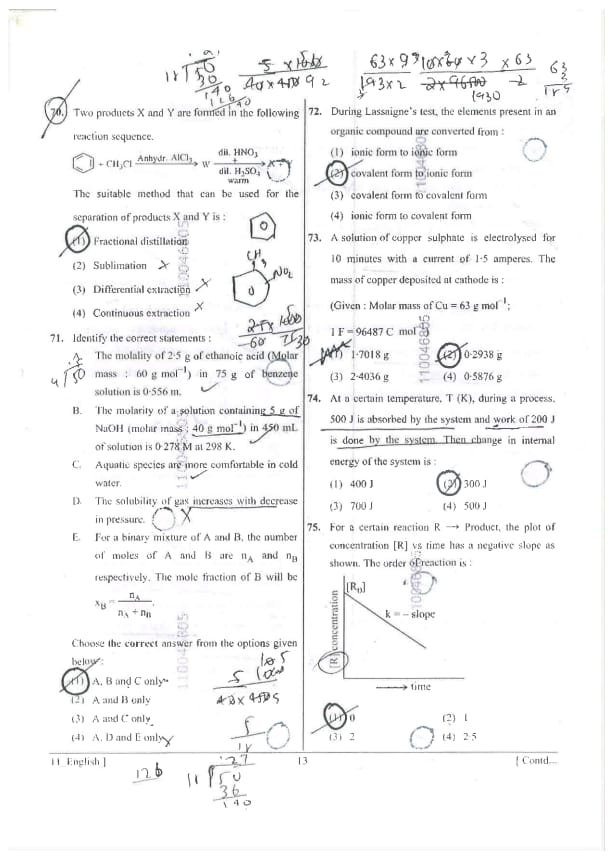
Two products X and Y are formed in the following reaction sequence. The suitable method that can be used for separation of products X and Y is:

Identify the correct statements:
A. The molality of \(2.5 g\) of ethanoic acid (\(Molar mass = 60 g mol^{-1}\)) in \(75 g\) of benzene solution is \(0.556 m\).
B. The molarity of a solution containing \(5 g\) of \(NaOH\) (\(Molar mass = 40 g mol^{-1}\)) in \(450 mL\) of solution is \(0.278 M\) at \(298 K\).
C. Aquatic species are more comfortable in cold water.
D. The solubility of gas increases with decrease in pressure.
E. For a binary mixture of \(A\) and \(B\), the mole fraction of \(B\) will be \(x_B = \frac{n_A}{n_A + n_B}\).
View Solution
Step 1: Understanding the Question:
The objective of this question is to analyze various fundamental concepts in solution chemistry. This includes the mathematical verification of concentration units like molality and molarity, understanding the physical behavior of dissolved gases in liquids as described by Henry's Law, and identifying the correct mathematical expression for mole fractions in a binary mixture. We must evaluate each statement (A through E) for scientific and mathematical accuracy to determine which set of options is correct.
Step 2: Key Formula or Approach:
The following formulas and concepts are essential for solving this problem:
Molality (m): defined as the number of moles of solute per kilogram of solvent (\(m = \frac{n_{solute}}{m_{solvent} in kg}\)).
Molarity (M): defined as the number of moles of solute per liter of total solution (\(M = \frac{n_{solute}}{V_{solution} in L}\)).
Henry's Law and Temperature: The solubility of gases generally decreases with an increase in temperature (exothermic dissolution) and increases with an increase in partial pressure.
Mole Fraction (\(x_i\)): The ratio of moles of a specific component to the total moles in the mixture (\(x_B = \frac{n_B}{n_A + n_B}\)).
Step 3: Detailed Explanation:
Statement A Verification: We first find the moles of ethanoic acid (\(CH_3COOH\)): \(n = \frac{2.5 g}{60 g/mol} = 0.04167\) mol. The mass of the solvent (benzene) is \(75\) g, which is \(0.075\) kg. Calculating molality: \(m = \frac{0.04167}{0.075} = 0.5555...\) m. Rounding to three decimal places gives \(0.556\) m. Thus, Statement A is correct.
Statement B Verification: First, calculate the moles of \(NaOH\): \(n = \frac{5 g}{40 g/mol} = 0.125\) mol. The volume of the solution is \(450\) mL, which equals \(0.450\) L. Calculating molarity: \(M = \frac{0.125}{0.450} = 0.2777...\) M. Rounding to three decimal places gives \(0.278\) M. Thus, Statement B is correct.
Statement C Analysis: According to Henry's Law, the solubility of a gas is inversely related to temperature because the dissolution of gases is typically an exothermic process. Cold water can hold a higher concentration of dissolved oxygen compared to warm water. This higher oxygen content makes aquatic organisms more "comfortable" or biologically viable in colder environments. Thus, Statement C is correct.
Statement D Analysis: Henry's Law states that gas solubility (\(S\)) is directly proportional to the partial pressure (\(P\)) of the gas (\(S \propto P\)). Therefore, if pressure decreases, the solubility should also decrease. This makes Statement D incorrect.
Statement E Analysis: The mole fraction of a component B is the number of moles of B divided by the total moles. The provided formula \(x_B = \frac{n_A}{n_A + n_B}\) is the formula for the mole fraction of component A, not B. Thus, Statement E is incorrect.
Step 4: Final Answer:
By evaluating all claims, we find that only statements A, B, and C are logically and mathematically sound. Therefore, the correct option is (A).
Quick Tip: To remember the difference between Molarity and Molality, focus on the "l" in mola\textbf{l}ity. Think of it as mola\textbf{l}ity for "solvent mass (kg)" and mo\textbf{l}arity for "volume (L)". Also, note that while molarity changes with temperature due to volume expansion, molality remains constant because mass is temperature-independent.
During Lassaigne’s test, the elements present in an organic compound are converted from:
A solution of copper sulphate is electrolysed for \(10\) minutes with a current of \(1.5\) ampere. The mass of copper deposited at the cathode is:
Given: Molar mass of \(Cu = 63 g mol^{-1}\), \(1F = 96487 C mol^{-1}\)
At a certain temperature \(T(K)\), during a process, \(500 J\) is absorbed by the system and work of \(200 J\) is done by the system. Then change in internal energy of the system is:
For a certain reaction \(R \rightarrow Product\), the plot of concentration \([R]\) versus time has a negative slope as shown. The order of reaction is:
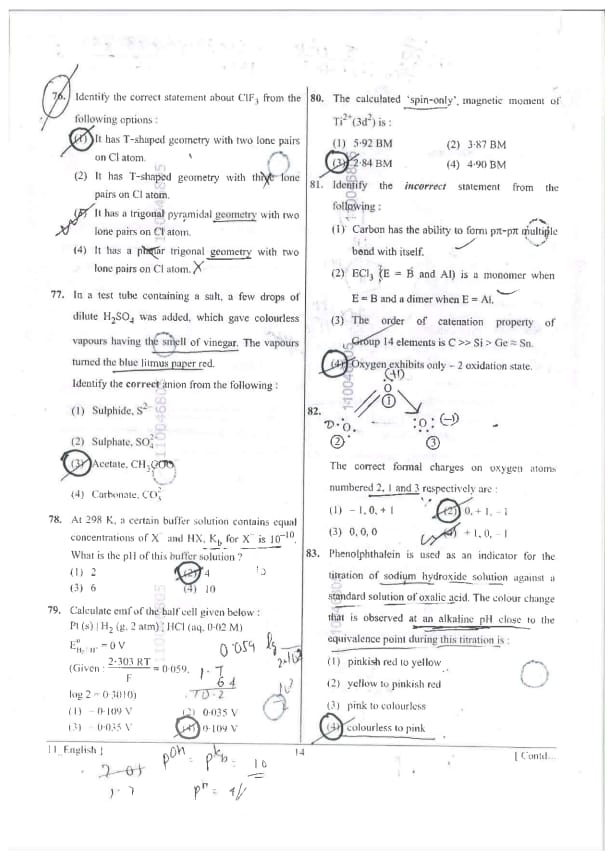
Identify the correct statement about \(ClF_3\) from the following options:
In a test tube containing a salt, a few drops of dilute \(H_2SO_4\) was added, which gave colourless vapours having the smell of vinegar. The vapours turned the blue litmus paper red. Identify the correct anion from the following:
At \(298 K\), a certain buffer solution contains equal concentrations of \(X^-\) and \(HX\). If \(K_b\) for \(X^-\) is \(10^{-10}\), what is the \(pH\) of this buffer solution?
Calculate emf of the half-cell given below:
\(Pt(s) | H_2(g, 2 atm) | HCl(aq, 0.02 M)\)
Given: \(E^\circ_{H^+/H_2} = 0 V\), \(\frac{2.303RT}{F} = 0.059\), \(\log 2 = 0.3010\)
The calculated spin-only magnetic moment of \(Ti^{2+}\) (\(3d^2\)) is:
Identify the incorrect statement from the following:
The correct formal charges on oxygen atoms numbered 2, 1 and 3, respectively, are:

Phenolphthalein is used as an indicator for titration of sodium hydroxide solution against a standard solution of oxalic acid. The colour change that is observed at an alkaline \(pH\) close to equivalence point during this titration is:
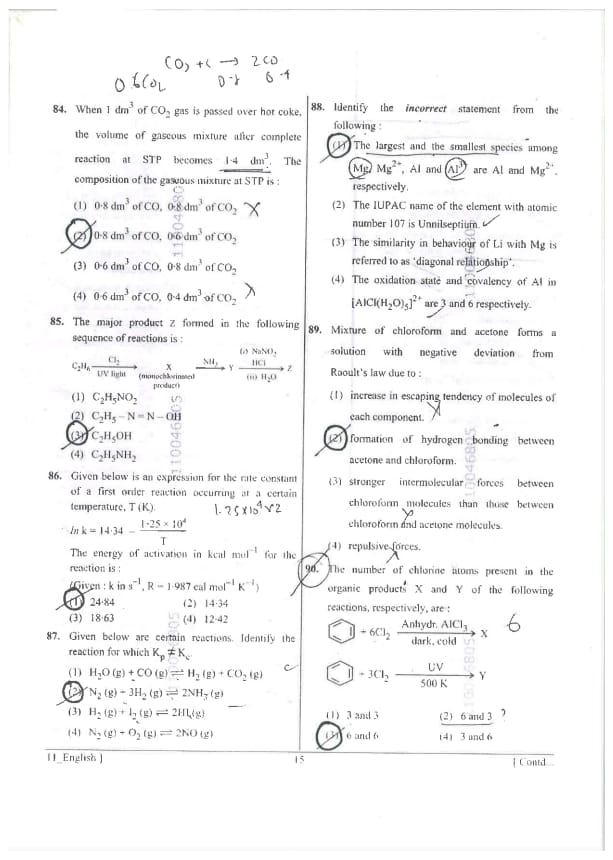
When \(1 dm^3\) of \(CO_2\) gas is passed over hot coke, the volume of gaseous mixture after complete reaction at STP becomes \(1.4 dm^3\). The composition of the gaseous mixture at STP is:
The major product Z formed in the following sequence of reactions is:

Given below is an expression for the rate constant of a first order reaction occurring at a certain temperature, \(T(K)\):
\(\ln k = 14.34 - \frac{1.25 \times 10^4}{T}\)
The energy of activation in \(kcal mol^{-1}\) for the reaction is:
Given: \(R = 1.987 cal mol^{-1} K^{-1}\)
Given below are certain reactions. Identify the reaction for which \(K_p \neq K_c\):
Identify the incorrect statement from the following:
Mixture of chloroform and acetone forms a solution with negative deviation from Raoult’s law due to:
View Solution
Step 1: Understanding the Question:
The question asks about the molecular reason behind the non-ideal behavior of a chloroform-acetone mixture. Specifically, why does it show a "negative deviation"? Negative deviation means the total vapor pressure of the solution is lower than what Raoult's Law predicts. This usually happens when the attraction between the two different components is stronger than the attractions within the pure components themselves.
Step 2: Key Formula or Approach:
According to Raoult's Law, for an ideal solution, \(A-A\) and \(B-B\) interactions are equivalent to \(A-B\) interactions.
Negative Deviation: Interaction \((A-B) >\) Interaction \((A-A)\) or \((B-B)\).
This leads to a lower escaping tendency of the molecules into the vapor phase, reducing vapor pressure.
Step 3: Detailed Explanation:
Intermolecular Forces: In pure acetone (\(CH_3COCH_3\)), there are dipole-dipole interactions. In pure chloroform (\(CHCl_3\)), there are also dipole-dipole interactions.
Synergy on Mixing: When chloroform is mixed with acetone, the hydrogen atom of the chloroform molecule is attracted to the oxygen atom of the carbonyl group in the acetone molecule.
Hydrogen Bonding: This interaction is a specific type of intermolecular hydrogen bond (\(C-H \cdots O\)). Even though \(C-H\) bonds don't usually form hydrogen bonds, the three chlorine atoms on the carbon withdraw electrons, making that \(H\) atom significantly positive and capable of H-bonding.
Result: These new \(A-B\) bonds are stronger than the original dipole-dipole interactions in the pure liquids. Consequently, the molecules "hold onto" each other more tightly, making them less likely to evaporate. This results in a negative deviation from Raoult's Law.
Step 4: Final Answer:
The negative deviation is due to the formation of hydrogen bonding between acetone and chloroform.
Quick Tip: A simple trick: If mixing two things makes the container \textbf{warm} (\(\Delta H < 0\)), it's usually a \textbf{negative} deviation (stronger bonds formed). If it gets \textbf{cold} (\(\Delta H > 0\)), it's a \textbf{positive} deviation (bonds were broken). Chloroform + Acetone is an exothermic process!
The number of chlorine atoms present in the organic products X and Y of the following reactions, respectively, are:
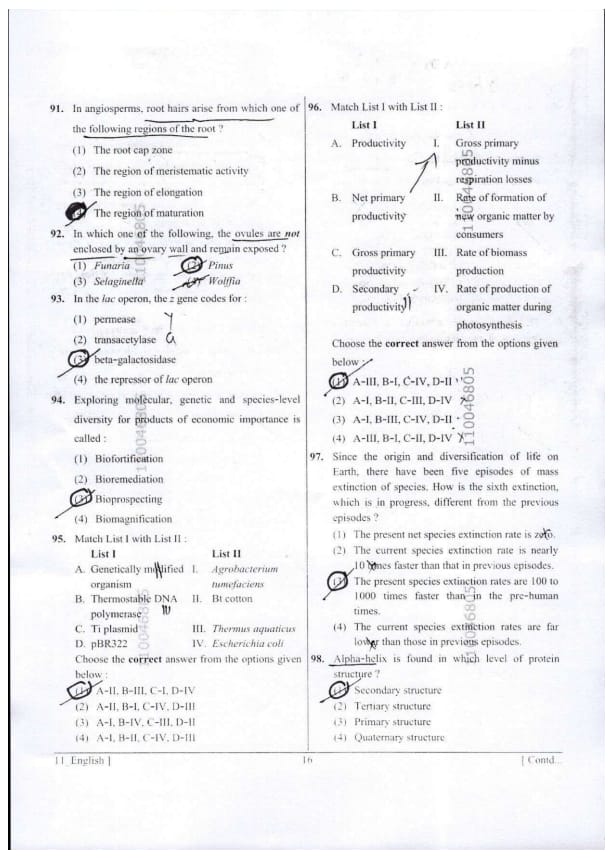
In angiosperms, root hairs arise from which one of the following regions of the root ?
In which one of the following, the ovules are not enclosed by an ovary wall and remain exposed ?
In the lac operon, the z gene codes for :
Exploring molecular, genetic and species-level diversity for products of economic importance is called :
Match List I with List II :

Choose the \textbf{correct} answer from the options given below :
Match List I with List II :

Choose the \textbf{correct} answer from the options given below :
Since the origin and diversification of life on Earth, there have been five episodes of mass extinction of species. How is the sixth extinction, which is in progress, different from the previous episodes ?
Alpha-helix is found in which level of protein structure ?
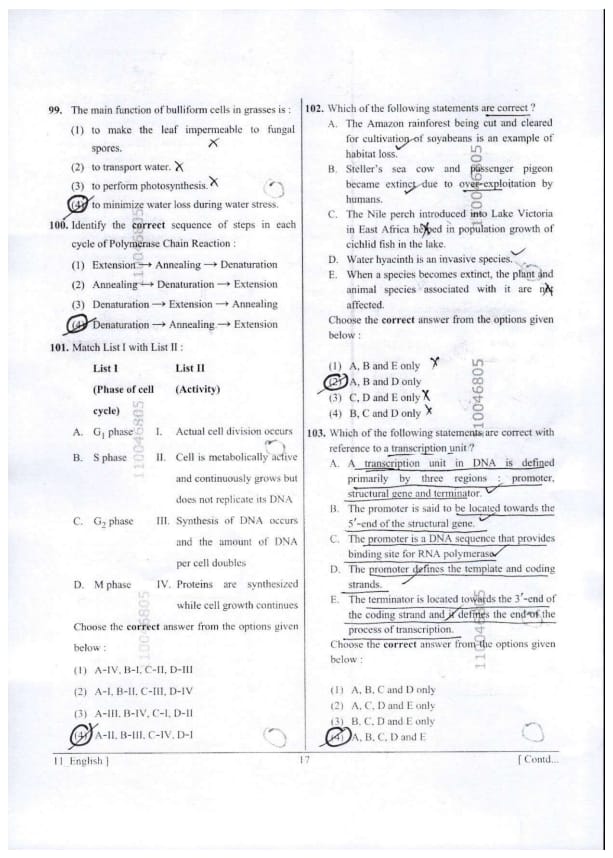
The main function of bulliform cells in grasses is :
Identify the correct sequence of steps in each cycle of Polymerase Chain Reaction :
Match List I with List II :

Choose the \textbf{correct} answer from the options given below :
Which of the following statements are correct ?
A. The Amazon rainforest being cut and cleared for cultivation of soyabeans is an example of habitat loss.
B. Steller's sea cow and passenger pigeon became extinct due to over-exploitation by humans.
C. The Nile perch introduced into Lake Victoria in East Africa helped in population growth of cichlid fish in the lake.
D. Water hyacinth is an invasive species.
E. When a species becomes extinct, the plant and animal species associated with it are not affected.
Choose the \textbf{correct} answer from the options given below :
Which of the following statements are correct with reference to a transcription unit?
\
A. A transcription unit in DNA is defined primarily by three regions : promoter, structural gene and terminator.
B. The promoter is said to be located towards the 5'-end of the structural gene.
C. The promoter is a DNA sequence that provides binding site for RNA polymerase .
D. The promoter defines the template and coding strands.
E. The terminator is located towards the 3'-end of the coding strand and it defines the end of the process of transcription.
Choose the \textbf{correct} answer from the options given below :
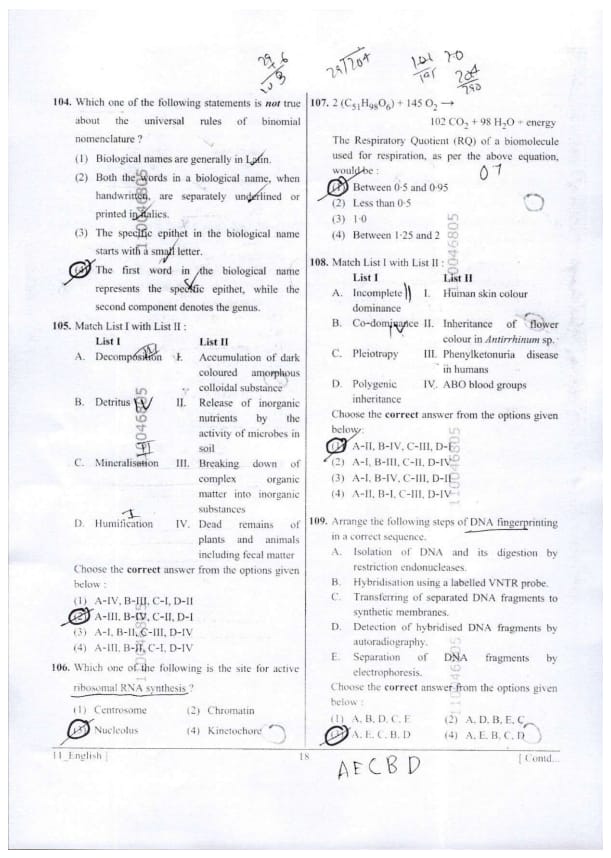
Which one of the following statements is not true about the universal rules of binomial nomenclature ?
Match List I with List II :

Choose the \textbf{correct} answer from the options given below :
Which one of the following is the site for active ribosomal RNA synthesis ?
\(2 \, (C_{51}H_{98}O_{6}) + 145 \, O_{2} \rightarrow 102 \, CO_{2} + 98 \, H_{2}O + energy\)
The Respiratory Quotient (RQ) of a biomolecule used for respiration, as per the above equation, would be :
Match List I with List II :

Choose the \textbf{correct} answer from the options given below :
Arrange the following steps of DNA fingerprinting in a correct sequence.
A. Isolation of DNA and its digestion by restriction endonucleases.
B. Hybridisation using a labelled VNTR probe.
C. Transferring of separated DNA fragments to synthetic membranes.
D. Detection of hybridised DNA fragments by autoradiography.
E. Separation of DNA fragments by electrophoresis.
Choose the \textbf{correct} answer from the options given below :
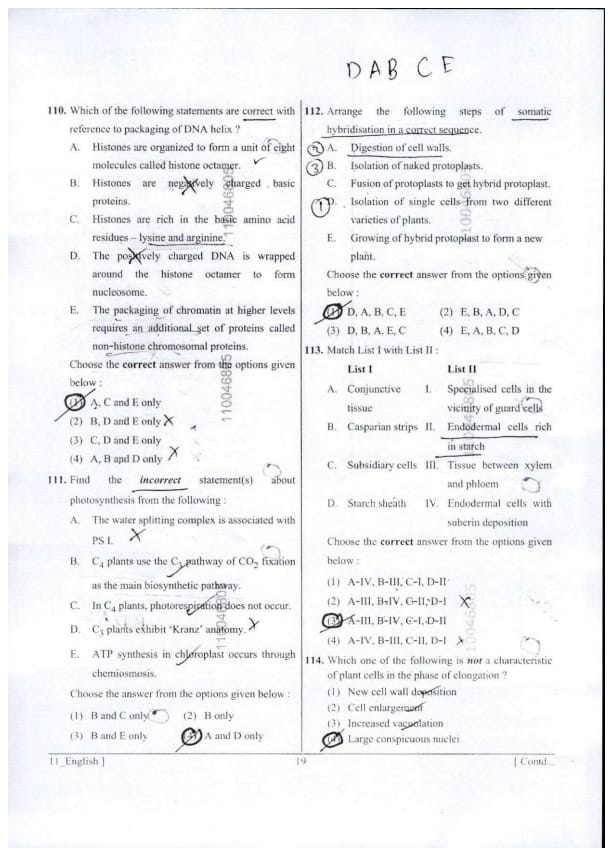
Which of the following statements are correct with reference to packaging of DNA helix ?
A. Histones are organized to form a unit of eight molecules called histone octamer.
B. Histones are negatively charged, basic proteins.
C. Histones are rich in the basic amino acid residues -- lysine and arginine.
D. The positively charged DNA is wrapped around the histone octamer to form nucleosome.
E. The packaging of chromatin at higher levels requires an additional set of proteins called non-histone chromosomal proteins.
Choose the \textbf{correct} answer from the options given below :
Find the incorrect statement(s) about photosynthesis from the following :
A. The water splitting complex is associated with PS II.
B. \(C_4\) plants use the \(C_3\) pathway of \(CO_2\) fixation as the main biosynthetic pathway.
C. In \(C_4\) plants, photorespiration does not occur.
D. \(C_3\) plants exhibit 'Kranz' anatomy.
E. ATP synthesis in chloroplast occurs through chemiosmosis.
Choose the answer from the options given below :
Arrange the following steps of somatic hybridisation in a correct sequence.
A. Digestion of cell walls.
B. Isolation of naked protoplasts.
C. Fusion of protoplasts to get hybrid protoplast.
D. Isolation of single cells from two different varieties of plants.
E. Growing of hybrid protoplast to form a new plant.
Choose the \textbf{correct} answer from the options given below :
Match List I with List II :

Choose the \textbf{correct} answer from the options given below :
Which one of the following is not a characteristic of plant cells in the phase of elongation ?
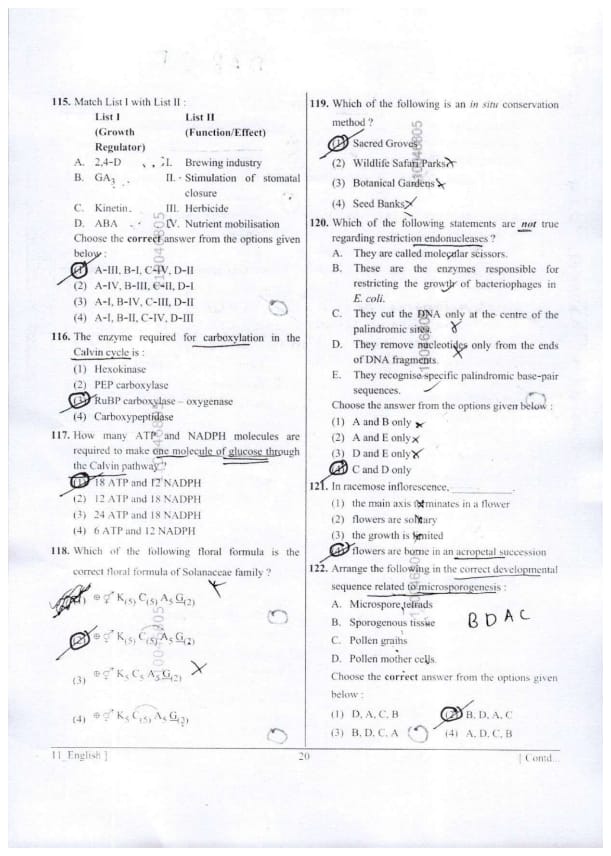
Match List I with List II :

Choose the \textbf{correct} answer from the options given below :
The enzyme required for carboxylation in the Calvin cycle is :
How many ATP and NADPH molecules are required to make one molecule of glucose through the Calvin pathway ?
Which of the following floral formula is the correct floral formula of Solanaceae family ?
Which of the following is an in situ conservation method ?
Which of the following statements are not true regarding restriction endonucleases ?
A. They are called molecular scissors.
B. These are the enzymes responsible for restricting the growth of bacteriophages in E. coli.
C. They cut the DNA only at the centre of the palindromic sites.
D. They remove nucleotides only from the ends of DNA fragments.
E. They recognise specific palindromic base-pair sequences.
Choose the answer from the options given below :
In racemose inflorescence, \rule{2cm}{0.4pt}.
Arrange the following in the correct developmental sequence related to microsporogenesis :
A. Microspore tetrads
B. Sporogenous tissue
C. Pollen grains
D. Pollen mother cells
Choose the \textbf{correct} answer from the options given below :
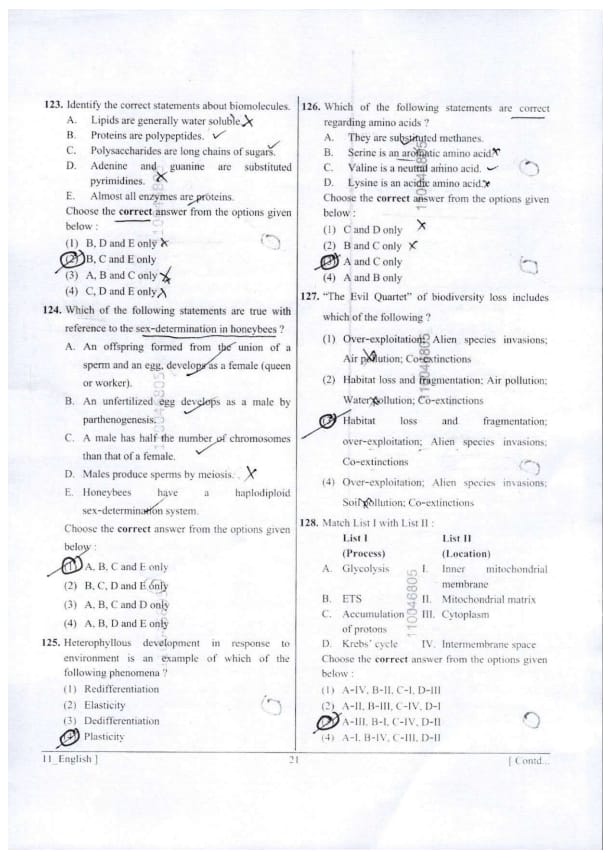
Identify the correct statements about biomolecules.
A. Lipids are generally water soluble.
B.Proteins are polypeptides.
C. Polysaccharides are long chains of sugars.
D. Adenine and guanine are substituted pyrimidines.
E. Almost all enzymes are proteins.
Choose the \textbf{correct} answer from the options given below :
Which of the following statements are true with reference to the sex-determination in honeybees ?
A. An offspring formed from the union of a sperm and an egg, develops as a female (queen or worker).
B. An unfertilized egg develops as a male by parthenogenesis.
C. A male has half the number of chromosomes than that of a female.
D. Males produce sperms by meiosis.
E. Honeybees have a haplodiploid sex-determination system.
Choose the \textbf{correct} answer from the options given below :
Heterophyllous development in response to environment is an example of which of the following phenomena ?
Which of the following statements are correct regarding amino acids ?
A. They are substituted methanes.
B. Serine is an aromatic amino acid.
C. Valine is a neutral amino acid.
D. Lysine is an acidic amino acid.
Choose the \textbf{correct} answer from the options given below :
"The Evil Quartet" of biodiversity loss includes which of the following ?
Match List I with List II :

Choose the \textbf{correct} answer from the options given below :
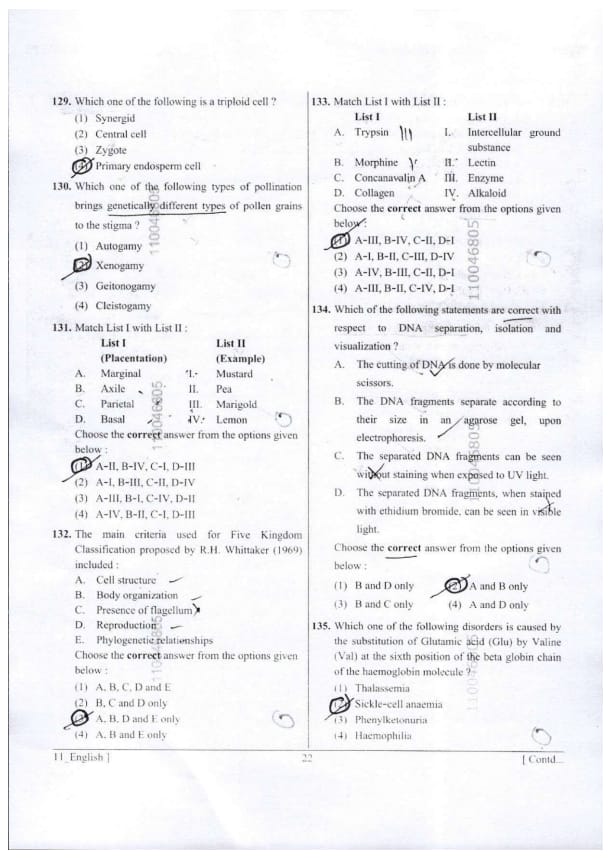
Which one of the following is a triploid cell ?
Which one of the following types of pollination brings genetically different types of pollen grains to the stigma ?
Match List I with List II :

Choose the \textbf{correct} answer from the options given below :
The main criteria used for Five Kingdom Classification proposed by R.H. Whittaker (1969) included :
A. Cell structure
B. Body organization
C. Presence of flagellum
D. Reproduction
E. Phylogenetic relationships
Choose the \textbf{correct} answer from the options given below :
Match List I with List II :

Choose the \textbf{correct} answer from the options given below :
Which of the following statements are correct with respect to DNA separation, isolation and visualization ?
A. The cutting of DNA is done by molecular scissors.
B. The DNA fragments separate according to their size in an agarose gel, upon electrophoresis.
C. The separated DNA fragments can be seen without staining when exposed to UV light.
D. The separated DNA fragments, when stained with ethidium bromide, can be seen in visible light.
Choose the \textbf{correct} answer from the options given below :
Which one of the following disorders is caused by the substitution of Glutamic acid (Glu) by Valine (Val) at the sixth position of the beta globin chain of the haemoglobin molecule ?
Choose the correct answer from the options given below :

\medskip
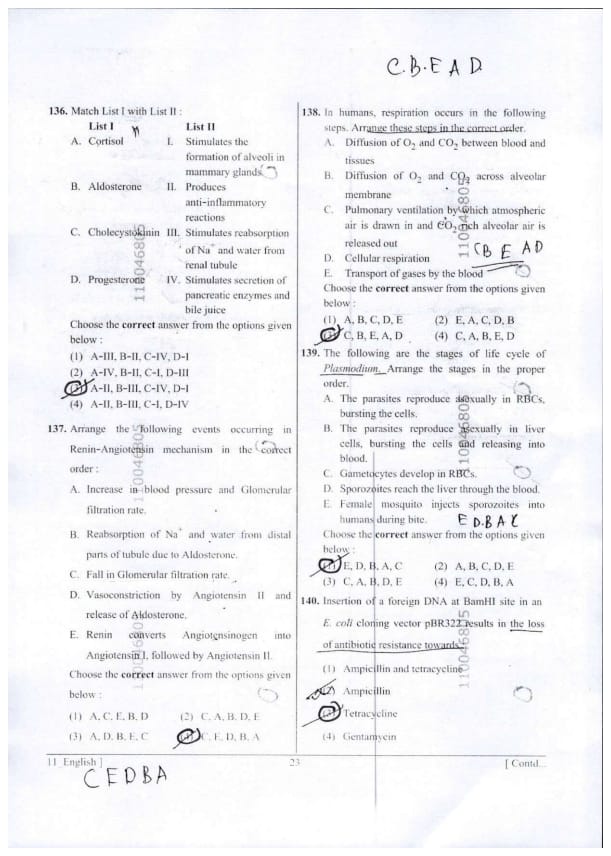
Arrange the following events occurring in Renin-Angiotensin mechanism in the correct order :
A. Increase in blood pressure and Glomerular filtration rate.
B. Reabsorption of \(Na^+\) and water from distal parts of tubule due to Aldosterone.
C. Fall in Glomerular filtration rate.
D. Vasoconstriction by Angiotensin II and release of Aldosterone.
E. Renin converts Angiotensinogen into Angiotensin I, followed by Angiotensin II.
Choose the correct answer from the options given below :
\medskip
In humans, respiration occurs in the following steps. Arrange these steps in the correct order.
A. Diffusion of \(O_2\) and \(CO_2\) between blood and tissues
B. Diffusion of \(O_2\) and \(CO_2\) across alveolar membrane
C. Pulmonary ventilation by which atmospheric air is drawn in and \(CO_2\) rich alveolar air is released out
D. Cellular respiration
E. Transport of gases by the blood
Choose the correct answer from the options given below:
\medskip
The following are the stages of life cycle of Plasmodium. Arrange the stages in the proper order.
A. The parasites reproduce asexually in RBCs, bursting the cells.
B. The parasites reproduce asexually in liver cells, bursting the cells and releasing into blood.
C. Gametocytes develop in RBCs.
D. Sporozoites reach the liver through the blood.
E. Female mosquito injects sporozoites into humans during bite.
Choose the correct answer from the options given below :
\medskip
Insertion of a foreign DNA at BamHI site in an E. coli cloning vector pBR322 results in the loss of antibiotic resistance towards:
\medskip
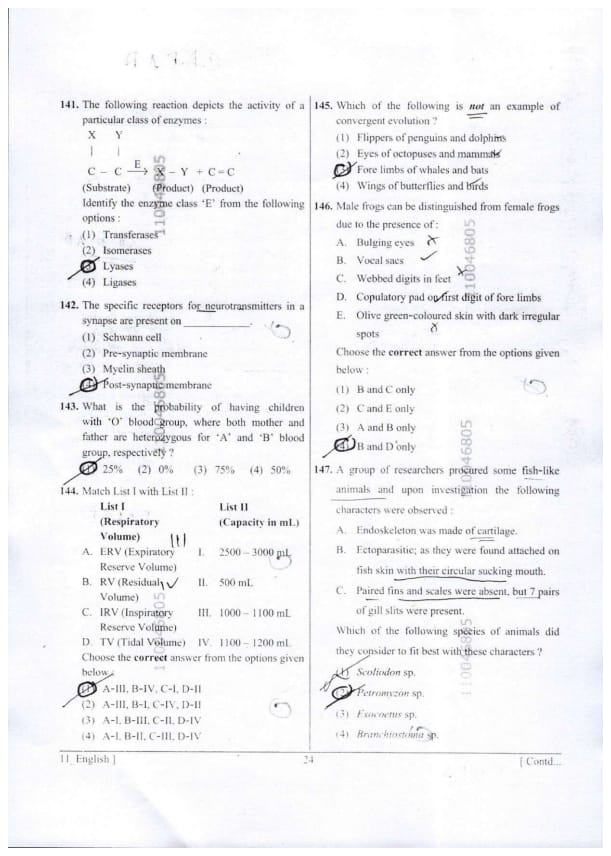
The following reaction depicts the activity of a particular class of enzymes :
\(\)\begin{matrix X & Y
| & |
C & - & C \end{matrix \longrightarrow X - Y + C = C\(\)
(Substrate) \hspace{1cm (Product) \hspace{0.5cm (Product)
Identify the enzyme class 'E' from the following options :
\medskip
The specific receptors for neurotransmitters in a synapse are present on ________.
\medskip
What is the probability of having children with 'O' blood group, where both mother and father are heterozygous for 'A' and 'B' blood group, respectively ?
\medskip
Choose the correct answer from the options given below :

\medskip
Which of the following is not an example of convergent evolution?
\medskip
Male frogs can be distinguished from female frogs due to the presence of:
A. Bulging eyes
B. Vocal sacs
C. Webbed digits in feet
D. Copulatory pad on first digit of fore limbs
E. Olive green-coloured skin with dark irregular spots
Choose the correct answer from the options given below:
\medskip
A group of researchers procured some fish-like animals and upon investigation the following characters were observed:
A. Endoskeleton was made of cartilage.
B. Ectoparasitic; as they were found attached on fish skin with their circular sucking mouth.
C. Paired fins and scales are absent, but 7 pairs of gill slits were present.
Which of the following species of animals did they consider to fit best with these characters?
\medskip
Match List I with List II

Choose the correct answer from the options given below :
\medskip
Match List I with List II:

\medskip
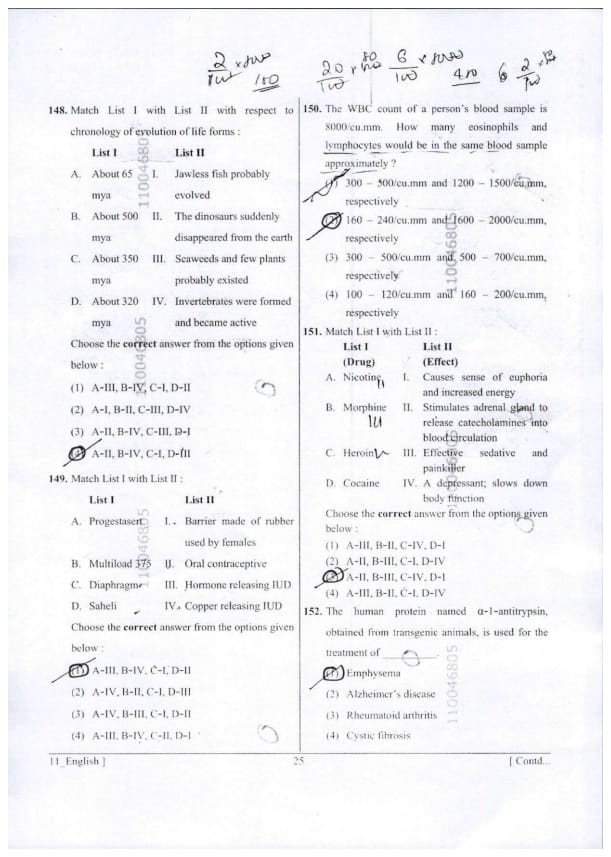
The WBC count of a person's blood sample is 8000/cu.mm. How many eosinophils and lymphocytes would be in the same blood sample approximately ?
\medskip
Match List I with List II

Choose the correct answer from the options given below:
The human protein named \(\alpha\)-1-antitrypsin, obtained from transgenic animals, is used for the treatment of ________.
\medskip
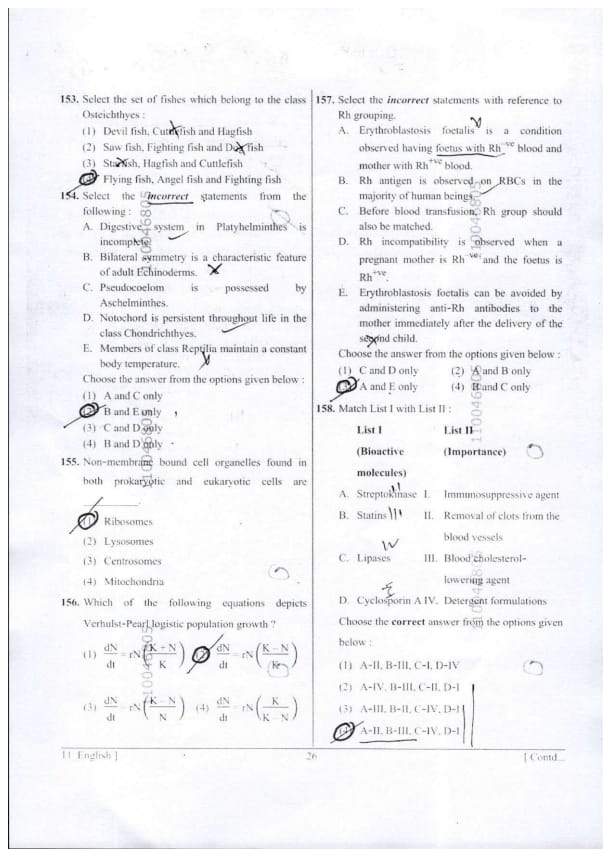
Select the set of fishes which belong to the class Osteichthyes :
\medskip
Select the incorrect statements from the following :
A. Digestive system in Platyhelminthes is incomplete.
B. Bilateral symmetry is a characteristic feature of adult Echinoderms.
C. Pseudocoelom is possessed by Aschelminthes.
D. Notochord is persistent throughout life in the class Chondrichthyes.
E. Members of class Reptilia maintain a constant body temperature.
Choose the answer from the options given below :
\medskip
Non-membrane bound cell organelles found in both prokaryotic and eukaryotic cells are:
\medskip
Which of the following equations depicts Verhulst-Pearl logistic population growth ?
\medskip
Select the incorrect statements with reference to Rh grouping.
A. Erythroblastosis foetalis is a condition observed having foetus with \(Rh^{-ve}\) blood and mother with \(Rh^{+ve}\) blood.
B. Rh antigen is observed on RBCs in the majority of human beings.
C. Before blood transfusion, Rh group should also be matched.
D. Rh incompatibility is observed when a pregnant mother is \(Rh^{-ve}\) and the foetus is \(Rh^{+ve}\).
E. Erythroblastosis foetalis can be avoided by administering anti-Rh antibodies to the mother immediately after the delivery of the second child.
Choose the answer from the options given below:
\medskip
Match List I with List II

Choose the correct answer from the options given below :
\medskip
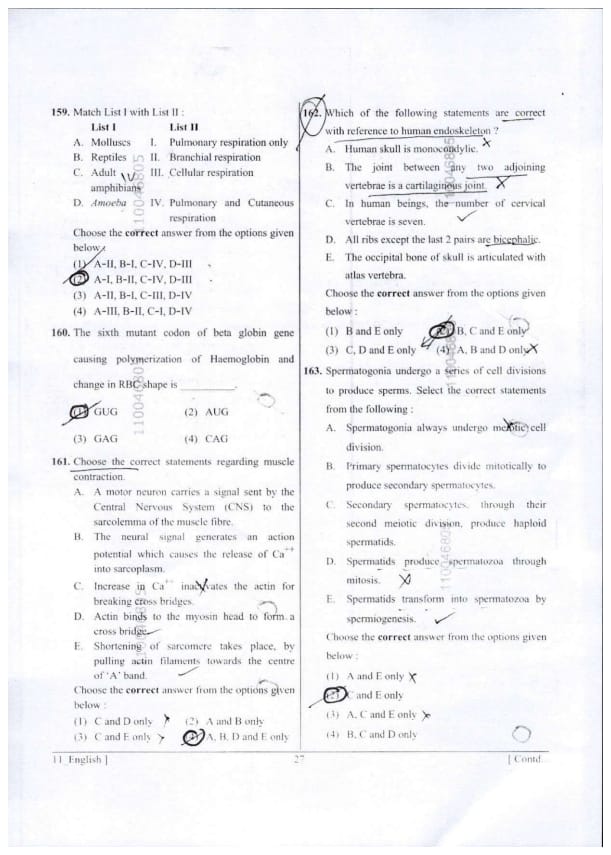
Match List I with List II

Choose the correct answer from the options given below :
\medskip
The sixth mutant codon of beta globin gene causing polymerization of Haemoglobin and change in RBC shape is ________
\medskip
Choose the correct statements regarding muscle contraction.
A. A motor neuron carries a signal sent by the Central Nervous System (CNS) to the sarcolemma of the muscle fibre.
B. The neural signal generates an action potential which causes the release of \(Ca^{++}\) into sarcoplasm.
C. Increase in \(Ca^{++}\) inactivates the actin for breaking cross bridges.
D. Actin binds to the myosin head to form a cross bridge.
E. Shortening of sarcomere takes place, by pulling actin filaments towards the centre of 'A' band.
Choose the correct answer from the options given below:
\medskip
Which of the following statements are correct with reference to human endoskeleton?
A. Human skull is monocondylic.
B. The joint between any two adjoining vertebrae is a cartilaginous joint.
C. In human beings, the number of cervical vertebrae is seven.
D. All ribs except the last 2 pairs are bicephalic.
E. The occipital bone of skull is articulated with atlas vertebra.
Choose the correct answer from the options given below:
\medskip
Spermatogonia undergo a series of cell divisions to produce sperms. Select the correct statements from the following :
A. Spermatogonia always undergo meiotic cell division.
B. Primary spermatocytes divide mitotically to produce secondary spermatocytes.
C. Secondary spermatocytes, through their second meiotic division, produce haploid spermatids.
D. Spermatids produce spermatozoa through mitosis.
E. Spermatids transform into spermatozoa by spermiogenesis.
Choose the correct answer from the options given below :
\medskip
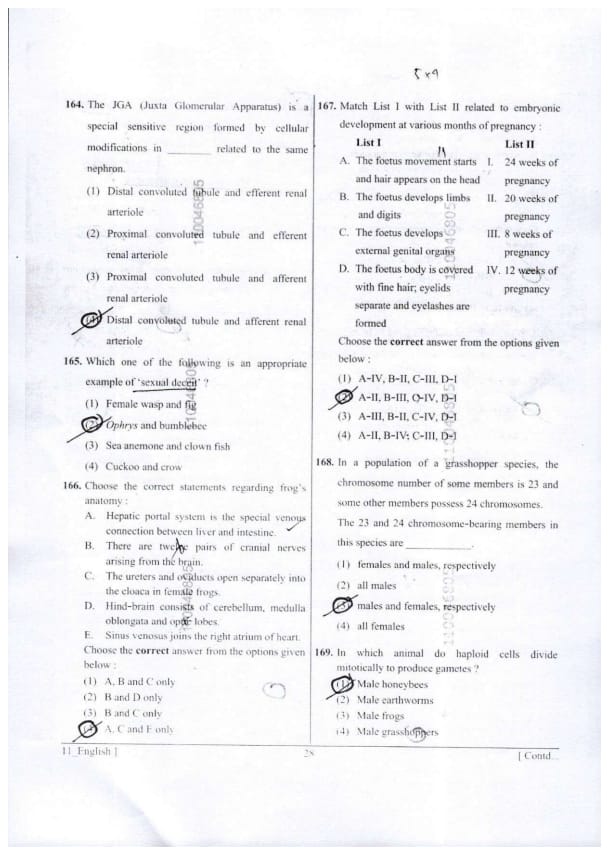
The JGA (Juxta Glomerular Apparatus) is a special sensitive region formed by cellular modifications in ________ related to the same nephron.
\medskip
Which one of the following is an appropriate example of 'sexual deceit' ?
\medskip
Choose the correct statements regarding frog's anatomy.
A. Hepatic portal system is the special venous connection between liver and intestine.
B. There are twelve pairs of cranial nerves arising from the brain.
C. The ureters and oviducts open separately into the cloaca in female frogs.
D. Hind-brain consists of cerebellum, medulla oblongata and optic lobes.
E. Sinus venosus joins the right atrium of heart.
Choose the correct answer from the options given below:
\medskip
Match List I with List II related to embryonic development at various months of pregnancy:

In a population of a grasshopper species, the chromosome number of some members is 23 and some other members possess 24 chromosomes. The 23 and 24 chromosome-bearing members in this species are ________
\medskip
In which animal do haploid cells divide mitotically to produce gametes ?
\medskip
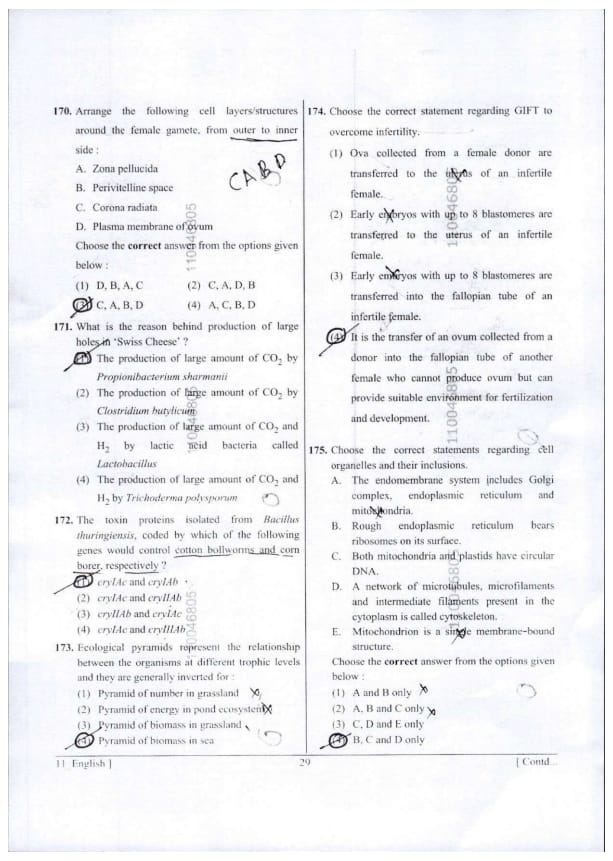
Arrange the following cell layers/structures around the female gamete from outer to inner side :
A. Zona pellucida
B. Perivitelline space
C. Corona radiata
D. Plasma membrane of ovum
Choose the correct answer from the options given below :
\medskip
What is the reason behind production of large holes in 'Swiss Cheese' ?
\medskip
The toxin proteins isolated from Bacillus thuringiensis, coded by which of the following genes would control cotton bollworms and corn borer, respectively ?
\medskip
Ecological pyramids represent the relationship between the organisms at different trophic levels and they are generally inverted for :
\medskip
Choose the correct statement regarding GIFT to overcome infertility.
\medskip
Choose the correct statements regarding cell organelles and their inclusions.
A. The endomembrane system includes Golgi complex, endoplasmic reticulum and mitochondria.
B. Rough endoplasmic reticulum bears ribosomes on its surface.
C. Both mitochondria and plastids have circular DNA.
D. A network of microtubules, microfilaments and intermediate filaments present in the cytoplasm is called cytoskeleton.
E. Mitochondrion is a single membrane-bound structure.
Choose the correct answer from the options given below :
\medskip
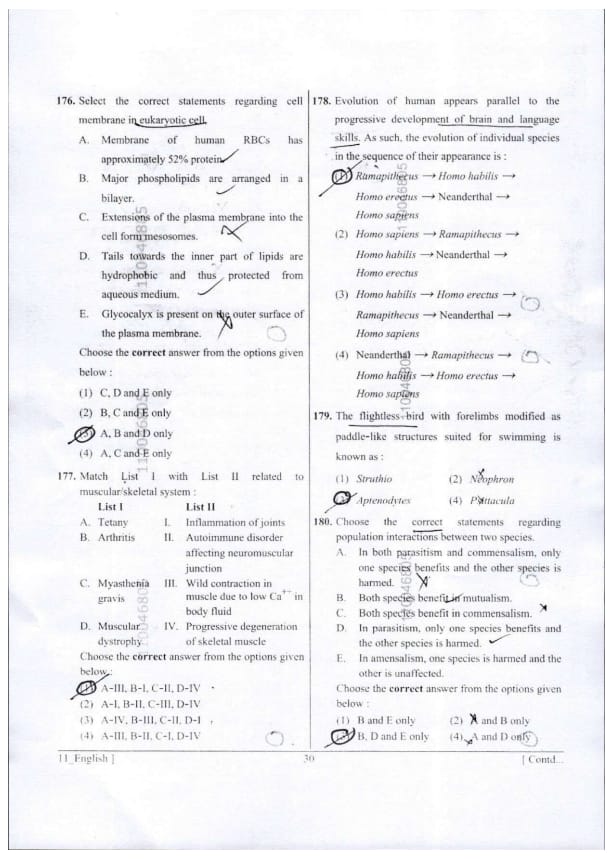
Select the correct statements regarding cell membrane in eukaryotic cell.
A. Membrane of human RBCs has approximately 52% protein.
B. Major phospholipids are arranged in a bilayer.
C. Extensions of the plasma membrane into the cell form mesosomes.
D. Tails towards the inner part of lipids are hydrophobic and thus protected from aqueous medium.
E. Glycocalyx is present on the outer surface of the plasma membrane.
Choose the correct answer from the options given below :
\medskip
Match List I with List II

Evolution of human appears parallel to the progressive development of brain and language skills. As such, the evolution of individual species in the sequence of their appearance is :
\medskip
The flightless bird with forelimbs modified as paddle-like structures suited for swimming is known as:
\medskip
Choose the correct statements regarding population interactions between two species.
A. In both parasitism and commensalism, only one species benefits and the other species is harmed.
B. Both species benefit in mutualism.
C. Both species benefit in commensalism.
D. In parasitism, only one species benefits and the other species is harmed.
E. In amensalism, one species is harmed and the other is unaffected.
Choose the correct answer from the options given below :
\medskip

NEET 2026 Marking Scheme
| Category | Detail |
| Marking Scheme | |
| Correct answer | +4 marks |
| Incorrect answer | −1 mark |
| Unattempted question | 0 marks |
| Subject-wise distribution | |
| Physics | 45 questions · 180 marks |
| Chemistry | 45 questions · 180 marks |
| Biology — Botany | 45 questions · 180 marks |
| Biology — Zoology | 45 questions · 180 marks |
| Total | 180 questions · 720 marks |
NEET 2026 Most Important Questions
*The article might have information for the previous academic years, please refer the official website of the exam.