
NEET 2026 Zoology Question Paper with Solution Pdf (Code 11)
- Answer Key
- Merit List
- Seat Inkate
- Tripura Counselling
- Nagaland Counselling
- Kerala Counselling
- UP Counselling
- Assam Counselling
- West Bengal Counselling
- MP Counselling
- Haryana Counselling
- Chhattisgarh Counselling
- Gujarat Counselling
- Participating Colleges
- AP Counselling
- Manipur Counselling
- Mark Vs Rank
- Mizoram NEET Counselling
- Ayush Counselling
- TN NEET Counselling
- Andhra Pradesh Counsellin
- Karnataka NEET Counsellin
- Jharkhand NEET Counsellin
- MH NEET Counselling
- Bihar NEET Counselling
- Counselling
- Seat Allotment


| Updated On - May 8, 2026
NTA conducted the NEET Exam on May 3 in a single shift from 2 PM to 5 PM in PBT Mode.
The NEET 2026 Zoology Question Paper includes 45 Questions carrying a total of 180 Marks. As per the NEET Marking Scheme, +4 Marks is awarded for every correct answer, and -1 mark will be deducted for every wrong answer.
NEET 2026 Zoology Question Paper with Solution PDF (Code 11) is available here for download.
NEET 2026 Zoology Question Paper with Solution PDF(Code 11)
| NEET 2026 Question Paper Code 11 | Download PDF | Check Solutions |
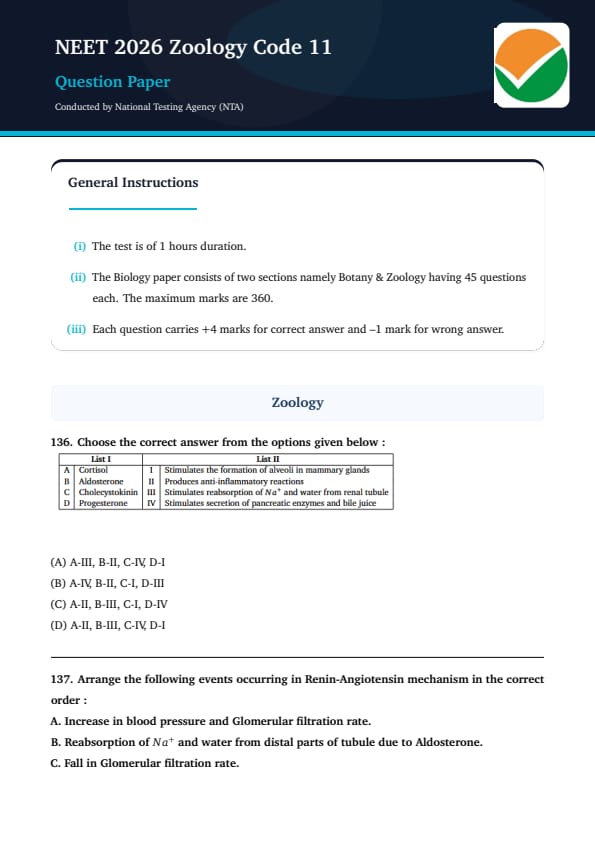
Choose the correct answer from the options given below :

\medskip
View Solution
Step 1 : Understanding the Question:
The question requires us to match various hormones listed in List I with their primary biological functions or target organ actions listed in List II. This involves knowledge of the endocrine system, including hormones from the adrenal cortex, the gastrointestinal tract, and the reproductive system.
Step 2 : Key Formulas and Approach:
The endocrine system operates through chemical messengers that travel via the bloodstream to specific target tissues. To solve this, we identify the origin and target of each hormone:
1. Glucocorticoids (like Cortisol) modulate metabolism and inflammation.
2. Mineralocorticoids (like Aldosterone) control electrolyte and water balance.
3. Gastrointestinal hormones (like CCK) coordinate digestive secretions.
4. Sex steroids (like Progesterone) regulate secondary sexual characteristics and pregnancy.
Step 3 : Detailed Explanation:
Cortisol (A): Secreted by the zona fasciculata of the adrenal cortex, cortisol is the primary glucocorticoid in humans. It plays a critical role in carbohydrate metabolism, increases blood glucose, and acts as a potent immunosuppressant. A major clinical significance of cortisol is that it produces anti-inflammatory reactions, making it vital in managing allergic and inflammatory conditions. Hence, A corresponds to II.
Aldosterone (B): Produced by the zona glomerulosa of the adrenal cortex, it is the main mineralocorticoid. It primarily acts on the distal convoluted tubule and collecting ducts of the kidney. It stimulates the reabsorption of \(Na^+\) and water and the excretion of \(K^+\) and phosphate ions, thereby regulating blood volume and osmotic pressure. Hence, B corresponds to III.
Cholecystokinin (C): This is a gastrointestinal hormone secreted by the duodenal mucosa. It travels to the pancreas and the gallbladder via the blood. Its primary role is to stimulate the secretion of pancreatic enzymes and cause the contraction of the gallbladder to release bile juice into the duodenum. Hence, C corresponds to IV.
Progesterone (D): This steroid hormone is secreted by the corpus luteum in the ovary and later by the placenta. It is essential for the maintenance of the endometrium. Furthermore, it acts on the mammary glands to stimulate the formation of alveoli (sac-like structures that store milk) and promotes milk secretion. Hence, D corresponds to I.
Step 4 : Final Answer:
By matching the hormones to their respective functions, we get the sequence A-II, B-III, C-IV, and D-I. This logic confirms that the correct combination is provided in the final choice.
Quick Tip: To remember hormone functions, use simple functional tags: Cortisol = "Stress/Anti-inflammation", Aldosterone = "Salt/Water saver", CCK = "Pancreas/Gallbladder activator", and Progesterone = "Pregnancy/Mammary support".
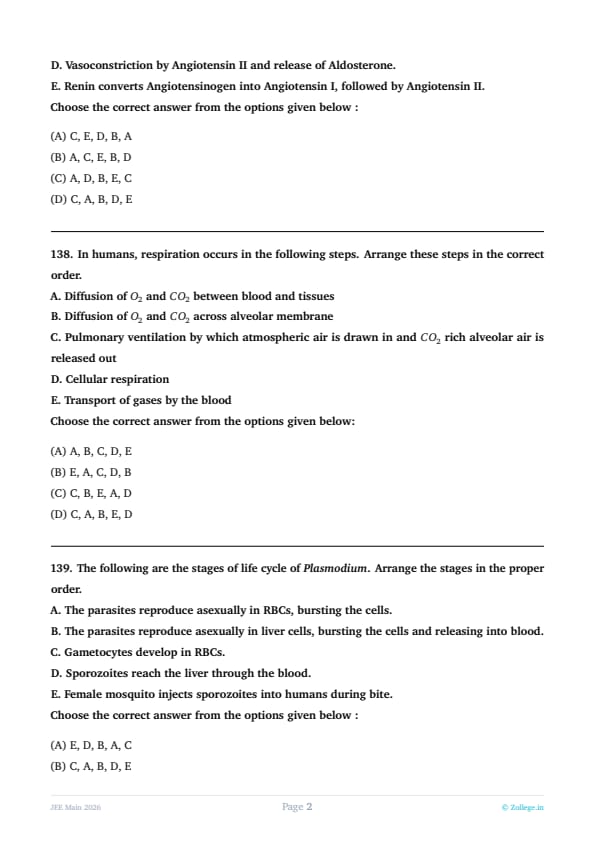
Arrange the following events occurring in Renin-Angiotensin mechanism in the correct order :
A. Increase in blood pressure and Glomerular filtration rate.
B. Reabsorption of \(Na^+\) and water from distal parts of tubule due to Aldosterone.
C. Fall in Glomerular filtration rate.
D. Vasoconstriction by Angiotensin II and release of Aldosterone.
E. Renin converts Angiotensinogen into Angiotensin I, followed by Angiotensin II.
Choose the correct answer from the options given below :
\medskip
View Solution
Step 1 : Understanding the Question:
This question asks us to identify the correct chronological sequence of the Renin-Angiotensin-Aldosterone System (RAAS). This is a vital homeostatic mechanism used by the body to restore blood pressure and kidney filtration when they drop below normal levels.
Step 2 : Key Formulas and Approach:
The RAAS follows a standard biological cascade:
Stimulus (Low BP/GFR) \(\rightarrow\) Sensor (JG cells) \(\rightarrow\) Enzyme (Renin) \(\rightarrow\) Intermediate Activation (Angiotensin I and II) \(\rightarrow\) Effector (Vasoconstriction and Aldosterone) \(\rightarrow\) Target Organ Action \(\rightarrow\) Correction of stimulus.
Step 3 : Detailed Explanation:
Step 1: The Initial Stimulus (C): The process is triggered when there is a Fall in Glomerular Filtration Rate (GFR) or a drop in blood pressure/blood volume. This change is detected by the macula densa and juxtaglomerular (JG) cells of the kidney.
Step 2: Enzyme Release and Conversion (E): The JG cells release the enzyme Renin into the blood. Renin acts on a plasma protein called angiotensinogen (produced by the liver) to convert it into Angiotensin I. Subsequently, Angiotensin-Converting Enzyme (ACE) converts Angiotensin I into the highly active Angiotensin II.
Step 3: Hormonal and Vascular Action (D): Angiotensin II is a powerful vasoconstrictor that increases systemic blood pressure. It also acts on the adrenal cortex to stimulate the release of Aldosterone.
Step 4: Tubular Reabsorption (B): Aldosterone acts on the distal parts of the renal tubule (DCT and collecting duct), causing the reabsorption of \(Na^+\) and water. This increases blood volume and restores the osmotic balance.
Step 5: Final Homeostatic Result (A): As blood volume and pressure rise, there is an Increase in blood pressure and GFR, returning the system to its set point and completing the negative feedback loop.
Step 4 : Final Answer:
The logical chronological sequence is C \(\rightarrow\) E \(\rightarrow\) D \(\rightarrow\) B \(\rightarrow\) A. This exact order describes the step-by-step restoration of kidney function, as shown in option (A).
Quick Tip: The RAAS is a classic feedback loop. The problem (Fall in GFR = C) must be at the start, and the solution (Increase in GFR = A) must be at the end. Only one sequence starts with C and ends with A.
In humans, respiration occurs in the following steps. Arrange these steps in the correct order.
A. Diffusion of \(O_2\) and \(CO_2\) between blood and tissues
B. Diffusion of \(O_2\) and \(CO_2\) across alveolar membrane
C. Pulmonary ventilation by which atmospheric air is drawn in and \(CO_2\) rich alveolar air is released out
D. Cellular respiration
E. Transport of gases by the blood
Choose the correct answer from the options given below:
\medskip
View Solution
Step 1 : Understanding the Question:
The question requires us to arrange the physiological steps of respiration in the correct order as they occur in the human body. This encompasses the entire journey of oxygen from the outside air into the cells for energy production, and the return of carbon dioxide.
Step 2 : Key Formulas and Approach:
Respiration is a multi-stage process involving:
1. Mechanical movement of air (Ventilation).
2. External exchange at the lungs.
3. Internal transport via the circulatory system.
4. Internal exchange at the tissues.
5. Metabolic consumption (Cellular respiration).
Step 3 : Detailed Explanation:
Step 1: Pulmonary Ventilation (C): The process begins with breathing, where atmospheric air is taken into the lungs (\(O_2\) rich) and \(CO_2\) rich air is expelled from the alveoli. This is the physical act of ventilation.
Step 2: External Respiration (B): Once air is in the alveoli, oxygen must enter the blood. This occurs through the diffusion of \(O_2\) and \(CO_2\) across the thin alveolar membrane separating the air sacs from the capillaries.
Step 3: Gas Transport (E): The blood then serves as the medium for the transport of gases throughout the body, carrying oxygenated blood toward tissues and deoxygenated blood back to the lungs.
Step 4: Internal Respiration (A): When blood reaches the capillary beds of various organs, the second exchange happens: Diffusion of \(O_2\) and \(CO_2\) between blood and tissues occurs down the partial pressure gradient.
Step 5: Cellular Respiration (D): Finally, within the cells, oxygen is used in metabolic pathways (like the Krebs cycle) to oxidize glucose and produce ATP, with \(CO_2\) being produced as a byproduct.
Step 4 : Final Answer:
Tracing the path of oxygen from the atmosphere to the mitochondria yields the sequence C-B-E-A-D. This logical progression of gas exchange and transport is correctly listed in the third choice.
Quick Tip: To remember the order, follow an \(O_2\) molecule: First, it "enters" the lung (C), then "crosses" into blood (B), then "travels" in blood (E), then "leaves" the blood for tissue (A), and is finally "burned" (D).
The following are the stages of life cycle of Plasmodium. Arrange the stages in the proper order.
A. The parasites reproduce asexually in RBCs, bursting the cells.
B. The parasites reproduce asexually in liver cells, bursting the cells and releasing into blood.
C. Gametocytes develop in RBCs.
D. Sporozoites reach the liver through the blood.
E. Female mosquito injects sporozoites into humans during bite.
Choose the correct answer from the options given below :
\medskip
View Solution
Step 1 : Understanding the Question:
The question asks to sequence the life cycle of the malarial parasite \textit{Plasmodium as it occurs within the human host. This requires knowledge of the exo-erythrocytic and erythrocytic phases of the infection.
Step 2 : Key Formulas and Approach:
The malarial life cycle in humans is asexual and follows a strict anatomical route:
Skin (Inoculation) \(\rightarrow\) Blood (Migration) \(\rightarrow\) Liver (Pre-erythrocytic phase) \(\rightarrow\) Red Blood Cells (Erythrocytic phase) \(\rightarrow\) Gametogenesis.
Step 3 : Detailed Explanation:
Infection Stage (E): The cycle starts when an infected female Anopheles mosquito bites a human, injecting the infectious form of the parasite, known as sporozoites, along with its saliva into the bloodstream.
Targeting the Liver (D): Within minutes, these sporozoites travel through the blood circulation to reach the liver cells (hepatocytes), which are their primary target for initial reproduction.
Liver Multiplication (B): Inside the liver, the parasites reproduce asexually (schizogony). They multiply until they burst the liver cells, releasing thousands of merozoites back into the blood.
RBC Invasion (A): The released merozoites then invade the erythrocytes. They reproduce asexually in RBCs, leading to their rhythmic bursting, which causes the characteristic symptoms of fever and chills.
Sexual Stage Formation (C): After some cycles of asexual reproduction in the blood, some parasites differentiate into the sexual forms, the male and female gametocytes, which develop within the RBCs.
Step 4 : Final Answer:
The correct chronological order of the life cycle events in the human host is E \(\rightarrow\) D \(\rightarrow\) B \(\rightarrow\) A \(\rightarrow\) C. This sequence matches the first provided option.
Quick Tip: Remember the path: Mosquito \(\rightarrow\) Blood \(\rightarrow\) Liver \(\rightarrow\) Blood \(\rightarrow\) RBCs. The parasite always visits the liver (Pre-erythrocytic) before it can attack the red blood cells (Erythrocytic).
Insertion of a foreign DNA at BamHI site in an E. coli cloning vector pBR322 results in the loss of antibiotic resistance towards:
\medskip
View Solution
Step 1 : Understanding the Question:
The question is about the principle of insertional inactivation in biotechnology. We need to determine how the antibiotic resistance of the pBR322 vector changes when a foreign gene is inserted at the BamHI restriction site.
Step 2 : Key Formulas and Approach:
The pBR322 vector contains two main selectable markers:
1. \(amp^R\) (ampicillin resistance gene).
2. \(tet^R\) (tetracycline resistance gene).
Restriction sites for specific enzymes are located within these genes. If an enzyme cuts within a gene and foreign DNA is inserted there, the gene is disrupted and its function is lost.
Step 3 : Detailed Explanation:
pBR322 Map: In the pBR322 plasmid, the BamHI and SalI recognition sites are specifically located within the coding sequence of the tetracycline resistance (\(tet^R\)) gene.
Insertional Inactivation: When foreign DNA is ligated into the vector at the BamHI site, the \(tet^R\) gene becomes split or "interrupted." This disruption means the gene can no longer produce the protein required to provide resistance to tetracycline.
Phenotypic Change: Consequently, the bacteria carrying this recombinant plasmid will grow on medium containing ampicillin but will lose the ability to grow on medium containing tetracycline.
Ampicillin Status: The ampicillin resistance gene (\(amp^R\)) contains sites for PstI and PvuI. Since these were not used for the insertion, the ampicillin resistance remains completely intact.
Step 4 : Final Answer:
Insertion at the BamHI site specifically inactivates the gene for tetracycline resistance. Therefore, the recombinant colonies will show a loss of resistance towards tetracycline, as stated in option (B).
Quick Tip: To remember this, use the keyword "BT": \textbf{B}amHI and \textbf{T}etracycline. If you "slice" through the "BT" section, the tetracycline power is destroyed.
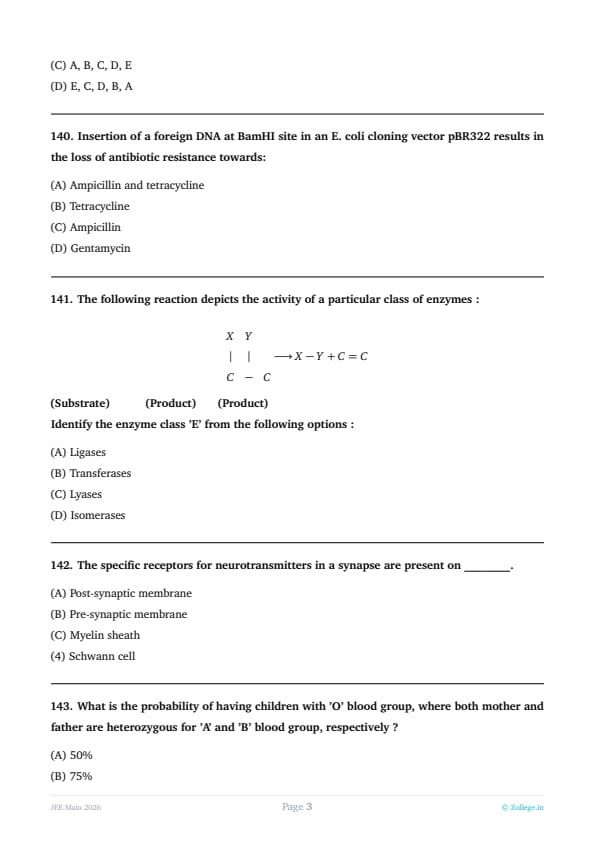
The following reaction depicts the activity of a particular class of enzymes :
\(\)\begin{matrix X & Y
| & |
C & - & C \end{matrix \longrightarrow X - Y + C = C\(\)
(Substrate) \hspace{1cm (Product) \hspace{0.5cm (Product)
Identify the enzyme class 'E' from the following options :
\medskip
View Solution
Step 1 : Understanding the Question:
We are given a generalized chemical equation showing a transformation of a substrate into two products. The goal is to identify which of the six IUBMB classes of enzymes catalyzes this specific type of reaction.
Step 2 : Key Formulas and Approach:
We analyze the chemical changes occurring from substrate to product:
1. Observe if groups are being removed or added.
2. Check for the formation of double bonds.
3. Determine if water is involved (hydrolysis).
4. Evaluate the options based on standard enzyme classification definitions.
Step 3 : Detailed Explanation:
Analysis of the Reaction: The substrate contains two carbon atoms (\(C-C\)) linked by a single bond, with groups X and Y attached to them. In the product phase, the X-Y molecule has been removed, and a double bond (\(C=C\)) has been created between the carbons.
Defining Lyases: Lyases are enzymes that catalyze the removal of groups from substrates by mechanisms other than hydrolysis, typically leaving double bonds behind. They can also catalyze the addition of groups to double bonds. The reaction provided is the classic representation of a Lyase.
Excluding Other Classes:
Ligases (A): Catalyze the joining of two molecules using ATP (not seen here).
Transferases (B): Catalyze the transfer of a group from one molecule to another (not seen here).
Isomerases (D): Catalyze structural rearrangements within a single molecule (not seen here).
Step 4 : Final Answer:
The formation of a double bond through the removal of groups without the addition of water is the hallmark of the class Lyases. Therefore, the third option is the correct identification.
Quick Tip: Identify a Lyase by the "Double Bond Signature": If the reaction results in a \(C=C\) double bond after a molecule is "kicked out" without using water, it's a Lyase.
The specific receptors for neurotransmitters in a synapse are present on ________.
\medskip
View Solution
Step 1 : Understanding the Question:
The question asks us to identify the location of the receptor proteins that detect and bind neurotransmitters during the transmission of a nerve impulse across a chemical synapse.
Step 2 : Key Formulas and Approach:
Synaptic transmission involves:
1. Arrival of an impulse at the pre-synaptic terminal.
2. Release of neurotransmitters into the synaptic cleft.
3. Diffusion of neurotransmitters across the gap.
4. Binding to receptors on the receiving membrane to generate a new potential.
Step 3 : Detailed Explanation:
The Synapse: A chemical synapse consists of a pre-synaptic neuron, a synaptic cleft, and a post-synaptic neuron.
Role of the Pre-synaptic Membrane (B): This membrane belongs to the axon terminal of the sending neuron. It contains voltage-gated calcium channels and is responsible for releasing neurotransmitters from vesicles into the cleft. It does not contain the primary receptors for these transmitters.
Role of the Post-synaptic Membrane (A): This is the membrane of the dendrite or cell body of the receiving neuron. It is embedded with specific receptors for neurotransmitters. Binding of the transmitter to these receptors opens ligand-gated ion channels, causing depolarization or hyperpolarization of the receiving cell.
Myelin and Schwann Cells (C/D): Myelin sheaths and Schwann cells provide electrical insulation for the axon to facilitate saltatory conduction; they are not involved in the chemical reception of signals at the synapse.
Step 4 : Final Answer:
The reception of the chemical signal occurs on the receiving side of the junction, which is the post-synaptic membrane. This corresponds to option (A).
Quick Tip: Think of the synapse as a one-way street: the "Pre-" side is the speaker (releases signal) and the "Post-" side is the listener (has the ears/receptors).
What is the probability of having children with 'O' blood group, where both mother and father are heterozygous for 'A' and 'B' blood group, respectively ?
\medskip
View Solution
Step 1 : Understanding the Question:
This problem involves basic Mendelian genetics applied to the human ABO blood group system. We need to determine the mathematical probability of producing an offspring with type 'O' blood from parents with specific heterozygous genotypes.
Step 2 : Key Formulas and Approach:
1. Identify the alleles: \(I^A\) and \(I^B\) are codominant, while \(i\) is recessive.
2. Determine parental genotypes: Heterozygous 'A' is \(I^A i\); Heterozygous 'B' is \(I^B i\).
3. Use a Punnett square to predict the genotypic and phenotypic ratios of the offspring.
Step 3 : Detailed Explanation:
Parental Genotypes: The mother's blood type is A but she is heterozygous, so her genotype is \(I^A i\). The father's blood type is B but he is heterozygous, so his genotype is \(I^B i\).
Gamete Production: The mother produces two types of ova: \(I^A\) and \(i\). The father produces two types of sperm: \(I^B\) and \(i\).
Punnett Square Analysis:

Calculating Ratios: Out of 4 possible genetic combinations:
1/4 is \(I^A I^B\) (Type AB)
1/4 is \(I^A i\) (Type A)
1/4 is \(I^B i\) (Type B)
1/4 is \(ii\) (Type O)
Step 4 : Final Answer:
The probability of a type 'O' offspring (\(ii\)) is 1 out of 4, which is 25%. This leads to the selection of option (D).
Quick Tip: A cross between heterozygous A and heterozygous B is famous for being able to produce children with all four possible blood types (A, B, AB, O), each with a 25% probability!
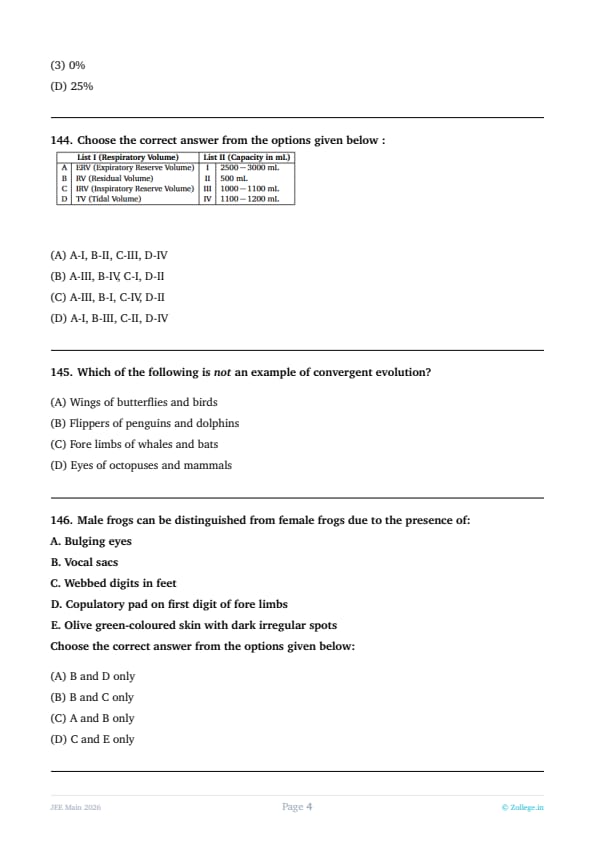
Choose the correct answer from the options given below :

\medskip
View Solution
Step 1 : Understanding the Question:
The question asks to match standard pulmonary (respiratory) volumes with their approximate average numerical values in a healthy human adult. These volumes are measured using a spirometer and are crucial for diagnosing lung health.
Step 2 : Key Formulas and Approach:
The approach involves recalling the standard physiological ranges for the four basic lung volumes:
1. Tidal Volume (TV) - normal breath.
2. Inspiratory Reserve Volume (IRV) - extra air in.
3. Expiratory Reserve Volume (ERV) - extra air out.
4. Residual Volume (RV) - air that stays in.
Step 3 : Detailed Explanation:
Tidal Volume (D): This represents the volume of air inspired or expired during normal, effortless breathing. Its average value is approximately 500 mL. Thus, D matches with II.
Inspiratory Reserve Volume (C): This is the additional volume of air a person can forcibly inspire over and above the tidal volume. Since our lungs have a large capacity for deep inhalation, this is the largest basic volume, averaging 2500 to 3000 mL. Thus, C matches with I.
Expiratory Reserve Volume (A): This is the extra air a person can forcibly expire after a normal tidal expiration. It averages between 1000 and 1100 mL. Thus, A matches with III.
Residual Volume (B): Even after the most forceful expiration, some air always remains in the lungs to prevent alveolar collapse. This averages between 1100 and 1200 mL. Thus, B matches with IV.
Step 4 : Final Answer:
The correct matching sequence is A-III, B-IV, C-I, and D-II. This combination is found in option (B).
Quick Tip: To keep them straight, rank them by size: TV is the smallest (500), IRV is the largest (3000), and the "Expiratory/Residual" pair are in the middle (around 1000-1100).
Which of the following is not an example of convergent evolution?
\medskip
View Solution
Step 1 : Understanding the Question:
The goal is to differentiate between convergent and divergent evolution by identifying the pair of organs that do not show convergent evolution. This requires understanding the difference between analogous and homologous structures.
Step 2 : Key Formulas and Approach:
1. Convergent Evolution: Unrelated species develop similar traits (analogous organs) to adapt to similar environments. (Different origin, same function).
2. Divergent Evolution: Related species develop different traits (homologous organs) from a common ancestral structure. (Same origin, different function).
Step 3 : Detailed Explanation:
Wings of butterflies and birds (A): Insects and birds are phylogenetically distant. Their wings have completely different structural designs but perform the same function (flying). This is convergent evolution (analogy).
Flippers of penguins and dolphins (B): Penguins (birds) and dolphins (mammals) are not closely related. Their flippers independently evolved for swimming in aquatic environments. This is convergent evolution (analogy).
Eyes of octopuses and mammals (D): These organisms belong to different phyla. Although their eyes appear similar in function and camera-like structure, their developmental origins are distinct. This is convergent evolution (analogy).
Forelimbs of whales and bats (C): Whales and bats are both mammals. Their forelimbs share the same fundamental skeletal pattern (humerus, radius, ulna, etc.) inherited from a common ancestor. However, they have been modified for swimming and flying, respectively. This is divergent evolution (homology).
Step 4 : Final Answer:
Since the forelimbs of whales and bats are homologous organs representing divergent evolution, they are not an example of convergent evolution. Thus, the third choice is correct.
Quick Tip: Remember the mnemonic "AC/HD": \textbf{Analogous organs show \textbf{C}onvergent evolution; \textbf{H}omologous organs show \textbf{D}ivergent evolution.
Male frogs can be distinguished from female frogs due to the presence of:
A. Bulging eyes
B. Vocal sacs
C. Webbed digits in feet
D. Copulatory pad on first digit of fore limbs
E. Olive green-coloured skin with dark irregular spots
Choose the correct answer from the options given below:
\medskip
View Solution
Step 1 : Understanding the Question:
This question asks about sexual dimorphism in frogs (\textit{Rana tigrina). We must identify which of the listed morphological features are found \textit{only in male frogs and are absent in females.
Step 2 : Key Formulas and Approach:
Identify the secondary sexual characters in frogs. These are usually traits that aid in attracting a mate or maintaining a grip during the mating process (amplexus). General adaptive traits for camouflage or vision are usually shared by both sexes.
Step 3 : Detailed Explanation:
Vocal Sacs (B): These are loose folds of skin under the mouth of male frogs. They act as resonating chambers to amplify the croaking sounds during the breeding season to attract females. Females lack vocal sacs.
Copulatory Pads (D): These are specialized swellings (also called nuptial pads) found on the first digit of the forelimbs in male frogs. They help the male to firmly hold the female during amplexus. Females lack these pads.
Shared Traits (A, C, E):
Bulging eyes with nictitating membranes are present in both sexes for vision and protection.
Webbed digits on the feet are swimming adaptations common to both sexes.
Olive green skin with spots is a camouflage adaptation for survival, present in both males and females.
Step 4 : Final Answer:
Since only the vocal sacs and the copulatory pads are unique to the males, statements B and D are the distinguishing features. This corresponds to option (A).
Quick Tip: To remember male frog traits, think about "Noise and Grip": Males make the noise (vocal sacs) and do the gripping (copulatory pads).
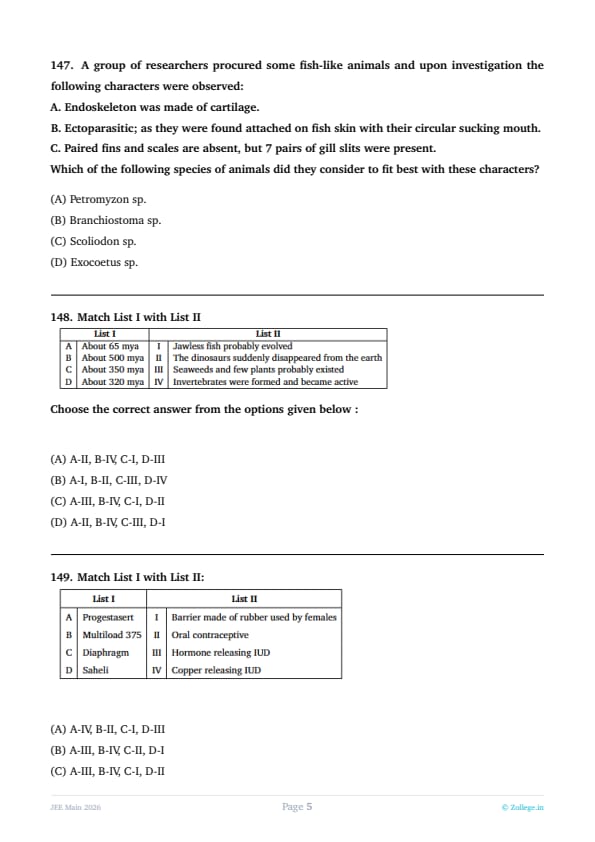
A group of researchers procured some fish-like animals and upon investigation the following characters were observed:
A. Endoskeleton was made of cartilage.
B. Ectoparasitic; as they were found attached on fish skin with their circular sucking mouth.
C. Paired fins and scales are absent, but 7 pairs of gill slits were present.
Which of the following species of animals did they consider to fit best with these characters?
\medskip
View Solution
Step 1 : Understanding the Question:
The question provides a set of diagnostic physiological and anatomical features of a specific chordate. We must determine which of the listed animals belongs to the class that exhibits all these specific "primitive" or "jawless" traits.
Step 2 : Key Formulas and Approach:
The described traits (cartilaginous endoskeleton, circular sucking mouth, jawless, lack of scales/paired fins) are the defining characteristics of the Class Cyclostomata. We need to identify which genus listed belongs to this class.
Step 3 : Detailed Explanation:
Identifying the Class: The absence of jaws (Agnatha), paired fins, and scales, combined with a cartilaginous skeleton and a parasitic lifestyle involving a circular mouth, points directly to the cyclostomes.
Evaluating the Options:
Petromyzon (A): Commonly known as the lamprey. It is a cyclostome. It matches all the given traits: it is an ectoparasite on fishes, has 6-15 pairs of gill slits (7 pairs falls in this range), and has no jaws or scales.
Branchiostoma (B): A cephalochordate (Amphioxus). It is not a true vertebrate and does not have the described sucking mouth or cartilaginous skull.
Scoliodon (C): A cartilaginous fish (shark). While it has cartilage, it possesses jaws, paired fins, and placoid scales. It is not an ectoparasite.
Exocoetus (D): A bony fish (flying fish). It has a bony skeleton, scales, jaws, and fins.
Step 4 : Final Answer:
Based on the strict morphological description of jawless, parasitic vertebrates, \textit{Petromyzon is the correct fit. This leads us to option (A).
Quick Tip: The "Circular sucking mouth" is the ultimate giveaway for Cyclostomes like Petromyzon (Lamprey) and Myxine (Hagfish). No other vertebrates have this.
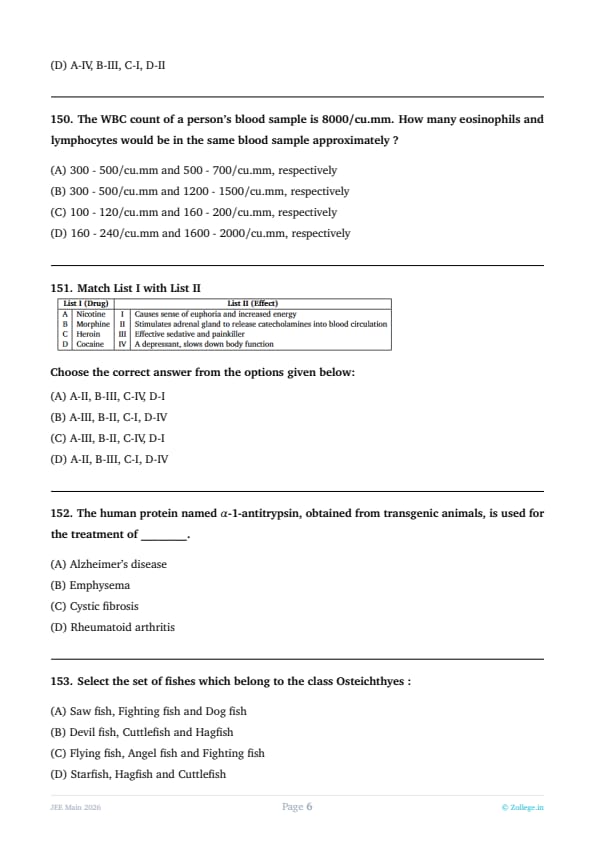
Match List I with List II

Choose the correct answer from the options given below :
\medskip
View Solution
Step 1 : Understanding the Question:
The question asks us to match key evolutionary events in the history of life on Earth with their approximate timing in millions of years ago (mya). This requires knowledge of the geological time scale and major biological transitions.
Step 2 : Key Formulas and Approach:
Follow the chronological order of evolution:
Early ocean life (Invertebrates) \(\rightarrow\) Early fish (Jawless) \(\rightarrow\) Early plants (Seaweeds) \(\rightarrow\) Extinction of giant reptiles (Dinosaurs).
Step 3 : Detailed Explanation:
Event at 65 mya (A): This date marks the end of the Cretaceous period. It is famous for the K-Pg mass extinction, where dinosaurs suddenly disappeared from the earth. Thus, A matches with II.
Event at 500 mya (B): During the early Paleozoic era, life diversified rapidly in the oceans. It is estimated that major invertebrates were formed and became active during this period. Thus, B matches with IV.
Event at 350 mya (C): Following the rise of invertebrates, the first vertebrates appeared. Jawless fish probably evolved around this time. Thus, C matches with I.
Event at 320 mya (D): As life moved towards land and diversified in the sea, seaweeds and few plants probably existed in their developed forms. Thus, D matches with III.
Step 4 : Final Answer:
Combining these historical facts, the correct match is A-II, B-IV, C-I, and D-III. This matches the arrangement in option (A).
Quick Tip: 65 mya is the "Dinosaur Date." Knowing A-II allows you to eliminate options (B) and (C) immediately, making the matching process much faster.
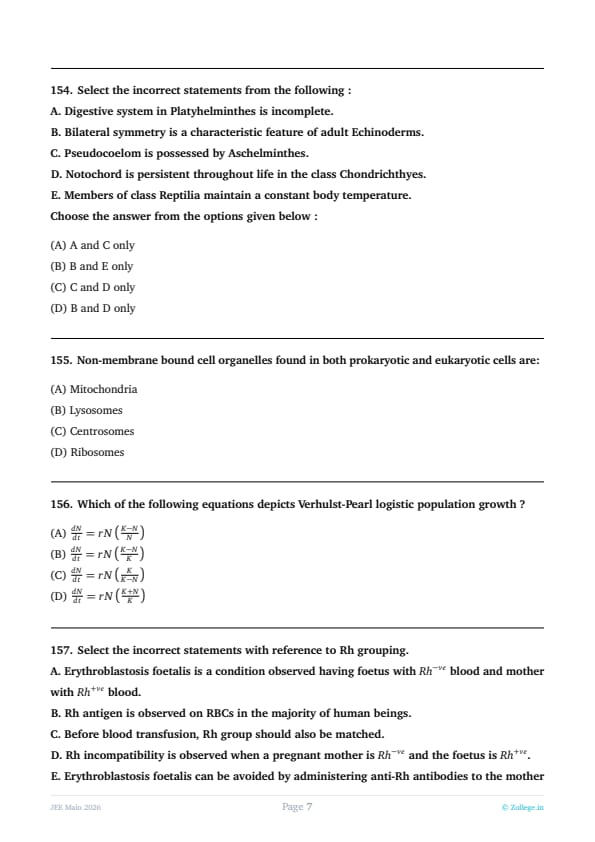
Match List I with List II:

\medskip
View Solution
Step 1 : Understanding the Question:
The question requires matching different contraceptive methods/brands (List I) with their specific pharmacological or physical category (List II). This covers barriers, hormonal methods, and intrauterine devices (IUDs).
Step 2 : Key Formulas and Approach:
Classification of contraceptives:
1. Barriers: Physical blocks (e.g., condoms, diaphragms).
2. IUDs: Intrauterine devices categorized into non-medicated, copper-releasing, and hormone-releasing.
3. Oral pills: Chemical suppression of ovulation (e.g., Saheli).
Step 3 : Detailed Explanation:
Progestasert (A): This is a T-shaped device inserted into the uterus. Unlike basic IUDs, it releases progestogens which make the uterus unsuitable for implantation and the cervix hostile to sperm. Thus, it is a hormone releasing IUD (III).
Multiload 375 (B): This is a variation of the copper-T device. It releases copper ions which decrease sperm motility and their fertilizing capacity. Thus, it is a copper releasing IUD (IV).
Diaphragm (C): This is a circular piece of rubber that is inserted into the female reproductive tract to cover the cervix. It physically prevents sperm from reaching the egg. Thus, it is a barrier made of rubber (I).
Saheli (D): This is a non-steroidal oral contraceptive pill developed in India (CDRI). It is taken once a week and has high contraceptive value with few side effects. Thus, it is an oral contraceptive (II).
Step 4 : Final Answer:
The correct matches are A-III, B-IV, C-I, and D-II. This combination is found in option (C).
Quick Tip: Remember the "IUD Trio": Non-medicated (Lippes loop), Copper (CuT, Cu7, Multiload), and Hormone (Progestasert, LNG-20). Knowing these three helps solve almost any IUD question.
The WBC count of a person's blood sample is 8000/cu.mm. How many eosinophils and lymphocytes would be in the same blood sample approximately ?
\medskip
View Solution
Step 1 : Understanding the Question:
The objective is to calculate the absolute count of specific white blood cell types (eosinophils and lymphocytes) given the total WBC count. This requires knowledge of the standard percentages (DLC) of these cells in healthy human blood.
Step 2 : Key Formulas and Approach:
1. Recall standard percentages: Lymphocytes (20-25%) and Eosinophils (2-3%).
2. Formula: Absolute count = (Standard % / 100) \(\times\) Total WBC count.
3. Apply this to the given total of 8000/cu.mm.
Step 3 : Detailed Explanation:
Calculating Eosinophils:
Normal range for eosinophils is 2% to 3% of the total leukocyte count.
Lower bound = \(2% of 8000 = (2 / 100) \times 8000 = 160\).
Upper bound = \(3% of 8000 = (3 / 100) \times 8000 = 240\).
Therefore, the count is 160 - 240 / cu.mm.
Calculating Lymphocytes:
Normal range for lymphocytes is 20% to 25% of the total leukocyte count.
Lower bound = \(20% of 8000 = (20 / 100) \times 8000 = 1600\).
Upper bound = \(25% of 8000 = (25 / 100) \times 8000 = 2000\).
Therefore, the count is 1600 - 2000 / cu.mm.
Step 4 : Final Answer:
The calculated ranges for eosinophils (160-240) and lymphocytes (1600-2000) match the data provided in option (D).
Quick Tip: Use the mnemonic "Never Let Monkeys Eat Bananas" to remember the order of abundance: Neutrophils (60%), Lymphocytes (20-25%), Monocytes (6%), Eosinophils (2%), Basophils (0.5%).
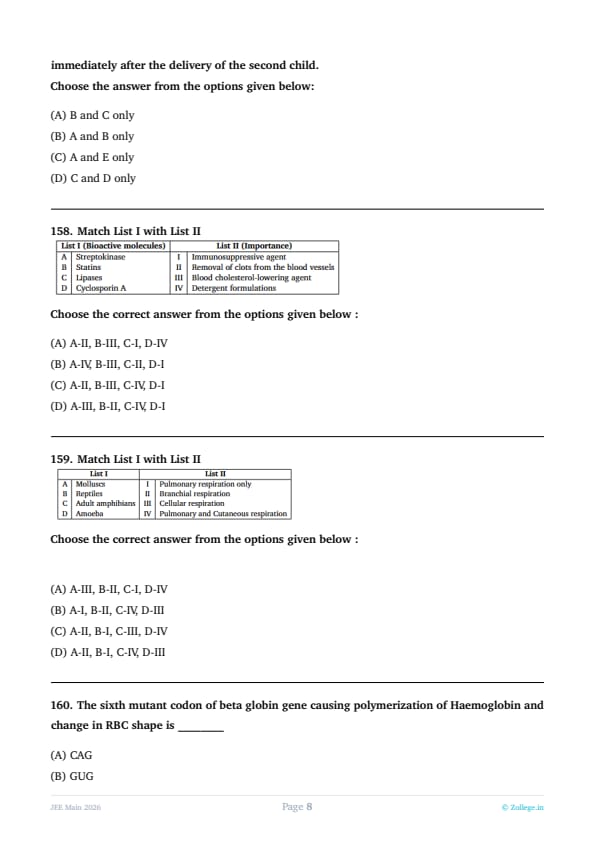
Match List I with List II

Choose the correct answer from the options given below:
View Solution
Step 1 : Understanding the Question:
The question asks us to match different drugs or chemical substances with their physiological or psychological effects on the human body. This involves pharmacology and human health knowledge.
Step 2 : Key Formulas and Approach:
Categorize each drug based on its source and action:
1. Nicotine: Alkaloid/Stimulant of the endocrine system.
2. Opiates: Analgesics and depressants.
3. Cocaine: Alkaloid/CNS Stimulant.
Step 3 : Detailed Explanation:
Nicotine (A): Found in tobacco, nicotine is an alkaloid that stimulates the adrenal glands to release adrenaline and noradrenaline (catecholamines) into the blood. This increases heart rate and blood pressure. Thus, A matches with II.
Morphine (B): Extracted from the latex of the poppy plant, morphine is an opioid that acts on the central nervous system. It is used clinically as an effective sedative and painkiller, especially for patients undergoing surgery. Thus, B matches with III.
Heroin (C): Chemically known as diacetylmorphine, it is a semi-synthetic opioid. It acts as a depressant and generally slows down body functions. Thus, C matches with IV.
Cocaine (D): Derived from the coca plant, it interferes with the transport of dopamine. It has a potent stimulating action on the CNS, which causes a sense of euphoria and increased energy. Thus, D matches with I.
Step 4 : Final Answer:
Matching these according to their known biological effects gives the sequence A-II, B-III, C-IV, and D-I. This corresponds to the arrangement in option (A).
Quick Tip: To distinguish opiates: \textbf{M}orphine is for \textbf{M}edicine (painkiller), while \textbf{H}eroin is a \textbf{H}eavy depressant that slows you down.
The human protein named \(\alpha\)-1-antitrypsin, obtained from transgenic animals, is used for the treatment of ________.
\medskip
View Solution
Step 1 : Understanding the Question:
The question asks to identify the specific human disease that is treated using a protein produced by transgenic animals (biological products of biotechnology).
Step 2 : Key Formulas and Approach:
The approach involves associating the human protein \(\alpha\)-1-antitrypsin with its known medical function. This protein is a protease inhibitor that protects lung tissue from being broken down by enzymes.
Step 3 : Detailed Explanation:
Biological Product: Transgenic animals are often used as "bioreactors" to produce expensive or complex human proteins. \(\alpha\)-1-antitrypsin (AAT) is one such protein produced in the milk of transgenic sheep.
Target Disease: Emphysema is a chronic lung condition where the alveolar walls are damaged, often due to an imbalance between proteases (like elastase) and protease inhibitors. A genetic deficiency of \(\alpha\)-1-antitrypsin leads to unchecked destruction of alveolar tissue.
Treatment Mechanism: Supplying the transgenic \(\alpha\)-1-antitrypsin helps inhibit the destructive enzymes, thereby treating or slowing the progression of Emphysema.
Other Diseases: While transgenic models are used to study Alzheimer's (A) and Cystic Fibrosis (C), \(\alpha\)-1-antitrypsin is not the primary treatment for those conditions.
Step 4 : Final Answer:
Based on established biotechnological applications, the protein is used for the treatment of Emphysema. This corresponds to option (B).
Quick Tip: Link "AAT" (Alpha-1-Antitrypsin) directly to "Lung Protection." Without it, the "Air" sacs (Alveoli) are destroyed, which is the definition of Emphysema.
Select the set of fishes which belong to the class Osteichthyes :
\medskip
View Solution
Step 1 : Understanding the Question:
This question requires us to identify a group where all members belong to the class Osteichthyes, which are the bony fishes. This involves distinguishing them from cartilaginous fishes (Chondrichthyes) and other marine organisms that are not true fishes.
Step 2 : Key Formulas and Approach:
1. Osteichthyes: Vertebrates with bony skeletons, terminal mouths, and opercula (e.g., Exocoetus, Betta).
2. Chondrichthyes: Vertebrates with cartilaginous skeletons and ventral mouths (e.g., sharks, saw fish).
3. Non-fishes: Invertebrates like Starfish (Echinoderms) or Devil fish (Molluscs) that have "fish" in their common name.
Step 3 : Detailed Explanation:
Evaluating Option (A): Saw fish (\textit{Pristis) and Dog fish (\textit{Scoliodon) are cartilaginous fishes (Chondrichthyes). Only Fighting fish is bony. This set is incorrect.
Evaluating Option (B): Devil fish (\textit{Octopus) and Cuttlefish (\textit{Sepia) are molluscs. Hagfish (\textit{Myxine) is a cyclostome. None are bony fish. This set is incorrect.
Evaluating Option (D): Starfish is an echinoderm. Hagfish is a cyclostome. Cuttlefish is a mollusc. This set is incorrect.
Evaluating Option (C):
Flying fish (\textit{Exocoetus): Marine bony fish.
Angel fish (\textit{Pterophyllum): Bony fish commonly found in aquariums.
Fighting fish (\textit{Betta): Freshwater bony fish.
All three are true bony fishes.
Step 4 : Final Answer:
The set containing only bony fishes (Osteichthyes) is Flying fish, Angel fish, and Fighting fish. This matches option (C).
Quick Tip: To avoid confusion, remember that "True" fishes are Chordates. If you see Starfish (Echinoderm) or Jellyfish (Cnidarian), eliminate the option immediately.
Select the incorrect statements from the following :
A. Digestive system in Platyhelminthes is incomplete.
B. Bilateral symmetry is a characteristic feature of adult Echinoderms.
C. Pseudocoelom is possessed by Aschelminthes.
D. Notochord is persistent throughout life in the class Chondrichthyes.
E. Members of class Reptilia maintain a constant body temperature.
Choose the answer from the options given below :
\medskip
View Solution
Step 1 : Understanding the Question:
The objective is to evaluate five general biological statements about animal taxonomy and identify which of them are \textit{incorrect. This covers symmetry, body cavities, skeletal structures, and thermoregulation.
Step 2 : Key Formulas and Approach:
Approach: Analyze each statement against established biological facts for the specified phylum or class:
1. Symmetry rules for Echinoderms.
2. Thermoregulation in vertebrates (Cold-blooded vs. Warm-blooded).
3. Coelom types in lower invertebrates.
Step 3 : Detailed Explanation:
Statement A: Platyhelminthes have only one opening for both ingestion and egestion. This is the definition of an incomplete digestive system. This statement is correct.
Statement B: Echinoderm larvae are bilaterally symmetrical, but adult echinoderms possess radial symmetry (pentamerous). Thus, saying adult echinoderms have bilateral symmetry is incorrect.
Statement C: Aschelminthes (roundworms) are the unique phylum characterized by having a pseudocoelom, where the mesoderm is present as scattered pouches. This statement is correct.
Statement D: In the class Chondrichthyes (cartilaginous fishes), the notochord is persistent throughout life and is not fully replaced by a bony vertebral column. This statement is correct.
Statement E: Reptiles are poikilotherms, meaning they are cold-blooded and cannot maintain a constant internal body temperature. Only birds and mammals are homeothermic. Thus, this statement is incorrect.
Step 4 : Final Answer:
Based on the analysis, statements B and E are the incorrect ones. This combination is found in option (B).
Quick Tip: Remember the "Echinoderm Symmetry Switch": Larva = Bilateral, Adult = Radial. For thermoregulation, remember: Only the "Feathered" (Birds) and "Furred" (Mammals) are warm-blooded.
Non-membrane bound cell organelles found in both prokaryotic and eukaryotic cells are:
\medskip
View Solution
Step 1 : Understanding the Question:
The question asks to identify a specific cell organelle that satisfies two criteria: it must not have a surrounding membrane and it must be present in both prokaryotes (like bacteria) and eukaryotes (like plant/animal cells).
Step 2 : Key Formulas and Approach:
1. Membrane-bound organelles (Mitochondria, Plastids, ER, Golgi, Lysosomes) are exclusive to eukaryotes.
2. Non-membrane bound organelles include Ribosomes, Centrioles, and Nucleoli.
3. We must find the one that is universal to all life forms.
Step 3 : Detailed Explanation:
Mitochondria (A): These are double-membrane bound organelles responsible for ATP production. They are found only in eukaryotic cells. Incorrect.
Lysosomes (B): These are single-membrane bound vesicles containing hydrolytic enzymes. They are found only in eukaryotic cells. Incorrect.
Centrosomes (C): These are non-membrane bound, but they are primarily found in animal cells (eukaryotes) to aid in cell division. They are absent in prokaryotes. Incorrect.
Ribosomes (D): Ribosomes are dense, granular particles composed of ribosomal RNA and proteins. They lack any membrane. Most importantly, they are the site of protein synthesis and are present in all living cells, including prokaryotes (70S) and eukaryotes (80S and 70S).
Step 4 : Final Answer:
Ribosomes are the only organelles that are both non-membrane bound and common to every cell type. This leads to option (D).
Quick Tip: Ribosomes are the "Universal Organelle". Every living thing must make proteins to survive, so every cell needs the machinery (ribosomes) to do it.
Which of the following equations depicts Verhulst-Pearl logistic population growth ?
\medskip
View Solution
Step 1 : Understanding the Question:
The question asks to identify the correct differential equation for logistic population growth, also known as the Verhulst-Pearl equation. This model describes population dynamics in an environment with limited resources.
Step 2 : Key Formulas and Approach:
1. \(N\): Population density at time \(t\).
2. \(r\): Intrinsic rate of natural increase.
3. \(K\): Carrying capacity (maximum population supportable).
4. The growth rate decreases as the population size (\(N\)) approaches the carrying capacity (\(K\)).
Step 3 : Detailed Explanation:
Conceptual Basis: When resources (food/space) are limited, a population cannot grow exponentially (\(dN/dt = rN\)) indefinitely. There is a limit (\(K\)) beyond which no more individuals can be supported.
Environmental Resistance: The factor \((K - N) / K\) represents the "unutilized capacity" of the environment. As \(N\) gets closer to \(K\), this factor becomes smaller, slowing down the growth rate.
Mathematical Form: The full equation is \(dN/dt = rN [(K - N) / K]\). This produces a sigmoid or S-shaped growth curve.
Evaluating Options: Option (B) correctly shows the relationship where growth is proportional to current population and the remaining fractional capacity of the habitat.
Step 4 : Final Answer:
The correct mathematical representation of Verhulst-Pearl logistic growth is found in the second choice, option (B).
Quick Tip: To remember the formula, just remember the term "K minus N over K" (\(\frac{K-N}{K}\)). It signifies that growth stops completely when the population (\(N\)) reaches the carrying capacity (\(K\)).
Select the incorrect statements with reference to Rh grouping.
A. Erythroblastosis foetalis is a condition observed having foetus with \(Rh^{-ve}\) blood and mother with \(Rh^{+ve}\) blood.
B. Rh antigen is observed on RBCs in the majority of human beings.
C. Before blood transfusion, Rh group should also be matched.
D. Rh incompatibility is observed when a pregnant mother is \(Rh^{-ve}\) and the foetus is \(Rh^{+ve}\).
E. Erythroblastosis foetalis can be avoided by administering anti-Rh antibodies to the mother immediately after the delivery of the second child.
Choose the answer from the options given below:
\medskip
View Solution
Step 1 : Understanding the Question:
The question asks us to identify the incorrect statements regarding Rh blood group incompatibility and its clinical consequences during pregnancy (erythroblastosis foetalis).
Step 2 : Key Formulas and Approach:
1. Rh status: \(Rh^{+ve\) (antigen present) and \(Rh^{-ve}\) (antigen absent).
2. Sensitization: Occurs when an \(Rh^{-ve}\) individual is exposed to \(Rh^{+ve}\) blood.
3. Pregnancy rule: Incompatibility arises only if mother is \(Rh^{-ve\) and fetus is \(Rh^{+ve}\).
Step 3 : Detailed Explanation:
Statement A: Erythroblastosis foetalis occurs when an \(Rh^{-ve}\) mother carries an \(Rh^{+ve}\) fetus. Statement A incorrectly swaps the Rh types. Thus, it is incorrect.
Statement B: About 80% of humans possess the Rh antigen, making them \(Rh^{+ve}\). This statement is correct.
Statement C: Rh compatibility is crucial in blood transfusions to avoid a severe immune response (agglutination). This statement is correct.
Statement D: This correctly defines the condition for Rh incompatibility in pregnancy. This statement is correct.
Statement E: To prevent sensitization, anti-Rh antibodies must be administered immediately after the delivery of the first child (and subsequent ones). Waiting until the second child is too late, as the mother is already sensitized. Thus, it is incorrect.
Step 4 : Final Answer:
Based on the analysis, statements A and E are incorrect. This combination is found in option (C).
Quick Tip: Remember the Rh Rule: "Negative Mother, Positive Baby." If Mom is Positive, there is NEVER a risk of erythroblastosis foetalis!
Match List I with List II

Choose the correct answer from the options given below :
\medskip
View Solution
Step 1 : Understanding the Question:
This matching question focuses on "Microbes in Human Welfare." We need to link specific bioactive molecules or enzymes with their respective clinical or industrial uses.
Step 2 : Key Formulas and Approach:
The approach relies on associating each chemical with its biological action:
1. Streptokinase: Fibrinolytic (clot buster).
2. Statins: HMG-CoA reductase inhibitors (cholesterol).
3. Lipases: Lipid breakdown.
4. Cyclosporin A: T-cell suppression.
Step 3 : Detailed Explanation:
Streptokinase (A): Produced by the bacterium \textit{Streptococcus, it is used as a "clot buster" to dissolve blood clots in patients who have suffered a myocardial infarction. Thus, A matches with II.
Statins (B): Produced by the yeast \textit{Monascus purpureus, statins competitively inhibit the enzyme responsible for cholesterol synthesis. They act as blood cholesterol-lowering agents. Thus, B matches with III.
Lipases (C): These are enzymes that digest lipids (oils and fats). They are used in detergent formulations to effectively remove oily stains from laundry. Thus, C matches with IV.
Cyclosporin A (D): Produced by the fungus \textit{Trichoderma polysporum, this molecule is a potent immunosuppressive agent used to prevent organ rejection in transplant patients. Thus, D matches with I.
Step 4 : Final Answer:
The correct matching sequence is A-II, B-III, C-IV, and D-I. This is represented in option (C).
Quick Tip: To remember bioactive molecules: "Strep" stops "Stoppages" (clots); "Statins" keep cholesterol "Static" (low); "Cyclo" helps with organ "Cycles" (transplants).
Match List I with List II

Choose the correct answer from the options given below :
\medskip
View Solution
Step 1 : Understanding the Question:
The objective is to match specific animal groups or organisms with their specialized modes of respiration. This requires knowledge of comparative animal physiology.
Step 2 : Key Formulas and Approach:
Modes of respiration:
1. Branchial: Gills (aquatic).
2. Pulmonary: Lungs (terrestrial).
3. Cutaneous: Skin (moist environment).
4. Direct diffusion: Simple surfaces (unicellular).
Step 3 : Detailed Explanation:
Molluscs (A): Most aquatic molluscs possess feather-like gills (ctenidia) in the mantle cavity for gas exchange. Respiration through gills is called branchial respiration. Thus, A matches with II.
Reptiles (B): Reptiles are terrestrial vertebrates with scaly skin. They breathe primarily through well-developed lungs. Thus, they use pulmonary respiration only. Thus, B matches with I.
Adult Amphibians (C): Frogs are unique because they can breathe through lungs (pulmonary) on land and through their moist skin (cutaneous) both on land and in water. Thus, C matches with IV.
Amoeba (D): Being a unicellular organism, Amoeba lacks specialized respiratory organs. Gas exchange occurs directly across the body surface into the cell via diffusion. This is associated with basic cellular respiration processes. Thus, D matches with III.
Step 4 : Final Answer:
The correct matching sequence is A-II, B-I, C-IV, and D-III. This matches the arrangement in option (D).
Quick Tip: Branchial = Gills; Pulmonary = Lungs; Cutaneous = Skin. Knowing these terms allows you to solve respiratory matching questions instantly.
The sixth mutant codon of beta globin gene causing polymerization of Haemoglobin and change in RBC shape is ________
\medskip
View Solution
Step 1 : Understanding the Question:
This question focuses on the molecular basis of Sickle Cell Anemia. We must identify the specific mutated mRNA codon at the sixth position of the beta-globin chain that leads to the disease.
Step 2 : Key Formulas and Approach:
1. Normal DNA: CTC/GAG \(\rightarrow\) Normal mRNA: GAG (Glutamic acid).
2. Mutated DNA: CAC/GTG \(\rightarrow\) Mutated mRNA: GUG (Valine).
3. We are looking specifically for the mutant mRNA codon.
Step 3 : Detailed Explanation:
Healthy State: In a normal individual, the sixth codon of the mRNA for the beta-globin chain is GAG. This codon specifies the amino acid Glutamic Acid, which is hydrophilic and keeps the hemoglobin molecules soluble.
Point Mutation: Sickle cell anemia is caused by a single base substitution (transversion) in the DNA. The base Adenine is replaced by Thymine at the middle position of the codon (\(A \rightarrow T\)).
Consequence on mRNA: This DNA mutation results in the transcription of a GUG codon in the mRNA instead of the original GAG.
Structural Outcome: The GUG codon codes for Valine, which is hydrophobic. Under low oxygen tension, these hydrophobic mutant hemoglobin molecules polymerize into long fibers, forcing the RBC to take a rigid, sickle shape.
Step 4 : Final Answer:
The mutant codon responsible for the polymerization of hemoglobin is GUG. This corresponds to option (B).
Quick Tip: Normal = G\textbf{AG; Mutant = G\textbf{U}G. Just remember that in Sickle Cell, "A" changes to "U" in the mRNA codon.
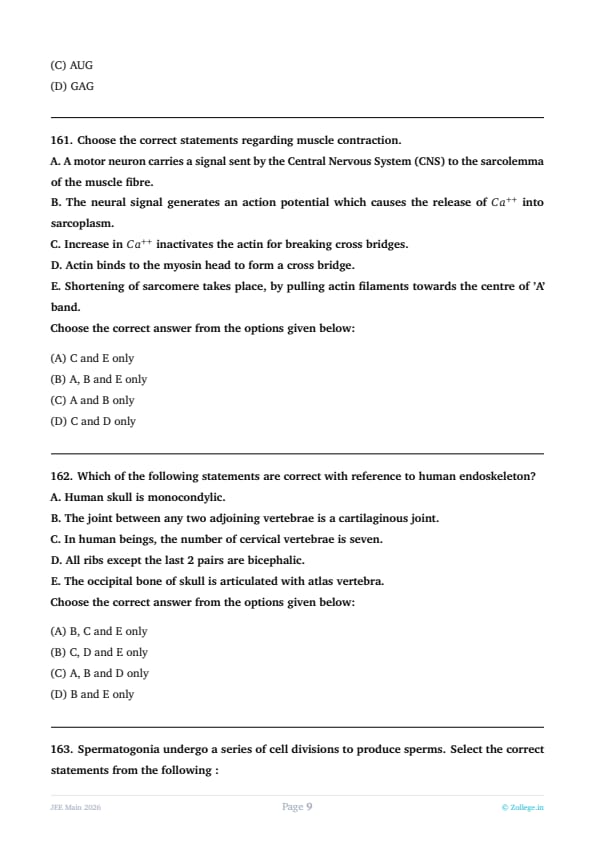
Choose the correct statements regarding muscle contraction.
A. A motor neuron carries a signal sent by the Central Nervous System (CNS) to the sarcolemma of the muscle fibre.
B. The neural signal generates an action potential which causes the release of \(Ca^{++}\) into sarcoplasm.
C. Increase in \(Ca^{++}\) inactivates the actin for breaking cross bridges.
D. Actin binds to the myosin head to form a cross bridge.
E. Shortening of sarcomere takes place, by pulling actin filaments towards the centre of 'A' band.
Choose the correct answer from the options given below:
\medskip
View Solution
Step 1 : Understanding the Question:
This question focuses on the biochemical and mechanical sequence of events involved in skeletal muscle contraction according to the sliding filament theory. We need to evaluate various statements regarding neural stimulation, ion release, molecular interactions between actin and myosin, and the resulting structural changes in the sarcomere to identify which are factually correct according to standard physiological models.
Step 2 : Key Formulas and Approach:
The approach involves tracing the contraction process from the nervous system trigger to the mechanical shortening:
1. Initiation: Motor unit stimulation via the CNS at the neuromuscular junction.
2. Excitation-Contraction Coupling: The spread of action potential and subsequent release of Calcium ions from the sarcoplasmic reticulum.
3. Regulatory Mechanism: The role of Calcium binding to troponin to uncover active sites.
4. Cross-bridge Cycle: ATP-dependent interaction between thick (myosin) and thin (actin) filaments.
5. Structural outcome: Movement of filaments resulting in sarcomere shortening.
Step 3 : Detailed Explanation:
Statement A: Muscle contraction is initiated by a command from the Central Nervous System. This electrical signal travels via a motor neuron to the motor end plate. Upon reaching the terminal, it causes the release of acetylcholine, which depolarizes the sarcolemma. Thus, this statement accurately describes the neural initiation phase.
Statement B: The depolarization of the sarcolemma generates an action potential that travels deep into the muscle fiber via T-tubules. This electrical disturbance triggers the sarcoplasmic reticulum to release stored Calcium ions (\(Ca^{++}\)) into the sarcoplasm. This is a vital step in coupling excitation to contraction. Thus, this statement is correct.
Statement C: In the presence of \(Ca^{++}\), the ions bind to the troponin subunit on the actin filament. This causes a shift in tropomyosin, which unmasks the active binding sites. This activates the actin for cross-bridge formation. It does not inactivate it. Therefore, this statement is incorrect.
Statement D: During the formation of a cross-bridge, the myosin head (which has bound and hydrolyzed ATP) binds to the exposed active sites on the actin filament. While the two proteins interact, the physical "binding" action is usually attributed to the myosin head attaching to the actin track. However, Statement D is often considered less precise than the mechanical descriptions of the myosin "grabbing" the actin.
Statement E: As the myosin heads pull the actin filaments toward the M-line (center of the A-band), the Z-lines move closer together. This leads to the shortening of the sarcomere, which is the functional unit of contraction. This describes the physical basis of the sliding filament theory. Thus, this statement is correct.
Step 4 : Final Answer:
By evaluating the physiological mechanics, we find that statements A, B, and E are the only ones that accurately represent the contraction process. Therefore, the correct option is (B).
Quick Tip: Remember: Calcium is the universal "Green Light" for muscle contraction! It binds to troponin to "unmask" the actin sites. If a statement claims calcium inactivates or stops the process, it is definitely false. Contraction always leads to the Z-lines moving inward!
Which of the following statements are correct with reference to human endoskeleton?
A. Human skull is monocondylic.
B. The joint between any two adjoining vertebrae is a cartilaginous joint.
C. In human beings, the number of cervical vertebrae is seven.
D. All ribs except the last 2 pairs are bicephalic.
E. The occipital bone of skull is articulated with atlas vertebra.
Choose the correct answer from the options given below:
\medskip
View Solution
Step 1 : Understanding the Question:
The objective is to identify the factually correct anatomical features of the human axial skeleton. We must evaluate statements regarding the number of vertebrae, the types of joints between vertebrae, the nature of the skull's articulation with the spine, and the structural morphology of the ribs.
Step 2 : Key Formulas and Approach:
The approach involves cross-referencing cadaveric anatomy and standard physiological texts regarding the skeletal system:
1. Cranial Articulation: Identifying the number of occipital condyles at the base of the skull.
2. Joint Classification: Categorizing the movement and tissue of intervertebral joints (Fibrous vs. Cartilaginous vs. Synovial).
3. Vertebral Constants: Identifying the specific number of cervical vertebrae, which is a mammalian characteristic.
4. Rib Anatomy: Understanding the dorsal attachment points to the vertebral column.
5. Cervical-Cranial interaction: Identifying the first vertebra and its role.
Step 3 : Detailed Explanation:
Statement A: The human skull articulates with the vertebral column via two occipital condyles. This configuration is known as dicondylic. Monocondylic skulls (one condyle) are characteristic of reptiles and birds. Therefore, this statement is incorrect.
Statement B: Adjoining vertebrae in the spinal column are held together by intervertebral discs made of fibrocartilage. These joints allow for limited movement and serve as shock absorbers. Because they use cartilage as the connecting medium, they are classified as cartilaginous joints. This statement is correct.
Statement C: A defining feature of nearly all mammals, including humans, is the presence of seven cervical vertebrae in the neck region. This number remains constant regardless of the length of the neck. This statement is correct.
Statement D: Each human rib is technically bicephalic because it possesses two articulation surfaces on its dorsal end for attachment to the vertebrae. This structural trait applies to all ribs, not just the first ten pairs. The phrasing that excludes the last 2 pairs makes the statement factually inaccurate in a general anatomical sense.
Statement E: The occipital bone at the base of the skull features two condyles that sit directly into the superior articular facets of the first cervical vertebra, which is the Atlas (C1). This articulation allows for the nodding motion of the head. This statement is correct.
Step 4 : Final Answer:
Upon detailed evaluation, statements B, C, and E are the only correct descriptions of the human axial skeleton according to standard biological nomenclature. Consequently, the correct option is (A).
Quick Tip: Logic Tip: Mammals are "Di-condylic" (Human = 2 Condyles) and almost all have exactly 7 "Neck" bones. If you remember that humans have two "bumps" at the base of the head to balance on the spine, you can instantly eliminate any option containing Statement A!
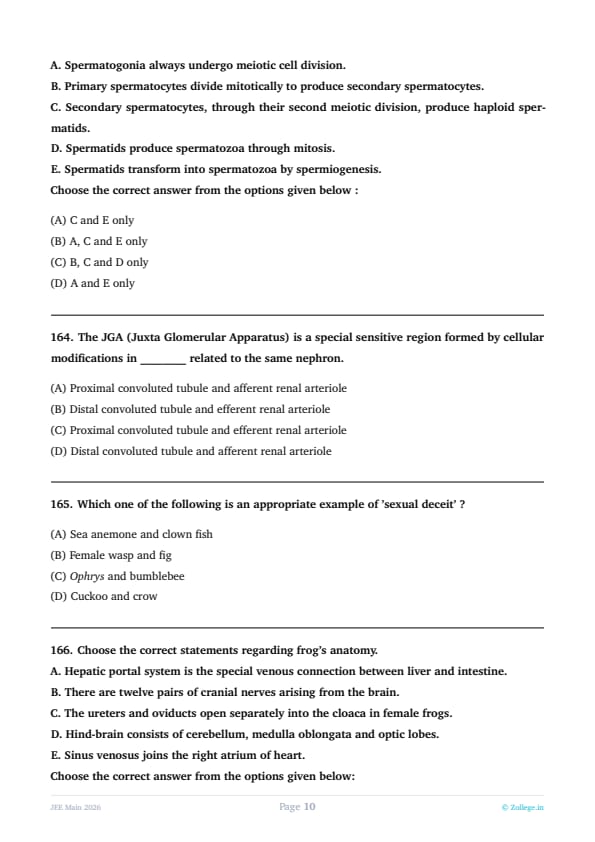
Spermatogonia undergo a series of cell divisions to produce sperms. Select the correct statements from the following :
A. Spermatogonia always undergo meiotic cell division.
B. Primary spermatocytes divide mitotically to produce secondary spermatocytes.
C. Secondary spermatocytes, through their second meiotic division, produce haploid spermatids.
D. Spermatids produce spermatozoa through mitosis.
E. Spermatids transform into spermatozoa by spermiogenesis.
Choose the correct answer from the options given below :
\medskip
View Solution
Step 1 : Understanding the Question:
This question requires a clear understanding of the stages of spermatogenesis—the process by which male gametes (sperms) are produced. We must distinguish between mitotic proliferation (to maintain cell numbers), meiotic reduction (to create haploid cells), and morphological transformation (to create motile sperm) to determine which statements are accurate.
Step 2 : Key Formulas and Approach:
The sequence of spermatogenesis is as follows:
1. Spermatogonia (\(2n\)) multiply by Mitosis to maintain the germline.
2. Some differentiate into Primary Spermatocytes (\(2n\)).
3. Primary Spermatocytes (\(2n\)) undergo Meiosis I to form two Secondary Spermatocytes (\(n\)).
4. Secondary Spermatocytes (\(n\)) undergo Meiosis II to form four Spermatids (\(n\)).
5. Spermatids (\(n\)) undergo Spermiogenesis (transformation) to become Spermatozoa (\(n\)).
Step 3 : Detailed Explanation:
Statement A: Spermatogonia are the stem cells of the male reproductive system. They primarily divide by mitosis to ensure a continuous supply of germ cells throughout reproductive life. They do not "always" undergo meiosis; in fact, the actual meiotic phase starts later in the lineage. Therefore, this statement is incorrect.
Statement B: Primary spermatocytes are diploid cells that initiate the reductional division. They divide through meiosis I, not mitosis, to produce haploid secondary spermatocytes. Therefore, this statement is incorrect.
Statement C: Secondary spermatocytes are haploid cells (\(n\)) produced after the first meiotic division. They quickly enter meiosis II, which is an equational division, resulting in the formation of four haploid spermatids. This statement is factually correct.
Statement D: Spermatids are the end-products of the second meiotic division. They are already haploid and do not undergo any further cell divisions. Spermatozoa are formed through a process of cellular remodeling, not mitosis. Therefore, this statement is incorrect.
Statement E: The final stage of sperm development is the conversion of non-motile, spherical spermatids into motile, elongated spermatozoa. This specific morphological process—involving the growth of a tail and the formation of an acrosome—is called spermiogenesis. This statement is factually correct.
Step 4 : Final Answer:
Reviewing the biological steps of gamete formation, statements C and E are the only ones that accurately describe the stages of sperm production. Thus, the correct answer is option (A).
Quick Tip: Logic Tip: "Spermatogenesis" is the name for the entire "factory line," but "Spermiogenesis" is just the "packaging and detailing" phase where the cell grows a tail. No cell division (mitosis or meiosis) happens during spermiogenesis!
The JGA (Juxta Glomerular Apparatus) is a special sensitive region formed by cellular modifications in ________ related to the same nephron.
\medskip
View Solution
Step 1 : Understanding the Question:
The question asks for the specific anatomical components of the nephron that undergo cellular modification to form the Juxtaglomerular Apparatus (JGA). This structure is essential for autoregulation of the Glomerular Filtration Rate (GFR) and blood pressure through the secretion of renin.
Step 2 : Key Formulas and Approach:
The JGA is a specialized contact point between the vascular and tubular components of the same nephron:
1. Identify the tubular section: The JGA is formed where the end of the loop of Henle/start of the distal tubule loops back to touch the glomerulus.
2. Identify the vascular section: It primarily involves the blood vessel bringing blood into the glomerulus.
3. Combined components: The modified cells involved are the Macula Densa (tubular) and Juxtaglomerular Cells (vascular).
Step 3 : Detailed Explanation:
Structural Anatomy: Every nephron is structured such that a portion of the Distal Convoluted Tubule (DCT) comes into direct physical contact with the afferent arteriole of its own Bowman’s capsule.
Tubular Modification: At this precise point of contact, the epithelial cells of the Distal Convoluted Tubule become specialized and tightly packed to act as chemoreceptors (sensing sodium/chloride levels). These cells are known as the Macula Densa. This confirms the involvement of the DCT, ruling out the PCT.
Vascular Modification: Similarly, the smooth muscle cells in the wall of the Afferent Renal Arteriole become enlarged and modified into secretory cells that contain the enzyme renin. These are known as Juxtaglomerular (JG) cells. While the efferent arteriole is in the vicinity, the primary functional modifications for pressure sensing and renin release are in the afferent vessel.
Regulatory Function: This apparatus acts as a sensor. When there is a drop in blood pressure or sodium flow, the JGA triggers the Renin-Angiotensin-Aldosterone System (RAAS) to bring the pressure and filtration rate back to normal.
Step 4 : Final Answer:
The Juxtaglomerular Apparatus is formed by cellular modifications specifically in the distal convoluted tubule and the afferent renal arteriole. Thus, the correct answer is (D).
Quick Tip: Logic Tip: Use the mnemonic "D.A." for JGA (Distal tubule + Afferent arteriole). The Distal tubule "detects" the salt, and the Afferent arteriole "adjusts" the pressure by releasing Renin!
Which one of the following is an appropriate example of 'sexual deceit' ?
\medskip
View Solution
Step 1 : Understanding the Question:
We are asked to identify a classic biological interaction that serves as an example of 'sexual deceit'. This phenomenon refers to a specialized form of mimicry where one organism (usually a plant) tricks another (an insect) into assisting its reproduction by visually and chemically imitating a potential mating partner.
Step 2 : Key Formulas and Approach:
The approach requires distinguishing between various types of interspecific interactions:
1. Mutualism: Both species derive a benefit (e.g., Fig and Wasp).
2. Commensalism: One species benefits while the other is unaffected (e.g., Anemone and Clownfish).
3. Brood Parasitism: Tricking another species into raising offspring (e.g., Cuckoo and Crow).
4. Sexual Deceit: Tricking an organism for pollination by mimicking a sexual partner.
Step 3 : Detailed Explanation:
Option A (Sea anemone and clown fish): This is an example of commensalism (or sometimes mutualism). The clownfish gains protection from predators by living among the stinging tentacles, while the anemone is largely unaffected or may get scraps of food. There is no biological "lie" or deceit involved.
Option B (Female wasp and fig): This represents a highly evolved mutualism. The wasp pollinates the fig, and in return, the fig provides a safe place for the wasp to lay its eggs. Both species benefit, and the relationship is based on a mutual exchange of services.
Option D (Cuckoo and crow): This is a case of brood parasitism. The cuckoo lays its eggs in the crow's nest so the crow will inadvertently raise the cuckoo's chicks. While this involves trickery, it is categorized as parasitism related to parental care, not "sexual deceit" related to mating lures.
Option C (Ophrys and bumblebee): The Mediterranean orchid Ophrys employs sexual deceit to achieve pollination. One petal of its flower has evolved to look like the female of a specific bumblebee species in color, size, and markings. It also releases scents that mimic female pheromones. The male bee, believing it has found a mate, attempts to "pseudocopulate" with the flower. During this encounter, pollen is transferred to the bee, which it then carries to the next flower.
Step 4 : Final Answer:
The interaction between the orchid \textit{Ophrys and the bumblebee is the quintessential textbook example of sexual deceit in nature. Therefore, the correct option is (C).
Quick Tip: Logic Tip: "Deceit" means a lie. In the case of \textit{Ophrys, the flower is "lying" to the male bee, pretending to be a female bee, just so the bee will move its pollen for free! No other option involves a fake mating partner.
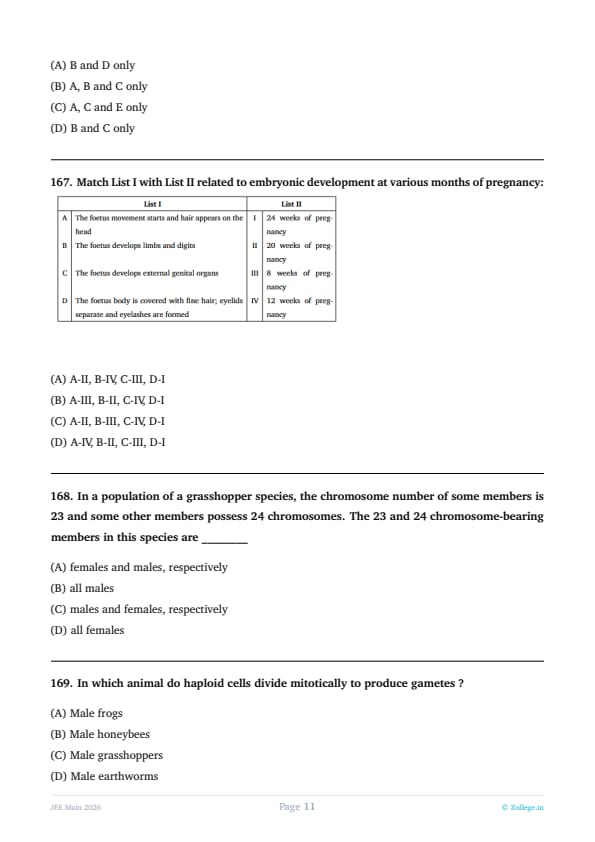
Choose the correct statements regarding frog's anatomy.
A. Hepatic portal system is the special venous connection between liver and intestine.
B. There are twelve pairs of cranial nerves arising from the brain.
C. The ureters and oviducts open separately into the cloaca in female frogs.
D. Hind-brain consists of cerebellum, medulla oblongata and optic lobes.
E. Sinus venosus joins the right atrium of heart.
Choose the correct answer from the options given below:
\medskip
View Solution
Step 1 : Understanding the Question:
This question evaluates various aspects of the anatomy of the frog (\textit{Rana tigrina). We must identify which statements regarding its circulatory, nervous, and reproductive systems are factually accurate for amphibians as opposed to higher vertebrates.
Step 2 : Key Formulas and Approach:
The approach involves distinguishing between amphibian and mammalian anatomy:
1. Portal Systems: Presence of specialized venous connections.
2. Nervous System: Identifying the correct number of cranial nerves and parts of the brain.
3. Reproduction: Comparing the duct systems in male vs. female frogs.
4. Cardiac Anatomy: Identifying specialized heart chambers unique to lower vertebrates.
Step 3 : Detailed Explanation:
Statement A: Like many vertebrates, frogs have a hepatic portal system. This is a specialized venous arrangement that collects blood from the digestive tract (intestines) and delivers it to the liver for processing before it enters the systemic circulation. This statement is correct.
Statement B: Amphibians, including frogs, possess only ten pairs of cranial nerves. The presence of twelve pairs is a trait found in reptiles, birds, and mammals. Thus, this statement is incorrect.
Statement C: In female frogs, the excretory and reproductive tracts are distinct. The ureters (from kidneys) and the oviducts (from ovaries) lead to the cloaca independently and open through separate apertures. In males, however, the ureter also functions as a urinogenital duct. This statement is correct.
Statement D: The frog's brain is divided into forebrain, midbrain, and hindbrain. While the hindbrain includes the cerebellum and medulla oblongata, the optic lobes are located in the midbrain. Thus, this statement is incorrect.
Statement E: The frog's heart has three chambers but is supplemented by accessory structures. The sinus venosus is a triangular chamber on the dorsal surface that receives deoxygenated blood and empties it into the right atrium. This statement is correct.
Step 4 : Final Answer:
Based on the anatomical evaluation of the frog, statements A, C, and E are the only correct ones. Therefore, the correct combination is option (C).
Quick Tip: Anatomy Trick: Remember that frogs are amphibians, so they are "less complex" than us—they have only 10 pairs of cranial nerves (we have 12). Also, the Sinus Venosus is just a "waiting room" for deoxygenated blood before it enters the Right Atrium!
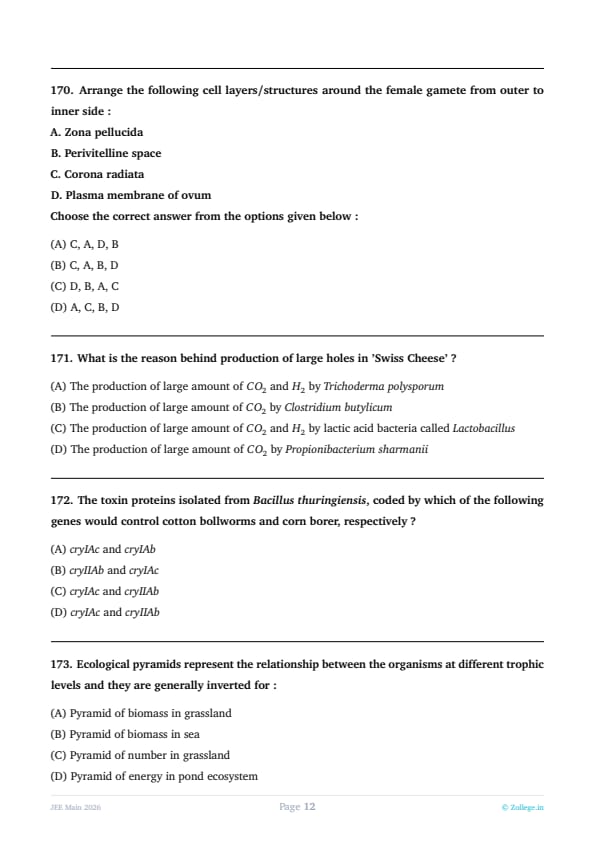
Match List I with List II related to embryonic development at various months of pregnancy:

View Solution
Step 1 : Understanding the Question:
The question asks for the correct matching of human fetal developmental milestones with the specific timeline (calculated in weeks) of a standard human pregnancy. We need to associate structural formations like limbs and organs with their respective months/weeks of gestation.
Step 2 : Key Formulas and Approach:
The approach relies on the standard human embryological timeline used in clinical practice:
1. End of 2nd month (8 weeks): Major structures like limbs are established.
2. End of 1st trimester (12 weeks): Organ systems and external genitalia are developed.
3. 5th month (20 weeks): Sensations like fetal movement and head hair begin.
4. End of 2nd trimester (24 weeks): Fine hair, eyelashes, and eyelid separation occur.
Step 3 : Detailed Explanation:
Milestone A: The first detectable fetal movements (quickening) and the initial growth of hair on the fetal head are classic signs of the fifth month of development. In gestational weeks, 5 months corresponds to 20 weeks. (Match: A-II).
Milestone B: By the end of the second month of gestation, the embryo has made significant progress in defining its shape. During this period, the limbs and digits (fingers and toes) are clearly formed. 2 months equals 8 weeks. (Match: B-III).
Milestone C: By the completion of the first trimester (the first three months), the major organ systems have been formed. Specifically, the external genital organs are well-developed by this time. 3 months equals 12 weeks. (Match: C-IV).
Milestone D: At the conclusion of the second trimester (roughly 6 months), the fetus undergoes refined development. The body is covered with fine hair (lanugo), eyelashes are present, and the eyelids finally separate. 6 months equals 24 weeks. (Match: D-I).
Step 4 : Final Answer:
By aligning these developmental biological markers with the correct gestational age, we arrive at the sequence A-II, B-III, C-IV, and D-I. This matching corresponds to option (C).
Quick Tip: Timeline Hack: Just remember the sequence 2-3-5-6 months!
2 months (8w) = Digits formed.
3 months (12w) = Genitals visible.
5 months (20w) = Hair on head / Movement.
6 months (24w) = Eyelashes / Body hair.
In a population of a grasshopper species, the chromosome number of some members is 23 and some other members possess 24 chromosomes. The 23 and 24 chromosome-bearing members in this species are ________
\medskip
View Solution
Step 1 : Understanding the Question:
The question presents a scenario where different individuals of the same grasshopper species have different total chromosome counts (23 and 24). We need to determine which count belongs to the male and which belongs to the female based on known sex determination mechanisms in insects.
Step 2 : Key Formulas and Approach:
The approach involves identifying the specific chromosomal sex-determination system for grasshoppers:
1. Mechanism Identification: Grasshoppers follow the XX-XO system.
2. Male Genotype: XO (Heterogametic—they produce two types of sperm, one with X and one without).
3. Female Genotype: XX (Homogametic—all eggs carry an X).
4. Rule: Total Chromosomes = Autosomes + Sex Chromosomes.
Step 3 : Detailed Explanation:
Mechanism Details: In the XX-XO system used by grasshoppers and many other insects, sex is determined by the number of X chromosomes. Females possess a pair of X chromosomes (XX), while males possess only a single X chromosome (XO). The "O" denotes the absence of a partner chromosome.
Female Chromosome Count: Since females have two X chromosomes (a complete pair), their total chromosome count will always be an even number. If the species has 22 autosomes, the female count is \(22 (A) + 2 (XX) = 24\).
Male Chromosome Count: Males have the same number of autosomes but only one X chromosome and no Y or second X. Therefore, they are "short" one chromosome compared to the female. Their total count will always be an odd number. In this case, the male count would be \(22 (A) + 1 (X) = 23\).
Logic Check: The question states some members have 23 and some have 24. Following the XX-XO logic, the members with 23 chromosomes (the odd number) must be the males, and those with 24 (the even number) must be the females.
Step 4 : Final Answer:
Therefore, the 23-chromosome members are males and the 24-chromosome members are females. Following the "respectively" order, the correct answer is option (C).
Quick Tip: Logic Tip: In the grasshopper world, males are "missing" a piece! They are XO, which means they always have one fewer chromosome than the females. If you see an odd number of chromosomes in these insects, that's the male!
In which animal do haploid cells divide mitotically to produce gametes ?
\medskip
View Solution
Step 1 : Understanding the Question:
While most diploid animals produce haploid gametes through meiosis (reductional division), this question asks for an organism where gametes are produced via mitosis from cells that are already haploid. This is only possible in organisms that are haploid as adults.
Step 2 : Key Formulas and Approach:
The approach involves analyzing the ploidy and developmental biology of each animal:
1. Male Frogs: Diploid vertebrates that use meiosis.
2. Male Honeybees: Haploid insects developed from unfertilized eggs.
3. Male Grasshoppers: Diploid insects that use meiosis.
4. Male Earthworms: Diploid hermaphroditic organisms that use meiosis.
Step 3 : Detailed Explanation:
Male Frogs (A): Frogs are standard diploid (\(2n\)) vertebrates. Their germ cells must undergo meiosis to reduce the chromosome number by half to produce haploid (\(n\)) sperm. This is typical of most animals.
Male Grasshoppers (C) and Earthworms (D): Both are diploid organisms. Grasshoppers are XO but still diploid in nature, and earthworms are \(2n\). They both rely on meiosis to produce their gametes.
Male Honeybees (B): Honeybees utilize a unique haplodiploid sex-determination system. While females (queens and workers) are diploid (\(2n=32\)) and hatch from fertilized eggs, the males (drones) develop through arrhenotoky—a form of parthenogenesis where unfertilized eggs develop into adults. Because they come from unfertilized eggs, drones are haploid (\(n=16\)) for their entire lives.
Gametogenesis: Since a drone's body cells are already haploid, his germ cells cannot undergo meiosis (which would attempt to halve 16 chromosomes into 8, resulting in non-functional gametes). To produce haploid sperm cells with a full set of 16 chromosomes, the drone must use mitosis.
Step 4 : Final Answer:
Male honeybees are the only organisms listed that are haploid and thus must produce their gametes via mitosis. Therefore, the correct option is (B).
Quick Tip: Genetics Rule: Meiosis is the "halving" division. If you are a Drone bee and you are already haploid, you can't halve yourself further! You must use mitosis (the "copying" division) to make your sperm.
Arrange the following cell layers/structures around the female gamete from outer to inner side :
A. Zona pellucida
B. Perivitelline space
C. Corona radiata
D. Plasma membrane of ovum
Choose the correct answer from the options given below :
\medskip
View Solution
Step 1 : Understanding the Question:
The question asks for the correct spatial sequence of the protective envelopes and spaces surrounding a mature human egg (ovum), specifically ordering them starting from the outermost layer and moving inward to the cell membrane.
Step 2 : Key Formulas and Approach:
The approach involves identifying the origin and position of each barrier:
1. Outer Cellular Coat: Granulosa cells.
2. Protective Glycoprotein Shell: Acellular coating.
3. Fluid-filled Gap: Space just outside the membrane.
4. Cell Boundary: The oolemma.
Step 3 : Detailed Explanation:
Outermost Layer (Corona Radiata - C): When the ovum is released from the follicle during ovulation, it is accompanied by a radiating crown of follicular cells (granulosa cells). These cells form the outermost cellular barrier that a sperm must navigate through.
Primary Envelope (Zona Pellucida - A): Beneath the corona radiata is a thick, transparent, and acellular layer of glycoproteins. This layer is secreted by the egg itself and is crucial for species-specific sperm recognition and the prevention of polyspermy.
Intermediate Space (Perivitelline Space - B): This is a thin, fluid-filled gap located between the zona pellucida and the plasma membrane of the ovum. It is important because the first and second polar bodies are extruded into this space during meiotic maturation.
Innermost Boundary (Plasma Membrane - D): This is the actual biological cell membrane (also called the oolemma) that encloses the egg's cytoplasm (ooplasm). This is the final layer that the sperm must fuse with for fertilization to succeed.
Step 4 : Final Answer:
Arranging these anatomical features from outer to inner yields the sequence: Corona radiata \(\rightarrow\) Zona pellucida \(\rightarrow\) Perivitelline space \(\rightarrow\) Plasma membrane. This corresponds to the sequence C, A, B, D. Therefore, the correct answer is option (B).
Quick Tip: Anatomy Mnemonic: Think of a "Crown" (Corona) on top of a "Zone" (Zona). The "Space" (Perivitelline) comes just before the "Main wall" (Plasma membrane). It follows the order C-A-B-D.
What is the reason behind production of large holes in 'Swiss Cheese' ?
\medskip
View Solution
Step 1 : Understanding the Question:
The question asks for the specific biological cause behind the distinctive large holes found in Swiss cheese. We need to identify the correct microorganism and the chemical byproduct of its metabolism that creates this unique texture.
Step 2 : Key Formulas and Approach:
The approach involves identifying the specific bacterium and gas involved in the industrial production of Swiss cheese:
1. Microbe Identification: Propionibacterium sharmanii.
2. Metabolic Process: Fermentation of lactate.
3. Gaseous Byproduct: Carbon dioxide (\(CO_2\)).
4. Physical effect: Trapped gas bubbles create "eyes" or holes in the cheese curd.
Step 3 : Detailed Explanation:
Microbial Specificity: Different varieties of cheese are characterized by their unique texture, flavor, and taste, which are determined by the specific microbes used. In the case of Swiss cheese, the ripening process involves the bacterium \textit{Propionibacterium sharmanii.
Fermentation Pathway: As this bacterium ferments the lactate within the developing cheese, it undergoes a metabolic pathway that results in the production of large amounts of Carbon dioxide (\(CO_2\)).
Formation of Holes: Because the cheese is a semi-solid matrix, the \(CO_2\) gas cannot easily escape. Instead, it accumulates in pockets. As the cheese firms up and ages, these gas bubbles leave behind the large, characteristic holes (often called "eyes") that define Swiss cheese.
Evaluation of Alternatives:
Trichoderma polysporum is a fungus used to produce the drug Cyclosporin A.
\textit{Clostridium butylicum is used for butyric acid production.
\textit{Lactobacillus is primarily used to make curd from milk and does not produce large \(CO_2\) bubbles.
Step 4 : Final Answer:
The large holes in Swiss cheese are the result of the massive production of \(CO_2\) gas by the bacterium \textit{Propionibacterium sharmanii. Therefore, the correct option is (D).
Quick Tip: Microbe Mnemonic: \textbf{Swiss cheese = \textbf{S}harmanii (Propionibacterium sharmanii). Just connect the "S" in Swiss to the "S" in Sharmanii and you will never forget the bacterium!
The toxin proteins isolated from Bacillus thuringiensis, coded by which of the following genes would control cotton bollworms and corn borer, respectively ?
\medskip
View Solution
Step 1 : Understanding the Question:
The question asks to identify the specific cry genes from the bacterium \textit{Bacillus thuringiensis (Bt) that encode toxins for two different agricultural pests: cotton bollworms and the corn borer. The answer must be provided in the correct "respective" order as stated in the prompt.
Step 2 : Key Formulas and Approach:
The toxin proteins produced by Bt are insect-group specific. The genes are named "cry" followed by identifiers.
1. Target: Cotton Bollworm \(\rightarrow\) Genes involved: \textit{cryIAc and \textit{cryIIAb.
2. Target: Corn Borer \(\rightarrow\) Gene involved: \textit{cryIAb.
3. Methodology: Match the gene for Cotton first and the gene for Corn second.
Step 3 : Detailed Explanation:
Bacillus thuringiensis (Bt): This soil bacterium produces crystalline protein inclusions that are toxic to specific insect larvae (Lepidopterans, Coleopterans, and Dipterans). Biotechnologists have inserted these genes into crops to make them pest-resistant.
Cotton Bollworm Control: Extensive agricultural research has shown that the proteins encoded by the genes \textit{cryIAc and cryIIAb are highly effective at controlling cotton bollworms. These are the primary genes found in commercial Bt Cotton.
Corn Borer Control: The corn borer (Ostrinia nubilalis) is susceptible to a slightly different crystalline toxin. The gene coding for the protein that specifically targets the corn borer is \textit{cryIAb. This gene is utilized in the production of Bt Corn.
Sequential Logic: The question specifies "cotton bollworms" first and "corn borer" second. Therefore, the answer pair must start with a cotton gene (like cryIAc) and end with the corn gene (\textit{cryIAb).
Step 4 : Final Answer:
The combination of \textit{cryIAc (for cotton bollworm) and \textit{cryIAb (for corn borer) is the correct respective pair. This corresponds to the sequence in option (A).
Quick Tip: Gene Trick: To remember them easily, note that the "Corn" gene ends with a "b" for \textbf{Borer (cryIAb). The "Cotton" genes usually feature "Ac" or "IIAb". \textbf{B}orer = \textbf{b}.
Ecological pyramids represent the relationship between the organisms at different trophic levels and they are generally inverted for :
\medskip
View Solution
Step 1 : Understanding the Question:
Ecological pyramids are graphical representations designed to show the relationship between different trophic levels based on energy, biomass, or numerical population. While most are upright, some specific ecosystems produce "inverted" pyramids. We need to identify which parameter and ecosystem combination results in an inverted shape.
Step 2 : Key Formulas and Approach:
1. Pyramid of Energy: Always upright (due to the 10% law of energy transfer).
2. Pyramid of Number (Grassland): Typically upright (many plants support fewer animals).
3. Pyramid of Biomass (Grassland): Upright (the total weight of grass is more than the total weight of consumers).
4. Pyramid of Biomass (Aquatic/Sea): Often inverted due to the high turnover rate of tiny producers.
Step 3 : Detailed Explanation:
Energy Pyramids (D): These are never inverted. As energy is transferred from one trophic level to the next, a significant amount is lost as heat. Consequently, there is always more energy at the producer level than at any consumer level.
Grassland Pyramids (A and C): In a terrestrial grassland, a huge number of producers (with a massive total dry biomass) support a smaller number of primary consumers, who in turn support even fewer secondary consumers. Thus, the pyramids of number and biomass in grasslands are upright.
Marine/Sea Biomass Pyramids (B): In the sea, the primary producers are microscopic phytoplankton. While they produce a lot of food, their "standing crop" biomass at any single moment is quite small because they are consumed very rapidly by zooplankton. This small producer biomass supports a much larger biomass of zooplankton and fish. Because the base (producers) has less biomass than the higher levels (consumers), the pyramid is inverted.
Step 4 : Final Answer:
The pyramid of biomass in a marine or aquatic ecosystem is the standard example of an inverted pyramid in ecology. Thus, the correct option is (B).
Quick Tip: Rule of Thumb: If you see "Inverted" and "Biomass" together, look for the "Sea" or "Ocean"! It is the classic exception because tiny, fast-breeding algae support much larger, long-living animals like whales.
Choose the correct statement regarding GIFT to overcome infertility.
\medskip
View Solution
Step 1 : Understanding the Question:
This question focuses on Assisted Reproductive Technology (ART) and specifically asks for the correct definition and procedural description of GIFT (Gamete Intra Fallopian Transfer) used to assist infertile couples.
Step 2 : Key Formulas and Approach:
The approach involves breaking down the medical acronym and its physiological requirements:
1. Gamete: This refers to unfertilized eggs (ova) or sperm (not embryos).
2. Intra Fallopian: The destination of the transfer is the fallopian tube.
3. Transfer: The surgical movement of the gamete.
4. Requirement: The mother must have a healthy uterus and tubes to support in-vivo fertilization and pregnancy.
Step 3 : Detailed Explanation:
The Procedure: In GIFT, an ovum (egg) is surgically retrieved from a donor or the patient and then immediately placed into the recipient's fallopian tube along with the male's sperm.
Target Patients: This method is specifically designed for women who are unable to produce their own viable eggs but have a functional reproductive tract that can facilitate natural fertilization and support a 9-month pregnancy.
In-vivo vs. In-vitro: Unlike IVF (In-Vitro Fertilization), in GIFT, the fertilization of the egg by the sperm happens naturally inside the woman's body within the fallopian tube.
Differential Diagnosis of Methods:
Transfer of a zygote/early embryo (up to 8 cells) to the tube is ZIFT.
Transfer of an embryo (more than 8 cells) to the uterus is IUT.
Transfer of unfertilized gametes (egg/sperm) to the tube is GIFT.
Step 4 : Final Answer:
GIFT involves the transfer of a donor ovum into the fallopian tube of a female who can support a natural pregnancy but cannot produce her own eggs. Thus, the correct answer is option (C).
Quick Tip: Acronym Check: GIFT starts with "G" for \textbf{G}amete. Remember that a zygote or embryo is NOT a gamete. If a description mentions an "embryo," it cannot be GIFT. GIFT is strictly the delivery of unfertilized "Gifts" (Egg and Sperm) to the tube!
Choose the correct statements regarding cell organelles and their inclusions.
A. The endomembrane system includes Golgi complex, endoplasmic reticulum and mitochondria.
B. Rough endoplasmic reticulum bears ribosomes on its surface.
C. Both mitochondria and plastids have circular DNA.
D. A network of microtubules, microfilaments and intermediate filaments present in the cytoplasm is called cytoskeleton.
E. Mitochondrion is a single membrane-bound structure.
Choose the correct answer from the options given below :
\medskip
View Solution
Step 1 : Understanding the Question:
This question requires us to verify several statements regarding the structure and classification of eukaryotic cell organelles, specifically the endomembrane system, the endoplasmic reticulum, the genetic material of semiautonomous organelles, and the cytoskeleton.
Step 2 : Key Formulas and Approach:
The approach involves cross-referencing each statement with established cell biology principles:
1. Endomembrane system: Includes coordinated organelles like ER, Golgi, Lysosomes, and Vacuoles.
2. RER: Characterized by the attachment of ribosomes.
3. Organelle DNA: Semiautonomous organelles (Mitochondria and Plastids).
4. Cytoskeleton: Composed of various proteinaceous filaments.
5. Membrane structure: Differentiating between single and double-membrane organelles.
Step 3 : Detailed Explanation:
Statement A: The endomembrane system refers to a group of organelles whose functions are physically and chemically coordinated. This includes the ER, Golgi complex, Lysosomes, and Vacuoles. Mitochondria are not part of this system because their functions are independent and not coordinated with these other organelles. Thus, this statement is incorrect.
Statement B: The part of the endoplasmic reticulum that has ribosomes attached to its outer (cytoplasmic) surface is known as the Rough Endoplasmic Reticulum (RER). These ribosomes are responsible for the "rough" appearance and the synthesis of proteins. This statement is correct.
Statement C: Based on the endosymbiotic theory, both mitochondria and plastids (like chloroplasts) were once independent prokaryotic organisms. Consequently, they both contain their own genetic material, which is organized as a single circular DNA molecule. This statement is correct.
Statement D: The cytoplasm contains an elaborate network of filamentous proteinaceous structures made of microtubules, microfilaments, and intermediate filaments. This total framework is referred to as the cytoskeleton. This statement is correct.
Statement E: Mitochondria are specialized organelles that are bound by two membranes (double-membrane bound)—an outer membrane and a highly folded inner membrane (cristae). They are not single-membrane bound. Thus, this statement is incorrect.
Step 4 : Final Answer:
Upon evaluation, statements B, C, and D are factually correct, while A and E are inaccurate. Therefore, the correct option is (D).
Quick Tip: Easy Elim: Remember the acronym "GERL" (Golgi, ER, Lysosome) for the endomembrane system. Mitochondria and Plastids are the "Double-Decker" (Double-membrane) independent organelles that have their own DNA!
Select the correct statements regarding cell membrane in eukaryotic cell.
A. Membrane of human RBCs has approximately 52% protein.
B. Major phospholipids are arranged in a bilayer.
C. Extensions of the plasma membrane into the cell form mesosomes.
D. Tails towards the inner part of lipids are hydrophobic and thus protected from aqueous medium.
E. Glycocalyx is present on the outer surface of the plasma membrane.
Choose the correct answer from the options given below :
\medskip
View Solution
Step 1 : Understanding the Question:
The question asks to identify correct statements about the composition, structure, and specialized features of the eukaryotic cell membrane (plasma membrane). This involves understanding the fluid mosaic model, the nature of phospholipids, and cell-type specific structures.
Step 2 : Key Formulas and Approach:
The approach involves checking each statement against the Fluid Mosaic Model of Singer and Nicolson:
1. Biochemical composition of specialized cells (RBCs).
2. Standard phospholipid bilayer organization.
3. Differentiating prokaryotic structures (Mesosomes) from eukaryotic ones.
4. The amphipathic nature of the lipid bilayer.
5. Identifying cell surface coatings and their typical host cells.
Step 3 : Detailed Explanation:
Statement A: Detailed biochemical studies of the human erythrocyte (RBC) membrane have demonstrated that it is composed of approximately 52% protein and 40% lipid. While these percentages vary by cell type, this is a standard benchmark for RBCs. Thus, this statement is correct.
Statement B: The fundamental structural unit of the cell membrane is the phospholipid bilayer. These lipids are arranged such that they form a continuous stable framework for the membrane proteins. This statement is correct.
Statement C: Mesosomes are indeed specialized extensions of the plasma membrane into the cell, but they are a hallmark feature of prokaryotic (bacterial) cells. Eukaryotic cells do not possess mesosomes. Thus, this statement is incorrect.
Statement D: Phospholipids are amphipathic, containing both polar and non-polar regions. The polar "heads" face the outer aqueous environment, while the hydrophobic tails face each other in the membrane's interior. This arrangement ensures the tails are protected from the water. This statement is correct.
Statement E: While a glycocalyx is found on many animal cells, it is primarily emphasized in biological texts as the outermost component of the bacterial cell envelope. Given the strict definitions in standard curricula, it is usually not grouped with core "eukaryotic" membrane facts.
Step 4 : Final Answer:
Statements A, B, and D are standard and correct descriptions of the eukaryotic cell membrane. Thus, the correct combination of statements is found in option (D).
Quick Tip: Biology Clue: Mesosomes = Bacteria. If you see the word "mesosome" in a question specifically about "eukaryotes," it is a guaranteed trick! Eliminate Statement C, and you will find the correct answer immediately.
Match List I with List II

View Solution
Step 1 : Understanding the Question:
The goal is to correctly match specific medical disorders of the human muscular and skeletal systems with their primary pathological descriptions or physiological causes. This includes genetic, inflammatory, autoimmune, and metabolic conditions.
Step 2 : Key Formulas and Approach:
The approach involves identifying the specific "keyword" associated with each disorder:
1. Tetany: Associated with low Calcium and Spasms.
2. Arthritis: Associated with Joint Inflammation.
3. Myasthenia: Associated with Autoimmune attacks on the Nerve-Muscle junction.
4. Dystrophy: Associated with Genetic Progressive Degeneration.
Step 3 : Detailed Explanation:
Tetany (A): This condition is characterized by rapid, uncontrollable wild contractions (spasms) in the skeletal muscles. It is biochemically caused by hypocalcemia, which is a critically low concentration of Calcium (\(Ca^{++}\)) in the body fluids. (Match: A-III).
Arthritis (B): This is a common musculoskeletal condition specifically defined as the inflammation of joints. It results in pain, stiffness, and reduced mobility in the affected joints. (Match: B-I).
Myasthenia gravis (C): This is a chronic autoimmune disorder. In this condition, the immune system mistakenly attacks the acetylcholine receptors at the neuromuscular junction, leading to progressive muscle fatigue and weakness. (Match: C-II).
Muscular dystrophy (D): This refers to a group of genetic disorders characterized by the progressive degeneration of skeletal muscle over time, usually due to the absence of the protein dystrophin. (Match: D-IV).
Step 4 : Final Answer:
Matching the disorders to their corresponding descriptions gives the sequence: A-III, B-I, C-II, and D-IV. This alignment is provided in option (B).
Quick Tip: Mnemonic: "-itis" always means inflammation (so Arthritis = Joint inflammation). "Gravis" sounds like "Grave/Serious"—it is a serious autoimmune attack on your nerve-to-muscle connection!
Evolution of human appears parallel to the progressive development of brain and language skills. As such, the evolution of individual species in the sequence of their appearance is :
\medskip
View Solution
Step 1 : Understanding the Question:
The question asks for the correct chronological sequence of human ancestors, beginning with early ape-like forms and progressing to modern humans. This sequence reflects the evolutionary transition toward increased cranial capacity and complex behaviors.
Step 2 : Key Formulas and Approach:
The approach involves ordering human ancestors based on their fossil age and brain capacity:
1. Ramapithecus: Approx 15 million years ago (mya).
2. \textit{Homo habilis: Approx 2 mya (Brain: 650-800cc).
3. \textit{Homo erectus: Approx 1.5 mya (Brain: 900cc).
4. Neanderthal: 100,000 to 40,000 years ago (Brain: 1400cc).
5. \textit{Homo sapiens: Modern man.
Step 3 : Detailed Explanation:
Ancient Hominids: \textit{Ramapithecus lived roughly 15 million years ago. Although they still had many ape-like features, they walked more upright and were more "man-like" than their predecessors. They represent the oldest ancestor in this list.
Handy Man: About 2 million years ago, Homo habilis emerged. They were the first hominids recognized as making and using stone tools. Their brain capacity was relatively small, between 650 and 800cc.
Upright Man: Fossils discovered in Java revealed that Homo erectus lived around 1.5 million years ago. They had a much larger brain (900cc) and were likely the first hominids to master the use of fire.
Cave Dwellers: Living in Europe and parts of Asia until 40,000 years ago, Neanderthals possessed large brains (1400cc), used hides for clothing, and practiced burying their dead.
Modern Man: Modern humans (Homo sapiens) appeared in Africa and spread across the globe during the last Ice Age (75,000–10,000 years ago), ultimately developing complex societies and language.
Step 4 : Final Answer:
The chronological evolutionary sequence is Ramapithecus \(\rightarrow\) \textit{Homo habilis \(\rightarrow\) \textit{Homo erectus \(\rightarrow\) Neanderthal \(\rightarrow\) \textit{Homo sapiens. This matches the sequence in option (A).
Quick Tip: Memory Phrase: \textbf{Real \textbf{H}umans \textbf{E}ver \textbf{N}eed \textbf{S}marts!
\textbf{R}amapithecus \(\rightarrow\) \textbf{H}abilis \(\rightarrow\) \textbf{E}rectus \(\rightarrow\) \textbf{N}eanderthal \(\rightarrow\) \textbf{S}apiens.
Just remember that Ramapithecus was the most ancient, and Sapiens is you!
The flightless bird with forelimbs modified as paddle-like structures suited for swimming is known as:
\medskip
View Solution
Step 1 : Understanding the Question:
The question describes an avian species with specific evolutionary adaptations: it is flightless and its forelimbs (wings) have been modified into paddle-like structures specifically for swimming. We need to identify the correct genus that corresponds to this bird.
Step 2 : Key Formulas and Approach:
The approach involves identifying the specialized adaptations associated with flightlessness in different bird families:
1. Penguin adaptations: Wings modified into aquatic flippers for propulsion.
2. Ostrich adaptations: Wings reduced; legs modified for high-speed running.
3. Scientific terminology: Identifying the genus names for common birds.
Step 3 : Detailed Explanation:
Morphological Adaptation: While many birds have lost the ability to fly, their remaining limbs adapt to different tasks. The description of forelimbs modified into "paddles" is a unique adaptation of the penguin.
Aptenodytes (A): This is the scientific genus name for certain large penguins, including the Emperor Penguin. These birds are flightless and spend most of their lives in the water. Their wings are stiff, flat, and paddle-shaped, making them powerful swimmers.
Neophron (B): This is the genus of the Egyptian vulture. It is a bird of prey capable of long-distance flight and does not possess paddle-like limbs.
Psittacula (C): This is the genus for certain parrots (like the parakeet). These are typical birds of flight with wings adapted for aerial maneuvering.
Struthio (D): This is the genus of the ostrich. While an ostrich is flightless, its wings are small and used for balance or display. Its primary adaptation is for terrestrial running using its massive hindlimbs; it does not swim using its wings as paddles.
Step 4 : Final Answer:
The bird described—being flightless and having wings modified into paddles for swimming—is the penguin, which belongs to the genus Aptenodytes. Therefore, the correct option is (A).
Quick Tip: Scientific Matching:
\textit{Aptenodytes = Penguin (Swimmer)
Struthio = Ostrich (Runner)
Neophron = Vulture (Scavenger)
Psittacula = Parrot (Arboreal)
Just remember that Aptenodytes is the "A-quatic" one!
Choose the correct statements regarding population interactions between two species.
A. In both parasitism and commensalism, only one species benefits and the other species is harmed.
B. Both species benefit in mutualism.
C. Both species benefit in commensalism.
D. In parasitism, only one species benefits and the other species is harmed.
E. In amensalism, one species is harmed and the other is unaffected.
Choose the correct answer from the options given below :
\medskip
View Solution
Step 1 : Understanding the Question:
This question evaluates our knowledge of ecological population interactions. We need to identify the correct statements describing the outcomes (benefit, harm, or no effect) for the two species involved in mutualism, parasitism, commensalism, and amensalism.
Step 2 : Key Formulas and Approach:
The approach involves applying the standard biological symbols for interaction outcomes:
- Positive (+) = Benefit to the organism.
- Negative (-) = Harm to the organism.
- Zero (0) = Neutral or Unaffected.
Classification: Mutualism (+,+); Parasitism (+,-); Commensalism (+,0); Amensalism (-,0).
Step 3 : Detailed Explanation:
Statement A: In parasitism (+,-), one benefits and one is harmed. However, in commensalism (+,0), one species benefits while the other is unaffected. Therefore, the claim that harm occurs in both is incorrect.
Statement B: Mutualism (+,+) is defined as a relationship where both species derive a biological benefit from their association (e.g., fungi and algae in lichens). This statement is correct.
Statement C: In commensalism (+,0), only one species benefits, while the other remains completely unaffected. Claiming that both benefit describes mutualism, not commensalism. Thus, this statement is incorrect.
Statement D: Parasitism (+,-) is an interaction where one organism (the parasite) benefits at the expense of the other (the host), which is harmed by the loss of energy or tissue damage. This statement is correct.
Statement E: Amensalism (-,0) is a relationship where one species is inhibited or harmed (often through the release of chemicals), while the other species remains completely neutral or unaffected. This statement is correct.
Step 4 : Final Answer:
Upon detailed evaluation, statements B, D, and E are the only correct descriptions of population interactions. Therefore, the correct combination is found in option (B).
Quick Tip: Logic Table:
Mutualism: (+/+)
Parasitism: (+/-)
Commensalism: (+/0)
Amensalism: (-/0)
Memorize these symbolic pairs and you will never miss a population interaction question!
NEET 2026 Marking Scheme
| Category | Detail |
| Marking Scheme | |
| Correct answer | +4 marks |
| Incorrect answer | −1 mark |
| Unattempted question | 0 marks |
| Subject-wise distribution | |
| Physics | 45 questions · 180 marks |
| Chemistry | 45 questions · 180 marks |
| Biology — Botany | 45 questions · 180 marks |
| Biology — Zoology | 45 questions · 180 marks |
| Total | 180 questions · 720 marks |
NEET 2026 Zoology Revision
*The article might have information for the previous academic years, please refer the official website of the exam.