
NEET 2026 Zoology Question Paper with Solutions PDF(Code 12)
- Answer Key
- Merit List
- Seat Inkate
- Tripura Counselling
- Nagaland Counselling
- Kerala Counselling
- UP Counselling
- Assam Counselling
- West Bengal Counselling
- MP Counselling
- Haryana Counselling
- Chhattisgarh Counselling
- Gujarat Counselling
- Participating Colleges
- AP Counselling
- Manipur Counselling
- Mark Vs Rank
- Mizoram NEET Counselling
- Ayush Counselling
- TN NEET Counselling
- Andhra Pradesh Counsellin
- Karnataka NEET Counsellin
- Jharkhand NEET Counsellin
- MH NEET Counselling
- Bihar NEET Counselling
- Counselling
- Seat Allotment


Content Curator | Updated On - Jun 17, 2026
NTA conducted the NEET Exam on May 3 in a single shift from 2 PM to 5 PM in PBT Mode.
The NEET 2026 Zoology Question Paper includes 45 Questions carrying a total of 180 Marks. As per the NEET Marking Scheme, +4 marks are awarded for every correct answer, and -1 mark will be deducted for every wrong answer.
NEET 2026 Zoology Question Paper with Solution PDF (Code 12) is available here for download.
NEET 2026 Zoology Question Paper with Solution PDF(Code 12)
| NEET 2026 Zoology Question Paper (Code 12) | Download PDF | Check Solution |
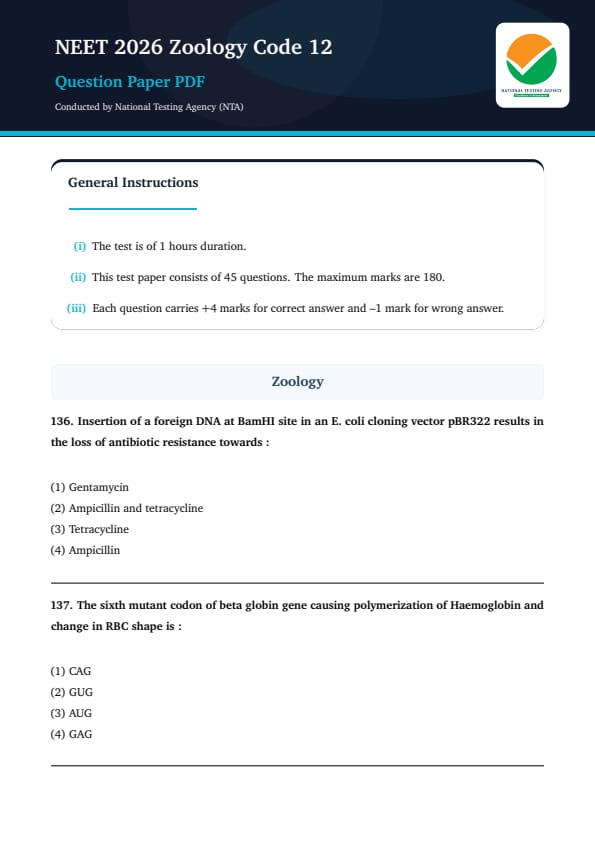
Insertion of a foreign DNA at BamHI site in an E. coli cloning vector pBR322 results in the loss of antibiotic resistance towards :
View Solution
Step 1: Understanding the Concept:
Insertional inactivation is a technique used in recombinant DNA technology to identify transformed cells. When a foreign DNA is inserted into a gene, that gene becomes non-functional.
Step 2: Detailed Explanation:
1. The plasmid pBR322 has two antibiotic resistance genes: ampicillin resistance (\( amp^R \)) and tetracycline resistance (\( tet^R \)).
2. The restriction site for the enzyme BamHI is located within the \( tet^R \) gene.
3. Therefore, if a foreign DNA fragment is ligated at the BamHI site, the \( tet^R \) gene is disrupted (inactivated).
4. The resulting recombinant plasmid will still confer resistance to ampicillin but will lose resistance to tetracycline.
Step 4: Final Answer:
The loss of antibiotic resistance occurs towards Tetracycline.
Quick Tip: Remember the "Bam-Tet" and "Pst-Amp" pairs. BamHI/SalI are in the Tetracycline gene. PstI/PvuI are in the Ampicillin gene.
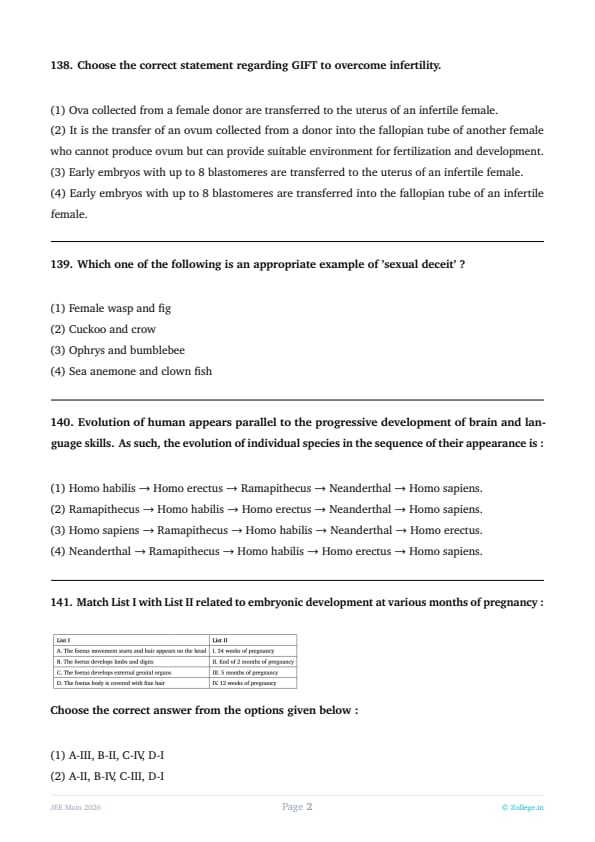
The sixth mutant codon of beta globin gene causing polymerization of Haemoglobin and change in RBC shape is :
View Solution
Step 1: Understanding the Concept:
Sickle-cell anaemia is a genetic disorder caused by a point mutation in the beta-globin chain of haemoglobin.
Step 2: Detailed Explanation:
1. In a normal individual, the sixth codon of the mRNA for the beta-globin chain is GAG, which codes for Glutamic acid.
2. In an individual with sickle-cell anaemia, a point mutation occurs (Adenine is replaced by Uracil in mRNA).
3. This changes the sixth codon to GUG, which codes for the amino acid Valine.
4. This mutant codon GUG leads to the synthesis of sickle-cell haemoglobin (HbS), which polymerizes under low oxygen conditions, causing the RBCs to become sickle-shaped.
Step 4: Final Answer:
The mutant codon is GUG.
Quick Tip: Normal = GAG (Glutamic acid). Mutant = GUG (Valine). Remember: "A" becomes "U" in the mRNA codon.
Choose the correct statement regarding GIFT to overcome infertility.
View Solution
Step 1: Understanding the Concept:
GIFT stands for Gamete Intra-Fallopian Transfer. It is an Assisted Reproductive Technology (ART) used for women who cannot produce eggs but have a healthy reproductive tract.
Step 2: Detailed Explanation:
1. GIFT involves the collection of an ovum (egg) from a donor.
2. This ovum is then transferred into the fallopian tube of an infertile female.
3. This recipient female is one who cannot produce her own ova but can provide the necessary environment for fertilization (which will occur naturally in the fallopian tube) and the subsequent development of the embryo.
4. Statement (3) and (4) describe embryo transfer techniques like ZIFT (Zygote Intra-Fallopian Transfer) or IUT (Intra-Uterine Transfer).
Step 4: Final Answer:
Statement (2) correctly defines GIFT.
Quick Tip: GIFT = {G}amete ({G}o to the {F}allopian tube). ZIFT = {Z}ygote ({Z}ip into the {F}allopian tube).
Which one of the following is an appropriate example of 'sexual deceit' ?
View Solution
Step 1: Understanding the Concept:
Sexual deceit is an evolutionary strategy where one species (often a plant) mimics the physical appearance or pheromones of the female of an insect species to ensure pollination.
Step 2: Detailed Explanation:
1. The Mediterranean orchid Ophrys employs "sexual deceit" to get pollinated by a species of bee.
2. One petal of its flower bears an uncanny resemblance to the female of the bee in size, color, and markings.
3. The male bee is attracted to what it perceives as a female, 'pseudocopulates' with the flower, and during that process is dusted with pollen.
4. When this same bee 'pseudocopulates' with another flower, it transfers pollen to it.
Step 4: Final Answer:
The example of sexual deceit is {Ophrys and the bumblebee.
Quick Tip: "Sexual deceit" is essentially "fake mating." The orchid tricks the male bee into thinking the flower is a female bee.
Evolution of human appears parallel to the progressive development of brain and language skills. As such, the evolution of individual species in the sequence of their appearance is :
View Solution
Step 1: Understanding the Concept:
The evolution of modern humans (Homo sapiens) from primate ancestors involved several intermediate species, characterized by increasing cranial capacity and upright posture.
Step 2: Detailed Explanation:
The correct chronological order of human evolution based on fossil records is:
1. {Ramapithecus: (around 15 mya), more man-like.
2. Homo habilis: (2 mya), first human-like being (hominid), brain capacity 650-800cc.
3. Homo erectus: (1.5 mya), upright man, brain capacity 900cc.
4. Neanderthal man: (100,000 to 40,000 years ago), brain capacity 1400cc.
5. Homo sapiens: (modern man), arose in Africa during the ice age.
Step 4: Final Answer:
The correct evolutionary sequence is Ramapithecus \(\rightarrow\) Homo habilis \(\rightarrow\) Homo erectus \(\rightarrow\) Neanderthal \(\rightarrow\) Homo sapiens.
Quick Tip: Use the mnemonic: {R}eal {H}umans {H}ave {N}ice {S}kins ({R}amapithecus \(\rightarrow\) {H}abilis \(\rightarrow\) {H}erectus \(\rightarrow\) {N}eanderthal \(\rightarrow\) {S}apiens).
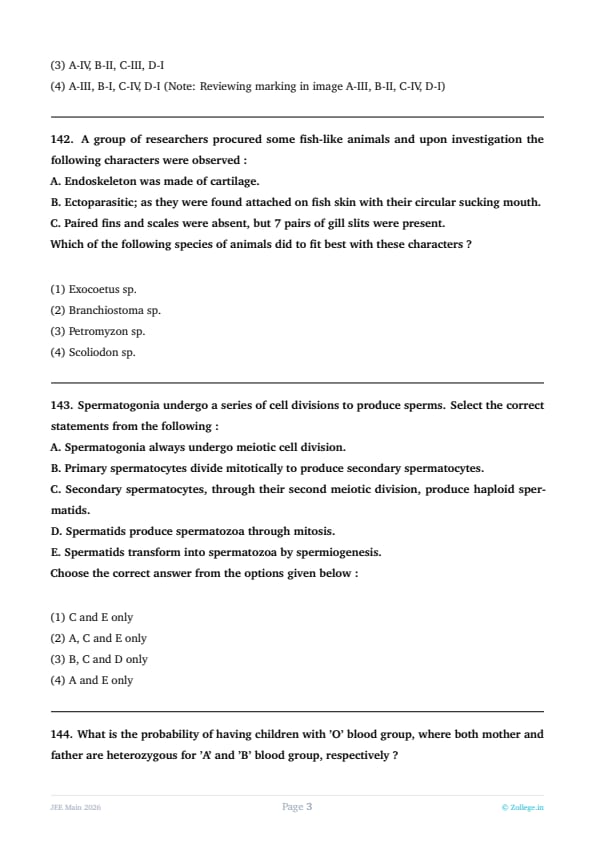
Match List I with List II related to embryonic development at various months of pregnancy :

Choose the correct answer from the options given below :
View Solution
Step 1: Understanding the Concept:
Human embryonic development follows a highly specific timeline where different organs and features appear at characteristic weeks or months.
Step 2: Detailed Explanation:
A. Foetus movement and hair on head: This typically occurs during the fifth month of pregnancy. (A \(\rightarrow\) III).
B. Limbs and digits: By the end of the second month of pregnancy, the foetus develops recognizable limbs and digits. (B \(\rightarrow\) II).
C. External genital organs: By the end of 12 weeks (first trimester), most of the major organ systems are formed, and external genitalia are well-developed. (C \(\rightarrow\) IV).
D. Fine hair, eyelids separate: By the end of 24 weeks (second trimester), the body is covered with fine hair, eye-lids separate, and eyelashes are formed. (D \(\rightarrow\) I).
The correct sequence is A-III, B-II, C-IV, D-I.
Step 4: Final Answer:
The matching results in option (1).
Quick Tip: Remember the Trimester Milestones:
1st Trimester (12 weeks) = Major Organs + Genitals.
2nd Trimester (24 weeks) = Hair + Eyelids.
5th Month = Movement (Quickening).
A group of researchers procured some fish-like animals and upon investigation the following characters were observed :
A. Endoskeleton was made of cartilage.
B. Ectoparasitic; as they were found attached on fish skin with their circular sucking mouth.
C. Paired fins and scales were absent, but 7 pairs of gill slits were present.
Which of the following species of animals did to fit best with these characters ?
View Solution
Step 1: Understanding the Concept:
The described features (cartilaginous endoskeleton, lack of scales/paired fins, circular sucking mouth, and 7 pairs of gill slits) are diagnostic of the class Cyclostomata.
Step 2: Detailed Explanation:
1. Cyclostomes are jawless vertebrates that live as ectoparasites on some fishes.
2. They have a sucking and circular mouth without jaws.
3. Their body is devoid of scales and paired fins.
4. They possess 6-15 pairs of gill slits for respiration (the question specifies 7, which fits this range).
5. Petromyzon (Lamprey) is a classic example of a cyclostome.
- Exocoetus is a bony fish (Osteichthyes).
- {Branchiostoma is a protochordate (Cephalochordata).
- {Scoliodon is a cartilaginous fish (Chondrichthyes) but has jaws, scales, and paired fins.
Step 4: Final Answer:
The animal is {Petromyzon sp.
Quick Tip: The "circular sucking mouth" is the most definitive clue for Cyclostomata ({cyclo = circular, stoma = mouth). Only Petromyzon and Myxine (Hagfish) fit this in your syllabus.
Spermatogonia undergo a series of cell divisions to produce sperms. Select the correct statements from the following :
A. Spermatogonia always undergo meiotic cell division.
B. Primary spermatocytes divide mitotically to produce secondary spermatocytes.
C. Secondary spermatocytes, through their second meiotic division, produce haploid spermatids.
D. Spermatids produce spermatozoa through mitosis.
E. Spermatids transform into spermatozoa by spermiogenesis.
Choose the correct answer from the options given below :
View Solution
Step 1: Understanding the Concept:
Spermatogenesis is the process of sperm production involving both mitosis and meiosis, followed by a morphological transformation.
Step 2: Detailed Explanation:
A. Incorrect: Spermatogonia initially undergo mitotic division to increase their number. Only some differentiate into primary spermatocytes.
B. Incorrect: Primary spermatocytes undergo meiosis I (reduction division) to produce secondary spermatocytes.
C. Correct: Secondary spermatocytes undergo the second meiotic division to produce four equal, haploid spermatids.
D. Incorrect: Spermatids do not divide by mitosis; they transform into spermatozoa.
E. Correct: The transformation of non-motile spermatids into functional spermatozoa is called spermiogenesis.
Step 4: Final Answer:
Statements C and E are correct.
Quick Tip: Remember the hierarchy: Spermatogonia (2n, Mitosis) \(\rightarrow\) Primary Spermatocyte (2n, Meiosis I) \(\rightarrow\) Secondary Spermatocyte (n, Meiosis II) \(\rightarrow\) Spermatid (n, Transformation) \(\rightarrow\) Spermatozoa.
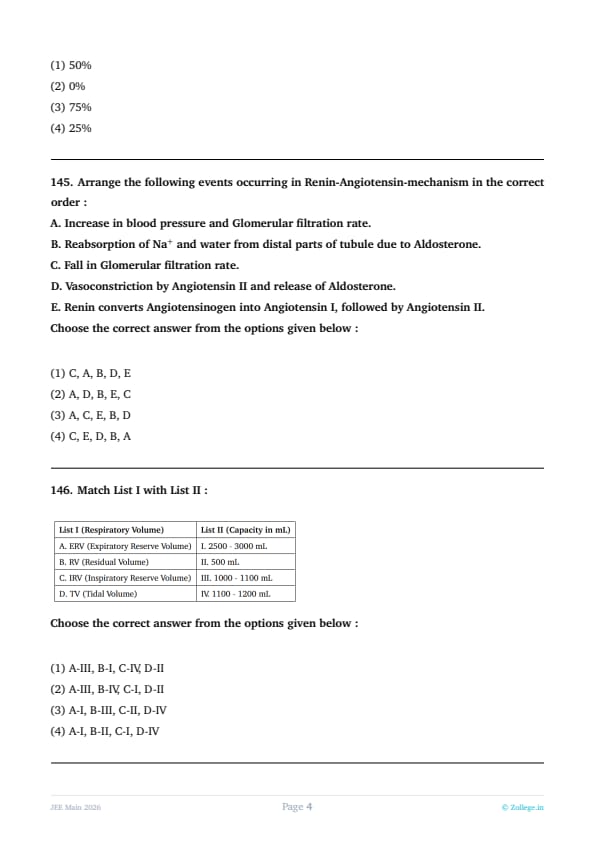
What is the probability of having children with 'O' blood group, where both mother and father are heterozygous for 'A' and 'B' blood group, respectively ?
View Solution
Step 1: Understanding the Concept:
ABO blood grouping in humans is controlled by the gene \( I \), which has three alleles: \( I^A, I^B, \) and \( i \). Blood group 'O' requires the homozygous recessive genotype (\( ii \)).
Step 2: Detailed Explanation:
Given:
- Mother is heterozygous for 'A': Genotype is \( I^A i \).
- Father is heterozygous for 'B': Genotype is \( I^B i \).
Cross (\( I^A i \times I^B i \)):
Using a Punnett Square:
\begin{figure[htb]
\centering

\end{figure
Possible genotypes: \( I^A I^B, I^A i, I^B i, ii \).
The 'O' blood group corresponds to the \( ii \) genotype.
Probability = 1 out of 4 = \( 1/4 \).
Percentage = \( 1/4 \times 100 = 25% \).
Step 4: Final Answer:
The probability is \( 25% \).
Quick Tip: When crossing two heterozygotes for different co-dominant traits (like A and B), you always get a 1:1:1:1 ratio of all four phenotypes (A, B, AB, O). Each has a \( 25% \) chance.
Arrange the following events occurring in Renin-Angiotensin-mechanism in the correct order :
A. Increase in blood pressure and Glomerular filtration rate.
B. Reabsorption of \( Na^+ \) and water from distal parts of tubule due to Aldosterone.
C. Fall in Glomerular filtration rate.
D. Vasoconstriction by Angiotensin II and release of Aldosterone.
E. Renin converts Angiotensinogen into Angiotensin I, followed by Angiotensin II.
Choose the correct answer from the options given below :
View Solution
Step 1: Understanding the Concept:
The RAAS (Renin-Angiotensin-Aldosterone System) is a hormonal cascade used by the body to regulate blood pressure and fluid balance when they drop.
Step 2: Detailed Explanation:
1. C: The process is triggered by a fall in Glomerular Filtration Rate (GFR) or blood pressure.
2. E: Juxtaglomerular cells release Renin, which converts Angiotensinogen to Angiotensin I and then to Angiotensin II.
3. D: Angiotensin II acts as a powerful vasoconstrictor and also stimulates the adrenal cortex to release Aldosterone.
4. B: Aldosterone causes the reabsorption of \( Na^+ \) and water in the distal parts of the tubule.
5. A: This leads to an increase in blood pressure and GFR, completing the feedback loop.
The sequence is C-E-D-B-A.
Step 4: Final Answer:
The correct order is C, E, D, B, A.
Quick Tip: Remember: The mechanism is a "correction" system. It starts with the problem (Fall in GFR) and ends with the solution (Increase in GFR).
Match List I with List II :

Choose the correct answer from the options given below :
View Solution
Step 1: Understanding the Concept:
Respiratory volumes are the quantities of air inhaled, exhaled, or remaining in the lungs during different phases of breathing.
Step 2: Detailed Explanation:
A. ERV: The additional volume of air a person can expire by a forcible expiration. Average is 1000 - 1100 mL. (A \(\rightarrow\) III).
B. RV: The volume of air remaining in the lungs even after a forcible expiration. Average is 1100 - 1200 mL. (B \(\rightarrow\) IV).
C. IRV: The additional volume of air a person can inspire by a forcible inspiration. Average is 2500 - 3000 mL. (C \(\rightarrow\) I).
D. TV: The volume of air inspired or expired during a normal respiration. It is approx. 500 mL. (D \(\rightarrow\) II).
The matching sequence is A-III, B-IV, C-I, D-II.
Step 4: Final Answer:
Matching the lists results in option (2).
Quick Tip: Sequence from smallest to largest volume: Tidal Volume (500) < ERV (1000) < RV (1100) < IRV (2500+). This ranking helps you match values quickly.
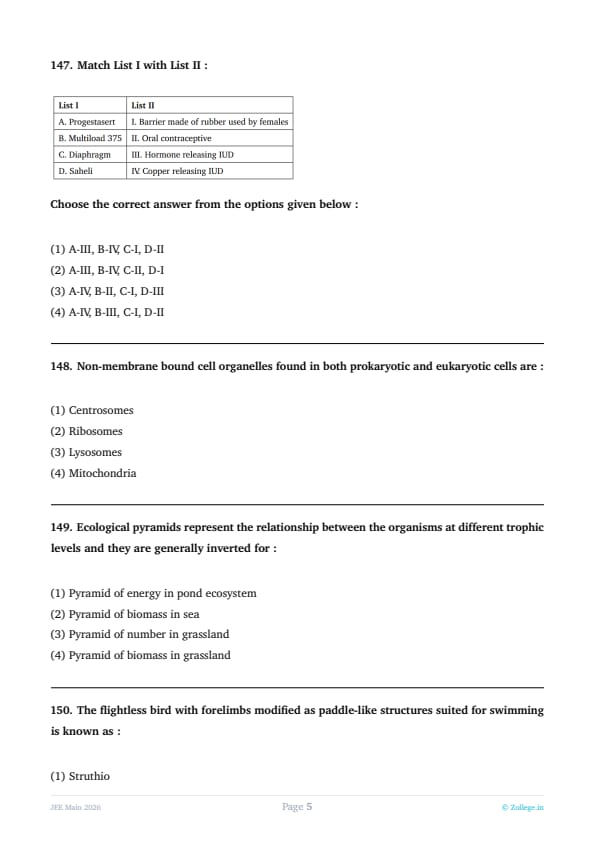
Match List I with List II :

Choose the correct answer from the options given below :
View Solution
Step 1: Understanding the Concept:
Various contraceptive methods are used to prevent pregnancy, including Intrauterine Devices (IUDs), barriers, and hormonal pills.
Step 2: Detailed Explanation:
A. Progestasert: Along with LNG-20, it is a hormone-releasing IUD. (A \(\rightarrow\) III).
B. Multiload 375: Along with CuT and Cu7, it is a copper-releasing IUD. (B \(\rightarrow\) IV).
C. Diaphragm: It is a barrier made of rubber that is inserted into the female reproductive tract. (C \(\rightarrow\) I).
D. Saheli: A non-steroidal oral contraceptive developed by CDRI, Lucknow. (D \(\rightarrow\) II).
The matching sequence is A-III, B-IV, C-I, D-II.
Step 4: Final Answer:
The matching results in option (1).
Quick Tip: Remember the "Cu" in CuT/Cu7 and "Multiload" for Copper. Progestasert has "Progest" in the name, signaling it releases Progesterone (hormone).
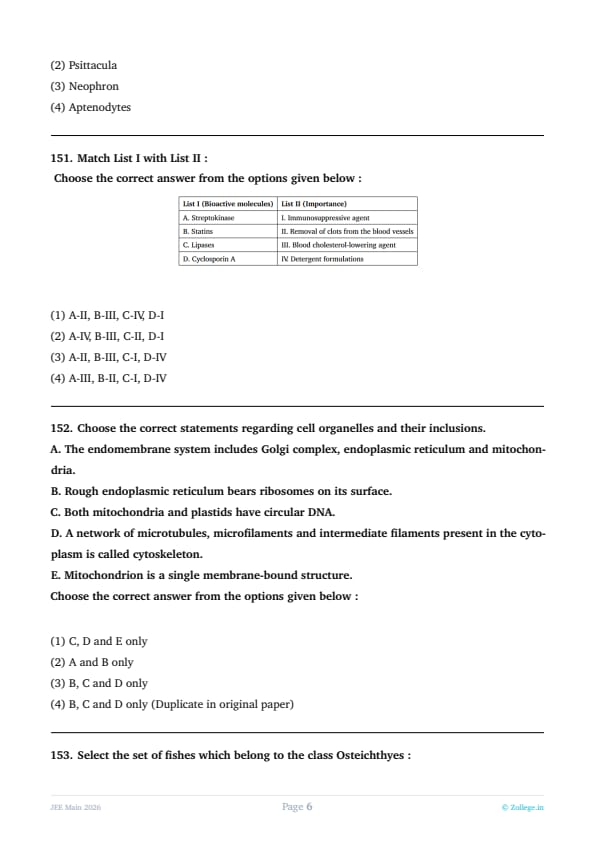
Non-membrane bound cell organelles found in both prokaryotic and eukaryotic cells are :
View Solution
Step 1: Understanding the Concept:
While prokaryotes lack membrane-bound organelles (like mitochondria or nuclei), some fundamental structures without membranes are universal to all life.
Step 2: Detailed Explanation:
1. Ribosomes: These are non-membrane bound organelles responsible for protein synthesis. They are found in both prokaryotes (70S) and eukaryotes (80S in cytoplasm, 70S in organelles).
2. Centrosomes: Non-membrane bound, but found only in animal cells (eukaryotes). They are absent in prokaryotes.
3. Lysosomes: These are single-membrane bound organelles found only in eukaryotes.
4. Mitochondria: These are double-membrane bound organelles found only in eukaryotes.
Step 4: Final Answer:
The correct answer is Ribosomes.
Quick Tip: Ribosomes are the only organelles that lack a membrane and are present across all three domains of life (Bacteria, Archaea, Eukarya).
Ecological pyramids represent the relationship between the organisms at different trophic levels and they are generally inverted for :
View Solution
Step 1: Understanding the Concept:
Ecological pyramids can be of number, biomass, or energy. While energy pyramids are always upright, biomass and number pyramids can be inverted in certain ecosystems.
Step 2: Detailed Explanation:
1. Sea/Aquatic Ecosystem: The pyramid of biomass is often inverted because the biomass of the producers (phytoplankton) is much less than that of the consumers (fish). This is possible because the producers have a very high turnover rate.
2. Energy Pyramid: Always upright because energy is lost as heat at each trophic level (10% law).
3. Grassland Ecosystem: Both the pyramid of numbers and the pyramid of biomass are typically upright.
Step 4: Final Answer:
The pyramid of biomass in the sea is generally inverted.
Quick Tip: Remember: Energy is always Upright. Sea Biomass is Inverted. Tree Numbers (single tree supporting many birds) is also Inverted.
The flightless bird with forelimbs modified as paddle-like structures suited for swimming is known as :
View Solution
Step 1: Understanding the Concept:
Biological classification and nomenclature use scientific names for animals. Some animals show extreme adaptations, such as flightless birds adapted for aquatic life.
Step 2: Detailed Explanation:
1. Aptenodytes: The scientific name for the Penguin. Penguins are flightless birds whose wings have evolved into stiff, flat flippers (paddles) used for swimming.
2. Struthio: The Ostrich. It is flightless but adapted for running on land.
3. {Psittacula: The Parrot. It is a flying bird.
4. {Neophron: The Vulture. It is a flying bird.
Step 4: Final Answer:
The bird is {Aptenodytes.
Quick Tip: Associate scientific names with common names:
{Aptenodytes = Penguin (Paddles).
Struthio = Ostrich (Speed).
Pavo = Peacock.
Match List I with List II :
\begin{figure[htb]
\centering

\end{figure
Choose the correct answer from the options given below :
View Solution
Step 1: Understanding the Concept:
Microbes and their products play a vital role in human welfare as bioactive molecules used in medicine and industry.
Step 2: Detailed Explanation:
A. Streptokinase: Produced by the bacterium {Streptococcus and modified by genetic engineering, it is used as a 'clot buster' for removing clots from the blood vessels of patients who have undergone myocardial infarction. (A \(\rightarrow\) II).
B. Statins: Produced by the yeast {Monascus purpureus, these act as blood cholesterol-lowering agents by competitively inhibiting the enzyme responsible for cholesterol synthesis. (B \(\rightarrow\) III).
C. Lipases: These enzymes are used in detergent formulations and are helpful in removing oily stains from the laundry. (C \(\rightarrow\) IV).
D. Cyclosporin A: Produced by the fungus {Trichoderma polysporum, it is used as an immunosuppressive agent in organ-transplant patients. (D \(\rightarrow\) I).
The correct sequence is A-II, B-III, C-IV, D-I.
Step 4: Final Answer:
The matching results in option (1).
Quick Tip: Remember the source organisms to avoid confusion: Cyclosporin A (Fungus), Statins (Yeast), Streptokinase (Bacteria). These four are the most commonly tested bioactive molecules in medical exams.
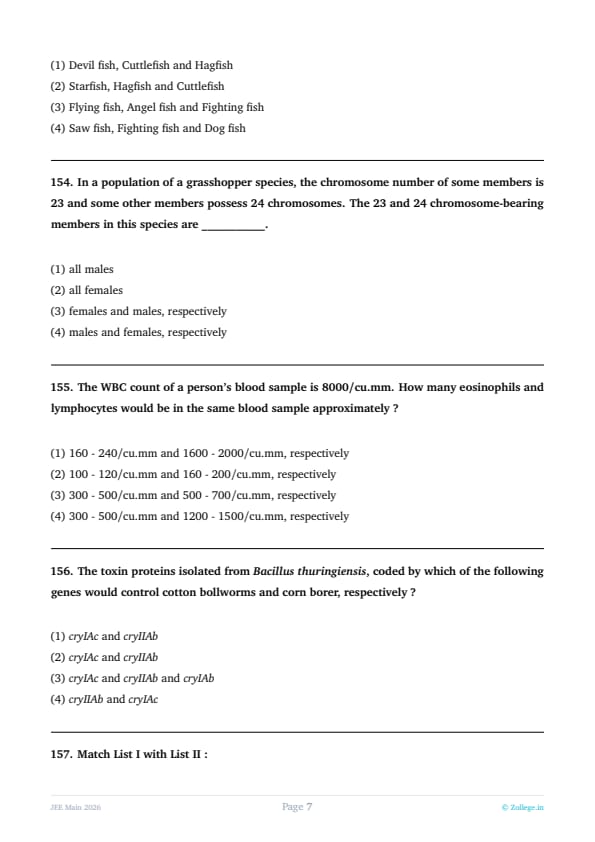
Choose the correct statements regarding cell organelles and their inclusions.
A. The endomembrane system includes Golgi complex, endoplasmic reticulum and mitochondria.
B. Rough endoplasmic reticulum bears ribosomes on its surface.
C. Both mitochondria and plastids have circular DNA.
D. A network of microtubules, microfilaments and intermediate filaments present in the cytoplasm is called cytoskeleton.
E. Mitochondrion is a single membrane-bound structure.
Choose the correct answer from the options given below :
View Solution
Step 1: Understanding the Concept:
Cell organelles are specialized structures within a cell that perform specific functions. Eukaryotic cells are characterized by extensive compartmentalization via membrane-bound organelles.
Step 2: Detailed Explanation:
A. Incorrect: The endomembrane system includes the ER, Golgi complex, Lysosomes, and Vacuoles. Mitochondria, chloroplasts, and peroxisomes are not part of this system because their functions are not coordinated with these.
B. Correct: Rough endoplasmic reticulum (RER) has ribosomes attached to its outer surface, giving it a granular appearance.
C. Correct: Both mitochondria and plastids (like chloroplasts) are semi-autonomous organelles containing their own circular DNA and ribosomes.
D. Correct: The cytoskeleton is an elaborate network of filamentous proteinaceous structures (microtubules, microfilaments, intermediate filaments) present in the cytoplasm.
E. Incorrect: Mitochondria are double membrane-bound structures.
Statements B, C, and D are correct.
Step 4: Final Answer:
The correct set of statements is B, C, and D.
Quick Tip: Remember that Mitochondria and Chloroplasts are like "cells within a cell"—they have double membranes and their own DNA, which sets them apart from the single-membraned endomembrane system.
Select the set of fishes which belong to the class Osteichthyes :
View Solution
Step 1: Understanding the Concept:
Class Osteichthyes includes bony fishes which have a bony endoskeleton and four pairs of gills covered by an operculum.
Step 2: Detailed Explanation:
1. Flying fish ({Exocoetus), Angel fish ({Pterophyllum), and Fighting fish ({Betta) are all examples of bony fishes (Osteichthyes).
2. Hagfish ({Myxine) belongs to Cyclostomata (jawless vertebrates).
3. Devil fish (Octopus) and Cuttlefish (Sepia) are Molluscs, not fishes.
4. Starfish (Asterias) is an Echinoderm, not a fish.
5. Saw fish ({Pristis) and Dog fish ({Scoliodon) belong to Chondrichthyes (cartilaginous fishes).
Step 4: Final Answer:
The set containing only Osteichthyes is Flying fish, Angel fish, and Fighting fish.
Quick Tip: "Fishes" that aren't fishes: Jellyfish (Cnidaria), Silverfish (Arthropoda), Starfish (Echinodermata), Cuttlefish (Mollusca). Always exclude these "false fishes" first in such questions.
In a population of a grasshopper species, the chromosome number of some members is 23 and some other members possess 24 chromosomes. The 23 and 24 chromosome-bearing members in this species are ___________.
View Solution
Step 1: Understanding the Concept:
Grasshoppers exhibit the XO type of sex determination, where the presence or absence of a second sex chromosome determines the sex.
Step 2: Detailed Explanation:
1. In grasshoppers, the females are homogametic and have two X chromosomes (XX).
2. The males are heterogametic and have only one X chromosome (XO).
3. Let the number of autosomes be 'A'. Then:
- Females = A + XX
- Males = A + XO
4. If there are 22 autosomes (\(2n = 22\)), then:
- Females have \(22 + 2 = 24\) chromosomes.
- Males have \(22 + 1 = 23\) chromosomes.
Therefore, the 23-chromosome members are males and the 24-chromosome members are females.
Step 4: Final Answer:
The members are males and females, respectively.
Quick Tip: In XO systems, the "O" stands for nothing—literally a missing chromosome. This means males in these species will always have one chromosome less than females.
The WBC count of a person's blood sample is 8000/cu.mm. How many eosinophils and lymphocytes would be in the same blood sample approximately ?
View Solution
Step 1: Understanding the Concept:
White Blood Cells (WBCs) consist of different types of cells in fixed percentage ranges. Knowing the total count and the standard percentages allows us to calculate absolute counts.
Step 2: Detailed Explanation:
Standard percentages for WBC types:
- Neutrophils: 60 - 65%
- Lymphocytes: 20 - 25%
- Monocytes: 6 - 8%
- Eosinophils: 2 - 3%
- Basophils: 0.5 - 1%
Given Total WBC = 8000/cu.mm.
1. Eosinophils (2-3% of 8000):
- Lower limit: \(0.02 \times 8000 = 160\)
- Upper limit: \(0.03 \times 8000 = 240\)
Range = 160 - 240/cu.mm.
2. Lymphocytes (20-25% of 8000):
- Lower limit: \(0.20 \times 8000 = 1600\)
- Upper limit: \(0.25 \times 8000 = 2000\)
Range = 1600 - 2000/cu.mm.
Step 4: Final Answer:
The approximate counts match option (1).
Quick Tip: Mnemonic for WBC count order (high to low): {N}ever {L}et {M}onkeys {E}at {B}ananas (Neutrophils, Lymphocytes, Monocytes, Eosinophils, Basophils).
The toxin proteins isolated from Bacillus thuringiensis, coded by which of the following genes would control cotton bollworms and corn borer, respectively ?
View Solution
Step 1: Understanding the Concept:
Specific Bt toxin genes from Bacillus thuringiensis are engineered into crops to provide resistance against particular insect pests. The action is highly specific.
Step 2: Detailed Explanation:
- Cotton bollworms are controlled by the proteins encoded by genes {cryIAc and cryIIAb.
- Corn borer is controlled by the protein encoded by the gene cryIAb.
The question asks for the genes corresponding to cotton bollworms and corn borer in that order.
Step 4: Final Answer:
The correct set of genes is provided in option (3).
Quick Tip: Mnemonic: {B}ollworm has {two} (cryIAc, cryIIAb). Corn {B}orer has {one} (cryIAb). Notice the subtle difference between cryIIAb and cryIAb.
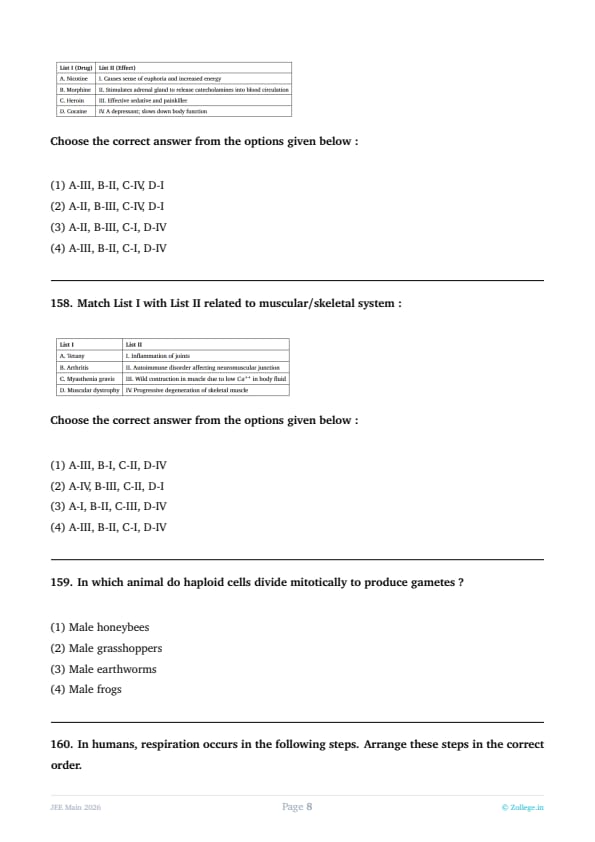
Match List I with List II :

Choose the correct answer from the options given below :
View Solution
Step 1: Understanding the Concept:
Psychoactive drugs affect the central nervous system and other bodily systems in characteristic ways.
Step 2: Detailed Explanation:
A. Nicotine: Found in tobacco, it stimulates the adrenal gland to release adrenaline and nor-adrenaline (catecholamines) into the blood, raising blood pressure and heart rate. (A \(\rightarrow\) II).
B. Morphine: Extracted from the poppy plant, it is an extremely effective sedative and painkiller, often used for patients undergoing surgery. (B \(\rightarrow\) III).
C. Heroin: Chemically diacetylmorphine, it is a depressant that slows down body functions. (C \(\rightarrow\) IV).
D. Cocaine: Obtained from coca plants, it has a potent stimulating action on the CNS, producing a sense of euphoria and increased energy. (D \(\rightarrow\) I).
The correct matching sequence is A-II, B-III, C-IV, D-I.
Step 4: Final Answer:
Matching the pairs correctly leads to option (2).
Quick Tip: Heroin and Morphine are related (Opioids) and are depressants/painkillers. Cocaine is a stimulant (up). Nicotine is unique as it acts specifically on the adrenals.
Match List I with List II related to muscular/skeletal system :

Choose the correct answer from the options given below :
View Solution
Step 1: Understanding the Concept:
Disorders of the muscular and skeletal systems result from hormonal imbalances, autoimmune issues, or genetic factors.
Step 2: Detailed Explanation:
A. Tetany: Rapid spasms or wild contractions in muscles due to low calcium levels (\(Ca^{++}\)) in the body fluid. (A \(\rightarrow\) III).
B. Arthritis: The general term for inflammation of joints. (B \(\rightarrow\) I).
C. Myasthenia gravis: An autoimmune disorder where the body's immune system attacks the neuromuscular junction, leading to fatigue and paralysis. (C \(\rightarrow\) II).
D. Muscular dystrophy: Usually a genetic disorder involving the progressive degeneration of skeletal muscle. (D \(\rightarrow\) IV).
The sequence is A-III, B-I, C-II, D-IV.
Step 4: Final Answer:
The matching results in option (1).
Quick Tip: Don't confuse Myasthenia gravis (autoimmune) with Muscular dystrophy (genetic). Both lead to muscle weakness, but the underlying cause and target (junction vs muscle fiber) are different.
In which animal do haploid cells divide mitotically to produce gametes ?
View Solution
Step 1: Understanding the Concept:
In most animals, gametes are produced through meiosis from diploid cells. However, in organisms with a haplodiploid sex-determination system, haploid individuals must use mitosis to produce gametes.
Step 2: Detailed Explanation:
1. Male honeybees (drones) are born from unfertilized eggs through parthenogenesis and are therefore haploid (\(n = 16\)).
2. Since they already possess only a single set of chromosomes, they cannot undergo meiosis (reduction division) to form sperm.
3. Instead, they produce sperm by mitosis, ensuring the sperm also has 16 chromosomes.
4. Grasshoppers, earthworms, and frogs are all diploid (\(2n\)) animals that produce gametes by meiosis.
Step 4: Final Answer:
Male honeybees produce gametes via mitosis.
Quick Tip: Remember the exception: Usually, Mitosis = Somatic cells, Meiosis = Gametes. But if the whole individual is haploid, Mitosis must be used for Gametes!
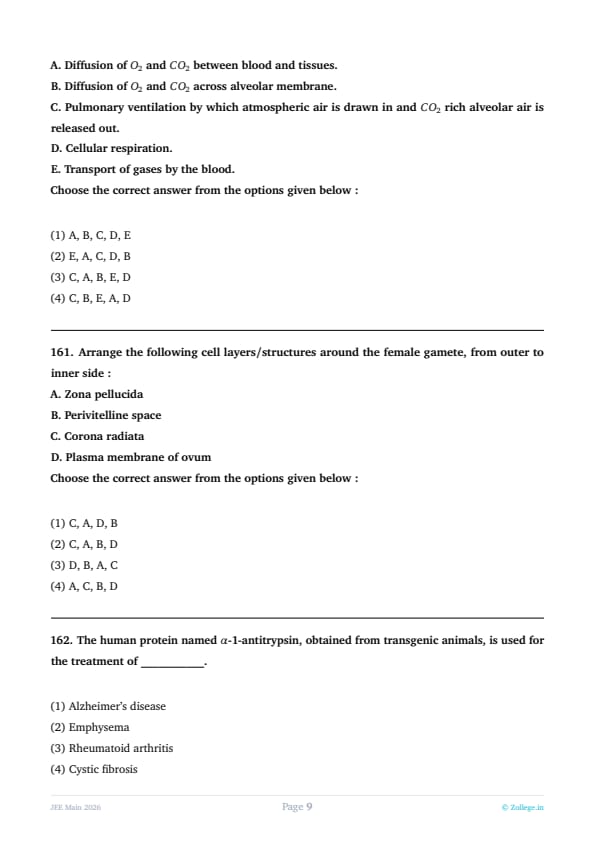
In humans, respiration occurs in the following steps. Arrange these steps in the correct order.
A. Diffusion of \(O_2\) and \(CO_2\) between blood and tissues.
B. Diffusion of \(O_2\) and \(CO_2\) across alveolar membrane.
C. Pulmonary ventilation by which atmospheric air is drawn in and \(CO_2\) rich alveolar air is released out.
D. Cellular respiration.
E. Transport of gases by the blood.
Choose the correct answer from the options given below :
View Solution
Step 1: Understanding the Concept:
Respiration is a multi-step physiological process involving the intake of oxygen and the release of carbon dioxide, eventually leading to energy production in cells.
Step 2: Detailed Explanation:
The logical physiological sequence is:
1. C: Breathing or pulmonary ventilation (Air in/out).
2. B: Alveolar Diffusion (Gas exchange between air sacs and lung capillaries).
3. E: Transport (Blood carries gases from lungs to body tissues).
4. A: Tissue Diffusion (Gas exchange between blood and cells).
5. D: Cellular Respiration (Utilization of \(O_2\) by cells for catabolic reactions).
The sequence is C-B-E-A-D.
Step 4: Final Answer:
The correct order is C, B, E, A, D.
Quick Tip: The process moves from "Outside" to "Inside". Start with ventilation (the nose/mouth) and end with the mitochondria (cellular respiration).
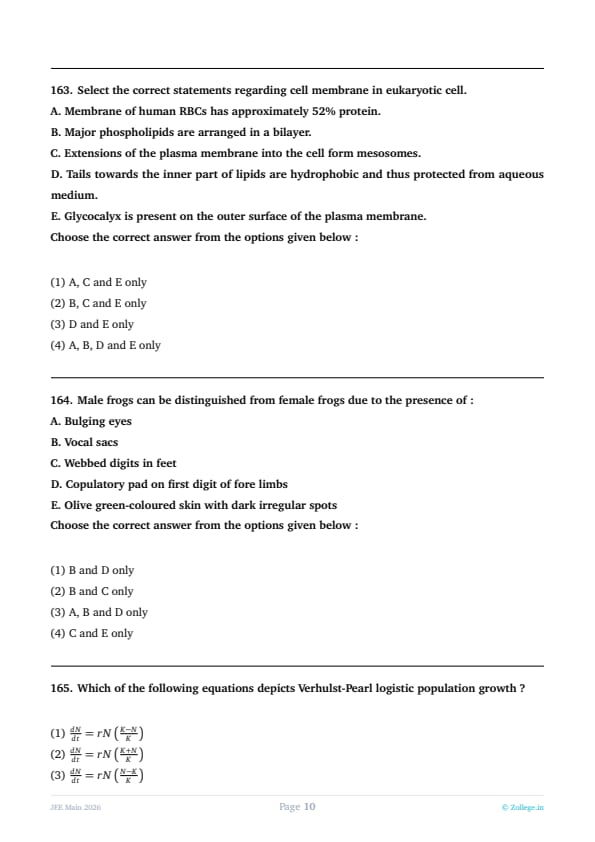
Arrange the following cell layers/structures around the female gamete, from outer to inner side :
A. Zona pellucida
B. Perivitelline space
C. Corona radiata
D. Plasma membrane of ovum
Choose the correct answer from the options given below :
View Solution
Step 1: Understanding the Concept:
The ovum (female gamete) is surrounded by several specialized layers and spaces that provide protection and mediate interaction with the sperm during fertilization.
Step 2: Detailed Explanation:
The layers, from the outermost to the innermost (moving towards the ooplasm), are arranged as follows:
1. C. Corona radiata: The outermost layer consisting of follicular cells held together by hyaluronic acid.
2. A. Zona pellucida: A clear, non-cellular glycoprotein membrane situated just inside the corona radiata.
3. B. Perivitelline space: A narrow fluid-filled space located between the zona pellucida and the plasma membrane.
4. D. Plasma membrane: The actual boundary of the ovum (oolemma).
Thus, the correct sequence is C \(\rightarrow\) A \(\rightarrow\) B \(\rightarrow\) D.
Step 4: Final Answer:
The correct sequence from outer to inner is C, A, B, D.
Quick Tip: Remember the acronym {C.Z.P.P.} (Corona, Zona, Perivitelline space, Plasma membrane) to recall the order during fertilization. The sperm must penetrate these in exactly this order to reach the egg nucleus.
The human protein named \(\alpha\)-1-antitrypsin, obtained from transgenic animals, is used for the treatment of ___________.
View Solution
Step 1: Understanding the Concept:
Biotechnology allows us to use transgenic animals (bioreactors) to produce specific human proteins that are difficult to synthesize chemically or extract from humans.
Step 2: Detailed Explanation:
1. \(\alpha\)-1-antitrypsin is a human protein used to treat emphysema.
2. Emphysema is a chronic respiratory disease where the alveolar walls are damaged, often due to smoking or genetic deficiency of this protein.
3. Transgenic animals (like sheep) are engineered to produce this protein in their milk, which is then purified for medical use.
4. Other diseases like cystic fibrosis and phenylketonuria (PKU) are also targets for similar biotechnological treatments, but \(\alpha\)-1-antitrypsin is specifically for emphysema.
Step 4: Final Answer:
The protein is used for the treatment of Emphysema.
Quick Tip: Associate "Antitrypsin" with "Emphysema" (AE). Also, remember "Rosie," the first transgenic cow, which produced human \(\alpha\)-lactalbumin enriched milk.
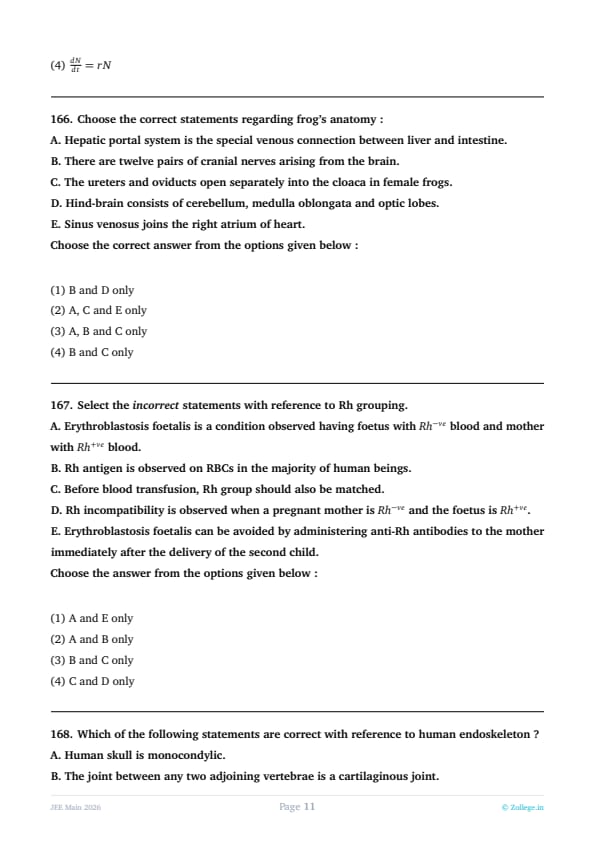
Select the correct statements regarding cell membrane in eukaryotic cell.
A. Membrane of human RBCs has approximately 52% protein.
B. Major phospholipids are arranged in a bilayer.
C. Extensions of the plasma membrane into the cell form mesosomes.
D. Tails towards the inner part of lipids are hydrophobic and thus protected from aqueous medium.
E. Glycocalyx is present on the outer surface of the plasma membrane.
Choose the correct answer from the options given below :
View Solution
Step 1: Understanding the Concept:
The eukaryotic cell membrane is based on the fluid mosaic model, composed primarily of lipids and proteins arranged in a specific orientation.
Step 2: Detailed Explanation:
A. Correct: In humans, the erythrocyte membrane has approximately 52% protein and 40% lipids.
B. Correct: Phospholipids are arranged in a bilayer with polar heads towards the outside and hydrophobic tails towards the inside.
C. Incorrect: Mesosomes are characteristic extensions of the plasma membrane found in prokaryotic cells, not eukaryotic cells.
D. Correct: The non-polar hydrophobic tails of lipids are shielded from the aqueous environment by being oriented towards the interior of the membrane.
E. Correct: The glycocalyx (carbohydrate coating) is found on the outer surface of animal cell membranes.
Statements A, B, D, and E are correct.
Step 4: Final Answer:
The correct set of statements is A, B, D, and E.
Quick Tip: Always look for "Mesosomes" in cell membrane questions. They are a classic "distractor" used to confuse prokaryotic features with eukaryotic ones.
Male frogs can be distinguished from female frogs due to the presence of :
A. Bulging eyes
B. Vocal sacs
C. Webbed digits in feet
D. Copulatory pad on first digit of fore limbs
E. Olive green-coloured skin with dark irregular spots
Choose the correct answer from the options given below :
View Solution
Step 1: Understanding the Concept:
Sexual dimorphism in frogs refers to the observable external differences between males and females of the same species.
Step 2: Detailed Explanation:
In {Rana tigrina (the common Indian bullfrog):
1. Vocal Sacs: Only male frogs possess sound-amplifying vocal sacs in the throat region to attract females during mating season.
2. Copulatory Pads: Male frogs have a specialized rough pad, called the amplexus or copulatory pad, on the first digit of the forelimbs. This helps them grip the female during mating.
3. Bulging eyes, webbed feet, and skin color are general characteristics found in both male and female frogs.
Step 4: Final Answer:
Male frogs are distinguished by vocal sacs and copulatory pads.
Quick Tip: Male frogs are the ones that "sing" (vocal sacs) and "hold on" (copulatory pads). All other features listed are for survival and are shared by both sexes.
Which of the following equations depicts Verhulst-Pearl logistic population growth ?
View Solution
Step 1: Understanding the Concept:
Population growth is usually limited by available resources. The Verhulst-Pearl Logistic Growth model describes how a population grows when it faces a carrying capacity (\(K\)).
Step 2: Key Formula or Approach:
The equation is: \( \frac{dN}{dt} = rN \left[ \frac{K - N}{K} \right] \)
Where:
\( N \) = Population density at time \( t \)
\( r \) = Intrinsic rate of natural increase
\( K \) = Carrying capacity
Step 3: Detailed Explanation:
1. When resources are limited, growth is not exponential.
2. The term \( (K-N)/K \) is the "environmental resistance" or the portion of resources still available.
3. As \( N \) approaches \( K \), the growth rate \( dN/dt \) approaches zero, resulting in a sigmoid (S-shaped) curve.
4. Option (4) represents exponential growth, while (1) is the correct logistic growth formula.
Step 4: Final Answer:
The equation is \( \frac{dN}{dt} = rN \left( \frac{K-N}{K} \right) \).
Quick Tip: Remember that in logistic growth, the "Limit" is \( K \). The formula must result in a decrease in growth as \( N \) gets closer to \( K \). Hence, \( (K-N) \) must be in the numerator.
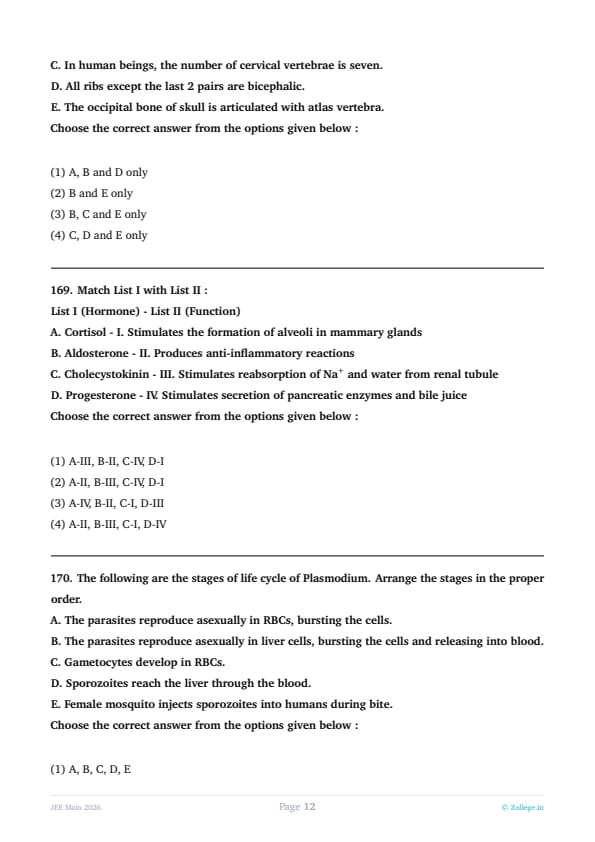
Choose the correct statements regarding frog's anatomy :
A. Hepatic portal system is the special venous connection between liver and intestine.
B. There are twelve pairs of cranial nerves arising from the brain.
C. The ureters and oviducts open separately into the cloaca in female frogs.
D. Hind-brain consists of cerebellum, medulla oblongata and optic lobes.
E. Sinus venosus joins the right atrium of heart.
Choose the correct answer from the options given below :
View Solution
Step 1: Understanding the Concept:
Frog anatomy contains specific circulatory, nervous, and reproductive structures that differ slightly from mammals.
Step 2: Detailed Explanation:
A. Correct: A hepatic portal system exists between the digestive tract and the liver.
B. Incorrect: Frogs possess ten pairs of cranial nerves, not twelve.
C. Correct: In females, the ureters and oviducts open separately into the cloaca. (In males, ureters act as a urino-genital duct).
D. Incorrect: Optic lobes are part of the mid-brain, not the hind-brain.
E. Correct: A triangular structure called sinus venosus receives blood and opens into the right atrium.
Statements A, C, and E are correct.
Step 4: Final Answer:
The correct statements are A, C, and E.
Quick Tip: Mammals have 12 pairs of cranial nerves, but lower vertebrates like frogs only have 10. This is a very common comparison point in exams.
Select the incorrect statements with reference to Rh grouping.
A. Erythroblastosis foetalis is a condition observed having foetus with \( Rh^{-ve} \) blood and mother with \( Rh^{+ve} \) blood.
B. Rh antigen is observed on RBCs in the majority of human beings.
C. Before blood transfusion, Rh group should also be matched.
D. Rh incompatibility is observed when a pregnant mother is \( Rh^{-ve} \) and the foetus is \( Rh^{+ve} \).
E. Erythroblastosis foetalis can be avoided by administering anti-Rh antibodies to the mother immediately after the delivery of the second child.
Choose the answer from the options given below :
View Solution
Step 1: Understanding the Concept:
Rh grouping and the clinical condition of Erythroblastosis foetalis involve immune reactions when \( Rh^{-ve} \) blood is exposed to \( Rh^{+ve} \) blood.
Step 2: Detailed Explanation:
A. Incorrect: Erythroblastosis foetalis occurs when the mother is \( Rh^{-ve} \) and the foetus is \( Rh^{+ve} \). Statement A gives the reverse.
B. Correct: Nearly 80% of humans are Rh-positive.
C. Correct: Rh matching is vital to prevent clumping of RBCs.
D. Correct: This is the standard condition for incompatibility during pregnancy.
E. Incorrect: To be effective, anti-Rh antibodies must be administered immediately after the delivery of the first \( Rh^{+ve} \) child (and subsequent ones) to prevent sensitization, not just the second.
Statements A and E are incorrect.
Step 4: Final Answer:
The incorrect statements are A and E.
Quick Tip: Remember: "Negative Mom, Positive Baby" is the dangerous combo. If Mom is positive, her body already recognizes the Rh antigen, so no immune reaction will occur against a positive baby.
Which of the following statements are correct with reference to human endoskeleton ?
A. Human skull is monocondylic.
B. The joint between any two adjoining vertebrae is a cartilaginous joint.
C. In human beings, the number of cervical vertebrae is seven.
D. All ribs except the last 2 pairs are bicephalic.
E. The occipital bone of skull is articulated with atlas vertebra.
Choose the correct answer from the options given below :
View Solution
Step 1: Understanding the Concept:
The human skeletal system has specific joint types and bone counts that are consistent across most mammals.
Step 2: Detailed Explanation:
A. Incorrect: The human skull is dicondylic (possesses two occipital condyles).
B. Correct: Adjoining vertebrae are connected by intervertebral discs made of fibrocartilage, forming a cartilaginous joint with limited movement.
C. Correct: Almost all mammals, including humans, have 7 cervical (neck) vertebrae.
D. Incorrect: All 12 pairs of ribs are bicephalic (they have two articulation surfaces on their dorsal end).
E. Correct: The occipital condyles of the skull articulate with the first cervical vertebra, the atlas.
Statements B, C, and E are correct.
Step 4: Final Answer:
The correct statements are B, C, and E.
Quick Tip: Skull Articulation: Humans = Dicondylic (2 points). Birds/Reptiles = Monocondylic (1 point). Think of "Di" as "Double" for humans.
Match List I with List II :
List I (Hormone) - List II (Function)
A. Cortisol - I. Stimulates the formation of alveoli in mammary glands
B. Aldosterone - II. Produces anti-inflammatory reactions
C. Cholecystokinin - III. Stimulates reabsorption of \( Na^{+} \) and water from renal tubule
D. Progesterone - IV. Stimulates secretion of pancreatic enzymes and bile juice
Choose the correct answer from the options given below :
View Solution
Step 1: Understanding the Concept:
Hormones are chemical messengers that regulate metabolic processes, ionic balance, digestion, and reproduction.
Step 2: Detailed Explanation:
A. Cortisol: A glucocorticoid that suppresses the immune system and produces anti-inflammatory reactions. (A \(\rightarrow\) II).
B. Aldosterone: A mineralocorticoid that acts on renal tubules to reabsorb \( Na^{+} \) and water. (B \(\rightarrow\) III).
C. Cholecystokinin (CCK): A peptide hormone from the GI tract that stimulates pancreatic enzyme secretion and gallbladder contraction (bile release). (C \(\rightarrow\) IV).
D. Progesterone: Acts on mammary glands to stimulate the formation of alveoli (milk storage sacs). (D \(\rightarrow\) I).
The correct sequence is A-II, B-III, C-IV, D-I.
Step 4: Final Answer:
Matching the pairs correctly gives option (2).
Quick Tip: Cortisol = "Control inflammation". Aldosterone = "Always reabsorb Sodium". Progesterone = "Promotes pregnancy/alveoli".
The following are the stages of life cycle of Plasmodium. Arrange the stages in the proper order.
A. The parasites reproduce asexually in RBCs, bursting the cells.
B. The parasites reproduce asexually in liver cells, bursting the cells and releasing into blood.
C. Gametocytes develop in RBCs.
D. Sporozoites reach the liver through the blood.
E. Female mosquito injects sporozoites into humans during bite.
Choose the correct answer from the options given below :
View Solution
Step 1: Understanding the Concept:
Plasmodium (the malaria parasite) has a complex life cycle involving a human host and a female {Anopheles mosquito vector.
Step 2: Detailed Explanation:
The sequential stages in the human host are:
1. E: The cycle starts when a mosquito injects sporozoites into the human blood stream.
2. D: These sporozoites travel to the liver via the circulatory system.
3. B: Parasites multiply asexually in liver cells, eventually bursting them to enter the blood.
4. A: Parasites enter RBCs, multiply asexually again, and burst the RBCs (releasing hemozoin).
5. C: Some parasites in RBCs differentiate into sexual stages called gametocytes.
The correct order is E-D-B-A-C.
Step 4: Final Answer:
The correct order is E, D, B, A, C.
Quick Tip: Remember the progression: {Skin \(\rightarrow\) Liver \(\rightarrow\) Blood RBCs \(\rightarrow\) Gametes. The Liver stage always happens before the Blood stage in human malaria.
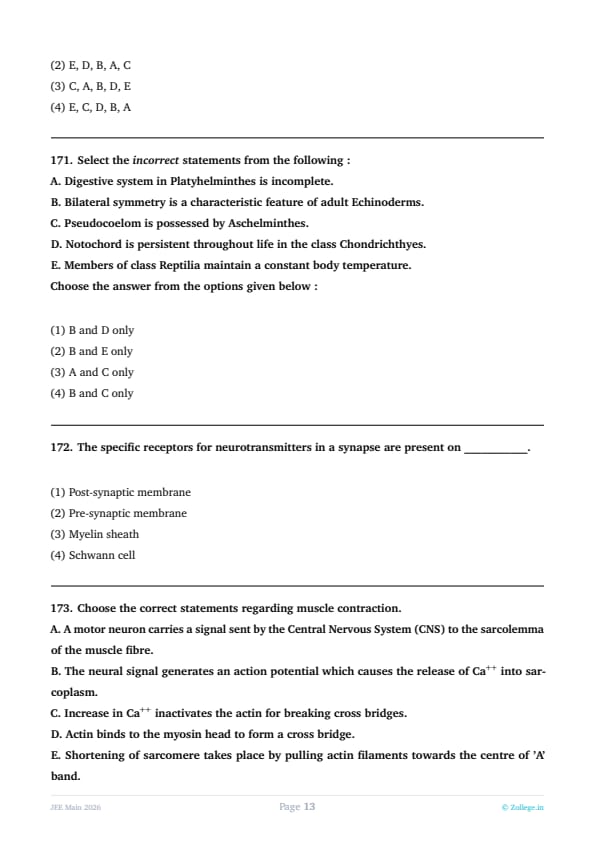
Select the incorrect statements from the following :
A. Digestive system in Platyhelminthes is incomplete.
B. Bilateral symmetry is a characteristic feature of adult Echinoderms.
C. Pseudocoelom is possessed by Aschelminthes.
D. Notochord is persistent throughout life in the class Chondrichthyes.
E. Members of class Reptilia maintain a constant body temperature.
Choose the answer from the options given below :
View Solution
Step 1: Understanding the Concept:
Animal classification is based on various diagnostic features like symmetry, body cavity (coelom), digestive system complexity, and thermoregulation.
Step 2: Detailed Explanation:
A. Correct: Platyhelminthes (flatworms) have a single opening for both ingestion and egestion, hence an incomplete digestive system.
B. Incorrect: Adult Echinoderms exhibit radial symmetry (specifically pentamerous radial symmetry), while their larvae are bilaterally symmetrical.
C. Correct: Aschelminthes (roundworms) are the only group that possesses a pseudocoelom (false body cavity).
D. Correct: In cartilaginous fishes (Chondrichthyes), the notochord persists throughout their life.
E. Incorrect: Reptiles are poikilotherms (cold-blooded), meaning they cannot maintain a constant internal body temperature and depend on the environment.
The incorrect statements are B and E.
Step 4: Final Answer:
The incorrect statements are B and E.
Quick Tip: Remember the "Echinoderm Exception": Larva = Bilateral, Adult = Radial. For temperature: only Birds and Mammals are Homeotherms (warm-blooded).
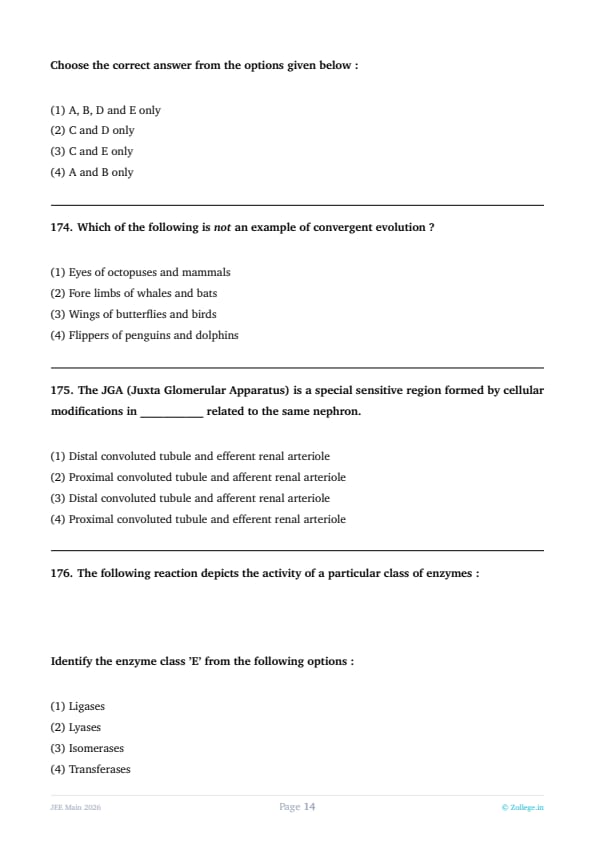
The specific receptors for neurotransmitters in a synapse are present on ___________.
View Solution
Step 1: Understanding the Concept:
Synaptic transmission involves the transfer of a chemical signal from one neuron to another across a small gap called the synaptic cleft.
Step 2: Detailed Explanation:
1. When an impulse reaches the axon terminal, it triggers the release of neurotransmitters from synaptic vesicles into the synaptic cleft.
2. These chemicals diffuse across the gap and bind to specific receptor sites.
3. These receptors are located on the post-synaptic membrane (the membrane of the receiving neuron or effector cell).
4. This binding opens ion channels, generating a new potential in the post-synaptic neuron.
Step 4: Final Answer:
The receptors are present on the Post-synaptic membrane.
Quick Tip: The flow of information in a chemical synapse is unidirectional: Pre-synaptic (Release) \(\rightarrow\) Post-synaptic (Reception). Receptors are always on the "receiving" side.
Choose the correct statements regarding muscle contraction.
A. A motor neuron carries a signal sent by the Central Nervous System (CNS) to the sarcolemma of the muscle fibre.
B. The neural signal generates an action potential which causes the release of \( Ca^{++} \) into sarcoplasm.
C. Increase in \( Ca^{++} \) inactivates the actin for breaking cross bridges.
D. Actin binds to the myosin head to form a cross bridge.
E. Shortening of sarcomere takes place by pulling actin filaments towards the centre of 'A' band.
Choose the correct answer from the options given below :
View Solution
Step 1: Understanding the Concept:
Muscle contraction follows the "Sliding Filament Theory," initiated by a neural signal and regulated by calcium ions.
Step 2: Detailed Explanation:
A. Correct: A motor unit involves a motor neuron carrying CNS signals to the neuromuscular junction.
B. Correct: The action potential spreads through the muscle fibre and triggers \( Ca^{++} \) release from the sarcoplasmic reticulum.
C. Incorrect: Increased \( Ca^{++} \) activates contraction by binding to troponin, which unmasks the active sites on actin. It does not "inactivate" actin.
D. Correct: Once sites are exposed, the myosin head binds to actin using ATP energy to form a cross-bridge.
E. Correct: The sliding of actin filaments over myosin filaments towards the M-line (centre of A band) shortens the sarcomere.
Step 4: Final Answer:
Statements A, B, D, and E are correct.
Quick Tip: Calcium is the "On Switch" for muscle contraction. It removes the "mask" (Troponin/Tropomyosin) from the actin filaments.
Which of the following is not an example of convergent evolution ?
View Solution
Step 1: Understanding the Concept:
Convergent evolution results in analogous organs (different structures, same function). Divergent evolution results in homologous organs (same structure/origin, different function).
Step 2: Detailed Explanation:
1. Whale/Bat Forelimbs: These are homologous organs. They share the same basic anatomical pattern (humerus, radius, ulna, etc.) but have adapted for different functions (swimming vs. flying). This is an example of divergent evolution.
2. Octopus/Mammal eyes: Different origin but same function (vision). (Analogous/Convergent).
3. Butterfly/Bird wings: Different structure (membranous vs. feathery) but same function (flight). (Analogous/Convergent).
4. Penguin/Dolphin flippers: One is a bird, one is a mammal; they evolved similar appendages for aquatic life. (Analogous/Convergent).
Step 4: Final Answer:
Fore limbs of whales and bats are an example of divergent evolution, not convergent.
Quick Tip: Mnemonic: {H.D.} (Homologous \(\rightarrow\) Divergent) and {A.C.} (Analogous \(\rightarrow\) Convergent). Whales and bats are both mammals; shared ancestry implies homology.
The JGA (Juxta Glomerular Apparatus) is a special sensitive region formed by cellular modifications in ___________ related to the same nephron.
View Solution
Step 1: Understanding the Concept:
The Juxtaglomerular Apparatus (JGA) is a regulatory structure in the kidney that monitors blood pressure and solute concentration to control the Glomerular Filtration Rate (GFR).
Step 2: Detailed Explanation:
The JGA is formed at a specific location where the Distal Convoluted Tubule (DCT) comes into contact with the Afferent renal arteriole of the same nephron.
- The modified cells of the afferent arteriole are called Juxtaglomerular cells (which secrete renin).
- The modified cells of the DCT are called the Macula Densa.
Step 4: Final Answer:
JGA is formed by modifications in the distal convoluted tubule and afferent renal arteriole.
Quick Tip: Remember: {D.A.} (Distal + Afferent). The DCT "loops back" to touch the incoming blood vessel (afferent arteriole) to sense the "incoming" pressure.
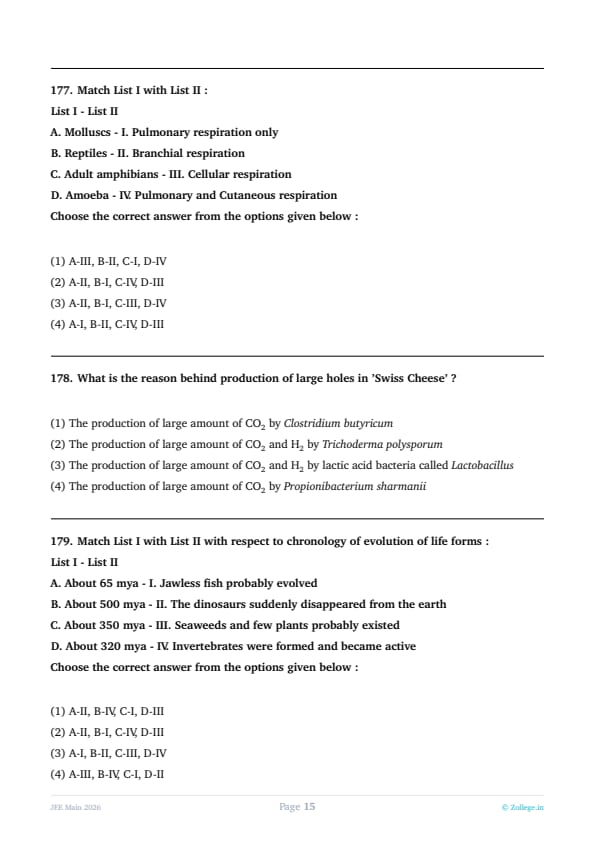
The following reaction depicts the activity of a particular class of enzymes :
% Context: Substrate X-C-C-Y -> X-Y + C=C
Identify the enzyme class 'E' from the following options :
View Solution
Step 1: Understanding the Concept:
Enzymes are classified into six groups based on the type of reaction they catalyze.
Step 2: Detailed Explanation:
1. Lyases are enzymes that catalyze the removal of groups from substrates by mechanisms other than hydrolysis, often leaving double bonds in the process.
2. The reaction shown (\( X-C-C-Y \rightarrow X-Y + C=C \)) clearly shows the removal of groups \( X \) and \( Y \) and the formation of a double bond (\( C=C \)).
- Ligases join molecules.
- Isomerases rearrange atoms.
- Transferases move groups between molecules.
Step 4: Final Answer:
The enzyme class is Lyases.
Quick Tip: If you see a double bond forming (\( = \)) as a result of a bond breaking without water being added, it's almost always a Lyase.
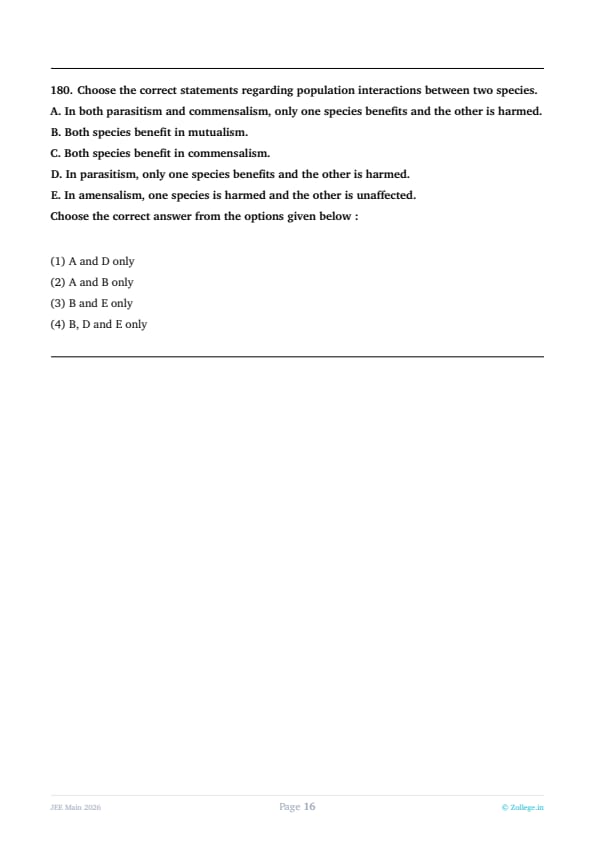
Match List I with List II :
List I - List II
A. Molluscs - I. Pulmonary respiration only
B. Reptiles - II. Branchial respiration
C. Adult amphibians - III. Cellular respiration
D. Amoeba - IV. Pulmonary and Cutaneous respiration
Choose the correct answer from the options given below :
View Solution
Step 1: Understanding the Concept:
Different animals have evolved different respiratory organs and mechanisms based on their habitats and complexity.
Step 2: Detailed Explanation:
A. Molluscs: Use gills (ctenidia) for respiration in aquatic environments, which is called branchial respiration. (A \(\rightarrow\) II).
B. Reptiles: Being purely terrestrial, they respire through lungs, which is pulmonary respiration. (B \(\rightarrow\) I).
C. Adult amphibians: Like frogs, they can respire using lungs (pulmonary) on land and through their moist skin (cutaneous) in water. (C \(\rightarrow\) IV).
D. Amoeba: A unicellular organism that exchanges gases directly across the cell membrane through diffusion, often categorized as cellular respiration at this scale. (D \(\rightarrow\) III).
The sequence is A-II, B-I, C-IV, D-III.
Step 4: Final Answer:
Matching the pairs correctly results in option (2).
Quick Tip: Adult Frogs are "Dual Respirators" (Skin + Lungs). Gills = Branchial. Lungs = Pulmonary. Skin = Cutaneous.
What is the reason behind production of large holes in 'Swiss Cheese' ?
View Solution
Step 1: Understanding the Concept:
Various microbes are used in the food industry to produce specific textures and flavors in dairy products.
Step 2: Detailed Explanation:
1. Swiss cheese is characterized by large holes (called "eyes").
2. These holes are formed due to the production of a large amount of \( CO_2 \) gas during the fermentation process.
3. The bacterium responsible for this specific fermentation is Propionibacterium sharmanii.
Step 4: Final Answer:
Large holes are produced by \( CO_2 \) from Propionibacterium sharmanii.
Quick Tip: Remember: {Propionibacterium for {P}unched-out holes in cheese. Roquefort cheese uses fungi, but Swiss cheese uses this specific bacterium.
Match List I with List II with respect to chronology of evolution of life forms :
List I - List II
A. About 65 mya - I. Jawless fish probably evolved
B. About 500 mya - II. The dinosaurs suddenly disappeared from the earth
C. About 350 mya - III. Seaweeds and few plants probably existed
D. About 320 mya - IV. Invertebrates were formed and became active
Choose the correct answer from the options given below :
View Solution
Step 1: Understanding the Concept:
The history of life on Earth is documented through geological time scales and fossil evidence, pinpointing major evolutionary milestones.
Step 2: Detailed Explanation:
A. 65 mya: This marks the end of the Cretaceous period when dinosaurs suddenly disappeared from the Earth. (A \(\rightarrow\) II).
B. 500 mya: Invertebrates were formed and became active during the Cambrian period. (B \(\rightarrow\) IV).
C. 350 mya: Jawless fish probably evolved during the Silurian/Devonian transition. (C \(\rightarrow\) I).
D. 320 mya: Seaweeds and few plants (like early seed plants) existed during the Carboniferous period. (D \(\rightarrow\) III).
The correct sequence is A-II, B-IV, C-I, D-III.
Step 4: Final Answer:
Matching the chronological events results in option (1).
Quick Tip: 65 mya is the most famous number in evolution—it's the extinction of the dinosaurs. Start your matching there!
Choose the correct statements regarding population interactions between two species.
A. In both parasitism and commensalism, only one species benefits and the other is harmed.
B. Both species benefit in mutualism.
C. Both species benefit in commensalism.
D. In parasitism, only one species benefits and the other is harmed.
E. In amensalism, one species is harmed and the other is unaffected.
Choose the correct answer from the options given below :
View Solution
Step 1: Understanding the Concept:
Population interactions are characterized by the effect (benefit, harm, or neutral) that individuals of different species have on each other.
Step 2: Detailed Explanation:
A. Incorrect: In commensalism, one species benefits (+) and the other is unaffected (0). In parasitism, one is harmed (-).
B. Correct: Mutualism is a (+,+) interaction where both benefit.
C. Incorrect: In commensalism, only one benefits.
D. Correct: Parasitism is a (+,-) interaction where the parasite benefits and the host is harmed.
E. Correct: Amensalism is a (-,0) interaction where one species is harmed and the other is unaffected.
Statements B, D, and E are correct.
Step 4: Final Answer:
The correct statements are B, D, and E.
Quick Tip: Use the +/- system:
Mutualism: (+/+)
Parasitism/Predation: (+/-)
Commensalism: (+/0)
Amensalism: (-/0)
Competition: (-/-)
NET 2026 Zoology Revision
*The article might have information for the previous academic years, please refer the official website of the exam.