
RE-NEET 2026 Botany Question Paper with Solution PDF
- Answer Key
- Merit List
- Seat Inkate
- Tripura Counselling
- Nagaland Counselling
- Kerala Counselling
- UP Counselling
- Assam Counselling
- West Bengal Counselling
- MP Counselling
- Haryana Counselling
- Chhattisgarh Counselling
- Gujarat Counselling
- Participating Colleges
- AP Counselling
- Manipur Counselling
- Mark Vs Rank
- Mizoram NEET Counselling
- Ayush Counselling
- TN NEET Counselling
- Andhra Pradesh Counsellin
- Karnataka NEET Counsellin
- Jharkhand NEET Counsellin
- MH NEET Counselling
- Bihar NEET Counselling
- Counselling
- Seat Allotment


Content Curator | Updated On - Jul 4, 2026
The RE-NEET 2026 Botany Question Paper is available here. The NTA conducted the NEET 2026 Re-Exam on June 21, from 2:00 PM to 5:15 PM. The exam comprised 180 questions for 720 marks, with a duration of 3 hours and 15 minutes.
The Botany section includes 45 questions carrying a total of 180 marks. Candidates are awarded 4 marks for each correct answer, while 1 mark is deducted for every incorrect response.
Candidates can download the RE-NEET 2026 Botany Question Paper, along with the Answer Key and Solution PDF, using the links provided below.
RE-NEET 2026 Botany Question Paper with Solution PDF
| RE-NEET Exam Botany Question Paper 2026 | Download PDF | Check Solution |
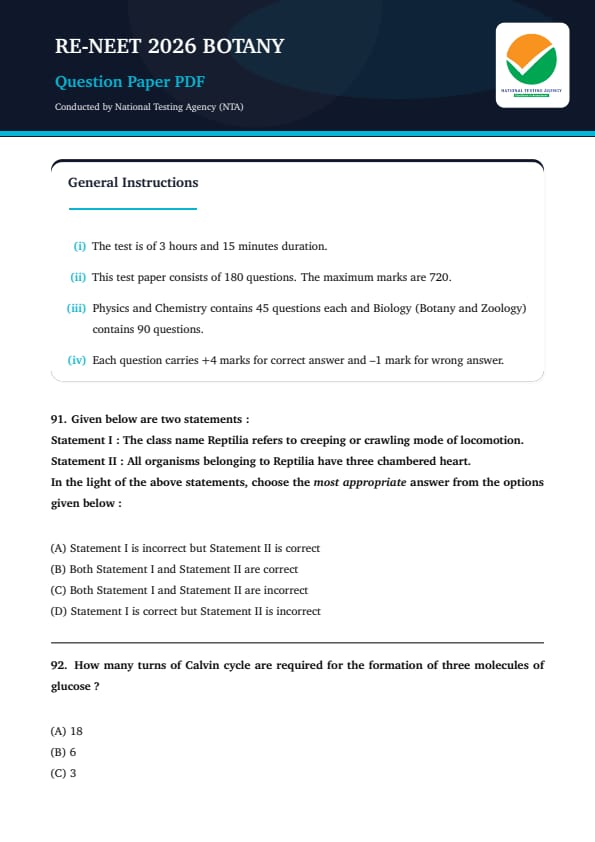
Given below are two statements :
Statement I : The class name Reptilia refers to creeping or crawling mode of locomotion.
Statement II : All organisms belonging to Reptilia have three chambered heart.
In the light of the above statements, choose the most appropriate answer from the options given below :
How many turns of Calvin cycle are required for the formation of three molecules of glucose ?
Photorespiration reaction catalyzed by RuBisCo is shown below :
\(RuBP + O_2 \rightarrow 3-Phosphoglycerate + X\)
Identify "X" from the given options :
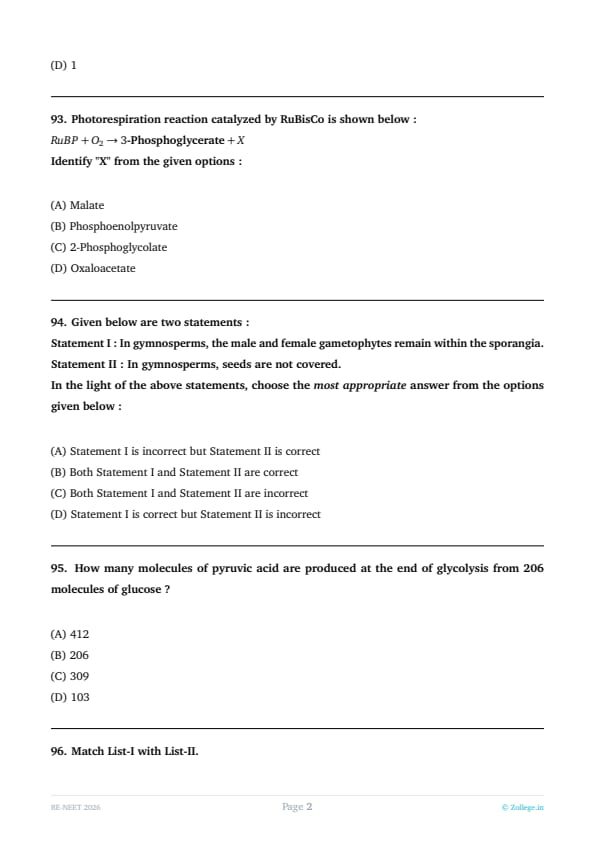
Given below are two statements :
Statement I : In gymnosperms, the male and female gametophytes remain within the sporangia.
Statement II : In gymnosperms, seeds are not covered.
In the light of the above statements, choose the most appropriate answer from the options given below :
How many molecules of pyruvic acid are produced at the end of glycolysis from 206 molecules of glucose ?
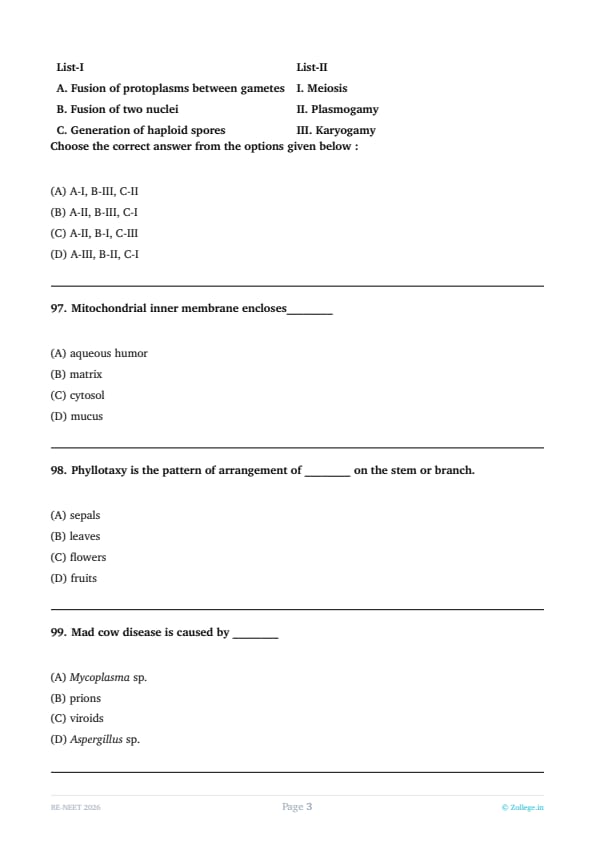
Match List-I with List-II.
{List-I} & {List-II}
A. Fusion of protoplasms between gametes & I. Meiosis
B. Fusion of two nuclei & II. Plasmogamy
C. Generation of haploid spores & III. Karyogamy
Choose the correct answer from the options given below :
View Solution
Step 1: Understanding the Question:
The question requires matching key stages of the sexual cycle in fungi (and general eukaryotic sexual reproduction) with their scientific terms.
Step 2: Detailed Explanation:
The sexual cycle in fungi typically involves three sequential steps:
A. Plasmogamy: The first step is the fusion of the cytoplasm (protoplasms) of two motile or non-motile gametes or mating types. (\(A \rightarrow II\))
B. Karyogamy: Following plasmogamy, the two haploid nuclei within the fused cell combine to form a single diploid nucleus (zygote). "Karyo" means nucleus. (\(B \rightarrow III\))
C. Meiosis: The diploid zygote undergoes reductional division (meiosis) to generate haploid sexual spores, resetting the chromosomal count. (\(C \rightarrow I\))
Matching results: A-II, B-III, C-I.
Step 3: Final Answer:
The correct matching is A-II, B-III, C-I.
Quick Tip: The prefixes are a dead giveaway: Plasmo- = plasma/cytoplasm; Karyo- = nucleus. Knowing just one root word can often solve the entire matching question!
Mitochondrial inner membrane encloses________
Phyllotaxy is the pattern of arrangement of ________ on the stem or branch.
Mad cow disease is caused by ________
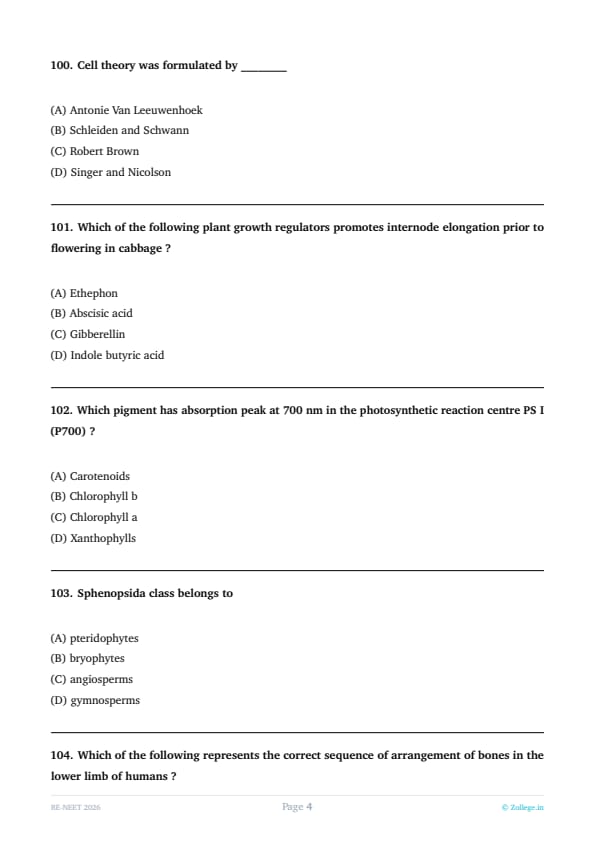
Cell theory was formulated by ________
Which of the following plant growth regulators promotes internode elongation prior to flowering in cabbage ?
Which pigment has absorption peak at 700 nm in the photosynthetic reaction centre PS I (P700) ?
Sphenopsida class belongs to
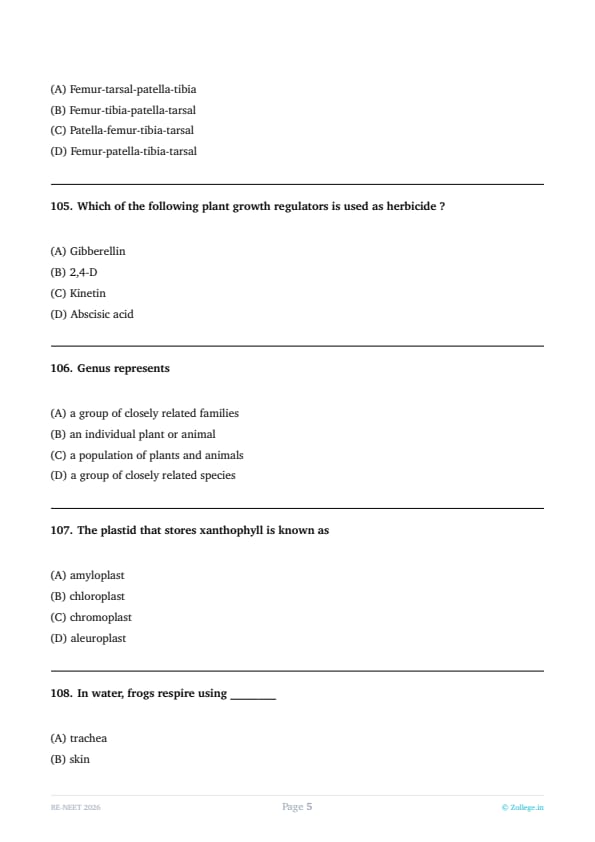
Which of the following represents the correct sequence of arrangement of bones in the lower limb of humans ?
Which of the following plant growth regulators is used as herbicide ?
Genus represents
The plastid that stores xanthophyll is known as
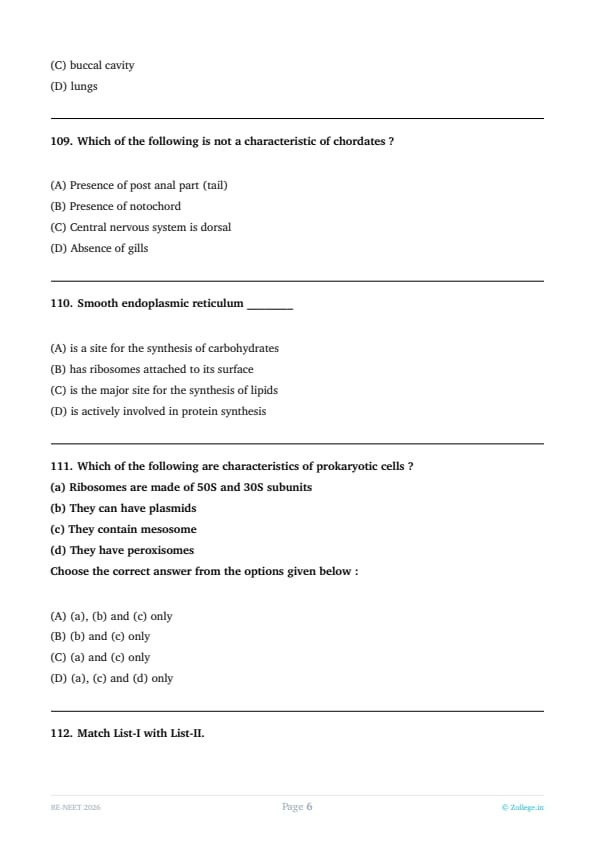
In water, frogs respire using ________
Which of the following is not a characteristic of chordates ?
Smooth endoplasmic reticulum ________
Which of the following are characteristics of prokaryotic cells ?
(a) Ribosomes are made of 50S and 30S subunits
(b) They can have plasmids
(c) They contain mesosome
(d) They have peroxisomes
Choose the correct answer from the options given below :
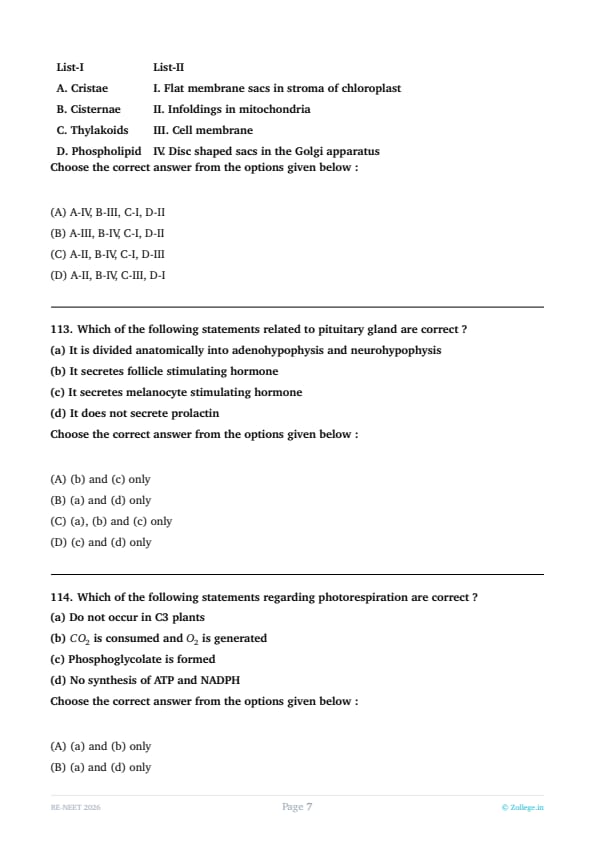
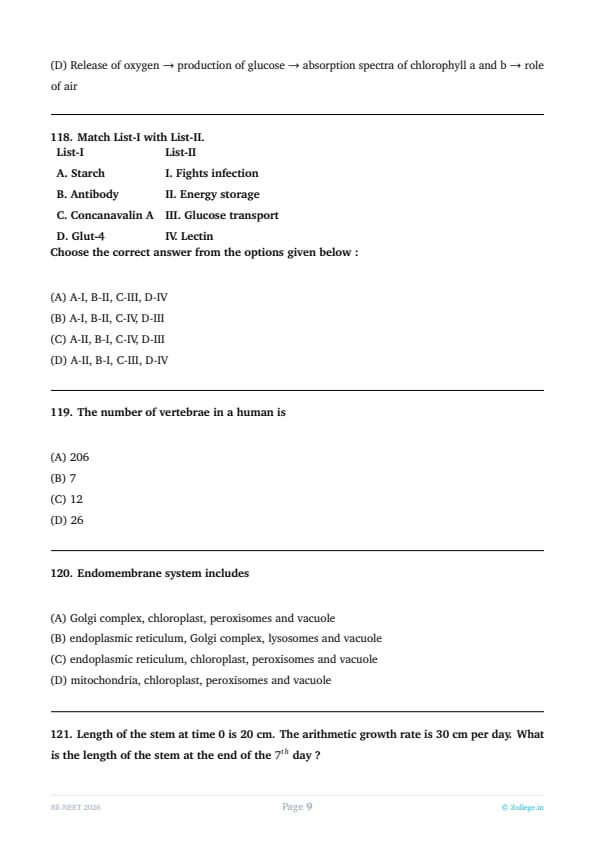
Match List-I with List-II.
{List-I} & {List-II}
A. Cristae & I. Flat membrane sacs in stroma of chloroplast
B. Cisternae & II. Infoldings in mitochondria
C. Thylakoids & III. Cell membrane
D. Phospholipid & IV. Disc shaped sacs in the Golgi apparatus
Choose the correct answer from the options given below :
View Solution
Step 1: Understanding the Question:
We need to correctly match cellular structures to their definitions or locations.
Step 2: Detailed Explanation:
Let's pair each biological term with its correct description:
A. Cristae: These are the deep, finger-like infoldings of the inner membrane of mitochondria that increase surface area for ATP production. (\(A \rightarrow II\))
B. Cisternae: These are the stacked, flat, disc-shaped membranous sacs that constitute the Golgi apparatus and Endoplasmic Reticulum. (\(B \rightarrow IV\))
C. Thylakoids: These are the flattened, coin-like membrane sacs located in the stroma of the chloroplast, which contain chlorophyll for light reactions. (\(C \rightarrow I\))
D. Phospholipid: The fundamental structural lipid molecule that forms the lipid bilayer of the cell membrane. (\(D \rightarrow III\))
Matching results: A-II, B-IV, C-I, D-III.
Step 3: Final Answer:
The correct matching is A-II, B-IV, C-I, D-III.
Quick Tip: Do not confuse {Cristae} (inner folds of Mitochondria) with {Cisternae} (stacked sacs of the Golgi). This is one of the most frequently tested vocabulary mix-ups in cytology!
Which of the following statements related to pituitary gland are correct ?
(a) It is divided anatomically into adenohypophysis and neurohypophysis
(b) It secretes follicle stimulating hormone
(c) It secretes melanocyte stimulating hormone
(d) It does not secrete prolactin
Choose the correct answer from the options given below :
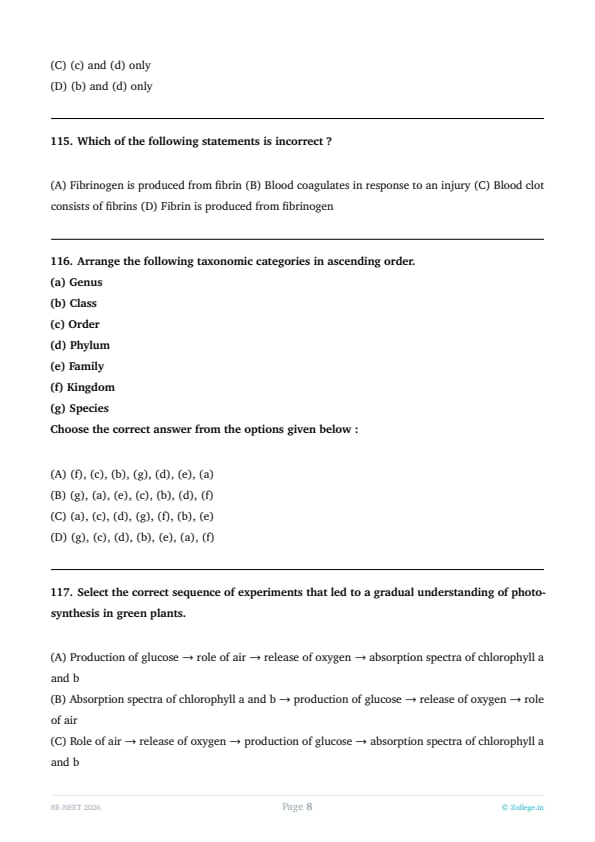
Which of the following statements regarding photorespiration are correct ?
(a) Do not occur in C3 plants
(b) \(CO_2\) is consumed and \(O_2\) is generated
(c) Phosphoglycolate is formed
(d) No synthesis of ATP and NADPH
Choose the correct answer from the options given below :
Which of the following statements is incorrect ?
Arrange the following taxonomic categories in ascending order.
(a) Genus
(b) Class
(c) Order
(d) Phylum
(e) Family
(f) Kingdom
(g) Species
Choose the correct answer from the options given below :
Select the correct sequence of experiments that led to a gradual understanding of photosynthesis in green plants.
Match List-I with List-II.
{List-I} & {List-II}
A. Starch & I. Fights infection
B. Antibody & II. Energy storage
C. Concanavalin A & III. Glucose transport
D. Glut-4 & IV. Lectin
Choose the correct answer from the options given below :
View Solution
Step 1: Understanding the Question:
We need to correctly match biological molecules/proteins from a standard biomolecules table with their primary physiological functions.
Step 2: Detailed Explanation:
Let's pair each molecule with its function:
A. Starch: A complex carbohydrate (polysaccharide) serving as the primary energy storage molecule in plants. (\(A \rightarrow II\))
B. Antibody: Specialized proteins (immunoglobulins) produced by the immune system to identify and neutralize foreign objects. They help fight infection. (\(B \rightarrow I\))
C. Concanavalin A: A carbohydrate-binding protein. Such proteins are classified as lectins. (\(C \rightarrow IV\))
D. GLUT-4: An insulin-regulated protein that facilitates glucose transport into cells, particularly in fat and muscle tissue. (\(D \rightarrow III\))
Matching results: A-II, B-I, C-IV, D-III.
Step 3: Final Answer:
The correct option is (3) A-II, B-I, C-IV, D-III.
Quick Tip: GLUT-4 stands for {GLU}cose {T}ransporter type 4. Even if you forget the others, knowing this abbreviation immediately solves part D.
The number of vertebrae in a human is
Endomembrane system includes
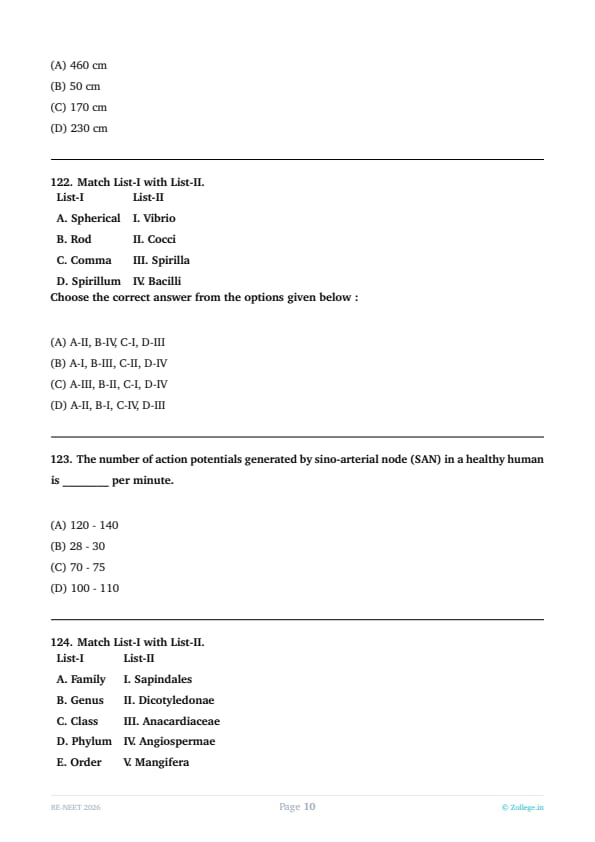
Length of the stem at time 0 is 20 cm. The arithmetic growth rate is 30 cm per day. What is the length of the stem at the end of the \(7^{th}\) day ?
Match List-I with List-II.
{List-I} & {List-II}
A. Spherical & I. Vibrio
B. Rod & II. Cocci
C. Comma & III. Spirilla
D. Spirillum & IV. Bacilli
Choose the correct answer from the options given below :
View Solution
Step 1: Understanding the Question:
Match the common morphological shapes of bacteria (List I) with their scientific taxonomic terminology (List II).
Step 2: Detailed Explanation:
Bacteria are grouped into four major categories based on their shape:
A. Spherical: Bacteria that are round or spherical are called Coccus (plural: Cocci). (\(A \rightarrow II\))
B. Rod: Bacteria that are rod-shaped are called Bacillus (plural: Bacilli). (\(B \rightarrow IV\))
C. Comma: Bacteria shaped like a comma are called Vibrio. (\(C \rightarrow I\))
D. Spirillum: Bacteria that have a spiral or helical shape are naturally called Spirillum (plural: Spirilla). (\(D \rightarrow III\))
Matching results: A-II, B-IV, C-I, D-III.
Step 3: Final Answer:
The correct option is (1) A-II, B-IV, C-I, D-III.
Quick Tip: Think of common diseases: Vibrio cholerae (comma-shaped cholera bacteria), Lactobacillus (rod-shaped in milk), Streptococcus (chains of spheres causing strep throat).
The number of action potentials generated by sino-arterial node (SAN) in a healthy human is ________ per minute.
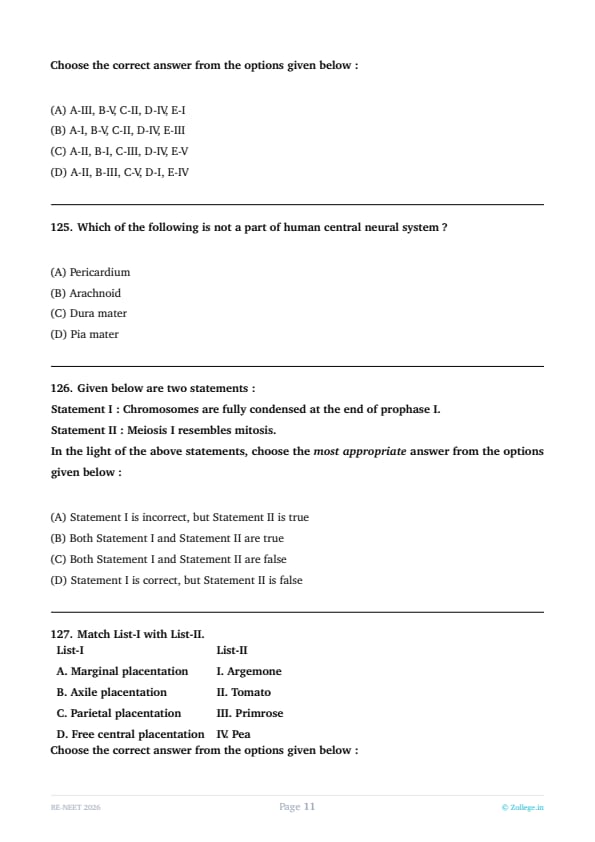
Match List-I with List-II.
{List-I} & {List-II}
A. Family & I. Sapindales
B. Genus & II. Dicotyledonae
C. Class & III. Anacardiaceae
D. Phylum & IV. Angiospermae
E. Order & V. Mangifera
Choose the correct answer from the options given below :
View Solution
Step 1: Understanding the Question:
The question requires matching various taxonomic categories with their specific nomenclature based on the biological classification of the mango plant ({Mangifera indica).
Step 2: Detailed Explanation:
Let us classify the mango plant step-by-step:
A. Family: Mango belongs to the family Anacardiaceae. (\(A \rightarrow III\))
B. Genus: The genus name of mango is Mangifera. (\(B \rightarrow V\))
C. Class: Mango is a dicotyledonous plant, so its class is Dicotyledonae. (\(C \rightarrow II\))
D. Phylum / Division: As a flowering plant, its division is Angiospermae. (\(D \rightarrow IV\))
E. Order: Mango belongs to the order Sapindales. (\(E \rightarrow I\))
Combining these, the correct match sequence is A-III, B-V, C-II, D-IV, E-I.
Step 3: Final Answer:
The correct matching is option (A).
Quick Tip: Always memorize the complete classification table of common organisms given in the NCERT text (Mango, Wheat, Housefly, Human) as direct matching questions are frequently derived from it.
Which of the following is not a part of human central neural system ?
Given below are two statements :
Statement I : Chromosomes are fully condensed at the end of prophase I.
Statement II : Meiosis I resembles mitosis.
In the light of the above statements, choose the most appropriate answer from the options given below :
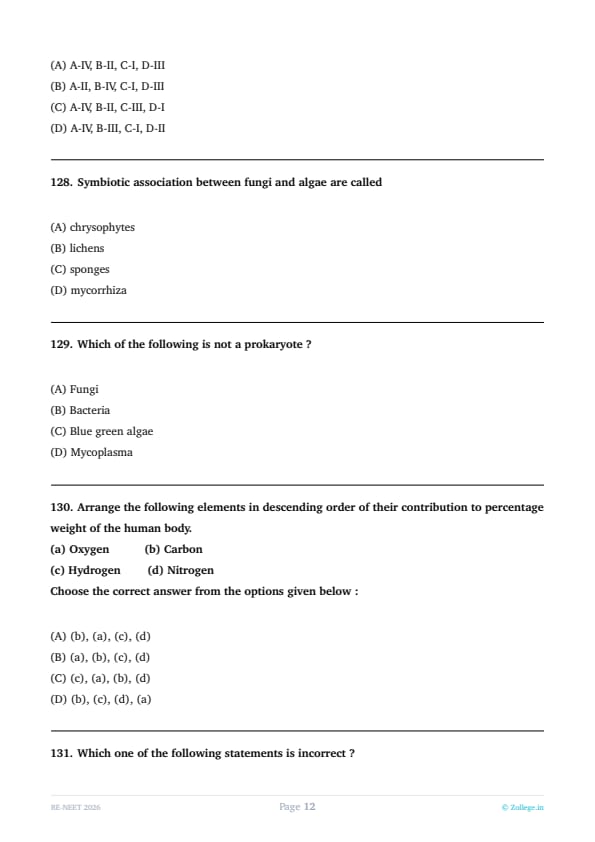
Match List-I with List-II.
{List-I} & {List-II}
A. Marginal placentation & I. Argemone
B. Axile placentation & II. Tomato
C. Parietal placentation & III. Primrose
D. Free central placentation & IV. Pea
Choose the correct answer from the options given below :
View Solution
Step 1: Understanding the Question:
The question asks to match different types of placentation (the arrangement of ovules within the ovary) with the plant examples that exhibit them.
Step 2: Detailed Explanation:
Let's match each placentation type with its classic example:
A. Marginal placentation: The placenta forms a ridge along the ventral suture of the ovary, and ovules are borne on this ridge forming two rows. Example: Pea. (\(A \rightarrow IV\))
B. Axile placentation: The placenta is axial, and the ovules are attached to it in a multilocular ovary. Examples: China rose, Tomato, and lemon. (\(B \rightarrow II\))
C. Parietal placentation: Ovules develop on the inner wall of the ovary or on the peripheral part. Examples: Mustard and Argemone. (\(C \rightarrow I\))
D. Free central placentation: Ovules are borne on a central axis, and septa are absent. Examples: Dianthus and Primrose. (\(D \rightarrow III\))
Matching results: A-IV, B-II, C-I, D-III.
Step 3: Final Answer:
The correct matching is option (A).
Quick Tip: Placentation examples are high-yield questions. Memorize the key pairs: Marginal = Pea; Axile = Tomato, Lemon, China rose; Parietal = Mustard, Argemone; Free central = Dianthus, Primrose; Basal = Sunflower, Marigold.
Symbiotic association between fungi and algae are called
Which of the following is not a prokaryote ?
Arrange the following elements in descending order of their contribution to percentage weight of the human body.
(a) Oxygen \hspace{1cm} (b) Carbon
(c) Hydrogen \hspace{0.7cm} (d) Nitrogen
Choose the correct answer from the options given below :
View Solution
Step 1: Understanding the Question:
We need to arrange four major chemical elements in the decreasing order of their percentage weight contribution to the human body.
Step 2: Detailed Explanation:
Based on the standard elemental analysis of the human body, the percentage weight of these elements is roughly:
1. Oxygen (O): ~65%
2. Carbon (C): ~18.5%
3. Hydrogen (H): ~9.5%
4. Nitrogen (N): ~3.3%
Descending order (highest to lowest) is Oxygen > Carbon > Hydrogen > Nitrogen.
This corresponds to the sequence (a), (b), (c), (d).
Step 3: Final Answer:
The correct descending sequence is (a), (b), (c), (d).
Quick Tip: Water makes up about 60-70% of the human body by weight, and since oxygen is much heavier than hydrogen (16:2 mass ratio in \(H_2O\)), Oxygen is overwhelmingly the most abundant element by mass in the body!
Which one of the following statements is incorrect ?
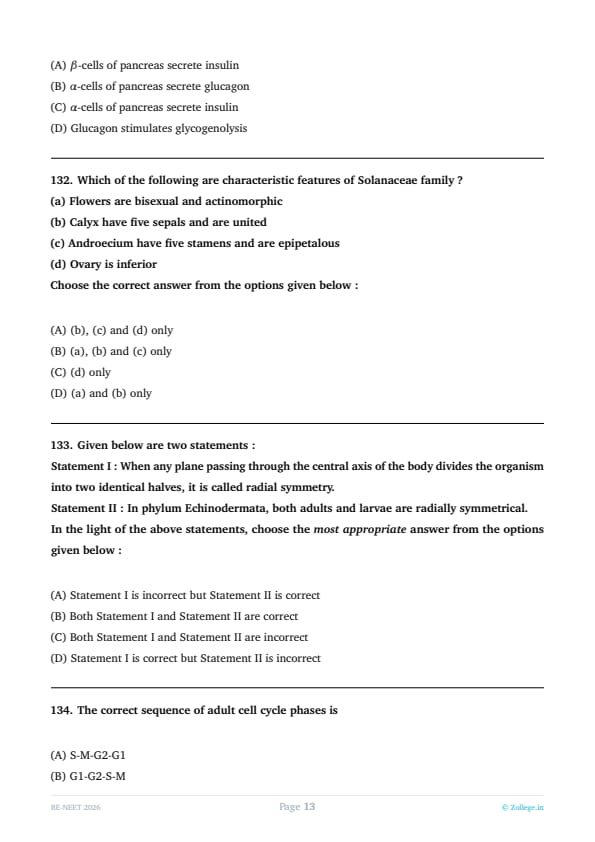
Which of the following are characteristic features of Solanaceae family ?
(a) Flowers are bisexual and actinomorphic
(b) Calyx have five sepals and are united
(c) Androecium have five stamens and are epipetalous
(d) Ovary is inferior
Choose the correct answer from the options given below :
Given below are two statements :
Statement I : When any plane passing through the central axis of the body divides the organism into two identical halves, it is called radial symmetry.
Statement II : In phylum Echinodermata, both adults and larvae are radially symmetrical.
In the light of the above statements, choose the most appropriate answer from the options given below :
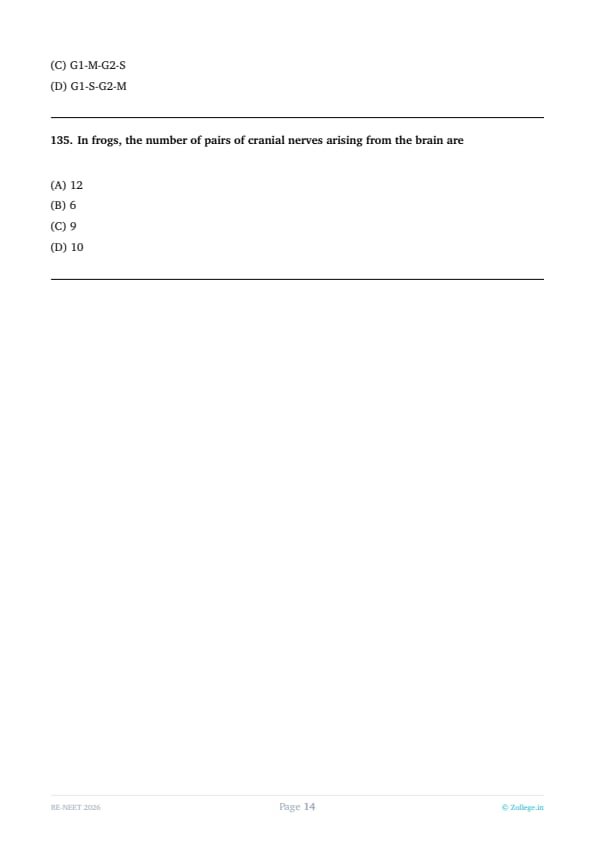
The correct sequence of adult cell cycle phases is
In frogs, the number of pairs of cranial nerves arising from the brain are
RE-NEET 2026 Botany Topic-Wise Weightage
| Topic | Expected Questions |
|---|---|
| Molecular Basis of Inheritance | 6–7 |
| Biotechnology: Principles and Processes | 5–6 |
| Biotechnology and Its Applications | 4–5 |
| Plant Kingdom | 3–5 |
| Morphology of Flowering Plants | 3–4 |
| Cell: The Unit of Life | 3–4 |
| Biomolecules | 3–4 |
| Sexual Reproduction in Flowering Plants | 3–5 |
| Photosynthesis in Higher Plants | 2–3 |
| Plant Growth and Development | 2–3 |
| Anatomy of Flowering Plants | 2–3 |
| Respiration in Plants | 1–2 |
| Biological Classification | 1–2 |
| The Living World | 1 |
RE-NEET 2026 Botany Paper Analysis
*The article might have information for the previous academic years, please refer the official website of the exam.