
RE-NEET 2026 Chemistry Question Paper with Solution PDF
- Answer Key
- Merit List
- Seat Inkate
- Tripura Counselling
- Nagaland Counselling
- Kerala Counselling
- UP Counselling
- Assam Counselling
- West Bengal Counselling
- MP Counselling
- Haryana Counselling
- Chhattisgarh Counselling
- Gujarat Counselling
- Participating Colleges
- AP Counselling
- Manipur Counselling
- Mark Vs Rank
- Mizoram NEET Counselling
- Ayush Counselling
- TN NEET Counselling
- Andhra Pradesh Counsellin
- Karnataka NEET Counsellin
- Jharkhand NEET Counsellin
- MH NEET Counselling
- Bihar NEET Counselling
- Counselling
- Seat Allotment


Content Curator | Updated On - Jul 4, 2026
The RE-NEET 2026 Chemistry Question Paper is available here. The NTA conducted the NEET 2026 Re-Exam on June 21, from 2:00 PM to 5:15 PM. The exam comprised 180 questions for 720 marks, with a duration of 3 hours and 15 minutes.
The Chemistry section includes 45 questions carrying a total of 180 marks. Candidates are awarded 4 marks for each correct answer, while 1 mark is deducted for every incorrect response.
Candidates can download the RE-NEET 2026 Chemistry Question Paper, along with the Answer Key and Solution PDF, using the links provided below.
RE-NEET 2026 Chemistry Question Paper with Solution PDF
| RE-NEET Exam Chemistry Question Paper 2026 | Download PDF | Check Solution |
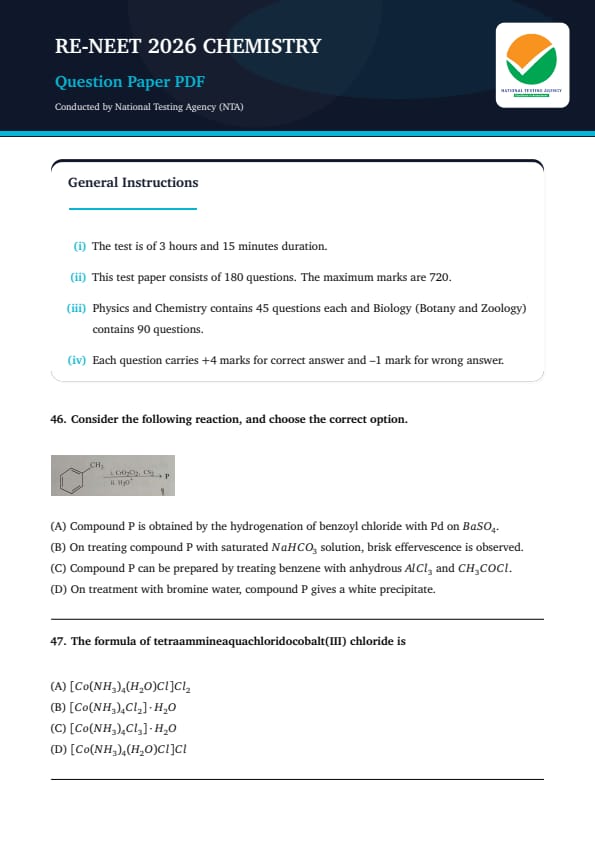
Consider the following reaction, and choose the correct option.

The formula of tetraammineaquachloridocobalt(III) chloride is
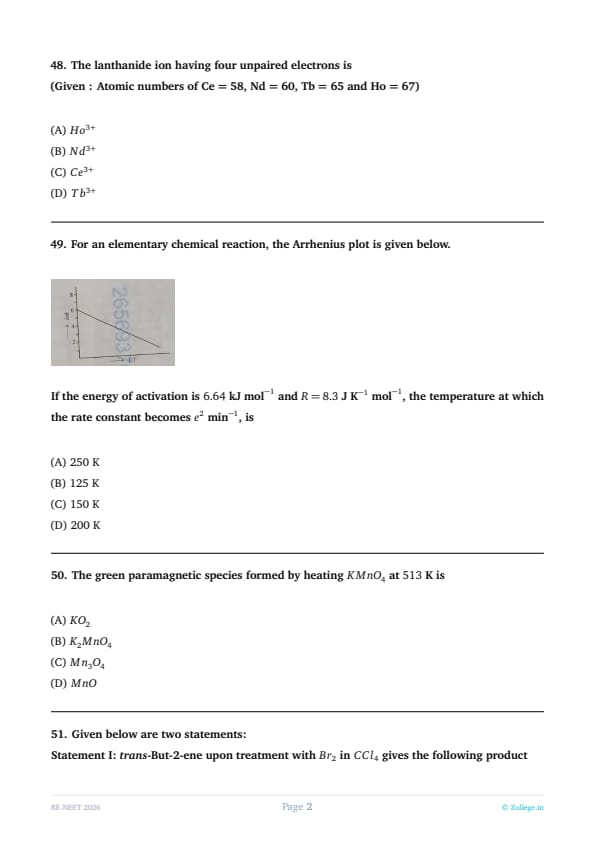
The lanthanide ion having four unpaired electrons is
(Given : Atomic numbers of Ce = 58, Nd = 60, Tb = 65 and Ho = 67)
For an elementary chemical reaction, the Arrhenius plot is given below.

If the energy of activation is \(6.64 kJ mol^{-1}\) and \(R = 8.3 J K^{-1} mol^{-1}\), the temperature at which the rate constant becomes \(e^2 min^{-1}\), is
The green paramagnetic species formed by heating \(KMnO_4\) at \(513 K\) is
Given below are two statements:
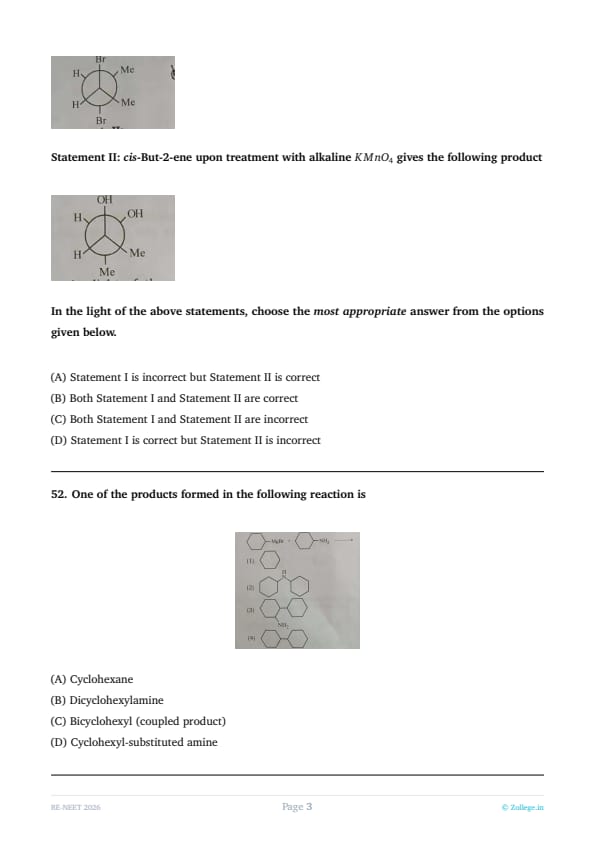
Statement I: trans-But-2-ene upon treatment with \(Br_2\) in \(CCl_4\) gives the following product

Statement II: cis-But-2-ene upon treatment with alkaline \(KMnO_4\) gives the following product

In the light of the above statements, choose the most appropriate answer from the options given below.
One of the products formed in the following reaction is

Given below are two statements:
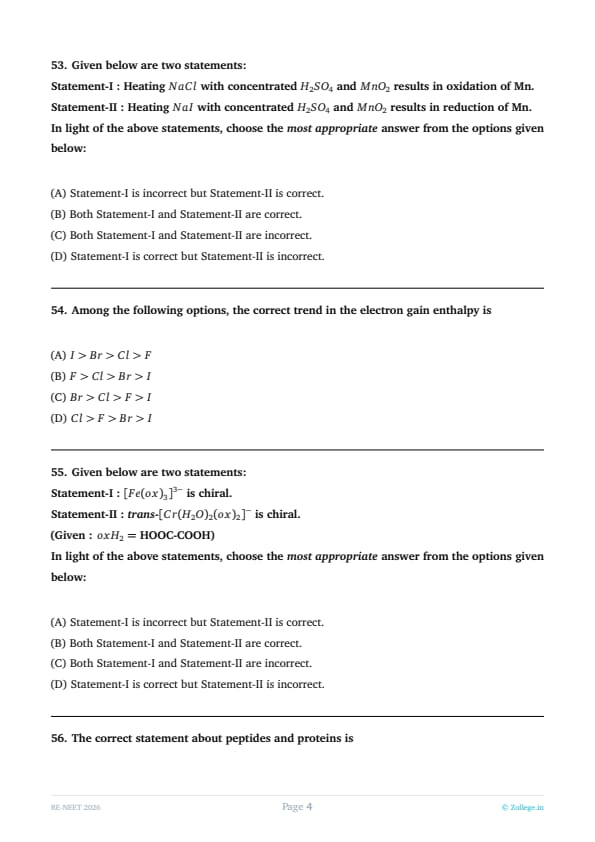
Statement-I : Heating \(NaCl\) with concentrated \(H_2SO_4\) and \(MnO_2\) results in oxidation of Mn.
Statement-II : Heating \(NaI\) with concentrated \(H_2SO_4\) and \(MnO_2\) results in reduction of Mn.
In light of the above statements, choose the {most appropriate answer from the options given below:
Among the following options, the correct trend in the electron gain enthalpy is
Given below are two statements:
Statement-I : \([Fe(ox)_3]^{3-}\) is chiral.
Statement-II : {trans-\([Cr(H_2O)_2(ox)_2]^-\) is chiral.
(Given : \(oxH_2\) = HOOC-COOH)
In light of the above statements, choose the {most appropriate answer from the options given below:
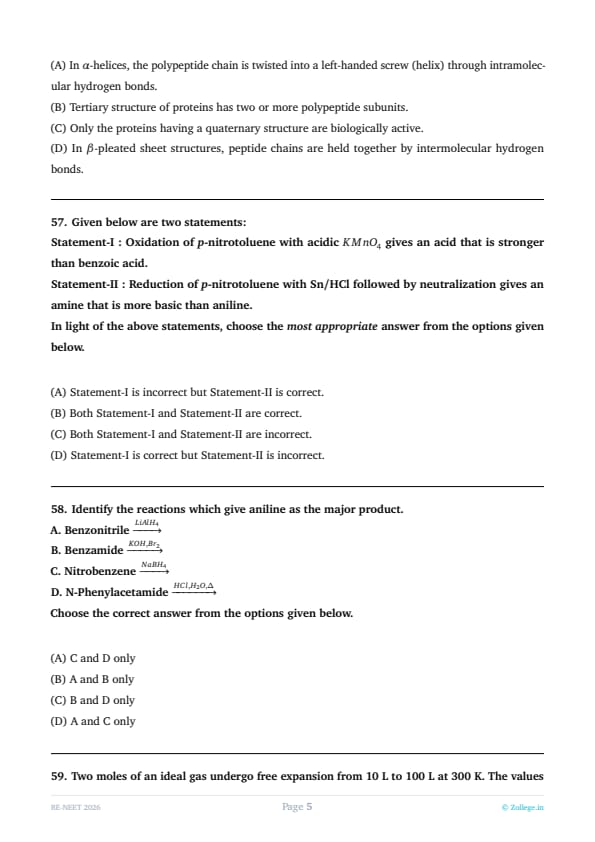
The correct statement about peptides and proteins is
Given below are two statements:
Statement-I : Oxidation of p-nitrotoluene with acidic \(KMnO_4\) gives an acid that is stronger than benzoic acid.
Statement-II : Reduction of {p-nitrotoluene with Sn/HCl followed by neutralization gives an amine that is more basic than aniline.
In light of the above statements, choose the {most appropriate answer from the options given below.
Identify the reactions which give aniline as the major product.
A. Benzonitrile \(\xrightarrow{LiAlH_4}\)
B. Benzamide \(\xrightarrow{KOH, Br_2}\)
C. Nitrobenzene \(\xrightarrow{NaBH_4}\)
D. N-Phenylacetamide \(\xrightarrow{HCl, H_2O, \Delta}\)
Choose the correct answer from the options given below.
View Solution
Step 1: Understanding the Question:
Evaluate four organic transformation pathways to identify which ones produce aniline (\(C_6H_5NH_2\)) as the major product.
Step 3: Detailed Explanation:
Let's predict the product for each reaction:
A. Benzonitrile (\(Ph-CN\)) treated with a strong reducing agent like \(LiAlH_4\) reduces the nitrile completely to a primary amine, forming benzylamine (\(Ph-CH_2NH_2\)), not aniline.
B. Benzamide (\(Ph-CONH_2\)) reacts with \(Br_2\) in the presence of \(KOH\). This is the Hoffmann bromamide degradation reaction, which removes the carbonyl carbon as carbonate and yields a primary amine with one less carbon: Aniline (\(Ph-NH_2\)).
C. Nitrobenzene (\(Ph-NO_2\)) with \(NaBH_4\). Sodium borohydride is a mild reducing agent and is generally unreactive toward aromatic nitro groups under normal conditions. It does not yield aniline. (Typically, \(Sn/HCl\) or \(H_2/Pd\) is used).
D. N-Phenylacetamide (Acetanilide, \(Ph-NH-COCH_3\)) boiled with aqueous HCl undergoes acid-catalyzed amide hydrolysis. The amide bond cleaves to form Aniline (\(Ph-NH_2\)) and acetic acid (\(CH_3COOH\)).
Reactions B and D yield aniline.
Step 4: Final Answer:
The correct options are B and D only.
Quick Tip: Hoffmann bromamide degradation is an excellent step-down reaction for synthesizing aromatic amines directly from primary amides. Amide hydrolysis is the standard method for unprotecting an amine.
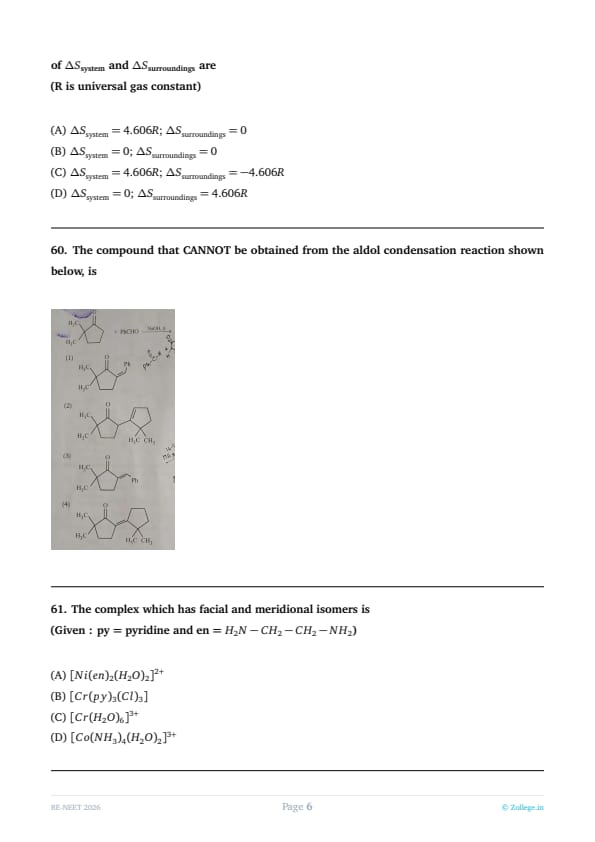
Two moles of an ideal gas undergo free expansion from 10 L to 100 L at 300 K. The values of \(\Delta S_{system}\) and \(\Delta S_{surroundings}\) are
(R is universal gas constant)
The compound that CANNOT be obtained from the aldol condensation reaction shown below, is

The complex which has facial and meridional isomers is
(Given : py = pyridine and en = \(H_2N-CH_2-CH_2-NH_2\))
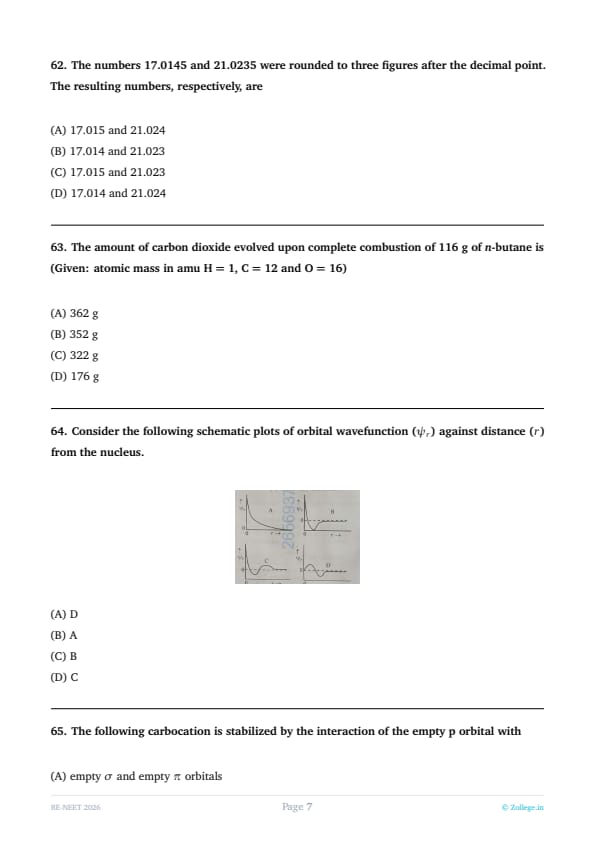
The numbers 17.0145 and 21.0235 were rounded to three figures after the decimal point. The resulting numbers, respectively, are
The amount of carbon dioxide evolved upon complete combustion of 116 g of n-butane is
(Given: atomic mass in amu H = 1, C = 12 and O = 16)
Consider the following schematic plots of orbital wavefunction (\(\psi_r\)) against distance (\(r\)) from the nucleus.

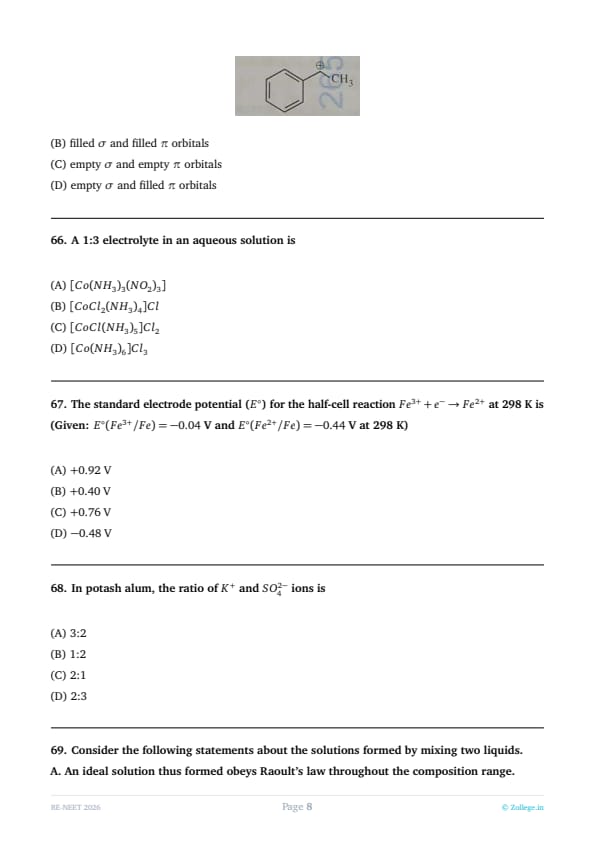
The following carbocation is stabilized by the interaction of the empty p orbital with

A 1:3 electrolyte in an aqueous solution is
The standard electrode potential (\(E^\circ\)) for the half-cell reaction \(Fe^{3+} + e^- \rightarrow Fe^{2+}\) at 298 K is
(Given: \(E^\circ(Fe^{3+}/Fe) = -0.04 V\) and \(E^\circ(Fe^{2+}/Fe) = -0.44 V\) at 298 K)
In potash alum, the ratio of \(K^+\) and \(SO_4^{2-}\) ions is
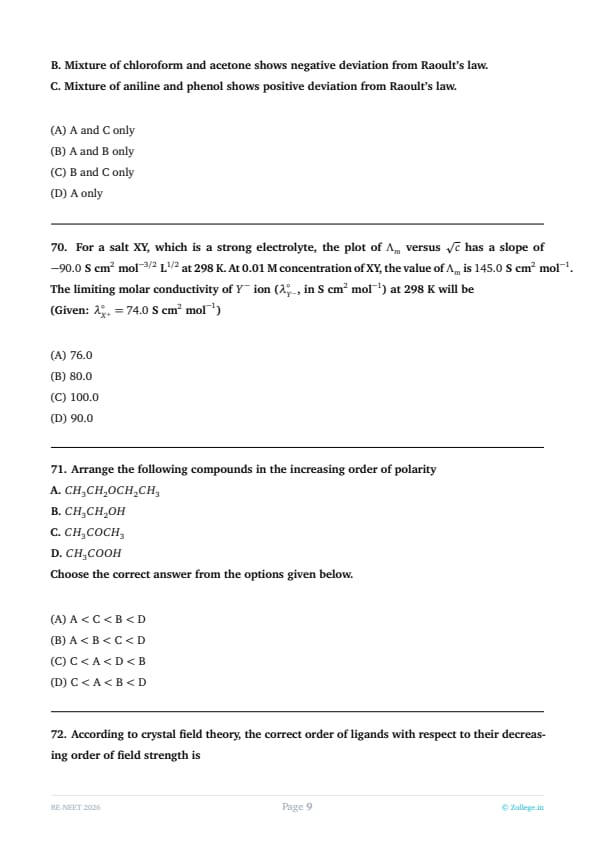
Consider the following statements about the solutions formed by mixing two liquids.
A. An ideal solution thus formed obeys Raoult's law throughout the composition range.
B. Mixture of chloroform and acetone shows negative deviation from Raoult's law.
C. Mixture of aniline and phenol shows positive deviation from Raoult's law.
For a salt XY, which is a strong electrolyte, the plot of \(\Lambda_m\) versus \(\sqrt{c}\) has a slope of \(-90.0 S cm^2 mol^{-3/2} L^{1/2}\) at 298 K. At 0.01 M concentration of XY, the value of \(\Lambda_m\) is \(145.0 S cm^2 mol^{-1}\). The limiting molar conductivity of \(Y^-\) ion (\(\lambda_{Y^-}^\circ\), in \(S cm^2 mol^{-1}\)) at 298 K will be
(Given: \(\lambda_{X^+}^\circ = 74.0 S cm^2 mol^{-1}\))
Arrange the following compounds in the increasing order of polarity
A. \(CH_3CH_2OCH_2CH_3\)
B. \(CH_3CH_2OH\)
C. \(CH_3COCH_3\)
D. \(CH_3COOH\)
Choose the correct answer from the options given below.
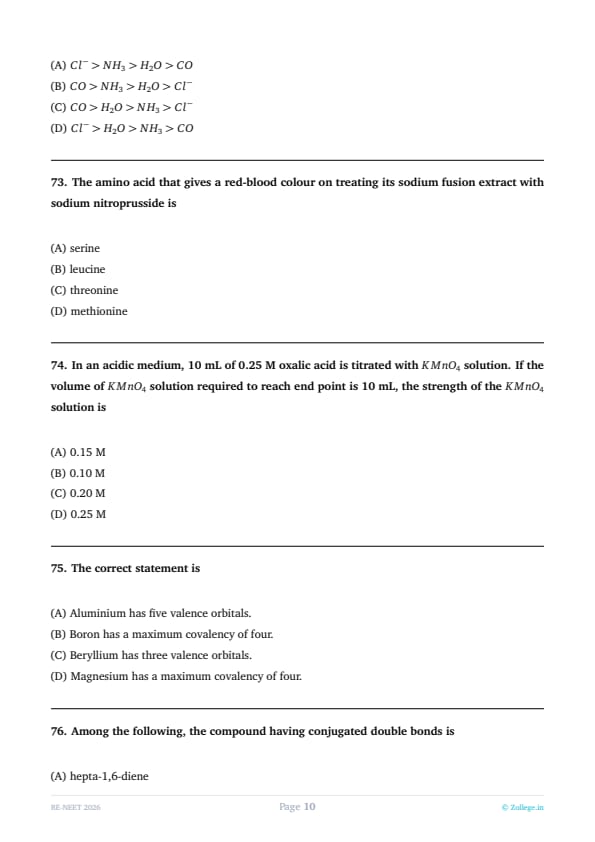
According to crystal field theory, the correct order of ligands with respect to their decreasing order of field strength is
The amino acid that gives a red-blood colour on treating its sodium fusion extract with sodium nitroprusside is
In an acidic medium, 10 mL of 0.25 M oxalic acid is titrated with \(KMnO_4\) solution. If the volume of \(KMnO_4\) solution required to reach end point is 10 mL, the strength of the \(KMnO_4\) solution is
The correct statement is
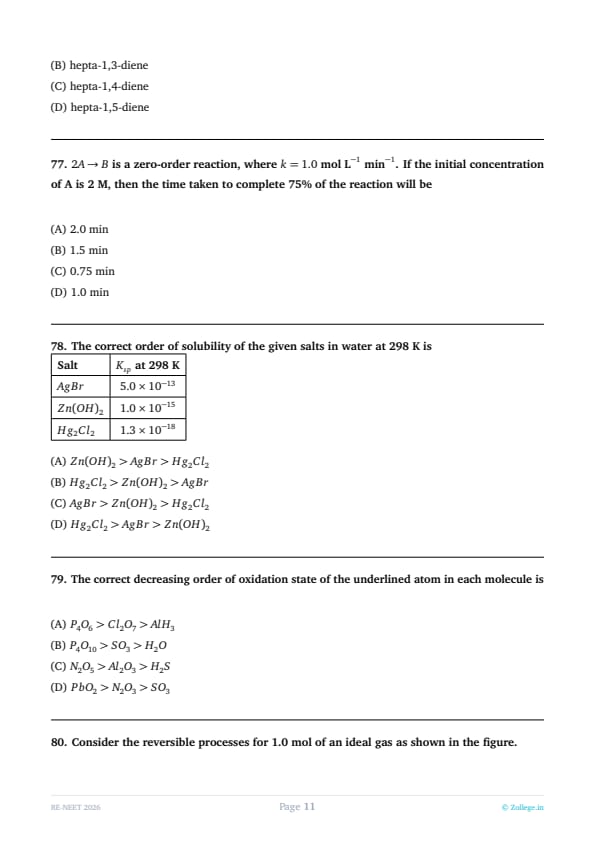
Among the following, the compound having conjugated double bonds is
\(2A \rightarrow B\) is a zero-order reaction, where \(k = 1.0 mol L^{-1} min^{-1}\). If the initial concentration of A is 2 M, then the time taken to complete 75% of the reaction will be
The correct order of solubility of the given salts in water at 298 K is
{Salt} & \(K_{sp}\) at 298 K
\(AgBr\) & \(5.0 \times 10^{-13}\)
\(Zn(OH)_2\) & \(1.0 \times 10^{-15}\)
\(Hg_2Cl_2\) & \(1.3 \times 10^{-18}\)
The correct decreasing order of oxidation state of the underlined atom in each molecule is
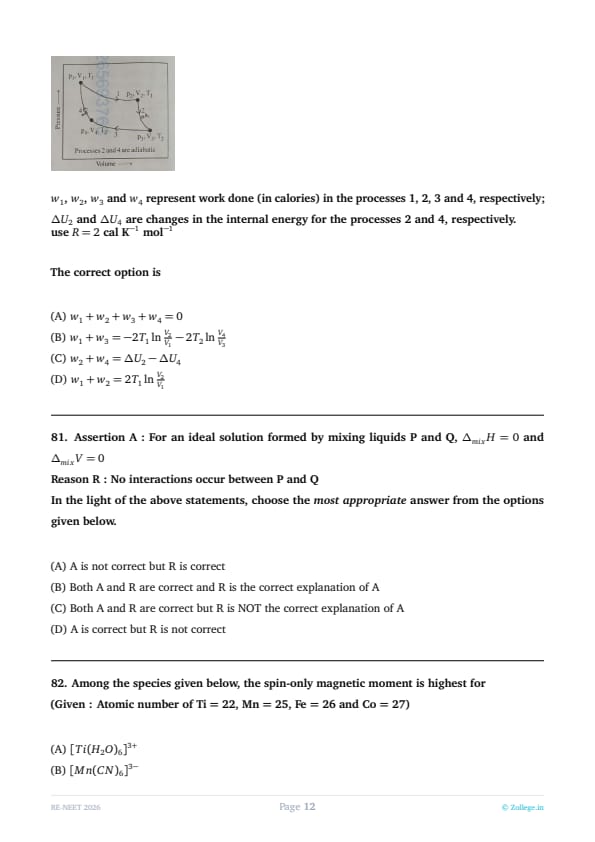
Consider the reversible processes for 1.0 mol of an ideal gas as shown in the figure.

\(w_1\), \(w_2\), \(w_3\) and \(w_4\) represent work done (in calories) in the processes 1, 2, 3 and 4, respectively; \(\Delta U_2\) and \(\Delta U_4\) are changes in the internal energy for the processes 2 and 4, respectively.
[use \(R = 2 cal K^{-1} mol^{-1}\)]
The correct option is
Assertion A : For an ideal solution formed by mixing liquids P and Q, \(\Delta_{mix} H = 0\) and \(\Delta_{mix} V = 0\)
Reason R : No interactions occur between P and Q
In the light of the above statements, choose the {most appropriate answer from the options given below.
Among the species given below, the spin-only magnetic moment is highest for
(Given : Atomic number of Ti = 22, Mn = 25, Fe = 26 and Co = 27)
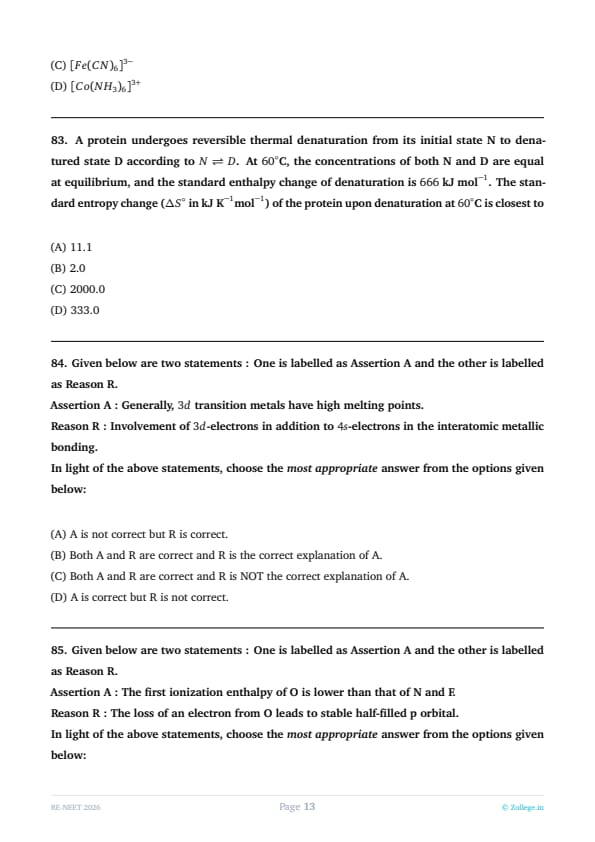
A protein undergoes reversible thermal denaturation from its initial state N to denatured state D according to \(N \rightleftharpoons D\). At \(60^\circC\), the concentrations of both N and D are equal at equilibrium, and the standard enthalpy change of denaturation is \(666 kJ mol^{-1}\). The standard entropy change (\(\Delta S^\circ\) in \(kJ K^{-1}mol^{-1}\)) of the protein upon denaturation at \(60^\circC\) is closest to
Given below are two statements : One is labelled as Assertion A and the other is labelled as Reason R.
Assertion A : Generally, \(3d\) transition metals have high melting points.
Reason R : Involvement of \(3d\)-electrons in addition to \(4s\)-electrons in the interatomic metallic bonding.
In light of the above statements, choose the {most appropriate answer from the options given below:
Given below are two statements : One is labelled as Assertion A and the other is labelled as Reason R.
Assertion A : The first ionization enthalpy of O is lower than that of N and F.
Reason R : The loss of an electron from O leads to stable half-filled p orbital.
In light of the above statements, choose the most appropriate answer from the options given below:
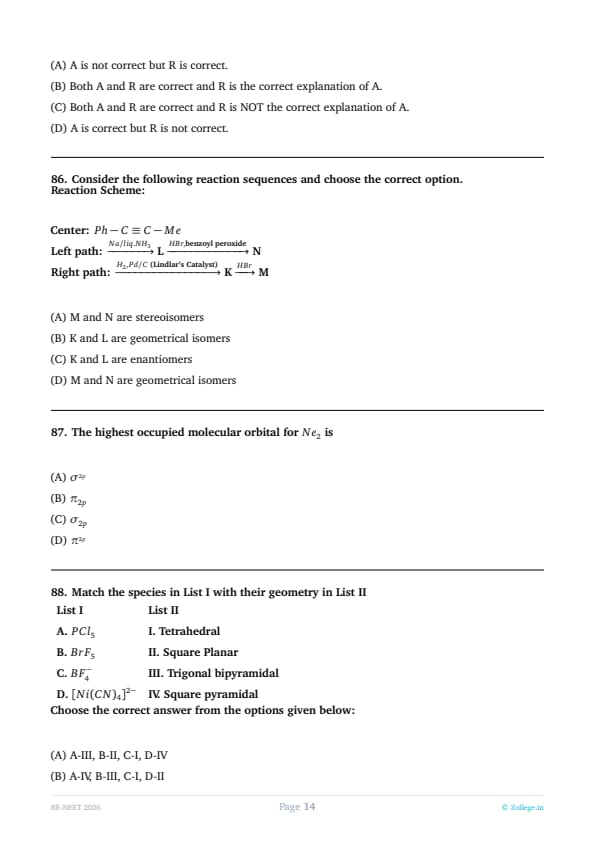
Consider the following reaction sequences and choose the correct option.
[Reaction Scheme:]
Center: \(Ph-C\equiv C-Me\)
Left path: \(\xrightarrow{Na/liq. NH_3}\) L \(\xrightarrow{HBr, benzoyl peroxide}\) N
Right path: \(\xrightarrow{H_2, Pd/C (Lindlar's Catalyst)}\) K \(\xrightarrow{HBr}\) M
The highest occupied molecular orbital for \(Ne_2\) is
Match the species in List I with their geometry in List II
{List I} & {List II}
A. \(PCl_5\) & I. Tetrahedral
B. \(BrF_5\) & II. Square Planar
C. \(BF_4^-\) & III. Trigonal bipyramidal
D. \([Ni(CN)_4]^{2-}\) & IV. Square pyramidal
Choose the correct answer from the options given below:
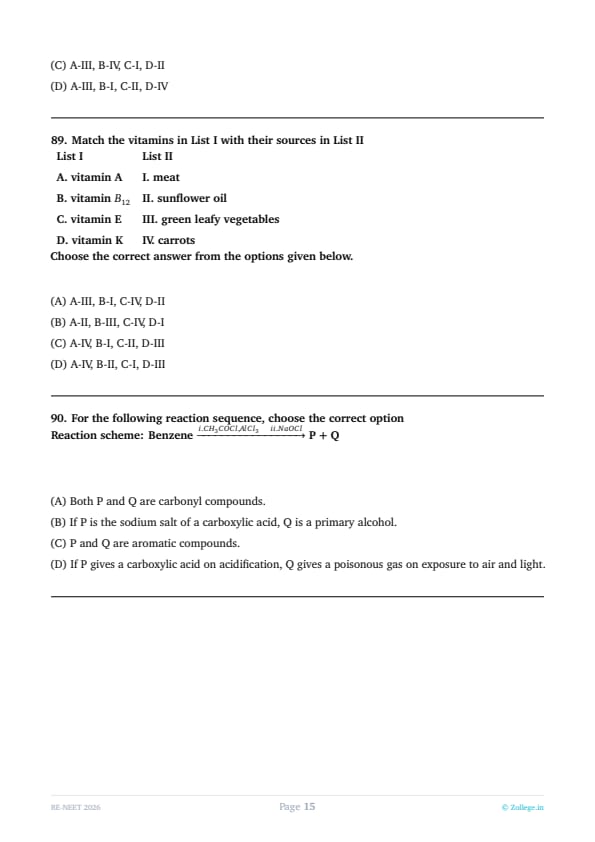
Match the vitamins in List I with their sources in List II
{List I} & {List II}
A. vitamin A & I. meat
B. vitamin \(B_{12}\) & II. sunflower oil
C. vitamin E & III. green leafy vegetables
D. vitamin K & IV. carrots
Choose the correct answer from the options given below.
For the following reaction sequence, choose the correct option
[Reaction scheme: Benzene \(\xrightarrow{i. CH_3COCl, AlCl_3 \quad ii. NaOCl}\) P + Q]
View Solution
Step 1: Understanding the Question:
We need to determine the intermediate and final products of a two-step organic reaction sequence starting from benzene, and then evaluate four descriptive statements about the final products P and Q.
Step 2: Key Formula or Approach:
1. Friedel-Crafts Acylation: Benzene + Acetyl chloride (\(CH_3COCl\)) + Lewis acid (\(AlCl_3\)) yields Acetophenone (\(Ph-CO-CH_3\)).
2. Haloform Reaction: Acetophenone contains a methyl ketone group (\(-CO-CH_3\)). Treatment with sodium hypochlorite (\(NaOCl\)) undergoes the haloform reaction to yield the sodium salt of a carboxylic acid (\(Ph-COONa\)) and a haloform precipitate (\(CHCl_3\)).
Step 3: Detailed Explanation:
Step 1 product: Acetophenone.
Step 2 products (P + Q): Sodium benzoate (\(C_6H_5COONa\)) and Chloroform (\(CHCl_3\)).
Let's evaluate the options based on these products:
(A) Neither Sodium benzoate nor Chloroform is considered a standard "carbonyl compound" (ketone/aldehyde) in this context. Chloroform certainly isn't. (False)
(B) If P is sodium benzoate, Q is chloroform, which is a haloalkane, not a primary alcohol. (False)
(C) Sodium benzoate is aromatic, but chloroform is aliphatic. Both are not aromatic. (False)
(D) If P is sodium benzoate (\(PhCOONa\)), acidification yields benzoic acid (\(PhCOOH\)). If Q is chloroform (\(CHCl_3\)), exposure to oxygen and UV light oxidizes it to phosgene gas (\(COCl_2\)), which is highly poisonous. This perfectly matches the properties of the products. (True)
Step 4: Final Answer:
The correct statement is (4) If P gives a carboxylic acid on acidification, Q gives a poisonous gas on exposure to air and light.
Quick Tip: Chloroform is stored in dark amber bottles filled to the brim to prevent the formation of deadly phosgene gas (\(2CHCl_3 + O_2 \xrightarrow{light} 2COCl_2 + 2HCl\)).
RE-NEET 2026 Chemistry Topic-Wise Weightage
| Topic | Expected Questions |
|---|---|
| Organic Chemistry - Some Basic Principles & Techniques | 3–4 |
| Equilibrium | 2–3 |
| Hydrocarbons | 2–3 |
| Chemical Kinetics | 2–3 |
| Coordination Compounds | 2–3 |
| Aldehydes, Ketones & Carboxylic Acids | 2–3 |
| Solutions | 2–3 |
| Chemical Bonding and Molecular Structure | 2 |
| Structure of Atom | 2 |
| Classification of Elements & Periodicity in Properties | 2 |
| Some Basic Concepts of Chemistry | 2 |
| The d- and f-Block Elements | 2 |
| Amines | 2 |
| Haloalkanes & Haloarenes | 2 |
| Electrochemistry | 1–2 |
| Thermodynamics | 1–2 |
| The p-Block Elements (Group 15 to 18) | 1–2 |
| Alcohols, Phenols & Ethers | 1–2 |
| Biomolecules | 1–2 |
| Redox Reactions | 1 |
| Principles Related to Practical Chemistry | 1 |
| The p-Block Elements (Group 13 & 14) | 1 |
RE-NEET 2026 Chemistry Paper Analysis
*The article might have information for the previous academic years, please refer the official website of the exam.