
GATE 2023 Economics Question Paper with Solution Pdf
- Chemistry Syllabus
- Maths Syllabus
- Physics Syllabus
- Exam Pattern
- Paper Analysis
- Chemical Engg Syllabus
- Civil Engg Syllabus
- ECE Syllabus
- Mechanical Engg Syllabus
- Engg Science Syllabus
- Mining Engg Syllabus
- IN Syllabus
- CSE Syllabus
- EE Syllabus
- AE Syllabus
- BM Syllabus
- GG Syllabus
- EY Syllabus
- ST Syllabus
- TF Syllaus
- AR Syllabus
- XL Syllabus
- MT Syllabus
- PI Syllabus
- PE Syllabus
- ME Pattern
- TF Pattern
- CE Pattern
- EE Pattern
- EC Pattern
- CS Pattern
- BT Pattern
- BM Pattern
- IN Pattern
- DA Syllabus
- NA & ME Syallabus
- ES & Engg Syllabus
- Geomatics Engg Syllabus
- Agri Engg Syllabus
- Humanities and Social Sci
- PI Syllabus


| Updated On - Jan 2, 2026
GATE Question Papers are the most important study material for effective exam preparation. We at Zollege have provided all GATE Previous Year Papers with Solution PDFs here. GATE 2023 Economics exam was conducted successfully on February 5 by Indian Institute of Technology Kanpur.
Students can freely download the GATE previous year's question paper PDFs along with their solutions here. We strongly encourage GATE aspirants to scan through all the GATE Question Paper to know the overall difficulty level, GATE Syllabus and understand the changes in GATE Exam Pattern over the years.
GATE 2023 Economics Question Paper with Solution PDF
| GATE 2023 Economics Question Paper PDF | GATE 2023 Economics Solution PDF |
|---|---|
| Download PDF | Check Solutions |

Rafi told Mary, “I am thinking of watching a film this weekend."
The following reports the above statement in indirect speech:
Rafi told Mary that he __________ of watching a film that weekend.
View Solution
Step 1: Understanding the Question
The question requires converting a sentence from direct speech to indirect (or reported) speech. This involves changing tenses, pronouns, and words indicating time and place.
Step 2: Rules for Conversion
1. Reporting Verb Tense: The reporting verb is "told," which is in the past tense.
2. Tense Change: When the reporting verb is in the past tense, the tense of the verb in the direct speech must be shifted back. The verb in the direct speech is "am thinking," which is in the Present Continuous Tense. It will change to the Past Continuous Tense.
3. Pronoun Change: The pronoun "I" refers to the speaker, Rafi (male). So, "I" changes to "he".
4. Time Adverbial Change: The phrase "this weekend" changes to "that weekend".
Step 3: Applying the Rules
Direct Speech: “I am thinking of watching a film this weekend."
Applying the rules:
"I" becomes "he".
"am thinking" (Present Continuous) becomes "was thinking" (Past Continuous).
"this weekend" becomes "that weekend".
Indirect Speech: Rafi told Mary that he was thinking of watching a film that weekend.
Step 4: Final Answer
The correct verb form to fill in the blank is "was thinking".
Quick Tip: In direct to indirect speech conversion, if the reporting verb (like 'said' or 'told') is in the past tense, you must shift the tense of the direct statement one step back. For example: Present Simple becomes Past Simple, Present Continuous becomes Past Continuous, and Present Perfect becomes Past Perfect.
Permit : __________ :: Enforce : Relax
(By word meaning)
View Solution
Step 1: Understanding the Question
This is an analogy question based on word meaning. We need to identify the relationship between the second pair of words ("Enforce : Relax") and apply the same relationship to the first pair ("Permit : ______").
Step 2: Analyzing the Relationship
The words "Enforce" and "Relax" are antonyms. To enforce a law means to make sure it is obeyed, while to relax a law means to make it less strict. They represent opposite actions.
Step 3: Applying the Relationship to the First Pair
We need to find the antonym for the word "Permit".
Permit means to give authorization or consent to (someone) to do something.
Let's examine the options:
(A) Allow: This is a synonym of "Permit".
(B) Forbid: This means to refuse to allow something, which is the direct opposite of "Permit".
(C) License: This is a noun referring to an official document that gives permission. It is related but not an antonym.
(D) Reinforce: This means to strengthen or support, which is not an opposite.
Step 4: Final Answer
The antonym of "Permit" is "Forbid". Therefore, the completed analogy is Permit : Forbid :: Enforce : Relax.
Quick Tip: In analogy questions, first pinpoint the precise relationship between the given pair of words. Common relationships include synonym/antonym, cause/effect, part/whole, object/function, and type/kind.
Given a fair six-faced dice where the faces are labelled '1', '2', '3', '4', '5', and '6', what is the probability of getting a ‘1' on the first roll of the dice and a ‘4' on the second roll?
View Solution
Step 1: Understanding the Question
The problem asks for the probability of two independent events happening in sequence: getting a '1' on the first roll of a fair six-sided die, and then getting a '4' on the second roll.
Step 2: Key Formula or Approach
For independent events A and B, the probability of both events occurring is the product of their individual probabilities:
\[ P(A and B) = P(A) \times P(B) \]
Step 3: Detailed Explanation
Event A: Getting a '1' on the first roll.
A fair six-faced die has 6 possible outcomes: \{1, 2, 3, 4, 5, 6\.
The number of favorable outcomes for getting a '1' is 1.
The probability of Event A is:
\[ P(A) = \frac{Number of favorable outcomes}{Total number of outcomes} = \frac{1}{6} \]
Event B: Getting a '4' on the second roll.
The second roll is independent of the first. It also has 6 possible outcomes.
The number of favorable outcomes for getting a '4' is 1.
The probability of Event B is:
\[ P(B) = \frac{Number of favorable outcomes}{Total number of outcomes} = \frac{1}{6} \]
Combined Probability.
To find the probability of both events happening, we multiply their individual probabilities:
\[ P(A and B) = P(A) \times P(B) = \frac{1}{6} \times \frac{1}{6} = \frac{1}{36} \]
Step 4: Final Answer
The probability of getting a '1' on the first roll and a '4' on the second roll is \(\frac{1}{36}\).
Quick Tip: Remember to distinguish between independent and dependent events. Rolling a die twice are independent events, as the outcome of the first roll does not affect the second. For sequential events described with "and," you typically multiply their probabilities.
A recent survey shows that 65% of tobacco users were advised to stop consuming tobacco. The survey also shows that 3 out of 10 tobacco users attempted to stop using tobacco.
Based only on the information in the above passage, which one of the following options can be logically inferred with certainty?
View Solution
Step 1: Understanding the Question
We are given two pieces of information about a group of tobacco users and asked to determine which conclusion can be drawn with absolute certainty.
Fact 1: 65% of tobacco users were advised to stop.
Fact 2: 3 out of 10 (which is 30%) of tobacco users attempted to stop.
Step 2: Analyzing the Options
Let's analyze each option based on the given facts. Let T be the total number of tobacco users.
(A) A majority of tobacco users who were advised to stop consuming tobacco made an attempt to do so.
This asks if the number of people who were both advised \textit{and attempted is greater than 50% of those who were advised. The group of people who attempted (30% of T) could be a subset of the group who were advised (65% of T). In the most optimistic scenario, all 30% who attempted were also advised. The fraction of advised users who attempted would be \(\frac{0.30T{0.65T} = \frac{30}{65} \approx 0.46\), which is 46%. Since 46% is not a majority (\(>\) 50%), this statement cannot be true even in the best-case scenario. It cannot be inferred with certainty.
(B) A majority of tobacco users who were advised to stop consuming tobacco did not attempt to do so.
Let's consider the group of advised users (65% of T). The maximum number of people from this group who could have attempted to stop is 30% of T (this happens if everyone who attempted was also advised).
In this case, the number of advised users who did not attempt would be \(0.65T - 0.30T = 0.35T\).
Is \(0.35T\) a majority of \(0.65T\)? Let's check the fraction: \(\frac{0.35T{0.65T} = \frac{35}{65} \approx 0.538\), which is 53.8%.
Since 53.8% is greater than 50%, a majority of the advised users did not attempt to stop, even in the scenario with the maximum possible overlap. If the overlap is smaller, this percentage will be even higher. Therefore, this statement can be inferred with certainty.
(C) Approximately 30% of tobacco users successfully stopped consuming tobacco.
The passage states that 30% \textit{attempted to stop, not that they were \textit{successful. We cannot infer success from an attempt.
(D) Approximately 65% of tobacco users successfully stopped consuming tobacco.
The passage states that 65% were \textit{advised to stop, not that they were \textit{successful. We cannot infer success from advice.
Step 3: Final Answer
The only statement that can be logically inferred with certainty is (B).
Quick Tip: For logical inference questions with percentages, it's often helpful to consider the "worst-case" or "best-case" scenario for the overlap between the groups to test the certainty of a statement.
How many triangles are present in the given figure?

View Solution
Step 1: Understanding the Question
The task is to count all the triangles in the given geometric figure. A systematic approach is needed to avoid missing any or counting them multiple times.
Step 2: Systematic Counting Strategy
We can count the triangles by categorizing them based on the number of small triangular components they are made of. Let's label the vertices for clarity. Top row: A, B, C, D. Bottom row: E, F, G, H.
Step 3: Detailed Explanation
Triangles made of 1 small component:
There are 8 small, individual triangles clearly visible in the figure.
Count = 8
Triangles made of 2 small components:
These triangles are formed by combining two adjacent small triangles.
Pointing right (base on the left diagonal): Triangles with vertices (A,B,F), (B,C,G), (C,D,H). (3 triangles)
Pointing left (base on the right diagonal): Triangles with vertices (B,A,E), (C,B,F), (D,C,G). (3 triangles)
Count = 3 + 3 = 6
Triangles made of 3 small components:
There are no triangles formed by combining 3 small components.
Count = 0
Triangles made of 4 small components:
These are larger triangles that span across the figure.
Triangles with vertices (A,C,G), (B,D,H). (2 triangles)
Triangles with vertices (B,F,H), (C,E,G). Wait, this combination is not right. Let's recheck.
Vertices: (A, C, G), (B, D, H). (2 triangles)
Vertices: (E, G, C), (F, H, B). (2 triangles)
Count = 4
Triangles made of 6 small components:
These are the largest triangles that form half of the parallelogram.
Triangle with vertices (A,D,H). (1 triangle)
Triangle with vertices (A,D,E). (1 triangle)
Count = 2
Step 4: Final Answer
Total number of triangles = (triangles of size 1) + (size 2) + (size 4) + (size 6)
Total = 8 + 6 + 4 + 2 = 20.
Quick Tip: When counting figures, develop a system. Start with the smallest components and gradually build up to larger shapes. Labelling vertices can also help in keeping track of the shapes you have already counted.
Students of all the departments of a college who have successfully completed the registration process are eligible to vote in the upcoming college elections. However, by the time the due date for registration was over, it was found that surprisingly none of the students from the Department of Human Sciences had completed the registration process.
Based only on the information provided above, which one of the following sets of statement(s) can be logically inferred with certainty?
(i) All those students who would not be eligible to vote in the college elections would certainly belong to the Department of Human Sciences.
(ii) None of the students from departments other than Human Sciences failed to complete the registration process within the due time.
(iii) All the eligible voters would certainly be students who are not from the Department of Human Sciences.
View Solution
Step 1: Understanding the Question
We need to evaluate three statements based on the given premises and determine which one(s) must be true.
Premise 1: Eligible Voter \(\implies\) Completed Registration.
Premise 2: Student from Human Sciences \(\implies\) Did NOT Complete Registration.
Step 2: Deriving a Direct Conclusion
From Premise 2, we know no student from Human Sciences completed registration. From Premise 1, we know that to be eligible, one must complete registration. Therefore, we can conclude with certainty that no student from the Department of Human Sciences is an eligible voter.
Step 3: Analyzing the Statements
(i) All those students who would not be eligible to vote in the college elections would certainly belong to the Department of Human Sciences.
This statement is of the form: Not Eligible \(\implies\) From Human Sciences. This is not necessarily true. We know Human Sciences students are not eligible, but students from other departments might also have failed to register for various reasons. The passage does not say that \textit{only Human Sciences students failed to register. So, we cannot be certain about this.
(ii) None of the students from departments other than Human Sciences failed to complete the registration process within the due time.
This means all students from other departments successfully registered. The passage gives no information about the registration status of students from other departments. It only provides information about the Human Sciences department. Therefore, we cannot infer this.
(iii) All the eligible voters would certainly be students who are not from the Department of Human Sciences.
This statement is of the form: Eligible Voter \(\implies\) NOT from Human Sciences. This is the contrapositive of our derived conclusion ("Student from Human Sciences \(\implies\) Not an Eligible Voter"). A statement and its contrapositive are logically equivalent. Since we are certain that no student from Human Sciences is eligible, it must be true that any student who IS eligible cannot be from Human Sciences. This statement can be inferred with certainty.
Step 4: Final Answer
Only statement (iii) can be logically inferred with certainty.
Quick Tip: In logic, if a statement "If P, then Q" is true, its contrapositive "If not Q, then not P" is also always true. Recognizing this relationship can quickly help validate or invalidate inferences.
Which one of the following options represents the given graph?

View Solution
Step 1: Understanding the Question
We need to identify the function that corresponds to the given graph by analyzing its key features like symmetry, behavior at the origin, and limits as x approaches infinity.
Step 2: Analyzing the Graph's Features
Origin: The graph passes through the origin, so \(f(0) = 0\).
Symmetry: The graph is symmetric with respect to the origin. This means it is an odd function, where \(f(-x) = -f(x)\).
End Behavior: As \(x \to \infty\), the graph approaches 0 from the positive side (\(f(x) \to 0^+\)). As \(x \to -\infty\), the graph approaches 0 from the negative side (\(f(x) \to 0^-\)).
Extrema: There is a local maximum in the first quadrant (for \(x>0\)) and a local minimum in the third quadrant (for \(x<0\)).
Step 3: Evaluating the Options
(A) \(f(x) = x^2 2^{-|x|}\):
Let's test for symmetry: \(f(-x) = (-x)^2 2^{-|-x|} = x^2 2^{-|x|} = f(x)\). This is an even function, which should be symmetric about the y-axis. The graph is not. So, (A) is incorrect.
(B) \(f(x) = x 2^{-|x|}\):
- Origin: \(f(0) = 0 \times 2^{-|0|} = 0 \times 1 = 0\). (Matches)
- Symmetry: \(f(-x) = (-x) 2^{-|-x|} = -x 2^{-|x|} = -f(x)\). This is an odd function. (Matches)
- End Behavior: As \(x \to \infty\), \(x\) grows linearly while \(2^{-x}\) decays exponentially. The exponential decay dominates, so \(f(x) \to 0\). For \(x>0\), \(f(x)\) is positive. As \(x \to -\infty\), let \(x = -y\) with \(y \to \infty\). \(f(-y) = -y \times 2^{-|-y|} = -y \times 2^{-y} \to 0\). For \(x<0\), \(f(x)\) is negative. (Matches)
This function fits all the key features.
(C) \(f(x) = |x| 2^{-x}\):
Let's test end behavior for \(x \to -\infty\). Let \(x = -2\). \(f(-2) = |-2| \times 2^{-(-2)} = 2 \times 2^2 = 8\). As \(x \to -\infty\), \(f(x)\) grows exponentially and goes to \(+\infty\). This does not match the graph. So, (C) is incorrect.
(D) \(f(x) = x 2^{-x}\):
Let's test end behavior for \(x \to -\infty\). Let \(x = -2\). \(f(-2) = (-2) \times 2^{-(-2)} = -2 \times 2^2 = -8\). As \(x \to -\infty\), \(f(x)\) goes to \(-\infty\). This does not match the graph. So, (D) is incorrect.
Step 4: Final Answer
The function \(f(x) = x 2^{-|x|}\) is the only one that matches all the characteristics of the given graph.
Quick Tip: Quickly check for symmetry when matching graphs to functions. If the graph is symmetric about the y-axis, it's an even function (\(f(-x)=f(x)\)). If it's symmetric about the origin, it's an odd function (\(f(-x)=-f(x)\)). This can often eliminate several options immediately.
Which one of the options does NOT describe the passage below or follow from it?
We tend to think of cancer as a 'modern' illness because its metaphors are so modern. It is a disease of overproduction, of sudden growth, a growth that is unstoppable, tipped into the abyss of no control. Modern cell biology encourages us to imagine the cell as a molecular machine. Cancer is that machine unable to quench its initial command (to grow) and thus transform into an indestructible, self-propelled automaton.
[Adapted from \textit{The Emperor of All Maladies by Siddhartha Mukherjee]
View Solution
Step 1: Understanding the Question
We need to read the given passage and identify which of the four options is a false statement, either by not being mentioned or by directly contradicting the information in the passage.
Step 2: Analyzing the Passage
The main points of the passage are:
Cancer is considered 'modern' due to its modern metaphors (overproduction, unstoppable growth).
Modern cell biology encourages the metaphor of a cell as a "molecular machine".
Cancer is described as this "machine" that cannot stop its growth command, becoming an "indestructible, self-propelled automaton".
The central theme is the use of modern, machine-based metaphors to understand cancer.
Step 3: Evaluating the Options
(A) It is a reflection of why cancer seems so modern to most of us.
The very first sentence states, "We tend to think of cancer as a 'modern' illness because its metaphors are so modern." This option accurately reflects the passage's main point. So, it follows from the passage.
(B) It tells us that modern cell biology uses and promotes metaphors of machinery.
The passage says, "Modern cell biology encourages us to imagine the cell as a molecular machine." This directly supports the idea that cell biology uses machinery metaphors. So, it follows from the passage.
(C) Modern cell biology encourages metaphors of machinery, and cancer is often imagined as a machine.
The passage combines these two ideas: "Modern cell biology encourages us to imagine the cell as a molecular machine. Cancer is that machine..." This option is a correct summary of a key argument in the passage. So, it follows from the passage.
(D) Modern cell biology never uses figurative language, such as metaphors, to describe or explain anything.
This statement is in direct contradiction to the passage. The entire passage is about how modern cell biology \textit{does use metaphors, specifically the "molecular machine" metaphor, to describe cells and cancer. The passage explicitly states that biology "encourages us to imagine" the cell in this metaphorical way. Therefore, this option does NOT follow from the passage.
Step 4: Final Answer
Option (D) is the correct answer because it makes a claim that is directly refuted by the text.
Quick Tip: In "which does NOT follow" questions, look for options that make absolute claims (using words like "never," "always," "all," "none"). These are often easier to invalidate. If the passage provides even one counterexample, the absolute claim is false.
The digit in the unit's place of the product \(3^{999} \times 7^{1000}\) is ______.
View Solution
Step 1: Understanding the Question
We need to find the last digit (unit's digit) of the number obtained by multiplying \(3^{999}\) and \(7^{1000}\). We can do this by finding the unit's digit of each part separately and then multiplying them.
Step 2: Key Formula or Approach
The unit digits of powers of a number repeat in a cycle. We need to find the length of this cycle (cyclicity) and use it to determine the unit digit for a given large power. The unit digit of \( (a \times b) \) is the unit digit of \( (unit digit of a \times unit digit of b) \).
Step 3: Detailed Explanation
Finding the unit digit of \(3^{999}\):
Let's look at the pattern of the unit digits of powers of 3:
\(3^1 = 3\)
\(3^2 = 9\)
\(3^3 = 27 \to 7\)
\(3^4 = 81 \to 1\)
\(3^5 = 243 \to 3\)
The cycle of unit digits is (3, 9, 7, 1), and its length is 4. To find the unit digit of \(3^{999}\), we divide the exponent 999 by the cycle length 4.
\[ 999 \div 4 = 249 with a remainder of 3 \]
The remainder of 3 means the unit digit is the 3rd element in the cycle, which is 7.
So, the unit digit of \(3^{999}\) is 7.
Finding the unit digit of \(7^{1000}\):
Let's look at the pattern of the unit digits of powers of 7:
\(7^1 = 7\)
\(7^2 = 49 \to 9\)
\(7^3 = 343 \to 3\)
\(7^4 = 2401 \to 1\)
\(7^5 = 16807 \to 7\)
The cycle of unit digits is (7, 9, 3, 1), and its length is 4. To find the unit digit of \(7^{1000}\), we divide the exponent 1000 by the cycle length 4.
\[ 1000 \div 4 = 250 with a remainder of 0 \]
A remainder of 0 means the unit digit is the last element (the 4th element) in the cycle, which is 1.
So, the unit digit of \(7^{1000}\) is 1.
Finding the unit digit of the product:
Unit digit of (\(3^{999} \times 7^{1000}\)) = Unit digit of ( (Unit digit of \(3^{999}\)) \(\times\) (Unit digit of \(7^{1000}\)) )
= Unit digit of (\(7 \times 1\))
= 7
Step 4: Final Answer
The digit in the unit's place of the product is 7.
Quick Tip: The cyclicity of unit digits for most single-digit numbers is either 1, 2, or 4. For powers, finding the remainder after dividing the exponent by the cycle length is the key. Remember that a remainder of 0 corresponds to the last digit in the cycle.
A square with sides of length 6 cm is given. The boundary of the shaded region is defined by two semi-circles whose diameters are the sides of the square, as shown. The area of the shaded region is __________ cm\(^2\).

View Solution
Step 1: Understanding the Question
We need to find the area of the shaded region within a square of side 6 cm. The shaded region is formed by two semi-circles, one with the left side as diameter and one with the bottom side as diameter. The shaded area is the region covered by exactly one of the two semi-circles (their symmetric difference).
Step 2: Key Formula or Approach
Let A\(_L\) be the area of the left semi-circle and A\(_B\) be the area of the bottom semi-circle. The shaded area, A\(_S\), is given by:
A\(_S\) = (Area covered by A\(_L\) only) + (Area covered by A\(_B\) only)
This can be calculated as: A\(_S\) = A\(_L\) + A\(_B\) - 2 \(\times\) Area(A\(_L\) \(\cap\) A\(_B\)), where A\(_L\) \(\cap\) A\(_B\) is the overlapping area (the lens shape).
Alternatively, a symmetry-based area rearrangement method can be used.
Step 3: Detailed Explanation (Using Area Calculation)
Dimensions:
Side of the square = 6 cm.
Diameter of each semi-circle = 6 cm.
Radius of each semi-circle, \(r = \frac{6}{2} = 3\) cm.
Area of one semi-circle:
\[ A_{semi-circle} = \frac{1}{2}\pi r^2 = \frac{1}{2}\pi (3)^2 = \frac{9\pi}{2} cm^2 \]
So, A\(_L\) = A\(_B\) = \(\frac{9\pi}{2}\).
Area of the overlapping region (lens):
The overlap occurs in the bottom-left quarter of the main square, which is a smaller 3x3 square. Inside this 3x3 square, the overlapping region is formed by the intersection of two quarter-circles of radius 3.
Area of the lens = (Area of quarter-circle 1) + (Area of quarter-circle 2) - (Area of the 3x3 square)
\[ A_{lens} = \left(\frac{1}{4}\pi r^2\right) + \left(\frac{1}{4}\pi r^2\right) - (r^2) = \frac{1}{2}\pi r^2 - r^2 \]
\[ A_{lens} = \frac{1}{2}\pi (3)^2 - (3)^2 = \frac{9\pi}{2} - 9 cm^2 \]
Area of the shaded region:
\[ A_S = A_L + A_B - 2 \times A_{lens} \]
\[ A_S = \left(\frac{9\pi}{2}\right) + \left(\frac{9\pi}{2}\right) - 2 \times \left(\frac{9\pi}{2} - 9\right) \]
\[ A_S = 9\pi - (9\pi - 18) = 9\pi - 9\pi + 18 = 18 cm^2 \]
Step 4: Final Answer
The area of the shaded region is 18 cm\(^2\).
Quick Tip: This is a classic geometry problem. A useful theorem (Leonardo's Theorem) states that the sum of the areas of the two "lunes" (the shaded parts) is equal to the area of the central triangle formed by the diameters. Here, it can be generalized: the area of the shaded region (symmetric difference of the two semi-circles) is equal to the area of the square minus the area of the unshaded regions. By symmetry, the top-right unshaded area equals the bottom-left unshaded (overlap) area. So, Shaded Area + 2 * Overlap Area = Total Area of semi-circles. This leads to the same calculation but can be a confusing path. The direct calculation is most reliable.
Which word below best describes the idea of being both Spineless and Cowardly?
View Solution
Step 1: Understanding the Question
The question asks for a single word that encapsulates the meanings of both "spineless" (lacking courage and determination) and "cowardly" (lacking courage).
Step 2: Analyzing the Options
(A) Pusillanimous: The definition of pusillanimous is "showing a lack of courage or determination; timid." This aligns perfectly with the concepts of being cowardly and spineless.
(B) Unctuous: This word means "excessively or ingratiatingly flattering; oily." It describes someone who is overly slick and insincere, not cowardly.
(C) Obsequious: This means "obedient or attentive to an excessive or servile degree." While a spineless person might be obsequious, this word focuses on servility rather than a lack of courage.
(D) Reticent: This means "not revealing one's thoughts or feelings readily." It describes someone who is reserved or shy, which is different from being cowardly.
Step 3: Final Answer
The word "pusillanimous" is the most precise and fitting term for describing someone who is both spineless and cowardly.
Quick Tip: When faced with difficult vocabulary, try to break down the words into their roots if possible. For "pusillanimous," 'pusillus' means very small and 'animus' means spirit. So, it literally means "having a very small spirit," which is a great way to remember its connection to cowardice.
Choose the right preposition to fill up the blank:
The whole family got together _________ Diwali.
View Solution
Step 1: Understanding the Question
We need to select the correct preposition to use with the festival "Diwali" in the given sentence context. The sentence describes a gathering for a specific occasion.
Step 2: Analyzing Preposition Usage
at: This preposition is commonly used to refer to a point in time, a specific event, or a period of celebration. Examples include "at Christmas," "at Easter," "at the weekend." It fits perfectly for a festival like Diwali.
on: This preposition is used for specific dates or days. For example, "on Diwali day" or "on October 25th." Since the sentence refers to the festival period in general and not a specific day, "on" is less appropriate than "at".
in: This is used for longer, non-specific periods of time like months, seasons, or years (e.g., "in November," "in winter"). It is not typically used for specific festivals.
of / till: These prepositions do not make grammatical sense in this context. "Of Diwali" would imply possession, and "till Diwali" would imply a time limit leading up to the festival.
Step 3: Final Answer
The most appropriate preposition to indicate a gathering during the festival period of Diwali is "at". The correct sentence is: "The whole family got together at Diwali."
Quick Tip: Remember the general rule for prepositions of time: \textbf{at} for specific times and festival periods (at 5 PM, at Christmas), \textbf{on} for specific days and dates (on Monday, on May 1st), and \textbf{in} for longer periods (in July, in 2024).
Select the correct option to fill in all the blanks to complete the passage:
The (i)__________ factor amid this turbulence has been the (ii)__________ of high-octane, action-oriented films such as RRR, K.G.F: Chapter 2 and Pushpa from film industries in the south of the country. Traditionally, films made in the south have done well in their own (iii)__________. But increasingly, their dubbed versions have performed well in the Hindi heartland, with collections (iv)__________ those of their Bollywood counterparts.
View Solution
Step 1: Understanding the Question
We need to fill in four blanks in the passage with the most contextually appropriate words from the given options. The passage discusses the success of South Indian films compared to Bollywood films.
Step 2: Detailed Explanation
Let's analyze the context of each blank:
(i) __________ factor amid this turbulence...: The passage describes the success of South Indian films as a positive point ("high-octane", "performed well") amidst "turbulence". A positive word is needed. "Redeeming" fits well, suggesting this success is a saving grace. "Disheartening," "shocking," or "humbling" don't fit the positive context of the films' performance.
(ii) ...has been the __________ of high-octane, action-oriented films...: The success is attributed to these films. Words like "outperformance" or "success" would fit. "Failure," "underperformance," or "bombing" are the opposite of what is being described.
(iii) ...done well in their own __________: The passage contrasts the films' traditional success in their home regions with their new success in the "Hindi heartland". The word "geographies" correctly refers to these regions. "Channels," "cinemas," or "theatres" are too specific and don't capture the idea of a broad region.
(iv) ...with collections __________ those of their Bollywood counterparts.: The passage highlights the superior performance of the dubbed versions. "Eclipsing" (surpassing or overshadowing) correctly describes collections that are better than their counterparts. "Matching," "below," or "falling behind" contradict the theme of success.
Step 3: Final Answer
Option (B) provides the words: (i) redeeming, (ii) outperformance, (iii) geographies, (iv) eclipsing. All four words fit the context perfectly, creating a coherent and logical passage.
Quick Tip: In fill-in-the-blanks questions, read the entire passage first to grasp the overall tone and meaning. Then, use a process of elimination for each blank, ensuring that the chosen words are consistent with each other and the main idea of the text.
The following passage consists of 6 sentences. The first and sixth sentences of the passage are at their correct positions, while the middle four sentences (represented by 2, 3, 4, and 5) are jumbled up. Choose the correct sequence of the sentences so that they form a coherent paragraph:
1. Most obviously, mobility is taken to be a geographical as well as a social phenomenon.
2. Much of the social mobility literature regarded society as a uniform surface and failed to register the geographical intersections of region, city and place, with the social categories of class, gender and ethnicity.
3. The existing sociology of migration is incidentally far too limited in its concerns to be very useful here.
4. Further, I am concerned with the flows of people within, but especially beyond, the territory of each society, and how these flows may relate to many different desires, for work, housing, leisure, religion, family relationships, criminal gain, asylum seeking and so on.
5. Moreover, not only people are mobile but so too are many ‘objects’.
6. I show that sociology's recent development of a ‘sociology of objects’ needs to be taken further and that the diverse flows of objects across societal borders and their intersections with the multiple flows of people are hugely significant.
View Solution
Step 1: Understanding the Question
We need to arrange the sentences 2, 3, 4, and 5 in a logical order between the fixed sentences 1 and 6 to create a coherent paragraph.
Step 2: Detailed Explanation
Sentence 1 introduces the topic: mobility as both a geographical and social phenomenon.
Sentence 2 logically follows Sentence 1. It critiques the "social mobility literature" for failing to consider the geographical aspect mentioned in S1. This is a direct continuation of the opening idea.
Sentence 3 follows Sentence 2 by critiquing another related field, the "sociology of migration," as being too limited. This continues the theme of pointing out the shortcomings of existing sociological frameworks.
Sentence 4 begins with "Further," signaling an expansion of the topic. After critiquing past work, the author now states their broader concern with "flows of people" for various reasons. This broadens the scope from just migration or social mobility.
Sentence 5 begins with "Moreover," introducing another layer to the argument. It expands the concept of mobility from just people to include "objects." This serves as a perfect bridge to the concluding sentence.
Sentence 6 (fixed conclusion) directly builds upon Sentence 5. It talks about the "sociology of objects" and the "flows of objects," which were introduced in S5.
Step 3: Final Answer
The logical flow is from a general statement (S1), to a critique of existing literature on social mobility (S2) and migration (S3), to proposing a broader scope for people's mobility (S4), then introducing the mobility of objects (S5), and finally concluding on the significance of object-people flow intersections (S6). This corresponds to the sequence 2, 3, 4, 5.
Quick Tip: In para-jumble questions, look for logical connectors (like "Further," "Moreover"), pronoun references, and the flow of ideas from general to specific or from problem to solution. The opening sentence introduces a topic, and the concluding sentence often summarizes or builds upon the last point of the paragraph.
The population of a country increased by 5% from 2020 to 2021. Then, the population decreased by 5% from 2021 to 2022. By what percentage did the population change from 2020 to 2022?
View Solution
Step 1: Understanding the Question
This is a problem of successive percentage change. A value is first increased by a percentage and then decreased by the same percentage. We need to find the net percentage change.
Step 2: Key Formula or Approach
For successive percentage changes of \(a%\) and \(b%\), the net percentage change is given by the formula:
\[ Net Change = \left( a + b + \frac{ab}{100} \right) % \]
Here, an increase is positive (\(a = +5%\)) and a decrease is negative (\(b = -5%\)).
Step 3: Detailed Explanation
Method 1: Using the formula
Let \(a = +5\) and \(b = -5\).
\[ Net Change = \left( 5 + (-5) + \frac{(5)(-5)}{100} \right) % \] \[ Net Change = \left( 0 - \frac{25}{100} \right) % \] \[ Net Change = -0.25 % \]
A negative sign indicates a decrease. So, the population decreased by 0.25%.
Method 2: Using an initial value
Let the initial population in 2020 be 100.
Population in 2021: An increase of 5%.
Population = \(100 + (5% of 100) = 100 + 5 = 105\).
Population in 2022: A decrease of 5% from the 2021 population.
Decrease amount = \(5% of 105 = \frac{5}{100} \times 105 = 0.05 \times 105 = 5.25\).
New Population = \(105 - 5.25 = 99.75\).
Calculate the net change:
Initial population = 100. Final population = 99.75.
Change = Final - Initial = 99.75 - 100 = -0.25.
Percentage change = \(\frac{Change}{Initial} \times 100 = \frac{-0.25}{100} \times 100 = -0.25%\).
Step 4: Final Answer
The population had a net decrease of 0.25%.
Quick Tip: When a value is increased and then decreased by the same percentage \(x\), the net result is always a decrease of \(\frac{x^2}{100}%\). In this case, \(x=5\), so the net decrease is \(\frac{5^2}{100} = \frac{25}{100} = 0.25%\).
The words Thin: Slim: Slender are related in some way. Identify the correct option(s) that reflect(s) the same relationship:
View Solution
Step 1: Understanding the Question
The question asks us to identify the relationship between the words "Thin," "Slim," and "Slender" and find the option(s) with a similar relationship. The use of "option(s)" suggests this could be a Multiple Select Question (MSQ).
Step 2: Analyzing the Relationship
The words "Thin," "Slim," and "Slender" are all synonyms related to a low amount of body fat. They are a cluster of words describing the same physical characteristic but with different connotations. "Thin" can be neutral or negative, while "Slim" and "Slender" are generally positive or elegant.
Step 3: Detailed Explanation
We are looking for another set of words that form a similar cluster of related terms for a physical attribute, with nuanced differences.
(A) Fat: Plump: Voluptuous: These words all relate to having a larger body size. "Fat" is a general term, "Plump" suggests a rounded, often cute or healthy fullness, and "Voluptuous" refers to a curvy and attractive large figure. This is a strong parallel to the original set.
(B) Short: Small: Petite: These words relate to a small physical stature. "Short" refers to height, "Small" to overall size, and "Petite" specifically refers to a woman who is small and slender in build. This also forms a cluster of related terms for a physical characteristic.
(C) Tall: Taller: Tallest: This is a series of comparative and superlative adjectives. It shows grammatical degrees of a single word, not a cluster of nuanced synonyms. This relationship is different.
(D) Fair: Dark: Wheatish: These are different categories of skin complexion, not synonyms or nuanced variations of the same idea. This relationship is different.
Step 4: Final Answer
Both options (A) and (B) exhibit the same relationship as the original set of words. They are clusters of related adjectives describing a physical attribute with different nuances. Therefore, both are correct answers.
Quick Tip: In questions asking for word relationships, first define the relationship as precisely as possible. Is it synonymy, antonymy, cause-effect, or something more nuanced like a cluster of related terms with different connotations? Pay attention to phrasing like "option(s)" which indicates that more than one answer could be correct.
A pandemic like situation hit the country last year, resulting in loss of human life and economic depression. To improve the condition of its citizens, the government made a series of emergency medical interventions and increased spending to revive the economy. In both these efforts, district administration authorities were actively involved.
Which of the following action(s) are plausible?
View Solution
Step 1: Understanding the Question
Based on the provided passage about a government's response to a pandemic, we need to identify which future actions are plausible or logical. The phrasing "action(s)" indicates this is a Multiple Select Question (MSQ).
Step 2: Detailed Explanation
Let's evaluate the plausibility of each option based on the text:
(A) The passage states that "district administration authorities were actively involved" in the pandemic response. Given their experience and involvement, it is highly plausible that the government would formally make them responsible for similar tasks in the future. This is a logical extension of their demonstrated role.
(B) After any major crisis and large-scale government intervention, it is a standard and very plausible practice to set up a task force to review what happened, evaluate the effectiveness of the response, and learn lessons. This is a logical step for accountability and improvement.
(C) Similar to (B), planning for the future is a critical government function. Setting up a committee to create a formal management program based on the recent experience is a very plausible and responsible action to be better prepared for future crises.
(D) The passage attributes losses to a "pandemic like situation," not overpopulation. Taking population control measures is a drastic step that is not logically connected to the problems and solutions described in the passage. This action is not plausible based on the given information.
Step 3: Final Answer
Actions described in options (A), (B), and (C) are all logical, standard, and plausible government responses that follow from the situation described in the passage. Option (D) is not a plausible action based on the given context.
Quick Tip: In questions asking for "plausible" actions or inferences, evaluate each option's logical connection to the text. Plausible actions are those that are reasonable, believable, and consistent with the information provided. Be wary of options that introduce unrelated concepts or propose extreme solutions.
Six students, Arif, Balwinder, Chintu, David, Emon and Fulmoni appeared in the GATE-XH exam in 2022. Balwinder scores less than Chintu in XH-B1, but more than Arif in XH-C1. David scores more than Balwinder in XH-C1, and more than Chintu in XH-B1. Emon scores less than David, but more than Fulmoni in XH-B1. Fulmoni scores more than David in XH-C1. Arif scores less than Emon, but more than Fulmoni in XH-B1. Who scores highest in XH-B1?
View Solution
Step 1: Understanding the Question
The goal is to find the student with the highest score in the XH-B1 paper. The question provides comparative scores for two different papers, XH-B1 and XH-C1. We must only use the information relevant to XH-B1.
Step 2: Key Formula or Approach
We will extract all comparisons related to XH-B1 scores and use them to establish a ranking of the students.
Step 3: Detailed Explanation
Let's list the comparisons for XH-B1 scores only:
Balwinder scores less than Chintu in XH-B1 \(\implies\) Balwinder \(<\) Chintu
David scores more than Chintu in XH-B1 \(\implies\) David \(>\) Chintu
Emon scores less than David in XH-B1 \(\implies\) Emon \(<\) David
Emon scores more than Fulmoni in XH-B1 \(\implies\) Emon \(>\) Fulmoni
Arif scores less than Emon in XH-B1 \(\implies\) Arif \(<\) Emon
Arif scores more than Fulmoni in XH-B1 \(\implies\) Arif \(>\) Fulmoni
Now, let's combine these inequalities to form a single ranking:
From (1) and (2), we get: Balwinder \(<\) Chintu \(<\) David.
From (4), (5), and (6), we get: Fulmoni \(<\) Arif \(<\) Emon.
From (3), we know that Emon \(<\) David.
Let's combine all the information with respect to David:
Chintu is less than David. Since Balwinder is less than Chintu, Balwinder is also less than David.
Emon is less than David. Since Arif and Fulmoni are both less than Emon, they are also both less than David.
This shows that David's score is greater than the scores of Chintu, Balwinder, Emon, Arif, and Fulmoni.
Step 4: Final Answer
David scored the highest in XH-B1. The information about XH-C1 is irrelevant and serves as a distractor.
Quick Tip: In complex logical reasoning problems, first identify the exact question being asked. Then, carefully filter and list only the relevant pieces of information. This helps avoid confusion from distractor details.
Select the correct relation between E and F.
\(E = \frac{x}{1+x}\) and \(F = \frac{-x}{1-x}\) \hspace{1cm \(x > 1\)
View Solution
Step 1: Understanding the Question
We are given two expressions, E and F, and a condition \(x > 1\). We need to determine the inequality relationship between E and F.
Step 2: Key Formula or Approach
A standard way to compare two quantities is to analyze their difference, E - F. The sign of the difference will tell us which quantity is larger.
Step 3: Detailed Explanation
Let's analyze the signs of E and F first for \(x > 1\):
For E = \(\frac{x}{1+x}\): Since \(x > 1\), both the numerator (\(x\)) and the denominator (\(1+x\)) are positive. Thus, E is positive.
For F = \(\frac{-x}{1-x}\): Since \(x > 1\), the numerator (\(-x\)) is negative. The denominator (\(1-x\)) is also negative. A negative divided by a negative is positive. Thus, F is positive.
Now, let's compute the difference E - F: \[ E - F = \frac{x}{1+x} - \frac{-x}{1-x} \] \[ E - F = \frac{x}{1+x} + \frac{x}{1-x} \]
Find a common denominator, which is \((1+x)(1-x) = 1 - x^2\). \[ E - F = \frac{x(1-x) + x(1+x)}{(1+x)(1-x)} \] \[ E - F = \frac{x - x^2 + x + x^2}{1 - x^2} \] \[ E - F = \frac{2x}{1 - x^2} \]
Now, let's determine the sign of this expression for \(x > 1\):
The numerator, \(2x\), is positive since \(x > 1\).
The denominator, \(1 - x^2\), is negative since if \(x > 1\), then \(x^2 > 1\), and \(1 - x^2 < 0\).
Therefore, \(E - F = \frac{positive}{negative} = negative\).
Since \(E - F < 0\), it implies that \(E < F\).
Step 4: Final Answer
The correct relation is E \(<\) F.
Quick Tip: When comparing algebraic fractions, a good strategy is to analyze their difference. By combining them into a single fraction, you can often determine the sign of the result (positive, negative, or zero) based on the given constraints.
A code language is formulated thus:
Vowels in the original word are replaced by the next vowel from the list of vowels, A-E-I-O-U (For example, E is replaced by I and U is replaced by A). Consonants in the original word are replaced by previous consonant (For example, T is replaced by S and V is replaced by T).
Then how does the word, GOODMORNING appear in the coded language?
View Solution
Step 1: Understanding the Question
We need to encode the word "GOODMORNING" based on two specific rules: one for vowels and one for consonants.
Step 2: Key Formula or Approach
Rule 1 (Vowels): Replace with the next vowel in the sequence A \(\to\) E \(\to\) I \(\to\) O \(\to\) U \(\to\) A.
Rule 2 (Consonants): Replace with the previous consonant in the alphabetical sequence of consonants (B, C, D, F, G, H, J, K, L, M, N, P, Q, R, S, T, V, W, X, Y, Z).
Step 3: Detailed Explanation
Let's apply the rules to each letter of "GOODMORNING":
G (Consonant): The consonant before G is F.
O (Vowel): The vowel after O is U.
O (Vowel): The vowel after O is U.
D (Consonant): The consonant before D is C.
M (Consonant): The consonant before M is L.
O (Vowel): The vowel after O is U.
R (Consonant): The consonant before R is Q.
N (Consonant): The consonant before N is M.
I (Vowel): The vowel after I is O.
N (Consonant): The consonant before N is M.
G (Consonant): The consonant before G is F.
Step 4: Final Answer
Combining the coded letters in order, we get: FUUCLUQMOMF. This matches option (C).
Quick Tip: For coding-decoding questions, write down the rules clearly. Then, go through the given word letter by letter, applying the correct rule systematically. Double-check your work to avoid simple mistakes, especially with complex rules like "previous consonant".
The stranger is by nature no "owner of soil" -- soil not only in the physical, but also in the figurative sense of a life-substance, which is fixed, if not in a point in space, at least in an ideal point of the social environment. Although in more intimate relations, he may develop all kinds of charm and significance, as long as he is considered a stranger in the eyes of the other, he is not an "owner of soil." Restriction to intermediary trade, and often (as though sublimated from it) to pure finance, gives him the specific character of mobility. If mobility takes place within a closed group, it embodies that synthesis of nearness and distance which constitutes the formal position of the stranger. For, the fundamentally mobile person comes in contact, at one time or another, with every individual, but is not organically connected, through established ties of kinship, locality, and occupation, with any single one.
What assumptions can be made about the stranger from the passage above?
View Solution
Step 1: Understanding the Question
We need to identify the most logical assumption that can be made about the "stranger" based on the definition and description provided in the passage.
Step 2: Detailed Explanation
The passage defines the stranger primarily by what he lacks: he is not an "owner of soil" because he is "not organically connected, through established ties of kinship, locality, and occupation". His defining characteristic is mobility and a lack of fixed social roots.
(A) This is incorrect. The passage says that even though he may develop charm, "as long as he is considered a stranger... he is not an 'owner of soil.'" Charm does not grant ownership status.
(B) This is too strong a claim. The passage describes the stranger's current state, but doesn't explicitly say it's impossible for him to change. The passage defines him by his lack of ties, implying that gaining ties would change his status.
(C) This is the most logical assumption. The passage defines the condition for NOT being an owner of soil as the lack of "ties of kinship, locality, and occupation". It logically follows that the condition FOR being an owner of soil is the presence of these very ties. Therefore, if the stranger were to establish such ties, he would cease to be a stranger and become an "owner of soil".
(D) This is incorrect. The passage explicitly states that "owner of soil" refers to soil "not only in the physical, but also in the figurative sense". It treats these two aspects as interconnected, not separate.
Step 3: Final Answer
The passage defines being a stranger by the absence of social ties. Therefore, one can logically assume that establishing these ties is the way to stop being a stranger and become an "owner of soil."
Quick Tip: In comprehension questions that ask for assumptions, look for the underlying logic of the author's definitions. If the author defines a concept by what it is NOT (e.g., A is defined as "not B"), a valid assumption is that the opposite of the concept (not A) is defined as "B".
L is the only son of A and S. S has one sibling, B, who is married to L's aunt, K. B is the only son of D. How are L and D related?
Select the possible option(s):
View Solution
Step 1: Understanding the Question
We need to determine all possible relationships between L and D based on the given family structure. The phrase "possible option(s)" indicates this is a Multiple Select Question (MSQ).
Step 2: Detailed Explanation
Let's break down the information:
L is the only son of A and S: This means A and S are L's parents.
S has one sibling, B: B is S's brother or sister.
B is the only son of D: This tells us two things: B is male, and D is B's parent.
Since B is male, he is S's brother. Therefore, B is L's uncle.
Since D is the parent of B, and B and S are siblings, D is also the parent of S.
S is a parent of L, and D is the parent of S. This makes D the grandparent of L, and L is the grandchild of D. This part of the relationship is certain.
B is married to L's aunt, K: L's aunt K must be the sister of L's other parent, A. (K cannot be S's sister, as S's only sibling is B).
Determining the type of grandparent: The relationship depends on the genders of S and D, which are not specified.
Gender of S: If S is L's father, then D is a paternal grandparent. If S is L's mother, then D is a maternal grandparent. Both are possible.
Gender of D: D is a parent of B and S. D could be male (Grandfather) or female (Grandmother). Both are possible.
Step 3: Final Answer
Combining the possibilities, D can be L's Paternal Grandfather, Maternal Grandfather, Paternal Grandmother, or Maternal Grandmother. In all cases, L is the grandchild. Therefore, all four options describe a possible relationship between L and D.
Quick Tip: In blood relation problems, draw a family tree to visualize the connections. Pay close attention to gender-specific terms ("son", "aunt") and neutral terms ("parent", "sibling"). If a person's gender is not specified, consider both possibilities when determining relationships like maternal vs. paternal.
Five segments of a sentence are given below. The first and fifth segments are at their correct positions, while the middle three segments (represented by 2, 3, and 4) are jumbled up. Choose the correct order of the segments so that they form a coherent sentence:
1. Consumed multitudes are jostling and shoving inside me
2. and guided only by the memory of a large white bedsheet with a roughly circular hole some seven inches in diameter cut into the center,
3. clutching at the dream of that holey, mutilated square of linen, which is my talisman, my open-sesame,
4. I must commence the business of remaking my life from the point at which it really began,
5. some thirty-two years before anything as obvious, as present, as my clock-ridden, crime-stained birth.
View Solution
Step 1: Understanding the Question
We need to arrange segments 2, 3, and 4 between fixed segments 1 and 5 to form a single, grammatically correct, and coherent sentence.
Step 2: Detailed Explanation
Identifying the Main Clause: Segment 4, "I must commence the business of remaking my life...", is the main independent clause that logically follows the introductory phrase in S1. It sets up the main action and intention of the narrator. Therefore, 4 must be the first of the jumbled segments. This eliminates options (A) and (B).
Analyzing the Modifying Phrases: Segments 2 and 3 are participial phrases that describe the narrator ("I") while undertaking the action in S4.
Segment 3: "clutching at the dream..."
Segment 2: "and guided only by the memory..."
Ordering the Phrases: We must decide between the sequence 4-2-3 and 4-3-2.
The sequence 4-3-2 reads: "...I must commence... clutching at the dream..., and guided only by the memory...". Here, "clutching" and "guided" form a parallel structure modifying "I". The conjunction "and" correctly links the two descriptive phrases. This creates a smooth, albeit complex, sentence structure.
The sequence 4-2-3 reads: "...I must commence... and guided only by the memory..., clutching at the dream...". Placing "and guided..." immediately after the main clause is grammatically awkward. The "and" should connect two similar elements, and here it seems to connect "commence" with "guided," which is not the intended meaning.
Connecting to the End: The entire middle part (4-3-2) smoothly connects the start (1) to the end (5), which specifies the time frame for the action in S4 ("...remaking my life from the point... some thirty-two years before...").
Step 3: Final Answer
The most logical and grammatically sound sequence is 4-3-2.
Quick Tip: When rearranging sentence parts, first find the core independent clause (subject + verb). Then, figure out how the other phrases and clauses modify or connect to this core. Look for parallel structures and logical flow of ideas to determine the correct order.
"I told you the truth," I say yet again, “Memory's truth, because memory has its own special kind. It selects, eliminates, alters, exaggerates, minimizes, glorifies, and vilifies also; but in the end it creates its own reality, its heterogeneous but usually coherent versions of events; and no sane human being ever trusts someone else's version more than his own."
What are the different ways in which ‘truth’ can be understood from the passage?
View Solution
Step 1: Understanding the Question
We need to analyze the provided passage to understand its definition and characteristics of 'truth'. The question asks for the "ways" (plural), suggesting it could be a Multiple Select Question (MSQ).
Step 2: Detailed Explanation
The passage describes "Memory's truth" as a subjective and constructive process. Let's evaluate the options based on this description.
(A) Truth is what can be verified by hard empirical evidence. The passage argues against this idea. It states that memory "alters, exaggerates... creates its own reality," which is the opposite of objective, empirical evidence.
(B) Truth is based on what can be perceived by the senses. The passage is not about sensory perception but about memory, which is a reconstruction of past events, not a direct perception of present reality.
(C) Truth is the product of memory that is fallible, selective and slanted. This is directly supported by the text. The passage lists memory's actions: "selects, eliminates, alters, exaggerates, minimizes, glorifies, and vilifies," which are all characteristics of a fallible, selective, and slanted process.
(D) Truth is contingent on the observer and can only be partial. This is also strongly supported. The idea that memory "creates its own reality" and that a person trusts their "own" version implies that truth is subjective and contingent on the individual (the observer). The actions of "selects" and "eliminates" confirm that this truth is inherently partial, not whole.
Step 3: Final Answer
Both (C) and (D) are accurate descriptions of how 'truth' is presented in the passage. It is a product of a flawed and selective memory, making it subjective, observer-dependent, and partial.
Quick Tip: In reading comprehension, pay close attention to the author's specific word choices. Words like "selects," "alters," and "creates its own reality" are key clues that the passage is defining truth as subjective and constructed, rather than objective and absolute.
A firm needs both skilled labour and unskilled labour for the production of cloth. The wage of skilled labour is Rs. 40,000 per month, and that of unskilled labour is Rs. 15,000 per month. The total wage bill of the firm for the production of cloth is Rs. 23,75,000 in a month for 100 labour. How many skilled labour are employed by the firm (in Integer)?
View Solution
Step 1: Understanding the Question
This is a word problem that can be solved using a system of linear equations. We are given the total number of labourers, their individual wages, and the total wage bill. We need to find the number of skilled labourers.
Step 2: Key Formula or Approach
Let S be the number of skilled labourers.
Let U be the number of unskilled labourers.
We can set up two equations:
Total Labour Equation: S + U = 100
Total Wage Equation: 40000 \(\times\) S + 15000 \(\times\) U = 2375000
Step 3: Detailed Explanation
First, simplify the wage equation by dividing by 1000:
40S + 15U = 2375
From the total labour equation, we can express U in terms of S:
U = 100 - S
Now, substitute this expression for U into the simplified wage equation:
40S + 15(100 - S) = 2375
Distribute the 15:
40S + 1500 - 15S = 2375
Combine the terms with S:
25S + 1500 = 2375
Subtract 1500 from both sides:
25S = 2375 - 1500
25S = 875
Solve for S:
\[ S = \frac{875}{25} \] \[ S = 35 \]
Step 4: Final Answer
The number of skilled labour employed by the firm is 35.
Quick Tip: For mixture or allocation problems like this, setting up a system of equations is a reliable method. Always look for opportunities to simplify large numbers (like dividing the wage equation by 1000) to make the calculations easier and less prone to error.
Select the odd word and write the option number as answer:
(1) Lek (2) Zloty (3) Diner (4) Drachma (5) Real
View Solution
Step 1: Understanding the Question
We need to identify the word that does not belong to the group formed by the other words. The answer should be the option number.
Step 2: Detailed Explanation
Let's analyze the meaning of each word:
(1) Lek: The official currency of Albania.
(2) Zloty: The official currency of Poland.
(3) Diner: A type of restaurant, typically small and inexpensive.
(4) Drachma: The former currency of Greece (before the Euro).
(5) Real: The official currency of Brazil.
The common category for Lek, Zloty, Drachma, and Real is that they are all units of currency.
Step 3: Final Answer
The word "Diner" is the odd one out because it refers to a type of restaurant, while all the other words are names of currencies. The corresponding option number is 3.
Quick Tip: In "odd one out" questions, the first step is to identify the common property or category that unites most of the options. The word that does not share this property is the correct answer.
An individual is endowed with income of Rs. 142 and has the utility function \(U(x_1, x_2) = x_2(x_1 + 1)\), where \(x_1 \geq 0, x_2 \geq 0\). The unit price of \(x_1\) is Rs. 2 and the unit price of \(x_2\) is Rs. 3. The utility maximizing bundle is
View Solution
Step 1: Understanding the Question
We need to find the combination of goods \(x_1\) and \(x_2\) that maximizes the consumer's utility, given their income (\(M\)) and the prices of the goods (\(p_1\) and \(p_2\)).
Step 2: Key Formula or Approach
The consumer's problem is to maximize the utility function \(U(x_1, x_2) = x_2(x_1 + 1)\) subject to the budget constraint \(p_1x_1 + p_2x_2 = M\).
The given values are: \(M = 142\), \(p_1 = 2\), \(p_2 = 3\).
The budget constraint is: \(2x_1 + 3x_2 = 142\).
The condition for an interior utility maximum is that the Marginal Rate of Substitution (MRS) equals the price ratio: \[ MRS = \frac{MU_1}{MU_2} = \frac{p_1}{p_2} \]
Step 3: Detailed Explanation
First, we find the marginal utilities (\(MU\)) by taking the partial derivatives of the utility function: \[ MU_1 = \frac{\partial U}{\partial x_1} = \frac{\partial}{\partial x_1}(x_1x_2 + x_2) = x_2 \] \[ MU_2 = \frac{\partial U}{\partial x_2} = \frac{\partial}{\partial x_2}(x_1x_2 + x_2) = x_1 + 1 \]
Next, we set up the MRS and equate it to the price ratio: \[ MRS = \frac{x_2}{x_1 + 1} = \frac{p_1}{p_2} = \frac{2}{3} \]
This gives us the relationship: \(3x_2 = 2(x_1 + 1)\), which simplifies to \(3x_2 = 2x_1 + 2\).
Now we solve the system of two equations:
\(2x_1 + 3x_2 = 142\) (Budget Constraint)
\(3x_2 = 2x_1 + 2\) (Optimality Condition)
Substitute the expression for \(3x_2\) from the second equation into the first equation: \[ 2x_1 + (2x_1 + 2) = 142 \] \[ 4x_1 + 2 = 142 \] \[ 4x_1 = 140 \] \[ x_1 = 35 \]
Now substitute \(x_1 = 35\) back into the optimality condition to find \(x_2\): \[ 3x_2 = 2(35) + 2 = 70 + 2 = 72 \] \[ x_2 = \frac{72}{3} = 24 \]
Step 4: Final Answer
The utility-maximizing bundle is \(x_1 = 35\) and \(x_2 = 24\). This corresponds to option (C). We can verify that this bundle exactly exhausts the income: \(2(35) + 3(24) = 70 + 72 = 142\).
Quick Tip: For utility maximization problems with standard functions, always set up the budget line and the tangency condition (\(MRS = p_1/p_2\)). Solving these two equations simultaneously will give the optimal bundle for an interior solution.
The International Monetary Fund (IMF) began operations in the year
View Solution
Step 1: Understanding the Question
The question asks for the year in which the International Monetary Fund (IMF) began its financial operations.
Step 2: Detailed Explanation
The IMF was conceived at the Bretton Woods Conference in July 1944. The organization was formally established on December 27, 1945, when 29 countries signed its Articles of Agreement. However, it did not start its financial activities immediately. The IMF officially began its financial operations on March 1, 1947.
Step 3: Final Answer
The International Monetary Fund (IMF) began its operations in 1947.
Quick Tip: For international organizations like the IMF and World Bank, remember the key dates: conceived at Bretton Woods in 1944, formally created in 1945, and began operations in 1947. Questions can test on any of these milestones.
According to the Working Group on Money Supply: Analytics and Methodology of Compilation (1998) constituted by the Reserve Bank of India (RBI), which of the following is NOT a component of the new monetary aggregate NM1?
View Solution
Step 1: Understanding the Question
The question asks to identify which item is excluded from the definition of the narrow money aggregate NM1, as recommended by the RBI's 1998 Working Group.
Step 2: Detailed Explanation
The 1998 Working Group recommended new monetary aggregates (NM0, NM1, NM2, NM3). The narrowest measure, NM1, was defined to include the most liquid assets available for transactions. Its definition is essentially the same as the traditional M1 measure.
The components of NM1 are:
Currency with the public
Demand deposits with the banking system
‘Other’ deposits with the RBI
Short-term time deposits of residents are less liquid than demand deposits because they have a specified maturity. These deposits are included in the next broader aggregate, NM2, which is defined as NM1 plus short-term time deposits. Therefore, short-term time deposits are not part of NM1.
Step 3: Final Answer
Short-term time deposits of residents are not a component of NM1.
Quick Tip: Remember that money aggregates are arranged by liquidity. M1 (or NM1) is the most liquid (cash, checking accounts). M2 adds slightly less liquid assets (like savings accounts and short-term time deposits). M3 adds even less liquid assets (like long-term time deposits).
Stagflation is a situation when
View Solution
Step 1: Understanding the Question
The question requires the definition of the macroeconomic term "stagflation".
Step 2: Detailed Explanation
The term "stagflation" combines the words stagnation and inflation.
Stagnation in an economic context refers to a period of little or no economic growth, which is typically accompanied by high unemployment.
Inflation is a persistent increase in the general price level.
Therefore, stagflation describes a period when the economy is experiencing both high unemployment and high inflation simultaneously. This situation contradicts the traditional Phillips Curve relationship, which suggested a trade-off between inflation and unemployment. The stagflation of the 1970s in many Western countries was a major event that challenged Keynesian economic orthodoxy.
Step 3: Final Answer
Stagflation is a situation where both unemployment and inflation are high.
Quick Tip: To remember the definition of stagflation, simply break the word apart: **STAG**nation (high unemployment) + in**FLATION** (high prices).
Consider the Keynesian consumption function \(C = \alpha + \beta Y\), where C is the aggregate consumption, Y is the aggregate income, \(\alpha\) is a constant (\(\alpha > 0\)), and \(\beta\) is the marginal propensity to consume (\(0 < \beta < 1\)). Then, the average propensity to consume is
View Solution
Step 1: Understanding the Question
Given the standard Keynesian consumption function, we need to find the mathematical expression for the average propensity to consume (APC).
Step 2: Key Formula or Approach
The average propensity to consume is defined as the total consumption (C) divided by the total income (Y). \[ APC = \frac{C}{Y} \]
The given consumption function is \(C = \alpha + \beta Y\).
Step 3: Detailed Explanation
We substitute the expression for C into the definition of APC: \[ APC = \frac{\alpha + \beta Y}{Y} \]
To simplify, we divide each term in the numerator by Y: \[ APC = \frac{\alpha}{Y} + \frac{\beta Y}{Y} \] \[ APC = \frac{\alpha}{Y} + \beta \]
This result shows that, according to Keynes, the APC is always greater than the marginal propensity to consume (\(\beta\)) and that APC decreases as income (Y) increases.
Step 4: Final Answer
The average propensity to consume is \(\frac{\alpha}{Y} + \beta\).
Quick Tip: Distinguish between average and marginal concepts in economics. "Average" usually involves dividing a total value by a quantity (like \(C/Y\)), while "Marginal" refers to the change in a total value resulting from a one-unit change in another variable (like \(dC/dY\)).
An analyst regressed Y on \(X_1\) and \(X_2\). If she later noticed that \(X_1 = 5X_2\), then which of the following assumptions of the classical linear regression model was violated?
View Solution
Step 1: Understanding the Question
The question describes a situation in a multiple regression where there is a perfect linear relationship between two independent variables. We must identify the assumption of the Classical Linear Regression Model (CLRM) that this violates.
Step 2: Detailed Explanation
The CLRM has several key assumptions for Ordinary Least Squares (OLS) to be the Best Linear Unbiased Estimator (BLUE). One of these assumptions is the No Perfect Multicollinearity assumption.
This assumption states that none of the independent variables is a perfect linear function of one or more other independent variables.
In this case, the relationship \(X_1 = 5X_2\) is a perfect linear relationship. This means that \(X_1\) and \(X_2\) contain the exact same information, just scaled differently. The regression model becomes: \[ Y = \beta_0 + \beta_1 X_1 + \beta_2 X_2 + u \] \[ Y = \beta_0 + \beta_1 (5X_2) + \beta_2 X_2 + u \] \[ Y = \beta_0 + (5\beta_1 + \beta_2) X_2 + u \]
The model cannot separately estimate the individual effects of \(\beta_1\) and \(\beta_2\); it can only estimate their combined effect \((5\beta_1 + \beta_2)\). This makes it impossible to find unique estimates for the coefficients, and most statistical software will produce an error.
Step 3: Final Answer
The situation \(X_1 = 5X_2\) violates the assumption of No Perfect Multicollinearity.
Quick Tip: Remember, multicollinearity is about a linear relationship between the \textbf{independent variables} (the X's). Perfect multicollinearity makes estimation impossible. High (but not perfect) multicollinearity makes estimates unstable and standard errors large, but estimation is still technically possible.
Which of the following is NOT an example of non-tariff barriers?
View Solution
Step 1: Understanding the Question
We must identify which of the options is not considered a non-tariff barrier (NTB) to trade. NTBs are restrictive trade practices other than tariffs.
Step 2: Detailed Explanation
(A) Voluntary export restraint (VER): A quota on exports imposed by the exporting country, typically at the request of the importing country. As a quota, it is a classic NTB.
(B) Government procurement law...: Policies that require government agencies to favor domestic suppliers over foreign ones are a form of NTB.
(C) Sanitary and phytosanitary (SPS) measures: These are standards for food safety and animal/plant health. While often legitimate, they can be used as NTBs if they are more stringent than necessary to restrict imports.
(D) An antidumping law: Dumping is when a foreign firm sells goods at a price below their cost of production or below their home market price. An antidumping law is a domestic law that allows for an investigation into such practices. If dumping is found to be causing material injury to a domestic industry, the remedy is the imposition of an "antidumping duty," which is a type of tariff. Since the ultimate tool of an antidumping law is a tariff, the law itself is generally categorized under trade remedies leading to tariffs, rather than as an NTB.
Step 3: Final Answer
An antidumping law is not an example of a non-tariff barrier because its enforcement results in the imposition of a tariff.
Quick Tip: The simple test for an NTB is to ask: "Is it a tax on imports?" If the answer is no, it's likely an NTB (e.g., quota, regulation, standard). If the answer is yes, it's a tariff. Antidumping laws lead to special tariffs.
Among the following, who first proposed that internal government debt does not create a burden for the future generation?
View Solution
Step 1: Understanding the Question
The question asks to identify the economist associated with the view that internally held national debt is not a burden on future generations.
Step 2: Detailed Explanation
This view is a central tenet of functional finance, a theory most famously developed by Abba P. Lerner. Lerner argued that the government's fiscal policy should be judged by its effects on the economy (e.g., achieving full employment and price stability), not by whether the budget is balanced.
Regarding internal debt, Lerner's argument was that "we owe it to ourselves." This means that the future generation that has to pay taxes to service the debt is the same generation that owns the government bonds and receives the interest payments. Therefore, it is simply a transfer of money from one group of citizens (taxpayers) to another group of citizens (bondholders) within the same country and generation. There is no net reduction in the resources available to that future generation as a whole.
Other economists, such as Martin Feldstein, have strongly argued the opposite, positing that debt crowds out capital and thus burdens future generations.
Step 3: Final Answer
A. P. Lerner was the prominent economist who proposed that internal government debt does not create a net burden for future generations.
Quick Tip: Associate A. P. Lerner with the concept of "functional finance" and the famous phrase regarding internal debt: "we owe it to ourselves." This captures the essence of his argument that internal debt is a transfer, not a burden.
Which of the following is an example of direct tax?
View Solution
Step 1: Understanding the Question
The question asks to identify a direct tax from the given options.
Step 2: Detailed Explanation
Taxes are categorized based on where the final burden falls.
A Direct Tax is a tax where the incidence (initial point of payment) and impact (final burden) are on the same person. The burden cannot be shifted. It is levied on income and wealth.
An Indirect Tax is a tax where the incidence and impact are on different persons. The burden can be shifted. It is levied on goods and services.
Let's analyze the options:
(A) Sales tax: An indirect tax. The seller pays the government but collects the tax from the buyer.
(B) Customs duty: An indirect tax on imports. The burden is passed on to consumers via higher prices.
(C) Individual income tax: A direct tax. The individual whose income is taxed bears the burden directly.
(D) Excise tax: An indirect tax on specific goods. The manufacturer pays the tax, but the cost is incorporated into the product's price.
Step 3: Final Answer
Individual income tax is a direct tax.
Quick Tip: A quick check for a direct tax is to ask, "Is the tax on what you earn/own, or on what you buy/sell?" Taxes on earning/owning are typically direct, while taxes on buying/selling are indirect.
In the context of endogenous growth theory, the Nobel laureate Paul Romer emphasized that "ideas" are
View Solution
Step 1: Understanding the Question
The question asks for the key economic property of "ideas" that drives growth in Paul Romer's endogenous growth models.
Step 2: Detailed Explanation
Paul Romer's theory of endogenous growth hinges on the distinction between ideas (or knowledge) and conventional economic goods. The crucial characteristic of ideas is that they are non-rival.
A good is rival if its use by one person precludes its use by another (e.g., an apple). A good is non-rival if its use by one person does not prevent others from using it at the same time (e.g., the Pythagorean theorem, a software design).
Romer argued that this non-rivalry of ideas allows for increasing returns to scale in the economy. Once an idea is produced, it can be used by everyone without depletion, leading to sustained technological progress and economic growth that is generated "endogenously" (from within the system) through investment in research and development. While ideas can be made excludable through patents, their fundamental nature is non-rivalry.
Step 3: Final Answer
Paul Romer emphasized that "ideas" are non-rival.
Quick Tip: To remember the economic properties of goods, think of a 2x2 matrix with Rival/Non-Rival and Excludable/Non-Excludable as the axes. Romer's key insight is that ideas fall into the "Non-Rival" category, which sets them apart from physical capital and labor and allows them to be an engine of growth.
In the Human Development Index (HDI), the longevity is measured by
View Solution
Step 1: Understanding the Question
The question asks for the specific indicator used to measure the health/longevity dimension in the calculation of the Human Development Index (HDI).
Step 2: Detailed Explanation
The HDI is a composite index measuring achievements in three basic dimensions of human development:
A long and healthy life: The indicator for this dimension is life expectancy at birth. It represents the number of years a newborn infant could expect to live if prevailing patterns of age-specific mortality rates at the time of birth stay the same throughout the infant's life.
Knowledge: Measured by mean years of schooling and expected years of schooling.
A decent standard of living: Measured by Gross National Income (GNI) per capita.
Other metrics like healthy life expectancy and disability-adjusted life years are valuable health indicators but are not the ones used for the longevity component of the main HDI calculation.
Step 3: Final Answer
Longevity in the Human Development Index is measured by life expectancy at birth.
Quick Tip: To remember the HDI components, think of what a person needs to achieve their potential: they need to \textbf{live long} (life expectancy), be \textbf{educated} (schooling years), and have the \textbf{resources} to live well (GNI per capita).
Which of the following statements is correct about the Fourteenth Finance Commission?
View Solution
Step 1: Understanding the Question
We need to identify the factually correct statement regarding the Fourteenth Finance Commission (14th FC) of India.
Step 2: Detailed Explanation
(A) The Commission was chaired by Dr. C. Rangarajan. Incorrect. The 14th FC was chaired by Dr. Y. V. Reddy.
(B) The Commission recommended achieving 90 percent metering...by the end of...2012. Incorrect. The recommendation period for the 14th FC was 2015-2020, so a 2012 deadline is impossible.
(C) The Commission recommended an increase in the share of tax devolution to states to 42 percent... Correct. This was the most prominent and widely discussed recommendation of the 14th FC. It significantly increased the share of central divisible pool taxes transferred to states from the 32% recommended by the 13th FC.
(D) The Commission was mandated to make recommendations for the period 2010-2015. Incorrect. This period was covered by the 13th Finance Commission. The 14th FC covered the period 2015-2020.
Step 3: Final Answer
The correct statement is that the 14th Finance Commission recommended increasing the states' share of tax devolution to 42 percent.
Quick Tip: For Indian Finance Commissions, the two most important things to remember for each are its Chairman and its main recommendation for the vertical share of taxes (the percentage given to states). For the 14th FC, this is Dr. Y. V. Reddy and 42%.
Many scholars consider the study conducted by Dandekar and Rath in the 1960s as the first systematic assessment of poverty in independent India. Which option from the following is NOT correct about the study?
View Solution
Step 1: Understanding the Question
The question asks to identify the factually incorrect statement about the landmark 1971 study on poverty in India by Dandekar and Rath.
Step 2: Detailed Explanation
Let's analyze the methodology and findings of the Dandekar and Rath study:
(A) This is correct. The study was pioneering in its use of the large-scale household survey data from the NSS, specifically the 1960-61 round, to estimate poverty.
(B) This is correct. A key aspect of their methodology was the use of a single, uniform calorie norm of 2,250 kcal per person per day for both rural and urban populations to define the minimum required consumption expenditure.
(C) This is NOT correct. One of the most famous and debated findings of their study was that the poverty head count ratio (HCR) was higher in urban areas (around 50%) than in rural areas (around 40%) for the year 1960-61. The statement in the option claims the opposite.
(D) This is correct. While they calculated different monetary poverty lines for rural (Rs. 15/month) and urban (Rs. 22.5/month) areas based on prices in 1960-61, they applied these national-level poverty lines uniformly across all states without adjusting for interstate price differences.
Since the question asks for the statement that is NOT correct, the answer is (C).
Step 3: Final Answer
The statement that the study estimated a higher poverty ratio for rural areas than urban areas is incorrect; the study found the opposite.
Quick Tip: The Dandekar and Rath study is a cornerstone of poverty estimation in India. Remember its key features: use of NSS data, a single calorie norm (2250 kcal), and the counter-intuitive finding (at the time) of higher urban poverty than rural poverty.
Which of the following statements is/are correct about the Pradhan Mantri Kaushal Vikas Yojana (PMKVY)?
View Solution
Step 1: Understanding the Question
The question asks to identify the correct statements about the PMKVY scheme. This is a Multiple Select Question (MSQ).
Step 2: Detailed Explanation
(A) ...flagship scheme of the Ministry of Education. Incorrect. PMKVY is the flagship scheme of the Ministry of Skill Development and Entrepreneurship (MSDE).
(B) It was launched in the year 2010. Incorrect. PMKVY was launched in 2015.
(C) The National Skill Development Corporation has been responsible for its implementation. Correct. The National Skill Development Corporation (NSDC) is the primary implementing agency for PMKVY, working under the guidance of the MSDE.
(D) One of the objectives...enable a large number of Indian youth to take up industry-relevant skill training. Correct. This is the core objective of the scheme. It aims to provide skill training in various sectors to improve employability and encourage entrepreneurship among the youth.
Step 3: Final Answer
The correct statements are that the NSDC is the implementing agency and that a key objective is to provide industry-relevant skill training to the youth.
Quick Tip: For major government schemes like PMKVY, remember the 4 W's: \textbf{W}hat (objective - skill training), \textbf{W}ho (target - youth), \textbf{W}hich ministry (MSDE), and \textbf{W}hen (launched - 2015). This helps in quickly verifying facts.
Which of the following is/are used for testing the assumption of normality?
View Solution
Step 1: Understanding the Question
The question asks to identify which of the listed statistical tests are used to check if a dataset (often the residuals in a regression) follows a normal distribution. This is an MSQ.
Step 2: Detailed Explanation
(A) Shapiro-Wilk test: Correct. This is a formal statistical test for the null hypothesis that the data is drawn from a normally distributed population. It is considered one of the most powerful normality tests.
(B) Breusch-Godfrey test: Incorrect. This is a test for autocorrelation (or serial correlation) in the error terms of a regression model.
(C) Jarque-Bera test: Correct. This is another formal test for normality. It assesses whether the sample data has skewness and kurtosis that match a normal distribution. The null hypothesis is that the data is normally distributed.
(D) Park test: Incorrect. This is a test for heteroscedasticity, which checks if the variance of the error term in a regression model is non-constant.
Step 3: Final Answer
The Shapiro-Wilk test and the Jarque-Bera test are both used for testing the assumption of normality.
Quick Tip: For regression diagnostics, it's useful to associate tests with assumptions: \textbf{Normality}: Shapiro-Wilk, Jarque-Bera, Kolmogorov-Smirnov. \textbf{Heteroscedasticity}: Breusch-Pagan, White test, Park test. \textbf{Autocorrelation}: Durbin-Watson, Breusch-Godfrey.
Suppose Amar borrows Rs. 1000 from Ujala. After one year, Ujala wants Rs. 1100 back from Amar. The yield to maturity in percent (%) on this borrowing is __________ (round off to one decimal place).
View Solution
Step 1: Understanding the Question
We need to calculate the yield to maturity (YTM) for a simple one-year loan.
Step 2: Key Formula or Approach
The yield to maturity is the interest rate (\(i\)) that equates the present value of all future payments from an asset to its current price. For a one-period simple loan, the formula is: \[ Present Value (Price) = \frac{Future Value (Payback Amount)}{1 + i} \]
Given:
Present Value (amount borrowed) = Rs. 1000
Future Value (amount to be paid back) = Rs. 1100
Time period = 1 year
Step 3: Detailed Explanation
Plugging the values into the formula: \[ 1000 = \frac{1100}{1 + i} \]
Now, we solve for \(i\): \[ 1 + i = \frac{1100}{1000} \] \[ 1 + i = 1.1 \] \[ i = 1.1 - 1 = 0.1 \]
To express the yield as a percentage, we multiply by 100: \[ Yield to Maturity (%) = 0.1 \times 100 = 10% \]
Rounding off to one decimal place gives 10.0%.
Step 4: Final Answer
The yield to maturity is 10.0%.
Quick Tip: For any simple one-period investment, the yield or rate of return can be calculated as \((Final Value - Initial Value) / Initial Value\). Here, \((1100 - 1000) / 1000 = 100 / 1000 = 0.1\) or 10%.
A 250 ml bottle of mango juice costs USD 4 in the United States. If the exchange rate is 0.02 USD per Rupee, then the cost of the same bottle of mango juice in Rupees would be __________ (in integer).
View Solution
Step 1: Understanding the Question
We need to convert a price from US Dollars (USD) to Indian Rupees (INR) using the given exchange rate.
Step 2: Key Formula or Approach
The given exchange rate is \(E = 0.02\) USD/Rupee. This means 1 Rupee can be exchanged for 0.02 USD.
The cost of the juice is 4 USD.
To find the cost in Rupees, we need to divide the cost in USD by the exchange rate (in USD per Rupee). \[ Cost in Rupees = \frac{Cost in USD}{Exchange Rate (USD/Rupee)} \]
Step 3: Detailed Explanation
Plugging in the values: \[ Cost in Rupees = \frac{4 USD}{0.02 USD/Rupee} \] \[ Cost in Rupees = \frac{4}{0.02} \] \[ Cost in Rupees = 200 \]
The information about the bottle size (250 ml) is irrelevant to the calculation.
Step 4: Final Answer
The cost of the bottle of mango juice in Rupees would be 200.
Quick Tip: Pay close attention to how the exchange rate is quoted. "USD per Rupee" means you divide the USD amount to get Rupees. If the rate were quoted as "Rupees per USD" (e.g., 50 Rupees/USD), you would multiply the USD amount to get Rupees. Checking the units helps avoid mistakes: \( USD / (USD/Rupee) = USD \times (Rupee/USD) = Rupee \).
The following table provides population information for different age groups in 2010 and 2017.

The percentage change in old-age dependency ratio from 2010 to 2017 is __________ (round off to two decimal places).
View Solution
Step 1: Understanding the Question
We need to calculate the old-age dependency ratio for two different years, and then find the percentage change between them.
Step 2: Key Formula or Approach
The old-age dependency ratio is defined as: \[ Old-Age Dependency Ratio = \frac{Population (65 years and above)}{Population (15 to 64 years)} \times 100 \]
The percentage change between two values (Old and New) is: \[ Percentage Change = \frac{New Value - Old Value}{Old Value} \times 100 \]
Step 3: Detailed Explanation
First, calculate the old-age dependency ratio for 2010: \[ DR_{2010} = \frac{232450}{899210} \times 100 \approx 25.85044... \]
Next, calculate the old-age dependency ratio for 2017: \[ DR_{2017} = \frac{254474}{847552} \times 100 \approx 30.02453... \]
Now, calculate the percentage change from 2010 to 2017: \[ Percentage Change = \frac{DR_{2017} - DR_{2010}}{DR_{2010}} \times 100 \] \[ Percentage Change = \frac{30.02453 - 25.85044}{25.85044} \times 100 \] \[ Percentage Change = \frac{4.17409}{25.85044} \times 100 \approx 16.1470...% \]
Step 4: Final Answer
Rounding off to two decimal places, the percentage change is 16.15%.
Quick Tip: For multi-step calculations, it's best to keep extra decimal places during intermediate steps and only round off at the very end. This prevents rounding errors from accumulating and affecting the final answer.
A firm in a market with perfect competition has the following total cost (TC) function: \(TC(Q) = a + b(Q)\) where Q is the quantity produced by the firm, a is the fixed cost and b(Q) is the variable cost. What will happen if the fixed cost increases?
View Solution
Step 1: Understanding the Question
We need to determine the effect of an increase in a firm's fixed cost on its various short-run cost curves and profitability.
Step 2: Detailed Explanation
Let's analyze the definitions of the different cost curves based on the given total cost function \(TC(Q) = a + b(Q)\), where \(a\) is Fixed Cost (FC) and \(b(Q)\) is Variable Cost (VC).
Average Variable Cost (AVC): \(AVC = \frac{VC}{Q} = \frac{b(Q)}{Q}\). Since AVC depends only on variable cost \(b(Q)\), it is not affected by a change in fixed cost \(a\). So, (A) is incorrect.
Marginal Cost (MC): \(MC = \frac{d(TC)}{dQ} = \frac{d(a + b(Q))}{dQ}\). Since \(a\) is a constant, its derivative is zero. Thus, \(MC = \frac{d(b(Q))}{dQ}\). MC depends only on the change in variable cost and is not affected by the level of fixed cost. So, (D) is incorrect.
Average Total Cost (ATC): \(ATC = \frac{TC}{Q} = \frac{a + b(Q)}{Q} = \frac{a}{Q} + \frac{b(Q)}{Q} = AFC + AVC\). If the fixed cost \(a\) increases, the Average Fixed Cost (AFC) term (\(a/Q\)) will increase for any given Q. This will cause the entire ATC curve to shift upwards. So, (B) is correct.
Profits: Profit is Total Revenue - Total Cost. If Total Cost increases due to a higher fixed cost, profits will decrease, not increase. So, (C) is incorrect.
Step 3: Final Answer
An increase in the fixed cost will cause the firm's Average Total Cost (ATC) curve to shift upwards.
Quick Tip: Remember this key rule: Fixed costs affect average total cost (ATC), but they do NOT affect average variable cost (AVC) or marginal cost (MC). MC is the cost of the *next* unit, which is purely a variable cost.
The emission of greenhouse gases is an example of “bads” that are
View Solution
Step 1: Understanding the Question
We need to classify the emission of greenhouse gases, a negative externality or a "public bad," using the economic concepts of rivalry and excludability.
Step 2: Detailed Explanation
Let's apply the definitions to the "consumption" of the negative effects of greenhouse gas emissions (e.g., climate change).
Rivalry vs. Non-rivalry: Is the "consumption" of climate change effects rival? If one person suffers from a heatwave or a flood exacerbated by climate change, it does not prevent another person from also suffering from it. The negative impact is shared globally. Therefore, it is non-rival.
Excludability vs. Non-excludability: Can any individual or nation be prevented from experiencing the effects of global climate change? No, it is practically and technologically impossible to exclude any part of the world from the consequences of atmospheric greenhouse gas concentrations. Therefore, it is non-excludable.
Since the negative effects are both non-rival and non-excludable, greenhouse gas emissions are an example of a public bad.
Step 3: Final Answer
The emission of greenhouse gases is an example of a "bad" that is non-rival and non-excludable.
Quick Tip: Public goods are non-rival and non-excludable (e.g., national defense). Public bads share the same characteristics (e.g., air pollution, climate change). The "free-rider problem" applies to public goods, while a "forced-rider problem" can be said to apply to public bads, where everyone is forced to "consume" the negative effects.
Consider a closed-economy IS-LM model. The IS and LM equations are
\( Y = C(Y) + I(z) + G \)
\( \frac{M}{P} = kY - li \)
where Y is the output, C is the consumption (\(C' > 0\)), I is the investment (\(I' < 0\)), \(z = i - \pi^e\), i is the nominal interest rate, \(\pi^e\) is the expected inflation, G is the government purchases, \(\frac{M}{P}\) is the fixed real money balances, and k and l are positive constants.
Suppose everyone in the economy suddenly expects the inflation to rise in the future. Assuming that the LM curve remains unchanged, what will happen in the short-run?
View Solution
Step 1: Understanding the Question
We need to analyze the short-run effect of an increase in expected inflation (\(\pi^e\)) within the given IS-LM framework, where investment depends on the real interest rate and the LM curve is fixed.
Step 2: Key Formula or Approach
We must examine how the change in \(\pi^e\) affects the IS curve, which represents equilibrium in the goods market. The IS curve is plotted in (\(Y, i\)) space.
The investment function is \(I(z)\), where the real interest rate \(z = i - \pi^e\).
Step 3: Detailed Explanation
Impact on Real Interest Rate: Expected inflation (\(\pi^e\)) increases. For any given nominal interest rate (\(i\)), the real interest rate (\(z\)) will decrease, since \(z = i - \pi^e\).
Impact on Investment: The problem states that investment is negatively related to the real interest rate (\(I'(z) < 0\)). Since the real interest rate \(z\) has decreased, investment spending \(I\) will increase.
Impact on the IS Curve: The IS curve represents the equation \(Y = C(Y) + I(i - \pi^e) + G\). An increase in \(\pi^e\) leads to higher investment at any given nominal interest rate \(i\). This increase in an autonomous component of aggregate demand will shift the entire IS curve to the right (or upwards).
New Equilibrium: The question assumes the LM curve remains unchanged. The IS curve shifts to the right. In the standard IS-LM diagram, a rightward shift of the IS curve along a fixed (upward-sloping) LM curve leads to a new equilibrium point with a higher level of output (Y) and a higher nominal interest rate (i).
Step 4: Final Answer
An increase in expected inflation shifts the IS curve to the right, leading to a higher equilibrium output (Y). Therefore, equilibrium Y increases.
Quick Tip: In the IS-LM model, remember that the IS curve shifts due to changes in autonomous spending (G, autonomous C, autonomous I). The LM curve shifts due to changes in money supply (M) or price level (P). In this case, the change in expected inflation acts like a shift in autonomous investment, moving the IS curve.
Consider the following simultaneous equations model:
\( Y_t = \beta_1 + \beta_2 X_t + \beta_3 X_{t-1} + \beta_4 Z_t + \mu_{1t} \) \quad (1)
\( Z_t = \delta_1 + \delta_2 Y_t + \delta_3 W_t + \mu_{2t} \) \quad (2)
Before estimating the above model, a researcher performed the test of identification using order and rank conditions, and found that equation (2) is overidentified. Then, which of the following methods is appropriate to estimate equation (2)?
View Solution
Step 1: Understanding the Question
We are given a system of two simultaneous equations. We are told that the second equation is overidentified. We need to choose the appropriate estimation method for this equation.
Step 2: Detailed Explanation
In simultaneous equation models, the endogenous variables (here, \(Y_t\) and \(Z_t\)) are determined jointly. This means that an explanatory variable in one equation can be correlated with the error term (e.g., \(Y_t\) is correlated with \(\mu_{2t}\) in equation 2), which violates a key assumption of Ordinary Least Squares (OLS). Therefore, OLS is generally biased and inconsistent for estimating simultaneous equations.
The choice of an appropriate estimator depends on the identification status of the equation:
Exactly identified equation: Can be estimated by Indirect Least Squares (ILS) or Two-Stage Least Squares (2SLS). ILS involves estimating the reduced form equations by OLS and then solving for the structural parameters.
Overidentified equation: Cannot be estimated by ILS because ILS will yield multiple and possibly conflicting estimates for the structural parameters. The appropriate and widely used method for estimating an overidentified equation is Two-Stage Least Squares (2SLS).
Underidentified equation: Cannot be estimated by any method.
Since we are told that equation (2) is overidentified, 2SLS is the appropriate method. Weighted Least Squares (WLS) is used to correct for heteroscedasticity, not simultaneity bias.
Step 3: Final Answer
For an overidentified equation in a simultaneous equations model, Two-Stage Least Squares (2SLS) is the appropriate estimation method.
Quick Tip: Remember the estimation methods based on identification status: Exactly identified: ILS or 2SLS. Overidentified: 2SLS (or other system methods like 3SLS). Underidentified: Cannot be estimated. Since 2SLS works for both exactly and overidentified cases, it is a very general and popular method.
An income tax system is considered as progressive if the average tax rate rises with income. Consider an income tax schedule: \(T = p + tY\), where T denotes the tax liability, p is a constant, t is the constant marginal tax rate, and Y is the income. For this tax schedule to be progressive, the value of p
View Solution
Step 1: Understanding the Question
A tax system is progressive if the average tax rate (ATR) increases as income (Y) increases. We need to find the condition on the parameter 'p' in the linear tax function \(T = p + tY\) that ensures progressivity.
Step 2: Key Formula or Approach
The average tax rate (ATR) is defined as total tax divided by total income: \[ ATR = \frac{T}{Y} \]
For the tax to be progressive, the ATR must be an increasing function of Y. This means the first derivative of the ATR with respect to Y must be positive: \(\frac{d(ATR)}{dY} > 0\).
Step 3: Detailed Explanation
First, derive the expression for the ATR using the given tax schedule: \[ ATR(Y) = \frac{p + tY}{Y} = \frac{p}{Y} + t \]
Next, differentiate the ATR with respect to Y: \[ \frac{d(ATR)}{dY} = \frac{d}{dY} \left( \frac{p}{Y} + t \right) = \frac{d}{dY} (pY^{-1}) + \frac{d}{dY}(t) \] \[ \frac{d(ATR)}{dY} = -pY^{-2} + 0 = -\frac{p}{Y^2} \]
For the tax system to be progressive, this derivative must be greater than zero: \[ -\frac{p}{Y^2} > 0 \]
Since income Y is positive, \(Y^2\) is always positive. Therefore, for the expression to be positive, the numerator \(-p\) must be positive: \[ -p > 0 \]
Multiplying both sides by -1 and reversing the inequality sign gives: \[ p < 0 \]
Step 4: Final Answer
The value of p must be negative. A negative 'p' acts as a lump-sum exemption or deduction, which makes the tax system progressive even with a constant marginal tax rate 't'.
Quick Tip: For a linear tax schedule \(T = p + tY\), the nature of the tax depends on 'p': \(p < 0\) (a deduction/exemption) \(\implies\) Progressive \(p = 0\) (no lump-sum component) \(\implies\) Proportional \(p > 0\) (a lump-sum tax) \(\implies\) Regressive
Match the following:
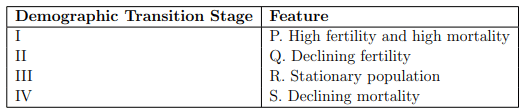
View Solution
Step 1: Understanding the Question
We need to match the four stages of the Demographic Transition Model to their corresponding descriptions of fertility and mortality.
Step 2: Detailed Explanation
The Demographic Transition Model outlines the following stages:
Stage I (Pre-transition): This stage is characterized by high birth rates (fertility) and high death rates (mortality), which often fluctuate due to famine and disease. Population growth is very slow and unstable. This matches P. High fertility and high mortality.
Stage II (Early transition): In this stage, mortality begins to fall sharply due to advancements in public health, sanitation, and medicine. Fertility remains high, leading to a period of rapid population growth. This matches S. Declining mortality.
Stage III (Late transition): Fertility starts to decline, often due to social and economic changes like urbanization, increased female education, and family planning. The rate of population growth slows down. This matches Q. Declining fertility.
Stage IV (Post-transition): Both fertility and mortality are low and stable. The population size becomes stationary or grows very slowly. This matches R. Stationary population.
Step 3: Final Answer
The correct matching is: I \(\to\) P; II \(\to\) S; III \(\to\) Q; IV \(\to\) R. This corresponds to option (B).
Quick Tip: The key sequence in the demographic transition is that death rates fall first, followed by a later fall in birth rates. This lag between the two is what causes the population explosion in the middle stages.
Consider two countries, India and Bangladesh, and two goods, Glass Bottle and Ceramic Plate, with labour requirements of production for a unit of each good given below:
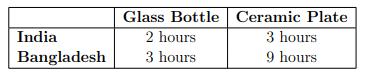
Which of the following options is/are correct?
View Solution
Step 1: Understanding the Question
We need to determine the patterns of absolute and comparative advantage for India based on the provided labor productivity data. The question format suggests it could be a Multiple Select Question (MSQ).
Step 2: Key Formula or Approach
Absolute Advantage: A country has an absolute advantage if it uses fewer labor hours to produce a unit of a good.
Comparative Advantage: A country has a comparative advantage if it has a lower opportunity cost of producing a good. The opportunity cost is what is given up to produce one more unit of the good.
Step 3: Detailed Explanation
1. Absolute Advantage:
For Glass Bottle: India (2 hrs) vs. Bangladesh (3 hrs). Since \(2 < 3\), India has the absolute advantage.
For Ceramic Plate: India (3 hrs) vs. Bangladesh (9 hrs). Since \(3 < 9\), India has the absolute advantage.
Conclusion: India has an absolute advantage in both goods.
2. Comparative Advantage:
We must calculate the opportunity costs.
India's Opportunity Costs:
OC of 1 Glass Bottle = \( \frac{hours for bottle}{hours for plate} = \frac{2}{3} \) Ceramic Plate.
OC of 1 Ceramic Plate = \( \frac{hours for plate}{hours for bottle} = \frac{3}{2} \) Glass Bottles.
Bangladesh's Opportunity Costs:
OC of 1 Glass Bottle = \( \frac{hours for bottle}{hours for plate} = \frac{3}{9} = \frac{1}{3} \) Ceramic Plate.
OC of 1 Ceramic Plate = \( \frac{hours for plate}{hours for bottle} = \frac{9}{3} = 3 \) Glass Bottles.
Now, compare the opportunity costs:
For Glass Bottle: Bangladesh's OC (\(1/3\) Plate) is lower than India's OC (\(2/3\) Plate). So, Bangladesh has a comparative advantage in Glass Bottles. This means India has a comparative disadvantage in Glass Bottles.
For Ceramic Plate: India's OC (\(3/2\) Bottles) is lower than Bangladesh's OC (\(3\) Bottles). So, India has a comparative advantage in Ceramic Plates.
3. Evaluate the Options:
(A) India has an absolute advantage in Glass Bottle production (True) and a comparative disadvantage in Glass Bottle production (True). This entire statement is correct.
(B) India has an absolute advantage in Ceramic Plate production (True) and a comparative disadvantage in Ceramic Plate production (False). This statement is incorrect.
(C) India has an absolute advantage in Ceramic Plate production (True) and a comparative disadvantage in Glass Bottle production (True). This entire statement is correct.
(D) India has an absolute advantage in Glass Bottle production (True) and a comparative disadvantage in Ceramic Plate production (False). This statement is incorrect.
Step 4: Final Answer
Based on the calculations, both statements (A) and (C) are factually correct descriptions derived from the data. This indicates it is likely an MSQ question where both options should be selected.
Quick Tip: Always calculate both absolute and comparative advantages separately. Absolute advantage is about being more productive (fewer inputs), while comparative advantage is about being relatively more productive (lower opportunity cost). A country can have an absolute advantage in all goods but will always have a comparative advantage in only some.
Suppose the own price elasticity of demand and income elasticity of demand are given by \(e_p\) and \(e_I\), respectively. The subscript p represents own price of a good and the subscript I represents the income of the consumer. Identify the correct statement(s) from the following.
View Solution
Step 1: Understanding the Question
We need to evaluate statements about price elasticity of demand (\(e_p\)) and income elasticity of demand (\(e_I\)). Price elasticity is typically treated as its absolute value for classification. This may be an MSQ.
Step 2: Detailed Explanation
Let's analyze each statement based on standard economic definitions. We assume \(e_p\) refers to the absolute value of the price elasticity.
(A) If \(1 < e_p < \infty\), the demand is price inelastic. Incorrect. When the elasticity is greater than 1, demand is said to be price elastic, meaning quantity demanded is highly responsive to price changes.
(B) Luxury goods are more price inelastic and the necessities are price elastic. Incorrect. This statement is reversed. Luxury goods are typically price elastic because consumers can easily forgo them if the price rises. Necessities (like basic food or medicine) are price inelastic because consumers need to buy them regardless of price changes.
(C) Luxury goods have \(e_I > 1\). Correct. This is the definition of a luxury good in terms of income elasticity. It means that as a consumer's income increases by 1%, their demand for the luxury good increases by more than 1%.
(D) If \(0 < e_p < 1\), the demand is price elastic. Incorrect. When the elasticity is between 0 and 1, demand is price inelastic, meaning quantity demanded is not very responsive to price changes.
Step 3: Final Answer
Only statement (C) is correct based on standard definitions of elasticity.
Quick Tip: Remember the elasticity benchmarks: \textbf{Price Elasticity (\(|e_p|\))}: \(<1\) is inelastic, \(=1\) is unit elastic, \(>1\) is elastic. \textbf{Income Elasticity (\(e_I\))}: \(<0\) is inferior, \(0 < e_I < 1\) is normal necessity, \(>1\) is luxury.
Let \(\pi^e\) be the expected inflation rate, i be the nominal interest rate and r be the real interest rate. Which of the following statements is/are correct?
View Solution
Step 1: Understanding the Question
We need to evaluate statements concerning the relationship between nominal interest rates, real interest rates, and expected inflation (the Fisher equation). This is an MSQ.
Step 2: Detailed Explanation
The exact relationship is given by the Fisher equation: \((1+i) = (1+r)(1+\pi^e)\).
(A) For small values of r and \(\pi^e\), \(r \approx i - \pi^e\). Correct. This is the well-known Fisher approximation. Expanding the exact formula gives \(i = r + \pi^e + r\pi^e\). If r and \(\pi^e\) are small (e.g., 0.02), their product \(r\pi^e\) (e.g., 0.0004) is negligible, leading to the approximation \(i \approx r + \pi^e\), or \(r \approx i - \pi^e\).
(B) When real interest rate is low, there are greater incentives to borrow and fewer incentives to lend. Correct. The real interest rate is the real cost of borrowing and the real return to lending. A lower real cost makes borrowing more attractive, while a lower real return makes lending less attractive.
(C) Real interest rate reflects the real cost of borrowing. Correct. This is the definition of the real interest rate. It represents the cost of borrowing in terms of goods and services, after accounting for the erosion of money's value due to inflation.
(D) If \(i = 8%\) and \(\pi^e = 10%\), then r is approximately (+) 2%. Incorrect. Using the Fisher approximation \(r \approx i - \pi^e\), we get \(r \approx 8% - 10% = -2%\). The real interest rate is approximately negative 2 percent, not positive 2 percent.
Step 3: Final Answer
Statements (A), (B), and (C) are all correct.
Quick Tip: The real interest rate is what truly matters for economic decisions. It's the nominal rate adjusted for inflation. A negative real interest rate means that the lender is losing purchasing power by lending money.
Which of the following models explain(s) the upward-sloping aggregate supply curve in the short-run?
View Solution
Step 1: Understanding the Question
The question asks to identify the macroeconomic models that provide a theoretical justification for a short-run aggregate supply (SRAS) curve that slopes upward. This is an MSQ.
Step 2: Detailed Explanation
The upward slope of the SRAS curve implies that in the short run, an increase in the overall price level leads to an increase in the quantity of output supplied. This relationship is explained by several models based on market imperfections or misperceptions.
(A) Sticky-wage model: This model assumes that nominal wages are fixed by contracts in the short run. If the price level rises unexpectedly, the real wage (\(W/P\)) falls. This makes labor cheaper for firms, who then hire more workers and increase production. Thus, higher prices lead to higher output. This model explains the upward slope.
(B) Worker-misperception model: This model assumes workers temporarily confuse a change in the nominal wage with a change in the real wage. If the price level rises, firms raise nominal wages. Workers see their nominal wage increase and, misperceiving it as a real wage increase, supply more labor. This leads to higher output. This model explains the upward slope.
(C) Imperfect-information model: This model assumes that producers have imperfect information about the aggregate price level. They observe the price of their own good rising but are unsure if it's a rise in its relative price or a rise in all prices (inflation). They may interpret it as a relative price increase and decide to produce more. If all producers do this, the aggregate output increases with the price level. This model explains the upward slope.
(D) Solow model: The Solow growth model is a long-run model of economic growth. In the long run, output is determined by the factors of production (capital, labor) and technology. The aggregate supply curve in the long-run (and thus in the Solow model) is vertical at the natural rate of output, as prices and wages are fully flexible. It does not explain a short-run upward-sloping curve.
Step 3: Final Answer
The sticky-wage model, the worker-misperception model, and the imperfect-information model all provide explanations for an upward-sloping short-run aggregate supply curve.
Quick Tip: All modern theories of the upward-sloping SRAS curve are based on some short-run "stickiness," "misperception," or "imperfect information" that causes output to deviate from its natural long-run level when the price level changes.
Consider a Mundell-Fleming model for a small open economy with perfect capital mobility. The goods market equation is
\[ Y = C(Y) + I(r^*) + G + NX(e) \]
where Y is the output, C is the consumption (\(C' > 0\)), I is the investment (\(I' < 0\)), G is the government purchases, and NX is the net exports (\(NX' < 0\)), \(r^*\) is the fixed world interest rate, and e is the exchange rate.
The money market equation is
\[ \frac{M}{\bar{P}} = kY - lr^* \]
where M is the money supply, \(\bar{P}\) is the fixed price level, and k and l are positive constants.
Which of the following policies is/are ineffective (i.e., have no impact on income) in the short-run?
View Solution
Step 1: Understanding the Question
We need to determine which macroeconomic policies have no effect on output (Y) in the Mundell-Fleming model under different exchange rate regimes. The key assumptions are a small open economy and perfect capital mobility.
Step 2: Detailed Explanation
Under perfect capital mobility, the domestic interest rate must equal the world interest rate (\(r = r^*\)). Any deviation will cause massive capital flows that affect the exchange rate or money supply.
Case 1: Floating Exchange Rate
(A) Expansionary fiscal policy (e.g., increase G): An increase in G shifts the IS* curve to the right. This puts upward pressure on the domestic interest rate (\(r > r^*\)). This attracts foreign capital, causing the domestic currency to appreciate. The appreciation reduces net exports (NX), shifting the IS* curve back to its original position. The final result is no change in income (Y). Thus, fiscal policy is ineffective.
(B) Expansionary monetary policy (e.g., increase M): An increase in M shifts the LM* curve to the right. This puts downward pressure on the domestic interest rate (\(r < r^*\)). Capital flows out, causing the currency to depreciate. The depreciation boosts net exports (NX), shifting the IS* curve to the right. The final result is a higher level of income (Y). Thus, monetary policy is effective.
Case 2: Fixed Exchange Rate
(C) Expansionary fiscal policy (e.g., increase G): An increase in G shifts IS* right, putting upward pressure on r. Capital flows in, creating pressure for the currency to appreciate. To maintain the fixed exchange rate, the central bank must intervene by buying foreign currency and selling domestic currency, which increases the money supply (M). This shifts the LM* curve to the right until equilibrium is restored at the original exchange rate with a higher level of income (Y). Thus, fiscal policy is effective.
(D) Expansionary monetary policy (e.g., increase M): The central bank tries to increase M, shifting LM* right. This puts downward pressure on r, leading to capital outflows and pressure for the currency to depreciate. To defend the fixed exchange rate, the central bank must sell foreign currency and buy domestic currency, which decreases the money supply (M) back to its original level. The LM* curve shifts back to its original position. The final result is no change in income (Y). Thus, monetary policy is ineffective.
Step 3: Final Answer
The policies that are ineffective at changing income are expansionary fiscal policy under a floating exchange rate and expansionary monetary policy under a fixed exchange rate.
Quick Tip: A useful summary for the Mundell-Fleming model with perfect capital mobility: Under \textbf{Floating} rates, \textbf{Monetary} policy is powerful; Fiscal policy is powerless. Under \textbf{Fixed} rates, \textbf{Fiscal} policy is powerful; Monetary policy is powerless.
In the context of Balance of Payments accounting, which of the following transactions is/are NOT recorded under the Current Account?
View Solution
Step 1: Understanding the Question
We need to identify which transactions are excluded from the Current Account in the Balance of Payments (BoP) statement. This is an MSQ.
Step 2: Detailed Explanation
The Balance of Payments is broadly divided into two main accounts: the Current Account and the Capital and Financial Account.
Current Account: Records the flow of goods, services, primary income (e.g., interest, dividends), and secondary income (e.g., unilateral transfers like remittances and foreign aid).
Capital and Financial Account: Records transactions involving financial assets and liabilities. The Financial Account component records transactions in assets like stocks, bonds, and real estate, as well as changes in official reserve assets.
Let's analyze the options:
(A) Merchandise trade: This is trade in goods. It is the main component of the "Balance of Trade," which is part of the Current Account.
(B) Unilateral transfer payments: These are one-way payments like foreign aid or private remittances. They are recorded in the secondary income part of the Current Account.
(C) Purchase of international financial assets: This is a transaction in assets (e.g., an Indian citizen buying US stocks). It is recorded in the Financial Account, not the Current Account.
(D) Purchase of foreign currency by the central bank: This is an official intervention in the foreign exchange market. It represents a change in the country's official reserve assets and is recorded in the Financial Account, not the Current Account.
Step 3: Final Answer
The purchase of international financial assets and the purchase of foreign currency by the central bank are both recorded in the Financial Account, not the Current Account.
Quick Tip: A simple rule of thumb: If the transaction is about currently produced goods, services, or income flows, it's in the Current Account. If it's about buying or selling assets (which represent claims on future income), it's in the Financial Account.
The demand and supply functions for a commodity are given by: \(D(p) = 10 - 2p\) and \(S(p) = -2 + p\) where D(p) and S(p) are the quantity demanded and supplied, respectively, and p (in USD) is the unit price of the good. If the government sets a price ceiling of USD 3 per unit, then the increase in consumer surplus (in USD) is __________ (round off to two decimal places).
View Solution
Step 1: Understanding the Question
We need to calculate the change in consumer surplus when a binding price ceiling is imposed on a market.
Step 2: Calculate Initial Equilibrium and Consumer Surplus
First, find the market equilibrium by setting demand equal to supply: \[ 10 - 2p = -2 + p \] \[ 12 = 3p \implies p_e = 4 \]
The equilibrium quantity is \(Q_e = 10 - 2(4) = 2\).
Consumer surplus (CS) is the area of the triangle below the demand curve and above the market price. The demand curve hits the price axis (the "choke price") when \(Q=0\), so \(10 - 2p = 0 \implies p_{max} = 5\). \[ Initial CS = \frac{1}{2} \times Q_e \times (p_{max} - p_e) = \frac{1}{2} \times 2 \times (5 - 4) = 1 \]
Step 3: Analyze the Price Ceiling and Find New Consumer Surplus
The government imposes a price ceiling \(p_c = 3\). Since \(p_c < p_e\), the ceiling is binding.
At \(p_c = 3\), the quantity supplied is \(S(3) = -2 + 3 = 1\), and the quantity demanded is \(D(3) = 10 - 2(3) = 4\).
The quantity actually traded is the minimum of the two, so \(Q_c = 1\).
The new consumer surplus is the area below the demand curve and above the ceiling price, up to the quantity traded. This area is a trapezoid.
The consumers who get the good (\(Q=1\)) pay a price of 3. We need to find the price these consumers were *willing* to pay. We find this from the inverse demand curve: from \(D=10-2p\), we get \(2p=10-D \implies p = 5 - 0.5D\).
At \(Q=1\), the price on the demand curve is \(p = 5 - 0.5(1) = 4.5\).
The new CS is the area of the trapezoid with height \(Q_c=1\), top base \((5-4.5)\), and bottom base \((5-3)\). This is complex.
An easier way is to see the new CS as a rectangle plus a triangle.
Rectangle area = (Price willing to pay at Q=1 - Ceiling Price) \(\times\) \(Q_c\) = \((4.5 - 3) \times 1 = 1.5\).
Triangle area = \(0.5 \times\) (Choke price - Price at Q=1) \(\times\) \(Q_c\) = \(0.5 \times (5 - 4.5) \times 1 = 0.5 \times 0.5 = 0.25\). \[ New CS = 1.5 + 0.25 = 1.75 \]
Step 4: Calculate the Increase in Consumer Surplus
\[ Increase in CS = New CS - Initial CS = 1.75 - 1 = 0.75 \]
Step 5: Final Answer
The increase in consumer surplus is 0.75 USD.
Quick Tip: With a price ceiling, consumer surplus changes in two ways: consumers who can still buy the good gain because they pay a lower price, but some consumers lose because the lower price reduces quantity supplied, so they can no longer buy the good. The net effect can be positive or negative. The calculation captures the net gain for the lucky consumers.
A duopoly faces the inverse market demand function \(p = 120 - Q\), where p is the unit price (in Rs.) of the good being sold by firms A and B, and Q is the total output. Firm A has a constant marginal cost of Rs. 20, which is exactly half of firm B's constant marginal cost. There is no fixed cost for both the firms. If there exists a Cournot-Nash equilibrium, Q is __________ (in integer).
View Solution
Step 1: Understanding the Question
We need to find the total equilibrium quantity (Q) in a Cournot duopoly model with two firms having different constant marginal costs.
Step 2: Key Formula or Approach
In a Cournot model, each firm chooses its output to maximize its profit, taking the other firm's output as given. This involves finding each firm's reaction function by setting its Marginal Revenue (MR) equal to its Marginal Cost (MC), and then solving the reaction functions simultaneously.
Given:
Inverse Demand: \(p = 120 - Q = 120 - (q_A + q_B)\)
Firm A's Cost: \(MC_A = 20\)
Firm B's Cost: \(MC_B = 2 \times MC_A = 40\)
Step 3: Detailed Explanation
Firm A's Reaction Function:
Total Revenue for A: \(TR_A = p \cdot q_A = (120 - q_A - q_B)q_A = 120q_A - q_A^2 - q_A q_B\).
Marginal Revenue for A: \(MR_A = \frac{d(TR_A)}{dq_A} = 120 - 2q_A - q_B\).
Set \(MR_A = MC_A\): \(120 - 2q_A - q_B = 20 \implies 2q_A = 100 - q_B\). \[ q_A = 50 - 0.5q_B \quad (Firm A's Reaction Function) \]
Firm B's Reaction Function:
Total Revenue for B: \(TR_B = p \cdot q_B = (120 - q_A - q_B)q_B = 120q_B - q_A q_B - q_B^2\).
Marginal Revenue for B: \(MR_B = \frac{d(TR_B)}{dq_B} = 120 - q_A - 2q_B\).
Set \(MR_B = MC_B\): \(120 - q_A - 2q_B = 40 \implies 2q_B = 80 - q_A\). \[ q_B = 40 - 0.5q_A \quad (Firm B's Reaction Function) \]
Solve for Equilibrium:
Substitute Firm B's reaction function into Firm A's: \[ q_A = 50 - 0.5(40 - 0.5q_A) \] \[ q_A = 50 - 20 + 0.25q_A \] \[ q_A - 0.25q_A = 30 \implies 0.75q_A = 30 \] \[ q_A = \frac{30}{0.75} = 40 \]
Now find \(q_B\): \[ q_B = 40 - 0.5(40) = 40 - 20 = 20 \]
Total Output: \[ Q = q_A + q_B = 40 + 20 = 60 \]
Step 4: Final Answer
The Cournot-Nash equilibrium total output Q is 60.
Quick Tip: For a linear demand \(P=a-bQ\) and constant marginal costs \(c_1\) and \(c_2\), the Cournot equilibrium quantities are \(q_1 = \frac{a - 2c_1 + c_2}{3b}\) and \(q_2 = \frac{a - 2c_2 + c_1}{3b}\). Here, a=120, b=1, c1=20, c2=40. \(q_A = (120 - 2(20) + 40)/3 = (120 - 40 + 40)/3 = 120/3 = 40\). \(q_B = (120 - 2(40) + 20)/3 = (120 - 80 + 20)/3 = 60/3 = 20\). \(Q = 40+20=60\).
Consider the following short-run cost function: \( C(q) = 10q^3 - 80q^2 + 300q + 50 \). At the minimum average variable cost (AVC), the value of marginal cost (MC) is __________ (in integer).
View Solution
Step 1: Understanding the Question
We are given a short-run total cost function and asked to find the value of marginal cost (MC) at the point where average variable cost (AVC) is at its minimum.
Step 2: Key Formula or Approach
A fundamental property of cost curves is that the marginal cost curve intersects the average variable cost curve at the minimum point of the AVC curve. Therefore, at the minimum AVC, MC = AVC. We can find the quantity (q) that minimizes AVC and then calculate MC at that quantity.
Step 3: Detailed Explanation
First, identify the components of the total cost function \(C(q) = 10q^3 - 80q^2 + 300q + 50\):
Fixed Cost (FC) = 50 (the term that doesn't depend on q)
Variable Cost (VC) = \(10q^3 - 80q^2 + 300q\)
Next, derive the Average Variable Cost (AVC) function: \[ AVC(q) = \frac{VC}{q} = \frac{10q^3 - 80q^2 + 300q}{q} = 10q^2 - 80q + 300 \]
To find the minimum point of AVC, take its first derivative with respect to q and set it to zero: \[ \frac{d(AVC)}{dq} = 20q - 80 \] \[ 20q - 80 = 0 \implies 20q = 80 \implies q = 4 \]
The AVC is minimized at an output level of q = 4.
Now, derive the Marginal Cost (MC) function by taking the derivative of the Total Cost (TC) function: \[ MC(q) = \frac{d(C)}{dq} = 30q^2 - 160q + 300 \]
Finally, calculate the value of MC at the quantity where AVC is minimum (q = 4): \[ MC(4) = 30(4)^2 - 160(4) + 300 \] \[ MC(4) = 30(16) - 640 + 300 = 480 - 640 + 300 = 140 \]
As a check, we can calculate AVC(4): \(AVC(4) = 10(4)^2 - 80(4) + 300 = 160 - 320 + 300 = 140\). The values are equal, as expected.
Step 4: Final Answer
The value of marginal cost at the minimum average variable cost is 140.
Quick Tip: To save time, remember that MC=AVC at the minimum of AVC. You can calculate the minimum point of AVC and then calculate either MC or AVC at that quantity—they will be the same. Often, one of the calculations might be simpler than the other.
Consider the Keynesian Cross Model with a linear consumption function and a zero tax, where the government purchase is Rs. 100 and the equilibrium income is Rs. 1300. If the government purchase is increased to Rs. 125, the equilibrium income increases to Rs. 1400. Using the given information, the marginal propensity to consume is __________ (round off to two decimal places).
View Solution
Step 1: Understanding the Question
We are given two equilibrium points (G, Y) in a simple Keynesian Cross model and asked to find the marginal propensity to consume (MPC).
Step 2: Key Formula or Approach
In the Keynesian Cross model, the government spending multiplier relates a change in government spending (\(\Delta G\)) to the resulting change in equilibrium income (\(\Delta Y\)).
The formula for the multiplier is: \[ Multiplier = \frac{\Delta Y}{\Delta G} \]
In a simple model with no taxes or imports, the multiplier is also given by the formula: \[ Multiplier = \frac{1}{1 - MPC} \]
We can calculate the multiplier from the given data and then use it to solve for the MPC.
Step 3: Detailed Explanation
First, calculate the change in income (\(\Delta Y\)) and the change in government spending (\(\Delta G\)): \[ \Delta Y = Y_2 - Y_1 = 1400 - 1300 = 100 \] \[ \Delta G = G_2 - G_1 = 125 - 100 = 25 \]
Next, calculate the value of the multiplier: \[ Multiplier = \frac{\Delta Y}{\Delta G} = \frac{100}{25} = 4 \]
Now, use the multiplier formula to solve for the MPC (let's denote it by 'b'): \[ 4 = \frac{1}{1 - b} \] \[ 4(1 - b) = 1 \] \[ 4 - 4b = 1 \] \[ 3 = 4b \] \[ b = \frac{3}{4} = 0.75 \]
Step 4: Final Answer
The marginal propensity to consume is 0.75.
Quick Tip: The concept of the multiplier is central to Keynesian economics. The change in equilibrium income is always the multiplier times the initial change in autonomous spending (\(\Delta Y = Multiplier \times \Delta G\)). This relationship allows you to work backwards and find the MPC if you know the changes in Y and G.
Using the Ordinary Least Squares (OLS) method, a researcher estimated the relationship between initial salary (S) of MBA graduates and their cumulative grade point average (CGPA) as
\(\hat{S_i} = \hat{\beta_0} + \hat{\beta_1} CGPA_i; \quad i=1, 2, ..., 100\)
where \(\hat{\beta_0} = 4543\) and \(\hat{\beta_1} = 645.08\). The standard errors of \(\hat{\beta_0}\) and \(\hat{\beta_1}\) are 921.79 and 70.01, respectively.
The t-statistic for testing the null hypothesis \(\beta_1 = 0\) is __________ (round off to two decimal places).
View Solution
Step 1: Understanding the Question
We need to calculate the t-statistic for a regression coefficient to test the hypothesis that the true coefficient is zero.
Step 2: Key Formula or Approach
The formula for the t-statistic for a coefficient estimate (\(\hat{\beta_k}\)) when testing the null hypothesis \(H_0: \beta_k = c\) is: \[ t = \frac{\hat{\beta_k} - c}{se(\hat{\beta_k})} \]
where \(\hat{\beta_k}\) is the estimated coefficient, \(c\) is the hypothesized value (in this case, 0), and \(se(\hat{\beta_k})\) is the standard error of the estimate.
Step 3: Detailed Explanation
We are given the following information for the coefficient \(\beta_1\):
Estimated coefficient: \(\hat{\beta_1} = 645.08\)
Standard error of the coefficient: \(se(\hat{\beta_1}) = 70.01\)
Hypothesized value under \(H_0\): \(\beta_1 = 0\)
Plugging these values into the formula: \[ t = \frac{645.08 - 0}{70.01} \] \[ t = \frac{645.08}{70.01} \approx 9.214112... \]
Step 4: Final Answer
Rounding the t-statistic to two decimal places, we get 9.21.
Quick Tip: The t-statistic essentially measures how many standard errors the estimated coefficient is away from the hypothesized value. A large absolute t-value (typically > 2) suggests that the coefficient is statistically significant, meaning we can reject the null hypothesis that the true coefficient is zero.
Let X be a random variable with the probability density function f(x) such that
\( f(x) = \begin{cases} \frac{1}{2\sqrt{3}} & if -\sqrt{3} < x < \sqrt{3}
0 & otherwise. \end{cases} \)
Then, the variance of X is __________ (in integer).
View Solution
Step 1: Understanding the Question
The given probability density function (PDF) is constant over a specific interval, which means it is a continuous uniform distribution. We need to find the variance of this distribution.
Step 2: Key Formula or Approach
For a continuous uniform distribution defined on the interval \([a, b]\), the variance is given by the standard formula: \[ Var(X) = \frac{(b - a)^2}{12} \]
In this problem, the interval is \((-\sqrt{3}, \sqrt{3})\), so we have \(a = -\sqrt{3}\) and \(b = \sqrt{3}\).
Step 3: Detailed Explanation
We substitute the values of a and b into the variance formula: \[ Var(X) = \frac{(\sqrt{3} - (-\sqrt{3}))^2}{12} \] \[ Var(X) = \frac{(\sqrt{3} + \sqrt{3})^2}{12} \] \[ Var(X) = \frac{(2\sqrt{3})^2}{12} \] \[ Var(X) = \frac{2^2 \cdot (\sqrt{3})^2}{12} \] \[ Var(X) = \frac{4 \cdot 3}{12} = \frac{12}{12} = 1 \]
The value of the PDF, \( \frac{1}{2\sqrt{3}} \), confirms it is a valid uniform distribution, as \(b-a = 2\sqrt{3}\) and the PDF is \(1/(b-a)\).
Step 4: Final Answer
The variance of X is 1.
Quick Tip: Memorizing the formulas for the mean (\(\frac{a+b}{2}\)) and variance (\(\frac{(b-a)^2}{12}\)) of a uniform distribution is very useful for solving such problems quickly.
Suppose from the estimation of a linear regression model \(Y_i = \beta_0 + \beta_1 X_i + e_i\) the residual sum of squares and the total sum of squares are obtained as 44 and 80, respectively. The value of coefficient of determination is __________ (round off to two decimal places).
View Solution
Step 1: Understanding the Question
We are given the Residual Sum of Squares (RSS) and the Total Sum of Squares (TSS) from a linear regression and asked to calculate the coefficient of determination (\(R^2\)).
Step 2: Key Formula or Approach
The coefficient of determination, \(R^2\), measures the proportion of the variance in the dependent variable that is predictable from the independent variable(s). It is calculated using the formula: \[ R^2 = 1 - \frac{RSS}{TSS} \]
Or alternatively, \(R^2 = \frac{ESS}{TSS}\), where ESS is the Explained Sum of Squares.
Step 3: Detailed Explanation
We are given:
Residual Sum of Squares (RSS) = 44
Total Sum of Squares (TSS) = 80
Plugging these values into the formula: \[ R^2 = 1 - \frac{44}{80} \]
First, calculate the ratio: \[ \frac{44}{80} = \frac{11}{20} = 0.55 \]
Now, complete the calculation for \(R^2\): \[ R^2 = 1 - 0.55 = 0.45 \]
Step 4: Final Answer
The value of the coefficient of determination is 0.45.
Quick Tip: Remember the fundamental identity in regression: TSS = ESS + RSS (Total variation = Explained variation + Unexplained variation). \(R^2\) is simply the ratio of explained variation to total variation (\(ESS/TSS\)), which is equivalent to \(1 - (RSS/TSS)\).
A labour-augmenting production function is \( Y = K^{0.33} (AL)^{0.67} \). where Y = output, K = capital, L = labour, and A = technology. Assume that the growth rate of L is 1.2 percent per annum, the growth rate of K is 3 percent per annum, and the growth rate of A is 1.5 percent per annum. Using the growth-accounting approach, the growth rate of Y in percent per annum is __________ (round off to two decimal places).
View Solution
Step 1: Understanding the Question
We need to calculate the growth rate of output (Y) using the growth accounting equation derived from the given Cobb-Douglas production function and the growth rates of its inputs.
Step 2: Key Formula or Approach
For a production function of the form \(Y = K^\alpha (AL)^{1-\alpha}\), the growth accounting equation can be derived by taking natural logarithms and differentiating with respect to time. The resulting formula for growth rates (denoted by 'g' with a subscript) is: \[ g_Y = \alpha g_K + (1-\alpha)(g_A + g_L) \]
Let's first rewrite the given production function: \( Y = K^{0.33} (AL)^{0.67} = K^{0.33} A^{0.67} L^{0.67} \)
The growth accounting equation for this form is: \[ g_Y = 0.33 \cdot g_K + 0.67 \cdot g_A + 0.67 \cdot g_L \]
Step 3: Detailed Explanation
We are given the following growth rates:
Growth rate of Labour, \(g_L = 1.2%\)
Growth rate of Capital, \(g_K = 3%\)
Growth rate of Technology, \(g_A = 1.5%\)
Substitute these values into the growth accounting equation: \[ g_Y = (0.33 \times 3) + (0.67 \times 1.5) + (0.67 \times 1.2) \] \[ g_Y = 0.99 + 1.005 + 0.804 \] \[ g_Y = 2.799 \]
Step 4: Final Answer
Rounding off to two decimal places, the growth rate of Y is 2.80 percent per annum.
Quick Tip: The growth rate of a product of variables (like \(X \cdot Z\)) is the sum of their individual growth rates (\(g_{XZ} = g_X + g_Z\)). The growth rate of a variable raised to a power (like \(X^\alpha\)) is the power times the variable's growth rate (\(g_{X^\alpha} = \alpha \cdot g_X\)). Combining these rules allows you to derive the growth accounting equation for any Cobb-Douglas function.
A monopolist is facing the demand function \( Q = \frac{100}{P-1} \), where Q is the quantity demanded and P is the price per unit of the good (P > 1). The average variable cost for the monopolist is \( \frac{4}{\sqrt{Q}} \) and the fixed cost is 10. The profit maximizing price is __________ (in integer).
View Solution
Step 1: Understanding the Question
We need to find the profit-maximizing price for a monopolist given the demand function and cost structure.
Step 2: Key Formula or Approach
A monopolist maximizes profit by producing the quantity where Marginal Revenue (MR) equals Marginal Cost (MC). After finding the optimal quantity (\(Q^*\)), we find the corresponding price (\(P^*\)) from the inverse demand curve.
Step 3: Detailed Explanation
1. Find the Inverse Demand Function and Marginal Revenue (MR):
The demand function is \(Q = \frac{100}{P-1}\). We solve for P to get the inverse demand function: \[ P-1 = \frac{100}{Q} \implies P = 1 + \frac{100}{Q} \]
Total Revenue (TR) is \(P \times Q\): \[ TR(Q) = \left(1 + \frac{100}{Q}\right) \times Q = Q + 100 \]
Marginal Revenue (MR) is the derivative of TR with respect to Q: \[ MR(Q) = \frac{d(TR)}{dQ} = 1 \]
2. Find the Total Cost Function and Marginal Cost (MC):
Average Variable Cost (AVC) is given as \( AVC(Q) = \frac{4}{\sqrt{Q}} = 4Q^{-1/2} \).
Variable Cost (VC) is \(AVC \times Q\): \[ VC(Q) = (4Q^{-1/2}) \times Q = 4Q^{1/2} = 4\sqrt{Q} \]
Fixed Cost (FC) is 10.
Total Cost (TC) is \(VC + FC\): \[ TC(Q) = 4\sqrt{Q} + 10 \]
Marginal Cost (MC) is the derivative of TC with respect to Q: \[ MC(Q) = \frac{d(TC)}{dQ} = \frac{d}{dQ}(4Q^{1/2} + 10) = 4 \times \frac{1}{2}Q^{-1/2} = 2Q^{-1/2} = \frac{2}{\sqrt{Q}} \]
3. Set MR = MC to find the optimal quantity (\(Q^*\)): \[ 1 = \frac{2}{\sqrt{Q}} \] \[ \sqrt{Q} = 2 \] \[ Q^* = 4 \]
4. Find the optimal price (\(P^*\)):
Substitute the optimal quantity \(Q^* = 4\) back into the inverse demand function: \[ P^* = 1 + \frac{100}{4} = 1 + 25 = 26 \]
Step 4: Final Answer
The profit-maximizing price is 26.
Quick Tip: Always start a monopolist's problem by deriving the MR and MC functions. For a non-linear demand curve, you must first find the Total Revenue (TR) by multiplying the inverse demand function \(P(Q)\) by Q, and then differentiate to get MR.
*The article might have information for the previous academic years, please refer the official website of the exam.