
GATE 2023 Psychology Question Paper with Solution Pdf
- Chemistry Syllabus
- Maths Syllabus
- Physics Syllabus
- Exam Pattern
- Paper Analysis
- Chemical Engg Syllabus
- Civil Engg Syllabus
- ECE Syllabus
- Mechanical Engg Syllabus
- Engg Science Syllabus
- Mining Engg Syllabus
- IN Syllabus
- CSE Syllabus
- EE Syllabus
- AE Syllabus
- BM Syllabus
- GG Syllabus
- EY Syllabus
- ST Syllabus
- TF Syllaus
- AR Syllabus
- XL Syllabus
- MT Syllabus
- PI Syllabus
- PE Syllabus
- ME Pattern
- TF Pattern
- CE Pattern
- EE Pattern
- EC Pattern
- CS Pattern
- BT Pattern
- BM Pattern
- IN Pattern
- DA Syllabus
- NA & ME Syallabus
- ES & Engg Syllabus
- Geomatics Engg Syllabus
- Agri Engg Syllabus
- Humanities and Social Sci
- PI Syllabus


| Updated On - Jan 2, 2026
GATE Question Papers are the most important study material for effective exam preparation. We at Zollege have provided all GATE Previous Year Papers with Solution PDFs here. GATE 2023 Psychology exam was conducted successfully on February 5 by Indian Institute of Technology Kanpur.
Students can freely download the GATE previous year's question paper PDFs along with their solutions here. We strongly encourage GATE aspirants to scan through all the GATE Question Paper to know the overall difficulty level, GATE Syllabus and understand the changes in GATE Exam Pattern over the years.
GATE 2023 Psychology Question Paper with Solution PDF
| GATE 2023 Psychology Question Paper PDF | GATE 2023 Psychology Solution PDF |
|---|---|
| Download PDF | Check Solutions |

Rafi told Mary, “I am thinking of watching a film this weekend."
The following reports the above statement in indirect speech:
Rafi told Mary that he __________ of watching a film that weekend.
View Solution
Step 1: Understanding the Question
The question requires converting a sentence from direct speech to indirect (or reported) speech. This involves changing tenses, pronouns, and words indicating time and place.
Step 2: Rules for Conversion
1. Reporting Verb Tense: The reporting verb is "told," which is in the past tense.
2. Tense Change: When the reporting verb is in the past tense, the tense of the verb in the direct speech must be shifted back. The verb in the direct speech is "am thinking," which is in the Present Continuous Tense. It will change to the Past Continuous Tense.
3. Pronoun Change: The pronoun "I" refers to the speaker, Rafi (male). So, "I" changes to "he".
4. Time Adverbial Change: The phrase "this weekend" changes to "that weekend".
Step 3: Applying the Rules
Direct Speech: “I am thinking of watching a film this weekend."
Applying the rules:
"I" becomes "he".
"am thinking" (Present Continuous) becomes "was thinking" (Past Continuous).
"this weekend" becomes "that weekend".
Indirect Speech: Rafi told Mary that he was thinking of watching a film that weekend.
Step 4: Final Answer
The correct verb form to fill in the blank is "was thinking".
Quick Tip: In direct to indirect speech conversion, if the reporting verb (like 'said' or 'told') is in the past tense, you must shift the tense of the direct statement one step back. For example: Present Simple becomes Past Simple, Present Continuous becomes Past Continuous, and Present Perfect becomes Past Perfect.
Permit : __________ :: Enforce : Relax
(By word meaning)
View Solution
Step 1: Understanding the Question
This is an analogy question based on word meaning. We need to identify the relationship between the second pair of words ("Enforce : Relax") and apply the same relationship to the first pair ("Permit : ______").
Step 2: Analyzing the Relationship
The words "Enforce" and "Relax" are antonyms. To enforce a law means to make sure it is obeyed, while to relax a law means to make it less strict. They represent opposite actions.
Step 3: Applying the Relationship to the First Pair
We need to find the antonym for the word "Permit".
Permit means to give authorization or consent to (someone) to do something.
Let's examine the options:
(A) Allow: This is a synonym of "Permit".
(B) Forbid: This means to refuse to allow something, which is the direct opposite of "Permit".
(C) License: This is a noun referring to an official document that gives permission. It is related but not an antonym.
(D) Reinforce: This means to strengthen or support, which is not an opposite.
Step 4: Final Answer
The antonym of "Permit" is "Forbid". Therefore, the completed analogy is Permit : Forbid :: Enforce : Relax.
Quick Tip: In analogy questions, first pinpoint the precise relationship between the given pair of words. Common relationships include synonym/antonym, cause/effect, part/whole, object/function, and type/kind.
Given a fair six-faced dice where the faces are labelled '1', '2', '3', '4', '5', and '6', what is the probability of getting a ‘1' on the first roll of the dice and a ‘4' on the second roll?
View Solution
Step 1: Understanding the Question
The problem asks for the probability of two independent events happening in sequence: getting a '1' on the first roll of a fair six-sided die, and then getting a '4' on the second roll.
Step 2: Key Formula or Approach
For independent events A and B, the probability of both events occurring is the product of their individual probabilities:
\[ P(A and B) = P(A) \times P(B) \]
Step 3: Detailed Explanation
Event A: Getting a '1' on the first roll.
A fair six-faced die has 6 possible outcomes: \{1, 2, 3, 4, 5, 6\.
The number of favorable outcomes for getting a '1' is 1.
The probability of Event A is:
\[ P(A) = \frac{Number of favorable outcomes}{Total number of outcomes} = \frac{1}{6} \]
Event B: Getting a '4' on the second roll.
The second roll is independent of the first. It also has 6 possible outcomes.
The number of favorable outcomes for getting a '4' is 1.
The probability of Event B is:
\[ P(B) = \frac{Number of favorable outcomes}{Total number of outcomes} = \frac{1}{6} \]
Combined Probability.
To find the probability of both events happening, we multiply their individual probabilities:
\[ P(A and B) = P(A) \times P(B) = \frac{1}{6} \times \frac{1}{6} = \frac{1}{36} \]
Step 4: Final Answer
The probability of getting a '1' on the first roll and a '4' on the second roll is \(\frac{1}{36}\).
Quick Tip: Remember to distinguish between independent and dependent events. Rolling a die twice are independent events, as the outcome of the first roll does not affect the second. For sequential events described with "and," you typically multiply their probabilities.
A recent survey shows that 65% of tobacco users were advised to stop consuming tobacco. The survey also shows that 3 out of 10 tobacco users attempted to stop using tobacco.
Based only on the information in the above passage, which one of the following options can be logically inferred with certainty?
View Solution
Step 1: Understanding the Question
We are given two pieces of information about a group of tobacco users and asked to determine which conclusion can be drawn with absolute certainty.
Fact 1: 65% of tobacco users were advised to stop.
Fact 2: 3 out of 10 (which is 30%) of tobacco users attempted to stop.
Step 2: Analyzing the Options
Let's analyze each option based on the given facts. Let T be the total number of tobacco users.
(A) A majority of tobacco users who were advised to stop consuming tobacco made an attempt to do so.
This asks if the number of people who were both advised \textit{and attempted is greater than 50% of those who were advised. The group of people who attempted (30% of T) could be a subset of the group who were advised (65% of T). In the most optimistic scenario, all 30% who attempted were also advised. The fraction of advised users who attempted would be \(\frac{0.30T{0.65T} = \frac{30}{65} \approx 0.46\), which is 46%. Since 46% is not a majority (\(>\) 50%), this statement cannot be true even in the best-case scenario. It cannot be inferred with certainty.
(B) A majority of tobacco users who were advised to stop consuming tobacco did not attempt to do so.
Let's consider the group of advised users (65% of T). The maximum number of people from this group who could have attempted to stop is 30% of T (this happens if everyone who attempted was also advised).
In this case, the number of advised users who did not attempt would be \(0.65T - 0.30T = 0.35T\).
Is \(0.35T\) a majority of \(0.65T\)? Let's check the fraction: \(\frac{0.35T{0.65T} = \frac{35}{65} \approx 0.538\), which is 53.8%.
Since 53.8% is greater than 50%, a majority of the advised users did not attempt to stop, even in the scenario with the maximum possible overlap. If the overlap is smaller, this percentage will be even higher. Therefore, this statement can be inferred with certainty.
(C) Approximately 30% of tobacco users successfully stopped consuming tobacco.
The passage states that 30% \textit{attempted to stop, not that they were \textit{successful. We cannot infer success from an attempt.
(D) Approximately 65% of tobacco users successfully stopped consuming tobacco.
The passage states that 65% were \textit{advised to stop, not that they were \textit{successful. We cannot infer success from advice.
Step 3: Final Answer
The only statement that can be logically inferred with certainty is (B).
Quick Tip: For logical inference questions with percentages, it's often helpful to consider the "worst-case" or "best-case" scenario for the overlap between the groups to test the certainty of a statement.
How many triangles are present in the given figure?

View Solution
Step 1: Understanding the Question
The task is to count all the triangles in the given geometric figure. A systematic approach is needed to avoid missing any or counting them multiple times.
Step 2: Systematic Counting Strategy
We can count the triangles by categorizing them based on the number of small triangular components they are made of. Let's label the vertices for clarity. Top row: A, B, C, D. Bottom row: E, F, G, H.
Step 3: Detailed Explanation
Triangles made of 1 small component:
There are 8 small, individual triangles clearly visible in the figure.
Count = 8
Triangles made of 2 small components:
These triangles are formed by combining two adjacent small triangles.
Pointing right (base on the left diagonal): Triangles with vertices (A,B,F), (B,C,G), (C,D,H). (3 triangles)
Pointing left (base on the right diagonal): Triangles with vertices (B,A,E), (C,B,F), (D,C,G). (3 triangles)
Count = 3 + 3 = 6
Triangles made of 3 small components:
There are no triangles formed by combining 3 small components.
Count = 0
Triangles made of 4 small components:
These are larger triangles that span across the figure.
Triangles with vertices (A,C,G), (B,D,H). (2 triangles)
Triangles with vertices (B,F,H), (C,E,G). Wait, this combination is not right. Let's recheck.
Vertices: (A, C, G), (B, D, H). (2 triangles)
Vertices: (E, G, C), (F, H, B). (2 triangles)
Count = 4
Triangles made of 6 small components:
These are the largest triangles that form half of the parallelogram.
Triangle with vertices (A,D,H). (1 triangle)
Triangle with vertices (A,D,E). (1 triangle)
Count = 2
Step 4: Final Answer
Total number of triangles = (triangles of size 1) + (size 2) + (size 4) + (size 6)
Total = 8 + 6 + 4 + 2 = 20.
Quick Tip: When counting figures, develop a system. Start with the smallest components and gradually build up to larger shapes. Labelling vertices can also help in keeping track of the shapes you have already counted.
Students of all the departments of a college who have successfully completed the registration process are eligible to vote in the upcoming college elections. However, by the time the due date for registration was over, it was found that surprisingly none of the students from the Department of Human Sciences had completed the registration process.
Based only on the information provided above, which one of the following sets of statement(s) can be logically inferred with certainty?
(i) All those students who would not be eligible to vote in the college elections would certainly belong to the Department of Human Sciences.
(ii) None of the students from departments other than Human Sciences failed to complete the registration process within the due time.
(iii) All the eligible voters would certainly be students who are not from the Department of Human Sciences.
View Solution
Step 1: Understanding the Question
We need to evaluate three statements based on the given premises and determine which one(s) must be true.
Premise 1: Eligible Voter \(\implies\) Completed Registration.
Premise 2: Student from Human Sciences \(\implies\) Did NOT Complete Registration.
Step 2: Deriving a Direct Conclusion
From Premise 2, we know no student from Human Sciences completed registration. From Premise 1, we know that to be eligible, one must complete registration. Therefore, we can conclude with certainty that no student from the Department of Human Sciences is an eligible voter.
Step 3: Analyzing the Statements
(i) All those students who would not be eligible to vote in the college elections would certainly belong to the Department of Human Sciences.
This statement is of the form: Not Eligible \(\implies\) From Human Sciences. This is not necessarily true. We know Human Sciences students are not eligible, but students from other departments might also have failed to register for various reasons. The passage does not say that \textit{only Human Sciences students failed to register. So, we cannot be certain about this.
(ii) None of the students from departments other than Human Sciences failed to complete the registration process within the due time.
This means all students from other departments successfully registered. The passage gives no information about the registration status of students from other departments. It only provides information about the Human Sciences department. Therefore, we cannot infer this.
(iii) All the eligible voters would certainly be students who are not from the Department of Human Sciences.
This statement is of the form: Eligible Voter \(\implies\) NOT from Human Sciences. This is the contrapositive of our derived conclusion ("Student from Human Sciences \(\implies\) Not an Eligible Voter"). A statement and its contrapositive are logically equivalent. Since we are certain that no student from Human Sciences is eligible, it must be true that any student who IS eligible cannot be from Human Sciences. This statement can be inferred with certainty.
Step 4: Final Answer
Only statement (iii) can be logically inferred with certainty.
Quick Tip: In logic, if a statement "If P, then Q" is true, its contrapositive "If not Q, then not P" is also always true. Recognizing this relationship can quickly help validate or invalidate inferences.
Which one of the following options represents the given graph?

View Solution
Step 1: Understanding the Question
We need to identify the function that corresponds to the given graph by analyzing its key features like symmetry, behavior at the origin, and limits as x approaches infinity.
Step 2: Analyzing the Graph's Features
Origin: The graph passes through the origin, so \(f(0) = 0\).
Symmetry: The graph is symmetric with respect to the origin. This means it is an odd function, where \(f(-x) = -f(x)\).
End Behavior: As \(x \to \infty\), the graph approaches 0 from the positive side (\(f(x) \to 0^+\)). As \(x \to -\infty\), the graph approaches 0 from the negative side (\(f(x) \to 0^-\)).
Extrema: There is a local maximum in the first quadrant (for \(x>0\)) and a local minimum in the third quadrant (for \(x<0\)).
Step 3: Evaluating the Options
(A) \(f(x) = x^2 2^{-|x|}\):
Let's test for symmetry: \(f(-x) = (-x)^2 2^{-|-x|} = x^2 2^{-|x|} = f(x)\). This is an even function, which should be symmetric about the y-axis. The graph is not. So, (A) is incorrect.
(B) \(f(x) = x 2^{-|x|}\):
- Origin: \(f(0) = 0 \times 2^{-|0|} = 0 \times 1 = 0\). (Matches)
- Symmetry: \(f(-x) = (-x) 2^{-|-x|} = -x 2^{-|x|} = -f(x)\). This is an odd function. (Matches)
- End Behavior: As \(x \to \infty\), \(x\) grows linearly while \(2^{-x}\) decays exponentially. The exponential decay dominates, so \(f(x) \to 0\). For \(x>0\), \(f(x)\) is positive. As \(x \to -\infty\), let \(x = -y\) with \(y \to \infty\). \(f(-y) = -y \times 2^{-|-y|} = -y \times 2^{-y} \to 0\). For \(x<0\), \(f(x)\) is negative. (Matches)
This function fits all the key features.
(C) \(f(x) = |x| 2^{-x}\):
Let's test end behavior for \(x \to -\infty\). Let \(x = -2\). \(f(-2) = |-2| \times 2^{-(-2)} = 2 \times 2^2 = 8\). As \(x \to -\infty\), \(f(x)\) grows exponentially and goes to \(+\infty\). This does not match the graph. So, (C) is incorrect.
(D) \(f(x) = x 2^{-x}\):
Let's test end behavior for \(x \to -\infty\). Let \(x = -2\). \(f(-2) = (-2) \times 2^{-(-2)} = -2 \times 2^2 = -8\). As \(x \to -\infty\), \(f(x)\) goes to \(-\infty\). This does not match the graph. So, (D) is incorrect.
Step 4: Final Answer
The function \(f(x) = x 2^{-|x|}\) is the only one that matches all the characteristics of the given graph.
Quick Tip: Quickly check for symmetry when matching graphs to functions. If the graph is symmetric about the y-axis, it's an even function (\(f(-x)=f(x)\)). If it's symmetric about the origin, it's an odd function (\(f(-x)=-f(x)\)). This can often eliminate several options immediately.
Which one of the options does NOT describe the passage below or follow from it?
We tend to think of cancer as a 'modern' illness because its metaphors are so modern. It is a disease of overproduction, of sudden growth, a growth that is unstoppable, tipped into the abyss of no control. Modern cell biology encourages us to imagine the cell as a molecular machine. Cancer is that machine unable to quench its initial command (to grow) and thus transform into an indestructible, self-propelled automaton.
[Adapted from \textit{The Emperor of All Maladies by Siddhartha Mukherjee]
View Solution
Step 1: Understanding the Question
We need to read the given passage and identify which of the four options is a false statement, either by not being mentioned or by directly contradicting the information in the passage.
Step 2: Analyzing the Passage
The main points of the passage are:
Cancer is considered 'modern' due to its modern metaphors (overproduction, unstoppable growth).
Modern cell biology encourages the metaphor of a cell as a "molecular machine".
Cancer is described as this "machine" that cannot stop its growth command, becoming an "indestructible, self-propelled automaton".
The central theme is the use of modern, machine-based metaphors to understand cancer.
Step 3: Evaluating the Options
(A) It is a reflection of why cancer seems so modern to most of us.
The very first sentence states, "We tend to think of cancer as a 'modern' illness because its metaphors are so modern." This option accurately reflects the passage's main point. So, it follows from the passage.
(B) It tells us that modern cell biology uses and promotes metaphors of machinery.
The passage says, "Modern cell biology encourages us to imagine the cell as a molecular machine." This directly supports the idea that cell biology uses machinery metaphors. So, it follows from the passage.
(C) Modern cell biology encourages metaphors of machinery, and cancer is often imagined as a machine.
The passage combines these two ideas: "Modern cell biology encourages us to imagine the cell as a molecular machine. Cancer is that machine..." This option is a correct summary of a key argument in the passage. So, it follows from the passage.
(D) Modern cell biology never uses figurative language, such as metaphors, to describe or explain anything.
This statement is in direct contradiction to the passage. The entire passage is about how modern cell biology \textit{does use metaphors, specifically the "molecular machine" metaphor, to describe cells and cancer. The passage explicitly states that biology "encourages us to imagine" the cell in this metaphorical way. Therefore, this option does NOT follow from the passage.
Step 4: Final Answer
Option (D) is the correct answer because it makes a claim that is directly refuted by the text.
Quick Tip: In "which does NOT follow" questions, look for options that make absolute claims (using words like "never," "always," "all," "none"). These are often easier to invalidate. If the passage provides even one counterexample, the absolute claim is false.
The digit in the unit's place of the product \(3^{999} \times 7^{1000}\) is ______.
View Solution
Step 1: Understanding the Question
We need to find the last digit (unit's digit) of the number obtained by multiplying \(3^{999}\) and \(7^{1000}\). We can do this by finding the unit's digit of each part separately and then multiplying them.
Step 2: Key Formula or Approach
The unit digits of powers of a number repeat in a cycle. We need to find the length of this cycle (cyclicity) and use it to determine the unit digit for a given large power. The unit digit of \( (a \times b) \) is the unit digit of \( (unit digit of a \times unit digit of b) \).
Step 3: Detailed Explanation
Finding the unit digit of \(3^{999}\):
Let's look at the pattern of the unit digits of powers of 3:
\(3^1 = 3\)
\(3^2 = 9\)
\(3^3 = 27 \to 7\)
\(3^4 = 81 \to 1\)
\(3^5 = 243 \to 3\)
The cycle of unit digits is (3, 9, 7, 1), and its length is 4. To find the unit digit of \(3^{999}\), we divide the exponent 999 by the cycle length 4.
\[ 999 \div 4 = 249 with a remainder of 3 \]
The remainder of 3 means the unit digit is the 3rd element in the cycle, which is 7.
So, the unit digit of \(3^{999}\) is 7.
Finding the unit digit of \(7^{1000}\):
Let's look at the pattern of the unit digits of powers of 7:
\(7^1 = 7\)
\(7^2 = 49 \to 9\)
\(7^3 = 343 \to 3\)
\(7^4 = 2401 \to 1\)
\(7^5 = 16807 \to 7\)
The cycle of unit digits is (7, 9, 3, 1), and its length is 4. To find the unit digit of \(7^{1000}\), we divide the exponent 1000 by the cycle length 4.
\[ 1000 \div 4 = 250 with a remainder of 0 \]
A remainder of 0 means the unit digit is the last element (the 4th element) in the cycle, which is 1.
So, the unit digit of \(7^{1000}\) is 1.
Finding the unit digit of the product:
Unit digit of (\(3^{999} \times 7^{1000}\)) = Unit digit of ( (Unit digit of \(3^{999}\)) \(\times\) (Unit digit of \(7^{1000}\)) )
= Unit digit of (\(7 \times 1\))
= 7
Step 4: Final Answer
The digit in the unit's place of the product is 7.
Quick Tip: The cyclicity of unit digits for most single-digit numbers is either 1, 2, or 4. For powers, finding the remainder after dividing the exponent by the cycle length is the key. Remember that a remainder of 0 corresponds to the last digit in the cycle.
A square with sides of length 6 cm is given. The boundary of the shaded region is defined by two semi-circles whose diameters are the sides of the square, as shown. The area of the shaded region is __________ cm\(^2\).

View Solution
Step 1: Understanding the Question
We need to find the area of the shaded region within a square of side 6 cm. The shaded region is formed by two semi-circles, one with the left side as diameter and one with the bottom side as diameter. The shaded area is the region covered by exactly one of the two semi-circles (their symmetric difference).
Step 2: Key Formula or Approach
Let A\(_L\) be the area of the left semi-circle and A\(_B\) be the area of the bottom semi-circle. The shaded area, A\(_S\), is given by:
A\(_S\) = (Area covered by A\(_L\) only) + (Area covered by A\(_B\) only)
This can be calculated as: A\(_S\) = A\(_L\) + A\(_B\) - 2 \(\times\) Area(A\(_L\) \(\cap\) A\(_B\)), where A\(_L\) \(\cap\) A\(_B\) is the overlapping area (the lens shape).
Alternatively, a symmetry-based area rearrangement method can be used.
Step 3: Detailed Explanation (Using Area Calculation)
Dimensions:
Side of the square = 6 cm.
Diameter of each semi-circle = 6 cm.
Radius of each semi-circle, \(r = \frac{6}{2} = 3\) cm.
Area of one semi-circle:
\[ A_{semi-circle} = \frac{1}{2}\pi r^2 = \frac{1}{2}\pi (3)^2 = \frac{9\pi}{2} cm^2 \]
So, A\(_L\) = A\(_B\) = \(\frac{9\pi}{2}\).
Area of the overlapping region (lens):
The overlap occurs in the bottom-left quarter of the main square, which is a smaller 3x3 square. Inside this 3x3 square, the overlapping region is formed by the intersection of two quarter-circles of radius 3.
Area of the lens = (Area of quarter-circle 1) + (Area of quarter-circle 2) - (Area of the 3x3 square)
\[ A_{lens} = \left(\frac{1}{4}\pi r^2\right) + \left(\frac{1}{4}\pi r^2\right) - (r^2) = \frac{1}{2}\pi r^2 - r^2 \]
\[ A_{lens} = \frac{1}{2}\pi (3)^2 - (3)^2 = \frac{9\pi}{2} - 9 cm^2 \]
Area of the shaded region:
\[ A_S = A_L + A_B - 2 \times A_{lens} \]
\[ A_S = \left(\frac{9\pi}{2}\right) + \left(\frac{9\pi}{2}\right) - 2 \times \left(\frac{9\pi}{2} - 9\right) \]
\[ A_S = 9\pi - (9\pi - 18) = 9\pi - 9\pi + 18 = 18 cm^2 \]
Step 4: Final Answer
The area of the shaded region is 18 cm\(^2\).
Quick Tip: This is a classic geometry problem. A useful theorem (Leonardo's Theorem) states that the sum of the areas of the two "lunes" (the shaded parts) is equal to the area of the central triangle formed by the diameters. Here, it can be generalized: the area of the shaded region (symmetric difference of the two semi-circles) is equal to the area of the square minus the area of the unshaded regions. By symmetry, the top-right unshaded area equals the bottom-left unshaded (overlap) area. So, Shaded Area + 2 * Overlap Area = Total Area of semi-circles. This leads to the same calculation but can be a confusing path. The direct calculation is most reliable.
Which word below best describes the idea of being both Spineless and Cowardly?
View Solution
Step 1: Understanding the Question
The question asks for a single word that encapsulates the meanings of both "spineless" (lacking courage and determination) and "cowardly" (lacking courage).
Step 2: Analyzing the Options
(A) Pusillanimous: The definition of pusillanimous is "showing a lack of courage or determination; timid." This aligns perfectly with the concepts of being cowardly and spineless.
(B) Unctuous: This word means "excessively or ingratiatingly flattering; oily." It describes someone who is overly slick and insincere, not cowardly.
(C) Obsequious: This means "obedient or attentive to an excessive or servile degree." While a spineless person might be obsequious, this word focuses on servility rather than a lack of courage.
(D) Reticent: This means "not revealing one's thoughts or feelings readily." It describes someone who is reserved or shy, which is different from being cowardly.
Step 3: Final Answer
The word "pusillanimous" is the most precise and fitting term for describing someone who is both spineless and cowardly.
Quick Tip: When faced with difficult vocabulary, try to break down the words into their roots if possible. For "pusillanimous," 'pusillus' means very small and 'animus' means spirit. So, it literally means "having a very small spirit," which is a great way to remember its connection to cowardice.
Choose the right preposition to fill up the blank:
The whole family got together _________ Diwali.
View Solution
Step 1: Understanding the Question
We need to select the correct preposition to use with the festival "Diwali" in the given sentence context. The sentence describes a gathering for a specific occasion.
Step 2: Analyzing Preposition Usage
at: This preposition is commonly used to refer to a point in time, a specific event, or a period of celebration. Examples include "at Christmas," "at Easter," "at the weekend." It fits perfectly for a festival like Diwali.
on: This preposition is used for specific dates or days. For example, "on Diwali day" or "on October 25th." Since the sentence refers to the festival period in general and not a specific day, "on" is less appropriate than "at".
in: This is used for longer, non-specific periods of time like months, seasons, or years (e.g., "in November," "in winter"). It is not typically used for specific festivals.
of / till: These prepositions do not make grammatical sense in this context. "Of Diwali" would imply possession, and "till Diwali" would imply a time limit leading up to the festival.
Step 3: Final Answer
The most appropriate preposition to indicate a gathering during the festival period of Diwali is "at". The correct sentence is: "The whole family got together at Diwali."
Quick Tip: Remember the general rule for prepositions of time: \textbf{at} for specific times and festival periods (at 5 PM, at Christmas), \textbf{on} for specific days and dates (on Monday, on May 1st), and \textbf{in} for longer periods (in July, in 2024).
Select the correct option to fill in all the blanks to complete the passage:
The (i)__________ factor amid this turbulence has been the (ii)__________ of high-octane, action-oriented films such as RRR, K.G.F: Chapter 2 and Pushpa from film industries in the south of the country. Traditionally, films made in the south have done well in their own (iii)__________. But increasingly, their dubbed versions have performed well in the Hindi heartland, with collections (iv)__________ those of their Bollywood counterparts.
View Solution
Step 1: Understanding the Question
We need to fill in four blanks in the passage with the most contextually appropriate words from the given options. The passage discusses the success of South Indian films compared to Bollywood films.
Step 2: Detailed Explanation
Let's analyze the context of each blank:
(i) __________ factor amid this turbulence...: The passage describes the success of South Indian films as a positive point ("high-octane", "performed well") amidst "turbulence". A positive word is needed. "Redeeming" fits well, suggesting this success is a saving grace. "Disheartening," "shocking," or "humbling" don't fit the positive context of the films' performance.
(ii) ...has been the __________ of high-octane, action-oriented films...: The success is attributed to these films. Words like "outperformance" or "success" would fit. "Failure," "underperformance," or "bombing" are the opposite of what is being described.
(iii) ...done well in their own __________: The passage contrasts the films' traditional success in their home regions with their new success in the "Hindi heartland". The word "geographies" correctly refers to these regions. "Channels," "cinemas," or "theatres" are too specific and don't capture the idea of a broad region.
(iv) ...with collections __________ those of their Bollywood counterparts.: The passage highlights the superior performance of the dubbed versions. "Eclipsing" (surpassing or overshadowing) correctly describes collections that are better than their counterparts. "Matching," "below," or "falling behind" contradict the theme of success.
Step 3: Final Answer
Option (B) provides the words: (i) redeeming, (ii) outperformance, (iii) geographies, (iv) eclipsing. All four words fit the context perfectly, creating a coherent and logical passage.
Quick Tip: In fill-in-the-blanks questions, read the entire passage first to grasp the overall tone and meaning. Then, use a process of elimination for each blank, ensuring that the chosen words are consistent with each other and the main idea of the text.
The following passage consists of 6 sentences. The first and sixth sentences of the passage are at their correct positions, while the middle four sentences (represented by 2, 3, 4, and 5) are jumbled up. Choose the correct sequence of the sentences so that they form a coherent paragraph:
1. Most obviously, mobility is taken to be a geographical as well as a social phenomenon.
2. Much of the social mobility literature regarded society as a uniform surface and failed to register the geographical intersections of region, city and place, with the social categories of class, gender and ethnicity.
3. The existing sociology of migration is incidentally far too limited in its concerns to be very useful here.
4. Further, I am concerned with the flows of people within, but especially beyond, the territory of each society, and how these flows may relate to many different desires, for work, housing, leisure, religion, family relationships, criminal gain, asylum seeking and so on.
5. Moreover, not only people are mobile but so too are many ‘objects’.
6. I show that sociology's recent development of a ‘sociology of objects’ needs to be taken further and that the diverse flows of objects across societal borders and their intersections with the multiple flows of people are hugely significant.
View Solution
Step 1: Understanding the Question
We need to arrange the sentences 2, 3, 4, and 5 in a logical order between the fixed sentences 1 and 6 to create a coherent paragraph.
Step 2: Detailed Explanation
Sentence 1 introduces the topic: mobility as both a geographical and social phenomenon.
Sentence 2 logically follows Sentence 1. It critiques the "social mobility literature" for failing to consider the geographical aspect mentioned in S1. This is a direct continuation of the opening idea.
Sentence 3 follows Sentence 2 by critiquing another related field, the "sociology of migration," as being too limited. This continues the theme of pointing out the shortcomings of existing sociological frameworks.
Sentence 4 begins with "Further," signaling an expansion of the topic. After critiquing past work, the author now states their broader concern with "flows of people" for various reasons. This broadens the scope from just migration or social mobility.
Sentence 5 begins with "Moreover," introducing another layer to the argument. It expands the concept of mobility from just people to include "objects." This serves as a perfect bridge to the concluding sentence.
Sentence 6 (fixed conclusion) directly builds upon Sentence 5. It talks about the "sociology of objects" and the "flows of objects," which were introduced in S5.
Step 3: Final Answer
The logical flow is from a general statement (S1), to a critique of existing literature on social mobility (S2) and migration (S3), to proposing a broader scope for people's mobility (S4), then introducing the mobility of objects (S5), and finally concluding on the significance of object-people flow intersections (S6). This corresponds to the sequence 2, 3, 4, 5.
Quick Tip: In para-jumble questions, look for logical connectors (like "Further," "Moreover"), pronoun references, and the flow of ideas from general to specific or from problem to solution. The opening sentence introduces a topic, and the concluding sentence often summarizes or builds upon the last point of the paragraph.
The population of a country increased by 5% from 2020 to 2021. Then, the population decreased by 5% from 2021 to 2022. By what percentage did the population change from 2020 to 2022?
View Solution
Step 1: Understanding the Question
This is a problem of successive percentage change. A value is first increased by a percentage and then decreased by the same percentage. We need to find the net percentage change.
Step 2: Key Formula or Approach
For successive percentage changes of \(a%\) and \(b%\), the net percentage change is given by the formula:
\[ Net Change = \left( a + b + \frac{ab}{100} \right) % \]
Here, an increase is positive (\(a = +5%\)) and a decrease is negative (\(b = -5%\)).
Step 3: Detailed Explanation
Method 1: Using the formula
Let \(a = +5\) and \(b = -5\).
\[ Net Change = \left( 5 + (-5) + \frac{(5)(-5)}{100} \right) % \] \[ Net Change = \left( 0 - \frac{25}{100} \right) % \] \[ Net Change = -0.25 % \]
A negative sign indicates a decrease. So, the population decreased by 0.25%.
Method 2: Using an initial value
Let the initial population in 2020 be 100.
Population in 2021: An increase of 5%.
Population = \(100 + (5% of 100) = 100 + 5 = 105\).
Population in 2022: A decrease of 5% from the 2021 population.
Decrease amount = \(5% of 105 = \frac{5}{100} \times 105 = 0.05 \times 105 = 5.25\).
New Population = \(105 - 5.25 = 99.75\).
Calculate the net change:
Initial population = 100. Final population = 99.75.
Change = Final - Initial = 99.75 - 100 = -0.25.
Percentage change = \(\frac{Change}{Initial} \times 100 = \frac{-0.25}{100} \times 100 = -0.25%\).
Step 4: Final Answer
The population had a net decrease of 0.25%.
Quick Tip: When a value is increased and then decreased by the same percentage \(x\), the net result is always a decrease of \(\frac{x^2}{100}%\). In this case, \(x=5\), so the net decrease is \(\frac{5^2}{100} = \frac{25}{100} = 0.25%\).
The words Thin: Slim: Slender are related in some way. Identify the correct option(s) that reflect(s) the same relationship:
View Solution
Step 1: Understanding the Question
The question asks us to identify the relationship between the words "Thin," "Slim," and "Slender" and find the option(s) with a similar relationship. The use of "option(s)" suggests this could be a Multiple Select Question (MSQ).
Step 2: Analyzing the Relationship
The words "Thin," "Slim," and "Slender" are all synonyms related to a low amount of body fat. They are a cluster of words describing the same physical characteristic but with different connotations. "Thin" can be neutral or negative, while "Slim" and "Slender" are generally positive or elegant.
Step 3: Detailed Explanation
We are looking for another set of words that form a similar cluster of related terms for a physical attribute, with nuanced differences.
(A) Fat: Plump: Voluptuous: These words all relate to having a larger body size. "Fat" is a general term, "Plump" suggests a rounded, often cute or healthy fullness, and "Voluptuous" refers to a curvy and attractive large figure. This is a strong parallel to the original set.
(B) Short: Small: Petite: These words relate to a small physical stature. "Short" refers to height, "Small" to overall size, and "Petite" specifically refers to a woman who is small and slender in build. This also forms a cluster of related terms for a physical characteristic.
(C) Tall: Taller: Tallest: This is a series of comparative and superlative adjectives. It shows grammatical degrees of a single word, not a cluster of nuanced synonyms. This relationship is different.
(D) Fair: Dark: Wheatish: These are different categories of skin complexion, not synonyms or nuanced variations of the same idea. This relationship is different.
Step 4: Final Answer
Both options (A) and (B) exhibit the same relationship as the original set of words. They are clusters of related adjectives describing a physical attribute with different nuances. Therefore, both are correct answers.
Quick Tip: In questions asking for word relationships, first define the relationship as precisely as possible. Is it synonymy, antonymy, cause-effect, or something more nuanced like a cluster of related terms with different connotations? Pay attention to phrasing like "option(s)" which indicates that more than one answer could be correct.
A pandemic like situation hit the country last year, resulting in loss of human life and economic depression. To improve the condition of its citizens, the government made a series of emergency medical interventions and increased spending to revive the economy. In both these efforts, district administration authorities were actively involved.
Which of the following action(s) are plausible?
View Solution
Step 1: Understanding the Question
Based on the provided passage about a government's response to a pandemic, we need to identify which future actions are plausible or logical. The phrasing "action(s)" indicates this is a Multiple Select Question (MSQ).
Step 2: Detailed Explanation
Let's evaluate the plausibility of each option based on the text:
(A) The passage states that "district administration authorities were actively involved" in the pandemic response. Given their experience and involvement, it is highly plausible that the government would formally make them responsible for similar tasks in the future. This is a logical extension of their demonstrated role.
(B) After any major crisis and large-scale government intervention, it is a standard and very plausible practice to set up a task force to review what happened, evaluate the effectiveness of the response, and learn lessons. This is a logical step for accountability and improvement.
(C) Similar to (B), planning for the future is a critical government function. Setting up a committee to create a formal management program based on the recent experience is a very plausible and responsible action to be better prepared for future crises.
(D) The passage attributes losses to a "pandemic like situation," not overpopulation. Taking population control measures is a drastic step that is not logically connected to the problems and solutions described in the passage. This action is not plausible based on the given information.
Step 3: Final Answer
Actions described in options (A), (B), and (C) are all logical, standard, and plausible government responses that follow from the situation described in the passage. Option (D) is not a plausible action based on the given context.
Quick Tip: In questions asking for "plausible" actions or inferences, evaluate each option's logical connection to the text. Plausible actions are those that are reasonable, believable, and consistent with the information provided. Be wary of options that introduce unrelated concepts or propose extreme solutions.
Six students, Arif, Balwinder, Chintu, David, Emon and Fulmoni appeared in the GATE-XH exam in 2022. Balwinder scores less than Chintu in XH-B1, but more than Arif in XH-C1. David scores more than Balwinder in XH-C1, and more than Chintu in XH-B1. Emon scores less than David, but more than Fulmoni in XH-B1. Fulmoni scores more than David in XH-C1. Arif scores less than Emon, but more than Fulmoni in XH-B1. Who scores highest in XH-B1?
View Solution
Step 1: Understanding the Question
The goal is to find the student with the highest score in the XH-B1 paper. The question provides comparative scores for two different papers, XH-B1 and XH-C1. We must only use the information relevant to XH-B1.
Step 2: Key Formula or Approach
We will extract all comparisons related to XH-B1 scores and use them to establish a ranking of the students.
Step 3: Detailed Explanation
Let's list the comparisons for XH-B1 scores only:
Balwinder scores less than Chintu in XH-B1 \(\implies\) Balwinder \(<\) Chintu
David scores more than Chintu in XH-B1 \(\implies\) David \(>\) Chintu
Emon scores less than David in XH-B1 \(\implies\) Emon \(<\) David
Emon scores more than Fulmoni in XH-B1 \(\implies\) Emon \(>\) Fulmoni
Arif scores less than Emon in XH-B1 \(\implies\) Arif \(<\) Emon
Arif scores more than Fulmoni in XH-B1 \(\implies\) Arif \(>\) Fulmoni
Now, let's combine these inequalities to form a single ranking:
From (1) and (2), we get: Balwinder \(<\) Chintu \(<\) David.
From (4), (5), and (6), we get: Fulmoni \(<\) Arif \(<\) Emon.
From (3), we know that Emon \(<\) David.
Let's combine all the information with respect to David:
Chintu is less than David. Since Balwinder is less than Chintu, Balwinder is also less than David.
Emon is less than David. Since Arif and Fulmoni are both less than Emon, they are also both less than David.
This shows that David's score is greater than the scores of Chintu, Balwinder, Emon, Arif, and Fulmoni.
Step 4: Final Answer
David scored the highest in XH-B1. The information about XH-C1 is irrelevant and serves as a distractor.
Quick Tip: In complex logical reasoning problems, first identify the exact question being asked. Then, carefully filter and list only the relevant pieces of information. This helps avoid confusion from distractor details.
Select the correct relation between E and F.
\(E = \frac{x}{1+x}\) and \(F = \frac{-x}{1-x}\) \hspace{1cm \(x > 1\)
View Solution
Step 1: Understanding the Question
We are given two expressions, E and F, and a condition \(x > 1\). We need to determine the inequality relationship between E and F.
Step 2: Key Formula or Approach
A standard way to compare two quantities is to analyze their difference, E - F. The sign of the difference will tell us which quantity is larger.
Step 3: Detailed Explanation
Let's analyze the signs of E and F first for \(x > 1\):
For E = \(\frac{x}{1+x}\): Since \(x > 1\), both the numerator (\(x\)) and the denominator (\(1+x\)) are positive. Thus, E is positive.
For F = \(\frac{-x}{1-x}\): Since \(x > 1\), the numerator (\(-x\)) is negative. The denominator (\(1-x\)) is also negative. A negative divided by a negative is positive. Thus, F is positive.
Now, let's compute the difference E - F: \[ E - F = \frac{x}{1+x} - \frac{-x}{1-x} \] \[ E - F = \frac{x}{1+x} + \frac{x}{1-x} \]
Find a common denominator, which is \((1+x)(1-x) = 1 - x^2\). \[ E - F = \frac{x(1-x) + x(1+x)}{(1+x)(1-x)} \] \[ E - F = \frac{x - x^2 + x + x^2}{1 - x^2} \] \[ E - F = \frac{2x}{1 - x^2} \]
Now, let's determine the sign of this expression for \(x > 1\):
The numerator, \(2x\), is positive since \(x > 1\).
The denominator, \(1 - x^2\), is negative since if \(x > 1\), then \(x^2 > 1\), and \(1 - x^2 < 0\).
Therefore, \(E - F = \frac{positive}{negative} = negative\).
Since \(E - F < 0\), it implies that \(E < F\).
Step 4: Final Answer
The correct relation is E \(<\) F.
Quick Tip: When comparing algebraic fractions, a good strategy is to analyze their difference. By combining them into a single fraction, you can often determine the sign of the result (positive, negative, or zero) based on the given constraints.
A code language is formulated thus:
Vowels in the original word are replaced by the next vowel from the list of vowels, A-E-I-O-U (For example, E is replaced by I and U is replaced by A). Consonants in the original word are replaced by previous consonant (For example, T is replaced by S and V is replaced by T).
Then how does the word, GOODMORNING appear in the coded language?
View Solution
Step 1: Understanding the Question
We need to encode the word "GOODMORNING" based on two specific rules: one for vowels and one for consonants.
Step 2: Key Formula or Approach
Rule 1 (Vowels): Replace with the next vowel in the sequence A \(\to\) E \(\to\) I \(\to\) O \(\to\) U \(\to\) A.
Rule 2 (Consonants): Replace with the previous consonant in the alphabetical sequence of consonants (B, C, D, F, G, H, J, K, L, M, N, P, Q, R, S, T, V, W, X, Y, Z).
Step 3: Detailed Explanation
Let's apply the rules to each letter of "GOODMORNING":
G (Consonant): The consonant before G is F.
O (Vowel): The vowel after O is U.
O (Vowel): The vowel after O is U.
D (Consonant): The consonant before D is C.
M (Consonant): The consonant before M is L.
O (Vowel): The vowel after O is U.
R (Consonant): The consonant before R is Q.
N (Consonant): The consonant before N is M.
I (Vowel): The vowel after I is O.
N (Consonant): The consonant before N is M.
G (Consonant): The consonant before G is F.
Step 4: Final Answer
Combining the coded letters in order, we get: FUUCLUQMOMF. This matches option (C).
Quick Tip: For coding-decoding questions, write down the rules clearly. Then, go through the given word letter by letter, applying the correct rule systematically. Double-check your work to avoid simple mistakes, especially with complex rules like "previous consonant".
The stranger is by nature no "owner of soil" -- soil not only in the physical, but also in the figurative sense of a life-substance, which is fixed, if not in a point in space, at least in an ideal point of the social environment. Although in more intimate relations, he may develop all kinds of charm and significance, as long as he is considered a stranger in the eyes of the other, he is not an "owner of soil." Restriction to intermediary trade, and often (as though sublimated from it) to pure finance, gives him the specific character of mobility. If mobility takes place within a closed group, it embodies that synthesis of nearness and distance which constitutes the formal position of the stranger. For, the fundamentally mobile person comes in contact, at one time or another, with every individual, but is not organically connected, through established ties of kinship, locality, and occupation, with any single one.
What assumptions can be made about the stranger from the passage above?
View Solution
Step 1: Understanding the Question
We need to identify the most logical assumption that can be made about the "stranger" based on the definition and description provided in the passage.
Step 2: Detailed Explanation
The passage defines the stranger primarily by what he lacks: he is not an "owner of soil" because he is "not organically connected, through established ties of kinship, locality, and occupation". His defining characteristic is mobility and a lack of fixed social roots.
(A) This is incorrect. The passage says that even though he may develop charm, "as long as he is considered a stranger... he is not an 'owner of soil.'" Charm does not grant ownership status.
(B) This is too strong a claim. The passage describes the stranger's current state, but doesn't explicitly say it's impossible for him to change. The passage defines him by his lack of ties, implying that gaining ties would change his status.
(C) This is the most logical assumption. The passage defines the condition for NOT being an owner of soil as the lack of "ties of kinship, locality, and occupation". It logically follows that the condition FOR being an owner of soil is the presence of these very ties. Therefore, if the stranger were to establish such ties, he would cease to be a stranger and become an "owner of soil".
(D) This is incorrect. The passage explicitly states that "owner of soil" refers to soil "not only in the physical, but also in the figurative sense". It treats these two aspects as interconnected, not separate.
Step 3: Final Answer
The passage defines being a stranger by the absence of social ties. Therefore, one can logically assume that establishing these ties is the way to stop being a stranger and become an "owner of soil."
Quick Tip: In comprehension questions that ask for assumptions, look for the underlying logic of the author's definitions. If the author defines a concept by what it is NOT (e.g., A is defined as "not B"), a valid assumption is that the opposite of the concept (not A) is defined as "B".
L is the only son of A and S. S has one sibling, B, who is married to L's aunt, K. B is the only son of D. How are L and D related?
Select the possible option(s):
View Solution
Step 1: Understanding the Question
We need to determine all possible relationships between L and D based on the given family structure. The phrase "possible option(s)" indicates this is a Multiple Select Question (MSQ).
Step 2: Detailed Explanation
Let's break down the information:
L is the only son of A and S: This means A and S are L's parents.
S has one sibling, B: B is S's brother or sister.
B is the only son of D: This tells us two things: B is male, and D is B's parent.
Since B is male, he is S's brother. Therefore, B is L's uncle.
Since D is the parent of B, and B and S are siblings, D is also the parent of S.
S is a parent of L, and D is the parent of S. This makes D the grandparent of L, and L is the grandchild of D. This part of the relationship is certain.
B is married to L's aunt, K: L's aunt K must be the sister of L's other parent, A. (K cannot be S's sister, as S's only sibling is B).
Determining the type of grandparent: The relationship depends on the genders of S and D, which are not specified.
Gender of S: If S is L's father, then D is a paternal grandparent. If S is L's mother, then D is a maternal grandparent. Both are possible.
Gender of D: D is a parent of B and S. D could be male (Grandfather) or female (Grandmother). Both are possible.
Step 3: Final Answer
Combining the possibilities, D can be L's Paternal Grandfather, Maternal Grandfather, Paternal Grandmother, or Maternal Grandmother. In all cases, L is the grandchild. Therefore, all four options describe a possible relationship between L and D.
Quick Tip: In blood relation problems, draw a family tree to visualize the connections. Pay close attention to gender-specific terms ("son", "aunt") and neutral terms ("parent", "sibling"). If a person's gender is not specified, consider both possibilities when determining relationships like maternal vs. paternal.
Five segments of a sentence are given below. The first and fifth segments are at their correct positions, while the middle three segments (represented by 2, 3, and 4) are jumbled up. Choose the correct order of the segments so that they form a coherent sentence:
1. Consumed multitudes are jostling and shoving inside me
2. and guided only by the memory of a large white bedsheet with a roughly circular hole some seven inches in diameter cut into the center,
3. clutching at the dream of that holey, mutilated square of linen, which is my talisman, my open-sesame,
4. I must commence the business of remaking my life from the point at which it really began,
5. some thirty-two years before anything as obvious, as present, as my clock-ridden, crime-stained birth.
View Solution
Step 1: Understanding the Question
We need to arrange segments 2, 3, and 4 between fixed segments 1 and 5 to form a single, grammatically correct, and coherent sentence.
Step 2: Detailed Explanation
Identifying the Main Clause: Segment 4, "I must commence the business of remaking my life...", is the main independent clause that logically follows the introductory phrase in S1. It sets up the main action and intention of the narrator. Therefore, 4 must be the first of the jumbled segments. This eliminates options (A) and (B).
Analyzing the Modifying Phrases: Segments 2 and 3 are participial phrases that describe the narrator ("I") while undertaking the action in S4.
Segment 3: "clutching at the dream..."
Segment 2: "and guided only by the memory..."
Ordering the Phrases: We must decide between the sequence 4-2-3 and 4-3-2.
The sequence 4-3-2 reads: "...I must commence... clutching at the dream..., and guided only by the memory...". Here, "clutching" and "guided" form a parallel structure modifying "I". The conjunction "and" correctly links the two descriptive phrases. This creates a smooth, albeit complex, sentence structure.
The sequence 4-2-3 reads: "...I must commence... and guided only by the memory..., clutching at the dream...". Placing "and guided..." immediately after the main clause is grammatically awkward. The "and" should connect two similar elements, and here it seems to connect "commence" with "guided," which is not the intended meaning.
Connecting to the End: The entire middle part (4-3-2) smoothly connects the start (1) to the end (5), which specifies the time frame for the action in S4 ("...remaking my life from the point... some thirty-two years before...").
Step 3: Final Answer
The most logical and grammatically sound sequence is 4-3-2.
Quick Tip: When rearranging sentence parts, first find the core independent clause (subject + verb). Then, figure out how the other phrases and clauses modify or connect to this core. Look for parallel structures and logical flow of ideas to determine the correct order.
"I told you the truth," I say yet again, “Memory's truth, because memory has its own special kind. It selects, eliminates, alters, exaggerates, minimizes, glorifies, and vilifies also; but in the end it creates its own reality, its heterogeneous but usually coherent versions of events; and no sane human being ever trusts someone else's version more than his own."
What are the different ways in which ‘truth’ can be understood from the passage?
View Solution
Step 1: Understanding the Question
We need to analyze the provided passage to understand its definition and characteristics of 'truth'. The question asks for the "ways" (plural), suggesting it could be a Multiple Select Question (MSQ).
Step 2: Detailed Explanation
The passage describes "Memory's truth" as a subjective and constructive process. Let's evaluate the options based on this description.
(A) Truth is what can be verified by hard empirical evidence. The passage argues against this idea. It states that memory "alters, exaggerates... creates its own reality," which is the opposite of objective, empirical evidence.
(B) Truth is based on what can be perceived by the senses. The passage is not about sensory perception but about memory, which is a reconstruction of past events, not a direct perception of present reality.
(C) Truth is the product of memory that is fallible, selective and slanted. This is directly supported by the text. The passage lists memory's actions: "selects, eliminates, alters, exaggerates, minimizes, glorifies, and vilifies," which are all characteristics of a fallible, selective, and slanted process.
(D) Truth is contingent on the observer and can only be partial. This is also strongly supported. The idea that memory "creates its own reality" and that a person trusts their "own" version implies that truth is subjective and contingent on the individual (the observer). The actions of "selects" and "eliminates" confirm that this truth is inherently partial, not whole.
Step 3: Final Answer
Both (C) and (D) are accurate descriptions of how 'truth' is presented in the passage. It is a product of a flawed and selective memory, making it subjective, observer-dependent, and partial.
Quick Tip: In reading comprehension, pay close attention to the author's specific word choices. Words like "selects," "alters," and "creates its own reality" are key clues that the passage is defining truth as subjective and constructed, rather than objective and absolute.
A firm needs both skilled labour and unskilled labour for the production of cloth. The wage of skilled labour is Rs. 40,000 per month, and that of unskilled labour is Rs. 15,000 per month. The total wage bill of the firm for the production of cloth is Rs. 23,75,000 in a month for 100 labour. How many skilled labour are employed by the firm (in Integer)?
View Solution
Step 1: Understanding the Question
This is a word problem that can be solved using a system of linear equations. We are given the total number of labourers, their individual wages, and the total wage bill. We need to find the number of skilled labourers.
Step 2: Key Formula or Approach
Let S be the number of skilled labourers.
Let U be the number of unskilled labourers.
We can set up two equations:
Total Labour Equation: S + U = 100
Total Wage Equation: 40000 \(\times\) S + 15000 \(\times\) U = 2375000
Step 3: Detailed Explanation
First, simplify the wage equation by dividing by 1000:
40S + 15U = 2375
From the total labour equation, we can express U in terms of S:
U = 100 - S
Now, substitute this expression for U into the simplified wage equation:
40S + 15(100 - S) = 2375
Distribute the 15:
40S + 1500 - 15S = 2375
Combine the terms with S:
25S + 1500 = 2375
Subtract 1500 from both sides:
25S = 2375 - 1500
25S = 875
Solve for S:
\[ S = \frac{875}{25} \] \[ S = 35 \]
Step 4: Final Answer
The number of skilled labour employed by the firm is 35.
Quick Tip: For mixture or allocation problems like this, setting up a system of equations is a reliable method. Always look for opportunities to simplify large numbers (like dividing the wage equation by 1000) to make the calculations easier and less prone to error.
Select the odd word and write the option number as answer:
(1) Lek (2) Zloty (3) Diner (4) Drachma (5) Real
View Solution
Step 1: Understanding the Question
We need to identify the word that does not belong to the group formed by the other words. The answer should be the option number.
Step 2: Detailed Explanation
Let's analyze the meaning of each word:
(1) Lek: The official currency of Albania.
(2) Zloty: The official currency of Poland.
(3) Diner: A type of restaurant, typically small and inexpensive.
(4) Drachma: The former currency of Greece (before the Euro).
(5) Real: The official currency of Brazil.
The common category for Lek, Zloty, Drachma, and Real is that they are all units of currency.
Step 3: Final Answer
The word "Diner" is the odd one out because it refers to a type of restaurant, while all the other words are names of currencies. The corresponding option number is 3.
Quick Tip: In "odd one out" questions, the first step is to identify the common property or category that unites most of the options. The word that does not share this property is the correct answer.
Blind spot in the retina contains __________.
View Solution
Step 1: Understanding the Question
The question asks about the composition of the blind spot in the human retina in terms of photoreceptor cells (rods and cones).
Step 2: Detailed Explanation
The blind spot, also known as the optic disc, is the specific point on the retina where the optic nerve and blood vessels leave the eye. Because this area is occupied by nerve fibers exiting the eye, there is no room for photoreceptor cells. Rods are responsible for vision at low light levels (scotopic vision), and cones are active at higher light levels (photopic vision) and are responsible for color vision. Since the blind spot lacks any photoreceptors, it cannot detect light, resulting in a small gap in the visual field.
Therefore, the blind spot contains neither rod cells nor cone cells.
Step 3: Final Answer
The correct answer is that the blind spot contains neither rod nor cone cells.
Quick Tip: Remember that the blind spot is an anatomical necessity—it's the "exit point" for the optic nerve. Since nerves must pass through the retinal layer, no light-detecting cells can be present at that exact location.
Taking painkillers eliminates pain, increasing the likelihood that the person will take painkillers again. This is an example of __________.
View Solution
Step 1: Understanding the Question
The question describes a scenario from operant conditioning and asks to identify the specific principle at work.
Step 2: Detailed Explanation
Let's break down the key terms in operant conditioning:
Reinforcement: Increases the likelihood of a behavior.
Punishment: Decreases the likelihood of a behavior.
Positive: Involves \textit{adding a stimulus.
Negative: Involves \textit{removing a stimulus.
In the given scenario:
Behavior: Taking painkillers.
Consequence: Pain is eliminated or removed. Pain is an aversive (unpleasant) stimulus.
Effect on Behavior: The likelihood of taking painkillers again is increased.
Since the behavior is \textit{increased, it is a type of reinforcement. Because the consequence involves \textit{removing an aversive stimulus (the pain), it is negative. Therefore, the process is negative reinforcement.
Step 3: Final Answer
The example illustrates negative reinforcement because a behavior (taking a painkiller) is strengthened by the removal of an unpleasant stimulus (pain).
Quick Tip: A common misconception is to think "negative" means "bad." In operant conditioning, "negative" always means the removal of a stimulus, and "positive" always means the addition of a stimulus. Focus on whether something is added or taken away, and whether the behavior increases or decreases.
When learning something new impairs the ability to retrieve information learnt earlier, it is known as __________.
View Solution
Step 1: Understanding the Question
The question asks for the term that describes the phenomenon where new learning interferes with the recall of old information.
Step 2: Detailed Explanation
Let's define the key terms related to memory interference:
Retroactive Interference: "Retro" means backward. This occurs when newly acquired information interferes with the retrieval of older information. The new learning acts backward to disrupt the old. The scenario in the question (new learning impairs retrieval of earlier info) perfectly matches this definition.
Proactive Interference: "Pro" means forward. This occurs when older information interferes with the retrieval of newly acquired information. The old learning acts forward to disrupt the new.
Tip-of-the-tongue phenomenon: This is a retrieval failure where you feel you know the information but cannot quite access it.
Recency effect: This is the tendency to remember the most recently presented information best.
Step 3: Final Answer
The correct term for new information hindering the recall of old information is retroactive interference.
Quick Tip: To remember the difference between retroactive and proactive interference, think about what is being interfered with. \textbf{Retro}active: \textbf{Retro} (old) information is being interfered with. \textbf{Pro}active: \textbf{Pro}gress (new information) is being interfered with.
Iconic memory is a type of __________.
View Solution
Step 1: Understanding the Question
The question asks to classify iconic memory within the broader categories of memory systems.
Step 2: Detailed Explanation
Sensory Memory: This is the very brief initial stage of memory that holds sensory information for a few seconds or less. It is divided into different stores for each sense.
Iconic memory is the visual sensory memory store, holding a brief image of a scene. The term "icon" refers to an image.
Echoic memory is the auditory sensory memory store.
Short-term Memory/Working Memory: This system holds a small amount of information in an active, readily available state for a short period (typically seconds). It is where conscious processing occurs.
Semantic Memory: This is a type of long-term memory involving the recall of general knowledge, facts, and concepts.
Based on these definitions, iconic memory is the visual component of sensory memory.
Step 3: Final Answer
Iconic memory is a type of sensory memory.
Quick Tip: Associate the root words to remember the types of sensory memory: "Icon" is related to images (visual), so \textbf{iconic memory} is for vision. "Echo" is related to sound (auditory), so \textbf{echoic memory} is for hearing.
Which one of the following components of language has to do with the practical or social aspects of communication with others?
View Solution
Step 1: Understanding the Question
The question asks to identify the component of language that deals with its use in social contexts.
Step 2: Detailed Explanation
Let's define the components of language listed:
Phonemes: The smallest units of sound in a language (e.g., the 'p' sound in "pin").
Morphemes: The smallest units of meaning in a language (e.g., "un-" or "-ed").
Syntax: The rules for combining words into grammatically sensible sentences.
Pragmatics: This branch of linguistics deals with the social rules of language and how context contributes to meaning. It includes aspects like taking turns in conversation, using appropriate tone of voice, understanding irony or sarcasm, and using gestures. It is about the practical use of language.
The question's description of "practical or social aspects of communication" directly matches the definition of pragmatics.
Step 3: Final Answer
Pragmatics is the component of language concerned with its practical and social use.
Quick Tip: Think of the components of language as building blocks: \textbf{Phonemes} (sounds) build \textbf{Morphemes} (meaningful parts), which build words. \textbf{Syntax} (grammar) arranges words into sentences. \textbf{Pragmatics} is the social "how-to" guide for using those sentences effectively in real life.
The Yerkes-Dodson law states that __________.
View Solution
Step 1: Understanding the Question
The question asks for the definition or statement of the Yerkes-Dodson law.
Step 2: Detailed Explanation
(A) performance is affected by the level of arousal: This is the core principle of the Yerkes-Dodson law. It proposes an inverted U-shaped relationship between arousal (stress, alertness) and performance. Performance is low at very low and very high levels of arousal, and it peaks at an optimal, moderate level of arousal.
(B) frustration leads to aggression: This describes the frustration-aggression hypothesis.
(C) self-concept helps us organize and remember information: This relates to the self-reference effect in memory.
(D) changes in behaviour are a result of experiences...: This is a general statement related to learning theories, particularly behaviorism.
The Yerkes-Dodson law specifically links performance and arousal.
Step 3: Final Answer
The Yerkes-Dodson law states that performance is affected by the level of arousal.
Quick Tip: Visualize the Yerkes-Dodson law as an upside-down 'U' graph. The y-axis is 'Performance' and the x-axis is 'Arousal'. Performance is best in the middle of the arousal spectrum, not at the extremes.
Transduction of mechanical energy into nerve impulses in the auditory system takes place in reponse to bending of the __________.
View Solution
Step 1: Understanding the Question
The question asks to identify the structure in the ear responsible for auditory transduction, the process of converting sound vibrations (mechanical energy) into electrical signals (nerve impulses).
Step 2: Detailed Explanation
Let's trace the path of sound through the ear:
The pinna (outer ear) collects sound waves and directs them into the ear canal.
Sound waves cause the eardrum to vibrate. These vibrations are transferred and amplified by the ossicles (three small bones) in the middle ear: the malleus, incus, and stapes.
The stapes presses against the oval window, causing fluid within the cochlea (inner ear) to move.
The fluid movement causes the basilar membrane inside the cochlea to vibrate.
Situated on the basilar membrane are the hair cells, which are the sensory receptors for hearing. The bending of these hair cells against the tectorial membrane triggers the release of neurotransmitters, generating nerve impulses in the auditory nerve. This is the point of transduction.
Therefore, the bending of the hair cells is the critical step where mechanical energy is converted into neural signals.
Step 3: Final Answer
The transduction of sound occurs when the hair cells bend.
Quick Tip: Remember that "transduction" is the conversion of one form of energy to another. In every sensory system, there is a specific receptor cell that performs this function. For hearing, it's the hair cells in the cochlea.
Which one of the following theories states that emotion occurs as a result of physical arousal and labeling of the arousal based on cues from the surrounding environment?
View Solution
Step 1: Understanding the Question
The question asks to identify the theory of emotion that emphasizes two factors: physiological arousal and cognitive appraisal (labeling) of that arousal based on environmental cues.
Step 2: Detailed Explanation
Let's review the major theories of emotion:
James-Lange theory: Proposes that emotions are the result of our interpretations of our bodily reactions to stimuli. (Event \(\to\) Arousal \(\to\) Emotion).
Cannon-Bard theory: Proposes that an event triggers physiological arousal and the subjective experience of emotion simultaneously and independently. (Event \(\to\) Arousal + Emotion).
Schachter-Singer theory (Two-Factor Theory): This theory posits that emotion is based on two factors: physiological arousal and a cognitive label. An event causes physiological arousal, we look to the environment for cues to explain why we feel aroused, and then we label the emotion accordingly. (Event \(\to\) Arousal \(\to\) Cognitive Label \(\to\) Emotion). This perfectly matches the description in the question.
Ekman-Friesen theory: This refers to the work of Paul Ekman and Wallace Friesen, primarily on facial expressions and the universality of basic emotions, not a theory of emotional generation in this specific sense.
Step 3: Final Answer
The Schachter-Singer theory is the one that states emotion is a result of physiological arousal plus a cognitive label based on environmental cues.
Quick Tip: Remember the Schachter-Singer theory as the "Two-Factor" theory: Factor 1 is the physiological arousal (the "what"), and Factor 2 is the cognitive label (the "why"). You feel aroused, you look around to see why, and that "why" determines the emotion you experience.
Which one of the following is TRUE for the Pain-Gate control theory?
View Solution
Step 1: Understanding the Question
The question asks to identify the true statement about the Gate-Control Theory of Pain, proposed by Melzack and Wall.
Step 2: Detailed Explanation
Let's analyze the core concepts of the Gate-Control Theory:
The theory suggests there's a neurological "gate" in the spinal cord that regulates the flow of pain signals to the brain.
(A) Gate is a physical structure: This is false. The "gate" is a theoretical or conceptual mechanism, not a single anatomical structure. It involves the interaction of different nerve fibers (e.g., A-delta, C fibers, A-beta fibers) in the dorsal horn of the spinal cord.
(B) Activity of gate cannot be closed by non-pain signals: This is false. A key aspect of the theory is that the gate can be "closed" by activating large-diameter A-beta fibers, which carry non-painful touch and pressure information. This is why rubbing an injured area can reduce pain.
(C) Substance P released into spinal cord does not activate other neurons...: This is false. Substance P is a neurotransmitter that is crucial for transmitting pain signals. Its release by C fibers helps to open the gate and activate the neurons that send pain messages to the brain.
(D) Pain signals must pass through a gate located in the spinal cord: This is true. This is the central premise of the theory. Pain perception is modulated at the level of the spinal cord, where these signals can be either allowed to pass through (gate is open) or blocked (gate is closed) before they reach the brain.
Step 3: Final Answer
The statement that accurately reflects the core idea of the Gate-Control theory is that pain signals must pass through a gate in the spinal cord.
Quick Tip: Think of the pain gate like a real gate. Small, slow pain signals (from C fibers) tend to open it. Large, fast non-pain signals (from A-beta fibers, like touch) tend to close it. This explains why distraction or rubbing a sore spot can provide pain relief.
Being treated with warmth and consideration by others only when one behaves as expected, is called as __________.
View Solution
Step 1: Understanding the Question
The question asks for the term that describes receiving acceptance and love that is contingent upon certain behaviors or conditions.
Step 2: Detailed Explanation
These terms come from different psychological theories:
(A) Openness to experience: This is one of the Big Five personality traits, referring to a person's willingness to try new things and be open to new experiences.
(B) Conditional positive regard: A concept from Carl Rogers' humanistic psychology. It refers to providing acceptance, love, and warmth only when an individual meets certain conditions or expectations ("I will love you if..."). This perfectly matches the question's description.
(C) Unconditional positive regard: Also from Carl Rogers. This is an attitude of total acceptance and love toward another person regardless of their behavior ("I will love you no matter what"). It is the opposite of conditional positive regard.
(D) Zone of proximal development: A concept from Lev Vygotsky's sociocultural theory, referring to the difference between what a learner can do without help and what they can achieve with guidance.
Step 3: Final Answer
The term for being treated with warmth only when one behaves as expected is conditional positive regard.
Quick Tip: Break down the term: "Conditional" means there are conditions or rules. "Positive regard" means warmth, love, and acceptance. So, "conditional positive regard" literally means love with strings attached.
Which of the following is/are NOT the factor(s) of the Big Five Personality model?
View Solution
Step 1: Understanding the Question
The question asks to identify which of the given options are not part of the Big Five personality model. The phrasing "is/are NOT" suggests it is a Multiple Select Question (MSQ).
Step 2: Detailed Explanation
The Big Five Personality model, often remembered by the acronym OCEAN or CANOE, consists of the following five broad traits:
Openness to Experience
Conscientiousness
Extraversion
Agreeableness
Neuroticism (sometimes referred to by its opposite, Emotional Stability)
Now let's evaluate the options:
(A) Conscientiousness: This IS one of the Big Five traits.
(B) Optimism: While related to traits like extraversion and low neuroticism, optimism itself is not one of the core Big Five factors. It is considered a more specific personality attribute.
(C) Humility: This trait is part of a different personality model called the HEXACO model (which adds Honesty-Humility as a sixth factor to a structure similar to the Big Five), but it is NOT one of the original Big Five.
(D) Extraversion: This IS one of the Big Five traits.
Step 3: Final Answer
Optimism and Humility are not factors in the Big Five Personality model.
Quick Tip: Use the acronym \textbf{OCEAN} (Openness, Conscientiousness, Extraversion, Agreeableness, Neuroticism) to easily recall the five factors of the Big Five personality model.
Which of the following is/are TRUE for creative individuals?
View Solution
Step 1: Understanding the Question
We need to identify the characteristics that are generally considered true for creative individuals, based on psychological research. This is a Multiple Select Question (MSQ).
Step 2: Detailed Explanation
Let's analyze the common traits associated with creativity:
(A) They are not very good at mental imagery: This is false. Creative individuals, especially in arts and sciences, often exhibit strong abilities in mental imagery and visualization to generate and manipulate ideas.
(B) They are not afraid to be different: This is true. Creativity often involves generating novel ideas that deviate from the norm. This requires a degree of non-conformity and the courage to stand out.
(C) They do not value their independence: This is false. Creative individuals typically value their autonomy and independence highly, as it allows them the freedom to explore ideas without constraints.
(D) They are unconventional in their work: This is true. A core component of creativity is originality and novelty. This often manifests as an unconventional approach to problems and tasks, challenging existing assumptions and methods.
Step 3: Final Answer
The true statements about creative individuals are that they are not afraid to be different and they are unconventional in their work.
Quick Tip: Think of creativity as the ability to produce something that is both novel (original) and useful (appropriate). Traits that support this, like independence, non-conformity, and openness to experience, are hallmarks of creative individuals.
Which of the following is/are included under behavioural genetics studies in humans?
View Solution
Step 1: Understanding the Question
The question asks to identify the research methods used in human behavioral genetics to study the influence of genes on behavior. This is an MSQ.
Step 2: Detailed Explanation
Behavioral genetics aims to disentangle the effects of heredity (genes) and environment on human traits and behaviors.
(A) Selective breeding studies: This method involves breeding animals with specific traits to determine if those traits are heritable. While a powerful tool in animal research, it is ethically impossible and illegal to conduct selective breeding studies on humans.
(B) Family studies: These studies examine how traits run in families. Researchers compare the similarity of a trait among close relatives (who share more genes) versus distant relatives (who share fewer genes). This is a standard method in human behavioral genetics.
(C) Twin studies: These are a cornerstone of behavioral genetics. They compare the similarity of a trait in identical (monozygotic) twins, who share 100% of their genes, to the similarity in fraternal (dizygotic) twins, who share about 50% of their genes. This allows researchers to estimate the heritability of a trait.
(D) Adoption studies: These studies compare adopted children to their biological parents (shared genes) and their adoptive parents (shared environment). This provides another way to separate genetic and environmental influences.
Step 3: Final Answer
The methods used for studying behavioral genetics in humans are family studies, twin studies, and adoption studies. Selective breeding is not used for humans.
Quick Tip: Remember that human behavioral genetics relies on "natural experiments"—situations that naturally occur and allow for genetic and environmental comparisons. These are family relationships, the existence of twins, and the practice of adoption.
Which of the following statements regarding locus of control is/are CORRECT?
View Solution
Step 1: Understanding the Question
We need to evaluate several statements about the concept of locus of control and identify which are correct according to psychological research. This is an MSQ.
Step 2: Detailed Explanation
Locus of control, a concept developed by Julian Rotter, refers to the degree to which people believe they have control over the outcomes of events in their lives.
(A) It can be internal and/or external: This is correct. This is the fundamental dimension of the concept. An internal locus of control means a person believes they control their own destiny. An external locus of control means a person believes outside forces (like luck, fate, or other people) control their destiny. A person's locus of control is typically seen as a continuum between these two poles.
(B) It is associated with self-esteem: This is correct. Research consistently shows a positive correlation between an internal locus of control and higher self-esteem. Believing you are in control of your life outcomes tends to foster a greater sense of self-worth.
(C) Internal locus of control is positively correlated with success: This is correct. Individuals with an internal locus of control are more likely to take initiative, work harder, and persist in the face of setbacks, which often leads to greater academic and professional success.
(D) Regret has no association with locus of control: This is incorrect. Locus of control is strongly associated with emotional responses like regret. For example, people with an internal locus of control might feel more personal regret and responsibility for negative outcomes, as they attribute them to their own actions.
Step 3: Final Answer
Statements (A), (B), and (C) are all correct descriptions of the locus of control construct and its correlates.
Quick Tip: Remember the core idea: \textbf{Internal} = "I make things happen." \textbf{External} = "Things happen to me." From this, you can logically infer many of the associated outcomes, such as higher achievement, self-esteem, and personal responsibility for internals.
Which of the following is/are TRUE for nonparametric statistics?
View Solution
Step 1: Understanding the Question
We need to identify the true characteristics of nonparametric statistics from the given options. This is an MSQ.
Step 2: Detailed Explanation
Let's contrast parametric and nonparametric statistics:
Parametric Statistics: These tests make assumptions about the parameters of the population distribution from which the sample is drawn. Typically, they assume the data is normally distributed and is measured on an interval or ratio scale. They often compare group means (e.g., t-test, ANOVA).
Nonparametric Statistics: These tests make fewer or no assumptions about the population distribution.
Now let's evaluate the options:
(A) It is often called distribution free statistics: This is true. This is a common alternative name for nonparametric statistics because they do not assume the data follows a specific distribution (like the normal distribution).
(B) It is used to analyze interval data: This is generally false. While some nonparametric tests can be used with interval data (especially if it violates normality assumptions), they are primarily designed for data that does not meet the requirements of parametric tests. Parametric tests are the preferred choice for interval data when assumptions are met.
(C) It is used to analyze ordinal data: This is true. Nonparametric tests are the appropriate choice for analyzing nominal and ordinal data (ranked data). For example, the Mann-Whitney U test and Kruskal-Wallis test work with ranks.
(D) It compares groups in terms of means: This is false. Parametric tests like the t-test compare means. Nonparametric tests typically compare medians or rank sums (e.g., Mann-Whitney U test, Wilcoxon signed-rank test).
Step 3: Final Answer
The true statements are that nonparametric statistics are often called distribution-free and are used to analyze ordinal data.
Quick Tip: Remember the "non-" in \textbf{non}parametric as a clue: \textbf{non}-normal distribution, \textbf{non}-interval data (i.e., nominal/ordinal), and often works with ranks instead of means.
According to the review of research on stress and immune system, which of the following statement(s) has/have substantial evidence?
View Solution
Step 1: Understanding the Question
The question asks about established research findings in the field of psychoneuroimmunology, specifically concerning the relationship between stress and the immune system. This is an MSQ.
Step 2: Detailed Explanation
Let's evaluate the statements based on well-established findings:
(A) There is a negative relationship between stress and functional immune measures: This is a core finding in psychoneuroimmunology. Substantial evidence shows that stress, particularly chronic stress, suppresses immune function. This means that as stress increases, immune system effectiveness (functional immune measures) tends to decrease. So, this statement is true.
(B) There is no measurable impact of stress on functional immune measures: This is false. The impact of stress on the immune system is well-documented and measurable through various biomarkers (e.g., cortisol levels, lymphocyte counts, wound healing speed).
(C) Loneliness impacts the relationship between stress and functional immune measures: This is true. Loneliness is a significant psychological stressor. Research has shown that social support can buffer the negative effects of stress on the immune system, while loneliness can exacerbate them. Thus, loneliness is a factor that impacts the stress-immunity link.
(D) There is a positive relationship between long term stressors and functional immune measures: This is false. A positive relationship would mean that long-term stress improves immune function. The evidence overwhelmingly points to the opposite: long-term (chronic) stressors are particularly damaging to the immune system, leading to suppressed function. (While very short-term, acute stress can sometimes temporarily enhance some aspects of immunity, the effect of long-term stress is negative).
Step 3: Final Answer
The statements with substantial evidence are that there is a negative relationship between stress and immune function, and that loneliness impacts this relationship.
Quick Tip: Remember the general rule from psychoneuroimmunology: Chronic stress is bad for your immune system. Social factors like loneliness (a stressor) and social support (a buffer) play a significant role in this relationship.
Which of the following influence(s) gender dysphoria?
View Solution
Step 1: Understanding the Question
The question asks to identify the factors that are considered to influence the development of gender dysphoria. This is an MSQ.
Step 2: Detailed Explanation
Gender dysphoria is the distress a person feels due to a mismatch between their gender identity and their sex assigned at birth. The etiology is understood to be multifactorial.
(A) Prenatal factors: Research suggests a biological component to gender identity. This includes genetic influences and the effects of prenatal hormones (e.g., testosterone) on brain development. These are considered significant contributing factors.
(B) Early childhood experiences: While the exact mechanisms are debated, psychological theories suggest that experiences in early childhood can play a role in the development of gender identity and dysphoria.
(C) Socialization: The social environment, including parental reactions, peer influences, and cultural norms about gender, can influence the expression and experience of gender identity and the distress associated with it. Social factors are a key part of the biopsychosocial model of gender dysphoria.
(D) Attention Deficit Hyperactivity Disorder (ADHD): While ADHD can be a co-occurring condition in individuals with gender dysphoria, it is not considered a causal or influencing factor in the development of gender dysphoria itself. It is a comorbidity, not an etiological factor.
Step 3: Final Answer
The development of gender dysphoria is complex and believed to be influenced by a combination of prenatal (biological), early childhood (psychological), and socialization (social) factors. ADHD is a comorbidity, not a cause.
Quick Tip: When considering the causes of complex psychological conditions like gender dysphoria, the biopsychosocial model is the dominant framework. This means you should look for biological factors (like genetics, hormones), psychological factors (like experiences, cognition), and social factors (like culture, socialization).
If the variance of a set of scores is 100, the standard deviation is __________ (in integer).
View Solution
Step 1: Understanding the Question
The question asks for the standard deviation of a set of scores, given that the variance is 100.
Step 2: Key Formula or Approach
The relationship between variance and standard deviation is fundamental in statistics. The standard deviation is the square root of the variance.
\[ Standard Deviation (\sigma) = \sqrt{Variance (\sigma^2)} \]
Step 3: Detailed Explanation
We are given the variance:
\[ \sigma^2 = 100 \]
To find the standard deviation, we take the square root of the variance:
\[ \sigma = \sqrt{100} \] \[ \sigma = 10 \]
Step 4: Final Answer
The standard deviation is 10.
Quick Tip: Remember that variance is measured in squared units of the original data, while standard deviation is in the original units. This is why we take the square root—to return to a measure of spread that is on the same scale as the data itself.
Match the structures of the brain in the first column with their respective functions in the second column of the table given below.
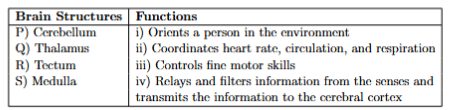
View Solution
Step 1: Understanding the Question
We need to correctly match each brain structure with its primary function from the given lists.
Step 2: Detailed Explanation
Let's analyze the function of each brain structure:
P) Cerebellum: Known as the "little brain," the cerebellum is crucial for coordinating voluntary movements, posture, balance, coordination, and speech, resulting in smooth and balanced muscular activity. This directly corresponds to (iii) Controls fine motor skills.
Q) Thalamus: Often described as the brain's sensory switchboard or relay station. It receives sensory information (except smell) from the body and directs it to the appropriate areas of the cerebral cortex for processing. This matches (iv) Relays and filters information from the senses...
R) Tectum: Located in the midbrain, the tectum (specifically the superior and inferior colliculi) is involved in reflexive orienting movements of the head and eyes toward stimuli in the environment (e.g., a sudden sound or flash of light). This matches (i) Orients a person in the environment.
S) Medulla: The medulla oblongata is part of the brainstem and controls vital autonomic functions such as heartbeat, breathing (respiration), and blood pressure (circulation). This matches (ii) Coordinates heart rate, circulation, and respiration.
Step 3: Final Answer
The correct pairings are:
P - (iii)
Q - (iv)
R - (i)
S - (ii)
This combination corresponds to option (D).
Quick Tip: Create simple mnemonics to remember brain functions. For example: \textbf{Cerebellum} sounds like "Sarah balances" - for balance and motor skills. \textbf{Thalamus} - Hal \& Amos are traffic cops, directing sensory traffic. \textbf{Medulla} - Medals hang over your heart and lungs, for vital functions.
Which one of the following is established by the replication of research studies?
View Solution
Step 1: Understanding the Question
The question asks about the primary purpose or outcome of replicating a research study.
Step 2: Detailed Explanation
Let's define the key terms:
Replication: The process of repeating a research study, often with different subjects in different situations, to see whether the basic finding extends to other participants and circumstances.
Reliability: Refers to the consistency and stability of a measure or a research finding. If a study is replicated and produces the same or similar results, it demonstrates that the findings are not a fluke or due to chance. This consistency is the essence of reliability.
Validity: Refers to the extent to which a test measures what it claims to measure (internal validity) or the extent to which the results can be generalized to other situations (external validity). While successful replication can increase our confidence in the external validity of a finding, its most direct and fundamental purpose is to establish reliability. If a finding cannot be reliably reproduced, its validity is moot.
Interaction effect \& Mediation effect: These are specific statistical outcomes within a study, not concepts established by the act of replication itself.
The core function of replication is to check if the results are consistent and dependable. If different researchers at different times can get the same results, the finding is considered reliable.
Step 3: Final Answer
Replication of research studies is primarily done to establish the reliability of the results.
Quick Tip: Think of reliability as \textbf{consistency} and validity as \textbf{accuracy}. If you step on a scale three times and it shows "150 lbs, 151 lbs, 149 lbs," it is reliable. If your actual weight is 170 lbs, the scale is not valid. Replication checks for consistency (reliability) first.
Match the theory/law in the first column with the corresponding explanation in the second column of the table given below.
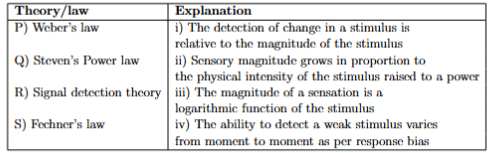
View Solution
Step 1: Understanding the Question
We need to match fundamental laws and theories from the field of psychophysics with their correct definitions.
Step 2: Detailed Explanation
P) Weber's law: This law states that the just-noticeable difference (JND) between two stimuli is a constant proportion of the original stimulus intensity. In other words, the detection of change is relative to the initial magnitude. This directly matches (i).
Q) Steven's Power law: This law is a more general relationship between stimulus intensity and perceived magnitude. It states that the perceived magnitude of a sensation is proportional to the stimulus intensity raised to a certain power (exponent). This perfectly matches (ii).
R) Signal detection theory: This theory moves beyond simple thresholds to account for the psychological factors influencing perception. It posits that detecting a weak stimulus (a "signal") depends not only on its intensity but also on the observer's decision-making process, including their expectations and response bias (e.g., being cautious vs. being liberal in responding). This matches (iv).
S) Fechner's law: Derived from Weber's law, this law proposes a specific mathematical relationship: the subjective sensation is proportional to the logarithm of the stimulus intensity. This matches (iii).
Step 3: Final Answer
The correct pairings are: P-(i), Q-(ii), R-(iv), S-(iii). This corresponds to option (C).
Quick Tip: To differentiate these laws: \textbf{Weber}: Change detection is a \textbf{ratio}. \textbf{Fechner}: Sensation is a \textbf{logarithm} of intensity. \textbf{Stevens}: Sensation is intensity raised to a \textbf{power}. \textbf{Signal Detection}: Detection involves \textbf{decision bias}.
Match the sleep disorders in the first column with the symptoms in the second column of the table given below.
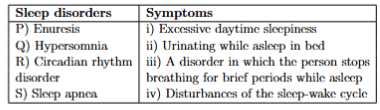
View Solution
Step 1: Understanding the Question
We need to match four specific sleep disorders with their defining symptoms.
Step 2: Detailed Explanation
P) Enuresis: The medical term for bedwetting. It involves involuntary urination while asleep. This matches (ii).
Q) Hypersomnia: Characterized by recurrent episodes of excessive daytime sleepiness or prolonged nighttime sleep. "Hyper-" means excessive, and "somnia" refers to sleep. This matches (i).
R) Circadian rhythm disorder: These are a family of sleep disorders related to the timing of sleep. They involve a persistent or recurrent pattern of sleep disruption resulting from a mismatch between the individual's internal sleep-wake cycle (circadian rhythm) and the light-darkness cycle in their environment. This matches (iv).
S) Sleep apnea: A serious sleep disorder where breathing repeatedly stops and starts during sleep. "Apnea" literally means a suspension of breathing. This matches (iii).
Step 3: Final Answer
The correct pairings are: P-(ii), Q-(i), R-(iv), S-(iii). This corresponds to option (B).
Quick Tip: Break down the medical terms to help remember them: \textbf{Enuresis}: Think "urine". \textbf{Hyper-somnia}: Hyper = excessive, Somnia = sleep. \textbf{Circadian}: Relates to the 24-hour biological clock or cycle. \textbf{A-pnea}: A = without, Pnea = breath.
__________ explains aging as a process of mutual withdrawal of individual and society, whereas __________ assumes positive correlation between activity and successful aging.
View Solution
Step 1: Understanding the Question
We need to identify two major psychosocial theories of aging based on their core tenets. The first describes aging as withdrawal, and the second describes it as continued activity.
Step 2: Detailed Explanation
Disengagement Theory: This theory posits that aging is an inevitable, mutual withdrawal or disengagement between the aging person and society. This process is seen as natural and beneficial for both the individual (who can prepare for death) and society (which can transition roles to younger generations). This matches the first part of the statement.
Activity Theory: This theory stands in direct opposition to disengagement theory. It proposes that successful aging occurs when older adults stay active and maintain social interactions. It assumes that a person's self-concept is validated through participation in roles and activities, and that continued activity is linked to life satisfaction. This matches the second part of the statement.
Other options: "Decay theory" relates to memory, not social aging. "Engagement theory" and "Withdrawal theory" are general terms but "Disengagement theory" and "Activity theory" are the specific, well-established names for these opposing sociological perspectives on aging. "Balance theory" is a theory of attitude change.
Step 3: Final Answer
Disengagement theory explains aging as mutual withdrawal, while Activity theory links activity to successful aging.
Quick Tip: Remember these two theories as a classic debate in gerontology. \textbf{Disengagement} = "It's natural and good to withdraw." \textbf{Activity} = "It's better to stay active and engaged."
Match the biases/effects in the first column with the descriptions in the second column of the table given below.
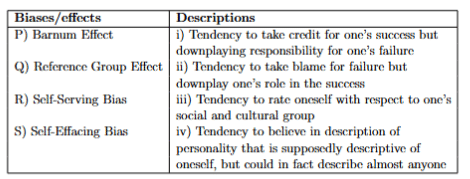
View Solution
Step 1: Understanding the Question
We need to match four psychological biases and effects with their correct definitions.
Step 2: Detailed Explanation
P) Barnum Effect (or Forer Effect): This is the tendency for individuals to give high accuracy ratings to personality descriptions that are supposedly tailored specifically for them, but are in fact vague and general enough to apply to a wide range of people (e.g., horoscopes). This matches (iv).
Q) Reference Group Effect: This is a bias in self-report where people compare themselves to a salient reference group when making ratings. For example, a person might rate themselves as "not very tall" if their reference group is a team of basketball players. This matches (iii), rating oneself with respect to one's social and cultural group.
R) Self-Serving Bias: This is the common tendency to attribute successes to internal, personal factors (e.g., "I passed because I'm smart") while attributing failures to external, situational factors (e.g., "I failed because the test was unfair"). This matches (i).
S) Self-Effacing Bias (or Modesty Bias): This is the opposite of the self-serving bias, more common in collectivistic cultures. It is the tendency to attribute success to external factors and take the blame for failure on internal factors. This matches (ii).
Step 3: Final Answer
The correct pairings are: P-(iv), Q-(iii), R-(i), S-(ii). This corresponds to option (B).
Quick Tip: To distinguish the self-related biases: \textbf{Self-Serving}: I'm great when I succeed, it's not my fault when I fail. (Common in individualistic cultures) \textbf{Self-Effacing}: It was luck when I succeeded, it's my fault when I fail. (Common in collectivistic cultures)
Match the theories in the first column with the central themes in the second column of the table given below.
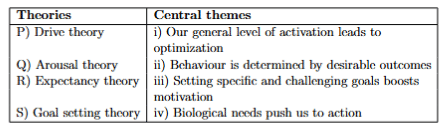
View Solution
Step 1: Understanding the Question
We need to match four different theories of motivation with their core concepts.
Step 2: Detailed Explanation
P) Drive theory (Drive-Reduction Theory): Proposed by Clark Hull, this theory suggests that physiological needs (e.g., hunger, thirst) create an aroused state of tension called a "drive." This drive motivates an organism to satisfy the need and return to a state of homeostasis. This matches (iv) Biological needs push us to action.
Q) Arousal theory: This theory suggests that people are motivated to maintain an optimal level of arousal, which is neither too high nor too low. It explains why people might seek out excitement when bored or relaxation when overstimulated. This matches (i) Our general level of activation leads to optimization.
R) Expectancy theory: Proposed by Victor Vroom, this is a cognitive theory of motivation. It suggests that individuals are motivated to act based on their expectations that their effort will lead to performance, that performance will lead to a desirable outcome (reward), and that the outcome is valuable to them. This matches (ii) Behaviour is determined by desirable outcomes.
S) Goal setting theory: Developed by Edwin Locke, this theory states that motivation and performance are highest when individuals are given specific and challenging goals, and when feedback is provided. This matches (iii) Setting specific and challenging goals boosts motivation.
Step 3: Final Answer
The correct pairings are: P-(iv), Q-(i), R-(ii), S-(iii). This corresponds to option (A).
Quick Tip: Associate each motivation theory with a key word: \textbf{Drive}: Push (from internal needs). \textbf{Arousal}: Optimal level (like Goldilocks, "just right"). \textbf{Expectancy}: Pull / Outcome (cognitive calculation of rewards). \textbf{Goal-Setting}: Target (specific, challenging goals).
Which one of the following would resolve the basic dilemma of the social psychologist?
View Solution
Step 1: Understanding the Question
The question asks how to resolve the "basic dilemma of the social psychologist." This dilemma is the trade-off between internal validity and external validity.
Step 2: Detailed Explanation
Internal Validity: The degree to which an experiment is free from confounding variables, allowing for confident causal conclusions. Lab experiments are typically high in internal validity.
External Validity: The degree to which the findings of a study can be generalized to other people, settings, and situations. Field studies are typically high in external validity.
The Dilemma: It is very difficult to design a single study that is high in both internal and external validity. The control needed for high internal validity (lab setting) often makes the situation artificial, lowering external validity. The realism of high external validity (field setting) makes it difficult to control for confounds, lowering internal validity.
Let's analyze the options:
(A) \& (C): These options focus on maximizing only one type of validity at the expense of the other, which is the cause of the dilemma, not the solution.
(D): The distinction between applied and basic research is different from the dilemma of internal vs. external validity. Both types of research face this dilemma.
(B): This is the accepted solution. No single study is perfect, but confidence in a theory is built through a program of research. Researchers conduct some studies (like lab experiments) to establish causal relationships with high internal validity, and other studies (like field experiments or correlational studies) to demonstrate that the findings generalize to real-world settings (high external validity). Replication is key to ensuring the findings are robust. This combination of methods resolves the dilemma.
Step 3: Final Answer
The basic dilemma is resolved not by a single perfect study, but by a body of research that includes some studies focused on internal validity and others on external validity.
Quick Tip: Remember the trade-off: \textbf{Lab experiments} give you \textbf{control} (high internal validity) but can be artificial. \textbf{Field studies} give you \textbf{realism} (high external validity) but are messy. The solution is to use both methods to build a strong case.
Match the research methods in the first column with their purposes in the second column of the table given below.

View Solution
Step 1: Understanding the Question
We need to match qualitative research methods with their primary purpose or description.
Step 2: Detailed Explanation
P) Narrative method: This approach focuses on the stories people tell to understand their experiences and how they make sense of their lives. The core data is the narrative or story itself. This matches (ii) Collecting data in the form of cohesive stories.
Q) Ethnography: Originating from anthropology, ethnography is a method where the researcher immerses themselves in a particular social or cultural group to gain a deep understanding of their customs, values, and social processes from an insider's perspective. This matches (iv) Describing cultural characteristics in detail.
R) Case Study: This is an in-depth, detailed examination of a single individual, group, event, or community. It aims to provide a rich, holistic description of the "case." This matches (i) Describing a person, event, and experience in detail.
S) Content analysis: This is a research technique used to make replicable and valid inferences by systematically interpreting and coding textual material (e.g., documents, interviews, articles). A key part of the process is identifying and extracting recurring themes from the data. This matches (iii) Extracting themes from data.
Step 3: Final Answer
The correct pairings are: P-(ii), Q-(iv), R-(i), S-(iii). This corresponds to option (D).
Quick Tip: Associate each method with its primary unit of analysis: \textbf{Narrative}: Story \textbf{Ethnography}: Culture \textbf{Case Study}: A single case (person, group, etc.) \textbf{Content Analysis}: Themes in text
Which one of the following statements is TRUE according to Brehm's reactance theory?
View Solution
Step 1: Understanding the Question
We need to apply Brehm's reactance theory to predict the effectiveness of mild versus strong prohibitions.
Step 2: Detailed Explanation
Reactance Theory: This theory states that when people feel their freedom to choose a certain behavior is threatened, they experience an unpleasant state called "reactance." To reduce this reactance, they may be motivated to perform the threatened behavior, thereby restoring their sense of freedom.
A strong sign (e.g., "DO NOT SPIT UNDER ANY CIRCUMSTANCES! VIOLATORS WILL BE FINED!") is a significant threat to a person's freedom. According to reactance theory, this strong threat would likely produce more reactance, potentially leading some people to spit deliberately just to reassert their freedom.
A mild sign (e.g., "Please help keep our city clean. No spitting.") is a much smaller threat to freedom. It is less likely to arouse reactance and may be more effective because people are more likely to comply with the polite request.
Therefore, according to the theory, the mild sign, which generates less reactance, would be more effective than the strong sign.
Step 3: Final Answer
Based on reactance theory, a mild prohibition would be more effective than a strong one.
Quick Tip: Think of reactance theory as the "reverse psychology" principle. If you tell someone in a very forceful way that they absolutely cannot do something, it might just make them want to do it more to prove they can.
According to the overjustification effect, which one of the following consequences would be TRUE for students who freely choose to study psychology, if marks are given for attendance?
View Solution
Step 1: Understanding the Question
We need to apply the overjustification effect to predict what will happen to students' intrinsic interest in a subject when an external reward (marks for attendance) is introduced.
Step 2: Detailed Explanation
Overjustification Effect: This effect occurs when an expected external incentive, such as money or marks, decreases a person's intrinsic motivation to perform a task.
The students initially "freely choose to study psychology," which indicates they have intrinsic motivation (they study it because they find it interesting and enjoyable).
Then, an external incentive ("marks are given for attendance") is introduced.
According to the overjustification effect, the students may now reattribute their reason for attending class from "I attend because I like psychology" (intrinsic) to "I attend to get marks" (extrinsic).
This shift from intrinsic to extrinsic justification for the behavior can undermine or decrease their original interest in the subject itself. They now have an "overjustification" for their behavior—both an internal and an external reason—and the external one tends to dominate and diminish the internal one.
Step 3: Final Answer
The overjustification effect predicts that introducing an external reward for an intrinsically motivated activity will lead to a decreased interest in that activity.
Quick Tip: Remember the overjustification effect with this phrase: "When you pay people for play, it can turn into work." Rewarding something that was once done for fun can make it feel like a chore, reducing the original enjoyment.
Large rewards and severe punishments are examples of __________ justification for behaviour and result in __________ changes in attitude.
View Solution
Step 1: Understanding the Question
This question relates to theories of attitude change, specifically cognitive dissonance theory and the concept of justification. We need to classify large rewards/punishments and predict their effect on attitude change.
Step 2: Detailed Explanation
Type of Justification: Large rewards (e.g., a huge payment) and severe punishments (e.g., a serious threat) are powerful situational factors that come from outside the individual. Therefore, they are clear examples of external justification. A person complies with a request because the reward is too good to pass up or the punishment is too severe to risk.
Effect on Attitude Change: According to cognitive dissonance theory, real, lasting attitude change occurs when people need to resolve dissonance with minimal external justification. When there is a large external justification ("I only did it for the money"), the person feels little or no dissonance between their original attitude and their behavior. They can easily explain their actions by pointing to the external factor. Because there is no dissonance to resolve, there is no pressure to change their underlying attitude. Therefore, large external justifications lead to temporary compliance but only small or no lasting changes in attitude.
Conversely, a small reward or mild punishment provides insufficient external justification, creating more dissonance and thus more pressure to change one's attitude to align with the behavior, resulting in a larger attitude change.
Step 3: Final Answer
Large rewards and severe punishments are examples of external justification and result in small changes in attitude.
Quick Tip: Remember the key principle of cognitive dissonance and attitude change: \textbf{Less is more}. A \textbf{lesser} external justification (smaller reward/punishment) forces more internal justification, leading to a \textbf{more} significant and lasting attitude change.
Which of the following therapies is/are based on classical conditioning?
View Solution
Step 1: Understanding the Question
We need to identify which of the listed psychotherapies are derived from the principles of classical conditioning. This is an MSQ.
Step 2: Detailed Explanation
Classical conditioning involves learning through association, where a neutral stimulus comes to elicit a response after being paired with a stimulus that naturally elicits that response.
(A) Systematic desensitization: This therapy is used to treat phobias. It works by pairing a relaxed state (a conditioned response) with gradually increasing anxiety-triggering stimuli (the conditioned stimulus). The goal is to replace the fear response with a relaxation response through a process called counter-conditioning. This is a direct application of classical conditioning principles.
(B) Aversion therapy: This therapy aims to reduce an undesirable behavior by pairing it with an aversive (unpleasant) stimulus. For example, pairing the taste of alcohol with a nausea-inducing drug. The goal is to create a conditioned aversion to the previously desirable stimulus. This is also a direct application of classical conditioning.
(C) Cognitive behaviour therapy (CBT): CBT is a broader therapeutic approach that incorporates both behavioral techniques (based on classical and operant conditioning) and cognitive techniques (focusing on changing maladaptive thought patterns). While it uses conditioning principles, it is not based *exclusively* on them; its defining feature is the integration of cognitive elements. However, many of its behavioral components are derived from conditioning.
(D) Rational emotive behaviour therapy (REBT): Developed by Albert Ellis, REBT is a type of cognitive therapy that focuses on identifying and changing the irrational beliefs that lead to emotional and behavioral problems. Its primary focus is cognitive, not classical conditioning.
Considering the options, Systematic Desensitization and Aversion Therapy are the purest and most direct applications of classical conditioning. CBT is a broader category that includes these but is not solely based on classical conditioning. REBT is primarily cognitive. The most accurate answer is to select the therapies that are fundamentally built on this principle.
Step 3: Final Answer
Systematic desensitization and aversion therapy are both therapeutic techniques directly based on the principles of classical conditioning.
Quick Tip: Remember the core of classical conditioning is \textbf{association}. Therapies based on it involve creating new associations. \textbf{Systematic Desensitization}: Associates phobic stimulus with relaxation. \textbf{Aversion Therapy}: Associates undesirable behavior with an unpleasant feeling.
Which of the following characterize(s) Wernicke's aphasia?
View Solution
Step 1: Understanding the Question
The question asks for the defining characteristics of Wernicke's aphasia, also known as receptive aphasia. This is a Multiple Select Question (MSQ).
Step 2: Detailed Explanation
Let's compare the two main types of aphasia:
Wernicke's Aphasia (Receptive Aphasia): Caused by damage to Wernicke's area in the temporal lobe. The primary deficit is in language comprehension. Individuals can often produce fluent, grammatically correct speech, but it is nonsensical and lacks meaning ("word salad"). They struggle to understand both spoken and written language.
Broca's Aphasia (Expressive Aphasia): Caused by damage to Broca's area in the frontal lobe. The primary deficit is in language production. Individuals can typically understand language but have great difficulty producing fluent, grammatical speech. Their speech is often slow, halting, and telegraphic.
Now let's evaluate the options:
(A) Inability to comprehend spoken words: This is the hallmark symptom of Wernicke's aphasia. This statement is correct.
(B) Inability to understand the meaning of words: This is another way of describing the comprehension deficit central to Wernicke's aphasia. This statement is correct.
(C) Inability to speak grammatically correct language: This is characteristic of Broca's aphasia, not Wernicke's. People with Wernicke's aphasia often speak in long, grammatical, but meaningless sentences. This statement is incorrect.
(D) Inability to write and understand the symbols that represent speech sounds: This describes aspects of agraphia and alexia, which can co-occur with aphasia, but the core issue in Wernicke's aphasia is comprehension of meaning, not just symbol-sound correspondence. Options A and B are more precise descriptions of the primary deficit.
Step 3: Final Answer
Wernicke's aphasia is primarily characterized by an inability to comprehend spoken words and understand their meaning.
Quick Tip: Remember the difference with this simple association: \textbf{Broca's} = \textbf{Broken} speech (production problem). \textbf{Wernicke's} = \textbf{What?} (comprehension problem).
Which of the following is/are the component(s) of Theory of Mind?
View Solution
Step 1: Understanding the Question
The question asks to identify the core components of the psychological construct "Theory of Mind" (ToM). This is an MSQ.
Step 2: Detailed Explanation
Theory of Mind (ToM) is the ability to attribute mental states—beliefs, intents, desires, emotions, knowledge, etc.—to oneself and to others, and to understand that others have beliefs, desires, intentions, and perspectives that are different from one's own.
(A) Understanding that people can have false beliefs: This is a critical and classic test of a developed Theory of Mind. The "false-belief task" (e.g., the Sally-Anne test) is used to assess whether a child understands that someone else can hold a belief that is different from reality. A key milestone in ToM development is passing this task. This is a core component.
(B) Distinguishing faces and smells: This is a basic perceptual ability, related to facial recognition (fusiform gyrus) and olfaction. It is not a component of Theory of Mind, which is a higher-order social-cognitive skill.
(C) Recognizing that others have mental states: This is the fundamental definition of Theory of Mind. It is the understanding that other people are not just automatons but have an internal world of thoughts, feelings, and intentions that guide their behavior. This is a core component.
(D) Having a vast vocabulary to express one's thoughts: This refers to linguistic ability or language development. While language is a tool that helps in developing and expressing Theory of Mind, it is not a component of ToM itself. A person could have a developed ToM with a limited vocabulary.
Step 3: Final Answer
The core components of Theory of Mind are recognizing that others have mental states and understanding that these states can include false beliefs.
Quick Tip: Think of Theory of Mind as being a "mind-reader" in a social sense. It's not about psychic powers, but about the ability to infer what's going on in someone else's head and realizing their mental world might be different from yours and from reality.
Which of the following would NOT be effective in minimizing groupthink?
View Solution
Step 1: Understanding the Question
We need to identify the actions that would fail to prevent or would even promote groupthink. Groupthink is a mode of thinking that people engage in when they are deeply involved in a cohesive in-group, when the members' strivings for unanimity override their motivation to realistically appraise alternative courses of action. This is an MSQ.
Step 2: Detailed Explanation
Let's evaluate which actions would help or hinder critical thinking in a group:
(A) The leader being impartial to all ideas...: This is an effective strategy to prevent groupthink. An impartial leader encourages open inquiry and avoids pressuring the group toward a preferred solution.
(B) The leader reminding the team that everyone will be held responsible...: This is an effective strategy to prevent groupthink. It promotes individual accountability and discourages "passing the buck" or mindlessly conforming.
(C) The leader taking all decisions on behalf of the group: This is NOT effective at minimizing groupthink. In fact, it's an authoritarian leadership style that completely bypasses group deliberation, which is the opposite of fostering critical evaluation. While it avoids the groupthink process, it does so by eliminating the group's decision-making role entirely, which is not a solution. It's a symptom of a dysfunctional group process.
(D) The leader arriving at a consensus quickly: This is NOT effective and is a primary symptom of groupthink. The pressure for a quick consensus and the illusion of unanimity are hallmarks of groupthink. An effective leader would encourage debate and a thorough exploration of alternatives, even if it takes more time.
Step 3: Final Answer
A leader taking all decisions and a leader pushing for a quick consensus would not be effective in minimizing groupthink; in fact, these actions are characteristic of poor group decision-making processes that groupthink theory seeks to explain.
Quick Tip: To prevent groupthink, a leader should act like a good moderator: encourage diverse opinions, seek outside input, play devil's advocate, and avoid stating their own preference early on. Any action that short-circuits this process (like making the decision alone or rushing to agree) will make groupthink more likely.
Which of the following describe(s) the standard error of the mean?
View Solution
Step 1: Understanding the Question
The question asks for the correct definition(s) of the standard error of the mean (SEM). This is an MSQ.
Step 2: Detailed Explanation
(A) It is the standard deviation of the sampling distribution of the mean: This is the precise statistical definition of the SEM. If you were to take an infinite number of samples from a population and calculate the mean of each sample, the distribution of those sample means is called the sampling distribution of the mean. The standard deviation of this specific distribution is the standard error of the mean. This statement is correct.
(B) It reflects the accuracy with which sample means estimate the population mean: This is the practical interpretation of the SEM. A smaller SEM indicates that the sample means are clustered closely together (and therefore likely closer to the true population mean), suggesting a more precise estimate. A larger SEM indicates more variability among sample means, suggesting a less precise estimate. This statement is correct.
(C) It is the difference between mean and standard deviation of a distribution: This is incorrect. This describes a simple arithmetic calculation, not a statistical concept like standard error.
(D) It is the standard deviation of a stratified sample: This is incorrect. This describes the standard deviation calculated from one specific type of sample, not the standard error of the mean, which is a theoretical concept about the distribution of all possible sample means.
Step 3: Final Answer
The standard error of the mean is both the standard deviation of the sampling distribution of the mean (the technical definition) and a measure of the accuracy of the sample mean as an estimate of the population mean (the practical meaning).
Quick Tip: Don't confuse the \textbf{Standard Deviation (SD)} with the \textbf{Standard Error of the Mean (SEM)}. \textbf{SD} describes the variability or spread of data points within a single sample. \textbf{SEM} describes the variability or spread of sample means around the true population mean. It tells you how reliable your sample mean is.
Which of the following describe(s) organizational commitment?
View Solution
Step 1: Understanding the Question
We need to identify the components that define organizational commitment based on established models in organizational psychology. This is an MSQ.
Step 2: Detailed Explanation
Organizational commitment is a psychological state that characterizes the employee's relationship with the organization and has implications for their decision to continue membership. The most widely used model by Meyer and Allen proposes three components, which are reflected in the early definitions by Porter et al.
(A) A strong desire to remain a member of the organization: This relates to affective commitment (emotional attachment and desire to stay) and continuance commitment (the perceived cost of leaving). This is a core part of the definition.
(B) Willingness to exert high level of effort on behalf of the organization: This is a key behavioral outcome of commitment. Employees who are committed are more likely to go above and beyond their basic job duties. This is a core part of the definition.
(C) A definite belief in and acceptance of values and goals of the organization: This is the essence of affective commitment. It reflects an alignment between the individual's values and the organization's values. This is a core part of the definition.
(D) High turnover intention of the employees of the organization: This is the opposite of organizational commitment. High commitment is associated with low turnover intention. Therefore, this statement is incorrect.
The first three options (A, B, C) are the classic components of the definition of organizational commitment as proposed by Mowday, Steers, and Porter (1979), which is a foundational concept in the field.
Step 3: Final Answer
Organizational commitment is described by a desire to remain, a willingness to exert effort, and an acceptance of the organization's values and goals.
Quick Tip: Think of organizational commitment as a three-part bond: \textbf{Heart: "I want to stay." (Affective) - Option A \& C \textbf{Mind}: "I need to stay." (Continuance) \textbf{Actions}: "I'll work hard." (Behavioral outcome) - Option B
Prejudice is supported by the human tendency to categorize into in-groups and out-groups. Prejudice is supported by which of the following processes?
View Solution
Step 1: Understanding the Question
The question asks about the cognitive and attributional processes that support prejudice, which is rooted in in-group/out-group categorization. This is an MSQ.
Step 2: Detailed Explanation
Prejudice is a negative attitude toward an individual based on their membership in a particular group. It is sustained by several psychological processes:
(A) The way we think about others: This refers to cognitive processes, primarily stereotyping. Stereotypes are generalized beliefs (thoughts) about the characteristics of a group of people. These cognitive shortcuts provide the "justification" or content for prejudice. For example, believing a stereotype about a group (a thought process) supports a prejudiced attitude towards them. This is a supporting process.
(B) The way we assign meaning to others behaviour: This refers to attributional processes. A common process supporting prejudice is the ultimate attribution error, where we attribute negative behaviors of out-group members to their disposition ("that's just how they are") but attribute positive behaviors to the situation ("they just got lucky"). This biased way of assigning meaning maintains negative views. This is a supporting process.
(C) By following intellectual pursuits: This is generally a process that would reduce prejudice. Education and intellectual engagement are often associated with increased tolerance and a reduction in stereotyping.
(D) By working towards a common goal: This is a well-established method for \textit{reducing prejudice. The Robbers Cave experiment famously demonstrated that making groups cooperate to achieve a superordinate (common) goal can break down intergroup hostility.
Step 3: Final Answer
Prejudice is supported by cognitive processes like stereotyping (how we think about others) and attributional biases (how we assign meaning to their behavior).
Quick Tip: Remember the ABCs of intergroup attitudes: \textbf{Affect = \textbf{Prejudice} (the feeling) \textbf{B}ehavior = \textbf{Discrimination} (the action) \textbf{C}ognition = \textbf{Stereotype} (the thought) The question asks what supports prejudice, and stereotypes (how we think) are a key cognitive support.
Which of the following is/are feature(s) of clinical phobia?
View Solution
Step 1: Understanding the Question
We need to identify the diagnostic features of a specific phobia according to clinical psychology criteria (e.g., DSM-5). This is an MSQ.
Step 2: Detailed Explanation
The diagnostic criteria for a Specific Phobia include the following key features:
(A) The fear must be persistent: This is correct. The fear, anxiety, or avoidance is not a one-time event; it is typically lasting for 6 months or more.
(B) The fear must be a source of significant distress: This is correct. To be considered a clinical disorder, the phobia must cause clinically significant distress or impairment in social, occupational, or other important areas of functioning. A mild fear that doesn't affect one's life is not a clinical phobia.
(C) The fear is rational: This is incorrect. A defining feature of a phobia is that the fear is out of proportion to the actual danger posed by the specific object or situation. It is an irrational fear.
(D) The fear is usually perceived as unwarranted: This is correct. Individuals with a phobia often recognize that their fear is excessive or unreasonable, but they feel they cannot control it. This awareness that the fear is irrational is a common feature.
Step 3: Final Answer
The features of a clinical phobia include being persistent, causing significant distress, and being perceived by the individual as unwarranted or excessive.
Quick Tip: To distinguish a regular fear from a clinical phobia, remember the "3 D's" of psychological disorders: \textbf{Deviant}: The fear is excessive and irrational. \textbf{Distressful}: It causes significant emotional distress. \textbf{Dysfunctional}: It impairs daily functioning.
The value of F calculated from the data given in the table below is __________ (rounded off to one decimal place).

View Solution
Step 1: Understanding the Question
The question asks to calculate the F-statistic from a given ANOVA (Analysis of Variance) summary table.
Step 2: Key Formula or Approach
The F-statistic in an ANOVA is the ratio of the variance between groups to the variance within groups. The "Mean Square" (MS) column in the ANOVA table represents these variances.
The formula is: \[ F = \frac{Mean Square Between (MS_{Between})}{Mean Square Within (MS_{Within})} \]
Step 3: Detailed Explanation
From the table, we are given:
Mean Square Between (MS\(_{Between}\)) = 18
Mean Square Within (MS\(_{Within}\)) = 5
Now, we plug these values into the formula: \[ F = \frac{18}{5} \] \[ F = 3.6 \]
The question asks for the answer rounded to one decimal place. 3.6 is already in this format. The Sum of Squares (SS) and degrees of freedom (df) values are provided for context but are not needed for the final calculation, as the Mean Squares (MS = SS/df) are already calculated.
Step 4: Final Answer
The value of F is 3.6.
Quick Tip: Remember that the F-statistic is always a ratio of two variances, specifically \(\frac{Between-group variance}{Within-group variance}\). In an ANOVA table, this is simply the MS\textsubscript{Between} divided by the MS\textsubscript{Within}. A larger F-value suggests a greater difference between the group means relative to the variability within the groups.
*The article might have information for the previous academic years, please refer the official website of the exam.