
GATE 2023 Sociology Question Paper with Solution Pdf
- Chemistry Syllabus
- Maths Syllabus
- Physics Syllabus
- Exam Pattern
- Paper Analysis
- Chemical Engg Syllabus
- Civil Engg Syllabus
- ECE Syllabus
- Mechanical Engg Syllabus
- Engg Science Syllabus
- Mining Engg Syllabus
- IN Syllabus
- CSE Syllabus
- EE Syllabus
- AE Syllabus
- BM Syllabus
- GG Syllabus
- EY Syllabus
- ST Syllabus
- TF Syllaus
- AR Syllabus
- XL Syllabus
- MT Syllabus
- PI Syllabus
- PE Syllabus
- ME Pattern
- TF Pattern
- CE Pattern
- EE Pattern
- EC Pattern
- CS Pattern
- BT Pattern
- BM Pattern
- IN Pattern
- DA Syllabus
- NA & ME Syallabus
- ES & Engg Syllabus
- Geomatics Engg Syllabus
- Agri Engg Syllabus
- Humanities and Social Sci
- PI Syllabus


| Updated On - Jan 3, 2026
GATE Question Papers are the most important study material for effective exam preparation. We at Zollege have provided all GATE Previous Year Papers with Solution PDFs here. GATE 2023 Sociology exam was conducted successfully on February 5 by Indian Institute of Technology Kanpur.
Students can freely download the GATE previous year's question paper PDFs along with their solutions here. We strongly encourage GATE aspirants to scan through all the GATE Question Paper to know the overall difficulty level, GATE Syllabus and understand the changes in GATE Exam Pattern over the years.
GATE 2023 Sociology Question Paper with Solution PDF
| GATE 2023 Sociology Question Paper PDF | GATE 2023 Sociology Solution PDF |
|---|---|
| Download PDF | Check Solutions |

Rafi told Mary, “I am thinking of watching a film this weekend."
The following reports the above statement in indirect speech:
Rafi told Mary that he __________ of watching a film that weekend.
View Solution
Step 1: Understanding the Question
The question requires converting a sentence from direct speech to indirect (or reported) speech. This involves changing tenses, pronouns, and words indicating time and place.
Step 2: Rules for Conversion
1. Reporting Verb Tense: The reporting verb is "told," which is in the past tense.
2. Tense Change: When the reporting verb is in the past tense, the tense of the verb in the direct speech must be shifted back. The verb in the direct speech is "am thinking," which is in the Present Continuous Tense. It will change to the Past Continuous Tense.
3. Pronoun Change: The pronoun "I" refers to the speaker, Rafi (male). So, "I" changes to "he".
4. Time Adverbial Change: The phrase "this weekend" changes to "that weekend".
Step 3: Applying the Rules
Direct Speech: “I am thinking of watching a film this weekend."
Applying the rules:
"I" becomes "he".
"am thinking" (Present Continuous) becomes "was thinking" (Past Continuous).
"this weekend" becomes "that weekend".
Indirect Speech: Rafi told Mary that he was thinking of watching a film that weekend.
Step 4: Final Answer
The correct verb form to fill in the blank is "was thinking".
Quick Tip: In direct to indirect speech conversion, if the reporting verb (like 'said' or 'told') is in the past tense, you must shift the tense of the direct statement one step back. For example: Present Simple becomes Past Simple, Present Continuous becomes Past Continuous, and Present Perfect becomes Past Perfect.
Permit : __________ :: Enforce : Relax
(By word meaning)
View Solution
Step 1: Understanding the Question
This is an analogy question based on word meaning. We need to identify the relationship between the second pair of words ("Enforce : Relax") and apply the same relationship to the first pair ("Permit : ______").
Step 2: Analyzing the Relationship
The words "Enforce" and "Relax" are antonyms. To enforce a law means to make sure it is obeyed, while to relax a law means to make it less strict. They represent opposite actions.
Step 3: Applying the Relationship to the First Pair
We need to find the antonym for the word "Permit".
Permit means to give authorization or consent to (someone) to do something.
Let's examine the options:
(A) Allow: This is a synonym of "Permit".
(B) Forbid: This means to refuse to allow something, which is the direct opposite of "Permit".
(C) License: This is a noun referring to an official document that gives permission. It is related but not an antonym.
(D) Reinforce: This means to strengthen or support, which is not an opposite.
Step 4: Final Answer
The antonym of "Permit" is "Forbid". Therefore, the completed analogy is Permit : Forbid :: Enforce : Relax.
Quick Tip: In analogy questions, first pinpoint the precise relationship between the given pair of words. Common relationships include synonym/antonym, cause/effect, part/whole, object/function, and type/kind.
Given a fair six-faced dice where the faces are labelled '1', '2', '3', '4', '5', and '6', what is the probability of getting a ‘1' on the first roll of the dice and a ‘4' on the second roll?
View Solution
Step 1: Understanding the Question
The problem asks for the probability of two independent events happening in sequence: getting a '1' on the first roll of a fair six-sided die, and then getting a '4' on the second roll.
Step 2: Key Formula or Approach
For independent events A and B, the probability of both events occurring is the product of their individual probabilities:
\[ P(A and B) = P(A) \times P(B) \]
Step 3: Detailed Explanation
Event A: Getting a '1' on the first roll.
A fair six-faced die has 6 possible outcomes: \{1, 2, 3, 4, 5, 6\.
The number of favorable outcomes for getting a '1' is 1.
The probability of Event A is:
\[ P(A) = \frac{Number of favorable outcomes}{Total number of outcomes} = \frac{1}{6} \]
Event B: Getting a '4' on the second roll.
The second roll is independent of the first. It also has 6 possible outcomes.
The number of favorable outcomes for getting a '4' is 1.
The probability of Event B is:
\[ P(B) = \frac{Number of favorable outcomes}{Total number of outcomes} = \frac{1}{6} \]
Combined Probability.
To find the probability of both events happening, we multiply their individual probabilities:
\[ P(A and B) = P(A) \times P(B) = \frac{1}{6} \times \frac{1}{6} = \frac{1}{36} \]
Step 4: Final Answer
The probability of getting a '1' on the first roll and a '4' on the second roll is \(\frac{1}{36}\).
Quick Tip: Remember to distinguish between independent and dependent events. Rolling a die twice are independent events, as the outcome of the first roll does not affect the second. For sequential events described with "and," you typically multiply their probabilities.
A recent survey shows that 65% of tobacco users were advised to stop consuming tobacco. The survey also shows that 3 out of 10 tobacco users attempted to stop using tobacco.
Based only on the information in the above passage, which one of the following options can be logically inferred with certainty?
View Solution
Step 1: Understanding the Question
We are given two pieces of information about a group of tobacco users and asked to determine which conclusion can be drawn with absolute certainty.
Fact 1: 65% of tobacco users were advised to stop.
Fact 2: 3 out of 10 (which is 30%) of tobacco users attempted to stop.
Step 2: Analyzing the Options
Let's analyze each option based on the given facts. Let T be the total number of tobacco users.
(A) A majority of tobacco users who were advised to stop consuming tobacco made an attempt to do so.
This asks if the number of people who were both advised \textit{and attempted is greater than 50% of those who were advised. The group of people who attempted (30% of T) could be a subset of the group who were advised (65% of T). In the most optimistic scenario, all 30% who attempted were also advised. The fraction of advised users who attempted would be \(\frac{0.30T{0.65T} = \frac{30}{65} \approx 0.46\), which is 46%. Since 46% is not a majority (\(>\) 50%), this statement cannot be true even in the best-case scenario. It cannot be inferred with certainty.
(B) A majority of tobacco users who were advised to stop consuming tobacco did not attempt to do so.
Let's consider the group of advised users (65% of T). The maximum number of people from this group who could have attempted to stop is 30% of T (this happens if everyone who attempted was also advised).
In this case, the number of advised users who did not attempt would be \(0.65T - 0.30T = 0.35T\).
Is \(0.35T\) a majority of \(0.65T\)? Let's check the fraction: \(\frac{0.35T{0.65T} = \frac{35}{65} \approx 0.538\), which is 53.8%.
Since 53.8% is greater than 50%, a majority of the advised users did not attempt to stop, even in the scenario with the maximum possible overlap. If the overlap is smaller, this percentage will be even higher. Therefore, this statement can be inferred with certainty.
(C) Approximately 30% of tobacco users successfully stopped consuming tobacco.
The passage states that 30% \textit{attempted to stop, not that they were \textit{successful. We cannot infer success from an attempt.
(D) Approximately 65% of tobacco users successfully stopped consuming tobacco.
The passage states that 65% were \textit{advised to stop, not that they were \textit{successful. We cannot infer success from advice.
Step 3: Final Answer
The only statement that can be logically inferred with certainty is (B).
Quick Tip: For logical inference questions with percentages, it's often helpful to consider the "worst-case" or "best-case" scenario for the overlap between the groups to test the certainty of a statement.
How many triangles are present in the given figure?

View Solution
Step 1: Understanding the Question
The task is to count all the triangles in the given geometric figure. A systematic approach is needed to avoid missing any or counting them multiple times.
Step 2: Systematic Counting Strategy
We can count the triangles by categorizing them based on the number of small triangular components they are made of. Let's label the vertices for clarity. Top row: A, B, C, D. Bottom row: E, F, G, H.
Step 3: Detailed Explanation
Triangles made of 1 small component:
There are 8 small, individual triangles clearly visible in the figure.
Count = 8
Triangles made of 2 small components:
These triangles are formed by combining two adjacent small triangles.
Pointing right (base on the left diagonal): Triangles with vertices (A,B,F), (B,C,G), (C,D,H). (3 triangles)
Pointing left (base on the right diagonal): Triangles with vertices (B,A,E), (C,B,F), (D,C,G). (3 triangles)
Count = 3 + 3 = 6
Triangles made of 3 small components:
There are no triangles formed by combining 3 small components.
Count = 0
Triangles made of 4 small components:
These are larger triangles that span across the figure.
Triangles with vertices (A,C,G), (B,D,H). (2 triangles)
Triangles with vertices (B,F,H), (C,E,G). Wait, this combination is not right. Let's recheck.
Vertices: (A, C, G), (B, D, H). (2 triangles)
Vertices: (E, G, C), (F, H, B). (2 triangles)
Count = 4
Triangles made of 6 small components:
These are the largest triangles that form half of the parallelogram.
Triangle with vertices (A,D,H). (1 triangle)
Triangle with vertices (A,D,E). (1 triangle)
Count = 2
Step 4: Final Answer
Total number of triangles = (triangles of size 1) + (size 2) + (size 4) + (size 6)
Total = 8 + 6 + 4 + 2 = 20.
Quick Tip: When counting figures, develop a system. Start with the smallest components and gradually build up to larger shapes. Labelling vertices can also help in keeping track of the shapes you have already counted.
Students of all the departments of a college who have successfully completed the registration process are eligible to vote in the upcoming college elections. However, by the time the due date for registration was over, it was found that surprisingly none of the students from the Department of Human Sciences had completed the registration process.
Based only on the information provided above, which one of the following sets of statement(s) can be logically inferred with certainty?
(i) All those students who would not be eligible to vote in the college elections would certainly belong to the Department of Human Sciences.
(ii) None of the students from departments other than Human Sciences failed to complete the registration process within the due time.
(iii) All the eligible voters would certainly be students who are not from the Department of Human Sciences.
View Solution
Step 1: Understanding the Question
We need to evaluate three statements based on the given premises and determine which one(s) must be true.
Premise 1: Eligible Voter \(\implies\) Completed Registration.
Premise 2: Student from Human Sciences \(\implies\) Did NOT Complete Registration.
Step 2: Deriving a Direct Conclusion
From Premise 2, we know no student from Human Sciences completed registration. From Premise 1, we know that to be eligible, one must complete registration. Therefore, we can conclude with certainty that no student from the Department of Human Sciences is an eligible voter.
Step 3: Analyzing the Statements
(i) All those students who would not be eligible to vote in the college elections would certainly belong to the Department of Human Sciences.
This statement is of the form: Not Eligible \(\implies\) From Human Sciences. This is not necessarily true. We know Human Sciences students are not eligible, but students from other departments might also have failed to register for various reasons. The passage does not say that \textit{only Human Sciences students failed to register. So, we cannot be certain about this.
(ii) None of the students from departments other than Human Sciences failed to complete the registration process within the due time.
This means all students from other departments successfully registered. The passage gives no information about the registration status of students from other departments. It only provides information about the Human Sciences department. Therefore, we cannot infer this.
(iii) All the eligible voters would certainly be students who are not from the Department of Human Sciences.
This statement is of the form: Eligible Voter \(\implies\) NOT from Human Sciences. This is the contrapositive of our derived conclusion ("Student from Human Sciences \(\implies\) Not an Eligible Voter"). A statement and its contrapositive are logically equivalent. Since we are certain that no student from Human Sciences is eligible, it must be true that any student who IS eligible cannot be from Human Sciences. This statement can be inferred with certainty.
Step 4: Final Answer
Only statement (iii) can be logically inferred with certainty.
Quick Tip: In logic, if a statement "If P, then Q" is true, its contrapositive "If not Q, then not P" is also always true. Recognizing this relationship can quickly help validate or invalidate inferences.
Which one of the following options represents the given graph?

View Solution
Step 1: Understanding the Question
We need to identify the function that corresponds to the given graph by analyzing its key features like symmetry, behavior at the origin, and limits as x approaches infinity.
Step 2: Analyzing the Graph's Features
Origin: The graph passes through the origin, so \(f(0) = 0\).
Symmetry: The graph is symmetric with respect to the origin. This means it is an odd function, where \(f(-x) = -f(x)\).
End Behavior: As \(x \to \infty\), the graph approaches 0 from the positive side (\(f(x) \to 0^+\)). As \(x \to -\infty\), the graph approaches 0 from the negative side (\(f(x) \to 0^-\)).
Extrema: There is a local maximum in the first quadrant (for \(x>0\)) and a local minimum in the third quadrant (for \(x<0\)).
Step 3: Evaluating the Options
(A) \(f(x) = x^2 2^{-|x|}\):
Let's test for symmetry: \(f(-x) = (-x)^2 2^{-|-x|} = x^2 2^{-|x|} = f(x)\). This is an even function, which should be symmetric about the y-axis. The graph is not. So, (A) is incorrect.
(B) \(f(x) = x 2^{-|x|}\):
- Origin: \(f(0) = 0 \times 2^{-|0|} = 0 \times 1 = 0\). (Matches)
- Symmetry: \(f(-x) = (-x) 2^{-|-x|} = -x 2^{-|x|} = -f(x)\). This is an odd function. (Matches)
- End Behavior: As \(x \to \infty\), \(x\) grows linearly while \(2^{-x}\) decays exponentially. The exponential decay dominates, so \(f(x) \to 0\). For \(x>0\), \(f(x)\) is positive. As \(x \to -\infty\), let \(x = -y\) with \(y \to \infty\). \(f(-y) = -y \times 2^{-|-y|} = -y \times 2^{-y} \to 0\). For \(x<0\), \(f(x)\) is negative. (Matches)
This function fits all the key features.
(C) \(f(x) = |x| 2^{-x}\):
Let's test end behavior for \(x \to -\infty\). Let \(x = -2\). \(f(-2) = |-2| \times 2^{-(-2)} = 2 \times 2^2 = 8\). As \(x \to -\infty\), \(f(x)\) grows exponentially and goes to \(+\infty\). This does not match the graph. So, (C) is incorrect.
(D) \(f(x) = x 2^{-x}\):
Let's test end behavior for \(x \to -\infty\). Let \(x = -2\). \(f(-2) = (-2) \times 2^{-(-2)} = -2 \times 2^2 = -8\). As \(x \to -\infty\), \(f(x)\) goes to \(-\infty\). This does not match the graph. So, (D) is incorrect.
Step 4: Final Answer
The function \(f(x) = x 2^{-|x|}\) is the only one that matches all the characteristics of the given graph.
Quick Tip: Quickly check for symmetry when matching graphs to functions. If the graph is symmetric about the y-axis, it's an even function (\(f(-x)=f(x)\)). If it's symmetric about the origin, it's an odd function (\(f(-x)=-f(x)\)). This can often eliminate several options immediately.
Which one of the options does NOT describe the passage below or follow from it?
We tend to think of cancer as a 'modern' illness because its metaphors are so modern. It is a disease of overproduction, of sudden growth, a growth that is unstoppable, tipped into the abyss of no control. Modern cell biology encourages us to imagine the cell as a molecular machine. Cancer is that machine unable to quench its initial command (to grow) and thus transform into an indestructible, self-propelled automaton.
[Adapted from \textit{The Emperor of All Maladies by Siddhartha Mukherjee]
View Solution
Step 1: Understanding the Question
We need to read the given passage and identify which of the four options is a false statement, either by not being mentioned or by directly contradicting the information in the passage.
Step 2: Analyzing the Passage
The main points of the passage are:
Cancer is considered 'modern' due to its modern metaphors (overproduction, unstoppable growth).
Modern cell biology encourages the metaphor of a cell as a "molecular machine".
Cancer is described as this "machine" that cannot stop its growth command, becoming an "indestructible, self-propelled automaton".
The central theme is the use of modern, machine-based metaphors to understand cancer.
Step 3: Evaluating the Options
(A) It is a reflection of why cancer seems so modern to most of us.
The very first sentence states, "We tend to think of cancer as a 'modern' illness because its metaphors are so modern." This option accurately reflects the passage's main point. So, it follows from the passage.
(B) It tells us that modern cell biology uses and promotes metaphors of machinery.
The passage says, "Modern cell biology encourages us to imagine the cell as a molecular machine." This directly supports the idea that cell biology uses machinery metaphors. So, it follows from the passage.
(C) Modern cell biology encourages metaphors of machinery, and cancer is often imagined as a machine.
The passage combines these two ideas: "Modern cell biology encourages us to imagine the cell as a molecular machine. Cancer is that machine..." This option is a correct summary of a key argument in the passage. So, it follows from the passage.
(D) Modern cell biology never uses figurative language, such as metaphors, to describe or explain anything.
This statement is in direct contradiction to the passage. The entire passage is about how modern cell biology \textit{does use metaphors, specifically the "molecular machine" metaphor, to describe cells and cancer. The passage explicitly states that biology "encourages us to imagine" the cell in this metaphorical way. Therefore, this option does NOT follow from the passage.
Step 4: Final Answer
Option (D) is the correct answer because it makes a claim that is directly refuted by the text.
Quick Tip: In "which does NOT follow" questions, look for options that make absolute claims (using words like "never," "always," "all," "none"). These are often easier to invalidate. If the passage provides even one counterexample, the absolute claim is false.
The digit in the unit's place of the product \(3^{999} \times 7^{1000}\) is ______.
View Solution
Step 1: Understanding the Question
We need to find the last digit (unit's digit) of the number obtained by multiplying \(3^{999}\) and \(7^{1000}\). We can do this by finding the unit's digit of each part separately and then multiplying them.
Step 2: Key Formula or Approach
The unit digits of powers of a number repeat in a cycle. We need to find the length of this cycle (cyclicity) and use it to determine the unit digit for a given large power. The unit digit of \( (a \times b) \) is the unit digit of \( (unit digit of a \times unit digit of b) \).
Step 3: Detailed Explanation
Finding the unit digit of \(3^{999}\):
Let's look at the pattern of the unit digits of powers of 3:
\(3^1 = 3\)
\(3^2 = 9\)
\(3^3 = 27 \to 7\)
\(3^4 = 81 \to 1\)
\(3^5 = 243 \to 3\)
The cycle of unit digits is (3, 9, 7, 1), and its length is 4. To find the unit digit of \(3^{999}\), we divide the exponent 999 by the cycle length 4.
\[ 999 \div 4 = 249 with a remainder of 3 \]
The remainder of 3 means the unit digit is the 3rd element in the cycle, which is 7.
So, the unit digit of \(3^{999}\) is 7.
Finding the unit digit of \(7^{1000}\):
Let's look at the pattern of the unit digits of powers of 7:
\(7^1 = 7\)
\(7^2 = 49 \to 9\)
\(7^3 = 343 \to 3\)
\(7^4 = 2401 \to 1\)
\(7^5 = 16807 \to 7\)
The cycle of unit digits is (7, 9, 3, 1), and its length is 4. To find the unit digit of \(7^{1000}\), we divide the exponent 1000 by the cycle length 4.
\[ 1000 \div 4 = 250 with a remainder of 0 \]
A remainder of 0 means the unit digit is the last element (the 4th element) in the cycle, which is 1.
So, the unit digit of \(7^{1000}\) is 1.
Finding the unit digit of the product:
Unit digit of (\(3^{999} \times 7^{1000}\)) = Unit digit of ( (Unit digit of \(3^{999}\)) \(\times\) (Unit digit of \(7^{1000}\)) )
= Unit digit of (\(7 \times 1\))
= 7
Step 4: Final Answer
The digit in the unit's place of the product is 7.
Quick Tip: The cyclicity of unit digits for most single-digit numbers is either 1, 2, or 4. For powers, finding the remainder after dividing the exponent by the cycle length is the key. Remember that a remainder of 0 corresponds to the last digit in the cycle.
A square with sides of length 6 cm is given. The boundary of the shaded region is defined by two semi-circles whose diameters are the sides of the square, as shown. The area of the shaded region is __________ cm\(^2\).

View Solution
Step 1: Understanding the Question
We need to find the area of the shaded region within a square of side 6 cm. The shaded region is formed by two semi-circles, one with the left side as diameter and one with the bottom side as diameter. The shaded area is the region covered by exactly one of the two semi-circles (their symmetric difference).
Step 2: Key Formula or Approach
Let A\(_L\) be the area of the left semi-circle and A\(_B\) be the area of the bottom semi-circle. The shaded area, A\(_S\), is given by:
A\(_S\) = (Area covered by A\(_L\) only) + (Area covered by A\(_B\) only)
This can be calculated as: A\(_S\) = A\(_L\) + A\(_B\) - 2 \(\times\) Area(A\(_L\) \(\cap\) A\(_B\)), where A\(_L\) \(\cap\) A\(_B\) is the overlapping area (the lens shape).
Alternatively, a symmetry-based area rearrangement method can be used.
Step 3: Detailed Explanation (Using Area Calculation)
Dimensions:
Side of the square = 6 cm.
Diameter of each semi-circle = 6 cm.
Radius of each semi-circle, \(r = \frac{6}{2} = 3\) cm.
Area of one semi-circle:
\[ A_{semi-circle} = \frac{1}{2}\pi r^2 = \frac{1}{2}\pi (3)^2 = \frac{9\pi}{2} cm^2 \]
So, A\(_L\) = A\(_B\) = \(\frac{9\pi}{2}\).
Area of the overlapping region (lens):
The overlap occurs in the bottom-left quarter of the main square, which is a smaller 3x3 square. Inside this 3x3 square, the overlapping region is formed by the intersection of two quarter-circles of radius 3.
Area of the lens = (Area of quarter-circle 1) + (Area of quarter-circle 2) - (Area of the 3x3 square)
\[ A_{lens} = \left(\frac{1}{4}\pi r^2\right) + \left(\frac{1}{4}\pi r^2\right) - (r^2) = \frac{1}{2}\pi r^2 - r^2 \]
\[ A_{lens} = \frac{1}{2}\pi (3)^2 - (3)^2 = \frac{9\pi}{2} - 9 cm^2 \]
Area of the shaded region:
\[ A_S = A_L + A_B - 2 \times A_{lens} \]
\[ A_S = \left(\frac{9\pi}{2}\right) + \left(\frac{9\pi}{2}\right) - 2 \times \left(\frac{9\pi}{2} - 9\right) \]
\[ A_S = 9\pi - (9\pi - 18) = 9\pi - 9\pi + 18 = 18 cm^2 \]
Step 4: Final Answer
The area of the shaded region is 18 cm\(^2\).
Quick Tip: This is a classic geometry problem. A useful theorem (Leonardo's Theorem) states that the sum of the areas of the two "lunes" (the shaded parts) is equal to the area of the central triangle formed by the diameters. Here, it can be generalized: the area of the shaded region (symmetric difference of the two semi-circles) is equal to the area of the square minus the area of the unshaded regions. By symmetry, the top-right unshaded area equals the bottom-left unshaded (overlap) area. So, Shaded Area + 2 * Overlap Area = Total Area of semi-circles. This leads to the same calculation but can be a confusing path. The direct calculation is most reliable.
Which word below best describes the idea of being both Spineless and Cowardly?
View Solution
Step 1: Understanding the Question
The question asks for a single word that encapsulates the meanings of both "spineless" (lacking courage and determination) and "cowardly" (lacking courage).
Step 2: Analyzing the Options
(A) Pusillanimous: The definition of pusillanimous is "showing a lack of courage or determination; timid." This aligns perfectly with the concepts of being cowardly and spineless.
(B) Unctuous: This word means "excessively or ingratiatingly flattering; oily." It describes someone who is overly slick and insincere, not cowardly.
(C) Obsequious: This means "obedient or attentive to an excessive or servile degree." While a spineless person might be obsequious, this word focuses on servility rather than a lack of courage.
(D) Reticent: This means "not revealing one's thoughts or feelings readily." It describes someone who is reserved or shy, which is different from being cowardly.
Step 3: Final Answer
The word "pusillanimous" is the most precise and fitting term for describing someone who is both spineless and cowardly.
Quick Tip: When faced with difficult vocabulary, try to break down the words into their roots if possible. For "pusillanimous," 'pusillus' means very small and 'animus' means spirit. So, it literally means "having a very small spirit," which is a great way to remember its connection to cowardice.
Choose the right preposition to fill up the blank:
The whole family got together _________ Diwali.
View Solution
Step 1: Understanding the Question
We need to select the correct preposition to use with the festival "Diwali" in the given sentence context. The sentence describes a gathering for a specific occasion.
Step 2: Analyzing Preposition Usage
at: This preposition is commonly used to refer to a point in time, a specific event, or a period of celebration. Examples include "at Christmas," "at Easter," "at the weekend." It fits perfectly for a festival like Diwali.
on: This preposition is used for specific dates or days. For example, "on Diwali day" or "on October 25th." Since the sentence refers to the festival period in general and not a specific day, "on" is less appropriate than "at".
in: This is used for longer, non-specific periods of time like months, seasons, or years (e.g., "in November," "in winter"). It is not typically used for specific festivals.
of / till: These prepositions do not make grammatical sense in this context. "Of Diwali" would imply possession, and "till Diwali" would imply a time limit leading up to the festival.
Step 3: Final Answer
The most appropriate preposition to indicate a gathering during the festival period of Diwali is "at". The correct sentence is: "The whole family got together at Diwali."
Quick Tip: Remember the general rule for prepositions of time: \textbf{at} for specific times and festival periods (at 5 PM, at Christmas), \textbf{on} for specific days and dates (on Monday, on May 1st), and \textbf{in} for longer periods (in July, in 2024).
Select the correct option to fill in all the blanks to complete the passage:
The (i)__________ factor amid this turbulence has been the (ii)__________ of high-octane, action-oriented films such as RRR, K.G.F: Chapter 2 and Pushpa from film industries in the south of the country. Traditionally, films made in the south have done well in their own (iii)__________. But increasingly, their dubbed versions have performed well in the Hindi heartland, with collections (iv)__________ those of their Bollywood counterparts.
View Solution
Step 1: Understanding the Question
We need to fill in four blanks in the passage with the most contextually appropriate words from the given options. The passage discusses the success of South Indian films compared to Bollywood films.
Step 2: Detailed Explanation
Let's analyze the context of each blank:
(i) __________ factor amid this turbulence...: The passage describes the success of South Indian films as a positive point ("high-octane", "performed well") amidst "turbulence". A positive word is needed. "Redeeming" fits well, suggesting this success is a saving grace. "Disheartening," "shocking," or "humbling" don't fit the positive context of the films' performance.
(ii) ...has been the __________ of high-octane, action-oriented films...: The success is attributed to these films. Words like "outperformance" or "success" would fit. "Failure," "underperformance," or "bombing" are the opposite of what is being described.
(iii) ...done well in their own __________: The passage contrasts the films' traditional success in their home regions with their new success in the "Hindi heartland". The word "geographies" correctly refers to these regions. "Channels," "cinemas," or "theatres" are too specific and don't capture the idea of a broad region.
(iv) ...with collections __________ those of their Bollywood counterparts.: The passage highlights the superior performance of the dubbed versions. "Eclipsing" (surpassing or overshadowing) correctly describes collections that are better than their counterparts. "Matching," "below," or "falling behind" contradict the theme of success.
Step 3: Final Answer
Option (B) provides the words: (i) redeeming, (ii) outperformance, (iii) geographies, (iv) eclipsing. All four words fit the context perfectly, creating a coherent and logical passage.
Quick Tip: In fill-in-the-blanks questions, read the entire passage first to grasp the overall tone and meaning. Then, use a process of elimination for each blank, ensuring that the chosen words are consistent with each other and the main idea of the text.
The following passage consists of 6 sentences. The first and sixth sentences of the passage are at their correct positions, while the middle four sentences (represented by 2, 3, 4, and 5) are jumbled up. Choose the correct sequence of the sentences so that they form a coherent paragraph:
1. Most obviously, mobility is taken to be a geographical as well as a social phenomenon.
2. Much of the social mobility literature regarded society as a uniform surface and failed to register the geographical intersections of region, city and place, with the social categories of class, gender and ethnicity.
3. The existing sociology of migration is incidentally far too limited in its concerns to be very useful here.
4. Further, I am concerned with the flows of people within, but especially beyond, the territory of each society, and how these flows may relate to many different desires, for work, housing, leisure, religion, family relationships, criminal gain, asylum seeking and so on.
5. Moreover, not only people are mobile but so too are many ‘objects’.
6. I show that sociology's recent development of a ‘sociology of objects’ needs to be taken further and that the diverse flows of objects across societal borders and their intersections with the multiple flows of people are hugely significant.
View Solution
Step 1: Understanding the Question
We need to arrange the sentences 2, 3, 4, and 5 in a logical order between the fixed sentences 1 and 6 to create a coherent paragraph.
Step 2: Detailed Explanation
Sentence 1 introduces the topic: mobility as both a geographical and social phenomenon.
Sentence 2 logically follows Sentence 1. It critiques the "social mobility literature" for failing to consider the geographical aspect mentioned in S1. This is a direct continuation of the opening idea.
Sentence 3 follows Sentence 2 by critiquing another related field, the "sociology of migration," as being too limited. This continues the theme of pointing out the shortcomings of existing sociological frameworks.
Sentence 4 begins with "Further," signaling an expansion of the topic. After critiquing past work, the author now states their broader concern with "flows of people" for various reasons. This broadens the scope from just migration or social mobility.
Sentence 5 begins with "Moreover," introducing another layer to the argument. It expands the concept of mobility from just people to include "objects." This serves as a perfect bridge to the concluding sentence.
Sentence 6 (fixed conclusion) directly builds upon Sentence 5. It talks about the "sociology of objects" and the "flows of objects," which were introduced in S5.
Step 3: Final Answer
The logical flow is from a general statement (S1), to a critique of existing literature on social mobility (S2) and migration (S3), to proposing a broader scope for people's mobility (S4), then introducing the mobility of objects (S5), and finally concluding on the significance of object-people flow intersections (S6). This corresponds to the sequence 2, 3, 4, 5.
Quick Tip: In para-jumble questions, look for logical connectors (like "Further," "Moreover"), pronoun references, and the flow of ideas from general to specific or from problem to solution. The opening sentence introduces a topic, and the concluding sentence often summarizes or builds upon the last point of the paragraph.
The population of a country increased by 5% from 2020 to 2021. Then, the population decreased by 5% from 2021 to 2022. By what percentage did the population change from 2020 to 2022?
View Solution
Step 1: Understanding the Question
This is a problem of successive percentage change. A value is first increased by a percentage and then decreased by the same percentage. We need to find the net percentage change.
Step 2: Key Formula or Approach
For successive percentage changes of \(a%\) and \(b%\), the net percentage change is given by the formula:
\[ Net Change = \left( a + b + \frac{ab}{100} \right) % \]
Here, an increase is positive (\(a = +5%\)) and a decrease is negative (\(b = -5%\)).
Step 3: Detailed Explanation
Method 1: Using the formula
Let \(a = +5\) and \(b = -5\).
\[ Net Change = \left( 5 + (-5) + \frac{(5)(-5)}{100} \right) % \] \[ Net Change = \left( 0 - \frac{25}{100} \right) % \] \[ Net Change = -0.25 % \]
A negative sign indicates a decrease. So, the population decreased by 0.25%.
Method 2: Using an initial value
Let the initial population in 2020 be 100.
Population in 2021: An increase of 5%.
Population = \(100 + (5% of 100) = 100 + 5 = 105\).
Population in 2022: A decrease of 5% from the 2021 population.
Decrease amount = \(5% of 105 = \frac{5}{100} \times 105 = 0.05 \times 105 = 5.25\).
New Population = \(105 - 5.25 = 99.75\).
Calculate the net change:
Initial population = 100. Final population = 99.75.
Change = Final - Initial = 99.75 - 100 = -0.25.
Percentage change = \(\frac{Change}{Initial} \times 100 = \frac{-0.25}{100} \times 100 = -0.25%\).
Step 4: Final Answer
The population had a net decrease of 0.25%.
Quick Tip: When a value is increased and then decreased by the same percentage \(x\), the net result is always a decrease of \(\frac{x^2}{100}%\). In this case, \(x=5\), so the net decrease is \(\frac{5^2}{100} = \frac{25}{100} = 0.25%\).
The words Thin: Slim: Slender are related in some way. Identify the correct option(s) that reflect(s) the same relationship:
View Solution
Step 1: Understanding the Question
The question asks us to identify the relationship between the words "Thin," "Slim," and "Slender" and find the option(s) with a similar relationship. The use of "option(s)" suggests this could be a Multiple Select Question (MSQ).
Step 2: Analyzing the Relationship
The words "Thin," "Slim," and "Slender" are all synonyms related to a low amount of body fat. They are a cluster of words describing the same physical characteristic but with different connotations. "Thin" can be neutral or negative, while "Slim" and "Slender" are generally positive or elegant.
Step 3: Detailed Explanation
We are looking for another set of words that form a similar cluster of related terms for a physical attribute, with nuanced differences.
(A) Fat: Plump: Voluptuous: These words all relate to having a larger body size. "Fat" is a general term, "Plump" suggests a rounded, often cute or healthy fullness, and "Voluptuous" refers to a curvy and attractive large figure. This is a strong parallel to the original set.
(B) Short: Small: Petite: These words relate to a small physical stature. "Short" refers to height, "Small" to overall size, and "Petite" specifically refers to a woman who is small and slender in build. This also forms a cluster of related terms for a physical characteristic.
(C) Tall: Taller: Tallest: This is a series of comparative and superlative adjectives. It shows grammatical degrees of a single word, not a cluster of nuanced synonyms. This relationship is different.
(D) Fair: Dark: Wheatish: These are different categories of skin complexion, not synonyms or nuanced variations of the same idea. This relationship is different.
Step 4: Final Answer
Both options (A) and (B) exhibit the same relationship as the original set of words. They are clusters of related adjectives describing a physical attribute with different nuances. Therefore, both are correct answers.
Quick Tip: In questions asking for word relationships, first define the relationship as precisely as possible. Is it synonymy, antonymy, cause-effect, or something more nuanced like a cluster of related terms with different connotations? Pay attention to phrasing like "option(s)" which indicates that more than one answer could be correct.
A pandemic like situation hit the country last year, resulting in loss of human life and economic depression. To improve the condition of its citizens, the government made a series of emergency medical interventions and increased spending to revive the economy. In both these efforts, district administration authorities were actively involved.
Which of the following action(s) are plausible?
View Solution
Step 1: Understanding the Question
Based on the provided passage about a government's response to a pandemic, we need to identify which future actions are plausible or logical. The phrasing "action(s)" indicates this is a Multiple Select Question (MSQ).
Step 2: Detailed Explanation
Let's evaluate the plausibility of each option based on the text:
(A) The passage states that "district administration authorities were actively involved" in the pandemic response. Given their experience and involvement, it is highly plausible that the government would formally make them responsible for similar tasks in the future. This is a logical extension of their demonstrated role.
(B) After any major crisis and large-scale government intervention, it is a standard and very plausible practice to set up a task force to review what happened, evaluate the effectiveness of the response, and learn lessons. This is a logical step for accountability and improvement.
(C) Similar to (B), planning for the future is a critical government function. Setting up a committee to create a formal management program based on the recent experience is a very plausible and responsible action to be better prepared for future crises.
(D) The passage attributes losses to a "pandemic like situation," not overpopulation. Taking population control measures is a drastic step that is not logically connected to the problems and solutions described in the passage. This action is not plausible based on the given information.
Step 3: Final Answer
Actions described in options (A), (B), and (C) are all logical, standard, and plausible government responses that follow from the situation described in the passage. Option (D) is not a plausible action based on the given context.
Quick Tip: In questions asking for "plausible" actions or inferences, evaluate each option's logical connection to the text. Plausible actions are those that are reasonable, believable, and consistent with the information provided. Be wary of options that introduce unrelated concepts or propose extreme solutions.
Six students, Arif, Balwinder, Chintu, David, Emon and Fulmoni appeared in the GATE-XH exam in 2022. Balwinder scores less than Chintu in XH-B1, but more than Arif in XH-C1. David scores more than Balwinder in XH-C1, and more than Chintu in XH-B1. Emon scores less than David, but more than Fulmoni in XH-B1. Fulmoni scores more than David in XH-C1. Arif scores less than Emon, but more than Fulmoni in XH-B1. Who scores highest in XH-B1?
View Solution
Step 1: Understanding the Question
The goal is to find the student with the highest score in the XH-B1 paper. The question provides comparative scores for two different papers, XH-B1 and XH-C1. We must only use the information relevant to XH-B1.
Step 2: Key Formula or Approach
We will extract all comparisons related to XH-B1 scores and use them to establish a ranking of the students.
Step 3: Detailed Explanation
Let's list the comparisons for XH-B1 scores only:
Balwinder scores less than Chintu in XH-B1 \(\implies\) Balwinder \(<\) Chintu
David scores more than Chintu in XH-B1 \(\implies\) David \(>\) Chintu
Emon scores less than David in XH-B1 \(\implies\) Emon \(<\) David
Emon scores more than Fulmoni in XH-B1 \(\implies\) Emon \(>\) Fulmoni
Arif scores less than Emon in XH-B1 \(\implies\) Arif \(<\) Emon
Arif scores more than Fulmoni in XH-B1 \(\implies\) Arif \(>\) Fulmoni
Now, let's combine these inequalities to form a single ranking:
From (1) and (2), we get: Balwinder \(<\) Chintu \(<\) David.
From (4), (5), and (6), we get: Fulmoni \(<\) Arif \(<\) Emon.
From (3), we know that Emon \(<\) David.
Let's combine all the information with respect to David:
Chintu is less than David. Since Balwinder is less than Chintu, Balwinder is also less than David.
Emon is less than David. Since Arif and Fulmoni are both less than Emon, they are also both less than David.
This shows that David's score is greater than the scores of Chintu, Balwinder, Emon, Arif, and Fulmoni.
Step 4: Final Answer
David scored the highest in XH-B1. The information about XH-C1 is irrelevant and serves as a distractor.
Quick Tip: In complex logical reasoning problems, first identify the exact question being asked. Then, carefully filter and list only the relevant pieces of information. This helps avoid confusion from distractor details.
Select the correct relation between E and F.
\(E = \frac{x}{1+x}\) and \(F = \frac{-x}{1-x}\) \hspace{1cm \(x > 1\)
View Solution
Step 1: Understanding the Question
We are given two expressions, E and F, and a condition \(x > 1\). We need to determine the inequality relationship between E and F.
Step 2: Key Formula or Approach
A standard way to compare two quantities is to analyze their difference, E - F. The sign of the difference will tell us which quantity is larger.
Step 3: Detailed Explanation
Let's analyze the signs of E and F first for \(x > 1\):
For E = \(\frac{x}{1+x}\): Since \(x > 1\), both the numerator (\(x\)) and the denominator (\(1+x\)) are positive. Thus, E is positive.
For F = \(\frac{-x}{1-x}\): Since \(x > 1\), the numerator (\(-x\)) is negative. The denominator (\(1-x\)) is also negative. A negative divided by a negative is positive. Thus, F is positive.
Now, let's compute the difference E - F: \[ E - F = \frac{x}{1+x} - \frac{-x}{1-x} \] \[ E - F = \frac{x}{1+x} + \frac{x}{1-x} \]
Find a common denominator, which is \((1+x)(1-x) = 1 - x^2\). \[ E - F = \frac{x(1-x) + x(1+x)}{(1+x)(1-x)} \] \[ E - F = \frac{x - x^2 + x + x^2}{1 - x^2} \] \[ E - F = \frac{2x}{1 - x^2} \]
Now, let's determine the sign of this expression for \(x > 1\):
The numerator, \(2x\), is positive since \(x > 1\).
The denominator, \(1 - x^2\), is negative since if \(x > 1\), then \(x^2 > 1\), and \(1 - x^2 < 0\).
Therefore, \(E - F = \frac{positive}{negative} = negative\).
Since \(E - F < 0\), it implies that \(E < F\).
Step 4: Final Answer
The correct relation is E \(<\) F.
Quick Tip: When comparing algebraic fractions, a good strategy is to analyze their difference. By combining them into a single fraction, you can often determine the sign of the result (positive, negative, or zero) based on the given constraints.
A code language is formulated thus:
Vowels in the original word are replaced by the next vowel from the list of vowels, A-E-I-O-U (For example, E is replaced by I and U is replaced by A). Consonants in the original word are replaced by previous consonant (For example, T is replaced by S and V is replaced by T).
Then how does the word, GOODMORNING appear in the coded language?
View Solution
Step 1: Understanding the Question
We need to encode the word "GOODMORNING" based on two specific rules: one for vowels and one for consonants.
Step 2: Key Formula or Approach
Rule 1 (Vowels): Replace with the next vowel in the sequence A \(\to\) E \(\to\) I \(\to\) O \(\to\) U \(\to\) A.
Rule 2 (Consonants): Replace with the previous consonant in the alphabetical sequence of consonants (B, C, D, F, G, H, J, K, L, M, N, P, Q, R, S, T, V, W, X, Y, Z).
Step 3: Detailed Explanation
Let's apply the rules to each letter of "GOODMORNING":
G (Consonant): The consonant before G is F.
O (Vowel): The vowel after O is U.
O (Vowel): The vowel after O is U.
D (Consonant): The consonant before D is C.
M (Consonant): The consonant before M is L.
O (Vowel): The vowel after O is U.
R (Consonant): The consonant before R is Q.
N (Consonant): The consonant before N is M.
I (Vowel): The vowel after I is O.
N (Consonant): The consonant before N is M.
G (Consonant): The consonant before G is F.
Step 4: Final Answer
Combining the coded letters in order, we get: FUUCLUQMOMF. This matches option (C).
Quick Tip: For coding-decoding questions, write down the rules clearly. Then, go through the given word letter by letter, applying the correct rule systematically. Double-check your work to avoid simple mistakes, especially with complex rules like "previous consonant".
The stranger is by nature no "owner of soil" -- soil not only in the physical, but also in the figurative sense of a life-substance, which is fixed, if not in a point in space, at least in an ideal point of the social environment. Although in more intimate relations, he may develop all kinds of charm and significance, as long as he is considered a stranger in the eyes of the other, he is not an "owner of soil." Restriction to intermediary trade, and often (as though sublimated from it) to pure finance, gives him the specific character of mobility. If mobility takes place within a closed group, it embodies that synthesis of nearness and distance which constitutes the formal position of the stranger. For, the fundamentally mobile person comes in contact, at one time or another, with every individual, but is not organically connected, through established ties of kinship, locality, and occupation, with any single one.
What assumptions can be made about the stranger from the passage above?
View Solution
Step 1: Understanding the Question
We need to identify the most logical assumption that can be made about the "stranger" based on the definition and description provided in the passage.
Step 2: Detailed Explanation
The passage defines the stranger primarily by what he lacks: he is not an "owner of soil" because he is "not organically connected, through established ties of kinship, locality, and occupation". His defining characteristic is mobility and a lack of fixed social roots.
(A) This is incorrect. The passage says that even though he may develop charm, "as long as he is considered a stranger... he is not an 'owner of soil.'" Charm does not grant ownership status.
(B) This is too strong a claim. The passage describes the stranger's current state, but doesn't explicitly say it's impossible for him to change. The passage defines him by his lack of ties, implying that gaining ties would change his status.
(C) This is the most logical assumption. The passage defines the condition for NOT being an owner of soil as the lack of "ties of kinship, locality, and occupation". It logically follows that the condition FOR being an owner of soil is the presence of these very ties. Therefore, if the stranger were to establish such ties, he would cease to be a stranger and become an "owner of soil".
(D) This is incorrect. The passage explicitly states that "owner of soil" refers to soil "not only in the physical, but also in the figurative sense". It treats these two aspects as interconnected, not separate.
Step 3: Final Answer
The passage defines being a stranger by the absence of social ties. Therefore, one can logically assume that establishing these ties is the way to stop being a stranger and become an "owner of soil."
Quick Tip: In comprehension questions that ask for assumptions, look for the underlying logic of the author's definitions. If the author defines a concept by what it is NOT (e.g., A is defined as "not B"), a valid assumption is that the opposite of the concept (not A) is defined as "B".
L is the only son of A and S. S has one sibling, B, who is married to L's aunt, K. B is the only son of D. How are L and D related?
Select the possible option(s):
View Solution
Step 1: Understanding the Question
We need to determine all possible relationships between L and D based on the given family structure. The phrase "possible option(s)" indicates this is a Multiple Select Question (MSQ).
Step 2: Detailed Explanation
Let's break down the information:
L is the only son of A and S: This means A and S are L's parents.
S has one sibling, B: B is S's brother or sister.
B is the only son of D: This tells us two things: B is male, and D is B's parent.
Since B is male, he is S's brother. Therefore, B is L's uncle.
Since D is the parent of B, and B and S are siblings, D is also the parent of S.
S is a parent of L, and D is the parent of S. This makes D the grandparent of L, and L is the grandchild of D. This part of the relationship is certain.
B is married to L's aunt, K: L's aunt K must be the sister of L's other parent, A. (K cannot be S's sister, as S's only sibling is B).
Determining the type of grandparent: The relationship depends on the genders of S and D, which are not specified.
Gender of S: If S is L's father, then D is a paternal grandparent. If S is L's mother, then D is a maternal grandparent. Both are possible.
Gender of D: D is a parent of B and S. D could be male (Grandfather) or female (Grandmother). Both are possible.
Step 3: Final Answer
Combining the possibilities, D can be L's Paternal Grandfather, Maternal Grandfather, Paternal Grandmother, or Maternal Grandmother. In all cases, L is the grandchild. Therefore, all four options describe a possible relationship between L and D.
Quick Tip: In blood relation problems, draw a family tree to visualize the connections. Pay close attention to gender-specific terms ("son", "aunt") and neutral terms ("parent", "sibling"). If a person's gender is not specified, consider both possibilities when determining relationships like maternal vs. paternal.
Five segments of a sentence are given below. The first and fifth segments are at their correct positions, while the middle three segments (represented by 2, 3, and 4) are jumbled up. Choose the correct order of the segments so that they form a coherent sentence:
1. Consumed multitudes are jostling and shoving inside me
2. and guided only by the memory of a large white bedsheet with a roughly circular hole some seven inches in diameter cut into the center,
3. clutching at the dream of that holey, mutilated square of linen, which is my talisman, my open-sesame,
4. I must commence the business of remaking my life from the point at which it really began,
5. some thirty-two years before anything as obvious, as present, as my clock-ridden, crime-stained birth.
View Solution
Step 1: Understanding the Question
We need to arrange segments 2, 3, and 4 between fixed segments 1 and 5 to form a single, grammatically correct, and coherent sentence.
Step 2: Detailed Explanation
Identifying the Main Clause: Segment 4, "I must commence the business of remaking my life...", is the main independent clause that logically follows the introductory phrase in S1. It sets up the main action and intention of the narrator. Therefore, 4 must be the first of the jumbled segments. This eliminates options (A) and (B).
Analyzing the Modifying Phrases: Segments 2 and 3 are participial phrases that describe the narrator ("I") while undertaking the action in S4.
Segment 3: "clutching at the dream..."
Segment 2: "and guided only by the memory..."
Ordering the Phrases: We must decide between the sequence 4-2-3 and 4-3-2.
The sequence 4-3-2 reads: "...I must commence... clutching at the dream..., and guided only by the memory...". Here, "clutching" and "guided" form a parallel structure modifying "I". The conjunction "and" correctly links the two descriptive phrases. This creates a smooth, albeit complex, sentence structure.
The sequence 4-2-3 reads: "...I must commence... and guided only by the memory..., clutching at the dream...". Placing "and guided..." immediately after the main clause is grammatically awkward. The "and" should connect two similar elements, and here it seems to connect "commence" with "guided," which is not the intended meaning.
Connecting to the End: The entire middle part (4-3-2) smoothly connects the start (1) to the end (5), which specifies the time frame for the action in S4 ("...remaking my life from the point... some thirty-two years before...").
Step 3: Final Answer
The most logical and grammatically sound sequence is 4-3-2.
Quick Tip: When rearranging sentence parts, first find the core independent clause (subject + verb). Then, figure out how the other phrases and clauses modify or connect to this core. Look for parallel structures and logical flow of ideas to determine the correct order.
"I told you the truth," I say yet again, “Memory's truth, because memory has its own special kind. It selects, eliminates, alters, exaggerates, minimizes, glorifies, and vilifies also; but in the end it creates its own reality, its heterogeneous but usually coherent versions of events; and no sane human being ever trusts someone else's version more than his own."
What are the different ways in which ‘truth’ can be understood from the passage?
View Solution
Step 1: Understanding the Question
We need to analyze the provided passage to understand its definition and characteristics of 'truth'. The question asks for the "ways" (plural), suggesting it could be a Multiple Select Question (MSQ).
Step 2: Detailed Explanation
The passage describes "Memory's truth" as a subjective and constructive process. Let's evaluate the options based on this description.
(A) Truth is what can be verified by hard empirical evidence. The passage argues against this idea. It states that memory "alters, exaggerates... creates its own reality," which is the opposite of objective, empirical evidence.
(B) Truth is based on what can be perceived by the senses. The passage is not about sensory perception but about memory, which is a reconstruction of past events, not a direct perception of present reality.
(C) Truth is the product of memory that is fallible, selective and slanted. This is directly supported by the text. The passage lists memory's actions: "selects, eliminates, alters, exaggerates, minimizes, glorifies, and vilifies," which are all characteristics of a fallible, selective, and slanted process.
(D) Truth is contingent on the observer and can only be partial. This is also strongly supported. The idea that memory "creates its own reality" and that a person trusts their "own" version implies that truth is subjective and contingent on the individual (the observer). The actions of "selects" and "eliminates" confirm that this truth is inherently partial, not whole.
Step 3: Final Answer
Both (C) and (D) are accurate descriptions of how 'truth' is presented in the passage. It is a product of a flawed and selective memory, making it subjective, observer-dependent, and partial.
Quick Tip: In reading comprehension, pay close attention to the author's specific word choices. Words like "selects," "alters," and "creates its own reality" are key clues that the passage is defining truth as subjective and constructed, rather than objective and absolute.
A firm needs both skilled labour and unskilled labour for the production of cloth. The wage of skilled labour is Rs. 40,000 per month, and that of unskilled labour is Rs. 15,000 per month. The total wage bill of the firm for the production of cloth is Rs. 23,75,000 in a month for 100 labour. How many skilled labour are employed by the firm (in Integer)?
View Solution
Step 1: Understanding the Question
This is a word problem that can be solved using a system of linear equations. We are given the total number of labourers, their individual wages, and the total wage bill. We need to find the number of skilled labourers.
Step 2: Key Formula or Approach
Let S be the number of skilled labourers.
Let U be the number of unskilled labourers.
We can set up two equations:
Total Labour Equation: S + U = 100
Total Wage Equation: 40000 \(\times\) S + 15000 \(\times\) U = 2375000
Step 3: Detailed Explanation
First, simplify the wage equation by dividing by 1000:
40S + 15U = 2375
From the total labour equation, we can express U in terms of S:
U = 100 - S
Now, substitute this expression for U into the simplified wage equation:
40S + 15(100 - S) = 2375
Distribute the 15:
40S + 1500 - 15S = 2375
Combine the terms with S:
25S + 1500 = 2375
Subtract 1500 from both sides:
25S = 2375 - 1500
25S = 875
Solve for S:
\[ S = \frac{875}{25} \] \[ S = 35 \]
Step 4: Final Answer
The number of skilled labour employed by the firm is 35.
Quick Tip: For mixture or allocation problems like this, setting up a system of equations is a reliable method. Always look for opportunities to simplify large numbers (like dividing the wage equation by 1000) to make the calculations easier and less prone to error.
Select the odd word and write the option number as answer:
(1) Lek (2) Zloty (3) Diner (4) Drachma (5) Real
View Solution
Step 1: Understanding the Question
We need to identify the word that does not belong to the group formed by the other words. The answer should be the option number.
Step 2: Detailed Explanation
Let's analyze the meaning of each word:
(1) Lek: The official currency of Albania.
(2) Zloty: The official currency of Poland.
(3) Diner: A type of restaurant, typically small and inexpensive.
(4) Drachma: The former currency of Greece (before the Euro).
(5) Real: The official currency of Brazil.
The common category for Lek, Zloty, Drachma, and Real is that they are all units of currency.
Step 3: Final Answer
The word "Diner" is the odd one out because it refers to a type of restaurant, while all the other words are names of currencies. The corresponding option number is 3.
Quick Tip: In "odd one out" questions, the first step is to identify the common property or category that unites most of the options. The word that does not share this property is the correct answer.
________________ has given the concept of ‘thick description'.
View Solution
Step 1: Understanding the Question
The question asks to identify the sociologist who introduced the concept of 'thick description'.
Step 2: Detailed Explanation
The concept of 'thick description' is a cornerstone of interpretive anthropology and sociology.
Clifford Geertz, in his influential book "The Interpretation of Cultures" (1973), famously advocated for 'thick description'. He argued that the job of an ethnographer is not just to describe human behavior (a 'thin description'), but to interpret it within its cultural context to uncover the layers of meaning behind it. A thick description explains not just the behavior, but also its context, such that the behavior becomes meaningful to an outsider. For example, a thin description of a wink is the rapid contraction of an eyelid. A thick description would interpret whether it was a conspiratorial signal, a twitch, a parody of a wink, etc., based on the social context.
Emile Durkheim is known for his work on social facts, solidarity, and anomie.
Louis Dumont is known for his work on the Indian caste system and his theory of hierarchy.
Talcott Parsons is a key figure in structural functionalism, known for his action theory and AGIL paradigm.
Step 3: Final Answer
The concept of ‘thick description' was given by Clifford Geertz.
Quick Tip: Associate 'thick description' with interpretive, symbolic anthropology. Clifford Geertz is the foremost figure in this school of thought. Think of 'thick' as meaning 'rich in context and meaning'.
Objectivity in social science research as a matter of transpersonal replicability entails __________.
View Solution
Step 1: Understanding the Question
The question asks for the meaning of "objectivity" when it is defined in terms of "transpersonal replicability".
Step 2: Detailed Explanation
Objectivity in social science is the principle of pursuing research without allowing personal biases or values to influence the research process and outcomes.
\titem Transpersonal replicability breaks down into "transpersonal" (beyond a single person) and "replicability" (the ability to be replicated or reproduced).
Therefore, defining objectivity as transpersonal replicability means that the findings of a study are considered objective if other researchers ("transpersonal"), following the same procedures under the same conditions, can arrive at the same results. This is the principle of reproducibility.
(A) While eliminating personal bias is a goal of objectivity, "merciless elimination" is an ideal that may not be fully achievable. Replicability is the practical procedure for checking and controlling for bias.
(B) This relates to research ethics, not objectivity in the sense of replicability.
(C) This also relates to research ethics and professional conduct. While necessary for good science, it is not the definition of replicability.
(D) This is the direct definition of replicability. If findings can be reproduced by others, they are demonstrated to be independent of the original researcher's personal biases, thus establishing a form of objectivity.
Step 3: Final Answer
Objectivity as transpersonal replicability entails the reproducibility of research findings under similar conditions and methods.
Quick Tip: In the philosophy of science, replicability or reproducibility is a cornerstone of the scientific method. It serves as the primary mechanism for verifying knowledge claims and ensuring they are objective rather than subjective.
Which of the following is NOT a characteristic of hypothesis?
View Solution
Step 1: Understanding the Question
The question asks to identify the statement that does not describe a characteristic of a scientific hypothesis.
Step 2: Detailed Explanation
A scientific hypothesis is a testable statement about the relationship between two or more variables.
(A) A shrewd hunch...: This describes the origin of many hypotheses. They often begin as an educated guess or a tentative explanation for a phenomenon. This is a valid description.
(B) A causal relationship between two/more variables: Many, if not most, hypotheses propose a causal link (e.g., "increased education leads to higher income"). This is a valid characteristic.
(C) An empirical conclusion foregone: This phrasing is a bit ambiguous, but can be interpreted as a tentative conclusion that is yet to be empirically tested. A hypothesis is precisely this—an expected outcome that the research aims to confirm or disconfirm. This is a reasonable description.
(D) A theoretically derived statement that denies refutability: This is NOT a characteristic of a scientific hypothesis. According to the principle of falsifiability, famously articulated by Karl Popper, a statement is only scientific if it is refutable or falsifiable. This means there must be some conceivable observation that could prove the statement false. A statement that "denies refutability" is untestable and therefore unscientific.
Step 3: Final Answer
A statement that denies refutability is the opposite of a scientific hypothesis. A hypothesis must be testable and falsifiable.
Quick Tip: Remember Karl Popper's principle of falsifiability: for a theory or hypothesis to be considered scientific, it must be possible to prove it false. If a statement is true no matter what evidence is presented (i.e., it's not refutable), it's not a scientific hypothesis.
__________ theory most appropriately describes a hierarchy of wealthy ‘core’ nations, poor ‘periphery’ nations, and a middle group of ‘semi-periphery’ nations.
View Solution
Step 1: Understanding the Question
The question asks to identify the theory that uses the specific terminology of 'core', 'periphery', and 'semi-periphery' to describe the global economic hierarchy.
Step 2: Detailed Explanation
(A) Globalization theory: A broad perspective that examines the increasing interconnectedness of societies. While it deals with global inequality, it doesn't use this specific tripartite structure as its central framework.
(B) Stages of growth theory: Associated with W.W. Rostow, this theory proposes that all societies pass through five linear stages of economic development. It is a model of modernization, not a hierarchical model of the global system.
(C) World systems theory: Developed by Immanuel Wallerstein, this theory is the correct answer. It views the global economy as a single, integrated capitalist "world-system" divided into a three-tiered hierarchy:
Core: Dominant, high-income capitalist countries that exploit the other tiers.
Periphery: Low-income countries that are exploited for their cheap labor and raw materials.
Semi-periphery: Middle-income countries that are simultaneously exploited by the core and exploit the periphery, acting as a stabilizing buffer in the system.
(D) Limits to growth theory: This refers to a perspective, famously from a 1972 report by the Club of Rome, arguing that exponential economic growth is unsustainable due to finite resources. It is not a theory of global stratification.
Step 3: Final Answer
The World systems theory, developed by Immanuel Wallerstein, describes the global hierarchy using the categories of core, periphery, and semi-periphery nations.
Quick Tip: The terms "core," "periphery," and "semi-periphery" are the unique and defining vocabulary of Immanuel Wallerstein's World Systems Theory. If you see this terminology, the answer is almost certainly related to this theory.
In Hindu society, marriage of a widow to the husband's brother is referred to as __________.
View Solution
Step 1: Understanding the Question
The question asks for the specific anthropological term for the custom where a widow marries her deceased husband's brother.
Step 2: Detailed Explanation
Let's define the anthropological terms related to marriage:
(A) Polygyny: A form of polygamy where a man has more than one wife at the same time.
(B) Endogamy: The custom of marrying only within the limits of a local community, clan, or tribe.
(C) Levirate: The custom whereby a man is obliged to marry his deceased brother's widow. The term derives from the Latin 'levir', meaning 'husband's brother'. This practice helps to keep the deceased man's property within the family and provide for his widow and children.
(D) Polyandry: A form of polygamy where a woman has more than one husband at the same time.
The description in the question perfectly matches the definition of Levirate marriage.
Step 3: Final Answer
The marriage of a widow to her husband's brother is referred to as Levirate.
Quick Tip: Remember the pair of terms: \textbf{Levirate}: A widow marries her husband's brother. \textbf{Sororate}: A widower marries his deceased wife's sister. The Latin root 'levir' (husband's brother) helps identify Levirate.
Because of Covid-19 lockdown, a large number of working-class people lost their jobs. Rising price of commodities has also worsened their economic conditions. __________ concept of Karl Marx most appropriately describes this ‘increasing impoverishment’ of the poor in contemporary times.
View Solution
Step 1: Understanding the Question
The question describes a situation of worsening economic hardship for the working class and asks for the Marxist concept that best describes this "increasing impoverishment".
Step 2: Detailed Explanation
Let's define the Marxist concepts provided:
(A) Alienation: Refers to the estrangement of workers from the products of their labor, the labor process, their own human nature ('species-being'), and from each other under capitalism. It is a psychological and social condition, not purely economic impoverishment.
(B) Commodity fetishism: The process by which commodities are imbued with mystical social powers, obscuring the underlying human labor and social relationships that produced them.
(C) Pauperization (or Immiseration Thesis): This is Marx's theory that, as capitalism develops, the condition of the working class (the proletariat) will inevitably worsen. This includes both relative impoverishment (their share of wealth declines compared to the capitalist class) and, in some interpretations, absolute impoverishment (their actual living standards fall). The term directly refers to the process of becoming a pauper, or becoming extremely poor. This perfectly describes the "increasing impoverishment" mentioned in the question.
(D) Embourgeoisement: The process by which members of the working class adopt the values, beliefs, and lifestyles of the middle class (bourgeoisie). This is the opposite of impoverishment.
Step 3: Final Answer
The Marxist concept that describes the increasing impoverishment of the poor is Pauperization.
Quick Tip: Pauperization comes from the word 'pauper,' which means a very poor person. This direct linguistic link makes it easy to connect the term to the concept of increasing poverty within Marxist theory.
__________ coined the term, ‘ethnocentrism'.
View Solution
Step 1: Understanding the Question
The question asks to identify the sociologist who coined the term 'ethnocentrism'.
Step 2: Detailed Explanation
W.G. Sumner (William Graham Sumner), an American sociologist, introduced the concept of ethnocentrism in his 1906 book, "Folkways". He defined it as the viewpoint that one's own group is the center of everything, and all others are scaled and rated with reference to it. He saw it as a universal tendency to view one's own culture as superior and to judge other cultures by the standards of one's own.
A.R. Radcliffe-Brown and Bronislaw Malinowski were key figures in British functionalist anthropology.
Harold Garfinkel is the founder of ethnomethodology.
While all are important figures, Sumner is credited with coining 'ethnocentrism' as well as related concepts like 'in-group', 'out-group', and 'folkways'.
Step 3: Final Answer
W.G. Sumner coined the term ‘ethnocentrism'.
Quick Tip: Associate W.G. Sumner with foundational concepts of group dynamics and culture: ethnocentrism, in-groups, out-groups, folkways, and mores.
Supremacy of science over non-sciences is attributed to __________.
View Solution
Step 1: Understanding the Question
The question asks to identify the philosophical and sociological perspective that asserts the superiority of the scientific method over all other forms of knowledge.
Step 2: Detailed Explanation
(A) Postcolonialism: A critical theory that examines the legacy of colonialism and imperialism, often critiquing the universal claims of Western science as a form of cultural dominance. It stands in opposition to the idea of science's supremacy.
(B) Neo-Kantianism: A revival of Immanuel Kant's philosophy, influential in the development of sociology (e.g., through Georg Simmel), but it doesn't primarily focus on the supremacy of science.
(C) Positivism: This is the correct answer. Positivism is a philosophical stance, founded by Auguste Comte, that emphasizes empirical data and the scientific method as the only source of authentic knowledge. It argues that social phenomena should be studied using the same methods as the natural sciences, and it holds that scientific knowledge is superior to metaphysical or theological explanations ('non-sciences').
(D) Verstehen: A German term meaning 'understanding'. In sociology, it refers to the interpretive or empathetic understanding of social phenomena, a method championed by Max Weber. It is often seen as a methodological alternative or complement to positivist explanation, emphasizing subjective meaning rather than just objective laws.
Step 3: Final Answer
The belief in the supremacy of science over non-sciences is a core tenet of Positivism.
Quick Tip: Associate Positivism with the key ideas of Auguste Comte, the scientific method, empirical evidence, and the belief that sociology can be a "social physics." It represents the attempt to make social study as rigorous and objective as the natural sciences.
Communism, universalism, disinterestedness and __________ constitute Mertonian ethos of science.
View Solution
Step 1: Understanding the Question
The question asks to identify the fourth norm in Robert K. Merton's description of the ethos (guiding beliefs) of modern science, alongside communism, universalism, and disinterestedness.
Step 2: Detailed Explanation
Robert K. Merton, in his work on the sociology of science, identified four institutional imperatives that comprise the ethos of modern science. He used the acronym CUDOS to summarize them:
Communism (or Communalism): The findings of science are the common property of the scientific community. Secrecy is anathematic.
Universalism: Scientific claims are evaluated based on universal, impersonal criteria (e.g., logic and evidence), not on the personal or social attributes (race, class, gender, etc.) of the scientist.
Disinterestedness: Scientists should act for the benefit of common scientific enterprise, rather than for personal gain.
Organized Skepticism: This is the fourth norm. It dictates that scientists should suspend judgment on all claims until sufficient evidence is available. All ideas must be subject to rigorous, structured community scrutiny.
Organized dogmatism (B) is the opposite of this norm. Objectivity (C) and Neutrality (D) are related concepts but 'Organized Skepticism' is the specific term Merton used for the fourth norm.
Step 3: Final Answer
The fourth component of the Mertonian ethos of science is Organized Skepticism.
Quick Tip: Use the acronym \textbf{CUDOS} to remember Merton's four norms of science: \textbf{C}ommunism, \textbf{U}niversalism, \textbf{D}isinterestedness, \textbf{O}rganized \textbf{S}kepticism.
__________ theory postulates that developing economies would eventually catch up with the developed economies if they follow the social and economic models of Western capitalism.
View Solution
Step 1: Understanding the Question
The question asks to identify the development theory that proposes a path for developing countries to "catch up" by emulating the models of Western capitalist nations.
Step 2: Detailed Explanation
(A) Postmodern theory: Critiques grand narratives of progress and development, including the idea of a single, linear path to modernity. It would be highly critical of the idea presented in the question.
(B) Subaltern studies: A school of thought focused on understanding history from the perspective of the marginalized and oppressed, often critiquing elite and Eurocentric models of development.
(C) Marxist theory: Includes dependency theory and world-systems theory, which argue that the capitalist world system actively underdevelops peripheral nations, making it impossible for them to "catch up" as long as they remain part of that system. This is the opposite of the idea in the question.
(D) Modernization theory: This is the correct answer. Modernization theory was the dominant perspective in the 1950s and 1960s. It argues that all societies progress through similar stages of development and that today's underdeveloped areas are in a similar situation to that of today's developed areas at some time in the past. Therefore, it postulates that developing countries can achieve development by adopting the economic policies, social structures, and cultural values of Western capitalist nations. W.W. Rostow's "Stages of Economic Growth" is a classic example of this theory.
Step 3: Final Answer
Modernization theory postulates that developing economies can catch up by following the models of Western capitalism.
Quick Tip: Remember the core difference: \textbf{Modernization Theory: "Follow our (Western) path, and you'll develop." \textbf{Dependency/World-Systems Theory}: "You can't develop because our (Western) path depends on your continued underdevelopment."
__________ approach was NOT propounded by B.S. Cohn as one of the approaches to study Indian civilization.
View Solution
Step 1: Understanding the Question
The question asks to identify which approach, from the given list, was NOT part of Bernard S. Cohn's classification of the colonial approaches to studying Indian society.
Step 2: Detailed Explanation
Bernard S. Cohn was an anthropologist and historian of India who analyzed the ways in which the British came to understand and rule India. He identified several "investigative modalities" or perspectives through which the British colonial state gathered knowledge about India. His major identified approaches include:
The Orientalist approach: Focused on understanding India through its classical texts, languages (like Sanskrit), and ancient traditions. It tended to produce a textual, Brahminical view of a timeless Indian civilization.
The Missionary approach: Viewed Indian society through the lens of Christian morality, often focusing on what they considered social evils (e.g., sati, idolatry) that needed reform.
The Administrative approach: This was the perspective of the colonial officials who needed practical knowledge to govern, tax, and control the Indian population. This led to surveys, censuses, and the documentation of local customs, laws, and land tenure systems.
The term Historiographical refers to the study of the writing of history—the history of historical writing. While Cohn's own work is a major contribution to the historiography of colonial India, he did not classify "historiographical" as one of the primary colonial approaches to studying India itself.
Step 3: Final Answer
The Historiographical approach was not propounded by B.S. Cohn as one of the colonial approaches to study Indian civilization.
Quick Tip: Associate B.S. Cohn with the analysis of how colonial knowledge was created and used. His key categories are the perspectives of the scholar (Orientalist), the reformer (Missionary), and the ruler (Administrator).
If standard deviation is 0.3, then its corresponding variance would be __________.
View Solution
Step 1: Understanding the Question
The question asks to calculate the variance given the standard deviation.
Step 2: Key Formula or Approach
Variance (\(\sigma^2\)) is the square of the standard deviation (\(\sigma\)). \[ Variance = (Standard Deviation)^2 \]
Step 3: Detailed Explanation
We are given the standard deviation: \[ \sigma = 0.3 \]
To find the variance, we square this value: \[ \sigma^2 = (0.3)^2 = 0.3 \times 0.3 = 0.09 \]
Step 4: Final Answer
The corresponding variance would be 0.09.
Quick Tip: Remember the relationship: Standard Deviation is the square root of Variance, and Variance is the square of Standard Deviation. Be careful with decimal places when squaring numbers less than one.
Under __________ land tenurial system during the British rule in India, the individual cultivator/peasant had some ownership right over land holding.
View Solution
Step 1: Understanding the Question
The question asks to identify the British land tenure system in India where ownership rights were vested in the individual peasant or cultivator.
Step 2: Detailed Explanation
The British introduced three major land tenure systems in India:
(A) Zamindari System: In this system, ownership rights were vested in landlords, known as Zamindars. They were responsible for collecting rent from the peasants (ryots) and paying a fixed revenue to the British government. The peasants were essentially tenants.
(B) Ryotwari System: In this system, the ownership rights of the land were handed over to the peasants (ryots). The British government collected taxes directly from the peasants. The ryot could sell, mortgage or gift the land. This system recognized the individual cultivator as having ownership rights.
(C) Mahalwari System: In this system, the land revenue was settled with the entire village or estate (\textit{mahal). The village community was jointly responsible for paying the revenue to the government. Land was held jointly by the village community.
(D) Talukdari System: This was a variant of the Zamindari system, particularly in regions like Awadh, where large landlords known as Talukdars were recognized as proprietors.
Step 3: Final Answer
The Ryotwari system was the land tenure system where the individual cultivator/peasant (ryot) had ownership rights over their land holding.
Quick Tip: Break down the names of the systems: \textbf{Zamindari: Revenue collected via the \textbf{Zamindar} (landlord). \textbf{Ryot}wari: Revenue collected directly from the \textbf{Ryot} (peasant proprietor). \textbf{Mahal}wari: Revenue collected from the \textbf{Mahal} (village community).
__________ introduced the concept of ‘reconstructive science'.
View Solution
Step 1: Understanding the Question
The question asks to identify the sociologist who introduced the concept of 'reconstructive science'.
Step 2: Detailed Explanation
Jürgen Habermas, a leading figure in critical theory, developed the concept of 'reconstructive sciences'. He distinguished them from both the empirical-analytic (natural) sciences and the historical-hermeneutic (interpretive) sciences.
A reconstructive science aims to make explicit the universal, pre-theoretical, and intuitive knowledge that competent subjects (e.g., speakers, actors) possess. It 'reconstructs' the deep, underlying structures of competence. For example, his "universal pragmatics" is a reconstructive science that aims to identify the universal conditions for reaching understanding through speech. Similarly, Lawrence Kohlberg's theory of moral development, which Habermas drew upon, can be seen as a reconstruction of the deep structures of moral reasoning.
Step 3: Final Answer
J. Habermas introduced the concept of ‘reconstructive science'.
Quick Tip: Associate Jürgen Habermas with key concepts like the public sphere, communicative action, legitimation crisis, and his unique methodological approach of 'reconstructive science,' which seeks to uncover the universal competencies underlying human action and speech.
__________ theory lies between minor working hypotheses and master conceptual schemes.
View Solution
Step 1: Understanding the Question
The question asks for the name of the type of theory that is positioned between minor, specific hypotheses and all-encompassing grand theories.
Step 2: Detailed Explanation
The concept of Middle-range theory was developed by Robert K. Merton as a critique of what he saw as the two extremes in sociology:
On one hand, the narrow empiricism that focused on "minor working hypotheses" without broader theoretical significance.
On the other hand, the "master conceptual schemes" or grand theories (like Talcott Parsons' structural functionalism) that were too abstract and general to be empirically tested.
Merton advocated for theories of the middle range, which are specific enough to be tested by empirical research but general enough to explain a range of social phenomena. Examples include theories of relative deprivation, social mobility, or reference groups. These theories lie "between" the two extremes mentioned in the question.
Step 3: Final Answer
Middle-range theory is the type of theory that lies between minor working hypotheses and master conceptual schemes.
Quick Tip: Associate Robert K. Merton with the concept of "middle-range theory." Think of it as the "Goldilocks" approach to theory-building in sociology: not too narrow and not too broad, but "just right" for guiding empirical research.
__________ is NOT a characteristic feature of M.N. Srinivas's concept of 'dominant caste'.
View Solution
Step 1: Understanding the Question
The question asks to identify which of the given options is not a feature of the 'dominant caste' concept as defined by the sociologist M.N. Srinivas.
Step 2: Detailed Explanation
M.N. Srinivas defined a 'dominant caste' based on several key characteristics that allow it to wield power and influence in a particular village or region. These criteria are:
(A) Numerical strength: A caste should be numerically sizable in the local area.
(B) Economic power through possession of land: This was considered a crucial factor. Ownership of a significant portion of the arable land provides economic power.
(C) Political power: The caste should have a strong representation and influence in local political bodies and decision-making processes.
High rank in the local caste hierarchy.
Access to Western education and jobs in the administration.
(D) Membership in militant organizations is not a criterion proposed by Srinivas. While a dominant caste might use its power to assert itself, and this could involve coercion, organized militancy is not a defining feature of the sociological concept.
Step 3: Final Answer
Membership in militant organizations is NOT a characteristic feature of M.N. Srinivas's concept of 'dominant caste'.
Quick Tip: To remember the features of a dominant caste, think of the key sources of power in a rural setting: \textbf{Numbers} (population), \textbf{Wealth} (land), and \textbf{Power} (political influence). These are the core elements of Srinivas's concept.
Max Weber's instrumental rationality refers to __________.
View Solution
Step 1: Understanding the Question
The question asks to identify which of Max Weber's types of social action corresponds to the concept of 'instrumental rationality'.
Step 2: Detailed Explanation
Max Weber identified four ideal types of social action, distinguished by their mode of orientation:
Traditional action: Action guided by established customs and habits.
Affective (or Emotive) action: Action guided by emotions and feelings.
Value-rational action (Wertrational): Action taken because it is seen as ethically, aesthetically, or religiously valuable in its own right, regardless of its prospects of success. The action itself is the goal.
Instrumental-rational action (Zweckrational): This is goal-rational action. It is characterized by the calculated pursuit of a specific goal, where the actor weighs the means in relation to the ends, considers the consequences, and chooses the most efficient means to achieve their objective. This is the type of rationality that Weber saw as increasingly dominant in modern society.
The term 'instrumental rationality' is a direct synonym for Weber's 'Zweckrational' or goal-rational action. The means are an 'instrument' to achieve a calculated end.
Step 3: Final Answer
Max Weber's instrumental rationality refers to Goal-rational action.
Quick Tip: Remember Weber's two types of rationality: \textbf{Instrumental (Goal-rational):} Focused on efficiency and calculation to achieve an external goal (e.g., maximizing profit). The means are an instrument. \textbf{Value-rational:} Focused on adhering to a value (e.g., honor, duty, religion), regardless of the consequences. The action itself is the goal.
The stable pattern of ‘modern men' formulated by Alex Inkeles does not include __________.
View Solution
Step 1: Understanding the Question
The question asks which trait is NOT part of Alex Inkeles's syndrome of individual modernity, i.e., his description of the 'modern man'.
Step 2: Detailed Explanation
In his major cross-national study, Alex Inkeles (along with David H. Smith) sought to identify a set of attitudes, values, and behaviors that constitute a "modern" personality type, which they argued emerges as societies industrialize and modernize. Key characteristics of the 'modern man' in their model include:
(A) Openness to new experiences and change.
(B) A growing independence from the authority of traditional figures like parents and priests, and a shift of allegiance to leaders of government, public affairs, etc.
(D) Belief in the efficacy of science and technology to solve problems.
An orientation to the present and future, rather than the past.
Belief in distributive justice (that rewards should be based on skill and contribution, not happenstance).
An awareness of the diversity of attitudes and opinions around them.
An active participation in civil and political life.
Therefore, (C) Rejection of activities in civil politics is the opposite of what Inkeles found. He argued that modern individuals are more likely to be aware of and participate in politics.
Step 3: Final Answer
The rejection of activities in civil politics is not included in Alex Inkeles's formulation of the 'modern man'.
Quick Tip: Think of the 'modern man' in Inkeles's theory as an ideal-typical citizen of an industrialized, democratic society: open-minded, independent, scientifically oriented, and politically engaged.
__________ refers to the careful consideration of the ways in which researchers' past experiences, points of view, and roles impact these same researchers' interactions with, and interpretations of, the research scene.
View Solution
Step 1: Understanding the Question
The question asks for the term that describes the process of a researcher critically examining their own background and position, and how these factors influence their research.
Step 2: Detailed Explanation
(A) Self-reflexivity (or just reflexivity): This is the correct term. In qualitative research especially, reflexivity is the process of ongoing self-reflection by the researcher on how their social background, assumptions, positioning, and relationship to the research subjects can affect the research process and outcomes, from data collection to interpretation. The description in the question is a precise definition of self-reflexivity.
(B) Social interactionism: This is a major theoretical perspective in sociology that focuses on how meaning is created through social interaction. It is a theory, not a methodological practice of self-reflection.
(C) Objectivity: This is the ideal of conducting research in a detached, unbiased manner. Reflexivity is a practice that acknowledges the difficulty of achieving pure objectivity and seeks to make the researcher's subjectivity transparent and accounted for.
(D) Participant action research: This is a research methodology where researchers and participants collaborate to understand and solve a social problem. While researchers in this paradigm would likely practice reflexivity, it is the name of a method, not the act of self-reflection itself.
Step 3: Final Answer
Self-reflexivity is the term for the careful consideration of how a researcher's own experiences and roles impact the research process.
Quick Tip: Think of reflexivity as the researcher turning the "sociological lens" back onto themselves. It is a key practice in qualitative and critical research methodologies to enhance the validity and transparency of the study.
__________ introduced the concept of __________ to refer to situations in which people accept, consent to, internalize, and are complicit in reproducing values and norms that are not in their own best interests.
View Solution
Step 1: Understanding the Question
The question asks to identify the theorist and concept that describe how a ruling class maintains power by getting the subordinate classes to accept and internalize the ruling ideology, even when it is against their own interests.
Step 2: Detailed Explanation
(A) K. Marx, alienation: Alienation refers to estrangement and powerlessness, but not necessarily consent to the system causing it. Marx's concept of 'false consciousness' is closer but 'hegemony' is more precise for the idea of manufactured consent.
(B) M. Foucault, governmentality: This refers to the complex techniques and rationalities of power through which populations are governed, often involving self-governance. It's related, but hegemony is more focused on the role of ideology and consent.
(C) A. Gramsci, hegemony: This is the correct answer. Antonio Gramsci, a neo-Marxist theorist, developed the concept of 'hegemony' to explain why revolutions predicted by Marx had not occurred in Western capitalist societies. He argued that the ruling class (bourgeoisie) maintains its dominance not just through force (coercion) but also through intellectual and moral leadership, where its own worldview becomes the "common sense" of the society. The subordinate classes accept this worldview as natural and normal, thereby consenting to their own subordination.
(D) R. Putnam, social capital: This concept refers to the networks, norms, and social trust that facilitate coordination and cooperation for mutual benefit. It is not about ideological domination.
Step 3: Final Answer
A. Gramsci introduced the concept of hegemony to describe rule by consent, where subordinate groups internalize the values and norms of the dominant group.
Quick Tip: Remember the distinction Gramsci made: rule is exercised through a combination of \textbf{domination} (coercion/force) and \textbf{hegemony} (consent/intellectual leadership). Hegemony is the more subtle and effective form of power.
__________ is the process by which researchers begin by identifying several participants who fit the study's criteria and then ask these people to suggest a colleague, a friend, or a family member who also fits the study's criteria.
View Solution
Step 1: Understanding the Question
The question describes a specific non-probability sampling technique and asks for its name. The technique involves using initial participants to recruit future participants.
Step 2: Detailed Explanation
Let's define the sampling methods:
(A) Random sampling: A probability sampling method where every member of the population has an equal chance of being selected.
(B) Stratified random sampling: A probability sampling method where the population is divided into subgroups (strata) and random samples are taken from each stratum.
(C) Purposive sampling: A non-probability method where the researcher deliberately selects participants based on their judgment and the purpose of the study (e.g., selecting experts on a topic).
(D) Snowball sampling: This is the correct answer. It is a non-probability sampling technique where existing study subjects recruit future subjects from among their acquaintances. The sample group appears to grow like a rolling snowball. This method is often used when the population of interest is hard to reach or hidden (e.g., drug users, undocumented immigrants). The description in the question is a textbook definition of snowball sampling.
Step 3: Final Answer
The process described is known as snowball sampling.
Quick Tip: The name "snowball sampling" is a great metaphor for the method. You start with a small "snowball" (a few participants) and as you "roll" it (ask for referrals), it gets bigger and bigger, picking up more participants along the way.
Match the following sociologists as given in Column P with their views on religion as given in Column Q.
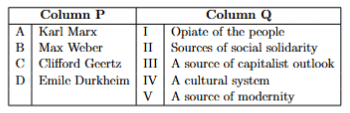
View Solution
Step 1: Understanding the Question
We need to match four major sociologists with their key ideas about the function or nature of religion.
Step 2: Detailed Explanation
A) Karl Marx: Famously described religion as the "opiate of the people." He saw it as an ideology that dulled the pain of oppression and exploitation, promising a reward in the afterlife and thus preventing the working class from challenging the capitalist system. This matches I.
B) Max Weber: In his seminal work, "The Protestant Ethic and the Spirit of Capitalism," Weber argued that the values of certain Protestant sects (like Calvinism) created an "ethos" or outlook that was highly conducive to the development of modern capitalism. This matches III. A source of capitalist outlook. (V, "a source of modernity," is also related but III is more specific to his famous thesis).
C) Clifford Geertz: An interpretive anthropologist who defined religion as a "system of symbols" which acts to establish powerful, pervasive, and long-lasting moods and motivations in men by formulating conceptions of a general order of existence. This is best summarized as viewing religion as IV. A cultural system of meaning.
D) Emile Durkheim: In "The Elementary Forms of the Religious Life," Durkheim argued that the primary function of religion is to create and maintain social cohesion and solidarity. By worshiping sacred objects or totems, society is, in effect, worshiping itself, reinforcing collective conscience and social bonds. This matches II. Sources of social solidarity.
Step 3: Final Answer
The correct pairings are: A \(\to\) I, B \(\to\) III, C \(\to\) IV, D \(\to\) II. This combination corresponds to option (D).
Quick Tip: Associate each classical sociologist with a one-line summary of their view on religion: \textbf{Marx}: Opiate (ideology of oppression). \textbf{Durkheim}: Glue (source of social solidarity). \textbf{Weber}: Spark (driver of social change, e.g., capitalism). \textbf{Geertz}: Map (a cultural system of meaning).
There are four forms of triangulation, namely data triangulation, theory triangulation and __________.
View Solution
Step 1: Understanding the Question
The question asks to identify the other two forms of triangulation in research methodology, given data triangulation and theory triangulation.
Step 2: Detailed Explanation
Triangulation is a research strategy used to enhance the validity and reliability of research findings. It involves using multiple data sources, methods, investigators, or theories to study a phenomenon. Norman Denzin identified four basic types of triangulation:
Data triangulation: Using different sources of data (e.g., from different times, spaces, or persons).
Theory triangulation: Using multiple theoretical perspectives to interpret a single set of data.
Investigator triangulation: Using several different researchers or evaluators in a study.
Methodological triangulation: Using multiple methods to study a single problem (e.g., combining qualitative interviews with a quantitative survey).
Based on this classification, the two missing forms are investigator triangulation and methodological triangulation.
Step 3: Final Answer
The other two forms of triangulation are investigator triangulation and methodological triangulation.
Quick Tip: Remember Denzin's four types of triangulation by thinking about the different components of a research project you could vary: the \textbf{Data}, the \textbf{Investigators}, the \textbf{Theory}, and the \textbf{Methods}.
__________ is the process by which groups seek to preserve some advantage by monopolizing resources and restricting access to the group.
View Solution
Step 1: Understanding the Question
The question asks for the sociological term for the process where a group maintains its privileged position by restricting others from accessing its resources and membership.
Step 2: Detailed Explanation
(A) Social action: A term, central to Max Weber, referring to an act which takes into account the actions and reactions of individuals. It's a general concept about behavior.
(B) Social construction: The idea that social phenomena or realities are developed in social contexts; they are not natural or inevitable.
(C) Social closure: This is the correct term. Developed by Max Weber and later elaborated by sociologists like Frank Parkin, social closure refers to the processes by which social groups seek to maximize their own advantages by restricting access to resources and opportunities to a limited circle of eligible individuals. This can involve excluding outsiders (exclusionary closure) or subordinate groups organizing to gain a greater share of resources (usurpationary closure). The description in the question is a textbook definition of exclusionary social closure.
(D) Social conflict: A broad term for the struggle for agency or power in society. Social closure is a specific strategy used within social conflicts over resources.
Step 3: Final Answer
The process described is known as social closure.
Quick Tip: Think of "social closure" as a group creating a "closed shop" or an exclusive club to protect its advantages. Examples include professional associations requiring credentials, or ethnic groups favoring their own in business.
Correlation coefficient lies between __________ and __________, and probability lies between __________ and __________.
View Solution
Step 1: Understanding the Question
The question asks for the defined numerical range for two fundamental statistical concepts: the correlation coefficient and probability.
Step 2: Detailed Explanation
Correlation Coefficient (r): The correlation coefficient is a measure of the strength and direction of a linear relationship between two variables. Its value is always between -1 and +1, inclusive.
+1 indicates a perfect positive linear relationship.
-1 indicates a perfect negative linear relationship.
0 indicates no linear relationship.
Probability (P): The probability of an event is a measure of the likelihood that the event will occur. It is expressed as a number between 0 and 1, inclusive.
0 indicates an impossible event.
1 indicates a certain event.
Therefore, the correlation coefficient lies between -1 and 1, and probability lies between 0 and 1.
Step 3: Final Answer
The correct ranges are -1 and 1 for the correlation coefficient, and 0 and 1 for probability.
Quick Tip: These are fundamental definitions in statistics. Remember: correlation can be negative, but probability cannot.
Match the following concepts as given in Column P with the Sociologists as given in Column Q:
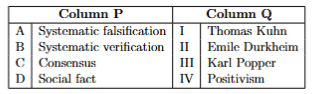
View Solution
Step 1: Understanding the Question
We need to match key concepts from the philosophy and methodology of science with the sociologists or schools of thought they are most associated with.
Step 2: Detailed Explanation
A) Systematic falsification: This is the cornerstone of Karl Popper's (III) philosophy of science. He argued that scientific theories can never be proven true (verified), but can be falsified by evidence. The goal of science is to subject theories to rigorous attempts at falsification.
B) Systematic verification: The idea that scientific knowledge is built by accumulating positive evidence that confirms or verifies a theory is central to Positivism (IV), particularly the logical positivism of the Vienna Circle. Popper's falsificationism was a direct critique of this verificationist approach.
C) Consensus: Thomas Kuhn (I), in "The Structure of Scientific Revolutions," argued that "normal science" operates under a paradigm, which is a set of shared beliefs, values, and techniques that create a strong consensus within a scientific community. Progress is disrupted by revolutionary shifts from one paradigm (and its consensus) to another.
D) Social fact: This is the core concept of Emile Durkheim's (II) sociology. He defined social facts as "ways of acting, thinking, and feeling, external to the individual, and endowed with a power of coercion, by reason of which they control him." He argued that the subject matter of sociology is the study of social facts.
Step 3: Final Answer
The correct pairings are: A \(\to\) III, B \(\to\) IV, C \(\to\) I, D \(\to\) II. This corresponds to option (A).
Quick Tip: Associate these key methodological ideas: \textbf{Popper} = Falsification (trying to prove things wrong). \textbf{Positivism} = Verification (trying to prove things right). \textbf{Kuhn} = Paradigm / Consensus (science as a community activity). \textbf{Durkheim} = Social Fact (sociology's subject matter).
Match the following approaches and village study as given in Column P with Sociologists as given in Column Q:

View Solution
Step 1: Understanding the Question
We need to match specific sociologists with the village they studied, or the theoretical perspective they are known for in the context of Indian sociology.
Step 2: Detailed Explanation
A) Rampura village: The village of Rampura in Mysore (now Karnataka) is the site of the famous fieldwork conducted by M.N. Srinivas (II). His intensive study of this village led to the development of key concepts like 'dominant caste' and 'Sanskritization'.
B) Indology: This is a textual approach to studying Indian society through its classical, primarily Sanskrit, texts. In Indian sociology, this approach is strongly associated with figures like G.S. Ghurye and Irawati Karve (IV), who used ancient texts to analyze social institutions like kinship and caste.
C) Marxist approach: A.R. Desai (III) is a prominent Indian sociologist known for applying a historical materialist or Marxist framework to the study of Indian society, particularly in his work "Social Background of Indian Nationalism".
D) Feminist perspective: Sharmila Rege (I) was a leading feminist sociologist in India who advocated for a 'Dalit standpoint' perspective, critiquing the caste and gender biases within mainstream sociology and bringing the voices of marginalized women to the forefront.
Step 3: Final Answer
The correct pairings are: A \(\to\) II, B \(\to\) IV, C \(\to\) III, D \(\to\) I. This corresponds to option (B).
Quick Tip: For Indian sociology, it's crucial to link key scholars with their primary field sites and theoretical contributions: \textbf{Srinivas}: Rampura village, Sanskritization, Dominant Caste. \textbf{Desai}: Marxist analysis of Indian nationalism. \textbf{Karve}: Indological/Textual analysis of kinship. \textbf{Rege}: Dalit feminist standpoint.
According to the World Commission on Environment and Development, 'sustainable development' refers to __________.
View Solution
Step 1: Understanding the Question
The question asks for the definition of 'sustainable development' as formulated by the World Commission on Environment and Development.
Step 2: Detailed Explanation
The most famous and widely cited definition of sustainable development comes from the 1987 report "Our Common Future," published by the World Commission on Environment and Development, often referred to as the Brundtland Commission.
The report defines sustainable development as:
"development that meets the needs of the present without compromising the ability of future generations to meet their own needs."
This definition contains two key concepts:
The concept of 'needs', in particular the essential needs of the world's poor, to which overriding priority should be given.
The idea of 'limitations' imposed by the state of technology and social organization on the environment's ability to meet present and future needs.
Option (C) is a verbatim reproduction of this classic definition. Options (A) and (B) are incomplete parts of the definition, while (D) is incorrect.
Step 3: Final Answer
The correct definition is "Development that meets the needs of the present without compromising the ability of future generations to meet their own needs."
Quick Tip: The Brundtland Commission's definition is the cornerstone of all discussions on sustainable development. The key is the balance it strikes between the \textbf{present} and the \textbf{future}, linking economic development with environmental stewardship and intergenerational equity.
According to David Pocock, the Indian Jajmani system reflects __________.
View Solution
Step 1: Understanding the Question
The question asks for David Pocock's interpretation of the Jajmani system, a traditional system of exchange of goods and services between different caste groups in Indian villages.
Step 2: Detailed Explanation
David Pocock, along with Louis Dumont, was a key proponent of a structuralist approach to understanding Indian society, emphasizing the ideology of hierarchy. They saw Indian society as fundamentally holistic and collective, rather than individualistic.
In this view, the Jajmani system is not merely an economic system of exchange. Instead, it is a ritual and social system that expresses and reinforces the hierarchical interdependence of castes within the village community. Each caste performs its specific function (e.g., priest, barber, potter) not as an individual economic actor, but as a member of a collective group fulfilling its duty (\textit{dharma) within a larger, hierarchically ordered whole. Therefore, the system reflects a hierarchical collectivity.
(B), (D) The concept of 'individuality' is seen as secondary or antithetical to the collective and hierarchical logic of the system.
(C) The system is fundamentally hierarchical, based on the opposition of purity and pollution, so 'egalitarian' (equal) is the opposite of its core principle.
Step 3: Final Answer
According to David Pocock's structuralist interpretation, the Jajmani system reflects a hierarchical collectivity.
Quick Tip: Associate David Pocock and Louis Dumont with the structuralist view of Indian society, where the central organizing principle is the religious ideology of hierarchy (the opposition of pure and impure), and the basic social unit is the collective (caste group) rather than the individual.
Which of the following is/are NOT characteristic(s) of class system?
View Solution
Step 1: Understanding the Question
The question asks to identify the statements that are NOT true for a class system of social stratification. This is an MSQ.
Step 2: Detailed Explanation
A class system is a form of social stratification based primarily on economic position. Let's analyze the statements:
(A) Class systems are fluid and the boundaries between classes are never clear-cut. This is a key characteristic of class systems. Unlike caste or estates, class allows for social mobility, and the lines between classes (e.g., middle and upper-middle) are often blurry. So, this statement IS a characteristic.
(B) Class is a form of stratification in which one's social position is given for a lifetime. This is NOT a characteristic of class. This describes a system based on ascription, such as a caste system, where social position is inherited and fixed for life. Class systems are, in principle, based on achievement and allow for mobility.
(C) Class is economically based. This IS a defining characteristic of class. Class divisions are rooted in inequalities in the possession of wealth, income, and control over economic resources.
(D) Class divisions are organized around the purity and pollution. This is NOT a characteristic of class. The concept of ritual purity and pollution is the central organizing principle of the traditional Hindu caste system, not the economic-based class system.
Step 3: Final Answer
The statements that are NOT characteristic of a class system are (B) and (D). These statements describe features of a caste system.
Quick Tip: To differentiate class from caste, remember these key distinctions: \textbf{Basis}: Class is economic; Caste is ritual (purity/pollution). \textbf{Mobility}: Class is open (achieved status); Caste is closed (ascribed status). \textbf{Boundaries}: Class boundaries are fluid; Caste boundaries are rigid.
Which of the following concept(s) is/are NOT propounded by Emile Durkheim?
View Solution
Step 1: Understanding the Question
The question asks to identify which concepts from the list were NOT developed by Emile Durkheim. This is an MSQ.
Step 2: Detailed Explanation
Let's review the origins of these concepts:
(A) Collective bargaining: This is a term from industrial relations and labor economics, referring to the process of negotiation between employers and a group of employees aimed at agreements to regulate working conditions. While Durkheim wrote about occupational groups ('corporations'), he did not propound the concept of collective bargaining.
(B) Collective effervescence: This is a core concept from Durkheim's "The Elementary Forms of the Religious Life". It refers to a state of high emotional energy and excitement experienced by a group, often during rituals, which strengthens social bonds and creates a sense of a shared reality. Durkheim propounded this concept.
(C) Cult of the individual: Durkheim argued that in modern societies with a high division of labor (organic solidarity), a new form of "civil religion" emerges which he called the "cult of the individual." It is a shared moral belief in the dignity, rights, and sacredness of the individual person, which provides a basis for social cohesion. Durkheim propounded this concept.
(D) Charismatic authority: This concept was propounded by Max Weber. It is one of his three types of legitimate authority (along with traditional and rational-legal), where authority derives from the exceptional sanctity, heroism, or exemplary character of an individual leader.
Step 3: Final Answer
Collective bargaining and Charismatic authority were not propounded by Emile Durkheim. Charismatic authority is a key Weberian concept.
Quick Tip: Associate key concepts with the "big three" classical sociologists: \textbf{Durkheim}: Social facts, solidarity (mechanical/organic), anomie, collective effervescence, cult of the individual. \textbf{Marx}: Class conflict, alienation, historical materialism, surplus value. \textbf{Weber}: Rationalization, bureaucracy, types of authority (traditional, charismatic, rational-legal), Verstehen.
The example(s) of relations of production is/are __________.
View Solution
Step 1: Understanding the Question
The question asks for examples of "relations of production," a key concept in Marxist theory. This is an MSQ.
Step 2: Detailed Explanation
In Karl Marx's theory of historical materialism, the "mode of production" (the way a society produces its means of subsistence) consists of two parts:
Forces of production: The technological and productive capacity of a society (e.g., tools, machinery, raw materials, and labor power itself).
Relations of production: The social relationships that people enter into as they acquire and use the forces of production. The most fundamental aspect of these relations is the ownership (or lack of ownership) of the means of production.
Let's analyze the options:
(A) Labour: Labour power (the capacity to work) is considered part of the forces of production.
(B) Division of labour: The technical division of labor is part of the organization of the forces of production. The social division of labor is a reflection of the relations of production, but "division of labour" itself is more aligned with the forces.
(C) Property relations: This is the quintessential example of relations of production. Who owns the factories, land, and tools (the means of production) defines the class relationship between the owners (bourgeoisie) and the non-owners (proletariat).
(D) Capitalism: Capitalism is a specific historical \textit{mode of production, which is defined by its characteristic relations of production: private ownership of the means of production by the capitalist class and the existence of a class of wage-laborers who sell their labor power. Therefore, "Capitalism" can be seen as a macro-level example or system of relations of production.
Step 3: Final Answer
Property relations are the core of the relations of production, and capitalism is a system defined by specific property relations. Both are valid examples.
Quick Tip: Think of the distinction this way: \textbf{Forces of Production = WHAT you have to work with (tools, tech, labor skill). \textbf{Relations of Production} = WHO owns what, and WHO works for whom (property, class structure).
While __________ emerges around a charismatic figure, idea or vision, __________ emerges as a breakaway group from a preexisting body of belief, rituals, or believers.
View Solution
Step 1: Understanding the Question
The question asks to distinguish between two types of religious organizations based on their origins.
Step 2: Detailed Explanation
In the sociology of religion, a common typology distinguishes between church, sect, and cult.
A Church or denomination is a large, established religious body with a formal, bureaucratic structure.
A Sect is a religious group that has broken away from an established church or denomination, often in protest against what it perceives as a compromise of the original principles. It is a "breakaway group" that claims to be restoring the true faith.
A Cult (or, in more neutral modern terminology, a New Religious Movement) is a religious group that is novel and stands apart from the dominant religious tradition of a society. Cults are often formed around a charismatic leader or a new revelation, idea, or vision.
Therefore:
The first blank, describing a group emerging around a charismatic figure or new idea, is a Cult.
The second blank, describing a breakaway group from a preexisting body, is a Sect.
Step 3: Final Answer
While a Cult emerges around a charismatic figure, idea or vision, a Sect emerges as a breakaway group from a preexisting body of belief.
Quick Tip: Remember the origin stories: \textbf{Cult} = New and charismatic. \textbf{Sect} = Split and purist (breaking away from a church). Think of Protestantism as a collection of sects that broke away from the Catholic Church.
Which of the following statement(s) is/are true for the Forest Rights Act (2006) of India?
View Solution
Step 1: Understanding the Question
The question asks to identify the rights granted to forest dwellers under the Scheduled Tribes and Other Traditional Forest Dwellers (Recognition of Forest Rights) Act, 2006, commonly known as the Forest Rights Act (FRA). This is an MSQ.
Step 2: Detailed Explanation
The Forest Rights Act of 2006 is a landmark piece of legislation that seeks to correct the "historical injustice" done to forest-dwelling communities. It recognizes and vests various rights in these communities.
(A) Forest dwellers' right of conserving and protecting community forest resources: Correct. Section 3(1)(i) of the Act explicitly recognizes the "right to protect, regenerate or conserve or manage any community forest resource which they have been traditionally protecting and conserving for sustainable use."
(B) Forest dwellers' right to rehabilitation: Correct. Section 4(8) provides for rehabilitation in case of illegal eviction or displacement. The Act aims to secure their tenure and provide relief where they have been unjustly displaced.
(C) Forest dwellers' right to settlement from forest villages into revenue villages: Correct. Section 3(1)(h) recognizes the "right of settlement and conversion of all forest villages, old habitation, unsurveyed villages and other villages in forests, whether recorded, notified or not into revenue villages."
(D) Forest dwellers' absolute right over all the natural resources...: Incorrect. The rights granted under the FRA are not absolute and are subject to various conditions and regulations. For example, rights are for sustainable use, and certain activities are regulated to protect wildlife and biodiversity. The term "absolute right" is too strong and inaccurate.
Step 3: Final Answer
Statements (A), (B), and (C) describe rights that are true and provided for under the Forest Rights Act, 2006.
Quick Tip: The Forest Rights Act (FRA) 2006 is about recognizing pre-existing rights, not granting new ones. It covers individual rights (to land), community rights (to minor forest produce), and rights to manage and conserve forests. Be wary of absolute claims like "absolute right," as most legal rights are qualified.
The Ethnographic Survey of India as part of the Census 1901 was conducted to __________.
View Solution
Step 1: Understanding the Question
The question asks about the primary purpose of the Ethnographic Survey of India, which was initiated under the direction of H. H. Risley in conjunction with the 1901 Census.
Step 2: Detailed Explanation
The British colonial administration undertook massive projects of information gathering, like censuses and surveys, to effectively govern the vast and diverse Indian subcontinent. The Ethnographic Survey of India was a major component of this "investigative modality."
Its primary purpose was administrative. By systematically classifying the various castes and tribes of India, their customs, social structures, and physical characteristics (using anthropometry), the British aimed to create a definitive map of Indian society. This knowledge was considered essential for:
(B) Making suitable legislations for Indian subjects: Understanding the "native" society was seen as a prerequisite for creating laws and administrative policies that would be effective and would not provoke unnecessary opposition. Knowledge of caste, custom, and tradition was crucial for social engineering and control.
(A) It was not primarily about "mitigating issues faced by the British," but about strengthening their ability to rule.
(C) The goal was not "protection" in a benevolent sense, but documentation for the purpose of governance. The survey often had the effect of rigidifying or "freezing" identities rather than protecting them.
(D) While some welfare and development may have been part of the broader colonial discourse, the primary impetus for this kind of survey was administrative control and legislative design, not altruistic development.
The survey was an exercise in colonial governance, aimed at making the population "legible" and thus more easily managed and legislated for.
Step 3: Final Answer
The Ethnographic Survey of India was conducted to gather information to aid in the creation of suitable legislations and administrative policies for Indian subjects.
Quick Tip: When analyzing British colonial projects like surveys and censuses, the primary motivation was almost always administrative control and the consolidation of power. Knowledge was a tool of governance.
__________ and __________ propounded conflict theory.
View Solution
Step 1: Understanding the Question
The question asks to identify the sociologists from the list who are known for propounding conflict theory. This is an MSQ.
Step 2: Detailed Explanation
Conflict theory is a major sociological perspective that views society as an arena of inequality that generates conflict and social change. While its roots are in the work of Karl Marx, several modern sociologists developed non-Marxist versions of conflict theory.
(A) Talcott Parsons: He is the leading figure of structural functionalism, a perspective that emphasizes consensus, stability, and integration, and is often seen as the primary theoretical opponent of conflict theory.
(B) Ralf Dahrendorf: A prominent German-British sociologist who is a key figure in modern conflict theory. He updated Marx's ideas, arguing that conflict in modern societies is not just based on class (property ownership) but on authority. He saw conflict between those who have authority and those who do not as a constant feature of all social organizations.
(C) Lewis A. Coser: An American sociologist who is another key figure in conflict theory. In his book "The Functions of Social Conflict," he argued, drawing on Georg Simmel, that conflict is not always dysfunctional. He focused on the positive functions of conflict, such as promoting group solidarity, clarifying issues, and creating new norms and institutions.
(D) Jeffrey C. Alexander: He is a leading figure in the neofunctionalist movement, which seeks to revise and update the theories of Talcott Parsons. He is not a conflict theorist.
Step 3: Final Answer
Ralf Dahrendorf and Lewis A. Coser are two of the most important sociologists who propounded modern conflict theory.
Quick Tip: Remember the key divide in mid-20th century sociology: \textbf{Consensus/Functionalist Camp}: Talcott Parsons. \textbf{Conflict Camp}: C. Wright Mills, Ralf Dahrendorf, Lewis A. Coser. Dahrendorf focused on conflict over authority, while Coser focused on the positive functions of conflict.
Which of the following is/are NOT aspect(s) of secularization process?
View Solution
Step 1: Understanding the Question
The question asks to identify which of the options are NOT part of the process of secularization. Secularization refers to the historical process in which religion loses social and cultural significance. This is an MSQ.
Step 2: Detailed Explanation
Key aspects of the secularization thesis include:
Differentiation: Social institutions (state, economy, science) become separate from religious institutions. This leads to a (C) Loss of social and political influence of religious organizations. This IS an aspect of secularization.
Rationalization: A worldview based on science and reason replaces religious explanations.
(A) Privatization of religion: Religion moves from the public sphere to the private sphere. It becomes a matter of personal choice and belief rather than a public obligation. This IS an aspect of secularization.
Now let's evaluate the options:
(A) Privatization of religion: This is considered a key aspect of secularization in modern societies.
(B) Rising level of membership of religious organizations: This is the \textit{opposite of what the secularization thesis would predict. Secularization is associated with a decline in religious participation, including church membership and attendance. Therefore, this is NOT an aspect of secularization.
(C) Loss of social and political influence of religious organizations: This is a core component of secularization, as other social institutions become more autonomous.
(D) Belief in magic and supernatural forces: The secularization thesis, particularly the rationalization aspect (following Weber), argues that modernity involves a "disenchantment of the world," where scientific and rational explanations replace belief in magic, spirits, and supernatural forces. Therefore, the persistence or rise of such beliefs would be evidence \textit{against secularization, not an aspect of it.
Step 3: Final Answer
A rising level of membership in religious organizations and the belief in magic and supernatural forces are NOT aspects of the secularization process; they are trends that would counter the secularization thesis.
Quick Tip: Think of secularization as the declining public power and influence of religion. Anything that suggests religion is gaining members, gaining public influence, or that non-rational beliefs are increasing would be a counter-trend to secularization.
Which of the following pair(s) is/are correct?
M1: Michel Foucault \quad \quad \quad \quad M2: Pierre Bourdieu \quad \quad \quad \quad M3: John Urry
X1: Archaeology of Knowledge X2: Sociological Imagination X3: Practice Theory
View Solution
Step 1: Understanding the Question
We need to match the sociologists (M1, M2, M3) with the concepts or book titles (X1, X2, X3) they are associated with and identify the correct pairs. This is an MSQ.
Step 2: Detailed Explanation
M1: Michel Foucault and X1: Archaeology of Knowledge: This is a correct pairing. "The Archaeology of Knowledge" (1969) is a major work by Michel Foucault in which he outlines his "archaeological" method for historical investigation, focusing on the rules of formation for statements and discourses (épistémès). So, (A) is correct.
X2: Sociological Imagination: This is the most famous concept of the American sociologist C. Wright Mills, not Pierre Bourdieu or John Urry. It refers to the ability to see the connection between personal troubles and public issues. So, pairings with X2, i.e., (B) M2-X2 and (C) M3-X2, are incorrect.
M2: Pierre Bourdieu and X3: Practice Theory: This is a correct pairing. Pierre Bourdieu is a central figure in what is known as "practice theory." His entire sociological project, built around concepts like habitus, field, and capital, is an attempt to overcome the opposition between objectivism and subjectivism by focusing on the 'logic of practice'. So, (D) is correct.
M3: John Urry is a British sociologist known for his work on the 'sociology of tourism' and 'mobilities'. He is not associated with the Sociological Imagination or Practice Theory in this foundational sense.
Step 3: Final Answer
The correct pairs are M1 – X1 (Foucault – Archaeology of Knowledge) and M2 – X3 (Bourdieu – Practice Theory).
Quick Tip: Associate these key thinkers with their "brand" concepts: \textbf{Foucault: Power/Knowledge, Archaeology, Genealogy. \textbf{Bourdieu}: Habitus, Field, Capital, Practice Theory. \textbf{C. Wright Mills}: Sociological Imagination, Power Elite.
Which of the following statement(s) is/are INCORRECT?
View Solution
Step 1: Understanding the Question
The question asks us to identify the INCORRECT statements about different forms of marriage and marriage rules. This is an MSQ.
Step 2: Detailed Explanation
Let's define each term and evaluate the statements:
Hypergamy (Anuloma): The practice of a woman marrying a man of a higher social status or caste. The statement says the bride's family is of superior status. This is the opposite of the definition. In hypergamy, the groom's family is of superior status. Thus, (A) is INCORRECT.
Hypogamy (Pratiloma): The practice of a woman marrying a man of a lower social status or caste. The statement says the groom's family is of superior status. This would be hypergamy. Thus, (B) is INCORRECT.
(C) Exogamy: The social norm of marrying outside one's own social group. The group may be defined as a clan, lineage, village, or, in this context, a caste or sub-caste group (gotra exogamy is a key rule in many Hindu communities). This statement is correct.
(D) Polygynandry: Also known as group marriage, it is a form of polyamory in which several men and several women are in a marital relationship with one another. This statement is a correct definition.
The question asks for the INCORRECT statements. Both (A) and (B) provide incorrect definitions of hypergamy and hypogamy.
Step 3: Final Answer
Statements (A) and (B) are incorrect.
Quick Tip: Remember the prefixes for status-based marriage: \textbf{Hyper-} (like hyperactive) means "up" or "above". Hypergamy = marrying up (for the woman). \textbf{Hypo-} (like hypodermic) means "down" or "below". Hypogamy = marrying down (for the woman).
*The article might have information for the previous academic years, please refer the official website of the exam.