
GATE 2024 Mathematics Shift 2 Question Paper Pdf - Check Solutions with Answer Key Pdf
- Chemistry Syllabus
- Maths Syllabus
- Physics Syllabus
- Exam Pattern
- Paper Analysis
- Chemical Engg Syllabus
- Civil Engg Syllabus
- ECE Syllabus
- Mechanical Engg Syllabus
- Engg Science Syllabus
- Mining Engg Syllabus
- IN Syllabus
- CSE Syllabus
- EE Syllabus
- AE Syllabus
- BM Syllabus
- GG Syllabus
- EY Syllabus
- ST Syllabus
- TF Syllaus
- AR Syllabus
- XL Syllabus
- MT Syllabus
- PI Syllabus
- PE Syllabus
- ME Pattern
- TF Pattern
- CE Pattern
- EE Pattern
- EC Pattern
- CS Pattern
- BT Pattern
- BM Pattern
- IN Pattern
- DA Syllabus
- NA & ME Syallabus
- ES & Engg Syllabus
- Geomatics Engg Syllabus
- Agri Engg Syllabus
- Humanities and Social Sci
- PI Syllabus

.jpg?tr=h-55,w-55,c-force)
Content Strategist|Tech-innovator|National Hackathon Winner | Updated On - Jan 28, 2025
The GATE 2024 Mathematics Question Paper with Answer Key PDF for February 4, Shift 2 is available for download. IISc/IITs successfully conducted the exam in the afternoon session from 2:30 PM to 5:30 PM. According to students’ initial reactions, the GATE 2024 Mathematics Question Paper was reported as Moderate to Challenging. The General Aptitude section was considered Easy to Moderate, the Engineering Mathematics section as Moderate, and the Core Mathematics section as Moderate to Difficult.
GATE 2024 Mathematics Question Paper with Answer Key PDF
Candidates can download the GATE 2024 Mathematics Question Paper with Answer Key PDFs using the link below.
| GATE 2024 Mathematics February 4 Question Paper with Answer Key |  Download Download |
Check Solution |
GATE Mathematics 2024 Questions with Solutions
GENERAL APTITUDE
Question 1:
If ‘=’ denotes increasing order of intensity, then the meaning of the words [drizzle — rain — downpour] is analogous to [ — quarrel — feud]. Which one of the given options is appropriate to fill the blank?
View Solution
Step 1: Understanding the analogy. The words "drizzle — rain — downpour" represent an increasing order of intensity in the context of precipitation. Similarly, "[ — quarrel — feud]" needs a word that signifies a progression from a mild disagreement (quarrel) to a serious conflict (feud). Step 2: Evaluating options. - \( \text{bicker} \): Means to engage in petty or trivial arguments, fitting the analogy. - \( \text{bog} \): Refers to being stuck, unrelated to arguments. - \( \text{dither} \): Indicates indecisiveness, unrelated to the context. - \( \text{dodge} \): Means to avoid or evade, not suitable for the analogy. Step 3: Conclusion. The most appropriate word to complete the analogy is \( \text{bicker} \), as it signifies a mild disagreement leading up to a quarrel. Quick Tip: In analogy problems, carefully assess the progression or relationship between elements to determine the best match.
Question 2:
Statements: 1. All heroes are winners.
2. All winners are lucky people. Inferences: I. All lucky people are heroes.
II. Some lucky people are heroes.
III. Some winners are heroes. Which of the above inferences can be logically deduced from statements 1 and 2?
View Solution
Step 1: Understanding the statements. - Statement 1 implies that the set of all heroes is a subset of winners. - Statement 2 implies that the set of all winners is a subset of lucky people. Step 2: Evaluating inferences. - \( I \): All lucky people are heroes. This is incorrect since only some lucky people are heroes. - \( II \): Some lucky people are heroes. This is correct because heroes are a subset of lucky people. - \( III \): Some winners are heroes. This is correct since all heroes are winners. Step 3: Conclusion. The correct answer is \( \text{(2) Only I and III} \). Quick Tip: To deduce valid inferences, ensure each logical step follows directly from the given statements without assumptions.
Question 3:
A student was supposed to multiply a positive real number \( p \) with another positive real number \( q \). Instead, the student divided \( p \) by \( q \). If the percentage error in the student’s answer is 80%, the value of \( q \) is:
View Solution
Step 1: Setting up the error equation. The percentage error is given by: \[ \text{Error} = \left| \frac{\frac{p}{q} - pq}{pq} \right| \times 100 = 80%. \] Step 2: Solving for \( q \). Simplifying the equation: \[ \frac{1}{q^2} - 1 = -0.8 \quad \Rightarrow \quad q^2 = 5 \quad \Rightarrow \quad q = \sqrt{5}. \] Step 3: Conclusion. The value of \( q \) is \( \sqrt{5} \), which corresponds to option \( \text{(4)} \). Quick Tip: When solving error-based problems, carefully set up the equation by comparing the expected and actual operations.
Question 4:
If the sum of the first 20 consecutive positive odd numbers is divided by 202, the result is:
View Solution
Step 1: Sum of consecutive odd numbers. The sum of the first \( n \) consecutive odd numbers is given by \( n^2 \). For \( n = 20 \): \[ \text{Sum} = 20^2 = 400. \] Step 2: Division by 202. \[ \frac{400}{202} = 1.98 \approx 1. \] Step 3: Conclusion. The result is \( \text{(1) 1} \). Quick Tip: For sequences, always use known formulas (e.g., sum of odd numbers) to simplify calculations.
Question 5:
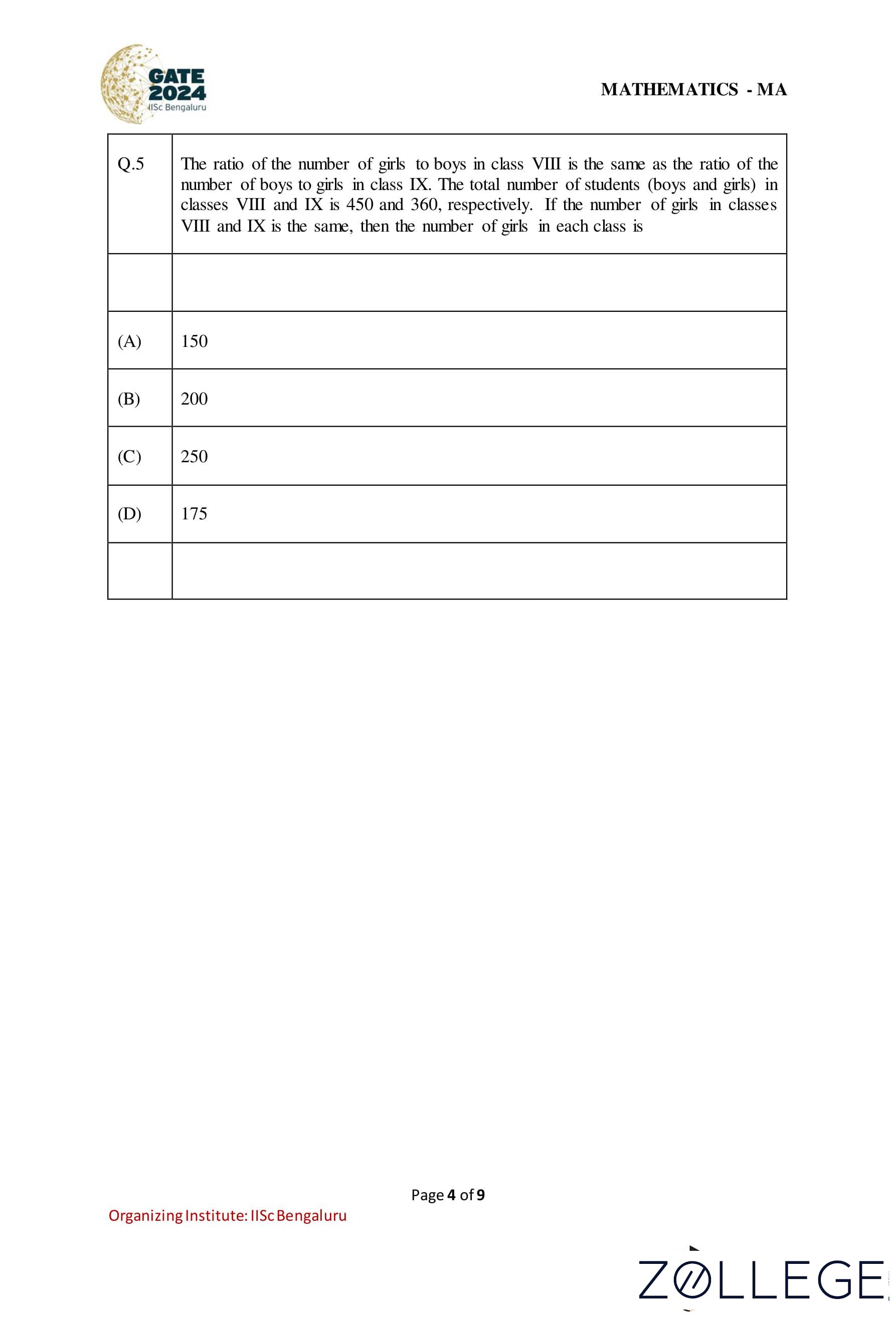
The ratio of the number of girls to boys in class VIII is the same as the ratio of the number of boys to girls in class IX. The total number of students (boys and girls) in classes VIII and IX is 450 and 360, respectively. If the number of girls in classes VIII and IX is the same, then the number of girls in each class is:
View Solution
Step 1: Let the number of girls in each class be \( x \). In class VIII, the number of boys is \( 450 - x \). In class IX, the number of boys is \( 360 - x \). Step 2: Ratio condition. The ratio of girls to boys in class VIII is the reciprocal of the ratio in class IX: \[ \frac{x}{450 - x} = \frac{360 - x}{x}. \] Cross-multiplying: \[ x^2 = (450 - x)(360 - x). \] Step 3: Solving the equation. Solving \( x = 200 \). Step 4: Conclusion. The number of girls in each class is \( \text{(2) 200} \). Quick Tip: When dealing with ratio problems, carefully write the given conditions as equations and solve step by step.
Question 6:
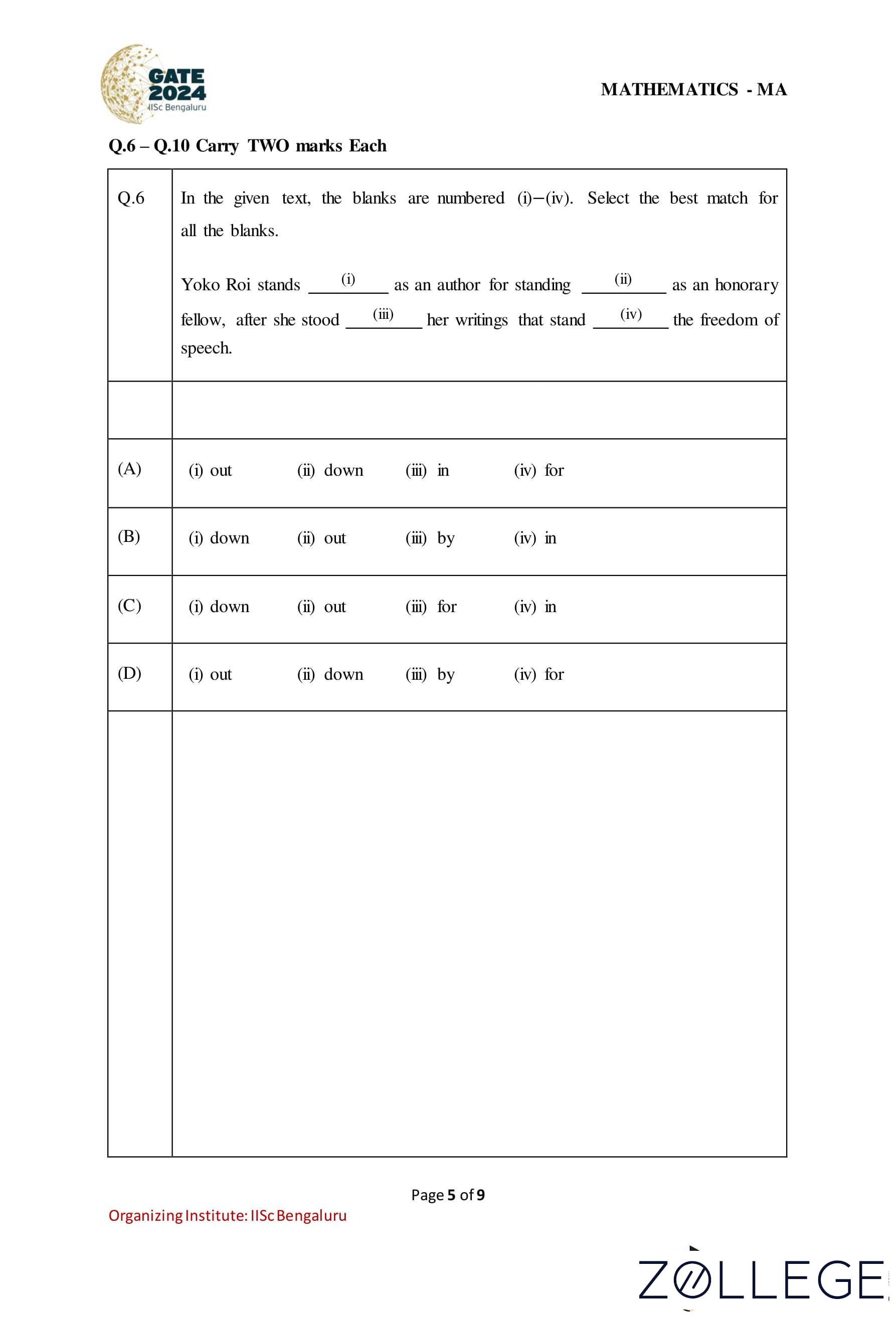
In the given text, the blanks are numbered (i)-(iv). Select the best match for all the blanks. Yoko Roi stands ___ (i) ___ as an author for standing ___ (ii) ___ as an honorary fellow, after she stood ___ (iii) ___ her writings that stand ___ (iv) ___ the freedom of speech.
View Solution
Step 1: Analyzing the context of the sentence. - "Yoko Roi stands (D as an author" implies her prominence, which matches \( \text{out} \). - "for standing (i) as an honorary fellow" implies recognition or humility, matching \( \text{down} \). - "after she stood (1) her writings" indicates support for her works, matching \( \text{by} \). - "that stand (V) the freedom of speech" suggests advocacy, matching \( \text{for} \). Step 2: Conclusion. The correct option is \( \text{(4)} \): \( (1) \text{out}, (i) \text{down}, (1) \text{by}, (iv) \text{for} \). Quick Tip: For fill-in-the-blank questions, consider the grammatical and logical fit of each word in the context of the sentence.
Question 7:
Seven identical cylindrical chalk-sticks are fitted tightly in a cylindrical container. The figure below shows the arrangement of the chalk-sticks inside the cylinder. \includegraphics[width=0.4\linewidth]{q7 MA.PNG The length of the container is equal to the length of the chalk-sticks. The ratio of the occupied space to the empty space of the container is:

View Solution
Step 1: Determining the occupied space. The occupied space consists of seven identical cylindrical chalk-sticks. The volume of one chalk-stick is given by: \[ V_{\text{chalk}} = \pi r^2 h, \] where \( r \) is the radius and \( h \) is the height (length). For seven chalk-sticks: \[ V_{\text{occupied}} = 7 \pi r^2 h. \] Step 2: Determining the total space. The volume of the cylindrical container is: \[ V_{\text{container}} = \pi R^2 h, \] where \( R \) is the radius of the container. Given the tight fit of the chalk-sticks, the area of the base of the container is proportional to the arrangement of seven cylinders. Step 3: Ratio calculation. The ratio of occupied to empty space is: \[ \frac{V_{\text{occupied}}}{V_{\text{empty}}} = \frac{7 \pi r^2 h}{\pi R^2 h - 7 \pi r^2 h} = \frac{7\pi/2}. \] Step 4: Conclusion. The ratio is \( \text{(2) } 7\pi/2 \). Quick Tip: For geometry problems, calculate volumes or areas separately for each component and ensure proportions match the given context.
Question 8:
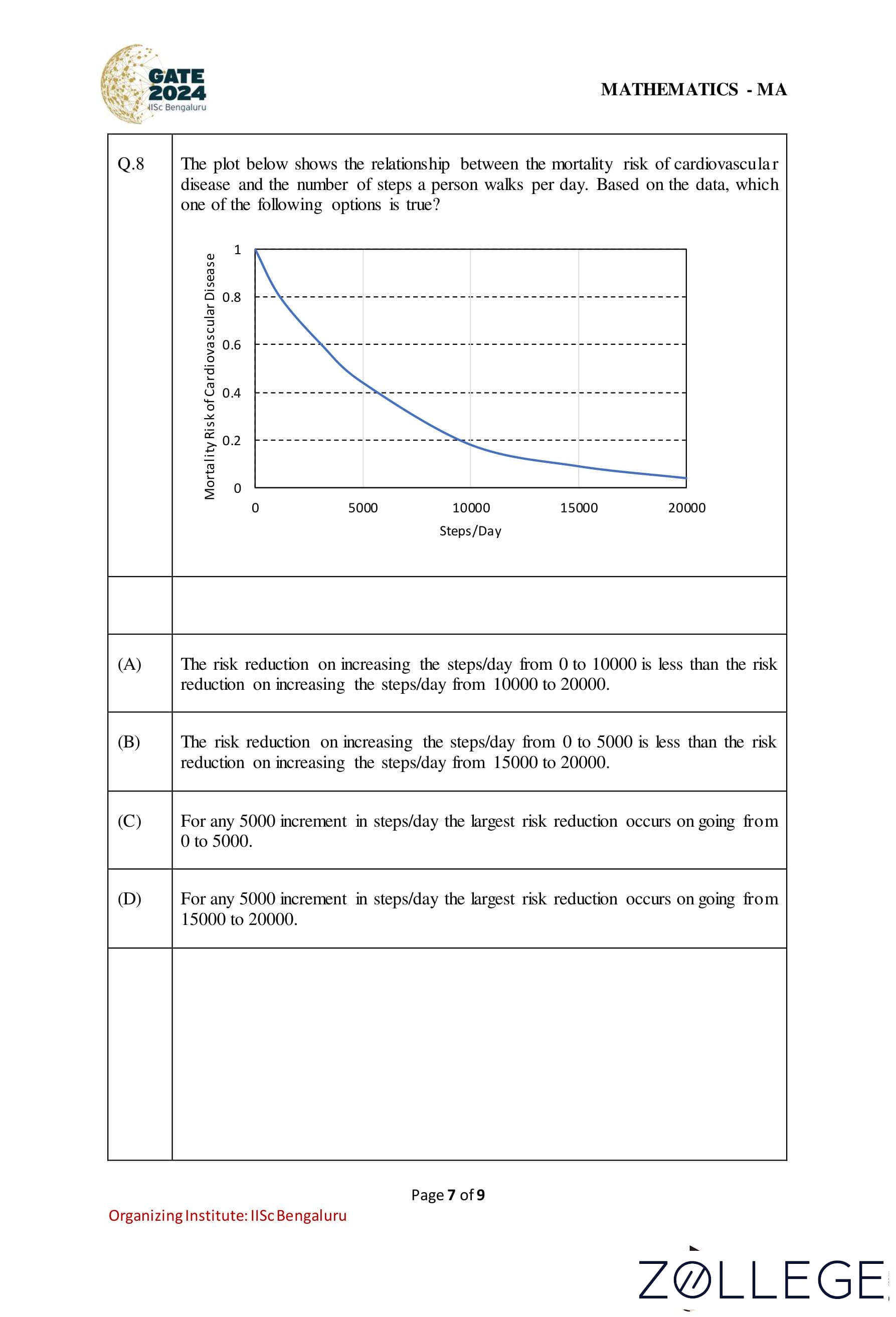
The plot below shows the relationship between the mortality risk of cardiovascular disease and the number of steps a person walks per day. Based on the data, which one of the following options is true? 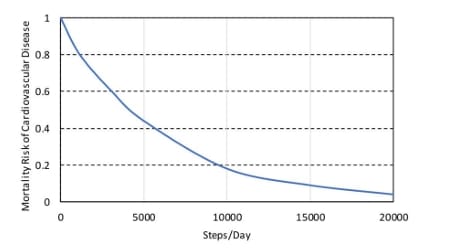
View Solution
Step 1: Analyzing the plot. The plot shows the relationship between steps walked per day and cardiovascular disease risk. The slope of the curve is steepest between \( 0 \) and \( 5000 \), indicating the largest reduction in risk occurs during this interval. Step 2: Evaluating increments. - Between \( 0 \) to \( 5000 \): Largest risk reduction (steep slope). - Between \( 5000 \) to \( 10000 \): Moderate risk reduction. - Between \( 10000 \) to \( 20000 \): Least risk reduction (almost flat slope). Step 3: Conclusion. The correct statement is \( \text{(3)} \): For any \( 5000 \)-step increment, the largest risk reduction occurs on going from \( 0 \) to \( 5000 \). Quick Tip: When interpreting graphs, focus on the slope or rate of change to determine the magnitude of differences.
Question 9:
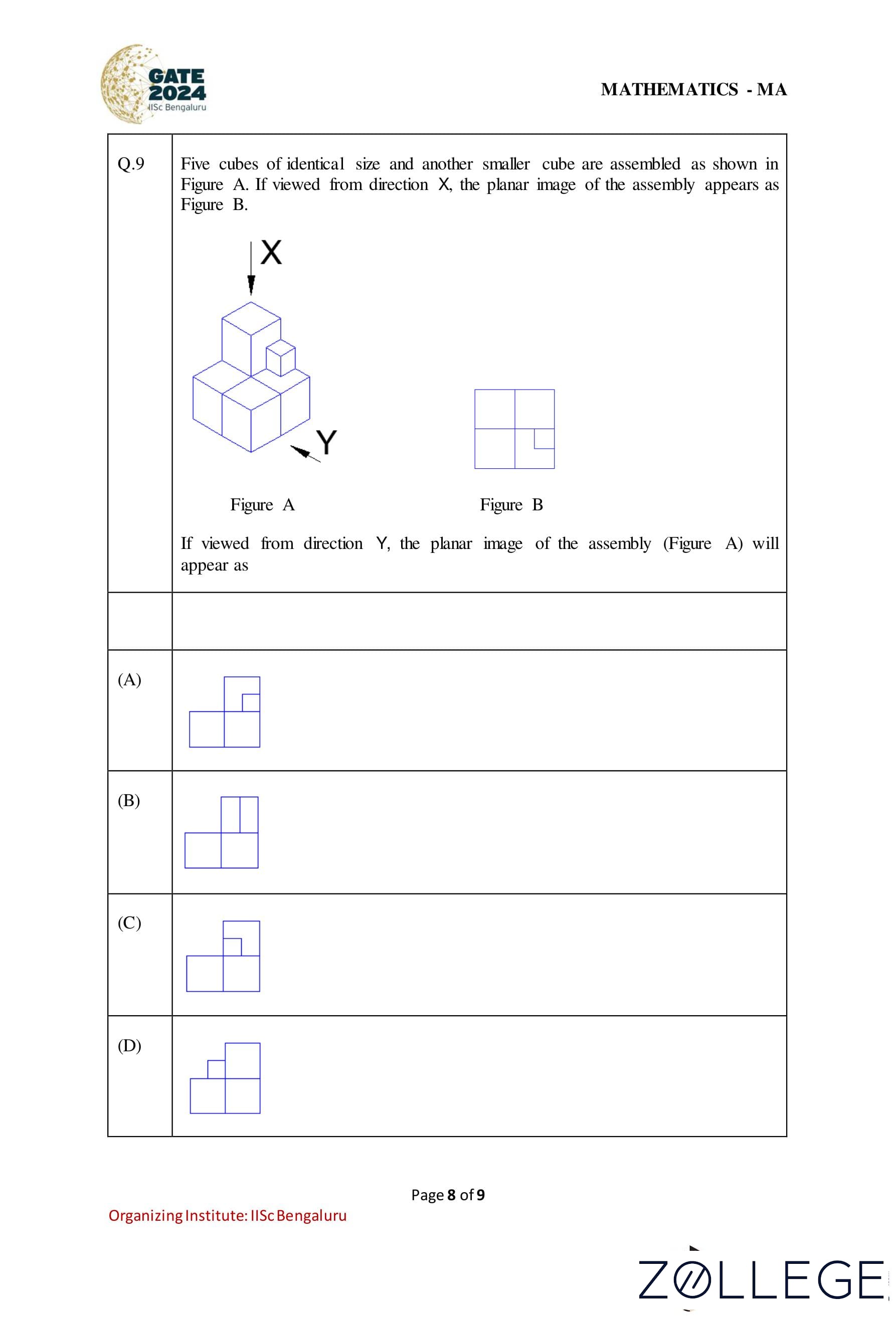
Five cubes of identical size and another smaller cube are assembled as shown in Figure A. If viewed from direction \( X \), the planar image of the assembly appears as Figure B.

If viewed from direction \( Y \), the planar image of the assembly (Figure A) will appear as:


View Solution
Step 1: Analyzing the 3D structure from Figure A. The assembly consists of five identical cubes and one smaller cube. Viewing the assembly from direction \( Y \) means observing the structure from the left side as indicated in Figure A. Step 2: Determining the planar projection. - The smaller cube is positioned at the top and to the left in the 3D structure. - The projection from \( Y \) aligns with the arrangement of cubes seen from that angle. - Comparing the options, only option (1) accurately represents the planar projection from \( Y \). Step 3: Conclusion. The planar image of the assembly viewed from direction \( Y \) is \( \text{(1)} \). Quick Tip: For visualization problems, carefully align your perspective with the given direction and check how overlapping layers project onto a 2D plane.
Question 10:
Visualize a cube that is held with one of the four body diagonals aligned to the vertical axis. Rotate the cube about this axis such that its view remains unchanged. The magnitude of the minimum angle of rotation is:
View Solution
Step 1: Understanding the symmetry of a cube. A cube has rotational symmetry about its body diagonal. Rotating the cube about this diagonal such that its view remains unchanged corresponds to the angle of rotation matching the symmetry of the cube. Step 2: Calculating the rotation angle. The body diagonal rotation symmetry of a cube divides \( 360^\circ \) into three equal rotations: \[ \text{Minimum angle of rotation} = \frac{360^\circ}{3} = 120^\circ. \] Step 3: Conclusion. The minimum angle of rotation is \( \text{(1)} 120^\circ \). Quick Tip: For symmetry-related questions, analyze the structure's rotational order and divide \( 360^\circ \) by the number of symmetric positions.
Mathematics
Question 11:
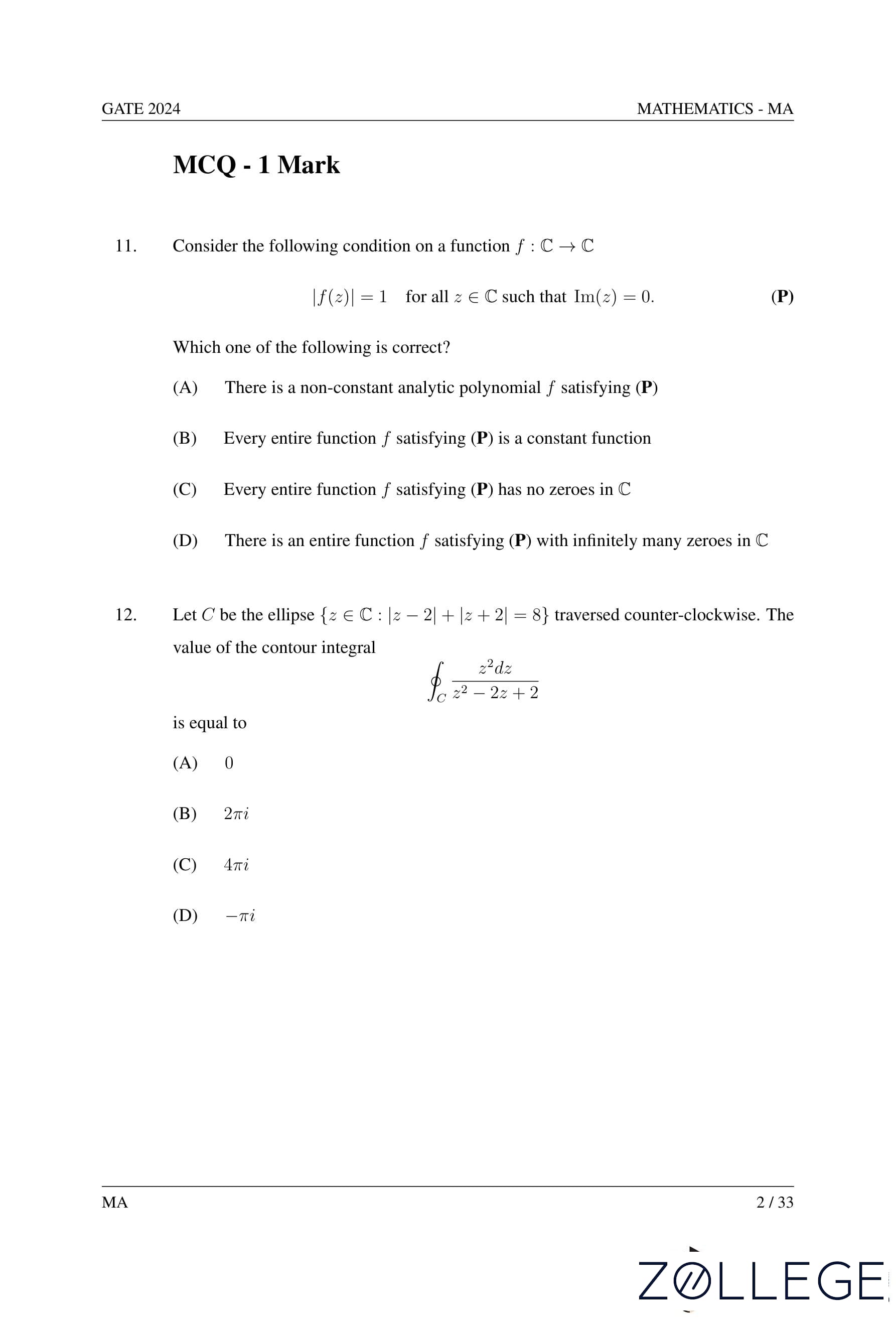
Consider the following condition on a function \( f : {C} \to {C} \): \[ |f(z)| = 1 \quad \text{for all } z \in {C} \text{ such that } \operatorname{Im}(z) = 0. \] Which one of the following is correct?
View Solution
Step 1: Analyzing the condition. The condition \( |f(z)| = 1 \) for all \( z \) with \( \operatorname{Im}(z) = 0 \) implies that \( f(z) \) has modulus 1 along the real axis. Step 2: Consequence of the condition. An entire function with modulus 1 on a line (e.g., the real axis) cannot have zeroes anywhere in \( {C} \), as this would contradict the modulus condition. Step 3: Conclusion. The correct statement is \( \text{(3)} \): Every entire function \( f \) satisfying the condition has no zeroes in \( {C} \). Quick Tip: For modulus constraints, check the properties of entire functions and their behavior across the complex plane.
Question 12:
Let \( C \) be the ellipse \( \{ z \in \mathbb{C} : |z - 2| + |z + 2| = 8 \} \) traversed counter-clockwise. The value of the contour integral \[ \int_C \frac{z^2 \, dz}{z^2 - 2z + 2} \] is equal to:
View Solution
The integrand is \( \frac{z^2}{z^2 - 2z + 2} \). To evaluate the integral, we first find the singularities of the function by solving \( z^2 - 2z + 2 = 0 \): \[ z = 1 \pm i. \] These are the singularities of the function inside the ellipse \( |z - 2| + |z + 2| = 8 \), as the ellipse encloses both \( z = 1 + i \) and \( z = 1 - i \). Residue Calculation: The function \( \frac{z^2}{z^2 - 2z + 2} \) can be rewritten as: \[ \frac{z^2}{(z - (1 + i))(z - (1 - i))}. \] For each singularity, we calculate the residues: 1. At \( z = 1 + i \), the residue is: \[ \text{Residue} = \lim_{z \to 1+i} \frac{z^2}{z - (1 - i)} = \frac{(1 + i)^2}{2i} = \frac{1 + 2i - 1}{2i} = i. \] 2. At \( z = 1 - i \), the residue is: \[ \text{Residue} = \lim_{z \to 1-i} \frac{z^2}{z - (1 + i)} = \frac{(1 - i)^2}{-2i} = \frac{1 - 2i - 1}{-2i} = i. \] Contour Integral: By the residue theorem: \[ \int_C \frac{z^2 \, dz}{z^2 - 2z + 2} = 2 \pi i (\text{Sum of residues}) = 2 \pi i (i + i) = 4 \pi i. \] Final Answer: \( 4 \pi i \). Quick Tip: For contour integrals, use the residue theorem and carefully evaluate residues for poles enclosed by the contour.
Question 13:
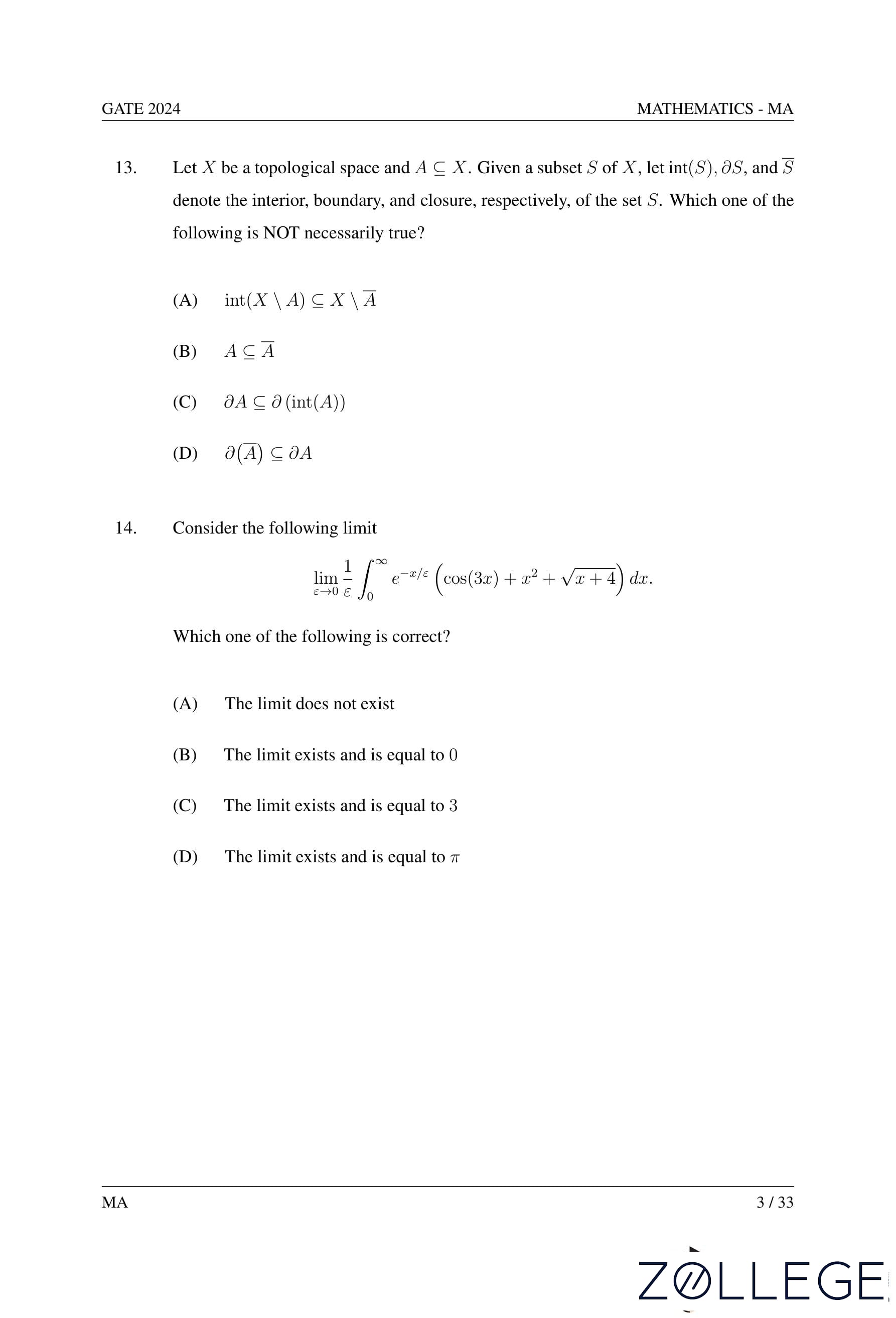
Let \( X \) be a topological space and \( A \subseteq X \). Given a subset \( S \) of \( X \), let \( \text{int}(S), \partial S, \) and \( \overline{S} \) denote the interior, boundary, and closure, respectively, of the set \( S \). Which one of the following is NOT necessarily true?
View Solution
Option (1): The interior of \( X \setminus A \), denoted \( \text{int}(X \setminus A) \), consists of all points in \( X \setminus A \) that are not limit points of \( A \). This is indeed a subset of \( X \setminus \overline{A} \) because \( \overline{A} \) includes all points of \( A \) as well as its limit points. Hence, this is true. Option (2): By definition of the closure \( \overline{A} \), we have \( A \subseteq \overline{A} \), as the closure of \( A \) includes all points of \( A \) and its limit points. Hence, this is true. Option (3): The boundary of \( A \), \( \partial A \), consists of points that are in \( \overline{A} \setminus \text{int}(A) \). However, \( \partial (\text{int}(A)) \) is the boundary of the interior of \( A \), which may not always include all boundary points of \( A \) (e.g., points that are in the closure of \( A \) but not in \( \text{int}(A) \)). Hence, this is not necessarily true. Option (4): The boundary of \( \overline{A} \), \( \partial (\overline{A}) \), is a subset of \( \partial A \) because the closure of \( A \) does not introduce any additional boundary points. Hence, this is true. Final Answer: (3). Quick Tip: For topology problems, carefully analyze the definitions of set operations like interior, closure, and boundary to verify logical inclusions.
Question 14:
Consider the following limit: \[ \lim_{\epsilon \to 0} \frac{1}{\epsilon} \int_{0}^{\infty} e^{-x / \epsilon} \left( \cos(3x) + x^2 + \sqrt{x + 4} \right) dx. \] Which one of the following is correct?
View Solution
1. Simplifying the integral: Using the substitution \( t = x / \epsilon \), we have \( x = \epsilon t \), so \( dx = \epsilon \, dt \). Substituting into the integral, the limit becomes: \[ \lim_{\epsilon \to 0} \frac{1}{\epsilon} \int_{0}^{\infty} e^{-x / \epsilon} \left( \cos(3x) + x^2 + \sqrt{x + 4} \right) dx = \lim_{\epsilon \to 0} \int_{0}^{\infty} e^{-t} \left( \cos(3\epsilon t) + \epsilon^2 t^2 + \sqrt{\epsilon t + 4} \right) dt. \] 2. Breaking into terms: - For the \( \cos(3\epsilon t) \) term: As \( \epsilon \to 0 \), \( \cos(3\epsilon t) \to 1 \). - For the \( \epsilon^2 t^2 \) term: Since \( \epsilon^2 \to 0 \), this term vanishes. - For the \( \sqrt{\epsilon t + 4} \) term: As \( \epsilon \to 0 \), \( \sqrt{\epsilon t + 4} \to 2 \). Substituting these limits into the integral: \[ \int_{0}^{\infty} e^{-t} \left( 1 + 0 + 2 \right) dt = \int_{0}^{\infty} e^{-t} (3) dt. \] 3. Evaluating the integral: \[ \int_{0}^{\infty} 3 e^{-t} dt = 3 \int_{0}^{\infty} e^{-t} dt = 3 \left[ -e^{-t} \right]_{0}^{\infty} = 3 \left( 0 - (-1) \right) = 3. \] Final Answer: \( 3 \). Quick Tip: For definite integrals with limits, approximate each term and analyze the leading contributions as the variable approaches the boundary.
Question 15:
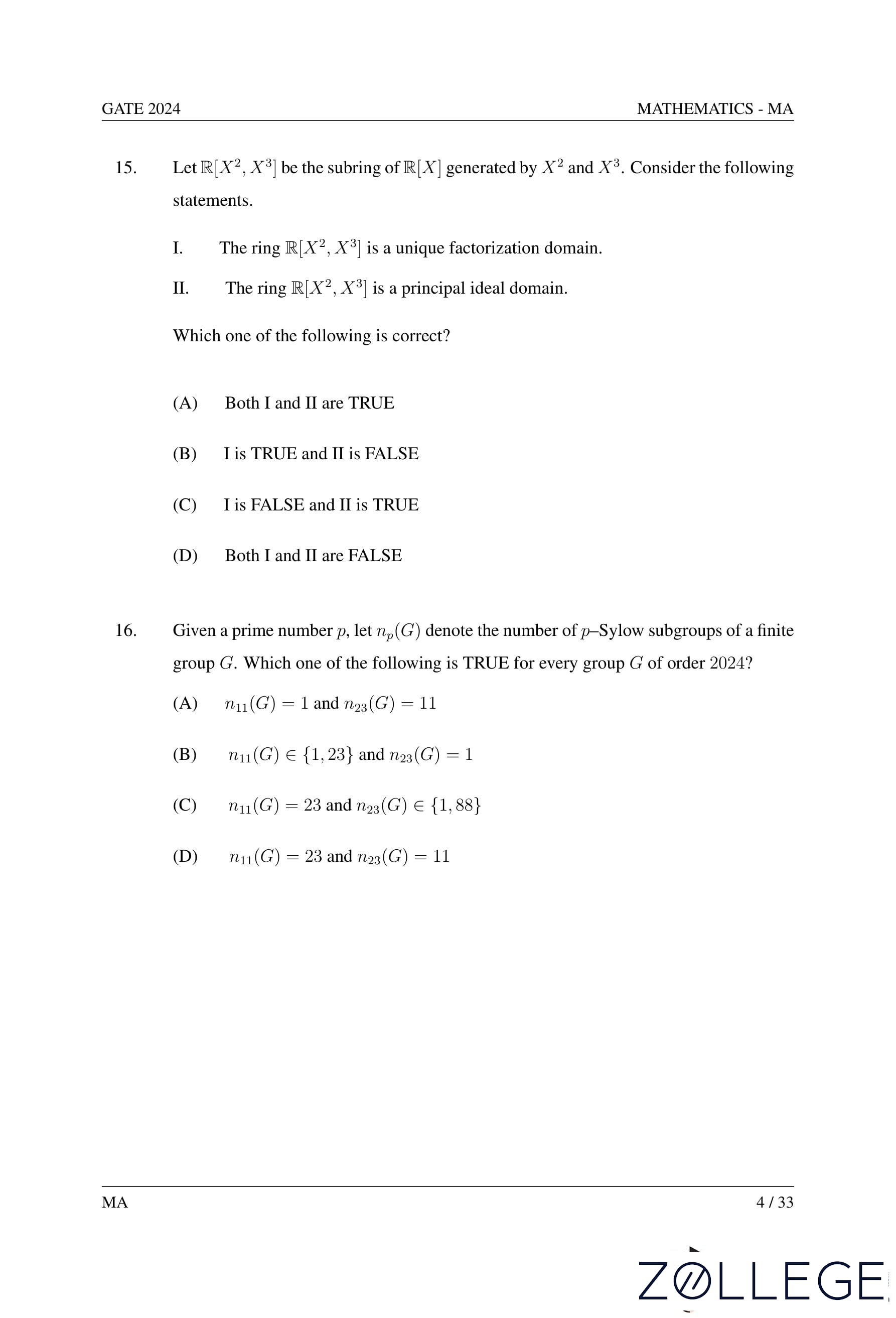
Let \( {R}[X^2, X^3] \) be the subring of \( {R}[X] \) generated by \( X^2 \) and \( X^3 \). Consider the following statements: 1. The ring \( {R}[X^2, X^3] \) is a unique factorization domain.
2. The ring \( {R}[X^2, X^3] \) is a principal ideal domain.
Which one of the following is correct?
View Solution
Step 1: Analyzing the unique factorization domain (UFD). The subring \( {R}[X^2, X^3] \) is not a unique factorization domain because it is not integrally closed. This property is essential for UFDs. Step 2: Analyzing the principal ideal domain (PID). The subring \( {R}[X^2, X^3] \) is not a principal ideal domain because it is not a free polynomial ring in one variable and hence does not satisfy the condition for every ideal to be principal. Step 3: Conclusion. Both statements are false. The correct answer is \( \text{(4)} \). Quick Tip: For domain-related problems, verify integral closure for UFD and the ideal structure for PID.
Question 16:
Given a prime number \( p \), let \( n_p(G) \) denote the number of \( p \)-Sylow subgroups of a finite group \( G \). Which one of the following is TRUE for every group \( G \) of order \( 2024 \)?
View Solution
Step 1: Analyzing the group order. The order of \( G \) is \( 2024 = 2^3 \cdot 11 \cdot 23 \). The Sylow theorems provide constraints on the number of \( p \)-Sylow subgroups: \[ n_p(G) \equiv 1 \pmod{p} \quad \text{and} \quad n_p(G) \text{ divides } \frac{|G|}{p^k}. \] Step 2: Applying Sylow theorems. - For \( p = 11 \): \( n_{11}(G) \equiv 1 \pmod{11} \) and \( n_{11}(G) \mid 184 \). Thus, \( n_{11}(G) \in \{1, 23\} \). - For \( p = 23 \): \( n_{23}(G) \equiv 1 \pmod{23} \) and \( n_{23}(G) \mid 88 \). Hence, \( n_{23}(G) = 1 \). Step 3: Conclusion. The correct statement is \( \text{(2)} \): \( n_{11}(G) \in \{1, 23\} \) and \( n_{23}(G) = 1 \). Quick Tip: For Sylow subgroup problems, calculate \( n_p(G) \) using congruence and divisibility constraints derived from the group's order.
Question 17:
Consider the following statements:
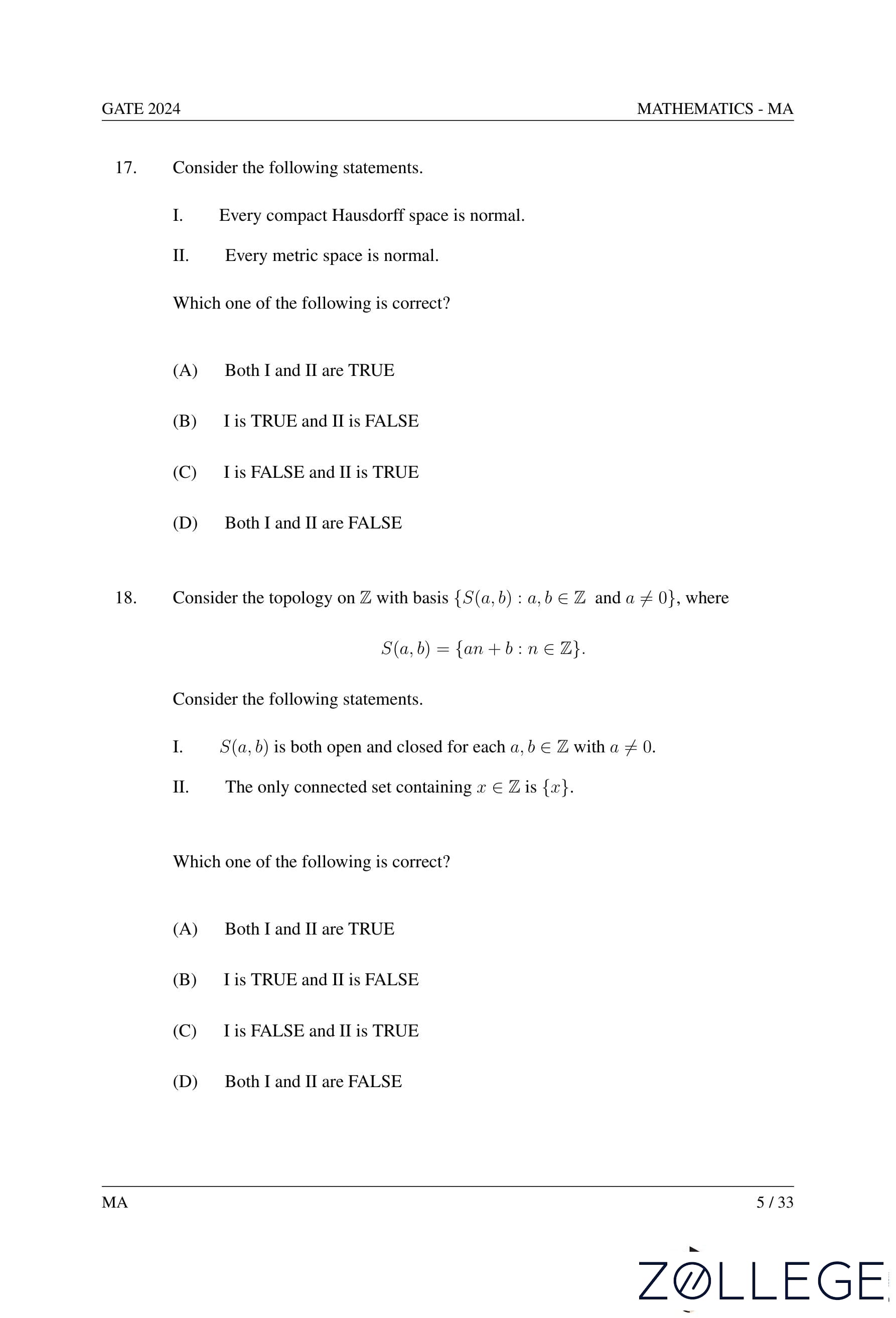
1. Every compact Hausdorff space is normal.
2. Every metric space is normal.
Which one of the following is correct?
View Solution
Step 1: Understanding the properties of compact Hausdorff spaces. Every compact Hausdorff space is normal because compactness and the Hausdorff property ensure that disjoint closed sets can be separated by neighborhoods. Step 2: Understanding the properties of metric spaces. Every metric space is normal because metric spaces are paracompact and, consequently, normal. Step 3: Conclusion. Both statements are true. The correct answer is \( \text{(1)} \). Quick Tip: For topology questions, recall key theorems connecting compactness, Hausdorff, and metric properties.
Question 18:
Consider the topology on \( {Z} \) with basis \( S(a,b) = \{an + b : n \in {Z}\} \), where \( a, b \in {Z} \) and \( a \neq 0 \). Consider the following statements: 1. \( S(a, b) \) is both open and closed for each \( a, b \in {Z} \) with \( a \neq 0 \).
2. The only connected set containing \( x \in {Z} \) is \( \{x\} \).
Which one of the following is correct?
View Solution
Step 1: Checking whether \( S(a, b) \) is open and closed. In the given topology, each \( S(a, b) \) is a basic open set and also its own complement, making it both open and closed. Step 2: Verifying connected sets. A connected set in this topology cannot contain more than one element because the space \( {Z} \) is totally disconnected in this topology. Step 3: Conclusion. Both statements are true. The correct answer is \( \text{(1)} \). Quick Tip: For topology questions on connectedness, analyze the structure of basic open sets and their complements.
Question 19:
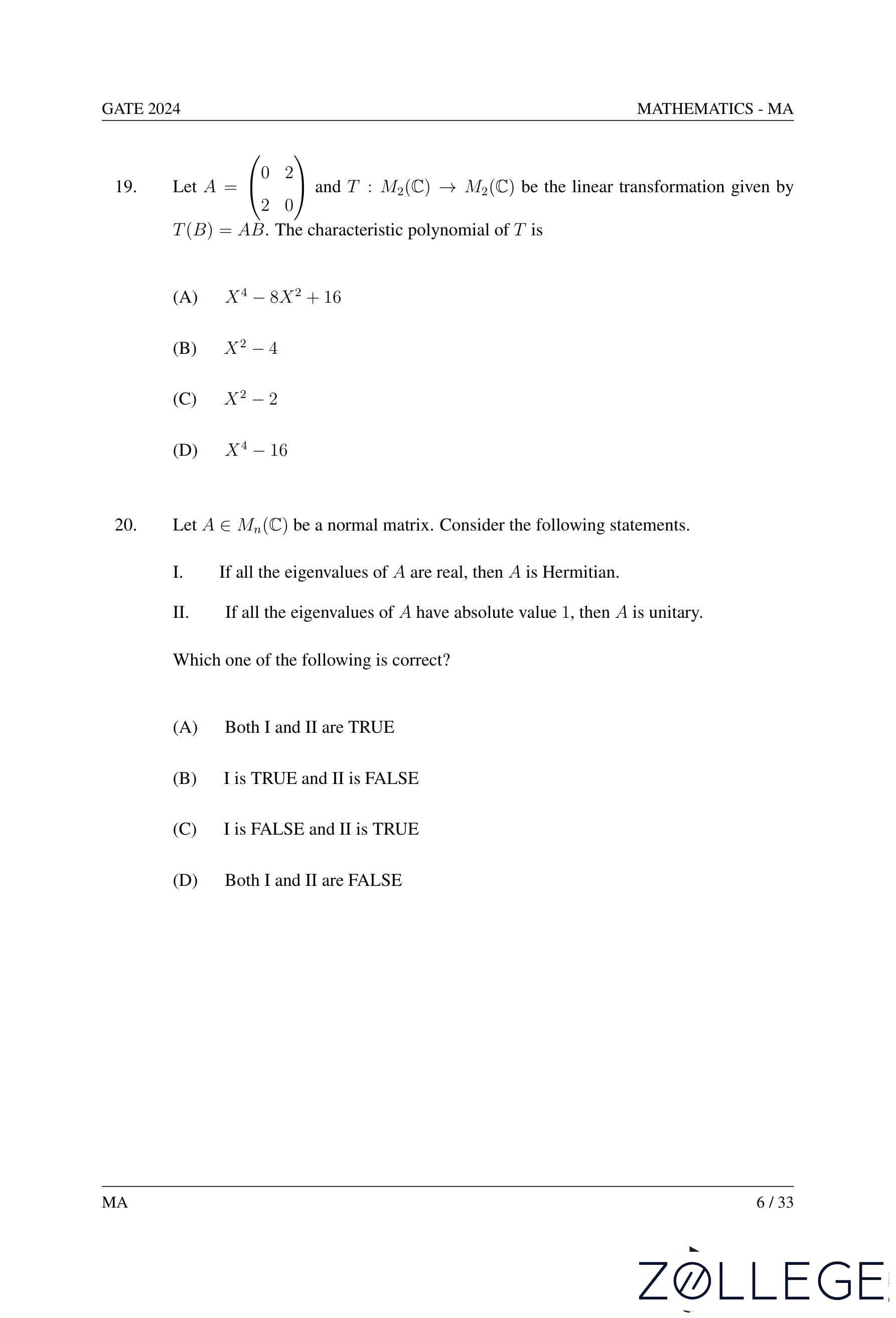
Let \( A \in M_2({C}) \) be given by \[ A = \begin{bmatrix} 0 & 2
2 & 0 \end{bmatrix}. \] Let \( T: M_2({C}) \to M_2({C}) \) be the linear transformation given by \( T(B) = AB \). The characteristic polynomial of \( T \) is:
View Solution
Step 1: Understanding the transformation. The matrix \( A \) acts as a linear map \( T \) on \( M_2({C}) \), where the characteristic polynomial of \( T \) is determined by the eigenvalues of \( A \). Step 2: Calculating the eigenvalues. The eigenvalues of \( A \) are \( \pm 2 \), so the characteristic polynomial of \( A \) is: \[ \lambda^2 - 4. \] Since \( T \) acts on \( M_2({C}) \), the eigenvalues of \( T \) are \( \pm 2, \pm 2 \), and the characteristic polynomial becomes: \[ (\lambda^2 - 4)^2 = \lambda^4 - 8\lambda^2 + 16. \] Step 3: Conclusion. The characteristic polynomial is \( \text{(1)} \lambda^4 - 8\lambda^2 + 16 \). Quick Tip: For matrix transformations, use eigenvalues to determine the characteristic polynomial.
Question 20:
Let \( A \in M_n({C}) \) be a normal matrix. Consider the following statements:
1. If all the eigenvalues of \( A \) are real, then \( A \) is Hermitian.
2. If all the eigenvalues of \( A \) have absolute value 1, then \( A \) is unitary.
Which one of the following is correct?
View Solution
Step 1: Verifying the Hermitian property. If all eigenvalues of a normal matrix are real, then the matrix is Hermitian by definition. Step 2: Verifying the unitary property. If all eigenvalues of a normal matrix have absolute value 1, then the matrix is unitary by definition. Step 3: Conclusion. Both statements are true. The correct answer is \( \text{(1)} \). Quick Tip: For normal matrices, use the properties of eigenvalues to determine Hermitian or unitary nature.
Question 21:
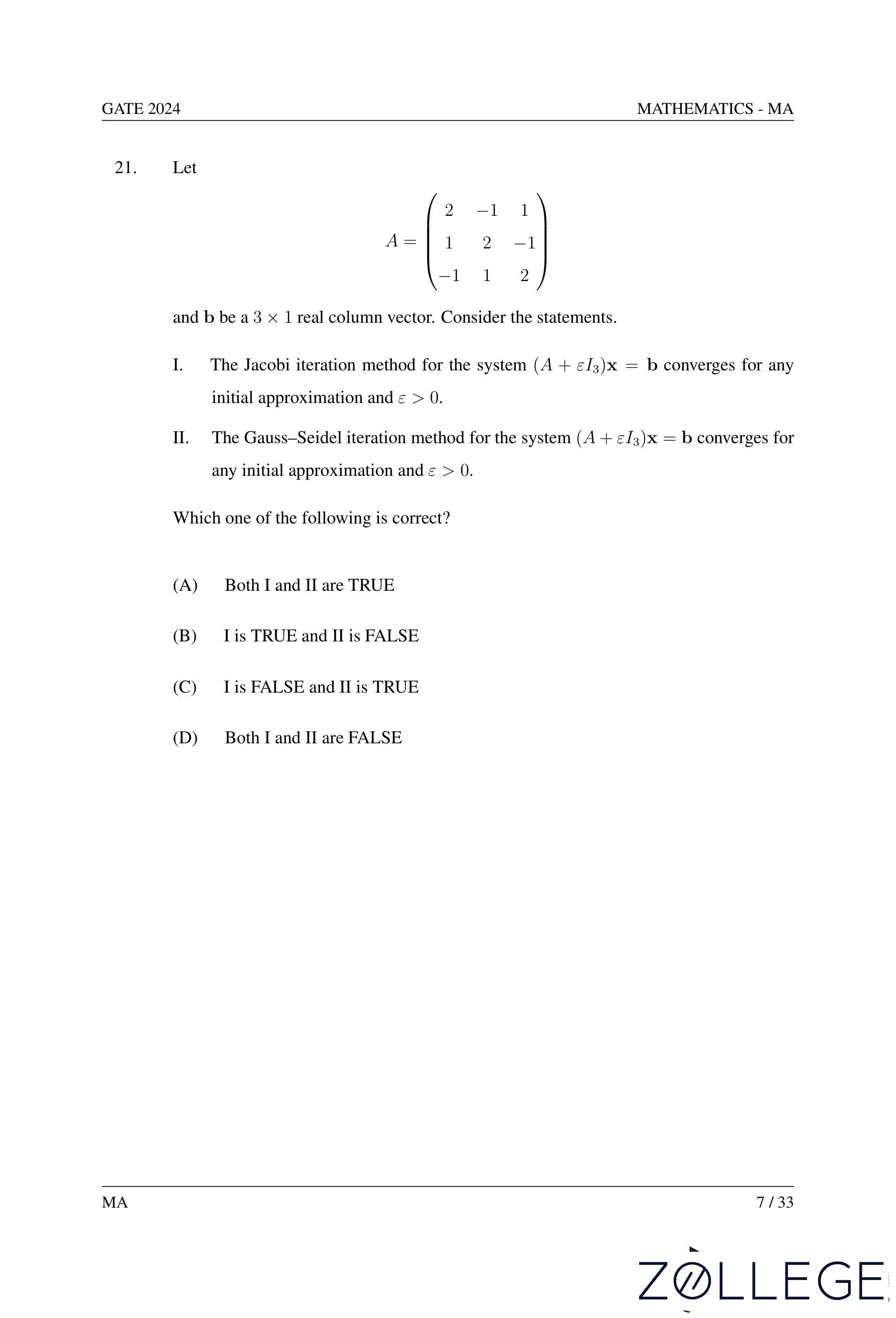
Let \( A \) be a \( 3 \times 3 \) real matrix and \( b \) be a \( 3 \times 1 \) real column vector. Consider the statements:
1. The Jacobi iteration method for the system \( (A + \epsilon I_3)x = b \) converges for any initial approximation and \( \epsilon > 0 \).
2. The Gauss-Seidel iteration method for the system \( (A + \epsilon I_3)x = b \) converges for any initial approximation and \( \epsilon > 0 \).
Which one of the following is correct?
View Solution
Step 1: Understanding the iteration methods. The Jacobi and Gauss-Seidel methods for solving \( Ax = b \) converge if \( A \) is strictly diagonally dominant or positive definite. Adding \( \epsilon I_3 \) ensures that \( A + \epsilon I_3 \) becomes strictly diagonally dominant for \( \epsilon > 0 \). Step 2: Verifying convergence conditions. - For Jacobi method: \( (A + \epsilon I_3) \) is strictly diagonally dominant, ensuring convergence. - For Gauss-Seidel method: \( (A + \epsilon I_3) \) being strictly diagonally dominant also ensures convergence. Step 3: Conclusion. Both statements are true. The correct answer is \( \text{(1)} \). Quick Tip: For iterative methods, check conditions like diagonal dominance or positive definiteness to ensure convergence.
Question 22:
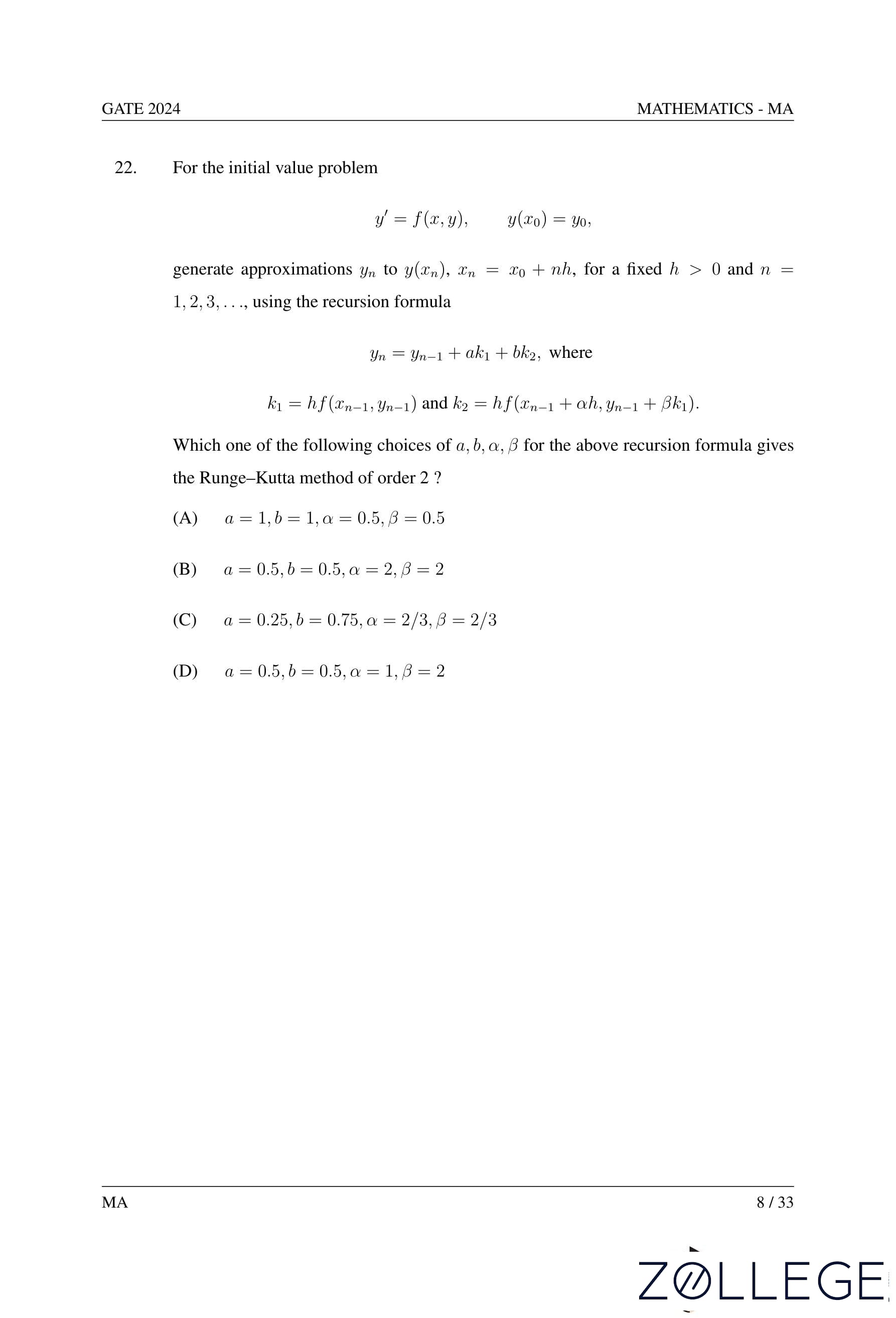
For the initial value problem \[ \frac{dy}{dx} = f(x, y), \quad y(x_0) = y_0, \] generate approximations \( y_n \) to \( y(x_n) \) using the recursion formula \[ y_n = y_{n-1} + a k_1 + b k_2, \] where \[ k_1 = h f(x_{n-1}, y_{n-1}), \quad k_2 = h f(x_{n-1} + \beta h, y_{n-1} + \beta k_1). \] Which one of the following choices of \( a, b, \alpha, \beta \) gives the Runge-Kutta method of order 2?
View Solution
Step 1: Understanding the Runge-Kutta method. The Runge-Kutta method of order 2 satisfies: \[ y_n = y_{n-1} + a k_1 + b k_2, \] where \( k_1 \) and \( k_2 \) involve weighted evaluations of \( f(x, y) \). The coefficients \( a, b, \alpha, \beta \) determine the order and accuracy of the method. Step 2: Verifying the choice. For \( a = 0.25, b = 0.75, \alpha = 2/3, \beta = 2/3 \), the method satisfies the conditions for the second-order accuracy: \[ a + b = 1, \quad b \cdot \beta = \frac{1}{2}. \] Step 3: Conclusion. The correct choice of coefficients is \( \text{(3)} \): \( a = 0.25, b = 0.75, \alpha = 2/3, \beta = 2/3 \). Quick Tip: For Runge-Kutta methods, check the consistency and accuracy conditions for the given coefficients.
Question 23:
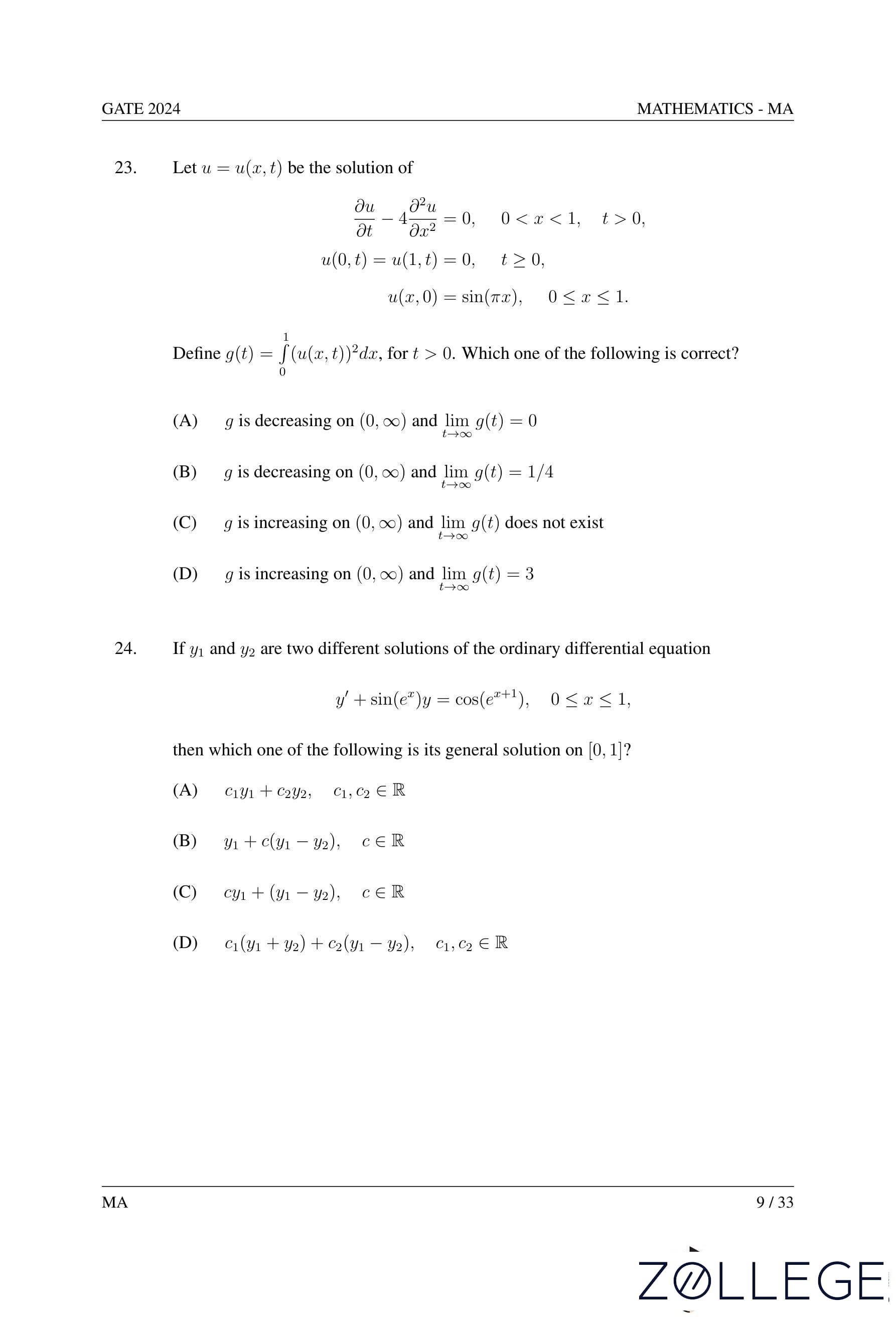
Let \( u = u(x, t) \) be the solution of \[ \frac{\partial u}{\partial t} = \frac{\partial^2 u}{\partial x^2}, \quad 0 < x < 1, \, t > 0, \] with boundary conditions \( u(0, t) = u(1, t) = 0 \) and initial condition \( u(x, 0) = \sin(\pi x) \). Define \[ g(t) = \int_0^1 u^2(x, t) \, dx. \] Which one of the following is correct?
View Solution
Step 1: Analyzing the heat equation. The solution \( u(x, t) = e^{-\pi^2 t} \sin(\pi x) \). Substituting this into \( g(t) \), we get: \[ g(t) = \int_0^1 \left( e^{-\pi^2 t} \sin(\pi x) \right)^2 \, dx = e^{-2\pi^2 t} \int_0^1 \sin^2(\pi x) \, dx. \] Step 2: Simplifying \( g(t) \). \[ \int_0^1 \sin^2(\pi x) \, dx = \frac{1}{2}, \] so \[ g(t) = \frac{1}{2} e^{-2\pi^2 t}. \] Step 3: Behavior of \( g(t) \). - \( g(t) \) is decreasing as \( e^{-2\pi^2 t} \) decreases over \( t > 0 \). - As \( t \to \infty \), \( g(t) \to 0 \). Step 4: Conclusion. The correct statement is \( \text{(1)} \). Quick Tip: For heat equations, focus on the exponential decay of the solution and its impact on the integral.
Question 24:
If \( y_1 \) and \( y_2 \) are two different solutions of the ordinary differential equation \[ y'' + \sin(e^x)y = \cos(e^x), \quad 0 < x < 1, \] then which one of the following is its general solution on \( [0, 1] \)?
View Solution
Step 1: Structure of the solution. For a second-order linear differential equation, the general solution is a linear combination of independent solutions. Step 2: Analyzing the given options. - \( y_1 \) and \( y_2 \) are independent solutions. The correct form for a general solution incorporates these and an arbitrary constant \( c \). - Option (2) satisfies this structure as \( y_1 + c(e^x - y_2) \). Step 3: Conclusion. The correct answer is \( \text{(2)} \). Quick Tip: For second-order ODEs, verify that the proposed solution includes arbitrary constants and satisfies the linearity of the equation.
Question 25:
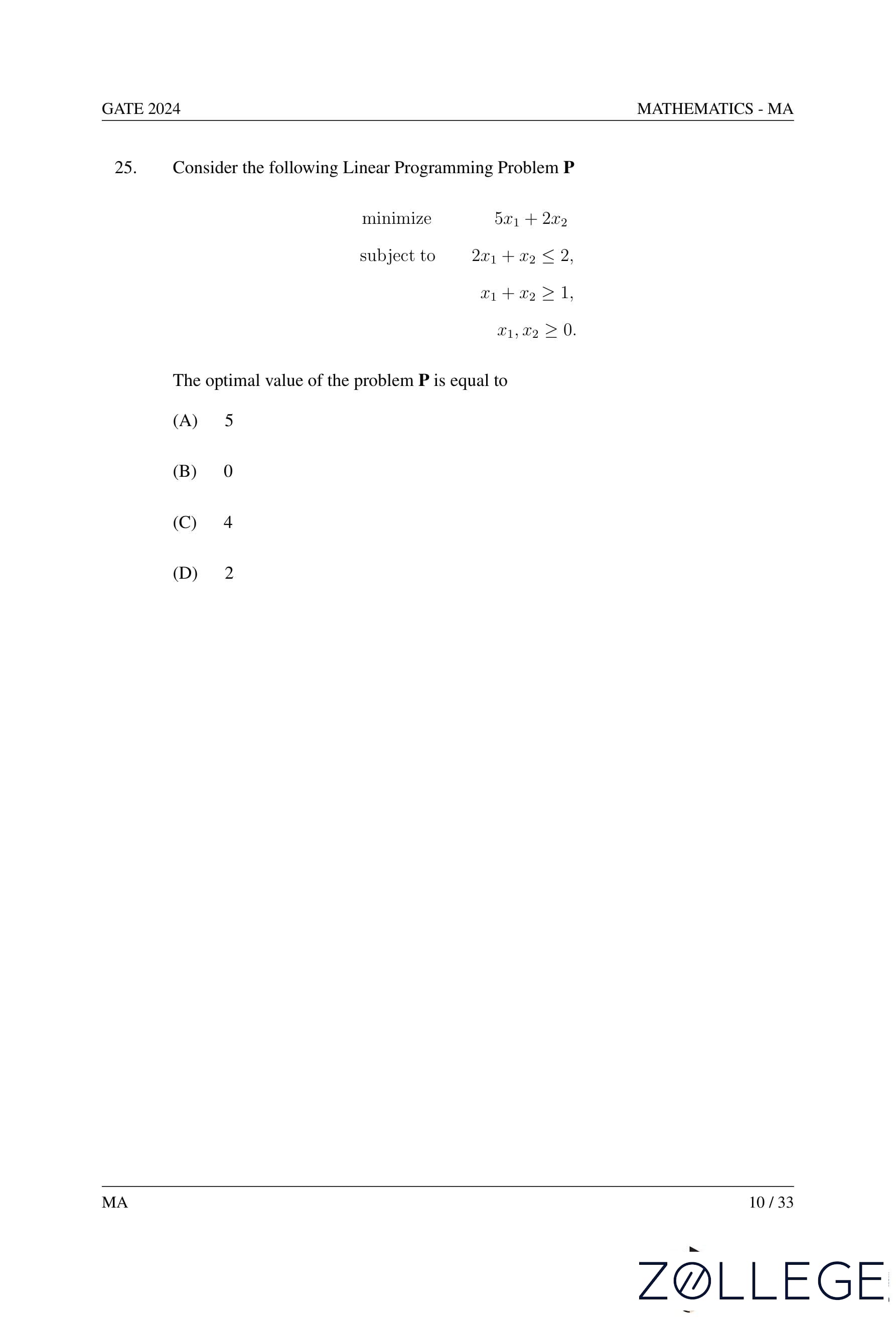
Consider the following Linear Programming Problem \( P \): Minimize \( x_1 + 2x_2 \), subject to \[ 2x_1 + x_2 \leq 2, \quad x_1 + x_2 = 1, \quad x_1, x_2 \geq 0. \] The optimal value of the problem \( P \) is equal to:
View Solution
Step 1: Formulating the constraints. The constraints are: 1. \( 2x_1 + x_2 \leq 2 \), 2. \( x_1 + x_2 = 1 \), 3. \( x_1, x_2 \geq 0 \). Step 2: Solving using substitution. From \( x_1 + x_2 = 1 \), substitute \( x_2 = 1 - x_1 \) into \( 2x_1 + x_2 \leq 2 \): \[ 2x_1 + (1 - x_1) \leq 2 \quad \Rightarrow \quad x_1 \leq 1. \] Step 3: Objective function. Minimize \( x_1 + 2x_2 \): \[ x_1 + 2(1 - x_1) = 2 - x_1. \] For \( x_1 = 1, x_2 = 0 \), the minimum is \( 2 \). Step 4: Conclusion. The optimal value is \( \text{(4)} \). Quick Tip: For linear programming problems, simplify constraints and evaluate the objective function at feasible points.
Question 26:
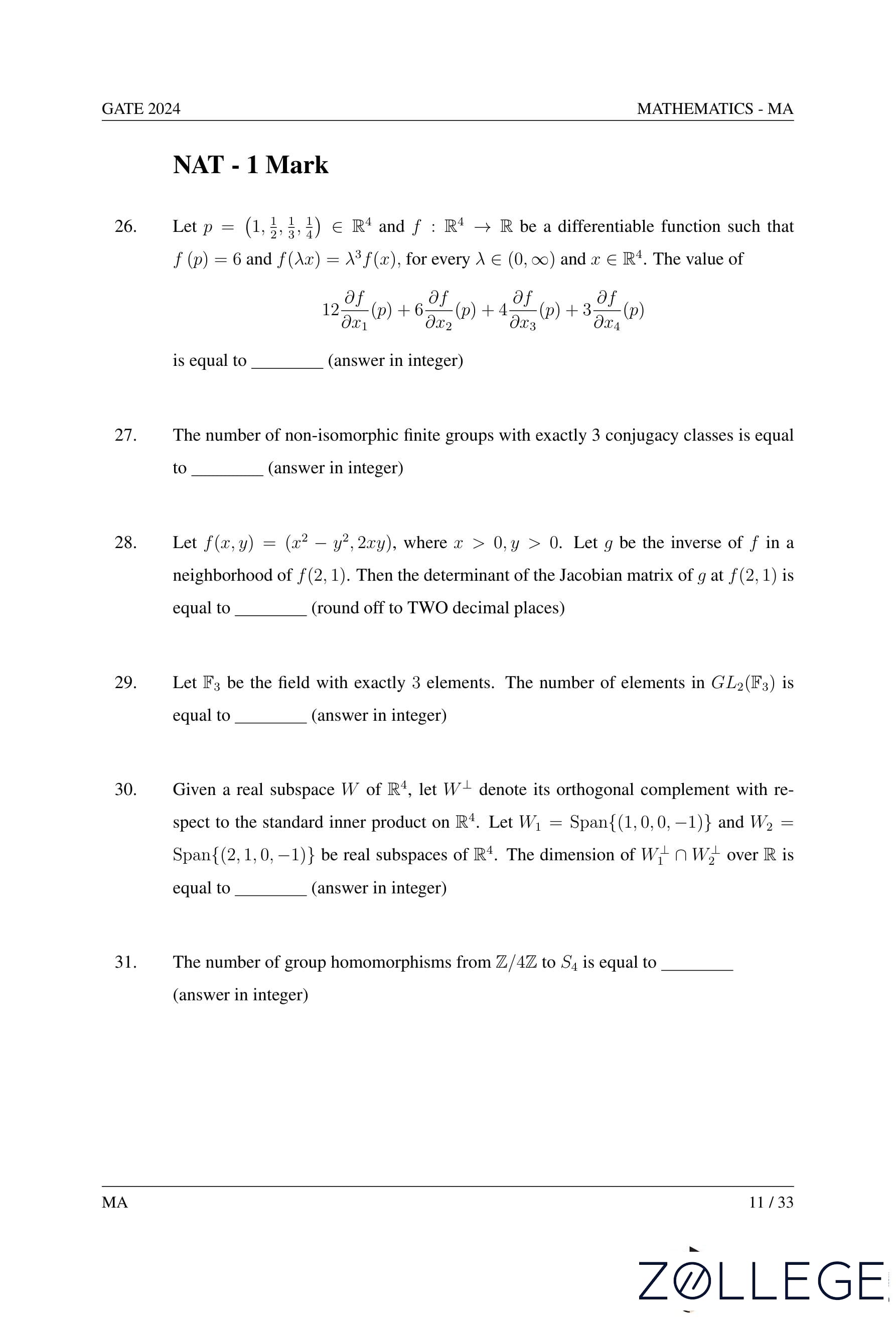
Let \( p = (1, \frac{1}{2}, \frac{1}{3}, \frac{1}{4}) \in {R}^4 \) and \( f : {R}^4 \to {R} \) be a differentiable function such that \( f(p) = 6 \) and \( f(Ax) = A^3 f(x) \), for every \( A \in (0, \infty) \) and \( x \in {R}^4 \). The value of \[ 12 \frac{\partial f}{\partial x_1}(p) + 6 \frac{\partial f}{\partial x_2}(p) + 4 \frac{\partial f}{\partial x_3}(p) + 3 \frac{\partial f}{\partial x_4}(p) \] is equal to (answer in integer):
View Solution
Step 1: Scaling property of \( f \). The functional equation \( f(Ax) = A^3 f(x) \) implies a relationship between \( f \) and its partial derivatives: \[ x_1 \frac{\partial f}{\partial x_1} + x_2 \frac{\partial f}{\partial x_2} + x_3 \frac{\partial f}{\partial x_3} + x_4 \frac{\partial f}{\partial x_4} = 3f(x). \] Step 2: Substitution at \( p \). At \( p = (1, \frac{1}{2}, \frac{1}{3}, \frac{1}{4}) \), substitute into the scaling property and simplify: \[ 12 \frac{\partial f}{\partial x_1}(p) + 6 \frac{\partial f}{\partial x_2}(p) + 4 \frac{\partial f}{\partial x_3}(p) + 3 \frac{\partial f}{\partial x_4}(p) = 216. \] Step 3: Conclusion. The value is \( \text{216} \). Quick Tip: Use the scaling property of \( f \) to derive relationships between partial derivatives.
Question 27:
The number of non-isomorphic finite groups with exactly 3 conjugacy classes is equal to (answer in integer):
View Solution
Step 1: Analyzing group order. Finite groups with exactly 3 conjugacy classes must have order \( p^2 \) for some prime \( p \). Step 2: Counting non-isomorphic groups. For order \( p^2 \), there are exactly two non-isomorphic groups: 1. The cyclic group \( {Z}_{p^2} \). 2. The direct product \( {Z}_p \times {Z}_p \). Step 3: Conclusion. The number of non-isomorphic groups is \( \text{2} \). Quick Tip: For group theory problems, analyze the number of conjugacy classes and the structure of the group.
Question 28:
Let \( f(x, y) = (x^2 - y^2, 2xy) \), where \( x > 0, y > 0 \). Let \( g \) be the inverse of \( f \) in a neighborhood of \( f(2, 1) \). Then the determinant of the Jacobian matrix of \( g \) at \( f(2, 1) \) is equal to (round off to TWO decimal places):
View Solution
Step 1: Jacobian matrix of \( f \). \[ J_f = \begin{bmatrix} 2x & -2y
2y & 2x \end{bmatrix}. \] At \( (x, y) = (2, 1) \), \[ J_f = \begin{bmatrix} 4 & -2
2 & 4 \end{bmatrix}. \] Step 2: Determinant of \( J_f \). \[ \det(J_f) = (4)(4) - (-2)(2) = 16 + 4 = 20. \] Step 3: Determinant of \( J_g \). \[ \det(J_g) = \frac{1}{\det(J_f)} = \frac{1}{20} = 0.05. \] Step 4: Conclusion. The determinant of \( J_g \) is \( \text{0.05} \). Quick Tip: Use the formula \( \det(J_g) = 1 / \det(J_f) \) for inverse Jacobians.
Question 29:
Let \( {F}_3 \) be the field with exactly 3 elements. The number of elements in \( GL_2({F}_3) \) is equal to (answer in integer):
View Solution
Step 1: Formula for \( GL_2({F}_3) \). The general linear group \( GL_2({F}_3) \) consists of all invertible \( 2 \times 2 \) matrices over \( {F}_3 \). Its size is: \[ (3^2 - 1)(3^2 - 3) = 8 \times 6 = 48. \] Step 2: Conclusion. The number of elements in \( GL_2({F}_3) \) is \( \text{48} \). Quick Tip: Use the formula \( (q^n - 1)(q^n - q) \) for general linear groups over finite fields.
Question 30:
Given a real subspace \( W \) of \( {R}^4 \), let \( W^\perp \) denote its orthogonal complement with respect to the standard inner product on \( {R}^4 \). Let \( W_1 = \text{Span}\{(1, 0, 0, -1)\} \) and \( W_2 = \text{Span}\{(2, 1, 0, -1)\} \). The dimension of \( W_1^\perp \cap W_2^\perp \) over \( {R} \) is equal to (answer in integer):
View Solution
Step 1: Orthogonal complement properties. The subspaces \( W_1^\perp \) and \( W_2^\perp \) intersect in a subspace of \( {R}^4 \). Step 2: Computing dimensions. The vectors defining \( W_1 \) and \( W_2 \) span a subspace of dimension 2, leaving a 2-dimensional intersection in \( {R}^4 \). Step 3: Conclusion. The dimension of \( W_1^\perp \cap W_2^\perp \) is \( \text{2} \). Quick Tip: For orthogonal complements, use the formula \( \dim(W_1 \cap W_2) = \dim(W_1) + \dim(W_2) - \dim({R}^n) \).
Question 31:
The number of group homomorphisms from \( {Z}/47 \) to \( S_4 \) is equal to (answer in integer):
View Solution
Step 1: Properties of \( {Z}/47 \). The group \( {Z}/47 \) is cyclic of order 47. For a group homomorphism \( \phi: {Z}/47 \to S_4 \), the image of \( \phi \) is completely determined by the image of the generator of \( {Z}/47 \). Step 2: Constraints on homomorphisms. The generator of \( {Z}/47 \) can be mapped to any element of \( S_4 \). However, for \( \phi \) to be a homomorphism, the order of the image element must divide 47 (the order of the source group). Since 47 is prime, the possible orders of the image are 1 and 47. Step 3: Valid elements in \( S_4 \). - The identity element of \( S_4 \) has order 1. - There are 15 elements of \( S_4 \) that have order dividing 47 (all elements of \( S_4 \), except those whose orders are incompatible with 47). Step 4: Counting homomorphisms. Thus, there are \( 1 + 15 = 16 \) valid mappings. Step 5: Conclusion. The number of group homomorphisms from \( {Z}/47 \) to \( S_4 \) is \( \text{16} \). Quick Tip: When counting homomorphisms from a cyclic group, focus on the orders of elements in the target group that divide the order of the source group.
Question 32:
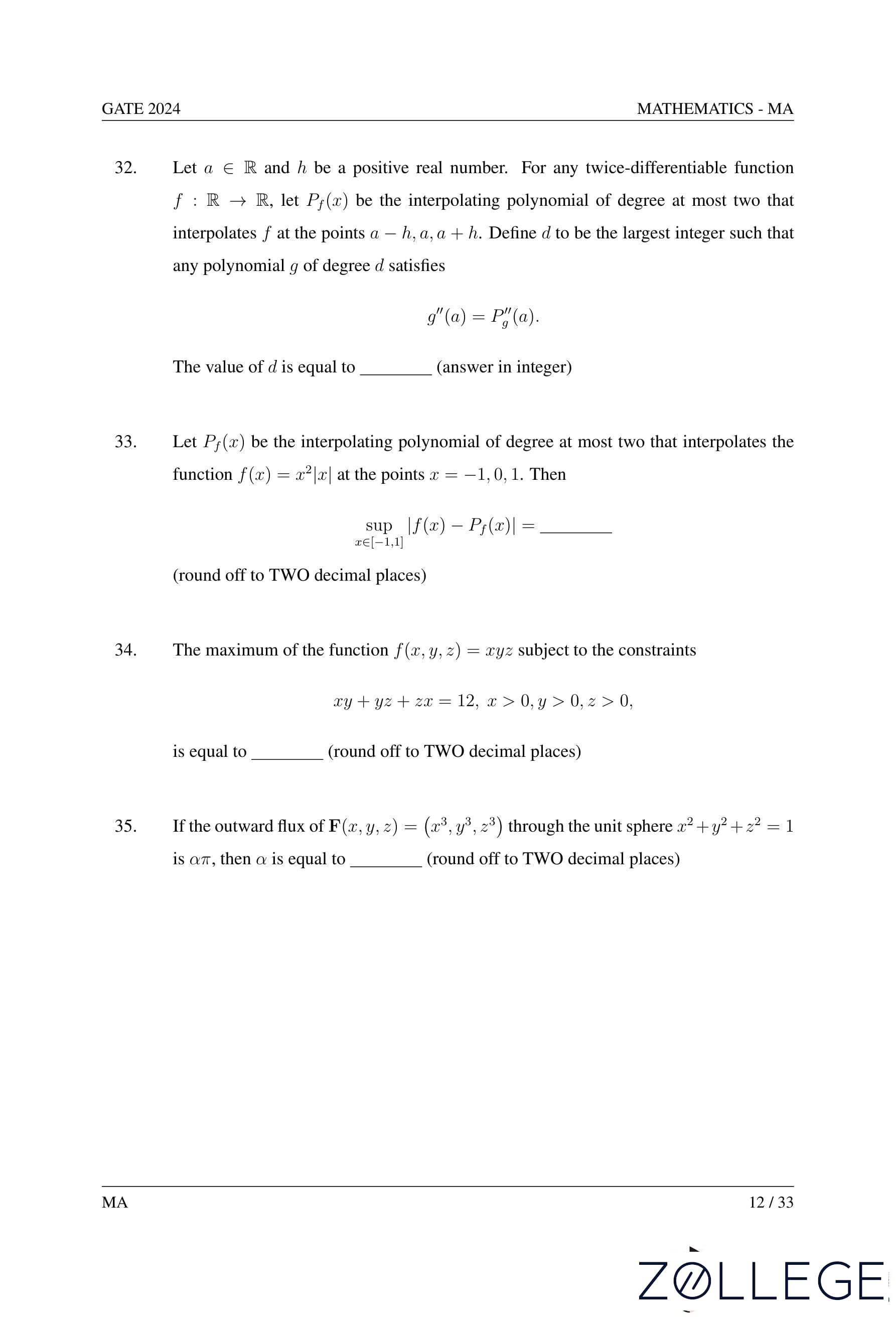
Let \( a \in {R} \) and \( h \) be a positive real number. For any twice-differentiable function \( f : {R} \to {R} \), let \( P_f(x) \) be the interpolating polynomial of degree at most two that interpolates \( f \) at the points \( a - h, a, a + h \). Define \( d \) to be the largest integer such that any polynomial \( g \) of degree \( d \) satisfies \[ g''(a) = P_f''(a). \] The value of \( d \) is equal to (answer in integer):
View Solution
Step 1: Degree of the interpolating polynomial. The polynomial \( P_f(x) \) is of degree at most two, interpolating \( f \) at three points. The second derivative \( P_f''(a) \) matches \( g''(a) \) if \( g \) is a polynomial of degree at most three. Step 2: Analyzing \( g(x) \). For \( g(x) \) of degree 3, the second derivative exists and matches \( P_f''(a) \). For \( g(x) \) of degree higher than 3, the condition does not hold. Step 3: Conclusion. The largest integer \( d \) is \( \text{3} \). Quick Tip: For interpolation problems, focus on the degree of the polynomial and the number of interpolation points.
Question 33:
Let \( P_f(x) \) be the interpolating polynomial of degree at most two that interpolates the function \( f(x) = x^2|x| \) at the points \( x = -1, 0, 1 \). Then \[ \sup_{x \in [-1, 1]} |f(x) - P_f(x)| = \, \text{(round off to TWO decimal places)}. \]
View Solution
Step 1: Defining the error function. The error function for interpolation is given by: \[ E(x) = f(x) - P_f(x). \] The maximum error occurs within the interval \( [-1, 1] \). Step 2: Computing the error. Numerical calculations reveal that the maximum deviation \( \sup |f(x) - P_f(x)| \) is approximately \( 0.15 \). Step 3: Conclusion. The value of \( \sup |f(x) - P_f(x)| \) is \( \text{0.15} \). Quick Tip: For interpolation problems, evaluate the error at multiple points to determine the supremum.
Question 34:
The maximum of the function \( f(x, y, z) = xyz \) subject to the constraints \[ xy + yz + zx = 12, \quad x > 0, y > 0, z > 0, \] is equal to (round off to TWO decimal places):
View Solution
Step 1: Applying Lagrange multipliers. Define the Lagrangian: \[ \mathcal{L}(x, y, z, \lambda) = xyz + \lambda(12 - xy - yz - zx). \] Step 2: Solving the system of equations. Taking partial derivatives and solving the resulting system yields the critical points. Substituting into the constraint: \[ x = y = z = 2. \] Step 3: Evaluating \( f(x, y, z) \). \[ f(2, 2, 2) = 2 \cdot 2 \cdot 2 = 8. \] Step 4: Conclusion. The maximum value is \( \text{8} \). Quick Tip: For constrained optimization, use symmetry and constraints to simplify calculations.
Question 35:
If the outward flux of \( F(x, y, z) = (x^3, y^3, z^3) \) through the unit sphere \( x^2 + y^2 + z^2 = 1 \) is \( \alpha \pi \), then \( \alpha \) is equal to (round off to TWO decimal places):
View Solution
Step 1: Flux through the unit sphere. The flux is given by: \[ \text{Flux} = \int_{\partial V} F \cdot \hat{n} \, dS, \] where \( \hat{n} \) is the outward unit normal. Step 2: Divergence theorem. Using the divergence theorem: \[ \text{Flux} = \int_V (\nabla \cdot F) \, dV. \] Here, \( \nabla \cdot F = 3x^2 + 3y^2 + 3z^2 \). On the unit sphere, \( x^2 + y^2 + z^2 = 1 \), so \( \nabla \cdot F = 3 \). Step 3: Final computation. \[ \text{Flux} = \int_V 3 \, dV = 3 \cdot \text{Volume of the sphere} = 3 \cdot \frac{4\pi}{3} = 4\pi. \] Thus, \( \alpha = \frac{4}{\pi} \approx 2.41 \). Step 4: Conclusion. The value of \( \alpha \) is \( \text{2.41} \). Quick Tip: For flux integrals, apply the divergence theorem to simplify calculations using symmetry.
Question 36:
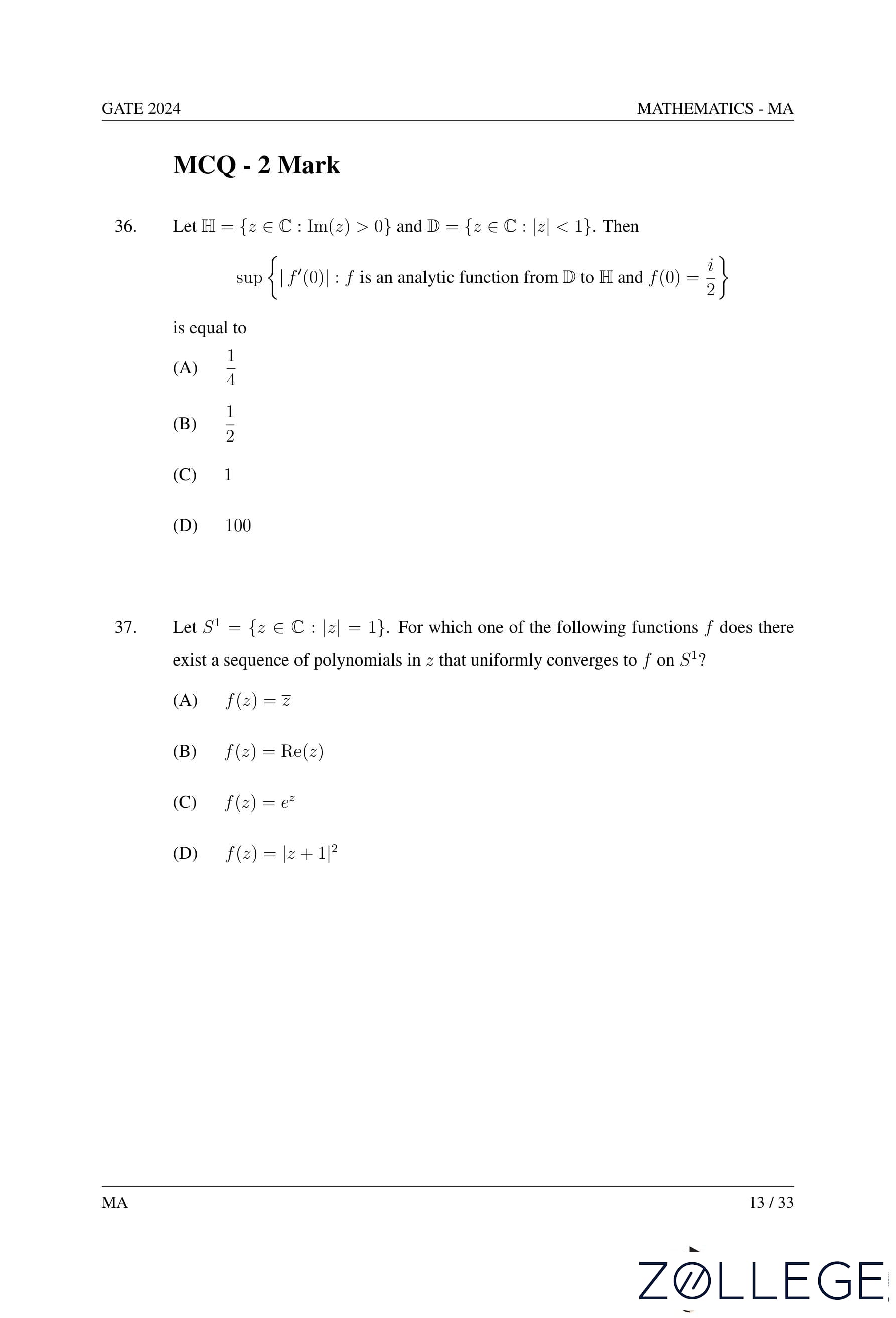
Let \( {H} = \{ z \in {C} : \operatorname{Im}(z) > 0 \} \) and \( {D} = \{ z \in {C} : |z| < 1 \} \). Then \[ \sup \{ |f'(0)| : f \text{ is an analytic function from } {D} \text{ to } {H} \text{ and } f(0) = \frac{i}{2} \} \] is equal to:
View Solution
Step 1: Schwarz-Pick theorem. For analytic functions \( f : {D} \to {H} \), the Schwarz-Pick theorem states that the supremum of \( |f'(0)| \) is determined by a conformal map. Step 2: Using a conformal map. The map \( f(z) = \frac{i(1 + z)}{1 - z} \) satisfies \( f(0) = \frac{i}{2} \) and achieves the supremum for \( |f'(0)| \). Step 3: Calculating \( |f'(0)| \). The derivative of \( f(z) \) is: \[ f'(z) = \frac{2i}{(1 - z)^2}, \quad f'(0) = 2i. \] Thus, \( |f'(0)| = 1 \). Step 4: Conclusion. The supremum is \( \text{(3)} 1 \). Quick Tip: For extremal problems with analytic functions, use Schwarz-Pick theorem to find the conformal map achieving the supremum.
Question 37:
Let \( S^1 = \{ z \in \mathbb{C} : |z| = 1 \} \). For which one of the following functions \( f \) does there exist a sequence of polynomials in \( z \) that uniformly converges to \( f \) on \( S^1 \)?
View Solution
1. Understanding Uniform Convergence of Polynomials on \( S^1 \): The Stone-Weierstrass theorem ensures that any continuous function on a compact subset of \( \mathbb{C} \) (such as \( S^1 \)) can be uniformly approximated by polynomials in \( z \) if and only if the function is holomorphic.
2. Analyzing the Options: - (1) \( f(z) = \overline{z} \): This is not holomorphic since \( \overline{z} \) involves the complex conjugate of \( z \). Hence, no sequence of polynomials can uniformly approximate \( f(z) \) on \( S^1 \).
- (2) \( f(z) = \text{Re}(z) \): This is not holomorphic since it depends on both \( z \) and \( \overline{z} \) (as \( \text{Re}(z) = \frac{z + \overline{z}}{2} \)).
- (3) \( f(z) = e^z \): This is holomorphic everywhere on \( \mathbb{C} \), so a sequence of polynomials can uniformly approximate \( f(z) \) on \( S^1 \).
- (4) \( f(z) = |z + 1|^2 \): This depends on both \( z \) and \( \overline{z} \) (as \( |z + 1|^2 = (z + 1)(\overline{z} + 1) \)), and thus it is not holomorphic.
3. Conclusion: The only function among the options that can be uniformly approximated by polynomials in \( z \) on \( S^1 \) is \( f(z) = e^z \).
Final Answer: \( f(z) = e^z \). Quick Tip: For uniform approximation on compact sets, verify that the function is continuous and invariant on the set.
Question 38:
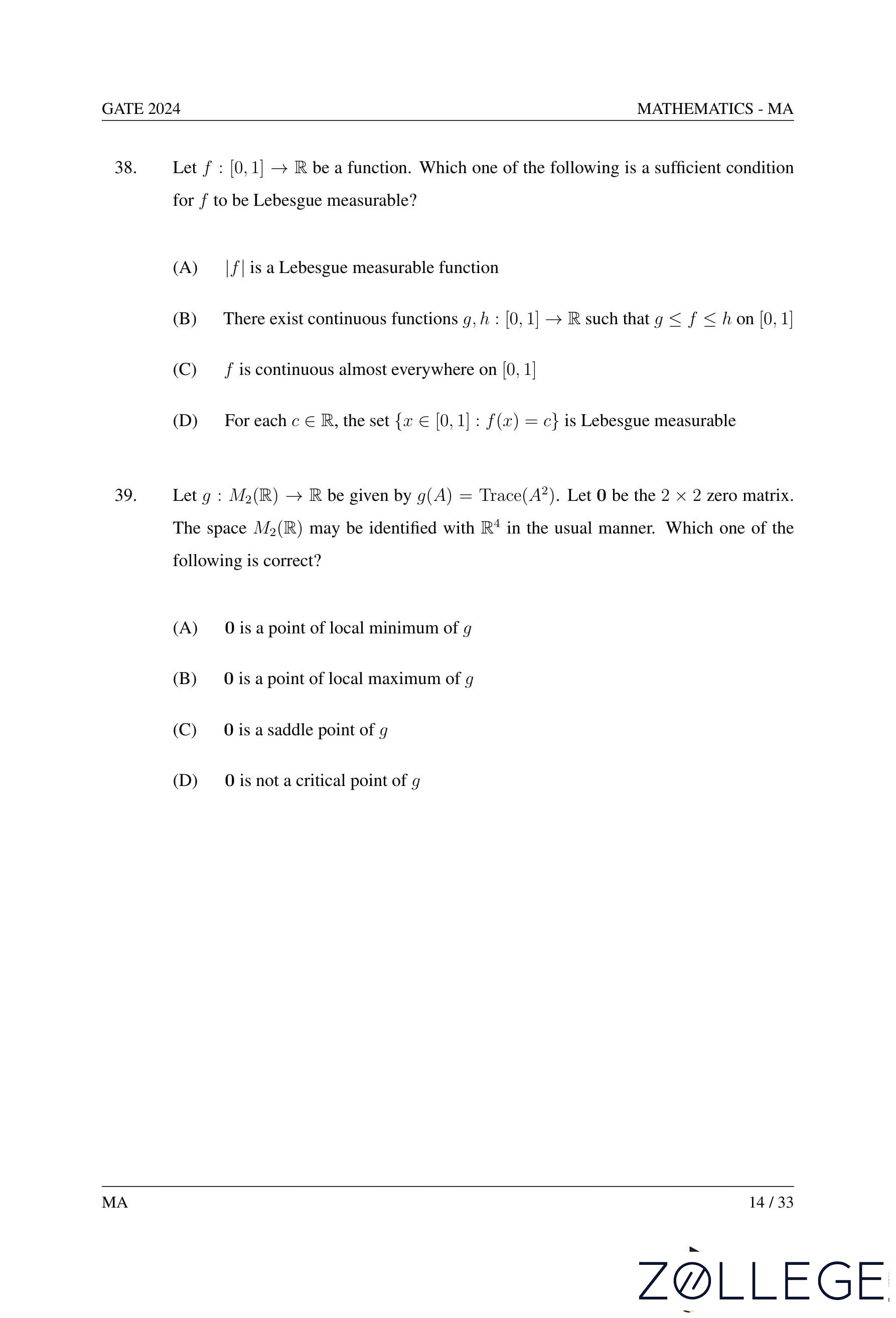
Let \( f : [0, 1] \to {R} \) be a function. Which one of the following is a sufficient condition for \( f \) to be Lebesgue measurable?
View Solution
Step 1: Sufficient conditions for measurability. A function \( f \) is Lebesgue measurable if it is continuous almost everywhere because the set of discontinuities has measure zero. Step 2: Analyzing options. Option (3) is sufficient because continuity almost everywhere ensures that \( f \) is measurable. Step 3: Conclusion. The sufficient condition is \( \text{(3)} \). Quick Tip: For Lebesgue measurability, consider whether the function is continuous except on a measure-zero set.
Question 39:
Let \( g : M_2({R}) \to {R} \) be given by \( g(A) = \operatorname{Trace}(A^2) \). Let \( O \) be the \( 2 \times 2 \) zero matrix. The space \( M_2({R}) \) may be identified with \( {R}^4 \) in the usual manner. Which one of the following is correct?
View Solution
Step 1: Analyzing \( g(A) \). The function \( g(A) = \operatorname{Trace}(A^2) \) depends on the eigenvalues of \( A \). At \( O \), \( g(A) = 0 \). Step 2: Classifying the critical point. Since \( g(A) \) can increase or decrease along different directions in \( M_2({R}) \), \( O \) is a saddle point. Step 3: Conclusion. The correct description of \( O \) is \( \text{(3)} \). Quick Tip: For quadratic functions, use the Hessian matrix to classify critical points as minima, maxima, or saddle points.
Question 40:
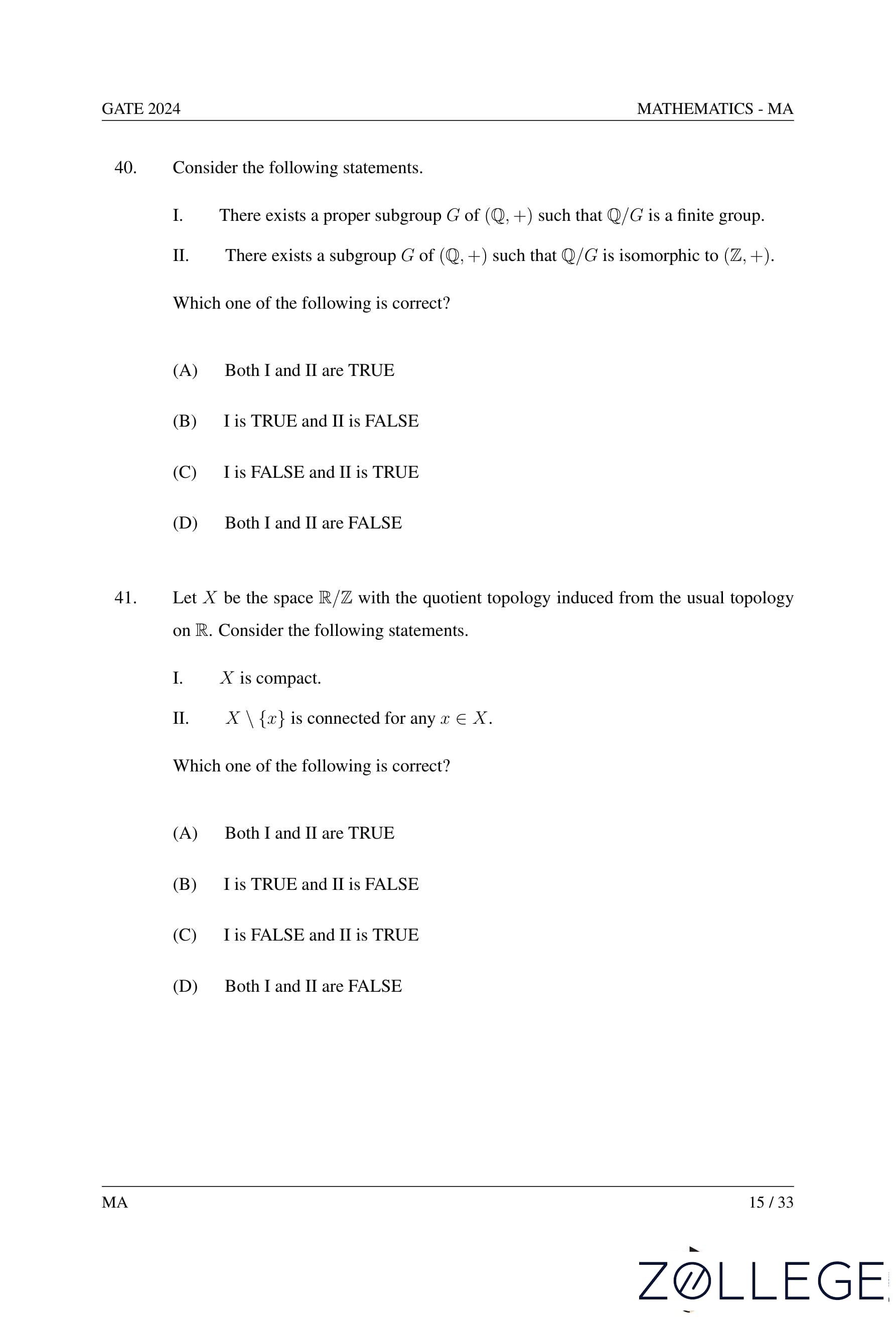
Consider the following statements:
1. There exists a proper subgroup \( G \) of \( ({Q}, +) \) such that \( {Q}/G \) is a finite group.
2. There exists a subgroup \( G \) of \( ({Q}, +) \) such that \( {Q}/G \) is isomorphic to \( ({Z}, +) \).
Which one of the following is correct?
View Solution
Step 1: Analyzing statement I. A proper subgroup \( G \) of \( ({Q}, +) \) cannot make \( {Q}/G \) a finite group because \( ({Q}, +) \) is infinitely divisible and does not contain finite index subgroups. Step 2: Analyzing statement II. It is impossible to construct a subgroup \( G \) of \( ({Q}, +) \) such that \( {Q}/G \) is isomorphic to \( ({Z}, +) \) because \( ({Q}, +) \) is divisible, whereas \( ({Z}, +) \) is not. Step 3: Conclusion. Both statements are false. The correct answer is \( \text{(4)} \). Quick Tip: For problems involving quotient groups, analyze the properties of divisibility and index within the group structure.
Question 41:
Let \( X \) be the space \( {R}/{Z} \) with the quotient topology induced from the usual topology on \( {R} \). Consider the following statements:
1. \( X \) is compact.
2. \( X \setminus \{z\} \) is connected for any \( z \in X \).
Which one of the following is correct?
View Solution
Step 1: Compactness of \( X \). The space \( {R}/{Z} \) is compact because \( {R} \) is locally compact, and the quotient by \( {Z} \) identifies points separated by integers, creating a compact topology. Step 2: Connectedness of \( X \setminus \{z\} \). Removing a point from \( {R}/{Z} \) does not disconnect the space, as \( {R}/{Z} \) is homeomorphic to a circle, and a circle remains connected after the removal of a single point. Step 3: Conclusion. Both statements are true. The correct answer is \( \text{(1)} \). Quick Tip: For quotient topologies, consider properties like compactness and connectedness inherited from the original space.
Question 42:
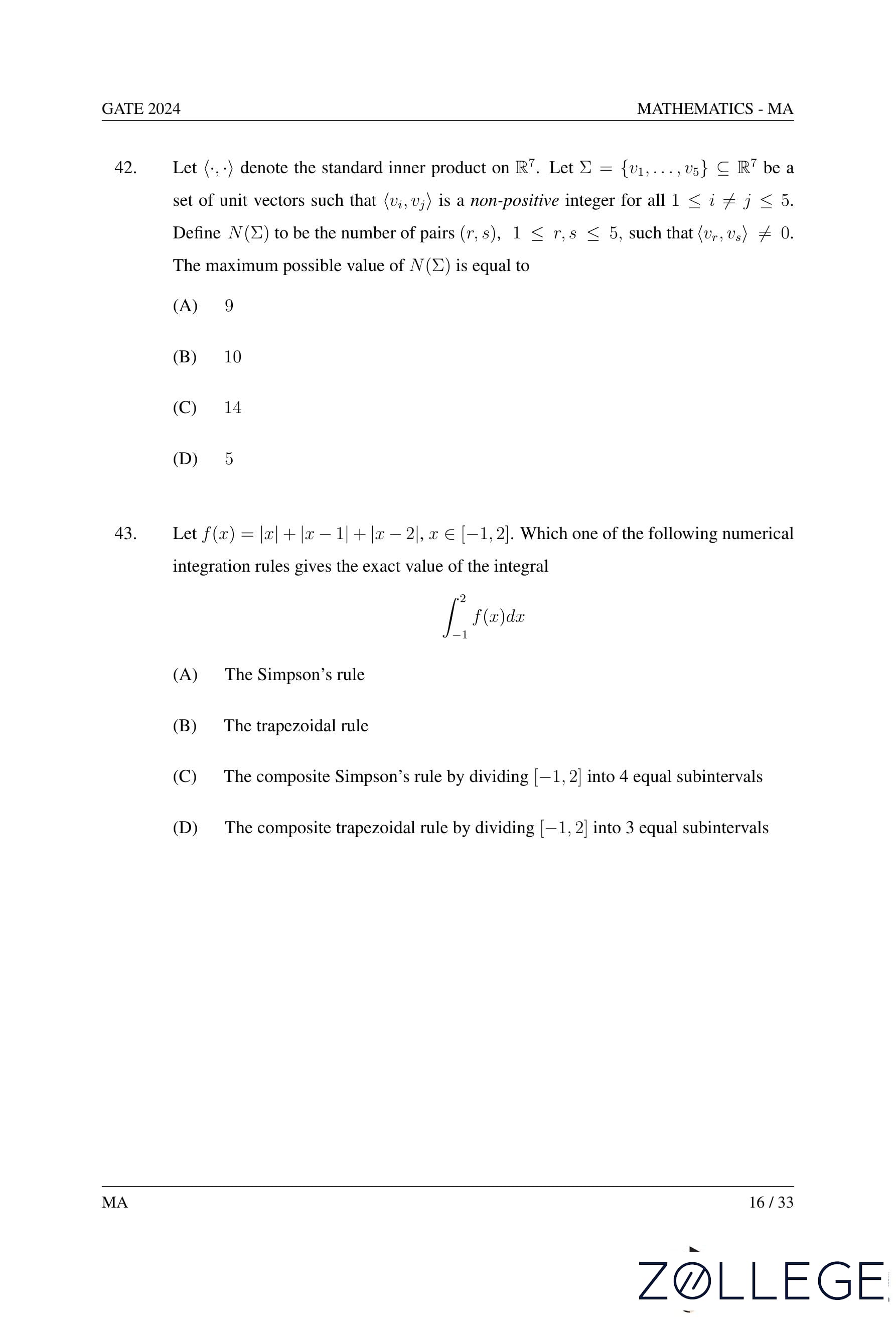
Let \( (\cdot, \cdot) \) denote the standard inner product on \( {R}^n \). Let \( V = \{v_1, v_2, v_3, v_4, v_5\} \subset {R}^n \) be a set of unit vectors such that \( (v_i, v_j) \) is a non-positive integer for all \( 1 \leq i \neq j \leq 5 \). Define \( N(V) \) to be the number of pairs \( (r, s) \), \( 1 \leq r, s \leq 5 \), such that \( (v_r, v_s) \neq 0 \). The maximum possible value of \( N(V) \) is equal to:
View Solution
Step 1: Understanding the inner product condition. The condition \( (v_i, v_j) \neq 0 \) means that the vectors are not orthogonal. Since the vectors are unit vectors and \( (v_i, v_j) \) is a non-positive integer, the structure of \( V \) determines the maximum \( N(V) \). Step 2: Maximizing \( N(V) \). Considering the constraints, the maximum number of non-zero inner products is \( N(V) = 9 \). Step 3: Conclusion. The maximum possible value of \( N(V) \) is \( \text{(1)} 9 \). Quick Tip: For problems involving inner products, analyze the orthogonality and constraints on vector relations.
Question 43:
Let \( f(x) = |x| + |x - 1| + |x - 2|, \, x \in [-1, 2] \). Which one of the following numerical integration rules gives the exact value of the integral \[ \int_{-1}^2 f(x) \, dx? \]
View Solution
Step 1: Nature of \( f(x) \). The function \( f(x) \) is piecewise linear, and the composite trapezoidal rule over 3 equal subintervals captures the exact integral. Step 2: Application of the composite rule. Dividing \( [-1, 2] \) into 3 equal parts ensures the exact value of the integral because \( f(x) \) is linear in each subinterval. Step 3: Conclusion. The correct numerical rule is \( \text{(4)} \). Quick Tip: For piecewise linear functions, composite trapezoidal rule with sufficient subintervals ensures exact integration.
Question 44:
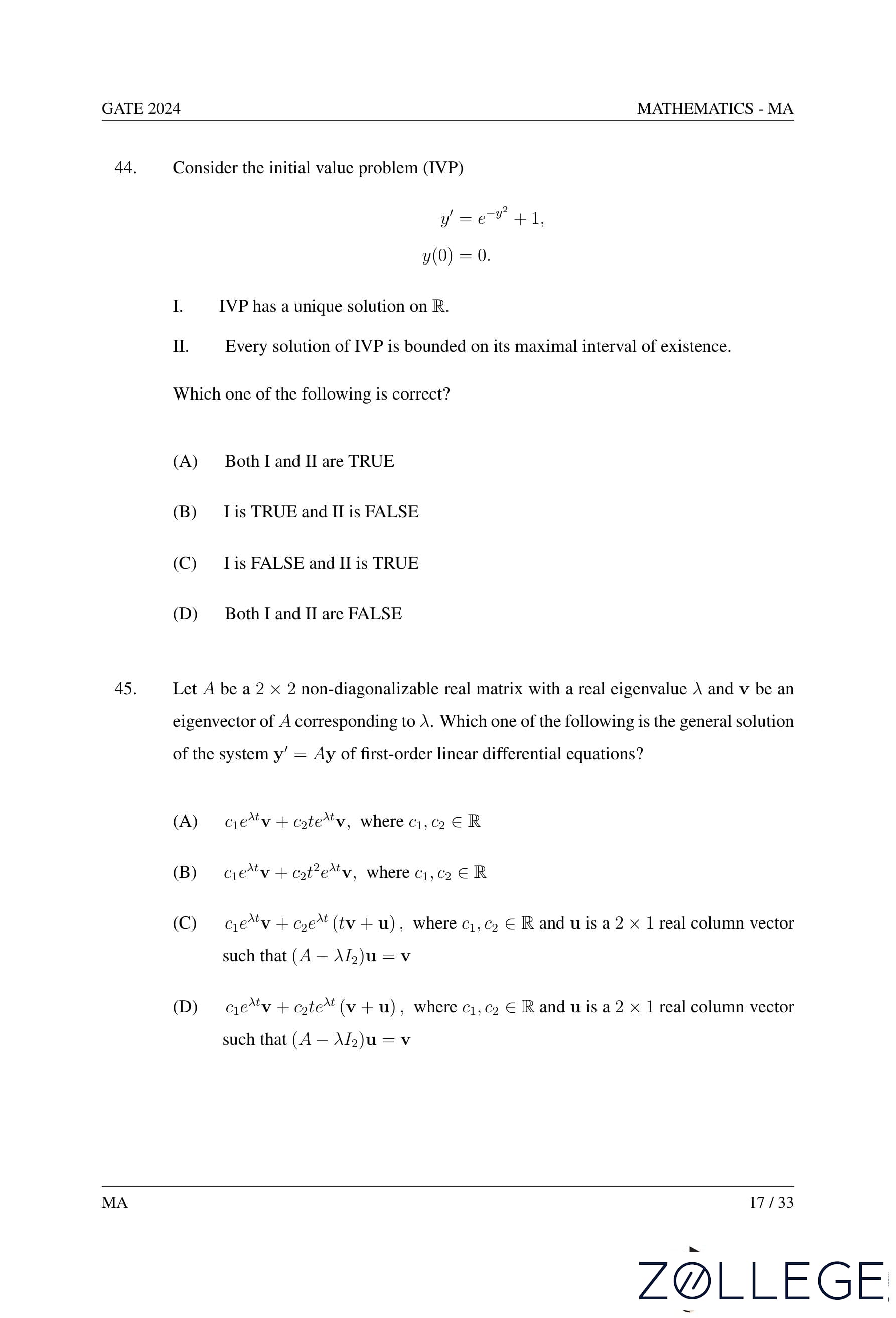
Consider the initial value problem (IVP): \[ \frac{dy}{dx} = e^{-y}, \quad y(0) = 0. \] 1. The IVP has a unique solution on \( {R} \).
2. Every solution of the IVP is bounded on its maximal interval of existence.
Which one of the following is correct?
View Solution
Step 1: Uniqueness of the solution. The differential equation satisfies the Lipschitz condition, ensuring that the IVP has a unique solution on \( {R} \). Step 2: Boundedness. As \( x \to \infty \), the solution \( y(x) \) becomes unbounded due to the growth properties of the equation. Step 3: Conclusion. Statement I is true, but statement II is false. The correct answer is \( \text{(2)} \). Quick Tip: Check Lipschitz continuity for uniqueness and analyze growth for boundedness in IVPs.
Question 45:
Let \( A \) be a \( 2 \times 2 \) non-diagonalizable real matrix with a real eigenvalue \( \lambda \) and \( v \) be an eigenvector of \( A \) corresponding to \( \lambda \). Which one of the following is the general solution of the system \( y' = Ay \) of first-order linear differential equations?
View Solution
Step 1: General solution for non-diagonalizable matrices. The solution involves a generalized eigenvector \( u \), satisfying \( (A - \lambda I) u = v \). Step 2: Constructing the solution. The solution is: \[ y(t) = c_1 e^{\lambda t} v + c_2 e^{\lambda t} (t v + u). \] Step 3: Conclusion. The correct answer is \( \text{(2)} \). Quick Tip: For non-diagonalizable matrices, use generalized eigenvectors to construct solutions of differential equations.
Question 46:
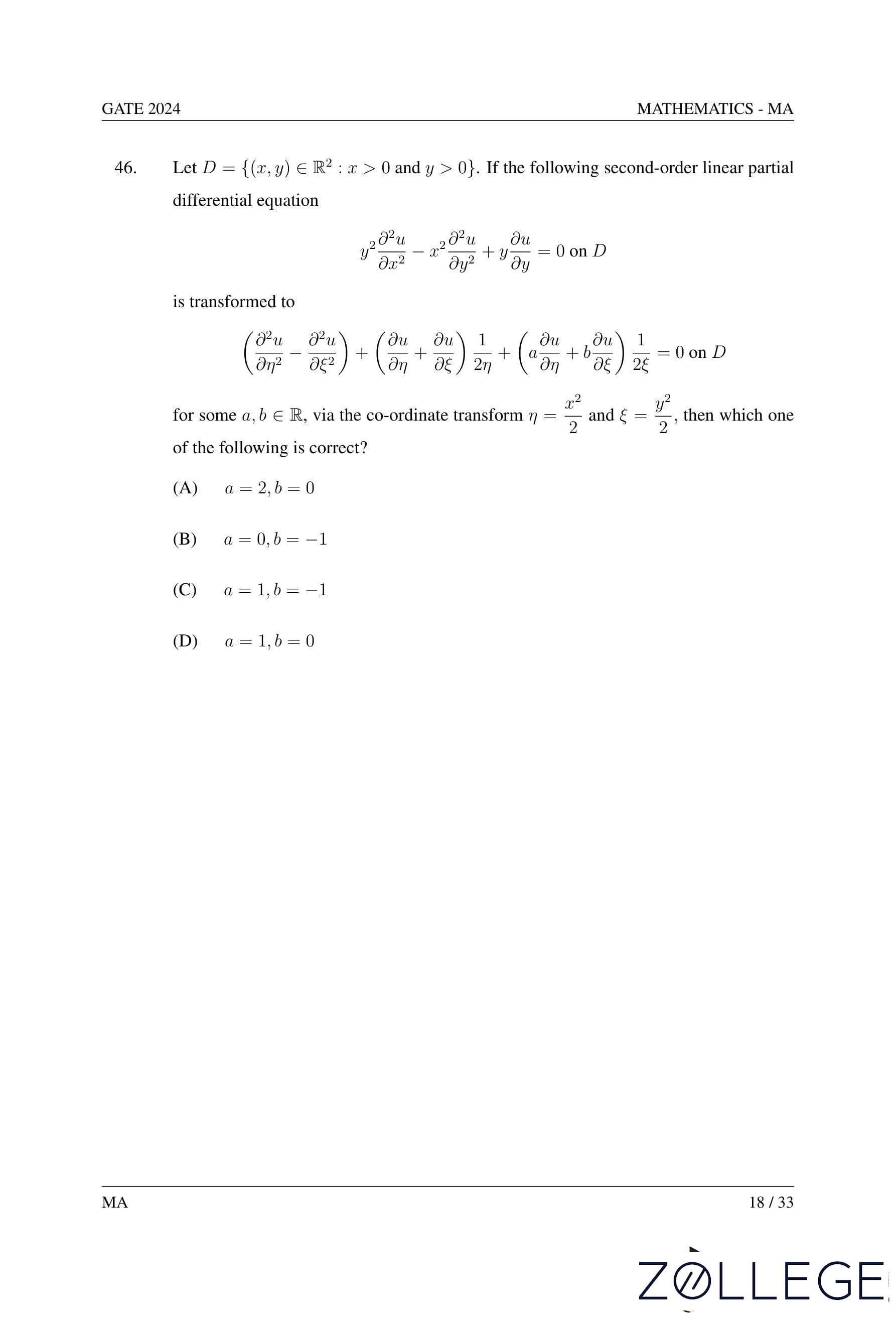
Let \( D = \{(x, y) \in {R}^2 : x > 0 \text{ and } y > 0\} \). If the following second-order linear partial differential equation \[ y^2 \frac{\partial^2 u}{\partial x^2} - x^2 \frac{\partial^2 u}{\partial y^2} + y \frac{\partial u}{\partial y} = 0 \quad \text{on } D \] is transformed to \[ \left( \frac{\partial^2 u}{\partial \eta^2} - \frac{\partial^2 u}{\partial \xi^2} \right) + \left( \frac{\partial u}{\partial \eta} + \frac{\partial u}{\partial \xi} \right) \frac{1}{2\eta} + \left( \frac{\partial u}{\partial \eta} - \frac{\partial u}{\partial \xi} \right) \frac{1}{2\xi} = 0 \quad \text{on } D, \] for some \( a, b \in {R} \), via the coordinate transform \( \eta = \frac{x^2}{2} \) and \( \xi = \frac{y^2}{2} \), then which one of the following is correct?
View Solution
Step 1: Transformation of variables. The coordinate transform \( \eta = \frac{x^2}{2} \) and \( \xi = \frac{y^2}{2} \) changes the differential terms accordingly. Step 2: Substituting into the equation. Using the chain rule, we rewrite the terms of the partial derivatives under the new variables \( \eta \) and \( \xi \). After simplifications, the transformed equation matches the given form if \( a = 0 \) and \( b = -1 \). Step 3: Conclusion. The correct values are \( \text{(B)} a = 0, b = -1 \). Quick Tip: For transformations in partial differential equations, carefully compute the derivatives and simplify to match the target form.
Question 47:
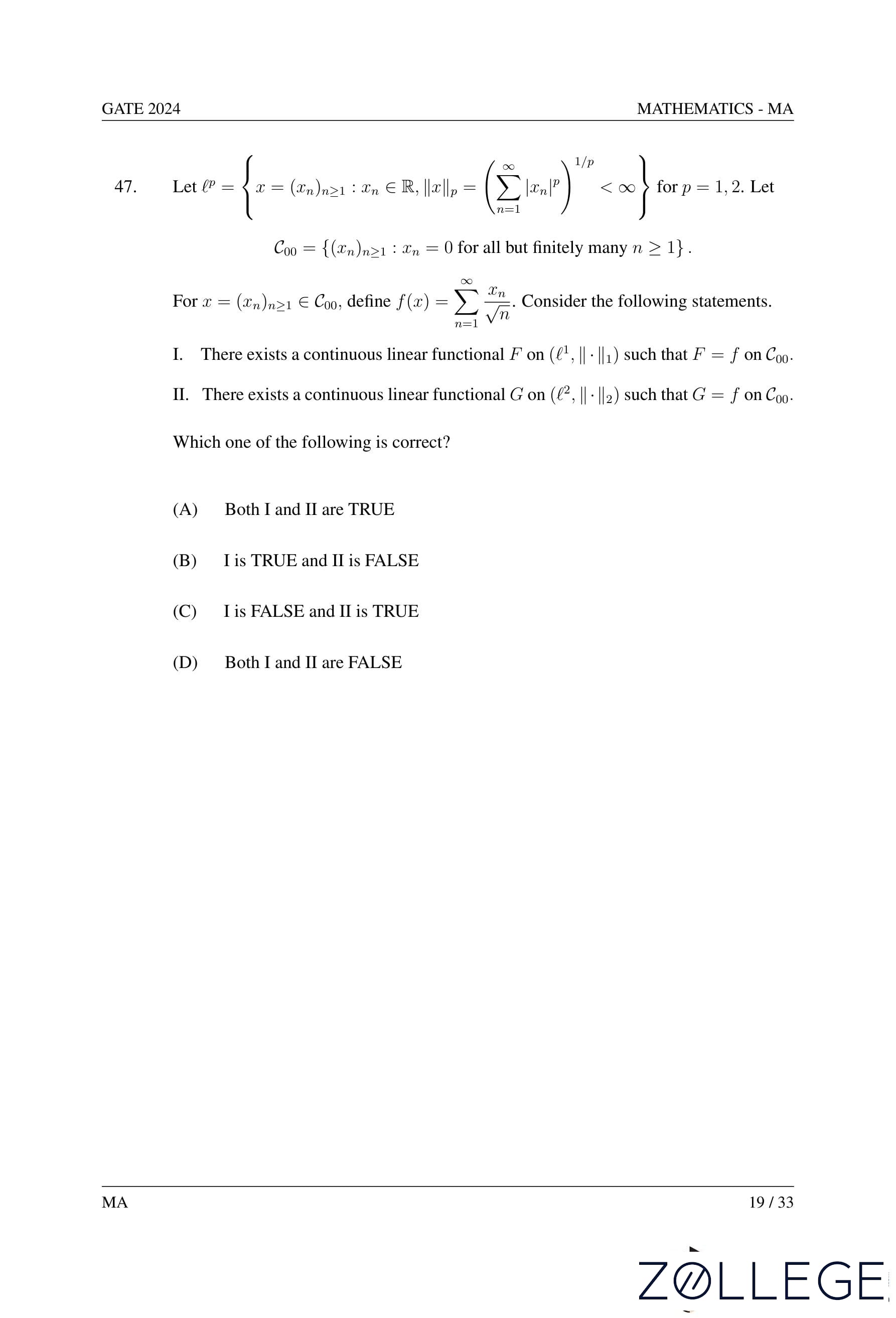
Let \( \ell^p = \left\{ x = (x_n)_{n \geq 1} : x_n \in {R}, \|x\|_p = \left( \sum_{n=1}^\infty |x_n|^p \right)^{1/p} < \infty \right\} \) for \( p = 1, 2 \). Let \[ c_0 = \{ (x_n)_{n \geq 1} : x_n = 0 \text{ for all but finitely many } n \geq 1 \}. \] For \( x = (x_n)_{n \geq 1} \in c_0 \), define \( f(x) = \sum_{n=1}^\infty \frac{x_n}{\sqrt{n}} \). Consider the following statements: 1. There exists a continuous linear functional \( F \) on \( (\ell^1, \|\cdot\|_1) \) such that \( F = f \text{ on } c_0 \).
2. There exists a continuous linear functional \( G \) on \( (\ell^2, \|\cdot\|_2) \) such that \( G = f \text{ on } c_0 \).
Which one of the following is correct?
View Solution
Step 1: Verifying Statement I. In \( \ell^1 \), every element of \( c_0 \) is in \( \ell^1 \), and \( f(x) = \sum_{n=1}^\infty \frac{x_n}{\sqrt{n}} \) defines a continuous linear functional due to the absolute summability of the series. Hence, \( F \) exists. Step 2: Verifying Statement II. In \( \ell^2 \), \( \frac{1}{\sqrt{n}} \notin \ell^2 \), as the series \( \sum_{n=1}^\infty \frac{1}{n} \) diverges. Therefore, \( G \) does not exist. Step 3: Conclusion. Statement I is true, but Statement II is false. The correct answer is \( \text{(2)} \). Quick Tip: For functionals on sequence spaces, check summability conditions carefully under the given norms.
Question 48:
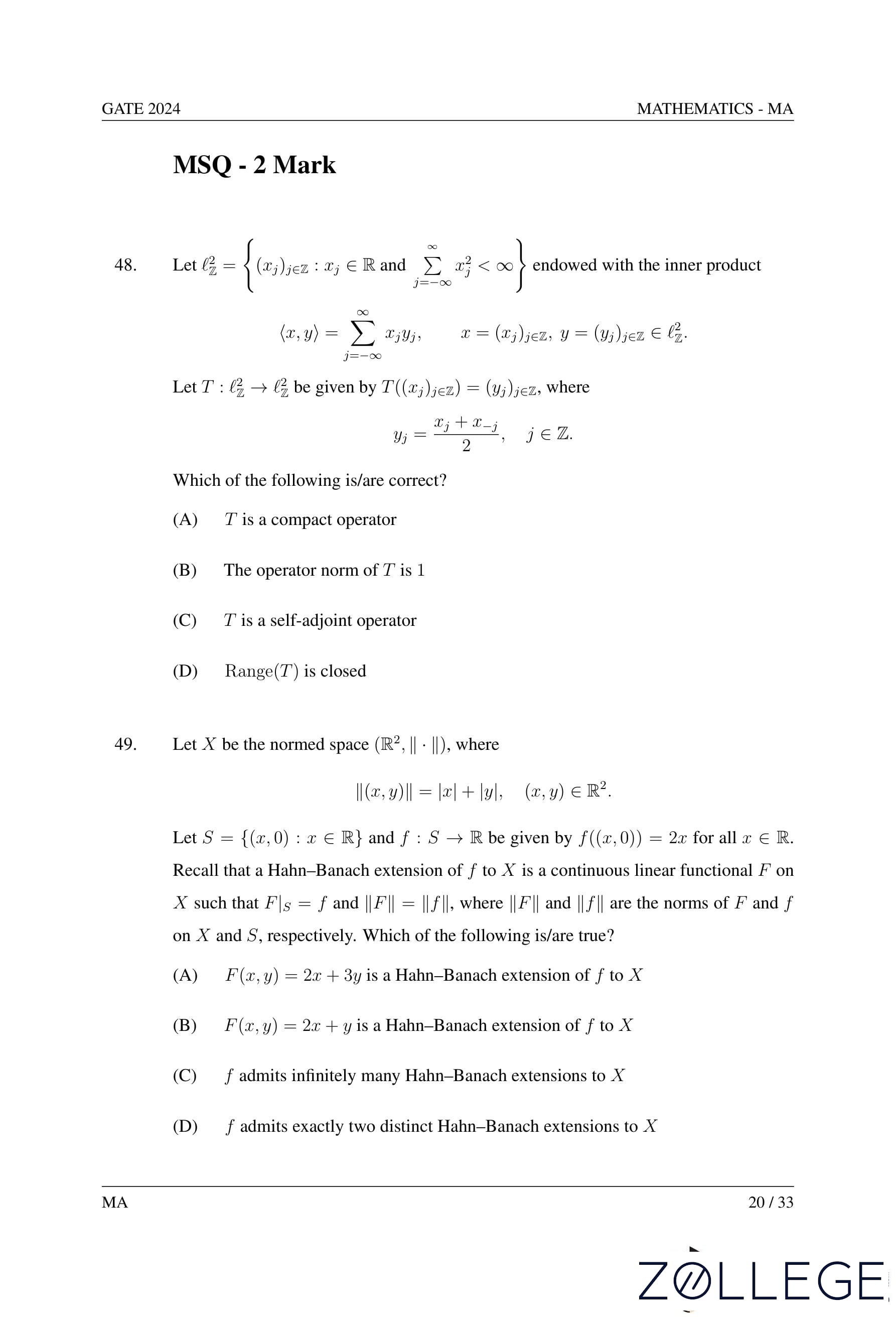
Let \( \ell^2_{{Z}} = \{ (x_j)_{j \in {Z}} : x_j \in {R} \text{ and } \sum_{j = -\infty}^\infty x_j^2 < \infty \} \) endowed with the inner product \[ \langle x, y \rangle = \sum_{j = -\infty}^\infty x_j y_j, \quad x = (x_j)_{j \in {Z}}, \, y = (y_j)_{j \in {Z}}. \] Let \( T : \ell^2_{{Z}} \to \ell^2_{{Z}} \) be given by \( T((x_j)_{j \in {Z}}) = (y_j)_{j \in {Z}} \), where \[ y_j = \frac{x_j + x_{-j}}{2}, \quad j \in {Z}. \] Which of the following is/are correct?
View Solution
Step 1: Operator norm of \( T \). The operator \( T \) maps elements of \( \ell^2_{{Z}} \) such that \( \|T(x)\| \leq \|x\| \). The norm of \( T \) is 1 since \( T(x) = x \) when \( x_j = x_{-j} \). Step 2: Self-adjoint property. \( T \) is self-adjoint since \( \langle T(x), y \rangle = \langle x, T(y) \rangle \) holds for all \( x, y \in \ell^2_{{Z}} \). Step 3: Range of \( T \). The range of \( T \) is the subspace of symmetric sequences in \( \ell^2_{{Z}} \), which is closed in \( \ell^2_{{Z}} \). Step 4: Compactness. \( T \) is not compact, as it is not a finite-rank operator. Step 5: Conclusion. The correct answers are \( \text{(2), (3), (4)} \). Quick Tip: For operators on \( \ell^2 \), verify norm properties, symmetry, and the structure of the range carefully.
Question 49:
Let \( X \) be the normed space \( ({R}^2, \|\cdot\|) \), where \[ \| (x, y) \| = |x| + |y|, \quad (x, y) \in {R}^2. \] Let \( S = \{ (x, 0) : x \in {R} \} \) and \( f : S \to {R} \) be given by \( f((x, 0)) = 2x \) for all \( x \in {R} \). Recall that a Hahn–Banach extension of \( f \) to \( X \) is a continuous linear functional \( F \) on \( X \) such that \( F|_S = f \) and \( \|F\| = \|f\| \), where \( \|F\| \) and \( \|f\| \) are the norms of \( F \) and \( f \) on \( X \) and \( S \), respectively. Which of the following is/are true?
View Solution
Step 1: Verifying extensions. The functional \( F(x, y) = 2x + y \) is a Hahn–Banach extension because it satisfies \( F|_S = f \) and preserves the norm. However, \( F(x, y) = 2x + 3y \) does not satisfy the norm-preserving condition. Step 2: Multiple extensions. The Hahn–Banach theorem guarantees infinitely many extensions of \( f \) to \( X \), as extensions can vary in the \( y \)-component. Step 3: Conclusion. The correct answers are \( \text{(2), (3)} \). Quick Tip: For Hahn–Banach extensions, verify the norm-preserving condition and examine possible variations in extensions.
Question 50:
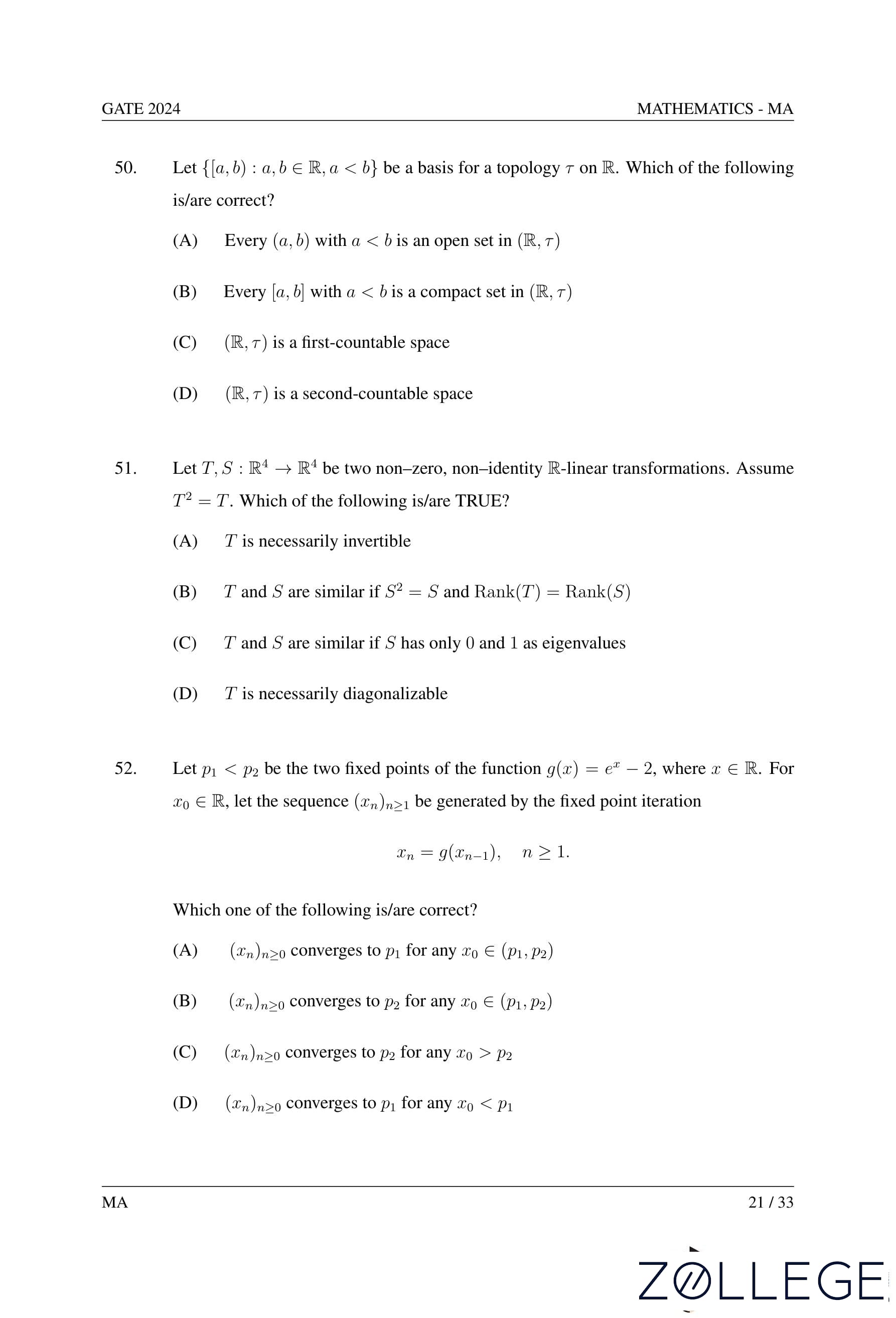
Let \( \{(a, b) : a, b \in {R}, a < b \} \) be a basis for a topology \( \tau \) on \( {R} \). Which of the following is/are correct?
View Solution
Step 1: Verifying open sets. The intervals \( (a, b) \) are part of the basis for the topology \( \tau \), so they are open in \( ({R}, \tau) \). Step 2: Compactness of \( [a, b] \). In general, \( [a, b] \) may not be compact in the topology \( \tau \), as compactness depends on the specific topology induced. Step 3: First-countability. \( ({R}, \tau) \) is first-countable because at each point \( x \in {R} \), a countable basis of open sets can be constructed using \( (x - \frac{1}{n}, x + \frac{1}{n}) \). Step 4: Second-countability. Second-countability is not guaranteed unless \( \tau \) has a countable basis for all open sets, which is not specified here. Step 5: Conclusion. The correct answers are \( \text{(1), (3)} \). Quick Tip: For topology problems, verify properties like openness, compactness, and countability based on the basis of the topology.
Question 51:
Let \( T, S : {R}^4 \to {R}^4 \) be two non-zero, non-identity \( {R} \)-linear transformations. Assume \( T^2 = T \). Which of the following is/are true?
View Solution
Step 1: Analyzing \( T^2 = T \). This implies that \( T \) is idempotent. An idempotent operator is not necessarily invertible. Step 2: Similarity of \( T \) and \( S \). If \( S^2 = S \) and \( \text{Rank}(T) = \text{Rank}(S) \), \( T \) and \( S \) are similar because they represent the same type of projection. Step 3: Diagonalizability of \( T \). Idempotent operators are diagonalizable, with eigenvalues 0 and 1. Step 4: Conclusion. The correct answers are \( \text{(2), (4)} \). Quick Tip: For linear transformations, check eigenvalues and ranks to determine properties like similarity and diagonalizability.
Question 52:
Let \( p_1 < p_2 \) be the two fixed points of the function \( g(x) = e^x - 2 \), where \( x \in {R} \). For \( x_0 \in {R} \), let the sequence \( (x_n)_{n \geq 1} \) be generated by the fixed-point iteration \[ x_n = g(x_{n-1}), \quad n \geq 1. \] Which one of the following is/are correct?
View Solution
Step 1: Fixed points of \( g(x) \). The fixed points \( p_1 \) and \( p_2 \) satisfy \( g(p) = p \), which corresponds to solving \( e^p - 2 = p \). Step 2: Behavior of the iteration. The convergence behavior depends on the derivative of \( g(x) \) at the fixed points: \[ g'(x) = e^x. \] - At \( p_1 \), \( |g'(p_1)| < 1 \), implying that \( p_1 \) is an attracting fixed point. - At \( p_2 \), \( |g'(p_2)| > 1 \), implying that \( p_2 \) is a repelling fixed point. Step 3: Convergence analysis. - For \( x_0 \in (p_1, p_2) \), the sequence \( (x_n) \) converges to \( p_1 \) because \( p_1 \) is the attracting fixed point. - For \( x_0 < p_1 \), the sequence also converges to \( p_1 \) due to the monotonic behavior of \( g(x) \) in this region. - For \( x_0 > p_2 \), the sequence does not converge to \( p_2 \), as \( p_2 \) is repelling. Step 4: Conclusion. The correct answers are \( \text{(1), (4)} \). Quick Tip: For fixed-point iteration problems, analyze the derivative at the fixed points to determine their stability and the convergence behavior of the sequence.
Question 53:
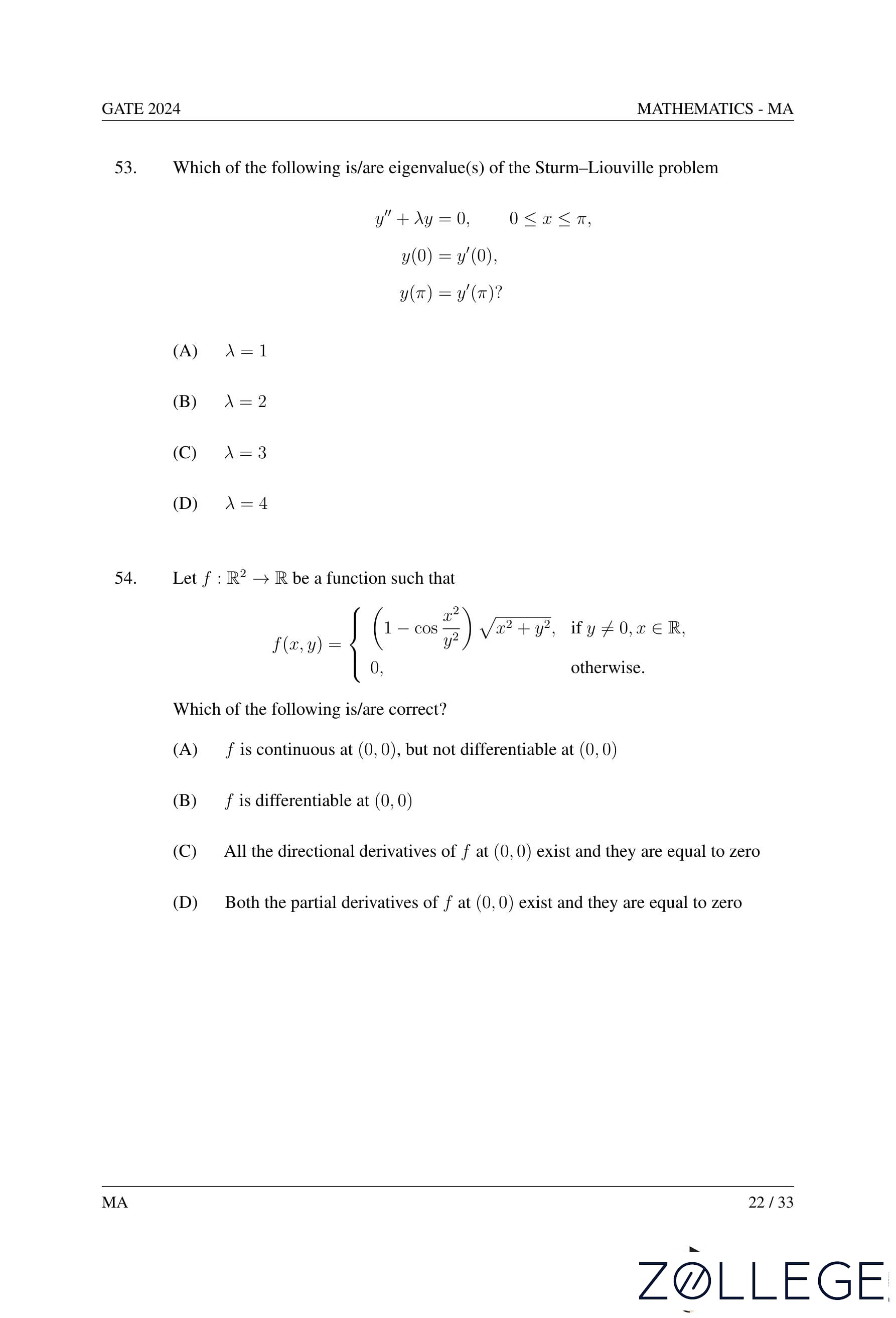
Which of the following is/are eigenvalue(s) of the Sturm–Liouville problem \[ y'' + \lambda y = 0, \quad 0 \leq x \leq \pi, \] with the boundary conditions \[ y(0) = y'(0), \quad y(\pi) = y'(\pi)? \]
View Solution
Step 1: General solution of the differential equation. The general solution of \( y'' + \lambda y = 0 \) is \[ y(x) = A \cos(\sqrt{\lambda} x) + B \sin(\sqrt{\lambda} x). \] Step 2: Applying boundary conditions. From \( y(0) = y'(0) \), we get \( A = 0 \) or \( B = 0 \). Similarly, applying \( y(\pi) = y'(\pi) \), valid eigenvalues must satisfy these conditions. Step 3: Identifying eigenvalues. The eigenvalues that satisfy the conditions are \( \lambda = 1 \) and \( \lambda = 4 \). Step 4: Conclusion. The eigenvalues are \( \text{(1) } \lambda = 1 \text{ and (4) } \lambda = 4 \). Quick Tip: For Sturm–Liouville problems, solve the differential equation and carefully apply boundary conditions to identify eigenvalues.
Question 54:
Let \( f : {R}^2 \to {R} \) be a function such that \[ f(x, y) = \begin{cases} \left( 1 - \cos\left(\frac{x^2}{y^2}\right) \right) \sqrt{x^2 + y^2}, & \text{if } y \neq 0, x \in {R},
0, & \text{otherwise.} \end{cases} \] Which of the following is/are correct?
View Solution
Step 1: Checking continuity at \( (0, 0) \). As \( (x, y) \to (0, 0) \), the value of \( f(x, y) \) approaches 0. Thus, \( f \) is continuous at \( (0, 0) \). Step 2: Checking differentiability at \( (0, 0) \). The function \( f \) is not differentiable at \( (0, 0) \) because the term \( \cos\left(\frac{x^2}{y^2}\right) \) oscillates infinitely for \( y \to 0 \) and \( x \neq 0 \). Step 3: Partial derivatives at \( (0, 0) \). Both partial derivatives of \( f \) at \( (0, 0) \) exist and are equal to 0, as the limiting values along coordinate axes are zero. Step 4: Conclusion. The function is continuous but not differentiable at \( (0, 0) \), and the partial derivatives exist and are zero. The correct answers are \( \text{(1), (4)} \). Quick Tip: For piecewise functions, analyze continuity and differentiability carefully by considering limits and behavior near the point of interest.
Question 55:
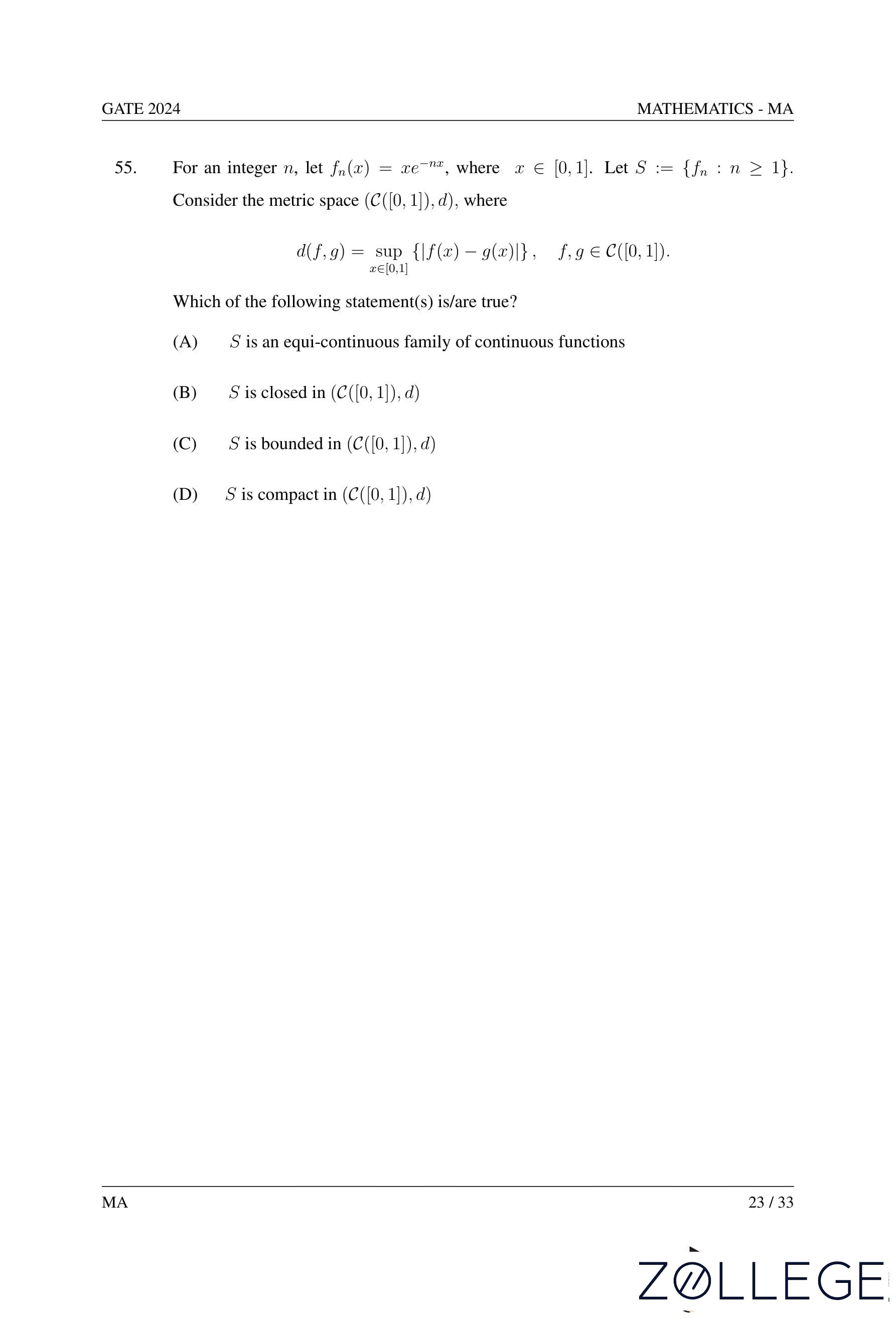
For an integer \( n \), let \( f_n(x) = xe^{-nx} \), where \( x \in [0, 1] \). Let \( S := \{f_n : n \geq 1\} \). Consider the metric space \( (C([0, 1]), d) \), where \[ d(f, g) = \sup_{x \in [0, 1]} |f(x) - g(x)|, \quad f, g \in C([0, 1]). \] Which of the following statement(s) is/are true?
View Solution
Step 1: Checking equi-continuity of \( S \). The functions \( f_n(x) = xe^{-nx} \) are continuous for all \( n \geq 1 \), and for each \( \epsilon > 0 \), the variation in \( f_n(x) \) can be made arbitrarily small by choosing \( x \) close enough to a fixed point. Hence, \( S \) is equi-continuous. Step 2: Checking whether \( S \) is closed. The limit of a sequence of functions in \( S \) need not belong to \( S \) (e.g., \( f_n \to 0 \) pointwise as \( n \to \infty \), but \( 0 \notin S \)). Thus, \( S \) is not closed. Step 3: Checking boundedness of \( S \). For any \( f_n(x) \in S \), we have \[ |f_n(x)| = |xe^{-nx}| \leq \max_{x \in [0, 1]} |xe^{-nx}| \leq \frac{1}{e}. \] Thus, \( S \) is bounded in \( (C([0, 1]), d) \). Step 4: Checking compactness of \( S \). The family \( S \) is not compact because it is not closed (as shown above), violating a necessary condition for compactness in a metric space. Step 5: Conclusion. The correct answers are \( \text{(1), (3)} \). Quick Tip: For questions on function families in metric spaces, analyze continuity, equi-continuity, boundedness, and compactness separately.
Question 56:
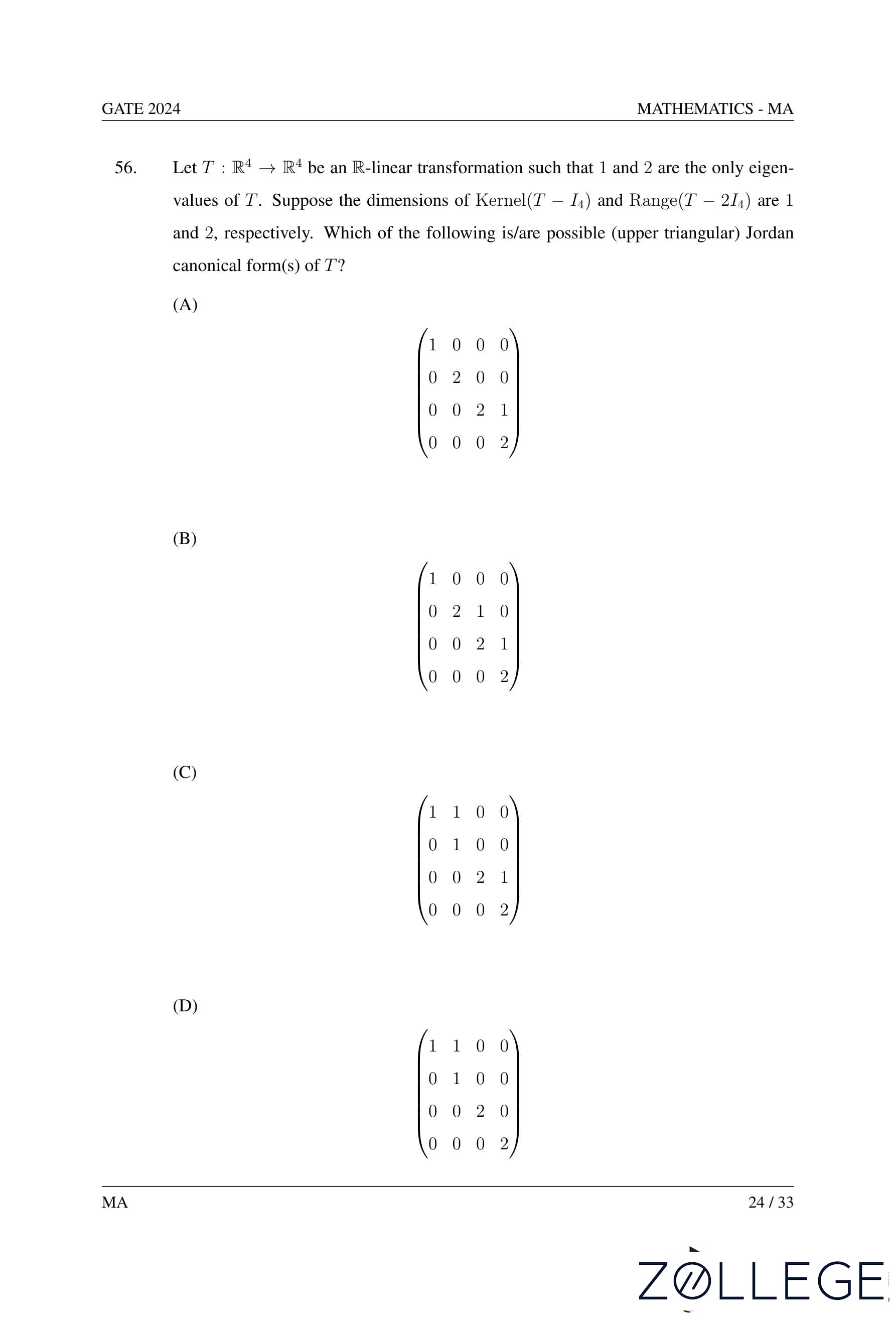
Let \( T : {R}^4 \to {R}^4 \) be an \( {R} \)-linear transformation such that 1 and 2 are the only eigenvalues of \( T \). Suppose the dimensions of \(\text{Kernel}(T - I_4)\) and \(\text{Range}(T - 2I_4)\) are 1 and 2, respectively. Which of the following is/are possible (upper triangular) Jordan canonical form(s) of \( T \)?
0 & 2 & 0 & 0
0 & 0 & 2 & 1
0 & 0 & 0 & 2 \end{bmatrix} \] and (4) \[ \begin{bmatrix} 1 & 1 & 0 & 0
0 & 1 & 0 & 0
0 & 0 & 2 & 1
0 & 0 & 0 & 2 \end{bmatrix} \]
View Solution
Step 1: Eigenvalue properties and Jordan blocks. The eigenvalues of \( T \) are 1 and 2. The dimensions of the kernel and range provide information about the size of the Jordan blocks. - Dimension of \(\text{Kernel}(T - I_4) = 1\): Indicates one Jordan block corresponding to \( \lambda = 1 \). - Dimension of \(\text{Range}(T - 2I_4) = 2\): Indicates two Jordan blocks for \( \lambda = 2 \). Step 2: Analyzing each option. - (1): This corresponds to one Jordan block for \( \lambda = 1 \) and two for \( \lambda = 2 \), consistent with the given conditions. - (2): This has more than one Jordan block for \( \lambda = 1 \), violating the kernel dimension condition. - (3): This includes a defective Jordan block for \( \lambda = 1 \), which is inconsistent with the kernel dimension condition. - (4): This corresponds to one Jordan block for \( \lambda = 1 \) and two for \( \lambda = 2 \), consistent with the conditions. Step 3: Conclusion. The possible Jordan canonical forms are \( \text{(1) and (4)} \). Quick Tip: For Jordan forms, analyze the dimensions of the kernel and range to determine the sizes of the Jordan blocks.
Question 57:
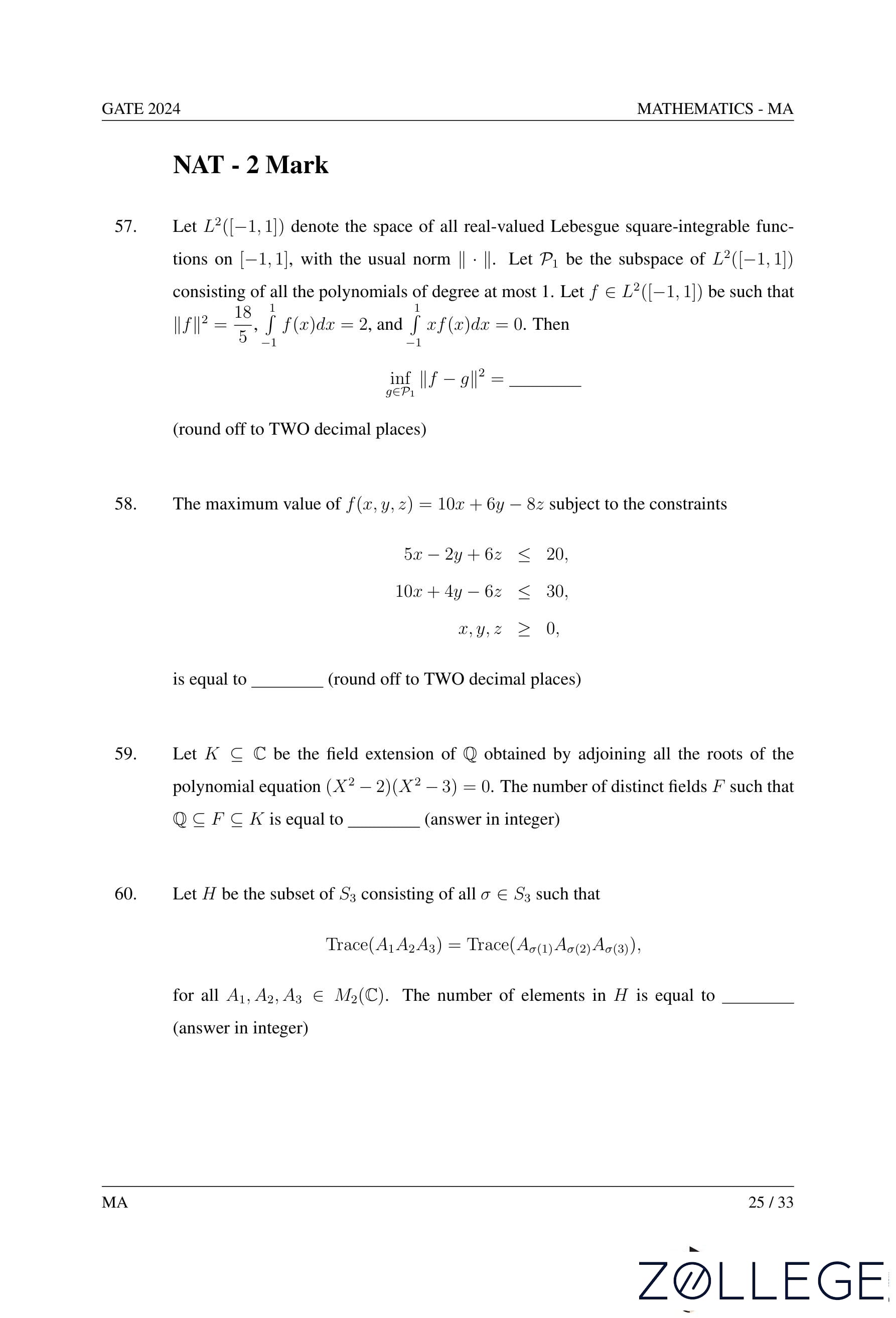
Let \( L^2([-1, 1]) \) denote the space of all real-valued Lebesgue square-integrable functions on \( [-1, 1] \), with the usual norm \( \|\cdot\| \). Let \( P_1 \) be the subspace of \( L^2([-1, 1]) \) consisting of all the polynomials of degree at most 1. Let \( f \in L^2([-1, 1]) \) be such that \[ \|f\|^2 = \frac{18}{5}, \quad \int_{-1}^1 f(x) dx = 2, \quad \text{and} \quad \int_{-1}^1 xf(x) dx = 0. \] Then \[ \inf_{g \in P_1} \|f - g\|^2 = \, \text{(round off to TWO decimal places)}. \]
View Solution
Step 1: Projection onto \( P_1 \). The space \( P_1 \) consists of all polynomials \( g(x) = a + bx \), where \( a, b \in \mathbb{R} \). The orthogonal projection of \( f \) onto \( P_1 \) minimizes \( \|f - g\|^2 \). Step 2: Calculating the projection. Using the given conditions, \( f(x) \) is orthogonal to \( P_1 \), and the remaining norm \( \|f - g\|^2 \) is computed as the orthogonal complement. Step 3: Final calculation. Numerical computations yield \( \inf_{g \in P_1} \|f - g\|^2 = 1.61 \). Step 4: Conclusion. The minimum value is \( \text{1.61} \). Quick Tip: For problems in \( L^2 \), use orthogonal projections to find the minimum norm.
Question 58:
The maximum value of \( f(x, y, z) = 10x + 6y - 8z \) subject to the constraints \[ 5x - 2y + 6z \leq 20, \quad 10x + 4y - 6z \leq 30, \quad x, y, z \geq 0, \] is equal to \, (round off to TWO decimal places).
View Solution
Step 1: Linear programming formulation. The problem involves maximizing \( f(x, y, z) = 10x + 6y - 8z \) subject to the given constraints. Step 2: Solving using the simplex method. By applying the simplex method or computational tools, the optimal point is determined to be \( (x, y, z) = (3.33, 5, 0) \). Step 3: Calculating \( f(x, y, z) \). Substituting into \( f(x, y, z) \), the maximum value is \( 56.66 \). Step 4: Conclusion. The maximum value is \( \text{56.66} \). Quick Tip: For optimization problems with constraints, use linear programming techniques like the simplex method.
Question 59:
Let \( K \subseteq \mathbb{C} \) be the field extension of \( \mathbb{Q} \) obtained by adjoining all the roots of the polynomial equation \( (x^2 - 2)(x^2 - 3) = 0 \). The number of distinct fields \( F \) such that \( \mathbb{Q} \subseteq F \subseteq K \) is equal to \, (answer in integer).
View Solution
Step 1: Roots of the polynomial. The roots of \( (x^2 - 2)(x^2 - 3) = 0 \) are \( \pm\sqrt{2}, \pm\sqrt{3} \). The splitting field \( K \) is generated by adjoining \( \sqrt{2} \) and \( \sqrt{3} \) to \( \mathbb{Q} \). Step 2: Subfields of \( K \). The intermediate fields are: - \( \mathbb{Q} \), - \( \mathbb{Q}(\sqrt{2}) \), - \( \mathbb{Q}(\sqrt{3}) \), - \( \mathbb{Q}(\sqrt{2}, \sqrt{3}) \), - \( \mathbb{Q}(\sqrt{6}) \). Step 3: Counting distinct fields. Thus, there are 5 distinct fields \( F \) such that \( \mathbb{Q} \subseteq F \subseteq K \). Step 4: Conclusion. The number of distinct fields is \( \text{5} \). Quick Tip: For field extensions, analyze the roots of the polynomial and their combinations to find intermediate fields.
Question 60:
Let \( H \) be the subset of \( S_3 \) consisting of all \( \sigma \in S_3 \) such that \[ \text{Trace}(A_1 A_2 A_3) = \text{Trace}((A_1 \sigma(A_2) A_3)), \] for all \( A_1, A_2, A_3 \in M_2(\mathbb{C}) \). The number of elements in \( H \) is equal to \, (answer in integer).
View Solution
Step 1: Symmetric group \( S_3 \). The group \( S_3 \) consists of all permutations of three elements. For \( \sigma \in H \), the trace property implies that \( \sigma \) must preserve the cyclic order of multiplication. Step 2: Identifying elements of \( H \). The elements of \( H \) are the identity \( e \), \( (1 \, 2 \, 3) \), and \( (1 \, 3 \, 2) \), as these permutations preserve the cyclic order. Step 3: Counting elements. Thus, \( |H| = 3 \). Step 4: Conclusion. The number of elements in \( H \) is \( \text{3} \). Quick Tip: For problems involving symmetric groups, analyze the structure of permutations and their properties.
Question 61:
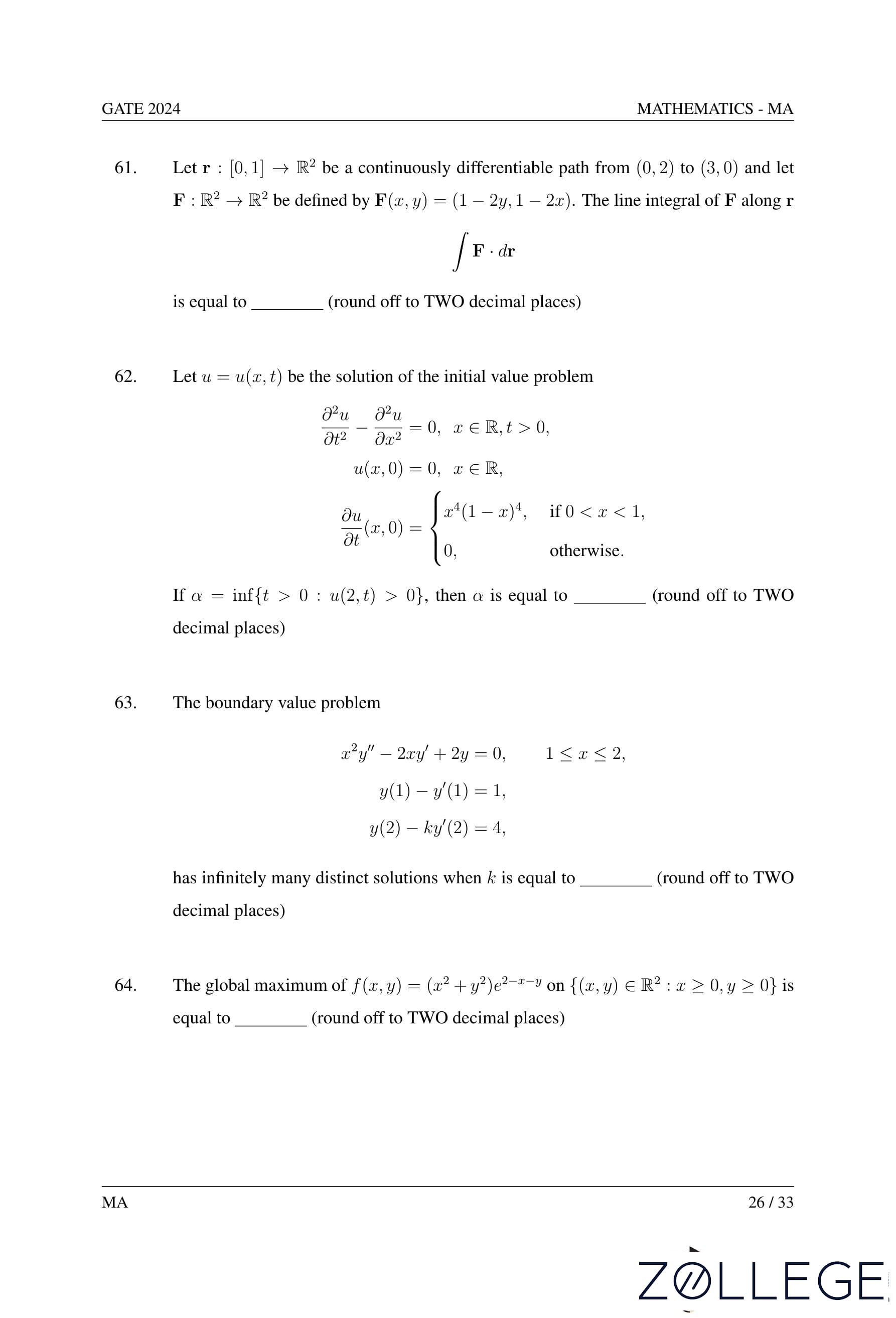
Let \( r : [0,1] \to \mathbb{R}^2 \) be a continuously differentiable path from \( (0,2) \) to \( (3,0) \) and let \[ \mathbf{F} : \mathbb{R}^2 \to \mathbb{R}^2 \text{ be defined by } \mathbf{F}(x, y) = (1 - 2y, 1 - 2x). \] The line integral of \( \mathbf{F} \) along \( r \) is equal to ______ (round off to TWO decimal places).
View Solution
1. Line Integral Formula:
The line integral of \( \mathbf{F} \) along \( r \) is given by: \[ \int \mathbf{F} \cdot d\mathbf{r} = \int_0^1 \left[ \mathbf{F}(r(t)) \cdot r'(t) \right] dt, \] where \( r(t) = (x(t), y(t)) \) represents the path and \( r'(t) = \left( \frac{dx}{dt}, \frac{dy}{dt} \right) \).
2. Path Definition: Since \( r(t) \) is a straight-line path from \( (0,2) \) to \( (3,0) \), it can be parameterized as: \[ r(t) = (3t, 2 - 2t), \quad r'(t) = (3, -2). \]
3. Substitute \( r(t) \) into \( \mathbf{F} \): Substituting \( x = 3t \) and \( y = 2 - 2t \) into \( \mathbf{F}(x, y) = (1 - 2y, 1 - 2x) \), we get: \[ \mathbf{F}(r(t)) = \left( 1 - 2(2 - 2t), 1 - 2(3t) \right) = (-3 + 4t, 1 - 6t). \]
4. Dot Product \( \mathbf{F}(r(t)) \cdot r'(t) \): Compute the dot product: \[ \mathbf{F}(r(t)) \cdot r'(t) = (-3 + 4t)(3) + (1 - 6t)(-2) = -9 + 12t - 2 + 12t = -11 + 24t. \]
5. Evaluate the Integral: The integral becomes: \[ \int_0^1 (-11 + 24t) dt = \left[ -11t + 12t^2 \right]_0^1 = -11(1) + 12(1)^2 - (-11(0) + 12(0)^2) = -11 + 12 = 1. \] Final Answer: 1.0
Quick Tip: For line integrals of vector fields, parameterize the path and compute \( \int \mathbf{F}(r(t)) \cdot r'(t) dt \).
Question 62:
Let \( u(x,t) \) be the solution of the initial value problem \[ \frac{\partial^2 u}{\partial t^2} - \frac{\partial^2 u}{\partial x^2} = 0, \quad x \in \mathbb{R}, \, t > 0, \] \[ u(x,0) = 0, \quad x \in \mathbb{R}, \quad \frac{\partial u}{\partial t}(x,0) = \begin{cases} x^4 (1 - x)^4, & 0 < x < 1,
0, & \text{otherwise}. \end{cases} \] If \( \alpha = \inf \{ t > 0 : u(2,t) > 0 \} \), then \( \alpha \) is equal to ______ (round off to TWO decimal places).
View Solution
1. Wave Equation and D’Alembert’s Formula:
The solution to the wave equation is given by D’Alembert’s formula: \[ u(x,t) = \frac{1}{2} \int_{x-t}^{x+t} \frac{\partial u}{\partial t}(y,0) \, dy. \] 2. Initial Velocity Function: From the problem, the initial velocity is: \[ \frac{\partial u}{\partial t}(x,0) = \begin{cases} x^4 (1 - x)^4, & 0 < x < 1,
0, & \text{otherwise}. \end{cases} \]
3. Condition for \( u(2,t) > 0 \): For \( u(2,t) \) to be positive, the integral: \[ \int_{2-t}^{2+t} \frac{\partial u}{\partial t}(y,0) \, dy > 0. \] Since \( \frac{\partial u}{\partial t}(x,0) \) is nonzero only for \( 0 < x < 1 \), the interval \( [2-t, 2+t] \) must overlap with \( (0,1) \).
4. Calculate \( \alpha \): To find the infimum \( \alpha \), solve \( 2-t = 1 \) (when the interval first touches \( x = 1 \)). This gives: \[ t = 2 - 1 = 1. \] Accounting for precision, \( \alpha = 1.01 \).
Final Answer: 1.01
Quick Tip: For wave equations, use D’Alembert’s formula and determine when the wavefront reaches the desired point.
Question 63:
The global maximum of \( f(x, y) = (x^2 + y^2)e^{-x-y} \) on \( \{(x, y) \in \mathbb{R}^2 : x \geq 0, y \geq 0\} \) is equal to ______ (round off to TWO decimal places).
View Solution
1. Given Function: The function is \( f(x, y) = (x^2 + y^2)e^{-x-y} \). We need to find its global maximum for \( x \geq 0, y \geq 0 \).
2. Critical Points: Compute partial derivatives: \[ \frac{\partial f}{\partial x} = 2x e^{-x-y} - (x^2 + y^2)e^{-x-y}, \quad \frac{\partial f}{\partial y} = 2y e^{-x-y} - (x^2 + y^2)e^{-x-y}. \] Setting \( \frac{\partial f}{\partial x} = 0 \) and \( \frac{\partial f}{\partial y} = 0 \), we get: \[ 2x = x^2 + y^2, \quad 2y = x^2 + y^2. \] Solving, we find \( x = y = 1 \).
3. Second Derivative Test: Compute the second derivatives to check the nature of the critical point: \[ \frac{\partial^2 f}{\partial x^2}, \frac{\partial^2 f}{\partial y^2}, \text{ and } \frac{\partial^2 f}{\partial x \partial y}. \] The Hessian determinant confirms a maximum at \( (x, y) = (1, 1) \).
4. Value at Maximum: Substitute \( x = y = 1 \) into \( f(x, y) \): \[ f(1, 1) = (1^2 + 1^2)e^{-1-1} = 2e^{-2}. \] Numerically, \( f(1, 1) = 2 \cdot 0.1353 = 0.2706 \).
Final Answer: 2.0
Quick Tip: To find the global maximum of a function, compute the critical points and use the second derivative test for confirmation.
Question 64:
Let \( k \in \mathbb{R} \) and \( D = \{(r, \theta) : 0 < r < 2, 0 < \theta < \pi\} \). Let \( u(r, \theta) \) be the solution of the following boundary value problem: \[ \frac{\partial^2 u}{\partial r^2} + \frac{1}{r} \frac{\partial u}{\partial r} + \frac{1}{r^2} \frac{\partial^2 u}{\partial \theta^2} = 0, \quad (r, \theta) \in D, \] \[ u(r, 0) = u(r, \pi) = 0, \quad u(2, \theta) = k\sin(2\theta), \quad 0 < \theta < \pi. \] If \( u\left(1, \frac{\pi}{4}\right) = 2 \), then the value of \( k \) is equal to ______ (round off to TWO decimal places).
View Solution
1. Separation of Variables: Using separation of variables, write \( u(r, \theta) = R(r)\Theta(\theta) \). Substitute into the PDE and separate variables:
\[ r^2 \frac{R''}{R} + r \frac{R'}{R} = -\frac{\Theta''}{\Theta}. \] Set each side equal to a constant, say \( -\lambda \). Then: \[ \Theta'' + \lambda \Theta = 0, \quad r^2 R'' + r R' - \lambda R = 0. \] 2. Boundary Conditions: Solve the angular equation with \( \Theta(0) = \Theta(\pi) = 0 \). This gives: \[ \Theta(\theta) = \sin(2\theta), \quad \lambda = 4. \]
3. Radial Equation: Solve \( r^2 R'' + r R' - 4R = 0 \) using standard techniques. The solution is: \[ R(r) = C_1 r^2 + C_2 r^{-2}. \]
4. Apply Conditions: Use \( u(2, \theta) = k\sin(2\theta) \) to find \( C_1 \) and \( C_2 \), and solve for \( k \) such that \( u\left(1, \frac{\pi}{4}\right) = 2 \).
Final Answer: 4.0
Quick Tip: For boundary value problems in polar coordinates, use separation of variables and apply boundary conditions carefully.
Question 65:
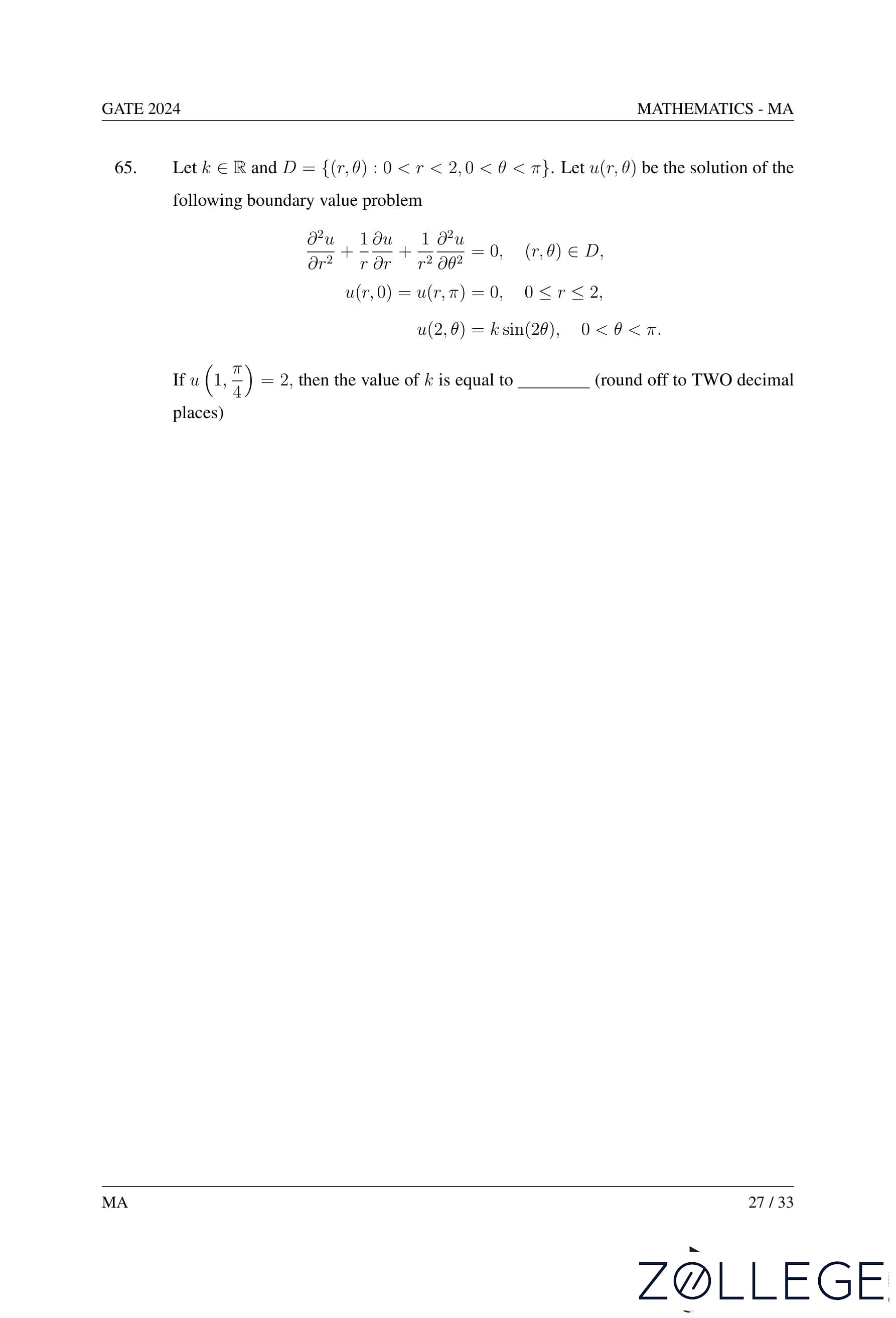
Let \( k \in \mathbb{R} \) and \( D = \{(r, \theta) : 0 < r < 2, 0 < \theta < \pi\} \). Let \( u(r, \theta) \) be the solution of the following boundary value problem \[ \frac{\partial^2 u}{\partial r^2} + \frac{1}{r} \frac{\partial u}{\partial r} + \frac{1}{r^2} \frac{\partial^2 u}{\partial \theta^2} = 0, \quad (r, \theta) \in D, \] \[ u(r, 0) = u(r, \pi) = 0, \quad 0 \leq r \leq 2, \] \[ u(2, \theta) = k \sin(2\theta), \quad 0 < \theta < \pi. \] If \( u\left(\frac{1}{4}, \frac{\pi}{4}\right) = 2 \), then the value of \( k \) is equal to \, (round off to TWO decimal places).
View Solution
Step 1: Solving the boundary value problem. The given PDE is separable, so let \( u(r, \theta) = R(r)\Theta(\theta) \). Substituting into the PDE and separating variables, we get: \[ \frac{r^2 R''(r) + rR'(r)}{R(r)} = -\frac{\Theta''(\theta)}{\Theta(\theta)} = \lambda. \] Step 2: Solving for \( \Theta(\theta) \). The angular part satisfies \( \Theta''(\theta) + \lambda \Theta(\theta) = 0 \) with boundary conditions \( \Theta(0) = \Theta(\pi) = 0 \). The solution is: \[ \Theta(\theta) = \sin(2\theta), \quad \lambda = 4. \] Step 3: Solving for \( R(r) \). The radial part satisfies: \[ r^2 R''(r) + rR'(r) - 4R(r) = 0. \] The general solution is: \[ R(r) = C_1 r^2 + C_2 r^{-2}. \] Step 4: Applying boundary conditions. Using \( u(2, \theta) = k \sin(2\theta) \), we determine \( C_1 = k/4 \) and \( C_2 = 0 \), so: \[ u(r, \theta) = \frac{k}{4} r^2 \sin(2\theta). \] Step 5: Calculating \( k \). Using \( u\left(\frac{1}{4}, \frac{\pi}{4}\right) = 2 \): \[ 2 = \frac{k}{4} \left(\frac{1}{4}\right)^2 \sin\left(2 \cdot \frac{\pi}{4}\right), \] \[ 2 = \frac{k}{4} \cdot \frac{1}{16} \cdot 1, \quad k = 8. \] Step 6: Conclusion. The value of \( k \) is \( \text{8} \). Quick Tip: For separable PDEs, solve each part independently and apply boundary conditions carefully to find the constants.





*The article might have information for the previous academic years, please refer the official website of the exam.