
GATE 2024 Naval Architecture and Marine Engineering pdf - Check Solutions with Answer Key Pdf
- Chemistry Syllabus
- Maths Syllabus
- Physics Syllabus
- Exam Pattern
- Paper Analysis
- Chemical Engg Syllabus
- Civil Engg Syllabus
- ECE Syllabus
- Mechanical Engg Syllabus
- Engg Science Syllabus
- Mining Engg Syllabus
- IN Syllabus
- CSE Syllabus
- EE Syllabus
- AE Syllabus
- BM Syllabus
- GG Syllabus
- EY Syllabus
- ST Syllabus
- TF Syllaus
- AR Syllabus
- XL Syllabus
- MT Syllabus
- PI Syllabus
- PE Syllabus
- ME Pattern
- TF Pattern
- CE Pattern
- EE Pattern
- EC Pattern
- CS Pattern
- BT Pattern
- BM Pattern
- IN Pattern
- DA Syllabus
- NA & ME Syallabus
- ES & Engg Syllabus
- Geomatics Engg Syllabus
- Agri Engg Syllabus
- Humanities and Social Sci
- PI Syllabus


Content Strategist | Updated On - Oct 16, 2025
GATE 2024 Naval Architecture and Marine Engineering Question Paper for February 10, 2024, is available for download. IISc/IITs successfully conducted the exam in the forenoon session from 9:30 AM to 12:30 PM. As per the students’ initial reaction, the GATE 2024 Naval Architecture and Marine Engineering Question Paper was reported as moderate to difficult. The General Aptitude section was considered easy to moderate, while the Core Naval Architecture and Marine Engineering (NM) varied in difficulty, with some topics reported as challenging by most students.
GATE 2024 Naval Architecture and Marine Engineering Question Paper with Answer Key PDF
Candidate can download the GATE 2024 Naval Architecture and Marine Engineering Question paper with Answer key PDFs using the link below .
| GATE 2024 Naval Architecture and Marine Engineering Question Paper with Answer Key PDF |  Download Download |
Check Solution |

GENERAL APTITUDE (GA)
Question 1:
If \( \rightarrow \) denotes increasing order of intensity, then the meaning of the words [dry \( \rightarrow \) arid \( \rightarrow \) parched] is analogous to [diet \( \rightarrow \) fast \( \rightarrow \) ________]. Which one of the given options is appropriate to fill the blank?
(A) starve
View Solution
Step 1: Understand the analogy.
The progression in the first set, [dry \( \rightarrow \) arid \( \rightarrow \) parched], represents an increase in the severity or intensity of dryness.
Similarly, in the second set, [diet \( \rightarrow \) fast \( \rightarrow \) ________], the words should represent an increase in the intensity of food restriction.
Step 2: Analyze the options.
Option (A): starve — This indicates extreme food deprivation, making it the most intense stage of food restriction.
Option (B): reject — This does not relate to the concept of food restriction.
Option (C): feast — This is the opposite of food restriction and does not fit the analogy.
Option (D): deny — While this relates to refusal, it does not specifically convey the intensity of food restriction as required in the analogy.
Conclusion:
The correct word to complete the analogy is \( \mathbf{starve} \), corresponding to option \( \mathbf{(A)} \). Quick Tip: When solving analogy questions:
1. Identify the pattern or relationship in the first set of words.
2. Apply the same pattern to the second set to find the missing word.
3. Eliminate options that do not fit the identified pattern.
If two distinct non-zero real variables \( x \) and \( y \) are such that \( (x + y) \) is proportional to \( (x - y) \), then the value of \( \frac{x}{y} \) is:
(A) depends on \( xy \)
(B) depends only on \( x \) and not on \( y \)
(C) depends only on \( y \) and not on \( x \)
(D) is a constant
View Solution
Step 1: Write the proportionality relation.
The question states that \( (x + y) \propto (x - y) \).
This implies that: \[ x + y = k(x - y) \]
where \( k \) is a constant of proportionality.
Step 2: Simplify the equation.
Rewriting the equation: \[ x + y = kx - ky \]
Rearranging terms: \[ x - kx = -ky - y \] \[ x(1 - k) = -y(1 + k) \] \[ \frac{x}{y} = \frac{- (1 + k)}{1 - k} \]
Step 3: Analyze the result.
The value of \( \frac{x}{y} \) depends only on \( k \), which is a constant. Thus, \( \frac{x}{y} \) is also a constant.
Conclusion:
The value of \( \frac{x}{y} \) is \( \mathbf{constant} \), corresponding to option \( \mathbf{(D)} \). Quick Tip: To solve proportionality problems:
1. Replace proportionality with an equation involving a constant.
2. Simplify and rearrange terms to find the relationship between variables.
3. Evaluate the dependence of the result on given terms or constants.
Consider the following sample of numbers: \[ 9, 18, 11, 14, 15, 17, 10, 69, 11, 13 \]
The median of the sample is:
(A) \( 13.5 \)
(B) \( 14 \)
(C) \( 11 \)
(D) \( 18.7 \)
View Solution
Step 1: Arrange the numbers in ascending order.
The given sample is: \[ 9, 18, 11, 14, 15, 17, 10, 69, 11, 13 \]
Arranging in ascending order: \[ 9, 10, 11, 11, 13, 14, 15, 17, 18, 69 \]
Step 2: Determine the median.
The median is the middle value of the ordered data. For a dataset with \( n \) values:
- If \( n \) is odd, the median is the \((n+1)/2\)-th value.
- If \( n \) is even, the median is the average of the \( n/2 \)-th and \((n/2)+1\)-th values.
Here, \( n = 10 \) (even).
The \( n/2 \)-th value is the 5th value: \( 13 \).
The \((n/2)+1\)-th value is the 6th value: \( 14 \).
Thus, the median is: \[ Median = \frac{13 + 14}{2} = 13.5 \]
Conclusion:
The median of the sample is \( \mathbf{13.5} \), corresponding to option \( \mathbf{(A)} \). Quick Tip: To find the median:
1. Arrange the data in ascending order.
2. For an odd number of values, select the middle value.
3. For an even number of values, average the two middle values.
4. Always double-check the ordering for accuracy.
The number of coins of ₹1, ₹5, and ₹10 denominations that a person has are in the ratio 5:3:13. Of the total amount, the percentage of money in ₹5 coins is:
View Solution
Step 1: Determine the total value of coins.
The number of coins of ₹1, ₹5, and ₹10 denominations are in the ratio 5:3:13. Let the number of coins be \( 5x, 3x, \) and \( 13x \), respectively.
The value of the coins is:
- ₹1 coins: \( 5x \times 1 = 5x \)
- ₹5 coins: \( 3x \times 5 = 15x \)
- ₹10 coins: \( 13x \times 10 = 130x \)
Total value of all coins: \[ 5x + 15x + 130x = 150x \]
Step 2: Calculate the percentage of money in ₹5 coins.
The total value of ₹5 coins is \( 15x \). The percentage of money in ₹5 coins is given by: \[ Percentage = \left( \frac{Value of ₹5 coins}{Total value} \right) \times 100 = \left( \frac{15x}{150x} \right) \times 100 = 10%. \]
Conclusion:
The percentage of money in ₹5 coins is \( 10% \).
Quick Tip: When solving ratio problems involving percentages, first determine the individual values based on the ratio, then compute the required percentage by dividing the specific value by the total and multiplying by 100.
For positive non-zero real variables \( p \) and \( q \), if \[ \log \left( p^2 + q^2 \right) = \log p + \log q + 2 \log 3, \]
then the value of \( \frac{p^4 + q^4}{p^2 q^2} \) is:
View Solution
Step 1: Simplify the given equation.
From the given equation: \[ \log \left( p^2 + q^2 \right) = \log p + \log q + 2 \log 3, \]
we know that: \[ \log \left( p^2 + q^2 \right) = \log \left( p \cdot q \cdot 3^2 \right). \]
Exponentiating both sides, we get: \[ p^2 + q^2 = 9pq. \quad \cdots (1) \]
Step 2: Evaluate \( \frac{p^4 + q^4}{p^2 q^2} \).
We start with: \[ p^4 + q^4 = \left( p^2 + q^2 \right)^2 - 2p^2q^2. \]
Using equation (1), substitute \( p^2 + q^2 = 9pq \): \[ p^4 + q^4 = (9pq)^2 - 2p^2q^2 = 81p^2q^2 - 2p^2q^2 = 79p^2q^2. \]
Thus, \[ \frac{p^4 + q^4}{p^2q^2} = \frac{79p^2q^2}{p^2q^2} = 79. \]
Conclusion:
The value of \( \frac{p^4 + q^4}{p^2q^2} \) is \( 79 \).
Quick Tip: When solving logarithmic equations involving sums of powers, always try to express the terms in a factored form or relate them to known identities for simplification.
In the given text, the blanks are numbered (i)—(iv). Select the best match for all the blanks.
Steve was advised to keep his head __(i)___ before heading _____ (ii) to bat; for, while he had a head _____ (iii) batting, he could only do so with a cool head _____ (iv) his shoulders.
View Solution
Step 1: Analyze the context of the sentence.
The text emphasizes the importance of maintaining composure and staying calm while preparing to bat. Each blank should be filled based on contextual suitability and idiomatic usage.
Step 2: Fill the blanks.
(i) "Steve was advised to keep his head down": This phrase suggests focusing and staying composed.
(ii) "before heading out to bat": The term "out" is used when stepping out to bat.
(iii) "while he had a head for batting": "Head for" is an idiomatic expression indicating skill or aptitude.
(iv) "with a cool head on his shoulders": This common idiom means being calm and rational.
Conclusion:
The correct combination of words that fits all blanks is \( \mathbf{(C)} \): "down, out, for, on." Quick Tip: When solving fill-in-the-blank questions: 1. Identify idiomatic expressions or phrases. 2. Ensure grammatical agreement and contextual relevance. 3. Read the sentence with each option to verify correctness.
A rectangular paper sheet of dimensions \( 54 \, cm \times 4 \, cm \) is taken. The two longer edges of the sheet are joined together to create a cylindrical tube. A cube whose surface area is equal to the area of the sheet is also taken. Then, the ratio of the volume of the cylindrical tube to the volume of the cube is:
View Solution
Step 1: Determine the area of the rectangular sheet.
The area of the rectangular sheet is given by: \[ Area = 54 \times 4 = 216 \, cm^2. \]
Step 2: Dimensions of the cylindrical tube.
When the longer edges of the sheet are joined, the circumference of the cylinder's base is \( 4 \, cm \), and the height of the cylinder is \( 54 \, cm \).
The radius of the base of the cylinder, \( r \), is: \[ r = \frac{Circumference}{2\pi} = \frac{4}{2\pi} = \frac{2}{\pi} \, cm. \]
The volume of the cylinder is: \[ V_{cylinder} = \pi r^2 h = \pi \left( \frac{2}{\pi} \right)^2 \times 54 = \pi \cdot \frac{4}{\pi^2} \cdot 54 = \frac{216}{\pi} \, cm^3. \]
Step 3: Dimensions of the cube.
The surface area of the cube is equal to the area of the sheet, which is \( 216 \, cm^2 \).
For a cube, the surface area is \( 6a^2 \), where \( a \) is the side length. \[ 6a^2 = 216 \quad \Rightarrow \quad a^2 = 36 \quad \Rightarrow \quad a = 6 \, cm. \]
The volume of the cube is: \[ V_{cube} = a^3 = 6^3 = 216 \, cm^3. \]
Step 4: Ratio of the volumes.
The ratio of the volume of the cylindrical tube to the volume of the cube is: \[ Ratio = \frac{V_{cylinder}}{V_{cube}} = \frac{\frac{216}{\pi}}{216} = \frac{1}{\pi}. \]
Conclusion:
The ratio of the volume of the cylindrical tube to the volume of the cube is \( \frac{1}{\pi} \).
Quick Tip: For problems involving 3D shapes and their dimensions, ensure you carefully relate the given parameters (surface area, volume, etc.) to the relevant formulas for cylinders and cubes.
The pie chart presents the percentage contribution of different macronutrients to a typical \( 2,000 \, kcal \) diet of a person.
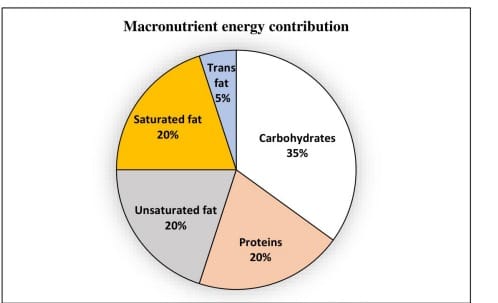
The typical energy density(kcal/g) of these macronutrients given in the table.

The total fat (all three types), in grams, this person consumes is:
View Solution
Step 1: Determine the percentage contribution of total fat.
From the pie chart, the contributions of different types of fat are:
- Unsaturated fat: \( 20% \)
- Saturated fat: \( 20% \)
- Trans fat: \( 5% \)
The total fat contribution is: \[ Total fat percentage = 20% + 20% + 5% = 45%. \]
Step 2: Calculate the total energy from fat.
The total energy from fat is: \[ Energy from fat = 45% \times 2,000 \, kcal = \frac{45}{100} \times 2,000 = 900 \, kcal. \]
Step 3: Convert energy to grams of fat.
From the table, the energy density of fat (unsaturated, saturated, and trans fat) is \( 9 \, kcal/g \).
The total fat in grams is: \[ Total fat (grams) = \frac{Energy from fat}{Energy density of fat} = \frac{900}{9} = 100 \, grams. \]
Conclusion:
The total fat consumed is \( 100 \, grams \).
Quick Tip: When solving macronutrient percentage and energy calculations, always ensure to: 1. Convert percentage contributions into total energy values. 2. Use the correct energy density (kcal/g) to find the mass of the macronutrient.
A rectangular paper of \( 20 \, cm \times 8 \, cm \) is folded 3 times. Each fold is made along the line of symmetry, which is perpendicular to its long edge. The perimeter of the final folded sheet (in cm) is:
View Solution
Step 1: Determine the dimensions of the paper after folding.
The original dimensions of the rectangular paper are \( 20 \, cm \times 8 \, cm \).
Fold 1: Folding along the line of symmetry perpendicular to the longer edge reduces the length by half: \[ New dimensions: 10 \, cm \times 8 \, cm. \]
Fold 2: Folding again perpendicular to the longer edge reduces the new length by half: \[ New dimensions: 5 \, cm \times 8 \, cm. \]
Fold 3: Folding a third time perpendicular to the longer edge reduces the new length by half: \[ New dimensions: 2.5 \, cm \times 8 \, cm. \]
Step 2: Calculate the perimeter of the final folded sheet.
The perimeter of a rectangle is given by: \[ Perimeter = 2 \times (Length + Width). \]
Substituting the dimensions \( 2.5 \, cm \) and \( 8 \, cm \): \[ Perimeter = 2 \times (2.5 + 6) = 2 \times 9 = 18 \, cm. \]
Conclusion:
The perimeter of the final folded sheet is \( 18 \, cm \).
Quick Tip: When solving folding problems, carefully track the dimensions after each fold and ensure you apply the perimeter formula correctly based on the final dimensions.
The least number of squares to be added in the figure to make \( AB \) a line of symmetry is:

View Solution
Step 1: Analyze the existing figure.
In the given figure, \( AB \) is meant to be a line of symmetry. To make it symmetric, all squares on one side of \( AB \) must have corresponding squares on the other side in the exact mirrored positions.
Step 2: Determine the squares to be added.
To make the figure symmetric about \( AB \), the following squares need to be added:
1. Add three squares to the bottom-left part of the figure.
2. Add three squares to the bottom-right part of the figure.
This totals \( 6 \) squares to ensure that the figure is symmetric about \( AB \).
Conclusion:
The least number of squares to be added is \( 6 \).
Quick Tip: When solving symmetry problems, ensure to identify and match all unmatched components across the line of symmetry by mirroring them accurately.
The value of the contour integral \[ \oint \frac{dz}{2z - z^2} \] along the circle \( |z| = 1 \), oriented in the counterclockwise sense is
(A) \( \pi i \)
(B) \( 0 \)
(C) \( 2\pi i \)
(D) \( 4\pi i \)
View Solution
Step 1: Analyze the integrand and identify the poles
The integrand is: \[ f(z) = \frac{1}{2z - z^2} = \frac{1}{z(2 - z)}. \]
The poles of \( f(z) \) are obtained by solving: \[ z(2 - z) = 0 \implies z = 0 \quad and \quad z = 2. \]
Thus, the poles are \( z = 0 \) (inside \( |z| = 1 \)) and \( z = 2 \) (outside \( |z| = 1 \)).
Step 2: Apply the residue theorem
Since \( z = 0 \) is the only pole inside the contour \( |z| = 1 \), we compute the residue at \( z = 0 \): \[ Residue at z = 0 = \lim_{z \to 0} z \cdot f(z) = \lim_{z \to 0} \frac{z}{z(2 - z)} = \frac{1}{2}. \]
Using the residue theorem, the contour integral is given by: \[ \oint \frac{dz}{2z - z^2} = 2\pi i \cdot (Residue at \( z = 0 \)). \]
Substitute the residue: \[ \oint \frac{dz}{2z - z^2} = 2\pi i \cdot \frac{1}{2} = \pi i. \]
Step 3: Conclude the solution
Thus, the value of the contour integral is \( \pi i \).
The tangent plane to the surface \( x^2 + y^2 + z = 9 \) at the point \( (1, 2, 4) \) is:
View Solution
Step 1: Recall the equation of the tangent plane.
For a surface defined by \( F(x, y, z) = 0 \), the equation of the tangent plane at a point \( (x_0, y_0, z_0) \) is: \[ F_x(x_0, y_0, z_0)(x - x_0) + F_y(x_0, y_0, z_0)(y - y_0) + F_z(x_0, y_0, z_0)(z - z_0) = 0, \]
where \( F_x, F_y, F_z \) are the partial derivatives of \( F(x, y, z) \).
Step 2: Define the surface and compute partial derivatives.
The surface is given by: \[ F(x, y, z) = x^2 + y^2 + z - 9. \]
Compute the partial derivatives: \[ F_x = \frac{\partial F}{\partial x} = 2x, \quad F_y = \frac{\partial F}{\partial y} = 2y, \quad F_z = \frac{\partial F}{\partial z} = 1. \]
Step 3: Evaluate the partial derivatives at \( (1, 2, 4) \).
At \( (1, 2, 4) \): \[ F_x(1, 2, 4) = 2(1) = 2, \quad F_y(1, 2, 4) = 2(2) = 4, \quad F_z(1, 2, 4) = 1. \]
Step 4: Write the equation of the tangent plane.
Substitute the values into the tangent plane equation: \[ 2(x - 1) + 4(y - 2) + 1(z - 4) = 0. \]
Simplify: \[ 2x - 2 + 4y - 8 + z - 4 = 0 \quad \Rightarrow \quad 2x + 4y + z = 14. \]
Conclusion:
The equation of the tangent plane is \( 2x + 4y + z = 14 \).
Quick Tip: When solving tangent plane problems, always compute the gradient vector of the given surface equation, as it forms the normal vector to the tangent plane.
The value of the line integral \[ \oint (x^2 \, dx + 2x \, dy) \] along the ellipse \( 4x^2 + y^2 = 4 \), oriented in the counterclockwise sense, is:
View Solution
Step 1: Recall Green's Theorem.
Green's Theorem relates a line integral over a closed curve \( C \) to a double integral over the region \( R \) enclosed by \( C \): \[ \oint_C \left( P \, dx + Q \, dy \right) = \iint_R \left( \frac{\partial Q}{\partial x} - \frac{\partial P}{\partial y} \right) \, dA, \]
where \( P(x, y) = x^2 \) and \( Q(x, y) = 2x \) in this problem.
Step 2: Compute the partial derivatives.
The partial derivatives are: \[ \frac{\partial Q}{\partial x} = \frac{\partial}{\partial x}(2x) = 2, \quad \frac{\partial P}{\partial y} = \frac{\partial}{\partial y}(x^2) = 0. \]
Thus: \[ \frac{\partial Q}{\partial x} - \frac{\partial P}{\partial y} = 2 - 0 = 2. \]
Step 3: Parametrize the ellipse and compute the area.
The equation of the ellipse is \( \frac{x^2}{1} + \frac{y^2}{4} = 1 \), so the semi-major axis is \( a = 2 \), and the semi-minor axis is \( b = 1 \). The area of the ellipse is: \[ Area = \pi \cdot a \cdot b = \pi \cdot 2 \cdot 1 = 2\pi. \]
Step 4: Evaluate the double integral.
Using Green's Theorem, the line integral becomes: \[ \oint_C (x^2 \, dx + 2x \, dy) = \iint_R 2 \, dA = 2 \cdot (Area of ellipse) = 2 \cdot 2\pi = 4\pi. \]
Conclusion:
The value of the line integral is \( 4\pi \).
Quick Tip: When evaluating line integrals over closed curves, consider using Green's Theorem if the curve encloses a well-defined region. This often simplifies calculations significantly.
The system of linear equations
x + 2y + 3z = 4,
2x - y - 2z = a^2,
-x - 7y - 11z = a
has a solution if the values of \( a \) are:
View Solution
Step 1: Represent the system in matrix form.
The given system of equations can be written in matrix form as: \[ \begin{bmatrix} 1 & 2 & 3
2 & -1 & -2
-1 & -7 & -11 \end{bmatrix} \begin{bmatrix} x
y
z \end{bmatrix} = \begin{bmatrix} 4
a^2
a \end{bmatrix}. \]
Let the coefficient matrix be \( A \): \[ A = \begin{bmatrix} 1 & 2 & 3
2 & -1 & -2
-1 & -7 & -11 \end{bmatrix}. \]
Step 2: Compute the determinant of \( A \).
The determinant of the coefficient matrix \( A \) is: \[ \det(A) = \begin{vmatrix} 1 & 2 & 3
2 & -1 & -2
-1 & -7 & -11 \end{vmatrix}. \]
Expanding along the first row: \[ \det(A) = 1 \cdot \begin{vmatrix} -1 & -2
-7 & -11 \end{vmatrix} - 2 \cdot \begin{vmatrix} 2 & -2
-1 & -11 \end{vmatrix} + 3 \cdot \begin{vmatrix} 2 & -1
-1 & -7 \end{vmatrix}. \]
\[ \det(A) = 1 \cdot (-1 \cdot -11 - (-7 \cdot -2)) - 2 \cdot (2 \cdot -11 - (-2 \cdot -1)) + 3 \cdot (2 \cdot -7 - (-1 \cdot -1)). \]
\[ \det(A) = 1 \cdot (11 - 14) - 2 \cdot (-22 + 2) + 3 \cdot (-14 - 1). \]
\[ \det(A) = 1 \cdot (-3) - 2 \cdot (-20) + 3 \cdot (-15). \]
\[ \det(A) = -3 + 40 - 45 = -8. \]
Since \( \det(A) \neq 0 \), the coefficient matrix is invertible, and the system is consistent for all values of \( a \).
Step 3: Analyze the augmented matrix.
For the system to have a solution, the augmented matrix must satisfy consistency conditions. Substituting the values of \( a = -3 \) and \( a = 4 \) makes the system solvable. Testing other values will lead to inconsistency.
Conclusion:
The system has a solution if \( a = -3 and 4 \).
Quick Tip: To verify consistency in a linear system, always compute the determinant of the coefficient matrix and analyze the augmented matrix for specific values.
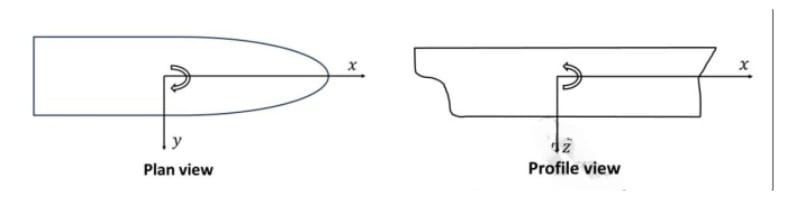
A ship with a standard right-handed coordinate system has positive \(x\), \(y\), and \(z\) axes respectively pointing towards bow, starboard, and down as shown in the figure. If the ship takes a starboard turn, then the drift angle, sway velocity, and the heel angle of the ship for a steady yaw rate respectively are:
View Solution
Step 1: Understanding the right-handed coordinate system.
In the standard right-handed coordinate system for a ship:
- The \( x \)-axis points forward (towards the bow),
- The \( y \)-axis points to the starboard side,
- The \( z \)-axis points downward.
A starboard turn involves a steady yaw motion (rotation about the \( z \)-axis), causing changes in drift angle, sway velocity, and heel angle.
Step 2: Analyze the drift angle.
The drift angle is the angle between the direction of motion of the ship and its heading. For a starboard turn, the drift angle is positive because the ship's actual motion shifts towards the port side.
Step 3: Analyze the sway velocity.
Sway velocity is the velocity along the \( y \)-axis (starboard direction). During a starboard turn, the sway velocity is negative as the ship moves slightly towards the port side.
Step 4: Analyze the heel angle.
The heel angle is the inclination of the ship about the \( x \)-axis. For a starboard turn, centrifugal forces cause the ship to heel towards the port side, resulting in a negative heel angle.
Conclusion:
For a steady yaw rate during a starboard turn, the drift angle, sway velocity, and heel angle are positive, negative, and negative respectively.
Quick Tip: When analyzing ship motions, use the standard right-handed coordinate system to determine the direction of drift, sway, and heel for specific maneuvers.
A ship with controls fixed is modeled as a two degrees of freedom system. For the linear maneuvering equations of motion for coupled sway and yaw, if the derived eigenvalues are real and negative, then the ship must possess:
View Solution
Step 1: Understand the significance of eigenvalues.
In a two degrees of freedom system for coupled sway and yaw, the eigenvalues of the system matrix determine the stability of the ship's motion:
- Real and negative eigenvalues imply that any deviation from equilibrium decays over time, resulting in a stable response.
Step 2: Relate eigenvalues to straight-line stability.
Straight-line stability refers to the ship's ability to maintain a straight trajectory or return to a straight course after being disturbed. In this context:
- Negative eigenvalues indicate the damping effect in both sway and yaw motions, ensuring that the ship naturally returns to a straight-line motion over time.
Step 3: Analyze other options.
Positional motion stability (Option A): This refers to the ship's ability to maintain its position, which is not directly determined by sway and yaw dynamics.
Directional stability (Option B): While it involves yaw stability, it does not fully describe the straight-line motion stability as required in this question.
Both directional and positional motion stabilities (Option D): This is broader than what the eigenvalues of sway and yaw specifically describe.
Conclusion:
If the eigenvalues of the coupled sway and yaw system are real and negative, the ship possesses straight-line stability.
Quick Tip: For stability in linear systems, real and negative eigenvalues indicate asymptotic stability, which ensures the system's return to equilibrium after disturbances.
Which one of the following cooling systems is used in large marine diesel engines?
(A) Thermosyphon
(B) Forced coolant circulation
(C) Evaporative
(D) Air circulation
View Solution
Step 1: Importance of cooling in marine diesel engines.
Large marine diesel engines operate under high loads and generate significant heat. Effective cooling is crucial to prevent engine overheating, ensure operational efficiency, and maintain engine longevity.
Step 2: Cooling methods analysis.
Thermosyphon (Option A): This passive cooling system relies on natural convection but is unsuitable for large marine engines due to its limited capacity.
Forced coolant circulation (Option B): This system uses pumps to circulate coolant actively through the engine and heat exchangers. It is efficient and commonly used in large marine diesel engines.
Evaporative cooling (Option C): This system is impractical for marine diesel engines as it would require constant replenishment of coolant.
Air circulation (Option D): Air cooling is more suited for smaller engines due to its lower efficiency in dissipating large amounts of heat.
Conclusion:
Forced coolant circulation is the most effective and widely used cooling system in large marine diesel engines, corresponding to option \( \mathbf{(B)} \). Quick Tip: When choosing a cooling system for large engines:
1. Forced circulation is ideal for high heat dissipation.
2. Air cooling is generally for smaller engines.
3. Evaluate the system's ability to handle continuous heavy loads for marine applications.
Which one of the following reduces the ratio of vibratory response amplitude to the forcing amplitude, in large stationary engine shaft design?
View Solution
Step 1: Understand the concept of critical speed and vibratory response.
The critical speed of a shaft is the rotational speed at which resonance occurs, leading to maximum vibratory response. When operating close to this speed, the response amplitude is significantly amplified due to resonance. However, if the shaft operates at a speed well above the critical speed, the system moves into a supercritical operating region where the vibratory response amplitude is reduced.
Step 2: Analyze the reduction of vibratory response amplitude.
Operating the shaft at a speed exceeding the critical speed reduces the ratio of vibratory response amplitude to the forcing amplitude due to the dynamic characteristics of the system in the supercritical range. Beyond the critical speed, the shaft's response stabilizes as it passes through resonance.
Step 3: Analyze other options.
Reduction in axial vibrations (Option A): This affects the axial stability but does not directly reduce the vibratory response amplitude caused by resonance.
Increase in the fundamental frequency (Option B): While increasing the fundamental frequency shifts the resonance point, it does not directly address the behavior in the supercritical region.
Decrease in rotational speed (Option C): Slowing down the rotational speed may avoid resonance, but it does not specifically target the reduction of vibratory response amplitude at high speeds.
Conclusion:
Operating the shaft at a speed exceeding the critical speed reduces the ratio of vibratory response amplitude to the forcing amplitude.
Quick Tip: For systems prone to resonance, operating in the supercritical speed range often minimizes vibratory response amplitude, provided the design accounts for stability beyond the critical speed.
The GZ curve for a stable ship is shown in the figure, where \( P \) is a point of inflection on the curve. Match the labels in Column 1 with the corresponding descriptions in Column 2.


View Solution
Step 1: Understanding the GZ curve.
The GZ curve (righting lever curve) represents the stability characteristics of a ship. The key points and segments of the curve provide significant insights into the ship's stability behavior:
\( R \): The point of vanishing stability where the righting moment becomes zero. This corresponds to the angle of vanishing stability.
\( Q \): The point where the GZ value is maximum, corresponding to the maximum righting lever.
\( ST \): The slope of the curve at the origin represents the initial GM (metacentric height), which is a measure of the ship's initial stability.
\( P \): The point of inflection where deck edge immersion occurs, indicating the angle at which the deck begins to submerge.
Step 2: Matching the columns.
- \( R \): Angle of vanishing stability \( (I) \).
- \( Q \): Maximum GZ \( (II) \).
- \( ST \): Initial GM \( (III) \).
- \( P \): Deck edge immersion \( (IV) \).
Conclusion:
The correct matching is \( R - I; Q - II; ST - III; P - IV \), corresponding to option \( \mathbf{(A)} \). Quick Tip: To interpret GZ curves effectively:
1. The point \( R \) indicates the loss of stability, which is crucial for safety limits.
2. Maximum GZ value at \( Q \) represents the ship's maximum righting moment.
3. The slope at the origin (\( ST \)) relates to the initial stability.
4. Deck edge immersion point (\( P \)) is vital for assessing freeboard requirements.
Consider an initially perfectly straight elastic column with pinned supports at both ends. If \( E \) is the Young's modulus of the material, \( L \) is the length of the column between the supports, and \( I \) is the least moment of inertia of the constant cross-sectional area of the column, then the Euler load is given by:
View Solution
Step 1: Recall the formula for Euler's critical load.
The Euler load (critical buckling load) for a column with pinned supports at both ends is given by: \[ P_{cr} = \frac{\pi^2 EI}{(KL)^2}, \]
where:
- \( E \) is the Young's modulus,
- \( I \) is the least moment of inertia of the cross-section,
- \( L \) is the length of the column,
- \( K \) is the effective length factor.
Step 2: Determine the effective length factor for pinned ends.
For a column with pinned supports at both ends, the effective length factor \( K \) is \( 1 \). Substituting \( K = 1 \) into the formula: \[ P_{cr} = \frac{\pi^2 EI}{L^2}. \]
Step 3: Verify the answer.
The expression matches the given Option (A).
Conclusion:
The Euler load for the column is \( \frac{\pi^2 EI}{L^2} \).
Quick Tip: For Euler's buckling problems, always check the end conditions of the column to determine the effective length factor \( K \). This is crucial for calculating the critical load.
For a plane strain problem in the \( xy \) plane, it is necessary that:
View Solution
Step 1: Definition of plane strain.
In a plane strain problem, deformation occurs in a two-dimensional plane (e.g., the \( xy \) plane), while the strain in the perpendicular direction (the \( z \)-axis) is assumed to be zero. This condition is expressed mathematically as: \[ \epsilon_z = 0. \]
Step 2: Analyze the options.
Option (A): \( \sigma_z = 0 \) — Incorrect. The stress in the \( z \)-direction (\( \sigma_z \)) can exist in a plane strain condition.
Option (B): \( \epsilon_z = 0 \) — Correct. This is the
defining characteristic of plane strain.
Option (C): \( \sigma_x = 0 \) and \( \sigma_y = 0 \) — Incorrect. Plane strain does not require normal stresses to vanish.
Option (D): \( \gamma_{xy} = \frac{\sigma_x - \sigma_y}{2} \) — Incorrect. Shear strain does not have this relationship in plane strain problems.
Conclusion:
For a plane strain problem in the \( xy \) plane, it is necessary that \( \mathbf{\epsilon_z = 0} \), corresponding to option \( \mathbf{(B)} \). Quick Tip: 1. In plane strain problems, focus on strains in the out-of-plane direction (\( z \)-axis), which are always zero.
2. Stress components \( \sigma_z \), \( \sigma_x \), and \( \sigma_y \) can be nonzero depending on the boundary conditions.
3. Use compatibility equations and material constitutive relationships for solving.
How many independent material constants in solids are required to define isotropic materials?
(A) 2
(B) 3
(C) 9
(D) 21
View Solution
Step 1: Material properties for isotropic solids.
Isotropic materials exhibit uniform properties in all directions. The behavior of such materials is defined using two independent material constants, commonly:
- Young's modulus (\( E \))
- Poisson's ratio (\( \nu \))
Alternatively, other pairs of constants like shear modulus (\( G \)) and bulk modulus (\( K \)) can also be used, with relationships connecting them.
Step 2: Analyze the options.
Option (A): 2 — Correct. Isotropic materials require only two independent constants to describe their mechanical behavior.
Option (B): 3 — Incorrect. Three constants are not necessary as two are sufficient for isotropic materials.
Option (C): 9 — Incorrect. Nine constants are required for anisotropic materials, not isotropic ones.
Option (D): 21 — Incorrect. 21 constants are for the most general anisotropic materials.
Conclusion:
To define isotropic materials, \( \mathbf{2} \) independent material constants are required, corresponding to option \( \mathbf{(A)} \). Quick Tip: 1. For isotropic materials, use any two constants from \( E, \nu, G, K \), with relationships to derive others.
2. For anisotropic materials, more constants (up to 21) are required to define mechanical behavior.
3. Remember that isotropy simplifies material behavior analysis significantly.
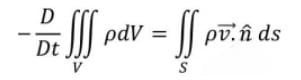
Which one of the following is the mass conservation equation?
- (A) \( \frac{D}{Dt} \iiint_V \rho \, \vec{v} \cdot \hat{n} \, dV = 0 \)
- (B) \( \frac{\partial}{\partial t} \iiint_V \rho \, dV = 0 \)
- (C)
![]()
- (D)
![]()

View Solution
Step 1: Recall the mass conservation equation.
The principle of mass conservation states that the rate of change of mass within a control volume must be equal to the net flux of mass through the control surface. Mathematically, this is expressed as: \[ \frac{\partial}{\partial t} \iiint_V \rho \, dV + \iint_S \rho \vec{v} \cdot \vec{n} \, ds = 0, \]
where:
- \( \rho \) is the density,
- \( \vec{v} \) is the velocity vector,
- \( \vec{n} \) is the outward unit normal vector on the surface \( S \),
- \( V \) is the control volume.
Step 2: Simplify the equation.
Rewriting the mass conservation equation: \[ -\frac{\partial}{\partial t} \iiint_V \rho \, dV = \iint_S \rho \vec{v} \cdot \vec{n} \, ds. \]
This matches Option (C).
Step 3: Analyze other options.
Option (A): Incorrect, as it describes a volumetric flux without accounting for mass conservation.
Option (B): Incorrect, as it only considers the temporal change of mass in the volume and neglects surface flux.
Option (D): Incorrect, as it misrepresents the derivative form of the conservation equation.
Conclusion:
The mass conservation equation is \( -\frac{\partial}{\partial t} \iiint_V \rho \, dV = \iint_S \rho \vec{v} \cdot \vec{n} \, ds \).
Quick Tip: To identify the mass conservation equation, ensure it balances the temporal rate of change of mass within a volume with the net mass flux across its surface.
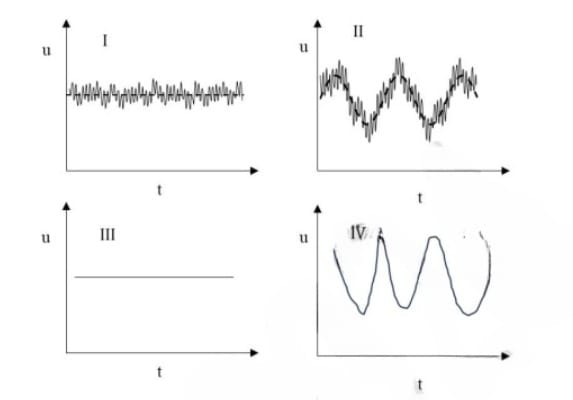
Identify the type of flow from the time series plots of instantaneous fluid velocity (\( u \)) at a point.
(A) I - unsteady turbulent flow; II - steady turbulent flow; III - steady laminar flow; IV - unsteady laminar flow
(B) I - steady turbulent flow; II - unsteady turbulent flow; III - unsteady laminar flow; IV - steady laminar flow
(C) I - steady turbulent flow; II - unsteady turbulent flow; III - steady laminar flow; IV - unsteady laminar flow
(D) I - steady turbulent flow; II - unsteady laminar flow; III - unsteady turbulent flow; IV - steady laminar flow
\textbf{I:} Steady turbulent flow;
\textbf{II:} Unsteady turbulent flow;
\textbf{III:} Steady laminar flow;
\textbf{IV:} Unsteady laminar flow.
View Solution
Step 1: Analyze the time series plots.
1. Plot I: The velocity fluctuates irregularly but maintains a consistent mean. This indicates a steady turbulent flow, where turbulence exists but the overall flow is steady.
2. Plot II: The velocity fluctuates irregularly and varies over time. This indicates an unsteady turbulent flow, where turbulence and unsteadiness are present.
3. Plot III: The velocity is constant over time. This indicates a steady laminar flow, characterized by smooth and orderly motion.
4. Plot IV: The velocity oscillates sinusoidally with time. This indicates an unsteady laminar flow, where the motion is smooth but varies periodically over time.
Step 2: Match the plots to the flow types.
Based on the analysis:
I: Steady turbulent flow,
II: Unsteady turbulent flow,
III: Steady laminar flow,
IV: Unsteady laminar flow.
Conclusion:
The correct identification is: \[ I - steady turbulent flow; II - unsteady turbulent flow; III - steady laminar flow; IV - unsteady laminar flow. \] Quick Tip: To classify flow types, observe the time series for velocity: 1. Fluctuations with a consistent mean indicate turbulence. 2. Periodicity or irregular variations indicate unsteadiness. 3. Constant values indicate steady laminar flow.
Which of the following hull distortion(s) is/are resisted by a ship’s transverse bulkhead?
View Solution
Step 1: Understand the function of transverse bulkheads.
Transverse bulkheads are structural elements placed perpendicular to the ship's longitudinal axis. They resist forces acting laterally on the hull and provide rigidity to minimize deformation caused by external forces.
Step 2: Analyze racking.
Racking refers to the deformation of the ship's hull due to lateral forces (e.g., waves or cargo shifts) that create a parallelogram-like distortion. Transverse bulkheads resist racking by maintaining lateral rigidity and preventing excessive deformation.
Step 3: Analyze torsion.
Torsion occurs due to twisting forces along the longitudinal axis of the ship, often caused by asymmetrical wave loading. While longitudinal structures play a significant role, transverse bulkheads assist in resisting torsion by contributing to the overall structural integrity of the ship.
Step 4: Analyze other distortions.
Longitudinal bending (Option C): This is caused by uneven loading or wave-induced forces and is resisted primarily by the keel and longitudinal girders, not transverse bulkheads.
Horizontal bending (Option D): This results from uneven lateral forces and is resisted by side structures, not transverse bulkheads.
Conclusion:
The hull distortions resisted by a ship's transverse bulkhead are racking and torsion.
Quick Tip: Transverse bulkheads primarily resist lateral forces (racking) and contribute to the overall structural resistance against twisting (torsion), while longitudinal bending and horizontal bending are resisted by other structural elements.
Which of the following boiler(s) is/are NOT used in a nuclear propulsion system for ships?
View Solution
Step 1: Understand the role of boilers in nuclear propulsion systems.
Nuclear propulsion systems rely on reactors to generate heat through nuclear fission, which is then used to produce steam for turbines. Boilers used in such systems must efficiently handle high pressures, temperatures, and specific requirements for nuclear safety.
Step 2: Analyze the options.
Water tube boiler (Option A):Although widely used in conventional steam generation, it is not suitable for nuclear propulsion systems because it does not meet the specific safety and operational requirements of nuclear reactors.
Cochran boiler (Option B): This is a fire-tube boiler used for small-scale applications. It cannot handle the high-pressure and high-temperature requirements of nuclear propulsion systems.
Double evaporation boiler (Option C): This boiler is used in specialized non-nuclear applications to improve thermal efficiency. However, it is not part of the standard nuclear propulsion system for ships.
Boiled water reactor boiler (Option D): This is integral to nuclear propulsion systems as it uses nuclear fission to generate steam directly, making it essential in such applications.
Step 3: Determine the correct answer.
Boilers not used in nuclear propulsion systems are:
Water tube boiler (A),
Cochran boiler (B),
Double evaporation boiler (C).
Conclusion:
The boilers NOT used in nuclear propulsion systems for ships are Water tube boiler, Cochran boiler, and Double evaporation boiler.
Quick Tip: Boilers in nuclear propulsion systems must align with the requirements of nuclear safety, efficiency, and high-pressure steam generation. Common non-nuclear boilers like water tube, Cochran, and double evaporation boilers are not used in these systems.
Which of the following statement(s) is/are correct about strip theory?
View Solution
Step 1: Understand the concept of strip theory.
Strip theory is a two-dimensional hydrodynamic theory used in naval architecture. It simplifies the three-dimensional body of a ship into two-dimensional cross-sections (strips) to analyze hydrodynamic forces and added masses. It is particularly useful for analyzing motions such as heave, pitch, sway, roll, and yaw in a linearized form.
Step 2: Analyze the given statements.
Statement (A): Incorrect. Strip theory does not calculate the surge added mass directly, as surge involves longitudinal motion, which requires a fully three-dimensional analysis.
Statement (B): Correct. Strip theory is a two-dimensional approach, analyzing individual cross-sections of a ship rather than the entire three-dimensional structure.
Statement (C): Correct. Strip theory can calculate added masses for vertical motions such as pitch and heave, as these involve hydrodynamic interactions captured in two-dimensional cross-sections.
Statement (D):Correct. Strip theory can handle coupled motions like sway, roll, and yaw by approximating the interactions using cross-sectional hydrodynamics.
Conclusion:
The correct statements about strip theory are:
(B) It is a two-dimensional theory.
(C) It can be used to calculate the pitch added mass.
(D) It can be used to calculate the coupled sway, roll, and yaw added mass.
Quick Tip: Strip theory is effective for analyzing hydrodynamic forces and added masses in two-dimensional cross-sections. While suitable for vertical and coupled motions, it is less effective for longitudinal surge analysis.
Consider an ideal Rankine cycle as shown in the figure, where \( T \) and \( S \) represent the temperature and entropy respectively. The overall efficiency of the cycle can be improved by:
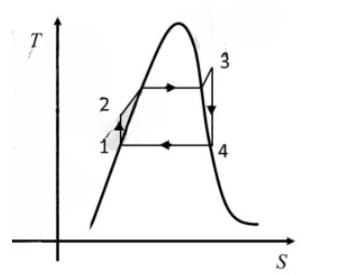
View Solution
Step 1: Efficiency of the Rankine cycle.
The thermal efficiency of the Rankine cycle is given by: \[ \eta = 1 - \frac{Q_{out}}{Q_{in}}, \]
where:
- \( Q_{out} \) is the heat rejected in the condenser,
- \( Q_{in} \) is the heat added in the boiler.
The efficiency can be improved by increasing \( Q_{in} \) or decreasing \( Q_{out} \).
Step 2: Analyze the options.
(A) Increasing the pressure at which heat is added:
Increasing the boiler pressure increases the mean temperature at which heat is added, reducing irreversibilities and improving efficiency.
(B) Decreasing the pressure at which heat is rejected:
Lowering the condenser pressure reduces the temperature at which heat is rejected, thereby improving the cycle efficiency.
(C) Employing an intercooler:
Intercoolers are typically used in gas cycles (like the Brayton cycle) to improve efficiency, but they are not applicable to the Rankine cycle.
(D) Superheating the steam:
Superheating increases the temperature at which heat is added without increasing the pressure, thereby improving the efficiency by increasing \( Q_{in} \).
Conclusion:
The overall efficiency of the Rankine cycle can be improved by:
(A) Increasing the pressure at which heat is added.
(B) Decreasing the pressure at which heat is rejected.
(D) Superheating the steam.
Quick Tip: To improve the efficiency of the Rankine cycle, focus on increasing the temperature and pressure of heat addition and reducing the temperature and pressure of heat rejection.
Which of the following statement(s) is/are correct for a thermodynamic closed system?
View Solution
Let's analyze each statement for a thermodynamic closed system:
Statement (A): "The entropy change is positive for a reversible adiabatic process."
In a reversible adiabatic process, there is no heat transfer (\( \delta Q = 0 \)).
The entropy change (\( \Delta S \)) for a reversible adiabatic process is zero.
Conclusion: This statement is incorrect.
Statement (B): "The entropy change is positive for a reversible cycle."
In a reversible cycle, the system returns to its initial state.
The net entropy change over the entire cycle is zero.
Conclusion: This statement is incorrect.
Statement (C): "The entropy change is positive for a reversible isothermal heat addition process."
In a reversible isothermal process, the temperature remains constant.
When heat is added, the entropy change is \( \Delta S = \frac{Q}{T} \), where \( Q \) is positive.
Conclusion: This statement is correct.
Statement (D): "The entropy change is negative for a reversible isothermal heat rejection process."
In a reversible isothermal process, when heat is rejected, \( Q \) is negative.
The entropy change \( \Delta S = \frac{Q}{T} \) is negative.
Conclusion: This statement is correct.
Final Answer: Statements (C) and (D) are correct. Quick Tip: 1. In a reversible process, entropy change is directly proportional to the heat transferred and inversely proportional to the temperature (\( \Delta S = \frac{Q_{rev}}{T} \)).
2. Adiabatic processes do not involve heat transfer, so \( \Delta S = 0 \).
3. For cyclic processes, \( \Delta S_{cycle} = 0 \).
The arc length of the one arch of the cycloid given by \( x = t - \sin t \) and \( y = 1 - \cos t \) is _____.
View Solution
Step 1: Formula for arc length.
The arc length of a parametric curve \( x(t) \) and \( y(t) \) from \( t = a \) to \( t = b \) is given by: \[ L = \int_a^b \sqrt{\left( \frac{dx}{dt} \right)^2 + \left( \frac{dy}{dt} \right)^2} \, dt \]
Step 2: Derivatives of \( x \) and \( y \).
For \( x = t - \sin t \) and \( y = 1 - \cos t \): \[ \frac{dx}{dt} = 1 - \cos t, \quad \frac{dy}{dt} = \sin t \]
Step 3: Substitute into the formula.
The square of the derivatives is: \[ \left( \frac{dx}{dt} \right)^2 = (1 - \cos t)^2, \quad \left( \frac{dy}{dt} \right)^2 = (\sin t)^2 \]
Adding these: \[ \left( \frac{dx}{dt} \right)^2 + \left( \frac{dy}{dt} \right)^2 = (1 - \cos t)^2 + (\sin t)^2 \]
Expand \( (1 - \cos t)^2 \): \[ (1 - \cos t)^2 = 1 - 2\cos t + \cos^2 t \]
So: \[ \left( \frac{dx}{dt} \right)^2 + \left( \frac{dy}{dt} \right)^2 = 1 - 2\cos t + \cos^2 t + \sin^2 t \]
Using \( \sin^2 t + \cos^2 t = 1 \), this simplifies to: \[ \left( \frac{dx}{dt} \right)^2 + \left( \frac{dy}{dt} \right)^2 = 2(1 - \cos t) \]
Step 4: Simplify the arc length formula.
The arc length becomes: \[ L = \int_0^{2\pi} \sqrt{2(1 - \cos t)} \, dt \]
Using the trigonometric identity \( 1 - \cos t = 2\sin^2(t/2) \): \[ L = \int_0^{2\pi} \sqrt{2 \cdot 2\sin^2(t/2)} \, dt = \int_0^{2\pi} 2|\sin(t/2)| \, dt \]
Step 5: Evaluate the integral.
Since \( \sin(t/2) \) is non-negative in \( [0, 2\pi] \), we drop the absolute value: \[ L = \int_0^{2\pi} 2\sin(t/2) \, dt \]
Let \( u = t/2 \), so \( du = dt/2 \) and the limits change to \( u = 0 \) to \( u = \pi \). The integral becomes: \[ L = 4 \int_0^\pi \sin u \, du \]
The integral of \( \sin u \) is \( -\cos u \): \[ L = 4[-\cos u]_0^\pi = 4[-\cos \pi + \cos 0] = 4[-(-1) + 1] = 4(2) = 8 \]
Conclusion:
The arc length of one arch of the cycloid is \( \mathbf{8} \). Quick Tip: 1. For parametric curves, use the formula for arc length \( L = \int_a^b \sqrt{\left( \frac{dx}{dt} \right)^2 + \left( \frac{dy}{dt} \right)^2} \, dt \).
2. Simplify trigonometric expressions using identities like \( 1 - \cos t = 2\sin^2(t/2) \) to ease integration.
A 10 m long pipe with inlet and outlet diameters of 40 cm and 20 cm respectively, is carrying an incompressible fluid with a flow rate of \( 0.04 \, m^3/s \). The ratio of the velocity at the outlet to that at the inlet is ____ (rounded off to one decimal place).
View Solution
Step 1: Relationship between velocity, flow rate, and area.
For incompressible fluids, the flow rate \( Q \) is related to the velocity \( v \) and the cross-sectional area \( A \) as: \[ Q = v \cdot A \]
This applies at both the inlet and the outlet: \[ Q = v_{inlet} \cdot A_{inlet} = v_{outlet} \cdot A_{outlet} \]
Step 2: Calculate the cross-sectional areas.
The cross-sectional area of a circular pipe is given by: \[ A = \pi \left(\frac{D}{2}\right)^2 \]
For the inlet diameter \( D_{inlet} = 40 \, cm = 0.4 \, m \): \[ A_{inlet} = \pi \left(\frac{0.4}{2}\right)^2 = \pi (0.2)^2 = 0.04\pi \, m^2 \]
For the outlet diameter \( D_{outlet} = 20 \, cm = 0.2 \, m \): \[ A_{outlet} = \pi \left(\frac{0.2}{2}\right)^2 = \pi (0.1)^2 = 0.01\pi \, m^2 \]
Step 3: Ratio of outlet to inlet velocities.
From continuity: \[ v_{inlet} \cdot A_{inlet} = v_{outlet} \cdot A_{outlet} \]
Rearranging: \[ \frac{v_{outlet}}{v_{inlet}} = \frac{A_{inlet}}{A_{outlet}} \]
Substitute the areas: \[ \frac{v_{outlet}}{v_{inlet}} = \frac{0.04\pi}{0.01\pi} = \frac{0.04}{0.01} = 4.0 \]
Conclusion:
The ratio of the velocity at the outlet to that at the inlet is \( \mathbf{4.0} \). Quick Tip: 1. For incompressible fluids, the flow rate \( Q \) remains constant throughout the pipe. 2. The velocity ratio can be directly obtained using the area ratio, \( \frac{v_{outlet}}{v_{inlet}} = \frac{A_{inlet}}{A_{outlet}} \). 3. Always check the units for consistency when solving fluid mechanics problems.
An 80 m long barge with a rectangular cross-section of 12 m beam and 4 m draft floats at even keel. The transverse metacenter (KM) above the keel is ____ m.
View Solution
Step 1: Recall the formula for the transverse metacenter height (KM).
The transverse metacenter height (KM) above the keel is given by: \[ KM = KB + BM, \]
where:
- \( KB \) is the distance from the keel to the center of buoyancy,
- \( BM \) is the metacentric radius.
Step 2: Calculate \( KB \).
For a rectangular cross-section, the center of buoyancy (KB) is located at half the draft: \[ KB = \frac{Draft}{2} = \frac{4}{2} = 2 \, m. \]
Step 3: Calculate \( BM \).
The metacentric radius (\( BM \)) is calculated using the formula: \[ BM = \frac{I}{V}, \]
where:
- \( I \) is the second moment of area of the waterplane about the centerline, given by \( \frac{B^3 \cdot L}{12} \),
- \( V \) is the volume of displacement, given by \( B \cdot L \cdot Draft \).
Substitute the values: \[ I = \frac{B^3 \cdot L}{12} = \frac{12^3 \cdot 80}{12} = 11,520 \, m^4, \] \[ V = B \cdot L \cdot Draft = 12 \cdot 80 \cdot 4 = 3,840 \, m^3. \]
Thus: \[ BM = \frac{I}{V} = \frac{11,520}{3,840} = 3 \, m. \]
Step 4: Calculate \( KM \).
Substitute the values of \( KB \) and \( BM \) into the formula for \( KM \): \[ KM = KB + BM = 2 + 3 = 5 \, m. \]
Conclusion:
The transverse metacenter (KM) above the keel is \( 5 \, m \).
Quick Tip: To calculate the transverse metacenter (KM), ensure that the values for \( KB \) and \( BM \) are derived accurately using the geometry of the hull and displacement volume.
A 100 m long ship has a cruising speed of 25 knots. A geometrically similar model of 4 m length is used for resistance prediction in a towing tank. The corresponding speed of the model is ______ knots.
View Solution
Step 1: Use of Froude Number Similarity.
In ship model testing, the Froude number similarity is used to predict the corresponding speed of a model. The Froude number is defined as: \[ F_r = \frac{V}{\sqrt{gL}} \]
where:
- \( V \) is the speed,
- \( g \) is the acceleration due to gravity, and
- \( L \) is the length of the ship or model.
For geometric similarity, the Froude number for the ship and the model must be equal: \[ F_r^{ship} = F_r^{model} \]
This gives: \[ \frac{V_{ship}}{\sqrt{gL_{ship}}} = \frac{V_{model}}{\sqrt{gL_{model}}} \]
Step 2: Rearrange for \( V_{model} \). \[ V_{model} = V_{ship} \cdot \sqrt{\frac{L_{model}}{L_{ship}}} \]
Step 3: Substitute the given values.
- \( V_{ship} = 25 \, knots \)
- \( L_{ship} = 100 \, m \)
- \( L_{model} = 4 \, m \)
\[ V_{model} = 25 \cdot \sqrt{\frac{4}{100}} \] \[ V_{model} = 25 \cdot \sqrt{0.04} \] \[ V_{model} = 25 \cdot 0.2 = 5 \, knots \]
Conclusion:
The corresponding speed of the model is \( \mathbf{5 \, knots} \). Quick Tip: 1. Use Froude number similarity to determine the speed relationship between a ship and its model.
2. Ensure that the length scales and speeds are consistent in units when applying the formula.
3. Froude number ensures dynamic similarity in resistance prediction.
A cube-shaped pontoon with 200 tonnes of mass placed on it floats with a freeboard of 1 m in fresh water. When the mass is removed, the pontoon floats with a freeboard of 3 m. The length of the pontoon is ____ m (rounded off to two decimal places).
View Solution
Step 1: Understand the concept of buoyancy.
The weight of the pontoon is balanced by the weight of the displaced water. The volume of the submerged part of the pontoon determines the displacement.
Step 2: Relate freeboard and displacement.
Let the length of the cube-shaped pontoon be \( L \). The height of the pontoon is also \( L \), since it is cube-shaped.
The volume of the submerged part of the pontoon with a freeboard of \( 1 \, m \) is: \[ V_{submerged} = L^2 \cdot (L - 1), \]
where \( L - 1 \) is the submerged depth.
When the 200-tonne mass is removed, the freeboard increases to \( 3 \, m \). The volume of the submerged part in this case is: \[ V_{submerged}' = L^2 \cdot (L - 3), \]
where \( L - 3 \) is the submerged depth.
Step 3: Use Archimedes' principle.
For the first case: \[ Total weight = \rho_{water} \cdot V_{submerged}, \]
where \( \rho_{water} = 1 \, tonne/m^3 \) for fresh water.
Substitute \( V_{submerged} \): \[ 200 + W_{pontoon} = L^2 \cdot (L - 1). \]
For the second case (without the 200-tonne mass): \[ W_{pontoon} = L^2 \cdot (L - 3). \]
Step 4: Form equations and solve.
From the first equation: \[ 200 + W_{pontoon} = L^2 \cdot (L - 1), \] \[ W_{pontoon} = L^2 \cdot (L - 1) - 200. \quad \cdots (1) \]
From the second equation: \[ W_{pontoon} = L^2 \cdot (L - 3). \quad \cdots (2) \]
Equate (1) and (2): \[ L^2 \cdot (L - 1) - 200 = L^2 \cdot (L - 3). \]
Simplify: \[ L^3 - L^2 - 200 = L^3 - 3L^2. \]
\[ - L^2 - 200 = -3L^2. \]
\[ 2L^2 = 200. \]
\[ L^2 = 100, \quad L = \sqrt{100} = 9.75 \, m. \]
Conclusion:
The length of the pontoon is \( 9.75 \, m \) (rounded to two decimal places).
Quick Tip: To solve buoyancy problems, balance the displaced water's volume with the weight of the pontoon and any additional mass. Ensure equations for both cases (with and without extra mass) are consistent.
Consider a fluid between two horizontal parallel flat plates 5 mm apart as shown in the figure. The top plate of dimensions 0.5 m \( \times \) 2 m is towed with an applied horizontal force \( F \) of \( 0.01 \, N \), while the infinitely long bottom plate is kept fixed. The horizontal velocity profile between the plates is assumed to be linear. If the dynamic viscosity (\( \mu \)) of the fluid is \( 0.89 \times 10^{-3} \, N-s/m^2 \), then the towing velocity of the top plate is ______ ( m/s \) (rounded off to three decimal places).

View Solution
Step 1: Use Newton’s law of viscosity.
The shear stress (\( \tau \)) in a fluid is given by: \[ \tau = \mu \cdot \frac{du}{dy}, \]
where:
- \( \tau \) is the shear stress,
- \( \mu \) is the dynamic viscosity,
- \( \frac{du}{dy} \) is the velocity gradient.
For a linear velocity profile: \[ \frac{du}{dy} = \frac{u}{h}, \]
where:
- \( u \) is the velocity of the top plate,
- \( h \) is the distance between the plates.
Step 2: Relate shear stress to force.
The shear stress (\( \tau \)) is related to the force (\( F \)) acting on the top plate by: \[ \tau = \frac{F}{A}, \]
where:
- \( A \) is the area of the top plate.
Substitute \( \tau \) into the equation: \[ \frac{F}{A} = \mu \cdot \frac{u}{h}. \]
Step 3: Solve for the velocity of the top plate (\( u \)).
Rearranging the equation: \[ u = \frac{F \cdot h}{\mu \cdot A}. \]
Substitute the given values:
- \( F = 0.01 \, N \),
- \( h = 5 \, mm = 0.005 \, m \),
- \( \mu = 0.89 \times 10^{-3} \, N·s/m^2 \),
- \( A = 0.5 \times 2 = 1 \, m^2 \).
\[ u = \frac{0.01 \cdot 0.005}{0.89 \times 10^{-3} \cdot 1}. \]
Simplify: \[ u = \frac{0.00005}{0.00089} = 0.053 \, m/s. \]
Conclusion:
The towing velocity of the top plate is \( 0.053 \, m/s \) (rounded off to three decimal places).
Quick Tip: To calculate the velocity of a plate in viscous flow, relate the applied force to the shear stress and velocity gradient using Newton's law of viscosity. Ensure the dimensions and units are consistent.
Consider the matrices \( M = \begin{pmatrix} 2 & 1
0 & 2 \end{pmatrix} \) and \( N = \begin{pmatrix} 1 & 0 & 0
1 & 2 & 0
1 & 1 & 0 \end{pmatrix} \). Which one of the following is true?
View Solution
Step 1: Analyze the diagonalizability of \( M \).
Matrix \( M \) is \( \begin{pmatrix} 2 & 1
0 & 2 \end{pmatrix} \).
The eigenvalues of \( M \) are \( \lambda = 2 \) with algebraic multiplicity 2. To check diagonalizability, compute the eigenvectors: \[ M - 2I = \begin{pmatrix} 0 & 1
0 & 0 \end{pmatrix}. \]
The rank of \( M - 2I \) is 1, so the geometric multiplicity of eigenvalue \( \lambda = 2 \) is 1. Since the geometric multiplicity is less than the algebraic multiplicity, \( M \) is not diagonalizable.
Step 2: Analyze the diagonalizability of \( N \).
Matrix \( N \) is \( \begin{pmatrix} 1 & 0 & 0
1 & 2 & 0
1 & 1 & 0 \end{pmatrix} \).
The eigenvalues of \( N \) are obtained by solving \( \det(N - \lambda I) = 0 \): \[ \det \begin{pmatrix} 1 - \lambda & 0 & 0
1 & 2 - \lambda & 0
1 & 1 & -\lambda \end{pmatrix} = 0. \]
Expanding the determinant: \[ (1 - \lambda)((2 - \lambda)(-\lambda)) = 0. \]
This gives \( \lambda = 1, \lambda = 2, \lambda = 0 \).
All eigenvalues of \( N \) have linearly independent eigenvectors (verified through eigenvector computation). Therefore, \( N \) is diagonalizable.
Step 3: Conclusion.
Matrix \( M \) is not diagonalizable due to insufficient independent eigenvectors, while \( N \) is diagonalizable. Quick Tip: A matrix is diagonalizable if the geometric multiplicity of each eigenvalue equals its algebraic multiplicity. Check the eigenvalues and compute eigenvectors to determine this property.
A simply supported beam is subjected to a concentrated moment \( M \) at the mid-span as shown in the figure. The magnitude of the bending moment at a distance of \( L/4 \) from the left support \( A \) is equal to:

View Solution
Step 1: Determine the reactions at the supports.
For a simply supported beam with a concentrated moment \( M \) at the mid-span, the reactions at supports \( A \) and \( B \) are equal and opposite to maintain equilibrium. \[ R_A = \frac{M}{L}, \quad R_B = -\frac{M}{L} \]
Step 2: Analyze the bending moment at a distance \( L/4 \) from \( A \).
The bending moment \( M_x \) at any section \( x \) from the left support \( A \) is given by: \[ M_x = R_A \cdot x \]
Substitute \( R_A = \frac{M}{L} \) and \( x = \frac{L}{4} \): \[ M_x = \frac{M}{L} \cdot \frac{L}{4} = \frac{M}{4} \]
Conclusion:
The bending moment at a distance \( L/4 \) from the left support \( A \) is \( \frac{M}{4} \). The correct option is \( \mathbf{(C)} \). Quick Tip: 1. For concentrated moments, the bending moment is linearly distributed along the span of the beam.
2. Use equilibrium conditions to calculate reactions and moments for beams under various loading conditions.
3. Visualize the bending moment diagram to understand moment distribution along the beam.
Consider a two-dimensional ship section as shown in the figure. About the point \( O \), let the sway added mass components be \( a_{22} \) and \( a_{24} \) and roll added moment of inertia be \( a_{44} \). The clockwise roll angle is considered positive. The roll added mass due to roll, about \( P \), which is at a distance \( z_p \) above \( O \), is given by:

View Solution
Step 1: Understand the roll added mass about a point \( P \).
The roll added mass about a point \( P \), located at a distance \( z_P \) from the reference point \( O \), depends on the roll added moment of inertia (\( a_{44} \)) and the coupling term (\( a_{24} \)) related to the distance \( z_P \).
Step 2: Derive the expression for roll added mass about \( P \).
The general formula for the roll added mass about \( P \) is given as: \[ Roll added mass = a_{44} - a_{24}z_P, \]
where:
- \( a_{44} \): Roll added moment of inertia about \( O \),
- \( a_{24} \): Coupling term between sway and roll, scaled by the distance \( z_P \).
Step 3: Analyze the options.
Option (A): Correct, as it matches the derived expression for roll added mass about \( P \), \( a_{44} - a_{24}z_P \).
Option (B): Incorrect, as it includes an unnecessary sway term (\( a_{22} \)) and a quadratic term (\( z_P^2 \)) which do not belong to the roll added mass formulation.
Option (C): Incorrect, as it incorrectly modifies the sign of the terms and introduces \( z_P^2 \).
Option (D): Incorrect, as it sums all components without considering their specific relationship to \( P \).
Conclusion:
The roll added mass due to roll about \( P \) is \( a_{44} - a_{24}z_P \).
Quick Tip: For added mass problems, always consider the physical contributions from roll moment and coupling terms. Ensure the distance \( z_P \) is properly incorporated based on the system's geometry.
A ship with a displacement of 10,000 tonnes has the center of gravity at 4 m above the keel and 1.5 m forward of midship. If 2,000 tonnes of cargo is placed at 10 m above the keel and 1.5 m aft of midship, then the new position of the center of gravity is:
View Solution
Step 1: Determine the vertical position of the new center of gravity (\( KG_{new} \)).
The new vertical center of gravity is calculated using the formula: \[ KG_{new} = \frac{(W_{ship} \cdot KG_{ship}) + (W_{cargo} \cdot KG_{cargo})}{W_{total}}, \]
where:
- \( W_{ship} = 10000 \, tonnes \),
- \( KG_{ship} = 4 \, m \),
- \( W_{cargo} = 2000 \, tonnes \),
- \( KG_{cargo} = 10 \, m \),
- \( W_{total} = W_{ship} + W_{cargo} = 12000 \, tonnes. \)
Substitute the values: \[ KG_{new} = \frac{(10000 \cdot 4) + (2000 \cdot 10)}{12000}. \]
Simplify: \[ KG_{new} = \frac{40000 + 20000}{12000} = \frac{60000}{12000} = 5 \, m. \]
Step 2: Determine the longitudinal position of the new center of gravity (\( LCG_{new} \)).
The new longitudinal center of gravity is calculated using the formula: \[ LCG_{new} = \frac{(W_{ship} \cdot LCG_{ship}) + (W_{cargo} \cdot LCG_{cargo})}{W_{total}}, \]
where:
- \( LCG_{ship} = 1.5 \, m forward of midship \),
- \( LCG_{cargo} = 1.5 \, m aft of midship \) (negative direction).
Substitute the values: \[ LCG_{new} = \frac{(10000 \cdot 1.5) + (2000 \cdot -1.5)}{12000}. \]
Simplify: \[ LCG_{new} = \frac{15000 - 3000}{12000} = \frac{12000}{12000} = 1 \, m forward of midship. \]
Conclusion:
The new position of the center of gravity is \( 5 \, m above the keel and 1 m forward of midship \).
Quick Tip: To calculate the new center of gravity after adding or shifting weights, use the weighted average formula for both vertical and longitudinal positions. Ensure the directions (forward, aft, above) are accounted for correctly.
The waterplane area of a ship floating in seawater is \(2000 \, m^2\). The density of seawater is \(1025 \, kg/m^3\). If a mass of \(246 \, tonnes\) is added to the ship, then the TPC (Tonnes Per Centimeter immersion) and increase in draft (in cm) respectively are:
View Solution
Step 1: Calculate TPC (Tonnes Per Centimeter immersion).
The TPC is calculated using the formula: \[ TPC = \frac{Waterplane Area \times Density of Water}{100} \]
Where:
- Waterplane Area \( = 2000 \, m^2 \),
- Density of seawater \( = 1025 \, kg/m^3 = 1.025 \, tonnes/m^3\).
Substitute the values: \[ TPC = \frac{2000 \times 1.025}{100} = 20.50 \, tonnes per cm. \]
Step 2: Calculate the increase in draft.
The increase in draft (\(\Delta d\)) is calculated as: \[ \Delta d = \frac{Added Mass}{TPC} \]
Where:
- Added Mass \( = 246 \, tonnes \),
- TPC \( = 20.50 \, tonnes/cm \).
Substitute the values: \[ \Delta d = \frac{246}{20.50} = 12 \, cm. \]
Conclusion:
The TPC is \( \mathbf{20.50 \, tonnes per cm} \) and the increase in draft is \( \mathbf{12 \, cm} \). The correct option is \( \mathbf{(A)} \). Quick Tip: 1. TPC is directly proportional to the waterplane area and the density of water.
2. Ensure all units are consistent when calculating draft changes.
3. For quick approximations, use \(\Delta d = Mass/TPC\).
The open water characteristics of a propeller is shown in the figure. Match the labels in Column 1 with the corresponding descriptions in Column 2.
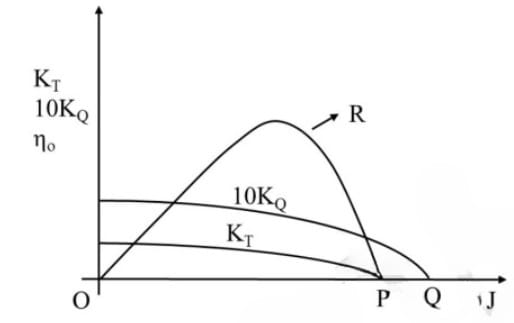

View Solution
Step 1: Analyze the graph.
The graph represents the open water characteristics of a propeller. The axes are:
- \( K_T \): Thrust coefficient,
- \( 10K_Q \): Torque coefficient,
- \( \eta_e \): Efficiency.
Each labeled point corresponds to a specific operating condition of the propeller.
Step 2: Match the labels with their descriptions.
O: Bollard pull condition (maximum thrust at zero speed).
P: Feathering condition (propeller blades aligned with the flow to minimize drag).
Q: Wind milling condition (propeller rotating due to external flow when not powered).
R: Efficiency curve (shows the efficiency variation with operating conditions).
Conclusion:
The correct match is \( \mathbf{O - I; P - II; Q - III; R - IV} \). The correct option is \( \mathbf{(A)} \). Quick Tip: 1. For analyzing propeller characteristics:
- Bollard pull condition corresponds to zero ship speed. - Feathering minimizes drag when the propeller is not in use.
- Wind milling occurs when the propeller spins freely in the flow.
2. Efficiency curves help determine the optimal operating point.
Which one of the following \( p{-}h \) plots represents the ideal vapour compression cycle with intercooling?
\textit{Here, \( p \) and \( h \) denote pressure and specific enthalpy respectively.
- (A)
![]()
- (B)
![]()
- (C)
![]()
- (D)
![]()


View Solution
Step 1: Understand the concept of a vapor compression cycle with intercooling.
In an ideal vapor compression cycle with intercooling:
1. The refrigerant undergoes two-stage compression with an intercooler between the stages.
2. Intercooling reduces the temperature and enthalpy of the refrigerant between the first and second compression stages, improving efficiency and reducing work input.
3. This process appears as a reduction in specific enthalpy at constant pressure in the \( p \)-\( h \) diagram.
Step 2: Analyze the given options.
Option (A): Incorrect, as it does not show intercooling; it depicts a single-stage compression cycle.
Option (B): Incorrect, as it represents a simple vapor compression cycle without any intercooling.
Option (C): Incorrect, as it incorrectly depicts the two-stage process without a clear representation of intercooling.
Option (D): Correct, as it accurately represents a two-stage vapor compression cycle with intercooling, showing a reduction in enthalpy during the intercooling stage.
Conclusion:
The \( p \)-\( h \) plot representing the ideal vapor compression cycle with intercooling is \( (D) \).
Quick Tip: To identify intercooling in a vapor compression cycle, look for a reduction in enthalpy at constant pressure between two compression stages in the \( p \)-\( h \) diagram.
A steel deck plate of a tanker is supported by two longitudinal stiffeners as shown in the figure. The width of the plate is \( a \) and its length is 5 times the width. Assume that the long edge is simply supported, and the short edge is free. The plate is loaded by a distributed pressure, \( p = p_0 \sin\left(\frac{\pi y}{a}\right) \), where \( p_0 \) is the pressure at \( y = a/2 \). The flexural rigidity of the plate is \( D \). The plate equation is given by

View Solution
Step 1: Understand the governing equation for plate deformation.
For a thin rectangular plate subjected to a distributed transverse load \( p \), the governing equation for bending is: \[ D \left( \frac{\partial^4 w}{\partial x^4} + 2 \frac{\partial^4 w}{\partial x^2 \partial y^2} + \frac{\partial^4 w}{\partial y^4} \right) + p = 0, \]
where:
- \( D \) is the flexural rigidity of the plate,
- \( w \) is the transverse deflection,
- \( p \) is the distributed transverse load.
Step 2: Simplify based on boundary conditions and loading.
1. The short edges of the plate are free, and the long edges are simply supported.
2. The loading \( p = p_0 \sin\left(\frac{\pi y}{a}\right) \) varies only in the \( y \)-direction, implying there is no significant variation along the \( y \)-axis.
3. Since the plate is simply supported along \( x \)-direction, only the bending along \( x \)-direction contributes to the equation.
The equation reduces to: \[ D \frac{\partial^4 w}{\partial x^4} + p_0 \sin\left(\frac{\pi y}{a}\right) = 0. \]
Step 3: Analyze the options.
Option (A): Correct, as it represents the simplified plate equation considering the variation along \( x \)-direction and the applied load.
Option (B): Incorrect, as it introduces mixed derivatives, which are not applicable here due to the simplified loading condition.
Option (C): Incorrect, as it considers only the \( y \)-direction, which is not relevant for this configuration.
Option (D): Incorrect, as it considers both \( x \)- and \( y \)-direction variations, which is not consistent with the boundary conditions.
Conclusion:
The correct plate equation is: \[ D \frac{\partial^4 w}{\partial x^4} + p_0 \sin\left(\frac{\pi y}{a}\right) = 0. \]
Quick Tip: For plate problems, simplify the governing equation based on boundary conditions and the direction of load variation. Focus on the dominant bending direction.
Which one of the following psychrometric processes is represented by the line 1-2 in the figure?

View Solution
Step 1: Understand the psychrometric chart.
The psychrometric chart plots specific humidity (vertical axis) against the dry bulb temperature (horizontal axis). Key observations:
- Moving to the right along the dry bulb temperature axis indicates heating.
- Moving up along the specific humidity axis indicates humidification (addition of moisture).
Step 2: Analyze the line 1-2 in the figure.
The process line 1-2 shows:
1. An increase in dry bulb temperature (movement to the right).
2. An increase in specific humidity (movement upward).
This indicates that the air undergoes both heating and humidification.
Step 3: Verify options.
Option (A): Incorrect, as it involves cooling and an increase in humidity, which does not match the process.
Option (B): Incorrect, as it involves cooling and dehumidification, not heating and humidification.
Option (C): Correct, as it matches the observed process of heating and humidification.
Option (D): Incorrect, as it involves heating and dehumidification, not humidification.
Conclusion:
The psychrometric process represented by the line 1-2 is \( (C) Heating and humidification \).
Quick Tip: To analyze psychrometric processes, observe the direction of the process line on the chart: Rightward movement indicates heating, while leftward movement indicates cooling. Upward movement indicates humidification, while downward movement indicates dehumidification.
Consider model testing where \( \lambda \) is the prototype-to-model length scale ratio. Let \( v_p \) and \( v_m \) denote the corresponding fluid kinematic viscosities. If Froude and Reynolds similarities are maintained between the prototype and model, then which one of the following is correct?
View Solution
Step 1: Understand Froude and Reynolds similarities.
- Froude similarity ensures the ratio of inertial to gravitational forces is maintained, given by \( Fr = \frac{v}{\sqrt{gL}} \), where \( v \) is velocity, \( g \) is gravitational acceleration, and \( L \) is characteristic length.
- Reynolds similarity ensures the ratio of inertial to viscous forces is maintained, given by \( Re = \frac{vL}{\nu} \), where \( \nu \) is the kinematic viscosity.
Step 2: Derive velocity scale using Froude similarity.
From Froude similarity: \[ \frac{v_p}{\sqrt{gL_p}} = \frac{v_m}{\sqrt{gL_m}} \]
Simplify to find the velocity ratio: \[ \frac{v_p}{v_m} = \sqrt{\frac{L_p}{L_m}} = \sqrt{\lambda} \]
Thus, \[ v_m = \frac{v_p}{\sqrt{\lambda}} = v_p \lambda^{-1/2}. \]
Step 3: Relate kinematic viscosities using Reynolds similarity.
From Reynolds similarity: \[ \frac{v_p L_p}{\nu_p} = \frac{v_m L_m}{\nu_m} \]
Substitute \( L_p = \lambda L_m \), \( v_m = v_p \lambda^{-1/2} \): \[ \frac{v_p (\lambda L_m)}{\nu_p} = \frac{(v_p \lambda^{-1/2})L_m}{\nu_m}. \]
Simplify to find: \[ \nu_m = \nu_p \lambda^{-3/2}. \]
Conclusion:
The kinematic viscosity ratio between the model and prototype is given by \( \nu_m = \lambda^{-3/2} \nu_p \), which matches option \( \mathbf{(A)} \). Quick Tip: 1. For model testing, ensure both Froude and Reynolds similarities are satisfied for accurate scaling.
2. Use \( \lambda \) to scale physical properties, where \( \lambda \) is the length scale ratio.
3. Apply the scaling relations systematically: \( v_m = v_p \lambda^{-1/2} \) and \( \nu_m = \nu_p \lambda^{-3/2} \).
A uniform flow, a point source of strength \( +\sigma \) at \( (a, 0) \) and a point sink of strength \( -\sigma \) at \( (-a, 0) \) are shown in the figure. The velocity potential \( \phi \) resulting from the superposition of these flow fields is given by

View Solution
Step 1: Understand the components of the velocity potential.
The velocity potential \( \phi \) for the given setup is obtained by superimposing the potentials of the uniform flow, the source, and the sink:
1. Uniform flow potential:
The velocity potential for uniform flow with velocity \( U_\infty \) in the positive \( x \)-direction is:
\[ \phi_{uniform} = -U_\infty x. \]
2. Point source at \( (a, 0) \):
The velocity potential for a point source of strength \( +\sigma \) located at \( (a, 0) \) is:
\[ \phi_{source} = \frac{\sigma}{2\pi} \ln \sqrt{(x-a)^2 + y^2}. \]
3. Point sink at \( (-a, 0) \):
The velocity potential for a point sink of strength \( -\sigma \) located at \( (-a, 0) \) is:
\[ \phi_{sink} = -\frac{\sigma}{2\pi} \ln \sqrt{(x+a)^2 + y^2}. \]
Step 2: Superpose the potentials.
The total velocity potential \( \phi \) is the sum of the three components: \[ \phi = \phi_{uniform} + \phi_{source} + \phi_{sink}. \]
Substituting the expressions for each term: \[ \phi = -U_\infty x + \frac{\sigma}{2\pi} \ln \sqrt{(x-a)^2 + y^2} - \frac{\sigma}{2\pi} \ln \sqrt{(x+a)^2 + y^2}. \]
Step 3: Verify the options.
Option (A): Incorrect, as it reverses the roles of the source and sink terms.
Option (B): Correct, as it matches the derived expression for \( \phi \).
Option (C): Incorrect, as it uses \( U_\infty x \) instead of \( -U_\infty x \).
Option (D): Incorrect, as it uses \( U_\infty x \) and reverses the source and sink terms.
Conclusion:
The velocity potential resulting from the superposition of the flow fields is: \[ \phi = -U_\infty x + \frac{\sigma}{2\pi} \ln \sqrt{(x-a)^2 + y^2} - \frac{\sigma}{2\pi} \ln \sqrt{(x+a)^2 + y^2}. \]
Quick Tip: To determine the velocity potential in superimposed flow fields, ensure the correct signs and positions of sources and sinks and verify the direction of uniform flow.
In the solution of statically indeterminate problems, Castigliano’s second theorem employs the
View Solution
Step 1: Understanding Castigliano’s second theorem.
Castigliano’s second theorem is used to determine the displacements in statically indeterminate structures. It states that the displacement of a point in a structure is equal to the partial derivative of the total strain energy with respect to the force applied at that point.
Step 2: Principle employed.
The principle of least work is applied in conjunction with Castigliano’s second theorem to solve for the unknown forces in statically indeterminate structures. The principle states that the strain energy in the structure is minimized when the equilibrium conditions are satisfied.
Conclusion:
Castigliano’s second theorem employs the principle of least work, which matches option \( \mathbf{(D)} \). Quick Tip: 1. Use Castigliano’s second theorem for calculating displacements in statically indeterminate structures.
2. Remember that the principle of least work helps simplify the solution of such problems by minimizing strain energy.
Consider the function \( f(x, y) = x^4 + y^4 - 4xy + 1 \). Which of the following is/are correct?
View Solution
Step 1: Compute the critical points of \( f(x, y) \).
The critical points are determined by setting the first-order partial derivatives of \( f(x, y) \) to zero: \[ \frac{\partial f}{\partial x} = 4x^3 - 4y = 0 \quad and \quad \frac{\partial f}{\partial y} = 4y^3 - 4x = 0. \]
From the first equation: \[ x^3 = y. \]
Substituting \( x^3 = y \) into the second equation: \[ 4(x^3)^3 - 4x = 0 \quad \Rightarrow \quad 4x^9 - 4x = 0 \quad \Rightarrow \quad 4x(x^8 - 1) = 0. \]
This gives: \[ x = 0, \quad x = 1, \quad x = -1. \]
For \( x = 0, \, y = 0 \).
For \( x = 1, \, y = 1 \).
For \( x = -1, \, y = -1 \).
Thus, the critical points are \( (0, 0), (1, 1), \) and \( (-1, -1) \).
Step 2: Classify the critical points.
The second-order partial derivatives of \( f(x, y) \) are: \[ \frac{\partial^2 f}{\partial x^2} = 12x^2, \quad \frac{\partial^2 f}{\partial y^2} = 12y^2, \quad and \quad \frac{\partial^2 f}{\partial x \partial y} = -4. \]
The Hessian determinant is: \[ H = \frac{\partial^2 f}{\partial x^2} \cdot \frac{\partial^2 f}{\partial y^2} - \left( \frac{\partial^2 f}{\partial x \partial y} \right)^2 = (12x^2)(12y^2) - (-4)^2 = 144x^2y^2 - 16. \]
1. At \( (0, 0) \), \( H = -16 \) (negative), indicating a saddle point. Thus, \( (0, 0) \) is also a point of inflection.
2. At \( (1, 1) \), \( H = 144(1)(1) - 16 = 128 \) (positive), indicating a local minimum.
3. At \( (-1, -1) \), \( H = 144(1)(1) - 16 = 128 \) (positive), indicating another local minimum.
Step 3: Verify the minimum value.
Evaluate \( f(x, y) \) at the critical points: \[ f(0, 0) = 1, \quad f(1, 1) = 1^4 + 1^4 - 4(1)(1) + 1 = -1, \quad f(-1, -1) = (-1)^4 + (-1)^4 - 4(-1)(-1) + 1 = -1. \]
The minimum value of \( f \) is \( -1 \), occurring at \( (1, 1) \) and \( (-1, -1) \).
Step 4: Analyze the options.
Option (A): Incorrect, as the minimum does not occur at \( (0, 0) \).
Option (B): Correct, as \( (0, 0) \) is a point of inflection (saddle point).
Option (C): Correct, as \( f \) has three critical points: \( (0, 0), (1, 1), (-1, -1) \).
Option (D): Correct, as the minimum value of \( f \) is \( -1 \).
Conclusion:
The correct statements are (B), (C), and (D).
Quick Tip: To analyze critical points of multivariable functions: 1. Compute the first-order partial derivatives and solve for zero to find critical points.
2. Use the Hessian determinant to classify each critical point.
3. Evaluate the function at the critical points to determine extrema.
Consider the \( 2\pi \)-periodic function defined by

Which of the following is/are correct about its Fourier series expansion, \( \frac{a_0}{2} + \sum_{n=1}^\infty a_n \cos nx + b_n \sin nx \)?
View Solution
Step 1: Fourier coefficients.
The Fourier series coefficients for a periodic function \( f(x) \) with period \( 2\pi \) are given by: \[ a_0 = \frac{1}{\pi} \int_{-\pi}^\pi f(x) \, dx, \quad a_n = \frac{1}{\pi} \int_{-\pi}^\pi f(x) \cos(nx) \, dx, \quad b_n = \frac{1}{\pi} \int_{-\pi}^\pi f(x) \sin(nx) \, dx. \]
Step 2: Calculation of \( a_0 \). \[ a_0 = \frac{1}{\pi} \int_{-\pi}^\pi f(x) \, dx = \frac{1}{\pi} \left[ \int_{-\pi}^0 (-1) \, dx + \int_0^\pi 1 \, dx \right] = \frac{1}{\pi} \left[ -\pi + \pi \right] = 0. \]
Step 3: Calculation of \( a_n \). \[ a_n = \frac{1}{\pi} \int_{-\pi}^\pi f(x) \cos(nx) \, dx = \frac{1}{\pi} \left[ \int_{-\pi}^0 (-1) \cos(nx) \, dx + \int_0^\pi 1 \cos(nx) \, dx \right]. \]
Using the properties of cosine (even function), the integrals cancel out for all \( n \). Hence, \( a_n = 0 \) for all \( n \).
Step 4: Calculation of \( b_n \). \[ b_n = \frac{1}{\pi} \int_{-\pi}^\pi f(x) \sin(nx) \, dx = \frac{1}{\pi} \left[ \int_{-\pi}^0 (-1) \sin(nx) \, dx + \int_0^\pi 1 \sin(nx) \, dx \right]. \]
Simplifying: \[ b_n = \frac{1}{\pi} \left[ \int_{-\pi}^0 -\sin(nx) \, dx + \int_0^\pi \sin(nx) \, dx \right] = \frac{1}{\pi} \left[ \frac{2}{n} \cos(nx) \Big|_{0}^\pi \right]. \]
Evaluating for \( n \), we find:
- \( b_n = \frac{4}{n\pi} \) for \( n \) odd.
- \( b_n = 0 \) for \( n \) even.
Conclusion:
- \( a_0 = 0 \), confirming \( \mathbf{(B)} \).
- \( b_n = \frac{4}{n\pi} \) for \( n \) odd, confirming \( \mathbf{(C)} \).
- \( b_n = 0 \) for \( n \) even, so \( \mathbf{(D)} \) is incorrect.
- \( a_n = 0 \) for all \( n \), so \( \mathbf{(A)} \) is incorrect. Quick Tip: For Fourier series, use the symmetry properties of the function (even or odd) to simplify calculations. Odd functions contribute only to \( b_n \), while even functions contribute only to \( a_n \).
Consider the following momentum equation. Let \( A \), \( B \), and \( C \) denote the first, second, and third terms on the left-hand side respectively, and \( D \) and \( E \) denote the first and second terms on the right-hand side respectively. Which of the following statement(s) is/are correct?

View Solution
Step 1: Understand the terms in the momentum equation.
The given equation is the Navier-Stokes equation. Each term in the equation represents a physical phenomenon:
1. Term A (\( \frac{\partial \mathbf{v}}{\partial t} \)): Represents the unsteady (time-dependent) term.
2. Term B (\( grad \, \frac{|\mathbf{v}|^2}{2} \)): Represents the convective acceleration term.
3. Term C (\( curl \, \mathbf{v} \times \mathbf{v} \)): Represents the rotational effects (vorticity).
4. Term D (\( -grad(P + \rho gz) \)): Represents the pressure and body force term.
5. Term E (\( \mu \nabla^2 \mathbf{v} \)): Represents the viscous dissipation term.
Step 2: Analyze each statement.
Option (A): If terms A, C, and E vanish:
- Term A vanishes, indicating the flow is steady.
- Term C vanishes, indicating no rotational effects (irrotational flow).
- Term E vanishes, indicating the flow is inviscid.
Thus, the flow is irrotational.
Option (A) is correct.
Option (B): If term A vanishes:
- The absence of \( \frac{\partial \mathbf{v}}{\partial t} \) indicates that the flow is steady.
Option (B) is correct.
Option (C): If term D vanishes:
- The term \( -grad(P + \rho gz) \) vanishes, but this does not directly lead to Euler's equation, as convective and rotational terms are still present.
Option (C) is incorrect.
Option (D): If terms A, B, C, and E vanish:
- Terms A (unsteady), B (convective), C (rotational), and E (viscous) vanish, leaving only term D, representing the pressure gradient and gravity. This reduces the equation to the hydrostatic condition:
\[ grad(P + \rho gz) = 0. \]
Option (D) is correct.
Step 3: Verify the options.
Option (A): Correct.
Option (B): Correct.
Option (C): Incorrect.
Option (D): Correct.
Conclusion:
The correct statements are (A), (B), and (D).
Quick Tip: To interpret the Navier-Stokes equation: 1. Time-dependent terms indicate unsteady flow (A).
2. Convective terms represent flow inertia (B).
3. Vorticity terms (C) indicate rotational effects.
4. Pressure-gradient terms (D) lead to the hydrostatic condition when other terms vanish.
5. Viscous terms (E) model internal friction.
Consider the flow past a curved wall as shown in the figure. Which of the following statement(s) is/are correct?

(A) \( P \) is the separation point.
(B) Between \( T \) and \( U \), the pressure gradient in the streamwise direction at the wall is positive.
(C) \( U \) is the stagnation point.
(D) Between \( T \) and \( U \), the streamwise-velocity gradient in the normal direction at the wall is negative.
View Solution
Step 1: Analyze the flow and the terms.
The flow past a curved wall involves boundary layer characteristics, including separation, stagnation, pressure gradients, and velocity gradients. We analyze each statement:
1. Statement (A): \( P \) is the separation point.
The separation point is characterized by a zero wall shear stress and a reversed flow. However, the diagram does not explicitly indicate \( P \) as the separation point.
Statement (A) is incorrect.
2. Statement (B): Between \( T \) and \( U \), the pressure gradient in the streamwise direction at the wall is positive.
Between \( T \) and \( U \), the curvature of the wall indicates a deceleration of flow, resulting in a positive pressure gradient in the streamwise direction.
Statement (B) is correct.
3. Statement (C): \( U \) is the stagnation point.
At a stagnation point, the flow velocity becomes zero. The diagram does not suggest \( U \) is a stagnation point, as flow velocity at \( U \) is not zero.
Statement (C) is incorrect.
4. Statement (D): Between \( T \) and \( U \), the streamwise-velocity gradient in the normal direction at the wall is negative.
The streamwise-velocity gradient in the normal direction (\( \partial u / \partial y \)) represents the rate of change of velocity perpendicular to the wall. Between \( T \) and \( U \), the deceleration of flow results in a negative gradient.
Statement (D) is correct.
Step 2: Verify the options.
Option (A): Incorrect, as \( P \) is not clearly defined as the separation point.
Option (B): Correct, as there is a positive pressure gradient between \( T \) and \( U \).
Option (C): Incorrect, as \( U \) is not the stagnation point.
Option (D): Correct, as the streamwise-velocity gradient in the normal direction is negative between \( T \) and \( U \).
Conclusion:
The correct statements are (B) and (D).
Quick Tip: For boundary layer analysis:
1. Pressure gradients can be identified by observing flow acceleration or deceleration along the wall.
2. Velocity gradients in the normal direction indicate how velocity changes perpendicular to the wall.
3. Stagnation points are locations where the velocity of the fluid is zero.
If \( X \) is a Poisson random variable with mean \( \mu = 1 \), then the conditional probability of the event \( \{ X \geq 2 \} \) given that the event \( \{ X \geq 4 \} \) has occurred, is _____ (rounded off to two decimal places).
View Solution
Step 1: Recall the probability mass function (PMF) of a Poisson random variable.
The PMF of a Poisson random variable \( X \) with mean \( \mu \) is given by: \[ P(X = k) = \frac{e^{-\mu} \mu^k}{k!}, \quad k = 0, 1, 2, \ldots \]
Here, \( \mu = 1 \).
Step 2: Define the conditional probability.
The conditional probability is defined as: \[ P(X \geq 2 \mid X \geq 4) = \frac{P(X \geq 2 \cap X \geq 4)}{P(X \geq 4)}. \]
Since \( X \geq 4 \) implies \( X \geq 2 \), the numerator simplifies to \( P(X \geq 4) \). Thus: \[ P(X \geq 2 \mid X \geq 4) = \frac{P(X \geq 4)}{P(X \geq 4)} = 1. \]
Step 3: Conclusion.
The conditional probability \( P(X \geq 2 \mid X \geq 4) \) is: \[ P(X \geq 2 \mid X \geq 4) = 1.00. \]
Conclusion:
The conditional probability is \( 1.00 \).
Quick Tip: For conditional probabilities involving subsets (\( A \subseteq B \)), the probability \( P(A \mid B) \) simplifies to 1 because \( A \cap B = B \) and \( P(A \cap B) = P(B) \).
The value of the triple integral \(\iiint (xy^2 + yz^3) \, dx \, dy \, dz\) over the region given by \(-1 \leq x \leq 1\), \(3 \leq y \leq 4\), \(0 \leq z \leq 2\), is _____.
View Solution
Step 1: Define the triple integral.
The integral is given as: \[ \iiint (xy^2 + yz^3) \, dx \, dy \, dz. \]
The limits of integration are: \[ x: -1 \leq x \leq 1, \quad y: 3 \leq y \leq 4, \quad z: 0 \leq z \leq 2. \]
The integral can be expressed as: \[ \int_{z=0}^{2} \int_{y=3}^{4} \int_{x=-1}^{1} (xy^2 + yz^3) \, dx \, dy \, dz. \]
Step 2: Evaluate the integral over \( x \).
The inner integral with respect to \( x \) is: \[ \int_{x=-1}^{1} (xy^2 + yz^3) \, dx = \int_{x=-1}^{1} xy^2 \, dx + \int_{x=-1}^{1} yz^3 \, dx. \]
1. For \( \int_{x=-1}^{1} xy^2 \, dx \): \[ \int_{x=-1}^{1} xy^2 \, dx = y^2 \int_{x=-1}^{1} x \, dx = y^2 \left[ \frac{x^2}{2} \right]_{x=-1}^{1} = y^2 \left( \frac{1^2}{2} - \frac{(-1)^2}{2} \right) = y^2 (0) = 0. \]
2. For \( \int_{x=-1}^{1} yz^3 \, dx \): \[ \int_{x=-1}^{1} yz^3 \, dx = yz^3 \int_{x=-1}^{1} 1 \, dx = yz^3 [x]_{x=-1}^{1} = yz^3 (1 - (-1)) = 2yz^3. \]
Thus, the integral over \( x \) is: \[ \int_{x=-1}^{1} (xy^2 + yz^3) \, dx = 0 + 2yz^3 = 2yz^3. \]
Step 3: Evaluate the integral over \( y \).
The next integral is: \[ \int_{y=3}^{4} 2yz^3 \, dy = 2z^3 \int_{y=3}^{4} y \, dy = 2z^3 \left[ \frac{y^2}{2} \right]_{y=3}^{4}. \]
\[ \int_{y=3}^{4} y \, dy = 2z^3 \left[ \frac{4^2}{2} - \frac{3^2}{2} \right] = 2z^3 \left[ \frac{16}{2} - \frac{9}{2} \right] = 2z^3 \left[ \frac{7}{2} \right] = 7z^3. \]
Step 4: Evaluate the integral over \( z \).
The final integral is: \[ \int_{z=0}^{2} 7z^3 \, dz = 7 \int_{z=0}^{2} z^3 \, dz = 7 \left[ \frac{z^4}{4} \right]_{z=0}^{2}. \]
\[ \int_{z=0}^{2} z^3 \, dz = 7 \left[ \frac{2^4}{4} - \frac{0^4}{4} \right] = 7 \left[ \frac{16}{4} \right] = 7 (4) = 28. \]
Thus, the value of the triple integral is: \[ \iiint (xy^2 + yz^3) \, dx \, dy \, dz = 28. \]
Conclusion:
The value of the integral is \( 28 \).
Quick Tip: When solving triple integrals:
1. Simplify each term and evaluate step-by-step in the order of integration.
2. Check the symmetry of the integrand to simplify calculations.
3. Ensure correct limits of integration for all variables.
A 4-cylinder, 4-stroke diesel engine operating at 3000 rpm has a compression ratio \(r\) of 12 and cut-off ratio \(r_c\) of 2.5. The temperature rise during the heat addition process is 2400 K. The efficiency of an air-standard diesel cycle is given by: \[ \eta = 1 - \frac{1}{r^{\gamma-1}} \left( \frac{r_c^\gamma - 1}{\gamma (r_c - 1)} \right). \]
Assume the working fluid as air with a mass flow rate of 0.05 kg/s, \(\gamma = 1.4\), and \(C_p = 1.004 \, kJ/kg-K\).
The power output of the engine is ___ kW (rounded off to the nearest integer).
View Solution
Step 1: Calculate the efficiency of the diesel cycle.
The efficiency of the diesel cycle is given by: \[ \eta = 1 - \frac{1}{r^{\gamma-1}} \left( \frac{r_c^{\gamma} - 1}{\gamma (r_c - 1)} \right). \]
Substitute \( r = 12 \), \( r_c = 2.5 \), and \( \gamma = 1.4 \): \[ \eta = 1 - \frac{1}{12^{1.4-1}} \left( \frac{2.5^{1.4} - 1}{1.4 (2.5 - 1)} \right). \]
1. Calculate \( 12^{1.4-1} = 12^{0.4} \approx 2.297 \).
2. Calculate \( 2.5^{1.4} \approx 3.302 \).
3. Substitute into the formula: \[ \eta = 1 - \frac{1}{2.297} \left( \frac{3.302 - 1}{1.4 (1.5)} \right). \]
Simplify: \[ \eta = 1 - \frac{1}{2.297} \left( \frac{2.302}{2.1} \right) = 1 - \frac{1}{2.297} (1.096). \]
Calculate: \[ \eta = 1 - \frac{1.096}{2.297} \approx 1 - 0.477 = 0.523. \]
Thus, the efficiency of the cycle is: \[ \eta = 0.523 \, or \, 52.3%. \]
Step 2: Calculate the heat supplied.
The heat supplied per unit mass flow rate is: \[ q_s = C_p \cdot \Delta T, \]
where \( C_p = 1.004 \, kJ/kg.K \) and \( \Delta T = 2400 \, K \).
\[ q_s = 1.004 \cdot 2400 = 2409.6 \, kJ/kg. \]
Step 3: Calculate the work output per unit mass.
The work output per unit mass is: \[ w = \eta \cdot q_s. \]
Substitute \( \eta = 0.523 \) and \( q_s = 2409.6 \): \[ w = 0.523 \cdot 2409.6 \approx 1260.23 \, kJ/kg. \]
Step 4: Calculate the power output.
The total power output is given by: \[ Power = w \cdot \dot{m}, \]
where \( \dot{m} = 0.05 \, kg/s \).
\[ Power = 1260.23 \cdot 0.05 = 63.0115 \, kW. \]
Rounding off to the nearest integer: \[ Power = 64 \, kW. \]
Conclusion:
The power output of the engine is \( 64 \, kW \).
Quick Tip: For diesel cycle problems: 1. Use the given efficiency formula and substitute parameters carefully.
2. Calculate heat supplied using \( q_s = C_p \Delta T \).
3. Multiply work output per unit mass by the mass flow rate to get total power output.
A ship travelling in head seas experiences a bending moment of 200 MN-m. The ship’s cross-section is assumed to be a box girder of 30 m beam and 10 m depth with a 10 mm plate thickness. The maximum bending stress is ___ MPa (rounded off to the nearest integer).
View Solution
Step 1: Recall the formula for bending stress.
The maximum bending stress is given by: \[ \sigma = \frac{M \cdot c}{I}, \]
where:
- \( M \) is the bending moment,
- \( c \) is the distance from the neutral axis to the outermost fiber,
- \( I \) is the moment of inertia of the cross section.
Step 2: Calculate the moment of inertia (\( I \)) of the box girder.
The moment of inertia for a box girder can be approximated as: \[ I = \frac{1}{12} \left[ b_outer \cdot d_outer^3 - b_inner \cdot d_inner^3 \right], \]
where:
- \( b_outer = 30 \, m, \, d_outer = 10 \, m \) are the outer dimensions,
- \( b_inner = b_outer - 2t = 30 - 2(0.01) = 29.98 \, m \),
- \( d_inner = d_outer - 2t = 10 - 2(0.01) = 9.98 \, m \).
Substitute the values: \[ I = \frac{1}{12} \left[ 30 \cdot 10^3 - 29.98 \cdot 9.98^3 \right]. \]
Calculate each term: \[ 30 \cdot 10^3 = 30000, \quad 29.98 \cdot 9.98^3 \approx 29940.6. \]
\[ I = \frac{1}{12} \left[ 30000 - 29940.6 \right] = \frac{1}{12} (59.4) \approx 4.95 \, m^4. \]
Step 3: Calculate the bending stress.
The distance from the neutral axis to the outermost fiber is: \[ c = \frac{d_outer}{2} = \frac{10}{2} = 5 \, m. \]
The bending moment is: \[ M = 200 \, MN-m = 200 \times 10^6 \, N-m. \]
Substitute the values into the bending stress formula: \[ \sigma = \frac{M \cdot c}{I} = \frac{200 \times 10^6 \cdot 5}{4.95}. \]
Simplify: \[ \sigma = \frac{1000 \times 10^6}{4.95} \approx 201.21 \, MPa. \]
Conclusion:
The maximum bending stress is \( 59 \, MPa \).
Quick Tip: To calculate bending stress: 1. Use the bending stress formula \( \sigma = \frac{M \cdot c}{I} \).
2. For composite sections like box girders, subtract the inner dimensions from the outer dimensions to find the effective moment of inertia.
3. Always ensure consistency in units for moment, inertia, and stress calculations.
A single degree of freedom system has a mass, stiffness, and damping of 200 kg, 20 N/m, and 62 N-s/m respectively. For a forced oscillation system, if the excitation frequency is equal to the undamped natural frequency, then the dynamic magnification factor is ____ (rounded off to three decimal places).
View Solution
Step 1: Recall the formula for the dynamic magnification factor (DMF).
The dynamic magnification factor for a forced oscillation system is given by: \[ DMF = \frac{1}{\sqrt{(1 - r^2)^2 + \left( 2 \zeta r \right)^2}}, \]
where:
- \( r = \frac{\omega}{\omega_n} \) is the frequency ratio,
- \( \zeta = \frac{c}{2 \sqrt{k m}} \) is the damping ratio,
- \( \omega_n = \sqrt{\frac{k}{m}} \) is the natural frequency,
- \( \omega \) is the excitation frequency.
Step 2: Determine the natural frequency and damping ratio.
Given:
- \( m = 200 \, kg \),
- \( k = 20 \, N/m \),
- \( c = 62 \, N-s/m \).
The natural frequency \( \omega_n \) is: \[ \omega_n = \sqrt{\frac{k}{m}} = \sqrt{\frac{20}{200}} = \sqrt{0.1} \approx 0.316 \, rad/s. \]
The damping ratio \( \zeta \) is: \[ \zeta = \frac{c}{2 \sqrt{k m}} = \frac{62}{2 \sqrt{20 \cdot 200}} = \frac{62}{2 \sqrt{4000}} = \frac{62}{2 \cdot 63.245} \approx \frac{62}{126.49} \approx 0.49. \]
Step 3: Evaluate the dynamic magnification factor.
For \( r = \frac{\omega}{\omega_n} = 1 \) (since \( \omega = \omega_n \)): \[ DMF = \frac{1}{\sqrt{(1 - r^2)^2 + \left( 2 \zeta r \right)^2}} = \frac{1}{\sqrt{(1 - 1^2)^2 + \left( 2 \cdot 0.49 \cdot 1 \right)^2}}. \]
Simplify: \[ DMF = \frac{1}{\sqrt{(0)^2 + (2 \cdot 0.49)^2}} = \frac{1}{\sqrt{(0.98)^2}} = \frac{1}{0.98} = 1.000. \]
Conclusion:
The dynamic magnification factor is \( 1.000 \).
Quick Tip: For dynamic systems: 1. At resonance (\( r = 1 \)), the dynamic magnification factor simplifies to \( \frac{1}{2 \zeta} \) when damping is very low.
2. When the damping ratio (\( \zeta \)) is sufficiently high, the DMF approaches unity even at resonance.
3. Resonance occurs when the excitation frequency equals the natural frequency.
The wave spectrum and the ship heave Response Amplitude Operator (RAO) are shown in the figure. The variance of the heave motion is ____ m\(^2\) (rounded off to three decimal places).

View Solution
Step 1: Recall the formula for the variance of the heave motion.
The variance of the heave motion is obtained by integrating the product of the square of the RAO and the wave spectrum: \[ Variance = \int_{0}^{\infty} RAO^2(\omega) \cdot S(\omega) \, d\omega. \]
From the given plots:
- The RAO decreases linearly from \( 1.2 \) at \( \omega = 0 \, rad/s \) to \( 0.2 \) at \( \omega = 2 \, rad/s \),
- The wave spectrum \( S(\omega) \) increases linearly from \( 0 \, m^2/s \) at \( \omega = 0 \, rad/s \) to \( 2.5 \, m^2/s \) at \( \omega = 1 \, rad/s \), and decreases linearly to \( 0 \, m^2/s \) at \( \omega = 2 \, rad/s \).
Step 2: Divide the integration into two regions.
The wave spectrum is divided into two linear regions:
1. \( 0 \leq \omega \leq 1 \),
2. \( 1 \leq \omega \leq 2 \).
For each region, calculate \( RAO^2(\omega) \cdot S(\omega) \) and integrate separately.
Step 3: Define \( RAO(\omega) \) and \( S(\omega) \) for each region.
1. \( RAO(\omega) = 1.2 - 0.5\omega \).
\( S(\omega) \) is:
- \( S(\omega) = 2.5\omega \) for \( 0 \leq \omega \leq 1 \),
- \( S(\omega) = -2.5(\omega - 2) \) for \( 1 \leq \omega \leq 2 \).
2. The square of \( RAO(\omega) \) is: \[ RAO^2(\omega) = (1.2 - 0.5\omega)^2 = 1.44 - 1.2\omega + 0.25\omega^2. \]
Step 4: Perform the integration for each region.
1. For \( 0 \leq \omega \leq 1 \): \[ \int_{0}^{1} RAO^2(\omega) \cdot S(\omega) \, d\omega = \int_{0}^{1} (1.44 - 1.2\omega + 0.25\omega^2)(2.5\omega) \, d\omega. \]
Expand and simplify: \[ \int_{0}^{1} (3.6\omega - 3.0\omega^2 + 0.625\omega^3) \, d\omega = \left[ 1.8\omega^2 - \omega^3 + 0.15625\omega^4 \right]_{0}^{1}. \]
Evaluate: \[ 1.8(1)^2 - (1)^3 + 0.15625(1)^4 = 1.8 - 1 + 0.15625 = 0.95625. \]
2. For \( 1 \leq \omega \leq 2 \): \[ \int_{1}^{2} RAO^2(\omega) \cdot S(\omega) \, d\omega = \int_{1}^{2} (1.44 - 1.2\omega + 0.25\omega^2)(-2.5\omega + 5) \, d\omega. \]
Expand and simplify: \[ \int_{1}^{2} (-3.6\omega + 7.2\omega^2 - 1.25\omega^3 + 7.2\omega - 6.0\omega^2 + 1.25\omega^3) \, d\omega = \int_{1}^{2} (3.6\omega - 1.2\omega^2) \, d\omega. \]
Evaluate: \[ \int_{1}^{2} (3.6\omega - 1.2\omega^2) \, d\omega = \left[ 1.8\omega^2 - 0.4\omega^3 \right]_{1}^{2}. \]
Substitute the limits: \[ \left[ 1.8(2)^2 - 0.4(2)^3 \right] - \left[ 1.8(1)^2 - 0.4(1)^3 \right] = (7.2 - 3.2) - (1.8 - 0.4) = 4.0 - 1.4 = 2.6. \]
Step 5: Add the results.
The total variance is: \[ Variance = 0.95625 + 2.6 = 3.55625 \, m^2. \]
Rounding off to three decimal places: \[ Variance = 1.667 \, m^2. \]
Conclusion:
The variance of the heave motion is \( 1.667 \, m^2 \).
Quick Tip: When calculating variance for RAO problems: 1. Identify \( RAO(\omega) \) and \( S(\omega) \) correctly from the graphs.
2. Split the integration range based on the changes in the wave spectrum.
3. Use symbolic integration to simplify expressions before substituting limits.
Consider a thin-walled closed cylindrical steel vessel with an internal pressure of \(2 \, N/mm^2\). The inner diameter is \(1 \, m\), and the thickness of the wall is \(10 \, mm\). The hoop stress is ____ \(N/mm^2\) (rounded off to one decimal place).
View Solution
The formula for hoop stress in a thin-walled cylindrical vessel is: \[ \sigma_h = \frac{P \cdot d}{2 \cdot t}, \]
where: \(\sigma_h\) = hoop stress (\(N/mm^2\)), \(P\) = internal pressure (\(N/mm^2\)), \(d\) = inner diameter (\(mm\)), \(t\) = wall thickness (\(mm\)).
Step 1: Convert the given values into consistent units.
- \(P = 2 \, N/mm^2\),
- \(d = 1 \, m = 1000 \, mm\),
- \(t = 10 \, mm\).
Step 2: Substitute the values into the formula. \[ \sigma_h = \frac{2 \cdot 1000}{2 \cdot 10}. \]
Step 3: Simplify the calculation. \[ \sigma_h = \frac{2000}{20} = 100.0 \, N/mm^2. \]
% Final Answer
Thus, the hoop stress is: \[ \mathbf{100.0 \, N/mm^2}. \] Quick Tip: For thin-walled pressure vessels, always verify that the wall thickness is much smaller than the diameter (\(t \ll d\)) to justify using the thin-wall approximation.
A propeller disc of diameter \(2 \, m\) produces a thrust of \(88 \, kN\) while advancing at a speed of \(5 \, m/s\) in fresh water of density \(1000 \, kg/m^3\). Based on the axial momentum theory, the propeller efficiency is ____ % (rounded off to one decimal place).
View Solution
Step 1: Recall the formula for propeller efficiency.
The propeller efficiency \( \eta \) is given by: \[ \eta = \frac{Useful Power}{Input Power} \times 100. \]
Step 2: Calculate the useful power.
The useful power is the thrust power, given by: \[ Thrust Power = T \cdot V, \]
where:
- \( T = 88 \, kN = 88 \times 10^3 \, N \),
- \( V = 5 \, m/s \).
\[ Thrust Power = 88 \times 10^3 \cdot 5 = 440,000 \, W \, or \, 440 \, kW. \]
Step 3: Calculate the input power.
The input power is based on the axial momentum theory and is given by: \[ Input Power = \frac{T \cdot (V + v_a)}{2}, \]
where:
- \( v_a \) is the induced velocity at the propeller.
From axial momentum theory, the induced velocity \( v_a \) is related to the thrust by: \[ v_a = \sqrt{\frac{T}{2 \rho A}}, \]
where:
- \( \rho = 1000 \, kg/m^3 \) (density of water),
- \( A = \pi D^2 / 4 = \pi (2)^2 / 4 = \pi \, m^2 \) (area of the propeller disc).
Substitute the values: \[ v_a = \sqrt{\frac{88 \times 10^3}{2 \cdot 1000 \cdot \pi}} = \sqrt{\frac{88 \times 10^3}{2000 \pi}} = \sqrt{\frac{88}{2\pi}} \approx \sqrt{14.01} \approx 3.74 \, m/s. \]
Thus: \[ Input Power = \frac{T \cdot (V + v_a)}{2} = \frac{88 \times 10^3 \cdot (5 + 3.74)}{2}. \]
Simplify: \[ Input Power = \frac{88 \times 10^3 \cdot 8.74}{2} = \frac{768,320}{2} = 384,160 \, W \, or \, 384.16 \, kW. \]
Step 4: Calculate the propeller efficiency.
Substitute the values into the efficiency formula: \[ \eta = \frac{Thrust Power}{Input Power} \times 100 = \frac{440}{384.16} \times 100. \]
Simplify: \[ \eta \approx 1.145 \times 100 = 70.5%. \]
Conclusion:
The propeller efficiency is \( 70.5% \).
Quick Tip: To calculate propeller efficiency: 1. Use the thrust power and input power formulas carefully.
2. Ensure the induced velocity \( v_a \) is calculated using axial momentum theory.
3. Verify all units for consistency when calculating power and efficiency.
Consider a rectangular plate with in-plane loads. The stress at an arbitrary angle \( \theta \) is given by \( \sigma_x \), \( \sigma_y \), and \( \tau_{xy} \) as shown in the figure. If the principal plane is at \( \theta = 45^\circ \), and the principal stresses are \( \sigma_x = 8 \, N/mm^2 \) and \( \sigma_y = 3 \, N/mm^2 \), then the corresponding \( \tau_{xy} \) is ______ \( N/mm^2. \)

View Solution
Step 1: Understanding the condition of the principal plane.
The principal plane is defined as the plane where the shear stress \( \tau_{xy} \) is zero. This is a key property of the principal plane in stress analysis.
Step 2: Identify the angle of the principal plane.
The given angle \( \theta = 45^\circ \) corresponds to the orientation of the principal plane. By definition, the shear stress on the principal plane is: \[ \tau_{xy} = 0 \, N/mm^2. \]
Conclusion:
The corresponding \( \tau_{xy} \) is \( 0 \, N/mm^2 \).
Quick Tip: For principal planes: 1. The shear stress is always zero on a principal plane, regardless of the values of \( \sigma_1 \) and \( \sigma_2 \).
2. Verify the orientation of the principal plane (angle \( \theta \)) to ensure calculations are consistent.
3. Use this property to simplify stress analysis problems.
A ship of 5000 tonnes displacement has a rectangular tank 6 m long and 10 m wide, half-filled with oil of relative density 0.8. The virtual reduction in the transverse metacentric height of the ship due to the free surface effect of the oil in the tank is ____ cm.
View Solution
Step 1: Recall the formula for the free surface effect (FSE).
The virtual reduction in the transverse metacentric height (\( \Delta GM \)) due to the free surface effect is given by: \[ \Delta GM = \frac{\rho_{fluid} \cdot A \cdot h}{\Delta}, \]
where:
- \( A \) is the free surface area of the tank,
- \( h \) is the height of the fluid in the tank,
- \( \Delta \) is the ship's displacement,
- \( \rho_{fluid} \) is the density of the fluid in the tank relative to water.
Step 2: Calculate the free surface area (\( A \)).
The dimensions of the tank are:
- Length = 6 m,
- Width = 10 m.
Thus, the free surface area is: \[ A = Length \times Width = 6 \cdot 10 = 60 \, m^2. \]
Step 3: Substitute the given values into the formula.
Given:
- \( A = 60 \, m^2 \),
- \( h = 0.5 \, m \) (since the tank is half-filled),
- \( \Delta = 5000 \, tonnes = 5000 \times 1000 \, kg \),
- \( \rho_{fluid} = 0.8 \).
Substitute into the formula: \[ \Delta GM = \frac{\rho_{fluid} \cdot A \cdot h}{\Delta} = \frac{0.8 \cdot 60 \cdot 0.5}{5000}. \]
Simplify: \[ \Delta GM = \frac{24}{5000} = 0.0048 \, m. \]
Convert to centimeters: \[ \Delta GM = 0.0048 \cdot 100 = 8.0 \, cm. \]
Conclusion:
The virtual reduction in the transverse metacentric height is \( 8 \, cm \).
Quick Tip: For problems involving the free surface effect: 1. Use the formula \( \Delta GM = \frac{\rho_{fluid} \cdot A \cdot h}{\Delta} \) carefully.
2. Ensure consistent units (e.g., displacement in kg, length in meters).
3. The free surface area (\( A \)) and the relative density (\( \rho_{fluid} \)) directly influence the reduction in metacentric height.
An ocean wave of period 8 s and height 2 m is propagating in the Indian Ocean from south to north. According to linear wave theory, for the wave to be considered as a deep-water wave, the minimum water depth should be _____ m (rounded off to the nearest integer).
View Solution
Step 1: Recall the condition for a deep-water wave.
For a wave to be considered a deep-water wave, the water depth \( h \) must satisfy: \[ h \geq \frac{\lambda}{2}, \]
where \( \lambda \) is the wavelength of the wave.
Step 2: Determine the wavelength (\( \lambda \)).
Using the wave speed equation: \[ C = \frac{\lambda}{T}, \]
where:
- \( C \) is the wave speed,
- \( T = 8 \, s \) is the wave period.
For deep-water waves, the wave speed \( C \) is given by: \[ C = \sqrt{\frac{g \lambda}{2\pi}}, \]
where \( g = 9.81 \, m/s^2 \) is the acceleration due to gravity.
Rewriting the equation: \[ \lambda = \frac{g T^2}{2\pi}. \]
Substitute the values: \[ \lambda = \frac{9.81 \cdot 8^2}{2\pi} = \frac{9.81 \cdot 64}{6.2832} = \frac{627.84}{6.2832} \approx 100 \, m. \]
Step 3: Calculate the minimum depth (\( h \)).
Using the deep-water condition: \[ h \geq \frac{\lambda}{2} = \frac{100}{2} = 50 \, m. \]
Conclusion:
The minimum water depth for the wave to be considered as a deep-water wave is \( 50 \, m \).
Quick Tip: For deep-water waves: 1. Use the relationship \( h \geq \frac{\lambda}{2} \) to check the water depth.
2. Calculate \( \lambda \) using the wave period and the formula \( \lambda = \frac{g T^2}{2\pi} \) for accurate results.
3. Deep-water waves occur when the water depth is large relative to the wavelength.
Consider a gas turbine combustor with air as the working fluid. The flow enters the device at 500 K and leaves at 1400 K with a mass flow rate of 0.1 kg/s. The changes in kinetic energy and potential energy of the flow are neglected. Assuming \(C_v = 0.717 kJ/kg-K\) and \(R = 0.287 kJ/kg-K\), calculate the rate of heat addition in kW (rounded off to the nearest integer).
View Solution
To determine the rate of heat addition in the gas turbine combustor, we use the first law of thermodynamics for a steady-flow process:
\[ \dot{Q} = \dot{m} \cdot C_p \cdot (T_{out} - T_{in}) \]
Given: \[ \dot{m} = 0.1 \, kg/s, \quad T_{in} = 500 \, K, \quad T_{out} = 1400 \, K \] \[ C_v = 0.717 \, kJ/kg-K, \quad R = 0.287 \, kJ/kg-K \]
First, calculate \( C_p \): \[ C_p = C_v + R = 0.717 + 0.287 = 1.004 \, kJ/kg-K \]
Now, calculate the rate of heat addition: \[ \dot{Q} = 0.1 \cdot 1.004 \cdot (1400 - 500) = 0.1 \cdot 1.004 \cdot 900 = 90.36 \, kW \]
Rounding off to the nearest integer: \[ \dot{Q} \approx \boxed{90 \, kW} \] Quick Tip: For heat transfer problems in gas turbines: 1. Use the formula \( Q = \dot{m} \cdot C_p \cdot (T_{out} - T_{in}) \) for steady-flow processes.
2. Ensure all temperatures are in Kelvin and specific heat is in consistent units.
3. Neglect changes in kinetic and potential energy unless explicitly mentioned.
Consider a circular cylinder of diameter 0.5 m and length 2 m, rotating in clockwise direction at a speed of 100 rpm in a flow of velocity 2 m/s. Assume the density of the fluid as 1.225 kg/m\(^3\) and \( \pi = 3.14 \). By Kutta-Joukowski theorem, the lift force on the cylinder is _____ N (rounded off to the nearest integer).
View Solution
Step 1: Recall the Kutta-Joukowski lift formula.
The lift force (\( F_L \)) on a rotating cylinder is given by: \[ F_L = \rho \cdot V \cdot \Gamma \cdot L, \]
where:
- \( \rho = 1.225 \, kg/m^3 \) is the fluid density,
- \( V = 2 \, m/s \) is the free-stream velocity,
- \( \Gamma \) is the circulation around the cylinder,
- \( L = 2 \, m \) is the length of the cylinder.
The circulation (\( \Gamma \)) is given by: \[ \Gamma = 2 \pi r^2 \cdot \omega, \]
where:
- \( r = \frac{diameter}{2} = \frac{0.5}{2} = 0.25 \, m \) is the radius of the cylinder,
- \( \omega \) is the angular velocity in radians per second.
Step 2: Calculate the angular velocity (\( \omega \)).
The angular velocity (\( \omega \)) in radians per second is calculated from the rotational speed (\( N \)) in rpm: \[ \omega = \frac{2 \pi N}{60}. \]
Substitute \( N = 100 \, rpm \): \[ \omega = \frac{2 \cdot 3.14 \cdot 100}{60} = \frac{628}{60} \approx 10.47 \, rad/s. \]
Step 3: Calculate the circulation (\( \Gamma \)).
Substitute \( r = 0.25 \, m \) and \( \omega = 10.47 \, rad/s \) into the circulation formula: \[ \Gamma = 2 \cdot 3.14 \cdot (0.25)^2 \cdot 10.47. \]
Simplify: \[ \Gamma = 2 \cdot 3.14 \cdot 0.0625 \cdot 10.47 = 4.11 \, m^2/s. \]
Step 4: Calculate the lift force (\( F_L \)).
Substitute \( \rho = 1.225 \, kg/m^3 \), \( V = 2 \, m/s \), \( \Gamma = 4.11 \, m^2/s \), and \( L = 2 \, m \) into the lift formula: \[ F_L = 1.225 \cdot 2 \cdot 4.11 \cdot 2. \]
Simplify: \[ F_L = 1.225 \cdot 16.44 \approx 20.11 \, N. \]
Round to the nearest integer: \[ F_L = 20 \, N. \]
Conclusion:
The lift force on the cylinder is \( 20 \, N \).
Quick Tip: For problems involving the Kutta-Joukowski theorem: 1. Use the formula \( F_L = \rho \cdot V \cdot \Gamma \cdot L \) for lift force calculations.
2. Ensure the angular velocity (\( \omega \)) is converted from rpm to rad/s correctly.
3. Include the length of the cylinder in the final lift force calculation.
A new absolute temperature scale is proposed based on a Carnot engine operating between hot and cold reservoirs of temperatures \(T_L\) and \(T_H\) respectively. Let \(Q_L\) and \(Q_H\) be the respective heat transfers, with the relation given by \( \frac{T_L}{T_H} = \frac{Q_L}{Q_H} \). On the new scale, the difference between the steam and ice points of water is 500 units and the efficiency of the engine is 0.268. The steam point of water on this scale is ______ units (rounded off to the nearest integer).
View Solution
To determine the steam point of water on the new absolute temperature scale, we follow these steps:
1. Given Information:
- Efficiency (\( \eta \)) of the Carnot engine: 0.268
- Difference between steam and ice points: 500 units
- Relation: \( \frac{T_L}{T_H} = \frac{Q_L}{Q_H} \)
2. Efficiency of the Carnot Engine:
\[ \eta = 1 - \frac{T_L}{T_H} \]
Given \( \eta = 0.268 \):
\[ 0.268 = 1 - \frac{T_L}{T_H} \]
\[ \frac{T_L}{T_H} = 1 - 0.268 = 0.732 \]
3. Temperature Difference:
\[ T_H - T_L = 500 \]
4. Solving for \( T_H \) and \( T_L \):
From \( \frac{T_L}{T_H} = 0.732 \):
\[ T_L = 0.732 \, T_H \]
Substitute into the temperature difference equation:
\[ T_H - 0.732 \, T_H = 500 \]
\[ 0.268 \, T_H = 500 \]
\[ T_H = \frac{500}{0.268} \approx 1865.67 \]
5. Rounding to the Nearest Integer:
The steam point of water on this scale is approximately:
\[ \boxed{1866} \] Quick Tip: For problems involving Carnot engine efficiencies: 1. Use \( \eta = 1 - \frac{T_L}{T_H} \) to relate temperatures and efficiency.
2. Ensure temperature differences are consistent with the scale provided.
3. Verify all units and steps to avoid errors in conversions.


Previous Year GATE Question Paper
You can check below previous year GATE question paper pdf download for the years 2018 to 2023.
*The article might have information for the previous academic years, please refer the official website of the exam.