
GATE 2024 Philosophy XH C4 Question Paper Pdf - Check Solutions with Answer Key Pdf
- Chemistry Syllabus
- Maths Syllabus
- Physics Syllabus
- Exam Pattern
- Paper Analysis
- Chemical Engg Syllabus
- Civil Engg Syllabus
- ECE Syllabus
- Mechanical Engg Syllabus
- Engg Science Syllabus
- Mining Engg Syllabus
- IN Syllabus
- CSE Syllabus
- EE Syllabus
- AE Syllabus
- BM Syllabus
- GG Syllabus
- EY Syllabus
- ST Syllabus
- TF Syllaus
- AR Syllabus
- XL Syllabus
- MT Syllabus
- PI Syllabus
- PE Syllabus
- ME Pattern
- TF Pattern
- CE Pattern
- EE Pattern
- EC Pattern
- CS Pattern
- BT Pattern
- BM Pattern
- IN Pattern
- DA Syllabus
- NA & ME Syallabus
- ES & Engg Syllabus
- Geomatics Engg Syllabus
- Agri Engg Syllabus
- Humanities and Social Sci
- PI Syllabus

.jpg?tr=h-55,w-55,c-force)
Content Strategist|Tech-innovator|National Hackathon Winner | Updated On - Feb 3, 2025
The GATE 2024 Philosophy (XH-C4) Question Paper with Answer Key PDF is available for download. The exam was successfully conducted by IISc Bangalore on February 4, 2024, in the forenoon session from 9:30 AM to 12:30 PM. As per the students' initial reactions, the GATE 2024 Philosophy (XH-C4) Question Paper was reported as Moderate to Difficult. The Western Philosophy and Ethics sections were considered Challenging, while the Indian Philosophy and Logic sections were reported as Easy to Moderate.
GATE 2024 Philosophy XH-C4 Question Paper with Answer Key PDF
Candidates can download the GATE 2024 Philosophy XH-C4 Question Paper with Answer Key PDFs using the link below.
| GATE 2024 Philosophy XH-C4 Question Paper with Answer Key |  Download Download |
Check Solution |
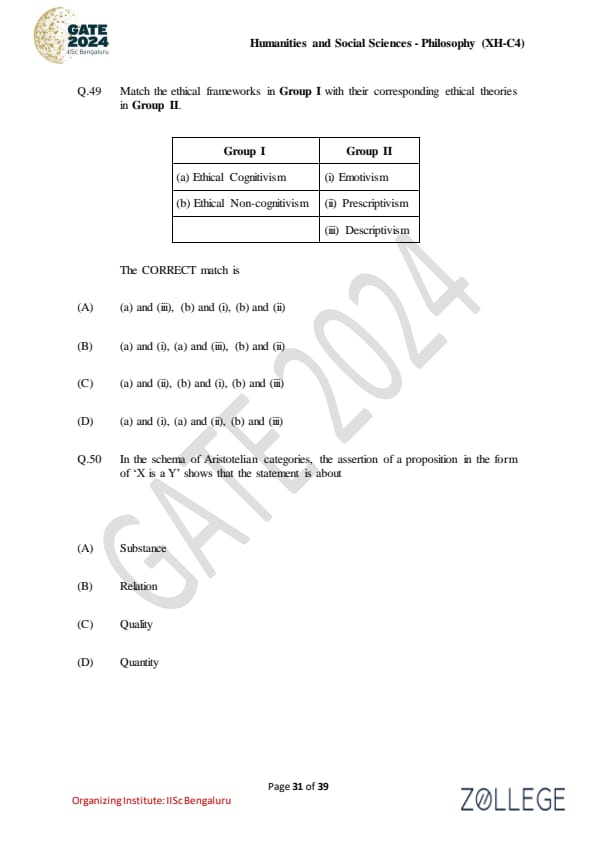
GATE Philosophy XH-C4 2024 Questions with Solutions
GENERAL APTITUDE
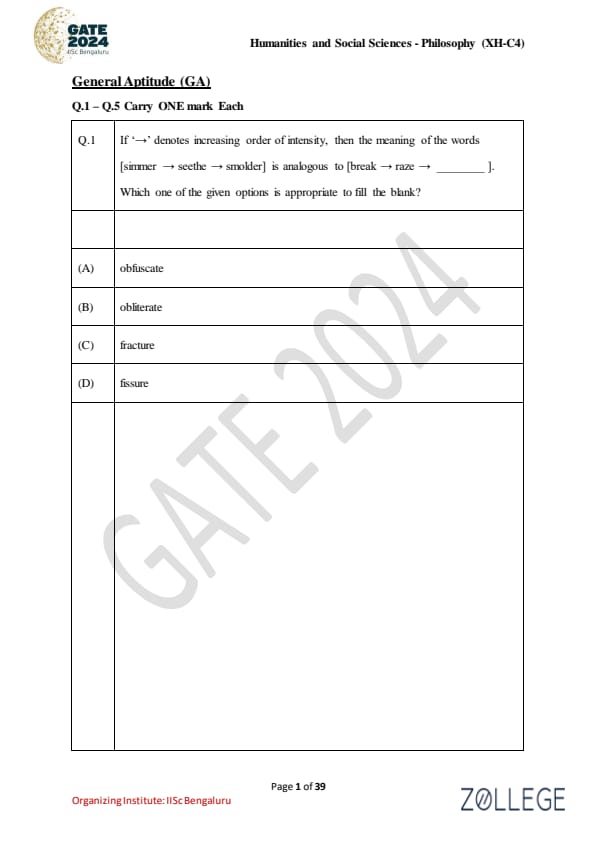
Question 1:
If “—” denotes increasing order of intensity, then the meaning of the words [simmer — seethe — smolder] is analogous to [break — raze — ]. Which one of the given options is appropriate to fill the blank?
View Solution
Step 1: Interpreting the analogy.
The sequence "simmer — seethe — smolder" suggests a gradual increase in intensity related to heat or emotion.
Similarly, in "break — raze —," we need a word that indicates a stronger, more destructive action than "raze."
Step 2: Reviewing the options.
- Obfuscate: Refers to making something unclear or confusing, not related to destruction.
- Obliterate: Means to completely destroy, making it suitable for the analogy.
- Fracture: Refers to breaking into parts, which is less intense than "raze."
- Fissure: Indicates a crack or split, also less severe than "raze."
Step 3: Concluding the solution.
"Obliterate" is the most appropriate word to complete the analogy as it represents the greatest level of destruction.
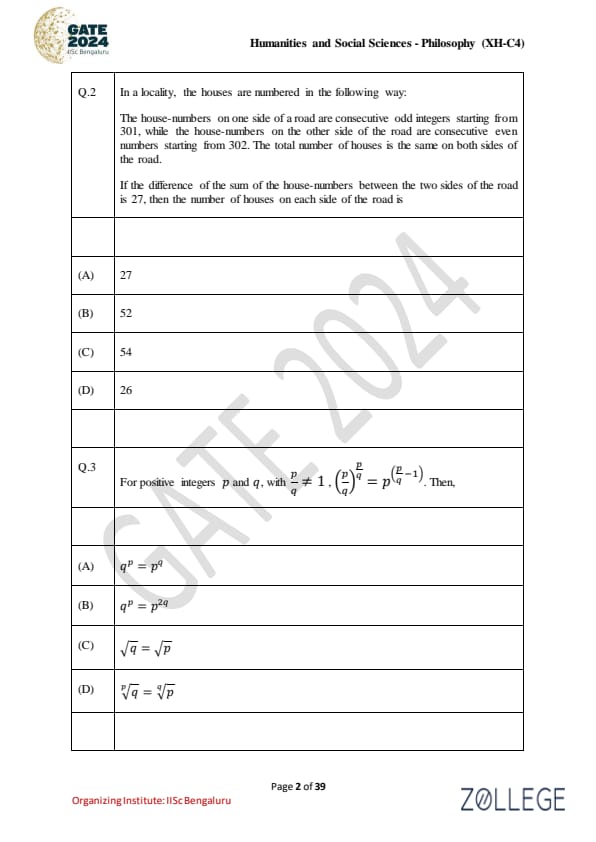
Question 2:
In a locality, the houses are numbered in the following way: The house-numbers on one side of a road are consecutive odd integers starting from 301, while the house-numbers on the other side of the road are consecutive even numbers starting from 302. The total number of houses is the same on both sides of the road. If the difference of the sum of the house-numbers between the two sides of the road is 27, then the number of houses on each side of the road is:
View Solution
Step 1: Problem setup.
House numbers on one side are consecutive odd integers starting from 301. On the other side, they are consecutive even integers starting from 302. Let "n" represent the number of houses on each side.
Step 2: Sum of odd-numbered houses.
Using the arithmetic progression formula, the sum is: n × (n + 300).
Step 3: Sum of even-numbered houses.
Similarly, the sum of even-numbered houses is: n × (n + 301).
Step 4: Calculating the difference in sums.
Given that the difference between the sums is 27:
301n - 300n = 27, which simplifies to n = 27.
Step 5: Final conclusion.
The number of houses on each side of the road is 27.
Question 3:
For positive integers p and q, with p/q ≠ 1,
(p/q)p/q = (p/q)(p/q - 1).
Then:
View Solution
Step 1: Simplify the given equation.
Starting with:
(p/q)p/q = (p/q)(p/q - 1)
Rewriting as:
qq / pq = pp/q - 1.
Equating the powers of p and q:
qp = pq.
Step 2: Verification.
The relationship qp = pq satisfies the given equation.
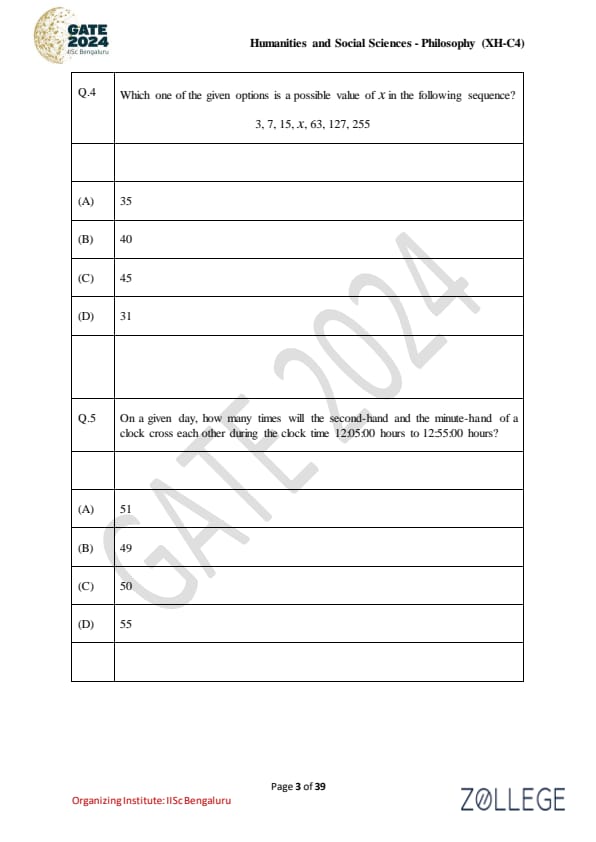
Question 4:
Which one of the given options is a possible value of X in the following sequence?
3, 7, 15, X, 63, 127, 255
View Solution
Step 1: Analyze the given sequence.
The sequence shows a pattern where each number is one less than a power of 2.
Step 2: Express each term.
3 = 22 - 1, 7 = 23 - 1, 15 = 24 - 1, X = 25 - 1 = 31.
The subsequent terms follow the same pattern: 63 = 26 - 1, 127 = 27 - 1, 255 = 28 - 1.
Step 3: Conclusion.
The missing term X is 31.
Question 5:
On a given day, how many times will the second-hand and the minute-hand of a clock cross each other during the clock time 12:05:00 hours to 12:55:00 hours?
View Solution
Step 1: Understand the motion of the second and minute hands.
The second-hand completes one full revolution (360 degrees) in 60 seconds, while the minute-hand completes one revolution in 3600 seconds (1 hour).
Step 2: Calculate the crossings in one minute.
In one minute, the second-hand crosses the minute-hand exactly once.
Step 3: Calculate the crossings between 12:05:00 and 12:55:00.
The time interval between 12:05:00 and 12:55:00 is 50 minutes. Hence, the second-hand and minute-hand will cross each other exactly 50 times during this period.
Step 4: Conclusion.
The total number of crossings is 50.
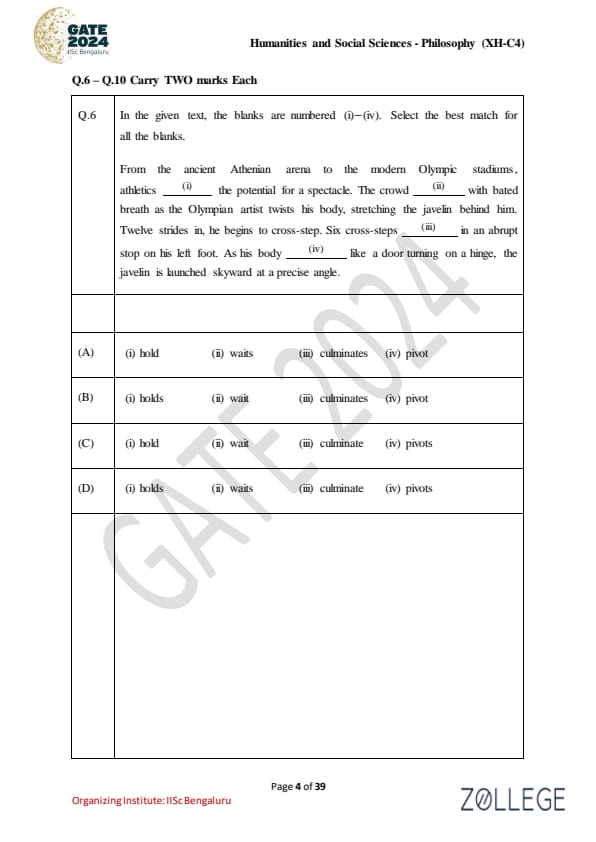
Question 6:
In the given text, the blanks are numbered (i)—(iv). Select the best match for all the blanks.
From the ancient Athenian arena to the modern Olympic stadiums, athletics (i) the potential for a spectacle. The crowd (ii) with bated breath as the Olympian artist twists his body, stretching the javelin behind him. Twelve strides in, he begins to cross-step. Six cross-steps (iii) in an abrupt stop on his left foot. As his body (iv) like a door turning on a hinge, the javelin is launched skyward at a precise angle.
View Solution
Step 1: Analyze the grammar.
Each blank requires a verb that agrees with the subject and fits the tense of the sentence.
- (i) holds: Matches the singular subject "athletics."
- (ii) waits: Agrees with the singular subject "crowd."
- (iii) culminate: Fits the progression of actions leading to a conclusion.
- (iv) pivots: Aligns with the description of the athlete's motion.
The correct answer is (4).
Question 7:
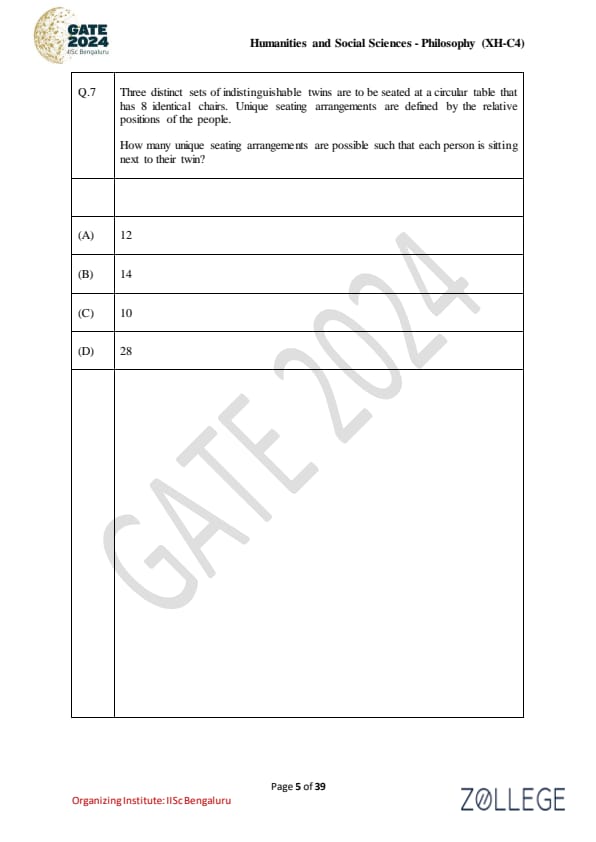
Three distinct sets of indistinguishable twins are to be seated at a circular table that has 8 identical chairs. Unique seating arrangements are defined by the relative positions of the people. How many unique seating arrangements are possible such that each person is sitting next to their twin?
View Solution
Step 1: Problem Setup.
We are tasked with finding the number of unique arrangements in a circular table where twins are always seated together.
Step 2: Circular Arrangements Formula.
Since the twins must be next to each other, treat each pair as a single unit, resulting in 3 units for arrangement.
The formula for arrangements is: Total arrangements = (n-1)!, where n is the number of units.
Step 3: Substitution and Simplification.
For 3 units: Arrangements = (3-1)! = 2! = 2.
Each twin can switch places within their pair, resulting in additional 23 = 8 arrangements.
Step 4: Final Answer.
Total arrangements = 2 × 8 = 12.
Question 8:
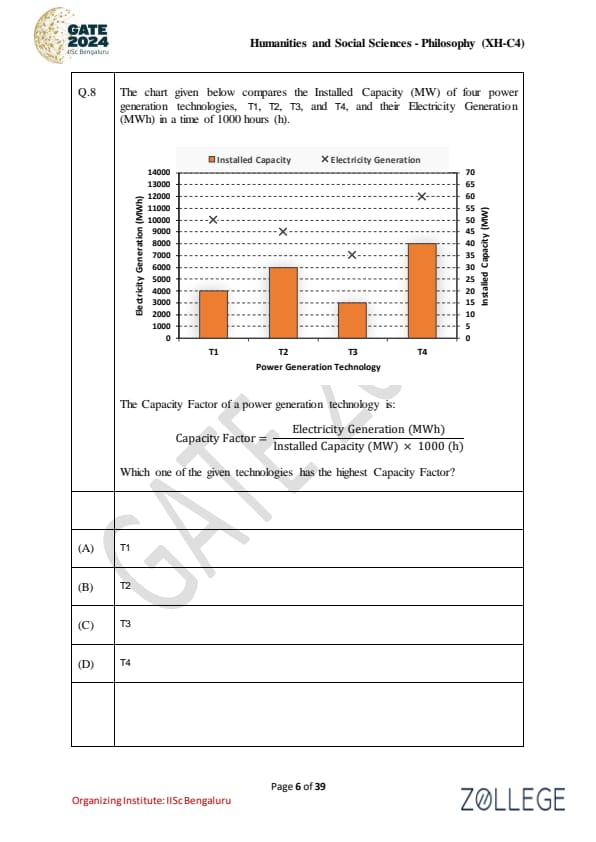
The chart given below compares the Installed Capacity (MW) of four power generation technologies, T1, T2, T3, and T4, and their Electricity Generation (MWh) in a time of 1000 hours (h). The Capacity Factor of a power generation technology is:

Capacity Factor = Electricity Generation (MWh) ÷ (Installed Capacity (MW) × 1000 (h)).
Which one of the given technologies has the highest Capacity Factor?
View Solution
Step 1: Understanding Capacity Factor.
The Capacity Factor is the ratio of actual electricity generation to the maximum possible electricity generation over a given time.
Step 2: Calculate Capacity Factor for Each Technology.
From the given data:
- T1: CF = 14,000 ÷ (20 × 1000) = 0.7 (70%)
- T2: CF = 9,000 ÷ (25 × 1000) = 0.36 (36%)
- T3: CF = 8,000 ÷ (30 × 1000) = 0.267 (26.7%)
- T4: CF = 7,000 ÷ (35 × 1000) = 0.2 (20%)
Step 3: Conclusion.
The highest Capacity Factor is for T1, which is 70%.
Question 9:
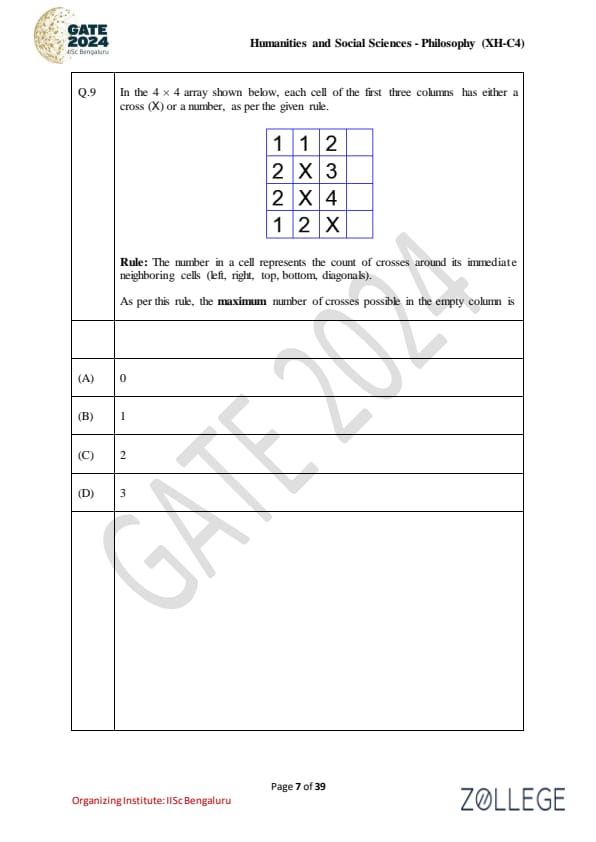
In the 4 x 4 array shown below, each cell of the first three columns has either a cross (X) or a number, as per the given rule.

Rule: The number in a cell represents the count of crosses around its immediate neighboring cells (left, right, top, bottom, diagonals).
As per this rule, the maximum number of crosses possible in the empty column is:
View Solution
Step 1: Analyze the given array.
The rule specifies that the number in each cell indicates the count of crosses (X) in its immediate neighbors. This limits the placement of crosses in adjacent cells.
Step 2: Identify constraints from neighboring numbers.
Examine the numbers in the third column, as these dictate the possible placement of crosses in the empty fourth column.
Step 3: Calculate the maximum number of crosses.
By observing the constraints, it is possible to place 2 crosses in the empty column without violating the numbers in the third column.
Step 4: Conclusion.
The maximum number of crosses in the empty column is 2.
Question 10:
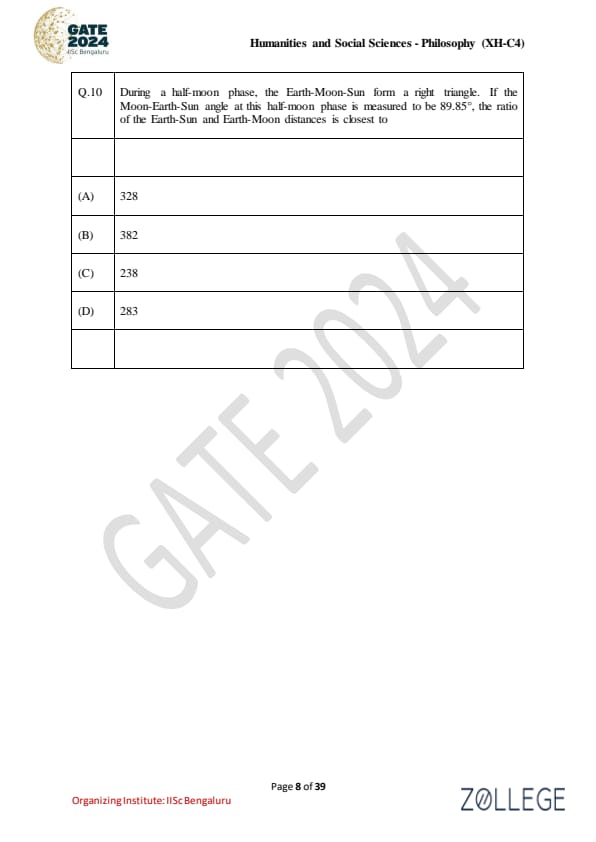
During a half-moon phase, the Earth-Moon-Sun form a right triangle. If the Moon-Earth-Sun angle at this half-moon phase is measured to be 89.85°, the ratio of the Earth-Sun and Earth-Moon distances is closest to:
View Solution
Step 1: Use the trigonometric relationship.
During the half-moon phase, the Earth-Moon-Sun form a right triangle. Using the tangent of the Moon-Earth-Sun angle θ = 89.85°:
tan(θ) = Earth-Moon distance ÷ Earth-Sun distance.
Step 2: Rearrange the formula.
Earth-Sun distance = Earth-Moon distance ÷ tan(θ).
Step 3: Substitute the values.
With θ = 89.85°, tan(θ) ≈ 0.002618.
Earth-Sun distance ÷ Earth-Moon distance = 1 ÷ 0.002618 ≈ 382.
Step 4: Conclusion.
The ratio of Earth-Sun to Earth-Moon distances is closest to 382.
Philosophy
Question 11:
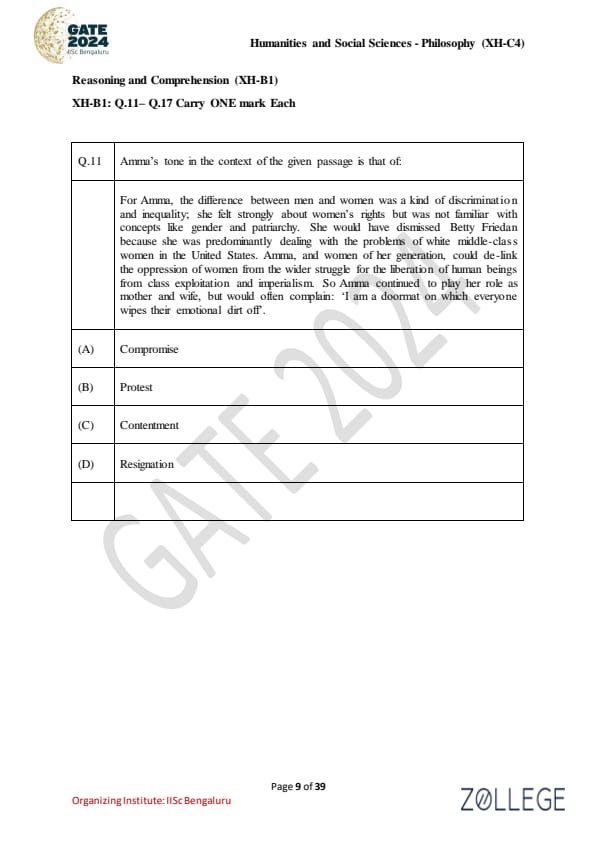
Amma’s tone in the context of the given passage is that of:
For Amma, the difference between men and women was a kind of discrimination and inequality; she felt strongly about women’s rights but was not familiar with concepts like gender and patriarchy. She would have dismissed Betty Friedan because she was predominantly dealing with the problems of white middle-class women in the United States. Amma, and women of her generation, could de-link the oppression of women from the wider struggle for the liberation of human beings from class exploitation and imperialism. So Amma continued to play her role as mother and wife, but would often complain: ‘I am a doormat on which everyone wipes their emotional dirt off.’View Solution
Step 1: Analyze Amma’s tone.
The passage illustrates Amma’s strong feelings about women’s rights and her vocal dissatisfaction with the inequality she faced. While she continues her role as a mother and wife, her complaints and dissatisfaction reflect a sense of protest.
Step 2: Key analysis.
- Amma’s strong feelings and complaints about being taken for granted indicate she is protesting her situation.
- She does not accept her condition passively, ruling out "resignation."
- Her dissatisfaction does not suggest compromise or contentment but aligns with an underlying "protest."
Question 12:
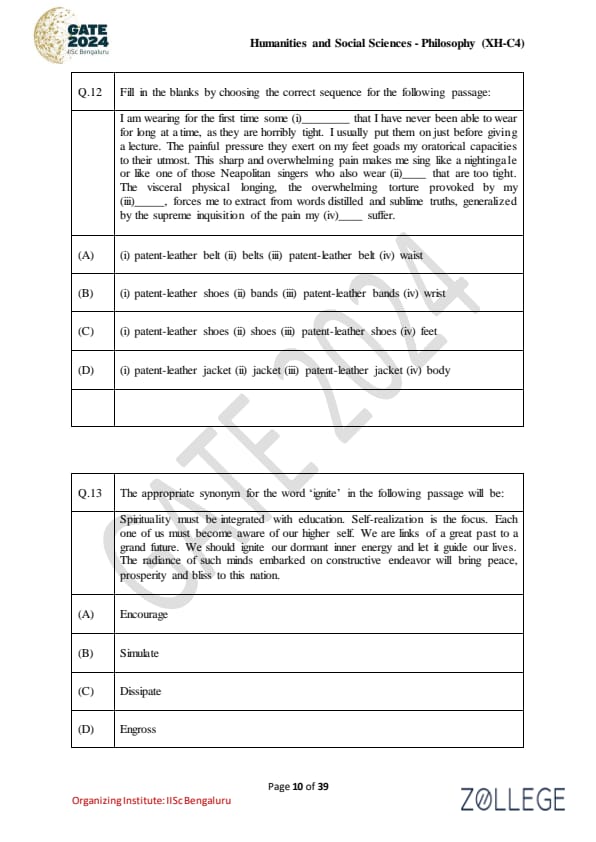
Fill in the blanks by choosing the correct sequence for the following passage:
I am wearing for the first time some (i) _______ that I have never been able to wear for long at a time, as they are horribly tight. I usually put them on just before giving a lecture. The painful pressure they exert on my feet goads my oratorical capacities to their utmost. This sharp and overwhelming pain makes me sing like a nightingale or like one of those Neapolitan singers who also wear (ii) _______ that are too tight. The visceral physical longing, the overwhelming torture provoked by my (iii) _______, forces me to extract from words distilled and sublime truths, generalized by the supreme inquisition of the pain my (iv) _______ suffer.View Solution
The passage describes the tightness and discomfort experienced by the speaker. The use of the words "feet," "shoes," and "pain" clearly indicates that the answer should relate to footwear. Thus, the correct choice is:
- (i) patent-leather shoes
- (ii) shoes
- (iii) patent-leather shoes
- (iv) feet
Question 13:
The appropriate synonym for the word ‘ignite’ in the following passage will be:
Spirituality must be integrated with education. Self-realization is the focus. Each one of us must become aware of our higher self. We are links of a great past to a grand future. We should ignite our dormant inner energy and let it guide our lives. The radiance of such minds embarked on constructive endeavor will bring peace, prosperity, and bliss to this nation.View Solution
In this context, "ignite" refers to awakening or inspiring inner energy and positivity. The word "encourage" best matches the meaning of "ignite" here, as it implies motivating or instilling energy for constructive efforts.
Question 14:
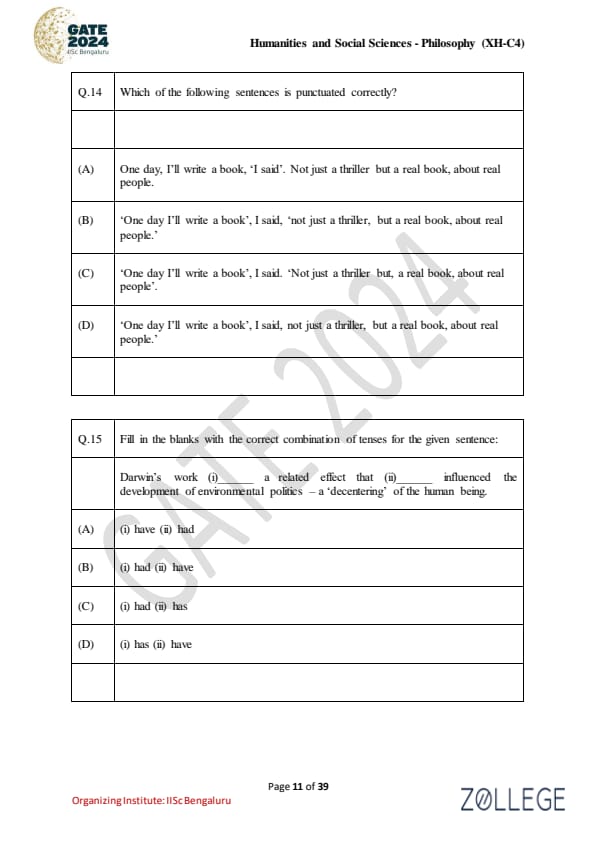
Which of the following sentences is punctuated correctly?
View Solution
Option (B) uses proper punctuation rules for dialogue and quoted speech:
- The quoted statement is enclosed in single quotation marks.
- Commas are correctly placed after "book" and "said."
- The internal quotation maintains proper punctuation for clarity.
Question 15:
Fill in the blanks with the correct combination of tenses for the given sentence:
Darwin’s work (i) _______ a related effect that (ii) _______ influenced the development of environmental politics – a ‘decentering’ of the human being.View Solution
The correct tense sequence is:
- (i) "had" indicates a past effect attributed to Darwin's work.
- (ii) "has" signifies the continuing influence of this work on the development of environmental politics in the present.
Question 16:
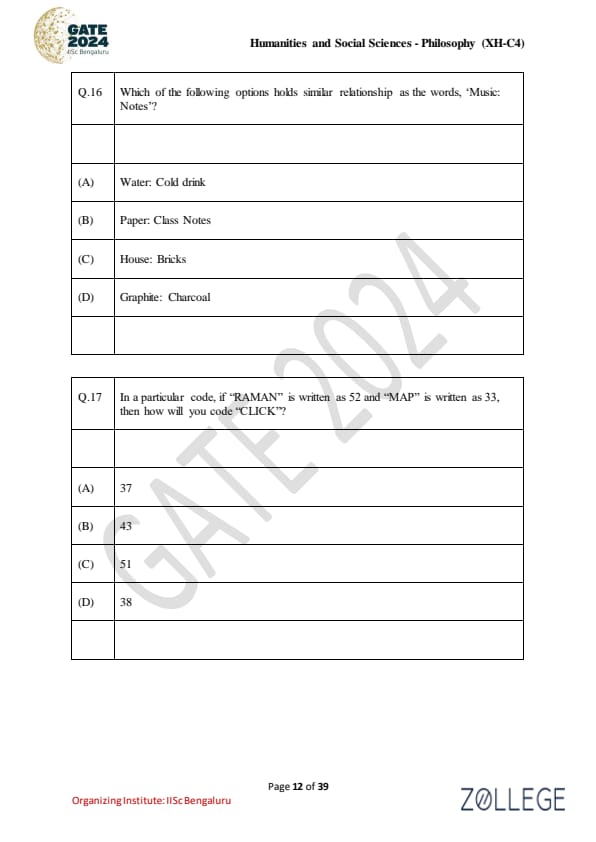
Which of the following options holds a similar relationship as the words, ‘Music: Notes’?
View Solution
Step 1: Identify the relationship.
The relationship between ‘Music’ and ‘Notes’ is that Notes are the basic components or elements that constitute Music.
Similarly, in the case of ‘House: Bricks,’ Bricks are the basic components used to construct a House.
Step 2: Evaluate other options.
- (A) Water: Cold drink – Water is an ingredient, not a structural component.
- (B) Paper: Class Notes – Class Notes are written on Paper but are not structural components of Paper.
- (D) Graphite: Charcoal – Graphite is a material in Charcoal but does not constitute the entire structure.
Thus, the correct answer is (C) House: Bricks.
Question 17:
In a particular code, if “RAMAN” is written as 52 and “MAP” is written as 33, then how will you code “CLICK”?
View Solution
Step 1: Assign numerical values to letters.
Assign values based on their position in the alphabet: \( A = 1, B = 2, C = 3, \ldots, Z = 26 \).
Step 2: Calculate for given examples.
- For "RAMAN": \( R = 18, A = 1, M = 13, A = 1, N = 14 \). Sum = \( 18 + 1 + 13 + 1 + 14 = 47 \). Adding \( +5 \), code = \( 52 \).
- For "MAP": \( M = 13, A = 1, P = 16 \). Sum = \( 13 + 1 + 16 = 30 \). Adding \( +3 \), code = \( 33 \).
Step 3: Apply the pattern to "CLICK."
For "CLICK": \( C = 3, L = 12, I = 9, C = 3, K = 11 \). Sum = \( 3 + 12 + 9 + 3 + 11 = 38 \). Adding \( +5 \), code = \( 43 \).
Thus, the correct answer is (B) 43.
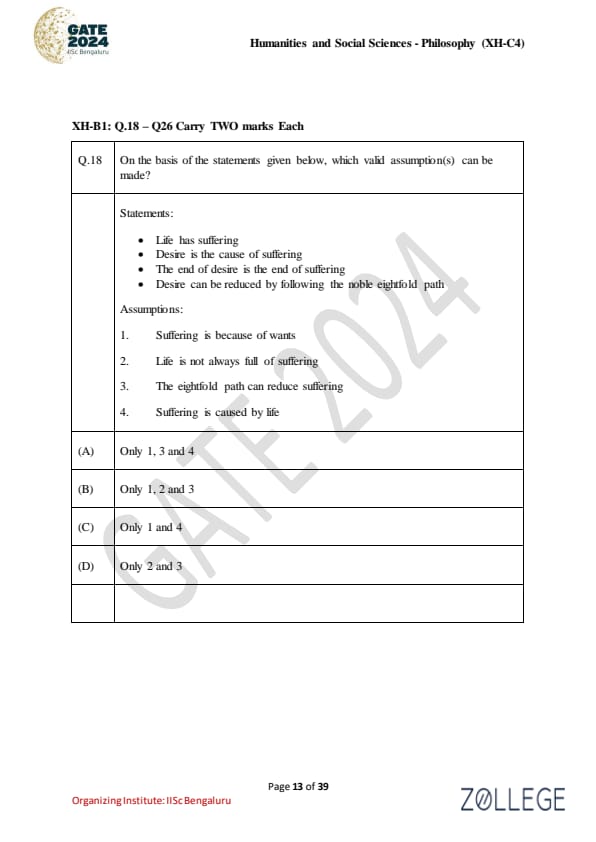
Question 18:
On the basis of the statements given below, which valid assumption(s) can be made?
Statements:
- Life has suffering.
- Desire is the cause of suffering.
- The end of desire is the end of suffering.
- Desire can be reduced by following the noble eightfold path.
Assumptions:
- 1. Suffering is because of wants.
- 2. Life is not always full of suffering.
- 3. The eightfold path can reduce suffering.
- 4. Suffering is caused by life.
View Solution
Step 1: Match assumptions with statements.
- 1: Suffering is because of wants – Matches "Desire is the cause of suffering."
- 2: Life is not always full of suffering – Matches "Life has suffering" (not always).
- 3: The eightfold path can reduce suffering – Matches "Desire can be reduced by following the noble eightfold path."
- 4: Suffering is caused by life – Not valid; life itself is not the cause, desire is.
Thus, only assumptions 1, 2, and 3 are valid.
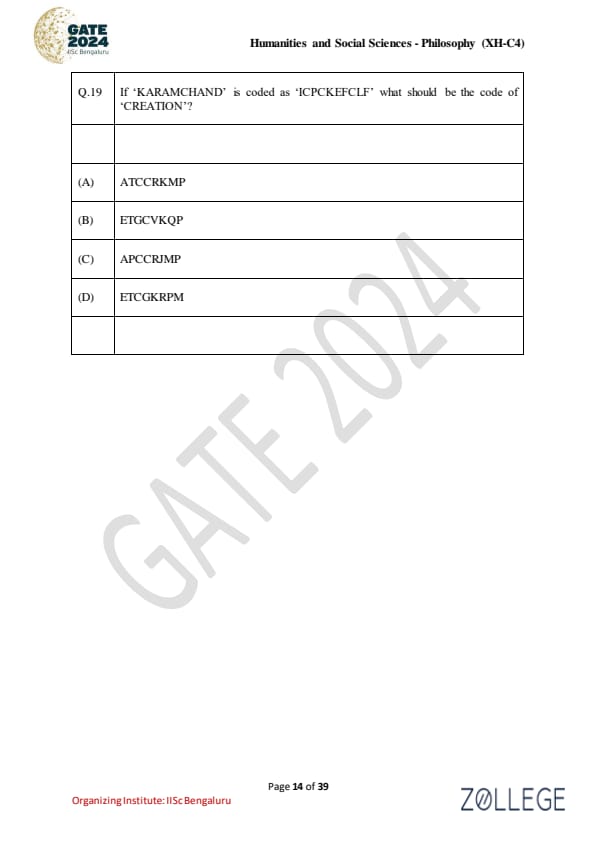
Question 19:
If 'KARAMCHAND' is coded as 'ICPCKEFCLF,' what should be the code of 'CREATION'?
View Solution
Step 1: Analyze the coding pattern.
"KARAMCHAND" is divided into pairs: KA, RA, MC, HA, ND. Each letter in a pair is shifted two steps backward in the alphabet.
Step 2: Apply the pattern to "CREATION."
Divide "CREATION" into pairs: CR, EA, TI, ON. Shift each letter two steps backward:
- CR → AT
- EA → CC
- TI → RK
- ON → MP
Step 3: Combine the results.
Code for "CREATION": ATCCRKMP.
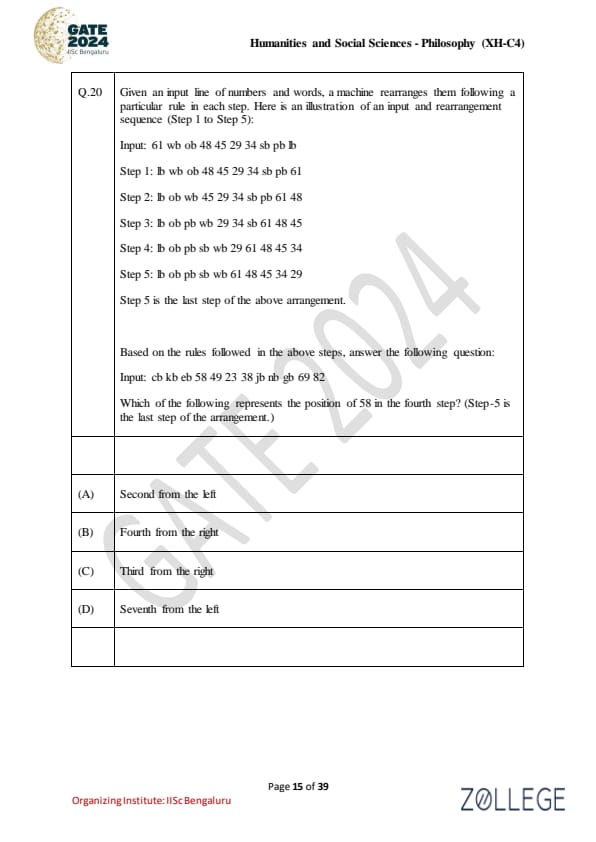
Question 20:
Given an input line of numbers and words, a machine rearranges them following a particular rule in each step. Here is an illustration of an input and rearrangement sequence (Step 1 to Step 5):
Input: 61 wb ob 48 45 29 34 sb pb lb
Step 1: lb wb ob 48 45 29 34 sb pb 61
Step 2: lb ob wb 45 29 34 sb pb 61 48
Step 3: lb ob pb wb 29 34 sb 61 48 45
Step 4: lb ob pb sb wb 61 48 45 34 29
Step 5: lb ob pb sb wb 61 48 45 34 29
Based on the rules followed in the above steps, answer the following question:
Input: cb kb eb 58 49 23 38 jb nb gb 69 82
Which of the following represents the position of 58 in the fourth step? (Step-5 is the last step of the arrangement.)
View Solution
Step 1: Understand the rule.
The arrangement rule involves two processes:
- Words are arranged in alphabetical order from left to right in each step.
- Numbers are arranged in descending order from right to left in each step.
Step 2: Apply the rule to the input.
Input: cb kb eb 58 49 23 38 jb nb gb 69 82
Step-by-step arrangement:
- Step 1: eb cb kb 49 23 38 jb nb gb 69 82 58
- Step 2: eb cb gb kb 23 38 jb nb 82 69 58 49
- Step 3: eb cb gb jb kb 38 nb 82 69 58 49 23
- Step 4: eb cb gb jb kb nb 82 69 58 49 38 23
Step 3: Determine the position of 58 in Step 4.
In Step 4, the arrangement is: eb cb gb jb kb nb 82 69 58 49 38 23.
The number 58 is third from the right.
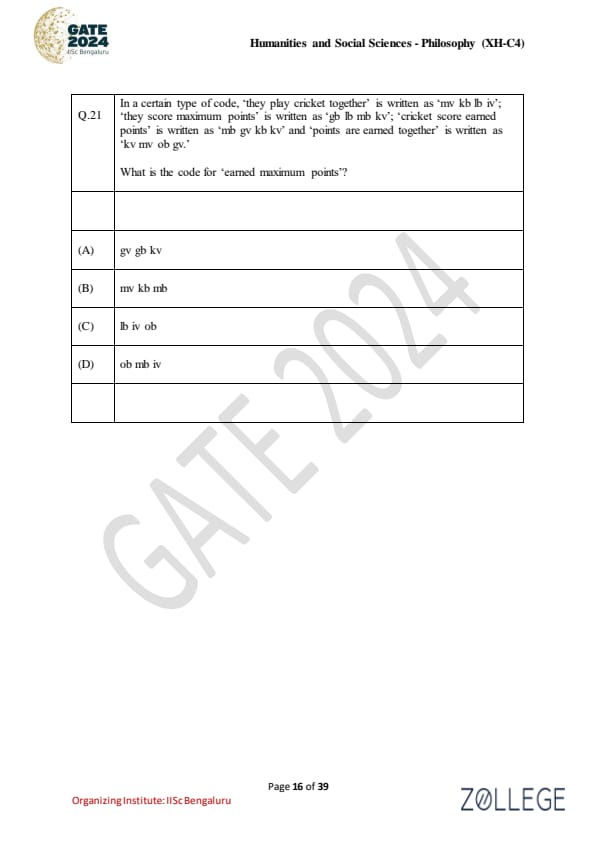
Question 21:
In a certain type of code, 'they play cricket together' is written as ‘mv kb lb iv'; 'they score maximum points' is written as 'gb lb mb kv'; ‘cricket score earned points' is written as 'mb gv kb kv' and ‘points are earned together' is written as 'kv mv ob gv.' What is the code for ‘earned maximum points’?
View Solution
Step 1: Analyze the given codes.
- 'points': Found in multiple phrases: "kv."
- 'earned': Found in two phrases: "gv."
- 'maximum': Found in one phrase: "gb."
Step 2: Combine the codes.
The code for 'earned maximum points' is gv gb kv.
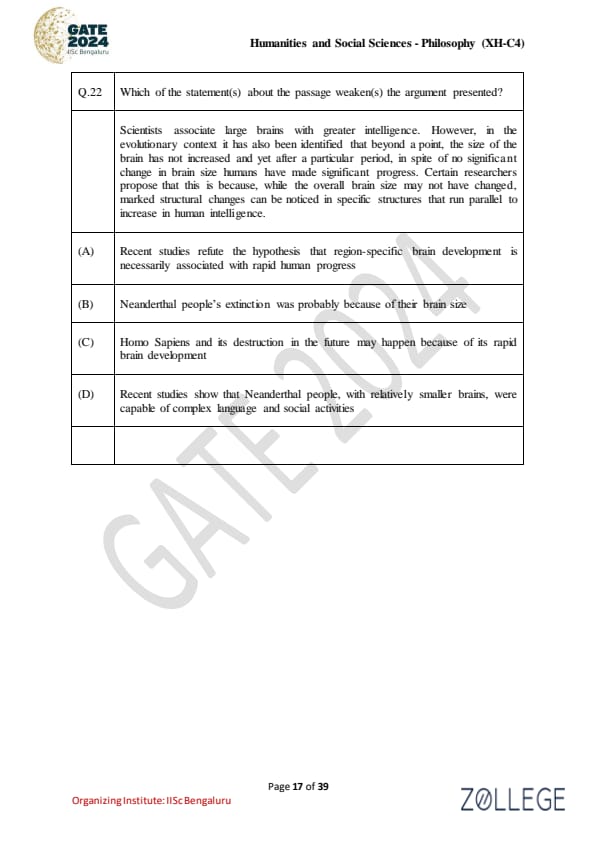
Question 22:
Which of the statement(s) about the passage weaken(s) the argument presented?
Scientists associate large brains with greater intelligence. However, in the evolutionary context, it has also been identified that beyond a point, the size of the brain has not increased, and yet after a particular period, in spite of no significant change in brain size, humans have made significant progress. Certain researchers propose that this is because, while the overall brain size may not have changed, marked structural changes can be noticed in specific structures that run parallel to an increase in human intelligence.View Solution
Step 1: Analyze the argument.
The passage argues that structural brain changes, not size, correlate with increased intelligence in humans.
Step 2: Evaluate the options.
- (A) Weakens the argument by directly refuting the hypothesis of region-specific development.
- (B) Irrelevant to the argument as it speculates on Neanderthals' extinction without addressing structural brain changes.
- (C) Speculative and unrelated to the argument about brain structure and intelligence.
- (D) Does not directly refute the argument but presents a potential counterexample to structural brain development.
Thus, the correct answer is (A).
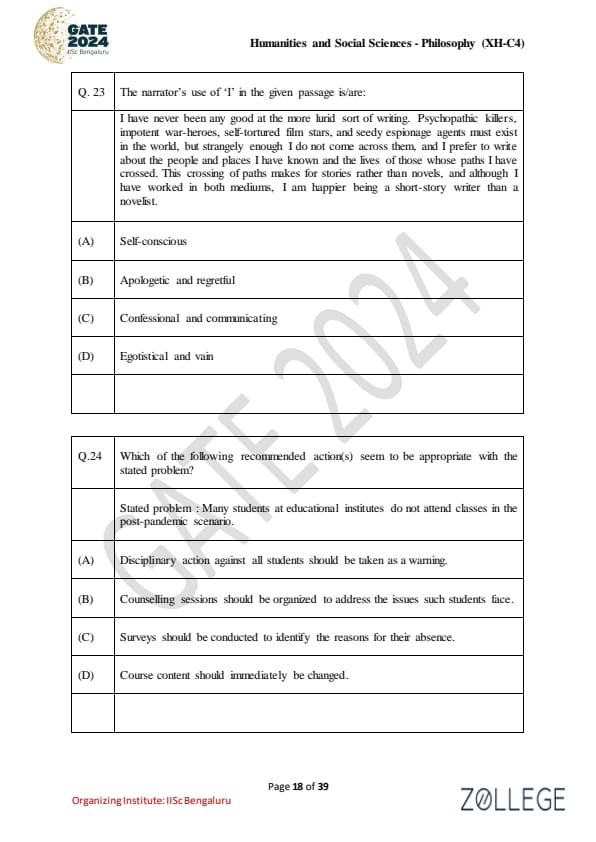
Question 23:
The narrator's use of 'I' in the given passage is/are:
I have never been any good at the more lurid sort of writing. Psychopathic killers, impotent war-heroes, self-tortured film stars, and seedy espionage agents must exist in the world, but strangely enough, I do not come across them, and I prefer to write about the people and places I have known and the lives of those whose paths I have crossed. This crossing of paths makes for stories rather than novels, and although I have worked in both mediums, I am happier being a short-story writer than a novelist.View Solution
Step 1: Analyze the narrator's tone and purpose.
The narrator reflects on their writing style and choices, showing a self-conscious tone. They also openly communicate their preferences and experiences, demonstrating a confessional style.
Step 2: Eliminate incorrect options.
- (B) Apologetic and regretful – There is no evidence of regret in the passage.
- (D) Egotistical and vain – The narrator does not display any sense of arrogance or vanity.
Thus, the correct tones are (A) Self-conscious and (C) Confessional and communicating.
Question 24:
Which of the following recommended action(s) seem to be appropriate with the stated problem?
Stated Problem: Many students at educational institutes do not attend classes in the post-pandemic scenario.
(C) Surveys should be conducted to identify the reasons for their absence.
View Solution
Step 1: Analyze the problem.
The problem relates to student absenteeism post-pandemic. Logical solutions involve understanding and addressing underlying reasons.
Step 2: Evaluate the options.
- (A) Disciplinary action – Reactive and does not address the root cause.
- (B) Counselling sessions – Proactive and addresses potential challenges faced by students.
- (C) Surveys – Necessary to understand the reasons for absenteeism.
- (D) Changing course content – Premature and speculative without understanding the problem.
Thus, the most appropriate actions are (B) Counselling sessions and (C) Surveys.
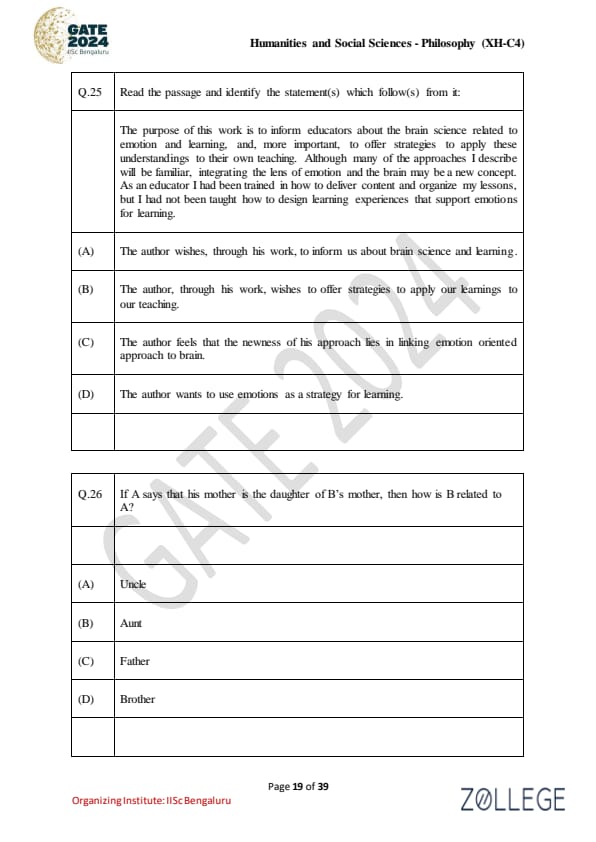
Question 25:
Read the passage and identify the statement(s) which follow(s) from it:
The purpose of this work is to inform educators about the brain science related to emotion and learning, and, more important, to offer strategies to apply these understandings to their own teaching. Although many of the approaches I describe will be familiar, integrating the lens of emotion and the brain may be a new concept. As an educator I had been trained in how to deliver content and organize my lessons, but I had not been taught how to design learning experiences that support emotions for learning.View Solution
Step 1: Analyze the passage.
- (A) Supported by the goal to inform educators about "brain science related to emotion and learning."
- (B) Incorrect; the author offers strategies but does not explicitly state applying "our learnings."
- (C) Valid, as the passage highlights the uniqueness of "integrating the lens of emotion and the brain."
- (D) Logical inference, as the author emphasizes supporting emotions for learning.
Thus, the correct statements are (A), (C), and (D).
Question 26:
If A says that his mother is the daughter of B's mother, then how is B related to A?
View Solution
Step 1: Analyze the statement.
- A's mother is the daughter of B's mother. This means that B's mother is A's grandmother.
- Therefore, B is either A's maternal uncle or maternal aunt, depending on B's gender.
Step 2: Conclusion.
Since the gender of B is not specified, both options Uncle (A) and Aunt (B) are plausible. Thus, the correct answer is A or B.
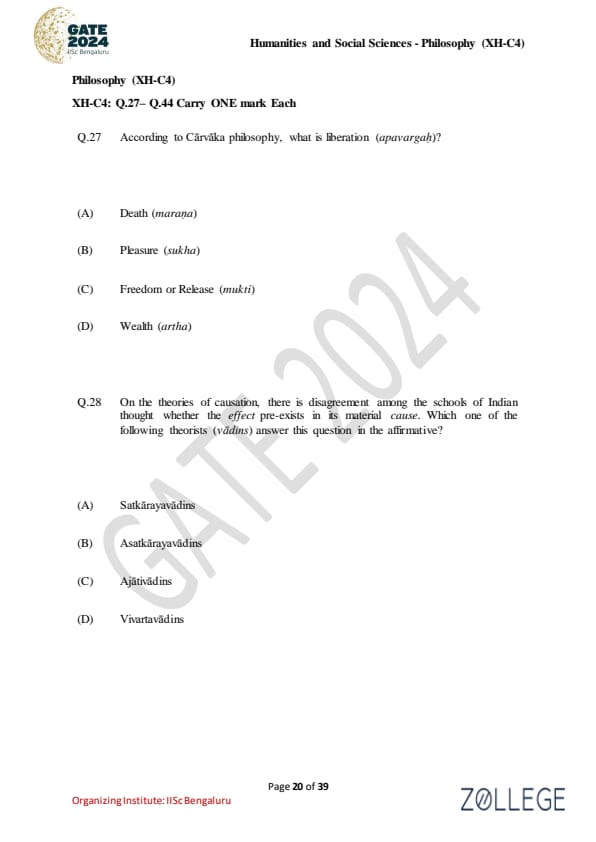
Question 27:
According to Cārvāka philosophy, what is liberation (apavargah)?
View Solution
Step 1: Understanding Cārvāka philosophy.
Cārvāka, a materialistic school of Indian philosophy, equates liberation (\textit{apavargah}) with death (\textit{marana}), as it represents the cessation of suffering and the end of life.
Key Points:
1. Cārvāka rejects notions of afterlife, karma, and spiritual liberation (\textit{mukti}).
2. Liberation (\textit{apavargah}) is not equated with sensory pleasure or wealth but with the natural end of life: death.
Question 28:
On the theories of causation, there is disagreement among the schools of Indian thought whether the effect pre-exists in its material cause. Which one of the following theorists (vādins) answer this question in the affirmative?
View Solution
Step 1: Key concept of Satkāryavāda.
Satkāryavāda asserts that the effect pre-exists in a subtle form within its material cause. Supported by:
- Sāṅkhya and some Vedānta traditions.
Contrasting views:
- Asatkāryavāda: Effect is newly produced (Nyāya-Vaiśeṣika).
- Ajātivāda and Vivartavāda: Metaphysical positions, unrelated to cause-effect pre-existence.
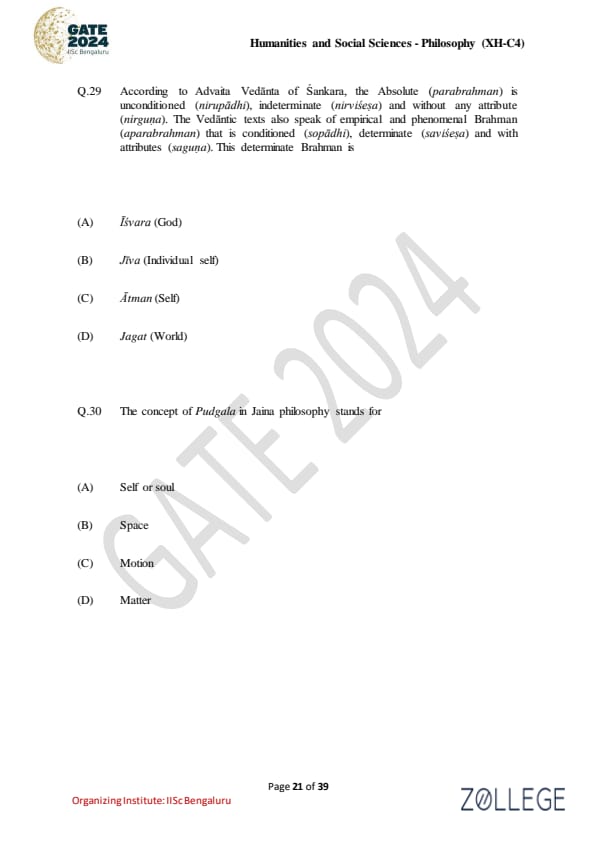
Question 29:
According to Advaita Vedānta of Sankara, the Absolute (parabrahman) is unconditioned (nirupādhi), indeterminate (nirviśeṣa) and without any attribute (nirguna). The Vedāntic texts also speak of empirical and phenomenal Brahman (aparabrahman) that is conditioned (sopādhi), determinate (saviśeṣa) and with attributes (saguna). This determinate Brahman is:
View Solution
Key distinctions in Advaita Vedānta:
1. Absolute Brahman (\textit{Parabrahman}): Unconditioned, indeterminate, without attributes.
2. Phenomenal Brahman (\textit{Aparabrahman}): Conditioned, determinate, with attributes, referred to as \textbf{Īśvara (God)}.
Eliminating other options:
- \textbf{Jīva (Individual self):} Represents the soul, not Brahman.
- \textbf{Ātman (Self):} Refers to the individual essence or consciousness.
- \textbf{Jagat (World):} Represents the physical universe.
Question 30:
The concept of Pradeśa in Jaina philosophy stands for:
View Solution
Understanding Pradeśa:
In Jaina philosophy, Pradeśa refers to the smallest indivisible unit of \textbf{matter} (\textit{pudgala}).
Key points:
1. Matter (\textit{pudgala}) consists of infinitely small units called Pradeśas.
2. Incorrect options: - \textbf{(A)} Self or soul (\textit{jīva}): Conscious, non-material.
- \textbf{(B)} Space (\textit{ākāśa}): Provides the area for existence.
- \textbf{(C)} Motion (\textit{dharma}): Medium enabling movement.
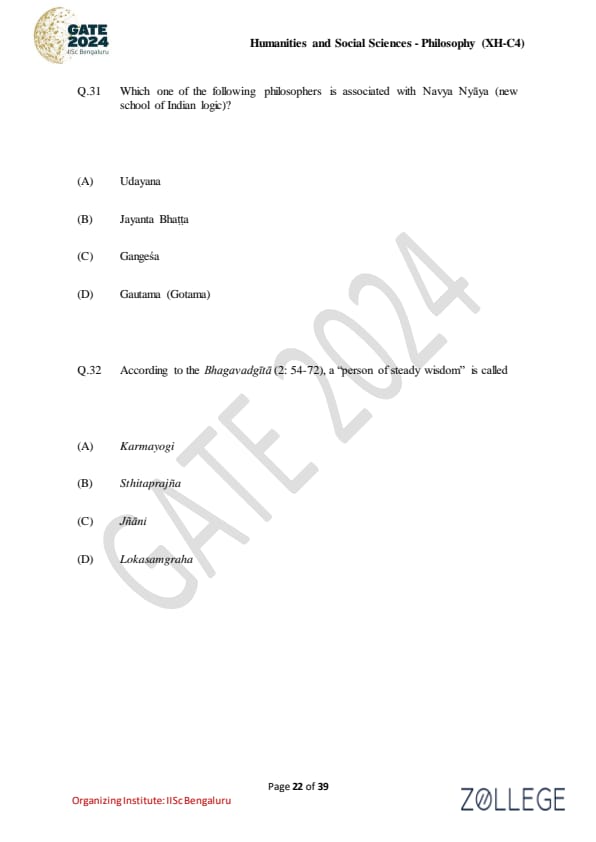
Question 31:
Which one of the following philosophers is associated with Navya Nyāya (new school of Indian logic)?
View Solution
Key Explanation:
- The Navya Nyāya (new school of Indian logic) was founded by Gangeśa Upādhyāya.
- His seminal work, Tattvachintāmaṇi, formalized the principles of Navya Nyāya.
- While Udayana and Jayanta Bhaṭṭa made significant contributions to earlier Nyāya traditions, Gautama (Gotama) founded the classical Nyāya school.
Thus, the correct answer is (C) Gangeśa.
Question 32:
According to the Bhagavadgītā (2:54–72), a “person of steady wisdom” is called:
View Solution
Explanation:
- Chapter 2 (Verses 54–72) of the Bhagavadgītā describes the qualities of a Sthitaprajña, a person with steady wisdom and equanimity.
- Such a person is unaffected by desires, emotions, or external circumstances.
Incorrect Options:
- (A) Karmayogi: Refers to someone who performs actions selflessly.
- (C) Jñāni: Refers to a person with knowledge of the Self.
- (D) Lokasaṃgraha: Relates to the welfare of the world, not individual wisdom.
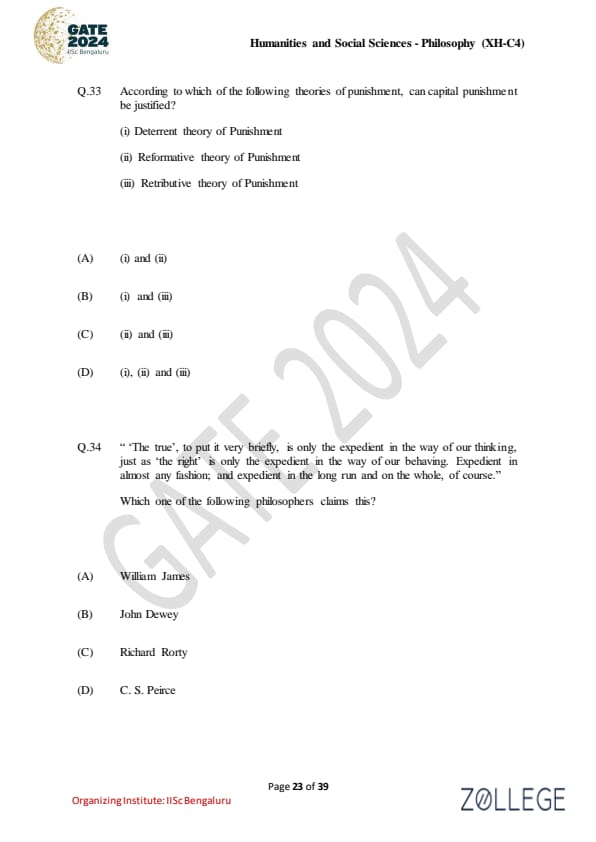
Question 33:
According to which of the following theories of punishment, can capital punishment be justified?
(i) Deterrent theory of Punishment
(ii) Reformative theory of Punishment
(iii) Retributive theory of Punishment
View Solution
Explanation:
1. Deterrent Theory: Justifies capital punishment as a means to prevent future crimes.
2. Retributive Theory: Supports capital punishment as a way to exact revenge for heinous crimes.
3. Reformative Theory: Incompatible with capital punishment, as it focuses on rehabilitating the offender.
Question 34:
“The true', to put it very briefly, is only the expedient in the way of our thinking, just as 'the right' is only the expedient in the way of our behaving. Expedient in almost any fashion; and expedient in the long run and on the whole, of course.” Which one of the following philosophers claims this?
View Solution
Key Points:
- William James is known for his pragmatist view of truth, where it is defined by its practical utility.
- The quote reflects his idea that "truth" and "rightness" are verified by their expedience and usefulness.
Eliminating Incorrect Options:
- (B) John Dewey: A pragmatist, but his emphasis was on education and democracy.
- (C) Richard Rorty: Neo-pragmatist but focused on different aspects of utility.
- (D) C. S. Peirce: Emphasized long-term convergence of belief, not expediency.
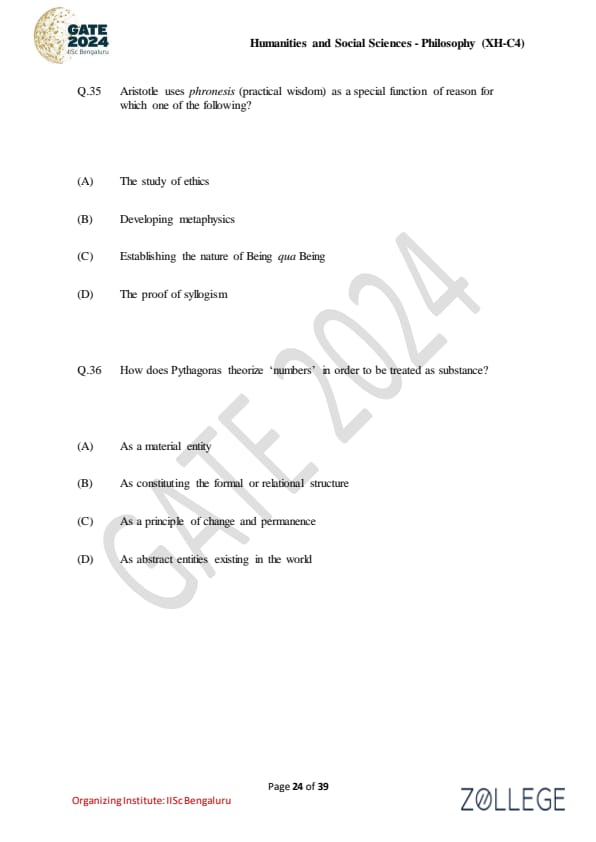
Question 35:
Aristotle uses phronesis (practical wisdom) as a special function of reason for which one of the following?
View Solution
Explanation:
- Aristotle associates phronesis (practical wisdom) with ethical decision-making and living a virtuous life.
- Other options relate to Aristotle's broader philosophical works but do not align with phronesis. For instance: - (B) Metaphysics relates to first principles and existence.
- (C) "Being qua Being" concerns ontology.
- (D) Syllogisms are part of logical reasoning, unrelated to ethics.
Question 36:
How does Pythagoras theorize ‘numbers’ in order to be treated as substance?
View Solution
Explanation:
Pythagoras regarded numbers as the fundamental principles of reality, not material entities. Numbers define:
- Relationships and patterns (e.g., harmony in music based on numerical ratios).
- The structural organization of the cosmos.
Incorrect Options:
- (A) Numbers are not treated as physical or tangible entities.- (C) Numbers do not directly explain change or permanence.
- (D) While abstract, numbers in Pythagoras’s philosophy have structural and relational significance.
Thus, the correct answer is (B) As constituting the formal or relational structure.
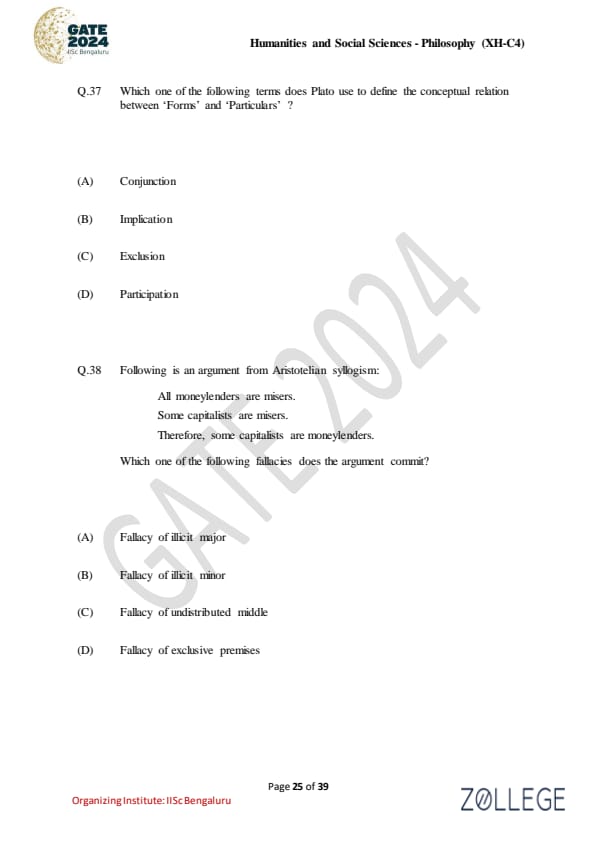
Question 37:
Which one of the following terms does Plato use to define the conceptual relation between ‘Forms’ and ‘Particulars’?
View Solution
Explanation:
In Plato’s metaphysics:
- Particulars are imperfect, transient instances of the eternal, perfect Forms.
- The relationship is called Participation, where particulars “participate” in the universal Forms (e.g., a beautiful object participates in the Form of Beauty).
Incorrect Options:
- (A) Conjunction suggests mere connection, which is insufficient for Plato’s theory.- (B) Implication is logical, not metaphysical.
- (C) Exclusion contradicts the interconnected nature of Forms and Particulars.
Thus, the correct answer is (D) Participation.
Question 38:
Following is an argument from Aristotelian syllogism:
All moneylenders are misers.Some capitalists are misers.
Therefore, some capitalists are moneylenders.
Which one of the following fallacies does the argument commit?
View Solution
Explanation:
In the argument:
- Middle term ("misers") is not distributed (i.e., does not refer to all instances) in either premise.
- Without a distributed middle term, the connection between major (moneylenders) and minor (capitalists) terms is invalid.
Incorrect Options:
- (A) Illicit major: Involves distribution error in the major term.- (B) Illicit minor: Involves distribution error in the minor term.
- (D) Exclusive premises: Happens when both premises are negative, which is not the case.
Thus, the correct answer is (C) Fallacy of undistributed middle.
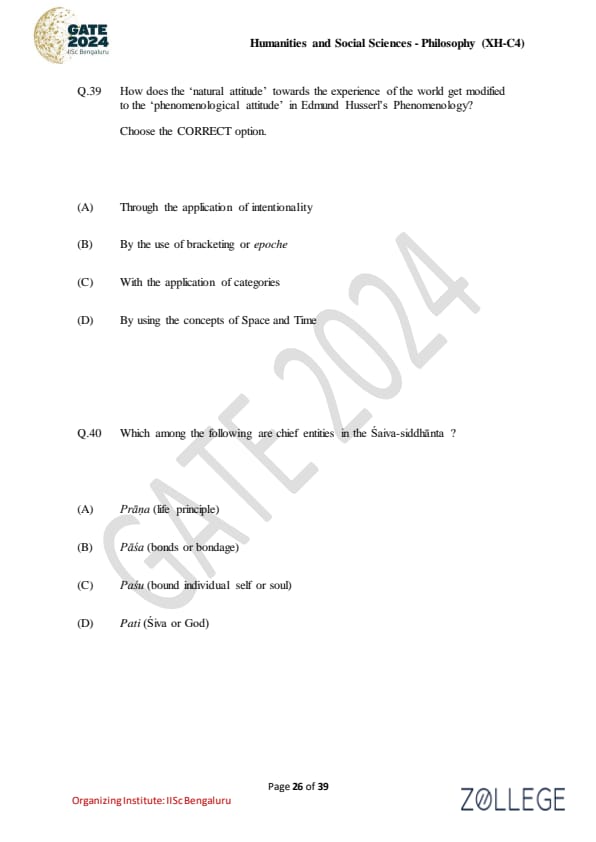
Question 39:
How does the 'natural attitude' towards the experience of the world get modified to the 'phenomenological attitude' in Edmund Husserl's Phenomenology?
View Solution
Explanation:
In Husserl's phenomenology:
- The 'natural attitude' involves everyday, unreflective engagement with the world.
- The 'phenomenological attitude' is achieved by bracketing (epoche), where preconceived notions and assumptions are set aside.
- This method allows focus on the essence of experiences.
Thus, the correct answer is (B) By the use of bracketing or epoche.
Question 40:
Which among the following are chief entities in the Śaiva-siddhānta?
View Solution
Explanation:
In Śaiva-siddhānta, the core entities are:
1. Pati (God or Śiva): The divine being.
2. Paśu (soul): The bound self.
3. Pāśa (bondage): Ignorance and karma that bind the soul.
Incorrect:
- (A) Prāņa (life principle) is not a chief entity in Śaiva-siddhānta.Thus, the correct answer is (B, C, D).
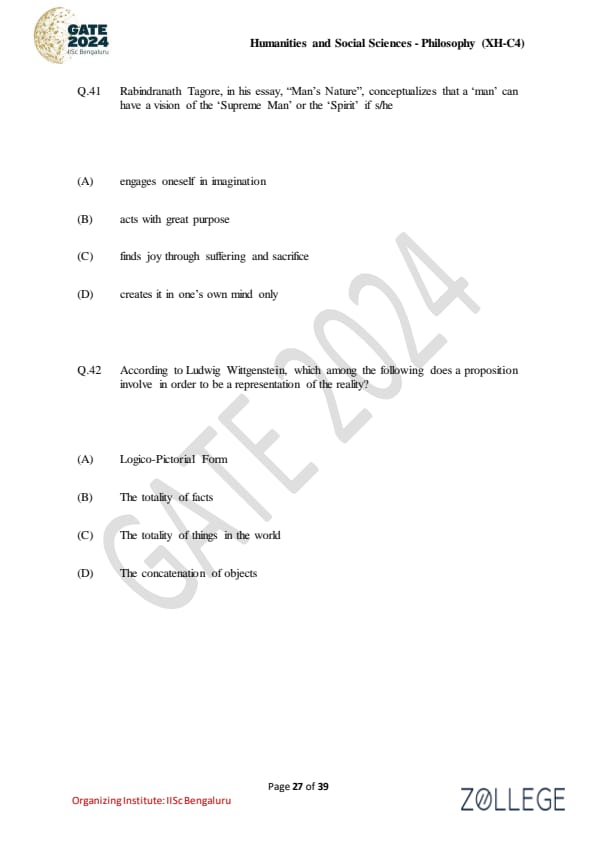
Question 41:
Rabindranath Tagore, in his essay “Man’s Nature,” conceptualizes that a ‘man’ can have a vision of the ‘Supreme Man’ or the ‘Spirit’ if s/he:
View Solution
Explanation:
Tagore’s vision of the ‘Supreme Man’ requires the following:
1. Engaging in imagination to transcend mundane life (\textbf{A}).
2. Acting with great purpose to align with the Spirit (\textbf{B}).
3. Finding joy through suffering and sacrifice, reflecting spiritual elevation (\textbf{C}).
Incorrect:
- (D): Creating it in one’s own mind contradicts Tagore’s emphasis on transcendence beyond the self.Thus, the correct answers are (A, B, C).
Question 42:
According to Ludwig Wittgenstein, which among the following does a proposition involve in order to be a representation of the reality?
View Solution
Explanation:
In Wittgenstein’s \textit{Tractatus Logico-Philosophicus}:
- A proposition is a logical picture of facts, representing reality through its logico-pictorial form.
- This structure aligns with the state of affairs it describes.
Incorrect:
- (B): The totality of facts defines the world but doesn’t explain propositions.- (C): The totality of things refers to objects, not logical structure.
- (D): The concatenation of objects relates to physical combinations, not propositions.
Thus, the correct answer is (A) Logico-Pictorial Form.
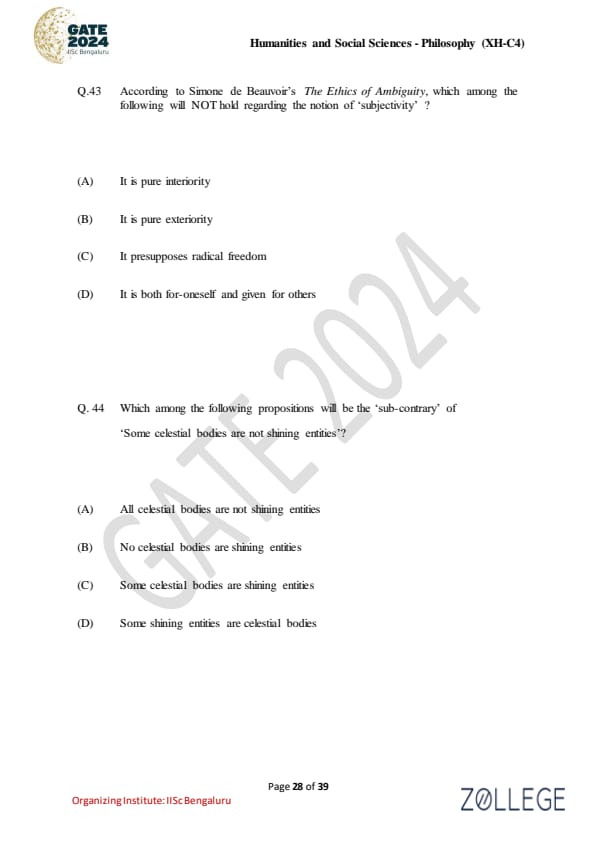
Question 43:
According to Simone de Beauvoir's The Ethics of Ambiguity, which among the following will NOT hold regarding the notion of ‘subjectivity’?
View Solution
Explanation:
In \textit{The Ethics of Ambiguity}:
- Subjectivity is both for-oneself (autonomous) and for others (social) (\textbf{D}).
- It is neither pure interiority nor pure exteriority but involves a dynamic interplay (\textbf{A, B are incorrect}).
- While subjectivity presupposes freedom, its characterization is not limited to radical freedom (\textbf{C is incorrect}).
Thus, the incorrect notions are (A, B, C).
Question 44:
Which among the following propositions will be the ‘sub-contrary’ of ‘Some celestial bodies are not shining entities’?
View Solution
Explanation:
Sub-contrary propositions satisfy these conditions:
1. Both cannot be false.
2. Both can be true.
Given \textbf{Some celestial bodies are not shining entities}, its sub-contrary is:
\textbf{Some celestial bodies are shining entities.}
Thus, the correct answer is (C) Some celestial bodies are shining entities.
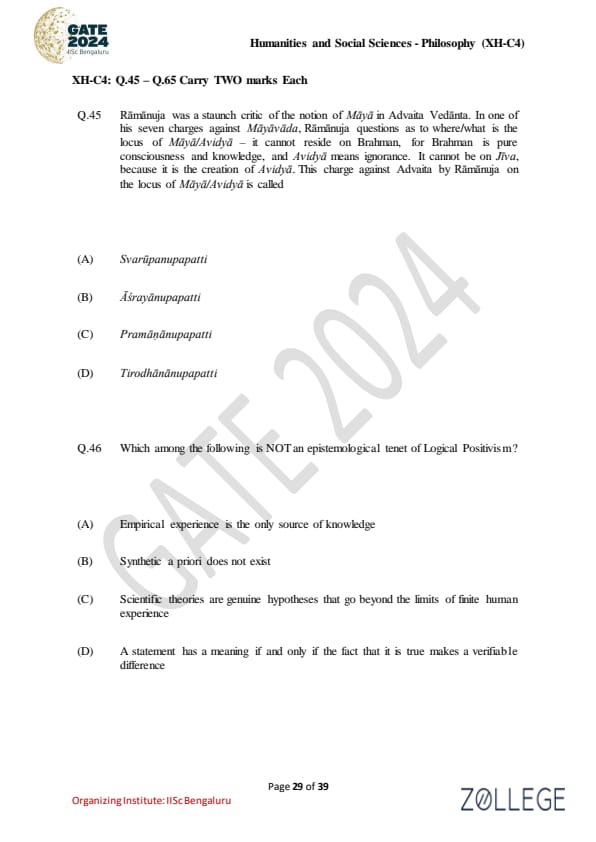
Question 45:
Rāmānuja was a staunch critic of the notion of Māyā in Advaita Vedānta. In one of his seven charges against Māyāvāda, Rāmānuja questions as to where/what is the locus of Māyā/Avidyā — it cannot reside on Brahman, for Brahman is pure consciousness and knowledge, and Avidyā means ignorance. It cannot be on Jīva, because it is the creation of Avidyā. This charge against Advaita by Rāmānuja on the locus of Māyā/Avidyā is called:
View Solution
Explanation:
Rāmānuja’s critique focuses on the lack of a proper locus for Māyā (\textbf{Avidyā}):
1. Māyā cannot reside in Brahman (pure consciousness).
2. Māyā cannot reside in Jīva (created by Māyā).
This logical challenge is termed Āśrayānupapatti, meaning "lack of proper locus."
Thus, the correct answer is (B) Āśrayānupapatti.
Question 46:
Which among the following is NOT an epistemological tenet of Logical Positivism?
View Solution
Explanation:
Logical Positivism emphasizes the following epistemological tenets:
1. The rejection of synthetic a priori knowledge (Option B).
2. Scientific theories as hypotheses extending beyond finite experience (Option C).
3. Verification as a criterion for meaningful statements (Option D).
However, Logical Positivism does not assert that empirical experience is the only source of knowledge (Option A), as it includes logical-mathematical truths within its framework.
Thus, the correct answer is (A).
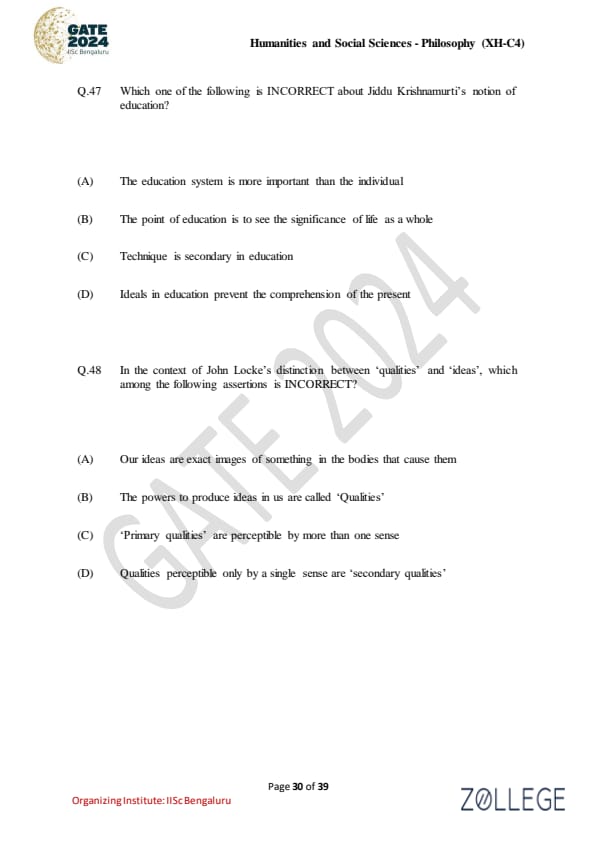
Question 47:
Which one of the following is INCORRECT about Jiddu Krishnamurti's notion of education?
View Solution
Explanation:
Jiddu Krishnamurti's philosophy of education emphasizes the following:
1. The individual’s development is prioritized over rigid educational systems.
2. Education’s purpose is to understand life holistically (Option B).
3. Emphasis on understanding and learning rather than technical training (Option C).
4. Avoidance of fixed ideals that restrict present comprehension (Option D).
Option A contradicts his core philosophy, as he strongly opposes prioritizing the system over the individual.
Thus, the correct answer is (A).
Question 48:
In the context of John Locke's distinction between ‘qualities' and 'ideas', which among the following assertions is INCORRECT?
View Solution
Explanation:
According to John Locke:
1. Primary qualities (e.g., shape, size) are inherent to objects and perceptible by multiple senses (Option C).
2. Secondary qualities (e.g., color, taste) are subjective and depend on perception, often tied to a single sense (Option D).
3. Qualities in objects produce ideas in our mind, which represent them but are not exact images (Option A is incorrect).
4. The term ‘qualities’ refers to powers in objects that cause ideas in us (Option B).
Thus, the correct answer is (A).
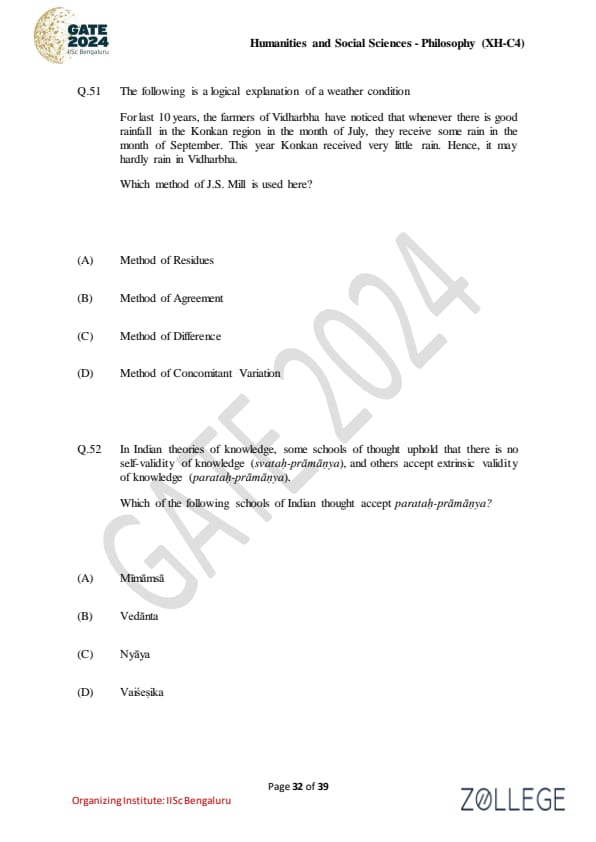
Question 51:
The following is a logical explanation of a weather condition:
For the last 10 years, the farmers of Vidarbha have noticed that whenever there is good rainfall in the Konkan region in the month of July, they receive some rain in the month of September. This year Konkan received very little rain. Hence, it may hardly rain in Vidarbha.
Which method of J.S. Mill is used here?
View Solution
Explanation:
The passage describes a consistent correlation:
- Good rainfall in Konkan (July) is linked with rain in Vidarbha (September).
- The absence of good rainfall in Konkan is linked to the expectation of little or no rain in Vidarbha.
This is an example of the Method of Concomitant Variation, which establishes a correlation between two events by observing variations in one event alongside variations in another.
Other methods:
- Method of Agreement: Identifies common factors in multiple cases of an effect.
- Method of Difference: Contrasts cases where the effect is present or absent.
- Method of Residues: Involves isolating the cause of an effect after accounting for known causes.
Question 52:
In Indian theories of knowledge, some schools of thought uphold that there is no self-validity of knowledge (svatah-prāmāṇya), and others accept extrinsic validity of knowledge (paratah-prāmāṇya). Which of the following schools of Indian thought accept paratah-prāmāṇya?
View Solution
Explanation:
- Nyāya and Vaiśeṣika accept paratah-prāmāṇya, meaning that the validity of knowledge is established by external factors or sources.
- Mīmāṃsā and Vedānta generally uphold svatah-prāmāṇya, the intrinsic validity of knowledge.
Thus, the correct answer is Nyāya (C) and Vaiśeṣika (D).
Question 53:
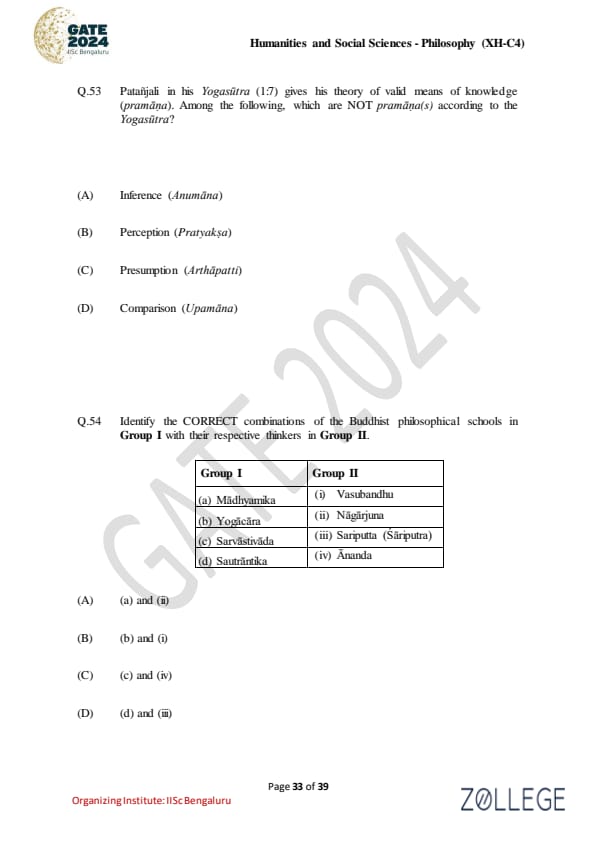
Patañjali in his Yogasūtra (1:7) gives his theory of valid means of knowledge (pramāṇa). Among the following, which are NOT pramāṇa(s) according to the Yogasūtra?
View Solution
Explanation:
In Yogasūtra (1:7), Patañjali identifies the following as valid means of knowledge (pramāṇa):
1. Pratyakṣa (Perception): Direct sensory experience.
2. Anumāna (Inference): Logical deduction based on observation.
3. Āptavacana (Testimony of reliable sources).
Arthāpatti (Presumption) and Upamāna (Comparison) are not included as independent pramāṇas in Patañjali's system.
Question 54:
Identify the CORRECT combinations of the Buddhist philosophical schools in Group I with their respective thinkers in Group II.
| Group I | Group II |
|---|---|
| (a) Mādhayamika | (i) Vasubandhu |
| (b) Yogācāra | (ii) Nāgārjuna |
| (c) Sarvāstivāda | (iii) Sariputta (Śāriputra) |
| (d) Sautrāntika | (iv) Ānanda |
View Solution
Explanation:
The correct combinations of Buddhist philosophical schools and their respective thinkers are:
1. (a) Mādhayamika: Associated with (ii) Nāgārjuna, as Nāgārjuna was the founder of the Mādhayamika school, emphasizing the philosophy of emptiness (\textit{śūnyatā}).
2. (b) Yogācāra: Associated with (i) Vasubandhu, a prominent proponent of the Yogācāra or the "mind-only" school.
Incorrect options:
- (c) Sarvāstivāda and (iii) Sariputta: Sarvāstivāda was not directly associated with Śāriputra.
- (d) Sautrāntika and (iv) Ānanda: Sautrāntika is not primarily linked with Ānanda.
Thus, the correct matches are:
(a) Mādhayamika → Nāgārjuna
(b) Yogācāra → Vasubandhu
Question 55:
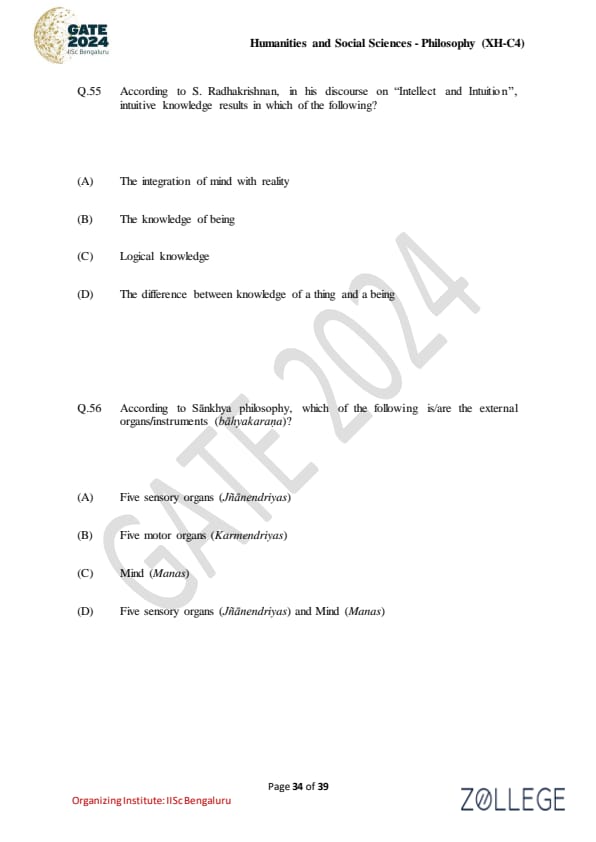
According to S. Radhakrishnan, in his discourse on “Intellect and Intuition,” intuitive knowledge results in which of the following?
View Solution
Explanation:
According to S. Radhakrishnan, intuitive knowledge:
1. Leads to the integration of the mind with reality (A). Intuition bridges the gap between the self and the universal reality.
2. Provides the knowledge of being (B). Intuition allows one to experience the essence of existence.
Incorrect options:
- (C): Logical knowledge pertains to intellect, not intuition.
- (D): Intuition dissolves the difference between knowledge of a thing and being, not emphasizing it.
Thus, the correct answers are (A, B).
Question 56:
According to Sāṅkhya philosophy, which of the following is/are the external organs/instruments (bāhyakaraṇa)?
View Solution
Explanation:
In Sāṅkhya philosophy, bāhyakaraṇa (external instruments) are:
1. The five sensory organs (Jñānendriyas): Eyes, ears, nose, tongue, and skin (A).
2. The five motor organs (Karmendriyas): Hands, feet, speech, excretion, and reproduction (B).
Incorrect options:
- (C): Mind (Manas) is considered an internal organ, not an external one.
- (D): Includes both Jñānendriyas and Manas, but Manas is not part of bāhyakaraṇa.
Thus, the correct answers are (A, B).
Question 57:
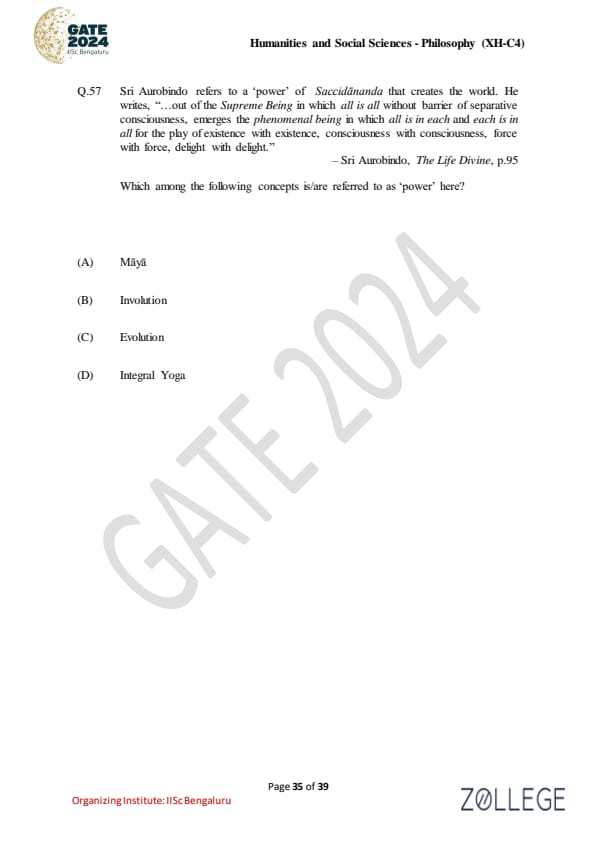
Sri Aurobindo refers to a 'power' of Saccidānanda that creates the world. He writes, “...out of the Supreme Being in which all is all without barrier of separative consciousness, emerges the phenomenal being in which all is in each and each is in all for the play of existence with existence, consciousness with consciousness, force with force, delight with delight.” Which among the following concepts is/are referred to as 'power' here?
View Solution
Explanation:
Sri Aurobindo describes the "power" of Saccidānanda (existence, consciousness, and bliss) that creates the world as the dynamic force responsible for the manifestation of the phenomenal universe.
1. Māyā: Māyā is the creative power of the Supreme Being, responsible for manifesting the diversity of the phenomenal world while maintaining unity in existence. It aligns with the description in the passage.
2. Incorrect options:
- Involution: Refers to the descent of the Supreme Consciousness but is not explicitly the "power" here.
- Evolution: Describes the ascent of consciousness, not the creative force.
- Integral Yoga: A practical philosophy, not the metaphysical "power" mentioned.
Thus, the correct answer is (A) Māyā.
Question 58:
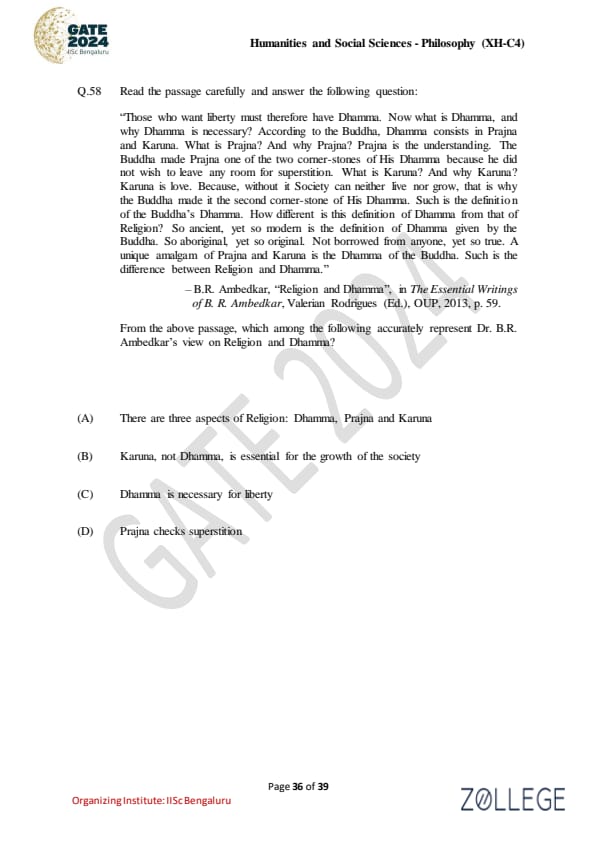
Read the passage carefully and answer the following question:
“Those who want liberty must therefore have Dhamma. Now what is Dhamma, and why Dhamma is necessary? According to the Buddha, Dhamma consists in Prajna and Karuna. What is Prajna? And why Prajna? Prajna is understanding. The Buddha made Prajna one of the two corner-stones of His Dhamma because he did not wish to leave any room for superstition. What is Karuna? And why Karuna? Karuna is love. Because, without it, Society can neither live nor grow, that is why the Buddha made it the second corner-stone of His Dhamma. Such is the definition of the Buddha’s Dhamma. How different is this definition of Dhamma from that of Religion? So ancient, yet so modern is the definition of Dhamma given by the Buddha. So aboriginal, yet so original. Not borrowed from anyone, yet so true. A unique amalgam of Prajna and Karuna is the Dhamma of the Buddha. Such is the difference between Religion and Dhamma.”– B.R. Ambedkar, “Religion and Dhamma”
From the above passage, which among the following accurately represent Dr. B.R. Ambedkar’s view on Religion and Dhamma?
View Solution
Explanation:
Dr. B.R. Ambedkar’s views in the passage highlight:
1. Dhamma is necessary for liberty (C): As it consists of Prajna (understanding) and Karuna (love), both critical for societal growth and individual freedom.
2. Prajna checks superstition (D): As understanding, Prajna prevents superstition and is a cornerstone of Dhamma.
Incorrect options:
- (A): The passage does not describe Dhamma, Prajna, and Karuna as aspects of Religion but rather as components of Dhamma.
- (B): Both Karuna and Dhamma are essential; the passage does not prioritize Karuna over Dhamma.
Thus, the correct answers are (C, D).
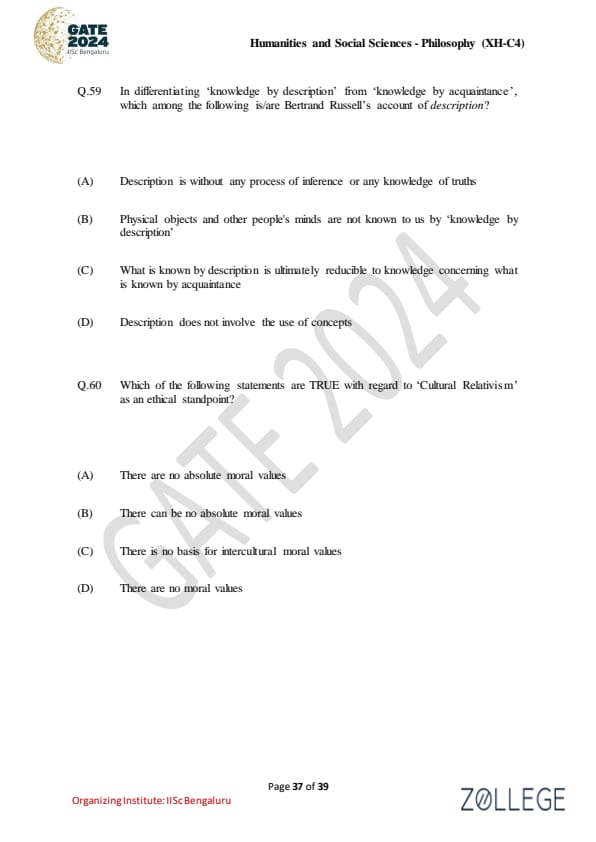
Question 59:
In differentiating ‘knowledge by description' from ‘knowledge by acquaintance', which among the following is/are Bertrand Russell's account of description?
View Solution
Explanation:
Bertrand Russell differentiates between:
1. Knowledge by acquaintance: Direct experience or perception of objects.
2. Knowledge by description: Knowledge of things not directly experienced, derived through inference.
Russell asserts:
- Description involves inference and the use of concepts, making (A) and (D) incorrect.
- Physical objects and other people's minds are often known by description, supporting (B).
- Description is ultimately reducible to acquaintance (C), as descriptions depend on direct experiences.
Thus, the correct answers are (B), (C).
Question 60:
Which of the following statements are TRUE with regard to ‘Cultural Relativism’ as an ethical standpoint?
View Solution
Explanation:
Cultural relativism asserts:
- Moral values are relative to specific cultures (A, B).
- There is no universal or intercultural basis for judging moral values (C).
- It does not deny the existence of moral values entirely, making (D) incorrect.
Thus, the correct answers are (A, B, C).
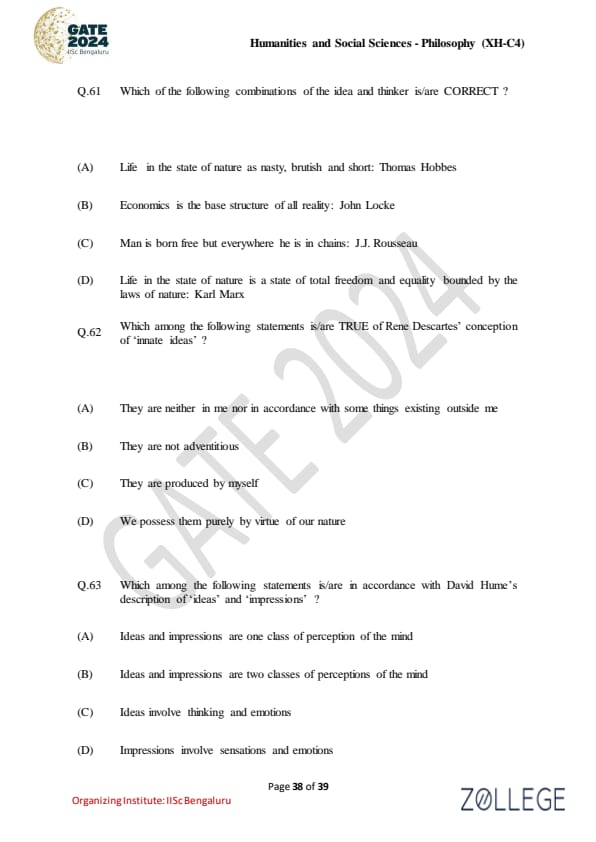
Question 61:
Which of the following combinations of the idea and thinker is/are CORRECT?
View Solution
Explanation:
Correct associations:
1. Thomas Hobbes: Described the state of nature as "nasty, brutish, and short" (A).
2. J.J. Rousseau: Argued "Man is born free, but everywhere he is in chains" (C).
Incorrect associations:
- (B): Economics as the base structure is a Marxist idea, not Locke's.
- (D): Marx did not describe the state of nature as total freedom and equality.
Thus, the correct answers are (A, C).
Question 62:
Which among the following statements is/are TRUE of Rene Descartes' conception of 'innate ideas'?
View Solution
Explanation:
Rene Descartes’ philosophy introduces the concept of innate ideas, which are ideas inherent in the human mind, not derived from external experiences or constructed by oneself.
1. (A): Incorrect. Descartes believed that innate ideas are inherent in the mind and are a fundamental part of the self.
2. (B): Correct. Innate ideas are not adventitious (not derived from sensory experience).
3. (C): Incorrect. Innate ideas are not produced by the self; they pre-exist in the mind.
4. (D): Correct. Innate ideas are possessed purely by virtue of our nature.
Thus, the correct answers are (B, D).
Question 63:
Which among the following statements is/are in accordance with David Hume's description of ‘ideas’ and ‘impressions’?
View Solution
Explanation:
David Hume divides perceptions into two distinct classes:
1. Impressions: Vivid, direct sensory experiences, including sensations and emotions (D).
2. Ideas: Fainter copies of impressions (B).
Incorrect statements:
- (A): Ideas and impressions are distinct classes, not one.
- (C): Ideas do not directly involve emotions; these are part of impressions.
Thus, the correct answers are (B, D).
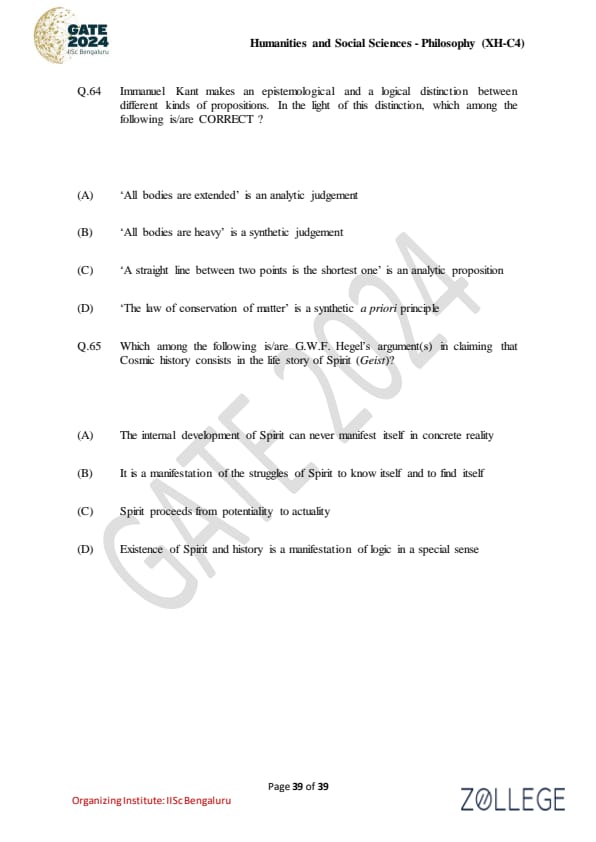
Question 64:
Immanuel Kant makes an epistemological and a logical distinction between different kinds of propositions. In the light of this distinction, which among the following is/are CORRECT?
View Solution
Explanation:
Immanuel Kant distinguishes between analytic and synthetic propositions and introduces synthetic a priori judgements.
1. (A): Correct. "All bodies are extended" is an analytic judgement because the predicate is contained within the subject.
2. (B): Correct. "All bodies are heavy" is synthetic because it adds new information not inherent in the subject.
3. (C): Incorrect. "A straight line is the shortest one" is a synthetic a priori proposition, not analytic.
4. (D): Correct. The law of conservation of matter is synthetic a priori, as it adds universal and necessary knowledge.
Thus, the correct answers are (A, B, D).
Question 65:
Which among the following is/are G.W.F. Hegel's argument(s) in claiming that Cosmic history consists in the life story of Spirit (Geist)?
View Solution
Explanation:
Hegel's view on Spirit (Geist):
1. (A): Incorrect. Spirit's development manifests in concrete reality.
2. (B): Correct. Spirit's struggle to know itself is central to Hegel's dialectical process.
3. (C): Correct. Spirit progresses from potentiality to actuality in history.
4. (D): Correct. History is the unfolding of reason or logic.
Thus, the correct answers are (B, C, D).
*The article might have information for the previous academic years, please refer the official website of the exam.