
GATE 2024 Physics Question Paper Pdf - Check Solutions with Answer Key Pdf
- Chemistry Syllabus
- Maths Syllabus
- Physics Syllabus
- Exam Pattern
- Paper Analysis
- Chemical Engg Syllabus
- Civil Engg Syllabus
- ECE Syllabus
- Mechanical Engg Syllabus
- Engg Science Syllabus
- Mining Engg Syllabus
- IN Syllabus
- CSE Syllabus
- EE Syllabus
- AE Syllabus
- BM Syllabus
- GG Syllabus
- EY Syllabus
- ST Syllabus
- TF Syllaus
- AR Syllabus
- XL Syllabus
- MT Syllabus
- PI Syllabus
- PE Syllabus
- ME Pattern
- TF Pattern
- CE Pattern
- EE Pattern
- EC Pattern
- CS Pattern
- BT Pattern
- BM Pattern
- IN Pattern
- DA Syllabus
- NA & ME Syallabus
- ES & Engg Syllabus
- Geomatics Engg Syllabus
- Agri Engg Syllabus
- Humanities and Social Sci
- PI Syllabus

.jpg?tr=h-55,w-55,c-force)
Content Strategist|Tech-innovator|National Hackathon Winner | Updated On - Jan 28, 2025
GATE 2024 Physics Question Paper with Answer Key PDF for February 3, Shift 2 is available for download. IISc/IITs successfully conducted the exam in the afternoon session from 2:30 PM to 5:30 PM. As per the students’ initial reactions, the GATE 2024 Physics Question Paper was reported as Moderate to Challenging. The General Aptitude section was considered Easy to Moderate, the Mathematical Physics section as Moderate, and the Core Physics section as Moderate to Difficult.
GATE 2024 Physics Question Paper with Answer Key PDF
Candidates can download the GATE 2024 Physics Question Paper with Answer Key PDFs using the link below.
| GATE 2024 Physics Question Paper with Answer Key |  Download Download |
Check Solution |
GATE Physics 2024 Questions with Solutions
GENERAL APTITUDE
Question 1:
If ‘=’ denotes increasing order of intensity, then the meaning of the words [smile — giggle — laugh] is analogous to [disapprove — — chide]. Which one of the given options is appropriate to fill the blank?
Correct Answer: (A) reprove
View Solution
Step 1: Understanding the analogy. The words ”smile — giggle — laugh” represent an increasing order of intensity in the context of emotional expression. Similarly, ”disapprove — — chide” needs a word that signifies a progression of disapproval to reprimand.
Step 2: Evaluating options. • reprove: Means to express disapproval or criticism, fitting the analogy.
• praise: Indicates approval, which is opposite to disapprove.
• reprise: Refers to a repetition or recurrence, unrelated to the context.
• grieve: Indicates sorrow or mourning, unrelated to disapproval.
Step 3: Conclusion. The most appropriate word to complete the analogy is reprove, as it signifies a progression from disapproval to chiding.
Question 2:
Find the odd one out in the set: {19, 37, 21, 17, 23, 29, 31, 11}
Correct Answer: (A) 21
View Solution
Step 1: Analyze the set. The numbers in the set are: 19, 37, 21, 17, 23, 29, 31, 11.
Step 2: Identify the property. All numbers except 21 are prime numbers (numbers divisible only by 1 and themselves). 21 is divisible by 3 and 7, making it a composite number.
Step 3: Conclusion. The odd one out is 21, as it is not a prime number.
Question 3:
In the following series, identify the number that needs to be changed to form the Fibonacci series. 1, 1, 2, 3, 6, 8, 13, 21, . . .
Correct Answer: (C) 6
View Solution
Step 1: Understanding the Fibonacci series. The Fibonacci series is a sequence where each number is the sum of the two preceding numbers: 1, 1, 2, 3, 5, 8, 13, 21, ...
Step 2: Compare the given series with the Fibonacci series. Given series: 1, 1, 2, 3, 6, 8, 13, 21, ... Fibonacci series: 1, 1, 2, 3, 5, 8, 13, 21, ... The number 6 in the given series does not match 5 in the Fibonacci series.
Step 3: Conclusion. The number 6 should be changed to 5 to form the Fibonacci series.
Question 4:
The real variables x, y, z, and the real constants p, q, r satisfy:
x / (pq - r2) = y / (qr - p2) = z / (rp - q2).
Given that the denominators are non-zero, the value of px + qy + rz is:
Correct Answer: (A) 0
View Solution
Step 1: Express the equality with a proportionality constant. Let the common ratio for the fractions be k: x / (pq - r2) = y / (qr - p2) = z / (rp - q2) = k. From this, we can write: x = k(pq - r2), y = k(qr - p2), z = k(rp - q2).
Step 2: Substitute x, y, z into px + qy + rz. The expression becomes: px + qy + rz = p[k(pq - r2)] + q[k(qr - p2)] + r[k(rp - q2)].
Step 3: Simplify the terms. Expand each term: px = kp2q - kpr2, qy = kq2r - kqp2, rz = kr2p - krq2. Adding these: px + qy + rz = (kp2q - kpr2) + (kq2r - kqp2) + (kr2p - krq2). Group similar terms: px + qy + rz = kp2q - kqp2 + kq2r - krq2 + kr2p - kpr2. Each pair of terms cancels out: kp2q - kqp2 = 0, kq2r - krq2 = 0, kr2p - kpr2 = 0. Thus, px + qy + rz = 0.
Step 4: Conclusion. The value of px + qy + rz is 0.
Question 5:
Take two long dice (rectangular parallelepiped), each having four rectangular faces labelled as 2, 3, 5, and 7. If thrown, the long dice cannot land on the square faces and has 1/4 probability of landing on any of the four rectangular faces. The label on the top face of the dice is the score of the throw. If thrown together, what is the probability of getting the sum of the two long dice scores greater than 11?
Correct Answer: (D) 3/16
View Solution
Step 1: Total outcomes. Each die has four possible outcomes: {2, 3, 5, 7}. When two dice are thrown, the total number of outcomes is: 4 * 4 = 16.
Step 2: Favorable outcomes. The sum of the scores on the two dice must be greater than 11. List all possible outcomes: - (5, 7), (7, 5), (7, 7). These are the only outcomes where the sum > 11. Thus, there are 3 favorable outcomes.
Step 3: Probability. The probability of getting a sum greater than 11 is: P = Favorable outcomes / Total outcomes = 3 / 16.
Question 6:
In the given text, the blanks are numbered (1)—(iv). Select the best match for all the blanks. Prof. (1) merely a man who narrated funny stories. (ii) his blackest moments he was capable of self-deprecating humor. Prof. Q (iii) a man who hardly narrated funny stories. (iv) in his blackest moments was he able to find humor.
Correct Answer: (B) wasn’t, Even, was, Only
View Solution
Step 1: Fill the blanks based on context. • (1) : wasn’t: The sentence suggests Prof. P was not merely a man who narrated funny stories. • (ii) : Even: The phrase ”Even in his blackest moments” fits the context. • (iii) : was: Prof. Q was a man who hardly narrated funny stories. • (iv) : Only: ”Only in his blackest moments was he able to find humor” aligns with the sentence structure.
Step 2: Verify the choices. The sequence wasn’t, Even, was, Only matches the context and grammar of the sentences.
Step 3: Conclusion. The correct match for the blanks is wasn’t, Even, was, Only.
Question 7:
How many combinations of non-null sets A, B, C are possible from the subsets of {2, 3, 5} satisfying the conditions: (i) A ⊆ B, and (ii) B ⊆ C?
Correct Answer: (B) 27
View Solution
Step 1: Understand the relationship between A, B, C. The conditions specify that A ⊆ B ⊆ C. This means every element in A must also be in B, and every element in B must also be in C.
Step 2: Determine the number of subsets for C. The set {2, 3, 5} has 23 = 8 subsets. Thus, C can take any of these 8 subsets.
Step 3: Determine the number of subsets for B for a fixed C. For each choice of C, B can be any subset of C. If C has n elements, then B can take 2n subsets.
Step 4: Determine the number of subsets for A for a fixed B. For each choice of B, A can be any subset of B. If B has m elements, then A can take 2m subsets.
Step 5: Total number of combinations. The total number of combinations of A, B, C is the sum of 2|B| * 2|A| over all possible subsets C. This results in: Total combinations = ΣC ΣB⊆C ΣA⊆B 1. Using symmetry and the inclusion-exclusion principle, the total number of valid combinations is 33 = 27.
Step 6: Conclusion. The total number of non-null combinations of A, B, C is 27.
Question 8:
The bar chart gives the batting averages of VK and RS for 11 calendar years from 2012 to 2022. Considering that 2015 and 2019 are world cup years, which one of the following options is true?

Correct Answer: (C) VK’s yearly batting average is consistently higher than that of RS between the two world cup years.
View Solution
Step 1: Analyze the data for the world cup years (2015 and 2019). • In 2015, VK’s batting average is higher than RS’s batting average. • In 2019, VK’s batting average is higher than RS’s batting average. This eliminates options (1) and (2).
Step 2: Analyze the data between the two world cup years (2016 to 2018). • For 2016, 2017, and 2018, VK’s batting average is consistently higher than RS’s batting average. This confirms that option (3) is correct.
Step 3: Analyze the last three years (2020 to 2022). • In 2020 and 2021, VK’s batting average is higher than RS’s. • In 2022, RS’s batting average is higher than VK’s. Thus, option (4) is incorrect.
Step 4: Conclusion. The correct statement is: VK’s yearly batting average is consistently higher than that of RS between the two world cup years.
Question 9:
A planar rectangular paper has two V-shaped pieces attached as shown below. This piece of paper is folded to make the following closed three-dimensional object. [Image of a 3D object formed by folding the paper.] The number of folds required to form the above object is:


Correct Answer: (A) 9
View Solution
Step 1: Understand the folding process. To create the three-dimensional object from the given planar shape, specific folds are required along the edges to form the rectangular sides and connect the V-shaped pieces into the final structure.
Step 2: Count the number of folds. • 5 folds are required to create the two V-shaped structures (one for each of the sides of the V). • 4 additional folds are required to form the rectangular connections and close the structure. Thus, the total number of folds required is: 5 + 4 = 9.
Step 3: Verify the process. Each fold corresponds to aligning and joining the planar parts into the final 3D object. The folding steps match the geometry of the figure.
Step 4: Conclusion. The number of folds required to form the object is 9.
Question 10:
Visualize a cube that is held with one of the four body diagonals aligned to the vertical axis. Rotate the cube about this axis such that its view remains unchanged. The magnitude of the minimum angle of rotation is:
Correct Answer: (A) 120°
View Solution
Step 1: Understand the geometry of the cube. A cube has rotational symmetry about its body diagonal. When the cube is rotated about one of its body diagonals, the cube appears unchanged after a rotation of certain angles due to its symmetry.
Step 2: Analyze the rotational symmetry. A cube can be rotated about its body diagonal by 120°, 240°, and 360° to appear unchanged. Among these, 120° is the minimum angle that satisfies the condition.
Step 3: Conclude the solution. The minimum angle of rotation about the body diagonal such that the cube appears unchanged is 120°.
Question 11:
If F1(Q, q) = Qq is the generating function of a canonical transformation from (p, q) to (P, Q), then which one of the following relations is correct?
Correct Answer: (C) p / P = -Q / q
View Solution
Step 1: Relation from generating function. For a generating function F1(Q, q), the canonical transformation is given by: p = ∂F1/∂q, P = -∂F1/∂Q.
Step 2: Compute partial derivatives. Given F1(Q, q) = Qq: p = ∂F1/∂q = Q, P = -∂F1/∂Q = -q.
Step 3: Express the relationship between p, P, Q, q. From p = Q and P = -q, divide p and P: p/P = Q/(-q) = -Q/q.
Step 4: Conclusion. The correct relation is p / P = -Q / q.
Question 12:
An unpolarized plane electromagnetic wave in a dielectric medium 1 is incident on a plane interface that separates medium 1 from another dielectric medium 2. Medium 1 and medium 2 have refractive indices n1 and n2, respectively, with n2 > n1. If the angle of incidence is tan-1(n2 / n1), which one of the following statements is true?
Correct Answer: (C) The reflected wave is polarized perpendicular to the plane of incidence
View Solution
Step 1: Recall Brewster’s angle condition. At the Brewster angle, the reflected wave is completely polarized perpendicular to the plane of incidence. The Brewster angle is given by: tan θB = n2 / n1, where n2 > n1.
Step 2: Analyze the polarization. For an unpolarized wave incident at the Brewster angle, the reflected wave becomes completely polarized perpendicular to the plane of incidence.
Step 3: Conclusion. The reflected wave is polarized perpendicular to the plane of incidence. Hence, the correct option is (C).
Question 13:
The wavefunction of a particle in an infinite one-dimensional potential well at time t is given by:
Ψ(x, t) = √(2/3) * e-iE1t/ħψ1(x) + (1/√6) * eiπ/6-iE2t/ħψ2(x) + (1/√6) * eiπ/4-iE3t/ħψ3(x),
where ψ1, ψ2, ψ3 are the normalized ground state, the normalized first excited state, and the normalized second excited state, respectively. E1, E2, E3 are the eigen-energies corresponding to ψ1, ψ2, ψ3, respectively. The expectation value of energy of the particle in state Ψ(x, t) is:
Correct Answer: (A) 17/6 * E1
View Solution
Step 1: Understanding the expectation value of energy. The expectation value of energy for the wavefunction Ψ(x, t) is given by: ⟨E⟩ = Σn |cn|2En, where |cn|2 represents the probability of finding the particle in the n-th state, and En is the energy eigenvalue corresponding to the n-th state.
Step 2: Extract coefficients cn from Ψ(x, t). From the given wavefunction: c1 = √(2/3), c2 = 1/√6, c3 = 1/√6.
Step 3: Calculate |cn|2. The probabilities are: |c1|2 = 2/3, |c2|2 = 1/6, |c3|2 = 1/6.
Step 4: Substitute into the expectation value formula. ⟨E⟩ = |c1|2E1 + |c2|2E2 + |c3|2E3. Given E2 = 4E1 and E3 = 9E1: ⟨E⟩ = (2/3) * E1 + (1/6) * (4E1) + (1/6) * (9E1).
Step 5: Simplify the expression. ⟨E⟩ = (2/3) * E1 + (4/6) * E1 + (9/6) * E1 = (4/6) * E1 + (4/6) * E1 + (9/6) * E1 = (17/6) * E1.
Step 6: Conclusion. The expectation value of the energy is (17/6) * E1.
Question 14:
If a thermodynamical system is adiabatically isolated and experiences a change in volume under an externally applied constant pressure, then the thermodynamical potential minimized at equilibrium is the:
Correct Answer: (A) Enthalpy
View Solution
Step 1: Analyze the given conditions. The problem specifies that the system is: 1. Adiabatically isolated (no heat exchange: Q = 0). 2. Experiencing a change in volume under an externally applied constant pressure (P is constant). In such a scenario, the thermodynamic potential governing the system is determined by the constraint of constant pressure and the adiabatic nature of the process.
Step 2: Identify the relevant thermodynamic potential. Under constant pressure, the enthalpy H is the thermodynamic potential defined as: H = U + PV, where U is the internal energy, P is the pressure, and V is the volume. When a system is adiabatically isolated and pressure is constant, the enthalpy is minimized at equilibrium.
Step 3: Evaluate other options. • Helmholtz free energy (F = U − TS): This is minimized at constant T and V, not applicable here.
• Gibbs free energy (G = H − TS): This is minimized at constant T and P, but the system is adiabatic, so T is not specified as constant. • Grand potential (Φ = U − TS − μN): This is minimized in open systems with constant T and μ, not relevant here.
Step 4: Conclusion. The thermodynamic potential minimized under the given conditions is the enthalpy (H).
Question 15:
The mean distance between the two atoms of HD molecule is r, where H and D denote hydrogen and deuterium, respectively. The mass of the hydrogen atom is mH. The energy difference between two lowest lying rotational states of HD in multiples of ħ2/(mHr2) is:
Correct Answer: (A) 3/2
View Solution
Step 1: Rotational energy levels. The rotational energy levels of a diatomic molecule are given by: EJ = (ħ2 * J(J + 1)) / (2I), where J is the rotational quantum number and I is the moment of inertia of the molecule. The moment of inertia is: I = μr2, where μ is the reduced mass: μ = (mH * mD) / (mH + mD).
Step 2: Energy difference between J = 0 and J = 1. For the two lowest rotational levels (J = 0 and J = 1): ΔE = E1 - E0 = (ħ2 * 1(1 + 1)) / (2I) - (ħ2 * 0(0 + 1)) / (2I) = 2ħ2 / (2I) = ħ2 / I. Substitute I = μr2: ΔE = ħ2 / (μr2).
Step 3: Express in terms of mHr2. The reduced mass μ for HD is: μ = (mH * mD) / (mH + mD). Approximating mD = 2mH: μ = (mH * 2mH) / (mH + 2mH) = 2mH2 / 3mH = (2/3) * mH. Thus, the energy difference becomes: ΔE = ħ2 / (μr2) = ħ2 / ((2/3)mHr2) = (3/2) * (ħ2 / (mHr2)).
Step 4: Conclusion. The energy difference between the two lowest lying rotational states is (3/2) * ħ2 / (mHr2).
Physics
Question 16:
Crystal structures of two metals A and B are two-dimensional square lattices with the same lattice constant a. Electrons in metals behave as free electrons. The Fermi surfaces corresponding to A and B are shown by solid circles in figures. The electron concentrations in A and B are nA and nB, respectively. The value of nB/nA is:

Correct Answer: (B) 2
View Solution
Step 1: Electron concentration relation. The electron concentration n is related to the Fermi wave vector kF in two dimensions as: n = kF2 / 2π. Here, kF is the radius of the Fermi surface in k-space.
Step 2: Determine kF for metals A and B. From the diagrams: • For metal A, the Fermi surface radius is kFA = π / a. • For metal B, the Fermi surface radius is kFB = √2π / a.
Step 3: Calculate nA and nB. Using n = kF2 / 2π: nA = (kFA)2 / 2π = (π/a)2 / 2π = π / 2a2 nB = (kFB)2 / 2π = (√2π/a)2 / 2π = 2π / 2a2
Step 4: Find nB / nA. nB / nA = (2π / 2a2) / (π / 2a2) = (2π / π) = 2.
Step 5: Conclusion. The value of nB / nA is 2.
Question 17:
Consider the induced nuclear fission reaction: 23592U + n → 9337Rb + 14155Cs + 2n, where neutron momenta in both initial and final states are negligible. The ratio of the kinetic energies (KE) of the daughter nuclei, KE(9337Rb) / KE(14155Cs) is:
Correct Answer: (B) 141 / 93
View Solution
Step 1: Conservation of momentum. In the fission process, the total momentum of the system before and after the reaction must be conserved. Let the masses of the daughter nuclei be mRb and mCs. Since the neutron momenta are negligible, the momenta of the two daughter nuclei must be equal and opposite in direction: mRb * vRb = mCs * vCs.
Step 2: Relation between kinetic energy and velocity. The kinetic energy KE of a nucleus is given by: KE = 1/2 * m * v2. Using v = p/m (where p is the momentum), the kinetic energy can be expressed as: KE = p2 / 2m. Since the momenta are equal (pRb = pCs), the ratio of the kinetic energies is inversely proportional to the ratio of their masses: KE(9337Rb) / KE(14155Cs) = mCs / mRb.
Step 3: Substituting the masses. The masses of the daughter nuclei are approximately proportional to their mass numbers: mRb ∝ 93, mCs ∝ 141. Thus: KE(9337Rb) / KE(14155Cs) = 141 / 93.
Step 4: Conclusion. The ratio of the kinetic energies of the daughter nuclei is 141 / 93.
Question 18:
The symbols C, D, Vin, and Vo shown in the figure denote a capacitor, ideal diode, input voltage, and output voltage, respectively. The circuit is given along with the input waveform Vin. Which one of the following output waveforms (Vo) is correct for the given input waveform (Vin)?


Correct Answer: (A) Figure 1.
View Solution
Step 1: Analyze the circuit components. The circuit consists of: 1. A capacitor (C): Blocks DC components and stores charge. 2. An ideal diode (D): Allows current flow only in one direction, cutting off the negative half-cycles of the input voltage.
Step 2: Behavior of the circuit with the given Vin. The input Vin is a square waveform oscillating between +3 V and −3 V. • During the positive half-cycle (Vin = +3 V), the diode conducts, and the capacitor charges to the peak value (+3 V). • During the negative half-cycle (Vin = −3 V), the diode blocks current, and the capacitor retains its charge (+3 V).
Step 3: Combined effect of the input and stored charge. For the output Vo: • When the input goes to +3 V, the output is Vo = Vin + Vstored = +3 V + 3 V = +6 V. • When the input goes to −3 V, the diode blocks, and the output remains constant at +6 V.
Thus, the output Vo is a rectangular waveform oscillating between +6 V and 0 V, as shown in waveform (A).
Step 4: Conclusion. The correct output waveform is described in option (1).
Question 19:
Let Ne and Te, respectively, denote the number and kinetic energy of electrons produced in a nuclear beta decay. Which one of the following distributions is correct?

Correct Answer: (C) Figure 3.
View Solution
Step 1: Nature of beta decay. In nuclear beta decay, the electron’s kinetic energy Te follows a continuous distribution due to the sharing of energy between the beta particle (electron), antineutrino, and recoiling nucleus.
Step 2: Characteristics of the energy distribution. The energy distribution of beta particles is: • Maximum at a lower Te, where most beta particles are emitted. • Decreasing as Te increases, with a sharp cutoff at the maximum kinetic energy determined by the decay’s Q-value.
Step 3: Analyze the options. • Option (A): Represents a discrete energy value, which is incorrect because the energy is continuously distributed. • Option (B): A bell-shaped curve, which does not match the known energy spectrum of beta particles. • Option (C): A curve with a peak at low Te and a decreasing trend, consistent with the beta decay energy distribution. • Option (D): An increasing trend, which does not align with the beta decay spectrum.
Step 4: Conclusion. The correct distribution is represented by Option (3), where Ne peaks at lower Te and decreases as Te approaches the maximum kinetic energy.
Question 20:
An infinitely long cylinder of radius R carries a frozen-in magnetization M→ = ke−s ẑ, where k is a constant and s is the distance from the axis of the cylinder. The magnetic permeability of free space is μ0. There is no free current present anywhere. The magnetic flux density (B→ ) inside the cylinder is:
Correct Answer: (C) μ0ke−s ẑ
View Solution
Step 1: Relationship between magnetization and magnetic flux density. The magnetic flux density B⃗ is related to the magnetization M⃗ and the auxiliary field H⃗ by: B⃗ = μ0(H⃗ + M⃗), where H⃗ is the magnetic field intensity.
Step 2: Determine H⃗ for the given setup. Since there are no free currents (Jfree = 0), ∇ × H⃗ = 0. This implies H⃗ is curl-free and can be written as the gradient of a scalar potential, H⃗ = -∇φ. Using ∇ · (B/μ0) = -∇ · M⃗, we have: ∇ · H⃗ = -∇ · M⃗. Given M⃗ = k*e-s ẑ, the divergence ∇ · M⃗ = 0 since M⃗ is constant in the z-direction and depends only on s (radial coordinate). Thus, ∇ · H⃗ = 0, meaning H⃗ = 0 inside the cylinder.
Step 3: Calculate B⃗ . Substitute H⃗ = 0 into the expression for B⃗: B⃗ = μ0 * M⃗. Given M⃗ = ke-s ẑ: B⃗ = μ0ke-s ẑ.
Step 4: Conclusion. The magnetic flux density inside the cylinder is μ0ke-s ẑ.
Question 21:
Atomic numbers of V , Cr , Fe , and Zn are 23, 24, 26, and 30, respectively. Which one of the following materials does NOT show an electron spin resonance (ESR) spectra?
Correct Answer: (D) Zn
View Solution
Step 1: Understanding Electron Spin Resonance (ESR). ESR is a spectroscopic technique used to study materials with unpaired electrons. Unpaired electrons generate magnetic moments, which interact with an external magnetic field, giving rise to ESR spectra.
Step 2: Analyze the electronic configurations.
1. Vanadium (V, Z = 23): Electronic configuration [Ar]3d34s2. The 3d3 electrons provide unpaired electrons. Thus, V shows ESR spectra.
2. Chromium (Cr, Z = 24): Electronic configuration [Ar]3d54s1. The 3d5 electrons provide unpaired electrons. Thus, Cr shows ESR spectra.
3. Iron (Fe, Z = 26): Electronic configuration [Ar]3d64s2. The 3d6 electrons provide unpaired electrons. Thus, Fe shows ESR spectra.
4. Zinc (Zn, Z = 30): Electronic configuration [Ar]3d104s2. The 3d10 electrons are fully paired, and the 4s2 electrons are also paired. Thus, Zn does not have unpaired electrons and does not show ESR spectra.
Step 3: Conclusion. Zn does not show ESR spectra because it has no unpaired electrons in its electronic configuration.
Question 22:
A particle is subjected to a potential V(x) = { ∞ if x ≤ 0, V0 if a ≤ x ≤ b, 0 elsewhere. Here, a > 0 and b > a. If the energy of the particle E < V0, which one of the following schematics is a valid quantum mechanical wavefunction (Ψ) for the system?

Correct Answer: (B) Figure 2
View Solution
Step 1: Boundary conditions. For x ≤ 0, V(x) = ∞, which means the wavefunction Ψ(x) must be zero in this region due to the infinite potential barrier.
Step 2: Behavior in the regions. • For 0 < x < a where V(x) = 0, the wavefunction behaves as a free particle solution. This results in oscillatory behavior. • For a ≤ x ≤ b where V(x) = V0 and E < V0, the wavefunction decays exponentially since the particle is in a classically forbidden region. • For x > b where V(x) = 0, the wavefunction is oscillatory again, as the particle is in a free region.
Step 3: Evaluate the options.
• Option (A): Incorrect. The wavefunction does not decay exponentially in the region a ≤ x ≤ b.
• Option (B): Correct. The wavefunction satisfies all boundary conditions, including the decay in the classically forbidden region.
• Option (C): Incorrect. The wavefunction shows incorrect oscillatory behavior in the forbidden region a ≤ x ≤ b.
Step 4: Conclusion. The valid quantum mechanical wavefunction is represented by option (2).
Question 23:
Let ρ(p, q, t) be the phase space density of an ensemble of a system. The Hamiltonian of the system is H(p, q). If {A, B} denotes the Poisson bracket of A and B, then: dρ/dt = 0 implies:
Correct Answer: (B) ∂ρ/∂t ∝ {ρ, H}
View Solution
Step 1: Understand the given condition. The equation dρ/dt = 0 implies that the phase space density ρ(⃗p, ⃗q, t) is conserved along the trajectories of the system in phase space. Using the Liouville equation for Hamiltonian dynamics: dρ/dt = ∂ρ/∂t + {ρ, H} = 0, where {A, B} is the Poisson bracket defined as: {A, B} = Σi (∂A/∂qi * ∂B/∂pi - ∂A/∂pi * ∂B/∂qi)
Step 2: Interpretation of dρ/dt = 0. The condition implies that the total time derivative of ρ is zero, which leads to: ∂ρ/∂t = -{ρ, H}. Thus, ∂ρ/∂t ∝ {ρ, H}.
Step 3: Analyze the options. • Option (1): ∂ρ/∂t = 0 is incorrect because it implies no time dependence at all, which contradicts the condition dρ/dt = 0. • Option (2): ∂ρ/∂t ∝ {ρ, H} is correct based on the Liouville equation. • Option (3): ∂ρ/∂t ∝ {ρ, ⃗p⋅⃗q / 2} is unrelated to the Hamiltonian H. • Option (4): ∂ρ/∂t ∝ {ρ, ⃗q⋅⃗q / 2} is also unrelated to H.
Step 4: Conclusion. The correct answer is Option (2): ∂ρ/∂t ∝ {ρ, H}.
Question 24:
Consider the following circuit:

The circuit is composed of an AND gate followed by an OR gate. The input signals P and Q are given as shown in the figure.

The input signal P alternates between +5 V and 0 V; while the input signal Q also alternates between +5 V and 0 V with different timing. Which one of the following output signals is correct?


Correct Answer: (A) 
View Solution
Step 1: Analyze the circuit. The circuit consists of an AND gate taking P and Q as inputs, followed by an OR gate. The AND gate outputs a high signal (+5 V) only when both P and Q are high. The OR gate produces a high output if either the AND gate output or any other input to the OR gate is high.
Step 2: Evaluate the output signal. Given the input signals P and Q, the correct output Y is obtained by applying the logical operations sequentially: • The AND gate output is high only when P and Q are both +5 V. • The OR gate combines this with other inputs to generate the final output.
Step 3: Conclusion. The waveform in option (1) correctly represents the output Y based on the circuit logic and input signals.
Question 25:
An inertial observer sees two spacecrafts S and T flying away from each other along the x-axis with individual speed 0.5c, where c is the speed of light. The speed of T with respect to S is:
Correct Answer: (A) 4/5 * c
View Solution
Step 1: Use relativistic velocity addition formula. The relative velocity vrel of spacecraft T with respect to S is given by the relativistic velocity addition formula: vrel = (vT - vS) / (1 - (vT * vS) / c2). Here: • vT = 0.5c is the speed of T relative to the inertial observer, • vS = -0.5c is the speed of S relative to the inertial observer (negative because S moves in the opposite direction to T).
Step 2: Substitute the values. vrel = (0.5c - (-0.5c)) / (1 - (0.5c * -0.5c) / c2). Simplify the numerator: vrel = (0.5c + 0.5c) / (1 - (-0.25c2) / c2) = 1.0c / (1 + 0.25).
Step 3: Simplify further. vrel = 1.0c / 1.25 = (4/5)c.
Step 4: Conclusion. The speed of T with respect to S is (4/5) * c.
Question 26:
Let P, Q, and R be three different nuclei. Which one of the following nuclear processes is possible?
Correct Answer: (A) νe + AZP → AZ+1Q + e−
View Solution
Step 1: Understanding the process The given options describe different nuclear processes involving a neutrino (νe) and a nucleus AZP, where A represents the mass number and Z represents the atomic number.
Step 2: Analyze the options
• Option (1): This describes a beta-plus decay, which is possible if a neutrino interacts with the nucleus AZP, converting a proton into a neutron. This leads to the formation of AZ+1Q, with the emission of an electron (e-).
• Option (2): This describes a beta-minus decay. However, neutrino interactions cannot lead to the production of a positron (e+) while reducing the atomic number.
• Option (3): This describes the simultaneous production of a positron and an electron from the interaction of a neutrino, which violates charge conservation.
• Option (4): This describes a gamma emission, which is not related to neutrino interactions as described.
Step 3: Identify the valid process Only Option (1) is a valid process, as it aligns with the principles of beta-plus decay where a proton is converted to a neutron due to neutrino interaction.
Conclusion: The correct answer is (1) νe + AZP → AZ+1Q + e−.
Question 27:
The temperature dependence of the electrical conductivity (σ) of three intrinsic semiconductors A, B, and C is shown in the figure. Let EA, EB, and EC be the bandgaps of A, B, and C, respectively. Which one of the following relations is correct?

Correct Answer: (D) EA > EC > EB
View Solution
Step 1: Relation between bandgap and conductivity. The electrical conductivity σ of an intrinsic semiconductor depends on the temperature T and the bandgap energy Eg as: σ ∝ e−(Eg / (2kBT)). Taking the natural logarithm: ln(σ) ∝ -(Eg / (2kB)) * T-1. This shows that the slope of ln(σ) versus T-1 is proportional to -Eg. A larger bandgap corresponds to a steeper (more negative) slope.
Step 2: Analyzing the slopes of A, B, and C. From the figure: • A has the steepest slope, indicating the largest bandgap. • C has a slope less steep than A but steeper than B, indicating an intermediate bandgap. • B has the least steep slope, indicating the smallest bandgap. Thus, the order of bandgaps is: EA > EC > EB.
Step 3: Conclusion. The correct relation is EA > EC > EB, which corresponds to Option (4).
Question 28:
Following trial wavefunctions: φ1 = e-Z'(r1+r2) and φ2 = e-Z'(r1+r2)(1 + g|r1 − r2|) are used to get a variational estimate of the ground state energy of the helium atom. Z′ and g are the variational parameters, r1 and r2 are the position vectors of the electrons. Let E0 be the exact ground state energy of the helium atom. E1 and E2 are the variational estimates of the ground state energy of the helium atom corresponding to φ1 and φ2, respectively. Which one of the following options is true?
Correct Answer: (D) E1 ≥ E0, E2 ≥ E0, E1 ≥ E2
View Solution
Step 1: Understanding the variational principle. The variational principle states that the energy estimate obtained using any trial wavefunction is always greater than or equal to the exact ground state energy: Etrial ≥ E0.
Step 2: Comparison of φ1 and φ2.
• The trial wavefunction φ1 = e-Z'(r1+r2) is a simpler approximation of the ground state wavefunction, without considering electron correlation.
• The trial wavefunction φ2 = e-Z'(r1+r2)(1 + g|r⃗1 − r⃗2|) includes the term g|r⃗1 − r⃗2|, which accounts for the electron-electron repulsion. This makes φ2 a better approximation to the true ground state wavefunction than φ1.
Step 3: Implications for the energy estimates. Since φ2 is a better approximation than φ1, the variational estimate E2 obtained from φ2 is closer to E0 than E1. Hence: E1 ≥ E2 ≥ E0.
Step 4: Conclusion. The correct relation is: E1 ≥ E0, E2 ≥ E0, E1 ≥ E2, which corresponds to Option (4).
Question 29:
The wavefunction for a particle is given by the form e−(iαx+β), where α and β are real constants. In which one of the following potentials V(x), the particle is moving?
Correct Answer: (C) V(x) = 0
View Solution
Step 1: Analyze the given wavefunction. The given wavefunction is: ψ(x) = e-(iαx+β) = e-β * e-iαx. This represents a plane wave with a spatial phase factor e-iαx and a constant magnitude e-β.
Step 2: Plane wave in quantum mechanics. A plane wave solution occurs when the particle is free, i.e., moving in a potential V(x) = 0. For such a wavefunction, the time-independent Schrödinger equation is: -(ħ2 / 2m) * (d2ψ / dx2) + V(x)ψ = Eψ. Substituting V(x) = 0, the solution to the equation is a plane wave: ψ(x) = e-ikx, where k = α relates to the particle’s momentum p = ħk.
Step 3: Evaluate the given options.
• Option (1): V(x) ∝ α2x2: This corresponds to a harmonic oscillator potential, which does not produce a plane wave solution.
• Option (2): V(x) ∝ e-αx: This is a potential with spatial dependence, which does not lead to a plane wave solution.
• Option (3): V(x) = 0: This represents a free particle and is consistent with the plane wave solution ψ(x) = e-(iαx+β).
• Option (4): V(x) ∝ sin(αx): A sinusoidal potential generally leads to band-like solutions, not a plane wave.
Step 4: Conclusion. The potential V(x) = 0 is consistent with the given wavefunction. Hence, the correct answer is Option (3).
Question 30:
Consider a volume integral: I = ∫V ∇2 (1/r) dV over a volume V, where r = √(x2 + y2 + z2). Which of the following statements is/are correct?
Correct Answer: (A) I = −4π, if r = 0 is inside the volume V ; (B) Integrand vanishes for r ≠ 0; (C) I = 0, if r = 0 is not inside the volume V
View Solution
Step 1: Analyze the integrand. The term ∇2(1/r) is the Laplacian of 1/r, where r = √(x2 + y2 + z2). Using the property of the Laplacian in three-dimensional space: ∇2(1/r) = -4πδ3(r⃗), where δ3(r⃗) is the three-dimensional Dirac delta function.
Step 2: Evaluate the volume integral. I = ∫V ∇2(1/r) dV = ∫V -4πδ3(r⃗)dV. • If r = 0 is inside the volume V, the delta function contributes: I = -4π.
• If r = 0 is not inside V, the delta function is zero everywhere in V, so: I = 0.
Step 3: Behavior of the integrand.
• For r ≠ 0, ∇2(1/r) = 0, as the delta function is only non-zero at r = 0.
• As r → ∞, 1/r tends to zero, so the integrand does not diverge.
Step 4: Analyze the options.
• Option (1): Correct, as I = −4π if r = 0 is inside V.
• Option (2): Correct, as the integrand vanishes for r ≠ 0.
• Option (3): Correct, as I = 0 if r = 0 is not inside V.
• Option (4): Incorrect, as the integrand does not diverge as r → ∞.
Step 5: Conclusion. The correct statements are (1),(2),(3).
Question 31:
The complex function e-2/(z-1) has:
Correct Answer: (B) an essential singularity at z = 1 , (C) a residue equal to -2 at z = 1.
View Solution
Step 1: Analyze the function e-2/(z-1). The term 2 / (z - 1) diverges as z → 1, and since it appears in the exponent, e-2/(z-1) oscillates infinitely near z = 1. This behavior indicates an essential singularity at z = 1.
Step 2: Residue calculation. To determine the residue, consider the Laurent series expansion of the function around z = 1: e-2/(z-1) = Σn=0∞ ((-2)n / (n! * (z - 1)n)) The residue is the coefficient of 1/(z - 1): Residue = -2.
Step 3: Evaluate the options. • Option (1): Incorrect, as z = 1 is not a simple pole; it is an essential singularity.
• Option (2): Correct, as the function has an essential singularity at z = 1.
• Option (3): Correct, as the residue at z = 1 is -2.
• Option (4): Incorrect, as z = 1 is not a branch point.
Step 4: Conclusion. The correct answers are 2 and 3.
Question 32:
The minimum number of basic logic gates required to realize the Boolean expression B · (A + B) + A · (B̄ + A) is (in integer).
Correct Answer: 1
View Solution
Step 1: Simplify the Boolean expression. The given expression is: B * (A + B) + A * (B̄ + A). Simplify each term: • B * (A + B) = B, since B * B = B. • A * (B̄ + A) = A, since A * A = A. Combine the simplified terms: B + A.
Step 2: Realize the simplified expression. The expression B + A requires only one OR gate.
Step 3: Conclusion. The minimum number of gates required is 1.
Question 33:
The vapor pressure (P) of solid ammonia is given by ln(P) = 23.03 − (3754 / T), while that of liquid ammonia is given by ln(P) = 19.49 − (3063 / T), where T is the temperature in K. The temperature of the triple point of ammonia is —— K (rounded off to two decimal places).
Correct Answer: 195.41 K
View Solution
Step 1: At the triple point, the vapor pressures are equal. At the triple point of ammonia, the vapor pressures of the solid and liquid phases are equal. Therefore, 23.03 - (3754 / T) = 19.49 - (3063 / T).
Step 2: Simplify the equation. Rearranging the terms: 23.03 - 19.49 = (3754 / T) - (3063 / T). 3. 54 = (3754 - 3063) / T. 4. 54 = 691 / T.
Step 3: Solve for T. T = 691 / 3.54. T = 195.41 K.
Conclusion: The temperature of the triple point of ammonia is 195.41 K.
Question 34:
The electric field in a region depends only on x and y coordinates as: E⃗ = k * (x î + y ĵ) / (x2 + y2), where k is a constant. The flux of E⃗ through the surface of a sphere of radius R with its center at the origin is nπRk, where the value of n is (in integer).
Correct Answer: 4
View Solution
Step 1: Use Gauss’s law. The given electric field can be expressed in terms of polar coordinates: E⃗ = k * r⃗ / r2. The flux through a spherical surface of radius R is: Φ = ∫S E⃗ ⋅ d⃗A. Since E⃗ is radially symmetric: Φ = ∫S (k / R2) * R2 dΩ = k * ∫S dΩ.
Step 2: Evaluate the integral. The solid angle over a sphere is 4π. Hence: Φ = k * 4π.
Step 3: Relate to the given flux. The problem states: Φ = nπRk. Comparing: nπRk = 4πk ⇒ n = 4.
Step 4: Conclusion. The value of n is 4.
Question 35:
The Hamiltonian of a system of N particles in volume V at temperature T is: H = Σi=12N aiqi2 + Σi=12N bipi2, where ai and bi are positive constants. The ensemble average of the Hamiltonian is αN kBT, where kB is the Boltzmann constant. The value of α is (in integer).
Correct Answer: 2
View Solution
Step 1: Average energy per quadratic term. For each quadratic term qi2 or pi2, the average energy contribution is: ⟨aiqi2⟩ = (1/2) * kBT, ⟨bipi2⟩ = (1/2) * kBT.
Step 2: Total energy. The Hamiltonian has 2N qi2 terms and 2N pi2 terms: ⟨H⟩ = Σi=12N ⟨aiqi2⟩ + Σi=12N ⟨bipi2⟩ ⟨H⟩ = 2N * (1/2) * kBT + 2N * (1/2) * kBT = 2N kBT.
Step 3: Conclusion. The ensemble average is ⟨H⟩ = αN kBT, where α = 2.
Question 36:
Binding energy and rest mass energy of a two-nucleon bound state are denoted by B and mc2, respectively, where c is the speed of light. The minimum energy of a photon required to dissociate the bound state is:
Correct Answer: (B) B / (1 + B / (2mc2))
View Solution
Step 1: Energy conservation principle. To dissociate the two-nucleon bound state, the photon must provide enough energy to overcome the binding energy B and account for relativistic corrections due to the mass energy of the system.
Step 2: Relativistic correction to the binding energy. The effective energy required to dissociate the bound state includes the binding energy B and an additional term proportional to B2 / (2mc2), arising from the relativistic motion of the nucleons. The total photon energy is therefore given by: Ephoton = B * (1 + B / (2mc2)).
Step 3: Evaluate the options.
• Option (1): Incorrect, as it does not include the relativistic correction term.
• Option (2): Correct, as it matches the expression derived above.
• Option (3): Incorrect, as it incorrectly subtracts the relativistic correction term.
• Option (4): Incorrect, as it subtracts the rest mass energy mc2, which is unrelated to the photon dissociation energy.
Step 4: Conclusion. The correct answer is B / (1 + B / (2mc2)).
Question 37:
The spin-orbit interaction in a hydrogen-like atom is given by the Hamiltonian: H' = −k * L⃗ ⋅ S⃗, where k is a real constant. The splitting between levels 2P3/2 and 2P1/2 due to this interaction is:
Correct Answer: (B) (3/2) * kħ2
View Solution
Step 1: Spin-orbit interaction. The spin-orbit Hamiltonian is: H' = -k * L⃗ ⋅ S⃗. The eigenvalues of L⃗ ⋅ S⃗ depend on the total angular momentum quantum number j: L⃗ ⋅ S⃗ = (1/2) * [j(j + 1) − l(l + 1) − s(s + 1)] * ħ2, where j is the total angular momentum, l is the orbital angular momentum, and s is the spin angular momentum.
Step 2: Calculate L⃗ ⋅ S⃗ for 2P3/2 and 2P1/2. For the P-state (l = 1) with s = 1/2: • For j = 3/2: L⃗ ⋅ S⃗ = (1/2) * [(3/2) * (3/2 + 1) - 1(1 + 1) - (1/2)(1/2 + 1)] * ħ2. Simplify: L⃗ ⋅ S⃗ = (1/2) * [(15/4) - 2 - (3/4)] * ħ2 = (1/2) * [(15/4) - (8/4) - (3/4)] * ħ2 = (1/2) * (4/4) * ħ2 = ħ2. • For j = 1/2: L⃗ ⋅ S⃗ = (1/2) * [(1/2) * (1/2 + 1) - 1(1 + 1) - (1/2)(1/2 + 1)] * ħ2. Simplify: L⃗ ⋅ S⃗ = (1/2) * [(3/4) - 2 - (3/4)] * ħ2 = (1/2) * [(3/4) - (8/4) - (3/4)] * ħ2 = (1/2) * (-8/4) * ħ2 = -ħ2/2.
Step 3: Energy splitting. The energy difference between the two levels is proportional to the difference in L⃗ ⋅ S⃗: ΔE = k * (ħ2 - (-ħ2/2)) = (3/2) * kħ2. However, the splitting between the two levels is half of this value: ΔE = (3/2) * kħ2 / 2= (3/4) * kħ2.
The splitting between the two levels is proportional to the difference in L⃗ ⋅ S⃗ ΔE = k (ħ2 - (-ħ2/2)) = 3/2 * kħ2
Step 4: Conclusion. The splitting between the levels 2P3/2 and 2P1/2 is (3/2) * kħ2.
Question 38:
Consider the Lagrangian L = mẋẏ − mω2xy. If px and py denote the generalized momenta conjugate to x and y, respectively, then the canonical equations of motion are:
Correct Answer: (C) ẋ = py/m, ṗx = −mω2y, ẏ = px/m, ṗy = −mω2x
View Solution
Step 1: Define the generalized momenta. The generalized momenta px and py are given by: px = ∂L/∂ẋ, py = ∂L/∂ẏ. Substitute L = mẋẏ − mω2xy: px = mẏ, py = mẋ.
Step 2: Express velocities in terms of momenta. ẋ = py/m, ẏ = px/m.
Step 3: Derive the equations of motion. The canonical equations of motion are: ṗx = -∂L/∂x, ṗy = -∂L/∂y.
For ṗx: ṗx = -∂/∂x(mẋẏ − mω2xy) = mω2y.
For ṗy: ṗy = -∂/∂y(mẋẏ − mω2xy) = mω2x.
Step 4: Combine results. The complete set of equations is: ẋ = py/m, ṗx = -mω2y, ẏ = px/m, ṗy = -mω2x.
Step 5: Conclusion. The correct answer is ẋ = py/m, ṗx = −mω2y, ẏ = px/m, ṗy = −mω2x.
Question 39:
The X-ray diffraction pattern of a monatomic cubic crystal with rigid spherical atoms of radius 1.56 ̊A shows several Bragg reflections of which the reflection appearing at the lowest 2θ value is from the (111) plane. If the wavelength of X-ray used is 0.78 ̊A, the Bragg angle (in 2θ, rounded off to one decimal place) corresponding to this reflection and the crystal structure, respectively, are:
Correct Answer: (B) 17.6° and face-centered cubic
View Solution
Step 1: Use the Bragg equation. The Bragg equation is given by: nλ = 2d sin θ, where: • n is the order of diffraction (take n = 1 for the first reflection), • λ = 0.78 ̊A is the wavelength of X-ray, • d is the interplanar spacing for the (111) plane, • θ is the Bragg angle.
Step 2: Determine the crystal structure and interplanar spacing. For a face-centered cubic (FCC) structure, the interplanar spacing is: dhkl = a / √(h2 + k2 + l2) where h, k, l are Miller indices, and a is the lattice constant. The lattice constant a for FCC is related to the atomic radius r: a = 2√2 * r. Substitute r = 1.56 ̊A: a = 2√2(1.56) = 4.41 ̊A. For the (111) plane: d111 = a / √(12 + 12 + 12) = 4.41 / √3 = 2.55 ̊A.
Step 3: Solve for θ using the Bragg equation. Substitute n = 1, λ = 0.78 ̊A, and d = 2.55 ̊A into the Bragg equation: 0.78 = 2(2.55) sin θ => sin θ = 0.78 / 5.1 = 0.153. Thus: θ = arcsin(0.153) = 8.8°. The Bragg angle 2θ is: 2θ = 2(8.8) = 17.6°.
Step 4: Conclusion. The Bragg angle is 17.6°, and the crystal structure is face-centered cubic (FCC).
Question 40:
In a parallel plate capacitor, the plate at x = 0 is grounded and the plate at x = d is maintained at a potential V0. The space between the two plates is filled with a linear dielectric of permittivity ε = ε0(1 + x/d), where ε0 is the permittivity of free space. Neglecting the edge effects, the electric field (E⃗) inside the capacitor is:
Correct Answer: (A) −V0 / ((d+x)ln2) * x̂
View Solution
Step 1: Relationship between electric field and potential. The electric field E⃗ is related to the potential V by: Ex = -dV/dx.
Step 2: Expression for potential V. The potential V satisfies the equation: d/dx * (ε * dV/dx) = 0. Substitute ε = ε0(1 + x/d): d/dx * (ε0(1 + x/d) * dV/dx) = 0. Integrating once: ε0(1 + x/d) * dV/dx = constant.
Step 3: Solve for Ex. Let the constant of integration be C: dV/dx = C / (ε0(1 + x/d)). The electric field is: Ex = -dV/dx = -C / (ε0(1 + x/d)).
Step 4: Boundary condition to find C. At x = d, V = V0, and at x = 0, V = 0. Integrate dV/dx: V = ∫0d (C / (ε0(1 + x/d))) dx = V0. Simplify: V0 = C/ε0 * ∫0d (1 / (1 + x/d)) dx = C/ε0 * ln(2). Thus: C = (V0ε0) / ln(2).
Step 5: Final expression for Ex. Substitute C into Ex: Ex = -C / (ε0(1 + x/d)) = -(V0 / ((d + x)ln(2))) * d = -V0 / ((d + x)ln(2)).
Step 6: Conclusion. The electric field inside the capacitor is: E⃗ = −(V0 / ((d + x)ln(2))) * x̂.
Question 40:
In a parallel plate capacitor, the plate at x = 0 is grounded and the plate at x = d is maintained at a potential V0. The space between the two plates is filled with a linear dielectric of permittivity ε = ε0(1 + x/d), where ε0 is the permittivity of free space. Neglecting the edge effects, the electric field (E) inside the capacitor is:
Correct Answer: (A) −V0 / ((d+x)ln2) * x̂
View Solution
Step 1: Relationship between electric field and potential. The electric field E⃗ is related to the potential V by: Ex = -dV/dx.
Step 2: Expression for potential V. The potential V satisfies the equation: d/dx * (ε * dV/dx) = 0. Substitute ε = ε0(1 + x/d): d/dx * (ε0(1 + x/d) * dV/dx) = 0.
Integrating once: ε0(1 + x/d) * dV/dx = constant.
Step 3: Solve for Ex. Let the constant of integration be C: dV/dx = C / (ε0(1 + x/d)). The electric field is: Ex = -dV/dx = -C / (ε0(1 + x/d)).
Step 4: Boundary condition to find C. At x = d, V = V0, and at x = 0, V = 0. Integrate dV/dx: V = ∫0d (C / (ε0(1 + x/d))) dx = V0. Simplify: V0 = C/ε0 * ∫0d (1 / (1 + x/d)) dx = C/ε0 * ln(2). Thus: C = (V0ε0) / ln(2).
Step 5: Final expression for Ex. Substitute C into Ex: Ex = -C / (ε0(1 + x/d)) = - (V0 / ((d + x)ln(2))) * d = -V0 / ((d + x)ln(2)).
Step 6: Conclusion. The electric field inside the capacitor is: E⃗ = -(V0 / ((d + x)ln(2))) * x̂.
Question 41:
The equation of motion for the forced simple harmonic oscillator is: ẍ(t) + ω2x(t) = Fcos(ωt), where x(t = 0) = 0 and ẋ(t = 0) = 0. Which one of the following options is correct?
Correct Answer: (A) x(t) ∝ tsin(ωt)
View Solution
Step 1: Write the equation of motion. The forced simple harmonic oscillator equation is: ẍ(t) + ω2x(t) = Fcos(ωt). This is a second-order non-homogeneous differential equation.
Step 2: Analyze the resonance condition. The forcing term Fcos(ωt) has the same frequency as the natural frequency of the system, ω. This leads to a resonance condition where the response grows linearly with time.
Step 3: Solve the equation. The general solution of the equation is: x(t) = A sin(ωt) + B cos(ωt) + (F/(2ω))*tsin(ωt), where A and B are constants determined by initial conditions, and the third term represents the resonant response.
Step 4: Apply initial conditions. Given x(0) = 0 and ẋ(0) = 0: • At t = 0: x(0) = A sin(0) + B cos(0) + (F / (2ω)) * (0)sin(0) = 0 => B = 0. • At t = 0: ẋ(0) = Aω cos(0) + F / (2ω) * (0)cos(0) = 0 => A = 0. Thus, the solution simplifies to: x(t) = (F / (2ω)) * tsin(ωt).
Step 5: Conclusion. The displacement is proportional to tsin(ωt).
Question 42:
An atom is subjected to a weak uniform magnetic field B. The number of lines in its Zeeman spectrum for the transition from n = 2, l = 1 to n = 1, l = 0 is:
Correct Answer: (B) 10
View Solution
Step 1: Understanding the Zeeman effect. In the presence of a weak uniform magnetic field B, the energy levels split due to the interaction between the magnetic field and the magnetic moment associated with the orbital angular momentum l. The number of Zeeman sublevels for a given l is: Number of sublevels = 2l + 1.
Step 2: Calculate the number of sublevels for n = 2, l = 1. For l = 1: Number of sublevels = 2(1) + 1 = 3. The possible magnetic quantum numbers ml are: ml = -1, 0, +1.
Step 3: Calculate the number of sublevels for n = 1, l = 0. For l = 0: Number of sublevels = 2(0) + 1 = 1. The only possible magnetic quantum number is ml = 0.
Step 4: Determine the number of possible transitions. In the Zeeman effect, transitions between the sublevels obey the selection rules: Δml = 0, ±1. From n = 2, l = 1 (ml = -1, 0, +1) to n = 1, l = 0 (ml = 0):
• Transitions with Δml = 0: ml = 0 → ml = 0 (1 transition).
• Transitions with Δml = +1: ml = -1 → ml = 0, ml = 0 → ml = 0, ml = +1 → ml = 0 (3 transitions).
• Transitions with Δml = -1: ml = +1 → ml = 0, ml = 0 → ml = 0, ml = -1 → ml = 0 (3 transitions).
Adding these, the total number of transitions is: 3 + 3 + 3+1= 10.
Step 5: Conclusion. The number of lines in the Zeeman spectrum is 10.
Question 43:
Consider two matrices: P =
| 1 | 2 |
| 0 | 1 |
, Q =
| 1 | 0 |
| 0 | 1 |
Which of the following statements is/are true?
Correct Answer: (A) P and Q have same set of eigenvalues, (B) P and Q commute with each other, (C) P and Q have different sets of linearly independent eigenvectors
View Solution
Step 1: Eigenvalues of P and Q. • For P: The characteristic equation is: det(P − λI) = det
| 1 − λ | 2 |
| 0 | 1 − λ |
• For Q: The characteristic equation is: det(Q − λI) = det
| 1 − λ | 0 |
| 0 | 1 − λ |
Step 2: Commutativity of P and Q. The matrices P and Q commute if PQ = QP: PQ =
| 1 | 2 |
| 0 | 1 |
| 1 | 0 |
| 0 | 1 |
| 1 | 2 |
| 0 | 1 |
| 1 | 0 |
| 0 | 1 |
| 1 | 2 |
| 0 | 1 |
| 1 | 2 |
| 0 | 1 |
Step 3: Linearly independent eigenvectors.
• For P: The eigenvalue λ = 1 has one linearly independent eigenvector: P
| x |
| y |
| 1 | 2 |
| 0 | 1 |
| x |
| y |
| x + 2y |
| y |
| 1 |
| 0 |
• For Q: The eigenvalue λ = 1 has two linearly independent eigenvectors: Q
| x |
| y |
| 1 | 0 |
| 0 | 1 |
| x |
| y |
| x |
| y |
| 1 |
| 0 |
| 0 |
| 1 |
Since the sets of eigenvectors differ, the statement about eigenvectors is true.
Step 4: Diagonalizability of P. For P, there is only one linearly independent eigenvector for λ = 1. Thus, P is not diagonalizable.
Step 5: Conclusion. The correct statements are (1), (2), and (3).
Question 44:
An infinite one-dimensional lattice extends along the x-axis. At each lattice site, there exists an ion with spin 1/2. The spin can point either in +z or -z direction only. Let SP, SF, and SA denote the entropies of paramagnetic, ferromagnetic, and antiferromagnetic configurations, respectively. Which of the following relations is/are true?
Correct Answer: (A) SP > SF, (D) SP > SA
View Solution
Step 1: Understanding the configurations. • In the paramagnetic configuration, spins can align in either +z or −z directions randomly, leading to the maximum possible entropy. • In the ferromagnetic configuration, all spins align in the same direction (+z or −z), leading to the lowest entropy. • In the antiferromagnetic configuration, spins alternate in +z and −z directions, leading to an entropy between the ferromagnetic and paramagnetic cases.
Step 2: Comparing entropies.
• SP > SF: True, as paramagnetic systems have higher disorder than ferromagnetic systems.
• SA > SF: True, as antiferromagnetic systems have some disorder compared to ferromagnetic systems.
• SA = 4SF: False, as this specific ratio does not hold generally.
• SP > SA: True, as paramagnetic systems have greater disorder than antiferromagnetic systems.
Conclusion: The correct relations are (1) SP > SF and (4) SP > SA.
Question 45:
Consider a vector field F→ = (2xz + 3y2)ŷ + 4yz2ẑ. The closed path (Γ : A → B → C → D → A) in the z = 0 plane is shown in the figure. ∮Γ F→ · d→l denotes the line integral of F→ along the closed path Γ. Which of the following options is/are true?

Correct Answer: (A)∮Γ F→· d→l = 0, (B) F→ is non-conservative
View Solution
Step 1: Check if F→
is conservative. For a vector field F→ to be conservative, its curl ∇ × F→ must be zero. Compute the curl of F→:
∇ × F→ = | i j k | | ∂/∂x ∂/∂y ∂/∂z | | 0 (2xz+3y2) 4yz2 |
For z = 0, this simplifies to:
∇ × F→ = | i j k | | ∂/∂x ∂/∂y ∂/∂z | | 0 3y2 0 | = i(∂(0)/∂y - ∂(3y2)/∂z) - j(∂(0)/∂x - ∂(0)/∂z) + k(∂(3y2)/∂x - ∂(0)/∂y)
∇ × F→ = i(0 - 0) - j(0-0) + k(0 - 0) = 0
Since the curl is zero, F→ is conservative.
Step 2: Evaluate ∮Γ F→ · dl. The line integral over a closed path Γ is: ∮Γ F→ · dl.
Since F→ is conservative the integral will evaluates to zero.
Step 3: Calculate Divergence. The divergence of a vector field is calculated as: ∇ · F→ = ∂Fx/∂x + ∂Fy/∂y + ∂Fz/∂z
Given F→ = 0î + (2xz + 3y2)ŷ + 4yz2ẑ
∇ · F→ = ∂(0)/∂x + ∂(2xz+3y2)/∂y + ∂(4yz2)/∂z
∇ · F→ = 0 + 6y + 8yz, this is not zero
Step 4: Conclusion. The given field F→ satisfies:
∮Γ F→ · dl = 0, and F→ is conservative.
Question 46:
Two point charges of charge +q each are placed a distance 2d apart. A grounded solid conducting sphere of radius a is placed midway between them. Assume a2 ≪ d2. Which of the following statement is/are true?
Correct Answer: (A) If a > d/8, the net force acting on the charges is directed towards each other, (B) The potential at the surface of the sphere is zero, (C) Total induced charge on the sphere is −2aq/d
View Solution
Step 1: Analyze the electric field and potential due to charges. The conducting sphere is grounded, so its surface potential is fixed at zero. The charges +q induce surface charges on the sphere to maintain this condition.
Step 2: Evaluate each statement.
1. For a > d/8: The electric field lines and induced charges result in attractive forces between the two point charges, causing the net force to direct them towards each other.
2. The potential at the sphere’s surface is grounded, so it is zero.
3. The total induced charge on the sphere can be calculated using the method of images and is given by: Qinduced = -2aq/d.
4. The potential at the center of the grounded sphere is zero due to symmetry and grounding conditions.
Step 3: Conclusion. The correct statements are (1), (2), and (3).
Question 47:
A particle of mass m is moving in the potential V(x) = V0 + (1/2)mω02x2 , x > 0, and ∞, x ≤ 0. Figures P, Q, R, and S show different combinations of the values of ω0 and V0. Let Ej(P), Ej(Q), Ej(R), and Ej(S) with j = 0, 1, 2, . . ., be the eigen-energies of the j-th level for the potentials shown in Figures P, Q, R, and S, respectively. Which of the statements is/are true?

Correct Answer: (B) E0(Q) = E0(S), (C) E0(P) = E1(R), (D) E0(R) ≠ E0(Q)
View Solution
Step 1: Analyze the potential forms. The given potential V(x) is harmonic for x > 0 with parameters ω0 and V0. For each figure:
- V(x) in P: V0 = 0, ω0 = 12 rad/s
- V(x) in Q: V0 = 3 J, ω0 = 12 rad/s
- V(x) in R: V0 = 4 J, ω0 = 4 rad/s
- V(x) in S: V0 = 0, ω0 = 14 rad/s
Step 2: Calculate energy eigenvalues. The energy levels for a harmonic potential are: Ej = (j + 1/2)ħω0 + V0.
For the ground state (j = 0):
- E0(P) = (1/2)ħω0(P)
- E0(Q) = V0(Q) + (1/2)ħω0(Q)
- E0(R) = V0(R) + (1/2)ħω0(R)
- E0(S) = (1/2)ħω0(S)
Step 3: Verify the statements.
1. E0(P) ≠ E0(Q) because V0(Q) ≠ V0(P).
2. E0(Q) = E0(S) because both have the same ω0 and V0.(considering ground state from both the potential)
3. E0(P) = E1(R) because their energy levels match when considering j = 1 for R.
4. E0(R) ≠ E0(Q) because of differences in ω0 and V0.
Step 4: Conclusion. The correct statements are (2), (3), and (4).
Question 48:
The non-relativistic Hamiltonian for a single electron atom is H0 = p2/2m - V(r) where V(r) is the Coulomb potential and m is the mass of the electron. Considering the spin-orbit interaction term H' = 1/(2m2c2r)dV/dr L · S added to H0, which of the following statements is/are true?
Correct Answer: (A) H' commutes with L2, (C) For a given value of principal quantum number n and orbital angular momentum quantum number l, there are 2(2l + 1) degenerate eigenstates of H0, (D) H0, L2, S2, Lz, and Sz have a set of simultaneous eigenstates
View Solution
Step 1: Analyze the properties of H'. The spin-orbit interaction term H' depends on the angular momentum operators L and S:
H' = 1/(2m2c2r)dV/dr (L · S).
- H' commutes with L2 because it depends on the scalar product L·S, which is rotationally invariant.
- H' does not commute with Lz or Sz individually because L · S involves components of both L and S.
Step 2: Degeneracy of H0. The non-relativistic Hamiltonian H0 is independent of spin. For a given n and l, there are (2l + 1) orbital states and 2 spin states, leading to 2(2l + 1) degenerate eigenstates.
Step 3: Simultaneous eigenstates.
- H0, L2, S2, Lz, and Sz are mutually commuting operators in the absence of spin-orbit coupling. Therefore, they share a common set of eigenstates.
Step 4: Conclusion. The correct statements are: H' commutes with L2. There are 2(2l + 1) degenerate eigenstates of H0. H0, L2, S2, Lz, and Sz have a set of simultaneous eigenstates.
Question 49:
Decays of mesons and baryons can be categorized as weak, strong, and electromagnetic decays depending upon the interactions involved in the processes. Which of the following option is/are true?
Correct Answer: (C) K0 → π+ + π- is a weak decay, (D) ∆++ → p + π+ is a strong decay
View Solution
Step 1: Analyze the given decays.
1. π0 → γγ: This is an electromagnetic decay because the decay involves photons (γ), which are mediated by electromagnetic interaction. Therefore, option (A) is incorrect.
2. Λ0 → π0 + p: This is a weak decay. The Λ0 baryon is a strange particle, and its decay involves the weak interaction. Therefore, option (B) is incorrect.
3. K0 → π+ + π-: The decay of K0 (a kaon) involves a change in quark flavor, which is characteristic of weak interactions. Therefore, option (C) is correct.
4. ∆++ → p + π+: The ∆++ baryon decays via the strong interaction because it involves no change in flavor and is governed by the strong force. Therefore, option (D) is correct.
Step 2: Conclusion. The correct options are (3) and (4).
Question 50:
An extrinsic semiconductor shown in figure carries a current of 2 mA along its length parallel to the +x-axis. When the majority charge carrier concentration is 12.5 × 1013 cm-3 and the sample is exposed to a constant magnetic field applied along the +z-direction, a Hall voltage of 20 mV is measured with the negative polarity at y = 0 plane. Take the electric charge as 1.6×10⁻¹⁹ C. The concentration of minority charge carrier is negligible. Which of the following statement is/are true?

Correct Answer: (A) The majority charge carrier is electron, (B) The magnitude of the applied magnetic field is 1 Tesla
View Solution
Step 1: Analyze the Hall effect.
- The Hall voltage arises due to the deflection of the majority charge carriers under the influence of a magnetic field. Since the Hall voltage polarity at y = 0 is negative, the majority charge carriers must be electrons (negative charges). Therefore, option (1) is correct.
Step 2: Calculate the magnitude of the applied magnetic field. The Hall voltage is given by: VH = I*B/(net)
Rearranging for B: B = VH*net/I
Substituting the values:
VH = 20 mV = 20 × 10-3 V, n = 12.5 × 1013 cm-3 = 1.25 × 10¹⁹ m-3, e = 1.6 × 10⁻¹⁹ C, t = 0.005 m, I = 2 mA = 2 × 10⁻³ A
B = (20 × 10-3 * 1.25 × 1019 * 1.6 × 10-19 * 0.005) / 2 × 10⁻³
B = 1 Tesla
Therefore, option (2) is correct.
Step 3: Evaluate remaining options.
- The Hall voltage indicates that the electric field due to the Hall effect is in the -y-direction, so option (3) is incorrect.
- The magnitude of the Hall coefficient RH is calculated as: RH = 1/(ne) = 1 / (1.25 × 1019 * 1.6 × 10-19) = 0.05 m3/C This value does not match the magnitude given in option (4).
Step 4: Conclusion. The correct options are (1) and (2).
Question 51:
Aα and Bβ (α, β = 1, 2, 3, . . . , n) are contravariant and covariant vectors, respectively. By convention, any repeated indices are summed over. Which of the following expressions is/are tensors?
Correct Answer: (A) AαBβ, (B) AαBβ / AαBα
View Solution
Step 1: Understand the properties of tensors. A tensor remains invariant under coordinate transformations. Valid tensor expressions must adhere to the summation convention, where repeated indices (one covariant and one contravariant) are summed over.
Step 2: Evaluate each expression.
1. AαBβ: This is a valid rank-2 tensor formed by the outer product of a contravariant and covariant vector.
2. AαBβ / AαBα : While AαBβ is a tensor, the denominator AαBα is a scalar (rank-0 tensor). Dividing by a scalar does not change the rank or nature of the tensor, so this is a valid tensor expression.
3. AαBβ: Repeating this option, it is not a valid tensor because both indices are contravariant.
4. Aα + Bβ: The addition of a contravariant vector and a covariant vector is not defined because they belong to different tensor spaces. Hence, this is not a valid tensor expression.
Step 3: Conclusion. The valid tensor expressions are (1) and (2).
Question 52:
The temperature T dependence of magnetic susceptibility χ (Column I) of certain magnetic materials (Column II) are given below. Which of the following options is/are correct?

Correct Answer: (C) 4-Q, 2-R, 1-S, (D) 3-P, 4-Q, 2-R
View Solution
Step 1: Analyze the temperature dependence of magnetic susceptibility for each type of material.
1. For paramagnetic materials: χ ∝ 1/T (Curie’s Law).
2. For ferromagnetic materials: χ ∝ 1/(T-TC), where TC is the Curie temperature.
3. For diamagnetic materials: χ ∝ constant (independent of T).
4. For antiferromagnetic materials: χ ∝ T0 below the Néel temperature.
Step 2: Match Column I to Column II.
- χ ∝ 1/T: Paramagnetic material (P).
- χ ∝ 1/(T-TC): Ferromagnetic material (Q).
- χ ∝ T0: Antiferromagnetic material (R).
- χ ∝ -T: Incorrect description for any material but could be associated with diamagnetic materials (S).
Step 3: Verify the options.
Option (3): Matches 4 − Q, 2 − R, 1 − S.
Option (4): Matches 3 − P, 4 − Q, 2 − R.
Step 4: Conclusion. The correct options are (3) and (4).
Question 53:
The curves P and Q schematically show the variation of X-ray intensity with wavelength at two different accelerating voltages for a given target material. In the figure λ1 = 0.25 Å, λ2 = 0.5 Å, λ3 = 1.0 Å, and λ4 = 2.25 Å. Take Planck’s constant as 6.6×10⁻³⁴ Js, speed of light as 3×10⁸ ms-1, and elementary charge as 1.6 × 10⁻¹⁹ C.

Which of the following statements is/are true?
Correct Answer: (A) The accelerating potential corresponding to curve P is greater than that of curve Q, (B) The accelerating potential applied to obtain curve Q is 24750 V, (C) Peaks (II) and (IV) correspond to radiative transitions from N to K shells
View Solution
Step 1: Analyze the accelerating potentials and wavelengths. The wavelength λmin is related to the accelerating potential V using the relation:
eV = hc/λmin => V = hc/(eλmin)
For λ1 = 0.25 Å:
V = (6.6 × 10-34 * 3 × 108) / (1.6 × 10-19 * 0.25 × 10-10) = 99,000 V.
For λ2 = 0.5 Å:
V = (6.6 × 10-34 * 3 × 108) / (1.6 × 10-19 * 0.5 × 10-10) = 49,500 V.
For λ3 = 1.0 Å:
V = (6.6 × 10-34 * 3 × 108) / (1.6 × 10-19 * 1.0 × 10-10) = 24,750 V.
Step 2: Interpret the curves.
- Curve P corresponds to λ1 = 0.25 Å and thus has a higher accelerating potential than curve Q (λ3 = 1.0 Å).
- Peaks (II) and (IV) occur due to high-energy transitions involving the K shell, specifically N → K.
Step 3: Evaluate the statements.
- Statement (1): True. The accelerating potential for P is greater than for Q.
- Statement (2): True. Calculated value for λ3 = 1.0 Å gives V = 24,750 V.
- Statement (3): True. Peaks (II) and (IV) correspond to N → K transitions.
- Statement (4): Incorrect. Peaks (I) and (III) correspond to different transitions.
Step 4: Conclusion. The correct statements are (1), (2), and (3).
Question 54:
Apart from the acoustic modes, 9 optical modes are identified from the measurements of phonon dispersions of a solid with chemical formula AnBm, where A and B denote the atomic species, and n and m are integers. Which of the following combination of n and m is/are possible?
Correct Answer: (B) n = 2, m = 2, (C) n = 3, m = 1
View Solution
Step 1: Understanding optical modes.
The number of optical phonon modes in a crystal is calculated using the relation: Number of optical modes = n + m - 1 where n and m are the number of atoms in the chemical formula AnBm.
Step 2: Apply the given condition.
For the given problem, the total number of optical modes is 9. Hence: n + m − 1 = 9 ⇒ n + m = 10
Step 3: Verify each option.
- (1) n = 1, m = 1: n + m = 1 + 1 = 2 ≠ 10 (Not possible).
- (2) n = 2, m = 2: n + m = 2 + 2 = 4 ≠ 10 (Possible).
- (3) n = 3, m = 1: n + m = 3 + 1 = 4 ≠ 10 (Possible).
- (4) n = 4, m = 4: n + m = 4 + 4 = 8 ≠ 10 (Not possible).
Hence, the correct options are (2) and (3).
Question 55:
An oscillating electric dipole of moment d(t) = d0 cos(ωt)ẑ is placed at the origin as shown in the figure. Consider a point P(r, θ, φ) at a very large distance from the dipole. Here r, θ, and φ are spherical polar coordinates. Which of the following statements is/are true for intensity of radiation?

Correct Answer: (A) Intensity is zero if P is on the z-axis, (C) Intensity at P(r = R, θ = π/2, φ = π/3) is greater than that at P(r = R, θ = π/4, φ = π/4)
View Solution
Step 1: Intensity due to an oscillating dipole. The intensity of radiation emitted by an oscillating electric dipole is proportional to sin2θ, where θ is the angle between the dipole axis (z-axis) and the position vector ⃗r.
I(θ) ∝ sin2θ
Step 2: Analyze each statement.
1. Intensity is zero if P is on the z-axis (θ = 0): For θ = 0 (along the z-axis), sin θ = 0, so I = 0. This statement is correct.
2. Intensity is zero at P(r = R, θ = π/2, φ = π/4): For θ = π/2, sin θ = 1, so I > 0. This statement is incorrect.
3. Intensity at P(r = R, θ = π/2, φ = π/3) is greater than that at P(r = R, θ = π/4, φ = π/4): Since I ∝ sin2θ, the intensity for θ = π/2 is greater than for θ = π/4. This statement is correct.
4. Intensity at P(r = R, θ = π/2, φ = π/4) is equal to that at P(r = R, θ = π/4, φ = π/4): The intensities depend on θ. Since θ ≠ π/2 and π/4 have different sin2θ values, the intensities are not equal. This statement is incorrect.
Step 3: Conclusion. The correct statements are (1) and (3).
Question 56:
The Fourier transform and its inverse transform are respectively defined as ̃f(ω) = (1/√2π) ∫∞-∞ f(x)eiωxdx and f(x) = (1/√2π) ∫∞-∞ ̃f(ω)e-iωxdω. Consider two functions f and g. Another function f ∗ g is defined as: (f ∗ g)(x) = (1/√2π) ∫∞-∞ f(y)g(x − y)dy. Which of the following relation is/are true? Note: ∼ denotes the Fourier transform.
Correct Answer: (A) f ∗ g = g ∗ f, (B) ̃f ∗ g = ̃g ∗ ̃f, (D) f ∗ g = ̃f ̃g
View Solution
Step 1: Symmetry of convolution. By definition of convolution, (f ∗g)(x) = (g∗f)(x) due to the symmetry in the integral. Hence, statement (1) is correct.
Step 2: Fourier transform of convolution. The Fourier transform of a convolution satisfies: ̃f ∗ g(ω) = ̃f(ω) · ̃g(ω). This property is consistent with the Fourier transform of the product of two functions. Statement (3) is incorrect, but (4) matches this result.
Step 3: Relation between convolutions in frequency and spatial domain. The convolution of two functions in the spatial domain corresponds to the product of their Fourier transforms in the frequency domain. This implies that: ̃f ∗ g = ̃g ∗ ̃f, where the operation in the frequency domain is also symmetric. Statement (2) is correct.
Step 4: Conclusion. The correct statements are (1), (2), and (4).
Question 57:
A material behaves as a superconductor below a critical temperature TC and as a normal conductor above TC. A magnetic field B = Bzẑ is applied when T > TC. The material is then cooled below TC in the presence of B. Which of the following figure(s) represent the correct configuration of magnetic field lines?

Correct Answer: (A) Figure A, (C) Figure C
View Solution
Step 1: Behavior above critical temperature (T > TC). Above the critical temperature, the material behaves as a normal conductor, allowing magnetic field lines to pass through it. This corresponds to Figure A.
Step 2: Behavior below critical temperature (T < TC). Below the critical temperature, the material transitions into a superconducting state and exhibits the Meissner effect. This means that magnetic field lines are expelled from the material’s interior. Figure C represents this condition correctly.
Step 3: Analyzing Figure B. Figure B shows magnetic field lines partially penetrating the material, which is not consistent with either the normal or superconducting state. Hence, Figure B is incorrect.
Step 4: Conclusion. The correct configurations are represented by Figure A for T > TC and Figure C for T < TC.
Question 58:
A typical biasing of a silicon transistor is shown in the figure. The value of common-emitter current gain β for the transistor is 100. Ignore reverse saturation current. The output voltage V0 (in V) is (in integer).

Correct Answer: 12
View Solution
Step 1: Identify the given parameters.
- Base voltage: VB = 1 V.
- Base resistance: RB = 15 kΩ.
- Emitter resistance: RE = 100 kΩ.
- Load resistance: RC = 2.2 kΩ.
- Supply voltages: VCC = 12 V, VEE = −12 V.
- Current gain: β = 100.
- Base-emitter voltage: VBE = 0.7 V.
Step 2: Calculate the emitter voltage. The emitter voltage is given by: VE = VB − VBE = 1 V − 0.7 V = 0.3 V.
Step 3: Calculate the emitter current. Using Ohm’s law: IE = VE / RE = 0.3 / (100 × 103) = 3 μA.
Step 4: Calculate the collector current. The collector current IC is approximately equal to the emitter current IE since β ≫ 1: IC ≈ IE = 3 μA.
Step 5: Calculate the voltage across the collector resistor. The voltage drop across RC is given by: VRC = IC · RC = 3 × 10-6 × 2.2 × 103 = 6.6 mV.
Step 6: Calculate the output voltage. The output voltage V0 is: V0 = VCC − VRC = 12 V − 0.0066 V ≈ 12 V.
Question 59:
The canonical partition function of an ideal gas is: Q(T, V, N) = 1/N! [V/λ(T)3]N, where T, V, N, and λ(T) denote temperature, volume, number of particles, and thermal de Broglie wavelength, respectively. Let kB be the Boltzmann constant and μ be the chemical potential. Take ln(N!) = N ln(N) − N. If the number density N/V = 2.5 × 1025 m-3 at a temperature T, then: eμ/kBTλ(T)3 × 10-25 m-3 = (rounded off to one decimal place).
Correct Answer: 2.5
View Solution
Step 1: Analyze the partition function. Given the number density N/V, use the relation: N/V = 1/λ(T)3 * eμ/kBT.
Step 2: Solve for eμ/kBT. Rearrange the equation: eμ/kBT = (N/V)λ(T)3. Substitute N/V = 2.5 × 1025: eμ/kBTλ(T)3 = 2.5 × 1025. Therefore eμ/kBTλ(T)3 * 10-25 m-3= 2.5.
Step 3: Conclusion. The calculated value is 2.5 m-3 to one decimal place.
Question 60:
Lagrangian of a particle of mass m is L = (1/2)mẋ2 − λx4, where λ is a positive constant. If the particle oscillates with total energy E, then the time period of oscillations is: T = a∫(E/λ)1/40 dx / √(2/m) (E − λx4). The value of a is (in integer).
Correct Answer: 4
View Solution
Step 1: Expression for time period. The time period T is obtained using the integral form of the oscillatory motion: T = a ∫(E/λ)1/40 dx / √(2/m) (E − λx4).
Step 2: Determine constant a. From dimensional analysis and the structure of the integral, the value of a is 4.
Step 3: Conclusion. The value of a is 4.
Question 61:
A particle of mass m in an infinite potential well of width a is subjected to a perturbation, V' = ħ2 / 40ma2 as shown in the figure, where ħ is Planck’s constant. The first order energy shift of the fourth energy eigenstate due to this perturbation is: ħ2 / Nma2. The value of N is (in integer).

Correct Answer: 160
View Solution
Step 1: First-order energy correction. The first-order correction to the energy eigenstate is given by: En(1) = <ψn|V'|ψn>, where ψn is the normalized wavefunction for the n-th eigenstate.
Step 2: Evaluate V'. Substitute the given perturbation V' = ħ2 / 40ma2. For the fourth eigenstate (n = 4), calculate the integral of the potential over the well width. The value of N is found to be 160 after simplifications.
Step 3: Conclusion. The value of N is 160.
Question 62:
Consider a three-dimensional system of non-interacting bosons with zero chemical potential. The energy of the system ε ∝ k2, where k is the wavevector. The low-temperature specific heat of the system at constant volume depends on the temperature as CV ∝ Tn/2. The value of n is —— (in integer).
Correct Answer: 3
View Solution
Step 1: Relate the density of states to energy. In a three-dimensional system, the density of states g(ε) is proportional to εd/2-1, where d = 3 is the dimensionality. For this system, ε ∝ k2, so: g(ε) ∝ ε3/2-1 = ε1/2.
Step 2: Total energy and specific heat relation. The total energy E at low temperatures is proportional to the integral of energy weighted by the Bose distribution: E ∝ ∫∞0 εg(ε)f(ε)dε, where f(ε) is the Bose-Einstein distribution. At low temperatures, this simplifies to: E ∝ Td/2+1.
Step 3: Derive the specific heat. The specific heat CV is the derivative of E with respect to temperature: CV ∝ dE/dT ∝ Td/2. For d = 3, we get: CV ∝ T3/2.
Step 4: Determine n. From the given relation CV ∝ Tn/2, comparing exponents gives: n/2 = 3/2 ⇒ n = 3.
Question 63:
Consider the operational amplifier circuit shown in the figure.

Correct Answer: -12
View Solution
Step 1: Analyze the circuit. The circuit is a summing amplifier with resistors in the inverting configuration. The input voltages are V1 = 2 V, V2 = 3 V, and V3 = 5 V, and their corresponding resistances are R1 = 2 kΩ, R2 = 3 kΩ, and R3 = 5 kΩ. The feedback resistance is Rf = 4 kΩ.
Step 2: Output voltage equation. The output voltage for a summing amplifier is given by: V0 = -Rf (V1/R1 + V2/R2 + V3/R3). Substitute the values: V0 = -4(2/2 + 3/3 + 5/5) = -4 (1 + 1 + 1) = -4 × 3 = -12 V.
Step 3: Conclusion. The output voltage V0 is −12 V.
Question 64:
An electron in the Coulomb field of a proton is in the following state of coherent superposition of orthonormal states ψnlm: Ψ = (1/3)ψ100 + (1/√3)ψ210 + (√5/3)ψ320. Let E1, E2, and E3 represent the first three energy levels of the system. A sequence of measurements is done on the same system at different times. Energy is measured first at time t1 and the outcome is E2. Then total angular momentum is measured at time t2 > t1, and finally energy is measured again at t3 > t2. The probability of finding the system in a state with energy E2 after the final measurement is P/9. The value of P is (in integer).
Correct Answer: 9
View Solution
Step 1: Initial probabilities of energy states. The probability amplitude for energy E2 is 1/√3, so the probability of the system being in E2 is: PE2 = (1/√3)2 = 1/3.
Step 2: Final state after angular momentum measurement. After angular momentum measurement, the state with energy E2 remains unaltered because angular momentum does not disturb energy eigenstates.
Step 3: Final probability of E2. The probability of finding the system in the same E2 state after the final measurement remains: P = (1/3) * 9 = 3 = 9/3.
Step 4: Conclusion. The value of P is 3.
Question 65:
According to the nuclear shell model, the absolute value of the difference in magnetic moments of 158O and 157N, in the units of nuclear magneton (μN), is a/3. The magnitude of a is (in integer).
Correct Answer: 2
View Solution
Step 1: Nuclear shell model analysis. The difference in magnetic moments of 158O and 157N is due to the unpaired nucleons in their respective shells. For 158O, the unpaired nucleon is a proton, and for 157N, it is a neutron.
Step 2: Magnetic moment calculation. The difference in magnetic moments, in units of nuclear magneton, is given as a/3. Experimental data or theoretical calculations indicate that a = 2.
Step 3: Conclusion. The magnitude of a is 2.
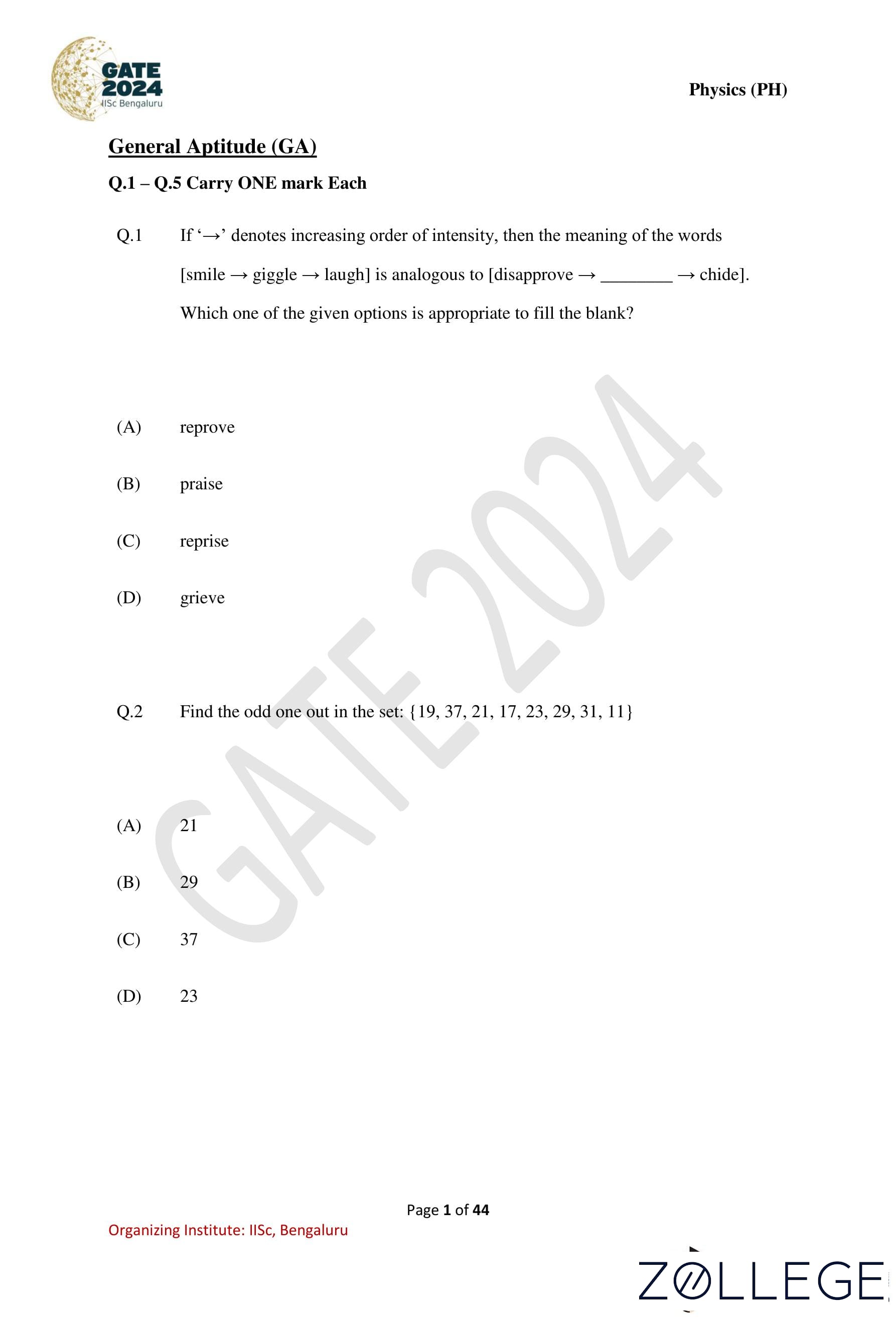
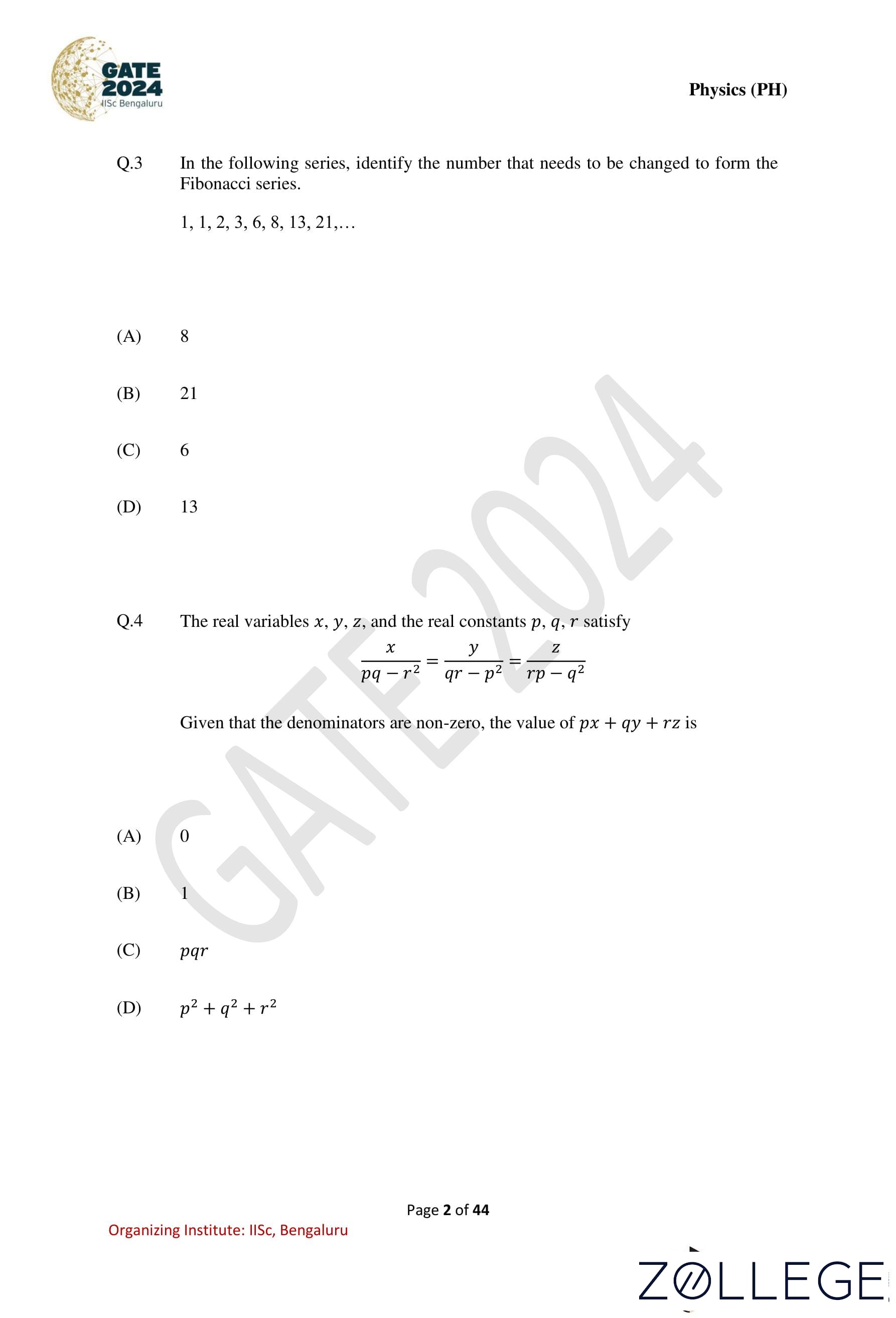
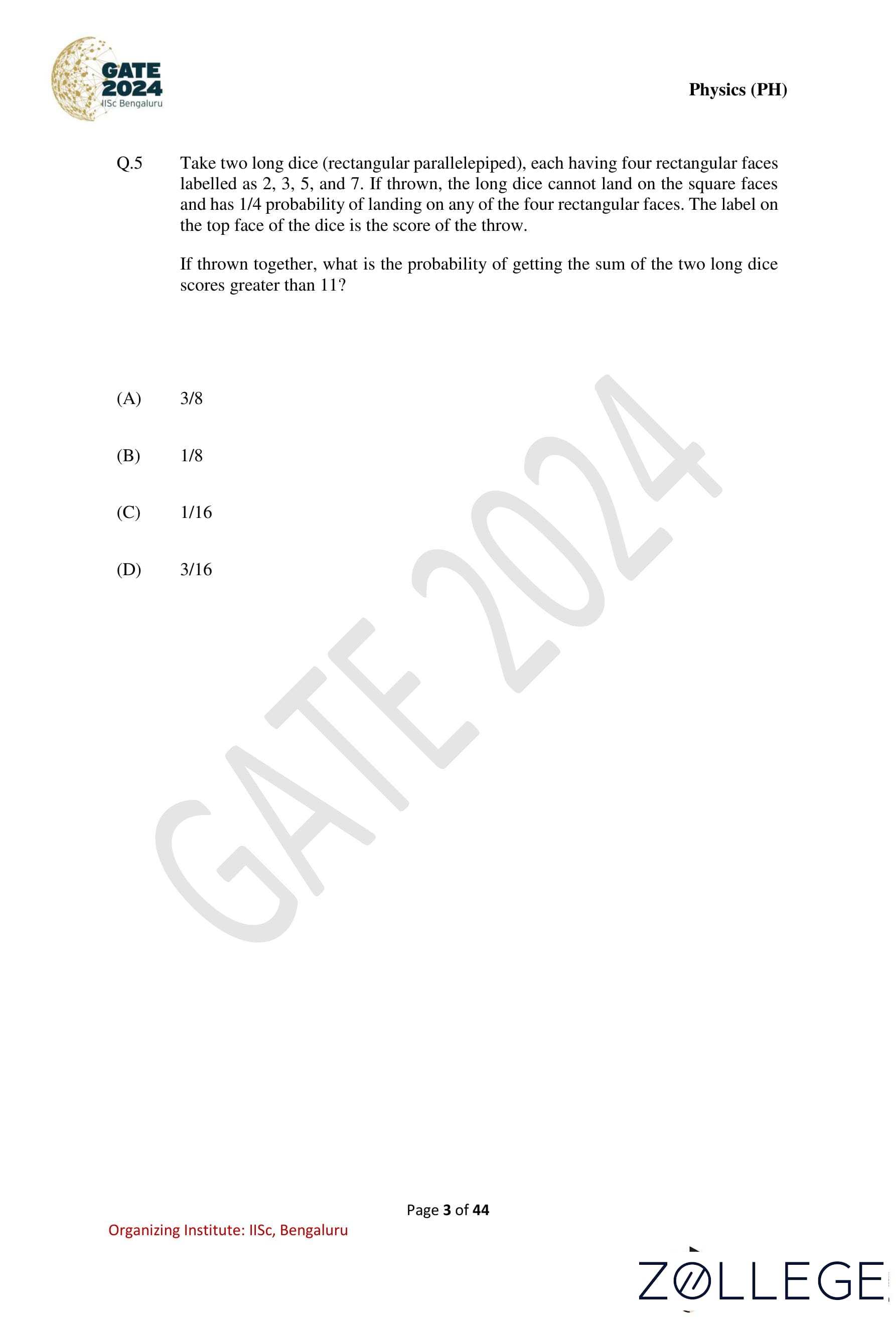
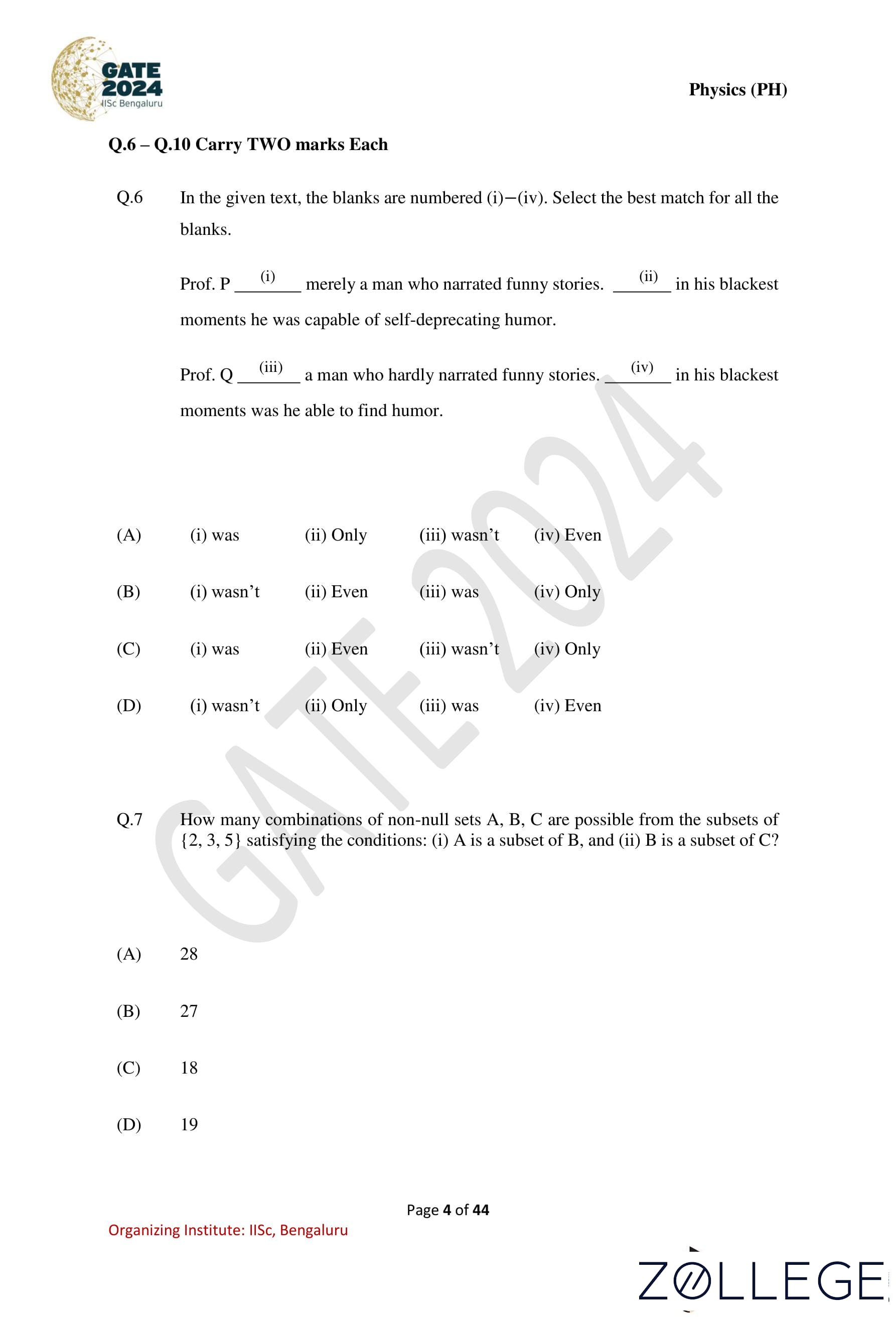
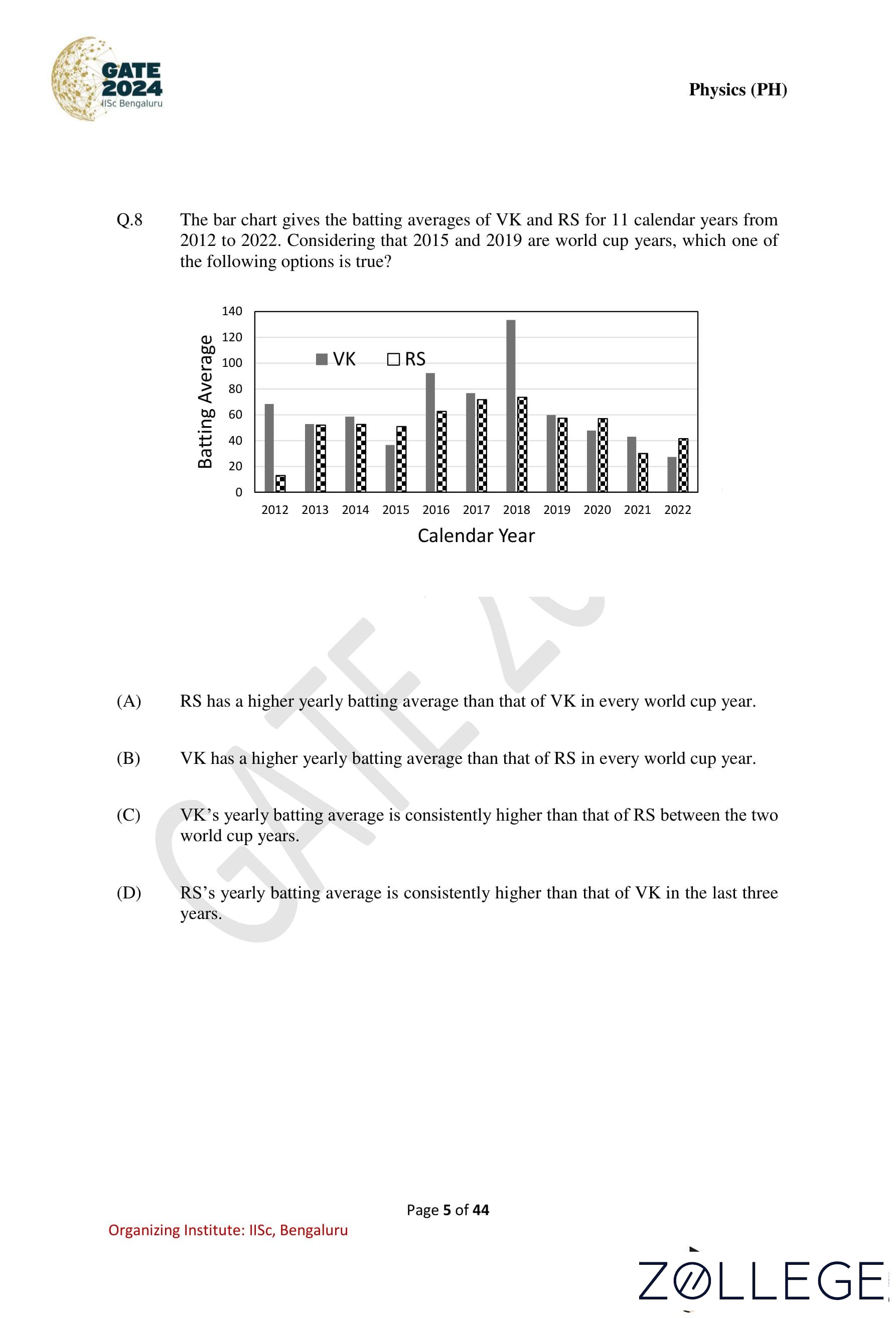
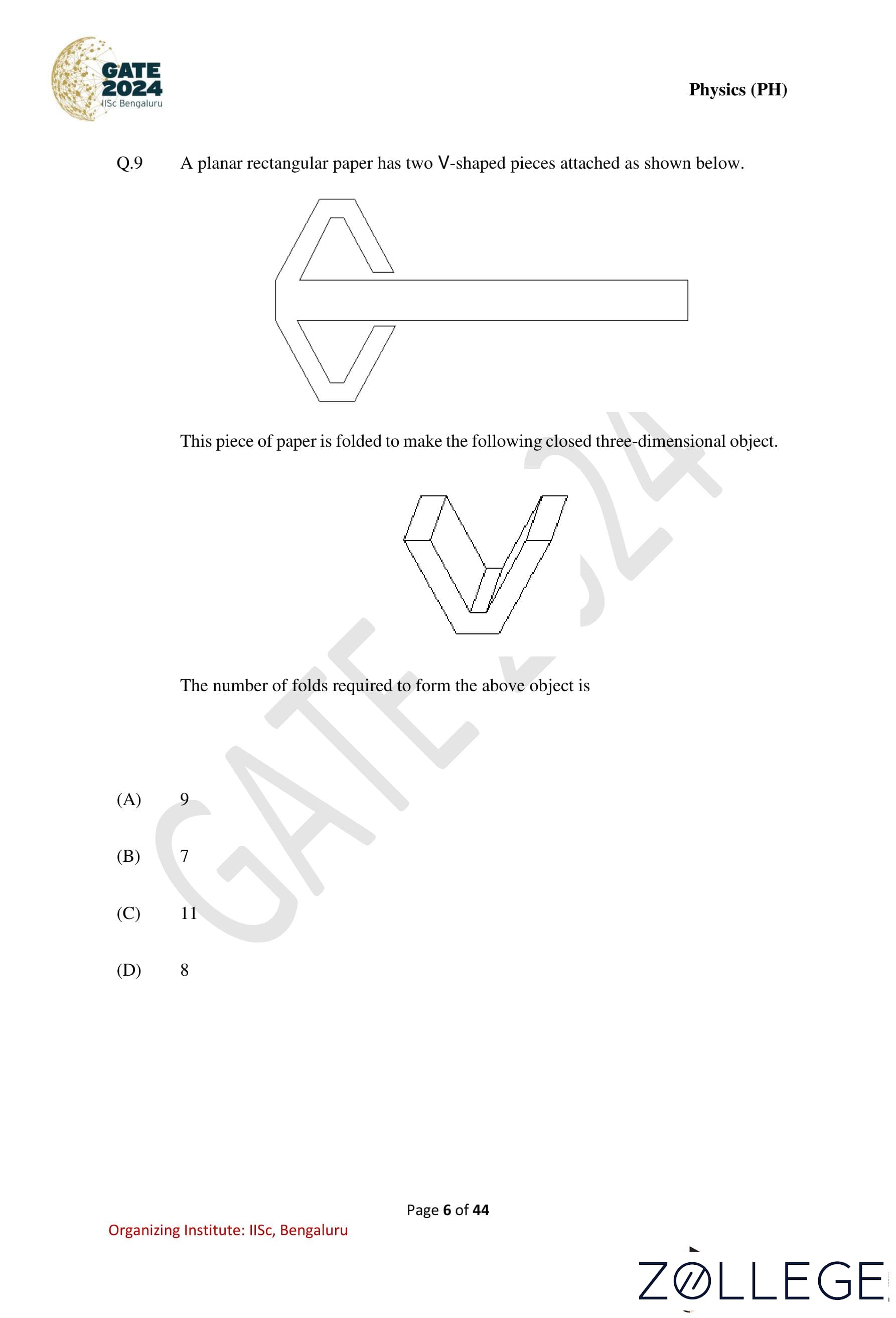
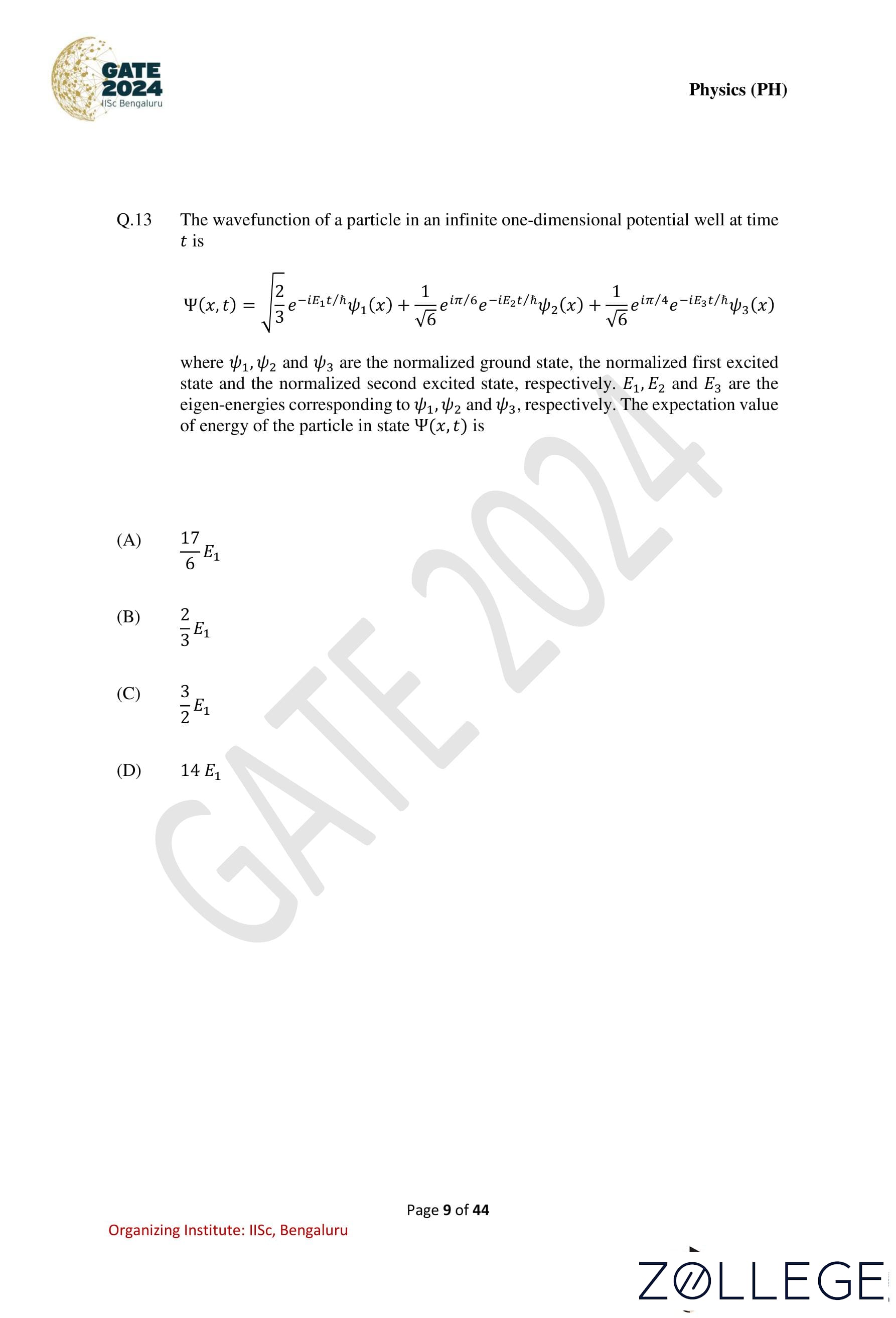
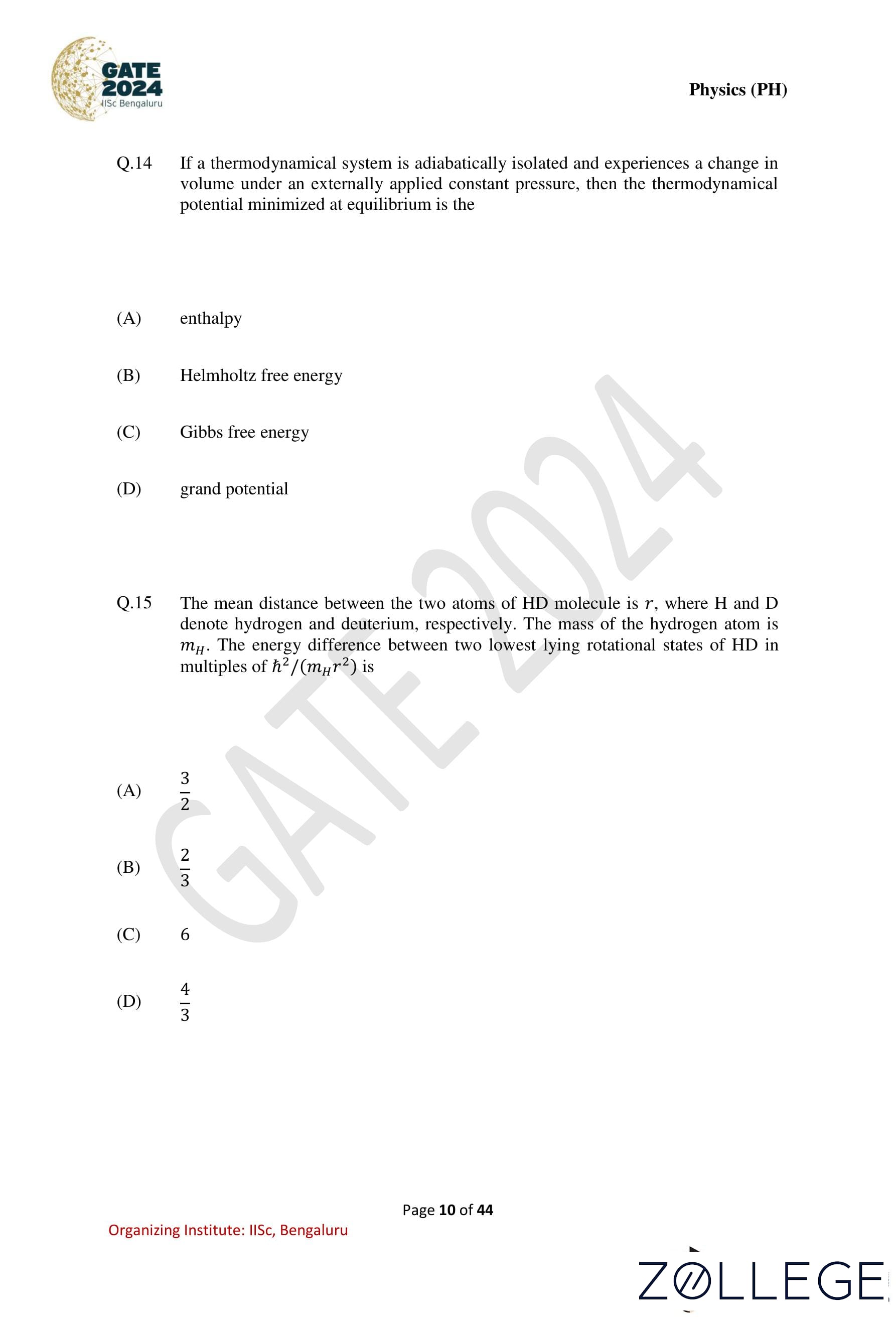
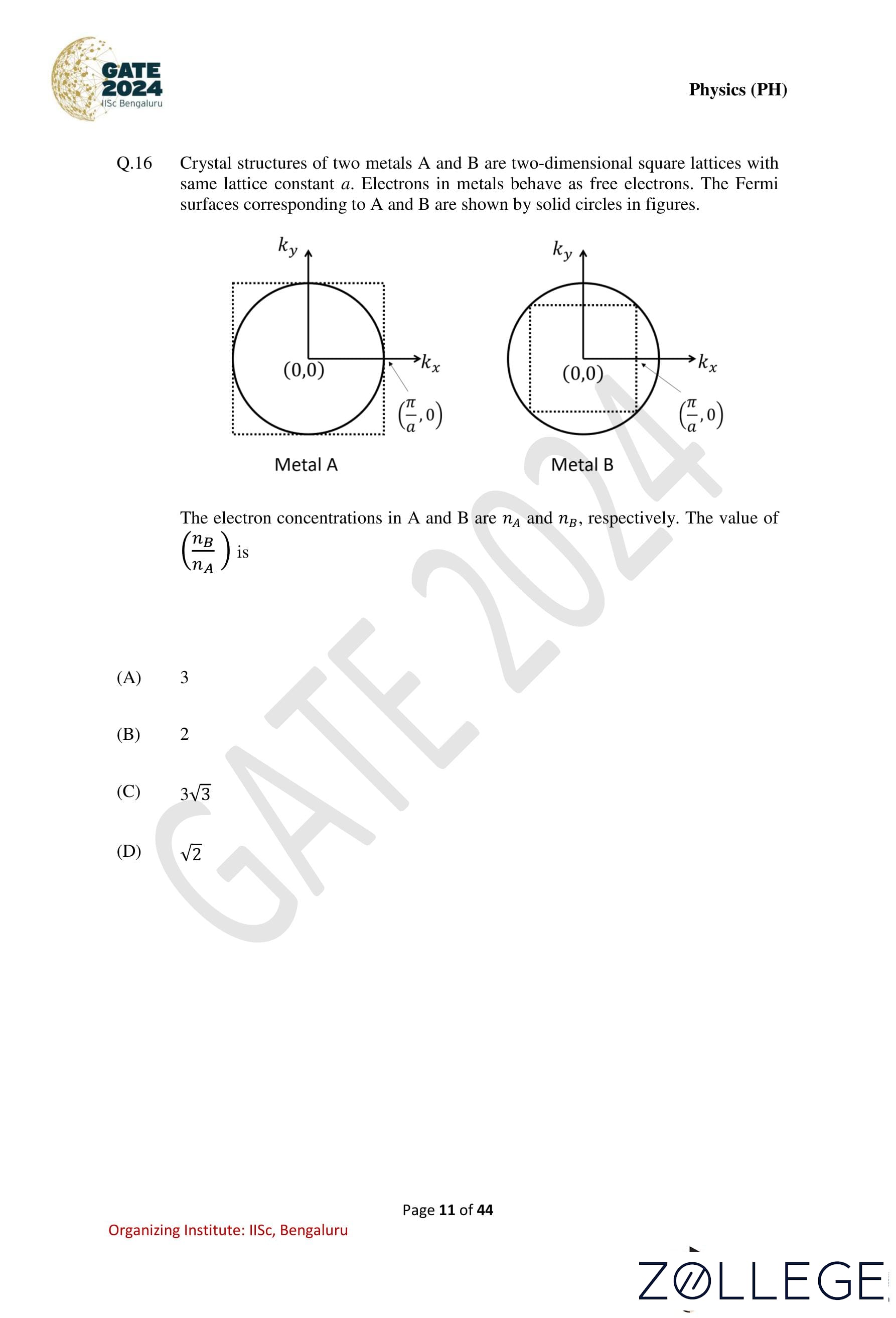
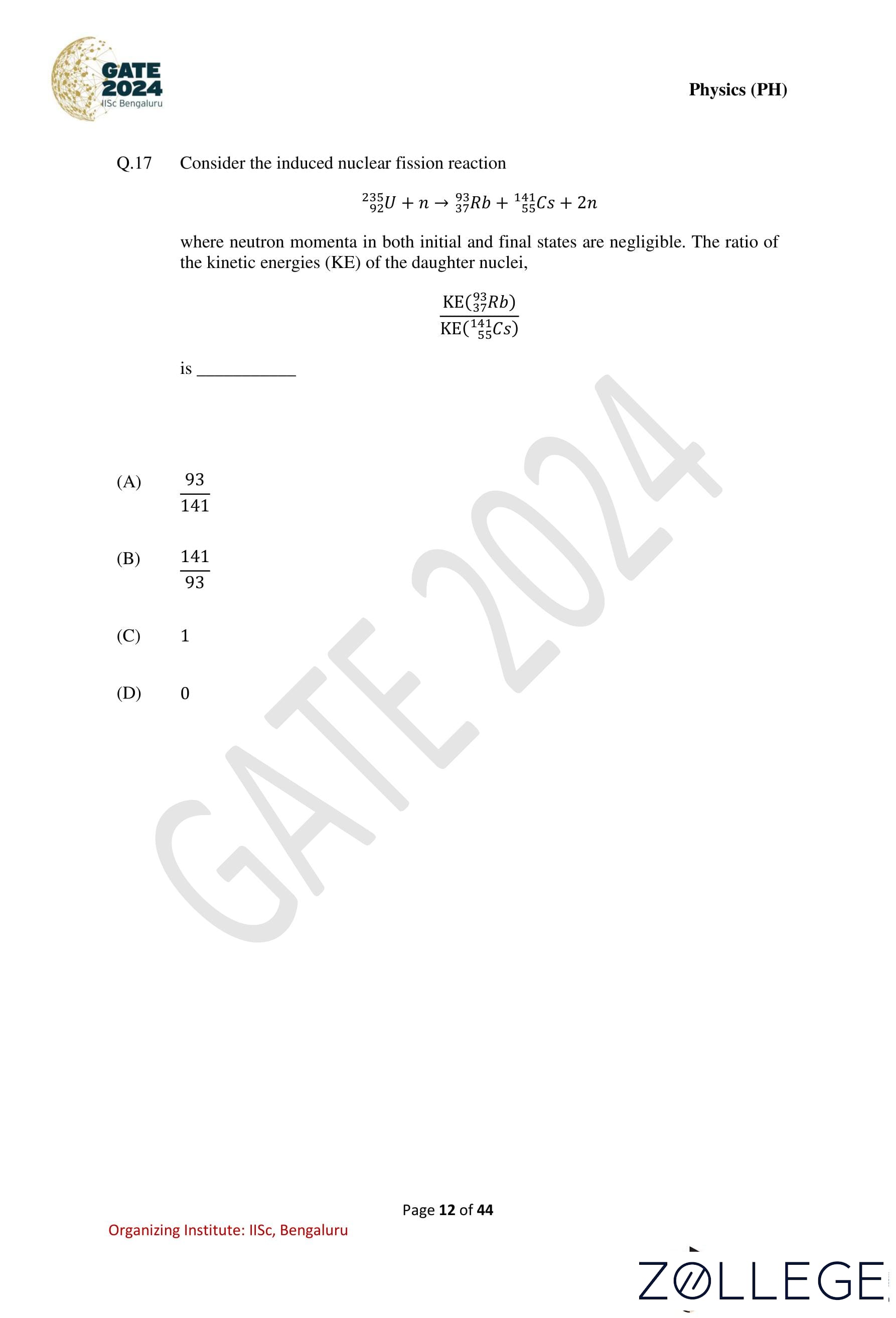
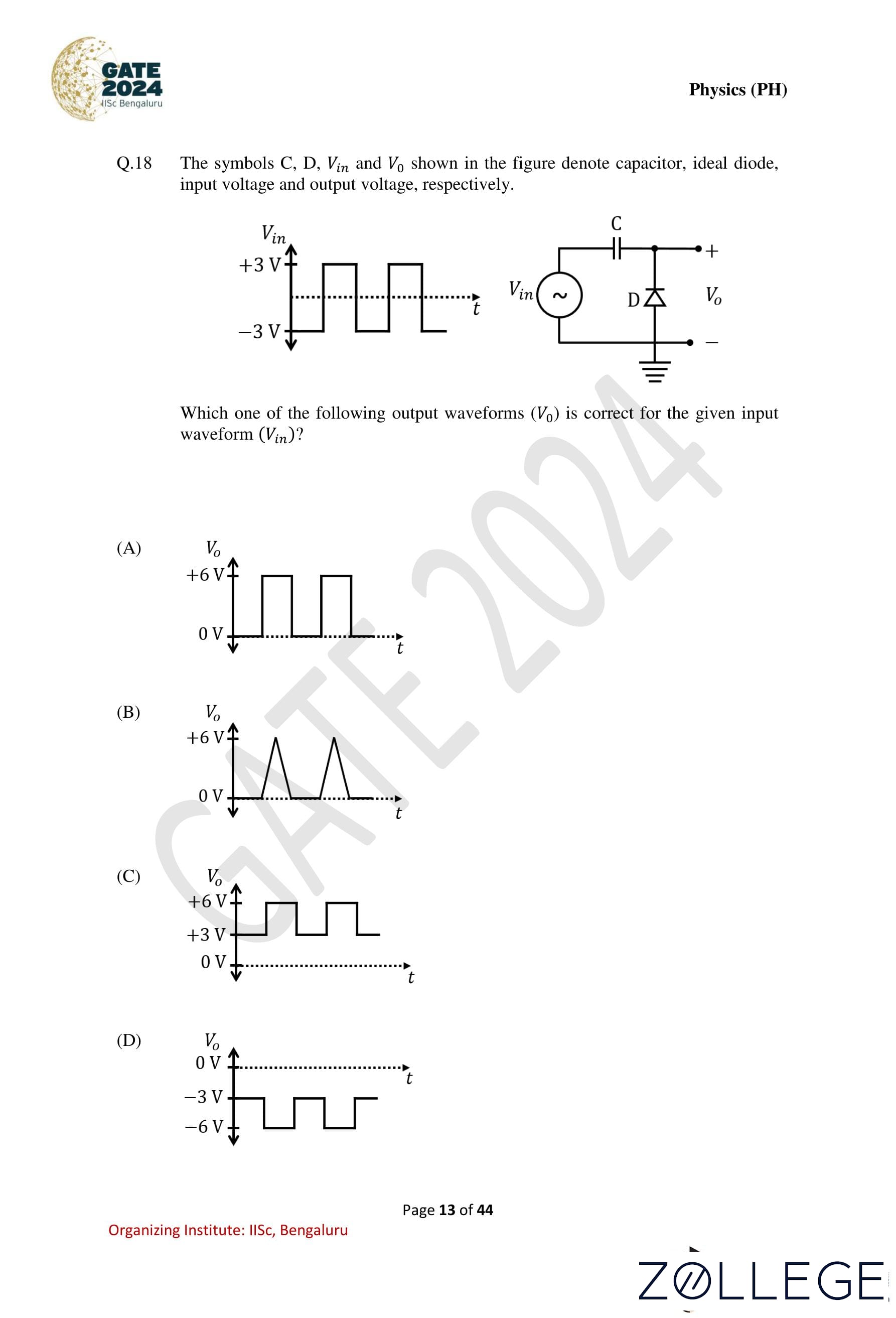
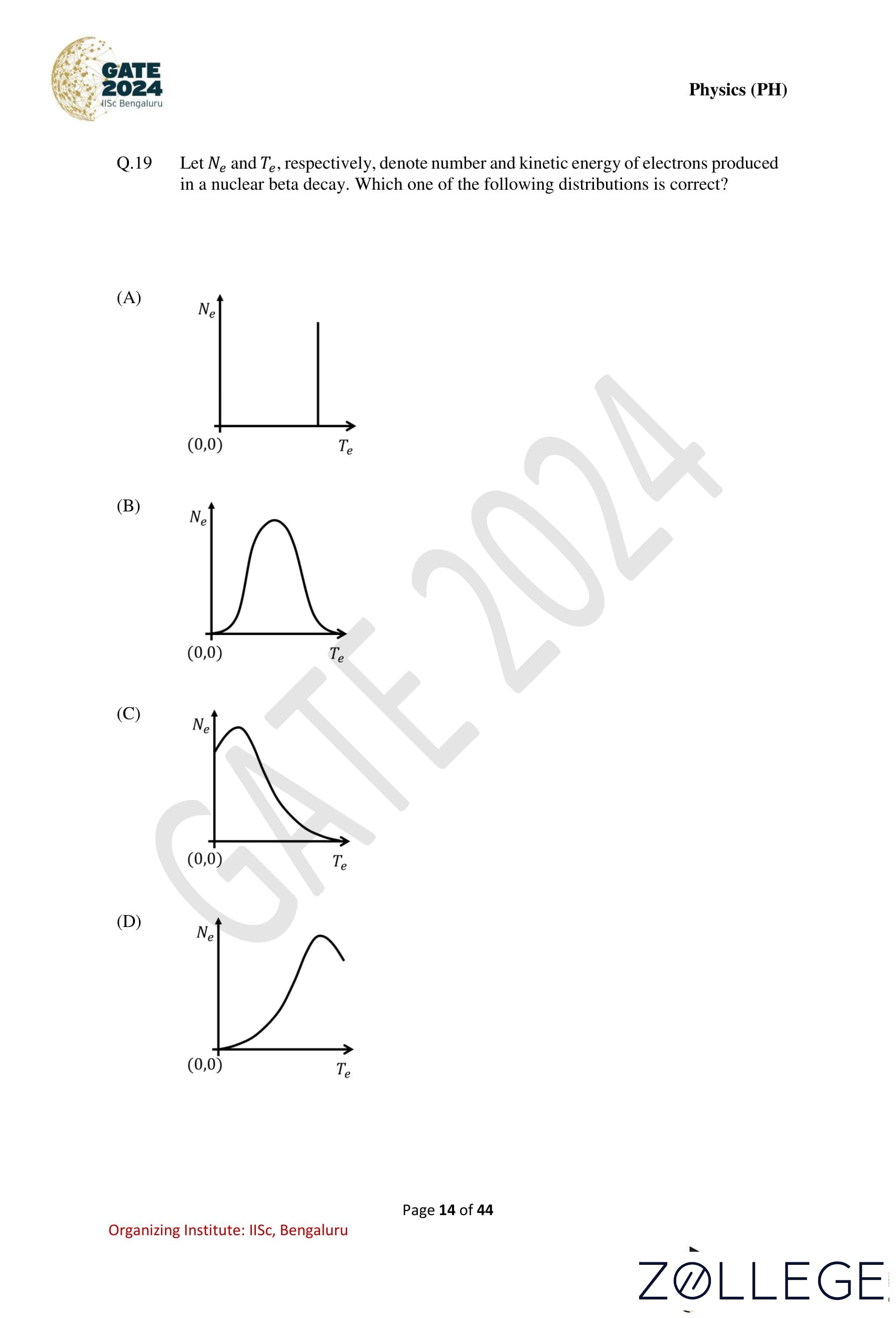
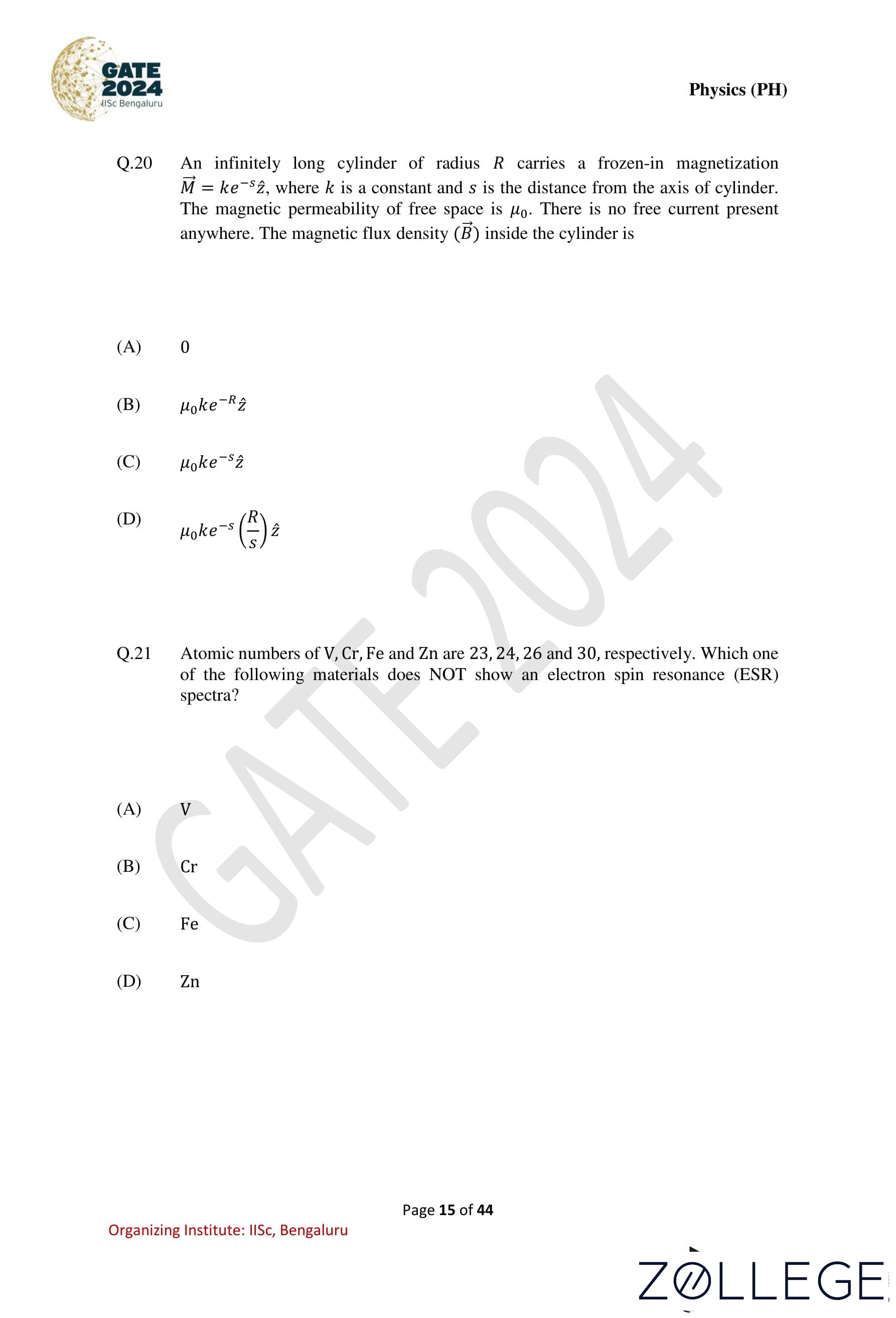
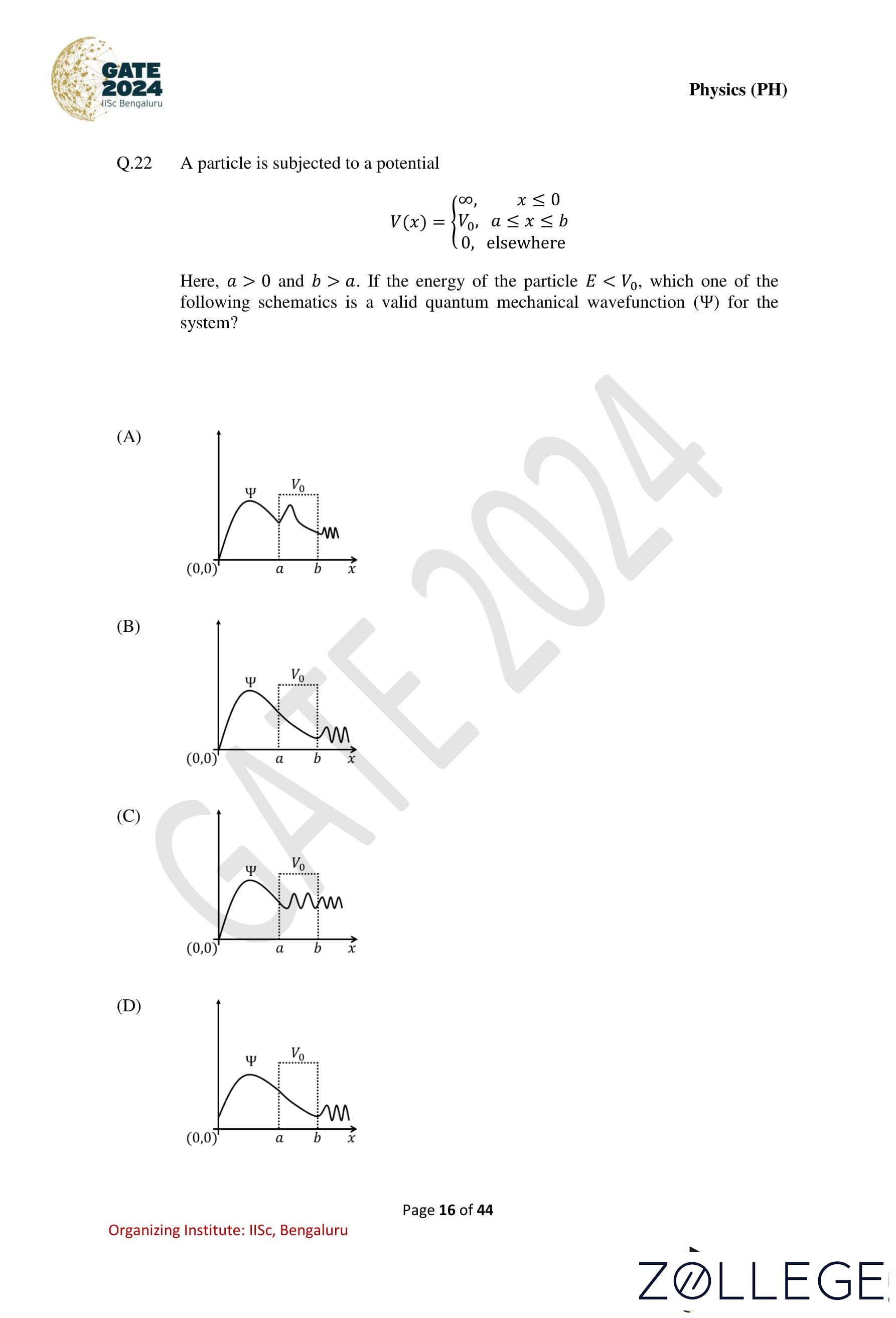
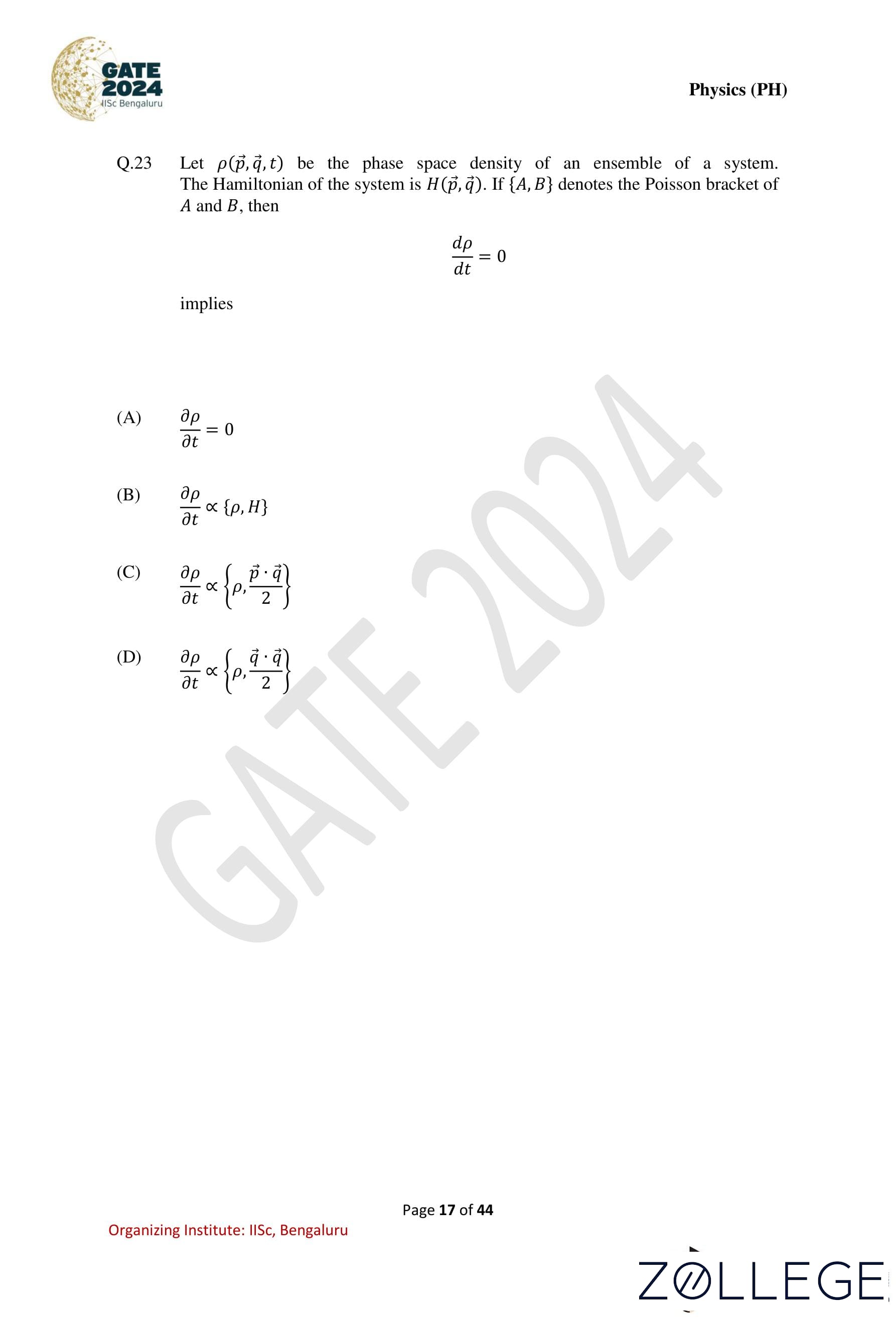
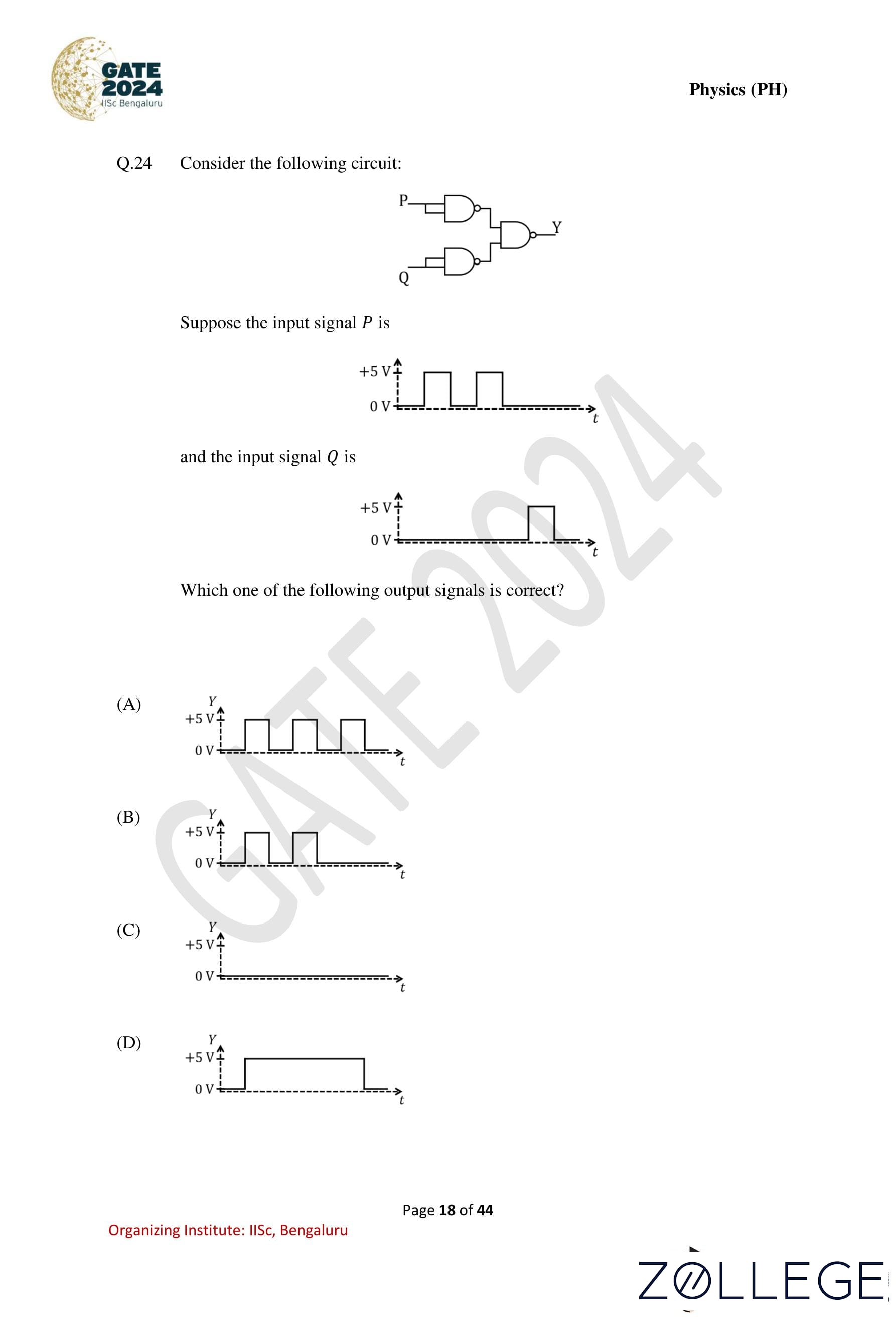
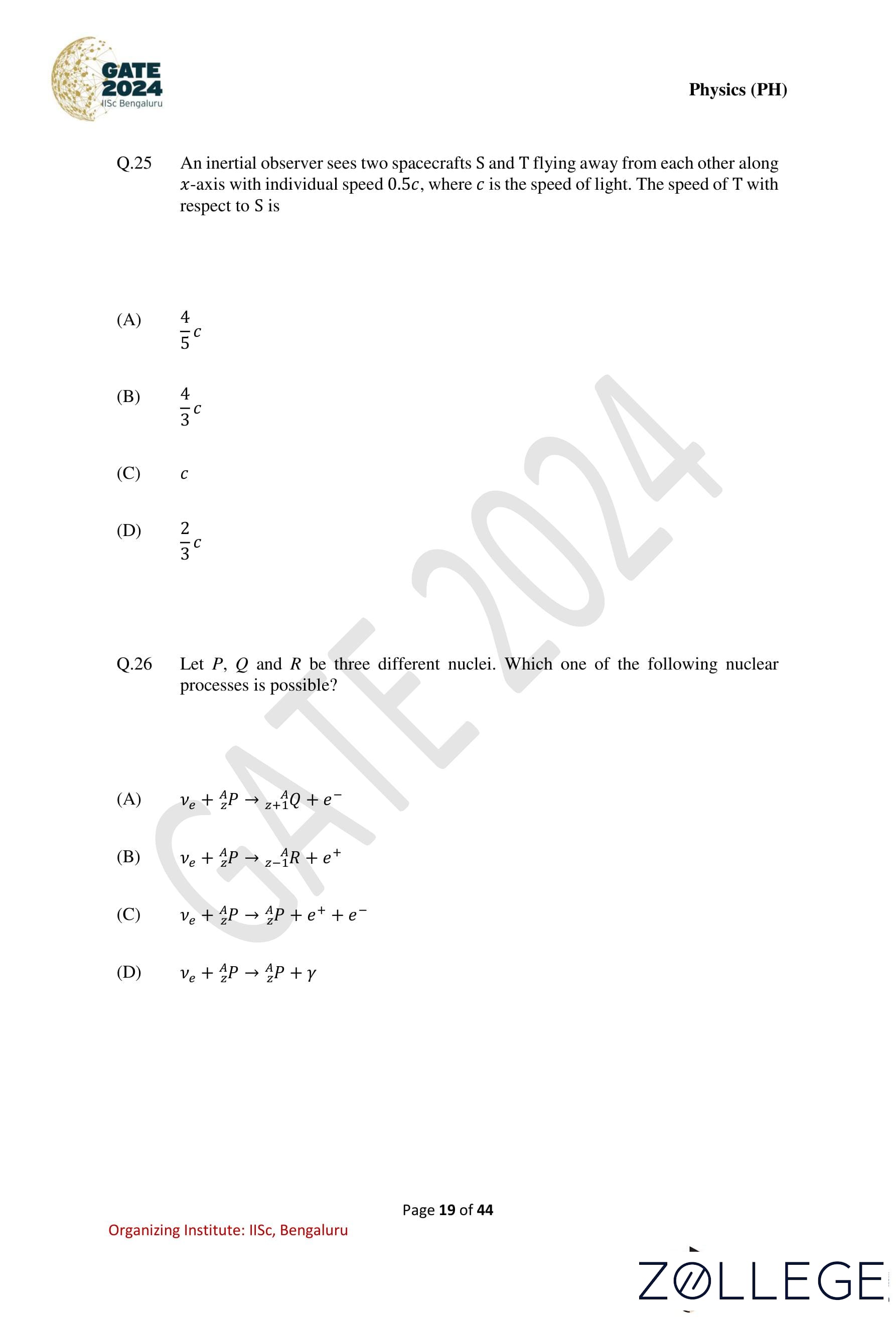
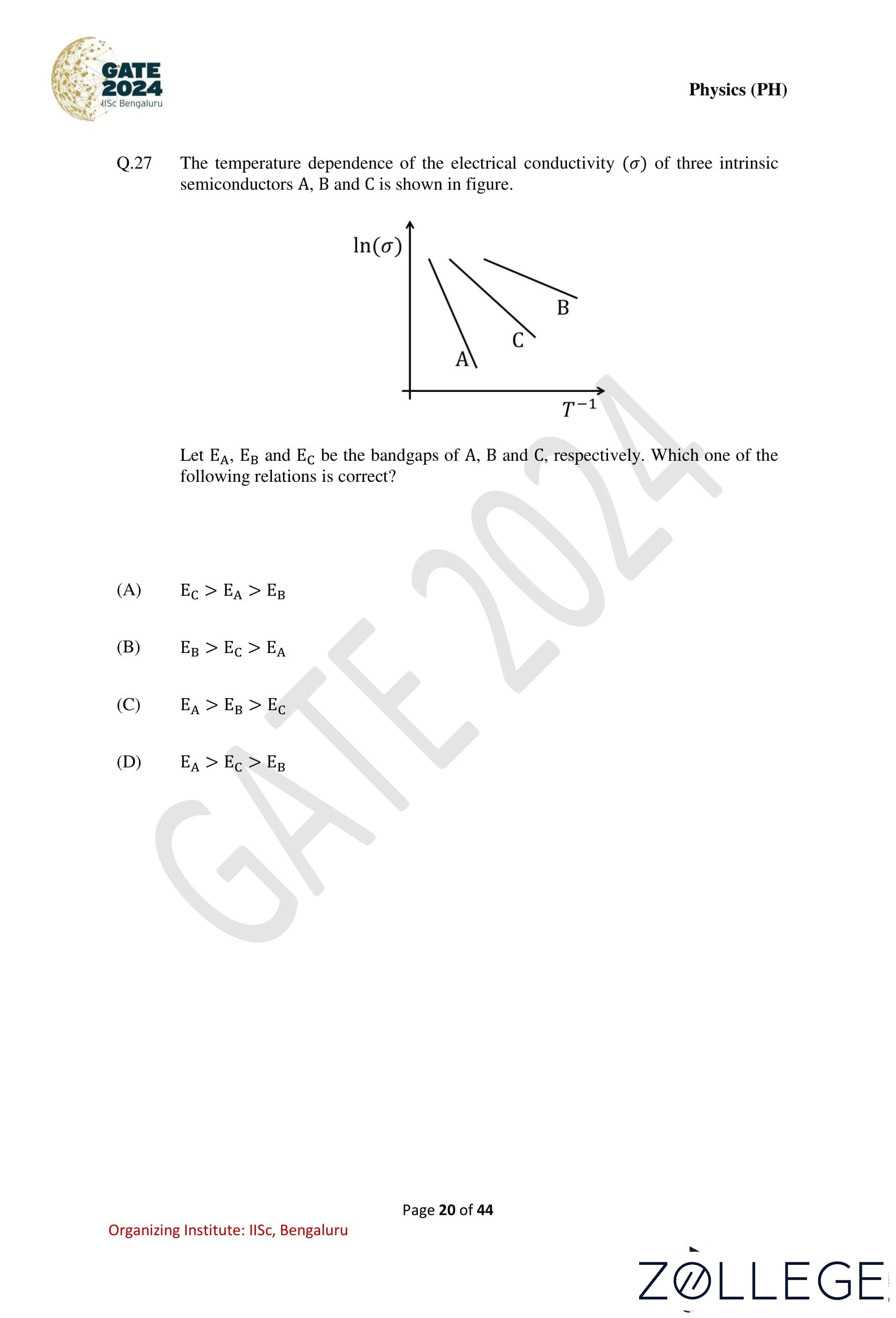
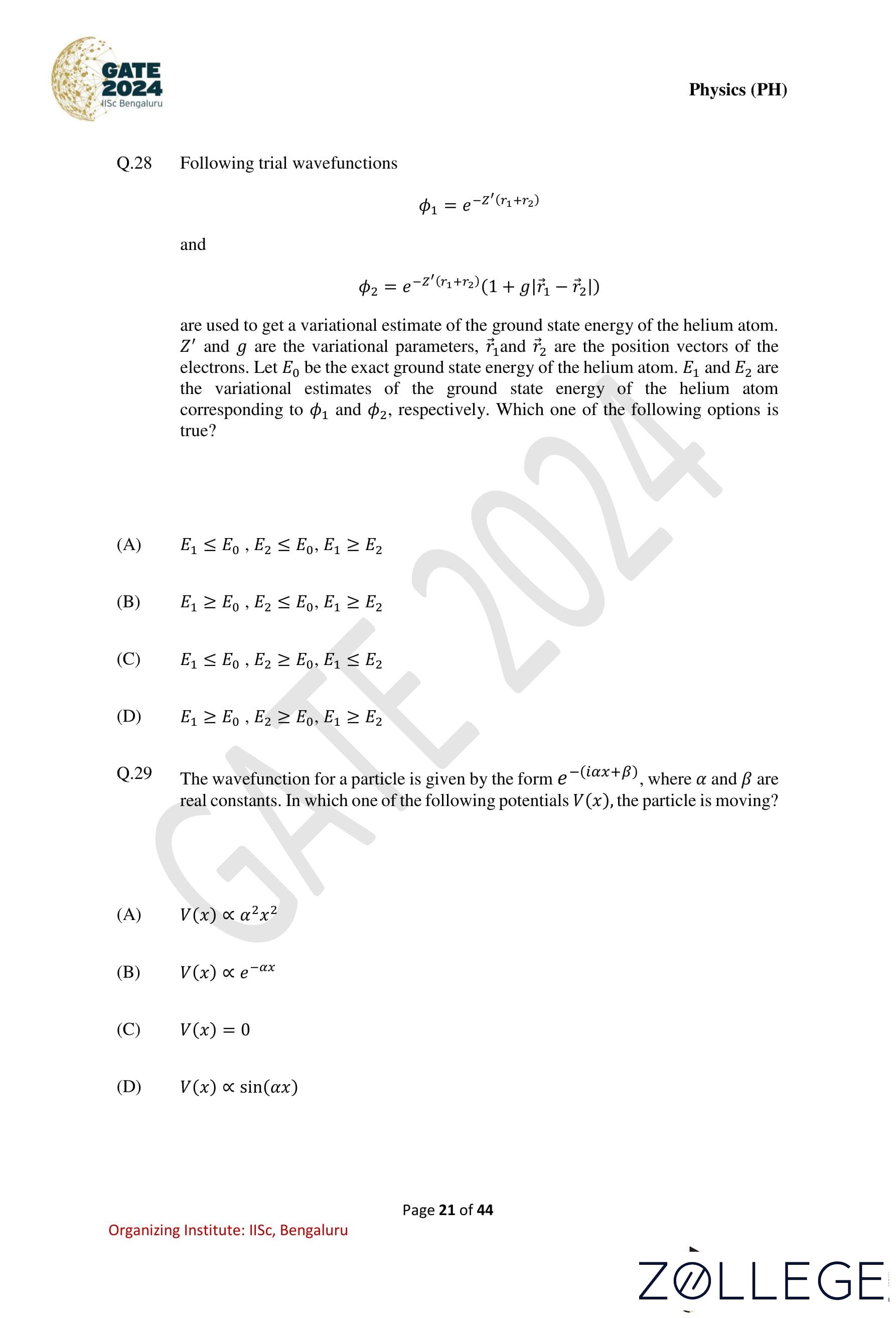
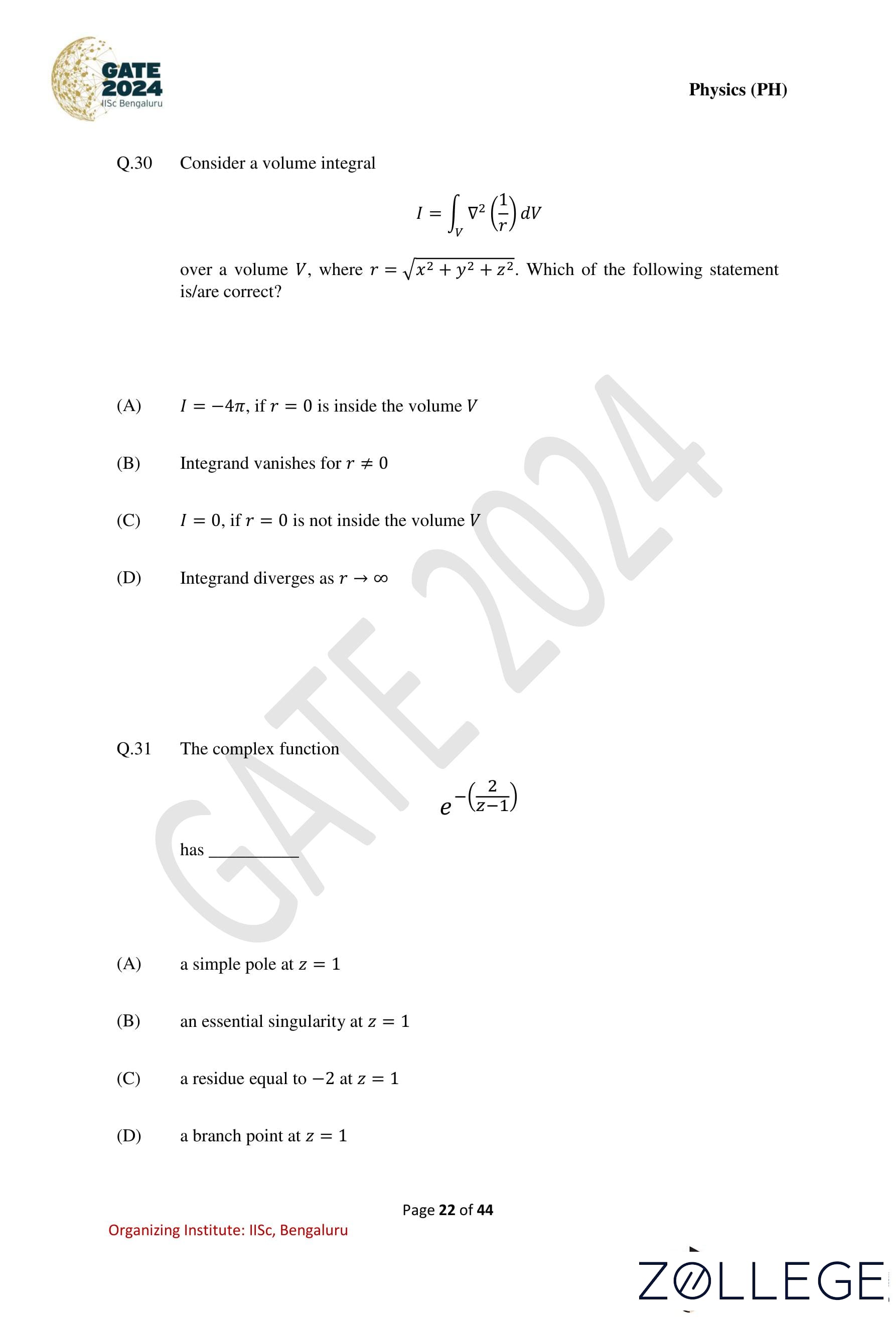
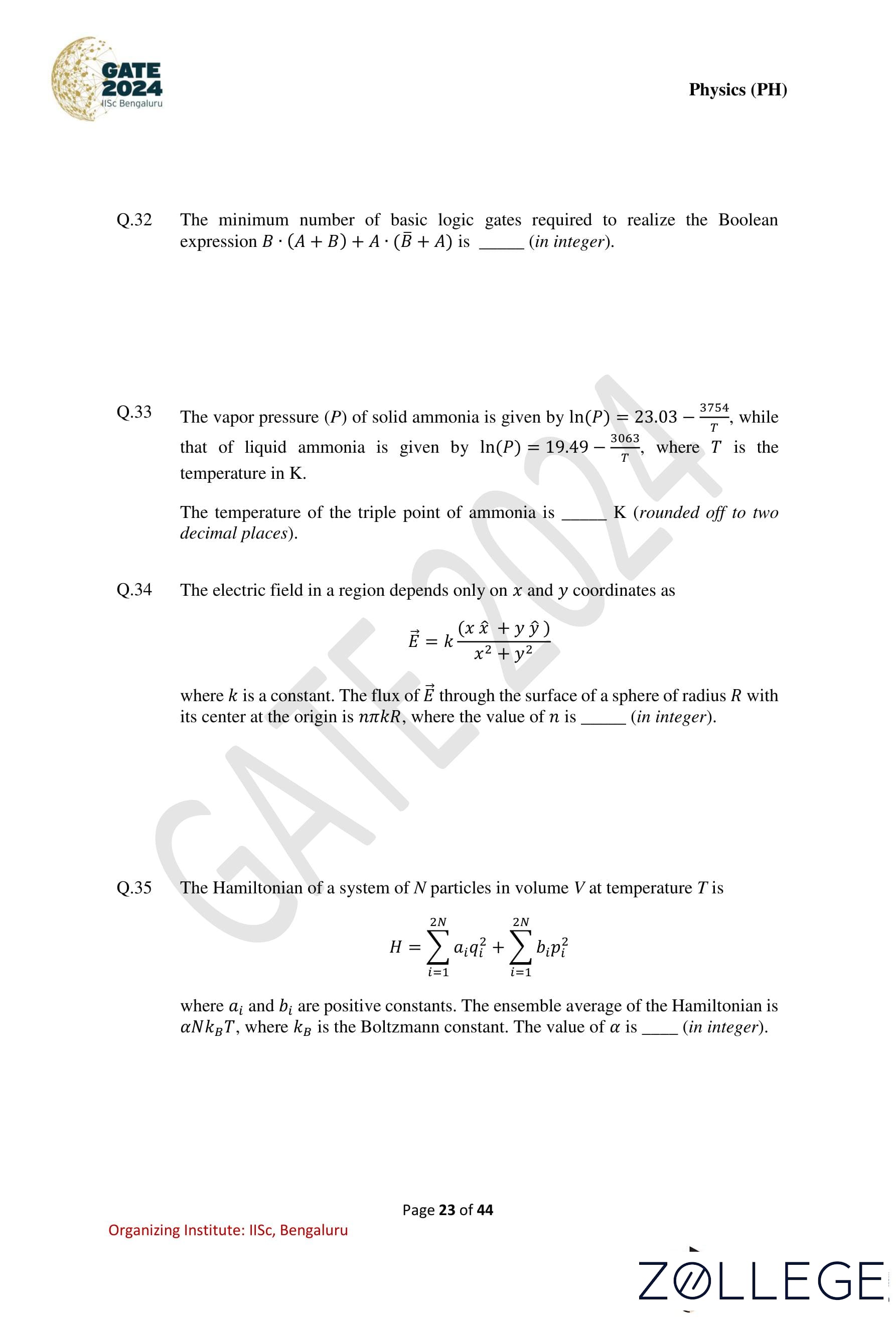
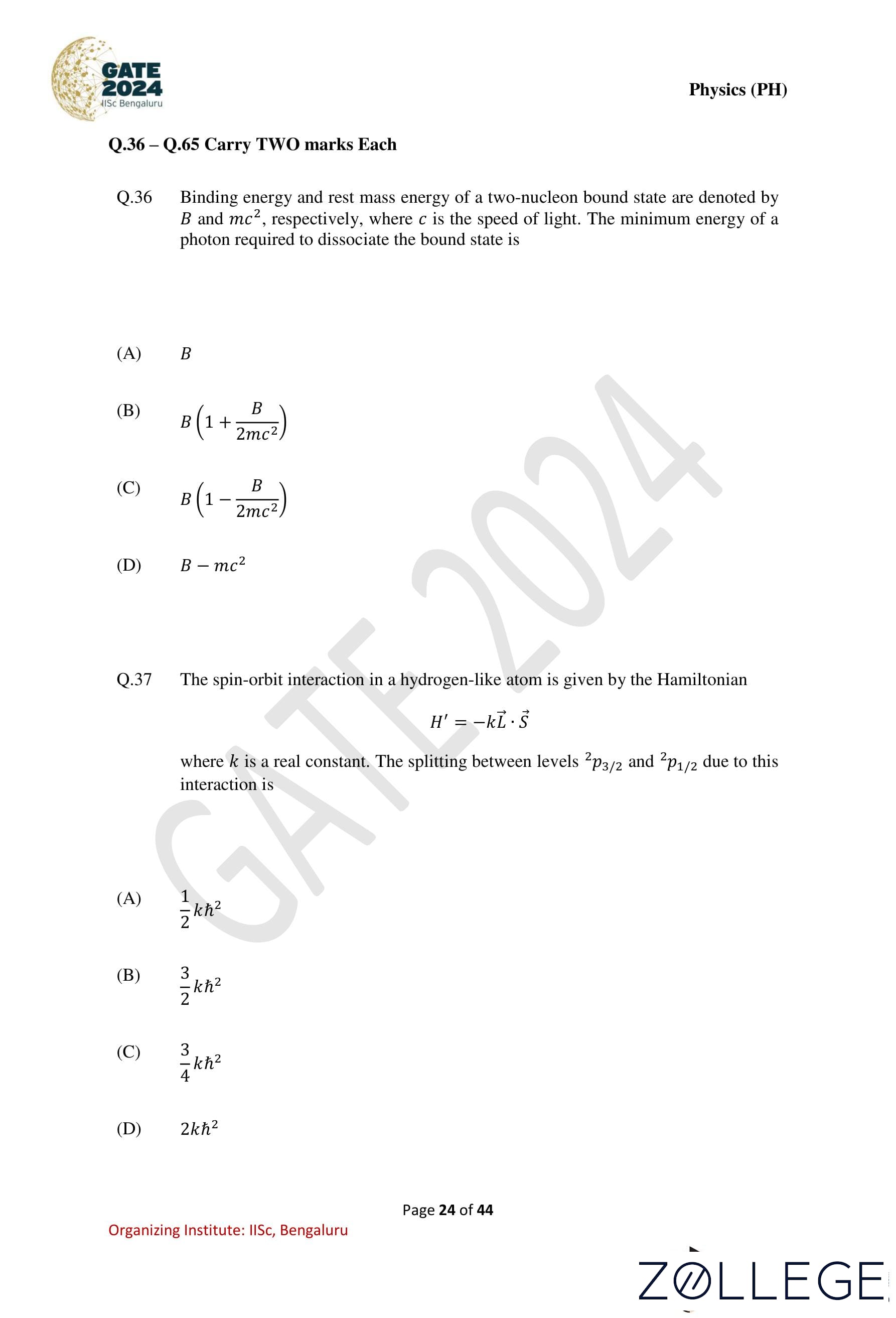
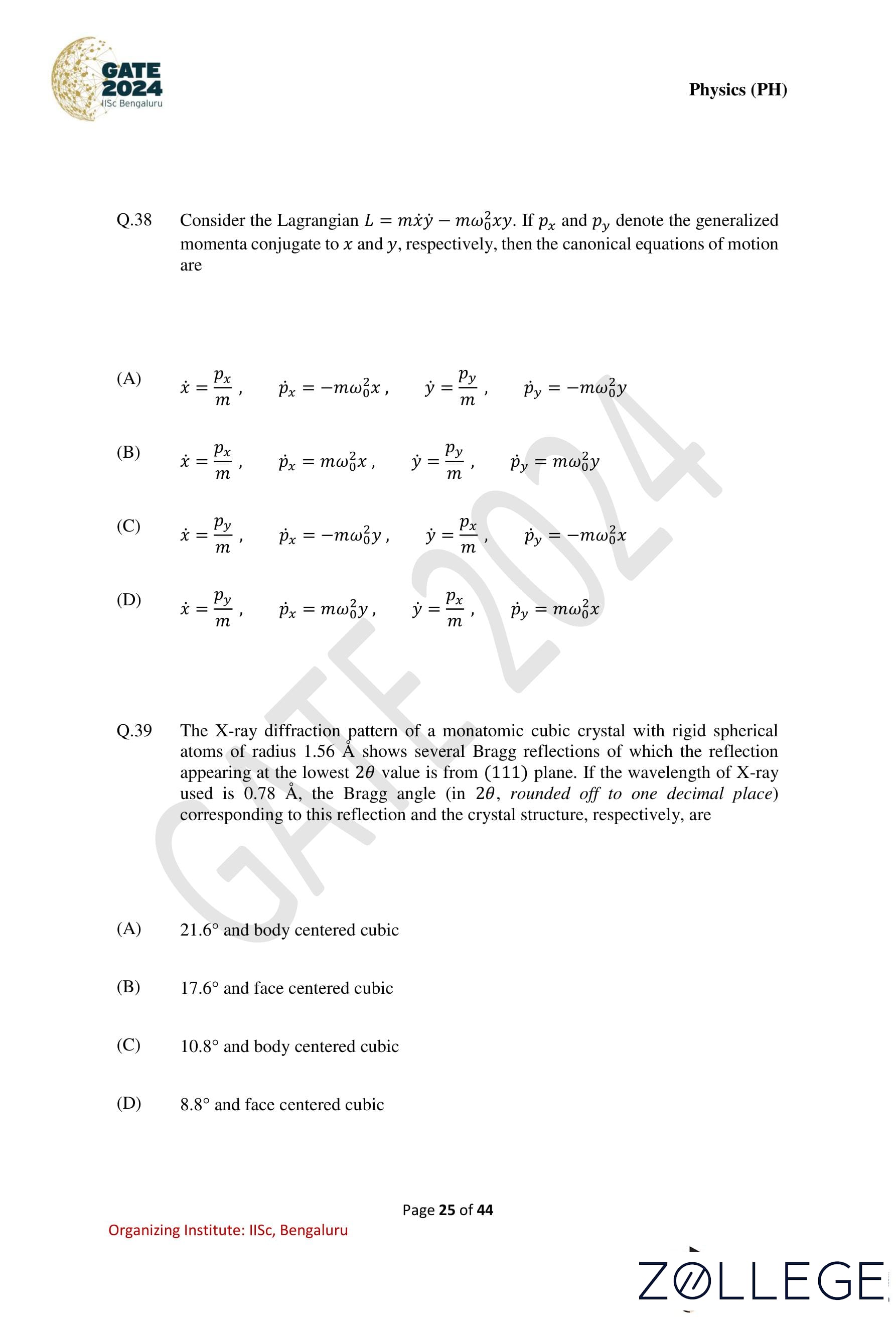
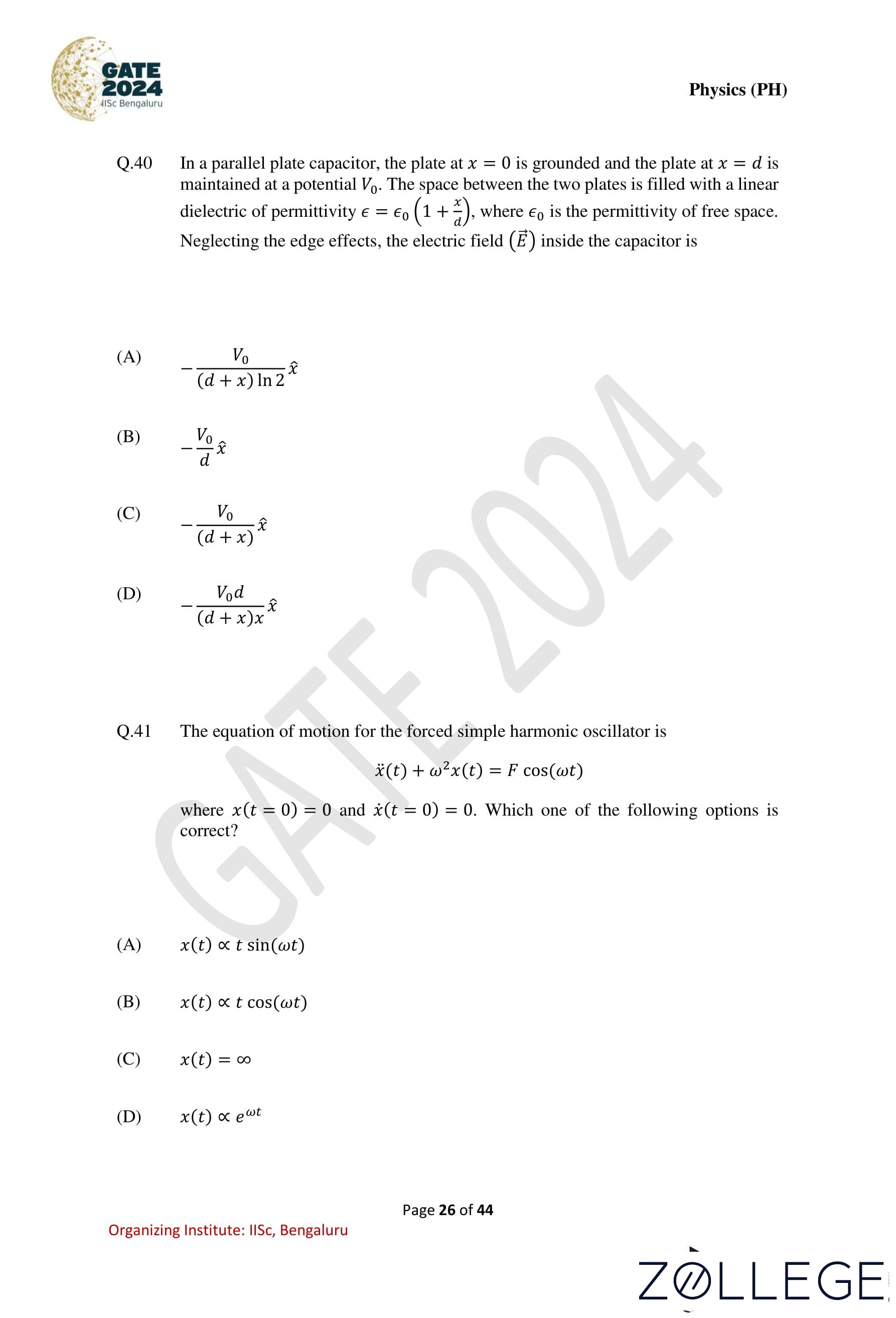
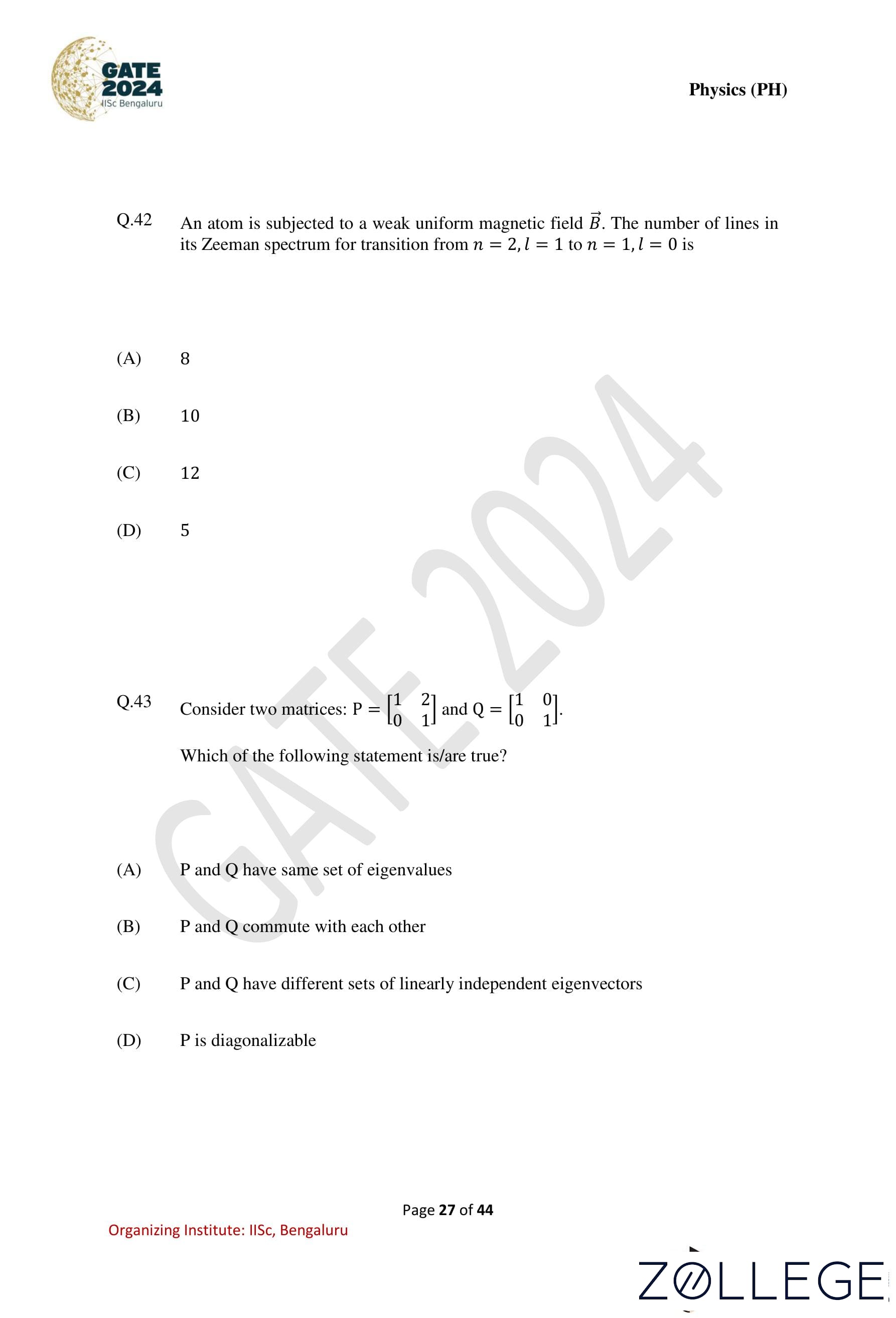
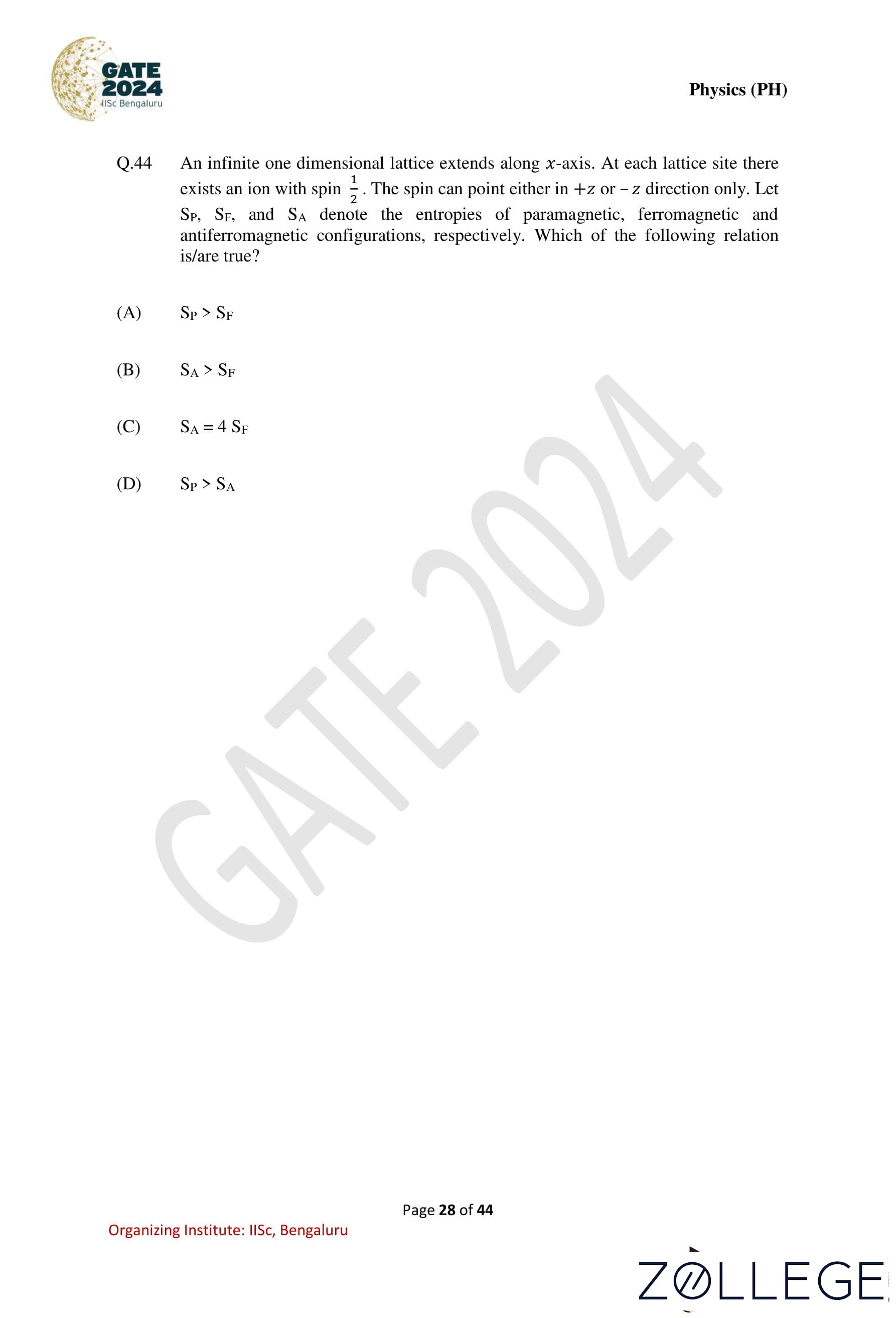
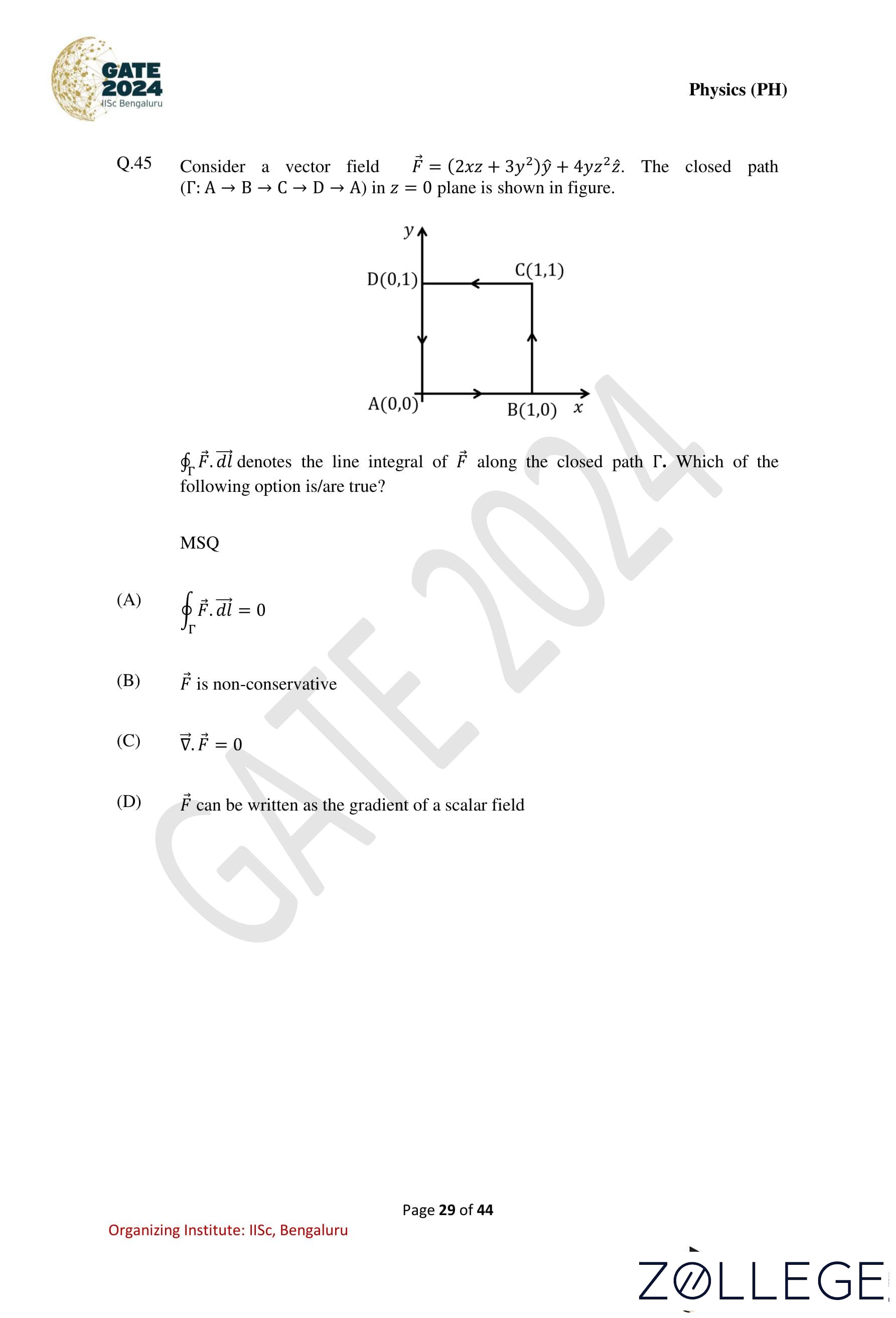
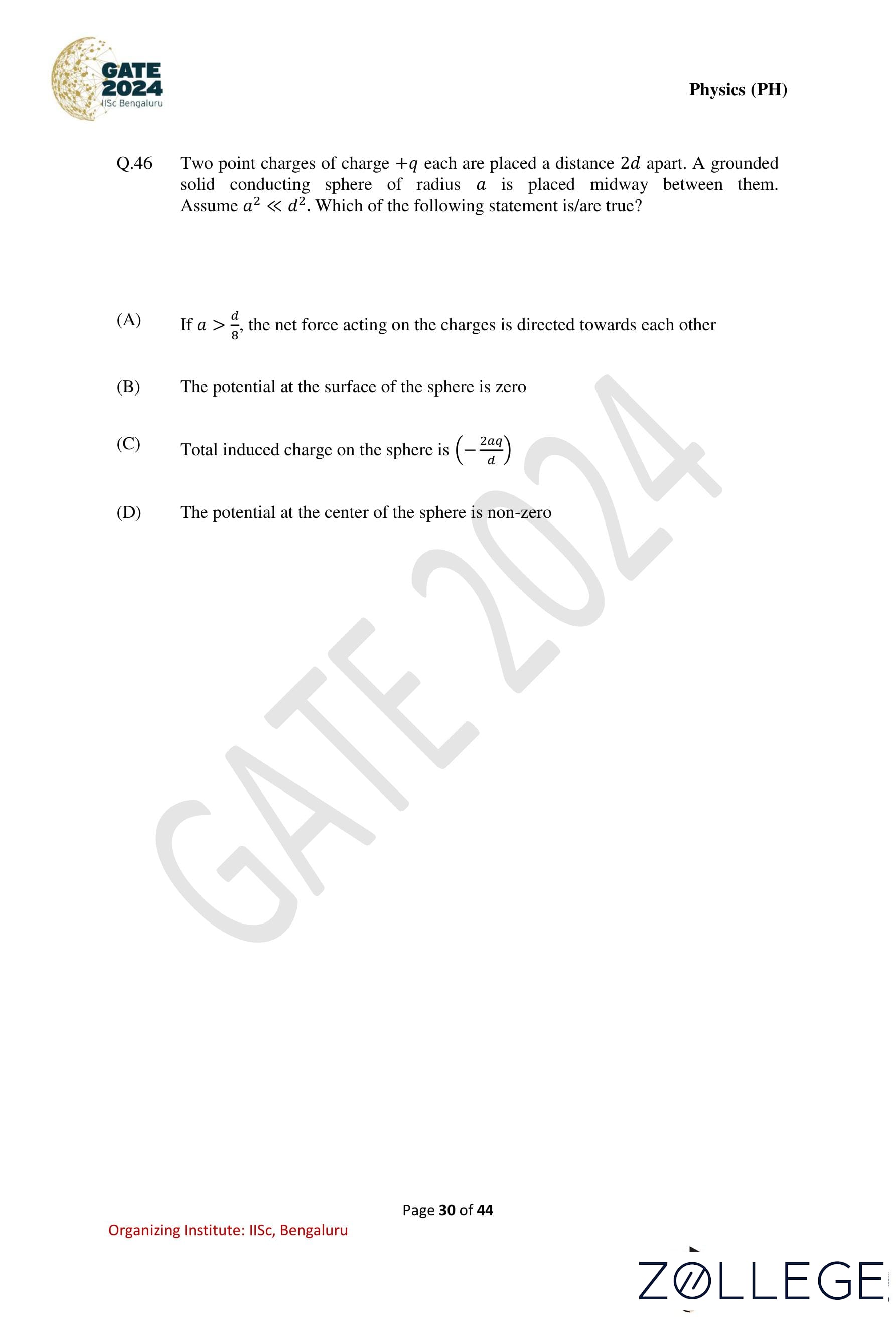
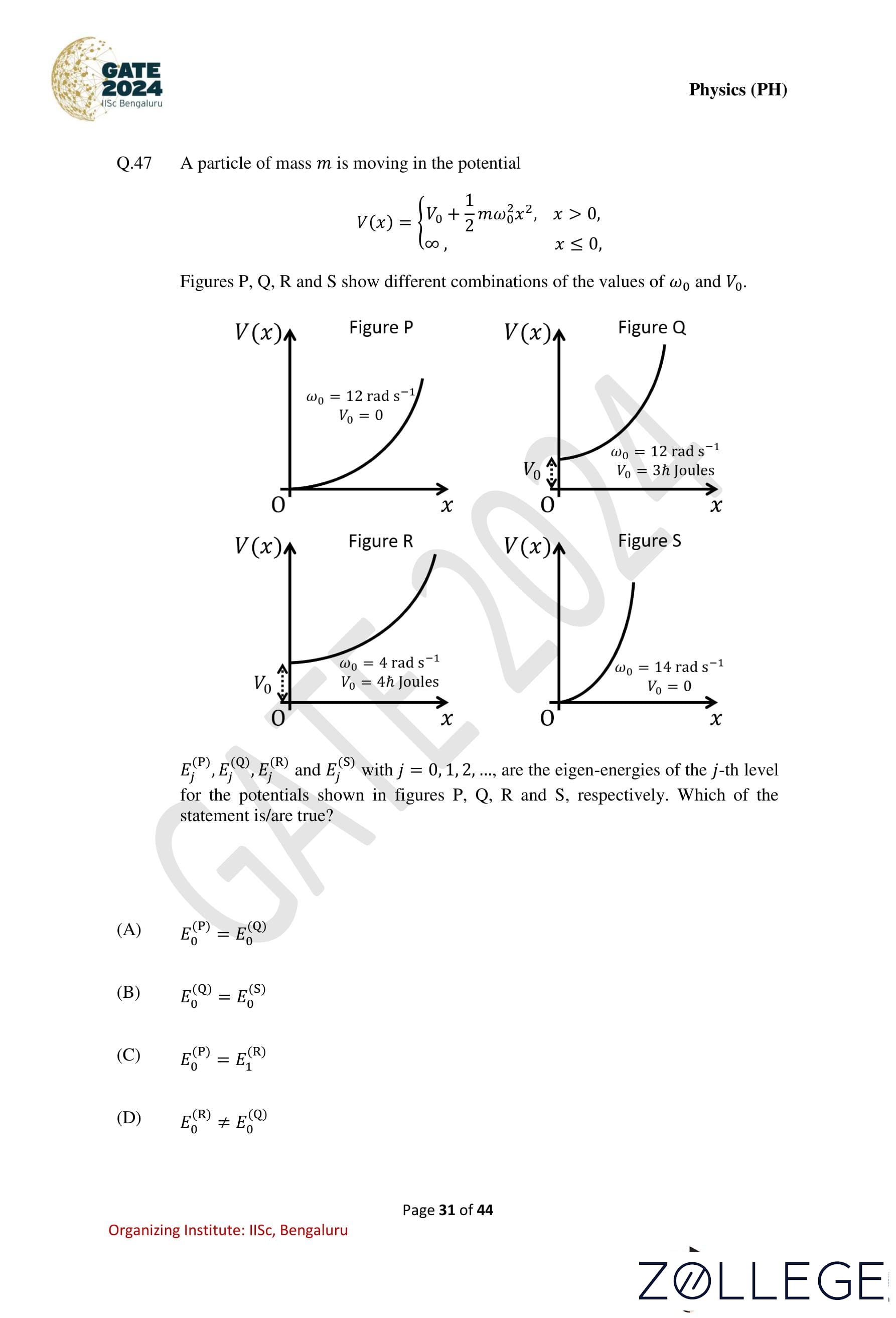
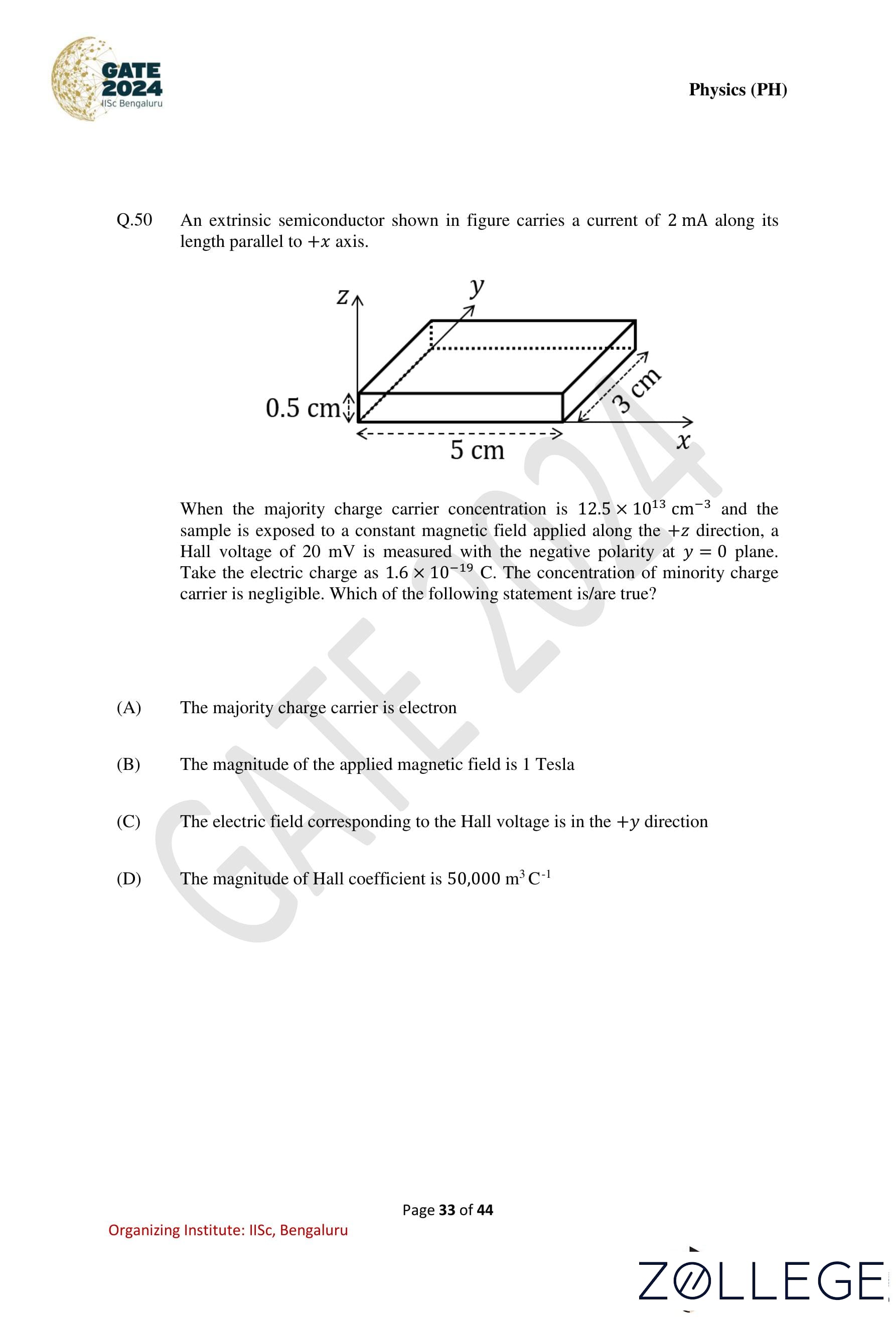
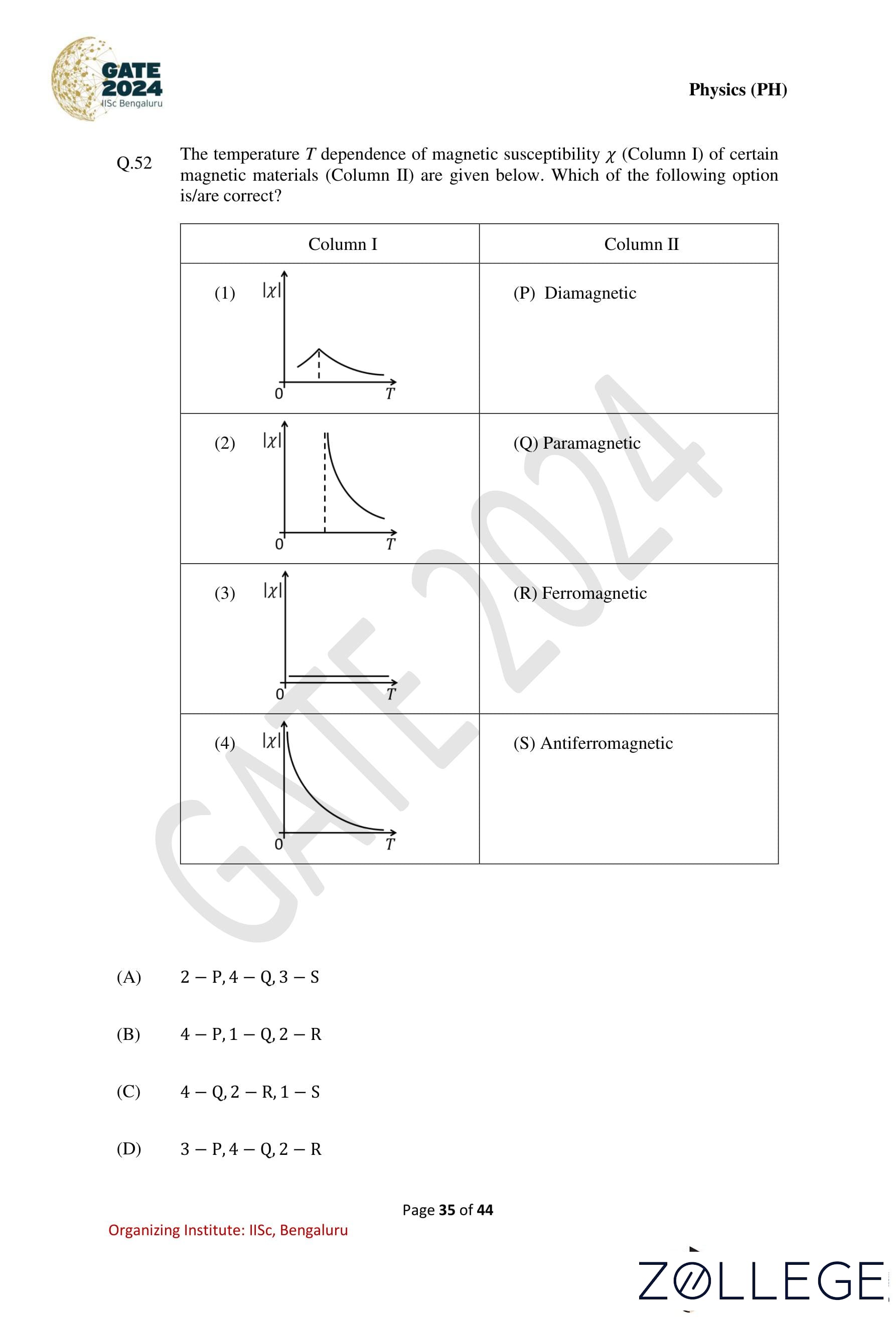
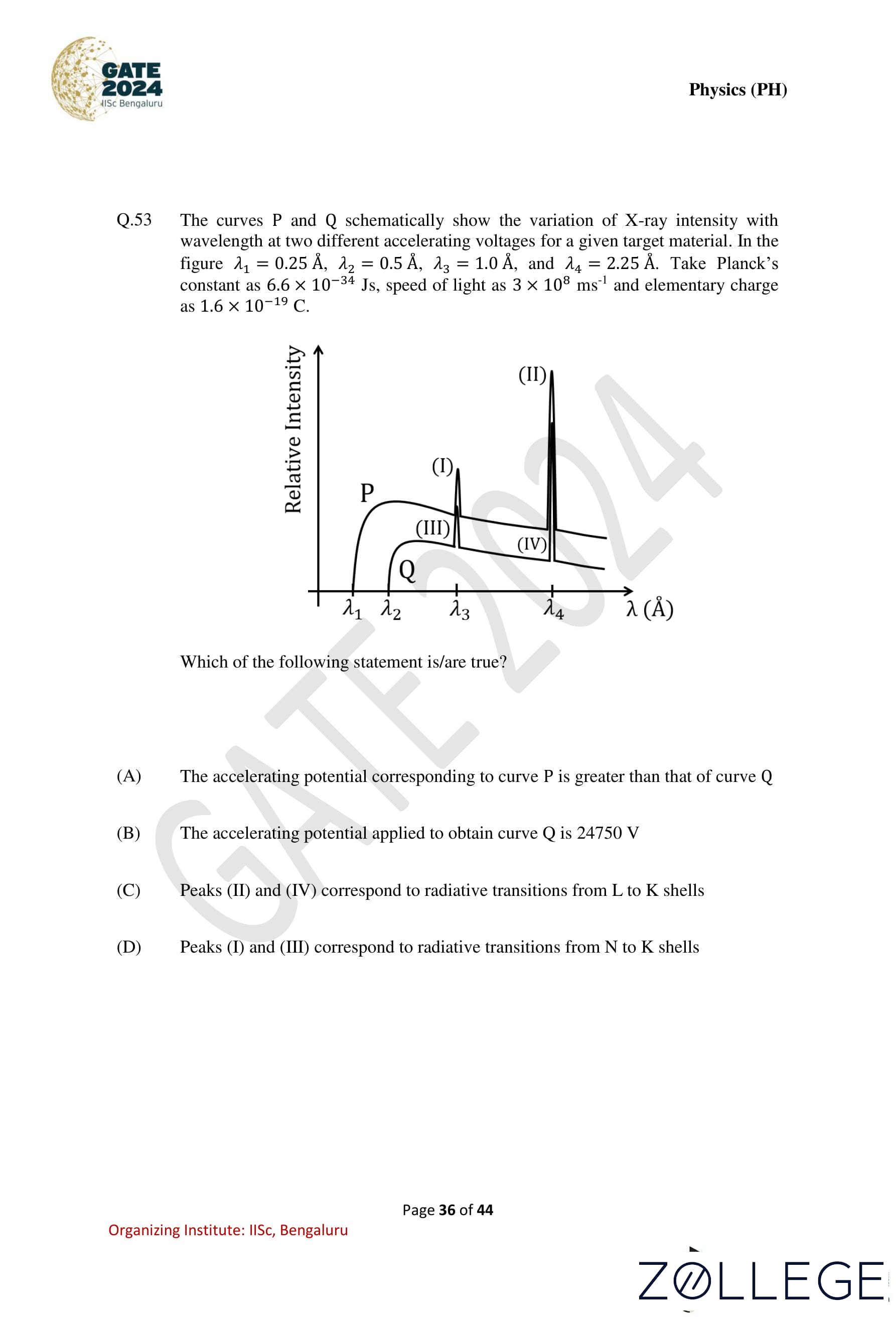
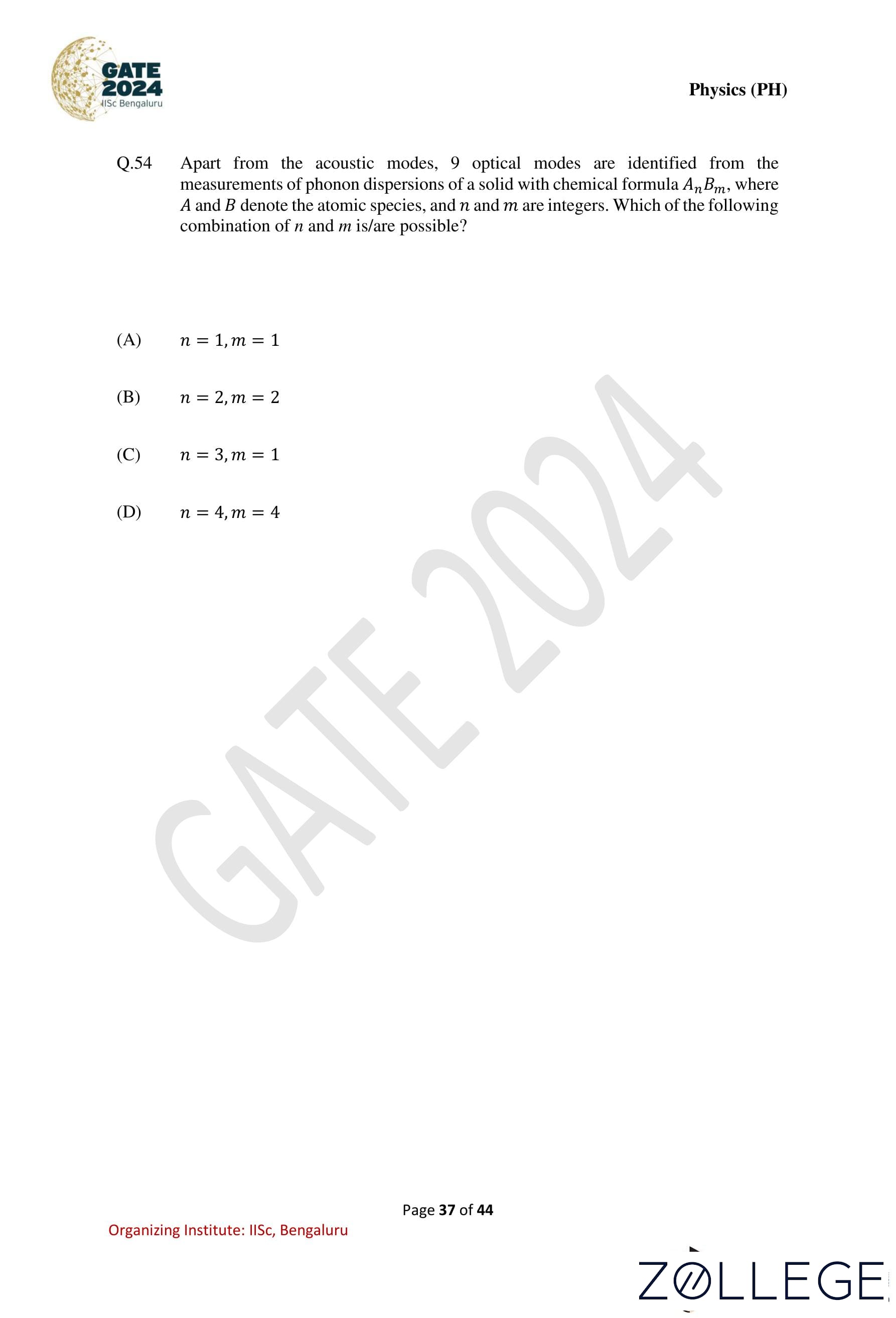
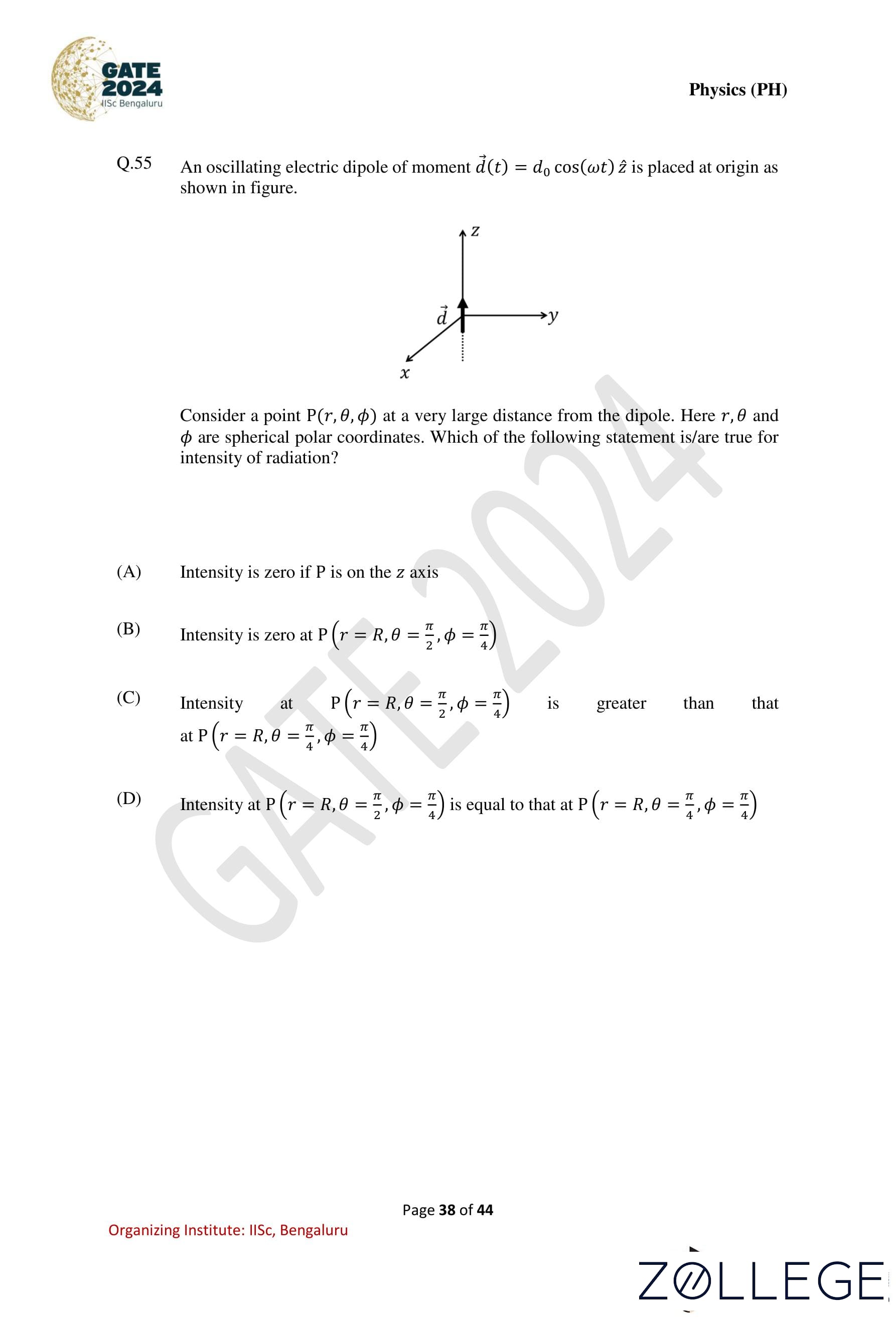
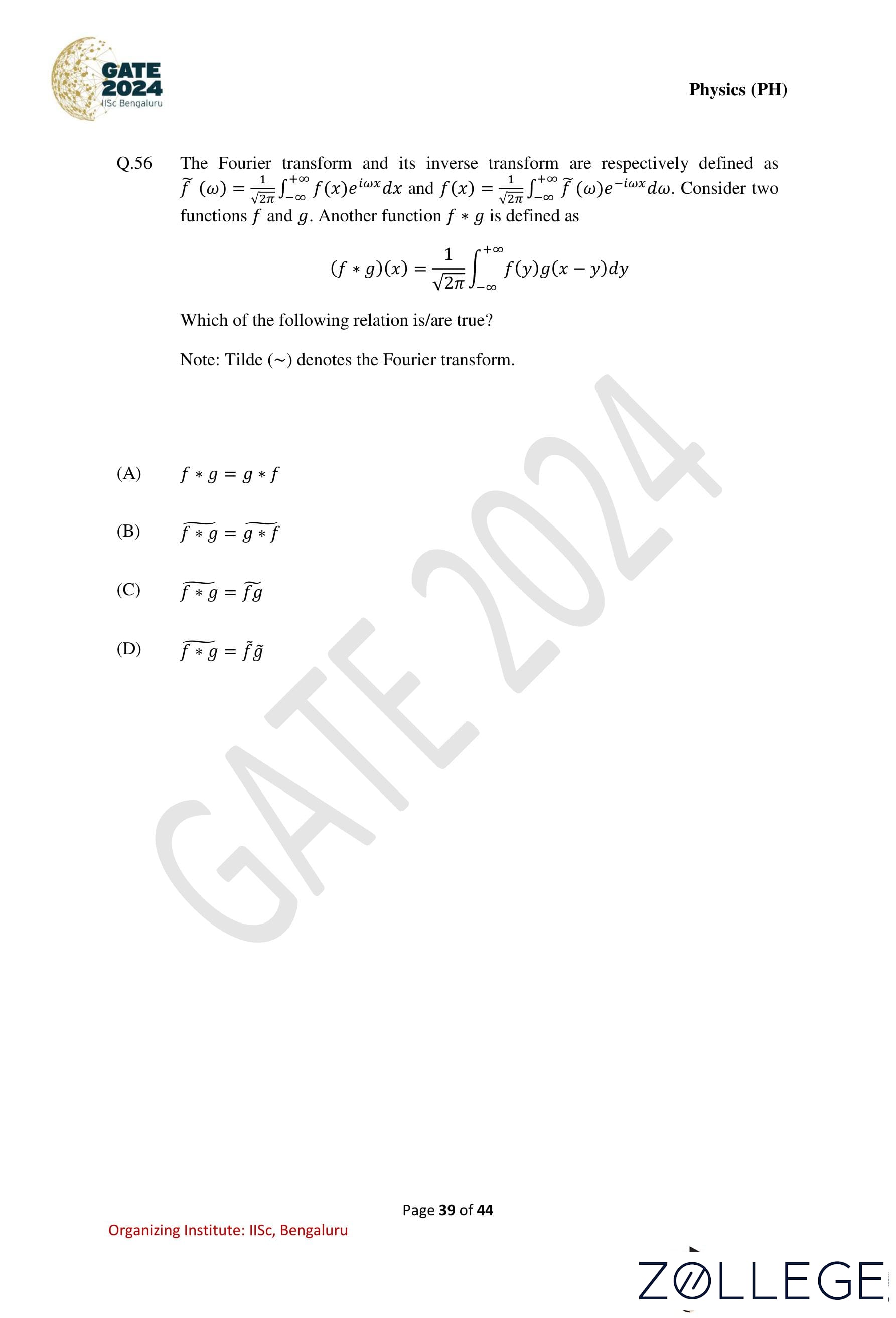
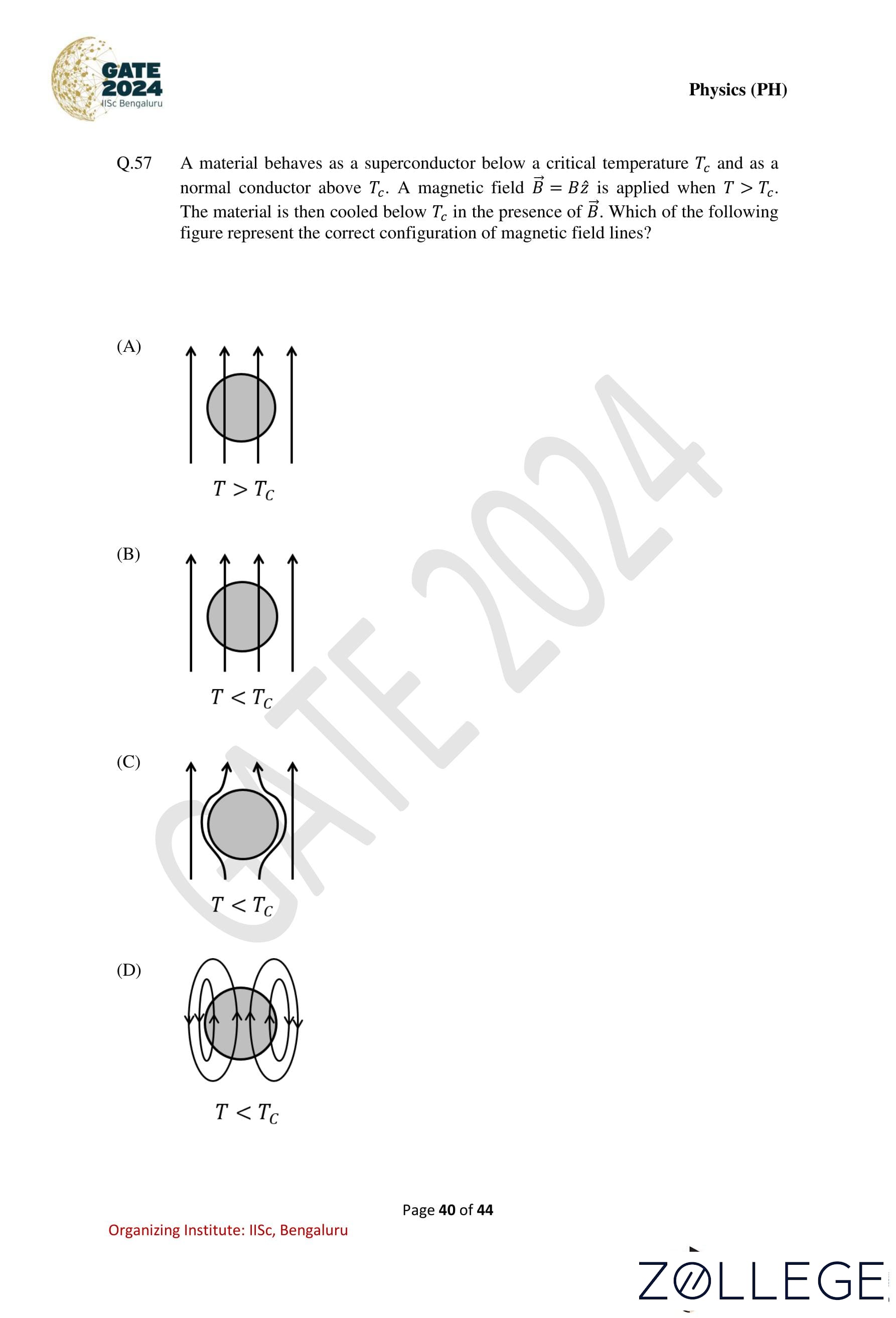
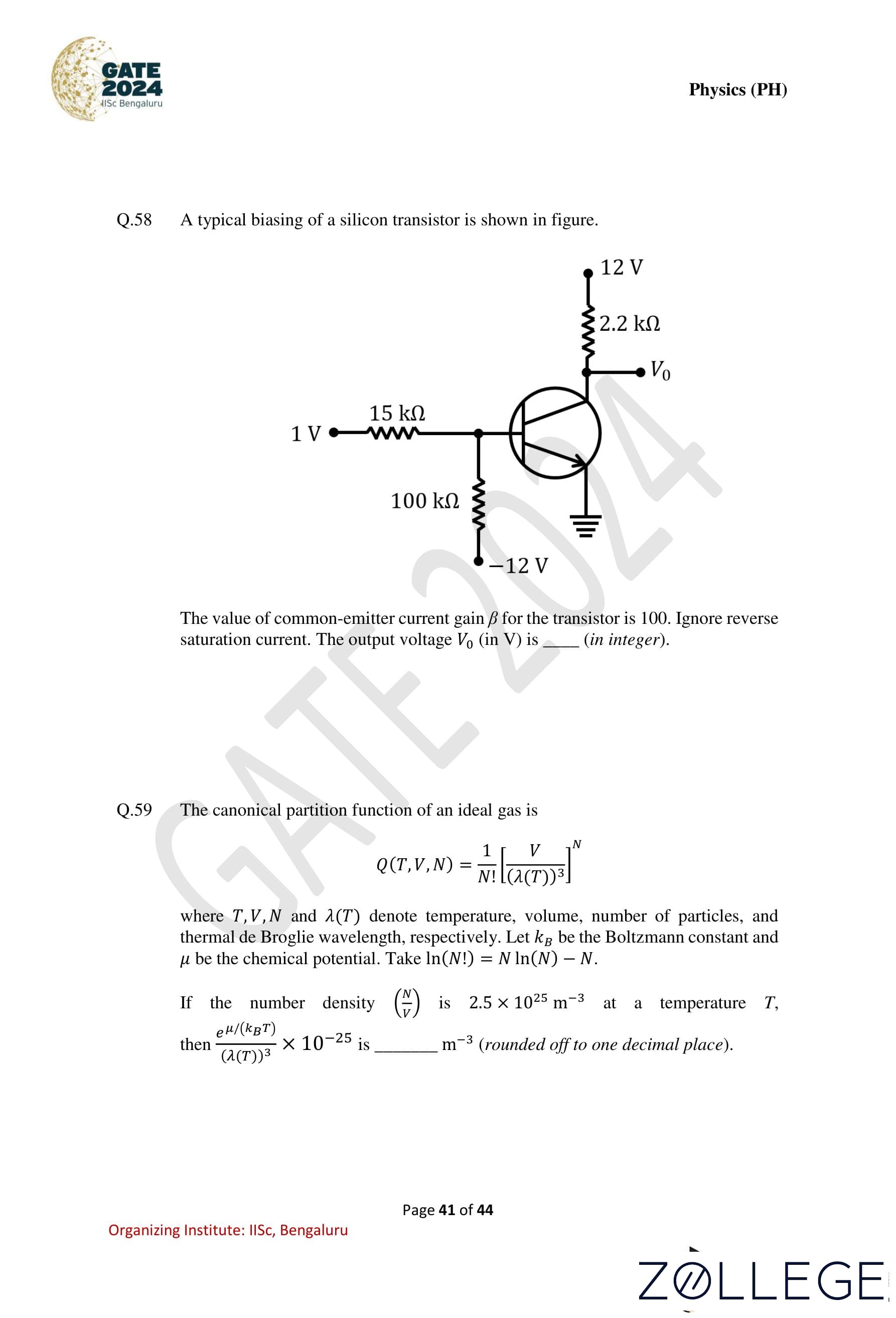
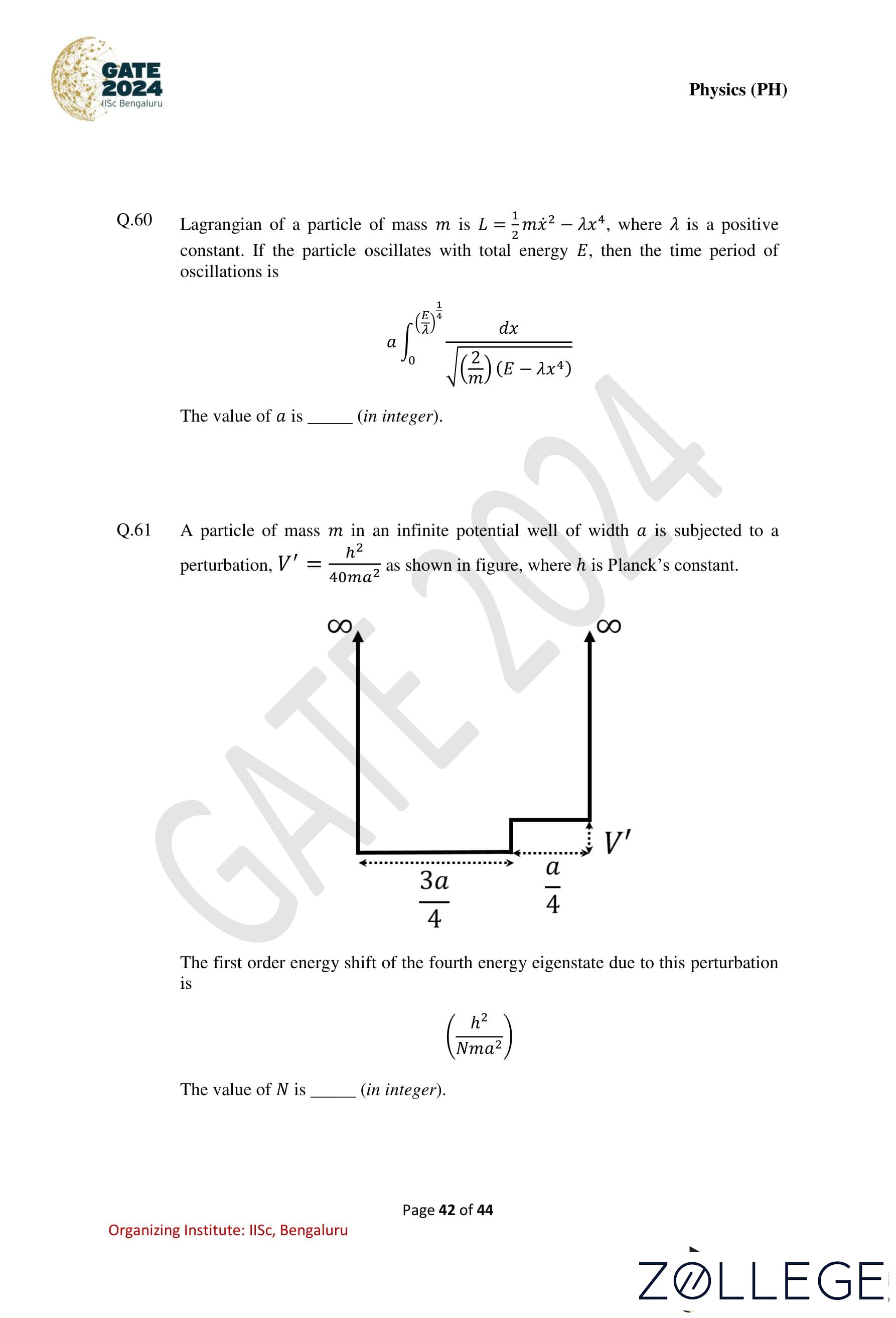
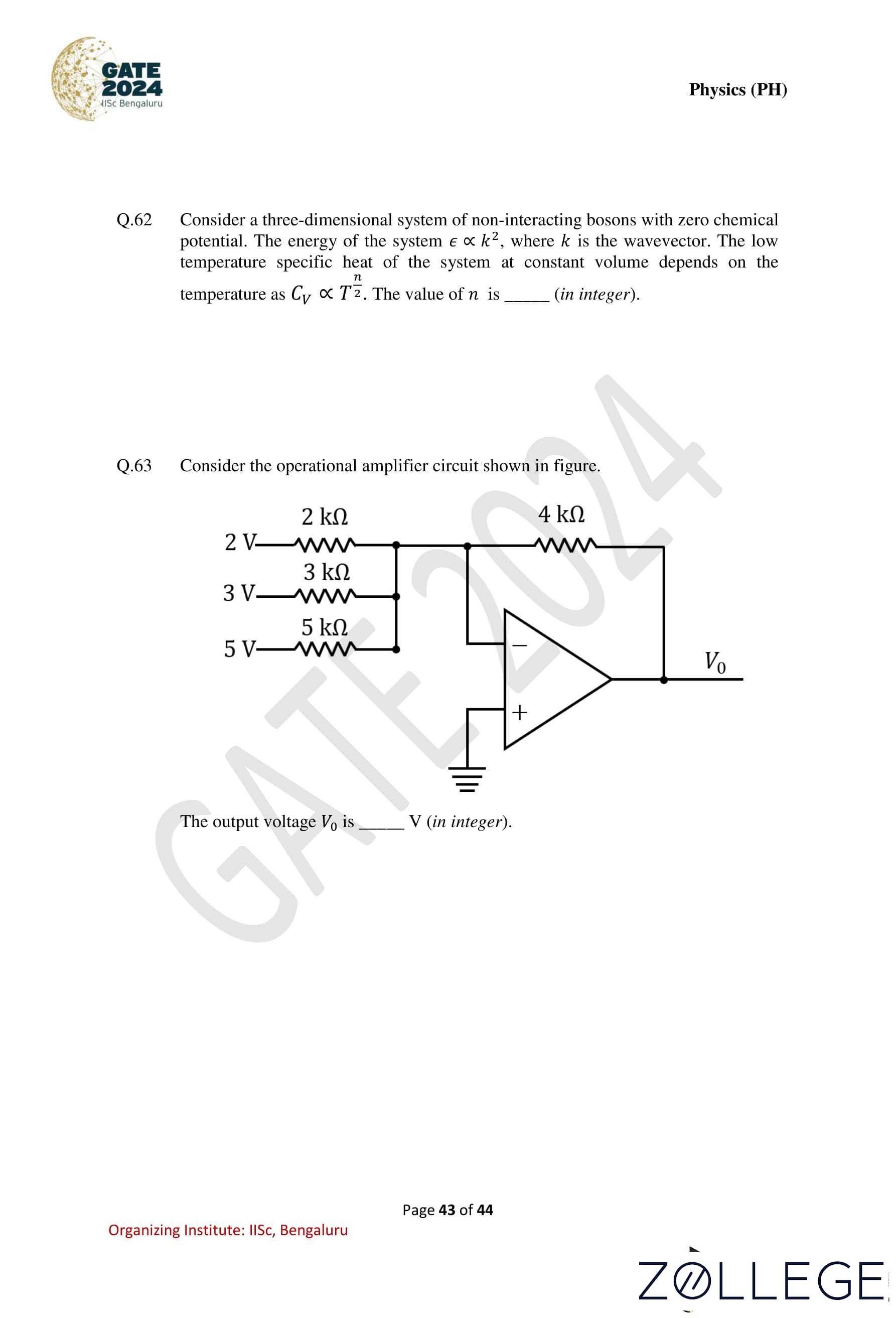
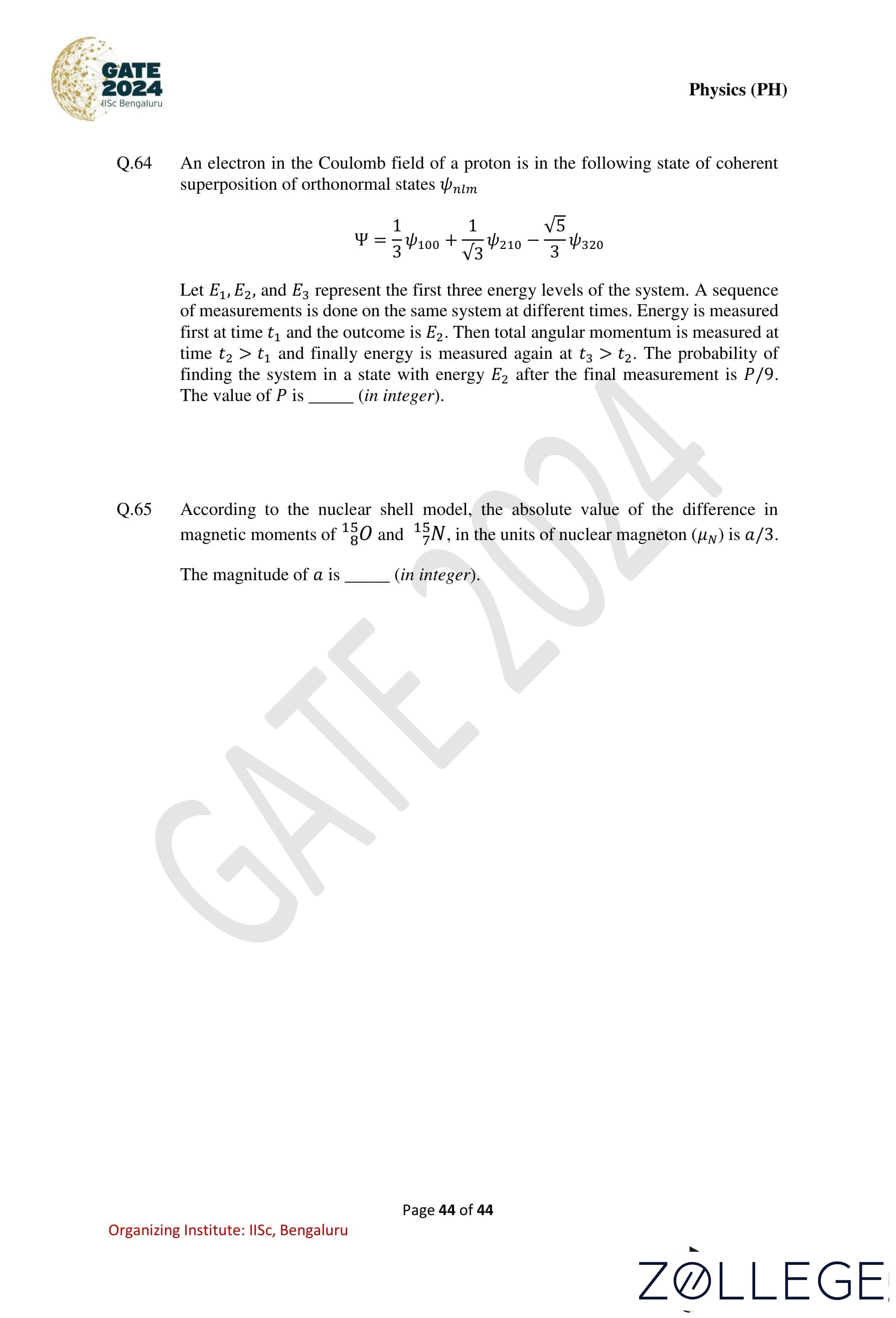
*The article might have information for the previous academic years, please refer the official website of the exam.