
GATE 2024 Psychology shift 2 Question Paper Pdf - Check Solutions with Answer Key Pdf
- Chemistry Syllabus
- Maths Syllabus
- Physics Syllabus
- Exam Pattern
- Paper Analysis
- Chemical Engg Syllabus
- Civil Engg Syllabus
- ECE Syllabus
- Mechanical Engg Syllabus
- Engg Science Syllabus
- Mining Engg Syllabus
- IN Syllabus
- CSE Syllabus
- EE Syllabus
- AE Syllabus
- BM Syllabus
- GG Syllabus
- EY Syllabus
- ST Syllabus
- TF Syllaus
- AR Syllabus
- XL Syllabus
- MT Syllabus
- PI Syllabus
- PE Syllabus
- ME Pattern
- TF Pattern
- CE Pattern
- EE Pattern
- EC Pattern
- CS Pattern
- BT Pattern
- BM Pattern
- IN Pattern
- DA Syllabus
- NA & ME Syallabus
- ES & Engg Syllabus
- Geomatics Engg Syllabus
- Agri Engg Syllabus
- Humanities and Social Sci
- PI Syllabus


Content Strategist | Updated On - Feb 17, 2025
GATE 2024 Humanities and Social Sciences- Psychology Question Paper for February 3, 2024, is available for download. IISc/IITs successfully conducted the exam in the forenoon session from 2:30 PM to 5:30 PM. As per the students’ initial reaction, the GATE 2024 Humanities and Social Sciences- Psychology Question Paper was reported as moderate to difficult. The General Aptitude section was considered easy to moderate, the Reasoning and Comprehension was of moderate difficulty, while the Core Humanities and Social Sciences- Psychology varied in difficulty, with some topics reported as challenging by most students.
GATE 2024 Humanities and Social Sciences - Psychology Question Paper with Answer Key PDF
Candidate can download the GATE 2024 Humanities and Social Sciences - Psychology Question paper with Answer key PDFs using the link below.
| GATE 2024 Psychology Question Paper with Answer Key PDF(Feb 3 Shift 2) |  Download Download |
Check Solution |
GENERAL APTITUDE (GA)
Question 1:
If ‘—’ denotes increasing order of intensity, then the meaning of the words [simmer — seethe — smolder] is analogous to [break — raze — ]. Which one of the given options is appropriate to fill the blank?
View Solution
Step 1: Interpreting the analogy.
The sequence "simmer — seethe — smolder" suggests a gradual increase in intensity related to heat or emotion.
Similarly, in "break — raze —," we need a word that indicates a stronger, more destructive action than "raze."
Step 2: Reviewing the options.
- Obfuscate: Refers to making something unclear or confusing, not related to destruction.
- Obliterate: Means to completely destroy, making it suitable for the analogy.
- Fracture: Refers to breaking into parts, which is less intense than "raze."
- Fissure: Indicates a crack or split, also less severe than "raze."
Step 3: Concluding the solution.
"Obliterate" is the most appropriate word to complete the analogy as it represents the greatest level of destruction.
Quick Tip: For analogy-based questions, first identify the progression or relationship in the given set of words. Apply this logic to the options to determine the best fit.
In a locality, the houses are numbered in the following way: The house-numbers on one side of a road are consecutive odd integers starting from 301, while the house-numbers on the other side of the road are consecutive even numbers starting from 302. The total number of houses is the same on both sides of the road. If the difference of the sum of the house-numbers between the two sides of the road is 27, then the number of houses on each side of the road is:
View Solution
Step 1: Problem setup.
House numbers on one side are consecutive odd integers starting from 301. On the other side, they are consecutive even integers starting from 302. Let \( n \) represent the number of houses on each side.
Step 2: Sum of odd-numbered houses.
Using the arithmetic progression formula, the sum is:
\[ n[n + 300]. \]
Step 3: Sum of even-numbered houses.
Similarly, the sum of even-numbered houses is:
\[ n[n + 301]. \]
Step 4: Calculating the difference in sums.
Given that the difference between the sums is 27:
\[ 301n - 300n = 27 \implies n = 27. \]
Step 5: Final conclusion.
The number of houses on each side of the road is \( 27 \).
Quick Tip: For problems involving sums of consecutive numbers, use the arithmetic progression formula: \[ S_n = \frac{n}{2} \left[2a + (n-1)d\right], \] where \( a \) is the first term, \( n \) is the number of terms, and \( d \) is the common difference.
For positive integers \( p \) and \( q \), with \( \frac{p}{q} \neq 1 \), \[ \left(\frac{p}{q}\right)^{\frac{p}{q}} = \left(\frac{p}{q}\right)^{(\frac{p}{q} - 1)}. \] Then:
View Solution
Step 1: Simplify the given equation.
Starting with:
\[ \left(\frac{p}{q}\right)^q = p^{\frac{p}{q} - 1}. \]
Rewriting:
\[ \frac{p^q}{q^q} = p^{\frac{p}{q} - 1}. \]
Step 2: Identifying the relationship.
Equating powers of \( p \) and \( q \):
\[ p^q = q^p. \]
Step 3: Verification.
The relationship \( p^q = q^p \) satisfies the equation, confirming the solution.
Quick Tip: In exponent-based problems, isolate terms with the same base or power and simplify step by step to uncover hidden relationships.
Which one of the given options is a possible value of \( X \) in the following sequence? \[ 3, 7, 15, X, 63, 127, 255 \]
View Solution
Step 1: Analyze the given sequence.
The sequence \( 3, 7, 15, X, 63, 127, 255 \) shows a pattern where each number is one less than a power of 2.
Step 2: Express each term.
\[ 3 = 2^2 - 1, \quad 7 = 2^3 - 1, \quad 15 = 2^4 - 1, \quad X = 2^5 - 1 = 31. \]
The subsequent terms follow the same pattern: \( 63 = 2^6 - 1 \), \( 127 = 2^7 - 1 \), \( 255 = 2^8 - 1 \).
Step 3: Conclusion.
The missing term \( X = 31 \).
Quick Tip: When analyzing a sequence, check for patterns such as differences, ratios, or powers. In this case, each term is one less than a power of 2.
On a given day, how many times will the second-hand and the minute-hand of a clock cross each other during the clock time 12:05:00 hours to 12:55:00 hours?
View Solution
Step 1: Understand the motion of the second and minute hands.
The second-hand completes one full revolution (360 degrees) in 60 seconds, while the minute-hand completes one revolution in 3600 seconds (1 hour).
Step 2: Calculate the crossings in one minute.
In one minute, the second-hand crosses the minute-hand exactly once.
Step 3: Calculate the crossings between 12:05:00 and 12:55:00.
The time interval between 12:05:00 and 12:55:00 is 50 minutes. Hence, the second-hand and minute-hand will cross each other exactly 50 times during this period.
Step 4: Conclusion.
The total number of crossings is \( 50 \).
Quick Tip: For clock-based problems, focus on the relative speeds of the hands and the time intervals to calculate the number of crossings or alignments.
In the given text, the blanks are numbered (i)—(iv). Select the best match for all the blanks. From the ancient Athenian arena to the modern Olympic stadiums, athletics \( (i) \) the potential for a spectacle. The crowd \( (ii) \) with bated breath as the Olympian artist twists his body, stretching the javelin behind him. Twelve strides in, he begins to cross-step. Six cross-steps \( (iii) \) in an abrupt stop on his left foot. As his body \( (iv) \) like a door turning on a hinge, the javelin is launched skyward at a precise angle.
View Solution
Step 1: Analyze the grammar.
Each blank requires a verb that agrees with the subject and fits the tense of the sentence.
- (i) holds: Matches the singular subject "athletics."
- (ii) waits: Agrees with the singular subject "crowd."
- (iii) culminate: Fits the progression of actions leading to a conclusion.
- (iv) pivots: Aligns with the description of the athlete's motion.
Step 2: Conclusion.
The correct answer is \( % Option (4) \).
Quick Tip: In grammar-based questions, ensure subject-verb agreement and consistent tense usage throughout the sentence. Singular subjects require singular verbs, and plural subjects require plural verbs.
Three distinct sets of indistinguishable twins are to be seated at a circular table that has 8 identical chairs. Unique seating arrangements are defined by the relative positions of the people. How many unique seating arrangements are possible such that each person is sitting next to their twin?
View Solution
Step 1: Problem Setup. We are tasked with finding the number of unique circular arrangements of 5 units, out of which 2 are alike (\( E \) and \( E \)). Step 2: Formula for circular arrangements. The total number of arrangements in a circle, accounting for repetition, is given by: \[ \frac{(n-1)!}{k!}, \] where \( n \) is the total number of units and \( k \) is the number of identical units. Step 3: Substituting the values. Here, \( n = 5 \) and \( k = 2 \) (for \( E \) and \( E \)): \[ \text{Number of unique arrangements} = \frac{(5-1)!}{2!}. \] Step 4: Simplifying the factorials. \[ \text{Number of unique arrangements} = \frac{4!}{2!} = \frac{4 \times 3 \times 2 \times 1}{2 \times 1}. \] Step 5: Calculating the result. \[ \text{Number of unique arrangements} = 12. \] Quick Tip: For circular arrangements, remember to account for rotational symmetry by dividing the total arrangements by the number of rotations (usually the number of units).
The chart given below compares the Installed Capacity (MW) of four power generation technologies, T1, T2, T3, and T4, and their Electricity Generation (MWh) in a time of 1000 hours (h).

The Capacity Factor of a power generation technology is: \[ \text{Capacity Factor} = \frac{\text{Electricity Generation (MWh)}}{\text{Installed Capacity (MW)} \times 1000 \, (\text{h})}. \] Which one of the given technologies has the highest Capacity Factor?
View Solution
Step 1: Understanding Capacity Factor.
The capacity factor is the ratio of actual electricity generation to the maximum possible electricity generation over a given time. Step 2: Extract data from the chart. From the chart: T1: Electricity Generation = 14,000 MWh, Installed Capacity = 20 MW. T2: Electricity Generation = 9,000 MWh, Installed Capacity = 25 MW. T3: Electricity Generation = 8,000 MWh, Installed Capacity = 30 MW. T4: Electricity Generation = 7,000 MWh, Installed Capacity = 35 MW. Step 3: Calculate the Capacity Factor for each technology.
Using the formula: \[ \text{Capacity Factor} = \frac{\text{Electricity Generation (MWh)}}{\text{Installed Capacity (MW)} \times 1000}. \] T1: Capacity Factor = \(\frac{14,000}{20 \times 1000} = 0.7 \, \text{(or 70%)}\). T2: Capacity Factor = \(\frac{9,000}{25 \times 1000} = 0.36 \, \text{(or 36%)}\). T3: Capacity Factor = \(\frac{8,000}{30 \times 1000} = 0.267 \, \text{(or 26.7%)}\). T4: Capacity Factor = \(\frac{7,000}{35 \times 1000} = 0.2 \, \text{(or 20%)}\). Step 4: Conclusion.
The highest Capacity Factor is for T1, which is 70%. Quick Tip: To calculate the Capacity Factor, ensure consistent units (MW for capacity, MWh for generation, and hours for time). Compare values directly after substitution.
In the 4 x 4 array shown below, each cell of the first three columns has either a cross (X) or a number, as per the given rule. Rule:

The number in a cell represents the count of crosses around its immediate neighboring cells (left, right, top, bottom, diagonals). As per this rule, the maximum number of crosses possible in the empty column is:
View Solution
The rule specifies that the number in each cell indicates the count of crosses (X) in its immediate neighbors. To solve this:
1. Identify the cells with numbers in the first three columns:
The numbers guide the arrangement of crosses around each cell to satisfy the count. Each number limits the placement of X in its neighboring cells.
2. Determine the empty column's capacity for crosses:
- Check the fourth column for constraints imposed by neighboring numbers in the third column.
- Ensure the placement of crosses in the fourth column does not violate the numbers in the third column. 3. Calculate the maximum number of crosses in the fourth column:
By observing the constraints and ensuring no violations, it is possible to place 2 crosses in the empty column.
Thus, the maximum number of crosses in the empty column is 2.
Quick Tip: For grid-based logic problems, analyze the rule carefully and test configurations systematically to ensure all constraints are satisfied.
During a half-moon phase, the Earth-Moon-Sun form a right triangle. If the Moon-Earth-Sun angle at this half-moon phase is measured to be \( 89.85^\circ \), the ratio of the Earth-Sun and Earth-Moon distances is closest to:
View Solution
Step 1: Use the trigonometric relationship.
During the half-moon phase, the Earth-Moon-Sun form a right triangle. Using the tangent of the Moon-Earth-Sun angle \( 89.85^\circ \): \[ \text{tan} \, \theta = \frac{\text{Earth-Moon distance}}{\text{Earth-Sun distance}}. \]
Rewriting: \[ \text{Earth-Sun distance} = \frac{\text{Earth-Moon distance}}{\text{tan} \, \theta}. \]
Step 2: Substitute the values.
With \( \theta = 89.85^\circ \), \( \text{tan} \, \theta \approx 0.002618 \). Hence:
\[ \frac{\text{Earth-Sun distance}}{\text{Earth-Moon distance}} = \frac{1}{0.002618} \approx 382. \]
Step 3: Conclusion.
The ratio of Earth-Sun to Earth-Moon distances is closest to \( 382 \).
Quick Tip: For problems involving right triangles and trigonometric ratios, ensure accurate angle measurements and use precise trigonometric values for calculations.
REASONING and COMPREHENSION
Question 11:
Amma’s tone in the context of the given passage is that of: \textit{For Amma, the difference between men and women was a kind of discrimination and inequality; she felt strongly about women’s rights but was not familiar with concepts like gender and patriarchy. She would have dismissed Betty Friedan because she was predominantly dealing with the problems of white middle-class women in the United States. Amma, and women of her generation, could de-link the oppression of women from the wider struggle for the liberation of human beings from class exploitation and imperialism. So Amma continued to play her role as mother and wife, but would often complain: ‘I am a doormat on which everyone wipes their emotional dirt off.’
View Solution
The passage illustrates Amma’s strong feelings about women’s rights and her vocal dissatisfaction with the inequality she faced. While she continues her role as a mother and wife, her complaints and dissatisfaction reflect a sense of protest. The key phrase, \textit{“I am a doormat on which everyone wipes their emotional dirt off,” highlights her resistance to societal expectations, albeit in a subdued manner. Key Analysis:
- Amma’s strong feelings and complaints about being taken for granted indicate she is protesting her situation.
- She does not accept her condition passively, ruling out \textit{resignation.
- Her dissatisfaction does not suggest a compromise or contentment but aligns with an underlying \textit{protest.
Quick Tip: To identify tone in a passage, pay attention to emotional expressions and the implied attitude of the speaker toward the subject.
Fill in the blanks by choosing the correct sequence for the following passage:
{I am wearing for the first time some (i) ______ that I have never been able to wear for long at a time, as they are horribly tight. I usually put them on just before giving a lecture. The painful pressure they exert on my feet goads my oratorical capacities to their utmost. This sharp and overwhelming pain makes me sing like a nightingale or like one of those Neapolitan singers who also wear (ii) ______ that are too tight. The visceral physical longing, the overwhelming torture provoked by my (iii) ______, forces me to extract from words distilled and sublime truths, generalized by the supreme inquisition of the pain my (iv) ______ suffer.
View Solution
The passage describes the tightness and discomfort experienced by the speaker. The use of the words "feet," "shoes," and "pain" clearly indicates that the answer should relate to footwear. Thus, the correct choice is: (i) patent-leather shoes
(ii) shoes
(iii) patent-leather shoes
(iv) feet Quick Tip: When filling blanks in a passage, focus on the logical flow and context provided by adjacent sentences.
The appropriate synonym for the word ‘ignite’ in the following passage will be:
{Spirituality must be integrated with education. Self-realization is the focus. Each one of us must become aware of our higher self. We are links of a great past to a grand future. We should ignite our dormant inner energy and let it guide our lives. The radiance of such minds embarked on constructive endeavor will bring peace, prosperity, and bliss to this nation.
View Solution
In this context, "ignite" refers to awakening or inspiring inner energy and positivity. The word "encourage" best matches the meaning of "ignite" here, as it implies motivating or instilling energy for constructive efforts. Quick Tip: When solving vocabulary-based questions, look for synonyms that fit the specific context of the passage.
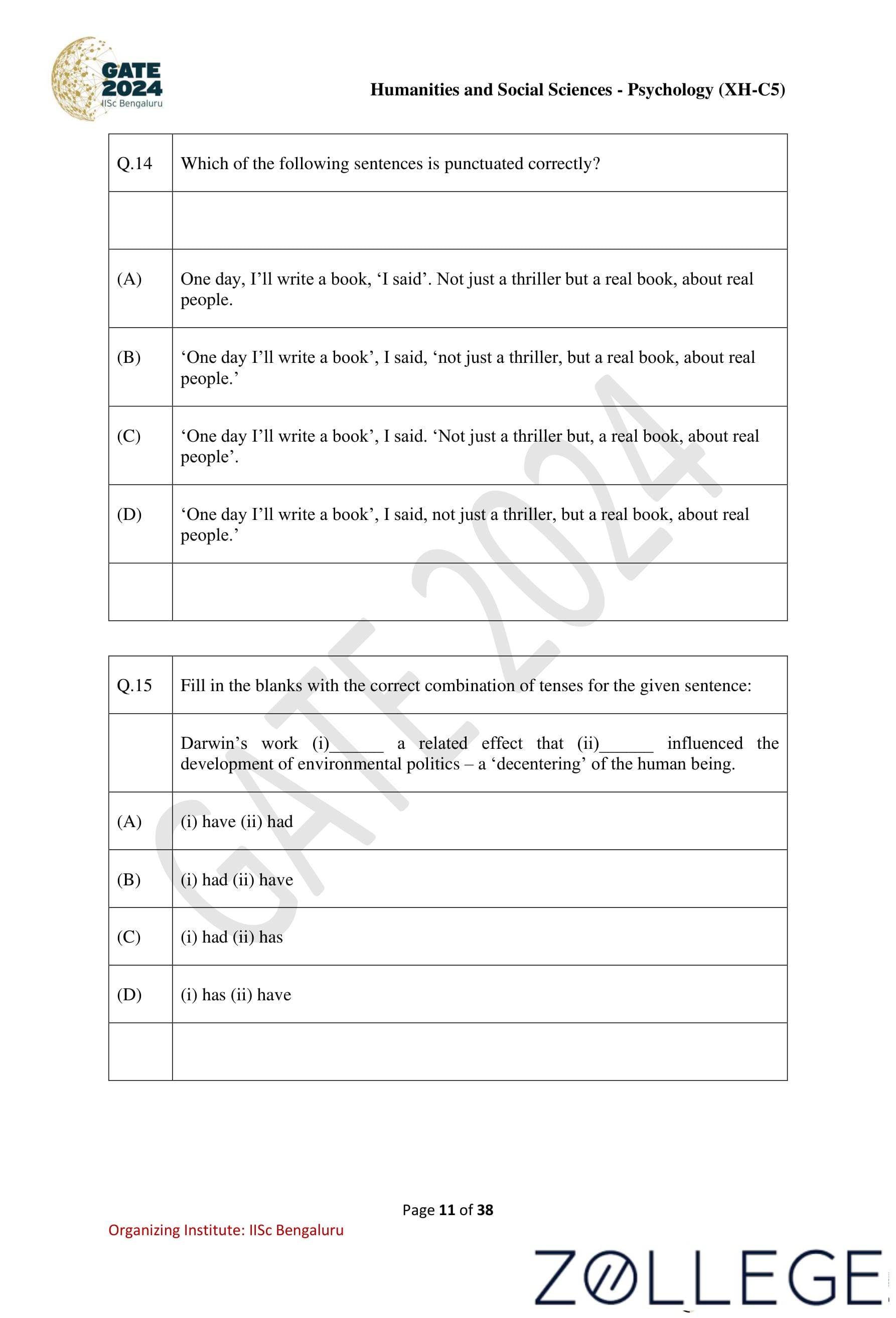
Which of the following sentences is punctuated correctly?
View Solution
Option (B) uses proper punctuation rules for dialogue and quoted speech: - The quoted statement is enclosed in single quotation marks. - Commas are correctly placed after "book" and "said." - The internal quotation maintains proper punctuation for clarity. Quick Tip: For punctuation questions, ensure quotation marks, commas, and periods are placed correctly based on grammar rules.
Fill in the blanks with the correct combination of tenses for the given sentence: \textit{Darwin’s work (i) ______ a related effect that (ii) ______ influenced the development of environmental politics – a ‘decentering’ of the human being.
View Solution
The correct tense sequence is:
- (i) "had" indicates a past effect attributed to Darwin's work.
- (ii) "has" signifies the continuing influence of this work on the development of environmental politics in the present.
Quick Tip: When solving tense-related questions, ensure consistency with the timeline described in the sentence.
Which of the following options holds a similar relationship as the words, ‘Music: Notes’?
View Solution
The relationship between ‘Music’ and ‘Notes’ is that Notes are the basic components or elements that constitute Music.
Similarly, in the case of ‘House: Bricks,’ Bricks are the basic components used to construct a House.
Incorrect options:
- (A) Water: Cold drink – Water is an ingredient, not a structural component.
- (B) Paper: Class Notes – Class Notes are written on Paper but are not structural components of Paper.
- (D) Graphite: Charcoal – Graphite is a material in Charcoal but does not constitute the entire structure.
Thus, the correct answer is (C) House: Bricks.\ Quick Tip: In analogy questions, identify the type of relationship (e.g., component, function, cause-effect) between the given pair before matching it with the options.
In a particular code, if “RAMAN” is written as 52 and “MAP” is written as 33, then how will you code “CLICK”?
View Solution
To determine the code for "CLICK," we need to identify the pattern used to code the given words:
1. Assign numerical values to the letters based on their position in the alphabet: - \( A = 1, B = 2, C = 3, \ldots, Z = 26 \).
2. Compute the sum of the letter values for "RAMAN" and "MAP": - \( R = 18, A = 1, M = 13, A = 1, N = 14 \).
\[ \text{Sum for RAMAN: } 18 + 1 + 13 + 1 + 14 = 47. \] To arrive at 52, we observe an additional constant of \( +5 \). Thus, the code for "RAMAN" is \( 47 + 5 = 52 \).
- \( M = 13, A = 1, P = 16 \).
\[ \text{Sum for MAP: } 13 + 1 + 16 = 30. \] Adding the constant \( +3 \), the code for "MAP" is \( 30 + 3 = 33 \).
3. Apply the same pattern to "CLICK": - \( C = 3, L = 12, I = 9, C = 3, K = 11 \).
\[ \text{Sum for CLICK: } 3 + 12 + 9 + 3 + 11 = 38. \] Adding \( +5 \), the code for "CLICK" becomes: \[ 38 + 5 = 43. \] Thus, the correct answer is (B) 43. Quick Tip: When working on coding-decoding problems, systematically test common patterns (alphabet positions, sums, etc.) before concluding.
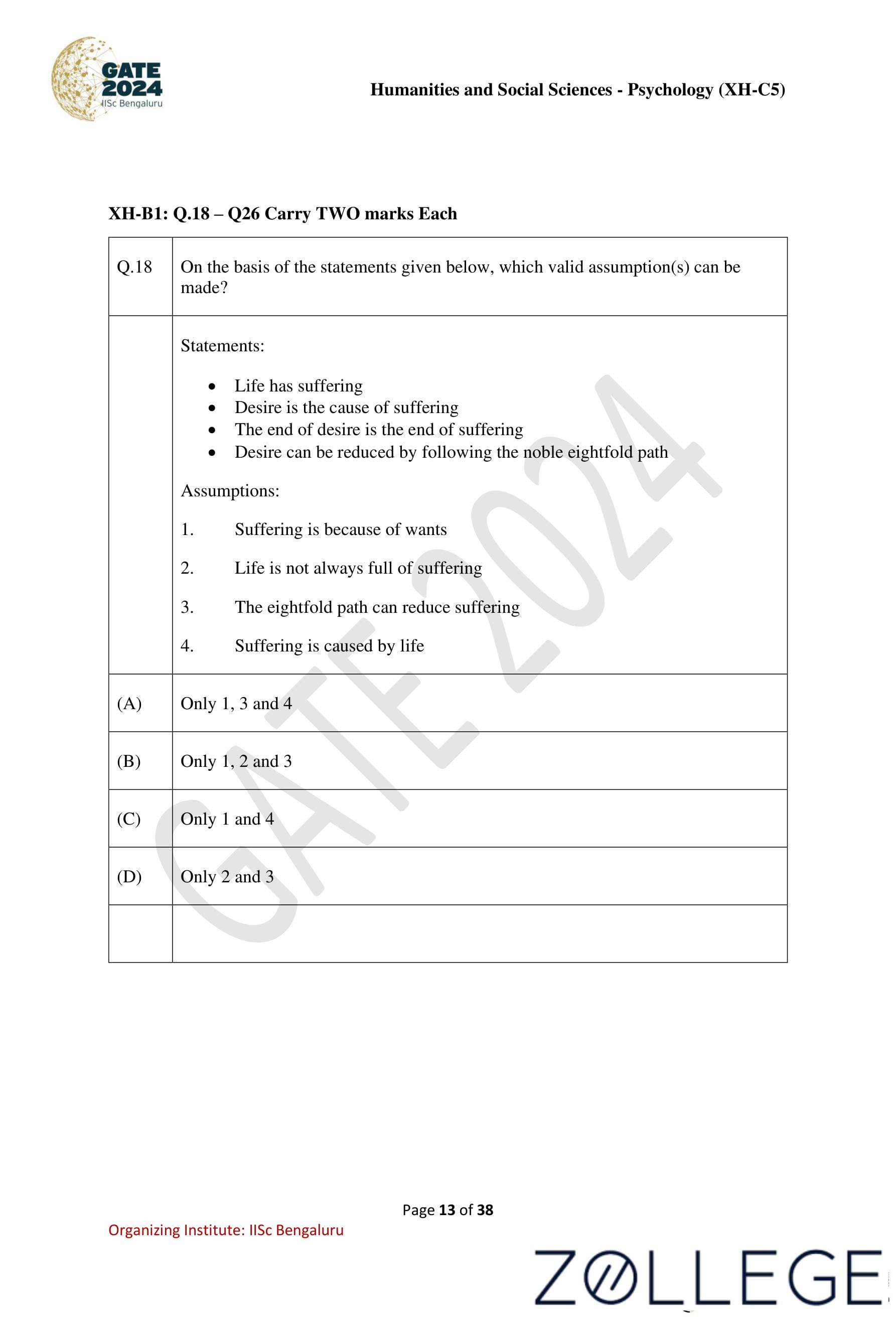
On the basis of the statements given below, which valid assumption(s) can be made? Statements: Life has suffering. Desire is the cause of suffering. The end of desire is the end of suffering. Desire can be reduced by following the noble eightfold path. Assumptions:
1. Suffering is because of wants.
2. Life is not always full of suffering.
3. The eightfold path can reduce suffering.
4. Suffering is caused by life.
View Solution
Analyzing each assumption:
1. "Suffering is because of wants" aligns with "Desire is the cause of suffering."
2. "Life is not always full of suffering" is valid because "Life has suffering" does not imply it is constant.
3. "The eightfold path can reduce suffering" is directly supported by "Desire can be reduced by following the noble eightfold path."
4. "Suffering is caused by life" is not valid; while life has suffering, the cause is identified as desire.
Thus, only assumptions 1, 2, and 3 are valid. Quick Tip: For assumption questions, match each assumption with the given statements for logical consistency.
If 'KARAMCHAND' is coded as 'ICPCKEFCLF,' what should be the code of 'CREATION'?
View Solution
To determine the code for "CREATION," let us analyze the pattern used to encode "KARAMCHAND" into "ICPCKEFCLF."
1. Observe the structure of the code for "KARAMCHAND": - The word "KARAMCHAND" is divided into pairs of letters: KA, RA, MC, HA, ND. - Each pair is transformed based on a pattern: - KA becomes IC: Shift each letter two steps backward in the alphabet. - RA becomes PC: Shift each letter two steps backward. - MC becomes KE: Shift each letter two steps backward. - HA becomes FC: Shift each letter two steps backward. - ND becomes LF: Shift each letter two steps backward.
2. Apply the same pattern to "CREATION": - Divide "CREATION" into pairs: CR, EA, TI, ON. - Transform each pair by shifting two steps backward: - CR becomes AT. - EA becomes CC. - TI becomes RK. - ON becomes MP.
3. Combine the transformed pairs: \[ \text{Code for "CREATION": ATCCRKMP.} \] Thus, the correct answer is (A) ATCCRKMP. Quick Tip: In pattern-based questions, apply transformations systematically and verify with the example provided.
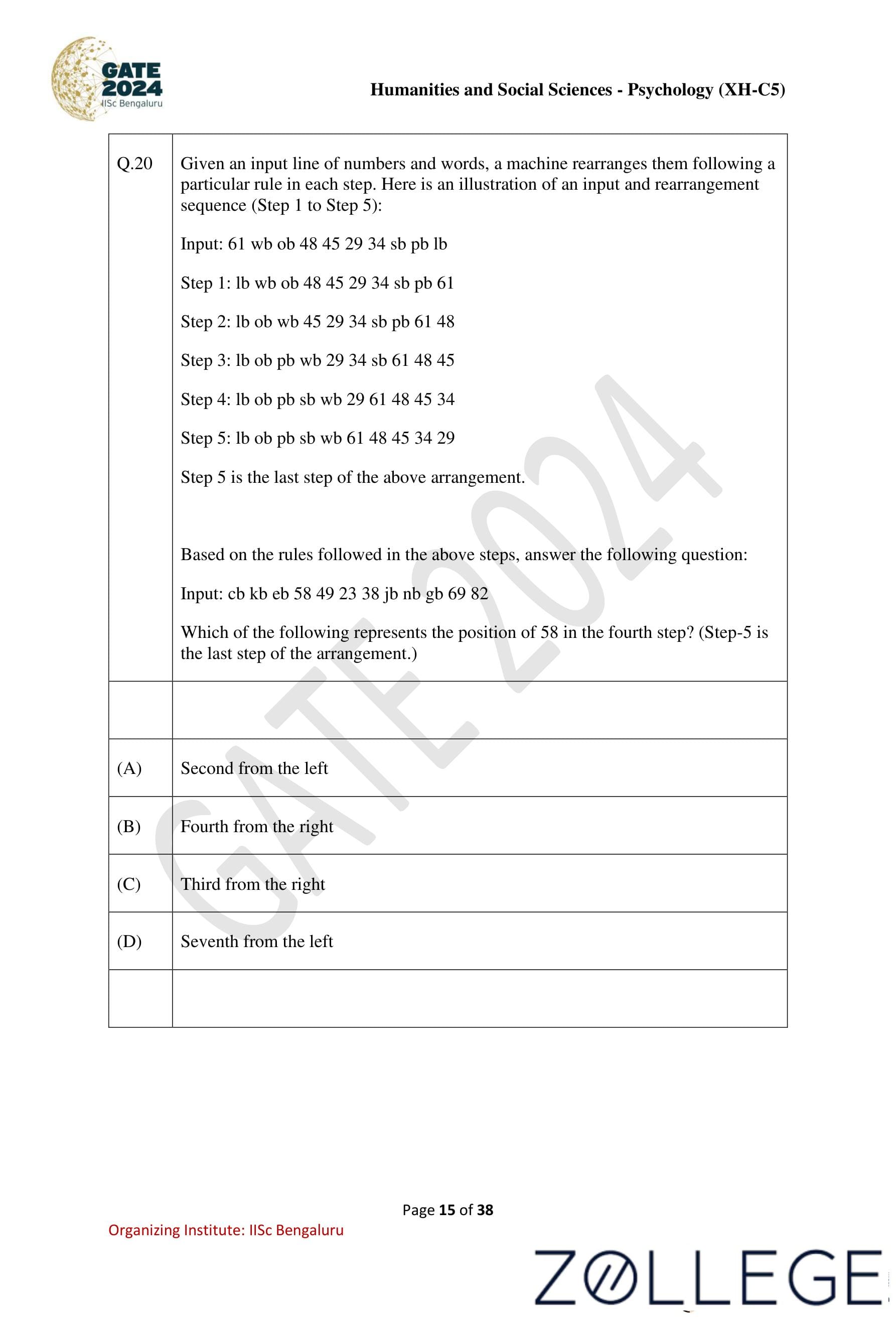
Given an input line of numbers and words, a machine rearranges them following a particular rule in each step. Here is an illustration of an input and rearrangement sequence (Step 1 to Step 5): Input: 61 wb ob 48 45 29 34 sb pb lb
Step 1: lb wb ob 48 45 29 34 sb pb 61
Step 2: lb ob wb 45 29 34 sb pb 61 48
Step 3: lb ob pb wb 29 34 sb 61 48 45
Step 4: lb ob pb sb wb 61 48 45 34 29
Step 5: lb ob pb sb wb 61 48 45 34 29
Step 5 is the last step of the above arrangement.
Based on the rules followed in the above steps, answer the following question: Input: cb kb eb 58 49 23 38 jb nb gb 69 82
Which of the following represents the position of 58 in the fourth step? (Step-5 is the last step of the arrangement.)
View Solution
The arrangement rule involves two processes:
1. Words are arranged in alphabetical order from left to right in each step.
2. Numbers are arranged in descending order from right to left in each step.
For the input: cb kb eb 58 49 23 38 jb nb gb 69 82,
Step-by-step arrangement proceeds as follows:
Step 1: eb cb kb 49 23 38 jb nb gb 69 82 58
Step 2: eb cb gb kb 23 38 jb nb 82 69 58 49
Step 3: eb cb gb jb kb 38 nb 82 69 58 49 23
Step 4: eb cb gb jb kb nb 82 69 58 49 38 23
In Step 4, 58 is the third from the right. Quick Tip: To solve machine arrangement problems, identify patterns for word and number sorting, and track the element's position across steps.
In a certain type of code, 'they play cricket together' is written as ‘mv kb lb iv'; 'they score maximum points' is written as 'gb lb mb kv'; ‘cricket score earned points' is written as 'mb gv kb kv' and ‘points are earned together' is written as 'kv mv ob gv.' What is the code for ‘earned maximum points’?
View Solution
We need to deduce the code for "earned maximum points" by analyzing the given phrases and their codes:
1. Analyze the given codes: - 'they play cricket together' = mv kb lb iv
- 'they score maximum points' = gb lb mb kv
- 'cricket score earned points' = mb gv kb kv
- 'points are earned together' = kv mv ob gv
2. Identify individual word codes: - From 'points' (appears in multiple phrases):
- 'they score maximum points' = gb lb mb kv
- 'cricket score earned points' = mb gv kb kv
- 'points are earned together' = kv mv ob gv.
Code for 'points' is kv.
- From 'earned' (appears in two phrases):
- 'cricket score earned points' = mb gv kb kv
- 'points are earned together' = kv mv ob gv.
Code for 'earned' is gv.
- From 'maximum' (appears in one phrase):
- 'they score maximum points' = gb lb mb kv.
Code for 'maximum' is mb.
3. Combine the codes for 'earned', 'maximum', and 'points': - 'earned' = gv
- 'maximum' = gb
- 'points' = kv
4. Final code for 'earned maximum points': gv gb kv. Thus, the correct answer is (A) gv gb kv. Quick Tip: When solving coding questions, identify overlapping words in the phrases to deduce their codes systematically.
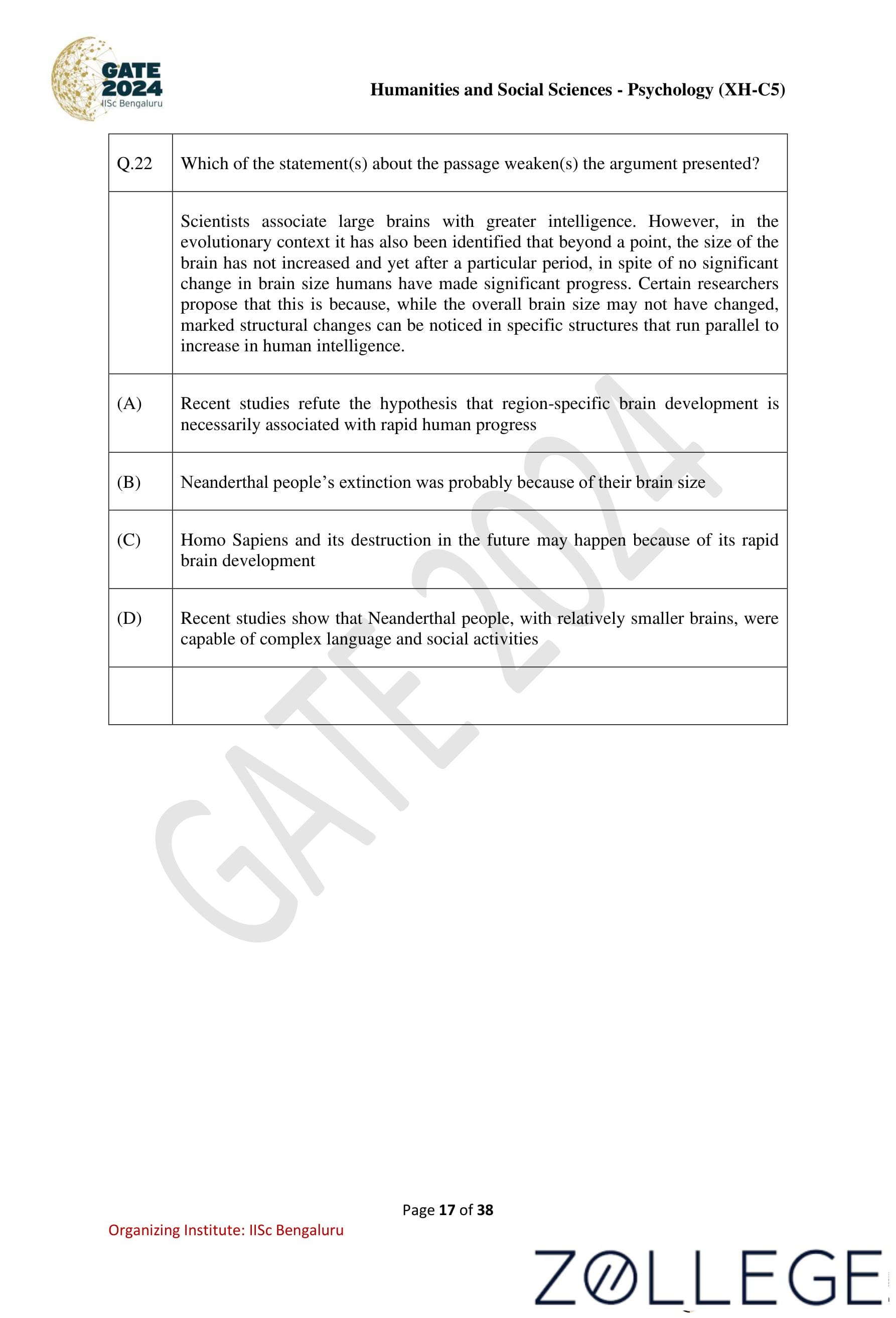
Which of the statement(s) about the passage weaken(s) the argument presented? \textit{Scientists associate large brains with greater intelligence. However, in the evolutionary context it has also been identified that beyond a point, the size of the brain has not increased and yet after a particular period, in spite of no significant change in brain size humans have made significant progress. Certain researchers propose that this is because, while the overall brain size may not have changed, marked structural changes can be noticed in specific structures that run parallel to an increase in human intelligence.
View Solution
The argument in the passage is that human intelligence increased due to structural changes in the brain, not overall size. Let’s evaluate the options:
- Option (A) does not weaken the argument, as it does not directly address the structural changes linked to intelligence.
- Option (B) is irrelevant to the argument, as it speculates on Neanderthals' extinction without contradicting the premise of structural brain changes.
- Option (C) is speculative and does not refute the argument.
- Option (D) weakens the argument by demonstrating that Neanderthals, despite having smaller brains, exhibited complex behavior, which undermines the implied link between structural changes and intelligence.
Thus, the correct answer is (A). Quick Tip: To identify weakening statements, focus on contradictions or counterexamples to the argument's core premise.
The narrator's use of 'I' in the given passage is/are: \textit{I have never been any good at the more lurid sort of writing. Psychopathic killers, impotent war-heroes, self-tortured film stars, and seedy espionage agents must exist in the world, but strangely enough I do not come across them, and I prefer to write about the people and places I have known and the lives of those whose paths I have crossed. This crossing of paths makes for stories rather than novels, and although I have worked in both mediums, I am happier being a short-story writer than a novelist.
View Solution
The narrator reflects on their writing style and preferences, which indicates a self-concious and confessional tone. They openly discuss their personal experiences and choices, demonstrating a desire to communicate their perspective effectively. There is no indication of self-consciousness, regret, or vanity. Thus, the correct tone is Self-conscious and Confessional and communicating. Quick Tip: When analyzing tone, focus on the narrator's attitude and the purpose behind their statements.
Which of the following recommended action(s) seem to be appropriate with the stated problem? Stated Problem: Many students at educational institutes do not attend classes in the post-pandemic scenario.
(C) Surveys should be conducted to identify the reasons for their absence.
View Solution
The stated problem focuses on student absenteeism in a post-pandemic scenario. The most logical steps would involve: 1. Understanding the reasons for absenteeism through surveys (Option C).
2. Addressing the issues faced by students via counselling sessions (Option B).
Analysis of incorrect options:
- Option A: Disciplinary action is reactive and does not address the underlying issues.
- Option D: Changing course content without understanding the reasons for absenteeism may not resolve the issue.
Thus, the most appropriate steps are conducting surveys (Option C) and organizing counselling sessions (Option B). Quick Tip: For problem-solving questions, prioritize solutions that address the root cause rather than reactive or speculative actions.
Read the passage and identify the statement(s) which follow(s) from it: \textit{The purpose of this work is to inform educators about the brain science related to emotion and learning, and, more important, to offer strategies to apply these understandings to their own teaching. Although many of the approaches I describe will be familiar, integrating the lens of emotion and the brain may be a new concept. As an educator I had been trained in how to deliver content and organize my lessons, but I had not been taught how to design learning experiences that support emotions for learning.
View Solution
Analyzing the passage: 1. Statement (A) is supported by the author's explicit goal to inform educators about "brain science related to emotion and learning." 2. Statement (B) aligns with the author's objective to "offer strategies to apply these understandings to their teaching." 3. Statement (C) is valid because the passage highlights that "integrating the lens of emotion and the brain" may be new for educators, indicating the uniqueness of the approach. 4. Statement (D) is a logical inference, as the author emphasizes designing learning experiences that "support emotions for learning." Therefore, A,C,D follow from the passage. Quick Tip: When evaluating statements, focus on both explicit information and logical inferences drawn from the passage.
If A says that his mother is the daughter of B's mother, then how is B related to A?
View Solution
Analyzing the statement: - A's mother is the daughter of B's mother. This means that B's mother is A's grandmother.
- Therefore, B is either A's maternal uncle or maternal aunt, depending on B's gender.
Since the gender of B is not specified in the question, both options Uncle (A) and Aunt (B) are plausible. Thus, the correct answer is A or B. Quick Tip: In family relationship questions, visualize the relationships by creating a simple family tree or diagram.
Psychology
Question 27:
In a sampling design, where every Kth case is selected from a random starting point with the value K kept constant throughout, is an example of ______.
View Solution
Systematic sampling is a probability sampling technique where a random starting point is chosen, and every \textit{kth element is selected from the population.
Key points: 1. The sampling interval (\textit{k) is kept constant throughout. 2. This method ensures that the sample is evenly distributed over the population.
Thus, the correct answer is (B) Systematic sampling. Quick Tip: Systematic sampling is efficient when the population is ordered and helps in avoiding selection bias.
Which among the following correlation coefficient values represents the strongest relationship between two variables?
View Solution
The strength of a correlation is determined by the absolute value of the correlation coefficient (\textit{r).
Key points: 1. The closer the absolute value of \textit{r is to 1, the stronger the correlation.
2. In this case: - \(|-0.86| = 0.86\), - \(|+0.68| = 0.68\), - \(|+0.59| = 0.59\), - \(|-0.05| = 0.05\).
3. Therefore, -0.86 represents the strongest relationship. Thus, the correct answer is (A) -0.86. Quick Tip: The sign of the correlation coefficient indicates the direction (positive or negative), while the absolute value determines the strength of the relationship.
A researcher performs an experiment to learn if room temperature affects the amount of aggression displayed by college students under crowded conditions in a simulated prison environment. In this experiment, the independent variable is:
View Solution
The independent variable is the factor that the researcher manipulates to observe its effect on the dependent variable.
In this experiment: 1. The researcher is manipulating room temperature to study its effect on aggression.
2. The dependent variable is aggression, as it is being measured in response to the change in room temperature. Thus, the correct answer is (C) Room temperature. Quick Tip: Independent variables are manipulated, while dependent variables are measured as outcomes in an experiment.
If the data distribution is skewed to the left, it means:
View Solution
In a left-skewed (negatively skewed) distribution: 1. The tail of the distribution extends to the left. 2. This indicates that most of the data points are concentrated at higher values, while fewer data points are at lower values.
Thus, the correct answer is (B) Fewer scores have low values than have high values. Quick Tip: In a left-skewed distribution, the mean is typically less than the median due to the influence of extreme low values.
The theory of psychoanalysis is based on ______ method.
View Solution
Psychoanalysis, developed by Sigmund Freud, relies heavily on the case study method to understand individual psychological processes.
Key points: 1. Case studies provide detailed insights into unconscious motives and past experiences. 2. Surveys and observations are not the primary methods in psychoanalysis.
Thus, the correct answer is (C) Case study. Quick Tip: Psychoanalysis uses detailed case studies to explore unconscious processes and past traumas.
If a court acquits the criminal for lack of evidence and sentences the victim for 2 years of rigorous imprisonment in a case, it is an example of:
View Solution
In statistical terms: 1. A Type I error (false positive) occurs when a true null hypothesis is rejected. In this case, the court wrongly convicts an innocent victim. 2. A Type II error (false negative) occurs when a false null hypothesis is not rejected. Here, the court fails to convict the actual criminal due to a lack of evidence. Explanation: - The criminal's acquittal for lack of evidence is a Type II error. - Sentencing the victim wrongly is a Type I error.
Thus, the correct answer is (D) Type II and Type I error, respectively. Quick Tip: Type I error: Rejecting a true null hypothesis (false positive).
Type II error: Failing to reject a false null hypothesis (false negative).
In the Darwinian sense, ______ refers to the ability of an organism to survive and produce a large number of fertile offspring.
View Solution
In Darwinian terms:
1. Fitness refers to an organism's ability to survive in its environment and produce a large number of fertile offspring.
2. It is a key concept in natural selection, where organisms with higher fitness are more likely to pass on their genes to the next generation.
Incorrect options:
- (A) Selection: Refers to the process driving evolution but does not directly define the ability to produce offspring.
- (B) Intersexual competition: Refers to competition between individuals of the same species for mates.
- (C) Evolution: Refers to the change in genetic composition over generations, but fitness is a component of this process.
Thus, the correct answer is (D) Fitness. Quick Tip: Fitness in evolutionary biology measures an organism's reproductive success and survival in its environment.
Which theory states that people try to regulate their emotions to minimize the distress caused by a situation?
View Solution
Step 1: Understanding Emotion-focused Coping:
Emotion-focused coping is a strategy where individuals attempt to manage their emotional responses to a stressful situation instead of addressing the problem itself.
Step 2: Application to the Question:
The question describes regulating emotions to minimize distress, which is directly aligned with the concept of emotion-focused coping. Quick Tip: Emotion-focused coping is useful when a situation cannot be changed, as it helps in managing internal emotional states.
Which of the following is a suitable description of “grounded theory”?
View Solution
Grounded theory emphasizes that theoretical ideas and concepts should emerge directly from the data collected,
rather than being imposed prior to data collection. This bottom-up approach ensures that the theory is "grounded" in empirical evidence.
Option (B) is incorrect because grounded theory does not advocate for theory preceding data.
Options (C) and (D) describe aspects of research methodology but do not define grounded theory.
Thus, the correct answer is (A).
Quick Tip: Grounded theory is an inductive research methodology where theory is constructed based on the data collected.
Percentage of scores between the mean and ± 1 standard deviation in a normal distribution is closest to:
View Solution
In a normal distribution, approximately 68% of the data lies within one standard deviation (±1) from the mean.
- Approximately 95% of the data lies within two standard deviations (±2) from the mean.
- Approximately 99% of the data lies within three standard deviations (±3) from the mean.
Thus, the correct answer is (A) 68%.
Quick Tip: The empirical rule (68-95-99.7) helps in understanding the spread of data in a normal distribution.
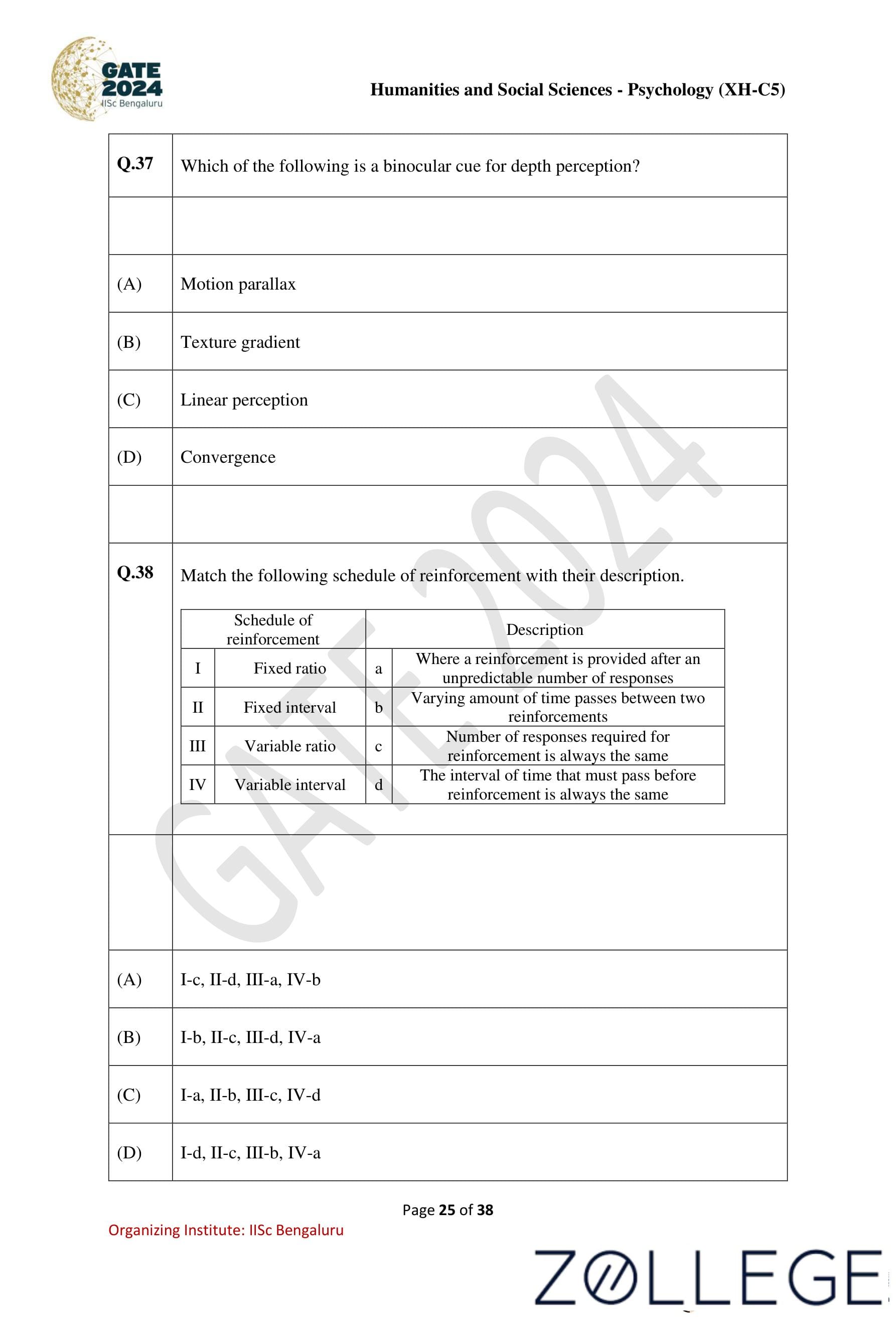
Which of the following is a binocular cue for depth perception?
View Solution
Step 1: Definition of Binocular Cues:
Binocular cues are depth perception cues that rely on the use of both eyes. Step 2: Role of Convergence:
Convergence occurs when the eyes turn inward to focus on nearby objects. The extent of inward turning provides information about the object's distance. Step 3: Elimination of Other Options:
Other options, such as motion parallax and texture gradient, are monocular cues, while convergence is a binocular cue. Quick Tip: Remember, binocular cues require both eyes and include convergence and retinal disparity.
Match the following schedule of reinforcement with their description. % Schedule and Descriptions

View Solution
Step 1: Matching Schedules with Descriptions: - Fixed Ratio: Matches with (c), as reinforcement is given after a fixed number of responses.
- Fixed Interval: Matches with (d), as reinforcement is provided after a fixed time interval.
- Variable Ratio: Matches with (a), as reinforcement is provided after an unpredictable number of responses.
- Variable Interval: Matches with (b), as reinforcement is provided after varying time intervals.
Step 2: Verifying the Matches: The matching sequence is I-c, II-d, III-a, IV-b. Quick Tip: Schedules of reinforcement are essential in behavioral psychology. Always associate "ratio" with responses and "interval" with time.
While retrieving a long-term memory, bits and pieces of information are gathered from various sources and put back together in a process called:
View Solution
Step 1: Understanding the Process: Long-term memory retrieval often involves reconstructing information by gathering bits from different sources. Step 2: Applying the Concept: This process is referred to as constructive processing, where the memory is not just retrieved but actively reconstructed. Quick Tip: Constructive processing highlights how memory retrieval is not always accurate, as it involves active reconstruction.
Which model of decision-making relies on simplifying strategies or rules of thumb based on past experiences, fairness, past events, and aversion to loss?
View Solution
Step 1: Definition of Heuristics and Biases:
This model explains decision-making based on simplifying strategies or rules of thumb derived from past experiences and events.
Step 2: Eliminating Other Options:
- Bounded rationality considers cognitive limitations but not explicitly heuristics.
- Social and economic rationality models focus on social interactions and economic factors, respectively.
Step 3: Correct Model:
The correct model is Judgment heuristics and biases.
Quick Tip: Heuristics are mental shortcuts that simplify decision-making, often at the cost of biases.
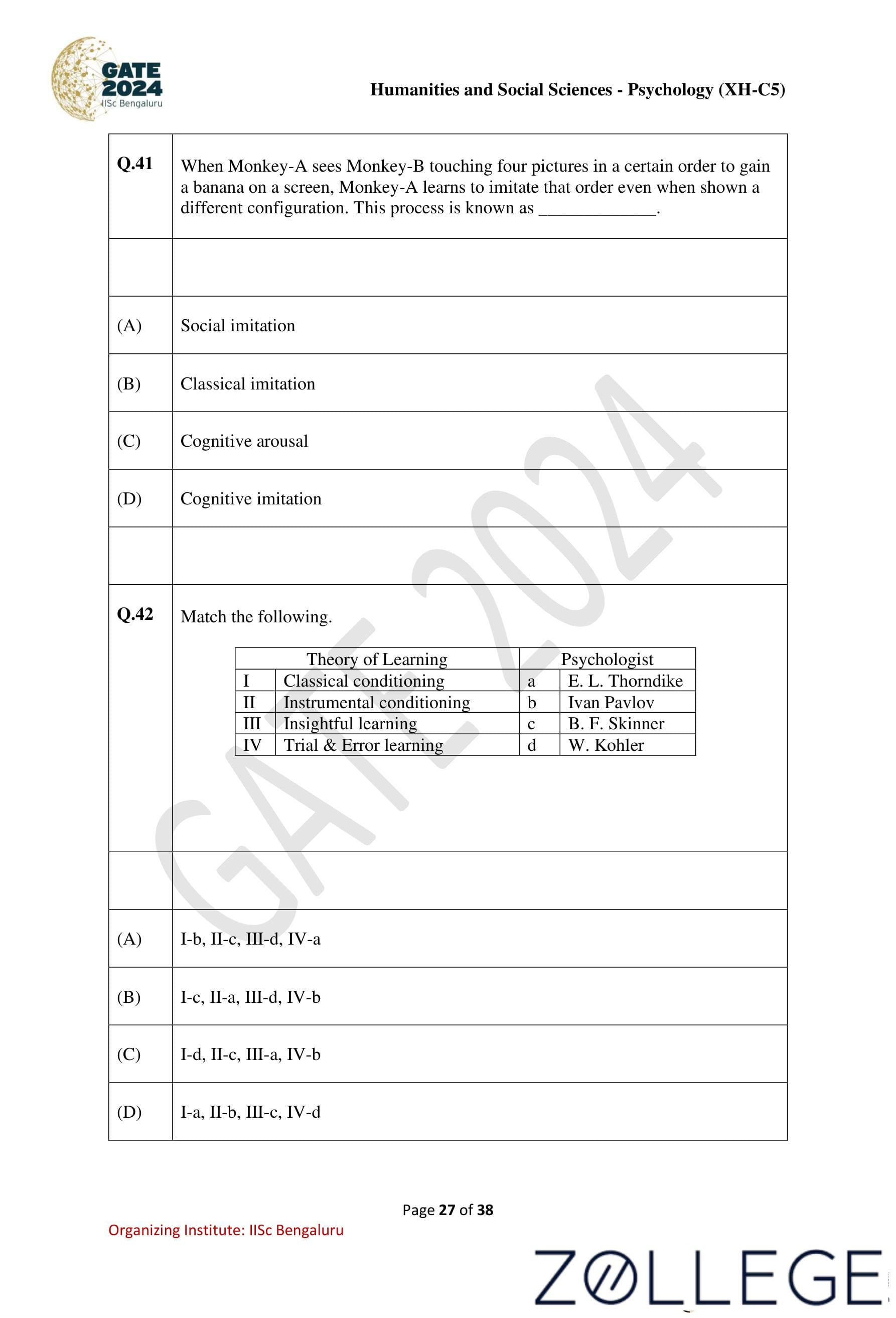
When Monkey-A sees Monkey-B touching four pictures in a certain order to gain a banana on a screen, Monkey-A learns to imitate that order even when shown a different configuration. This process is known as:
View Solution
Step 1: Defining Cognitive Imitation:
Cognitive imitation involves understanding and replicating a sequence of actions in different contexts.
Step 2: Application to the Scenario:
Monkey-A learns not just by mimicking but by understanding the sequence, indicating cognitive imitation.
Quick Tip: Cognitive imitation goes beyond mere replication; it involves comprehension and adaptability.
Match the following.

View Solution
Classical conditioning is associated with E.L. Thorndike (b).
Instrumental conditioning is linked with B.F. Skinner (c).
Insightful learning is associated with W. Kohler (d).
Trial \& Error learning relates to Ivan Pavlov (a)
Thus, the correct match is I-b, II-a, III-d, IV-c.
Quick Tip: For matching questions, ensure you clearly understand the key contributions of psychologists to their respective theories.
Match the following.

View Solution
Charles Spearman is known for his two-factor theory of intelligence (d).
Arthur Jensen is associated with Level-I \& Level-II abilities (a).
L. L. Thurstone's theory focuses on the structure of intelligence (c).
Robert Sternberg proposed the triarchic theory of intelligence (b).
J.P. Guilford's work emphasizes primary mental abilities (e).
Thus, the correct match is I-d, II-a, III-c, IV-b, V-e.
Quick Tip: Matching psychological theories to their contributors helps build a strong conceptual foundation.
Which theory emphasizes an individual's subjective frame of reference?
View Solution
Phenomenological theory focuses on individuals' subjective experiences and their interpretations of reality.
It emphasizes how people perceive the world uniquely from their own frame of reference.
Thus, the correct answer is Phenomenological theory (C).
Quick Tip: Phenomenological theories prioritize the uniqueness of subjective human experiences over general objective principles.
Tentative answer(s) to a simple research problem that is/are expressed in the form of a clearly stated relationship between independent and dependent variables is/are called:
View Solution
A hypothesis is a tentative answer that describes the relationship between independent and dependent variables.
The Alternate Hypothesis states a specific relationship or effect.
The Null Hypothesis states no significant relationship exists between the variables.
Thus, both Alternate Hypothesis (A) and Null Hypothesis (B) are correct.
Quick Tip: In research, hypotheses guide the testing process and frame the focus of experiments.
Independent variable(s) is/are also known as:
View Solution
Independent variables are manipulated to observe their effects on dependent variables.
They are referred to as Explanatory Variables because they explain changes in the dependent variable.
They are also called Exogenous Variables as they originate outside the model being studied.
Thus, the correct answers are (A) and (C).
Quick Tip: Always distinguish between independent (manipulated) and dependent (measured) variables in experiments.
Which of the following is/are not considered as unethical research practice(s)?
View Solution
Data fabrication and salami slicing are unethical research practices.
Data collection and statistical analysis, when conducted ethically, are not considered unethical.
Thus, the correct answer is (C, D).
Quick Tip: Always ensure that research methods, including data collection and analysis, adhere to ethical guidelines to maintain integrity.
In which of the following methods are variables not actively manipulated?
View Solution
In observational, correlational, and descriptive research methods, variables are not actively manipulated.
In experimental research, variables are manipulated to observe their effects.
Thus, the correct answer is (A, C, D).
Quick Tip: Non-experimental methods, like observational and descriptive, focus on observation without intervention or manipulation of variables.
Which of the following is/are distribution-free test(s)?
View Solution
Distribution-free tests, also known as non-parametric tests, do not assume a specific data distribution.
- Pearson correlation assumes normality and is not distribution-free.
- Spearman's rho is a non-parametric measure of rank correlation, making it distribution-free.
- Kruskal-Wallis H test is a non-parametric equivalent of ANOVA, hence distribution-free.
- Analysis of variance (ANOVA) assumes normality and equal variances, so it's not distribution-free.
Thus, the correct answer is (B, C).
Quick Tip: Non-parametric tests are useful when data does not meet assumptions like normality or equal variances.
Which of the following hormones do/does not increase hunger?
View Solution
- Leptin signals satiety (fullness) and suppresses hunger.
- Insulin regulates glucose uptake and may reduce hunger by maintaining blood glucose levels.
- Ghrelin stimulates hunger, promoting food intake.
- Melanocortins suppress appetite, reducing food consumption.
Thus, the correct answer is (A, B, D).
Quick Tip: Hormones like ghrelin stimulate hunger, while leptin and melanocortins act as appetite suppressants.
Component(s) of Peripheral Nervous System is/are:
View Solution
The Peripheral Nervous System (PNS) consists of:
- Somatic Nervous System, which controls voluntary actions.
- Autonomic Nervous System, which regulates involuntary functions.
The Central Nervous System (B) is not part of the PNS.
"Automatic Nervous System" (C) is a misnomer for Autonomic Nervous System.
Thus, the correct answer is (A, D).
Quick Tip: Remember that the Peripheral Nervous System includes somatic and autonomic divisions, while the CNS comprises the brain and spinal cord.
Which of the following tests are post hoc?
View Solution
Post hoc tests are used after ANOVA to determine which groups differ significantly.
- Newman-Keuls test, Duncan Multiple Range test, and Tukey test are post hoc tests.
- t-test is not a post hoc test as it is used for comparing two groups.
Thus, the correct answer is (A, C, D).
Quick Tip: Post hoc tests follow ANOVA to identify specific group differences while controlling for multiple comparisons.
The component(s) of a vertebrate motor neuron is/are:
View Solution
A vertebrate motor neuron consists of the following components:
- Axon: Responsible for transmitting electrical signals.
- Myelin sheath: Insulates the axon and increases signal transmission speed.
- Soma: Contains the nucleus and is essential for cell maintenance.
Cortisol (D) is a hormone, not a neuron component.
Thus, the correct answer is (A, B, C).
Quick Tip: Neurons consist of a soma, dendrites, axon, and often a myelin sheath for efficient signal transmission.
Which of the following is/are measure(s) of dispersion?
View Solution
Measures of dispersion describe the variability in a dataset:
- Variance (A): Indicates how data points deviate from the mean.
- Range (D): The difference between the maximum and minimum values.
ANOVA (B) is a statistical test, not a measure of dispersion.
Correlation (C) measures the association between two variables, not dispersion.
Thus, the correct answer is (A, D).
Quick Tip: Measures of dispersion include range, variance, and standard deviation, which quantify data spread.
Jagruti's mother was upset to find that Jagruti used her crayons to draw the picture of an animal on the wall of the drawing room. Her mother took away the crayons from her and made Jagruti wash the drawings off the wall. Which of the following statements is/are true?
View Solution
- Taking away the crayons (A) is a form of punishment by removal as it removes a desired object to reduce unwanted behavior.
- Making Jagruti wash the drawings (C) is a form of punishment by application as it adds an unpleasant task to discourage the behavior.
Thus, the correct answer is (A, C).
Quick Tip: Punishment by removal involves taking away a positive reinforcer, while punishment by application adds an unpleasant consequence.
Which of the following statements is/are correct regarding memory?
View Solution
- Visual sensory memory (A) holds visual information briefly, for a fraction of a second.
- Short-term memory (C) temporarily holds information while it's being processed or used.
- Selective attention (B) helps transfer information to long-term memory but is not directly responsible for the transfer.
- Echoic memory (D) lasts longer than iconic memory (visual sensory memory).
Thus, the correct answer is (A, C).
Quick Tip: Sensory memory types include iconic (visual) and echoic (auditory), each with different capacities and durations.
Which of the following is/are correct regarding the pre-operational stage (2-7 years) of the cognitive development theory of Piaget?
View Solution
- Object permanence (A) develops in the sensorimotor stage, not the pre-operational stage.
- Centration (B), focusing on one feature, and irreversibility (C), inability to reverse actions, are key features of the pre-operational stage.
- Conservation and reversibility (D) develop in the concrete operational stage (7-11 years).
Thus, the correct answer is (B, C).
Quick Tip: Piaget's pre-operational stage highlights egocentrism, symbolic thinking, centration, and irreversibility.
Which of the following statements is/are correct about “item-response theory”?
View Solution
- IRT explains how test items function in relation to a latent trait or ability (A).
- It assesses item functionality by analyzing response patterns (B).
- IRT assumes a single latent trait rather than many underlying traits (C).
- Logistic functions with parameters model the relationship between ability and item response in IRT (D).
Thus, the correct answer is (A, B, D).
Quick Tip: IRT evaluates test item quality using logistic models to link latent traits with response probabilities.
Which of the following is/are characteristic(s) of groupthink?
View Solution
Groupthink occurs when a group's desire for harmony results in irrational decision-making.
- Excessive optimism and risk-taking (A) and interpreting silence as consent (B) are characteristics of groupthink.
- Members reducing effort (C) describes social loafing, not groupthink.
- Lack of clarity (D) is unrelated to groupthink.
Thus, the correct answer is (A, B).
Quick Tip: Groupthink often leads to poor decisions due to overemphasis on consensus and underemphasis on critical evaluation.
Which of the following dimensions is/are related to Fiedler's Contingency Model of Leadership Effectiveness?
View Solution
Fiedler's Contingency Model focuses on the fit between leadership style and situation favorableness.
- Leader-member relations (A): Quality of relationships between leader and members.
- Leader's position power (B): Authority associated with the leader's role.
- Personal power (C) and individual consideration (D) are unrelated to Fiedler's model.
Thus, the correct answer is (A, B).
Quick Tip: Fiedler's model emphasizes situational factors like leader-member relations, task structure, and position power.
Which of the following is/are not culture-fair test(s)?
View Solution
Culture-fair tests are designed to minimize cultural and language biases by focusing on non-verbal reasoning and problem-solving abilities.
1. Raven's Progressive Matrices (A): Generally considered culture-fair as it relies on abstract reasoning without language dependency.
2. Dynamic Progressive Matrices (B): While related to Raven's matrices, it may involve elements that are not entirely free of cultural influences.
3. Advanced Progressive Matrices (C): Similar to Raven's, this is typically classified as culture-fair due to its focus on non-verbal reasoning.
4. Millennium Progressive Matrices (D): This variation may introduce cultural dependencies, making it less culture-fair in certain contexts.
Thus, Dynamic Progressive Matrices (B) and Millennium Progressive Matrices (D) are not considered culture-fair tests.
Quick Tip: Culture-fair tests assess intelligence through nonverbal reasoning to reduce cultural and linguistic influences.
Which of the following is/are related to reliability?
View Solution
Reliability assesses the consistency and stability of a test's results:
- Test-retest reliability (A): Consistency over time.
- Inter-rater reliability (B): Consistency across evaluators.
- Split-half reliability (C): Consistency within a test.
- Validity (D) measures accuracy, not reliability.
Thus, the correct answer is (A, B, C).
Quick Tip: Reliability ensures consistent test results across time, evaluators, and internal components.
Which of the following is/are not defense mechanism(s)?
View Solution
Defense mechanisms are unconscious strategies to manage difficult emotions:
- Projection (A) and rationalization (D) are classic defense mechanisms.
- Frustration (B) is an emotional state, not a defense mechanism.
- Introspection (C) is a reflective process, not a defense mechanism.
Thus, the correct answer is (B, C).
Quick Tip: Defense mechanisms help cope with stress and anxiety unconsciously, differing from reflective processes like introspection.
On a standard test, the population is known to have a mean of 500 and a standard deviation of 100. Those receiving an experimental treatment have a mean of 540. The effect size is ______ (rounded off to two decimal places).
View Solution
Effect size quantifies the difference between group means:
\text{Effect size = \(\frac{\text{Mean of experimental group - Mean of population}}{\text{Standard deviation}} \)
\text{Effect size = \(\frac{540 - 500}{100} = 0.40\) Thus, the effect size is 0.40.
Quick Tip: Effect size provides a standardized measure of the magnitude of an effect, independent of sample size.
The standard deviation for the following scores: 8, 6, 6, 9, 6, 5, 6, 2 is ______ (rounded off to two decimal places).
View Solution
The steps to calculate the standard deviation are as follows:
1. Calculate the mean:
\[ \text{Mean} = \frac{8 + 6 + 6 + 9 + 6 + 5 + 6 + 2}{8} = \frac{48}{8} = 6 \]
2. Calculate the squared differences from the mean:
\[ (8 - 6)^2 = 4, \, (6 - 6)^2 = 0, \, (6 - 6)^2 = 0, \, (9 - 6)^2 = 9,
(6 - 6)^2 = 0, \, (5 - 6)^2 = 1, \, (6 - 6)^2 = 0, \, (2 - 6)^2 = 16 \]
3. Sum of squared differences:
\[ 4 + 0 + 0 + 9 + 0 + 1 + 0 + 16 = 30 \]
4. Calculate the variance:
\[ \text{Variance} = \frac{\text{Sum of squared differences}}{\text{Number of observations}} = \frac{30}{8} = 3.75 \]
5. Calculate the standard deviation:
\[ \text{Standard Deviation} = \sqrt{\text{Variance}} = \sqrt{3.75} \approx 1.92 \]
Thus, the standard deviation for the given data is 1.92.
Quick Tip: Standard deviation measures data spread around the mean and is a crucial statistic for variability.










*The article might have information for the previous academic years, please refer the official website of the exam.