
GATE 2026 EE Question Paper with Answer Key and Solution PDF
- Chemistry Syllabus
- Maths Syllabus
- Physics Syllabus
- Exam Pattern
- Paper Analysis
- Chemical Engg Syllabus
- Civil Engg Syllabus
- ECE Syllabus
- Mechanical Engg Syllabus
- Engg Science Syllabus
- Mining Engg Syllabus
- IN Syllabus
- CSE Syllabus
- EE Syllabus
- AE Syllabus
- BM Syllabus
- GG Syllabus
- EY Syllabus
- ST Syllabus
- TF Syllaus
- AR Syllabus
- XL Syllabus
- MT Syllabus
- PI Syllabus
- PE Syllabus
- ME Pattern
- TF Pattern
- CE Pattern
- EE Pattern
- EC Pattern
- CS Pattern
- BT Pattern
- BM Pattern
- IN Pattern
- DA Syllabus
- NA & ME Syallabus
- ES & Engg Syllabus
- Geomatics Engg Syllabus
- Agri Engg Syllabus
- Humanities and Social Sci
- PI Syllabus


| Updated On - Jul 20, 2026
The GATE 2026 Electrical Engineering (EE) question paper is now available with detailed solutions for free download. GATE 2026 EE was conducted by IIT Guwahati on February 14, 2026, in the forenoon shift (9:30 AM to 12:30 PM), and the paper carried 65 questions for 100 marks in 3 hours.
| GATE 2026 Electrical Engineering Question Paper with Solutions | Download PDF | Check Solutions |
GATE 2026 Electrical Engineering Questions with Solutions
'The shopkeeper sells lemons.'
In this sentence, the word 'lemons' is the ________.
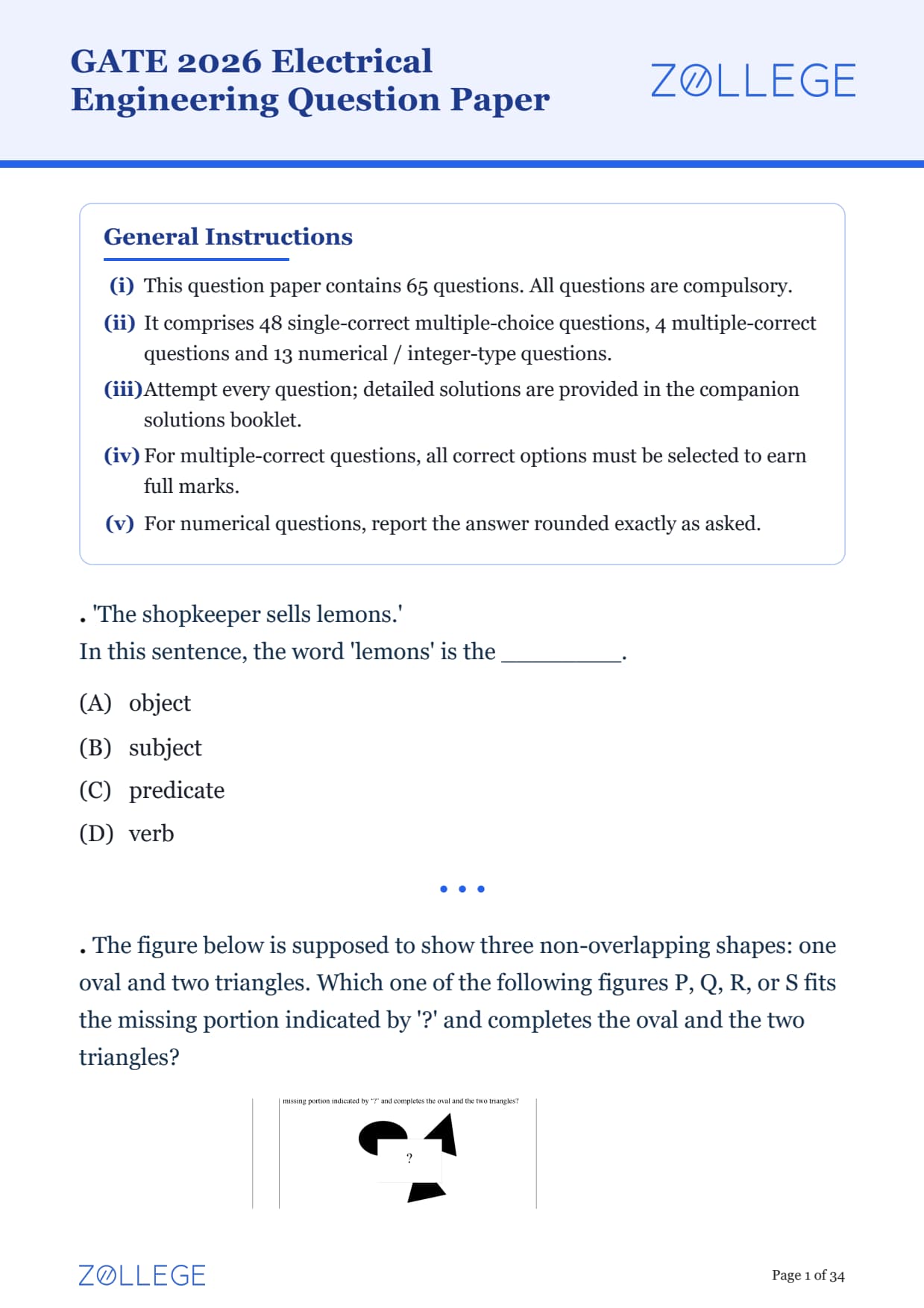
The figure below is supposed to show three non-overlapping shapes: one oval and two triangles. Which one of the following figures P, Q, R, or S fits the missing portion indicated by '?' and completes the oval and the two triangles?

At how many points will the curves \(y=x^2\) and \(y=-x^2-2x-1\) intersect in the real \((x,y)\) plane?
'If Anish had scored hundred runs in today's match, he would have been made the captain of his team. He would have then become the youngest captain in his team's history. Unfortunately, he got out without scoring any runs. Hence, there won't be any change in the captaincy for now.'
Based on the paragraph above, which one of the following statements is true?
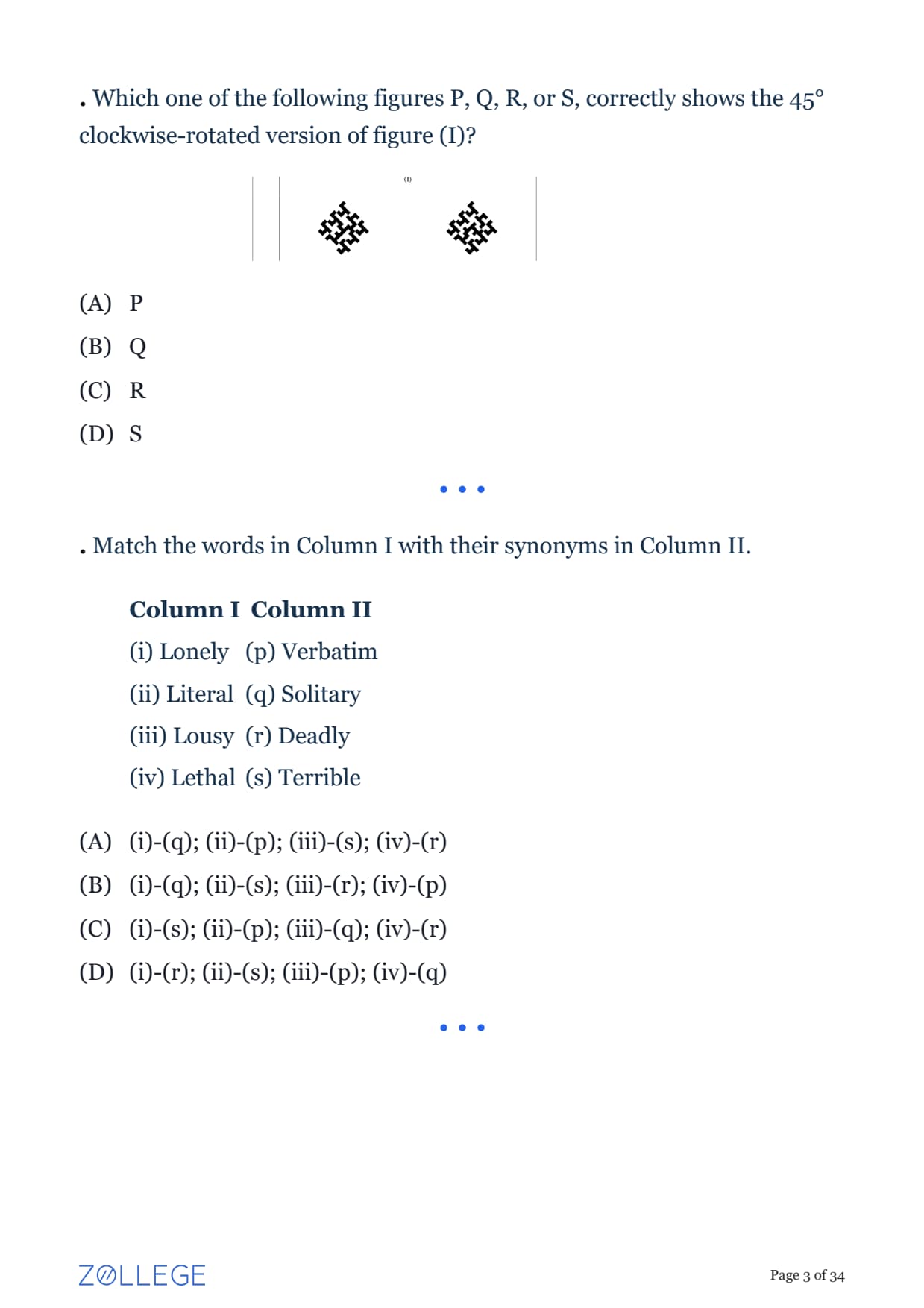
Which one of the following figures P, Q, R, or S, correctly shows the 45° clockwise-rotated version of figure (I)?

Match the words in Column I with their synonyms in Column II.
| Column I | Column II |
|---|---|
| (i) Lonely | (p) Verbatim |
| (ii) Literal | (q) Solitary |
| (iii) Lousy | (r) Deadly |
| (iv) Lethal | (s) Terrible |
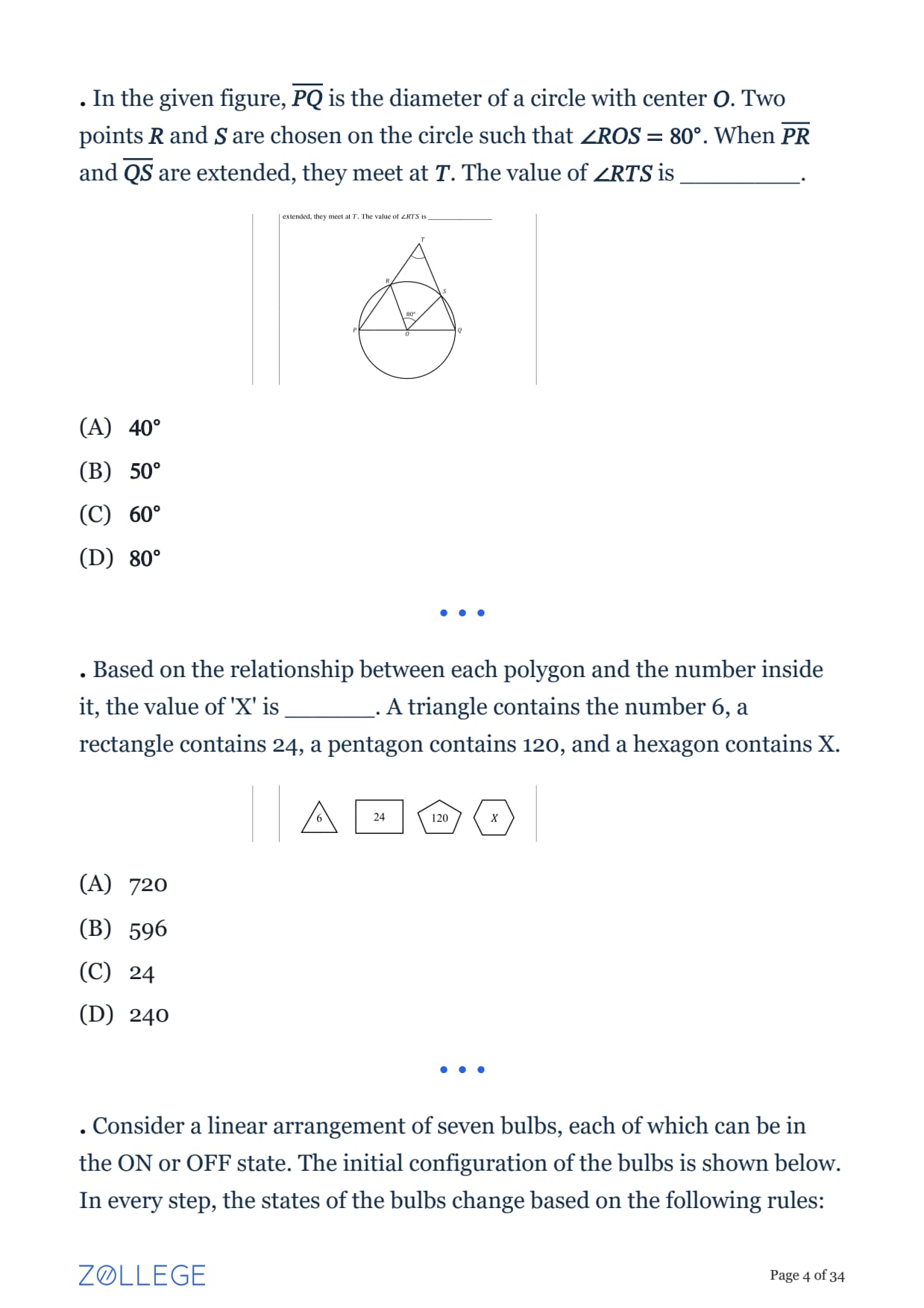
In the given figure, \(\overline{PQ}\) is the diameter of a circle with center \(O\). Two points \(R\) and \(S\) are chosen on the circle such that \(\angle ROS=80^\circ\). When \(\overline{PR}\) and \(\overline{QS}\) are extended, they meet at \(T\). The value of \(\angle RTS\) is ________.

Based on the relationship between each polygon and the number inside it, the value of 'X' is ______. A triangle contains the number 6, a rectangle contains 24, a pentagon contains 120, and a hexagon contains X.

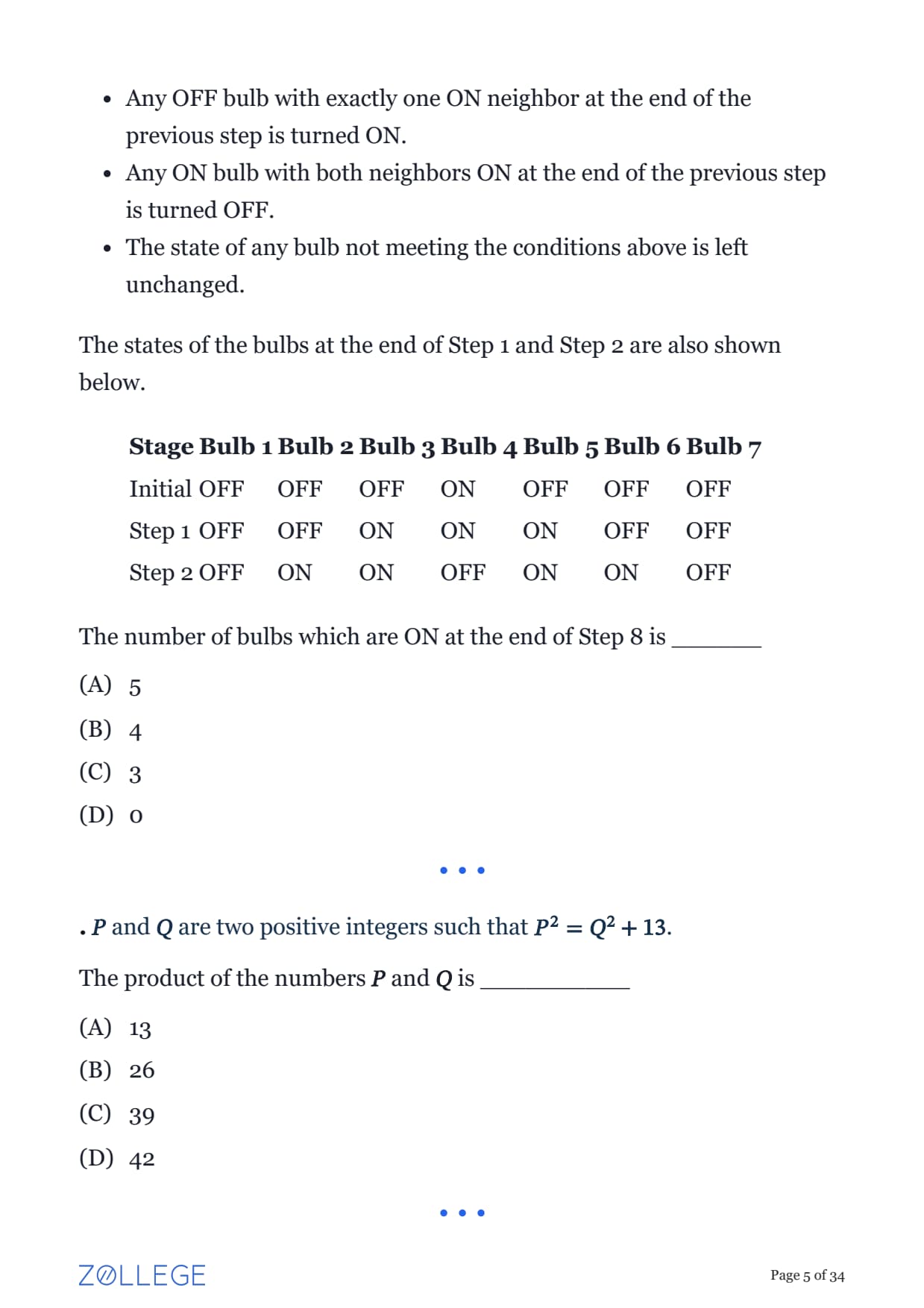
Consider a linear arrangement of seven bulbs, each of which can be in the ON or OFF state. The initial configuration of the bulbs is shown below. In every step, the states of the bulbs change based on the following rules:
- Any OFF bulb with exactly one ON neighbor at the end of the previous step is turned ON.
- Any ON bulb with both neighbors ON at the end of the previous step is turned OFF.
- The state of any bulb not meeting the conditions above is left unchanged.
| Stage | Bulb 1 | Bulb 2 | Bulb 3 | Bulb 4 | Bulb 5 | Bulb 6 | Bulb 7 |
|---|---|---|---|---|---|---|---|
| Initial | OFF | OFF | OFF | ON | OFF | OFF | OFF |
| Step 1 | OFF | OFF | ON | ON | ON | OFF | OFF |
| Step 2 | OFF | ON | ON | OFF | ON | ON | OFF |
\(P\) and \(Q\) are two positive integers such that \(P^2=Q^2+13\).
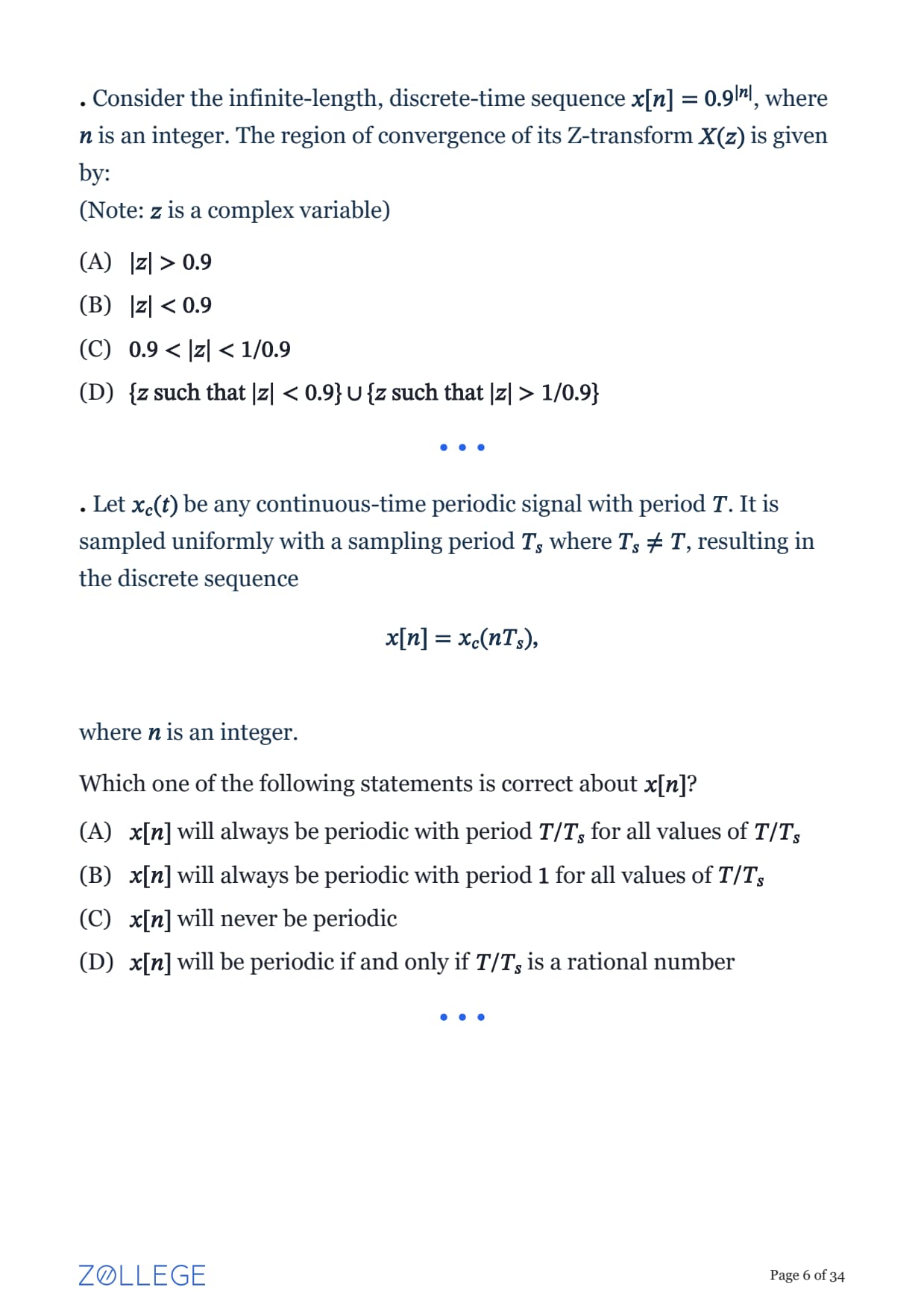
Consider the infinite-length, discrete-time sequence \(x[n]=0.9^{|n|}\), where \(n\) is an integer. The region of convergence of its Z-transform \(X(z)\) is given by:
(Note: \(z\) is a complex variable)
Let \(x_c(t)\) be any continuous-time periodic signal with period \(T\). It is sampled uniformly with a sampling period \(T_s\) where \(T_s\neq T\), resulting in the discrete sequence
\[ x[n]=x_c(nT_s), \]
where \(n\) is an integer.
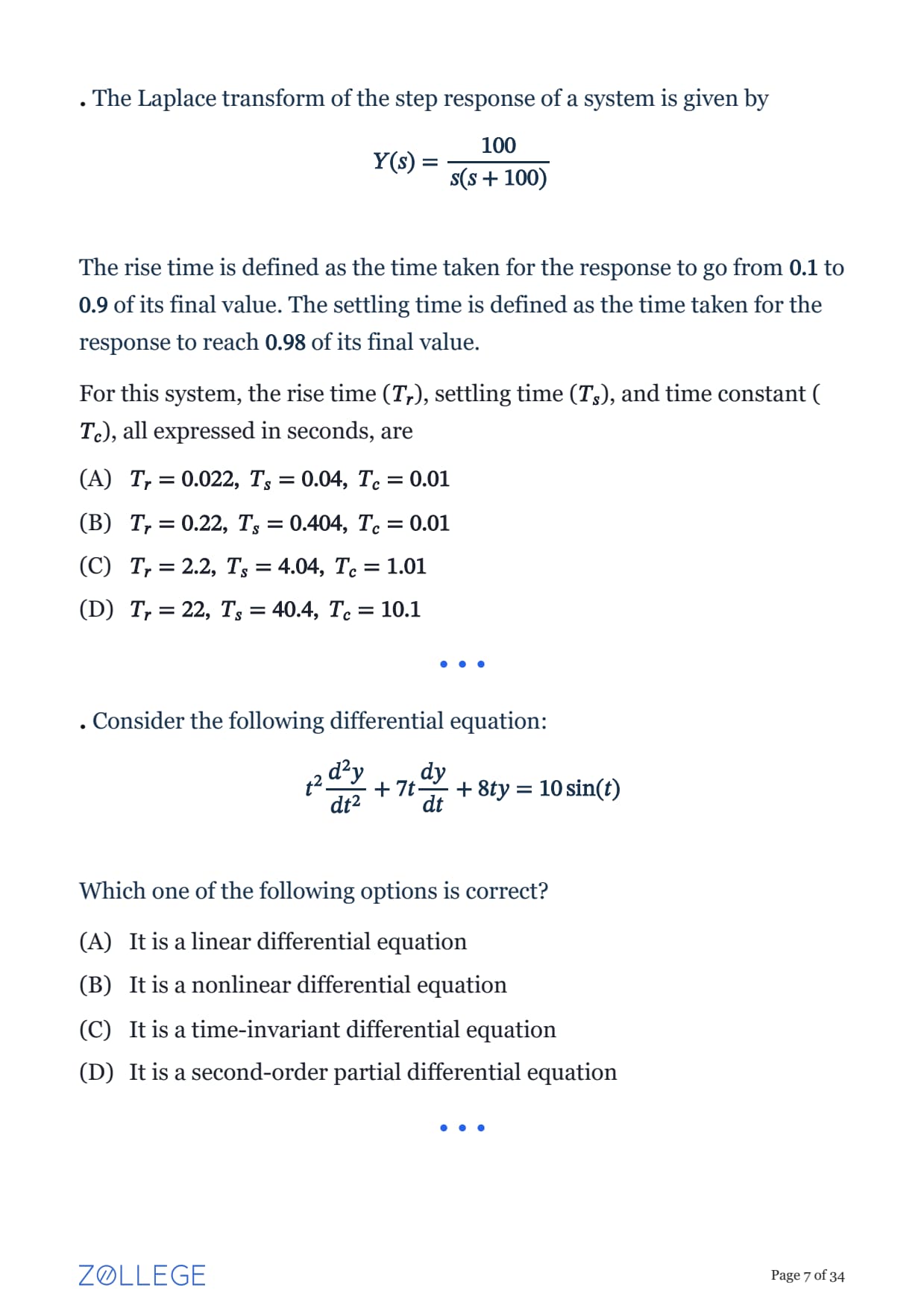
The Laplace transform of the step response of a system is given by
\[ Y(s)=\dfrac{100}{s(s+100)} \]
The rise time is defined as the time taken for the response to go from \(0.1\) to \(0.9\) of its final value. The settling time is defined as the time taken for the response to reach \(0.98\) of its final value.
Consider the following differential equation:
\[ t^2\dfrac{d^2y}{dt^2}+7t\dfrac{dy}{dt}+8ty=10\sin(t) \]
Which one of the following options is correct?
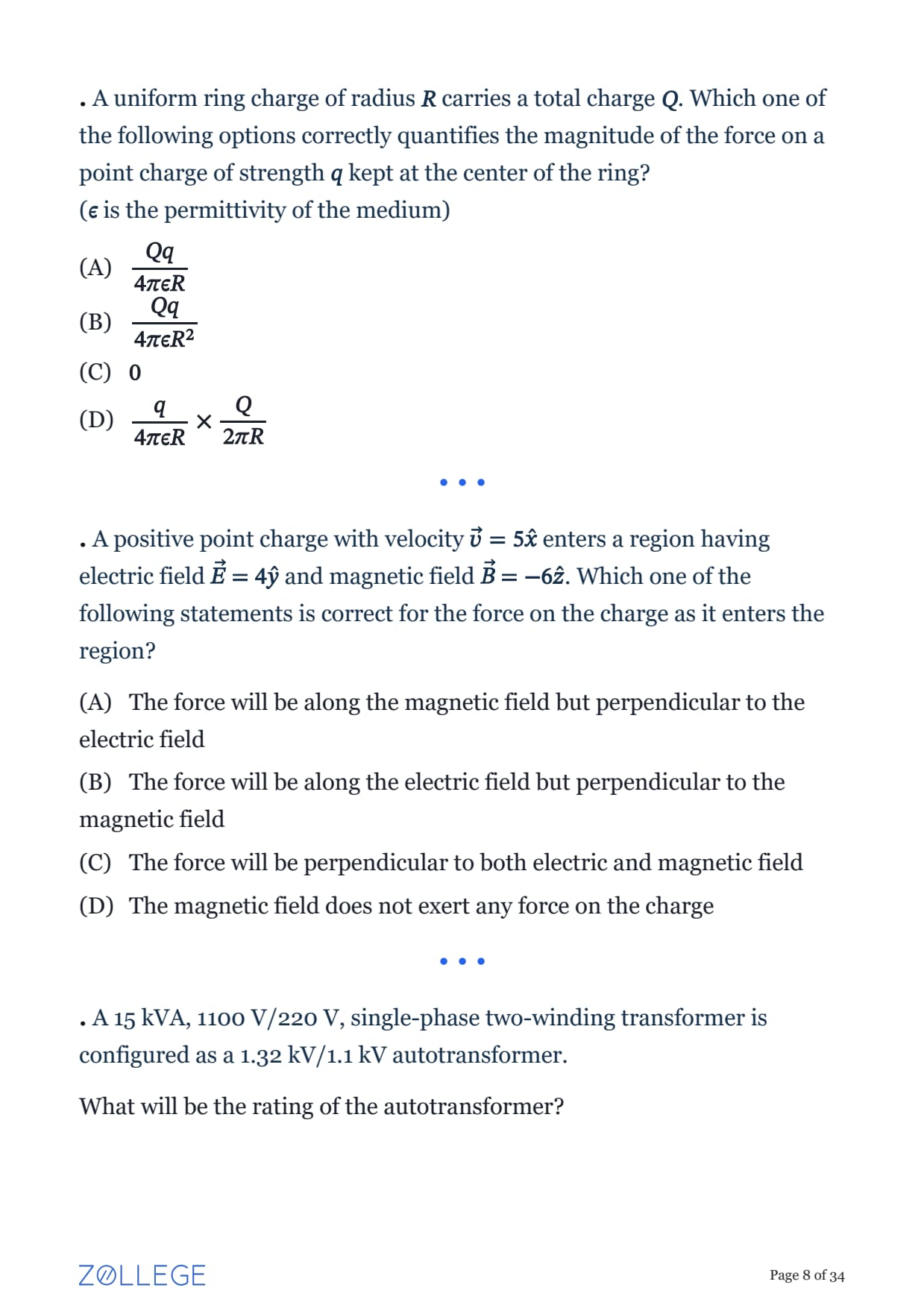
A uniform ring charge of radius \(R\) carries a total charge \(Q\). Which one of the following options correctly quantifies the magnitude of the force on a point charge of strength \(q\) kept at the center of the ring?
(\(\epsilon\) is the permittivity of the medium)
A positive point charge with velocity \(\vec v=5\hat x\) enters a region having electric field \(\vec E=4\hat y\) and magnetic field \(\vec B=-6\hat z\). Which one of the following statements is correct for the force on the charge as it enters the region?
A 15 kVA, 1100 V/220 V, single-phase two-winding transformer is configured as a 1.32 kV/1.1 kV autotransformer.
Consider a power system with \(N\) buses, of which \(P\) are generator buses and the remaining \(Q\) are load buses (where there is no generation).
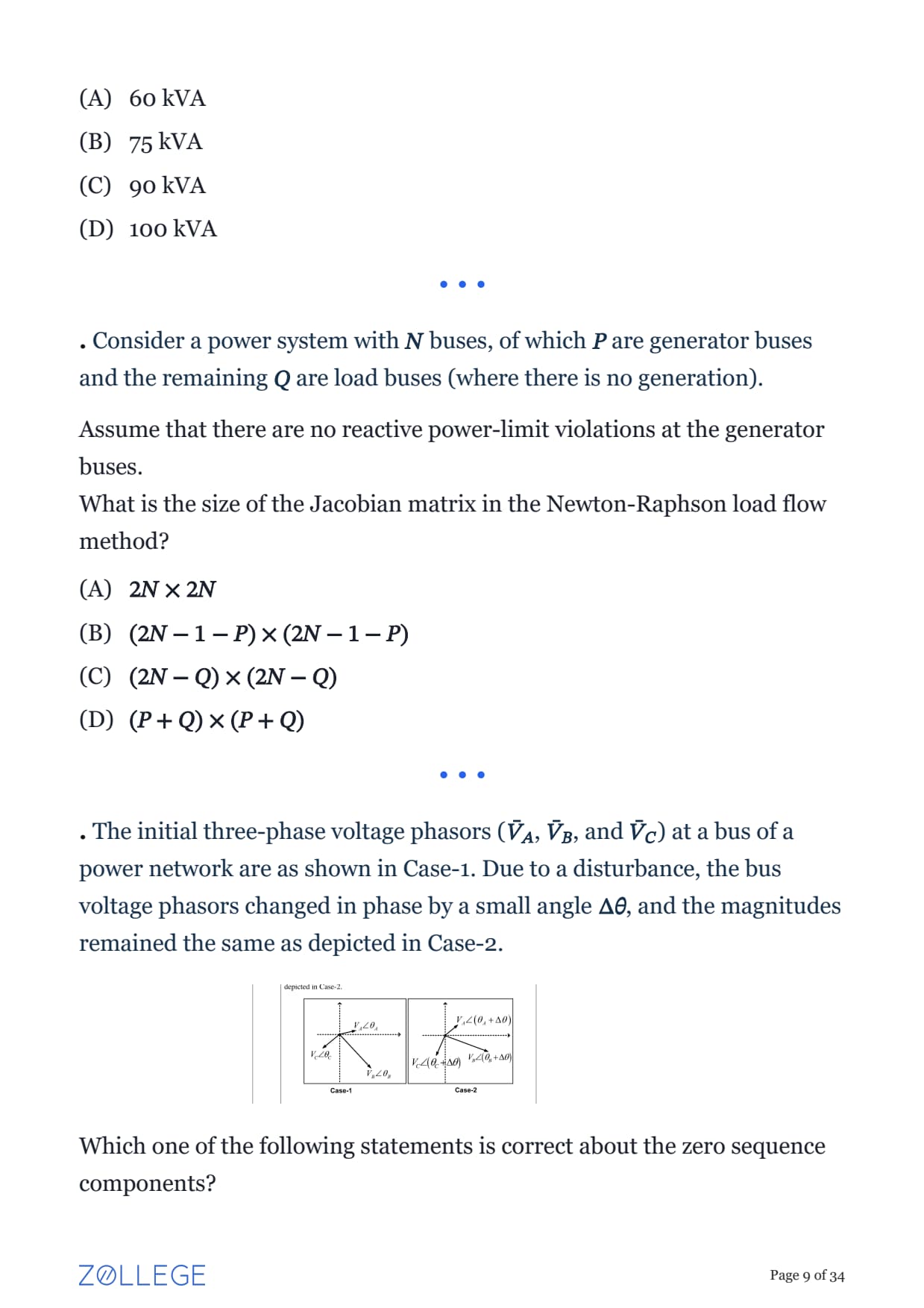
The initial three-phase voltage phasors (\(\bar V_A\), \(\bar V_B\), and \(\bar V_C\)) at a bus of a power network are as shown in Case-1. Due to a disturbance, the bus voltage phasors changed in phase by a small angle \(\Delta\theta\), and the magnitudes remained the same as depicted in Case-2.

A certain application requires power at a frequency of 16.67 Hz, while the available grid frequency is 50 Hz. A 3-phase synchronous motor connected to the 50 Hz, 3-phase grid, driving a synchronous generator, is used for this application.
Which one of the following options is correct regarding the typical double-squirrel-cage structure used in induction motors?
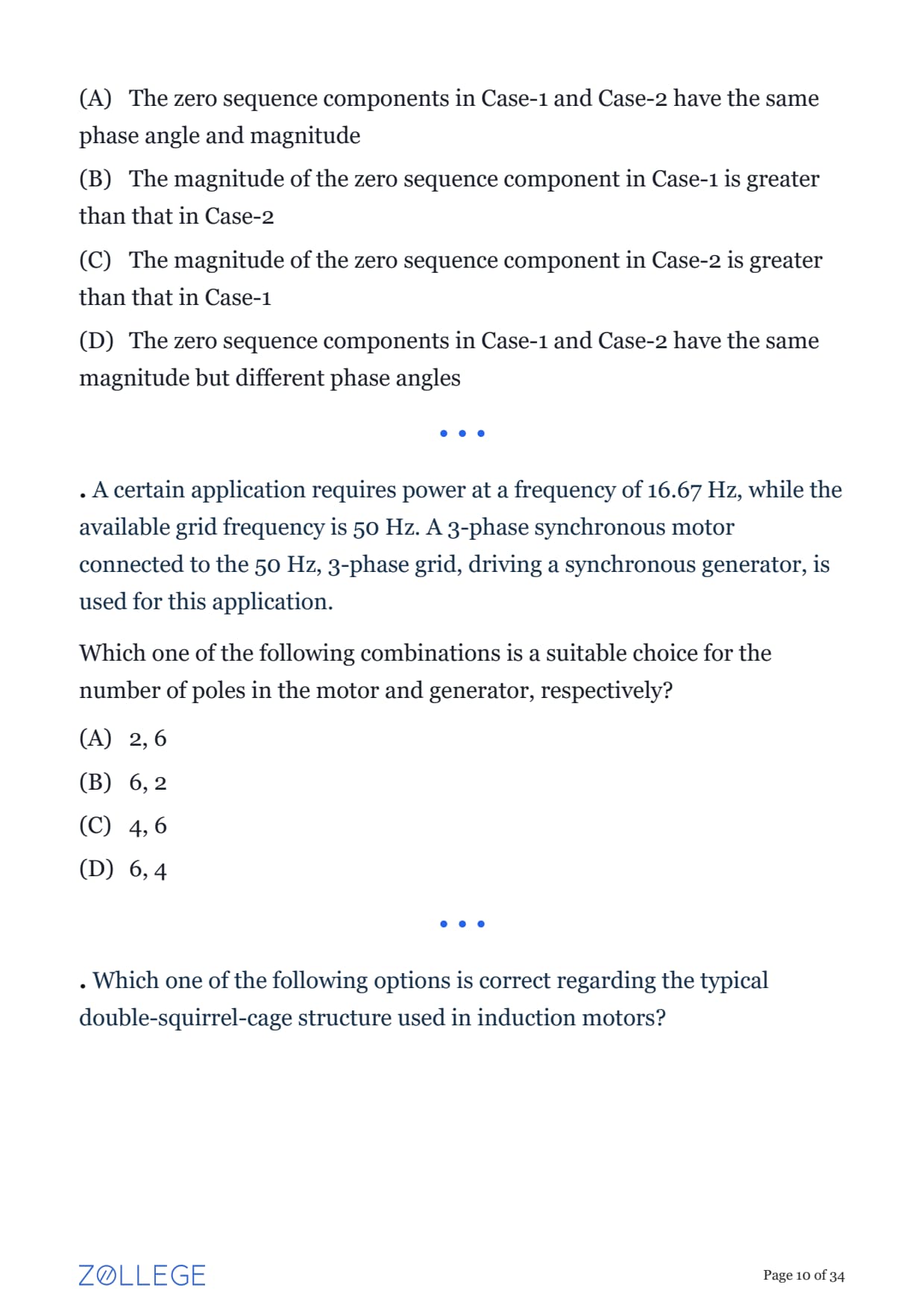
The figure shows the single-line diagram of a synchronous generator delivering \(P=50\) MW of power at unity power factor to an infinite bus.

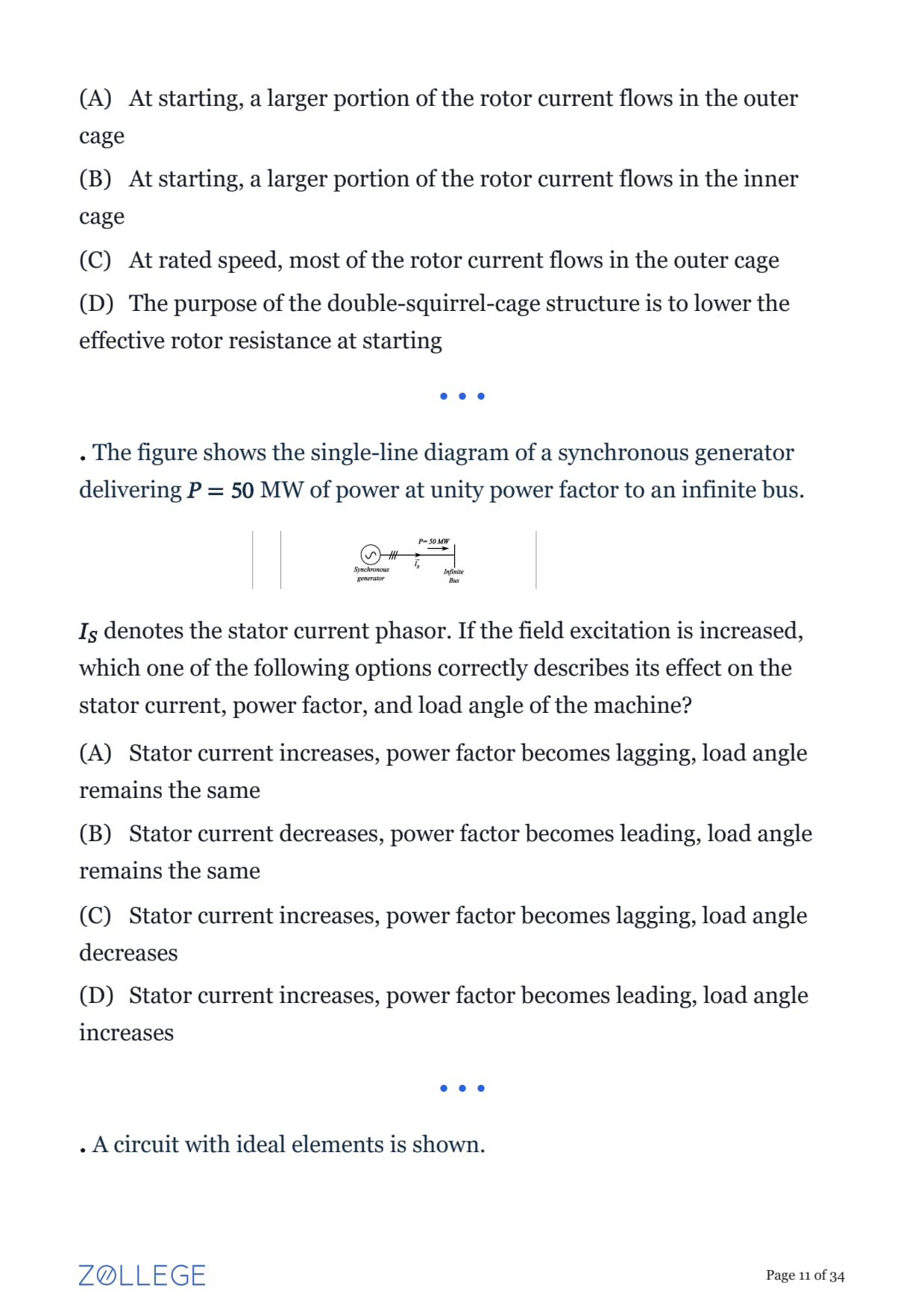
A circuit with ideal elements is shown.

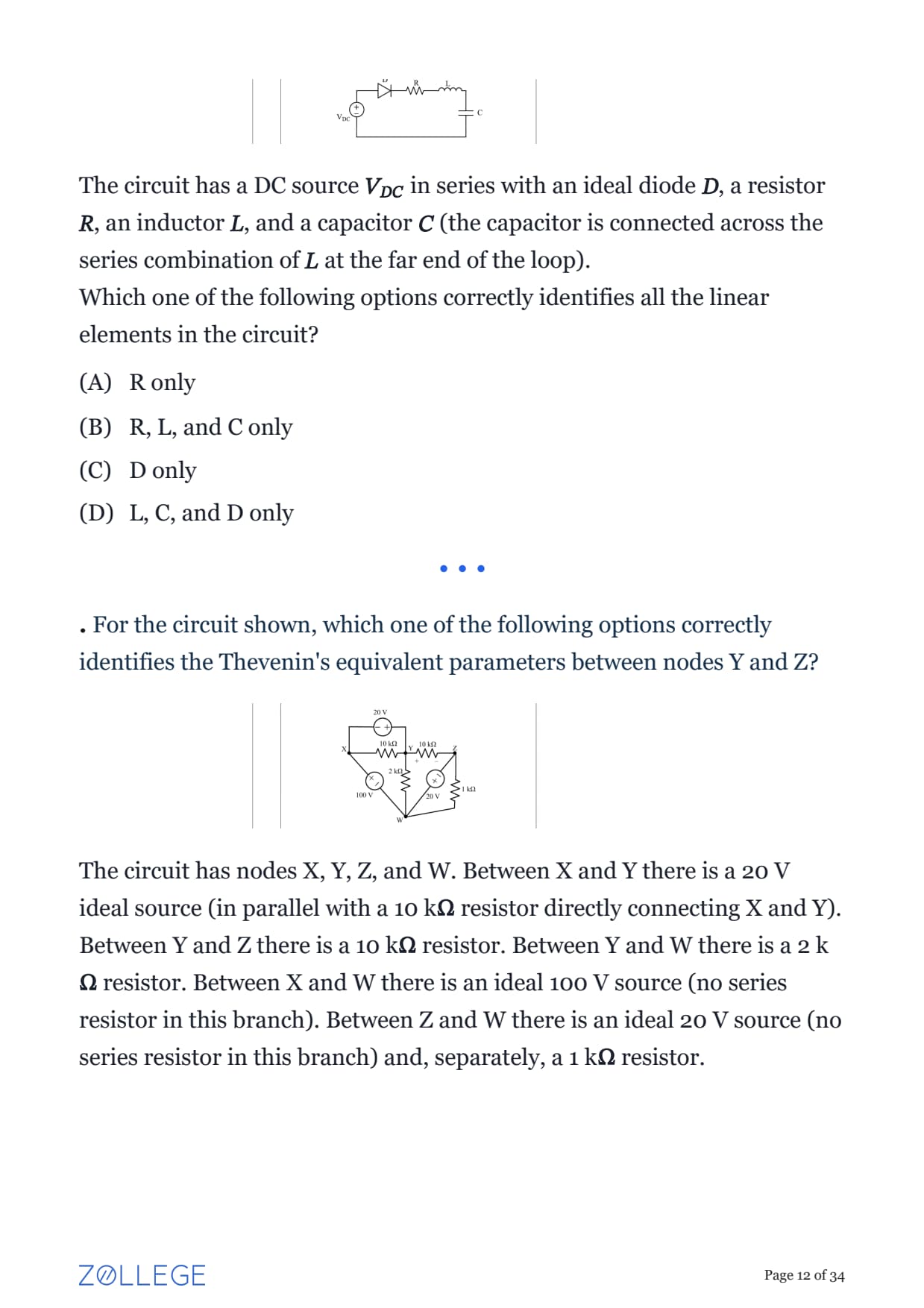
For the circuit shown, which one of the following options correctly identifies the Thevenin's equivalent parameters between nodes Y and Z?

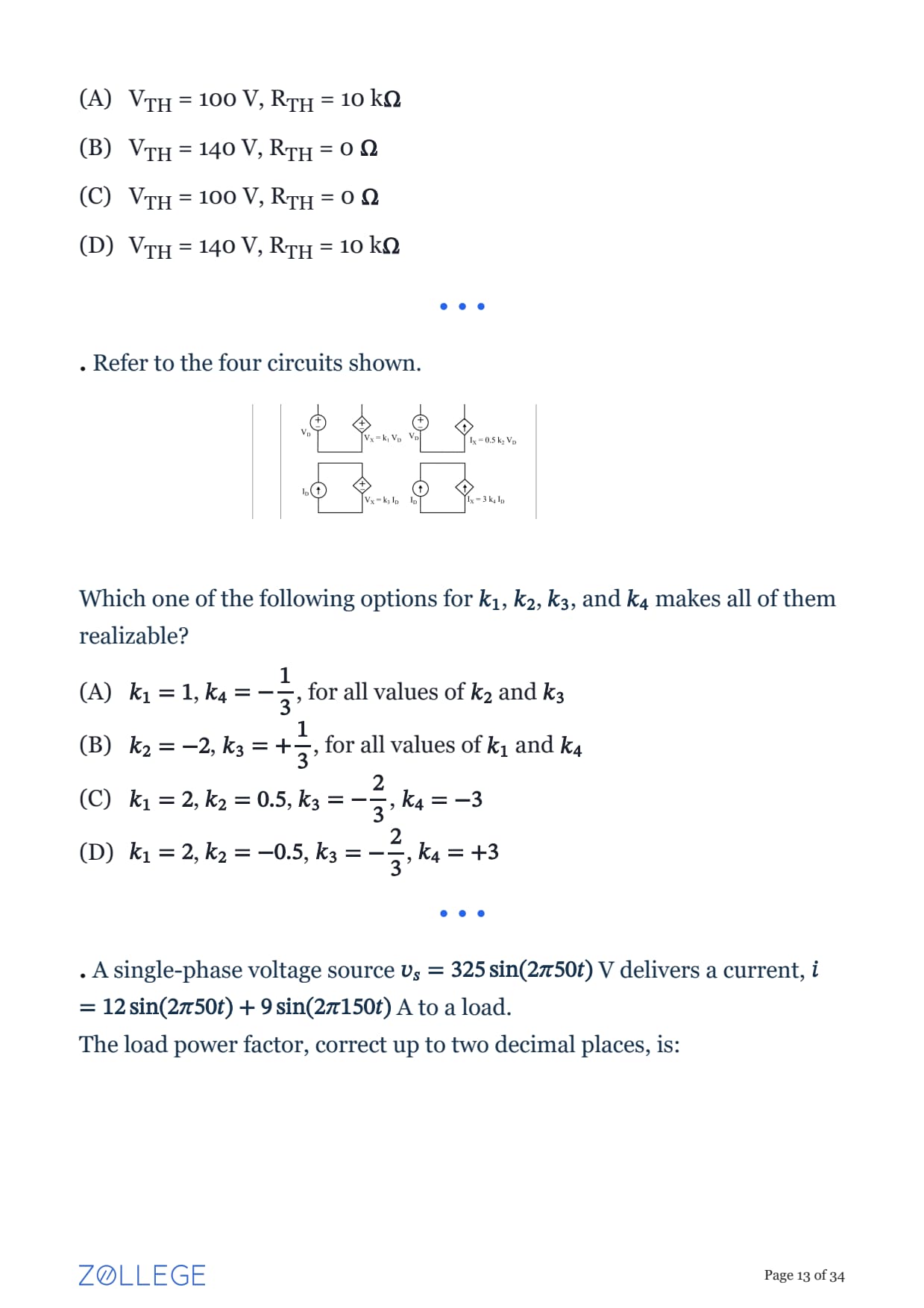
Refer to the four circuits shown.

Which one of the following options for \(k_1\), \(k_2\), \(k_3\), and \(k_4\) makes all of them realizable?
A single-phase voltage source \(v_s=325\sin(2\pi 50t)\) V delivers a current, \(i=12\sin(2\pi 50t)+9\sin(2\pi 150t)\) A to a load.
The load power factor, correct up to two decimal places, is:
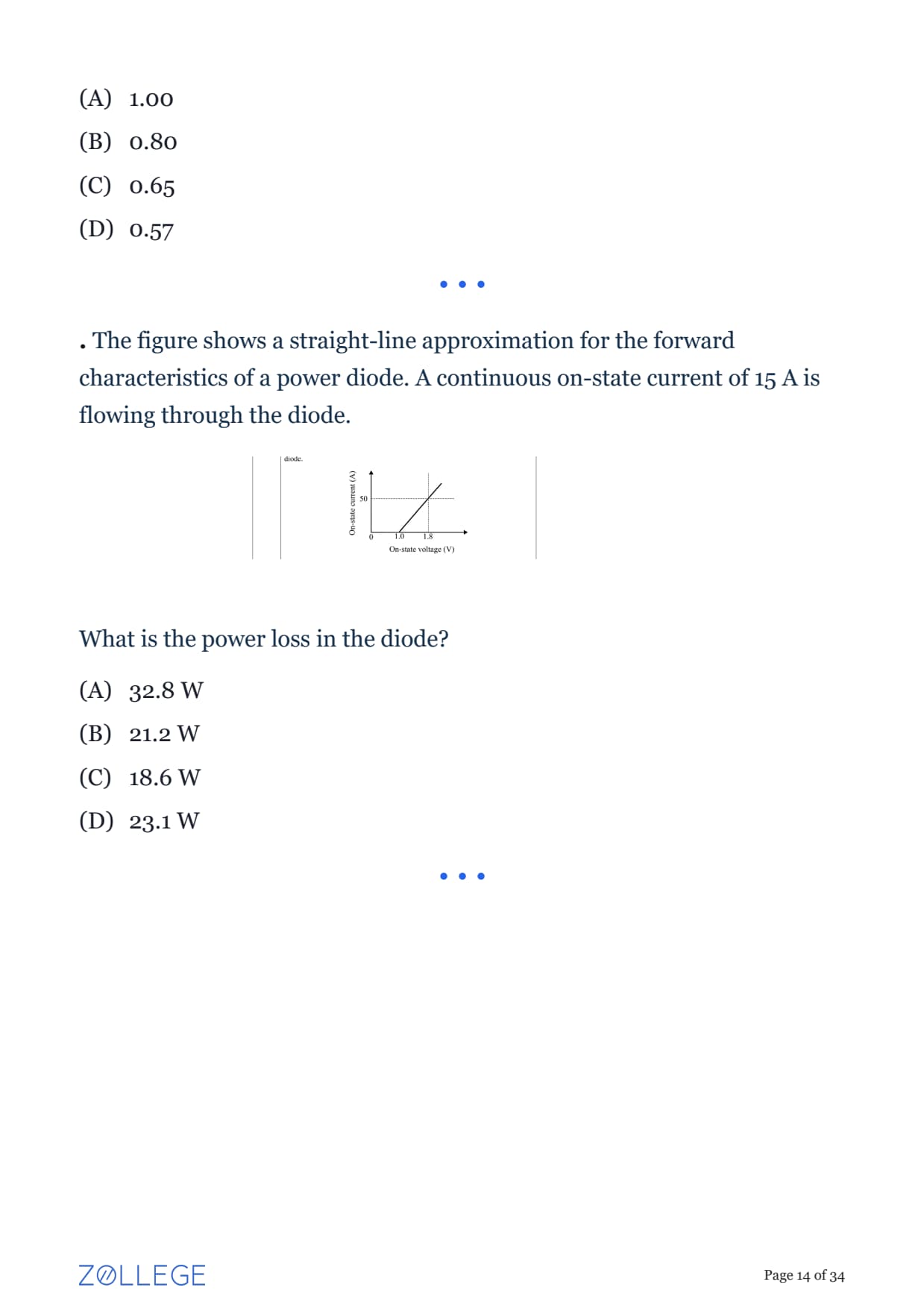
The figure shows a straight-line approximation for the forward characteristics of a power diode. A continuous on-state current of 15 A is flowing through the diode.

What is the power loss in the diode?
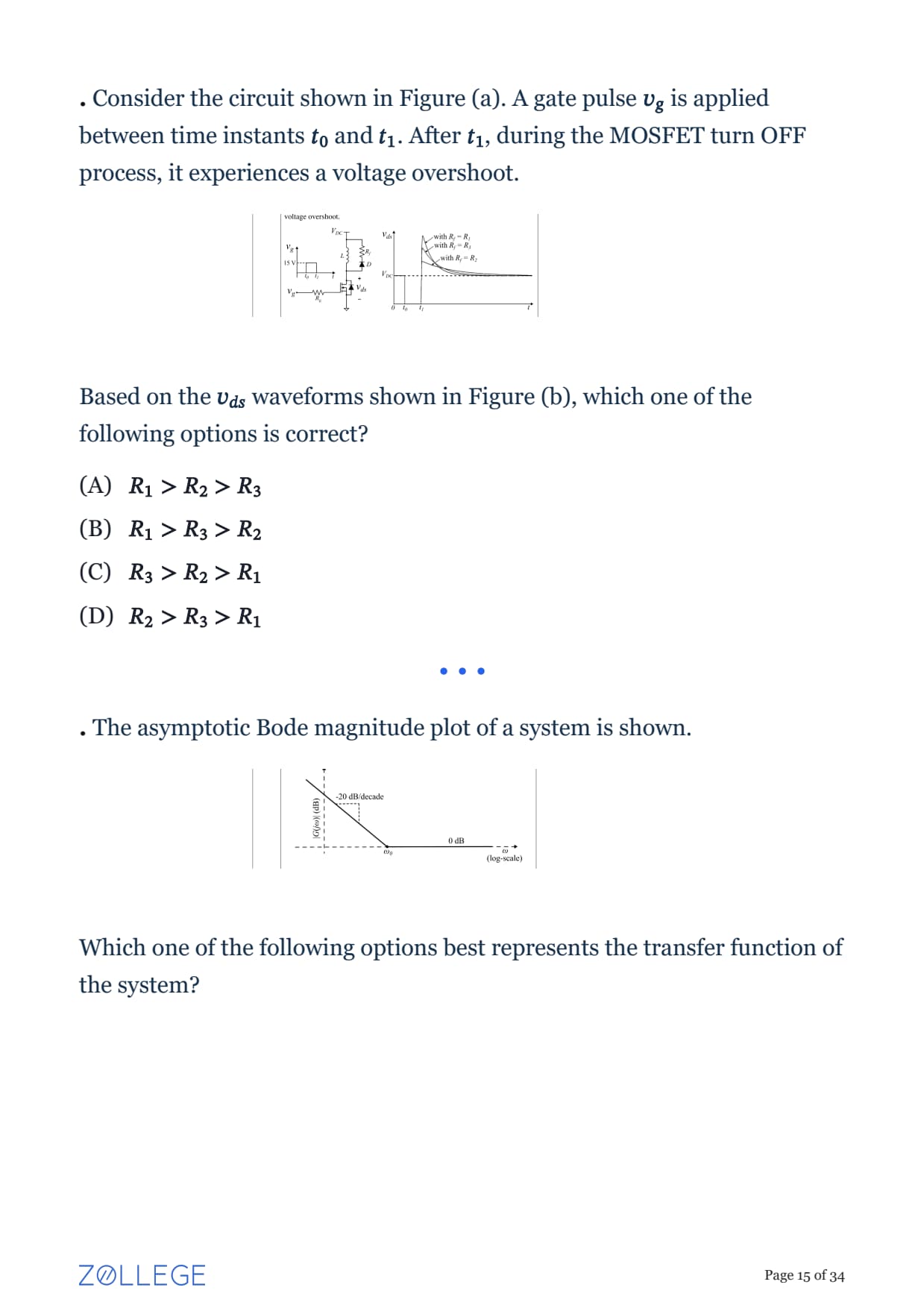
Consider the circuit shown in Figure (a). A gate pulse \(v_g\) is applied between time instants \(t_0\) and \(t_1\). After \(t_1\), during the MOSFET turn OFF process, it experiences a voltage overshoot.

Based on the \(v_{ds}\) waveforms shown in Figure (b), which one of the following options is correct?
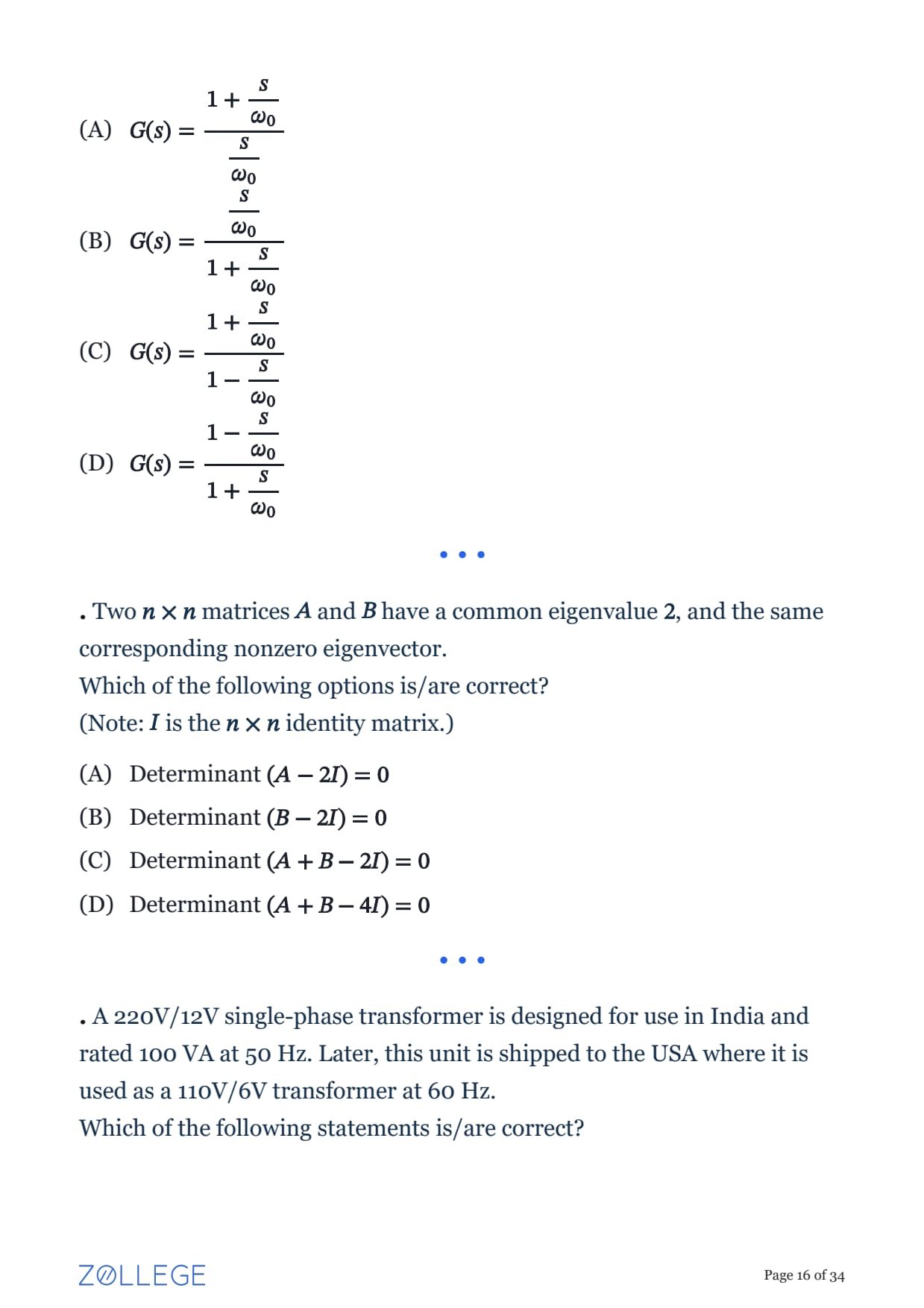
The asymptotic Bode magnitude plot of a system is shown.

Which one of the following options best represents the transfer function of the system?
Two \(n\times n\) matrices \(A\) and \(B\) have a common eigenvalue \(2\), and the same corresponding nonzero eigenvector.
Which of the following options is/are correct?
(Note: \(I\) is the \(n\times n\) identity matrix.)
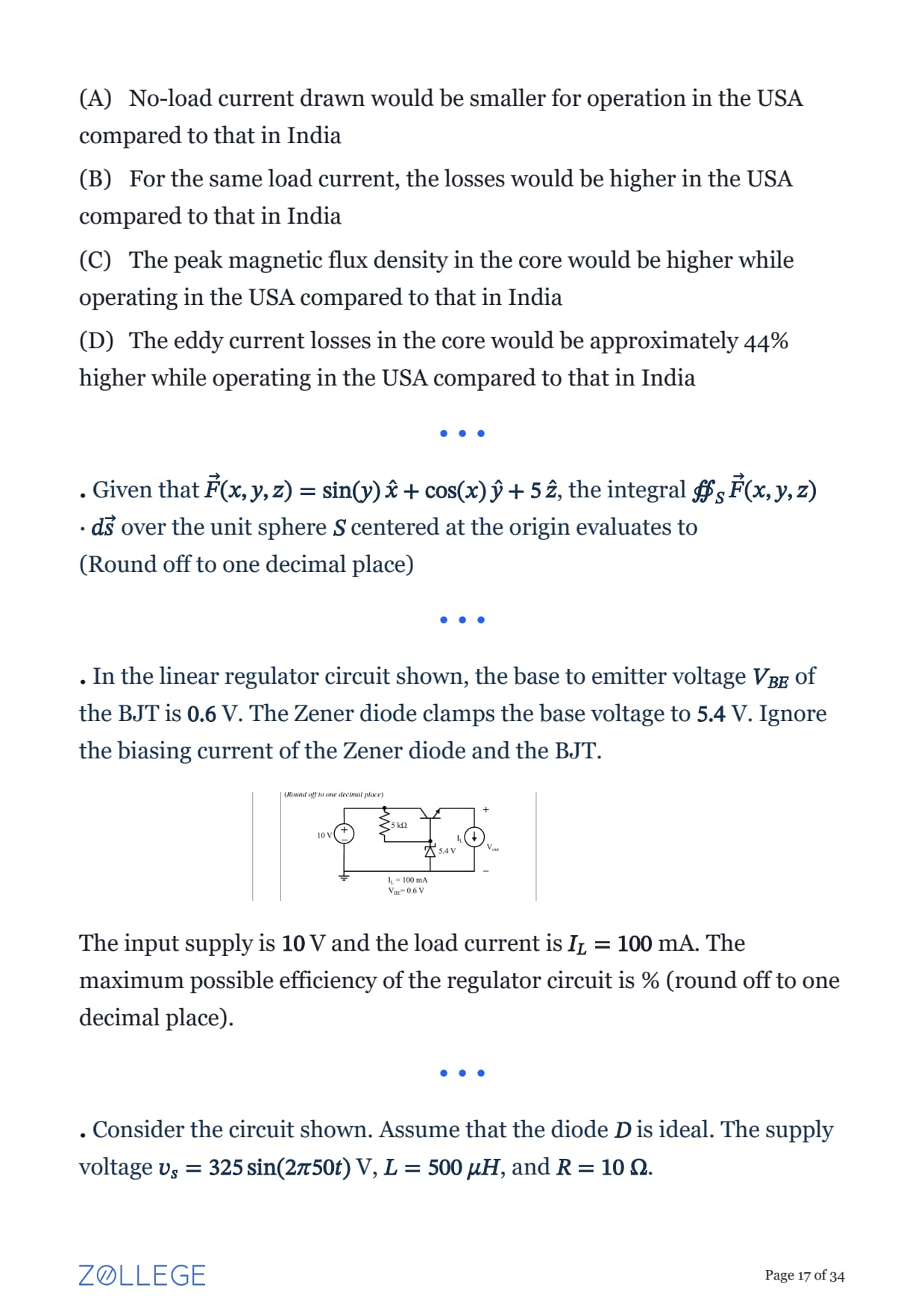
A 220V/12V single-phase transformer is designed for use in India and rated 100 VA at 50 Hz. Later, this unit is shipped to the USA where it is used as a 110V/6V transformer at 60 Hz.
Which of the following statements is/are correct?
Given that \(\vec{F}(x,y,z)=\sin(y)\,\hat{x}+\cos(x)\,\hat{y}+5\,\hat{z}\), the integral \(\oiint_S \vec{F}(x,y,z)\cdot d\vec{s}\) over the unit sphere \(S\) centered at the origin evaluates to
(Round off to one decimal place)
In the linear regulator circuit shown, the base to emitter voltage \(V_{BE}\) of the BJT is \(0.6\) V. The Zener diode clamps the base voltage to \(5.4\) V. Ignore the biasing current of the Zener diode and the BJT.

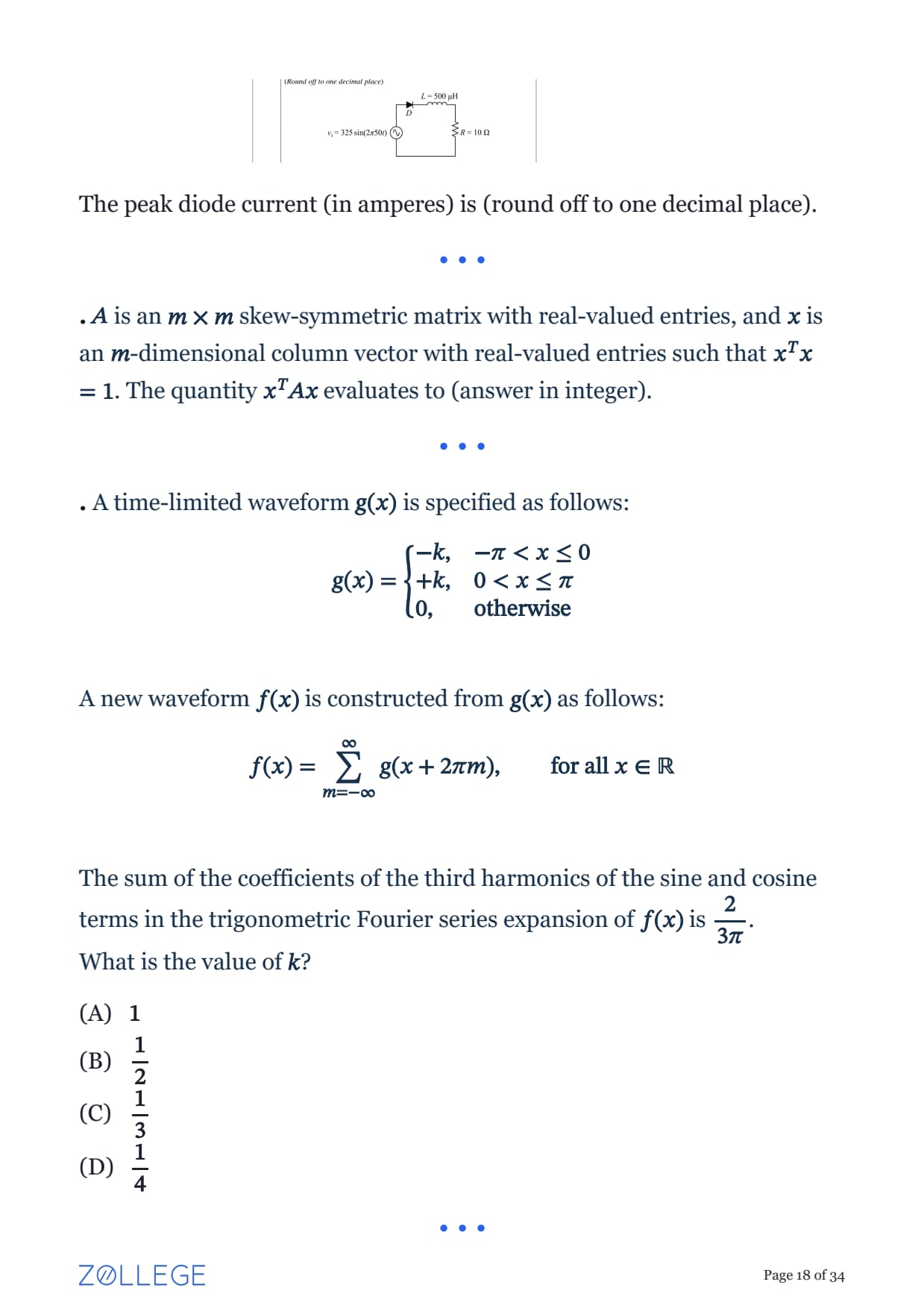
Consider the circuit shown. Assume that the diode \(D\) is ideal. The supply voltage \(v_s=325\sin(2\pi50t)\) V, \(L=500\ \mu H\), and \(R=10\ \Omega\).

\(A\) is an \(m\times m\) skew-symmetric matrix with real-valued entries, and \(x\) is an \(m\)-dimensional column vector with real-valued entries such that \(x^{T}x=1\). The quantity \(x^{T}Ax\) evaluates to (answer in integer).
A time-limited waveform \(g(x)\) is specified as follows:
\[
g(x)=\begin{cases}-k, & -\pi<x\le0\\ +k, & 0<x\le\pi\\ 0, & \text{otherwise}\end{cases}
\]
A new waveform \(f(x)\) is constructed from \(g(x)\) as follows:
\[
f(x)=\sum_{m=-\infty}^{\infty}g(x+2\pi m),\qquad \text{for all } x\in\mathbb{R}
\]
The sum of the coefficients of the third harmonics of the sine and cosine terms in the trigonometric Fourier series expansion of \(f(x)\) is \(\dfrac{2}{3\pi}\).
What is the value of \(k\)?
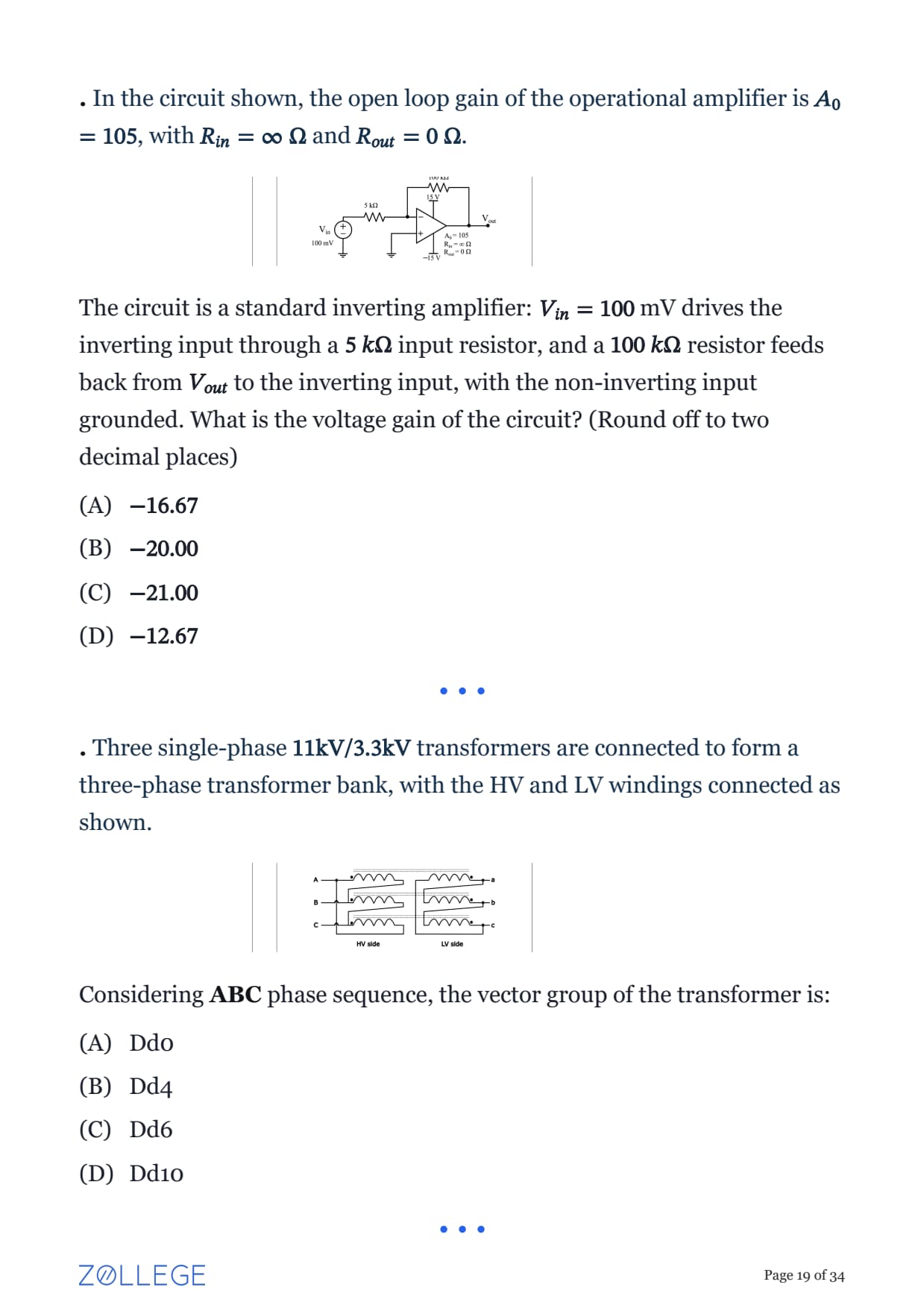
In the circuit shown, the open loop gain of the operational amplifier is \(A_0=105\), with \(R_{in}=\infty\ \Omega\) and \(R_{out}=0\ \Omega\).

Three single-phase \(11\text{kV}/3.3\text{kV}\) transformers are connected to form a three-phase transformer bank, with the HV and LV windings connected as shown.

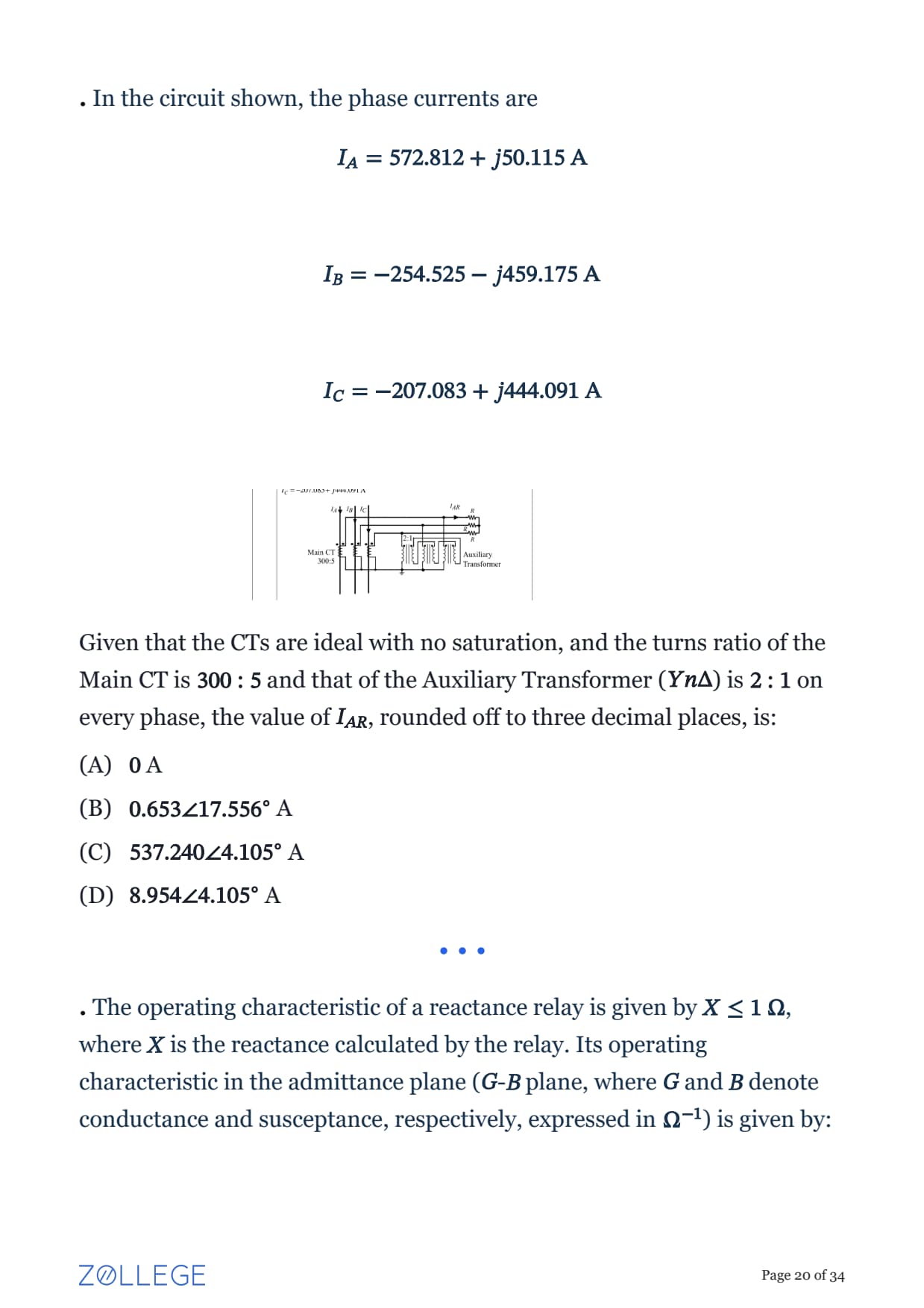
In the circuit shown, the phase currents are
\[
I_A=572.812+j50.115\text{ A}
\]
\[
I_B=-254.525-j459.175\text{ A}
\]
\[
I_C=-207.083+j444.091\text{ A}
\]

The operating characteristic of a reactance relay is given by \(X\le1\ \Omega\), where \(X\) is the reactance calculated by the relay. Its operating characteristic in the admittance plane (\(G\)-\(B\) plane, where \(G\) and \(B\) denote conductance and susceptance, respectively, expressed in \(\Omega^{-1}\)) is given by:
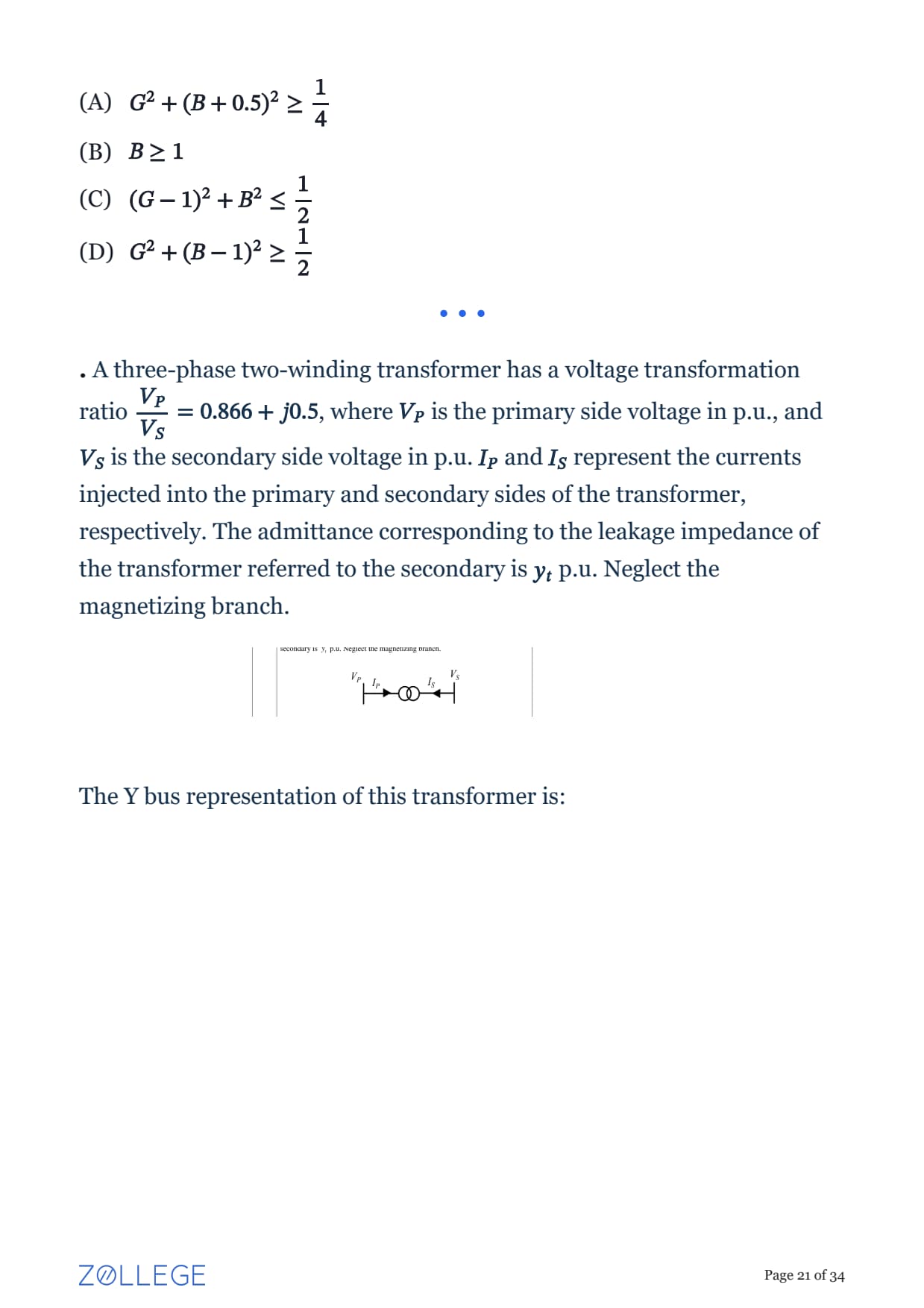
A three-phase two-winding transformer has a voltage transformation ratio \(\dfrac{V_P}{V_S} = 0.866 + j0.5\), where \(V_P\) is the primary side voltage in p.u., and \(V_S\) is the secondary side voltage in p.u. \(I_P\) and \(I_S\) represent the currents injected into the primary and secondary sides of the transformer, respectively. The admittance corresponding to the leakage impedance of the transformer referred to the secondary is \(y_t\) p.u. Neglect the magnetizing branch.
The Y bus representation of this transformer is:
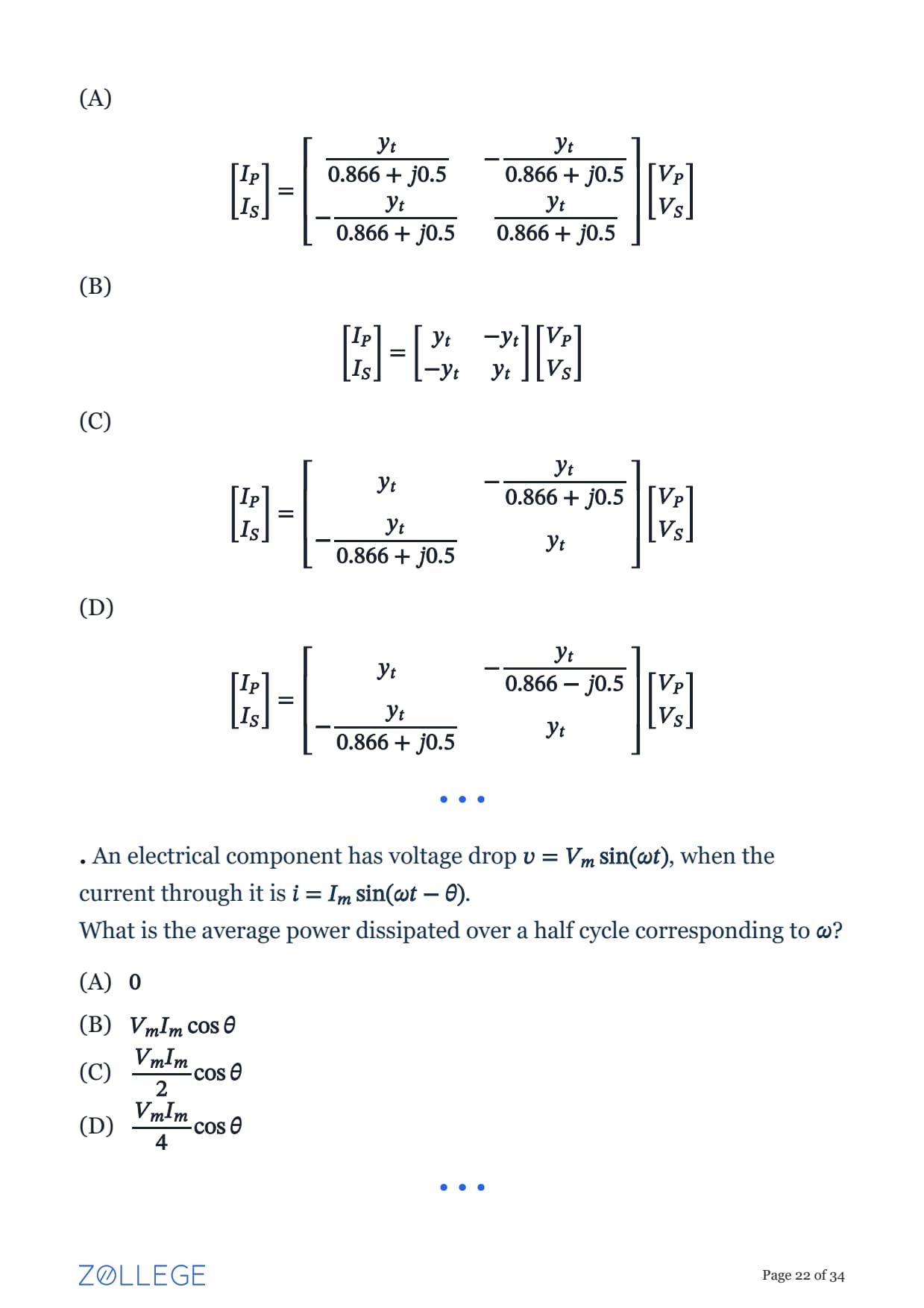
An electrical component has voltage drop \(v = V_m\sin(\omega t)\), when the current through it is \(i = I_m\sin(\omega t-\theta)\).
What is the average power dissipated over a half cycle corresponding to \(\omega\)?
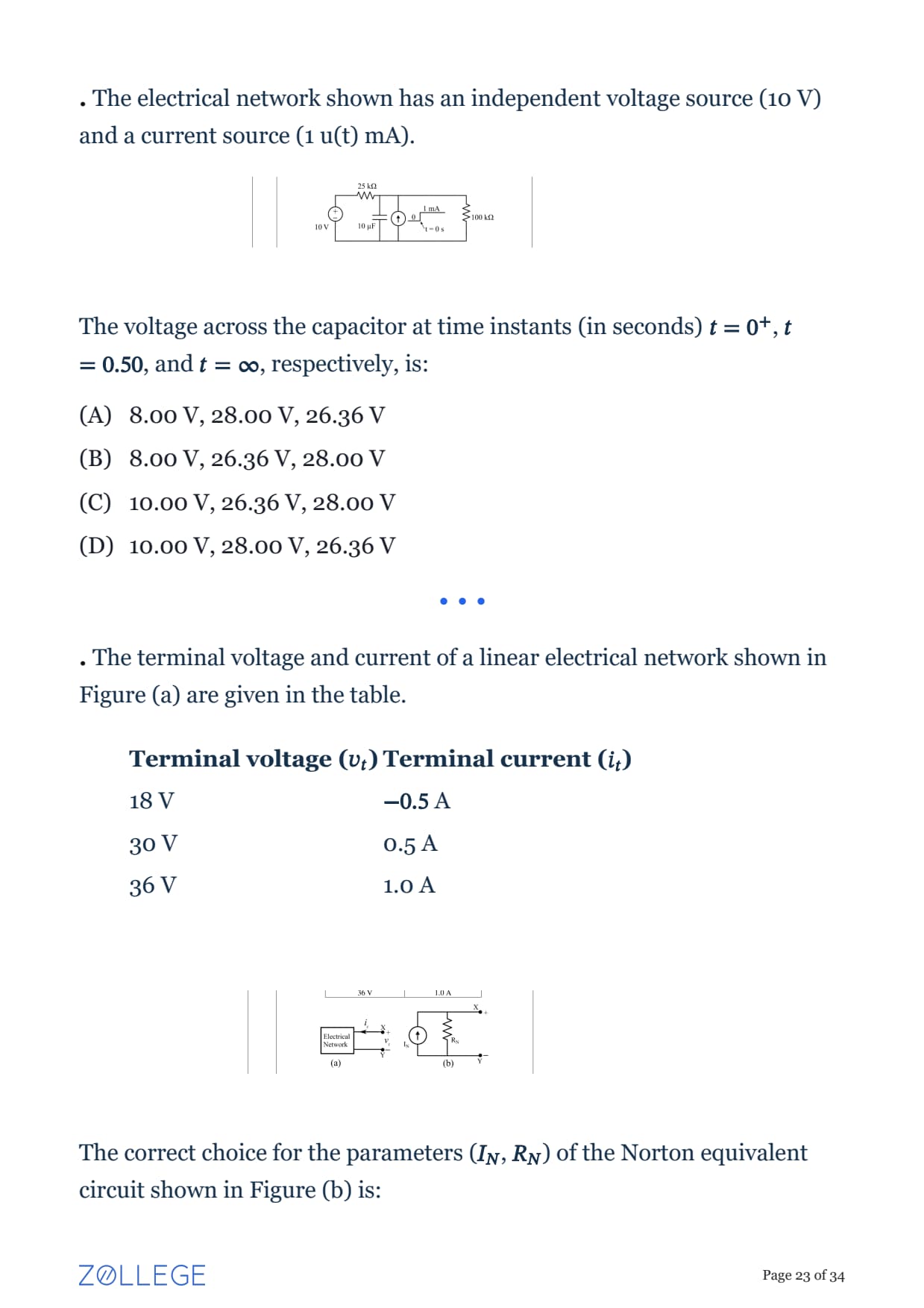
The electrical network shown has an independent voltage source (10 V) and a current source (1 u(t) mA).
The voltage across the capacitor at time instants (in seconds) \(t=0^{+}\), \(t=0.50\), and \(t=\infty\), respectively, is:
The terminal voltage and current of a linear electrical network shown in Figure (a) are given in the table.
| Terminal voltage (\(v_t\)) | Terminal current (\(i_t\)) |
|---|---|
| 18 V | \(-0.5\) A |
| 30 V | 0.5 A |
| 36 V | 1.0 A |

The correct choice for the parameters (\(I_N\), \(R_N\)) of the Norton equivalent circuit shown in Figure (b) is:
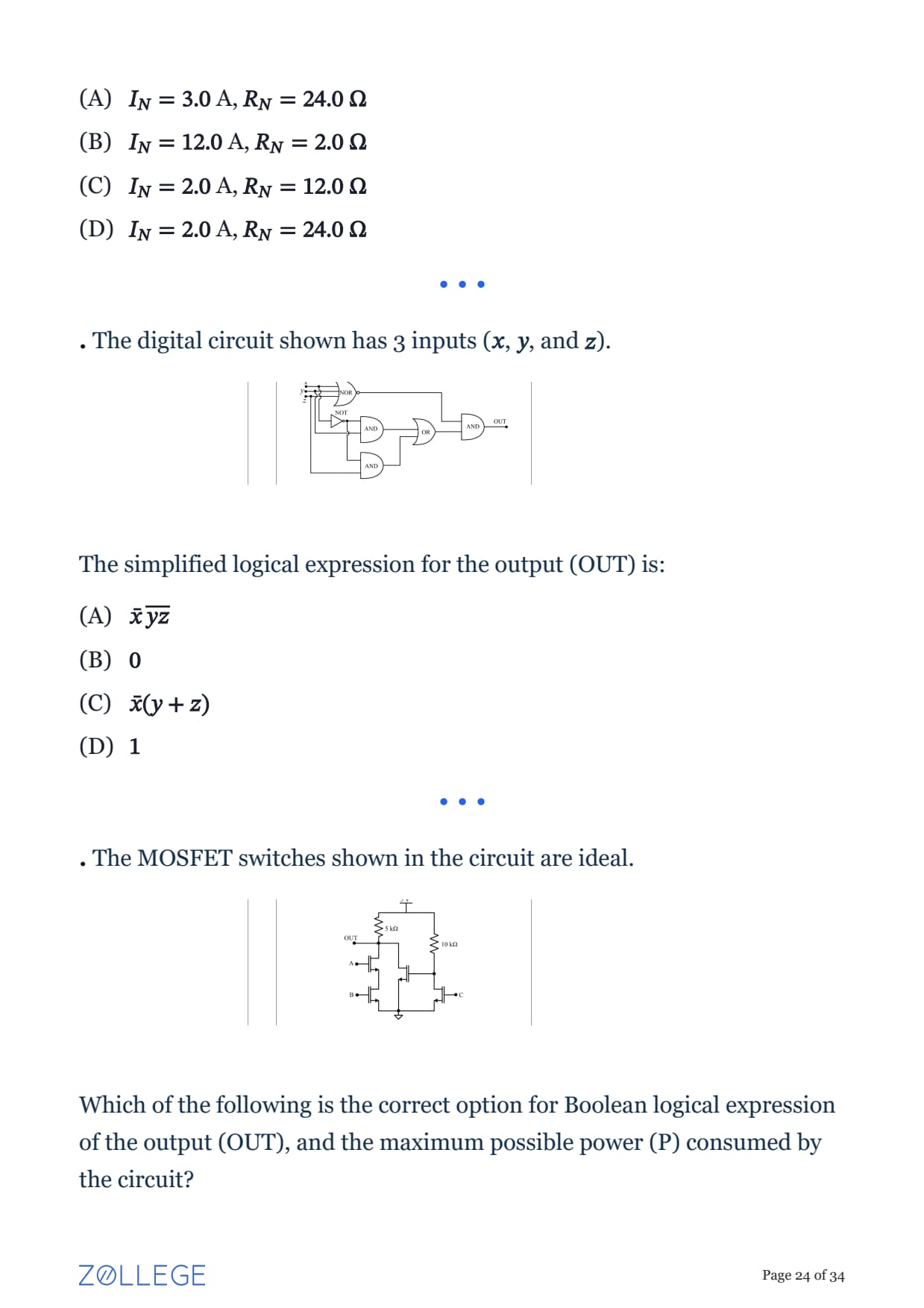
The digital circuit shown has 3 inputs (\(x\), \(y\), and \(z\)).
The simplified logical expression for the output (OUT) is:
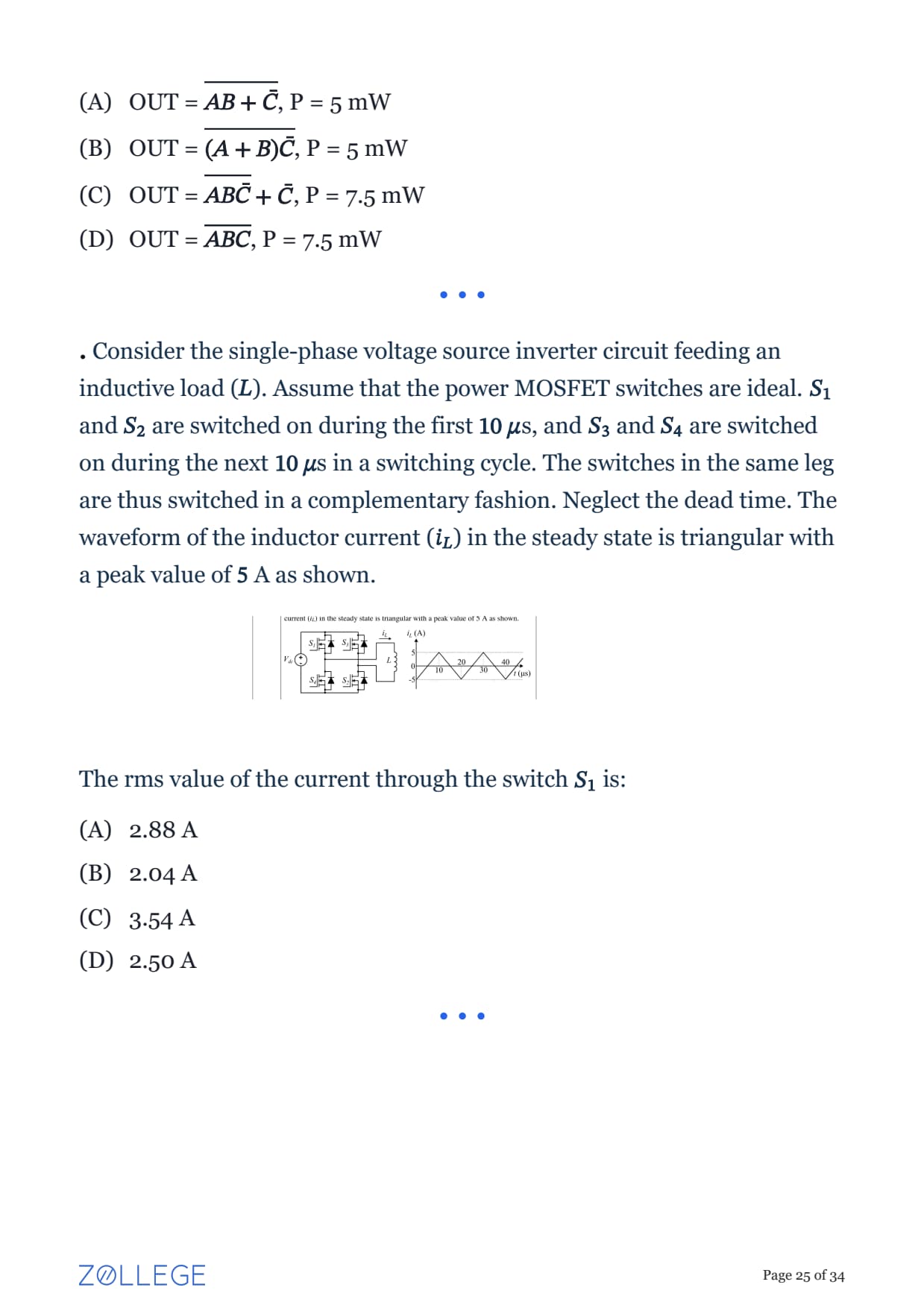
The MOSFET switches shown in the circuit are ideal.
Which of the following is the correct option for Boolean logical expression of the output (OUT), and the maximum possible power (P) consumed by the circuit?
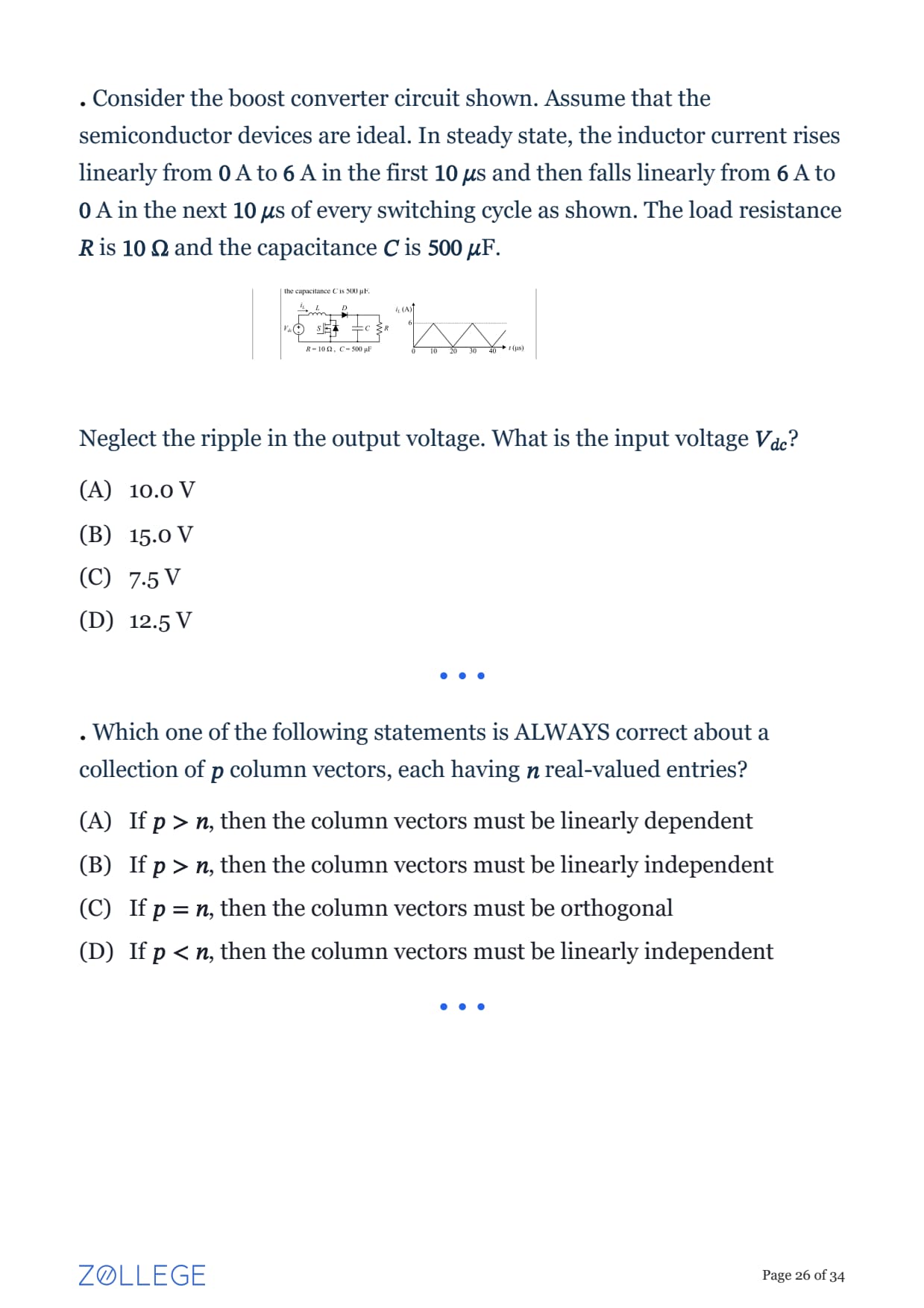
Consider the single-phase voltage source inverter circuit feeding an inductive load (\(L\)). Assume that the power MOSFET switches are ideal. \(S_1\) and \(S_2\) are switched on during the first \(10\ \mu\)s, and \(S_3\) and \(S_4\) are switched on during the next \(10\ \mu\)s in a switching cycle. The switches in the same leg are thus switched in a complementary fashion. Neglect the dead time. The waveform of the inductor current (\(i_L\)) in the steady state is triangular with a peak value of \(5\) A as shown.
The rms value of the current through the switch \(S_1\) is:
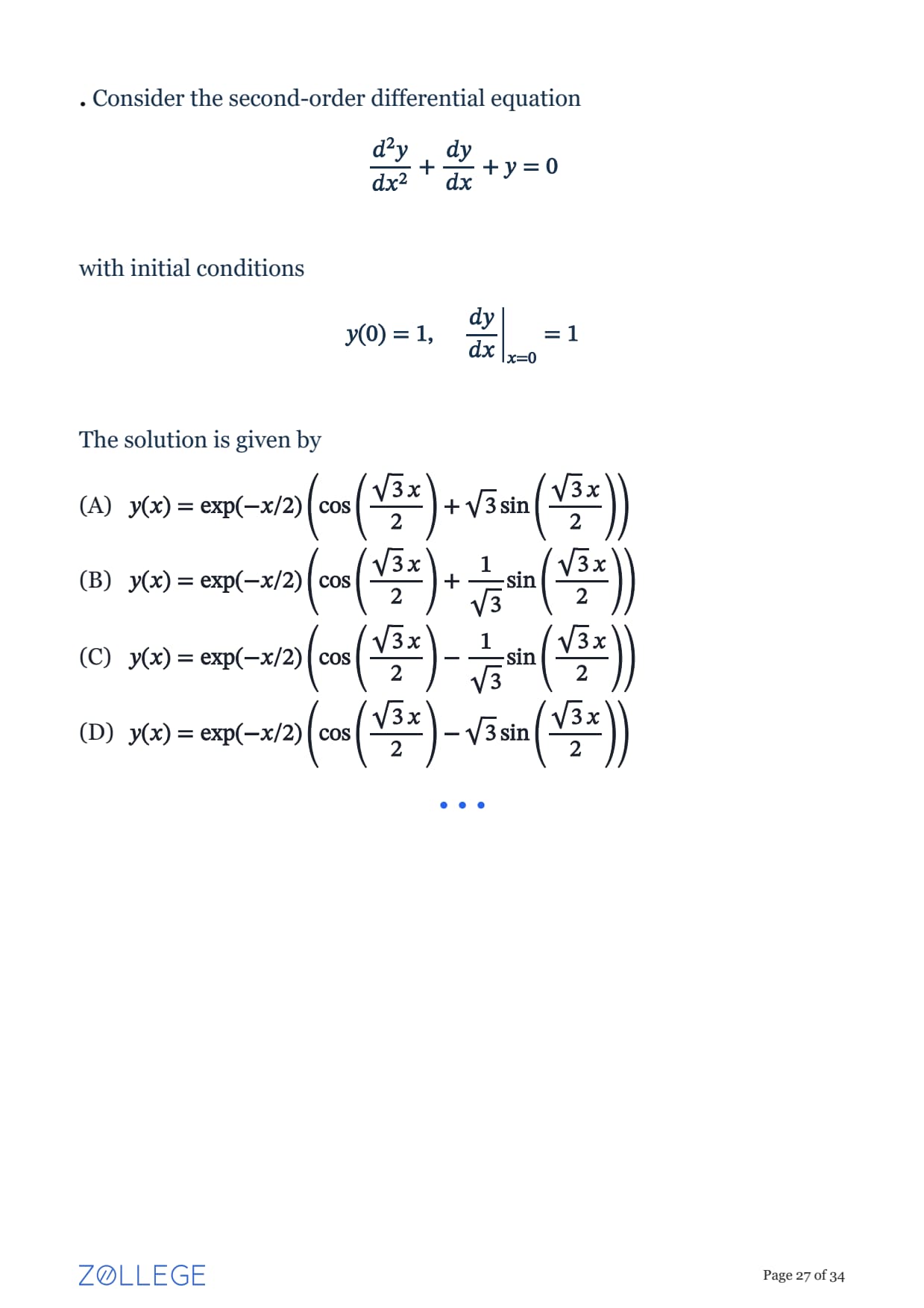
Consider the boost converter circuit shown. Assume that the semiconductor devices are ideal. In steady state, the inductor current rises linearly from \(0\) A to \(6\) A in the first \(10\ \mu\)s and then falls linearly from \(6\) A to \(0\) A in the next \(10\ \mu\)s of every switching cycle as shown. The load resistance \(R\) is \(10\ \Omega\) and the capacitance \(C\) is \(500\ \mu\)F.
Neglect the ripple in the output voltage. What is the input voltage \(V_{dc}\)?
Which one of the following statements is ALWAYS correct about a collection of \(p\) column vectors, each having \(n\) real-valued entries?
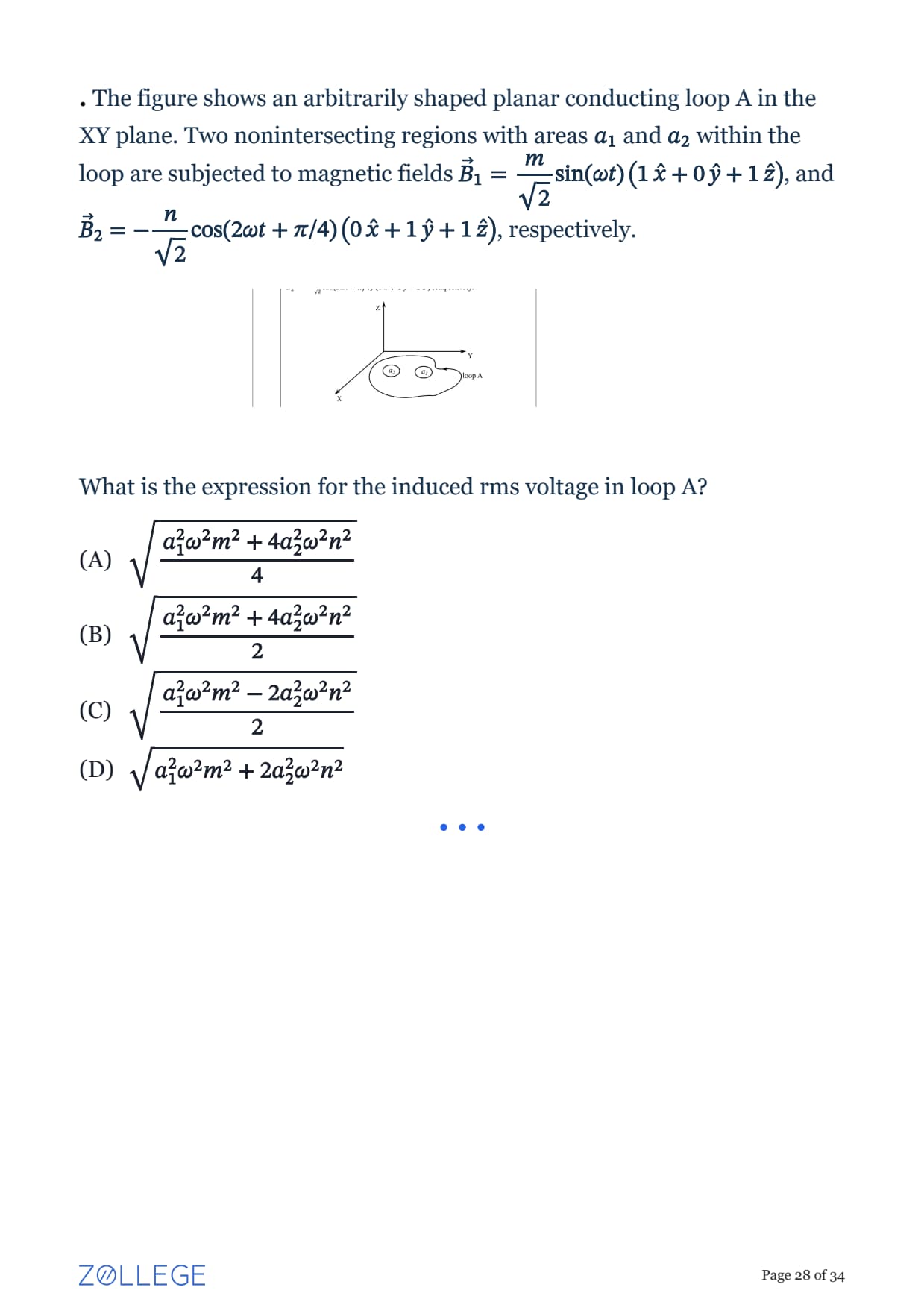
Consider the second-order differential equation
\[ \frac{d^2y}{dx^2}+\frac{dy}{dx}+y=0 \]
with initial conditions
\[ y(0)=1,\quad \left.\frac{dy}{dx}\right|_{x=0}=1 \]
The solution is given by
The figure shows an arbitrarily shaped planar conducting loop A in the XY plane. Two nonintersecting regions with areas \(a_1\) and \(a_2\) within the loop are subjected to magnetic fields \(\vec{B}_1=\dfrac{m}{\sqrt2}\sin(\omega t)\left(1\,\hat{x}+0\,\hat{y}+1\,\hat{z}\right)\), and \(\vec{B}_2=-\dfrac{n}{\sqrt2}\cos(2\omega t+\pi/4)\left(0\,\hat{x}+1\,\hat{y}+1\,\hat{z}\right)\), respectively.
What is the expression for the induced rms voltage in loop A?
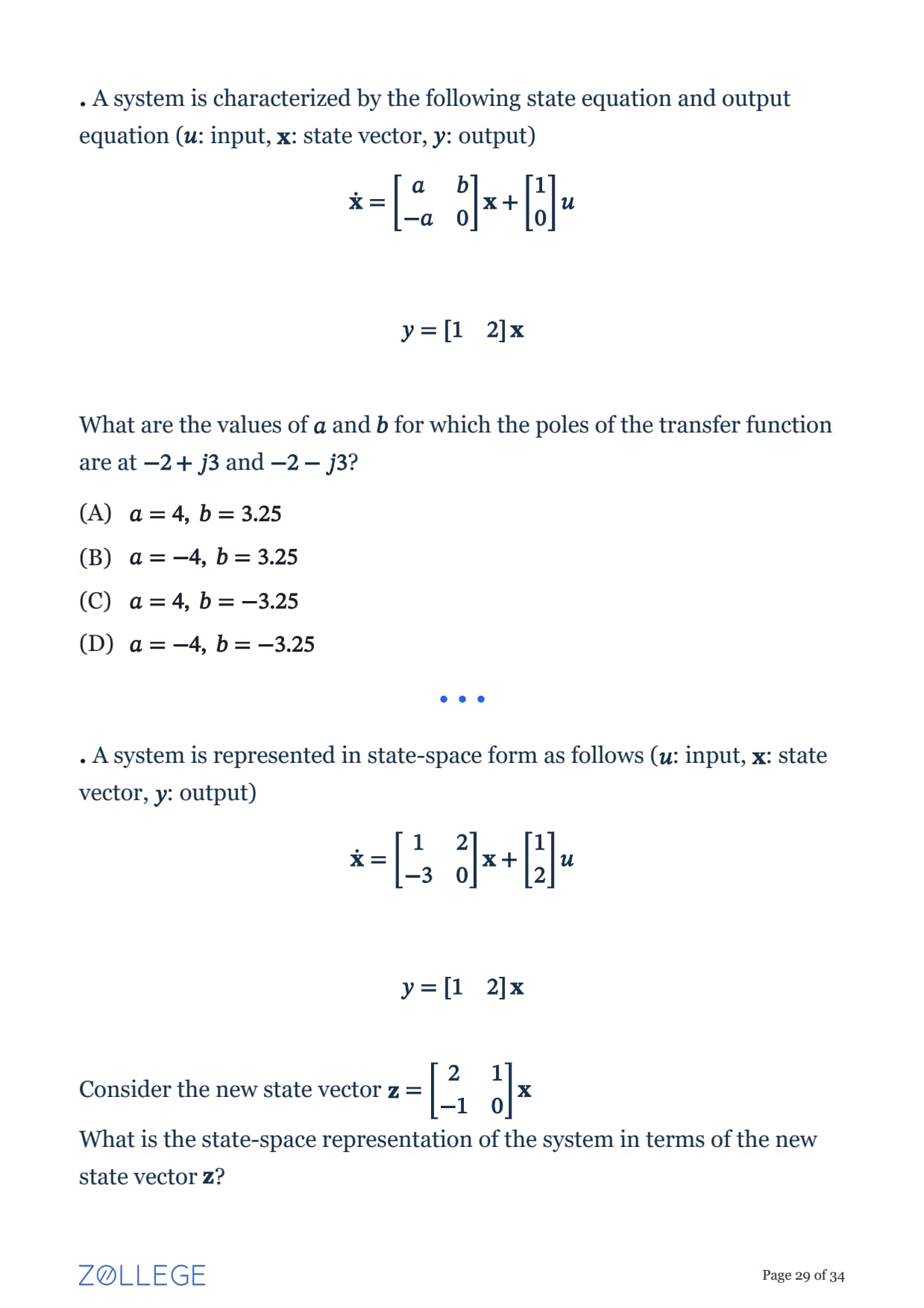
A system is characterized by the following state equation and output equation (\(u\): input, \(\mathbf{x}\): state vector, \(y\): output)
\[ \dot{\mathbf{x}}=\begin{bmatrix}a&b\\-a&0\end{bmatrix}\mathbf{x}+\begin{bmatrix}1\\0\end{bmatrix}u \]
\[ y=\begin{bmatrix}1&2\end{bmatrix}\mathbf{x} \]
What are the values of \(a\) and \(b\) for which the poles of the transfer function are at \(-2+j3\) and \(-2-j3\)?
A system is represented in state-space form as follows (\(u\): input, \(\mathbf{x}\): state vector, \(y\): output)
\[ \dot{\mathbf{x}}=\begin{bmatrix}1&2\\-3&0\end{bmatrix}\mathbf{x}+\begin{bmatrix}1\\2\end{bmatrix}u \]
\[ y=\begin{bmatrix}1&2\end{bmatrix}\mathbf{x} \]
Consider the new state vector \(\mathbf{z}=\begin{bmatrix}2&1\\-1&0\end{bmatrix}\mathbf{x}\)
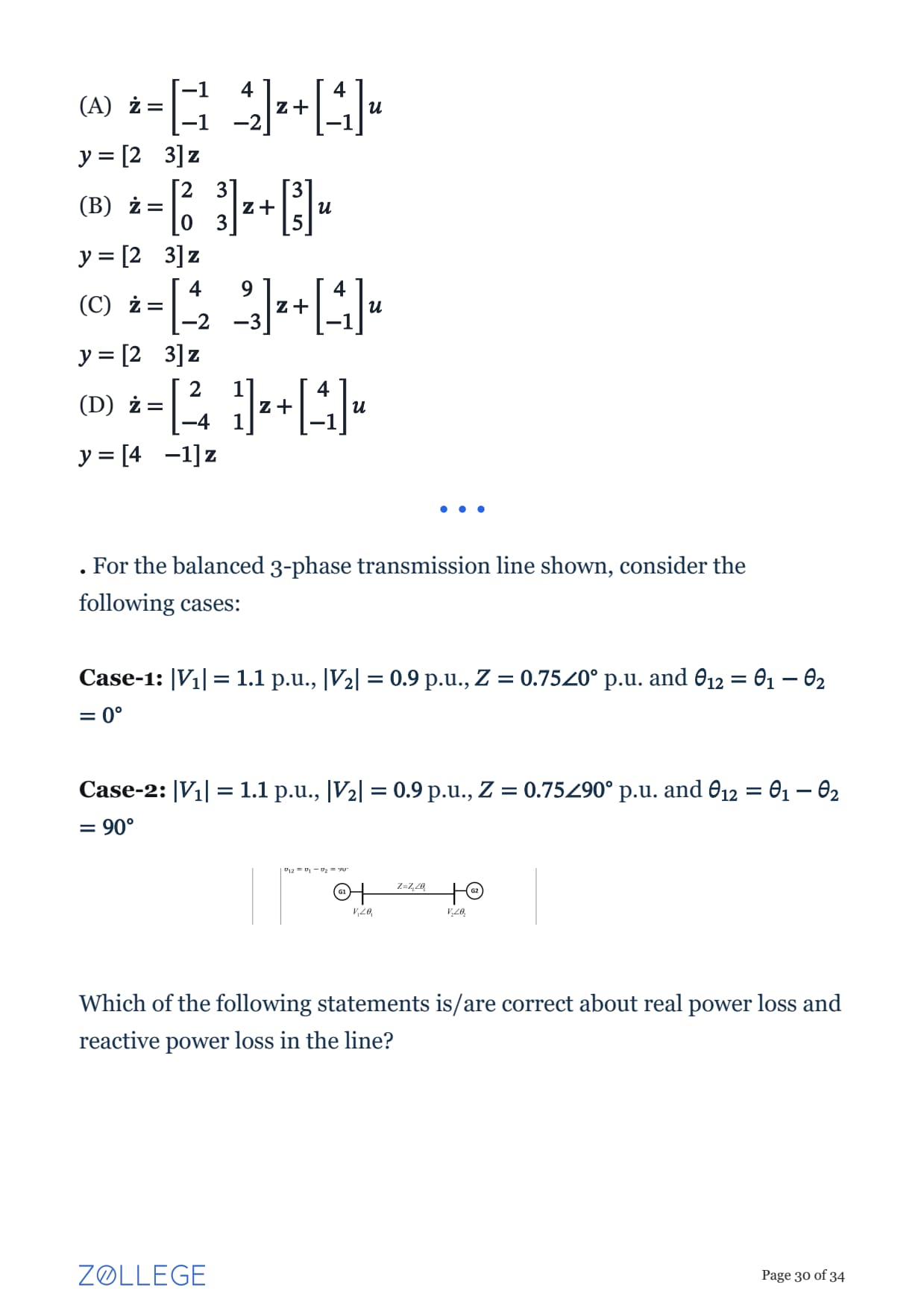
What is the state-space representation of the system in terms of the new state vector \(\mathbf{z}\)?
For the balanced 3-phase transmission line shown, consider the following cases:
Case-1: \(|V_1|=1.1\) p.u., \(|V_2|=0.9\) p.u., \(Z=0.75\angle0^{\circ}\) p.u. and \(\theta_{12}=\theta_1-\theta_2=0^{\circ}\)
Case-2: \(|V_1|=1.1\) p.u., \(|V_2|=0.9\) p.u., \(Z=0.75\angle90^{\circ}\) p.u. and \(\theta_{12}=\theta_1-\theta_2=90^{\circ}\)
Which of the following statements is/are correct about real power loss and reactive power loss in the line?
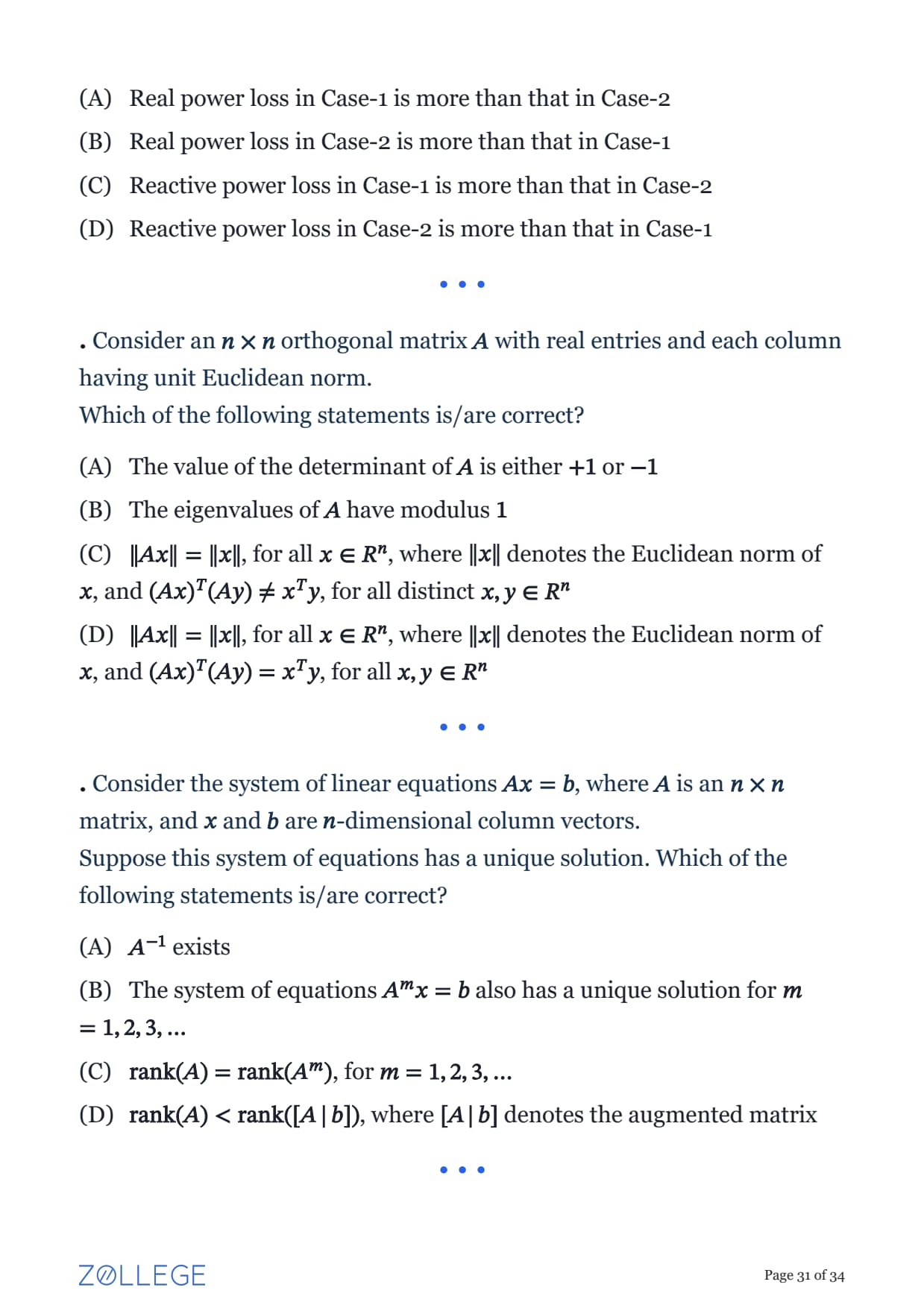
Consider an \(n\times n\) orthogonal matrix \(A\) with real entries and each column having unit Euclidean norm.
Which of the following statements is/are correct?
Consider the system of linear equations \(Ax=b\), where \(A\) is an \(n\times n\) matrix, and \(x\) and \(b\) are \(n\)-dimensional column vectors.
Suppose this system of equations has a unique solution. Which of the following statements is/are correct?
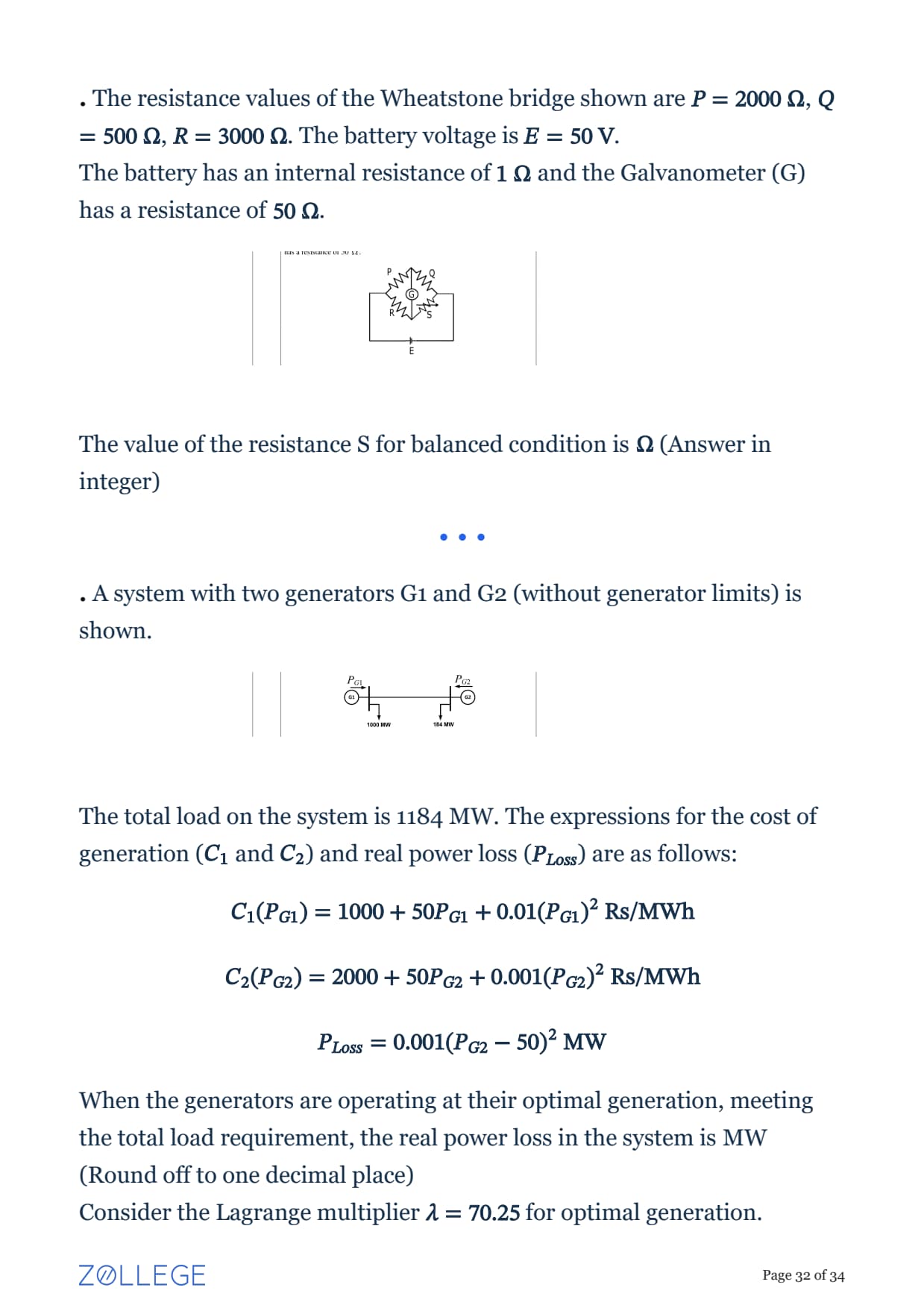
The resistance values of the Wheatstone bridge shown are \(P=2000\ \Omega\), \(Q=500\ \Omega\), \(R=3000\ \Omega\). The battery voltage is \(E=50\ \text{V}\).
The battery has an internal resistance of \(1\ \Omega\) and the Galvanometer (G) has a resistance of \(50\ \Omega\).

The value of the resistance S for balanced condition is \(\Omega\) (Answer in integer)
A system with two generators G1 and G2 (without generator limits) is shown.

The total load on the system is 1184 MW. The expressions for the cost of generation (\(C_1\) and \(C_2\)) and real power loss (\(P_{Loss}\)) are as follows:
\[
C_1(P_{G1})=1000+50P_{G1}+0.01(P_{G1})^2\ \text{Rs/MWh}
\]
\[
C_2(P_{G2})=2000+50P_{G2}+0.001(P_{G2})^2\ \text{Rs/MWh}
\]
\[
P_{Loss}=0.001(P_{G2}-50)^2\ \text{MW}
\]
When the generators are operating at their optimal generation, meeting the total load requirement, the real power loss in the system is MW (Round off to one decimal place)
Consider the Lagrange multiplier \(\lambda=70.25\) for optimal generation.
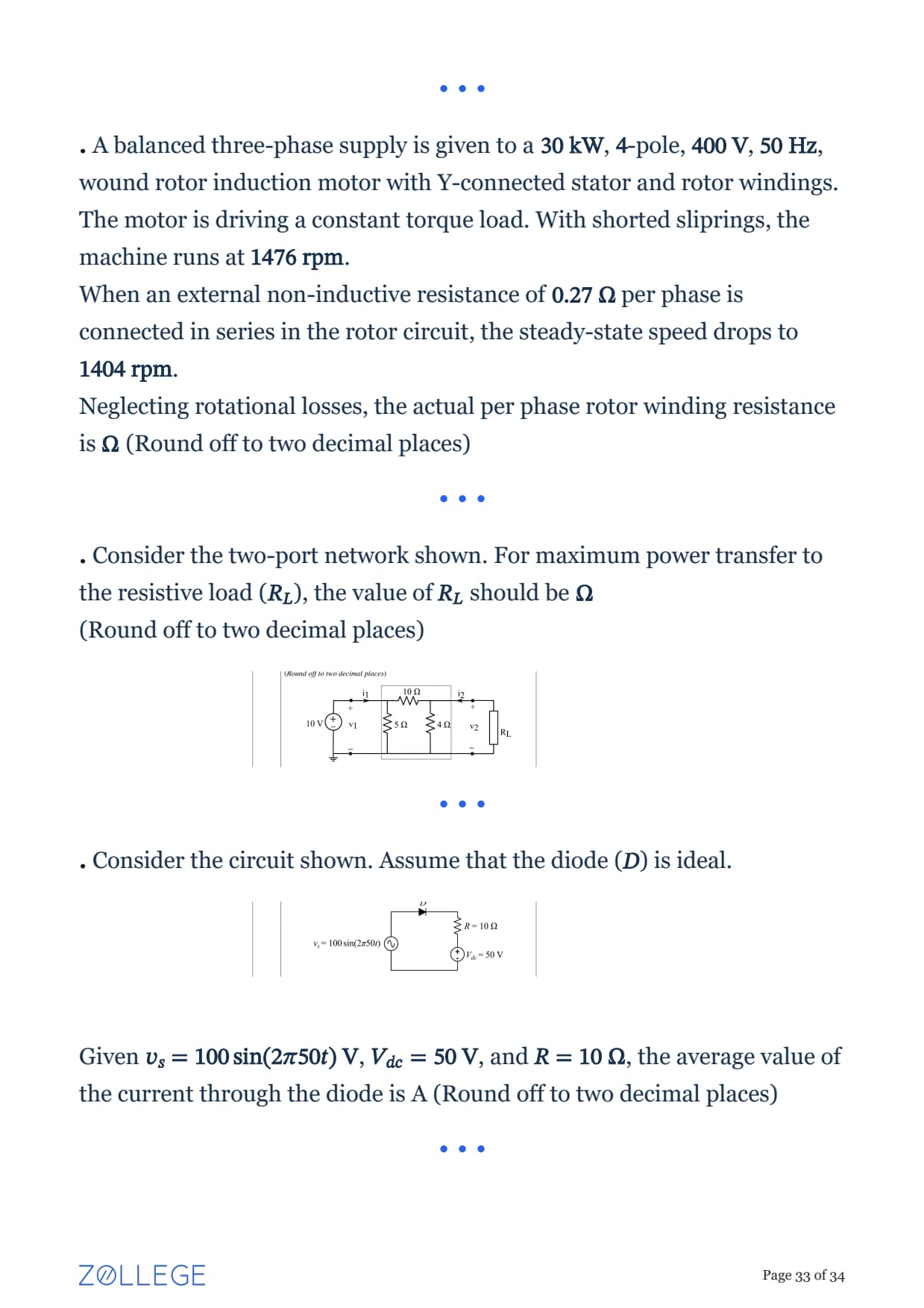
A balanced three-phase supply is given to a \(30\ \text{kW}\), \(4\)-pole, \(400\ \text{V}\), \(50\ \text{Hz}\), wound rotor induction motor with Y-connected stator and rotor windings. The motor is driving a constant torque load. With shorted sliprings, the machine runs at \(1476\ \text{rpm}\).
When an external non-inductive resistance of \(0.27\ \Omega\) per phase is connected in series in the rotor circuit, the steady-state speed drops to \(1404\ \text{rpm}\).
Neglecting rotational losses, the actual per phase rotor winding resistance is \(\Omega\) (Round off to two decimal places)
Consider the two-port network shown. For maximum power transfer to the resistive load (\(R_L\)), the value of \(R_L\) should be \(\Omega\)
(Round off to two decimal places)

Consider the circuit shown. Assume that the diode (\(D\)) is ideal.

Given \(v_s=100\sin(2\pi50t)\ \text{V}\), \(V_{dc}=50\ \text{V}\), and \(R=10\ \Omega\), the average value of the current through the diode is A (Round off to two decimal places)
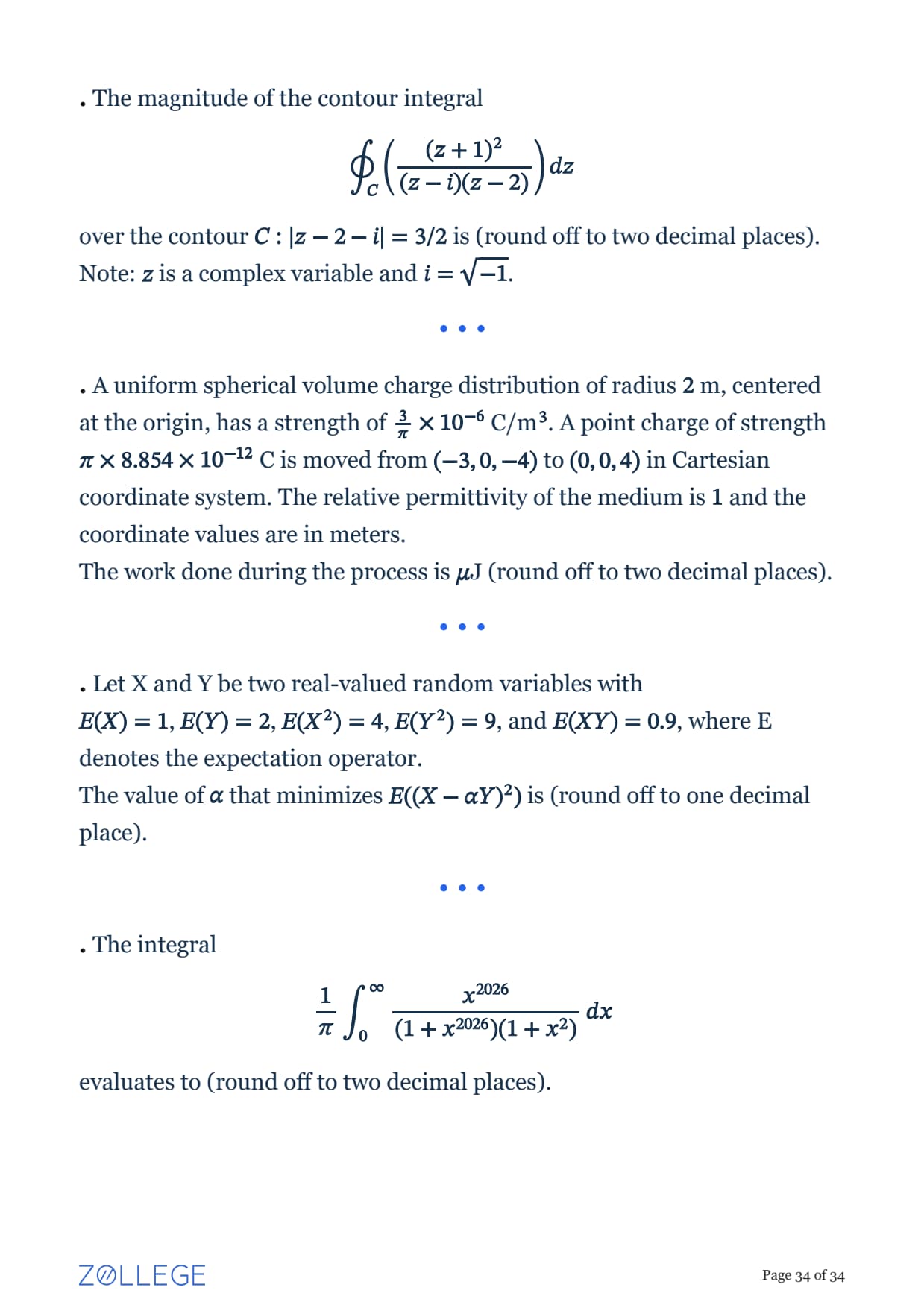
The magnitude of the contour integral
\[
\oint_C \left(\frac{(z+1)^2}{(z-i)(z-2)}\right) dz
\]
over the contour \(C: |z-2-i| = 3/2\) is (round off to two decimal places).
Note: \(z\) is a complex variable and \(i=\sqrt{-1}\).
A uniform spherical volume charge distribution of radius \(2\) m, centered at the origin, has a strength of \(\frac{3}{\pi}\times10^{-6}\) C/m\(^3\). A point charge of strength \(\pi\times8.854\times10^{-12}\) C is moved from \((-3,0,-4)\) to \((0,0,4)\) in Cartesian coordinate system. The relative permittivity of the medium is \(1\) and the coordinate values are in meters.
The work done during the process is \(\mu\)J (round off to two decimal places).
Let X and Y be two real-valued random variables with
\(E(X)=1\), \(E(Y)=2\), \(E(X^2)=4\), \(E(Y^2)=9\), and \(E(XY)=0.9\), where E denotes the expectation operator.
The value of \(\alpha\) that minimizes \(E((X-\alpha Y)^2)\) is (round off to one decimal place).
The integral
\[
\frac{1}{\pi}\int_0^{\infty}\frac{x^{2026}}{(1+x^{2026})(1+x^2)}\,dx
\]
evaluates to (round off to two decimal places).
GATE 2026 EE Exam Pattern and Marking Scheme Explained
As per the information bulletin on the official site (gate2026.iitg.ac.in), GATE EE is a computer-based test mixing three question formats across General Aptitude and the core subject.
- Total questions: 65 (10 General Aptitude + 55 core Electrical Engineering)
- Duration: 3 hours
- Total marks: 100
- Question mix: around 35-40 MCQs, 12-15 MSQs (Multiple Select), and 10-15 NAT (numerical answer type) questions
- Marking scheme: 1 or 2 marks per question, negative marking only on MCQs (-1/3 for 1-mark, -2/3 for 2-mark questions), no negative marking on MSQ or NAT
High-Weightage Subjects in GATE 2026 EE to Focus On First
Engineering Mathematics and Electrical Machines carried the most marks in the GATE EE syllabus, and this paper's questions matched that split closely.
- Engineering Mathematics: around 13% weightage - linear algebra, differential equations, complex variables, and probability all showed up in this paper
- Electrical Machines: around 12% weightage - transformers, induction motors, and synchronous machines, including a double-squirrel-cage rotor question
- Power Electronics: around 11% weightage - rectifiers, choppers, inverters, and MOSFET/thyristor switching questions
- Power Systems and Control Systems: 8% weightage each - load flow, symmetrical components, transmission line loss, and Bode plot/state-space questions
- Electric Circuits and Electromagnetic Fields: 7% weightage each - Thevenin/Norton equivalents, two-port networks, and field theory
GATE 2026 EE Question Paper Analysis Video
Source: GeeksforGeeks - EC, EE & IN
How to Use the GATE EE Question Paper for Practice
Treat this as a timed mock before you check a single solution - GATE EE rewards speed on the numerical-heavy machines and power systems questions.
- Attempt all 65 questions in one 3-hour sitting first, exactly like exam day
- Mark every question you were unsure of before checking the solution PDF
- Redo the Electrical Machines and Power Electronics questions separately, since they carried the most marks
- Recheck every MSQ you attempted - a single wrong option selected loses the mark with no partial credit
GATE EE 2026 Good Attempts Benchmark
- 20+ correct attempts out of 65 was the good-attempt range student reviews pointed to for this paper
- The paper leaned conceptual overall, but a few numerical questions (state-space transformation, economic load dispatch) took longer than their 2-mark weight suggested
- Use 20-25 as your target when you time yourself against this paper
GATE 2026 EE Question Paper FAQs
Ques. Was GATE 2026 EE tougher than previous years?
Ans. Student reviews rated the GATE EE 2026 paper as moderate overall, with mostly conceptual questions and only a handful of long numerical ones in Electrical Machines and Power Systems.
Ques. How many questions should I attempt for a good score in GATE EE 2026?
Ans. Reviews after the exam pointed to 20+ correct attempts out of 65 as the good-attempt zone, given the conceptual difficulty and the number of numerical-heavy machines and power systems questions.
Ques. Which topics had the highest weightage in GATE EE 2026?
Ans. Electrical Machines, Power Systems, Power Electronics, Linear Algebra, and Analog/Digital Electronics carried the bulk of the core-subject questions, matching Engineering Mathematics (13%) and Electrical Machines (12%) as the highest-weightage areas in the syllabus.
Ques. Are GATE EE questions repeated from previous years?
Ans. The exact numbers change every year, but the same question types recur - autotransformer rating, double-squirrel-cage motors, Thevenin/Norton equivalents, and Newton-Raphson load flow all showed up again in the 2026 paper in a new form.
Ques. Is a calculator allowed in the GATE EE exam?
Ans. Yes, GATE 2026 provided a virtual scientific calculator on-screen during the computer-based test - you cannot bring a physical calculator into the exam hall.
Ques. Where can I download the GATE 2026 EE question paper with solutions PDF for free?
Ans. Use the download table above on Collegedunia for the question paper with solutions PDF. The official question paper and answer key are released on gate2026.iitg.ac.in, the IIT Guwahati GATE 2026 site.
*The article might have information for the previous academic years, please refer the official website of the exam.